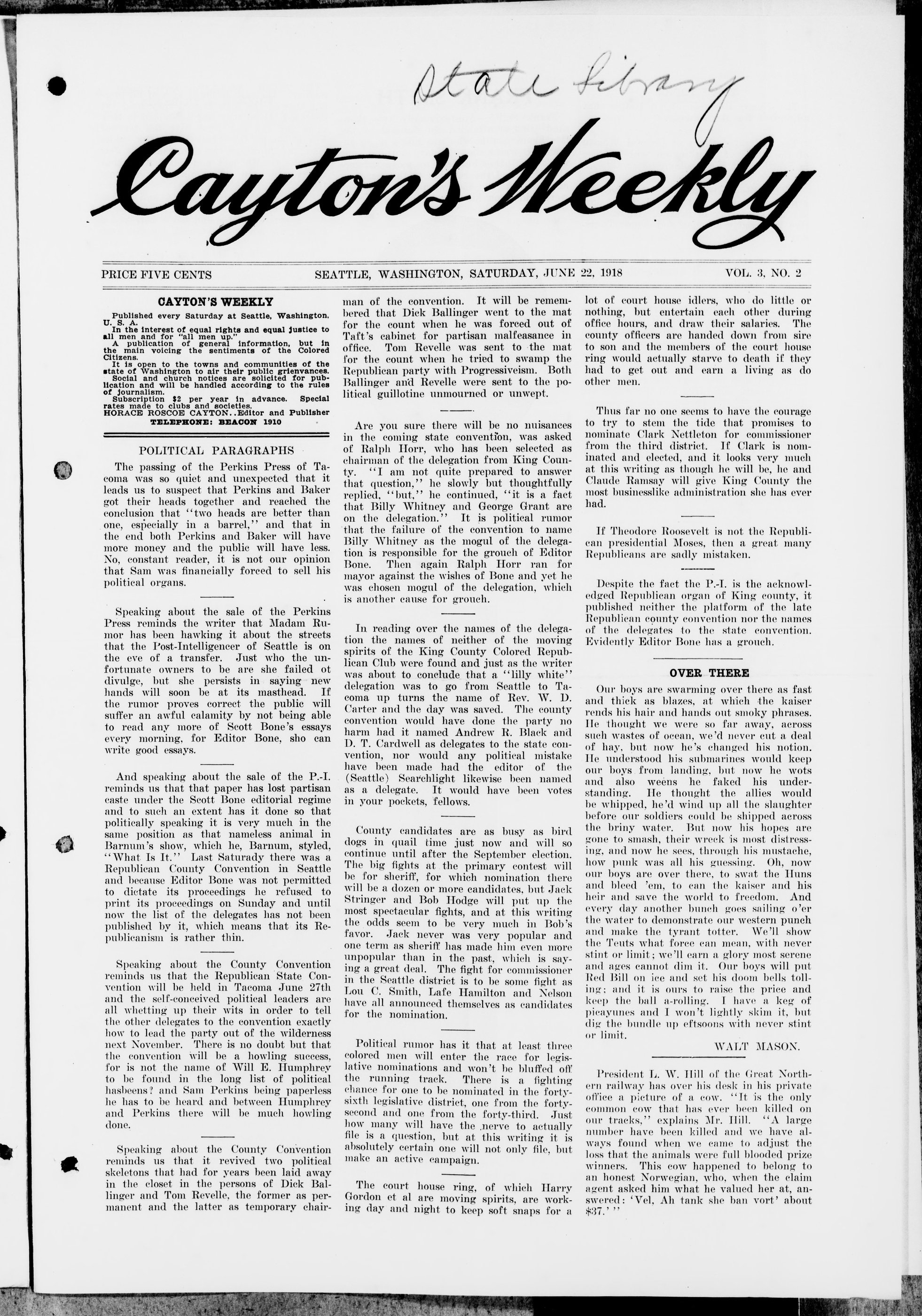
Cayton's Weekly
Saturday, June 22, 1918
Seattle, Washington
Page text (machine-generated)
State library Cayton's Weekly
---
PRICE FIVE CENTS
CAYTON'S WEEKLY
Published every Saturday at Seattle, Washington, U. S. A. In the interest of equal rights and equal justice to all men and for "all men up." A publication of general information, but in the main voicing the sentiments of the Colored Citizens. It is open to the towns and communities of the state of Washington to air their public grievances. Social and church notices are solicited for publication and will be handled according to the rules of journalism.
Subscription $2 per year in advance. Special rates made to clubs and societies. HORACE ROSCOE CAYTON..Editor and Publisher TELEPHONE: BEACON 1910
POLITICAL PARAGRAPHS
The passing of the Perkins Press of Tacoma was so quiet and unexpected that it leads us to suspect that Perkins and Baker got their heads together and reached the conclusion that "two heads are better than one, especially in a barrel," and that in the end both Perkins and Baker will have more money and the public will have less. No, constant reader, it is not our opinion that Sam was financially forced to sell his political organs.
Speaking about the sale of the Perkins Press reminds the writer that Madam Rumor has been hawking it about the streets that the Post-Intelligencer of Seattle is on the eve of a transfer. Just who the unfortunate owners to be are she failed of divulge, but she persists in saying new hands will soon be at its masthead. If the rumor proves correct the public will suffer an awful calamity by not being able to read any more of Scott Bone's essays every morning, for Editor Bone, sho can write good essays.
And speaking about the sale of the P.-I. reminds us that that paper has lost partisan caste under the Scott Bone editorial regime and to such an extent has it done so that politically speaking it is very much in the same position as that nameless animal in Barnum's show, which he, Barnum, styled, "What Is It." Last Saturady there was a Republican County Convention in Seattle and because Editor Bone was not permitted to dictate its proceedings he refused to print its proceedings on Sunday and until now the list of the delegates has not been published by it, which means that its Republicanism is rather thin.
Speaking about the County Convention reminds us that the Republican State Convention will be held in Tacoma June 27th and the self-conceived political leaders are all whetting up their wits in order to tell the other delegates to the convention exactly how to lead the party out of the wilderness next November. There is no doubt but that the convention will be a howling success, for is not the name of Will E. Humphrey to be found in the long list of political hasbeens? and Sam Perkins being paperless he has to be heard and between Humphrey and Perkins there will be much howling done.
Speaking about the County Convention reminds us that it revived two political skeletons that had for years been laid away in the closet in the persons of Dick Ballinger and Tom Revelle, the former as permanent and the latter as temporary chair-
---
SEATTLE, WASHINGTON, SATURDAY, JUNE 22, 1918
man of the convention. It will be remembered that Dick Ballinger went to the mat for the count when he was forced out of Taft's cabinet for partisan malfeasance in office. Tom Revelle was sent to the mat for the count when he tried to swamp the Republican party with Progressiveism. Both Ballinger and Revelle were sent to the political guillotine unmourned or unwept.
Are you sure there will be no nuisances in the coming state convention, was asked of Ralph Horr, who has been selected as chairman of the delegation from King County. "I am not quite prepared to answer that question," he slowly but thoughtfully replied, "but," he continued, "it is a fact that Billy Whitney and George Grant are on the delegation." It is political rumor that the failure of the convention to name Billy Whitney as the mogul of the delegation is responsible for the grouch of Editor Bone. Then again Ralph Horr ran for mayor against the wishes of Bone and yet he was chosen mogul of the delegation, which is another cause for grouch.
In reading over the names of the delegation the names of neither of the moving spirits of the King County Colored Republican Club were found and just as the writer was about to conclude that a "lilly white" delegation was to go from Seattle to Tacoma up turns the name of Rev. W. D. Carter and the day was saved. The county convention would have done the party no harm had it named Andrew R. Black and D. T. Cardwell as delegates to the state convention, nor would any political mistake have been made had the editor of the (Seattle) Searchlight likewise been named as a delegate. It would have been votes in your pockets, fellows.
County candidates are as busy as bird dogs in quail time just now and will so continue until after the September election. The big fights at the primary contest will be for sheriff, for which nomination there will be a dozen or more candidates, but Jack Stringer and Bob Hodge will put up the most spectacular fights, and at this writing the odds seem to be very much in Bob's favor. Jack never was very popular and one term as sheriff has made him even more unpopular than in the past, which is saying a great deal. The fight for commissioner in the Seattle district is to be some fight as Lou C. Smith, Lafe Hamilton and Nelson have all announced themselves as candidates for the nomination.
Political rumor has it that at least three colored men will enter the race for legislative nominations and won't be bluffed off the running track. There is a fighting chance for one to be nominated in the forty-sixth legislative district, one from the forty-second and one from the forty-third. Just how many will have the nerve to actually file is a question, but at this writing it is absolutely certain one will not only file, but make an active campaign.
The court house ring, of which Harry Gordon et al are moving spirits, are working day and night to keep soft snaps for a
VOL. 3. NO. 2
lot of court house idlers, who do little or nothing, but entertain each other during office hours, and draw their salaries. The county officers are handed down from sire to son and the members of the court house ring would actually starve to death if they had to get out and earn a living as do other men.
Thus far no one seems to have the courage to try to stem the tide that promises to nominate Clark Nettleton for commissioner from the third district. If Clark is nominated and elected, and it looks very much at this writing as though he will be, he and Claude Ramsay will give King County the most businesslike administration she has ever had.
If Theodore Roosevelt is not the Republican presidential Moses, then a great many Republicans are sadly mistaken.
Despite the fact the P.-I. is the acknowledged Republican organ of King county, it published neither the platform of the late Republican county convention nor the names of the delegates to the state convention. Evidently Editor Bone has a grouch.
OVER THERE
Our boys are swarming over there as fast and thick as blazes, at which the kaiser rends his hair and hands out smoky phrases. He thought we were so far away, across such wastes of ocean, we'd never cut a deal of hay, but now he's changed his notion. He understood his submarines would keep our boys from landing, but now he wots and also weens he faked his understanding. He thought the allies would be whipped, he'd wind up all the slaughter before our soldiers could be shipped across the briny water. But now his hopes are gone to smash, their wreck is most distressing, and now he sees, through his mustache, how punk was all his guessing. Oh, now our boys are over there, to swat the Huns and bleed 'em, to can the kaiser and his heir and save the world to freedom. And every day another bunch goes sailing o'er the water to demonstrate our western punch and make the tyrant totter. We'll show the Teuts what force can mean, with never stint or limit; we'll earn a glory most serene and ages cannot dim it. Our boys will put Red Bill on ice and set his doom bells tolling; and it is ours to raise the price and keep the ball a-rolling. I have a keg of picayunes and I won't lightly skim it, but dig the bundle up eftsoons with never stint or limit.
WALT MASON
President L. W. Hill of the Great Northern railway has over his desk in his private office a picture of a cow. "It is the only common cow that has ever been killed on our tracks," explains Mr. Hill. "A large number have been killed and we have always found when we came to adjust the loss that the animals were full blooded prize winners. This cow happened to belong to an honest Norwegian, who, when the claim agent asked him what he valued her at, answered: 'Vel, Ah tank she ban vort' about $37.'"
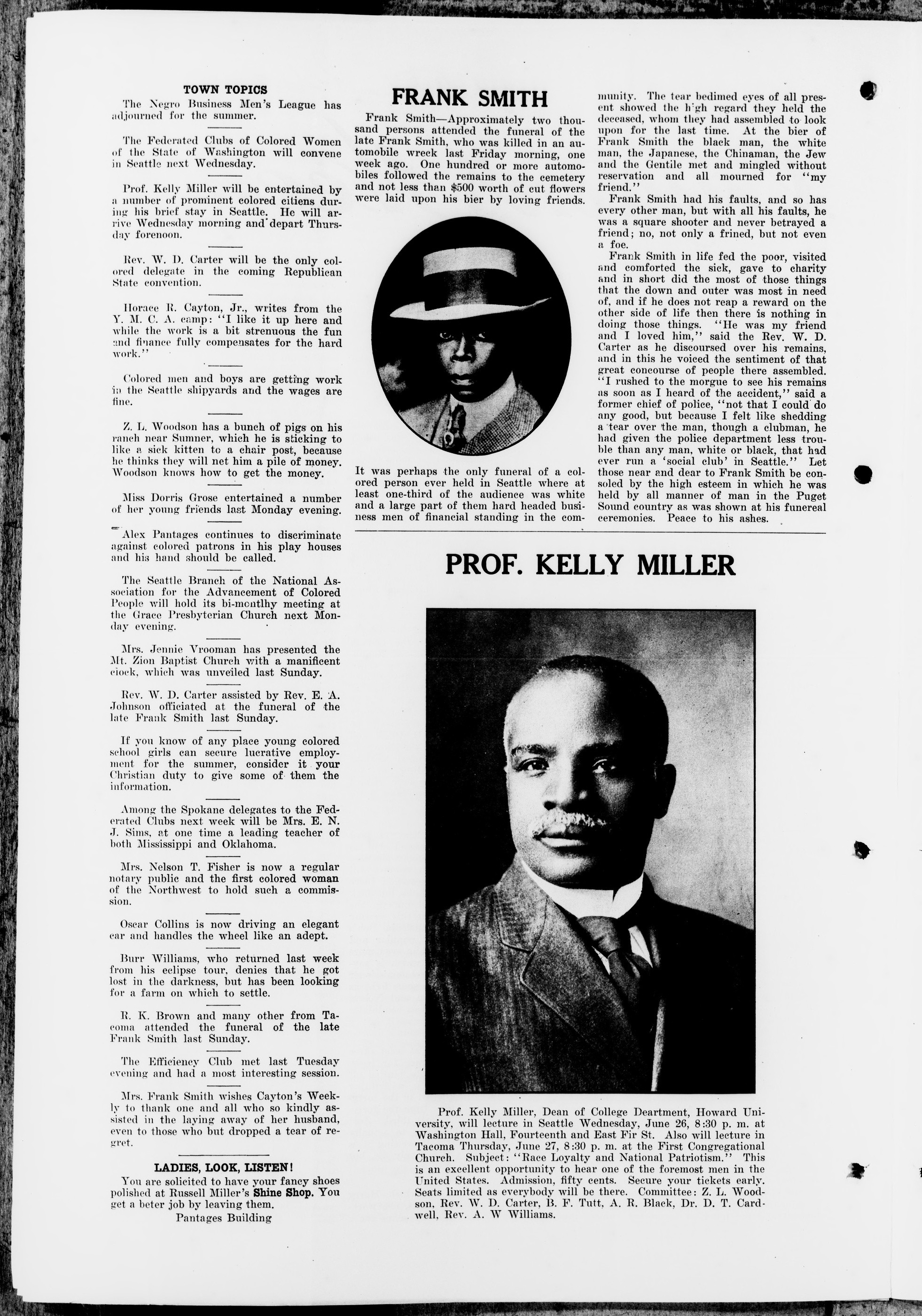
PROF. KELLY MILLER
Prof. Kelly Miller, Dean of College Department, Howard University, will lecture in Seattle Wednesday, June 26, 8:30 p. m. at Washington Hall, Fourteenth and East Fir St. Also will lecture in Tacoma Thursday, June 27, 8:30 p. m. at the First Congregational Church. Subject: "Race Loyalty and National Patriotism." This is an excellent opportunity to hear one of the foremost men in the United States. Admission, fifty cents. Secure your tickets early. Seats limited as everybody will be there. Committee: Z. L. Woodson, Rev. W. D. Carter, B. F. Tutt, A. R. Black, Dr. D. T. Cardwell, Rev. A. W Williams.
P
TOWN TOPICS
The Negro Business Men's League has adjourned for the summer.
The Federated Clubs of Colored Women of the State of Washington will convene in Seattle next Wednesday.
Prof. Kelly Miller will be entertained by a number of prominent colored citizens during his brief stay in Seattle. He will arrive Wednesday morning and depart Thursday forenoon.
Rev. W. D. Carter will be the only colored delegate in the coming Republican State convention.
Horace R. Cayton, Jr., writes from the Y. M. C. A. camp: "I like it up here and while the work is a bit strenuous the fun and finance fully compensates for the hard work."
Colored men and boys are getting work in the Seattle shipyards and the wages are fine.
Z. L. Woodson has a bunch of pigs on his ranch near Sumner, which he is sticking to like a sick kitten to a chair post, because he thinks they will net him a pile of money. Woodson knows how to get the money.
Miss Dorris Grose entertained a number of her young friends last Monday evening.
Alex Pantages continues to discriminate against colored patrons in his play houses and his hand should be called.
The Seattle Branch of the National Association for the Advancement of Colored People will hold its bi-monthly meeting at the Grace Presbyterian Church next Monday evening.
Mrs. Jennie Vrooman has presented the Mt. Zion Baptist Church with a manificent clock, which was unveiled last Sunday.
Rev. W. D. Carter assisted by Rev. E. A. Johnson officiated at the funeral of the late Frank Smith last Sunday.
If you know of any place young colored school girls can secure lucrative employment for the summer, consider it your Christian duty to give some of them the information.
Among the Spokane delegates to the Federated Clubs next week will be Mrs. E. N. J. Sims, at one time a leading teacher of both Mississippi and Oklahoma.
Mrs. Nelson T. Fisher is now a regular notary public and the first colored woman of the Northwest to hold such a commission.
Oscar Collins is now driving an elegant car and handles the wheel like an adept.
Burr Williams, who returned last week from his eclipse tour, denies that he got lost in the darkness, but has been looking for a farm on which to settle.
R. K. Brown and many other from Tacoma attended the funeral of the late Frank Smith last Sunday.
The Efficiency Club met last Tuesday evening and had a most interesting session.
Mrs. Frank Smith wishes Cayton's Weekly to thank one and all who so kindly assisted in the laying away of her husband, even to those who but dropped a tear of regret.
LADIES, LOOK, LISTEN!
You are solicited to have your fancy shoes polished at Russell Miller's Shine Shop. You get a better job by leaving them.
Pantages Building
FRANK SMITH
Frank Smith—Approximately two thousand persons attended the funeral of the late Frank Smith, who was killed in an automobile wreck last Friday morning, one week ago. One hundred or more automobiles followed the remains to the cemetery and not less than $500 worth of cut flowers were laid upon his bier by loving friends.
[Image of a black man wearing a wide-brimmed hat and a suit with a tie. The background is plain black.]
It was perhaps the only funeral of a colored person ever held in Seattle where at least one-third of the audience was white and a large part of them hard headed business men of financial standing in the com-
munity. The tear bedimed eyes of all present showed the high regard they held the deceased, whom they had assembled to look upon for the last time. At the bier of Frank Smith the black man, the white man, the Japanese, the Chinaman, the Jew and the Gentile met and mingled without reservation and all mourned for "my friend." Frank Smith had his faults, and so has every other man, but with all his faults, he was a square shooter and never betrayed a friend; no, not only a frined, but not even a foe.
Frank Smith in life fed the poor, visited and comforted the sick, gave to charity and in short did the most of those things that the down and outer was most in need of, and if he does not reap a reward on the other side of life then there is nothing in doing those things. "He was my friend and I loved him," said the Rev. W. D. Carter as he discoursed over his remains, and in this he voiced the sentiment of that great concourse of people there assembled. "I rushed to the morgue to see his remains as soon as I heard of the accident," said a former chief of police, "not that I could do any good, but because I felt like shedding a tear over the man, though a clubman, he had given the police department less trouble than any man, white or black, that had ever run a 'social club' in Seattle." Let those near and dear to Frank Smith be consoled by the high esteem in which he was held by all manner of man in the Puget Sound country as was shown at his funereal ceremonies. Peace to his ashes.
---
A CONCRETE VILLAGE BUILT OF SLABS BY A DERRICK
The house cast solidly of concrete in one piece, poured into a mold like cast metal, has not materialized commercially. But concrete houses cast in pieces and then assembled are apparently both practical and inexpensive. This method of building in "units" has been employed for some time to erect large industrial structures, but it is now being used, it is asserted, for the first time in a group of dwellings in Youngstown, Ohio. We quote from a descriptive article in The Engineering News-Record (New York), according to which the expense of moving and handling the slabs is more than offset by reduction in the cost of forms and the possibility of operating the concrete-plant continuously. Says the writer:
"Precast slabs, poured in a yard and erected by a traveler, are being used for the first time in this country to construct dwelling houses. The so-called unit method of concrete construction . . . is being successfully applied to the construction of 146 dwellings for the first section of a community center . . . east of Youngstown, Ohio. This settlement marks one of the first attempts to provide living quarters of a permanent and inexpensive type which will be comfortable, sanitary, and practically fire-proof. The success of the experiment is made possible by the almost indestructible character of the buildings, and by the low cost which could be secured through erecting a large number of houses at one operation.
"The method of construction allows the concrete-plant to operate continuously, regardless of the progress of the other work, and greatly reduces the cost of forms. These advantages, according to the contractor, much more than offset the added cost of rehandling and erecting the slabs after they are cast, which is the only item that would not be required if the houses were poured in place. The use of concrete-casting platforms, granulated slag-cores for forming hollow wall-slabs, and of a traveling erection derrick, mounted on towers, characterizes the work.
"The dividing walls between houses are hollow, while all other slabs cast are ribbed. The exterior slabs are set with the smooth face out and the ribs, with wood inserts, form studs to which a lath-and-plaster wall is secured on the inside. The ceilings of the basement and the first floor are beamed, the smooth side of the slab being turned up. With the ceilings of the second floor, however, the ribbed sides of the slabs are turned up, leaving a smoother ceiling below. The window and door openings are cast in the wall-slabs, but the window-sills are cast separately. After the sills are placed, wooden door and window frames are fitted.
"The roof design is of timber framing with one-inch plank sheathing, on which a red tile roof is nailed. The gable ends are made with triangular concrete slabs. These red gable roofs on the white buildings are expected to give a very pleasing architectural effect.
"A casting yard through which runs a trestle track from which the slabs can be cast by chuting from a side gate car is laid out at the top of the hill, where it will not interfere with any of the houses now being built. Parallel to the trestle and located on the up-hill side is a standard guage track for the locomotive crane which stacks and handles the slabs. Up hill from this, on the side toward the street by which materials are received and near the middle of the yard, is located the concrete plant. This consists of a two-bag batch mixer supplied with material by a car on a narrow-guage track which runs beneath bins into which motor trucks dump the sand and crushed slag through gratings.
"Work was first started in the casting yard on the single-family and three-family houses, 150 concrete beds and 100 timber beds being required to keep the mixer plant going on slabs for these two types. One form is poured at a time, tho of course one batch will fill several of the small forms.
such as those for window-sills. Two men handle, fill an dempty the car on the trestle, while five or six men work in the larger forms and do the finishing. As soon as the concrete has set, the side forms are stript and notch marks are painted on the edge of the concrete. The slabs are allowed to set from two days to a week, depending on the weather, then raised from the beds and stacked on edge with others of the same tyre.
"The hoisting is done with wire-rope slings and hooks, which are hooked into eye-bolts embedded in the concrete. The heads of these bolts come inside the form, recesses being cast around them large enough to permit slipping in the hook. The floor-slabs have four such rings so that they can be suspended level, while the wall-slabs have rings only in the top edge. The lighter pieces, such as the chimneys and the window ledges, are set by hand and hoisted in bundles with a sling."—Literary Digest.
GENE JOHNSON GETS IT
It is pleasing news to our people in this city and its environs to learn that the popular young pharmacist, Eugene G. Johnson, has become the proporietor of the Prentice Drug Store located near the corner of 12th and Central Avenue, thereby saving this highly creditable and efficient enterprise to the race. Dr. Johnson has been employed at this store for a long time and is one of its landmarks. By his courteous treatment and affable disposition he has gained a host of friends who will be his valiant boosters. He lived formerly at Seattle, Wash., where he worked at his profession, after graduating from the University of Washington. He is the son of Rev. E. Johnson, prominent clergyman of that city. He is a man of family, with wife and child. He will leave no stone unturned to keep this establishment up to the highest standard. Just as soon as the Brunswick Wholesale Company came into control, on the leave taking of S. L. Prentice, Dr. Johnson got busy to take over this store. The papers for the same went into escrow June 1st, and this is the story of the rare tact and enterprise of this splendid young man.—California (Los Angeles) Eagle.
FRANK SMITH
An old colored woman in the South went to see the deacon of her church about the way her husband was treating her. She said that he not only neglected to provide food for the home and clothing for the children, but that he used the most disrespectful language to her. "Has yer eber tried heapin' coals ob fire on his head?" asked the deacon. "Well, not perzactly dat," answered the imposed upon wife: "but I's soused him wid a bucket or two ob cold water every now an' den."
Are You Going? Yes. Where?
To the Banquet Given by the U. B. F. and S. M. T.
Renton Hill Club House
Eighteenth and East Madison
June 25th, 1918, 8:30 p. m.
Committee of Arangements: W. E. Mitchell, chairman; J. B. Barnes, R. P. Franklin, S. E. Buxton, M. T. Comer, Mrs. E. Dixon, Mrs. Alberta Gay, Mrs. W. E. Mitchell, Mrs. L. C. Giles, Mrs S E. Buxton.
Admission $1.00
ALHAMBRA CASH GROCERY
H. Legg, Prop.
W. H. Banks, Mgr.
We Carry a Full Line of Fancy and
Staple Groceries
WE KINDLY INVITE YOUR INSPECTION
Our New Store:
1201-3 Jackson St.
Phone Beacon 505
TUTT'S BARBER SHOP "He wants to see you." High-class Tonsorial Work. 300 Main Street, Seattle. Latest race papers. All kinds of toilet supplies.
IN THE SUPERIOR COURT OF THE STATE OF Washington for King County.
Georgia Watson, Plaintiff, vs. Milton Watson, Defendant—No. ..... Summons by Publication. The State of Washington to the said Milton Watson, Defendant:
You are hereby summoned to appear within sixty days after the date of the first publication of this summons, to-wit: within sixty days after the 15th day of June, 1918, and defend the above entitled action in the above entitled court, and answer the complaint of the plaintiff, and serve a copy of your answer upon the undersigned attorney for plaintiff at his office below stated; and in case of your failure so to do, judgment will be rendered against you according to the demand of the complaint, which has been filed with the clerk of said court.
The object of the above entitled action is to obtain a decree of divorce from the defendant by the plaintiff on the ground of cruelty.
IN THE SUPERIOR COURT OF THE STATE OF Washington for King County.
---
A SAMPLE COPY
Cayton's Weekly sends out a similar paper to this every week.
It is not the leading paper of the Northwest, nor does it "occupy an exclusive field", but it is always well edited and full to the brim with up-lift matter.
Cayton's Weekly would like you for a subscriber and if you would subscribe you would like it. Let us get together.
Telephone Beacon 1910
513 Pacific Block
ANDREW R. BLACK,
Attorney for Plaintiff.
P. O. Address, 316 Pacific Block, Seattle, Wash.
June 15—August 3, 1918
Chester A. Fleming, Plaintiff, vs. Christina Fleming, Defendant—No. ..... Summons by Publication. The State of Washington to the said Christina Fleming, efendant:
You are hereby summoned to appear within sixty days after the date of the first publication of this summons, to-wit: within sixty days after the 11th day of May, 1918, and defend the above entitled action in the above entitled court, and answer the complaint of the plaintiff, and serve a copy of your answer upon the undersigned attorney for plaintiff at his office below stated; and in case of your failure so to do, judgment will be rendered against you according to the demand of the complaint, which has been filed with the clerk of said court.
The object of the above entitled action is to obtain a decree of divorce from the defendant by the plaintiff on the ground of desertion.
ANDREW R. BLACK,
Attorney for Plaintiff.
P. O. Address, 316 Pacific Block, Seattle, Wash.
May 11—June 22, 1918.
IN THE SUPERIOR COURT OF THE STATE OF Washington for King County.
Mildred Holmes, Plaintiff, vs. William Holmes, Defendant—No. ..... Summons by Publication.
The State of Washington to the said William Holmes, Defendant:
You are hereby summoned to appear within sixty days after the date of the first publication of this summons, to-wit: within sixty days after the 11th day of May, 1918, and defend the above entitled action in the above entitled court, and answer the complaint of the plaintiff, and serve a copy of your answer upon the undersigned attorney for plaintiff at his office below stated; and in case of your failure so to do, judgment will be rendered against you according to the demand of the complaint, which has been filed with the clerk of said court.
The object of the above entitled action is to obtain a decree of divorce from the defendant by the plaintiff on the ground of desertion.
ANDREW R. BLACK,
Attorney for Plaintiff.
P. O. Address, 316 Pacific Block, Seattle, Wash.
May 11—June 22, 1918.
IN THE SUPERIOR COURT OF THE STATE OF Washington for King County. Dottie Blackadar, Plaintiff, vs. Carl H. Blackadar, Defendant.—No. ..... Summons by Publication. The State of Washington to the said Carl H. Blackadar, Defendant:
You are hereby summoned to appear within sixty days after the date of the first publication of this summons, to-wit: within sixty days after the 18th day of May, 1918, and defend the above entitled action in the above entitled court, and answer the complaint of the plaintiff, and serve a copy of your answer upon the undersigned attorney for plaintiff at his office below stated; and in case of your failure so to do, judgment will be rendered against you according to the demand of the complaint, which has been filed with the clerk of said court.
The object of the above entitled action is to obtain a decree of divorce from the defendant by the plaintiff on the ground of desertion.
ANDREW R. BLACK,
Attorney for Plaintiff.
P. O. Address, 316 Pacific Block, Seattle, Wash.
May 18—June 29, 1918.
---
---
"I's gwine to mak a college graduate out of dat boy of mine," said a Mississippi colored man to his former mistress and her children, in reply to a question from her as to what he wanted his son to be, now that he was free. The declaration of the colored man brought such vociferous laughter to the eyes of the entire family that the tears streamed from their eyes which so nettled the colored man that he actually shed a tear over his discomfiture.
"Make a college graduate out of that little kinky headed nigger would be equal to trying to make a college graduate out of a baboon," she firmly but kindly informed him. Instead of spoiling that boy with book learning you get you some land and put him to work, and to prove to you that my heart is in the right place, I will rent you a piece of ground and you can go to farming on your own hook."
The above conversation took place the next year after the colored folks of the South had been emancipated, when to open a school for colored children would have resulted in the opener being visited by a mob and his or her death the result. Something, however, had given that black man the idea that the school house would follow the flag (freedom) and he dropped the subject as soon as he could, lest he get himself into trouble, but the idea became more firmly fixed in his heart and, like Gallileo, he whispered to himself, "and yet I'll do it." Time moved on and the little black boy was eight years of age, when his father heard that two white women from Wisconsin, Miss Clark and Miss Helen, had opened a pay school for colored children in a town some forty miles away.
"Do you want to go to town tomorrow?" the father asked of the little black lad. Though he had never seen a town, living forty miles in the country, as he did, yet he had heard great wonders about town and was delighted to get an opportunity to see the town. What was in the mind of the ambitious father was not known to any of his neighbors or by his "ol' missus," but the boy piled onto the bales of cotton and with his father began the long trip, which took a day and part of a night. The other children envied him of "gwine to town" and threw rocks at him on his way to the "waggin."
Town was finally reached and after the mules had been put away for the night the father and the boy sought a place to sleep. A former slave from the same plantation as father and son had hailed from, had moved to this town, after the emancipation, and he cried with joy to see the father and son and cooked them a good supper after 10 o'clock p. m. By this time the lad felt like dying, he was so tired and sleepy, and did not know when he was put t obed. But not so with "papy an' Unker Ik", and in after years the father told the son, he and his friend sat up all night talking of his (the boy's) future. Town was a wonderful sight to this little half wild black boy and he followed his father about the streets the next day with fear and trembling. The father bought him many little things in the shape of clothing and the boy thought of how he would lord it over the other "chillun" when he returned home. It was about dark when father and son returned to his friend's home and after the two men and the wife had whispered together "inde kitchin" the father called his son to him and asked, "would you like to live in town?" "Yas, sir," promptly replied the little fellow, thinking that daddy would be also there, but when he saw a great big tear in daddy's eyes he realized that, "daddy was gwine to leave me" and he cried as if his little heart would break, but daddy was soon lost in the darkness and the boy cried himself to sleep that night. "Unker Ik an' Aunt Laur," for the next two or three days, honeyed him "jes like daddy" and it was not long before the little fellow seemed as content as if at home. He saw boys and girls going to school and asked one morning the privilege of going with them, which was denied, but
the following Monday morning Unker Ik told him he might go to school and even went with him. The lad was sent to Miss Helen's room, where the A, B, C's were taught, but after a day there he was promoted to Miss Clark's room because he not only knew his letters, but could spell as high in Webster's blue back speller to baker.
By some manner Uncle Jim, the boy's father, had learned to read the Bible and though he read the "spelling book" with difficulty, yet he did so and had taught little Jim, not only his letters, but to spell. This however, was against the laws of the land and Uncle Jim would have had a peck of trouble had it gotten to the "whit folks" ears.
On his return to the plantation anxious inquiries were made about little Jim, but Uncle Jim made no further explanation than that little Jim was "gwine to live with Ikt til de waggin went back to town." Even his former mistress did not mistrust the fact, that the little darky was in school, for she had no idea that even a Yankee would teach a "nigger school."
For some reason little Jim did not return to the plantation when the wagon went to town again and his stay was prolonged a year and then some. His father came to see him whenever he could leave the farm and though separated, absence made the heart grow fonder and a visit by the father was a well of happiness for the son and vice versa.
After graduating from Miss Hellen's room, little Jim, he was now known as Jimmy, stood in line with men and women and spelled words of three and four syllables, which had been missed by the men and women above him, and Jimmy went ahead. Miss Clark was a teacher that pushed those who could be pushed and Jimmy seemed to be one of such pupils. The year and a half he was in town he pushed along and when he returned to the country he could read in the Fourth reader. At that time only spelling and reading were taught to colored children.
The community was surprised to discover little Jim had been going to school and the colored men and women were delighted to hear him read the little stories in his readers. Little or nothing was said about it among the white folks. Apparently Jimmy had gotten all the education he would ever get and for the next two years he worked on the farm from daylight until dark and came dangerously close to forgetting all he had learned.
But time was bringing great changes among the colored folks of the South and first a subscription school for the colored children in that community were operated and then public schools were opened and to all of these Jimmy was pushed. He made rapid progress and soon became of much help to his father, who by that time was operating a large plantation. Perchance there came a young many to that community one Christmas on a visit, who had been to college, and he told Jimmy's father all about how it was operated and in an hour's time that father made up his mind to make good his threat and the next day Jimmy was headed for the State University. Though a fairly bright country lad in books at college, he was a mere baby in books. All he had done had to be done over and being eighteen years of age, it was rather humiliating.
Months and even years rolled by, but Jimmy stuck to his text. First he changed his name from Jimmy to James G. Cononce when some one asked his father, was Mr. J. Gillespie Contassell in, the old gentleman seemed to have no idea of whom he was inquiring, and replied, he don't live here.
And now, J. Gillespy Contassel had finished his course at college, and went to an adjoining county to teach school. Taking the examination at the same time as himself was a matter of fact young white girl and she got stuck on an example, which the young black man observed, and, unobserved, worked it out for her. She told her mother and oldest sister of the incident, described
the colored man and repeated his name. After lunch J. Gillespie Contassell was almost frightened to death to see two white women point him out to an accompanying white man with. "that's him," whereupon mother, son and daughter rushed to Jim and greeted him more as a long-lost brother than anything else. "And black papy kept his word and gave his little kinky headed boy a 'college education,' and here he is. This is my daughter, who, like yourself, is going to teach school." The eyes of the two met and the girl blushed while Jim looked sheepish. She knew that she would not have gotten a certificate had not this man clandestinely assisted her, but custom forbade her to show any signs of appreciation. There was still another tie that bound that white girl and "black" boy together—they were first cousins and a strong family resemblance was plain to be seen.
"No, I will not go home with you, but I will come to your home later on," was his reply to ol' Missus' invitation to go home with them, who now lived in this town, which he did and for once the matter of color difference was wiped completely out.
Uncle Jim had been successful in farming and when ol' Miss Liza found herself in financial entanglements he went to her rescus and saved the old slave estate from financial wreck, much of the obligations having come down from slavery time, the purchase of himself being a part of the encumbrance. As J. Gillespy Contassel, who was an expert mathematician, figured out the entanglements of Ol' Miss Liza with Uncle Jim looking on smiling, Ol Miss Liza broke the silence by saying, "Black Pappy, its him who laughs last who laughs best, all of us now appreciate the boy you promised to give a college education, despite the fact thirty years ago we laughed our sides sore at the joke."
Again the eyes of the young white girl and the young black "boy" met and, perhaps, if the truth had been told, another tie had developed greater than either appreciation or kinship, but J. Gillespie Contassell was full of common sense and if he did not wholly smother his feelings he did much in that direction. It was not long after that when J. Gillespy Contassell announced to his aged father: "I am going to take Horace Greely's advice and go West," which he did and to the acquaintances of his boyhood days he was forever lost, but periodically there came to the address of J. Gillespy Contassell a souvenir card apparently addressed by a lady, and the writer was not known to the receiver, yet it was lovingly suspected.
IN THE SUPERIOR COURT OF THE STATE OF
Washington, in and for the County of King.
In the Matter of the Dissolution of Toyo Shokai, a
corporation.—No. 128072. Notice of Dissolution of
Corporation.
Notice is hereby given that Toyo Shokai, a Wash-
ington corporation, with headquarters at Seattle, has
petitioned the King County Superior Court for
authority to disincorporate and dissolve.
Notice is hereby given that said application will
be heard in Department No. 1, of the King County
Superior Court on the 28th day of May, 1918.
Datd at Seattle, Wash., March 29th, 1918.
PERCY F. THOMAS,
County Clerk.
By W. F. HATT,
Deputy.
A. R. BLACK.
316 Pacific Block.
AFRO AMERICAN HOTEL
Phone Beacon 912 1261 Main
Rooms by Day or Week. Well kept and highly
sanitary. Steam heated.
Mrs. T. H. Jones.
VROOMAN HOTEL
Phone Beacon 29 1236 Main
Three story concrete building. Steam heated.
Beautifully furnished.
W. E. Vrooman Jennie Vrooman
NEW WAY CAFE
Phone Main 5964 1034 Jackson
Regular Dinner from 4 to 8 P.M.
We give Special Attention to Theatre parties
J. C. Garner and E. T. Palmer, Props.
GOLDEN WEST
Phone 2647 1034 Jackson
Tailors and Cleaners
Clothes called for and delivered.
Hats retrimmed and blocked.
H. S. Frazier C. W. Curtest