Cayton's Weekly
Saturday, September 21, 1918
Seattle, Washington
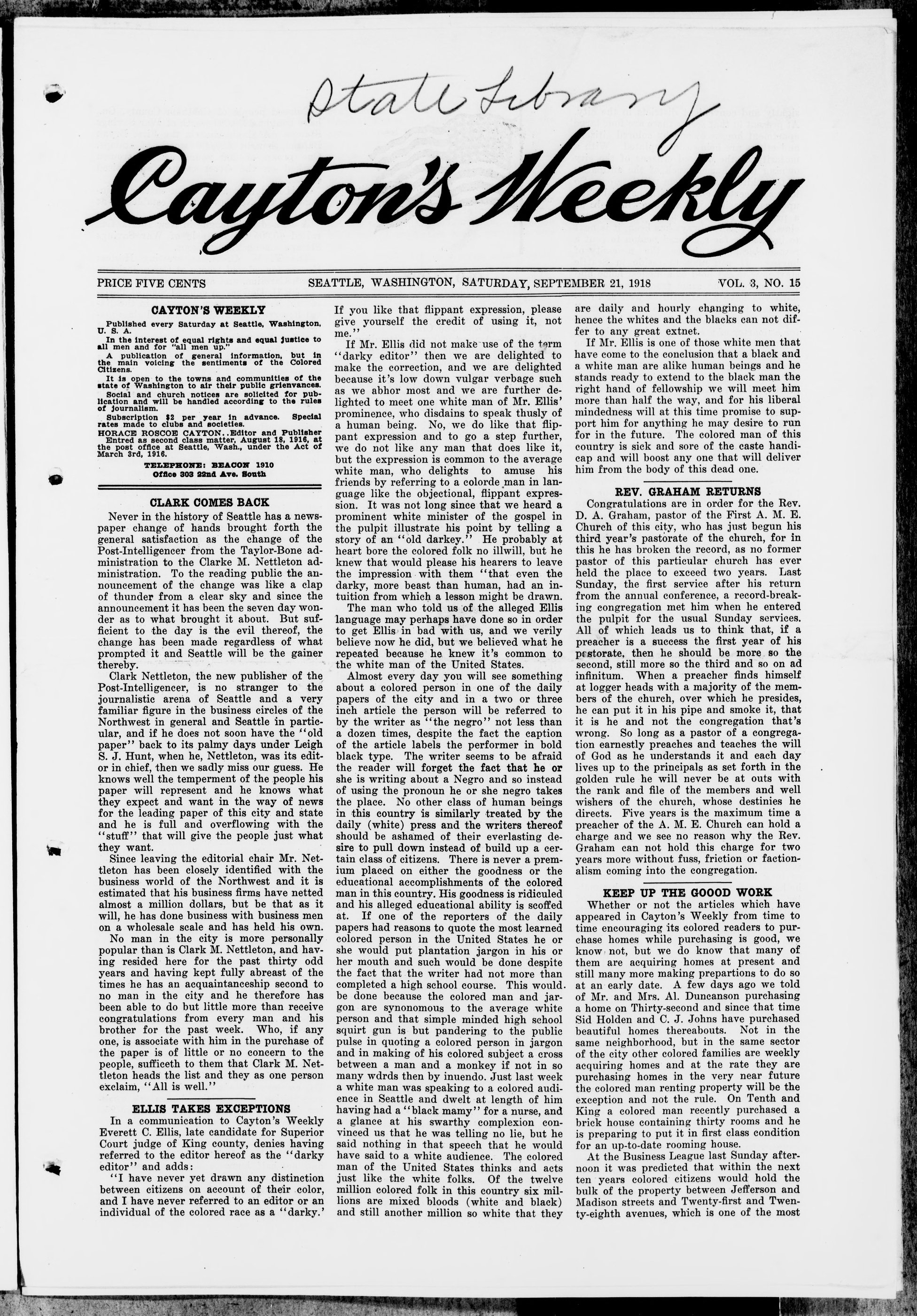
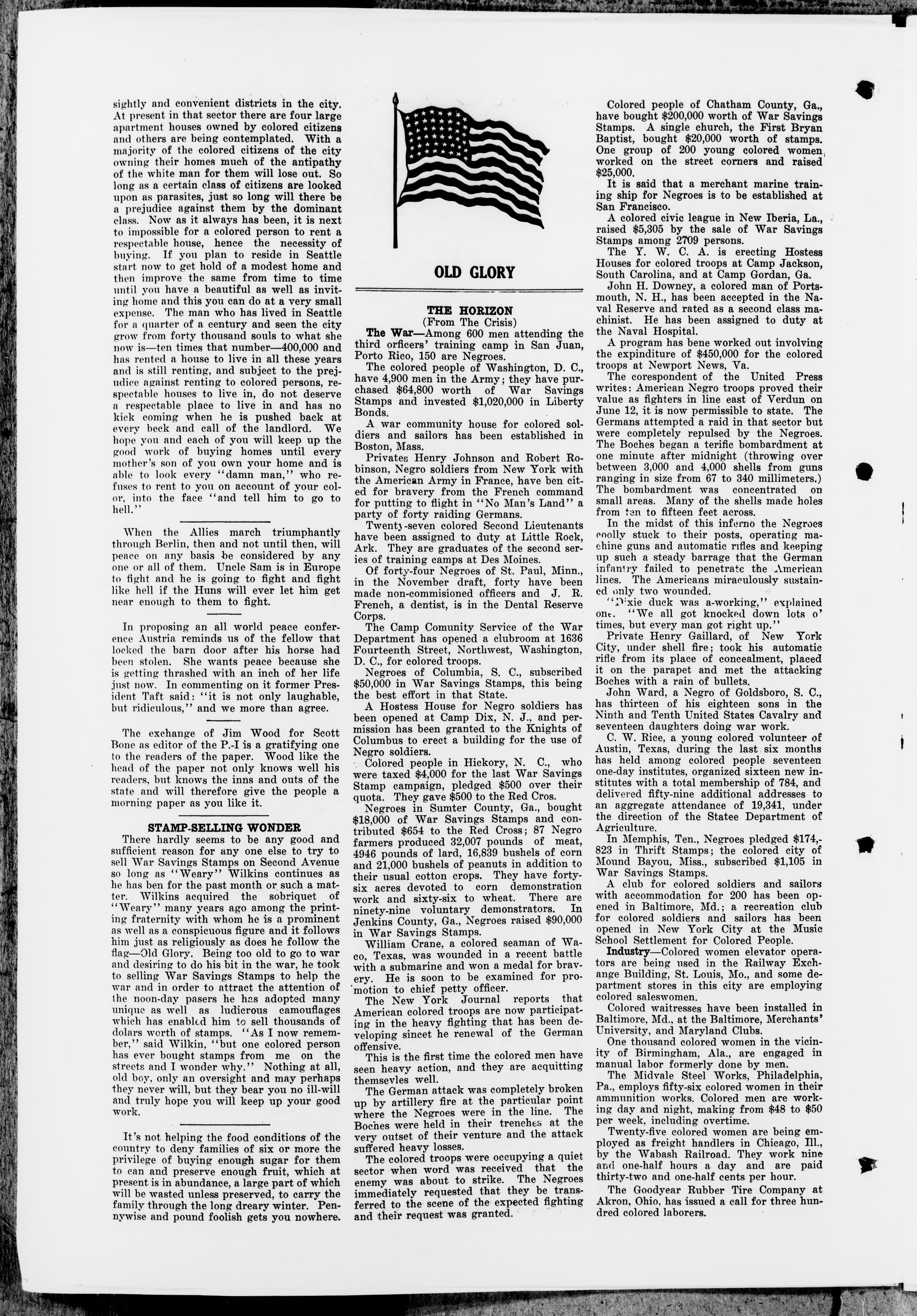
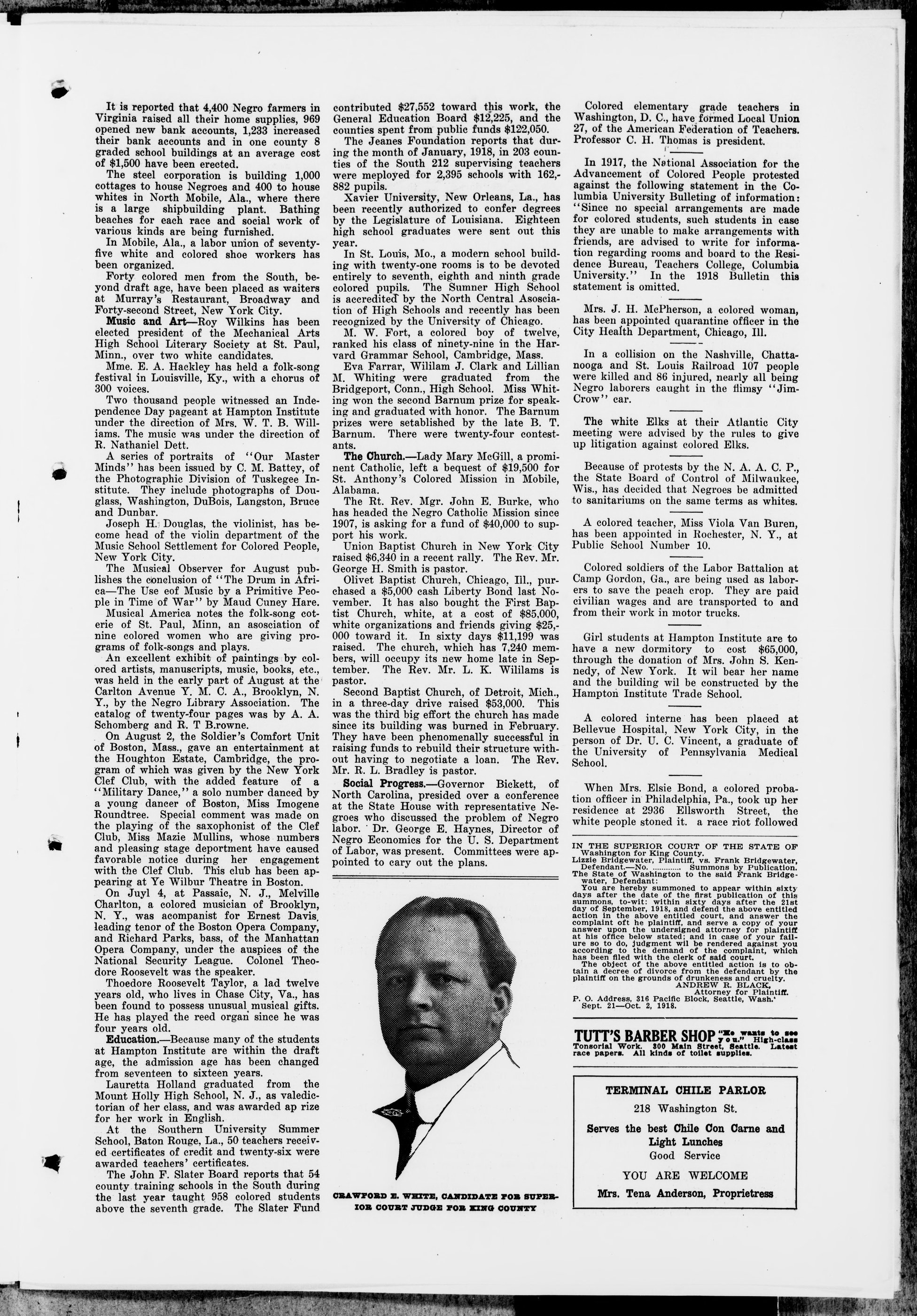
Page text (machine-generated)
State Library Cayton's Weekly
---
---
PRICE FIVE CENTS
CAYTON'S WEEKLY
Published every Saturday at Seattle, Washington. U. S. A.
It is open to the towns and communities of the state of Washington to air their public grievances. Social and church notices are solicited for publication and will be handled according to the rules of journalism.
HORACE ROSCOE CAYTON..Editor and Publisher Entred as second class matter, August 18, 1916, at the post office at Seattle, Wash., under the Act of March 3rd, 1916.
TELEPHONE: BEACON 1910
Office 303 22nd Ave. South
CLARK COMES BACK
Never in the history of Seattle has a newspaper change of hands brought forth the general satisfaction as the change of the Post-Intelligencer from the Taylor-Bone administration to the Clarke M. Nettleton administration. To the reading public the announcement of the change was like a clap of thunder from a clear sky and since the announcement it has been the seven day wonder as to what brought it about. But sufficient to the day is the evil thereof, the change has been made regardless of what prompted it and Seattle will be the gainer thereby.
Clark Nettleton, the new publisher of the Post-Intelligencer, is no stranger to the journalistic arena of Seattle and a very familiar figure in the business circles of the Northwest in general and Seattle in particular, and if he does not soon have the "old paper" back to its palmy days under Leigh S. J. Hunt, when he, Nettleton, was its editor in chief, then we sadly miss our guess. He knows well the temperment of the people his paper will represent and he knows what they expect and want in the way of news for the leading paper of this city and state and he is full and overflowing with the "stuff" that will give the people just what they want.
Since leaving the editorial chair Mr. Nettleton has been closely identified with the business world of the Northwest and it is estimated that his business firms have netted almost a million dollars, but be that as it will, he has done business with business men on a wholesale scale and has held his own.
No man in the city is more personally popular than is Clark M. Nettleton, and having resided here for the past thirty odd years and having kept fully abreast of the times he has an acquaintanceship second to no man in the city and he therefore has been able to do but little more than receive congratulations from every man and his brother for the past week. Who, if any one, is associate with him in the purchase of the paper is of little or no concern to the people, sufficeth to them that Clark M. Nettleton heads the list and they as one person exclaim, "All is well."
ELLIS TAKES EXCEPTIONS
In a communication to Cayton's Weekly Everett C. Ellis, late candidate for Superior Court judge of King county, denies having referred to the editor hereof as the "darky editor" and adds:
"I have never yet drawn any distinction between citizens on account of their color, and I have never referred to an editor or an individual of the colored race as a "darky."
If you like that flippant expression, please give yourself the credit of using it, not me."
If Mr. Ellis did not make use of the term "darky editor" then we are delighted to make the correction, and we are delighted because it's low down vulgar verbage such as we abhor most and we are further delighted to meet one white man of Mr. Ellis' prominence, who disdains to speak thusly of a human being. No, we do like that flippant expression and to go a step further, we do not like any man that does like it, but the expression is common to the average white man, who delights to amuse his friends by referring to a colorde man in language like the objectional, flippant expression. It was not long since that we heard a prominent white minister of the gospel in the pulpit illustrate his point by telling a story of an "old darkey." He probably at heart bore the colored folk no illwill, but he knew that would please his hearers to leave the impression with them "that even the darky, more beast than human, had an intuition from which a lesson might be drawn.
The man who told us of the alleged Ellis language may perhaps have done so in order to get Ellis in bad with us, and we verily believe now he did, but we believed what he repeated because he knew it's common to the white man of the United States.
Almost every day you will see something about a colored person in one of the daily papers of the city and in a two or three inch article the person will be referred to by the writer as "the negro" not less than a dozen times, despite the fact the caption of the article labels the performer in bold black type. The writer seems to be afraid the reader will forget the fact that he or she is writing about a Negro and so instead of using the pronoun he or she negro takes the place. No other class of human beings in this country is similarly treated by the daily (white) press and the writers thereof should be ashamed of their everlasting desire to pull down instead of build up a certain class of citizens. There is never a premium placed on either the goodness or the educational accomplishments of the colored man in this country. His goodness is ridiculed and his alleged educational ability is scoffed at. If one of the reporters of the daily papers had reasons to quote the most learned colored person in the United States he or she would put plantation jargon in his or her mouth and such would be done despite the fact that the writer had not more than completed a high school course. This would be done because the colored man and jargon are synonomous to the average white person and that simple minded high school squirt gun is but pandering to the public pulse in quoting a colored person in jargon and in making of his colored subject a cross between a man and a monkey if not in so many wdrds then by inuendo. Just last week a white man was speaking to a colored audience in Seattle and dwelt at length of him having had a "black many" for a nurse, and a glance at his swarthy complexion convinced us that he was telling no lie, but he said nothing in that speech that he would have said to a white audience. The colored man of the United States thinks and acts just like the white folks. Of the twelve million colored folk in this country six millions are mixed bloods (white and black) and still another million so white that they
are daily and hourly changing to white, hence the whites and the blacks can not differ to any great extnet.
If Mr. Ellis is one of those white men that have come to the conclusion that a black and a white man are alike human beings and he stands ready to extend to the black man the right hand of fellowship we will meet him more than half the way, and for his liberal mindedness will at this time promise to support him for anything he may desire to run for in the future. The colored man of this country is sick and sore of the caste handicap and will boost any one that will deliver him from the body of this dead one.
REV. GRAHAM RETURNS
Congratulations are in order for the Rev. D. A. Graham, pastor of the First A. M. E. Church of this city, who has just begun his third year's pastorate of the church, for in this he has broken the record, as no former pastor of this particular church has ever held the place to exceed two years. Last Sunday, the first service after his return from the annual conference, a record-breaking congregation met him when he entered the pulpit for the usual Sunday services. All of which leads us to think that, if a preacher is a success the first year of his pastorate, then he should be more so the second, still more so the third and so on ad infinitum. When a preacher finds himself at logger heads with a majority of the members of the church, over which he presides, he can put it in his pipe and smoke it, that it is he and not the congregation that's wrong. So long as a pastor of a congregation earnestly preaches and teaches the will of God as he understands it and each day lives up to the principals as set forth in the golden rule he will never be at outs with the rank and file of the members and well wishers of the church, whose destinies he directs. Five years is the maximum time a preacher of the A. M. E. Church can hold a charge and we see no reason why the Rev. Graham can not hold this charge for two years more without fuss, friction or factionalism coming into the congregation.
KEEP UP THE GOOOD WORK
Whether or not the articles which have appeared in Cayton's Weekly from time to time encouraging its colored readers to purchase homes while purchasing is good, we know not, but we do know that many of them are acquiring homes at present and still many more making preparations to do so at an early date. A few days ago we told of Mr. and Mrs. Al. Duncanson purchasing a home on Thirty-second and since that time Sid Holden and C. J. Johns have purchased beautiful homes thereabouts. Not in the same neighborhood, but in the same sector of the city other colored families are weekly acquiring homes and at the rate they are purchasing homes in the very near future the colored man renting property will be the exception and not the rule. On Tenth and King a colored man recently purchased a brick house containing thirty rooms and he is preparing to put it in first class condition for an up-to-date rooming house.
At the Business League last Sunday afternoon it was predicted that within the next ten years colored citizens would hold the bulk of the property between Jefferson and Madison streets and Twenty-first and Twenty-eighth avenues, which is one of the most
---
```markdown
```
sightly and convenient districts in the city. At present in that sector there are four large apartment houses owned by colored citizens and others are being contemplated. With a majority of the colored citizens of the city owning their homes much of the antipathy of the white man for them will lose out. So long as a certain class of citizens are looked upon as parasites, just so long will there be a prejudice against them by the dominant class. Now as it always has been, it is next to impossible for a colored person to rent a respectable house, hence the necessity of buying. If you plan to reside in Seattle start now to get hold of a modest home and then improve the same from time to time until you have a beautiful as well as inviting home and this you can do at a very small expense. The man who has lived in Seattle for a quarter of a century and seen the city grow from forty thousand souls to what she now is—ten times that number—400,000 and has rented a house to live in all these years and is still renting, and subject to the prejudice against renting to colored persons, respectable houses to live in, do not deserve a respectable place to live in and has no kick coming when he is pushed back at every beck and call of the landlord. We hope you and each of you will keep up the good work of buying homes until every mother's son of you own your home and is able to look every "damn man," who refuses to rent to you on account of your color, into the face "and tell him to go to hell."
When the Allies march triumphantly through Berlin, then and not until then, will peace on any basis be considered by any one or all of them. Uncle Sam is in Europe to fight and he is going to fight and fight like hell if the Huns will ever let him get near enough to them to fight.
In proposing an all world peace conference Austria reminds us of the fellow that locked the barn door after his horse had been stolen. She wants peace because she is getting thrashed with an inch of her life just now. In commenting on it former President Taft said: "it is not only laughable, but ridiculous," and we more than agree.
The exchange of Jim Wood for Scott Bone as editor of the P.-I is a gratifying one to the readers of the paper. Wood like the head of the paper not only knows well his readers, but knows the inns and outs of the state and will therefore give the people a morning paper as you like it.
STAMP-SELLING WONDER
There hardly seems to be any good and sufficient reason for any one else to try to sell War Savings Stamps on Second Avenue so long as "Weary" Wilkins continues as he has ben for the past month or such a matter. Wilkins acquired the sobriquet of "Weary" many years ago among the printing fraternity with whom he is a prominent as well as a conspicuous figure and it follows him just as religiously as does he follow the flag—Old Glory. Being too old to go to war and desiring to do his bit in the war, he took to selling War Savings Stamps to help the war and in order to attract the attention of the noon-day pasers he has adopted many unique as well as ludicrous camouflages which has enabled him to sell thousands of dollars worth of stamps. "As I now remember," said Wilkin, "but one colored person has ever bought stamps from me on the streets and I wonder why." Nothing at all, old boy, only an oversight and may perhaps they never will, but they bear you no ill-will and truly hope you will keep up your good work.
It's not helping the food conditions of the country to deny families of six or more the privilege of buying enough sugar for them to can and preserve enough fruit, which at present is in abundance, a large part of which will be wasted unless preserved, to carry the family through the long dreary winter. Pennywise and pound foolish gets you nowhere.
```markdown
```
OLD GLORY
THE HORIZON
(From The Crisis) The War—Among 600 men attending the third orficers' training camp in San Juan, Porto Rico, 150 are Negroes. The colored people of Washington, D. C., have 4,900 men in the Army; they have purchased $64,800 worth of War Savings Stamps and invested $1,020,000 in Liberty Bonds. A war community house for colored soldiers and sailors has been established in Boston, Mass.
Privates Henry Johnson and Robert Robinson, Negro soldiers from New York with the American Army in France, have ben cited for bravery from the French command for putting to flight in "No Man's Land" a party of forty raiding Germans. Twenty-seven colored Second Lieutenants have been assigned to duty at Little Rock, Ark. They are graduates of the second series of training camps at Des Moines. Of forty-four Negroes of St. Paul, Minn., in the November draft, forty have been made non-commisioned officers and J. R. French, a dentist, is in the Dental Reserve Corps.
The Camp Community Service of the War Department has opened a clubroom at 1636 Fourteenth Street, Northwest, Washington, D. C., for colored troops. Negroes of Columbia, S. C., subscribed $50,000 in War Savings Stamps, this being the best effort in that State. A Hostess House for Negro soldiers has been opened at Camp Dix, N. J., and permission has been granted to the Knights of Columbus to erect a building for the use of Negro soldiers. Colored people in Hickory, N. C., who were taxed $4,000 for the last War Savings Stamp campaign, pledged $500 over their quota. They gave $500 to the Red Cros.
Negroes in Sumter County, Ga., bought $18,000 of War Savings Stamps and contributed $654 to the Red Cross; 87 Negro farmers produced 32,007 pounds of meat, 4946 pounds of lard, 16,839 bushels of corn and 21,000 bushels of peanuts in addition to their usual cotton crops. They have forty-six acres devoted to corn demonstration work and sixty-six to wheat. There are ninety-nine voluntary demonstrators. In Jenkins County, Ga., Negroes raised $90,000 in War Savings Stamps.
William Crane, a colored seaman of Waco, Texas, was wounded in a recent battle with a submarine and won a medal for bravery. He is soon to be examined for promotion to chief petty officer. The New York Journal reports that American colored troops are now participating in the heavy fighting that has been developing since he renewal of the German offensive. This is the first time the colored men have seen heavy action, and they are acquitting themsevles well.
The German attack was completely broken up by artillery fire at the particular point where the Negroes were in the line. The Boches were held in their trenches at the very outset of their venture and the attack suffered heavy losses. The colored troops were occupying a quiet sector when word was received that the enemy was about to strike. The Negroes immediately requested that they be transferred to the scene of the expected fighting and their request was granted.
Colored people of Chatham County, Ga., have bought $200,000 worth of War Savings Stamps. A single church, the First Bryan Baptist, bought $20,000 worth of stamps. One group of 200 young colored women worked on the street corners and raised $25,000. It is said that a merchant marine training ship for Negroes is to be established at San Francisco. A colored civic league in New Iberia, La., raised $5,305 by the sale of War Savings Stamps among 2709 persons. The Y. W. C. A. is erecting Hostess Houses for colored troops at Camp Jackson, South Carolina, and at Camp Gordan, Ga.
John H. Downey, a colored man of Portsmouth, N. H., has been accepted in the Naval Reserve and rated as a second class machinist. He has been assigned to duty at the Naval Hospital. A program has bene worked out involving the expinditure of $450,000 for the colored troops at Newport News. Va.
The corepondent of the United Press writes: American Negro troops proved their value as fighters in line east of Verdun on June 12, it is now permissible to state. The Germans attempted a raid in that sector but were completely repulsed by the Negroes. The Boches began a terific bombardment at one minute after midnight (throwing over between 3,000 and 4,000 shells from guns ranging in size from 67 to 340 millimeters.) The bombardment was concentrated on small areas. Many of the shells made holes from ten to fifteen feet across.
In the midst of this inferno the Negroes coolly stuck to their posts, operating machine guns and automatic rifles and keeping up such a steady barrage that the German infantry failed to penetrate the American lines. The Americans miraculously sustained only two wounded.
"Dixie duck was a-working," explained one. "We all got knocked down lots o' times, but every man got right up."
Private Henry Gaillard, of New York City, under shell fire; took his automatic rifle from its place of concealment, placed it on the parapet and met the attacking Boches with a rain of bullets.
John Ward, a Negro of Goldsboro, S. C., has thirteen of his eighteen sons in the Ninth and Tenth United States Cavalry and seventeen daughters doing war work. C. W. Rice, a young colored volunteer of Austin, Texas, during the last six months has held among colored people seventeen one-day institutes, organized sixteen new institutes with a total membership of 784, and delivered fifty-nine additional addresses to an aggregate attendance of 19,341, under the direction of the Statee Department of Agriculture.
In Memphis, Ten., Negroes pledged $174,-823 in Thrift Stamps; the colored city of Mound Bayou, Miss., subscribed $1,105 in War Savings Stamps.
A club for colored soldiers and sailors with accommodation for 200 has been opened in Baltimore, Md.; a recreation club for colored soldiers and sailors has been opened in New York City at the Music School Settlement for Colored People.
Industry-Colored women elevator operators are being used in the Railway Exchange Building, St. Louis, Mo., and some department stores in this city are employing colored saleswomen.
Colored waitresses have been installed in Baltimore, Md., at the Baltimore, Merchants' University, and Maryland Clubs. One thousand colored women in the vicinity of Birmingham, Ala., are engaged in manual labor formerly done by men. The Midvale Steel Works, Philadelphia, Pa., employs fifty-six colored women in their ammunition works. Colored men are working day and night, making from $48 to $50 per week, including overtime. Twenty-five colored women are being employed as freight handlers in Chicago, Ill., by the Wabash Railroad. They work nine and one-half hours a day and are paid thirty-two and one-half cents per hour.
The Goodyear Rubber Tire Company at Akron, Ohio, has issued a call for three hundred colored laborers.
It is reported that 4,400 Negro farmers in Virginia raised all their home supplies, 969 opened new bank accounts, 1,233 increased their bank accounts and in one county 8 graded school buildings at an average cost of $1,500 have been erected. The steel corporation is building 1,000 cottages to house Negroes and 400 to house whites in North Mobile, Ala., where there is a large shipbuilding plant. Bathing beaches for each race and social work of various kinds are being furnished. In Mobile, Ala., a labor union of seventy-five white and colored shoe workers has been organized.
Forty colored men from the South, beyond draft age, have been placed as waiters at Murray's Restaurant, Broadway and Forty-second Street, New York City. Music and Art—Roy Wilkins has been elected president of the Mechanical Arts High School Literary Society at St. Paul, Minn., over two white candidates. Mme. E. A. Hackley has held a folk-song festival in Louisville, Ky., with a chorus of 300 voices. Two thousand people witnessed an Independence Day pageant at Hampton Institute under the direction of Mrs. W. T. B. Williams. The music was under the direction of R. Nathaniel Dett.
A series of portraits of "Our Master Minds" has been issued by C. M. Battey, of the Photographic Division of Tuskegee Institute. They include photographs of Douglass, Washington, DuBois, Langston, Bruce and Dunbar. Joseph H. Douglas, the violinist, has become head of the violin department of the Music School Settlement for Colored People, New York City. The Musical Observer for August publishes the conclusion of "The Drum in Africa—The Use of Music by a Primitive People in Time of War" by Maud Cuney Hare.
Musical America notes the folk-song coterie of St. Paul, Minn, an asosciation of nine colored women who are giving programs of folk-songs and plays. An excellent exhibit of paintings by colored artists, manuscripts, music, books, etc., was held in the early part of August at the Carlton Avenue Y. M. C. A., Brooklyn, N. Y., by the Negro Library Association. The catalog of twenty-four pages was by A. A. Schomberg and R. T. B.rowne.
On August 2, the Soldier's Comfort Unit of Boston, Mass., gave an entertainment at the Houghton Estate, Cambridge, the program of which was given by the New York Clef Club, with the added feature of a "Military Dance," a solo number danced by a young dancer of Boston, Miss Imogene Roundtree. Special comment was made on the playing of the saxophonist of the Clef Club, Miss Mazie Mullins, whose numbers and pleasing stage deportment have caused favorable notice during her engagement with the Clef Club. This club has been appearing at Ye Wilbur Theatre in Boston.
On Juyl 4, at Passaic, N. J., Melville Charlton, a colored musician of Brooklyn, N. Y., was acompanist for Ernest Davis, leading tenor of the Boston Opera Company, and Richard Parks, bass, of the Manhattan Opera Company, under the auspices of the National Security League. Colonel Theodore Roosevelt was the speaker. Thoedore Roosevelt Taylor, a lad twelve years old, who lives in Chase City, Va., has been found to possess unusual musical gifts. He has played the reed organ since he was four years old.
Education.—Because many of the students at Hampton Institute are within the draft age, the admission age has been changed from seventeen to sixteen years.
Lauretta Holland graduated from the Mount Holly High School, N. J., as valedictorian of her class, and was awarded ap rize for her work in English.
At the Southern University Summer School, Baton Rouge, La., 50 teachers received certificates of credit and twenty-six were awarded teachers' certificates.
The John F. Slater Board reports that 54 county training schools in the South during the last year taught 958 colored students above the seventh grade. The Slater Fund
contributed $27,552 toward this work, the General Education Board $12,225, and the counties spent from public funds $122,050. The Jeanes Foundation reports that during the month of January, 1918, in 203 counties of the South 212 supervising teachers were employed for 2,395 schools with 162,- 882 pupils. Xavier University, New Orleans, La., has been recently authorized to confer degrees by the Legislature of Louisiana. Eighteen high school graduates were sent out this year.
In St. Louis, Mo., a modern school building with twenty-one rooms is to be devoted entirely to seventh, eighth and ninth grade colored pupils. The Sumner High School is accredited by the North Central Asosciation of High Schools and recently has been recognized by the University of Chicago. M. W. Fort, a colored boy of twelve, ranked his class of ninety-nine in the Harvard Grammar School, Cambridge, Mass.
Eva Farrar, Wililam J. Clark and Lillian M. Whiting were graduated from the Bridgeport, Conn., High School. Miss Whiting won the second Barnum prize for speaking and graduated with honor. The Barnum prizes were setablished by the late B. T. Barnum. There were twenty-four contestants.
The Church.—Lady Mary McGill, a prominent Catholic, left a bequest of $19,500 for St. Anthony's Colored Mission in Mobile, Alabama.
The Rt. Rev. Mgr. John E. Burke, who has headed the Negro Catholic Mission since 1907, is asking for a fund of $40,000 to support his work.
Union Baptist Church in New York City raised $6,340 in a recent rally. The Rev. Mr. George H. Smith is pastor. Olivet Baptist Church, Chicago, Ill., purchased a $5,000 cash Liberty Bond last November. It has also bought the First Baptist Church, white, at a cost of $85,000, white organizations and friends giving $25,000 toward it. In sixty days $11,199 was raised. The church, which has 7,240 members, will occupy its new home late in September. The Rev. Mr. L. K. Wililams is pastor.
Second Baptist Church, of Detroit, Mich., in a three-day drive raised $53,000. This was the third big effort the church has made since its building was burned in February. They have been phenomenally successful in raising funds to rebuild their structure without having to negotiate a loan. The Rev. Mr. R. L. Bradley is pastor. Social Progress.—Governor Bickett, of North Carolina, presided over a conference at the State House with representative Negroes who discussed the problem of Negro labor. Dr. George E. Haynes, Director of Negro Economics for the U. S. Department of Labor, was present. Committees were appointed to carry out the plans.
```markdown
```
CRAWFORD E. WHITE, CANDIDATE FOR SUPERIOR COURT JUDGE FOR KING COUNTY
Colored elementary grade teachers in Washington, D. C., have formed Local Union 27, of the American Federation of Teachers. Professor C. H. Thomas is president.
In 1917, the National Association for the Advancement of Colored People protested against the following statement in the Columbia University Bulleting of information: "Since no special arrangements are made for colored students, such students in case they are unable to make arrangements with friends, are advised to write for information regarding rooms and board to the Residence Bureau, Teachers College, Columbia University." In the 1918 Bulletin this statement is omitted.
Mrs. J. H. McPherson, a colored woman, has been appointed quarantine officer in the City Health Department, Chicago, Ill.
In a collision on the Nashville, Chattanooga and St. Louis Railroad 107 people were killed and 86 injured, nearly all being Negro laborers caught in the flimsy "Jim-Crow" car.
The white Elks at their Atlantic City meeting were advised by the rules to give up litigation against colored Elks.
Because of protests by the N. A. A. C. P., the State Board of Control of Milwaukee, Wis., has decided that Negroes be admitted to sanitariums on the same terms as whites.
A colored teacher, Miss Viola Van Buren, has been appointed in Rochester, N. Y., at Public School Number 10.
Colored soldiers of the Labor Battalion at Camp Gordon, Ga., are being used as laborers to save the peach crop. They are paid civilian wages and are transported to and from their work in motor trucks.
Girl students at Hampton Institute are to have a new dormitory to cost $65,000, through the donation of Mrs. John S. Kennedy, of New York. It will bear her name and the building wil be constructed by the Hampton Institute Trade School.
A colored interne has been placed at Bellevue Hospital, New York City, in the person of Dr. U. C. Vincent, a graduate of the University of Pennsylvania Medical School.
When Mrs. Elsie Bond, a colored probation officer in Philadelphia, Pa., took up her residence at 2936 Ellsworth Street, the white people stoned it. a race riot followed
IN THE SUPERIOR COURT OF THE STATE OF Washington for King County.
Lizzie Bridgewater, Plaintiff, vs. Frank Bridgewater,
Defendant.—No. ..... Summons by Publication.
The State of Washington to the said Frank Bridge-
water. Defendant:
You are hereby summoned to appear within sixty days after the date of the first publication of this summons, to-wit: within sixty days after the 21st day of September, 1918, and defend the above entitled action in the above entitled court, and answer the complaint oft he plaintiff, and serve a copy of your answer upon the undersigned attorney for plaintiff at his office below stated; and in case of your failure so to do, judgment will be rendered against you according to the demand of the complaint, which has been filed with the clerk of said court.
The object of the above entitled action is to obtain a decree of divorce from the defendant by the plaintiff on the grounds of drunkenness and cruelty.
ANDREW R. BLACK,
Attorney for Plaintiff.
P. O. Address, 316 Pacific Block, Seattle, Wash.*
Sept. 21—Oct. 2, 1918.
TUTT'S BARBER SHOP "He wants to see you." High-class Tonsorial Work. 300 Main Street, Seattle. Latest race papers. All kinds of toilet supplies.
TERMINAL CHILE PARLOR
218 Washington St.
Serves the best Chile Con Carne and
Light Lunches
Good Service
YOU ARE WELCOME
Mrs. Tena Anderson, Proprietress
---
---
---
in which two policemen were killed and sixty persons injured. More than sixty Negroes have been arrested and charged for having weapons, and one is charged with murder.
To make financial ends of the department meet, the Negro Welfare Bureau at Trenton, N. J., resulting from a law pasesd last winter, has been suspendedb yt he State Commissioner of Labor.
It has been decided that the Public Service Commission cannot segregate colored and white passengers on interstate street cars in Maryland.
The report of the Special Congressional Investigating Committee on the East St. Louis riots has been laid before the House and printed. The conduct of the men of the National Guard is characterized as a "blot on the Illinois Militia organization." The "Birth of a Nation" has been ruled out of Lincoln, Neb.
The colored Knights of Pythias of Georgia have held their annual session. They report an income of $177,656, expenditures of $64,037 and a balance on hand of $113,627. Mob violence in the United States has been denounced by the Indiana and Wisconsin Bar Associations.
B. H. Fisher, of Toledo, has been appointed clerk in the street cleaning department. This is the first instance of such a colored appointment in the history of the city. An eleven-year-old colored boy, J. E. Reed, of Waterbury, Conn., won the Junior Four-Minute-Men speaking contest at the Russell School.
The publishers of the San Antonio, Texas, Express, have established a fund of $100,-000, to be maintained for five years for the purpose of combating and punishing lynching and mob violence in the United States. A reward of $500 will be paid to each person responsible for the arrest and conviction of any person instrumental in arrousing a mob to commit lynching or to participate in lynching when the victim is white and $1,-000 when the victim is colored. The offer applies both to officers of the law and to private citizens in any state.
A park and community center for colored people has been purchased by the city of St. Louis, Mo. It is opposite the colored Sumner High School.
Premier Botha, of the Union of South Africa, has issued a statement calling attention to great unrest in South Africa among whites and natives.
The Virginia State Legislature has passed a resolution commending the Virginia State Federation of Colored Women's Clubs for the work which it has done in establishing an industrial home school for wayward colored girls at Peak, Hanover County. Mrs. Janie Porter Barrett is secretary and superintendent and the board is composed of white and colored members.
In Shreveport, La., two streets, formerly known as Bismarck and Berlin, have been changed to Christopher and Chester in honor of the first two Negro volunteers.
Vivienne Ward Stokes has been made Assistant Superintendent of the New York State Bureau of Labor by competitive examination at a salary of $1,200.
The South Carolina Federation of Colored Women's Clubs held its eighth annual session in Orangeburg. The members have put up 20,790 cans of fruits and vegetables and have contributed $8,000 to the Red Cross, the Y. M. C. A. and camp activities.
Mayor Preston, of Baltimore, Md., is suggesting a new segregation ordinance based on the fact that Negroes are more susceptible to tuberculosis than whites.
Fifteen modern houses, six-tories high, containing 1,500 living rooms, have been opened for Negroes in New York City at 202-230 West 140th Street, through a colored real estate operator.
Protests have been made against the use of the word "darky" by the white press when referring to Negroes. The Providence, R. I. Journal, "regrets" that the word appeared in its columns, and the New York World "have given orders that the word shall not be used again."
The nurse training school at Los Angeles, Cal., which has heretofore discriminated against colored nurses is now through the efforts of the local branch of the N. A. A. C. P. open to all.
Personal—Miss Geneva Jackson, of Radcliffe College, Cambridge, Mass., has been awarded a $200 scholarship for next year.
Dr. B. A. Crichlo, of Charleston, W. Va., has been appointed superintendent of the State Tuberculosis Sanitarium.
The funeral of Uncle Billy Robertson, a former slave, was held in the County courthouse at Oneonta, Ala., and the business of the town was suspended during the service. The Mayor and members of the City Council insisted that his widow permit the town to bear the expenses of the funeral.
Mrs. Rebecca L. Furr, founder and principal of the Newport News Training School, Inc., is dead. She was a graduate of Fisk.
Wilberforce University recently conferred the following honorary degrees: LL.D., Hon. W. H. Lewis, Boston, Mass.; Hon. Emmett J. Scott, Tuskegee Institute, Ala.; Prof. J. R. E. Lee, Kansas City, Mo.; Hon. George Welington Ellis, Chicago, Ill.; Colonel Charles Young, Wilberforce, Ohio. Professor C. F. Parr, Palestine, Texas, and Mrs. Mary McLeod Bethune, Daytona, Fla., were given the degree of M.A.
I. Colline, of Lakewood, N. J., is the first colored mail carrier in the town. He stood second on the examination list.
W. G. Cromwell, a colored teacher at Etobicoke, Ontario, was given a gold watch by his white pupils at the end of his four and one-half years' service.
Amos Edwards, a colored detective on the Philadelphia police force, is dead. He was a popular athlete.
Mrs. Edward W. Blyden, widow of the noted African, is dead at the age of eighty-thre eyears.
The Newark Daily Ledger is giving a page to Negro news to be edited by R. A. Travis, of East Orange, formerly chief clerk in the testing department of the Croker Wheeler Company.
The marriage of Miss Sallie Fisher, a teacher of Washington, D. C., to Dr. Harold G. Clark, is announced.
Marie Dwyer, a colored nurse, saved an eight-year-old white girl from being accidentally burned to death in a bonfire in St. Louis, Mo.
Crime.—The following lynchings have taken place since our last record:
Madill, Okla., June 29, L. McGill, hanged for alleged attack upon a white woman.
Ben Hur, Texas, July 27, Gene Brown, hanged for alleged assault on a white woman.
Two other lynchings inadvertently omitted from Crisis records are: G. W. Lych, Fezruary 10, Estil Springs, Tenn., for aiding an escaped murderer; Monroe, La., March 6, John Richards, for alleged attack upon a white woman.
---
ALHAMBRA CASH GROCERY
H. Legg, Prop. W. H. Banks, Mgr.
We Carry a Full Line of Fancy and
Staple Groceries
WE KINDLY INVITE YOUR INSPECTION
Our New Store:
1201-3 Jackson St. Phone Beacon 505
VIOLA N. BERRY
Successful Masseur
Facial Massage, Hair Shampooing and
Scalp Treatment
Open for Business
Parlors 2103 E. James Tel. East 5694
CAYTON'S WEEKLY
(Office 303 22nd Ave. South) Regular, Reliable, Republican, Readable Wants 500 New Subscribers
This is a Sample of what it sends out Every Week
No Friends to Reward or Enemies to Punish
A Publication of Ideas Rather Than Personalities
Read for Yourself and be Convinced
Telephone Beacon 1910
IN THE SUPERIOR COURT OF THE STATE OF Washington for King County.
Robert L. Lavender, Plaintiff, vs. Minnie Lavender, Defendant.—No. ..... Sumons by Publication. The State of Washington to the said Minnie Lavender, Defendant:
You are hereby sumoned to appear within sixty days after the date of the first publication of this sumons, to-wit: within sixty days after the 2nd day of August, 1918, and defend the above entitled action in the above entitled court, and answer the complaint of the plaintiff, and serve a copy of your answer upon the undersigned attorney for plaintiff at his office below stated; and in case of your failure so to do, judgment will be rendered against you according to the demand of the complaint, which has been filed with the clerk of said court.
The object of the above entitled action is to obtain a decree of divorce from the defendant by the plaintiff on the grounds of desertion.
ANDREW R. BLACK,
Attorney for Plaintiff
P. O. Address, 316 Pacific Block, Seattle, Wash.
August 3—September 14, 1918.
IN THE SUPERIOR COURT OF THE STATE OF Washington for King County.
R. E. Warren, Plaintiff, vs. Lida Warren, Defendant.
—No. 130089. Summons for Publication.
The State of Washington to the said Lida Warren, defendant:
You are hereby summoned to appear within sixty (60) days after the date of the first publication of this summons, to-wit: Within sixty days after the 3rd day of August, 1918, and defend the above entitled action in the above entitled court, and answer the complaint of the plaintiff, and serve a copy of your answer upon the undersigned attorney for plaintiff, at his office below stated; and in case of your failure so to do, judgment will be rendered against you according to the complaint, which has been filed with the clerk of said court, the object of the above entitled action is for the dissolution of the bonds of matrimony existing between plaintiff and defendant upon the grounds of desertion and abandonment described in the complaint.
CRAWFORD E. WHITE
Attorney for Plaintiff.
Post Office and Office Address: 1303-4 L. C. Smith
Building, Seattle, King County, Washington, Phone
Elliott 1113.
CAYTON—9-12 .....Minnie .....bpxz
IN THE SUPERIOR COURT OF THE STATE OF
Washington for King County.
Washington Brize, to King County
Florence Brize, vs. Dwight Brize, Defendant.—No.
Summons by Publication.
The State of Washington to the said Dwight Brize,
Defendant:
You are hereby summoned to appear within sixty days after the date of the first publication of this summons, to-wit: within sixty days after the 13th day of September, 1918, and defend the above entitled action in the above entitled court, and answer the complaint of the plaintiff, and serve a copy of your answer upon the undersigned attorney for plaintiff at his office below stated; and in case of your failure so to do, judgment will be rendered against you according to the demand of the complaint, which has been filed with the clerk of said court.
The object of the above entitled action is to obtain a decree of divorce from the defendant by the plaintiff on the grounds of desertion.
ANDREW R. BLACK,
Attorney for Plaintiff
P. O. Address, 316 Pacific Block, Seattle, Wash.
Sept. 13—Nov. 1, 1918.
---