Cayton's Weekly
Saturday, October 26, 1918
Seattle, Washington
Page text (machine-generated)
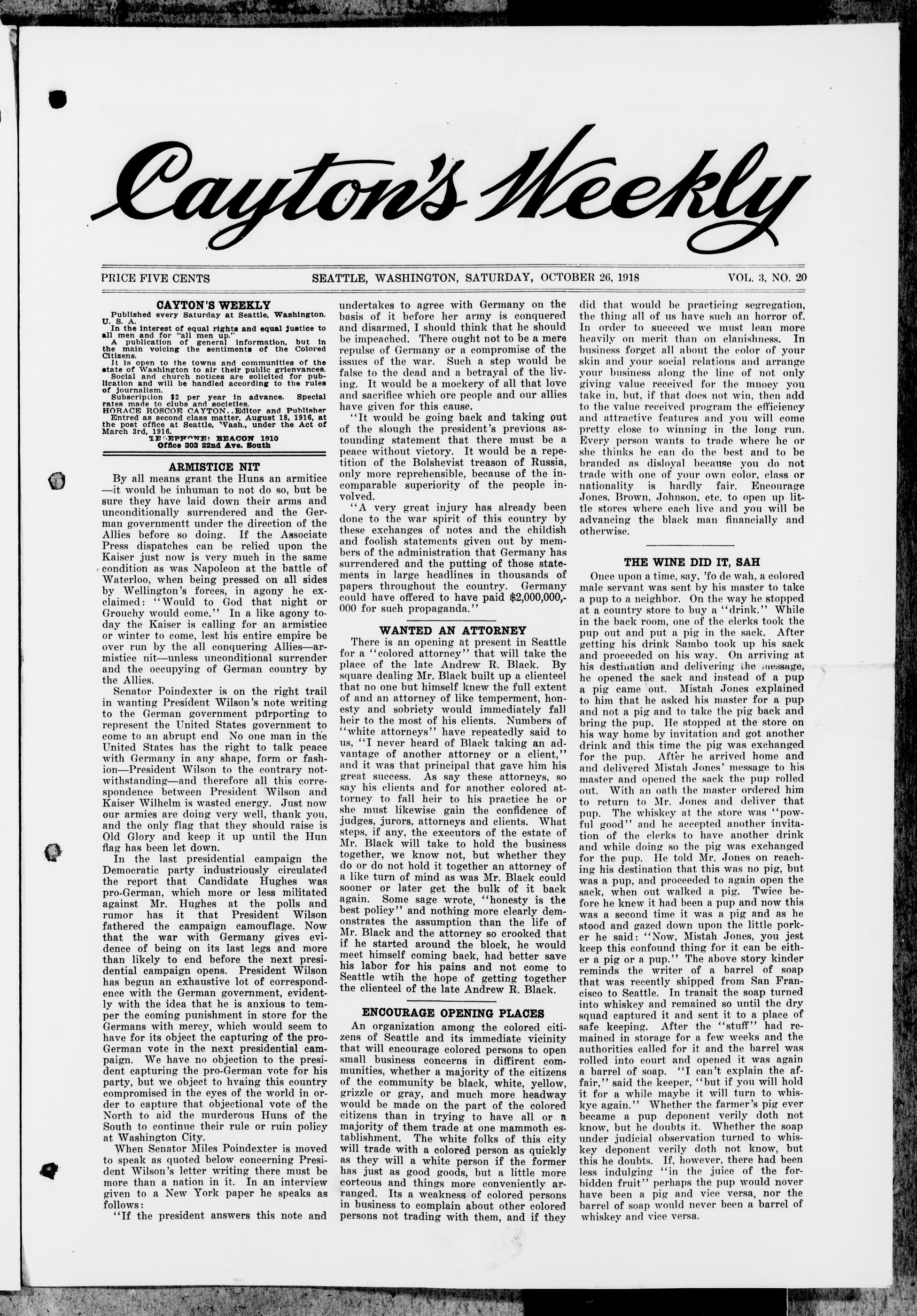
Cayton's Weekly
PRICE FIVE CENTS
CAYTON'S WEEKLY
Published every Saturday at Seattle, Washington. U. S. A.
It is open to the towns and communities of the state of Washington to air their public grievances. Social and church notices are solicited for publication and will be handled according to the rules of journalism.
Subscription $2 per year in advance. Special rates made to clubs and societies.
HORACE ROSCOF CAYTON..Editor and Publisher
Entred as second class matter, August 18, 1916, at
the post office at Seattle, 'Vash, under the Act of
March 3rd, 1916.
TEEPONE: BEACON 1910
Office 303 22d Ave. South
ARMISTICE NIT
By all means grant the Huns an armitice—it would be inhuman to not do so, but be sure they have laid down their arms and unconditionally surrendered and the German governmentt under the direction of the Allies before so doing. If the Associate Press dispatches can be relied upon the Kaiser just now is very much in the same condition as was Napoleon at the battle of Waterloo, when being pressed on all sides by Wellington's forces, in agony he exclaimed: "Would to God that night or Grouchy would come." In a like agony today the Kaiser is calling for an armistice or winter to come, lest his entire empire be over run by the all conquering Allies—armistice nit—unless unconditional surrender and the occupying of German country by the Allies.
Senator Poindexter is on the right trail in wanting President Wilson's note writing to the German government purporting to represent the United States government to come to an abrupt end. No one man in the United States has the right to talk peace with Germany in any shape, form or fashion—President Wilson to the contrary notwithstanding—and therefore all this correspondence between President Wilson and Kaiser Wilhelm is wasted energy. Just now our armies are doing very well, thank you, and the only flag that they should raise is Old Glory and keep it up until the Hun flag has been let down.
In the last presidential campaign the Democratic party industriously circulated the report that Candidate Hughes was pro-German, which more or less militated against Mr. Hughes at the polls and rumor has it that President Wilson fathered the campaign camouflage. Now that the war with Germany gives evidence of being on its last legs and more than likely to end before the next presidential campaign opens. President Wilson has begun an exhaustive lot of correspondence with the German government, evidently with the idea that he is anxious to temper the coming punishment in store for the Germans with mercy, which would seem to have for its object the capturing of the pro-German vote in the next presidential campaign. We have no objection to the president capturing the pro-German vote for his party, but we object to hvaing this country compromised in the eyes of the world in order to capture that objectional vote of the North to aid the murderous Huns of the South to continue their rule or ruin policy at Washington City.
When Senator Miles Poindexter is moved to speak as quoted below concerning President Wilson's letter writing there must be more than a nation in it. In an interview given to a New York paper he speaks as follows: "If the president answers this note and
undertakes to agree with Germany on the basis of it before her army is conquered and disarmed, I should think that he should be impeached. There ought not to be a mere repulse of Germany or a compromise of the issues of the war. Such a step would be false to the dead and a betrayal of the living. It would be a mockery of all that love and sacrifice which ore people and our allies have given for this cause.
"It would be going back and taking out of the slough the president's previous astounding statement that there must be a peace without victory. It would be a repetition of the Bolshevist treason of Russia, only more reprehensible, because of the incomparable superiority of the people involved.
"A very great injury has already been done to the war spirit of this country by these exchanges of notes and the childish and foolish statements given out by members of the administration that Germany has surrendered and the putting of those statements in large headlines in thousands of papers throughout the country. Germany could have offered to have paid $2,000,000,000 for such propaganda."
WANTED AN ATTORNEY
There is an opening at present in Seattle for a "colored attorney" that will take the place of the late Andrew R. Black. By square dealing Mr. Black built up a clienteel that no one but himself knew the full extent of and an attorney of like temperment, honesty and sobriety would immediately fall heir to the most of his clients. Numbers of "white attorneys" have repeatedly said to us, "I never heard of Black taking an advantage of another attorney or a client," and it was that principal that gave him his great success. As say these attorneys, so say his clients and for another colored attorney to fall heir to his practice he or she must likewise gain the confidence of judges, jurors, attorneys and clients. What steps, if any, the executors of the estate of Mr. Black will take to hold the business together, we know not, but whether they do or do not hold it together an attorney of a like turn of mind as was Mr. Black could sooner or later get the bulk of it back again. Some sage wrote, "honesty is the best policy" and nothing more clearly demonstrates the assumption than the life of Mr. Black and the attorney so crooked that if he started around the block, he would meet himself coming back, had better save his labor for his pains and not come to Seattle wth the hope of getting together the clienteel of the late Andrew R. Black.
ENCOURAGE OPENING PLACES
An organization among the colored citizens of Seattle and its immediate vicinity that will encourage colored persons to open small business concerns in different communities, whether a majority of the citizens of the community be black, white, yellow, grizzle or gray, and much more headway would be made on the part of the colored citizens than in trying to have all or a majority of them trade at one mammoth establishment. The white folks of this city will trade with a colored person as quickly as they will a white person if the former has just as good goods, but a little more corteous and things more conveniently arranged. Its a weakness of colored persons in business to complain about other colored persons not trading with them, and if they
VOL. 3. NO. 20
did that would be practicing segregation, the thing all of us have such an horror of. In order to succeed we must lean more heavily on merit than on clanishness. In business forget all about the color of your skin and your social relations and arrange your business along the line of not only giving value received for the mnoey you take in, but, if that does not win, then add to the value received program the efficiency and attractive features and you will come pretty close to winning in the long run. Every person wants to trade where he or she thinks he can do the best and to be branded as disloyal because you do not trade with one of your own color, class or nationality is hardly fair. Encourage Jones, Brown, Johnson, etc. to open up little stores where each live and you will be advancing the black man financially and otherwise.
THE WINE DID IT. SAH
Once upon a time, say, 'fo de wah, a colored male servant was sent by his master to take a pup to a neighbor. On the way he stopped at a country store to buy a "drink." While in the back room, one of the clerks took the pup out and put a pig in the sack. After getting his drink Sambo took up his sack and proceeded on his way. On arriving at his destination and delivering the message, he opened the sack and instead of a pup a pig came out. Mistah Jones explained to him that he asked his master for a pup and not a pig and to take the pig back and bring the pup. He stopped at the store on his way home by invitation and got another drink and this time the pig was exchanged for the pup. After he arrived home and delivered Mistah Jones' message to his master and opened the sack the pup rolled out. With an oath the master ordered him to return to Mr. Jones and deliver that pup. The whiskey at the store was "powful good" and he accepted another invitation of the clerks to have another drink and while doing so the pig was exchanged for the pup. He told Mr. Jones on reaching his destination that this was no pig, but was a pup, and proceeded to again open the sack, when out walked a pig. Twice before he knew it had been a pup and now this was a second time it was a pig and as he stood and gazed down upon the little porker he said: "Now, Mistah Jones, you jest keep this confound thing for it can be either a pig or a pup." The above story kinder reminds the writer of a barrel of soap that was recently shipped from San Francisco to Seattle. In transit the soap turned into whiskey and remained so until the dry squad captured it and sent it to a place of safe keeping. After the "stuff" had remained in storage for a few weeks and the authorities called for it and the barrel was rolled into court and opened it was again a barrel of soap. "I can't explain the affair," said the keeper, "but if you will hold it for a while maybe it will turn to whiskye again." Whether the farmer's pig ever became a pup deponent verily doth not know, but he doubts it. Whether the soap under judicial observation turned to whiskey deponent verily doth not know, but this he doubts. If, however, there had been less indulging "in the juice of the forbidden fruit" perhaps the pup would never have been a pig and vice versa, nor the barrel of soap would never been a barrel of whiskey and vice versa.
ily welcome and the boys after dark often annoyed the family. It was a year thereafter before the neighbors discovered that though thei rskins were dark they were ideal citizens and far more desirable than some of the whites. Condemn no one until you have thoroughly investigated the accused.
DALLYING WITH SUFFRAGE From The Public
No greater reason was ever given for the adoption of the Federal Suffrage Amendment than the simple fact of its defeat in the Senate. When thirty-one men in the United States Senate are so blind to the trend of events as to vote against the extension of the franchise to American women at a time when nations all over the world are admitting women to the full rights of citizenship, it shows the imperative need of the very influence that is now denied expression. The defeat of the Amendment at this time is doubly unfortunate. It brings an unnecessary issue into the November elections, to the confusion of others that are still to be decided; and it tends to weaken the Nation's prestige abroad in places where it is most needed. Attempts are being made by politicians to turn it into a party issue—and the Democrats deserve nothing better than to have the Republicans take advantage of their stupidity; but the President's warm espousal of the cause will neutralize their blunder, and cause the Suffragists to work against individual candidates in both parties, rather than oppose the party to which most of the offending Congressmen belong.
---
The opponents of suffrage in the Senate not only betrayed their provincialism by their failure to keep abreast of the times, but they made it clear that they do not yet grasp the ideals at stake in this war. When the President told the Senate that the Suffrage Amendment should pass because it was necessary to the winning of the war some of the members thought him guilty of gross exaggeration, and some of the otherwise more enlightened press were inclined to agree with them. This is another instance of how people misunderstand the President's war position. They appear to be unable to free their minds of the limitations of the physical plane, and graps the ideals of the spiritual. By winning the war the President does not mean the mere overthrow of the Prussian military machine. That might be done by a military machine of the Allies, and leave the oppressed peoples little better off than before. What he has in mind is not alone the overthrow of a particular oppressor, but the liberation of all who are oppressed.
President Wilson has declared that America had no selfish purpose in entering the war. We want nothing, he says, that we do not freely accord to others. We seek only justice for all. But these are words. Others as high sounding have been uttered at various times by different men. The Prussians themselves have used similar expressions. They prated indeed about the rights of small nations at the very moment they were imposing the Brest-Litovsk treaty upon Russia. It is because such expressions have been used so often by men of sinister purpose that they must now be backed by deeds before they will be believed. If we had held Cuba, as our imperialists sought to do; or if we had not put the Philippines in the way of independence, which these same imperialists so long opposed, how could we now have the temerity to talk of the rights of small nations? The humiliating position of this country at the time of the Boer war when British tories were imposing their will upon the South African republic, is a case in point. It was the first instance since the foundation of our Government that it had not expressed sympathy with an oppressed people struggling for liberty; but we were mute when the Boer republic went down because, as one frank critic brutally expressed it, our mouths were stopped by Filipino blood. It is because we finally succeeded in casting out our own imperialism that our democratic professions today carry weight.
But just how far do our democratic principles extend? The oppressed peoples of the world hear us talk about self-determination; and there is little doubt that if they believed our professions they would, as the President has said, put themselves under our leadership. But do we really mean what we say? Do we mean self-determination for all people, or only for some races and not for others? Do we mean men and women, or only men? Some of these questions we can answer reassuringly; but there are others that the President told the Senate he could not answer satisfactorily if the Suffrage Amendment were to be voted down. A number of European nations have enfranchised women, and nations too that are still groping under the benighted rule of kings. What are they to think of us when the 'greatest deliberative assembly on earth" deliberately refuses to permit one-half of our own people to have a voice in determining their own affairs?
That is what the President had in mind when he said the passage of the Suffrage Amendment was necessary to the winning of the war. He was not thinking then of the Prussian Junkers, but of the Junkers in all countries—including our own. He knows, and all forward-looking men and women know, that Prussian Junkerism is only one of the manifestations of privilege, and that the war will not and can not be won in the fullest sense without complete overthrow of privilege and the universal establishment of liberty.
The obstructionist Senators who placed themselves athwart the path of progress are men of limited vision. They have yet to graps the full meaning of justice and freedom. They want liberty for themselves, EIGHT—Cayton 10-24 chl and for a few of their friends, but not for all. Some of them may see more clearly when the Suffrage Amendment again comes before them. The rest wil pass into that kindly oblivion that hides those who were born too late. Meanawhile the President will give them no rest.
POLITICAL POT-PIE
On the non-partisan judicial ticket for the state supreme court for the six-year term, six candidates are running and two of that number Cayton's Weekly desires to direct the attention of its readers to, viz.: Judge Wallace Mount and Judge John F. Main, each of whom have been on the bench for many years and who have given good accounts of themselves. Three six-year term judges are to be elected. Despite the fact they are running on a non-parti-
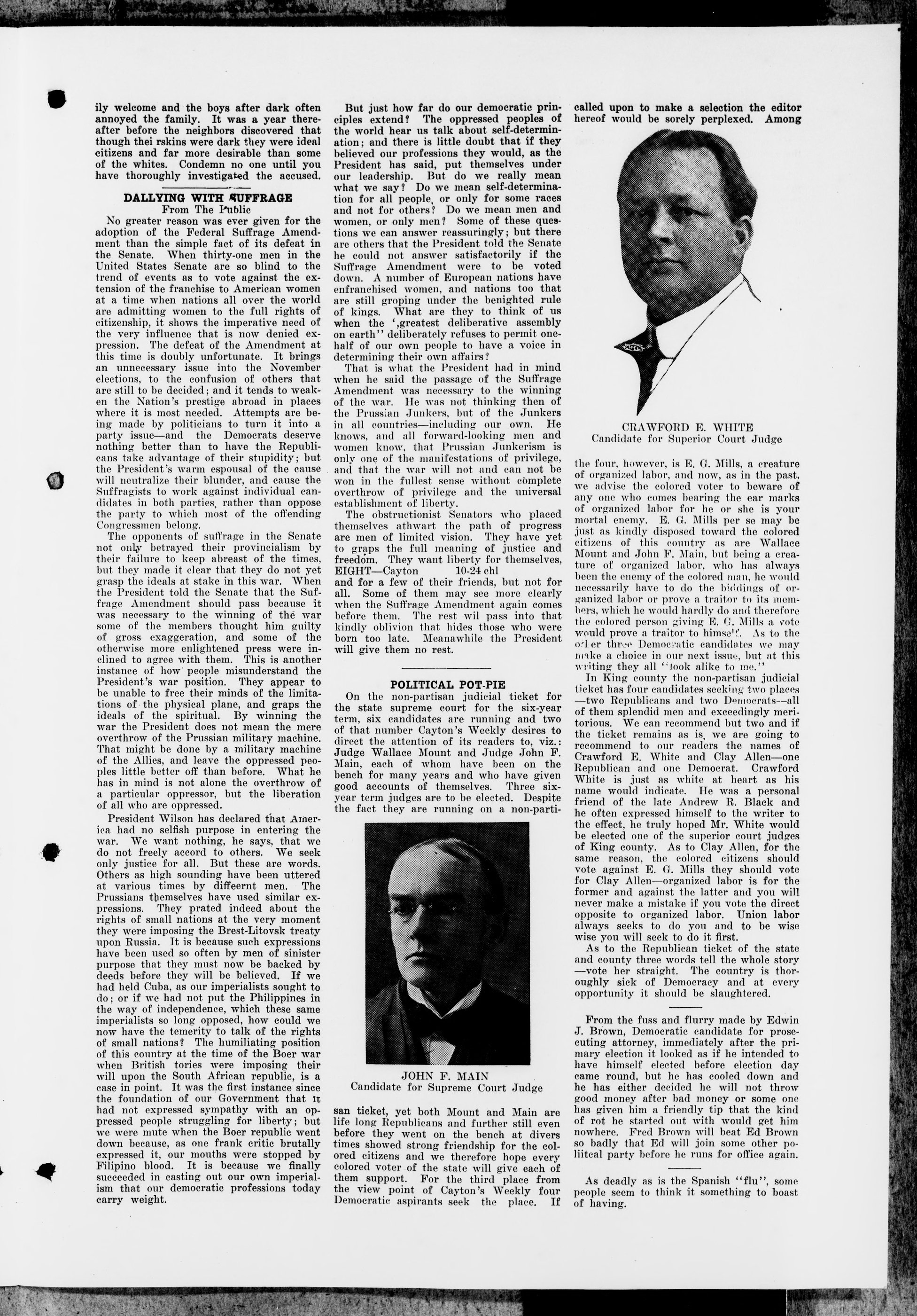
[Image of a man in a suit with a bow tie].
JOHN F. MAIN Candidate for Supreme Court Judge san ticket, yet both Mount and Main are life long Republicans and further still even before they went on the bench at divers times showed strong friendship for the colored citizens and we therefore hope every colored voter of the state will give each of them support. For the third place from the view point of Cayton's Weekly four Democratic aspirants seek the place. If
called upon to make a selection the editor hereof would be sorely perplexed. Among
```markdown
```
CRAWFORD E. WHITE Candidate for Superior Court Judge
the four, however, is E. G. Mills, a creature of organized labor, and now, as in the past, we advise the colored voter to beware of any one who comes bearing the ear marks of organized labor for he or she is your mortal enemy. E. G. Mills per se may be just as kindly disposed toward the colored citizens of this country as are Wallace Mount and John F. Main, but being a creature of organized labor, who has always been the enemy of the colored man, he would necessarily have to do the biddings of organized labor or prove a traitor to its members, which he would hardly do and therefore the colored person giving E. G. Mills a vote would prove a traitor to himself'. As to the other three Democratic candidates we may make a choice in our next issue, but at this writing they all "took alike to me."
In King county the non-partisan judicial ticket has four candidates seeking two places two Republicans and two Democrats-all of them splendid men and exceedingly meritorious. We can recommend but two and if the ticket remains as is, we are going to recommend to our readers the names of Crawford E. White and Clay Allen-one Republican and one Democrat. Crawford White is just as white at heart as his name would indicate. He was a personal friend of the late Andrew R. Black and he often expressed himself to the writer to the effect, he truly hoped Mr. White would be elected one of the superior court judges of King county. As to Clay Allen, for the same reason, the colored citizens should vote against E. G. Mills they should vote for Clay Allen—organized labor is for the former and against the latter and you will never make a mistake if you vote the direct opposite to organized labor. Union labor always seeks to do you and to be wise wise you will seek to do it first.
As to the Republican ticket of the state and county three words tell the whole story—vote her straight. The country is thoroughly sick of Democracy and at every opportunity it should be slaughtered.
From the fuss and flurry made by Edwin J. Brown, Democratic candidate for prosecuting attorney, immediately after the primary election it looked as if he intended to have himself elected before election day came round, but he has cooled down and he has either decided he will not throw good money after bad money or some one has given him a friendly tip that the kind of rot he started out with would get him nowhere. Fred Brown will beat Ed Brown so badly that Ed will join some other political party before he runs for office again.
As deadly as is the Spanish "flu", some people seem to think it something to boast of having.
1
9
STOLEN FROM THIEVES
"Queer, isn't it?"
"What?"
"You plant the eyes of the potatoes, and the ears of the corn."
Mrs. Jones: "Lookee, George, didn't I tell you my boy'd make the folks open their mouths when he got to Chicago?"
Mrs. Johnson: "So you did, an' has he done it?"
Mrs. Jones: "Sure thing. He's started business as a dentist."
The burglar had just begun his term and was assigned to work in the broom factory. Near him was an oldish man who studied him intently and seemed to be awaiting an opportunity to say something. It came when the overseer was at the ice-water tank. "How long are you in for?" he whispered. "Twelve years." replied the newcomer.
"Twelve years," replied the newcomer. The veteran looked around nervously and thrust a letter in the burglar's hand. "I'm in for life," he said. "Mail this when you get out."
He—"I haven't done a day's work in two years."
She—"You ought to be ashamed of yourself."
He—"Oh, no. I'm a night-watchman in a bank."
Rebecca—"Do you understand the language of married life?"
Rachel—"No, do you?"
Rebecca—"Yes. One grunt means I love you. Two grunts means 'Don't bother me, I want to read my paper.'"
"Why are you in prison, my good man?" asked the sympathetic visitor.
"I wanted to do a deed of kindness, mum, but de law didn't see it dat way."
"No?"
"I wuz told dat a certain millionaire's money wuz a burden to him, an' I tried to lighten his burden."
Neighbor—"Say, Dobson, if you're running to fish your little boy out of the mill pond, you're too late!"
Dobson (wildly)—"Oh, good heavens!" Neighbor—"Yep, he crawled out himself."
Jinks—"I know a woman who has never searched her husband's pockets."
Blinks—"Really! Impossible!"
Jinks—"No, she's never been married."
She was a widow who was trying to get in touch with her deceased husband.
The medium, after a good deal of futile work, said to her:
"The conditions this evening seem unfavorable. I can't seem to establish communication with Mr. Smith, ma'am."
"Well, I'm not surprised," said the widow, with a glance at the clock. "It is only half past eight now, and John never did show up till about three a. m."—Tit-Bits.
Helene: "Now, George, you must come early, because you know father puts out all the lights at ten o'clock."
George: "Very well, dearest. I'll be there promptly at ten."
The old wold we're living in
Is pretty hard to beat;
Every rose may have its thorn—
But ain't the roses sweet?
A colored employee of a large company was killed in an accident. The claim agent went to the widow to make a settlement out of court.
"You see, madam," said the agent, "we make you a fair offer. If you refuse and take the matter into court, you may not receive anything. Will you be satisfied with fifteen hundred dollars?"
"No suh. You'se ain't gwine ter cheat me. Ise won't be satisfied with no fifteen
---
Easy Money for Maggie—"My sister Maggie is a very fortunate girl."
"Yes? Why?"
"Dunno. But she went to a party last night, and played blind man's buff all the evening. The gentlemen hunt around and find a girl, and then they must either kiss her or give her a shilling.
"Yes?"
"Maggie came home with thirty shillings and a war-bond."—Tit-Bits.
TUTT'S BARBER SHOP "He wants to see you." High-class Tonsorial Work. 300 Main Street, Seattle. Latest race papers. All kinds of toilet supplies.
Phone 2647
Tailors and Cleaners. Clothes called for and delivered. Hats retrimmed and blocked. H. S. Frazier C. W. Curtest
WEST & WHEELER
There are real estate dealers and real estate dealers, but—
IN THE SUPERIOR COURT OF THE STATE OF Washington for King County.
You are hereby summoned to appear within sixty days after the date of the first publication of this summons, to-wit: within sixty days after the 13th day of September, 1918, and defend the above entitled action in the above entitled court, and answer the complaint of the plaintiff, and serve a copy of your answer upon the undersigned attorney for plaintiff at his office below stated; and in case of your failure so to do, judgment will be rendered against you according to the demand of the complaint, which has been filed with the clerk of said court.
The object of the above entitled action is to obtain a decree of divorce from the defendant by the plaintiff on the grounds of desertion.
ANDREW R. BLACK,
Attorney for Plaintiff
P. O. Address, 316 Pacific Block, Seattle, Wash.
Sept. 13—Nov. 1, 1918.
Read for Yourself and be Convinced
---
hundred dollars. Ise won't be satisfied 'less I gets a thousand dollars.'"
Mr. Slowe (about 11:59 p. m.)—"Shall I sing Tosti's 'Good-Bye'?"
Miss Cutting (wearily)—"I don't care which one you sing—in fact you needn't bother to sing it, just say it."
Recently at a funeral, a well dressed stranger took a seat in one of the three mourning coaches. The three other occupants of the carriage were rather curious to know who he was, and at last one of them began to question him. The dialogue went something like this:
"Are you a brother of the corpse?"
"No, I am not the brother of the corpse."
No, I am not the brother of the corpse. "Well, then perhaps you are a cousin?" "No, I'm not a cousin." "At any rate, you are a friend of the corpse." "No, I'm not that either. You see, I've not been very well," explained the stranger, "and my doctor ordered me to ride about in the fresh air as much as possible, and not having a carriage of my own, I thought it would be cheaper to ride out to the cemetery with you than to hire a cab." The Missus: "Dinah, did you wash the fish carefully before you baked it?"
Dinah: "Lawd, no, ma'am. Wot de use ob washin' er fish dat's lived all his life in de watah?"
Pauline: "No Freddie, I cannot marry you. The man who weds me must be a grand man,—upright and square."
Freddie: "You don't want a man, you want a piano."
"Casey is me pertickeler frind, Oi'd have ye know."
"G'wan! If he was pertickeler he wouldn't be yer frind."
Fixing Up the House—"Have you no potted geraniums." "No. We have some very nice chrysanthemums." "I must have geraniums. They are for my wife." "I'm sure she'd like these chrysanthemums." "You don't understand. The geraniums are to replace some I promised to care for while she was away."—Pittburg Sun.
What Saved the Baby—The family were entertaining callers one afternoon, and while the grown-ups were talking, the baby crept on the floor. Suddenly there was a loud bump and wild wail. It came from the direction of the piano.
"Oh, the baby has hurt himself!" cried the mother. "Run, quick, dear!"
The young father had already dashed toward the piano. He dropt on his knees and groped under the piano for his injured offspring. Presently he returned.
"He fell down and bumped his head on one of the pedals," he reported.
"Oh, the poor darling! Is it a bad bump?" asked one of the guests.
"No," he answered. "Fortunately, his head hit the soft pedal!"—Tit-Bits.
Little Weakness of Chris—Sam—"Ah done heerd dat dey fin' Columbus's bones." Ezra—'Lawd! Ah never knew dat he wuz a gamblin' man."—Panther.
Thoughts Encouraged by Nation-wide Prohibition—The modern germ-crank can not understand how the boy who drank out of the old oaken bucket ever lived to write the verses. And there have been times when the verses struck others as having been written during a long illness.—Kansas City Star.
There is no doubt but that the next prosecuting attorney of King county will be Brown though white.
Camp Lewis is under strict quarantine just now and the profiteers of Tacoma and Seattle wear faces as long as your arm on account of it.
1034 Jackson
WEST & WHEELER Marion Building
Cheasty's Good Clothes for Men and Women. You can't beat it. CHEASTY'S Second and Spring
SEATTLE LIGHTING CO.
Lightens your burdens. Day or night it's always there with the goods. SEATTLE LIGHTING CO.
The State of Washingt .. to the said Dwight Brice,
Defendant:
CAYTON'S WEEKLY
(Office 303 22nd Ave. South) Regular, Reliable, Republican, Readable Wants 500 New Subscribers
This is a Sample of what it sends out Every Week
No Friends to Reward or Enemies to Punish
A Publication of Ideas Rather Than Personalities
Telephone Beacon 1910