Cayton's Weekly
Saturday, November 9, 1918
Seattle, Washington
Page text (machine-generated)
Cayton's Weekly
SEATTLE, WASHINGTON, SATURDAY, NOVEMBER 9, 1918.
---
PRICE FIVE CENTS
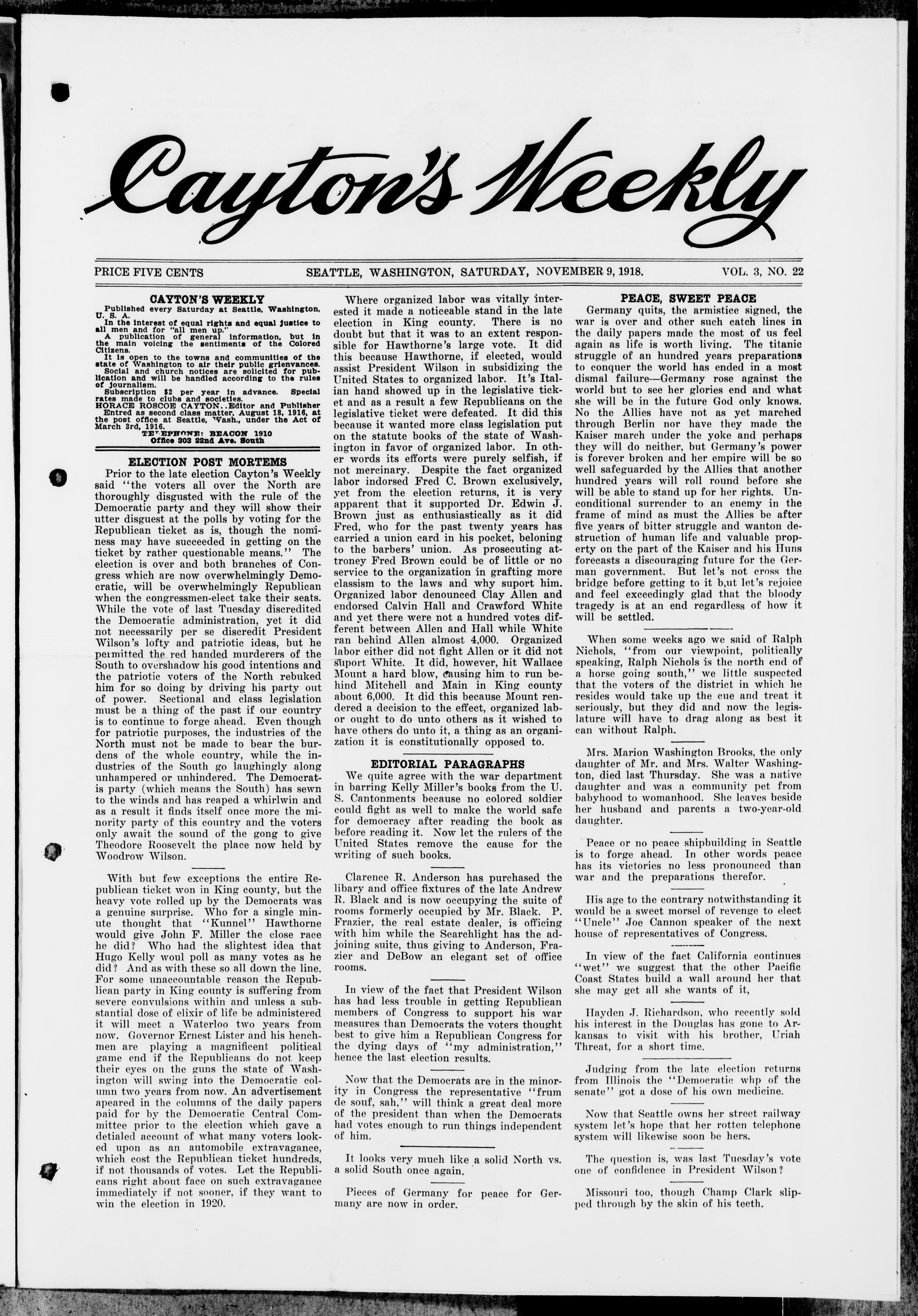
CAYTON'S WEEKLY
Published every Saturday at Seattle, Washington, U. S. A.
In the interest of equal rights and equal justice to all men and for "all men up."
A publication of general information, but in the main voicing the sentiments of the Colored Citizens.
It is open to the towns and communities of the state of Washington to air their public grievances. Social and church notices are solicited for publication and will be handled according to the rules of journalism.
Subscription $2 per year in advance. Special rates made to clubs and societies.
HORACE ROSCOE CAYTON..Editor and Publisher
Entred as second class matter, August 18, 1916, at
the post office at Seattle, "Wash., under the Act of
March 3rd, 1916.
TELEPHONE: BEACON 1910
Office 303 22d Ave. South
ELECTION POST MORTEMS
Prior to the late election Cayton's Weekly said "the voters all over the North are thoroughly disgusted with the rule of the Democratic party and they will show their utter disguest at the polls by voting for the Republican ticket as is, though the nominess may have succeeded in getting on the ticket by rather questionable means." The election is over and both branches of Congress which are now overwhelmingly Democratic, will be overwhelmingly Republican when the congressmen-elect take their seats. While the vote of last Tuesday discredited the Democratic administration, yet it did not necessarily per se discredit President Wilson's lofty and patriotic ideas, but he permitted the red handed murderers of the South to overshadow his good intentions and the patriotic voters of the North rebuked him for so doing by driving his party out of power. Sectional and class legislation must be a thing of the past if our country is to continue to forge ahead. Even though for patriotic purposes, the industries of the North must not be made to bear the burdens of the whole country, while the industries of the South go laughingly along unhampered or unhindered. The Democratis party (which means the South) has sewn to the winds and has reaped a whirlwin and as a result it finds itself once more the minority party of this country and the voters only await the sound of the gong to give Theodore Roosevelt the place now held by Woodrow Wilson.
With but few exceptions the entire Republican ticket won in King county, but the heavy vote rolled up by the Democrats was a genuine surprise. Who for a single minute thought that "Kunnel" Hawthorne would give John F. Miller the close race he did? Who had the slightest idea that Hugo Kelly woul poll as many votes as he did? And as with these so all down the line. For some unaccountable reason the Republican party in King county is suffering from severe convulsions within and unless a substantial dose of elixir of life be administered it will meet a Waterloo two years from now. Governor Ernest Lister and his henchmen are playing a magnificent political game end if the Republicans do not keep their eyes on the guns the state of Washington will swing into the Democratic column two years from now. An advertisement appeared in the columns of the daily papers paid for by the Democratic Central Committee prior to the election which gave a detialed account of what many voters looked upon as an automobile extravagance, which cost the Republican ticket hundreds, if not thousands of votes. Let the Republicans right about face on such extravagance immediately if not sooner, if they want to win the election in 1920.
Where organized labor was vitally interested it made a noticeable stand in the late election in King county. There is no doubt but that it was to an extent responsible for Hawthorne's large vote. It did this because Hawthorne, if elected, would assist President Wilson in subsidizing the United States to organized labor. It's Italian hand showed up in the legislative ticket and as a result a few Republicans on the legislative ticket were defeated. It did this because it wanted more class legislation put on the statute books of the state of Washington in favor of organized labor. In other words its efforts were purely selfish, if not mercinary. Despite the fact organized labor indorsed Fred C. Brown exclusively, yet from the election returns, it is very apparent that it supported Dr. Edwin J. Brown just as enthusiastically as it did Fred, who for the past twenty years has carried a union card in his pocket, beloning to the barbers' union. As prosecuting attroney Fred Brown could be of little or no service to the organization in grafting more classism to the laws and why support him. Organized labor denounced Clay Allen and endorsed Calvin Hall and Crawford White and yet there were not a hundred votes different between Allen and Hall while White ran behind Allen almost 4,000. Organized labor either did not fight Allen or it did not support White. It did, however, hit Wallace Mount a hard blow, causing him to run behind Mitchell and Main in King county about 6,000. It did this because Mount rendered a decision to the effect, organized labor ought to do unto others as it wished to have others do unto it, a thing as an organization it is constitutionally opposed to.
EDITORIAL PARAGRAPHS
We quite agree with the war department in barring Kelly Miller's books from the U. S. Cantonments because no colored soldier could fight as well to make the world safe for democracy after reading the book as before reading it. Now let the rulers of the United States remove the cause for the writing of such books.
Clarence R. Anderson has purchased the libary and office fixtures of the late Andrew R. Black and is now occupying the suite of rooms formerly occupied by Mr. Black. P. Frazier, the real estate dealer, is officing with him while the Searchlight has the adjoining suite, thus giving to Anderson, Frazier and DeBow an elegant set of office rooms.
In view of the fact that President Wilson has had less trouble in getting Republican members of Congress to support his war measures than Democrats the voters thought best to give him a Republican Congress for the dying days of "my administration," hence the last election results.
Now that the Democrats are in the minority in Congress the representative "frum de souf, sah," will think a great deal more of the president than when the Democrats had votes enough to run things independent of him.
It looks very much like a solid North vs. a solid South once again.
Pieces of Germany for peace for Germany are now in order.
VOL. 3. NO. 22
PEACE. SWEET PEACE
Germany quits, the armistice signed, the war is over and other such catch lines in the daily papers made the most of us feel again as life is worth living. The titanic struggle of an hundred years preparations to conquer the world has ended in a most dismal failure—Germany rose against the world but to see her glories end and what she will be in the future God only knows. No the Allies have not as yet marched through Berlin nor have they made the Kaiser march under the yoke and perhaps they will do neither, but Germany's power is forever broken and her empire will be so well safeguarded by the Allies that another hundred years will roll round before she will be able to stand up for her rights. Unconditional surrender to an enemy in the frame of mind as must the Allies be after five years of bitter struggle and wanton destruction of human life and valuable property on the part of the Kaiser and his Huns forecasts a discouraging future for the German government. But let's not cross the bridge before getting to it but let's rejoice and feel exceedingly glad that the bloody tragedy is at an end regardless of how it will be settled.
When some weeks ago we said of Ralph Nichols, "from our viewpoint, politically speaking, Ralph Nichols is the north end of a horse going south," we little suspected that the voters of the district in which he resides would take up the cue and treat it seriously, but they did and now the legislature will have to drag along as best it can without Ralph.
Mrs. Marion Washington Brooks, the only daughter of Mr. and Mrs. Walter Washington, died last Thursday. She was a native daughter and was a community pet from babyhood to womanhood. She leaves beside her husband and parents a two-year-old daughter.
Peace or no peace shipbuilding in Seattle is to forge ahead. In other words peace has its victories no less pronounced than war and the preparations therefor.
His age to the contrary notwithstanding it would be a sweet morsel of revenge to elect "Uncle" Joe Cannon speaker of the next house of representatives of Congress.
In view of the fact California continues "wet" we suggest that the other Pacific Coast States build a wall around her that she may get all she wants of it,
Hayden J. Richardson, who recently sold his interest in the Douglas has gone to Arkansas to visit with his brother, Uriah Threat, for a short time.
Judging from the late election returns from Illinois the "Democratic whp of the senate" got a dose of his own medicine.
Now that Seattle owns her street railway system let's hope that her rotten telephone system will likewise soon be hers.
The question is, was last Tuesday's vote one of confidence in President Wilson?
Missouri too, though Champ Clark slipped through by the skin of his teeth.
```markdown
```
With Germany suppressed the next disturbing element of the world will be Japan, who in the war just closed professed friendship for the Allies, yet turned not her hand to assist them and it is the private opinion of the editor hereof that had Germany ever showed any signs of success Germany and Japan would have co-jointly seized Russia and split it fifty-fifty between them. Japan we fear is a snake in the grass.
Because Ed Cudihee suported P. J. McCormick for sheriff Mrs. Ed Cudihee supported Jack Stringer, but despite the fact Mrs. Cudihee won out, yet she has begun divorce proceedings against her "lord and master." Evidently she plans to give "my lord and master" a touch of high life for daring to have a mind of his own, and, yet for that we love them.
In this country the past, of anyone, however shady, is very soon forgotten and nothing more clearly demonstrates that than the election of Frank Cotterill as a member of the next legislature. Frank may prove to be just as useful a member as answers the roll call and his past whether good or bad may not bias or warp his brilliant mind one iota, but—
"Didn't support my administration," as scolded President Wilson prior to the election worked like a charm in the South, but was not worth a tinker's damn in the North. In fact the voters of the North were just delighted to get an opportunity to rebuke "my administration," which may be seen from the late election returns.
[Name]
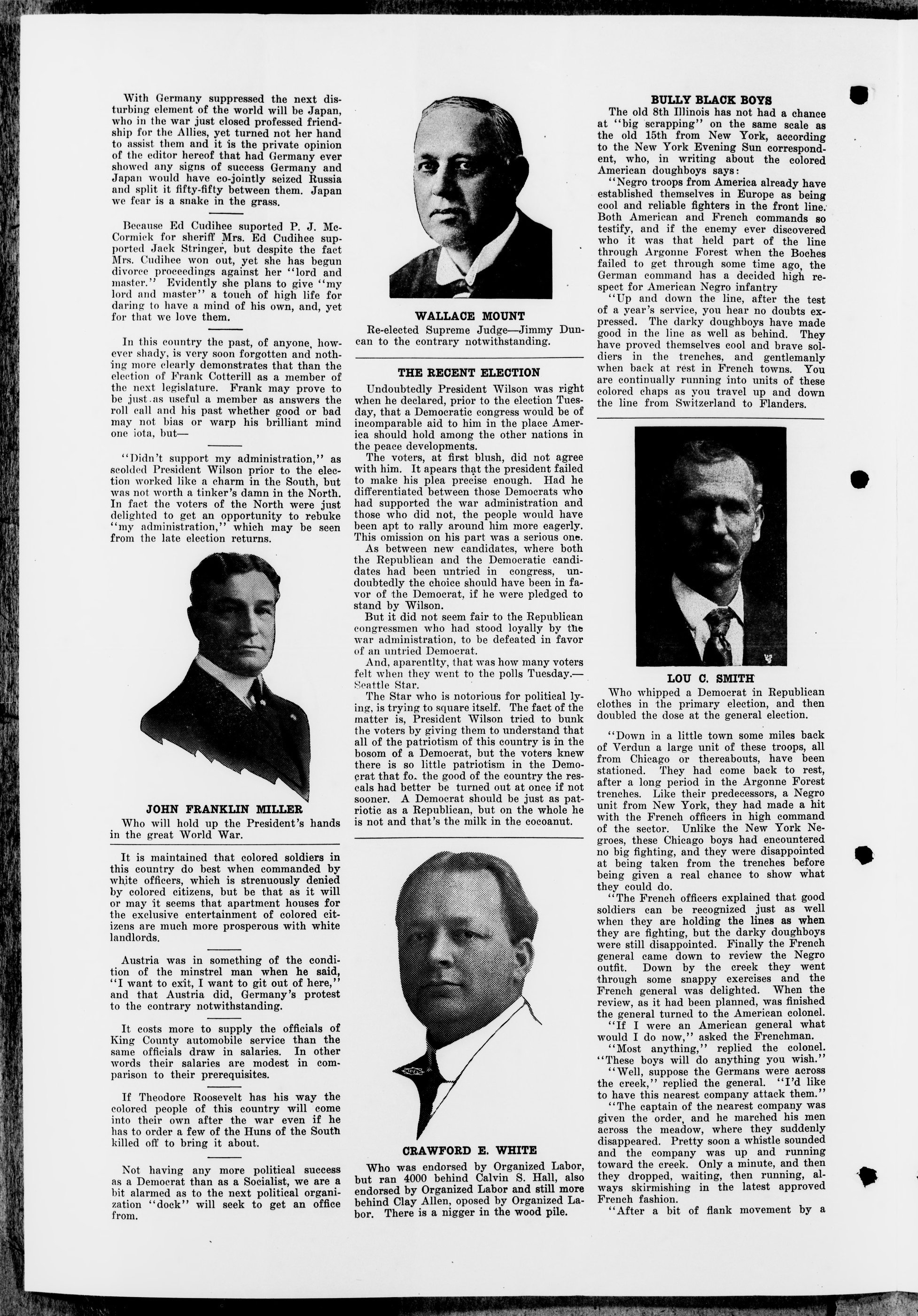
JOHN FRANKLIN MILLER Who will hold up the President's hands in the great World War. It is maintained that colored soldiers in this country do best when commanded by white officers, which is strenuously denied by colored citizens, but be that as it will or may it seems that apartment houses for the exclusive entertainment of colored citizens are much more prosperous with white landlords.
Austria was in something of the condition of the minstrel man when he said, "I want to exit, I want to git out of here," and that Austria did, Germany's protest to the contrary notwithstanding.
It costs more to supply the officials of King County automobile service than the same officials draw in salaries. In other words their salaries are modest in comparison to their prerequisites.
If Theodore Roosevelt has his way the colored people of this country will come into their own after the war even if he has to order a few of the Huns of the South killed off to bring it about.
Not having any more political success as a Democrat than as a Socialist, we are a bit alarmed as to the next political organization "dock" will seek to get an office from.
[Picture of a man in a suit with a tie].
WALLACE MOUNT Re-elected Supreme Judge—Jimmy Duncan to the contrary notwithstanding.
THE RECENT ELECTION
Undoubtedly President Wilson was right when he declared, prior to the election Tuesday, that a Democratic congress would be of incomparable aid to him in the place America should hold among the other nations in the peace developments. The voters, at first blush, did not agree with him. It apears that the president failed to make his plea precise enough. Had he differentiated between those Democrats who had supported the war administration and those who did not, the people would have been apt to rally around him more eagerly. This omission on his part was a serious one.
As between new candidates, where both the Republican and the Democratic candidates had been untried in congress, undoubtedly the choice should have been in favor of the Democrat, if he were pledged to stand by Wilson.
But it did not seem fair to the Republican congressmen who had stood loyally by the war administration, to be defeated in favor of an untried Democrat.
And, aparentlty, that was how many voters felt when they went to the polls Tuesday.—Seattle Star.
The Star who is notorious for political lying, is trying to square itself. The fact of the matter is, President Wilson tried to bunk the voters by giving them to understand that all of the patriotism of this country is in the bosom of a Democrat, but the voters knew there is so little patriotism in the Democrat that fo. the good of the country the rescals had better be turned out at once if not sooner. A Democrat should be just as patriotic as a Republican, but on the whole he is not and that's the milk in the cocoanut.
A. G.
CRAWFORD E. WHITE Who was endorsed by Organized Labor, but ran 4000 behind Calvin S. Hall, also endorsed by Organized Labor and still more behind Clay Allen, opposed by Organized Labor. There is a nigger in the wood pile.
BULLY BLACK BOYS
The old 8th Illinois has not had a chance at "big scrapping" on the same scale as the old 15th from New York, according to the New York Evening Sun correspondent, who, in writing about the colored American doughboys says:
"Negro troops from America already have established themselves in Europe as being cool and reliable fighters in the front line. Both American and French commands so testify, and if the enemy ever discovered who it was that held part of the line through Argonne Forest when the Boches failed to get through some time ago, the German command has a decided high respect for American Negro infantry
"Up and down the line, after the test of a year's service, you hear no doubts expressed. The darky doughboys have made good in the line as well as behind. They have proved themselves cool and brave soldiers in the trenches, and gentlemanly when back at rest in French towns. You are continually running into units of these colored chaps as you travel up and down the line from Switzerland to Flanders.
49
LOU C. SMITH Who whipped a Democrat in Republican clothes in the primary election, and then doubled the dose at the general election.
"Down in a little town some miles back of Verdun a large unit of these troops, all from Chicago or thereabouts, have been stationed. They had come back to rest, after a long period in the Argonne Forest trenches. Like their predecessors, a Negro unit from New York, they had made a hit with the French officers in high command of the sector. Unlike the New York Negroes, these Chicago boys had encountered no big fighting, and they were disappointed at being taken from the trenches before being given a real chance to show what they could do.
"The French officers explained that good soldiers can be recognized just as well when they are holding the lines as when they are fighting, but the darky doughboys were still disappointed. Finally the French general came down to review the Negro outfit. Down by the creek they went through some snappy exercises and the French general was delighted. When the review, as it had been planned, was finished the general turned to the American colonel.
"If I were an American general what would I do now," asked the Frenchman. "Most anything," replied the colonel. "These boys will do anything you wish." "Well, suppose the Germans were across the creek," replied the general. "I'd like to have this nearest company attack them." "The captain of the nearest company was given the order, and he marched his men across the meadow, where they suddenly disappeared. Pretty soon a whistle sounded and the company was up and running toward the creek. Only a minute, and then they dropped, waiting, then running, always skirmishing in the latest approved French fashion.
"After a bit of flank movement by a
Ee
aa pope MT ee ar IAs Pa EN Ls ee ere ;
couple of platoons, the supposed German
positions along the creek were stormed and
taken. The French general was delighted.
Finally he said, ‘My oldest veterans could
do it no better, even if they were warned
it was on the program, and your boys did
that extemporaneously.’ The general re-
membered the review, and a few days later
these colored chaps from Chicago received
a fine letter from him, congratulating them
on their esprit de corps and their work.
“Tt was interesting to see how these col-
ee
7 4
\ *
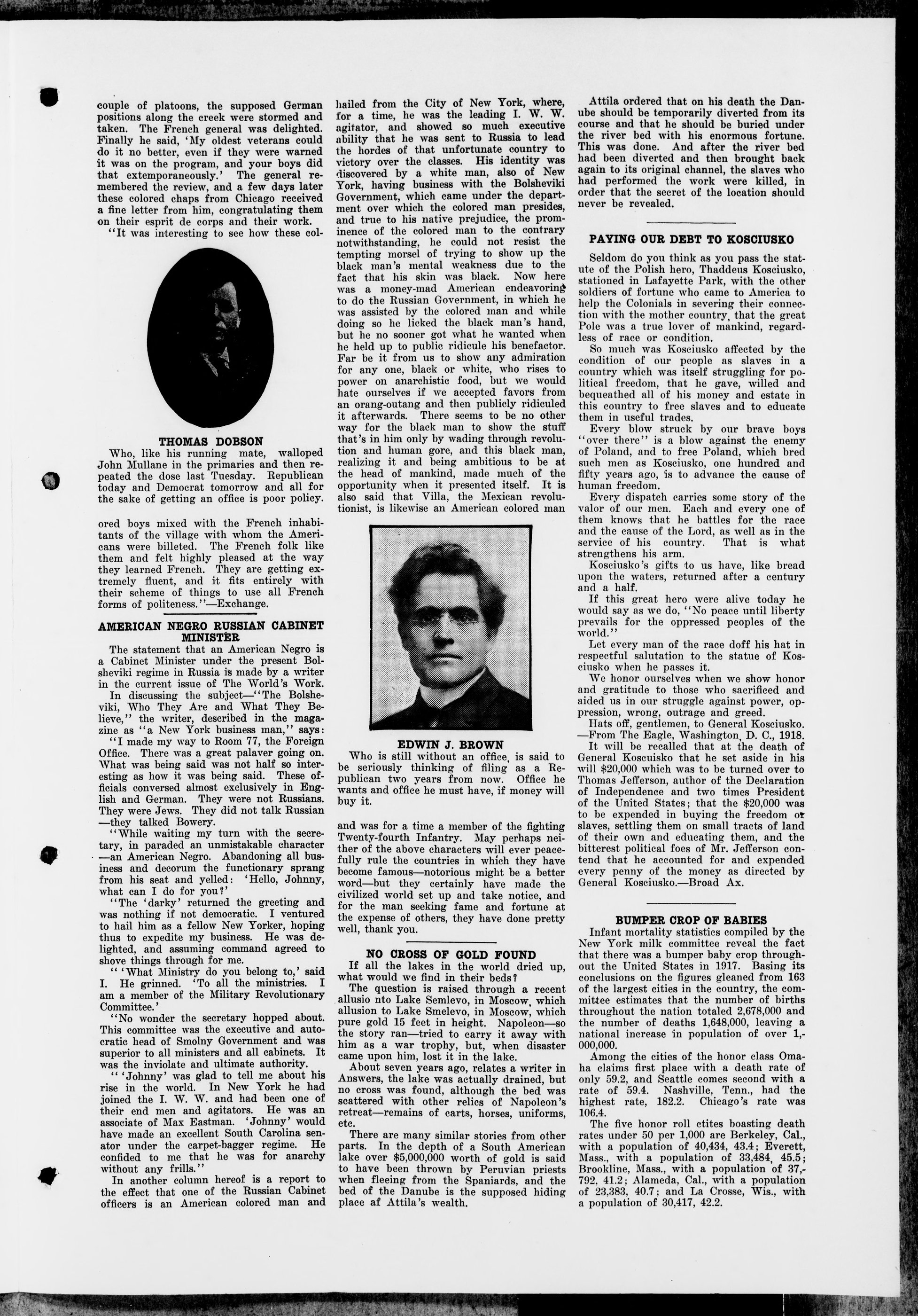
THOMAS DOBSON
Who, like his running mate, walloped
John Mullane in the primaries and then re-
peated the dose last Tuesday. Republican
today and Democrat tomorrow and all for
the sake of getting an office is poor policy.
ored boys mixed with the French inhabi-
tants of the village with whom the Ameri-
cans were billeted. The French folk like
them and felt highly pleased at the way
they learned French. They are getting ex-
tremely fiuent, and it fits entirely with
their scheme of things to use all French
forms of politeness.’’—Exchange.
AMERICAN NEGRO RUSSIAN CABINET
MINISTER,
The statement that an American Negro is
a Cabinet Minister under the present Bol-
sheviki regime in Russia is made by a writer
in the current issue of The World’s Work.
In discussing the subject—‘‘The Bolshe-
viki, Who They Are and What They Be-
lieve,’? the writer, described in the maga-
zine as ‘‘a New York business man,’’ says:
“‘T made my way to Room 77, the Foreign
Office. There was a great palaver going on.
What was being said was not half so inter-
esting as how it was being said. These of-
ficials conversed almost exclusively in Eng-
lish and German. They were not Russians.
They were Jews. They did not talk Russian
—they talked Bowery.
“While waiting my turn with the secre-
tary, in paraded an unmistakable character
—an American Negro. Abandoning all bus-
imess and decorum the functionary sprang
from his seat and yelled: ‘Hello, Johnny,
what can I do for you?’
“The ‘darky’ returned the greeting and
was nothing if not democratic. I ventured
to hail him as a fellow New Yorker, hoping
thus to expedite my business. He was de-
lighted, and assuming command agreed to
shove things through for me.
“«¢What Ministry do you belong to,’ said
I. He grinned. ‘To all the ministries. I
am a member of the Military Revolutionary
Committee.’
“‘No wonder the secretary hopped about.
This committee was the executive and auto-
eratic head of Smolny Government and was
superior to all ministers and all cabinets. It
was the inviolate and ultimate authority.
“*¢ Johnny’ was glad to tell me about his
rise in the world. In New York he had
joined the I. W. W. and had been one of
their end men and agitators. He was an
associate of Max Eastman. ‘Johnny’ would
have made an excellent South Carolina sen-
ator under the carpet-bagger regime. He
confided to me that he was for anarchy
without any frills.’’
In another column hereof is a report to
the effect that one of the Russian Cabinet
officers is an American colored man and
hailed from the City of New York, where,
for a time, he was the leading I. W. W.
agitator, and showed so much executive
ability that he was sent to Russia to lead
the hordes of that unfortunate country to
victory over the classes. His identity was
discovered by a white man, also of New
York, having business with the Bolsheviki
Government, which came under the depart-
ment over which the colored man presides,
and true to his native prejudice, the prom-
inence of the colored man to the contrary
notwithstanding, he could not resist the
tempting morsel of trying to show up the
black man’s mental weakness due to the
fact that his skin was black. Now here
was a money-mad American endeavoring
to do the Russian Government, in which he
was assisted by the colored man and while
doing so he licked the black man’s hand,
but he no sooner got what he wanted when
he held up to public ridicule his benefactor.
Far be it from us to show any admiration
for any one, black or white, who rises to
power on anarchistic food, but we would
hate ourselves if we accepted favors from
an orang-outang and then publicly ridiculed
it afterwards. There seems to be no other
way for the black man to show the stuff
that’s in him only by wading through revolu-
tion and human gore, and this black man,
realizing it and being ambitious to be at
the head of mankind, made much of the
opportunity when it presented itself. It is
also said that Villa, the Mexican revolu-
tionist, is likewise an American colored man
: é 2 a :
:
EDWIN J. BROWN
Who is still without an office, is said to
be seriously thinking of filing as a Re-
publican two years from now. Office he
wants and office he must have, if money will
buy it.
and was for a time a member of the fighting
Twenty-fourth Infantry. May perhaps nei-
ther of the above characters will ever peace-
fully rule the countries in which they have
become famous—notorious might be a better
word—but they certainly have made the
civilized world set up and take notice, and
for the man seeking fame and fortune at
the expense of others, they have done pretty
well, thank you.
NO CROSS OF GOLD FOUND
dr all the lakes in the world dried up,
what would we find in their beds?
The question is raised through a recent
allusio nto Lake Semlevo, in Moscow, which
allusion to Lake Smelevo, in Moscow, which
pure gold 15 feet in height. Napoleon—so
the story ran—tried to carry it away with
him as a war trophy, but, when disaster
came upon him, lost it in the lake.
About seven years ago, relates a writer in
Answers, the lake was actually drained, but
no cross was found, although the bed was
scattered with other relics of Napoleon’s
retreat—remains of carts, horses, uniforms,
ete.
There are many similar stories from other
parts. In the depth of a South American
lake over $5,000,000 worth of gold is said
to have been thrown by Peruvian priests
when fleeing from the Spaniards, and the
bed of the Danube is the supposed hiding
place af Attila’s wealth.
Attila ordered that on his death the Dan-
ube should be temporarily diverted from its
course and that he should be buried under
the river bed with his enormous fortune.
This was done. And after the river bed
had been diverted and then brought back
again to its original channel, the slaves who
had performed the work were killed, in
order that the secret of the location should
never be revealed.
PAYING OUR DEBT TO KOSCIUSKO
Seldom do you think as you pass the stat-
ute of the Polish hero, Thaddeus Kosciusko,
stationed in Lafayette Park, with the other
soldiers of fortune who came to America to
help the Colonials in severing their connec-
tion with the mother country, that the great
Pole was a true lover of mankind, regard-
less of race or condition.
So much was Kosciusko affected by the
condition of our people as slaves in a
country which was itself struggling for po-
litical freedom, that he gave, willed and
bequeathed all of his money and estate in
this country to free slaves and to educate
them in useful trades,
Every blow struck by our brave boys
“fover there’ is a blow against the enemy
of Poland, and to free Poland, which bred
such men as Kosciusko, one hundred and
fifty years ago, is to advance the cause of
human freedom.
Every dispatch carries some story of the
valor of our men. Each and every one of
them knows that he battles for the race
and the cause of the Lord, as well as in the
service of his country. That is what
strengthens his arm.
Kosciusko’s gifts to us have, like bread
upon the waters, returned after a century
and a half.
If this great hero were alive today he
would say as we do, ‘‘No peace until liberty
prevails for the oppressed peoples of the
world.’’
Let every man of the race doff his hat in
respectful salutation to the statue of Kos-
ciusko when he passes it.
‘We honor ourselves when we show honor
and gratitude to those who sacrificed and
aided us in our struggle against power, op-
pression, wrong, outrage and greed.
Hats off, gentlemen, to General Kosciusko.
—From The Eagle, Washington, D. C., 1918.
It will be recalled that at the death of
General Koscuisko that he set aside in his
will $20,000 which was to be turned over to
Thomas Jefferson, author of the Declaration
of Independence and two times President
of the United States; that the $20,000 was
to be expended in buying the freedom ot
slaves, settling them on small tracts of land
of their own and educating them, and the
bitterest political foes of Mr. Jefferson con-
tend that he accounted for and expended
every penny of the money as directed by
General Kosciusko.—Broad Ax.
BUMPER CROP OF BABIES
Infant mortality statistics compiled by the
New York milk committee reveal the fact
that there was a bumper baby crop through-
out the United States in 1917. Basing its
conclusions on the figures gleaned from 163
of the largest cities in the country, the com-
mittee estimates that the number of births
throughout the nation totaled 2,678,000 and
the number of deaths 1,648,000, leaving a
national increase in population of over 1,-
000,000.
Among the cities of the honor class Oma-
ha claims first place with a death rate of
only 59.2, and Seattle comes second with a
rate of 59.4. Nashville, Tenn., had the
highest rate, 182.2. Chicago’s rate was
106.4.
The five honor roll ctites boasting death
rates under 50 per 1,000 are Berkeley, Cal.,
with a population of 40,434, 43.4; Everett,
Mass., with a population of 33,484, 45.5;
Brookline, Mass., with a population of 37,-
792, 41.2; Alameda, Cal., with a population
of 23,383, 40.7; and La Crosse, Wis., with
a population of 30,417, 42.2.
out the country known to have fat bank accounts and who are supposed to believe that the race will become that much stronger and influential in proportion to the solid business enterprises it can put in the commercial world. There were some who did not have the common courtesy to reply, while others were not so favorably impressed with facts and figures presented, as the proposition did not have the aspect of a get-rich-quick scheme. It failed to quicken their imagination the same as a 100 to 1 shot at the races.
Some Negroes throughout the country who are known for opening wine and "going big" in public, thought the idea "wonderful," but that was all they did—just think; so the publishing company was ultimately organized in a most modest way—by the writer going down in his jeans. With the proper cooperation the enterprise could have been started under more auspicious conditions.
There are two music publishing concerns struggling for recognition and success in New York at this time. One is the Walton Publishing Company, which is in swaddling clothes, and the Pace & Handy Music Company, which is known as the "Home of the Blues" and took up residence in the metropolis a few months ago. This firm has been trying to gain a foothold for more than five years, and it affords me pleasure to be able to state that its future looks bright.
Since the advent of Pace & Handy in New York I have heard colored writers declare that they would not place their numbers with a colored firm, as their previous experience with colored publishing houses some years ago was none too remunerative. I have heard these same writers complain of being unable to get their songs with a white publisher. Were an investigation made it would be brought to light that the colored firm gave larger royalties than the white firms. Of course, many of us well know that one of our drawbacks is expecting too much of one another—because we are Negroes. The two colored publishing firms mentioned herein have been able to live so far largely on account of the white musical public. But imagine what influence for good they would yield for race writers if there were 100,000 William R. Hollands—or say 50,000 William R. Hollands—out of twelve million people!
Evidently the voters got the impression that the "Kunnul" was a big bunch of hartshorn instead of Hawthorne.
TUTT'S BARBER SHOP "He wants to see you." High-class Tonsorial Work. 300 Main Street, Seattle. Latest race papers. All kinds of toilet supplies.
Phone 2647
Tailors and Cleaners. Clothes called for and delivered. Hats retrimmed and blocked. H. S. Frazier C. W. Curtest
---
9
MUSIC PUBLISHING HOUSES
(By Lester A. Walton) Two weeks ago, in renewing his subscription for The Age, William R. Holland, who resides in Seattle, Wash., enclosed an additional $1 with the request that he be forwarded songs written by members of the race. I now have before me a second letter from Mr. Holland asking that he be advised where he can secure musical numbers featured this season by our representative colored shows. Colored composers, one and all, should doff their hats to Mr. Holland. He is a doer, not a talker. Neither would it be amiss for our advocates of race co-operation to point out Mr. Holland as a shining example of one who practices what he preaches.
If there were just 100,000 more William R. Hollands out of the twelve million colored Americans it would not be a very long time before the race could boast of music publishing houses in New York where talented young men and women might find an avenue for the exploitation of their musical compositions. In the United States today there are hundreds of young colored song writers of promise, but they find little encouragement, if any, in the music publishing world. This unfavorable condition is due largely to the inability of these ambitious writers to secure the serious consideration of the white publisher. But the latter, it must be remembered, first must give a willing ear to the compositions of young white writers.
The need of the establishment of music publishing houses conducted mainly to exploit the musical numbers of colored writers is not a new subject. Two years ago Alex Rogers and I not only discussed it at length but spent much valuable time in a futile effort to enlist white and colored people of means who bear the reputation of being extremely sympathetic toward the Negro. Our experience was none too pleasant, and after numerous personal interviews and exchange of correspondence on the wholesale we finally reached the conclusion that if a colored publishing house was to be formed it would be without the financial aid of philanthropists. We also found out that philanthropists, as a general rule, do not care to further race projects, even if there is a roseate opportunity to combine philanthropy with business to their financial advantage, unless the aims and objects strike their particular fancy. Giving with many of them seems to be a fad.
One of the philanthropists, while thinking well of the plan, was inclined to think that the publishing house should devote much of its efforts toward getting out songs for colored churches. Of course, we felt that our field of endeavor ought not to be restricted, nor did we care to confine ourselves to publishing religious numbers only. Another philanthropist of note was asked to look at the proposition as one in which he would get back his original investment. We assured him that we did not want a cent for our services, which would be gratis until the business became well established. We likened the present situation existing among colored writers to an orchard where the fruit was falling to the ground and rotting, due to neglect and failure to gather it.
This philanthropist in question admitted that an outlet should be provided for our promising colored writers, but frankly stated that helping the Negro in the realm of music was distinctly out of his line. Before the conference was over he asked me to help him in the furtherance of a pet idea of his which meant the expenditure of more money and was far less practical. However, his plan of promoting the interest of the race, while less practical, was far more spectacular and would have put him more in the limelight.
After similar experience with white philanthropists, Mr. Rogers and I decided to turn our attention to colored men through-
```markdown
```
OLD GLORY
1034 Jackson
GOLDEN WEST
BARBERS
PENN UNDERTAKING COMPANY
Funeral Directors and Embalmers
The only Colored Undertaking Establishment in the Northwest Owned, Managed and Financed by Colored Brain and Money. "Best service at moderate prices," is our motto. Your business will be highly appreciated. Calls promptly answered day or night.
P. FRAZIER
Funeral Director and Manager
Parlors, 1215 East Marion St., Seattle
WEST & WHEELER
There are real estate dealers and real estate dealers, but—
WEST & WHEELER
Marion Building
Cheasty's Good Clothes for Men and Women. You can't beat it.
CHEASTY'S
Second and Spring
SEATTLE LIGHTING CO.
Lightens your burdens. Day or night it's always there with the goods. SEATTLE LIGHTING CO.
IN THE SUPERIOR COURT OF THE STATE OF Washington for King County.
You are hereby summoned to appear within sixty days after the date of the first publication of this summons, to-wit: within sixty days after the 13th day of September, 1918, and defend the above entitled action in the above entitled court, and answer the complaint of the plaintiff, and serve a copy of your answer upon the undersigned attorney for plaintiff at his office below stated; and in case of your failure so to do, judgment will be rendered against you according to the demand of the complaint, which has been filed with the clerk of said court.
The object of the above entitled action is to obtain a decree of divorce from the defendant by the plaintiff on the grounds of desertion.
ANDREW R. BLACK,
Attorney for Plaintiff
P. O. Address, 316 Pacific Block, Seattle, Wash.
Sept. 13—Nov. 1, 1918.
CAYTON'S WEEKLY
(Office 303 22nd Ave. South) Regular, Reliable, Republican, Readable Wants 500 New Subscribers
This is a Sample of what it sends out Every Week
No Friends to Reward or Enemies to Punish
A Publication of Ideas Rather Than Personalities
Read for Yourself and be Convinced
Telephone Beacon 1910