Cayton's Weekly
Saturday, November 30, 1918
Seattle, Washington
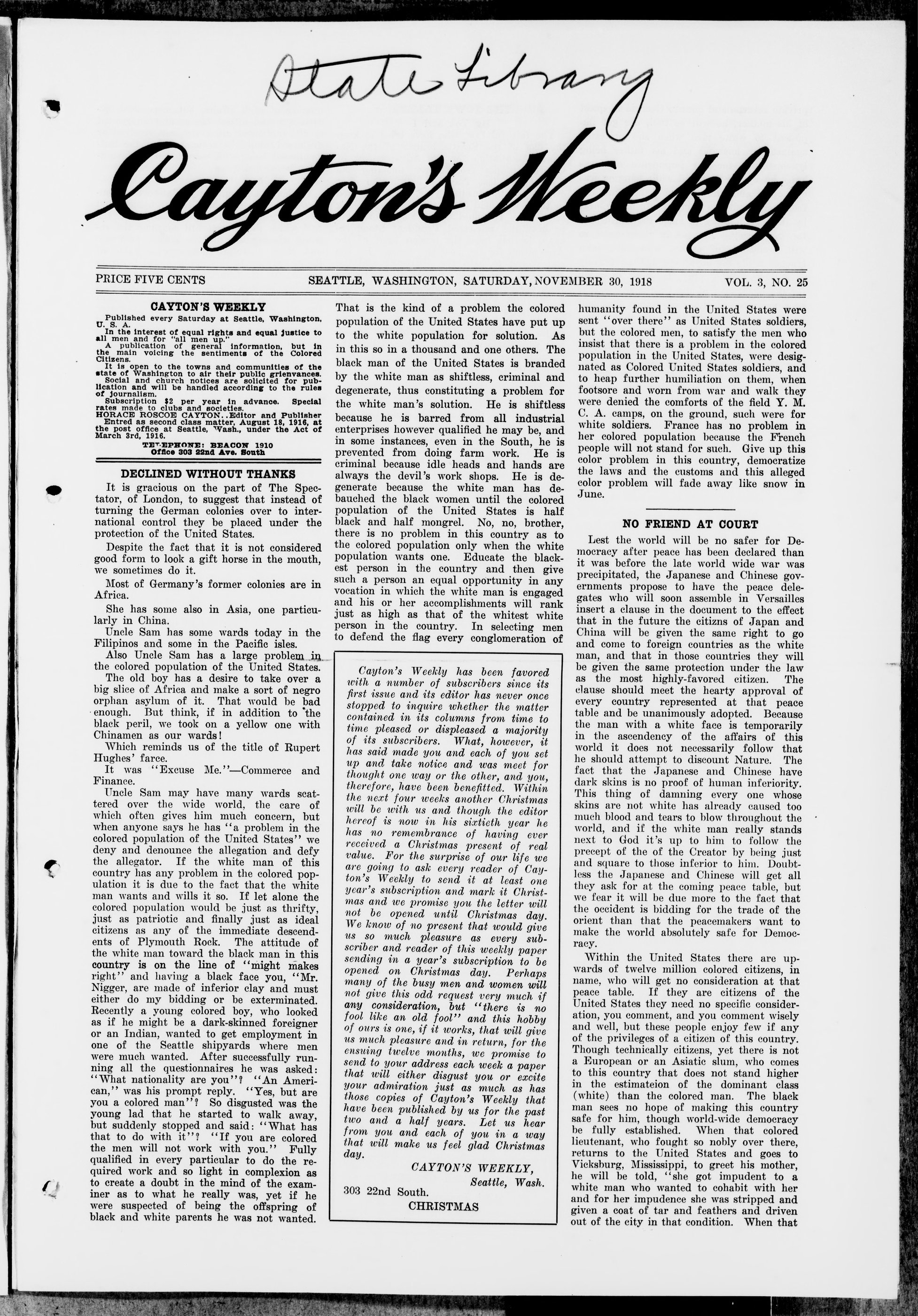
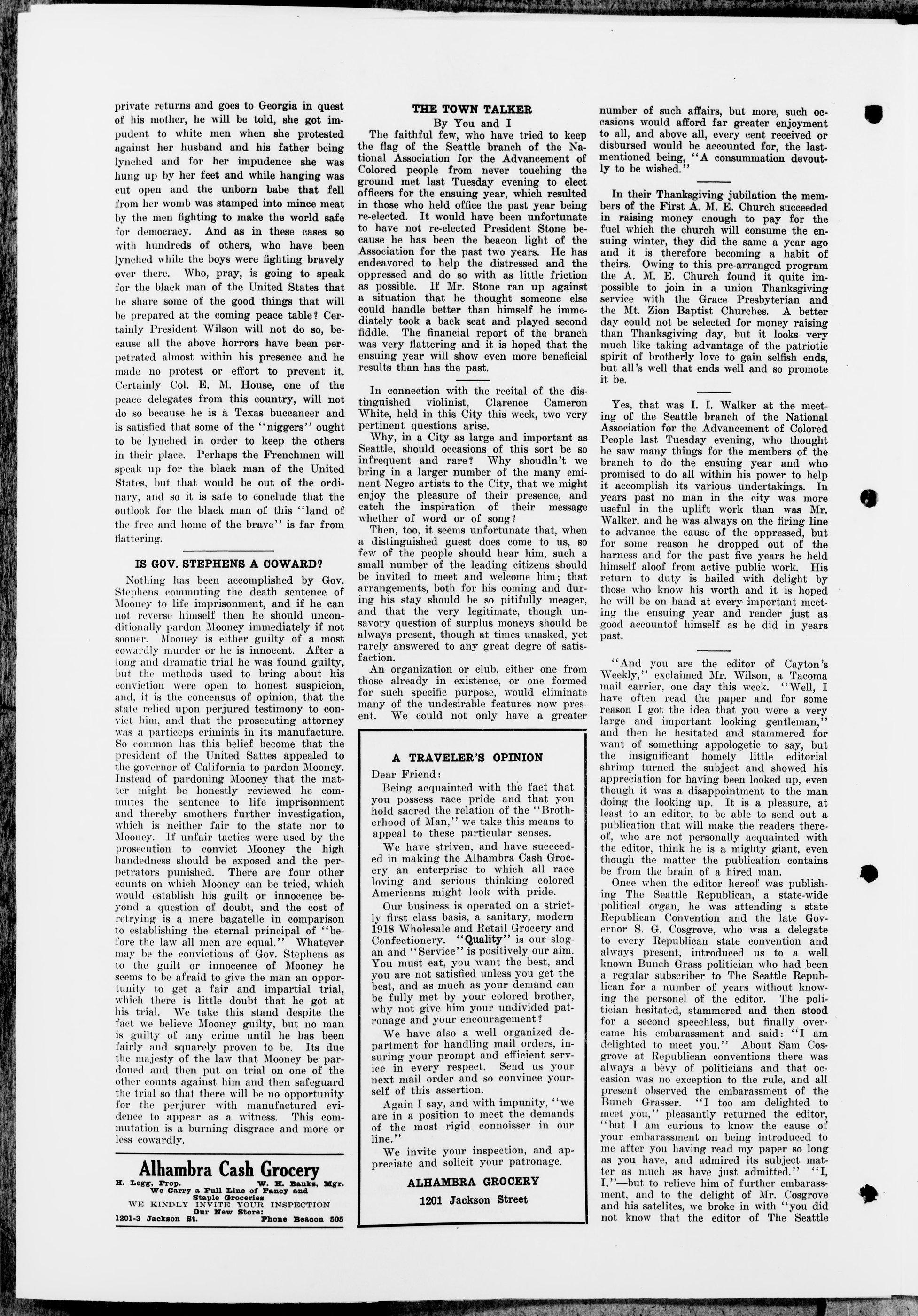
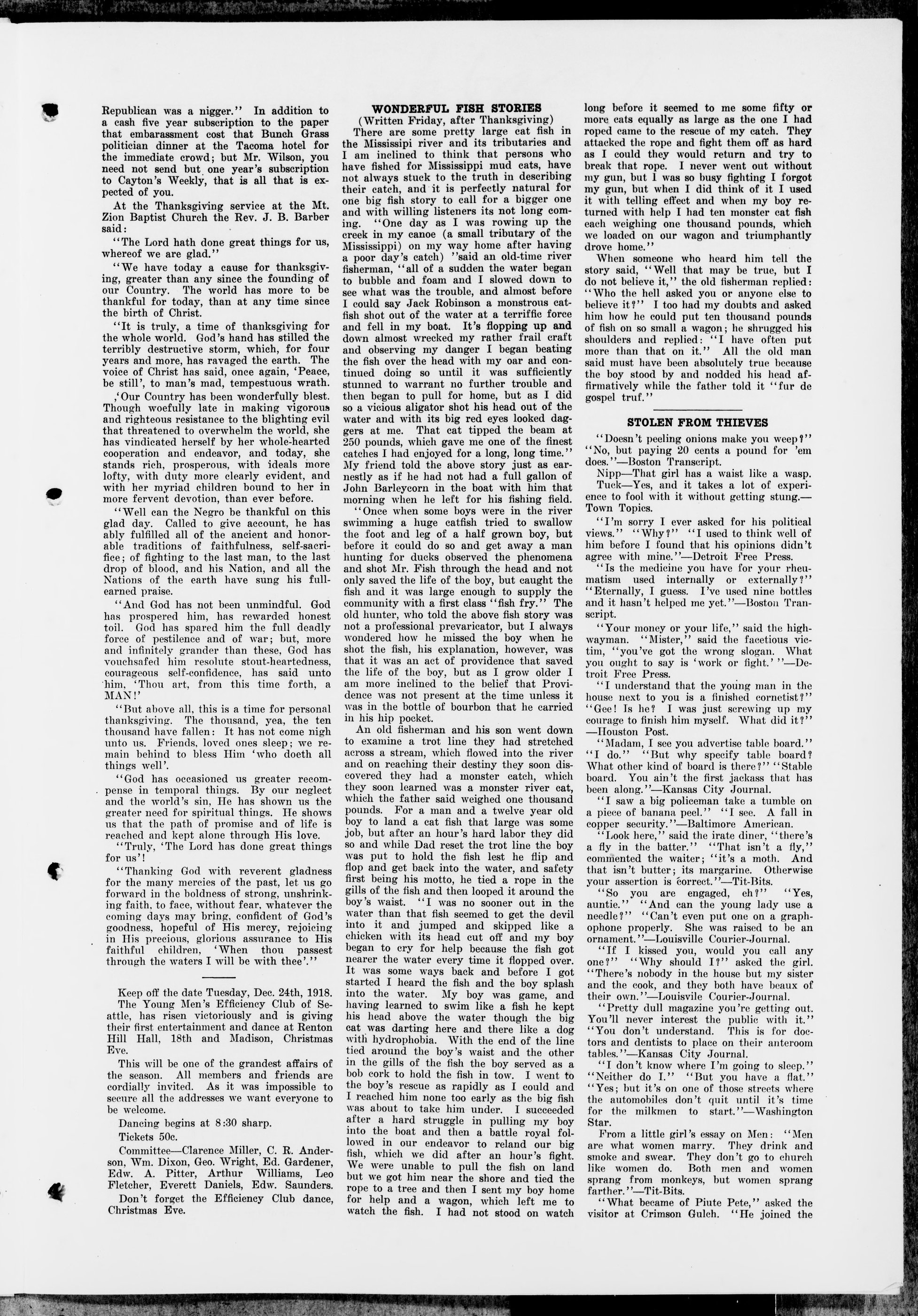
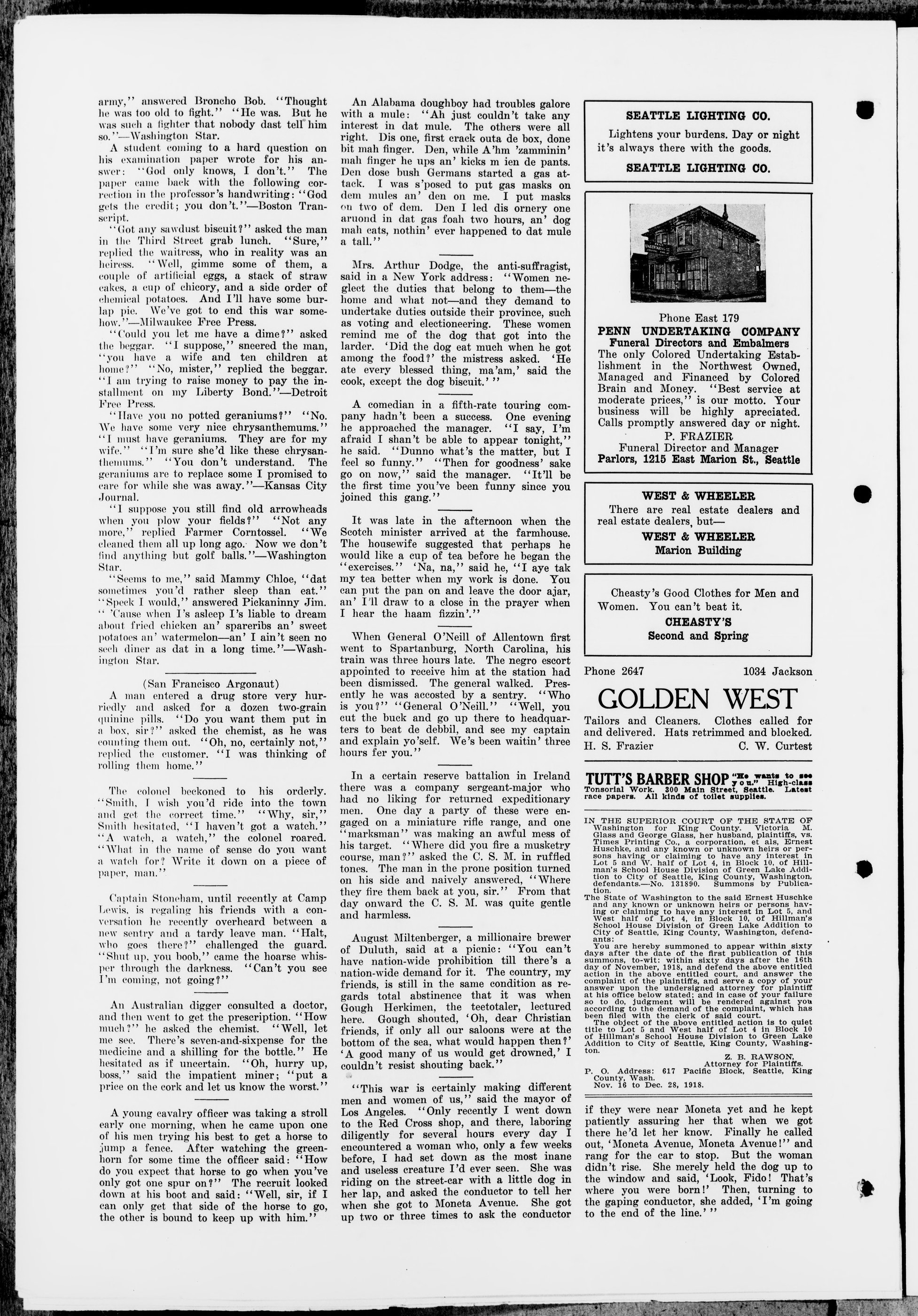
Page text (machine-generated)
State Library Cayton's Weekly
PRICE FIVE CENTS
CAYTON'S WEEKLY
Published every Saturday at Seattle, Washington. U. S. A.
It is open to the towns and communities of the state of Washington to air their public grievances. Social and church notices are solicited for publication and will be handled according to the rules of journalism.
Subscription $2 per year in advance. Special
Hours made to clubs and societies
HOTLINE: 212-555-1234, HOTLINE and Publisher
HORACE ROSCOE CAYTON..Editor and Publisher
Entred as second class matter, August 18, 1916, at
the post office at Seattle, Wash., under the Act of
March 3rd, 1916.
TELEPHONE: BEACON 1910
Office 303 22nd Ave. South
DECLINED WITHOUT THANKS
It is gracious on the part of The Spectator, of London, to suggest that instead of turning the German colonies over to international control they be placed under the protection of the United States.
Despite the fact that it is not considered good form to look a gift horse in the mouth, we sometimes do it.
Most of Germany's former colonies are in Africa.
She has some also in Asia, one particularly in China.
Uncle Sam has some wards today in the Filipinos and some in the Pacific isles.
Also Uncle Sam has a large problem in the colored population of the United States.
The old boy has a desire to take over a big slice of Africa and make a sort of negro orphan asylum of it. That would be bad enough. But think, if in addition to the black peril, we took on a yellow one with Chinamen as our wards!
Which reminds us of the title of Rupert Hughes' farce.
It was "Excuse Me."—Commerce and Finance.
Uncle Sam may have many wards scattered over the wide world, the care of which often gives him much concern, but when anyone says he has "a problem in the colored population of the United States" we deny and denounce the allegation and defy the allegator. If the white man of this country has any problem in the colored population it is due to the fact that the white man wants and wills it so. If let alone the colored population would be just as thrifty, just as patriotic and finally just as ideal citizens as any of the immediate descendents of Plymouth Rock. The attitude of the white man toward the black man in this country is on the line of "might makes right" and having a black face you, "Mr. Nigger, are made of inferior clay and must either do my bidding or be exterminated. Recently a young colored boy, who looked as if he might be a dark-skinned foreigner or an Indian, wanted to get employment in one of the Seattle shipyards where men were much wanted. After successfully running all the questionnaires he was asked: "What nationality are you"? "An American," was his prompt reply. "Yes, but are you a colored man"? So disgusted was the young lad that he started to walk away, but suddenly stopped and said: "What has that to do with it"? "If you are colored the men will not work with you." Fully qualified in every particular to do the required work and so light in complexion as to create a doubt in the mind of the examiner as to what he really was, yet if he were suspected of being the offspring of black and white parents he was not wanted.
That is the kind of a problem the colored population of the United States have put up to the white population for solution. As in this so in a thousand and one others. The black man of the United States is branded by the white man as shiftless, criminal and degenerate, thus constituting a problem for the white man's solution. He is shiftless because he is barred from all industrial enterprises however qualified he may be, and in some instances, even in the South, he is prevented from doing farm work. He is criminal because idle heads and hands are always the devil's work shops. He is degenerate because the white man has debauched the black women until the colored population of the United States is half black and half mongrel. No, no, brother, there is no problem in this country as to the colored population only when the white population wants one. Educate the blackest person in the country and then give such a person an equal opportunity in any vocation in which the white man is engaged and his or her accomplishments will rank just as high as that of the whitest white person in the country. In selecting men to defend the flag every conglomeration of
Cayton's Weekly has been favored with a number of subscribers since its first issue and its editor has never once stopped to inquire whether the matter contained in its columns from time to time pleased or displeased a majority of its subscribers. What, however, it has said made you and each of you set up and take notice and was meet for thought one way or the other, and you, therefore, have been benefitted. Within the next four weeks another Christmas will be with us and though the editor hereof is now in his sixtieth year he has no remembrance of having ever received a Christmas present of real value. For the surprise of our life we are going to ask every reader of Cayton's Weekly to send it at least one year's subscription and mark it Christmas and we promise you the letter will not be opened until Christmas day. We know of no present that would give us so much pleasure as every subscriber and reader of this weekly paper sending in a year's subscription to be opened on Christmas day. Perhaps many of the busy men and women will not give this odd request very much if any consideration, but "there is no fool like an old fool" and this hobby of ours is one, if it works, that will give us much pleasure and in return, for the ensuing twelve months, we promise to send to your address each week a paper that will either disgust you or excite your admiration just as much as has those copies of Cayton's Weekly that have been published by us for the past two and a half years. Let us hear from you and each of you in a way that will make us feel glad Christmas day.
303 22nd South.
CHRISTMAS
VOL. 3. NO. 25
humanity found in the United States were sent "over there" as United States soldiers, but the colored men, to satisfy the men who insist that there is a problem in the colored population in the United States, were designated as Colored United States soldiers, and to heap further humiliation on them, when footsore and worn from war and walk they were denied the comforts of the field Y. M. C. A. camps, on the ground, such were for white soldiers. France has no problem in her colored population because the French people will not stand for such. Give up this color problem in this country, democratize the laws and the customs and this alleged color problem will fade away like snow in June.
NO FRIEND AT COURT
Lest the world will be no safer for Democracy after peace has been declared than it was before the late world wide war was precipitated, the Japanese and Chinese governments propose to have the peace delegates who will soon assemble in Versailles insert a clause in the document to the effect that in the future the citizens of Japan and China will be given the same right to go and come to foreign countries as the white man, and that in those countries they will be given the same protection under the law as the most highly-favored citizen. The clause should meet the hearty approval of every country represented at that peace table and be unanimously adopted. Because the man with a white face is temporarily in the ascendency of the affairs of this world it does not necessarily follow that he should attempt to discount Nature. The fact that the Japanese and Chinese have dark skins is no proof of human inferiority. This thing of damning every one whose skins are not white has already caused too much blood and tears to blow throughout the world, and if the white man really stands next to God it's up to him to follow the precept of the of the Creator by being just and square to those inferior to him. Doubtless the Japanese and Chinese will get all they ask for at the coming peace table, but we fear it will be due more to the fact that the occident is bidding for the trade of the orient than that the peacemakers want to make the world absolutely safe for Democracy.
Within the United States there are upwards of twelve million colored citizens, in name, who will get no consideration at that peace table. If they are citizens of the United States they need no specific consideration, you comment, and you comment wisely and well, but these people enjoy few if any of the privileges of a citizen of this country. Though technically citizens, yet there is not a European or an Asiatic slum, who comes to this country that does not stand higher in the estimateion of the dominant class (white) than the colored man. The black man sees no hope of making this country safe for him, though world-wide democracy be fully established. When that colored lieutenant, who fought so nobly over there, returns to the United States and goes to Vicksburg, Mississippi, to greet his mother, he will be told, "she got impudent to a white man who wanted to cohabit with her and for her impudence she was stripped and given a coat of tar and feathers and driven out of the city in that condition. When that
---
private returns and goes to Georgia in quest
of his mother, he will be told, she got im-
pudent to white men when she protested
against her husband and his father being
lynched and for her impudence she was
hung up by her feet and while hanging was
cut open and the unborn babe that fell
from her womb was stamped into mince meat
by the men fighting to make the world safe
for democracy. And as in these cases so
with hundreds of others, who have been
lynched while the boys were fighting bravely
over there. Who, pray, is going to speak
for the black man of the United States that
he share some of the good things that will
be prepared at the coming peace table? Cer-
tainly President Wilson will not do so, be-
cause all the above horrors have been per-
petrated almost within his presence and he
made no protest or effort to prevent it.
Certainly Col. E. M. House, one of the
peace delegates from this country, will not
do so because he is a Texas buccaneer and
is satisfied that some of the ‘‘niggers’’ ought
to be lynched in order to keep the others
in their place. Perhaps the Frenchmen will
speak up for the black man of the United
States, but that would be out of the ordi-
nary, and so it is safe to conclude that the
outlook for the black man of this ‘‘land of
the free and home of the brave’’ is far from
flattering.
IS GOV. STEPHENS A COWARD?
Nothing has been accomplished by Gov.
Stephens commuting the death sentence of
Mooney to life imprisonment, and if he can
not reverse himself then he should uncon-
ditionally pardon Mooney immediately if not
sooner. Mooney is either guilty of a most
cowardly murder or he is innocent. After a
long and dramatic trial he was found guilty,
but the methods used to bring about his
conviction were open to honest suspicion,
and, it is the concensus of opinion, that the
state relied upon perjured testimony to con-
vict him, and that the prosecuting attorney
was a particeps criminis in its manufacture.
So common has this belief become that the
president of the United Sattes appealed to
the governor of California to pardon Mooney.
Instead of pardoning Mooney that the mat-
ter might be honestly reviewed he com-
mutes the sentence to life imprisonment
and thereby smothers further investigation,
which is neither fair to the state nor to
Mooney. If unfair tactics were used by the
prosecution to convict Mooney the high
handedness should be exposed and the per-
petrators punished. There are four other
counts on which Mooney can be tried, which
would establish his guilt or innocence be-
yond a question of doubt, and the cost of
retrying is a mere bagatelle in comparison
to establishing the eternal principal of ‘‘be-
fore the law all men are equal.’? Whatever
may be the convictions of Gov. Stephens as
to the guilt or innocence of Mooney he
seems to be afraid to give the man an oppor-
tunity to get a fair and impartial trial,
which there is little doubt that he got at
his trial. We take this stand despite the
fact we believe Mooney guilty, but no man
is guilty of any crime until he has been
fairly and squarely proven to be. Its due
the majesty of the law that Mooney be par-
doned and then put on trial on one of the
other counts against him and then safeguard
the trial so that there will be no opportunity
for the perjurer with manufactured evi-
dence to appear as a witness. This com-
mutation is a burning disgrace and more or
less cowardly.
Alhambra Cash Grocery
H. Legg, Prop. ‘W. H. Banks, Mgr.
‘We Carry a Full Line of Fancy and
Staple Groceries
WE KINDLY INVITE YOUR INSPECTION
Our New Store:
1201-3 Jackson St. Phone Beacon 505
THE TOWN TALKER
By You and I
The faithful few, who have tried to keep
the flag of the Seattle branch of the Na-
tional Association for the Advancement of
Colored people from never touching the
ground met last Tuesday evening to elect
officers for the ensuing year, which resulted
in those who held office the past year being
re-elected. It would have been unfortunate
to have not re-elected President Stone be-
cause he has been the beacon light of the
Association for the past two years. He has
endeavored to help the distressed and the
oppressed and do so with as little friction
as possible. If Mr. Stone ran up against
a situation that he thought someone else
could handle better than himself he imme-
diately took a back seat and played second
fiddle. The financial report of the branch
was very flattering and it is hoped that the
ensuing year will show even more beneficial
results than has the past.
In connection with the recital of the dis-
tinguished violinist, Clarence Cameron
White, held in this City this week, two very
pertinent questions arise.
Why, in a City as large and important as
Seattle, should occasions of this sort be so
infrequent and rare? Why shoudln’t we
bring in a larger number of the many emi-
nent Negro artists to the City, that we might
enjoy the pleasure of their presence, and
catch the inspiration of their message
whether of word or of song?
Then, too, it seems unfortunate that, when
a distinguished guest does come to us, so
few of the people should hear him, such a
small number of the leading citizens should
be invited to meet and welcome him; that
arrangements, both for his coming and dur-
ing his stay should be so pitifully meager,
and that the very legitimate, though un-
savory question of surplus moneys should be
always present, though at times unasked, yet
rarely answered to any great degre of satis-
faction.
An organization or club, either one from
those already in existence, or one formed
for such specific purpose, would eliminate
many of the undesirable features now pres-
ent. We could not only have a greater
A TRAVELER’S OPINION
Dear Friend:
Being acquainted with the fact that
you possess race pride and that you
hold sacred the relation of the ‘‘Broth-
erhood of Man,’’ we take this means to
appeal to these particular senses.
We have striven, and have succeed-
ed in making the Alhambra Cash Groe-
ery an enterprise to which all race
loving and serious thinking colored
Americans might look with pride.
Our business is operated on a strict-
ly first class basis, a sanitary, modern
1918 Wholesale and Retail Grocery and
Confectionery. ‘‘Quality’’ is our slog-
an and ‘‘Service’’ is positively our aim.
You must eat, you want the best, and
you are not satisfied unless you get the
best, and as much as your demand can
be fully met by your colored brother,
why not give him your undivided pat-
ronage and your encouragement?
We have also a well organized de-
partment for handling mail orders, in-
suring your prompt and efficient serv-
jee in every respect. Send us your
next mail order and so convince your-
self of this assertion.
Again I say, and with impunity, ‘‘we
are in a position to meet the demands
of the most rigid connoisser in our
line.”’
We invite your inspection, and ap-
preciate and solicit your patronage.
ALHAMBRA GROCERY
1201 Jackson Street
Casions would afford tar greater enjoyment
to all, and above all, every cent received or
disbursed would be accounted for, the last-
mentioned being, ‘‘A consummation devout-
ly to be wished.”’
In their Thanksgiving jubilation the mem-
bers of the First A. M. E. Church succeeded
in raising money enough to pay for the
fuel which the church will consume the en-
suing winter, they did the same a year ago
and it is therefore becoming a habit of
theirs. Owing to this pre-arranged program
the A. M. E. Church found it quite im-
possible to join in a union Thanksgiving
service with the Grace Presbyterian and
the Mt. Zion Baptist Churches. <A better
day could not be selected for money raising
than Thanksgiving day, but it looks very
much like taking advantage of the patriotic
spirit of brotherly love to gain selfish ends,
but all’s well that ends well and so promote
it be.
Yes, that was I. I. Walker at the meet-
ing of the Seattle branch of the National
Association for the Advancement of Colored
People last Tuesday evening, who thought
he saw many things for the members of the
branch to do the ensuing year and who
promised to do all within his power to help
it accomplish its various undertakings. In
years past no man in the city was more
useful in the uplift work than was Mr.
Walker. and he was always on the firing line
to advance the cause of the oppressed, but
for some reason he dropped out of the
harness and for the past five years he held
himself aloof from active public work. His
return to duty is hailed with delight by
those who know his worth and it is hoped
he will be on hand at every: important meet-
ing the ensuing year and render just as
good accountof himself as he did in years
past.
“And you are the editor of Cayton’s
Weekly,’’ exclaimed Mr. Wilson, a Tacoma
mail carrier, one day this week. ‘Well, I
have often read the paper and for some
reason I got the idea that you were a very.
large and important looking gentleman,’’
and then he hesitated and stammered for
want of something appologetie to say, but
the insignificant homely little editorial
shrimp turned the subject and showed his
appreciation for having been looked up, even
though it was a disappointment to the man
doing the looking up. It is a pleasure, at
least to an editor, to be able to send out a
publication that will make the readers there-
of, who are not personally acquainted with
the editor, think he is a mighty giant, even
though the matter the publication contains
be from the brain of a hired man.
Once when the editor hereof was publish-
ing The Seattle Republican, a state-wide
political organ, he was attending a state
Republican Convention and the late Gov-
ernor 8. G. Cosgrove, who was a delegate
to every Republican state convention and
always present, introduced us to a well
known Bunch Grass politician who had been
a regular subscriber to The Seattle Repub-
lican for a number of years without know-
ing the personel of the editor. The poli-
tician hesitated, stammered and then stood
for a second speechless, but finally over-
came his embarassment and said: ‘“‘I am
delighted to meet you.’? About Sam Cos-
grove at Republican conventions there was
always a bevy of politicians and that oc-
casion was no exception to the rule, and all
present observed the embarassment of the
fo ee eee a ee
---
---
Republican was a nigger." In addition to a cash five year subscription to the paper that embarassment cost that Bunch Grass politician dinner at the Tacoma hotel for the immediate crowd; but Mr. Wilson, you need not send but one year's subscription to Cayton's Weekly, that is all that is expected of you. At the Thanksgiving service at the Mt. Zion Baptist Church the Rev. J. B. Barber said: "The Lord hath done great things for us, whereof we are glad."
"We have today a cause for thanksgiving, greater than any since the founding of our Country. The world has more to be thankful for today, than at any time since the birth of Christ.
"It is truly, a time of thanksgiving for the whole world. God's hand has stilled the terribly destructive storm, which, for four years and more, has ravaged the earth. The voice of Christ has said, once again, 'Peace, be still', to man's mad, tempestuous wrath.
'Our Country has been wonderfully blest. Though woefully late in making vigorous and righteous resistance to the blighting evil that threatened to overwhelm the world, she has vindicated herself by her whole-hearted cooperation and endeavor, and today, she stands rich, prosperous, with ideals more lofty, with duty more clearly evident, and with her myriad children bound to her in more fervent devotion, than ever before.
"Well can the Negro be thankful on this glad day. Called to give account, he has ably fulfilled all of the ancient and honorable traditions of faithfulness, self-sacrifice; of fighting to the last man, to the last drop of blood, and his Nation, and all the Nations of the earth have sung his fullearned praise.
"And God has not been unmindful. God has prospered him, has rewarded honest toil. God has spared him the full deadly force of pestilence and of war; but, more and infinitely grander than these, God has vouchsafed him resolute stout-heartedness, courageous self-confidence, has said unto him, 'Thou art, from this time forth, a MAN!'
"But above all, this is a time for personal thanksgiving. The thousand, yea, the ten thousand have fallen: It has not come nigh unto us. Friends, loved ones sleep; we remain behind to bless Him 'who doeth all things well'.
"God has occasioned us greater recompense in temporal things. By our neglect and the world's sin, He has shown us the greater need for spiritual things. He shows us that the path of promise and of life is reached and kept alone through His love. "Truly, 'The Lord has done great things for us'!
"Thanking God with reverent gladness for the many mercies of the past, let us go forward in the boldness of strong, unshrinking faith, to face, without fear, whatever the coming days may bring, confident of God's goodness, hopeful of His mercy, rejoicing in His precious, glorious assurance to His faithful children, 'When thou passest through the waters I will be with thee'."
Keep off the date Tuesday, Dec. 24th, 1918. The Young Men's Efficiency Club of Seattle, has risen victoriously and is giving their first entertainment and dance at Renton Hill Hall, 18th and Madison, Christmas Eve. This will be one of the grandest affairs of the season. All members and friends are cordially invited. As it was impossible to secure all the addresses we want everyone to be welcome. Dancing begins at 8:30 sharp. Tickets 50c.
Committee—Clarence Miller, C. R. Anderson, Wm. Dixon, Geo. Wright, Ed. Gardener, Edw. A. Pitter, Arthur Williams, Leo Fletcher, Everett Daniels, Edw. Saunders. Don't forget the Efficiency Club dance, Christmas Eve.
WONDERFUL FISH STORIES
(Written Friday, after Thanksgiving)
There are some pretty large cat fish in the Mississippi river and its tributaries and I am inclined to think that persons who have fished for Mississippi mud cats, have not always stuck to the truth in describing their catch, and it is perfectly natural for one big fish story to call for a bigger one and with willing listeners its not long coming. "One day as I was rowing up the creek in my canoe (a small tributary of the Mississippi) on my way home after having a poor day's catch) "said an old-time river fisherman, "all of a sudden the water began to bubble and foam and I slowed down to see what was the trouble, and almost before I could say Jack Robinson a monstrous catfish shot out of the water at a terrific force and fell in my boat. It's flopping up and down almost wrecked my rather frail craft and observing my danger I began beating the fish over the head with my oar and continued doing so until it was sufficiently stunned to warrant no further trouble and then began to pull for home, but as I did so a vicious aligator shot his head out of the water and with its big red eyes looked daggers at me. That cat tipped the beam at 250 pounds, which gave me one of the finest catches I had enjoyed for a long, long time." My friend told the above story just as earnestly as if he had not had a full gallon of John Barleycorn in the boat with him that morning when he left for his fishing field.
"Once when some boys were in the river swimming a huge catfish tried to swallow the foot and leg of a half grown boy, but before it could do so and get away a man hunting for ducks observed the phenomena and shot Mr. Fish through the head and not only saved the life of the boy, but caught the fish and it was large enough to supply the community with a first class "fish fry." The old hunter, who told the above fish story was not a professional prevaricator, but I always wondered how he missed the boy when he shot the fish, his explanation, however, was that it was an act of providence that saved the life of the boy, but as I grow older I am more inclined to the belief that Providence was not present at the time unless it was in the bottle of bourbon that he carried in his hip pocket.
An old fisherman and his son went down to examine a trot line they had stretched across a stream, which flowed into the river and on reaching their destiny they soon discovered they had a monster catch, which they soon learned was a monster river cat, which the father said weighed one thousand pounds. For a man and a twelve year old boy to land a cat fish that large was some job, but after an hour's hard labor they did so and while Dad reset the trot line the boy was put to hold the fish lest he flip and flop and get back into the water, and safety first being his motto, he tied a rope in the gills of the fish and then looped it around the boy's waist. "I was no sooner out in the water than that fish seemed to get the devil into it and jumped and skipped like a chicken with its head cut off and my boy began to cry for help because the fish got nearer the water every time it flopped over. It was some ways back and before I got started I heard the fish and the boy splash into the water. My boy was game, and having learned to swim like a fish he kept his head above the water though the big cat was darting here and there like a dog with hydrophobia. With the end of the line tied around the boy's waist and the other in the gills of the fish the boy served as a bob cork to hold the fish in tow. I went to the boy's rescue as rapidly as I could and I reached him none too early as the big fish was about to take him under. I succeeded after a hard struggle in pulling my boy into the boat and then a battle royal followed in our endeavor to reland our big fish, which we did after an hour's fight. We were unable to pull the fish on land but we got him near the shore and tied the rope to a tree and then I sent my boy home for help and a wagon, which left me to watch the fish. I had not stood on watch
long before it seemed to me some fifty or more cats equally as large as the one I had roped came to the rescue of my catch. They attacked the rope and fight them off as hard as I could they would return and try to break that rope. I never went out without my gun, but I was so busy fighting I forgot my gun, but when I did think of it I used it with telling effect and when my boy returned with help I had ten monster cat fish each weighing one thousand pounds, which we loaded on our wagon and triumphantly drove home."
When someone who heard him tell the story said, "Well that may be true, but I do not believe it," the old fisherman replied: "Who the hell asked you or anyone else to believe it?" I too had my doubts and asked him how he could put ten thousand pounds of fish on so small a wagon; he shrugged his shoulders and replied: "I have often put more than that on it." All the old man said must have been absolutely true because the boy stood by and nodded his head affirmatively while the father told it "fur de gospel truf."
STOLEN FROM THIEVES
"Doesn't peeling onions make you weep?" "No, but paying 20 cents a pound for 'em does."—Boston Transcript.
Nipp—That girl has a waist like a wasp.
Tuck—Yes, and it takes a lot of experience to fool with it without getting stung.—Town Topics.
"I'm sorry I ever asked for his political views." "Why?" "I used to think well of him before I found that his opinions didn't agree with mine."—Detroit Free Press.
"Is the medicine you have for your rheumatism used internally or externally?" "Eternally, I guess. I've used nine bottles and it hasn't helped me yet."—Boston Transcript.
"Your money or your life," said the highwayman. "Mister," said the facetious victim, "you've got the wrong slogan. What you ought to say is 'work or fight.'"—Detroit Free Press.
"I understand that the young man in the house next to you is a finished cornetist?" "Gee! Is he? I was just screwing up my courage to finish him myself. What did it?"—Houston Post.
"Madam, I see you advertise table board." "I do." "But why specify table board? What other kind of board is there?" "Stable board. You ain't the first jackass that has been along."—Kansas City Journal.
"I saw a big policeman take a tumble on a piece of banana peel." "I see. A fall in copper security."—Baltimore American.
"Look here," said the irate diner, "there's a fly in the batter." "That isn't a fly," commented the waiter; "it's a moth. And that isn't butter; its margarine. Otherwise your assertion is correct."—Tit-Bits.
"So you are engaged, eh?" "Yes, auntie." "And can the young lady use a needle?" "Can't even put one on a graphophone properly. She was raised to be an ornament."—Louisville Courier-Journal.
"If I kissed you, would you call any one?" "Why should I?" asked the girl. "There's nobody in the house but my sister and the cook, and they both have beaux of their own."—Louisville Courier-Journal.
"Pretty dull magazine you're getting out. You'll never interest the public with it." "You don't understand. This is for doctors and dentists to place on their anteroom tables."—Kansas City Journal.
"I don't know where I'm going to sleep." "Neither do I." "But you have a flat." "Yes; but it's on one of those streets where the automobiles don't quit until it's time for the milkmen to start."—Washington Star.
From a little girl's essay on Men: "Men are what women marry. They drink and smoke and swear. They don't go to church like women do. Both men and women sprang from monkeys, but women sprang farther."—Tit-Bits.
"What became of Piute Pete," asked the visitor at Crimson Gulch. "He joined the
Tailors and Cleaners. Clothes called for and delivered. Hats retrimmed and blocked. H. S. Frazier C. W. Curtest
TUTT'S BARBER SHOP "He wants to see you." High-class Tonsorial Work. 300 Main Street, Seattle. Latest race papers. All kinds of toilet supplies.
You are hereby summoned to appear within sixty days after the date of the first publication of this summons, to-wit: within sixty days after the 16th day of November, 1918, and defend the above entitled action in the above entitled court, and answer the complaint of the plaintiffs, and serve a copy of your answer upon the undersigned attorney for plaintiff at his office below stated; and in case of your failure so to do, judgment will be rendered against you according to the demand of the complaint, which has been filed with the clerk of said court.
The object of the above entitled action is to quiet title to Lot 5 and West half of Lot 4 in Block 10 of Hillman's School House Division to Green Lake Addition to City of Seattle, King County, Washington.
if they were near Moneta yet and he kept patiently assuring her that when we got there he'd let her know. Finally he called out, 'Moneta Avenue, Moneta Avenue!' and rang for the car to stop. But the woman didn't rise. She merely held the dog up to the window and said, 'Look, Fido! That's where you were born!' Then, turning to the gaping conductor, she added, 'I'm going to the end of the line.'"
---
---
army," answered Broncho Bob. "Thought he was too old to fight." "He was. But he was such a fighter that nobody dast tell him so."—Washington Star. A student coming to a hard question on his examination paper wrote for his answer: "God only knows, I don't." The paper came back with the following correction in the professor's handwriting: "God gets the credit; you don't."—Boston Transcript.
"Got any sawdust biscuit?" asked the man in the Third Street grab lunch. "Sure," replied the waitress, who in reality was an heiress. "Well, gimme some of them, a couple of artificial eggs, a stack of straw cakes, a cup of chicory, and a side order of chemical potatoes. And I'll have some burlap pie. We've got to end this war somehow."—Milwaukee Free Press.
"Could you let me have a dime?" asked the beggar. "I suppose," sneered the man, "you have a wife and ten children at home?" "No, mister," replied the beggar. "I am trying to raise money to pay the installment on my Liberty Bond."—Detroit Free Press.
"Have you no potted geraniums?" "No. We have some very nice chrysanthemums." "I must have geraniums. They are for my wife." "I'm sure she'd like these chrysanthemums." "You don't understand. The geraniums are to replace some I promised to care for while she was away."—Kansas City Journal.
"I suppose you still find old arrowheads when you plow your fields?" "Not any more," replied Farmer Corntossel. "We cleaned them all up long ago. Now we don't find anything but golf balls."—Washington Star.
“Seems to me,” said Mammy Chloe, “dat sometimes you'd rather sleep than eat.” "Speek I would," answered Pickaninny Jim. "Cause when I's asleep I's liable to dream about fried chicken an' spareribs an' sweet potatoes an' watermelon—an' I ain't seen no seek diner as dat in a long time."—Washington Star.
(San Francisco Argonaut)
A man entered a drug store very hurriedly and asked for a dozen two-grain quinine pills. "Do you want them put in a box, sir?" asked the chemist, as he was counting them out. "Oh, no, certainly not," replied the customer. "I was thinking of rolling them home."
The colonel beckoned to his orderly. "Smith, I wish you'd ride into the town and get the correct time." "Why, sir," Smith hesitated, "I haven't got a watch." "A watch, a watch," the colonel roared. "What in the name of sense do you want a watch for? Write it down on a piece of paper, man."
Captain Stoneham, until recently at Camp Lewis, is regaling his friends with a conversation he recently overheard between a new sentry and a tardy leave man. "Halt, who goes there?" challenged the guard. "Shut up, you boob," came the hoarse whisper through the darkness. "Can't you see I'm coming, not going?"
An Australian digger consulted a doctor, and then went to get the prescription. "How much?" he asked the chemist. "Well, let me see. There's seven-and-sixpense for the medicine and a shilling for the bottle." He hesitated as if uncertain. "Oh, hurry up, boss," said the impatient miner; "put a price on the cork and let us know the worst."
A young cavalry officer was taking a stroll early one morning, when he came upon one of his men trying his best to get a horse to jump a fence. After watching the greenhorn for some time the officer said: "How do you expect that horse to go when you've only got one spur on?" The recruit looked down at his boot and said: "Well, sir, if I can only get that side of the horse to go, the other is bound to keep up with him."
An Alabama doughboy had troubles galore with a mule: "Ah just couldn't take any interest in dat mule. The others were all right. Dis one, first crack outa de box, done bit mah finger. Den, while A'hm 'zamminin' mah finger he ups an' kicks m ien de pants. Den dose bush Germans started a gas attack. I was s'posed to put gas masks on dem mules an' den on me. I put masks on two of dem. Den I led dis ornery one aruond in dat gas foah two hours, an' dog mah cats, nothin' ever happened to dat mule a tall."
Mrs. Arthur Dodge, the anti-suffragist, said in a New York address: "Women neglect the duties that belong to them—the home and what not—and they demand to undertake duties outside their province, such as voting and electioneering. These women remind me of the dog that got into the larder. 'Did the dog eat much when he got among the food?' the mistress asked. 'He ate every blessed thing, ma'am,' said the cook, except the dog biscuit.'"
A comedian in a fifth-rate touring company hadn't been a success. One evening he approached the manager. "I say, I'm afraid I shan't be able to appear tonight," he said. "Dunno what's the matter, but I feel so funny." "Then for goodness' sake go on now," said the manager. "It'll be the first time you've been funny since you joined this gang."
It was late in the afternoon when the Scotch minister arrived at the farmhouse. The housewife suggested that perhaps he would like a cup of tea before he began the "exercises." 'Na, na,' said he, "I aye tak my tea better when my work is done. You can put the pan on and leave the door ajar, an' I'll draw to a close in the prayer when I hear the haam fizzin'."
When General O'Neill of Allentown first went to Spartanburg, North Carolina, his train was three hours late. The negro escort appointed to receive him at the station had been dismissed. The general walked. Presently he was accosted by a sentry. "Who is you?" "General O'Neill." "Well, you cut the buck and go up there to headquarters to beat de debbil, and see my captain and explain yo'self. We's been waitin' three hours fer you."
In a certain reserve battalion in Ireland there was a company sergeant-major who had no liking for returned expeditionary men. One day a party of these were engaged on a miniature rifle range, and one "marksman" was making an awful mess of his target. "Where did you fire a musketry course, man?" asked the C. S. M. in ruffled tones. The man in the prone position turned on his side and naively answered, "Where they fire them back at you, sir." From that day onward the C. S. M. was quite gentle and harmless.
August Miltenberger, a millionaire brewer of Duluth, said at a picnic: "You can't have nation-wide prohibition till there's a nation-wide demand for it. The country, my friends, is still in the same condition as regards total abstinence that it was when Gough Herkimen, the teetotaler, lectured here. Gough shouted, 'Oh, dear Christian friends, if only all our saloons were at the bottom of the sea, what would happen then?' 'A good many of us would get drowned,' I couldn't resist shouting back.'
"This war is certainly making different men and women of us," said the mayor of Los Angeles. "Only recently I went down to the Red Cross shop, and there, laboring diligently for several hours every day I encountered a woman who, only a few weeks before, I had set down as the most inane and useless creature I'd ever seen. She was riding on the street-car with a little dog in her lap, and asked the conductor to tell her when she got to Moneta Avenue. She got up two or three times to ask the conductor
SEATTLE LIGHTING CO.
Lightens your burdens. Day or night it's always there with the goods.
SEATTLE LIGHTING CO.
UNITTIMING
BANK
PENN UNDERTAKING COMPANY Funeral Directors and Embalmers The only Colored Undertaking Establishment in the Northwest Owned, Managed and Financed by Colored Brain and Money. "Best service at moderate prices," is our motto. Your business will be highly appreciated. Calls promptly answered day or night. P. FRAZIER Funeral Director and Manager Parlors, 1215 East Marion St., Seattle
WEST & WHEELER There are real estate dealers and real estate dealers, but— WEST & WHEELER Marion Building
Cheasty's Good Clothes for Men and Women. You can't beat it. CHEASTY'S Second and Spring
Phone 2647
1034 Jackson
GOLDEN WEST
IN THE SUPERIOR COURT OF THE STATE OF Washington for King County. Victoria M. Glass and George Glass, her husband, plaintiffs, vs. Times Printing Co., a corporation, et als, Ernest Huschke, and any known or unknown heirs or persons having or claiming to have any interest in Lot 5 and W. half of Lot 4, in Block 10, of Hillman's School House Division of Green Lake Addition to City of Seattle, King County, Washington, defendants.—No. 131890. Summons by Publication. The State of Washington to the said Ernest Huschke and any known or unknown heirs or persons having or claiming to have any interest in Lot 5, and West half of Lot 4, in Block 10, of Hillman's School House Division of Green Lake Addition to City of Seattle, King County, Washington, defendants:
Z. B. RAWSON.
Attorney for Plaintiffs.
P. O. Address: 617 Pacific Block, Seattle, King
County, Wash.
Nov. 16 to Dec. 28, 1918.