Cayton's Weekly
Saturday, February 8, 1919
Seattle, Washington
Page text (machine-generated)
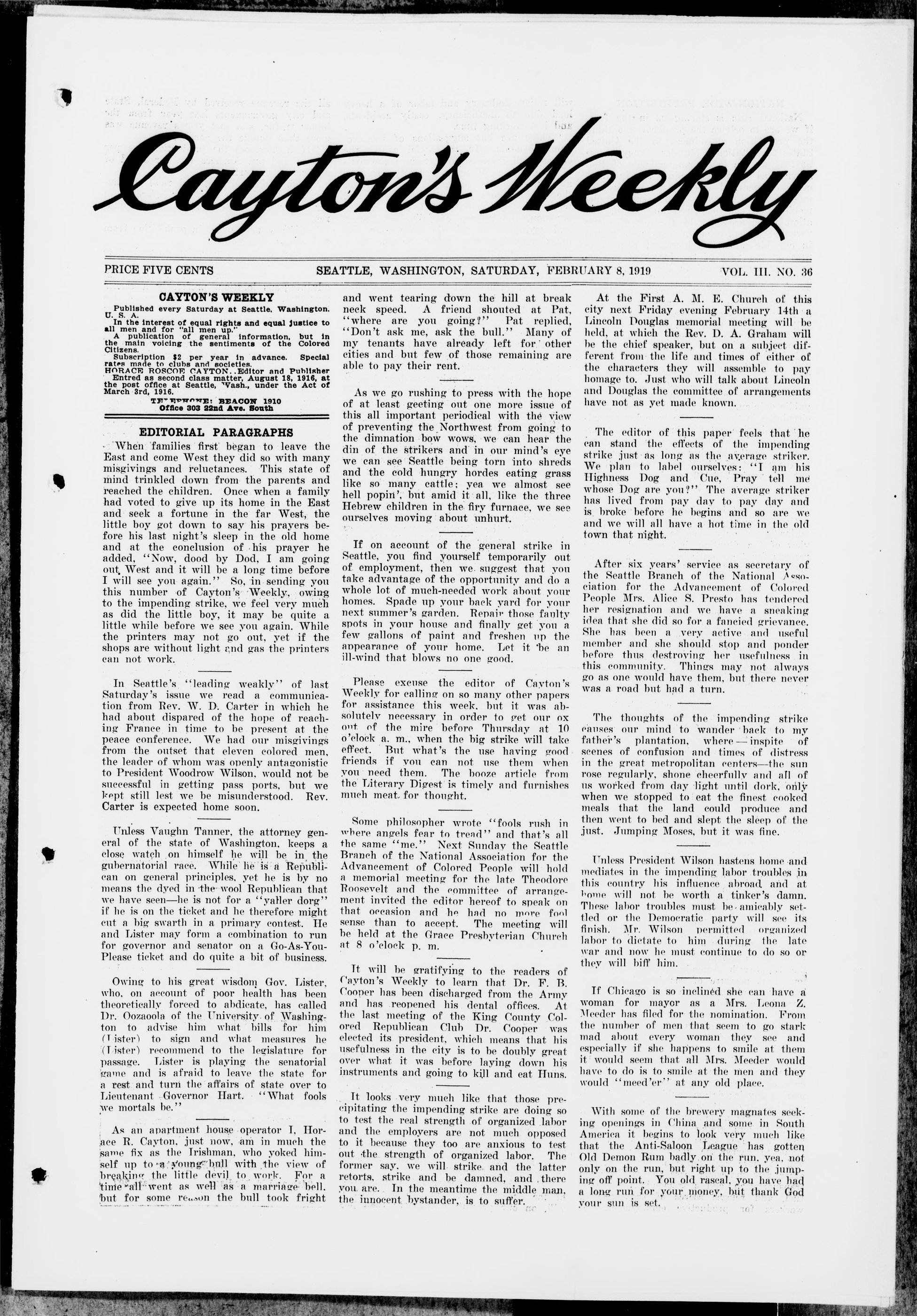
Cayton's Weekly
PRICE FIVE CENTS
CAYTON'S WEEKLY
Published every Saturday at Seattle, Washington. U. S. A. In the interest of equal rights and equal justice to all men and for "all men up." A publication of general information, but in the main voicing the sentiments of the Colored Citizens. Subscription $2 per year in advance. Special rates made to clubs and societies. HORACE ROSCOE CAYTON..Editor and Publisher Entred as second class matter, August 18, 1916, at the post office at Seattle, Vash., under the Act of March 3rd, 1916.
TELEPHONE: BEACON 1910
Office 303 22nd Ave. South
EDITORIAL PARAGRAPHS
When families first began to leave the East and come West they did so with many misgivings and reluctances. This state of mind trinkled down from the parents and reached the children. Once when a family had voted to give up its home in the East and seek a fortune in the far West, the little boy got down to say his prayers before his last night's sleep in the old home and at the conclusion of his prayer he added, "Now, dood by Dod, I am going out, West and it will be a long time before I will see you again." So, in sending you this number of Cayton's Weekly, owing to the impending strike, we feel very much as did the little boy, it may be quite a little while before we see you again. While the printers may not go out, yet if the shops are without light and gas the printers can not work.
In Seattle's "leading weakly" of last Saturday's issue we read a communication from Rev. W. D. Carter in which he had about dispared of the hope of reaching France in time to be present at the peace conference. We had our misgivings from the outset that eleven colored men, the leader of whom was openly antagonistic to President Woodrow Wilson, would not be successful in getting pass ports, but we kept still lest we be misunderstood. Rev. Carter is expected home soon.
Unless Vaughn Tanner, the attorney general of the state of Washington, keeps a close watch on himself he will be in the gubernatorial race. While he is a Republican on general principles, yet he is by no means the dyed in the wool Republican that we have seen—he is not for a "yaller dorg" if he is on the ticket and he therefore might cut a big swarth in a primary contest. He and Lister may form a combination to run for governor and senator on a Go-As-YouPlease ticket and do quite a bit of business.
Owing to his great wisdom Gov. Lister, who, on account of poor health has been theoretically forced to abdicate, has called Dr. Oozaoola of the University of Washington to advise him what bills for him (Lister) to sign and what measures he (Lister) recommend to the legislature for passage. Lister is playing the senatorial game and is afraid to leave the state for a rest and turn the affairs of state over to Lieutenant Governor Hart. "What fools we mortals be."
As an apartment house operator I, Horace R. Cayton, just now, am in much the same fix as the Irishman, who yoked himself up to a young bull with the view of breaking the little devil to work. For a time all went as well as a marriage bell, but for some reason the bull took fright
SEATTLE, WASHINGTON, SATURDAY, FEBRUARY 8, 1919
and went tearing down the hill at break neck speed. A friend shouted at Pat, "where are you going?" Pat replied, "Don't ask me, ask the bull." Many of my tenants have already left for other cities and but few of those remaining are able to pay their rent.
As we go rushing to press with the hope of at least geting out one more issue of this all important periodical with the view of preventing the Northwest from going to the dimnation bow wows, we can hear the din of the strikers and in our mind's eye we can see Seattle being torn into shreds and the cold hungry hordes eating grass like so many cattle; yea we almost see hell popin', but amid it all, like the three Hebrew children in the firy furnace, we see ourselves moving about unhurt.
If on account of the general strike in Seattle, you find yourself temporarily out of employment, then we suggest that you take advantage of the opportunity and do a whole lot of much-needed work about your homes. Spade up your back yard for your next summer's garden. Repair those faulty spots in your house and finally get you a few gallons of paint and freshen up the appearance of your home. Let it be an ill-wind that blows no one good.
Please excuse the editor of Cayton's Weekly for calling on so many other papers for assistance this week, but it was absolutely necessary in order to get our ox out of the mire before Thursday at 10 o'clock a. m., when the big strike will take effect. But what's the use having good friends if you can not use them when you need them. The booze article from the Literary Digest is timely and furnishes much meat for thought.
Some philosopher wrote "fools rush in where angels fear to tread" and that's all the same "me." Next Sunday the Seattle Branch of the National Association for the Advancement of Colored People will hold a memorial meeting for the late Theodore Roosevelt and the committee of arrangement invited the editor hereof to speak on that occasion and he had no more fool sense than to accept. The meeting will be held at the Grace Presbyterian Church at 8 o'clock p. m.
It will be gratifying to the readers of Cayton's Weekly to learn that Dr. F. B. Cooper has been discharged from the Army and has reopened his dental offices. At the last meeting of the King County Colored Republican Club Dr. Cooper was elected its president, which means that his usefulness in the city is to be doubly great over what it was before laying down his instruments and going to kill and eat Huns.
It looks very much like that those precipitating the impending strike are doing so to test the real strength of organized labor and the employers are not much opposed to it because they too are anxious to test out the strength of organized labor. The former say, we will strike and the latter retorts, strike and be damned, and there you are. In the meantime the middle man, the innocent bystander, is to suffer.
VOL. III. NO. 36
At the First A. M. E. Church of this city next Friday evening February 14th a Lincoln Douglas memorial meeting will be held, at which the Rev. D. A. Graham will be the chief speaker, but on a subject different from the life and times of either of the characters they will assemble to pay homage to. Just who will talk about Lincoln and Douglas the committee of arrangements have not as yet made known.
The editor of this paper feels that he can stand the effects of the impending strike just as long as the average striker. We plan to label ourselves: "I am his Highness Dog and Cue, Pray tell me whose Dog are you?" The average striker has lived from pay day to pay day and is broke before he begins and so are we and we will all have a hot time in the old town that night.
After six years' service as secretary of the Seattle Branch of the National Association for the Advancement of Colored People Mrs. Alice S. Presto has tendered her resignation and we have a sneaking idea that she did so for a fancied grievance. She has been a very active and useful member and she should stop and ponder before thus destroying her usefulness in this community. Things may not always go as one would have them, but there never was a road but had a turn.
The thoughts of the impending strike causes our mind to wander back to my father's plantation, where—inspite of scenes of confusion and times of distress in the great metropolitan centers—the sun rose regularly, shone cheerfully and all of us worked from day light until dork, only when we stopped to eat the finest cooked meals that the land could produce and then went to bed and slept the sleep of the just. Jumping Moses, but it was fine.
Unless President Wilson hastens home and mediates in the impending labor troubles in this country his influence abroad and at home will not be worth a tinker's damn. These labor troubles must be amicably settled or the Democratic party will see its finish. Mr. Wilson permitted organized labor to dictate to him during the late war and now he must continue to do so or they will biff him.
If Chicago is so inclined she can have a woman for mayor as a Mrs. Leona Z. Meeder has filed for the nomination. From the number of men that seem to go stark mad about every woman they see and especially if she happens to smile at them it would seem that all Mrs. Meeder would have to do is to smile at the men and they would "meed'er" at any old place.
With some of the brewery magnates seeking openings in China and some in South America it begins to look very much like that the Anti-Saloon League has gotten Old Demon Rum badly on the run, yea, not only on the run, but right up to the jumping off point. You old rascal, you have had a long run for your money, but thank God your sun is set.
---
---
```markdown
```
NATION-WIDE PROHIBITION
National ruin is staring us in the face, if we are to believe the prophets who think the prohibition amendment to the United States Constitution a blunder. They assure us that we are in for an epidemic of Bolshevism as a protest against the infringement of personal liberty; an increase of unemployment, already made acute by demobilization; an increased burden of taxation, made necessary by the loss of excise revenue; a depression of real-estate values in our big cities; an increased aggressiveness on the part of the forces of intolerance, as foreshadowed in the statement of a W. C. T. U. official that "the next campaign will be against cigarets, gambling, and profanity"; a reluctance on the part of Europeans to come to a land where they will be denied their accustomed alcoholic beverages; a great increase in "moonshining"; an aggravation of the drug evil; the growth of a national spirit of hypocrisy; and a contempt for law, born of inevitable failures to enforce this law in many great communities where it is not supported by public opinion. According to figures widely circulated in the press, the bone-dry amendment will wipe out 992 breweries, 233 distilleries, and 300,000 saloons; upset capital invested in the brewing and liquor business to the extent of $1,294,000,000; and throw out of work 749,418 employees drawing annual compensation t othe amount of $453,-872,553.
But despite this somber outlook, an examination of our press shows that the great majority not only seem to take a cheerful view of the situation, but proceed to give reasons for their optimism. As to Bolshevism, they retort that the American people will submit to the majority verdict in a sportsmanlike and American way. To the predictions of unemployment, they reply that this will be only temporary, a possibly unavoidable phase in the transfer of brewery and distillery employees from non-productive to productive employment. If we are atxed more, they say, the increased prosperity that follows in the track of prohibition will more than compensate us. And the other clouds on the antiprohibitionists' horizon seem to the general editorial observer no less unsubstantial. He points out, moreover, that the exile of John Barleycorn will remove the "boss" from our State and city politics, will decrease the cost of our police departments, correctional institutions, charities, and hospitals. Moreover, as the Philadelphia Press remarks, "a lack of demand from the brewers and maltsters for grain will have its effect upon the market for farm products, and if this tends to cheapen the cost of living the change will be welcomed by the vast majority of consumers." "On the economic side," remarks the New York Globe, "the cessation of the guzzling by which ten per cent of our productiveness has gone to the support of a parasitic class which has battened on human weakness should flush legitimate trade." Altogether, affirms the Boston Christian Science Monitor, "the certain gain" overwhelmingly outweighs "the alleged cost." And in the Philadelphia North American, which hails the Eighteenth Amendment as "the most important measure of social and economic legislation adopted since the Republic was formed," we read:
"It means a conservation of national wealth which within ten years will equal the colossal costs of the war. By ending a wasted expenditure of $2,000,000,000 a year, it will divert that sum to the satisfying demands for necessaries and comforts of life, creating incomparably the greatest new market any legislation could open to American industry. It will multiply the manpower of the nation and enhance the skill of its workers, giving America a substantial advantage over those countries which continue to carry the alcoholic burden. It will conserve vast stores of foodstuffs and other raw materials, ease the strain upon transportation, end a tremendous waste of fuel, and release scores of thousands of workers for productive employment. It
will relieve industry and labor of a heavy load due to inefficiency, costly accidents, and lost working time.
"These are but suggestions of the economic benefits. In the social aspect the change will immeasurably reduce the evils of vice, crime, illiteracy, insanity, preventable disease, and poverty. It will lower the cost to the community of private and public charity, policing and court administration, the upkeep of jails, almshouses, and asylums. It will do more than any other one thing to eradicate the slum from the cities and rural districts. It will remove the deadliest source of disease, the effects of which are transmitted from generation to generation, and thus will make for a rising standard of national health.
"It will have a radically beneficial effect in politics, especially in the large cities, where the saloon and the liquor vote have been the mainstays of machine despotism and corruptoin. And in States like Pennsylvania it will emancipate the judiciary from a function which not only was degrading to the courts, but which led to the selection of men for the bench because of their advocacy of the traffic.
"Beyond all these things there will be gains not to be computed in the liberation to new life of moral and spiritual forces and faculties which have been benumbed by the crushing weight of this evil and the hopeless struggle against it. And who shall measure the value it will bring in hope and happiness to homes that have been shadowed by want and despair?" Analyzing the situation from a business view-point for the Philadelphia Public Ledger, Mr. Richard Spillane finds these items on the credit side of the account:
"The billion dollars invested in distilleries and breweries and the additional billion paid by them and the saloon-keepers in taxes and license fees and rents came from the nickels and dimes and quarters and dollars passed over the bar for drinks.
"In a bookkeeping sense those things balance.
"If a billion dollars a year more in taxes must be paid by the public to offset the revenue received in 1918 fro mliquor by Federal, State, and city governments, it will go direct instead of through the channel of saloon, brewery, or distillery. * * * .
"In various parts of the country prohibition appealed more to the people in an economic way than from the moral side.
"It is the testimony of large employers in places where liquor is sold that Monday is the poorest day of the week in production. This they ascribe to overindulgence in liquor on Saturday night and Sunday by those of their workers who drink too much.
* * *
"Earnest men are giving consideration to the question of a substitute for the saloon. They find it difficult of solution.
"The head of the Anti-Saloon League says the matter will be solved without the aid of sociological students. He declares the substitute for the saloon has been a failure heretofore because the saloon had more attraction. With the big attraction removed, he believes business men, as a matter of business, will evolve ways of catering to the great body of men who seek entertainment and sociability without philanthropic trimmings.
"Unquestionably the sober man is a better producer than the tippling man.
"Production is wealth.
"Most of the money that has bene spent for liquor has been waste, direct and indirect
"The same money spent in better living, in better furnishings, in better clothing, in better housing will make for better citizenship.
np. "It will make, too, for more trade.
"The butcher, the baker, the grocer, the storekeeper, big and little, is concerned in a business way—very much concerned—in the workings of prohibition.
"If prohibition increases the production of the American workers two per cent it will, on our present basis, more than pay
all the revenue received by Federal, State and city governments last year from the liquor traffic, and last year's revenue was more than double the normal. "If it increases the production five per cent it will put America far, far ahead of any nation on earth. "And, incidentally, it will raise the human standard higher than ever before, make for better men, better women, better children. "All these are factors in prohibition from a business view-point." Of the effect of prohibition on real-estate values Mr. Spillane says:
"Usually the saloon-keeper has sought an advantageous location, preferably a corner structure. Because of the nature of his business and the character of his customers he has had to pay a higher rental than would another occupant. In various cities, and particularly New York, hundreds of corner stores, formerly used for saloon purposes, are vacant, and the owners of the property find difficulty, not only in getting a tenant at the former rental, but at anything near that rental. * * * The vicepresident of the largest mortgage and title guaranty company in the United States has made public declaration that so many saloons have closed in his city that it has demoralized the real estate market.
"One thing he did not bring out is that a saloon affects adversely the value of adjacent property, and that while some real estate owners have been injured, temporarily at least, others have been benefited by saloon closings." The Oshkosh Northwestern thinks that the loss of revenue from excise taxes "is not as serious as many pretend to believe," because—
"The liquor business did not actually pay these taxes itself, but merely collected this money from the public, along with much more, and turned over a very small percentage of its receipts, in the shape of taxes, for the privilege of doing business. The abolition of the liquor business, therefore, will mean that the people will have just that much more money left in their own hands, and they easily can pay the amount of taxes lost through the suppression of the liquor trade, and still find the new arrangement profitable to themselves. For, besides paying the amount formerly turned in by the liquor interests, the public will have a much larger amount left for other purposes, which formerly went to pay the expenses and the profits of the liquor trade."
Next Sunday the World and his family will pay homage to the memory of the late Theodore Roosevelt, and a more deserving subject the World has never produced. After all the good things that one can think of saying about Roosevelt have been said, still half will not have been told.
Cayton's Weekly is being published this week before it was ready lest, owing to the impending strike, it could not be published when it got ready. That western philosopher, who wrote to a friend back East, "out West life is one damn thing after another." hit the nail on the head so squarely and so hard that he should be immortalized.
A jim crow bill has been introduced in the Missouri legislature, which will die a bornin'.
THE EMPORIUM
Soft Drinks. A Choice Line of Cigars and Tobacco. Candy Meals from 6 a.m. to 2 p.m. Chillie Con Carnie
CAN CHRISTIANITY TOLERATE THE CHURCH?
Where the question "Can democracy tolerate the Church?" some thoughtful Americans would promptly reply, No. Democracy has use for religion in its business. It cannot permit so vital a social function to be monopolized and arbitrarily controlled by private interests. Religion, like every other universal human concern, must be brought under community control, if democracy is fully to vindicate itself. A church bearing a sect name and exploiting society in the interests of a sect idea cannot be tolerated by a thoroughgoing democracy. Religion is too vital a social function for its institutions to be monopolized by private corporations.
The great majority are still reconciled to laissez faire in religion. Democracy can tolerate almost anything. Even such institutions as the present hodge-podge of religious organization are not beyond its complacency. Democratic society suffers a great deal which it does not approve. Even majorities do not arbitrarily order affairs according to their will. Until majorities attain a unity of purpose and select a clearly defined objective, they let minorities have their way. The community as a whole has been too busily occupied with matters which it must handle to mix in with the scramble of religious sects which it feels that it can let alone. The American doctrine of the separation of church and state is still commonly interpreted by the sects themselves, by the politicians and by the general public as involving a complete let-alone of the religious bodies by agencies under public control. Our democracy so far takes the religious situation philosophically. Nobody except securely installed hierarchs likes the way things are going, but the only course open to the public seems to be to keep hands off. The public indeed gets much satisfaction out of its indifference, taking pride in its "toleration."
But our question is not of the diligence or indifference of democracy in the face of our religious confusion. It is rather that of the integrity and sincerity of the Christian system. Can Christianity save its soul while sponsored by the institutions which assume to mediate it among the American people? The churches are not democratic; are they Christian? Can genuine Christianity survive their manipulation? Is the Christian tradition safe in their keeping? Will the American people ever know and feel what Christianity really is under the churches' tutelage?
It is hard to define Christianity. This quality it shares with every great and vital truth. It is impossible to express in fixed formulas any living and universal reality. But whatever Christianity is, it is not an institution, a culture. It is a spirit, an inspiration. Conformably to its nature, therefore, it must resist confinement in an official institution. Least of all can it tolerate the monopoly of self-appointed hierarchies, close corporations which can consistently resist democratic control.
Christian history is one continuous breaking away from the institutions which have assumed to confine Christian truth and the Christian spirit. The greatest foe in more than one clearly defined crisis with which true Christianity has had to contend has been the Christian church. The larger question is whether this has not been always true, whether the attempt to ecclesiasticize Christianity has not always been a blunder, when it has not broken out into flagrant crime. It is common enough to hear the church castigated for its shortcomings. Reproaches and charges of malfeasance are the pabulum of the press and the forum, and furnish the common talk of the street and the railway carriage. May not the much-belabored church deserve the summary defense of sweeping the whole mass of charges out of court? The churches have been expected to perform the impossible. They have not succeeded because to succeed is ingloriously to fail. In the nature of the case an ecclesiastical organization cannot
serve the purpose for which Christianity is in the world. Being a spirit and not an institution, the attempt to institutionalize Christianity sacrifices its genius.
No one denies the sacrilege which the church has at certain seasons committed upon essential Christianity. John Gerson was quite as eloquent and caustic as John Hus in denouncing the abuses of the papacy and the Roman hierarchy during the early portion of the fifteenth century, though the former was an aggressive instigation of the assault which committed the latter to the flames. The orthodox opponents of Martin Luther rarely denied the truth of the moral obliquities which he charged against the ecclesiastical order of his day. And in his turn Luther lived long enough to lament the excesses and the sacrifice of essential Christianity on the part of the new ecclesiastical order which his reforms instituted. Every reformed church itself needs to be reformed, and the new process usually begins before the original reformers die.
This phenomenon nullifies the contention that Christianity can survive only as it is embodied in a distinctive institution assuming to act as its official custodian. What has kept essential Christianity its busiest from the first till now is its effort to break away from this custody. It would seem far more reasonable to ask, "Can Christianity survive the church?" than to ask "Can Christianity survive without the church?"
In this connection it is important to determine what is meant by a church. Everybody knows offhand, but few realize the essential genius of the institution. Being a spirit, Christianity can express itself through any social institution not inimical to its genius. There are Christian grocery stores, doubtless, in spite of the presumptions to the contrary which war prices have created. There can be such a thing as a Christian state. There are Christian industrial corporations. There are Christian individual men and women. These are true to the term in the degree to which they embody the Christian spirit and purpose. But is not a Christian church an anomaly, a contradiction in terms, an impossibility? Of course the great majority of us do not think so now. But should not this fact be discovered and the necessary radical changes be made in the present religious program? Should not those who hold in the highest esteem the Christian truth, and who hope for the spread of the Christian spirit through all our society, justify their faith by helping t orelease Christianity from its present demoralizing confinement?—New Republic.
Christian officialdom tends to stifle the Christian spirit. It does it in individual men and women. It would do it in grocery stores, if it were applied. The customers of a food market over which were plastered labels protesting its strict and unimpeachable Christian character would rather expect to find sand in the sugar and rain water in the vinegar. The way to make a state Chrisitan is not to "establish" a Christian church nor otherwise to officialize a cult. That institution is Christian which expresses the Christian spirit and whose program realizes the Christian purpose. No other is Christian indeed, however spangled with Christian labels it may be. The very officiousness of its professions therefore compromises the Christian church. This out-thrust of officialdom has prepared a sophisticated American public for just what is discovered in the conventional church, much asseveration of Christian claims and little practice of the wholesome and wholehearted brotherhood which is the soul of both democracy and the Christian tradition. Even where the ritual prescribes universal "welcome" and unimpeachable ushers fulfill the ritual without a flaw, only those who qualify in approved social sets are likely to be unreservedly included, and others are "welcomed" only to be patronized.
If American society perfects its democracy, its religious institutions must come under community control. This implies that
all sect labels must come off and sectarian control must be abolished. This is essential from the point of view of democracy. Is it not quite as essential from the point of view of Christianity? Enlightened Christian forces should join with democracy to transform the present order and abolish the sectarian system.
Sectarianism would not be abolished with the merging of all Christian sects into one. That might only aggravate its evils. A strong sect can do more mischief than a weak one. What democracy needs to complete its programme, and what Christianity needs for its emancipation, is the abolition of the whole sect programme and the eradication of the sectarian principle and spirit. Hierarchies which are pleased to call themselves Christian have no more rights in the common religious institutions of democratic society than have other groups pleased to assume other labels. Christianity does not gain, but it inevitably loses by claims of monopoly in its favor. The time must come when those who advance such claims will be identified as the foes and not the friends of true Christianity. Christianity can be itself only as it wins acceptance on its spiritual merits. As soon as presumptuous friends attempt to install it in social institutions monopolized in its interest it loses spiritual merit.
From all quarters rises the lament of the unfaithfulness of the Christian Church to its trust. And the remedies are almost as various and numerous as the complainants. If all should come to realize that an official Christian Church by its very nature must be un-Christian, it would vastly accelerate the religious reconstruction which is in any case inevitable. No one who believes in essential Christianity should resist the process of bringing our religious institutions under community control: The hands of professed Christians should reach farthest and move quickest in stripping off sect labels. Nothing else could so effectually vindicate essential Christianity, and no other programme would furnish so free an opportunity for Christianity to accomplish its wholesome mission in human life.
Even with Adviser Oozaoola at his side Gov. Lister has been as silent as a clam on the strike situation. The public is anxiously waiting to hear some words of advice from His Excellency Advisory Governor Oozaoola or from Gov. Lister himself. The politicians have their ear to the ground to catch the first sound from the seat of wisdom.
Col. Roscoe Simmons is now in France and is preparing a series of articles for publication. He is a versatile writer.
Franklin K. Lane, secretary of the interior, recently spoke to the students of Hampton Institute on Founders Day and paid a glowing tribute to General Samuel Chapman Armstrong and his work.
Captain Daniel Smith, First Lieutenant Horace Robert Crawford and First Lieutenatn Robert E. John of the U. S. A have been condemned to be shot for misbehavior before the enemy.
Edgar Caldwell, a recent oversea soldier, has been found guilty of murder and sentenced to be hanged. In a street car row in Anniston, Alabama, he killed a street car conductor.
You Are Welcome
To Spend Your Leisure Moments at the GREAT NORTHERN POOL AND BILLIARD HALL
Cigars, Tobacco and Soft Drinks. Courteous Treatment
BOYD & WILLIAMS, Props.
1032 Jackson St.
---
---
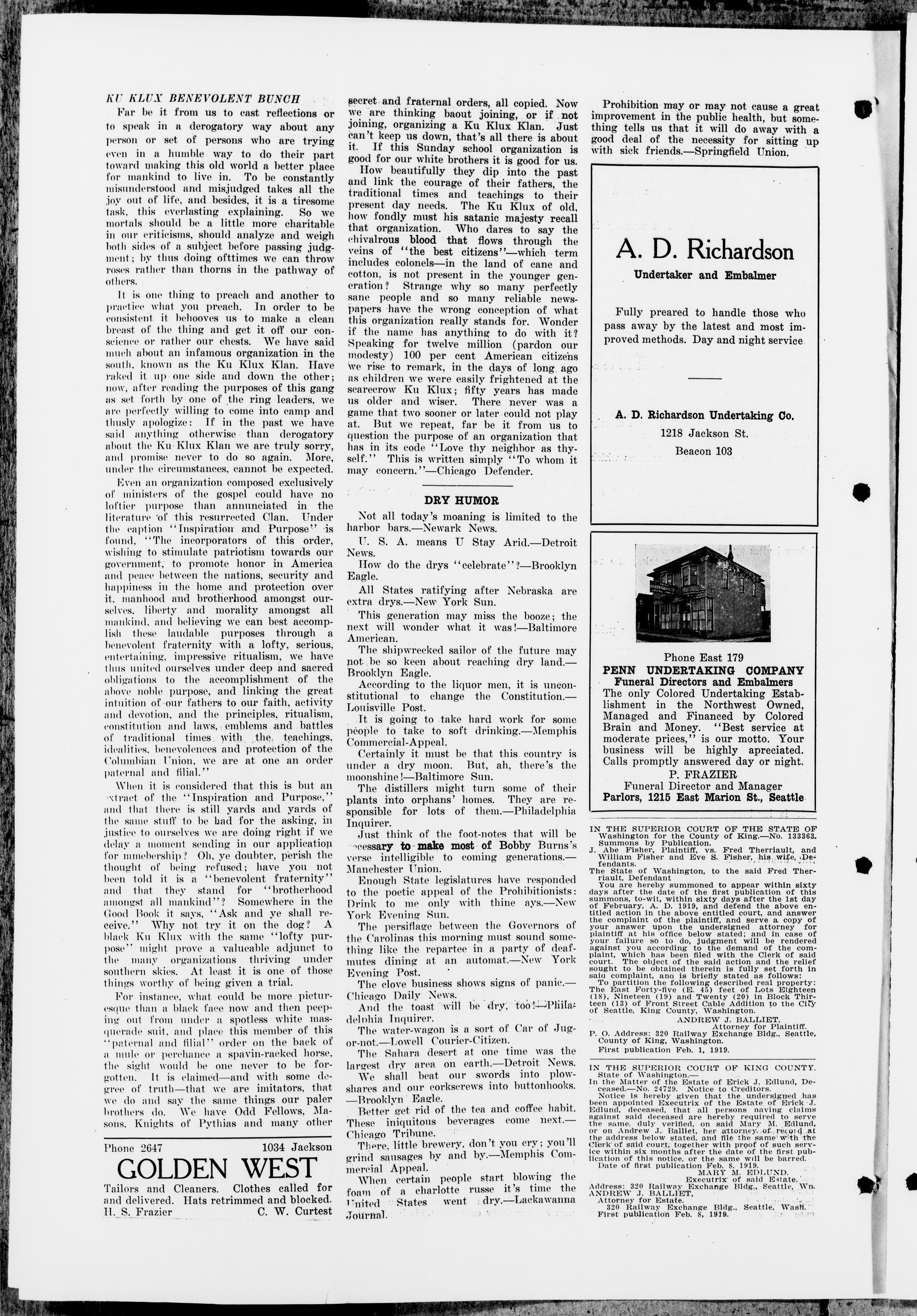
KU KLUX BENEVOLENT BUNCH
Far be it from us to cast reflections or to speak in a derogatory way about any person or set of persons who are trying even in a humble way to do their part toward making this old world a better place for mankind to live in. To be constantly misunderstood and misjudged takes all the joy out of life, and besides, it is a tiresome task, this everlasting explaining. So we mortals should be a little more charitable in our criticisms, should analyze and weigh both sides of a subject before passing judgment; by thus doing offtimes we can throw roses rather than thorns in the pathway of others.
It is one thing to preach and another to practice what you preach. In order to be consistent it behooves us to make a clean breast of the thing and get it off our conscience or rather our chests. We have said much about an infamous organization in the south, known as the Ku Klux Klan. Have raked it up one side and down the other; now, after reading the purposes of this gang as set forth by one of the ring leaders, we are perfectly willing to come into camp and thusly apologize: If in the past we have said anything otherwise than derogatory about the Ku Klux Klan we are truly sorry, and promise never to do so again. More, under the circumstances, cannot be expected.
Even an organization composed exclusively of ministers of the gospel could have no loftier purpose than annunciated in the literature of this resurrected Clan. Under the caption "Inspiration and Purpose" is found, "The incorporators of this order, wishing to stimulate patriotism towards our government, to promote honor in America and peace between the nations, security and happiness in the home and protection over it, manhood and brotherhood amongst ourselves, liberty and morality amongst all mankind, and believing we can best accomplish these laudable purposes through a benevolent fraternity with a lofty, serious, entertaining, impressive ritualism, we have thus united ourselves under deep and sacred obligations to the accomplishment of the above noble purpose, and linking the great intuition of our fathers to our faith, activity and devotion, and the principles, ritualism, constitution and laws, emblems and battles of traditional times with the teachings, idealities, benevolences and protection of the Columbian Union, we are at one an order paternal and filial."
When it is considered that this is but an extract of the "Inspiration and Purpose," and that there is still yards and yards of the same stuff to be had for the asking, in justice to ourselves we are doing right if we delay a moment sending in our application for mmebership? Oh, ye doubter, perish the thought of being refused; have you not been told it is a "benevolent fraternity" and that they stand for "brotherhood amongst all mankind"? Somewhere in the Good Book it says, "Ask and ye shall receive." Why not try it on the dog? A black Ku Klux with the same "lofty purpose" might prove a valueable adjunct to the many organizations thriving under southern skies. At least it is one of those things worthy of being given a trial.
For instance, what could be more picturesque than a black face now and then peeping out from under a spotless white masquerade suit, and place this member of this "paternal and filial" order on the back of a mule or perchance a spavin-racked horse, the sight would be one never to be forgotten. It is claimed—and with some degree of truth—that we are imitators, that we do and say the same things our paler brothers do. We have Odd Fellows, Masons, Knights of Pythias and many other Phone 2647 1034 Jackson
Phone 2647
Tailors and Cleaners. Clothes called for and delivered. Hats retrimmed and blocked. H. S. Frazier C. W. Curtest
secret and fraternal orders, all copied. Now we are thinking baout joining, or if not joining, organizing a Ku Klux Klan. Just can't keep us down, that's all there is about it. If this Sunday school organization is good for our white brothers it is good for us.
How beautifully they dip into the past and link the courage of their fathers, the traditional times and teachings to their present day needs. The Ku Klux of old, how fondly must his satanic majesty recall that organization. Who dares to say the chivalrous blood that flows through the veins of "the best citizens"—which term includes colonels—in the land of cane and cotton, is not present in the younger generation? Strange why so many perfectly sane people and so many reliable newspapers have the wrong conception of what this organization really stands for. Wonder if the name has anything to do with it? Speaking for twelve million (pardon our modesty) 100 per cent American citizens we rise to remark, in the days of long ago as children we were easily frightened at the scarecrow Ku Klux; fifty years has made us older and wiser. There never was a game that two sooner or later could not play at. But we repeat, far be it from us to question the purpose of an organization that has in its code "Love thy neighbor as thyself." This is written simply "To whom it may concern."—Chicago Defender.
DRY HUMOR
Not all today's moaning is limited to the harbor bars.—Newark News.
U. S. A. means U Stay Arid.—Detroit News.
How do the drys "celebrate'?"—Brooklyn Eagle.
All States ratifying after Nebraska are extra drys.—New York Sun.
This generation may miss the booze; the next will wonder what it was!—Baltimore American.
The shipwrecked sailor of the future may not be so keen about reaching dry land.—Brooklyn Eagle.
According to the liquor men, it is unconstitutional to change the Constitution.— Louisville Post.
It is going to take hard work for some people to take to soft drinking.—Memphis Commercial-Apeal.
Certainly it must be that this country is under a dry moon. But, ah, there's the moonshine!—Baltimore Sun.
The distillers might turn some of their plants into orphans' homes. They are responsible for lots of them.—Philadelphia Inquirer.
Just think of the foot-notes that will be necessary to make most of Bobby Burns's verse intelligible to coming generations.—Manchester Union.
Enough State legislatures have responded to the poetic appeal of the Prohibitionists: Drink to me only with thine ays.—New York Evening Sun.
The persiflage between the Governors of the Carolinas this morning must sound something like the repartee in a party of deaf-mutes dining at an automat.—New York Evening Post.
The clove business shows signs of panic.—Chicago Daily News.
And the toast will be dry, too! Philadelphia Inquirer. The water-wagon is a sort of Car of Jugor-not.—Lowell Courier-Citizen. The Sahara desert at one time was the largest dry area on earth.—Detroit News.
We shall beat our swords into plowshares and our corkscrews into buttonhooks. Brooklyn Eagle. Better get rid of the tea and coffee habit. These iniquitous beverages come next. Chicago Tribune. There, little brewery, don't you cry; you'll grind sausages by and by.—Memphis Commercial Appeal. When certain people start blowing the foam of a charlotte russe it's time the United States went dry.—Lackawanna Journal.
Prohibition may or may not cause a great improvement in the public health, but something tells us that it will do away with a good deal of the necessity for sitting up with sick friends.—Springfield Union.
A. D. Richardson Undertaker and Embalmer
Fully preared to handle those who pass away by the latest and most improved methods. Day and night service.
A. D. Richardson Undertaking Co.
1218 Jackson St.
Beacon 103
DOLPHINS CO.
Funeral Directors and Embalmers The only Colored Undertaking Establishment in the Northwest Owned, Managed and Financed by Colored Brain and Money. "Best service at moderate prices," is our motto. Your business will be highly appreciated. Calls promptly answered day or night. P. FRAZIER Funeral Director and Manager Parlors. 1215 East Marion St., Seattle
IN THE SUPERIOR COURT OF THE STATE OF Washington for the County of King.—No. 133363. Summons by Publication. J. Abe Fisher, Plaintiff, vs. Fred Therriault, and William Fisher and Eve S. Fisher, his wife, Defendants.
The State of Washington, to the said Fred Therriault, Defendant.
You are hereby summoned to appear within sixty days after the date of the first publication of this summons, to-wit, within sixty days after the 1st day of February, A. D. 1919, and defend the above entitled action in the above entitled court, and answer the complaint of the plaintiff, and serve a copy of your answer upon the undersigned attorney for plaintiff at his office below stated; and in case of your failure so to do, judgment will be rendered against you according to the demand of the complaint, which has been filed with the Clerk of said court. The object of the said action and the relief sought to be obtained therein is fully set forth in said complaint, and is briefly stated as follows:
To partition the following described real property: The East Forty-five (E. 45) feet of Lots Eighteen (18), Nineteen (19) and Twenty (20) in Block Thirteen (13) of Front Street Cable Addition to the City of Seattle, King County, Washington.
ANDREW J. BALLIET,
Attorney for Plaintiff.
P. O. Address: 320 Railway Exchange Bldg., Seattle, County of King, Washington.
First publication Feb. 1. 1919.
IN THE SUPERIOR COURT OF KING COUNTY. State of Washington. In the Matter of the Estate of Erick J. Edlund, De-
In the Matter of the Estate of Erick J. Edlund, Deceased—No. 24729. Notice to Creditors.
Notice is hereby given that the undersigned has been appointed Executrix of the Estate of Erick J. Edlund, deceased, that all persons naving claims against said deceased are hereby required to serve the same, duly verified, on said Mary M. Edlund, or on Andrew J. Balliet, her attorney, of record at the address below stated, and file the same with the Clerk of said court, together with proof of such service within six months after the date of the first publication of this notice, or the same will be barred. Date of first publication Feb. 8. 1919. MARY M. EDLUND.
Executrix of said Estate.
Address: 320 Railway Exchange Bldg., Seattle, Wn.
ANDREW J. BALLIET,
Attorney for Estate.
320 Railway Exchange Bldg., Seattle, Wash.
First publication Feb. 8, 1919.