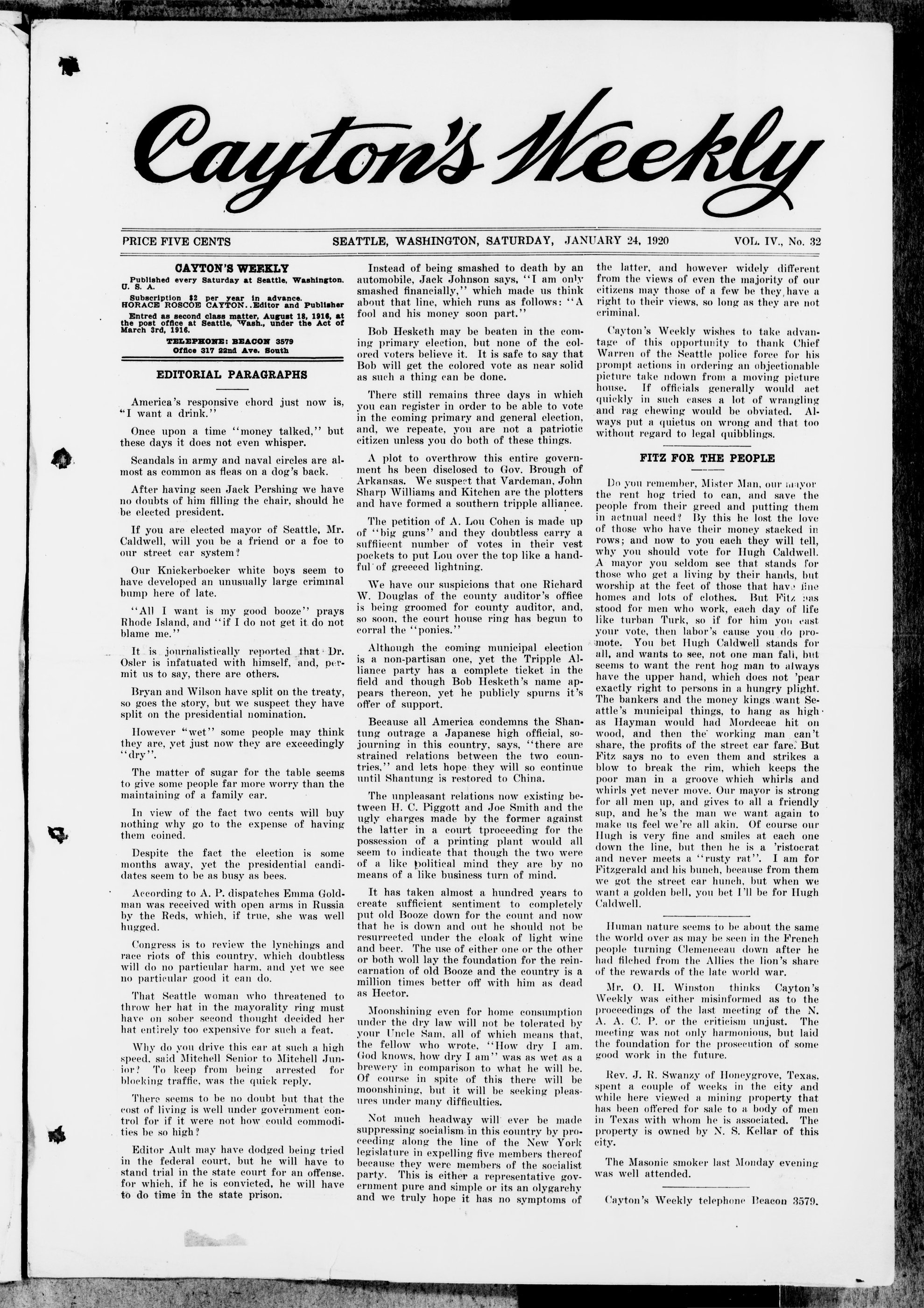
Cayton's Weekly
Saturday, January 24, 1920
Seattle, Washington
Page text (machine-generated)
Cayton's Weekly
SEATTLE, WASHINGTON, SATURDAY, JANUARY 24, 1920
PRICE FIVE CENTS
CAYTON'S WEFKLY
Published every Saturday at Seattle, Washington.
U. S. A.
Subscription $2 per year in advance.
HORACE ROSCOE CAYTON..Editor and Publisher
Entred as second class matter, August 18, 1916, at
the post office at Seattle, Wash., under the Act of
March 3rd, 1916.
TELEPHONE: BEACON 3579
Office 317 22nd Ave. South
EDITORIAL PARAGRAPHS
America's responsive chord just now is, "I want a drink."
Once upon a time "money talked," but these days it does not even whisper.
Scandals in army and naval circles are almost as common as fleas on a dog's back.
After having seen Jack Pershing we have no doubts of him filling the chair, should he be elected president.
If you are elected mayor of Seattle, Mr. Caldwell, will you be a friend or a foe to our street car system?
Our Knickerbocker white boys seem to have developed an unusually large criminal bump here of late.
"All I want is my good booze" prays Rhode Island, and "if I do not get it do not blame me."
It is journalistically reported that Dr. Osler is infatuated with himself, and, permit us to say, there are others.
Bryan and Wilson have split on the treaty, so goes the story, but we suspect they have split on the presidential nomination.
However "wet" some people may think they are, yet just now they are exceedingly "dry".
The matter of sugar for the table seems to give some people far more worry than the maintaining of a family car.
In view of the fact two cents will buy nothing why go to the expense of having them coined.
Despite the fact the election is some months away, yet the presidential candidates seem to be as busy as bees.
According to A. P. dispatches Emma Goldman was received with open arms in Russia by the Reds, which, if true, she was well hugged.
Congress is to review the lynchings and race riots of this country, which doubtless will do no particular harm, and yet we see no particular good it can do.
That Seattle woman who threatened to throw her hat in the mayorality ring must have on sober second thought decided her hat entirely too expensive for such a feat.
Why do you drive this car at such a high speed, said Mitchell Senior to Mitchell Junior? To keep from being arrested for blocking traffic, was the quick reply.
There seems to be no doubt but that the cost of living is well under government control for if it were not how could commodities be so high?
Editor Ault may have dodged being tried in the federal court, but he will have to stand trial in the state court for an offense. for which, if he is convicted, he will have to do time in the state prison.
Instead of being smashed to death by an automobile, Jack Johnson says, "I am only smashed financially," which made us think about that line, which runs as follows: "A fool and his money soon part."
Bob Hesketh may be beaten in the coming primary election, but none of the colored voters believe it. It is safe to say that Bob will get the colored vote as near solid as such a thing can be done.
There still remains three days in which you can register in order to be able to vote in the coming primary and general election, and, we repeat, you are not a patriotic citizen unless you do both of these things.
A plot to overthrow this entire government has been disclosed to Gov. Brough of Arkansas. We suspect that Vardeman, John Sharp Williams and Kitchen are the plotters and have formed a southern tripple alliance.
The petition of A. Lou Cohen is made up of "big guns" and they doubtless carry a suffiecnt number of votes in their vest pockets to put Lou over the top like a handful of greeced lightning.
We have our suspicions that one Richard W. Douglas of the county auditor's office is being groomed for county auditor, and, so soon, the court house ring has begun to corral the "ponies."
Although the coming municipal election is a non-partisan one, yet the Triple Alliance party has a complete ticket in the field and though Bob Hesketh's name appears thereon, yet he publicly spurns it's offer of support.
Because all America condemns the Shantung outrage a Japanese high official, sojourning in this country, says, "there are strained relations between the two countries," and lets hope they will so continue until Shantung is restored to China.
The unpleasant relations now existing between H. C. Piggott and Joe Smith and the ugly charges made by the former against the latter in a court tproceeding for the possession of a printing plant would all seem to indicate that though the two were of a like political mind they are by no means of a like business turn of mind.
It has taken almost a hundred years to create sufficient sentiment to completely put old Booze down for the count and now that he is down and out he should not be resurrected under the cloak of light wine and beer. The use of either one or the other or both woll lay the foundation for the reincarnation of old Booze and the country is a million times better off with him as dead as Hector.
Moonshining even for home consumption under the dry law will not be tolerated by your Uncle Sam, all of which means that, the fellow who wrote, "How dry I am. God knows, how dry I am" was as wet as a brewery in comparison to what he will be. Of course in spite of this there will be moonshining, but it will be seeking pleasures under many difficulties.
Not much headway will ever be made suppressing socialism in this country by proceeding along the line of the New York legislature in expelling five members thereof because they were members of the socialist party. This is either a representative government pure and simple or its an olygarchy and we truly hope it has no symptoms of
VOL. IV., No. 32
the latter, and however widely different from the views of even the majority of our citizens may those of a few be they have a right to their views, so long as they are not criminal. Cayton's Weekly wishes to take advantage of this opportunity to thank Chief Warren of the Seattle police force for his prompt actions in ordering an objectionable picture take ndown from a moving picture house. If officials generally would act quickly in such cases a lot of wrangling and rag chewing would be obviated. Always put a quietus on wrong and that too without regard to legal quibblings.
FITZ FOR THE PEOPLE
Do you remember, Mister Man, our mayor the rent hog tried to can, and save the people from their greed and putting them in actual need? By this he lost the love of those who have their money stacked in rows; and now to you each they will tell, why you should vote for Hugh Caldwell. A mayor you seldom see that stands for those who get a living by their hands, but worship at the feet of those that have fine homes and lots of clothes. But Fitz has stood for men who work, each day of life like turban Turk, so if for him you cast your vote, then labor's cause you do promote. You bet Hugh Caldwell stands for all, and wants to see, not one man fall, but seems to want the rent hog man to always have the upper hand, which does not 'pear exactly right to persons in a hungry plight. The bankers and the money kings want Seattle's municipal things, to hang as high as Hayman would had Mordecae hit on wood, and then the working man can't share, the profits of the street car fare. But Fitz says no to even them and strikes a blow to break the rim, which keeps the poor man in a groove which whirls and whirls yet never move. Our mayor is strong for all men up, and gives to all a friendly sup, and he's the man we want again to make us feel we're all akin. Of course our Hugh is very fine and smiles at each one down the line, but then he is a 'ristocrat and never meets a "rusty rat". I am for Fitzgerald and his bunch, because from them we got the street car hunch, but when we want a golden bell, you bet I'll be for Hugh Caldwell.
Human nature seems to be about the same the world over as may be seen in the French people turning Clemenceau down after he had filched from the Allies the lion's share of the rewards of the late world war.
Mr. O. H. Winston thinks Cayton's Weekly was either misinformed as to the proceedings of the last meeting of the N. A. A. C. P. or the criticism unjust. The meeting was not only harmonious, but laid the foundation for the prosecution of some good work in the future.
Rev. J. R. Swanzy of Honeygrove, Texas, spent a couple of weeks in the city and while here viewed a mining property that has been offered for sale to a body of men in Texas with whom he is associated. The property is owned by N. S. Kellar of this city.
The Masonic smoker last Monday evening was well attended.
Cayton's Weekly telephone Beacon 3579.
```markdown
```
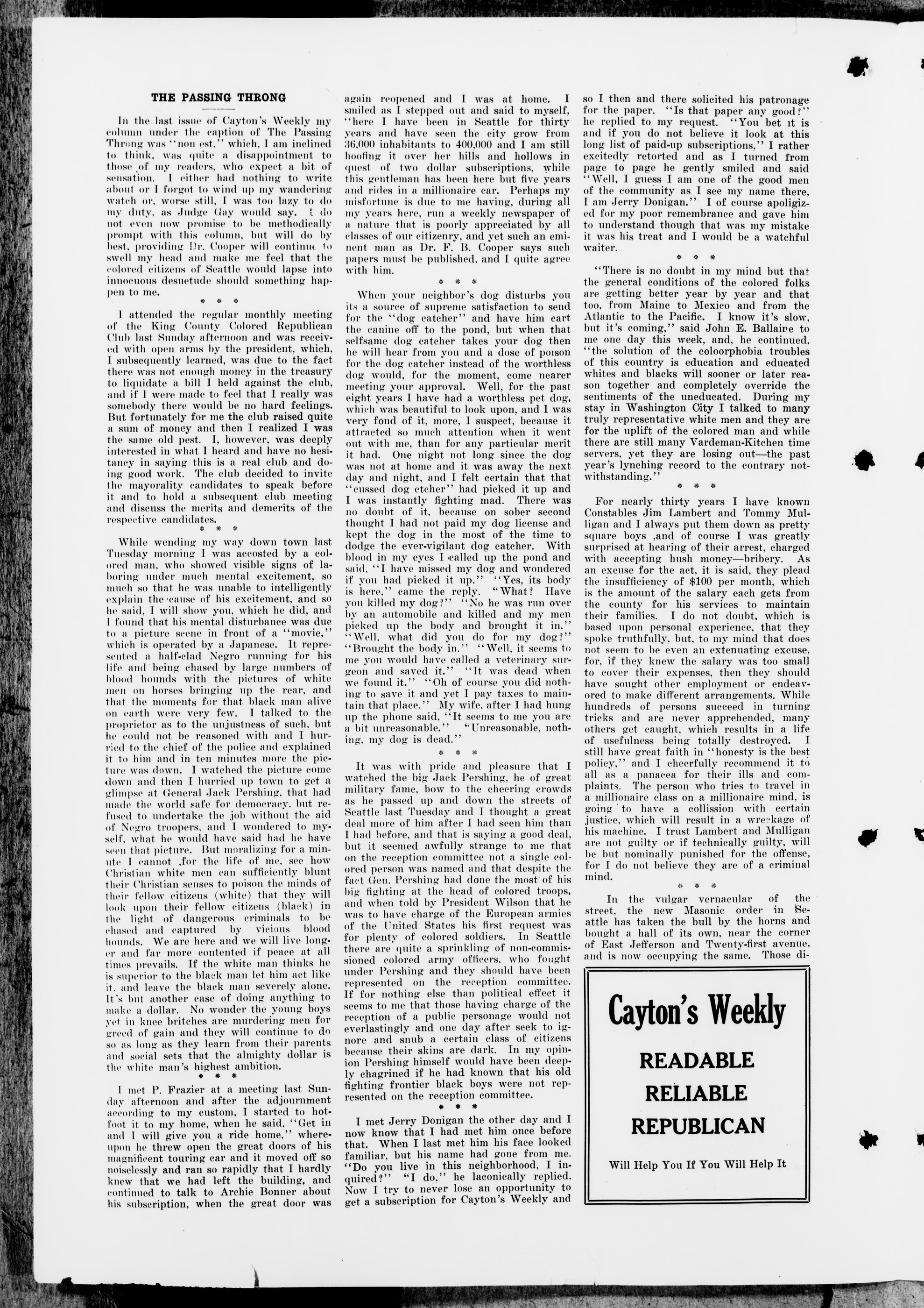
THE PASSING THRONG
In the last issue of Cayton's Weekly my column under the caption of The Passing Throng was "non est," which, I am inclined to think, was quite a disappointment to those of my readers, who expect a bit of sensation. I either had nothing to write about or I forgot to wind up my wandering watch or, worse still, I was too lazy to do my duty, as Judge Gay would say. I do not even now promise to be methodically prompt with this column, but will do by best, providing Dr. Cooper will continue to swell my head and make me feel that the colored citizens of Seattle would lapse into innocuous desuetude should something happen to me.
* * *
I attended the regular monthly meeting of the King County Colored Republican Club last Sunday afternoon and was received with open arms by the president, which, I subsequently learned, was due to the fact there was not enough money in the treasury to liquidate a bill I held against the club, and if I were made to feel that I really was somebody there would be no hard feelings. But fortunately for me the club raised quite a sum of money and then I realized I was the same old pest. I, however, was deeply interested in what I heard and have no hesitancy in saying this is a real club and doing good work. The club decided to invite the mayorality candidates to speak before it and to hold a subsequent club meeting and discuss the merits and demerits of the respective candidates.
* * *
While wending my way down town last Tuesday morning I was accosted by a colored man, who showed visible signs of laboring under much mental excitement, so much so that he was unable to intelligently explain the cause of his excitement, and so he said, I will show you, which he did, and I found that his mental disturbance was due to a picture scene in front of a "movie," which is operated by a Japanese. It represented a half-clad Negro running for his life and being chased by large numbers of blood hounds with the pictures of white men on horses bringing up the rear, and that the moments for that black man alive on earth were very few. I talked to the proprietor as to the unjustness of such, but he could not be reasoned with and I hurried to the chief of the police and explained it to him and in ten minutes more the picture was down. I watched the picture come down and then I hurried up town to get a glimpse at General Jack Pershing, that had made the world safe for democracy, but refused to undertake the job without the aid of Negro troopers, and I wondered to myself, what he would have said had he have seen that picture. But moralizing for a minute I cannot, for the life of me, see how Christian white men can sufficiently blunt their Christian senses to poison the minds of their fellow citizens (white) that they will look upon their fellow citizens (black) in the light of dangerous criminals to be chased and captured by vicious blood hounds. We are here and we will live longer and far more contented if peace at all times prevails. If the white man thinks he is superior to the black man let him act like it, and leave the black man severely alone. It's but another case of doing anything to make a dollar. No wonder the young boys yet in knee britches are murdering men for greed of gain and they will continue to do so as long as they learn from their parents and social sets that the almighty dollar is the white man's highest ambition.
* * *
I met P. Frazier at a meeting last Sunday afternoon and after the adjournment according to my custom, I started to hotfoot it to my home, when he said, "Get in and I will give you a ride home," whereupon he threw open the great doors of his magnificent touring car and it moved off so noiselessly and ran so rapidly that I hardly knew that we had left the building, and continued to talk to Archie Bonner about his subscription, when the great door was
again reopened and I was at home. I smiled as I stepped out and said to myself, "here I have been in Seattle for thirty years and have seen the city grow from 36,000 inhabitants to 400,000 and I am still hoofing it over her hills and hollows in quest of two dollar subscriptions, while this gentleman has been here but five years and rides in a millionaire car. Perhaps my misfortune is due to me having, during all my years here, run a weekly newspaper of a nature that is poorly appreciated by all classes of our citizenry, and yet such an eminent man as Dr. F. B. Cooper says such papers must be published, and I quite agree with him.
***
When your neighbor's dog disturbs you its a source of supreme satisfaction to send for the "dog catcher" and have him cart the canine off to the pond, but when that selfsame dog catcher takes your dog then he will hear from you and a dose of poison for the dog catcher instead of the worthless dog would, for the moment, come nearer meeting your approval. Well, for the past eight years I have had a worthless pet dog, which was beautiful to look upon, and I was very fond of it, more, I suspect, because it attracted so much attention when it went out with me, than for any particular merit it had. One night not long since the dog was not at home and it was away the next day and night, and I felt certain that that "cussed dog etcher" had picked it up and I was instantly fighting mad. There was no doubt of it, because on sober second thought I had not paid my dog license and kept the dog in the most of the time to dodge the ever-vigilant dog catcher. With blood in my eyes I called up the pond and said, "I have missed my dog and wondered if you had picked it up." "Yes, its body is here," came the reply. "What? Have you killed my dog?" "No he was run over by an automobile and killed and my men picked up the body and brought it in." "Well, what did you do for my dog?" "Brought the body in." "Well, it seems to me you would have called a veterinary surgeon and saved it." "It was dead when we found it." "Oh of course you did nothing to save it and yet I pay taxes to maintain that place." My wife, after I had hung up the phone said, "It seems to me you are a bit unreasonable." "Unreasonable, nothing, my dog is dead."
* * *
It was with pride and pleasure that I watched the big Jack Pershing, he of great military fame, bow to the cheering crowds as he passed up and down the streets of Seattle last Tuesday and I thought a great deal more of him after I had seen him than I had before, and that is saying a good deal, but it seemed awfully strange to me that on the reception committee not a single colored person was named and that despite the fact Gen. Pershing had done the most of his big fighting at the head of colored troops, and when told by President Wilson that he was to have charge of the European armies of the United States his first request was for plenty of colored soldiers. In Seattle there are quite a sprinkling of non-commissioned colored army officers, who fought under Pershing and they should have been represented on the reception committee. If for nothing else than political effect it seems to me that those having charge of the reception of a public personage would not everlastingly and one day after seek to ignore and snub a certain class of citizens because their skins are dark. In my opinion Pershing himself would have been deeply chagrined if he had known that his old fighting frontier black boys were not represented on the reception committee.
* * *
I met Jerry Donigan the other day and I now know that I had met him once before that. When I last met him his face looked familiar, but his name had gone from me. "Do you live in this neighborhood, I inquired?" "I do," he laconicly replied. Now I try to never lose an opportunity to get a subscription for Cayton's Weekly and
so I then and there solicited his patronage for the paper. "Is that paper any good?" he replied to my request. "You bet it is and if you do not believe it look at this long list of paid-up subscriptions," I rather excitedly retorted and as I turned from page to page he gently smiled and said "Well, I guess I am one of the good men of the community as I see my name there, I am Jerry Donigan." I of course apoligized for my poor remembrance and gave him to understand though that was my mistake it was his treat and I would be a watchful waiter.
* * *
"There is no doubt in my mind but that the general conditions of the colored folks are getting better year by year and that too, from Maine to Mexico and from the Atlantic to the Pacific. I know it's slow, but it's coming," said John E. Ballaire to me one day this week, and, he continued, "the solution of the coloorphobia troubles of this country is education and educated whites and blacks will sooner or later reason together and completely override the sentiments of the uneducated. During my stay in Washington City I talked to many truly representative white men and they are for the uplift of the colored man and while there are still many Vardeman-Kitchen time servers, yet they are losing out—the past year's lynching record to the contrary notwithstanding."
***
For nearly thirty years I have known Constables Jim Lambert and Tommy Mulligan and I always put them down as pretty square boys, and of course I was greatly surprised at hearing of their arrest, charged with accepting hush money—bribery. As an excuse for the act, it is said, they plead the insufficiency of $100 per month, which is the amount of the salary each gets from the county for his services to maintain their families. I do not doubt, which is based upon personal experience, that they spoke truthfully, but, to my mind that does not seem to be even an extenuating excuse, for, if they knew the salary was too small to cover their expenses, then they should have sought other employment or endeavored to make different arrangements. While hundreds of persons succeed in turning tricks and are never apprehended, many others get caught, which results in a life of usefulness being totally destroyed. I still have great faith in "honesty is the best policy," and I cheerfully recommend it to all as a panacea for their ills and complaints. The person who tries to travel in a millionaire class on a millionaire mind, is going to have a collission with certain justice, which will result in a wreckage of his machine. I trust Lambert and Mulligan are not guilty or if technically guilty, will be but nominally punished for the offense, for I do not believe they are of a criminal mind.
***
In the vulgar vernacular of the street, the new Masonic order in Seattle has taken the bull by the horns and bought a hall of its own, near the corner of East Jefferson and Twenty-first avenue, and is now occupying the same. Those di-
Cayton's Weekly
READABLE
RELIABLE
REPUBLICAN
Will Help You If You Will Help It
outmatched Shaw in their attitude toward our American composers. Some change in this situation was brought by the war's victorious ending. In the resulting outburst of patriotism, New York conductors declared their intention of encouraging American music. Last season our composers were better represented in New York orchestral concerts.
However, throughout the country, the orchestral conductor is still stolidly indifferent to the American composer, giving even mediocre music that is foreign in preference to American music that is good. What encouragement is there for any man to compose that which stands such small chance of performance?
In long years a steady stream of foreign pianists has visited America, to return home more or less financially revived. A few among them played some compositions by our prized McDowell; the rest left without discovering any American piano music at all.
Unfortunately our native pianists of eminence seem to hold much the same idea. In general they have failed to emulate the brilliant example of Fanny Bolomfield-Zeisler, who has unhesitatingly played in her recitals American pieces that appealed to her.
Reginald De Koven, whose "Robin Hood" is looked on as a classic, and whose "Canterbury Pilgrims" at the time of its performance was pronounced the best Ameircan opera given at the Metropolitan, very naturally writes with strong feeling for his profession. In the New York Herald he stated, and, as far as my personal knowled eggoes, without contradiction, that the two important operatic institutions in this country, supported entirely by American money, are so bound by contracts with fore-edge goes, without contradiction, that the if they would, give other than scant attention nt oopera by Americans.
Now, it is of prime importance that the composer hear his opera performed if he would judge wherein he may improve and
Register Today
No one is a good citizen, who does not re-
a registered voter those you help to elect to
you can start a movement to turn them out,
trust imposed in them. Every citizen that
should not only register but vote and there-
amount of patriotism. If you do not do this the
cent American—minus—that is to say, against
it warm for you.
Ben Butler said, "The way to resume is to
say, the way to keep this country 100 per cent
cent Americans to religiously register and vote.
There are upwards of 5000 colored person-
and vote and we would like to be able to sa-
per cent of them not only registered, but w
tion. Do not fail to register today, but if you
Yours Fo
No one is a good citizen, who does not register and vote. If you are a registered voter those you help to elect to office are your servants and you can start a movement to turn them out, if they prove recreant to the trust imposed in them. Every citizen that is 100 per cent American should not only register but vote and thereby elect officials of a like amount of patriotism. If you do not do this the persons that are 100 per cent American-minus-that is to say, against the government-will make it warm for you.
Ben Butler said, "The way to resume is to resume." Permit us to say, the way to keep this country 100 per cent American is for 100 per cent Americans to religiously register and vote.
There are upwards of 5000 colored persons in Seattle that can register and vote and we would like to be able to say after the election that 99 per cent of them not only registered, but voted at the municipal election. Do not fail to register today, but if you do then register Monday.
Candidates Are Invited
Under the auspices of the King County Coloree Woman's Political Alliance, the candidates for offices, which are to be voted for in the coming
CORDIALLY INVITE
to be present at a public meeting to be held in next Monday evening—
Under the auspices of the King County Colored Republican Club and the Woman's Political Alliance, the candidates for Mayor and other municipal offices, which are to be voted for in the coming primary and city election are
CORDIALLY INVITED
to be present at a public meeting to be held in the Mt. Zion Baptist Church next Monday evening—
JANUARY 26th, 1920.
and deliver short addresses before the meeting.
Be it understood that this will under no circumstances and the various candidates are free to discuss such of them seems meet and proper by which to furnish ests. The public without regard to the Club may be invited to be present, but is urged to be present
F. B. CO
C. R. AN
Be it understood that this will under no circumstances be a quizz meeting and the various candidates are free to discuss such things as to them and each of them seems meet and proper by which to further their own political interests. The public without regard to the Club membership is not only cordially invited to be present, but is urged to be present and hear for itself.
recting the affairs of the organization worked on the time-worn theory of, the way to resume is to resume, and they therefore got busy and immediately resumed and as a result, they are now under their own vine and fig tree. Had other lodges acted likewise, either singly or collectively, the colored population of Seattle would now be the proud possessors of a magnificent hall and would not be compelled, as it now is, to pay $10 more per night for the use of the halls for rent than does the white population.
* * *
Every time a person is justly arrested, charged with crime, somebody's son or daughter has gone wrong and here of late a great many somebody's sons have been going wrong. One day this week my son went wrong and though I love him to destruction and still hope he will see the error of his ways and, Phoenix like, rise out of the ashes of his mis-step and let his light shine among men, yet he will have to reap his reward just as your son. The ones we seem to love the best are generally the ones that give us the most concern, but these is always hope as long as there is life, and hoping and believing that my boy is without a criminal mind my efforts to yet have him reach my ideal will not only be doubled and trebled, but even then some. But the father who does not feel in a like manner about his son is so inhuman that he is not deserving of the honor. It seems almost miraculous that boys yet in their tender years would desert inviting home environments to associate with fixed criminals, but they will do it. However, there is nothing to indicate that my boy is one of a trio of much criminal record, but whatever he is or has been he is mine, every inch of him, and I love him not one iota less and will continue to throw my strong protecting arms around him and will do so, even though he really becomes as bad as he has been pictured.
Horace Roscoe Cayton,s Editorial Warbling's. * * *
Important mass meeting at Baptist church, Monday evening, January 26, 1920 at 8:15 p. m. Very important. This meeting will be addressed by the various candidates for offices in the coming municipal election. Your presence is urged. This meeting is held under the auspices of the King County Colored Republican Club and Woman's Political Alliance. Don't forget the date and place, Baptist church, Monday evening, January 26, 1920 at 8:15 p. m.—F. B. Cooper. President: C. R. Anderson, Secretary.
Cayton's Weekly telephone Beacon 3579.
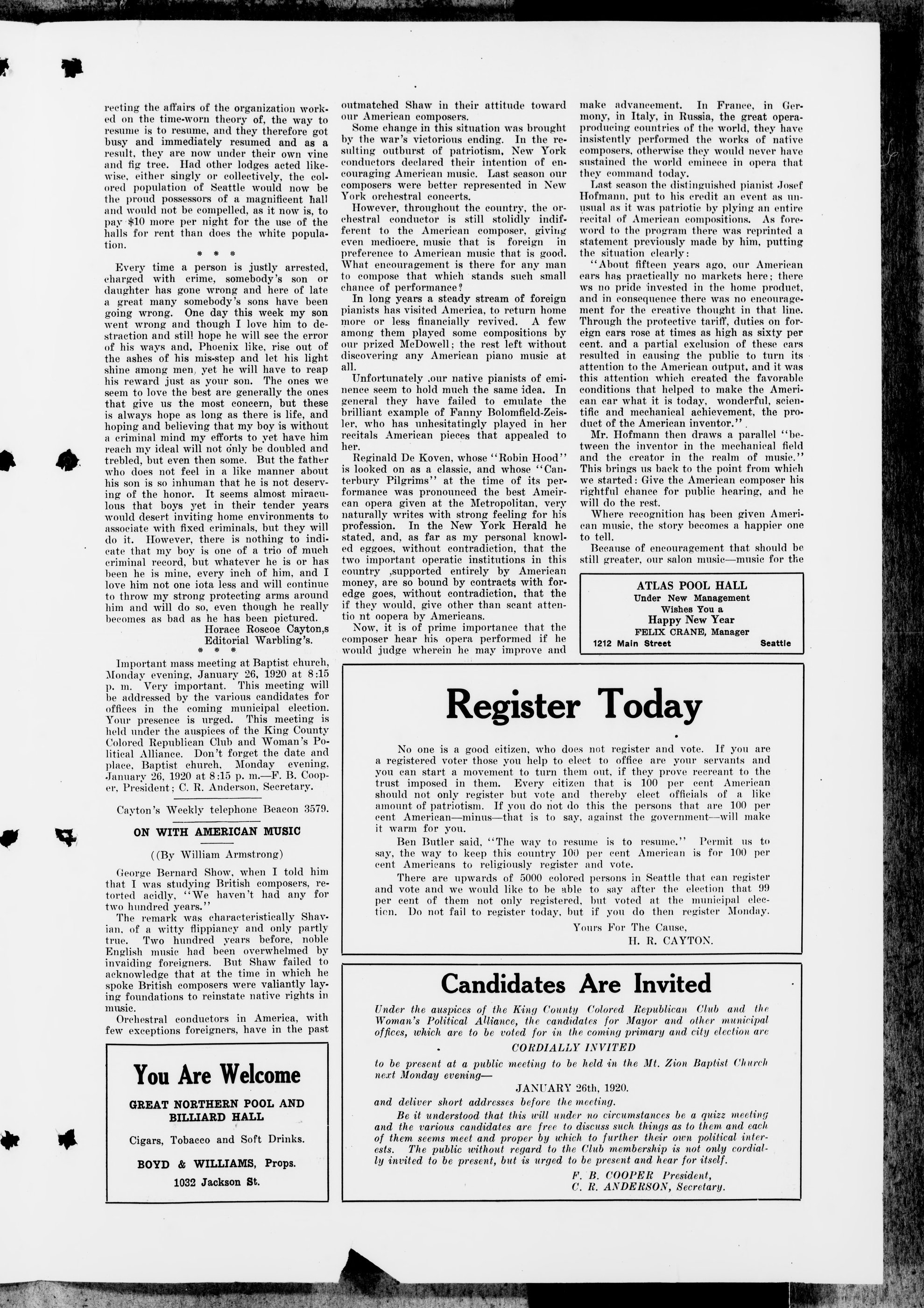
ON WITH AMERICAN MUSIC
((By William Armstrong)
George Bernard Show, when I told him that I was studying British composers, retorted acidly, "We haven't had any for two hundred years."
The remark was characteristically Shavian, of a witty flippiancy and only partly true. Two hundred years before, noble English music had been overwhelmed by invaiding foreigners. But Shaw failed to acknowledge that at the time in which he spoke British composers were valiantly laying foundations to reinstate native rights in music.
Orchestral conductors in America, with few exceptions foreigners, have in the past
GREAT NORTHERN POOL AND BILLIARD HALL
Cigars, Tobacco and Soft Drinks.
BOYD & WILLIAMS, Props.
1032 Jackson St.
make advancement. In France, in Germany, in Italy, in Russia, the great opera-producing countries of the world, they have insistently performed the works of native composers, otherwise they would never have sustained the world eminence in opera that they command today. Last season the distinguished pianist Josef Hofmann, put to his credit an event as unusual as it was patriotic by plying an entire recital of American compositions. As foreword to the program there was reprinted a statement previously made by him, putting the situation clearly:
"About fifteen years ago, our American cars has practically no markets here; therews no pride invested in the home product, and in consequence there was no encouragement for the creative thought in that line. Through the protective tariff, duties on foreign cars rose at times as high as sixty per cent. and a partial exclusion of these cars resulted in causing the public to turn its attention to the American output, and it was this attention which created the favorable conditions that helped to make the American car what it is today, wonderful, scientific and mechanical achievement, the product of the American inventor."
Mr. Hofmann then draws a parallel "between the inventor in the mechanical field and the creator in the realm of music." This brings us back to the point from which we started: Give the American composer his rightful chance for public hearing, and he will do the rest.
Where recognition has been given American music, the story becomes a happier one to tell.
Because of encouragement that should be still greater, our salon music—music for the
ATLAS POOL HALL
Under New Management
Wishes You a
Happy New Year
FELIX CRANE, Manager
1212 Main Street
Yours For The Cause,
H. R. CAYTON.
F. B. COOPER President,
C. R. ANDERSON, Secretary.
39
drawing-room and to play for friends—surpasses in real worth the salon music of any other country.
Today, none would think of giving a vocal recital in which American songs did not figure. But there was a time when celebrated singers evaded American songs on the specious plea that English was unsingable.
Madame Patti, in answer to the direct question, "Is English a good language to sing?" answered me, "English is not a good language to sing only to those who do not know how to sing it."
In her glorious days I have seen an audience of thousands bend forward in breathless silence as she sang, "Home, Sweet Home;" the softest notes of that supreme mezzo voice of hers carried each distinctly enunciated word lingeringly, sympathetically, with a ravishing beauty of tone alive with tenderness and meaning.
Nevertheless, in past years, not so very far away, concert singers, both eminent and aspirant, a generous proportion of them American ones at that, declared persistently that English was not to be attempted without offending their artistic sensibilities.
Suddenly all changed. Madame Nordica it was who proved the foremost figure in the movement. Her artistic position was unassailable; she could do as she willed. Above all she was ardently an American. Eagerly she sought out songs by her countrymen, placing them in recital programs that she sang throughout the United States. Madame Nordica it was who made tireless propaganad for Charles Wakefield Cadmn, whose great melodie talent she instantly recognized when he was utterly unknown.
Since that time when he first gave out his admired song, "Land of the Sky-blue Water," what a mass of songs and instrumental pieces he has written, as well as the opera. "Shaneweis," which had the distinction of being presented at the Metropolitan Opera House! To her he owes primarily his quick rise to fame.
James H. Roger's lovely song, "At Parting," she found by accident, lying on a piano in Cleveland. In one season she made it nationally know. Nevin's "Mighty Lak' a Rose," was sent her in a mass of music for inspection. Humming it once through to its accompaniment, I heard her say emphatically, "That song I will sing!" A trifle it is undoubtedly, and a light one, but it holds the kernel of universal appeal to audiences. And she knew it.
This was not all that Madame Nordica did in her continuous patriotic interest. In London, in 1897, the year of Queen Victoria's Diaomnd Jubilee, she gave there a splendid impetus to the songs of the Americans, and at a period when the British knew little of them. Having told her that I would that season lecture in London on "American Song-Composers," she exclaimed enthusiastically, "I am going to sing your program of illustrations!"
True to her word, she did, and without thought of fee. From that time on American songs grew in favor there; today they find generous space in London programs.
Our noted singers were not slow in joining a steadily growing American movement. Foreign artists entered in the race to present songs by Americans Our people learning the beauty of their own songs, demanded them. What a crop of young songcomposers has sprung up in consequence. Today the best of their songs equal in beauty the best by living composers of any country. This is an evidence of what real recognition will accomplish. What a mass of foreign propaganda American music has had to fight against! Germans in high authority in musical organizations, and teaching in institutions everywhere, have fluently discouraged it.
Prior to 1914 German publishers in their contracts bound American firms to sell annually certain thousands of dollars' worth of German-published "editions" in order to
J. W. EDMUNDS, OPH. D... Graduate Op-Eye Specialist. Personal attention given in Eye examinations for Glasses. Fifteen years in Seattle. Balcony. Fraser-Paterson Co.
secure the agency for those editions. Consequently, American music had always to compete with the obstacle of forced sales. For several years the French Government has sent noted musical artists, and last season one of its famous orchestras, to enlist our interest in French music. It is now proposed to establish a center in New York for the sale of French music at cost, in order to promote its wider sale in America. An old saying goes that a people is judged by the songs it sings. Thanks to the recognition that has been given our song-composers, we may be judged in this direction and not found wanting.
But in our music we can not remain content to be judged in any such destricted way. To be judged properly, we must be judged by our own music in every branch. To do this, we must never rest until our composers have received a just and rightful hearing. To accomplish this, we must work as individual musicians, singing American music, playing American music, teaching American music, recommending American music, each and every one of us; not only because it is American music, but because it is good music. The Delineator.
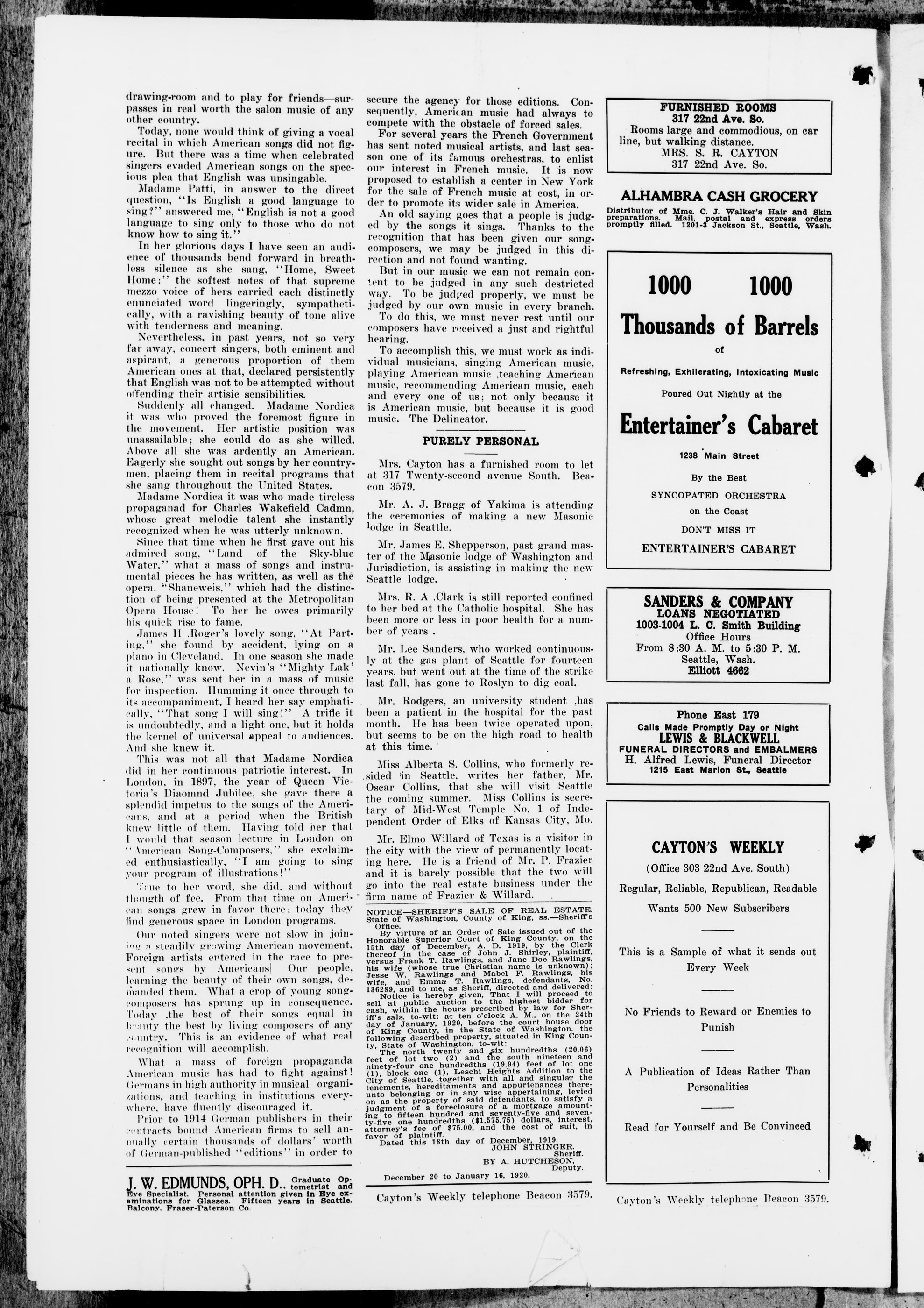
PURELY PERSONAL
Mrs. Cayton has a furnished room to let at 317 Twenty-second avenue South. Beacon 3579.
Mr. A. J. Bragg of Yakima is attending the ceremonies of making a new Masonic lodge in Seattle.
Mr. James E. Shepperson, past grand master of the Masonic lodge of Washington and Jurisdiction, is assisting in making the new Seattle lodge.
Mrs. R. A .Clark is still reported confined to her bed at the Catholic hospital. She has been more or less in poor health for a number of years.
Mr. Lee Sanders, who worked continuously at the gas plant of Seattle for fourteen years, but went out at the time of the strike last fall, has gone to Roslyn to dig coal.
Mr. Rodgers, an university student has been a patient in the hospital for the past month. He has been twice operated upon, but seems to be on the high road to health at this time.
Miss Alberta S. Collins, who formerly resided in Seattle, writes her father, Mr. Oscar Collins, that she will visit Seattle the coming summer. Miss Collins is secretary of Mid-West Temple No. 1 of Independent Order of Elks of Kansas City, Mo.
Mr. Elmo Willard of Texas is a visitor in the city with the view of permanently locating here. He is a friend of Mr. P. Frazier and it is barely possible that the two will go into the real estate business under the firm name of Frazier & Willard.
NOTICE—SHERIFF'S SALE OF REAL ESTATE. State of Washington, County of King, ss.—Sheriff's Office.
By virtue of an Order of Sale issued out of the Honorable Superior Court of King County, on the 15th day of December, A. D. 1919, by the Clerk thereof in the case of John J. Shirley, plaintiff, versus Frank T. Rawlings, and Jane Doe Rawlings, his wife (whose true Christian name is unknown); Jesse W. Rawlings and Mabel F. Rawlings, his wife, and Emma T. Rawlings, defendants. No. 136289, and to me, as Sheriff, directed and delivered:
Notice is hereby given. That I will proceed to sell at public auction to the highest bidder for cash, within the hours prescribed by law for Sheriff's sals, to-wit: at ten o'clock A. M., on the 24th day of January, 1920, before the court house door of King County, in the State of Washington, the following described property, situated in King County. State of Washington, to-wit:
The north twenty and six hundredths (20.06) feet of lot two (2) and the south nineteen and ninety-four one hundredths (19.94) feet of lot one (1), block one (1), Leschi Heights Addition to the City of Seattle, together with all and singular the tenements, hereditaments and appurtenances thereunto belonging or in any wise appertaining, levied on as the property of said defendants, to satisfy a judgment of a foreclosure of a mortgage amounting to fifteen hundred and seventy-five and seventy-five one hundredths ($1,575.75) dollars, interest, attorney's fee of $75.00, and the cost of suit, in favor of plaintiff.
Dated this 18th day of December, 1919.
Cayton's Weekly telephone Beacon 3579.
FURNISHED ROOMS 317 22nd Ave. So. Rooms large and commodious, on car line, but walking distance. MRS. S. R. CAYTON 317 22nd Ave. So.
ALHAMBRA CASH GROCERY
Distributor of Mme. C. J. Walker's Hair and Skin preparations. Mail, postal and express orders promptly filled. 1201-3 Jackson St., Seattle, Wash.
1000 1000
Thousands of Barrels
of
Refreshing, Exhilerating, Intoxicating Music
Poured Out Nightly at the
Entertainer's Cabaret
1238 Main Street
By the Best
SYNCOPATED ORCHESTRA
on the Coast
DON'T MISS IT
ENTERTAINER'S CABARET
SANDERS & COMPANY
LOANS NEGOTIATED
1003-1004 L. C. Smith Building
Office Hours
From 8:30 A. M. to 5:30 P. M.
Seattle, Wash.
Elliott 4662
Phone East 179
Calls Made Promptly Day or Night
LEWIS & BLACKWELL
FUNERAL DIRECTORS and EMBALMERS
H. Alfred Lewis, Funeral Director
1215 East Marion St., Seattle
CAYTON'S WEEKLY
(Office 303 22nd Ave. South) Regular, Reliable, Republican, Readable Wants 500 New Subscribers
This is a Sample of what it sends out Every Week
No Friends to Reward or Enemies to Punish
A Publication of Ideas Rather Than Personalities
Read for Yourself and Be Convinced
Cayton's Weekly telephone Beacon 3579.