Cayton's Weekly
Saturday, March 20, 1920
Seattle, Washington
Page text (machine-generated)
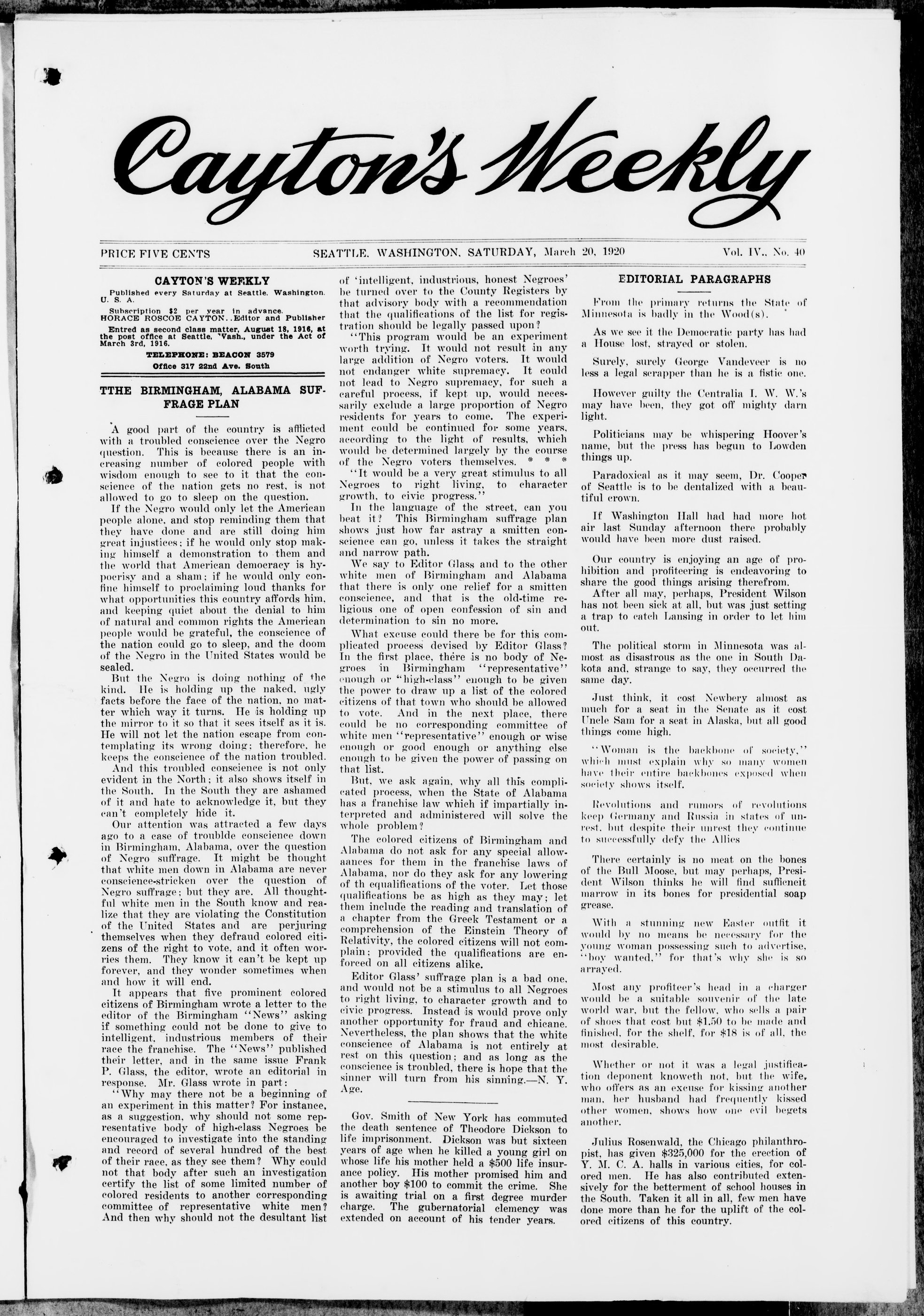
Cayton's Weekly
---
PRICE FIVE CENTS
CAYTON'S WEEKLY
Published every Saturday at Seattle. Washington. U. S. A.
Subscription $2 per year in advance.
HORACE ROSCOE CAYTON..Editor and Publisher
Entred as second class matter, August 18, 1916, at the post office at Seattle, 'Vash., under the Act of March 3rd, 1916.
TELEPHONE: BEACON 3579
Office 317 22nd Ave. South
TTHE BIRMINGHAM, ALABAMA SUF- FRAGE PLAN
A good part of the country is afflicted with a troubled conscience over the Negro question. This is because there is an increasing number of colored people with wisdom enough to see to it that the conscience of the nation gets no rest, is not allowed to go to sleep on the question.
If the Negro would only let the American people alone, and stop reminding them that they have done and are still doing him great injustices; if he would only stop making himself a demonstration to them and the world that American democracy is hypocrisy and a sham; if he would only confine himself to proclaiming loud thanks for what opportunities this country affords him, and keeping quiet about the denial to him of natural and common rights the American people would be grateful, the conscience of the nation could go to sleep, and the doom of the Negro in the United States would be sealed.
But the Negro is doing nothing of the kind. He is holding up the naked, ugly facts before the face of the nation, no matter which way it turns. He is holding up the mirror to it so that it sees itself as it is. He will not let the nation escape from contemplating its wrong doing; therefore, he keeps the conscience of the nation troubled. And this troubled conscience is not only evident in the North; it also shows itself in the South. In the South they are ashamed of it and hate to acknowledge it, but they can't completely hide it.
Our attention was attracted a few days ago to a case of troublde conscience down in Birmingham, Alabama, over the question of Negro suffrage. It might be thought that white men down in Alabama are never conscience-stricken over the question of Negro suffrage; but they are. All thoughtful white men in the South know and realize that they are violating the Constitution of the United States and are perjuring themselves when they defraud colored citizens of the right to vote, and it often worries them. They know it can't be kept up forever, and they wonder sometimes when and how it will end.
It appears that five prominent colored citizens of Birmingham wrote a letter to the editor of the Birmingham "News" asking if something could not be done to give to intelligent, industrious members of their race the franchise. The "News" published their letter, and in the same issue Frank P. Glass, the editor, wrote an editorial in response. Mr. Glass wrote in part:
"Why may there not be a beginning of an experiment in this matter? For instance, as a suggestion, why should not some representative body of high-class Negroes be encouraged to investigate into the standing and record of several hundred of the best of their race, as they see them? Why could not that body after such an investigation certify the list of some limited number of colored residents to another corresponding committee of representative white men? And then why should not the desultant list
SEATTLE, WASHINGTON, SATURDAY, March 20, 1920
of 'intelligent, industrious, honest Negroes' be turned over to the County Registers by that advisory body with a recommendation that the qualifications of the list for registration should be legally passed upon? "This program would be an experiment worth trying. It would not result in any large addition of Negro voters. It would not endanger white supremacy. It could not lead to Negro supremacy, for such a careful process, if kept up, would necessarily exclude a large proportion of Negro residents for years to come. The experiment could be continued for some years, according to the light of results, which would be determined largely by the course of the Negro voters themselves. * * * "It would be a very great stimulus to all Negroes to right living, to character growth, to civic progress."
In the language of the street, can you beat it? This Birmingham suffrage plan shows just how far astray a smitten conscience can go, unless it takes the straight and narrow path.
We say to Editor Glass and to the other white men of Birmingham and Alabama that there is only one relief for a smitten conscience, and that is the old-time religious one of open confession of sin and determination to sin no more.
What excuse could there be for this complicated process devised by Editor Glass? In the first place, there is no body of Negroes in Birmingham "representative" enough or "high-class" enough to be given the power to draw up a list of the colored citizens of that town who should be allowed to vote. And in the next place, there could be no corresponding committee of white men "representative" enough or wise enough or good enough or anything else enough to be given the power of passing on that list.
But, we ask again, why all this complicated process, when the State of Alabama has a franchise law which if impartially interpreted and administered will solve the whole problem?
The colored citizens of Birmingham and Alabama do not ask for any special allowances for them in the franchise laws of Alabama, nor do they ask for any lowering of th equalifications of the voter. Let those qualifications be as high as they may; let them include the reading and translation of a chapter from the Greek Testament or a comprehension of the Einstein Theory of Relativity, the colored citizens will not complain: provided the qualifications are enforced on all citizens alike.
Editor Glass' suffrage plan is a bad one, and would not be a stimulus to all Negroes to right living, to character growth and to civic progress. Instead is would prove only another opportunity for fraud and chicane. Nevertheless, the plan shows that the white conscience of Alabama is not entirely at rest on this question; and as long as the conscience is troubled, there is hope that the sinner will turn from his sinning.—N. Y. Age.
Gov. Smith of New York has commuted the death sentence of Theodore Dickson to life imprisonment. Dickson was but sixteen years of age when he killed a young girl on whose life his mother held a $500 life insurance policy. His mother promised him and another boy $100 to commit the crime. She is awaiting trial on a first degree murder charge. The gubernatorial clemency was extended on account of his tender years.
Vol. IV., No. 40
EDITORIAL PARAGRAPHS
From the primary returns the State of Minnesota is badly in the Wood(s).
As we see it the Democratic party has had a House lost, strayed or stolen.
Surely, surely George Vandeveer is no less a legal scrapper than he is a fistic one.
However guilty the Centralia I. W. W.'s may have been, they got off mighty darn light.
Politicians may be whispering Hoover's name, but the press has begun to Lowden things up.
Paradoxical as it may seem, Dr. Cooper of Seattle is to be dentalized with a beautiful crown.
If Washington Hall had had more hot air last Sunday afternoon there probably would have been more dust raised.
Our country is enjoying an age of prohibition and profiteering is endeavoring to share the good things arising therefrom.
After all may, perhaps, President Wilson has not been sick at all, but was just setting a trap to catch Lansing in order to let him out.
The political storm in Minnesota was almost as disastrous as the one in South Dakota and, strange to say, they occurred the same day.
Just think, it cost Newbery almost as much for a seat in the Senate as it cost Uncle Sam for a seat in Alaska, but all good things come high.
"Woman is the backbone of society," which must explain why so many women have their entire backbones exposed when society shows itself.
Revolutions and rumors of revolutions keep Germany and Russia in states of unrest, but despite their unrest they continue to successfully defy the Allies
There certainly is no meat on the bones of the Bull Moose, but may perhaps, President Wilson thinks he will find sufficeneit marrow in its bones for presidential soap grease.
With a stunning new Easter outfit it would by no means be necessary for the young woman possessing such to advertise, "boy wanted," for that's why she is so arrayed.
Most any profiteer's head in a charger would be a suitable souvenir of the late world war, but the fellow, who sells a pair of shoes that cost but $1.50 to be made and finished, for the shelf, for $18 is of all, the most desirable.
Whether or not it was a legal justification deponent knoweth not, but the wife, who offers as an excuse for kissing another man, her husband had frequently kissed other women, shows how one evil begets another.
Julius Rosenwald, the Chicago philanthropist, has given $325,000 for the erection of Y. M. C. A. halls in various cities, for colored men. He has also contributed extensively for the betterment of school houses in the South. Taken it all in all, few men have done more than he for the uplift of the colored citizens of this country.
```markdown
```
a ET ey CTH OO RAL NOnRSee SCPe Nee OO eee ane Sea aeee eeaa
a ee
Ee ee
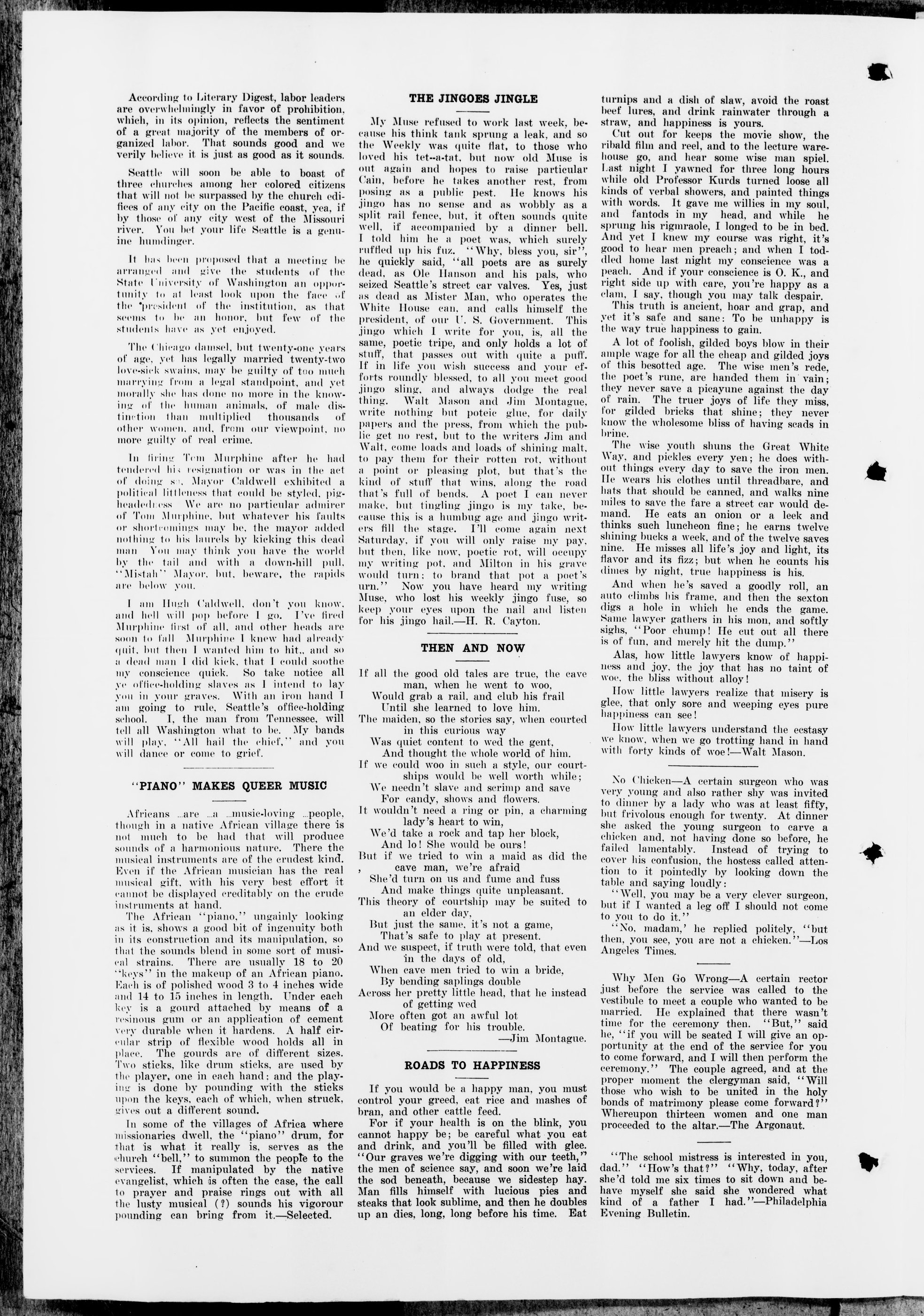
According to Literary Digest, labor leaders
are overwhelmingly in favor of prohibition,
which, in its opinion, reflects the sentiment
of a great majority of the members of or-
ganized labor. That sounds good and we
verily believe it is just as good as it sounds.
Seattle will soon be able to boast of
three churches among her colored citizens
that will not be surpassed by the chureh edi-
fices of any city on the Pacifie coast, yea, if
by those of any city west of the Missouri
river. You bet your life Seattle is a genu-
ine humdinger.
It has heen proposed that a meeting be
arranged and give the students of the
State University of Washington an oppor-
tunity to at least look upon the face of
the ‘president of the institution, as that
seems to be an honor, but few of the
students have as yet enjoyed.
The Chicago damsel, but twenty-one years
of age, yet has legally married twenty-two
love-sick swains, may be guilty of too much
marrying from a legal standpoint, and yet
morally she has done no more in the know-
ing of the human animals, of male dis-
tinetion than multiplied thousands — of
other women, and, from our viewpoint, no
more guilty of real crime.
In firing Tom Murphine after he had
tendered his resignation or was in the act
of doing so, Mayor Caldwell exhibited a
political littleness that could be styled, pig-
headediess We are no particular admirer
of Tom Murphine, but whatever his faults
or shortcomings may be, the mayor added
nothing to his laurels by kieking this dead
man You may think you have the world
by the tail and with a down-hill pull,
“*Mistah’’ Mayor, but, beware, the rapids
are below you.
Team Hugh Caldwell, don’t you know,
and hell will pop before Togo. [ve fired
Murphine first of all, and other heads are
soon to fall Murphine T knew had already
quit, but then T wanted him to hit,, and so
au dead man 1 did kiek, that T could soothe
my conscience quick. So take notice all
ye office-holding slaves as I intend to lay
you in your graves. With an iron hand |
am going to rule, Seattle’s offiee-holding
school. TI, the man from Tennessee, will
tell all Washington what to be. My bands
will play, ‘‘AIL hail the chief,’ and you
will dance or come to grief.
“PIANO”? MAKES QUEER MUSIC
Africans ware oa .music-loving people,
though in a native African village there is
not much to be had that will produce
sounds of a harmonious nature. There the
musical instruments are of the crudest kind.
Even if the African musician has the real
musical gift, with his very best effort it
cannot be displayed creditably on the crude
instruments at hand.
The Afriean ‘‘piano,’’? ungainly looking
as it is, shows a good bit of ingenuity both
in its construction and its manipulation, so
that the sounds blend in some sort of musi-
cal strains. There are usually 18 to 20
‘keys’? in the makeup of an African piano.
Each is of polished wood 3 to 4+ inches wide
and 14 to 15 inches in length. Under each
key is a gourd attached by means of a
resinous gum or an application of cement
very durable when it hardens. A half cir-
cular strip of flexible wood holds all in
place. The gourds are of different sizes.
Two sticks, like drum sticks, are used by
the player, one in each hand; and the play-
ing is done by pounding with the sticks
upon the keys, each of which, when struck,
gives out a different sound.
In some of the villages of Africa where
missionaries dwell, the ‘‘piano’’ drum, for
that is what it really is, serves as the
chureh ‘‘bell,’’ to summon the peopfe to the
services. If manipulated by the native
evangelist, which is often the case, the call
to prayer and praise rings out with all
the lusty musical (?) sounds his vigorour
pounding ean bring from it.—Selected.
THE JINGOES JINGLE
My Muse refused to work last week, be-
cause his think tank sprung a leak, and so
the Weekly was quite flat, to those who
loved his tet-a-tat, but now old Muse is
out again and hopes to raise particular
Cain, before he takes another rest, from
posing as a public pest. He knows his
jingo has no sense and as wobbly as a
split rail fence, but, it often sounds quite
well, if accompanied by a dinner bell.
I told him he a poet was, which surely
ruffled up his fuz. ‘*Why, bless you, sir’,
he quickly said, ‘‘all poets are as surely
dead, as Ole Hanson and his pals, who
seized Seattle’s street car valves. Yes, just
as dead as Mister Man, who operates the
White House can, and calls himself the
president, of our U.S. Government. This
Jingo which L write for you, is, all the
same, poetic tripe, and only holds a lot of
stuff, that passes out with quite a puff.
If in life you wish success and your ef:
forts roundly blessed, to all you meet good
jingo sling, and always dodge the real
thing. Walt Mason and Jim Montague,
write nothing but poteie glue, for daily
papers and the press, from whieh the pub-
lic get no rest, but to the writers Jim and
Walt, come loads and loads of shining malt,
to pay them for their rotten rot, without
a point or pleasing plot, but that’s the
kind of stuff that wins, along the road
that’s full of bends. A poet I ean never
make, but tingling jingo is my take, be-
cause this is a humbug age and jingo writ-
ers fill the stage. I'll come again next
Saturday, if you will only raise my pay,
but then, like now, poetic rot, will oceupy
my writing pot, and Milton in his grave
would tum; to brand that pot a poet’s
urn.’”’ Now you have heard my writing
Muse, who lost his weekly jingo fuse, so
keep your eyes upon the nail and listen
for his jingo hail—H. R. Cayton.
THEN AND NOW
If all the good old tales are true, the cave
man, when he went to woo,
Would grab a rail, and club his frail
Until she learned to love him.
The maiden, so the stories say, when courted
in this curious way
Was quiet content to wed the gent,
And thought the whole world of him.
If we could woo in such a style, our court-
ships would be well worth while;
We needn’t slave and serimp and save
For candy, shows and flowers.
It wouldn’t need a ring or pin, a charming
lady’s heart to win,
We’d take a rock and tap her block,
And lo! She would be ours!
But if we tried to win a maid as did the
hs cave man, we’re afraid
She’d turn on us and fume and fuss
And make things quite unpleasant.
This theory of courtship may be suited to
an elder day,
But just the same, it’s not a game,
That’s safe to play at present.
And we suspect, if truth were told, that even
in the days of old,
‘When cave men tried to win a bride,
By bending saplings double
Across her pretty little head, that he instead
of getting wed
More often got an awful lot
Of beating for his trouble.
—Jim Montague.
ROADS TO HAPPINESS
If you would be a happy man, you must
control your greed, eat rice and mashes of
bran, and other cattle feed.
For if your health is on the blink, you
cannot happy be; be careful what you eat
and drink, and you’ll be filled with glee.
“Our graves we’re digging with our teeth,”
the men of science say, and soon we’re laid
the sod beneath, because we sidestep hay.
Man fills himself with lucious pies and
steaks that look sublime, and then he doubles
up an dies, long, long before his time. Eat
. @
turnips and a dish of slaw, avoid the roast
beef lures, and drink rainwater through a
straw, and happiness is yours.
Cut out for keeps the movie show, the
ribald film and reel, and to the lecture ware-
house go, and hear some wise man spiel.
Last night I yawned for three long hours
while old Professor Kurds turned loose all
kinds of verbal showers, and painted things
with words. It gave me willies in my soul,
and fantods in my head, and while he
sprung his rigmraole, I longed to be in bed.
And yet I knew my course was right, it’s
good to hear men preach; and when I tod-
dled home last night my conscience was a
peach, And if your conscience is O. K., and
right side up with care, you’re happy as a
clam, I say, though you may talk despair.
This truth is ancient, hoar and grap, and
yet it’s safe and sane: To be unhappy is
the way true happiness to gain.
A lot of foolish, gilded boys blow in their
ample wage for all the cheap and gilded joys
of this besotted age. The wise men’s rede,
the poet’s rune, are handed them in’ vain;
they never save a picayune against the day
of rain. The truer joys of life they miss,
for gilded bricks that shine; they never
know the wholesome bliss of having scads in
brine.
The wise youth shuns the Great White
Way, and pickles every yen; he does with-
out things every day to save the iron men.
He wears his clothes until threadbare, and
hats that should be canned, and walks nine
miles to save the fare a street car would de-
mand. He eats an onion or a leek and
thinks such luncheon fine; he earns twelve
shining bucks a week, and of the twelve saves
nine. He misses all life’s joy and light, its
flavor and its fizz; but when he counts his
dimes by night, true happiness is his.
And when he’s saved a goodly roll, an
auto climbs his frame, and then the sexton
digs a hole in which he ends the game.
Same lawyer gathers in his mon, and softly
sighs, ‘‘Poor chump! He cut out all there
is of fun, and merely hit the dump.”’
Alas, how little lawyers know of happi-
ness and joy, the joy that has no taint of
woe, the bliss without alloy!
How little lawyers realize that misery is
glee, that only sore and weeping eyes pure
happiness can see!
How little lawyers understand the ecstasy
we know, when we go trotting hand in hand
with forty kinds of woe!—Walt Mason.
No Chieken—A certain surgeon who was
No Chicken—A certain surgeon who was
very young and also rather shy was invited
to dinner by a lady who was at least fifty,
but frivolous enough for twenty. At dinner
she asked the young surgeon to carve a
chicken and, not having done so before, he
failed lamentably. Instead of trying to
cover his confusion, the hostess called atten-
tion to it pointedly by looking down the
table and saying loudly:
“Well, you may be a very clever surgeon,
but if T wanted a leg off I should not come
to you to do it.’’
“No, madam,’ he replied politely, ‘but
then, you see, you are not a chicken.’’—Los
Angeles Times.
Why Men Go Wrong—A certain rector
just before the service was called to the
vestibule to meet a couple who wanted to be
married. He explained that there wasn’t
time for the ceremony then. ‘‘But,’’ said
he, ‘‘if you will be seated I will give an op-
portunity at the end of the service for you
to come forward, and I will then perform the
ceremony.’’ The couple agreed, and at the
proper moment the clergyman said, ‘‘ Will
those who wish to be united in the holy
bonds of matrimony please come forward ?’’
Whereupon thirteen women and one man
proceeded to the altar—The Argonaut.
“The school mistress is interested in you,
dad.’’ ‘‘How’s that?’’ ‘‘ Why, today, after
she’d told me six times to sit down and be-
have myself she said she wondered what
kind of a father I had.’’—Philadelphia
Evening Bulletin.
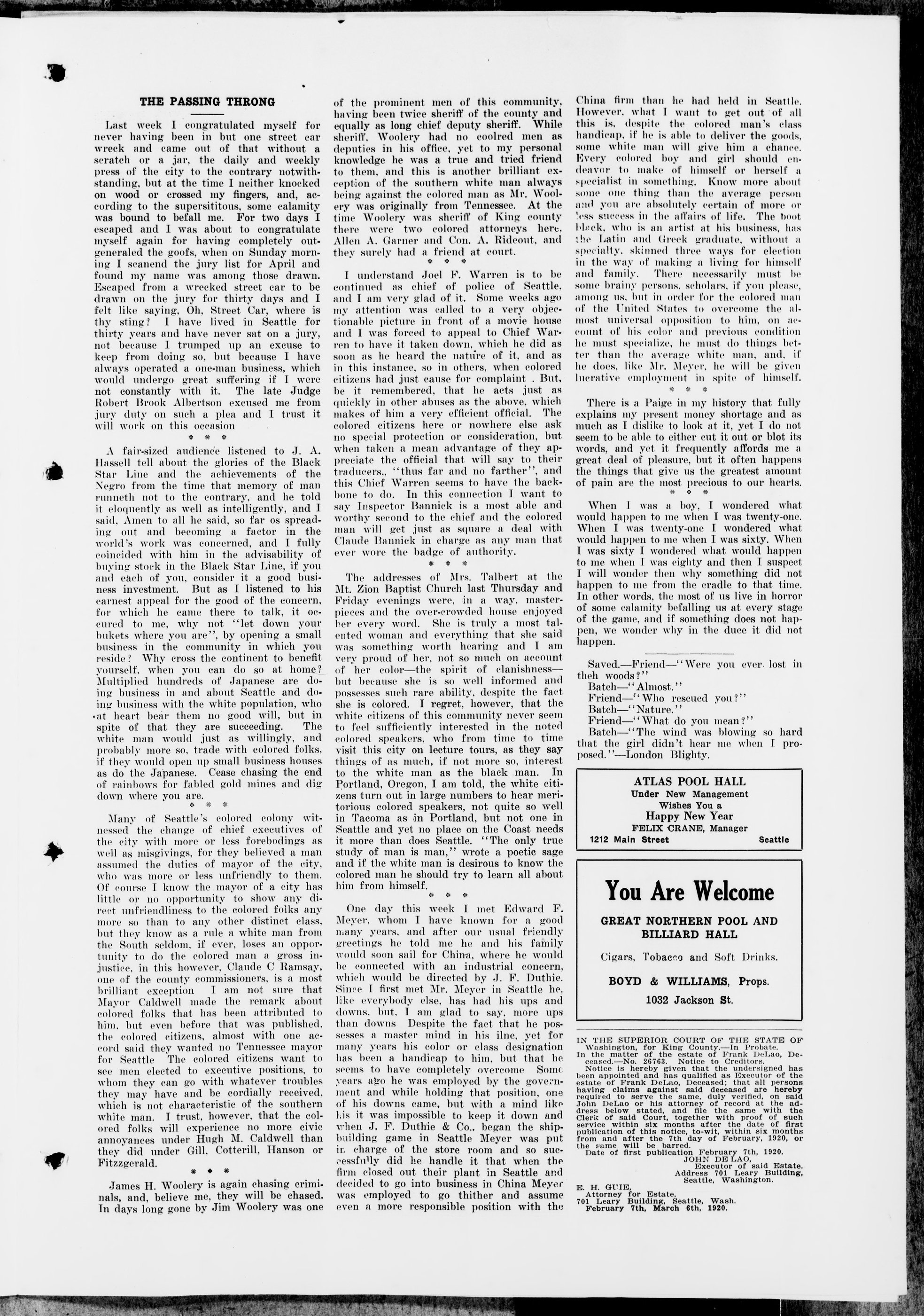
THE PASSING THRONG
Last week I congratulated myself for never having been in but one street car wreck and came out of that without a scratch or a jar, the daily and weekly press of the city to the contrary notwithstanding, but at the time I neither knocked on wood or crossed my fingers, and, according to the supersititous, some calamity was bound to befall me. For two days I escaped and I was about to congratulate myself again for having completely outgeneraled the goofs, when on Sunday morning I scanend the jury list for April and found my name was among those drawn. Escaped from a wrecked street car to be drawn on the jury for thirty days and I felt like saying, Oh, Street Car, where is thy sting? I have lived in Seattle for thirty years and have never sat on a jury, not because I trumped up an excuse to keep from doing so, but because I have always operated a one-man business, which would undergo great suffering if I were not constantly with it. The late Judge Robert Brook Albertson excused me from jury duty on such a plea and I trust it will work on this occasion
* * *
A fair-sized audience listened to J. A. Hassell tell about the glories of the Black Star Line and the achievements of the Negro from the time that memory of man runneth not to the contrary, and he told it eloquently as well as intelligently, and I said, Amen to all he said, so far os spreading out and becoming a factor in the world's work was concerned, and I fully coincided with him in the advisability of buying stock in the Black Star Line, if you and each of you, consider it a good business investment. But as I listened to his earnest appeal for the good of the concern, for which he came there to talk, it occurred to me, why not "let down your bukets where you are", by opening a small business in the community in which you reside? Why cross the continent to benefit yourself, when you can do so at home? Multiplied hundreds of Japanese are doing business in and about Seattle and doing business with the white population, who at heart bear them no good will, but in spite of that they are succeeding. The white man would just as willingly, and probably more so, trade with colored folks, if they would open up small business houses as do the Japanese. Cease chasing the end of rainbows for fabled gold mines and dig down where you are.
* * *
Many of Seattle's colored colony witnessed the change of chief executives of the city with more or less forebodings as well as misgivings, for they believed a man assumed the duties of mayor of the city, who was more or less unfriendly to them. Of course I know the mayor of a city has little or no opportunity to show any direct unfriendliness to the colored folks any more so than to any other distinct class, but they know as a rule a white man from the South seldom, if ever, loses an opportunity to do the colored man a gross injustice, in this however, Claude C Ramsay, one of the county commissioners, is a most brilliant exception I am not sure that Mayor Caldwell made the remark about colored folks that has been attributed to him, but even before that was published, the colored citizens, almost with one accord said they wanted no Tennessee mayor for Seattle The colored citizens want to see men elected to executive positions, to whom they can go with whatever troubles they may have and be cordially received, which is not characteristic of the southern white man. I trust, however, that the colored folks will experience no more civic annoyances under Hugh M. Caldwell than they did under Gill, Cotterill, Hanson or Fitzzgerald.
* * *
James H. Woolery is again chasing criminals, and, believe me, they will be chased. In days long gone by Jim Woolery was one
of the prominent men of this community, having been twice sheriff of the county and equally as long chief deputy sheriff. While sheriff, Woolery had no coolred men as deputies in his office, yet to my personal knowledge he was a true and tried friend to them, and this is another brilliant exception of the southern white man always being against the colored man as Mr. Woolery was originally from Tennessee. At the time Woolery was sheriff of King county there were two colored attorneys here. Allen A. Garner and Con. A. Rideout, and they surely had a friend at court.
* * *
I understand Joel F. Warren is to be continued as chief of police of Seattle, and I am very glad of it. Some weeks ago my attention was called to a very objectionable picture in front of a movie house and I was forced to appeal to Chief Warren to have it taken down, which he did as soon as he heard the nature of it, and as in this instance, so in others, when colored citizens had just cause for complaint. But, be it remembered, that he acts just as quickly in other abuses as the above, which makes of him a very efficient official. The colored citizens here or nowhere else ask no special protection or consideration, but when taken a mean advantage of they appreciate the official that will say to their traducers., "thus far and no farther", and this Chief Warren seems to have the backbone to do. In this connection I want to say Inspector Bannick is a most able and worthy second to the chief and the colored man will get just as square a deal with Claude Bannick in charge as any man that ever wore the badge of authority.
* * *
The addresses of Mrs. Talbert at the Mt. Zion Baptist Church last Thursday and Friday evenings were, in a way, masterpieces and the over-crowded house enjoyed her every word. She is truly a most talented woman and everything that she said was something worth hearing and I am very proud of her, not so much on account of her color—the spirit of clanishness—but because she is so well informed and possesses such rare ability, despite the fact she is colored. I regret, however, that the white citizens of this community never seem to feel sufficiently interested in the noted colored speakers, who from time to time visit this city on lecture tours, as they say things of as much, if not more so, interest to the white man as the black man. In Portland, Oregon, I am told, the white citizens turn out in large numbers to hear meritorious colored speakers, not quite so well in Tacoma as in Portland, but not one in Seattle and yet no place on the Coast needs it more than does Seattle. "The only true study of man is man," wrote a poetic sage and if the white man is desirous to know the colored man he should try to learn all about him from himself.
* * *
One day this week I met Edward F. Meyer, whom I have known for a good many years, and after our usual friendly greetings he told me he and his family would soon sail for China, where he would be connected with an industrial concern, which would be directed by J. F. Duthie. Since I first met Mr. Meyer in Seattle he, like everybody else, has had his ups and downs, but, I am glad to say, more ups than downs. Despite the fact that he possesses a master mind in his ilne, yet for many years his color or class designation has been a handicap to him, but that he seems to have completely overcome. Some years ago he was employed by the government and while holding that position, one of his downs came, but with a mind like his it was impossible to keep it down and when J. F. Duthie & Co., began the shipbuilding game in Seattle Meyer was put in charge of the store room and so successfully did he handle it that when the firm closed out their plant in Seattle and decided to go into business in China Meyer was employed to go thither and assume even a more responsible position with the
China firm than he had held in Seattle. However, what I want to get out of all this is, despite the colored man's class handicap, if he is able to deliver the goods, some white man will give him a chance. Every colored boy and girl should endeavor to make of himself or herself a specialist in something. Know more about some one thing than the average person and you are absolutely certain of more or less success in the affairs of life. The boot black, who is an artist at his business, has the Latin and Greek graduate, without a specialty, skinned three ways for election in the way of making a living for himself and family. There necessarily must be some brainy persons, scholars, if you please, among us, but in order for the colored man of the United States to overcome the almost universal opposition to him, on account of his color and previous condition he must specialize, he must do things better than the average white man, and, if he does, like Mr. Meyer, he will be given lucrative employment in spite of himself.
* * *
There is a Paige in my history that fully explains my present money shortage and as much as I dislike to look at it, yet I do not seem to be able to either cut it out or blot its words, and yet it frequently affords me a great deal of pleasure, but it often happens the things that give us the greatest amount of pain are the most precious to our hearts.
* * *
When I was a boy, I wondered what would happen to me when I was twenty-one. When I was twenty-one I wondered what would happen to me when I was sixty. When I was sixty I wondered what would happen to me when I was eighty and then I suspect I will wonder then why something did not happen to me from the cradle to that time. In other words, the most of us live in horror of some calamity befalling us at every stage of the game, and if something does not happen, we wonder why in the duce it did not happen.
Saved.—Friend—“Were you ever lost in theh woods?”
Batch—"Almost."
Friend—"Who rescued you?"
Batch—"Nature."
Friend—"What do you mean?"
Batch—"The wind was blowing so hard that the girl didn't hear me when I proposed."—London Blighty.
ATLAS POOL HALL
Under New Management
Wishes You a
Happy New Year
FELIX CRANE, Manager
1212 Main Street Seattle
You Are Welcome
GREAT NORTHERN POOL AND
BILLIARD HALL
Cigars, Tobacco and Soft Drinks.
BOYD & WILLIAMS, Props.
1032 Jackson St.
IN THE SUPERIOR COURT OF THE STATE OF Washington, for King County.—In Probate. In the matter of the estate of Frank DeLao, Deceased.—No. 26763. Notice to Creditors. Notice is hereby given that the undersigned has been appointed and has qualified as Executor of the estate of Frank DeLao, Deceased; that all persons having claims against said deceased are hereby required to serve the same, duly verified, on said John DeLao or his attorney of record at the address below stated, and file the same with the Clerk of said Court, together with proof of such service within six months after the date of first publication of this notice, to-wit, within six months from and after the 7th day of February, 1920, or the same will be barred.
Date of first publication February 7th, 1920.
JOHN DE LAO,
Executor of said Estate.
Address 701 Leary Building,
Seattle, Washington.
E. H. GUIE,
Attorney for Estate.
701 Leary Building, Seattle, Wash.
February 7th, March 6th, 1920.