Cayton's Weekly
Saturday, May 1, 1920
Seattle, Washington
Page text (machine-generated)
Cayton's Weekly
---
#
PRICE FIVE CENTS
CAYTON'S WEEKLY
Published every Saturday at Seattle, Washington,
U. S. A.
Subscription $2 per year in advance.
HORACE ROSCOE CAYTON..Editor and Publisher
Entred as second class matter, August 18, 1916, at
the post office at Seattle, Wash., under the Act of
March 3rd, 1916.
TELEPHONE: BEACON 3579
Office 317 22nd Ave. South
OUR NEXT PRESIDENT
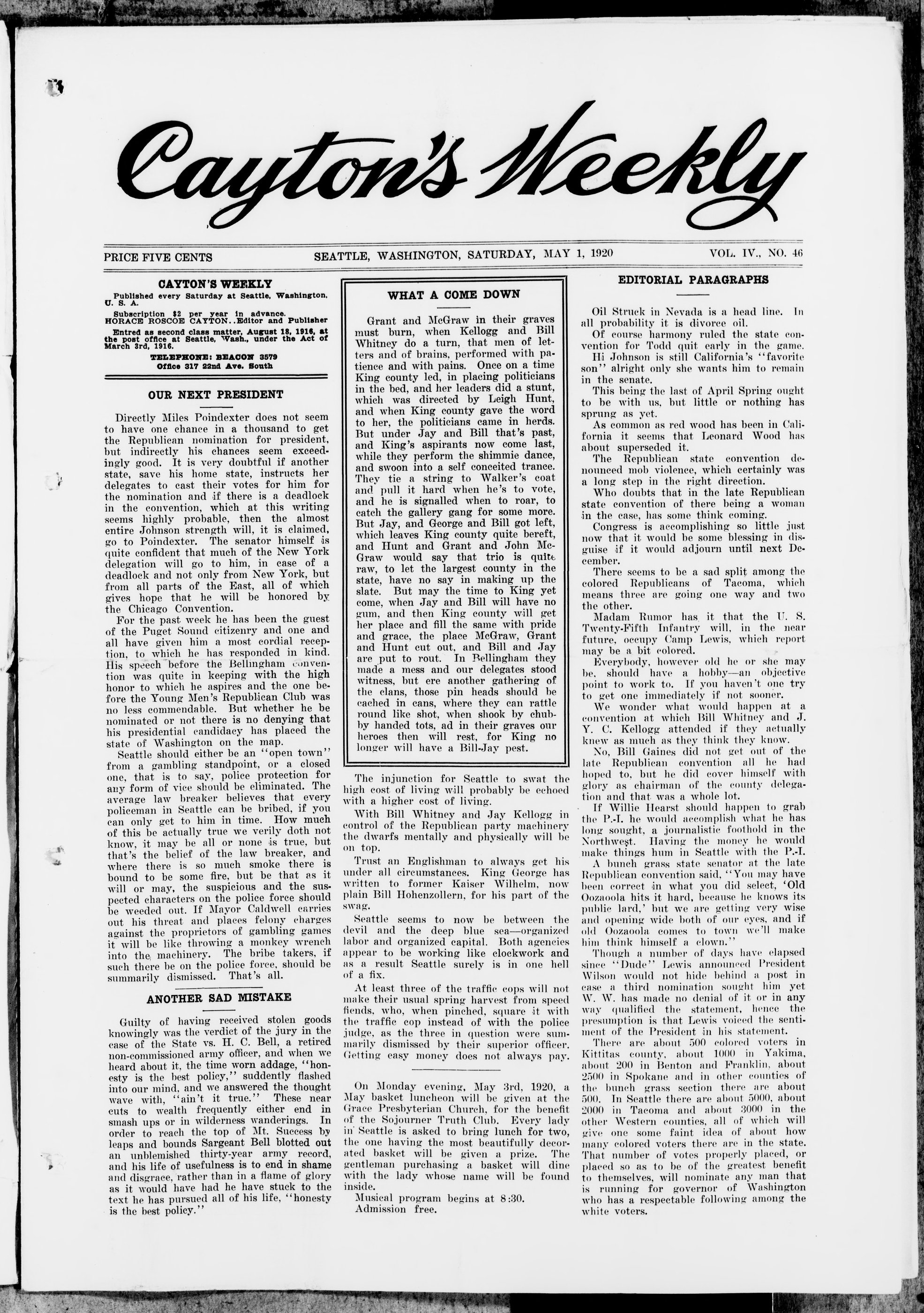
Directly Miles Poindexter does not seem to have one chance in a thousand to get the Republican nomination for president, but indirectly his chances seem exceedingly good. It is very doubtful if another state, save his home state, instructs her delegates to cast their votes for him for the nomination and if there is a deadlock in the convention, which at this writing seems highly probable, then the almost entire Johnson strength will, it is claimed, go to Poindexter. The senator himself is quite confident that much of the New York delegation will go to him, in case of a deadlock and not only from New York, but from all parts of the East, all of which gives hope that he will be honored by the Chicago Convention.
For the past week he has been the guest of the Puget Sound citizenry and one and all have given him a most cordial reception, to which he has responded in kind. His speech before the Bellingham convention was quite in keeping with the high honor to which he aspires and the one before the Young Men's Republican Club was no less commendable. But whether he be nominated or not there is no denying that his presidential candidacy has placed the state of Washington on the map.
Seattle should either be an "open town" from a gambling standpoint, or a closed one, that is to say, police protection for any form of vice should be eliminated. The average law breaker believes that every policeman in Seattle can be bribed, if you can only get to him in time. How much of this be actually true we verily doth not know, it may be all or none is true, but that's the belief of the law breaker, and where there is so much smoke there is bound to be some fire, but be that as it will or may, the suspicious and the suspected characters on the police force should be weeded out. If Mayor Caldwell carries out his threat and places felony charges against the proprietors of gambling games it will be like throwing a monkey wrench into the machinery. The bribe takers, if such there be on the police force, should be summarily dismissed. That's all.
ANOTHER SAD MISTAKE
Guilty of having received stolen goods knowingly was the verdict of the jury in the case of the State vs. H. C. Bell, a retired non-commissioned army officer, and when we heard about it, the time worn addage, "honesty is the best policy," suddenly flashed into our mind, and we answered the thought wave with, "ain't it true." These near cuts to wealth frequently either end in smash ups or in wilderness wanderings. In order to reach the top of Mt. Success by leaps and bounds Sargeant Bell blotted out an unblemished thirty-year army record, and his life of usefulness is to end in shame and disgrace, rather than in a flame of glory as it would have had he have stuck to the text he has pursued all of his life, "honesty is the best policy."
SEATTLE, WASHINGTON, SATURDAY, MAY 1, 1920
WHAT A COME DOWN
Grant and McGraw in their graves must burn, when Kellogg and Bill Whitney do a turn, that men of letters and of brains, performed with patience and with pains. Once on a time King county led, in placing politicians in the bed, and her leaders did a stunt, which was directed by Leigh Hunt, and when King county gave the word to her, the politicians came in herds. But under Jay and Bill that's past, and King's aspirants now come last, while they perform the shimmie dance, and swoon into a self conceited trance. They tie a string to Walker's coat and pull it hard when he's to vote, and he is signalled when to roar, to catch the gallery gang for some more. But Jay, and George and Bill got left, which leaves King county quite bereft, and Hunt and Grant and John McGraw would say that trio is quite raw, to let the largest county in the state, have no say in making up the slate. But may the time to King yet come, when Jay and Bill will have no gum, and then King county will get her place and fill the same with pride and grace, the place McGraw, Grant and Hunt cut out, and Bill and Jay are put to rout. In Bellingham they made a mess and our delegates stood witness, but ere another gathering of the clans, those pin heads should be cached in cans, where they can rattle round like shot, when shook by chubby handed tots, ad in their graves our heroes then will rest, for King no longer will have a Bill-Jay pest.
The injunction for Seattle to swat the high cost of living will probably be echoed with a higher cost of living. With Bill Whitney and Jay Kellogg in control of the Republican party machinery the dwarfs mentally and physically will be on top. Trust an Englishman to always get his under all circumstances. King George has written to former Kaiser Wilhelm, now plain Bill Hohenzollern, for his part of the swag. Seattle seems to now be between the devil and the deep blue sea—organized labor and organized capital. Both agencies appear to be working like clockwork and as a result Seattle surely is in one hell of a fix.
At least three of the traffic cops will not make their usual spring harvest from speed fiends, who, when pinched, square it with the traffic cop instead of with the police judge, as the three in question were summarily dismissed by their superior officer. Getting easy money does not always pay.
On Monday evening, May 3rd, 1920, a May basket luncheon will be given at the Grace Presbyterian Church, for the benefit of the Sojourner Truth Club. Every lady in Seattle is asked to bring lunch for two, the one having the most beautifully decorated basket will be given a prize. The gentleman purchasing a basket will dine with the lady whose name will be found inside. Musical program begins at 8:30. Admission free.
VOL. IV., NO. 46
EDITORIAL PARAGRAPHS
Oil Struck in Nevada is a head line. In all probability it is divorce oil.
Of course harmony ruled the state convention for Todd quit early in the game.
Hi Johnson is still California's "favorite son" alright only she wants him to remain in the senate.
This being the last of April Spring ought to be with us, but little or nothing has sprung as yet.
As common as red wood has been in California it seems that Leonard Wood has about superseded it.
The Republican state convention denounced mob violence, which certainly was a long step in the right direction.
Who doubts that in the late Republican state convention of there being a woman in the case, has some think coming.
Congress is accomplishing so little just now that it would be some blessing in disguise if it would adjourn until next December.
There seems to be a sad split among the colored Republicans of Tacoma, which means three are going one way and two the other.
Madam Rumor has it that the U. S. Twenty-Fifth Infantry will, in the near future, occupy Camp Lewis, which report may be a bit colored.
Everybody, however old he or she may be, should have a hobby—an objective point to work to. If you haven't one try to get one immediately if not sooner.
We wonder what would happen at a convention at which Bill Whitney and J. Y. C. Kellogg attended if they actually knew as much as they think they know.
No, Bill Gaines did not get out of the late Republican convention all he had hoped to, but he did cover himself with glory as chairman of the county delegation and that was a whole lot.
If Willie Hearst should happen to grab the P.-I. he would accomplish what he has long sought, a journalistic foothold in the Northwest. Having the money he would make things hum in Seattle with the P.-I. A bunch grass state senator at the late Republican convention said, "You may have been correct in what you did select, 'Old Oozaoola hits it hard, because he knows its public lard,' but we are getting very wise and opening wide both of our eyes, and if old Oozaoola comes to town we'll make him think himself a clown." Though a number of days have elapsed since "Dude" Lewis announced President Wilson would not hide behind a post in case a third nomination sought him yet W. W. has made no denial of it or in any way qualified the statement, hence the presumption is that Lewis voiced the sentiment of the President in his statement.
There are about 500 colored voters in Kittitas county, about 1000 in Yakima, about 200 in Benton and Franklin, about 2500 in Spokane and in other counties of the bunch grass section there are about 500. In Seattle there are about 5000, about 2000 in Tacoma and about 3000 in the other Western counties, all of which will give one some faint idea of about how many colored voters there are in the state. That number of votes properly placed, or placed so as to be of the greatest benefit to themselves, will nominate any man that is running for governor of Washington who has a respectable following among the white voters.
```markdown
```
CONVENTION CATCHES
The Wood machine sent a steam roller over the convention and that, in spite of the mild protest of Senator Poindexter. After all the Chicago delegation is but partially instructed for Poindexter, and at no time can he put them even if by doing so it would redound to his political advantage. It certainly looked a bit like old times when we ran onto Herb Baker and George Stephenson quietly chatting and sizing up the crowd. Once on a time at a meeting like that Baker and Stephenson could have taken snuff and two-thirds of those present would have sneezed.
Among those who attracted more or less attention at the convention was W. A. Gilmore, who did a great deal of work in the East in the last presidential campaign. Mr. Gilmore lived in Nome for a number of years, where he was for a time mayor. If there was a delegate at the convention that worked harder than the Hon. C. E. Myers, of Davenport, then we failed to locate him or her. The editor hereof enjoyed a long heart to heart talk with both Charley and his brother Hapy (Judge Myers of Seattle), and we enjoyed the re-union.
One of the most popular political spectators at the Republican state convention was Claude C. Ramsay, one of the county commissioners of King. Few there were at that convention who did not know Mr. Ramsay personally and extended him a most cordial greeting. It was whispered in the hotel lobby that Claude might go to Washington City in the interest of Seattle.
Some one was circulating campaign literature for a Miss Jones for superintendent of public instruction, and the thought occurred to me that all this lady needs do is to write to the members of her family name and if they agreed, she will win in a walk out.
Owing to having a more or less captivating private secretary dispensing his political propaganda, Col. Hartley reaped a political harvest at the state convention. He, too, was present and did not overlook a bet. Dr. David T. Cardwell prepared a useful preamble and resolution for the platform committee, which went through verbatim. He gives evidence of developing into a shrewd, and sagacious leader, but we trust he will not overlook the fact that two heads are better than one, and especially in a barrel.
The Cardwell resolution in the Republican platform, is as follows: "We re-affirm the Republican policy of political, industrial and economic equality of all citizens of the nation, regardless of race, creed or color, and equality before the courts of justice for all, and we condemn mob violence." The spirit of the above resolution is to go to Chicago and there again be ratified.
It was amusing to witness King county with a quarter of the entire state delegation rattle around among the politicians in the convention like a belzebub in an ant bed, stung on all sides, but could see no place to hit back. For this have we Whitney, Kellogg, Walker (George H.) and the young men's Republican club.
It looked to us as if Col. Lamping did not make many converts for his gubernatorial campaign at the convention, and it was hinted that he was in the right church but the wrong pew. In other words, the most of those in attendance were violently opposed to "radicalism."
Just what Jack Sullivan has up his sleeve deponent verily doeth not know, but it is a safe bet that he has something, and his convention spiel fully justifies this prediction. In that, however, Jack is doing no more than most any one who has a pull, and he certainly has.
A vote of thanks to Bellingham I move and trust the next convention she'll not lose; and here's to Dave and his aeroplane that brought to us that bunch of "rain." Next time we'll take two thousand delegates if Dave will once more upon up his gates.
I went to Bellingham for tone, but found it not quite in the zone, and though I skirmished all the day, without a drop I hit the hay, and as I tossed and rolled in bed, and thought of having missed my red, I heard a whisper through the door, how'd you like a bottle of gore.' A familiar sound the judge did hear, and I whispered back, "bring on yer beer," not so, the whispered echo came, "but dress yourself and lose your name." All this I did without a think, except the one that meant a drink. Behind yon hill and in a cave, old red eye can be had from Dave. Now Dave's an Indian long and tall, and wants his money first of all. The Indian came by aero-plane, and dropped in town with plenty of game. I soon before the Indian stood and soon thereafter felt quite good, as a bottle of his booze I had, which made me feel so very glad, that I shouted like a ten year old lad.
THE PASSING THRONG
When I heard that Dr. D. T Cardwell had prepared a plank for the Republican platform and had submitted the same to the platform committee for its consideration, which condemned mob violence and reaffirmed the Grand Old Party to the rights of humanity without regard to race, color or creed, I said it was a long step in the right direction and I had no doubt but that the same would be recommended by the committee and unanimously passed by the convention, all of which was done. After the plank had become a documentary part of the platform, I wondered why it was that the Democratic party of Washington would not just as willingly pass a similar resolution. The white folks who run the Democratic party are brothers and sisters to those who run the Republican party and, it seems to me, just as humane as their Reupublican brethern, and if the Republicans condemned brutality, the Democrats, being of the same kith and kin, should be full and overflowing of a like spirit of justice and fair play. But the Democrats of Washington nor the Democrats of any other state of the North will not do so, and all because they do not want to offend the red handed murderers of the South, who are the national back bone of the Democratic party. The Democrats of the North "wouldn't rather be right than president," but they want to be president (partisanly) even though men, women and children have to be slain by the hundreds and thousands to guarantee their desire. Like Huerta, Caranza and other Mexican usurpers, they have no scruples in killing their way to the White House. It seems almost impossible for persons of the same family to differ so widely in their treatment of others whom they as a whole have the advantage of. But the Cardwell resolution will save to the Republican party of this state many colored votes that otherwise might have wandered after strange Gods.
STRANGE BUT TRUE
The potash monopoly of the world will be held by France instead of Germany in the future because of the cession of Alsace-Lorraine to France. The potash deposits extend sixteen kilometres (9.94 miles) to the north of Mulhouse, over a surface of more than 180 square kilometres (69.2 square miles). They are unusually rich in potash salts, much richer in fact than the beds in the interior of Germany.
The bamboo sometimes grows two feet in twenty-four hours. There are thirty varieties of this tree; the smallest is only six inches in height and the largest 150 feet.
Statistics have proved that during the war nearly 15,000,000 women were drawing pay for their services. More than 1,000,000 of them had never done a day's work in their lives. In the operating department of one of the Eastern railroads 2360 women and girls took positions formerly held by men. That the women have made good has
been definitely established. In one of the munitions plants where 2000 girls were at work the greatest output made by two sets of engineers was 15,000 complete sets of fuses daily in two shifts. The girls turned out 38,000 complete sets in the same period of time. In another instance where the work dealt directly with a drill press the greatest production where men were working in teams was 3200 pieces each in nine hours' time, while that of the girls doing the same work was 4400 pieces each.
Brazilian cocoanut palms live from 600 to 700 years, and the date palm from 200 to 300 years. On the Mount of Olives, Jerusalem, there are olive trees known to have been flourishing in 1099.
Jane Addams, pioneer in social settlements in America, was born at Cedarville, Illinois, in 1860. Her father was John H. Addams, for eighteen years a state senator from his district, a friend of Abraham Lincoln, one of the early abolitionists of the state, and a man of large business interests. Miss Addams was graduated from Rockford College in 1881. She then studied medicine at a woman's medical college in Philadelphia. In the spring of 1884 she went to Europe, pursuing her duties as she was able. Her earliest ambition had been toward softening the lot of the poor, and in London, especially the experiment of Toynbee Hall, then in its early stage, interested her greatly. When she returned home the settlement idea was in her mind. In 1888, after another trip to Europe studying industrial conditions with Miss Helen G. Starr, she took up her residence in Chicago. With Miss Starr she obtained the old residence of Charles J. Hull for a social settlement venture. Beginning with a kindergarten, in which an instructor gave two years' work free, the Hull House grew until it now embraces a wide field of endeavor, reaching out into all the industrial neighborhoods lying about it and centering in the institution the interest of thousands of persons who go to it weekly in the class and lecture season.
At the Workingmen's Institute there rose a fierce discussion as to whether women should be given a chance of filling the high appointments. "Twouldn't do!" said a youthful and newly married firebrand. "Just think of a woman as Secretary of the Treasury. What do they know about finance, anyway?" His effective pause was spoiled by an older man, who said solemnly: "You just go home to the missus next Friday night $5 short in your pay and you'll find out."
FURNISHED ROOMS 317 22nd Ave. So. Rooms large and commodious, on car line, but walking distance. MRS. S. R. CAYTON 317 22nd Ave. So.
1000 1000
Thousands of Barrels
of
Refreshing, Exhilerating, Intoxicating Music
Poured Out Nightly at the
Entertainer's Cabaret
1238 Main Street
By the Best
SYNCOPATED ORCHESTRA
on the Coast
DON'T MISS IT
ENTERTAINER'S CABARET
SIR OLIVER LODGE ON LIFE AFTER DEATH
When a scientist of the standing of Sir Oliver Lodge stakes his reputation on the claim to have experimental proof that the dead still live; when crowds of men and women flock to his lectures, and mediums of all sorts do a thriving trade with the curious and heart-hungry, it is time for reasonable men to take thought about their attitude toward "psychic" phenomena.
The first thing they need to do is to be on their guard against their own emotional bias. Many people are instinctively repelled by the thought of seeking to enter into communication with the dead. It seems to them a profane intrusion upon the peace of the grave. They cannot imagine that they themselves should want to communicate after death, even were it possible. The necromancy of the professional medium disgusts them. They shrink from the morbidity of automatic utterances in trances.
It is well to realize at once that Sir Oliver Lodge stands at the opposite of these feelings. To him there is nothing antecedently improbable about the survival. Its reality has been an age-old human belief. It is wholly and simply a question of evidence. Why not, then, thy to find out?
There is nothing of bad taste about such attempts. All that is necessary is an open-minded willingness to explore what looks like a hitherto neglected human faculty. There are phenomena which claim to be evidential. Why not test and verify that claim by careful experimental investigation? Why not, if the results are positive, seek to enlarge the scope of this faculty and to develop its technique? It is no question of disturbing the peace of the dead. Why not assume, as a working hypothesis, that they are as eager to communicate with us as we are with them? It is a practical problem to be solved, and we have to set about it in a business-like, scientific way. We shall only hamper ourselves if we think of the spirit-world as either a heaven or a hell, and of the spirits of the departed as like the sugary angels of conventional piety. No, the whole atmosphere of the relationship is purely and intensely human, sometimes all-too human. At its best, it has much of the intimacy of affection—recollect the Voice in J. M. Barrie's little war-play; at its worst, it is like a casual conversation over a telephone, broken by buzzings and disconnections. There is nothing specifically religious, mystical, or exalted about it.
But in so far as the investigation is successful, science is once again proving herself a benefactress to humanity, turning blind faith into reasoned assurance, robbing grief of its sting.
But if there is no valid moral or religious objection to such researches, is there perhaps a scientific one? The vast majority of Sir Oliver's scientific brethern think there is. To them it is unscientific to investigate these phenomena and doubly unscientific to entertain the survival-hypothesis as worthy of being tested at all. Such critics have a simple and sweeping formula. All mediums are frauds. All their customers are dupes. Sir Oliver himself is a self-deluded prophet, a blind leader of the blind. But is the case quite so simple? Granted that many professional mediums have been detected in fraudulent practices, is it quite safe to generalize? You might as well argue that because many antiques are fakes, therefore none are genuine. The problem, surely, is to sort out the genuine phenomena from the counterfeit.
Nor is it only a question of guarding oneself against conjuring tricks. Recent study of the "subconscious," especially in cases of so-called "dissociation of personality," have abundantly shown that the subconscious may manifest itself in behavior of which the moral consciousness is utterly unaware. The psychical researcher should certainly be an expert in psycharity, even more than an expert in physics. Meanwhile, the "scientist" who dogmatizes on these matters without an exhaustive first-hand acquaintance with the phenomena, under laboratory conditions controlled by himself, sins
as much against the spirit of free inquiry, as ever did theologian. Let us frankly acknowledge that there is such a thing as scientific orthodoxy—a fashion of suspiciousness against any phenomena suggestive to the supernatural, which is a relic of the ages of struggle through which science has won its emancipation from superstition disguised as religion.
And so for the real issue: Has Sir Oliver made out a case for survival or has he not? What is his evidence? Omitting, for brevity's sake, the phenomena of materializations and apparitions, let us confine ourselves to "communications" in the strictest sense, i.e., to automatic writing and automatic speech, be the latter trance-utterance of a medium or inner voice heard by oneself. Here, then, are our "facts." These facts are words, spoken or written—nay, spoken or written by somebody. This is the one thing we are sure of: of the body which does the speaking or writing.
Now, words have meanings and they expres thoughts. Thus our facts raise two sorts of questions. First, is what the words mean true? And, secondly, who is it that expresses his thoughts through the writing and speaking of this body? Note that the body may be my own, though I may not recognize the thoughts expressed as mine, or the facts alleged as known to me. Thus automatic script sometimes contains statements concerning matters which, to all appearances, are beyond the writer's and the sitter's knowledge, but which are subsequently found to be true. Add that the script names a "spirit" and claims that the information comes from him; that he is the real writer, using the living body as his instrument. Telepathy between the living beings, on the facts, excluded, does not the truth of the information given corroborate the truth of the spirit's assertions concerning himself?
This is the type of evidence and argument on which Sir Oliver chiefy relies. Testimony concerning a matter of fact, unknown to the living concerned in the experiment, is given through automatic script or utterance, and subsequently verified. Its truth then supplies the basis for crediting the spirit-communicator's further statements concerning his own identity. If the information given cannot come from the automatist's mind; if it cannot come, by telepathy, from the sitter, or from any other "incarnate" mind, then it must come from the self-confessed "discarnate" spirit.
It is, thus, an argument by elimination, the strength of which depends on the conclusiveness with which the negatives can be established. Criticism of it, to be effective, must show by counter-experiment that the information on which everything hinges, is known to one of the incarnate minds, though too completely forgotten for anything but automatic revision of it. This is obviously a difficult matter, and in practice often impossible. But the more often we succeed, the less is the probability that our failure to do so in any given case, should count as evidence in favor of spirit-hypothesis.
Hence it is evident that what is urgently required, and what Sir Oliver himself has not sufficiently done, is to make a far more thorough study of the resources of the "subconscious," which' in this connection, is simply a technical term for the fact that our bodies register, and are capable of expressing in automatic gesture and utterance, countless experiences of which our official "consciousness' knows nothing. Every one of us perceives vastly more than he notices, and knows much more than he can voluntarily remember. There are "unrecognized faculties" here, the exploration of which may prove the spirit-hypothesis to be necessary.
There is, however, a group of psychic phenomena, of which Sir Oliver makes comparatively little, but which is harder than any other to account for except on a spirit-hypothesis. This group consists of the so-called "cross-correspondence" phenomena, i.e., cross-references between scripts of two or more automatists, writing in distant places without knowledge of each other. These phe-
nomena certainly strain the hypothesis of telepathy of sub-conscious knowledge to the breaking point.
On the other hand, this core of spirit-activity, if such it is, offers least evidence of the personality of the spirit, and least satisfaction for the craving of personal intercourse with a departed friend.
All in all, Sir Oliver is right in claiming for psychical research a fair field and no favor (or, rather, no disfavor). But it is difficult for most students of the evidence to share his conviction that the spirit-hypothesis has been established. And it seems very clear that no form in which it is at present likely to be established. And it seems very clear thatno form in which it is at present likely to be established, promises much gain either for religion or for the consolation of sorrowing love. R. F. A. H.—New Republic.
HE WANTS TO KNOW
Addressing an open letter to the New Republic on the presidential situation, L. E. Graves of Raleigh, North Carolina, uses the following words:
Sir: I have read with interest the articles in the New Republic on Hoover and the Issues. Encompassing as these issues may seem, I wish to ask if, in all fairness, the problems presented by twelve millions of Negroes do not present an "issue" on which the next President of the United States should at least have an expressed point of view.
The facts of this year of unrest and its attendant ills have not been lost upon the Negro. He wants a "realism" that is militant towards the enforcement of the Fourteenth and Fifteenth Amendments of the Constitution, a federal law against lynching, a governmental recognition in a specific way of his desire to serve this country in peace as well as in war, and to have a real share of responsibility of the government of the country that it is his and to which he contributes taxes, works and life. Is his a case of so little importance to the well being of the government that it is to be thrown out of court?
The Negro forms more than one-tenth of the population of this country, and no "realism," however blatant, can be of sincere service to the United States of America that does not consider as one of the great issues in American life the just settlement of his account.
During the early part of the war a Negro soldier was walking post in one of the big mid-western camps. A group of officers, among whom was the camp commandant, passed within a few feet of the dusky guard, who continued calmly oblivious. The irate general wheled on the derelict African and snapped: "Don't you ever salute officers?" "Yas, suh! yas, suh," chattered the badly frightened Negro. "Then why didn't you salute me?" "Kase, I'se got a gun, suh." "Don't you know how to salute with your gun?" "Oh, yas, suh; yas, suh, but this here aint my gun."
IN THE SUPERIOR COURT OF THE STATE OF Washington for the County of King.
Edward Sweeney and Katherine Sweeney, his wife, plaintiffs, vs. May S. Jones, John Doe Jones, her husband, F. P. Kelly and Jane Doe Kelly, his wife, Defendants.—No. 142,329. Summons by Publication.
The State of Washington, to the said F. P. Kelly and Jane Doe Kelly, his wife, Defendants:
You are hereby summoned to appear within sixty days after the date of the first publication of this summons, to-wit: within sixty days after the 1st day of May, A. D. 1920, and defend the above entitled action in the above entitled Court, and answer the complaint of the plaintiffs, and serve a copy of your answer upon the undersigned attorney for plaintiff at his office below stated; and in case of your failure so to do, judgment will be rendered against you according to the demand of the complaint, which has been filed with the Clerk of said Court. The object of the said action and the relief sought to be obtained therein is fully set forth in said complaint, and is briefly stated as follows: Cancellation of real estate contract for conditions broken and effecting East 187 feet of the North 285 feet of tract 22 of Lake Dell Addition to the City of Seattle, King County, Washington.
Z. B. RAWSON,
Attorney for Plaintiffs.
P. O. Address: 617 Pacific Block, Seattle, County of King, Washington.
May 1-June 19, 1920.
```markdown
```
PURELY PERSONAL
Mr. C. W. Jamison has accepted a position on the Great Northern Pullman service.
Rev. W. D. Carter was well pleased with the work of the Republican state convention and highly enjoyed its proceedings.
Mr. E. H. Holmes, who was a spectator at the Republican state convention, proceeded from there to Vancouve, B. C.
Dr. David T. Cardwell, while in attendance at the state convention at Bellingham, was a guest at the home of Mr. and Mrs. Reames.
Mr. W. L. Yancy, who attended the convention at Bellingham, hailed from Yakima county. He seemed none to friendly to Senator Poindexter, but was cooled down.
Rev. D. A. Graham and wife left for St. Louis last Monday evening. He will be in attendance at one of the largest and most notable assemblages among colored folks.
Mr. and Mrs. George W. Thompson of Bellingham, formerly of Seattle, entertained the Rev. W. D. Carter and the editor hereof, while they were attending the Republican state convention.
Mr. C. H. Baker and Mr. W. H. Banks were eminently successful in their first annual ball for the Alhambra baseball bunch. They had a good house and those who attended had a good time.
Mr. James E. Shepperson of Roslyn was a delegate to the Bellingham convention and from there he went to Winlock, where he will let the contract for clearing the ground for the Masonic home.
Mr. O. C. Winston, president of the National Association for the Advancement of Colored People (Seattle branch), was a delegate to the Republican state convention and enjoyed the outing very much.
Mr. W. Arthur Dixon was a delegate at large from Pierce county to the Republican state convention at Bellingham, and took an active part in its proceedings. Mr. Dixon is in business in Tacoma and is considered one of her prosperous colored citizens.
The many friends of Rev. Meyers and his Fisk Jubilee Singers may hereby know that these distinguished people will be in Seattle from Friday of this week until Monday of next. Rev. Meyers will preach at the Mt. Zion Baptist church Snuday morning, and the quartet will sing at the evening service.
Mr. Barbour, the Kansas barrister who will tour the West, will be in Seattle May 24th and the committee having charge of his stay in this city, has arranged for him to speak in the First Methodist church on the evening of the 24th. The lecture will be free and the public is cordially invited to be present. The lecture will be given under the auspices of the Seattle Branch of the N. A. A. C. P.
Mr. Earnest Moore, after a lingering illness which covered many months, died at the residence of his mother last Monday and was buried in Tacoma last Thursday. He was laid to rest by the side of the remains of his father. Sergt. Moore contracted the illness, which eventually proved fatal, while at an army cantonment preparing for overseas duty. He battled long and well to throw it off, but failed. He leaves a mother and brother to mourn his loss.
HAS GONE EAST
Illustrious J. O. Lewis $ 33^{\circ} $ S. G. I. G., left Thursday, April 27, to attend the annual session of the Supreme Council of the $ 33^{\circ} $ of the Northern Masonic Jurisdiction of the United States of America, which
MRS. L. T. GREEN
1101 Washington St., Seattle, Wash. Phone Main 4573. Hair Culture and Scalp Specialist. Will call at your home if desired. Graduate of Oxford College. St. Louis.
meets in Grand See at Philadelphia, Penn., May 10, 1920. Ill. J. O. Lewis is also Ill. Grand Potentate of Beni Hassen Temple No. 64 A. E. A. O. N. of Mystic Shrine, which is giving their first Grand Ball at Christensen's Hall on the night of May 5, 1920, for which very elaborate preparations have been made.
It is very much to be regretted that Ill. Lewis should be called away at this particular time and not be able to attend this social function which he has fostered, but however, Ill. Chief Rabban Geo. Hays, $ 3 2^{\circ} $ , assisted by able committees and Prof. R. C. Pondexter, will endeavor to make this ball the grandest affair ever given in the Pacific Northwest.
STOLEN FROM THIEVES
Mr. Saphedde—Do you think men have descended from monkeys? Miss Caustique—Not very far.—Manchester Guardian. Jud Tunkins says that this year's farm hands expect to make enough to come back next year as summer boarders.—Washington Star. "I understood the two men had quite an epistolary argument." "No pistols about it. They took it out in letter-writing."—Baltimore American. Ex-Private—So you want either Wood or Pershing for President? Ex-Corporal—I sure do. Us officers have gotta stick together.—Home Sector.
Teacher—In what battle did General Wolfe, when hearing of victory, cry, "I die happy"? Johnny—I think it was his last battle.—Boston Transcript.
"My fortune's made!" exclaimed the dancing teacher. "Have you thought of a new dance?" "No. But I've thought of a highly improper name for one."—Washington Star.
Prisoner—It is difficult to see how I can be a forger. Why, I can't sign my own name. Judge—You are not charged with signing your own name.—London Opinion.
"How was it you told people that you could marry Miss Smithers if you wanted to?" "She told me herself I cauld have the refusal of her hand."—Baltimore American. "What kind of a woman is Mrs. Gadspur?" "Essentially artistic." "How's that?" "The family fly-swatter is adorned with a bow of pink ribbon."—Birmingham Age-Herald. Parke—I'm more and more convinced that as a ation what we lack is religious discipline. Lane—But to whom would you apply it? Parke—Oh, to the young people and clergymen—Life.
Mrs. Newrich—Don't you think, William, now that we are getting into society, that we should have a coat of arms? Newrich
You Are Welcome
GREAT NORTHERN POOL AND BILLIARD HALL
Cigars, Tobacco and Soft Drinks.
BOYD & WILLIAMS, Props.
1032 Jackson St.
Cayton's Weekly
READABLE
RELIABLE
REPUBLICAN
Will Help You If You Will Help It
—Certainly, my dear; I'll see my tailor about it tomorrow.—Boston Transcript.
Mr. Murfee—Sure, an' what's the matter with the goat this mornin'? Mrs. Murfee—Sure, he eat up a pair of my old corsets. Mr. Murfee—Didn't I tell you that corsets were unhealthy?—Yonkers Statesman.
"The prima donna says she is not herself tonight." "Umph!" exclaimed the long-suffering manager. "Do you mean to tell me she is actually decent to the other members of the company?"—Birmingham Age-Herald.
He—Did you read my poem last night? She—I began it. He—Interrupted, I suppose. She—No.—Syracuse Orange Peel.
The schoolroom was rather chilly, and the Boston school teacher sent this written complaint to the principal: "There is hardly caloric enough in this room to altitudinize the mercury above the freezing quotation." —Cincinnati Enquirer.
"Then you don't want her advertised as a diva?" "Make it a coloratura soprano, and let it go at that. The last time I advertised a diva I had to refund considerable money to people who were expecting an acquiatic exhibition."—Louisville Courier-Journal
Willis, Sr.—I'm a self-made man. Made my money by hard work. Do you know what that means? Willis, Jr.—Sure. It means you were not clever enough to graft it, lucky enough to have it left to you, or handsome enough to marry it.—Town Topics.
"Is there an amendment to the Constitution of the United States forbidding a man to kiss his wife or anybody else's wife?" asked the man who had just returned from a two years' cruise in the South Seas. "Not yet," replied the cynical citizen.—Birmingham Age-Herald.
Not so very long ago there lived in Carthage, Missouri, a man who was known as the premier lobbyist of his state. No one surpassed him in legislative experience or in getting things done or undone. On one occasion a friend asked him for advice. "I have got to go over to the state legislature and see if I can't defeat a particularly obnoxious bill," the friend explained, "and I have come to you to ask you what is the first thing to do." Out of his bountiful experience the lobbyist replied: "The first thing for you to do is to go and see your banker."
ALHAMBRA CASH GROCERY
Distributor of Mme. C. J. Walker's Hair and Skin preparations. Mail, postal and express orders promptly filled. 1201-3 Jackson St., Seattle, Wash.
SANDERS & COMPANY
LOANS NEGOTIATED
1003-1004 L. C. Smith Building
Office Hours
From 8:30 A. M. to 5:30 P. M.
Seattle, Wash.
Elliott 4662
Phone East 179 Calls Made Promptly Day or Night LEWIS & BLACKWELL FUNERAL DIRECTORS and EMBALMERS H. Alfred Lewis, Funeral Director 1215 East Marion St., Seattle
ATLAS POOL HALL Under New Management Wishes You a Happy New Year FELIX CRANE, Manager 1212 Main Street
DOUGLAS ANNEX
2107 E. James St.
Two rooms with bath, $30. Two sleeping rooms, reasonable. All well furnished.
DOUGLAS ANNEX
2107 E. James St.