Cayton's Weekly
Saturday, June 5, 1920
Seattle, Washington
Page text (machine-generated)
Cayton's Weekly
!PRICE FIVE CENTS
CAYTON'S WEEKLY
Published every Saturday at Seattle, Washington.
U. S. A.
Subscription $2 per year in advance.
HORACE ROSCOE CAYTON..Editor and Publisher
Entred as second class matter, August 18, 1916, at
the post office at Seattle, Vash., under the Act of
March 3rd, 1916.
TELEPHONE: BEACON 3579
Office 317 22nd Ave. South
WHEN WILL IT BE
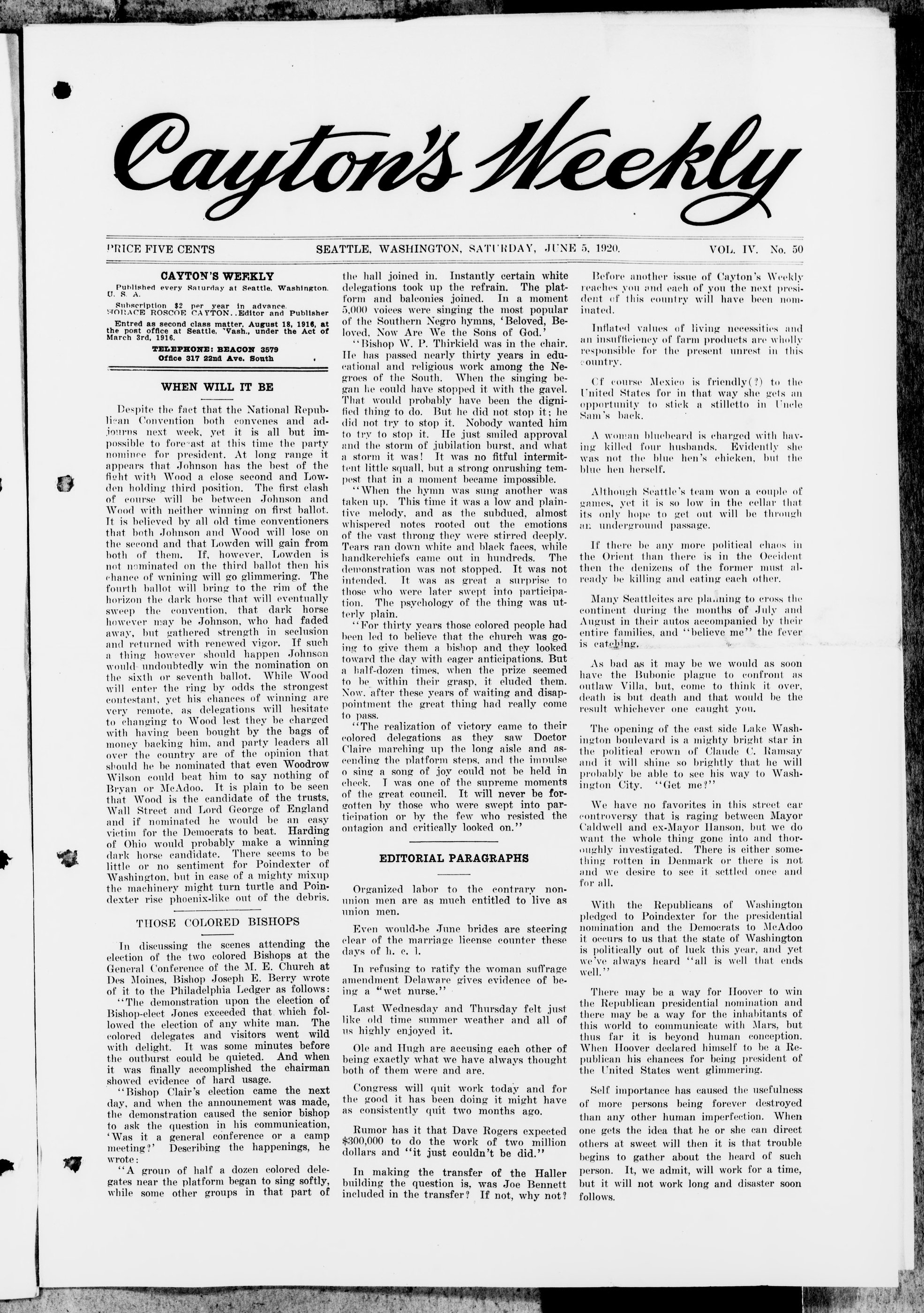
Despite the fact that the National Republican Convention both convenes and adjourns next week, yet it is all but impossible to forecast at this time the party nominee for president. At long range it appears that Johnson has the best of the fight with Wood a close second and Lowden holding third position. The first clash of course will be between Johnson and Wood with neither winning on first ballot. It is believed by all old time conventioners that both Johnson and Wood will lose on the second and that Lowden will gain from both of them. If, however, Lowden is not nominated on the third ballot then his chance of winning will go glimmering. The fourth ballot will bring to the rim of the horizon the dark horse that will eventually sweep the convention, that dark horse however may be Johnson, who had faded away, but gathered strength in seclusion and returned with renewed vigor. If such a thing however should happen Johnson would undoubtedly win the nomination on the sixth or seventh ballot. While Wood will enter the ring by odds the strongest contestant, yet his chances of winning are very remote, as delegations will hesitate to changing to Wood lest they be charged with having been bought by the bags of money backing him, and party leaders all over the country are of the opinion that should he be nominated that even Woodrow Wilson could beat him to say nothing of Bryan or McAdoo. It is plain to be seen that Wood is the candidate of the trusts, Wall Street and Lord George of England and if nominated he would be an easy victim for the Democrats to beat. Harding of Ohio would probably make a winning dark horse candidate. There seems to be little or no sentiment for Poindexter of Washington, but in case of a mighty mixup the machinery might turn turtle and Poindexter rise phoenix-like out of the debris.
THOSE COLORED BISHOPS
In discussing the scenes attending the election of the two colored Bishops at the General Conference of the M. E. Church at Des Moines, Bishop Joseph E. Berry wrote of it to the Philadelphia Ledger as follows: "The demonstration upon the election of Bishop-elect Jones exceeded that which followed the election of any white man. The colored delegates and visitors went wild with delight. It was some minutes before the outburst could be quieted. And when it was finally accomplished the chairman showed evidence of hard usage. "Bishop Clair's election came the next day, and when the announcement was made, the demonstration caused the senior bishop to ask the question in his communication, 'Was it a general conference or a camp meeting?' Describing the happenings, he wrote: "A group of half a dozen colored delegates near the platform began to sing softly, while some other groups in that part of
SEATTLE, WASHINGTON, SATURDAY, JUNE 5, 1920.
the hall joined in. Instantly certain white delegations took up the refrain. The platform and balconies joined. In a moment 5,000 voices were singing the most popular of the Southern Negro hymns, 'Beloved, Beloved, Now Are We the Sons of God.' "Bishop W. P. Thirkield was in the chair. He has passed nearly thirty years in educational and religious work among the Negroes of the South. When the singing began he could have stopped it with the gavel. That would probably have been the dignified thing to do. But he did not stop it; he did not try to stop it. Nobody wanted him to try to stop it. He just smiled approval and the storm of jubilation burst, and what a storm it was! It was no fitful intermittent little squall, but a strong onrushing tempest that in a moment became impossible.
"When the hymn was sung another was taken up. This time it was a low and plaintive melody, and as the subdued, almost whispered notes rooted out the emotions of the vast throng they were stirred deeply. Tears ran down white and black faces, while handkerchiefs came out in hundreds. The demonstration was not stopped. It was not intended. It was as great a surprise to those who were later swept into participation. The psychology of the thing was utterly plain.
"For thirty years those colored people had been led to believe that the church was going to give them a bishop and they looked toward the day with eager anticipations. But a half-dozen times, when the prize seemed to be within their grasp, it eluded them. Now, after these years of waiting and disappointment the great thing had really come to pass.
"The realization of victory came to their colored delegations as they saw Doctor Claire marching up the long aisle and ascending the platform steps, and the impulse o sing a song of joy could not be held in check. I was one of the supreme moments of the great council. It will never be forgotten by those who were swept into participation or by the few who resisted the ontagion and critically looked on."
EDITORIAL PARAGRAPHS
Organized labor to the contrary nonunion men are as much entitled to live as union men.
Even would-be June brides are steering clear of the marriage license counter these days of h. c. l.
In refusing to ratify the woman suffrage amendment Delaware gives evidence of being a "wet nurse."
Last Wednesday and Thursday felt just like old time summer weather and all of us highly enjoyed it.
Ole and Hugh are accusing each other of being exactly what we have always thought both of them were and are.
Congress will quit work today and for the good it has been doing it might have as consistently quit two months ago.
Rumor has it that Dave Rogers expected $300,000 to do the work of two million dollars and "it just couldn't be did."
In making the transfer of the Haller building the question is, was Joe Bennett included in the transfer? If not, why not?
VOL. IV. No. 50
Before another issue of Cayton's Weekly reaches you and each of you the next president of this country will have been nominated.
Inflated values of living necessities and an insufficiency of farm products are wholly responsible for the present unrest in this country.
Cf course Mexico is friendly(?) to the United States for in that way she gets an opportunity to stick a stilletto in Uncle Sam's back.
A woman bluebeard is charged with having killed four husbands. Evidently she was not the blue hen's chicken, but the blue hen herself.
Although Seattle's team won a couple of games, yet it is so low in the cellar that its only hope to get out will be through an underground passage.
If there be any more political chaos in the Orient than there is in the Occident then the denizens of the former must already be killing and eating each other.
Many Seattleites are planning to cross the continent during the months of July and August in their autos accompanied by their entire families, and "believe me" the fever is catching.
As bad as it may be we would as soon have the Bubonic plague to confront as outlaw Villa, but, come to think it over, death is but death and that would be the result whichever one caught you.
The opening of the east side Lake Washington boulevard is a mighty bright star in the political crown of Claude C. Ramsay and it will shine so brightly that he will probably be able to see his way to Washington City. "Get me?"
We have no favorites in this street car controversy that is raging between Mayor Caldwell and ex-Mayor Hanson, but we do want the whole thing gone into and thoroughly investigated. There is either something rotten in Denmark or there is not and we desire to see it settled once and for all.
With the Republicans of Washington pledged to Poindexter for the presidential nomination and the Democrats to McAdoo it occurs to us that the state of Washington is politically out of luck this year, and yet we've always heard "all is well that ends well."
There may be a way for Hoover to win the Republican presidential nomination and there may be a way for the inhabitants of this world to communicate with Mars, but thus far it is beyond human conception. When Hoover declared himself to be a Republican his chances for being president of the United States went glimmering.
Self importance has caused the usefulness of more persons being forever destroyed than any other human imperfection. When one gets the idea that he or she can direct others at sweet will then it is that trouble begins to gather about the heard of such person. It, we admit, will work for a time, but it will not work long and disaster soon follows.
---
THE PASSING THRONG
Last week the circus was in town and according to a custom, which has prevailed since the mind of man runneth not to the contrary, everybody and his brothers and sisters were lined up on the street to see the parade, no different, mind you, than the circus parades that Noah drove into the ark. The waiting throngs stood without comment as the various features of the circus passed along just as stoically silent as the gaping crowds. Owing to the long drawn out condition of the parade, the crowd was a bit uncertain as to the finality of the whole. I too was a bit in doubt as to when to quit my watchful waiting post, but was completely relieved of that embarrassment when a white woman gathered her armful of children about her with "come darlings that's all, for there comes the niggers." The colored band was about passing and what she said was quite correct. And then I set myself to thinking and I remembered that in all parades in which colored folks participated with white folks they were either at the end of the procession or dangerously close to it, and that had become such a well established custom that it was early taught to all white children. Some years ago when colored soldiers were stationed at Fort Lawton, on some holiday occasion the colored soldiers were to be a feature of the parade, and when they arrived from the Fort and the procession was being formed, the marshal of the day told the commander of the colored soldiers to fall in behind the State troops, and it so incensed him that he threatened to order the U. S. soldiers back to the Fort and to report the insult to the war department, but the matter was quickly smoothed over and the necessary apologies made. To "put the niggers last" was of such a common occurrence that the local authorities were almost willing to offer an insult to the government to satisfy their weakness in this particular. It is plain to be seen why the colored citizens lag in joining any patriotic demonstrations. And then it occurred to me that the alleged race problem of this country was more an effort on the part of the whites to keep the blacks behind than it was the blacks to push ahead.
```markdown
```
When I was attending Alorn University of the State of Mississippi, where there were some four hundred or more young men, the most of whom, like myself, hailed from remote rural districts, where we had spent our lives working on the farm from daylight until dark and from Monday morning until Saturday, either noon or night, just as the exigencies demanded, and had not had very much opportunity to learn to observe things without passing an opinion on them, but we did do our duty hoeing corn and digging taters, all of which was plain to be seen when we went to the university. But I set out to tell you about an incident that happened in my student life that has followed me ever since. On the campus there lived a man, not a student but apparently a parasite on the family that operated the boarding hall. He was a very intelligent man and talked fluently on most subjects of the day, but never seemed to earn a dollar on which to subsist. The most of us were curious as to his modus procedure and the most of us were sufficiently curious, owing to our own ignorance, to have flat-footedly asked him as to how he earned a living, but we remembered he was also rather clever with his fists, and that alone put a check on our tongues. One fellow who also used his fists pretty niftily, could stand the strain no longer and so in the presence of a score or more fellow students put the question up to him. "Woods," he began, "I never see you work at anything and I would like for you to tell me how you make a living?" Well. Woods looked at his interrogator as pleasantly as a preacher would look at a sister in the act of preparing a yellow leg chicken for his dinner, and both courteously and graciously replied, "Why, my friend,
easy enough. I get seventy-five cents a day for attending to my business and seventy-five cents a day for letting other people's business alone, which amounts to one dollar and fifty cents per day, and with that in hand I pay my way from day to day." He seemed to have taken all of the curiosity out of those present and even the interrogator could not find words for reply. A great many persons of this world spend more time trying to figure out other folks' affairs than they do in trying to make a living for themselves. Down on the farm the old folks used to say to the younger folk, "Curiosity killed a cat."
```markdown
```
If Twelfth and Jackson is not now a place where angels have no fear to tread, then it seems so to me, the other night as I wandered thereabouts to see if sights I could see. The new chief has ordered the "bulls" to clean the town up and however unwilling they may be to carry out the order, yet, for fear they loose their jobs, they are doing so. The pool halls are advocating the daylight closing to save light bills and many of the former denizens of the community have long since moved on. Some years ago, when George W. Dilling was elected mayor of Seattle he too set out to clean up the town, and for a time verily did do so, and the underworld denizens left for parts unknown in droves and bunches, almost between suns, and thus did it remain for weeks and months, but time is a great healer of troubles and cares. Seattle, however, seems very inviting and the cat came back, no, not in droves and bunches, but one by one or two by twos, they however came back hence this recent order to clean up the town. Believe me, within the past thirty years I have heard much about cleaning up Seattle, but it never seems to stay clean.
```markdown
```
When first I learned to drive a "car," I didn't get so very far, ere I tried to join an angel fold, by climbing up a ten foot pole, though it was just about high noon. I plainly saw the stars and moon. After that I started up a hill, but half way up it ceased to drill, and then I thought that hell had popped, for the puffing of that thing had stopped. Just what to do in such a boat, I swan, it almost got my goat. No friendly hand was near to help and I was forced to work my kelp. Release my brake and down I'd go, plenty, more as plenty, feet below. I shifted from the high to low, but the darned old thing refused to go, and then I thought about the gas, and plying it I went like glass. I left that hill some time that day a chuckling like an uncaged jay, and then it was for quite a while I was as happy as a little child, for I traveled around and flew through space, with perfect ease and swan-like grace. When late that night I went to sleep, the "brownies" in my face did peep, they teased and poked me all the night, for having been in such a plight, and then my shirt got full of bugs, which came from under all my rugs. My head was heavy all next day and out of time I hit the hay, and there I slept for hours and hours and dreamed that I was only culling flowers. Its nice to drive a great big Paige, but it will make you show your age, but push and pluck will do the work and soon you'll overcome the jerk. To spin your car around the parks, will cost you lots of shining marks, but from that bucking costly toy there comes to you a world of joy.—Editorial Warbler.
A. D. SMITH — B. BIRD
Proprietors
Phone Beacon 113
B & B PANATARIAN
Cleaning, Pressing and Repairing
Ladies Work a Specialty
We Call for and Deliver
TRY JIMMIE THE SHINE KING
Shine Parlor for Ladies and Gents
1218 Jackson Street
STOLEN FROM THIEVES
"What is your favorite book?" "My bank book; but even that is lacking in interest these days."—Kansas City Star.
Otis—How beautifully the land lies in that new suburb! Chester—Yes, but it can't compare with the real estate men.—Judge.
"What are you treating me for, doctor?" "Loss of memory. You have owed me a bill of $60 for two years."—Boston Transcript.
"A doctor can not conscientiously take money from his patients." "Why not?" "Because his are ill-gotten gains."—Baltimore American.
Redd—Is that your dog growling so? Greene—It sure is. Redd—What's he growling about? Green—Because meat is so high.—Yonkers Statesman.
"I have a novel idea for a film play." "What is it?" "The husband and wife in the plot have no serious marital difficulties." —Louisville Courier-Journal.
"Do you believe in the beneficial effects of laughtr?" "I certainly do. If I can gt a man laughing I can nearly always borrow $5 from him."—Boston Transcript.
New Reporter—What was the worst financial panic you ever went through, Mr. Moneybags? Mr. M.—Let me see. Coming home one night in the street-car somebody dropped a nickel and seven women claimed it.—Houston Post.
The Bride (coyly)—My only regret is about mother. She's bound to miss me terribly. Her Friend (coldly)—Ah, well, she can't complain. After all, she's had you with her longer than most mothers keep their daughters.—London Answers.
“Pa, what's an anomaly?” “I'm afraid you are too young to understand the dictionary definition, son.” “Can't you give me some idea, pa?” “Yes, my boy. A motion-picture star who doesn't own an automobile is an anomaly.”——Film Fun.
“Well, Brown, how ill you look! What's the matter?” “Oh, nothing much; losing weight, that's all. Lost a hundred and thirty pounds of flesh in one day.” “Impossible!” “Fact, I assure you. My wife has eloped with the next-door neighbor.”——Toledo Blade.
"Well, Tommy, did you learn anything at school today?" asked the proud father. "Yes. sir." replied the youngster with pugilistic ambitions. "Fine- What was it? History, geography, grammar——?" "No. dad I learned that Sam Snoggs, the butcher's son, packs an awful punch in his right."—Birmingham Age-Herald.
"That was a great speech you made," said the enthusiastic friend. "Do you think it will help me?" said Senator Sorghum. "Unquestionably. It may not have much influence in public affairs, but it ought to get you an engagement with any lecture bureau."—Washington Star.
"I understand young Dr. Pillers had a hard time getting established here." "So he did." "What was the trouble?" "Well, chiefly the fact that his whiskers wouldn't grow fast." "Indeed?" "Yes. It took him about four years to raise a respectable Vandyke beard."—Birmingham Age-Herald.
"Do you believe doctors have a right to kill where they cant' cure?" "Haven't they always been doing it?"—Baltimore American.
"What's up now?" asked Jeremiah, who was half asleep. "Well, it says here about the launching of a ship. 'With graceful ease the huge vessel slid into the water just after the Duchess of Dumpshire had cracked a bottle of champaign on her nose.' It must have hurt her! Why should she mutilate her face like that, Jeremiah?'—Houston Post.
Mr. Russell Smith has opened a coal office at 310 Twelfth avenue South with his brother Mr. Floyd Wright in charge of the office.
PURELY PERSONAL
Rev. and Mrs. W. D. Carter have moved to the Mt. Zion Baptist Church parsonage. The regular monhtly meeting of the N. A. A. C. P. Seattle Branch will be held at the First A. M. E. Church next Monday evening. All members and friends are requested to be present. Mr. Gillie Richardson and Russell Walton have purchased the Entertainers Cabaret and have reopened it with new entertainers. Under its new management it bids fair to be a brilliant success.
Rev. and Mrs. D. A. Graham have returned to the city after an absence of one month attending the A. M. E. General Conference. He will give a brief review of the work of the conference from his pulpit next Sunday evening.
THE NEW NEGRO
Before the war, the Negroes of the United States suffered more than a full measure of all the wrongs that have led to the double revolt of small nations and suppressed classes in Europe. Individually the Negro workers, who form a very large portion of the colored population, have borne all the hardships of their economic class, and collectively the race has been subjected to special disabilities, political, economic and social, such as the limitation of the right to vote and to hold office, the denial of justice, the practices of lynching and peonage, the discrimination of white labor unions, segregation in trains and in residential districts, and the limitation of educational opportunities. Now it is perfectly obvious that every sort of discrimination against Negroes, as such, tends to unite them as a racial group, and it is equally obvious that the appearance of economic differences among the Negroes themselves has exactly the opposite effect. During recent years, the development of economic differentiations has been very marked, but there is some evidence that racial animosity is likewise on the increase; and it is precisely this complication of class and race alignments that makes the Negro problem the most uncertain factor in the future of the country.
The people who are attempting to deal with this situation fall naturally into three groups, as determined by the attitude they take toward the questions of race and class. Certain politicians and an increasing number of welfare-workers and educators hold an essentially liberal position, in that they disregard racial and economic divisions and attempt to appeal to black men and white as individual citizens. The second group champions Socialism and industrial unionism, and attempts to unite all workers, irrespective of race and color, upon the basis of common economic interest. The third group considers white Socialists almost as hateful as white Democrats; and against them all it preaches the doctrine of racial unity, Negro nationalism, and the final overthrow of Caucasian supremacy.
In so far as it may be classed as an attempt at solution, the whole "Black Republican" movement belongs to the category of non-racial, non-economic answers to the Negro problem. Tradition and sentiment have bound the colored people so completely to the Grand Old Party, that Republican candidates have generally secured the black vote without giving either promise or performance in return. It would be hard to find better proof of this proposition than is contained in the report on a questionnaire sent by the National Association for the Advancement of Colored People to seventeen Presidential candidates now before the country. In the questionnaire the candidates were asked to state among other things, whether they would favor the enactment of Federal laws against lynching, and the enforcement of the Fourteenth Amendment by the reduction of the representation of States which disfranchise some of their citizens. In reply, Senator Harding stated that it was the business of the National Conventions to frame platforms and policies, and Senator Poindexter declared
himself "in favor of maintaining the legal rights and opportunities of all citizens, regardless of color or condition." As for the rest, Citizens Hoover and Johnson were as silent as Generals Wood and Pershing. The point is this: in the northern States, where the colored vote counts, the Negroes will vote Republican whatever happens; whereas some of the northern white men might be frightened into Democracy by too much pro-Africanism on the part of the Republican candidate. On the other hand, the colored vote in the south isn't worth a buffalo nickel to anybody under present conditions, and can hardly be made so, at an early date, by any means short of another Civil War.
The mess the Arkansas Republicans have gotten into will show pretty clearly how the black Republican vtoe is handled south of the Line. When Negro delegates were denied seats at the State Convention at Little Rock, they bolted and elected their own delegates to the National Convention, and also nominated a Negro candidate for governor. The entire delegations to the Republican National Convention from Florida, Louisiana, Mississippi, South Carolina and Virginia are being contested; of 122 places in the Convention now in dispute, 118 are from Southern Democratic States, where the fight between the so-called "Lily White" and "Black and Tan" elements is running its usual course. And the saddest part of it is, that all this fuss is being made over the business of nominating a candidate who will promise the southern Negroes nothing, and for whom most of them will not be allowed to vote.
If he Republicans disregard racial and economic lines, the educational-welfare groups go even farther toward universal brotherhood by dropping even political partisanship. Somewhat typical of this attitude are the rejoicings of Robert R. Moton, President of Tuskegee Institute, over the fact that "Although there are 15,000,000 Negroes in this country, not one of them was ever captured in the Federal dragnet which recently gathered in bolsheviks, anarchists and other 'reds.'" President Moton's conclusion is that "the loyalty of the Negro race can never be questioned."
The National Association for the Advancement of Colored People fairly represents the co-operation of white and colored citizens in the liberal "appeal to the conscience of America" on behalf of the civil and political rights of the Negro. The Board of Directors of the Association is half white and half colored, and its membership of 91,000 is about ninety per cent colored. The Crisis, a magazine published by this organization, has a circulation of about 100,000 copies per month, some of which go to Africa. The Association has no economic or political programme, and its appeal is quite specifically an appeal to the righteous; nevertheless, its work in general, and its agitation against lynching in particular, have unquestionably been of very considerable value.
The civil-rights program of the N. A. A. C. P. is supplemented, on the side of industrial welfare, by the work of the National Urban League. It is the aim of this organization to open up new industrial opportunities to Negro workers, and to give attention to conditions of work and recreation in communities where Negroes are emplyoed in considerable numbers. During 1919 the various locals of hte League persuaded the managers of 135 industrial plants to employ Negroes for the first time; and during the same period twenty-two welfare workers were placed in plants where Negroes were engaged. The organization has also declared its sympathy with efforts to unionize Negro labor.
At the last National Convention of the American Federation of Labor, it became evident that trade unionism was prepared to give considerable attention to the organization of Negro workers. Forty-six or more of the hundred and thirteen Internationals included in the Federation already admit Negro members, and the Convention for 1919 voted to bring pressure to bear upon the other Internationals by or-
ganizing independent locals directly under the Federation wherever the existing unions will not accept colored applicants. According to a statement made by President Gompers, the A. F. of L. now has two paid organizers and thirteen volunteers at work among the Negroes.
But respectable trade-unionism—like Republican politics, and the liberal appeal to the American conscience—is by no means satisfactory to the leaders of the second major school of thought on the Negro problem. Here, in place of a liberal disregard of class and race lines, we have the preaching of a class war in which "the workers of the world," irrespective of race and color, are urged to unite against their oppressors. In politics this group is Socialist; in the field of labor-organization, it inclines to favor the I. W. W. rather than the unions of the A. F. of L. The Socialist party, on its part, has recognized the potential value of the Negro vote, and has included in its national platform a declaration in favor of full political and economic rights for Negroes; this party has also made special provision for the spread of propaganda among the Negroes, and has employed three organizers for this purpose. No statistics are available as to the number of Negro Socialists in this country; but, according to the statement of an I. W. W. organizer, ten per cent of the members of the latter organization are colored; in other words, the membership of the I. W. W. corresponds pretty closely with the population of the United States in the matter of color-composition.
The chief organ of the Negro Socialistsyndicalists—a magazine with a circulation of some 20,000 copies a month—is characterized in the following terms by Attorney-General Palmer:
The Messenger (he says) . . . is by long odds the most able and the most dangerous of all the Negro publications. It is representative of the most educated thought among the Negroes.
Referring to the Socialist party, and to the National Labor party, which has also adopted a demand in favor of Negro rights, this interesting publication says:
We have constantly maintained that the solution of the Negro problem rests with the alliance of Negroes with radical organizations. . . . Here are two organizations largely composed of white poeple, who have adopted fundamental methods for the solution of the problems affecting the
IN THE SUPERIOR COURT OF THE STATE OF Washington for the County of King.
Edward Sweeney and Katherine Sweeney, his wife, plaintiffs, vs. May S. Jones, John Doe Jones, her husband, F. P. Kelly and Jane Doe Kelly, his wife, Defendants.—No. 142,329. Summons by Publication.
The State of Washington, to the said F. P. Kelly and Jane Doe Kelly, his wife, Defendants:
You are hereby summoned to appear within sixty days after the date of the first publication of this summons, to-wit: within sixty days after the 1st day of May, A. D. 1920, and defend the above entitled action in the above entitled Court, and answer the complaint of the plaintiffs, and serve a copy of your answer upon the undersigned attorney for plaintiff at his office below stated; and in case of your failure so to do, judgment will be rendered against you according to the demand of the complaint, which has been filed with the Clerk of said Court. The object of the said action and the relief sought to be obtained therein is fully set forth in said complaint, and is briefly stated as follows: Cancellation of real estate contract for conditions broken and effecting East 187 feet of the North 285 feet of tract 22 of Lake Dell Addition to the City of Seattle, King County, Washington.
Z. B. RAWSON,
Attorney for Plaintiffs.
P. O. Address: 617 Pacific Block, Seattle, County of King, Washington.
May 1-June 19, 1920.
IN THE SUPERIOR COURT OF THE STATE OF Washington.
Mary McBride, Plaintiff, vs. Willie Craven McBride, Defendant—No. 143206. Summons by Publication.
The State of Washington, To the said Craven McBride, Defendant:
You are hereby summoned to appear within sixty days after the date of the first publication of this summons, to-wit: within sixty days after the 15th day of May, 1920, and defend the above entitled action in the above entitled Court and answer the complaint of the plaintiff and serve a copy of your answer upon the undersigned attorney for the plaintiff at his office below stated and in case of your failure so to do, judgment will be rendered against you according to the demand of the complaint which has been filed with the Clerk of said Court.
The object of the above entitled action is to obtain a divorce on the ground of cruelty and non-support.
Z. B. RAWSON.
Attorney for Plaintiff.
P. O. Address: 617 Pacific Block, Seattle, King
County, Washington.
May 15, June 24, 1920.
```markdown
```
white and Negro races in the United States. This is not because there is any special love for the Negro on the part of the groups which compose these conventions, but because it is impossible for them to attain the ends and objects at which they are aiming unless these fundamental rights of the Negro are granted to him.
In another number the editor speaks furthem in the same vein:
We do not depend upon professions of friendship or flowery promises, but only intelligent self-interest. The position of white labor is already changing rapidly in its relation to Negro labor, not because white labor likes Negro labor any better, but because it realizes that the only way white labor can raise its standing of living is to raise the standard of living of its competitors. This sound position will be taken by white labor as rapidly as it becomes more intelligent and class conscious.
Our political philosophy is Socialism, not State Socialism. For more than two years, now, it has functioned in Russia. The (Negro) Left Wing group holds that the greatest power the Negro possesses is his power to combine with the Socialist present minority and assist it in becoming the majority.
It would appear then that the Messenger group is convinced that the solution of the Negro problem is to be found in the solidarity of all workers, white and black. And yet it is very evident that, from time to time, lynchings and race-riots put a rude strain upon the inter-racial creed of these Socialist-syndicalists. Take, for example, this quotation, also from the Messenger:
We are . . . urging Negroes and other oppressed groups confronted with lynching or mob violence to act upon the recognized and accepted law of self-defense. The black man has no rights which will be respected unless the black man enforces that respect. It is his business to decide that just as he went 3000 miles away to fight for alleged democracy in Europe and for others, he can lay down his life, honorably and peacefully, for himself in the United States. New Negroes are determined to make their dying a costly investment for all concerned. This new spirit is but a reflex of the Great War.
And it is this spirit that, in time of pressure—in the time of such riots as those of Washington and Chicago—must unite the Negro radicals with the supporters of the third and most startling answer to the race problem-"African nationalism." Perhaps this expression will always remain strange to American ears—and then again it may become quite familiar within a few years. For, after all, a rebellious hatred of the white race as a whole is the Negro's easiest reaction to wrongs, most of which certainly seem to fall upon him rather as a black man than as a workingman; this rebellious spirit needs only a common racial objective to give it unity, and that it seems now in a measure to have gotten. The "Negro-First" propaganda is largely the work of the Universal Negro Improvement Association and African Communities League of the World—an organization which claims a million adherents in the United States, the West Indies, South America and South Africa, and announces as its final object the establishment of a black empire in Africa. The following quotation from the Negro World will give an idea of the nature of this remarkable movement:
Mobs of white men all over the world will continue to lynch and burn Negroes as long as we remain divided among ourselves. The very moment all the Negroes of this and other countries start to stand together, that very time will see the white man standing in fear of the Negro race even as he stands in fear of the yellow race of Japan today. The Negro must now organize all over the world, 400,000,000 strong, to administer to our oppressors their Waterloo. Let every Negro all over the world prepare for the new emancipation. The Fatherlan, Africa, has been kept by God Almighty for the Negro to redeem, and we, young men and women
of the race, have pledged ourselves to plant there the flag of freedom and of empire.
Connected with the U. N. I. A. are the Black Star Steamship Line, capitalized at $10,000,000, and the Negro Factories Corporation, capitalized at $1,000,000. Just what these astonishing figures represent in actual cash we have no means of knowing, but this much is certain: the Black Star Line has already in operation one of the multitude of steamers which—say the prophets of the movement—will some day ply between the Negro lands of the world. To cap the climax, the U. N. I. A. will hold in New York during the month of August an "International Convention of Deputies" who will elect "His Supreme Highness, the Potentate; His Highness, the Supreme Deputy, and other high officials who will preside over the destiny of the Negro peoples of the world until the African Empire is founded."
However laughable this language may be, there is no doubt that something is happening in the Negro world—something that can not be laughed down, any more than the Germans could laugh down the Senegalese. If any further proof of this is needed, it can be found in the pages of the magazine called the Crusader. On the cover of this magazine is the figure of a black man bearing a spear and a shield, and inside one finds this sort of thing:
"Let us notice a combat between black boys and white boys, and we will see that the blacks exchange two or three cuffs for one. And no single white man will attack a Negro until he is first sure that he has some other help than himself, for the Negro would endeavor to greet him with such blows as only one who knows that there is no other god but God can. Do not fail to teach your children the truth, for Africa is our
1000 1000
Thousands of Barrels
of
Refreshing, Exhilerating, Intoxicating Music
Poured Out Nightly at the
Entertainer's Cabaret
1238 Main Street
By the Best
SYNCOPATED ORCHESTRA
on the Coast
DON'T MISS IT
ENTERTAINER'S CABARET
GILLIE RICHARDSON
RUSSELL WALTON
---
CAYTON'S WEEKLY
(Office 303 22nd Ave. South) Regular, Reliable, Republican, Readable Wants 500 New Subscribers
This is a Sample of what it sends out Every Week
No Friends to Reward or Enemies to Punish
A Publication of Ideas Rather Than Personalities
Read for Yourself and Be Convinced
heritage, the hope of our salvation." And in another number, this: "What the Negro needs to know is that in many qualities he is the superior of the white man. He needs to know these qualities and to believe in them and insist on them." To complete the familiar paraphernalia of nationalism with historical illusion, the colored people are urged by the Negro World to "restore the ancient glories of Ethiopia."
In the face of this movement, American liberalism seeks to preserve its calm unconsciousness of race; even as it has sought to keep up the appearance of moral disinterestedness in the realm of economic interests. And just as the liberals, for all their good intentions, did not succeed in forestalling class-movements among the white workers, it is pretty certain that they can not find palliatives enough to sweep back "the rising tide of color." The Socialist-syndicalist group, on the other hand, replaces the appeal to economic interest.
The conflict between the lass-movement and the race-movement is fundamental and direct. If the expansion of American unionism leaves the Negroes for the most part unorganized, the white workers may rest assured that their colored competitors will turn to racial organization—black unions against white. If, on the other hand, the Negro workers can be absorbed into a general labor movement, the race problem may lose some of its difficulty, as, in the course of time, the labor-problem approaches a solution. acial division may serve the interests of the old order for the present, but in the end it will profit no one but the munitions-makers.—Exchange.
—GEROID ROBINSON.
You Are Welcome
GREAT NORTHERN POOL AND
BILLIARD HALL
Cigars, Tobacco and Soft Drinks.
BOYD & WILLIAMS, Props.
1032 Jackson St.
SANDERS & COMPANY
LOANS NEGOTIATED
1003-1004 L. C. Smith Building
Office Hours
From 8:30 A. M. to 5:30 P. M.
Seattle, Wash.
Elliott 4662
Phone East 179
Calls Made Promptly Day or Night
LEWIS & BLACKWELL
FUNERAL DIRECTORS and EMBALMERS
H. Alfred Lewis, Funeral Director
1215 East Marion St., Seattle
ATLAS POOL HALL Under New Management Wishes You a Happy New Year FELIX CRANE, Manager 1212 Main Street
FURNISHED ROOMS 317 22nd Ave. So. Rooms large and commodious, on car line, but walking distance. MRS. S. R. CAYTON 317 22nd Ave. So.
ALHAMBRA CASH GROCERY
Distributor of Mme. C. J. Walker's Hair and Skin preparations. Mail, postal and express orders promptly filled. 1201-3 Jackson St., Seattle, Wash.
1101 Washington St., Seattle, Wash. Phone Main
4573. Hair Culture and Scalp Specialist. Will
call at your home if desired. Graduate of Oxford
College, St. Louis.