Cayton's Weekly
Saturday, June 12, 1920
Seattle, Washington
Page text (machine-generated)
Cayton's Weekly
SEATTLE, WASHINGTON, SATURDAY, JUNE 12, 1920.
---
PRICE FIVE CENTS
CAYTON'S WEEKLY
Published every Saturday at Seattle, Washington,
U. S. A.
Subscription $2 per year in advance.
HORACE ROSCOE CAYTON..Editor and Publisher
Entred as second class matter, August 18, 1916, at
the post office at Seattle, Wash., under the Act of
March 3rd, 1916.
TELEPHONE: BEACON 3579
Office 317 22nd Ave. South
NEGRO MIGRATION
The Negro race is not migratory, and therein is much of its value and reliability. However, the World War, which disturbed everything else, disturbed also the Negro. Immigration from Europe ceased, former immigrants returned, and at the close of the war America was short three million immigrant laborers. Northern employers were troubled by shortage of labor and high wage demands, and looked toward the South for a possible labor supply. They sent representatives South to find many Negroes whose earnings were small, due to the plant-destroying bollweevil and to consequent unemployment of cotton acreage.
These employment agents promised the Negroes better wages, better housing, better education for the children, better treatment in the courts, and free transportation for themselves and their families if they would come North. One large railroad system operating in the South started special trains, notifying the Negroes that each stop that any who wanted to come North might do so without charge. As a result, 500,000 migrated to a climate to which they were unaccustomed, and on account of bad housing conditions died in large numbers.
The factory doors which had hitherto been closed to the Negro opened wide, and to a large extent still remain open, and large numbers of the migrators who formerly worked in southern fields are now engaged in all sorts of industrial occupations in the North. The plants of seven states, numbering 244 plants in all, into which Negro laborers were introduced during the war were investigated by the Department of Labor as to conditions prevailing during 1918 and 1919 and disclosed a good feeling between whites and blacks in all the plants, with the blacks showing equal attendance and supplying an equal quantity and quality of work.
However, the Northern social organism did not support the sudden influx. At first the new arrivals were crowded into certain sections long recognized as plague-ridden, disease-infected and vice-ruled; but when the new arrivals, as in case of Detroit, increased 500% in five years, those sections could not contain the newomers, and other sections were necessarily occupied. Declines in real estate values followed; and although these declines were quickly succeeded by recoveries larger than the declines, due to the enormous rents collected from the new arrivals, racial prejudices developed and trouble ensued.
When the Negroes first began to go North not much attention was paid to their exodus in the South. But the size of the migration seriously affected the Southern labor market, increased the shortage of farm products, raised the prices of foodstuffs; and ere long the planters and Chambers of Commerce of the South were urging the Negroes to return South to bettered conditions, such as larger wages and gifts of land suitable for homes and gardens.
Meantime, those Negroes who remained in the more fertile parts of the South had fared far better than most of those who went North. Vast numbers of them work on a crop-sharing system; and where the farm superintendents and operators are honest men, the Negroes have made enough out of the high prices obtained for their products, to lift them completely out of poverty. There are vast sections of the Mississippi River delta land in the hands of Negroes who have become well-to-do. Many of these farmers have accumulated fortunes ranging from $10,000 to $175,000 and are permitted the full use of sidewalks, streets and thoroughfares.
These lands have produced as high as 500 lbs. of 51-cent cotton per acre, and under such conditions the making of money by an industrious and intelligent man is most natural. One such man, a Negro who had nothing eighteen years ago, now owns 1,600 acres of this land. Nine Negroes have recently clubbed together and bought a tract of 1,200 acres; and twenty-five others have clubbed together and bought a 3,000 acre tract for $225,000, intending to cut it up into 100-acre farms. In one county of Mississippi Negroes possess more than $5,000,000 worth of property and over 2,000 automobiles. With improved economic conditions the Negro has improved otherwise, has organized an insurance company doing a large business, has employed a farm demonstration agent in one important agricultural center, and has organized various kinds of commercial enterprises in many places. Among these is a steamship line.—The Golden Age.
JOHN BARLEYCORN SLEEPS
No greater favor could be bestowed upon the citizens of this country than the decision of the United States supreme court upholding the dry law. Of course a large minority may feel sadly disappointed, but the most of them are disappointed because it takes from them the opportunity to make tainted money and owing to the fact many of our citizens are money mad they will resort to any kind of an underhanded deal within the law to get the money, hence their desire to manufacture for and sell to their fellow citizens intoxicants that in all cases destroy the usefulness of those who indulge in their use as a beverage. We trust the legislative bodies of this country will go yet a step further in an effort to stamp out this national evil and make it a felony for any one to manufacture intoxicants and likewise a felony for any one to dispose of them to another or to have them in their possession. An evil is an evil and the way to correct an evil is to completely eradicate it. Let us rejoice and be exceedingly glad that as much headway as has been made toward freeing our country from the blighting curse of John Barleycorn and let us continue the good work until every vestige of the miserable old monster has been extripated root and branch.
In all probability a new depot will have to be arranged for to receive Bill Laube on his return to Seattle from Chicago.
Despite the fact that there are many dark horses in the Chicago convention, yet the leaders were unable to find a dark horse for the nomination.
VOL. IV. No. 51
EDITORIAL PARAGRAPHS
If the Democrats insert a booze plank in their platform Bryan is liable to get wet.
From the number of auto outings it occurs to us that the auto is about to run the church down.
The shortage of gasoline has lengthened the price, which doubtless fully explains the shortage.
Europeans have already begun to riot for bread and that too when there is plenty of green grass.
Picnicing along the shores of Puget Sound, though this be June, is still for future consideration.
"How dry I am" may have been the slogan, but, "it never rains but it pours" can aptly take its place.
Getting a club for the colored boys of Seattle and its suburbs is a long step in the right direction and we heartily favor it.
Money still seems to be the root of all evil and the desire to get to the root of things is just as keen today as it was yesterday.
The A. M. E. general conference was hardly over when Bishop A. J. Warner died, thus leaving a vacancy for the ensuing four years.
If a majority of the voters of this state favor the Tripple Alliance idea, whether its patriotic or otherwise, the commonwealth will pass under its yoke.
If Harry White, he of Seattle mayorality fame, is a sample of the new Mexican government citizenship then we are of the opinion the worst is yet to come.
Let an order be issued and religiously enforced, "All loafers must go to work," and the order should apply to the idle rich the same as it does to the common laborer-
That Chicago Chinaman that refused to serve colored guests at his restaurant and was fined $125 and costs now realizes that a Chinaman can not do everything in this country that a white man does.
It will be quite a feather in the cap of the Seattle Branch of the N. A. A. C. P. to father a mid-summer get-together outing for the colored people of the community. If there be no objection it is so ordered.
Persons without the love of God in their hearts, which moves them to do unto others as they would that others do to them, are not only objectionable neighbors, but a menace to the peace and happiness of whatever country in which they happen to reside.
There is neither a federal or state law prohibiting any citizen or even alien from running for an office and therefore Walter Beals is taking no chance in announcing his intention of running for supreme judge, but candidly, Walter has about the same chance of being elected as does a snow ball of flying through hadese.
At the Chiaego convention Wall Street's "fine Italian hand" was backed off of the boards and its golden fist did the work.
At a family reunion of twelve children the mother (colored) presented each of them with a check of $700 and she is still well fixed financially. This happened in Paris, Texas, where colored people are considered little short of peons and parasites. "Jest tell 'um we is risin'."
---
MONEY MAD
The people all seem money mad, they wildly play the game; to gain another shining scad is each one's highest aim. Myself, I do not kick at cash, I like my share of mon; I do not say that coin is trash, or dross that we should shun. I make no pious rigmarole with halo on my brow; I like to have a little roll with which to choke a cow.
But there are other wholesome joys than gathering in the dough; and I feel sorry for the boys who this much do not know; who pass up every kind of fun, to gain another wheel, another slice of germ-proof mon, to put in vaults of steel. I let not earning interfere with burning gasoline, when comes the springtime of the year, the woods and fields are green. Then in my car I jaunt abroad along the dusty road, and not to double up my wad would I compose an ode. The buyers of such rhythmic junk exclaim, "Produce your lyre, and we will pay a silver plunk for anthem full of fire." And I remark, "The day is fine, the roads are good, I ween; there'll be no honest toil in mine—I'm burning gasoline!"
The towns are full of crazy men who hustle till they die; "Another plunk! Another yen!" is evermore their cry.
And they forget the words of fate some elder prophet said: "When man is boxed up in a crate, he'll be a long time dead."
We'll be a long time dead, my lads, when we are lying low; and men wil still be chasing seads and piling up the dough. Your children will be having fun, forgetful how you slaved; and lawyers will be blowing mon some other fellows saved. So trot along with buoyant tread, and join the gladsome crowd; you can't go fishing when you're dead, or joyride in a shroud.
I've always said, and say once more, that men should save and thrive; there's nothing like a stock of ore when rainy days arrive. I've always said, in stentor tones, extravagance is wrong; there's nothing like some pickled bones when sickness comes along. It always makes me feel distressed when money melts like ice! but virtue, when too sorely pressed, may well become a vice. And too much salting money down becomes the miser greed; to go at times and paint the town is still a human need.
So let us duly paint the town and paint it brilliant red; for when we lay our weapons down, we'll be a long time dead. And other men will paint the grad, and have a corking time, when we are feeling bum and bad in some far torrid clime. And other boys will ride abroad like Cleo in her barge; and other sports will blow the wad we struggled to enlarge. And other maniacs will whiz through town, and break the law; and other girls will drink their fizz, with rapture, through a straw. And when we sleep it is the end of plenty and of dearth; no gent can leave his tomb and spend the coin he made on earth.—Walt Mason.
Mr. and Mrs. W. H. Wilson have moved into the house formerly occupied by Rev. and Mrs. W. D. Carter.
Mrs. John T. Gyaton and her daughter are at the Firland hospital, suffering from a mild case of smallpox. Both are rapidly recovering while "dad" is wondering "what's going to happen to me and the boys."
THE PASSING THRONG
Last Monday while I stood reading the head lines in the noon paper the decision of the U. S. Supreme Court, holding the dry law constitutional, a man staggered by grumbling to himself in an undertone. I took a second look at him and I was convinced that he had an old fashioned drunk on, but soon a friend espied him and ran to his assistance and as they waddled down the street they were the cynosure of all eyes, which were many, as it was the noon hour. What a curiosity was that drunken man even in Seattle, where less than five years ago 300 saloons flourished, and where now the industrious bootlegger does his best. Both men and women seemed utterly disgusted at the sight and no stronger argument could have been offered to move all, who saw the beast of the bottle, to take a firmer stand for prohibition for all time to come.
. * * *
I was the guest of County Commissioner Thomas Dobson last Saturday to view the "round the lake boulevard," and in all my life I never enjoyed a ride so fully as I did that, not so much, however, because I was the guest of a county commissioner, but because I was riding over one of the most scenic highways I had ever seen, which was being opened on that occasion. My host fortunately killed his speedometer before leaving on the trip, which prevented me from feeling that he also meant to kill me, as he occasionally sped over that highway at about sixty miles an hour. This particular highway was a hobby of Mr. Dobson, even before he became a member of the board of county commissioners and its opening and the celebration thereof last Saturday afternoon at Bellevue was one of the auspicious occasions of his life. The citizens from end to end of the road were greatly pleased at the work and so expressed themselves, and if indications mean anything, Tom Dobson will be renominated next September by a two to one majority over all other aspirants to succeed himself, and he deserves to be. I have known Tom for nearly thirty years and I have always found him to be on the square and in the open. Here is to your success, old man, now and ever more.
***
A few days ago I heard Col. Will Inglis, among a score of others, address a large and enthusiastic audience, and, having known Billy for many years, and, having remembered his oversea work in the late war, I was quite keen to hear, what, to me was his maiden speech, in view of the fact that he probably will be a Republican candidate for the house of representatives in Congress to succeed one John F. Miller before the coming September primaries, and I heard that maiden speech, and if my vote is to put him in Congress he's there now. It remained for Billy, of all of that score or more speakers to hold up the colored soldiers, who went to France from this country, to fight to make the world safe for democracy, to ridicule and vulgar derision. As he told his "dahky" story of a colored soldier, who marked time on account of fear, instead of rushing to the front as did the white soldiers, I remembered that the colored soldiers in proportion to their number brought back to this land of the free and home of the lyncher more French war medals than did the white soldiers, and I also remembered of a recent request of the French government, that
A. D. SMITH B. BIRD Proprietors Phone Beacon 113 B & B PANATARIAN Cleaning, Pressing and Repairing Ladies Work a Specialty We Call for and Deliver TRY JIMMIE THE SHINE KING Shine Parlor for Ladies and Gents 1218 Jackson Street
Uncle Sam give his consent to let it colonize or amalgamize three million colored men of this country, all of which made Coi. Bill Inglis look mighty small in my mind, and I said to myself, "old man, if you ever get to Congress, you will remember that I was 'agin' you."
* * *
Bitter complaint comes to me of the brutality of the police, who were ordered to clean up the district in and about Twelfth and Jackson, toward all colored persons, not only living in that district, but who happen to pass through it. One officer wearing No. 25, so said a young lad, used him rougly and informed him that he was there to make you black bastards respect white men. Other cases of brute force are also reported, all of which are being investigated. Years ago such brutality was common among the policemen of this city toward colored folk but under Bannick, Griffith and Warren the rough stuff was to an extent cut out, but it seems to have taken on a new lease of life. For the past year the police force seems to have been honeycombed with thieves and law-brakers in general and I am of the opinion that persons living in glass houses should hesitate to begin throwing stones. A policeman said to me some two weeks ago, "the colored boys in Seattle are in for a hell of a hard drubbing under this clean-up order. The white men will be told to lay low while the order is to knock low every colored man that tries to talk back." How much of the above story be true I know not, but I do know that the stories that are coming to me of the abuse colored men are being subjected to by the policemen tally with my informer's story. Morally I favor a complete house cleaning in Seattle, but there is no excuse for singling colored men and women out for police persecution and beacuse it is no longer possible to get the money from them, which, if reports be true, has been done by scores of blue coats. If colored men are to be forced to "respect white men," then for the good God's sake let it be white men and not policemen, and especially those white of skin, but damn black of heart.
* * *
Nothing that may be said to the contrary will have but little or any effect upon the determination of the mayor and the city council to raise the fare on the street cars, yet the proposition hardly seems just and equitable to the small wage earner, such as the great majority of the citizens of this city are. The difference between the five cent and the seven cent fare could and should be saddled upon general taxation. In the long run, however, we realize the consumer will have to pay it, for the great tax payers in fact, never pay a cent's taxation, but they simply pass the buck on to the consumer in the shape of increased cost. It however, makes one feel better to pay a five instead of a seven cent fare and in that instance we desire to see their feelings accommodated. There is but little lost or gained to our economic system in either permitting the fare to remain as it is or in raising it, for whichever way it is the man behind the gun pays the price.
* * *
Under the auspices of the Seattle Branch of the National Association for the Advancement of Colored People we would like to see a semi-state gathering of the colored itizens in some convenient park near Seattle for an outing, to first listen to a well arranged program, and then those, who so desired, close the whole with an exhilerating dance. The Branch has decided to do something on that date and to that end it hopes no other organization will make any plans to hold any kind of a public demonstration on August 4th.
* * *
In giving the City of Seattle the right to regulate jitney busses we are of the opinion that the Federal Court not only handed down a fair legal opinion, but the judges actually gave strong evidence of being men of ordinary horse-sense.
[Name]
James Sheridan
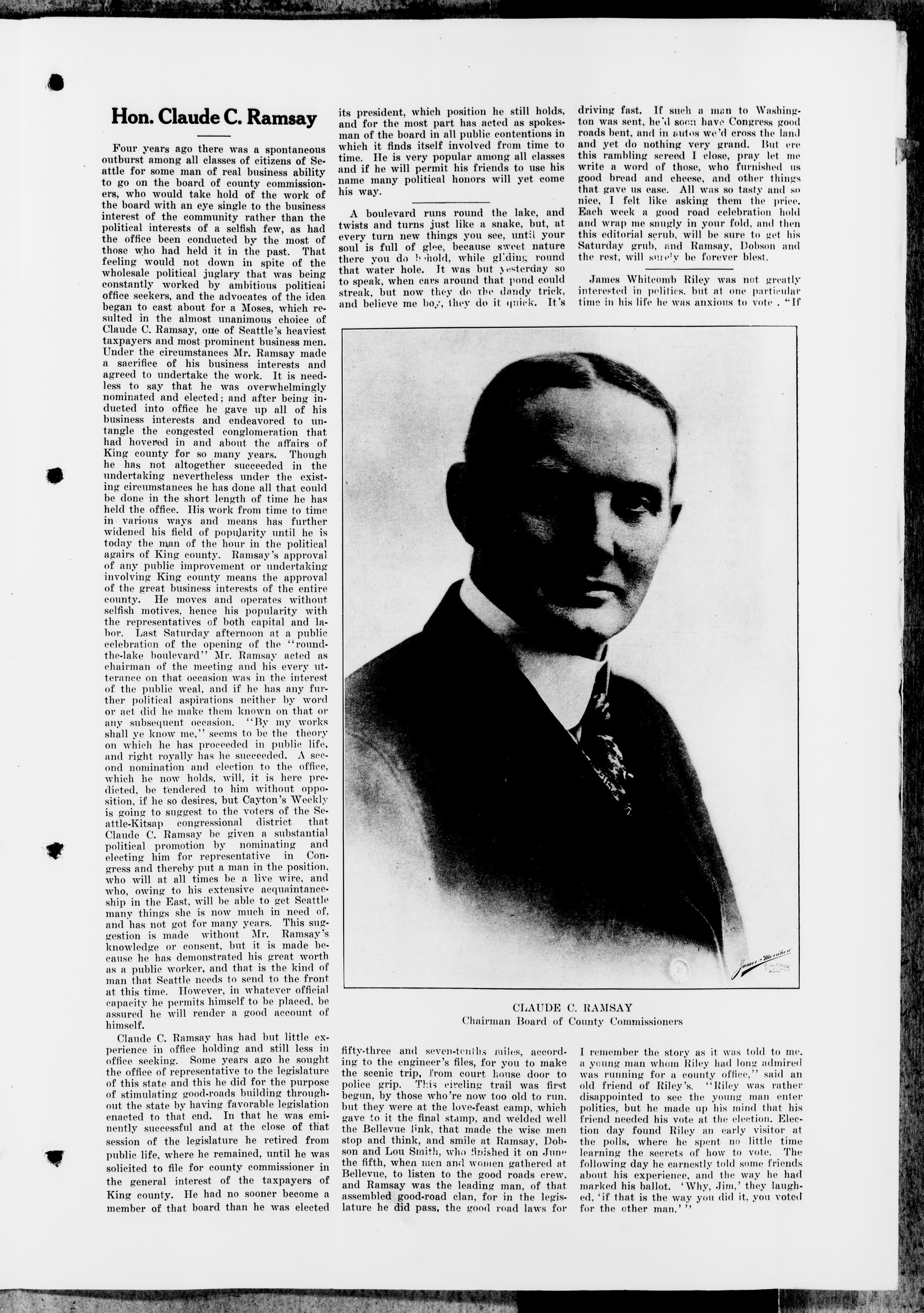
CLAUDE C. RAMSAY Chairman Board of County Commissioners
---
Hon. Claude C. Ramsay
Four years ago there was a spontaneous outburst among all classes of citizens of Seattle for some man of real business ability to go on the board of county commissioners, who would take hold of the work of the board with an eye single to the business interest of the community rather than the political interests of a selfish few, as had the office been conducted by the most of those who had held it in the past. That feeling would not down in spite of the wholesale political juglary that was being constantly worked by ambitious political office seekers, and the advocates of the idea began to cast about for a Moses, which resulted in the almost unanimous choice of Claude C. Ramsay, one of Seattle's heaviest taxpayers and most prominent business men. Under the circumstances Mr. Ramsay made a sacrifice of his business interests and agreed to undertake the work. It is needless to say that he was overwhelmingly nominated and elected; and after being inducted into office he gave up all of his business interests and endeavored to untangle the congested conglomeration that had hovered in and about the affairs of King county for so many years. Though he has not altogether succeeded in the undertaking nevertheless under the existing circumstances he has done all that could be done in the short length of time he has held the office. His work from time to time in various ways and means has further widened his field of popularity until he is today the man of the hour in the political agairs of King county. Ramsay's approval of any public improvement or undertaking involving King county means the approval of the great business interests of the entire county. He moves and operates without selfish motives, hence his popularity with the representatives of both capital and labor. Last Saturday afternoon at a public celebration of the opening of the "round-the-lake boulevard" Mr. Ramsay acted as chairman of the meeting and his every utterance on that occasion was in the interest of the public weal, and if he has any further political aspirations neither by word or act did he make them known on that or any subsequent occasion. "By my works shall ye know me," seems to be the theory on which he has proceeded in public life, and right royally has he succeeded. A second nomination and election to the office, which he now holds, will, it is here predicted, be tendered to him without opposition, if he so desires, but Cayton's Weekly is going to suggest to the voters of the Seattle-Kitsap congressional district that Claude C. Ramsay be given a substantial political promotion by nominating and electing him for representative in Congress and thereby put a man in the position who will at all times be a live wire, and who, owing to his extensive acquaintanceship in the East, will be able to get Seattle many things she is now much in need of, and has not got for many years. This suggestion is made without Mr. Ramsay's knowledge or consent, but it is made because he has demonstrated his great worth as a public worker, and that is the kind of man that Seattle needs to send to the front at this time. However, in whatever official capacity he permits himself to be placed, be assured he will render a good account of himself.
Claude C. Ramsay has had but little experience in office holding and still less in office seeking. Some years ago he sought the office of representative to the legislature of this state and this he did for the purpose of stimulating good-roads building throughout the state by having favorable legislation enacted to that end. In that he was eminently successful and at the close of that session of the legislature he retired from public life, where he remained, until he was solicited to file for county commissioner in the general interest of the taxpayers of King county. He had no sooner become a member of that board than he was elected
its president, which position he still holds, and for the most part has acted as spokesman of the board in all public contentions in which it finds itself involved from time to time. He is very popular among all classes and if he will permit his friends to use his name many political honors will yet come his way.
A boulevard runs round the lake, and twists and turns just like a snake, but, at every turn new things you see, until your soul is full of glee, because sweet nature there you do behold, while gliding round that water hole. It was but yesterday so to speak, when cars around that pond could streak, but now they do the dandy trick, and believe me boy, they do it quick. It's
[Name]
fifty-three and seven-tenths miles, according to the engineer's files, for you to make the scenic trip, from court house door to police grip. This circling trail was first begun, by those who're now too old to run, but they were at the love-feast camp, which gave to it the final stamp, and welded well the Bellevue link, that made the wise men stop and think, and smile at Ramsay, Dobson and Lou Smith, who finished it on June the fifth, when men and women gathered at Bellevue, to listen to the good roads crew, and Ramsay was the leading man, of that assembled good-road clan, for in the legislature he did pass, the good road laws for
---
driving fast. If such a man to Washington was sent, he'd soon have Congress good roads bent, and in autos we'd cross the land and yet do nothing very grand. But ere this rambling screed I close, pray let me write a word of those, who furnished us good bread and cheese, and other things that gave us ease. All was so tasty and so nice, I felt like asking them the price. Each week a good road celebration hold and wrap me snugly in your fold, and then this editorial scrub, will be sure to get his Saturday grub, and Ramsay, Dobson and the rest, will surely be forever blest.
James Whitecomb Riley was not greatly interested in politics, but at one particular time in his life he was anxious to vote. "If
James - the editor
I remember the story as it was told to me, a young man whom Riley had long admired was running for a county office," said an old friend of Riley's. "Riley was rather disappointed to see the young man enter politics, but he made up his mind that his friend needed his vote at the election. Election day found Riley an early visitor at the polls, where he spent no little time learning the secrets of how to vote. The following day he earnestly told some friends about his experience, and the way he had marked his ballot. 'Why, Jim,' they laughed, 'if that is the way you did it, you voted for the other man.'"
---
```markdown
```
STOLEN FROM THIEVES
They were talking about the different places they had visited during the war. One Australian was saying he had enjoyed the privilege of being on guard one night at the gates of Bethlehem. Suddenly another Australian looked up at the first speaker and said: "I'll bet the shepherds watched their flocks that night."
Miss Fortyodd awoke in the middel of the night to find a burglar ransacking her effects. Miss Fortyodd did not scream, for she prided herself, among other things, upon her courage. Pointing to the door with a dramatic gesture, she exclaimed: "Leave me at once!" The burglar politely retreated a step and said: "I had no intention of taking you."
The day before Christmas little Bertram, eight years old, surprised his mamma by saying, "I don't believe there is any Santa Claus. All the kids at school say there isn't." His mamma was properly shocked and said, "Now, honey, I don't think Santa Claus will bring you anything at all. You've let the cat out of the bag this time sure." Nothing was said for some time. Imagine her surprise when he finally said: "Mamma, I do believe in Santa Claus and have put the cat back in the bag."
The evening party was over, and most of the guests had gone, so the story goes. As one young man took leave of the hostess the lady said: "I'm sorry you found Miss Biggle a poor conversationalist." "Poor conversationalist!" exclaimed the guest. "She's absolutely the limit! Why the only thing she said to me during the entire evening was 'No,' and I had to propose to her to get that out of her."
It was just after a thunderstorm, and two men were strolling down the street behind a young damsel who was lifting her skirt rather high. After an altercation as to the merits of the case, one of the men stepped forward and said, "Pardon me, miss, but aren't you holding your skirt rather high?" "Haven't I a perfect right?" she snapped. "You certainly have, miss, and a beauty of a left," he replied at once.
Admiral Mark Kerr said at an airman's wedding: "Women often marry men to reform them, and oftener than people think the women succeed in this. The reformed husbands, however, are seldom grateful. 'My wife married me to reform me,' a man said bitterly on a sea voyage Cubaward. 'Did she succeed?' asked another man. 'You bet she did!' said the first one. 'Why if I lived to be as old as Methuselah I wouldn't marry again.'"
A marriage is always a favorite topic with the ladies, isn't it? So the first time Mabel and Phyllis met after Miss Ann Teek's wedding they discussed it eagerly. "Do you know, she was furious about the way in which the newspaper reported her marriage," said Mabel. "Did it allude to her age?" laughed Phyllis. "Indirectly. It stated that Miss Ann Teek and Mr. Yale were married, the latter being a well-known collector of antiques."
Dr. A. A. Hamerschlag, head of the Carnegie Institute, said at a dinner party recently: "I respect that Kansas school principal who forbade the young girls to wear silk stockings or to powder their faces. Even in Kansas the young girls are getting altogether too sophisticated. I heard the other day of a male drawing teacher out in Kansas who said to a little girl of twelve: 'Minnie, you've neglected your work shamefully and you must remain with me an hour after school.' Minnie shrugged her thin little shoulders. 'Well, professor,' she said, 'if your wife doesn't mind, I'm sure I don't.'"
Baron Rempel Kondo, president of a steamship company, said at a dinner he gave recently in New York: "The Japanese are a very clean people. I know an American traveler who will testify to this. The traveler, half famished, made his way one day into a teahouse in a remote Japanese village. A geisha girl ushered him into a spotless, airy room and brought him a cup of unsweetened tea. As he could speak no Japanese, he tried to explain by signs that he wanted a full meal, but the girl, though she smiled politely, failed to understand. So the traveler thought he would resort to another means. He took out his notebook and pencil, drew a fish and an egg, and handed the drawing to the geisha. This time she laughed delightedly, clapped her hands, and ran from the room. The traveler was pleased. He waited contentedly for his meal. Five or ten minutes passed. Then the door opened and two attendants staggered in with a portable bath, brimful of hot water, and a cake of soap."
IN THE SUPERIOR COURT OF THE STATE OF Washington.
Mary McBride, Plaintiff, vs. Willie Craven McBride, Defendant—No. 143206. Summons by Publication. The State of Washington, To the said Craven McBride, Defendant:
You are hereby summoned to appear within sixty days after the date of the first publication of this summons, to-wit: within sixty days after the 15th day of May, 1920, and defend the above entitled action in the above entitled Court and answer the complaint of the plaintiff and serve a copy of your answer upon the undersigned attorney for the plaintiff at his office below stated and in case of your failure so to do judgment will be rendered against you according to the demand of the complaint which has been filed with the Clerk of said Court.
The object of the above entitled action is to obtain a divorce on the ground of cruelty and non-support.
Z. B. RAWSON,
Attorney for Plaintiff.
P. O. Address: 617 Pacific Block, Seattle, King County, Washington.
May 15, June 24, 1920.
1000 1000 Thousands of Barrels of Refreshing, Exhilerating, Intoxicating Music Poured Out Nightly at the Entertainer's Cabaret
1238 Main Street
By the Best
SYNCOPATED ORCHESTRA
on the Coast
DON'T MISS IT
ENTERTAINER'S CABARET
GILLIE RICHARDSON
RUSSELL WALTON
CAYTON'S WEEKLY
(Office 303 22nd Ave. South) Regular, Reliable, Republican, Readable Wants 500 New Subscribers
This is a Sample of what it sends out Every Week
No Friends to Reward or Enemies to Punish
A Publication of Ideas Rather Than Personalities
Read for Yourself and Be Convinced
Unlike the Chicago convention, the San Francisco convention will be absolutely devoid of either dark or black horses.
Quik wit is indispensable in the vaudeville performer. Witness Beatrice Herford. It was on an occasion when she was giving her entertainment. The audience had been worked up to the proper amount of attention, when a large black cat meandered in from the wings, sat down in the centre of the stage, and undertook its feline ablutions. "Sh! Sh!" came from Miss Herford promptly, as a ripple of laughter arose. "Seat. This is a monologue—not a catalogue." And the feline exited amid the applause of the spectators.
IN THE SUPERIOR COURT OF THE STATE OF Washington for the County of King.
Edward Sweeney and Katherine Sweeney, his wife, plaintiffs, vs. May S. Jones, John Doe Jones, her husband, F. P. Kelly and Jane Doe Kelly, his wife, Defendants.—No. 142,329. Summons by Publication.
The State of Washington, to the said F. P. Kelly and Jane Doe Kelly, his wife, Defendants:
You are hereby summoned to appear within sixty days after the date of the first publication of this summons, to-wit: within sixty days after the 1st day of May, A. D. 1920, and defend the above entitled action in the above entitled Court, and answer the complaint of the plaintiffs, and serve a copy of your answer upon the undersigned attorney for plaintiff at his office below stated; and in case of your failure so to do, judgment will be rendered against you according to the demand of the complaint, which has been filed with the Clerk of said Court. The object of the said action and the relief sought to be obtained therein is fully set forth in said complaint, and is briefly stated as follows: Cancellation of real estate contract for conditions broken and effecting East 187 feet of the North 285 feet of tract 22 of Lake Dell Addition to the City of Seattle, King County, Washington.
Z. B. RAWSON,
Attorney for Plaintiffs.
P. O. Address: 617 Pacific Block, Seattle, County of King, Washington.
May 1-June 19, 1920.
You Are Welcome
GREAT NORTHERN POOL AND
BILLIARD HALL
Cigars, Tobacco and Soft Drinks.
BOYD & WILLIAMS, Props.
1032 Jackson St.
SANDERS & COMPANY
LOANS NEGOTIATED
1003-1004 L. C. Smith Building
Office Hours
From 8:30 A. M. to 5:30 P. M.
Seattle, Wash.
Elliott 4662
Phone East 179
Calls Made Promptly Day or Night
LEWIS & BLACKWELL
FUNERAL DIRECTORS and EMBALMERS
H. Alfred Lewis, Funeral Director
1215 East Marion St., Seattle
ATLAS POOL HALL
Under New Management
Wishes You a
Happy New Year
FELIX CRANE, Manager
1212 Main Street
FURNISHED ROOMS 317 22nd Ave. So. Rooms large and commodious, on car line, but walking distance. MRS. S. R. CAYTON 317 22nd Ave. So.
ALHAMBRA CASH GROCERY
Distributor of Mme. C. J. Walker's Hair and Skin preparations. Mail, postal and express orders promptly filled. 1201-3 Jackson St., Seattle, Wash.
MRS. L. T. GREEN
1101 Washington St., Seattle, Wash. Phone Main 4573. Hair Culture and Scalp Specialist. Will call at your home if desired. Graduate of Oxford College, St. Louis.