Cayton's Weekly
Saturday, July 3, 1920
Seattle, Washington
Page text (machine-generated)
Cayton's Weekly
SEATTLE, WASHINGTON, SATURDAY, JULY 3, 1920
PRICE FIVE CENTS
CAYTON'S WEEKLY
Published every Saturday at Seattle, Washington,
U. S. A.
Subscription $2 per year in advance.
HORACE ROSCOE CAYTON..Editor and Publisher
Entred as second class matter, August 18, 1916, at
the post office at Seattle, Wash., under the Act of
March 3rd, 1916.
TELEPHONE: BEACON 3579
Office 317 22nd Ave. South
WIPING OUT THE COLOR LINE
TO THOSE WHO WAIT—actively everything eventually comes. It is but natural for us to feel that we have had a little harder row to hoe than the other fellow and we have done our full share of complaining without making any strenuous effort to remedy conditions. A whiner and a crybaby never gets very far up life's rickety ladder. The world makes way for the fighter, the self-reliant, determined person who finds no human endeavor impossible and who has on such word in his vocabulary as "can't." We have in the past ten years developed a workable brand of self-determination; that is, have found ourselves and our possibilities. We challenge other groups to show a better right to things truly American than the right that is held by us.
We hold an enviable place in the economic life of this country. The great mass of us must earn our keep by the sweat of our brows, and when through powerful combinations of men our every effort to advance is met with a rebuff, it is little less than morvelous the progress we have made. Now the one big barrier has been swept away, for on June 10th the American Federation of Labor, after a stormy session, which nearly resulted in a fight between delegates from the Northern states and delegates from the Southern states, wiped out the color line and warned its affiliated international unions that hereafter our workers must be given full and equal membership. And from the constitution and by-laws of every local the words "white only" must be eliminated.
They have taken a long step forward, their name now is not a misnomer; they have paved the way to a bigger, stronger and more powerful organisation; they have disarmed their potential enemies and made it possible for our workers to fight with and not against this organization in order to make a living. The opposition of the Southern delegates was met by the level-headed ones of other sections, who knew the very life of the organization was in jeopardy with such a formidable force of black workmen arrayed on the side of capital and against them. Here the law of self-preservation was put into actual practice.
We are not blinded to the fact that our invitation came as a matter of necessity and not of choice. While we have always had many good and loyal friends in the unions, there has ever been an undercurrent of Race hatred strong enough to keep the doors of industry closed against us. However, we intend to forget the past, forget the motive that kept the industrial gates closed to us and join hands with our white fellow worker, knowing full well that without our hearty co-operation they are seriously handicapped and without their backing we have no real foothold. Never was an adage truer than this. "In union there is strength."—Chicago Defender.
The vehicle most talked about in this country just now is the water wagon.
THE DEMOCRATIC PARTY
This is Friday and as we write the Democratic convention is still at sea, so far as a nomination goes, and still further at sea so far as party policy is concerned. Bryan has been squeelched by Wilsonism and Reed of Missouri has been likewise administered to, and still the convention is in a seething surging state of turmoil. The party will be split in twain if it does not put a wet plank into its platform and it will be split just as badly if it does. The party will be split if it does not adopt Wilson's League of Nations ideas and be worse split if it does. The party will be split into smithereens if it nominates either McAdoo or Wilson and just as badly split if it nominates Cox or Edwards, and to nominate Bryan would simply mean suicide. However, Cox is the only man that would have a ghost of a show at winning and he has none at all. The South is in the saddle and under the leadership of Burleson, the brute force, so characteristic of Texas, is domineering the convention. Eight years of rule has completely wrecked the Democratic party and now the assumed leaders thereof who have fed at the public crib, are bluntly proclaiming the "people be damned," this convention will go our way or it won't go any way. But let the heathen rage as he is no longer in a position to do the public any very great damage. The king is dead (politically) and the Clown Prince will die if he ever gets in the race. Bryan can no longer consistently be a Democrat and Cox would be so bitterly opposed by the wet faction of the party that he would be ignominiously defeated. The whole Democratic convention mess spells Harding and Coolidge for president and vice president. So promote it be.
HERE AND THERE
At the close of the Fifteenth Annual Session of the Baptist Sunday School Congress, Henry Allen Boyd, secretary of the congress, placed a magnificent floral tribute on the tomb of the immortal Abraham Lincoln in the name of one million Sunday School scholars, descendants of the slaves emancipated by the martyred Lincoln. Such tributes are great reminders of the living of the commendable deeds and acts of the dead.
Two papers published by colored men and both claiming to be the greatest and most widely circulated in the world operated by colored folks, are finding great cause for rejoicing in a recent court decision. It seems that one editor published statements reflecting upon the integrity of the other, at least from his view point, and the aggrieved resorted to the courts for redress. The case finally came on for hearing and after a hotly contested legal battle for days the aggrieved was given a verdict of six cents damages to liquidate a $200,000 demand. The defeated editor is all swelled up and says the verdict was equal to acquittal, while the successful editor says it has established its contentions and the dollars and cents asked for were but a coincident in the mighty battle. However, if both are happy the public should be tickled to death.
In spite of the scenes of Chicago, Omaha and Duluth there are scenes going on in the South a thousand times more grave than either of the above because they affect multiplied millions, while the places cited above
VOL. V., NO. 2
are but sporadic and spasmodic outbreaks. The following bit of news from various points of the South will give the reader some faint idea of the ceaseless turmoil that goes on in that section from day to day between the whites and blacks, which prevents the South from being the garden spot of the United States. Jackson, Miss., June 28. At the last meeting of the Jackson board of trade J. W. Tucker stated that the labor shortage had become a serious menace to the business interests of the city and state; that another exodus was now on, stronger than ever before, and apparently gathering force and strength. When a canvass was made to determine the cause for the rush North agents of the business men found that in every case the men declared they had suffered untold humiliation from the South and sought other shores in which to live in comfort and safety from mob violence and lynching.
One man, a minister, who was preparing to move his family to Detroit, Mich., declared that "ex-Senator James K. Vardaman and a colored man could not live together happily in the same state."
Just about the same time as the Mississippi unrest reached its high water mark a like occurrence took place in Georgia which is here with recounted:
Rincon, Ga., June 25.——This town is practically deserted today. All plows are idle and white farm owners are pleading with their laborers to remain here. But nothing will induce the members of our Race to live in this section following the lynching of Phillip Gaithers. Efforts to stop the sale of tickets for people who desired to go to Savannah began too late. A carload of farm laborers had left here before the white men were aware of the exodus.
Gaithers had been accusd of murdring a white girl, Miss Anna Jaudon, age 17, but it was later rumored that the girl was slain by her sweetheart and that Gaither had driven him to the spot in a buggy where the crime was committed. Gaithers was chained to a tree and oil poured on his clothing, but when an effort was made to apply the torch he broke the chains. He was riddled with bullets in the attempt to escape."
But there are millions of colored people in the South all of whom cannot come North and the southern white man is quite cognizant of that fact, and knowing that his treatment of the colored man will not be very greatly improve for the next quarter of a century. If two or three million colored citizens of the South could only get located in Mexico, what a blessing it would be to all concerned. Such a migration ought to please well the southern white man as he could feel as it was a good riddance of bad rubbish, such migration ought to please well the colored man as he would be escaping the brutal and savage treatment of the white howling hyenas and finally such a migration ought to please well the Mexican authorities as that country would be the recipient of a great army of hard working men and women who would till their soil and develop their country, even if they did so under disadvantages.
It's amusing in the extreme to hear the southern delegates to the San Francisco convention tell about the horrors of Armenia when no crime was ever perpetrated in Armenia that could be remotely compared to the brutalities those self-same delegates have practiced upon the colored citizens of the South.
+
THE PASSING THRONG
If there be any difference between the average intelligence of an audience made up of colored women in the Northwest and one made up of white women, then the late convention of the Federation of Colored Women's Clubs of Washington and jurisdiction gave no evidence of such a fact. I sat through one of its sessions and I heard colored women speak, sing and perform on musical instruments and from an educational as well as artistical stand point, if only the sounds from that hall could have reached the most critical critic, it would have been impossible for said critic to have told from such sounds whether said audience was made up of white or colored persons. The annual address of Mrs. Maps was gramatically, rhetorically and classically magnificent and I seriously doubt if it could be discounted by any white woman in this state, even though she be connected with some of the higher schools of learning. As a piano performer I doubt if the renditions of Mrs. N. J. Asberry could be surpassed by any white performer in the Northwest and as in these two instances so also with every one that I heard in that session. I am trying to get out of all this the fact that the colored women of this country will favorably compare with their white sisters, their color handicap to the contrary notwithstanding. Women could have been selected from that convention, who would creditably represent the women of the State of Washington, irrespective of color or creed, in any national or even international gathering assembled for the betterment of womanhood.
* * *
"Not Guilty!" said B. F. Tutt last Saturday morning, when the editor hereof charged him with bootlegging and offered as evidence a long-legged Missouri-looking mountaineer, who was at that moment staggering by Tutt's shop door so drunk that he thought he was in Heaven and had gotten in by mistake and was wandering about the room hoping to find some place of egress through which he could make his get-away. Drunken men are so seldom seen on the streets that every barber in Tutt's shop had deserted his customer and stood watching the preambulations of old John Barleycorn, and observing the interest they were taking in him it occurred to me that I could charge the proprietor with the offense even though one of his men may have been the guilty one as the proprietor is always responsible for the acts of his employees; and one of the employees must have been guilty, I reasoned, thusly, because there was the prima facie evidence before my eyes. None of the above is true save the drunken man, but I thought it was a good joke at Tutt's expense.
* * *
Talk about telling a joke at Tutt's expense reminds me of one that I got off on Tutt some time ago. I happened to be going by his shop and observed that he was sitting in the barber chair of George E. Haves, who was engaged in cutting his hair. Tutt did not see me enter the shop, but I walked up to George and in a loud and offensive tone of voice said: "Since when, George, did you begin to cut nigger's hair in this shop?" It was like a clap of thunder from a clear sky and Tutt almost jumped out of the chair. He looked up at me in a bewildered state of mind and then let loose a sickly smile to feel me out, and not being able to longer
keep a straight face, all present enjoyed the joke at Tutt's expense. He didn't say, "have something on me," but evidently he did not treat me as considerately as somebody had treated the staggering stew last Saturday morning.
* * *
In selecting Mrs. W. D. Carter as the delegate from the Washington Federation of Colored Women's Clubs no mistake was made and, in my opinion, she will be one of the able representative on the floor of the National Convention, which will be held in Tuskegee early in July. Mrs. Carter not only has the ability, but she has had the convention experience and she will be a valuable asset to the national organization. She is vice-president of the state organization and has proved her worth in its work. In Seattle she heads the branch Y. W. C. A., which seems to be accomplishing much in the efforts it has undertaken. She is the wife of the Rev. W. D. Carter, pastor of the Mt. Zion Baptist church and in that work she has been a valuable assistant to her husband.
* * *
At funerals the "cuss" feeling seldom ever comes over one attending, but I must admit that I felt very much like saying "damn it" last Sunday afternoon as a funeral procession was leaving for the cemetary and I, with a face as long as my arm, prepared to follow in its wake. I had just started my engine when some one said "you have a flat tire" and I rolled out to make an examination as to its cause and found a ten-penny nail up to the head in my tire and inner tube, and I had no spare. I silently beat it for home and parked the car for the night and wondered the balance of the evening why damphools would throw nails in the streets, where not less than 100,000 automobiles pass over. A spare now hangs on my bus and if there is ever another funeral, which I desire to follow, I'll try to do so, nail or no nali.
* * *
"In moving from my present location to 206 Twenty-fifth avenue North it is with the view of laying the foundation for a bigger and a better business," said George S. Chatters. "About a year ago," he continued, "my wife and I started a hand laundry in a small way and we have done so well with it that we have moved to this location, where we have the room to broaden out and operate on a business like scale. We plan to do a general laundry business and increase our help as the business grows. Quite a few men already patronize us by sending their dress shirts to us to be laundered, which always pays well." Such beginnings as this often develop into gigantic business concerns and I have often wondered why colored persons were not the owners of many laundry establishments like this throughout the city. I really believe if fifty or more such establishments were begun in various parts of the city they would all do well. Every one should attempt to do those things he or she knows the most about or seem better adapted to do and if he did there would be more success recorded. Here is to hoping that the new venture will bring to its proprietors sufficient amount of money to make that section of the city chatter like Chatters.
* * *
Tomorrow will be Fourth of July., but it will be Sunday, which will restrain the most of us from having our usual "hell-of-a-time", so common to such occasions, but by proclamation Monday has been declared a legal
A. D. SMITH B. BIRD Proprietors Phone Beacon 113 B & B PANATARIAN Cleaning, Pressing and Repairing Ladies Work a Specialty We Call for and Deliver TRY JIMMIE THE SHINE KING Shine Parlor for Ladies and Gents 1218 Jackson Street
O
holiday and all of us will do the act on Monday. If it only happens that Monday will be like unto the day on which this "junk" is being written it "sho' will be some day," and if gasoline is plentiful on that occasion pretty nearly all Seattle will be on wheels and will almost drive their fool selves to death.
* * *
Mr. Gustave B. Aldrich of Tacoma was attending to business in Seattle last Wednesday. He is the Tacoma representative of a Seattle "weakly" paper and judging from the advertisements he has secured, that Tacoma end is doing a bully good business. I enquired of him about the health of my friend Lawhorn, which he reported fairly good. "Ryan, in my opinion, is doing well," he replied to my enquiry. He has hooked up with the Triple Alliance and seems to be in a fair way to make a great political hit. No. I am neither independent nor partisan in politics, I am just paying no attention to it as I see nothing in it for the black man. I, however, am dead opposed to segregated Republican clubs, and will do my best to exterminate every one I can. But, be good, there is my car."
***
As I was passing the Haller building last Thursday I saw Joe Bennett moving his belongings from that building, thereby quitting a position, which he has held continuously for the past thirty-two years. Joe and the Haller, for all of those years, were as near one and the same as man and building could possibly be. He was generally there from 6:30 in the morning until 8 p. m. and had complete charge of the building. That he made more than good is seen from the number of years he held the position. I have no idea as to whether or not the former owners of the building have made any provision for the few remaining years he has to live, he now being far advanced in his seventies, but if ever a faithful servant deserved to be retired on a life pension Joe Bennett does and I truly hop he will be so rewarded. "For the present I am going to take a good long rest," said Mr. Bennett.
WHAT THEY WANT
Oh, the flowers are blooming in Dixie,
The skies are as blue as can be.
And the cotton is bursting with softness.
Just as far as the vision can see.
It's a wonderful place to be happy,
With the banjos at twilight in June,
Whie the Race folks are dancing their break-
downs.
By the light of a soft Southern moon.
They dance, though their hearts may be
aching;
They laugh with their eyes full of tears,
While their souls burn with righteous re-
sentment.
At the bitter injustice of years. Dixie's theirs, so why should they leave it? The taters, the cotton, the corn. All tended by hands brown and loving. Since the day that the southland was born. Jim-crowed segregated, disfranchised. Fighting hard to hold fast what they've won.
How soon is forgotten their courage,
The sacrifice fare that they made:
There's a debt Uncle Sam is still owing
To the Race, that can never be paid.
Oh, the flowers are blooming in Dixie,
As they ought to be blooming today
In the heart of each Race man and woman,
To drive all the heartache away.
What they need in the South isn't franchise,
Nor things manufactured above;
Nor pity nor half-hearted tolerance,
But plain every-day bretherly love.
—Edna Perry Booth.
Bridget O'Flynn—Toimes have changed indade. Norah O'Toole—'Tis true fur yes! Oi used to cook fur women that Oi wouldn't play bridge wid nowadays.—Life.
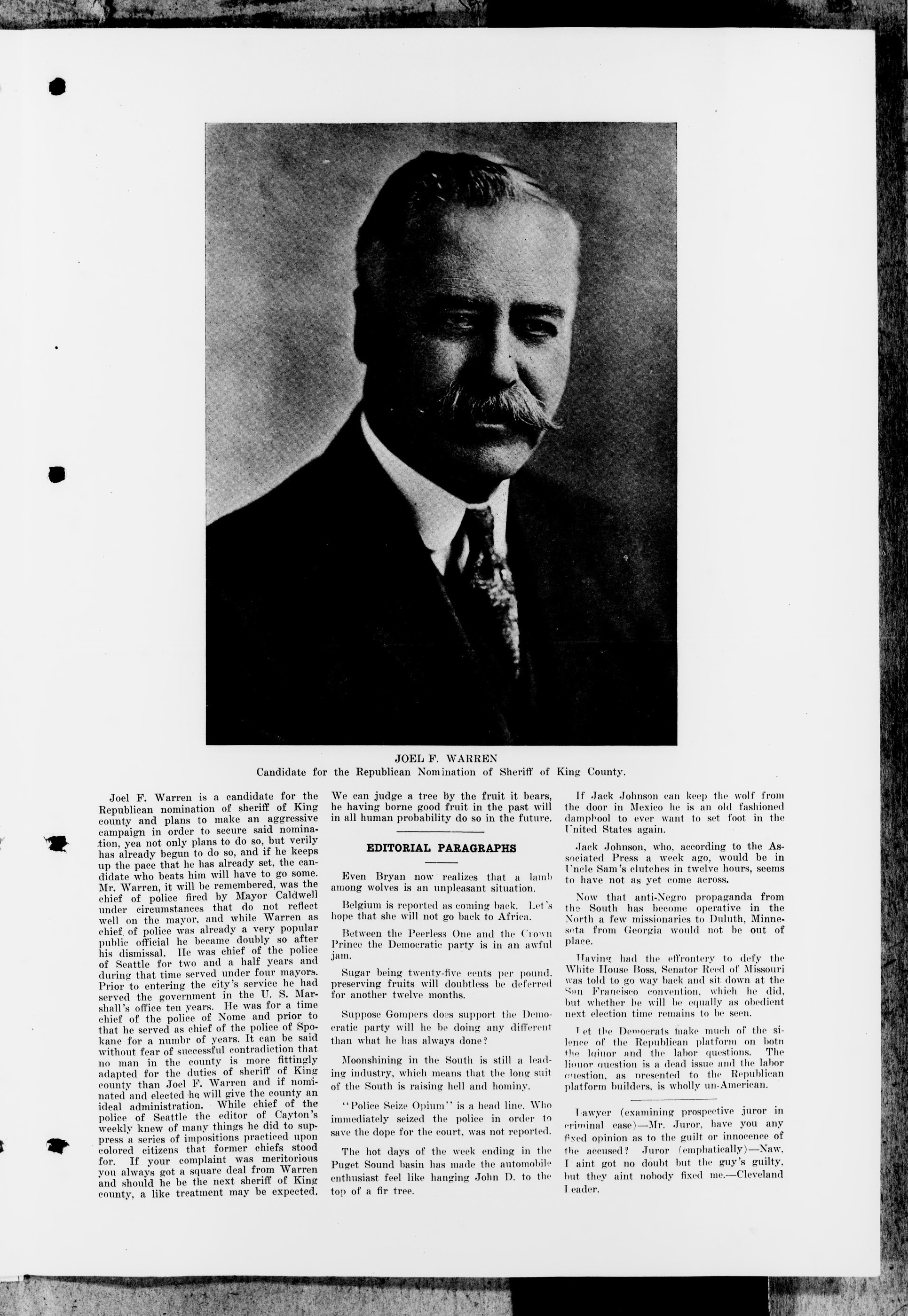
Candidate for the Republican Nomination of Sheriff of King County.
Joel F. Warren is a candidate for the Republican nomination of sheriff of King county and plans to make an aggressive campaign in order to secure said nomination, yea not only plans to do so, but verily has already begun to do so, and if he keeps up the pace that he has already set, the candidate who beats him will have to go some. Mr. Warren, it will be remembered, was the chief of police fired by Mayor Caldwell under circumstances that do not reflect well on the mayor, and while Warren as chief of police was already a very popular public official he became doubly so after his dismissal. He was chief of the police of Seattle for two and a half years and during that time served under four mayors. Prior to entering the city's service he had served the government in the U. S. Marshall's office ten years. He was for a time chief of the police of Nome and prior to that he served as chief of the police of Spokane for a numbr of years. It can be said without fear of successful contradiction that no man in the county is more fittingly adapted for the duties of sheriff of King county than Joel F. Warren and if nominated and elected he will give the county an ideal administration. While chief of the police of Seattle the editor of Cayton's weekly knew of many things he did to suppress a series of impositions practiced upon colored citizens that former chiefs stood for. If your complaint was meritorious you always got a square deal from Warren and should he be the next sheriff of King county, a like treatment may be expected.
JOEL F. WARREN
We can judge a tree by the fruit it bears, he having borne good fruit in the past will in all human probability do so in the future.
EDITORIAL PARAGRAPHS
Even Bryan now realizes that a lamb among wolves is an unpleasant situation.
Belgium is reported as coming back. Let's hope that she will not go back to Africa.
Between the Peerless One and the Crown Prince the Democratic party is in an awful jam.
Sugar being twenty-five cents per pound, preserving fruits will doubtless be deferred for another twelve months.
Suppose Gompers does support the Democratic party will he be doing any different than what he has always done?
Moonshining in the South is still a leading industry, which means that the long suit of the South is raising hell and hominy.
"Police Seize Opium" is a head line. Who immediately seized the police in order to save the dope for the court, was not reported.
The hot days of the week ending in the Puget Sound basin has made the automobile enthusiast feel like hanging John D. to the top of a fir tree.
---
If Jack Johnson can keep the wolf from the door in Mexico he is an old fashioned dampbool to ever want to set foot in the United States again.
Jack Johnson, who, according to the Associated Press a week ago, would be in Uncle Sam's clutches in twelve hours, seems to have not as yet come across.
Now that anti-Negro propaganda from the South has become operative in the North a few missionaries to Duluth, Minnesota from Georgia would not be out of place.
Having had the effrontery to defy the White House Boss, Senator Reed of Missouri was told to go way back and sit down at the San Francisco convention, which he did, but whether he will be equally as obedient next election time remains to be seen. Let the Democrats make much of the silence of the Republican platform on both the liuior and the labor questions. The liuior question is a dead issue and the labor question, as presented to the Republican platform builders, is wholly un-American.
Lawyer (examining prospective juror in criminal case)—Mr. Juror, have you any fixed opinion as to the guilt or innocence of the accused? Juror (emphatically)—Naw, Iaint got no doubt but the guy's guilty, but theyaint nobody fixed me.—Cleveland Leader.
---
```markdown
```
PURELY PERSONAL
Mr. Johnnie Green left last Wednesday for Denver where he will visit for some time with relatives.
Mrs. W. D. Carter leaves for Tuskegee, Alabama, Sunday evening and will be absent for about one month.
Mr. Fred Mitchell of Tacoma attended to business in Seattle last Tuesday. He was for many years a resident of Seattle and still owns valuable real estate here.
Mrs. Ada Pritchard, for a number of years a resident of Seattle and a valuable member of the Mt. Zion Baptist church, was buried from that church last Monday and the funeral rites were largely attended, the Rev. W. D. Carter officiating.
The remains of Mrs. Jennie Clark were laid to rest last Sunday afternoon in the Lakeview cemetery. Her funeral was preached at the First A. M. E. Church, which was very largely attended, the Rev. D. A. Graham, officiating with the Revs. Carter and Barber assisting. Mrs. E. N. J. Simms and daughter of Spokane were for three days of the present week guests at the home of Mrs. S. C. Winston, where they were seen by a great many of our citizens. They left for their home last Tuesday and Mrs. Simms will immediately leave for Tuskeeegee. While away she will visit her old home in Mississippi.
STOLEN FROM THIEVES
In an Irish case of a domestic riot involving much injury to person and property, a witness in the course of a vivid narrative swore as follows: "He says to me, 'Is that your father?' And I says to him, 'It is me father.' And he says, 'It is well you told me for I thought he was an ould gorilly,' and then the fight began, me lord."
He hated having his photograph taken, but his wife, indirectly, had forced him to undergo the much-dreaded ordeal. When she saw the photograph she cried out in horror, "Oh, George, you have only one button on your coat!" "Thank heavens," replied friend husband, "you've noticed it at last. That's why I had the photograph taken."
The newly-married couple had arrived at the stage when they invent little pet names for each other. They were seated in the drawing-room one evening when the man said to his wife: "And is my little duckie quite comfy in her little armchair?" "Yes, lovebird." "And is my popsy quite free from draughts?" "Yes, sweety." "Well, change seats."
Ernest Hardecastle dropped into the Hennessy grocery department yesterday and asked for "a dozen black hens eggs." The puzzled clerk stared at him. "I can't tell a black hen's egg from a white one," he said. "I can," said Hardecastle. "All right," responded the clerk, "go to it." Hardecastle began to pick through the case. "Here," exclaimed the clerk a moment later, "you can't do that, you know. You are picking all the big eggs." "Sure I am," said Ernest. "That's the way you tell a black hens egg."
Aunt Mary had been introduced to all the friends of the family while visiting her brother. Now, womanlike, she was trying to discover if her niece favored any young man especially. "That young Mr. Smarte who comes here seems a clever sort of man, Maude," she began. "Yes," replied Maude, "he is clever." "What is his profession?" "A bit of lawyer and a bit of musician." "But what is he really?" asked aunty, puzzled. "Well," explained the girl, "the lawyers say he is a musician, and the musicians say he is a lawyer."
Dr. W. N. Prottsman was a Methodist preacher in Missouri for sixty years and in his prime was known as the Henry Ward Beecher of Missouri. The clergyman used to tell the story of his first sermon, which was preached in a backwoods district in the
mountains of Virginia. He had prepared an elaborate discourse and delivered it in what he thought was a masterly way. After the sermon he asked an old man in the congregation what he thought of the effort. "I tell you, pa'son," said the old man. "We uns up here in this neck o' the woods would rather have a lump o' sugar no bigger'n a hickory nut than a hull bucket o' sap."
It was a scrubby little room in a scrubby little part of a scrubby little city's suburbs, and the London traveler didn't approve at all. When he went to wash he found that there was no water for the basin, no soap to wash with, and no towel to dry himself with. So he rang. Five minutes' interim bringing no answer, he rang again and then again and again, until his arm ached. At the end of twenty minutes a waiter of forbidding aspect opened the door. "Did you ring?" he inquired in a bass rumbling voice. "Of course I did!" snapped the London visitor. "Well," said the waiter, as he withdrew, "don't do it again! You'll wake the missis."
Two Mississippi girls, who are attending a young ladies seminary in Washington, paying their first visit to the Capitol, called upon Senator Pat Harrison of Mississippi before going to the Senate gallery to see that august body at work. Later Senator Harrison, seeing the girls from the Senate floor, decided that it would be very pleasant to have the two pretty girls at luncheon with him. He went to the gallery and said: "I would be very much honored if you young ladies would take luncheon with me." "We would be charmed," chorused fifteen sweet voices, and thereupon fifteen pretty girls, the entire party from the seminary, rose up and joined him.
A regiment of Rhode Island national guardsmen were holding rifle practice within the confines of their native state early in the recent war. When the range was hiked to 1000 an inaccurate doughboy shot high and killed a cow that was placidly grazing in the neighboring state of Massachusetts. The owner of the cow was very decent when he filed his bill of complaint, that eventually came to the official notice of the Rhode Island adjutant-general. He wrote: "I am glad to see that you boys in Rhode Island are indulging in the patriotic practice of rifle shooting. But for the sake of the rest of my live stock I would request that hereafter you please shoot lengthwise in your state."
"The stock you sold me is full of water." "Well," said the agent, "have a blotter." —Judge.
"Did the captain do anything to clean up the precinct?" "Some say he got sixty thousand in a month."—Louisville Courier-Journal.
Mrs. Knicker—Have you had a busy week? Mrs. Bocker—Rather; I've had two husbands, three landlords, and four cooks.—New York Globe.
Jonah was much perturbed. "You can't
1000 1000
Thousands of Barrels
of
Refreshing, Exhilerating, Intoxicating Music
Poured Out Nightly at the
Entertainer's Cabaret
1238 Main Street
By the Best
SYNCOPATED ORCHESTRA
on the Coast
DON'T MISS IT
ENTERTAINER'S CABARET
GILLIE RICHARDSON
RUSSELL WALTON
even try to live in a whale without being evicted in three days,” he mourned.—Toledo Blade.
The Cow—What do you think of this daylight saving? The Rooster—Easy enough. I just turned my crow forward an hour.—Detroit Free Press.
“‘A penny for your thoughts.’ So the old saying had it.’” “Well?” “But I just had to pay 38 cents for overdue postage on some little thoughts of mine that came back in a bulky envelope.”—Louisville Courier-Journal.
HOW PRODUCTION FELL OFF LAST YEAR
We have been getting false ideas about the magnitude of the business the country is doing, remarks the editor of Forbes. One reason is that we reckon in dollars, not in quantities, and we forget that prices have about doubled since the war began. So this financial writer picks out a few significant figures from a report of the Controller of the Currency showing how little was actually produced in 1919 as compared with former years: Bituminous coal, 130,000,000 tons less than 1918. Anthracite coal, 12,000,000 tons less than 1918.
Steel ingots, 9,000,000 tons less than 1918.
Cotton, 5,106,000 bales less than 1914.
Wheat, 76,000,000 bushels less than 1915.
Corn, 142,000,000 bushels less than 1917.
Copper, 900,000,256 pounds less than 1918.
Gold, $10,157,900 less than 1918.
Silver, $4,789,919 less than 1918.
You Are Welcome
GREAT NORTHERN POOL AND
BILLIARD HALL
Cigars, Tobacco and Soft Drinks.
BOYD & WILLIAMS, Props.
1032 Jackson St.
SANDERS & COMPANY
LOANS NEGOTIATED
1003-1004 L. C. Smith Building
Office Hours
From 8:30 A. M. to 5:30 P. M.
Seattle, Wash.
Elliott 4662
Phone East 179
Calls Made Promptly Day or Night
LEWIS & BLACKWELL
FUNERAL DIRECTORS and EMBALMERS
H. Alfred Lewis, Funeral Director
1215 East Marion St., Seattle
ATLAS POOL HALL
Under New Management
Wishes You a
Happy New Year
FELIX CRANE, Manager
1212 Main Street
FURNISHED ROOMS
317 22nd Ave. So.
Rooms large and commodious, on car
line, but walking distance.
MRS. S. R. CAYTON
317 22nd Ave. So.
ALHAMBRA CASH GROCERY
Distributor of Mme. C. J. Walker's Hair and Skin
preparations. Mail, postal and express orders
promptly filled. 1201-3 Jackson St., Seattle, Wash.
MRS. L. T. GREEN
1101 Washington St., Seattle, Wash. Phone Main
4573. Hair Culture and Scalp Specialist. Will
call at your home if desired. Graduate of Oxford
College, St. Louis.