Cayton's Weekly
Saturday, July 10, 1920
Seattle, Washington
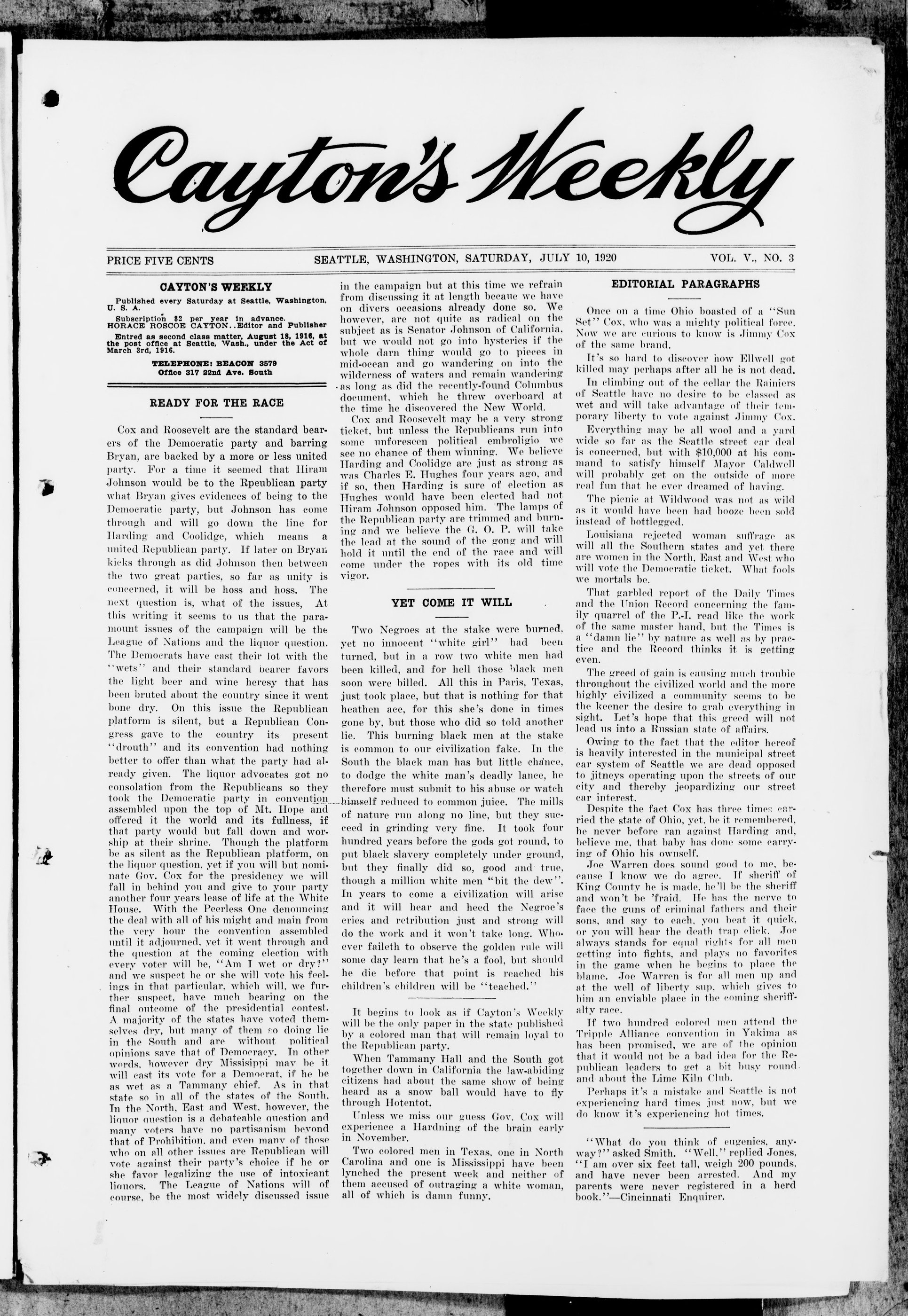
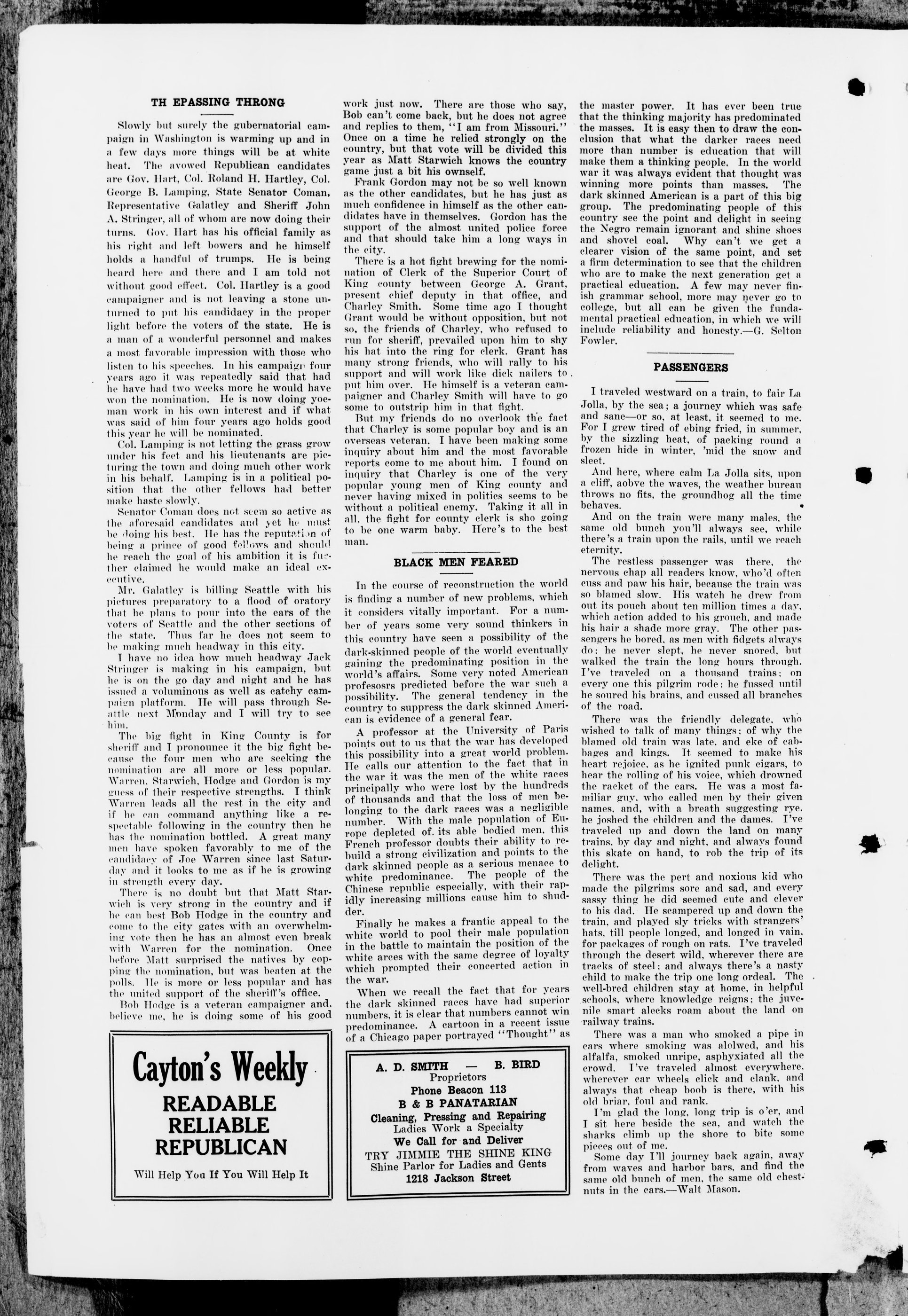
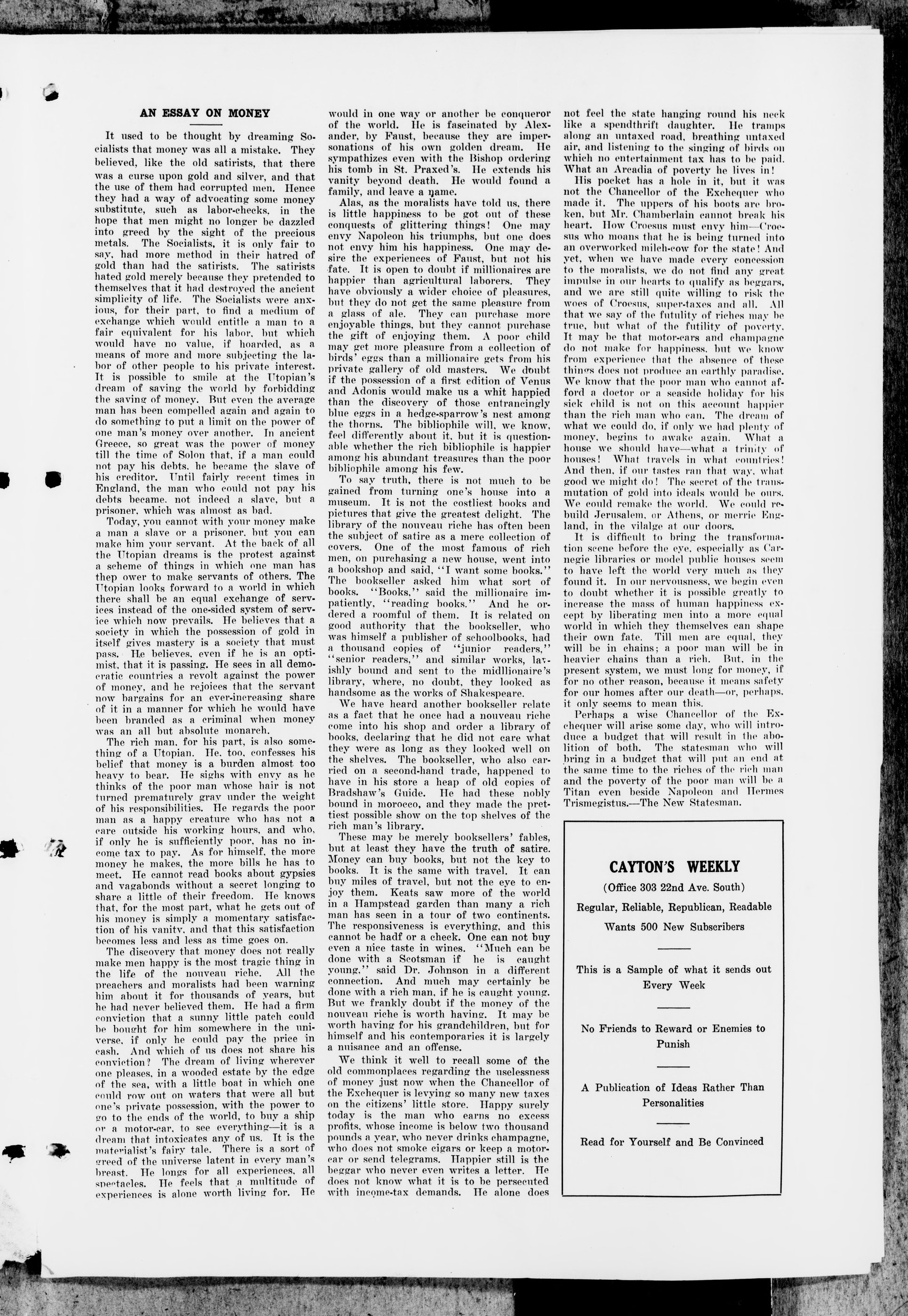
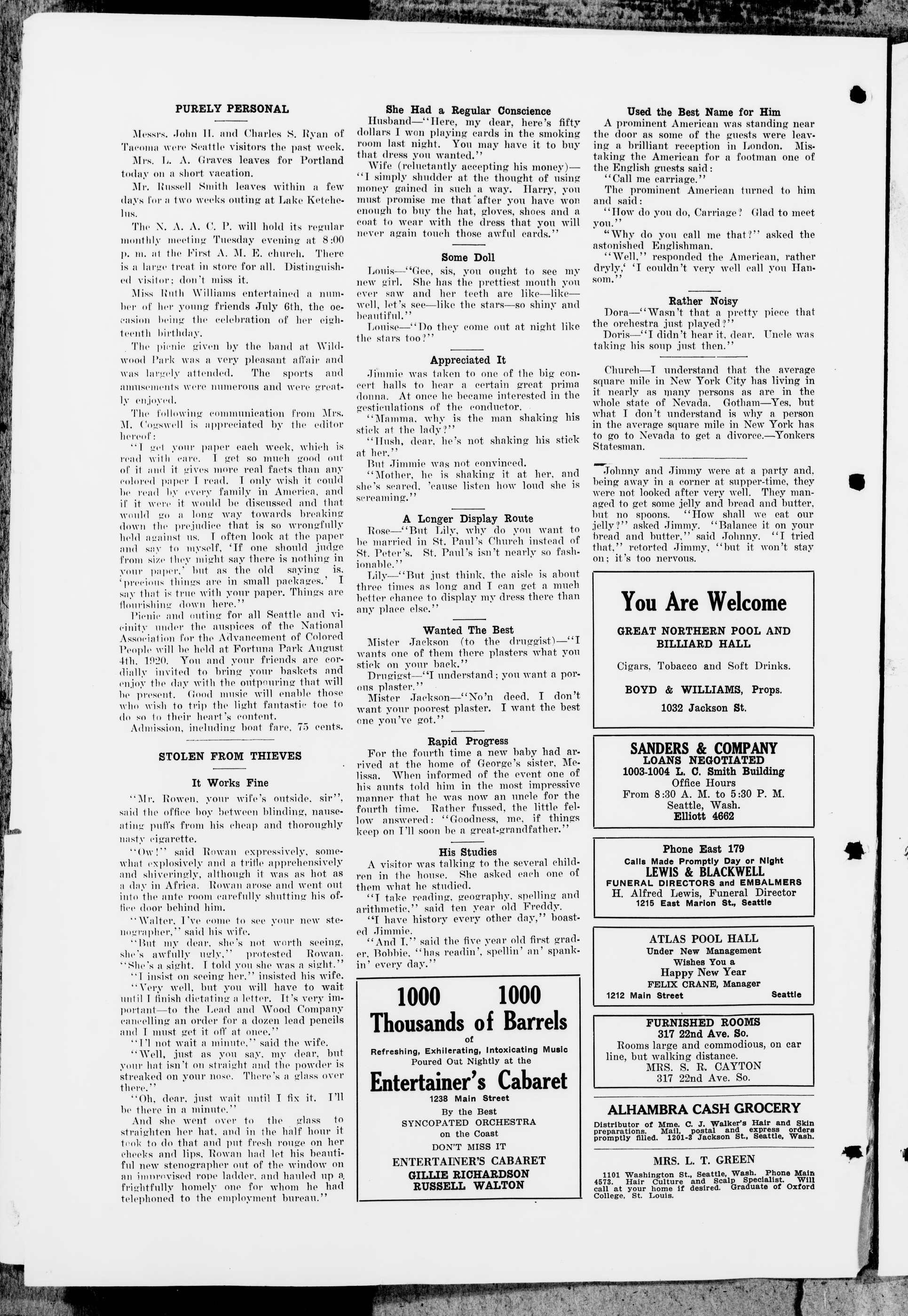
Page text (machine-generated)
Cayton's Weekly
PRICE FIVE CENTS
CAYTON'S WEEKLY
Published every Saturday at Seattle, Washington,
U. S. A.
Subscription $2 per year in advance.
HORACE ROSCOE CAYTON..Editor and Publisher
Entred as second class matter, August 18, 1916, at
the post office at Seattle, Wash., under the Act of
March 3rd, 1916.
TELEPHONE: BEACON 3579
Office 317 22nd Ave. South
READY FOR THE RACE
Cox and Roosevelt are the standard bearers of the Democratic party and barring Bryan, are backed by a more or less united party. For a time it seemed that Hiram Johnson would be to the Rpeublican party what Bryan gives evidences of being to the Democratic party, but Johnson has come through and will go down the line for Harding and Coolidge, which means a united Republican party. If later on Bryan kicks through as did Johnson then between the two great parties, so far as unity is concerned, it will be hoss and hoss. The next question is, what of the issues, At this writing it seems to us that the paramount issues of the campaign will be the League of Nations and the liquor question. The Democrats have cast their lot with the "wets" and their standard bearer favors the light beer and wine heresy that has been bruted about the country since it went bone dry. On this issue the Republican platform is silent, but a Republican Congress gave to the country its present "drouth" and its convention had nothing better to offer than what the party had already given. The liquor advocates got no consolation from the Republicans so they took the Democratic party in convention assembled upon the top of Mt. Hope and offered it the world and its fullness, if that party would but fall down and worship at their shrine. Though the platform be as silent as the Republican platform, on the liquor question, yet if you will but nominate Gov. Cox for the presidency we will fall in behind you and give to your party another four years lease of life at the White House. With the Peerless One denouncing the deal with all of his might and main from the very hour the convention assembled until it adjourned, yet it went through and the question at the coming election with every voter will be, "Am I wet or dry?" and we suspect he or she will vote his feelings in that particular, which will, we further suspect, have much bearing on the final outcome of the presidential contest. A majority of the states have voted themselves dry, but many of them so doing lie in the South and are without political opinions save that of Democracy. In other words, however dry Mississippi may be it will cast its vote for a Democrat, if he be as wet as a Tammany chief. As in that state so in all of the states of the South. In the North, East and West, however, the liquor question is a debateable question and many voters have no partisanism beyond that of Prohibition, and even many of those who on all other issues are Republican will vote against their party's choice if he or she favor legalizing the use of intoxicant liquors. The League of Nations will of course, be the most widely discussed issue
SEATTLE, WASHINGTON, SATURDAY, JULY 10, 1920
in the campaign but at this time we refrain from discussing it at length because we have on divers occasions already done so. We however, are not quite as radical on the subject as is Senator Johnson of California, but we would not go into hysteries if the whole darn thing would go to pieces in mid-ocean and go wandering on into the wilderness of waters and remain wandering as long as did the recently-found Columbus document, which he threw overboard at the time he discovered the New World.
Cox and Roosevelt may be a very strong ticket, but unless the Republicans run into some unforeseen political embroligio we see no chance of them winning. We believe Harding and Coolidge are just as strong as was Charles E. Hughes four years ago, and if so, then Harding is sure of election as Hughes would have been elected had not Hiram Johnson opposed him. The lamps of the Republican party are trimmed and burning and we believe the G. O. P. will take the lead at the sound of the gong and will hold it until the end of the race and will come under the ropes with its old time vigor.
YET COME IT WILL
Two Negroes at the stake were burned, yet no innocent "white girl" had been turned, but in a row two white men had been killed, and for hell those black men soon were billed. All this in Paris, Texas, just took place, but that is nothing for that heathen ace, for this she's done in times gone by, but those who did so told another lie. This burning black men at the stake is common to our civilization fake. In the South the black man has but little chance, to dodge the white man's deadly lance, he therefore must submit to his abuse or watch himself reduced to common juice. The mills of nature run along no line, but they succeed in grinding very fine. It took four hundred years before the gods got round, to put black slavery completely under ground, but they finally did so, good and true, though a million white men "bit the dew". In years to come a civilization will arise and it will hear and heed the Negroe's cries and retribution just and strong will do the work and it won't take long. Whoever faileth to observe the golden rule will some day learn that he's a fool, but should he die before that point is reached his children's children will be "teached."
It begins to look as if Cayton's Weekly will be the only paper in the state published by a colored man that will remain loyal to the Republican party.
When Tammany Hall and the South got together down in California the law-abiding citizens had about the same show of being heard as a snow ball would have to fly through Hotentot.
Unless we miss our guess Gov. Cox will experience a Hardning of the brain early in November.
Two colored men in Texas, one in North Carolina and one is Mississippi have been lynched the present week and neither of them accused of outraging a white woman, all of which is damn funny.
VOL. V., NO. 3
EDITORIAL PARAGRAPHS
Once on a time Ohio boasted of a "Sun Set" Cox, who was a mighty political force. Now we are curious to know is Jimmy Cox of the same brand.
It's so hard to discover now Ellwell got killed may perhaps after all he is not dead.
In climbing out of the cellar the Rainiers of Seattle have no desire to be classed as wet and will take advantage of their temporary liberty to vote against Jimmy Cox.
Everything may be all wool and a yard wide so far as the Seattle street car deal is concerned, but with $10,000 at his command to satisfy himself Mayor Caldwell will probably get on the outside of more real fun that he ever dreamed of having.
The picnic at Wildwood was not as wild as it would have been had booze been sold instead of bottledgged.
Louisiana rejected woman suffrage as will all the Southern states and yet there are women in the North, East and West who will vote the Democratic ticket. What fools we mortals be.
That garbled report of the Daily Times and the Union Record concerning the family quarrel of the P-I. read like the work of the same master hand, but the Times is a "damn lie" by nature as well as by practice and the Record thinks it is getting even.
The greed of gain is causing much trouble throughout the civilized world and the more highly civilized a community seems to be the keener the desire to grab everything in sight. Let's hope that this greed will not lead us into a Russian state of affairs.
Owing to the fact that the editor hereof is heavily interested in the municipal street car system of Seattle we are dead opposed to jitneys operating upon the streets of our city and thereby jeopardizing our street car interest.
Despite the fact Cox has three times carried the state of Ohio, yet, be it remembered, he never before ran against Harding and, believe me, that baby has done some carrying of Ohio his ownself.
Joe Warren does sound good to me, because I know we do agree. If sheriff of King County he is made, he'll be the sheriff and won't be 'fraid. He has the nerve to face the guns of criminal fathers and their sons, and say to each, you beat it quick, or you will hear the death trap click. Joe always stands for equal rights for all men getting into fights, and plays no favorites in the game when he begins to place the blame. Joe Warren is for all men up and at the well of liberty sup, which gives to him an enviable place in the coming sheriffalty race. If two hundred colored men attend the Triple Alliance convention in Yakima as has been promised, we are of the opinion that it would not be a bad idea for the Republican leaders to get a bit busy round and about the Lime Kiln Club. Perhaps it's a mistake and Seattle is not experiencing hard times just now, but we do know it's experiencing hot times.
"What do you think of eugenics, anyway?" asked Smith. "Well," replied Jones. "I am over six feet tall, weigh 200 pounds, and have never been arrested. And my parents were never registered in a herd book."—Cincinnati Enquirer.
```markdown
```
```markdown
```
TH EPASSING THRONG
Slowly but surely the gubernatorial campaign in Washington is warming up and in a few days more things will be at white heat. The avowed Republican candidates are Gov. Hart, Col. Roland H. Hartley, Col. George B. Lamping, State Senator Coman, Representative Galatley and Sheriff John A. Stringer, all of whom are now doing their turns. Gov. Hart has his official family as his right and left bowers and he himself holds a handful of trumps. He is being heard here and there and I am told not without good effect. Col. Hartley is a good campaigner and is not leaving a stone unturned to put his candidacy in the proper light before the voters of the state. He is a man of a wonderful personnel and makes a most favorable impression with those who listen to his speeches. In his campaign four years ago it was repeatedly said that had he have had two weeks more he would have won the nomination. He is now doing yoeman work in his own interest and if what was said of him four years ago holds good this year he will be nominated.
Col. Lamping is not letting the grass grow under his feet and his lieutenants are picturing the town and doing much other work in his behalf. Lamping is in a political position that the other fellows had better make haste slowly.
Senator Coman does not seem so active as the aforesaid candidates and yet he must be doing his best. He has the reputation of being a prince of good fellows and should he reach the goal of his ambition it is further claimed he would make an ideal executive.
Mr. Galatley is billing Seattle with his pictures preparatory to a flood of oratory that he plans to pour into the ears of the voters of Seattle and the other sections of the state. Thus far he does not seem to be making much headway in this city.
I have no idea how much headway Jack Stringer is making in his campaign, but he is on the go day and night and he has issued a voluminous as well as catchy campaign platform. He will pass through Seattle next Monday and I will try to see him.
The big fight in King County is for sheriff and I pronounce it the big fight because the four men who are seeking the nomination are all more or less popular. Warren, Starwich, Hodge and Gordon is my guess of their respective strengths. I think Warren leads all the rest in the city and if he can command anything like a respectable following in the country then he has the nomination bottled. A great many men have spoken favorably to me of the candidacy of Joe Warren since last Saturday and it looks to me as if he is growing in strength every day.
There is no doubt but that Matt Starwich is very strong in the country and if he can best Bob Hodge in the country and come to the city gates with an overwhelming vote then he has an almost even break with Warren for the nomination. Once before Matt surprised the natives by copping the nomination, but was beaten at the polls. He is more or less popular and has the united support of the sheriff's office. Bob Hodge is a veteran campaigner and, believe me, he is doing some of his good
Cayton's Weekly
READABLE
RELIABLE
REPUBLICAN
Will Help You If You Will Help It
work just now. There are those who say, Bob can't come back, but he does not agree and replies to them, "I am from Missouri." Once on a time he relied strongly on the country, but that vote will be divided this year as Matt Starwich knows the country game just a bit his ownself. Frank Gordon may not be so well known as the other candidates, but he has just as much confidence in himself as the other candidates have in themselves. Gordon has the support of the almost united police force and that should take him a long ways in the city.
There is a hot fight brewing for the nomination of Clerk of the Superior Court of King county between George A. Grant, present chief deputy in that office, and Charley Smith. Some time ago I thought Grant would be without opposition, but not so, the friends of Charley, who refused to run for sheriff, prevailed upon him to shy his hat into the ring for clerk. Grant has many strong friends, who will rally to his support and will work like dick nailers to put him over. He himself is a veteran campaigner and Charley Smith will have to go some to outstrip him in that fight.
But my friends do no overlook the fact that Charley is some popular boy and is an overseas veteran. I have been making some inquiry about him and the most favorable reports come to me about him. I found on inquiry that Charley is one of the very popular young men of King county and never having mixed in politics seems to be without a political enemy. Taking it all in all, the fight for county clerk is sho going to be one warm baby. Here's to the best man.
BLACK MEN FEARED
In the course of reconstruction the world is finding a number of new problems, which it considers vitally important. For a number of years some very sound thinkers in this country have seen a possibility of the dark-skinned people of the world eventually gaining the predominating position in the world's affairs. Some very noted American profesosrs predicted before the war such a possibility. The general tendency in the country to suppress the dark skinned American is evidence of a general fear.
A professor at the University of Paris points out to us that the war has developed this possibility into a great world problem. He calls our attention to the fact that in the war it was the men of the white races principally who were lost by the hundreds of thousands and that the loss of men belonging to the dark races was a negligible number. With the male population of Europe depleted of, its able bodied men, this French professor doubts their ability to rebuild a strong civilization and points to the dark skinned people as a serious menace to white predominance. The people of the Chinese republic especially, with their rapidly increasing millions cause him to shudder.
Finally he makes a frantic appeal to the white world to pool their male population in the battle to maintain the position of the white arces with the same degree of loyalty which prompted their concerted action in the war.
When we recall the fact that for years the dark skinned races have had superior numbers, it is clear that numbers cannot win predominance. A cartoon in a recent issue of a Chicago paper portrayed "Thought" as
A. D. SMITH B. BIRD Proprietors Phone Beacon 113 B & B PANATARIAN Cleaning, Pressing and Repairing Ladies Work a Specialty We Call for and Deliver TRY JIMMIE THE SHINE KING Shine Parlor for Ladies and Gents 1218 Jackson Street
the master power. It has ever been true that the thinking majority has predominated the masses. It is easy then to draw the conclusion that what the darker races need more than number is education that will make them a thinking people. In the world war it was always evident that thought was winning more points than masses. The dark skinned American is a part of this big group. The predominating people of this country see the point and delight in seeing the Negro remain ignorant and shine shoes and shovel coal. Why can't we get a clearer vision of the same point, and set a firm determination to see that the children who are to make the next generation get a practical education. A few may never finish grammar school, more may never go to college, but all can be given the fundamental practical education, in which we will include reliability and honesty.—G. Selton Fowler.
PASSENGERS
I traveled westward on a train, to fair La Jolla, by the sea; a journey which was safe and sane—or so, at least, it seemed to me. For I grew tired of ebing fried, in summer, by the sizzling heat, of packing round a frozen hide in winter, 'mid the snow and sleet.
And here, where calm La Jolla sits, upon a cliff, aobve the waves, the weather bureau throws no fits, the groundhog all the time behaves.
And on the train were many males, the same old bunch you'll always see, while there's a train upon the rails, until we reach eternity.
The restless passenger was there, the nervous chap all readers know, who'd often cuss and paw his hair, because the train was so blamed slow. His watch he drew from out its pouch about ten million times a day, which action added to his grouch, and made his hair a shade more gray. The other passengers he bored, as men with fidgets always do: he never slept, he never snored, but walked the train the long hours through. I've traveled on a thousand trains; on every one this pilgrim rode; he fussed until he soured his brains, and cussed all branches of the road.
There was the friendly delegate, who wished to talk of many things; of why the blamed old train was late, and eke of cabbages and kings. It seemed to make his heart rejoice, as he ignited punk cigars, to hear the rolling of his voice, which drowned the racket of the cars. He was a most familiar guy, who called men by their given names, and, with a breath suggesting rye, he joshed the children and the dames. I've traveled up and down the land on many trains, by day and night, and always found this skate on hand, to rob the trip of its delight.
There was the pert and noxious kid who made the pilgrims sore and sad, and every sassy thing he did seemed cute and clever to his dad. He scampered up and down the train, and played sly tricks with strangers' hats, till people longed, and longed in vain, for packages of rough on rats. I've traveled through the desert wild, wherever there are tracks of steel: and always there's a nasty child to make the trip one long ordeal. The well-bred children stay at home, in helpful schools, where knowledge reigns: the juvenile smart alecks roam about the land on railway trains.
There was a man who smoked a pipe in cars where smoking was alolwed, and his alfalfa, smoked unripe, asphyxiated all the crowd. I've traveled almost everywhere, wherever car wheels click and clank, and always that cheap boob is there, with his old briar, foul and rank.
I'm glad the long, long trip is o'er, and I sit here beside the sea, and watch the sharks climb up the shore to bite some pieces out of me.
Some day I'll journey back again, away from waves and harbor bars, and find the same old bunch of men, the same old chestnuts in the cars.—Walt Mason.
AN ESSAY ON MONEY
It used to be thought by dreaming Socialists that money was all a mistake. They believed, like the old satirists, that there was a curse upon gold and silver, and that the use of them had corrupted men. Hence they had a way of advocating some money substitute, such as labor-checks, in the hope that men might no longer be dazzled into greed by the sight of the precious metals. The Socialists, it is only fair to say, had more method in their hatred of gold than had the satirists. The satirists hated gold merely because they pretended to themselves that it had destroyed the ancient simplicity of life. The Socialists were anxious, for their part, to find a medium of exchange which would entitle a man to a fair equivalent for his labor, but which would have no value, if hoarded, as a means of more and more subjecting the labor of other people to his private interest. It is possible to smile at the Utopian's dream of saving the world by forbidding the saving of money. But even the average man has been compelled again and again to do something to put a limit on the power of one man's money over another. In ancient Greece, so great was the power of money till the time of Solon that, if a man could not pay his debts, he became the slave of his creditor. Until fairly recent times in England, the man who could not pay his debts became, not indeed a slave, but a prisoner, which was almost as bad.
Today, you cannot with your money make a man a slave or a prisoner, but you can make him your servant. At the back of all the Utopian dreams is the protest against a scheme of things in which one man has thep ower to make servants of others. The Utopian looks forward to a world in which there shall be an equal exchange of services instead of the one-sided system of service which now prevails. He believes that a society in which the possession of gold in itself gives mastery is a society that must pass. He believes, even if he is an optimist, that it is passing. He sees in all democratic countries a revolt against the power of money, and he rejoices that the servant now bargains for an ever-increasing share of it in a manner for which he would have been branded as a criminal when money was an all but absolute monarch.
The rich man, for his part, is also something of a Utopian. He, too, confesses his belief that money is a burden almost too heavy to bear. He sighs with envy as he thinks of the poor man whose hair is not turned prematurely gray under the weight of his responsibilities. He regards the poor man as a happy creature who has not a care outside his working hours, and who, if only he is sufficiently poor, has no income tax to pay. As for himself, the more money he makes, the more bills he has to meet. He cannot read books about gypsies and vagabonds without a secret longing to share a little of their freedom. He knows that, for the most part, what he gets out of his money is simply a momentary satisfaction of his vanity, and that this satisfaction becomes less and less as time goes on.
The discovery that money does not really make men happy is the most tragic thing in the life of the nouveau riche. All the preachers and moralists had been warning him about it for thousands of years, but he had never believed them. He had a firm conviction that a sunny little patch could be bought for him somewhere in the universe, if only he could pay the price in cash. And which of us does not share his conviction? The dream of living wherever one pleases, in a wooded estate by the edge of the sea, with a little boat in which one could row out on waters that were all but one's private possession, with the power to go to the ends of the world, to buy a ship or a motor-car, to see everything—it is a dream that intoxicates any of us. It is the materialist's fairy tale. There is a sort of greed of the universe latent in every man's breast. He longs for all experiences, all spectacles. He feels that a multitude of experiences is alone worth living for. He
would in one way or another be conqueror of the world. He is fascinated by Alexander, by Faust, because they are impersonations of his own golden dream. He sympathizes even with the Bishop ordering his tomb in St. Praxed's. He extends his vanity beyond death. He would found a family, and leave a name.
Alas, as the moralists have told us, there is little happiness to be got out of these conquests of glittering things! One may envy Napoleon his triumphs, but one does not envy him his happiness. One may desire the experiences of Faust, but not his fate. It is open to doubt if millionaires are happier than agricultural laborers. They have obviously a wider choice of pleasures, but they do not get the same pleasure from a glass of ale. They can purchase more enjoyable things, but they cannot purchase the gift of enjoying them. A poor child may get more pleasure from a collection of birds' eggs than a millionaire gets from his private gallery of old masters. We doubt if the possession of a first edition of Venus and Adonis would make us a whit happied than the discovery of those entrancingly blue eggs in a hedge-sparrow's nest among the thorns. The bibliophile will, we know, feel differently about it, but it is questionable whether the rich bibliophile is happier among his abundant treasures than the poor bibliophile among his few.
To say truth, there is not much to be gained from turning one's house into a museum. It is not the costliest books and pictures that give the greatest delight. The library of the nouveau riche has often been the subject of satire as a mere collection of covers. One of the most famous of rich men, on purchasing a new house, went into a bookshop and said, "I want some books." The bookseller asked him what sort of books. "Books," said the millionaire impatiently, "reading books." And he ordered a roomful of them. It is related on good authority that the bookseller, who was himself a publisher of schoolbooks, had a thousand copies of "junior readers," "senior readers," and similar works, lavisily bound and sent to the midllionaire's library, where, no doubt, they looked as handsome as the works of Shakespeare.
We have heard another bookseller relate as a fact that he once had a nouveau riche come into his shop and order a library of books, declaring that he did not care what they were as long as they looked well on the shelves. The bookseller, who also carried on a second-hand trade, happened to have in his store a heap of old copies of Bradshaw's Guide. He had these nobly bound in morocco, and they made the prettiest possible show on the top shelves of the rich man's library.
These may be merely booksellers' fables, but at least they have the truth of satire. Money can buy books, but not the key to books. It is the same with travel. It can buy miles of travel, but not the eye to enjoy them. Keats saw more of the world in a Hampstead garden than many a rich man has seen in a tour of two continents. The responsiveness is everything, and this cannot be hadf or a check. One can not buy even a nice taste in wines. "Much can be done with a Scotsman if he is caught young." said Dr. Johnson in a different connection. And much may certainly be done with a rich man, if he is caught young. But we frankly doubt if the money of the nouveau riche is worth having. It may be worth having for his grandchildren, but for himself and his contemporaries it is largely a nuisance and an offense.
We think it well to recall some of the old commonplaces regarding the uselessness of money just now when the Chancellor of the Exchequer is levying so many new taxes on the citizens' little store. Happy surely today is the man who earns no excess profits, whose income is below two thousand pounds a year, who never drinks champagne, who does not smoke cigars or keep a motorcar or send telegrams. Happier still is the beggar who never even writes a letter. He does not know what it is to be persecuted with income-tax demands. He alone does
not feel the state hanging round his neck like a spendthrift daughter. He tramps along an untaxed road, breathing untaxed air, and listening to the singing of birds on which no entertainment tax has to be paid. What an Arcadia of poverty he lives in!
His pocket has a hole in it, but it was not the Chancellor of the Exchequer who made it. The uppers of his boots are broken, but Mr. Chamberlain cannot break his heart. How Croesus must envy him—Croesus who moans that he is being turned into an overworked mileh-cow for the state! And yet, when we have made every concession to the moralists, we do not find any great impulse in our hearts to qualify as beggars, and we are still quite willing to risk the woes of Croesus, super-taxes and all. All that we say of the futility of riches may be true, but what of the futility of poverty. It may be that motor-cars and champagne do not make for happiness, but we know from experience that the absence of these things does not produce an earthly paradise. We know that the poor man who cannot afford a doctor or a seaside holiday for his sick child is not on this account happier than the rich man who can. The dream of what we could do, if only we had plenty of money, begins to awake again. What a house we should have—what a trinity of houses! What travels in what countries! And then, if our tastes ran that way, what good we might do! The secret of the transmutation of gold into ideals would be ours. We could remake the world. We could rebuild Jerusalem, or Athens, or merrie England, in the vilage at our doors.
It is difficult to bring the transformation scene before the eye, especially as Carnegie libraries or model public houses seem to have left the world very much as they found it. In our nervousness, we begin even to doubt whether it is possible greatly to increase the mass of human happiness except by liberating men into a more equal world in which they themselves can shape their own fate. Till men are equal, they will be in chains; a poor man will be in heavier chains than a rich. But, in the present system, we must long for money, if for no other reason, because it means safety for our homes after our death—or, perhaps, it only seems to mean this.
Perhaps a wise Chancellor of the Exchequer will arise some day, who will introduce a budget that will result in the abolition of both. The statesman who will bring in a budget that will put an end at the same time to the riches of the rich man and the poverty of the poor man will be a Titan even beside Napoleon and Hermes Trismegistus.—The New Statesman.
CAYTON'S WEEKLY
(Office 303 22nd Ave. South)
Regular, Reliable, Republican, Readable
Wants 500 New Subscribers
This is a Sample of what it sends out
Every Week
No Friends to Reward or Enemies to
Punish
A Publication of Ideas Rather Than
Personalities
Read for Yourself and Be Convinced
PURELY PERSONAL
Messrs. John H. and Charles S. Ryan of Tacoma were Seattle visitors the past week. Mrs. L. A. Graves leaves for Portland today on a short vacation. Mr. Russell Smith leaves within a few days for a two weeks outing at Lake Ketchelus. The N. A. A. C. P. will hold its regular monthly meeting Tuesday evening at 8:00 p. m. at the First A. M. E. church. There is a large treat in store for all. Distinguished visitor: don't miss it.
Miss Ruth Williams entertained a number of her young friends July 6th, the occasion being the celebration of her eighteenth birthday. The picnic given by the band at Wildwood Park was a very pleasant affair and was largely attended. The sports and amusements were numerous and were greatly enjoyed. The following communication from Mrs. M. Cogswell is appreciated by the editor hereof:
"I get your paper each week, which is read with care. I get so much good out of it and it gives more real facts than any colored paper I read. I only wish it could be read by every family in America, and if it were it would be discussed and that would go a long way towards breaking down the prejudice that is so wrongfully held against us. I often look at the paper and say to myself, 'If one should judge from size they might say there is nothing in your paper,' but as the old saying is, 'precious things are in small packages.' I say that is true with your paper. Things are flourishing down here."
Picnic and outing for all Seattle and vicinity under the auspices of the National Association for the Advancement of Colored People will be held at Fortuna Park August 4th, 1920. You and your friends are cordially invited to bring your baskets and enjoy the day with the outpouring that will be present. Good music will enable those who wish to trip the light fantastic toe to do so to their heart's content. Admission, including boat fare, 75 cents.
STOLEN FROM THIEVES
It Works Fine
"Mr. Rowen, your wife's outside, sir", said the office boy between blinding, nauseating puffs from his cheap and thoroughly nasty cigarette.
"Ow!" said Rowan expressively, somewhat explosively and a trifle apprehensively and shiveringly, although it was as hot as a day in Africa. Rowan arose and went out into the ante room carefully shutting his office door behind him.
"Walter, I've come to see your new stenographer," said his wife.
"But my dear, she's not worth seeing, she's awfully ugly," protested Rowan. "She's a sight. I told you she was a sight."
"I insist on seeing her. I insisted his wife.
"Very well, but you will have to wait until I finish dictating a letter. It's very important—to the Lead and Wood Company cancelling an order for a dozen lead pencils and I must get it off at once."
"I'll not wait a minute," said the wife.
"Well, just as you say, my dear, but your hat isn't on straight and the powder is streaked on your nose. There's a glass over there."
"Oh, dear, just wait until I fix it. I'll be there in a minute."
And she went over to the glass to straighten her hat, and in the half hour it took to do that and put fresh rouge on her cheeks and lips. Rowan had let his beautiful new stenographer out of the window on an improvised rope ladder, and hauled up a frightfully homely one for whom he had telephoned to the employment bureau."
She Had a Regular Conscience
Husband—"Here, my dear, here's fifty dollars I won playing cards in the smoking room last night. You may have it to buy that dress you wanted." Wife (reluctantly accepting his money)—"I simply shudder at the thought of using money gained in such a way. Harry, you must promise me that after you have won enough to buy the hat, gloves, shoes and a coat to wear with the dress that you will never again touch those awful cards."
Some Doll
Louis—"Gee, sis, you ought to see my new girl. She has the prettiest mouth you ever saw and her teeth are like—like well, let's see—like the stars—so shiny and beautiful."
Louise—"Do they come out at night like the stars too?"
Appreciated It
Jimmie was taken to one of the big concert halls to hear a certain great prima donna. At once he became interested in the gesticulations of the conductor.
"Mamma, why is the man shaking his stick at the lady?"
"Hush, dear, he's not shaking his stick at her."
But Jimmie was not convinced.
"Mother, he is shaking it at her, and she's scared, 'cause listen how loud she is screaming."
A Longer Display Route
Rose—"But Lily, why do you want to be married in St. Paul's Church instead of St. Peter's. St. Paul's isn't nearly so fashionable." Lily—"But just think, the aisle is about three times as long and I can get a much better chance to display my dress there than any place else."
Wanted The Best
Mister Jackson (to the druggist)—"I wants one of them there plasters what you stick on your back."
Drugigst—"I understand; you want a porous plaster."
Mister Jackson—"No'n deed. I don't want your poorest plaster. I want the best one you've got."
Rapid Progress
For the fourth time a new baby had arrived at the home of George's sister, Melissa. When informed of the event one of his aunts told him in the most impressive manner that he was now an uncle for the fourth time. Rather fussed, the little fellow answered: "Goodness, me, if things keep on I'll soon be a great-grandfather."
His Studies
A visitor was talking to the several children in the house. She asked each one of them what he studied.
"I take reading, geography, spelling and arithmetic," said ten year old Freddy.
"I have history every other day," boasted Jimmie.
"And I." said the five year old first grader. Bobbie, "has readin', spellin' an' spankin' every day."
1000 1000
Thousands of Barrels
of
Refreshing, Exhilerating, Intoxicating Music
Poured Out Nightly at the
Entertainer's Cabaret
1238 Main Street
By the Best
SYNCOPATED ORCHESTRA
on the Coast
DON'T MISS IT
ENTERTAINER'S CABARET
GILLIE RICHARDSON
RUSSELL WALTON
Used the Best Name for Him
A prominent American was standing near the door as some of the guests were leaving a brilliant reception in London. Mistaking the American for a footman one of the English guests said:
"Call me carriage."
The prominent American turned to him and said:
"How do you do, Carriage? Glad to meet you."
"Why do you call me that?" asked the astonished Englishman.
"Well," responded the American, rather dryly, 'I couldn't very well call you Hansom."
Rather Noisy
Dora—"Wasn't that a pretty piece that the orchestra just played?"
Doris—"I didn't hear it, dear. Uncle was taking his soup just then."
Church—I understand that the average square mile in New York City has living in it nearly as many persons as are in the whole state of Nevada. Gotham—Yes, but what I don't understand is why a person in the average square mile in New York has to go to Nevada to get a divorce.—Yonkers Statesman.
Johnny and Jimmy were at a party and, being away in a corner at supper-time, they were not looked after very well. They managed to get some jelly and bread and butter, but no spoons. "How shall we eat our jelly?" asked Jimmy. "Balance it on your bread and butter." said Johnny. "I tried that," retorted Jimmy, "but it won't stay on; it's too nervous.
You Are Welcome
GREAT NORTHERN POOL AND BILLIARD HALL
Cigars, Tobacco and Soft Drinks.
BOYD & WILLIAMS, Props.
1032 Jackson St.
SANDERS & COMPANY
LOANS NEGOTIATED
1003-1004 L. C. Smith Building
Office Hours
From 8:30 A. M. to 5:30 P. M.
Seattle, Wash.
Elliott 4662
Phone East 179
Calls Made Promptly Day or Night
LEWIS & BLACKWELL
FUNERAL DIRECTORS and EMBALMERS
H. Alfred Lewis, Funeral Director
1215 East Marion St., Seattle
ATLAS POOL HALL
Under New Management
Wishes You a
Happy New Year
FELIX CRANE, Manager
1212 Main Street
FURNISHED ROOMS 317 22nd Ave. So. Rooms large and commodious, on car line, but walking distance. MRS. S. R. CAYTON 317 22nd Ave. So.
ALHAMBRA CASH GROCERY
Distributor of Mme. C. J. Walker's Hair and Skin preparations. Mail, postal and express orders promptly filled. 1201-3 Jackson St., Seattle, Wash.
MRS. L. T. GREEN
1101 Washington St., Seattle, Wash. Phone Main 4573. Hair Culture and Scalp Specialist. Will call at your home if desired. Graduate of Oxford College, St. Louis.