Cayton's Weekly
Saturday, August 21, 1920
Seattle, Washington
Page text (machine-generated)
Cayton's Weekly
SEATTLE, WASHINGTON, SATURDAY, August 21, 1920.
PRICE FIVE CENTS
CAYTON'S WEEKLY
Published every Saturday at Seattle, Washington,
U. S. A.
Subscription $2 per year in advance.
HORACE ROSCOE CAYTON..Editor and Publisher
Entred as second class matter, August 18, 1916, at
the post office at Seattle, Wash., under the Act of
March 3rd, 1916.
TELEPHONE: BEACON 3579
Office 317 22nd Ave. South
THE CARLYON ROAD BILL
Perhaps the Carlyon road bill is drawing too heavily on the future or, better yet, drawing too heavily on the present in the interest of the future, but at that, as we see it it will prove to be not only a profitable, but a priceless investment. Of course it is on the installment plan,—enjoy the article while you pay for it,—but it means the rapid development of the resources of the state almost immediately after the competition of the proposed highway, whereas, on the other hand, to sit idly by until we have the money in the bank to pay as we go for highway building the present generation even to the cradle would not see the completion of the proposed and necessary highways. Its god-like for the living to prepare for the coming generations, but its common sense-like to enjoy some of your labors yourself and it is likewise equitable and just to have the coming generations bear some of the burdens of the luxuries they will enjoy. If the proposed highways can be completed in six years and thereby give to the state a system of good roads and yet the pay for the same be distributed over forty years then we should have the good roads that many of us now living may be able to enjoy such luxury as well as those who will to do so an hundred years from now. Fifty years ago our state capitol could only be reached by steam boat; then came the railroad, but both systems were both taxing and tiresome and state capital going was a nuisance until a splendid paved highway was built thereto and now in two hours one can cover the distance from Seattle to Olympia in an automobile and our state capitol is but a Seattle suburb. As in this instance so would be with the remotest sections of the state had we paved highways running thereto. Of course the wealthy city citizen is opposing this measure because it will increase his taxes and at the end he will not have quite as many million dollars to leave to his children or at least he thinks that, but with a system of highways ramifying themselves throughout the entire state we believe it would add to rather than detract from the city citito, rather than detract from the city citimunities would at least be greatly benefitted and no city can long prosper if the farming communities thereabouts are not highly developed.
But however much needed are the state highways there are serious objections to the Carlyon bill, which is to be voted on at the general election in that it has the earmarks of the cement trust. Yea, it is currently reported that Carlyon's name as a matter of deception was given to the bill, but in fact it should be labeled the Cement Trust Bill. It is argued by those who ought to know that if the Carlyon road bill should become a law the cement trust would so manipulate its prices that it would get the big end of the sum voted. How much of this be true we verily do not know, but it is a fact that the cement trust is boosting for the bill.
TOKENS BEING COUNTERFEITED
Rumor has it that the City of Seattle is headed for much trouble in connection with its municipal street car system. It is common street talk that the tokens issued for the street car system have been counterfeited and that the city is now flooded with spurious tokens. A man in our presence one day this week exhibited two tokens and on close comparison it was plain to be seen they were not cast from the same dye; which of them was spurious, if either, it was hard to say, but they were not alike. Rumor further has it that there are about as many suprious tokens in circulation as genuine ones and that the city is already losing thousands of dollars thereby. While Mayor Caldwell is trying to find out how much swag Oly Hanson got out of the street car deal, if the above rumors be true, counterfeiters will soon have copped the city treasurer of one or two million dollars. Whether or not the tokens have as yet been counterfeited is mere speculation, but if they have not its only a question of a very short time before they will be. The issuing of those tokens was a mistake and it is said the authorities were warned of the danger, when the idea was first advocated, but they brushed it aside with, "evil to him who evil thinks." Careless public officials always make such blunders.
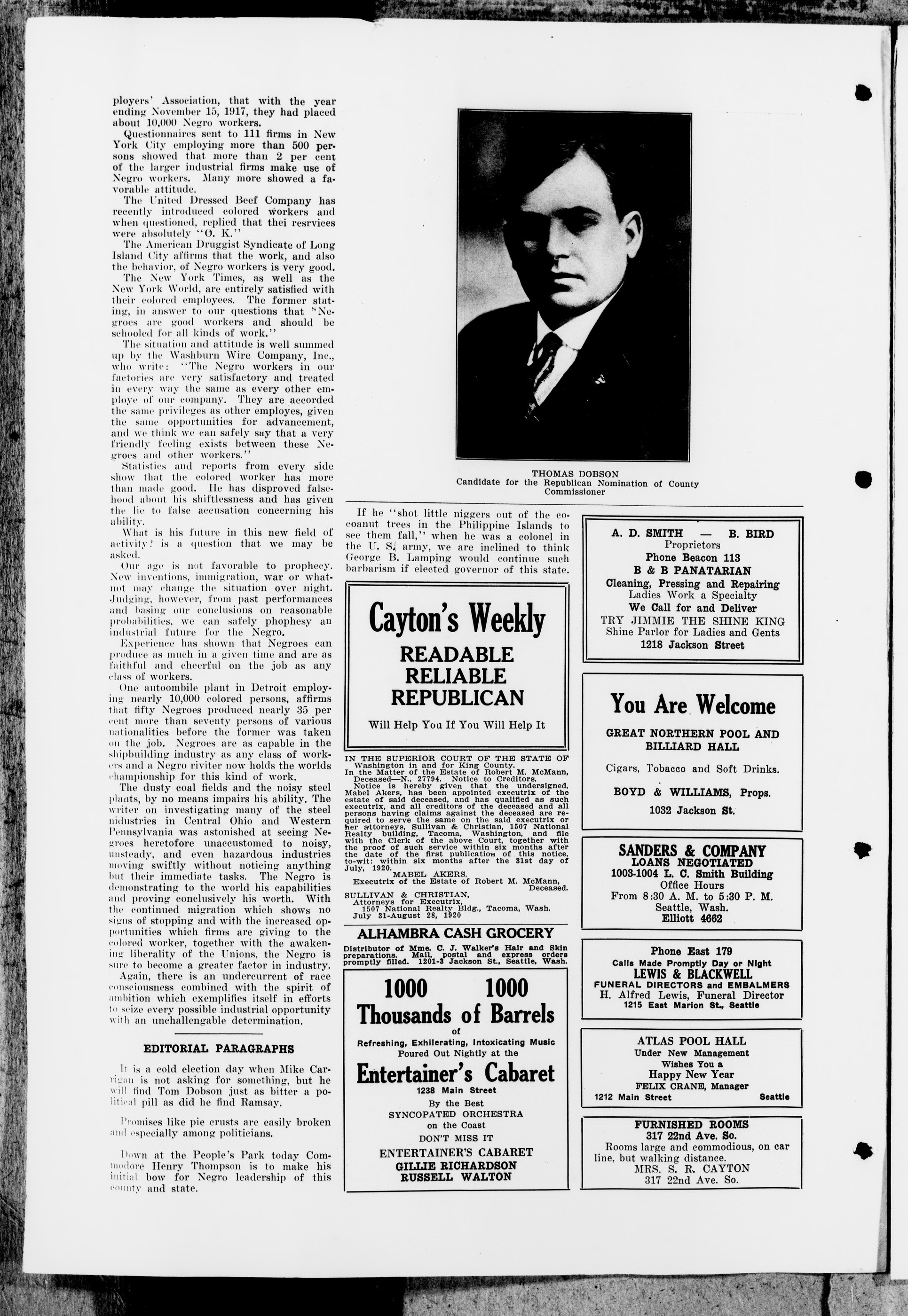
Mike Carrigan and Bill Beck are seeking to defeat the nomination of Tom Dobson for county commissioner, not because Tom has not made the best commissioner the Third District has ever had, but because Mike is a chronic office seeker, apparently with fears that he will die of actual starvation if he is not feeding from the public crib, and because Bill Beck is dying to get into the public eye. Mike Carrigan moved into the Third District because he realized he had run his course in the First and to ever succeed again he had to tell his story to new listeners. Bill Beck has no more parks to sell and he is now anxious to protect the "dear people." Tom Dobson has made a record in the office that he or any one else can feel justly proud of and if he is not overwhelmingly renominated the voters will prove the truthfulness of what Barnum said, "the American people love to be humbugged," but Barnum was mistaken and the voters in the Third Commissioner District will rally almost to a vote to Dobson and squelch the chronic office seeker as well as the park seller.
EDITORIAL PARAGRAPHS
Owing to the long drouth in and about Seattle real estate is flying high.
Doubtless bootlegging will take a lull owing to Judge Rudkin's having to return to Spokane.
If W. L. Presto had it in his mind to reckle John F. Miller last Sunday afternoon it is still in his mind.
Any one who will run for the same office four times without success cannot expect any greater success in running the fifth time.
No Republican filed against Claude C. Ramsay and the Democrat who will oppose him at the general election will have his labor for his pains.
Vol. 5, No. 9
POLITICAL POT PIE
In the last issue of Cayton's Weekly I said that W. W. Conner, candidate for the Republican nomination of lieutenant governor showed his spirit of human fairness by working against the intermarriage bills, which E. L., French, also a candidate for the Republican nomination of lieutenant governor, and other political ighbinders had put up to the legislature for passage, when he could have favored the measures and been a good fellow with that bunch, and in proof of the above statement Mr. Conner was first elected to the legislature from Skagit county in which county there were not to exceed five colored voters. He was next elected to the legislature from the 44th legislative district in King county and in that district there were and are not over five colored voters, hence it is plain to be seen that he did not oppose the intermarriage bills because of his colored constituency. I am always for the man who does things because he is convinced he is right and not because he realizes that the other fellow holds a club over his head.
Cayton's Weekly is delighted to again recommend to its readers Mrs. Josephine Corliss Preston for the Republican nomination of State Superintendent of Public Instruction. She as held the office eight years and has not only given to the state a school system the inferior to none other in the United States, but she has just retired from the presidency of the National Educational Association, an honor never before conferred upon a woman. Mrs. Preston is truly one of the notable educators of this country and she has given the school system of the State of Washington the full benefit of her educational ability. I saw her at her office one day this week and she is paying no attention to the campaign, but is disposing of the momentus school questions coming before her every moment she is in her office and is absolutely unmindful of what her would-be opponent might have to say or was saying against her administration. I seriously doubt if her opponent will get enough votes at the primary election to enable her to say "I also ran."
A. Lincoln Smith, who is seeking the Republican nomination for county auditor says, in case I am nominated and elected county auditor it is not my intention to make a clean sweep of the office as it now is, but it is my intention to properly organize the office force and to systematize the work. All efficient men will remain in the office, but no one will be carried on the pay roll on account of his or her political pull.
"I am for Joel F. Warren for the Republican nomination of sheriff of King county because the colored man always got a square deal when he was chief of the police,' said Clarence R. Anderson, an attorney at law, and the same sentiment was expressed by P. Frazier, the real estate dealer, and as they have expressed themselves so have all the Colored leaders with whom I have talked.
I do not expect to see either of Fred C. Brown's opponents get enough votes to worry him a single bit, but it is being hinted about town that his former general election opponent Dr. E. J. Brown is planning to give him a mighty tussle at the general election.
```markdown
```
THE PASSING THRONG
"You tell me there are two papers published in this city by colored men and yet I see neither of the editors here. Tell them to come to see me before I leave, as I want to subscribe for their papers," said Bishop Fountain in his address on Monday evening. At least one of the editors was present, but no provision had been made for either of them to get in touch with the Bishop and the one present was not even able to get a seat at the banquet table where he could get first handed what was being said by the distinguished and learned speakers of the occasion. Bishop Fountain's words were a severe rebuke to the spirit of this community in frequently overlooking the press in public functions. It may satisfy a selfish and sinister motive to overlook the press but it's a splendid example of "cutting off your nose to spite your face." Sensible newspaper men have no desire to be lionized, but they do expect common courtesy and the community that does not accord them that permits its indiscretion to lead it astray. Bishop Fountain knows he canont make much headway in his uplift work without at least having a tentative co-operation of the press and he therefore, if in not so many words, yet by inedundo, expressed his surprise at the community arranging a banquet and not having one or both of the publishers of the papers published in the city in the colored uplift work seated at that banquet table that he might fraternize with them.
* * *
I do not doubt the correctness of the statement of Wesley L. Jones, U. S. Senator of this state to the effect, the colored people of the United States on the surface have made as much progress in fifty years as the present white civilization has made in fourteen hundred years, but as a matter of fact they are not parallel cases, and if colored folks take such statements seriously then they will show their weakness for temporarily feasting on fulsome flattery. Despite the fact the colored man had been a slave, yet as such he heard much of the business methods of the white man. He even knew more about the industries of the South than his master. When then he was emancipated and thrown upon his own resources and initiative he had but to apply what he had heard, seen and done for all those years of bondage to the white man for the improvement of his own self. The fourteen hundred years of evolution of the white man were handed over to the colored man and he could not help but thrive. As soon as he was emancipated millions of dollars were expended for his education and the white man of the North drilled it into him morning, noon and night that to be somebody he had to get an education, and, comparatively speaking, the army of ignorant colored chattels as it were, became intelligent citizens over night. The fourteen hundred year evolutionist just pumped his experience into the former slave while he slept and to his (the colored man's) surprise he awoke the next morning born again. As Roosevelt said, "the colored man has run exceedingly fast and traveled, under the circumstances, a remarkable distance, but he still has a long ways to travel to, even with the friendly assistance of the white man, cope with the business white man of fourteen hundred years of evolutionary fame.
* * *
In his address last onday evening before a vast audience Bishop William A. Fountain mildly rebuked colored Seattle for its poor business showing and as I listened to his remarks I was reminded of what I had recently said editorially along this line. Many of the colored citizens of the city not only demurred at what I said, but openly criticized me and impugned selfish motives for what I had published. The next morning I called upon the Bishop and inquired of him had he seen the special number of my publication, in which that criticism appeared, and he replied in the negative. There it was, a man who was
seeing Seattle and her colored citizens for the first time had criticized the people he came to visit along the same line as I had done, who had lived here for the past thirty years and there must be something to it.
* * *
Lest the readers hereof have lost sight of the exact words of the article mentioned above the same is herewith reproduced:
It is variously estimated that Seattle and her suburbs have a colored population of 6000. It may be less, but certainly no more; this population is quite cosmopolitan in its makeup, there being no distinct or exclusive colored communities in the city, though in and about Twenty-fourth and East Madison more of them are to be found than in any other locality. Paradoxical as it may seem, living in the immediate vicinity of neither of the three leading colored churches is there to exceed two colored families, and not even one near the Mt. Zion Baptist church, in whose interest this number is issued; yea some of the members thereof live fully five miles from the church, but are in regular attendance. This is cited in order to corroborate the statement, Seattle's colored population is of a cosmopolitan composition. Whether their wide diversity of locations, which necessarily means a like wide diversity of ideas and opinions, argues for their good or their detriment, at least commercially, is an open question, and men of brains and forethought, both white and black, differ as widely as does the East from the West on this point.
Six thousand of so distinct a class of citizens as the colored people should, it seems, call for much commercial enterprise among them, and this should be especially true of a seaport city in the Northwest, whose homegenous population hail from the countries of the world. But not so with the colored citizens of Seattle as they seem totally devoid of the commercial spirit. The actual number of bonafide business and women among them in this city may be counted upon the fingers of one's two hands and then perhaps have one or two uncounted. In this particular the colored man seems to be sleeping a sleep that knoweth no wakening and soliloquizes himself with, 'you many have all this business, but give me fun.'
While comparisons are more or less odious, yet a brief comparison between the colored man and the Japanese living in Seattle at this time might more fully illustrate the point at issue. In Seattle there are about 8,000 Japanese—just two thousand more than colored citizens—and while the figures as to the actual number of Japanese engaged in commercial enterprises in this city are not at hand, yet it is quite safe to say that there are not less than 3,000 distinct business firms under control of and directed by Japanese, and among them are six banks. Twenty-five years ago there were not to exceed twenty Japanese business concerns in Seattle, but their business concerns have kept pace with the growth of the city in the way of increase in numbers. While it is alleged that the success of the Japanese lies in the whole standing together, yet this is doubted as there are not enough Japanese here to maintain a hundredth part of so large a volume of business. In the commercial world the Japanese is a cosmopolitan and he conducts his business in such a way and manner as to make it an object to the purchasing public, whatever their color, complexion or nationality may be, to trade with a Japanese. In other words, the Japanese are essential to the present prosperity of Seattle and her surrounding country. As with the Japanese so with the Italians and to an extent even so with the Chinese. All showing the trading spirit.
Say what you will or may to the contrary there is a silent bond of sympathy between all the darker races in the United States, and where the colored man comes in contact with other darker races, as in Seattle, each one of whom is forging to the front in commercial lines, endeavoring to follow in the footsteps of the white man, it would appear that their spirit of business enterprise would attach itself to the colored man and he would be no less enterprising than
the others. What moves one man should move another, and it does not appear that on general principles the colored man differs very materially from other men.
But while the colored man is not making much of a business showing in Seattle it can not be truthfully said that he is completely asleep at the switch, as a very heavy percentage of them own valuable homes, splendidly furnished with attractive and inviting surroundings, and still a smaller percentage of them own speculative tracts and parcels of valuable real estate, which they are holding for a future increase. It is almost impossible to give the unnumber of colored persons owning homes and other real estate in this city, but county officials, who have given the subject some thought, are of the opinion that more than a thousand are so fortunate, which, if true, would mean that the 6,000 colored citizens of Seattle own real estate and appurtenances thereunto belonging, valued at two million dollars. The situation could be worse. It may be a bit inconsistent, yet in this connection, it might be added that, the colored citizens of Seattle own a half a million dollars worth of automobiles.
* * *
"The many good things the Rev. W. D. Carter said about County Commissioner Claude C. Ramsay met my hearty approval," said John Green, one of the charter members of the King County Colored Republican Club. "If ever a politician gave his colored constituents a square deal Mr. Ramsay is one. About the court house he is looked upon as the prince of good fellows and I trust he will be unanimously re-elected and, he will be, if I have my say."
* * *
When a preacher and a publisher get their heads together, there are things doing or at least that seems to be the general impression among the people. I think, however, it would be drawing on one's imagination to say that the lower order of the animal kingdom share in a like opinion, and yet one day the past week the Rev. W. D. Carter and myself were out on a drive and in passing a farm house the chickens took sudden fright and scattered hither and thither as though we had made an effort to corral them, all of which might have happened had the moon, instead of the sun, been shining, but we were driving innocently along attending to our own business. The Rev. Carter, observing the commotion among the chicks, finally said, "In your opinion are those fowls excited on account of our color or do they realize a preacher and a publisher are among them and, generally speaking from a chicken's standpoint, that it means death in the pot to them?" My thoughts were at that time absorbed in the directing of my car and I left his question unanswered, but what think you?
* * *
Last Sunday was a great day for the First A. M. E. Church of this city and it was a busy one almost from day light until midnight. It was the closing Sunday of the past conference year and the pastor was winding up his work and Bishop Fountain was paying his first visit to the church, and, taking it all in all, it was a strenuous day. In theological grandiloquence I hardly think Bishop Fountain measures up to the most of the other Bishops of that church who have visited here, but in practical common sense and hard headed business foresight I think he leads them all. I learned many years ago that a Bisop was just a man—no more nor no less than Jim Johnson or Bill Brown, and if it were his make up to talk sense, that he talked, but if he was all puffed on the strength of being Bishop and exhibited his over importance as he moved among his fellow men, while he would continue to be a Bishop, yet he wuold be a Bishop that did more harm than good. Men put at the head of affairs should seek to sow seeds of common sense rather than seeds of pomposity and big I and little you. After listening to Bishop Fountain speak on Monday evening in response to a lot of more
Mary E.
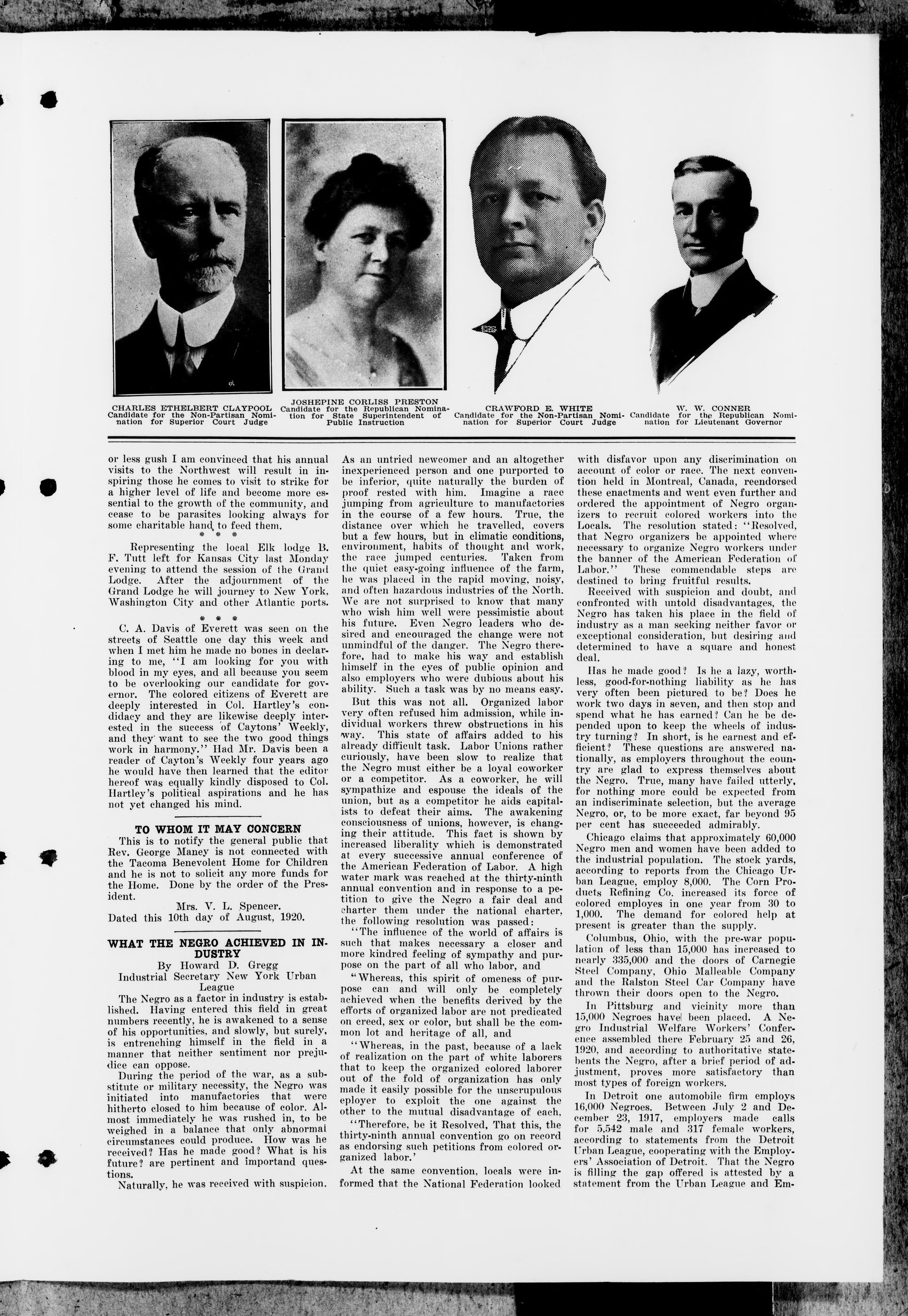
JOSHEPINE CORLISS PRESTON Candidate for the Republican Nomination for State Superintendent of Public Instruction
or less gush I am convinced that his annual visits to the Northwest will result in inspiring those he comes to visit to strike for a higher level of life and become more essential to the growth of the community, and cease to be parasites looking always for some charitable hand to feed them.
Representing the local Elk lodge B. F. Tutt left for Kansas City last Monday evening to attend the session of the Grand Lodge. After the adjournment of the Grand Lodge he will journey to New York, Washington City and other Atlantic ports.
C. A. Davis of Everett was seen on the streets of Seattle one day this week and when I met him he made no bones in declaring to me, "I am looking for you with blood in my eyes, and all because you seem to be overlooking our candidate for governor. The colored citizens of Everett are deeply interested in Col. Hartley's candidacy and they are likewise deeply interested in the success of Caytons' Weekly, and they want to see the two good things work in harmony." Had Mr. Davis been a reader of Cayton's Weekly four years ago he would have then learned that the editor hereof was equally kindly disposed to Col. Hartley's political aspirations and he has not yet changed his mind.
This is to notify the general public that Rev. George Maney is not connected with the Tacoma Benevolent Home for Children and he is not to solicit any more funds for the Home. Done by the order of the President.
WHAT THE NEGRO ACHIEVED IN INDUSTRY
The Negro as a factor in industry is established. Having entered this field in great numbers recently, he is awakened to a sense of his opportunities, and slowly, but surely, is entrenching himself in the field in a manner that neither sentiment nor prejudice can oppose.
During the period of the war, as a substitute or military necessity, the Negro was initiated into manufactories that were hitherto closed to him because of color. Almost immediately he was rushed in, to be weighed in a balance that only abnormal circumstances could produce. How was he received? Has he made good? What is his future? are pertinent and important questions.
Naturally, he was received with suspicion.
T.
CHARLES ETHELBERT CLAYPOOL Candidate for the Non-Partisan Nomination for Superior Court Judge
* * *
TO WHOM IT MAY CONCERN
Mrs. V. L. Spencer. Dated this 10th day of August, 1920.
As an untried newcomer and an altogether inexperienced person and one purported to be inferior, quite naturally the burden of proof rested with him. Imagine a race jumping from agriculture to manufactories in the course of a few hours. True, the distance over which he travelled, covers but a few hours, but in climatic conditions, environment, habits of thought and work, the race jumped centuries. Taken from the quiet easy-going influence of the farm, he was placed in the rapid moving, noisy, and often hazardous industries of the North. We are not surprised to know that many who wish him well were pessimistic about his future. Even Negro leaders who desired and encouraged the change were not unmindful of the danger. The Negro therefore, had to make his way and establish himself in the eyes of public opinion and also employers who were dubious about his ability. Such a task was by no means easy.
But this was not all. Organized labor very often refused him admission, while individual workers threw obstructions in his way. This state of affairs added to his already difficult task. Labor Unions rather curiously, have been slow to realize that the Negro must either be a loyal coworker or a competitor. As a coworker, he will sympathize and espouse the ideals of the union, but as a competitor he aids capitalists to defeat their aims. The awakening consciousness of unions, however, is changing their attitude. This fact is shown by increased liberality which is demonstrated at every successive annual conference of the American Federation of Labor. A high water mark was reached at the thirty-ninth annual convention and in response to a petition to give the Negro a fair deal and charter them under the national charter, the following resolution was passed:
"The influence of the world of affairs is such that makes necessary a closer and more kindred feeling of sympathy and purpose on the part of all who labor, and
"Whereas, this spirit of omeness of purpose can and will only be completely achieved when the benefits derived by the efforts of organized labor are not predicated on creed, sex or color, but shall be the common lot and heritage of all, and
"Whereas, in the past, because of a lack of realization on the part of white laborers that to keep the organized colored laborer out of the fold of organization has only made it easily possible for the unscrupulous eployer to exploit the one against the other to the mutual disadvantage of each, Therefore, be it Resolved, That this, the thirty-ninth annual convention go on record as endorsing such petitions from colored organized labor.' At the same convention, locals were informed that the National Federation looked
SIDE
CRAWFORD E. WHITE W. W. CONNER
Candidate for the Non-Partisan Nomi-
nation for Superior Court Judge Candidate for the Republican Nomi-
nation for Lieutenant Governor
with disfavor upon any discrimination on account of color or race. The next convention held in Montreal, Canada, reendorsed these enactments and went even further and ordered the appointment of Negro organizers to recruit colored workers into the Locals. The resolution stated: "Resolved, that Negro organizers be appointed where necessary to organize Negro workers under the banner of the American Federation of Labor." These commendable steps are destined to bring fruitful results.
Received with suspicion and doubt, and confronted with untold disadvantages, the Negro has taken his place in the field of industry as a man seeking neither favor or exceptional consideration, but desiring and determined to have a square and honest deal.
Has he made good? Is he a lazy, worthless, good-for-nothing liability as he has very often been pictured to be? Does he work two days in seven, and then stop and spend what he has earned? Can he be depended upon to keep the wheels of industry turning? In short, is he earnest and efficient? These questions are answered nationally, as employers throughout the country are glad to express themselves about the Negro. True, many have failed utterly, for nothing more could be expected from an indiscriminate selection, but the average Negro, or, to be more exact, far beyond 95 per cent has succeeded admirably.
Chicago claims that approximately 60,000 Negro men and women have been added to the industrial population. The stock yards, according to reports from the Chicago Urban League, employ 8,000. The Corn Products Refining Co. increased its force of colored employees in one year from 30 to 1,000. The demand for colored help at present is greater than the supply. Columbus, Ohio, with the pre-war population of less than 15,000 has increased to nearly 335,000 and the doors of Carnegie Steel Company, Ohio Malleable Company and the Ralston Steel Car Company have thrown their doors open to the Negro.
In Pittsburg and vicinity more than 15,000 Negroes have been placed. A Negro Industrial Welfare Workers' Conference assembled there February 25 and 26, 1920, and according to authoritative statements the Negro, after a brief period of adjustment, proves more satisfactory than most types of foreign workers.
In Detroit one automobile firm employs 16,000 Negroes. Between July 2 and December 23, 1917, employers made calls for 5,542 male and 317 female workers, according to statements from the Detroit Urban League, cooperating with the Employers' Association of Detroit. That the Negro is filling the gap offered is attested by a statement from the Urban League and Em-
[Image of a man in a suit with a white shirt and a black tie. The background is plain white. The man's face is centered, and he has a serious expression. The image is black and white. There are no other discernible details.]]
[Name]
THOMAS DOBSON Candidate for the Republican Nomination of County Commissioner
```markdown
```
ployers' Association, that with the year ending November 15, 1917, they had placed about 10,000 Negro workers.
Questionnaires sent to 111 firms in New York City employing more than 500 persons showed that more than 2 per cent of the larger industrial firms make use of Negro workers. Many more showed a favorable attitude.
The United Dressed Beef Company has recently introduced colored workers and when questioned, replied that thei resrvices were absolutely "O. K."
The American Druggist Syndicate of Long Island City affirms that the work, and also the behavior, of Negro workers is very good.
The New York Times, as well as the New York World, are entirely satisfied with their colored employees. The former stating, in answer to our questions that "Negroes are good workers and should be schooled for all kinds of work." The situation and attitude is well summed up by the Washburn Wire Company, Inc., who write: "The Negro workers in our factories are very satisfactory and treated in every way the same as every other employee of our company. They are accorded the same privileges as other employes, given the same opportunities for advancement, and we think we can safely say that a very friendly feeling exists between these Negroes and other workers."
Statistics and reports from every side show that the colored worker has more than made good. He has disproved falsehood about his shiftlessness and has given the lie to false accusation concerning his ability.
What is his future in this new field of activity? is a question that we may be asked.
Our age is not favorable to prophecy. New inventions, immigration, war or whatnot may change the situation over night. Judging, however, from past performances and basing our conclusions on reasonable probabilities, we can safely phophesy an industrial future for the Negro.
Experience has shown that Negroes can produce as much in a given time and are as faithful and cheerful on the job as any class of workers. One autoombile plant in Detroit employing nearly 10,000 colored persons, affirms that fifty Negroes produced nearly 35 per cent more than seventy persons of various nationalities before the former was taken on the job. Negroes are as capable in the shipbuilding industry as any class of workers and a Negro riviter now holds the worlds championship for this kind of work.
The dusty coal fields and the noisy steel plants, by no means impairs his ability. The writer on investigating many of the steel nidustries in Central Ohio and Western Pennsylvania was astonished at seeing Negroes heretofore unaccustomed to noisy, unsteady, and even hazardous industries moving swiftly without noticing anything but their immediate tasks. The Negro is demonstrating to the world his capabilities and proving conclusively his worth. With the continued migration which shows no signs of stopping and with the increased opportunities which firms are giving to the colored worker, together with the awakening liberality of the Unions, the Negro is sure to become a greater factor in industry.
Again, there is an undercurrent of race consciousness combined with the spirit of ambition which exemplifies itself in efforts to seize every possible industrial opportunity with an unchallengable determination.
EDITORIAL PARAGRAPHS
It is a cold election day when Mike Carrigan is not asking for something, but he will find Tom Dobson just as bitter a political pill as did he find Ramsay.
Promises like pie crusts are easily broken and especially among politicians.
Down at the People's Park today Commodore Henry Thompson is to make his initial bow for Negro leadership of this county and state.
If he "shot little niggers out of the cocoanut trees in the Philippine Islands to see them fall," when he was a colonel in the U. S. army, we are inclined to think George B. Lamping would continue such barbarism if elected governor of this state.
Cayton's Weekly READABLE RELIABLE REPUBLICAN
Will Help You If You Will Help It
IN THE SUPERIOR COURT OF THE STATE OF Washington in and for King County.
In the Matter of the Estate of Robert M. McMann, Deceased—N.. 27794. Notice to Creditors.
Notice is hereby given that the undersigned, Mabel Akers, has been appointed executrix of the estate of said deceased, and has qualified as such executrix, and all creditors of the deceased and all persons having claims against the deceased are required to serve the same on the said executrix or her attorneys, Sullivan & Christian, 1507 National Realty building, Tacoma, Washington, and file with the Clerk of the above Court, together with the proof of such service within six months after the date of the first publication of this notice, to-wit: within six months after the 31st day of July, 1920.
MABEL AKERS.
Executrix of the Estate of Robert M. McMann, Deceased.
SULLIVAN & CHRISTIAN.
Attorneys for Executrix,
1507 National Realty Bldg., Tacoma, Wash.
July 31-August 28, 1920
ALHAMBRA CASH GROCERY
Distributor of Mme. C. J. Walker's Hair and Skin preparations. Mail, postal and express orders promptly filled. 1201-3 Jackson St., Seattle, Wash.
1000 1000
Thousands of Barrels
of
Refreshing, Exhilerating, Intoxicating Music
Poured Out Nightly at the
By the Best
SYNCOPATED ORCHESTRA
on the Coast
DON'T MISS IT
ENTERTAINER'S CABARET
GILLIE RICHARDSON
RUSSELL WALTON
---
A. D. SMITH B. BIRD
Proprietors
Phone Beacon 113
B & B PANATARIAN
Cleaning, Pressing and Repairing
Ladies Work a Specialty
We Call for and Deliver
TRY JIMMIE THE SHINE KING
Shine Parlor for Ladies and Gents
1218 Jackson Street
You Are Welcome
GREAT NORTHERN POOL AND
BILLIARD HALL
Cigars, Tobacco and Soft Drinks.
BOYD & WILLIAMS, Props.
1032 Jackson St.
SANDERS & COMPANY
LOANS NEGOTIATED
1003-1004 L. C. Smith Building
Office Hours
From 8:30 A. M. to 5:30 P. M.
Seattle, Wash.
Elliott 4662
Phone East 179 Calls Made Promptly Day or Night LEWIS & BLACKWELL FUNERAL DIRECTORS and EMBALMERS H. Alfred Lewis, Funeral Director 1215 East Marion St., Seattle
ATLAS POOL HALL
Under New Management
Wishes You a
Happy New Year
FELIX CRANE, Manager
1212 Main Street
FURNISHED ROOMS
317 22nd Ave. So.
Rooms large and commodious, on car
line, but walking distance.
MRS. S. R. CAYTON
317 22nd Ave. So.