Cayton's Weekly
Saturday, August 28, 1920
Seattle, Washington
Page text (machine-generated)
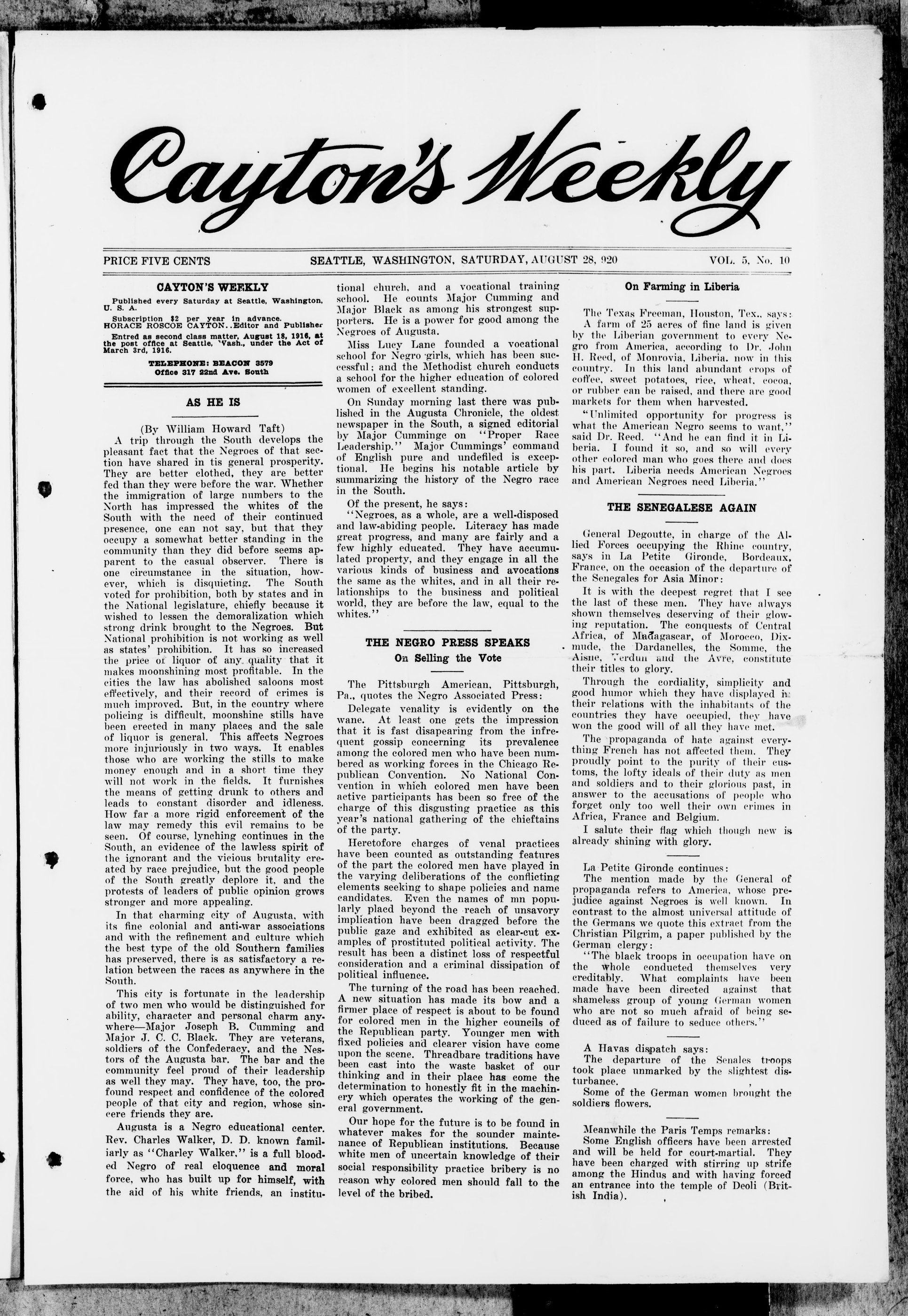
Cayton's Weekly
SEATTLE, WASHINGTON, SATURDAY, AUGUST 28, 920
PRICE FIVE CENTS
CAYTON'S WEEKLY
Published every Saturday at Seattle, Washington,
U. S. A.
Subscription $2 per year in advance.
HORACE ROSCOE CAYTON..Editor and Publisher
Entred as second class matter, August 18, 1916, at
the post office at Seattle, 'Vash., under the Act of
March 3rd, 1916.
TELEPHONE: BEACON 3579
Office 317 22nd Ave. South
AS HE IS
(By William Howard Taft)
A trip through the South develops the pleasant fact that the Negroes of that section have shared in its general prosperity. They are better clothed, they are better fed than they were before the war. Whether the immigration of large numbers to the North has impressed the whites of the South with the need of their continued presence, one can not say, but that they occupy a somewhat better standing in the community than they did before seems apparent to the casual observer. There is one circumstance in the situation, however, which is disquieting. The South voted for prohibition, both by states and in the National legislature, chiefly because it wished to lessen the demoralization which strong drink brought to the Negroes. But National prohibition is not working as well as states' prohibition. It has so increased the price of liquor of any quality that it makes moonshining most profitable. In the cities the law has abolished saloons most effectively, and their record of crimes is much improved. But, in the country where policing is difficult, moonshine stills have been erected in many places and the sale of liquor is general. This affects Negroes more injuriously in two ways. It enables those who are working the stills to make money enough and in a short time they will not work in the fields. It furnishes the means of getting drunk to others and leads to constant disorder and idleness. How far a more rigid enforcement of the law may remedy this evil remains to be seen. Of course, lynching continues in the South, an evidence of the lawless spirit of the ignorant and the vicious brutality created by race prejudice, but the good people of the South greatly deplore it, and the protests of leaders of public opinion grows stronger and more appealing.
In that charming city of Augusta, with its fine colonial and anti-war associations and with the refinement and culture which the best type of the old Southern families has preserved, there is as satisfactory a relation between the races as anywhere in the South.
This city is fortunate in the leadership of two men who would be distinguished for ability, character and personal charm anywhere—Major Joseph B. Cumming and Major J. C. C. Black. They are veterans, soldiers of the Confederacy, and the Nestors of the Augusta bar. The bar and the community feel proud of their leadership as well they may. They have, too, the profound respect and confidence of the colored people of that city and region, whose sincere friends they are.
Augusta is a Negro educational center. Rev. Charles Walker, D. D. known familiarly as "Charley Walker," is a full blooded Negro of real eloquence and moral force, who has built up for himself, with the aid of his white friends, an institu
tional church, and a vocational training school. He counts Major Cumming and Major Black as among his strongest supporters. He is a power for good among the Negroes of Augusta.
Miss Lucy Lane founded a vocational school for Negro girls, which has been successful; and the Methodist church conducts a school for the higher education of colored women of excellent standing.
On Sunday morning last there was published in the Augusta Chronicle, the oldest newspaper in the South, a signed editorial by Major Cumminge on "Proper Race Leadership." Major Cummings' command of English pure and undefiled is exceptional. He begins his notable article by summarizing the history of the Negro race in the South.
Of the present, he says:
"Negroes, as a whole, are a well-disposed and law-abiding people. Literacy has made great progress, and many are fairly and a few highly educated. They have accumulated property, and they engage in all the various kinds of business and avocations the same as the whites, and in all their relationships to the business and political world, they are before the law, equal to the whites."
THE NEGRO PRESS SPEAKS On Selling the Vote
The Pittsburgh American, Pittsburgh, Pa., quotes the Negro Associated Press: Delegate venality is evidently on the wane. At least one gets the impression that it is fast disapearing from the infrequent gossip concerning its prevalence among the colored men who have been numbered as working forces in the Chicago Republican Convention. No National Convention in which colored men have been active participants has been so free of the charge of this disgusting practice as this year's national gathering of the chieftains of the party.
Heretofore charges of venal practices have been counted as outstanding features of the part the colored men have played in the varying deliberations of the conflicting elements seeking to shape policies and name candidates. Even the names of mn popularly placed beyond the reach of unsavory implication have been dragged before the public gaze and exhibited as clear-cut examples of prostituted political activity. The result has been a distinct loss of respectful consideration and a criminal dissipation of political influence.
The turning of the road has been reached. A new situation has made its bow and a firmer place of respect is about to be found for colored men in the higher councils of the Republican party. Younger men with fixed policies and clearer vision have come upon the scene. Threadbare traditions have been cast into the waste basket of our thinking and in their place has come the determination to honestly fit in the machinery which operates the working of the general government.
Our hope for the future is to be found in whatever makes for the sounder maintenance of Republican institutions. Because white men of uncertain knowledge of their social responsibility practice bribery is no reason why colored men should fall to the level of the bribed.
VOL. 5. No. 10
On Farming in Liberia
The Texas Freeman, Houston, Tex., says: A farm of 25 acres of fine land is given by the Liberian government to every Negro from America, according to Dr. John H. Reed, of Monrovia, Liberia, now in this country. In this land abundant crops of coffee, sweet potatoes, rice, wheat, cocoa, or rubber can be raised, and there are good markets for them when harvested.
"Unlimited opportunity for progress is what the American Negro seems to want," said Dr. Reed. "And he can find it in Liberia. I found it so, and so will every other colored man who goes there and does his part. Liberia needs American Negroes and American Negroes need Liberia."
THE SENEGALESE AGAIN
General Degoutte, in charge of the Allied Forces occupying the Rhine country, says in La Petite Gironde, Bordeaux, France, on the occasion of the departure of the Senegales for Asia Minor:
It is with the deepest regret that I see the last of these men. They have always shown themselves deserving of their glowing reputation. The conquests of Central Africa, of Madagascar, of Morocco, Dixmude, the Dardanelles, the Somme, the Aisne, Verdun and the Avre, constitute their titles to glory.
Through the cordiality, simplicity and good humor which they have displayed in their relations with the inhabitants of the countries they have occupied, they have won the good will of all they have met.
The propaganda of hate against everything French has not affected them. They proudly point to the purity of their customs, the lofty ideals of their duty as men and soldiers and to their glorious past, in answer to the accusations of people who forget only too well their own crimes in Africa, France and Belgium.
I salute their flag which though new is already shining with glory.
La Petite Gironde continues:
The mention made by the General of propaganda refers to America, whose prejudice against Negroes is well known. In contrast to the almost universal attitude of the Germans we quote this extract from the Christian Pilgrim, a paper published by the German clergy:
"The black troops in occupation have on the whole conducted themselves very creditably. What complaints have been made have been directed against that shameless group of young German women who are not so much afraid of being seduced as of failure to seduce others."
A Havas dispatch says: The departure of the Senales troops took place unmarked by the slightest disturbance. Some of the German women brought the soldiers flowers.
Meanwhile the Paris Temps remarks: Some English officers have been arrested and will be held for court-martial. They have been charged with stirring up strife among the Hindus and with having forced an entrance into the temple of Deoli (British India).
```markdown
```
```markdown
```
[Name]
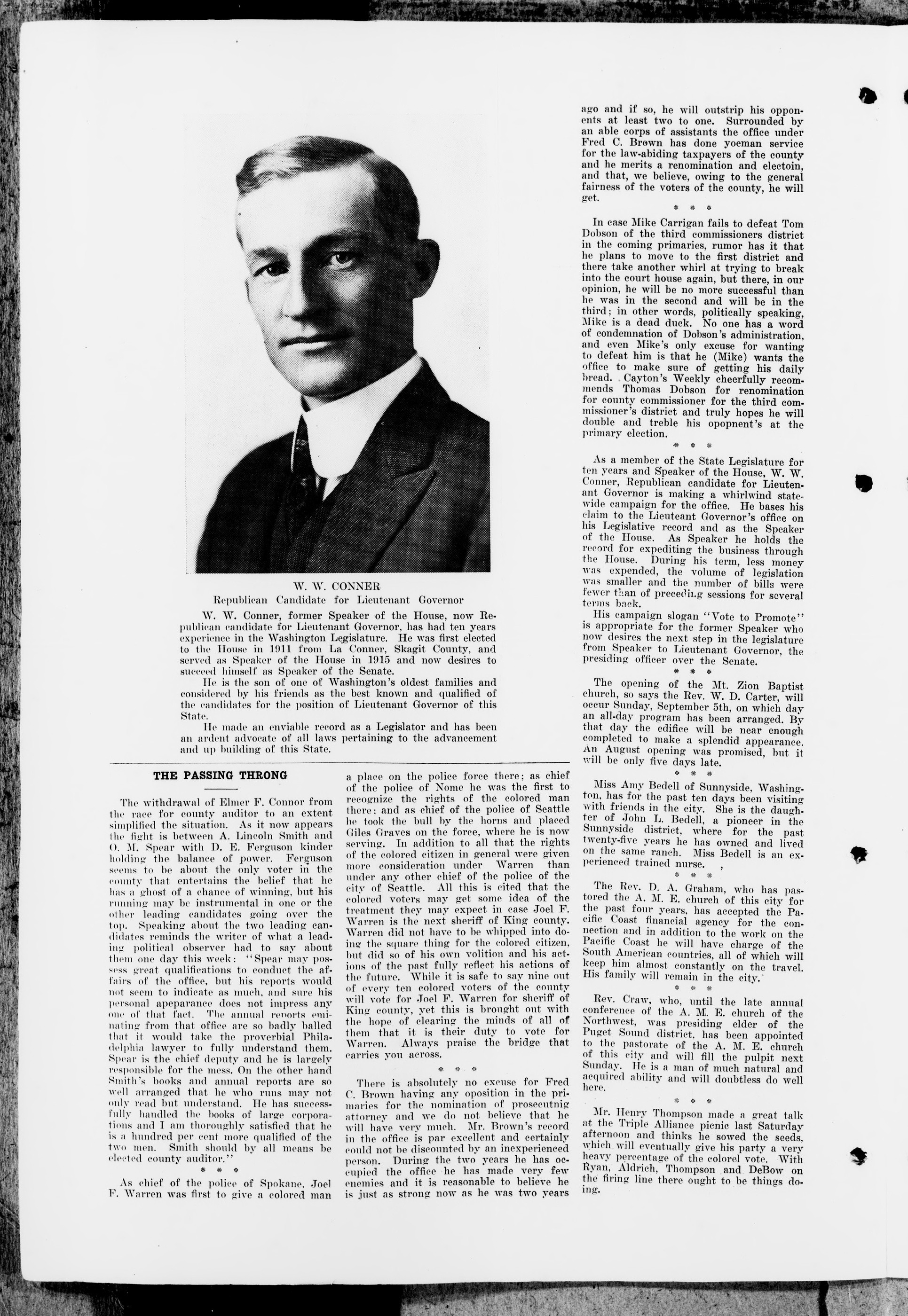
Republican Candidate for Lieutenant Governor
W. W. Conner, former Speaker of the House, now a publican candidate for Lieutenant Governor, has had ten years experience in the Washington Legislature. He was first elected to the House in 1911 from La Conner, Skagit County, served as Speaker of the House in 1915 and now desirous succeed himself as Speaker of the Senate.
He is the son of one of Washington's oldest families considered by his friends as the best known and quality candidates for the position of Lieutenant Governor of State.
He made an enviable record as a Legislator and has an ardent advocate of all laws pertaining to the advance and up building of this State.
W. W. Conner, former Speaker of the House, now Republican candidate for Lieutenant Governor, has had ten years experience in the Washington Legislature. He was first elected to the House in 1911 from La Conner, Skagit County, and served as Speaker of the House in 1915 and now desires to succeed himself as Speaker of the Senate. He is the son of one of Washington's oldest families and considered by his friends as the best known and qualified of the candidates for the position of Lieutenant Governor of this State. He made an enviable record as a Legislator and has been an ardent advocate of all laws pertaining to the advancement and up building of this State.
THE PASSING THRONG
The withdrawal of Elmer F. Connor from the race for county auditor to an extent simplified the situation. As it now appears the fight is between A. Lincoln Smith and O. M. Spear with D. E. Ferguson kinder holding the balance of power. Ferguson seems to be about the only voter in the county that entertains the belief that he has a ghost of a chance of winning, but his running may be instrumental in one or the other leading candidates going over the top. Speaking about the two leading candidates reminds the writer of what a leading political observer had to say about them one day this week: "Spear may possess great qualifications to conduct the affairs of the office, but his reports would not seem to indicate as much, and sure his personal apearance does not impress any one of that fact. The annual reports eminating from that office are so badly balled that it would take the proverbial Philadelphia lawyer to fully understand them. Spear is the chief deputy and he is largely responsible for the mess. On the other hand Smith's books and annual reports are so well arranged that he who runs may not only read but understand. He has successfully handled the books of large corporations and I am thoroughly satisfied that he is a hundred per cent more qualified of the two men. Smith should by all means be elected county auditor."
As chief of the police of Spokane, Joel F. Warren was first to give a colored man
* * *
Speaker of the House, now Re- ment Governor, has had ten years legislature. He was first elected to Conner, Skagit County, and was in 1915 and now desires to the Senate. Washington's oldest families and the best known and qualified of Lieutenant Governor of this state as a Legislator and has been pertaining to the advancement
a place on the police force there; as chief of the police of Nome he was the first to recognize the rights of the colored man there; and as chief of the police of Seattle he took the bull by the horns and placed Giles Graves on the force, where he is now serving. In addition to all that the rights of the colored citizen in general were given more consideration under Warren than under any other chief of the police of the city of Seattle. All this is cited that the colored voters may get some idea of the treatment they may expect in case Joel F. Warren is the next sheriff of King county. Warren did not have to be whipped into doing the square thing for the colored citizen, but did so of his own volition and his actions of the past fully reflect his actions of the future. While it is safe to say nine out of every ten colored voters of the county will vote for Joel F. Warren for sheriff of King county, yet this is brought out with the hope of clearing the minds of all of them that it is their duty to vote for Warren. Always praise the bridge that carries you across.
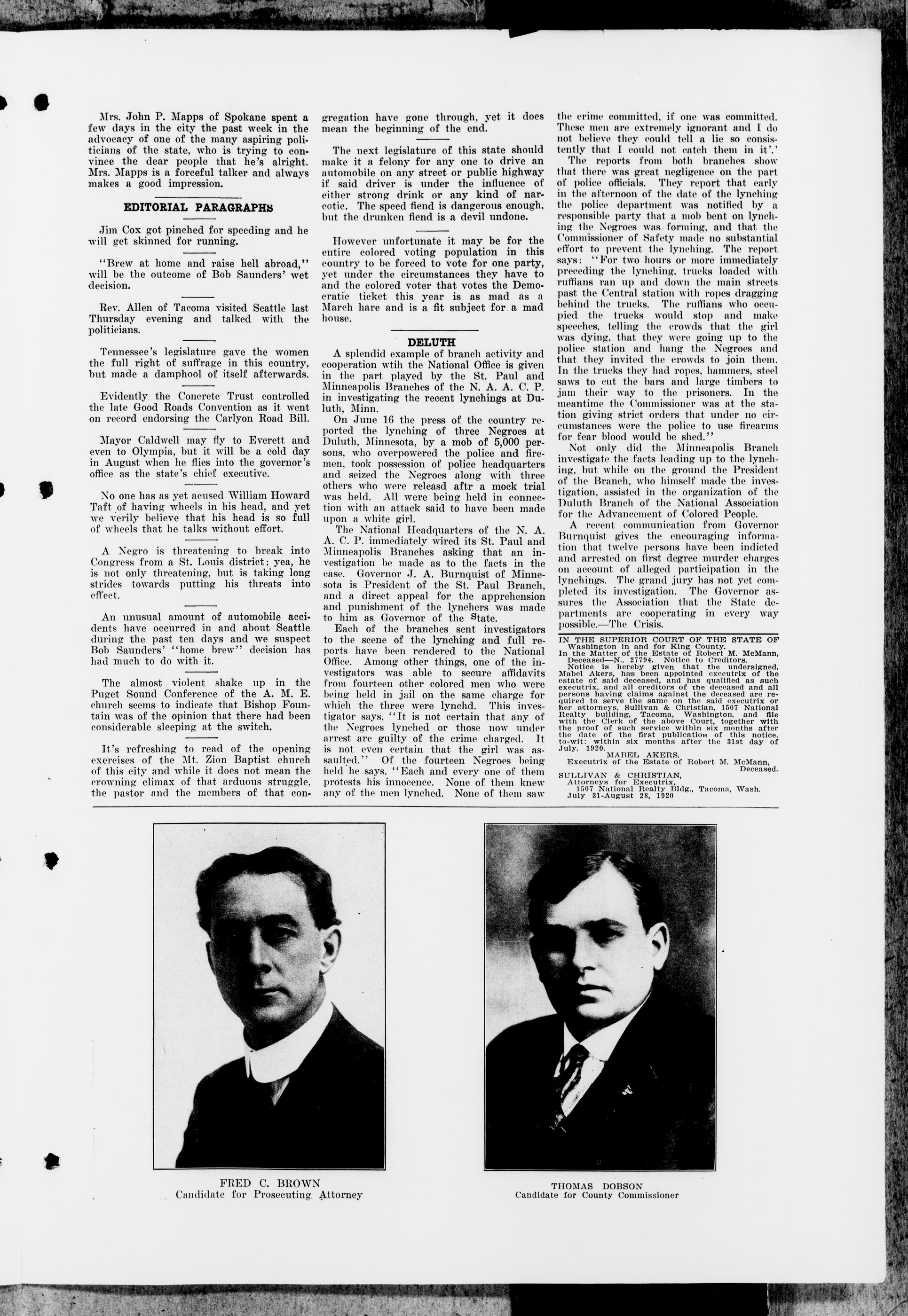
There is absolutely no excuse for Fred C. Brown having any oposition in the primaries for the nomination of prosecuting attorney and we do not believe that he will have very much. Mr. Brown's record in the office is par excellent and certainly could not be discounted by an inexperienced person. During the two years he has occupied the office he has made very few enemies and it is reasonable to believe he is just as strong now as he was two years
---
W. W. CONNER
* * *
ago and if so, he will outstrip his opponents at least two to one. Surrounded by an able corps of assistants the office under Fred C. Brown has done yoeman service for the law-abiding taxpayers of the county and he merits a renomination and electoin, and that, we believe, owing to the general fairness of the voters of the county, he will get.
* * *
In case Mike Carrigan fails to defeat Tom Dobson of the third commissioners district in the coming primaries, rumor has it that he plans to move to the first district and there take another whirl at trying to break into the court house again, but there, in our opinion, he will be no more successful than he was in the second and will be in the third; in other words, politically speaking, Mike is a dead duck. No one has a word of condemnation of Dobson's administration, and even Mike's only excuse for wanting to defeat him is that he (Mike) wants the office to make sure of getting his daily bread. Cayton's Weekly cheerfully recommends Thomas Dobson for renomination for county commissioner for the third commissioner's district and truly hopes he will double and treble his opopnent's at the primary election.
. * * *
As a member of the State Legislature for ten years and Speaker of the House, W. W. Conner, Republican candidate for Lieutenant Governor is making a whirlwind statewide campaign for the office. He bases his claim to the Lieuteant Governor's office on his Legislative record and as the Speaker of the House. As Speaker he holds the record for expediting the business through the House. During his term, less money was expended, the volume of legislation was smaller and the number of bills were fewer than of preceding sessions for several terms back.
His campaign slogan "Vote to Promote" is appropriate for the former Speaker who now desires the next step in the legislature from Speaker to Lieutenant Governor, the presiding officer over the Senate.
* * *
The opening of the Mt. Zion Baptist church, so says the Rev. W. D. Carter, will occur Sunday, September 5th, on which day an all-day program has been arranged. By that day the edifice will be near enough completed to make a splendid appearance. An August opening was promised, but it will be only five days late.
***
Miss Amy Bedell of Sunnyside, Washington, has for the past ten days been visiting with friends in the city. She is the daughter of John L. Bedell, a pioneer in the Sunnyside district, where for the past twenty-five years he has owned and lived on the same ranch. Miss Bedell is an experienced trained nurse.
The Rev. D. A. Graham, who has pastored the A. M. E. church of this city for the past four years, has accepted the Pacific Coast financial agency for the connection and in addition to the work on the Pacific Coast he will have charge of the South American countries, all of which will keep him almost constantly on the travel. His family will remain in the city.
* * *
Rev. Craw, who, until the late annual conference of the A. M. E. church of the Northwest, was presiding elder of the Puget Sound district, has been appointed to the pastorate of the A. M. E. church of this city and will fill the pulpit next Sunday. He is a man of much natural and acquired ability and will doubtless do well here.
* * *
Mr. Henry Thompson made a great talk at the Triple Alliance picnic last Saturday afternoon and thinks he sowed the seeds, which will eventually give his party a very heavy percentage of the colorel vote. With Ryan, Aldrich, Thompson and DeBow on the firing line there ought to be things doing.
gregation have gone through, yet it does mean the beginning of the end.
The next legislature of this state should make it a felony for any one to drive an automobile on any street or public highway if said driver is under the influence of either strong drink or any kind of narcotic. The speed fiend is dangerous enough, but the drunken fiend is a devil undone.
However unfortunate it may be for the entire colored voting population in this country to be forced to vote for one party, yet under the circumstances they have to and the colored voter that votes the Democratic ticket this year is as mad as a March hare and is a fit subject for a mad house.
A splendid example of branch activity and cooperation wth the National Office is given in the part played by the St. Paul and Minneapolis Branches of the N. A. A. C. P. in investigating the recent lynchings at Duluth, Minn. On June 16 the press of the country reported the lynching of three Negroes at Duluth, Minnesota, by a mob of 5,000 persons, who overpowered the police and firemen, took possession of police headquarters and seized the Negroes along with three others who were released aftr a mock trial was held. All were being held in connection with an attack said to have been made upon a white girl.
The National Headquarters of the N. A. A. C. P. immediately wired its St. Paul and Minneapolis Branches asking that an investigation be made as to the facts in the case. Governor J. A. Burnquist of Minnesota is President of the St. Paul Branch, and a direct appeal for the apprehension and punishment of the lynchers was made to him as Governor of the State.
Each of the branches sent investigators to the scene of the lynching and full reports have been rendered to the National Office. Among other things, one of the investigators was able to secure affidavits from fourteen other colored men who were being held in jail on the same charge for which the three were lynchd. This investigator says, "It is not certain that any of the Negroes lynched or those now under arrest are guilty of the crime charged. It is not even certain that the girl was assaulted." Of the fourteen Negroes being held he says, "Each and every one of them protests his innocence. None of them knew any of the men lynched. None of them saw
FRED C. BROWN Candidate for Prosecuting Attorney
Mrs. John P. Mapps of Spokane spent a few days in the city the past week in the advocacy of one of the many aspiring politicians of the state, who is trying to convince the dear people that he's alright. Mrs. Mapps is a forceful talker and always makes a good impression.
EDITORIAL PARAGRAPHS
Jim Cox got pinched for speeding and he will get skinned for running.
"Brew at home and raise hell abroad," will be the outcome of Bob Saunders' wet decision.
Rev. Allen of Tacoma visited Seattle last Thursday evening and talked with the politicians.
Tennessee's legislature gave the women the full right of suffrage in this country, but made a damphool of itself afterwards.
Evidently the Concrete Trust controlled the late Good Roads Convention as it went on record endorsing the Carlyon Road Bill.
Mayor Caldwell may fly to Everett and even to Olympia, but it will be a cold day in August when he flies into the governor's office as the state's chief executive.
No one has as yet acused William Howard Taft of having wheels in his head, and yet we verily believe that his head is so full of wheels that he talks without effort.
A Negro is threatening to break into Congress from a St. Louis district; yea, he is not only threatening, but is taking long strides towards putting his threats into effect.
An unusual amount of automobile accidents have occurred in and about Seattle during the past ten days and we suspect Bob Saunders' "home brew" decision has had much to do with it.
The almost violent shake up in the Puget Sound Conference of the A. M. E. church seems to indicate that Bishop Fountain was of the opinion that there had been considerable sleeping at the switch.
It's refreshing to read of the opening exercises of the Mt. Zion Baptist church of this city and while it does not mean the crowning climax of that arduous struggle, the pastor and the members of that con-
M. B.
DELUTH
the crime committed, if one was committed. These men are extremely ignorant and I do not believe they could tell a lie so consistently that I could not catch them in it.'
The reports from both branches show that there was great negligence on the part of police officials. They report that early in the afternoon of the date of the lynching the police department was notified by a responsible party that a mob bent on lynching the Negroes was forming, and that the Commissioner of Safety made no substantial effort to prevent the lynching. The report says: "For two hours or more immediately preceding the lynching, trucks loaded with ruffians ran up and down the main streets past the Central station with ropes dragging behind the trucks. The ruffians who occupied the trucks would stop and make speeches, telling the crowds that the girl was dying, that they were going up to the police station and hang the Negroes and that they invited the crowds to join them. In the trucks they had ropes, hammers, steel saws to cut the bars and large timbers to jam their way to the prisoners. In the meantime the Commissioner was at the station giving strict orders that under no circumstances were the police to use firearms for fear blood would be shed."
Not only did the Minneapolis Branch investigate the facts leading up to the lynching, but while on the ground the President of the Branch, who himself made the investigation, assisted in the organization of the Duluth Branch of the National Association for the Advancement of Colored People. A recent communication from Governor Burnquist gives the encouraging information that twelve persons have been indicted and arrested on first degree murder charges on account of alleged participation in the lynchings. The grand jury has not yet completed its investigation. The Governor assures the Association that the State departments are cooperating in every way possible.—The Crisis.
IN THE SUPERIOR COURT OF THE STATE OF Washington in and for King County.
In the Matter of the Estate of Robert M. McMann, Deceased—N., 27794. Notice to Creditors.
Notice is hereby given that the undersigned, Mabel Akers, has been appointed executrix of the estate of said deceased, and has qualified as such executrix, and all creditors of the deceased and all persons having claims against the deceased are required to serve the same on the said executrix or her attorneys, Sullivan & Christian, 1507 National Realty building, Tacoma, Washington, and file with the Clerk of the above Court, together with the proof of such service within six months after the date of the first publication of this notice, to-wit: within six months after the 31st day of July, 1920.
MABEL AKERS.
Executrix of the Estate of Robert M. McMann, Deceased.
SULLIVAN & CHRISTIAN,
Attorneys for Executrix,
1507 National Realty Bldg., Tacoma, Wash.
July 31-August 28, 1920
THOMAS DOBSON
Candidate for County Commissioner
```markdown
```
STOLEN FROM THIEVES
There was not even standing room in the crowded electric car, but one more passenger, a young woman, wedged her way along just inside the doorway. Each time the car took a sudden lurch forward she fell helplessly back, and three times she landed in the arms of a large, comfortable man. The third time it happened he said quietly: "Hadn't you better stay here?"
Dinah was a product of New Orleans, a big, plump "yaller gal," who could cook the finest dinners for miles around. One day a new butler appeared upon the scene, and Dinah's mistress noticed that she took a great interest in the man. At last her mistress could stand her curiosity no longer and asked, "Dinah, do you know that new man?" Dinah took another long and scrutinizing look and then slowly and reminiscently replied: "Well, I dunno, Miss Alice; but I think he was mah fust husband."
The commercail traveler met Sandy, the canny one, emerging from the postoffice. "Ah, Sandy!" cried the commercial traveler, "it is good to see as prosperous a farmer as yourself—not forgetful of his country! You have been in the postoffice to purchase war bonds?" "Nay," said Sandy easily. "Oh. Then perhaps you have put a little money in the savings bank that it may help the country?" "Nay." "Well," said the traveler as a last resort, "I suppose that you have bought a postal order to send to some poor acquaintance?" "Nay, I've been in to fill my fountain pen."
With many sobs and repetitions the good woman had told her tale of woe to the English clergyman. It was full of "he sez" and "I sez," but the clergyman listened patiently until she had finished. "I'm sorry, my dear lady," he said, sympathetically. "Certainly your husband does seem to treat you rather unkindly. But remember that you took him for better or for worse." "Well, it's allus been for wuss, s'far as I kin see," replied the visitor, dabbing her eyes with what only politeness could call a pocket handkerchief. "Have you tried to cure him with kindness?" pleaded the man. "Have you tried heaping coals of fire on his head?" "No, I aint, sir," replied the woman, grateful for the new idea. "So far, I've only tried 'ot water."
"Say,' said the irate visitor, "you had something about me in your paper that has gotta be corrected." "If the item was wrong," the editor smoothly replied, "we shall cheerfully do as you request." "I told one of your reporters I saw a beautiful goldfinch perched on a twig just outside of my bedroom——" "Well——" "And when the item came out in the paper it read 'goldfish.'" "That isn't so bad." "Oh, isn't it, though? Well, ever since it was in the paper friends of mine have been hanging around our house thinking I have a private supply of something to drink in my cellar."
John Simmons had been an abstainer for twenty years but fell from the ways of grace and worshipped the vinous god with all the fervor of a convert. Feeling the need of recuperation, he sent his boy to an adjacent hostelry for a bottle of whisky. "But," cried the hotel proprietor, "who's it for?" "For my father," said the boy. "Nonsense. Your father is a total abstainer and has been to my knowledge for longer than you've lived." "Well, at all events, he sent me for it." "What does he want it for?" "To let you into a secret," said the boy, ashamed to tell the truth, "he's going fishing and he wants the cork to use for a float."
The smart young automobile salesman was trying to sell a car to a farmer who swore he would never set foot in one of the pesky things. Other salesmen had tried and had failed. "Now, Mr. Cornsilk," spoke the young man. "This bar here is the 'gid dap' rop. This iron thing here is the 'whoa' pedal. The other one is the back' pedal. This tin box is the feed bag. Of course this jigger
here is the reins. Perfectly simple. I'd like to sell you this little nag." The farmer stroked his chin and looked like a man about to make an important decision. "Well, I dunno, young man. I might say 'yes' if you'd throw in a whip."
The family had been having an epidemic of colds and sore throats. Each received the physician's favorite prescriptions for powder and gargle. Finally the maid, a recent importation from Poland, fell ill. The lady of the house, Mrs. G——, tried to give her the powder and gargle, but she insisted on having the physician. And when the latter came he prescribed as usual. "Now, you see," said Mrs. G——, "he's giving you exactly the same things I took." "I von't take dem," responded the maid. "Doctor, you are a sensible man. I ask you, is id right a single girl should take de same medicine as a married woman vid children?"
Mr. Fairfax telephoned to his wife at 5 o'clock that he was bringing a party of six to dinner. An inventory of the larder showed short rations. So Bridget, the cook, was instructed to order certain supplies over the telephone. Wishing to supplement the order, Bridget's mistress followed her to the telephone and heard: "I wahnt yez to sind along a leg o' mutton and ask the grocer nixt door to let your boy bring two jillies and a tin of pears, an' if Oi don't get them quick Oi'll be along in the morning and paralyze ye all!" A brief pause, then: "Who's shpakin'? Sure, an' it's Mrs. Fairfax of the Cedars." "Bridget," cried the astonished and outraged mistress. "What do
CAYTON'S WEEKLY
(Office 303 22nd Ave. South)
Regular, Reliable, Republican, Readable
Wants 500 New Subscribers
This is a Sample of what it sends out Every Week
No Friends to Reward or Enemies to Punish
A Publication of Ideas Rather Than Personalities
Read for Yourself and Be Convinced
ALHAMBRA CASH GROCERY
Distributor of Mme. C. J. Walker's Hair and Skin preparations. Mail, postal and express orders promptly filled. 1201-3 Jackson St., Seattle, Wash.
1000 1000
Thousands of Barrels
Refreshing, Exhilerating, Intoxicating Music Poured Out Nightly at the
1238 Main Street
By the Best
SYNCOPATED ORCHESTRA
on the Coast
DON'T MISS IT
ENTERTAINER'S CABARET
GILLIE RICHARDSON
RUSSELL WALTON
---
you mean? How dare you say such things?"
"Sure, ma'am," returned the cook, unconcernedly, "that's all right. I talk to 'em like that for you all the toime."
Aunt Lizzie, comfortably fat, a widow, and nearing middle age, met her fate in the person of a prosperous Negro who owned a plantation and a good home. Her white friends thought she had done unusually well, and were glad. A few short months after the wedding ceremony, however, she came to see a family she had once cooked for, and when a young member of the group asked about her wealthy spouse, she said: "Law, chile, I done left that nigger. Him and me didn't get along a-tal." Surprised, the girl asked: "What on earth was the matter, Aunt Lizzie? I thought you married a fine man with plenty of money." "Had plenty of money all right," she replied. "Warn't but one thing wrong with him—he was sanctified. You know, one of dese here holiness men. Us hadn't been married no time befo' he told me I warnn't as good as him. Said I was onregenerate. Den he stopped me fum drinking coffee, wouldn't let me wear my weddin' clothes, and said he'd quit me if I ever went near one of dese picture shows. And you know, honey, I loves my coffee, my clothes, and when I comes to town my picture shows. So I up and quits him." "You don't look sad about it," the girl said. "Aint sad, honey; aint sad. I got me a lawyer and tuk half dat nigger's plantation 'way fum him. Guess he wished when I done dat he hadn't been so sanctified."
A. D. SMITH B. BIRD
Proprietors
Phone Beacon 113
B & B PANATARIAN
Cleaning, Pressing and Repairing
Ladies Work a Specialty
We Call for and Deliver
TRY JIMMIE THE SHINE KING
Shine Parlor for Ladies and Gents
1218 Jackson Street
You Are Welcome
GREAT NORTHERN POOL AND
BILLIARD HALL
Cigars, Tobacco and Soft Drinks.
BOYD & WILLIAMS, Props.
1032 Jackson St.
SANDERS & COMPANY
LOANS NEGOTIATED
1003-1004 L. C. Smith Building
Office Hours
From 8:30 A. M. to 5:30 P. M.
Seattle, Wash.
Elliott 4662
Phone East 179
Calls Made Promptly Day or Night
LEWIS & BLACKWELL
FUNERAL DIRECTORS and EMBALMERS
H. Alfred Lewis, Funeral Director
1215 East Marlon St., Seattle
ATLAS POOL HALL
Under New Management
Wishes You a
Happy New Year
FELIX CRANE, Manager
1212 Main Street
FURNISHED ROOMS 317 22nd Ave. So. Rooms large and commodious, on car line, but walking distance. MRS. S. R. CAYTON 317 22nd Ave. So.