Cayton's Weekly
Saturday, October 9, 1920
Seattle, Washington
Page text (machine-generated)
Cayton's Weekly
CAYTON'S WEEKLY
Published every Saturday at Seattle, Washington.
U. S. A.
Subscription $2 per year in advance.
HORACE ROSCOE CAYTON..Editor and Publisher
Entred as second class matter, August 18, 1916, at
the post office at Seattle, Vash., under the Act of
March 3rd, 1916.
TELEPHONE: BEACON 3579
Office 317 22nd Ave. South
AFRICA FOR AFRICANS
Is a beautiful theory, but a chamellion dream, that is, viewing it from the standpoint of the Marcus Garveyites. If the Garveyites should be successful in returning all or a major part of the descendants of black Africans living in other parts of the world to the land of their original parents, then an historical event will have been accomplished such as has never before been recorded, and that would really be, "something new under the sun." The descendants of black Africans in the United States now number twelve million souls more or less and at least six millions of them are so closely identified with the white Americans in color that it would be next to impossible to convince them of the necessity of such a migration and the other six millions, black as thy are, are so closely identified with the six million mixed bloods that they would refuse to make their exit and leave behind them their mulatto brethern. The whole scheme of rehabilitating Africa with descendants of black Africans scattered to the four corners of the world and more or less identified with the respective races and peoples with whom thy have been thrown in immediate contact, is so absolutely preposterous that we seriously question such an exaggerated opinion. If we are to believe the findings and conclusions of distinguished historians the black Africans have been supplying blood and bone for decaying white races and tribes for a million years, and perhaps then some. All of the islands of the South Seas and even to the major part of southern Europe have drawn heavily upon black Africa from time to time to strengthen their decaying bloods, and, as a result, all of such countries now have strong and rugged populations of a more or less mongrel composition. Now, if the Garveyite theory should prevail, all those peoples would or must return to Africa, because, forsooth, African black blood flows through their veins—ridiculous.
In order to erect a great central African government under the absolute control of black Africans the foundation must be laid in Africa itself and by those black Africans that are already there and under no circumstances in America and by Garveyites. In other words those four hundred million black Africans already in Africa must receive the light of the Lamb, that taketh away the sins of the world, and be born into a civilization, the chief corner of which is organization, and like the Japanese government that had lain dormant since the mind of man runneth not to the contrary, suddenly awake to its surroundings and not only took on active life, but actually bloomed like the proverbial green bay tree and in less than a half of a century assumed a standing among the most potent powers of the world, and we repeat, that he who runs may read, unless that great horde of black Africans awake from their long hibernation and themselves lay the foundation for a great central government.
which will make Africa a country for only black Africans the feat will hardly be accomplished by outside colored folks living in other countries, and to that extent, we see no success ahead for Marcus Garvey and those who are following after him. The migration of even the twelve million colored persons in the United States to Africa would require more ships and men-of-war than the United States government now possesses constantly operating for the next quarter of a century, and then add the number of colored persons in South and Central America and the West Indies and the ships of the world could hardly perform the feat within the next one hundred years, hence, in a nut shell, it can't be done.
Though that great central government and migration idea advocated by Marcus Garvey and his followers appear to us absolutely ridiculous, yet their idea of organizing for Commercial purpose is quite worthy of profound consideration. They preach Africa for black Africans simply as a means to an end, which is to sufficiently interest their hearers, here and everywhere they go, to move them into giving small sums of money, on which they plan to build up a gigantic corporation, by which they will be able to garner some of the wealth of the world—not a bad idea at all. However those individuals who get a five dollar share, can hardly ever expect any returns therefrom, yea verily they can kiss their five spot a forever fare you well, but the millions of dollars thus collected, if properly invested and subsequently judiciously directed, will give hundreds and thousands of well educated young colored persons employment commensurate with their educational qualifications, yea it will even go a step further and may perhaps instill into the lethergetic colored man's mind a spirit of commercialism—a thing he does not now possess—and others may follow in the wake of Marcus Garvey and launch into business and commercial enterprises, if not on so large a scale as he, yet in a limited way. Even though Jones, Brown, et al, actually feel that they are parting from their five bones to never meet again, yet if they have sufficient confidence in the ability of the directors and managers of the Garvey institution, that the money will be properly directed then its a good investment for colorel people in general though they never receive any returns for their contribution, for to provide for the constant employment of numbers of young colored persons of education and refinement in positions commensurate with their standings, is worth any colored person's five dollar contribution. It may also bring the colored persons to that point so strenuously advocated by the late Dr. Booker T. Washington, "let down your buckets where you are." In this do not understand us as indorsing the Garvey idea of financing his institution, but we leave it with you. Be it remembered however the hundreds and thousands of dollars given up by the colored citizens of even Seattle, if placed under direct management of capable and conscientious persons would bring to them a hundred times greater returns and give to the colored citizens of Seattle a local business and commercial standing that would make them shine a thousand times brighter than that they hold a five dollar share in Marcus Garvey's great steamship enterprise.
VOL. V. NO. 17
EDITORIAL PARAGRAPHS
It begins to look as if the equinoxual storms have developed into the regulation Puget Sound winter weather.
Evidently Mayor Caldwell has an overdose of cold feet so far as the Seattle street railway project is concerned, but we suspect he is bucking at his shadow.
No, P. Frazier is not a German, but he is a colored man. He however may have gotten the spelling of his name from a German having chased his father.
There is no excuse for the jitney on the streets of Seattle and therefore when you go into the election booth to mark your ballot vote NO on the jitney ordinance.
It occurs to us that the real estate business among the colored people of Seattle is gaining ground and this suggestoin comes to us in view of the fact that the number of colored dealers are constantly on the increase.
According to B. F. Tutt, St. Paul and Minneapolis stand a chance of losing quite a few of their colored citizens, who will come to the Puget Sound country to dodge the rigors of the Minnesota winters. Come in fellows, the water is fine.
In case Senator Harding is elected president of the United States let's hope his administration will not have a similar pecuniary interest in the development of Alaska as has been exhibited by the leaders of the present administration.
Taxes in King County can never be decreased so long as the various governmental departments of the county give ear to every project that is presented to them and in turn importune the commissioners to spend the money for the same. Commissioner Ramsay hit the nail on the head when he turned the Mercer Island bridge project down at least for a season.
A cock and bull story appeared in the daily press of Seattle to the effect Bob Bridges had leased lands to Japanese, and suppose he did, how differently has he acted than have a majority of the white land owners from Seattle to Tacoma? White men owning those lands have discovered that it pays better to rent to Japanese than to citiezns of this country and they are all doing it.
This time last year the world was deeply interested in the outcome of the world's baseball series, but this year its a horse of another color because the world has learned from the players themselves that they played a crooked game and the one now in progress is doubtless no more on the square and in the open than the one last year. In other words baseballism is nothing more or less than a dirty deal.
With two hundred and fifty thousand colored voters recently of the South casting their first vote in the state of Ohio there should be no more chance of Jimmie Cox carrying the state of Ohio than for a snow ball to fly through hades. And as with Ohio so with New York, New Jersey, Michigan, Illinois, Indiana, Pennsylvania and Massachusetts. The colored voter is in a position to hit back and he should hit hard.
In the Northwest, Seattle in particular, Philip Tindall is all but frightened out of his last life lest the ten thousand Japanese in and about the city enslave the million
```markdown
```
or more white citizens hereabouts. In the South the leading daily papers of that section are greatly disturbed lest the twelve million colored citizens of the United States enslave the ninety million white citizens and thus is life for the white man of this country just one damn thing after another. Ain't it sickening?
This thing of putting the entire colored population down as cocksure Republicans as the Republican leaders are doing in this state and county and making no effort to organize them, may cost the party the loss of a good many votes. No, they will hardly vote the Democratic ticket, but many of them have strong leanings toward the Farmer-Labor ticket and in the absence of personal workers among them in the interest of the G. O. P. there may be grave danger of many of them wandering after strange political gods.
From the current issue of the Portland Advocate under the caption of Frame Up on Colored Man, I clipped the following article which fully speaks for itself and needs no comment from me further than, the same things happen in other places, for example, Omaha and Duluth in the North and an hundred and one places in the South:
The reading public has not so soon forgotten the big scare headlines which appeared in the local daily papers a week or so ago describing an alleged assault by a "burly negro" on a "pretty white woman" in one of The Dalles, Or., hotels. One paper ran the cut of the alleged "beautiful" victim and another paper said editorially: "It's good for the negro who attacked the white woman of The Dalles that he was not in the South, or he would have been lynched or burned at the stake." The object of these papers was to start a race riot or to have a "necktie" party; but the law-abiding people of The Dalles were not swayed by such inflammatory utterances of the newspapers and as a result the colored man was arrested, placed in jail and a grand jury was called in to investigate, and their finding was that the whole business was a "frame-up" on the colored man in order to have him mobbed or sent to the penitentiary. The colored man has been set free. Now, what about this "pretty" white woman who helped to frame up on this burly colored man and her coterie of conspirators? Why didn't the daily papers give as much publicity to the vindication of this colored man as they did in trying to have him murdered by fastening the crime of rape upon him? And what about this "pretty" white woman, who is not only a liar but a perjurer and a would-be murderer? Thousands of innocent colored men are lying in their graves today through just such dirty frameups as the one in this case.
TRYING TO SAVE THE SOUTH
That efforts are not altogether lacking on part of both races in the South, to save that section from being completely submerged beneath the waves of mob violence and lynch law is made evident from time to time. Despite the fact that but little substantial result has so far been manifested in response to their appeals, these devoted advocates of justice and the upholding of the law continue their efforts to save the civilization of the section with unabated zeal.
Conspicuous among those members of the race who have an abiding faith in the desire and ability of the better white element of the South to prevail in the struggle against lynching and mob rule is Mr. Charles Banks of Mound Bayou, Miss. Time and again he has urged the giving of publicity to the position being taken by the white Southerners in addresses and editorials against lynching, and the inclination among men of influence and affairs to come out openly and strongly for justice, a square deal and larger opportunity for the Negro in the South.
Recognizing the expediency of the policy urged by Mr. Banks and the great good that would follow all genuine effort on the part of the white South to remedy its in-
ternal evils in its own way and through its own instruments, The Age has hailed with encouragement every outgiving of Southern press and pulpit pointing in this direction. We take occasion now to welcome and reproduce a significant denunciation of mob rule by Bishop Theodore Dubose Bratton of the Episcopal diocese of Mississippi, which the Jackson Daily News, one of the leading dailies of the State endorsed editorially as "an indication of the attitude of the sober thinking high-minded people of Mississippi."
Bishop Bratton was quoted as follows: "Lynching is an indefensible act of lawless brutality. It is rebellion against organized society, and its inevitable tendency is toward disorder and murder and barbaric cruelty. It is, whether realized or not, a disregard of the sacredness of life. As resorted to in our midst, it is probably a practical expression of unbelief in the humanity of the Negro race, and, in the Christian (and scientific as well) declaration that "God hath made of one (blood) all the nations of men."
"At one time resorted to for the crime of rape, it has now come to be used in the case of many lesser crimes. An example in point is the lynching briefly and casually noted in the papers on Sunday, August 29, of two Negro prisoners in Corinth for knocking theri guard down (not killing him) and attempting their escape—the notice concluding by saying that one of them had no part in the attack upon the guard. Yet this brutal, barbarous, unlawful lynching was resorted to to avenge a deed which every officer of the law knows may happen at the hands of prisoners, and for which he is ever prepared. I have no patience with any newspaper which can publish such an atrocity without one syllable of condemnation of it. Even in the extreme case of rape, lynching has no defense, and I can never believe that the women of our South can want such a protection at the cost of law and order and the safety of society and government. It is a protection which does not protect, but rather imperils the only source of protection which good people, men and women alike, have.
"It is high time that law-abiding and livery-loving people proclaim their condemnation of this base form of barbarism and banish from our borders this disgrace upon our Christian civilization. The lust of blood is characteristic of the jungle, the lust of revenge of the savage."
No stronger indictment of the crime of mob murder could be framed than this deliverance of a Christian preacher from the pulpit on a Sunday morning.
Nor is there any reservation in the editorial endorsement by the News. It concedes the justice of the indictment and points out the following facts:
"The Negro race is a race of human beings, entitled to the same humanitarian considerations as any other race. The Negro acts our every day life. He is a part of us and his degeneration or advancement is linked inseparably with the degeneration or the advancement of the white man. The Negro is brought up under the same environment in which we live, he is taught the same ideals of living, he reads the same textbooks in our schools, cherishes the same flag, and worships the same flag, and worships the same God.
"The peaceful Negro has no patience with the lawless element of his race. He is as ready as the white man to take a determined stand against those who violate the laws of the state and the laws of decency. While in considering personally the crime for which many Negroes have been mobbed it is difficult, perhaps, for some of us to refuse to countenance mob action, we know that it is inexcusable under any consideration and that swift and sure punishment should be meted out to those who take the law into their own hands and commit crimes in the name of law and order which are fitting only to the most savage of races."
In view of such strong pronouncements as the above, and many that have preceded them, it is not surprising that some disappointment should exist among those who
have counted upon an immediate popular response to such sentiments that would reveal itself in some active movement to curb the excesses of the mob spirit. Undoubtedly the speakers and writers of expressions against lynching and mob law are sincere and earnest in their utterances, but the practical response to their pleadings is slow to come. Nevertheless, every effort on the part of the Southerners of both races to try to save the South to civilization is to be commended. The South should respond to its true leaders and purge itself of lynching and mob violence.—New York Age.
THE WAR IN HAYTI
In his speech on Constitution Day Senator Harding said in referring to American military operations in Santo Domingo and Hayti:
"The censorship is no less strict than it was during the secret conferences and conspiracies in Paris. Practically all we know is that thousands of native Haytians have been killed by American marines."
Nevertheless it is possible to form an idea of the character of this war, which as Mr. Harding says, is being waged, though never declared, through the usurpation by the Executive of powers not only never bestowed on him but scrupulously withheld by "the Constitution."
The Haytians whom the marines are pursuing are known as Cacos. Some are simple bandits, some are revolutionists many are men who have been driven to the hills in consequence of a mistake made by the American administrators early in the occupation of the island. The Americans took too seriously an old law requiring men to work the roads four days a month, there was a rebellion against the attempt to enforce it, Haytian opposition to the Americans crystallized on this issue and ever since a stream of recruits has been flowing to the bands of outlaws and revolutionists.
One of the duties of the American marines has been to hunt down these bands. It has been described as a war of extermination. Samuel Guy Inman, executive secretary of the Committee on Cooperation in Latin America, who made a survey of the island in the summer of 1919 wrote in his report: "These outlaws go in bands numbering from twenty-five to two hundred generally. Not more than 20 or 30 per cent are armed, and these are very poor shots, so that there are few casualties among our men. They are now making a systematic drive and closing on the bandits, and in some battles from twenty-five to sixty are killed.
"It is with great hesitancy that one seemingly passes criticism on our American marines. It is the machine, not the man, that is to blame. From the military standpoint it is natural to regard all life as cheap." Another observer, Otto Schoenrich, a New York lawyer, the author of a book on Santo Domingo and formerly secretary of the Dominican Minister of Finance, heard "unfortunate stories of torture of prisoners by water cure and by application of red hot matchets. Giving prisoners an opportunity to escape and shooting them while escaping was also said to have occurred."
Mr. Harding spoke of thousands of native Haytians having been killed. James Weldon Johnson, field secretary of the National Association for the Advancement of the Colored People, who visited Hayti recently says that "in the five years of American occupation more than three thousand innocent Haytians have been slaughtered."
The immediate provocation of the American occupation of Hayti was the violation by a mob of the French Legation at Portau-Prince and the killing of President Guillaume Sam, who had taken refuge there after causing the death of only 160 political prisoners. And the purpose of the American occupation was to improve the government of Hayti!—New York Herald.
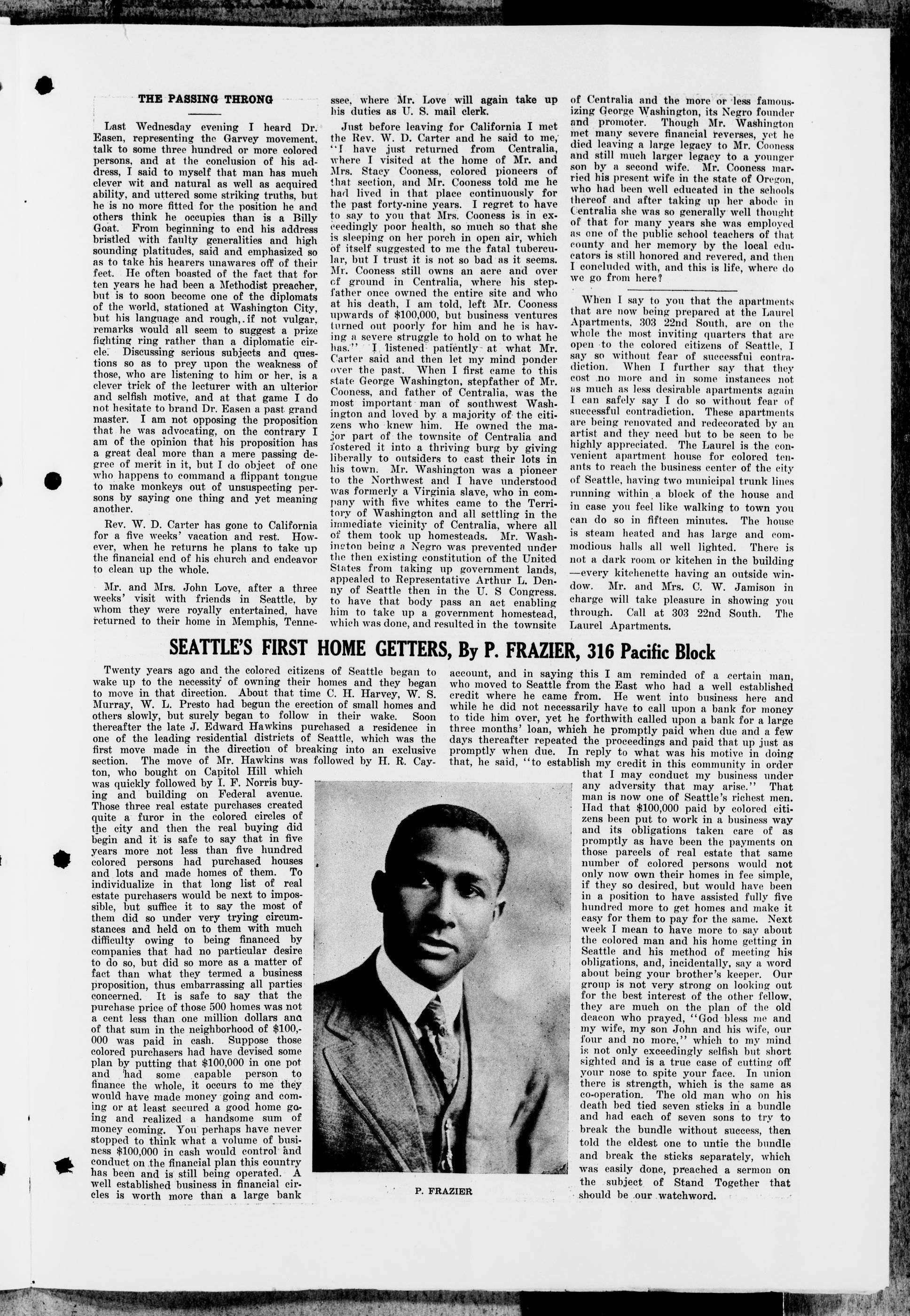
SEATTLE'S FIRST HOME GETTERS, By P. FRAZIER. 316 Pacific Block
SEATTLE'S FIRST HOME GETTERS, By P. FRAZIER. 316 Pacific Block
Twenty years ago and the colored citizens of Seattle began to wake up to the necessity of owning their homes and they began to move in that direction. About that time C. H. Harvey, W. S. Murray, W. L. Presto had begun the erection of small homes and others slowly, but surely began to follow in their wake. Soon thereafter the late J. Edward Hawkins purchased a residence in one of the leading residential districts of Seattle, which was the first move made in the direction of breaking into an exclusive section. The move of Mr. Hawkins was followed by H. R. Cay-
account, and in saying this I am reminded of a certain man, who moved to Seattle from the East who had a well established credit where he came from. He went into business here and while he did not necessarily have to call upon a bank for money to tide him over, yet he forthwith called upon a bank for a large three months' loan, which he promptly paid when due and a few days thereafter repeated the proceedings and paid that up just as promptly when due. In reply to what was his motive in doing that, he said, "to establish my credit in this community in order
THE PASSING THRONG
Last Wednesday evening I heard Dr. Easen, representing the Garvey movement, talk to some three hundred or more colored persons, and at the conclusion of his address, I said to myself that man has much clever wit and natural as well as acquired ability, and uttered some striking truths, but he is no more fitted for the position he and others think he occupies than is a Billy Goat. From beginning to end his address bristled with faulty generalities and high sounding platitudes, said and emphasized so as to take his hearers unawares off of their feet. He often boasted of the fact that for ten years he had been a Methodist preacher, but is to soon become one of the diplomats of the world, stationed at Washington City, but his language and rough, if not vulgar, remarks would all seem to suggest a prize fighting ring rather than a diplomatic circle. Discussing serious subjects and questions so as to prey upon the weakness of those, who are listening to him or her, is a clever trick of the lecturer with an ulterior and selfish motive, and at that game I do not hesitate to brand Dr. Easen a past grand master. I am not opposing the proposition that he was advocating, on the contrary I am of the opinion that his proposition has a great deal more than a mere passing degree of merit in it, but I do object of one who happens to command a flippant tongue to make monkeys out of unsuspecting persons by saying one thing and yet meaning another.
Rev. W. D. Carter has gone to California for a five weeks' vacation and rest. However, when he returns he plans to take up the financial end of his church and endeavor to clean up the whole. Mr. and Mrs. John Love, after a three weeks' visit with friends in Seattle, by whom they were royally entertained, have returned to their home in Memphis. Tenne-
ton, who bought on Capitol Hill which was quickly followed by I. F. Norris buying and building on Federal avenue. Those three real estate purchases created quite a furor in the colored circles of the city and then the real buying did begin and it is safe to say that in five years more not less than five hundred colored persons had purchased houses and lots and made homes of them. To individualize in that long list of real estate purchasers would be next to impossible, but suffice it to say the most of them did so under very trying circumstances and held on to them with much difficulty owing to being financed by companies that had no particular desire to do so, but did so more as a matter of fact than what they termed a business proposition, thus embarrassing all parties concerned. It is safe to say that the purchase price of those 500 homes was not a cent less than one million dollars and of that sum in the neighborhood of $100,000 was paid in cash. Suppose those colored purchasers had have devised some plan by putting that $100,000 in one pot and had some capable person to finance the whole, it occurs to me they would have made money going and coming or at least secured a good home going and realized a handsome sum of money coming. You perhaps have never stopped to think what a volume of business $100,000 in cash would control and conduct on the financial plan this country has been and is still being operated. A well established business in financial circles is worth more than a large bank
ssee, where Mr. Love will again take up his duties as U. S. mail clerk.
Just before leaving for California I met the Rev. W. D. Carter and he said to me, "I have just returned from Centralia, where I visited at the home of Mr. and Mrs. Stacy Cooness, colored pioneers of that section, and Mr. Cooness told me he had lived in that place continuously for the past forty-nine years. I regret to have to say to you that Mrs. Cooness is in exceedingly poor health, so much so that she is sleeping on her porch in open air, which of itself suggested to me the fatal tubercular, but I trust it is not so bad as it seems. Mr. Cooness still owns an acre and over of ground in Centralia, where his stepfather once owned the entire site and who at his death, I am told, left Mr. Cooness upwards of $100,000, but business ventures turned out poorly for him and he is having a severe struggle to hold on to what he has." I listened patiently at what Mr. Carter said and then let my mind ponder over the past. When I first came to this state George Washington, stepfather of Mr. Cooness, and father of Centralia, was the most important man of southwest Washington and loved by a majority of the citizens who knew him. He owned the major part of the townsite of Centralia and fostered it into a thriving burg by giving liberally to outsiders to cast their lots in his town. Mr. Washington was a pioneer to the Northwest and I have understood was formerly a Virginia slave, who in company with five whites came to the Territory of Washington and all settling in the immediate vicinity of Centralia, where all of them took up homesteads. Mr. Washington being a Negro was prevented under the then existing constitution of the United States from taking up government lands, appealed to Representative Arthur L. Denny of Seattle then in the U. S Congress. to have that body pass an act enabling him to take up a government homestead, which was done, and resulted in the townsite
[Name]
P. FRAZIER
of Centralia and the more or less famousizing George Washington, its Negro founder and promoter. Though Mr. Washington met many severe financial reverses, yet he died leaving a large legacy to Mr. Cooness and still much larger legacy to a younger son by a second wife. Mr. Cooness married his present wife in the state of Oregon, who had been well educated in the schools thereof and after taking up her abode in Centralia she was so generally well thought of that for many years she was employed as one of the public school teachers of that county and her memory by the local educators is still honored and revered, and then I concluded with, and this is life, where do we go from here?
When I say to you that the apartments that are now being prepared at the Laurel Apartments, 303 22nd South, are on the whole the most inviting quarters that are open to the colored citizens of Seattle, I say so without fear of successful contradiction. When I further say that they cost no more and in some instances not as much as less desirable apartments again I can safely say I do so without fear of successful contradiction. These apartments are being renovated and redecorated by an artist and they need but to be seen to be highly appreciated. The Laurel is the convenient apartment house for colored tenants to reach the business center of the city of Seattle, having two municipal trunk lines running within a block of the house and in case you feel like walking to town you can do so in fifteen minutes. The house is steam heated and has large and commodious halls all well lighted. There is not a dark room or kitchen in the building every kitchenette having an outside window. Mr. and Mrs. C. W. Jamison in charge will take pleasure in showing you through. Call at 303 22nd South. The Laurel Apartments.
that I may conduct my business under any adversity that may arise." That man is now one of Seattle's richest men. Had that $100,000 paid by colored citizens been put to work in a business way and its obligations taken care of as promptly as have been the payments on those parcels of real estate that same number of colored persons would not only now own their homes in fee simple, if they so desired, but would have been in a position to have assisted fully five hundred more to get homes and make it easy for them to pay for the same. Next week I mean to have more to say about the colored man and his home getting in Seattle and his method of meeting his obligations, and, incidentally, say a word about being your brother's keeper. Our group is not very strong on looking out for the best interest of the other fellow, they are much on the plan of the old deacon who prayed, "God bless me and my wife, my son John and his wife, our four and no more," which to my mind is not only exceedingly selfish but short sighted and is a true case of cutting off your nose to spite your face. In union there is strength, which is the same as co-operation. The old man who on his death bed tied seven sticks in a bundle and had each of seven sons to try to break the bundle without success, then told the eldest one to untie the bundle and break the sticks separately, which was easily done, preached a sermon on the subject of Stand Together that should be our watchword.
---
---
STOLEN FROM THIEVES
Butler (in service of Earl of Kyloes)— Is that you, my lord??? Burglar (full of guile)—Yus, matey.—Punch.
"Three balls!" yelled the umpire. "Now's your chance to soak it," shouted the excited pawnbroker's clerk to the batsman.—Boston Transcript.
"How's business?" "Not too good— thanks to some dishonest rascals who are selling goods at reasonable prices."—Le Journal Amusant (Paris).
Peddler—I'm trying to sell some almanacs to make a living. Won't you help me out? Busy Man—I certainly will, if you don't go of your own accord.—Boston Transcript.
"What kind of a time is he having on his motor trip?" "Guess he's having a pretty lively time. He sent me a picture postcard of a hospital."—Louisville Courier-Journal.
Muggins—It's strange that Wigwag does not succeed. He seems to have no difficulty in catching on. Buggins—Maybe the trouble is he doesn't know when to let go.—Philadelphia Record.
Lady (at bank teller's window)—I wish to open an account with you. Teller—All right, madam. How much do you want to deposit? Lady—Why, nothing. I want to draw out fifty dollars.—Life.
"These love scenes are rotten. Can't the leading man act like he is in love with the star?" "Can't act at all," said the director. "Trouble is, he is in love with her."—Louisville Courier-Journal.
"Why don't you join a golf club?" 'Man, I don't know how to play golf.' "That's no reason. Ninety per cent of the golf club members dont know how to play the game either."—Detroit Free Press.
Heaed of Firm—How long do you want to be away on your wedding trip? Hinks (timidly)—Well, sir—er—what would you say? Head of Firm—How do I know? I haven't seen the bride.—Toledo Blade.
"The man was in a reverie and the lady was in a tantrum. They collided." "The man was in what?" "A reverie. And the lady was in a tantrum." "I suppose both machines were badly damaged?"—Detroit Free Press.
"Do you think Gladys was surprised when I proposed to her?" inquired the happy youth. "About as surprised," answered Miss Cavenne, "as a candidate who has received formal notification that he has been nominated."—Washington Star. "Dobbs says art is no longer appreciated. He painted a picture called 'Greedy Fellow,' showing a pig eating corn, and—" "Why, he sold that picture, I'm sure." "Yes; but he has just heard that the model sold for more than the painting."—New York Globe.
"I've often been struck by the extreme hauteur of salesladies. Don't you suppose merchants suffer from it?" "I know one who does. He tells me he feels like sneaking in the rear door of his establishment because he suspects that his personal appearance does not meet with the approval of his clerks." Birmingham Herald. She—I told you yesterday that I would not marry you. He—I know. That's why I ask you again today. You would not be so lacking in originality, I hope, as to repeat today what you said yesterday.—Boston Transcript.
He had been fishing, but with bad luck. On his way home he entered a fishmonger's shop and said to the dealer, "John, stand over there and throw me five of the biggest of those trout." "Throw 'em? What for?" asked the dealer in amazement. "I want to tell the family I caught 'em. I may be a poor fisherman, but I'm no liar."—Tit-Bits.
George, three years of age, appeared on the Easter programme at his Sunday school in Greenwood, singing a solo. As he was leaewing the church with his mother a friend said to him: "George, you did fine." "I know it," he replied. His mother, reproving him, said: "Why, George, you should not have said that to the lady." Whereupon George answered: "Well, mother, I guess I could hear my own voice."
"Come upstairs and let me wash your hands" said Winnie's mother. "I don't
want to go up," wailed Winnie aged three. "Let her wash them down here," called grandma, "she can do it just as well." "No," her mother said firmly, "I want her to come up with me." Winnie came upstairs as slowly as possible. "Oh," she said, turning a wrathfully tearful face to her mother, "why don't you obey your mother?"
Bishop Hess said at a Nashville picine: "The religious knowledge of too many adults resembles. I am afraid, the religious knowledge of little Eve. 'So you attend Sunday school regularly?' the minister said to little Eve. 'Oh, yes sir.' 'And you know your Bible?' 'Oh, yes sir.' 'Could you perhaps tell me something that is in it?' 'I could tell you everything that's in it.' 'Indeed.' "Sister's beau's photo is in it,' said little Eve, promptly, 'and ma's recipe for vanishin' cream is in it, and a lock of my hair cut off when I was a baby is in it, and the ticket for pa's watch is in it.'"
STATEMENT OF THE OWNERSHIP, MANAGEMENT, Circulation, Etc., Required by the Act of Congress of August 24, 1912, of Cayton's Weekly, published weekly at Seattle, Wash., for October 1, 1920.
State of Washington, County of King—ss.
Before me, a notary public, in and for the State and county aforesaid, personally appeared Horace Roscoe Cayton, who, having been duly sworn, according to law, deposes and says that he is the editor of Cayton's Weekly, and that the following is, to the best of his knowledge and belief, a true statement of the ownership, management (and if a daily paper, the circulation), etc., of the aforesaid publication for the date shown in the above capton, required by the Act of August 24, 1912, embodied in section 443, Postal Laws and Regulations, printed on the reverse of this form, to-wit:
1. That the names and addresses of the publisher, editor, managing editor, and business managers are: Publisher, editor, managing editor, business manager, Horace Roscoe Cayton, Seattle, Wash.
2. That the owners are: Horace Roscoe Cayton, Seattle, Wash.
3. That the known bondholders, mortgagees, and other security holders owning or holding 1 per cent or more of total amount of bonds, mortgages, or other securities are: None.
4. That the two paragraphs next above, giving the names of the owners, stockholders, and security holders, if any, contain not only the list of stockholders and security holders as they appear upon the books of the company but also, in cases where the stockholder or security holder appears upon the books of the company as trustee or in any other judiciary relation, the name of the person or corporation for whom such trustee is acting, is given; also that the said two paragraphs contain statements embracing affiant's full knowledge and belief as to the circumstances and conditions under which stockholders and security holders who do not appear upon the books of the company as trustees, hold stock and securities in a capacity other than that of a bona fide owner; and this affiant has no reason to believe that any other person, association, or corporation has any interest direct or indirect in the said stock, bonds, or other securities than as so stated by him.
5. That the average number of copies of each issue of this publication sold or distributed, through the mails or otherwise, to paid subscribers during the six months preceding the date shown above is 500.
HORACE ROSCOE CAYTON. Sworn to and subscribed before me this 30th day of September, 1920. CHARLES M. SILVER. Notary Public in and for the State of Washington, (My Commission expires November 4, 1923). The LAUREL APARTMENTS is being renovated, redecorated and otherwise made ready for
WINTER TENANCY and you and each of you are invited to call and inspect the various apartments and if you are in need of such accommodations for the coming winter you are solicited to become a patron of the house. The Laurel Apartments is one block from Jackson Street and one block from Yesler Way on Twenty-second Avenue South, 303. Every apartment in THE LAUREL is an outside one and without a single dark room in the building. It is steam heated and sufficiently furnished for immediate occupancy. In fact you can be in living possession of one of the apartments within a few hours after having rented the same. The halls, lavatories and heating apparatus are all well cared for by competent persons. Come and see for yourself.
LAUREL APARTMETS Telephone Beacon 1910 at 303 22nd Ave. South
Register and Vote
In order to enjoy life, liberty and pursuit of happiness, the Republican Party must be restored to power, with a Republican President, Senate and House of Representatives. The entire Republican State and County ticket must be elected. This can only be accomplished by registering and voting solidly the Republican ticket.
Vote the straight Republican ticket.
King County Colored Republican Club
IN THE SUPERIOR COURT OF THE STATE OF Washington for King County.
National Grocery Company, a corporation, Plaintiff, vs. Richard Koska and William Koska, co-partners, doing business as R. Koska & Son, Defendants.—No. 144529. Summons for Publication.
The State of Washington: to the said Richard Koska and William Koska, co-partners doing business as R. Koska & Son:
You are hereby summoned to appear within sixty days after the date of the first publication of this summons, to-wit: within sixty days after the 4th day of September, 1920, and defend the above entitled action in the above entitled court, and answer the complaint of the plaintiff, and serve a copy of your answer upon the undersigned attorneys for plaintiff at their offices below stated, and in case of your failure so to do, judgment will be rendered against you according to the demand of the complaint, which has been filed with the clerk of said court.
The object of the above entitled action is to determine and adjudge the amount due upon a claim of the plaintiff against the defendedants, founded upon the sale and delivery of goods, wares and merchandise from the said plaintiff to said defendants, which claim is in the sum of $274.55, together with interest thereon at six per cent per annum from May 26, 1920; and to secure a judgment therefor, together with the costs of this action, against the defendants and each of them, Richard Koska and William Koska, co-partners doing business as R. Koska and Son.
BRONSON, ROBINSON & JONES.
Attorneys for Plaintiff.
614 Colman Building, Seattle
King County, Washington.
Date of first publication: Sept. 4-Oct. 12. 1920.
IN THE SUPERIOR COURT OF THE STATE OF Washington for King County.
Mildred Lorene Wooden, Plaintiff, vs. William Bradford Wooden, Defendant.—No. 145455. Summons.
The State of Washington to the said William Bradford Wooden, Defendant:
You are hereby summoned to appear, within sixty days after the first publication of this summons, to-wit: within sixty days after the 4th day of September, 1920, and defend the above entitled action in the above entitled court, and answer the complaint of the plaintiff, and serve a copy of your answer upon the undersigned attorneys for plaintiff, at their offices below stated; and in case of your failure so to do, judgment will be rendered against you according to the demand of the complaint, which has been filed with the Clerk of said Court.
The object of this action is to obtain judgment granting plaintiff a divorce from defendant, and dissolving the bonds of matrimony existing between plaintiff and efendant, and to award and confirm to plaintiff the title and possession of her separate property.
BRONSON, ROBINSON & JONES,
Attorneys for Plaintiff.
Post Office address:
614 Colman Building, Seattle,
King County, Washington.
September 4-October 12, 1920.
ALHAMBRA CASH GROCERY
Distributor of Mme. C. J. Walker's Hair and Skin preparations. Mall, postal and express orders promptly filled. 1201-3 Jackson St., Seattle, Wash.
SANDERS & COMPANY
LOANS NEGOTIATED
1003-1004 L. C. Smith Building
Office Hours
From 8:30 A. M. to 5:30 P. M.
Seattle, Wash.
Elliott 4662