Cayton's Weekly
Saturday, November 27, 1920
Seattle, Washington
Page text (machine-generated)
Cayton's Weekly
---
PRICE FIVE CENTS
CAYTON S WEEKLY
Published every Saturday at Seattle, Washington,
U. S. A.
Subscription $2 per year in advance.
HORACE ROSCOE CAYTON..Editor and Publisher
Entred as second class matter, August 18, 1916, at
the post office at Seattle, Wash., under the Act of
March 3rd, 1916.
TELEPHONE: BEACON 3579
Office 317 22nd Ave. South
THANKSGIVING
It is many generations ago indeed that our liberty-loving forefathers conceived the idea of setting aside a day for thanks-giving and feasting.
An American, if he remembers only but a new lessons from his school history book, can in a twinkling recall scenes he so vividly conjured up in those younger carefree days of childhood—scenes which typified to him what Thanksgiving must have been like in the inauguration days of America. Of course, it somewhat depends upon whether the aspiring little American wore dresses or trousers, as to the scenes he beheld in his imaginings.
If of the "dress" variety, the main features of the scene very likely were demure Puritan maidens, with eyes quite concealed under very modest lashes, who received the equally as calm and sedate admiration of the several unattached youths generally scattered throughtout the scenery (and right here the young dreamer experienced a distinct thrill), while the secondary consideration was the "thanks1giving" itself with its accompanying feast.
But if our searching efforts were to begin a diagnosis of the "trousered' variety of young America, we would see a grand conglomeration of fried turkey, cranberry sauce, mashed potatoes, impossible pies, nuts and candies, to say nothing of red-cheeked apples, more nuts and more candy following the main feast in solemn procession, (and right here this young dreamer would experience a distinct sensation of hunger). To penetrate into the one-track minds of little boys picturing the first Thanksgiving, it would be like entering into a hitherto undiscovered Wizard of Oz magical country—where meats, vegetables and fruits played the leading roles. And the various secondary considerations "here" usually entailed whooping Indians, in full war regalia, (whooping this time just to celebrate the day), with some sprinklings of Puritan men with guns, game laid out for the feast, and last and very least, women-folk every now and then.
Well, it does a fellow good to go over childhood dreams and aspirations, even of this kind, once in a while—when our ideals were unsullied by subsequent battles of life where we didn't always emerge with just exactly the same outlook. Such happy retrospection brings a reminiscent smile to the lips, to be sure, and makes us better citizens of America, by recalling the ideals on which our country is founded.
There will be the same number of people again this season, whether their estate be afbuent or more or less inconsequent, who will ask the same, oft-reiterated question, "What have I to be thankful for?" and possibly this question will be tinged with a great bitterness where the home has been visited by the Angel of Death through the agency of the recent World War. Where death, disablement or disease has entered, because the hand of war dealt it out, there is no doubt it is hard to keep the thoughts of bitter resentment down and many a hearthstone is silent from sounds of youth because across
the waters a lover one lies sleeping in France, or sad because a loved one is no longer the stalwart self-same youth of yesterday. The hearts of true America beat in a unison of sympathy for the war-stricken homes where the wound has not even lost its early stages of acute pain, or where a mother has given her only son. And the world as a whole is still in the throes of uncertainty as to what tomorrow will bring out of the turbulence of today!
But were there even greater uncertainty staring us in the face, were every home within the bounds of America directly touched by war, or one or several of their inmates sick or disabled, there are still thanks due to the Giver of all good things. You and I still behold the faces of those we love, or see the life about us. We can eat what little we way have with sound enjoyment—or if our digestive apparatus is not of the best, the sense of smell is still ours and our ears are still attuned to the sounds of music and of laughter. We are living in luxury, truly, comparing our lot with that of the hardy pioneers who instituted our national feast—and THEY saw fit to give thanks.
And let us look ahead. The future is for the growing child. Don't live entirely in the past—except to glean from some worthy act or thought the impetus to make you and those about you to stride forward more surely—or to give a thought of love to those who have passed beyond to the mystery of eternity! The soldier who died did not give his life that humanity should lose thereby!—
THE PASSING THRONG
Wilson R. Gay Passes.
When I read of the death of Wilson R. Gay a few days ago I was pained beyond description, for the two of us had been fast and firm friends for more than a quarter of a century. Before I got acquainted with Mr. Gay I read of what he had said in defending a white man charged with having killed a colored man—George White—which in my opinion reflected upon the colored citizens in general, and in the next issue of the Seattle Republican, which I then published, I went after Attorney Gay without gloves. Apparently he gave what I had said no consideration, but subsequently we met and he smiled and poked out his hand to shake, and then he invited me to lunch and so comprehensively explained to me what he had said that I involuntarily poked my hand across the table and said "shake," which he did, and from that day on we were fast friends. In all my experience I never met a more cheerful and congenial gentleman than Mr. Gay. He was a philosopher that ever looked upon the bright side of life and no entanglements came before him but what he could extract a scintilla of good therefrom. Some four years ago the Seattle Branch of the National Association for the Advancement of Colored People delegated me to find for them a speaker for an emancipation celebration and Mr. Gay was invited to make the principal address, which in my opinion was the most encouraging address that had ever been delivered to a colored audience in Seattle and to this day those who heard him tell of Judge Gay's beautiful address. It differed from addresses previously delivered to colored audiences in that he at no time referred to the complexion of his hearers. To all intents and purposes he was talking to an audience made up of the elite white citizens of the city. Aside from being a philosopher and a student of
nature Bill Gay was also full and overflowing with the milk of human kindness and he patiently heard the story of every one who came to him in distress, and for the most part extended a helping hand. Recently I called upon him in the interest of an institution directed by colored citizens and I began to tell what the members of the institution contemplated doing, but were in need of funds, and before I could finish my story he looked up and smiled and said, if you recommend I will give the widow's mite, here's my check for fifty dollars and then to head off any great amount of thanks he began to tell us a bunch of stories and though persons wanting to do business with him were restless in the outer office, he continued his story telling and seemed glad for the half hour's recreation. As often as I took my troubles and tribulations to Bill Gay just as often did I leave him feeling that life was still worth living. Whether or not his recent religion was a New Thought one I do not know, but judging from his ever smiling countenance it surely was a sweet thought one. Thus do we meet on earth to part again and whether we will meet again "beyond the river" is life's problem, but let's hope that we die but to live again and after death we will meet to never part.
Speaking about Wilson R. Gay reminds me of my work with him in our endeavor to re-elect the late John L. Wilson to the United States senate. We of course had done a great deal of preliminary campaign work together in the way of electing the right men as members of the legislature, but our real work began when the legislature convened. For weeks Gay and I were in immedaite touch with each other. I, in the capacity of publicity man, and Gay as general director. He leaned heavily on me to find out everything that was going on politically and to find out the business of every politician who visited the legislature. During that entire campaign Gay was always my friend and at no time did I find him trying to take any mean advantage of the other fellow. Bill Gay headed a loyal bunch of fellows and every one of that bunch that is left to tell the tale dropped a bitter tear of regret when they read of his death. The number however grows smaller each year and when one of them falls by the wayside the others wonder who will be the next.
Her Teachings Were Narrow.
Sitting directly in front of me on a crowded street car one evening last week which was going East on Jackson street, was a ten year old white girl. The vacant half of the seat was soon taken by a Japanese woman, to which the little girl took much mental exceptions and exhibited more or less displeasure. The Japanese lady gave the little one no concern and did not even see her, but the child was in such an ugly frame of mind that every one near her noticed it. Somewhere up the line the Japanese lady left the car and the little girl seemed perfectly delighted, but her happiness was of short duration for at the next corner a six foot coal black colored man took the vacant half of the seat and a scowl came over her face—a swap the witch for the devil look—and her disgust attracted general attention, and remembering her recent discomfiture on account of the presence of the Japanese woman, the most of us audibly smiled, and I said to myself, that young girl has been badly tutored at
```markdown
```
home, her parents having failed to impart to her cosmopolitan ideas. Persons who, on account of cramped financial circumstances, are forced to use public conveyances, should so generalize their minds as to be perfectly at ease in whatever awkward situation they happen to find themselves. Though everybody tittered when the colored man took the seat, yet he was as indifferent to the situation as was the Japanese woman and she was as indifferent as an Indian statute, all showing that neither the Japanese woman nor the colored man cared a tinkers damn whether it pleased or displeased anyone for having taken that vacant seat.
They Got Together.
Familiar faces greeted me the other day while walking up Madison street between Second and Third in the persons of F. F. Keeble, John F. Cragwell and Richard S. Brown, all well known barbers of this city. Keeble and Cragwell are pioneer barbers of the Northwest, for more than a quarter of a century have been more or less conspicuous in the public eye of the Puget Sound country. Both at different times have owned and operated extensive as well as expensive tonsorial parlors and bath house emporiums. Each have met financial reverses as well as misfortunes, but they seem to have always worked upon the theory, though one be down such an one is not necessarily out, which enabled them to pull themselves together and the next turn of the wheel would show them again prosperous and happy. I, however, am inclined to think there was always a bit of rivalry, if not actual jealousy between these familiar public characters which frequently militated to the financial detriment of both of them, but be that as it will or may, I was pleased to see the two working together. Both of them have many reliable as well as substantial customers who will follow them, and it shows good sense on their part to lay aside any jealousy that may have existed between them and take advantage of any opportunity that may present itself. Recently Mr. Cragwell had been unfortunate in one of his undertakings and was out of employment. Mr. Keeble had an opening and both took advantage of the opportunity. Good horse sense.
He Had It Coming.
When you have something under the hat the public will recognize it—in other words, you can't keep a good man down. Last Sunday afternoon the King County Colored Republican Club endorsed the candidacy of W. E. Vrooman for a position as a deputy sheriff of King county under the Matt. Starwich striveility administration. May perhaps the other candidates seeking the same endorsement had just as much under the hat as did Mr. Vrooman, but those voting did not believe it, hence Vrooman got a two to one vote over the combined opposition. There is in this a lesson for the boys of today, who are to be the men of tomorrow, to not only learn, but to faithfully observe, while laying the foundation for manhood lay it sufficiently solid to accommodate any emergency it may be called upon to hold up. In other words get an education and not a smattering. Young men who think they know it all when they have finished a grammar grade, will, if they live until they but against the world, realize that they did not even know enough to know that they knew little or nothing. I may have many shortcomings in life, but I have always tried to keep myself sufficiently posted that no one could ever charge me with incompetency and this rule every young person should learn good and well and then live up to it.
Friday, November 19th inst. Miss Helen Thorn became the bride of Mr. William McFarland at the home of her parents, Mr. and Mrs. Samuel A. Thorn in the presence of a few friends and the members of the family. They immediately took quarters in the Laurel Apartment where they have a most sumptuously furnished
apartment. Both of the high contracting parties have a host of friends in the city, who remembered them with many tokens as a reminder of their love and appreciation of them.
Mr. and Mrs. McMullen and Mrs. Ward spent Thanksgiving in Tacoma.
KING COUNTY REPUBLICAN CLUB
(By F. B. Cooper, President)
From time to time costic criticisms have been hurled at our club and at the men of Seattle in general. The criticisms have generally come from sources from which encouraging remarks, or at least constructive criticism would be expected. We have been accused of having done nothing and still doing nothing. Now, we must admit that in a very tangible way we have not accomplished a great deal. We have not been able to place a great number of persons in office or gain any special concession for any particular person or persons, but a more careful investigation will show that in a fundamental and constructive way we have made some progress. It must be borne in mind that the Negro population of Seattle enjoy a freedom not common to our people in many sections of the country, hence we have not felt the need of organization and are therefore extremely diffident towards organizing. We should also remember that no manufacturer can produce manufactured goods, which are his tangible results, until he has secured and put in perfect order his manufacturing machinery. Our work thus far has been confined very largely to securing our machinery with which to produce our tangible evidence.
When the present incumbent came into office about a year and a half ago, the life of our club was at a very low ebb, so much so, that some claimed that we had lost our last opportunity, but there were others, however, who took the opposite view and believed that with the proper effort we still had a chance. Upon coming into office and making a study of conditions we immediately brought ot the club certain recommendations for its consideration, among which were the following: 1st. Revivify the club by increasing its membership and creating and developing in all classes of Negroes in Seattle new political spirit. We recommended that a committee be appointed to divide the city into districts and appoint a captain over each of these districts, who should enroll upon a card prepared for that purpose the name of every male Negro voter in our city and prevail upon him to register.
We recommended that our executive committee confer with the executive committee of the Women's Political Alliance, through these committees harmonize the two clubs, and have them work along the same line for a common cause to the same end. We believed that through this system more effective work could be done for the whole. We further recommended that the club strive to actively interest the Negro ministers of our city and if possible have them pledge the club their support. Prior to this time we seemingly had overlooked the power and influence of our ministers.
We further recommended that the Negroes of the state be organized into some form of a state organization. Emphasis were laid upon the idea of getting our voters to register and vote, in fact we insisted that all of our efforts should be directed to the accomplishment of this one thing—the paramount issue—for without the accomplishment of this one thing we could not hope to do much.
Our past record showed that while we had talked a great deal and made much noise we had miserably failed in our registration and voting. Dr. Cardwell our former secretary declared in 1916 that out of a membership of 200 or more only 60 had registered. These recommendations were adopted by the club as a whole and we immediately proceeded to put them into practice. We districted the city, appointed captains, assigned them their respective districts and
with the proper working material. Some of them did a most commendable work and are deserving of special mention at this time, namely: Mr. C. L. Miller, Sergt. Vrooman, Dr. Hamilton and others. From this effort we learned at first hand that our voting strength had been greatly inflated and that we were not as strong numerically as we had rated ourselves. In attempting to carry out this system we met with much difficulty and learned a valuable lesson, to-wit: that to do effective and efficient political work, finance is absolutely essential. While all of our districts were not thoroughly worked, many of them were, and especially those in which the Negro population was densely settled.
In the work of harmonizing the Women's Political Club we failed utterly.
As to the co-operation of the ministers they responded in a manner most favorable. They announced and preached from their pulpits the necessity of registering and voting, they opened their church doors to us for special rally meetings and made public talks urging the Negro to register and vote. They also allowed us to send four minute men to their Sunday services to preach the doctrine of registering and voting. They contributed a wonderful share to the success of our work in this line. I believe that it is reasonable to say that at least 85% of the Negroes of Seattle cast their ballot at the late election. In 1916 Dr. Cardwell reported that in the Woodson Apartments three persons besied Mr. and Mrs. Woodson were registered and in the Douglas Apartments 7 out of 75 were registered. Prior to city election I made a special investigation of the Douglas and found that about 80% of the occupants had registered. After an interview with those who had not registered I secured a pledge that they would register. Since the election of Nov. 2nd, I have canvassed the Douglas, Woodson and Miller Apartments and find that about 95% of the occupants claim to have voted. I believe that this club is directly responsible for this increase in registering and voting. If we had done nothing more than to cause the colored people to register and vote I believe we would have laid a wonderful foundation for greater work in the future.
The Negroes of the state have been well organized into a State Colored Republican Club. Dr. Cardwell has been the chief exponent in this movement and deserves special praise for the excellent work he has done along this line. To our County Republican Convention this club was represented by four regular delegates and one alternate. The alternate, however, did not attend. To the State Republican Convention we were honored to have elected three regular delegates and one alternate. This was another distinction which we had not before enjoyed as a club.
The club has contributed either directly or indirectly to the appointment of two police officers in Seattle and one person in the assessors office temporarily, in the person of Dr. E. A. Johnson. One in the county treasurer's office temporarily, in the person of Sergt. W. E. Vrooman. The restorations of one laborer in the City-County Building and the appointment of one registration clerk temporarily in the person of Dr. Hunter. The club has a definite promise of an appointment in the sheriff's office and a possible appointment in the county treasurer's office. This new club has definite standing with the county and state organizations, which organizations control the politics of our county and state. They have declared that they will recognize no other Negro political club and the candidates for political office are beginning to take a similar stand. The club has succeeded in harmonizing some of the factions among our own people and getting them to work through the club.
Now, one of the club's greatest handicaps has been, and is, its inability to control the various groups that work independently of the club, and compel by some means those groups to work through the club. I believe this can be best accomplished by the club's communicating with
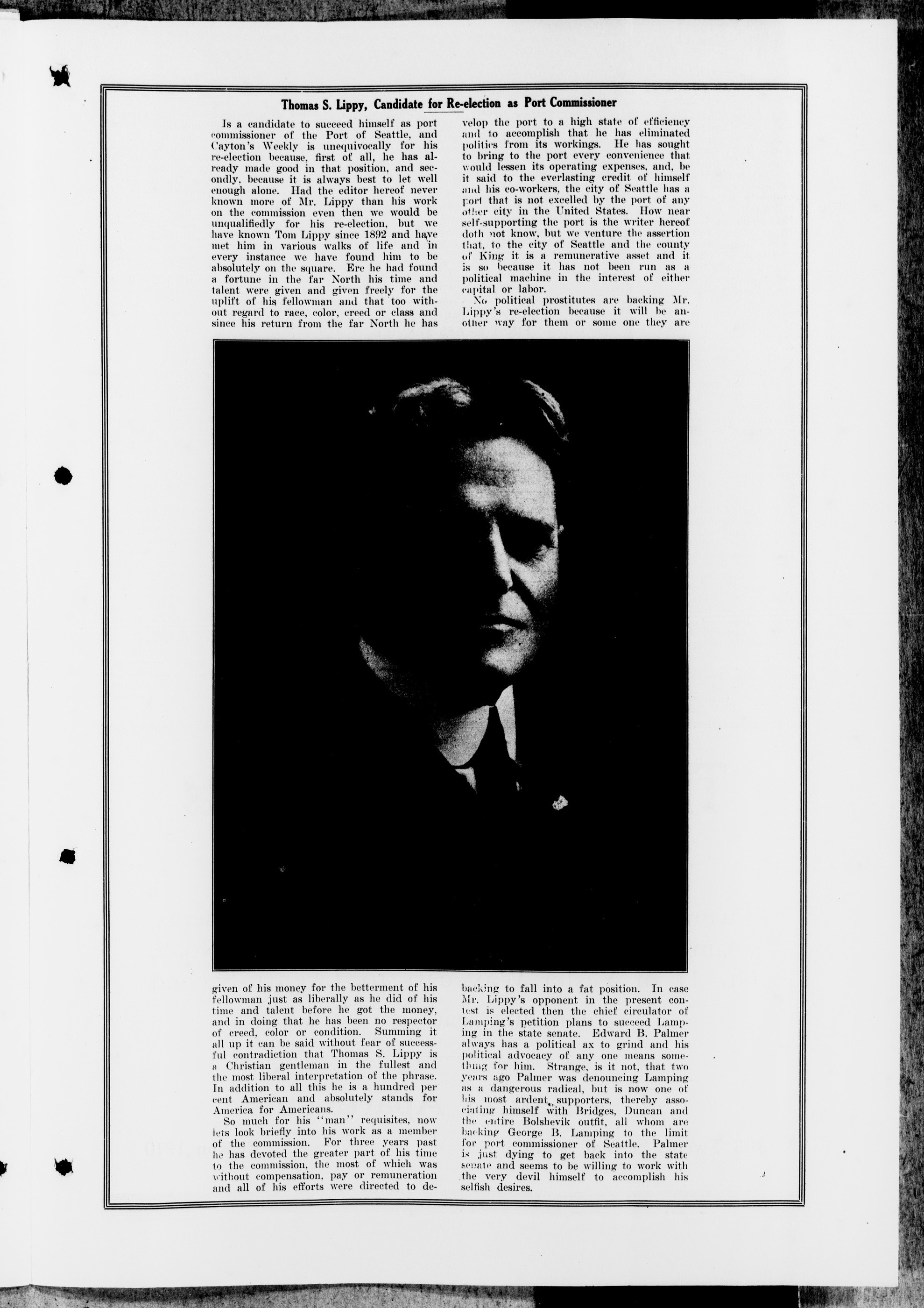
Thomas S. Lippy. Candidate for Re-election as Port Commissioner
[Name]
Is a candidate to succeed himself as port commissioner of the Port of Seattle, and Cayton's Weekly is unequivocally for his re-election because, first of all, he has already made good in that position, and secondly, because it is always best to let well enough alone. Had the editor hereof never known more of Mr. Lippy than his work on the commission even then we would be unqualifiedly for his re-election, but we have known Tom Lippy since 1892 and have met him in various walks of life and in every instance we have found him to be absolutely on the square. Ere he had found a fortune in the far North his time and talent were given and given freely for the uplift of his fellowman and that too without regard to race, color, creed or class and since his return from the far North he has
The image provided is too blurry to accurately recognize any text. It appears to be a grayscale photograph of a person's face, but the details are not clear.
given of his money for the betterment of his fellowman just as liberally as he did of his time and talent before he got the money, and in doing that he has been no respector of creed, color or condition. Summing it all up it can be said without fear of successful contradiction that Thomas S. Lippy is a Christian gentleman in the fullest and the most liberal interpretation of the phrase. In addition to all this he is a hundred per cent American and absolutely stands for America for Americans.
So much for his "man" requisites, now lets look briefly into his work as a member of the commission. For three years past he has devoted the greater part of his time to the commission, the most of which was without compensation, pay or remuneration and all of his efforts were directed to de-
velop the port to a high state of efficiency and to accomplish that he has eliminated politics from its workings. He has sought to bring to the port every convenience that would lessen its operating expenses, and, be it said to the everlasting credit of himself and his co-workers, the city of Seattle has a port that is not excelled by the port of any other city in the United States. How near self-supporting the port is the writer hereof doth not know, but we venture the assertion that, to the city of Seattle and the county of King it is a remunerative asset and it is so because it has not been run as a political machine in the interest of either capital or labor.
No political prostitutes are backing Mr. Lippy's re-election because it will be another way for them or some one they are
1930
backing to fall into a fat position. In case Mr. Lippy's opponent in the present contest is elected then the chief circulator of Lamping's petition plans to succeed Lamping in the state senate. Edward B. Palmer always has a political ax to grind and his political advocacy of any one means something for him. Strange, is it not, that two years ago Palmer was denouncing Lamping as a dangerous radical, but is now one of his most ardent, supporters, thereby associating himself with Bridges, Duncan and the entire Bolshevik outfit, all whom are backing George B. Lamping to the limit for port commissioner of Seattle. Palmer is just dying to get back into the state senate and seems to be willing to work with the very devil himself to accomplish his selfish desires.
---
---
The Laurel Apartments
303 Twenty-Second South
Twenty-five two and three room apartments,
steam heated and nicely furnished. Take No. 9,
No. 11 or Yesler Way cars to Twenty-Second
Apartments ready to occupy
| The Laurel Apartments
303 Twenty-Second South Beacon 1910
WAS THANKFUL
That [Tam temporarily out of business,
which enables me to take a much needed
rest before entering into another line of
business—B. FL Tutt.
That there are thousands of Japanese in
and ahout Seattle whose confidence I have,
which enables me to do business with them
and thereby increase my realty operations
—P. Frazier,
That my talent was recognized by the Re-
publican State Central Committee, which
gave me an opportunity to tell the world
what | knew.—W. TL. Wilson.
That 1 conducted the affairs of the Na-
tional Association for the Advancement of
Colored People (Seattle Branch) the past
twelve months fo merit a unanimous re-
election. 1 thank yvou.—O, M. Winston.
That a turn of the wheel has enabled me
to lay the foundation for a permanent. busi-
ness and the outlook for the future seems
bright and cheerful—Russell Smith.
That the Lord has blest my efforts in the
way of building and consecrating an edifice
for my congregation to worship in.—Rev.
W. D. Carter.
That things have been coming my way and
the end is not in sight and its now see me
or your name is Dennis.—C. R. Anderson.
That the Bishop sent me to Seattle where
a magnificent church and a pleasing congre-
gation awaited my coming and that I think
} am able to do the rest.—Rev. J. Lincoln
Craw.
That Seattle's fuel season began early and
gives evidence of lasting long, thus enabling
me to get mine while the train is passing
by.—William Chandler.
That fortune has favored and enabled us
to live under our own vine and fig tree
and furthermore the future looks partieu-
larly bright—The Sojourner Truth Club.
That the Alhambra Cash Grocery Store
leads all the rest and is enjoying an ever-
increasing trade-—W. H. Banks.
That the sun does not shine in one man’s
door all of the time nor does the wind al-
ways blow the same way, and the change
has made it possible for me to direet in-
stead of being directed.—Edie Gardner.
That the Laurel Apartment is giving its
tenants good heating service without a mur-
mur or complaint from its tenants and it
could do equally as much more.—C. W.
Jamison.
That the Y. W. C. A. (colored branch) does
not take a back seat in the way of owning
its home and its fittings, it having moved into
its new quarters a few days ago. Mrs. W.
D. Carter, official secretary.
That I have been blest with perfect health,
which has enabled me to prosecute the work
I set out to accomplish with brevity and ob-
ject—Mrs. A. R. Bonner, president So-
Journer Truth,
That despite adversities I am surely
though slowly moving to the goal and that
my congregation is gradually — growing
stronger.—Rey. J. B. Barber.
That I still have a strong arm, that teeth
still ache and those having aching teeth are
FIRST CLASS COAL and
FIRST CLASS SERVICE
Pacific Coast Coal Company
Main 5080
MAINEVENT POOL HALL
Seattle Baking Company
Latest Sanitary and Up-to-Date Baking
Appliance
Ask Your Dealer For Our Goods
RICHMOND EXPRESS CO.
‘WOOD AND COAL DELIVERED
Express, Baggage to Any Part of the City.
310 Twelfth Ave. South Beacon 178
FLOYD WRIGHT, Mgr.
ALHAMBRA CASH GROCERY
Distributor of Mme. C. J. Walker’s Hair and Skin
preparations. Mail, postal and express orders
promptly filled. 1201-3 Jackson St., Seattle, Wash.
still able to get the money and—well ‘nuf
said.—Dr. F, B. Cooper.
That all three branches of my mercantile
concern are doing well under their respect-
ive managers.—Harry Legg.
That I have curbed the disturbing elements
among the colored Republicans of King
County in particular and the state of Wash-
ington in general and my O. K. must be
had before you get into the show.—Dr.
David T, Cardwell.
That its impossible to keep a good man
down and that behind the blackest cloud
a bright sun shines.—Z. L. Woodson.
That I have been able to watch my busi-
hess grow by giving my customers a square
deal.—Noy Pierson.
That ‘‘my boys’ are chips off of the old
block and that sun shine follows after rain.
—J. T. Gayton.
That things could be a whole lot worse
and that J still have a host of friends.—
J. EF. Cragwell.
(Cont!nued fgom second page!
various candidates soon after they announce
their candidacy and ask them if they will
be kind enough to do whatever political
business they do with the colored people of
Seattle through this club. Second, to send
committees from this club to confer with
the heads of those groups and try to prevail
upon them to join this club and work
through it, as their efforts will be more
effective this way. To harmonize the dif-
ferent factions among us as a race is our
next greatest and most difficult step.
I also believe that this club showld put
forth definite steps to have at least one or
two good representatives on the King Coun-
ty Republican Central Committee and at
least one on the State Central Committee.
Tf this is done we will have at all times
someone to guard our interests while plans
are in their formative state. T am one of
those who believe that if we are to work for
the Republican Party. and it is the only
party for us to work for, they should share
some part of the expense necessary to the
prosecution of this work. However, I favor
the plan offered by Dr. Cardwell that we
first contribute something to the general
fund for by so doing we become partners
to that sum and are therefore justly entitled
to draw upon it for the proper purposes
when necessary.