Seattle Republican
Friday, February 22, 1901
Seattle, Washington
Page text (machine-generated)
The SEATTLE REPUBLICAN
Historical
NORTHWEST
VoL VII., NO. 36
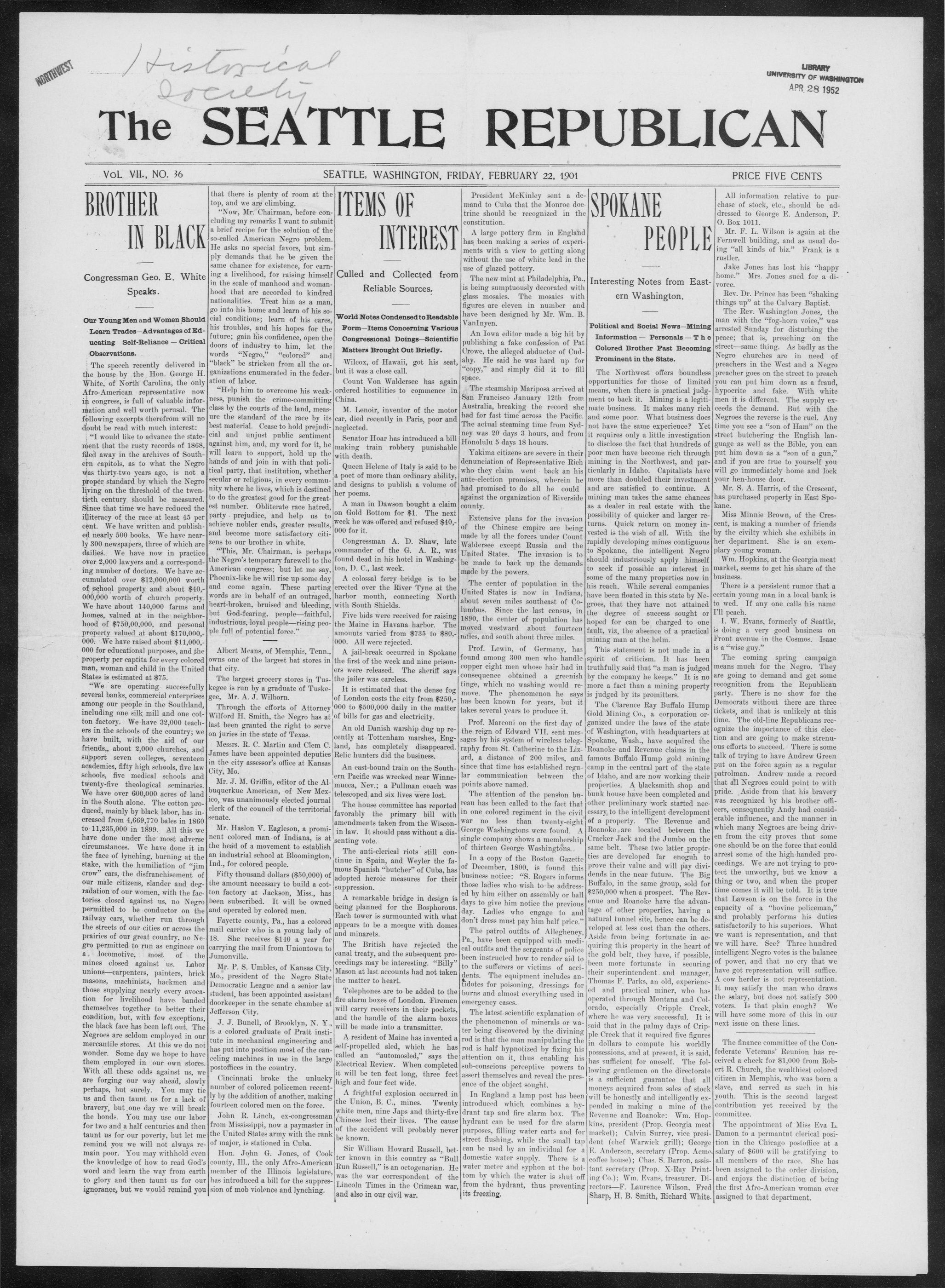
BROTHER IN BLACK
BROTHER IN BLACK
Congressman Geo. E. White Speaks.
Our Young Men and Women Should Learn Trades—Advantages of Educating Self-Reliance -Critical Observations.
The speech recently delivered in the house by the Hon. George H. White, of North Carolina, the only Afro-American representative now in congress, is full of valuable information and well worth perusal. The following excerpts therefrom will no doubt be read with much interest:
"I would like to advance the statement that the rusty records of 1868, filed away in the archives of Southern capitols, as to what the Negro was thirty-two years ago, is not a proper standard by which the Negro living on the threshold of the twentieth century should be measured. Since that time we have reduced the illiteracy of the race at least 45 per cent. We have written and published nearly 500 books. We have nearly 300 newspapers, three of which are dailies. We have now in practice over 2,000 lawyers and a corresponding number of doctors. We have accumulated over $12,000,000 worth of school property and about $40,000,000 worth of church property. We have about 140,000 farms and homes, valued at in the neighborhood of $750,00,000, and personal property valued at about $170,000,000. We have raised about $11,000,000 for educational purposes, and the property per capita for every colored man, woman and child in the United States is estimated at $75.
"We are operating successfully several banks, commercial enterprises among our people in the Southland, including one silk mill and one cotton factory. We have 32,000 teachers in the schools of the country; we have built, with the aid of our friends., about 2,000 churches, and support seven colleges, seventeen academies, fifty high schools, five law schools, five medical schools and twenty-five theological seminaries. We have over 600,000 acres of land in the South alone. The cotton produced, mainly by black labor, has increased from 4,669,770 bales in 1860 to 11,235,000 in 1899. All this we have done under the most adverse circumstances. We have done it in the face of lynching, burning at the stake, with the humiliation of "jim crow" cars, the disfranchisement of our male citizens, slander and degradation of our women, with the factories closed against us, no Negro permitted to be conductor on the railway cars, whether run through the streets of our cities or across the prairies of our great country, no Negro permitted to run as engineer on a locomotive, most of the mines closed against us. Labor unions—carpenters, painters, brick masons, machinists, hackmen and those supplying nearly every avocation for livelihood have banded themselves together to better their condition, but, with few exceptions, the black face has been left out. The Negroes are seldom employed in our mercantile stores. At this we do not wonder. Some day we hope to have them employed in our own stores. With all these odds against us, we are forging our way ahead, slowly perhaps, but surely. You may tie us and then taunt us for a lack of bravery, but one day we will break the bonds. You may use our labor for two and a half centuries and then taunt us for our poverty, but let me remind you we will not always remain poor. You may withhold even the knowledge of how to read God's word and learn the way from earth to glory and then taunt us for our ignorance, but we would remind you
that there is plenty of room at the top, and we are climbing.
"Now, Mr. Chairman, before concluding my remarks I want to submit a brief recipe for the solution of the so-called American Negro problem. He asks no special favors, but simply demands that he be given the same chance for existence, for earning a livelihood, for raising himself in the scale of manhood and womanhood that are accorded to kindred nationalities. Treat him as a man, go into his home and learn of his social conditions; learn of his cares, his troubles, and his hopes for the future; gain his confidence, open the doors of industry to him, let the words "Negro," "colored" and "black" be stricken from all the organizations enumerated in the federation of labor.
"Help him to overcome his weakness, punish the crime-committing class by the courts of the land, measure the standard of the race by its best material. Cease to hold prejudicial and unjust public sentiment against him, and, my word for it, he will learn to support, hold up the hands of and join in with that political party, that institution, whether secular or religious, in every community where he lives, which is destined to do the greatest good for the greatest number. Obliterate race hatred, party prejudice, and help us to achieve nobler ends, greater results, and become more satisfactory citizens to our brother in white.
"This, Mr. Chairman, is perhaps the Negro's temporary farewell to the American congress; but let me say, Phoenix-like he will rise up some day and come again. These parting words are in behalf of an outraged, heart-broken, bruised and bleeding, but God-fearing, people—faithful, industrious, loyal people—rising people full of potential force."
Albert Means, of Memphis, Tenn., owns one of the largest hat stores in that city.
The largest grocery stores in Tuskegee is run by a graduate of Tuskegee, Mr. A. J. Wilborn.
Through the efforts of Attorney Wilford H. Smith, the Negro has at last been granted the right to serve on juries in the state of Texas.
Messrs. R. C. Martin and Clem C. James have been appointed deputies in the city assessor's office at Kansas City, Mo.
Mr. J. M. Griffin, editor of the Albuquerque American, of New Mexico, was unanimously elected journal clerk of the council of the territorial senate.
Mr. Haslon V. Eagleson, a prominent colored man of Indiana, is at the head of a movement to establish an industrial school at Bloomington, Ind., for colored people.
Fifty thousand dollars ($50,000) of the amount necessary to build a cotton factory at Jackson, Miss., has been subscribed. It will be owned and operated by colored men.
Fayette county, Pa., has a colored mail carrier who is a young lady of 18. She receives $140 a year for carrying the mail from Uniontown to Jumonville.
Mr. P. S. Umbles, of Kansas City, Mo., president of the Negro State Democratic League and a senior law student, has been appointed assistant doorkeeper in the senate chamber at Jefferson City.
J. J. Bunell, of Brooklyn, N. Y., is a colored graduate of Pratt institute in mechanical engineering and has put into position most of the canceling machines in use in the large postoffices in the country. Cincinnati broke the unlucky number of colored policemen recently by the addition of another, making fourteen colored men on the force.
Hon. John G. Jones, of Cook county, Ill., the only Afro-American member of the Illinois legislature has introduced a bill for the suppression of mob violence and lynching.
SEATTLE, WASHINGTON, FRIDAY, FEBRUARY 22, 1901
ITEMS OF INTEREST
ITEMS OF INTEREST
Culled and Collected from Reliable Sources,
Wilcox, of Hawaii, got his seat but it was a close call.
M. Lenoir, inventor of the motor car, died recently in Paris, poor and neglected.
Senator Hoar has introduced a bill making train robbery punishable with death.
Queen Helene of Italy is said to be a poet of more than ordinary ability, and designs to publish a volume of her poems.
A man in Dawson bought a claim on Gold Bottom for $1. The next week he was offered and refused $40,-000 for it.
Congressman A. D. Shaw, late commander of the G. A. R., was found dead in his hotel in Washington, D. C., last week.
A colossal ferry bridge is to be erected over the River Tyne at the harbor mouth, connecting North with South Shields.
Five bids were received for raising the Maine in Havana harbor. The amounts varied from $735 to $80,-000. All were rejected.
A jail-break occurred in Spokane the first of the week and nine prisoners were released. The sheriff says the jailer was careless.
It is estimated that the dense fog of London costs the city from $250,-000 to $500,000 daily in the matter of bills for gas and electricity.
An old Danish warship dug up recently at Tottenham marshes, England, has completely disappeared. Relic hunters did the business.
An east-bound train on the Southern Pacific was wrecked near Winnemucca, Nev.; a Pullman coach was telescoped and six lives were lost.
The house committee has reported favorably the primary bill with amendments taken from the Wisconsin law. It should pass without a dissenting vote.
The anti-clerical riots still continue in Spain, and Weyler the famous Spanish "butcher" of Cuba, has adopted heroic measures for their suppression.
A remarkable bridge in design is being planned for the Bosphorous. Each tower is surmounted with what appears to be a mosque with domes and minarets.
The British have rejected the canal treaty, and the subsequent proceedings may be interesting. "Billy" Mason at last accounts had not taken the matter to heart.
Telephones are to be added to the fire alarm boxes of London. Firemen will carry receivers in their pockets, and the handle of the alarm boxes will be made into a transmitter.
A resident of Maine has invented a self-propelled sled, which he has called an "automosled," says the Electrical Review. When completed it will be ten feet long, three feet high and four feet wide.
A frightful explosion occurred in the Union, B. C., mines. Twenty white men, nine Japs and thirty-five Chinese lost their lives. The cause of the accident will probably never be known.
Sir William Howard Russell, better known in this country as "Bull Run Russell," is an octogenarian. He was the war correspondent of the Lincoln Times in the Crimean war, and also in our civil war.
President McKinley sent a demand to Cuba that the Monroe doctrine should be recognized in the constitution.
A large pottery firm in England has been making a series of experiments with a view to getting along without the use of white lead in the use of glazed pottery.
The new mint at Philadelphia, Pa., is being sumptuously decorated with glass mosaics. The mosaics with figures are eleven in number and have been designed by Mr. Wm. B. VanInyen.
An Iowa editor made a big hit by publishing a fake confession of Pat Crowe, the alleged abductor of Cudahy. He said he was hard up for "copy," and simply did it to fill space.
The steamship Mariposa arrived at San Francisco January 12th from Australia, breaking the record she had for fast time across the Pacific. The actual steaming time from Sydney was 20 days 3 hours, and from Honolulu 5 days 18 hours.
Yakima citizens are severe in their denunciation of Representative Rich who they claim went back an his ante-election promises, wherein he had promised to do all he could against the organization of Riverside county.
Extensive plans for the invasion of the Chinese empire are being made by all the forces under Count Waldersee except Russia and the United States. The invasion is to be made to back up the demands made by the powers.
The center of population in the United States is now in Indiana, about seven miles southeast of Columbus. Since the last census, in 1890, the center of population has moved westward about fourteen miles, and south about three miles.
Prof. Lewin, of Germany, has found among 300 men who handle copper eight men whose hair had in consequence obtained a greenish tinge, which no washing would remove. The phenomenon he says has been known for years, but it takes several years to produce it.
Prof. Marconi on the first day of the reign of Edward VII. sent messages by his system of wireless telegraphy from St. Catherine to the Lizard, a distance of 200 miles, and since that time has established regular communication between the points above named.
The attention of the pension bureau has been called to the fact that in one colored regiment in the civil war no less than twenty-eight George Washington were found. A single company shows a membership of thirteen George Washington. In a copy of the Boston Gazette of December, 1800, is found this business notice: "S. Rogers informs those ladies who wish to be addressed by him either on assembly or ball days to give him notice the previous day. Ladies who engage to and don't dress must pay him half price."
The patrol outfits of Allegheny, Pa., have been equipped with medical outfits and the sergeants of police been instructed how to render aid to to the sufferers or victims of accidents. The equipment includes antidotes for poisoning, dressings for burns and almost everything used in emergency cases.
The latest scientific explanation of the phenomenon of minerals or water being discovered by the divining rod is that the man manipulating the rod is half hypnotized by fixing his attention on it, thus enabling his sub-conscious perceptive powers to assert themselves and reveal the presence of the object sought.
In England a lamp post has been introduced which combines a hydrant tap and fire alarm box. The hydrant can be used for fire alarm purposes, filling water carts and for street flushing, while the small tap can be used by an individual for a domestic water supply. There is a water meter and syphon at the bottom by which the water is shut off from the hydrant, thus preventing its freezing.
SPOKANE PEOPLE
Political and Social News—Mining Information Personals The Colored Brother Fast Becoming Prominent in the State.
The Northwest offers boundless opportunities for those of limited means, when there is practical judgment to back it. Mining is a legitimate business. It makes many rich and some poor. What business does not have the same experience? Yet it requires only a little investigation to disclose the fact that hundreds of poor men have become rich through mining in the Northwest, and particularly in Idaho. Capitalists have more than doubled their investment and are satisfied to continue. A mining man takes the same chances as a dealer in real estate with the possibility of quicker and larger returns. Quick return on money invested is the wish of all. With the rapidly developing mines contiguous to Spokane, the intelligent Negro should industriously apply himself to seek if possible an interest in some of the many properties now in his reach. While several companies have been floated in this state by Negroes, that they have not attained the degree of success sought or hoped for can be charged to one fault, viz, the absence of a practical mining man at the helm.
This statement is not made in a spirit of criticism. It has been truthfully said that "a man is judged by the company he keeps." It is no more a fact than a mining property is judged by its promoters.
The Clarence Ray Buffalo Hump Gold Mining Co., a corporation organized under the laws of the state of Washington, with headquarters at Spokane, Wash., have acquired the Roanoke and Revenue claims in the famous Buffalo Hump gold mining camp in the central part of the state of Idaho, and are now working their properties. A blacksmith shop and bunk house have been completed and other preliminary work started necessary to the intelligent development of a property. The Revenue and Roanoke are located between the Cracker Jack and the Jumbo on the same belt. These two latter propftries are developed far enoguh to prove their value and will pay dividends in the near future. The Big Buffalo, in the same group, sold for $250,000 when a prospect. The Revenue and Roanoke have the advantage of other properties, having a natural tunnel site, hence can be developed at less cost than the others. Aside from being fortunate in acquiring this property in the heart of the gold belt, they have, if possible, been more fortunate in securing their superintendent, and manager, Thomas F. Parks, an old, experienced and practical miner, who has operated through Montana and Colorado, especially Cripple Creek, where he was very successful. It is said that in the palmy days of Cripple Creek that it required five figures in dollars to compute his worldly possessions, and at present, it is said, has sufficient for oneself. The following gentlemen on the directorate is a sufficient guarantee that all moneys acquired from sales of stock will be honestly and intelligently expended in making a mine of the Revenue and Roanoke: Wm. Hopkins, president (Prop. Georgia meat market); Calvin Surrey, vice president (chef Warwick grill); George E. Anderson, secretary (Prop. Acme coffee house); Chas. S. Barron, assistant secretary (Prop. X-Ray Printing Co.); Wm. Evans, treasurer. Directors—F. Laurence Wilson, Free Sharp, H. B. Smith, Richard White
LIBRARY
UNIVERSITY OF WASHINGTON
APR 28 1952
All information relative to purchase of stock, etc., should be addressed to George E. Anderson, P. O. Box 1011. Mr. F. L. Wilson is again at the Fernwell building, and as usual doing "all kinds of biz." Frank is a rustler. Jake Jones has lost his "happy home." Mrs. Jones sued for a divorce.
Rev. Dr. Prince has been "shaking things up" at the Calvary Baptist. The Rev. Washington Jones, the man with the "fog-horn voice," was arrested Sunday for disturbing the peace; that is, preaching on the street—same thing. As badly as the Negro churches are in need of preachers in the West and a Negro preacher goes on the street to preach you can put him down as a fraud, hypocrite and fake. With white men it is different. The supply exceeds the demand. But with the Negroes the reverse is the ruel. Any time you see a "son of Ham" on the street butchering the English language as well as the Bible, you can put him down as a "son of a gun," and if you are true to yourself you will go immediately home and lock your hen-house door.
Mr. S. A. Harris, of the Crescent, has purchased property in East Spokane.
Miss Minnie Brown, of the Crescent, is making a number of friends by the civility which she exhibits in her department. She is an exemplary young woman.
Wm. Hopkins, at the Georgia meat market, seems to get his share of the business.
There is a persistent rumor that a certain young man in a local bank is to wed. If any one calls his name I'll peach.
I. W. Evans, formerly of Seattle, is doing a very good business on Front avenue in the Cosmos. Isaac is a "wise guy."
The coming spring campaign means much for the Negro. They are going to demand and get some recognition from the Republican party. There is no show for the Democrats without there are three tickets, and that is unlikely at this time. The old-line Republicans recognize the importance of this election and are going to make strenuous efforts to succeed. There is some talk of trying to have Andrew Green put on the force again as a regular patrolman. Andrew made a record that all Negroes could point to with pride. Aside from that his bravery was recognized by his brother officers, consequently Andy had considerable influence, and the manner in which many Negroes are being driven from the city proves that some one should be on the force that could arrest some of the high-handed proceedings. We are not trying to protect the unworthy, but we know a thing or two, and when the proper time comes it will be told. It is true that Lawson is on the force in the capacity of a "bovine policeman," and probably performs his duties satisfactorily to his superiors. What we want is representation, and that we will have. See? Three hundred intelligent Negro votes is the balance of power, and that no cry that we have got representation will suffice. A cow herder is not representation. It may satisfy the man who draws the salary, but does not satisfy 300 voters. Is that plain enough? We will have some more of this in our next issue on these lines.
The finance committee of the Confederate Veterans' Reunion has received a check for $1,000 from Robert R. Church, the wealthiest colored citizen in Memphis, who was born a slave, and served as such in his youth. This is the second largest contribution yet received by the committee.
The appointment of Miss Eva L. Damon to a permanent clerical position in the Chicago postoffice at a salary of $600 will be gratifying to all members of the race. She has been assigned to the order division, and enjoys the distinction of being the first Afro-American woman ever assigned to that department.
The Seattle Republican
The Republican Pub. Co., Publishers
OFFICE 714 THIRD AVENUE
Advertising rates Furnished upon application
Entered at the Postoffice at Seattle as Second
Class Mail Matter.
Hobson, one of the heroes of the
South Atlantic squadron, has almost
dropped out of sight. His work has
not obtained recognition on account of
the Schley shouters.
Mrs. Nation has again been making it extremely lively for the Kansas saloon keepers. Whatever may be thought of the wisdom of her crusade, it has certainly had the effect of wiping out most of the joints.
H. R. Cayton is basking in the sunshine of Holly Springs, Miss., and perhaps wondering how those slow, easy-going people manage to secure a competence at the gait they travel at. Holly Springs is a famous resort and one of the prettiest towns in the South, and was famous long before the war as a health resort for the people of the South.
The Preston bill, by a vote of 19 to 15 for reconsideration, received its quietus. There has been a great deal of speculation about the good faith of the author in its introduction, but as yet the truth has not been disclosed. No one who knows Harold Preston believes that he cared two whoops in hades for the farmers of Eastern Washington.
The committee did the proper thing when it refused to be taken in by the young rascals who put the country to at least $100,000 of expense that their methods might be exposed. The ones who made the promises of reformation might or might not have kept their word, but they could not bind those who entered the academy later.
Former residents of Dakota will regret to learn that Gilbert A. Pierce, formerly United States senator from North Dakota, governor of Dakota and minister to Portugal during the Harrison administration, died last Friday at the Lexington hotel, Chicago. Mr. Pierce was a newspaper man of wide acquaintance and helped make the Inter Ocean one of the leading papers of Chicago.
If there is any such thing as an office outliving its usefulness, that one is that of coroner. It is a relic of semi-barbarism and has outlived its usefulness, if it ever had any. Those two intelligent policemen in Spokane who allowed a woman to hang rather than touch her before they had consulted the coroner, only emphasizes the halo of superstition which surmuch longer to do away with a useless office than it does to establish one.
Commander Rassieur and the committee asked notning of congress and the president but what should have been granted, and if his criticism makes enemies for the G. A. R. they will have to stand it. All that they objected to was that final adjustment or appealed cases should not be left in the hands of beardless boys who did not know a Mauser from a popgun. The men who are always criticising the pensions of enlisted men are continually demanding higher salaries for general officers and larger pensions for their widows.
At ever general election since 1894 A. T. Van De Vanter has been a standing candidate for sheriff and is now setting up his pins for another nomination. Either there must be great emoluments in the office as conducted by him or there are other potent reasons for his ambition in that direction. His road has always been a rocky one. The first time he was declared elected, after a contest, by seven votes. In 1896 he was beaten about a thousand. In 1898 he went in on the popular wave by a small majority and last fall he ran behind the head of his ticket about 5,000 votes.
A new arrival from Minnesota saw an advertisement in the daily papers offering a hotel at a bargain at Lake Washington. He went out to look the field over, and what was his as-
tonishment to find that he was in one of the lowest dives imaginable. The owner frankly admitted that he had no license to sell intoxicating liquor, but remarked that he did not need one, as the police knew all about it, and did not interfere with his business. The place was no better nor worse than four or five more along the lake, but they were all under police protection. The people will some day awake to the necessity of demonstrating an enforcement of the law, and then will come the rattling of official dry bones.
If there is a promoter of crime in this city that leads all others it is the gambling device known as the nickel in the slot. Boys and young men get their first gambling experienees with these omnipresent machines. We have in mind two men in this city who were honored and respected two years ago. They were both occupying positions of trust and earning good salaries. In an evil moment they appeared at a prominent cigar stand, and just for the fun of the thing began trying to beat the trap at its own game. They kept it up for two years, when they were both financially and perhaps morally ruined. They should not be allowed to exist in this city, and the time will come when the great moral sense of the people will be so aroused that their withdrawal will be demanded.
The men who are making so much ado over the fact that Cuba has not been allowed to fix up any old thing they call a constitution and then go it alone with their peculiar ideas of liberty, should read a letter written by a correspondent who was sent to Cuba purposely to write up the American side of the question. Instead of going right at it as soon as he touched a dock he visited nearly all of the island, talked with laborers, business men and farmers, and in his letter says that he cannot stultify himself by writing things that he knows to be untrue. He says a small minority of the ragtag and botail with the same ambitious leaders desire independence, but the respectable, educated classes are almost unanimous for annexation. He further says it will not be three months after Cuba has been abandoned by the United States before a revolution will break out which will oblige this government to return and subdue it by force of arms. He further says, I used to hate a Spaniard, and they may be as bad as painted, but they are certainly no worse than the so-called Cuban patriots.
The president has sent a message to congress asking that justice be done to Admiral Sampson, and now the Schley shouters have again taken up the cudgel in behalf of their political naval official. Admiral Sampson had command of the whole South Atlantic squadron during the whole Spanish war, and every official of rank from the secretary of the navy down has sided with him in the controversy. It has been decided that the New York never fired a gun in the action at Santiago which resulted in the destruction of Cervera's fleet. For the sake of argument, the charge is admitted, and what then? Sampson, it is admitted, carefully planned the battle, and if Schley had been ten thousand miles from the scene of the conflict the fleet of the Spanish would have been destroyed just the same. The objection against Sampson being elevated over Schley has no force, for all of the officers of Dewey's fleet were promoted above the balance of the officers of the navy. Even Capt. Clark, the famous commander of the Oregon, was two grades lower in rank when the Manila officers were promoted than before.
People who are objecting so strenuously to giving the people the right to choose their own United States senators lose sight of the fact that the people are becoming aroused at the expensive useless waste of time and money almost always necessary to accomplish the feat of sending a millionaire to legislate for people as a whole. We will say nothing about Quay and Clark, because we have already defined object lessons in Oregon, Nebraska, Montana and Delaware. In the latter state it is perhaps true that the Addicks men were elected to support him, but in neither of the other states mentioned was there any such understanding with the voters. If these senators are of any use to their people Nebraska promises to be without representa-
tion, while Oregon, Montana and Delaware will only have one vote each, provided elections are impossible, which seems to be now assured. The advocates of the present system are afraid of giving the people too much power because they fear the effect on corporate wealth. But the change will surely be made. It may take two two years and it may take ten. But the mode of election will be changed or the abolishment of the rich man's club will be the ultimate result. If the people are not competent to say how their business shall be conducted it would be better to have no public business.
The supporters of a wide-open policy, especially as to gambling, contend that a continuance of the policy is necessary to make good times in this city. They assert that gamblers and the soiled doves that go hand in hand with chance devices, put in circulation large amounts of money which would be hoarded if the nefarious business was stopped. Let us see how much truth there is in this claim. In Sioux City some years ago a minister who had been an earnest upholder of law was killed by some saloon keepers, with the result that every saloon in the city was driven out of existence. The sympathizers of saloons and gambling houses predicted a ruin to the city and many property owners thought that they would have to suffer for the innovation, but as time passed business men began to realize that legitimate lines had not only held their own but were rapidly increasing their volume of business. The man who gave the bulk of his wages to the saloon brought home edibles and clothes for his family, and it was not long before the business men who fought the hardest for gambling and saloons were the loudest in favor of the new conditions. This is not the experience of Sioux City alone, but it is the experience of every city which has revolted against the abominable alliance between political managers and the wide open liquor traffic. If we must have saloons, make them pay $1,000, do away with side entrances and remove nickel in the slot machines.
STATE EXCHANGES
Mrs. Nation may smash Kansas saloons, but in so doing she is pursuing the tactics of any other outlaw. The saloons may have no legal right to run in Kansas; neither has any one the right to wantonly destroy property or roast a Negro at the stake. Kansas has turned out a variegated crop of Pops and cranks in the past decade, and it is no wonder the poor old commonwealth has been dubbed "bleeding Kansas."—Everett Times.
In theory it is all very well to wait for the authorities to enforce the law, but in practice it does not always work. No one condemns Gen. Sherman and the vigilance committee in San Francisco for taking the law into their own hands when he found the authorities were powerless.
If one were to judge by the daily editorial worship of the Seattle Times there would be one great, supreme, living IT on earth, named Jim J. Hill.—New Whatcom Blade. That's nothing. The colonel always believed in sustaining the hand that feeds him.
Oregon, like Washington, is after the deadly cigarette. A bill has been introduced compelling handlers of cigarettes or cigarette papers to pay an annual license fee of $500, and put up a bond of $1000 that the little brain wreckers will not be sold or given away to any minor, the penalty for violation being the payment of $100 to the parent or guardian of the minor. It is also provided that no license shall be granted until the applicant shall secure the signatures of a majority of the legal voters of the precinct to a petition, which is to be published for four consecutive weeks in a newspaper.—Leader.
It is safe to say that if such a bill should become law the day of cigarette smoking would end in that jurisdiction.
The newspaper boys see all sides of every question and the pathetic side of the capital fight has not escaped them.—Olympian.
There should be no pathetic side to a question like the one referred to. It is simply a business proposition, and should be so considered.
Under the libel law of this state a person with a grievance against a
newspaper can demand immediate and thrice published correction. After the correction he can sue the paper and recover actual damages. That ought to satisfy any fair-minded person. It is not satisfactory to Representative Easterday, of Tacoma, who has a bill to abolish the existing law and substitute a cinch statute that would put every reputable journal at the mercy of adventurous grafters. If Easterday had his way conscientious, fearless journalism would be impossible in Washington.—Spokesman-Review.
The man who fears newspapers is either a cowardly cur or has a record behind him that he desires concealed from the public. Some of the most earnest advocates in this county should thank the different papers for not driving them out of King county.
Bryan delivered a speech in Ohio on Lincoln day, but forgot to mention Lincoln. Stevenson is still regretting that during the campaign he was not equally forgetful.—Tacoma Ledger.
It has been observed that the Lincoln Republicans suddenly collapsed after the last election and have not peeled since.
Now Mark Hanna has joined the G. A. R. As he was a stay-at-home during the civil war, he is probably an honorary member with a view to the presidential nomination in 1904. It is not creditable to the G. A. R. that it allows itself to be thus prostituted for selfish political purposes.—Walla Walla Argus.
Mark Hanna was a lieutenant in the civil war and received an honorable discharge and is as much entitled to membership in the organization as any other man in the order. The last insinuation is worthy of the source from which it originated.
The present legislature should by all means pass the bill now before it, to have all criminals convicted executed at the state penitentiary instead of by the sheriffs of the various counties of the state. This will put the scene of the execution where it properly belongs and relieve the sheriff of performing a duty with which he is not familiar. By all means let our criminals who must be hung swing at Walla Walla.—Island County Times.
The bill is all right and should pass; but does it look like a tempest in a teapot? Who ever heard of a murderer dying anything but a natural death in Washington? The men hung in this state will not seriously harm the people now here.
Capt. John J. Healy, the Alaska pioneer, has a by no means modest opinion of the wonderful resources of the great gold land to the north of us. It is general conceded, too, that Capt. Healy is as well equipped to make a fair prediction as to Alaska's future as any one in the country. The dream of a railroad to the Orient is not more impracticable than dozens of gigantict enterprises that are being promoted in these days of big things by American brains and capital.—Port Angeles Tribune-Times. The man who has the temerity to say that anything cannot be accomplished these days is away behind the times.
Fifth Annual Ball
SEATTLE BRANCH No. 79
NATIONAL ASSOCIATION
OF LETTER CARRIERS
ARMORY HALL
ThursdayEve.,Feb.28
Admission 50c—Ladies Free
Committee Reserves Rights
Frank's Place
EXPERT HAIR CUTTER
and TONSORIAL ARTIST
Frank Anderson, Prop.
708 Railroad Ave.
BONNEY & STEWART
UNDERTAKERS
THIRD and COLUMBIA
Preparing bodies for shipping a speciality.
All orders by telephone or telegraph promptly
attended to. Telephone Main 13.
Ring up Buff 1004
Seattle Glothes Pressing Go.
Ladies' and gents' clothing
cleaned, dyed and repaired
We call for and deliver promptly.
1007 Third Avenue
---
PROFESSIONAL CARDS.
ATTORNEYS AT LAW.
E. D. Benson George F. Aust
Benson & Aust
Practice in all the courts. R. 22 Boston Bldg
James A. Kellogg
Legal Practitioner
219 Bailey Block, Seattle, Wash.
J. P. BALL, Jr.
Practices in all State and U. S. Courts
Rooms 18, 17, 16 Rowwell Block, Seattle, Wash.
Morris & Southard
Successful Criminal and Civil Lawyers.
61 Haller Bldg., Seattle, Wash. Phone Blue 541
Moron, Fenwick & Lawrence
PATENT LAWYERS 40 years' experience—
Washington, D.C. G. Ward Kemp, Local
Attorney, 432 Burke Bldg., Seattle. Call or write
for free guide book.
Root, Palmer & Brown
Have formed a law partnership.
533 Pioneer Bldg., Seattle. Wn. Tel. Main 476
Z. B. Rawson,
Gives Prompt Attention to Court Cases
617 and 618 Pacific Block.
ADAMS
The Best Coffee
Adams' Bost Jaqa and Mocha
Coffee, 38c per lb., is the best.
It's fresh roasted; we roast it
ourselves; try it; we guarantee it,
please you.
ADAMS GROCERY CO.
Phone Main 488
1428 SECOND AVE.
Opposite Bon Marche
JOB
PRINTING
Promptly as well as artistically done. We need your trade; yon need our work.
CLARK BROS.
1618 Seventh Ave. Tel. Front 488
PEOPLE'S SAVING BANK.
PEOPLE'S SAVING BANK.
Second and Pike.
Capital - $100,000
James R. Hayden, Manager.
J. T. Greenleaf, Ass't Cashier
Deposits received from $1 to $10,000; 4 per
ent interest allowed on savings deposits
THE PUGET SOUND NATIONAL BANK OF SEATTLE
Capital Stock paid in - $528,000
Surplus - $85,000
Jacob Furth, President; J. S. Goldsmith, Vice-
President; R. V. Ankeny, Cashier
Correspondence in all the principal cities of the
United States and Europe
SAFE DEPOSIT VAULT
THE NATIONAL BANK OF COMMERCE
H. C. HENRY, Pres. R. R. SPENCER, Cashier
FIRST NATIONAL BANK OF
SEATTLE
PAID-UP CAPITAL ..... $100,000
JAMES D. HOGE, JR., President.
LESTER TURNER, Cashier.
A general banking business. Transacted.
Letters of credit sold on all principal
cities of the world. Special facilities for
collecting in British Columbia points.
ALBERT HANSEN
JEWELER AND SILVERSMITH
..Dealer in..
Diamonds, Watches, Clocks, Jewelry, Silver
ware, Rich Cut Glass, Etc.
RUPTURE Does your
truss hold you?
If not, call at Guy's Drug Store
Brockman Bros.
Pike Street's Leading Grocer
Wants Your Trade
Cor. Sixth and Pike SEATTLE
Moran Bros. Company
Manufacture and Sell
LUMBER
For All Purposes
SEATTLE - - - WASH.
DRESSY SHOES
At Prices that Appeal to Your
Pocketbook.
The Very Latest Styles at the Popular
Prices of $2.50 to $5.00. See them.
RAYMOND & HOYT,
918 Second Ave., - SEATTLE, WASH.
NORTHERN
PACIFIC
YELLOWSTONE PARK LINE
RUNS
Two Overland Trains Daily
from Seattle to the
East with
Pullman Sleeping Cars
Elegant Dining Cars
Finest Tourist Sleeping Cars
SPOKANE BUTTE
HELENA DULUTH
ST. PAUL MINNEAPOLIS
THE SHORTEST LINE by twelve hours or more to Omaha, Kansas City, St. Louis, etc.
Through tickets to all points East and South-east.
For information, maps and tickets, call on or write to
I. A. NADEAU, General Agt. Seattle, Wash.
A. D. CHARLTON, A. G. P. Portland, Or
THE
NORTHWESTERN'S
FAST MAIL
THE
NORTHWESTERN
LINE
Have added two more trains (the
Fast Mail) to their St. Paul-Chi-
cago service, making eight trains
daily.
BETWEEN
MINNEAPOLIS
ST. PAUL and
CHICAGO
This assures passengers from the west, making connections.
The 20th Century train, "the finest in the world," leaves St. Paul every day in the year at 8.10 p. m.
E. W. PARKER.
General Agent.
606 First Avenue. Seattle Wash.
Seattle & International Railway
Train No. 1, for Snomhish, Arlington, Sedro-Woolley and Vancouver leaves 86 a.m. connecting with Sumas 4:35 p.m. connecting with Canaan Pacific Pierway for all points east; arrives at Vancouver 5:50 p.m.
Train No. 2 leaves Vancouver daily at 8:50 a.m. m.; leaves Sumas at 11:45 a.m. arrives Seattle 5:10 p.m.
Train No. 3, "daily," leaves Seattle 4:40 p.m. m.; arrives Woolley, 9:00 p.m. m. connecting with Snouqalmie and Everett branches.
Train No. 4, daily, leaves Woolley 6:00 a.m. m.; arrives M., m., connecting with Everett and Snouqalmie branches. "Daily, except Sunday."
R. T. BRETZ, G. P.
Coal
all Coal
The Best Coal
NEWCASTLE
Lump Coal
Only at the Bunkers of the
PACIFIC COAST CO.
Phone Main 92
WASHINGTON IRON WORK CO. Founders, Machinists and Boilermakers.
HOISTING AND LOGGING ENGINES A SPECIALTY
J. M. FRINK, President.
SEATTLE, WASH.
Hats Cleaned, Dyed and Retrimmed
by Practical Hatters
SEATTLE
HAT FACTORY
A Full Line of New Hats at
Factory Prices.
1009 FIRST AVE. Phone Green 182
---
Dr. Crichton has been so long in the council that he is regarded as a permanent fixture. The doctor is an earnest worker and the working people have absolute confidence in his loyalty to their just interests. Some years ago he was regarded with suspicion by some of the business men on account of his "isms," but at present he is regarded as a man who can be depended upon to use his whole influence for good government and enforcement of law.
Blake has already made quite a stir, and the saloon interests are not particularly stuck on his presence in the council, but his straightforward and fearless course has made him a host of friends outside of the crowd above referred to, and he will perhaps become one of the old standbys for law and order.
Byers and Murphy have not as yet made much noise, as they have been less than a year in their present positions not much has been expected of them, and will not be until they become better acquainted with the inner workings of the city government.
Littell has not made a very popular city official, because he is not considered a master of his profession. He was first appointed on account of his politics and he has been reappointed for the same reason.
Frank Paul, the present comptroller, is an official who stands well with everybody. He has been before the political footlights a long time, and his immense majority last spring gave him great prestige. He is a keen judge of men, and gained a more than local reputation as manager of Senator Frink's campaign.
Capt. John Taylor has not been much in evidence of late in the struggles of the city council on account of ill health. He had a severe stroke a few months ago, which was supposed to be akin to apoplexy. It gave his friends much uneasiness at the time, but he is gradually gaining his accustomed health.
Councilman Muldoon, of the Second ward, is one of the smoothest members of the city legislature, and consequently one of the most influential members of that august body. Mr. Muldoon has never been charged with any brilliant strokes of financiering in behalf of himself in the city council. He is a positive character, but people who do not know him would consider him a negative man.
One of the interesting characters of the city council is Tommy Navin, of the First. He can make more speeches in behalf of single tax than any other man in the council. He has some latent ability, but spreads out so much that his energies are sometimes wasted. But Tommy is a much more conservative member now than when he first entered upon his duties. He manages to keep in touch with the saloon and at the same time he keeps step with the anti-saloon league.
One of the old rounders met the Pie-Maker on the street the first of the week and remarked that, "I see The Republican is after Mayor Humes" for his last lack of loyalty to old-time supporters." Yes, that's about the size of it," was the answer. "Well, I believe I have been in touch with the politics of this city for many years, and I recall one instance of downright duplicity and ingratitude in Mayor Humes that should place him in the same boat with Van De Vanter. You remember, Black was elected mayor and soon sickened of his job, and gave it up to be followed by Mayor Wood, who served within three months of his time, when his Alaska interests demanded his whole attention, so he also resigned his position, and I want to tell you, my friend, that some fine politics were then practiced by men who were in
HOUSES AND LOTS
FOR SALE AND
TO LET
WHALLEY
& EASTMAN
PHONE
MAIN 611,
5-6 COLMAN BLD.
```markdown
```
You don't know what is the very best possible deal to be made on a piano until you have seen one on a piano department. It is excellent, one of the best makes and beautiful finishes at really extraordinary prices. Credit is given on terms to suit your convenience.
favor of a liberal policy in the city government. Among the most industrious, indefatiguable and efficient workers for Humes was Steve Meek, of the Sixth ward. Well, Steve was on the ground early and late, spending his money and time for the slate, and when enough votes were secured to secure the election of Humes, the "boys" began looking for the interests of their friends. Some of those who have been on the ground and knew the intelligent work got in by Steve went to to Humes and asked that he be given the position of street commissioner. Judge Humes then and there gave his full assent and assured the friends of Meek that he should be given the position at the earliest moment after his election. Well, he was elected, and instead of doing as he promised he, of course, gave it to some new friend who he thought he could use in the future and then being ashamed of it, he refused to recognize Meek when he met him on the street. Do you wonder that the old-time workers are getting tired of such treatment?
Another man who is always around when there are any political pickings is Maj. Rinehart, president of the city council. He has been driven out of public life time and again, but bobs up serenely every time there is a salaried office vacant. The major is anything but popular in his own ward, and will have a hard time to secure a delegation for future favor.
Will H. Parry has been an enigma to most of the men who have had a speaking acquaintance with him. He first came into public notice as one of the Post-Intelligencer's editorial staff, and the next step was an easy one into the comptroller's office, when he was recognized by every one as one of the most valuable officers in the municipal government. He refused a nomination to accept a position with Moran Bros., and he is now considered one of the strong financial men of the city. His immense majority last spring for councilman-at-large shows that the people of this city appreciate an able, faithful servant.
The present telephone tangle has brought trouble to Councilman James, and a determined effort will be made at the next election to return him to private life. Ugly stories are being circulated about the conduct of city affairs, but they must be taken with a grain of salt. One that is repeated hundreds of times each day is that he has used his position for personal gain in the telephone struggle.
The success of the committee who investigated the hazing of the fourth class men at West Point has started a strong movement to inquire into like practices at Annapolis. Bills have been introduced into both houses of congress appointing committees for that purpose.
We are opposed to the passage of the Tollman bill because we consider it another scheme to fleece taxpayers by the creation of a new bunch of highly paid officials. One can see the hollowness of the whole proceeding when frantic efforts are being made by the councillors to secure the names of the appointees before they give their support to the measure. If an honest, unselfish rate bill could be passed, which is not at all likely, unless a lot of new names are placed on the payroll, it would do the people of this state more good than a dozen railroad commissions, but the last two weeks of our law makers at Olympia must have convinced the most verdant hayseed that they are not there wholly for their health. A condition of barter and trade has been going on which should disgust the most ardent champions of free popular government.
Justice Harlan has silenced some Democratic thunder for a time at
least, by saying that his remarks made at the Loyal Legion banquet had nothing to do with the insular cases before the court.
"It is quite apparent that Levi Ankeny has reached high-water mark in his senatorial aspirations," said a shrewd observer to the Pie-maker a few days ago. The gentleman referred to has been with the Ankeny crowd for four or five years past, and is was a little surprising to hear him talk as he did. "Ankeny will make a hard fight for election at the next senatorial contest," continued the gentleman referred to, "but he is as near the goal today as he will ever get. Ankeny is perfectly helpless when it comes to politics. He has always been the victim of mismanagement. As a banker and business man he is shrewd and capable, but he seems to lack that quality necessary to judge men in politics. His first senatorial fight was in the hands of George Heilbron, B. C. Van Houten and Frank Musseter, and there could be but one result. Two years ago it was even worse, for the had the cards in his hand with which he could have won out, but his manager, Tom Fisk, through his laziness and stupidity, refused to play them. Fisk also has another defect, fatal in politics, of being too smart to be told anything that he doesn't already know. No matter how important a piece of news was taken to Fisk two years ago in regard to Ankeny's campaign, he would stare his informant in the face almost insolently until he finished his story, and then pretend that he had heard the same thing several days before. His insulting manner alone cost Mr. Ankeny much valuable assistance and helped defeat him."
"George Piper is Ankeny's best friend in one respect," continued this man, "and that is in the fact that he is true to his chief. No matter what the motive, Piper has allied his political fortunes with those of Mr. Ankeny, and he will stay with him to the end of time. He is something more than a 'hired man,' for it is conceded that he thinks Mr. Ankeny one of the best and ablest men in the state, and seeks to impress every one with his earnestness in supporting the man from Walla Walla. The chief criticism to make of Piper is that he is a 'kid' in manner and method, and impresses most every one who meets him with the that he is a boy instead of a man. But there is no doubt whatever of his hearty and sincere admiration for Levi Ankeny, and that fact impresses one so forcibly as to almost efface the other. In this fact lies George Piper's value to Ankeny, and it is a good asset when a man is so short on that kind of securities as Mr. Ankeny is in his political combinations. I have personal knowledge of the fact that Ankeny is ungrateful, but I can never be made to believe that he will discard George Piper for new 'friends' that are trying to foist themselves on him."
The gentleman who spoke this is not an admirer of George Piper, and gives it out flat that he believes the Republican party in this state would be better off without having such men as Piper attempting to control it. But he does not think that even such buldozing politicians as Ben Grosscup and George Stevenson can persuade Ankeny to throw Piper overboard in exchange for the glittering promises they are willing to hold out to him for the overthrow. He thinks there is no sincerity in the i nte proposition made by Grosscup to Ankeny. Grosscup, he says, had become so self-important and egotistical over his success in the Foster campaign, and in the railroad fights of the last two sessions of the state legislature, that he now has an idea he can dictate to the whole Republican party and everybody in it. Grosscup does not want Ankeny elected senator, and is only trying to impose impossible conditions on him as an excuse for not assisting him two years Ankeny and his friends are beginning to see through Grosscup's game, and indications are that they will be just as "foxy" over the negotiations as Mr. Grosscup is.
State Senator Stanton Warburton has been enrolled as one of Ankeny's prospective managers for the next senatorial fight, but this is no surprise to those who know him. Warburton is a mereurial politician. He has been somewhat dazed by Ankeny's apparent strength in the present state senate, and being a political trimmer of the simon-pure variety,
has hastened to "get in." He will stay with Ankeny as long as Ankeny is in the lead, and will be perhaps the very first one to desert him at a time when Ankeny really needs friends. They figure Warburton at exactly his true worth. Two years ago Warburton held himself in readiness to desert Foster at any time, in spite of the fact that that he was tied up to him by positive convention instructions by the Republicans of Pierce county. Warburto nwas constantly running to the Ankeny managers, and even gave them valuable inside information during the critical period of the struggle two years ago. He daily gave assurances that at the very first opportunity he would leave Foster and go to Ankeny. He pretended to regret the election of Foster—that is, when talking to the Ankeny men, to whom he had given such elegant encouragement. He constantly assured the Ankeny people that the Foster campaign was on the point of breaking up. He said he hoped it would, or something to that effect. It was known about the Ankeny headquarters, it is said, that Warburton stood ready to "come over" to Ankeny.
But how changed was the attitude of Mr. Warburton when Foster landed the senatorship! He had led the Foster people to think all the time that he was their most devoted follower and adherent, and certainly no cringing creature could have better or more forcibly have illustrated his desires to be properly understood. From the moment of his election every intimation of a desire on the part of Senator Foster was law and gospel with Warburton, and he is constantly trying to curry favor in that direction. With Warburton it is a case of "The king is dead! Long live the king!" but fortunately his duplicity in politics is so well known that he is no longer of much force as a factor in Republican politics in this state. While he is known today as an Ankeny man, he will be sleeping with one eye open and one ear to the ground during the next two years, looking out for signs of other senatorial ambitions.
WHAT THE PAPERS SAY.
And now even Mexico is going to adopt the gold basis. The business world learns by experience, and the time has gone forever when there is any influential nation opening its mints to the free and unlimited coinage of two metals at a ratio established by law. Events as they unfold show up the sophistry of the "False Prophet of 1896." The dangerous free silver microbes he scattered have been killed by exposure to the bright light induced by intelligent observation.—Cosmopolis Enterprise.
But the fellows who were trying to get out of the rut of hard times and empty pocket books should not be taken seriously on the question. That was the best ammunition they had, and they used it for all it was worth.
A genius over in the legislature has introduced a bill prohibiting the defacement of scenery. He probably imagines that it is vandalism, barbarism or something of that kind for a farmer to denude a piece of ground of the ornaments of nature in order that a crop of spuds may be raised or that a waterfall should be harnessed to a mill. He should be squelched or he may next undertake to limit the quantity of mountain air a railsplitter shall be allowed to consume. —Statesman-Index. There are others. One bright light from the Puget Sound country wanted to find a way to even up with the supreme court and make him decide his cases at once.
The Herald has usurped the functions of the old Independent and promises to more than fill the bill. Everett is a splendid town and the Herald should grow up with the city of smokestacks until it becomes famous. From reading the editorials and capital correspondence in the Tacoma papers one might gain the impression that two lobbyists named Paulhamus and Piper had undertaken to enact all laws that in their wisdom might be used by the people of the state that would redound to the benefit of the said Paulhamus and Piper—Olympia Capital.
If Brother Price expected our only Piper to do anything else than run the whole machine he is not acquainted with Georgie.
DRUGS Perfectly Com- pounded at Pike STREET PHAR- MACY, 419 Pike. Tel. Main 933
Per Acre. Adjoining Car Line. Overlooking Lake Washington.
Fifteen Minutes From Pioneer Square
McGRAW & KITTENGER Room 6 Bailey Building
Daylight arrives late and leaves early these days
WELSBACH
Is the cheapest artificial light on earth
Bright White Light
Handle Power, one-half cent per Hour
We Deliver It.
BETTLE GAS & ELECTRIC CO.
214-216 Cherry Street
electric Light
is the
best Artificial Light
Bright White Light 60 Candle Power, one-half cent per Hour We Deliver It.
SEATTLE GAS & ELECTRIC CO.
214-216 Cherry Street
Electric Light
Electric Light
is the
Best Artificial Light
because it is
Convenient Most Hy nest Best Quality Sa tches No Smoke N Poisonous Gases Giver ces Redu
Most Convenient Most Hygienic Cleanest Best Quality Safest No Matches No Smoke No Heat No Poisonous Gases Given Off
Prices Reduced
Prices Reduced
Free Renewals of
of
Incandescent Lamps
Particulars at Office the
TTLE ELECTRIC
SEATTLE ELECTRIC CO.
815 Second Avenue
AMUSEMENTS
Mrs. Fiske's production of "Becky Sharp" was the most widely-discussed stage feature of last season. The appearance here this season of this actress in this play will afford theater patrons an opportunity to witness an event which for interest based on the art of Mrs. Fiske and for magnificence of presentation has seldom if ever been surpassed in this city. From the time of the first announcement of Mrs. Fiske's purpose to play Becky Sharp everybody interested in literature and the drama was curious as to the result. As to Mrs. Fiske, nothing but the artistic was expected and she amazed her warmest admirers as Becky She is an actress, a pleased study of whose work in familiar roles in which she always may have been seen is always possible. That is to say, unlike many other actors, to see whom once is to measure their breadths and fathom their depths, she on repeated observation suggests always new shades of art and newly interests. In this wonderful character from "Vanity Fair" she fairly revels, and is at her best, and the play itself and its production fit the art of the actress.
A convincing testimony of the abiding power of "Tess of the D'Urbervilles" is found in the fact that during both engagements of Mrs. Fiske in this great play in New York there were scores of persons who went again and again to witness it. They seemed always to find new matter of interest in the dramatic development of the powerful Hardy story, and Mrs. Fiske's acting appeared to thrill them after repeated study of it as at first. There were several blase theatergoers who came in nightly, week after week, to witness the wonderful murder scene, which never has failed to work an audience up to a high pitch of excitement. The effect of this scene is all the more marvelous because there is nothing in it of the blood-and-thunder sort that melodramatically characterizes most murder scenes on the stage. Mrs Fiske always in this play inspires in the audience the tense emotion which she so incomparably simulates
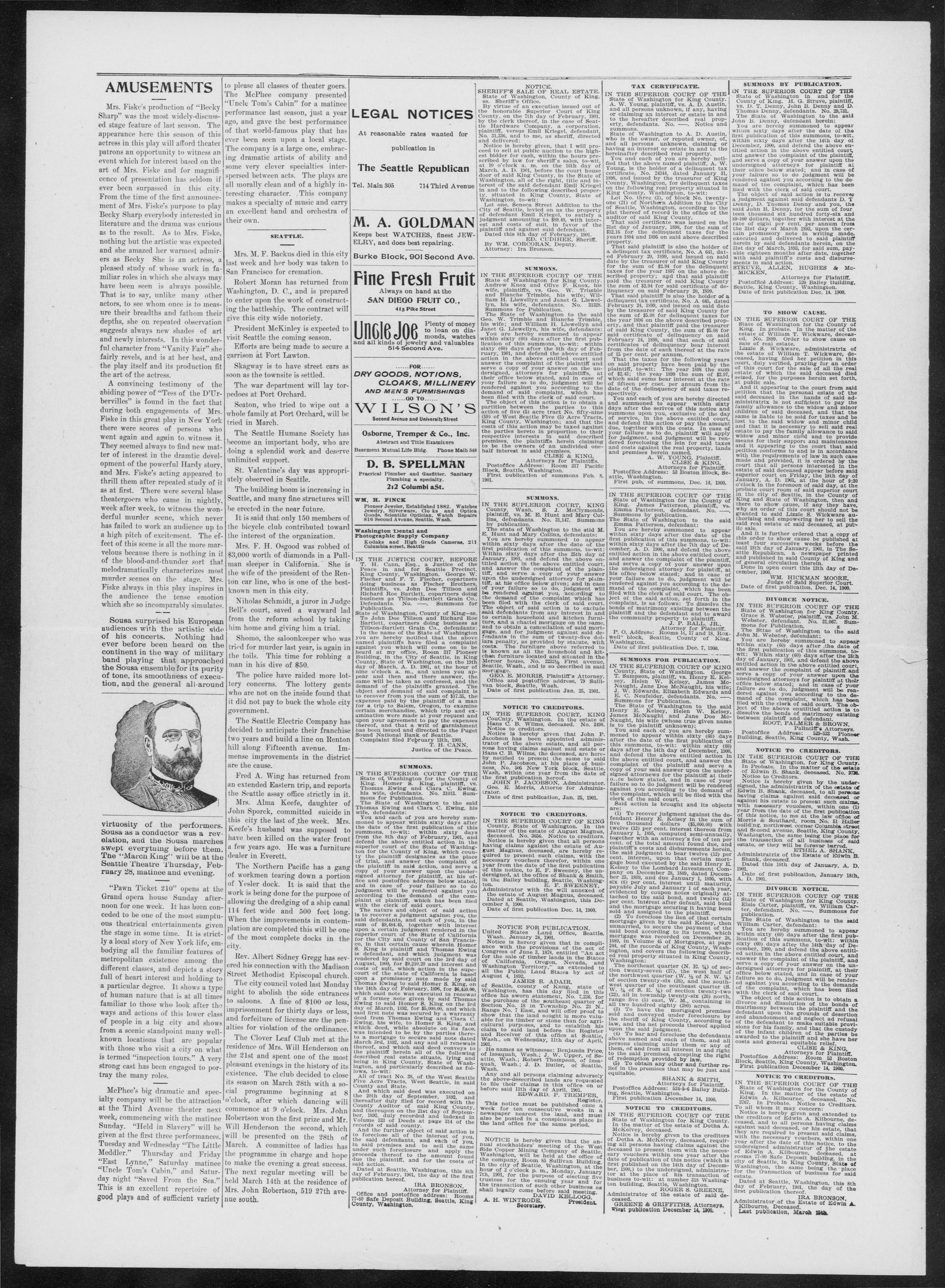
Sousa surprised his European audiences with the artistic side of his concerts. Nothing had ever before been heard on the continent in the way of military band playing that approached the Sousa ensemble for its purity of tone, its smoothness of execution, and the general all-around
virtuosity of the performers. Sousa as a conductor was a revelation, and the Sousa marches swept everything before them. The "Maren King" will be at the Seattle Theatre Thursday, February 28, matinee and evening.
"Pawn Ticket 210" opens at the Grand opera house Sunday afternoon for one week. It has been conceded to be one of the most sumptuous theatrical entertainments given the stage in some time. It is strictly a local story of New York life, embodying all the familiar features of metropolitan existence among the different classes, and depicts a story full of heart interest and holding to a particular degree. It shows a type of human nature that is at all times familiar to those who look after the ways and actions of this lower class of people in a big city and shows from a scenic standpoint many well-known locations that are popular with those who visit a city on what is termed "inspection tours." A very strong cast has been engaged to portray the many roles.
McPhee's big dramatic and specialty company will be the attraction at the Third Avenue theater next week, commencing with the matinee Sunday. "Held in Slavery" will be given at the first three performances. Tuesday and Wednesday "The Little Meddler." Thursday and Friday "East Lynne," Saturday matinee "Uncle Tom's Cabin," and Saturday night "Saved From the Sea." This is an excellent repertoire of good plays and of sufficient variety
to please all classes of theater goers. The McPhee company presented "Uncle Tom's Cabin" for a matinee performance last season, just a year ago, and gave the best performance of that world-famous play that has ever been seen upon a local stage. The company is a large one, embracing dramatic artists of ability and some very clever specialties interspersed between acts. The plays are all morally clean and of a highly interesting character. This company makes a specialty of music and carry an excellent band and orchestra of their own.
SEATTLE.
Mrs. M. F. Backus died in this city last week and her body was taken to San Francisco for cremation.
Robert Moran has returned from Washington, D. C., and is prepared to enter upon the work of constructing the battleship. The contract will give this city wide notoriety.
President McKinley is expected to visit Seattle the coming season.
Efforts are being made to secure a garrison at Fort Lawton.
Skagway is to have street cars as soon as the townsite is settled.
The war department will lay torpedoes at Port Orchard.
Seaton, who tried to wipe out a whole family at Port Orchard, will be tried in March.
The Seattle Humane Society has become an important body, who are doing a splendid work and deserve unlimited support.
St. Valentine's day was appropriately observed in Seattle.
The building boom is increasing in Seattle, and many fine structures will be erected in the near future.
It is said that only 150 members of the bicycle club contributed toward the interest of the organization.
Mrs. F. H. Osgood was robbed of $3,000 worth of diamonds in a Pullman sleeper in California. She is the wife of the president of the Renton car line, who is one of the best-known men in this city.
Niholas Schmidt, a juror in Judge Bell's court, saved a wayward lad from the reform school by taking him home and giving him a trial. Shomo, the saloonkeeper who was tried for murder last year, is again in the toils. This time for robbing a man in his dive of $50. The police have raided more lottery concerns. The lottery gents who are not on the inside found that it did not pay to buck the whole city government. The Seattle Electric Company has decided to anticipate their franchise two years and build a line on Renton hill along Fifteenth avenue. Imense improvements in the district are the cause.
Fred A. Wing has returned from an extended Eastern trip, and reports the Seattle assay office strictly in it. Mrs. Alma Keefe, daughter of John Sporck, committed suicide in this city the last of the week. Mrs. Keefe's husband was supposed to have been killed on the water front a few years ago. He was a furniture dealer in Everett.
The Northern Pacific has a gang of workmen tearing down a portion of Yesler dock. It is said that the work is being done for the purpose of allowing the dredging of a ship canal 114 feet wide and 500 feet long. When the improvements in contemplation are completed this will be one of the most complete docks in the city.
Rev. Albert Sidney Gregg has severed his connection with the Madison Street Methodist Episcopal church. The city council voted last Monday night to abolish the side entrances to saloons. A fine of $100 or less, imprisonment for thirty days or less, and forfeiture of license are the penalties for violation of the ordinance
The Clover Leaf Club met at the residence of Mrs. Will Henderson on the 21st and spent one of the most pleasant evenings in the history of its existence. The club decided to close its season on March 28th with a social programme beginning at 8 o'clock, after which dancing will commence at 9 o'clock. Mrs. John Robertson won the first prize and Mr. Will Henderson the second, which will be presented on the 28th of March. A committee of ladies has the programme in charge and hope to make the evening a great success. The next regular meeting will be held March 14th at the residence of Mrs. John Robertson, 519 27th avenue south.
LEGAL NOTICES
At reasonable rates wanted for publication in
Tel. Main 305 714 Third Avenue
M. A. GOLDMAN
Keeps best WATCHES, finest JEW-
ELRY, and does best repairing.
Burke Block, 901 Second Ave.
Always on hand at the
SAN DIEGO FRUIT CO.,
415 Pike Street
Uncle Joe
Plenty of money
to loan on diamonds,
watches
and all kinds of jewelry and valuables
514 Second Ave.
....FOR.....
DRY GOODS, NOTIONS,
CLOAKS, MILLINERY
AND MEN'S FURMISHINGS
....GO TO.....
WILSON'S
Second Avenue and University Street
Osborne, Tremper & Co., Inc.
Abstract and Title Examiners
Basement Mutual Life Bldg.
Phone Maith 548
D. B. SPELLMAN
Practical Plumber and Gasfitter. Sanitary
Plumbing a specialty.
212 Columbia St.
WM H. FiNCK
Pioneer Jewelry, Established 1882. Watches Jewelry, Silverware, Clok s and Optical Goods, Scientific Optician, Watch Repairs 916 Second Avenue, Seattle, Wash.
Washington Dental and Photographic Supply Company
Kodaks and High Grade Cameras, 211 Columbia street, Seattle
IN THE JUSTICE COURT, BEFORE
T. H. Cann, Esq., a Justice of the Reason
King County, Washington, George W. Fischer and F. T. Fischer, copartners doing business as Fischer Brothers, copartners doing business as Richard Roe Bartlett, copartners doing business as Tillson-Bartlett Grain Co.
Defendants. No. — Summons for Bankruptcy.
State of Washington, County of King-Iss. To John Doe Tilson and Richard Roe Bartlett, copartners doing business as Tilson-Bartlett (Grain Co., Defendants in the�, the Washington you are hereby notified that the above named plaintiffs have filed a complaint against you which will come on to be heard at my office, Room 317 Pioneer Building, in the City of Seattle, in King County, State of Washington, on the 19th day of March, A. D. 1961, at the hour of nine o'clock a. m., and unless you appear and then and the answer, he came will be taken as confessed, and the demand of the plaintiffs granted. The object and demand of said complaint is to recover from you the sum of $17.35, the expenses paid by the plaintiff of a man for a trip to Salem, Oregon, to examine certain merchandise, which trip and examination were made at your request and upon your agreement to pay the expenses there is no need for the garnishment has been issued and directed to the Puget Sound National Bank of Seattle.
Complaint filed February 13th, 1901.
T. H. CANN.
Justice of the Peace.
SUMMONS
IN THE SUPERIOR COURT OF THE State of Washington for the County of King, the Ewing and King, plaintiff, vs. Thomas Ewing and King, plaintiff, his wife, defendants. No. 31013. Summons for Publication. The State of Washington to the said Thomas Ewing and Clara C. Ewing, his wife, defendants:
You and each of you are hereby summoned to appear within sixty days after the date of the first publication of this complaint from the 8th day of February, 1901, and defend the above entitled action in the superior court of the State of Washington for the County of King, which county plaintiff designates, the trial, and answer the complaint of the plaintiff in said action, and serve a copy of your answer upon the underwriter of your office and office address below stated, and in case of your failure so to do judgment will be rendered against you according to the demand of the complaint of the plaintiff, been fled with the clerk of said court.
The nature and object of said action is to recover a judgment against you, the defendant, of $484.45, together with inerence upon a certain judgment rendered in the superior court of the State of California in Honolulu, in that certain cause wherein Honolulu. King is plaintiff and Thomas Ewing is defendant, and which judgment was waived on court on the 3rd day of August, 1900, for $2,825.20, which costs of suit, which action in the super-court of the state of California is based upon a promissory note made by said Thomas Ewing, and which was given on the 14th day of February, 1886, for $4,500.00, which said note was executed in renewal of former note given by said Thomas Ewing, and which was given on the 14th day of March, 1882, for $5,000.00, and which said first note was secured by a warranty deed from Thomas Ewing and Clara C. Ewing, and which was secured by renewal of which deed, while absolute on its face, was intended to be by the parties thereafter, mortgage to secure said note dated March 1882, and which was secured by renewal thereof, and which said deed constituted the plaintiff herein all of the following described real estate situate, lying and situated in the State of Washington, and particularly described as follows, to-wit: All of tract No. 38, of the West Seattle Fire Department, West Seattle, in said County and State.
And which said deed was executed on the 31st day of September, 1832 and thereafter the day of September, 1832 on the County Auditor of said King County, and thereupon on the 21st day of September, 1832 only recorded and indexed in Volume 1832, page 314 of the records of said county.
And the further object of said action is to take the interest of you, the said defendants to you, in said premises and to sell the said under such foreclosure and apply the proceeds thereof to the amount found the plaintiff, and for the costs of said action.
Dated at Seattle, Washington, this 5th day of February, 1901, the day of the first publication hereof.
IRA BRONSON,
attorney for Plaintiff.
Office and post office address: Rooms 77-80 Safe Deposit Building, Seattle, King County, Washington.
---
NOTICE
SHERIF'S SALE OF REAL ESTATE.
State of Washington, County of King,
ss. Sherif's Office.
By the Executive Commission issued out of the
honorable Superior Court of King
County, on the 7th day of February, 1901,
by the clerk thereof, in the case of Seat-
Hardware Company, a corporation,
business of No. 31,336, and to me, as sherif, directed
and delivered:
Notice is hereby given, that I will pro-
cess the best binder for cash, within the hours pres-
scribed by law for sherif's sales, to-wit,
at 10 o'clock a.m. on the 16th day of
March, 1901, before the court house
door of Seat Hardware, Washington, all of the right, title and
interest of the said defendant Emil Kriegel
in and to the following described property
in King County, State of Washington,
to-wit.
Lot one, Seneca Street Addition to the
City of Seattle, levied on the property of
defendant Emil Kriegel, to satisfy a
interest, and costs of suit, in favor of
the plaintiff and against said defendant.
Dated this 5th day of February, 1901,
By WM. CORCORAN Deputy,
Attorney: Ira Bronson.
SUMMONS.
IN THE SUPERIOR COURT OF THE State of Washington for King County. Awaite plaintiffs, vs. Geo. W. Trimble and Blanche Trimble, his wife; wife H. Wilemiah L. Wilemiah and Janet G. Lieweliah andendants. No. 31328. Summons for Publications. The State of Washington to the said Geo. W. Trimble and Blanche Trimble, wife; wife H. Wilemiah L. Wilemiah andendants. No. 31328. Summons for Publications. You are hereby summoned to appear within sixty (60) days after the first publication of this summons to-wit; within sixty (60) days of January, 1901, and defend the above entitled action in the above entitled court and answer the complaint of the plaintiff and defendant, attorneys for plaintiffs, at their office below stated, and in case of your failure so to do, judgment will be given against you for the demand of said complaint, which has been filed with the clerk of said court. The object of this action is to obtain a plaintiff's action of five (5) acre tract No. fifty-nine (59) of West Seattle Five (5) Acre Tracts, King County, Washington; and that the parties hereto in proportion to their respective interests in said described premises, the plaintiffs herein claiming one-half interest in said premises.
First publication of summons Feb. 8, 1901.
SUMMONS
IN THE SUPLERIOR COURT, KING County, Wash. S. J. McClymonds, plaintiff, vs. M. E. Hunt and Mary Collins, defendants. No. 31,147. Summons by publication.
The Court of Washington to the std M.E. Hunt and Mary Collins, defendants:
You are hereby summoned to appear within sixty days after the date of the first publication of this summons, to write: Within sixty days after the 25th day of the January, 1901, and defend the above entitled notice to tell the court on the complaint of your answeroff, and serve a copy of your answer upon the undersigned attorney for plaintiff, at his office below given; and in case of your failure so to do, judgment will be rendered against you, according to the order of the court, and that has been filed with the clerk of said court. The object of said action is to exclude said defendants from any interest in and to certain household and kitchen furniture, and a chattel mortgage on the same time to obtain a cancellation of said mortgage, and to the case of the first paid-up defendants in the sum of twenty-five dollars penalty, as provided by statute with costs. The furniture above referred to is known as all the household and kitchen furniture located and situated in the house.
The case, No. 2222, First avenue, Seattle, as, and is so described in said mortgage.
GEO. E. MORRIES, Plaintiff's Attorney,
address, T. Sullivan
van block, Seattle, Wash
Date of first publication Jan. 25. 1901.
NOTICE TO CREDITORS
IN THE SUPERIOR COURT, KING CounCty, Washington. In the estate of Hans C. B. Wilms, deceased. No. 3488. Notice is in creditors. Notice is given that John P. Jacobson has been appointed administrator of the above estate, and all persons having claims against said estate or Hans C. B. Wilms, the deceased, are hereby notified that John P. Jacobson, at his place of business, No. 506 New York block, Seattle, Wash, within one year from the date of the first publication hereof. P.J. JACOBSON, Administrator. Geo. E. Morris, Attorne for Administrator.
Date of first publication. Jan. 25. 1901.
NOTICE TO CREDITORS
IN THE SUPERIOR COURT OF KING County, State of Washington. In the matter of the estate of August Magnus, dearest of the estate of August Magnus, deceased, are hereby required to present such claims, with the necessary vouchers therefor, within one month from the first publication of this notice, to E. F. Sweney dressed, at the office of Shank & Smith, in the Bailey building, Seattle, Washington. E. F. SWENEY,
an ancestor of the estate of August Magnus, a Seattle, Washington, this December 8, 1909.
Date of first publication Dec. 14, 1900.
NOTICE FOR PUBLICATION.
United States Land Office, Seattle
Wash., January 24, 1901.
Notice is hereto given that in compliance with the provisions of the act of Congress of 1854 a 15K land for the sale of timber lands in the State of California, Oregon, Nevada, and Washington Territory, as extended to the public Land States by act of August 4, 1852.
JAMES B. ADAIR, of Seattle, county of KIng, state of Washington, has his day filed in this office his sword at the quarterly purchase of the southeast quarter of Section No. 18, in Township No. 23 N. 18, in Angus, and will offer proof to show that the land is suitable for the able for its timber or stone than for agricultural purposes, and to establish his claim to said land before the Register receiver of this office at Seattle, Wash., on Wednesday, 11th day of April, 1901.
He names as witnesses: Benjamin Price, Isaquah, Wash.; J. W. Upper, of Seattle, R. Rehmann, of Isaquah, Wash.; J. D. Butler, of Seattle, Wash.
Any and all persons claiming adversely to the two-desired lands are requested to file their claims in the State on or before said 11th day of April, 1901.
This notice must be published once a week for ten consecutive weeks in a newspaper nearest the land, and must be posted outside place in the land office for the same period.
NOTICE is hereby given that the annual stockholders' meeting of the West Side Copper Mining Company of Seattle, Washington, will be held at the office of the CEO, the Managing Director, Building, in the city of Seattle, Washington, on the hour of 2 o'clock p. m., Monday, January 7th, 1901, for the purpose of electing five candidates for the creating chair and for the transaction of such other business, as shall legally come before said meeting.
A. H. WINTROD, President
Secretary
TAX CERTIFICATE.
IN THE SUPERIOR COURT OF THE State of Washington for King County, A. W. Young, plaintiff, vs. A. D. Austin, an attorney, or claiming an interest or estate in and to the hereafter described real property, defendants. No. —. Notice and summons. State of Washington to A. D. Austin, who is the owner, or reputed owner, of, and all persons unknown, claiming or having an interest or estate in and to the hereafter described real property. You and each of you are hereby notified that the above named plaintiff, A. W. Young, is the holder of a delinquent tax on King County, Washington, on w-o-t, 1888, and issued by the treasure of King County, Washington, for delinquent taxes on the following real property situated in King County, Washington, on w-o-t, (2) 1888 of Northern Addition to the City of Seattle, Washington, according to the plat thereof of record in the office of the court of appeals. That said certificate was issued on the 31st day of January, 1888, for the sum of $12.16 for the delinquent taxes for the years 1894 and 1895 on said above described
That said plaintiff is also the holder of a delinquent tax certificate, No. A 611, dated February 20, 1899, and issued on said date by the treasurer of said King County for the sum of $2.94 for the delinquent taxes for the year 1897 on the above de-seized property; and that said plaintiff paid the sum of $2.94 for said King County of delinquency on said February 20, 1899.
That said plaintiff is also the holder of a delinquent tax certificate, No. A 645, dated February 24, 1899, and issued on said date by the treasurer of said King County for the sum of $5.08 for delinquent taxes for the year 1896 on the above described property, and that plaintiff paid the treasurer of said King County, a sum of $5.08 for said certificate of delinquency on said February 24, 1899, and that each of said certificates of delinquency bear interest from the date of each thereof at the rate of 15 per cent. per annum.
That the taxes for the following years on said property have been paid by the plaintiff, to-wit: The year 1898 the sum of $2.43, the year 1899 the sum of $2.97, the sum of $2.43, the year 1899 interest at the rate of $1.60 per cent. per annum from the date of the delinquency of said taxes respectively.
You and each of you are hereby directed and summoned to appear within sixty days after the service of this notice and summons upon you, exclusive of the day before the service of this notice and defend this action or pay the amount due, together with the costs. In case of your failure so to do, plaintiff will apply for judgment, and judgment will be rendered foreclosing the lein for sald taxes, property, lands and premises herein, name:
First pub, of summons, Dec. 14, 1900.
IN THE SUPERIOR COURT OF THE
State of Washington for the County of
James Patterson, plantiff, Vs.
Emmia Patterson, plantiff. No.
Summons by publication.
The State of Washington to the said Emma Pitterson, defendant:
You have a valid claim to appear within sixty days after the date of the first publication of this summons, to-wit: within sixty days after the 7th day of Declaration, to apply for a judgment entitled action in the above entitled court, and answer the complaint of the plaintiff, and serve a copy of your answer upon the plaintiff, to apply for a judgment at his office below stated; and to ask your failure so to do, judgment will be rendered against you according to the deference of the plaintiff, which has been filed with the clerk; and the object of the said action, set forth in the complaint, is as follows: To dissolve the bonds of matrimony existing between the plaintiff and the defendant in the community property to plaintiff.
J. P. BALL, JR., attorney, for Plaintiff.
P. O. Address: Room 16, and 18, Rockwell* block, Seattle, County of King, Washington.
Date of first publication Dec. 7, 1900.
SUMMONS FOR PUBLICATION
IN THE SLUPERIOR COURT OF KING County, State of Washington, George T. Seymour, George T. Seymour, Helen W. Kelsey, James McNaught, Jane Doe McNaught, his wife; L. W. Edwards, Elizabeth Edwards and E.C. C. Williams. No. Summons for Publication.
The State of Washington to the said Henry E. Kelsey, Helen W. Kelsey, T. Seymour, Elizabeth Edwards, his wife (whose truth given name is to the plaintiff unknown):
You and each of you are hereby summoned to appear within sixty (60) days after this summons, to-wit: within sixty (60) days after the 14th day of December, 1900, and defend the above entitled action in the complaint of the plaintiff, with a complaint of the plaintiff and serve a copy of your said answer upon the undersigned attorneys for the plaintiff at their failure so to do judgment of your failure so to do judgment of your failure against you according to the demand of the complaint, which will be filed with the clerk of the said court.
The action is brought and its objects are:
(1) To recover judgment against the defendant Henry E. Kelsey in the sum of five thousand dollars ($5,000.00) with twelve (12) per cent. interest thereon from January 1, 1895, computed semi-annually, together with an attorney's fee of ten per cent. of the total amount found due, and plaintiff's costs and disbursements herein, the said judgment to bear twelve (12) per cent. interest, upon that certain mortgage bond executed by the said Henry E. Kelsey to the Lombard Investment Company on December 28, 1889, dated December 23, 1889, and due January 1, 1895, with six (6) per cent. interest until maturity, payable July and January 1 of each year, evidenced by coupon notes originally attached to the said bond, and twelve (12) per cent. interest after default, said bond and the mortgage securing it having been sold and assigned to the plaintiff.
(2) To foreclose the lien of that certain mortgages given by the said Kelsey, then unmarried and unmarried, said bond according to its terms, which mortgage was recorded on December 28, 1945 of mortgages, at page 244, of the redeemer K. M. Kingston, and covers the following described real property situated in King County, Washington. To the nearest quarter (N. E. ¼) of section twenty-seven (27), the west half of the northwest quarter (W. ½ of N. W. ¼) of section twenty-six (26), and the southwest quarter (W. ¼ of S. E. ¼) of section twenty-six (W. ¼ of S. E. ¼) of section twenty-six (26), all in township twenty-six (26) north, range five (5) east, W. M. containing in all towns acres. To have the mortgage premises sold and conveyed under foreclosure by the sheriff of King County, according to law, and the net proceeds thereof applied to the suree, and right to the said premises, excepting the right of redemption provided by law. To obtain any other and further relief in the premises that may be just and equitable. SHANK & SMITH.
Postoffice Address: 844-5 Bailley Building, Seattle, Washington.
NOTICE TO CREDITORS
IN THE SUPERIOR COURT OF THE State of Washington for King County. In the matter of the estate of Dotha A. McKelvey, deceased.
Notice is hereby given to the creditors of Dotha A. McKelvey, deceased, requirment of the sale of the property against the deceased to present them with the sary vouchers within one year after the date of publication of this notice (which is December 1, 1900), to the undersigned, administrator at the place of his transaction of business to-wit: a number $31 Washington building, Seattle, ROGER S. GREENE. Administrator of the estate of said deceased GREENE & GRIFFITHS, Attorneys. First publication December 14, 1900.
SUMMONS BY PUBLICATION.
IN THE SUPERIOR COURT OF THE
State of Washington in and for the
County of King, H. G. Struve, plaintiff,
vs. D. T. Denny, John B. Denny and D.
Thomas Denny, defendants. No. 29,71.
The court said John B. Denny detained begin:
A new help has been commenced to appear within sixty days after the date of the first publication of this summons, to-wit. within sixty days after the 14th day of December, 1900, and defend the above entitled action in the above entitled court, and answer the complaint of the plaintiff, and serve a copy of your answer upon the undersigned for plaintiff the office below stated; and in case of your failure so to do judgment will be rendered against you according to the demand of the complaint, which has been died with the clerk of said court.
The object of said action is to recover a judgment against said defendants D. T. Penny, John B. Denny, and you, the said John B. Denny, for the sum of your been thousand six hundred forty-six and 89-100 dollars, together with interest at the rate of eight per cent. per annum from the 31st day of March 1893, upon the certain promissory note in writing made, executed and delivered to said plaintiff, and by said defendant hewin, on the 31st day of March 1898, for said paid, able eighteen months after date, together with said plaintiff's costs and disbursements in said action.
STRUVE, ALLEN, HUGHES & Mc
MICKEN,
Attorneys for Plaintiff
Postoffice Address: 520 Bailey Building,
S. 10th St., New York, NY 10016
Date of first publication: Dec. 14, 1900
TO SHOW CAUSE
IN THE SUPERIOR COURT OF THE
state of Washington for the County of
Kingston, the estate of William T. Wickware, deceased.
No. 2899. Order to show cause on
Lizzle S. Wickware, administratrix of the estate of William T. Wickware, deceased, having filed her petition in this
case, and having received the estate of this court for the sale of all the real estate of which the deceased died
sized for the purposes herein set forth,
please告示。
And it appearing to the court from said petition that the personal estate of the defendant in the mistress's administratrix is not sufficient to pay the family allowance to the widow and minor children of said deceased, and that the family allowance to the widow and minor child lost to the said widow and minor child and that it is necessary to sell said real estate to pay the family allowance to said family, and that means for their support and maintenance and it appearing to the court that said petition conforms to and is in accordance with the order provided in such case made and provided, it is ordered court that all persons interested in the estate of said deceased appear before said court in the forenoon of said January, A. D. 1901, at the hour of 9:30 o'clock in the forenoon of said day, at the probate court room of said superior court of King and State of Washington, then and there to show cause, if any they have, why an order of this court should not be made, and why the court should thorizing and empowering her to sell the said real estate of said deceased, at public sale.
A court is further ordered that a copy of this order to show cause be published at least four successive weeks before the Seattle Republic of January, 1901, in The Seattle Republic of January, 1901, printed and published in said County of King and of general circulation therein.
Done in open court this 13th day of December,
1500. WM. HICKMAN MOORE,
Judge of Sald Superior Court.
Date of first publication, Dec. 14, 1900.
DIVORCE NOTICE.
IN THE SUPERIOR COURT OF THE
state of Washington for King County.
Gate of Washington, plaintiff, vs. John M.
Webster, defendant. No. 31.067. Summons
for Publication.
The Sttae of Washington to the said John M. Webster, defendant;
You are hereby summoned to appear within sixty (60) days after the date of your owit: Within sixty (60) days summons, owit: Within sixty (60) days of day January, 1901, and defend the above entitled action in the above entitled court, answer the complaint of plaintiff and serve the judgment against you, unresigned attorneys for plaintiff at their office below stated; and in case of your office below stated; and in case of your judgment will be rendered against you. The command of the complaint, which has been filled with the clerk of said court. The objection to above action is to dissolve the command of matrimony existing between plaintiff and defendant. ROOT, PALMER & BROWN, full-time attorney, attorneys. Postoffice Address: 522-533 Building, Seattle, King County, Wash.
NOTICE TO CREDITORS.
IN THE SUPERIOR COURT OF THE
State of Washington, for King County.
He is the matter of the estate
of Edwin B. Shank, deceased. No. 3786.
Notice to Creditors.
Notice is hereby given by the undersigned, the administrative of the estate of Edwin B. Shank, deceased, to all persons having claims against said deceased or against his estate to present such claims, with necessary vouchers, within one (1) year from the date of the first publication of this notice, to me at the law office of Morris & Southard, room No. 51 Haller building, northwest corner Columbia street and Second avenue, Seattle, King County, Washington, the same being the place for the transaction of all business of said estate, or they will be forever barred.
ETHEL A. SHANK,
Administratrix of the Estate of Edwin B.
Shank, deceased.
Dated this 15th day of January, A. D.
1901.
Date of first publication, January 18th, A. D. 1901.
DIVORCE NOTICE
IN THE SUPERIOR COURT OF THE State of Washington for King County. Eliseis plaintiff, vs. William Carter, defendant. No. — Summons for publication.
The State of Washington to the said William Carter, plaintiff, vs. William Carter, defendant. No. — Summons for publication.
The State of Washington to the said William Carter, plaintiff, vs. William Carter, defendant. No. — Summons for publication.
You are hereby summoned to appear within sixty (60) days after the first publication of this summons, to-wit: within the office of the fifth day of December, 1900, and defend the fifth day of December in the above entitled court, and answer the complaint of the plaintiff, and answer your answer on the undersigned attorney, to the office below stated, and in case of your failure so to do, judgment will be rendered according to the demands of the complaint, has been filed with the clerk of said court.
The object of this action is to obtain a divorce and dissolution of the bonds of marriage between the plaintiff and the defendant upon the plaintiff's behalf and abandonment and neglect ad refusal of the defendant to make suitable provisions for his family, and that the custody of the plaintiff and the parties be awarded to the plaintiff and give her costs and general equitable relief. CLISE & KING, Attorneys for Plaintiff. Postoffice Address, 53 Boston Block, Seattle, King County, Washington. First publication December 14, 1989.
NOTICE TO CREDITOR
THE SUPERIOR COURT OF THE
State of Washington for the County of
King, in the State of Washington.
Edwin A. Kilbourne, deceased. No.
367. In Probate. Notice to Creditors.
Tall publication in concert with
Notice is hereby given extended to
the creditors of Edwin A. Kilbourne, deceased, and to all persons having claims against them, on his estate, that they are required to present with
with the necessary vouchers, within one
month of the date of this notice, to the
understated creditors of the estate of
Edwin A. Kilbourne, deceased.
rooms 77-80 Deposit building, in the
Seattle, in King County, State of
Washington, the same being the place
for the transaction of business for said
estate.
Date at Seattle, Washington, this 8th
day of February, the day of the first
publication thereof.
IRA BRONSON,
Administrator of the Estate of Edwin A.
Kilbourne, deceased.
Last publication: April 16th