Seattle Republican
Friday, October 14, 1904
Seattle, Washington
Page text (machine-generated)
SEATTLE REPUBLICAN
SEATTLE, WASHINGTON, FRIDAY, OCTOBER 14, 1904
not at the polls, and for that reason I have no hesitancy in saying the Republican ticket from top to bottom will be elected. Washington is as overwhelmingly, and I might add as unalterably, Republican as
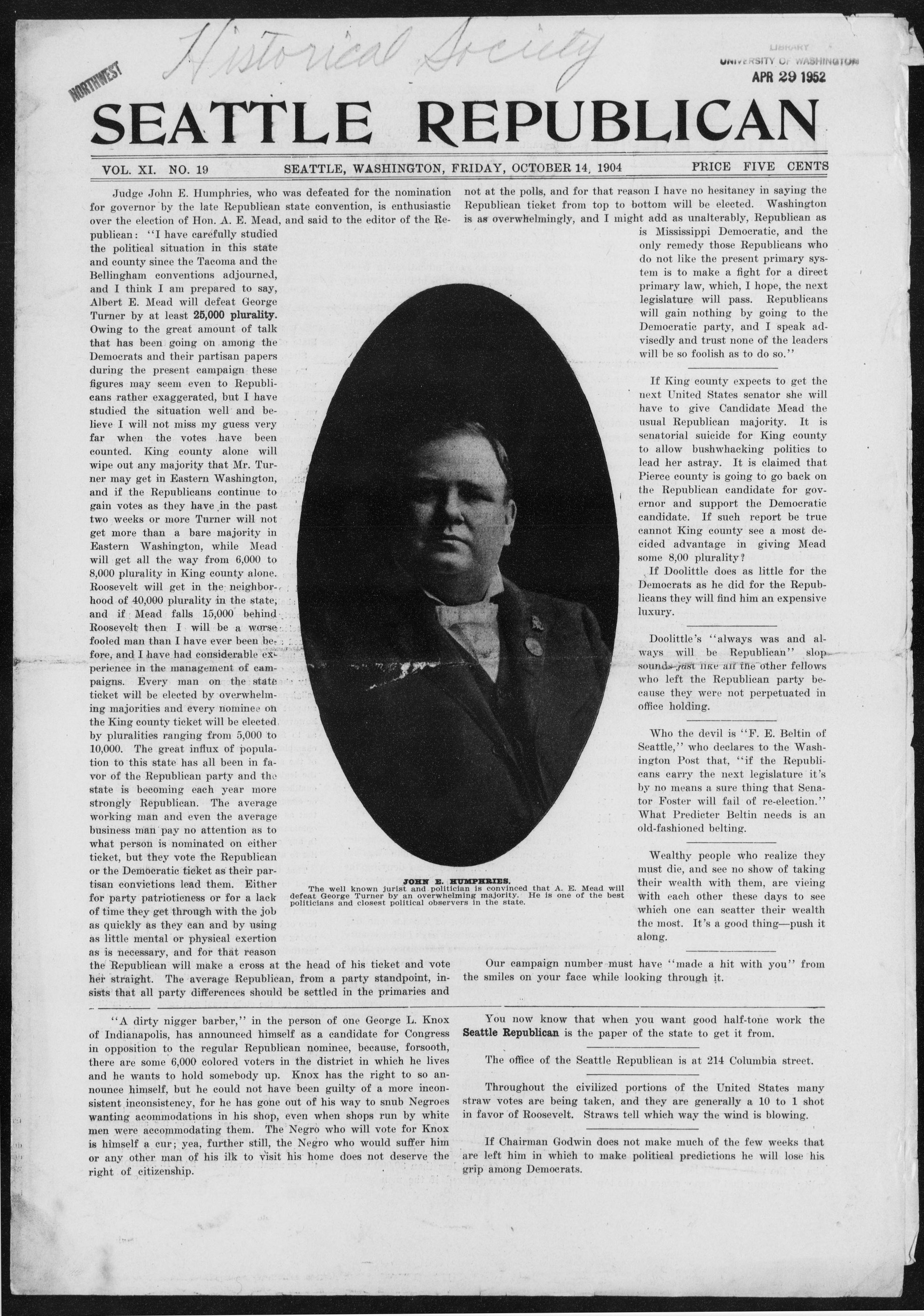
Judge John E. Humphries, who was defeated for the nomination for governor by the late Republican state convention, is enthusiastic over the election of Hon. A. E. Mead, and said to the editor of the Re-
[Name not visible in the image]
The well known jurist and politician is convinced that A. E. Mead will defeat George Turner by an overwhelming majority. He is one of the best politicians and closest political observers in the state.
Our campaign number must have "made a hit with you" from the smiles on your face while looking through it.
the Republican will make a cross at the head of his ticket and vote her straight. The average Republican, from a party standpoint, insists that all party differences should be settled in the primaries and
You now know that when you want good half-tone work the Seattle Republican is the paper of the state to get it from.
"A dirty nigger barber," in the person of one George L. Knox of Indianapolis, has announced himself as a candidate for Congress in opposition to the regular Republican nominee, because, forsooth, there are some 6,000 colored voters in the district in which he lives and he wants to hold somebody up. Knox has the right to so announce himself, but he could not have been guilty of a more inconsistent inconsistency, for he has gone out of his way to snub Negroes wanting accommodations in his shop, even when shops run by white men were accommodating them. The Negro who will vote for Knox is himself a cur; yea, further still, the Negro who would suffer him or any other man of his ilk to visit his home does not deserve the right of citizenship.
The office of the Seattle Republican is at 214 Columbia street.
Throughout the civilized portions of the United States many straw votes are being taken, and they are generally a 10 to 1 shot in favor of Roosevelt. Straws tell which way the wind is blowing.
If Chairman Godwin does not make much of the few weeks that are left him in which to make political predictions he will lose his grip among Democrats.
VOL. XI. NO. 19
Judge John E. Humphries, who for governor by the late Republican over the election of Hon. A. E. Mead publican: "I have carefully studied the political situation in this state and county since the Tacoma and the Bellingham conventions adjourned, and I think I am prepared to say, Albert E. Mead will defeat George Turner by at least 25,000 plurality. Owing to the great amount of talk that has been going on among the Democrats and their partisan papers during the present campaign these figures may seem even to Republicans rather exaggerated, but I have studied the situation well and believe I will not miss my guess very far when the votes have been counted. King county alone will wipe out any majority that Mr. Turner may get in Eastern Washington, and if the Republicans continue to gain votes as they have in the past two weeks or more Turner will not get more than a bare majority in Eastern Washington, while Mead will get all the way from 6,000 to 8,000 plurality in King county alone. Roosevelt will get in the neighborhood of 40,000 plurality in the state; and if Mead falls 15,000 behind Roosevelt then I will be a worse fooled man than I have ever been before, and I have had considerable experience in the management of campaigns. Every man on the state ticket will be elected by overwhelming majorities and every nominee on the King county ticket will be elected by pluralities ranging from 5,000 to 10,000. The great influx of population to this state has all been in favor of the Republican party and the state is becoming each year more strongly Republican. The average working man and even the average business man pay no attention as to what person is nominated on either ticket, but they vote the Republican or the Democratic ticket as their partisan convictions lead them. Either for party patriotism or for a lack of time they get through with the job as quickly as they can and by using as little mental or physical exertion as is necessary, and for that reason
UNIVERSITY OF WASHINGTON
APR 29 1952
PRICE FIVE CENTS
is Mississippi Democratic, and the only remedy those Republicans who do not like the present primary system is to make a fight for a direct primary law, which, I hope, the next legislature will pass. Republicans will gain nothing by going to the Democratic party, and I speak advisedly and trust none of the leaders will be so foolish as to do so."
If King county expects to get the next United States senator she will have to give Candidate Mead the usual Republican majority. It is senatorial suicide for King county to allow bushwhacking politics to lead her astray. It is claimed that Pierce county is going to go back on the Republican candidate for governor and support the Democratic candidate. If such report be true cannot King county see a most decided advantage in giving Mead some 8,00 plurality?
If Doolittle does as little for the Democrats as he did for the Republicans they will find him an expensive luxury.
Doolittle's "always was and always will be Republican" slop sounds just like all the other fellows who left the Republican party because they were not perpetuated in office holding.
Who the devil is "F. E. Beltin of Seattle," who declares to the Washington Post that, "if the Republicans carry the next legislature it's by no means a sure thing that Senator Foster will fail of re-election." What Predicter Beltin needs is an old-fashioned belting.
Wealthy people who realize they must die, and see no show of taking their wealth with them, are vicing with each other these days to see which one can scatter their wealth the most. It's a good thing—push it along.
POLITICAL POT=PIE
THE SHERIFF SITUATION.
Election day is now only a little over a month ahead. Before the Republicans held their county convention in Seattle, every close observer of King county politics knew that no matter whom the Republicans might nominate for Sheriff, the Democrats would wage a vindictive mud-slinging campaign against such nominee, and center their county fight on the sheriff's office. That has been and is now being done. A more unfair, unjust political campaign was never waged than that now being waged against L. C. Smith. These tactics, however, are making Democratic votes for Mr. Smith in many country precincts. The country precincts will give Lew Smith a good substantial majority. What will the city of Seattle do? The wholesale houses, merchants and business men of Seattle are always eager to secure the trade of the country districts, and in that respect have succeeded well. In return that city has twice defeated the country Republican nominee for sheriff of this county. What will Seattle do now? The country precincts have no candidate outside of Seattle for United States Senator, Congress or any state office. The country precincts, not including the city of Ballard, have only one nominee out of fourteen upon the general Republican county ticket. L. C. Smith for sheriff, since he was nominated for sheriff, has been viciously attacked by certain irresponsible newspapers and spouters. If any honest, intelligent voter takes any stock in these attacks let him go to Auburn or Osceola in the southern part of this county and talk with the neighbors of Mr. Smith who have known him intimately for the past 32 years, let him investigate impartially his record as county commissioner and let him bear in mind that prior to his nomination for sheriff not one word was ever uttered against his official acts. If such a Seattle voter does that he will vote for L. C. Smith. If he does not do this then the country precincts will know what to expect from the city of Seattle in the future. We want to see Seattle grow and prosper financially and politically. We want fair treatment in return. Much has been said about the business men of Seattle and the influence which they exert. This sheriff's contest is largely up to them and they will be held responsible.—Auburn Argus.
Never fear neighbor Lon Smith is going to carry every ward in Seattle. Lou Smith is going to beat his opponent at least 5.000 votes, mark this prediction.
The Pie-maker is thoroughly convinced since Judge Turner has visited Seattle and said his say that Candidate Mead will beat him at the polls by not less than 5,000 plurality, granting that Turner comes to the top
THE SEATTLE REPUBLICAN
of the mountains with a 10,000 plurality, and granting further that the two candidates break even in Pierce county or that Turner will carry Pierce by a thousand plurality. There is no show of Mr. Turner being elected unless he is favored by a political landslide in Western Washington, and such is hardly probable, for political landslides do not often happen without there being some premonition of their coming prior to the election, and theer have been no such indications in Western Washington, unless it be in Pierce county, and those who in the past seemed best acquainted with the politics of that county declare that Pierce will give Mead a good substantial plurality. The conclusion of the whole matter, so far as the Pie-maker is able to observe, is Turner is a gone goose and he will have to make another political flop before he will be able to warm the gubernatorial chair of this state.
Some time ago the Seattle Republican alleged in an article that R. Lee Purdin, candidate for state auditor, was born in the South, but Mr. Purdin denies the allegation, and not wishing to do any man an injustice the Pie-maker hastens to correct the error. It is an odium, most any one will admit, to be classed as an offspring of a Southern rebel, and one very few men of the North desire to rest under, and it is no wonder when one is charged with being such he hastens to have the error corrected.
"Far from being a Southerner," says Mr. Purdin, "I was born in this state in Walla Walla county, and if there is one thing I am proud to boast of it is being a native son. Since arriving at the years of maturity I have taught school but four years, and since that time I have been in pubic life in Kittitas county. I was deputy in the county auditor's office for four years and have twice been elected county treasurer.
The questions put to George Turner by the Post-Intelligencer last Monday morning proved to be a body blow below the belt to the politician of many colors. If he had answered all of the questions he would not have been able to have said anything else, and in ignoring them he practically admitted the truth of them all. Granting that Turner had a much better audience than was reported by the P.-I., there is no denying the fact that he failed to make any votes for himself in his Seattle speech.
Said Major Hayeden of Tacoma one day this week: "The man who says Pierce county is going to give Turner a majority over Mead is a fit subject for Steilacoom. I do not deny the fact that one or two Republicans, so to speak, are going to vote for Turner, but there is nothing to indicate that Pierce county will give Mead a black eye. I am prepared to say Pierce county is Republican, and that, too, despite the allegations of Orange Blossom Doolittle."
It is now quite apparent that the registration for this city will be very much larger than it ever was before and it is also quite apparent that something over 25,000 votes will be registered when the poll books close, yet there are a sufficient number of men in Seattle today for not less than 30,000 votes to be legally registered if the men would
only get a move on themselves and do so. If you have not registered this year and have been in the state for the past twelve months and in Seattle for the past thirty days, go and register as soon as you read this article. If you have registered this year and have moved from the location which you occupied at the time you last registered, you must register again if you wish to vote at the next general election.
PROPOSED AMENDMENT TO THE CONSTITUTION.
State of Washington, Office of the Secretary of State.
To whom it may concern: In obedience to an act of the legislature, approved March 16, 1903, entitled as follows, An act to provide for voting on a constitutional amendment at the general election to be held in November, 1904, relative to amending the state constitution relative to power of legislature to employ chaplains for state penal and reformatory institutions, there is herewith published for the consideration of the voters of the state of Washington the following proposed amendment to the constitution of said state:
Sec. 11, Article 1, of the constitution of the state of Washington shall be amended to read as follows:
Sec. 11. Absolute freedom of conscience in all matters of religious sentiment, belief and worship shall be guaranteed to every individual and no one shall be molested or disturbed in person or property on account of religion; but the liberty of conscience hereby secured shall not be so construed as to excuse acts of licentiousness or justify practices inconsistent with the peace and safety of the state. No public money or property shall be appropriated for or applied to any religious worship, exercise or instruction, or the support of any religious establishment. Provided, however, that this article shall not be so construed as to forbid the employment by the state of a champlain for the state penitentiary, and for such of the state reformatories as in the discretion of the legislature may seem justified. No religious qualifications shall be required for any public office or employment, nor shall any person be incompetent as a witness or juror in consequence of his opinion on matters of religion, or be questioned in any court of justice touching his religious belief to affect the weight of his testimony.
That there shall be printed on all ballots supplied to said election the words: "For the proposed amendment of section eleven (11), of article one (1) of the constitution, giving to the legislature of the state of Washington the power of supplying chaplains for state penal and reformatory institutions," and "Against said proposed amendment to section eleven (11), of article one (1) of the constitution, giving to the legislature of the state of Washington the power of employing chaplains for the state penal and reformatory institutions."
In testimony whereof, I have hereunto set my hand and affixed the seal of the state of Washington. Done at Olympia, this first day of August, A. D. 1904.
(State Seal) SAM H. NICHOLS, Secretary of State for the State of Washington.
To the voters: You are hereby advised to place an X after the question "For the amendment," etc., or "Against the amendment," etc., as the case may be so as to express more clearly your affirmative or negative vote. SAM H. NICHOLS, Secretary of State.
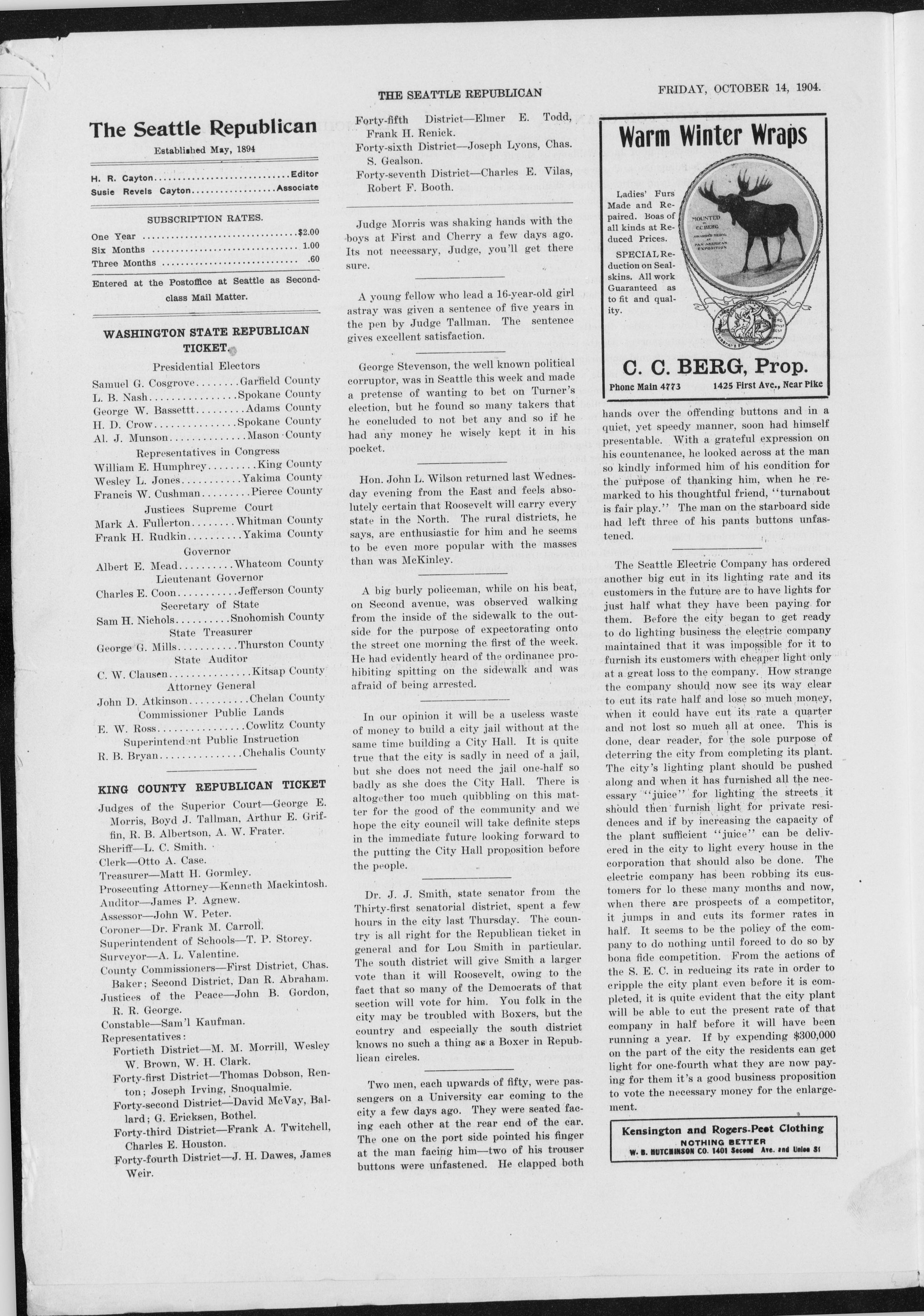
Ladies' Furs Made and Repaired. Boas of all kinds at Reduced Prices. SPECIAL Reduction on Sealskins. All work Guaranteed as to fit and quality.
hands over the offending buttons and in a quiet, yet speedy manner, soon had himself presentable. With a grateful expression on his countenance, he looked across at the man so kindly informed him of his condition for the purpose of thanking him, when he remarked to his thoughtful friend, "turnabout is fair play." The man on the starboard side had left three of his pants buttons unfastened.
The Seattle Electric Company has ordered another big cut in its lighting rate and its customers in the future are to have lights for just half what they have been paying for them. Before the city began to get ready to do lighting business the electric company maintained that it was impossible for it to furnish its customers with cheaper light only at a great loss to the company. How strange the company should now see its way clear to cut its rate half and lose so much money, when it could have cut its rate a quarter and not lost so much all at once. This is done, dear reader, for the sole purpose of deterring the city from completing its plant. The city's lighting plant should be pushed along and when it has furnished all the necessary "juice" for lighting the streets it should then furnish light for private residences and if by increasing the capacity of the plant sufficient "juice" can be delivered in the city to light every house in the corporation that should also be done. The electric company has been robbing its customers for lo these many months and now, when there are prospects of a competitor, it jumps in and cuts its former rates in half. It seems to be the policy of the company to do nothing until forced to do so by bona fide competition. From the actions of the S. E. C. in reducing its rate in order to cripple the city plant even before it is completed, it is quite evident that the city plant will be able to cut the present rate of that company in half before it will have been running a year. If by expending $300,000 on the part of the city the residents can get light for one-fourth what they are now paying for them it's a good business proposition to vote the necessary money for the enlargement.
The Seattle Republican
Established May, 1894
H. R. Cayton.....Editor
Susie Revels Cayton.....Associate
SUBSCRIPTION RATES.
One Year .....$2.00
Six Months .....1.00
Three Months ......60
Entered at the Postoffice at Seattle as Second-class Mail Matter.
WASHINGTON STATE REPUBLICAN TICKET
Presidential Electors
Samuel G. Cosgrove.....Garfield County
L. B. Nash.....Spokane County
George W. Bassettt.....Adams County
H. D. Crow.....Spokane County
Al. J. Munson.....Mason County
Representatives in Congress
William E. Humphrey.....King County
Wesley L. Jones.....Yakima County
Francis W. Cushman.....Pierce County
Justices Supreme Court
Mark A. Fullerton.....Whitman County
Frank H. Rudkin.....Yakima County
Governor
Albert E. Mead.....Whatcom County
Lieutenant Governor
Charles E. Coon.....Jefferson County
Secretary of State
Sam H. Nichols.....Snohomish County
State Treasurer
George G. Mills.....Thurston County
State Auditor
C. W. Clausen.....Kitsap County
Attorney General
John D. Atkinson.....Chelan County
Commissioner Public Lands
E. W. Ross.....Cowlitz County
Superintendent Public Instruction
R. B. Bryan.....Chehalis County
KING COUNTY REPUBLICAN TICKET
Judges of the Superior Court—George E. Morris, Boyd J. Tallman, Arthur E. Griffin, R. B. Albertson, A. W. Frater.
Sheriff—L. C. Smith.
Clerk—Otto A. Case.
Treasurer—Matt H. Gormley.
Prosecuting Attorney—Kenneth Mackintosh.
Auditor—James P. Agnew.
Assessor—John W. Peter.
Coroner—Dr. Frank M. Carroll.
Superintendent of Schools—T. P. Storey.
Surveyor—A. L. Valentine.
County Commissioners—First District, Chas. Baker; Second District, Dan R. Abraham.
Justices of the Peace—John B. Gordon, R. R. George.
Constable—Sam'l Kaufman.
Representatives:
Fortieth District—M. M. Morrill, Wesley W. Brown, W. H. Clark.
Forty-first District—Thomas Dobson, Renton; Joseph Irving, Snoqualmie.
Forty-second District—David McVay, Ballard; G. Ericksen, Bothel.
Forty-third District—Frank A. Twitchell, Charles E. Houston.
Forty-fourth District—J. H. Dawes, James Weir.
---
THE SEATTLE REPUBLICAN
Forty-fifth District—Elmer E. Todd, Frank H. Renick.
Forty-sixth District—Joseph Lyons, Chas. S. Gealson.
Forty-seventh District—Charles E. Vilas, Robert F. Booth.
Judge Morris was shaking hands with the boys at First and Cherry a few days ago. Its not necessary, Judge, you'll get there sure.
A young fellow who lead a 16-year-old girl astray was given a sentence of five years in the pen by Judge Tallman. The sentence gives excellent satisfaction.
George Stevenson, the well known political corrupter, was in Seattle this week and made a pretense of wanting to bet on Turner's election, but he found so many takers that he concluded to not bet any and so if he had any money he wisely kept it in his pocket.
Hon. John L. Wilson returned last Wednesday evening from the East and feels absolutely certain that Roosevelt will carry every state in the North. The rural districts, he says, are enthusiastic for him and he seems to be even more popular with the masses than was McKinley.
A big burly policeman, while on his beat, on Second avenue, was observed walking from the inside of the sidewalk to the outside for the purpose of expectorating onto the street one morning the first of the week. He had evidently heard of the ordinance prohibiting spitting on the sidewalk and was afraid of being arrested.
In our opinion it will be a useless waste of money to build a city jail without at the same time building a City Hall. It is quite true that the city is sadly in need of a jail, but she does not need the jail one-half so badly as she does the City Hall. There is altogether too much quibbling on this matter for the good of the community and we hope the city council will take definite steps in the immediate future looking forward to the putting the City Hall proposition before the people.
Dr. J. J. Smith, state senator from the Thirty-first senatorial district, spent a few hours in the city last Thursday. The country is all right for the Republican ticket in general and for Lou Smith in particular. The south district will give Smith a larger vote than it will Roosevelt, owing to the fact that so many of the Democrats of that section will vote for him. You folk in the city may be troubled with Boxers, but the country and especially the south district knows no such a thing as a Boxer in Republican circles.
Two men, each upwards of fifty, were passengers on a University car coming to the city a few days ago. They were seated facing each other at the rear end of the car. The one on the port side pointed his finger at the man facing him—two of his trouser buttons were unfastened. He clapped both
FRIDAY, OCTOBER 14, 1904.
Warm Winter Wraps
MOUNTED
BY
CCBERG
AWARDED MEDAL
BY
PAT AMERICAN
EXPOSITION
C. C. BERG, Prop.
Kensington and Rogers-Peet Clothing
NOTHING BETTER
W. B. NUTCHINSON CO. 1401 Second Ave. and Union St
THE SEATTLE REPUBLICAN
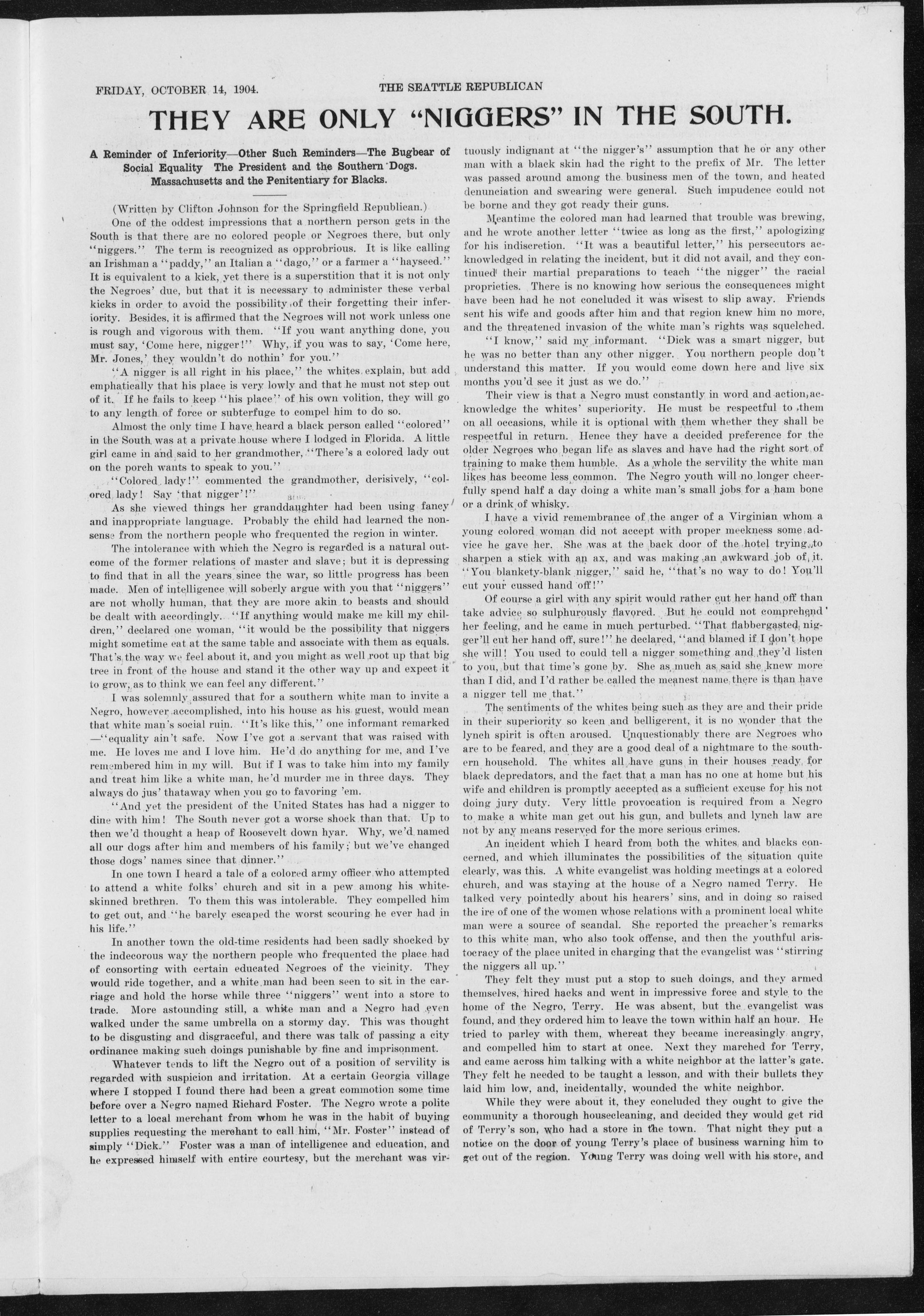
THEY ARE ONLY "NIGGERS" IN THE SOUTH.
tuously indignant at "the nigger's" assumption that he or any other man with a black skin had the right to the prefix of Mr. The letter was passed around among the business men of the town, and heated denunciation and swearing were general. Such impudence could not be borne and they got ready their guns.
A Reminder of Inferiority—Other Such Reminders—The Bugbear of Social Equality The President and the Southern Dogs. Massachusetts and the Penitentiary for Blacks.
(Written by Clifton Johnson for the Springfield Republican.)
Meantime the colored man had learned that trouble was brewing, and he wrote another letter "twice as long as the first," apologizing for his indiscretion. "It was a beautiful letter," his persecutors acknowledged in relating the incident, but it did not avail, and they continued their martial preparations to teach "the nigger" the racial proprieties. There is no knowing how serious the consequences might have been had he not concluded it was wisest to slip away. Friends sent his wife and goods after him and that region knew him no more, and the threatened invasion of the white man's rights was squelched.
One of the oddest impressions that a northern person gets in the South is that there are no colored people or Negroes there, but only "niggers." The term is recognized as opprobrious. It is like calling an Irishman a "paddy," an Italian a "dago," or a farmer a "hayseed." It is equivalent to a kick, yet there is a superstition that it is not only the Negroes' due, but that it is necessary to administer these verbal kicks in order to avoid the possibility of their forgetting their inferiority. Besides, it is affirmed that the Negroes will not work unless one is rough and vigorous with them. "If you want anything done, you must say, 'Come here, nigger!'" Why, if you was to say, 'Come here, Mr. Jones,' they wouldn't do nothin' for you."
"I know," said my informant. "Dick was a smart nigger, but he was no better than any other nigger. You northern people don't understand this matter. If you would come down here and live six months you'd see it just as we do."
"A nigger is all right in his place," the whites explain, but add emphatically that his place is very lowly and that he must not step out of it. If he fails to keep "his place" of his own volition, they will go to any length of force or subterfuge to compel him to do so.
Their view is that a Negro must constantly in word and action, acknowledge the whites' superiority. He must be respectful to them on all occasions, while it is optional with them whether they shall be respectful in return. Hence they have a decided preference for the older Negroes who began life as slaves and have had the right sort of training to make them humble. As a whole the servility the white man likes has become less common. The Negro youth will no longer cheerfully spend half a day doing a white man's small jobs for a ham bone or a drink of whisky.
Almost the only time I have heard a black person called "colored" in the South was at a private house where I lodged in Florida. A little girl came in and said to her grandmother, "There's a colored lady out on the porch wants to speak to you."
"Colored lady!" commented the grandmother, derisively, "colored lady! Say 'that nigger'!"
As she viewed things her granddaughter had been using fancy and inappropriate language. Probably the child had learned the nonsense from the northern people who frequented the region in winter.
I have a vivid remembrance of the anger of a Virginian whom a young colored woman did not accept with proper meekness some advice he gave her. She was at the back door of the hotel trying to sharpen a stick with an ax, and was making an awkward job of it. "You blankety-blank nigger," said he, "that's no way to do! You'll cut your cussed hand off!"
The intolerance with which the Negro is regarded is a natural outcome of the former relations of master and slave; but it is depressing to find that in all the years since the war, so little progress has been made. Men of intelligence will soberly argue with you that "niggers" are not wholly human, that they are more akin to beasts and should be dealt with accordingly. "If anything would make me kill my children," declared one woman, "it would be the possibility that niggers might sometime eat at the same table and associate with them as equals. That's the way we feel about it, and you might as well root up that big tree in front of the house and stand it the other way up and expect it to grow, as to think we can feel any different."
Of course a girl with any spirit would rather cut her hand off than take advice so sulphurously flavored. But he could not comprehend her feeling, and he came in much perturbed. "That flabbergasted nigger'll cut her hand off, sure!" he declared, "and blamed if I don't hope she will! You used to could tell a nigger something and they'd listen to you, but that time's gone by. She as much as said she knew more than I did, and I'd rather be called the meanest name there is than have a nigger tell me that."
I was solemnly assured that for a southern white man to invite a Negro, however accomplished, into his house as his guest, would mean that white man's social ruin. "It's like this," one informant remarked—"equality ain't safe. Now I've got a servant that was raised with me. He loves me and I love him. He'd do anything for me, and I've remembered him in my will. But if I was to take him into my family and treat him like a white man, he'd murder me in three days. They always do jus' thataway when you go to favoring 'em.
The sentiments of the whites being such as they are and their pride in their superiority so keen and belligerent, it is no wonder that the lynch spirit is often aroused. Unquestionably there are Negroes who are to be feared, and they are a good deal of a nightmare to the southern household. The whites all have guns in their houses ready for black depredators, and the fact that a man has no one at home but his wife and children is promptly accepted as a sufficient excuse for his not doing jury duty. Very little provocation is required from a Negro to make a white man get out his gun, and bullets and lynch law are not by any means reserved for the more serious crimes.
"And yet the president of the United States has had a nigger to dine with him! The South never got a worse shock than that. Up to then we'd thought a heap of Roosevelt down hyar. Why, we'd named all our dogs after him and members of his family; but we've changed those dogs' names since that dinner."
An incident which I heard from both the whites and blacks concerned, and which illuminates the possibilities of the situation quite clearly, was this. A white evangelist was holding meetings at a colored church, and was staying at the house of a Negro named Terry. He talked very pointedly about his hearers' sins, and in doing so raised the ire of one of the women whose relations with a prominent local white man were a source of scandal. She reported the preacher's remarks to this white man, who also took offense, and then the youthful aristocracy of the place united in charging that the evangelist was "stirring the niggers all up."
In one town I heard a tale of a colored army officer who attempted to attend a white folks' church and sit in a pew among his white-skinned brethren. To them this was intolerable. They compelled him to get out, and "he barely escaped the worst scouring he ever had in his life."
In another town the old-time residents had been sadly shocked by the indecorous way the northern people who frequented the place had of consorting with certain educated Negroes of the vicinity. They would ride together, and a white man had been seen to sit in the carriage and hold the horse while three "niggers" went into a store to trade. More astounding still, a white man and a Negro had even walked under the same umbrella on a stormy day. This was thought to be disgusting and disgraceful, and there was talk of passing a city ordinance making such doings punishable by fine and imprisonment.
They felt they must put a stop to such doings, and they armed themselves, hired hacks and went in impressive force and style to the home of the Negro, Terry. He was absent, but the evangelist was found, and they ordered him to leave the town within half an hour. He tried to parley with them, whereat they became increasingly angry, and compelled him to start at once. Next they marched for Terry, and came across him talking with a white neighbor at the latter's gate. They felt he needed to be taught a lesson, and with their bullets they laid him low, and, incidentally, wounded the white neighbor.
Whatever tends to lift the Negro out of a position of servility is regarded with suspicion and irritation. At a certain Georgia village where I stopped I found there had been a great commotion some time before over a Negro named Richard Foster. The Negro wrote a polite letter to a local merchant from whom he was in the habit of buying supplies requesting the merchant to call him, "Mr. Foster" instead of simply "Dick." Foster was a man of intelligence and education, and he expressed himself with entire courtesy, but the merchant was vir-
While they were about it, they concluded they ought to give the community a thorough housecleaning, and decided they would get rid of Terry's son, who had a store in the town. That night they put a notice on the door of young Terry's place of business warning him to get out of the region. Young Terry was doing well with his store, and
FRIDAY, OCTOBER 14, 1904
THE SEATTLE REPUBLICAN
it was everything to him. He concluded to die in its defense, and he bought two revolvers, and let it be known that, though he expected death, he proposed to do some shooting first. His courage had a salutary effect, and the lynchers concluded, on cooler thought, to let him alone.
The following very interesting article is reproduced that a bit of history might be corrected:
One of the most active delegates to the convention of the National Business Men's League of Negroes, held recently in Indianapolis, was Isaiah T. Montgomery, of Bayou, Mississippi. Montgomery was born a slave, but now is the owner of a plantation once the property of Jefferson Davis, president of the Confederacy. Montgomery and his brothers were the property of Joseph Davis, brother of the leader of the Confederacy. The Davis plantation passed into the hands of Joseph Davis and was placed in charge of Montgomery and his brothers. Later Montgomery obtained complete control of the land. Montgomery is now an old man, and is a typical representative of the African race. His wealth is estimated at $200,000. He employs 150 men.—Brooklyn Eagle.
I do not wish to infer that sympathy is entirely lacking between southern whites and blacks. In most ways there is no friction, and as a rule the whites are considerate and kindly. They help generously any reputable Negro in misfortune, they contribute as a matter of course when a subscription paper goes around for the benefit of the colored church, and they will tell you, "There's heap o' good niggers," though taking care to add, "and there's a lot o' darn fool niggers, too." They remember with gratitude that during the war when the white men were all in the army, the blacks stayed on the plantations and did their accustomed work. "Had they been whites they would have had a carnival of murder and robbery and gone away."
The father of Isaiah T. Montgomery was the property of Jefferson Davis, and not Joseph Davis. The senior Montgomery was educated at Oberlin for the purpose of attending to his master's business, which he did even after the latter had been elected president of the Confederacy. During Jeff Davis' legal entanglements Montgomery still did business for him and after the surrender Montgomery bought his former master's plantation and appropriated Joseph Davis' farm. The latter finally returned to the country and demanded of Montgomery the surrender of his farm, but this was denied him. The matter was taken into court and after being bitterly fought for a number of years in the lower and higher courts of the state Joseph Davis succeeded in recovering his property, which had been appropriated by the Negro Montgomery. There was no contention over the Jeff Davis farm and the Montgomery family still own that while the heirs of Joe Davis still hold his property. Isaiah Montgomery, son of the old man, is perhaps the wealthiest man without regard to color or nationality in the state of Mississippi.
But after the war there was chaos. "The niggers were turned loose just like a herd of cattle," an Alabamian enlightened me. "There never was a more fatal mistake. Not one in a thousand knew beef from a side of sole leather. We've got an ole nigger still living in this town who come clost to getting into the United States Senate, and he's only a common brick mason. I bet he couldn't tell in three guesses how much seven and six is."
The situation was intolerable, and the whites felt they must by fair means or foul disfranchise the blacks. One of the most charming gentlemen I met frankly averred that he had himself cast 30 ballots in a single election. He acknowledged that this kind of fraud created a general lawless irresponsibility, but he would do the same thing again under the same circumstances.
It is recognized that the colored people must feel chafed by southern conditions, and yet it is argued that they are better off than they would be in the North. A story told for my benefit was that, "There was a Mississippi nigger who had been sent to the penitentiary, and the governor of the state give him his choice between bein' set free and goin' to Massachusetts, and he said he'd rather go back to the penitentiary."
Dan Bass was in town the other day. Dan was a deputy in the prosecuting attorney's office under Judge John F. Miller. The office then was run by three men, Judge Miller, McBridge and Bass. During the fourth year of Judge Miller's term Sam Piles assisted with the civil business. It is claimed by some that the four men named did as much, if not more, than the eight men who now do the work of that office. 'One thing is certain, there were more big murder cases tried during Judge Miller's term than any successor has handled. Of the many, we recall the Stark, Fredericks, Cramer, Nordstrom, Brackel, Evans, Wilcox, Murphy, Boyd and Rundeberg, and the office had such men as Allen, Hughes, Lewis, Ronald, Piles, Dorr and Fishback to fight. McBride and Judge Humes made a record that has never been beaten. They tried four jury cases in one day and all resulted in conviction. Judges Griffin and Emory both tried their first criminal cases against McBride in the superior court. In speaking of the case that Judge Griffin defended, McBride said that he never would forget the judge's speech. He started off like a jack rabbit when he pretends that one of his hind legs is fractured. He told the jury he was no talker and wanted them to overlook his weakness, and then he lit into the facts of the case and pounded them with a force and vigor that nearly paralyzed him. "Why, I had to 'holler' so you could have heard me seven blocks to keep my case from being laughed out of court," said the ex-deputy.
The joke perhaps travesties Massachusetts, yet our treatment of the Negroes is scarcely angelic. We have the same feeling of superiority that exists in the South. This is characteristic of the Anglo-Saxon race in its relations with all other races, and very likely the North would discriminate against the blacks more if they were with us in greater numbers. Nor is the southern antipathy without any reasonable foundation. A colored preacher recently declared: "The only way to get rid of the 'Jim Crow' car is to get rid of the 'Jim Crow' Negro. If I could use 200 bars of soap on the unwashed Negroes that travel on trains and hang around depots I would solve the Negro problem about 20 per cent."
There is a vast deal of slovenly poverty and thriftlessness, easy morals and lack of ideals among the Negroes, and the leaven that works for better things is entirely inadequate. The chance of their being vouchsafed any but the most meager political rights for a long time to come is very small; and it would seem as if their especial need was to strive quietly and steadily for better homes, for better and more general education, and for the ownership of property. They are a race apart, and must learn self-reliance and build up a worthy social life in their own ranks.
Those offices that deal with the criminal elements are always the ones the Democrats make the hardest pull to capture. For an instance, the Democrats in the state have concentrated all their efforts in the election of a governor, where the pardoning power can be so used as to make them votes. In King county they have concentrated their efforts in the election of a sheriff and a prosecuting attorney. If successful it will always be an easy matter to raise the necessary sinews of war by squeezing the criminal element.
It is often claimed by southern men that the Negroes were better off as slaves than they are now, with regard to physical comfort and all essential needs, but this view finds no indorsement among the Negroes themselves; and even the whites are agreed that for the owners and the South itself slavery was a curse. "We never realized it," explained a Carolinian, "but slavery was a great incubus. If the old conditions had continued, business could never have developed, few railroads would have been built, and we'd still be riding around in our chariots drawn by eight horses, and thinking our manner of life was superior to any other on the face of the earth. We were ready to fight for slavery then, and we'd have kept on fighting till this day if our resources hadn't been totally exhausted sooner. But now, if slavery could be restored by vote, it wouldn't get one supporter in a thousand!"
Dollar a day Parker can cheerfully commend his wage theory to Belmont and the bankers supporting him, but he will meet a frost when he presents it to the workingmen.
Bob Moran was not elected president of the United States last Friday, nor was he elected United States senator or governor of the state of Washington, but he launched the Nebraska, got his $100,000 bonus check from the Seattle citizens, and we surmise for that day he got all the glory that he felt able to bear. The man who step by step masters a profession, trade or undertaking, nad watches his fellow citizens throng about to drop expressions of approval and hears those throngs break into wild and incoherent applause over his success, must for the moment become greatly intoxicated with "what man has done, man can do."
Bryan's tongue seems to have finally bursted his lungs.
If you believe what you say that, "Lou Smith is guilty of doing nothing as an official from which he profited as a citizen," then you as a Republican have no right to vote against him, and, if you are a "man," you will not.
FRIDAY, OCTOBER 14, 1904
th
C
S
w
c
ni
tl
tl
to
sc
fo
m
un
---
FRIDAY, OCTOBER 14, 1904.
+
PERSONAL.
Rev. F. T. Walker is attending the Coast Baptist Association in California at present.
Dr. and Mrs. Samuel Burdett left Seattle last Friday to spend the winter on their ranch in Klickitat county.
Rev. S. S. Freeman is in California on business in connection with the Eastern Star lodge.
Mrs. Cornelia Gibson wishes to thank those who showed kindness to her during the illness of her late son.
The Unique Club has organized for the winter and the entertainment committee is planning many unique things for the season.
DEVREAUX GIBSON DEAD.
After an illness lasting something like ten months Devreaux Gibson, only son of Mrs. C. Gibson, died at his mother's residence last Friday afternoon. The young fellow was just in his sixteenth year and his death was a sad blow to his mother and relatives as well as to his many friends. He was buried last Tuesday afternoon and the funeral services were conducted by Rev. Nichols of Everett.
ROSLYN NOTES.
Mr. J. E. Shepperson has returned to Roslyin from a trip to the Cascades.
Mrs. M. Bagley and Miss Bagley are en route to the St. Louis Fair.
Mr. Sandy Vaughn has returned from a business trip to Seattle.
The people of Roslyn extend condolence to Mrs. Gibson over the death of her son Dexreaux, who was well known here.
Mr. J. Donaldson of Seattle was in Roslyn the 10th instant and sold a part of his property.
---
Herald
"Maker of Modern Clothes at Moderate Prices."
1329 2nd Av.
Arcade Blk.
Big Cut
All Wall Papers
reduced at an average of 25 per cent on all Grades. To make room for next Spring Styles. Large assortment to select from, at 816 3rd Ave.
G. F. STOELTING
816 Third Avenue.
IN THE SUPERIOR COURT OF the State of Washington, for King County. No. ____. Notice and Summons.
Charles Lange, plaintiff, vs. G. A. Hill and all persons unknown, if any, having or claiming an interest or estate in and to the hereinafter described real property, defendants.
State of Washington to G. A. Hill.
You and each of you are hereby notified that the above named plaintiff, A. Biswanger, is the holder of a certain delinquent tax certificate, numbered as hereinafter stated, issued by the county treasurer of King county, state of Washington, embracing the following real property situated in said King county, Washington, and more particularly described as follows, to-wit: Delinquent Tax Certificate No. B26388, lot 1, block 9, Ballard Park Addition. That said certificate was issued on the 12th day of May, 1904, for the following sums and for delinquent taxes for the following years, to wit: Tax Certificate No. B26388 for years 1899-00-01-02-03, amount $14.24. That the taxes for the following subsequent years have been paid by the plaintiff upon said above described to wit: Lot 1, block 9, Ballard
---
THE SEATTLE REPUBLICAN
Park Addition, amount $3.41, for years 1899-00-01-02-03; total, $3.41, which several sums bear interest at the rate of 15 per cent per annum from said date of payment, and are all the unpaid and unredeemed taxes upon and against said real property. You and each of you (including said persons unknown, if any), are hereby notified and summoned to be and appear within sixty days after the service of this notice, exclusive of the day of first publication, sixty (60) days after the 19th day of August, 1904, in the above entitled court and action, and defend this action and answer the complaint of said plaintiff and serve a copy of your answer on the undersigned attorney for plaintiff at his office below stated, or pay the amount, together with penalty, interest and costs. In case you fail so to do, judgment will be rendered against you and against each parcel of said real property for the sums and amounts due upon and charged against each, including costs, ordering a sale of each parcel of said property for the satisfaction of the sums charged and found against it respectively as provided by law, and as prayed in plaintiff's complaint now on file in this cause and court.
A BISWANGER Plaintiff.
DANIBEL LANDON, Attorney for
Plaintiff.
Office address Room 9 Roxwell blk. Seattle, King county, Wash. First publication dated August 19, 1904. Last, Sept. 30.
NOTICE OF STOCKHOLDERS' MEETING.
Seattle, Wash., Aug. 17, A. D. 1904. Notice is hereby given that the annual meeting of the stockholders of the Alaska Central Railway Company will be held at the office of the secretary of said company, being the principal office of said company, at room No. 304 of the Denny building, No. 1408 Second avenue, on Tuesday, September 27, A. D. 1904, at twelve (12) o'clock noon.
JOHN E. BALLAINE,
Secretary of said Company.
Date of first publication of this notice is August 19th.
Date of last publication of this notice is Sept. 16.
IN THE SUPERIOR COURT OF the State of Washington for the County of King, U. S. A. Summons by Publication.
Margaret Murray, plaintiff, vs. George Kennedy Murray, defendant.
George Kennedy Murray, defendant. The State of Washington to the said George Kennedy Murray, defendant, you are hereby summoned to appear within sixty (60) days after the date of the first publication of this summons, to-wit, within 60 days after the 30th day of September, A. D. 1904, and defend the above entitled action in the above entitled court and answer the complaint of the plaintiff and serve a copy of your answer upon the undersigned attorney at his office below stated; and in case of your failure so to do, judgment will be rendered against you according to the demand of the complaint which has been filed with the clerk of said court. The object of the said action set forth in the complaint is as follows: That this action is a suit for a divorce from said defendant on the grounds of cruelty and personal indignities of defendant towards this plaintiff, rendering his life burdensome.
T. G. GREGSON,
Attorney for Plaintiff.
P. O. address: 503 Mutual Life
Building, Seattle, County of King,
Washington.
Acme Publishing Co.
214 COLUMBIA ST.
BRIEFS
our
Specialty
Telephones: {Sunset, Red 1971
Independent, 1306
IN THE SUPERIOR COURT OF the State of Washington for the County of King.
In the matter of the estate of Frank P. Hemen, deceased. In Probate. No. 5800. Notice to Creditors. To All Whom It May Concern: Notice is hereby given and extended to the creditors of Frank P. Hemen, deceased, and to all persons having claims against said deceased, or against his estate, that they are required to present said claims, with the necessary vouchers, within one year after the date of this notice to the undersigned administratrix of the estate of said Frank P. Hemen, deceased, at the office of said administratrix, 2019 First Avenue (rear) in the City of Seattle, King County, Washington, the same being the place for the transaction of business for said estate. Dated at Seattle, King County, Washington, this 23rd day of September, 1904, the day of the first publication hereof.
LEANNA M. HEMEN,
Administratrix of the estate of Frank
P. Hemen, deceased.
IN THE SUPERIOR COURT OF
the State of Washington, in and
for the County of King.—In Probate.
In the matter of the estate of
James E. Boyden, deceased. No. 3144
-Notice of Settlement of Final Account.
Notice is hereby given that Alice M. Boyden, the administratrix of the estate of James E. Boyden, deceased, has rendered to, and filed in said court, her final account as such administratrix, and that Thursday, the 13th day of October, A. D. 1904, at 10 o'clock A. M., at the courtroom of the probate department of our said superior court, in the city of Seattle, in said King county, has been duly appointed by said court for the settlement of said account, at which time and place any person interested in said estate may appear and file his exceptions in writing to said account, and contest the same.
Witness, the Hon. W. R. Bell, judge of said superior court, and the seal of said court hereto affixed, this 16th day, of Seutember, 1904.
(Seal) C. A. KOEPFLI, Clerk.
By D. K. SICKLES, Deputy Clerk.
IN THE SUPERIOR COURT OF
the State of Washington in and for
the County of King. Emma Compton,
plaintiff, vs. Charles H. Compton,
defendant. No. _____. Summons.
State of Washington to said
Charles H. Compton, defendant:
You are hereby summoned to appear within sixty days after the 9th day of September, 1904, and defend the above entitled action in the above entitled court, and answer the complaint of the plaintiff, and serve a copy of your answer upon the undersigned attorney for the plaintiff, at
his office below stated, and in case of failure on your part so to do, judgment will be rendered against you according to the demand of the complaint which has been filed with the clerk of said court, that plaintiffs cause of action against you as set forth in the complaint is for divorce, founded upon non-support and drunkenness.
ANDREW R. BLACK
Attorney for Plaintiff.
Office and Postoffice address 328-30 Pacific Block, Seattle, Wash.
IN THE SUPERIOR COURT OF the State of Washington, for King County.
No. 44002—Summons.
Betsy Hilda Hunt, plaintiff, vs. Samuel LeRoy Hunt, defendant. To the said Samuel LeRoy Hunt, defendant:
You are hereby summoned to appear within sixty (60) days after the date of the first publication of this summons, exclusive of the day of said first publication, to-wit, within sixty days after the 9th day of September, 1904, and defend the above entitled action, in the above entitled court, and answer the complaint of the plaintiff, and serve a copy of your answer upon the undersigned, attorney for the plaintiff, at Room 509 Bailey building, Seattle, Wash., and in case of your failure so to do judgment will be rendered against you according to the demand of the complaint which has been filed with the clerk of said court. The object of the said action as set forth in the complaint is as follows: For divorce on the ground of desertion.
W. H. WHITE,
Attorney for Plaintiff.
P. O. address, 509 Bailey building,
Seattle, King county, Wash.
Sept. 9, Oct. 21.
IN THE SUPERIOR COURT OF the State of Washington, for King County, Michael Burns, plaintiff, vs. B. F. Patoon and Nancy Patton, defendants. No. 27620. Notice by Publication.
The State of Washington to the said B. F. Patton, defendant: You are hereby notified to appear within sixty days after the date of the first publication of this notice, towit, within sixty days after the 7th day of October, 1904, and to show cause, if any you have, why the motion to revive and continue the lien of the judgment heretofore rendered in this cause on the 6th day of September, 1899, with leave to issue execution thereon, should not be granted, and an order reviving and continuing the lien of said judgment with leave to issue execution thereon, should not be made and entered by the court; and in case of your failure to show cause an order will be entered reviving and continuing the lien of said judgment with leave to issue execution thereon; said motion now being on file with the county clerk; and you are further required to answer said motion within the time aforesaid, and serve a copy of your answer on the undersigned attorney for plaintiff, at his address below specified.
Witness my hand and the seal of said court this 4th day of October, 1904. (Seal) C. A. KOEPFLI, Clerk of the Superior Court of King County, State of Washington. Do. L.M. DREWSTER
By J. M. BREWSTER,
Deputy Clerk.
Frank S. Griffith, 405 Marion block,
Seattle, Washington, attorney for
plaintiff.
IN THE SUPERIOR COURT OF
the State of Washington, for the
County of King.
County of No. 43974—Notice.
In the matter of the dissolution and disincorporation of the Montana Standard Oil Company. To Whom It May Concern; Notice is hereby given that the Montana Standard Oil Company, in pursuance of the resolution of more than two-thirds of all the stock and stockholders of said corporation, has filed petition with the clerk of the above entitled court to dissolve and disincorporate and that said corporation has disposed of all its assets and is not indebted to any person
whatsoever and that the application of the said Montana Standard Oil Co. to dissolve and disincorporate would be heard in department No. 4 of the above entitled court on the 10th day of Nov., 1904, at the hour of 9:30 a. m. of that day, before Honorable W. R. Bell, one of the judges of the above entitled court. This notice is given in pursuance of an order of said court dated 3rd day of Sept., 1904.
Witness the Honorable W. R. Bell, one of the judges of the Superior Court of the State of Washington for King County, this 3rd day of September, 1904.
(Seal) C. A. KOEPFLI, Clerk.
By J. M. Brewster, Deputy Clerk.
Sept. 9, Nov. 3.
IN THE SUPERIOR COURT OF
State of Washington, in and
for the County of King.
Allie Diven, plaintiff, vs. Joseph M. Diven, defendant.—No. 44073.—Summons by Publication.
The State of Washington to the said Joseph M. Diven, defendant.
You are hereby summoned to appear within sixty (60) days after the date of the first publication of this summons, to-wit: within sixty (60) days after the 9th day of September, 1904, and defend the above entitled action in the above entitled court, and answer the complaint of the plaintiff and serve a copy of your answer upon the undersigned attorney for the plaintiff at his office below stated; and in case of your failure so to do, judgment will be rendered against you according to the demand of the complaint, which has been filed with the clerk of said court.
The object of said action is to obtain a decree of divorce on the grounds of non-support and abandonment.
JNO. R. WILSON,
Attorney for Plaintiff.
Office and P. O. Address: 316 Bailey building, Seattle, Washington.
Sept. 9, Oct. 21.
IN THE SUPERIOR COURT OF THE State of Washington, for King County.
In the matter of the estate of Isaiah Dalrymple, deceased.—In Probate.—Notice to Creditors.
Notice is hereby given by the undersigned, the executrix of the estate of Isaiah Dalrymple, deceased, to the creditors and all persons having claims against said deceased or his estate, to present them with the necessary vouchers, to the undersigned within one year after the date of first publication of this notice, at the office of J. M. Wiestling, attorney for said estate, 422 Boston Block, Seattle, King county, Washington, it being the place for the transaction of the business of said estate.
LILLIE E. DALRYMPLE,
Executrix of Estate of Isaiah Dalrymple, Deceased.
Date of first publication, Sept. 23,
1904.
IN THE SUPERIOR COURT OF
the State of Washington, for King
county. No. _____. Summons
by Publication.
George A. Jones, plaintiff, vs Alsie
Jones, defendant The state of
Washington to Alsie Jones, defend-
In the name of the state of Washington, you are hereby summoned to appear within sixty (60) days after the date of the first publication of this summons, to-wit, sixty days (60) days after the 2nd day of September, 1904, and defend the above entitled action in the above entitled court, and answer the complaint of the plaintiff, and serve a copy of your answer upon the undersigned attorney for plaintiff, at his office below stated; and in case of your failure so to do, judgment will be rendered against you according to the demand of the complaint, which has been filed with the clerk of said court.
The object of the above entitled action is for divorce; the cause of said action being for personal indignities rendered plaintiff by the defendant, which rendered his life unhappy and burdensome, and that said defendant deserted and abandoned the plaintiff for more than one year immediately preceding the commencement of this action, to-wit, ever since the year 1894 and continuously to the commencement of this action.
J. M. WIESTLING,
Attorney for Plaintiff
Attorney for Plaintiff.
P. O. address 421-423 Boston Blk.,
Seattle, King County, Wash.
Sept. 2; Oct. 14.
IN THE SUPERIOR COURT OF
the State of Washington, in and
for the County of King.
Eleanor Sullivan, plaintiff, vs. John
J. Sullivan, defendant. No.... Summons by Publication.
The State of Washington to the
said John J. Sullivan, defendant.
You are hereby summoned to appear within sixty (60) days after the date of the first publication of this summons, to-wit: within sixty (60) days after the 14th day of October, 1904, and defend the above entitled action in the above entitled court, and answer the complaint of the plaintiff and serve a copy of your answer upon the undersigned attorney for the plaintiff at his office below stated; and in case of your failure so to do, judgment will be rendered against you according to the demand of the complaint, which has been filed with the clerk of said court.
The object of said action is to obtain a decree of divorce on the grounds of non-support and abandonment. JAMES McNENNY, Attorney for Plaintiff.
Office and P. O. Address: 515 Bailey Building, Seattle, Washington. Oct. 14. Dec. 2.
WOODSON'S ROOMING HOUSE.
Rooms by the Day, Week or Month,
Permanent and Transient.
Neatly Furnished Rooms.
No. 1216 Rear Second Ave. Entrance
from University St.
Phone Red 9024.
Clothing and Gents' Furnishing Goods, Hats and Caps, Suit Cases, Traveling Bags, etc.
Go to a respectable place to borrow money on diamonds, jewelry and watches. Low rates. Private offices and all business strictly confidential. American Watch and Jewelry Co., 908 First Ave., opp. Rainier Grand Hotel.
We enlarge photos. We make picture frames. John Nogleberg, 1907 First avenue. Both phones.
Uncle Joe has barrels of money to loan on diamonds, watches and jewelry. Store 517 Second.
CLAUSSEN BREWING ASSOCIATION, Brewers of Tannhaueser and Salvator Beer, Seattle, U. S. A. Phone Main 1088, Ind. 1088.
THE BANK OF ELLENSBURG,
Ellensburg, Wash.,
Solicits Your Business.
E. H. Snowden, Pres., P. H. W. Ross,
Cashier.
The Perfected System of our Order Department. Service Insures a Prompt and Rapid Delivery of all Orders.
Cor Boylston and Phones
Denny Way John 776 L 2060
Our Fresh, Wholsome, Non-refrigerator Beef is Always in Demand at Hospitals and Sanitoriums.
C. WEBER, Prop.
228 N. Broadway Phones, Ind. 8135 Main 1294
RUBBER BOOTS and SHOES
RUBBER and OIL CLOTHING
807 THIRD AV. SEATTLE
Seattle
Engraving Co.
187 THIRD AV. S.
We make
printers plates
that print
5c PHONES INDEPENDENT
SUNSET MAIN 800
```markdown
```
AFRO-AMERICANISM.
"The Negroes of this country now have ten savings banks, of which only two are in the South. They own $499,000.00 worth of farms and farm produce, and $700,000,000 worth of property. Do you know, Mr. President, that the Negro produces $172,-127,000 worth of cotton per year? Do you know that he produces tobacco to the value of $5,756,357 per year? Do you know sir, that he produces each year wheat to the value of $4,-149,939; oats to the value of $40,356; rye valued $315,926; sweet potatoes to the value of $2,692,939, and corn to the value of $46,687,493? Do you know, sir, that the total annual products of the Negro excluding rice, hay and buckwheat amount to $232,337,515.89?"—Extract from speech of John Mitchell, Jr., before Bankers' convention.
The National Medical Association dentists will hold its annual session in Lexington, Oct. 11, 12 and 13. The local committee is making great preparation for the reception and entertainment of the large number of doctors that will be present from all parts of the country.
John Mitchell, Jr., president of the Mechanic's Savings Bank of Richmond, Va., and editor of the Richmond Planet, which has just forced the Richmond street railway into bankruptcy by inducing Afro-Americans to boycott its "Jim Crow" street cars, had the distinction of being the first and only Negro delegate to attend the National Bankers' convention, which met in New York recently.
President Roosevelt is a humane man; his heart goes out to those who are inhumanly treated. Last year Samuel Tharpe, an Afro-American, incarcerated in the jail at Augusta, Ga., awaiting trial in the United States courts, wrote to the president declaring that he was being tortured by vermin; that his bed was insufficient for comfort; that he was cruelly treated, and that the rations served were inadequate. The president immediately took up the matter with the department of justice and an investigation was ordered, which developed the fact that Richmond county jail was an unfit place for the detention of prisoners.
It is probable that the voice of the singer Paul Laurence Dunbar, whose writing in prose and poetry have given him a distinguished name as the poet laureate of the race will be hushed by death before many days. For five weeks he has been confined to his bed the greater portion of the time at his home, Dayton, Ohio. Mr. Dunbar came to his home over a year ago from Chicago, where he was taken ill, intending to leave shortly for a health resort, but he seemed to get better until recently and continued his work. Consumption is taking his life. His recitals have been given in all the big cities of the country and he has always been given a most hearty reception. He is the author of "Homes of Cabin and Field," "Candle Lighting Time," "When Melinda Sings," "Hearthside, "Love and Master" and "Lowly Life." Dunbar may live on for months, but death may come to him soon. He was born in Dayton in 1872 and educated in the public schools."—Ex.
THE SEATTLE REPUBLICAN
JOHN LINDH & CO.
1432 Second Ave., near Pike St.
Seattle, Wash.
THE DODDS GROCERY
Phones
John 776 L 2060
FIRLAND MEAT MARKET
Ladies' and Misses' RAIN COATS
The Rubber Store
714 First Ave. Bet. Cheryy an Columbia
Most Complete Stock in the City.
H. HASSENPFLUG
Merchant Tailor
THE SEATTLE REPUBLICAN.
September 9, 1904.
MAIN 305 MAIN
214 COLUMBIAST.
Great Re
Shoe
Ends O
Walking in cinders,
that degree of unecessa
duced by wearing an ill
shoe.
Shoes, made of an ini
leather improperly cur
and lasting injury to t
Painful growths upo
den of wearers of The
ALL CARS
TRANSFER TO
THE BON MA
ALL CARS TRANSFER TO THE BON MARCHE MAIL ORDERS FILLED
BANKERS - BROKERS
Kinnear and Paul, financial agents. Buy and sell city bonds and high class stocks. 39 Sullivan Blk.
Peoples' Savings Bank
Second and Pike. Capital $100,000
Deposits received from $1 to $10,000; 4
per cent interest allowed on savings
deposits.
E. C. Neufelder, President.
R. H. Denny, Vice President.
J. T. Greenleaf, Cashier.
SAFE DEPOSIT VAULT
THE NATIONAL BANK
OF COMMERCE
H. C. Henry, Pres.
R. R. Spencer, Cashier.
The Canadian Bank of Commerce
Head Office, Toronto. Established 1867
Capital ..... $8,700,000
Surplus ..... 3,000,000
London Office ..... 60 Lombard St
New York Office ..... 16 Exchange Place
Over 100 Branches in Canada and the
United States, including DAWSON
CITY, ATLIN, WHITE HORSE, VICTORIA and VANCOUVER in Canada
and SAN FRANCISCO, PORTLAND,
SEATTLE and SKAGWAY in U. S.
Accounts of banks, corporations, firms and individuals received on favorable terms. Drafts, letters of credit and commercial credits issued available in any part of the world. Interest allowed on Time Deposits. Seattle Branch G. V. HOLT, Manager.
THE PUGET SOUND NATIONAL BANK
Capital stock paid in.....$528,000
Surplus.....35,000
Jacob Furth, Pres.; J. S. Goldsmith,
Vice- Pres.; R. V. Ankeny, Cash.
Correspondence in all the principal cities
of the United States and Europe.
FIRST NATIONAL BANK OF SEATTLE, WASH.
Paid up capital.....$150,000
LESTER TURNER, President.
C. P. MASTERSON, Cashier.
MAURICE McMICKEN, Vice- Pres.
F. F. PARKHURST, Asst. Cash.
A general banking business transacted.
Letters of credit sold on all principal cities of the world. Special facilities
for collecting on British Columbia,
Alaska and all Pacific Northwest points.
We have a bank at Cape Nome.
R. W. BUTLER
All work guaranteed and all contracts lived up to.
Phone Buff 1267. 2022 Eighth av.
BONNEY-WATSON CO.
Preparing bodies for shipping a specialty. All orders by telephone or telegraph promptly attended to. Telephone Main 13.
Great Reformation Shoe Sale Ends October 15
Walking in cinders, shoeless, fittingly implies that degree of unnecessary pain and suffering induced by wearing an ill-fitting, friction producing shoe. Shoes, made of an inferior grade of leather, or leather improperly cured, will cause permanent and lasting injury to the feet. Painful growths upon the feet is not the burden of wearers of The Bon Marche Shoes.
FRIDAY, OCTOBER 14, 1904.
Information
Sale
October 15
noeless, fittingly implies
y pain and suffering in-
teting, friction producing
nor grade of leather, or
al, will cause permanent
feet.
the feet is not the bur-
Bon Marche Shoes.
RCHE MAIL ORDERS FILLED
Albert Hansen
JEWELER AND SILVERSMITH.
Diamonds, Watches, Clocks, Jewelry, Silverware, Rich Cut Glass, Etc.
Diamond Ice
Leaves no slime in the refrigerator, because it is made from distilled artesian water. TELEPHONE PINCE 159
Moran Bros. Co.
Manufacture and Sell
Lumber
For All Purposes
SEATTLE, WASHINGTON.
John H. McGraw Geo. B. Kittinger
REAL ESTATE
Fire and Marine Insurance.
Room B, Bailey Building.
Telephone Main 695
Building Material
Of all kinds. Delivered on short notice.
STETSON POST MILL CO.
Eestablished 1875. Tel. Main 3
J. M. FRINK, Phone Main 94
Prop. and Supt.
Washington Iron Works
Founders and Machinists.
Works, Grant Street Bridge Seattle
Both Phones 949 Established 1888
E. R. BUTTERWORTH & SONS
E. R. BUTTERWORTH Mana
Professional Funeral Directors
and Embalmers
1921 FIRST AV. SEATTLE
BREWERY
YES SIR! HERE'S THE BEER, SIR!
RAINIER- THE ONLY BEER, SIR!
SEATTLE BREWING & MALTING CO.
SEATTLE / / WASHINGTON. TELEPHONE RAINIER 30