Seattle Republican
Friday, November 18, 1904
Seattle, Washington
Page text (machine-generated)
SEATTLE REPUBLICAN
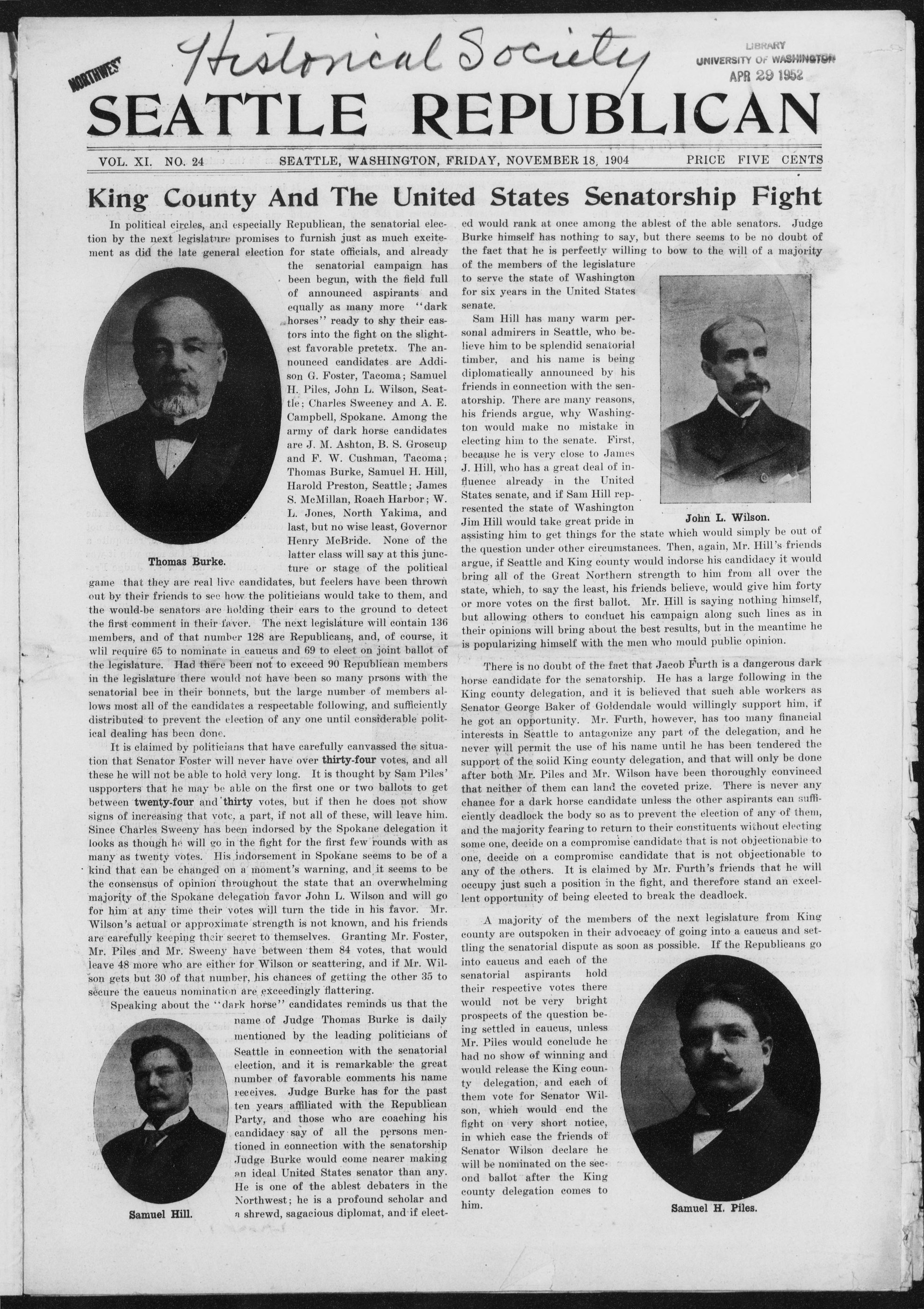
King County And The United States Senatorship Fight
King County And The United States Senatorship Fight
King County A In political circles, and especially tion by the next legislature promises ment as did the late general election
In political circles, and especially Republican, the senatorial election by the next legislature promises to furnish just as much excitement as did the late general election for state officials, and already
edith
game that they are real live candidate out by their friends to see how the poor would-be senators are holding that the first comment in their favor. The members, and of that number 128 are will require 65 to nominate in caucus of the legislature. Had there been not to in the legislature there would not have senatorial bee in their bonnets, but the lows most all of the candidates a resp. distributed to prevent the election of official dealing has been done.
It is claimed by politicians that hation that Senator Foster will never have these he will not be able to hold very low uspporters that he may be able on the between twenty-four and thirty votes signs of increasing that vote, a part, in Since Charles Sweeny has been indors looks as though he will go in the fight many as twenty votes. His indorsem kind that can be changed on a moment the consensus of opinion throughout a majority of the Spokane delegation for him at any time their votes will Wilson's actual or approximate strength are carefully keeping their secret to the Mr. Piles and Mr. Sweeny have betw leave 48 more who are either for Wilson gets but 30 of that number, his el secure the caucus nomination are exc. Speaking about the "dark horse"
candidates, but feelers have been thrown now the politicians would take to them, and holding their ears to the ground to detect ever. The next legislature will contain 136 per 128 are Republicans, and, of course, it will caucus and 69 to elect on joint ballot of been not to exceed 90 Republican members did not have been so many prsons with thehets, but the large number of members altes a respectable following, and sufficiently election of any one until considerable politi-ans that have carefully canvassed the situall never have over thirty-four votes, and all cold very long. It is thought by Sam Piles' table on the first one or two ballots to get thirty votes, but if then he does not show it, a part, if not all of these, will leave him. Been indorsed by the Spokane delegation it in the fight for the first few rounds with as indorsement in Spokane seems to be of a moment's warning, and it seems to be throughout the state that an overwhelming delegation favor John L. Wilson and will go votes will turn the tide in his favor. Mr. hate strength is not known, and his friends secret to themselves. Granting Mr. Foster, we have between them 84 votes, that would be for Wilson or scattering, and if Mr. Wilber, his chances of getting the other 35 to ten are exceedingly flattering. "Dark horse" candidates reminds us that the
game that they are real live candidates, but feelers have been thrown out by their friends to see how the politicians would take to them, and the would-be senators are holding their ears to the ground to detect the first comment in their favor. The next legislature will contain 136 members, and of that number 128 are Republicans, and, of course, it will require 65 to nominate in caucus and 69 to elect on joint ballot of the legislature. Had there been not to exceed 90 Republican members in the legislature there would not have been so many prsons with the senatorial bee in their bonnets, but the large number of members allows most all of the candidates a respectable following, and sufficiently distributed to prevent the election of any one until considerable political dealing has been done.
It is claimed by politicians that have carefully canvassed the situation that Senator Foster will never have over thirty-four votes, and all these he will not be able to hold very long. It is thought by Sam Piles' uspporters that he may be able on the first one or two ballots to get between twenty-four and thirty votes, but if then he does not show signs of increasing that vote, a part, if not all of these, will leave him. Since Charles Sweeny has been indorsed by the Spokane delegation it looks as though he will go in the fight for the first few rounds with as many as twenty votes. His indorsement in Spokane seems to be of a kind that can be changed on a moment's warning, and it seems to be the consensus of opinion throughout the state that an overwhelming majority of the Spokane delegation favor John L. Wilson and will go for him at any time their votes will turn the tide in his favor. Mr. Wilson's actual or approximate strength is not known, and his friends are carefully keeping their secret to themselves. Granting Mr. Foster, Mr. Piles and Mr. Sweeny have between them 84 votes, that would leave 48 more who are either for Wilson or scattering, and if Mr. Wilson gets but 30 of that number, his chances of getting the other 35 to secure the caucus nomination are exceedingly flattering.
Speaking about the "dark horse" candidates reminds us that the
name of Judge Thomas Burke is daily mentioned by the leading politicians of Seattle in connection with the senatorial election, and it is remarkable the great number of favorable comments his name receives. Judge Burke has for the past ten years affiliated with the Republican Party, and those who are coaching his candidacy say of all the persons mentioned in connection with the senatorship Judge Burke would come nearer making an ideal United States senator than any. He is one of the ablest debaters in the Northwest; he is a profound scholar and a shrewd, sagacious diplomat, and if elect-
```markdown
```
---
VOL. XI. NO. 24
Thomas Burke.
[Picture of a man in a suit with a mustache].
Samuel Hill.
SEATTLE, WASHINGTON, FRIDAY, NOVEMBER 18, 1904
the senatorial campaign has been begun, with the field full of announced aspirants and equally as many more "dark horses" ready to shy their castors into the fight on the slightest favorable pretetx. The announced candidates are Addison G. Foster, Tacoma; Samuel H. Piles, John L. Wilson, Seattle; Charles Sweeney and A. E. Campbell, Spokane. Among the army of dark horse candidates are J. M. Ashton, B. S. Groscup and F. W. Cushman, Tacoma; Thomas Burke, Samuel H. Hill, Harold Preston, Seattle; James S. McMillan, Roach Harbor; W. L. Jones, North Yakima, and last, but no wise least, Governor Henry McBride. None of the latter class will say at this juncture or stage of the political
ed would rank at once among the ablest of the able senators. Judge Burke himself has nothing to say, but there seems to be no doubt of the fact that he is perfectly willing to bow to the will of a majority
assisting him to get things for the state which would simply be out of the question under other circumstances. Then, again, Mr. Hill's friends argue, if Seattle and King county would indorse his candidacy it would bring all of the Great Northern strength to him from all over the state, which, to say the least, his friends believe, would give him forty or more votes on the first ballot. Mr. Hill is saying nothing himself, but allowing others to conduct his campaign along such lines as in their opinions will bring about the best results, but in the meantime he is popularizing himself with the men who mould public opinion.
There is no doubt of the fact that Jacob Furth is a dangerous dark horse candidate for the senatorship. He has a large following in the King county delegation, and it is believed that such able workers as Senator George Baker of Goldendale would willingly support him, if he got an opportunity. Mr. Furth, however, has too many financial interests in Seattle to antagonize any part of the delegation, and he never will permit the use of his name until he has been tendered the support of the solid King county delegation, and that will only be done after both Mr. Piles and Mr. Wilson have been thoroughly convinced that neither of them can land the coveted prize. There is never any chance for a dark horse candidate unless the other aspirants can sufficiently deadlock the body so as to prevent the election of any of them, and the majority fearing to return to their constituents without electing some one, decide on a compromise candidate that is not objectionable to one, decide on a compromise candidate that is not objectionable to any of the others. It is claimed by Mr. Furth's friends that he will occupy just such a position in the fight, and therefore stand an excellent opportunity of being elected to break the deadlock.
A majority of the members of the next legislature from King county are outspoken in their advocacy of going into a caucus and settling the senatorial dispute as soon as possible. If the Republicans go
of the members of the legislature to serve the state of Washington for six years in the United States senate.
Sam Hill has many warm personal admirers in Seattle, who believe him to be splendid senatorial timber, and his name is being diplomatically announced by his friends in connection with the senatorship. There are many reasons, his friends argue, why Washington would make no mistake in electing him to the senate. First, because he is very close to James J. Hill, who has a great deal of influence already in the United States senate, and if Sam Hill represented the state of Washington Jim Hill would take great pride in
assisting him to get things for the question under other circumstance argue, if Seattle and King county will bring all of the Great Northern state, which, to say the least, his fi or more votes on the first ballot. but allowing others to conduct their opinions will bring about the is popularizing himself with the more
There is no doubt of the fact that horse candidate for the senatorship King county delegation, and it is Senator George Baker of Goldendale he got an opportunity. Mr. Furtter interests in Seattle to antagonize never will permit the use of his new support of the solid King county dea after both Mr. Piles and Mr. Wils that neither of them can land the chance for a dark horse candidate ciently deadlock the body so as to and the majority fearing to return to some one, decide on a compromise of one, decide on a compromise can any of the others. It is claimed to occupy just such a position in the lent opportunity of being elected to
A majority of the members county are outspoken in their advocing the senatorial dispute as soon
into caucus and each of the senatorial aspirants hold their respective votes there would not be very bright prospects of the question being settled in caucus, unless Mr. Piles would conclude he had no show of winning and would release the King county delegation, and each of them vote for Senator Wilson, which would end the fight on very short notice, in which case the friends of Senator Wilson declare he will be nominated on the second ballot after the King county delegation comes to him.
```markdown
```
LIBRARY
UNIVERSITY OF WASHINGTON
APR 29 1952
BLICAN
04 PRICE FIVE CENTS
natorship Fight the ablest of the able senators. Judge say, but there seems to be no doubt of willing to bow to the will of a majority ture
[Name not visible]
John L. Wilson.
in the state which would simply be out of constances. Then, again, Mr. Hill's friendsenty would indorse his candidacy it would bern strength to him from all over the his friends believe, would give him forty foot. Mr. Hill is saying nothing himself, but his campaign along such lines as in the best results, but in the meantime he the men who mould public opinion.
that Jacob Furth is a dangerous dark parish. He has a large following in the art is believed that such able workers as dendale would willingly support him, if Furth, however, has too many financialize any part of the delegation, and he his name until he has been tendered the duty delegation, and that will only be done Wilson have been thoroughly convinced of the coveted prize. There is never any date unless the other aspirants can suffi- to prevent the election of any of them, return to their constituents without electing wise candidate that is not objectionable to candidate that is not objectionable to need by Mr. Furth's friends that he will the fight, and therefore stand an excelled to break the deadlock.
ers of the next legislature from King advocacy of going into a caucus and set- soon as possible. If the Republicans go
[Image of a man in a suit with a bow tie, facing forward.]
Samuel H. Piles.
POLITICAL POT=PIE
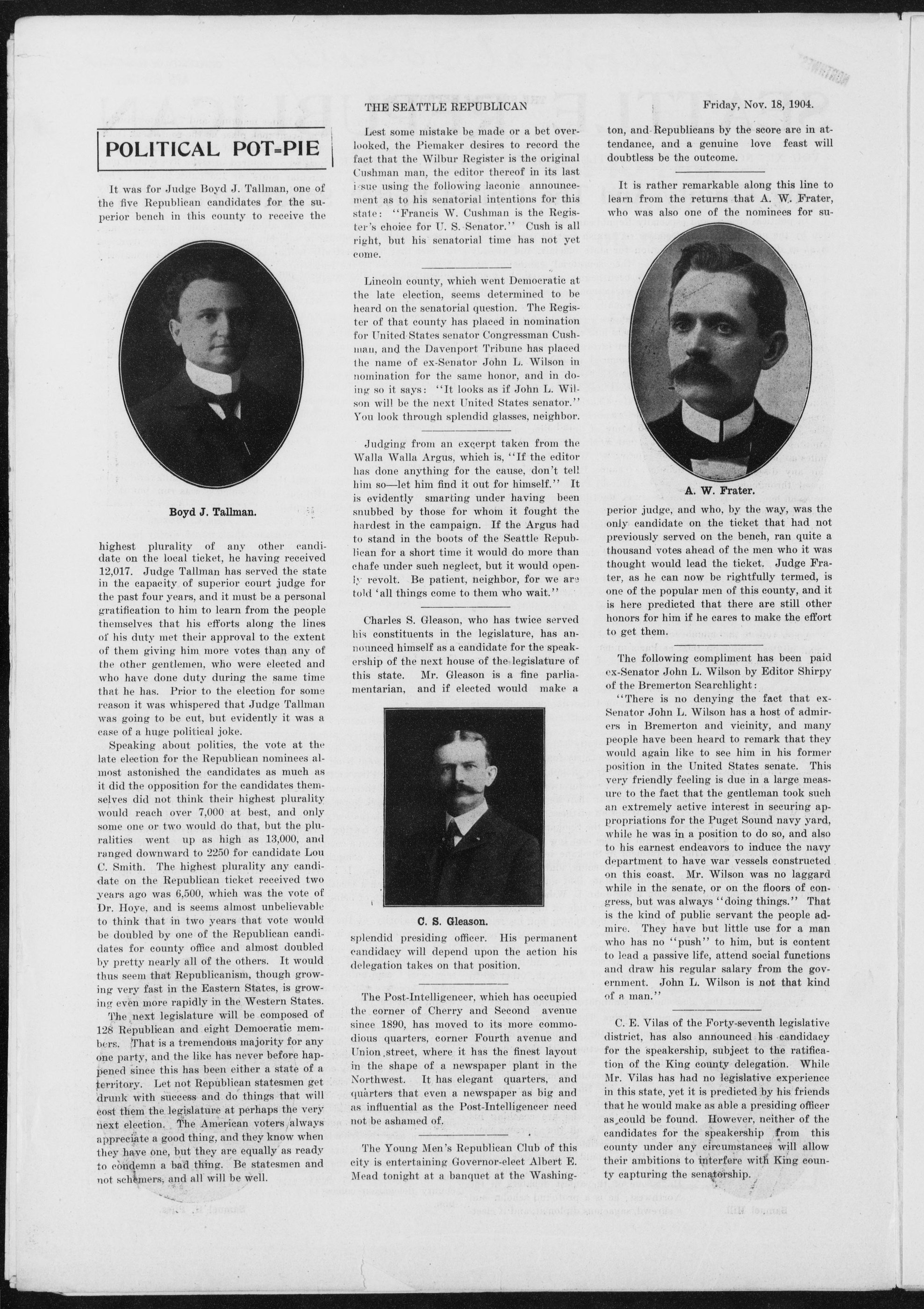
It was for Judge Boyd J. Tallman, one of the five Republican candidates for the superior bench in this county to receive the
[Name not provided]
Boyd J. Tallman.
highest plurality of any other candidate on the local ticket, he having received 12,017. Judge Tallman has served the state in the capacity of superior court judge for the past four years, and it must be a personal gratification to him to learn from the people themselves that his efforts along the lines of his duty met their approval to the extent of them giving him more votes than any of the other gentlemen, who were elected and who have done duty during the same time that he has. Prior to the election for some reason it was whispered that Judge Tallman was going to be cut, but evidently it was a case of a huge political joke.
Speaking about politics, the vote at the late election for the Republican nominees almost astonished the candidates as much as it did the opposition for the candidates themselves did not think their highest plurality would reach over 7,000 at best, and only some one or two would do that, but the pluralities went up as high as 13,000, and ranged downward to 2250 for candidate Lou C. Smith. The highest plurality any candidate on the Republican ticket received two years ago was 6,500, which was the vote of Dr. Hoye, and is seems almost unbelievable to think that in two years that vote would be doubled by one of the Republican candidates for county office and almost doubled by pretty nearly all of the others. It would thus seem that Republicanism, though growing very fast in the Eastern States, is growing even more rapidly in the Western States.
The next legislature will be composed of 128 Republican and eight Democratic members. That is a tremendous majority for any one party, and the like has never before happened since this has been either a state of a territory. Let not Republican statesmen get drunk with success and do things that will cost them the legislature at perhaps the very next election. The American voters always appreciate a good thing, and they know when they have one, but they are equally as ready to condemn a bad thing. Be statesmen and not schemers, and all will be well.
THE SEATTLE REPUBLICAN
Lest some mistake be made or a bet overlooked, the Piemaker desires to record the fact that the Wilbur Register is the original Cushman man, the editor thereof in its last issue using the following laconic announcement as to his senatorial intentions for this state: "Francis W. Cushman is the Register's choice for U. S. Senator." Cush is all right, but his senatorial time has not yet come.
Lincoln county, which went Democratic at the late election, seems determined to be heard on the senatorial question. The Register of that county has placed in nomination for United States senator Congressman Cushman, and the Davenport Tribune has placed the name of ex-Senator John L. Wilson in nomination for the same honor, and in doing so it says: "It looks as if John L. Wilson will be the next United States senator." You look through splendid glasses, neighbor.
Judging from an excerpt taken from the Walla Walla Argus, which is, "If the editor has done anything for the cause, don't tell him so—let him find it out for himself." It is evidently smarting under having been snubbed by those for whom it fought the hardest in the campaign. If the Argus had to stand in the boots of the Seattle Republican for a short time it would do more than chafe under such neglect, but it would openly revolt. Be patient, neighbor, for we are told 'all things come to them who wait.'"
Charles S. Gleason, who has twice served his constituents in the legislature, has announced himself as a candidate for the speakership of the next house of the legislature of this state. Mr. Gleason is a fine parliamentarian, and if elected would make a
[Picture of a man with a mustache and a suit].
C. S. Gleason. splendid presiding officer. His permanent candidacy will depend upon the action his delegation takes on that position.
The Post-Intelligencer, which has occupied the corner of Cherry and Second avenue since 1890, has moved to its more commodious quarters, corner Fourth avenue and Union street, where it has the finest layout in the shape of a newspaper plant in the Northwest. It has elegant quarters, and quarters that even a newspaper as big and as influential as the Post-Intelligencer need not be ashamed of.
The Young Men's Republican Club of this city is entertaining Governor-elect Albert E. Mead tonight at a banquet at the Washing-
Friday, Nov. 18, 1904
ton, and Republicans by the score are in attendance, and a genuine love feast will doubtless be the outcome.
It is rather remarkable along this line to learn from the returns that A. W. Frater, who was also one of the nominees for su-
[Name not visible]
A. W. Frater. perior judge, and who, by the way, was the only candidate on the ticket that had not previously served on the bench, ran quite a thousand votes ahead of the men who it was thought would lead the ticket. Judge Frater, as he can now be rightfully termed, is one of the popular men of this county, and it is here predicted that there are still other honors for him if he cares to make the effort to get them.
The following compliment has been paid ex-Senator John L. Wilson by Editor Shirpy of the Bremerton Searchlight:
"There is no denying the fact that exSenator John L. Wilson has a host of admirers in Bremerton and vicinity, and many people have been heard to remark that they would again like to see him in his former position in the United States senate. This very friendly feeling is due in a large measure to the fact that the gentleman took such an extremely active interest in securing appropriations for the Puget Sound navy yard, while he was in a position to do so, and also to his earnest endeavors to induce the navy department to have war vessels constructed on this coast. Mr. Wilson was no laggard while in the senate, or on the floors of congress, but was always "doing things." That is the kind of public servant the people admire. They have but little use for a man who has no "push" to him, but is content to lead a passive life, attend social functions and draw his regular salary from the government. John L. Wilson is not that kind of a man."
C. E. Vilas of the Forty-seventh legislative district, has also announced his candidacy for the speakership, subject to the ratification of the King county delegation. While Mr. Vilas has had no legislative experience in this state, yet it is predicted by his friends that he would make as able a presiding officer as could be found. However, neither of the candidates for the speakership from this county under any circumstances will allow their ambitions to interfere with King county capturing the senatorship.
(111) 501-0020
THE HOTEL
Friday, Nov. 19, 1904.
AUTOMOBILE NOTES. (Scientific American.)
The first practical demonstration of what an automobile can do, if fitted with stell-flanged wheels, and run on a railroad track, was made recently by Mr. Charles J. Glidden, of Boston, Mass. Mr. Glidden is on an auto tour of the world, in the course of which he has already covered over 20,000 miles, or about one-half the distance which he intends to cover in all during several months of the next three years. In the course of this trip he found it necessary to cross the American continent. The first 1733 miles of this distance were traversed over the roads at an average speed of 18.13 miles an hour, while the second stage of 1800 miles, from Minneapolis, Minn., to Vancouver, was run over the rails of the Canadian Pacific Railway. The 24-horse power Napier car which Mr. Glidden drives was run as a special, and was in charge of a conductor all the way. The 1800 miles were traversed in 60 hours' running time, and the Gliddens say that 40 miles an hour can be made on the rails without any discomfort. The general average speed throughout the trip was about 30 miles an hour, and the gasoline consumption was about half that needed for locomotion over the roads. The trip has demonstrated the applicability of the automobile to railroads, and probably in the near future railroad superintendents will have large and powerful automobile inspection cars propelled by gasoline motors, instead of the more cumbersome steam cars now used for this purpose.
A new type of automobile for transporting mail matter is now on trial at Paris under the supervision of M. Berard, secretary of posts and telegraphs. The new cars are electromobiles and will be used for carrying the mail between the central post office and
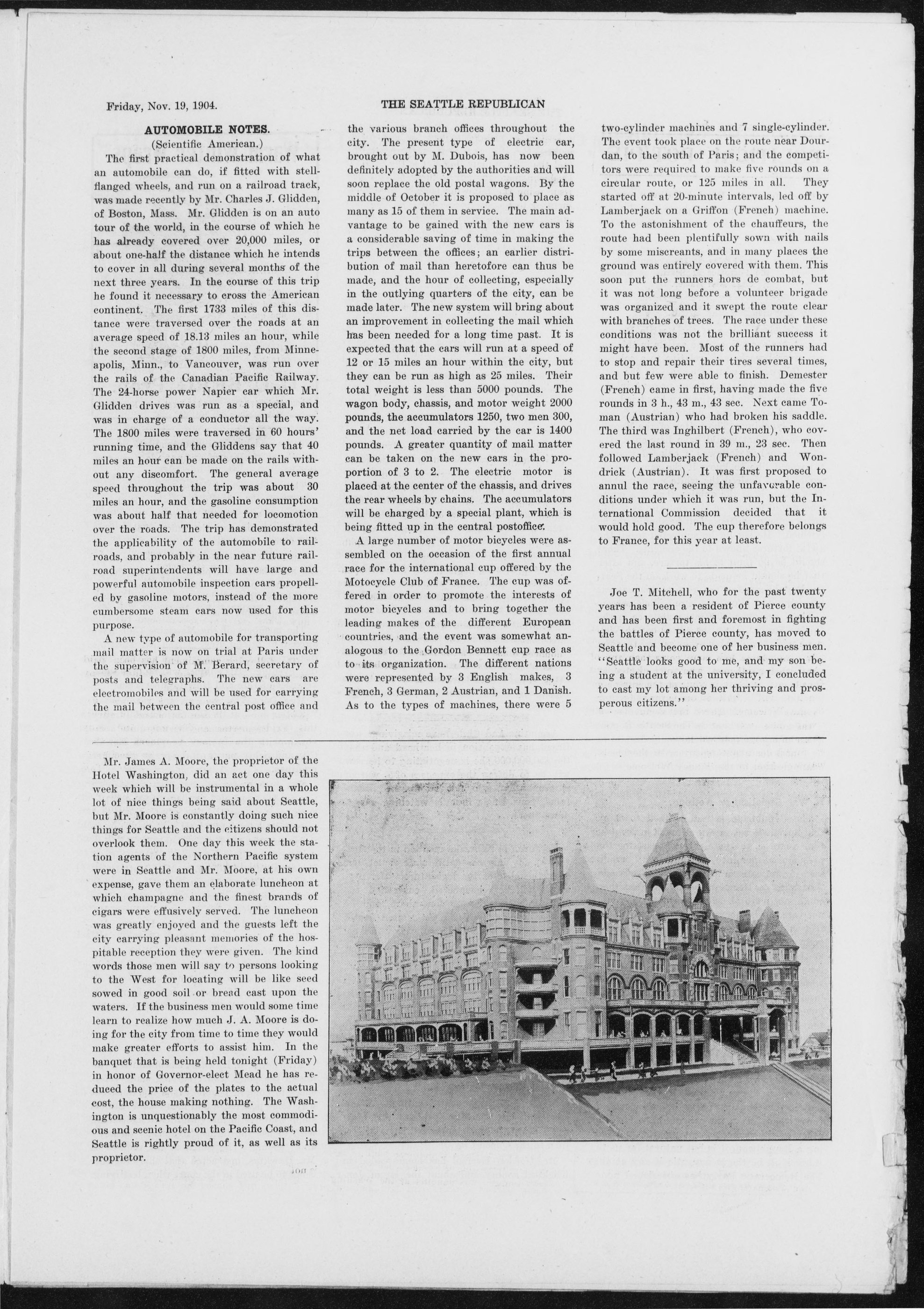
Mr. James A. Moore, the proprietor of the Hotel Washington, did an act one day this week which will be instrumental in a whole lot of nice things being said about Seattle, but Mr. Moore is constantly doing such nice things for Seattle and the citizens should not overlook them. One day this week the station agents of the Northern Pacific system were in Seattle and Mr. Moore, at his own expense, gave them an elaborate luncheon at which champagne and the finest brands of cigars were effusively served. The luncheon was greatly enjoyed and the guests left the city carrying pleasant memories of the hospitable reception they were given. The kind words those men will say to persons looking to the West for locating will be like seed sowed in good soil or bread cast upon the waters. If the business men would some time learn to realize how much J. A. Moore is doing for the city from time to time they would make greater efforts to assist him. In the banquet that is being held tonight (Friday) in honor of Governor-elect Mead he has reduced the price of the plates to the actual cost, the house making nothing. The Washington is unquestionably the most commodious and scenic hotel on the Pacific Coast, and Seattle is rightly proud of it, as well as its proprietor.
THE SEATTLE REPUBLICAN
the various branch offices throughout the city. The present type of electric car, brought out by M. Dubois, has now been definitely adopted by the authorities and will soon replace the old postal wagons. By the middle of October it is proposed to place as many as 15 of them in service. The main advantage to be gained with the new cars is a considerable saving of time in making the trips between the offices; an earlier distribution of mail than heretofore can thus be made, and the hour of collecting, especially in the outlying quarters of the city, can be made later. The new system will bring about an improvement in collecting the mail which has been needed for a long time past. It is expected that the cars will run at a speed of 12 or 15 miles an hour within the city, but they can be run as high as 25 miles. Their total weight is less than 5000 pounds. The wagon body, chassis, and motor weight 2000 pounds, the accumulators 1250, two men 300, and the net load carried by the car is 1400 pounds. A greater quantity of mail matter can be taken on the new cars in the proportion of 3 to 2. The electric motor is placed at the center of the chassis, and drives the rear wheels by chains. The accumulators will be charged by a special plant, which is being fitted up in the central postoffice.
A large number of motor bicycles were assembled on the occasion of the first annual race for the international cup offered by the Motocycle Club of France. The cup was offered in order to promote the interests of motor bicycles and to bring together the leading makes of the different European countries, and the event was somewhat analogous to the Gordon Bennett cup race as to its organization. The different nations were represented by 3 English makes, 3 French, 3 German, 2 Austrian, and 1 Danish. As to the types of machines, there were 5
two-cylinder machines and 7 single-cylinder. The event took place on the route near Dourdan, to the south of Paris; and the competitors were required to make five rounds on a circular route, or 125 miles in all. They started off at 20-minute intervals, led off by Lamberjack on a Griffon (French) machine. To the astonishment of the chauffeurs, the route had been plentifully sown with nails by some miscreants, and in many places the ground was entirely covered with them. This soon put the runners hors de combat, but it was not long before a volunteer brigade was organized and it swept the route clear with branches of trees. The race under these conditions was not the brilliant success it might have been. Most of the runners had to stop and repair their tires several times, and but few were able to finish. Demester (French) came in first, having made the five rounds in 3 h., 43 m., 43 sec. Next came Toman (Austrian) who had broken his saddle. The third was Inghilbert (French), who covered the last round in 39 m., 23 sec. Then followed Lamberjack (French) and Wondrick (Austrian). It was first proposed to annul the race, seeing the unfavorable conditions under which it was run, but the International Commission decided that it would hold good. The cup therefore belongs to France, for this year at least.
Joe T. Mitchell, who for the past twenty years has been a resident of Pierce county and has been first and foremost in fighting the battles of Pierce county, has moved to Seattle and become one of her business men. "Seattle looks good to me, and my son being a student at the university, I concluded to cast my lot among her thriving and prosperous citizens."
§
:
The Seattle Republican
Established May, 1894
H. R. Cayton..............Editor and Publisher
Susie Revels Cayton.................. Associate
SUBSCRIPTION RATES.
One VOar oi. ccc cseds dels ceaecn dem epee cog GRO
GIS MOWING oo gsitiseig oes craw mea peewee miUe
Thkee MONS .hickiucatan. tot eehs ereews eO0
Published every Friday at 214 Columbia St.
Entered at the Postoffice at Seattle as Second-
class Mail Matter.
Sunday Welcome’s Bad Break.
The colored editor of the Seattle Repub-
liean takes exception to an article in this pa-
per several weeks ago, relative to a colored
man following a white woman. In the arti-
cle it was stated that those present in the
court room at the time the man was tried and
convicted were of the opinion that the fellow
needed lynching. The editor of the Repub-
lican asks what would have happened if a
white man had followed a colored woman.
Ic would like to know if the same people
would have desired the white man lynched.
This paper is of the opinion that if a white
man would become so low and vile as to fol-
low a colored woman about he should not be
lynched. He should be subjected to all the
awful tortures known to the ancients. There
should be no limit to his torture, and after
that he should be made to work on the Seat-
tle Republican for the rest of his natural
life Sunday (Portland, Ore.) Welcome.
There are over 2,000,000 mulattoes in the
United States. Does the editor of the Wel-
come wish to go on record as saying that the
white women of this country are solely re-
sponsible for this great army of half-breeds?
Do not get reckless in your statements or a
lynching will be quite in order for the editor
of the Welcome. There are a number - of
‘‘white men’’ working on The Seattle Repub-
liean, and any one of whom would disdain to
be found dead in company with the black-
mailing editor of the Sunday Welcome.
It Was Socialism or Nothing.
The Republican is not inclined to think
that Socialism has grown as much in the past
four years as the vote recently cast for the
presidential nominee of that party would
seem to indicate on its face. Hundreds and
thousands of Democrats who felt that they
could not yote the Republican and would
not vote the Democratic ticket, owing to the
fact that it had again strayed off after false
gods no less obnoxious than when Bryan was
at the helm, voted the Socialist ticket as a
rebuke to both of the old parties. In this
state hundreds of Demoerats refused abso-
lutely to vote for the Democratic nominee for
governor and under no circumstances could
they be induced to vote for the Republican
nominee, compromised the awkward situa-
tion by voting for the Socialist candidate,
knowing at the time they were throwing
their votes away. There will always be two,
and only two, great parties in this country,
and if the Socialist party becomes one of
those it must be at the expense of one or the
other of the present great parties, and be-
ing a Republican, it is but natural for us to
think it ill be the Demoeratiec if any at all.
The Demoeratic Party has abandoned none
THE SEATTLE REPUBLICAN
of its old principles, and that is just why it
is a dead one. It never has anything new
to present to the voters for their considera-
tion, hence it must fail in the future even
worse than it did at the late general elec-
tion. The Socialist Party has some new
ideas, and some good ones at that, and hence
it will completely wipe out the Democratic
Party in the North, and the Lord only knows
what will become of the benighted Demo-
eratic heathens in the South. “
If President Roosevelt is correctly report-
ed, Uncle Sam is to feed four years more on
Hay.
With the next legislature of this state
overwhelmingly Republican the senatorial
question, which is to be settled by it, seems
to be nobody’s victory.
The Republican in the House of Repre-
sentatives who votes against cutting down
the representation to Congress from the
South ought to be defeated two years hence.
Judge Parker takes the right view of it in
deciding to never be a candidate for office
again. Any one beaten as badly as he was
ought to know when he has enough of a good
thing.
Let our own and only Teddy intervene in
the Oriental embroligio and then let him
him while he has his hand in at the business
intervene in the embroligio in Uncle Sam’s
Sunny South.
President Roosevelt is to:visit the ' St.
Louis fair. Missouri must have gotten a tip
as to the President’s intention, which ex-
plains why she changed her polities at the
last election.
Argentine and Chile have misgivings lest
Brazil has expansion in her head and that
the $50,000,000 she is’ negotiating to borrow
will be to defray the expenses of a war of
extermination. Do not be alarmed, little
folks, your Uncle Sam is watching things
down there.
Bryanism in Nebraska resulted in the elec-
tion of not only the entire state ticket, but
every member of the legislature. Mr. Bry-
an, it will be remembered, controlled the
Demo-Pop state conventions there, and he
had ambitions to go to the United States
senate in ease his crowd won. He won’t go.
Bryan is a Jonah,
PERSONAL PARAGRAPHS.
Mrs. J. E. Hawkins spent four days of last
week in Tacoma, the guest of Mrs. Edison.
She reports Tacoma society flourishing.
Mrs. J. T. Gayton entertained the Maga-
zine Club last Tuesday evening. The attend-
ance was good and the papers read of much
interest.
Mr. J. S. Murray visited with the Maga-
zine Club last Tuesday evening. Mr. Mur-
ray’s health is much improved since his re-
turn to the Queen City.
Mr, Gordon Eversol has homesteaded in
Klickitat county and about the Ist of Jan-
Friday, Nov. 18, 1904.
Warm Winter Wraps
Sn ee
Ladies’ Furs {7 Sh wa \
Made and Re- ff -~ \\
paired. Boas of f] sousreb- si
all kinds at Re- {| cewek _ |)
duced Prices. \\\ a eo. |)
SPECIAL Re- Ke ~ Pi Mf
duction on Seal- \\ RES t all My
skins. Allwork \Y x <q = ee)
Nee er
coarse
ts
1
C. C. BERG, Prop.
Phone Main 4773 1425 First Aves, Near Pike
uary he and his family contemplate. moving
out to try the life of an up-to-date western
rancher.
There are several entertainments to come
off during Thanksgiving week. Both the
Methodist and Baptist churches have pre-
pared programs and the Unique Social Club
will give a club bail.
Cards have been received in the city invit-
ing attendance to a piano recital by the in-
termediate pupils of Miss Candace Parker
November 16, 1904, at All Saints’ parish
house, Spokane, Wash.
The members of the Magazine Club have
agreed to attend Rey. Alfred W. Martin’s
diseouree at Christenson’s hall on next Sun-
day evening. His subject will be ‘‘The Ad-
versities of Life and How to Meet Them.”’
Miss Dora Thwaite gives a reading of
“Ostler Joe’’ at the Baptist church literary
this (Friday) evening. She was quite a fa-
vorite with the literary people of Kansas
City and richly merits all the praise given her
readings.
Mrs. I. F. Norris gave a surprise party on
her son Ira in honor of his 17th birthday last
Tuesday evening. A merry party of girls and
boys rushed in at half past 8 o’clock, taking
the young Mr. Norris completely by surprise.
Among those present were: Miss Clifford
Freeman, Miss Willie Lee, Miss Mattie Col-
lins, Miss Emma Houston, Miss Genevia
Richardson, Miss Octavia Richardson, Miss
Gertrude Harvey; Mr. Eugene Wallace, Mr.
Carl Washington, Mr: Robert Harvey, Mr.
Willie Anderson, Mr: Alfred Purnell, Mr.
Perey Norris, Mr. Hartsfield. With merry
games and light hearts the hours fled quick-
ly. Two courses of refreshments were served.
After wishing Mr. Norris many happy re-
turns of the day the merry-makers started
homeward.
Attorney J. E. Hawkins has obtained a rul-
ing in the police court barring slang refer-
ences to colored people. Tt is not apparent
why some policemen and men on the witness
stand who live in this enlightened age should
wish to use the terms ‘“nigger,”’ “darkey”’
and ‘‘coon.”? The court; at the request’ of
Mr. Hawkins, instructed that this’ language
is not to be used in the court when testifying.
Friday Nov. 18, 1904. THE SEATTLE REPUBLICAN
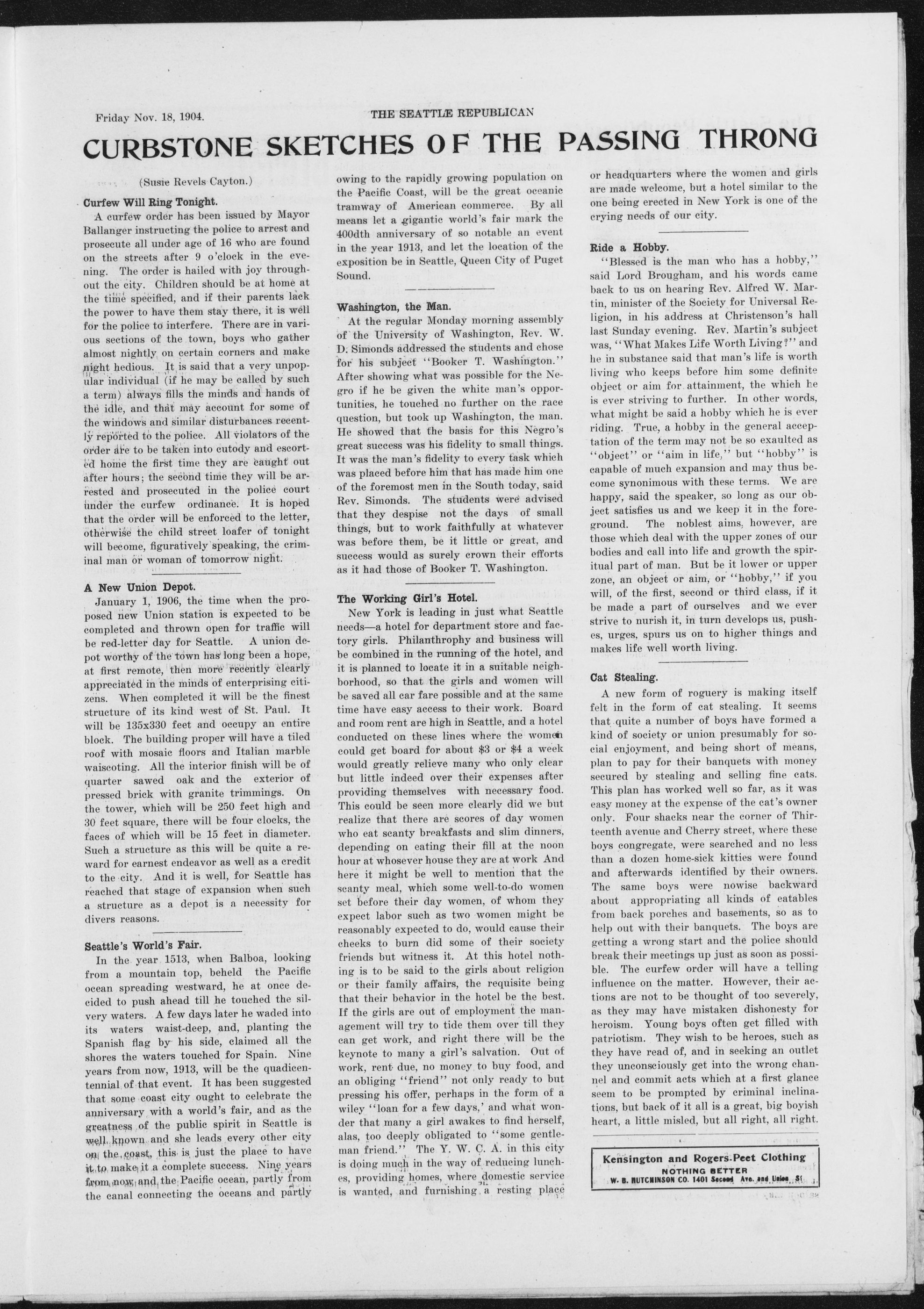
(Susie Revels Cayton.) owing to the rapidly growing population on or headquarters where the women and girls
Curfew Will Ring Tonight. the Pacific Coast, will be the great oceanic are made welcome, but a eae similar to the
2 tramway of American commerce. — By all one being erected in New York is one of the
‘A curfew order has been issued by Mayor : A ; . a é
means let a gigantic world’s fair mark the erying needs of our city.
Ride a Hobby.
“Blessed is the man who has a hobby,”
said Lord Brougham, and his words came
back to us on hearing Rev. Alfred W. Mar-
tin, minister of the Society for Universal Re-
ligion, in his address at Christenson’s hall
last Sunday evening. Rey. Martin’s subject
was, ‘‘What Makes Life Worth Living?’ and
he in substance said that man’s life is worth
living who keeps before him some definite
object or aim for. attainment, the which ke
is ever striving to further. In other words,
what might be said a hobby which he is ever
riding. True, a hobby in the general accep-
tation of the term may not be so exaulted as
“object”? or ‘‘aim in life,’”? but ‘““hobby”’ is
capable of much expansion and may thus be-
come synonimous with these terms. We are
happy, said the speaker, so long as our ob-
ject satisfies us and we keep it in the fore-
ground. The noblest aims, however, are
those which deal with the upper zones of our
bodies and call into life and growth the spir-
itual part of man. But be it lower or upper
zone, an object or aim, or ‘‘hobby,’’ if you
will, of the first, second or third class, if it
be made a part of ourselves and we ever
strive to nurish it, in turn develops us, push-
es, urges, spurs us on to higher things and
makes life well worth living.
Cat Stealing.
A new form of roguery is making itself
felt in the form of eat stealing. It seems
that quite a number of boys have formed a
kind of society or union presumably for so-
cial enjoyment, and being short of means,
plan to pay for their banquets with money
secured by stealing and selling fine cats.
This plan has worked well so far, as it was
easy money at the expense of the cat’s owner
only. Four shacks near the corner of Thir-
teenth avenue and Cherry street, where these
boys congregate, were searched and no less
than a dozen home-sick kitties were found
and afterwards identified by their owners.
The same boys were nowise backward
about appropriating all kinds of eatables
from back porehes and basements, so as to
help out with their banquets. The boys are
getting a wrong start and the police should
break their meetings up just as soon as possi-
ble. The curfew order will have a telling
influence on the matter. However, their ac-
tions are not to be thought of too severely,
as they may have mistaken dishonesty for
heroism. Young boys often get filled with
patriotism. They wish to be heroes, such as
they have read of, and in seeking an outlet
they unconsciously get into the wrong chan-
nel and commit acts which at a first glance
seem to be prompted by criminal inelina-
tions, but back of it all is a great, big boyish
heart, a little misled, but all right, all right.
Kensington and Rogers-Peet Clothing
NOTHING BETTER
W. B, NUTCHINSON CO. 1401 Second Avo. and Union, Si.
(Susie Revels Cayton.)
ee een ee
‘A curfew order has been issued by Mayor
Ballanger instructing the police to arrest and
prosecute all under age of 16 who are found
on the streets after 9 o’clock in the eve-
ning. The order is hailed with joy through-
out the city. Children should be at home at
the tilié specified, and if their parents lack
the power to have them stay there, it is well
for the police to interfere. There are in vari-
ous sections of the town, boys who gather
almost nightly on certain corners and make
night hedious. It is said that a very unpop-
ular individual (if he may be ealled by such
a term) always fills the minds and hands of
the idle, and that may account for some of
the windows and similar disturbances recent-
ly reported to the police. All violators of the
order die to be taken into cutody and escort-
td home the first time they are taught out
after hours; the second time they will be ar-
rested and prosecuted in the police court
under the curfew ordinance. It is hoped
that the order will be enforced to the letter,
othéerwige the child street loafer of tonight
will become, figuratively speaking, the erim-
inal man or woman of tomorrow night.
A New Union Depot.
January 1, 1906, the time when the pro-
posed new Union station is expected to be
completed and thrown open for traffic will
be red-letter day for Seattle. A union de-
pot worthy of the town has long been a hope,
at first remote, then more’ recently clearly
appreciated in the minds of enterprising eiti-
zens. When completed it will be the finest
structure of its kind west of St. Paul. It
will be 135x330 feet and occupy an entire
block. The building proper will have a tiled
roof with mosaie floors and Italian marble
waiscoting. All the interior finish will be of
quarter sawed oak and the exterior of
pressed brick with granite trimmings. On
the tower, which will be 250 feet high and
30 feet square, there will be four clocks, the
faces of which will be 15 feet in diameter.
Such a structure as this will be quite a re-
ward for earnest endeavor as well as a credit
to the city. And it is well, for Seattle has
reached that stage of expansion when such
a structure as a depot is a necessity for
divers reasons. :
Seattle’s World’s Fair.
In the. year 1513, when Balboa, looking
from a mountain top, beheld the Pacific
ocean spreading westward, he at once de-
cided to push ahead till he touched the sil-
very waters. A few days later he waded into
its waters waist-deep, and, planting the
Spanish flag by his side, claimed all the
shores the waters touched for Spain. Nine
years from now, 1913, will be the quadicen-
tennial of that event. It has been suggested
that some coast city ought to celebrate the
anniversary with a world’s fair, and as the
greatness of the public spirit in Seattle is
well. known. and she leads every other city
oni the, coast, this. is just the place to have
it.to, make it a complete success. Ning years
from, nosy; and, the, Pacific ocean, partly from
the canal connecting the oceans and partly
owing to the rapidly growing population on
the Pacific Coast, will be the great oceanic
tramway of American commerce. By all
means let a gigantic world’s fair mark the
400dth anniversary of so notable an event
in the year 1913, and let the location of the
exposition be in Seattle, Queen City of Puget
Sound.
‘Washington, the Man.
~ At the regular Monday morning assembly
of the University of Washington, Rev. W.
D. Simonds addressed the students and chose
for his subject ‘‘Booker T. Washington.”’
After showing what was possible for the Ne-
gro if he be given the white man’s oppor-
tunities, he touched no further on the race
question, but took up Washington, the man.
He showed that the basis for this Negro’s
great success was his fidelity to small things.
It was the man’s fidelity to every task which
was placed before him that has made him one
of the foremost men in the South today, said
Rey. Simonds. The students weré advised
that they despise not the days of small
things, but to work faithfully at whatever
was before them, be it little or great, and
success would as surely crown their efforts
as it had those of Booker T. Washington.
The Working Girl’s Hotel.
New York is leading in just what Seattle
needs—a hotel for department store and fac-
tory girls. Philanthrophy and business will
be combined in the running of the hotel, and
it is planned to locate it in a suitable neigh-
borhood, so that the girls and women will
be saved all ear fare possible and at the same
time have easy access to their work. Board
and room rent are high in Seattle, and a hotel
conducted on these lines where the women
could get board for about $3 or $4 a week
would greatly relieve many who only clear
but little indeed over their expenses after
providing themselves with necessary food.
This could be seen more clearly did we but
realize that there are scores of day women
who eat seanty breakfasts and slim dinners,
depending on eating their fill at the noon
hour at whosever house they are at work And
here it might be well to mention that the
scanty meal, which some well-to-do women
set before their day women, of whom they
expect labor such as two women might be
reasonably expected to do, would cause their
cheeks to burn did some of their society
friends but witness it. At this hotel noth-
ing is to be said to the girls about religion
or their family affairs, the requisite being
that their behavior in the hotel be the best.
If the girls are out of employment the man-
agement will try to tide them over till they
ean get work, and right there will be the
keynote to many a girl’s salvation. Out of
work, rent due, no money to buy food, and
an obliging ‘‘friend’’ not only ready to but
pressing his offer, perhaps in the form of a
wiley ‘‘loan for a few days,’ and what won-
der that many a girl awakes to find herself,
alas, too deeply obligated to ‘‘some gentle-
man friend.’? The Y. W. ©. A. in this city
is doing much in the way of reducing lunch-
es, providing homes, where domestic service
is wanted, and furnishing,a resting place
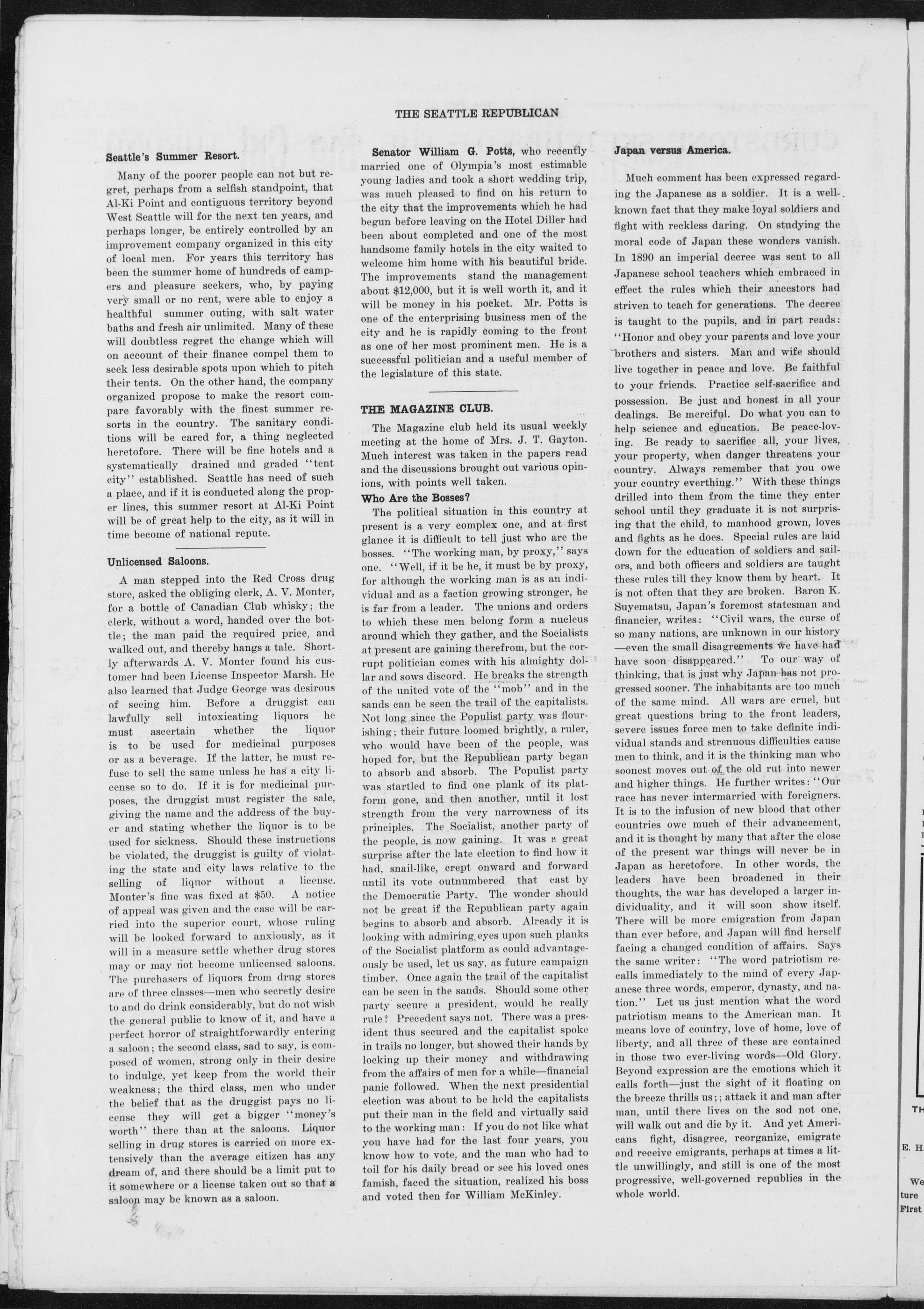
Seattle's Summer Resort.
Many of the poorer people can not but regret, perhaps from a selfish standpoint, that Al-Ki Point and contiguous territory beyond West Seattle will for the next ten years, and perhaps longer, be entirely controlled by an improvement company organized in this city of local men. For years this territory has been the summer home of hundreds of campers and pleasure seekers, who, by paying very small or no rent, were able to enjoy a healthful summer outing, with salt water baths and fresh air unlimited. Many of these will doubtless regret the change which will on account of their finance compel them to seek less desirable spots upon which to pitch their tents. On the other hand, the company organized propose to make the resort compare favorably with the finest summer resorts in the country. The sanitary conditions will be cared for, a thing neglected heretofore. There will be fine hotels and a systematically drained and graded "tent city" established. Seattle has need of such a place, and if it is conducted along the proper lines, this summer resort at Al-Ki Point will be of great help to the city, as it will in time become of national repute.
Unlicensed Saloons.
A man stepped into the Red Cross drug store, asked the obliging clerk, A. V. Monter, for a bottle of Canadian Club whisky; the clerk, without a word, handed over the bottle; the man paid the required price, and walked out, and thereby hangs a tale. Shortly afterwards A. V. Monter found his customer had been License Inspector Marsh. He also learned that Judge George was desirous of seeing him. Before a druggist can lawfully sell intoxicating liquors he must ascertain whether the liquor is to be used for medicinal purposes or as a beverage. If the latter, he must refuse to sell the same unless he has a city license so to do. If it is for medicinal purposes, the druggist must register the sale, giving the name and the address of the buyer and stating whether the liquor is to be used for sickness. Should these instructions be violated, the druggist is guilty of violating the state and city laws relative to the selling of liquor without a license. Monter's fine was fixed at $50. A notice of appeal was given and the case will be carried into the superior court, whose ruling will be looked forward to anxiously, as it will in a measure settle whether drug stores may or may not become unlicensed saloons. The purchasers of liquors from drug stores are of three classes—men who secretly desire to and do drink considerably, but do not wish the general public to know of it, and have a perfect horror of straightforwardly entering a saloon; the second class, sad to say, is composed of women, strong only in their desire to indulge, yet keep from the world their weakness; the third class, men who under the belief that as the druggist pays no license they will get a bigger "money's worth" there than at the saloons. Liquor selling in drug stores is carried on more extensively than the average citizen has any dream of, and there should be a limit put to it somewhere or a license taken out so that a saloon may be known as a saloon.
THE SEATTLE REPUBLICAN
Senator William G. Potts, who recently married one of Olympia's most estimable young ladies and took a short wedding trip, was much pleased to find on his return to the city that the improvements which he had begun before leaving on the Hotel Diller had been about completed and one of the most handsome family hotels in the city waited to welcome him home with his beautiful bride. The improvements stand the management about $12,000, but it is well worth it, and it will be money in his pocket. Mr. Potts is one of the enterprising business men of the city and he is rapidly coming to the front as one of her most prominent men. He is a successful politician and a useful member of the legislature of this state.
THE MAGAZINE CLUB.
The Magazine club held its usual weekly meeting at the home of Mrs. J. T. Gayton. Much interest was taken in the papers read and the discussions brought out various opinions, with points well taken.
Who Are the Bosses?
The political situation in this country at present is a very complex one, and at first glance it is difficult to tell just who are the bosses. "The working man, by proxy," says one. "Well, if it be he, it must be by proxy, for although the working man is as an individual and as a faction growing stronger, he is far from a leader. The unions and orders to which these men belong form a nucleus around which they gather, and the Socialists at present are gaining therefrom, but the corrupt politician comes with his almighty dollar and sows discord. He breaks the strength of the united vote of the "mob" and in the sands can be seen the trail of the capitalists. Not long since the Populist party was flourishing; their future loomed brightly, a ruler, who would have been of the people, was hoped for, but the Republican party began to absorb and absorb. The Populist party was startled to find one plank of its platform gone, and then another, until it lost strength from the very narrowness of its principles. The Socialist, another party of the people, is now gaining. It was a great surprise after the late election to find how it had, snail-like, crept onward and forward until its vote outnumbered that cast by the Democratic Party. The wonder should not be great if the Republican party again begins to absorb and absorb. Already it is looking with admiring eyes upon such planks of the Socialist platform as could advantageously be used, let us say, as future campaign timber. Once again the trail of the capitalist can be seen in the sands. Should some other party secure a president, would he really rule? Precedent says not. There was a president thus secured and the capitalist spoke in trails no longer, but showed their hands by locking up their money and withdrawing from the affairs of men for a while—financial panic followed. When the next presidential election was about to be held the capitalists put their man in the field and virtually said to the working man: If you do not like what you have had for the last four years, you know how to vote, and the man who had to toil for his daily bread or see his loved ones famish, faced the situation, realized his boss and voted then for William McKinley.
Japan versus America.
Much comment has been expressed regarding the Japanese as a soldier. It is a well-known fact that they make loyal soldiers and fight with reckless daring. On studying the moral code of Japan these wonders vanish. In 1890 an imperial decree was sent to all Japanese school teachers which embraced in effect the rules which their ancestors had striven to teach for generations. The decree is taught to the pupils, and in part reads: "Honor and obey your parents and love your brothers and sisters. Man and wife should live together in peace and love. Be faithful to your friends. Practice self-sacrifice and possession. Be just and honest in all your dealings. Be merciful. Do what you can to help science and education. Be peace-loving. Be ready to sacrifice all, your lives, your property, when danger threatens your country. Always remember that you owe your country everthing." With these things drilled into them from the time they enter school until they graduate it is not surprising that the child, to manhood grown, loves and fights as he does. Special rules are laid down for the education of soldiers and sailors, and both officers and soldiers are taught these rules till they know them by heart. It is not often that they are broken. Baron K. Suyematsu, Japan's foremost statesman and financier, writes: "Civil wars, the curse of so many nations, are unknown in our history—even the small disagreements we have had have soon disappeared." To our way of thinking, that is just why Japan has not progressed sooner. The inhabitants are too much of the same mind. All wars are cruel, but great questions bring to the front leaders, severe issues force men to take definite individual stands and strenuous difficulties cause men to think, and it is the thinking man who soonest moves out of the old rut into newer and higher things. He further writes: "Our race has never intermarried with foreigners. It is to the infusion of new blood that other countries owe much of their advancement, and it is thought by many that after the close of the present war things will never be in Japan as heretofore. In other words, the leaders have been broadened in their thoughts, the war has developed a larger individuality, and it will soon show itself. There will be more emigration from Japan than ever before, and Japan will find herself facing a changed condition of affairs. Says the same writer: "The word patriotism recalls immediately to the mind of every Japanese three words, emperor, dynasty, and nation." Let us just mention what the word patriotism means to the American man. It means love of country, love of home, love of liberty, and all three of these are contained in those two ever-living words—Old Glory. Beyond expression are the emotions which it calls forth—just the sight of it floating on the breeze thrills us;; attack it and man after man, until there lives on the sod not one, will walk out and die by it. And yet Americans fight, disagree, reorganize, emigrate and receive emigrants, perhaps at times a little unwillingly, and still is one of the most progressive, well-governed republics in the whole world.
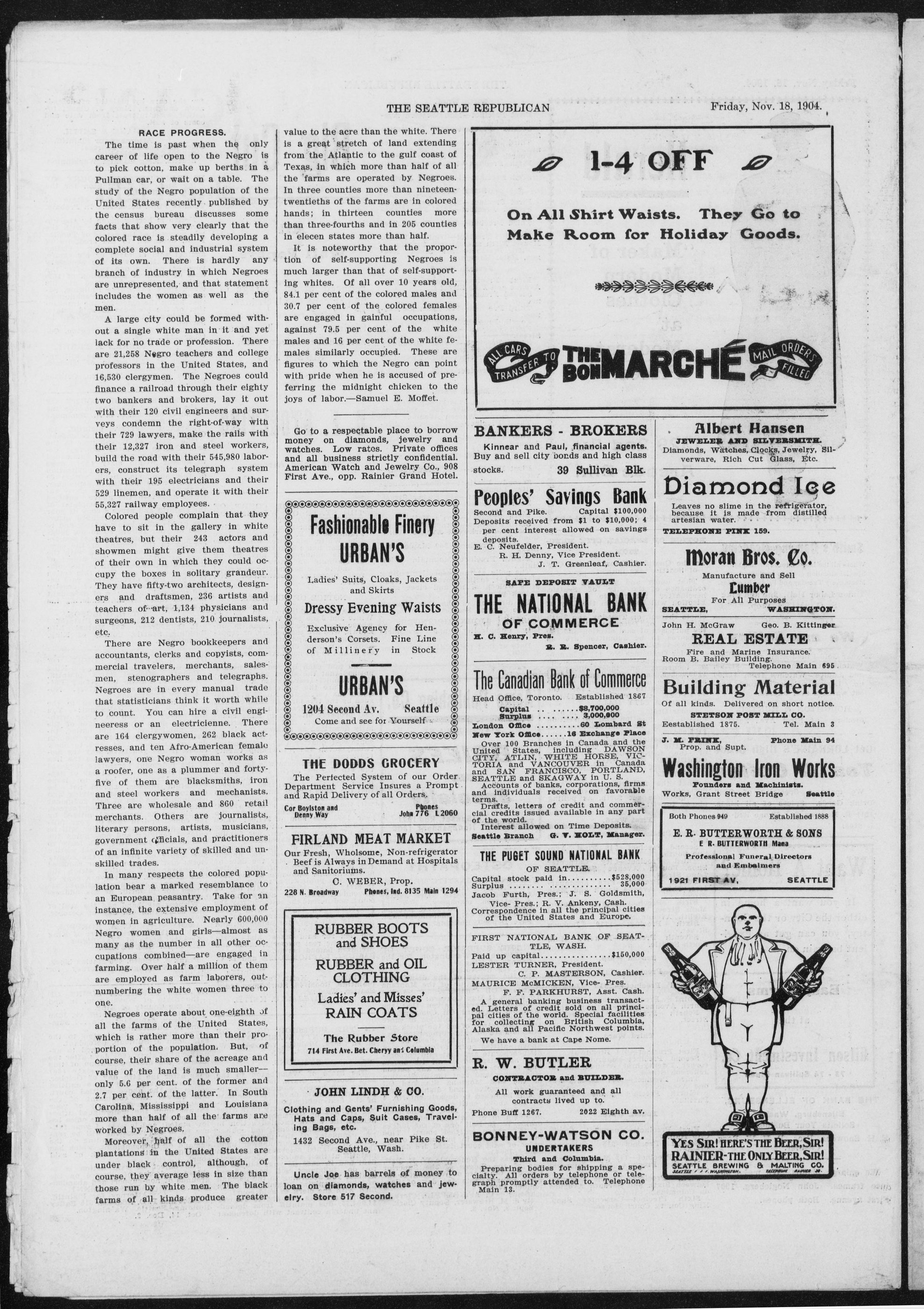
RACE PROGRESS.
The time is past when the only career of life open to the Negro is to pick cotton, make up berths in a Pullman car, or wait on a table. The study of the Negro population of the United States recently published by the census bureau discusses some facts that show very clearly that the colored race is steadily developing a complete social and industrial system of its own. There is hardly any branch of industry in which Negroes are unrepresented, and that statement includes the women as well as the men.
A large city could be formed without a single white man in it and yet lack for no trade or profession. There are 21,258 Negro teachers and college professors in the United States, and 16,530 clergymen. The Negroes could finance a railroad through their eighty two bankers and brokers, lay it out with their 120 civil engineers and surveys condemn the right-of-way with their 729 lawyers, make the rails with their 12,327 iron and steel workers, build the road with their 545,980 laborers, construct its telegraph system with their 195 electricians and their 529 linemen, and operate it with their 55.327 railway employees.
Colored people complain that they have to sit in the gallery in white theatres, but their 243 actors and showmen might give them theatres of their own in which they could occupy the boxes in solitary grandeur. They have fifty-two architects, designers and draftsmen, 236 artists and teachers of art, 1,134 physicians and surgeons, 212 dentists, 210 journalists, etc.
There are Negro bookkeepers and accountants, clerks and copyists, commercial travelers, merchants, salesmen, stenographers and telegraphs. Negroes are in every manual trade that statisticians think it worth while to count. You can hire a civil engineeress or an electricienne. There are 164 clergywomen, 262 black actresses, and ten Afro-American female lawyers, one Negro woman works as a roofer, one as a plummer and forty-five of them are blacksmiths, iron and steel workers and mechanists. Three are wholesale and 860 retail merchants. Others are journalists, literary persons, artists, musicians, government officials, and practitioners of an infinite variety of skilled and unskilled trades.
In many respects the colored population bear a marked resemblance to an European peasantry. Take for an instance, the extensive employment of women in agriculture. Nearly 600,000 Negro women and girls-almost as many as the number in all other occupations combined-are engaged in farming. Over half a million of them are employed as farm laborers, outnumbering the white women three to one.
Negroes operate about one-eighth of all the farms of the United States, which is rather more than their proportion of the population. But, of course, their share of the acreage and value of the land is much smaller--only 5.6 per cent. of the former and 2.7 per cent. of the latter. In South Carolina, Mississippi and Louisiana more than half of all the farms are worked by Negroes.
Moreover, half of all the cotton plantations in the United States are under black control, although, of course, they average less in size than those run by white men. The black farms of all kinds produce greater
THE SEATTLE REPUBLICAN
value to the acre than the white. There is a great stretch of land extending from the Atlantic to the gulf coast of Texas, in which more than half of all the farms are operated by Negroes. In three counties more than nineteenwentieths of the farms are in colored hands; in thirteen counties more than three-fourths and in 205 counties in elecen states more than half.
It is noteworthy that the proportion of self-supporting Negroes is much larger than that of self-supporting whites. Of all over 10 years old, 84.1 per cent of the colored males and 30.7 per cent of the colored females are engaged in gainful occupations, against 79.5 per cent of the white males and 16 per cent of the white females similarly occupied. These are figures to which the Negro can point with pride when he is accused of preferring the midnight chicken to the joys of labor.—Samuel E. Moffet.
Go to a respectable place to borrow money on diamonds, jewelry and watches. Low rates. Private offices and all business strictly confidential. American Watch and Jewelry Co., 908 First Ave., opp. Rainier Grand Hotel.
Fashionable Finery
URBAN'S
Ladies' Suits, Cloaks, Jackets
and Skirts
Dressy Evening Waists
Exclusive Agency for Henderson's Corsets. Fine Line of Millinery in Stock
URBAN'S
1204 Second Av. Seattle
Come and see for Yourself
THE DODDS GROCERY
The Perfected System of our Order Department Service Insures a Prompt and Rapid Delivery of all Orders.
FIRLAND MEAT MARKET
Our Fresh, Wholsome, Non-refrigerator Beef is Always in Demand at Hospitals and Sanitoriums.
C. WEBER, Prop.
228 N. Broadway Phones, Ind. 8135 Main 1294
RUBBER BOOTS and SHOES
RUBBER and OIL CLOTHING
Ladies' and Misses'
RAIN COATS
The Rubber Store
714 First Ave. Bet. Cheryy and Columbia
JOHN LINDH & CO.
Clothing and Gents' Furnishing Goods, Hats and Caps, Suit Cases, Traveling Bags, etc.
1432 Second Ave., near Pike St.
Seattle, Wash.
Uncle Joe has barrels of money to loan on diamonds, watches and jewelry. Store 517 Second.
```markdown
```
1-4
On All Shirt Wa
Make Room for
ALL CARS
TRANSFER TO
THE BON MA
1-4 OFF
On All Shirt Waists. They Go to Make Room for Holiday Goods.
ALL CARS
TRANSFER TO
THE BON MARCHÉ
MAIL ORDERS
FILLED
BANKERS - BROKERS
Kinnear and Paul, financial agents. Buy and sell city bonds and high class stocks. 39 Sullivan Blk.
Peoples' Savings Bank
Second and Pike. Capital $100,000
Deposits received from $1 to $10,000; 4
per cent interest allowed on savings
deposits.
E. C. Neufelder, President.
R. H. Denny, Vice President.
J. T. Greenleaf, Cashier.
THE NATIONAL BANK
The Canadian Bank of Commerce
Head Office, Toronto. Established 1867
London Office ..... 60 Lombard St
New York Office ..... 16 Exchange Place
Over 100 Branches in Canada and the
United States, including DAWSON
CITY, ATLIN, WHITE HORSE, VICTORIA and VANCOUVER in Canada
and SAN FRANCISCO, PORTLAND,
SEATTLE and SKAGWAY in U. S.
Accounts of banks, corporations, firms and individuals received on favorable terms
Drafts, letters of credit and commercial credits issued available in any part of the world. Interest allowed on Time Deposits. Seattle Branch G. V. HOLT, Manager.
THE PUGET SOUND NATIONAL BANK
Capital stock paid in..... $528,000
Surplus..... 35,000
Jacob Furth, Pres.; J. S. Goldsmith,
VICE- Pres.; R. V. Ankeny, Cash.
Correspondence in all the principal cities
of the United States and Europe.
FIRST NATIONAL BANK OF SEATTLE, WASH.
Paid up capital.....$150,000
LESTER TURNER, President.
C. P. MASTERSON, Cashier.
MAURICE McMICKEN, Vice- Pres.
F. F. PARKHURST, Asst. Cash.
A general banking business transact-
ed. Letters of credit sold on all principal
cities of the world. Special facilities
for collecting on British Columbia,
Alaska and all Pacific Northwest points.
We have a bank at Cape Nome.
R. W. BUTLER
All work guaranteed and all contracts lived up to.
Phone Buff 1267. 2022 Eighth av.
BONNEY-WATSON CO.
Preparing bodies for shipping a specialty. All orders by telephone or telegraph promptly attended to. Telephone Main 13.
E. E. Spencer, Cashier.
Friday, Nov. 18, 1904.
OFF
sts. They Go to Holiday Goods.
RCHE MAIL ORDERS FILLED
Albert Hansen
JEWELER AND SILVERSMITH.
Diamonds, Watches, Clocks, Jewelry, Silverware, Rich Cut Glass, Etc.
Diamond Ice
Leaves no slime in the refrigerator because it is made from distilled artesian water. TELEPHONE PINK 159.
Moran Bros. Co.
Manufacture and Sell
Lumber
For All Purposes
SEATTLE. WASHINGTON.
John H. McGraw Geo. B. Kittinger
REAL ESTATE
Fire and Marine Insurance.
Room B. Bailey Building.
Telephone Main 695
Building Material
Of all kinds. Delivered on short notice.
STETSON POST MILL CO.
Eestablished 1875. Tel. Main 3
J. M. PRINK, Phone Main 94
Prop. and Supt.
Washington Iron Works
Founders and Machinists.
Works, Grant Street Bridge Seattle
E. R. BUTTERWORTH & SONS
E R. BUTTERWORTH Mana
Professional Funeral Directors
and Embalmers
1921 FIRST AV, SEATTLE
INVESTMENT
YES SIR! HERE'S THE BEER, SIR!
RAINIER- THE ONLY BEER, SIR!
SEATTLE BREWING & MALTING CO.
SEATTLE / / / WASHINGTON.
TELEPHONE: RAINIER JD.