Seattle Republican
Friday, May 12, 1905
Seattle, Washington
Page text (machine-generated)
SEATTLE REPUBLICAN
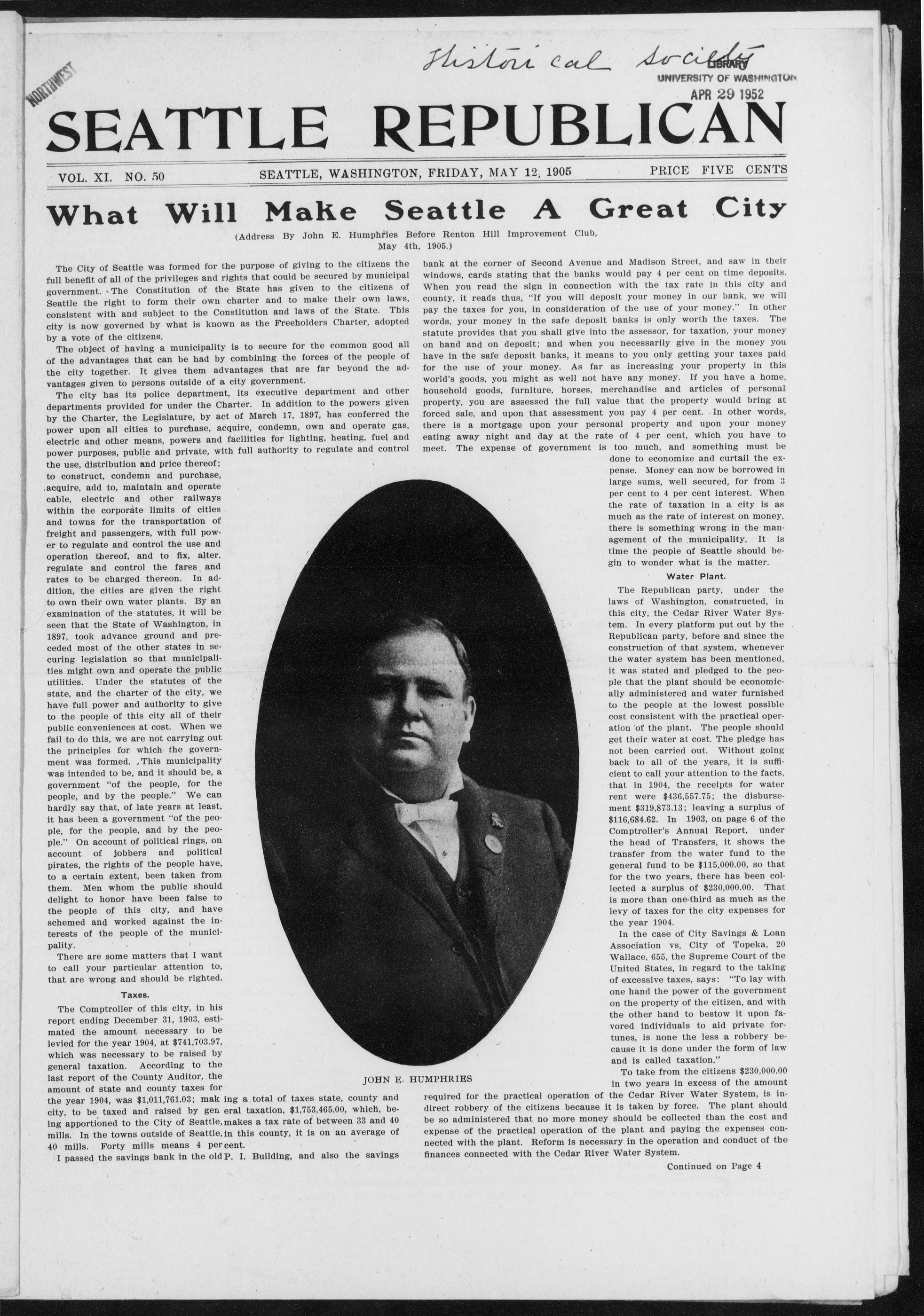
What Will Make Seattle A Great City
bank at the corner of Second Avenue and Madison Street, and saw in their windows, cards stating that the banks would pay 4 per cent on time deposits. When you read the sign in connection with the tax rate in this city and county, it reads thus, "If you will deposit your money in our bank, we will pay the taxes for you, in consideration of the use of your money." In other words, your money in the safe deposit banks is only worth the taxes. The statute provides that you shall give into the assessor, for taxation, your money on hand and on deposit; and when you necessarily give in the money you have in the safe deposit banks, it means to you only getting your taxes paid for the use of your money. As far as increasing your property in this world's goods, you might as well not have any money. If you have a home, household goods, furniture, horses, merchandise and articles of personal property, you are assessed the full value that the property would bring at forced sale, and upon that assessment you pay 4 per cent. In other words, there is a mortgage upon your personal property and upon your money eating away night and day at the rate of 4 per cent, which you have to meet. The expense of government is too much, and something must be
required for the practical operation of the Cedar River Water System, is indirect robbery of the citizens because it is taken by force. The plant should be so administered that no more money should be collected than the cost and expense of the practical operation of the plant and paying the expenses connected with the plant. Reform is necessary in the operation and conduct of the finances connected with the Cedar River Water System.
The City of Seattle was formed for the purpose of giving to the citizens the full benefit of all of the privileges and rights that could be secured by municipal government. The Constitution of the State has given to the citizens of Seattle the right to form their own charter and to make their own laws, consistent with and subject to the Constitution and laws of the State. This city is now governed by what is known as the Freeholders Charter, adopted by a vote of the citizens.
The object of having a municipality is to secure for the common good all of the advantages that can be had by combining the forces of the people of the city together. It gives them advantages that are far beyond the advantages given to persons outside of a city government.
The city has its police department, its executive department and other departments provided for under the Charter. In addition to the powers given by the Charter, the Legislature, by act of March 17, 1897, has conferred the power upon all cities to purchase, acquire, condemn, own and operate gas, electric and other means, powers and facilities for lighting, heating, fuel and power purposes, public and private, with full authority to regulate and control
the year 1904, was $1,011,761.03; making a total of taxes state, county and city, to be taxed and raised by gen eral taxation, $1,753,465.00, which, being apportioned to the City of Seattle, makes a tax rate of between 33 and 40 mills. In the towns outside of Seattle, in this county, it is on an average of 40 mills. Forty mills means 4 percent. I passed the savings bank in the old P. I. Building, and also the savings
VOL. XI. NO. 50
What Will
The City of Seattle was formed for the full benefit of all of the privileges and its government. The Constitution of the Seattle the right to form their own consistent with and subject to the City is now governed by what is known by a vote of the citizens.
The object of having a municipality of the advantages that can be had by the city together. It gives them advantages given to persons outside of it.
The city has its police department departments provided for under the C by the Charter, the Legislature, by act power upon all cities to purchase, ad electric and other means, powers and power purposes, public and private, wi
the use, distribution and price thereof; to construct, condemn and purchase, acquire, add to, maintain and operate cable, electric and other railways within the corporate limits of cities and towns for the transportation of freight and passengers, with full power to regulate and control the use and operation thereof, and to fix, alter, regulate and control the fares and rates to be charged thereon. In addition, the cities are given the right to own their own water plants. By an examination of the statutes, it will be seen that the State of Washington, in 1897, took advance ground and preceded most of the other states in securing legislation so that municipalities might own and operate the public utilities. Under the statutes of the state, and the charter of the city, we have full power and authority to give to the people of this city all of their public conveniences at cost. When we fail to do this, we are not carrying out the principles for which the government was formed. This municipality was intended to be, and it should be, a government "of the people, for the people, and by the people." We can hardly say that, of late years at least, it has been a government "of the people, for the people, and by the people." On account of political rings, on account of jobbers and political pirates, the rights of the people have, to a certain extent, been taken from them. Men whom the public should delight to honor have been false to the people of this city, and have schemed and worked against the interests of the people of the municipality.
There are some matters that I want to call your particular attention to, that are wrong and should be righted.
Taxes.
The Comptroller of this city, in his report ending December 31, 1903, estimated the amount necessary to be levied for the year 1904, at $741,703.97, which was necessary to be raised by general taxation. According to the last report of the County Auditor, the amount of state and county taxes for
the year 1904, was $1,011,761.03; mak city, to be taxed and raised by gen ing apportioned to the City of Seattle, mills. In the towns outside of Seattle, 40 mills. Forty mills means 4 per I passed the savings bank in the old
historical
REI
HINGTON, FRIDAY
Seatt
umphries Before Renton
SEATTLE, WASHINGTON, FRIDAY, MAY 12, 1905
(Address By John E. Humphries Before Renton Hill Improvement Club,
citizens the city municipal citizens of own laws, statute. This order, adopted on good all the people of and the ad- and other powers given inferred the operate gas, g, fuel and control bank at the windows, c. When you county, it is pay the tax words, your statute pro- on hand and have in the for the us world's good household property, y forced sale there is a eating awa meet. The
W. H.
JOHN E. HUMPHRIES
county and
which, be-
33 and 40
average of
savings
required for
direct robber
be so admin
expense of
nected with
finances co
May 4th, 1905.)
PRICE FIVE CENTS
Great City
and Madison Street, and saw in their would pay 4 per cent on time deposits. On with the tax rate in this city and deposit your money in our bank, we will of the use of your money." In other it banks is only worth the taxes. The to the assessor, for taxation, your money you necessarily give in the money you ans to you only getting your taxes paid as increasing your property in this have any money. If you have a home, merchandise and articles of personal value that the property would bring at you pay 4 per cent. In other words, personal property and upon your money rate of 4 per cent, which you have to too much, and something must be
done to economize and curtail the expense. Money can now be borrowed in large sums, well secured, for from 3 per cent to 4 per cent interest. When the rate of taxation in a city is as much as the rate of interest on money, there is something wrong in the management of the municipality. It is time the people of Seattle should begin to wonder what is the matter.
Water Plant.
The Republican party, under the laws of Washington, constructed, in this city, the Cedar River Water System. In every platform put out by the Republican party, before and since the construction of that system, whenever the water system has been mentioned, it was stated and pledged to the people that the plant should be economically administered and water furnished to the people at the lowest possible cost consistent with the practical operation of the plant. The people should get their water at cost. The pledge has not been carried out. Without going back to all of the years, it is sufficient to call your attention to the facts, that in 1904, the receipts for water rent were $436,557.75; the disbursement $319,873.13; leaving a surplus of $116,684.62. In 1903, on page 6 of the Comptroller's Annual Report, under the head of Transfers, it shows the transfer from the water fund to the general fund to be $115,000.00, so that for the two years, there has been collected a surplus of $230,000.00. That is more than one-third as much as the levy of taxes for the city expenses for the year 1904.
In the case of City Savings & Loan Association vs. City of Topeka, 20 Wallace, 655, the Supreme Court of the United States, in regard to the taking of excessive taxes, says: "To lay with one hand the power of the government on the property of the citizen, and with the other hand to bestow it upon favored individuals to aid private fortunes, is none the less a robbery because it is done under the form of law and is called taxation."
To take from the citizens $230,000.00 in two years in excess of the amount
in the Cedar River Water System, is init is taken by force. The plant should y should be collected than the cost and the plant and paying the expenses consary in the operation and conduct of the Water System. Continued on Page 4
```markdown
```
The Seattle Republican
H. R. Cayton.....Editor and Publisher
Susie Revels Cayton.....Associate
SUBSCRIPTION RATES.
One Year .....$2.00
Six Months .....1.00
Three Months ......60
Published every Friday at 214 Columbia St.
Entered at the Postoffice at Seattle as Second-class Mail Matter.
We can truthfully boast of a growing population; within twelve hours 12,039 foreigners arrived in steerage and were permitted to enter New York. "Coming events cast their shadows before." runs an old adage.
Now that the trial of Nan Patterson is about to be removed from the stage of excitement the sensational public drops down to witness "Bluebeard" Johann Hoch's trial. Ere it is disposed of doubtless some other sensation will loom upon our national horizon to give entertainment and occupation at home and court notoriety abroad.
Mrs. Amelia Fischer-Hoch's statement to the effect that Johann Hoch flirted with her while her sister lay dying and woed her immediately after her sister's death, casts quite a reflection upon her own judgment. A woman who studies humanity to any extent would refuse to entrust her happiness and incidentally her money to the keeping of such a woer.
Bishop Potter, in a speech made at the anniversary meeting of the Actors' Fund of America, held in New York, condemned the action of the Y. M. C. A. of Pittsburg in excluding two actors from membership. Theaters are not what they used to be, actors number among them many of the best and noblest but some persons there are who grasp a prejudice, shut their eyes and hold on while the years go fleeting by.
"I do not speak in a sense of frivolity, but China must get out of her ancient custom of doing just as her forefathers did before she can hope to succeed," said Li Hung Chang's ex-secretary, S. Z. Saibaya, who is here from Tientsin, China, on his first visit to the states. He has touched the true key to success. We are supposed to profit from the failures and weaknesses of our ancestors and to emulate only such virtues as are in keeping with advancement.
Mrs. Horton Phelps, who has returned from the national meeting of the Daughters of the American Revolution at Boston, says the election of officers stirred up a strenuous struggle. Unfortunately American women are drifting in the same course taken by their brothers and before any work can be done at their meetings, no matter how urgent the appeals, there must be a struggle to see whose heads shall bear laural wreaths.
No greater compliment could have been given the W. C. T. U. of America than that given by a committee of eminent physicians representing fifty thousand members of the medical profession in Great Britain when it
THE SEATTLE REPUBLICAN
recommended that every local school board in England, Scotland, Ireland and Wales, adopt a course of study in hygiene and temperance based on that used in America and prepared by the W. C. T. U.
"The character of the Chinese soldier has been misrepresented. He is brave, active, and tireless and almost the equal of the Jap in the field. He believes in dying in battle and has a great advantage over the soldier who prefers to live." says a recent writer. Like the Japanese, the Chinese soldiers may have to go into battle and show the world that they possess something besides pigtails and an appetite for rats ere they are known and respected for their real worth.
A display of speed in sending messages from Washington, D. C., to Nome, Alaska, a distance of about 6,000 miles, broke the record. Replies were received at the national capital from Nome in less than five minutes. The message had to be repeated or relayed three times. The international convention of railroad men, representing forty-four countries of the world, and for whose benefit this display and others were made, could have had no better proof of the efficiency of American progress along certain lines.
POLITICAL POT=PIE
The report from Olympia that ex- Congressman Samuel C. Hyde had been appointed commandant at the state soldier's home seems to have been an error. The place has been offered, it is announced, to ex-State Land Commissioner S. A. Callvert of Bellingham, who has been serving temporarily in the position for several months. If Judge Callvert does not accept, it is said it will be offered to Mr. Hyde.
It is up to the Mead administration to do something for Judge Callvert. Governor Mead allowed the anti-McBride men to use him as a candidate for congress a year ago, not with any idea that he would be nominated, but under a direct promise from Harry Fairchild and the other anti-McBride leaders that they would give him the nomination for superior judge in the fall.
At the Tacoma convention the fortunes of politics gave Mead the nomination for governor. That precluded the renomination of Judge Callvert, who hails from the same county, as land commissioner; but, to assuage his feelings, Fairchild and the others promised him the superior judgeship for which Mead had originally been slated. When it came time to deliver that promise, however, the Mead crowd, in their county convention, indorsed Judge Jere Neterer, the Democratic nominee, for superior judge. This was done to get Democratic votes for Mead in Whatcom county to offset the "boxer" revolt against him.
Once more a promise was made to Judge Callvert—that of a place on the state board of control. That, too, was broken, and when Governor Mead removed the McBride commandant at the soldiers' home he placed Judge Callvert in charge temporarily. Now, it is announced, he can have the position
FRIDAY, MAY 12, 1905
That the next Republican state convention will be controlled by the Piles-Ankeny faction is pretty clear to those who know the situation in the various counties; and it can be predicted now that Congressmen Humphrey and Cushman will have the fight of their lives to hold their seats. Humphrey, to all appearances, stands no chance. There is little doubt that the Piles men will control King county, and, if they do, Mr. Humphrey will not have his home delegation. It will go to Frank H. Brownell of Everett.
There is a feeling all over the state that Spokane should have a congressman. Nobody disputes that of recent years Spokane has been shabbily treated in state conventions—due largely to her long and only recently dissolved allegiance to an utterly discredited and perennial seeker after the United States senatorship. Congressman Jones, in all probability, will be renominated; but, if Spokane sends a solid delegation to the next state convention for a reputable candidate for congress a combine can be made which will give Brownell one of the congressional nominations, Jones another and the Spokane man the third.
Into this combine could be brought Spokane county, the Ankeny following which controls the southeast, King county, a good proportion of the northwest, where Mr. Brownell is strong, and much of the southwest where the Piles-Ankeny men are in control. Pierce county would probably fight to the last for Congressman Cushman, and so would anything which Governor Mead and his faction might control, not through love of Cushman, but through ingrained hostility to Spokane and to the two United States senators and their friends; but the combine could be made effectual nevertheless. Spokane can be made Republican permanently, but not by spitting on it in every state convention.
John Paul Jones, the first American Admiral, was allowed to die in penury and neglect in a Paris tenement house. Now that he has been dead over one hundred years half the leading cities in the Union are seeking to do him honor.—Ex.
An eastern man stepped off at one of the stations in Western Kansas a few weeks ago when the wind was blowing a gale of fifty miles an hour. "Mister," said he to a man who was sitting on the baggage truck on the sheltered side of the station house, "does this wind blow this way all the time?" "No'p," said the resident, as he calmly spat with the wind, "about half the time, I should say, it runs the other way."—Ex.
EXCERPTS FROM THE PRESS
A certain landlord in a certain Issaquah hotel is somewhat bowlegged. The other evening a lady stopped at his hostlery and asked for a room. The gentleman with the crooked pedal extremities picked up her grip and started for the stairway, saying, "You'll have to walk this way, madam." The lady looked for a minute at the figure before her, then said, "I couldn't walk that way to save my life. Guess I'd better find another hotel." And she did.—Issaquah Independent.
Its to your interest to talk to The Seattle Republican before giving your notices out for publication.
Phones, Main 305, Ind. 1306 Office 214 Columbia St.
FRIDAY, MAY 12, 1905
TALES OF THE TOWN
An informal dinner was tenederd Judge Milo A. Root, one of the justices of the supreme court of this state, on Saturday evening last at the Rainier club. Thirty of his personal friends and admirers were seated at the table. Senator Samuel H. Piles presided. Among those present who responded to informal toasts were Judge C. H. Hanford, of the United States district court; Mayor Ballinger, Congressman Will E. Humphrey and ex-Chief Justice of the Territory Hon. Orange Jacobs. The superior judges of King county were likewise present, as well as other distinguished members of the Seattle bar. Letters of regret were received from several well known lawyers. The affair was a very fine one.
As plans, orders, ordinances and movements, which are to produce "cleaner Seattle" materialize the public in general and citizen in particular, especially merchants, have been not a little surprised at the turn things have taken. The latest order is, nothing but clocks and are light poles will be permitted to stand on the business streets. Real estate boards employment bureaus' placards and barbers' poles must follow in the wake of the peanut man's wagon and disappear from the streets and sidewalks.
A fine demonstration of how one step forward leads to another has been given by the Ladies' Musical Club of Seattle. But a few years ago, comparatively speaking, there was no such club in the city; not only has the public during last and this year had the opportunity of attending superior musical recitals of this club and listening to traveling talent under its auspices, but a scholarship is to be given by it, either in New York or Europe. The course of study will be for three years and the fortunate pupil will be chosen by competitive test. It is not difficult to see what a stimulus this will be to the musical world of the entire Northwest.
Five boys, all of them under age, were recently arraigned before Judge Griffin in the superior court. Had they been men instead of mere youths their charges of felony would have subjected them to prison sentences aggregating sixty or seventy years. The problem is what ought to be done with such boys. A problem, however, for which more cities than Seattle are seeking a solution. Admiral Kempff of the United States Navy feels that the government should act as guardian of such youths by placing them upon the training ships, which should be maintained at every available point. The navy department did not like his views. However, all who know anything of the order, discipline, and educational instructions maintained upon these ships ought to realize at once in them a harbor of refuge. The ships need just such strong young American timber, a little warped at the time of entering but plainable, out of which to make good American seamen.
The Sunday state closing law, which was passed years ago but which has never been
THE SEATTLE REPUBLICAN
carried out to any great extent in Seattle, has by some means received fresh impetus. The Chief of Police has issued an order that the saloon doors must be closed on Sundays and says he means to see to it that they are closed. The state law makes it a misdemeanor for a saloon keeper to keep his place of business open on Sunday. The Seattle police, however, are not instructed to compel the saloon men to lock their front doors, they are to be kept closed. In the meanwhile, the side and rear entrances may be entered. It is understood that the city authorities do not wish to enforce the order to the letter, but are striving to keep the saloon men from making the violation of the law more flagrant.
There never was a time when the desires of the people were studied more, in other words, the taste of the public catered to, than is done at the present day. To stimulate that taste, sharpen competition, broaden the field and incidently beautify the city, the Post-Intelligencer has offered prizes for the best dressed and most attractive shop windows. The contest will benefit greatly the crowds which pass on the streets, the merchants who compete and also the morning paper which promoted it.
Portland and San Francisco have for some time had steel mills which were not until recently counted among Seattle's industries. Through the enterprise of a Seat-
ATTENTION
HOW ABOUT
NOT
Its to your
The Seattle Repu
your notices out for
```markdown
```
tle company of which William Piggott is the promoter, one of the most modern steel plants on the Coast has thrown open its doors for business. There are 150 men employed for the day and night shifts. The three mills cover an area of two and one half acres. The output every twenty-four hours is about 100,000 pounds of rolled steel, the plant having a capacity for three times that amount. Already plans are being made for the plants enlargement.
____.
Seattle is to have a departure in the way of church enterprise; quite out of the order of the old school but in keeping with the progressive ideas of the day. The congregation of the First Presbyterian church has purchased a building site at the southeast corner of Seventh Avenue and Spring Street at a cost of $17,000. The intention is to erect there a building to be used for Sunday school work, gymnasium and lecture rooms. The old property on Fourth and Spring Street will be retained by the church and the present building enlarged for a place of worship. The Great Northern tunnel has damaged this building and the proposed regrade on Fourth Avenue will render it more unfit for church purposes, but these difficulties can be overcome. Advanced thinkers in the religious realm depict the church of tomorrow as a club house—a place of guileless amusement, where men may congregate and feel at home. This Presbyterian congregation seems to have taken a step in that direction.
ATTORNEYS
YOUR LEGAL
CES?
interest to talk to
ican before giving
publication.
```markdown
```
THE SEATTLE REPUBLICAN
If we can operate successfully a water system and an electric light system, we can operate successfully a street railway system. The systems can be operated together and could save the citizens a great expense. As it is now, the street car company has a mortgage on every voter of about $100.00 each per year. If we had municipal ownership, we could reduce it one half, saving to each voter fifty dollars per year. We could, by proper management of the Cedar River water system and stopping the waste of water and furnishing it to the people at actual cost, save to the people from one third to one half. By the proper operation of the lighting plant, we can give to the citizens their lights at one half the present cost.
The city has, in connection with the Cedar River Water System, an electric light system, which, if properly administered, would furnish light at a nominal expense. As now administered, it has not furnished to the people the light that was intended. There is no reason why the electric light bills should be, by one half, as high as they are. There is no reason why private corporations should fatten upon the citizens of Seattle in the lighting business, when it has its own power plant, and by the addition of dynamos and pole lines, it could light the city at night, as well as private residences, at small cost. Reform is necessary in the electric light business.
The wave has started in the mother countries. It has reached New York. The Brooklyn Municipal Ownership Club has already been formed. The storm struck Chicago, and with all the opposition money could raise, the people voted for municipal ownership. The city of San Francisco owns one line. Next it will take over the other lines. And the progressive City of Seattle, out in the Northwest, being the best street car city of all of them, having already got the advantage of the legislation necessary to carry it forward, can, within the next year, accomplish municipal ownership, cheap water, cheap light and cheap transportation; and if so furnished to the city, it will become, in a few years, one of the greatest cities in the world. The people must now be educated along the lines of municipal ownership until the great work is accomplished. It will be necessary for the masses to control the next Republican primaries. This being a Republican city, it must of necessity come through the Republican party. Men must be nominated for councilmen and for city officers who will favor municipal ownership for the transportation system. We can mortgage the system, get the money from three to four per cent, pay off the value of the property and yet be the first city in the United States to have municipal ownership. We do not have to go to the legislature to get the laws passed, as they do in Illinois. The laws have already been passed and they are now in force. All we have to do is to use them.
The City of Seattle is one of the best cities in the world for street car lines and transportation upon street cars. The amount of money taken in, in this city, by the Seattle Electric Company, in 1903, was $2,096,725.00, as near as one can find out; in 1904, it was $2,321,235.00; its net receipts in 1903 were $598,821.00; in 1904, $711,595.00. The amount is enough to stagger the ordinary individual when he figures upon it, when he sees that the amount of taxes levied, as shown above, for city purposes, were $741,703.97, and that the net earnings of the Seattle Electric Company alone were $711,595.00. If the city had owned the plant, as it ought to have done, these net earnings would have paid the amount which had to be raised by taxation in the municipality for the years 1903 and 1904. Not only that, but this is not more than one-half of it. The company is capitalized at $10,000,000; it is assessed for taxation at $1,700,000; it paid 6 per cent interest on $5,000,000.00 preferred stock as a dividend; it paid 5 per cent interest on $5,000,000.00 of bonds. The preferred stock of the company is redeemable at 120; the bonds are redeemable at 110. And with a net income of $711,595.00, it is only assessed at the modest little sum of $1,700,000.00. It paid off a note on the purchase price of the Yesler Avenue road of December 31, 1904, of $615,000.00. When you add the $615,000.00 to the $711,595.00 then add $300,000.00 dividends, we have the modest sum of $1,626,595.00 as the amount this company took out of this city last year. It is remarkable that the people of the great city of Seattle will keep still and allow their money to be wasted when they should have the use of it. They talk about an appropriation for the Lake Washington Canal; an appropriation for the dredging of the Duwamish River; yet they sit idly by and permit this corporation to take from the pockets of the citizens, over and above the money left in Seattle, the enormous sum of $1,626,595.00. The exact profits of the company is a secret and it is hard to get all the facts.
If we do not desire municipal ownership, then we have the right and power, under the constitution, to have a straight three cent fare and the round trip five cent fare. The constitution says that no contract and no obligation can be made to deprive the people of legislation regulating the fares for transportation companies of all kinds. It is expressly provided in the constitution, that the legislature reserves the right, and it makes it its duty, to regulate the fares and charges of common carriers of passengers and freight. The question is, will the people be silent when they know that enormous sums of money are being taken from them and shipped east without really any consideration to them? The fact is our business affairs, our financial affairs and affairs of the city cannot stand the drain.
In Toronto, Canada, the street car company pays to the city, on all gross receipts between $1,000,000.00 and $1,500,000.00, 10 per cent; between $1,500,-000.00 and $2,000,000.00, 12 per cent; between $2,000,000.00 and $3,000,000.00, 15 per cent; and on all gross receipts over $3,000,000.00, 20 per cent. If the same rule prevailed in Seattle, the city would get 12 per cent on $2,321,235.00, which would make the sum of $278,548.20 instead of the sum of $46,424.70 at the rate of 2 per cent. When you take this sum from the 12 per cent, it shows that the city of Toronto gets $232,123.50 more than does the City of Seattle on the same amount.
Eternal vigilance is the price of liberty. There have been in this community influential, strong and wealthy citizens who have at all times been working to control the public utilities of the city and make a fortune out of it. The first attempt was made to get hold of the water supply, and the people are well aware of the fact that Amadon and others undertook to corner the Cedar River property and compel the city to purchase its water for all time to come from the corporation to be formed by them.
The city of Montreal collects from the street car lines, on gross receipts, from $2,000,000.00 to $2,500,000.00, 10 per cent; from $2,500,000.00 to $3,000,000.00, 13 per cent; all over $3,000,000.00, 15 per cent.
The people, under the statute above referred to, went to work and created such a sentiment that it took from them the properties at Cedar Lake and the water pipe line, condemned the property and built the works, against the opposition of the Amidon crowd. The next was to corner the light proposition, and the people have finally taken that away from them and built their own lighting plant.
In Ottawa, the companies issue thirty-three tickets for $1.00, or eight tickets for 25 cents, from the first trip in the morning until 7:30 a. m., and from 5:00 in the evening to 6:30 p. m.
In Toronto, under section 31, page 13, of the contract, eight tickets are sold for 25 cents, the same as in Ottawa. There are numbers of other cities that have the same rules, regulating a 3-cent fare.
In a recent interview by a prominent citizen, when J. A. Moore offered a profit of $250,000.00 for the lighting plant, the citizen remarked that the city could not afford to sell it for ten times $250,000.00, which was the fact. The next move was to secure the transportation system in the city and its suburbs. A foreign syndicate made arrangements with certain influential and strong citizens, some of the same citizens who were connected with the Amadon system, to corner the street car franchises and systems of this city. They went to work for that purpose and are now the owners of all of the street car lines in the city except the Renton line. They have been purchased by the syndicate, and have been owned, run and operated under the name of the Seattle Electric Company. The real owner of the system is the Boston syndicate. So strong has this octopus become, that during the last legislature, it attempted to have passed house bill No. 40, the first section of which reads as follows:
The average passenger earnings, per passenger, in Berlin, is 2.3 cents; in Breslau, 2.1 cents; in Dusseldorf, 2.2 cents; in Newramburg, 2.2 cents; in Hamburg, Altona, Hanover and Linden, 2.6 cents; in Liepsig, 2.2 cents; in Frankfort, 2.1 cents; in Munich, 2.2 cents; in Cologne, 2.5 cents. The average rate of fare in German cities, covered by the table of the report of the Bureau of the Census of the Department of Commerce and Labor, page 153, is 2.6 cents. It is stated, "In Berlin, the uniform fare within the city limits is 2.38 cents."
The time has come when the people of Seattle, as a matter of self protection, and in the exercise of business capacity, must now proceed, not only to own the water system and electric light system, but the transportation system of the city also. We have now the Cedar River water system which can be enlarged to meet the wants of the people. We can, not only light the city, but increase the electric power for all the transportation necessary for the good of the people. We can furnish to the people the lowest transportation in the world. The way has been opened by the acts of the Legislature from 1893 down to the present time. We have the power to condemn the rights of the foreign stock holders and bond holders in the present system and take them ourselves. If they can clear $1,626,000.00 in 1904, $1,626,000.00 in 1905, $2,000,000.00 in 1906, and so on, we can do the same. It is a dangerous power to allow foreign capitalists to control this enormous system of trade and commerce in Seattle, Tacoma, Bellingham, Everett and the whole of Western Washington. With the enormous effort they are making, they will not only control the city council, the legislature and the courts, but they will absolutely trample under foot the rights of the people. Part of their agents in this city attempted to corner the water system. They then struck for the electric light system. And lastly, they have seized the greatest of them all, the transportation system; and the people will have to wrest that from them.
“Any contract between attorney and client for the payment of a contingent fee, in an action for the recovery of unliquidated damages, shall provide for the payment to such attorney or attorneys of not to exceed one third of the amount ultimately recovered in such action. Every such contract shall be in writing, and a copy thereof shall be filed with the summons and complaint in the action; and if the plaintiff fails to recover in such action, the costs thereof shall be taxed against both the plaintiff and his attorneys.”
Section 3 of the same bill reads as follows:
“Any violation of the provisions of this act shall be punished by the disbarment of the attorney violating the same.”
It will be seen that the employees of this octopus are not satisfied with the power of controlling the city officials and collecting off of the citizens of Seattle and vicinity, in 1903, the sum of $2,096,725.00, and in 1904, the sum of $2,321,235.00, and making a clear profit of more than $1,626,00.00, but were determined to destroy the legal profession, knowing that if the legal profession was destroyed, the people would be without representatives to take care of their rights. It was not only a stroke at the liberties of the people and the right to contract, but it was to deprive the poor man of his property and of being represented in the courts of the country when injured by the negligence of the employees of the octopus, and to deprive him of justice. The octopus had its attorney prepare the bill and lobby the legislature to have it passed. It required the attorneys of the state to raise a fund, fight for their rights and pay men to stay at Olympia to keep the bill from being passed.
In Glasgow, municipal ownership has been tried. I have been furnished with the balance sheet to May 31, 1904; during that year, after paying all expenses and all improvements, the city of Glasgow had a net balance of $403,000.00; and put into the sinking fund, $227,000.00; making the sum of $630,000.00 over and above all expenses, improvements and interest on the capital. Glasgow saved enough almost to pay the amount of money required to be raised by taxation to pay the expenses of government of the City of Seattle, and with an average fare of only two cents.
Prior to the last city election, the octopus commenced to select the men for councilmen and for the city offices. It is worth thousands of dollars to have the corporation counsel, the mayor and members of the council. The
Continued from page one Electric Light System.
Street Railways.
Municipal Ownership.
FRIDAY, MAY 12, 1905
Octopus.
THE SEATTLE REPUBLICAN
officers have put the property in for taxation at the modest sum of $1,700,000.00. While the mortgage to the trust company is for the face value of $5,000,000.00, yet the subsequent mortgages under the original mortgage, as shown by the records in the Auditor's office, are only $2,000,000.00. The probability is that the Octopus has never invested, outside of the improvements made from the income of the property, to exceed $2,000,000.00. All the improvements made have been made from the income of the property, except perhaps the $2,000,000.00 which is shown upon the records in the Auditor's office. As heretofore stated, $615,000.00 was paid last December out of the earnings of 1904, on a note for the purchase of the Yesler Avenue line. The Octopus has now taken in in cash, over and above all expenditures and money paid out, and even money borrowed, more than enough to have the whole street car system of Seattle clear. If the people of Seattle take a business view of the matter, they will at once commence and organize to carry municipal ownership in the next city election. The matter is of such great importance that the people cannot afford to let the Octopus control and rule the city longer. The longer the Octopus is left in control, the harder it will be to dislodge it. The united efforts of the citizens, commencing now, will dislodge it within the next year. The Octopus has one advantage of the people. It has the money of the people to use to defeat the will of the people. While the people are making a fight for liberty, for municipal ownership, cheap water, cheap light, and cheap public utilities generally, the Octopus is collecting money from the people with which to maintain itself and keep the people from dislodging it. With the money collected from the people, it will be able to organize the next primaries and the next political conventions in this city, and will be able to nominate its own officers and elect them, unless the people now commence the agitation and make such a strong organization that the Octopus will be overcome.
octopus wants franchises, and to have friendly officers enables it to get franchises cheap. Instead of paying 10 per cent and 12 per cent to the city for franchises as Ottawa and other cities get, it only pays the nominal sum of 2 per cent of the gross earnings. Instead of it being assessed at what it is claimed to be worth, when the preferred stock is valued at 120 and its bonds at 110, making in the neighborhood of $10,000,000.00 in value, it is only assessed at $1,700,000.00. All these matters the octopus is interested in, in the city election.
I might say to you, ladies and gentlemen, that for a man to occupy the position of Mayor, Corporation Counsel, member of the Board of Public Works, or member of the City Council, with the powerful organization that is under the control of the Octopus, it is almost impossible for him to withstand the desires and requests of the Octopus. The Octopus, with its numbers of agents, officers and hired servants and strong political affiliation, has power enough, unless the citizens are thoroughly aroused, to put its own men in office and make the citizens wear the collar of the Octopus.
In Chicago, during the last election, the newspapers were subsidized, the members and interested parties of the Octopus threw millions of money into the campaign, and the fight against the people was tremendous; but the people got thoroughly aroused; the women of the city went to work; and the Octopus was beaten.
If the people of this city knew their power, and had force of character enough and independence enough to act, the Octopus would stand no show whatever in the coming fight for lower street car fares and municipal ownership. We are in a position at this time where, by the election of the proper city officers, councilmen, corporation counsel and mayor, we can immediately submit to the people, under the statutes now in force, the question of condemnation and purchase of the present transportation system of the city. We can take off of the people the terrible load they are now bearing. We are under no obligation to the Boston syndicate, and the few individuals in our city who are interested in the syndicate and are acting as agents for the system, will have to give way to the people. The theory of government, as above stated, is the greatest good to the greatest number.
If by municipal ownership, each family can be saved, in transportation, in light and water, at least one hundred dollars each year, it is of so much interest that the voters cannot afford to sell out to the Octopus for a nominal sum. I hope that the citizens will give this matter due consideration, and commence to organize at once for their own protection.
In six months after the next election, if the voters and their wives in this city are wise and take hold of this matter at this time, we will have the street car lines owned by the City of Seattle. We will borrow the money at from 3 per cent to 4 per cent and pay for them. Suppose it costs us $5,000,000.00, the interest at 4 per cent would be only $200,000.00 per annum; and if we did no better than the company did in 1904, at the same rate of fare, we would clear $1,626,000.00; and in five years at the same rate, we would pay for the whole system, have it clear and make a big profit. As was said about the electric plant, when the city owns the transportation system, it cannot afford to let it go for ten times what it will cost. Owning the Cedar River lighting plant and the water system, when we desire to increase the electric current, all we have to do is to add more dynamos. If we need any further light, we can construct an electric plant between Lake Union and Lake Washington.
It is too late now for the citizens of Seattle to claim that they are not in favor of owning the public utilities because it is Bryanism and Populism. Under the law of 1897, passed by the legislature of the State of Washington, the citizens of Seattle have purchased and built their own water system; have purchased and built their own electric light plant; which is two thirds of the public utilities above referred to. Having gone two thirds of the way, it is too late now to stop. It is necessary now that the three public utilities go together, as it takes the electric light system to propel the transportation system, and the electric light system is a part of the Cedar River water system, consequently the electric light system, the water system and the transportation system may be conducted, owned and controlled and managed as one system. The city has two thirds of the system, and the united effort, as heretofore stated, will make the city the owner of the other one third within six months after the next city election. The owning of the public utilities by this city will do more to bring in the suburbs under the city government than all other things combined. When the suburbs can get the advantage of the cheap taxes, cheap light, cheap transportation, cheap heat and cheap power, they will want to be let into the corporation of Seattle. The owning of the public utilities by the city, as stated, is the key to making a greater Seattle out of Seattle, its suburbs and contiguous territory.
In Chicago, they have no mountain streams and water falls to run their electric light plants, but in Seattle, nature has surounded us with mountains and mountain streams to light up the City of Seattle in the night time like the noon day sun, and sufficient to furnish all the electric power that we want to propel the street cars through the city. If we own the street car system, the electric light system and the water system, then the suburban towns and the suburban population will join with us and become part of our population. We will extend the corporation limits beyond the northern limits of Ballard; we will extend it south to the limits of South Park, Georgetown and South Seattle, and, if necessary, we can go to the county line. If we stand back the Octopus will have Seattle, Tacoma, Bellingham, Everett and all of Western Washington under its control.
We will have to be in the same spirit in accepting the Populist legislation of 1897 as was the poor old woman who prayed for bread; the neighbor heard her prayer and went to the bakery and got a loaf of bread and threw it over the transom into her room; she got up and thanked the Lord for the bread. The neighbor stepped into the door and told her the Lord did not send the bread but that he had brought it. The woman said, it can make no difference; the Lord sent it even if the devil brought it.
The good Christian people of Philadelphia held prayer meetings and prayed for the Mayor, and asked the Lord to help control the actions of the Mayor; but the Octopus put the Mayor in office; it had the control of him, and the Lord could not change the wishes of the machine. He was placed in power by the Octopus and for the Octopus. The Mayor of Philadelphia was placed in power by the machine controlled by the Octopus.
The Lord nas given us the law of 1897 to protect ourselves and own our own transportation lines, even if the Populist party put it upon the books. Don't let us stand in our own light and let the Octopus take it away. We have used it for getting our water and light plants and we must keep it to get our transportation, telephone, heat and power plants.
Now is the time for the citizens of Seattle to become aroused. Let the women take hold of this matter as they did in Chicago. Let it be the talk from now on until the time of the next primaries. Let the people scan the character and standing of the men nominated for the city offices from the Mayor down. Let no man be nominated who is the tool and representative of the Octopus. Get patriotic, intelligent, honest and capable citizens. There are men, as there were in 1776, who can be depended upon to stand with the people. There are men who cannot be bribed. There are men who are not grafters. There are men who are patriots. And when the time comes, if the people do their duty, such men can be found and elected; and when such men are found and elected, then you will have your water system and your electric light system properly managed, and will secure your water and electric lights at the lowest possible cost; your street car system will be owned by the city and properly managed, and you will ride at the lowest possible cost; your taxes will be reduced; the burden of government will be taken off of you except at the lowest possible cost; then Seattle and its suburbs will become a city "of the people, for the people, and by the people." When it is published to the world that Seattle is the first city to own its public utilities, that taxes have been reduced, then the influx of population will be surprising. Then we will become what de deserve to be, the greatest city in the Northwest. While we are now claiming to be a second Chicago, yet we will beat the first Chicago in having the first municipal onership of the public utilities.
According to the report of the Department of Commerce and Labor, Bureau of the Census, 1905, page 224, it is stated: "It appears from the figures which were compiled by the Metropolitan Street Railway, for its own information, that the percentage of operating expenses to the gross earnings in 1900, was 40.5 per cent for electric railways. The cost per passenger carried was 2.02 cents for the electric cars." But since that time, the cost of transportation by electric power has been greatly cheapened; the cars have been enlarged; and the number of passengers to each car increased, so that the same car will carry two or three times as many passengers. The cost of propulsion and management does not increase with the size of the car, but the income has so greatly increased that the cost of carriage is now a great deal less for each passenger than 2.02 cents.
Where the City of Seattle owns its own electric light plant, and where the plant is run without the cost of coal and fuel, it can carry passengers and make a big profit at a two-cent fare. The great cost of operating street cars has been the cost of coal, water and services in the power houses for generating the electricity; but when the water is furnished free, coal is not used. The power for generating the current of electricity is furnished by the use of waterfalls and mountain streams, and the expense of operating the cars will be greatly lessened.
When the estimate was made, as above, of 40.5 per cent of the gross earnings for operating expenses, artificial means were used for generating the electricity, and engines fed by coal and water purchased by the company were used; but when Seattle has her electric car system, she will not use any fuel. The water will be free, and the operating expenses will be a great deal less than 40 per cent of the gross earnings.
The new Mayor of Chicago has stated, that while the street car Octopus claims it has invested $25,000,000.00 in the street car system of Chicago, their interests can be condemned and purchased for $8,000,000.00. While the capitalization of the Octopus in Seattle is $10,000,000.00, yet the money actually invested is not to exceed $3,000,000.00. In fact the Octopus is estopped now to claim its rights are of any greater value than $3,000,000.00, because its
FRIDAY, MAY 12, 1905
Cost of Purchase of Street Car Lines.
Bryanism and Populism.
Operating Expenses.
Continued on page 8
3C
"It's the person forced to stay over night in Olympia that is thoroughly convinced the state capital should be moved the very next week."—Seattle Republican (Black).
To the men who made Washington, Olympia was a haven of rest, a bower of beauty, the center of civilized comfort, a very oasis in the wilderness when the editor of the Seattle Republican and or his progenitor subsisted on the leavings of Master's table and found comfort "over-night" in the squalid nigger-quarters of some Southern plantation. Having acquired a few cases of type, a lime-kiln vocabulary and a second-class mail matter permit the Seattle beneficiary of Abe Lincoln's proclamation at once becomes epicurean, bon vivant, luxurist, etc., etc. The things that are acceptable to the taste of Governors, United States Senators and others in high position, convince him that "the state capital should be removed the very next week." It is impudence such as the above that makes one regret the sacrifices of '61-'65 and wonder if Booker Washington is not leaving out of his curriculum an important feature of Negro education.—Olympian.
The above scurrilous, unwarrantable billinsgate are the outpourings of an exCongregational minister of the gospel. We
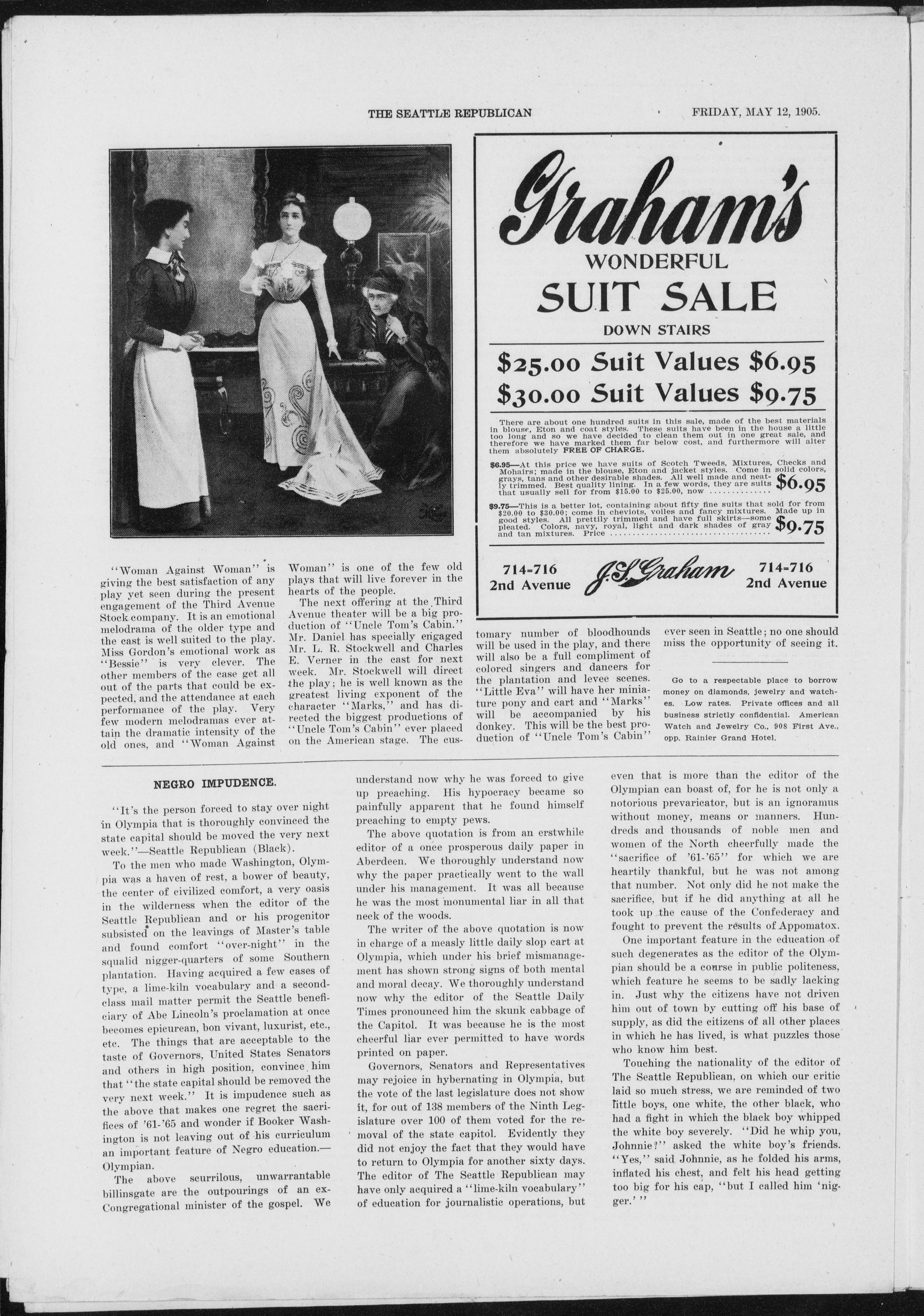
"Woman Against Woman" is giving the best satisfaction of any play yet seen during the present engagement of the Third Avenue Stock company. It is an emotional melodrama of the older type and the cast is well suited to the play. Miss Gordon's emotional work as "Bessie" is very clever. The other members of the case get all out of the parts that could be expected, and the attendance at each performance of the play. Very few modern melodramas ever attain the dramatic intensity of the old ones, and "Woman Against
NEGRO IMPUDENCE.
THE SEATTLE REPUBLICAN
J.C.
Woman" is one of the few old plays that will live forever in the hearts of the people. The next offering at the Third Avenue theater will be a big production of "Uncle Tom's Cabin." Mr. Daniel has specially engaged Mr. L. R. Stockwell and Charles E. Verner in the cast for next week. Mr. Stockwell will direct the play; he is well known as the greatest living exponent of the character "Marks," and has directed the biggest productions of "Uncle Tom's Cabin" ever placed on the American stage. The cus
understand now why he was forced to give up preaching. His hypocracy became so painfully apparent that he found himself preaching to empty pews.
The above quotation is from an erstwhile editor of a once prosperous daily paper in Aberdeen. We thoroughly understand now why the paper practically went to the wall under his management. It was all because he was the most monumental liar in all that neck of the woods.
The writer of the above quotation is now in charge of a measly little daily slop cart at Olympia, which under his brief mismanagement has shown strong signs of both mental and moral decay. We thoroughly understand now why the editor of the Seattle Daily Times pronounced him the skunk cabbage of the Capitol. It was because he is the most cheerful liar ever permitted to have words printed on paper.
Governors, Senators and Representatives may rejoice in hybernating in Olympia, but the vote of the last legislature does not show it, for out of 138 members of the Ninth Legislature over 100 of them voted for the removal of the state capitol. Evidently they did not enjoy the fact that they would have to return to Olympia for another sixty days. The editor of The Seattle Republican may have only acquired a "lime-kiln vocabulary" of education for journalistic operations, but
1.
Waham's
WONDERFUL
IT SALE
DOWN STAIRS
Suit Values $6.95
Suit Values $9.75
dred suits in this sale, made of the best materials
styles. These suits have been in the house a little
decided to clean them out in one great sale, and
them far below cost, and furthermore will alter
CHARGE.
There are about one hundred suits in this sale, made of the best materials in blouse, Eton and coat styles. These suits have been in the house a little too long and so we have decided to clean them out in one great sale, and therefore we have marked them far below cost, and furthermore will alter them absolutely FREE OF CHARGE.
$6.95—At this price we have suits of Scotch Tweeds, Mixtures, Checks and Mohairs; made in the blouse, Eton and jacket styles. Come in solid colors, grays, tans and other desirable shades. All well made and neatly trimmed. Best quality lining. In a few words, they are suits that usually sell for from $15.00 to $25.00, now ..... $6.95
$9.75—This is a better lot, containing about fifty fine suits that sold for from $20.00 to $30.00; come in cheviots, voiles and fancy mixtures. Made up in good styles. All prettily trimmed and have full skirts—some pleated. Colors, navy, royal, light and dark shades of gray and tan mixtures. Price ..... $9.75
$9.75—This is a better lot, containing about fifty fine suits that sold for from $20.00 to $30.00; come in cheviots, voiles and fancy mixtures. Made up in good styles. All prettily trimmed and have full skirts—some pleated. Colors, navy, royal, light and dark shades of gray and tan mixtures. Price $9.75
ever seen in Seattle; no one should miss the opportunity of seeing it.
Go to a respectable place to borrow money on diamonds, jewelry and watches. Low rates. Private offices and all business strictly confidential. American Watch and Jewelry Co., 908 First Ave., opp. Rainier Grand Hotel.
even that is more than the editor of the Olympian can boast of, for he is not only a notorious prevaricator, but is an ignoramus without money, means or manners. Hundreds and thousands of noble men and women of the North cheerfully made the "sacrifice of '61-'65" for which we are heartily thankful, but he was not among that number. Not only did he not make the sacrifice, but if he did anything at all he took up the cause of the Confederacy and fought to prevent the results of Appomatox.
One important feature in the education of such degenerates as the editor of the Olympian should be a course in public politeness, which feature he seems to be sadly lacking in. Just why the citizens have not driven him out of town by cutting off his base of supply, as did the citizens of all other places in which he has lived, is what puzzles those who know him best.
Touching the nationality of the editor of The Seattle Republican, on which our critic laid so much stress, we are reminded of two little boys, one white, the other black, who had a fight in which the black boy whipped the white boy severely. "Did he whip you, Johnnie?" asked the white boy's friends. "Yes," said Johnnie, as he folded his arms, inflated his chest, and felt his head getting too big for his cap, "but I called him 'nigger.'"
---
714=716
2nd Avenue
tomary number of bloodhounds will be used in the play, and there will also be a full compliment of colored singers and dancers for the plantation and levee scenes. "Little Eva" will have her miniature pony and cart and "Marks" will be accompanied by his donkey. This will be the best production of "Uncle Tom's Cabin"
FRIDAY, MAY 12, 1905.
714-716
2nd Avenue
FRIDAY, MAY 12, 1905.
IN THE SUPERIOR COURT OF the State of Washington in and for King County—Probate. No. 6162. Notice to Creditors.
In the matter of the estate of Seth W. Clark, Deceased.
Notice is hereby given to the creditors of Seth W. Clark, deceased, and to all persons having claims against said deceased or his estate, that they are required to present said claims, with the necessary vouchers, within one year after the date of this notice, to the undersigned administrator of said decedent's estate, at his office, 422, 423 and 424 Boston Block, in the City of Seattle, King County, State of Washington, the same being the place for the transaction of business for said estate.
Dated at Seattle, Washington, this 31st day of March, 1905, the day of first publication hereof.
Last publication, 28th day of April, 1905. J. M. WIESTLING. Administrator of the Estate of Seth W. Clark, Deceased.
422-3-4 Boston Block.
IN THE SUPERIOR COURT OF THE
State of Washington in and for
Skagit County.
First National Bank of Mt. Vernon,
Plaintiff, vs. W. M. Brook and J. M.
Brook, Defendants. No. .....
Summons for Publication.
The State of Washington to the
above named defendants, W. M.
Brook and J. M. Brook:
You and each of you are hereby summoned to appear within sixty (60) days after the date of the first publication of this summons, to-wit, the 31st day of March, 1905, and defend the above entitled action in the above entitle court, and answer the complaint of the plaintiff and serve a copy of your answer upon the undersigned attorneys for the plaintiff at their office below stated, and in case of your failure so to do judgment will be rendered against you according to the demand of the complaint, which has been filed with the clerk of the above entitled court.
That this action is brought for the purpose of foreclosing a pledge of 1631 shares of the capital stock of Spruce Creek Power Co. for the sum of $817.62 with interest at the rate of one per cent. per month from March 6th, 1905, for attorney's fee of 10 per cent. of amount due, and that upon the sale of said stock, should the same not bring sufficient to pay the same, plaintiff recover deficiency judgment against the defendant W. M. Brook, should he appear in said action, and that the defendant J. W. Brook be decreed to have no interest in and to the stock pledged as aforesaid, and for such other and further relief as is meet and equitable.
TUCKER & HYLAND,
Attorneys for Plaintiff.
Postoffice and Office Address, 26-29 Dexter Horton & Co. Bank Bldg., Seattle, King Co., Wash.
IN THE SUPERIOR COURT OF THE
State of Washington, for King
County.
In the matter of the Estate of
Erick Ulin, Deceased. No. 6103. Notice to Creditors.
Notice is hereby given by the undersigned Administratrix of the Estate of Erick Ulin, deceased, to the creditors, and all parties having claims against the said deceased, to exhibit them with the necessary vouchers, within one year after the date of this notice to the Administratrix of said estate at 504 Bailey Building, in the City of Seattle, Washington, that being the place for the transaction of the business of said estate.
Dated at Seattle, Washington, March 30th, 1905.
HELEN H. ULIN.
Administratrix.
JAMES McNENY, Attorney.
IN THE SUPERIOR COURT OF the State of Washington, for King County.
In the matter of the estate of Joseph Livengood, Deceased—No. 5290.
Order to Show Cause Why Distribution Should Not Be Made.
W. M. Livengood, the administrator with the will annexed of Joseph Livengood, Deceased, having filed in this court his petition setting forth that said estate is now in condition to be closed and is ready for distribution of the residue thereof among the persons by the terms of the will of said deceased, entitled thereto, and it appearing to the court that said petition sets forth facts sufficient to authorize a distribution of said estate, it is therefore ordered by the court that all persons interested in said estate be and appear before said Superior Court of King County, State of Washington, at Department Number Four (4) thereof, at the Court House in the City of Seattle, Washington, on the 20th day of April, 1905, at 9:30 a. m. of said day, there and then to show cause, if any they have, why an order of distribution should not be made of the residue of said estate among the devisees in said petition mentioned, according to law and the terms of said said
It is further ordered that a copy of this order be posted in three of the most public places in said county and published once a week for four successive weeks before said 20th day of April, 1905, in the Seattle Republican, a newspaper printed and published and of general circulation in said King County, Washington. Done in open court in Seattle, King County, Washington, this 16th day of March, 1905. A. W. FRATER, Judge. JAMES McNENY, Attorney.
IN THE SUPERIOR COURT OF the State of Washington, for King County.—In Probate. In the matter of the estate of Joseph Livengood, Deceased.—No. 5290. Notice is hereby given that the un-
If you want a home in either the City or the Country, you can get an excellent bargain on
Easy Terms
at the
Gilson Investment Co.
73 - 74 Sullivan Block
at the
dersigned administrator with the will annexed of the estate of Joseph Livengood, deceased, has rendered and presented for settlement, and filed in said court his final account of his administration of said estate, and that Thursday, the 20th day of April, 1905, at 9:30 a. m., at the Court House, in the City of Seattle, Washington, in Department No. Four of said court, has been fixed for the settlement of said account, at which time and place any person interested in said estate may appear and file exceptions in writing to said account and contest the same.
Witness the Honorable A. W. Frater, judge of said Superior Court, and the seal of said court hereto affixed this 16th day of March, 1905.
(Seal.) OTTO A. CASE, Clerk. D. K. SICKELS, Deputy. JAMES McNENY, Attorney.
IN THE SUPERIOR COURT OF the State of Washington, for King County.
Matilda Hendy, Plaintiff, vs. Edward A. Hendy, Defendant.-No. 46,-490. Summons by publication. State of Washington to the said Ed-
State of Washington to the said Edward A. Hendy, Defendant:
In the name of the State of Washington you are hereby summoned to be and appear within sixty (60) days from and after the date of the first publication of this summons, towit, within sixty (60) days from and after the 17th day of March, 1905, and defend the above entitled action in the above entitled court, and answer the complaint of the plaintiff and serve a copy of your answer upon the undersigned attorney for plaintiff, at his offices below stated; and in case of your failure so to do, judgment will be rendered against you according to the demand of the complaint, which has been filed with the Clerk of said court.
The object of the said action set forth in the complaint is as follows: To secure in favor of plaintiff and from defendant an absolute divorce, and an attorney's fee of one hundred dollars and costs and disbursements, and twenty dollars a month alimony, and to divest defendant of all right, title and interest in and to lot 10, in block 6, and lots 1 and 2, in block 7, in Northern Addition to Seattle, King County, Washington, as per the recorded plat, and to divest defendant of all right, title and interest in and to all of block 27, being lots 1 to 30, both inclusive, in block 27, in Puget Sound Park Addition to the town of Des Moines, King County, Washington, as per the recorded plat thereof, and that the title of plaintiff therein and thereto be quieted as against any claims thereto in favor of defendant and for other proper relief in the premises, including a decree of ownership in favor of plaintiff of two (2) little houses situate at the corner of Van Buren Avenue and Highland Drive, in Seattle, King County, Washington, together with the personal effects and household belongings therein situate, and that defendant be decreed to have no rights therein.
Attorney for Plaintiff.
Postoffice address: Rooms 421 to
423 Boston Block, Seattle, King County,
Washington.
STATE OF WASHINGTON, COUNTY of King—ss. Sheriff's Office. By virtue of an order of sale issued out of the Honorable Superior Court of King County, on the 23rd day of March, 1905, by the Clerk thereof, in the case of Ed. S. Keene, plaintiff, versus Armstrong Turner, defendant, No. 45378. and to me, as Sheriff, directed and delivered:
Notice is hereby given that I will proceed to sell at public auction to the highest bidder for cash, within the hours prescribed by law for Sheriff's sales, to-wit: at 10 o'clock A. M., on the 29th day of April, A. D. 1905, before the Court House door of said King County, in the State of Washington, all of the right, title and interest of the said defendant in and to the following described property, situated in King County, State of Washington, toowit: Lot 25, and the south half of lot 26, in block 14, West Seattle First Plat, constituting altogether a triangular tract of land bounded on the east and south by Rainier Avenue, according to said plat, levied on as the property of said defendant, Armstrong Turner, to satisfy a judgment, amounting to one hundred sixty-two, and 30-100
THE WEEKLY NEWS
THE SEATTLE REPUBLICAN
dollars ($162.30), and costs of suit, 78 SuL
in favor of plaintiff.
ton.
IN. THE SUPERIOR COURT OF State of Washington for King County. In the matter of the estate of Albert Clawson, deceased; notice of settlement of final account and of distribution.
Notice is hereby given, that Mrs. Sarah E. Clawson, administratrix of the e. clawson of Albert Clawson, deceased, has rendered and presented for settlement, and filed in the Superior Court of King County, State of Washington, her final account as such administratrix, coupled with a petition for the distribution of the said estate to the parties respectively entitled thereto, and that Thursday, the 30th day of March, 1905, at 9:30 o'clock a. m., at the Court Room of said Superior Court in the city of Seattle, Washington, in said King County, has been duly appointed by said Superior Court for the settlement of said final account, and the decreeing of distribution of said estate to the heirs entitled thereto, at which time and place any person interested in said estate may appear and file his exceptions in writing to said final account and contest the same, and be heard as to the final distribution of the said estate.
Witness the Hon. A. W. Frater,
Judge of the said Superior Court,
and the seal of said Court affixed
this 3rd day of March, 1905.
OTTO A. CASE,
County Clerk and Clerk of the Superior Court.
By D. K. SICKELS.
IN THE SUPERIOR COURT OF
the State of Washington for King
County.
G. Beninghausen, Plaintiff, vs. H.
C. Wahlberg and — Wahlberg,
his wife: N. Anderson and —
State of Washington to the above named defendants, who are the owners or reputed owners of, and all persons unknown, claiming or having an interest or estate in and to the hereinafter described real property.
You and each of you are hereby notified that the above named plaintiff is the holder of a certain delinquent tax certificate, numbered as hereinafter stated, issued by the County Treasurer of King County, State of Washington, embracing the following real property situated in said King County, Washington, and more particularly described as follows, to-wit: Delinquent Tax Certificate No. B27744, Lot 26, Block 7, Salmon Bay Second Addition to Seattle. That said certificate was issued on the 1st day of October, 1904, for the following sums and for delinquent taxes for the following years, to-wit: Tax Certificate No. B27744, for year 1897, 87 cents. That the taxes for the following subsequent years have been paid by the plaintiff upon said above described lots, to-wit: Lot 26, Block 7, Salmon Bay Second Addition to Seattle, 32 cents for year 1898, 38 cents for year 1899, 36 cents for year 1900, 39 cents for year 1901, 36 cents for year 1902, 33 cents for year 1903, which several sums bear interest at the rate of 15 per cent, per annum from said date of payment, and are all the unpaid and unredeemed taxes upon and against said real property.
You and each of you (including said persons, unknown, if any), are hereby further notified and summoned to be and appear within sixty days after the day of publication of this notice, exclusive of the day of first publication, in the above entitled Court and action, and defend this action and answer the complaint of said plaintiff and serve a copy of your answer on the undersigned attorney for plaintiff at his office below stated, or pay the amounts, together with penalty, interest and costs. In case you fail so to do, judgment will be rendered against you and against each parcel of said real property for the sums and amounts due upon and charged against each, including costs, ordering a sale of each parcel of said property for the satisfaction of the sums charged and found against it respectively as provided by law, and as prayed in plaintiff's complaint now on file in this cause and Court.
ERNEST B. HEROLD,
Office address 226-30 Colman Bidg.. Seattle, Washington.
First publication dated March 3.
1905.
IN THE SUPERIOR COURT OF
King County, State of Washington.
Charles C. Burrows, plaintiff, vs.
Alice L. Burrows, defendant. No.
46598. Summons for Publication.
State of Washington to Alice L.
Burrows, defendant:
You are hereby summoned to appear within sixty days after the date of the first publication of this summons, to-wit: within sixty days from the 24th day of March, 1905, and defend the above entitled action in the above entitled court and answer the complaint of the plaintiff herein, and serve a copy of your answer upon the attorneys for the plaintiff, at their office below stated; and in case of your failure so to do, judgment will be rendered against you according to the demand of the complaint, which has been filed with the clerk of said court.
This action is brought by the plaintiff for the purpose of obtaining a divorce from the defendant upon the ground of desertion.
R. WINSOR AND EDGAR S. HADLEY,
Attorneys for Plaintiff.
Office and postoffice address: Room
78 Sullivan Bldg., Seattle, Washington.
IN THE SUPERIOR COURT OF King County State of Washington. Henry Longus, plaintiff, vs. Nell Longus, defendant. No. 46960. Summons. The State of Washington to the said Nell Longus.
You are hereby summoned to appear within sixty days after the date of the first publication of this summons, to-wit: within sixty days after the 28th day of April, 1905, and defend the above entitled action in the above entitled court, and answer the complaint of the plaintiff, and serve a copy of your answer upon the undersigned attorney for the plaintiff, at his office below stated, and in case of your failure so to do, judgment will be rendered against you according to the demands of the complaint, which has been filed with the Clerk of the said court, which action is brought by the plaintiff to secure a divorce from the defendant, upon the grounds of desertion.
ANDREW R. BLACK
Attorney for Plaintiff.
Postoffice address, No. 315 Pacific
Block, Seattle, King County, Washington.
Date of first publication,
ORDER TO SHOW CAUSE.
IN THE SUPERIOR COURT OF THE
State of Washington in and for the
County of King.
In the matter of the Estate of Edward P. Beeman, deceased. No. 2892. This cause having come on for hearing this day Ivan L. Hyland as administratos of the estate of Edward P. Beeman, deceased, appearing by his attorney, and it appearing to the court from the petition on file herein that there is not sufficient profits and estate in the hands of the said administrator to pay the debts and expenses of administration, and that it is necessary to sell the whole or some portion of the real estate to provide for the payment of said expenses at private sale, and all things having been duly considered by the court;
NOW THEREFORE it is hereby ordered, considered and adjudged that all persons interested in the estate of Edward P. Beeman, deceased, be, and they are hereby ordered to show cause to this court on the 27th day of April, 1905, at the hour of 9:30 o'clock. A.M., on that day why an order should not be granted herein to the administrator to sell the whole of the real estate of the said deceased, or so much thereof as shall be necessary to pay the charges and debts against said estate.
It is further ordered that a copy of this order be published in the Seattle Republican, that being a newspaper printed and published in King County, State of Washington, for at least four successive weeks, prior to the date of said hearing.
Done in open court this 17th day of March, 1905.
A W. FRATER. Judge.
IN THE SUPERIOR COURT OF the State of Washington in and for King County.
Ella Hellig, formerly Ella Lachmund, plaintiff, vs. Margaret Morrow, Clarissa Powell, Kate Morrow, John Kenneth Morrow, a minor, F. Alva Morrow, Mary Girdsall, Anna White, Bel Leed, Henry L. Morrow, Ollie Griffin, formerly Ollie Cruikshank, Lucia L. Long, formerly Lucia L. Morrow, Effia Morrow, a minor, F. A. Morrow as administrator of the estate of John C. Morrow, deceased, Mont Morrow, defendants. No. — Summons for Publication.
The State of Washington to the above named defendants, Mary Birdsall, Anna White, F. A. Morrow and Mont Morrow, and F. A. Morrow as administrator of the estate of John C. Morrow, deceased
You and each of you are hereby summoned to appear within sixty days after the date of the first publication of this summon, to-wit on the 24th day of March, A. D. 1905, and defend the above entitled action in the above entitled Court, and answer the complaint of the plaintiff and serve a copy of your answer upon the undersigned attorneys for the plaintiff at their office below stated, and in case of your failure so to do judgment will be rendered against you according to the demand of the complaint which has been filed with the Clerk of the above entitled Court.
The above entitled action is brought by the plaintiff, the owner of the following described real estate situate in King county, State of Washington, more particularly described as follows: Commencing at a point 390 feet west of the southeast corner of the northwest quarter of the northeast quarter of Section 17, Township 25, North of Range 5 East, of the Willamette Meridian; thence running north 20 rods, or one half way across the southeast quarter of the northwest quarter of the northeast quarter of said section 17; thence west 666 feet or to the angle in A. W. Pratt's property; thence south 20 rods or to the south line of the northwest quarter of the northeast quarter of said section 17; thence east along said line to the place of beginning, containing five acres, more or less, for the purpose of quieting title in said plaintiff against the defendants and each of them.
Postoffice and office address 26-29
Dexter Horton & Co. Bank Bldg., Seattle,
King County, Washington.
PROBATE NOTICE.
IN THE SUPERIOR COURT OF THE State of Washington, for the County of King.
State of Washington, County of King—ss. In the matter of the estate of Carl
Gass, deceased, No. 5131. Notice of Settlement of Final Account. Notice is hereby given that Joseph Steiert, the administrator of the estate of Carl Gass, deceased, has rendered to, and filed in said court his final account as such administrator, and that Thursday, the 25th day of May, 1905, at 9:30 o'clock a.m., at the court room of the Probate Department of our said Superior Court, in the City of Seattle, in said King County, has been duly appointed by said Court for the settlement of said account, at which time and place any person interested in said estate may appear and file his exceptions in writing to said account, and contest the same.
Witness, the Hon. John B. Yakey, Judge of said Superior Court and the seal of said Court hereto affixed, this 18th day of April, 1905.
OTTO A, CASE, Clerk,
Px D), K, SICKELS,
IN THE SUPERIOR COURT OF THE
State of Washington for the County
of King.
In the matter of the estate of Carl
Gass, deceased. No. 5131 . Order to
show cause why distribution should
not be made. In Probate.
Joseph Steiert, administrator of
the estate of Carl Gass, deceased,
having filed in this court his petition
setting forth that said estate is
now in a condition to be closed and
is ready for distribution of the residue
thereof among the persons entitled
by law thereto, and it appearing
to the court that said petition
sets forth facts sufficient to authorize
a distribution of the residue of
said estate.
It is therefore ordered by the court that all persons interested in the estate of the said Carl Gass, deceased, be and appear before the said Superior Court of King County, State of Washington, at the court room of the Probate Department of said Court in the City of Seattle, on the 25th day of May, 1905; at the hour of 9:30 o'clock a. m. of said day then and there to show cause, if any they have, why an order of distribution should not be made of the residue of said estate among the heirs and persons in said petition mentioned, according to law.
It is further ordered that a copy of this order be published once a week for four successive weeks before the said 25th day of May, 1905, in The Seattle Republican, a newspaper printed and published in said King County and of general circulation therein.
JOHN B. YAKEY, Judge.
State of Washington, County of
King—ss.
I, Otto A. Case, County Clerk of
King County and ex-officio Clerk of
the Superior Court of the State of
Washington, for the County of King,
do hereby certify that the foregoing
is a full, true and correct copy of an
original order to show cause, made
by said Court on the 18th day of
April, 1905, in the matter of the estate
of Carl Gass, deceased.
Witness my hand and the seal of
said Court this 18th day of April,
1905.
OTTO A. CASE, Clerk.
By D. K. SICKELS, Deputy Clerk.
C. S. GLEASON, Attorney.
April 21-May 19.
IN THE SUPERIOR COURT OF THE
State of Washington in and for
King County.
In the matter of the estate of Ed.
P. Beeman, Deceased.—No. .....
Notice of Sale.
Notice is hereby given that Ivan L. Hyland, the administrator of the estate of Ed. P. Beeman, deceased, will sell at private sale, the following described real estate, situated in King County, Washington, to-wit: Lots nine (9) and ten (10), in Block seven (7), and Lot three (3) in Block eight (8), Yesler's First Addition to the town of Kent, King County, State of Washington. Said sale shall take place on the 15th day of May, 1905, and bids upon said property will be received by Ivan L. Hyland, at his office in the Dexter Horton & Co. Bank Building, Seattle, King County, Washington. All bids must be in writing and must be delivered at the place above mentioned or to the said administrator personally, or left with the clerk of the above entitled Court. All bids must be accompanied by ten per cent. of the amount bid, which will be forfeited in case the property be not taken.
Dated at Seattle, King Co., Washington, this 27th day of April, A. D. 1905.
IVAN L. HYLAND,
Administrator.
TUCKER & HYLAND,
Attorneys for Administrator.
IN THE SUPERIOR COURT OF
King County, State of Washington.
Bertha I. Wheelon, plaintiff, vs.
Neuvill Wheelon, defendant. No.
46827. Summons.
The State of Washington to the
said Neuvill Wheelon:
You are hereby summoned to appear within sixty days after the date of the first publication of this summons, to-wit: within sixty days after the 15th day of April, 1905, and defend the above entitled action in the above entitled court, and answer the complaint of the plaintiff, and serve a copy of your answer upon the undersigned attorney for the plaintiff, at his office below stated, and in case of your failure so to do, judgment will be rendered against you according to the demands of the complaint, which has been filed with the Clerk of the said court, which action is brought by the plaintiff to secure a divorce from the defendant, upon the grounds of desertion and non-support.
Z. B. RAWSON,
Attorney for Plaintiff.
Postoffice address, No. 617 Pacific Block, Seattle, King County, Washington. Date of first publication.
a of a five-cent fare on horse cars, and the expense times greater than them by horse and multi- frequent years, they can pay and make a big pro- interest on money was in, in large quantities, at ear out of proportion. I make it profitable to furnished in proportion finished by water power cost the company about as per passenger. In Oer. In this city, it will locate to clear three cen- undemn the street car sy little?
Do you know that the idea of a five-cent fare on street car lines is a relic of the ages when they had horse cars, and the expense of pulling street cars by mules and horses was ten times greater than it is running them by electricity? If they could pull them by horse and mule power at a five-cent fare, in 1862-3-4 and 5, and subsequent years, they can pull them now by electricity, in Seattle at a two-cent fare and make a big profit. The five-cent fare was in force when the rate of interest on money was 10 per cent and more, and now money can be borowed, in large quantities, at 3 per cent and 4 per cent, and a five-cent fare is clear out of proportion. A two-cent fare with all transfers, in Seattle, would make it profitable to run street car lines. Electricity in this city can be furnished in proportion as cheap as water. The cheapness of electricity furnished by water power is now revolutionizing the world. The old horse car cost the company about four cents per passenger; the electric car, two cents per passenger. In Glasgow, it only costs the city 1.82 cents per passenger. In this city, it will not cost two cents. Shall we allow the Boston syndicate to clear three cents per passenger and take it to Boston, or shall we condemn the street car system and own it ourselves, and keep the money in Seattle?
Of Chicago were elated on social ownership, but they felt it was necessary to have it appealed to the legislature. Octopus had preceded a new charter for the city city for complete municipality that unless they now exchanged Octopus will control the city for municipal owners when once repealed, it can be again enacted. $1,626,000.00 in Seattle, one million to two million, the city of Bellingham, spend a million each week we now have and to help the people. The greed is not powerful enough to get the legislation required next city election, or to allow Every man connected to to defeat the will of the mixed so they can make sure of the people will not be ens, in the interest of you never at once and in dead this time, it will be gone never be able to raise emopus.
Gas.
Introduction the fact, which is half of the cost you are not with this transportation, take up the heat and power controlled by the people, transportation and telephone s
The people of the city of Chicago were elated over the fact that they had voted in favor of municipal ownership, but they were not aware that the enemy was on the alert. It was necessary to have additional legislation to carry out their plans. They appealed to the legislature of Illinois for a new charter for Chicago. The Octopus had preceded them, had its strong lobby at Springfield, and the new charter for the city of Chicago was defeated as well as all laws necessary for complete municipal ownership. I want to say to the people of Seattle that unless they now embrace the opportunity for municipal ownership, the Octopus will control the next legislature, and the laws now in force providing for municipal ownership of the street railway lines will be repealed, and when once repealed, it will take years and years of struggle before they can be again enacted.
If the Octopus can clear $1,626,000.00 in Seattle, and in the next few years double that amount, from one million to two millions in the city of Tacoma, $500,000 to $1,000,000 in the city of Bellingham, and the same amount in Everett, it can afford to spend a million each winter in the legislature at Olympia to repeal the laws we now have and to keep other laws from being enacted in the interests of the people. The great city of Chicago, in the great state of Illinois was not powerful enough, after voting in favor of municipal ownership, to get the legislation required. Seattle must act at once and be ready for the next city election, or the opportunity for the next half century will be gone. Every man connected with legislation knows how easy it is for the Octopus to defeat the will of the people. The members of the legislature can be fixed so they can make excuses enough, after their election, so that the rights of the people will not be taken care of.
I beg of you, fellow citizens, in the interest of yourselves and your children, to take hold of this matter at once and in dead earnest. Do not let the opportunity pass. If gone this time, it will be gone during your life time. The citizens of Seattle will never be able to raise enough money to control the legislature against the Octopus.
It is only necessary to mention the fact, which you all know, that gas can be manufactured for one half of the cost you are now charged. At the proper time, after we get through with this transportation, electric light and water system business, we can take up the heat and power systems. These public utilities must be owned and controlled by the people. They must be furnished light, water, heat, transportation and telephone service at the cost of production.
Pensions for Employes.
ed and controlled by the employees can have creat- of them when crippled. Rate this fund out of th- the employee has serve too old to serve longer in his declining years.emen. By the proper high to protect and care transportation, for police rule a government "of the
The systems, when owned and controlled by the city, can be put under civil service rules. The employees can have created for them a benefit and pension fund to take care of them when crippled and injured in the service of the public. We can create this fund out of the income from the systems and never miss it. When the employee has served the public until he is crippled or injured, or is too old to serve longer, we can assure him that he will be taken care of in his declining years. The same may be said of our policemen and our firemen. By the proper management of our public utilities, we can save enough to protect and care for those we depend upon for water, for light, for transportation, for police duty and for the protection of our property.
Then we can make Seattle a government "of the people, for the people, and by the people."
Acme Publishing Co.
214 COLUMBIA ST.
BRIEFS
our
Specialty
Telephones: {Sunset, Red 1971
Independent, 1306
---
cent fare on street car lines is a relic of and the expense of pulling street cars greater than it is running them by elec-verse and mule power at a five-cent fare, but they can pull them now by electricity, be a big profit. The five-cent fare was money was 10 per cent and more, and quantities, at 3 per cent and 4 per cent, proportion. A two-cent fare with all profitable to run street car lines. Elec-ton proportion as cheap as water. The water power is now revolutionizing the company about four cents per passenger;enger. In Glasgow, it only costs the city, it will not cost two cents. Shall for three cents per passenger and take street car system and own it ourselves,
icago.
There elated over the fact that they had to, but they were not aware that the necessary to have additional legislation to to the legislature of Illinois for a new and preceded them, had its strong lobby for the city of Chicago was defeated as the municipal ownership. I want to say they now embrace the opportunity for control the next legislature, and the municipal ownership of the street railway is repealed, it will take years and years enacted.
In Seattle, and in the next few years to two millions in the city of Tacoma, Bellingham, and the same amount in nation each winter in the legislature at live and to keep other laws from being used. The great city of Chicago, in the careful enough, after voting in favor of legislation required. Seattle must act at section, or the opportunity for the next connected with legislation knows how the will of the people. The members can make excuses enough, after their role will not be taken care of.
Interest of yourselves and your children, and in dead earnest. Do not let the will be gone during your life time. The to raise enough money to control the fact, which you all know, that gas can cost you are now charged. At the proper transportation, electric light and water heat and power systems. These public pay the people. They must be furnished telephone service at the cost of pro-
er Employes.
Controlled by the city, can be put under it have created for them a benefit and been crippled and injured in the service and out of the income from the systems we has served the public until he is reserve longer, we can assure him that living years. The same may be said of the proper management of our public act and care for those we depend upon for police duty and for the protection
ment "of the people, for the people, and
Continued from page 5 Five-Cent Fare.
Uncle Joe has barrels of money to loan on diamonds, watches and jewelry. Store 517 Second.
FIRST NATIONAL BANK OF SEATTLE, WASH.
Paid up capital.....$150,000
LESTER TURNER, President.
C. P. MASTERSON, Cashier.
MAURICE McMICKEN, Vice- Pres.
F. F. PARKHURST, Asst. Cash.
A general banking business transacted. Letters of credit sold on all principal cities of the world. Special facilities for collecting on British Columbia, Alaska and all Pacific Northwest points.
We have a bank at Cape Nome.
WE HAVE A BANK DO CAPE TOWN
Chicago.
Gas.
THE SEATTLE REPUBLICAN
mes is a relic of ing street cars them by elec five-cent fare
fare with all
car lines. Elec-
cas water. The
olutionizing the
per passenger;
only costs the
of the United States.
What do You Think!
You can do your cooking in the Least Time, with the Least Trouble, for the Least Cost, to the Greatest Satisfaction, with the Ideal Warm Weather Coal.
NEW CASTLE LUMP
NEW CASTLE NUT
The Pacific Coast Co.
The Pacific Coast Co.
Foot of Dearborn St.
Phones: Exch. 99,-Coal office-Ind 92
IN THE SUPERIOR COURT OF King County, State of Washington. C. P. Whittier, plaintiff, vs. Nellie Whittier, defendant.—Summons for Publication. State of Washington to Nellie Whittier, defendant: You are hereby summoned to appear within sixty days after the date of the first publication of this summons, to-wit: within sixty days from the 5th day of May, 1905, and defend the above entitled action in the above entitled court, and answer the complaint of the plaintiff herein, and serve a copy of your answer upon the attorneys for the plaintiff, at their office below stated; and in case of your failure so to do, judgment will be rendered against you according to the demand of the complaint, which has been filed with the clerk of said court.
This action is brought by the plaintiff for the purpose of obtaining a divorce from the defendant upon the ground of desertion.
W. T. SCOTT,
Attorney for Plaintiff.
Office address: Room 404 Marion Blk., Seattle, Wash.
We are Selling
20-year Gold Filled Elgin or Waltham
Watches this month for $12.00,
and Ladies' Watches from $12.50
up. Lowest prices for good, honest
watches ever offered.
HOUGHTON & HUNTER,
Jewelers 704 First Ave., Seattle.
Peoples' Savings Bank
Second and Pike. Capital $100,000
Deposits received from $1 to $10,000; 4
per cent interest allowed on savings
deposits.
E. C. Neufelder, President.
R. H. Denny, Vice President.
J. T. Greenleaf, Cashier.
SAFE DEPOSIT VAULT
THE NATIONAL BANK
OF COMMERCE
H. C. Henry, Pres.
E. E. Spencer, Cashier.
The Canadian Bank of Commerce
Head Office, Toronto. Established 1867
London Office.....60 Bombard St
New York Office.....16 Exchange Place
Over 100 Branches in Canada and the
United States, including DAWSON
CITY, ATLIN, WHITE HORSE, VIGTORIA and VANCOUVER in Canada
and SAN FRANCISCO, PORTLAND,
SEATTLE and SKAGWAY in U. S.
Accounts of banks, corporations, firms
and individuals received on favorable
terms.
Drafts, letters of credit and commercial
credits issued available in any part
of the world.
Interest allowed on Time Deposits.
Seattle Branch G. V. HOLT, Manager.
THE PUGET SOUND NATIONAL BANK
Capital stock paid in..... $528,000
Surplus ..... 35,000
Jacob Furth, Pres.; J. S. Goldsmith,
Vice- Pres.; R. V. Ankeny, Cash. Correspondence in all the principal cities of the United States and Europe.
Listen Here
OF SEATTLE.
FRIDAY, MAY 12, 1905.
Fashionable Finery URBAN'S
Ladies' Suits, Cloaks, Jackets and Skirts
Exclusive Agency for Henderson's Corsets. Fine Line of Millinery in Stock
URBAN'S
1204 Second Av. Seattle
Come and see for Yourself
BONNEY-WATSON CO.
UNDERTAKERS
Preparing bodies for shipping a specialty. All orders by telephone or telegraph promptly attended to. Telephone Main 13.
John H. McGraw Geo. B. Kittinger
REAL ESTATE
Fire and Marine Insurance.
Room B, Bailey Building.
Telephone Main 695
Building Material
Of all kinds. Delivered on short notice.
STETSON POST MILL CO.
Eestablished 1875. Tel. Main 3
J. M. PRINK, Phone Main 94 Prop. and Supt.
Washington Iron Works
Founders and Machinists. Works, Grant Street Bridge Seattle
Established 1888
Both Phones 949 Established 1888
E. R. BUTTERWORTH & SONS
E. R. BUTTERWORTH Mgr
Professional Funeral Directors
and Embalmers
1921 FIRST AV. SEATTLE
Albert Hansen
JEWELER AND SILVERSMITH.
Diamonds, Watches, Clocks, Jewelry, Silverware, Rich Cut Glass, Etc.
Diamond Ice
Leaves no slime in the refrigerator, because it is made from distilled artesian water.
TELEPHONE PINK 159.
Moran Bros. Co.
Manufacture and Sell
Lumber
For All Purposes
SEATTLE, WASHINGTON.
R. W. BUTLER
CONTRACTOR and BUILDER.
All work guaranteed and all contracts lived up to.
Phone Buff 1267. 2022 Eighth av.