Seattle Republican
Friday, July 7, 1905
Seattle, Washington
Page text (machine-generated)
SEATTLE REPUBLICAN
Municipal Ownership of Street Railways in Glasgow
VOL. XII. NO. 6
Glasgow, the commercial metropolis of Scotland, was the first city to adopt municipal ownership of street railways on a large scale and to carry it to a logical conclusion by operating as well as owning its roads. The success of this pioneer enterprise has stimulated progress all over the world. It is not surprising that Chicago should seek the advice of Mr. Dalrymple, the manager of the Glasgow tramways, when about to make the first experiment in the municipal ownership of street railways in America. The chief officers of the Glasgow tramways have been frequently called in to advise other municipalities, and have been tempted away to occupy other positions. When Mr. Yerkes wanted a man to direct his vast railroad enterprises in London-electric suburban roads and deep-level subways-to remodel an old system and inaugurate a new one, he found him in Mr. John Young, the organizer and first manager of the Glasgow tramways. No better testimonial to the efficiency of municipal ownership could be found than this appointment. Glasgow has been a training ground for street railway administrators, as its former officers are managing tramway systems in Leeds, Madrid, and other cities.
The ownership of tramways in Glasgow was the necessary outcome of the city's municipal policy. The city has always held a leading position for the extent of its municipal institutions as well as for efficiency of management. From the romantic Lake Katrine in the Trassachs, associated with memories of Scott's masterpieces, the city draws its municipal water supply. Since 1869 it has owned its gas works, and lowered the price until now it is 53 cents per thousand cubic feet. Its municipal electricity is also supplied at the extremely low rate of five and one-half cents per kilowatt hour. Private slaughter houses were abolished in the middle of the last century, and three municipal establishments serve the city. All the markets are municipal possessions. Forty years ago the center of Glasgow was congested and overcrowded. Dens of rookeries were packed round narrow courts. They were nurseries of crime breeding grounds of disease. A radical remedy was adopted. Nearly a hundred acres of slumland, with a population of 51,000, were bought by the city, which carried out a bold reconstruction and rehousing scheme. Over $12,000,000 has been expended in the improvement scheme. The municipality has built thirty new streets, widened as many more, and provided new tenements and lodging houses for the displaced population. It burdened itself with a heavy annual charge to start with in support of the improvement; but the scheme, instead of now being a burden, has become a financial as well as a social benefit to the community. It was the persistency of Glasgow that broke down the private telephone monopoly in Great Britain, encouraged other municipalities to es-
SEATTLE, WASHINGTON, FRIDAY, JULY 7, 1905
(By Robert Donald, Editor of the London Chronicle.)
tablish their own system, and has now led to the complete nationalization of the whole service.
Among the other municipal possessions of Glasgow may be mentioned a series of hospitals, homes for inebriates, art galleries, museums, numerous parks, libraries, baths, winter gardens, botanic gardens, public schools, art schools, technical institutes, free concerts, pleasure grounds, facilities for golf and other games, gymnasia and playgrounds for children, etc. Its solicitude for the poor has induced it to establish a family home for children of widows and widowers, and depots for the supply ow sterilized milk to poor children. It was due to civic enterprise that Clyde was converted into a navigable river and Glasgow made one of the leading ports in the world.
Connected with Glasgow's greater municipal organizations are many subsidiary developments of special interest. The cleansing department, for instance, which deals with the city refuse, has developed large estates, maintains farms, and works stone quarries, from which the municipality obtains part of its supply for street paving. The water department supplies hydraulic power. In fact, Glasgow municipality looks after the welfare of its citizens on a most comprehensive scale, by providing them with all common services of public utility—with one exception. Having done so much to promote the health and welfare of the community, it has not considered it necessary to make provision for the disposal of the dead, by municipalizing the cemeteries. All its numerous services, institutions, works, municipal industries, are carried on, not for the purpose of accumulating large profits to be transferred to accounts for the relief of local taxation, but on the principle of supplying the cheapest and best services, so as to spread the benefits over the greatest number of citizens. The dividends which the city reaps are in the form of civic betterment, lower death rate, and improvement in social conditions. Its progress in civic affairs has never been tarnished by the taint of policies. The ward "boss" is unknown. Citizens' committees take his place. Civic patriotism runs strong, and the differences among the members of the city council are not so much on the principles of progress as on the pace at which they should go forward.
Bearing in mind the history of Glasgow, its experience in municipal administration, it was the most natural thing in the world that, given the opportunity, it should municipalize its tramways; and it would have been going back on its record if it had not made the system a success. Like most British cities outside London, Glasgow had always municipal ownership of its tramways. Several years after tramways were introduced into American cities, experimental lines were tried in England. Parliament scented the nucleus of a new monopoly. Cities
ways in Glasgow
feared they would lose control of their streets; so a law was passed, though not until 1871, laying down the principles of municipal ownership, with short franchises an undesirable condition, as time showed. The cities could build the roads and grant franchises to companies for 21 years, or could leave the companies the right to build, with or without conditions. In either case, the tenure of the private corporations expired automatically after the lapse of 21 years from the opening of the track. At that time the House of Commons foresaw the possibilities of municipal operation, but was fearful of the result, and passed a standing order to prevent it. The city which owned the roads was under no obligation to buy the operating company's rolling stock, depots, etc., but the city which did not begin with municipal ownership was called upon to buy the company's undertaking at its "then value;" that is, after 21 years' use, making allowance for depreciation but none for compensation in respect of good will and future profits. Both methods undoubtedly retarded progress. When the franchise period was drawing to a close, there was no desire for improvement, no attempt to introduce electric traction; roads were not extended; rolling stock was allowed to become dilapidated as well as obsolete.
The legislature barrier to prevent municipal operation was not disposed of until 1896. Several towns, notably Huddersfield and Plymouth, had before that date operated lines only on sufferance, because no company had made a reasonable offer. Glasgow discovered that, in taking over the powers which established the company, it had also taken the right to work the tramways, so that it was outside the scope of the Parliamentary prohibition.
It had given a company the franchise for 23 years—two years beyond the minimum period—on the following conditions:
1. The company paid all promoting expenses and interest on the money which the city borrowed in making the roads.
2. It paid into a redemption fund 3 per cent on the capital expenditure.
3. It paid 4 per cent on the cost of construction to form a fund for renewals carried out by itself under supervision of the municipality.
4. It paid $750 per mile for the use of the streets.
These were stringent conditions, but they did not prevent the tramway company from paying fair dividends, and they enabled the city to pay back the whole of the capital expenditure when the franchise expired, and to receive in the form of mileage dues $378,-120.
The franchise expired in June, 1894. The situation was similar to the position in Chi-
---
cago. War was declared between the company interests and the municipality. Municipal elections were fought on the future of the tramways. A spontaneous outburst of civic enthusiasm led to a citizens' victory; municipal ownership was adopted. Defeated in the election field, the company interests then declined to sell their worn-out cars, their old horses, and their depots at a reasonable price. The city's reply was to build new depots, buy new cars, engage and train a new staff. Without the use of the track it could not adopt electricity, but had to begin with horse traction. There was a dramatic change. At midnight the company's cars disappeared from the streets; a few hours later the municipal cars were running. The success was immediate and has been permanent.
It will be interesting to state the effect of municipal ownership, and to explain the policy which guided the city council. The company—as all private enterprises must do—kept mainly in view immediate profits. Like most British companies, it pursued a narrow policy. The keynote of the municipal system was service, giving the best possible to the citizens. The municipality operated the roads in the interest of all. It greatly lowered the fares, banished all advertisements from the cars, made the names of the routes and destinations conspicuous, opened up new routes and linked up new districts. It also considered its employees. Without a contented staff there cannot be a perfect service. So the drivers and conductors were dressed in new uniforms, their wages were increased, their hours reduced. The citizens had the feeling of personal possession when they patronized the cars, which display the city's arms and its motto—"Let Glasgow Flourish." Civic patriotism asserted itself later on, when the displaced franchise-holders started a competing service of omnibuses, which failed to get support and soon disappeared.
The city corporation had no sooner completed its horse-car service than it set about investigating electric traction. It sent deputations to America and to continental Europe. To the disappointment of many, it adopted the overhead instead of the underground trolley.
In reconstructing its system, the city corporation adopted the system carried out in other departments. It dispensed with contractors as much as possible. It built the new depots and the electricity-generating station, laid down the extensions, and, after the first set of cars, built all others in the department's work shops. The Glasgow tramways extend beyond the city boundaries by agreement with suburban municipalities, and serve a population of a million. Since the tramways were municipalized, the roads have increased from 64 to 150 miles. This extent of road is small in comparison with the Chicago street railways, or of the systems in less populous American cities. The area of Glasgow is small—12,688 acres for a city of its population, 790,000. Many streets are too narrow for tramways. Suburban districts still maintain a lingering but dying prejudice against the democratic street car. Glasgow is a busy center for a British city, but its bustle cannot be compared with the feverish activity of Chicago.
THE SEATTLE REPUBLICAN
There is far greater mobility among the people in American than in British cities.
There are interesting differences in the metohds of operating the car service. There are no transfers in Glasgow, as in American and Continental cities. The city is divided into routes, and fares are regulated according to distance. The policy is to carry the greatest possible number of people at the lowest possible rate, and to make every route independent and self-supporting, except in the case of new roads which are being developed. British people have not yet acquired the traveling habit to the same extent as Americans. A larger number of people want to travel a mile than to go five miles; but, unless the fares were low for short distances, British people would not take the cars.
The fares in Glasgow are 1 cent for a stage of a little over half a mile, and over 30 per cent of the passengers travel this short distance, and bring in nearly 17 per cent of the receipts. For an average of two and a third miles the fares are 2 cents, and close on to 61 per cent of the passengers travel this distance and contribute $ 6 6 \frac{1}{2} $ per cent of the receipts, so that 91 per cent of the total number carried pay 2-cent or 1-cent fares. Only 6.31 per cent travel for 3 cents, bringing 10.38 per cent of the receipts; 1.62 pay 4 cents, and bring 3.54 per cent of the receipts. Less than 1 per cent of the 189,000,000 passengers last year paid 5 cents or more. It is obvious that the long-distance passengers contribute an undue share of the profits, while in American cities the policy is to overcharge the short-distance traveler.
Glasgow tramways differ in other respects from the Aemrican cars. The conductor, instead of ringing up the fare, gives passengers tickets which they punch, and the discs punched out of the tickets are the means of checking the receipts. Then the cars are double-deckers. Leaving out of account overcrowding, which is not permitted in Glasgow, the double-decker will carry nearly double the number of passengers of the ordinary American car. Stoppages are more frequent, however, and fares are more difficult to collect. There are regular stopping places, about the width of a block apart, for taking up and setting down passengers.
The Glasgow tramways are managed by a committee of the city corporation, which holds frequent meetings and reports regularly to the city council. It consists of 28 members, who appoint sub-committees for supervising different departments. It obtains the sanction of the council for its actions. The council might be regarded as the legislative authority, and the committee as the executive.
From a financial point of view the Glasgow undertaking has been remarkably successful. A cautious policy has been adopted. As I have pointed out, the original capital for constructing the roads was paid off when the municipality obtained possession. More capital was borrowed, on the credit of the city, to start the horse traction system, and the city has been continually borrowing to meet additional capital expenditure, until the capital now stands at over $12,000,000. The council pays a little over 3 per cent interest on the capital, which is borrowed for a period of thirty years. It has adopted the
FRIDAY. JULY 7. 1905
policy of practically renewing the permanent way out of revenue, depreciating heavily, and building up revenues in order to keep down capital expenditure. Unlike other British cities, Glasgow does not use its surplus profits for the relief of local taxation. It pays a mileage rate on the same basis as the old company did into what is known as the common good fund of the city a general fund which can be applied to any purpose for increasing the amenities of the city and the welfare of the people. This mileage rate amounts to $125,000 a year. The result of pursuing this cautious policy as to capital expenditure, and carrying out repairs and renewals from revenue, was that, by the time the whole system was converted to electric traction, the whole capital incurred four or five years previously for equipping the horse system had been entirely extinguished.
Last year's accounts indicate the healthy financial condition of the tramways. The total receipts, for instance, amounted to £724,857 ($3,624,255), the operating expenses to £356,820 ($1,684,100)—49 per cent of the revenue. The net receipts showed a gross return on the capital outlay of 17.46 per cent. The interest and franchise charges to other municipalities amounted to £64,376 ($321,880). The payment into a sinking fund for redemption of capital at the rate of 2 per cent was £45,553 ($227,765). There still remained the huge surplus of £258,102 ($1,290,510), which was allocated to depreciation and reserve fund, and the payment of $125,000 in mileage dues to the common good fund. The ordinary depreciation on equipment power stations, cars, etc., amounted to $393,095. There was a special depreciation for cables, overhead wires, buildings, etc., of $310,000. There was carried to a general reserve fund $93,950, and to a permanent way renewal fund $300,135. This fund now stands at $965,025. The tramways undertaking makes the same contribution to local taxation as if it were under private enterprise. The amount which it paid in taxes in the last financial year was $174,580. The accounts of the department are examined and audited by independent professional accountants. The accounts are published with elaborate detail, showing the smallest item of expenditure worked out to percentages and comparisons with previous years.
The tramway department, as I have indicated, generates its own electric power, the total cost of which is less than 1 per cent per kilowatt hour. The tramways committee delegates considerable power to its general manager, who is responsible for the staff who form part of the permanent civil service in the city. Politics does not influence appointments, and promotion is by merit.
In conclusion, I would like to point out that the Glasgow tramways system has not by any means reached its high water mark of efficiency. With its cautious financial policy, the tramways department could in a few years accumulate reserves which would enable it to introduce the underground trolley without adding greatly to its capital, and further swell its earning powers. With liberal depreciation and reserve funds to meet renewals and obsolescence, with a redemp-
SN ese merit oie gee iin a ciate Myla ls ert
SSS Sees SS ESS
Se egy je a ee
ae Fpsdicr haem. =. 4 SN SS a,
ga Rs tigi ee ee ae
Se ye ge a Sn meee rer eae i 9 oe
ke eee MOE ge, ss LO
SN SG er Sy a age eri. aE BT ne eee
= 2 SC PENG Pt AS Nghe eal 2 fagltog AS J
ae | =o ea ae SS a aeRO aie al at EN
<P R a7 Za ees SEES PSS ee ee ee \ pee
4 bX iz A Eee Gee Se SSS ee SS tN Oe, eS ———— oo
EX) Foe le Gia Se aM spe. Sie pre a st SSS
Se Se ES SS ayia CS i — SS
BSS a = Steer ee put = fa Sn SS, SSS SS
2s SSS Se ae a
SSS 2S res SS
S : Se] 2] | SSS SS =
pein inar® ap te a SS fh SSS Cu
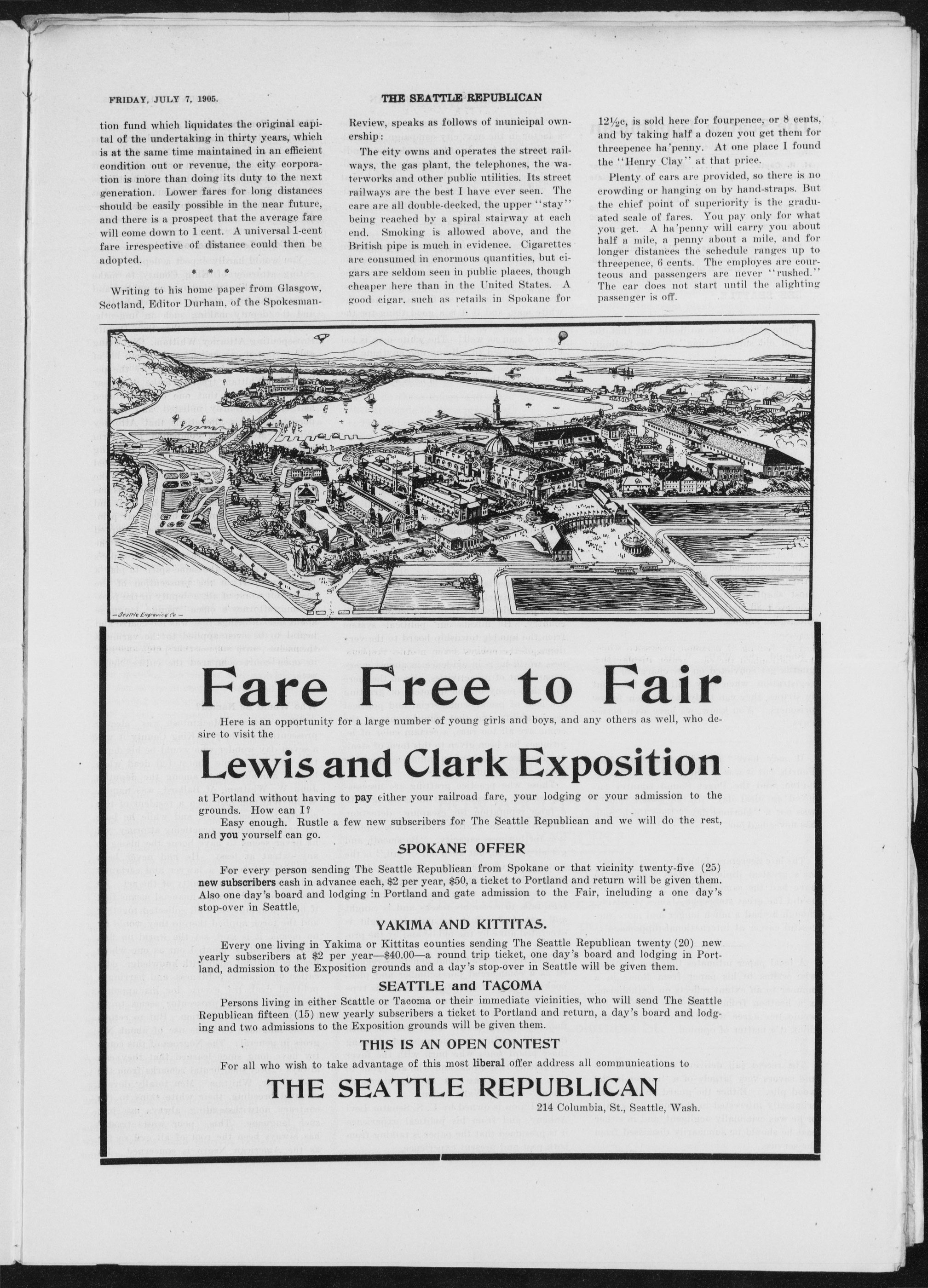
Fare Free to Fair
Lewis and Clark Exposition
at Portland without having to pay cither your railroad fare, your lodging or your admission to the
grounds. How can I?
Easy enough. Rustle a few new subscribers for The Seattle Republican and we will do the rest,
and you yourself can go.
i SPOKANE OFFER
For every person sending The Seattle Republican from Spokane or that vicinity twenty-five (25)
new subscribers cash in advance each, $2 per year, $50, a ticket to Portland and return will be given them.
Also one day’s board and lodging ‘n Portland and gate admission to the Fair, including a one day’s
stop-over in Seattle,
YAKIMA AND KITTITAS.
Every one living in Yakima or Kittitas counties sending The Seattle Republican twenty (20) new
yearly subscribers at $2 per year—$40.00—a round trip ticket, one day’s board and lodging in Port-
land, admission to the Exposition grounds and a day’s stop-over in Seattle will be given them.
SEATTLE and TACOMA
Persons living in either Seattle or Tacoma or their immediate vicinities, who will send The Seattle
Republican fifteen (15) new yearly subscribers a ticket to Portland and return, a day’s board and lodg-
ing and two admissions to the Exposition grounds will be given them.
: THIS IS AN OPEN CONTEST
For all who wish to take advantage of this most liberal offer address all communications to
214 Columbia, St., Seattle, Wash.
a |
FRIDAY, JULY 7, 1905. x
tion fund which liquidates the original eapi-
tal of the undertaking in thirty years, which
is at the same time maintained in an efficient
condition out or revenue, the city corpora-
tion is more than doing its duty to the next
generation. Lower fares for long distances
should be easily possible in the near future,
and there is a prospect that the average fare
will come down to 1 cent. A universal 1-cent
fare irrespective of distance could then be
adopted.
* % #
Writing to his home paper from Glasgow,
Seotland, Editor Durham, of the Spokesman-
THE SEATTLE REPUBLICAN
Review, speaks as follows of municipal own-
ership:
The eity owns and operates the street rail-
ways, the gas plant, the telephones, the wa-
terworks and other public utilities. Its street
railways are the best I have ever seen. The
care are all double-decked, the upper ‘‘stay”’
being reached by a spiral stairway at each
end. Smoking is allowed above, and the
British pipe is much in evidence. Cigarettes
are consumed in enormous quantities, but ci-
gars are seldom seen in public places, though
cheaper here than in the United States. A
good cigar, such as retails in Spokane for
1214¢, is sold here for fourpence, or 8 cents,
and by taking half a dozen you get them for
threepence ha*penny. At one place I found
the ‘‘Henry Clay’? at that price.
Plenty of cars are provided, so there is no
crowding or hanging on by hand-straps. But
the chief point of superiority is the gradu-
ated scale of fares. You pay only for what
you get. A ha’penny will carry you about
half a mile, a penny about a mile, and for
longer distances the schedule ranges up to
threepence, 6 cents. The employes are cour-
teous and passengers are never “mushed.’’
The car does not start until the alighting
passenger is off.
RR
.
The Seattle Republican
Established May, 189
H. R. Cayton..............Editor and Publisher
Susie Revels Cayten.................- Associate
SUBSCRIPTION RATES.
ONG VOar ....ccccscccsseesteresesscescees sGa0O
SIE MONUDE isis dens ow ceess soe mabsces ROO
Three Months ..........0eeeeeeeereeeeeeess 60
Published every Friday at 214 Columbia St.
Entered at the Postoffice at Seattle as Second-
class Mail Matter.
a a a ae a
There seems to be no doubt but that the
“‘good old summer time’’ is now feelingly
with us.
‘*Watch Tacoma Grow”’ holds the field just
now, but most of the visitors to the Port-
land fair decided before leaving home to
“SEE SEATTLE” before returning, and
they are doing so.
There may have been an unusually large
crop of marriages in the June month just
closed, but the other eleven months of the
year will pay up for the excess in the way
of divorces.
In the econvietion of Senator John H.
Mitchell of Oregon of gross land frauds the
most skeptical must now realize that the
Roosevelt administration means to clear out
the Agean stables.
Should the Walla Walla penitentiary
guards get convicted on the charge of false
registration, when they will have been put
in stripes, they ean truly say to their fellow
prisoners: ‘‘You know, we have seen better
days.’’
It may have rained somewhere July
Fourth, but it was not in the State of Wash-
ington, and the Puget Sound country en-
joyed an ideal day. If the recent Fourth
was not a ‘“‘glorious day,’’ then Uncle Sam
has never had one.
The late Secretary John Hay, one of Amer-
ica’s greatest diplomats, does not seem to
have had the same hold on publie opinion
as did the great statesman, James G. Blaine,
though he had a much longer ‘and more sue-
cessful career at international dippomacy.
A local paper intimates that Joe Blethen,
who writes to his paper from Rome in a
manner to an extent reflects on Catholicism,
is a heathen from home. We suspect Joe
would not agree with the local seribe and
think it a matter of opinion.
The recent jail delivery at MeNeil’s Isl-
and savors very largely of a ‘‘nigger in the
wood pile.’’ Hither the guard on duty was
criminally interested in the convicts’ eseape
or he was criminally negligent, and in either
cage he should be summarily dismissed from
the service.
ae aa cea rc ak Ree Semmes ae aee
THE SEATTLE. REPUBLICAN
‘Municipal ownership may or may not-be
a factor in the next city campaign, but rail-
roadism will be. In other words, the candi-
date who is nominated beeause he favors rail-
road measures will be handed a bunch that
he will not soon forget,’’ came from a lead-
ing Republican one day this week.
The time does not seem very distant when
the red man can buy all the firewater he
wants and no one he punished therefor. The
red man, it must be admitted, does no worse
under the influence of firewater than the
white man, and if it is a good thing for the
white man, why is it not a good thing for
the red man as well? The white man is too
highly civilized to sell any one anything for
either drink, eat or wear that is not for the
best good of those to whom he is selling to.
Eliminate the Grafter.
Not many years ago the word ‘‘graft’’
conveyed the idea of illegal perquisites of
politicians, and its use was almost entirely
confined to the sphere of politics. Today
graft has invaded the industrial and com-
mercial channels of our national life until the
word has a universal application. It may
mean any one of a multitude of corrupt prac-
tices, but seldom is it given its true cate-
gorical place among the most detestable of
crimes.
The grafter is a curse neither new nor un-
ique in character, but he is emphatically
more pernicious now than ever before in this
country. He infests our political system
from the humble township board to the very
doors of the cabinet room and in the busi-
ness world he is in evidence in almost every
department of its activities. From the mere
fact that many of the devotees of grafting
are men of pseudo-commercial and political
respectability and that punishments of the
crime are all too rare, a certain color of le-
gitimacy has been given to this form of steal-
ing that exerts a banfeul influence upon the
youth of the land.
Those who practice grafting are necessa-
rily covert, sly and adroit in escaping with
a false reputation for escaping detection.
This invests the grafter with a false reputa-
tion for business sagacity. ‘‘Be smooth and
get all you can, but keep out of jail,’’ is the
watchword of the craft. he only thing
wrong about the business among the graft-
ers themselves is when some bungling ama-
teur fails to cover his tracks and is caught
and punished. Such an unlucky wight is
execrated alike by the publie and by the pro-
fession.
Until the grafter become generally regard-
ed as a commercial porchclimber and pick-
pocket we cannot hope to eliminate this type
of pest from our affairs. Our young men
must be taught that the grafter is no better
than a common theif. Then and not until
then will grafting become unpopular among
those pliant souls who burn with the fever
for getting rich quick, and who are prone to
look upon grafting as a ‘‘gentleman’s
game.’’—Walla Walla Union.
The Union is owned by U.S. Senator Levi
Ankeny, and from his political experience
it is presumed that the paper is talking from
both past and present experience.
FRIDAY, JULY. 7, 1905.
Nothing For Excitement.
Johan Hock,: Chicago’s bluebeard, was
hanged yesterday. With Nan . Patterson
free, Cassie Chadwick in prison, Hyde out
of the Equitable, Hoch dead, and hostilities
between Russia and Japan about ended, what
oe the papers going to do for sensations ?—
UX.
**All Coons Look Alike to Me.’’
You would hardly ex:pect a deputy prose-
euting attorney of King County to make
a statement like the above in public, and
yet one did do it, that is, if reports be true,
and the deputy making such an ungentle-
manly remark was none other than Deputy
Prosepeuting Attorney Whittam. Not being
able to fasten any crime on the lump lot of
fallen women that were run in by the po-
lice, Mr. Whittam tried to make it appear
to Judge Gordon that one of the women
had been previously indicted, and was so
persistent in his allegations that Attorney
Will H. Morris was compelled to inform
him that he.... if he persisted in saying
such, whereupon he, Whittam, is reported
to have snarled, ‘‘ Well, all coons look alike
to me.’’ In other words, if this Negress has
not been indicted some one else has been and
she ought to be punished on general prin-
ciples. It was that very spirit that prompted
the arrest of the women on the part of the
police and now the prosecuting attorney’s
office is permitting the same spirit to play a
prominent part in the prosecution of the
case. But worst of all, a deputy in the pros-
ecuting attorney’s office using language
about human beings that was too coarse and
brutal to be even applied to the varmints
themselves with whom this publie servant
in open court compared the entire Negro
race,
Who Would Be Named?
When Kenneth Mackintosh was _ elected
proseeuting attorney of King County it was
a seven day wonder who would be his depu-
ties, and the people almost fell dead when
he did announce that among the deputies
John W. Whittam, of Ballard, was named.
While Whittam had been a resident of this
county for some years, and while he bore
the name of being a practicing attorney, yet
he never seems to have borne the blame to
any extent at least. He had never been
charged with being a lawyer and certainly
had never been found guilty of the act. He
is a man of such limited financial means that
if his belongings were all collected together
and the torch applied thereto they would by
no means, it is said, set the world on fire.
He would not be pointed out as one whose
head is bursting open with knowledge, edu-
cation or common politeness, and barring a
political deal, the excuse for his appoint-
ment as a deputy prosecutor seems to be
totally without justification. But to return
to the language he made use of about Ne-
groes in general: The Negroes of this coun-
try have long since learned that they can
always expect such brutal remarks from the
likes of Mr. Whittam. Men totally devoid
of good breeding, their white skins to the
contrary notwithstanding, always use just
such language. This ‘‘poor white trash’’
has always been the root of all evil so far
as the American Negro is concerned. Its
THE SEATTLE REPUBLICAN
ple could not reach or read them, and then confiscated their property for not observing laws they knew nothing about, these southern people enact laws and ordinances skillfully conceived and framed as traps and pitfalls for the Colored people, who are nefariously accused of crime, seized, imprisoned, sold to cruel taskmasters, who rob them of liberty, torture their bodies by every kind of abuse, until death or disease ends their power longer to labor. The whole administrative and judicial establishments of the southern states are effective conspiracies to utterly reduce to penal servitude the Colored people of those communities. And this goes on year by year, decade by decade, until all restraint is thrown to the winds, and all semblance of concealment dispensed with and no effort is made to stop the abuse or to punish the fiends in human form who brazenly do these things and share the profits that are made by these practices.
This subterfuge of accusing Colored people of crime in order to despoil them of every right belonging to them as human beings—to say nothing of their rights as American citizens, is so clumsily put forward that it no longer deceives any one North or South, East or West. The facts are no longer even controverted or denied or palliated or excused. And yet the old friends of justice and decency and law and liberty are being taken through the South in the Ogden parties and seduced into sympathy with the South in its carnival of crimes against humanity and against the constitution of our republic. How long, how long, O Lord, wilt thou turn
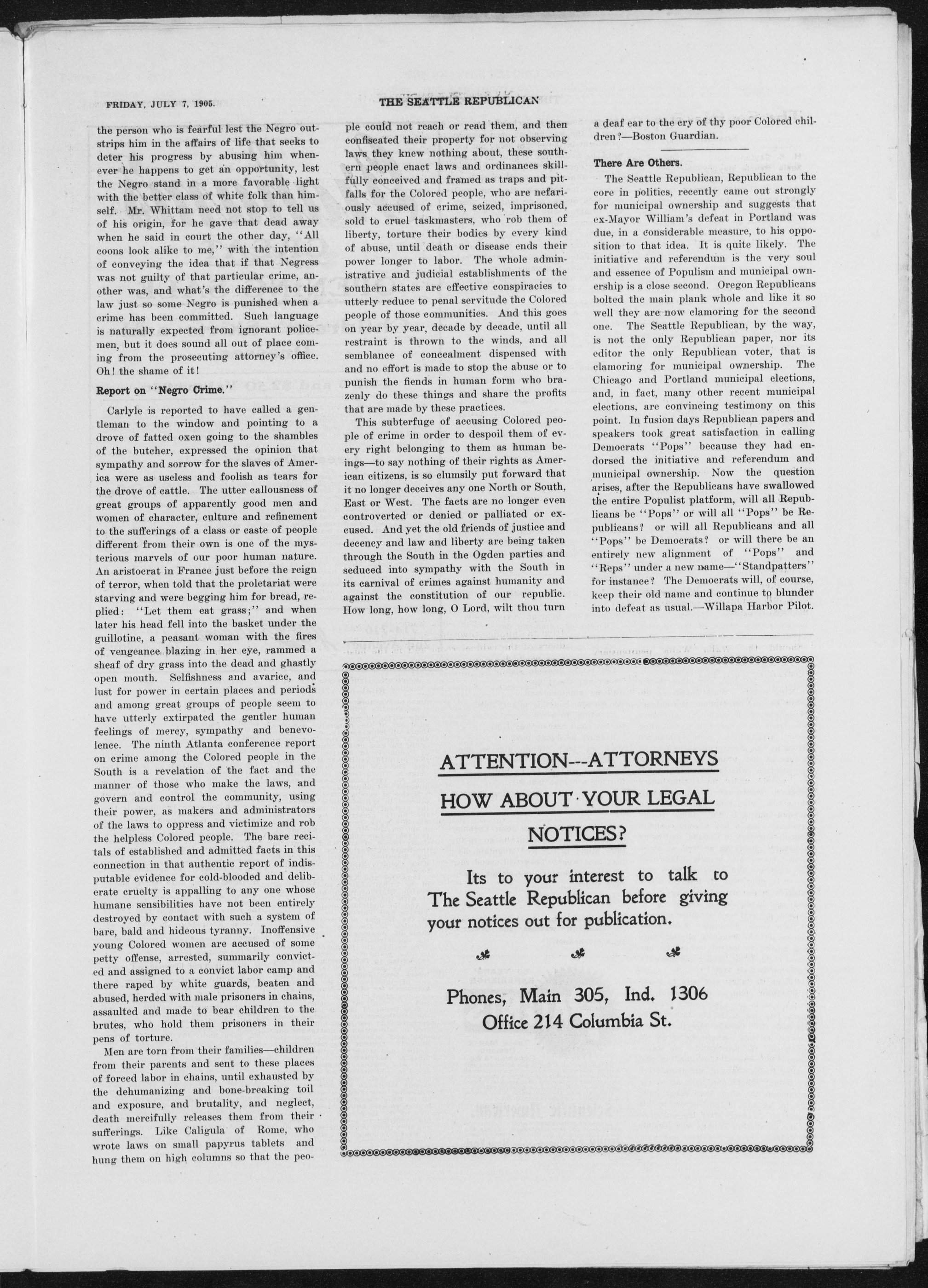
ATTENTION
HOW ABOUT
NOT
Its to your
The Seattle Repu
your notices out fo
Its to your interest to talk to The Seattle Republican before giving your notices out for publication.
Phones, Main 305, Ind. 1306 Office 214 Columbia St.
```markdown
```
FRIDAY. JULY 7. 1905.
the person who is fearful lest the Negro outstrips him in the affairs of life that seeks to deter his progress by abusing him whenever he happens to get an opportunity, lest the Negro stand in a more favorable light with the better class of white folk than himself. Mr. Whittam need not stop to tell us of his origin, for he gave that dead away when he said in court the other day, "All coons look alike to me," with the intention of conveying the idea that if that Negress was not guilty of that particular crime, another was, and what's the difference to the law just so some Negro is punished when a crime has been committed. Such language is naturally expected from ignorant policemen, but it does sound all out of place coming from the prosecuting attorney's office. Oh! the shame of it!
Report on "Negro Crime."
Carlyle is reported to have called a gentleman to the window and pointing to a drove of fatted oxen going to the shambles of the butcher, expressed the opinion that sympathy and sorrow for the slaves of America were as useless and foolish as tears for the drove of cattle. The utter callousness of great groups of apparently good men and women of character, culture and refinement to the sufferings of a class or caste of people different from their own is one of the mysterious marvels of our poor human nature. An aristocrat in France just before the reign of terror, when told that the proletariat were starving and were begging him for bread, replied: "Let them eat grass;" and when later his head fell into the basket under the guillotine, a peasant woman with the fires of vengeance blazing in her eye, rammed a sheaf of dry grass into the dead and ghastly open mouth. Selfishness and avarice, and lust for power in certain places and periods and among great groups of people seem to have utterly extirpated the gentler human feelings of mercy, sympathy and benevolence. The ninth Atlanta conference report on crime among the Colored people in the South is a revelation of the fact and the manner of those who make the laws, and govern and control the community, using their power, as makers and administrators of the laws to oppress and victimize and rob the helpless Colored people. The bare recitals of established and admitted facts in this connection in that authentic report of indisputable evidence for cold-blooded and deliberate cruelty is appalling to any one whose humane sensibilities have not been entirely destroyed by contact with such a system of bare, bald and hideous tyranny. Inoffensive young Colored women are accused of some petty offense, arrested, summarily convicted and assigned to a convict labor camp and there raped by white guards, beaten and abused, herded with male prisoners in chains, assaulted and made to bear children to the brutes, who hold them prisoners in their pens of torture.
Men are torn from their families—children from their parents and sent to these places of forced labor in chains, until exhausted by the dehumanizing and bone-breaking toil and exposure, and brutality, and neglect, death mercifully releases them from their sufferings. Like Caligula of Rome, who wrote laws on small papyrus tablets and hung them on high columns so that the peo-
a deaf ear to the cry of thy poor Colored children?—Boston Guardian.
There Are Others.
The Seattle Republican, Republican to the core in politics, recently came out strongly for municipal ownership and suggests that ex-Mayor William's defeat in Portland was due, in a considerable measure, to his opposition to that idea. It is quite likely. The initiative and referendum is the very soul and essence of Populism and municipal ownership is a close second. Oregon Republicans bolted the main plank whole and like it so well they are now clamoring for the second one. The Seattle Republican, by the way, is not the only Republican paper, nor its editor the only Republican voter, that is clamoring for municipal ownership. The Chicago and Portland municipal elections, and, in fact, many other recent municipal elections, are convincing testimony on this point. In fusion days Republican papers and speakers took great satisfaction in calling Democrats "Pops" because they had endorsed the initiative and referendum and municipal ownership. Now the question arises, after the Republicans have swallowed the entire Populist platform, will all Republicans be "Pops" or will all "Pops" be Republicans? or will all Republicans and all "Pops" be Democrats? or will there be an entirely new alignment of "Pops" and "Reps" under a new name—"Standpatters" for instance? The Democrats will, of course, keep their old name and continue to blunder into defeat as usual.—Willapa Harbor Pilot.
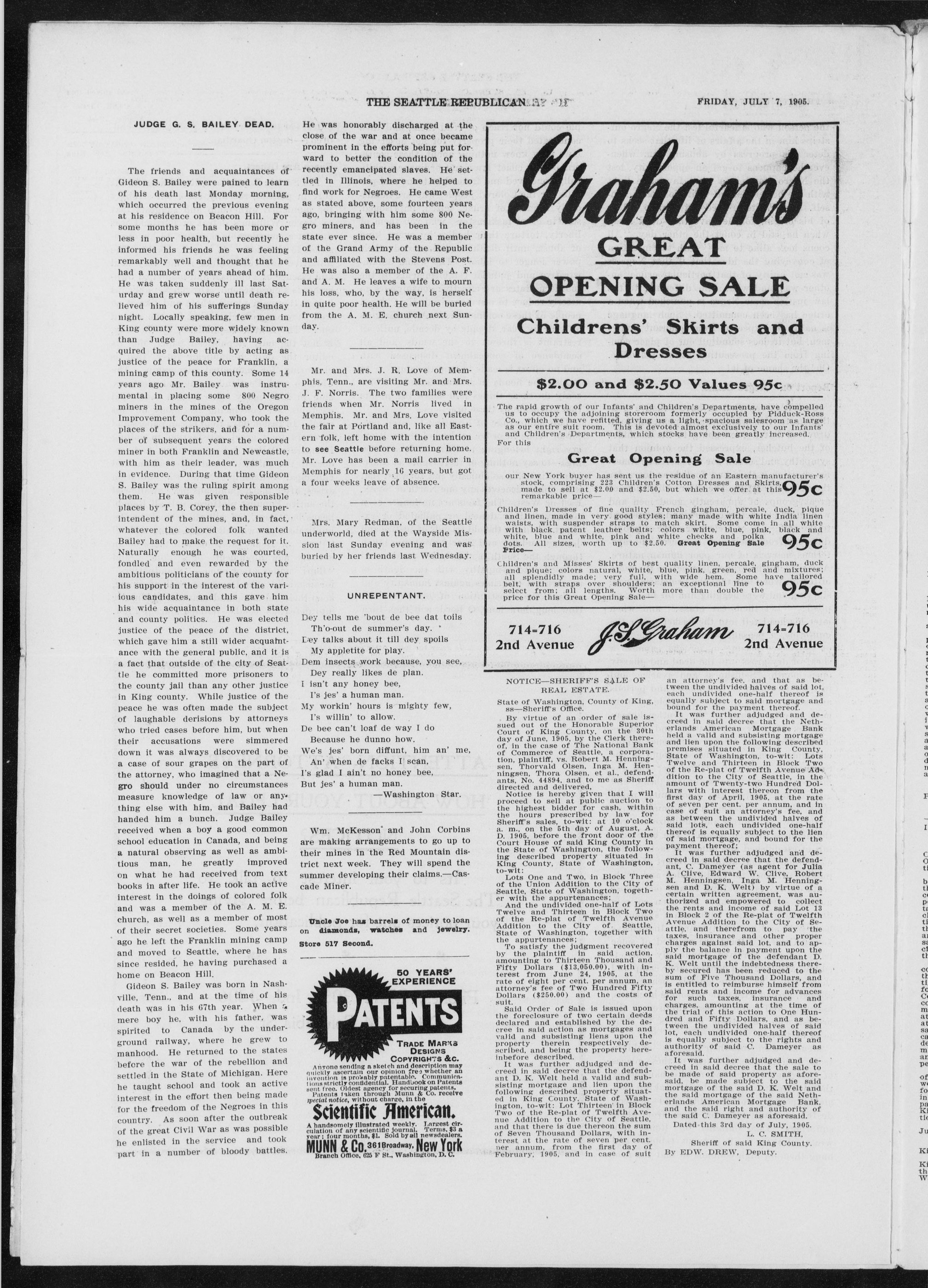
JUDGE G. S. BAILEY DEAD.
The friends and acquaintances of Gideon S. Bailey were pained to learn of his death last Monday morning, which occurred the previous evening at his residence on Beacon Hill. For some months he has been more or less in poor health, but recently he informed his friends he was feeling remarkably well and thought that he had a number of years ahead of him. He was taken suddenly ill last Saturday and grew worse until death relieved him of his sufferings Sunday night. Locally speaking, few men in King county were more widely known than Judge Bailey, having acquired the above title by acting as justice of the peace for Franklin, a mining camp of this county. Some 14 years ago Mr. Bailey was instrumental in placing some 800 Negro miners in the mines of the Oregon Improvement Company, who took the places of the strikers, and for a number of subsequent years the colored miner in both Franklin and Newcastle, with him as their leader, was much in evidence. During that time Gideon S. Bailey was the ruling spirit among them. He was given responsible places by T. B. Corey, the then superintendent of the mines, and, in fact, whatever the colored folk wanted Bailey had to make the request for it. Naturally enough he was courted, fondled and even rewarded by the ambitious politicians of the county for his support in the interest of the various candidates, and this gave him his wide acquaintance in both state and county politics. He was elected justice of the peace of the district, which gave him a still wider acquaintance with the general public, and it is a fact that outside of the city of Seattle he committed more prisoners to the county jail than any other justice in King county. While justice of the peace he was often made the subject of laughable derisions by attorneys who tried cases before him, but when their accusations were simmered down it was always discovered to be a case of sour grapes on the part of the attorney, who imagined that a Negro should under no circumstances measure knowledge of law or anything else with him, and Bailey had handed him a bunch. Judge Bailey received when a boy a good common school education in Canada, and being a natural observing as well as ambitious man, he greatly improved on what he had received from text books in after life. He took an active interest in the doings of colored folk and was a member of the A. M. E. church, as well as a member of most of their secret societies. Some years ago he left the Franklin mining camp and moved to Seattle, where he has since resided, he having purchased a home on Beacon Hill.
Gideon S. Bailey was born in Nashville, Tenn., and at the time of his death was in his 67th year. When mere boy he, with his father, was spirited to Canada by the underground railway, where he grew to manhood. He returned to the states before the war of the rebellion and settled in the State of Michigan. Here he taught school and took an active interest in the effort then being made for the freedom of the Negroes in this country. As soon after the outbreak of the great Civil War as was possible he enlisted in the service and took part in a number of bloody battles.
THE SEATTLE REPUBLICAN
He was honorably discharged at the close of the war and at once became prominent in the efforts being put forward to better the condition of the recently emancipated slaves. He settled in Illinois, where he helped to find work for Negroes. He came West as stated above, some fourteen years ago, bringing with him some 800 Negro miners, and has been in the state ever since. He was a member of the Grand Army of the Republic and affiliated with the Stevens Post. He was also a member of the A. F. and A. M. He leaves a wife to mourn his loss, who, by the way, is herself in quite poor health. He will be buried from the A. M. E. church next Sunday.
Mr. and Mrs. J. R. Love of Memphis, Tenn., are visiting Mr. and Mrs. J. F. Norris. The two families were friends when Mr. Norris lived in Memphis. Mr. and Mrs. Love visited the fair at Portland and, like all Eastern folk, left home with the intention to see Seattle before returning home. Mr. Love has been a mail carrier in Memphis for nearly 16 years, but got a four weeks leave of absence.
Mrs. Mary Redman, of the Seattle underworld, died at the Wayside Mission last Sunday evening and was buried by her friends last Wednesday.
UNREPENTANT.
Dey tells me 'bout de bee dat toils
Th'o-out de summer's day.
Dey talks about it till dey spoils
My appletite for play.
Dem insects work because, you see,
Dey really likes de plan.
I isn't any honey bee,
I's jes' a human man.
My workin' hours is mighty few,
I's willin' to allow.
De bee can't loaf de way I do
Because he dunno how.
We's jes' born diffunt, him an' me
An' when de facks I scan,
I's glad I ain't no honey bee,
But jes' a human man.
Wm. McKesson and John Corbins are making arrangements to go up to their mines in the Red Mountain district next week. They will spend the summer developing their claims.—Cascade Miner.
Uncle Joe has barrels of money to loan on diamonds, watches and jewelry. Store 517 Second.
50 YEARS' EXPERIENCE
PATENTS
TRADE MARKS
DESIGNS
COPYRIGHTS & C.
Anyone sending a sketch and description may quickly ascertain our opinion free whether an invention is probably patentable. Communications strictly confidential. Hand look on Patents sent free. Oldest agency for securing patents.
Patents taken through Munn & Co. receive special notice, without charge, in the
Scientific American.
A handsomely illustrated weekly. Largest circulation of any scientific journal. Terms, $3 a year; four months, $1. Sold by all newsdealers.
MUNN & Co. 361 Broadway, New York
Branch Office, 625 F St., Washington, D. C.
Grah
GR
OPENIN
Childrens'
Dre
$2.00 and $2.00
The rapid growth of our Infants' and us to occupy the adjoining storero Co., which we have refitted, giving as our entire suit room. This is de and Children's Departments, which For this
The rapid growth of our Infants' and Children's Departments, have compelled us to occupy the adjoining storeroom formerly occupied by Pidduck-Ross Co., which we have refitted, giving us a light, spacious salesroom as large as our entire suit room. This is devoted almost exclusively to our Infants' and Children's Departments, which stocks have been greatly increased. For this
our New York buyer has sent us the stock, comprising 223 Children made to sell at $2.00 and $2.50 remarkable price—
Children's Dresses of fine quality and linen, made in very good stylaists, with suspender straps to with black, patent leather belts; white, blue and white, pink and dots. All sizes, worth up to $2.
Price—
Children's and Misses' Skirts of best and pique; colors natural, white, all splendidly made; very full, belt, with straps over shoulders; select from; all lengths. Worth price for this Great Opening Sale—
our New York buyer has sent us the residue of an Eastern manufacturer's stock, comprising 223 Children's Cotton Dresses and Skirts, made to sell at $2.00 and $2.50, but which we offer at this remarkable price—
Children's Dresses of fine quality French gingham, percale, duck, pique and linen, made in very good styles; many made with white India linen waists, with suspender straps to match skirt. Some come in all white with black patent leather belts; colors white, blue, pink, black and white, blue and white, pink and white checks and polka dots. All sizes, worth up to $2.50. Great Opening Sale
Price—
Children's and Misses' Skirts of best quality linen, percale, gingham, duck and pique; colors natural, white, blue, pink, green, red and mixtures; all splendidly made; very full, with wide hem. Some have tailored belt, with straps over shoulders; an exceptional line to select from; all lengths. Worth more than double the price for this Great Opening Sale—
714=716
2nd Avenue
NOTICE—SHERIFF'S SALE OF REAL ESTATE.
State of Washington, County of King,
ss—Sheriff's Office.
By virtue of an order of sale issued out of the Honorable Superior Court of King County, on the 30th day of June, 1905, by the Clerk thereof, in the case of The National Bank of Commerce of Seattle, a corporation, plaintiff, vs. Robert M. Henningsen, Thorvald Olsen, Inga M. Henningsen, Thora Olsen, et al., defendants, No. 44894, and to me as Sheriff directed and delivered.
Notice is hereby given that I will proceed to sell at public auction to the highest bidder for cash, within the hours prescribed by law for Sheriff's sales, to-wit: at 10 o'clock a. m., on the 5th day of August, A. D. 1905, before the front door of the Court House of said King County in the State of Washington, the following described property situated in King County, State of Washington, to-wit:
Lots One and Two, in Block Three of the Union Addition to the City of Seattle, State of Washington, together with the appurtenances;
And the undivided one-half of Lots Twelve and Thirteen in Block Two of the Re-plat of Twelfth Avenue Addition to the City of. Seattle, State of Washington, together with the appurtenances;
To satisfy the judgment recovered by the plaintiff in said action, amounting to Thirteen Thousand and Fifty Dollars ($13,050.00), with interest from June 24, 1905, at the rate of eight per cent. per annum, an attorney's fee of Two Hundred Fifty Dollars ($250.00) and the costs of suit.
Said Order of Sale is issued upon the foreclosure of two certain deeds declared and established by the decree in said action as mortgages and valid and subsisting liens upon the property therein respectively described, and being the property hereinbefore described.
It was further adjudged and decreed in said decree that the defendant D. K. Welt held a valid and subsisting mortgage and lien upon the following described property situated in King County. State of Washington, to-wit: Lot Thirteen in Block Two of the Re-plat of Twelfth Avenue Addition to the City of Seattle, and that there is due thereon the sum of Seven Thousand Dollars, with interest at the rate of seven per cent. per annum, from the first day of February, 1905, and in case of suit
---
$2.00 and $2.50 Values 95c
Great Opening Sale
J.S.Graham
FRIDAY, JULY 7, 1905.
ham's
EAT
G SALE
Skirts and
sses
50 Values 95c
Children's Departments, have compelled
n formerly occupied by Pidduck-Ross
s a light, spacious salesroom as large
noted almost exclusively to our Infants'
stocks have been greatly increased.
residue of an Eastern manufacturer's Cotton Dresses and Skirts, but which we offer at this 95c
french gingham, percale, duck, pique; many made with white India linen match skirt. Some come in all white colors white, blue, pink, black and white checks and polka. 95c
Great Opening Sale
quality linen, percale, gingham, duck blue, pink, green, red and mixtures; with wide hem. Some have tailored an exceptional line to more than double the 95c
an attorney's fee, and that as between the undivided halves of said lot, each undivided one-half thereof is equally subject to said mortgage and bound for the payment thereof.
It was further adjudged and decreed in said decree that the Netherlands American Mortgage Bank held a valid and subsisting mortgage and lien upon the following described premises situated in King County, State of Washington, to-wit: Lots Twelve and Thirteen in Block Two of the Re-plat of Twelfth Avenue Addition to the City of Seattle, in the amount of Twenty-two Hundred Dollars with interest thereon from the first day of April, 1905, at the rate of seven per cent. per annum, and in case of suit an attorney's fee, and as between the undivided halves of said lots, each undivided one-half thereof is equally subject to the lien of said mortgage, and bound for the payment thereof:
It was further adjudged and decreed in said decree that the defendant, C. Dameyer (as agent for Julia A. Clive, Edward W. Clive, Robert M. Henningsen, Inga M. Henningsen and D. K. Welt) by virtue of a certain written agreement, was authorized and empowered to collect the rents and income of said Lot 13 in Block 2 of the Re-plat of Twelfth Avenue Addition to the City of Seattle, and therefrom to pay the taxes, insurance and other proper charges against said lot, and to apply the balance in payment upon the said mortgage of the defendant D. K. Welt until the indebtedness thereby secured has been reduced to the sum of Five Thousand Dollars, and is entitled to reimburse himself from said rents and income for advances for such taxes, insurance and charges, amounting at the time of the trial of this action to One Hundred and Fifty Dollars, and as between the undived halves of said lot, each undived one-half thereof is equally subject to the rights and authority of said C. Dameyer as aforesaid.
It was further adjudged and decreed in said decree that the sale to be made of said property as aforesaid, be made subject to the said mortgage of the said D. K. Welt and the said mortgage of the said Netherlands American Mortgage Bank, and the said right and authority of the said C. Dameyer as aforesaid.
Sheriff of said King County.
By EDW. DREW, Deputy.
F
I
O
C
t
b
t
c
t
t
a
c
v
i
s
a
o
d
n
e
o
t
f
O
c
m
a
t
s
c
d
m
a
p
o
w
f
o
i
n
p
a
k
t
i
c
Ju
714=716
2nd Avenue
FRIDAY, JULY 7, 1905.
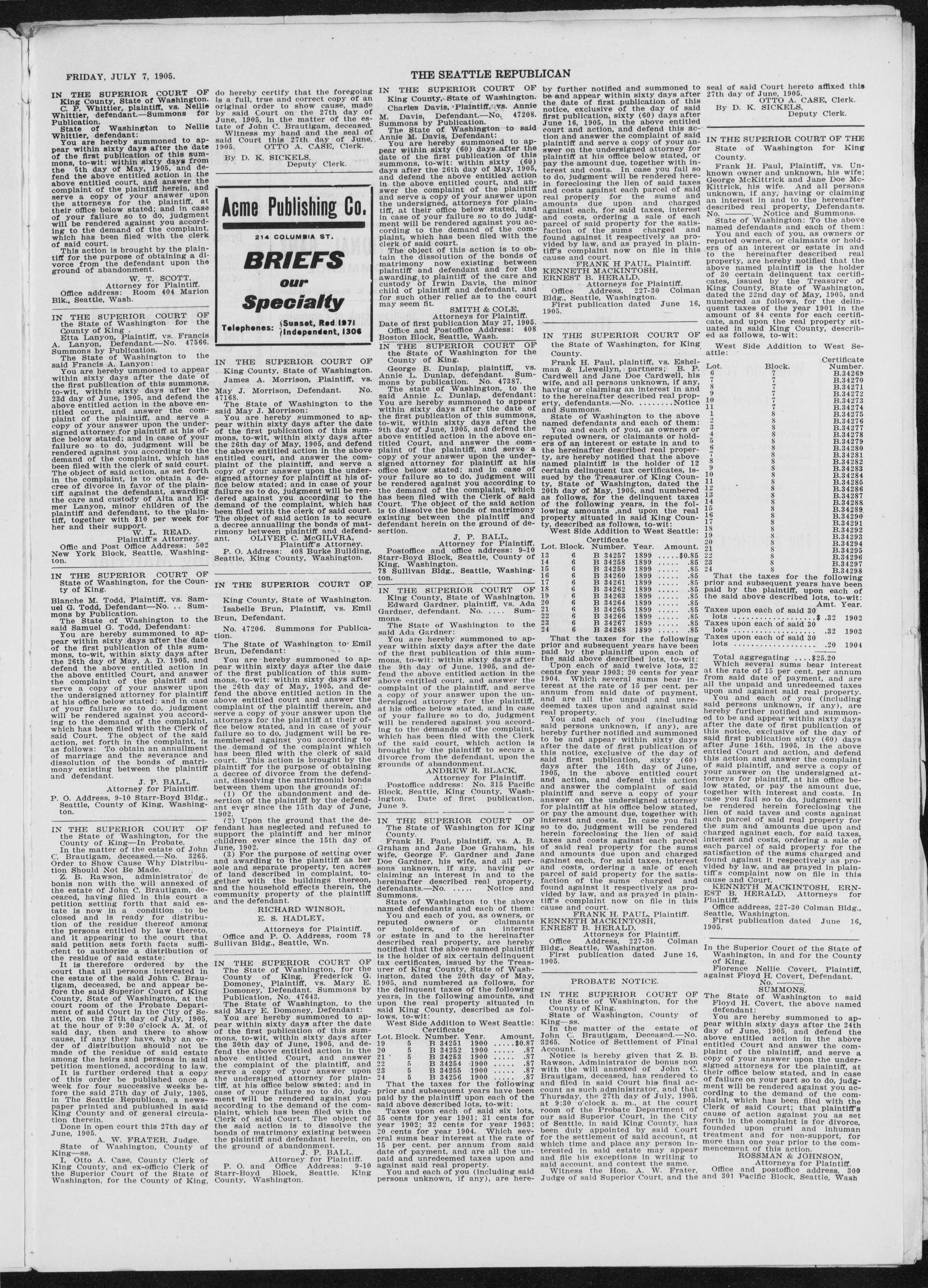
IN THE SUPERIOR COURT OF King County, State of Washington.
C. P. Whittier, plaintiff, vs. Nellie Whittier, defendant.—Summons for Publication.
State of Washington to Nellie Whittier, defendant:
You are hereby summoned to appear within sixty days after the date of the first publication of this summons, to-wit: within sixty days from the 5th day of May, 1905, and defend the above entitled action in the above entitled court, and answer the complaint of the plaintiff herein, and serve a copy of your answer upon the attorneys for the plaintiff, at their office below stated; and in case of your failure so to do, judgment will be rendered against you according to the demand of the complaint, which has been filed with the clerk of said court.
This action is brought by the plaintiff for the purpose of obtaining a divorce from the defendant upon the ground of abandonment.
W. T. SCOTT,
Attorney for Plaintiff.
Office address: Room 404 Marion Blk., Seattle, Wash.
IN THE SUPERIOR COURT OF
the State of Washington for the
County of King.
Etta Lanyon, Plaintiff, vs. Francis
A. Lanyon, Defendant.—No. 47566.
Summons by Publication.
Summary
The State of Washington to the
said Francis A. Lanyon:
You are hereby unmonned to appear
within sixty days after the date of
the first publication of this summons,
to-wit, within sixty days after the
23d day of June, 1905, and defend the
above entitled action in the above
entitled court, and answer the complaint
of the plaintiff, and serve a copy of your answer upon the undersigned attorney for plaintiff at his office below stated; and in case of your failure so to do, judgment will be rendered against you according to the demand of the complaint, which has been filed with the clerk of said court.
The object of said action, as set forth in the complaint, is to obtain a decree of divorce in favor of the plaintiff against the defendant, awarding the care and custody of Alta and Elmer Lanyon, minor children of the plaintiff and defendant, to the plaintiff, together with $10 per week for her and their support.
Offic and Post Office Address: 502 New York Block, Seattle, Washington.
IN THE SUPERIOR COURT OF State of Washington, for the County of King.
Blanche M. Todd, Plaintiff, vs. Samuel G. Todd, Defendant—No. . . Summons by Publication.
The State of Washington to the said Samuel G. Todd, Defendant:
You are hereby summoned to appear within sixty days after the date of the first publication of this summons, to-wit, within sixty days after the 26th day of May, A. D. 1905, and defend the above entitled action in the above entitled Court, and answer the complaint of the plaintiff and serve a copy of your answer upon the undersigned attorney for plaintiff at his office below stated: and in case of your failure so to do, judgment will be rendered against you according to the demand of the complaint, which has been filed with the Clerk of said Court. The object of the said action, set forth in the complaint, is as follows: To obtain an annullment of marriage and the severance and dissolution of the bonds of matrimony existing between the plaintiff and defendant.
P. O. Address, 9-10 Starr-Boyd Bldg., Seattle, County of King, Washington.
IN THE SUPERIOR COURT OF the State of Washington, for the County of King—In Probate.
In the matter of the estate of John C. Brautigam, deceased.—No. 3265. Order to Show Cause Why Distribution Should Not Be Made.
Z. B. Rawson, administrator de bonis non with the will annexed of the estate of John C. Brautigam, deceased, having filed in this court a petition setting forth that said estate is now in a condition to be closed and is ready for distribution of the residue thereof among the persons entitled by law thereto, and it appearing to the court that said petition sets forth facts sufficient to authorize a distribution of the residue of said estate:
It is therefore ordered by the court that all persons interested in the estate of the said John C. Brautigam, deceased, be and appear before the said Superior Court of King County, State of Washington, at the court room of the Probate Department of said Court in the City of Seattle, on the 27th day of July, 1905, at the hour of 9:30 o'clock A. M. of said day, then and there to show cause, if any they have, why an order of distribution should not be made of the residue of said estate among the heirs and persons in said petition mentioned, according to law.
It is further ordered that a copy of this order be published once a week for four successive weeks before the said 27th day of July, 1905, in The Seattle Republican, a newspaper printed and published in said King County and of general circulation therein.
Done in open court this 27th day of June, 1905.
A. W. FRATER, Judge.
State of Washington, County of King—ss.
I, Otto A. Case, County Clerk of King County, and ex-officio Clerk of the Superior Court of the State of Washington, for the County of King.
do hereby certify that the foregoing is a full, true and correct copy of an original order to show cause, made by said Court on the 27th day of June, 1905, in the matter of the estate of John C. Brautigam, deceased. Witness my hand and the seal of said Court this 27th day of June,
Acme Publishing Co.
214 COLUMBIA ST.
BRIEFS
our
Specialty
Telephones: {Sunset, Red 1971
Independent, 1306
May J. Morrison, Defendant. No. 47168.
The State of Washington to the said May J. Morrison:
You are hereby summoned to appear within sixty days after the date of the first publication of this summons, to-wit, within sixty days after the 26th day of May, 1905, and defend the above entitled action in the above entitled court, and answer the complaint of the plaintiff, and serve a copy of your answer upon the undersigned attorney for plaintiff at his office below stated; and in case of your failure so to do, judgment will be rendered against you according to the demand of the complaint, which has been filed with the clerk of said court. The object of said action is to secure a decree annualling the bonds of matrimony between plaintiff and defendant.
OLIVER C. McGILVRA,
Plaintiff's Attorney.
P. O. Address: 408 Burke Building, Seattle, King County, Washington.
IN THE SUPERIOR COURT OF
King County, State of Washington.
Isabelle Brun, Plaintiff, vs. Emil Brun, Defendant.
No. 47206. Summons for Publication.
The State of Washington to Emil Brun, Defendant:
You are hereby summoned to appear within sixty days after the date of the first publication of this summons, to-wit: within sixty days after the 26th day of May, 1905, and defend the above entitled action in the above entitled court and answer the complaint of the plaintiff therein, and serve a copy of your answer upon the attorneys for the plaintiff at their office below stated, and in case of your failure so to do, judgment will be remembered against you according to the demand of the complaint which has been filed with the clerk of said court. This action is brought by the plaintiff for the purpose of obtaining a decree of divorce from the defendant, dissolving the matrimonial bonds between them upon the grounds of: (1) Of the abandonment and desertion of the plaintiff by the defendant ever since the 15th day of June, 1902.
(2) Upon the ground that the defendant has neglected and refused to support the plaintiff and her minor children ever since the 15th day of June. 1902.
(3) For the purpose of setting over and awarding to the planitiff as her sole and separate property, ten acres of land described in complaint, together with the buildings thereon, and the household effects therein, the community property of the plaintiff and the defendant.
E. S. HADLEY.
Attorneys for Plaintiff.
Office and P. O. Address, room 78
Sullivan Bldg., Seattle, Wn.
IN THE SUPERIOR COURT OF
The State of Washington, for the
County of King, Frederick G.
Domoney, Plaintiff, vs. Mary E.
Domoney, Defendant, Summons by
Publication, No. 47643.
The State of Washington, to the
said Mary E. Domoney, Defendant:
You are hereby summoned to appear within sixty days after the date of the first publication of this summons, to-wit, within sixty days after the 30th day of June, 1905, and defend the above entitled action in the above entitled Court, and answer the complaint of the plaintiff, and serve a copy of your answer upon the undersigned attorney for plaintiff, at his office below stated; and in case of your failure so to do, judgment will be rendered against you according to the demand of the complaint, which has been filed with the Clerk of said Court. The object of the said action is to dissolve the bonds of matrimony existing between the plaintiff and defendant herein, on the ground of abandonment.
J. P. BALL.
Attorney for Plaintiff.
P. O. and Office Address: 9-10 Starr-Boyd Block, Seattle, King County, Washington.
IN THE SUPERIOR COURT OF
IN THE SUPERIOR COURT OF King County, State of Washington. Charles Davis, Plaintiff, vs. Annie M. Davis, Defendant.—No. 47208. Summons by Publication. The State of Washington to said Annie M. Davis, Defendant: You are hereby summoned to appear within sixty (60) days after the date of the first publication of this summons, to-wit: within sixty (60) days after the 26th day of May, 1905, and defend the above entitled action in the above entitled court, and answer the complaint of the plaintiff and serve a copy of your answer upon the undersigned, attorneys for plaintiff, at their office below stated, and in case of your failure so to do judgment will be rendered against you according to the demand of the complaint, which has been filed with the clerk of said court.
The object of this action is to obtain the dissolution of the bonds of matrimony now existing between plaintiff and defendant and for the awarding to plaintiff of the care and custody of Irwin Davis, the minor child of plaintiff and defendant, and for such other relief as to the court may seem fit.
SMITH & COLE,
Attorneys for Plaintiff.
Date of first publication May 27, 1905.
Office and Postoffice Address: 408 Boston Block, Seattle, Wash.
IN THE SUPERIOR COURT OF
the State of Washington for the
County of King.
George B. Dunlap, plaintiff, vs.
Annie L. Dunlap, defendant. Summons by publication. No. 47387.
The state of Washington, to the said Annie L. Dunlap, defendant: You are hereby summoned to appear within sixty days after the date of the first publication of this summons, to-wit, within sixty days after the 9th day of June, 1905, and defend the above entitled action in the above entitled Court, and answer the complaint of the plaintiff, and serve a copy of your answer upon the undersigned attorney for plaintiff at his office below stated; and in case of your failure so to do, judgment will be rendered against you according to the demand of the complaint, which has been filed with the Clerk of said Court. The object of the said action is to dissolve the bonds of matrimony existing between the plaintiff and defendant herein on the ground of desertion.
Attorney for Plaintiff
Postoffice and office address: 9-10
Starr-Boyd Block, Seattle, County of
King, Washington.
78 Sullivan Bldg., Seattle, Washington.
IN THE SUPERIOR COURT OF King County, State of Washington. Edward Gardner, plaintiff, vs. Ada Gardner, defendant. No. .... Summons. The State of Washington to the said Ada Gardner:
You are hereby summoned to ap year within sixty days after the date of the first publication of this summons, to-wit: within sixty days after the 9th day of June, 1905, and defend the above entitled action in the above entitled court, and answer the complaint of the plaintiff, and serve a copy of your answer upon the undersigned attorney for the plaintiff, at his office below stated, and in case of your failure so to do, judgment will be rendered against you according to the demands of the complaint, which has been filed with the Clerk of the said court, which action is brought by the plaintiff to secure a divorce from the defendant, upon the grounds of abandonment.
ANDREW R. BLACK,
Attorney for Plaintiff.
Postoffice address: No. 315 Pacific Block, Seattle, King County, Washington. Date of first publication, June 9.
IN THE SUPERIOR COURT OF
The State of Washington for King
County.
Frank H. Paul, plaintiff, vs. A. B.
Graham and Jane Doe Graham, his
wife, George F. Gardner and Jane
Doe Gardner, his wife, and all
persons unknown, if any, having or
claiming an interest in and to
the hereinafter described real property,
defendants—No. .... Notice and
Summons.
State of Washington to the above
named defendants and each of them:
named defendants and each of them. You and each of you, as owners, or reputed owners or claimants or holders, of an interest or estate in and to the hereinafter described real property, are hereby notified that the above named plaintiff is the holder of six certain delinquent tax certificates, issued by the Treasurer of King County, State of Washington, dated the 20th day of May, 1905, and numbered as follows, for the delinquent taxes of the following years, in the following amounts, and upon the real property situated in said King County, described as follows, to-wit:
West Side Addition to West Seattle:
Certificate
Lot. Block. Number. Year. Amount.
19 5 B 34251 1900 ..... $0.87
20 5 B 34252 1900 ..... .87
21 5 B 34253 1900 ..... .87
22 5 B 34254 1900 ..... .87
23 5 B 34255 1900 ..... .87
24 5 B 34256 1900 ..... .87
That the taxes for the following prior and subsequent years have been paid by the plaintiff upon each of the said above described lots, to-wit:
Taxes upon each of said six lots,
35 cents for year 1901; 31 cents for
year 1902; 32 cents for year 1903;
20 cents for year 1904. Which several sums bear interest at the rate of
15 per cent. per annum from said
date of payment, and are all the unpaid and unredeemed taxes upon and
against said real property.
You and each of you (including said
persons unknown, if any), are here-
by further notified and summoned to be and appear within sixty days after the date of first publication of this notice, exclusive of the day of said first publication, sixty (60) days after June 16, 1905, in the above entitled court and action, and defend this action and answer the complaint of said plaintiff and serve a copy of your answer on the undersigned attorney for plaintiff at his office below stated, or pay the amount due, together with interest and costs. In case you fail so do, judgment will be rendered herein foreclosing the lien of said taxes and costs against each parcel of said real property for the sums and amounts due upon and charged against each, for said taxes, interest and costs, ordering a sale of each parcel of said property for the satisfaction of the sums charged and found against it respectively as provided by law, and as prayed in plaintiff's complaint now on file in this cause and court.
FRANK H PAUL, Plaintiff.
KENNETH MACKINTOSH,
INC.
First publication dated June 16, 1905.
IN THE SUPERIOR COURT OF
the State of Washington, for King
County.
Frank H. Paul, plaintiff, vs. Eshelman
& Llewellyn, partners; B. P.
Cardwell and Jane Doe Cardwell, his
wife, and all persons unknown, if any,
having or claiming an interest in and
to the hereinafter described real property,
defendants.—No. . . . . . Notice
and Summons.
State of Washington to the above
named defendants and each of them:
You and each of you, as owners or reputed owners, or claimants or holders of an interest or estate in and to the hereinafter described real property, are hereby notified that the above named plaintiff is the holder of 12 certain delinquent tax certificates, issued by the Treasurer.of King County, State of Washington, dated the 20th day of May, 1905, and numbered as follows, for the delinquent taxes of the following years, in the following amounts, and upon the real property situated in said King County, described as follows, to-wit:
West Side Addition to West Seattle:
Certificate
Lot. Block. Number. Year. Amount.
13 6 B 34257 1899 ..... $0.85
14 6 B 34258 ..... .85
15 6 B 34259 ..... .85
16 6 B 34260 ..... .85
17 6 B 34261 ..... .85
18 6 B 34262 ..... .85
19 6 B 34263 ..... .85
20 6 B 34264 ..... .85
21 6 B 34265 ..... .85
22 6 B 34266 ..... .85
23 6 B 34267 ..... .85
24 6 B 34268 ..... .85
That the taxes for the following
prior and subsequent years have been
paid by the plaintiff upon each of
the said above described lots to wit:
Upon each of said twelve lots, 32 cents for year 1903; 20 cents for year 1904. Which several sums bear interest at the rate of 15 per cent. per annum from said date of payment, and are all the unpaid and unredeemed taxes upon and against said real property.
You and each of you (including said persons unknown, if any), are hereby further notified and summoned to be and appear within sixty days after the date of first publication of this notice, exclusive of the day of said first publication, sixty (60) days after the 16th day of June, 1905, in the above entitled court and action, and defend this action and answer the complaint of said plaintiff and serve a copy of your answer on the undersigned attorney for plaintiff at his office below stated, or pay the amount due, together with interest and costs. In case you fail so to do, judgment will be rendered herein foreclosing the lien of said taxes and costs against each parcel of said real property for the sums and amounts due upon and charged against each, for said taxes, interest and costs, ordering a sale of each parcel of said property for the satisfaction of the sums charged and found against it respectively as provided by law, and as prayed in plaintiff's complaint now on file in this cause and court.
FRANK H. PAUL, Plaintiff.
KENNETH MACKINTOSH,
ENREST B. HERALD,
Attorneys for Plaintiff.
Office Address, 227-30 Colman
Bldg., Seattle, Washington.
First publication dated June 16,
1905.
PROBATE NOTICE.
IN THE SUPERIOR COURT OF the State of Washington, for the County of King.
State of Washington, County of King—ss.
In the matter of the estate of John C. Brautigam, Deceased.—No. 3265. Notice of Settlement of Final Account.
Notice is hereby given that Z. B. Rawson, Administrator de bonus non with the will annexed of John C. Brautigam, deceased, has rendered to and filed in said Court his final account as such administrator, and that Thursday, the 27th day of July, 1905, at 9:30 o'clock a. m., at the court room of the Probate Department of our said Superior Court, in the City of Seattle, in said King County, has been duly appointed by said Court for the settlement of said account, at which time and place any person interested in said estate may appear and file his exceptions in writing to said account, and contest the same.
Witness the Hon. A. W. Frater, Judge of said Superior Court, and the
seal of said Court hereto affixed this
27th day of June, 1905.
OTTO A. CASE, Clerk.
By D. K. SICKELS.
Deputy Clerk.
IN THE SUPERIOR COURT OF THE State of Washington for King County.
Frank H. Paul, Plaintiff, vs. Unknown owner and unknown, his wife; George McKittrick and Jane Doe McKittrick, his wife. And all persons unknown, if any, having or claiming an interest in and to the herenafter described real property, Defendants. No. _____. Notice and Summons.
State of Washington: To the above named defendants and each of them:
You and each of you, as owners or reputed owners, or claimants or holders of an interest or estate in and to the hereinafter described real property, are hereby notified that the above named plaintiff is the holder of 30 certain delinquent tax certificates, issued by the Treasurer of King County, State of Washington, dated the 22nd day of May, 1905, and numbered as follows, for the delinquent taxes of the year 1901 in the amount of 84 cents for each certificate, and upon the real property situated in said King County, described as follows, to-wit:
West Side Addition to West Seattle:
Total aggregating ..... $25.20
Which several sums bear interest at the rate of 15 per cent. per annum from said date of payment, and are all the unpaid and unredeemed taxes upon and against said real property.
You and each of you (including said persons unknown, if any), are hereby further notified and summoned to be and appear within sixty days after the date of first publication of this notice, exclusive of the day of said first publication sixty (60) days after June 16th, 1905, in the above entitled Court and action, and defend this action and answer the complaint of said plaintiff, and serve a copy of your answer on the undersigned attorneys for plaintiff, at his office below stated, or pay the amount due, together with interest and costs. In case you fail so to do, judgment will be rendered herein foreclosing the lien of said taves and costs against each parcel of said real property for the sum and amounts due upon and charged against each, for said taxes, interest and costs, ordering a sale of each parcel of said property for the satisfaction of the sums charged and found against it respectively as provided by law, and as prayed in plaintiff's complaint now on file in this cause and Court.
KENNETH MACKINTOSH, ERN-
EST B. HERALD, Attorneys for
Plaintiff.
Office address, 227-30 Colman Bldg.,
Seattle, Washington.
First publication dated June 16,
1905.
In the Superior Court of the State of
Washington, in and for the County
of King.
Florence Nellie Covert, Plaintiff,
against Floyd H. Covert, Defendant.
No. —
SUMMONS.
The State of Washington to said
Floyd H. Covert, the above named
defendant:
You are hereby summoned to appear within sixty days after the 24th day of June, 1905, and defend the above entitled action in the above entitled Court and answer the complaint of the plaintiff, and serve a copy of your answer upon the undersigned attorneys for the plaintiff, at their office below stated, and in case of failure on your part so to do, judgment will be rendered against you according to the demand of the complaint, which has been filed with the Clerk of said Court; that plaintiff's cause of action against you as set forth in the complaint is for divorce, founded upon cruel and inhuman treatment and for non-support, for more than one year prior to the commencement of this action.
ROSSMAN & JOHNSON,
Attorneys for Plaintiff.
Office and postoffice address, 300
and 301 Pacific Block, Seattle, Wash
Heretofore in all discussions of African affairs there has been a conspicuous absence of attention to the interests of the colored races. The British doubtless feel that they have enough on their hands with the disaffected Boers without having to reckon with disaffected blacks. Yet according to Carl Peters in Der Tag, of Berlin, "among the changes which have been produced by the Anglo-Boer war in South Africa, the most noteworthy is the present attitude of the natives. In South Africa there is at present an 'Ethiopian movement,' which for the Dutch 'Africa for the Afrikanders' has substituted the 'Black Continent for the Blacks.' And it is significant that this movement came into existence as soon as the Union Jack took the place of the Boer flag. The Boers ruled their country according to the right of the strong, and they at least thoroughly understood how to keep the natives in order. But as soon as Pretoria became British the Negro arose; a telegram was sent to London demanding equality with the whites and the right of suffrage. The British government, up to the present, has not granted this demand."
Herr Peters says that the Ethiopian movement has its real origin in the imssionary circles. The missionaries have so long preached to the "dear black brother" the equality of mankind in every sense, that it would be indeed remarkable if the blacks did not demand some payment on account of these representations. "In Africa," Herr Peters continues, "there is today a black platform, a
Mrs. Lydia Norris, who has lived about the home of Mr. John T. Gayton whenever she was out of permanent employment, died last Sunday evening, and was buried Wednesday. She had a husband, who was supposed to be in Portland, but no news having come from him, and she being without funds, was buried by the county in pottersfield.
Go to a respectable place to borrow money on diamonds, jewelry and watches. Low rates. Private offices and all business strictly confidential. American Watch and Jewelry Co., 908 First Ave., opp. Rainier-Grand Hotel.
What do You Think!
Listen Here
You can do your cooking in the Least Time, with the Least Trouble, for the Least Cost, to the Greatest Satisfaction, with the Ideal Warm Weather Coal. NEW CASTLE LUMP NEW CASTLE NUT
The Pacific Coast Co.
Phones: Exch. 99,-Coal office-Ind 92
R. W. BUTLER
CONTRACTOR and BUILDER.
All work guaranteed and all
contracts lived up to.
Phone Buff 1267. 2022 Eighth av.
AFRICA FOR THE AFRICANS.
Heretofore in all discussions of Africa fairs there has been a conspicuous absen attention to the interests of the colored The British doubtless feel that they enough on their hands with the disaff Boers without having to reckon with
black newspaper, and a black organization which is being rapidly perfected. The natives have commenced to unite, somewhat after the manner of the European proletariat, and already black leaders are asserting that 'the earth belongs to the colored races.' It is also interesting to note how the Japanese war has reacted here. In the Russian defeats the black prophets see the first sign of the doom of the white ract; a vigorous propaganda will in the end assure the black race the superiority; Japan has begun the war, Africa will complete it. No real danger, however, exists for the whites so long as the blacks are separated among themselves, as at present. But it is one of the ironies of fate that the whites are doing all they can to destroy this lack of unity. tIis true that the Rand and Kimberley form the great rendezvous where the representatives of the different tribes meet and exchange their views, but the native schools, which the British and Germans are establishing everywhere, are the real factories in which the great rising against the Europeans is being manufactured. Here the dynamite is prepared which will produce the explosion. Here the leaders of the 'Ethiopian movement' are taught."
In discussing Africa for Africans, a writer says: "The white are in no imminent danger in Africa so long as the blacks continue divided among themselves." To keep the blacks fighting among themselves has been the pitfall in which the American Negro has
E. R. BUTTERWORTH & SONS
E. R. BUTTERWORTH Mgr
Professional Funeral Directors
and Embalmers
1921 FIRST AV, SEATTLE
Diamond Ice
Leaves no slime in the refrigerator because it is made from distilled artesian water.
TELEPHONE PINK 159.
Moran Bros. Co.
Manufacture and Sell
Lumber
For All Purposes
SEATTLE, WASHINGTON.
YES SIR! HERE'S THE BEER, SIR! RAINIER- THE ONLY BEER, SIR! SEATTLE BREWING & M.ALTING CO. SEATTLE WASHINGTON. TELEPHONE RAINIER JOB.
IS. black newspaper, and american af- which is being rapid tives have commence d races. after the manner of t
fallen since the mind of man runneth not to the contrary, and this division among the blacks has been adroitly brought about by the evil hearted white man, and now the same tactics are to be taken to the wilds of Africa and put into operation among the natives while their country is being stolen from them. It seems high time that at least the Negroes of the United States were learning to stand together by upholding each others hands. Abusing some other colored person because he happens to be doing something better than you is but digging a ditch for your own downfall, either directly or indirectly. If there be one among you who can successfully lead, help him to do so. A good follower is sometimes a better safeguard to assure success than a good leader, so be satisfied in following. If some one who seems to be leading in some particular way does not lead as you like, you do neither yourself nor your race any good by holding that individual up to ridicule to your enemies. Just leave him or her severely alone and do as you think best. This reminds us of the carping critics of Booker T. Washington. He may not be doing things as we see it, but he surely is doing things, and what he is doing is helping the onward march of the race to which he belongs, and instead of abusing him he should be praised. "Don't do things as I would, but he is doing no harm, but some good, so God speed him on," might be well observed by those of the race who are devoting columns of newspaper articles severely criticising him.
Peoples' Savings Bank
Second and Plike. Capital $100,000
Deposits received from $1 to $10,000; 4
per cent interest allowed on savings
deposits.
SAFE DEPOSIT VAULT
THE NATIONAL BANK
R. R. Spencer, Cashier.
The Canadian Bank of Commerce
Head Office, Toronto. Established 1867
Over 100 Branches in Canada and the United States, including DAWSON CITY, ATLIN, WHITE HORSE, VICTORIA and VANCOUVER in Canada and SAN FRANCISCO, PORTLAND, SEATTLE and SKAGWAY in U. S.
Accounts of banks, corporations, firms and individuals received on favorable terms.
Drafts, letters of credit and commercial credits issued available in any part of the world.
Interest allowed on Time Deposits.
Seattle Branch G. V. HOLT, Manager.
THE PUGET SOUND NATIONAL BANK
OF SEATTLE.
Capital stock paid in.....$528,000
Surplus ..... 35,000
Jacob Furth, Pres.; J. S. Goldsmith,
Vice- Pres.; R. V. Ankeny, Cash.
Correspondence in all the principal cities
of the United States and Europe.
FIRST NATIONAL BANK OF SEATTLE, WASH.
Paid up capital.....$150,000
LESTER TURNER, President.
C. P. MASTERSON, Cashier.
MAURICE McMICKEN, Vice- Pres.
F. F. PARKHURST, Asst. Cash.
A general banking business transacted.
Letters of credit sold on all principal cities of the world. Special facilities for collecting on British Columbia, Alaska and all Pacific Northwest points.
We have a bank at Cape Nome.
a black organization fallen sim
perfected. The na-
tio unite, somewhat
European proletari-
eaders are asserting the contr
blacks ha
the evil
same tact
FRIDAY, JULY 7, 1905
Fashionable Finery URBAN'S
Ladies' Suits, Cloaks, Jackets and Skirts
Exclusive Agency for Henderson's Corsets. Fine Line of Millinery in Stock
URBAN'S
1204 Second Av. Seattle
Come and see for Yourself
BONNEY-WATSON CO.
UNDERTAKERS
Preparing bodies for shipping a specialty. All orders by telephone or telegraph promptly attended to. Telephone Main 13.
John H. McGraw Geo. B. Kittinger
Fire and Marine Insurance.
Room B, Bailey Building.
Telephone Main 695
Building Material
Of all kinds. Delivered on short notice.
STETSON POST MILL CO.
Eestablished 1875. Tel. Main 2
Albert Hansen
JEWELER AND SILVERSMITE. Diamonds, Watches, Clocks, Jewelry, Silverware, Rich Cut Glass, Etc. the mind of man runneth not to cry, and this division among the been adroitly brought about by hearted white man, and now the are to be taken to the wilds of