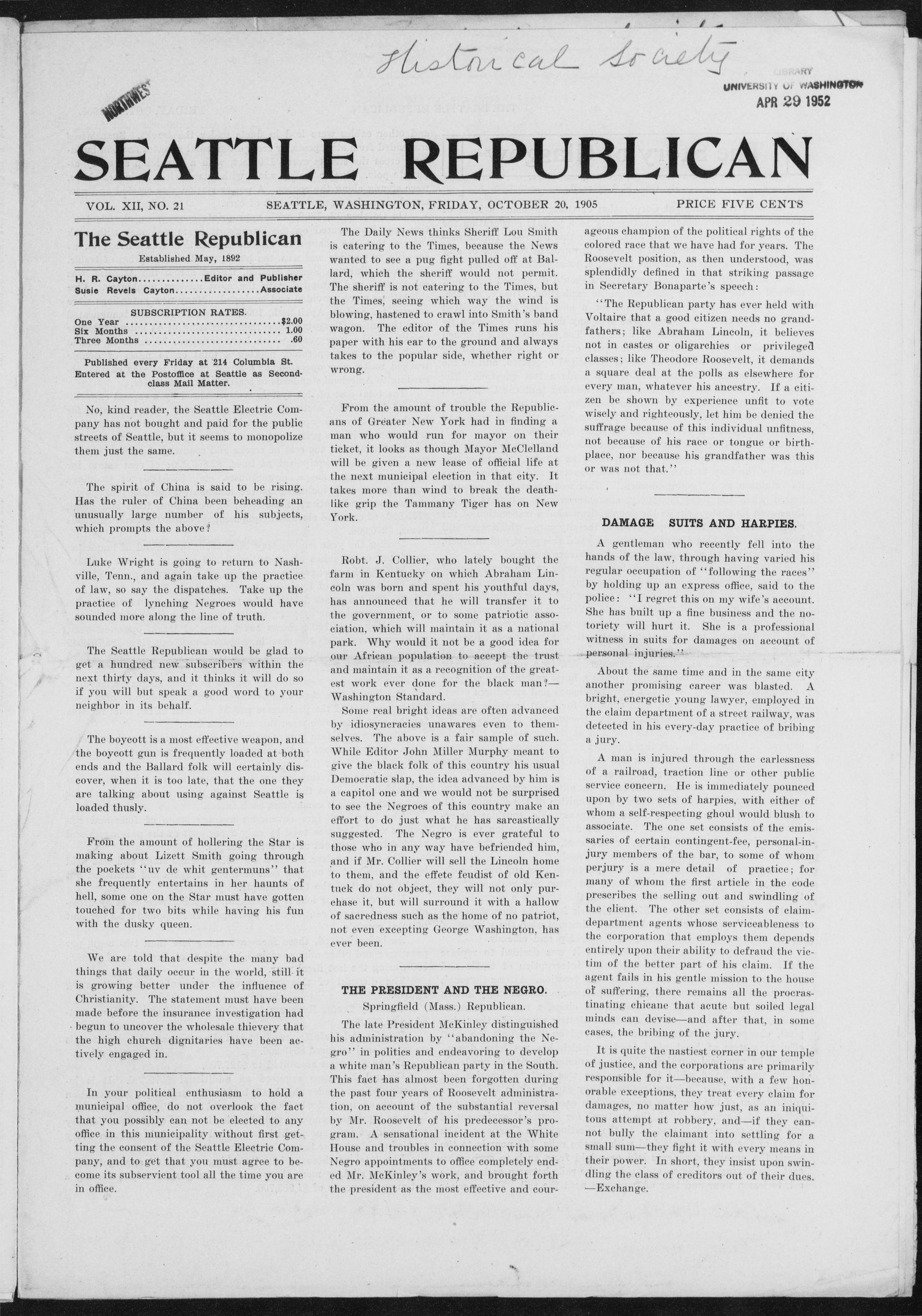
Seattle Republican
Friday, October 20, 1905
Seattle, Washington
Page text (machine-generated)
historical society
SEATTLE REPUBLICAN
NORTHWEST
VOL. XII. NO. 21
The Seattle Republican Established May, 1892
H. R. Cayton.....Editor and Publisher
Susie Revels Cayton.....Associate
One Year ..... $2.00
Six Months ..... 1.00
Three Months ..... .60
Published every Friday at 214 Columbia St.
Entered at the Postoffice at Seattle as Second-
class Mail Matter.
No, kind reader, the Seattle Electric Company has not bought and paid for the public streets of Seattle, but it seems to monopolize them just the same.
The spirit of China is said to be rising. Has the ruler of China been beheading an unusually large number of his subjects, which prompts the above?
Luke Wright is going to return to Nashville, Tenn., and again take up the practice of law, so say the dispatches. Take up the practice of lynching Negroes would have sounded more along the line of truth.
The Seattle Republican would be glad to get a hundred new subscribers within the next thirty days, and it thinks it will do so if you will but speak a good word to your neighbor in its behalf.
The boycott is a most effective weapon, and the boycott gun is frequently loaded at both ends and the Ballard folk will certainly discover, when it is too late, that the one they are talking about using against Seattle is loaded thusly.
From the amount of hollering the Star is making about Lizett Smith going through the pockets "uv de whit gentermuns" that she frequently entertains in her haunts of hell, some one on the Star must have gotten touched for two bits while having his fun with the dusky queen.
We are told that despite the many bad things that daily occur in the world, still it is growing better under the influence of Christianity. The statement must have been made before the insurance investigation had begun to uncover the wholesale thievery that the high church dignitaries have been actively engaged in.
In your political enthusiasm to hold a municipal office, do not overlook the fact that you possibly can not be elected to any office in this municipality without first getting the consent of the Seattle Electric Company, and to get that you must agree to become its subservient tool all the time you are in office.
```markdown
```
SEATTLE, WASHINGTON, FRIDAY, OCTOBER 20, 1905
The Daily News thinks Sheriff Lou Smith is catering to the Times, because the News wanted to see a pug fight pulled off at Ballard, which the sheriff would not permit. The sheriff is not catering to the Times, but the Times, seeing which way the wind is blowing, hastened to crawl into Smith's band wagon. The editor of the Times runs his paper with his ear to the ground and always takes to the popular side, whether right or wrong.
From the amount of trouble the Republicans of Greater New York had in finding a man who would run for mayor on their ticket, it looks as though Mayor McClelland will be given a new lease of official life at the next municipal election in that city. It takes more than wind to break the deathlike grip the Tammany Tiger has on New York.
Robt. J. Collier, who lately bought the farm in Kentucky on which Abraham Lincoln was born and spent his youthful days, has announced that he will transfer it to the government, or to some patriotic association, which will maintain it as a national park. Why would it not be a good idea for our African population to accept the trust and maintain it as a recognition of the greatest work ever done for the black man? Washington Standard.
Some real bright ideas are often advanced by idiosyncracies unawares even to themselves. The above is a fair sample of such. While Editor John Miller Murphy meant to give the black folk of this country his usual Democratic slap, the idea advanced by him is a capitol one and we would not be surprised to see the Negroes of this country make an effort to do just what he has sarcastically suggested. The Negro is ever grateful to those who in any way have befriended him, and if Mr. Collier will sell the Lincoln home to them, and the effete feudist of old Kentuck do not object, they will not only purchase it, but will surround it with a hallow of sacredness such as the home of no patriot, not even excepting George Washington, has ever been.
THE PRESIDENT AND THE NEGRO
Springfield (Mass.) Republican.
The late President McKinley distinguished his administration by "abandoning the Negro" in politics and endeavoring to develop a white man's Republican party in the South. This fact has almost been forgotten during the past four years of Roosevelt administration, on account of the substantial reversal by Mr. Roosevelt of his predecessor's program. A sensational incident at the White House and troubles in connection with some Negro appointments to office completely ended Mr. McKinley's work, and brought forth the president as the most effective and cour-
UNIVERSITY OF WASHINGTON
APR 29 1952
BLICAN
905 PRICE FIVE CENTS
ageous champion of the political rights of the colored race that we have had for years. The Roosevelt position, as then understood, was splendidly defined in that striking passage in Secretary Bonaparte's speech:
"The Republican party has ever held with Voltaire that a good citizen needs no grandfathers; like Abraham Lincoln, it believes not in castes or oligarchies or privileged classes; like Theodore Roosevelt, it demands a square deal at the polls as elsewhere for every man, whatever his ancestry. If a citizen be shown by experience unfit to vote wisely and righteously, let him be denied the suffrage because of this individual unfitness, not because of his race or tongue or birthplace, nor because his grandfather was this or was not that."
---
DAMAGE SUITS AND HARPIES
A gentleman who recently fell into the hands of the law, through having varied his regular occupation of "following the races" by holding up an express office, said to the police: "I regret this on my wife's account. She has built up a fine business and the notoriety will hurt it. She is a professional witness in suits for damages on account of personal injuries."
About the same time and in the same city another promising career was blasted. A bright, energetic young lawyer, employed in the claim department of a street railway, was detected in his every-day practice of bribing a jury.
A man is injured through the carlessness of a railroad, traction line or other public service concern. He is immediately pounced upon by two sets of harpies, with either of whom a self-respecting ghoul would blush to associate. The one set consists of the emissaries of certain contingent-fee, personal-injury members of the bar, to some of whom perjury is a mere detail of practice; for many of whom the first article in the code prescribes the selling out and swindling of the client. The other set consists of claim-department agents whose serviceableness to the corporation that employs them depends entirely upon their ability to defraud the victim of the better part of his claim. If the agent fails in his gentle mission to the house of suffering, there remains all the procrastinating chicane that acute but soiled legal minds can devise—and after that, in some cases, the bribing of the jury.
It is quite the nastiest corner in our temple of justice, and the corporations are primarily responsible for it—because, with a few honorable exceptions, they treat every claim for damages, no matter how just, as an iniquitous attempt at robbery, and—if they cannot bully the claimant into settling for a small sum—they fight it with every means in their power. In short, they insist upon swindling the class of creditors out of their dues. Exchange.
---
THE SEATTLE REPUBLICAN
and other cables were laid in ducts under the tracks. Span wires suspended from steel posts, or from ornamental rosettes fixed in buildings, cross the streets every 120 feet, with a city lamp at every alternate pole. Double trolley wires with guard wires 24 inches above, were strung along the routes. A power station was erected and new car sheds and a new equipment of cars.
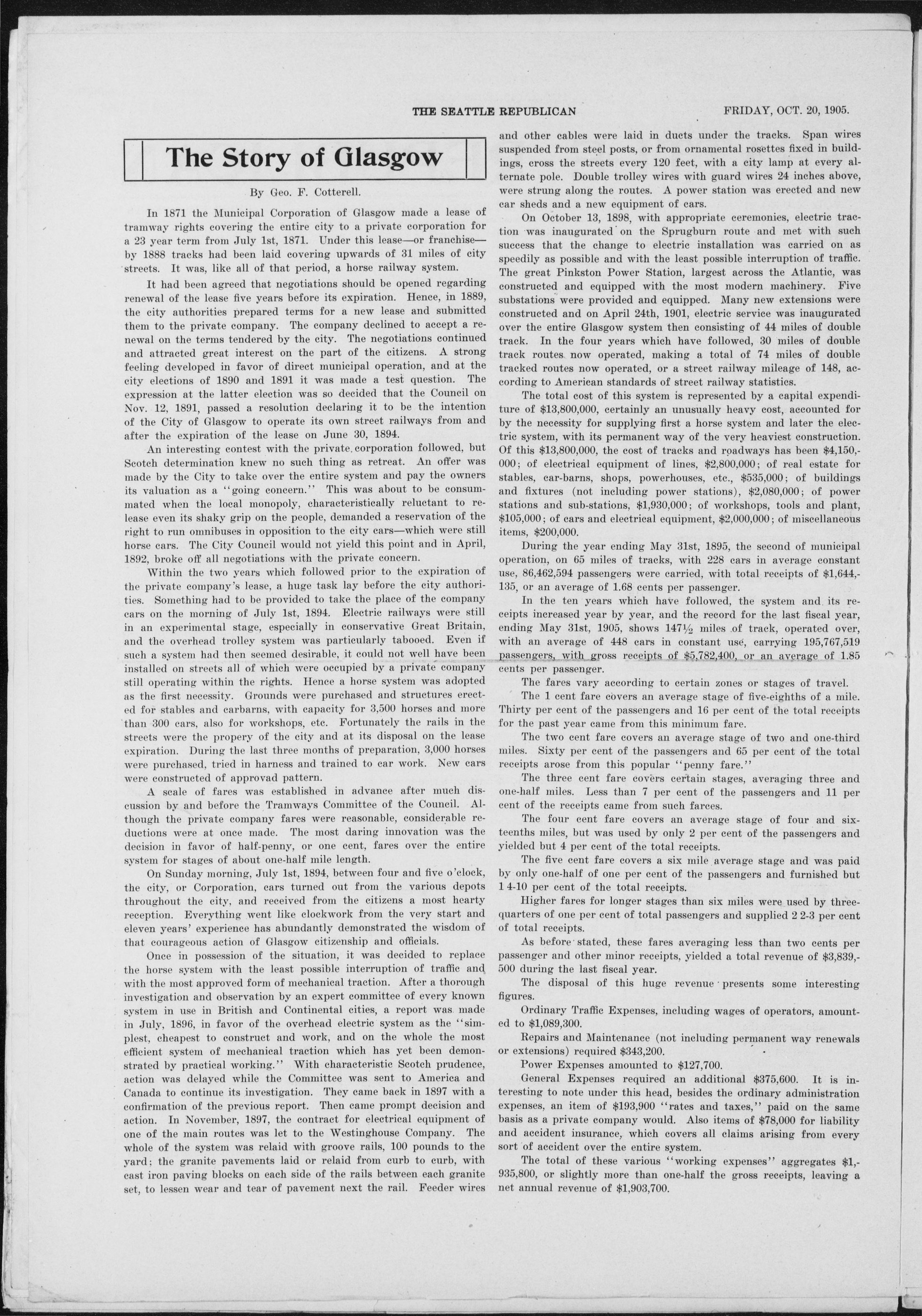
The Story of Glasgow
In 1871 the Municipal Corporation of Glasgow made a lease of tramway rights covering the entire city to a private corporation for a 23 year term from July 1st, 1871. Under this lease—or franchise—by 1888 tracks had been laid covering upwards of 31 miles of city streets. It was, like all of that period, a horse railway system.
On October 13, 1898, with appropriate ceremonies, electric traction was inaugurated on the Sprugburn route and met with such success that the change to electric installation was carried on as speedily as possible and with the least possible interruption of traffic. The great Pinkston Power Station, largest across the Atlantic, was constructed and equipped with the most modern machinery. Five substations were provided and equipped. Many new extensions were constructed and on April 24th, 1901, electric service was inaugurated over the entire Glasgow system then consisting of 44 miles of double track. In the four years which have followed, 30 miles of double track routes now operated, making a total of 74 miles of double tracked routes now operated, or a street railway mileage of 148, according to American standards of street railway statistics.
It had been agreed that negotiations should be opened regarding renewal of the lease five years before its expiration. Hence, in 1889, the city authorities prepared terms for a new lease and submitted them to the private company. The company declined to accept a renewal on the terms tendered by the city. The negotiations continued and attracted great interest on the part of the citizens. A strong feeling developed in favor of direct municipal operation, and at the city elections of 1890 and 1891 it was made a test question. The expression at the latter election was so decided that the Council on Nov. 12, 1891, passed a resolution declaring it to be the intention of the City of Glasgow to operate its own street railways from and after the expiration of the lease on June 30, 1894.
The total cost of this system is represented by a capital expenditure of $13,800,000, certainly an unusually heavy cost, accounted for by the necessity for supplying first a horse system and later the electric system, with its permanent way of the very heaviest construction. Of this $13,800,000, the cost of tracks and roadways has been $4,150,000; of electrical equipment of lines, $2,800,000; of real estate for stables, car-barns, shops, powerhouses, etc., $535,000; of buildings and fixtures (not including power stations), $2,080,000; of power stations and sub-stations, $1,930,000; of workshops, tools and plant, $105,000; of cars and electrical equipment, $2,000,000; of miscellaneous items, $200,000.
An interesting contest with the private corporation followed, but Scotch determination knew no such thing as retreat. An offer was made by the City to take over the entire system and pay the owners its valuation as a "going concern." This was about to be consummated when the local monopoly, characteristically reluctant to release even its shaky grip on the people, demanded a reservation of the right to run omnibuses in opposition to the city cars—which were still horse cars. The City Council would not yield this point and in April, 1892, broke off all negotiations with the private concern.
During the year ending May 31st, 1895, the second of municipal operation, on 65 miles of tracks, with 228 cars in average constant use, 86,462,594 passengers were carried, with total receipts of $1,644,-135, or an average of 1.68 cents per passenger.
Within the two years which followed prior to the expiration of the private company's lease, a huge task lay before the city authorities. Something had to be provided to take the place of the company cars on the morning of July 1st, 1894. Electric railways were still in an experimental stage, especially in conservative Great Britain, and the overhead trolley system was particularly tabooed. Even if such a system had then seemed desirable, it could not well have been installed on streets all of which were occupied by a private company still operating within the rights. Hence a horse system was adopted as the first necessity. Grounds were purchased and structures erected for stables and carbarns, with capacity for 3,500 horses and more than 300 cars, also for workshops, etc. Fortunately the rails in the streets were the proper of the city and at its disposal on the lease expiration. During the last three months of preparation, 3,000 horses were purchased, tried in harness and trained to car work. New cars were constructed of approvad pattern.
In the ten years which have followed, the system and its receipts increased year by year, and the record for the last fiscal year, ending May 31st, 1905, shows $147\frac{1}{2}$ miles of track, operated over, with an average of 448 cars in constant use, carrying 195,767,519 passengers, with gross receipts of $5,782,400, or an average of 1.85 cents per passenger.
The fares vary according to certain zones or stages of travel.
The 1 cent fare covers an average stage of five-eighths of a mile. Thirty per cent of the passengers and 16 per cent of the total receipts for the past year came from this minimum fare.
The two cent fare covers an average stage of two and one-third miles. Sixty per cent of the passengers and 65 per cent of the total receipts arose from this popular "penny fare."
The three cent fare covers certain stages, averaging three and one-half miles. Less than 7 per cent of the passengers and 11 per cent of the receipts came from such farces.
A scale of fares was established in advance after much discussion by and before the Tramways Committee of the Council. Although the private company fares were reasonable, considerable reductions were at once made. The most daring innovation was the decision in favor of half-penny, or one cent, fares over the entire system for stages of about one-half mile length.
The four cent fare covers an average stage of four and sixteenths miles, but was used by only 2 per cent of the passengers and yielded but 4 per cent of the total receipts. The five cent fare covers a six mile average stage and was paid by only one-half of one per cent of the passengers and furnished but 14-10 per cent of the total receipts.
On Sunday morning, July 1st, 1894, between four and five o'clock, the city, or Corporation, cars turned out from the various depots throughout the city, and received from the citizens a most hearty reception. Everything went like clockwork from the very start and eleven years' experience has abundantly demonstrated the wisdom of that courageous action of Glasgow citizenship and officials.
Higher fares for longer stages than six miles were used by three-quarters of one per cent of total passengers and supplied 22-3 per cent of total receipts.
As before stated, these fares averaging less than two cents per passenger and other minor receipts, yielded a total revenue of $3,839,-500 during the last fiscal year.
Once in possession of the situation, it was decided to replace the horse system with the least possible interruption of traffic and with the most approved form of mechanical traction. After a thorough investigation and observation by an expert committee of every known system in use in British and Continental cities, a report was made in July, 1896, in favor of the overhead electric system as the "simplest, cheapest to construct and work, and on the whole the most efficient system of mechanical traction which has yet been demonstrated by practical working." With characteristic Scotch prudence, action was delayed while the Committee was sent to America and Canada to continue its investigation. They came back in 1897 with a confirmation of the previous report. Then came prompt decision and action. In November, 1897, the contract for electrical equipment of one of the main routes was let to the Westinghouse Company. The whole of the system was relaid with groove rails, 100 pounds to the yard; the granite pavements laid or relaid from curb to curb, with cast iron paving blocks on each side of the rails between each granite set, to lessen wear and tear of pavement next the rail. Feeder wires
The disposal of this huge revenue presents some interesting figures.
Ordinary Traffic Expenses, including wages of operators, amounted to $1,089,300.
Repairs and Maintenance (not including permanent way renewals or extensions) required $343,200.
Power Expenses amounted to $127,700.
General Expenses required an additional $375,600. It is interesting to note under this head, besides the ordinary administration expenses, an item of $193,900 "rates and taxes," paid on the same basis as a private company would. Also items of $78,000 for liability and accident insurance, which covers all claims arising from every sort of accident over the entire system.
The total of these various "working expenses" aggregates $1,-935,800, or slightly more than one-half the gross receipts, leaving a net annual revenue of $1,903,700.
By Geo. F. Cotterell.
FRIDAY, OCT. 20, 1905
THE SEATTLE REPUBLICAN
aggregate $783,000, and now require $125,000 annually. This "Common Good Fund" is not used for ordinary city expenses but is held for application to great municipal projects which may require extraordinary expenditures, beyond immediate taxation resources.
This was applied last year as follows:
For interest on borrowed capital ..... $249,500
For sinking fund against borrowed capital ..... 234,600
Into the Depreciation and Permanent Way Renewals Fund
there was set aside ..... 766,500
To the “Common Good Fund” of the City of Glasgow was
Under a bonus scheme established in 1903, 86 per cent of the motormen qualified last year and received $12,370 in addition to their regular pay. A slight general increase of wages of all operating employees also went into effect last January.
appropriated ..... 125,000
Miscellaneous items received a total of ..... 61,600
and an absolute surplus of $466,500 remaining was carried forward into an "Appropriation Fund" for special emergency and reserve uses.
There are now 683 electric cars in service and 100 new cars are now being constructed of latest approved top-covered double-deck design.
Of the total capital cost for entire system to date, viz.: $13,800,000, originally borrowed, there remains a debt of $8,915,000, the difference of almost $5,000,000 having been reduced by sinking fund allowances during past eleven years.
The population served by the Glasgow Corporation Railways is about 1,000,000. The system covers the entire city with outside lines to Paisley, Govan and other adjacent towns. Eleven miles of new trackage are under construction this year, which will bring the total track mileage up to 159 miles.
The Depreciation and Permanent Way Renewal Fund now contains $3,888,000, available as required and accumulating against future necessities.
Surely the eleven years' experience of the City of Glasgow well supports the simple, but strong statement of Sir Charles Cameron, one of her leading citizens, and a Member of Parliament, made at the exercises held in honor of the general inauguration of electric service four years ago. In giving the toast "The Corporation of Glasgow," Sir Charles Cameron said:
Certain general reserve and special funds have $505,000 set aside for special and emergency purposes. The payment of taxes has amounted in eleven years to a total of 788,000, increasing each year and now requiring nearly $200,000 annually.
::The sagacity, foresight and energy shown by the members of the Corporation during a long series of years, has secured for the
The direct payments to the "Common Good Fund" of the City of Glasgow, from street railway revenues, during eleven years past,
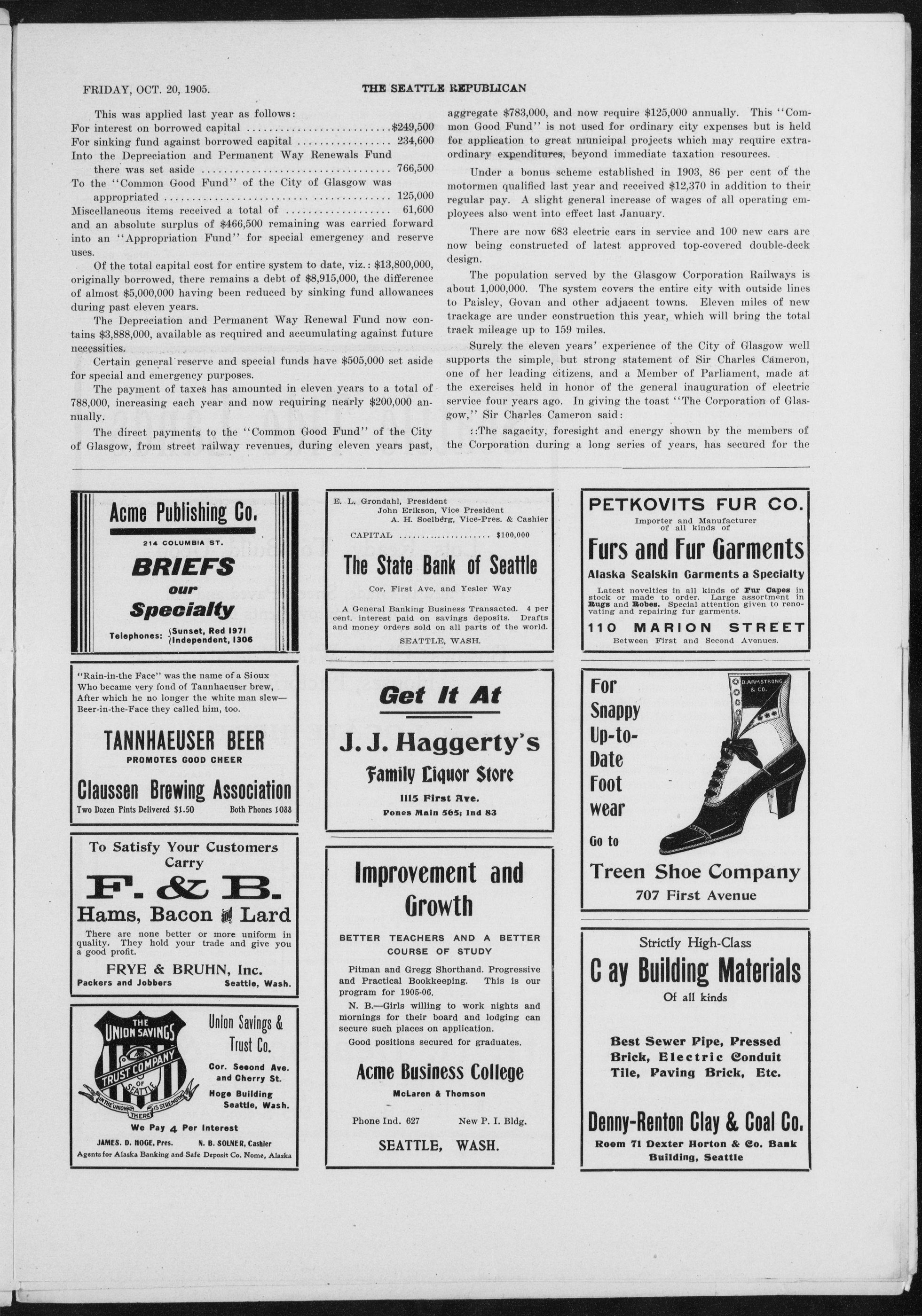
Acme Publishing Co.
214 COLUMBIA ST.
BRIEFS
our
Specialty
Telephones: (Sunset, Red 1971
Independent, 1306
E. L. Grondahl, President
John Erikson, Vice President
A. H. Soelberg, Vice-Pres. & Cashier
CAPITAL $100,000
The State Bank of Seattle
Cor. First Ave. and Yesler Way
A General Banking Business Transacted. 4 per cent. interest paid on savings deposits. Drafts and money orders sold on all parts of the world.
SEATTLE, WASH.
PETKOVITS FUR CO.
Importer and Manufacturer
of all kinds of
Furs and Fur Garments
Alaska Sealskin Garments a Specialty
Latest novelties in all kinds of Fur Capes in stock or made to order. Large assortment in Bugs and Robes. Special attention given to renovating and repairing fur garments.
110 MARION STREET
Between First and Second Avenues.
"Rain-in-the Face" was the name of a Sioux Who became very fond of Tannhaeuser brew, After which he no longer the white man slew—Beer-in-the-Face they called him, too.
TANNHAEUSER BEER
PROMOTES GOOD CHEER
Claussen Brewing Association
Two Dozen Pints Delivered $1.50 Both Phones 1088
Get It At
J. J. Haggerty's
Family Liquor Store
1115 First Ave.
Pones Main 565; Ind 83
To Satisfy Your Customers
Carry
F. & B.
Hams, Bacon and Lard
There are none better or more uniform in quality. They hold your trade and give you a good profit.
FRYE & BRUHN, Inc.
Packers and Jobbers Seattle, Wash.
Improvement and Growth
BETTER TEACHERS AND A BETTER COURSE OF STUDY
Pitman and Gregg Shorthand. Progressive and Practical Bookkeeping. This is our program for 1905-06.
N. B.—Girls willing to work nights and mornings for their board and lodging can secure such places on application.
Good positions secured for graduates.
Acme Business College
McLaren & Thomson
Phone Ind. 627 New P. I. Bldg.
SEATTLE, WASH.
Strictly High-Class
Cay Building Materials
Of all kinds
Best Sewer Pipe, Pressed Brick, Electric Conduit Tile, Paving Brick, Etc.
The Union Savings & Trust Co.
Cor. Second Ave. and Cherry St.
Hoge Building Seattle, Wash.
We Pay 4 Per Interest
JAMES. D. HOGE, Pres. N. B. SOLNER, Cashier
Agents for Alaska Banking and Safe Deposit Co. Nome, Alaska
FRIDAY, OCT. 20, 1905
of the great city, over which he then presided, he said with all the
strength and brevity and truth:
“The Corporation of Glasgow has never been afraid to tackle
any position if they thought the capture of that position would be
for the benefit of the community as a whole. It was in that spirit
that they had endeavored to secure, and had secured the control of
the tramway system. It was in that-spirit that they had endeavored
to secure the position which they now occupied in regard to the tel-
ephone, and it was in the same spirit that the Corporation continued
to earry on those varied enterprises which they had indicated. One
factor which continued to give them confidence and courage was the
fact that they believed they retained the unabated confidence of their
fellow-citizens.’’
municipality a position which not even the immense population of the
city, or its great commercial importance could have secured it, viz.:
the reputation, not merely throughout the United Kingdom, but
throughout the whole civilized world, of being a model of municipal
administration. For more than the memory of a generation, the
municipal water supply of Glasgow has been the envy and admiration
of our great towns. The Glasgow corporation was among the first
to municipalize the gas supply of the city. It was among the pioneers
in the muniepalization of the tramway system. We have still another
electric experiment on hand. Glasgow has been from the first the
pioneer of the municipal telephone system.”’
And the reply of the Lord Provost, Sir Samuel Chisholm, gives
the whole explanation—the Glasgow spirit. Responding on behalf
‘
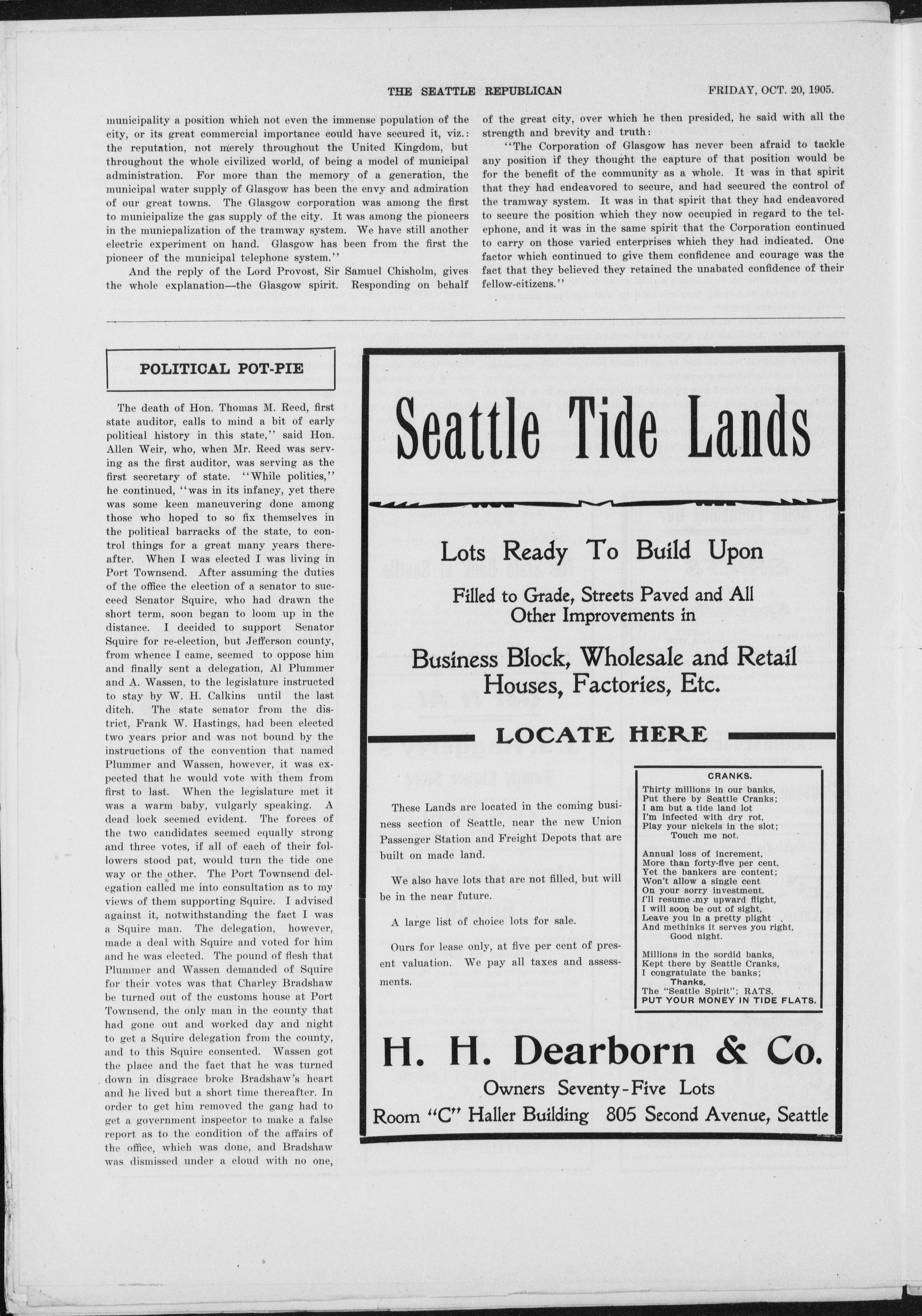
Lots Ready To Build Upon
Filled to Grade, Streets Paved and All
‘
Other Improvements in
, ‘
Business Block, Wholesale and Retail
s
Houses, Factories, Etc.
CRANKS.
Thirty millions in our banks,
” ‘ Put there by Seattle Cranks;
These Lands are located in the coming busi- I am but a tide land lot
ness section of Seattle, near the new Union SEH ieee oP ineciot:
Passenger Station and Freight Depots that are Touch me not.
built on made land. Annual loss of increment,
More than forty-five per cent,
i - Yet the bankers are content;
We also have lots that are not filled, but will Won't allow a single cent
be in the near future. On Neaumnaany Eee ent:
I will soon be out of sight,
A large list of choice lots for sale. ea eee eee peu aene
Good night.
Ours for lease only, at five per cent of pres- = ie & :
: Millions in the sordid banks,
ent valuation. We pay all taxes and assess- | Kept there by Seattle Cranks,
I congratulate the banks;
ments. Thanks,
The “Seattle Spirit’; RATS,
PUT YOUR MONEY IN TIDE FLATS.
H. H. Dearborn & Co.
*
Owners Seventy-Five Lots
tt stag
Room “C” Haller Building 805 Second Avenue, Seattle
SEGRE R28 RAS PPA SAA IS IS ST AT BRE SS ET SRY A
POLITICAL POT-PIE
The death of Hon. Thomas M. Reed, first
state auditor, calls to mind a bit of early
political history in this state,’’ said Hon.
Allen Weir, who, when Mr. Reed was serv-
ing as the first auditor, was serving as the
first secretary of state. ‘‘While politics,’’
he continued, ‘‘was in its infancy, yet there
was some keen maneuvering done among
those who hoped to so fix themselves in
the political barracks of the state, to con-
trol things for a great many years there-
after. When I was elected I was living in
Port Townsend. After assuming the duties
of the office the election of a senator to suc-
eeed Senator Squire, who had drawn the
short term, soon began to loom up in the
distance. I decided to support Senator
Squire for re-election, but Jefferson county,
from whence I came, seemed to oppose him
and finally sent a delegation, Al Plummer
and A. Wassen, to the legislature instructed
to stay by W. H. Calkins until the last
ditch. The state senator from the dis-
trict, Frank W. Hastings, had been elected
two years prior and was not bound by the
instructions of the convention that named
Plummer and Wassen, however, it was ex-
pected that he would vote with them from
first to last. When the legislature met it
was a warm baby, vulgarly speaking. A
dead lock seemed evident. The forces of
the two candidates seemed equally strong
and three votes, if all of each of their fol-
lowers stood pat, would turn the tide one
way or the other. The Port Townsend del-
egation called me into consultation as to my
views of them supporting Squire. I advised
against it, notwithstanding the fact I was
a Squire man. The delegation, however,
made a deal with Squire and voted for him
and he was elected. The pound of flesh that
Plummer and Wassen demanded of Squire
for their votes was that Charley Bradshaw
be turned out of the customs house at Port
Townsend, the only man in the county that
had gone out and worked day and night
to get a Squire delegation from the county,
and to this Squire consented. Wassen got
the place and the fact that he was turned
down in disgrace broke Bradshaw’s heart
and he lived but a short time thereafter. In
order to get him removed the gang had to
get a government inspector to make a false
report as to the condition of the affairs of
the office, which was done, and Bradshaw
was dismissed under a cloud with no one,
THE SEATTLE REPUBLICAN
FRIDAY, OCT. 20, 1905.
FRIDAY, OCT. 20, 1905.
not even Senator Squire to say one word in his behalf. A subsequent investigation, however, proved instead of Bradshaw squandering the government's money the government actually owed him twenty-seven dollars. It was the irony of fate and, as said above, poor Bradshaw died broken hearted. Wassen held the office one term and he is now somewhere in British Columbia in total obscurity. Al Plummer killed himself while hunting and it was whispered at the time that it was not an accident. Hastings is still in Port Townsend, but without political influence. Senator Squire lost his prestige in the politics of the state and can not now hardly be counted a citizen of the state. That politics make strange bedfellows, from sad experience, I can verily testify to."
The latest in the local political situation is Mayor Ballinger is favorably considering being a candidate to succeed himself. Strong pressure from time to time has been brought on him to reconsider his opposition to becoming a candidate for the place and it is currently reported that he is thinking better of it just now.
It has also been learned by the Pie-maker during the past week that, in case Mayor Ballinger decides not to run for mayor to succeed himself the powers that be will hand the nomination to John Riplinger on a silver platter, so to speak, and they say he will not refuse.
There are still other candidates hoping to succeed Mayor Ballinger and among them is Irving T. Cole. "If the mayor becomes a candidate for re-election," said a friend of Mr. Cole, "he, Cole, will not be a candidate for either mayor or councilman."
Josiah Collins is still pushing his claims and it is said the Seattle Electric Company would be willing to give their two eyes and go blind if he could be nominated and elected.
Madam Rumor has it that Judge Battle is very anxious to be mayor of Seattle and that he would not be averse to having a Republican nomination for the place. He will be a candidate on some ticket if he can get the nomination if Mayor Ballinger is not nominated.
The Democrats will nominate Edward Cudihee for mayor and he is going to get hundreds of Republican votes. If Collins is nominated Cudihee will be elected by 2,000 plurality. If Mayor Ballinger is renominated, Cudihee will give him a close rub. If Riplinger is nominated Cudihee would be beaten by 3,000 plurality.
Seattle consumes 40,000 pounds of fish every day. It is no wonder that so many of her inhabitants talk "deals" that are fishy, indulge in scaley transactions, fin you in the back and as soon as opportunity permits swim away from you to float in other (political) schools.
The endeavors some have put forth to endeavor to find what was the general opinion regarding the Endeavors' meeting here
has given the city more advertisement, in a way, concerning her capacity when endeavoring to entertain than she ever got of her own free endeavors.
THE PASSING THRONG
The mayor of the town of Tuskegee, in which the school of the same name is located, which school is so ably presided over by the distinguished Booker The President and the South. T. Washington, says "the town and its officials will not assist Tuskegee institute to entertain President Roosevelt when he stops over there
on his Southern tour," whereupon the Boston Transcript rises to remark, "who the devil ever heard of Tuskegee until Booker T. Washington made it?" The public remembers it was but a few days ago that the city council of Mobile, the commercial capitol of the state, refused to appropriate any money for the entertainment of the President, and that too after the leading folk of the city had previously invited him to be the city's guest while touring the South. All such clap-trap, cheap-John notoriety is purely Southern and common to that class of Southerners who base their claim to greatness and superiority on the color of their skins rather than the amount of grey matter they really possess. What damphools some of us mortals be.
The article in The Seattle Republican two weeks ago in reference to persons with Negro blood in their veins coming to the Sound and passing for Anglo-Saxons was widely read and commented upon. Two street philosophers were standing in front of a certain block talking about the article when there brisked by a lady well known to them both and who in the South would not pass for nothing more than a mulatto, but who has married in the upper crust of Anglo-Saxondom in this city and is getting by. "Well," said one of them, "that lady's husband may think he has married a pure Anglo-Saxon, but if he does I would not give very much for his judgment."
"When I look at that lady I am always reminded of a story that I once read in The Seattle Republican, which ran like this," replied the other. "In a certain community in Iowa there lived an Anglo-Saxon family who had a son that was quite brunette in complexion, yes, so much so that it excited the curiosity of the corner grocery keeper, and he brooded over it so long that he finally decided to make some personal inquiry about the lusus naturae. 'Boy,' he began, after he had stood it as long as he could, 'why are you so black?' 'Before I was born a nigger chased my mother,' came instantly from the boy, showing that he had been previously posted by some one for just such an emergency. The grocer meditatively stood for a minute, then he mused to himself in an undertone, 'and I am awfully afraid he caught her.'"
On a Port Townsend Southern passenger train a few days ago two state dignitaries
sat discussing things in general and the country and its people in particular. That morning the paper had told of two Kentukians, who had come to Oregon to live and brought with them their Kentucky feud and attempted to settle their troubles along similar lines as they do in Kentucky. "The state of Kentucky is a mighty good place to live if those feuds could only be cut out." "That will be done sooner or later," replied the other, "for Northern folk and foreigners are settling in the state and they will entermarry with the natives and make a very much stronger race. I am an ardent advocate of the mixture of the different race for from it comes a stronger and a more vigorous race than any of the old ones." I hope you do not mean to include the Negroes in that," came from his companion. "Not by any means," he quickly replied. "I am inclined to think a mixture with the Negro would weaken rather than strengthen the white race." By this time the train had reached the Bush prairie farm, which is one of the finest in Western Washington, which grew wheat that took the world's prize at the Centenial exhibition at Philadelphia in 1876. "This is one of the finest farms in the state and it is owned by one of the best citizens and the finest men I ever met. He has been a leader of affairs in this county and even in some instances in the state for a number of years. I have met his family and they are ideal citizens." He grew enthusiastic over their good qualities. What a contrast with what had been said but a few minutes previous about the white man mixing with the black man and declaring it weakening to the white race. The father of the man Bush was as black as the ace of spades. He migrated from Virginia, where he was even a slave. He married a white Western woman and the couple reared a fine family, every member of whom married white and the family is noted for the strong personnel of the various members, both male and female. Now if this case is a sample, the mixture of the races including even the Negro would make a much stronger and hearty race in this country, their frequent swarthy complexions to the contrary notwithstanding, than has even been seen in the history of the world.
"What's in a name," exclaimed Joe Kuhn, the well known Port Townsend pioneer, one day last week. "There are a whole lot of persons who answer to the sound of my name and yet they are not only no relations of mine, but really have different names. Down in Port Townsend one of the prominent men of this state lives and he answers to the name of Hon. Charles E. Coon, lieutenant governor and mayor, then there is Old Joe Kuhn, your humble servant, and finally, there is black "coon" and all of our names sound like one and the same and to the outsider it would be hard to distinguish who was being called, discussed or criticised when the home folk get to speaking of one or the other. Whether it was Governor-Mayor Coon, Old Joe Kuhn or "the coon," who shines, was wanted, from the sound of the name would be a puzzle, and I must confess that I frequently get very badly confused trying to distinguish whether the mayor, myself or our brother in black is wanted.
An Iowa sportsman, having read a "fish story," condescended to relate a bit of experience he had, and the editor hereof, believing it to be the biggest lie ever published, reproduces it to get your opinion on it. The story runs as follows:
"I had been hunting all day with an old powder and ball rifle without success, when, coming up to the edge of the stream, I discovered eleven wild turkeys on a limb not more than thirty-five yards away. I knew it would be impossible to get more than one of them if I shot to kill, so I resolved to try
HUMAN ODDITIES.
The first Carnegie hero prizes have been awarded and neither William Jennings Bryan nor Jerome K. Jerome were among the winners.
After a thirty-year "its mine" by right of capture, a valuable pearl necklace has been returned to its original owner. It took the purloiners a long time to get conscience struck, but better late than never.
After five years' stormy session, Minister Powell, Uncle Sam's representative at the Haytian court, gives up the ghost and Dr. H. W. Furniss, consul to Bahae, Brazil, will succeed him. The constant dripping of water will wear the hardest stone away.
If Folk of Missouri is not careful he will find himself in Bryan's boots, talking too much out of his mouth. With Bryan, La Follette and Folk globe trotting, trying to reform the world, a hot time is promised.
The sun, it is claimed by a London astronomer, has been ten million years cooling down to its present heat. It will hardly reach the freezing state before "we" shuffle off this mortal coil.
A wealthy woman of New York, who had lived for one year in a first-class hotel, and who had spent money freely on food and livery, drew the attention of the housekeeper by the great demand she made for linen. Suddenly she notified the proprietor that she was going to take her leave. He entered her room with a pass key and on opening her trunks with a skeleton key found quite a supply of his sheets, table covers, pillow slips, and towels. They were too numerous for souvenirs, so he quietly removed them and relocked the trunks. The odd part of it is that she was rich enough to buy all the linen she wanted.
Says an authority on music:
"Any succession of single or combined tones which in their rendering carry with them some expression of the thoughts or emotions of the performer, is music."
This information comes as a relief for there are times when the musical performer certainly seems to be expressing his thoughts or emotions, but we had wondered if the sounds he produced could be called music.
Twenty aborigines from Port Madison reservation received over $3,000 from the government in return for improvements on seventy acres of land purchased by the war department for a fort. This amount was divided among them from a Seattle bank and they returned to Port Madison on the steamer Reliance. Now the question with the American wily is how to get some of that money away from those "first sons" of the land.
THE SEATTLE REPUBLICAN
Some claim that true love is dying out so rapidly that it will soon be a thing of the past. Reported recently, was a case of a lecturer who heard a laugh and fell in love with her who gave it and hunted for her for seven years begore he found and married her. Now comes the dismissal of Grand Duke Cyril, his deprival of honors and money because of his recent marriage to the Princess Victoria, the divorced wife of the Grand Duke of Hesse. Some of the flames of love are still burning it would appear.
Miss Mabel Freene, who has the distinction of being the first woman free rural delivery letter carrier, appointed in the United States, has married Harry C. Wright, another letter carrier. She substituted for years on a route which goes over a mountainous region and won for herself a great record for facing blinding snowstorms and heavy rains. Perchance her experience in facing storms will come in for Wright alright.
One George Sheets, a blind piano tuner of Western Kansas, is greatly rejoiced because of an accident which he lately sustained. When but a youth an accident caused him to become blind in one eye. Shortly afterward the sight of the other one failed and he was totally blind. Not long since he stumbled and fell, striking his head with much force. In an hour's time after the fall Sheets had regained his eyesight. The shock of the fall doubtless effected the cure which had baffled physicians for years.
Tom Armstrong, a Cleary creek operator near Fairbanks, and William Kerr, a recent arrival from Dawson, fought thirty-five minutes with bare knuckles in a barn for the possession of a dog. Armstrong received two fractured ribs from a kick in the side and was otherwise badly bruised, and Kerr had to be carried away by fr.ends. The men agreed that the first one to squeal was to give up all claim to the dog. Kerr was the first to cry enough. About thirty spectators were present and it would not seem so much out of the ordinary if they had been barned up to witness two dogs fighting over their owner, but two men bruising each other up over a dog. Men are supposed to be above the kingdom which settles all disputes by brute force.
Chief Cook has issued a new order to firemen which is in keeping with the reform he has inaugurated. The object is to bring the Seattle firemen up to the highest standard of efficiency. It provides that no intoxicating liquors shall be kept or drank in or about the department premises. The firemen are also forbidden to even enter a saloon when on duty. Smoking while on duty is also prohibited and the smoking of cigarettes at any time in the houses or on the premises of the department will not be tolerated. These rules regarding smok-
the old Indian way—to shoot at the branch, creck it, and let their toes fall in. This I did and it held them securely. The ball passed through the branch and out into the river, killing a large fish. While wading for the fish my clothes became full of little fishes, and as I came near the shore the pressure became so great that the top button of my trousers flew off with such force as to kill a rabbit sitting in the grass on the bank of the stream.
"I cut off the limb holding the turkeys, strung the fishes on my rifle barrel, put the rabbit in my hunting coat, and with what
Grah
SPECIAL SILK
$10, $12, and S
Come in taffeta, peau de cygne, peau
nets. All sizes and colors; pink, b
lemon, ecru, black and white. No, th
very finest of the last season's stock
and tailored. Only the finest quality
collection. These waists sold last ye
and $15.00. Any number of styles to
cost price
Come in taffeta, peau de cygne, peau de soie, crepe de chine, all-over laces and nets. All sizes and colors; pink, blue, red, gray, lavender, navy, green, lemon, ecru, black and white. No, they are not new, but they represent the very finest of the last season's stock. Made in the best styles, both fancy and tailored. Only the finest quality silks and nets are shown in this great collection. These waists sold last year at $7.50, $10.00, $12.50 and $15.00. Any number of styles to select from at less than cost price $3.95
Our collection of new and up-to-date Skirts for street wear is exceptional,
every new shape and fabric represented; attractive prices.
Swell Black Panama Cloth Skirt,
made with yoke effect and kilted from
yoke, falling loose in inch pleats
$10.00
Black and Blue Panama Circular
Skirts, with two folds of same ma-
terial around bottom; fine pleats back
and front $17.50
Stylish Black Panama Cloth Skirt,
well shaped and tailored; very full;
an exceptional skirt at $15.00
Black Panama Circular Skirt, with
stitched bands of same. Three box
pleats front and back: stitched bands
on hip. Nicely tailored, splendid
value $12.50
714-20
Second Ave.
ing and drinking apply to every member of the department from the chief down. As Chief Cook does not use tobacco in any form the order will not cause him much inconvenience. There is some grumbling among the men at the station, but they have all given up the use of the weed in accordance with the orders. Chief Cook states that he wants to make the Seattle fire department one of the finest in the world, and will gradually wean the men from their bad habits. If refraining from the use of tobacco makes the firemen more efficient why would it not improve other men in different lines of business?
If the citizens on Renton Hill were permitted a say they would unanimously decide that in future the city do its own paving of its streets and all because the contractors that are playing paying up there are moving snail like and will not finish before next summer a job that should have been finished by not later than September 15th. Had the proper push been used it would long since have been done. The city is getting "nasty deals" by all the grading and paving contractors, which is sufficient evidence that the city in future should do its own paving.
to shoot at the branch, to toes fall in. This I securely. The ball branch and out into the fish. While wading for same full of little fish the shore the pressure the top button of my much force as to kill a small fish trudged there girls" at of the young J board. she be r
aham's
SILK WAIST SALE
and $15 Values $3.95
argne, peau de soie, crepe de chine, all-over laces and
pink, blue, red, gray, lavender, navy, green,
white. No, they are not new, but they represent the
season's stock. Made in the best styles, both fancy
best quality silks and nets are shown in this great
old last year at $7.50, $10.00, $12.50
of styles to select from at less than $3.95
Women's Street Skirts
J.S.Graham 714-20 Second Ave.
small fishes I could keep in my clothes trudged home for a square meal."
There has been a shortage of "Hello girls" at Berkley, Cal., and the management of the Sunset Telephone Company put a young Japanese girl to work at the switchboard. The American girls have asked that she be removed. It is all right for her to cook their dinners, but they do not wish her to work with them in the telephone office, even if the company is so short of girls
There has been a shortage of "Hello girls" at Berkley, Cal., and the management of the Sunset Telephone Company put a young Japanese girl to work at the switchboard. The American girls have asked that she be removed. It is all right for her to cook their dinners, but they do not wish her to work with them in the telephone office, even if the company is so short of girls as to give general dissatisfaction to its patrons.
FRIDAY, OCT. 20, 1905
Stylish Black Panama Cloth Skirt,
well shaped and tailored; very full;
an exceptional skirt at.....$15.00
Black Panama Circular Skirt, with
stitched bands of same. Three box
pleats front and back; stitched bands
on hip. Nicely tailored, splendid
value.....$12.50
What was the matter with Mrs. Herman? She did not break Jerome's voodoo and get that "thousand."
Not long since John B. Hart, the well known local attorney, succeeded in having the city enjoined from cutting down the street in front of his property on Thirteenth avenue, but at the time of the granting of the injunction the street had already been lowered some ten feet or more. Now the members of the board of public works declare they will leave the street in its present condition until the residents in the immediate neighborhood get good and tired and will force Mr. Hart to call it off. Meanwhile there is no doubt but that his property has depreciated fully 50 per cent in value on account of the cut.
Of course the railroads want the Christian Endeavorers because it means all income to them. Do the railroads want them bad enough to put up the required $25,000 for the entertainment of the "high moguls" 6f the convention? If not let them hush up. It will be like throwing that much money away for the citizens to raise $25,000 for that convention from which neither the city nor the citizens will get value received. That amount of money could be used much more advantageously.
714-20 Second Ave.
FRIDAY, OCT. 20, 1905.
IN THE SUPERIOR COURT OF
the State of Washington for the
County of King.
Nellie M. Smith, plaintiff, vs. Samuel
W. Smith, defendant. No. _____
Summons by Publication.
Summons by
The State of Washington to the
said Samuel W. Smith, defendant:
You are hereby summoned to appear
within sixty days after the date of
the first publication of this summons,
to-wit: within sixty days after
the 22nd day of September, A. D.,
1905, and defend the above entitled
action in the above entitled court,
an answerer the complaint of the
plaintiff, and serve a copy of your
answer upon the undersigned attorney
for plaintiff at his office below
stated; and in case of your failure
so to do, judgment will be rendered
against you according to the demand
of the complaint, which has been filed
with the Clerk of said Court. The
object of the said action is to dis-
solve the bonds of matrimony exist-
ing between the plaintiff and defa-
endant herein on the grounds of aban-
donment and extreme cruelty, and ad-
judication of property rights and for
general relief.
Postoffice and office address: 539 Burke Block, Seattle, County of king, Washington.
IN THE SUPERIOR COURT OF the State of Washington for King County.
J. J. Smith, plaintiff, vs. Oszer Mosher and Jane Doe Mosher, his wife, whose true first name is to plaintiff unknown, and all persons unknown, if any, having or claiming an interest or estate in and to the hereinafter described real property, defendants. No. Notice and Summons.
State of Washington to Oszer Mosher and Jane Doe Mosher, his wife, who are the owners or reputed owners of, and all persons unknown, claiming or having an interest or estate in and to the hereinafter described real property. You and each of you are hereby notified that the above named plaintiff, J. J. Smith, is the holder of one certain delinquent tax certificate, numbered as hereinafter stated, issued by the County Treasurer of King County, State of Washington, embracing the following real property situated in said King County, Washington, and more particularly described as follows, to-wit:
You and each of you (including said persons unknown, if any), are hereby further notified and summoned to be and appear within sixty days after the service of this notice, exclusive of the day of the first publication, to-wit: within 60 days after the 1st day of September, 1905, in the above entitled Court and action, and defend this action and answer the complaint of said plaintiff and serve a copy of your answer on the undersigned attorney for plaintiff at his office below stated, or pay the amount, together with penalty, interest and costs. In case you fail so to do judgment will be rendered against you and against each parcel of said real property for the sums and amounts due upon and charged against each, including costs, ordering a sale of each parcel of said property for the satisfaction of the sums charged and found against it respectively as provided by law, and as prayed in plaintiff's complaint now on file in this cause and court. J. J. SMITH. Plaintiff.
Attorney for Plaintiff.
Office address: 513 Marion Block,
Seattle, Wash.
First publication 1st day of September, 1905.
IN THE SUPERIOR COURT OF
King County, State of Washington,
James G. Pennfield, plaintiff, vs.
Catherine Pennfield, defendant. No.
48163.
The State of Washington to the
said Catherine Pennfield:
You are hereby summoned to appear within sixty days after the date of the first publication of this summons, to-wit, within sixty days after the 18th day of August, 1905, and defend the above entitled action in the above entitled court, and answer the complaint of the plaintiff, and serve a copy of your answer upon the undersigned attorney for plaintiff at his office below stated; and in case of your failure so to do, judgment will be rendered against you according to the demand of the complaint, which has been filed with the clerk of said court. The object of said action is to secure a decree annulling the bonds of matrimony between plaintiff and defendant.
A. S. COMYNS,
Plaintiff's Attorney.
P. O. Address: 408 Pacific Block,
Seattle, King County, Washington.
IN THE SUPERIOR COURT OF the State of Washington in and for the County of King.
In the matter of the estate of Peter Clement, an insane person. No. 2407. In Probate. Notice of Settlement of Final Account.
Notice is hereby given, that pursuant to an order of the above entitled court, made and entered on the 25th day of Sept., 1905, the undersigned, will call on for hearing and allowance his final report as guardian of the above entitled estate on Friday, the 20th day of October, 1905, at the hour of 10 a. m., or as soon thereafter as counsel can be heard before the Hon. A. W. Frater, one of the judges of the above entitled court.
IN THE SUPERIOR COURT OF THE State of Washington in and for the County of King. Gertrude Moore, Plaintiff, against J. E. Moore, Defendant. No. 48901. Summons for Publication.
The State of Washington to J. E. Moore, the above named defendant. You are hereby summoned to appear within sixty days after the 20th day of October, 1905, and defend the above entitled action, in the above entitled Court a, and answer the complaint of the plaintiff, and serve a copy of your answer upon the undersigned attorneys for the plaintiff, at their office below stated, and in case of failure on your part so to do, judgment will be rendered against you, according to the demand of the complaint, which has been filed with the Clerk of said Court; that plaintiffs cause of action against you as set forth in the complaint is for divorce, founded upon non-support, for more than one year prior to the commencement of this action.
ROSSMAN AND JOHNSON,
Attorneys for Plaintiff
Office and postoffice address, 300 and 301 Pacific Block, Seattle, Wash. Oct. 20-Dec. 1.
IN THE SUPERIOR COURT OF THE
State of Washington for King
County.
Ulrich Jarrett, Plaintiff, vs. Rosella
Jarrett, Defendant. No. — Summons.
The State of Washington to the
said defendant, Rosella Jarrett:
You are hereby summoned to appear within sixty (60) days after the date of the first publication of this summos, to-wit, within sixty (60) days after the 20th day of October, 1905, and defend the above entitled action in the above entitled court and answer the complaint of the plaintiff, and serve a copy of your answer upon the undersigned attorney for plaintiff, at his office below stated, and in case of your failure so to do, judgment will be rendered against you according to the demand of the complaint which has been filed with the clerk of said court. The object of the above entitled action is to obtain a divorce on account and by reason of defendant's wilful desertion of plaintiff.
T. H. CANN,
Attorney for Plaintiff.
P. O. Address: No. 412 Oriental Block, Seattle, King County, Washington.
First publication October 20, last publication Dec. 1, 1905.
IN THE SUPERIOR COURT OF the State of Washington, in and for the County of King.
In the Matter of the Estate of Mary Ella McCutcheon, an insane person. In Probate. No. 65271.
Notice to Creditors.
To All Whom it May Concern:
Notice is hereby given and extended to all creditors or all persons having claims in the State of Washington against the estat of Mary Ella McCutchon, an insane person, to present such claims, with the vouchers, on or before the first day of December, 1905, to F. T. Fischer, the guardian of the estate in the State of Washington of said Mary Ella McCutcheon, an insane person, at the place of business of said guardian, to-wit, at 810-12 Western Avenue, in the City of Seattle, King County, State of Washington.
F. J. FISCHER, Guardian.
Oct. 13, Nov. 10
IN THE SUPERIOR COURT OF THE State of Washington, for King County. In Probate.
In the matter of the estate of Wm. McIntyre Sr., deceased. No. 3168. Order to Show Cause Why Distribution Should Not be Made.
Wm. McIntyre Jr. and George McIntyre, the executors of the estate of Wm. McIntyre Sr., deceased, having filed in this Court their petition setting forth that said estate is now in a condition to be closed and is ready for distribution of the residue thereof among the persons entitled by law thereto, and it appearing to the Court that said petition sets forth facts sufficient to authorize a distribution of the residue of said estate.
It is therefore ordered by the Court that all persons interested in the estate of the said Wm. McIntyre, Sr., deceased, be and appear before the said Superior Court of King County, State of Washington, at the court room of said Court, in the City of Seattle, on the 26th day of October, 1905, at the hour of 10 o'clock A. M. of said day, then and there to show cause, if any they have, why an order of distribution should not be made of the residue of said estate among the heirs and persons in said petition mentioned, according to law.
It is further ordered, that a copy of this order be published once a
week for four successive weeks before the said 26th day of October, -905, in the Seattle Republican, a newspaper printed and published in said King County and of general circulation therein.
Done in open Court this 15th day of August, 1905.
MITCHELL GILLIAM,
Judge of said Superior Court.
State of Washington, County of King—ss.
I, Otto A. Case, Clerk of the Superior Court of King County, State of Washington, do hereby certify that the above and foregoing document is a true, correct and complete copy of an order of said Superior Court to show cause why distribution of said estate should not be made in the above entitled matter, made and entered by said Court on the 15th day of August, 1905.
In witness whereof, I have hereunto set my hand and affixed the seal of said Court this 16th day of August, 1905.
OTTO A. CASE, Clerk.
By D. K. SICKLES,
Deputy Clerk.
Sept. 29.
IN THE SUPERIOR COURT OF THE
State of Washington for the County of King.
Lydia E. Van Meter, plaintiff, vs.
George W. Van Meter, defendant. No.
Summons by Publication.
The State of Washington to the said George W. Van Meter, defendant:
You are hereby summoned to appear within sixty days after the date of the first publication of this summons, to-wit, within sixty days after the 13th day of October, A. D. 1905, and defend the above entitled action in the above entitled Court, and answer the complaint of the plaintiff, and serve a copy of your answer upon the undersigned attorney for plaintiff at his office below stated; and in case of your failure so to do, judgment will be rendered against you according to the demand of the complaint, which has been filed with the Clerk of said Court. The object of the said action is to dissolve the bonds of matrimony existing between the plaintiff and defendant herein on the grounds of refusal and neglect of defendant to make suitable provisions for his family and for abandonment for one year and more.
P. O. and office address: 9-10 Starr-Boyd Block, Seattle, County of King, Washington.
Oct. 10, Nov. 24.
IN THE SUPERIOR COURT OF
The State of Washington for King
County.
In the matter of the estate of Edwin
N. Robinson, deceased. No.
4775. Order to Show Cause.
At this time this matter came
on regularly to be heard upon the
petition of Emily M. Robinson for
an order authorizing and empowering
her to sell all the real estate of
said decedent, or so much thereof
as may be necessary to pay the
debts and expenses and claims
against said estate, and for an
order of this court directing all
persons interested to appear before this
court at a time and place to be stated
therein, then and there to show cause
if any exists why said real estate
should not be sold.
It is considered, ordered and decreed that all persons interested in said estate appear at the court room of Hon. A. W. Frater, in the court house in Seattle, King County, Washington, on Thursday, the 2nd day of November, 1905, at ten o'clock a. m. of said day, then and there to show cause, if any exists, why an order should not be made, authorizing and empowering said administratrix to sell the real estate described in her said petition, and that notice of the pendency thereof be published in The Seattle Republican as by law required.
Done in open court this 23d day of September, 1905.
Sept. 29-Oct. 27.
A. W. FRATER, Judge.
IN THE SUPERIOR COURT OF
the State of Washington, in and
for the County of King.
Herbert E. Chesley, Plaintiff, vs.
Ada M. Chesley, Defendant. No.
48715. Summons.
The State of Washington to the said Ada M. Chesley, defendant: You are hereby summoned to appear within sixty (60) days after the date of the first publication of this summons, to-wit: within sixty days after the 29th day of September, 1905, and defend the above entitled action in the above entitled Court, and answer the complaint of the plaintiff, and serve a copy of your answer upon the undersigned attorney for plaintiff, at his office below stated; and in case of your failure so to do, judgment will be rendered against you according to the demand of the complaint, which has been filed with the Clerk of said Court. The object of the above action is to secure a decree of divorce on the ground of cruelty.
J. A. WILLIAMS,
Plaintiff's Attorney.
Address 217-18 Hinckley Block, Seattle, King County, Washington.
Sept. 29-Nov. 10.
IN THE SUPERIOR COURT OF the State of Washington in and for the County of King.
Richard Marmion, Plaintiff, vs. Pauline Marmion, Defendant.—No. . . Summons for Publication.
The State of Washington to the above named defendant, Pauline Marmion:
You are hereby summoned to appear within sixty (60) days after the date of the first publication of this summons, to-wit, within sixty (60) days after the 29th day of Septem-
ber, 1905, and defend the above entitled action in the above entitled court, and answer the complaint of the plaintiff and serve a copy of your answer upon the undersigned attorneys for plaintiff, at their office below stated, and in case of your failure so to do, judgment will be rendered against you according to the demand of the complaint, which has been filed with the Clerk of said Court.
That the object of said action is to obtain a decree absolutely dissolving the bonds of matrimony existing between the plaintiff and the defendant, on the following grounds, to-wit, on the ground of abandonment for one year and more by the defendant of the plaintiff. A. JURICH, Attorney for Plaintiff. Postoffice Address: Seattle, King County, Washington.
County: Washington
Office Address: 200-205 Epler
Building.
Sept. 29. Nov. 10.
IN THE SUPERIOR COURT OF
the State of Washington for King County.
L. P. Roberts, Plaintiff, vs. Mamie Potter and John Doe Potter, her husband, whose true first name is to plaintiff unknown, and all persons unknown, if any, having or claiming an interest or estate in and to the hereinafter described real property, Defendants.—No. .... Notice and Summons.
State of Washington to Mamie Potter and John Doe Potter, her husband, who are the owners or reputed owners of, and all persons unknown, claiming or having an interest or estate in and to the hereinafter described real property:
You and each of you are hereby notified that the above named plaintiff, L. P. Roberts, is the holder of one certain delinquent tax certificate, numbered as hereinafter stated, issued by the County Treasurer of King County, State of Washington, embracing the following real property situated in said King County, Washington, and more particularly described as follows, to-wit:
Delinquent tax certificate Number 34580, Sec. 23, Twp. 20, Range 6; description: Beginning at S. E. cor. of Sec. 23, thence N. 209 ft., thence W. 209 ft., thence S. 209 ft., thence E. 209 ft. to beginning. That said certificate was issued on the 17th day of June, 1905, for the following sums and for delinquent taxes for the following years, towit: Tax certificate No. 34580, for year 1899, $9.55. That the taxes for the following subsequent years have been paid by the plaintiff upon said above described lots, towit: Sec. 23, Twp. 20, Range 6; description: Beginning at S. E. cor. of Sec. 23, thence N. 209 ft., thence W. 209 ft., thence S. 209 ft., thence E. 209 ft. to beginning; $5.18 for year 1900, $4.55 for year 1901, $4.08 for year 1902, $4.03 for year 1903, $3.87 for year 1904. Which several sums bear interest at the rate of 15 per cent. per annum from said date of payment, and are all the unpaid and undredeemed taxes upon and against said real property.
You and each of you (including said persons unknown, if any), are hereby further notified and summoned to be and appear within sixty days after the service of this notice, exclusive of the day of the first publication, towit, within 60 days after the 15th day of September, 1905, in the above entitled Court and action, and defend this action and answer the complaint of said plaintiff and serve a copy of your answer on the undersigned attorney for plaintiff at his office below stated, or pay the amount, together with penalty, interest and costs. In case you fail so to judgment will be rendered against you and against each parcel of said real property for the sums and amounts due upon and charged against each, including costs, ordering a sale of each parcel of said property for the satisfaction of the sums charged and found against it respectively as provided by law, and as prayed in plaintiff's complaint now on file in this cause and Court.
L. P. ROBERTS, Plaintiff.
JOHN C. MURPHY.
Attorney for Plaintiff.
Office Address, 513 Marion Block,
Seattle, Washington
First publication dated 15th day of September, 1905. Last publication dated October 27.
IN THE SUPERIOR COURT OF THE STATE OF WASHINGTON, FOR THE COUNTY OF KING.
Rebecca Helms, plaintiff, vs. Josiah C. Helms, defendant. No. 48640. Summons.
The State of Washington to the said Josiah C. Helms, defendant:
You are hereby summoned to appear within sixty (60) days after the date of the first publication of this summons, to-wit: within sixty (60) days after the 22nd days of September, 1905, and defend the above entitled action in the above entitled court and answer the complaint of the plaintiff, and serve a copy of your answer upon the undersigned attorney for plaintiff, at his office, below stated; and in case of your failure so to do, judgment will be rendered against you according to the demand of the complaint, which has been filed with the clerk of said Court.
This action is instituted for the purpose of dissolving the bonds of matrimony now existing between the plaintiff and defendant, for the reason and upon the grounds, that said defendant has abandoned plaintiff for more than one (1) year; and that said defendant has failed, neglected and refused to make suitable or any provisions for the support and maintenance of said plaintiff, and for a
following described real property situated in the County of King, State decree awarding to said plaintiff the of Washington, more particularly described as follows, to-wit: The East Forty (40) feet of Lots One and Two (1 and 2), in Block Ten (10), of Burke's Second Addition to the City of Seattle, and Lot One (1), Block Seven (7), of Plummer's Addition to the City of Seattle; and for such other and further relief as to this Court may seem just and equitable.
JOHN F. REED,
Attorney for Plaintiff.
Office and P. O. address, No. 607 Burke Building, Seattle, Washington.
IN THE SUPERIOR COURT OF King County, State of Washington, James G. Penfield, plaintiff, vs. Catherine Penfield, defendant. No. 48163. The State of Washington to the said Catherine Penfield: You are hereby summoned to appear within sixty days after the date of the first publication of this summons, to-wit, within sixty days after the 18th day of August, 1905, and defend the above entitled action in the above entitled court, and answer the complaint of the plaintiff, and serve a copy of your answer upon the undersigned attorney for plaintiff at his office below stated, and in case of your failure so to do, judgment will be rendered against you according to the demand of the complaint, which has been filed with the clerk of said court. The object of said action is to secure a decree annulling the bonds of matrimony between plaintiff and defendant.
P. O. Address: 408 Pacific Block, Seattle, King County, Washington.
IN THE SUPERIOR COURT OF King County, State of Washington. Frederick Brosseau, plaintiff, vs. Malvina Brosseau, defendant. No. .....
The State of Washington to the said Malvina Brosseau.
You are hereby summoned to appear within sixty days after the date of the first publication of this summons, to-wit, within sixty days after the 20t hday of October, 1905, and defend the above entitled action in the above entitled action in the above entitled court, and answer the complaint of the plaintiff, and serve a copy of your answer upon the undersigned attorney for plaintiff at his office below stated; and in case of your failure so to do, judgment will be rendered against you according to the demand of the complaint, which has been filed with the clerk of said court. The object of said action is to secure a decree annulling the bonds of matrimony between plaintiff and defendant on the grounds of adultery, cruelty and desertion.
T. G. GREGSON,
Plaintiff's Attorney.
P. O. Address: 518 Mutual Life Building, Seattle, King County, Washington.
IN THE SUPERIOR COURT OF The State of Washington for the County of King.
County of King.
Mayes, defendant. No. 48757. Sum-
Meyes, defendant. No. 48757. Summ-
mons by Publication.
The State of Washington to the said Eugene Mayes, defendant: You are hereby summoned to appear within sixty days after the date of the first publication of this summons, to-wit, within sixty days after the 6th day of October, A. D. 1905, and defend the above entitled action in the above entitled Court, and answer the complaint of the plaintiff, and serve a copy of your answer upon the undersigned attorney for plaintiff at his office below stated; and in case of your failure so to do, judgment will be rendered against you according to the demand of the complaint, which has been filed with the Clerk of said Court. The object of the said action, set forth in the complaint, is as follows: to obtain a divorce on the ground of failure of the defendant to support plaintiff and his family for two years last past and also on the ground of cruel treatment.
Attorney for Plaintiff.
P. O. Address: 429 to 431 Epler
Block, 813 Second Avenue, County
of King, Washington.
Warner, 212
IN THE SUPERIOR COURT OF THE
State of Washington for the County of King.
Walter S. Eldridge, plaintiff, vs.
Alice A. Eldridge, defendant, No.
____. Summons by Publication.
The State of Washington to the
said Alice A. Eldridge, defendant:
You are hereby summoned to appear within sixty days after the date of the first publication of this summons, to-wit, within sixty days after the 13th day of October, A. D. 1905, and defend the above entitled action in the above entitled Court, and answer the complaint of the plaintiff, and serve a copy of your answer upon the undersigned attorney for plaintiff at his office below stated; and in case of your failure so to do, judgment will be rendered against you according to the demand of the complaint, which has been filed with the Clerk of said Court. The object of this action is to dissolve the bonds of matrimony existing between the plaintiff and defendant herein on the grounds of cruel treatment and fraud.
J. P. BALL,
Attorney for Plaintiff.
P. O. and office address: 9-10 Starr-Boyd Block, Seattle, County of King, Washington.
PERSONAL.
Miss Carrie Dixon, who has recently
finished a course at a British Colum-
bia academy of art, is at home and is
prepared to give lessons in pyrography
on wood, leather or velvet. Samples
of her work may be seen by calling at
her home, 109 Bell street. Instruc-
tion on either of the three are given
by her for 50 cents per lesson. For
further particulars, call or address
Miss Carrie Dixon, 109, Bell street,
Seattle, Wash.
A visiting nurse is a new feature of
the Associate Charity Societies of this
city. ‘
The council has passed an ordinance
reducing the rate for city water.
The Wayside Emergency Hospital
is facing a deficit. Better raise $25,-
000 for this hospital, instead of for
the C, E. convention.
The franchise ordinance for ex-
clusive right to the S. E. C. has been
laid over until after the election next
spring.
Hon. Allen Weir, a Puget Sound
pioneer, who now resides in Olympia,
has been doing business in the city
the most of the present week.
Now that city water has been re-
duced to consumers, it’s in order for
the breweries to meet the cut and go
it one better.
Lowman’s skyscraper has reached
the rubber-neck state, and the street
idlers are working it overtime.
Mrs. B. R. Carle of Spokane passed
through the city last Thursday en
route to Portland:
Mme, Boyer of Everett was doing
business in the Queen City last Thurs-
day.
Mr. S. A, Franklin of Newcastle
says the new colored Baptist church
near Newcastle is almost completed
and will soon be ready for occupancy.
When completed it will be free from
debt.
Mrs. Aurora Grose is home from
Portland, whither she went during
the life-time of the exposition.
Jerome Collins, youngest son of Mr.
and Mrs. T. C. Collins, is in a bad
way again and attempted to do his
parents violence one day this week.
He should be returned to the asylum.
Mr, R. W. Butler has moved to his
property on Twelfth Avenue N. E.,
Brooklyn.
Out of Town Subscribers—The col-
lector for The Seattle Republican is
headed your way. Be ready to do
your part.
Rey. G. A. Bailey of Everett was in
the city a couple of days this week.
FLORENCE ROBERTS.
Florence Roberts, who will inter-
pret the title role in “Ann LaMont,”
the new problem play by Paul Arm-
strong, at the Grand for four nights,
starting Sunday, will make a short
tour of the Pacific Coast prior to ad-
vent in the East, after which Man-
ager John Cort will present the popu-
lar actress at a New York theatre
some time this season. This means
that her appearance here will be the
only one this season. Considerable
interest attaches to Miss Roberts’ en-
gagement here in that she has de-
parted from her former policy of rep-
ertoire and will be seen only in “Ann
LaMont,” other productions for the
succeeding four years of her contract
with Mr, Cort being now in prepara-
tion. ,
WASHINGTON SOCIETY GIRLS
What may be considered as a posi-
tively entertaining and novel per-
THE SEATTLE REPUBLICAN
formance will be seen at the Seattle
all next week, when the “Washing-
ton Society Girls” make their first ap-
pearance in this city, and while a new
company this season, they have been
winning great prestige along the line.
The organization is one of the larg-
est on the road, numbering forty peo-
ple, thirty of which are pretty, vivac-
ious show girls, gowned in the latest
creation of the dressmaker’s art.
The two burlesques “Oh What Joy”
and “Krausmyer’s Alley” are new and
up-to-date, full of bright hits and the
musical portion is of a better char-
acter than is usually heard in this
style of entertainment.
The vaudeville portion of the bill is
composed of some of the very best
specialty stars, among whom are
Grace Mantell, high class singer; West
and Williams, comedians and parody
singers; the marvelous Eldora in
wonderful juggling feats; Lynotte Sis-
ters, singing comediennes; Lew
Adams, the cleyer German comedian;
Dave Marion, singing comedian, in
his original and highly successful act
“Moving Day,” and as an added feat-
ure Ah Ling Foo, the mysterious Chi-
nese conjuror.
The sale of seats for the great
Western operatic comedy, “The Ten-
derfoot,” which will be seen at the
Grand, will open Tuesday. Oscar L.
Figman and Ruth White, two of the
best known comic opera stars in
America, are the stars of the produc-
tion, while.the cast is a strong one.
‘The company numbers nearly seventy
people. The music of “The Tender-
foot” is particularly bright.
There is going to be an interesting
play at the Third Avenue Theatre
next week.: It bears the Southern sug-
gestive title, “Knobs 0’ Tennessee.”
The title is taken from the mountain,
or knobs that abound in the moun-
tainous regions of the South, and
which afford shelter to the “moon-
shiners” for elicit distilleries of those
regions. In this play Hal Reid has
introduced as interesting types of men
and women as are ever found in a
melodrama, and there is less exag-
geration in these characters than is
generally found in plays. There is
some of the most heart-touching pa-
thos in the plea of the one-armed vet-
eran, for his son, as was ever wit-
nessed in a play. The heart-rendering
grief of the demented mother over the
arrest of her boy, who she shoots to
keep the revenue officers from taking,
reaches the acme of dramatic climax.
The Third Avenue Theatre clientele
will relish “Knobs 0’ Tennessee.” It
is to be produced by the company
that played “Dora Thorne,” which was
one of the best seen here this season.
“Tf I were a married man I would
take my wife to see the play at the
Third Avenue Theatre this week,” is
what a bachelor said at the Third
Avenue Theatre after witnessing the
performance. “I wonder if I would be
as big a chump as the husband was in
the first part of that play,” is what
another one said. A married woman
said: “I am going to bring my daugh-
ter and try and persuade my husband
to come here during the week and see
‘Why Women Sin.’ I thought it might
not be a proper play, but I have never
heard a sermon in my life that im-
pressed me as much as this play
does.” These are a few of the ex-
pressions heard by the writer of the
play at the Third Avenue Theatre this
week,
Life imprisonment even in a South-
ern pen, which is a thousand times
worse than hell itself, was too good
for a Negro convict down in “Old
Kentuck” and a mob lynched him. In
this instance the mob was merciful.
Full line of Builders’ Hardware at
Spinning’s Cash Store, 1310 2nd Ave.
Go to a respectable place to borrow
money on diamonds, jewelry and
watches. Low rates. Private offices
and all business strictly confidential.
American Watch and Jewelry Co., 908
First Ave., opp. Rainier-Grand Hotel.
DRINK
Yellowstone Whiskey
Clarke’s Pure Rye |
M. & K. GOTTSTEIN
WHOLESALE
LIQUOR leas
206 FIRST AVE. SOUTH
” Savi Bank
Peoples’ Savings Ban
Second and Pike. Capital $100,000
Deposits received from $1 to $10,000; 4
per cent interest allowed on savings
deposits.
E. C. Neufelder, President.
R. H. Denny, Vice President.
J. T. Greenleaf, Cashier.
SAFE DEPOSIT VAULT
OF COMMERCE
H. C. Henry, Pres.
B. B. Spencer, Cashier.
CONTRACTOR and BUILDER.
All work guaranteed and all
Phone Buff 1267. 2022 Highth av.
contracts lived up to.
Ne (ip
Way + \eee
‘ yy os
Y
:
Cee)
YES SIR! HERE'S THE BEER, SiR!
§ RAINIER-THE ONLY BEER, SiR!
BS EATUEE RRONINGS tae Nae ce!
FRIDAY, OCT. 20, 1905.
Kohler& Chase
‘The Largest Music House on Coast
+ SELL
Better Pianos
tS DR Rane ies
Lower Prices
——AND ON——
Easier Terms
Than any other House in Seattle
Investigate and you will be convinced.
Our line of Pianos headed by famous
Weber Piano
is complete. Call at any time: no
trouble to show goods.
Kohler & Chase
1305 2nd Ave., Seattle.
C. A. Meyer, Manager
Both Phones 949 Established 1888
E. R. BUTTERWORTH & SONS
E.R. BUTTERWORTH Mor
Professional Funeral Directors
and Embalmers
1921 FIRST AV, SEATTLE
[seetirines Avi) =o SeArTLRY
Moran Bros. Co.
Manufacture and Sell
: Lumber
For All Purposes
SEATTLE, WASHINGTON.
BONNEY-WATSON Co.
UNDERTAKERS
Third and Columbia. s
Preparing bodies for shipping a spe-
cialty. All orders by telephone or tele-
graph promptly attended to. Telephone
Main 13.
John H. McGraw Geo. B. Kittinger
REAL ESTATE
Fire and Marine Insurance.
Room B, Bailey Building.
Telephone Main 695
Building Material
Of all kinds. Delivered on short notice.
STETSON POST MILL Co.
Eestablished 1875. Tel. Main 3
THE PUGET SOUND NATIONAL BANK
OF SEATTLE.
Capital stock paid in..........$528,000
Byrplue ssvisnves ceseescaecige Jaeeee
Jacob Furth, Pres.; J. S. Goldsmith,
Vice- Pres.; R. V. Ankeny, Cash.
Correspondence in all the principal cities
of the United States and Europe,
FIRST NATIONAL BANK OF SEAT-
TLE, WASH.
Paid up capital.........+++.+++$150,000
LESTER TURNER, President.
C. P, MASTERSON, Cashier.
MAURICE McMICKEN, Vice- Pres.
F, F. PARKHURST, Asst. Cash.
A general banking business transact-
ed, Letters of credit sold on all princi-
pal cities of the world. Special facilities
for collecting on British Columbia,
‘Alaska and all Pacific Northwest points.
We have a bank at Cape Nome.
Albert Hansen
JEWELER AND SILVERSMITH.
Diamonds, Watches, Clocks, Jewelry, Sil-
verware, Rich Cut Glass, Ete.