Seattle Republican
Friday, November 30, 1906
Seattle, Washington
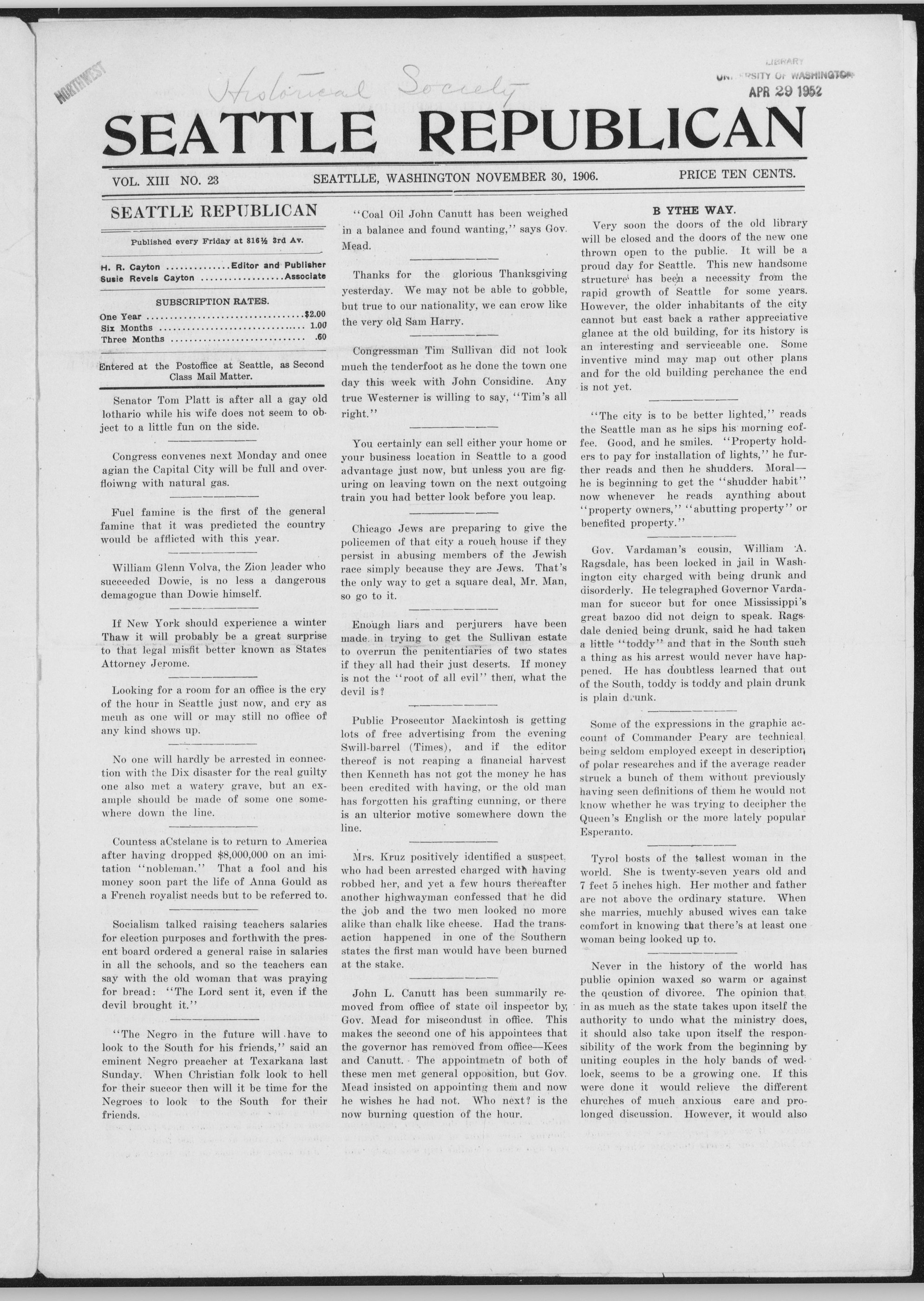
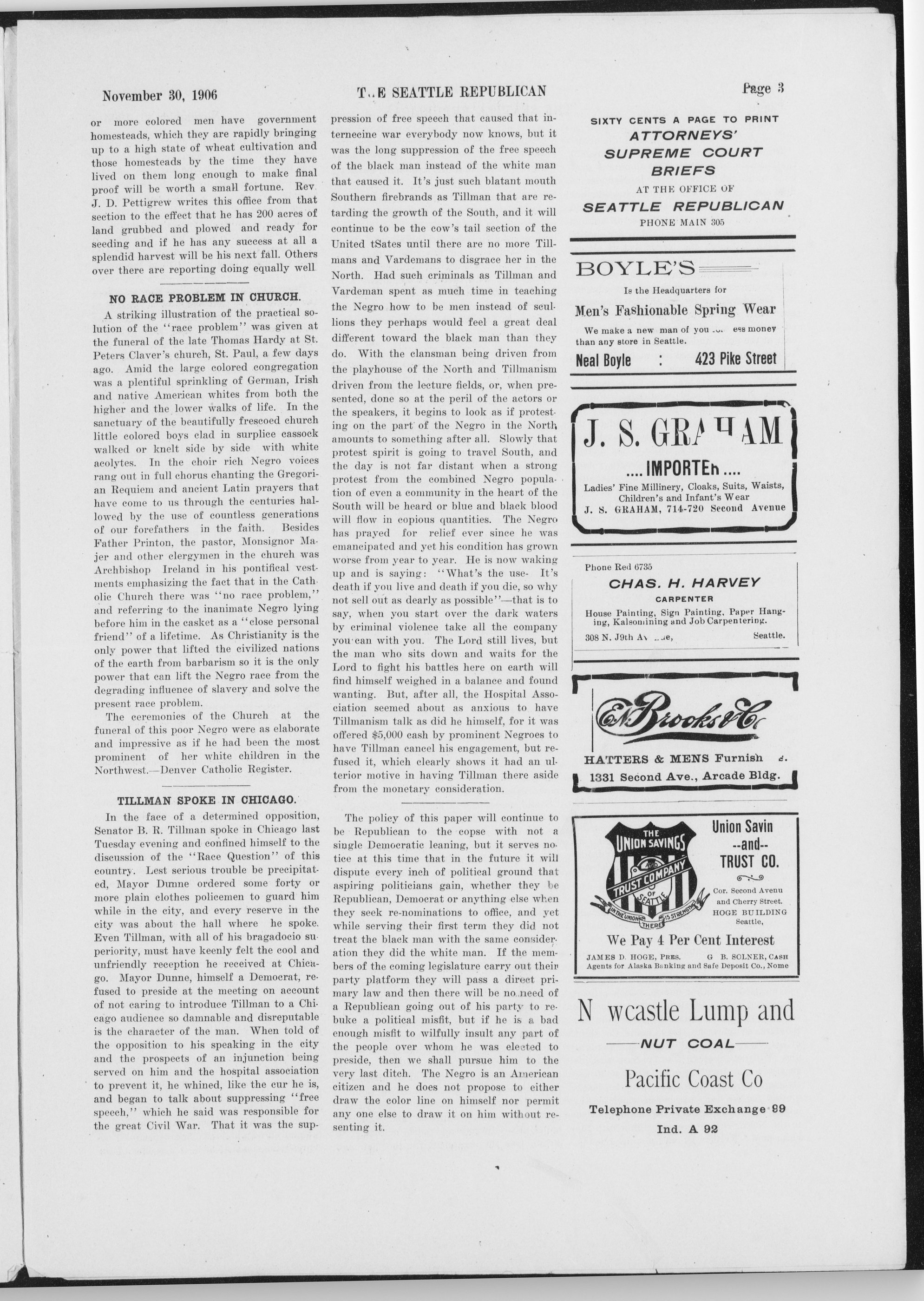
Page text (machine-generated)
SEATTLE REPUBLICAN
VOL. XIII NO. 23
SEATTLE REPUBLICAN
Published every Friday at 816 $ \frac{1}{2} $ 3rd Av.
H. R. Cayton .....Editor and Publisher
Susie Revels Cayton .....Associate
SUBSCRIPTION RATES.
One Year ..... $2.00
Six Months ..... 1.00
Three Months ..... .60
Entered at the Postoffice at Seattle, as Second
Class Mail Matter.
Senator Tom Platt is after all a gay old
lothario while his wife does not seem to obje
ct to a little fun on the side.
Congress convenes next Monday and once agian the Capital City will be full and overflowing with natural gas.
Fuel famine is the first of the general famine that it was predicted the country would be afflicted with this year.
William Glenn Volva, the Zion leader who succeeded Dowie, is no less a dangerous demagogue than Dowie himself.
If New York should experience a winter Thaw it will probably be a great surprise to that legal misfit better known as States Attorney Jerome.
Looking for a room for an office is the cry of the hour in Seattle just now, and cry as meuh as one will or may still no office of any kind shows up.
No one will hardly be arrested in connection with the Dix disaster for the real guilty one also met a watery grave, but an example should be made of some one somewhere down the line.
Countess aCstelane is to return to America after having dropped $8,000,000 on an imitation "nobleman." That a fool and his money soon part the life of Anna Gould as a French royalist needs but to be referred to.
Socialism talked raising teachers salaries for election purposes and forthwith the present board ordered a general raise in salaries in all the schools, and so the teachers can say with the old woman that was praying for bread: "The Lord sent it, even if the devil brought it."
"The Negro in the future will have to look to the South for his friends," said an eminent Negro preacher at Texarkana last Sunday. When Christian folk look to hell for their succor then will it be time for the Negroes to look to the South for their friends.
```markdown
```
SEATTLLE. WASHINGTON NOVEMBER 30, 1906.
"Coal Oil John Canutt has been weighed in a balance and found wanting,'" says Gov. Mead.
Thanks for the glorious Thanksgiving yesterday. We may not be able to gobble, but true to our nationality, we can crow like the very old Sam Harry.
Congressman Tim Sullivan did not look much the tenderfoot as he done the town one day this week with John Considine. Any true Westerner is willing to say, "Tim's all right."
You certainly can sell either your home or your business location in Seattle to a good advantage just now, but unless you are figuring on leaving town on the next outgoing train you had better look before you leap.
Chicago Jews are preparing to give the policemen of that city a rough house if they persist in abusing members of the Jewish race simply because they are Jews. That's the only way to get a square deal, Mr. Man, so go to it.
Enough liars and perjurers have been made in trying to get the Sullivan estate to overrun the penitentiaries of two states if they all had their just deserts. If money is not the "root of all evil" then, what the devil is?
Public Prosecutor Mackintosh is getting lots of free advertising from the evening Swill-barrel (Times), and if the editor thereof is not reaping a financial harvest then Kenneth has not got the money he has been credited with having, or the old man has forgotten his grafting cunning, or there is an ulterior motive somewhere down the line.
Mrs. Kruz positively identified a suspect, who had been arrested charged with having robbed her, and yet a few hours thereafter another highwayman confessed that he did the job and the two men looked no more alike than chalk like cheese. Had the transaction happened in one of the Southern states the first man would have been burned at the stake.
John L. Canutt has been summarily removed from office of state oil inspector by Gov. Mead for misconduct in office. This makes the second one of his appointees that the governor has removed from office—Kees and Canutt. The appointmetn of both of these men met general opposition, but Gov. Mead insisted on appointing them and now he wishes he had not. Who next? is the now burning question of the hour.
```markdown
```
LIBRARY
UNIVERSITY OF WASHINGTON
APR 29 1952
BLICAN
906 PRICE TEN CENTS.
B YTHE WAY.
Very soon the doors of the old library will be closed and the doors of the new one thrown open to the public. It will be a proud day for Seattle. This new handsome structure has been a necessity from the rapid growth of Seattle for some years. However, the older inhabitants of the city cannot but cast back a rather appreciative glance at the old building, for its history is an interesting and serviceable one. Some inventive mind may map out other plans and for the old building perchance the end is not yet.
"The city is to be better lighted," reads the Seattle man as he sips his morning coffee. Good, and he smiles. "Property holders to pay for installation of lights," he further reads and then he shudders. Moral—he is beginning to get the "shudder habit" now whenever he reads aynthing about "property owners," "abutting property" or benefited property."
Gov. Vardaman's cousin, William A. Ragsdale, has been locked in jail in Washington city charged with being drunk and disorderly. He telegraphed Governor Vardaman for succor but for once Mississippi's great bazoo did not deign to speak. Ragsdale denied being drunk, said he had taken a little "toddy" and that in the South such a thing as his arrest would never have happened. He has doubtless learned that out of the South, toddy is toddy and plain drunk is plain drunk.
Some of the expressions in the graphic account of Commander Peary are technical being seldom employed except in description of polar researches and if the average reader struck a bunch of them without previously having seen definitions of them he would not know whether he was trying to decipher the Queen's English or the more lately popular Esperanto.
Tyrol bosts of the tallest woman in the world. She is twenty-seven years old and 7 feet 5 inches high. Her mother and father are not above the ordinary stature. When she marries, muchly abused wives can take comfort in knowing that there's at least one woman being looked up to.
Never in the history of the world has public opinion waxed so warm or against the question of divorce. The opinion that in as much as the state takes upon itself the authority to undo what the ministry does, it should also take upon itself the responsibility of the work from the beginning by uniting couples in the holy bands of wedlock, seems to be a growing one. If this were done it would relieve the different churches of much anxious care and prolonged discussion. However, it would also
The image provided is too blurry to accurately recognize any text. It appears to be a blank or heavily blurred page with no discernible content.
rage 2
greatly loosen the now too elastic marriage ties.
The oldest man in Wichita, Kansas, has just taken unto himself his fourth wife. His name is H. L. Grey and he is ninety-four years old, the woman whom he wedded is sixty-five. The surprise about the whole matter is not that he married four times, that's common in these advanced days, but that the bride was sixty-five instead of sixteen. Mr. Grey has not kept in touch with the trend of things matrimonial. However, here's long life to the bride.
Suppose such a thing as a north pole had never been thought of, what in the world would have furnished food for thought upon which so many have subsisted all of these years. The result would have been far-reaching. What a vacuum in the newspaper columns, what a lack of speculation and what a derth of frozen men and dogs within stone throws of their icebound vessels.
The hearty and quick responding sympathy for Leonard Masters, the young lad who lost all of his relatives on the ill-fated Dix, speaks volumes for the large-heartedness of the Seattle and surrounding townspeople.
Recent articles published in some of the Western newspapers concerning the Japanese question have put the American people in rather a ludicrous light. It was published that the people of San Francisco did not wish the Japanese children in their schools, but that President Roosevelt would be advised that they must be permitted to attend as Japan would boycott America, and that would never do. In other words, if it was going to cost America so many dollars and cents the children of Japan would be permitted to attend the American schools. Again, it was published that Japanese, strictly speaking, could not be classed as Mongolians, a thought never advanced until the question of their attendance in the schools came up. Conclusion to be drawn by foreigners: Some men's pocketbooks being threatened can so materially change their viewpoint that the nationality of an entire nation appears to them not to be what it really is. "If this trouble about the schools reaches Japan it will hurt American interests immensely," writes one lately returned from a visit among the sons of Nippon, whereupon it is published that "the Japanese can do anything that Americans can do." "There is nothing mean or small about the little brown men and we must treat them as equals"—that is if we wish to hold even the small share of the trade of Japan which we now have. In other words, we will treat the Japanese as we would be treated—because we have to; we will give them a fair show in our country—because it will affect not our honor but our national pocketbook if we do not; and if the brownness of their skin becomes too offensive we will shut our eyes for they are, in all truth, not Mongolians, but possess the power of turning the boys of their boats from our shores. If we as a people are weak enough to hold in our hearts thoughts which these
THE SEATTLE REPUBLICAN
recent writings have disclosed, great is the pity that we have not diplomacy enough to conceal them till we have either cured or greatly lessened them.
Was there poison in the stomach of Mrs. Creffield, has been an all absorbing question before the newspaper readers of Seattle. It seems there was, but one thing about which there can be no question is, that there were wheels in her head and the wonder is that so much space, time, talk and ink should be sacrificed upon a woman whose life was so little worthy of emulation, or who fought for a cause, the general adaptation of which would be ruinous to the nation.
Caruso, the Italian tenor singer, thinks himself much abused for not being permitted to pursue the even tenor of his way by the Paris authorities. If similar actions to what he is accused of are to be the adopted tenor of the tenor, then he must not put into practice "his simple Italian way" upon any and all women, for some there be who, though disliking the base, will not permit of his tenor.
NEGROES DOING WELL.
That the colored population is keeping step with the general progress common to every community of the state of Washington is plain to be seen by any one visiting the different cities and communities thereof. Wherever the Negro is located there you will find him struggling to get not only a home for himself, but other property as well, all of which very conclusively shows that the Negro of the Northwest is no less energetic nor financially grasping than the most thoroughbred Yankee. He may be working under difficulties, but he nevertheless is surely working, and the assessment rolls in the various counties where he is to be found all bear swift though silent witnesses of that fact. In every county in Eastern Washington one or more colored men are to be found and a different story can be told of those isolated ones settled as they are among the whites than of the exceptional Negro settler in white pioneer settlements of say some twenty-five years ago. Then he dogged the white man's footsteps with his barber pole and a plea for "a job boss," but now he is striking boldly out to sea by getting hold of property and he is learning from the white man to do whatever and whoever comes his way in order to get the money to buy a piece of real estate. Have you got anything here, is about the second question they ask each other after meeting and getting acquainted. They may not have adopted as a motto that rather trite saying of Marcus Aurelius, "Let neither the peculiar quality of anything or its value escape thee," but one is safe in saying that wherever in the Northwest even to the uttermost parts of Alaska, the Yukon and the Northwest Territory the Negro is found (and he is found in all of these places) he is acquiring property and is trying to horde up wealth.
A recent trip through the state by the editor hereof found the Negro population showing more signs of succeeding than a year ago when a similar trip was made, and
November 30 1906
that is saying a good deal. In the city of Spokane the real estate condition of the Negro is not only gratifying, but exceedingly flattering. The splendid homes they own in every section of the city and the numerous small homes owned by them are living evidences that they have made up their minds to not be satisfied with a mere existence, but are struggling to share and share alike the best in the land with their white brethrens. While the men folk talk political recognition to some extent, yet they lose no financial or business opportunities to make a dollar while waiting for recognition, for they have long since learned that the Negro who strives to make his living out of politics usually enjoys a darn poor living. In Spokane, however, it can be said without fear of successful contradiction that fully 85 per cent of the Negro voters of that city and county own their own homes and the others outside of the sporting fraternity are struggling to be able in the very near future to boast of the very same thing. Outside of barber shops the Georgia Market operated by William Hopkins is the only business house in the city operated by a Negro, but they are doing janitor, porter and elevator, hotel and common labor work, for which they receive good wages and their earnings over and above a living are invested in real estate, which is making them money much faster than they could make it otherwise. After visiting Spokane even the true Seattleite does not hesitate to say, "If I were not a Seattleite I would be a Spokanite."
So much has been said about the prosperous state of the Negro in Sunnyside that it would seem that there is nothing left to be said, and yet the colored man from the city, who is able to lay aside $100 per month for his home maintenance, sees the Sunnyside farmers enjoying an abundance so far superior to his that he has no hesitancy in saying there is no living equal to that of the Sunnyside farmer. Free from the labor union entanglements and living on lands where they have but to sow and reap theirs is a life of one long dream in comparison to his city brother, who works today and lays off tomorrow with, "What you going to do when the rent comes round," constantly ringing in his ears. With but two or three exceptions every Negro living in Sunnyside owns his home, which consists of twenty or more acres, the majority over 100 acres. How valuable those lands are is hard to say, as the price is advancing so rapidly that before one set of figures are published the price will have advanced fully 10 per cent.
Those pioneer Negroes may have for years suffered in a manner that almost beggars description, but it is all over now and they have all their hearts and stomachs desire. That they are thrifty, progressive and prosperous about their homes and ranches may be seen by riding through the community in which they reside. Next year the government will furnish all of them all of the water they may need for irrigating purposes, a thing they have never before had and as soon as that has been done their farms will enhance in value at least 500 fold. Just across the river on the divide a score
November 30, 1906
or more colored men haye government
homesteads, which they are rapidly bringing
up to a high state of wheat cultivation and
those homesteads by the time they have
lived on them long enough to make final
proof will be worth a small fortune. Rev
J. D. Pettigrew writes this office from that
section to the effect that he has 200 acres of
land grubbed and plowed and ready for
seeding and if he has any success at all a
splendid harvest will be his next fall. Others
over there are reporting doing equally well
NO RACE PROBLEM IN CHURCH.
A striking illustration of the practical so-
lution of the ‘‘race problem’’ was given at
the funeral of the late Thomas Hardy at St.
Peters Claver’s church, St. Paul, a few days
ago. Amid the large colored congregation
was a plentiful sprinkling of German, Trish
and native American whites from both the
higher and the lower walks of life. In the
sanctuary of the beautifully freseoed church
little colored boys clad in surplice cassock
walked or knelt side by side with white
acolytes. In the choir rich Negro voices
rang out in full chorus chanting the Gregori-
an Requiem and ancient Latin prayers that
have come to us through the centuries hal-
lowed by the use of countless generations
of our forefathers in the faith. Besides
Father Printon, the pastor, Monsignor Ma-
jer and other clergymen in the chureh was
Arehbishop Ireland in his pontifical vest-
ments emphasizing the fact that in the Cath
olic Church there was ‘‘no race problem,”’
and referring ‘to the inanimate Negro lying
before him in the casket as a ‘‘close personal
friend’? of a lifetime. As Christianity is the
only power that lifted the civilized nations
of the earth from barbarism so it is the only
power that can lift the Negro race from the
degrading influence of slavery and solve the
present race problem.
The ceremonies of the Church at the
funeral of this poor Negro were as elaborate
and impressive as if he had been the most
prominent of her white children in the
Northwest.—Denver Catholic Register.
TILLMAN SPOKE IN CHICAGO.
In the face of a determined opposition,
Senator B. R. Tillman spoke in Chicago last
Tuesday evening and confined himself to the
discussion of the ‘‘Race Question’”’ of this
country. Lest serious trouble be precipitat-
ed, Mayor Dunne ordered some forty or
more plain clothes policemen to guard him
while in the city, and every reserve in the
city was about the hall where he spoke.
Even Tillman, with all of his bragadocio su-
periority, must have keenly felt the cool and
unfriendly reception he received at Chicu-
go. Mayor Dunne, himself a Democrat, re-
fused to preside at the meeting on account
of not caring to introduce Tillman to a Chi-
cago audience so damnable and disreputable
is the character of the man. When told of
the opposition to his speaking in the city
and the prospects of an injunction being
served on him and the hospital association
to prevent it, he whined, like the cur he is,
and began to talk about suppressing ‘‘free
speech,’’ which he said was responsible for
the great Civil War. That it was the sup-
..E SEATTLE REPUBLICAN
pression of free speech that caused that in-
ternecine war everybody now knows, but it
was the long suppression of the free speech
of the black man instead of the white man
that caused it. It’s just such blatant mouth
Southern firebrands as Tillman that are re-
tarding the growth of the South, and it will
continue to be the cow’s tail section of the
United tSates until there are no more Till-
mans and Vardemans to disgrace her in the
North. Had such criminals as Tillman and
Vardeman spent as much time in teaching
the Negro how to be men instead of scul-
lions they perhaps would feel a great deal
different toward the black man than they
do. With the clansman being driven from
the playhouse of the North and Tillmanism
driven from the lecture fields, or, when pre-
sented, done so at the peril of the actors or
the speakers, it begins to look as if protest:
ing on the part of the Negro in the North
amounts to something after all. Slowly that
protest spirit is going to travel South, and
the day is not far distant when a strong
protest from the combined Negro popula-
tion of even a community in the heart of the
South will be heard or blue and black blood
will flow in copious quantities. The Negro
has prayed for relief ever since he was
emancipated and yet his condition has grown
worse from year to year. He is now waking
up and is saying: ‘‘What’s the use- It’s
death if you live and death if you die, so why
not sell out as dearly as possible’’—that is to
say, when you start over the dark waters
by criminal violence take all the company
you'can with you. The Lord still lives, but
the man who sits down and waits for the
Lord to fight his battles here on earth will
find himself weighed in a balance and found
wanting. But, after all, the Hospital Asso-
ciation seemed about as anxious to have
Tillmanism talk as did he himself, for it was
offered $5,000 cash by prominent Negroes to
have Tillman cancel his engagement, but re-
fused it, which clearly shows it had an ul-
terior motive in having Tillman there aside
from the monetary consideration.
The policy of this paper will continue to
be Republican to the copse with not a
single Democratic leaning, but it serves no-
tice at this time that in the future it will
dispute every inch of political ground that
aspiring politicians gain, whether they be
Republican, Democrat or anything else when
they seek re-nominations to office, and yet
while serving their first term they did not
treat the black man with the same consider.
ation they did the white man. If the mem-
bers of the coming legislature carry out their
party platform they will pass a direct pri-
mary law and then there will be no.need of
a Republican going out of his party to re-
buke a political misfit, but if he is a bad
enough misfit to wilfully insult any part of
the people over whom he was elected to
preside, then we shall pursue him to the
very last ditch. The Negro is an American
citizen and he does not propose to either
draw the color line on himself nor permit
any one else to draw it on him without re-
senting it.
Page 3
SIXTY CENTS A PAGE TO PRINT
ATTORNEYS’
SUPREME COURT
BRIEFS
AT THE OFFICE OF
SEATTLE REPUBLICAN
PHONE MAIN 305
BOWE > —.
Is the Headquarters for
Men’s Fashionable Spring Wear
We make a new man of you... ess money
than any store in Seattle.
Neal Boyle =: 423 Pike Street
... IMPORTED ....
Ladies’ Fine Millinery, Cloaks, Suits, Waists,
Children’s and Infant’s Wear
J. 8S. GRAHAM, 714-720 Second Avenue
Phone Red 6735
CHAS. H. HARVEY
CARPENTER
House Painting, Sign Painting, Paper Hang-
ing, Kalsomining and Job Carpentering.
808 N. J9th Ay ..ue, Seattle.
oF ae ‘
ac SSL RTT
HATTERS & MENS Furnish 4.
A 2" 1831 Second Ave., Arcade Bldg. i
a Union Savin
TTSORECIAS --ant--
aye TRUST CO.
CATIy :
Ss (a ORO
iu yd fy Cor Second Avenu
rHeaK | AT\ xg? and Cherry Street.
eo Sik HOGE BUILDING
Head Seattle,
We Pay 4 Per Cent Interest
JAMES D. HOGE, PREs, G B. SOLNER, Cash
Agents for Alaska Banking and Safe Deposit Co., Nome
N weastle Lump and
——NUT COAL——
Pacific Coast Co
Telephone Private Exchange 99
Ind. A 92
POLITICAL.
That the Negro is not always married to the Republican party and its nominees may be seen in the defeat of E. D. Sanders of Spokane county, late Republican nominee for senator from that senatorial district, and likewise the defeat of Hal Weber of Yakima county, late Republican candidate for sheriff. In both instances the Negro voters almost to a man worked to defeat their party candidate and in both instances they were eminently successful. In both cases by comparing the pluralities by which the Democrats over their Republican opponents were elected with the actual number of Negro votes cast at the polls, and keep in mind the Negro vote is always reckoned as practically a unit for the Republican party, it is readily seen that the Negro vote was directly responsible for the defeat of said candidates. For, to say nothing of the influence they may exercise with white voters, Mr. Sanders, the would-be Spokane state senator, was beaten by only a 65 plurality, while in his district there are not less than 150 Negro voters, the most of whom worked and voted against him. His opponent, Will G. Graves, was elected by a plurality of only 65. There are in Yakima county some 175 Negro voters and it is claimed by J. L. Bedell, the well known Negro leader of Sunnyside, that not to exceed ten of that number voted for Hal Weber, the Republican candidate for sheriff, and his Democratic opponent only received a plurality of 75. Now had Weber gotten only 100 of the Negro voters he would have defeated his opponent by a plurality of 125. Other elements entered into this fight, however, and the Negro vote perhaps was only been the "widow's mite," but as may be seen from the above figures "every little bit helps." Neither Sanders nor Weber courted the Negro vote and they now know they did not get it and they are sadder, but wiser from their political experience. In the case of Weber it was his second attempt, he having been defeated two years ago for the same office and under the self-same conditions—that is to say, every Negro in the county voting against him, and the plurality by which he was defeated was so small that had he have gotten the Negro vote as did the other Republicans on the ticket, he would have been elected by a handsome plurality. Diplomacy as well as consistency is a jewel.
Why the Negro opposition to those particular candidates and not against the party? you ask. In the case of Ed Sanders, he it was that inveigled himself on a jury in Spokane, wherein a Negro, E. H. Holmes, was suing a "resort" for refusing to serve himself and wife as other guests, which refusal was based solely on their color, under the civil rights act of the state laws, and he, Sanders, so goes the story, made the fight of his life to get a verdict for the defendant and finally succeeded. Not content with his success in the jury room he talked it on the streets and permitted himself to be interviewed for the daily papers, in which he did not mince words in declaring his opposition to the Negro enjoying equal rights with the white man. Neither Holmes nor his friends
THE SEATTLE REPUBLICAN
retaliated in kind nor murmured or complained, but lay dead for the bloodless hero, with the results that Mr. Sanders is not state senator, but his Democratic opponent is. The Negro voters not only voted against him themselves, but they button-holed every other voter in the district to help them out, and by cajoling some and threatening others, who had friends on the ticket, they were able to enlist a sufficient number of white votes along with theirs to administer a rebuke to him that he will never forget and such a rebuke as will serve to make others hesitate as to what they say about another class of folk.
When Hal Weber was road supervisor in the Sunnyside district he made it a point to not give a single Negro in the district a single hour's work, though there were quite a number of them there and at the time they were paying taxes on 1,000 acres of land, more or less improved. Had not, however, his predecessor have given the Negroes considerable work to do nothing would have been thought about Weber's action. Smarting under the seeming insult to the Negro T. R. Taylor, an extensive hop raiser, was made a committee of one to speak to Mr. Weber about it, which he did.
"I see, Mr. Weber," said Mr. Taylor, "that you are not giving any of the colored boys any road work, and that, too, despite the fact you have expended over $3,000 on road work in the district this year. How is this?" "I have no apologies to make," abruptly, as well as laconically, came from Mr. Weber, "and my actions in the past may be taken as a reflection of my future actions."
He courtly closed the interview and walked away. The matter was reported to the Negro voters of Sunnyside and they, of course, declared war on Weber, he, however, thinking it but another case of a band of Liliputians attacking a Gulliver added insult to injury by laughing them to scorn and inviting the "niggers" to do their worst. He now realizes he made the mistake of his life and we suspect in his heart of hearts he would give a whole lot to be able to recall his brief interview with the "nigger." Let's hope, however, that both E. D. Sanders and Hal Weber will profit by their experience and that other aspiring politicians will at least learn that, in politics policy is the best policy, that is if you want to win without a fight in your own ranks.
Even in Seattle a decided independent spirit among Negro voters, heretofore unswervingly Republican, is manifesting itself. At a meeting of the Forum, an organization among Seattle's Afro-Americans, two weeks prior to the last election, "The Advisability of the Negro Being a Partisan," was up for discussion, and while those taking part had no particular grievance at the nominees of the Republican party of the state or county, yet the whole tenor of the discussion drifted along independentness in politics. "Vote for the man instead of the party" met their hearty approval and even the ladies heartily indorsed such actions. So strong was the sentiment for the man and
not the party that at the election two weeks later a great many of them were so apathetic that they failed to vote for any one, not caring to lose the time to even go to the polls to vote. While they may not have had any direct excuse for such apathy still they had mountains of indirect excuses and the party of their choice will wake up to find when it is too late that they have gone from it and that too when they needed them the worst.
From way down in bleeding Kansas, where the Negro in the past has been so faithful to the Republican party that, if a man that had personally abused him, had gotten a Republican nomination for a state or county office, such Negro would "vote her straight" just the same. In other words he swallowed the whole ticket, "yaller dorg" and all, but comes a most startling report to the effect that the Negro vote almost to a man all over the state bolted the re-election of Gov. Hoch for some alleged political insult or affront he wilfully flung into their faces. So persistent as well as consistent was their fight that they enlisted the sympathies of hundreds of white voters in their cause which resulted in the defeat of the governor and, if not his actual defeat, reduced the 100,000 plurality the other Republicans got, that in his particular case too such a minimum that it will take the official count to decide whether he or his Democratic opponent is elected. Whether Gov. Hoch is or is not defeated now is of no importance, but the mere fact that the Negro voters gave the governor and his party the fight of their lives to save them the day; and the fact that his vote fell some 75,000 or more below the party vote are all sufficient rebukes to warn others that though the Negro is a faithful party slave, who can be depended on to always "vote her straight," yet there occasionally comes a day sometime when the worm turns and such times are coming more rfrequent as time goes by. In future the Negro must be respected if not considered by politicians.
Unless we miss our guess Gov. A. E. Mead of this state is in line for a political rebuke from the Negro voters like unto that the Negro voters of Kansas administered to Gov. Hoch, and Gov. Mead not having popularized himself with the voters in general as he might have done the few Negro votes in the state may prove the turning point against his re-election. A Negro applied to Gov. Mead's penitentiary warden appointee for a guardship at the prison and the Negro was informed that he could not have the place because the prisoners might object to a colored guard over them and the other guards might not want to eat at the same table with the colored guard. When the governor was appealed to he said he was powerless in the matter. When Contractor McAbe, however, was in need of a colored servant and found one in the state prison that suited him Gov. Mead almost fell over himself to parole the Negro, who but two years prior was sent to state prison from Seattle for taking advantage of a fourteen-year-old colored girl who was a member of the church of which the Negro pastored, he representing himself to be a preacher of the
November 30, 1906
Gospel, who not only betrayed the innocent little girl, but she died from the effects of that betrayal. Gov. Mead did not consult a single Negro in King county about that parole, yea not only not a single Negro, but not even the prosecuting attorney, the judge or the jury, and when the governor was asked about it by some Negroes he innocently replied: "I thought I was doing the colored folk a favor by pardoning one of their preachers." It is said that McAbe, on whose sole recommendation Mac Scott, the criminal wretch, was pardoned by Gov. Mead, who was sent to prison for fifteen years for the ruin and death of Mary Hall, informed the governor that it was only a little "nigger gal," and that all of them did about the same thing. Whether the argument was convincing or not the writer verily doeth not know, but he does know the dirty criminal was paroled then and there and subsequent report says he has since been granted a full pardon and that now, as a railroad porter, he is the same gay lothario that he was of yore. There may be some Negroes in the state who will work and vote for the governor for that act of kindness (?) but we have our doubts, yea our serious doubts.
The Sunday Forum
A house full and overflowing at the Forum last Sunday listened to Mr. W. J. Wylie, Rev. Edmonson, Mr. I. I. Walker, Mr. W. C. Peoples and others discuss the actions of President Roosevelt in dismissing Companies "B," "C" and "D" of the Twenty-fifth Infantry from the army for refusing to divulge the names of the soldiers who participated in the Brownsville riot. The president of the Forum in the outset suggested that those taking part in the discussion speak from the standpoint of loyal citizens, rather than from the standpoint of race prejudice, which, for the most part, was adhered to. Some 200 or more persons were present long before the meeting was opened, eager to hear every word that was to be said on the subject, and, Negroes though they were, discussing what seemed to them an injustice to members of their race by the president of the United tSates, yet the spirit of patriotism domineered the meeting from start to finish.
In opening the discussion, Mr. Wylie declared the president had not done the colored soldiers an injustice. He not only had not done them an injustice, but had acted wisely in dismissing them from the service for not telling who the perpetrators of the Brownsville rot were. The president is the military head of the army, and he simply did his duty as such military head. The side taken by Mr. Wylie might have been the unpopular side of the question, but he handled it with such skill and adroitness that he was highly complimented by all who heard him.
Rev. Edmonson held that the soldiers had been dismissed without giving them a fair and impartial trial and that even the president had no right to dishonorably discharge
THE SEATTLE REPUBLICAN soldiers from the army without first court-martialing them and in dismissing the whole batallion he had punished the innocent along with the guilty, many of whom (the innocent) knew not who the actual guilty ones were.
Mr. Walker made a masterly appeal on behalf of the discharged troops and unhesitatingly declared the president had acted unfair and had used such drastic methods on those soldiers for no other reason than they were Negroes. He cited numerous instances where white soldiers had been guilty of even more heinous offenses than that the colored, soldiers were charged with having committed at Brownsville, Texas, and yet none of them were ever dismissed or even tried for their riotous acts. He was frequently applauded by the audience, whom he had with him from from the very outset.
Mr. Peoples argued that sympathy should play no part in the discussion, that the colored soldiers were guilty of riot and were justly punished for their acts. He claimed the president was the true friend of the Negro and had shown that he was in a thousand and one different ways since he had been president of the United States. He further said that this was not the first time the colored soldiers had committed such riotous acts, they at one time shooting up a resort kept by a Negro. Those soldiers were stationed at Brownsville to preserve the peace, and instead of doing so they broke the peace. If the soldiers of the United States army are to become rioters because, forsooth, some criminal white man somewhere in the South had been riotous, what was the need of having soldiers to keep the peace?
At the close of Mr. Peoples' speech the audience sang a verse of "John Brown's Body" with patriotic enthusiasm. Then Mr. Harrison and Mr. Wylie spoke briefly on the subject. Mrs. Graves recited "The Charge of the Black Brigade," which was loudly applauded. Mr. Reed, an ex-soldier, spoke from a soldier's standpoint, and his brief remarks were listened to with rapt attention. The president of the Forum then declared the discussion closed, whereupon Mrs. Susie Revels Cayton offered the following preamble and resolutions, which were unanimously adopted:
"Whereas, Theodore Roosevelt, president of the United tSates of America, by virtue of the power vested in him by Congress, has summarily dismissed from the Army of the United States, Companies "B," "C" and "D" of the Twenty-fifth Infantry because the members of said companies collectively and individually refused to divulge the names of their fellow soldiers guilty of the riotous acts at Brownsville, Texas, and thereby punishing the innocent as well as the guilty; thus reversing the Biblical law. 'It is better that ninety-nine guilty go free than an innocent one suffer,' and
"Whereas, We condemn in unmeasured terms the actual participants in the Brownsville riot and trust the guilty ones will be detected and duly punished, yet we nevertheless believe the president's order so sweeping that innocent men, who were not only not participants in that riot, but were equally as innocent as to the actual partici-
pants, have been done an evelasting injustice, which will reflect upon the good name of their children's children; therefore, be it "Resolved, That the Sunday Forum of Seattle hereby petition Congress to reinstate the dishonorably discharged soldiers, or as many thereof as are not actually found guilty of participating in that Brownsville riot. Be it further
"Resolved, That a copy of these resolutions be forwarded to each of the members of Congress from the State of Washington for the purpose of enlisting their advocacy and support of such a motion before the Congress of the United tSates of America."
STUNG
Authorities Have Stirred Up Hornets' Nest of Public Indignation.
It was remarked in these columns the other day that there would be much public sympathy for the three companies of Negro soldiers who are to be discharged from the United States army "without honor" because no one among them would turn informer against the few who "shot up" the town of Brownsville, Tex. There is unmistakably a great amount of such sympathy, and the authorities responsible for the discharge of the three companies must feel the sting of public disapproval.
Especially noteworthy has been the number of letters of protest from old army officers, even men who were educated at West Point, and their attitude is of interest because it shows that even those who would naturally take a purely military view of the case are not necessarily agreed in support of the punishment inflicted upon the Negro soldiers. One old army officer, who signs his letter "West Pointer," writes to the New York Times to say that "no man with the first instincts of a soldier would 'peach' on his companions. Should a cadet at West Point be guilty of so dishonorable an act he would be cut by the entire corps; no one would speak to him." Sometimes whole classes in school or college are suspended because they refuse to testify against some member supposed to be guilty of a violation of school rules, and this method of discipline has been copied by the army authorities in the present case. Yet public opinion always has, and always will, regard with a measure of sympathy those who, not being placed under oath in a lawfully-constituted court, refuse to testify against friends and comrades.
That a mistake has been made regarding the soldiers of the Twenty-fifth Infantry may not be so apparent to the military authorities as to those who are observing the effect of their action upon the colored race of the country, whose indignation is widespread, and not in the least concealed. If the government was unable to discover the identity of the soldiers who committed the offenses at Brownsville, it should have dismissed the case, evidently, rather than punish the innocent alike with the guilty; or if any one was to be punished for the bad discipline of certain companies, why should not the blow have fallen upon the officers who are responsible for the behavior of their men?—Springfield Republican.
November 30, 1906
PETKOVITS FUR Co....
PETKOVITS FUR Co....
Latest Novelties in all kinds of Fur Capes in stock or made to order. Large assortment of Rugs and Robes. Special attention given to renovating and repairing fur garments: 110 Marion Street. Between First and Second
IMPORTER AND MANUFACTURER
OF ALL KINDS OF.
FUR And Fur Garments
ALASKA SEALSKIN GARDEN PERSONAL.
ALASKA SEALSKIN GARMENTS A SPECIALTY
Miss Cora Oliver has been sick for a week.
Mr. C. C. Hancock entertained the Trojans on Monday evening.
Miss Mable Dixon is very ill at the home of her parents on Washington street with typhoid fever.
Elaborate preparations are being made for the initiation of the "herd" of Independent Elks that will be made in this city on Sunday next.
Joe Anderson, the well known restaurant man, is in the city and will immediately go into business here.
Jack Gordon, one of the most familiar characters and from point of residence the third oldest man of our race in this city, left Monday for San Francisco, where he will reside. He came to Seattle 24 years ago to visit a friend and this is the first time he has left town since.
The mock wedding given at the 14th Street A. M. E. church on Tuesday evening was a grand success. The church was beautifully decorated and the contracting parties, Miss Doris Grose and Master William Collins, with their attendants, were dressed in the height of fashion and deported themselves far more dignified than many older persons have done.
Mr. and Mrs. Geo. W. Turner were delightfully entertained and were deluged with presents and congratulations on Saturday night by a number of their friends at their home on 25th Ave. The occasion was the 20th anniversary of their marriage. The gathering was a complete surprise to the Turner family. Among the presents left were: Salad dish, Miss G. Harvey; berry dish, Mr. and Mrs. A. H. Hall; chop plate (hand painted), Mrs. Sarah Grose; set salt cellars (cut glass), Miss Carrie Dixon; cake plate (hand painted), Mr. and Mrs. F. N. Harris; extra large coffee cup and saucer, Mr. R. A. Clark; sugar and cream set (Milton ware), Mrs. Mary Ellis; cake plate (Haviland china), Mrs. R. A. Clark; fancy plate, Mr. and Mrs. W. E. Bennett; bon-bon dish (Milton ware), Mr. and Mrs. E. Thompson; work basket, Mrs. E. E. Hall; cake plate (hand painted), Mrs. Frank Smith; shell curio vase, Mr. C. C. Hancock; Milton ware fruit dish, Mr. Robert Harvey; cut glass vases, Mrs. M. Mann; burnt wood taberett, Miss Mable Turner. The supper was furnished by Mrs. C. H. Harvey and Mrs. G. W. Nelson. There were thirty guests present.
---
Fur
ments
MENTS A SPECIALTY
Go to a respectable place to borrow money on diamonds, jewelry and watches. Low rates. Private offices and all business strictly confidential. American Watch and Jewelry Co., 908 First Avenue, opp. Rainier Grand Hotel.
IN THE SUPERIOR COURT OF THE State of Washington, for the County of King.
Margaret K. Boecher, Plaintiff, vs. John Boecher, Defendant—No. 53851. Summons by Publication.
The State of Washington to the said John Boecher, Defendant: You are hereby summoned to appear within sixty days after the date of the first publication of this summons, to-wit: within sixty days after the 30th day of November, A. D. 1906, and defend the above entitled action in the above entitled Court, and answer the complaint of the plaintiff, and serve a copy of your answer upon the undersigned attorney for plaintiff at his office below stated; and in case of your failure so to do, judgment will be rendered against you according to the demand of the complaint, which has been filed with the Clerk of said Court. The object of the said action is to dissolve the bonds of matrimony existing between the plaintiff and defendant herein on the ground of the neglect and refusal of the defendant to make suitable provisions or any provisions at all for plaintiff and child.
Attorney for Plantin.
P. O. and Office Address: 9-10 Starr-
Boyd Bldg., Seattle, County of King,
Washington.
Date of first publication, Nov. 30, 1906.
IN THE SUPERIOR COURT OF THE STATE OF WASHINGTON, FOR KING COUNTY
G. H. Appleton, plaintiff, vs. Robert L. Totman, and all persons unknown, if any, having or claiming an interest in and to the hereinafter described real property, defendants.—No. 53597. Notice and summons. State of Washington to the above named defendants and each of them:
You and each of you, as owners or reputed owners, or claimants or holders of an interest or estate in and to the hereinafter described real property, are hereby notified that the above named plaintiff is the holder of a certain delinquent tax certificate, issued by the treasurer of King county, state of Washington, dated the 12th day of October, 1901, and numbered as follows, for the delinquent taxes of the following year, in the following amount, and upon the real property situated in said King county, described as follows, to-wit: Palatine Hill addition to the City of Seattle, lot 1, block 13, certificate No. B10707, year 1897, amount $1.39.
That the taxes for the following prior and subsequent years have been paid by the plaintiff upon said above described real property, to-wit: Lot 1, block 13, Palatine Hill addition to the City of Seattle, for year 1898, 75c; for year 1899, 85c; for year 1900, 77c; for year 1901, 89c; for year 1902, $1.54; for year 1903, $1.69; for year 1904, $3.21; for year 1905, $3.35; which several sums bear interest at the rate of 15 per cent. per annum from said date of payment, and are all the unpaid and unredeemed taxes upon and against said real property.
You and each of you (including said persons unknown, if any), are hereby further notified and summoned to be and appear within sixty days after the date of first publication of this notice, exclusive of the day of said first publication, to-wit, within 60 days after the 9th day of November, 1906, in the above entitled court and action, and defend this action and answer the complaint of said plaintiff, and serve a copy of your answer on the undersigned attorney for plaintiff, at his office below sated, or pay the amount due, together with interest and costs. In case you fail so to do, judgment will be rendered herein foreclosing the lien of said taxes and costs against each parcel of said real property for the sums and amounts due upon and charged against each, for said
```markdown
```
THE SEATTLE REPUBLICAN
MILK BREWERY
YES SIR! HERE'S THE BEER, SIR!
RAINIER- THE ONLY BEER, SIR!
SEATTLE BREWING & MALTING CO.
SEATTLE / / / WASHINGTON.
TELLPHONE RAINIER JO.
taxes, interest and costs, ordering a sale of each parcel of said property for the satisfaction of the sums charged and found against it respectively as provided by law, and as prayed in plaintiffs complaint now on file in this cause and court.
G. H. APPLETON, Plaintiff.
Office address: 3824 E. Highland Drive, Seattle, Wash.
First publication dated November 9th, 1906.
IN THE SUPERIOR COURT OF THE STATE OF WASHINGTON, FOR THE COUNTY OF KING. IN PROBATE In the matter of the estate of Carl John Carlson, deceased.—No. 7226. Order to show cause on sale of real estate. Josephine C. Carlson, the administratrix of the estate of Carl John Carlson, deceased, having filed her petition in this court, duly verified, praying for an order of this court for the sa'l at private sale of the real estate of which the said deceased died seized, for the purposes therein set forth.
And it appearing to the court from said petition that the personal estate of the said deceased in the hands or said administratrix is not sufficient to pay the claims against the asid estate and the expenses of the administration thereof, and other debts of said decedent, and that it is necessary to sell all or a portion of the real estate of the said deceased to pay the said claims and expenses of the administration. And it appearing to the court that said petition conforms to, and is in accordance with the requirements of law in such case made and provided. It is ordered by the court that all persons interested in the estate of the said deceased appear before said superior court on Thursday, the 13th day of December, 1906, at the hour of 9:30 o'clock in the forenoon of said day at the courtroom of the probate department of said superior court, in the City of Seattle in said King county, then and there to show cause, if any they have, why an order of this court should not be granted to said administratrix authorizing and empowering her to sell the said real estate of said deceased at private sale, or so much thereof as may be necessary to pay the aforesaid claims and expenses of administration and other debts.
It is further ordered that a copy of this order to show cause be published at least four successive weeks before the said 13th day of December, 1906, in The Seattle Republican, a newspaper printed and published in said County of King and of general circulation therein. Done in open court this 8th day of November, 1906. ARTHUR E. GRIFFIN, Judge. ISRAEL NELSON, Attorney for Administratrix, 704 New York Block, Seattle, Wash.
IN THE SUPERIOR COURT OF THE STATE OF WASHINGTON, IN AND FOR THE COUNTY OF KING.
FOR THE COUNTY OF KING.
John G. Hoopes, plaintiff, vs. Lulu E. Hoopes, defendant.—No. 53585. Summons.
The state of Washington to the said Lulu E. Hoopes, defendant:
You are hereby summoned to appear within sixty days after the date of the first publication of this summons, to wit, within sixty days after the 9th day of November, 1906, and defend the above entitled action in the above entitled court, and answer the complaint of the plaintiff, and serve a copy of your answer upon the undersigned attorney for plaintiff, at his office below stated; and, in case of your failure so to do, judgment will be rendered against you according to the demand of the complaint, which has been filed with the clerk of said court.
The above entitled action is an action for divorce dissolving the bonds of matrimony on the ground of abandonment and desertion for a period of more than one year previous to the commencement of this action.
E. T. SCHOF.
Attorney for Plaintiff.
P. O. Address: 506 Pioneer Bldg., Seattle, King County, Washington.
IN. THE SUPERIOR COURT OF THE
State of Washington, in and for King
County.
Catherine H. Matson, plaintiff, vs.
Charles A. Matson, defendant. No.
53639. Summons for publication.
The State of Washington to the said
Charles A. Matson, defendant:
You are hereby summoned to appear
within sixty days after the date of the
first publication of this summons, to
wit: Within sixty days after the 16th
day of November, 1906, and defend the
above entitled action in the above
entitled court, and answer the complaint
of the plaintiff, and serve a copy of
your answer upon the undersigned attorney
for plaintiff at his office below
stated; and, in case of your failure so
to do, judgment will be rendered against
you according to the demand of the
complaint, which has been filed with the
clerk of said court.
The object of the above entitled action is to obtain a decree of divorce between the plaintiff and defendant upon the grounds of abandonment for more than five years, and the neglect and refusal of said defendant to make suitable provisions for his family; to obtain the care and custody of the minor child of plaintiff and defendant; for alimony and the cost of this action.
J. HENRY DENNING. Plaintiff's Attorney. Office and postoffice address: 46-47 Starr-Boyd Building, Seattle, King County Washington.
Date of first publication November 16,
1906.
Date of last publication December 28,
1906.
IN THE SUPERIOR COURT OF THE
State of Washington, for the County
of King.
Agusta Schmidt, plaintiff, vs. O. P.
Schmidt, defendant. No. 53686. Summons
by publication.
The State of Washington to the said
O. P. Schmidt defendant:
You are hereby summoned to appear within sixty days after the date of the first publication of this summons, to-wit, within sixty days after 16th day of November, A. D. 1906, and defend the above entitled action in the above entitled court, and answer the complaint of the plaintiff, and serve a copy of your answer upon the undersigned attorney for plaintiff, at his office below stated; and, in case of your failure so to do, judgment will be rendered against you accordin gto the demand of the complaint, which has been filed with the clerk of said court. The object of the said action, set forth in the complaint, is as follows: To procure an absolute divorce by the plaintiff from the defendant on account of desertion, failure to provide a maintenance for plaintiff and their child and cruelty.
P. O. address: 306 Bailey Building, Seattle, County of King, Washington. Date of first publication November 16, 1906.
IN THE SUPERIOR COURT OF THE State of Washington for the County of King. In Probate.
In the matter of the estate of John Haas, deceased. No. 6347. Order to show cause why distribution should not be made.
Fred Seedorf, administrator of the estate of John Haas, deceased, having filed in this court his petition setting forth that said estate is now in a condition to be closed and is ready for distribution of the residue thereof among the persons by law entitled thereti, and it appearing to the court that said petition sets forth facts sufficient to authorize a distribution of the residue of said estate:
It is therefore ordered by the court that all persons interested in the estate of the said John Haas, deceased, be and appear before the said Superior Court of King County, State of Washington, at the court room of the probate department of said court in the city of Seattle, on the 20th day of December, 1906, at the hour of 9:30 o'clock A. M. of said day, then and there to show cause, if any they have, why an order of distribution should not be made of the residue of said estate among the heirs and persons in said petition mentioned, according to law.
It is further ordered that a copy of this order be published once a week for four successive weeks before the said 20th day of December, 1906, in the Seattle Republican, a newspaper printed and published in said King County, and of general circulation therein.
Done in open court this 12th day of November, 1906.
ARTHUR E. GRIFFIN,
Judge.
NICHOLAS SCHMITT, Attorney.
NOTICE OF ASSESSMENT OF STOCK.
To Lionel A. Wolf:
You are hereby notified that you are delinquent in the payment of your assessment of your mining stock in the Skagit River Copper Mining Company for the annual assessment work for the following years, to-wit:
For the year ending December
31st, 1903, the sum of ..... $23.20
For the year ending December
31st 1904, the sum of ..... 23.20
For the year ending December
31st, 1905, the sum of ..... 60.50
Total $106.90
You are further notified that your
shares of stock in said company, or such
part thereof as may be necessary to satisfy
said assessments will be sold on the
30th day of November, 1906, at the
hour of ten o'clock A. M. at the company's office, 46 Starr-Boyd Building, Seattle, King County, Washington.
GFO. W. FICKS, Secretary.
Sept. 28—Nov. 23
IN THE SUPERIOR COURT OF THE State of Washington, in and for the County of King.
County of King.
Clara Noretz, plaintiff, vs. Constantine Noretz, defendant.—No. 53094. Summons for Publication.
The State of Washington to the said Constantine Noretz, defendant:
You are hereby summoned to appear within sixty (60) days after the date of the first publication of this summons, to-wit, within sixty (60) days after the 12th day of October, A. D. 1906, and defend the above entitled action in the above entitled court, and answer the complaint of plaintiff, and serve a copy of your answer upon the undersigned attorneys for plaintiffs at their office below stated, and in case of your failure so to do judgment will be rendered against you according to the demand of the complaint, which has been filed with the clerk of said court.
This action is brought on to secure a decree absolutely dissolving the bonds of matrimony now existing between plaintiff and defendant on the grounds of abandonment and non-support of plaintiff by said defendant.
LONGFELLOW & FITZPATRICK
Attorneys for Plaintiff.
P. O. Address, 319-20 Pioneer Bldg.
Seattle, Wn.
Date of first publication, Oct. 12th,
A. D. 1906.
Last publication, Nov. 16.
IN THE SUPERIOR COURT OF THE
State of Washington, for King County.
In the matter of the estate of Welcome Murdock, deceased.—No. 7263. Notice to Creditors.
By order of said court made herein on the 9th day of October, 1906, notice is hereby given to the creditors of, and all persons having claims against said deceased or against said estate, to present them with the necessary vouchers to the undersigned administrator of said estate, at 747 New York Block, the place of business of said estate, in Seattle, in said county and state, within one year from and after the date of first publication of this notice or same will be barred.
Date of first publication, Oct. 12, 1906.
F. M. JEFFERY.
Administrator of said Estate.
Oct. 12—Nov. 9.
IN THE SUPERIOR COURT OF THE State of Washington, in and for the County of King.
In the matter of the estate of C. C. Maring, Deceased.—Order to Show Cause of Sale of Real Estate.
Francette P. Maring, administratrix of the will annexed of the estate of C. C. Maring, deceased, having filed her petition in this court, duly verified, praying for an order of this court for the sale of the north half (N. $ \frac{1}{2} $ ) of Lot twelve (12), and the whole of Lot thirteen (13), in Block two (2) of Walla Walla Addition to the City of Seattle, real estate belonging to said estate, for the purposes therein set forth; and it appearing to the court from said petition that the personal property of said estate is not sufficient to pay the debts against said estate and the expense of administration; and it further appearing that there is a mortgage outstanding against said property which the holders are threatening to foreclose, and that there are not sufficient funds to maintain, support and educate the surviving widow and minor children of the above named deceased, and that the real property hereinbefore described will suffer unavoidable waste if the sale thereof be not made.
And it appearing that it is to the best interest of said estate that said real estate be sold; and it further appearing to the court that said petition conforms to and is in accordance with the requirements of law in such case made and provided, it is by the court ordered that all persons interested in the above named estate of C. C. Maring, deceased, be and appear before said Superior Court on Thursday, the 27th day of December, 1906, at the hour of 9:30 o'clock in the forenoon of said day, at the court room of the Probate Department of said Superior Court, in the City of Seattle, King County, State of Washington, then and there to show cause, if any they have, why an order of this court should not be granted to said administratrix with the will annexed, authorizing and empowering her to sell the said real estate belonging to said estate at private sale as prayed for in her petition on file herein:
It is further ordered that a copy of this order to show cause be published at least four consecutive weeks before the 27th day of December, 1906, in the Seattle Republican, a weekly newspaper printed and published in said King County and of general circulation therein.
Done in open court this 23d day of November, 1906.
ARTHUR E. GRIFFIN, Judge.
First publication, Nov. 23, 1906.
IN THE DISTRICT COURT OF THE United States for the Western District of Washington, Northern Division.
In the matter of W. H. Webb and S. T. Calhoun, copartners as Webb & Calhoun, and W. H. Webb and S. T. Calhoun as individuals, bankrupts. No. 3100. In Bankruptcy. To the creditors of the above named bankrupts, and to all other persons in interest:
```markdown
```
THE SEATILE REPUBLICAN
Take notice, that the above named bankrupts have petitioned this court for a full discharge from all debts provable against their estate under the acts of congress relating to bankruptcy, and that a hearing will be had upon their said petition, before said District Court, at the courtroom thereof, in the city of Seattle, in said district, on the 17th day of November, 1906, at ten o'clock in the forenoon; at which time and place you may appear and show cause, if any you have, why the prayer of the said petitioners should not be granted.
Dated at Seattle, this 24th day of October. 1906
IN THE SUPERIOR COURT OF THE State of Washington, for the County of King. H. M. Gould, plaintiff, vs. the Unknown Heirs of John L. Lewis, deceased, defendants. No. 52,490. The State of Washington to the said "The Unknown Heirs of John L. Lewis, deceased":
You are hereby summoned to appear within sixty days after the date of the first publication of this summons, to wit, within sixty days after the 2nd day of November, 1906, and defend the above entitled action in the above entitled court, and answer the complaint of the plaintiff, and serve a copy of your answer upon the undersigned attorneys 101 plaintiff at their office below stated; and in case of your failure so to do, judgment will be rendered against you according to the demand of the complaint, which has been filed with the clerk of said court. The object of this action is to procure a partition of land described as lot nine, in block fifteen, in Madison Street Addition to the City of Seattle, in said county and state, in which it is alleged in the complaint in said action that you have an undivided half interest.
JUDD & SAMPSON,
Plaintiff's Attorneys.
P. O. Address: 432 New York Block,
Seattle, Washington.
November 2-Dec. 14
IN THE SUPERIOR COURT OF THE State of Washington, for the County of King.
Alphonso James, Plaintiff, vs. Clara James, Defendant. No. 52975. Summons by Publication.
The State of Washington to the said Clara James, defendant. You are hereby summoned to appear within sixty days after the date of the first publication of this summons, to-wit, within sixty days after the 28th day of September, A.D. 1906, and defend the above entitled action in the above entitled Court, and answer the complaint of the plaintiff, and serve a copy of your answer upon the undersigned attorney for plaintiff at his office below stated; and in case of your failure so to do, judgment will be rendered against you according to the demand of the complaint, which has been filed with the Clerk of said Court. The object of the said action is to dissolve the bonds of matrimony existing between the plaintiff and defendant herein on the ground of abandonment for more than one year.
P. O. and Office Address: 315 Pacific Blk., Seattle, County of King, Washington
IN THE SUPERIOR COURT OF THE
State of Washington, for King County,
Jonathan Gifford, doing business as
Gifford Realty Trust, plaintiff, vs. William A. Fermann and Jane Doe Fermann,
his wife (whose Christian name is unknown), defendants.—No. 52719. Summons.
The State of Washington to the said William A. Fermann and Jane Doe Fermann, his wife, defendants:
You are hereby summoned to appear within sixty days after the date of the first publication of this summons, to-wit within sixty days after the 21st day of Sept., 1906, and defend the above entitled action in the above entitled court, and answer the complaint of the plaintiff and serve a copy of your answer upon the undersigned attorney for plaintiff at his office below stated, or in case of your failure so to do judgment will be rendered against you, according to the demand of the complaint which has been filed with the clerk of the court. The object of the above action is to obtain a judgment against you for $120 commission for the sale of real estate.
An attachment, has been issued in
Postoffice address: 747 New York Block, City of Seattle, in King County, State of Washington.
NOTICE—SHERIFF'S SALE OF REAL ESTATE.
State of Washington. County of King, ss—Sheriff's Office.
By virtue of an order of sale issued out of the Honorable Superior Court of King County, on the 12th day of September, 1906, by the clerk thereof, in the case of Netherlands American Mortgage Bank, a corporation, vs. Sadie Canterbury and John Doe Canterbury, her husband, M. M. Riley and Jennie Riley, his wife, I. R. Williams, I. D. Kramer and Mathilde E. Kramer, his wife, H. Ochiltree, C. Ochiltree and Kentucky Liquor Company, a corporation, defendants, No. 51450, and to me, as sheriff, directed and delivered:
Notice is hereby given that I will proceed to sell at public auction to the highest bidder for cash, within the hours prescribed by law for sheriff's sale, towit, at ten o'clock a. m. on the 20th day of October, A. D. 1906, before the court house door of said King County, in the Staate of Washington, the following de-
Sept. 28—Nov. 9.
in favor of plaintiff.
Dated this twelfth day of September, 1906.
L. C. SMITH, Sheriff.
By EDW. DREW, Deputy.
IN THE SUPERIOR COURT OF THE
State of Washington, in and for King
County.
Nettie McDonald, Plaintiff, vs. Alphonsus McDonald, Defendant.—No. 53745. Summons by Publication.
The State of Washington to the said Alphonsus McDonald, defendant:
You are hereby summoned to appear within sixty (60) days after the date of the first publication of this summons, to-wit, within sixty (60) days after the 23d day of November, A. D. 1906, and defend the above entitled action in the above entitled court and answer the complaint of the plaintiff and serve a copy of your answer upon the undersigned attorneys for plaintiff, at their office below stated, and in case of your failure so to do, judgment will be rendered against you according to the demand of the complaint, which has been filed with the clerk of said court. The object of the said action set forth in the complaint aforesaid is to obtain a decree of absolute divorce by the said plaintiff from the said defendant upon the grounds of desertion, abandonment and non-support, as alleged in said complaint.
SAUTER & SHELDON,
Attorney for Plaintiff
Office and Post-Office Address: Room 536 New York Block, Seattle, King County, Washington.
Date of first publication, November 23, 1906.
IN THE SUPERIOR COURT OF THE State of Washington in and for the County of King.
Elvine M. Stuart, plaintiff, vs. William Henry Stuart, defendant. No.
William Henry Stuart, defendant. No. 52906.
State of Washington, to the said William Henry Stuart, defendant:
You are hereby summoned to appear within sixty (60) days after date of the first publication of this summons, to-wit, within sixty (60) days after the 21st day of September, 1906, and defend the above entitled action in the above entitled court, and answer the complaint of plaintiff and serve a copy of your answer upon the undersigned attorney for plaintiff at his office below stated; and in case of your failure so to do, judgment will be rendered against you according to the demand of the complaint which has been filed with the clerk of said court; the object for which this action is brought is to obtain a decree of divorce from the defendant on the following grounds:
I.
Because the defendant abandoned the plaintiff in the State of California on the day of February, 1905, which abandonment has been continuous for one year or more.
Because the defendant has neglected and refused ever since the day of February, 1905, to make suitable provisions for the plaintiff and his family and because he still neglects and refuses to do the same.
III.
Personal indignities rendering plaintiff's life burdensome caused by many acts of cruelty upon the plaintiff by defendant, abuse and misconduct of the plaintiff by the defendant, and also drunkenness of the defendant.
A. J. SPECKERT.
Attorney for Plaintiff.
429 to 432 Epler block, 813 Second avenue, Seattle, Wash.
REPUBLICAN LEGALS
IN THE SUPERIOR COURT OF THE
State of Washington, in and for the
County of King.
Ella McBride, Plaintiff, vs. Linas McBride, Defendant. No. 52785. Summons and Service of Publication.
State of Washington to the said Linas McBride, Defendant.
You are hereby summoned to appear within sixty (60) days after date of the first publication of this summons, to-wit, within sixty (60) days after the 14th day of September, 1906, and defend the above entitled action in the above entitled court, and answer the complaint of the plaintiff and serve a copy of your answer upon the undersigned attorney for the plaintiff at his office below stated; and in case of your failure so to do, judgment will be rendered against you, according to the demand of the complaint, which has been filed with the clerk of said court. The object for which this action is brought is to obtain a decree of divorce from the defendant on the following grounds:
Because defendant abandoned the plaintiff on or about the ..... day of May or June, 1903, and because said abandonment has been continuous for one year or more.
II.
Because the defendant has neglected and refused to make suitable provisions for the plaintiff and the family for more than two years last past.
A. J. SPECKERT,
Attorney for Plaintiff.
429-31 Epler Block, Seattle, Wash.
Sept. 14—Oct. 26.
IN THE SUPERIOR COURT OF THE
State of Washington, in and for the
County of King. In Probate.
In the matter of the estate of N. W.
Hendricks, deceased. No. 7330.
Notice is hereby given by the undersigned administrator of the estate of N, W. Hendricks, deceased, to the creditors of and all persons having claims against the said deceased or said estate, to exhibit and present them with year after the first publication of this
November 30, 1906
notice to the undersigned administrator at 704 New York block, Seattle, Washington, that being the place for the transaction of the business of said estate. The notice is given under and by virtue of the order of the above entitled court made and entered on the 8th day of November, 1906. Dated this 15th day of November, 1906.
704 New York block, Seattle, Washington. Attention November 16, 1806
First notice November 16, 1906.
IN THE SUPERIOR COURT OF THE STATE OF WASHINGTON, FOR THE COUNTY OF KING. IN PROBATE.
In the matter of the estate of Nicholas F. Beck, deceased.—No. 6793. Notice to creditors.
Notice is hereby given by Frances Beck as administratrix of the estate of Nicholas F. Beck, deceased, to the creditors of and all persons having claims against said deceased or his estate to exhibit them, with the necessary vouchers, within one year after the first publication of this notice, to said administratrix, at the office of Pierre P. Ferry, attorney for said administratrix, at his office, room 330 Burke building, in the City of Seattle, King county, Washington, that being the place for the transaction of the business of said estate. All claims not so presented will be barred.
Dated at Seattle, Washington, November 8, 1906. FRANCES BECK, Administratrix for the Estate of Nich-
Administratrix for the Estate of Nicholas F. Beck, Deceased.
PIERRE P. FERRY,
Attorney for Said Estate.
Date of first publication November 9,
1906.
IN THE SUPERIOR COURT OF THE
State of Washington, for the County
of King.
You are hereby summoned to appear within sixty days after the date of the first publication of this summons, to-wit, within sixty days after the 28th day of September, 1906, and defend the above entitled action in the above entitled court, and answer the complain of the plaintiff, and serve a copy of your answer upon the undersigned attorney for plaintiff, at his office below stated; and in case of your failure so to do, judgment will be rendered against you according to the demand of the complaint, which has been filed with the clerk of said court.
The object of this action is to obtain a decree of divorce dissolving the bonds of matrimony between the plaintiff and the defendant on the grounds of non-support and neglect.
E. T. SCHOFF,
Attorney for Plaintiff.
Postoffice Address: 506 Pioneer Bldg..
Seattle, King County, Wash.
Sent 28 Nov 9.
THE SUPERIOR COURT OF THE State of Washington for King County. F. M. Jeffery, Plaintiff, vs. Alice Harmon and L. C. Harmon, husband and wife Defendants. No. 52220. Summons
wife, Defendants. No. 52220. Summons.
The State of Washington to the said Alice Harmon and L. C. Harmon, husband and wife, Defendants:
You are hereby summoned to appear within sixty (60) days after the date of the first publication of this summons to-wit: within 60 days after the 7th day of September, 1906, and defend the above entitled action in the Superior Court of the State of Washington for King County aforesaid; and answer the complaint of the Plaintiff, and serve a copy of your answer upon the plaintiff, at his office below stated; and in case of your failure so to do, judgment will be rendered against you according to the demand of the complaint, which has been filed with the Clerk of said Court.
This action is brought to collect a debt of $50 for professional services.
F. M. JEFFERY.
P. O. Address: 747 New York Block, in Seattle, County of King, State of Washington.
Sept. 7—Oct. 19
NOTICE OF ASSESSMENT OF STOCK.
To Mrs. F. H. Browning:
You are hereby notified that you are delinquent in the payment of your assessment of your mining stock in the Skagit River Copper Mining Company for the annual assessment work for the following years, to-wit:
For the year ending December
31st, 1902, the sum of ..... $10.00
For the year ending December
31st, 1903, the sum of ..... 10.00
For the year ending December
31st, 1904, the sum of ..... 10.00
For the year ending December
31st, 1905, the sum of ..... 27.50
Total ..... $57.50
You are further notified that your shares of stock in said company, or such part thereof as may be necessary to satisfy said assessments, will be sold on the 30th day of November, 1906, at the hour of ten o'clock A. M. at the company's office, 46 Starr-Boyd Building, Seattle, King County, Washington.
GEO. W. FICKS, Secretarv.
Sept. 28—Nov. 23
Page 8
Notice is hereby given that the regular annual meeting of the stockholders of the Renstrom Tempered Copper Company will be held December first at 2 p. m. in room 306 New York building, Seattle, Washington.
Oct. 19, Nov. 9.
IN THE SUPERIOR COURT OF THE State of Washington, for the County of King. Probate Notice.
State of Washington, County of King—ss.
In the matter of the estate of David H. Simons, deceased. No. 6442. Notice of Settlement of Final Account. Notice is hereby given that J. N. Dotson, the administrator of the estate of David H. Simons, deceased, has rendered to, and filed in said Court his final account as such administrator, and that Friday, the 30th day of November, 1906, at 9:30 o'clock, a. m., at the Court Room of the Probate Department of our said Superior Court, in the City of Seattle, in said King County, has been duly appointed by said Court for the settlement of said account, at which time and place any person interested in said estate may appear and file his exceptions in writing to said account, and contest the same.
Witness, the Hon. John B. Yakey, judge of said Superior Court, and the seal of said court hereto affixed this 20th day of October. 1906.
IN THE SUPERIOR COURT OF THE State of Washington for King County. G. H. Appleton, plaintiff, vs. Dr. Ballard and Simon P. Totman, and all persons unknown, if any, having or claiming an interest in and to the hereinafter described real property, defendants. No. 53414. Notice and Summons.
State of Washington: To the above named defendants and each of them. You and each of you, as owners or reputed owners, or claimants or holders of an interest or estate in and to the hereinafter described real property, are hereby notified that the above named plaintiff is the holder of a certain delinquent tax certificate, issued by the Treasurer of King County, State of Washington, dated the 12th day of October, 1901, and numbered as follows, for the delinquent taxes of the following year, in the following amount, and upon the real property situated in said King County, described as follows, towit:
Lot 2, block 13, Palatine Hill Addition,
certificate No. B10708, year 1897, $2.85.
Lot 2, block 13, Palatine Hill, $1.99 for year 1898, 85 cents for year 1899, $2.06 for year 1900, $2.40 for year 1901, $3.09 for year 1902, $3.37 for year 1903, $3.21 for year 1901, $3.35 for year 1905. Which several sums bear interest at the rate of 15 per cent, per annum from said date of payment, and are all the unpaid and unredeemed taxes upon and against said real property.
You and each of you (including said persons unknown, if any), are hereby further notified and summoned to be and appear within sixty days after the date of first publication of this notice, exclusive of the day of said first publication, to-wit, sixty (60) days after October 26th, 1906, in the above entitled Court and action, and defend this action and answer the complaint of said plaintiff and serve a copy of your answer on the undersigned the plaintiff at his office below stated, or pay the amount due, together with interest and costs. In case you fail so to do, judgment will be rendered herein foreclosing the lien of said taxes and costs against each parcel of said real property for the sums and amounts due upon and charged against each, for said taxes, interest and costs, ordering a sale of each parcel of said property for the satisfaction of the sums charged and found against it respectively as provided by law, and as prayed in plaintiff's complaint now on file in this cause and Court.
G. H. APPLETON, Plaintiff
Office address 3824 East Highland Drive, Seattle, Wash.
Date of first publication Oct. 26, 1906;
date of last publication Dec. 7, 1906.
NOTICE OF ADMINISTRATOR'S SALE
OF REAL ESTATE
Notice is hereby given, that in pursuance of an order of the Superior Court of the County of King, State of Washington, made on the 18th day of October, 1906, in the matter of the estate of John H. Weiss, deceased, the undersigned, the administrator of the said estate, will sell at public auction to the highest bidder, for cash, and subject to confirmation by said Superior Court, on Tuesday, the 20th day of November, 1906, at 11 o'clock A. M., at the front entrance to the Court House of said county in the City of Seattle, King County, State of Washington, the following described real estate, and all the right, title, interest, and estate of the said John H. Weiss therein at the time of his death, and all the right, title and interest that the said estate has, by operation of law or otherwise, acquired therein other than or in addition to that of the said John H. Weiss at the time of his death; said real estate consisting of all the following lots, pieces and
THE SEATTLE REPUBLICAN
parcels of land, situated, lying and being in the said City of Seattle, King County and State of Washington, and described as follows, to-wit: Lots one (1), two (2), three (3) and four (4) of block two (2) of Ayer & Walker's Addition to the City of Seattle, situate on the northwest corner of Thirty-fifth Avenue and Cherry Street in said city. Terms and conditions of sale: Cash, of which 10 per cent of the purchase money to be paid to the administrator when said property is struck off, and the balance thereof on the confirmation of sale by said Superior Court. For particulars apply to
J. M. WIESTLING,
Administrator of the estate of John H. Weiss, deceased.
Offices: 421-422-423 Boston Block.
Seattle, Washington.
Seattle, Washington, October 19, 1906.
Oct. 26-Nov. 16.
IN THE SUPERIOR COURT OF KING
County, State of Washington. In Probate.
In the matter of the estate of Elizabeth A. White, deceased. No. 7320. Notice to Creditors.
Notice is hereby given that all persons having claims against the estate of Elizabeth A. White, deceased, are required to present the same, with the necessary vouchers, within one year from the date of the first publication of this notice, to-wit: the 26th day of October, 1906, to John H. White, administrator of the estate of said deceased, at his place of business, 1508 Fifth Avenue, Seattle, Washington.
Attorney for Administrator, 78 Sullivan Building, Seattle, Wash. Oct. 26-Nov. 23.
IN THE SUPERIOR COURT OF THE State of Washington for the County of King. In Probate. In the matter of the estate of David H. Simons, deceased. No. 6442. Order to Show Cause Why Distribution Should Not Be Made. J. N. Dotson, administrator of the estate of David H. Simons, deceased, having filed in this court his petition setting forth that said estate is now in a condition to be closed and is ready for distribution of the residue thereof among the persons entitled by law thereto and it appearing to the court that said petition sets forth facts sufficient to authorize a distribution of the residue of said estate.
It is therefore ordered by the court that all persons interested in the estate of the said David H. Simons, deceased, be and appear before the said Superior Court of King County, State of Washington, at the court room of the Probate Department of said Court in the City of Seattle, on the 30th day of November, 1906, at the hour of 9:30 o'clock A. M. of said day then and there to show cause, if any they have, why an order of distribution should not be made of the residue of said estate among the heirs and persons in said petition mentioned, according to law.
It is further ordered, that a copy of this order be published once a week for four successive weeks before the said 30th day of November, 1906, in The Seattle Republican, a newspaper printed and published in said King County and of general circulation therein.
Done in open court this 30th day of October. 1906.
JOHN B. YAKEY, Judge.
Oct 26-Nov. 23.
NOTICE—SHERIFF'S SALE OF REAL Estate. Sheriff's Office.
State of Washington, County of King—ss.
By virtue of an order of sale, issued out of the Honorable Superior Court of King County, on the 19th day of October, 1906, by the Clerk thereof, in the case of The Travelers Insurance Company of Hartford, Connecticut, a corporation, plaintiff, versus William A. Doyle, and Cora A. Doyle, his wife, defendants, No. 52618, and to me, as Sheriff, directed and delivered.
Notice is hereby given that I will proceed to sell at public auction to the highest bidder for cash, within the hours prescribed by law for Sheriff's sales, to-wit: at 10 o'clock A. M. on the 1st day of December, A. D. 1906, before the Court House door of said King County, in the State of Washington, the following described property, situated in King County, State of Washington, to-wit: Lot fifteen (15) in block ten (10) Capitol Hill Addition to Seattle, Division: No. three (3), to satisfy a judgment amounting to forty-five hundred ($4500.00) dollars, together with interest at six per cent per annum from January 1, 1906, and the sum of two hundred twenty-five ($225.00) dollars, attorney's fees, aggregating forty-nine hundred thirty nine and 50-100 ($4939.50) dollars, together with costs of suit in favor of the plaintiff, also a judgment amounting to five hundred sixty-nine and 83-100 ($569.83) dollars, together with interest from the 17th day of November, 1904, at 6 per cent per annum, and the sum of seventy-five ($75.00) dollars, as attorney's fees, together with costs of suit in favor of the Eclipse Mill Company.
Dated this 20th day of October, 1906
L.C. SMITH, Sheriff.
By EDW. DREW, Deputy.
Oct. 26-Nov. 23.
PROBATE NOTICE.
IN THE SUPERIOR COURT OF THE
State of Washington for the County
of King.
State of Washington, County of King,
ss.
In the matter of the estate of John
Haas. No. 6347. Notice of settlement
of final account.
Notice is hereby given that Fred Seedorf, the administrator of the estate of John Haas, deceased, has rendered to and filed in said court his final account as such administrator and that Thursday, the 20th day of December, 1906, at 9:30 o'clock a. m., at the Court Room of the Probate Department of our said Superior Court, in the City of Seattle, in said King County, has been duly appointed by said court for the settlement of said account, at which time and place any person interested in said estate may apear and file his exceptions in writing to said account, and contest the same.
Witness, the Hon. Arthur E. Griffin,
Judge of said Superior Court, and the
seal of said court hereto affixed this
12th day of November, 1906.
OTTO A. CASE, Clerk.
By D. K. SICKELS, Deputy Clerk.
NICHOLAS, SCHMITT.
IN THE SUPERIOR COURT OF THE State of Washington in and for the County of King. In the matter of the guardianship of John Howard Haisch, a minor. No. 3264. Order to show cause on sale of real estate.
George Haisch, guardian of the person and estate of the minor John Howard Haisch, having filed his petition in this court duly verified, praying for an order of this court for the sale of an undivided one-half interest in lots 9 and 10, in block 4, of William R. Brawley's addition to the City of Seattle, real estate belonging to said minor, for the purposes therein set forth, and it appearing to the court from said petition that the personal estate of said minor in the hands of his guardian is not sufficient to properly care for said property and to support and educate said minor, and that the interest of said minor will suffer unavaoidable waste if a sale thereof be not made, and that it is to the best interests of said minor that said real estate be sold, and it further appearing to the court that said petition conforms to and is in accordance with the requirements of law in such cases made and provided.
It is ordered by the court that all persons interested in the estate of said minor appear before said Superior Court on Thursday, the 20th day of December, 1906, at the hour of 9:30 o'clock in the forenoon of said day, at the court room of the probate department of said Superior Court, in the (city of Seattle, in said King County, then and there to show cause, if any they have, why an order of this court should not be granted to said guardian authorizing and empowering him to sell the said real estate of the said minor at private sale as prayed for in his petition on file herein.
It is further ordered that a copy of this order to show cause be published at least four successive weeks before the said 20th day of December, 1906, in the Seattle Republican, a weekly newspaper printed and published in the said County of King, and of general circulation therein.
Done in open court this 14th day of November, 1906.
ARTHUR E. GRIFFIN,
Judge.
Nov.16. Dec7
John H. McGraw Geo. B. Kittinger
REAL ESTATE
Fire and Marine Insurance. Colman Building.
FOR FINE
FASHIONABLE WORK
J. M. CUNNINGHAM
The Merchant Tailor Leads
1022 Second Ave.
Ind. L 738
EDGAR BATTLE CLAUDE C. RAMSAY
RAMSAY & BATTLE
We represent none but the strongest and most reliable Fire Insurance Companies : : : :
310 NEW YORK BLOCK
PHONES: { SUNSET 1090
} Independent 432
Attorney.
Nov16 Nov30
November 30, 1906
BONNEY- SON Co.
UNDERTAKERS
Third and Columbia.
Preparing bodies for shipment a specialty. All orders by telephone or telegraph promptly attended to. Telephone Main 13.
Both 'P onl Established 1888
E R BUTTERWORTH & SONS
E. R. BUTTERWORTH, Mgr.
Professional Funeral Directors
And Embalmers :
1921 First Avenue, - Seattle
The Puget Sound National Bank
Capital stock paid in ..... $528,000
Surplus..... 35,000
Jacob Furth, Pres.; J. S. Goldsmith,
Vice-Pres.; R. V. Ankeny, Cash.
Correspondence in all the principal cities
of the United States and Europe.
Building Material
Of all kinds. Delivered on short notice
STETSON POST MILL CO.
Established 1875. Tel. Main 711
ACME PUBLISHING CO.
312 MARION BLOCK
BRIEFS
OUR
SPECIALTY
Telephones: (Sunset, Red 1997
)Independent, 1306
Eyes Carefully Examined and
Properly Fitted with Glasses.
706 First Avenue.
M. & K. GOTTSTEIN
WHOLESALE
LIQUOR DEALERS
206 First Aye. South.
FIRST NATIONAL BANK OF SEATTLE, WASH.
Paid up capital.....$150,000
LESTER TURNER, President.
C. P. MASTERSON, Cashier.
MAURICE M'MICKEN, Vice-Pres.
F. F. PARKHURST, Asst. Cash.
A general banking business transacted. Letters of credit sold on all principal cities of the world. Special facilities for collecting on British Columbia, Alaska and all Pacific Northwest points.
We have a bank at Cape Nome.
Peoples' Savings Bank
Second and Pike. Capital $100,000
Deposits received from $1 to $10,000; 4
per cent. interest allowed on savings
deposits. : : : :
E. C. Neufelder, President.
R. H. Denny, Vice-President.
J. T. Greenleaf, Cashier
SAFE DEPOSIT VAULT
THE NATIONAL BANK
OF COMMERCE
```markdown
```