Seattle Republican
Friday, December 14, 1906
Seattle, Washington
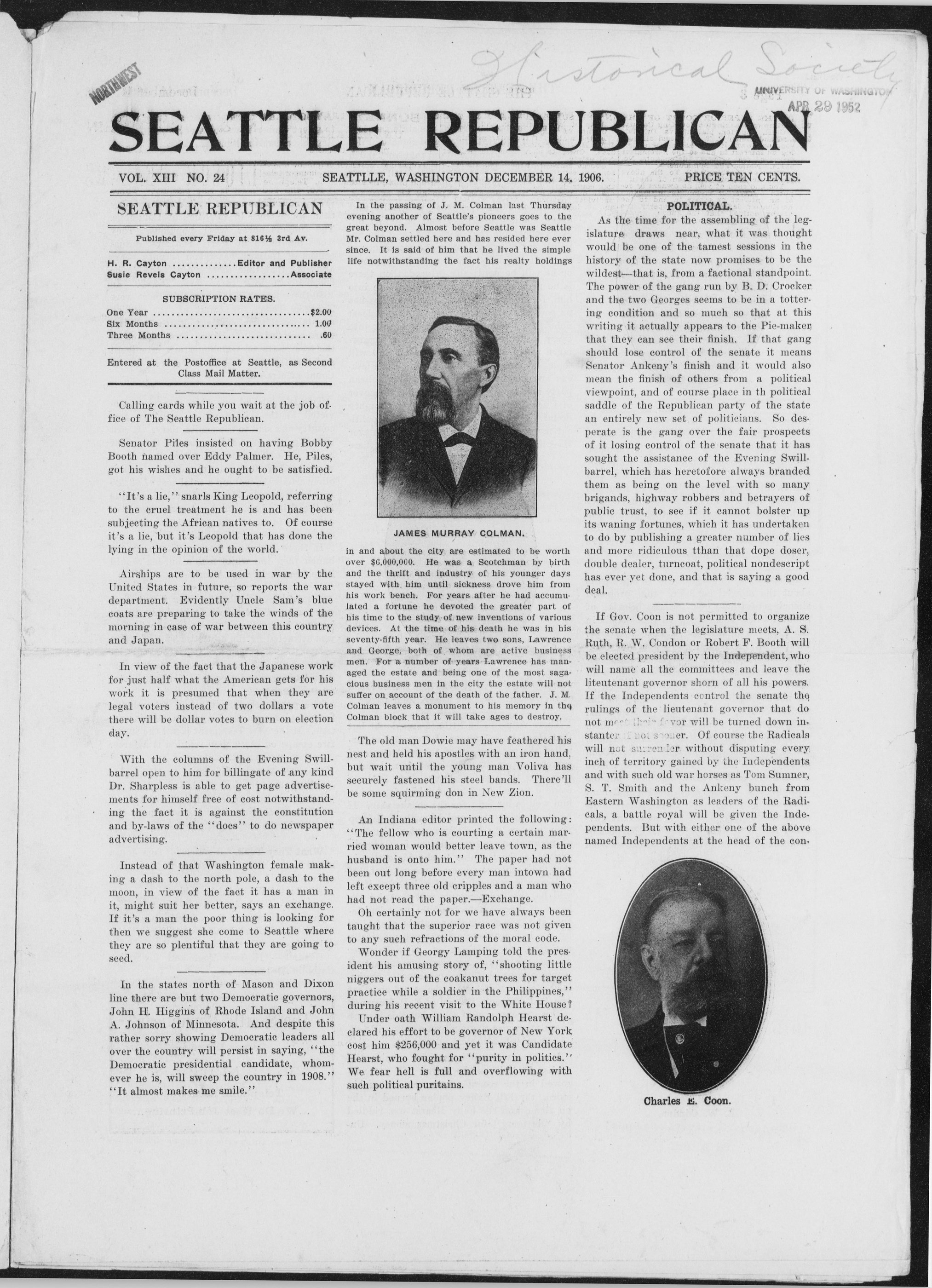
Page text (machine-generated)
SEATTLE REPUBLICAN
VOL. XIII NO. 24
SEATTLE REPUBLICAN
Published every Friday at 816 $ \frac{1}{2} $ 3rd Av.
H. R. Cayton .....Editor and Publisher
Susie Revels Cayton .....Associate
SUBSCRIPTION RATES.
One Year ..... $2.00
Six Months ..... 1.00
Three Months ..... .60
Entered at the Postoffice at Seattle, as Second Class Mail Matter.
Calling cards while you wait at the job office of The Seattle Republican.
Senator Piles insisted on having Bobby Booth named over Eddy Palmer. He, Piles, got his wishes and he ought to be satisfied.
"It's a lie," snarls King Leopold, referring to the cruel treatment he is and has been subjecting the African natives to. Of course it's a lie, but it's Leopold that has done the lying in the opinion of the world.
Airships are to be used in war by the United States in future, so reports the war department. Evidently Uncle Sam's blue coats are preparing to take the winds of the morning in case of war between this country and Japan.
In view of the fact that the Japanese work for just half what the American gets for his work it is presumed that when they are legal voters instead of two dollars a vote there will be dollar votes to burn on election day.
With the columns of the Evening Swillbarrel open to him for billingate of any kind Dr. Sharpless is able to get page advertisements for himself free of cost notwithstanding the fact it is against the constitution and by-laws of the "docs" to do newspaper advertising.
Instead of that Washington female making a dash to the north pole, a dash to the moon, in view of the fact it has a man in it, might suit her better, says an exchange. If it's a man the poor thing is looking for then we suggest she come to Seattle where they are so plentiful that they are going to seed.
In the states north of Mason and Dixon line there are but two Democratic governors, John H. Higgins of Rhode Island and John A. Johnson of Minnesota. And despite this rather sorry showing Democratic leaders all over the country will persist in saying, "the Democratic presidential candidate, whomever he is, will sweep the country in 1908." "It almost makes me smile."
...
SEATTLLE, WASHINGTON DECEMBER 14, 1906.
In the passing of J. M. Colman last Thursday evening another of Seattle's pioneers goes to the great beyond. Almost before Seattle was Seattle Mr. Colman settled here and has resided here ever since. It is said of him that he lived the simple life notwithstanding the fact his realty holdings
[Name not visible in the image]
JAMES MURRAY COLMAN.
in and about the city are estimated to be worth over $6,000,000. He was a Scotchman by birth and the thrift and industry of his younger days stayed with him until sickness drove him from his work bench. For years after he had accumulated a fortune he devoted the greater part of his time to the study of new inventions of various devices. At the time of his death he was in his seventy-fifth year. He leaves two sons, Lawrence and George, both of whom are active business men. For a number of years Lawrence has managed the estate and being one of the most sagacious business men in the city the estate will not suffer on account of the death of the father. J. M. Colman leaves a monument to his memory in the Colman block that it will take ages to destroy.
The old man Dowie may have feathered his nest and held his apostles with an iron hand, but wait until the young man Voliva has securely fastened his steel bands. There'll be some squirming don in New Zion.
An Indiana editor printed the following: "The fellow who is courting a certain married woman would better leave town, as the husband is onto him." The paper had not been out long before every man intown had left except three old cripples and a man who had not read the paper.—Exchange. Oh certainly not for we have always been taught that the superior race was not given to any such refractions of the moral code.
Wonder if Georgy Lamping told the president his amusing story of, "shooting little niggers out of the coakanut trees for target practice while a soldier in the Philippines," during his recent visit to the White House? Under oath William Randolph Hearst declared his effort to be governor of New York cost him $256,000 and yet it was Candidate Hearst, who fought for "purity in politics." We fear hell is full and overflowing with such political puritains.
PRICE TEN CENTS.
POLITICAL.
As the time for the assembling of the legislature draws near, what it was thought would be one of the tamest sessions in the history of the state now promises to be the wildest—that is, from a factional standpoint. The power of the gang run by B. D. Crocker and the two Georges seems to be in a tottering condition and so much so that at this writing it actually appears to the Pie-maker that they can see their finish. If that gang should lose control of the senate it means Senator Ankeny's finish and it would also mean the finish of others from a political viewpoint, and of course place in th political saddle of the Republican party of the state an entirely new set of politicians. So desperate is the gang over the fair prospects of it losing control of the senate that it has sought the assistance of the Evening Swill-barrel, which has heretofore always branded them as being on the level with so many brigands, highway robbers and betrayers of public trust, to see if it cannot bolster up its waning fortunes, which it has undertaken to do by publishing a greater number of lies and more ridiculous tthan that dope doser, double dealer, turncoat, political nondescript has ever yet done, and that is saying a good deal.
If Gov. Coon is not permitted to organize the senate when the legislature meets, A. S. Ruth, R. W. Condon or Robert F. Booth will be elected president by the Independent, who will name all the committees and leave the liteutenant governor shorn of all his powers. If the Independents control the senate the rulings of the lieutenant governor that do not meet their favor will be turned down instanter if not sooner. Of course the Radicals will not surrender without disputing every inch of territory gained by the Independents and with such old war horses as Tom Sumner, S. T. Smith and the Ankeny bunch from Eastern Washington as leaders of the Radicals, a battle royal will be given the Independents. But with either one of the above named Independents at the head of the con-
[Name not visible]
Charles E. Coon.
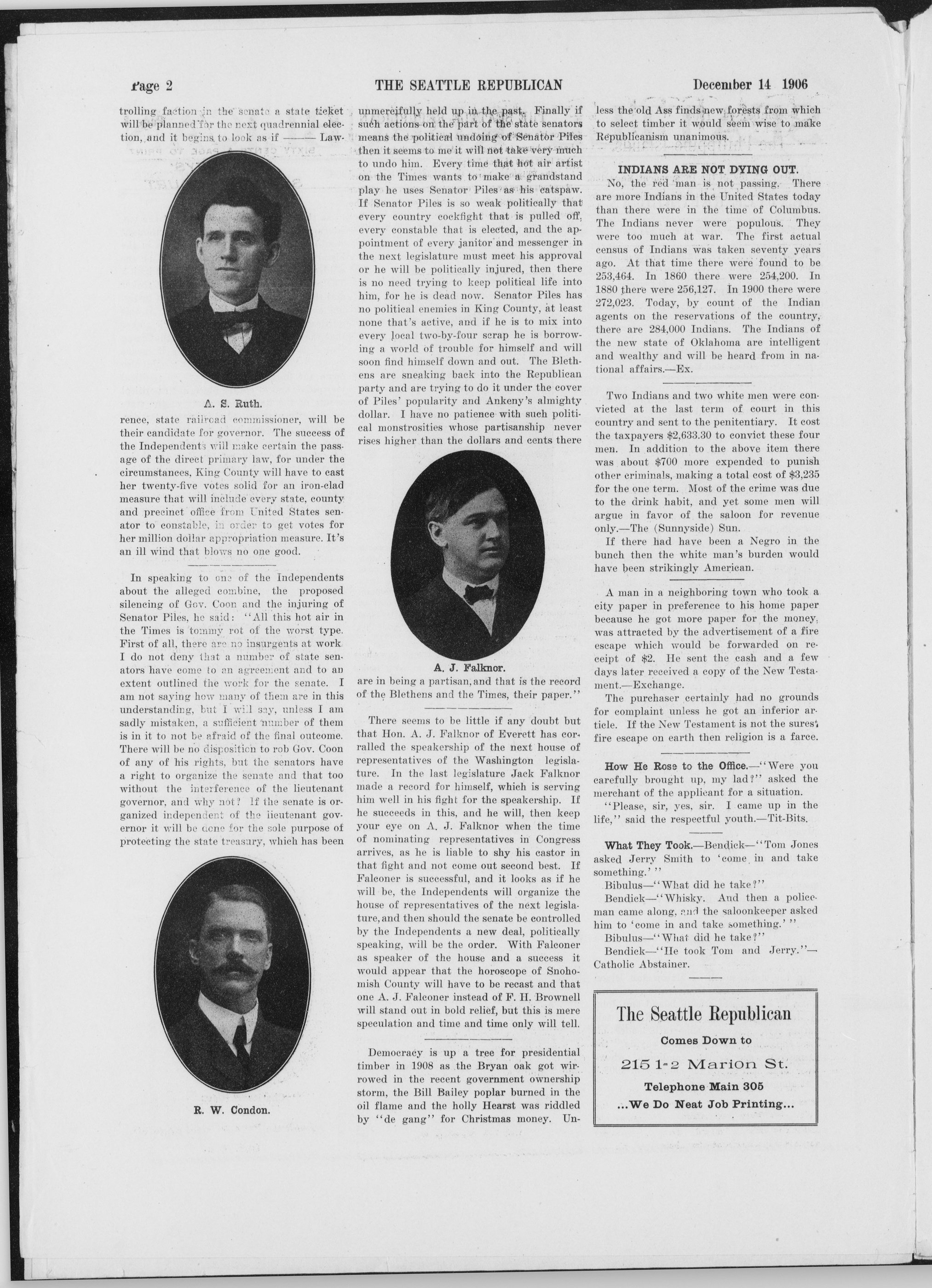
trolling faction in the senate a state ticket will be planned for the next quadrennial election, and it begins to look as if Law-
OF ADAS A STYLE
A. S. Ruth. rence, state railroad commissioner, will be their candidate for governor. The success of the Independents will make certain the passage of the direct primary law, for under the circumstances, King County will have to cast her twenty-five votes solid for an iron-clad measure that will include every state, county and precinct office from United States senator to constable, in order to get votes for her million dollar appropriation measure. It's an ill wind that blows no one good.
In speaking to one of the Independents about the alleged combine, the proposed silencing of Gov. Coon and the injuring of Senator Piles, he said: "All this hot air in the Times is tommy rot of the worst type. First of all, there are no insurgents at work. I do not deny that a number of state senators have come to an agreement and to an extent outlined the work for the senate. I am not saying how many of them are in this understanding, but I will say, unless I am sadly mistaken, a sufficient number of them is in it to not be afraid of the final outcome. There will be no disposition to rob Gov. Coon of any of his rights, but the senators have a right to organize the senate and that too without the interference of the lieutenant governor, and why not? If the senate is organized independent of the lieutenant governor it will be done for the sole purpose of protecting the state treasury, which has been
[Picture of a man with a mustache and a suit.]
R. W. Condon.
THE SEATTLE REPUBLICAN
unmercifully held up in the past. Finally if such actions on the part of the state senators means the political undoing of Senator Piles then it seems to me it will not take very much to undo him. Every time that hot air artist on the Times wants to make a grandstand play he uses Senator Piles as his catspaw. If Senator Piles is so weak politically that every country cockfight that is pulled off, every constable that is elected, and the appointment of every janitor and messenger in the next legislature must meet his approval or he will be politically injured, then there is no need trying to keep political life into him, for he is dead now. Senator Piles has no political enemies in King County, at least none that's active, and if he is to mix into every local two-by-four scrap he is borrowing a world of trouble for himself and will soon find himself down and out. The Blethens are sneaking back into the Republican party and are trying to do it under the cover of Piles' popularity and Ankeny's almighty dollar. I have no patience with such political monstrosities whose partisanship never rises higher than the dollars and cents there
[Picture of a man in a suit and bow tie].
A. J. Falknor. are in being a partisan, and that is the record of the Blethens and the Times, their paper."
There seems to be little if any doubt but that Hon. A. J. Falknor of Everett has corralled the speakership of the next house of representatives of the Washington legislature. In the last legislature Jack Falknor made a record for himself, which is serving him well in his fight for the speakership. If he succeeds in this, and he will, then keep your eye on A. J. Falknor when the time of nominating representatives in Congress arrives, as he is liable to shy his castor in that fight and not come out second best. If Falconer is successful, and it looks as if he will be, the Independents will organize the house of representatives of the next legislature, and then should the senate be controlled by the Independents a new deal, politically speaking, will be the order. With Falconer as speaker of the house and a success it would appear that the horoscope of Snohomish County will have to be recast and that one A. J. Falconer instead of F. H. Brownell will stand out in bold relief, but this is mere speculation and time and time only will tell.
Democracy is up a tree for presidential timber in 1908 as the Bryan oak got wrowed in the recent government ownership storm, the Bill Bailey poplar burned in the oil flame and the holly Hearst was riddled by "de gang" for Christmas money. Un-
December 14 1906 less the old Ass finds new forests from which to select timber it would seem wise to make Republicanism unanimous.
INDIANS ARE NOT DYING OUT.
No, the red man is not passing. There are more Indians in the United States today than there were in the time of Columbus. The Indians never were populous. They were too much at war. The first actual census of Indians was taken seventy years ago. At that time there were found to be 253,464. In 1860 there were 254,200. In 1880 there were 256,127. In 1900 there were 272,023. Today, by count of the Indian agents on the reservations of the country, there are 284,000 Indians. The Indians of the new state of Oklahoma are intelligent and wealthy and will be heard from in national affairs.—Ex.
Two Indians and two white men were convicted at the last term of court in this country and sent to the penitentiary. It cost the taxpayers $2,633.30 to convict these four men. In addition to the above item there was about $700 more expended to punish other criminals, making a total cost of $3,235 for the one term. Most of the crime was due to the drink habit, and yet some men will argue in favor of the saloon for revenue only.—The (Sunnyside) Sun.
If there had have been a Negro in the bunch then the white man's burden would have been strikingly American.
A man in a neighboring town who took a city paper in preference to his home paper because he got more paper for the money, was attracted by the advertisement of a fire escape which would be forwarded on receipt of $2. He sent the cash and a few days later received a copy of the New Testament.—Exchange.
The purchaser certainly had no grounds for complaint unless he got an inferior article. If the New Testament is not the surest fire escape on earth then religion is a farce.
How He Rose to the Office.—"Were you carefully brought up, my lad?" asked the merchant of the applicant for a situation. "Please, sir, yes, sir. I came up in the life." said the respectful youth.—Tit-Bits.
What They Took.—Bendick—"Tom Jones asked Jerry Smith to 'come in and take something.'"
Bibulus—"What did he take?"
Bendick—"Whisky. And then a policeman came along, and the saloonkeeper asked him to 'come in and take something.'"
Bibulus—"What did he take?"
Bendick—"He took Tom and Jerry."—Catholic Abstainer.
The Philippine Islands.
By Henry C. Ide in the Independent Magazine. (The following is an interview kindly given by the late Governor General of the Philippines on his return to the United States a few days ago to a representative of the Independent.—Editor.)
After a residence in the Islands from May, 1900, until a few weeks ago, I can say that the Philippines now are, in my opinion, more peaceful than at any time before, under either Spanish or American rule. I have been through nearly every province, and am familiar with conditions in every part of the Archipelago, and have a personal acquaintance with nearly all prominent Filipinos. Anything that I can do to make my fellow countrymen understand the Filipino and appreciate his good qualities and his needs, will be service gladly rendered.
The task undertaken by the Philippine Commission, in which I had the honor to share from the beginning of the Taft administration, as Commissioner, Secretary of Finance and Justice, Governor and Governor-General, was neither small nor simple. Not only were we confronted with conditions more or less of chaos, dealing with unknown quantities. As we got to know the natives we tried to win their confidence, and our success in this direction in the face of disheartening obstacles, has been most gratifying.
Some obsacles were placed in our way by public speakers and editorial writers in the United States. Words thoughtlessly sown in the United States to meet some issue or fit some policy that had passed into oblivion or totally changed aspect long before the echo reached the islands, were most misleading to those whose confidence we were trying to win, and who held us personally responsible for every sentiment uttered in our own land.
The administration of justice in the islands is conducted today with all the regularity of our own courts. The judges are able, independent and highly respected, and the forms of procedure have been made simple and inexpensive, but expeditious.
Thru the adoption of the Torrens system the complicated problem of land titles is in a fair way of being settled. The new system of currency eliminated from circulation in the Philippines some 40,000,000 or 50,000,000 pesos of fluctuating silver currency, and substituted a uniform one based on the gold standard.
Our internal revenue law, which met with much opposition from the manufacturers of tobacco and alcohol, products formerly very lightly taxed, but which now bear much of the public burden. The new system is now appreciated by the people at large as a most beneficent measure. It has raised the burden of taxation from a multitude of small industries and has transferred it to the optional consumers of alcohol and tobacco products.
When the railroads are completed for which franchises have been granted and on which the surveyors are now working, the Philippines will have nearly 900 miles of well-equipped railway, which will mean much for the development of the islands. Not least among the benefits to be derived from this industrial development will be the opportunity it offers the Filipino for labor under skilled supervision, the new markets for local products during the period of construction, and the immense advantage of bringing the rich products of the interior within reach of the markets of the island and of the world.
The impression that Filipino labor is unjust is in large measure untrue. If properly managed, the Filipino is a fairly good laborer. He cannot be kicked and cuffed and cursed. Treat him roughly and it is only a matter of a few hours when his sis-
187954 000000 2002
TUE SEATTLE REPUBLICAN
ter or his cousin or his aunt will be sick and he will have to hurry to her side. And that will be the last that boss sees of that Filipino.
The Filipino laborer needs efficient oversight. He needs more overtime probably than most other laborers; but with the kind of oversight he does much useful work, work good enough to offset the expense of supervision. The Manila harbor works, representing an outlay of $4,000,000, stand largely as a monument to Filipino labor wisely directed. The natives engaged on that work were encouraged to bring their families with them, for the Filipino is a great lover of home and family. They had their brass band, for they greatly enjoy music, and on Sundays they had their cock-pits, which to the Filipino mean even more than does the baseball diamond to young America.
In Manila we have forty miles of new electric railway, as well equipped as any in the United States. The cost of building was carefully figured and in the item of labor—all Filipino labor under American supervision—the actual expense was 40 per cent. below the estimate, which had been based upon the theory that Filipino labor was most inefficient and expensive, not expensive in the per diem, but supposed to be so in actual results for the money paid.
As regards Chindse labor. Chinese undoubtedly would develop the islands, but their admission would not develop the Filipinos. The Filipinos are opposto the admission of Chinese, for they realize that the the Chinaman is most formidable competition and would soon control the industry and trade of the islands.
The Commission, in its reports, has favored the admission of a limited number of skilled Chinese mechanics, with the condition that each should train a certain number of Filipino apprentices. Congress, however, wills otherwise.
Leyte and Samar are the only islands now where the conditions are disturbed. The trouble there is caused mainly by tribes of religious fanatics who have lived for years in the hills, who hate the peaceful husbandmen of the plains and who raid the lowlands at irregular intervals. The police and constabulary force of the islands is, aside from constabulary officers, and outside the city of Manila, now entirely native, and can be trusted with these and any similar disturbances. United States troops are very rarely called upon for aid. The entire policing of the islands, municipal and rural is in the hands of the natives, and they have proved both reliable and effective constabulary. In the city of Manila the police is one-third American and two-tnirds Filipino, an admirable combination.
Conditions in the Philippines, aside from Samar and Leyte, are satisfactory from a peace point of view, but what the islands need and are entitled to for their material benefit is a square deal from this country on the tariff question. It will come, I believe, but meanwhile the situation is serious. By annexation we killed the Spanish market for Philippine sugar and tobacco, and our tariff shuts these products from the United States market, and today both these industries, the most important in the islands, are practically prostrated.
Cards Done While you Wait
215 1-2 Marian St.
page 3
SIXTY CENTS A PAGE TO PRINT
ATTORNEYS'
SUPREME COURT
BRIEFS
AT THE OFFICE OF
SEATTLE REPUBLICAN
PHONE MAIN 305
BOYLE'S
Is the Headquarters for
Men's Fashionable Spring Wear
We make a new man of you less money than any store in Seattle.
N : 423 Pike Street
J. S. GRAHAM
.... IMPORTEn .....
Ladies' Fine Millinery, Cloaks, Suits, Waists,
Children's and Infant's Wear
J. S. GRAHAM, 714-720 Second Avenue
Phone Red 6735
CHAS. H. HARVEY
CARPENTER
House Painting, Sign Painting, Paper Hang-
ing, Kalsomining and Job Carpentering.
308 N. J9th A. Seattle.
ENBrooks&Co. HATTERS & MENS Furnish s. 1331 Second Ave., Arcade Bldg.
THE
UNION SAVINGS
TRUST COMPANY
OF
SEATTLE
IN THE UNION
THERE IS STRENGTH
Cor. Second Avenu
and Cherry Street.
HOGE BUILDING
Seattle,
We Pay 4 Per Cent Interest
JAMFS D HCGE, PIES. G B. SCLNER, CASH
Agents for Alaska Banking and Safe Deposit Co., Nome
Newcastle Lump and
NUT COAL
Pacific Coast Co
Telephone Private Exchange 99
Ind. A 92
---
The Sunday Forum
It can be said without fear of successful contradiction that last Sunday's program at The Forum was the most entertaining one that has as yet been had, and that is saying a good deal. The house was comfortably filled with persons interested in the work and showed their high appreciation of the various renditions on the program. Messrs. Walker and Gardner are to be commended for the splendid work they are doing on the program committee. The address by Mr. Hayden Richardson was, to say the least, a masterly effort and that it met general approval was shown by the enthsiastic applause it received. Mr. Richardson is almost a native son and the most of those present have watched him grow from mere childhood to manhood and noted with great satisfaction his riepning inot a student of nature. His talk was along commercial lines and was not only highly entertaining, but exceeding interesting.
The feature of the program, however, was the banjo-guitar renditions by Messrs. W. M. Holly and D. B. Washington. It has been said of Mr. Holly that he is a banjo king, and the comparison is not overdrawn. His first selection was followed by others and each number was given a more enthusiastic applause, if such a thing was possible, than the last. The trio in which Mr. J. B. Reed was the piano accompanist, was a most pleasing selection. Mr. Reed also favored the audience with a piano solo, The Holy City, as did Mrs. Thompson a vocal solo. Mr. Clifford C. Hancock read the following short but interesting paper on Music:
"ORIGIN OF MUSIC."
For, as the mountains, and valleys, and rivers, and, seas were from the beginning, so has music been.
It was the music of nature, of the air, the water, the brook, and the distant water-fall, and of the gentle wind which moving forth upon the earth, caused the grass, the herbs and the trees to spring forth.
It was the music of birds, of insects, and of everything which had life, in the first joyous spring of existence. What glorious music this must have been!
We speak of the music of our time; of our thousands of voices and instruments uniting in chorus of praise to God, and of the wonderful genius of Handel, Haydn, Mozart, Beethoven, Mendelssohn, Cook, Wagner, Freeman, and Taylor, and others, but no music ever composed by mortal man can be compared with the morning of the Seventh day; the beginning of time and things.
The Negro has contributed to the culture of the Musical world, a large number of artists, who have attracted the attention of nations; with voices and compositions that have pleasingly entertained and enriched the homes and concert stages of both continents. From the earlist of his existence to the present time, he has shown that love, ability and appreciation for music, that indicates a successful musician.
THE SEATTLE REPUBLICAN
THE SEATTLE REPUBLICAN
It is, indeed, encouraging to note that the Negro in his effort to obtain knowledge of music has crawled out of the depths of ignorance to the daylight of knowledge; and although he enjoys much success in this accomplishment, the seeming cry of his soul is to know even more about the art.
In his illiteracy, he created tunes that the greater race is proud to call "Our Country's" music. For in these tunes there is that pathos rythm and feeling which soothes the inmost soul and calms the most rebelulous heart.
We find that the slave had a song to console his every adversity, as well as promote his every joy, and to accompany his religious feeling. Today, we have Negro composers that compare favorably with the best popular classic writers and composers of the Caucasian and Anglo-Saxon races, who had at least two thousand years the advance of the Negro. For example, in forty years the Negro has provided three hundred composers of prominence. Three of this number are classed as great composers. Namely, Will Marion Cook, H. Lawrence Freeman, W. H. Loving and S. Colridge Taylor. These mighty men, each greatest in his own realm, are the prominent and harmonious vanguard of a musical and liberty-loving people, whose aim is to pay respect to whom respect is due, to emplore fair chance to earn honest bread at the profession as honest citizens willing to work faithfully onward until merit has its true reward. His progress in music like other features of his rapid advancement has been afforded him by convenient time or opportunity, which is the greatest aid to success. All he lacks is opportunity.
THE NEGRO AND MUSIC By H. F. Wilson.
In any inquiry as to solutions of the Negro problem the influence of music must not be slighted. That this art plays a prominent part in the development and life of any people is too obvious to need emphasis; but the response of the Negro to music is singularly ready, and so sure that it almost leads to the query whether through this response, rightly directed, might not come the main developing motive.
On the Ground Floor
...The Seattle Republican...
Finally Lands with its Complete
Newspaper
and
Job Printing
Plant...
Work Done with Neatness and
Dispatch on Short Notice.
215 1-2 Marion Street.
Phone Main 305
December 14, 1906 Those who know him best accord the Negro a sincere aesthetic nature. His love of dress and finery, however crudely expressed, is in a manner evidence of this; so is his love of color, though often this manifests itself pervertedly enough. A sensitiveness to natural beauty of scenery and physical environment is almost universal in the race, despite the ugly surroundings in which individuals are forced to live.
But it is in music that this aesthetic sense shows its liveliest development. There is hardly a Negro so poverty-stricken that he may not possess a musical instrument of some sort; and many a lad, working hard week in and week out for a paltry wage, will yet save enough to buy himself music lessons. The case is not unique of the boy who, working with stiff, horny hands all day at the carpenter's trade, devoted nearly the whole of his savings and all of his time evenings to taking a correspondence course in piano lessons. Think of the discouragements this suggests! Not to him, however. It was the animation of his existence.
If a Negro plows a furrow, he does it to a tune; and he paddles a canoe to some susceptible rhythm. The clatter of a tin pan is suggestive of beguilement to the solitary walk of any child, but observe a colored boy with this primitive medium of expression; note what inspiration it furnishes him for ingenious and highly embellished rhythms which he whistles or sings with immeasurable delight. As with all undeveloped peoples, too, the Negro perhaps more than most uses music to charm away superstitious and malevolent fancies.
Marked as a race characteristic is the inherent feeling for harmony. Compare the Negro in this respect with the average white person. It is rare enough to find among ourselves individuals or groups of singers who have the instinct for harmonizing a melody, while with the Negroes this ability is almost universal. If there are but two or three singers, each will take a different part in order to make the harmony as full as possible. If a boy is within hearing distance of any instrument carrying a melody, he will whistle, not with the melody, however assertive, but will ad a part. Still more remarkable is it to hear a boy whistling or singing by himself, carrying the melody until it reaches some point where the feeling is strong for the tonic or dominant note, we will say, when suddenly he will leave the melody to carry itself in the mind, while he takes a bass note to give emphasis to a modulation or climax, returning to his melody with an inerrant instinct when it would weaken or be lost. Nor is this an exceptional instance.
Of course the harmonies the Negroes use are likely to be simple (as would be expected with a music-loving though musically uneducated people), being confined mainly to sixths and thirds and similar combinations with but little movement to related keys. Still, in some of the plantation melodies a very fine feeling for harmonic effects is evident, even though studied combinations of notes may not be used. It is easy to see ways in which this love of
December 14, 1906
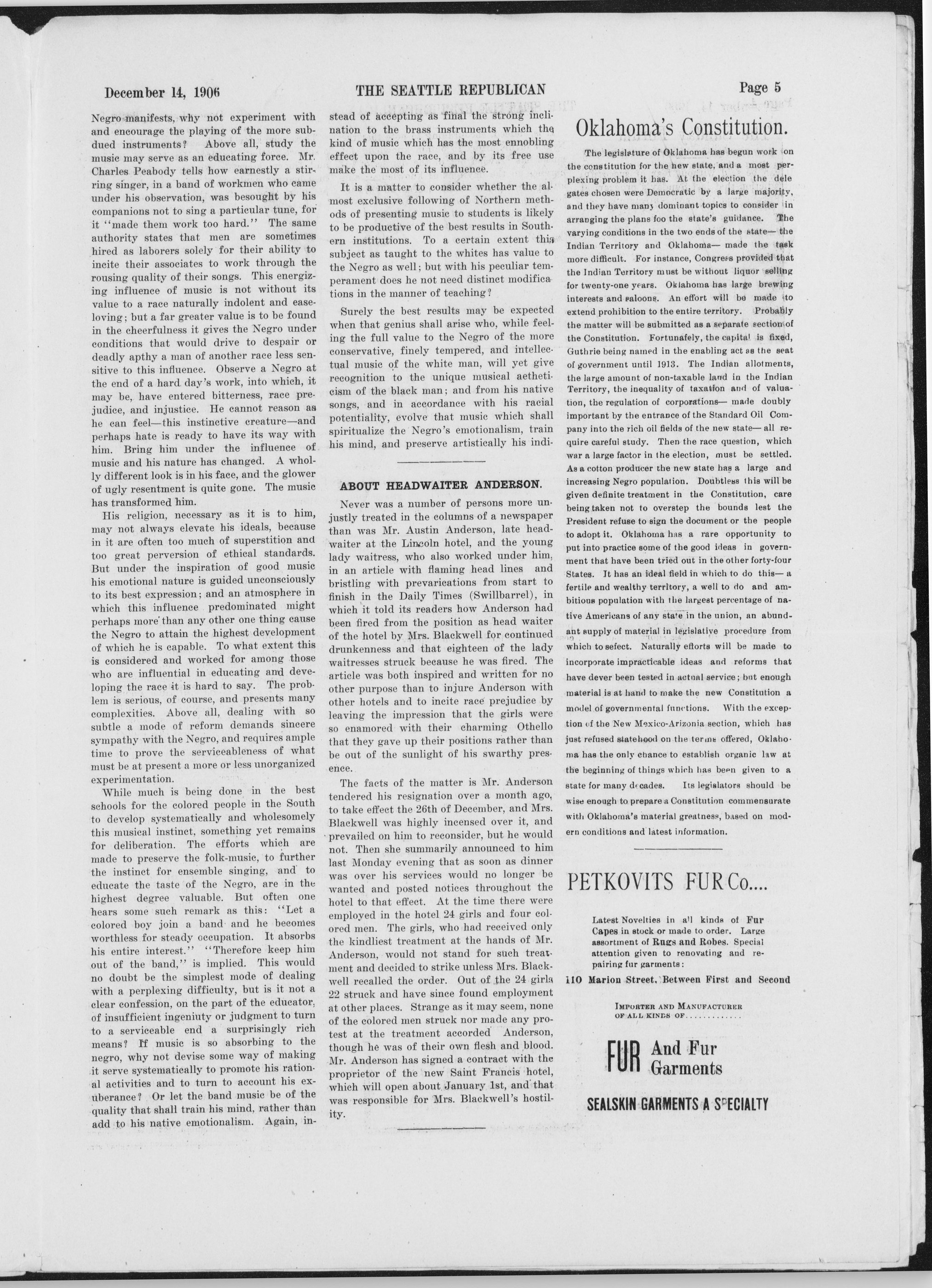
Negro manifests, why not experiment with and encourage the playing of the more subdued instruments? Above all, study the music may serve as an educating force. Mr. Charles Peabody tells how earnestly a stirring singer, in a band of workmen who came under his observation, was besought by his companions not to sing a particular tune, for it "made them work too hard." The same authority states that men are sometimes hired as laborers solely for their ability to incite their associates to work through the rousing quality of their songs. This energizing influence of music is not without its value to a race naturally indolent and easeloving; but a far greater value is to be found in the cheerfulness it gives the Negro under conditions that would drive to despair or deadly apathy a man of another race less sensitive to this influence. Observe a Negro at the end of a hard day's work, into which, it may be, have entered bitterness, race prejudice, and injustice. He cannot reason as he can feel—this instinctive creature—and perhaps hate is ready to have its way with him. Bring him under the influence of music and his nature has changed. A wholly different look is in his face, and the glower of ugly resentment is quite gone. The music has transformed him.
His religion, necessary as it is to him, may not always elevate his ideals, because in it are often too much of superstition and too great perversion of ethical standards. But under the inspiration of good music his emotional nature is guided unconsciously to its best expression; and an atmosphere in which this influence predominated might perhaps more than any other one thing cause the Negro to attain the highest development of which he is capable. To what extent this is considered and worked for among those who are influential in educating and developing the race it is hard to say. The problem is serious, of course, and presents many complexities. Above all, dealing with so subtle a mode of reform demands sincere sympathy with the Negro, and requires ample time to prove the serviceableness of what must be at present a more or less unorganized experimentation.
While much is being done in the best schools for the colored people in the South to develop systematically and wholesomely this musical instinct, something yet remains for deliberation. The efforts which are made to preserve the folk-music, to further the instinct for ensemble singing, and to educate the taste of the Negro, are in the highest degree valuable. But often one hears some such remark as this: "Let a colored boy join a band and he becomes worthless for steady occupation. It absorbs his entire interest." "Therefore keep him out of the band," is implied. This would no doubt be the simplest mode of dealing with a perplexing difficulty, but is it not a clear confession, on the part of the educator, of insufficient ingeniuty or judgment to turn to a serviceable end a surprisingly rich means? If music is so absorbing to the negro, why not devise some way of making it serve systematically to promote his rational activities and to turn to account his exuberance? Or let the band music be of the quality that shall train his mind, rather than add to his native emotionalism. Again, in-
THE SEATTLE REPUBLICAN stead of accepting as final the strong inclination to the brass instruments which the kind of music which has the most ennobling effect upon the race, and by its free use make the most of its influence.
It is a matter to consider whether the almost exclusive following of Northern methods of presenting music to students is likely to be productive of the best results in Southern institutions. To a certain extent this subject as taught to the whites has value to the Negro as well; but with his peculiar temperament does he not need distinct modifications in the manner of teaching?
Surely the best results may be expected when that genius shall arise who, while feeling the full value to the Negro of the more conservative, finely tempered, and intellectual music of the white man, will yet give recognition to the unique musical aetheticism of the black man; and from his native songs, and in accordance with his racial potentiality, evolve that music which shall spiritualize the Negro's emotionalism, train his mind, and preserve artistically his indi-
ABOUT HEADWAITER ANDERSON.
Never was a number of persons more unjustly treated in the columns of a newspaper than was Mr. Austin Anderson, late headwaiter at the Lincoln hotel, and the young lady waitress, who also worked under him, in an article with flaming head lines and bristling with prevarications from start to finish in the Daily Times (Swillbarrel), in which it told its readers how Anderson had been fired from the position as head waiter of the hotel by Mrs. Blackwell for continued drunkenness and that eighteen of the lady waitresses struck because he was fired. The article was both inspired and written for no other purpose than to injure Anderson with other hotels and to incite race prejudice by leaving the impression that the girls were so enamored with their charming Othello that they gave up their positions rather than be out of the sunlight of his swarthy presence.
The facts of the matter is Mr. Anderson tendered his resignation over a month ago, to take effect the 26th of December, and Mrs. Blackwell was highly incensed over it, and prevailed on him to reconsider, but he would not. Then she summarily announced to him last Monday evening that as soon as dinner was over his services would no longer be wanted and posted notices throughout the hotel to that effect. At the time there were employed in the hotel 24 girls and four colored men. The girls, who had received only the kindliest treatment at the hands of Mr. Anderson, would not stand for such treatment and decided to strike unless Mrs. Blackwell recalled the order. Out of the 24 girls 22 struck and have since found employment at other places. Strange as it may seem, none of the colored men struck nor made any protest at the treatment accorded Anderson, though he was of their own flesh and blood. Mr. Anderson has signed a contract with the proprietor of the new Saint Francis hotel, which will open about January 1st, and that was responsible for Mrs. Blackwell's hostility.
Oklahoma's Constitution.
The legislature of Oklahoma has begun work on the constitution for the new state, and a most perplexing problem it has. At the election the delegates chosen were Democratic by a large majority, and they have many dominant topics to consider in arranging the plans foo the state's guidance. The varying conditions in the two ends of the state—the Indian Territory and Oklahoma—made the task more difficult. For instance, Congress provided that the Indian Territory must be without liquor selling for twenty-one years. Oklahoma has large brewing interests and saloons. An effort will be made to extend prohibition to the entire territory. Probably the matter will be submitted as a separate section of the Constitution. Fortunafely, the capital is fixed, Guthrie being named in the enabling act as the seat of government until 1913. The Indian allotments, the large amount of non-taxable land in the Indian Territory, the inequality of taxation and of valuation, the regulation of corporations—made doubly important by the entrance of the Standard Oil Company into the rich oil fields of the new state—all require careful study. Then the race question, which war a large factor in the election, must be settled. As a cotton producer the new state has a large and increasing Negro population. Doubtless this will be given definite treatment in the Constitution, care being taken not to overstep the bounds lest the President refuse to sign the document or the people to adopt it. Oklahoma has a rare opportunity to put into practice some of the good ideas in government that have been tried out in the other forty-four States. It has an ideal field in which to do this—a fertile and wealthy territory, a well to do and ambitious population with the largest percentage of native Americans of any state in the union, an abundant supply of material in legislative procedure from which to select. Naturally efforts will be made to incorporate impracticable ideas and reforms that have ever been tested in actual service; but enough material is at hand to make the new Constitution a model of governmental functions. With the exception of the New Mexico-Arizona section, which has just refused statehood on the terms offered, Oklahoma has the only chance to establish organic law at the beginning of things which has been given to a state for many decades. Its legislators should be wise enough to prepare a Constitution commensurate with Oklahoma's material greatness, based on modern conditions and latest information.
PETKOVITS FURCo....
Latest Novelties in all kinds of Fur Capes in stock or made to order. Large assortment of Rugs and Robes. Special attention given to renovating and repairing fur garments: 110 Marion Street. Between First and Second
IMPORTER AND MANUFACTURER
OF ALL KINDS OF.....
FUR And Fur
Garments
SEALSKIN GARMENTS A SPECIALTY
```markdown
```
THE DANCE COMPANY
December 14, 1906
```markdown
```
PERSONAL.
W. M. J. Wylie and C. H. Harvey visited Tacoma on business Sunday.
Rev. J. M. Nebb will lecture before The Forum next Sunday afternoon.
Mr. A. R. Black received the sad intelligence of the death of his eldest brother at Chester, Pa.
Mrs. H. P. Lawhorn, of Tacoma spent Monday in the city visiting friends.
Mr. W. H. Taylor entertained the Trojan Whist Club on Monday evening.
Mrs. G. W. Thompson has been very sick for a week, but is slowly improving.
The Seattle Republican, Main 305. The Seattle Republican, 215 Marion Street.
Mr. Austin Anderson has resigned the position of head waiter at the Lincoln Hotel, a position he has held for four years.
The Evergreen Literary Society will hold a meeting tonight for the purpose of reorganizing at the Mt. Zion Baptist Church.
Mrs. B. F. Meadows, of Everett, was in the city Wednesday, making arrangements to erect a house on her property at 12th and Jefferson Sts.
Rev. F. L. Donohoo has been incapacitated this week from a severe cold and overwork in his efforts for the grand rally of last week.
Robert Harvey, a young man who is working at one of the hotels, has made the right move by investing in some property that can be paid for on installments. He bought five lots this week.
A few of the friends of Miss Charlotte Dunn gave her a surprise party on Monday evening. The occasion was the young lady's birthday. Music, cards and dancing were indulged in and a fine luncheon was served. Among those present were Misses D. O'Brien, A. Clark, B. Davis, C. Dunn, M. O'Brien, G. Selby, M. Warack.
```markdown
```
THE SEATTLE REPUBLICAN
```markdown
```
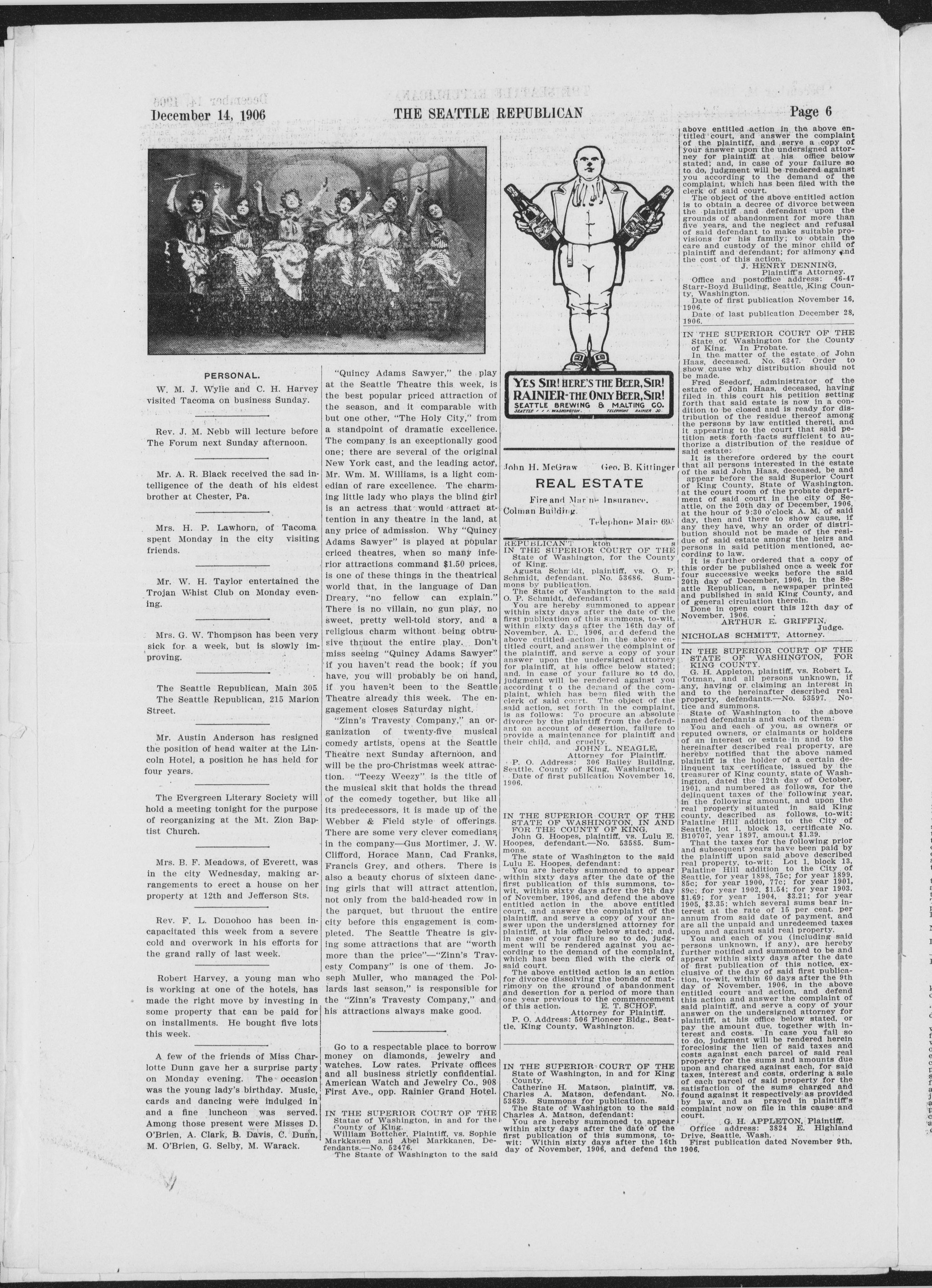
"Quincy Adams Sawyer," the play at the Seattle Theatre this week, is the best popular priced attraction of the season, and it comparable with but one other, "The Holy City," from a standpoint of dramatic excellence. The company is an exceptionally good one; there are several of the original New York cast, and the leading actor, Mr. Wm. M. Williams, is a light comedian of rare excellence. The charming little lady who plays the blind girl is an actress that would attract attention in any theatre in the land, at any price of admission. Why "Quincy Adams Sawyer" is played at popular criced theatres, when so many inferior attractions command $1.50 prices, is one of these things in the theatrical world that, in the language of Dan Dreary, "no fellow can explain." There is no villain, no gun play, no sweet, pretty well-told story, and a religious charm without being obtrusive throut the entire play. Don't miss seeing "Quincy Adams Sawyer" if you haven't read the book; if you have, you will probably be on hand, if you haven't been to the Seattle Theatre already this week. The engagement closes Saturday night.
"Zinn's Travesty Company," an organization of twenty-five musical comedy artists, opens at the Seattle Theatre next Sunday afternoon, and will be the pro-Christmas week attraction. "Teezy Weezy" is the title of the musical skit that holds the thread of the comedy together, but like all its predecessors, it is made up of the Webber & Field style of offerings. There are some very clever comedians in the company—Gus Mortimer, J. W. Clifford, Horace Mann, Cad Franks, Francis Grey, and others. There is also a beauty chorus of sixteen dancing girls that will attract attention, not only from the bald-headed row in the parquet, but thruout the entire city before this engagement is completed. The Seattle Theatre is giving some attractions that are "worth more than the price"—"Zinn's Travesty Company" is one of them. Joseph Muller, who managed the Pollards last season," is responsible for the "Zinn's Travesty Company," and his attractions always make good.
Go to a respectable place to borrow money on diamonds, jewelry and watches. Low rates. Private offices and all business strictly confidential. American Watch and Jewelry Co., 908 First Ave., opp. Rainier Grand Hotel.
IN THE SUPERIOR COURT OF THE Statue of Washington, in and for the County of King.
William Bottcher, Plaintiff, vs. Sophie Markkanen and Abel Markkanen, Defendants.—No. 52476.
The Staate of Washington to the said
CHEVROLET
YES SIR! HERE'S THE BEER, SIR!
RAINIER- THE ONLY BEER, SIR!
SEATTLE BREWING & MALTING CO.
SEATTLE / WASHINGTON
TELEPHONE RAINIER JO.
John H. McGraw Geo. B. Kittinger REAL ESTATE
Fire and Marine Insurance. Colman Building.
REPUBLICAN'T kton
IN THE SUPERIOR COURT OF THE State of Washington, for the County of King.
Agusta Schmidt, plaintiff, vs. O. P. Schmidt, defendant. No. 53686. Summons by publication.
The State of Washington to the said O. P. Schmidt, defendant:
You are hereby summoned to appear within sixty days after the date of the first publication of this summons, to-wit, within sixty days after the 16th day of November, A. D. 1906, and defend the above entitled action in the above entitled court, and answer the complaint of the plaintiff, and serve a copy of your answer upon the undersigned attorney for plaintiff, at his office below stated; and, in case of your failure so to do, judgment will be rendered against you according to the demand of the complaint, which has been filed with the clerk of said court. The object of the said action, set forth in the complaint, is as follows: To procure an absolute divorce by the plaintiff from the defendant on account of desertion, failure to provide a maintenance for plaintiff and their child, and cruelty.
P. O. Address: 306 Bailey Building, Seattle, County of King, Washington. Date of first publication November 16, 1906.
IN THE SUPERIOR COURT OF THE STATE OF WASHINGTON, IN AND FOR THE COUNTY OF KING.
John G. Hoopes, plaintiff. vs. Lulu E. Hoopes, defendant.—No. 53585. Summons.
The state of Washington to the said Lulu E. Hoopes, defendant:
You are hereby summoned to appear within sixty days after the date of the first publication of this summons, towit, within sixty days after the 9th day of November, 1906, and defend the above entitled action in the above entitled court, and answer the complaint of the plaintiff, and serve a copy of your answer upon the undersigned attorney for plaintiff, at his office below stated; and, in case of your failure so to do, judgment will be rendered against you according to the demand of the complaint, which has been filed with the clerk of said court.
The above entitled action is an action for divorce dissolving the bonds of matrimony on the ground of abandonment and desertion for a period of more than one year previous to the commencement of this action. E. T. SCHOF, Attorney for Plaintiff. P. O. Address: 506 Pioneer Bldg., Seattle, King County, Washington.
IN THE SUPERIOR COURT OF THE State of Washington, in and for King County. Catherine H. Matson, plaintiff, vs. Charles A. Matson, defendant. No. 53639. Summons for publication. The State of Washington to the said Charles A. Matson, defendant:
Charles A. Matson, defendant.
You are hereby summoned to appear within sixty days after the date of the first publication of this summons, towit: Within sixty days after the 16th day of November, 1906, and defend the
Telephone Mair 695
JOHN L. NEAGLE
Attorney of Phyllis
above entitled action in the above entitled court, and answer the complaint of the plaintiff, and serve a copy of your answer upon the undersigned attorney for plaintiff at his office below stated; and, in case of your failure so to do, judgment will be rendered against you according to the demand of the complaint, which has been filed with the clerk of said court.
The object of the above entitled action is to obtain a decree of divorce between the plaintiff and defendant upon the grounds of abandonment for more than five years, and the neglect and refusal of said defendant to make suitable provisions for his family; to obtain the care and custody of the minor child of plaintiff and defendant; for alimony and the cost of this action.
J. HENYD DENNING
Plaintiff's Attorney
Office and postoffice address: 46-47
Starr-Boyd Building, Seattle, King County,
Washington.
Date of first publication November 16,
1906.
Date of last publication December 28, 1906.
IN THE SUPERIOR COURT OF THE State of Washington for the County of King. In Probate.
In the matter of the estate of John Haas, deceased. No. 6347. Order to show cause why distribution should not be made.
Fred Seedorf, administrator of the estate of John Haas, deceased, having filed in this court his petition setting forth that said estate is now in a condition to be closed and is ready for distribution of the residue thereof among the persons by law entitled thereto, and it appearing to the court that said petition sets forth facts sufficient to authorize a distribution of the residue of said estate:
It is therefore ordered by the court that all persons interested in the estate of the said John Haas, deceased, be and appear before the said Superior Court of King County, State of Washington, at the court room of the probate department of said court in the city of Seattle, on the 20th day of December, 1906, at the hour of 9:30 o'clock A. M. of said day, then and there to show cause, if any they have, why an order of distribution should not be made of the residue of said estate among the heirs and persons in said petition mentioned, according to law.
It is further ordered that a copy of this order be published once a week for four successive weeks before the said 20th day of December, 1906, in the Seattle Republican, a newspaper printed and published in said King County, and of general circulation therein.
Done in open court this 12th day of November, 1906.
ARTHUR E. GRIFFIN,
Judge.
NICHOLAS SCHMITT, Attorney.
IN THE SUPERIOR COURT OF THE STATE OF WASHINGTON, FOR KING COUNTY.
G. H. Appleton, plaintiff, vs. Robert L. Totman, and all persons unknown, if any, having or claiming an interest in and to the hereinafter described real property, defendants.—No. 53597. Notice and summons.
State of Washington to the above named defendants and each of them:
You and each of you, as owners or reputed owners, or claimants or holders of an interest or estate in and to the hereinafter described real property, are hereby notified that the above named plaintiff is the holder of a certain delinquent tax certificate, issued by the treasurer of King county, state of Washington, dated the 12th day of October, 1901, and numbered as follows, for the delinquent taxes of the following year, in the following amount, and upon the real property situated in said King county, described as follows, to-wit: Palatine Hill addition to the City of Seattle, lot 1, block 13, certificate No. B10707 year 1897 amount $1.39.
That the taxes for the following prior and subsequent years have been paid by the plaintiff upon said above described real property, to-wit: Lot 1, block 13, Palatine Hill addition to the City of Seattle, for year 1898, 75c; for year 1899, 85c; for year 1900, 77c; for year 1901, 89c; for year 1902, $1.54; for year 1903, $1.69; for year 1904, $3.21; for year 1905, $3.35; which several sums bear interest at the rate of 15 per cent. per annum from said date of payment, and are all the unpaid and unredeemed taxes upon and against said real property.
You and each of you (including said persons unknown, if any), are hereby further notified and summoned to be and appear within sixty days after the date of first publication of this notice, exclusive of the day of said first publication, to-wit, within 60 days after the 9th day of November, 1906, in the above entitled court and action, and defend this action and answer the complaint of said plaintiff, and serve a copy of your answer on the undersigned attorney for plaintiff, at his office below stated, or pay the amount due, together with interest and costs. In case you fail so do, judgment will be rendered herein foreclosing the lien of said taxes and costs against each parcel of said real property for the sums and amounts due upon and charged against each, for said taxes, interest and costs, ordering a sale of each parcel of said property for the satisfaction of the sums charged and found against it respectively as provided by law, and as prayed in plaintiff's complaint now on file in this cause and court.
G. H. APPLETON, Plaintiff.
Office address: 3824 E. Highland Drive, Seattle, Wash.
First publication dated November 9th,
1906.
```markdown
```
---
J. M. CUNN IAM The Merchant Tailor Lead 122 Second Ave.
Ind. L 738
IN THE SUPERIOR COURT OF THE
State of Washington, for the County of
King.
Margaret K. Boecher, Plaintiff, vs.
John Boecher, Defendant.—No. 53851.
Summons by Publication .
The State of Washington to the said John Beecher, Defendant: You are hereby summoned to appear within sixty days after the date of the first publication of this summons, to-wit: within sixty days after the 30th day of November. A. D. 1906, and defend the above entitled action, in the above entitled Court, and answer the complaint of the plaintiff, and serve a copy of your answer upon the undersigned attorney for plaintiff at his office below stated; and in case of your failure so to do, judgment will be rendered against you according to the demand of the complaint, which has been filed with the Clerk of said Court. The object of the said action is to dissolve the bonds of matrimony existing between the plaintiff and defendant herein on the ground of the neglect and refusal of the defendant to make suitable provisions or any provisions at all for plaintiff and child.
Attorney for Phantin.
P. O. and Office Address: 9-10 Starr-
Boyd Bldg., Seattle, County of King,
Washington.
Date of first publication, Nov. 30, 1906.
IN THE SUPERIOR COURT OF THE
STATE OF WASHINGTON, FOR THE
COUNTY OF KING. IN PROBATE.
In the matter of the estate of Carl
John Carlson, deceased.—No. 7226. Order
to show cause on sale of real estate.
Josephine C. Carlson, the administratrix
of the estate of Carl John Carlson,
deceased, having filed her petition in
this court, duly verified, praying for an
order of this court for the sale at
private sale of the real estate of which
the said deceased died seized, for the
purposes therein set forth.
And it appearing to the court from said petition that the personal estate of the said deceased in the hands of said administratrix is not sufficient to pay the claims against the asid estate and the expenses of the administration thereof, and other debts of said decedent, and that it is necessary to sell all or a portion of the real estate of the said deceased to pay the said claims and expenses of the administration. And it appearing to the court that said petition conforms to, and is in accordance with the requirements of law in such case made and provided. It is ordered by the court that all persons interested in the estate of the said deceased appear before said superior court on Thursday, the 13th day of December, 1906, at the hour of 9:30 o'clock in the forenoon of said day at the courtroom of the probate department of said superior court, in the City of Seattle in said King county, then and there to show cause, if any they have, why an order of this court should not be granted to said administratrix authorizing and empowering her to sell the said real estate of said deceased at private sale, or so much thereof as may be necessary to pay the aforesaid claims and expenses of administration and other debts.
It is further ordered that a copy of this order to show cause be published at least four successive weeks before the said 13th day of December, 1906, in The Seattle Republican, a newspaper printed and published in said County of King and of general circulation therein. Done in open court this 8th day of November, 1906.
ARTHUR E. GRIFFIN, Judge.
ISRAEL NELSON, Attorney for Administratrix, 704 New York Block, Seattle,
IN THE SUPERIOR COURT OF THE State of Washington, for the County of King.
H. M. Gould, plaintiff, vs. the Unknown Heirs of John L. Lewis, deceased, defendants. No. 52,490.
The State of Washington to the said "The Unknown Heirs of John L. Lewis, deceased":
You are hereby summoned to appear within sixty days after the date of the first publication of this summons, towit, within sixty days after the 2nd day of November, 1906, and defend the above entitled action in the above entitled court, and answer the complaint of the plaintiff, and serve a copy of your answer upon the undersigned attorneys for plaintiff at their office below stated; and in case of your failure so to do, judgment will be rendered against you according to the demand of the complaint, which has been filed with the clerk of, said court. The object of this action is to procure a partition of land described as lot nine, in block fifteen
```markdown
```
in Madison Street Addition to the City of Seattle, in said county and state, in which it is alleged in the complaint in said action that you have an undivided half interest.
JUDD & SAMPSON,
Plaintiff's Attorneys.
P. O. Address: 432 New York Block,
Seattle, Washington.
November 2-Dec. 14.
IN THE SUPERIOR COURT OF THE
State of Washington, in and for the
County of King.
In the matter of the estate of C. C.
Maring, Deceased.—Order to Show Cause
of Sale of Real Estate.
Francettie P. Maring, administratrix of the will annexed of the estate of C. C. Maring, deceased, having filed her petition in this court, duly verified, praying for an order of this court for the sale of the north half (N. $ _{1/2} $ ) of Lot twelve (12), and the whole of Lot thirteen (13), in Block two (2) of Walla Wala A. Addition to the City of Seattle, real estate belonging to said estate, for the purposes therein set forth; and it appearing to the court from said petition that the personal property of said estate is not sufficient to pay the debts against said estate and the expense of administration; and it further appearing that there is a mortgage outstanding against said property which the holders are threatening to foreclose, and that there are not sufficient funds to maintain, support and educate the surviving widow and minor children of the above named deceased, and that the real property hereinbefore described will suffer unavoidable waste if the sale thereof be not made.
And it appearing that it is to the best interest of said estate that said real estate be sold; and it further appearing to the court that said petition conforms to and is in accordance with the requirements of law in such case made and provided, it is by the court ordered that all persons interested in the above named estate of C. C. Maring, deceased, be and appear before said Superior Court on Thursday, the 27th day of December, 1906, at the hour of 9:30 o'clock in the forenoon of said day, at the court room of the Probate Department of said Superior Court, in the City of Seattle, King County, State of Washington, then and there to show cause, if any they have, why an order of this court should not be granted to said administratrix with the will annexed, authorizing and empowering her to sell the said real estate belonging to said estate at private sale as prayed for in her petition on file herein;
It is further ordered that a copy of this order to show cause be published at least four consecutive weeks before the 27th day of December, 1906, in the Seattle Republican, a weekly newspaper printed and published in said King County and of general circulation therein.
Done in open court this 23d day of November, 1906.
ARTHUR E. GRIFFIN. Judge.
First publication, Nov. 23, 1906.
ONE—REPUBLICAN ETOUT
IN THE SUPERIOR COURT OF THE State of Washington, Snohomish County. In Probate.
In the matter of the estate of H. P. Rassmussen, Deceased; E. L. Rassmussen, Administrator. Notice of Sale of Real Estate.
Notice is hereby given that in pursuance of an order of the above entitled court made in the above entitled matter on the 1st day of December, 1906, the undersigned as administrator will sell the premises hereinafter described at public auction to the highest bidder for cash on Friday, the 4th day of January, 1907, at the hour of ten o'clock A.M., at the front door of the courthouse in the City of Seattle, King County. Washington, subject only to the confirmation of said sale as by law provided.
The property hereinabove referred to is particularly described as follows, towit: Lots 47 and 48, in block 12. Saunder's First Addition to the Town, now City of West Seattle.
E. L. RASSMUSSEN.
Administrator of the Estate of H. P.
Rassmussen, Deceased.
FRANK A. STEELE,
Attorney for Administrator, 405 Pioneer
Bldg., Seattle, Wash.
IN THE SUPERIOR COURT OF THE
State of Washington, in and for the
County of King.
Katherine Dilsaver, Plaintiff, vs. Ellsworth Dilsaver, Defendant. No. 53,908.
Summons and Service of Publication.
The State of Washington, to the said
Ellsworth Dilsaver, Defendant:
You are hereby summoned to appear within sixty (60) days after date of the first publication of this summons, to wit: Within sixty (60) days after the 7th day of December, 1906, and defend the above entitled action in the above entitled court, and answer the complaint of the plaintiff and serve a copy of your answer upon the undersigned attorney for plaintiff, at his office, below stated; and in case of your failure so to do, judgment will be rendered against you according to the demand of the complaint which has been filed with the Clerk of said Court; the object for which this action is brought is to obtain a decree of divorce from the defendant on the following grounds:
I.
Because of personal indignities upon the part of the defendant (as alleged in the complaint) rendering the plaintiff's life burdensome.
II.
Because the defendant, for a long time past and especially for four (4) months last past, has neglected and refused to
```markdown
```
make suitable provisions for the plaintiff and his family, and because he still neglects and refuses to do the same.
The further object for which this action is brought is also to obtain a decree from the court adjudging the plaintiff to be the sole owner of real estate in King County, in the State of Washington, and described as lots one (1) and two (2), in block forty-six (46), Denny & Hoyt's Addition to the City of Seattle, according to the plat now of record in the auditor's office in King County, in the State of Washington; also to recover from the defendant the sum of Eight Hundred ($800) Dollars, with real interest from the day of in the year of 1899, which money if advanced to defendant upon the sale of real estate belonging to plaintiff prior to her marriage to the defendant.
A. J. SPECKERT.
Attorney for Plaintiff.
P. O. Address: 429 to 432 Epler Blk., 813 Seventh Avenue, Seattle, Wash.
SHERIFF'S SALE OF REAL ESTATE.
State of Washington, County of King,
SS, Sheriff's office.
By virtue of an Order of Sale, issued out of the Honorable Superior Court of King County, on the 30th day of November, 1906, by the Clerk thereof, in the case of F. D. Black and Kate H. Black, his wife, Plaintiffs, versus J. A. Bilieu, Defendant, No. 51,443, and to me, as Sheriff, directed and delivered:
Notice Is Hereby Given, That I will proceed to sell at public auction to the highest bidder for cash, within the hours prescribed by law for Sheriff's Sales, towit: at 10 o'clock A. M. on the 12th day of January, A. D. 1907, before the Courthouse door of said King County, in the State of Washington, all of the right, title and interest of the said defendant in and to the following described property, situated in King County, State of Washington, towit: One-sixth (1-6) interest in and to that certain property known and described as follows;
A tract of eight (8) acres in the northwest corner of the southeast quarter of the northeast quarter of section twenty-one, township twenty-four, north range four east W. M., excepting eighty feet in the northwest corner, levied on as the property of said defendant, to satisfy a judgment of foreclosure of mortgage, amounting to Ninety-five and 35-100 ($95.35) Dollars, and costs of, suit in favor of Plaintiff.
Dated this 3rd day of December, 1906.
L. C. SMITH, Sheriff.
By EDW. DREW, Deputy.
IN THE SUPERIOR COURT OF THE
State of Washington, in and for King
County.
Nettie McDonald, Plaintiff, vs. Alphonsus McDonald, Defendant.—No. 53745. Summons by Publication.
The State of Washington to the said
Alphonsus McDonald, defendant:
You are hereby summoned to appear within sixty (60) days after the date of the first publication of this summons, to-wit, within sixty (60) days after the 23d day of November. A. D. 1906, and defend the above entitled action in the above entitled court and answer the complaint of the plaintiff and serve a copy of your answer upon the undersigned attorneys for plaintiff, at their office below stated, and in case of your failure so to do, judgment will be rendered against you according to the demand of the complaint, which has been filed with the clerk of said court. The object of the said action set forth in the complaint aforesaid is to obtain a decree of absolute divorce by the said plaintiff from the said defendant upon the grounds of desertion, abandonment and non-support, as alleged in said complaint.
SAUTER & SHELDON,
Attorneys for Plaintiff.
Office and Post-Office Address: Room 536 New York Block, Seattle, King County, Washington.
Date of first publication, November 23, 1906.
NOTICE TO CREDITORS.
IN THE SUPERIOR COURT OF THE State of Washington, in and for the County of King.
In the Matter of the Estate of Charles M. Maltby, deceased.
Notice is hereby given by the undersigned, Jennie D. Maltby, Administratrix of the estate of Charles M. Maltby, deceased, to the creditors of, and all persons having claims against said deceased, to exhibit them and present the same with the necessary vouchers within one year after the first publication of this notice, to said Administratrix at her office at 646 New York Block, Seattle, County of King, State of Washington, the same being the place for the transaction of the business of said estate in the County of King, State of Washington.
Revelle, Revelle & Revelle,
Attorneys for the Administratrix,
646 New York Block,
Seattle, Washington.
REPUBLICAN LEGALS
IN THE SUPERIOR COURT OF THE
State of Washington, in and for the
County of King.
Ella McBride, Plaintiff, vs. Linas McBride, Defendant. No. 52785. Summons and Service of Publication.
State of Washington to the said Linas McBride, Defendant.
You are hereby summoned to appear within sixty (60) days after date of
December 14, 1906
notice to the undersigned administrator at 704 New York block, Seattle, Washington, that being the place for the transaction of the business of said estate. The notice is given under and by virtue of the order of the above entitled court made and entered on the 8th day of November, 1906. Dated this 15th day of November, 1906.
Attorney for Administrator. 704 New York block, Seattle, Washington
First notice November 16, 1906.
IN THE SUPERIOR COURT OF THE STATE OF WASHINGTON, FOR THE COUNTY OF KING. IN PROBATE.
In the matter of the estate of Nicholas F. Beck, deceased.—No. 6793. Notice to creditors.
Notice is hereby given by Frances Beck as administratrix of the estate of Nicholas F. Beck, deceased, to the creditors of and all persons having claims against said deceased or his estate to exhibit them, with the necessary vouchers, within one year after the first publication of this notice, to said administratrix, at the office of Pierre P. Ferry, attorney for said administratrix, at his office, room 330 Burke building, in the City of Seattle, King county, Washington, that being the place for the transaction of the business of said estate. All claims not so presented will be barred.
Dated at Seattle, Washington, November 8, 1906.
FRANCES BECK, Administratrix for the Estate of Nich-
Date of first publication November 9, 1906.
IN THE SUPERIOR COURT OF THE
State of Washington, for the County
of King.
Josephine Grady, plaintiff, vs. James
S. Grady, defendant. No. 52181.
The State of Washington to the said
James S. Grady, defendant:
You are hereby summoned to appear
within sixty days after the date of the
first publication of this summons, to-wit,
within sixty days after the 28th day of
September, 1906, and defend the above
entitled action in the above entitled
court, and answer the complain of the
plaintiff, and serve a copy of your answer
upon the undersigned attorney for
plaintiff, at his office below stated; and
in case of your failure so to do, judgment will be rendered against you according to the demand of the complaint, which has been filed with the clerk of
said court.
The object of this action is to obtain a decree of divorce dissolving the bonds of matrimony between the plaintiff and the defendant on the grounds of non-support and neglect.
E. T. SCHOFF
Attorney for Plaintiff.
Postoffice Address: 506 Pioneer Bldg.
Seattle, King County, Wash.
Sept. 28. Nov. 9.
THE SUPERIOR COURT OF THE
State of Washington for King County.
F. M. Jeffery, Plaintiff, vs. Alice Harmon
and L. C. Harmon, husband and
wife, Defendants. No. 52220. Summons.
The State of Washington to the said
Alice Harmon and L. C. Harmon, husband
and wife, Defendants:
You are hereby summoned to appear
within sixty (60) days after the
date of the first publication
of this summons to-wit: within 60 days
after the 7th day of September, 1906,
and defend the above entitled action
in the Superior Court of the State of Wash-
ington for King County aforesaid; and
answer the complaint of the Plaintiff,
and serve a copy of your answer upon
the plaintiff, at his office below stated;
and in case of your failure so to do,
judgment will be rendered against you
according to the demand of the com-
plaint, which has been filed with the
Clerk of said Court.
This action is brought to collect a
debt of $50 for professional services.
P. O. Address: 747 New York Block, in Seattle, County of King, State of Washington. Sept. 7-Oct. 19
NOTICE OF ASSESSMENT OF STOCK To Mrs. F. H. Browning: You are hereby notified that you are delinquent in the payment of your assessment of your mining stock in the Skagit River Copper Mining Company for the annual assessment work for the following years, to-wit:
For the year ending December
31st, 1902, the sum of .....
For the year ending December
31st, 1903, the sum of .....
For the year ending December
31st, 1904, the sum of .....
Total $57.50
You are further notified that your shares of stock in said company, or such part thereof as may be necessary to satisfy said assessments, will be sold on the 30th day of November, 1906, at the hour of ten o'clock A. M. at the company's office, 46 Starr-Boyd Building, Seattle, King County, Washington.
GEO. W. FICKS, Secretarv
Sept. 28—Nov. 23
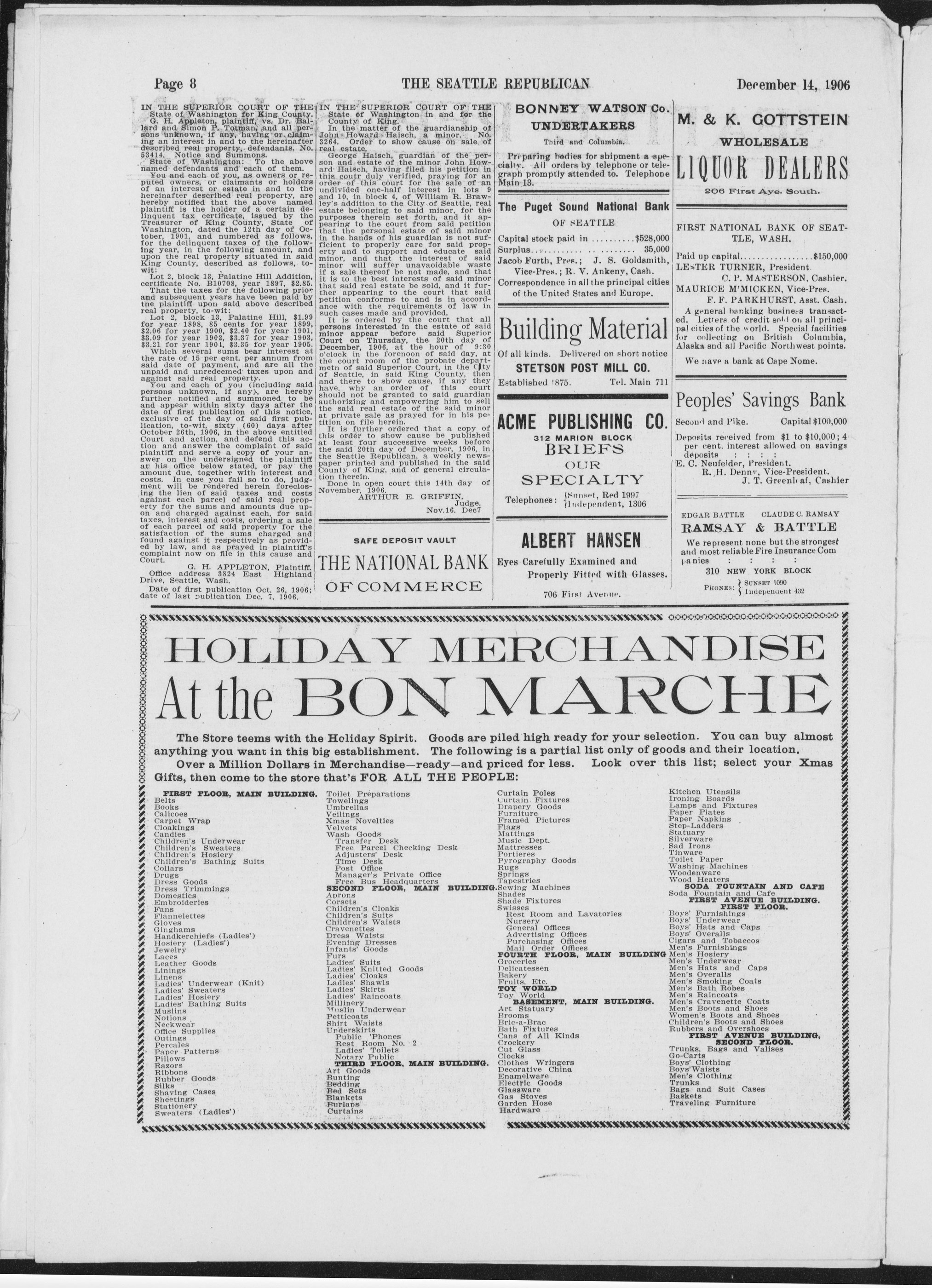
HOLIDAY MERCHANDISE At the BON MARCHE
The Store teems with the Holiday Spirit. Goods are piled high ready for your selection. You can buy almost anything you want in this big establishment. The following is a partial list only of goods and their location. Over a Million Dollars in Merchandise—ready—and priced for less. Look over this list; select your Xmas Gifts, then come to the store that's FOR ALL THE PEOPLE:
Page 8
IN THE SUPERIOR COURT OF THE
State of Washington for King County.
G. H. Appleton, plaintiff, vs. Dr. Ballard and Simon P. Totman, and all persons unknown, if any, having or claiming an interest in and to the hereinafter described real property, defendants. No.
53414. Notice and Summons.
State of Washington: To the above named defendants and each of them.
named defendants and each or them.
You and each of you, as owners or reputed owners, or claimants or holders of an interest or estate in and to the hereinafter described real property, are hereby notified that the above named plaintiff is the holder of a certain delinquent tax certificate, issued by the Treasurer of King County, State of Washington, dated the 12th day of October, 1901, and numbered as follows, for the delinquent taxes of the following year, in the following amount, and upon the real property situated in said King County, described as follows, towit:
Lot 2, block 13, Palatine Hill Addition, certificate No. B10708, year 1897, $2,855. That the taxes for the following prior and subsequent years have been paid by the plaintiff upon said above described real property, to-wit:
Lot 2, block 13, Palatine Hill, $1.99 for year 1898, 85 cents for year 1899, $2.06 for year 1900, $2.40 for year 1901, $3.09 for year 1902, $3.37 for year 1903, $3.21 for year 1901, $3.35 for year 1905. Which several sums bear interest at the rate of 15 per cent, per annum from said date of payment, and are all the unpaid and unredeemed taxes upon and against said real property.
You and each of you (including said persons unknown, if any), are hereby further notified and summoned to be and appear within sixty days after the date of first publication of this notice, exclusive of the day of said first publication, to-wit, sixty (60) days after October 26th, 1906, in the above entitled Court and action, and defend this action and answer the complaint of said plaintiff and serve a copy of your answer on the undersigned the plaintiff at his office below stated, or pay the amount due, together with interest and costs. In case you fail so to do, judgment will be rendered herein foreclosing the lien of said taxes and costs against each parcel of said real property for the sums and amounts due upon and charged against each, for said taxes, interest and costs, ordering a sale of each parcel of said property for the satisfaction of the sums charged and found against it respectively as provided by law, and as prayed in plaintiff's complaint now on file in this cause and Court.
G. H. APPLETON, Plaintiff.
Office address 3824 East Highland Drive, Seattle, Wash.
Date of first publication Oct. 26, 1906;
date of last publication Dec. 7, 1906.
HOLIDAY
At the H
The Store teems with th
anything you want in this
Over a Million Dollars
Gifts, then come to the store
FIRST FLOOR, MAIN
Belts
Books
Calicoes
Carpet Wrap
Cloakings
Candies
Children's Underwear
Children's Sweaters
Children's Hosiery
Children's Bathing Suits
Collars
Drugs
Dress Goods
Dress Trimmings
Domestics
Embroideries
Fans
Flannelettes
Gloves
Ginghams
Handkerchiefs (Ladies')
Hosiery (Ladies')
Jewelry
Laces
Leather Goods
Linings
Linens
Ladies' Underwear (Knit)
Ladies' Sweaters
Ladies' Hosiery
Ladies' Bathing Suits
Muslins
Notions
Neckwear
Office Supplies
Outings
Percales
Paper Patterns
Pillows
Razors
Ribbons
Rubber Goods
Silks
Shaving Cases
Sheetings
Stationery
Sweaters (Ladies')
```markdown
```
IN THE SUPERIOR COURT OF THE State of Washington in and for the County of King. In the matter of the guardianship of John Howard Haisch, a minor. No. 3264. Order to show cause on sale of real estate.
George Haisch, guardian of the person and estate of the minor John Howard Haisch, having filed his petition in this court duly verified, praying for an order of this court for the sale of an undivided one-half interest in lots 9 and 10, in block 4, of William R. Brawley's addition to the City of Seattle, real estate belonging to said minor, for the purposes therein set forth, and it appearing to the court from said petition that the personal estate of said minor in the hands of his guardian is not sufficient to properly care for said property and to support and educate said minor, and that the interest of said minor will suffer unavaoidable waste if a sale thereof be not made, and that it is to the best interests of said minor that said real estate be sold, and it further appearing to the court that said petition conforms to and is in accordance with the requirements of law in such cases made and provided.
It is ordered by the court that all persons interested in the estate of said minor appear before said Superior Court on Thursday, the 20th day of December, 1906, at the hour of 9:30 o'clock in the forenoon of said day, at the court room of the probate department of said Superior Court, in the City of Seattle, in said King County, then and there to show cause, if any they have, why an order of this court should not be granted to said guardian authorizing and empowering him to sell the said real estate of the said minor at private sale as prayed for in his petition on file herein.
It is further ordered that a copy of this order to show cause be published at least four successive weeks before the said 20th day of December, 1906, in the Seattle Republican, a weekly newspaper printed and published in the said County of King, and of general circulation therein.
Done in open court this 14th day of November, 1906.
ARTHUR E. GRIFFIN.
Judge.
Nov.16. Dec7
SAFE DEPOSIT VAULT
THE NATIONAL BANK OF COMMERCE
DAY ME
BON N
The Holiday Spirit. Goods are p
big establishment. The follow
in Merchandise—ready—and p
e that's FOR ALL THE PEOP
Toilet Preparations
Towelings
Umbrellas
Veilings
Xmas Novelties
Velvets
Wash Goods
Transfer Desk
Free Parcel Checking Desk
Adjusters' Desk
Time Desk
Post Office
Manager's Private Office
Free Bus Headquarters
SECOND FLOOR, MAIN BUILDIN
Aprons
Corsets
Children's Cloaks
Children's Suits
Children's Waists
Cravenettes
Dress Waists
Evening Dresses
Infants' Goods
Furs
Ladies' Suits
Ladies' Knitted Goods
Ladies' Cloaks
Ladies' Shawls
Ladies' Skirts
Ladies' Raincoats
Millinery
Muslin Underwear
Petticoats
Shirt Waists
Underskirts
Public 'Phones
Rest Room No. 2
Ladies' Toilets
Notary Public
THIRD FLOOR, MAIN BUILDING.
Art Goods
Bunting
Bedding
Bed Sets
Blankets
Burlaps
Curtains
---
BONNEY WATSON Co.
UNDERTAKERS
Third and Columbia.
Preparing bodies for shipment a specialty. All orders by telephone or telegraph promptly attended to. Telephone Main 13.
The Puget Sound National Bank
OF SEATTLE
Capital stock paid in ..... $528,000
Surplus..... 35,000
Jacob Furth, Pres.; J. S. Goldsmith,
Vice-Pres.; R. V. Ankeny, Cash.
Correspondence in all the principal cities
of the United States and Europe.
Building Material
Of all kinds. Delivered on short notice STETSON POST MILL CO. Established 1875. Tel. Main 711
ACME PUBLISHING CO.
312 MARION BLOCK
BRIEFS
OUR
SPECIALTY
Telephones: {Sunset, Red 1997
}Independent, 1306
ALBERT HANSEN
Eyes Carefully Examined and Properly Fitted with Glasses. 706 First Avenue.
ERCHAIR
MAR
published high ready for your selec
ting is a partial list only of good
priced for less. Look over th
FILE:
Curtain Poles
Curtain Fixtures
Drapery Goods
Furniture
Framed Pictures
Flags
Mattings
Music Dept.
Mattresses
Portieres
Pyrography Goods
Rugs
Springs
Tapestries
Sewing Machines
Shades
Shade Fixtures
Swisses
Rest Room and Lavatories
Nursery
General Offices
Advertising Offices
Purchasing Offices
Mail Order Offices
FOURTH FLOOR, MAIN BUILDING
Groceries
Delicatessen
Bakery
Fruits, Etc.
TOY WORLD
Toy World
BASEMENT, MAIN BUILDING.
Art Statuary
Brooms
Bric-a-Brac
Bath Fixtures
Cans of All Kinds
Crockery
Cut Glass
Clocks
Clothes Wringers
Decorative China
Enamelware
Electric Goods
Glassware
Gas Stoves
Garden Hose
Hardware
---
December 14, 1906
M. & K. GOTTSTEIN
WHOLESALE
LIQUOR DEALERS
206 First Aye. South.
FIRST NATIONAL BANK OF SEATTLE, WASH.
Paid up capital.....$150,000
LESTER TURNER, President.
F. F. PARKHURST, Asst. Cash. A general banking business transacted. Letters of credit sold on all principal cities of the world. Special facilities for collecting on British Columbia, Alaska snd all Pacific Northwest points. We have a bank at Cape Nome.
Peoples' Savings Bank
Second and Pike. Capital $100,000
Deposits received from $1 to $10,000; 4 per cent. interest allowed on savings deposits : : : :
E. C. Neufolder, President.
R. H. Denny, Vice-President.
J. T. Greenleaf, Cashier
EDGAR BATTLE CLAUDE C. RAMSAY
RAMSAY & BATTLE
We represent none but the strongest
and most reliable Fire Insurance Com
panies : : : : :
310 NEW YORK BLOCK
PHONES: SUNSET 1090
Independent 432
NDISE CHEction. You can buy almost foods and their location. this list; select your Xmas
```markdown
```
Kitchen Utensils
Ironing Boards
Lamps and Fixtures
Paper Plates
Paper Napkins
Step-Ladders
Statuary
Silverware
Sad Irons
Tinware
Toilet Paper
Washing Machines
Woodenware
Wood Heaters
SODA FOUNTAIN AND CAFE
Soda Fountain and Cafe
FIRST AVENUE BUILDING.
FIRST FLOOR.
Boys' Furnishings
Boys' Underwear
Boys' Hats and Caps
Boys' Overalls
Cigars and Tobaccos
Men's Furnishings
Men's Hosiery
Men's Underwear
Men's Hats and Caps
Men's Overalls
Men's Smoking Coats
Men's Bath Robes
Men's Raincoats
Men's Cravenette Coats
Men's Boots and Shoes
Women's Boots and Shoes
Children's Boots and Shoes
Rubbers and Overshoes
FIRST AVENUE BUILDING,
SECOND FLOOR.
Trunks, Bags and Valises
Go-Carts
Boys' Clothing
Boys' Waists
Men's Clothing
Trunks
Bags and Suit Cases
Baskets
Traveling Furniture
---