Seattle Republican
Friday, January 13, 1911
Seattle, Washington
Page text (machine-generated)
The Seattle Republican
Historical Society
The Sea
Single Copies, 10 Cents. SEATTLE
THE PUBLISHER'S NOTICE.
The Seattle Republican is published on Friday of every week by Cayton Publishing Company. Subscriptions, $3.00 per year; six months, $1.50 postage prepaid. Subscriptions to all foreign countries included in the Postal Union, $4.00 a year postage paid. Sample copies, free. Single copies ten cents. Advertising rates made known on application. Special rates to publishers. Entered a second-class matter at the postoffice at Seattle. Address all communications to The Seattle Republican 307 Epler Block, Seattle, Washington. Make a checks, drafts, postal orders, etc., payable to "Cayton Publishing Company."
CAYTON PUBLISHING COMPANY, INC.
Telephone: Main 305. Publication office, 307 Epler Block.
HORACE ROSCOE CAYTON - - - Publisher
NUSIE REVELS CAYTON - - - Associates
DILLING FOR MAYOR
After much casting about the Welfare League's executive committee has selected George W. Dilling as the mayorality candidate to oppose Mayor Gill in the recall election and Mr. Dilling has accepted the call, ane will, using his own words, make a ten days' whirlwind campaign. Aside from the work of the executive committee he will have no compaign manager, but will do the work himself.
George W. Dilling has been a resident of Seattle for a number of years and he has always taken an active interest in the political game, but for the most part along independent lines. He was elected to the legislature some years ago from the forty-fifth representative district as a Republican, but in the legislature he was more an independent than a stand patter. He has always opposed the corporation politician and in the Preston campaign almost worked his head off trying to elect him United States senator. His efforts were without avail as Preston was defeated, and ever since he has been even more independent in politics than before. He bitterly opposed the re-election of Levi Ankeny and supported Wesley L. Jones with a vengeance. In the senatorial campaign last fall he was for John L. Wilson until he was thoroughly convinced that the campaign of Thomas Burke made Wilsnn an impossibility, when he swung to Poindexter and supported him as enthusiastically as he did Jones two years ago.
It has been frequently hinted in political circles that Mr. Dilling would seek the senatorial toga himself four years from now, and it is now openly declared that, if he is elected mayor and gets through with the job with credit to himself and satisfaction to the voters, there is no doubt but that he will seek to be King county's senatorial candidate to succeed Wesley L. Jones. Dilling is a clean cut business man and has made a fortune for himself within the past fifteen years deal in Seattle real estate. He has the confidence of the business men, and in view of the fact that he declares he will clean up the city and will have the laws enforced, he will give Mayor Gill such a fight as he never before engaged in.
COMMODITY PRICES DECLINING
A fall in commodity prices was noted by Bradstreet's for November 1. The same authority finds that for weeks the general average still tended toward lower levels. The index number for December was 8.7919, which was the lowest that had been recorded since September 1, 1909, and showed a drop of 4.7 per cent from the record high point of January 1, 1910. The main factors in the reduction have been cheaper food stuffs such as hogs, mutton, pork, lard and butter. These reductions were considerable, and would have had greater effect, except for the higher quotations for cereals, milk, eggs, cheese,rackerel coffee and cotton.—Literary Digest.
It begins to look as if King and Pierce counties will is making rule the roost in the twelfth legislatuere. other ad
SEATTLE, WASHINGTON. FRIDAY, JANUARY 13, 1911
MADE A CLEAN SWEEP
While it may have been responsible for a number of valuable men losing positions that they had honestly and honorably filled, yet the clean sweep made by the King county commissioners was not half bad, and in making this assertion it is not done to cast reflection on the retired county commissioners, but because it is almost impossible to keep out parasites where the same set of men have held office as long as has that faction of the Republican party of King county that was curned out of office by the results of the last primary and general election. While we are ardent admirers of the civil service regulations, yet we know that the employes of a county such as are given employment in the counties of the state of Washington are not under civil service regulations and men under strict civil service rules work poor enough at best yet they do even worse where they have no well defined rules and laws to live up to. The change therefore in our opinion was a meritorious one and lets hope the present administration will not be leng lived enough to create as many parasites as the one just retired from office.
The first bout in the legislature between the drys ann the wets took place in the house of representatives last Wednesday and resulted disastrously for the drys. It had been repeatdly stated that the wets held the whip hand in the house, but Doty persistently denied the same and declared until the last minute that the drys controlled the house by a good working majority. The wets have not felt as yet like appearing on the scene in the way of doing lobby work, and Doty, representing the drys, had things all his way and even then lost in the first skirmish.
EDITORIAL EDICTS
Last Sunday's wind simply blew you blue.
Wallace, Idaho, is said to have recently had a "bad fire." Is a "bad fire" any different from an extensive fire?
If in the past California did not get in her good work on Congress she will certainly do so in the future with Senator Work in his seat.
The Hanford decision has been the only ray of hope that Blethen, Wappy Gill and Co., have gotten out the recall move and it lasted but a moment.
Lieutenant Perry is now of the opinion that the north pole is as much lost as before he found it. You bet your life, beaause you have never found it any more than did Cook.
Mexican loyalists may be beating the revolutionists as report the Associated Press, but it looks as if the loyalists are fighting their battles in the newspapers instead of in actual combats.
Representative Todd made the hit of his life last Monday, the opening day of the legislature, when he declared the Democrats in this session did not propose to be either anile or caduke.
If cheese can be made for two cents per pound why in heaven's name do they charge twenty-five cents per pound at the grocery stores all over this land of the free and home of the suckers?
Perhaps the "Almighty dollar" is not worshipped in Japan by the natives, but when the little brown fellows get to the United States they fall in with the customs of the country pretty darn soon.
Claude C. Ramsay, who for the past month has been visiting his parents in Salisbury, North Carolina, will leave that place for Seattle about the 15th of January. Mrs. Ramsay will accampany him home.
Unless we are very much mistaken, and we do not believe we are, that distribution of coal to the poor and needy, of which the Times Publishing Company is making such a fuss about, is nothing short of another advertising dodge on the part of the company.
LIBRARY
UNIVERSITY OF WASHINGTON
APR 29 1952
publican
VOLUME XVII. NUMBER 33
'Sawciety' was at the registration booths in Seattle one day this week, according to the morning paper, and that too, with Josiah Collins in Olpmpia. Well, we wonder how it manage to get home?
Jury duty for women who wish to serve, will meet with popular favor. but if made compulsory, there will be trouble. It must be considered that not all of Washington's fair ones were in favor of gaining the right of suffrage for their sex.—Davenport Tribune.
After last Monday's weather stunts there is no longer any room to doubt but that the Puget Sound country has all the weathers known to America and that she can put them all on exhibition in one and the same day.
Resorts are said to be running wide open today as at any other time in the history of the Gill administration. Evidently King county has no sheriff and prosecuting attorney, or these officials are afraid of Chief of Police Wappenstein.
Hiram Charles Glll, having failed to head off the recall proceedings in the courts, may now try to resign as mayor of Seattle and thereby save himself and the colonel the humiliation that certainly awaits them at the polls next Feburary.
Former Editor Kenny Beaton is now Purchasing Agent Beaton and thus this splendid newspaper man plunges headlong into the political game. We believe he is making a mistake, but every man is the architect of his own fortune snd Kenny is a man.
Gid Tupper's name is one of the most prominent found in the daily and weekly papers of Seattle for the past few months, and by this time he must feel that if his name continues to fill the columns of the Seattle papers he will soon be somebody.
The Historical number of the Tacoma Forum was full and overflowing with historical reminiscances of Washington territory as well as of Washington state. The annual number of the Forum is always good and is eagerly looked for by its many patrons.
Ambassador Wilson expresses the opinion that, the Mexican government will eventually put down the insurrectionists now operating in that country, all of which may be true, but a good many regulers will have been put down and under before she does.
"Puget Sound Climates Lures a Nebraska Boy," says an exchange. Did he get frozen to the fireless street cars and was unable to jar himself loose? If there is any difference between the climate of Nebraska and that of Puget Sound just now, then Nebraska climate must be a bird.
Registration is moving on quite rapidly, but not as rapidly as it should, considering the short time the time the registration is to be done in order to get a good vote at the recall electjon. It does not pay to wait and it is hoped that you will go and register at once and get it off your mind.
In the slipping of the Tannhauser cafe license through we would like to know who was the "nigger in the wood pile" that made it possible for the license to get through without any one knowing of its presence in the bunch of renewals? Will the clerk of the council please explain.
If the meat packers get off as well as did the Standard Oil Trust we see no reason why they need have any fear of going to trial even if they are convicted as some of the interest federal judges would reverse the whole proceedings in case the meat packers were found guilty.
Be nice to the Chinamen and help them fight their battles against the overbearing Japanese, but not a Chink to enter the West Point military school, says Congress, and it is quite right. There is such a thing as being too liberal and if Chinese or any other foreigners are admitted to the nation's chief military school that would be a case of too much generosity.
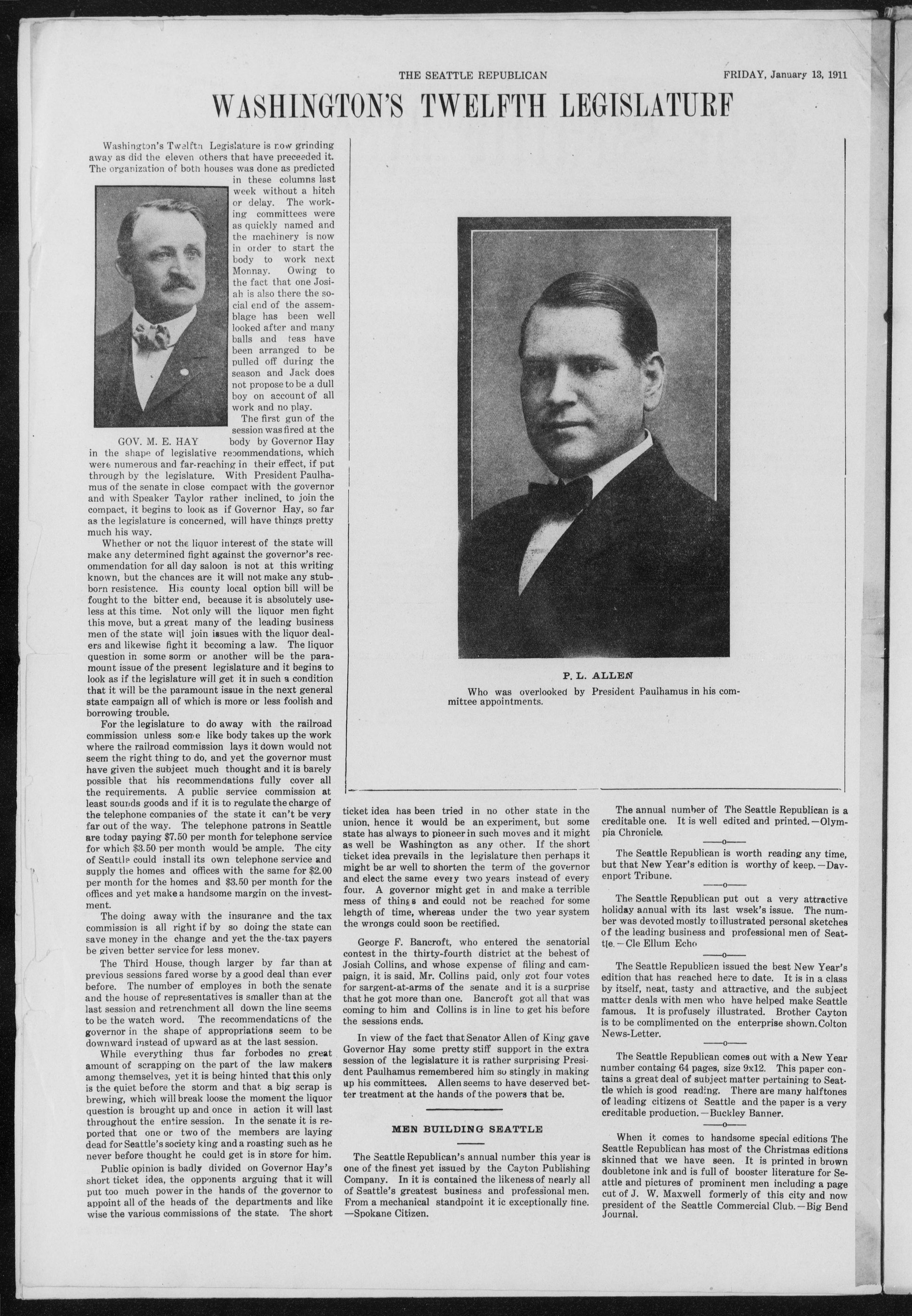
WASHINGTON'S TWELFTH LEGISLATURE
[Name]
Who was overlooked by President Paulhamus in his committee appointments.
Washington's Twelfth Legislature is now grinding away as did the eleven others that have preceeded it. The organization of both houses was done as predicted
in these columns last week without a hitch or delay. The working committees were as quickly named and the machinery is now in order to start the body to work next Monnay. Owing to the fact that one Josiah is also there the social end of the assemblage has been well looked after and many balls and teas have been arranged to be pulled off during the season and Jack does not propose to be a dull boy on account of all work and no play.
[Name]
The first gun of the session was fired at the body, by Governor Hay
GOV. M. E. HAY body by Governor Hay in the shape of legislative recommendations, which were numerous and far-reaching in their effect, if put through by the legislature. With President Paulhamus of the senate in close compact with the governor and with Speaker Taylor rather inclined, to join the compact, it begins to look as if Governor Hay, so far as the legislature is concerned, will have things pretty much his way.
Whether or not the liquor interest of the state will make any determined fight against the governor's recommendation for all day saloon is not at this writing known, but the chances are it will not make any stubborn resistance. His county local option bill will be fought to the bitter end, because it is absolutely useless at this time. Not only will the liquor men fight this move, but a great many of the leading business men of the state will join issues with the liquor dealers and likewise fight it becoming a law. The liquor question in some sorm or another will be the paramount issue of the present legislature and it begins to look as if the legislature will get it in such a condition that it will be the paramount issue in the next general state campaign all of which is more or less foolish and borrowing trouble.
For the legislature to do away with the railroad commission unless some like body takes up the work where the railroad commission lays it down would not seem the right thing to do, and yet the governor must have given the subject much thought and it is barely possible that his recommendations fully cover all the requirements. A public service commission at least sounds goods and if it is to regulate the charge of the telephone companies of the state it can't be very far out of the way. The telephone patrons in Seattle are today paying $7.50 per month for telephone service for which $3.50 per month would be ample. The city of Seattle could install its own telephone service and supply the homes and offices with the same for $2.00 per month for the homes and $3.50 per month for the offices and yet make a handsome margin on the investment.
The doing away with the insurance and the tax commission is all right if by so doing the state can save money in the change and yet the the-tax payers be given better service for less monev.
The Third House, though larger by far than at previous sessions fared worse by a good deal than ever before. The number of employes in both the senate and the house of representatives is smaller than at the last session and retrenchment all down the line seems to be the watch word. The recommendations of the governor in the shape of appropriations seem to be downward instead of upward as at the last session.
While everything thus far forbodes no great amount of scrapping on the part of the law makers among themselves, yet it is being hinted that this only is the quiet before the storm and that a big scrap is brewing, which will break loose the moment the liquor question is brought up and once in action it will last throughout the entire session. In the senate it is reported that one or two of the members are laying dead for Seattle's society king and a roasting such as he never before thought he could get is in store for him.
Public opinion is badly divided on Governor Hay's short ticket idea, the opponents arguing that it will put too much power in the hands of the governor to appoint all of the heads of the departments and like wise the various commissions of the state. The short
THE SEATTLE REPUBLICAN TON'S TWELFTH LE
---
ticket idea has been tried in no other state in the union, hence it would be an experiment, but some state has always to pioneer in such moves and it might as well be Washington as any other. If the short ticket idea prevails in the legislature then perhaps it might be ar well to shorten the term of the governor and elect the same every two years instead of every four. A governor might get in and make a terrible mess of things and could not be reached for some leghth of time, whereas under the two year system the wrongs could soon be rectified.
George F. Bancroft, who entered the senatorial contest in the thirty-fourth district at the behest of Josiah Collins, and whose expense of filing and campaign, it is said, Mr. Collins paid, only got four votes for sargent-at-arms of the senate and it is a surprise that he got more than one. Bancroft got all that was coming to him and Collins is in line to get his before the sessions ends.
In view of the fact that Senator Allen of King gave Governor Hay some pretty stiff support in the extra session of the legislature it is rather surprising President Paulhamus remembered him so stingly in making up his committees. Allen seems to have deserved better treatment at the hands of the powers that be.
MEN BUILDING SEATTLE
The Seattle Republican's annual number this year is one of the finest yet issued by the Cayton Publishing Company. In it is contained the likeness of nearly all of Seattle's greatest business and professional men. From a mechanical standpoint it is exceptionally fine. —Spokane Citizen.
GISLATURF
The annual number of The Seattle Republican is a creditable one. It is well edited and printed.—Olympia Chronicle.
The Seattle Republican is worth reading any time, but that New Year's edition is worthy of keep.—Davenport Tribune.
The Seattle Republican put out a very attractive holiday annual with its last wsek's issue. The number was devoted mostly to illustrated personal sketches of the leading business and professional men of Seattle. -Cle Ellum Echo
The Seattle Republican issued the best New Year's edition that has reached here to date. It is in a class by itself, neat, tasty and attractive, and the subject matter deals with men who have helped make Seattle famous. It is profusely illustrated. Brother Cayton is to be complimented on the enterprise shown. Colton News-Letter.
The Seattle Republican comes out with a New Year number containing 64 pages, size 9x12. This paper contains a great deal of subject matter pertaining to Seattle which is good reading. There are many halftones of leading citizens of Seattle and the paper is a very creditable production.—Buckley Banner.
When it comes to handsome special editions The Seattle Republican has most of the Christmas editions skinned that we have seen. It is printed in brown doubletone ink and is full of booster literature for Seattle and pictures of prominent men including a page cut of J. W. Maxwell formerly of this city and now president of the Seattle Commercial Club.—Big Bend Journal.
P. L. ALLEN
FRIDAY. January 13. 1911
PERSONS IN THE PUBLIC EYE
ITEMS MORE OR LESS INTERESTING
Frank H. Paul, one of the interested parties in the Duwamish Waterway project is in the East in the interest of the project and is expected home in the very near future.
William Pitt Trimble, accompanied by his wife and children, left for California last Saturday and may not return for two months or more. They wil. auto the state and may even run down in old Mexico before returning.
John Cort, the theatrical magnate, has been ill for the past week and for the most of the time unable to be out, and to add to his own troubles, his son Harry, manager of the Seattle Theater, is also down with pneumonia.
Moritz Thompson, of the Centennial Mill Company and likewise a number of other large industrial concerns in Seattle, who is sojourning in old Mexico, will probably reach Seattle the middle of February. He is now in Mexico City.
"Men Building Seattle" is the title of a splendid magazine that has recently been issued by THE SEATTLE REPUBLICAN, and it is worth your while to get a copy of the same. In another column hereof please note the press comments on the same.
I. I. Walker, president of the Colored Men's Political Club has issued a call for the meeting of the club next Tuesday evening to elect new officers for the ensuing year and to make preparations to take an active part in the coming spring campaign.
Dan R. Abrams, for four years county assessor of King county, for four years deputy county assessor under Frank H. Paul and for six years county commissioner, retired from office last Monday, and for a while is going to rest from duties and cares.
Stephen B. Elkins, United States senator from Virginia was buried last Sunday and it was the most largely attended funeral that has taken place in this country for many years. His son Dave was appointed by the governor to serve his unexpired term.
William King, of the Butler Hotel of Seattle, has announced his intention of making a fight for one of the councilmanic nominations. He is backed by the hotel men of the city and if they can get the endorsement of the hotel helpers he will have a good long lead on the other fellows. Mr. King is quite popular in business circles and will have quite a stand in with the papers of the city.
FRIDAY January 13. 1911
Frank H. Paul, one of the in-
Duwamish Waterway project is
interest of the project and is expect-
near future.
William Pitt Trimble, accom-
pany children, left for California last
return for two months or more
state and may even run down in-
turning.
John Cort, the theatrical ma-
the past week and for the most
be out, and to add to his own tr-
manager of the Seattle Theater
pneumonia.
Moritz Thompson, of the Cen-
and likewise a number of other
cerns in Seattle, who is sojourn-
probably reach Seattle the mid-
is now in Mexico City.
"Men Building Seattle" is the
magazine that has recently been
TLE REPUBLICAN, and it is wort-
copy of the same. In another
note the press comments on the s
I. I. Walker, president of the
cal Club has issued a call for the
next Tuesday evening to elect m
suing year and to make prepara-
part in the coming spring campa-
丹 R. Abrams, for four ye-
king county, for four years de
under Frank H. Paul and for a
missioner, retired from office la-
while is going to rest from duty.
Stephen B. Elkins, United
Virginia was buried last Sunday
largely attended funeral that has
country for many years. His s
ed by the governor to serve his u
William King, of the Butler
announced his intention of make
the councilmanic nominations.
hotel men of the city and if they
ment of the hotel helpers he w
lead on the other fellows. Mr.
in business circles and will have
the papers of the city.
---0---
0
0
BORROWED THOUGHTS
In time of Carnegie perpare for Dickinson. — Boston Transcript.
Mr. Carnegie is for peace at any price. — Boston Herald.
Intrenchment, more than retrenchment, seems to be the problem before the dear old Democratic party. — Southern Lumberman.
In New Jersey the politicians are beginning to fear Woodrow Wilson will be even a better governor than they expected. — Kansas City Star.
Now that Vice-President Sherman is elected chancellor of the Smithsonian it looks dark for the Colonel's animals.—Boston Transcript.
Reduction of the postoffice deficit by $11,500,000 in twelve months is economy that counts. This is first-class delivery.—Boston Advertiser.
Ex-Congressman Hepburn of Iowa opposes any further tariff revision. This is one reason he is ex-Congressman Hepburn—Kansas City Star.
---
James D. Hoge, the well known banker and promoter, who went East some weeks ago to look after the building arrangements of his twenty story sky scrapers, is expected home next Thursday, when it is thought work will begin immediately on his building.
Matt H. Gormley, for six years treasurer of King county and the two years preceding his becoming county treasurer, city treasurer of Seattle, last Monday surrendered the office to his successor, Will M. Hanna. Mr. Gormley has had a long run for his money and he says he is not anxious to repeat the trip. He has made some plans for the future, but he is not ready to make public the same.
F. S. Steiner, of Interbay, he of Ft. Lawton fame, is about to announce himself as one of the candidates for the councilmanic nomination. If it be true that he is the man that kicked up all that unnecessary fuss over the Ft. Lawton affair last year then the good citizens of Seattle will tell Mr. Steiner, he is not the kind of a disturber that is wanted in the city council or any other public office
John B. Gordon for the fifth time has been named as police judge of Seattle. Judge Gordon administers a kind of justice to those who come before him peculiar to police courts and he frequently punishes men, who under the strict letter of the law, should go free, but he knows their ways and their habits and he often punishes them for something they have done in the past instead of the thing they are charged with af the time they are arraigned.
Erastus Brainard, of the P.-I., seems to have the faculty of calling persons, who differ from him, names that no one but himself knows what they mean until they have persued every encyclopedia in the libraries. It will be remembered that he called Colonel Blethen a lot of high falutin' names that it took the colonel and every one else a whole week to find out what they meant, and now he has done the same thing to Judge Hanford.
George E Bradley, for the past thirty years manager of the Stetson-Post Mill company, has decided to stand for the nomination of councilman in Seattle. Few men in the Northwest can boast of the long business career that he has behind him and few can boast in so long a career of having made so few enemies in business as he. Of course politics is not business, and men who really think Mr. Bradley a splendid fellow and just the kind of man the council should have, will, for political reasons, vote against him, not exactly vote against him, but vote for the other fellow. But there is one thing certain he has a host of friends in the city,
Chicago boasts that more twins are born in that city than in any other. But who would think of striking Chicago for the first time alone?—Detroit Times.
Indiana authors must at least envy Dr. Cook his ability to spread on local color.—Philadelphia Enguirer.
It is quite a natural supposition that there is a good deal of water in the bath tub trust.—Buffalo Enguirer.
Troy accepted with resignation the census report that Yonkers exceeds it in population, but the Trojans feel chagrined that the state of Nevada should have passed them. -Syracuse Post-Standard.
Up to the present time Dr. Cook's high regard of the public's opinion of him has not extended to a refund of that $80,000 he got from them on his lecture tour. -Southern Lumberman.
A pardoned convict has rushed into print with the advice, "Always do right and you will never get into trouble." Looks like a case of stealing T. Roosevelt's
SEATTLE REPUBLICAN
H. D. Hoge, the well known banker and plumber East some weeks ago to look after arrangements of his twenty story sky expected home next Thursday, when work will begin immediately on his building.
H. Gormley, for six years treasurer of Seattle and the two years preceding his become treasurer, city treasurer of Seattle, last tendered the office to his successor, W. M. Gormley has had a long run for his says he is not anxious to repeat the made some plans for the future, but he can make public the same.
Steiner, of Interbay, he of Ft. Lawton is to announce himself as one of the candidate councilmanic nomination. If it be true man that kicked up all that unnecessary Ft. Lawton affair last year then the Seattle will tell Mr. Steiner, he is not disturber that is wanted in the city council public office.
B. Gordon for the fifth time has been made judge of Seattle. Judge Gordon admits justice to those who come before him in office courts and he frequently punishes for the strict letter of the law, should go on their ways and their habits and he them for something they have done in bad of the thing they are charged with and are arraigned.
Is Brainard, of the P.-I., seems to have been calling persons, who differ from him, nor but himself knows what they mean, persued every encyclopedia in the library remembered that he called Colonel Bligh falutin' names that it took the co- one else a whole week to find out what and now he has done the same thing to J.
E. Bradley, for the past thirty years since the Stetson-Post Mill company, has decided the nomination of councilman in Seattle in the Northwest can boast of the long war that he has behind him and few can be a career of having made so few enemies as he. Of course politics is not business, really think Mr. Bradley a splendid for the kind of man the council should have, real reasons, vote against him, not exactly him, but vote for the other fellow. But the g certain he has a host of friends in the
thunder.—Des Moines Register and Leader.
There were sixteen deaths in the prize ring this year, accord to the New York World, two more than were caused by football. This disposes of the charge that faotball is more brutal than prize fighting.—Rochester Democrat and Chronicle.
Nearly two hundred cases of bad eggs shipped from Dallas to a Kansas City candy factory were seized by officers and showed to contain 150,000,000 bacteria to the cubic centimeter. This is probably the largest number of arrests made in a single raid. Los Angeles Express.
SEATTLE THEATER
Willie Collier's laughing success "On The Quiet" will follow "The Dollar Mark" at the Seattle Theatre. Collier had a complete season'f run in New York with this farce comedy and used it in his tour of Australia with great success.
Joseph Galbraith, who excels in all the Collier line of parts wi
who have done business with him as the years have gone by, who will give him a vote when they get in their voting booths.
If a man can write a better book, preach a better
ermon, or make a better mouse trap than his neigh-
or, though he builds his house in the woods, the world
will make a beaten path to his door.—Ralph Waldo
Emerson.
Heaven has no rage like love to hatred turned
Nor hell like a woman scorned.
When Eve brought woe to all mankind old Adman
called her wo-man,
If a man can write a better book, preach a better sermon, or make a better mouse trap than his neighbor, though he builds his house in the woods, the world will make a beaten path to his door.—Ralph Waldo Emerson.
Heaven has no rage like love to hatred turned
Nor hell like a woman scorned.
When Eve brought woe to all mankind old Adman called her wo-man,
But when she wooed with love so kind,
he then pronounced her woo-man.
But now with folly and with pride.
men pronounce them wimmin'.
There is a man who never drinks,
Nor smokes, nor chews, nor swears;
Who never gambles. never flirts,
And shuns all sinful snares;
old go free,
and he often
done in the
with af the
There is a man who never does anything,
that is not right;
His wife can tell just where he is, at
morning, noon and night,
—He'd died.
to have the
him, names
mean until
the libraries.
del Blethen
the colonel
Victor Berger the only Socialist member
gress, tells of hearing the following conver
tween two street gamins:
',Say, Chimmie, wot's de renson de oce
run over w'en all de rivers an' de' lakes
'em?"
He'd died.
Victor Berger the only Socialist member of Congress, tells of hearing the following conversation between two street gamins:
'Say, Chimmie, wot's de renson de oceans don't run over w'en all de rivers an' de' lakes run interem?'
Victor Berger the only Socialist member of Congress, tells of hearing the following conversation between two street gamins:
'Say, Chimmie, wot's de renson de oceans don't run over w'en all de rivers an' de' lakes run inter 'em?'
And Jimmie quickly answered:
to Judge
ears mana-decided to in Seattle. long busi- can boast enemies in business, and did fellow have, will, actually vote But there in the city,
"I guess it's 'cause water up."
Jimmie's answer, as some of the statement with regard to the lie
Down in Louisiana, the river bank and the river and she was caused she was fatally bitten dently a joy ride for M
That New York while eating must have oysters.
INTERESTING
"I guess it's 'cause de sponges in de bottom soak de water up."
Jimmie's answer, Mr. Berger said, was as logical as some of the statements made by the Prohibitionists with regard to the liquor traffic.
Down in Louisianna a woman was out autoing along the river bank and the machine turned turtle into the river and she was caught under it ahd in that position she was fatally bitten by an alligator. That was evidently a joy ride for Mr. Alligator.
That New York woman that discolated her jaw while eating must have been mnnching Puget Sound oysters.
"I guess it's 'cause de sponges in de bottom soak de water up." Jimmie's answer, Mr. Berger said, was as logical as some of the statements made by the Prohibitionists with regard to the liquor traffic.
Down in Louisianna a woman was out autoing along the river bank and the machine turned turtle into the river and she was caught under it ahd in that position she was fatally bitten by an alligator. That was evidently a joy ride for Mr. Alligator.
That New York woman that discolated her jaw while eating must have been mnching Puget Sound oysters.
give a most interesting interpretation of the leading role, and the large and effective scenery will find ample room for a perfect presentation upon the Seattle stage. Yatch scenes are becoming popular with the Baker players. They had one in "Via Wireless" then again in "Brewster's Millions." And now comes a double deck scene in "On The Quiet," showing the action of the comedy going on above and below deck at the same time.
Ethel Clifton and the full cast of the Baker Company ladies will be seen in new gowns and stuning hats, and the men be seen in humorous character creations. This Collier success starts on Sunday matinee, Jan. 15th.
AMUSEMENTS
"Anita The Singing Girl" at the Alhambra next week. This is one of the most popular plays in Miss Emma Bunting's repertoire, and one she has created a most lasting impression with, i.e., the audience consider her ideal in this character. The
---
:
MATTER IN PARVU
---
story of the play is very interesting. Miss Bunting appears in the character of a public entertainer, a singing girl, but being a girl of spirit, she will not sing before an audience selected by the villainess of the play, whom she discovers to be an enemy.
This play will be better presented than at any other theatre in Seattle this season.
Send your legals to The Seattle Republican, 305 Epler Blk., Phone Main 305.
STETSON & POST LUMBER CO.
BUILDING MATERIAL
Of all kinds. Delivered on short notice.
Established 1875. Tel. Main 711
The Light and Power department of the Seattle Electric Company has moved to the Electric Bldg., Seventh avenue and Pine street. Street car tickets can be purchased and all bills paid in the Electrical Sales Room at the old location 907 FIRST AVENUE THE SEATTLE ELECTRIC CO
In handling the decision of Judge Hanford's the Post-Intelligencer administered to him one of the most cutting rebukes a newspaper ever administered to a human being, and it has been frequently asked since that time, did the Post-Intelligencer overstep its bounds and place itself in a position to be punished by Judge Hanford for contempt of court? The federal judges do not seem to have as wide latitue in contempt proceeding as do the judges of the state courts, hence the Post-Intelligencer took no chances in saying what it did. While the comment from the Central Law Journal quoted below does not bear directly on the case in question, yet it will give the reader some idea of what kind of cases the federal courts can punish for contempt:
One guilty of criminal contempt of a federal court may be removed for the purpose of trial and punishment from any district in which he may be found, to the district in which he has committed the contempt; but there can be no such removal for the purpose of merely enforcing obedience to the court's order in a civil proceeding.
It is indeed remarkable that at this late day there should be doubt and obscurity as to what kinds of contempt constitute crimes against the United States under Sec. 1014 of Revised Statutes, so as to allow those guilty to be removed from one district to another and also that the authorities should be so meager as to the methods of apprehending such persons and the procedure generally in such cases.
The first thing to be considered in dealing with this question is what are the classes into which contempts are divided and what are the reasons and causes of these divisions.
Contempts are of two kinds, criminal and civil with reference to this distinction the court in the case of Inre Nevitt, aptly expresses itself as follows:
"The former (criminal) are conducted to preserve the power and dignity of the courts and to punish for disobedience of their orders. The latter (civil) are instituted to protect, preserve and enforce the rights of private parties, and to compel obedience of the orders, judgments and decrees of the courts made to enforce the rights and remedies to which the courts have decided that such parties are lawfully entitled."
It may be further said that all contempts which involve purely the question of punishment for some disobedience to an order or some indignity or slight put upon a court as distinguished from a mere imprisonment to enforce obedience to an order in a civil case, are criminal, whereas, a civil contempt consists only of refusal by a person to do an act which the court has ordered him to do for the benefit of a party in a suit pending before it, and if he is committed until he complies with the order such commitment is in the nature of an execution to enforce the judgment of the court. The final test seems to be, who is the real party inter-
It is barely possible that no opinion that has ever been handed down from the bench by any judge in the Northwest has caused as much cemment as the decision of Judge Hanford last Friday, in which the recall election of Mayor Hiram Charles Gill of Seattle was involved. Public opinion was badly divided on the decision, but the concensus of opinion is that, Judge Hanford "butted" in the affairs of the state courts without cause or excuse. He has protected the rights of one man at the expense of forty thousand men, is one of the most frequent criticisms heard against the decision. Here are some of the criticisms of the decision that prominent attorneys of the city have indulged in since it became public property;
"The history of civilization shows that God Almighty has created but few men, who know how to exercise power in a common sense manner. The trouble with many judges is that they hasten to assume jurisdiction of
FEDERAL COURT CONTEMPT CASES
ested in the contempt proceedings; to whose advantage will it most redound. If it is solely to maintain the dignity and the power of the state and its courts, the contempt is criminal in nature. But if some private party is primarily interested in its outcome, as when the defendant in an injunction suit is imprisoned until he obeys the order of the court, then the contempt is civil.
The power of the national courts to punish for contempt and to compel obedience of their orders from Section 1, Article 3, of the Constitution, which provides that "the judicial power of the United States shall be vested in one supreme court and in such inferior courts as the Congress may from time to time ordain and establish." In order that there shall be no misunderstanding or misconstruction of this provision, congress has passed an act, Section 725 of Revlsed Statutes, which specifically confers the power upon the federal courts to punish contempt of their authority and restricts such power to certain classes of cases.
It is axiomatic and is a canon of the common law that only the court whose order is disobeyed can punish for the contempt. The fact that this is the case immediately opens up the complex question of removal or extradition; in the state courts from one state to another, and in the federal courts from one federal district to another federal district.
Perhaps nothing in federal procedure is more uncertain or more shrouded in obscurity than the question of removal for contempt of court. In fact the authorities on this and ancillary propositions are so few and indecisive that it can hardly be said that anything except the main principle that there is removal for contempt, can be regarded as well as settled. The whole authority to such removal for criminal contempt is regarded as well as settled. The whole authority for such removal is conferred by Section 1014, of Revised Statutes, which provides that "for any crime or offense against the United States" the offender may, by any judge of the United States, be arrested and imprisoned, or bailed "for trial before such court of the United States, as by law has cognizance of the offense." And it further provides that "when an offender or witness is committed in any district other than that where the offense is to be tried, it shall be the duty of the district judge of the district where such offender or witness is imprisoned, seasonably to issue, and the marshal to execute, a warrant for his removal to the district where the trial is to be had." At a glance this may seem comparatively simple as to the method of apprehension and removal, but a close study of the few adjudged cases will reveal considerable vagueness and uncertainity.
That a criminal contempt is an offense against the United States under Section 1014 of Revised Statutes, supra, has been repeatedly held. It has also been held that a person cannot be removed under Section 1014 for any other purpose than trial.
JUDGE HANFORD AND THE RECALL
everything from a dunghill to a principality." "Judge Hanford's decision is a blow at our present system of state and municipal governments. It is as revolting as the Dred Scott decision and is as unpopular in the locality affected by it as was that iniquitious decision throughout Chrisendom. When a non-resident purchases property in a city he should have no greater rights to interfere with municipal government than the resident citizen."
"If the federal court has the right to interfere in the case in question and thwart the will of the tax payers, then it seems to me that any non-resident citizen would have the same right to enjoin the collection of taxes or to prevent the city from levying assessments and claim the signers to such improvement were forgeries or had been gotten by intimidation and thereby prevent any city from doing anything that some non-resident tax payer did not like. If the decision handed down by Judge Han-
THE SEATTLE REPUBLICAN
in the contempt proceedings; to whose almost redound. If it is solely to mow and the power of the state and its capt is criminal in nature. But if it is primarily interested in its outcome defendant in an injunction suit is imprisoned the order of the court, then the power of the national courts to punish and to compel obedience of their will, Article 3, of the Constitution, that "the judicial power of the United States, which specifically confers the federal courts to punish contempt of the law restricts such power to certain classes as axiomatic and is a canon of the only the court whose order is disobeyed in the contempt. The fact that this institution opens up the complex question of tradition; in the state courts from the first, and in the federal courts from the first to another federal district.
Whaps nothing in federal procedure or more shrouded in obscurity than removal for contempt of court. Cities on this and ancillary propositions and indecisive that it can hardly be said except the main principle that there is contempt, can be regarded as well as so authority to such removal for criminals as well as judicial removal is conferred by Section 11 Statutes, which provides that "for any case against the United States" the offence of judge of the United States, be annulled, or bailed "for trial before sufficited States, as by law has cognizance." And it further provides that "for or witness is committed in any case where the offense is to be tried by the district judge of the district offender or witness is imprisoned, seized and the marshal to execute, a removal to the district where the trial isance this may seem comparatively the method of apprehension and removal, of the few adjudged cases will reveal genueness and uncertainity.
At a criminal contempt is an offense of States under Section 1014 of Revised laws been repeatedly held. It has at a person cannot be removed under any other purpose than trial.
ford is good law then cities]undertaking vast improvements are seriously in danger of having the same abruptly stopped by the federal court." However, public opinion was not wholly against the decision of Judge Hanford from a legal standpoint as quite a number of attorneys were of the opinion that the stand taken by Judge Handford was eminently correct, but they had no legal grounds to give for the position they took in the matter.
Corporation Counsel Scott Cahoun and Wilmont Tucker took the Hanford decision before Judge Gilbert, of Portland, who ruled adversely, and now the recall election, Judge Hanford to the contrary notwithstanding, will proceed on February 7th as it had been planned, unless some unforeseen difficulty arises.
"Whether or not the names on the Gill recall petition were forgeries or had been gotten by misrepresentation or by duress, to my mind, Judge Hanford was not called upon to decide. Those
---
The first proposition with regard to removal for contempt of court and the one which seems to be conclusively settled, although the decided cases are few, is that, one guilty of criminal contempt may be brought from another district and punished. In the early case of Fanshawe v. Tracy, the court without laying down any rule to be followed, says: "I do not see why, if a man is imprisoned for contempt of a court of the United States, and breaks jail and escapes into another state, he cannot be arrested and returned to his prisonment under the authority of the United States." Of course, this is not decisive of anything, and only goes to prove how unsettled the procedure in this regard was at that time. The strongest case yet decided is that of In re Ellerbe, in which the contempt consisted of refusal to obey a subpoena. It was there held that when such witnesses, after failing to obey the subpoena, which had been duly served upon him had been ordered arrested by the court of which he was in contempt, but had fled into another district, he could be arrested and removed by order of any judge having jurisdiction in the district where he might be found.
The only other decision holding directly on this point is that of In re Manning, which declares that an officer of a court may be brought from another district and punished for contempt.
In the above authorities the question of criminal contempt is alone involved, and it yet remains to be seen what has been held to be the rule in similar circumstances when the contempt is civil. The lone case so far decided on this point is that of In re Graves. This was a case in which a defendant refused to obey a money decree and fled the district. Thereupon removal proceedings were instituted and the court of the district in which he had sought sanctuary declined to order his removal, assigning as a reason that this was civil and not criminal contempt. The court at some length distinguishes the two kinds of contempt and the difference between this case and In re Ellerbe, supra, holding that the latter is purely punitive, while the former is remedial, executive and for the advantage of a private party. The court bases its refusal on the ground that removal under Section 1014 must be for purpose of trial and not to enforce an order already made, which would be aiding the prevailing party in the civil suit in his effort to coerce the loser into obeying the order made for the payment of money. But on the other hand, if in this very case the object of the contempt proceeding was to punish for willful disobedience of the decree and not to imprison and compel obedience, we would have an instance of criminal contempt and the offender could be proceeded against criminally; "in which case he charged with the offense, and, being put upon trial, he may be convicted, and be punished by fine or imprisonment or both. In the latter case, the punishment is for an offense against the government." In such case, however, the extent of the punishment must be fixed when sentence is pronounced. W. S. BARRETT
Houston, Texas. THE RECALL
were points to be proven and denied in the trial of the case. The matter was taken into the Federal court on points of law, to determine whether or not the Federal courts had jurisdiction to protect the vested interest of a non-reaident, whose property, according to the allegation, had been put in jeopardy without due process of law; and for the court to take up the fraudulent allegation, was clearly out of its jurisdiction."
IN THE SUPERIOR COURT OF THE State of Washington, for King County. Order to show cause why distribution should not be made, fixing time for hearing final account and giving notice thereof. In the Matter of the Estate of Fred Scholpn, deceased—No. 10793
Louise Scholpp, the executrix of the estate of Fred Scholpp deceased, having this day rendered and filed in this court her final account as executrix of said estate and her petition for distribution setting that said estate is now in a condition to be closed and is ready for distribution;
And it appearing that the facts set forth are sufficient to authorize the distribution of said estate,
It is now ordered that Monday, the 13th of February, 1911, at 9:30 o'clock in the morning of Friday and the same is, hereby appointed as the time for hearing and settlement of said final account and petition for distribution in the court room of the Probate Department of said court in the King County Court House in the city of Seattle.
It is ordered that all persons interested in said estate appear before said
---
FRIDAY, January 13, 1911
edition with regard to removal for and the one which seems to be contouhough the decided cases are few, the criminal contempt may be brought at and punished. In the early case, the court without laying down saved, says: "I do not see why, if a man for contempt of a court of the county breaks jail and escapes into annot be arrested and returned to his authority of the United States." Not decisive of anything, and only unsettled the procedure in this reme. The strongest case yet decidillerbe, in which the contempt conjoey a subpoena. It was there with witnesses, after failing to obey he had been duly served upon him arrested by the court of which he had fled into another district, he had removed by order of any judge in the district where he might be decision holding directly on this case Manning, which declares that an may be brought from another disorder contempt.
Authorities the question of criminal involved, and it yet remains to be held to be the rule in similar cirne contempt is civil. The lone case this point is that of In re Graves, which a defendant refused to obey he fled the district. Thereupon rewere instituted and the court of he had sought sanctuary declined all, assigning as a reason that this criminal contempt. The court at ruishes the two kinds of contempt between this case and In re Ellerbe, the latter is purely punitive, while trial, executive and for the advantage. The court bases its refusal on removal under Section 1014 must be and not to enforce an order already be aiding the prevailing party in effort to coerce the loser into obeyfor the payment of money. But if in this very case the object ofiding was to punish for willful disreee and not to imprison and compold have an instance of criminal tender could be proceeded against in case he charged with the offense, trial, he may be convicted, and for imprisonment or both. In theishment is for an offense against In such caee, however, the extent must be fixed when sentence is pro-
W. S. BARRETT.
court at said time and place then and there to show cause, if any they have, why said final account should not be approved and why an order of distribution should not be made of the residue of said estate among the devisees mentioned in the will of the deceased
It is further ordered that notice of the time and place of hearing said final account and petition for distribution be given by posting a copy of this order in three or four postal addresses in King County, Washington, at least for weeks before said 13th day of February, 1911, and further that a copy of this order be published once a week for four successive weeks before said 13th day of February, 1911, in the Seattle Rehabilitation Center printed and published in King County, and of general circulation therein.
The court now finds and adjudges that the posting and publishing of this order, as above set forth, is a proper and adequate notice in the premises.
Done in open court this 11th day of January, 1911.
A. W. FRATER,
Judge.
Jan. 13—Feb. 24, 1911.
IN THE SUPERIOR COURT OF THE State of Washington, for King County. Notice to Creditors.
In the Matter of the Estate of J. A. Burkholder, deceased.—No. 11797
By order of said court made herein on the 7th day of December, 1910, notice is hereby given to the creditors of, and to all persons having claims against deceased or against said estate or against the community estate of said deceased and Halle Burkholder, to present them with their property buyers to the undersigned executrix of said estate, at 314 Northern Bank & Trust Bldg., Seattle, Washington, the place of business of said estate, in Seattle, in said county and state, within one year from and after the date of first publication of this notice or same will be barred.
Date of first publication December 9, 1910.
HALLIE HURKHOLDER,
As Executrix of said Estate.
F. J. Caryer,
Norway for Estate.
314 Northern Bank & Trust Bldg., Seattle, Wash.
Dec. 9, 1910—Jan. 7, 1911
---
FRIDAY, January 13, 1911
HE SEATTLE REPUBLICAN
5
[Name]
[Name not visible in the image]
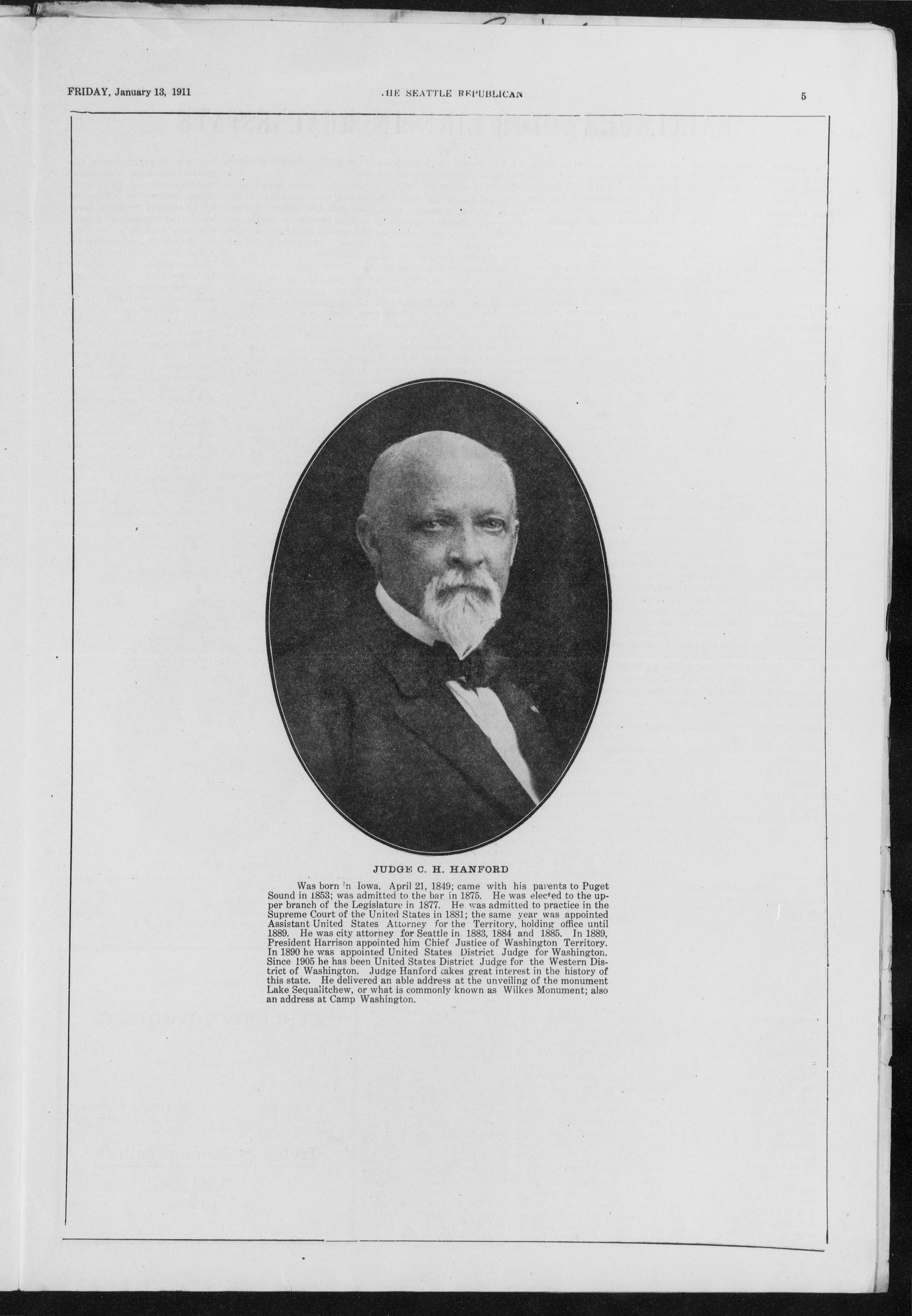
JUDGE C. H. HANFORD
Iowa, April 21, 1849; came with his parents to Puget
unmitted to the bar in 1875. He was elected to the up-
sislature in 1877. He was admitted to practice in the
United States in 1881; the same year was appointed
es Attorney for the Territory, holding office until
orney for Seattle in 1883, 1884 and 1885. In 1889,
pointed him Chief Justice of Washington Territory.
United States District Judge for Washington.
United States District Judge for the Western Dis-
Judge Hanford cakes great interest in the history of
an able address at the unveiling of the monument
what is commonly known as Wilkes Monument; also
Was born in Iowa, April 21, 1849; came with his parents to Puget Sound in 1853; was admitted to the bar in 1875. He was elected to the upper branch of the Legislature in 1877. He was admitted to practice in the Supreme Court of the United States in 1881; the same year was appointed Assistant United States Attorney for the Territory, holding office until 1889. He was city attorney for Seattle in 1883, 1884 and 1885. In 1889, President Harrison appointed him Chief Justice of Washington Territory. In 1890 he was appointed United States District Judge for Washington. Since 1905 he has been United States District Judge for the Western District of Washington. Judge Hanford takes great interest in the history of this state. He delivered an able address at the unveiling of the monument Lake Sequalitchew, or what is commonly known as Wilkes Monument; also an address at Camp Washington.
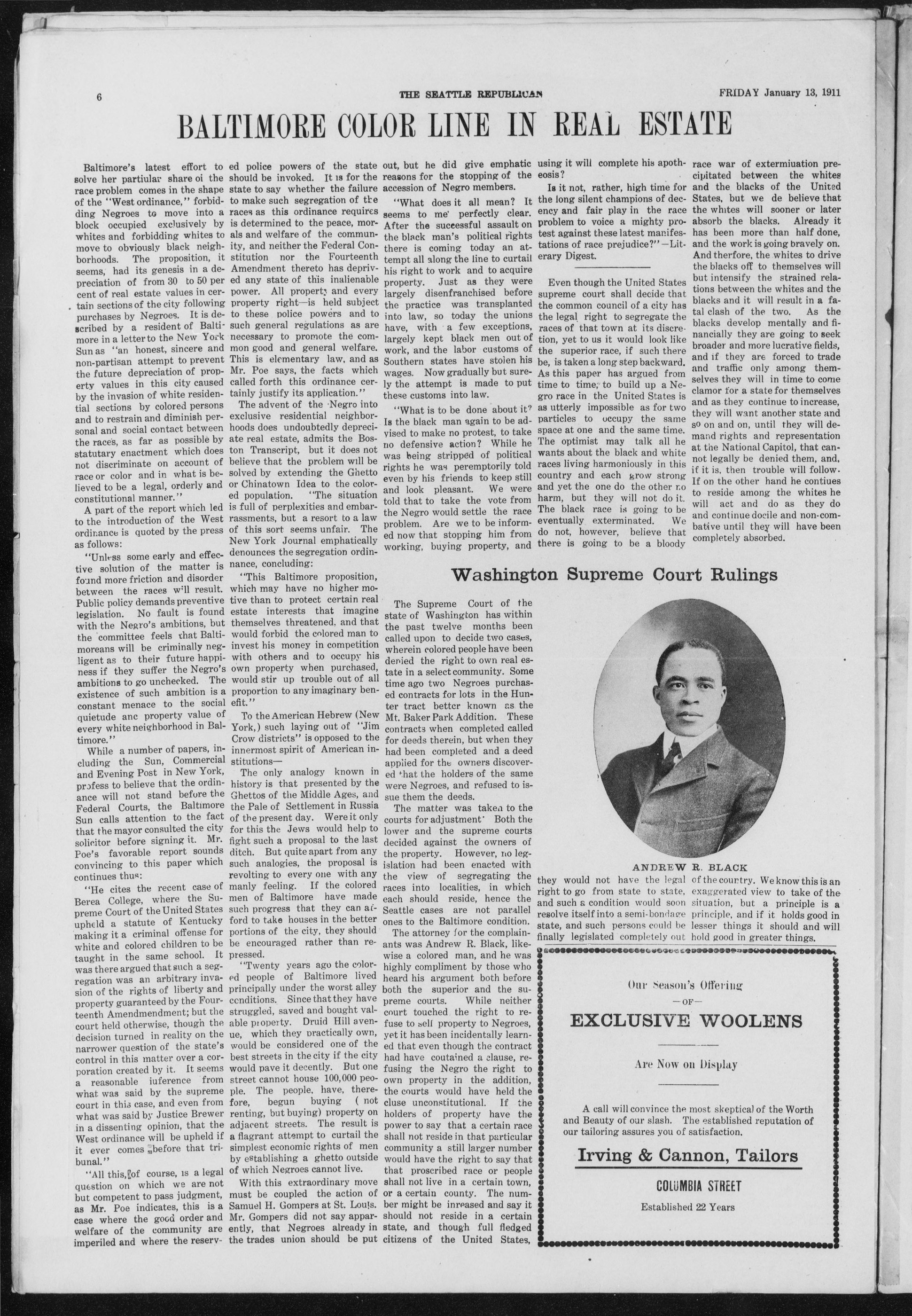
BALTIMORE COLOR LINE IN REAL ESTATE
6
Baltimore's latest effort to solve her particular share oi the race problem comes in the shape of the "West ordinance," forbidding Negroes to move into a block occupied exclusively by whites and forbidding whites to move to obviously black neighborhoods. The proposition, it seems, had its genesis in a depreciation of from 30 to 50 per cent of real estate values in certain sections of the city following purchases by Negroes. It is described by a resident of Baltimore in a letter to the New York Sun as "an honest, sincere and non-partisan attempt to prevent the future depreciation of property values in this city caused by the invasion of white residential sections by colored persons and to restrain and diminish personal and social contact between the races, as far as possible by statutory enactment which does not discriminate on account of race or color and in what is believed to be a legal, orderly and constitutional manner."
A part of the report which led to the introduction of the West ordinance is quoted by the press as follows:
"Unless some early and effective solution of the matter is found more friction and disorder between the races will result. Public policy demands preventive legislation. No fault is found with the Negro's ambitions, but the committee feels that Baltimoreans will be criminally negligent as to their future happiness if they suffer the Negro's ambitions to go unchecked. The existence of such ambition is a constant menace to the social quietude anc property value of every white neighborhood in Baltimore."
While a number of papers, including the Sun, Commercial and Evening Post in New York, profess to believe that the ordinance will not stand before the Federal Courts, the Baltimore Sun calls attention to the fact that the mayor consulted the city solicitor before signing it. Mr. Poe's favorable report sounds convincing to this paper which continues thus:
"He cites the recent case of Berea College, where the Supreme Court of the United States upheld a statute of Kentucky making it a criminal offense for white and colored children to be taught in the same school. It was there argued that such a segregation was an arbitrary invasion of the rights of liberty and property guaranteed by the Fourteenth Amendmentment; but the court held otherwise, though the decision turned in reality on the narrower question of the state's control in this matter over a corporation created by it. It seems a reasonable inference from what was said by the supreme court in this case, and even from what was said by Justice Brewer in a dissenting opinion, that the West ordinance will be upheld if it ever comes before that tribunal."
"All this, of course, is a legal question on which we are not but competent to pass judgment, as Mr. Poe indicates, this is a case where the good order and welfare of the community are imperiled and where the reserv-
ed police powers of the state should be invoked. It is for the state to say whether the failure to make such segregation of the races as this ordinance requires is determined to the peace, morals and welfare of the community, and neither the Federal Constitution nor the Fourteenth Amendment thereto has deprived any state of this inalienable power. All property and every property right—is held subject to these police powers and to such general regulations as are necessary to promote the common good and general welfare. This is elementary law, and as Mr. Poe says, the facts which called forth this ordinance certainly justify its application."
The advent of the Negro into exclusive residential neighborhoods does undoubtedly depreciate real estate, admits the Boston Transcript, but it does not believe that the problem will be solved by extending the Ghetto or Chinatown Idea to the colored population. "The situation is full of perplexities and embarrassments, but a resort to a law of this sort seems unfair. The New York Journal emphatically denounces the segregation ordinance, concluding:
"This Baltimore proposition, which may have no higher motive than to protect certain real estate interests that imagine themselves threatened, and that would forbid the colored man to invest his money in competition with others and to occupy his own property when purchased, would stir up trouble out of all proportion to any imaginary benefit."
To the American Hebrew (New York,) such laying out of "Jim Crow districts" is opposed to the innermost spirit of American institutions—
The only analogy known in history is that presented by the Ghettos of the Middle Ages, and the Pale of Settlement in Russia of the present day. Were it only for this the Jews would help to fight such a proposal to the last ditch. But quite apart from any such analogies, the proposal is revolting to every one with any manly feeling. If the colored men of Baltimore have made such progress that they can afford to take houses in the better portions of the city, they should be encouraged rather than repressed.
"Twenty years ago the colored people of Baltimore lived principally under the worst alley conditions. Since that they have struggled, saved and bought valuable property. Druid Hill avenue, which they practically own, would be considered one of the best streets in the city if the city would pave it decently. But one street cannot house 100,000 people. The people, have, therefore, begun buying ( not renting, but buying) property on adjacent streets. The result is a flagrant attempt to curtail the simplest economic rights of men by establishing a ghetto outside of which Negroes cannot live.
With this extraordinary move must be coupled the action of Samuel H. Gompers at St. Louis. Mr. Gompers did not say apparently, that Negroes already in the trades union should be put
Washington Supreme Court Rulings
THE SEATTLE REPUBLICAN
out, but he did give emphatic reasons for the stopping of the accession of Negro members.
'What does it all mean? It seems to me' perfectly clear. After the successful assault on the black man's political rights there is coming today an attempt all along the line to curtail his right to work and to acquire property. Just as they were largely disenfranchised before the practice was transplanted into law, so today the unions have, with a few exceptions, largely kept black men out of work, and the labor customs of Southern states have stolen his wages. Now gradually but surely the attempt is made to put these customs into law.
"What is to be done about it? Is the black man again to be advised to make no protest, to take no defensive action? While he was being stripped of political rights he was peremotorily told even by his friends to keep still and look pleasant. We were told that to take the vote from the Negro would settle the race problem. Are we to be informed now that stopping him from working, buying property, and
The Supreme Court of the state of Washington has within the past twelve months been called upon to decide two cases, wherein colored people have been denied the right to own real estate in a select community. Some time ago two Negroes purchased contracts for lots in the Hunter tract better known as the Mt. Baker Park Addition. These contracts when completed called for deeds therein, but when they had been completed and a deed applied for the owners discovered that the holders of the same were Negroes, and refused to issue them the deeds.
The matter was taken to the courts for adjustment. Both the lower and the supreme courts decided against the owners of the property. However, no legislation had been enacted with the view of segregating the races into localities, in which each should reside, hence the Seattle cases are not parallel ones to the Baltimore condition.
The attorney for the complainants was Andrew R. Black, likewise a colored man, and he was highly compliment by those who heard his argument both before both the superior and the supreme courts. While neither court touched the right to refuse to self property to Negroes, yet it has been incidentally learned that even though the contract had have coutained a clause, refusing the Negro the right to own property in the addition, the courts would have held the cluse unconstitutional. If the holders of property have the power to say that a certain race shall not reside in that particular community a still larger number would have the right to say that that proscribed race or people shall not live in a certain town, or a certain county. The number might be inreased and say it should not reside in a certain state, and though full fledged citizens of the United States,
using it will complete his apotheosis?
Is it not, rather, high time for the long silent champions of decency and fair play in the race problem to voice a mighty protest against these latest manifestations of race prejudice?"—Literary Digest.
Even though the United States supreme court shall decide that the common council of a city has the legal right to segregate the races of that town at its discretion, yet to us it would look like the superior race, if such there be, is taken a long step backward. As this paper has argued from time to time, to build up a Negro race in the United States is as utterly impossible as for two particles to occupy the same space at one and the same time. The optimist may talk all he wants about the black and white races living harmoniously in this country and each grow strong and yet the one do the other no harm, but they will not do it. The black race is going to be eventually exterminated. We do not, however, believe that there is going to be a bloody
ton Supreme Cou
[Name]
ANDREW R. BLACK
they would not have the legal right to go from state to state, and such a condition would soon resolve itself into a semi-bondage state, and such persons could be finally legislated completely out
Our Season
EXCLUSIVE
they would not have the legal of the country. We know this is an right to go from state to state, exaggerated view to take of the and such a condition would soon situation, but a principle is a resolve itself into a semi-bondage principle, and if it holds good in state, and such persons could be lesser things it should and will finally legislated completely out hold good in greater things.
A call will convince the most skepti and Beauty of our slash. The establish our tailoring assures you of satisfaction Irving & Cannon,
A call will convince the most skeptical of the Worth and Beauty of our slash. The established reputation of our tailoring assures you of satisfaction.
Irving & Cannon, Tailors
COLUMBIA STREET
Established 22 Years
---
FRIDAY January 13, 1911
ATE
race war of extermiuation precipitated between the whites and the blacks of the United States, but we de believe that the whites will sooner or later absorb the blacks. Already it has been more than half done, and the work is going bravely on. And therfore, the whites to drive the blacks off to themselves will but intensify the strained relations between the whites and the blacks and it will result in a fatal clash of the two. As the blacks develop mentally and financially they are going to seek broader and more lucrative fields, and if they are forced to trade and traffic only among themselves they will in time to come clamor for a state for themselves and as they continue to increase, they will want another state and so on and on, until they will demand rights and representation at the National Capitol, that cannot legally be denied them, and, if it is, then trouble will follow. If on the other hand he continues to reside among the whites he will act and do as they do and continue docile and non-combative until they will have been completely absorbed.
rt Rulings
of the country. We know this is an exaggerated view to take of the situation, but a principle is a principle, and if it holds good in lesser things it should and will hold good in greater things.
s Offering
WOOLENS
most skeptical of the Worth the established reputation of satisfaction.
---
The special edition of The Seattle Republican, entitled, "Men Building Seattle," was issued January 1, and every one who has seen it pronounce it one of the most attractive as well as instructive holiday numbers ever published in the Northwest. Here are some of the subjects that are discussed therein:
The illustrations:
Birdseye View of Seattle
Thomas Burke (Drawing), Diplomat
James A. Moore, Builder and Promoter
Jacob Furth, Banker, Builder, Promoter
Reginald H. Thomson, City Engineer
James E. Chilberg, Banker and Promoter
E. G. Ames, Millman and Banker
FRIDAY, January 13, 1911
The special edition
Building Seattle," was
it pronounce it one of
numbers ever published
that are discussed the
The
Sea
WH
The
Sea
Sea
Op
Fa
Ba
Sea
Law
WH
Cut
Sea
Sea
Sea
Sea
Sea
Dw
An
Se
The illustrations
Birdseye Vic
Thomas Burd
James A. M.
Jacob Furthe
Reginald H.
James E. C.
E. G. Ames,
427 Epler Block
THE MEN BUILDING SEATTLE
The Seattle Spirit
Seattle's Really Big Things
Who Is Who In Seattle
The Seattle U. S. Assay Office
Seattle As Others See Her
Seattle, A Show Place
Opportunities In Seattle
Facts and Figures About Seattle
Banks in Seattle
Seeing Seattle
Lake Washington Canal
Why Seattle Grows
Curtiss Photographing the Indians
Seattle's Chamber of Commerce
Seattle, A Theatrical Center
Seattle's Manufacturing Outlook ...
Seattle and The Orient
Seattle's Pioneer Builders
Seattle, Where Sail Meets Rail
Duwamish Waterway
Anti-Tuberculosis Work in Seattle
Seattle's Public Schools
Your friends in the other sections of the country could get a splendid insight into the real facts about Seattle if you send them a copy of this number. It will be delivered to you neatly enclosed in an envelope ready for mailing, and its costs FOUR CENTS to take it to its destination.
THE SEATTLE REPUBLICAN.
EN BUILDING
can, entitled, "Men
very one who has seen
its instructive holiday
some of the subjects
Horse
James
Corn
John
Rev.
Mourn
James
Ches
Chan
Frank
Ed.
Will
Sam
Lour
Edw
John
Elber
Jam
Lour
John
Jam
Rud
Anti
Will
Claus
Freed
Denn
John
The
Your friend
did insight into
this numb
envelope read
its destination
THE EATTLE REPUBLICAN
7
Horace P. Strickland, Manufacturer and Builder
James D. Lowman, President Chamber Commerce
Cornelius H. Hanford, Federal Judge and Historian
John Lockwood Wilson, Journalist
Rev. Mark A. Mathews, Presbyterian Divine
Mount Rainier and Lake Washington
James W. Maxwell, President Commercial Club
Chester F. White, Millman and Builder
Charles H. Frye, Packing House King
Frank McDermott, Merchant Prince
Ed. S. Curtiss, Photographer and Historian
William Pigott, Manufacturer and Builder
Samuel Hill, Builder and Promoter
Louis Hemrich, Brewer and Builder
Edward W. Andrews, Banker
John W. Considine, Theatrical Magnate
Elbert F. Blaine, Builder and Promoter
James D. Hoge, Banker and Builder
Louis H. Gray, Steamship Magnate
John C. C. Eden, Manufacturer and Promoter
James P. Gleason, Banker and Builder
Rudolph G. H. Nordhoff, Merchant and Builder
Anti-Tuberculosis Office
William P. Trimble, Builder
Claude C. Ramsey, Builder and Promoter
Frederic Carl Struve, Banker
Denny Clay Factory
John Cort, Theatrical Magnate
The Walker Building
Telephone Main 305
8
IN THE SUPERIOR COURT OF THE
State of Washington, in and for the County of King. Sixty Day Summons. John Richard Hope, plaintiff, vs. Florence K. Hope, defendant.-No. 77914. The State of Washington, to Florence K. Hope, above defendant: You are hereby summoned to appear within sixty (60) days after the first publication of this summons, to-wit, within sixty days after the 6th day of January, 1911, in the above entitled action in the above entitled court, and answer the complaint of the plaintiff and serve a copy of your answer upon the undersigned attorneys for the plaintiff, at their office, below stated; in case of failure so to do, judgment will be rendered against you according to the demand of the complaint which has been filed with the clerk of mid court.
In the foregoing action the plaintiff seeks to obtain an absolute decree of divorce from the defendant upon the ground of adultery.
ground or aids
REVELLE, REVELLE & REVELLE,
Attorneys for Plaintiff.
Office and postoffice address:
605-8 New York Block, Seattle,
King County, Washington.
Jan. 6—Feb. 17, 1911.
IN THE SUPERIOR COURT OF THE
State of Washington, for King County. In Probate. Notice to Creditors. In the Matter of the Estate of Samuel Hammett, deceased.—No. 12263. To Whom It May Concern. Emily A. Hammett, having been duly appointed by the entitled court instratrix of the estate of said Samuel Hammett, deceased, and said court having duly made an order directing notice to creditors herein, now, therefore, notice is hereby given to all persons having claims against said Samuel Hammett to present said claims, with the necessary tratrix on, to the undersigned administrix on or before one year from the date of the first publication of this notice, to-wit, on or before one year from the 6th day of January, 1911 at room 45 Starr-Boyd Bldg., Seattle, Washington, the same being the notice for the transaction of the business of said estate or such claims will be barred by law.
EMILY A. HAMNETT,
As Administratrix of the Estate of
Samuel Hamnett, Deceased.
J. HENRY DENNING,
Attorney for Estate.
Date of first publication January 6th,
1911.
Jan. 6—Feb. 3, 1911.
NOTICE OF DISSOLUTION.
Notice is hereby given that the partnership existing between Anton Aagaard and Scott I. Wallace for the manufacture of Aagaards Waterproof and Leather Preservative has this day been dissolved and that Anton Aagaard has assumed and agreement to pay all accounts against said partnership, said partnership having appeared under the name of the AAGAARD MANUFACTURING CO. The undersigned will not be responsible for any indebtedness incurred in the name of the above company hereafter. Dated Dec. 8th, 1908.
SCOTT I. WALLACE.
Dec. 9—Dec. 30, 1910.
IN THE SUPERIOR COURT OF THE State of Washington, in and for King County.
Grote-Rankin Company, a corporation, Plaintiff, vs. D. C. Brownell and F. W. Winters, doing business as Hotel Corlew, and Mrs. Gertrude Corlew and John Doe Corlew, her husband, whose true Christian name is unknown, Defendants. No. — Summons by Pub-
The State of Washington. To the defendants, Mrs. Gertrude Corlew and John Doe Corlew, her husband, whose true Christian name is unknown, De-
You and each of you are hereby summoned to appear within sixty (60) days after the date of the first publication of this summons, to-wit: within sixty days after the 23rd day of December, 1910, and defend the above entitled act, the above entitled court and answer the complaint of the prosecution and serve a copy of your answer on the undersigned attorneys for the plaintiff at their office below stated and in case of your failure so to do judgment will be rendered against you according to the demand of the complaint which has been filed with the clerk of said court. The object of this action is to recover the possession of certain goods, wares and机械 sold by the plaintiff the defendants Corlew and under a conditional sale dutched on which there is a balance at the legal rate from the 7th day of October, 1910, or the value of said goods, if same can not be returned, and that the plaintiff has had issued out of this cause and has levied in certain property of defendants in high Trust, to-wit: Lot 103), in Block Three (3) of C. P. Stone's Home Addition to the city of Seattle.
F. J. CARVER & JOHN SLATTERY
Attorneys for Plaintiff.
314 Northern Bank & Trust Building,
Seattle, Washington.
Dec. 23, 1910—Feb. 3, 1911.
IN THE SUPERIOR COURT OF THE
State of Washington, for King County.
A. Biswanger, Plaintiff, vs. W. T. G. T. Fawner, and all persons unknown, if any,
having or claiming an interest in and
to the hereinafter described real property, Defendants. No. —, Notice and Summons.
State of Washington: To the above defendants and each of them:
You are each of you, as owners, claimants or holders of an interest or estate in and to the hereinafter described real property, are hereby notified that the above named plaintiff is the holder of a certain delinquent tax certificate issued by the Treasurer of King County, State of Washington, dated the 25th day of October, 1910, and numbered as follows, for the delinquent taxes of the following year, in the following amount, and upon the real property situated in said King County, described as follows, to
Bothell's 1st Add. to Bothell, lot 1, block 1, certificate number B-67341, year 1904 to 1907 $4.63, 1908 $2.50.
That the taxes for the following prior and subsequent years have been paid by the plaintiff upon the said above described property property. Lot 1, hold 1, Bothell's 1st Add. to Bothell amount $2.62, year 1908.
Which several sums bear interest at the rate of 15 per cent per annum from said date of payment, and are all the unpaid and unredeemed taxes upon and against said sums pursuant to You and each of you (including said persons unknown, if any), are hereby
further notified and summoned to be and appear within sixty days after the date of first publication of this notice, exclusive of the day of said first publication being December 23rd, 1910, in the above entitled court and issue, and the complaint of said plaintiff and serve a copy of you ranswer on the undersigned attorney for plaintiff at his office below stated, or pay the amount due, together with interest and costs. In case you fail so to do, judgment will be rendered and costs against you, and costs against each parcel of said real property for the sums and amounts due upon and charged against each, for said taxes, interest and costs, ordering a sale of each parcel of said property for the satisfaction of the sums charged and found against it respectively by law, and as prayed by plaintiff's complaint, now on file in this cause and Court.
A. BISWANGER, Plaintiff.
WM. C. KEITH,
Attorney for Plaintiff.
Office Address: Leary Building, Seattle, Washington.
Dec. 1910—Feb. 3, 1911.
IN THE SUPERIOR COURT, STATE of Washington, in and for the County of King.
Henry Store Coon, Plaintiff, vs. Ida N. Coon, Defendant. No. 77713. Summons for Publication.
The State of Washington, to the said Ida N. Coon, Defendant:
Mary are being commended to arpear within sixty (60) days after the date of the first publication of this Summons, towit: within sixty (60) days after the 23rd day of December, 1910, and defend the above entitled action in the above entitled court, and answer the complaint of the plaintiff and serve a copy of your answer for the demands of the complaint, Plaintiff, at his office below stated; and in case of your failure so to do, judgment will be rendered against you according to the demands of the complaint, which has been filed with the clerk of said court.
The object for which this action is brought is to obtain a decree of divorce for Defendant, upon the following grounds:
Because the Defendant, without Plaintiff's fault, has been guilty of personal indignities to such an extent as to render Plaintiff's life burdensome; said personal indignities consisting of frequent towards the Plaintiff and also that the defendant frequently and often called plaintiff bad and vile names, abused him and threw dishes at him and threw dishes around the room and broke them and tried in every way possible to make life unpleasant to the person. A. J. SPECKERT.
Attorney for Plaintiff
P. O. Address: Fourth Ave., Between Pike and Pine Streets, Second Floor Stevens Academy, Seattle, Washington. Dec. 23, 1910—Feb. 3, 1911.
IN THE SUPERIOR COURT OF THE State of Washington, for King County. Summons by Publication.
You are hereby summoned to appear within sixty (60) days after the date of the first publication of this summons, to-wit: within sixty days after the 16th day of December, A. D. 1910, and defend the above entitled action in the court aforesaid, and answer the complaint of the plaintiff, and serve a copy of your answer upon the undersigned attorney for the plaintiff; in case of your failure to do, judgment will be rendered against you and acceded to the prayer of plaintiff's complaint, which has been filed with the clerk of said court.
The object of the above entitled action is to obtain a decree of absolute divorce from you on the grounds of desertion and failure to support plaintiff, and for habitual drunkenness.
EDWARD W. FRANKLIN.
Attorney for Plaintiff.
29 Scheureman Building, Seattle,
King County, Washington.
Dec. 16, 1910—Jan. 27, 1911.
Notice is hereby given that there will be a meeting of the stock-holders of the Savings Investment Association, a corporation, on the 4th day of February, 1911, at 1:30 o'clock p. m., at No. 809 Fifth Avenue, for the purpose of considering the question of increasing the capital stock of said corporation from $25,000.00 to $50,000.00, and for the transaction of such business connected with said increase as may properly come before said meeting.
Dated December 7, 1910.
EVELYN H. HALL,
HARRIETT M. BISHOP,
ANNA M. BROWN,
RUTH FLAGLES,
ELIZABETH MAHONEY,
ADELAIDE POLLOCK,
JOSEPHINE I. ATWOOD.
Dec. 9, 1910—Jan. 28, 1911.
IN THE SUPERIOR COURT OF THE
State of Washington, for King County,
Summons by Publication.
Ben Huber, plaintiff, vs. Sina M. Adams,
the Empire State Surety Co., John A.
Anes and L. G. Heinz, defendants.—
No. 77372.
The State of Washington to the said
defendant. Sina M. Adams:
You are hereby summoned and required to appear within sixty days after the date of the first publication of this summons, to-wit; within sixty days after the 18th of December, 150, and the above written notice in above entitled court and answer the complaint of the plaintiff herein, and serve a copy of your answer upon the undersigned attorney for plaintiff at the address below stated and in case of your failure so to do, judgment will be rendered against you according to the demand of the complaint herein, which has been filed with the clerk of this court.
The object of said action, as set forth in the complaint, is to foreclose those two certain mortgages heretofore given by you, the first one executed and delivered on the 18th day of May, 1909, to secure the sum of $500.00 with interest thereon, of the sum of 8 per annum from said date until paid, and the second one dated July 30, 1910, to secure a note for the sum of $400.00 with interest thereon at the rate of 8 per cent per annum from said date until paid, and to recover judgment for said amounts and interest against you and an attorney's fee of $100.00 and costs; both of said mortgages being on the following described real property in King County, Washington, for the Lot 13, block 12, Gilman Park, as per map recorded in Vol. 3 of plats, page 40, records in the auditor's office of King County, Washington, and to foreclose and determine all the right, title and interest of the said defendants, and each and all of them, in and to said property
EDWARD VON TOBEL,
Attorney for Plaintiff.
Office and postoffice address
Rooms 604-5 Mutual Life Building,
Washington, D.C.
Dec. 16, 1989-Jun. 27, 1991
THE SEATTLE REPUBLICAN
IN THE SUPERIOR COURT OF THE
State of Washington, in and for the
County of King. Notice to Creditors.
In the Matter of Marion B. Baxter, dee-
ceased.
To all whom it may concern, and par-
ticularly to the creditors, if any, of
the estate of Marion B. Baxter, dee-
ceased:
You, and each of you, will please
take notice that the undersigned has
been appointed the executrix of the
estate of Marion B. Baxter, deceased,
and that all claims of every kind and
nature whatsoever, either against said
Marion B. Baxter or against the estate
of said Marion B. Baxter, deceased,
should be presented to the undersigned,
as executrix, at her business address,
No. 314 Colman Building, Seattle, Wash-
ington, on or before one year after the
date of the first publication of this
notice, to the office of or before no
from the 18th day of April, 1910.
BEATRICE BAXTER, McCLURE
BEATRICE BAXTER McCLURE,
Executrix of the Estate of Marion B.
Baxter, deceased.
Dec. 16, 1910—Jan. 13, 1911.
IN THE SUPERIOR COURT OF THE
State of Washington, in and for King
Gerald. Summons by Publication.
Oswald E. Jensen & Co., Inc., plaintiff, vs.
Fred B. Jensen and Emma J. Fair, defendants.
fendants.—No. —
The State of Washington to Fred B.
The State of Washington to Fred B. Jewell and Emma J. Fair, defendants. You and each of you are hereby summoned to appear before the court of the first publication of this summons, to-wit, within sixty days after the 13th day of January, 1911, and defend the above entitled action in the above entitled court and answer the complaint of the plaintiff and serve a copy of your answer upon the undersigned attorneys for plaintiff at their office below stated; and in case of your failure so to do, judgment will be rendered against you according to the deed of the plaintiff. You will be furnished with the clerk of said court. The object of this action is to foreclose a chattel mortgage on a white mare known as "Babe," a sorrel horse known as "Dick." and two delivery wagons. F. J. CARVER and JOHN SLATTERY, Attorneys for Plaintiff. 314-15-16 Northern Bank & Trust Co. Bldg., Corner Pike and Westlake, Seattle, King County, Washington. Jan. 1—Feb. 24, 1911.
IN THE SUPERIOR COURT OF THE State of Washington, in and for the County of King, 60 Day Summons.
Ella Von Wasmer, plaintiff, vs. J. D. Hendricks, sometimes known as and written John D. Hendricks, and Minnie Hendricks, his wife; a. J Joe Slatton and Jane Doe Slatton, his wife, and also all other person or parties unknown claimant, of life, can interest in the real estate described in the complaint herein, and also any and all unknown heirs of the said defendants above named, defendants.—No. 78033. The State of Washington, to the above named defendants, J. D. Hendricks, sometimes known as and written John D. Hendricks, and Minnie Hendricks, his wife; and Joe Slatton and Jane Doe Slatton, his wife, and also all other persons or parties unknown claimant, of life, can interest in the real estate described in the complaint herein, and also any and all unknown heirs of the said defendants above named:
You are hereby summoned to appear within sixty (60) days after date of first publication of this summons, to-wit, within sixty (60) days after the 13th day of January, 1911, and defend the above entitled action in the above entitled court and answer the complaint of the plaintiff and serve a copy of your answer upon the undersigned attorneys be upon the undersigned office below stated and in case of your failure so to do, judgment will be rendered against you according to the demand of the complaint which has been filed with the clerk of said court.
This action is brought for the purposes of quieting title in the plaintiff to the following described property, towit: A part of lot twenty-one (21) in block two (2) of the plot of Columbia County, Washington, described as follows: Beginning at a point on the east line of said lot 21 a distance of 83.47 feet south of the northeast corner thereof, running thence west 126.83 feet, more or less, to the west line of said lot 21; thence south along the west line of said lot 21; a distance of once said lot 166.83 feet or less to the east line of said lot 21; thence north along the east line of said lot 21 a distance of 41 feet to the place of beginning.
REVELLE, REVELLE & REVELLE,
Attorneys for Plaintiff
Postoffice address:
605-608. New York Block.
IN THE SUPERIOR COURT OF THE State of Washington, in and for King County.
Winifred Jones, Plaintiff, vs. Frances J. Jones, Defendant. No. 77320. Summons by Publication.
The State of Washington, to Frances J. Jones, Defendant:
You are hereby summoned to appear within sixty (60) days after the date of the first publication of this summons, to-wit: within sixty days after the 2nd day of December 1910, and defend the above entitled action in the above entitled court, and answer the complaint of the plaintiff and serve a copy of your answer upon the undersigned attorneys for plaintiff at their office below stated: "The complaint of your failure to judgment will be rendered against you according to the demand of the complaint which has been filed with the clerk of said court. The object of this action is to secure an absolute divorce from the defendant by the plaintiff on the grounds of drunkenness and desertion.
F. J. CARVER and JOHN PLATTERY.
Attorneys for Plaintiff.
Office Address: 314 Northern Bank &
Trust Bldg., Seattle, Washington.
Dec 2. 1910—Jan. 13, 1911.
IN THE SUPERIOR COURT OF THE
State of Washington, in and for King
County.
Walter S. Boxwell, Plaintiff, vs. Izola
Lourine Boxwell, Defendant, No.
77321. Summons by Publication.
The State of Washington: To Izola
Lourine Boxwell, Defendant:
You are hereby summoned to appear within sixty (60) days after the date of the first publication of this summons, to-wait: within sixty days after the 2nd day of December, 1910, and defend the above entitled action in the above entitled court, and answer the complaint of the plaintiff and serve a copy of your answer upon the undersigned attorneys for plaintiff at their office below stated; and in case of your failure to do so, in case of your failure against you according to the demand of the complaint, which has been filed with the clerk of said court. The object of this action is to secure an absolute divorce from the defendant by
the plaintiff on the grounds of desertion and for a decree declaring him to be the sole and separate owner of Lots in the city of Seattle. Deservoir Addition to the city of Seattle. F. J. CARVER and JOHN SLATTERY. Attorneys for Plaintiff.
Attorneys for Plaintiff.
Office Address: 314 Northern Bank & Trust Bldg., Seattle, Washington. DEC. 2, 1910—Jan. 3, 1911.
IN THE SUPERIOR COURT OF THE State of Washington, for King County. Notice and Summons.
Aurora Land Company, a corporation, plaintiff, vs. Unknown Owners, and all persons, if any hawking or claiming an interest in and to the hereinafter described real property, defendants.—No.
State of Washington to the above defendants and each of them:
You and each of you, as owners, claimants or holders of an interest or estate in and to the hereinafter described real property, are hereby notified that the above named plaintiff is the holder of one certain delinquent tax certificate issued by the treasurer of King County, State of Washington, dated the 31st day of June, 1909 and numbered as follows on the delinquent taxes of the following year, in the following amount, and upon the real property situated in said King County, described as follows, to-wit:
Davis improved addition, to the City of Seattle, lot 22, block 1, certificate No. B55361, year 1906, amount $0.76.
That the taxes for the following prior and subsequent years have been paid by the plaintiff upon said above described real property, to-wit:
Lot 22, block 1, Davis improved addition to the City of Seattle, amount $1.24, for year 1907.
With the total sums bear interest at the rate of 15 per cent per annum from said date of payment, and are all the unpaid and unredeemed taexs upon and against said real property.
You and each of you (including said persons unknown, if any), are hereby further notified and summoned to be and appear within sixty days after the date of first publication of this notice, exclusive of the day of said first publication, to wit, within 60 days after the date of first publication 1918 in the above entitled court and action; and defend this action and answer the complaint of said plaintiff, and serve a copy of your answer on the undersigned attorney for plaintiff at this office below stated, or pay the amount due, together with interest and costs. In case you fail so upon payment, will be bound and held foreclosing the lien of said taxes and costs against each parcel of said real property for the sums and amounts due upon and charged against each, for said taxes interest and costs, ordering a sale of each parcel of said property for the satisfaction of the sums charged and found against it, theses sums being your law, and as prayed for in plaintiff's complaint, now on file in this cause and court.
AURORA LAND COMPANY. A CORPORATION, Plaintiff.
F. J. CARVER, Attorney for Plaintiff.
Office address: Northern Bank & Trust Co. Building, Dec. 30, 1910—Feb. 14, 1911.
IN THE SUPERIOR COURT OF THE State of Washington, for King County, Notice and Summons.
Aurorah Land Company, corporation, plaintiff, vs. Unknown Owners, and all persons unknown, if any, having or claiming an interest in and to the hereslafter described real property, defendants—No. —
State of Washington to the above deed of them:
You and each of you, as owners, claimants or holders of an interest or estate in and to the hereinafter described real property, are hereby notified that the above named plaintiff is the holder of one certain delinquent tax certificate issued by the treasurer of King County, State of Washington, dated the 1st day 1990, and numbered as follows, for the delinquent taxes of the following year, in the following amount, and upon the real property situated in said King County, described as follows, to-wit: Davis improved addition to the City of Seattle, lot 1, block 2, certificate No. B83669, year 2004, amount $9.9. Davis upon the taxes for the following prior and subsequent years have been paid by the plaintiff upon said above described real property, to-wit: Lot 1, block 2, Davis improved addition to the City of Seattle, amount $1.45, for year 1907. Which several sums bear interest at the date of the higher cent per annum from said date of payment, and are all the unpaid and unredeemed taxes upon and against said real property.
You and each of you (including said persons unknown, if any), are hereby further summoned to be and appear within sixty days after the date of first publication of this notice, exclusive of the day of said first publication, to-wit, within 60 days after December 30, 1910, in the above entitled court and on notice of the court, to answer the complaint of said plaintiff and serve a copy of your answer on the undersigned attorney for plaintiff at his office below stated, or pay the amount due, together with in trests and costs. In case you fall so to do, judgment will be rendered herein, foreclosing the lien of said taxes and costs against each parcel of said real property for the sums and amounts due upon and charged against each, for said taxes, interest and costs, ordering the court to pay parcel of said property for the satisfaction of the sums charged and found against it respectively as provided by law, and as prayed in plaintiff's complaint, now on file in this cause and court.
AURORA LAND COMPANY. A CORPORATION, Plaintiff.
F. J. CARVER.
Attorney for Plaintiff.
Office address: Northern Bank & Trust Co. Building.
Dec. 30, 1910—Feb. 14, 1911.
IN THE SUPERIOR COURT OF THE State of Washington, for King County. Notice and Summons.
Aurora Land Company, a corporation, plaintiff, vs. Unknown Owners, and all persons unknown, if any, having or claiming an interest in and to the hereinafter described real property, defendants. No.
State of Washington to the above deed and each of them:
You and each of you, as owners, claimants or holders of an interest or estate in and to the hereinafter described real property, are hereby notified that the above named plaintiff is the holder of one certain delinquent tax certificate, issued by the treasurer of King County, State of Washington, dated the 1st day of June, 1909, and numbered as follows, for the delinquent taxes of the following year, in the following amount and upon the real property situated in as much King County, described as follows to-wit: Davis' improved addition to the City of Seattle, lot 27, block 1, certificate No. B55366, year 1906, amount $0.77. That the taxes for the following prior and subsequent years have been paid
FRIDAY January 13, 1911
by the plaintiff upon said above described real property, to-wit:
Lot 27, block 1, Davis improved addition to the City of Seattle, amount $1.07, for year 1907.
Which several sums year interest at the rate of 15 per cent per annum from said state of payment, and are all the unpaid and unredeemed taxes upon and against said real property.
You and each of you (including said persons unknown, if any), are hereby further notified and summoned to be and appear within sixty days after the date of first publication of this notice, and the way of said first publication, to-wit, within 60 days of December 30th, 1910, in the above entitled court and action; and defend this action and answer the complaint of said plaintiff, and serve a copy of your answer on the undersigned attorney for plaintiff at his office below stated, or pay the amount due, together with interest in the case, if so do, judgment will be pronounced foreclosing the lien of said taxes and costs against each parcel of said real property for the sums and amounts due of the charges against each, for said taxes, interest and costs, ordering a sale of each parcel of said property for the location of the sums charged and found in sums it is required to pay, provided by law, and as praved in plaintiff's complaint, now on file in this cause and court.
AURORA LAND COMPANY, A CORPORATION, Plaintiff.
F. J. CARVER, Attorney for Plaintiff.
Office address: Northern Bank & Trust Co. Building.
Dec. 30, 1910—Feb. 14, 1911.
IN THE SUPERIOR COURT OF THE State of Washington, for King County. Notice to Creditors.
In the Matter of the Estate of John J. Blaine, deceased.—No. 12213.
By order of said court made herein on the 21st day of December, 1910.
Notice is hereby given to the creditors of all adult persons having claims against said deceased or against said estate, to present them with the necessary vouchers to the undersigned administrator of said estate, at room No. 214 Alaska Building, Seattle, Washington, the place of business of said estate, within one year from and after the date of first publication of this notice or same will be barred.
Date of first publication December 30, 1910
As Administrator of said Estate J. H. TEMPILETON.
NOTICE TO CREDITORS AND STOCK-HOLDERS OF CANNEL, COAL CO.
OF WASHINGTON.
To the creditors and stockholders of the
Cannel Coal Company of Washington,
a corporation.
You, and each of you, will please take
notice that on Saturday, the 18th of
March, 1911, at the office of said
Company, No. 314 Colman Building in the
City of Seattle Washington, at the hour
of 2 o'clock P. M., or as soon thereafter
as said matter may be taken up,
there will be held a meeting of the
Cannel Coal Company of Washington,
for the object and purpose of reducing
the capital stock of said Cannel Coal
Company of Washington, a corporation,
from five hundred thousand dollars
(000,000) to its present capitalization,
to the amount, One hundred
thousand dollars ($100,000).
You are hereby notified to be present
at such meeting to cast your vote upon
said subject or present such objections
as you may have to any such reduction
of capital stock aforesaid.
Dated at Seattle, King County, Washington,
this 7th day of January, 1911.
LOREN GRINSTEAD
Majority of Board of Trustees of Canel Coal Company Washington.
Jan. 13—March 10, 1911.
Bonney-Watson Co. UNDERTAKERS
Preparing bodies for shipment specialty. All orders by telephone or telegraph promptly attended to. Telephone Main 13
ALBERT HANSEN.
Eyes Carefully Examined and
Properly Fitted With Glasses.
Phone, Main 268. Seattle Washington.
First and Cherry.
People's Savings Bank.
Edward C. Neufelder, Prest
R. J. Reekle, Vee Prest.
Joe T. Greenleaf, Cashier.
Incorporated Dec. 19th, 1889.
Commercial Savings and Trust
General Bank and Exchange.
Cor. Second and Pike St. Seattle, Wash.
ORDER A CASE
OUT TO YOUR PLACE OF
Rainier PALE BEER
A Free Trip to Seattle and Return. Let's Bust the State Dental Trust.
Take a trip to Seattle and let me save you the price of your trip on your dental work. Your dental work will cost you $1,000 and the State Dental Monopoly will lose two dollars when I do your dental work. Have your dental work done now while the dental war is on. My offices are in the First Ave, in the Union Block, for 18 years. I do not compete
Take a trip to Seattle and let me save you the price of your trip on your dental work. You save a dollar, I make a dollar the Savings and the Monopoly will lose two dollars when I do your dental work. Have your dental work done now while the dental war is on. My offices have been established at 713 First Ave., in the Union Block, for 18 years. I do not compete with cheap dentists, but with the high-class dentists for half their price. Open evenings until 8 and Sundays until 4 for people who work.
EDWIN J. BROWN, D.D.S.
713 First Avenue
Seattle, Wash.
Read my article in Sunday's P-L and Monday's Times and Star.