Seattle Republican
Friday, March 10, 1911
Seattle, Washington
Page text (machine-generated)
State Library
The Seattle Republican
The S
THE PUBLISHER'S NOTICE.
The Seattle Republican is published on Friday of every week by Cayton Publishing Company Subscriptions, $3.00 per year; six months, $1.50 postage prepaid. Subscriptions to all foreign countries included in the Postal Union, $4.00 a year postage paid. Sample copies, free. Single copies cents. Advertising rates made known on application. Special rates to publishers. Entered a second-class matter at the postoffice at Seattle. Address all communications to The Seattle Republican 307 Epler Block, Seattle, Washington. Make a checks, drafts, postal orders, etc., payable to "Cayton Publishing Company." CAYTON PUBLISHING COMPANY, INC.
Telephone: Main 305. Publication office, 307
Epler Block.
HORACE ROSCOE CAYTON - - - Publish
BUSIE REVELS CAYTON - - - Associat
OUR STATE LEGISLATURE
Washington's twelfth legislature is now a thing of the past, having gone into innocuous desuetude last Thursday. It did many things during its life time, for which it is to be commended, and a great many things for which it should be censured forever and a day, and among the list for which it should be censured was the failure of the house to pass the Allen senate bill or some other regulating the crude if not criminal practices charged up against the state land commissioner's office. Howard Taylor speaker of the body made an exceptionally fine presiding officer, and it can be said without fear of successful contradiction the state never had a better one. While a majority of the senate were pretty level headed men for the most part and on most things the members of the house showed no political sense on anything they undertook to initiate. The King county delegation was exceptionally weak.
Senator Paulhamus was the hero of the occasion and he left Olympia Friday with the strongest following of any man in the state. Governor Hay was more or less drubbed by the body and in some instances drubbed when it meant to the detriment of the state to do so. There are many things to be discussed in the acts of the legislature just adjourned, which will be given space herein from time to time. One of the most successful lobbyists at Olympia, while the legislature was in session, was former Speaker Charles E. Cline, who was there to get some old fashioned Populist legislation passed, which was done. Organized labor kept a committee on the ground during the entire session and measures originating in that body were given much consideration, the bulk of which passed.
UNCLE SAM AND MEXICO
The sudden mobilizing of 20,000 United States troops and the greater part of the navy near the Mexican frontiers has set the tongues of every nation on earth to wagging as well as the tongues of even the citizens of the United as to the real meaning. The rebellion in Mexico has been moving on in the even tenor of its ways, and until this unexpected move on the part of Uncle Sam, had caused little or no comment in this or any other country. In Mexico there is a general feeling to interpret the military move of the United States to mean that she will intervene in the war now going on and assume a protectorate and finally do as she did with the state of Texas, annex the whole of Mexico.
The mobilizing of the troops near Mexico and the insistency of the president of having a reciprocity treaty with Canada has caused a great many persons even in the United States to wonder if this country has not decided upon a systematic move of territory grabbing. The United States will never wilfully seek to annex Canada, but if Canada should knock at the door and ask for admission, Uuncle Sam would be too courteous to close the door in the lady's face. With Mexico it is a different proposition and if your Uncle Sam is ever given a half an opportunity, the whole darned Mexican family will be adopted by him nolens volens.
---
Single Copies, 10 Cents.
SEATTLE, WASHINGTON. FRIDAY, MARCH 10, 1911
The Mexican Insurgents, which the federal government of that country promised to put down in thirty days, still seem to be doing business at the old stand, while the federal troops are not doing much else except dodge bulles. It begins to look as if the insurgents will either get absolute control of the Mexican government or force the federalist to give all men a square deal, a thing they have not done in the past, if reports from that country be true. But it matters not which party licks or gets licked, both sides are bitterly opposed to the United States having anything to do with it. They must have read the story of the two cats that stole a piece of cheese, and then called in a monkey to decide which one was entitled to it; the monkey after cutting it in half, and then nibbling off of first one piece and then the other, until only two small bits remained and finally took what was left for settling the dispute, and they are of the opinion that would be the case with their country if the United States was called in to abitrate the trouble.
BALIINGER HAS RESIGNED
Richard Achiles Ballinger, Secretary of the Interior who has been under the ban of public criticism on account of his official acts for the past twelve months or more, has finally resigned, thus ending one of the
M.
R A BALLINGER
but even that did not appease the press and it continued its scathing criticism of his official acts. Some eight months ago, it is the concensus of opinion that, President Taft asked him for his resignation, but he plead for time believing that he would be acquitted by the investigation committee and then he could go out of the office without a cloud hanging over his head. This paper is not prepared to say whether or not Mr. Ballinger is guilty or not, but it has always been of the opinion, the suspicion of his guilt was so well established that he was a handicap to the president by remaining in his cabinet, and, if the president entertained any hope at all of succeeding himself, Ballinger should be forced out of the cabinet. It predicted when the controversy first broke out that there could be no other outcome to it except the resignation of the secretary. This is the first time in the history of the state of Washington that a cabinet official was chosen faom it and the second time in the history of the Northwest that a cabinet official came from the section, and it is to be regretted that Seattle's representative could not remain in the cabinet at least through one administration. Walter L. Fisher, of Chicago, has been named by the president as Mr. Ballinger's successor. The question now is does the resignation of Secretary Ballinger forecast the conviction of the Alaska coal land grabbers?
Murdering Jews in Russia seems to be executed with as much skill as if the Russians had learned the art of slaughtering human beings from the white sons of Uncle Sam who delights in slaughtering their black brothers.
If it be true that he who calls his fellow man a liar is in danger of hell fire, then we very much regret to give the hand of state senator J. A. Falknor a parting shake as we have no desire to share his future quarters.
most bitter controversies ever waged on a cab inet official. Secretary Ballinger proclaims his innocence and he may be correct, but has done no more than could have been expected from any one accused as was he, but the press with few exception has been against him and pronounced him guilty. The affairs of his office were investigated by a congress committee, and it acquitted him.
VOLUME XVII. NUMBER 41
THE SEATTLE REPUBLICAN is looking for legal publications and if you have one, call Main 305 and we will do the rest.
Universal peace will never be so long as the supply of get-rich-quick persons is greater than the demand. The greed for gold is the prime cause of all wars.
From the amount of good things the Buford sailed to China with for the sufferers we suspect some of the local queques would not object to being among the sufferers.
Mr. Liar seems to be among the most conspicuous members of the twelfth legislature of Washington. He is a very busy body and speaks right out in meeting.
Senator Bailey having tired of making money wanted to resign from the senate, and to the everlasting shame of the governor of Texas he would not let him,
Thanks for the stubbornness of President Taft that when the 61st Congress adjourns, the Piles family, so far as the state of Washington is concerned, was blotted off the political map.
Rumor has it that even Wall Street has a "bright side," which is not doubted, but the honest toiler of this land of the free and home of the brave never seems to get an opportunity to look on it.
Consternation of a panic nature among a bunch of hoboes prevailed at Centralia when they were given an opportunity to go to work, which, after composing their flurried feelings, they dignifiedly declined to not turn a hand.
Daddy Clayson dropped his historic reminisences from the last issue of his edifying sheet and we suspect that the escapades of his famous dance hall played such a conspicuous part in it that he was ashamed to chronicle it in his own confession.
Speaker Cannon went down with flying colors, so say the dispatches. If the report from his district as to the wholesale corruption of votes be true, his colors should be very pronounced for a number of years to come.
While Hillman may have had to borrow money to get more land to sell to his excursion suckers it is an undeniable fact that many persons who bought property of him had to borrow money after they had made their payments, to have enough to feed at a soup house.
President Tafe's threat to his party in the 61st congress to pass the Canadian reciprocity treaty or an extra session of congress would be the result, did not bring the Republicans through, but the call for the extra session has made them set up and take notice.
President Taft's lashing to the contrary notwithstanding the G. O. P. refused to walk the reciprocity plank. With the house Democratic and the senate Republican it remains to be seen whether the president will be able to control a two-ring circus better than he did a one-ring circus.
A proposition is before the public in New York to expend a million dollars in establishing a hobo colony where they may be sent instead of to the state and county prisons, and where an effort will be made to cure them of the wandering Willie disease. Is it possible?
William Howard Taft, president of the United States of America, not being satisfied with the way the sixty-first congress left certain legislation, in which he was more or less interested, immediately after the adjourning of the same issued a call for the assembling of the sixty-second congress April 4th, and when some of the Republican pap suckers protested against losing eight months' salary he shrugged his shoulders and laconically remarked, "I told you so."
---
IN THE SUPERIOR COURT OF THE State of Washington, for King County. Summons by Publication. The State of Washington, to the said Harry Heton, defended: Peter E. Brown, plaintiff, vs. Harry Heton, defendant.—No. 78993. You are hereby summoned to appear within sixty days after the date of the first publication of this summons, to wit: within sixty days after the 10th day of March 1911, and after the censure action in the above entitled court, and answer the complaint of the plaintiff, Peter E. Brown, and serve a copy of your answer upon the undersigned attorney for the plaintiff at his office below stated; and in case of your failure so to do judgment will be rendered against you according to the demand of the complaint which has been filed with the clerk of said court.
The object of the action is to set aside and cancel a certain deed bearing date June 6th, 1910, filed in said King County and recorded in Volume 744 of Deeds at page 402, in which the said plaintiff was induced by fraudulent representations to convey to said king the half a southeast quarter of the southeast quarter of the southwest quarter in Section 28 of Township 26 North, Range 5 East W. M., in King County, State of Washington. Also cancel and avoid certain option or contract of sale between said parties describing said real property or option is recorded in said King County, Washington, in Volume 738 of Deeds at page 571. T. B. McMARTIN, Attorney for Plaintiff. 1323 Alaska Bldg, Seattle, King County, Washington. March 10—April 21, 1911.
IN JUSTICE'S COURT BEFORE FRED G. BROW, Justice of the Peace, in and for Seattle Precinct, King County, State of Washington, Summons for Publication.
Georgetown Mercantile Co., a corporation, plaintiff, vs. G. J. Velzy and Jane Doe Velzy, his wife, defendants.—No. 7710
State of Washington, County of King, ss
The State of Washington to G. J. Velzy
and Jane Doe Velzy, his wife.
You, and each of you, are hereby noti-
sed that Georgetown Mercantile Co., a
corporation, has filed a summons and
complaint against you to court
will be heard at be heard at my
office in room 601 Prefontaine Building,
Seattle, King County, Washington, on
the 10th day of April, A. D. 1911, at
the hour of 9:30 a. m., and unless you
appear and then and there answer, the
same will be taken as confessed and the
demand of the plaintiff granted,
the object and demand of said complaint is
to recover the total $10.58 due for gro-
ceries and millinery.
Filed March 2, A. D. 1911.
FRED C. BROWN,
Justice of the Peace in and for Seattle.
Precinct, King County, Washington.
IN THE JUSTICE'S COURT BEFORE
Fred C. Brown, Justice of the Peace,
Seattle Precinct, King County, Washington,
Summons for Publication.
The Bee Hive Store, a corporation, vs.
George J. Lvelz, defendant—No. —
George J. Velzy, defendant.—No. —
State of Washington, County of King, ss.
The State of Washington to George J.
Velzy:
You are hereby notified that The Bee
Hive Store, a corporation, has filed a
summons and complaint against you in
said court, which will come on to be
heard at my office in room 601 Prefontaine
Building, Seattle, King County,
Washington, on the 5th day of April,
A. D. 1911, at the hour of 9:30 a. m.,
and unless you appear and then and
there answer, the same will be taken
as confessed and demand of the plaintiff
granted. The object and demand of said
complaint is to recover Nineteen and
84-100 ($19.84) Dollars due for gro-
ceries.
Filed February 24, A. D. 1911.
FRED C. BROWN,
Justice of the Peace in and for Seattle
Precinct, King County, Washington.
March 4—March 31, 1911.
IN THE SUPERIOR COURT OF THE
State of Washington, for King County.
Isabella Badere, Plaintiff, vs. Frederick
Badere, Defendant. No. —. Sum-
mer Publication.
more
The State of Washington to the said
Defendant, Frederick Badere:
You are hereby summoned and required to appear within sixty days after the date of the first publication of this summons, to-wit: within sixty days after the third day of March, 1911, and defend the above entitled attorney in the above entitled complaint, answer the plaintiff to the plaintiff herein, and serve a copy of your answer upon the undersigned attorney for plaintiff at the address below stated and in case of your failure so to do, judgment will be rendered against you, according to the demand of the complaint herein, which has been filed with the clerk of this court.
To object of this action is to dissolve the bonds of matrimony now existing between plaintiff and defendant upon the grounds of cruelty and failure of defendant to support plaintiff.
EDWARD VON TOBBL.
Attorney for plaintiff.
Office and Post Office: Rooms
603-5 Mutual Life Bldg., Seattle, King
County, Washington.
March 4—April 14, 1911.
IN THE SUPERIOR COURT OF THE State of Washington, for King County, Summons by Publication. Edwin R. Buffington, plaintiff, vs. J. B. Cook, Mabel Cook, his wife, and Fred R. Harrison, defendants.—No The State of Washington, for King Cook, his wife, defendants. In the name of the State of Washington, you are hereby summoned to appear within sixty days after the date of the first publication of this summons, to-wit: within sixty days from and after the 24th day of first date, and before the above entitled action in the above entitled court, and answer the complaint of the plaintiff, and serve a copy of your answer upon the undersigned, the attorney for the plaintiff, at his office below stated; and in case it is used to prove that form will be rendered, test you according to the demand of the complaint, which has been filed with the clerk of the above entitled court.
The object of the said action set forth in the complaint, is as follows: To recover judgment against defendants Cook and wife for $2,000, with interest, costs, charges, affords, and mortgage, recorded in Vol. 486, Mortgages, page 490. Records King County Auditor's Office, and divest defendants of all interest in the premises therein described and quiet title thereto and general relief; said property is described as牢房, with 10 block and seas 25 feet lot, 10 block 15. Maynard's Lake Washington Addition to Seattle, King County, Washington, as per recorded plat.
Seattle, King County, Washington.
First date of publication February 24,
19
Feb. 24—April 7, 1911.
IN THE SUPERIOR COURT OF THE State of Washington for King County. Notice of Application to Adopt Waldron Ward Gordon. In the Matter of the Application of F. M. Richards and Sarah Richards, his wife, to adopt the minor child of William Gordon and Mary Gordon, deceased. The petition of F. M. Richards, and Sarah Richards, his wife, to adopt the minor child of William Gordon and Mary Waldron Gordon, deceased, has been filed in the above entitled court, praying said court for an order of adoption in the name of the state of Washington, said William Gordon, and all other persons concerned, are hereby notified to file in said court their objection, if any, to such adoption, on or before the 30th day of March, 1911. Dated this 10th day of March, 1911. M. W. HOWELL. Attorney for Petitioners. 342 New York Block. March 10—March 17, 1911.
IN THE SUPERIOR COURT OF THE State of Washington, for King County. Summons by Publication. M. H. Ring, plaintiff, vs. C. E. Remsberg, as executor of the last will and testament of George E. Hall, deceased; C. E. Remsberg, and "Jane Doe" Remsberg, his wife, whose true given name is to plaintiff unknown; Fremont State Bank, Charles J. Clark, Seattle Coal & Wood Company, a corporation; Humane Society, a corporation; Charles P. Hall, Joseph F. Hall, Lucy Irene Hall Leach and Carrie G. Hall, defendants, and 1885 State of Washington to Charles P. Hall, Joseph E. Hall, Lucy Irene Hall Leach and Carrie G. Hall, defendants above named:
You are hereby summoned to appear within sixty days after the date of the first publication of this summons, toowit: within sixty days after the 24th day of February, 1911, and defend the case in the court of the titled court and answer the cross complaint of the defendants C. E. Remberg and "Jane Doe" Remsberg, his wife, and Fremont State Bank, and serve a copy of your answer upon the undersigned attorneys for cross complainants at their offices below stated, and in case you do not answer, you will be rendered against you according to the demands of the cross complaint, which has been filed with the clerk of this court. The object of the action is to foreclose mortgages upon real estate mentioned and described in the cross
berg and Fremont State Bank.
Postoffice address 602 Mutual Life Bldg.
Seattle, King County, Washington.
Feb. 24—April 7, 1911.
IN THE SUPERIOR COURT OF THE
State of Washington, for King County.
Chas. W. Herrod, Plaintiff, vs. Mary Herrod, Defendant. No. — — Summons for Publication.
The State of Washington to Mary Herrod Defendant.
You are hereby notified and summoned to be and appear in the above entitled Court, the above entitled action within sixty days after the date of the first publication of this summons exclusive of the date of the said first publication, to-wit: within sixty days after the tenth (10th) day of March, 1911, and answer the complaint of the plaintiff and serve a copy of your answer upon the attorney for the plaintiff below named at his office below stated and in case of your failure so to do judgment will be rendered against you according to the demand of the court. Plaintiff which has been filed with the clerk of the above entitled court.
The object of this action is to obtain a divorce by the plaintiff from the defendant on the ground of the abandonment of the plaintiff by the defendant for a period of more than one year. A. C. MAC DONALD. Attorney for Plaintiff. Office and P. O Address: 514 Bailey Building, Seattle, Washington.
IN THE SUPERIOR COURT OF THE State of Washington for the County of King. Summons. W. R. Augustine, plaintiff, vs. Dora Augustine, defendant—No. 78261. The State of Washington, to said Dora
You are hereby summoned to appear within sixty days from the date of the first publication of this summons, that is to say, within sixty days from the 20th day of January, 1911, and defend the above entitled action in the above entitled court and answer the complaint of the court and serve a copy of your answer upon the undersigned attorney for the plaintiff at his office below stated; and in case of your failure so to do, judgment will be rendered against you according to the demands of said complaint, which has heretofore been filed with the clerk of said court. The object of your action is to obtain an absolute divorce to the bond of matrimony heretofore existing between yourself and the said plaintiff, said divorce being asked upon the ground of abandonment.
LEOPARD M. STERM.
Attorney for Plaintiff.
Office and postoffice address.
IN THE SUPERIOR COURT, STATE of Washington, in and for the County of King.
Franklin F. Gongleski, Plaintiff, vs. Eva Gongleski, Defendant.—No. 77713. Summons for Publication.
The State of Washington, to the said Eva Gongleski, Defendant:
You are hereby summoned to appear within sixty (60) days after the date of the first publication of this Summons, town two (20) courts, 17th day of February, 1911, and defend the above entitled action in the above entitled court, and answer the complaint of the plaintiff and serve a copy of your answer upon the undersigned attorney for Plaintiff, at his office below stated; and in case of your failure so to do, judgment will be rendered against you according to the demands of the complaint, which has been filed with the clerk of said court.
The object for which this action is brought is to obtain a decree of divorce from the Defendant from the grounds of wilful desertion for more than one year, gross neglect of duty and extreme cruelty.
E. R. SHIRRAN.
P. O. Address; 222-3 Epler-McDonald Block, Dearborn, Washington. First publication February 17th, 1911.
IN THE SUPERIOR COURT OF THE State of Washington, in and for the County of King. 60 Day Summons. Ella Von Wasmer, plaintiff, vs. J. D. Hendricks, sometimes known as and written John D. Hendricks, and Minnie Hendricks, his wife; and Joe Slatton and Jane Doe Slatton, his wife.
THE SEATTLE REPUBLICAN
and also all other persons or parties
unknown claiming any right, title,
estate, lien or interest in the real estate
described in the complaint herein, and
also any and all unknown heirs of
the said defendants above named,
defendants. No. 78053
The State of Washington, to the above
named defendants, J. D. Hendricks,
sometimes known as and written John
D. Hendricks, and Minnie Hendricks,
his wife; and Joe Slatton and Jane
Doe Slatton, his wife, and also all
other persons or parties unknown
claiming any right, title, estate, lien,
or interest in the real estate described
in the complaint herein, and also any
and all unknown heirs of the said
defendants above named:
You are hereby summoned to appear within sixty (60) days after date of first publication of this summons, to-wit, within sixty (60) days after the 13th day of January, 1911, and defend the above entitled action in the above entitled court and answer the complaint of the plaintiff and serve a copy of your answer upon the undersigned attorneys for the plaintiff at their office below stated and in case of your failure so to do, judgment will be rendered upon you according to the demand of the complaint which has been filed with the clerk of said court.
This action is brought for the purposes of quieting title in the plaintiff to the following described property, towit: A part of lot twenty-one (21) in block two (2) of the plat of Columbia Heights, King County, Washington, described as follows: Beginning at a lot on the east side of lot 21 a distance of 83.47 feet south of the northeast corner thereof, running thence west 126.83 feet, more or less, to the west line of said lot 21; thence south along the west line of said lot 21 a distance of 41 feet; thence east 126.83 feet, more or less, to the east line of said lot 21; thence north along the east line of said lot 21 a distance of 41 feet to the place of beginning.
REVELLE, REVELLE & REVELLE.
Attorneys for Plaintiff.
Postoffice address
605-608 New York Block,
Seattle, Washington.
Jan. 13—Feb. 24, 1911.
IN THE SUPERIOR COURT OF THE
State of Washington, in and for King
County.
Grote-Rankin Company, a corporation,
Plaintiff, vs. D. C. Brownell and F. W.
Winters, doing business as Hotel Co-
lorent, Inc., of Corlew, Corlew,
and John Doe Corlew, her husband, whose
true Christian name is unknown, Defendants. No. —. Summons by Publication.
The State of Washington. To the defendants, Mrs. Gertrude Corlew and John Doe Corlew, her husband, whose true Christian name is unknown, Defendants.
You and each of you are hereby summoned to appear within sixty (60) days after the date of the first publication of this summons, to-wit: within sixty days after the 23rd day of December, 1910, and defend the above entitled action in the above entitled court and answer the complaint which has been filed with the copy of your answer on the undersigned attorneys for the plaintiff at their office below stated and in case of your failure so to do judgment will be rendered against you according to the demand of the complaint which has been filed with the clerk of said court. The object of this action is to recover the possession of certain goods, wares and merchandise for the plaintiff, to obtain a clew and will under a condition a contract on which there is a balance due of $595.75, together with interest at the legal rate from the 7th day of October, 1910, or the value of said goods, if same can not be returned, and that the plaintiff has had issued out of this cause and court a writ of attachment and has levied in certain property of the defendants in this county, to-wit: Lot F10, in Block Three (3) of C. T. Stone's Home Addition to the city of Seattle.
F. J. CARVER & JOHN SLATTERY,
Attorneys for Plaintiff
314 Northern Business Trust Building
Seattle, Washington
Dec. 23, 1910-Feb. 3, 1911.
Seattle, Wash.. January 19, 1911.
Notice is hereby given that the second annual meeting of the stockholders of the Alaska Northern Railway Company will be held at the principal office of said company, at room 217 of the Alaska Railway Company, at 10 a.m. on Tuesday, the 14th day of March, A. D. 1911, at two o'clock in the afternoon of said day.
JAMES A. HAIGHT.
Secretary of the Alaska Northern Railway Company.
Jan. 27—Feb. 24, 1911.
Our Ton Always Weighs 2,000 lbs.
RENTON COAL
Insist on having the Genuine you can easily detect a substitute. If such is delivered send it back.
J. W. BULLOCK
DEALER IN
COAL AND WOOD
609 TENTH AVE.
Seattle, Wash.
Rear James St. Power House,
Telephones: Sunset East 87
Independent 87
Twenty-Sixth Ave. and Dearborn St. Telephones: Sunset
East 102, Ind. 8170
Second Ave. No. and Boston
St. Telephones: Sunset Queen
Anne 1885 Ind. 7538
711 Western Ave. between
Yesler and Columbia. Telephones: Sunset Main 3873
IN THE SUPERIOR COURT OF THE
State of Washington, for King County.
Notice and Summons.
Aurora Land Company, a corporation,
plaintiff, vs. Unknown Owners, and all
persons unknown, if any, having or
claiming an interest in and to the
hereinafter described real property,
defendants.—No. —
State of Washington to the above
defendants and each of them:
You and each of you, as owners,
claimants or holders of an interest or
estate in and to the hereinafter described
real property, are hereby notified that
the above named plaintiff is the holder
of one certain delinquent tax certificate
issued by the treasurer of King County,
State of Washington, dated the 1st day
of June 1998, and numbered as follows,
for the delinquent taxes of the following
year, in the following amount, and
upon the real property situated in said
King County, described as follows, tow-
wit:
Davis improved addition to the City of Seattle, lot 1, block 2, certificate No. R55368, year 1906, amount $0.94.
That the taxes for the following prior and subsequent years have been paid by the plaintiff upon said above described real property, to-wit:
Lot 1, block 2, Davis improved addition to the City of Seattle, amount $1.43, for year 1907.
Which several sums bear interest at the rate of 15 per cent per annum from said date of payment, and are all the unpaid and unredeemed taxes upon and against said real property.
You and each of you (including said persons unknown, if any), are hereby further summoned to be and appear within sixty days after the date of first publication of this notice, exclusive of the day of said first publication, to-wit, within 60 days after December 30, 1910, in the above entitled court and action; and defend this action and answer the complaint of said plaintiff and serve a copy of your answer on the undersigned attorney for plaintiff in his behalf at state or day he amount due, together with in trests and costs. In case you fail so to do, judgment will be rendered herein, foreclosing the lien of said taxes and costs against each parcel of said real property for the sums and amounts due upon and charged against each, for sold taxes, interest and costs, ordering a sale of each parcel of said property for the satisfaction of the sums charged and found against it respectively as provided by law, and as prayed in plaintiff's complaint, now on file in this cause and court.
AURORA LAND COMPANY, A CORPORATION, Plaintiff.
F. J. CARVER
Attorney for Plaintiff.
Office address: Northern Bank & Trust
Co. Building.
Dec. 30, 1910—Feb. 14, 1911.
IN THE SUPERIOR COURT, STATE of Washington, in and for the County of King.
Henry Store Coon, Plaintiff, vs. Ida N. Coon, Defendant. No. 77713. Summons for Publication.
The State of Washington, to the said Ida N. Coon, Defendant:
You are hereby summoned to appear within sixty (60) days after the date of the first publication of this Summons, towit: within sixty (60) days after the 23rd day of December, 1910, and defend entitled action in the above entitled court, and answer the complaint of the plaintiff and serve a copy of your answer upon the undersigned attorney for Plaintiff, at his office below stated; and in case of your failure so to do, judgment will be rendered against you according to the demands of the complaint, which has been filed with the clerk of the court.
The object for which this action is brought is to obtain a decree of divorce from the Defendant, upon the following grounds:
Because the Defendant, without Plaintiff's fault, has been guilty of personal indignities to such an extent as to render Plaintiff's life burdensome; said personal indignities consisting of frequent quarrels upon the part of the Defendant towards the Plaintiff and also that the defendant frequently and often called plaintiff bad and ill names, abused him, dishes around the room and broke them and tried in every way possible to make life unpleasant for plaintiff.
A. J. SPECKERT.
Attorney for Plaintiff.
P. O. Address: Fourth Ave., Between
Pike and Pine Streets, Second Floor
Stevens Academy, Seattle, Washington.
Dec. 23, 1910—Feb. 3, 1911.
State of Washington, in and for King County. Summons by Publication. Oscar E. Jensen & Co., Inc., plaintiff, vs. Fred B. Jewell and Emma J. Fair, defendants.—No. ——. The State of Washington to Fred B.
Jewell and Emma J. Fair, defendants: You and each of you are hereby summoned to appear within sixty (60) days after the date of the first publication of this summons, to-wit, within sixty days after the 13th day of January, 1911, and defend the above entitled action in the case of the elder of the court the complaint of the plaintiff and serve a copy of your answer upon the undersigned attorneys for plaintiff at their office below stated; and in case of your failure so to do, judgment will be rendered against you according to the demand of the complaint which has been tendered to the elder of the court the object of this action is to foreclose a chattel mortgage on a white mare known as "Babe," a sorrel horse known as "Dick," and two delivery wagons.
F. J. CARVER and JOHN SLATTERY,
Attorneys for Plaintiff.
314-15-16 Northern Bank & Trust Co.
Bldg., Corner Pike and Westlake, Seattle, King County, Washington,
Jan. 1—Feb. 24, 1911.
IN THE SUPERIOR COURT OF THE
State of Washington, for King County.
Notice and Summons.
Aurora Land Company, a corporation,
plaintiff, vs. Unknown Owners, and
all persons unknown, if any, having
or claiming an interest in and to the
hereinafter described real property,
defendants.—No. —.
State of Washington to the above defenders and each of them: You and each of you, as owners, claimants or holders of an interest or
FRIDAY March 10, 1911
IN THE SUPERIOR COURT OF THE State of Washington, for King County, Notice of Sale of Real Estate. In the Matter of the Estate of Elaine K. Oderkirk, deceased—No. 8969. Notice is hereby given that under and by virtue of an order of sale in the Superior Court of the State of Washington, for King County, dated December 8, 1909, I will sell at private sale the following described real estate situated in King County, Washington: Lot eight (8), block five (5), Webster's Madison Street Addition to the City of Seattle; to the City of Seattle, (6), and the north forty (40) feet of lot five (5), block fourteen (14), Yesler's Second Addition to the City of Seattle, King County, Washington.
The sale will be made on or after the 11th day of March, A. D. 1911. Bid will be received by the undersigned, at his office, No. 604 Mutual Life Building, Seattle, Washington. Of sales, County of Washington, of sale are gold and silver to the United States, 10 per cent of bid to accompany bid. balance to be paid upon confirmation of sale by court.
Feb. 24—April 24, 1911.
STATE OF WASHINGTON, FOR THE
County of King.
Margaret Brooks, plaintiff, vs. William
S. Brooks, defendant.
The State of Washington, to the said William S. Brooks;
You are hereby summoned to appear within sixty days after the date of the first publication of this summons, to-wit: Within sixty days after the 24th day of February, 1911, and defend the above entitled action in the above entitled court, and answer the complaint of the plaintiff on the undersigned attorney for plaintiff, at his office below stated; and in case of your failure so to do, judgment will be rendered against you according to the demand of the complaint, which has been filed with the clerk of said court. The objet of the above entitled action is to obtain abhorrence of divorce on the grounds of abandonment and non-support.
JAS. M. EPLER,
Attorney for Plaintiff.
Office: 320-321 Epler Block, Seattle,
Washington.
Feb. 24—April 7, 1911.
NOTICE TO CREDITORS AND STOCK-
HOLDERS OF CANNEL COAL CO.
OF WASHINGTON.
To the creditors and stockholders of the
Cannel Coal Company of Washington,
a corporation:
You, and each of you, will please take
notice that on Saturday, the 18th of
March, 1911, at the office of said Company,
No. 314 Colman Building, in the
City of Seattle, Washington, at the ho-
of of 2 o'clock P. M., or as soon then
after as said matter may be taken up,
there will be held a meeting of the
Cannel Coal Company of Washington,
for the object and purpose of reducing
the capital stock of said Cannel Coal
Company of Washington, a corporation
from five hundred thousand dollars
($500,000), which is its present capital-
ization, to the amount of one hundred
thousand dollars ($100,000).
You are hereby notified to be present at such meeting to cast your vote upon said motion; present such objections that may have any such reduction of capital stock aforesaid.
Dated at Seattle, King County, Washington, this 7th day of January, 1911.
D. B. TREFETHEN,
ANDREW KENNEDY,
LOREN GRINSTEAD,
Majority of Board of Trustees of Can-
nel Coal Company, Washington.
Jan. 13—March 10, 1911.
Send your legals to The Seattle
Republican, 427 Epler Blk.
Phone Main 305.
STETSON & POST LUMBER CO.
BUILDING MATERIAL
Of all kinds. Delivered on short
notice.
Established 1875. Tel. Main 711
Preparing bodies for shipment specialty. All orders by telephone or telegraph promptly attended to. Telephone Main 13.
ALBERT HANSEN.
Eyes Carefully Examined and Properly Fitted With Glasses. Phone, Main 268. Seattle Washington. First and Cherry,
ORDER A CASE
OUT TO YOUR PLACE OF
Rainier PALE BEER
PHONE SIDNEY 526
A Free Trip to Seattle and Return. Let's Bust the State Dental Trust.
Take a trip to Seattle and let me save you the price of your trip on your dental work. You save a dollar, I make a dollar. You save a dollar, I make a dollar. You will lose two dollars when I do your dental work. Have your dental work done now while the dental war is on. My offices are in the Union Block, First Ave, in the Union Block for 18 years. I do not compete
Take a trip to Seattle and let me save you the price of your trip on your dental work. You save a dollar, I make a dollar and the State Dental Monopoly will lose two dollars when I do your dental work. Have your dental work done now while the dental war is on. My offices have been established at 713 First Ave., in the Union Block for 18 years. I do not compete with cheap dentists, but with the high-class dentists for half their price. Open evenings until 8 and Sundays until 4 for people who work.
EDWIN J. BROWN, D.D.S.
713 First Avenue
Seattle, Wash.
Read my article in Sunday's P-I and Monday's Times and Star.
THE SEATTLE REPUBLICAN
FT HELPS P
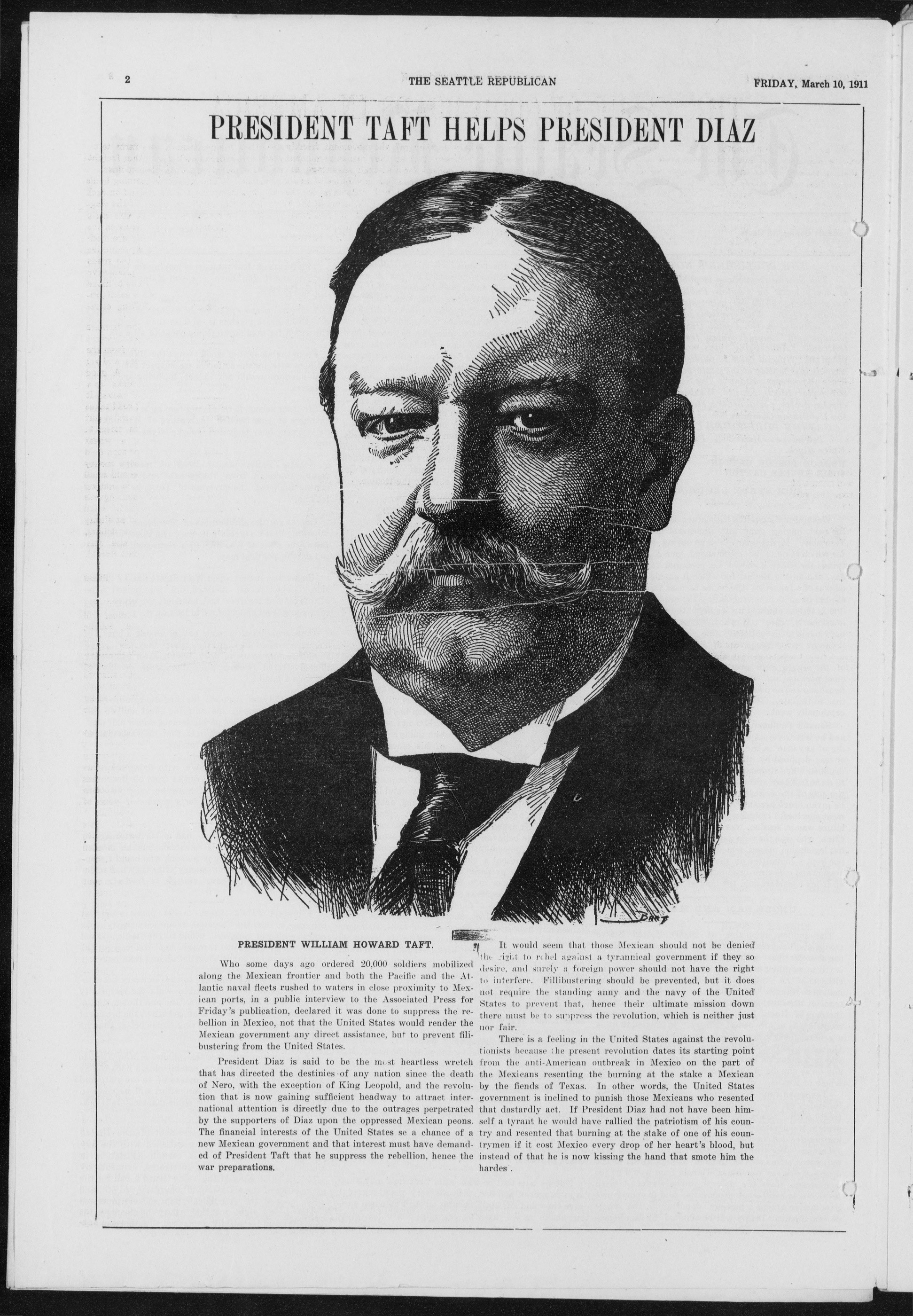
PRESIDENT TAFT HELPS PRESIDENT DIAZ
D. D.
---
Who some days ago ordered 20,000 soldiers mobilized along the Mexican frontier and both the Pacific and the Atlantic naval fleets rushed to waters in close proximity to Mexican ports, in a public interview to the Associated Press for Friday's publication, declared it was done to suppress the rebellion in Mexico, not that the United States would render the Mexican government any direct assistance, but to prevent filibustering from the United States.
President Diaz is said to be the most heartless wretch that has directed the destinies of any nation since the death of Nero, with the exception of King Leopold, and the revolution that is now gaining sufficient headway to attract international attention is directly due to the outrages perpetrated by the supporters of Diaz upon the oppressed Mexican peons. The financial interests of the United States se a chance of a new Mexican government and that interest must have demanded of President Taft that he suppress the rebellion, hence the war preparations.
PRESIDENT WILLIAM HOWARD TAFT.
It would seem that those Mexican should not be denied the right to rebel against a tyrannical government if they so desire, and surely a foreign power should not have the right to interfere. Fillibustering should be prevented, but it does not require the standing army and the navy of the United States to prevent that, hence their ultimate mission down there must be to suppress the revolution, which is neither just nor fair.
There is a feeling in the United States against the revolutionists because the present revolution dates its starting point from the anti-American outbreak in Mexico on the part of the Mexicans resenting the burning at the stake a Mexican by the fiends of Texas. In other words, the United States government is inclined to punish those Mexicans who resented that dastardly act. If President Diaz had not have been himself a tyrant he would have rallied the patriotism of his country and resented that burning at the stake of one of his countrymen if it cost Mexico every drop of her heart's blood, but instead of that he is now kissing the hand that smote him the hardes.
FRIDAY, March 10, 1911
THE VALUE OF GOOD ROADS IN AMERICA
FRIDAY March 10, 1911
To agitate for road improvements in a thorough and systematic manner all over the country, so that good roads will bind counties and states together and evolve into a net work of thoroughfares tapping every portion of the country is the ideal that that the newly organized American Association of Highway Improvement has set before it. This association is officered by government officials, railroad men, park commissioners, road experts, United States senators and men in a dozen other pursuits. Its purpose is to strive for good roads everywhere, to send out lecturers upon the subject, to help legislatures to draft good road bills, and to do everything possible that will tend to systematic road improvement.
In view of the agitated bond issue to provide Snohomish county with roads of a permanent character, which, when such a national campaign bears the fruits that are certain to come, will form a part of a national system, this association and the influences that persuaded different men to enroll themselves among highway workers are of special interest to this section.
Logan Waller Page, director of the United States office of public roads, is president of the association he says, in the Saturday evening Post:
"The work our association itends to do, throwing all our strength where needed, will eventually make a complete system of good roads an actuality. Improved roads will have the effect of lowering the cost of hauling, now twenty-three cents per mile. In the vicinity of London, motor tractors draw trains of cars into the city loaded with truck products.
"The system over there is somewhat curious. One of these big motor tractors starts toward London from a distant point. As it proceeeds, cars of farm products are hitched to it. A great load can thus be drawn into the city at a very little cost to the frrmers. The system is made possible solely because of the modern condition in which the roads are maintained. The cost of hauling is less than four cents a ton-mile. American consuls abroad reported eighteen years ago that the average cost in hauling was about ten cents a mile. That shows what good roads have done for Europe.
"Take another example of the effects of good roads: Massachusetts, previously to 1890, found its land rapidly decreeing in value. The state began to build improved roads in 1892. As a result, between 1890 and 1900, land in Massachusetts showed the greatest percentage of increase in comparison with all other states in the Union.
"Where roads have been improved, railroad rates have gone down. But by increased commerce, the improved roads bring advantage to the railroads. The more prosserous the country the greater the shipments and, therefore, the greater the benefit to the railroads. Professor Latta, of Perdue university, made an investigation that showed an average increase of five dollars an acre in
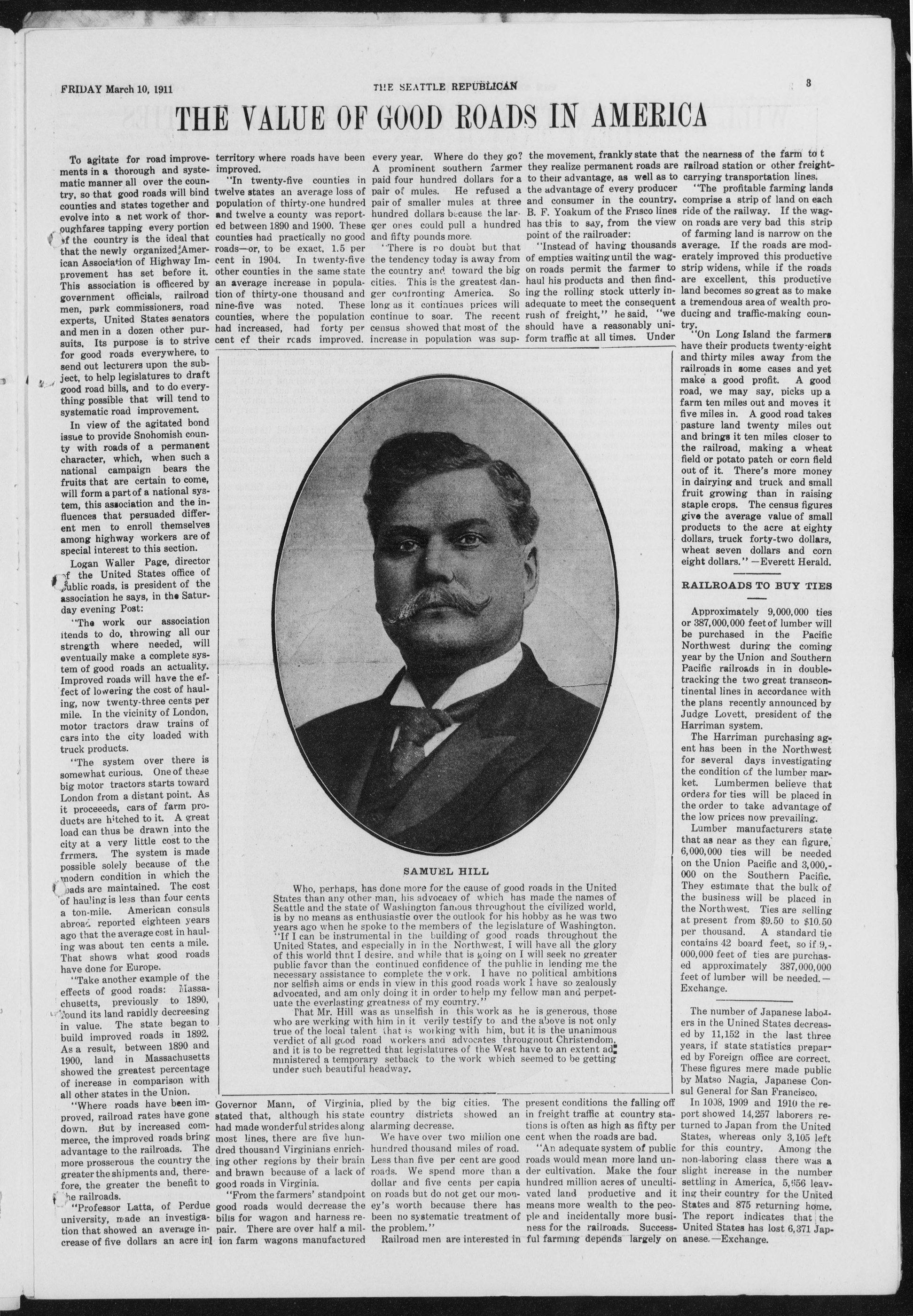
Who, perhaps, has done more for the cause of good roads in the United States than any other man, his advocacy of which has made the names of Seattle and the state of Washington famous throughout the civilized world, is by no means as enthusiastic over the outlook for his hobby as he was two years ago when he spoke to the members of the legislature of Washington. "If I can be instrumental in the building of good roads throughout the United States, and especially in in the Northwest, I will have all the glory of this world thnt I desire, and while that is going on I will seek no greater public favor than the continued confidence of the public in lending me the necessary assistance to complete the work. I have no political ambitions nor selfish aims or ends in view in this good roads work I have so zealously advocated, and am only doing it in order to help my fellow man and perpetuate the everlasting greatness of my country."
That Mr. Hill was as unselfish in this work as he is generous, those who are working with him in it verily testify to and the above is not only true of the local talent that is working with him, but it is the unanimous verdict of all good road workers and advocates throughout Christendom, and it is to be regretted that legislatures of the West have to an extent administered a temporary setback to the work which seemed to be getting under such beautiful headway.
territory where roads have been improved.
"In twenty-five counties in twelve states an average loss of population of thirty-one hundred and twelve a county was reported between 1890 and 1900. These counties had practically no good roads-or, to be exact, 1.5 per cent in 1904. In twenty-five other counties in the same state an average increase in population of thirty-one thousand and nine-five was noted. These counties, where the population had increased, had forty per cent of their roads improved.
Who, perhaps, but States than any other Seattle and the state is by no means as emergy years ago when he said, "If I can be instrumented United States, and end of this world that I can public favor than the necessary assistance nor selfish aims or end advocated, and am omitate the everlasting That Mr. Hill who are working with true of the local tale verdict of all good and it is to be regret ministered a temporary under such beautiful
Governor Mann, of Virginia, stated that, although his state had made wonderful strides along most lines, there are five hundred thousand Virginians enriching other regions by their brain and brawn because of a lack of good roads in Virginia. "From the farmers' standpoint good roads would decrease the bills for wagon and harness repair. There are over half a million farm wagons manufactured
---
THE SEATTLE REPUBLICAN GOOD ROAD every year. Where do they go? A prominent southern farmer paid four hundred dollars for a pair of mules. He refused a pair of smaller mules at three hundred dollars because the larger ones could pull a hundred and fifty pounds more.
There is no doubt but that the tendency today is away from the country and toward the big cities. This is the greatest danger confronting America. So long as it continues prices will continue to soar. The recent census showed that most of the increase in population was sup-
[Image of a man with a mustache and a suit, looking directly at the camera. The background is a plain, light color. The man's face is centered in the frame, and he appears to be middle-aged. The image is oval-shaped with a thin border.]]
SAMUEL HILL
has done more for the cause of good man, his advocacy of which has of Washington famous throughout thusiastic over the outlook for his book to the members of the legislature in the building of good roads especially in in the Northwest, I wished, and while that is going on I have continued confidence of the public to complete the work. I have made in view in this good roads work only doing it in order to help my fellow greatness of my country." Has as unselfish in this work as he him in it verily testify to and point that is working with him, but road workers and advocates throughed that legislatures of the West have setback to the work which they headway.
plied by the big cities. The country districts showed an alarming decrease. We have over two million one hundred thousand miles of road. Less than five per cent are good roads. We spend more than a dollar and five cents per capia on roads but do not get our money's worth because there has been no systematic treatment of the problem." Railroad men are interested in
---
the movement, frankly state that they realize permanent roads are to their advantage, as well as to the advantage of every producer and consumer in the country. B. F. Yoakum of the Frisco lines has this to say, from the view point of the railroader:
"Instead of having thousands of empties waiting until the wagon roads permit the farmer to haul his products and then finding the rolling stock utterly inadequate to meet the consequent rush of freight," he said. "we should have a reasonably uniform traffic at all times. Under
road in the United States made the names of the civilized world, hobby as he was two nature of Washington. Roads throughout the will have all the glory will seek no greater public in lending me the political ambitions I have so zealously low man and perpet-
he is generous, those the above is not only it is the unanimous throughout Christendom, have to an extent ad seemed to be getting
present conditions the falling off in freight traffic at country stations is often as high as fifty per cent when the roads are bad. "An adequate system of public roads would mean more land under cultivation. Make the four hundred million acres of uncultivated land productive and it means more wealth to the people and incidentally more business for the railroads. Successful farming depends largely on
---
3
the nearness of the farm to t railroad station or other freightcarrying transportation lines. "The profitable farming lands comprise a strip of land on each ride of the railway. If the wagon roads are very bad this strip of farming land is narrow on the average. If the roads are moderately improved this productive strip widens, while if the roads are excellent, this productive land becomes so great as to make a tremendous area of wealth producing and traffic-making country.
"On Long Island the farmers have their products twenty-eight and thirty miles away from the railroads in some cases and yet make a good profit. A good road, we may say, picks up a farm ten miles out and moves it five miles in. A good road takes pasture land twenty miles out and brings it ten miles closer to the railroad, making a wheat field or potato patch or corn field out of it. There's more money in dairying and truck and small fruit growing than in raising staple crops. The census figures give the average value of small products to the acre at eighty dollars, truck forty-two dollars, wheat seven dollars and corn eight dollars." —Everett Herald.
RAILROADS TO BUY TIES
Approximately 9,000,000 ties or 387,000,000 feet of lumber will be purchased in the Pacific Northwest during the coming year by the Union and Southern Pacific railroads in in doubletracking the two great transcontinental lines in accordance with the plans recently announced by Judge Lovett, president of the Harriman system.
The Harriman purchasing agent has been in the Northwest for several days investigating the condition of the lumber market. Lumbermen believe that orders for ties will be placed in the order to take advantage of the low prices now prevailing.
Lumber manufacturers state that as near as they can figure, 6,000,000 ties will be needed on the Union Pacific and 3,000,-000 on the Southern Pacific. They estimate that the bulk of the business will be placed in the Northwest. Ties are selling at present from $9.50 to $10.50 per thousand. A standard tie contains 42 board feet, so if 9,-000,000 feet of ties are purchased approximately 387,000,000 feet of lumber will be needed. Exchange.
The number of Japanese laborers in the Unined States decreased by 11,152 in the last three years, if state statistics prepared by Foreign office are correct. These figures mere made public by Matso Nagia, Japanese Consul General for San Francisco.
In 1008, 1909 and 1910 the report showed 14,257 laborers returned to Japan from the United States, whereas only 3,105 left for this country. Among the non-laboring class there was a slight increase in the number settling in America, 5,656 leaving their country for the United States and 875 returning home. The report indicates that the United States has lost 6,371 Japanese.—Exchange.
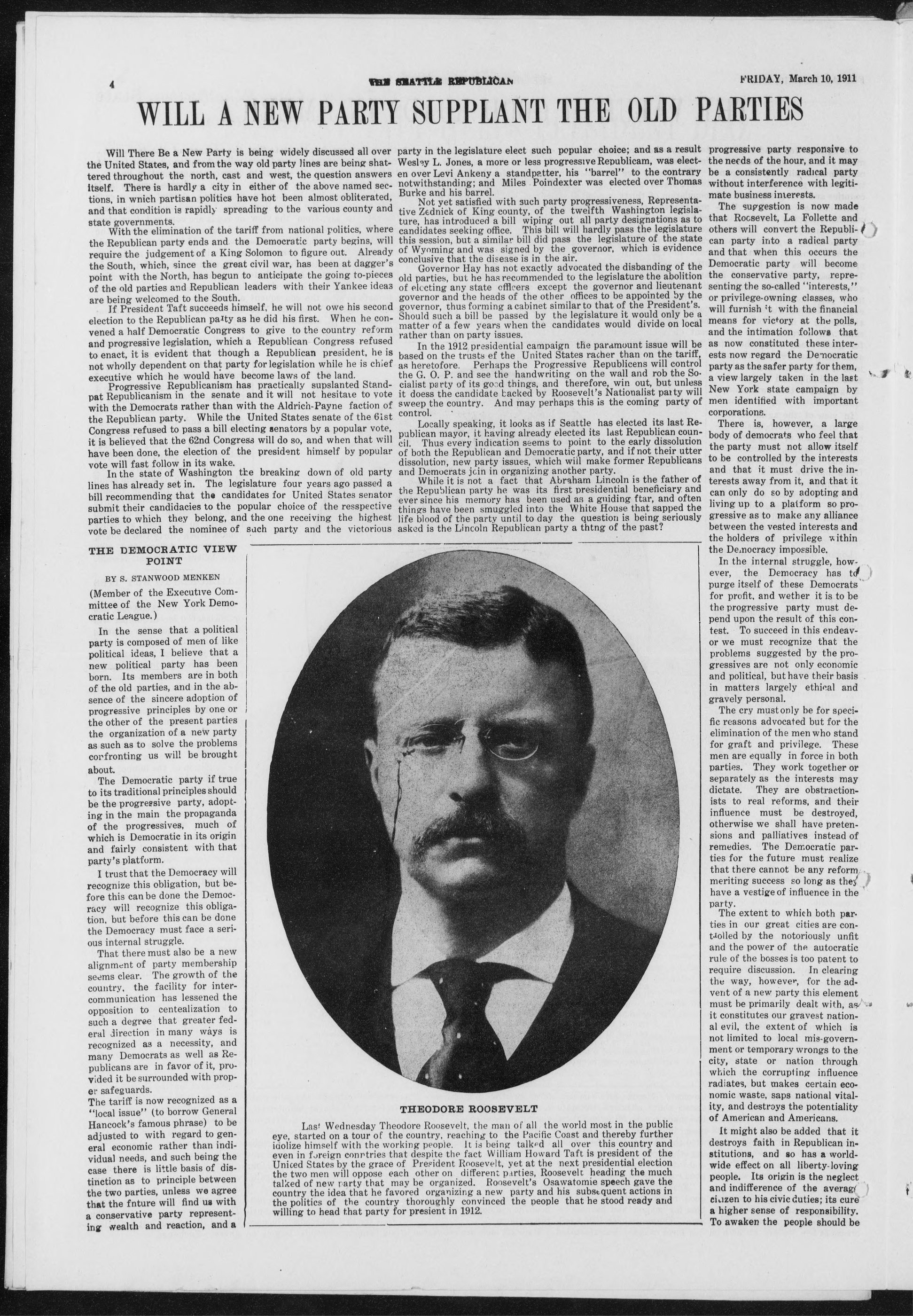
WILL A NEW PARTY SUPPLANT THE OLD PARTIES
4
Will There Be a New Party is being widely discussed all over the United States, and from the way old party lines are being shattered throughout the north, cast and west, the question answers itself. There is hardly a city in either of the above named sections, in which partisan politics have hot been almost obliterated, and that condition is rapidly spreading to the various county and state governments.
With the elimination of the tariff from national politics, where the Republican party ends and the Democratic party begins, will require the judgement of a King Solomon to figure out. Already the South, which, since the great civil war, has been at dagger's point with the North, has begun to anticipate the going to-pieces of the old parties and Republican leaders with their Yankee ideas are being welcomed to the South.
If President Taft succeeds himself, he will not owe his second election to the Republican party as he did his first. When he convened a half Democratic Congress to give to the country reform and progressive legislation, which a Republican Congress refused to enact, it is evident that though a Republican president, he is not wholly dependent on that party for legislation while he is chief executive which he would have become laws of the land. Progressive Republicanism has practically supslanted Standpat Republicanism in the senate and it will not hesitate to vote with the Democrats rather than with the Aldrich-Payne faction of the Republican party. While the United States senate of the 61st Congress refused to pass a bill electing senators by a popular vote, it is believed that the 62nd Congress will do so, and when that will have been done, the election of the president himself by popular vote will fast follow in its wake.
In the state of Washington the breaking down of old party lines has already set in. The legislature four years ago passed a bill recommending that the candidates for United States senator submit their candidacies to the popular choice of the respective parties to which they belong, and the one receiving the highest vote be declared the nominee of such party and the victorious
THE DEMOCRATIC VIEW POINT
BY S. STANWOOD MENKEN (Member of the Executive Committee of the New York Democratic League.)
In the sense that a political party is composed of men of like political ideas, I believe that a new political party has been born. Its members are in both of the old parties, and in the absence of the sincere adoption of progressive principles by one or the other of the present parties the organization of a new party as such as to solve the problems confronting us will be brought about.
The Democratic party if true to its traditional principles should be the progressive party, adopting in the main the propaganda of the progressives, much of which is Democratic in its origin and fairly consistent with that party's platform.
I trust that the Democracy will recognize this obligation, but before this can be done the Democracy will recognize this obligation, but before this can be done the Democracy must face a serious internal struggle.
That there must also be a new alignment of party membership seems clear. The growth of the country, the facility for intercommunication has lessened the opposition to centeralization to such a degree that greater federal direction in many ways is recognized as a necessity, and many Democrats as well as Republicans are in favor of it, provided it be surrounded with proper safeguards.
The tariff is now recognized as a "local issue" (to borrow General Hancock's famous phrase) to be adjusted to with regard to general economic rather than individual needs, and such being the case there is little basis of distinction as to principle between the two parties, unless we agree that the fniture will find us with a conservative party representing wealth and reaction, and a
THE SHATTLE REPUBLICAN
party in the legislature elect su-
Wesley L. Jones, a more or less
en over Levi Ankeny a standp
notwithstanding; and Miles P.
Burke and his barrel.
Not yet satisfied with such
tive Zednick of King county, o
ture, has introduced a bill wip
candidates seeking office. This
this session, but a similar bill o
of Wyoming and was signed b
conclusive that the disease is in
Governor Hay has not exac
old parties, but he has recomm
of electing any state officers
governor and the heads of the
governor, thus forming a cabin.
Should such a bill be passed b
matter of a few years when th
rather than on party issues.
In the 1912 presidential ca
based on the trusts of the Uni
as heretofore. Perhaps the B
the G. O. P. and see the hand
cist party of its good things,
it does the candidate backed b
sweep the country. And may
control.
Locally speaking, it looks a
publican mayor, it having alre
cil. Thus every indication seee
of both the Republican and Dey
dissolution, new party issues, v
and Democrats join in organizi
While it is not a fact that
the Republican party he was i
ever since his memory has bee
things have been smuggled int
life blood of the party until to
asked is the Lincoln Republican
party in the legislature elect such popular choice; and as a result Wesley L. Jones, a more or less progressive Republicam, was electen over Levi Ankeny a standpatter, his "barrel" to the contrary notwithstanding; and Miles Poindexter was elected over Thomas Burke and his barrel.
Not yet satisfied with such party progressiveness, Representative Zednick of King county, of the twelfth Washington legislature, has introduced a bill wiping out all party designations as to candidates seeking office. This bill will hardly pass the legislature this session, but a similar bill did pass the legislature of the state of Wyoming and was signed by the governor, which is evidence conclusive that the disease is in the air.
Governor Hay has not exactly advocated the disbanding of the old parties, but he has recommended to the legislature the abolition of electing any state officers except the governor and lieutenant governor and the heads of the other offices to be appointed by the governor, thus forming a cabinet similar to that of the President's. Should such a bill be passed by the legislature it would only be a matter of a few years when the candidates would divide on local rather than on party issues.
In the 1912 presidential campaign the paramount issue will be based on the trusts of the United States rather than on the tariff, as heretofore. Perhaps the Progressive Republicens will control the G. O. P. and see the handwriting on the wall and rob the Socialist party of its good things, and therefore, win out, but unless it doesess the candidate backed by Roosevelt's Nationalist party will sweep the country. And may perhaps this is the coming party of control.
Locally speaking, it looks as if Seattle has elected its last Republican mayor, it having already elected its last Republican council. Thus every indication seems to point to the early dissolution of both the Republican and Democratic party, and if not their utter dissolution, new party issues, which will make former Republicans and Democrats join in organizing another party.
While it is not a fact that Abraham Lincoln is the father of the Republican party he was its first presidential beneficiary and ever since his memory has been used as a guiding ftar, and often things have been smuggled into the White House that sapped the life blood of the party until to day the question is being seriously asked is the Lincoln Republican party a thng of the past?
THEODORE ROOSEVELT
ay Theodore Roosevelt, the man of all
er of the country, reaching to the Pac
the working people. It is being talk-
ties that despite the fact William Ho-
grace of President Roosevelt, yet at
rose each other on different parties,
that may be organized. Roosevelt's
he favored organizing a new party
country thoroughly convinced the pe
party for present in 1912.
Last Wednesday Theodore Roosevelt, the man of all the world most in the public eye, started on a tour of the country, reaching to the Pacific Coast and thereby further idolize himself with the working people. It is being talked all over this country and even in foreign countries that despite the fact William Howard Taft is president of the United States by the grace of President Roosevelt, yet at the next presidential election the two men will oppose each other on different parties, Roosevelt heading the much talked of new party that may be organized. Roosevelt's Osawatomie speech gave the country the idea that he favored organizing a new party and his subsequent actions in the politics of the country thoroughly convinced the people that he stood ready and willing to head that party for president in 1912.
FRIDAY. March 10, 1911
progressive party responsive to the needs of the hour, and it may be a consistently radical party without interference with legitimate business interests.
The suggestion is now made that Rocsevelt, La Follette and others will convert the Republican party into a radical party and that when this occurs the Democratic party will become the conservative party, representing the so-called "interests," or privilege-owning classes, who will furnish it with the financial means for victory at the polls, and the intimation follows that as now constituted these interests now regard the Democratic party as the safer party for them, a view largely taken in the last New York state campaign by men identified with important corporations.
There is, however, a large body of democrats who feel that the party must not allow itself to be controlled by the interests and that it must drive the interests away from it, and that it can only do so by adopting and living up to a platform so progressive as to make any alliance between the vested interests and the holders of privilege within the Democracy impossible.
In the internal struggle, however, the Democracy has to purge itself of these Democrats for profit, and wether it is to be the progressive party must depend upon the result of this contest. To succeed in this endeavor we must recognize that the problems suggested by the progressives are not only economic and political, but have their basis in matters largely ethical and gravely personal.
The cry must only be for specific reasons advocated but for the elimination of the men who stand for graft and privilege. These men are equally in force in both parties. They work together or separately as the interests may dictate. They are obstractionists to real reforms, and their influence must be destroyed, otherwise we shall have pretensions and palliatives instead of remedies. The Democratic parties for the future must realize that there cannot be any reform meriting success so long as they have a vestige of influence in the party.
The extent to which both parties in our great cities are controlled by the notoriously unfit and the power of the autocratic rule of the bosses is too patent to require discussion. In clearing the way, however, for the advent of a new party this element must be primarily dealt with, as it constitutes our gravest national evil, the extent of which is not limited to local mis-government or temporary wrongs to the city, state or nation through which the corrupting influence radiates, but makes certain economic waste, saps national vitality, and destroys the potentiality of American and Americans.
It might also be added that it destroys faith in Republican institutions, and so has a worldwide effect on all liberty-loving people. Its origin is the neglect and indifference of the average citizen to his civic duties; its cure a higher sense of responsibility. To awaken the people should be
FRIDAY. March 10. 1911
the great work of the progressives. In stating this nothing new is suggested, but is it given here as the viewpoint of what should be the ground plan of any progressive party, and while agreeing with the principle stated by Mr. Edgerton that the progressives should "drive the bosses out of politics," it is submitted that they should drive the people in and having driven them into politics keep them interested all the time.
If the Democratic party is strong enough to prevail in this struggle over those who are interested in it for personal purposes, then it can properly be the progressive and dominant party.
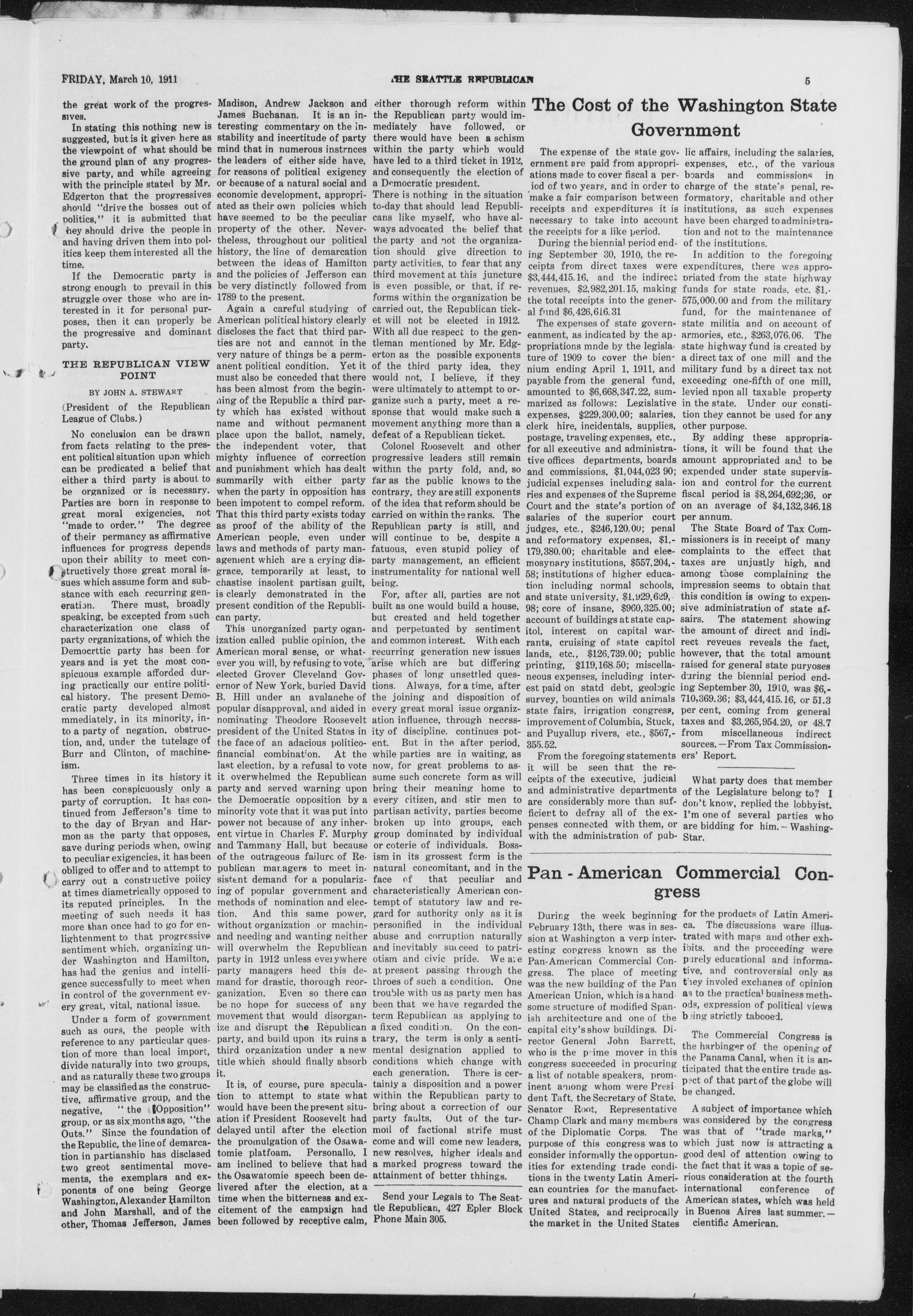
THE REPUBLICAN VIEW POINT
BY JOHN A. STEWART (President of the Republican League of Clubs.) No conclusion can be drawn from facts relating to the present political situation upon which can be predicated a belief that either a third party is about to be organized or is necessary. Parties are born in response to great moral exigencies, not "made to order." The degree of their permanency as affirmative influences for progress depends upon their ability to meet con-
structively those great moral issues which assume form and substance with each recurring generation. There must, broadly speaking, be excepted from such characterization one class of party organizations, of which the Democritic party has been for years and is yet the most conspicuous example afforded during practically our entire political history. The present Democratic party developed almost immediately, in its minority, into a party of negation, obstruction, and, under the tutelage of Burr and Clinton, of machineism.
Three times in its history it has been conspicuously only a party of corruption. It has continued from Jefferson's time to to the day of Bryan and Harmon as the party that opposes, save during periods when, owing to peculiar exigencies, it has been obliged to offer and to attempt to carry out a constructive policy at times diametrically opposed to its reputed principles. In the meeting of such needs it has more than once had to go for enlightenment to that progressive sentiment which, organizing under Washington and Hamilton, has had the genius and intelligence successfully to meet when in control of the government every great, vital, national issue.
Under a form of government such as ours, the people with reference to any particular question of more than local import, divide naturally into two groups, and as naturally these two groups may be classified as the constructive, affirmative group, and the negative, "the Opposition" group, or as six months ago, "the Outs." Since the foundation of the Republic, the line of demarcation in partianship has disclased two great sentimental movements, the exemplars and exponents of one being George Washington, Alexander Hamilton and John Marshall, and of the other, Thomas Jefferson, James
Madison, Andrew Jackson and James Buchanan. It is an interesting commentary on the instability and incertitude of party mind that in numerous instructs the leaders of either side have, for reasons of political exigency or because of a natural social and economic development, appropriated as their own policies which have seemed to be the peculiar property of the other. Nevertheless, throughout our political history, the line of demarcation between the ideas of Hamilton and the policies of Jefferson can be very distinctly followed from 1789 to the present.
Again a careful studying of American political history clearly discloses the fact that third parties are not and cannot in the very nature of things be a permanent political condition. Yet it must also be conceded that there has been almost from the beginning of the Republic a third party which has existed without name and without permanent place upon the ballot, namely, the independent voter, that mighty influence of correction and punishment which has dealt summarily with either party when the party in opposition has been impotent to compel reform. That this third party exists today as proof of the ability of the American people, even under laws and methods of party management which are a crying disgrace, temporarily at least, to chastise insolent partisan guilt, is clearly demonstrated in the present condition of the Republican party.
This unorganized party organization called public opinion, the American moral sense, or whatever you will, by refusing to vote, elected Grover Cleveland Governor of New York, buried David B. Hill under an avalanche of popular disapproval, and aided in nominating Theodore Roosevelt president of the United States in the face of an adacious politico-financial combination. At the last election, by a refusal to vote it overwhelmed the Republican party and served warning upon the Democratic opposition by a minority vote that it was put into power not because of any inherent virtue in Charles F. Murphy and Tammany Hall, but because of the outrageous failure of Republican managers to meet insistent demand for a popularizing of popular government and methods of nomination and election. And this same power, without organization or machinand needing and wanting neither will overwhelm the Republican party in 1912 unless everywhere party managers heed this demand for drastic, thorough reorganization. Even so there can be no hope for success of any movement that would disorganize and disrupt the Republican party, and build upon its ruins a third organization under a new title which should finally absorb it.
It is, of course, pure speculation to attempt to state what would have been the present situation if President Roosevelt had delayed until after the election the promulgation of the Osawatomie platfoam. Personallo, I am inclined to believe that had the Osawatomie speech been delivered after the election, at a time when the bitterness and excitement of the campaign had been followed by receptive calm,
THE SEATTLE REPUBLICAN
either thorough reform within the Republican party would immediately have followed, or there would have been a schism within the party which would have led to a third ticket in 1912, and consequently the election of a Democratic president.
There is nothing in the situation to-day that should lead Republicans like myself, who have always advocated the belief that the party and not the organization should give direction to party activities, to fear that any third movement at this juncture is even possible, or that, if reforms within the organization be carried out, the Republican ticket will not be elected in 1912. With all due respect to the gentleman mentioned by Mr. Edgerton as the possible exponents of the third party idea, they would not, I believe, if they were ultimately to attempt to organize such a party, meet a response that would make such a movement anything more than a defeat of a Republican ticket.
Colonel Roosevelt and other progressive leaders still remain within the party fold, and, so far as the public knows to the contrary, they are still exponents of the idea that reform should be carried on within the ranks. The Republican party is still, and will continue to be, despite a fatuous, even stupid policy of party management, an efficient instrumentality for national well being.
For, after all, parties are not built as one would build a house, but created and held together and perpetuated by sentiment and common interest. With each recurring generation new issues arise which are but differing phases of long unsettled questions. Always, for a time, after the joining and disposition of every great moral issue organization influence, through necessity of discipline, continues potent. But in the after period, while parties are in waiting, as now, for great problems to assume such concrete form as will bring their meaning home to every citizen, and stir men to partisan activity, parties become broken up into groups, each group dominated by individual or coterie of individuals. Bossism in its grossest form is the natural concomitant, and in the face of that peculiar and characteristically American contempt of statutory law and regard for authority only as it is personified in the individual abuse and corruption naturally and inevitably succeed to patriotism and civic pride. We are at present passing through the throes of such a condition. One trouble with us as party men has been that we have regarded the term Republican as applying to a fixed condition. On the contrary, the term is only a sentimental designation applied to conditions which change with each generation. There is certainly a disposition and a power within the Republican party to bring about a correction of our party faults. Out of the turmoil of factional strife must come and will come new leaders, new resolves, higher ideals and a marked progress toward the attainment of better things.
Send your Legals to The Seattle Republican, 427 Epler Block Phone Main 305.
The Cost of the Washington State Government
Pan-American Commercial Congress
The expense of the state government are paid from appropriations made to cover fiscal a period of two years, and in order to make a fair comparison between receipts and expenditures it is necessary to take into account the receipts for a like period.
During the biennial period ending September 30, 1910, the receipts from direct taxes were $3,444,415.16, and the indirect revenues, $2,982,201.15, making the total receipts into the general fund $6,426,616.31
The expenses of state governement, as indicated by the appropriations made by the legislature of 1909 to cover the biennium ending April 1, 1911, and payable from the general fund, amounted to $6,668,347.22, summarized as follows: Legislative expenses, $229,300.00; salaries, clerk hire, incidentals, supplies, postage, traveling expenses, etc., for all executive and administrative offices departments, boards and commissions, $1,044,023.90; judicial expenses including salaries and expenses of the Supreme Court and the state's portion of salaries of the superior court judges, etc., $246,120.00; penal and reformatory expenses, $1,179,380.00; charitable and eleemosynary institutions, $557,204.58; institutions of higher education including normal schools, and state university, $1,929,629.98; core of insane, $960,325.00; account of buildings at state capitol, interest on capital warrants, cruising of state capitol lands, etc., $126,739.00; public printing, $119,168.50; miscellaneous expenses, including interest paid on statd debt, geologic survey, bounties on wild animals state fairs, irrigation congress, improvement of Columbia, Stuck, and Puyallup rivers, etc., $567,355.52.
From the foregoing statements it will be seen that the receipts of the executive, judicial and administrative departments are considerably more than sufficient to defray all of the expenses connected with them, or with the administration of pub-
During the week beginning February 13th, there was in session at Washington a verp interesting congress known as the Pan-American Commercial Congress. The place of meeting was the new building of the Pan American Union, which is a handsome structure of modified Spanish architecture and one of the capital city's show buildings. Director General John Barrett, who is the prime mover in this congress succeeded in procuring a list of notable speakers, prominent among whom were President Taft, the Secretary of State, Senator Root, Representative Champ Clark and many members of the Diplomatic Corps. The purpose of this congress was to consider informally the opportunities for extending trade conditions in the twenty Latin American countries for the manufactures and natural products of the United States, and reciprocally the market in the United States
5
lic affairs, including the salaries, expenses, etc., of the various boards and commissions in charge of the state's penal, reformatory, charitable and other institutions, as such expenses have been charged to administration and not to the maintenance of the institutions.
In addition to the foregoing expenditures, there was appropriated from the state highway funds for state roads, etc. $1,575,000.00 and from the military fund, for the maintenance of state militia and on account of armories, etc., $263,076.06. The state highway fund is created by a direct tax of one mill and the military fund by a direct tax not exceeding one-fifth of one mill, levied upon all taxable property in the state. Under our constitution they cannot be used for any other purpose.
By adding these appropriations, it will be found that the amount appropriated and to be expended under state supervision and control for the current fiscal period is $8,264,692;36, or on an average of $4,132,346.18 per annum.
The State Board of Tax Commissioners is in receipt of many complaints to the effect that taxes are unjustly high, and among those complaining the impression seems to obtain that this condition is owing to expensive administration of state affairs. The statement showing the amount of direct and indirect revenues reveals the fact, however, that the total amount raised for general state puryoses during the biennial period ending September 30, 1910, was $6,710,369.36; $3,444,415.16, or 51.3 per cent, coming from general taxes and $3,265,954.20, or 48.7 from miscellaneous indirect sources.—From Tax Commissioners' Report.
What party does that member of the Legislature belong to? I don't know, replied the lobbyist. I'm one of several parties who are bidding for him. - Washing-Star.
for the products of Latin America. The discussions ware illustrated with maps and other exhibits, and the proceeding were purely educational and informative, and controversial only as they involed exchanes of opinion as to the practical business methods, expression of political views being strictly tabooed.
The Commercial Congress is the harbinger of the opening of the Panama Canal, when it is anticipated that the entire trade aspect of that part of the globe will be changed.
A subject of importance which was considered by the congress was that of "trade marks," which just now is attracting a good deal of attention owing to the fact that it was a topic of serious consideration at the fourth international conference of American states, which was held in Buenos Aires last summer. scientific American.
POLITICS AND THE POLITICIANS
Seattle last Tuesday pulled of an election that attracted attention not only throughout the state, but throughout the whole country, and all because it followed so soon after the recall election, which attracted such widespread comment. While at the recall election some 61,000 and more votes were cast, but forty odd thousand were cast at the regular election for councilman, showing that a large percentage of the voters either thought the election of a mayor of their liking was sufficient to keep things going right side up with care or they had no further interest in the city government.
The Seattle Republican is highly pleased with the results of the election as the most of those elected were supported in its columns. 'It, however, believes that it would have been good business judgment for Frank P. Mullen to have been returned to the council, on account of his long street experience, but since a majority of the voters thought differently we can stand it if they can.
The tail end of the campaign developed into an ugly personal scrap, which came dangerously close to defeating Albert J. Goddard, and did shift him from the three-year term, which he richly deserved, to the one-year term.
It was the general belief that E. L. Blaine would draw one of the three-year terms, but he only drew a two, while Erickson, who in both the primaries and the general election ran like a scared wolf, drew the first three-year term while Griffith and Wardall drew the other two.
Hesketh and Steiner drew the other two, two-year terms, and that, too, was something of a surprise. There were forces working against both of those candidates that looked on their face as would result in their defeat, but they evidently did not work fast or hard enough.
Kellogg, who, with Goddard and Haas, grabbed the three one-year terms, had a hard fight and looked for a while as if Joe Smith would surely get him. The broadside editorial of the P.I. last Sunday against Joe, put him down and out for the count.
PERSONAL COMMENT
Speaking of the men from a personal standpoint, it is said of Erickson, who is the head of a manufacturing concern of the city, that though a very successful business man, he is one of the most arbitrary ones in the whole city and he will not harmonize with a single member of the council, yea, will not only not harmonize with the other members, but will not even harmonize with himself.
---
Of Austin E. Griffith, he is charged with having been the contending factor in the Chamber of Commerce for years, but in spite of that he has done valiant work in that body for the advancement of the city. His hobby is the park and playground system of the city and he will overlook all else to accomplish that, so it is reported. He is an attorney at law.
---
Max Wardall has already shown the kind of stuff he is made of and yet his enemies declare that he is a grandstand player and was not sincere in laying open the Gill administration, which resulted in Gill's recall. Wardall will harmonize with the working majority of the body and under no circumstances be a hindering block. He, too, is an attorney at law.
* * *
Edwin L. Blaine has been a sturdy hard working member of the council for the past year, as may be seen from the record of the service he has rendered; but like Socrates, when asked by a man, who asked that the name of Socrates, not knowing he was talking to Socrates himself, he wrote on a banishment shell, was asked, what have you against Socrates? and the reply was, "I am tired of him always being called the just." That is about all any one had against Blaine. He is an abstractor by profession.
```markdown
```
Hesketh is a new factor in the political game of the city, he being the first organized labor man that has ever been elected to the council or any other position in Seattle. He is charged with being unduly favorable to the saloon forces and was put in the position by the saloon element, and he, with F. S. Steiner, it is said, are the two men of all the rest in the council, the saloon men look to as being in close touch with their business interest. Hesketh is without business experience, but is said to be a very fair minded man. Steiner has splendid business recommendations and his friends predict he will make a most useful member of the council. Hesketh is a cook.
For tht past twenty-two years A. F. Haas has been a highly respected citizen of Seattle and aught can not be said detrimental to his character and reputation. He has been more or less successful in his business dealings and would have been among the higher ups on the ticket
THE SEATTLE REPUBLICAN
[Name]
SPEAKER HOWARD D. TAYLOR
had not irresponsible persons circulated the report that he would be a corporation tool in the city council. He is always ready to listen to a business proposition, and for that reason it is believed he will be a most useful as well as serviceable member. He is a retired business man.
---
J. Y. C. Kellogg is a splendid young man and while he is not one of very brilliant speech, yet he is a hard worker and quick to take advantage of an opportunity. He ran in the third class more on account of his youthfulness than anything real against him. In the council for the past year he has been considered something of a disturbing factor among those who were in the saddle, but the people evidently thought he was right and his opponents wrong, as all of them were turned down and he won out in both fights. He is an attorney at law. Albert J. Goddard was perhaps the most contentious
cuss in the old council from the viewpoint of those who opposed him, and yet he never contended for anything, but what he honestly believed was in the interest of the taxpayers. In the council he has been not only aggressive, but insistent and though he has always been in the hopeless minority, yet he has done things and it was that very reason he was elected in spite of the malicious stories that were circulated over the city against him and his record. He is a banker.
It is very doubtful, however, if Mayor Dilling has a majority of the members of the council, who will act in harmony with him, and if he has not, then not much will be accomplished by him as mayor. Mayor Dilling is not of himself charged with being of a very harmonizing nature and if he and a majority of the members of the council should go to logger-heading soon after they take their seats, there will be no end of trouble for his honor, the mayor.
---
Three of the members of the council live in the Seventh ward, and Ballard and Green Lake districts are without representation and this has caused considerable comment along the line that those sections of the city will not get the proper recognition. That is all cheap Blethen talk in which there is not an iota of common sense. The men elected will show no partiality as to wards, and if they should try to do more for the ward in which they reside than for the other wards it would result in a recall of them before they could say Jack Robinson, and if they were not actually recalled they would never again be elected.
The Times editorially declares that it warmly supported four out of the nine candidates in the campaign. If that is true, it must have given them that silent support, which is imparted by the human telegraphy route. If the public had have known the Times was warmly supporting even Erickson, who ran ahead of his ticket, he would have been beaten. It was hinted in the campaign
FRIDAY March 10, 911 ICIANS
that the Times was supporting Mullen and Murphy and as a result both of them were badly beaten. The person seeking public office and gets the Times to boost for him, is almost certain of defeat. "Come on," said one friend to another, who was a candidate at the primarits for a councilmanic nomination, "and I will go with you to my friend, Col. Blethen, and got him to give you a boost in the Times." "Well, my friend, I will appreciate it just as much if you do not take me near the Times. I have found out that a boost in the Times is a knock, and if you have any influence with your friend Col. Blethen and want to see me elected, have him to leave my candidacy severely alone and then I will continue to stand a show of being nominated." It was done and the man was nominated.
PERSONS TALKED ABOUT
Former Governor Albert E. Mead is said to be a candidate for congress from the district in which he resides. Since retiring from the gubernatorial chair, Gov. Mead has not been a howling financial success and he seems to have gotten infected with politico phobia and cannot break away from it.
1
W. R. Forrest, at one time one of the foremost politicians of King count under the old Leigh Hunt regime, died one day this week after a protracted illness, but at no time bedfast. While Mr. Forrest was not one of the political dictators as were Hunt, Grant and McGraw, yet he was an executor and was considered by Mr. Hunt as one of his most trusted and valiant lieutenants. For years he was a prominent banker of the city, but in latter years was not so active in business circles.
0
John Alexander Falconer, of Everett, state senator from the district to the twelfth legislature, says he has made no announcement as to being a candidate for congress, "but if I do," he was heard to remark, "I will be hooked up with no combination and no one will have any strings on me." Recently in a tilt in the senate he pronounced one of his fellow members a cold blooded liar, and then as cold bloodedly apologized to the president of the senate for his rudeness of speeeh, but the deed had been done and no amount of apology could recall it.
Fred C. Harper, collector of customs at Port Townsend, after all stands a most excellent chance of succeeding himself despite the fact he was personally objectionable to Senator Piles. He will probably be given a recess appointment and will have little or no opposition when his name is sent to to the senate again, Mr. Harper, of course, knew that Senator Piles favored his brother over himself, but after the president had sent his name to the senate in spite of the backing of Senator Piles for his brother, he expected Senator Piles to stand for the appointment, and when he did not Harper was the most surprised man of all.
We are not prepared to say that the armories of the state have been the result of any very illnstrious army recruits on the firing line being developed, but, if reports from Olympia be true, the graduates of the armories are showing great fighting qualifications on the floor of the legislature.
Mexico seems inclined to favor the recall of Minister Wilson, representing the United States at her ourts, which is c said to be due to the fact that, Mr. Wilson gave Mexico to understand that Uncle Sam had rights that she were bound to respect, to which Mexico took serious exceptions.
Socialism may not be gaining much headway in the United States, but the fear that it might do so is causing the high government officials to honestly get after the trusts. The latest to be haulled before the courts is the General Electric Company and the other supply houses that manufacture electrical articles. Here is hoping that Uncle Sam has touched a live wire.
The Sixty-first Congress died by statutory limitation last Saturday at noon, and died amid a confusion such as seldom ever before witnessed at the National Capitol. With it died Uncle Joe Cannon, as a Republican leader or as an active member of congress, as he is too far advanced in years to longer measure arms with the younger and more vigorous element in the house of representatives.
FRIDAY. March 10. 1911
AMUSEMENTS
For the first time in seventeen years, Dion Boucicault's romantic Irish drama, "The Colleen Bawn" will be given at the Alhambra Theatre next week, starting Sunday, and a special matinee will be given on Friday, St. Patrick's Day. Mr. Dan Bruce aud Miss. Margo Duffet will be the star attractions in the "Colleen Bawn" next week. Both these players are well known to Seattle theater goers, as they were prime favorites in the Baker Stock Company. The supporting company will be augmented by the appeaance of a new leading juvenile man specially engaged and the entire Alhambra comvanv. Mr. Bruce will have an opportunity to some of the fine old Irish songs that are ever green in the hearts of all Irish people. No play contains prettier sentiment and dialogue as well as catchy comedy than the "Colleen Bawn," for it stands as a classic among the Irish plays for the past one hundred years.
SEATTLE THEATER
"In the Bishop's Carriage," which is to be the bill at the Seattle Theatre for the week commencing March 12th, is a story full of life, and the characters are as clearly cut as portraits in steel. It is fresh and spontaneous, having nothing of that wooden quality which has become aassociated with the term "moral play." It is made of new material, of a picturesque yet delicate style, has a good plot and some very intense situations.
IN THE SUPERIOR COURT OF THE
State of Washington, for King County.
Notice to Creditors.
In the Matter of the Establishment of John J.
Brown, for the Estate of 12131.
By order of said court made herein on the 21st day of December, 1910. Notice is hereby given to the creditors of, and to all persons having claims against said deceased or against said estate, to present them with the necessary vouchers to the undersigned administrator of said estate, at room No. 214 Alaska Building, Seattle, Washington. the place of said estate, within one year from and after the date of first publication of this notice or same will be barred. Date of first publication December 30, 1910. E. L. BLAINE, As Administrator of said Estate. J. H. TEMPLETON, Attorney for Estate. No. 16 Starbridge Building, Seattle, Washington. Dec. 30, 1910—Jan. 27, 1911.
IN THE SUPERIOR COURT OF THE State of Washington, for King County.
Clara Mullin, plaintiff, vs. Frederick Mullin,
defendant.—No. —
In, defendant.—No.
The State of Washington to Frederick
advent.
Mullin, the said defendant.
In the name of the state of Washington, you are required to appear in court five days after the date of the first publication of this summons, to wit: within sixty days from and after the 27th day of January, 1911, and defend the above entitled action in the above entitled court, and answer the complaint of the plaintiff, and serve a copy of your answer upon the undersigned, the attorney for the plaintiff at his offices below stated, and in case of your failure to do judgment will be ordered against you according to the demand of the complaint, which has been filed with the clerk of the above entitled court.
The object of the said action set forth in the complaint is as follows: To secure a divorce from defendant, with costs, alimony andorney fees, upon the grounds of non-support and desertion, to plaintiff have the custody of the minor child.
FRANK B. WIESTLING.
Attorney for Plaintiff.
Postoffice address, 202 Fern Block,
Seattle, King County, Washington.
Jan. 27—March 10, 1911.
IN THE SUPERIOR COURT OF THE
State of Washington for King County.
Notice and Summons.
Aurora Land Company, a corporation,
plaintiff, vs. J. B. Fox and Jane Doe
Fox, his wife, whose true christian
name is unknown; and all persons un-
known, if any, having or claiming an
interest in and to the hereinafter des-
cribed real property, defendants.
No.-7515.
State of Washington, to the above de-
signated and each of them:
You and each of you, as owners, claimants or holders of an interest or estate in and to the herenafter described real property, are hereby that the above certain delinquentiff is the certificate issued by the treasurer of King County, State of Washington, dated the 23rd day of March, 1910, and numbered as follows, for the delinquentiff the following years following and for the real property situated in said King County, described as follows, to-wit:
Addition, Boulevard Place, addition to Seattle; lot 6; block 28; certificate number 55236; year 1906; amount $1.09.
That the taxes for the following prior and subsequent years have been paid by the plaintiff upon said above described real property, to-wit:
Lot 6; block 28; Boulevard Place Addition to Seattle; amounts 70, 53, and 60 cents; for years 1907, 1908, 1909.
Which several sums bear interest at the date of payment, and amount from said date of payment, and are all the unpaid and unredeemed taxes upon and against said real property.
You and each of you (including said persons unknown, if any), are hereby further notified and summoned to be and appear within sixty days after the date of first publication of this notice, exclusive of the day of said first publication, to-wit, 60 days after Jan. 27, 1911, to be entitled to court and defend this action and answer the complaint of said plaintiff and serve a copy of your answer on the undersigned attorney for plaintiff at his office below stated, or pay the amount due, together with interest and costs. In case you fail so to do, judgment will be rendered herein, foreclosing the lien of said taxes and costs against each parcel of said property due upon and charged against each, for said taxes, interest and costs, ordering a sale of each parcel of said property for the satisfaction of the sums charged and found against it respectively as provided by law, and as prayed in plaintiff's complaint, now on file in this cause and court.
AURORA LAND COMPANY, a Corporation.
Plaintiff.
Attorney for Plaintiff.
Office address Northern Bank & Trust
Building, Seattle, Washington.
Jan. 27—March 10, 1911.
IN THE SUPERIOR COURT OF THE
State of Washington for King County.
Notice and Summons.
Aurora Land Company, a corporation,
plaintiff, vs. H. McCord and Jane Doe
McCord, his wife, whose true christian
name is unknown; and all persons un-
known, if any, having or claiming an
interest in and to the hereinafter des-
cribed real property, defendants.
State of Washington, to the above de-
fendants and each of them:
You and each of you, as owners, claimants or holders of an interest or estate in and to the hereinafter described real property, are hereby notified that the above named plaintiff is the holder of a certain delinquent tax certificate issued by the treasurer of King County, State of Washington, dated the 22nd of March, 1910, number as follows, for the delinquent taxes of the following year, in the following amount, and upon the real property situated in said King County, described as follows, to-wit:
Addition, Cumberland Addition to Seattle; lot 46; block 16; certificate number: 46; jar for the amount $103.
That the plaintiff for the prior and subsequent years have been paid by the plaintiff upon said above described real property, to-wit:
Lot 46; block 16; Cumberland Addition to Seattle; amounts, 54 cents, $1.43, $1.37; for years 1907, 1908, 1909.
Which several sums bear interest at the rate of 15 per cent per annum from settlement of the claimant are all the unpaid and unredeemed taxes upon and against said real property.
You and each of you (including said persons unknown, if any), are hereby further notified and summoned to be and appear within sixty days after the date of first publication of this notice, excluding the day of said first publication, to-wit, 60 days after Jan. 27, 1911, in the above entitled court and action; and defend this action and answer the complaint of said plaintiff and serve a copy of your answer on the undersigned attorney for plaintiff at his office below stated, to pay the amount due, together with any other payment you fail so to do, judgment will be rendered herein, forecaching the lien of said taxes and costs against each parcel of said real property for the sums and amounts due upon and charged against each, for said taxes, interest and costs, ordering a sale, purchase of said property, satisfaction of the sums charged and found against it respectively as provided by law, and as prayed in plaintiff's complaint, now on file in this cause and court.
AURORA. LAND COMPANY, a Corporation. Plaintiff.
F. J. CARVER,
Attorney for Plaintiff.
Attorney for Plaintiff.
Office address Northern Bank & Trust
Co. Building, Seattle, Washington.
Jan. 27-March 10, 1911.
IN THE SUPERIOR COURT OF THE
State of Washington for King County.
Notice and Summons.
Aurora Land Company, a corporation, plaintiff, vs. Barlin B. Barnes and Jane Doe Barnes, his wife, whose true Christian name is unknown; and all persons unknown, if any, having or claiming an interest in and to the hereinafter described real property, defendants—No. 75517.
State of Washington, to the above defendants and each of them:
You and each of you, as owners, claimants or holders of an interest or estate in and to the hereinafter described real property, are hereby appointed the objection to the proof is the holder of a certain delinquent tax certificate issued by the treasurer of King County, State of Washington, dated the 29th day of March, 1909, and numbered as follows, for the delinquent taxes of the following years, in the following amounts, and upon the real property situated in said King County, described as follows, to-wit:
Adjunct Suburban Home Tracts; lot 5; block 9; certificate number B55508; year 1906; amount $1.67.
That the taxes for the following prior and subsequent years have been paid by the plaintiff upon said above described real property, to-wit:
Lot 5; block 9; addition, Seattle Suburban Home Tracts; amounts $1.40, $1.43, $1.59; for years 1907, 1908, 1909.
Which several bears interest at the rate of per annum from said state of payment, and are all the unpaid and unredeemed taxes upon and against said real property.
You and each of you (including said persons unknown, if any), are hereby further notified and summoned to be and appear within sixty days after the date of first publication of this notice, exclusive of the day of said plaintiff Jan. 1st, 1911, in the above entitled court and action; and defend this action and answer the complaint of said plaintiff and serve a copy of your answer on the undersigned attorney for plaintiff at his office below stated, or pay the amount due, together with interest and costs. In case you fail so to do, judgment will be rendered herein, foreclosing the costs and costs of the property for each parcel of said property for the sums and amounts due upon and charged against each, for said taxes, interest and costs, ordering a sale of each parcel of said property for the satisfaction of the sums charged
THE SEATTLE REPUBLICAN.
and found against it respectively as provided by law, and as prayed in plaintiff's complaint, now on file in this cause and court.
AURORA LAND COMPANY, a Corporation Plaintiff.
F. J. CARVER Attorney for Plaintiff.
Office address 314 Northern Bank & Trust Co. Building, Seattle, Wash. Jan. 27-March 10, 1911.
IN THE SUPERIOR COURT OF THE
State or Washington for King County. Notice on a Summons.
Aurora Land Company, a corporation, plaintiff, vs. Wm. Reese and Jane Doe Reese, whose true Christian name is unknown; and all persons unknown, if any, having or claiming an interest in and to the herelinafter described real property, defendants—No. 75356.
State of Washington, to the above de
You and each of you, as owners, claimants or holders of an interest or estate in and to the hereinafter described real property, are hereby notified that the above named plaintiff is the holder of a certain delinquent tax certificate issued by the treasurer of King County, and to the Washington dated the 29th day of March, 1910, and numbered as follows, for the delinquent taxes of the following year, in the following amount, and upon the real property situated in said King County, described as follows, to-wit:
Addition, Ravenna Springs Park, Addition to Seattle, supplemental plat tract lot 20; block 1; certificate number B5555; amount 54 cents.
That the taxes for the following prior and subsequent years have been paid by the plaintiff upon said above described real property, to-wit:
lot 20; block 1; addition, Ravenna Springs Park Addition to Seattle, supplemental plat tract E; amount 54 cents; for year 1907.
Which several sums bear interest at the rate of 15 per cent per annum from said property and to the Washington are all the unpaid and unredeemed taxes upon and against said real property.
You and each of you (including said persons unknown, if any), are hereby further notified and summoned to be and appear within sixty days after the date of first publication of this notice, exclusive of the day of said first publication, to-wit, 60 days after Jan. 27, 1911 in about entitle court and ordered by the court and answer the complaint of said plaintiff and serve a copy of your answer on the undersigned attorney for plaintiff at his office below stated, or pay the amount due, together with interest and costs. In case you fail so to do, judgment will be rendered herein, foreclosing the lien of said taxes and costs against each parcel of said real property for the sums and amounts due upon and charged against each, for said taxes, interest and costs, ordoning a parcel of said property in the satisfaction of the sums, charged and found against it respectively as provided by law, and as prayed in plaintiff's complaint, now on file in this cause and court.
AURORA LAND COMPANY, a Cor-
Attorney for Plaintiff.
Northern Bank & Trust Co. Building,
Seattle, Washington.
Jan. 27—March 10, 1911.
IN THE SUPERIOR COURT OF THE
State of Washington, for King County. Summons by, Publication.
ty. Summons by Publication.
H. L. Comstock, plaintiff. v. Myrtle
Brockman Comstock, defendant.—No
—
The State of Washington, to Myrtle
Brockman Comstock, defendant:
You are hereby summoned to appear
within sixty (60) days after the date
of the first publication of this summons,
to-wit, within sixty days after the date
of the first publication of the defendant
the above entitled action in the court
aforesaid, and answer the complaint
of the plaintiff, and serve a copy of
your answer upon the undersigned attorney
for the plaintiff; in case of your
failure so to do, judgment will be rendered against you according to the prayer of plaintiffs complaint, which
has been filed with the clerk of said
court.
The object of the above entitled action
is to obtain a decree of absolute
divorce from you on the grounds of
desertion and incompatibility.
JOSEPH R. ANDERSON,
603 Pioneer Building, Seattle, King
County, Washington.
Feb. 10—March 17, 1911.
Sewall, Washington.
IN THE SUPERIOR COURT OF THE
State of Washington, for King County.
In the Matter of the Estate of Davit
Albein Lunden, Deceased. No. 12369.
Notice to Creditors.
By order of said Court made herein
on the 30th day of January. His notice is hereby given to the creditors of all businesses having claims against said deceased or against said estate, to present them with the necessary vouchers to the undersigned, Emil H. Hendrickson, administrator of said estate, at the office of Brady & Rummens, 1308 Alaska Building, in the City of Seattle, King County, Washington, the office of businesses said cause, within one year from and after the date of first publication of this notice or same will be barred.
Date of first publication February 3, 1911.
EMIL H. HENDICKSON,
Administrator of the Estate of Davit
Albein Lunden, Deceased.
Feb. 3—March 3, 1911.
IN THE SUPERIOR COURT OF THE State of Washington, in and for the County of King, Sixty Day Summons, John Richard Hope, plaintiff, vs. Florence K. Hope, defendant.—No. 77914 The State of Washington, to Florence K. Hope, above defendant: You are hereby summoned to appear within sixty (60) days after the first publication of this summons, to-wit, within sixty days after the sixth, 1911, in the above entitled action in the above entitled court, and answer the complaint of the plaintiff, and serve a copy of your answer upon the undersigned attorneys for the plaintiff, at its office below stated; and in case of your failure so to do, judgment will be rendered against you according to the demand of the complaint which has been filed with the clerk of said court. In the foregoing action the plaintiff seeks to obtain an absolute decree of divorce from the defendant upon the ground of adultery.
REVELLE, REVELLE & REVELLE,
Office and postoffice address:
Plaintiff
IN PROBATE.
IN THE SUPERIOR COURT OF THE State of Washington, in the County of King.
In the Matter of the Estate of Elliot La Gaetz, deceased. No. 10019. Order Fixing Time to Hear Final Account and of Show Cause Why Distribution Should Not Be Made.
Mattie A. Gaetz, the administratrix of the estate of Elliot L. Gaetz, deceased, having filed in this court her final account and petition setting forth that said estate is now in a condition to be closed and is ready for distribution of the estate of Elliot L. Gaetz, entitled by law thereto, and it appearing to the court that said petition sets forth facts sufficient to authorize a distribution of the residue of said estate. It is therefore ordered by the court that all persons interested in the estate of the said Elliot L. Gaetz, deceased, be and appear before the said Superior Court of Seattle, at the court room of the Probate Department of said court in Seattle, Wash., on the 6th day of March, 1911, at the hour of 9:30 o'clock a.m. of said day, then and there to show cause, if any they have, why said final account should not be allowed and an order of distribution be made of the residue of said estate among the heirs and persons in said petition mentioned, according to law.
It is further ordered, that a copy of this order be posted in three of the most public places in King County, for a period of four weeks prior to said hearing and published once a week for four consecutive weeks before the said 6th day of March, 1111, in the Seattle Republican, a newspaper printed and published in said King County and of general circulation therein.
Done in open court this 31st day of
January, 1911.
(Seal). A. W. FRATER, Judge
February 3-March 3, 1911.
PROBATE NOTICE.
IN THE SUPERIOR COURT OF THE
State of Washington, for the County
of King.
In the matter of the Guardianship of
James and Mary Berden, minors. No.
12334. Notice of Aplication for Appointment of Guardian.
Notice is hereby given that John R. Wilson has filed in the Superior Court
of the State of Washington, for the County of King, a petition for that
a Guardian of persons, and estates of James and Mary Berden, minors, be appointed, and that Letters of Guardianship be issued to him, and that Thursday, the 2nd day of March, 1911, at 9:30 o'clock a. m., of said day, at the Court
Room of the Probate department of said
Superior Court has been set for hearing
said petition, when and where any person
interested may appear and show cause
why the prayer of said petition should
not be granted.
Witness, the Hon. John B. Yakey, Judge of said Superior Court, and the seal of said Court hereunto affixed this 23rd day of January, 191. D. K. SICKELS, Clerk. By C. C. Burtis, Deputy Clerk.
IN THE SUPERIOR COURT OF THE State of Washington, for the County of King. Isadora E. McKay, plaintiff, vs. Alvy E. McKay, defendant. No. 78475. Summons by Publication. The State of Washington to the said Alvy E. McKay, defendant. You are hereby summoned to appear within sixty days after the date of the first publication of this summons, to-wit: Within sixty days after the third day of February, 1911, and defend the above entitled action in the above entitled court, and answer the complaint of the plaintiff, and serve a copy of your answer upon the undersigned attorney for plaintiff, at his office below stated; and in case of your failure so to do, the judgment will be replayed against you according to the demand of the complaint, which has been filed with the cerk of said court.
The object of the above entitled action is to obtain a decree of divorce on the grounds of abandonment and non-support.
JOHN R. WILSON,
Atorney for Plaintiff.
Office and P. O. Address,
539 New York Block,
Seattle, Washir yton.
February 3-March 17, 1911.
IN THE SUPERIOR COURT OF THE State of Washington, for King County. Alice Graves, plaintiff, vs. Albert M. Graves, defendant. Summons by Publication. The State of Washington to the said Defendant Albert M. Graves: You are hereby summoned and required to appear within sixty days after the date of the first publication of this summons, to-wit: within sixty days after the third day of February, 1911, and defend the above entitled action in the above entitled court and answer the complaint of the plaintiff herein, and serve a copy of your answer upon the undersigned attorney for plaintiff at the address below, be placed in case of your failure so to do, judgment will be rendered against you according to the demand of the complaint herein, which has been filed with the clerk of this court. The object of this action to dissolve the bonds of matrimony now existing between plaintiff and defendant upon the grounds of the abandonment description of the said plaintiff by the said defendant.
EDWARD VON TOBEL
Attorney for Plaintiff.
Office and Postoffice address.
Life building
Rooms 604-5 Mutual Life building Washington. February 3-March 17, 1911.
IN THE SUPERIOR COURT OF THE State of Washington, for King County. In Probate. Notice to Creditors. In the Matter of the Estate of Samuel Hamnett, deceased.-No. 12263. To Whom It May Concern: Emily A. Hamnett, having been duly appointed by the above entitled court as administratrix of the estate of said Samuele Hamnett, deceased, and said court having duly made an order directive notice to creditors herein, now, therefore, notice is hereby given to all persons having claims against said Samuel Hamnett or his estate, to present said claims, with the necessary administratrix on or before one year from the date of the first publication of his notice, to-wit, on day of before one year from 45 Star-Boyd Bldg., Seattle, Washington, the same being the place for the transaction of the business of said estate, or such claims will be barred by law.
EMILY A. HAMNETT
As Administratrix of the Estate of
Samuee Hammett, Deceased.
J. HENRY DENNIS
Attorney for Estate.
Date of first publication January 6th,
1911.
IN THE SUPERIOR COURT OF THE
State of Washington for King County.
Notice and instructions.
Aurora Land Company, a corporation,
plaintiff, vs. L. M. Greenstreet and
Jane Doe Greenstreet, his wife, whose
true Christian name is unknown; and
all persons unknown, if any, having or
claiming an interest in and to the herer-
nature of the actual property, defendants.—No. 75555.
State of Washington, to the above defendants and each of them:
You and each of you, as owners, claimants or holders of an interest or estate in and to the hereinafter described real property, are hereby notified that the above named plaintiff is the holder of a certain delinquent tax certificate issued by the treasurer of King County, State of Washington, dated the 18th day of September, 1910, and numbered follows; for the delinquent taxes of the following year, in the following amount, and upon the real property situated in said King County, described as follows, to-wit:
Addition, Green Lake Circle, Maple Leaf Addition to; lot 6; block, acre 2, tract 51; certificate number B53699; year, 1906; amount, 77 cents.
That the taxes for the following prior and subsequent years have been paid by the plaintiff upon said above described real property, to-wit:
Lot 6; block, acre 2, tract 51; addition, Green Lake Circle, Maple Leaf Addition to; amount, 82 cents; for year 1907.
That several sums bear interest at the rate of 15 per annum from said date of payment, and all the unpaid and unredeemed taxes upon and against said real property.
You and each of you (including said persons unknown, if any), are hereby further notified and summoned to be and appear within sixty days after the date of first publication of this notice, exclusive of the day of said first publication, no outfit, 60 days after Jan. 27, 1911, the objection court and action; and defend this action if you answer the complaint of said plaintiff for a copy of your answer on the undersigned attorney for plaintiff at his office below stated, or pay the amount due, together with interest and costs. In case you fail so to do, judgment will be rendered herein, foreclosing the lien of said taxes and costs against each parcel of said real property for the sums and amounts for taxes interest and costs each, for said taxes interest and costs, ordering a sale of each parcel of said property for the satisfaction of the sums agreed and found against it respectively as vided by law, and as prayed in plaintiff's complaint, now on file in this cause and court.
AURORA LAND COMPANY, a Corpora-
poration
F. J. CARNER,
Attorney for Plaintiff
Office address 314-15-16 Northern Bank
& Trust Co. Building, corner Pike
and Westlake
Photographer
Phones: Main 4747; Ind. 4535.
Jan. 27—March 10, 1911.
IN THE SUPERIOR COURT OF THE
State of Washington, for King County,
Notice and Summons.
Aurora Land Company, a corporation,
plaintiff, vs. Unknown owners, and all
persons, if any, having or claiming an
interest in and to the hereinafter described real property, defendants—
No. _____
State of Washington to the above defendants and each of them:
You and each of you, as owners, claimants or holders of an interest or estate in and to the hereinafter described real property, are hereby not entitled at the above named plaintiff is the holder of a certain delinquent tax certificate issued to the treasurer of King County, State of Washington, deceased the 1st day of June, 1909, and numbered follows, for the delinquent taxes of the following year, in the following amount, and upon the real property situated in said King County, described as follows, to-wit:
Davis improved addition, to the City of Seattle, lot 22, block 1, certificate No. B55361, year 1906, certificate 9.76.
That the taxes for the following prior and subsequent years have been paid by the plaintiff upon said above described real property, to-wit:
Lot 22, block 1, Davis improved addition to the City of Seattle, amount $1.24, for year 1907.
Which several sums bear interest at the rate of 15 per cent per annum from said date of payment, and are all the unpaid and unredeemed taxes upon and against said real property.
You and each of you (including said persons unknown, if any), are hereby further notified and summoned to be and appear within sixty days after the exclusive first publication of this notice, of the day of said first publication, to-wit, within 60 days after December 30th, 1910. In the days after titled court and action; and defend this action and answer the complaint of said plaintiff, and serve a copy of your answer to the undersigned attorney for plaintiff at this office below stated, or pay the amount due, together with interest and costs. If you fail so do, judgment will be rendered upon foreclosing the lien of said taxes and costs against each parcel of said real property for the sums and amounts due upon and charged against each, for said interest and costs, ordering a sale of each piece of said property for the satisfaction of the charges and found against it respectively charged by law, and as praved for in plaintiffs' complaint, now or file in this cause and court.
AURORA GAND COMPANY. A CORPORATION. Plaintiff.
F. J. CATTERY. Attorney for Plaintiff.
Dec. 30, 1310—Feb. 14, 1911.
Office address: Northern Bank & Trust Co. Building.
IN THE SUPERIOR COURT OF THE State of Washington for King County. Summons by Publication.
Herman Felt, plaintiff, vs. Elizabeth Felt, defendant—No.
The State of Washington to the said defendant, Elizabeth Feit.
You are hereby summoned and required to appear within sixty days after the date of the first publication of this summons, to-wit, within sixty days after the 10th day of February, 1911, and declared to the above entitled action in the above entitled court and answer the complaint of the plaintiff herein, and serve a copy of your answer upon the undersigned attorney for plaintiff at the address below stated; and in case of your failure so to do, judgment will be rendered against you according to the demand of the complaint herein, which has been filed with the clerk of this court.
The object of this action is to dissolve the bonds of matrimony now existing between plaintiff and defendant upon the ground of the abandonment and desertion of the said plaintiff by the said defendant.
EDWARD VAN TOBEL.
Attorney for Plaintiff.
Office and postoffice address:
Rooms 604-5 Mutual Life Bldg..
Seattle, King County, Washington.
Feb. 10—March 24, 1811