Seattle Republican
Friday, May 10, 1912
Seattle, Washington
Page text (machine-generated)
The Seattle Republican
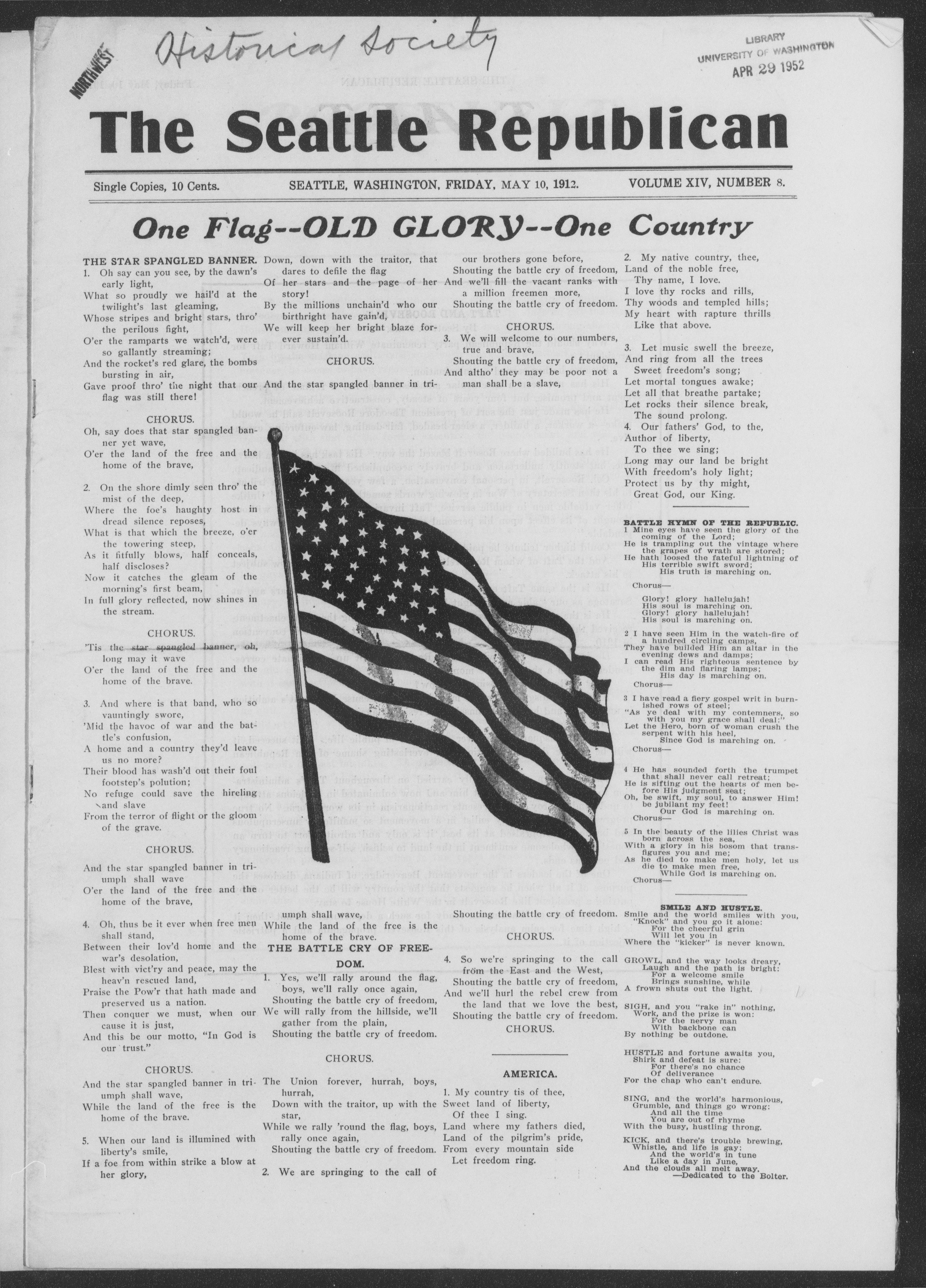
One Flag--OLD GLORY--One Country
Historical society
bursting in all, Gave proof thro' the night that our And the star spangled banner in triflag was still there!
Single Copies, 10 Cents.
One Flag
THE STAR SPANGLED BANNER.
1. Oh say can you see, by the dawn's early light,
Whose stripes and bright stars, thro' the perilous fight,
O'er the ramparts we watch'd, were so gallantly streaming;
And the rocket's red glare, the bombs bursting in air,
Gave proof thro' the night that our flag was still there!
CHORUS.
CHORUS
Oh, say does that star spangled banner yet wave,
O'er the land of the free and the home of the brave,
2. On the shore dimly seen thro' the mist of the deep,
What is that which the breeze, o'er the towering steep,
As it fitfully blows, half conceals, half discloses?
Now it catches the gleam of the morning's first beam,
In full glory reflected, now shines in the stream.
CHORUS
'Tis the star spangled banner, oh, long may it wave O'er the land of the free and the home of the brave.
3. And where is that band, who so vauntingly swore,
'Mid the havoc of war and the battle's confusion,
A home and a country they'd leave us no more?
Their blood has wash'd out their foul footstep's pollution;
No refuge could save the hireling \and slave
From the terror of flight or the gloom of the grave.
CHORUS.
And the star spangled banner in triumph shall wave
O'er the land of the free and the home of the brave,
4. Oh, thus be it ever when free men shall stand.
Blest with vict'ry and peace, may the heav'n rescued land,
Praise the Pow'r that hath made and preserved us a nation.
Then conquer we must, when our cause it is just,
And this be our motto, "In God is our trust."
CHORUS
And the star spangled banner in triumph shall wave,
While the land of the free is the home of the brave.
5. When our land is illumined with liberty's smile,
If a foe from within strike a blow at her glory.
their guilty
SEATTLE, WASHINGTON, FRIDAY, MAY 10, 1912.
```markdown
```
Down, down with the traitor, that dares to defile the flag
Of her stars and the page of her story!
By the millions unchain'd who our birthright have gain'd,
We will keep her bright blaze forever sustain'd.
CHORUS.
And the star spangled banner in tri-
CHORUS
umph shall wave,
While the land of the free is the home of the brave.
THE BATTLE CRY OF FREE-
1. Yes, we'll rally around the flag, boys, we'll rally once again, Shouting the battle cry of freedom, We will rally from the hillside, we'll gather from the plain, Shouting the battle cry of freedom. CHORUS.
CHORUS
The Union forever, hurrah, boys, hurrah,
Down with the traitor, up with the star,
While we rally 'round the flag, boys, rally once again,
Shouting the battle cry of freedom.
2. We are springing to the call of
Shouting the battle cry of freedom. And we'll fill the vacant ranks with a million freemen more.
Shouting the battle cry of freedom.
CHORUS
3. We will welcome to our numbers, true and brave, Shouting the battle cry of freedom, And altho' they may be poor not a man shall be a slave.
```markdown
```
Shouting the battle cry of freedom.
CHORUS.
4. So we're springing to the call from the East and the West,
Shouting the battle cry of freedom,
And we'll hurl the rebel crew from the land that we love the best,
Shouting the battle cry of freedom.
CHORUS.
AMERICA.
1. My country tis of thee,
Sweet land of liberty,
Of thee I sing.
Land where my fathers died,
Land of the pilgrim's pride,
From every mountain side
Let freedom ring.
---
LIBRARY
UNIVERSITY OF WASHINGTON
APR 29 1952
ublican
VOLUME XIV, NUMBER 8.
Country
Country
2. My native country, thee,
Land of the noble free,
Thy name, I love.
I love thy rocks and rills,
Thy woods and templed hills;
My heart with rapture thrills
Like that above.
3. Let music swell the breeze
And ring from all the trees
Sweet freedom's song;
Let mortal tongues awake;
Let all that breathe partake;
Let rocks their silence break,
The sound prolong.
4. Our fathers' God, to the,
Author of liberty,
To thee we sing;
Long may our land be bright
With freedom's holy light;
Protect us by thy might,
Great God, our King.
BATTLE HYMN OF THE REPUBLIC.
1 Mine eyes have seen the glory of the coming of the Lord;
He is trampling out the vintage where the grapes of wrath are stored;
He hath loosed the fateful lightning of His terrible swift sword;
His truth is marching on.
Glory! glory hallelujah!
His soul is marching on.
Glory! glory hallelujah!
His soul is marching on.
2 I have seen Him in the watch-fire of a hundred circling camps,
They have builted Him an altar in the evening dews and damps;
I can read His righteous sentence by the dim and flaring lamps;
His day is marching on.
3 I have read a fiery gospel writ in burnished rows of steel:
"As ye deal with my contenders, so with you my grace shall deal:"
Let the Hero, born of woman crush the serpent with his heel,
Since God is marching on.
4 He has sounded forth the trumpet that shall never call retreat;
He is sifting out the hearts of men before His judgment seat;
Oh, be swift, my soul, to answer Him! be jubilant my feet!
Our God is marching on.
Chorus—
5 In the beauty of the lilies Christ was born across the sea,
With a glory in his bosom that transfigures you and me;
As he died to make men holy, let us die to make men free,
While God is marching on.
Chorus—
SMILE AND HUSTLE.
Smile and the world smiles with you, "Knock" and you go it alone: For the cheerful grin Will let you in Where the "kicker" is never known.
Smile and the world smiles with you,
"Knock" and you go it alone:
For the cheerful grin
Will let you in
Where the "kicker" is never known.
GROWL, and the way looks dreary,
Laugh and the path is bright:
For a welcome smile
Brings sunshine, while
A frown shuts out the light.
SIGH, and you "rake in" nothing,
Work, and the prize is won:
For the nervy man
With backbone can
By nothing be outdone.
HUSTLE and fortune awaits you,
Shirk and defeat is sure:
For there's no chance
Of deliverance
For the chap who can't endure.
SING, and the world's harmonious,
Grumble, and things go wrong:
And all the time
You are out of rhyme
With the busy, hustling throng.
KICK, and there's trouble brewing,
Whistle, and life is gay:
And the world's in tune
Like a day in June,
And the clouds all melt away.
—Dedicated to the Bolter
---
---
Chorus—
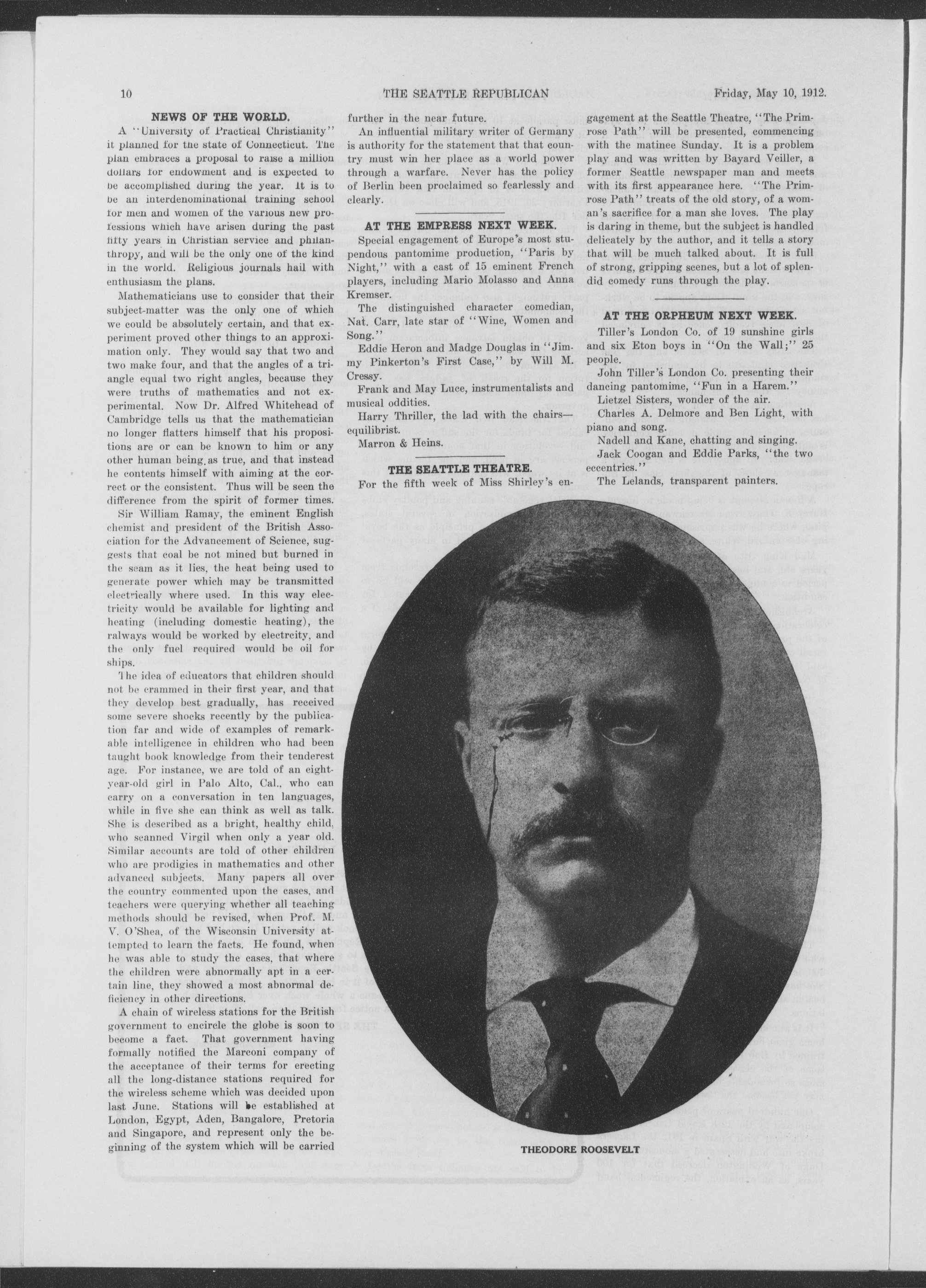
[Image of a man with a mustache and glasses, wearing a suit and tie, looking serious and contemplative. The background is plain and dark, emphasizing the subject.]
10
NEWS OF THE WORLD.
A "University of Practical Christianity" it planned for the state of Connecticut. The plan embraces a proposal to raise a million dollars for endowment and is expected to be accomplished during the year. It is to be an interdenominational training school for men and women of the various new professions which have arisen during the past fifty years in Christian service and philanthropy, and will be the only one of the kind in the world. Religious journals hail with enthusiasm the plans.
Mathematicians use to consider that their subject-matter was the only one of which we could be absolutely certain, and that experiment proved other things to an approximation only. They would say that two and two make four, and that the angles of a triangle equal two right angles, because they were truths of mathematics and not experimental. Now Dr. Alfred Whitehead of Cambridge tells us that the mathematician no longer flatters himself that his propositions are or can be known to him or any other human being, as true, and that instead he contents himself with aiming at the correct or the consistent. Thus will be seen the difference from the spirit of former times.
Sir William Ramay, the eminent English chemist and president of the British Association for the Advancement of Science, suggests that coal be not mined but burned in the seam as it lies, the heat being used to generate power which may be transmitted electrically where used. In this way electricity would be available for lighting and heating (including domestic heating), the ralways would be worked by electricity, and the only fuel required would be oil for ships.
The idea of educators that children should not be crammed in their first year, and that they develop best gradually, has received some severe shocks recently by the publication far and wide of examples of remarkable intelligence in children who had been taught book knowledge from their tenderest age. For instance, we are told of an eight-year-old girl in Palo Alto, Cal., who can carry on a conversation in ten languages, while in five she can think as well as talk. She is described as a bright, healthy child, who scanned Virgil when only a year old. Similar accounts are told of other children who are prodigies in mathematics and other advanced subjects. Many papers all over the country commented upon the cases, and teachers were querying whether all teaching methods should be revised, when Prof. M. V. O'Shea, of the Wisconsin University attempted to learn the facts. He found, when he was able to study the cases, that where the children were abnormally apt in a certain line, they showed a most abnormal deficiency in other directions.
A chain of wireless stations for the British government to encircle the globe is soon to become a fact. That government having formally notified the Marconi company of the acceptance of their terms for erecting all the long-distance stations required for the wireless scheme which was decided upon last June. Stations will be established at London, Egypt, Aden, Bangalore, Pretoria and Singapore, and represent only the beginning of the system which will be carried
THE SEATTLE REPUBLICAN
An influential military writer of Germany is authority for the statement that that country must win her place as a world power through a warfare. Never has the policy of Berlin been proclaimed so fearlessly and clearly.
AT THE EMPRESS NEXT WEEK
Special engagement of Europe's most stupendous pantomime production, "Paris by Night," with a cast of 15 eminent French players, including Mario Molasso and Anna Kremser.
The distinguished character comedian, Nat. Carr, late star of "Wine, Women and Song."
Eddie Heron and Madge Douglas in "Jimmy Pinkerton's First Case," by Will M. Cressy.
Frank and May Luce, instrumentalists and musical oddities.
Harry Thriller, the lad with the chairs equilibrist.
For the fifth week of Miss Shirley's en
[Image of a man with a mustache and glasses]
THEODORE ROOSEVELT
further in the near future.
Marron & Heins.
THE SEATTLE THEATRE.
gagement at the Seattle Theatre, "The Primrose Path" will be presented, commencing with the matinee Sunday. It is a problem play and was written by Bayard Veiller, a former Seattle newspaper man and meets with its first appearance here. "The Primrose Path" treats of the old story, of a woman's sacrifice for a man she loves. The play is daring in theme, but the subject is handled delicately by the author, and it tells a story that will be much talked about. It is full of strong, gripping scenes, but a lot of splendid comedy runs through the play.
AT THE ORPHEUM NEXT WEEK.
Tiller's London Co. of 19 sunshine girls and six Eton boys in "On the Wall;" 25 people.
John Tiller's London Co. presenting their dancing pantomime, "Fun in a Harem."
Lietzel Sisters, wonder of the air.
Charles A. Delmore and Ben Light, with piano and song.
Nadell and Kane, chatting and singing.
Jack Coogan and Eddie Parks, "the two eccentrics."
The Lelands, transparent painters.
Friday, May 10, 1912
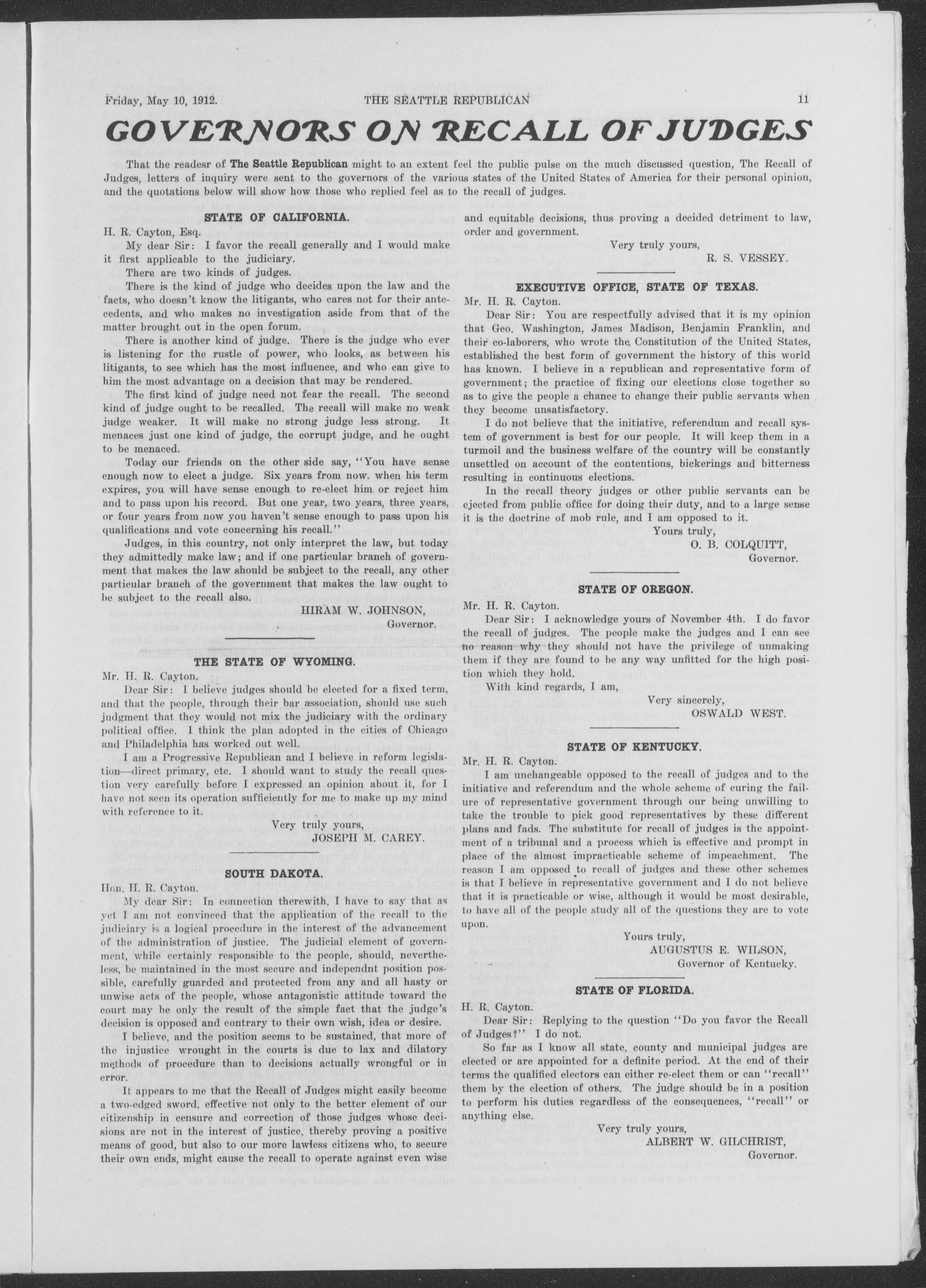
GOVERNORS ON RECALL OF JUDGES
That the reader of The Seattle Republican might to an extent feel the public pulse on the much discussed question, The Recall of Judges, letters of inquiry were sent to the governors of the various states of the United States of America for their personal opinion, and the quotations below will show how those who replied feel as to the recall of judges.
My dear Sir: I favor the recall generally and I would make it first applicable to the judiciary.
There is the kind of judge who decides upon the law and the facts, who doesn't know the litigants, who cares not for their antecedents, and who makes no investigation aside from that of the matter brought out in the open forum.
There is another kind of judge. There is the judge who ever is listening for the rustle of power, who looks, as between his litigants, to see which has the most influence, and who can give to him the most advantage on a decision that may be rendered.
The first kind of judge need not fear the recall. The second kind of judge ought to be recalled. The recall will make no weak judge weaker. It will make no strong judge less strong. It menaces just one kind of judge, the corrupt judge, and he ought to be menaced.
Today our friends on the other side say, "You have sense enough now to elect a judge. Six years from now. when his term expires, you will have sense enough to re-elect him or reject him and to pass upon his record. But one year, two years, three years, or four years from now you haven't sense enough to pass upon his qualifications and vote concerning his recall." Judges, in this country, not only interpret the law, but today they admittedly make law; and if one particular branch of government that makes the law should be subject to the recall, any other particular branch of the government that makes the law ought to be subject to the recall also.
Dear Sir: I believe judges should be elected for a fixed term, and that the people, through their bar association, should use such judgment that they would not mix the judiciary with the ordinary political office. I think the plan adopted in the cities of Chicago and Philadelphia has worked out well.
I am a Progressive Republican and I believe in reform legislation—direct primary, etc. I should want to study the recall question very carefully before I expressed an opinion about it, for I have not seen its operation sufficiently for me to make up my mind with reference to it.
My dear Sir: In connection therewith, I have to say that as yet I am not convinced that the application of the recall to the judiciary is a logical procedure in the interest of the advancement of the administration of justice. The judicial element of government, while certainly responsible to the people, should, nevertheless, be maintained in the most secure and independnt position possible, carefully guarded and protected from any and all hasty or unwise acts of the people, whose antagonistic attitude toward the court may be only the result of the simple fact that the judge's decision is opposed and contrary to their own wish, idea or desire.
I believe, and the position seems to be sustained, that more of the injustice wrought in the courts is due to lax and dilatory methods of procedure than to decisions actually wrongful or in error.
It appears to me that the Recall of Judges might easily become a two-edged sword, effective not only to the better element of our citizenship in censure and correction of those judges whose decisions are not in the interest of justice, thereby proving a positive means of good, but also to our more lawless citizens who, to secure their own ends, might cause the recall to operate against even wise
GOVERNOR That the reader of The Seattle Judges, letters of inquiry were sent and the quotations below will show
STATE OF CALIFORNIA
R. Cayton, Esq. My dear Sir: I favor the recall generally first applicable to the judiciary. There are two kinds of judges.
There is the kind of judge who facts, who doesn't know the litigants, cedents, and who makes no investiga matter brought out in the open forum.
There is another kind of judge. It is listening for the rustle of power litigants, to see which has the most in him the most advantage on a decision.
The first kind of judge need no kind of judge ought to be recalled. judge weaker. It will make no st menaces just one kind of judge, then to be menaced.
Today our friends on the other enough now to elect a judge. Six ye expires, you will have sense enough and to pass upon his record. But one or four years from now you haven't qualifications and vote concerning his Judges, in this country, not only they admittedly make law; and if on ment that makes the law should be a particular branch of the government be subject to the recall also.
kind of judge who decides upon it know the litigants, who cares so makes no investigation aside but in the open forum. Another kind of judge. There is the rustle of power, who looks which has the most influence, and advantage on a decision that may be kind of judge need not fear the right to be recalled. The recall will It will make no strong judge, a kind of judge, the corrupt just friends on the other side say, elect a judge. Six years from now have sense enough to re-elect his record. But one year, two m now you haven't sense enough to vote concerning his recall." This country, not only interpret to make law; and if one particular law should be subject to the law of the government that makes recall also.
THE STATE OF WYOMING
Mr. H. R. Cayton.
Dear Sir: I believe judges should and that the people, through their bad judgment that they would not mix the political office. I think the plan added and Philadelphia has worked out well.
I am a Progressive Republican an tion—direct primary, etc. I should v tion very carefully before I expresses have not seen its operation sufficiently with reference to it.
Very
I believe judges should be elected able, through their bar association they would not mix the judiciary. I think the plan adopted in the has worked out well. Passive Republican and I believeary, etc. I should want to study before I expressed an opinion operation sufficiently for me to it.
SOUTH DAKOTA
In connection therewith, I have convinced that the application of judicial procedure in the interest of justice. The judicial entity responsible to the people, and in the most secure and indepen
My dear Sir: In connection the yet I am not convinced that the ap judiciary is a logical procedure in the of the administration of justice. Th ment, while certainly responsible to less, be maintained in the most secure sible, carefully guarded and protecte unwise acts of the people, whose ant court may be only the result of the
Friday, May 10, 1912
H. R. Cayton. Esq.
Hon. H. R. Cayton.
ORS ON
Little Republican might to an exte sent to the governors of the w how how those who replied feel a
recall generally and I would make
mediary.
judges.
who decides upon the law and the
agents, who cares not for their an-
investigation aside from that of the
forum.
judge. There is the judge who eve-
power, who looks, as between the
most influence, and who can give
decision that may be rendered.
and not fear the recall. The secon-
died. The recall will make no wee-
no strong judge less strong.
, the corrupt judge, and he ought
other side say, "You have sent
six years from now. when his test
enough to re-elect him or reject him
but one year, two years, three yeas
aren't sense enough to pass upon
ing his recall."
only interpret the law, but tod-
if one particular branch of gover-
nment to the recall, any other
ment that makes the law ought
HIRAM W. JOHNSON Governor
should be elected for a fixed ten-
air bar association, should use su
ix the judiciary with the ordina
n adopted in the cities of Chicago
t well.
I can and I believe in reform legis
uld want to study the recall qu
pressed an opinion about it, for
iently for me to make up my mi
Very truly yours,
JOSEPH M. CAREY.
in therewith, I have to say that the application of the recall to the interest of the advancement The judicial element of govern to the people, should, neverth secure and independnt position protected from any and all hasty
THE SEATTLE REPUBLICAN
ON RECALL OF
right to an extent feel the public pulse on the mu
nors of the various states of the United States o
o replied feel as to the recall of judges.
and equitable decisions, thus
order and government.
and I would make V
not for their ante-
from that of the
the judge who ever
as between his
who can give to
rendered.
reall. The second
will make no weak
less strong. It
age, and he ought
You have sense
when his term
him or reject him
years, three years,
to pass upon his
the law, but today
branch of govern-
recall, any other
the law ought to
Mr. H. R. Cayton.
Dear Sir: You are respect-
that Geo. Washington, James
their co-laborers, who wrote to
established the best form of gov-
has known. I believe in a re-
government; the practice of f
as to give the people a chance
they become unsatisfactory.
I do not believe that the
tem of government is best for
turmoil and the business welfa
unsettled on account of the c
resulting in continuous election.
In the recall theory judge
ejected from public office for o
it is the doctrine of mob rule,
JOHNSON,
Governor.
Dear Sir: I acknowledge the recall of judges. The peo no reason why they should n them if they are found to be tion which they hold.
With kind regards, I am,
for a fixed term, should use such with the ordinary cities of Chicago
the recall question about it, for I take up my mind I am unchangeable oppose initiative and referendum and aure of representative government take the trouble to pick good plans and fads. The substitute ment of a tribunal and a proc place of the almost impractic M. CAREY.
and equitable decisions, thus proving a decided detriment to law, order and government.
EXECUTIVE OFFICE. STATE OF TEXAS.
Sir: You are respectfully advised that it is my opinion Washington, James Madison, Benjamin Franklin, and laborers, who wrote the Constitution of the United States, and the best form of government the history of this world can. I believe in a republican and representative form of government; the practice of fixing our elections close together so the people a chance to change their public servants when time unsatisfactory. I not believe that the initiative, referendum and recall system is best for our people. It will keep them in a and the business welfare of the country will be constantly on account of the contentions, bickerings and bitterness in continuous elections. We recall theory judges or other public servants can be from public office for doing their duty, and to a large sense doctrine of mob rule, and I am opposed to it.
Dear Sir: You are respectfully advised that it is my opinion that Geo. Washington, James Madison, Benjamin Franklin, and their co-laborers, who wrote the Constitution of the United States, established the best form of government the history of this world has known. I believe in a republican and representative form of government; the practice of fixing our elections close together so as to give the people a chance to change their public servants when they become unsatisfactory.
I do not believe that the initiative, referendum and recall system of government is best for our people. It will keep them in a turmoil and the business welfare of the country will be constantly unsettled on account of the contentions, bickerings and bitterness resulting in continuous elections.
In the recall theory judges or other public servants can be ejected from public office for doing their duty, and to a large sense it is the doctrine of mob rule, and I am opposed to it.
. Cayton. Sir: I acknowledge yours of November 4th. I do favor of judges. The people make the judges and I can see why they should not have the privilege of unmaking they are found to be any way unfitted for the high posi- they hold.
Dear Sir: I acknowledge yours of November 4th. I do favor the recall of judges. The people make the judges and I can see no reason why they should not have the privilege of unmaking them if they are found to be any way unfitted for the high position which they hold.
With kind regards, I am.
STATE OF KENTUCKY
Cayton. I changeable opposed to the recall of judges and to the and referendum and the whole scheme of curing the fail- presentative government through our being unwilling to trouble to pick good representatives by these different fads. The substitute for recall of judges is the appoint- tribunal and a process which is effective and prompt in the almost impracticable scheme of impeachment. The am opposed to recall of judges and these other schemes believe in representative government and I do not believe practicable or wise, although it would be most desirable, of the people study all of the questions they are to vote
I am unchangeable opposed to the recall of judges and to the initiative and referendum and the whole scheme of curing the failure of representative government through our being unwilling to take the trouble to pick good representatives by these different plans and fads. The substitute for recall of judges is the appointment of a tribunal and a process which is effective and prompt in place of the almost impracticable scheme of impeachment. The reason I am opposed to recall of judges and these other schemes is that I believe in representative government and I do not believe that it is practicable or wise, although it would be most desirable, to have all of the people study all of the questions they are to vote upon.
Sir: Replying to the question "Do you favor the Recall?" I do not. Or as I know all state, county and municipal judges are appointed for a definite period. At the end of their qualified electors can either re-elect them or can "recall" the election of others. The judge should be in a position in his duties regardless of the consequences, "recall" or else.
Dear Sir: Replying to the question "Do you favor the Recall of Judges?" I do not.
So far as I know all state, county and municipal judges are elected or are appointed for a definite period. At the end of their terms the qualified electors can either re-elect them or can "recall" them by the election of others. The judge should be in a position to perform his duties regardless of the consequences, "recall" or anything else.
1.
Mr. H. R. Cayton.
Mr. H. R. Cayton.
H. R. Cavton.
11
Very truly yours,
R. S. VESSEY
Yours truly,
O. B. COLQUITT,
Governor.
STATE OF OREGON.
Very sincerely,
OSWALD WEST
Yours truly,
AUGUSTUS E. WILSON,
Governor of Kentucky.
STATE OF FLORIDA
Very truly yours,
ALBERT W. GILCHRIST,
Governor
I do not favor the recall of judges. Strong reasons against it were given by President Taft in his veto message on the subject, and I deem it unnecessary to reiterate, as I might, much that he has said.
In my opinion, judges should always be appointed by the chief executive of the government, and for long terms, if not for good behavior.
The judiciary, under our system of government, has greater power than ever belonged before to the judiciary of any country, or any age. The most extreme care, therefore, should be exercised in their selection. A single magistrate, like a governor or president, can exercise such care better than a nominating convention, or a direct primary. If all our judges were elected in such fashion, I think there would be little cry from those representing the interests of the community at large for any system of judicial recall.
Dear Sir. Replying to your inquiry of the 4th inst., I would say I am opposed to the recall of judges, as the phrase is popularly understood, both as an institution in itself and as an adjunct to the initiative and referendum.
"I enthusiastically favor the recall of judges and will do everything within my official power to have the legislature submit a constitutional amendment to the people favoring the recall of judges."
"I believe in the initiative, referendum and recall, but I do not think their inauguration and application will directly or of a necessity quickly cure fundamental evils. The initiative is simply an extension of indisputable right of petiton. The referendum is a formal acknowledgement of the sovereign right and power of the people with legal machinery for their expression. The recall gives to the masses the right, now jealously guarded by the individual, of discharging unfaithful servants at irregular interevals.
"Elections are a regular form of the recall in use today. If the masses can be intrusted with the recall at regular intervals, there is no reason why they may not exercise that function at any time.
"It has been argued that the people need specialists in law, on the bench, in medicine, and elsewhere. Granting this, there is no reason why they should not be permitted to easily and at all times say who these specialists shall be, just as the individual may choose his family physician and dispense with his services when he regards them as unsatisfactory."
It is claimed by some that we cannot secure a proper measure of progress in the enactment of necessary laws for the correction of existing evils and abuses until we make the courts more responsive to the people. There are those who claim that we are a court ridden nation; that the judiciary has become the dominant and the controlling department of government, which defeats the work of legislatures and executives by holding unconstitutional the acts of the one and by nullifying the acts of the other; that our process of impeachment is so cumbersome and ineffective that it gives to a judge, particularly if he enjoys a life tenure of office, a practical immunity for wrong-doing, for prejudiced or unfair decisions, and that the result has been a judicial autocracy which is accustomed to usurp powers not conferred and exert them in an unfair and, sometimes, in a tyrannical manner.
I am of the opinion that the lawyers in this country have it in their power to bring about conditions which will defeat this public demand for subjecting the decisions of our courts to popular review by making our judges subject to removal by reason of public disapproval. I believe it is within the power of the members of our
12
Dear Sir:
I do not favor it were given by H and I deem it unn has said.
In my opinion executive of the g behavior.
The judiciary power than ever b or any age. The in their selection. ident, can exercise or a direct primary I think there woul ests of the commun
Mr. H. R. Cayton.
Dear Sir. Re say I am opposed to understood, both a
THE SEATTLE REPUBLICAN
seasons against
on the subject,
for much that he
had by the chief
of not for good
it, has greater
of any country,
could be exercised
ennor or pres-
ing convention,
in such fashion,
taking the inter-
dicial recall.
ALDWIN.
inst., I would
se is popularly
adjunct to the
profession to save
the treme method of
unsatisfactory and
were compelled to
rectness of their
man of integrity
complacency the p
for an unpopular
dependent upon his
voters who elected
of our judicial sys.
But the mem-
people from this m
to its theoretical in-
for the recall of ju-
dissatisfaction with
sion exercised a m
political considera-
take an effective
procedure, so as to
thus prevent mis-
technicalities; in s
make our courts
from rules of prac-
and always for de-
discriminating criti-
for the recall of judges. Strong reasons again. President Taft in his veto message on the subject unnecessary to reiterate, as I might, much that is. judges should always be appointed by the chief government, and for long terms, if not for government, under our system of government, has greatly belonged before to the judiciary of any country the most extreme care, therefore, should be exercised. A single magistrate, like a governor or preside such care better than a nominating conventionry. If all our judges were elected in such fashion could be little cry from those representing the unity at large for any system of judicial recall.
SIMEON E. BALDWIN.
replying to your inquiry of the 4th inst., I would to the recall of judges, as the phrase is popular as an institution in itself and as an adjunct to the termendum.
Very truly yours.
A. J. POTHIER,
Governor.
will do everyture submit a the recall of That it does throughout the endence not only in presses the public tion of justice wh
ically favor the recall of judges and will do ever official power to have the legislature submit amendment to the people favoring the recall GEORGE W. P. HUNT, Governor.
call, but I do directly or of initiative is simple referendum and power of it. The recall by the individ-
in the initiative, referendum and recall, but I do inauguration and application will directly or only cure fundamental evils. The initiative is similar indisputable right of petition. The referendum knowledge of the sovereign right and power of legal machinery for their expression. The recalls the right, now jealously guarded by the individual unfaithful servants at irregular interevals. There a regular form of the recall in use today. I am intrusted with the recall at regular intervals in why they may not exercise that function at an argued that the people need specialists in law, medicine, and elsewhere. Granting this, there they should not be permitted to easily and at all these specialists shall be, just as the individual may physician and dispense with his services which was unsatisfactory."
use today. If nular intervals, function at any specialists in law, this, there isily and at all individual may services when Dear Sir: I judge, but to the The recall is oppo the last hundred a government ent as it is to conduct holders numbering States. without a b The theory of to the idealist and
CHASE S. OSBORN Governor.
proper measure the correction of more responsive a court ridden and the con- the work of al the acts of is fashioned upon it is right in govern been true of no gen not be true for man made to work with communities, but Icessfully in the law affairs and wholly Again I am o
by some that we cannot secure a proper measure enactment of necessary laws for the correction abuses until we make the courts more responsible are those who claim that we are a court riddle judiciary has become the dominant and the center of government, which defeats the work executives by holding unconstitutional the acts nullifying the acts of the other; that our process
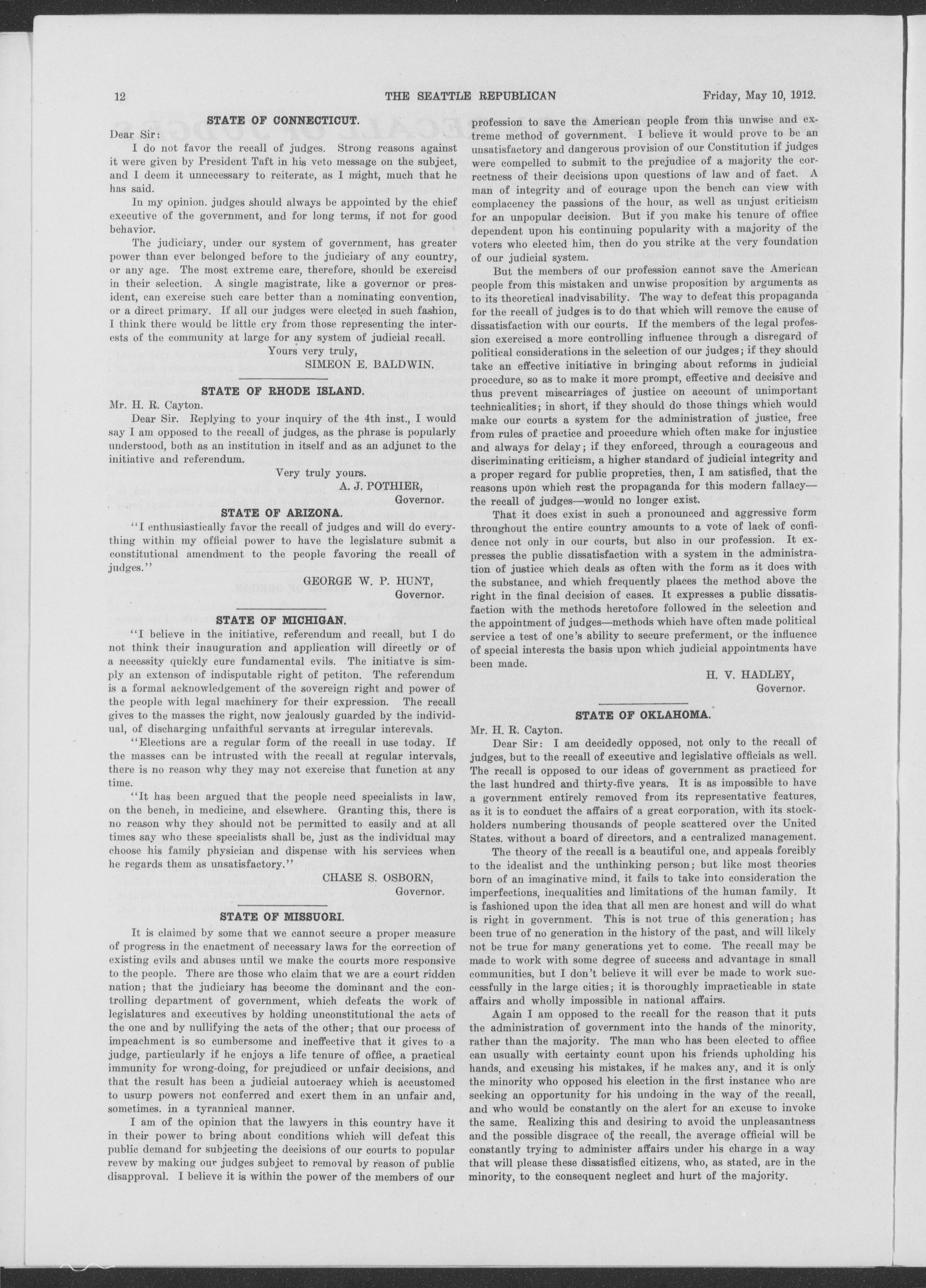
STATE OF CONNECTICUT
Yours very truly.
STATE OF RHODE ISLAND
STATE OF ARIZONA
STATE OF MICHIGAN.
STATE OF MISSUORI
profession to save the American people from this unwise and extreme method of government. I believe it would prove to be an unsatisfactory and dangerous provision of our Constitution if judges were compelled to submit to the prejudice of a majority the correctness of their decisions upon questions of law and of fact. A man of integrity and of courage upon the bench can view with complacency the passions of the hour, as well as unjust criticism for an unpopular decision. But if you make his tenure of office dependent upon his continuing popularity with a majority of the voters who elected him, then do you strike at the very foundation of our judicial system.
But the members of our profession cannot save the American people from this mistaken and unwise proposition by arguments as to its theoretical inadvisability. The way to defeat this propaganda for the recall of judges is to do that which will remove the cause of dissatisfaction with our courts. If the members of the legal profession exercised a more controlling influence through a disregard of political considerations in the selection of our judges; if they should take an effective initiative in bringing about reforms in judicial procedure, so as to make it more prompt, effective and decisive and thus prevent miscarriages of justice on account of unimportant technicalities; in short, if they should do those things which would make our courts a system for the administration of justice, free from rules of practice and procedure which often make for injustice and always for delay; if they enforced, through a courageous and discriminating criticism, a higher standard of judicial integrity and a proper regard for public preties, then, I am satisfied, that the reasons upon which rest the propaganda for this modern fallacy—the recall of judges—would no longer exist.
That it does exist in such a pronounced and aggressive form throughout the entire country amounts to a vote of lack of confidence not only in our courts, but also in our profession. It expresses the public dissatisfaction with a system in the administration of justice which deals as often with the form as it does with the substance, and which frequently places the method above the right in the final decision of cases. It expresses a public dissatisfaction with the methods heretofore followed in the selection and the appointment of judges—methods which have often made political service a test of one's ability to secure preferment, or the influence of special interests the basis upon which judicial appointments have been made.
Dear Sir: I am decidedly opposed, not only to the recall of judges, but to the recall of executive and legislative officials as well. The recall is opposed to our ideas of government as practiced for the last hundred and thirty-five years. It is as impossible to have a government entirely removed from its representative features, as it is to conduct the affairs of a great corporation, with its stockholders numbering thousands of people scattered over the United States, without a board of directors, and a centralized management.
The theory of the recall is a beautiful one, and appeals forcibly to the idealist and the unthinking person; but like most theories born of an imaginative mind, it fails to take into consideration the imperfections, inequalities and limitations of the human family. It is fashioned upon the idea that all men are honest and will do what is right in government. This is not true of this generation; has been true of no generation in the history of the past, and will likely not be true for many generations yet to come. The recall may be made to work with some degree of success and advantage in small communities, but I don't believe it will ever be made to work successfully in the large cities; it is thoroughly impracticable in state affairs and wholly impossible in national affairs.
Again I am opposed to the recall for the reason that it puts the administration of government into the hands of the minority, rather than the majority. The man who has been elected to office can usually with certainty count upon his friends upholding his hands, and excusing his mistakes, if he makes any, and it is only the minority who opposed his election in the first instance who are seeking an opportunity for his undoing in the way of the recall, and who would be constantly on the alert for an excuse to invoke the same. Realizing this and desiring to avoid the unpleasantness and the possible disgrace of the recall, the average official will be constantly trying to administer affairs under his charge in a way that will please these dissatisfied citizens, who, as stated, are in the minority, to the consequent neglect and hurt of the majority.
Mr. H. R. Cayton.
STATE OF OKLAHOMA.
Friday, May 10, 1912
from this unwise and ex-
cuse would prove to be an
or Constitution if judges
of a majority the con-
flict of law and of fact. A
bench can view with
well as unjust criticism
like his tenure of office
with a majority of the
at the very foundation
not save the American
position by arguments and
defeat this propaganda
will remove the cause of
orders of the legal profess-
through a disregard of
judges; if they should
but reforms in judicial
effective and decisive and
account of unimportant
use things which would
operation of justice, free
often make for injustice
though a courageous and
of judicial integrity and
I am satisfied, that the
this modern fallacy—
and aggressive form,
vote of lack of confi-
dence profession. It ex-
stem in the administra-
tion as it does with
the method above the
presses a public dissatisf-
ed in the selection and
often made political
periment, or the influence
special appointments have
H. V. HADLEY, Governor. A.
THE SEATTLE REPUBLICAN
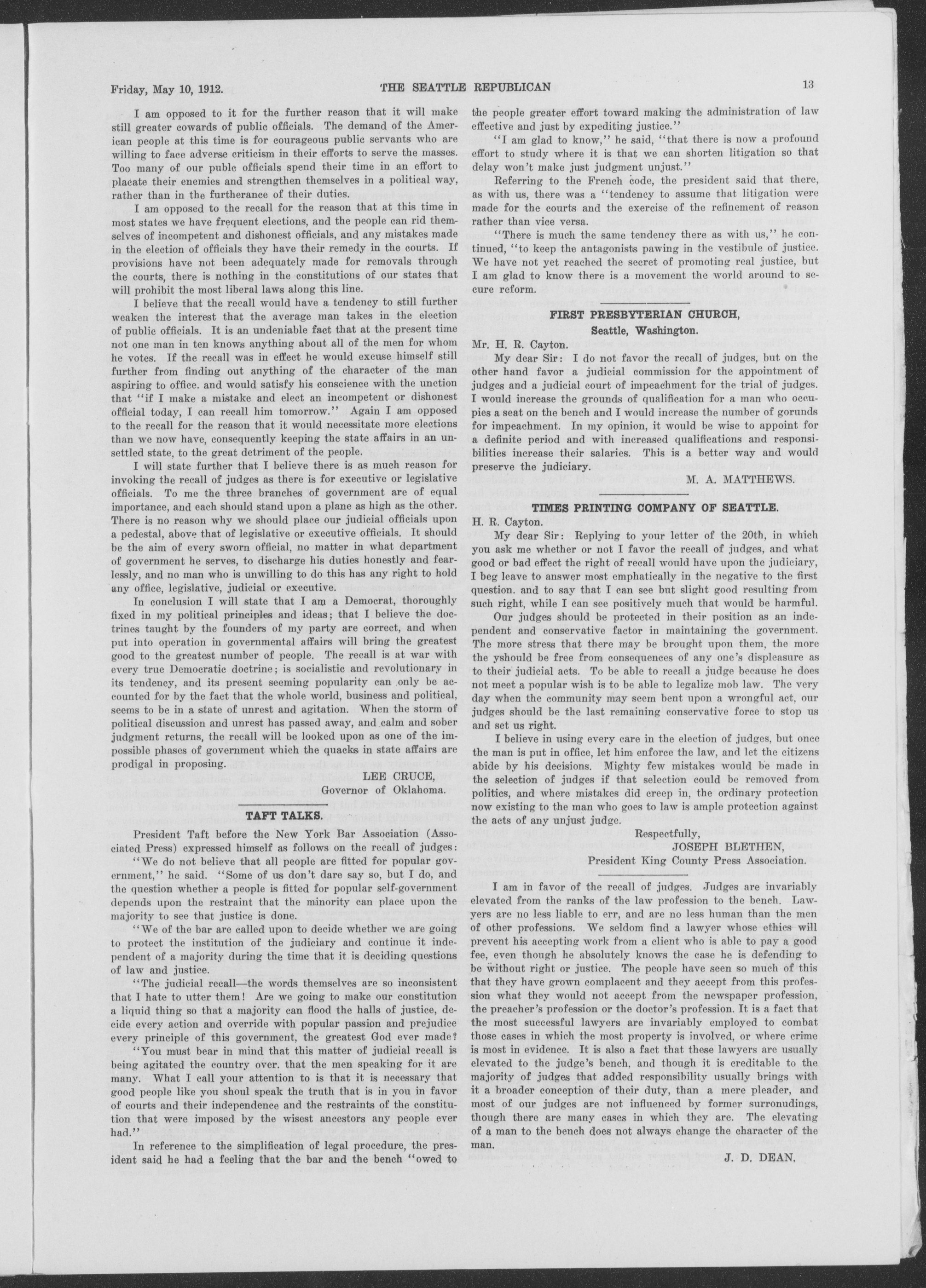
the people greater effort toward making the administration of law effective and just by expediting justice." "I am glad to know," he said, "that there is now a profound effort to study where it is that we can shorten litigation so that delay won't make just judgment unjust." Referring to the French code, the president said that there, as with us, there was a "tendency to assume that litigation were made for the courts and the exercise of the refinement of reason rather than vice versa.
"There is much the same tendency there as with us," he continued, "to keep the antagonists pawing in the vestibule of justice. We have not yet reached the secret of promoting real justice, but I am glad to know there is a movement the world around to secure reform.
Mr. H. R. Cayton.
My dear Sir: I do not favor the recall of judges, but on the other hand favor a judicial commission for the appointment of judges and a judicial court of impeachment for the trial of judges. I would increase the grounds of qualification for a man who occupies a seat on the bench and I would increase the number of gorunds for impeachment. In my opinion, it would be wise to appoint for a definite period and with increased qualifications and responsibilities increase their salaries. This is a better way and would preserve the judiciary.
My dear Sir: Replying to your letter of the 20th, in which you ask me whether or not I favor the recall of judges, and what good or bad effect the right of recall would have upon the judiciary, I beg leave to answer most emphatically in the negative to the first question, and to say that I can see but slight good resulting from such right, while I can see positively much that would be harmful.
Our judges should be protected in their position as an independent and conservative factor in maintaining the government. The more stress that there may be brought upon them, the more the yshould be free from consequences of any one's displeasure as to their judicial acts. To be able to recall a judge because he does not meet a popular wish is to be able to legalize mob law. The very day when the community may seem bent upon a wrongful act, our judges should be the last remaining conservative force to stop us and set us right.
I believe in using every care in the election of judges, but once the man is put in office, let him enforce the law, and let the citizens abide by his decisions. Mighty few mistakes would be made in the selection of judges if that selection could be removed from politics, and where mistakes did creep in, the ordinary protection now existing to the man who goes to law is ample protection against the acts of any unjust judge.
I am in favor of the recall of judges. Judges are invariably elevated from the ranks of the law profession to the bench. Lawyers are no less liable to err, and are no less human than the men of other professions. We seldom find a lawyer whose ethics will prevent his accepting work from a client who is able to pay a good fee, even though he absolutely knows the case he is defending to be without right or justice. The people have seen so much of this that they have grown complacent and they accept from this profession what they would not accept from the newspaper profession, the preacher's profession or the doctor's profession. It is a fact that the most successful lawyers are invariably employed to combat those cases in which the most property is involved, or where crime is most in evidence. It is also a fact that these lawyers are usually elevated to the judge's bench, and though it is creditable to the majority of judges that added responsibility usually brings with it a broader conception of their duty, than a mere pleader, and most of our judges are not influenced by former surronudings, though there are many cases in which they are. The elevating of a man to the bench does not always change the character of the man.
Friday, May 10, 1912. THE SEATTL I am opposed to it for the further reason that it will make still greater cowards of public officials. The demand of the American people at this time is for courageous public servants who are willing to face adverse criticism in their efforts to serve the masses. Too many of our public officials spend their time in an effort to placate their enemies and strengthen themselves in a political way, rather than in the furtherance of their duties.
I am opposed to the recall for the reason that at this time in most states we have frequent elections, and the people can rid themselves of incompetent and dishonest officials, and any mistakes made in the election of officials they have their remedy in the courts. If provisions have not been adequately made for removals through the courts, there is nothing in the constitutions of our states that will prohibit the most liberal laws along this line.
I believe that the recall would have a tendency to still further weaken the interest that the average man takes in the election of public officials. It is an undeniable fact that at the present time not one man in ten knows anything about all of the men for whom he votes. If the recall was in effect he would excuse himself still further from finding out anything of the character of the man aspiring to office, and would satisfy his conscience with the unction that "if I make a mistake and elect an incompetent or dishonest official today, I can recall him tomorrow." Again I am opposed to the recall for the reason that it would necessitate more elections than we now have, consequently keeping the state affairs in an unsettled state, to the great detriment of the people.
I will state further that I believe there is as much reason for invoking the recall of judges as there is for executive or legislative officials. To me the three branches of government are of equal importance, and each should stand upon a plane as high as the other. There is no reason why we should place our judicial officials upon a pedestal, above that of legislative or executive officials. It should be the aim of every sworn official, no matter in what department of government he serves, to discharge his duties honestly and fearlessly, and no man who is unwilling to do this has any right to hold any office, legislative, judicial or executive.
In conclusion I will state that I am a Democrat, thoroughly fixed in my political principles and ideas; that I believe the doctrines taught by the founders of my party are correct, and when put into operation in governmental affairs will bring the greatest good to the greatest number of people. The recall is at war with every true Democratic doctrine; is socialistic and revolutionary in its tendency, and its present seeming popularity can only be accounted for by the fact that the whole world, business and political, seems to be in a state of unrest and agitation. When the storm of political discussion and unrest has passed away, and calm and sober judgment returns, the recall will be looked upon as one of the impossible phases of government which the quacks in state affairs are prodigal in proposing.
LEE CRUCE,
Governor of Oklahoma.
TAFT TALKS.
President Taft before the New York Bar Association (Associated Press) expressed himself as follows on the recall of judges: "We do not believe that all people are fitted for popular government," he said. "Some of us don't dare say so, but I do, and the question whether a people is fitted for popular self-government depends upon the restraint that the minority can place upon the majority to see that justice is done.
"We of the bar are called upon to decide whether we are going to protect the institution of the judiciary and continue it independent of a majority during the time that it is deciding questions of law and justice.
"The judicial recall—the words themselves are so inconsistent that I hate to utter them! Are we going to make our constitution a liquid thing so that a majority can flood the halls of justice, decide every action and override with popular passion and prejudice every principle of this government, the greatest God ever made?
"You must bear in mind that this matter of judicial recall is being agitated the country over. that the men speaking for it are many. What I call your attention to is that it is necessary that good people like you shoul speak the truth that is in you in favor of courts and their independence and the restraints of the constitution that were imposed by the wisest ancestors any people ever had."
In reference to the simplification of legal procedure, the president said he had a feeling that the bar and the bench "owed to
13
FIRST PRESBYTERIAN CHURCH Seattle. Washington.
M. A. MATTHEWS.
TIMES PRINTING COMPANY OF SEATTLE
H. R. Cavton.
Respectfully JOSEPH BLETHEN President King County Press Association
J. D. DEAN.
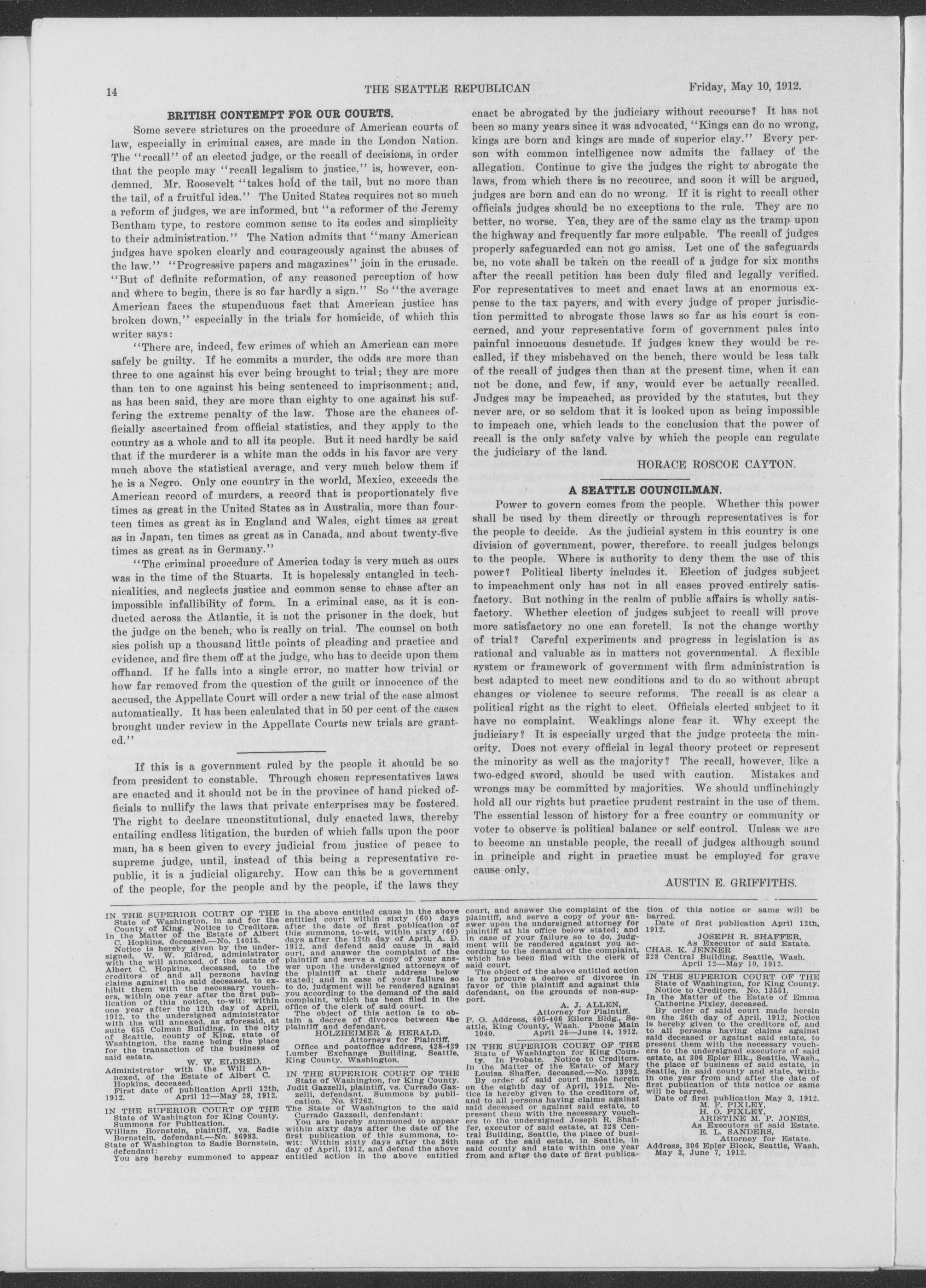
BRITISH CONTEMPT FOR OUR COURTS.
Some severe strictures on the procedure of American courts of law, especially in criminal cases, are made in the London Nation. The "recall" of an elected judge, or the recall of decisions, in order that the people may "recall legalism to justice," is, however, condemned. Mr. Roosevelt "takes hold of the tail, but no more than the tail, of a fruitful idea." The United States requires not so much a reform of judges, we are informed, but "a reformer of the Jeremy Bentham type, to restore common sense to its codes and simplicity to their administration." The Nation admits that "many American judges have spoken clearly and courageously against the abuses of the law." "Progressive papers and magazines" join in the crusade. "But of definite reformation, of any reasoned perception of how and where to begin, there is so far hardly a sign." So "the average American faces the stupenduous fact that American justice has broken down," especially in the trials for homicide, of which this writer says:
"There are, indeed, few crimes of which an American can more safely be guilty. If he commits a murder, the odds are more than three to one against his ever being brought to trial; they are more than ten to one against his being sentenced to imprisonment; and, as has been said, they are more than eighty to one against his suffering the extreme penalty of the law. Those are the chances officially ascertained from official statistics, and they apply to the country as a whole and to all its people. But it need hardly be said that if the murderer is a white man the odds in his favor are very much above the statistical average, and very much below them if he is a Negro. Only one country in the world, Mexico, exceeds the American record of murders, a record that is proportionately five times as great in the United States as in Australia, more than fourteen times as great as in England and Wales, eight times as great as in Japan, ten times as great as in Canada, and about twenty-five times as great as in Germany."
"The criminal procedure of America today is very much as ours was in the time of the Stuarts. It is hopelessly entangled in technicalities, and neglects justice and common sense to chase after an impossible infallibility of form. In a criminal case, as it is conducted across the Atlantic, it is not the prisoner in the dock, but the judge on the bench, who is really on trial. The counsel on both sies polish up a thousand little points of pleading and practice and evidence, and fire them off at the judge, who has to decide upon them offhand. If he falls into a single error, no matter how trivial or how far removed from the question of the guilt or innocence of the accused, the Appellate Court will order a new trial of the case almost automatically. It has been calculated that in 50 per cent of the cases brought under review in the Appellate Courts new trials are granted."
If this is a government ruled by the people it should be so from president to constable. Through chosen representatives laws are enacted and it should not be in the province of hand picked officials to nullify the laws that private enterprises may be fostered. The right to declare unconstitutional, duly enacted laws, thereby entailing endless litigation, the burden of which falls upon the poor man, has been given to every judicial from justice of peace to supreme judge, until, instead of this being a representative republic, it is a judicial oligarchy. How can this be a government of the people, for the people and by the people, if the laws they
14
IN THE SUPERIOR COURT OF THE
State of Washington, in and for the
County of King. Notice to Creditors.
In the Matter of the Estate of Albert
C. Hopkins, deceased.—No. 14015.
Notice is hereby given by the undersigned, W. W. Eldred, administrator with the will annexed, of the estate of Albert C. Hopkins, deceased, to the creditors of and all persons having claims against the said deceased, to exhibit them with the necessary vouchers, within one year after the first publication of this notice, to-wit: within one year after the 12th day of April, 1912, to the undersigned administrator with the will annexed, as aforesaid, at suite 655 Colman Building, in the city of Seattle, county of King, state of Washington, the same being the place for the transaction of the business of said estate.
W. W. ELDRED,
Administrator with the Will Annexed, of the Estate of Albert C.
Hopkins deceased
First date of publication April 12th, 1912. April 12—May 28, 1912. IN THE SUPERIOR COURT OF THE State of Washington for King County. Summons for Publication.
You are hereby summoned to appear
THE SEATTLE REPUBLICAN
FOR OUR COURTS.
The procedure of American courts of justice are made in the London Nation. Or the recall of decisions, in order to uphold the tail, but no more than the United States requires not so much need, but "a reformer of the Jeremy on sense to its codes and simplicity nation admits that "many American courageously against the abuses of and magazines" join in the crusade. If any reasoned perception of how hardly a sign." So "the average fact that American justice has trials for homicide, of which this cases of which an American can more than a murder, the odds are more than being brought to trial; they are more than sentenced to imprisonment; and, than eighty to one against his suffer law. Those are the chances of statistics, and they apply to the people. But it need hardly be said than the odds in his favor are very large, and very much below them if in the world, Mexico, exceeds the record that is proportionately five times as in Australia, more than four and Wales, eight times as great as in Canada, and about twenty-five America today is very much as ours. It is hopelessly entangled in tech- and common sense to chase after an In a criminal case, as it is cannot the prisoner in the dock, but really on trial. The counsel on both points of pleading and practice and judge, who has to decide upon them the error, no matter how trivial or on of the guilt or innocence of the order a new trial of the case almost stated that in 50 per cent of the cases appellate Courts new trials are grant-
ed by the people it should be so through chosen representatives laws in the province of hand picked of- private enterprises may be fostered. National, duly enacted laws, thereby burden of which falls upon the poor judicial from justice of peace to if this being a representative re- How can this be a governmented by the people, if the laws they
CURTS.
The American courts of the London Nation. In decisions, in order to be, however, construed but no more than requires not so much former of the Jeremy Jones and simplicity but "many American against the abuses of join in the crusade. Superception of how it." So "the average American justice has decide, of which this American can more odds are more than trial; they are more imprisonment; and, none against his suffrage the chances of they apply to the need hardly be said in his favor are very much below them if Mexico, exceeds the proportionately five, more than four-eight times as great and about twenty-five very much as our entangled in technology to chase after an case, as it is concern in the dock, but the counsel on both big and practice and so decide upon them better how trivial or for innocence of the trial of the case almost every cent of the cases new trials are grantable.
While it should be so representatives laws of hand picked offices may be fostered. Acted laws, thereby falls upon the poor justice of peace to representative reins be a government rule, if the laws they enact be abolished so many kings are by son with or allegation. Laws, from judges are officials judge better, no way the highway properly sailed, no vote after the rule. For represensse to the tion permit cerned, and painful insult called, if the of the recant not be done. Judges may never are, to impeach, recall is the judicial.
Power shall be used by the people in division of to the people power? Poor to impeach, factory. Bad factory. We more satisfy of trial? Rational and system or best adapted changes or political right have no co-judiciary? Mority. Does the minority two-edged wrongs may hold all ours. The essential voter to obey to become a in principle cause only.
in the above entitled cause in the above entitled court within sixty (60) days after the date of first publication of this summons, to-wit, within sixty (60) days after the 12th day of April, A. D. 1912, and defend said cause in said ourt, and answer the complaint of the plaintiff and serve a copy of your answer upon the undersigned attorneys of the plaintiff at their address below stated; and in case of your failure so to do, judgment will be rendered against you according to the demand of the said complaint, which has been filed in the office of the clerk of said court.
The object of this action is to obtain a decree of divorce between the plaintiff and defendant.
HOLZHEIMER & HERALD.
Attorneys for Plaintiff.
Office and postoffice address, 428-429 Lumber Exchange Building, Seattle, King County, Washington.
IN THE SUPERIOR COURT OF THE State of Washington, for King County. Judit Gazzelli, plaintiff, vs. Currado Gazzelli, defendant. Summons by publication. No. 87262.
The State of Washington to the said Currado Gazzelli, denendant: You are hereby summoned to appear within sixty days after the date of the first publication of this summons, to wit: Within sixty days after the 26th day of April, 1912, and defend the above entitled action in the above entitled
---
enact be abrogated by the judiciary been so many years since it was a kings are born and kings are man son with common intelligence in allegation. Continue to give the laws, from which there is no recidivals are born and can do no w officials judges should be no ex better, no worse. Yea, they are on the highway and frequently far more properly safeguarded can not go be, no vote shall be taken on the after the recall petition has been. For representatives to meet an pense to the tax payers, and w tion permitted to abrogate those cerned, and your representative painful innocuous desuetude. If called, if they misbehaved on the of the recall of judges then that not be done, and few, if any, Judges may be impeached, as p never are, or so seldom that it to impeach one, which leads to recall is the only safety valve the judiciary of the land.
enact be abrogated by the judiciary without recourse? It has not been so many years since it was advocated, "Kings can do no wrong, kings are born and kings are made of superior clay." Every person with common intelligence now admits the fallacy of the allegation. Continue to give the judges the right to abrogate the laws, from which there is no resource, and soon it will be argued, judges are born and can do no wrong. If it is right to recall other officials judges should be no exceptions to the rule. They are no better, no worse. Yea, they are of the same clay as the tramp upon the highway and frequently far more culpable. The recall of judges properly safeguarded can not go amiss. Let one of the safeguards be, no vote shall be taken on the recall of a judge for six months after the recall petition has been duly filed and legally verified. For representatives to meet and enact laws at an enormous expense to the tax payers, and with every judge of proper jurisdiction permitted to abrogate those laws so far as his court is concerned, and your representative form of government pales into painful innocuous desuetude. If judges knew they would be recalled, if they misbehaved on the bench, there would be less talk of the recall of judges then than at the present time, when it can not be done, and few, if any, would ever be actually recalled. Judges may be impeached, as provided by the statutes, but they never are, or so seldom that it is looked upon as being impossible to impeach one, which leads to the conclusion that the power of recall is the only safety valve by which the people can regulate the judiciary of the land.
Power to govern comes from shall be used by them directly by the people to decide. As the judic division of government, power, to the people. Where is author power? Political liberty includes to impeachment only has not in factory. But nothing in the real factory. Whether election of j more satisfactory no one can for of trial? Careful experiments in rational and valuable as in mat system or framework of govern best adapted to meet new condi changes or violence to secure n political right as the right to el have no complaint. Weaklings judiciary? It is especially urgency. Does not every official in the minority as well as the major two-edged sword, should be us wrongs may be committed by me hold all our rights but practice p The essential lesson of history for voter to observe is political balance to become an unstable people, th in principle and right in prac cause only.
Power to govern comes from the people. Whether this power shall be used by them directly or through representatives is for the people to decide. As the judicial system in this country is one division of government, power, therefore, to recall judges belongs to the people. Where is authority to deny them the use of this power? Political liberty includes it. Election of judges subject to impeachment only has not in all cases proved entirely satisfactory. But nothing in the realm of public affairs is wholly satisfactory. Whether election of judges subject to recall will prove more satisfactory no one can foretell. Is not the change worthy of trial? Careful experiments and progress in legislation is as rational and valuable as in matters not governmental. A flexible system or framework of government with firm administration is best adapted to meet new conditions and to do so without abrupt changes or violence to secure reforms. The recall is as clear a political right as the right to elect. Officials elected subject to it have no complaint. Weaklings alone fear it. Why except the judiciary? It is especially urged that the judge protects the minority. Does not every official in legal theory protect or represent the minority as well as the majority? The recall, however, like a two-edged sword, should be used with caution. Mistakes and wrongs may be committed by majorities. We should unflinchingly hold all our rights but practice prudent restraint in the use of them. The essential lesson of history for a free country or community or voter to observe is political balance or self control. Unless we are to become an unstable people, the recall of judges although sound in principle and right in practice must be employed for grave cause only.
court, and answer the complaint of the plaintiff, and serve a copy of your answer upon the undersigned attorney for plaintiff at his office below stated; and in case of your failure so to do, judgment will be rendered against you according to the demand of the complaint, which has been filed with the clerk of said court.
The object of the above entitled action is to procure a decree of divorce in favor of this plaintiff and against this defendant, on the grounds of non-support.
A. J. ALLEN,
Attorney for Plaintiff.
P. O. Address, 405-406 Ellers Bldg., Seattle, King County, Wash. Phone Main 1040.
April 26—June 14, 1912.
IN THE SUPERIOR COURT OF THE
State of Washington for King Coun-
ty. In Probate. Notice to Creditors.
In the Matter of the Estate of Mary
Lynn Sharp deceased—No. 13992
Boulis Shaffer, deceased.
By order of said court made herein on the eighth day of April, 1912. Notice is hereby given to the creditors of, and to all persons having claims against said deceased or against said estate, to present them with the necessary vouchers to the undersigned Joseph R. Shaffer, executor of said estate, at 328 Central Building, Seattle, the place of business of the said estate, in Seattle, in said county and state within one year from and after the date of first publica-
```markdown
```
A SEATTLE COUNCILMAN.
western comes from the people. We ask them directly or through republic. As the judicial system in the government, power, therefore, to recount. Where is authority to deny the liberty includes it. Elections only has not in all cases proven in the realm of public affairs for election of judges subject to no one can foretell. Is not total experiments and progress inevitable as in matters not govern work of government with firm, meet new conditions and to do justice to secure reforms. The right to elect. Officials elect. Weaklings alone fear it. Especially urged that the judge every official in legal theory pro- well as the majority? The recall should be used with caution committed by majorities. We still but practice prudent restraint on of history for a free country as political balance or self-controlable people, the recall of judge the right in practice must be en
The image provided is too blurry to accurately recognize any text. It appears to be a blank or heavily pixelated area with no discernible content.
Friday. May 10. 1912
sciary without recourse? It has not advocated, "Kings can do no wrong, made of superior clay." Every person now admits the fallacy of the judge judges the right to abrogate the recourse, and soon it will be argued, wrong. If it is right to recall other exceptions to the rule. They are no of the same clay as the tramp upon more culpable. The recall of judges so amiss. Let one of the safeguards the recall of a judge for six months been duly filed and legally verified. And enact laws at an enormous ex- with every judge of proper jurisdic- ce laws so far as his court is con- form of government pales into self judges knew they would be re- the bench, there would be less talk an at the present time, when it can, would ever be actually recalled. Provided by the statutes, but they is looked upon as being impossible to the conclusion that the power of by which the people can regulate
HORACE ROSCOE CAYTON.
from the people. Whether this power lay or through representatives is for judicial system in this country is one therefore. to recall judges belongs priority to deny them the use of thisides it. Election of judges subject in all cases proved entirely satis- alm of public affairs is wholly satis- judges subject to recall will prove foretell. Is not the change worthy and progress in legislation is as matters not governmental. A flexible government with firm administration isditions and to do so without abrupt reforms. The recall is as clear a elect. Officials elected subject to it is alone fear it. Why except the need that the judge protects the minin legal theory protect or represent majority? The recall, however, like a used with caution. Mistakes and majorities. We should unflinchingly prudent restraint in the use of them. for a free country or community orance or self control. Unless we are the recall of judges although sound practice must be employed for grave
AUSTIN E. GRIFFITHS.
tion of this notice or same will be barred.
Date of first publication April 12th,
1912.
JOSEPH R. SHAFFER,
As Executor of said Estate.
CHAS. K. JENNER
328 Central Building, Seattle, Wash.
April 12—May 10, 1912.
IN THE SUPERIOR COURT OF THE
State of Washington, for King County.
Notice to Creditors. No. 13551.
In the Matter of the Estate of Emma
Catherine Pixley, deceased.
By order of said court made herein
on the 26th day of April, 1912, Notice
is hereby given to the creditors of, and
to all persons having claims against
said deceased or against said estate, to
present them with the necessary vouchers
to the undersigned executors of said
estate, at 306 Epler Blk., Seattle, Wash.,
the place of business of said estate, in
Seattle, in said county and state, within
one year from and after the date of
first publication of this notice or same
will be barred.
Date of first publication May 3, 1912.
M. F. PIXLEY,
H. O. PIXLEY,
ARISTINE M. P. JONES,
As Executors of said Estate.
E. L. SANDERS,
Attorney for Estate.
Address, 306 Epler Block, Seattle, Wash.
May 3, June 7, 1912.
Friday, May 10, 1912.
IN THE SUPERIOR COURT OF THE State of Washington, for the County of King. In Probate.
In the Matter of the Estate of Alexander Scott. Deceased. No. 1227. Order
der Scott, Deceased. No. 1227. Order to Show Cause on Sale of Real Estate. Margaret Scott, the administratrix of the estate of Alexander Scott, deceased, having filed her petition in this Court, duly verified, praying for an Order of this Court for the mortgaging of certain real estate of which the said deceased died seized, for the purposes therein set forth:
And it appearing to the Court from said petition that the personal estate of the said deceased in the hands of said administratrix is not sufficient to pay the claims against the said estate and the expenses of the administration thereof, and that it is necessary to sell or mortgage all or a portion of the real estate of the said deceased to pay the said claims and expenses of the administration. And it appearing to the Court that said petition conforms to, and is in accordance with the requirements of law in such case made and provided. It is ordered by the Court that all persons interested in the estate of the said deceased appear before said Superior Court on Monday, the tenth day of June, 1912, at the hour of 9:30 o'clock in the forenoon of said day at the Court-room of the Probate Department of said Superior Court, in the City of Seattle, in said King County, then and there to show cause, if any they have, why an order of this Court should not be granted to said administratrix authorizing and empowering her to sell the said real estate of said deceased, or so much thereof as may be necessary to pay the aforesaid claims and expenses of administration.
It is further ordered that a copy of this order to show cause be published at least four successive weeks before the said 10th day of June, 1912, in The Seattle Republican, a newspaper printed and published in said County of King and of general circulation therein. Done in open Court this 8th day of May, 1912.
May, 1912. A. W. FRATER, Judge. State of Washington, County of King, ss. I, D. K. Sickels, County Clerk of King County and ex-officio Clerk of the Superior Court of the State of Washington, for the County of King, do hereby certify that the foregoing is a full, true and correct copy of an original order to show cause, made by said Court on the 8th day of May, 1912, in the matter of the estate of Alexander Scott, deceased.
Witness my hand and the seal of said Court this 8th day of May, 1912. (Seal) D. K. SICKELS, Clerk.
(Seal) D. K. SICKELS, Clerk.
By C. C. BURTIS, Deputy Clerk.
May 10-June 7, 1912.
IN THE SUPERIOR COURT OF THE
State of Washington, for King Coun-
ty.
Joseph Cass, Plaintiff, vs. Marian Pauline Cass, Defendant. No. Summons for Publication. The State of Washington to the said Marian Pauline Cass, Defendant: You are hereby summoned to appear within sixty days after the date of the first publication of this summons, to-wit: Within sixty days after the 10th day of May, 1912, and defend the above entitled action in the above entitled court, and answer the complaint of the plaintiff, and serve a copy of your answer upon the undersigned attorney for plaintiff at his office below stated; and in case of your failure so to do, judgment will be rendered against you according to the demand of the complaint, which has been filed with the clerk of said court. The object of the above entitled action is to obtain a decree of divorce in favor of plaintiff and against defendant on the grounds of abandonment and desertion for more than two years.
Attorney for Plaintiff.
P. O. Address: 405-406 Eller Bldg., Seattle, King County, Washington.
May 10—June 28, 1912.
IN THE SUPERIOR COURT OF THE
State of Washington, for King County.
Summons by Publication.
Stewart Holmes Drug Co. (a corporation)
plaintiff, vs. The Make-Man Tablet Co. (a corporation), defendant.—
8521
No. 86621.
The State of Washington to the said
The Make-Man Tablet Co. (a corporation),
defendant:
You are hereby summoned to appear within sixty days after the date of the first publication of this summons, to wit, within sixty days after the 5th day of April, A. D. 1912, and defend the above entitled action in the above entitled Court, and answer the complaint of the plaintiff, and serve a copy of your answer upon the undersigned attorneys for plaintiff at their office below stated; and in case of your failure so to do, judgment will be rendered against you according to the demand of the complaint, which has been filed with the Clerk of said Court. The object of the above entitled action is to recover judgment against the defendant in the sum of $17.17, interest and costs, and to garnishee money owing by F. C. Blendel, of Seattle, Washington, to said defendant.
Attorneys for Plaintiff.
P. O. Address, 714 Lowman Bldg.,
Seattle, County of King, Washington.
(April 5—May 17, 1912.)
IN THE SUPERIOR COURT OF THE
State of Washington, in and for the
County of King. Summons for Service
by Publication.
by Publication.
Mary Elizabeth Graham, plaintiff, vs.
Wendell Stuart Graham, defendant.—
No. 86743.
State of Washington to the Defendant,
Wendell Stuart Graham:
THE SEATTLE REPUBLICAN
You are hereby summoned to appear within sixty (60) days after the date of the first publication of this summons, to-wit, within sixty (60) days after the 5th day of April, A. D. 1912, and defend the above entitled action in the above entitled Court, and answer the complaint of the plaintiff, and serve a copy of your answer upon the undersigned attorneys for plaintiff, at their address below stated, and in case of your failure so to do, judgment will be rendered against you, according to the demand of the complaint, which has been filed with the Clerk of said Court.
The object of the above entitled action is to obtain a divorce upon the ground of failure to support and abandon.
Dated at Seattle, Washington, April 2, 1912.
BOSTWICK & STEELE,
Attorneys for Plaintiff.
P. O. and Office address: 609 Mutual Life Building, Seattle, Washington.
(April 5—May 17, 1912.)
IN THE SUPERIOR COURT OF THE State of Washington, for King County. Notice. In the Matter of the Petition of the Ford, Harder Grain Co. to dissolve and disincorporate—No. 86344
Notice is hereby given that the Ford Harder Grain Co., a corporation, has filed a petition in the Superior Court of the State of Washington for King County, which said petition prays that said corporation be disincorporated and be dissolved, and said Court has fixed the hour of 9:30 o'clock in the forenoon of the 20th day of May, 1912, in the court room of Department No. 9 of the above entitled Court in the court house in the City of Seattle, King County, State of Washington, as a time and place when and where said petition will be heard, at which time and place all persons interested may show cause, if any they have, why said corporation shall not be dissolved and disincorporated.
Witness my hand and the seal of said court this 8th day of March, 1912.
BRADY & RUMMENS,
Attorneys for Petitioner.
1308 Alaska Building, Seattle, Wash.
March 15—May 17, 1912.
IN THE SUPERIOR COURT OF THE
State of Washington in and for King
County. Summons for publication.
Charles B. Mayhugh, plaintiff, vs. Grace
E. Mayhugh, defendant.—No. 86911.
The state of Washington to the said
Grace E. Mayhugh, defendant:
You are hereby summoned to appear within sixty (60) days after the date of the first publication of this summons, to-wit; within sixty (60) days after the 5th of April, 1912 and defend the above entitled action in the above entitled court, and answer the complaint of the plaintiff, and serve a copy of your answer upon the undersigned attorney for plaintiff, at his office below stated, and in case of your failure so to do, judgment will be rendered against you according to the demands of the complaint, which has been filed with the clerk of said court.
The object for which this action is brought is to obtain a decree of divorce from the defendant, upon the grounds of abandonment.
JOSEPH R. ANDERSON,
Attorney for Plaintiff.
Office and postoffice address, 408 Pioneer Block, Seattle, Wash.
April 5—May 17, 1912.
IN THE SUPERIOR COURT OF THE State of Washington, for King County. Summons by Publication. Abby C. Bush, plaintiff, vs. James P. Bush, defendant. No. 87280. The State of Washington, to James P. Bush. Defendant:
In the name of the State of Washington, you are hereby summoned to be and appear within sixty days from and after the date of the first publication of this summons, exclusive of the said first date, to-wit, within sixty days from and after the 26th day of April, 1912, and defend the above entitled action in the above entitled Court, and answer the complaint of the plaintiff, and serve a copy of your answer upon the undersigned, the attorney for the plaintiff, at his office below stated; and in case of your failure so to do, judgment will be rendered against you according to the demand of the complaint, which has been filed with the Clerk of the said Court. The objects of the said action set forth in the complaint are as follows:
To secure a divorce from the defendant by the plaintiff, upon the ground of non-support, the custody of the minor child, for alimony, suit money and attorney fees, and other proper relief.
Attorney for the Plaintiff.
P. O. Address, 314 Bailey Building, Seattle, King County, Washington.
April 26—June 14, 1912.
IN THE SUPERIOR COURT OF THE
State of Washington, in and for the
County of King.
Mary L. Kennedy, plaintiff, vs. Milton
G. Kennedy, defendant.
Summons for publication.—No._____
To the said Milton G. Kennedy, defendant, greeting:
You are hereby summoned to appear within sixty (60) days after the date of the first publication of this summons, to-wit: within sixty (60) days after the 26th day of April, 1912, and defend the above entitled action in the above entitled Court, and answer the complaint of the plaintiff, and serve a copy of your answer upon the undersigned attorney for plaintiff, at his office below stated, and in case of your failure so to do, judgment will be rendered against you, according to the de-
mand of the complaint, which has been filed with the clerk of the said court.
The object and purpose of the above entitled action is to secure on the part of the plaintiff, a divorce, dissolving the bonds of matrimony now existing between plaintiff and defendant herein, on the ground of non-support and incurable chronic mania and dementia existing more than ten years.
H. O. DURK,
Attorney for Plaintiff.
525 Henry Bldg., Seattle, King County,
Wash.
April 26, June 14, 1912.
IN THE SUPERIOR COURT OF THE
State of Washington for King County.
Notice and Summons.
J. S. King, plaintiff, vs. M. Mickel, and all persons unknown, if any, having or claiming an interest in and to the hereinafter described real property, defendants.—No. 87073.
State of Washington: To the above defendants and each of them:
You and each of you, as owners, claimants or holders of an interest or estate in and to the hereinafter described real property, are hereby notified that the above named plaintiff is the holder of thirteen certain delinquent tax certificates issued by the treasurer of King County, State of Washington, dated the 24th day of September, 1902, and numbered as follows, for the delinquent taxes of the following year, in the following amounts, and upon the real property situated in said King County, described as follows, to-wit: River Park Addition in King County, Washington; lots one to nine inclusive, and lots 38 to 41 inclusive, all in block 39; the numbers of the certificates being B14824 to B14836 inclusive; of the year 1900, for and upon each of the above described lots in the sum of ninety-one cents, the amount of taxes, interest and cost, on each of the above described and numbered certificates.
That the taxes for the following prior and subsequent years have been paid by the plaintiff upon said above described real property, to-wit:
Upon each of said lots there was paid, including principal and interest to April 1, 1912, the sum of $18.49, excepting upon lot 1 there was paid principal and interest as above the sum of $18.82, and upon each of lots 40 and 41 there was paid the sum of $18.53.
Which several sums bear interest at the rate of 15 per cent per annum from said 1st day of April, 1912, and are all the unpaid and unredeemed taxes upon and against said real property.
You and each of you (including said persons unknown, if any), are hereby further notified and summoned to be and appear within sixty days after the date of first publication of this notice, exclusive of the day of said first publication, to-wit, 60 days after the 19th day of April, 1912, in the above entitled court and action; and defend this action and answer the complaint of said plaintiff, and serve a copy of your answer on the undersigned attorney for plaintiff at his office below stated, or pay the amount due, together with interest and costs. In case you fail so to do, judgment will be rendered herein, foreclosing the lien of said taxes and costs against each parcel of said real property for the sums and amounts due upon and charged against each, for said taxes, interest and costs, ordering a sale of each parcel of said property for the satisfaction of the sums charged and found against it respectively as provided by law, and as prayed in plaintiff's complaint, now on file in this cause and court.
H. H. EATON,
Attorney for Plaintiff.
Office address, 323 and 324 Alaska
Building, Seattle, Washington.
First publication dated April 19th,
1912.
IN THE SUPERIOR COURT OF THE State of Washington, in the County of King. In Probate. Order fixing time to hear final account and to show cause why distribution should not be made.
In the Matter of the Estate of Henry Epting, deceased.—No. 12596.
James T. Claque, administrator of the estate of Henry Epting, deceased, having filed in this court his final account and petition setting forth that said estate is now in a condition to be closed and is ready for distribution of the residue thereof among the persons entitled by law thereto, and it appearing to the court that said petition sets forth facts sufficient to authorize a distribution of the residue of said estate:
If is therefore ordered by the court that all persons interested in the estate of the said Henry Epting, deceased, be and appear before the said Superior Court of King County, State of Washington; at the court room of the Probate Department of said court in Seattle, King County, on the 25th day of May, 1912, at the hour of 9:30 o'clock a. m. of said day, then and there to show cause, if any they have, why said final account should not be allowed and an order of distribution be made of the residue of said estate among the heirs and persons in said petition mentioned, according to law.
It is further ordered that a copy of this order be posted in three of the most public places in King County, for a period of four weeks prior to said hearing and published once a week for four consecutive weeks before the said twenty-fifth da yof May, 1912, in The Seattle Republican, a newspaper printed and published in said King County and of general circulation therein.
Done in open court this 15th day of April, 1912.
A. W. FRATER. Judge.
15
State of Washington, County of King—ss.
D. K. Sickels, county clerk of King County and ex-officio clerk of the Superior Court of the State of Washington, ro the county of King, do hereby certify that the foregoing is a full, true and correct copy of an original order to show cause, made by said court on the 15th day of April, 1912, in the matter of the estate of Henry Epting, deceased.
Witness my hand and the seal of said court this 15th day of April. 1912.
D. K. SICKELS,
Clerk,
By PERCY F. THOMAS,
Deputy Clerk.
April 19—May 24, 1912.
IN THE SUPERIOR COURT OF THE
State of Washington, for King County.
Notice to Creditors.
In the Matter of the Estate of Ellen
McClear, deceased.—No. 14003.
By order of said court made herein
on the 17th day of April, 1912. Notice
is hereby given to the creditors of, and
to all persons having claims against
sald deceased or against said estate, to
present them with the necessary vouchers
to the undersigned administrator of
sald estate, at corner of Second and
Cherry Street, the place of business of
sald estate, in Seattle, in said county
and state, within one year from and
after the date of first publication of
this notice or same will be barred.
Date of first publication April 19th,
1912.
WASHINGTON TRUST AND SAV-
INGS BANK,
As Administrator of said Estate.
H. R. CLISE and C. K. POE,
Attorneys for Estate.
405 New York Block, Seattle, Wash.
April 19—May 24, 1912.
IN THE SUPERIOR COURT OF THE
State of Washington, for King County.
In Probate.
In the Matter of the Estate of John R.
Kinnear, deceased.
NATIONAL GEOGRAPHY NO. 14008
Kimear, deceased.
Notice to Creditors. No. 14063.
By order of said court made herein on the 20th day of April, 1912, notice is hereby given to the creditors of, and to all persons having claims against said deceased or against said estate, to present them with the necessary vouchers to the undersigned executor of said estate, at the office of E. H. Gue, 810-812 Leary Bldg., Seattle, Wash., the place of business of said estate, in Seattle, in said county and state within one year from and after the date of first publication of this notice, to-wit, within one year from the 26th day of April, A. D., 1912, or same will be barred.
Date of first publication April 26th 1912.
IN THE SUPERIOR COURT OF THE State of Washington, for King County. Summons by Publication.
A. P. Simmons, plaintiff, vs. Helen K. Simmons, defendant.—No.
The State of Washington to the said Helen K. Simmons, defendant: You are hereby summoned to appear within sixty days after the date of the first publication of this summons, to wit: Within sixty days after the 19th day of April, 1912, and defend the above entitled action in the above entitled court and answer the complaint of the plaintiff, and serve a copy of your answer upon the undersigned attorney for plaintiff at his office below stated; and in case of your failure so to do, judgment will be rendered against you according to the demand of the complaint, which has been filed with the clerk of said court. The object of the above entitled action is to procure a judgment of divorce in favor of this plaintiff and against this defendant, on the grounds of desertion.
A. J. ALLEN,
Plaintiff's Attorney.
P. O. address, 405-406 Eller Building,
Seattle, King County, Washington.
April 19—June 7, 1912.
IN THE SUPERIOR COURT OF THE
State of Washington, for King County.
Mary Gray, plaintiff, vs. Nicholas Gray
and Alaska Commercial Company, a
corporation, defendants. Summons by
Publication, No. 87286.
The State of Washington, to Nicholas Gray, one of the defendants:
In the name of the State of Washington, you are hereby summoned to be and appear within sixty days from and after the date of the first publication of this summons, exclusive of the said first date, to-wit: within sixty days from and after the 26th day of April, 1912, and defend the above entitled action in the above entitled court, and answer the complaint of the plaintiff, and serve a copy of your answer upon the undersigned, the attorney for the plaintiff at his office below stated; and in case of your failure so to do, judgment will be rendered against you according to the demand of the complaint, which has been filed with the Clerk of the said Court. The objects of the said action set forth in the complaint are as follows: To obtain an absolute divorce for the plaintiff from the defendant Nicholas Gray, and to require the defendant company to pay out of the wages of the said husband $75.00 per month for alimony, $50.00 suit money and $100.00 attorney fee, and that the defendant husband be required to make such payments, and for other proper relief in the premises.
F. B. WIESTLING,
Attorney for the Plaintiff.
P. O. Address, 314 Bailey Building, Seattle, King County, Washington,
April 26—June 14, 1912.
THE SEATTLE REPUBLICAN Friday, May 10, 1912
"IT Makes The Mountain Smile"
Rainier BEER
Rainier BEER
SEATTLE
BREWING & MALTING
ON MOUNTAIN OR LAKE YOUR SUMMER OUTING WILL NOT BE COMPLETE WITHOUT RAINIER. FREE DELIVERY MADE TO ALL PARTS OF THE CITY. PHONES SIDNEY 1; SIDNEY 526.
16
IN THE SUPERIOR COURT OF THE State of Washington, for King County.
Elizabeth Sorge, plaintiff, vs. Frederick
Sorge, defendant.
1985
The State of Washington to the said
Frederick Sorge, defendant:
You are hereby summoned to appear within sixty days after the date of the first publication of this summons, towit: Within sixty days after the 3rd day of May, 1912, and defend the above entitled action in the above entitled court, and answer the complaint of the plaintiff, and serve a copy of your answer upon the undersigned attorney for plaintiff, at his office below stated; and in case of your failure so to do, judgment will be rendered against you according to the demand of the complaint, which has been filed with the clerk of said court.
The object of the above entitled action is for divorce on the grounds of abandonment, non-support and drunkenness.
NICHOLAS SCHMITT,
Attorney for Plaintiff.
P. O. Address and office, 412 Pacific Block, Seattle, King Co., Wash.
May 3, June 21, 1912.
IN THE SUPERIOR COURT OF THE State of Washington, for King County. Summons by Publication.
Alfred H. Stone, plaintiff, vs. Sarah Edmunds and the unknown heirs of David Edmunds, deceased, also the other persons or parties unknown, claiming any right, title, estate, lien or interest in the real estate described in the complaint, defendants.—No.
The State of Washington to the unknown heirs of David Edmunds, deceased, also the other persons or parties unknown, claiming any right, title, estate, lien or interest in the real estate described in the complaint: You and each of you are hereby summoned and required to appear within sixty days from and after the date of the first publication of this summons, to-wit, within sixty days from and after the 12th day of April, 1912, and defend the above entitled action in the above entitled court and answer the complaint of the plaintiff herein and serve a copy of your answer upon the undersigned attorney for plaintiff, at the address below stated, and in case of your failure so to do judgment will be rendered against you according to the demand of the complaint which has been filed with the clerk of this court.
The object of this action is to obtain a decree quieting title to Lots 5 and 6, Block 48, of South Park, King County, Washington, in the plaintiff and adjudging plaintiff owner thereof and that said defendanth have not, nor has any of the many interest whatsoever in and to said lands and premises.
EDWARD VON TOBEL,
Attorney for Plaintiff.
Office and postoffice address, 604 Mutual Life Building, Seattle, Wash.
April 12, May 24, 1912.
IN THE SUPERIOR COURT OF THE
State of Washington, for the County of King. In Probate. Order to show Cause on Sale of Real Estate. No. 9036.
In the Matter of the Guardianship of Julie Butler an insane person.
W. A. Butler, the guardian of the estate of Julia Butler, an insane person, having filed his petition in this Court, duly verified, praying for an Order of this Court for the sale of certain real estate of which the said insane person owns in common with petition, for the purposes therein set forth:
And it appearing to the Court from said petition that the personal estate of the said insane person in the hands of said guardian is not sufficient to pay the claims against the said estate and the expenses of the administration thereof, and that condemnation proceedings is pending to take said property, and that it is necessary to sell all or a portion of the real estate of the said insane person to pay the said claims and expenses of the guardianship. And it appearing to the Court that said petition conforms to, and is in accordance with the requirements of law in such case made and provided. It is ordered by the Court that all persons interested in the estate of the said insane person appear before said Superior Court on Monday the third day of June, 1912, at the hour of 9:30 o'clock in the forenoon of said day at the Court-room of the Probate Department of said Superior Court, in the City of Seattle, in said King County, then and there to show cause, if any they have, why an order of this Court should not be granted to said guardian authorizing and empowering him to sell the said real estate of said deceased, or so much thereof as may be necessary to pay the aforesaid claims and expenses of administration.
It is further ordered that a copy of this order to show cause be published at least four successive weeks before the said 3rd day of June, 1912, in The Seattle Republican, a newspaper printed and published in said County of King and of general circulation therein.
Done in open Court this 29th day of April, 1912. A. W. FRATER. Judge.
State of Washington, County of King.
ss.
I, D. K. Sickels, county clerk of King county and ex-officio clerk of the Superior court of the State of Washington, for the County of King, do hereby certify that the foregoing is a full, true and correct copy of an original order to show cause, made by said court on the 29th day of April, 1912, in the matter of the estate of Julia Butler, an insane person.
Witness my hand and the seal of said
court this 29th day of the month.
K. SICKLES, Clerk
(Seal) D. K. SICKLES, Clerk. By C. C. Burtis, Deputy Clerk. May 3, May 31, 1912. IN THE SUPERIOR COURT OF THE State of Washington., in and for the County of King.
County or King. Revelle Revelle & Revelle, a co-partner-
ship composed of G. H. Revelle, W. R. Revelle and T. P. Revelle, plaintiffs, vs. Carrie Hull, defendant. No. 87255. Summons.
The state of Washington, to the said Carrie Hull, defendant:
You are hereby summoned to appear within sixty days after the date of the first publication of this summons, towith: within sixty days after the 3rd day of May, 1912, and defend the above entitled action in the above entitled court, and answer the complaint of the plaintiff, and serve a copy of your answer upon the undersigned attorneys for plaintiff, at their office below stated; and in case of your failure so to do, judgment will be rendered against you according to the demand of the complaint which has been filed with the clerk of said court.
The object of this action is to recover for services performed and monies expended, on behalf of the said defendant, by the said plaintiff, and to attach real estate only
REVELLE, REVELLE & REVELLE,
Attorneys for Plaintiff.
605 New York Block, Seattle, Wash.
May 3, June 21, 1912.
IN THE SUPERIOR COURT OF THE
State of Washington, for King County.
Summons of Publication. No. 86761.
Alfred Wilkinson, plaintiff, vs. Mamie
Wilkinson, defendant.
The State of Washington to the said
Mamie Wilkinson, defendant:
You are hereby summoned to appear
within sixty days after the date of the
first publication of this summons, to-
wit: Within sixty days after the 29th day of March, 1912, and defend the above entitled action in the above entitled court, and answer the complaint of the plaintiff, and serve a copy of your answer upon the undersigned attorney for plaintiff, at his office below stated; and in case of your failure so to do, judgment will be rendered against you according to the demand of the complaint, which has been filed with the clerk of said court.
The object of the above entitled action is for divorce on the grounds of desertion for five years and for incompatibility and cruelty.
ALBERT J. ALLEN,
Plaintiff's Attorney.
P. O. Address, 405-406 Eiler Building,
Seattle, King County, Washington.
March 29—May 10, 1912.
IN THE SUPERIOR COURT OF THE
State of Washington, for the County of King. Summons.
Hyman & Oppenheim, a Corporation,
plaintiff, vs. Mrs. D. C. Robbins, de-
fendant.—No. _____
The State of Washington to the said Mrs. D. C. Robbins, defendant:
You are hereby summoned to appear within sixty days after the date of the first publication of this summons, to-wit, within sixty days after the 23rd day of February, 1912, and defend the above entitled action in the above entitled court, and answer the complaint of the plaintiff, and serve a copy of your answer upon the undersigned, attorney for the plaintiff, at his office below stated; and in case of your failure so to do,
judgment will be rendered against you, according to the demand of the complaint which has been filed with the clerk of said court.
The object of the action is to recover the sum of Eight Hundred and 63-100 ($800.63) Dollars with interest at six per cent per annum, balance due over and above all payments for merchandise sold and delivered by plaintiff to said defendant at her special instance and request between March 11th, 1910, and February 16th, 1911, inclusive, and to subject Lot 7, Block 1, H. E. Orr's Park Division Two (2) in King County, Washington, to attachment and sale towards satisfaction of the judgment which plaintiff will recover in said action.
LEOPOLD M. STERN.
---
Bonney-Watson Co.
UNDERTAKERS
Preparing bodies for shipment specialty. All orders by telephone or telegraph promptly attended to. Telephone Main 13.
Friday, May 10, 1912
THE SEATTLE REPUBLICAN
TAFT
TAFT AND ROOSEVELT. By Scott C. Bone.
Why should the Republican party renominate William Howard Taft for president?
Because he has earned a renomination.
His has not been a spectacular administration, not a regime of preachment and promise, but four years of steady, constructive achievement.
He has made just the sort of president Theodore Roosevelt said he would make—a worker, a builder, a clear-headed, fair-dealing, law-enforcing executive.
He has builted where Rosevelt blazed the way. His task has been a heavy one, but stoutly undertaken and bravely accomplished in spite of handicap.
Col. Roosevelt, in personal conversation, a few years ago, paid a tribute to his then Secretary of War in glowing words something like these: "Unlike other valuable men in public service, Taft invariably does his duty without thought of its effect upon his personal or political future. He is always dependable."
Could higher tribute be paid to any man?
And the Taft of whom Roosevelt thus spoke is the same Taft now subject to his attack.
He is the same Taft eulogized by Roosevelt less than two years ago at Saratoga as our "able and upright President."
He is the same Taft whose administration, including the tariff enactment, received the unqualified indorsement of the Roosevelt New York convention in 1910.
He is the same Taft with whom Roosevelt kept up affectionate correspondence until a short twelve months ago.
Why is Roosevelt opposing him now?
Attempt to disguise it as he may, it is only because Roosevelt's ambition is unsatisfied and he would himself be President again.
Is it a square deal?
It is the unsquarest deal ever attempted in public life. If it succeed, it will be to the deep humiliation and everlasting shame of the Republican party.
The campaign systematically carried on throughout Taft's administration to disparage and discredit him and now culminated in a vicious attempt to undo and destroy him represents reactionarism in its worst form. No true progressive can knowingly enlist in a movement so manifestly unscrupulous and insincere. Appraised at its best, it is only and adroit effort to turn an honest and wholesome sentiment in the land to selfish, self-seeking, reactionary and perilous ends.
One of the leaders in the movement, Beaveridge, of Indiana, discloses the purpose of it all when he suggests that the country will be the better off by putting a president like Roosevelt in the White House to stay.
Is the State of Washington ready for such a departure? If not, then it is high time for calm analysis of this Roosevelt propaganda and a patriotic rejection of it.
3
THE SEATTLE REPUBLICAN
Friday, May 10, 1912
ROOSEVELT
(By A. G. McBride.)
The recent elections held in the various states of the Union indicate that Theodore Roosevelt has lost but little of his popularity since he left the White House, and his opponents now concede that he has a good fighting chance for the Republican nomination. After his return from Africa, his defeat in New York by the machine politicians apparently gave him a setback, from which, however, he seems to have recovered, and with the people, he is now probably as popular as ever.
The unwirtten law against a third term is a handicap, and under ordinary conditions would in itself be sufficient to defeat any aspirant, but President Taft's administration has been so vacillating and unsatisfactory that when compared with that of the former executive, the people want, and will have a change, and Roosevelt is the best thing in sight.
The ex-president should be re-elected president of the United States, even if it is a third term and against the unwritten law. He should be elected because he is the only honest, fearless man who has held the office since Lincoln. I do not say this from information gained by reading the history of my country, but because I have lived through the various administrations. We have not had a president from Lincoln to Roosevelt that would permit the Panama canal to be dug and the transcontinental railroads were the corrupt influences behind he throne. It took fifty years to put a pure food bill through congress. He gave the American people warning concerning the Taft universal peace treaties, which if put in force, would have set aside the ancient policies of the country, or involved it in war. But above everything, he gave the moral law such a boost that the people took a better and brighter view of life, and one of the results was the direct primary and the dethronement of the ward heeler and political boss. The moral sentiment of the people improved by a large per cent during his term of office and it was his teaching and influence that brought about this change. In other words, he taught progressiveness and with it came better men and women and cleaner politics.
If Roosevelt is anything, he is a patriot. He never minces words or talks he quit. He would correct past errors because he is not afraid to do so. He would probably stop trying to enforce the Sherman anti-trust law, which is a stupendous failure. If Roosevelt is elected he will be a better president than he was during the seven years he held the office, because he is older, and will profit by past mistakes. Then, Roosevelt is a good judge of men. Like Louis the XIV of France, he possesses the genius of discovering genius in others. Do you think if he had been president for the past four years, we would have such an outfit of United States Supreme Court judges? I don't.
If Roosevelt is anything, he is a patriot. He never minces words or takes diplomatically to gain votes or popularity. He is always Roosevelt, and what he says and does, is honestly intended to benefit the people he represents. He believes in progrssion, and when in this rapid advancing age a principle of government becomes ineffective, he believes in setting it aside. Excelsior, is his motto. We will always have drones, reactionaries and those who will claim that everything is all right, but the office of President is no place for such a man.
POLITICS AND POLITICIANS
4
REPUBLICANS ASSEMBLE AGAIN.
Quadrenially the Republicans of the state meet in convention to play their part in the nomination of a candidate to make the race for the presidency of the United States, and to that end, here we are. This is not a convention of isms and factions, an incoherent mass of howling humanity without form or fashion, but a Republican convention, whose highest hope and ambition is or should be the success of the Republican party from President to constable, and that, too, regardless of from what faction, if such there be, the nominees may hail. Many of such meets as this convention have already been held in the state of Washington and it is hoped many more will be held, and there will be, providing party pride prevails among the delegates over personal aggrandizement. The country still needs the cool calculating hand of the Republican party on the wheel of the ship of state, and if the delegates to this convention are wise and patriotic they will do nothing to tear it therefrom. Regardless of the man for whom a majority of the chosen representatives of the voters of Washington endorse at this convention let not only the majority, but likewise the minority, give him their united support. In recent years many isms and dissentions have arisen within the ranks of the Republican party and so pronounced have they become that, unless the party leaders make haste slowly and use every party precaution in arriving at a final conclusion, the arch enemy of Republicanism, which is always camping on its trail, the Democratic party, will drive the party from power, and, perhaps, place in the presidential chair a man from the South, who still mourns for the "lost cause." Rekindle the fires of patriotism within you, if for any reason they have died down, from the soul-inspiring national airs, the words for which are found on the front page hereof, and let each do his or her duty as Republicans and not as faddists and factionalists.
[Name]
DANIEL LANDON.
THE SEATTLE REPUBLICAN
[Name not provided]
D. H. COX.
In the state of Washington, David H. Cox, who for the past four years has been a member of the state senate, where he played a conspicuous part in its deliberations, is truly in the public eye. He is as well known in commercial circles as in political, and perhaps even better. He is likewise well and favorably known in religious circles and he is at this time a delegate to the general conference of the Methodist Episcopal Church, which is now in session at Minneapolis, Minnesota. Mr. Cox is an extensive as well as successful farmer of eastern Washington. On the whole it would be hard to find a man in the entire state of Washington with a wider scope of experience, both with men and affairs, than D. H. Cox, and to whatever position of political or civic preferment he may in the future be selected to fill by his fellow citizens, he will do so with honor to himself and credit to those who select him. David H. Cox will be a candidate for state treasurer on the Republican ticket next September and the splendid record he has made in whatever he has in the past engaged will do much toward bringing success to his efforts.
Whether one be a progressive, a standpatter or just a Republican matters not, if his or her efforts are along lines for a general uplift of humanity. If you know W. H. Paulhamus and have not had your mind poisoned against him on account of personal differences you can but admit that he is always found trying to do something that will improve the condition of man, and that too without regard to race, creed or color. Early in life believing that greater financial success would attend his labors by casting his lot on a farm he gave up a lucrative court house position and moved on a farm near Sumner and the whole state and even other states now know that Farmer Paulhamus of Sumner is a most brilliant success as a farmer. He was not satisfied with success for himself, and so he set about to de-
Friday, May 10, 1912.
vise ways and means to bring success to other farms. He organized an association among the farmers of that community for the successful handling of their fruits and vegetables, which has been so successful that his memory will be revered by the children's children of those farmers. As a member of the state senate he worked just as zealously for the community's good as he did for the farmers, which gained for him the confidence of his opponents as well as his co-workers. W. H. Paulhamus will be a candidate for the Republican nomination for lieutenant-governor next September, and he does not doubt but that he will get more votes than will the other two avowed candidates for the same nomination combined.
Everybody is beginning to know Dan Landon and he has become more generally known since he identified himself with the Roosevelt campaign in the state of Washington than ever before. In his work he pulls strong and sturdy, and being an untiring worker, success has crowned his efforts. He will go to the Aberdeen convention next Wednesday with the firm conviction that he has the situation well in hand and so well that the Taft forces will have no excuse to hold a rump convention. Mr. Landon is a member of the state senate and has two years yet to serve. It is said he has his eye on congress and will be a candidate for its honors two years from now.
To do anything better than the other fellow always gives the doer a most decided advantage over the other fellow. It is the concensus of opinion that John H. Schively, state insurance commissioner, is one of the best, if not the very best, campaigners in the state of Washington, which, it is argued, will go a long ways toward making his own successor. Though he is a most convincing campaigner in his own behalf, yet it can not be denied that in the conduct of the office he has been a most wonderful success. He has not only conducted the office with ef-
[Name]
JOHN H. SCHIVELY.
: ; PE ene
fi ee
ee aoe
F 3 ce ee
P ee ee
> 7 :
¢ aa
: Bee
F wr a.
as Bee ee
i, a hh
4 % % PRR a Boe
a8 8 ee
z eas prep ast es ac
‘ ~—e OR
rok a ae OL Se ee aes
‘eo : “an i oo
SCR cre Boal ae Ke
oe oe ae <
PP Nae tie te — ee
wae uel ae ' anc.
Rees oe 8 “Sita ~ :
SMR Gs iS” aig i aaa ‘i :
no a et te ees D ¥ i
AIS PPR, el ee oe airs :
ee
s ea Bs hme - : pie
CCR 3 kok Se ee ee
W. H. PAULHAMUS.
Friday, May 10, 1912.
ficiency, but he has gone a step farther and
through the influence the office gave him
will bring to the state next August the an-
nual national insurance congress, which will
give her more beneficial publicity than any
other convention or congress that will meet
here for many months. John Henry Schive-
ly will be a candidate to succeed himself,
and his friends declare he is already as good
as nominated and elected.
Henry B. Dewey won fame as a pedagogue,
as a professor, as a city and county super-
intendent and lastly as state superintendent
of public instruction, and now hopes to win
gerater fame as representative in congress
from Washington. With a personal ac-
quaintance extending into every county,
community and hamlet of the state, Henry
B. Dewey should make one of the most popu-
lar candidates that enters the race for one
of the Republican nominations for repre-
sentative. Uncle Remus, after having read
his record, would say to him, ‘‘Mr. Dewey,
you’s alright.’’
SHARP SHORT SHOTS.
Meanwhile, Mexico continues to vindicate
President Diaz.—Topeka Capital.
However, that man who tried to force his
way into the White House with a knife did-
n’t originate the idea—Washington Post.
A lake’ of boiling mud has been discovered
in Java. Still, Baltimore is to have the
Democratic national convention.—Cleveland
Leader,
Don’t disturb Mr. Lorimer in the Senate
any more. It seems to be the only place
where the poor man is wanted._New York
Evening Mail.
Frank Hitchcock has changed the name of
Cobb, Fla., to Baker. Betting on the Ath-
letics again this year, Frank?!—Washington
Post.
People who are too poor to take an ocean
voyage occasionally also have something to
be thankful for at times.—Des Moines Regis-
ter and Leader.
After the Illinois primary the Colonel said
he was too happy to talk. It’s a pity the
Colonel has not been happier in the past than
he has been.—Nashville Southern Lumber-
man,
Speaking of nerve, three masked bandits
robbed the passengers of a Pullman ear right
in the presence of the porter, and all this
not far from Chicago.—Pittsburg Chronicle-
Telegraph,
The papers are still commenting upon the
rejoicing in Milwaukee over the bier of So-
cialism. It takes, it seems, something like
that to make Milwaukee famous.—Nashville
Southern Lumberman.
The president of a buttonhole-manufactur-
ing company reports that this is one of the
best years his industry ever had. Button-
holing is always active in a big campaign
year—Kansas City Journal.
While we are mourning the wreck of the
Titanic, all civilized nations have aviators
at work drilling themselves in the art of
dropping bombs on ships for the mainten-
ance of peace-——New York World.
It must be a relief for some of the scholars
in polities to know that the presidency of
Johns Hopkins is vacant. It is not impossi-
ble that some of these gentlemen may need
employment about the middle of November.
—Boston Advertiser.
THE SEATTLE REPUBLICAN
|
| ¥ a
ae ee
(Pape
ie yy -
The Chinese vice-presidency is vacant.
Practically the same here.—Cleveland Lead-
er.
If epithets were delegates, the Colonel
still would not have them all—New York
World.
The glacier’s children do not get out of
the speed maniac’s way like the children of
men.—Brooklyn Eagle.
The bearing of T. Roosevelt, Jr., during
his first day in Wall Street is described as
modest, Blood will tell—Boston Advertiser.
A half-eagle of the vintage of 1815 has
brought $3,500. Now the reason fowl are
kept so long in cold storage is clear.—Bos-
ton Advertiser.
Mt. McKinley has defeated another party.
Probably the best way to climb this moun-
tain is the way Dr. Cook did it—Boston
Advertiser.
A New York cab-driver has sailed for Ger-
many to claim a fortune of $125,000. Had
he been a taxicab-driver he couldn’t afford
to have gone.—Nashville Southern Lumber-
man.
MENRY B. DEWEY.
A patriotic society wants to buy Jeffer-
son’s home at Monticello, but there are many
patriotic organizations anxious to get W. H.
Taft’s home in Washington.—Detroit Jour-
nal,
There is still some question whether the
result in Pennsylvania was due to a genuine
Roosevelt. landslide or a crevasse in the
Pennsylvania bosses’ levees—New Orleans
Times-Democrat.
Edison has completed an invention which
makes it possible to have moving pictures
at home, About the only thing that can not
be had at home now is home life——Chicago
Record-Herald.
“Mr, Morgan paid $2,500 for an antique
bed in his collection.’’ That isn’t anything;
Senator Stephenson has a single chair in
Washington for which he paid $107,000, and
considered it cheap—Memphis Commercial
Appeal,
“T object,’? says Heyburn, ‘‘to carrying
any farther the wreckage and carnage and
disorder that have been brought about by
direct primaries.’’ Yes; it would be awful
if they were carried as far as Idaho.—Phila-
delphia North American.
Secretary of State Knox, on his recent tour
of Central America, won the hearts of the
people of two republics and received con-
tinuous ovation. He carried the important
message to the citizens of the struggling re-
public that the true motive of the United
States toward the Latin-American republics
under the Monroe Doctrine is to assist in
the maintenance of republican institutions.
THE SEATTLE ELECTRIC COMPANY
Is selling the Most Reliable Light
and at a Reduced Cost.
Carbon Lamps Are Supplied Free
to consumers of our current,
Call at the
ELECTRIC BUILDING,
Seventh Avenue and Olive Street,
Or phone Main 2680 - - - Ind. 208
5
PERSONS TALKED ABOUT,
PERSONS IN THE PUBLIC EYE
T. E. H.
James Elliott, an Afro-American, died a short time since at Binghamton, N. Y., aged 101 years. He was a slave in South Carolina when the Civil war broke out and escaped by the "underground railway." He learned to read and write at the age of sixty. William C. Matthews, a prominent colored lawyer of Boston, has just been appointed Assistant United States District Attorney at that city. He is a graduate of Harvard and Boston University Law School, and the most famous baseball player of Andover.
William A. Durant is a full-blooded Indian, and is speaker of the House of the Oklahoma legislature. He is highly cultured and intelligent and frequently presides over that body in full Indian costume. Capt. H. Ruser has been at sea from a lad of fifteen, and today is commander of one of the largest ships in the world, the Kaiserin Auguste Victoria, of the Hamburg-American line. This is a tribute to one of the most popular captains of the day and age.
Mrs. Rodney Smith, wife of Gypsy Smith, the evangelist, has accompanied her husband continuously on all his wanderings for the past five years. She is an Englishwoman whom Mr. Smith met in the course of Salvation army work.
Anna B. Hooper is the nine-year-old daughter of the governor of Tennessee, and a pronounced advocate of woman suffrage. Her opinions are original, as neither her father, mother nor two brothers are advocates of the cause. She says: "By the time I am grown up, the women in Tennessee will be voting."
Dr. Lem G. Broughton was recently called from the Baptist Tabernacle, Atlanta, Ga., to Christ Church, London. He is a well known evangelist, and believes in the salvation of the body as well as the soul, and holds that the church ought not to turn over the care of the sick to any outside institution.
General Booth, the founder of the Salvation army, at eighty-three, still retains the indomitable spirit which has served to make his life work such a wonderful success. He expects to undergo an operation which will probably restore his sight, as he is nearly blind from a cataract.
Reginald Wright Kauffman is writing a series of articles for an Eastern journal which should tend to rouse parents and guardians to the conditions and danger that assail the young. They do not give detail of vice, but they do show how easy it is to be led astray.
James B. Clarke, a Negro junior student at Cornell University, was recently awarded the highest honor in the annual competition in French essay writing and translation held under the auspices of the French professors in America.
Miss Lucille Pugh, of North Carolina, is the first woman counsel ever seen in New York at a murder trial when she appeared in court to defend Leroy Poindexter, a Negro accused of shooting a white man.
Andrew Carnegie has donated $12,000 for a library building for the colored people of Savannah, Georgia.
BOMANJUAS H. W.
6
Myra Lee, aged twenty-two, is the first Chinese girl to register in America as a voter. She resides in Los Angeles and is a graduate of the high school there, specializing in higher literature. Dr. Harvey W. Wiley, who recently resigned as chief chemist of the Department of Agriculture, supports Taft and says he hopes that he will be re-elected President. Adda F. Howle, of Elm Grove, Mich., has been appointed member-at-large to the state board of agriculture. She is the first woman in Michigan to receive such an honor.
Dr. P. P. Claxon, United States commissioner of education, says, "that the most important problem in education today is that of the country school where 65 per cent of the children of the United States receive their education." Violet Oakley, a New York artist, is to take up the unfinished work of the late Edwin Abbey on the paintings of the Pennsylvania capitol. That she is not a poor substitute is shown by the fact that she is to receive the same amount promised the deceased—a rate of $50 per foot.
Mary Taft Holtz, twelve years of age, has received the prize offered by the Woman's Political Union, for the best answer of 300 words to the question, "Why am I a suffragist?" R. T. Crane, who made a severe arraignment of our colleges and universities for the drinking habit, did not live to see the vote of Cornell students on the temperance
THE SEATTLE REPUBLICAN
WILLIAM HOWARD TAFT
question. Sixty-five per cent favored "dry" dinners and "dry" smokers. Mr. Crane based his conclusion on the habits of a minority.
Benjamin Guggenheim, one of the victims of the Titanic disaster, left a fortune estimated at $92,000,000. Public charities are to receive $80,000 and relatives bequests of several hundred thousand dollars.
Robert E. Dallard, prominent in Grand Army circles, died in California, aged seventy years, last Sunday. He was an officer under General Grant during the Civil war and later was appointed attorney-general of Dakota. Blanche Stuart Scott, the young woman who has acquired such distinction as a daring aviator, drove her automobile from New York to San Francisco two years ago. She chafes very much under the flying restraints placed upon her on account of her sex.
Homer Davenport, the noted cartoonist, died last week of pneumonia in New York. His cartoons of Mark Hanna in the dollarmark suits will be handed down to posterity, being one of many that aided in gaining him fame. He was a native of Oregon, where where he made his home. Dr. Sun Yat Sen, the instigator of the recent Chinese revolution, and one of China's foremost progressives, is authority for the statement that China is to adopt Socialism, and that the complete pacification of that country is near at hand.
Friday, May 10, 1912
STATE NEWS
JEWB IN GENERAL
THOMAS P. REVELLE. Who has worked unceasingly to elect a Roosevelt delegation from the state of Washington, will be one of the central figures in the Aberdeen convention next Wednesday. He goes to the convention thoroughly satisfied with the work he has done and thoroughly convinced that the Roosevelt forces have the Taft forces beaten by a safe majority though all the contesting delegations be given to the Taft forces. Mr. Revelle will again meet Representative Will E. Humphrey in the political arena and cross swords for the representative nomination for congress, and being the only Progressive in the field, declares he is sure to win.
Senator Wesley L. Jones has introduced a bill appropriating $1,600,000 for constructing works to irrigate 120,000 acres of land on the Yakima Indian reservation. The laying of the last stone in the big drydock at the Puget Sound navy yard was celebrated last Saturday and was witnessed by over 400 prominent people of this section of the country.
Spelling bees are the rage in the state of Washington this spring. If there are many words of Indian origin given out, we would suggest that the tenderfoot will do well to keep out of the game. A Yakima man has sent an application for a patent for an automatic regulator cut-off and safety valve for a power spraying pump, It is the only thing of its kind, and many who are competent to judge, declare that it fulfills the claims made for it.
Over 700,000 pounds of shad are caught every year on the Columbia river and the canning of it is increasing. Shad is an excellent fish, cheaper than salmon, and as soon as the consumer becomes acquainted with the fact there will be greater demand for it. Deposits in twenty-seven banks of Seattle at the close of business on April 18th, total-
Friday, May 10, 1912
THE SEATTLE REPUBLICAN
ed $79,955,040, the largest in the history of the city. The Puget Sound Seine Fishermen's Association, composed of 200 power fishing boat owners, has inaugurated a movement to have the government equip the lightships at the entrance of the Straits of Fuca with wireless. The commissioners of King county have appropriated $1,500 with which to get a herd of Montana elk and bring them to this district.
Ten thousand yellow pine slips have been sent from Wind River, Wash., to the local forest office at Medford, Ore., and are being planted in the National forest reserve of Crater Lake. The state public service commission has entered a formal order holding that the differential rate on logs between less and more than ten carloads should not exceed ten cents.
Several hundred men employed in sawmills and logging camps in Snohomish county have struck in response to an appeal of the I. W. W.'s. More wages are demanded, some getting as low as $1.60 per day. The O.-W. R. & N. Co. and the Milwaukee railroad have purchased property in Spo-
7
kane for a union depot. The deal approximates $1,250,000.
Tacoma is to have an automobile race meet in July. There will be four road races from 100 to 250 miles long.
The bonding company which wrote the bond for Joseph M. Snow, ex-state highway commissioner, has paid to the state treasurer $2,142 with interest to reimburse the state for the money which Snow failed to account for on leaving office.
A large increase in the output of the Puyallup Fruit Growers' Association cannery at that place is expected this season. An order for 1,000,000 cans ranging from two to ten gallons has been ordered, that number covering only the products sold to date. Tahola III, chief of the Quinault tribe near Hoquiam, who recently returned from a trip to Washington, D. C., where he attended a council of twenty-four tribes of Indians, prophesies that Champ Clark will be the next "Great White Father" of the nation.
King county has asked for bids on $150,000 worth of hard surfaced roads to be constructed the coming summer. This amount is the appropriation for the year for new roads and will probably cover all new work that will be undertaken. The Washington annual state Sunday school convention meets in Seattle for three days this week.
The first grand opera dealing with the Pacific Northwest has received a successful launching on the stage. The four performances recently given in Seattle were ample to demonstrate the merit of the opera, and it is all the more interesting because it is said to be the first grand opera ever composed by a woman.
The banks of the Pacific Northwest are in better condition now than at any time since 1907. This fact is brought out by the reports of the comptroller of currency. In Seattle, banks show increased deposits of more than $6,000,000. Similar improvements are shown all along the line. The mayor of Chehalis has offered a prize of $15 to the boy raising the best head of cabbage. Evidently cabbage comes high in Chehalis county, but then, goodness knows they are high enough everywhere.
Dairymen of Chehalis are planning a cooperative creamery and expect to have the milk from 2,000 to 3,000 cows to support the project. The farmers in Horse Heaven country are jubilant over the crop prospect. It is six years since there has been as much moisture on the hills, the result of unusually heavy snowfalls. A prediction of 25 to 30 bushels an acre is made.
Because of the great success with which potatoes were raised last season in the Washtuena valley an extremely large acreage is being planted this spring. It is impossible to estimate the amount, but it will run into hundreds of acres.
Four white men and a Filipino have been adopted into the Quinault Indian tribe, the ceremony taking place a few weeks ago. The men were all residents among the Indians and were adopted on their request. By the laws and Indian customs the men are now eligible to allotment of land in the reservation.
8
THE SEATTLE REPUBLICAN
Is published every Friday by Cayton Publishing Company.
Subscriptions, $3 per year; six months, $1.50;
postage prepaid.
Entered as second-class matter at the postoffice
at Seattle.
HORACE ROSCOE CAYTON, - - - Publisher
SUSIE REVELS CAYTON, - - - Associate
WISE AND OTHERWISE.
All topics and essays of students are now upon "summer vacation" as commencement day draws near.
Think of Pacific Coast people eating potatoes that have been shipped from Europe. It seems that the best is not being made of our opportunities.
Banana peelings and an icy pavement are not conducive of great dignity.
Some fish story that from Bellingham about the fish caught in Lake Whatcom containing a sample advisory ballot. Last week it was a diamond ring. What next?
We can draw a moral from the recent disaster of the sinking of the Titanic. The sacrifice of safety to speed lays bare a weak spot in human nature. At what a cost has this tragedy of the sea taught us that human life is more to be valued than a record-breaking voyage. Then again needed reforms in the matter of sufficient life boats, proper equipment in all departments and thorough emergency drills cannot be too strongly emphasized, and doubtless other amendments and limitations will follow.
Is man's attitude of mind entirely filled with humility when he goes down on his knees to search for his collar button or lays upon his back in the dust or mud underneath his car trying to get it to work?
It is said that the training which Catholics receive give them a reverence for purity which tends to make them respect women. But it is the concensus of opinion that all Christianity teaches the nobility of soul that comes from innocence and virtue and creates chivalry toward the opposite sex.
A busy person is never a "busybody." A well trained mind has no room for meddling nor has the mind of a busy person any room for gossip or back-biting. Education and business occupies and lifts humanity in general above such petty characteristics. The man who has received a nomination and says he didn't spend a cent, is a fit subject for strict investigation.
Harry Lauder, the Scotch vaudeville performer, is seriously ill, it is stated, from internal ailments. If it were termed "infernal," it might, perhaps, account for the manner in which he treats his audiences.
It is being brought to mind by the press of the country that there is a lesson to be learned by Republican politicians and the public in general from the fate of the Democrats. In 1896 the Chicago convention repudiated the Democratic administration. It has not been recognized since, and only since Roosevelt announced his candidacy has the Democratic party assumed any prominence in the mind of the public.
Another chapter in the story of George Adams is added this week in the announcement that he has been granted a parole. And few indeed will be the number that does
not feel that it is justly given, and that he has expiated his crime.
Work is not only a good physical but also a great moral developer. It is also a panacea for all disappointment, and for illness, to a certain extent. Idleness brings dissatisfaction and furnishes an incentive for much evil. The life of duty, not the life of ease or mere pleasure, is the kind of life that develops noble character. It is worth while to work, and work that is worth doing, is worth doing well.
Brete Harte, the noted author of Western stories, declared that "for ways that are dark and tricks that are vain the heathen Chinese is peculiar." So he is. They are a solemn people. They smile sometimes, but you have to know how to interpret it. They are inveterate gamblers and generally take their losing philosophically, but if cheating is charged there is always trouble—and funerals.
"Leguminotherapy" is the name of the latest scientific diet composed of vegetables. The diet may become popular, but the name —never. It would cause indigestion if the vegetables did not. A freight car, containing over 8,000 bibles, is on its way to Los Angeles, where they are to be placed in the rooms of the hotels of that city. It is to be hoped that the seed thus sown will create a spirit of "love thy neighbor as thyself."
The pious person who says, "I try to do my duty and do not hesitate to remind others to do the same," may be a useful member of society, but never becomes popular. "Parsifal," Wagner's immortal opera, is symbolic of the eternal fight between Christianity and Paganism. Wagner was an infidel for forty years but learned to know God in composing "Parsifal."
STATE NEWS.
Senator Jones has offered a bill authorizing the expenditure of $50,000 on a system of roads for the development of Mt. Rainier National Park. Three carolads of Eastern oysters are to be planted this week by the Westport Oyster Company on its beds in lower Grays Harbor.
In conjunction with governors of other states, Gov. M. E. Hay has issued a proclamation calling on the people of Washington to give aid to the sufferers from the floods which have devastated the Mississippi valley. The public service commission has made an order to the effect that all interurban trains between Seattle and Tacoma shall reduce their speed to 15 to 20 miles an hour, in certain sections, owing to company's refusal to repair its track.
MEDICAL NOTES
Dr. Howard Fox is reported to have seen as many as thirty lepers in New York City in a year who are continuing their usual occupation. Some have had it for years and do not seem to be spreading it. Dr. Walter Conley, in charge of the leper colony in New York, does not believe that leprosy is a menace to a community in that climate, and says the leprophobia, or fear of leprosy, is more injurious to the community than the disease itself. Deaths from Pellagra are said to be in-
Friday, May 10, 1912. creasing. Doubtless there were deaths from this disease in former years that were not properly diagnosed. There were 368 deaths reported from it last year. Dr. Nathan Strauss has recently offered $1,000 for any case of rickets or scurvy caused by the use of pasteurized milk.
During the past year, according to recent reports of the Rockefeller commission, 140,000 persons were treated in nine southern states for hookworm, at an average cost of $1.27 each. An artificial respiratory machine, the pulmotor, which automatically pumps oxygen into the lungs of an asphyxiated person, has restored to life those who to all intents and purposes, were dead.
Recent experiments have shown conclusively that a plant growing up through polluted soil will take on its leaves germs from the soil, and that an occasional rain does not necessarily wash away the germs.
2.
A baby was born in Petaluma, Cal., some weeks ago which weighed only two pounds. It was placed in an incubator where it is thriving and now weighs over six pounds. G. B. Taylor, of Cameron, Texas, mentions as the principal results of adenoids in school children, deafness and inability to apply themselves, causing truancy, mischievousness and instability of character. Adenoids are less common in warm than in cold climates.
Dr. Gotthiel points out that the action of the sun's rays upon the head is injurious not only to the hair but the whole system, over-indulgence in sun baths causing irritability and nervous cardiac and circulating disturbances.
NEWS IN GENERAL.
The clause of the will of Mrs. Mary Baker G. Eddy, bequeathing the residue of her estate, valued at about $2,000,000, to the First Church of Christ Scientist, of Boston, has been announced valid by the Superior court of New Hampshire. British Ambassador Bryce and wife have left New York for New Zealand, where they will study at first hand political and sociological conditions of a part of the British empire the ambassador has never before visited.
1
In a recent speech in Massachusetts President Taft suggested that the constitution be changed to make a presidential term six years instead of four. He says no man should hold the office more than one term then. The spring cleanup is now on in Alaska, the earliest ever known. Gold shipments will begin in June.
The government carries on its payroll a large number of dogs as they are necessary for the use of the signal corps in Alaska. They are allowed $15 a head for food and medicine per year. The army transport Buford will leave San Francisco immediately for the west coast of Mexico to pick up any Mexican refugees who may wish to leave the country. The Buford is sent after urgent appeals from many Americans stranded in the states bordering the Pacific.
Immigration Inspector Barbour of Portland has communicated with Washington, D. C., for instructions regarding Japanese who are deserting their ships in large numbers at that point. It is thought possible that
must parade at 10 p. m. and play five minutes, and ever since the order has been carried out. "Winter to Winter" is to be the slogan of the Panama-Pacific International Exposition, which is to open in San Francisco February 20, 1915, and will close on December 4th, the same year.
The Supreme court of the United States has lately decided that a water company may not cut off a householder's supply if he does not pay his water tax, as such action might not only lead to serious suffering to affected party but might also endanger the health of the community. Uncle Sam spends a million and a half yearly to obtain advance information concerning the weather for his people.
In Arizona the amendment to the constitution for the recall of judges has been passed by both houses and signed by the governor. The American Red Cross in China has cabled for funds for the sufferers of famine and revolution in that country. A million persons are in need, and the famine which is at its worst, will continue throughout this month.
Girls' vegetable canning and poultry clubs are under organization in several states, working on the same principle as the boys' corn club which is found in many parts of the Union. Twenty-five per cent of the receipts from the sale of federal forest timber will go to the states in which the forest is located, for the benefit of public schools and roads, if a bill now pending passes congress. A mission city in white, set in a tropical landscape, will be the picture presented by San Diego's Panama-California exposition.
Many of the rifles shipped to the American ambassador for use of the American colony
The image provided is too blurry to accurately recognize any text. It appears to be a blank or heavily blurred document. Therefore, no text can be extracted from this image.
---
IMPORTANT TO LAWYERS.
If you are a lawyer, you know in your publication notices. You at the last minute you find your a made, you rightly lose your temper sound well in Sunday School nor given the notice to The Seattle R such worry and would not have
lawyer, you know what it means to get good service on notices. You get ready for your day in court and you find your affidavit of publication has not been close your temper and say things that would neither day School nor look well in print. If you had have to The Seattle Republican you would have had no would not have to go to confession in order to get Creator. The Seattle Republican is prompt and it means all of it in legal matters. It takes notices, which means a whole week over Saturday pub- you have a notice for publication, call Main 305.
If you are a lawyer, you know what it means to get good service in your publication notices. You get ready for your day in court and at the last minute you find your affidavit of publication has not been made, you rightly lose your temper and say things that would neither sound well in Sunday School nor look well in print. If you had have given the notice to The Seattle Republican you would have had no such worry and would not have to go to confession in order to get right with your Creator. The Seattle Republican is prompt and painstaking, which means all of it in legal matters. It takes notices until Friday noon, which means a whole week over Saturday publications. When you have a notice for publication, call Main 305.
423 Epler Block.
Friday, May 10, 1912. Japanese ship owners are parties to a systematic evasion of the immigration laws. A complete investigation will be made. May 1st was Raisin Day in California and was the occasion of twenty thousand pounds of raisins being given away in San Francisco. Celebrations were held in a number of California cities and everywhere raisins formed the chief article on menu at hotels and restaurants.
Chinese in adopting the Republican form of government has assumed all the features of modern government including trial by jury, and the innovations appear to be working satisfactorily. The Oriental takes hold of new ideas readily, once he is convinced that they are beneficial. The assay office of Seattle and the San Francisco mint are to be abolished by the simple expedient of failing to provide any money for their maintenance.
---
A settlement worker of New York, who has been an earnest student of home economics of various people in many countries, is authority for the statement that the average American housewife is not as good a manager as those of the same class in Europe. A fourth attempt is being made to liberate Harry K. Thaw from Matteawan State Hospital, where he was imprisoned for the slaying of Stanford White, six years ago.
Mad King Otto of Bavaria is sixty-four years old, and has spent thirty-four of that period in confinement because of his mental condition.
Archbishop Ireland spoke at the Grant celebration last week and touched upon some of the problems of the day, particularly the recall of the judiciary and of Socialism. He said "the recall was a peril which must not be treated lightly."
In 1907 real work was begun toward the organization of the Social Center idea. It is significant of the spirit it represents that the social center work is not the result of any one person, set or faction. The movement being in its nature absolutely democratic and free to develop any needs or desires that the good sense of the community may choose.
}
At the recent International Congress on the Negro, eighteen foreign countries and twelve different religious denominations were represented. There were Africans, West Indians and Americans of all denominations and shades of color; there were representatives of the very latest scientific views upon social and racial problems as well as educational and religious.
The only woman west of the Mississippi who ever bowled a perfect ten-pin score, 300, is Mrs. George Watkins, of Venice, Cal. She has established a record that cannot be beaten and is being showered with congratulations.
It is announced that Carl Morris, the Oklahoma giant boxer, is to be taken in hand and trained by Bob Fitzsimmons. If he can gain some of the cleverness that made Fitzsimmons so formidable fifteen years ago, Morris may yet become the "white hope."
One hundred years of penace is just about completed by the 12th Royal Lancers. During the war with Spain in 1812 the Lancers broke into and desecrated a monastery. The Duke of Wellington decreed that for 100 years, as an expiation, the regimental band
THE SEATTLE REPUBLICAN
9
in Mexico in event of trouble in the capital were seized by the police on distribution. They were returned to the ambassador without explanation. Mr. Wilson has taken the matter up with federal authorities. Reports come of increased business in different industries. For the first time in the history of the great steel plants at Gary, Indiana, are working full force, and shoe and clothing factories report similar activity. Building is also getting on its feet again and it really seems as though good times were coming.
The total vote registered in San Francisco, both men and women, is 136,490. Women number 26,570 and men 109,920. According to the state attorney-general, women in California have no right to serve on trial juries, claiming that the franchise gave them elective and political rights alone.
The most important discussion at the Democratic national committee meeting held recently related to the two-thirds rule of nominating the presidential candidate. An effort will be made to have the convention adopt a majority vote instead of the two-thirds rule before the 1916 campaign.
The United States attorney-general and the city attorney of San Francisco have filed two suits in the local Superior court to set aside the merger of the Home and Pacific telephone companies.
Whether railroads will be enabled to handle the increased traffic which will follow improvement in business is a question which is being discussed in Wall street. Railroad officials say that they have equipment to take care of any reasonable expansion in trade, while financiers contend that owing to economy practiced by the railroads during the past two years, the equipment is seriously curtailed.
THE SEATTLE REPUBLICAN 423 Epler Block.