Seattle Republican
Friday, January 3, 1913
Seattle, Washington
Page text (machine-generated)
The Seattle Republican
SINGLE GOPIES 10 GENTS
THE SEATTLE REPUBLICAN
Is published every Friday by Cayton Publishing Company.
Subscriptions, $2 per year; six months,
$1.00, postage prepaid.
Entered as second-class matter at the post-office at Seattle.
CAYTON PUBLISHING CO., Inc.
Main 305 422 Epler Block
Seattle, Washington
HORACE ROSCOE CAYTON - Publisher
SUSIE REVELS CAYTON - - Associate
The terms of four of the members of the City Council expire this year and their successors will be elected. Already a number of would-be councilmen have filed for the nomination and many more will probably follow in their wake, but if the voters desire to be honest to themselves they will scrutinize the number more than carefully before making a selection for election. Of the number, who aspire to the positions, it is safe to predict three out of four have a selfish motive in view. It is also safe to predict that five out of six have nor never will have any fitness for the place. The councilmen elected this year should be men with the interest of the community at heart, men who are not willing to give up every vestige of moral respectability for the sake of making a few lousy dollars off of vice and crime; men who are not religious cranks and want to have everybody put in jail who do not think as they do; men who place human beings above money; and not form a bucking society in the City hall to make war on some other fellow who views things different from themselves.
January always brings its changes in all lines of business all over the United States, but it has been a good many years when as many changes took place as the present January will give us. During the present month sweeping political changes will take place in almost every state in the North, Eeast and West and while the political change in the Nation will not actually occur in January, yet things will begin to adjust themselves preparatory to the change a few weeks later on. In view of the sweeping political changes, the entire country is about to undergo, there will be multiplied thousands of business changes, which will more or less disturb the commercial and industrial conditions of the whole country.
Gen. Coxey and his brigade, after many ups and downs finally reached Washington City, where the leaders received some slight consideration at the hands of the Federal officials, but no good whatever came fro mthe demonstration to the masses. Now a few hysterical women of New York state are tramping to the state capitol to demand equal suffrage for women, and this will result in no more good for the masses than did the Coxey move. Things do not come that way in this country.
In the past it has been Turkey's good fortune to profit through the troubles of the European powers, but at present the Sick Man of Europe seems to be up against the real thing and while he may not be backed completely out of Europe, yet he will be so near it that he will almost wish that he had been. "You can fool some of the people all of the time, but you cannot fool all of the people all of the time," and Turkey is finding that out.
Hundreds of those present at the ball of the Eighth Illinois regiment who hissed Jack Johnson and his wife from the floor, were as white as Mrs. Johnson, though the former wass for colored while the latter passes for white. The question is how did those white Negroes come by their complexion? How did they happen to be born different from the simon pure Negro?
Champion Jack Johnson who recently married a white girl, was kissed by twenty white women after the ceremony. But this was in the effete East, where the cratic women have run out of sensations."—Seattle Weekly News. The black meat of "fouls" is becoming very popular among the sawciety women of late and the above is in keeping with the fad.
SEATTLE, WASH., FRIDAY, JANUARY 3, 1913
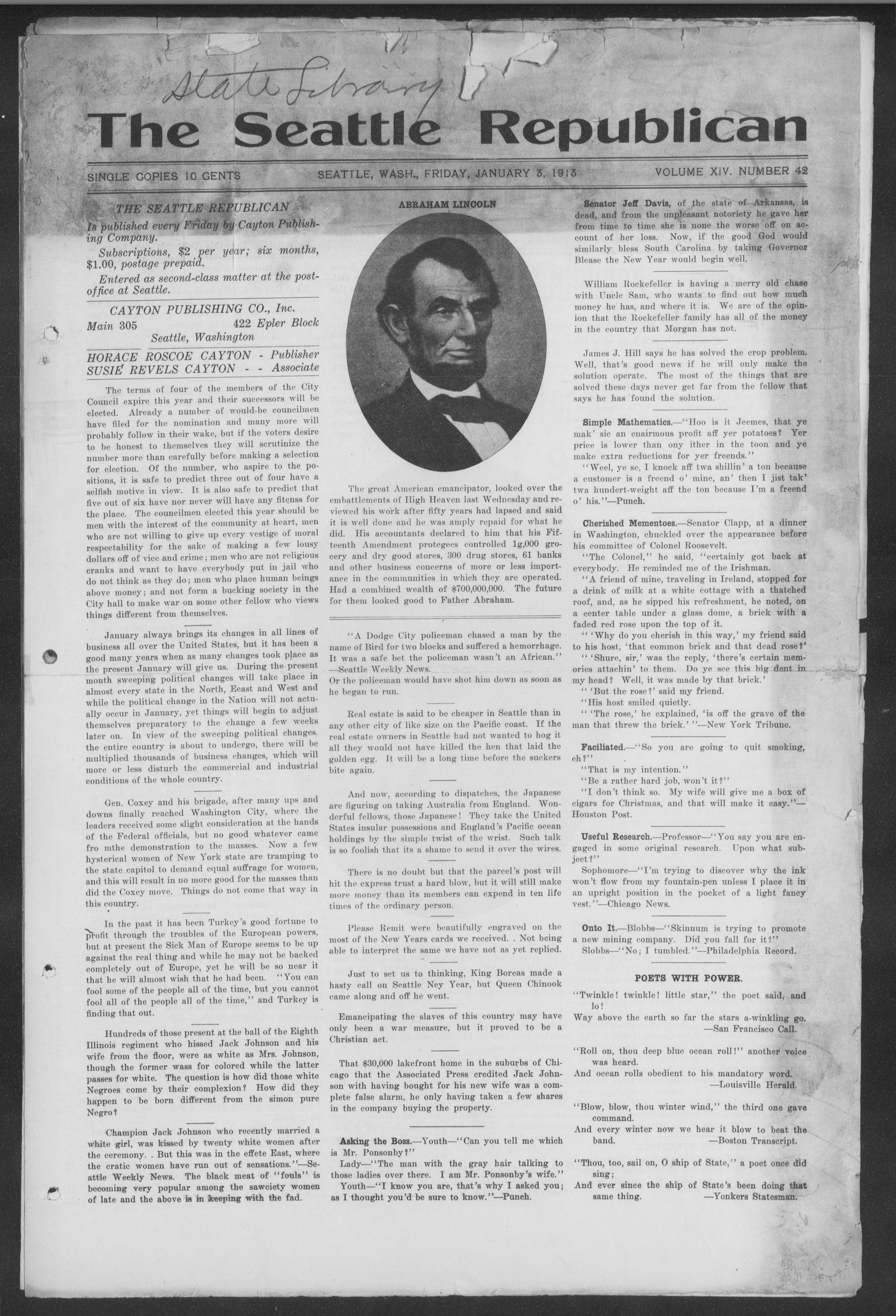
ABRAHAM LINCOLN
ABRAHAM LINCOLN
The great American emancipator, looked over the embattlements of High Heaven last Wednesday and reviewed his work after fifty years had lapsed and said it is well done and he was amply repaid for what he did. His accountants declared to him that his Fifteenth Amendment protegees controlled 1g,000 grocery and dry good stores, 300 drug stores, 61 banks and other business concerns of more or less importance in the communities in which they are operated. Had a combined wealth of $700,000,000. The future for them looked good to Father Abraham.
"A Dodge City policeman chased a man by the name of Bird for two blocks and suffered a hemorrhage. It was a safe bet the policeman wasn't an African." Seattle Weekly News. Or the policeman would have shot him down as soon as he began to run.
Real estate is said to be cheaper in Seattle than in any other city of like size on the Pacific coast. If the real estate owners in Seattle had not wanted to hog it all they would not have killed the hen that laid the golden egg. It will be a long time before the suckers bite again.
And now, according to dispatches, the Japanese are figuring on taking Australia from England. Wonderful fellows, those Japanese! They take the United States insular possessions and England's Pacific ocean holdings by the simple twist of the wrist. Such talk is so foolish that its a shame to send it over the wires.
There is no doubt but that the parcel's post will hit the express trust a hard blow, but it will still make more money than its members can expend in ten life times of the ordinary person.
Please Remit were beautifully engraved on the most of the New Years cards we received. Not being able to interpret the same we have not as yet replied.
Just to set us to thinking, King Boreas made a hasty call on Seattle Ney Year, but Queen Chinook came along and off he went.
Emancipating the slaves of this country may have only been a war measure, but it proved to be a Christian act.
That $30,000 lakefront home in the suburbs of Chicago that the Associated Press credited Jack Johnson with having bought for his new wife was a complete false alarm, he only having taken a few shares in the company buying the property.
Asking the Boss.—Youth—"Can you tell me which is Mr. Ponsonby?"
Lady—"The man with the gray hair talking to those ladies over there. I am Mr. Ponsonby's wife."
Youth—"I know you are, that's why I asked you; as I thought you'd be sure to know."—Punch.
VOLUME XIV. NUMBER 42
Senator Jeff Davis, of the state of Arkansas, is dead, and from the unpleasant notoriety he gave her from time to time she is none the worse off on account of her loss. Now, if the good God would similarly bless South Carolina by taking Governor Blease the New Year would begin well.
William Rockefeller is having a merry old chase with Uncle Sam, who wants to find out how much money he has, and where it is. We are of the opinion that the Rockefeller family has all of the money in the country that Morgan has not.
James J. Hill says he has solved the crop problem. Well, that's good news if he will only make the solution operate. The most of the things that are solved these days never get far from the fellow that says he has found the solution.
Simple Mathematics.—"Hoo is it Jeemes, that ye mak' sic an enairmous profit aff yer potatoes? Yer price is lower than ony ither in the toon and ye make extra reductions for yer freends."
"Weel, ye se, I knock aff twa shillin' a ton because a customer is a freend o' mine, an' then I jist tak' twa hundert-weight aff the ton because I'm a freend o' his."—Punch.
Cherished Mementoes.—Senator Clapp, at a dinner in Washington, chuckled over the appearance before his committee of Colonel Roosevelt.
"The Colonel," he said, "certainly got back at everybody. He reminded me of the Irishman.
"A friend of mine, traveling in Ireland, stopped for a drink of milk at a white cottage with a thatched roof, and, as he sipped his refreshment, he noted, on a center table under a glass dome, a brick with a faded red rose upon the top of it.
"'Why do you cherish in this way,' my friend said to his host, 'that common brick and that dead rose?'
"'Shure, sir,' was the reply, 'there's certain memories attachin' to them. Do ye see this big dent in my head? Well, it was made by that brick.'
"'But the rose?' said my friend.
“His host smiled quietly.
“‘The rose,’ he explained, ‘is off the grave of the man that threw the brick.’’”—New York Tribune.
Faciliated.—“So you are going to quit smoking, eh?”
“That is my intention.”
“Be a rather hard job, won't it?”
“I don't think so. My wife will give me a box of cigars for Christmas, and that will make it easy.’”—Houston Post.
Useful Research.—Professor—“You say you are engaged in some original research. Upon what subject?”
Sophomore—"I'm trying to discover why the ink won't flow from my fountain-pen unless I place it in an upright position in the pocket of a light fancy vest."—Chicago News.
Onto It.—Bobbs—"Skinnum is trying to promote a new mining company. Did you fall for it?"
Slobbs—"No; I tumbled."—Philadelphia Record.
POETS WITH POWER.
“Twinkle! twinkle! little star,” the poet said, and lo!
Way above the earth so far the stars a-winkling go.
—San Francisco Call.
“Roll on, thou deep blue ocean roll!” another voice was heard.
And ocean rolls obedient to his mandatory word.
—Louisville Herald.
“Blow, blow, thou winter wind,” the third one gave command.
And every winter now we hear it blow to beat the band.
—Boston Transcript.
"Thou, too, sail on, O ship of State," a poet once did sing;
And ever since the ship of State's been doing that same thing. —Yonkers Statesman.
PERSONS IN THE PUBLIC EYE
2
A. L. Walters has been retired by Mayor Cotterill from the superintendency of the streets of Seattle, which means that, he will, if he does as he once did, bellyache around until some future mayor of Seattle reinstates him.
C. R. Case, who succeeds A. L. Walters on the board of public works, like Walters, is never happy unless he is holding some kind of a public office. He like Walters, may be a very efficient man for the place, but he always wants to be in the political limelight.
A. J. Sigurdson will be a candidate for councilman. For eight years Sigurdson has held a desk in the office of county clerk, but he is no more satisfied with the favors of which he has been the recipient than if he had only been there a month. This mania to hold political positions, when once it gets hold of a fellow sticks to him closer than a brother.
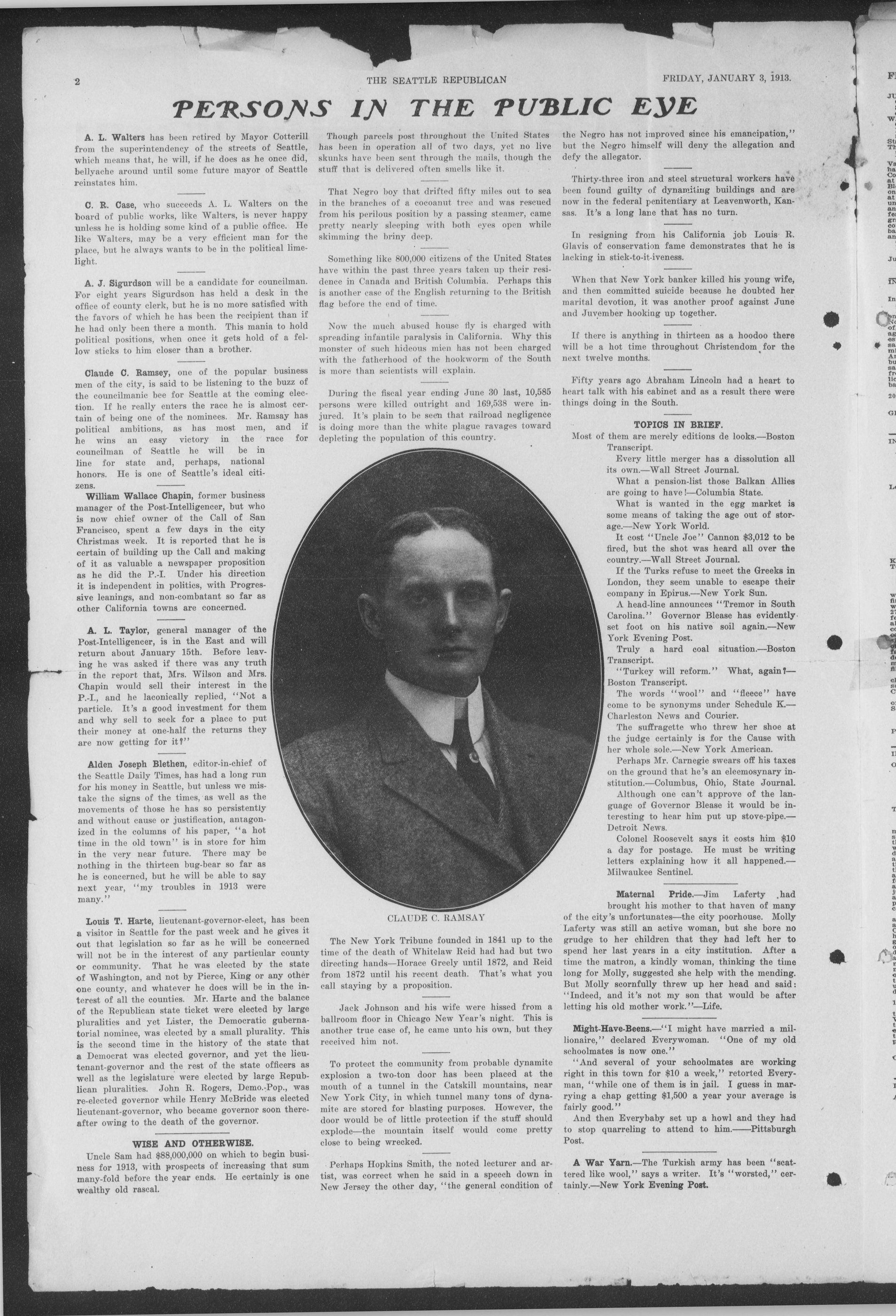
Claude C. Ramsey, one of the popular business men of the city, is said to be listening to the buzz of the councilmanic bee for Seattle at the coming election. If he really enters the race he is almost certain of being one of the nominees. Mr. Ramsay has political ambitions, as has most men, and if he wins an easy victory in the race for councilman of Seattle he will be in line for state and, perhaps, national honors. He is one of Seattle's ideal citizens.
William Wallace Chapin, former business manager of the Post-Intelligencer, but who is now chief owner of the Call of San Francisco, spent a few days in the city Christmas week. It is reported that he is certain of building up the Call and making of it as valuable a newspaper proposition as he did the P.-I. Under his direction it is independent in politics, with Progressive leanings, and non-combatant so far as other California towns are concerned.
A. L. Taylor, general manager of the Post-Intelligencer, is in the East and will return about January 15th. Before leaving he was asked if there was any truth in the report that, Mrs. Wilson and Mrs. Chapin would sell their interest in the P.-L., and he laconically replied, "Not a particle. It's a good investment for them and why sell to seek for a place to put their money at one-half the returns they are now getting for it?"
Alden Joseph Blethen, editor-in-chief of the Seattle Daily Times, has had a long run for his money in Seattle, but unless we mistake the signs of the times, as well as the movements of those he has so persistently and without cause or justification, antagonized in the columns of his paper, "a hot time in the old town" is in store for him in the very near future. There may be nothing in the thirteen bug-bear so far as he is concerned, but he will be able to say next year, "my troubles in 1913 were many."
Louis T. Harte, lieutenant-governor-elect, has been a visitor in Seattle for the past week and he gives it out that legislation so far as he will be concerned will not be in the interest of any particular county or community. That he was elected by the state of Washington, and not by Pierce, King or any other one county, and whatever he does will be in the interest of all the counties. Mr. Harte and the balance of the Republican state ticket were elected by large pluralities and yet Lister, the Democratic gubernatorial nominee, was elected by a small plurality. This is the second time in the history of the state that a Democrat was elected governor, and yet the lieutenant-governor and the rest of the state officers as well as the legislature were elected by large Republican pluralities. John R. Rogers, Demo.-Pop., was re-elected governor while Henry McBride was elected lieutenant-governor, who became governor soon thereafter owing to the death of the governor.
WISE AND OTHERWISE.
Uncle Sam had $88,000,000 on which to begin business for 1913, with prospects of increasing that sum many-fold before the year ends. He certainly is one wealthy old rascal.
THE SEATTLE REPUBLICAN
S IN THE PUB
Though parcels post throughout the United States has been in operation all of two days, yet no live skunks have been sent through the mails, though the stuff that is delivered often smells like it.
That Negro boy that drifted fifty miles out to sea in the branches of a cocoanut tree and was rescued from his perilous position by a passing steamer, came pretty nearly sleeping with both eyes open while skimming the briny deep.
Something like 800,000 citizens of the United States have within the past three years taken up their residence in Canada and British Columbia. Perhaps this is another case of the English returning to the British flag before the end of time.
Now the much abused house fly is charged with spreading infantile paralysis in California. Why this monster of such hideous mien has not been charged with the fatherhood of the hookworm of the South is more than scientists will explain.
During the fiscal year ending June 30 last, 10,585 persons were killed outright and 169,538 were injured. It's plain to be seen that railroad negligence is doing more than the white plague ravages toward depleting the population of this country.
1910
[Name not visible in the image]
CLAUDE C. RAMSAY
The New York Tribune founded in 1841 up to the time of the death of Whitelaw Reid had had but two directing hands—Horace Greely until 1872, and Reid from 1872 until his recent death. That's what you call staying by a proposition.
Jack Johnson and his wife were hissed from a ballroom floor in Chicago New Year's night. This is another true case of, he came unto his own, but they received him not.
To protect the community from probable dynamite explosion a two-ton door has been placed at the mouth of a tunnel in the Catskill mountains, near New York City, in which tunnel many tons of dynamite are stored for blasting purposes. However, the door would be of little protection if the stuff should explode—the mountain itself would come pretty close to being wrecked.
Perhaps Hopkins Smith, the noted lecturer and artist, was correct when he said in a speech down in New Jersey the other day, "the general condition of
---
PUBLIC EYE
the Negro has not improved since his emancipation," but the Negro himself will deny the allegation and defy the allegator.
Thirty-three iron and steel structural workers have been found guilty of dynamiting buildings and are now in the federal penitentiary at Leavenworth, Kansas. It's a long lane that has no turn.
In resigning from his California job Louis R. Glavis of conservation fame demonstrates that he is lacking in stick-to-it-iveness.
When that New York banker killed his young wife, and then committed suicide because he doubted her marital devotion, it was another proof against June and Juvember hooking up together.
If there is anything in thirteen as a hoodoo there will be a hot time throughout Christendom for the next twelve months.
Fifty years ago Abraham Lincoln had a heart to heart talk with his cabinet and as a result there were things doing in the South.
TOPICS IN BRIEF.
Most of them are merely editions de looks.—Boston Transcript.
Every little merger has a dissolution all its own.—Wall Street Journal.
What a pension-list those Balkan Allies are going to have!—Columbia State.
What is wanted in the egg market is some means of taking the age out of storage.—New York World.
It cost "Uncle Joe" Cannon $3,012 to be fired, but the shot was heard all over the country.—Wall Street Journal.
If the Turks refuse to meet the Greeks in London, they seem unable to escape their company in Epirus.—New York Sun.
A head-line announces "Tremor in South Carolina." Governor Blease has evidently set foot on his native soil again.—New York Evening Post.
Truly a hard coal situation.—Boston Transcript.
"Turkey will reform." What, again?—Boston Transcript.
The words "wool" and "fleece" have come to be synonyms under Schedule K.—Charleston News and Courier.
The suffragette who threw her shoe at the judge certainly is for the Cause with her whole sole.—New York American.
Perhaps Mr. Carnegie swears off his taxes on the ground that he's an eleemosynary institution.—Columbus, Ohio, State Journal.
Although one can't approve of the language of Governor Blease it would be interesting to hear him put up stove-pipe.—Detroit News.
Colonel Roosevelt says it costs him $10 a day for postage. He must be writing letters explaining how it all happened.—Milwaukee Sentinel.
Maternal Pride.—Jim Lafferty had brought his mother to that haven of many of the city's unfortunates—the city poorhouse. Molly Lafferty was still an active woman, but she bore no grudge to her children that they had left her to spend her last years in a city institution. After a time the matron, a kindly woman, thinking the time long for Molly, suggested she help with the mending. But Molly scornfully threw up her head and said: "Indeed, and it's not my son that would be after letting his old mother work."—Life.
Might-Have-Beens.—"I might have married a millionaire," declared Everywoman. "One of my old schoolmates is now one."
"And several of your schoolmates are working right in this town for $10 a week," retorted Everyman, "while one of them is in jail. I guess in marrying a chap getting $1,500 a year your average is fairly good."
And then Everybaby set up a howl and they had to stop quarreling to attend to him.—Pittsburgh Post.
A War Yarn.—The Turkish army has been "scattered like wool," says a writer. It's "worsted," certainly.—New York Evening Post.
---
FRIDAY, JANUARY 3, 1913.
JUSTICE'S COURT—BEFORE R. R. George, Justice of the Peace in and for Seattle Precinct, King County, State of Washington.
W. L. Walker, as The V. & H. Company, Plaintiff, vs. Mrs. Myrle Falk, Defendant. No. 29104. Summons for Publication.
State of Washington, County of King, ss. The State of Washington, to Mrs. Myr-
sank
You are hereby notified that W. N. Vandeverker, as The V. & H. Company, has filed a complaint against you in said Court, which will come on to be heard at my office in Room 611 Prefontaine Bldg., Seattle, King County, Washington, on the 10th day of January, A. D. 1913, at the hour of 9:30 o'clock a. m., and unless you appear and then and there answer, the same will be taken as confessed and the demand of the defendant. The demand and demand of said complaint is the recovery of $24.75, a balance due for shoes and footwear sold and delivered to you by plaintiff.
Complain filed Nov. 25th, A. D. 1912.
Dated December 4th, 1912.
K. R. GEORGE.
Justice of the Piece in GEORGE for Seattle
Precinct, King County, Wash.
December 6—December 27.
IN THE SUPERIOR COURT OF THE
State of Washington, for King Coun-
tinue.
In the Matter of the Estate of C. Tamagni, deceased.—No. 14867.
By order of said court made herein on the 18th day of December, 1912.
Notice is hereby given to the creditors of, and to all persons having claims against said deceased or against said estate, to present them with the necessary vouchsers to the undersigned administrator of said estate, at room 400 Arcade Building, Seattle, the place of business of said estate, in Seattle, in said county and state, within one year from and after the date of first publication of this notice or same will be barred.
Date of first publication December 20, 1912.
FRED NELSON,
As Administrator of said Estate.
GEO. McKAY,
Attorney for Estate.
430 Arcade Building.
Dec. 20, 1912—Jan. 17, 1912.
IN THE SUPERIOR COURT OF THE State of Washington for the County of King. Summons for publication for services on the defendants, E. J. Fallon, Hattie P. Wolcott, and May Jahn, and First National Bank of Southern Oregon, a national banking corporation. Lopez H. Stern, plaintiff, vs. Mildred H. Cutler, and Fred G. Cutler, her husband; the First National Bank of Southern, Oregon, a national banking corporation; E. J. Fallon, J. Ruthe, Joseph Ahern, W. E. Cox, National Bank of Commerce of Seattle, a national banking corporation; the General Hauling Company, a corporation; George Carson, Hattie P. Woolcott and May Jahn, defendants. No. 19755 The State of Washington, County of King—ess
To the said E. J. Fallon, Hattie P. Woolcott, and May Jahn; and First National Bank of Southern, Oregon, a national banking corporation;
To whom sixty days after the date of the first publication of this summons, towit, within sixty (60) days after the 27th day of December, 1912, and defend the above entitled action in the above entitled complaint, with the copy of your answer, and serve copy of your answer upon the under-signed attorneys for plaintiff, at their office below stated; and in case of your failure so to do, judgment will be rendered against you according to the demand of the clerk, and been with the clerk of said court.
The object of this action is to foreclose a mortgage on the following described real estate, situate in King County, Washington:
Lot 10, Block Eleven (11), of Capitol Hill Addition to the City of Seattle, Division No. Three.
J. W. RUSSELL and
C. L. BUTCHER.
C. L. BUTCHER,
Attorneys for Plaintiff.
Postoffice address, 712 Lowman Building, Seattle, King County, Wash. Dec. 27, 1912—Feb. 6, 1913.
IN THE SUPERIOR COURT OF THE State of Washington, for King County, Omaha, Mehlhorn, Inc., Plaintiff, vs. Pearl M. Coleman, Charles O. Coleman, her husband; Rachel Lowery, John Doe Lowery, her husband; S. Kumasaki, F. H. Moore, doing business as the Moore Realty, Legg and D. M. Schuchh, Defendants. No. 30690. Summons by Publication.
The State of Washington to the above named defendants, Rachel Lowery and John Doe Lowery, her husband: You, and each of you, are hereby summoned and required to appear within sixty days from and after the date of the first publication of this summons, to wit. within sixty days after the 29th day of November, 1912, and defend the above entitled action in the above entitled court and answer the complaint of the plaintiff and serve a copy of your answer upon the undersigned attorney for plaintiff, at the address below stated, and in case of your failure so to do, judgment will be rendered against you according to the demand of the complaint, which has been filed with the clerk of this court.
The object of this action is to obtain a judgment in favor of the plaintiff, against the said defendant, Coleman, and Charles O. Coleman, her husband, for the sum of $1,600.00, together with interest thereon at the rate of 8 per cent per annum from the 26th day of January 2014, with an attorney's fee and costs and disbursements and to foreclose that certain mortgage given by said defendants on the 26th day of January 2014 to sell plaintiff's secure said amount, upon Lot 9, Block 10, of The Baker Addition to the city of Seattle;
Lots 9, 10, 11, 12, 13, 14, 15, 16, 17, 18, 19, 20, in Block 1;
Lot 1, Block 4, Map of Ellis' Addition to Chautauqua, all in King County, Washington, and to foreclose and determine all right, title and interest of each and all of said defendants in and to said lands and premises, and every part thereof.
EDWARD VON TOBEL
Attorney for Plaintiff.
Office and Post Office Address, 604-5 Mutual Life Building, Seattle, King County, Washington.
Nov. 29, 1912—Jan. 11, 1913.
IN THE SUPERIOR COURT OF KING County, Washington. Summons
County, Washington. Summons.
Annie E. Blakney, Susan Blakney, David Hefler and Erastus Hefler, plaintiffs, vs. Ida Swanson and Charles Swanson, her husband; Minnie V. Miller and George Miller, her husband; Phoenix International Light Company, a corporation; George A. Kemp, William Cole, Charles Shubert, Globe Electric Company, a corporation; Freeman Hefler, Byron L. Hefler, Norman Hefler, Albert Hefler, Willard Hefler, Elijah Heuer, Alice Allison and also all other persons or parties unknown claiming any right, title, estate, lien or interest in the real estate described in the complaint herein. defendants.—No. 91344.
The State of Washington, to the above named defendants: Phoenix International Light Company, a corporation, Freeman Heifer, Norman Heifer, Norman Heifer, Norman Heifer, Albert Heifer, William Heifer, John Heifer, Allison and also all other persons or parties unknown claiming any right, title, estate, lien or interest in the real estate described in the complaint herein;
And each of you are hereby summoned to appear within sixty (60) days after the date of the first publication of this summons, to-wit, within sixty (60) days after the 20th day of December, 1912, and defend the above entitled action in the above entitled court, and answer the complaint of the plaintiff, which has been answer upon the undersigned attorneys for the plaintiff, at their office below stated; and in case of your failure so do judgment will be rendered against you according to the demand of the complaint, which has been filed with the clerk of the above entitled court.
The object of the said action is to obtain a decree fixing the title, interest and lien of each and all of the parties hereto in the following described real property in King County, Washington to wit.
The north half of the west half of the east half of the southwest quarter (N. ½ of the W. ½ of the E. ½ of the S. W. ½) of section twenty-nine (29), ownership twenty-five (25), north, north (5) east of the W. west, less the county road along the W. west thereof; and to have each of the above entitled plaintiffs declared to own in severality a certain portion of the said tract in accordance with the order confirming referee's report entered in cause No. 89027 in the Superior Court of King County, Washington, and for such other relief as to the court shall seem proper.
SHANK & SMITH,
Attorneys for Plaintiffs.
Office and postoffice address, 1002 Alaska Building, Seattle, Washington.
Dec. 20, 1912-Jan. 31, 1913.
IN JUSTICE C COURT BEFORE FRED C. Brown, Justice of the Peace, in and for the purpose of instituting, King County, State of Washington.
A. Kristoferson, Inc., a corporation,
Plaintiff, vs. Mrs. Myrtle Falk, Defend-
ant, No. 16347. Summons for Publ-
State of Washington, County of King, ss.
The State of Washington, Mrs. Myrtle
Falk, Defendant:
You are hereby notified that A. Kristo-
ferson, inc. a corporation, has for
complaint come against you. In said Court,
which will come at behead at my office
in Room 601 Pressfaine Bldg,
Seattle, King County, Washington, on the
14th day of January, A. D. 1913, at the
appear and then and there answer, the
same will be taken as confessed and the
demand of the plaintiff granted. The
object and demand of said complaint is
the recovery of $28.40 upon dairy products
claim for groceries sold and delivered
to you, filed .ov. 29th, A. D. 1912.
FRED C. BROWN.
Justice of the Peace, in and for Seattle
President, King County, Washington.
E. N. SEARS.
Attorney for Plaintiff.
IN THE SUPERIOR COURT OF THE State of Washington, for King County. In Probate. Cause Why Reality Should Not Be Mortgaged. In the matter of the Estate of Wm. F. Nelson, Deceased.—No. 10376. Upon reading and filing the petition of the estate of Wm. F. Nelson as administratrix of the estate of Wm. F. Nelson, deceased, be authorized, empowered and directed to mortgage the real estate belonging to said estate, all of lot No. eight (8) and the north ten (10) feet of lot No. nine (9), in block twelve (12) of Walla Walla Addition to the City of Seattle, situate, and add the county of King and State of Washington.
And it further appearing to the satisfaction of the ocrunt from such petition, that there is not sufficient personal estate in the hands of the administrix to pay the allowance for the debts outstanding against the deceased and the expenses of administration, or to pay the installments upon the principal of, as well as the interest due upon, a mortgage subsisting against the real property of said estate, and that it is necessary to obtain that loan or provide fund for the payment of said installments and interest due upon said mortgage, as well as for the payment of the expenses of administration and one or more of the debts aforesaid; now therefore.
It is hereby ordered that all persons interested in the ocrunt appear before the entitled court on the 13th day of January, A. D. 1913, at the hour of 9:30 o'clock, a. m., in the court room of said court, to show cause, if any they can, why the said real estate should not be mortgaged for the purpose of exceeding fourteen hundred dollars ($1400), as is more fully set forth in said petition, reference to which is hereby made for further particulars.
Done in open court this 11th day of December, A. D. 1912. FRATER
IN THE SUPERIOR COURT OF THE State of Washington in and for the County of King. Summons for Publication.
Dora E. Orbin, Plaintiff, vs. Charles Orbin, Defendant.
The State of Washington, to the said Charles Orbyn, Defendant:
You are hereby summoned to appear within sixty (60) days after the date of the first publication of this summons, to-wit: Within sixty days after the 13th day of December, 1912 and denote the first publication of above entitled court, and answer the complaint of the plaintiff, and serve a copy of your answer upon the undersigned attorney for plaintiff at his office below stated; and in case of your failure to do judgment will be remand against you, waiting to be the command of the complaint, which has been filed with the clerk of said court.
The object of the above entitled action is to secure an absolute decree of divorce on the ground of desertion and abandonment, and the usurpation of two minor children.
Attorney for Plaintiff.
Office and P. O. Address, 511 Burke Block, Seattle, King County, Wash. December 13—January 24, 1913.
IN THE SUPERIOR COURT OF THE State of Washington, for King County, Summons, for, Publication
The State of Washington, to the said Rose, Kelley, Nickerson, Defendant;
Rose Kelley Nickerson, Defendant:
You are hereby summoned to appear
within sixty days of this publication
of this summons, to-wit,
within sixty days after the 13th day
of December 15th and an act he
above the action in the above
entitled court, and answer the complaint
THE SEATTLE REPUBLICAN of the plaintiff and serve a copy of your answer upon the undersigned attorney for plaintiff at his office below stated; and in case of your failure so to do judgment will be rendered against you according to the prayer of the complaint, which has been filed with the clerk of said court. The object of this action is to obtain a decree of divorce from the defendant of the plaintiff from the defendant of the ground of abandonment of the plaintiff by the defendant for more than one year last past.
C. A. RIDDLE,
Attorney for Plaintiff.
Postoffice and office address: Suite
655, Colman Building, Seattle, Washington.
December 13—January 24, 1913.
IN THE SUPERIOR COURT OF THE
State of Washington, for the County
of King. Notice of Settlement of
Final Account.
State of Washington, County of King
—ss.
In the matter of the estate of Wm. F.
Nelson. Drooged. No. 10376.
Nelson, Deceased—No. 10376
M. Nelson, hereby appointed, and Wills
H. White, administrator of the estate
of Wm. F. Nelson, deceased, has rendered to, and, filed in, said court his Final Account as such administrator of the estate, day of January, 1913, a 3:30 o'clock, a day, at the Court Room of the Probate Department of our said Superior Court, in the City of Seattle, in said King County, has been duly appointed by said account for the settlement of said account, at which time and place any person interested in said estate may appear and file his exceptions in writing to said account, and contest the same.
Witness, the Hon. A. W. Frater, Frater.
Judge of said Superior Court, and the
Judge of said Superior Court, affixed this
11th day of December, 1923.
4th day of
MARCH
D. K. SICKELS, Clerk.
By PERCY F. THOMAS,
Deputy Clerk.
December 13—January 10, 1913.
IN THE SUPERIOR COURT OF THE
State of Washington in and for the
County of King. Summons for Publ-
sarah Forstad, Plaintiff, vs. Eli Forstad,
Defendant. No. 90978.
The State of Washington, to the said
Eli Forstad, Defendant:
You are hereby summoned to appear
within sixty (60) days after the date of
the hearing of your case. You are to-wit: Within sixty days after the 6th
day of December, 1912, and defend the
above entitled action in the above
entitled court, and answer the complaint of
the plaintiff, and serve a copy of your
answer upon the undersigned attorney
for plaintiff at his office below stated;
and in case of your failure, judgment will be rendered against you
according to the demand of the complaint,
which has been filed with the
clerk of said court.
The object of the above entitled action is to secure an absolute decree of justice on the grounds of desertion and abrogation.
Office and P. O. Address, 611 Mutual Life Block, Seattle, King County, Wash. December 6—January 17.
IN THE SUPERIOR COURT OF THE State of Washington for King County, Notice to Creditors.
In the Matter of the Estate of Selma Detlofsen, deceased.—No. 14905.
Notice is hereby given to the creditors of, and all persons having claims against, the estate, and the community estate of said deceased and Martin Detlofsen, her husband, to present the same, with the necessary vouchers to the undersigned administrator of said estate at the date of the first publication of this notice, to-wit: within one year from the 20th day of December, 1912.
Dated this 30th day of December, 1912.
MARTIN DETLOFOSFEN,
Administrator of the Estate of Selma Detlofsen, Deceased.
Office of Life Building, address, 604-5 Mutual Life Building, Seattle, King County, Washington.
January 3—February 3, 1913.
IN THE SUPERIOR COURT OF THE State of Washington, for King County. In Probate. Notice to Creditors. In the Matter of the Estate of Charles Kloppenberg, deceased. No. 14906. Necessary bereft being the creditors of, and all persons having claims against the said deceased, or his estate, to present the same, with the necessary vouchers to the undersigned administrator of said estate at the office of Edward Von Tobel, 604 Mutual Life Building, Seattle King County, Washington, the same being the place of the transaction of business of said estate, within one year from the date of the first publication of this notice, to-wit, within one year from the 3rd day of January, 1913.
M. SCHULZ, Administrator of the Estate of Charles Kloppenberg, Deceased. Office and postoffice address. 604-5 Mutual Life Bldg., Seattle, King County, Wash.
January 3—February 3, 1913.
IN THE SUPERIOR COURT OF THE
State of Washington, for King County.
German Savings, Building & Loan Association,
a corporation, Plaintiff, vs.
Henry O'Brien, Charles O'Brien, a minor,
Bernard O'Brien, a minor, O'Brien,
O'Brien, a minor, and August Mehlhorn,
Jr., administrator of the estate of
Lena O'Brien, deceased, Defendants.
No. 90,612. Summons by Publication.
The State of Washington to the said
Robert Henry O'Brien, a minor;
Bernard O'Brien, a minor and Thomas
O'Brien a minor;
You and each of you are hereby summoned and required to appear within sixty days after the date of the first publication of this summons to which you may have been issued and of November, 1912, and defend the above entitled action in the above entitled court and answer the complaint of the plaintiff and serve a copy of your answer to the application of the plaintiff, at the address below stated, and in case of your failure so to do judgment will be rendered against you according to the demand of the complaint, which has been filed with the order of the court to be filed in the action of the court to obtain a judgment in favor of the plaintiff against the said Henry O'Brien for the sum of $1,000.00, with interest thereon at the rate of $12 per cent per annum on the sale of the unlulled property provided in said note and mortgage, together with an attorney's fee and costs and disbursements and to foreclose that certain mortgage made by the said defendant, Henry O'Brien and L.S.A. was on the date of the date of 1909, upon Lot 6 and the N.Y. of March, 7, Block 13, Plat. of Rainier Beach, King County, Washington which mortgage is of record in the Auditor's office of King County, Washington, and the said office of the said office, page 434, record of mortgages in said office, and for the sale of said land
The Seattle Republican
$2 PER YEAR For All 1913
to satisfy the amount that may be adjudged by the court to plaintiff, and to bar and to foreclose all right, title and interest of each and all of said defendants in and to the said lands and premises and every part thereof.
EDWARD VON TOBEL
Attorney for Plaintiff.
Office and Post Office Address: 604-5
Mutual Life Building, Seattle, King
County, Washington
November 22, 1912—January 5, 1913.
IN THE SUPERIOR COURT OF THE
State of Washington, for King County,
Samuel J. Friedman, Plaintiff, vs. Josephine Friedman, Defendant. No. 90965.
Summons for Publication.
The State of Washington to the said Josephine Friedman. Defendant:
You are hereby summoned to appear within sixty days after the date of the first publication of this summons, towit: Within sixty days after the 15th day of November, 1912, and defend the above entitled action in the above entitled court, and answer the complaint in good order to the opposing answer upon the undersigned attorney for plaintiff at its office below stated; and in case of your failure so to do, judgment will be rendered against you according to the demand of the complaint, which has been filed with the clerk, court, or other object, of the above entitled action is to be made to you a divorce upon the grounds of cruelty, personal indignities, and abandonment, and to have the care and custody of Esther Friedman, Harry Fredman, and Edna Friedman, infant children of the parties hereto, awarded to this plaintiff.
November 15—December 27, 1912.
JUSTICE'S COURT, BEFORE JOHN E. for Seattle Precinct, King County, Carroll, Justice of the Peace in and State of Washington. Summons for Publication.
H. Beskebes, plaintiff, vs. Peter Savas, also known as P. Shekrekes, defend- and—No. 255242-25.
State of Washington, County of King ss.
The State of Washington to Peter Savas, also known, as P. Shekrekens.
DON'T ASK FOR BEER Merely say- White and Gold
and you will not only get what you w
It is not alone what you feel a
taste that braces you up and helps you
IT IS
BEER IN
and you will not only get what you want, but the very thing you need.
It is not alone what you feel a delicious beet should be, but it has a taste that braces you up and helps your outlook on things.
IT IS THE BEST
BEER IN THE WEST
GIVE IT A TRIAL
YOU'LL LIKE IT
Brewed in Seattle from the choice
ditions that insure helthfulness and p
Claussen Brew
SEATTLE
Brewed in Seattle from the choicest materials obtainable and under conditions that insure healthfulness and purity.
Claussen Brewing Association SEATTLE Phone Queen Anne 50
3
defendant herein:
You, and each of you, are hereby notified that H. Besbekes has filed a complaint against you in said court, which will come on to be heard at my office in room 602 Prefontaine Building, Seattle, King County, Washington, on the 31st day of January, A. D. 1913, at the hour 'of 9:30 o'clock a. m., and unless you answer, and then and there answer, the same will be taken as concessions and the demand of the plaintiff granted. The plaintiff and demand of said complaint and action is to recover judgment for forty ($40.00) dollars and costs, being money loaned to defendant by the plaintiff.
Filed December 9th, A. D. 1912
JOHN E. CARROLL,
Justice of the Court
Justice of the Peace in and for Seattle Precinct, King County, Wash. Dec. 27, 1912—Jan. 17, 1913.
JUSTICE'S COURT, BEFORE JOHN E. Carroll, Justice of the Peace in and for Seattle Precinct, King County, State of Washington. Summons for Publication.
Congressional Collection Association, a corporation, plaintiff, vs. Peter Angelos and Jane Doe Angelos, whose true name is unknown, his wife, defendants.—No. 25710-11.
State of Washington, County of King
—ss.
The State of Washington to Peter Angelos and Jane Doe Angelos, whose true name is unknown, his wife, defendants herein:
You, and each of you, are hereby notified that Creditors Collection Association has filed a complaint against you in said court, which will come on be heard at my office in room 602 Predicott 2010g, Seattle, King County, Washington, on the 23rd day of January, A. D. 1913 at the 24th day of 9:30 o'clock a, m., and unless you appear, and then and there answer, the same will be taken as confessed and the demand of the plaintiff granted. The object and demand of said action is to obtain judgment against you for $28.50 and costs for board furnished you by one Louis Karas. Filed December 20th, A. D. 1912. JOHN E. CARROLL. Justice of the Peace in and for Seattle Precinct, King County, Wash. Dec. 27, 1912—Jan. 17, 1913.
IN THE SUPERIOR COURT OF THE State of Washington, for King County. Jennifer Nicholas, Plaintiff, vs. John Nicholas, Defendant, No. 91825. Summons for Publication. The State of Washington, to John Nicholas, defendant named:
You are hereby summoned to appear within sixty (60) days after the date of the first publication of this summons, to-wait; within sixty days after the 3rd day of January 1919, to defend the above entitled action in the court entitled court, and answer the complaint of the plaintiff and serve a copy of your answer upon the undersigned attorney for plaintiff at his office below stated; and in case of your failure so to do, you shall be rendered against you according to the demands of the complaint, which has been filed with the clerk of said court.
The object of this action is to obtain a decree of divorce dissolving the bonds of matrimony existing between the plaintiff and defendant; for the custody by plaintiff to have certain property belonging to plaintiff and defendant or to defendant awarded to plaintiff as her sole and separate property and estate; for judgment against the defendant for moneys expended by the plaintiff in the maintenance of the money for suit money and attorney's fees, and for much other relief as the court may deem proper. C. A. RIDDLE.
Attorney for Plaintiff.
Office and Postoffice Address: Suite 655
Colman Building, Seattle, Washington.
January 3—February 14, 1913.
IN JUSTICE COURT, BEFORE JOHN
E. Carroll, Justice of the Peace in and
for Seattle Precinct, King County,
Washington.
Nick Doucas plaintiff, vs. Anglos Param-
matzis, sometimes known as Anglos
Parmagis and Angelus Pallus, Defend-
ant.
State of Washington: To Anglos Param-
matzis, sometimes known as Anglos
Parmagis and Angelus Pallus, Defend-
ant.
In the name of the State of Washington,
you are hereby notified that Nick Doucas has filed a notice and complaint
against you in said court above named,
and that the notice and complaint
office in Seattle, in King County, State
of Washington, on the 4th day of F
ebruary, A. D. 1913, at the hour of 9:30
clock a. m., and unless you appear and
then and there answer the same, judg-
ment will be taken in the court and the
demand of the plaintiff granted.
The object and demand of the said complaint is to recover the sum of Ninety-nine hundred (90,800) Dollars, for merchandise sold and delivered to the said defendant. Complaint filed December 11th, A. D. 1912. January 3—January 24, 1913
THE COLORED SOLDIERS MUST GO
THE CAYTONIAN COURT
Arranged in two and three-room suites, is now ready to receive tenants. Its modern conveniences consist of hot and cold water in each apartment, gas range, electric lights and steam heated. Its sanitary bathrooms ready for a hot plunge any hour are always open to tenants. Prices, $10 and up.
This is the only strictly modern apartment house owned and operated by Negroes and for Negroes in the Northwest and its owners appeal to them for a shore of their patronage.
One block from the house is the Yesler Way car line that runs on a three minute schedule, and in ten minutes after leaving the door you can be in the heart of the city. Two other car lines run within a block of the house giving it excellent car service, and especially to the Union Depot.
Your fires are always burning; your lights are always trimmed; your cooking range is always ready and your bath water is always prepared, all of which makes life in the Caytonian Court one long sweet dream.
You can maintain apartments here for one-third less than you can a cottage. They are either furnished or unfurnished.
303 Twenty-second Avenue South.
Telephone, Beacon 1910.
HORACE ROSCOE CAYTON SUSIE REVELS CAYTON
Some months ago an edict went forth from an enraged populace of Seattle, "The Negro Soldiers must go," meaning that the Twenty-fifth infantry, then stationed at Ft. Lawton, had become so objectionable to the citizens, due to divers overt acts, that nothing could appease their anger save immediate removal of them from their midst. Indignation meeting after indignation meeting was held, at which resolutions that almost reached the sky were passed and rushed to the war department both by wire and by mail, demanding the removal of the objectionable soldiers. Charges of the most serious nature were filed against them as a whole as well as individually, all of which tended to prove that the members of the company were not only a menace to the peace and dignity of the community, but were absolutely terrors of the womanhood about the reservation. So alarming was the situation that the mayor deemed it sufficiently grave to swear in thirty extra policemen, who were ordered to patrol the reservation and arrest the entire company of soldiers, if necessary, to protect the women living in the immediate neighborhood thereof, and in case they found the job too big for them, to call help and thirty more policemen would be sent to their aid. It was a true case of making war on the warriors and the commanding officers of the company believing that discretion wa sthe bettor part of valor, gave orders that the men refrain from visiting the city for a number of days, in order that they could see what turn things would take. Those who engineered the protest precipitated it at a most opportune time, in the midst of a heated political campaign, in which the election of a United States senator was involved, and to add fuel to the flames, each of the three daily papers were advocating the election of different senatorial candidates and took advantage of every opportunity to make votes for its favorite. The sentiment against the solidiers soon assumed not only a local, but even a national aspect, hence the papers gave it all of the publicity that it could stand. In order to get the vote that that sentiment controlled, the three papers vied with each other in playing up each bit of news to the best advantage. It was not long before strong editorials in each of the papres had been published fully endorsing the going of the soldiers, which the various mass meetings had from time to time demanded.
With the foremost politicians and publications of the community arrayed against them and the presidential election rapidly coming on, just or unjust the soldiers seemed doomed to have to leave Ft. Lawton under a cloud no less dark and foreboding than the one under which they left the fort situated near Brownsville, Texas, which later on burst and proved so officially destructive to many of their numbers. To the unbiased mind and the mind that always advocates fair play even for the beasts of the forest, this was not only a most pitiable condition, but likewise lamentable one. With something like a half million of first-class white citizens condemning and denouncing those 400 soldiers and worked up almost to the point of marching on the fort and exterminating every mother's son of them, and they hurded up in a fort, practically prisoners, with no means of saying a word in their own defense, it was almost worth even a white man's life to speak one word in their behalf, and yet there were a few that did so, and not only demanded fair treatment for them, but went a step further and declared they were innocent of all they had been charged.
Whether or not there was just cause for complaint against any or all of the members of the Twenty-fourth infantry, while stationed at Ft. Lawton, is for you and each of you to decide for yourselves. The story is not written with the view of opening up old scores nor to denounce any thing any one did in that embroligio, but to demonstrate that it matters not how ugly a situation may seem, when it is fresh, time will show it up in a far different light. Uncle Sam seldom if ever loses his head and at the opportune time he stepped forward and poured oil on the troubled waters, promising a thorough and impartial investigation, the punishment of the refractory soldiers and, finally, the removal of the company from the fort, if the investigation justified actions so drastic. True to his promise, special officers were sent on from Washington City to make the investigation and even General Dickerson himself, secretary of war, was present and listened to much of the evidence. Despite General Dickerson's antipathy against Negro soldiers he declared those at Ft. Lawton were guilty of doing no wrong in Seattle so far as the evidence showed, and there was no excuse for their removal, though he did not hesitate to be quoted, "I am against the enlistment of Negroes as soldiers for the United States army." The intense feeling against the soldiers soon vanished, but from time to time there were occasional outbursts
THE SEATTLE REPUBLICAN
against them, but the charges always fell flat on investigation.
Early in December, however, orders did come that the Twenty-fifth infantry would have to go, not for disobedience, but because the company had stayed its allotted time at this place, and, according to the regulations of the war department, it must move on to some other fort and some other company take its place. Unless the unexpected happens no one living will ever again see Negro soldiers at Ft. Lawton as it will take them a lifetime to go the rounds of the different posts. Judging from the sentiment that arrayed against those soldiers, when their removal was demanded, one would have supposed the citizens of Seattle would have almost held public meetings of rejoicings when they were really ordered to go, but not so. Instead of rejoicing over their departure public sentiment had so completely reversed itself that actual regret was expressed for the company having to leave in mid-winter after the officers and men had made preparation to spend the winter here. Not only the Post-Intelligencer, but the other daily papers of the city, spoke highly of the good behavior of the company and even the police unsolicited through the columns of the Post-Intelligencer declared it was an orderly, well-behaved company and the members thereof gave the police little or no trouble. If not in so many wards, yet meaning the same, the Post-Intelligencer gave the members of the Twenty-fourth infantry equally as strong recommendation for good behavior as did the police of the city of Seattle.
There are numerous reasons why colored soldiers behave better than white soldiers, and chief among them is because they know that they are not wanted at any post, not so much on account of their general bad behavior, but because of the prejudice common to the country against all colored folk, and doubly so when they come in an official capacity. The presumption among the white citizens of every community is, if the Negro comes thereto as a soldier of the federal government, he will not be so easily controlled as the ordinary Negro citizen, and clothed in the garb of the United States government, he will force himself into places where he is not only not wanted, but where it would mean a riot if the ordinary Negro should go. But not so, for the Negro soldier is too well posted on public sentiment in the United States even in the garb of the government to go too far.
Then again the Negro soldier knows that the sins of one must be borne by them all and they themselves make war on that soldier that tries to take liberties in any community that will bring criticism and odium upon the heads of the membership of the entire company. They are always warned before arriving at new quarters of the feeling that has been worked up against their coming, and they put on their good behavior in order to disabuse the minds of
FRIDAY, JANUARY 3, 1913. MUST GO
their accusers of the idea that they are any worse than the members of the white company preceding them, even if as bad. Already the citizens of Honolulu are protesting against the Twenty-fourth being stationed there, not that they have had any experience with Negroes either as soldiers or citizens, but evidently to be in line with the actions of the white citizens of the States. In this case, however, it looks like the pot calling the kettle back, for fully fifty per cent of the members of the Twenty-fifth infantry greatly resemble the Hawaiians in color and after they will have learned the language of the island they could easily lose their Negro identity and be mistaken for Hawaiians just as hudreds of other Negroes from the States are already doing.
For a Scent.—A grouchy butcher, who had watched the price of porterhouse steak climb the ladder of fame, was deep in the throes of an unusually bad grouch when a would-be customer, eight years old, approached him and handed him a penny.
"Please, mister, I want a cent's worth of sausage."
Turning on the youngster with a growl, he let for this burst of good salesmanship:
"Go smell o' the hook!"—New Orleans States.
Unkind Cut.—A Bore—"Yes, I learned to play entirely by ear."
Miss Bright—"And have you never had an earache?"—Judge.
No Linguist.—Brusque Customer (in music shop)
—"Libretto 'Mikado.'"
New Assistant—"I no speak Italiano."—Sketch.
One on Teacher.—Teacher—"Why, Jimmy, Jimmy! Have you forgot your pencils again? What would you think of a soldier going to war without a gun?" Jimmy—"I'd think he was an officer."—Boston Record.
Pick-Ups.—Frost—"Where do you get your hats, old man?" Snow—"At cafes, usually. But once or twice I've been lucky enough to exchange at church."—Judge.
**Bargain-Hunter.**—Manager (five-and-ten cent store)
“What did that lady who just went out want?”
Shopgirl—“She inquired if we had a shoe department.”—Boston Transcript.
**A Swat Indirect.**—Mandy—“What foh yo been goin’ to de postoffice so reg’lar? Are yo correspondin’ wif some other female?”
Rastus—“Nope; but since ah been a-readin’ in de papers 'bout dese ‘conscience funds’ ah kind of thought ah might possibly git a lettah from dat ministah what married us.’”—Life.
NIAN COURT