Seattle Republican
Friday, February 14, 1913
Seattle, Washington
Page text (machine-generated)
The Seattle Republican
State Library The Sea SINGLE COPIES 10 GENTS SEATTLE
THE SEATTLE REPUBLICAN
Is published every Friday by Cayton Publishing Company.
Subscriptions, $2 per year; six months,
$1.00, postage prepaid.
Entered as second-class matter at the post-office at Seattle.
CAYTON PUBLISHING CO., Inc.
Main 305 422 Epler Block
Seattle, Washington
HORACE ROSCOE CAYTON - Publisher
SUSIE REVELS CAYTON - - Associate
Hades is hearing a good deal about the misfortunes of Turkey just now.
Twice within the past week the P.-I. took a decided stand on public questions. Is there a screw loose somewhere?
An appendix, to any one, is an expensive luxury, but that Peruvian woman who is spending $100,000 to get rid of hers holds the record.
Even the dead is to be disturbed that Lillian Graham, a former Renton girl, may get through the world on her shape.
That's right, every girl should have her own room, if for nothing else so that she could hide her laziness behind locked doors.
Of course "a girl's bite is dangerous," even if she is pretty. When a girl's scorn is dangerous, there is no doubt about her bite being dangerous.
With war raging in the Balkans, Mexico and West Virginia, the devil must have his hands full handling the crowds.
Mrs. Blessing wants a divorce and Mr. Blessing has no objections. She evidently is not longing for further matrimonial Blessing and he evidently thinks she has had too darn much Blessing for her good.
"Will Congress Act Now?" is a P.-I. head-line. Not if it can help itself. Congress seldom acts and when it does it acts so badly that it would be just as well if it did not act at all.
In all probability that missionary that was arrested in Paris for relieving a young women of $400,000, wanted the money to pay for Christianizing himself. Charity, you know, begins at home.
Now that Nevada requires a twelve-months residence before one can bring a divorce proceeding, Puget Sound ought to get the most of the members of the divorce colony.
If the Mexicans do not quit their slaughtering of sas legislature, that state will not get to taste the initiative and referendum panacea that is said to be the cure for all governmental aches and complaints.
Unless the Mexicans quit their slaughtering of each other the whole damn family will get their gable ends badly blistered, as Uncle Sam is getting good and tired of the row.
"You're a liar," didn't sound good to Chief Bannick and Attorney Horner now knows it. It is not always safe to use such language, even if you have reasons to believe that you are correct.
Count Boni, Anna Gould's former jack-in-the-box, is reported as having a lead-pipe cinch on marrying J. Pierpont Morgan's daughter. He may be a shrimp, but he manages to always attach himself to the money.
The house of representatives of Congress is on record against the inter-marriage of whites with Negroes, Japanese and Chinese. Being compelled to live
SEATTLE, WASH., FRIDAY, FEBRUARY 14, 1913
with one did not seem to be to the tastes of Mr. Democratic Congressman.
We have our suspicions that Frederick O. Beach now knows what it is to be in the power of a woman, and ere this he is a poorer but wiser man, on account of his experience. A more plausible defense might have been put up had the Beaches paid some Negro to confess and plead guilty to Mrs. Beach's assault.
Uncle Sam's insular possessions are calling for more troops and his continental possessions are objecting, on the ground that the game is not worth the candle, and there is more truth than poetry in the allegation.
Commissioner Remsberg had the reputation six years ago of being able to get the money, but his former reputation for getting the money paled into insignificance to what it now is, if half that has been published about him be true.
There is no doubt but that hostilities have been reopened between the Turks and the allied powers and the Turks quite aware of it from the number of their dead. The Turks might have compromised, but they felt certain the European powers would quarrel among themselves and they would profit thereby, as they have done in the past, but they now see their mistake. They are doomed to be driven from Europe.
Unless Hayti gets awful busy Mexico will doubly discount her in the way of revolutions, and that would simply be awful. Today the Mexican capital is in the hands of the rebels and the next day the regulars hold the fort, and thus do the two armies exchange compliments with each other, while the country is going to the dimnation-bow-wows. The most friendly act the United States could perform would be to whip both sides to a frazzle and make them be good.
Whether we do or do not agree with the other fellow in times of misfortune, over which he has no control, we are ever ready to extend a helping hand or speak a word of comfort, all of which prompts us to say that, we sorely regret the recent misfortunes of the Seattle Daily Times. From whatever viewpoint you may look at it, The Times is a powerful institution in the community and has to be reckoned with. It, perhaps, does not do things as you or I would, or as we would have it do, but it does do things and fills a field of usefulness, in its own peculiar way, that no other does. Looking at the Times from a journalistic standpoint, it has been a howling success, and, it is barely possible, from a newsstand point no other paper in the Northwest comes any nearer giving the public value received for its money than does the Times. However well the plant may have been insured the fire last Thursday morning, which totally disabled the plant and necessitated having the paper issued from the Post-Intelligencer's plant, will entail untold financial loss to the company in the way of business and circulation. The fire, however, may hasten the erection of the new building that had been contemplated, and perhaps, planned.
PRIMARY ELECTION.
Next Tuesday the municipal primary election will be held in Seattle, at which six persons will be nominated for three positions as councilman for three years. Forty-seven persons have filed for this honor, and the most of them are absolutely confident they will be the lucky one and perhaps they are all correct, but it is feared that they are not. To advise you as to the best men for the positions would not be an easy matter, for be it remembered, even an editor is not allwise. You and each of you have your friends whom you will support and just the same as an editor. At this time we refrain from discussing either the merits or the merits of the respective candidates, but we are going to give you the names of six aspirants for whom if you vote you will make no grave mistake: Homer M. Hill, will make an ideal councilman; Edwin F. Blaine has already made good in the council and we believe will do so again. Charles Marble, for the year he has been a member of the council, has done well. Austin E. Griffiths has shown himself to be a true and tried representative. George B. Littlefield would make a good councilman as would P. P. Carroll.
VOLUME XIV. NUMBER 47
THE LEGISLATURE.
Christenson proposes to abolish the office of lieutenant governor, and perhaps the idea is a good one, but if the office is abolished, then subsequent legislatures will be devoid of any ornamental feature.
Governor Lister has warned the appointive state officials against hanging around Olympia doing the lobbying act. We suspect the officials in question are more interested in Gov. Lister than they are in what the legislature will do, and they are in Olympia quietly lobbying with friends of the governor to save for a time, at least, their official heads.
It is more than likely that Gov. Lister will vetoe the Cheney normal school appropriation, and if he does, it will not be passed over his veto. Schools are very essential to the success of a state or community, but there is such a thing as having too much schools, and this seems to be one of those times.
The senate has passed the teachers' pension bill and it is now before the house for its consideration. This bill has the support of some of the most influential persons of the state and the teachers themselves are solid for its passage, but in spite of all this, it looks very much like class legislation.
The Mothers' Pension bill has run the gauntlet of the house and has been transmitted to the senate for its consideration. The present legislature promises to hold the record for passing pension acts, if those now under consideration are passed, and it looks as if they will be.
If Hughes' bill becomes a law, Washington will have an official flag; the proposition did not look good to Foster, and he went after it with hammer and tongues, but the other members of the house saw it in another light and supported the measure. There seems to be nothing wrong in the state having an official flag and to our minds it will be showing no disrespect whatever to Old Glory.
The present legislature is considering the advisability of pensioning judges after they have served on the bench. The most of the judges in Seattle at present are in excellent financial circumstances and for them to accept a pension would be like a prize-fighter taking candy from a baby.
Gerrymandering the congressional districts of the state by the present legislature would be a very foolish move, and that, too, without regard to the party it benefited. Let the state be districted according to the rules laid down by Congress, and also to the best advantage of the state itself and good sense will be shown.
Seattle is furnishing a heavy lobby these days, the heaviest, perhaps, for many years. Chief among those who are looking after either private or company interests, are J. C. C. Eden of the Superior Portland Cement Company, George W. Allen, representing a voting machine concern, George F. Meacham and a score of others representing the tide land interest. To the King county lobby, add the Pierce county contingent, and those from other communities of the state, and Olympia has an army of interested Third Housers that is equal to ye olden days when Levi Ankeny was trying to be elected to the United States senate.
FIXING THE PRESIDENTIAL TERM
The United States Senate has passed a measure by which the presidential term is extended to six years and limited to one term. This is in accord with a sentiment that has been growing for years. Perhaps it would have remained merely as sentiment for many years, had it not been for the well-known activities of Theodore Roosevelt, who, in his insistence that the people rule, thought to put aside the honored custom of the possible two terms of four years each.
The theory of popular government is all right, meaning that the people have what they want, when the people actually want something. It does not mean leading them against their better judgments by those who are in position to do so. Woodrow Wilson, president-elect, is very popular at this time. He is thought to be of excellent judgment, of great qualities, heart and head. Many men will swear by him, owing to what he is, or what they think he is. In an hour of
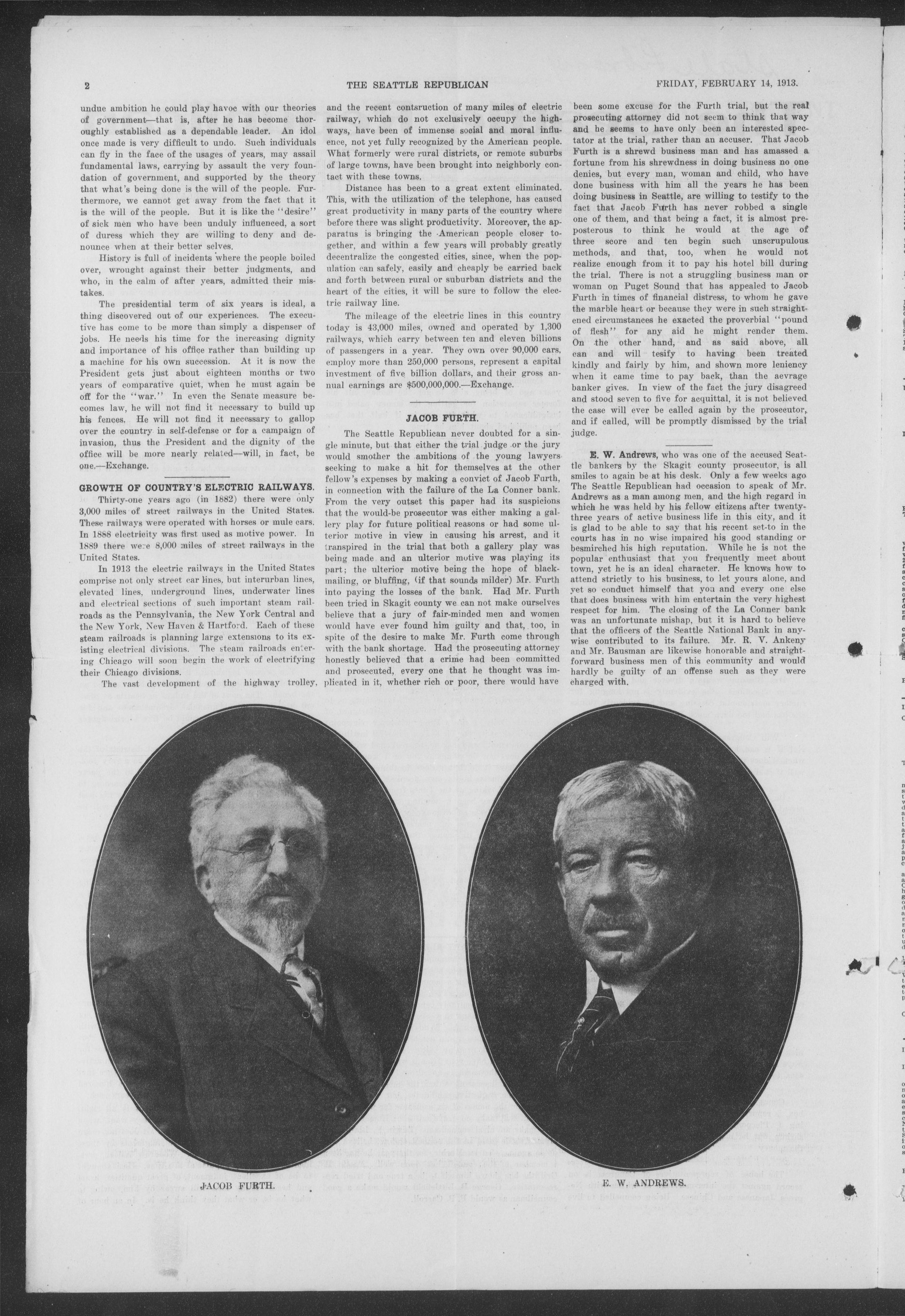
JACOB FURTH.
E. W. ANDREWS.
undue ambition he could play havoc with our theories of government—that is, after he has become thoroughly established as a dependable leader. An idol once made is very difficult to undo. Such individuals can fly in the face of the usages of years, may assail fundamental laws, carrying by assault the very foundation of government, and supported by the theory that what's being done is the will of the people. Furthermore, we cannot get away from the fact that it is the will of the people. But it is like the "desire" of sick men who have been unduly influenced, a sort of duress which they are willing to deny and denounce when at their better selves.
History is full of incidents where the people boiled over, wrought against their better judgments, and who, in the calm of after years, admitted their mistakes.
The presidential term of six years is ideal, a thing discovered out of our experiences. The executive has come to be more than simply a dispenser of jobs. He needs his time for the increasing dignity and importance of his office rather than building up a machine for his own succession. At it is now the President gets just about eighteen months or two years of comparative quiet, when he must again be off for the "war." In even the Senate measure becomes law, he will not find it necessary to build up his fences. He will not find it necessary to gallop over the country in self-defense or for a campaign of invasion, thus the President and the dignity of the office will be more nearly related—will, in fact, be one.—Exchange.
GROWTH OF COUNTRY'S ELECTRIC RAILWAYS.
Thirty-one years ago (in 1882) there were only 3,000 miles of street railways in the United States. These railways were operated with horses or mule cars. In 1888 electricity was first used as motive power. In 1889 there were 8,000 miles of street railways in the United States. In 1913 the electric railways in the United States comprise not only street car lines, but interurban lines, elevated lines, underground lines, underwater lines and electrical sections of such important steam railroads as the Pennsylvania, the New York Central and the New York, New Haven & Hartford. Each of these steam railroads is planning large extensions to its existing electrical divisions. The steam railroads entering Chicago will soon begin the work of electrifying their Chicago divisions.
The vast development of the highway trolley.
[Name]
JACOB FURTH.
THE SEATTLE REPUBLICAN and the recent construction of many miles of electric railway, which do not exclusively occupy the highways, have been of immense social and moral influence, not yet fully recognized by the American people. What formerly were rural districts, or remote suburbs of large towns, have been brought into neighborly contact with these towns.
Distance has been to a great extent eliminated. This, with the utilization of the telephone, has caused great productivity in many parts of the country where before there was slight productivity. Moreover, the apparatus is bringing the American people closer together, and within a few years will probably greatly decentralize the congested cities, since, when the population can safely, easily and cheaply be carried back and forth between rural or suburban districts and the heart of the cities, it will be sure to follow the electric railway line.
The mileage of the electric lines in this country today is 43,000 miles, owned and operated by 1,300 railways, which carry between ten and eleven billions of passengers in a year. They own over 90,000 cars, employ more than 250,000 persons, represent a capital investment of five billion dollars, and their gross annual earnings are $500,000,000.—Exchange.
JACOB FURTH
The Seattle Republican never doubted for a single minute, but that either the trial judge or the jury would smother the ambitions of the young lawyers seeking to make a hit for themselves at the other fellow's expenses by making a convict of Jacob Furth, in connection with the failure of the La Conner bank. From the very outset this paper had its suspicions that the would-be prosecutor was either making a gallery play for future political reasons or had some ulterior motive in view in causing his arrest, and it transpired in the trial that both a gallery play was being made and an ulterior motive was playing its part; the ulterior motive being the hope of blackmailing, or bluffing, (if that sounds milder) Mr. Furth into paying the losses of the bank. Had Mr. Furth been tried in Skagit county we can not make ourselves believe that a jury of fair-minded men and women would have ever found him guilty and that, too, in spite of the desire to make Mr. Furth come through with the bank shortage. Had the prosecuting attorney honestly believed that a crime had been committed and prosecuted, every one that he thought was implicated in it, whether rich or poor, there would have
FRIDAY, FEBRUARY 14, 1913.
been some excuse for the Furth trial, but the real prosecuting attorney did not seem to think that way and he seems to have only been an interested spectator at the trial, rather than an accuser. That Jacob Furth is a shrewd business man and has amassed a fortune from his shrewdness in doing business no one denies, but every man, woman and child, who have done business with him all the years he has been doing business in Seattle, are willing to testify to the fact that Jacob Furth has never robbed a single one of them, and that being a fact, it is almost preposterous to think he would at the age of three score and ten begin such unscrupulous methods, and that, too, when he would not realize enough from it to pay his hotel bill during the trial. There is not a struggling business man or woman on Puget Sound that has appealed to Jacob Furth in times of financial distress, to whom he gave the marble heart or because they were in such straightened circumstances he exacted the proverbial "pound of flesh" for any aid he might render them. On the other hand, and as said above, all can and will tesify to having been treated kindly and fairly by him, and shown more leniency when it came time to pay back, than the aevrage banker gives. In view of the fact the jury disagreed and stood seven to five for acquittal, it is not believed the case will ever be called again by the prosecutor, and if called, will be promptly dismissed by the trial judge.
E. W. Andrews, who was one of the accused Seattle bankers by the Skagit county prosecutor, is all smiles to again be at his desk. Only a few weeks ago The Seattle Republican had occasion to speak of Mr. Andrews as a man among men, and the high regard in which he was held by his fellow citizens after twenty-three years of active business life in this city, and it is glad to be able to say that his recent set-to in the courts has in no wise impaired his good standing or besmirched his high reputation. While he is not the popular enthusiast that you frequently meet about town, yet he is an ideal character. He knows how to attend strictly to his business, to let yours alone, and yet so conduct himself that you and every one else that does business with him entertain the very highest respect for him. The closing of the La Conner bank was an unfortunate mishap, but it is hard to believe that the officers of the Seattle National Bank in any wise contributed to its failure. Mr. R. V. Ankeny and Mr. Bausman are likewise honorable and straight-forward business men of this community and would hardly be guilty of an offense such as they were charged with.
[Name]
E. W. ANDREWS.
February IN THE SUPERIOR COURT OF THESarah Forstad, Plaintiff, vs. Ell Forstad, State of Washington, for the County Defendant. No. 90978.
FRIDAY, FEBRUARY 14, 1913.
IN THE SUPERIOR COURT OF THE
State of Washington in and for the
County of King—Publication of Summons.
Simon P. Boxler, plaintiff, vs. Stella P.
Boxler, defendant—No. 92377.
The State of Washington to the said
Stella P. Boxler, defendant:
You are hereby summoned to appear
within sixty (60) days after the date
of the first publication of this Summons,
to-wit: Within sixty days after the 31st
day of January, 1913, and defend the
above entitled action in the above
entitled court, and answer the complaint
of the plaintiff, and answer the
newer one to the undersigned attorneys
for the plaintiff at their office below
stated, and in case of your failure so to
do judgment will be rendered against
you according to the demands of said
complaint, which has been filed with the
Clerk of said court.
The object of the above entitled action
is to dissolve the bonds of matri-
mony existing between the plaintiff and
defendant.
BEECHLER & BATCHELOR.
P. O. address Suite 211, New York Blk., Seattle, King County, Washington. January 31—March 14, 1913.
Seattle, Washington, January 25, 1913. Notice is hereby given that the fourth Regular Annual Meeting of the stockholders of the Alaska Northern Railway Company will be held at the principal office of said Co. at 1216 of Alaska Building on Second Avenue, Seattle, King County, Washington, on Tuesday, the 11th day of March, A. D. 1912, at two o'clock in the afternoon of sald day.
JAMES A. HAIGHT
Secretary of Alaska Northern Railway Company.
January 31—February 28, 1913.
IN THE SUPERIOR COURT OF THE State of Washington for the County of King. Summons for publication for services on the defendants, E. J. Fallon, Hattie P. Pollock, May Jant and first National Bank of Southern Oregon, a national banking corporation.
Leopold M. Stern, plaintiff, vs. Mildred H. Cutler, and Fred G. Cutler, her husband; the First National Bank of Southern, Oregon a national bank affiliated with E. J. Fulcher, Ruthe, Joseph Ahern, W. E. Cox, National Bank of Commerce of Seattle, a national banking corporation; the General Hauling Company, a corporation; George Carson, Hattle P. Wolcott, and May Jahn, defendants.—A5—The State of Washington, County of King—ss.
To the said E. J. Fallon, Hattie P. Woolcott, and May Jahn; and First National Bank of Southern, Oregon, a national banking corporation;
You are hereby summoned to appear within the court of the first publication of this summons, towit, within sixty (60) days after the 27th day of December, 1912, and defend the above entitled action in the above entitled court, and answer the complaint of the plaintiff, and serve a copy of your answer upon the plaintiff, at their office below stated; and in case of your failure so to do, judgment will be rendered against you according to the demand of the complaint, which has been filled with the clerk of said court.
The object of this action is to foreclose mortgage, the following declarations, situation in King County, Washington:
Not Seven (7), in Block Eleven (11),
Capitol, addition, the City of
Detroit.
Attorney
Postoffice address: 714 Lowman Building, Seattle, King County, Wash.
Dec. 27, 1912—Feb. 6, 1913.
IN THE SUPERIOR COURT OF THE
State of Washington, for King County.
Osner, M. & Mehlhorn, Inc., Flauntin, Bemma,
her husband; Rachel Lowery, John Doe
Lowery, her husband; S. Kumasaki, F.
H. Moore, doing business as the Moore
Realty Co.; Burton E. Legg and D. M.
Schueth, Summa. No. 90508. Summa-
dation. Publication.
The State of Washington to the above name1 defendants, Rachel Lowery and John Doe Lowery, her husband; You, and each of you, are hereby summoned and required to appear within the first publication of this summons, towit, within sixty days after the 29th day of November, 1912, and defend the above entitled action in the above entitled court and answer to the request of your answer upon the undersigned attorney for plaintiff, at the address below stated, and in case of your failure so to do, judgment will be rendered against according to the demand of the compiler which has been filed with the compiler of this court.
The object of this action is to obtain a judgment in favor of the plaintiff, the defendant the said defendants, Coleman the defendant the Coleman, her husband, for the sum of $1,600.00, together with interest thereon at the rate of 8 per cent per annum from the 26th day of August, 1911, together with cost of disbursements and to foreclose that certain mortgage given by said defendants on the 26th day of August, 1910, to said plaintiff, to secure said amount, to the city of Seattle.
Lots 9, 10, 11, 12, 13, 14, 15, 16, 17,
18, 19 and 20. In Block 1:
Lot 1, Block 4, Map of Ellis' Addition
Chautauqua, all in King County.
Washington, and to foreclose and determine all right, title and interest of each and all of said defendants in and to said lands and premises, and every part thereof.
EDWARD VON TOBEL.
Attorney for Plaintiff.
Office and Post Office Address, 604-54
Mutual Life Building, Seattle, King County, Washington.
Nov. 29, 1912—Jane. 11, 1913.
IN THE SUPERIOR COURT OF The
State of Washington for King Coun-
sellors
ty. Notice
inventory of the estate of Whit-
field, F. Walker, Deceased—No. 15180.
In the matter of the estate field F. Walker, deceased—No. 15180. By order of F. Walker count made herein on the 11th day of February, 1913, notice is hereby given to the creditors of, and to all persons having claims against said deceased or against said estate, to present them with the necessary vouchers to the undersigned executrix of said estate at office, 484,409, New York Block, Washington, the place of business of said estate, in Seattle, in said county and state within one year from and after the date of first publication of this notice or same will be barred.
MARY ROMAUS,
RUSSELL L. FARRELL
Russell, R. For Estate
428, 428, New York Block, Seattle,
washington.
date of first publication, February
1951.
of King.—Summons by Publication. Helen H. Spence, plaintiff, vs. George F. Spence, defendant.—No. 92610. The State of Washington, to the said George F. Spence, defendant: You are hereby summoned to appear within sixty days after the date of the publication, the date of the towit, within sixty days after the 14th day of February, A. D. 1913, and defend the above entitled action in the above entitled Court, and answer the complaint of the plaintiff, and serve a copy of your answer upon the undersigned attorney for plaintiff at his office below stated. and judgment will be rendered against you according to the demand of the complaint, which has been filed with the Clerk of said Court. The object of the said action, set forth in the complaint, is as follows: To secure a decree absolutely severing the bonds of matrimony existing between the plaintiff and defendant, on the ground of non-support. WM. R. BELL. Attorney for Plaintiff.
P. O. address: 304 Lyon Building, Seattle, County of King, Washington
February 14-March 28, 1913.
IN THE SUPERIOR COURT OF THE
State of Washington for the County
of King.—In Probate—Notice of
Sale.
In the matter of the estate of Thos
K. Penginger. Deceased—No. 13719
K. Ensminger, Deceased—No. 13719.
Notice is hereby given, that pursuant to an order of the Court made in filed on the 11th day of February 1913, in said proceeding, the undersigned, executor and executrix of the last will and testament of Thos. K. Ensminger, deceased, will sell at private sale, for cash, the following described real estate, or so much thereof as may be necessary under said order of Court, to the West 7% of the North 1/2 of the Southeast 1/4 of the Northeast 1/4 of Section 5, Township 25 North, Range 4 East, W. M. Lots 1, 2, 3, 4, 5, 6 and 7 Block 94, D. Denny's First Addition to North Seattle;
Lot 12 Block 49, D. T. Denny's Third Addition to North Seattle;
Lots 7, 8, 9, 10, 11 and 12 Block 11, D. T. Denny's North Seattle Addition; All in King County, State of Washington;
And bids for the same, or any portion thereof, must be in writing and may be left at No. 320 Epler Building, Seattle, Washington; or delivered to the executor, Wm. F. Epler, or cutture, Katherine Ahlerson, perly, or may be filed in the office of the Clerk of said Court.
Said sale will be made on the 3rd day of March, 1913, or within six months thereafter. The undersigned reserve the right to appoint any or all bids. Said sale will be made subject to the confirmation of the Court.
Executrix.
Of the last will and testament of the Estate of Thos. K. Ens-
miger, deceased.
February 14—Feb. 28, 1913.
1913, at two o'clock in the afternoon of
IN THE SUPERIOR COURT OF THE
State of Washington, for King County.
Osner & Mehlorn, Inc. a corporation.
Plaintiffs, vs. W. W. Eggert, H.
D. Alison, Executive of the Estate of
Marie C. Eggert, deceased. H. D. Alison
and Elizabeth E. Allison, his
wife. Defendants. Summons by
Publication.
The State of Washington to the Above
W. W. Eggert; Defendant.
You are hereby summoned and required to appear within sixty days from the date of the first publication of this summons, to-wit: within sixty days from the 7th day of February, 1918, and defend the above entitled answer answer the complaint of the plaintiff and serve a copy of your answer upon the undersigned attorney for plaintiff, at the address below stated, and in case of your failure so to do, judgment will be rendered against you according to the demand of the complaint, as been filed in this court. The object of this action is to recover judgment against the defendant W. W. Eggert for the sum of $5,000 and foreclose a certain mortgage given by the said W. W. Eggert and Marie C. Eggert, his wife, on the 24th day of August, 1908 to secure the sale of $5,000,000 with interest per cent per cent together with attorney's fees, costs and disbursements, upon lots 7, and 8. block 2, of Flint's Addition to the city of Seattle, King county, Washington, and to foreclose and determine all of said defendants in and to said lands and premises and every part
IN THE SUPERIOR COURT OF THE
State of Washington, in the County
of King. In Probate.
In the Matter of the Estate of Frederick
Carlson, Deceased. No. 2,549. Order
Fixing. How Final Account and
Show Cause Why Distribution
Should Not Be Made.
August Sandgren, administrator of the
estate of Frederick Carlson, deceased.
having filed in this court the final
count. How Cause Why forth that
estate is now in a condition to be
closed and is ready for distribution
of the residue thereof among the persons
certified by law thereto, and it appearing
to the court that said petition sets forth
facts sufficient to attribute
distribution of said estate:
It is further ordered by the court that all persons interested in the estate of the said Frederick Carlson, deceased, be and appear before the said Superior Court of King County, State of Winston, and appear before the said Pro- Department of said court in Seattle, Washington, on the 3rd day of March, 1913, at the hour of 9:30 o'clock a. m. of said day, then and there to show cause, if any they have, why said final account should not be allowed, and order of district made of the estate of said estate among the heirs said persons in said petition mentioned, according to law.
It is further ordered, that a copy of this order be posted in three of the most public places in King County, most period of time in which said hearing was published, once a week for four consecutive weeks before the said 3rd day of March, 1913, in The Seattle Republic, a newspaper printed and published in said King County and of general circulation therein.
Done in open court this 30th day of
IN THE SUPERIOR COURT OF THE State of Washington in and for the County of King. Summons for Public
THE SEATTLE REPUBLICAN
The State of Washington, to the said Eli Forstad, Defendant:
You are hereby summoned to appear within sixty (60) days after the date of the first publication of this summons, to-wit: Within sixty days, after the 6th day of December, 1912, and defend the above entitled action in the above filed court and answer the complaint of the plaintiff, and serve a copy of your answer upon the undersigned attorney for plaintiff at his office below stated; and in case of your failure so to do, judgment will be renderé against you according to the demand of the complaint, and been filed with the office of said court.
The object of the above entitled action is to secure an absolute decree of divorce on the grounds of desertion and abandonment.
H. M. DALTON,
Attorney for Plaintiff.
Office and P. O. Address, 611 Mutual Life Block, Seattle, King County, Wash.
December 6—January 17.
IN THE SUPERIOR COURT OF THE
State of Washington in and for the
County of King. Summons for Publication.
Thomas E. Tague, Plaintiff, vs. Jannette
Tague, Defendant.
The State of Washington, to the said
Jannette Tague, Defendant:
You are hereby summoned to appear
within sixty (60) days after the date
of the first publication of this summe-
ture, and answer the 1st day of January, 1913, and defend the above entitled action in the
above entitled court, and answer the
complaint of the plaintiff, and serve a
copy of your answer upon the under-
signed attorney for your defense.
Be bound and in case of your
failure so to do, judgment will be rendered against you according to the demand of the complaint, which has been
filed with the clerk of said court.
The object of the above entitled action
is secure in the interest of a divorce
on the ground of desertion and abandon-
ment.
OLIVER ANDERSON.
Attorney for Plaintiff.
Office and P. O. Address: 414 17 Mutual
Life Bldg., Seattle, King County, Wn.
IN THE SUPERIOR COURT OF THE
State of Washington for King Coun-
lor
In the Matter of the Estate of Selma Detlofsen, deceased.-No. 14905. Notice is hereby given to the creditors of, and all persons having claims against the said deceased, or her estate, and the community estate of her deceased, to present the same, with the necessary vouchers to the undersigned administrator of said estate at the office of Edward Von Tobel, 604 Mutual Life Building, Seattle, King County, Washington, the same being the place of the transaction, one year from the date of the first publication of this notice, to-wit: within one year from the 3rd day of January, 1913.
Dated this 3rd day of January, 1913.
MARTIN DETLOFSON,
Administrator of the Estate of Selma
Detlofsen, Deceased.
Office Address: the address, 604-5
Mutual Life Building, Seattle, King
County, Washington.
January 3—February 3, 1913.
IN THE SUPERIOR COURT OF THE
State of Washington, for King County,
In Probate, Notice to Creditors.
In the Matter of the Estate of Charles Kloppenberg, deceased.—No. 14906.
Notice is hereby given to the creditors of, and all persons having claims against the estate for business or assistance to present the same, with the necessary vouchers to the undersigned administrator of said estate at the office of Edward Von Tobel, 604 Mutual Life Building, Seattle, King County, Washington, the same being the place of the residence of business or assistance within one year from the date of the first publication of this notice, to-wit, within one year from the 3rd day of January, 1913.
M. SCHULZ,
Administrator of the Estate of Charles Kloppenberg, Deceased.
Office and postoffice address, 604-5 Mutual Life Bldg., Seattle, King County, Wash.
January 3—February 3, 1913.
JUSTICE'S COURT, BEFORE JOHN E. for Seattle Precinct, King County, Carroll, Justice of the Peace in and State of Washington. Summons for Publication.
H. Besbakes, plaintiff, vs. Peter Savas, also known as P. Shekrekes, defend-and—No. 25524-25. State of Washington, County of King—ss.
The State of Washington to Peter Savas, also known as P. Shekrekens, defendant herein: You, and each of you, are hereby named that against you in said court, which will come on to be heard at my office in room 602 Prefontaine Building, Seattle, King County, Washington, on the 31st day of January, A. D. 1913, at the hour of 9:30 o'clock a.m., and unless you appear, and then you may confess and the demand of the plaintiff granted. The object and demand of said complaint and action is to recover judgment for forty ($40.00) dollars and costs, being money loaned to defendant by the plaintiff.
Filed December 9th, A. D. 1912.
JOHN E. CARROLL
JOHN E. CARROLL,
Justice of the Peace in and for Seattle
Precinct, King County, Wash.
Dec. 27, 1912-Jan. 17, 1913.
SUMMONS FOR PUBLICATION.
JUSTICE'S COURT.
Before John E. Carroll, Justice of the Peace in and for Seattle Precinct, King County, State of Washington.
National Grocery Company, a corporation, plaintiff, vs. S. B. Householder and A. Miller, copartners doing business as Householder & Miller, defendants.—No. 26046.
State of Washington County of King, ss.
The State of Washington to S. B. Householder and A. Miller:
You, and each of you, are hereby notified that National Grocery Company has filed a complaint against you in said Court, which will be heard by a jury in Room 602 Prefontain Bldg, Seattle, King County, Washington, on the 3rd day of March, A. D., 1913, at the hour of 9:30, A. M., and unless you appear, and then and there answer, the same will be taken as confessed and the demand of the plaintiff granted. The object and demand of a complaint against you, and the merchandise sold and delivered of value of $50.43, with interest and costs.
Filed January 11, A. D., 1913.
JOHN E. CARROLL
Justice of the Peace in and for
Seattle Precinct, King County,
Wash.
February 10, 1913
January 31—February 28, 1913.
IN THE SUPERIOR COURT OF THE
State of Washington, for King County.
Jennie Nicholas, Plaintiff, vs. John
Nicholas, Defendant. No. 91825. Sum-
The Seattle Republican
---
$2 PER YEAR
For All
1913
The State of Washington, to John Nicholas, defendant above named;
You are hereby summoned to appear within sixty (60) days after the date of the first publication of this summons, to-wit; within sixty days after the 3rd day of January, 1913, and defend the above entitled action in the above enclosed plaintiff and serve a copy of your answer upon the undersigned attorney for plaintiff at his office below stated; and in case of your failure so to do, judgment will be rendered against you according to the demands of the complaint of the plaintiff and be filed with the clerk of said court.
The object of this action is to obtain a decree of divorce dissolving the bonds of matrimony existing between the plaintiff and defendant; for the custody by plaintiff of their minor children, and to have certain property belonging to plaintiff and defendant or to defendant awarded to plaintiff as her sole and separate property and estate; for judgment against the defendant for moneys expended by the plaintiff in the maintenance of their minor children; for suit and court arrears fees; for other relief if the court may deem proper. C. A. RIDDLE.
Attorney for Plaintiff.
Office and Postoffice Address: Suite 655
Colman Building, Seattle, Washington.
January 3—February 14, 1913.
IN JUSTICE COURT, BEFORE JOHN
E. Carroll, Justice of the Peace in and
for Seattle Precinct, King County,
Washington.
Nick Doucas, Plaintiff, vs. Anglos Paramatzis, sometimes known as Anglos
Parmagis and Angelus Pallus, Defendant.
State of Washington: To Anglos Paramatizis, sometimes known as Anglos Paramagis and Angelus Pallus, Defendant.
In name of the State of Washington, you are hereby notified that Nick Doucas has filed a notice and complaint against you in said court above named, which will come on to be heard at my office in Seattle, in King County, State Washington, of the City of Paley, A. D. 1913, at the hour of 9:30 o'clock a. m., and unless you appear and then and there answer the same, judgment will be taken as confessed, and the demand of the plaintiff granted. Washington, of the City of Paley, a complaint is to recover the sum of Ninety-nine 50-100 ($99.50) Dollars, for merchandise sold and delivered to the said defendant.
Complaint filed December 11th, A. D. 1912.
January 3—January 24, 1913
IN THE SUPERIOR COURT OF the State of Washington, for King County
You are hereby summoned to appear within sixty (60) days after the date of the first publication of this summons, to-wit, within sixty days after the 10th day of January, 1913, and defend the above entitled action in the above entitled court, and answer the complaint to do and answer and copy of your answer upon the undersigned Attorney for Plaintiff, at his office below stated; and in case of your failure so to do, judgment will be rendered against you according to the prayer of the complaint which has been filed with the Clerk of said court. The order of the above entitled action is to obtain a decree in favor of the plaintiff and against the defendant, dissolving and annulling the bonds of matrimony existing between them, and that the plaintiff have a decree of divorce from the defendant, and that plaintiff have the care and care of his wife and cover her costs, and for such other and further general orders as may be just and equitable, and for general relief.
JAMES M. GEPHART,
Attorney for Plaintiff.
Postiffice and Office Acreess, 502 Baldwin Building and 222 Washington.
January 19, February 21, 1913.
January 10—February 24, 1916.
3
IN THE SUPERIOR COURT OF THE
State of Washington, for King County.
In Probate.
In the Matter of the Estate of Francis
A. Plank, Deceased. No. 14934. Notice to
Creditors.
By notice of said court made herein
on the 3rd day of January, 1913, notice
is hereby given to the creditors of, and
to all persons having claims against
said deceased or against said estate, to
present them with the necessary vouchers
to the undersigned administratrix of
said estate, at Suite 211 New York
Block, Seattle, Washington, the place
of business of said estate. in Seattle,
in hold of any said state, within one
year from and after the date of first
publication of this notice or same will
be barred.
Date of first publication Jan. 10, 1913.
FRANCIS PLANK.
As Administratrix of said Estate.
BEECHED by the Honorable and Trust Company for Estate.
211 New York Block, Seattle, Wash.
January 10—February 7, 1913.
STOCKHOLDERS ANNUAL MEETING.
The annual meeting of the stockholder-
y company will be held in the office of said
company in the Northern Bank & Trust Building in the City of Seattle
on the 15th day of January, 1913, at
p. m., for the purpose of electing
directors, and for the transaction
of such other business as may be bought
before said meeting.
The stock transfer books will be
closed at 5 p. m., January 10, 1913, and
remain closed until 10 a. m., January
6, 1913.
IN THE SUPERIOR COURT OF THE
State of Washington, in and for the
County of King.
In the Matter of the Estate of Amelia
Cordes, Deceased. No. — Notice.
Notice is hereby given, that pursuant
to an order of the court made and en-
tered on the 7th day of January, 1913,
in the above ordinance, proceeding
the undersigned administrator of the said
estate, will sell at private sale to the
highest bidder for cash, all of the
household furniture belonging to the
said estate located and situated at 621
Warren Street, Seattle, Washington.
The said bids are to be filed with the
admiral of the navy, at 605
New York Block, Seattle, King County.
Washington, accompanied by a certified
check for the purchase of said house-
hold furniture. The said bids will be
opened at the hour of ten o'clock in
the forenoon, on the 27th day of Janu-
ary, 1913. The said sale will be made
subject to confirmation by the Court.
Dated this Tuesday, 1913.
RAYMOND CORDES.
Administrator of the Estate of Amelia
Cordes.
REVELLE, REVELLE & REVELLE,
Attorney for Administrator,
605 New York Block, Seattle, Wn.
January 10—January 21, 1913.
In the Superior Court of the State of
Washington, in and for the County
of King.
In the Matter of the Estate of Francis
A. Plank, Deceased. No. 14934. Notice.
To the administratrix, heirs, legatees,
devises, creditors and all others interest
in the estate of Francis A. Plank,
late of King County, State of
Washington:
You and each of you are hereby notified
that the following order has been
entered by the Superior Court of the
State of Washington in and for the
County of King County.
On reading and filing the petition of
A. C. Wiess and Edna O. Weiss, his
wife, praying for an order of this Court
directing the administratrix of the
above named estate to complete the
agreement of her decedent, by executing
to said petitioners a deed of that
county real property situated in King
County of Washington and described
as follows to wit:
Lot Eleven (11) in Block One (1) of Harrison Heights Addition to the City of Seattle.
"It is hereby ordered that 9:30 a. m. on the 04th day of February, 1913, be and the same is appointed the time, and the Court Room of the above entitled Court, Department No. 7 thereof as the place for the hearing of said petition.
"It is hereby ordered that notice of said hearing be given in the Seattle Room of the newspaper published in the County of King, and State of Washington for at least four (4) weeks before said hearing.
"It is hereby ordered that notice of said hearing be served upon the administrator of said estate by delivering to her a copy of said notice, together with copy of the petition filed herein at least four (4) weeks before said hearing.
"Done in open Court this 3rd day of January, 1913.
(Signed) A. W. FRATER, Judge."
You will therefore take due notice of the same.
A. C. WEISS.
EDNA O. WEISS.
Petitioners.
January 10—February 7, 1913.
IN THE SUPERIOR COURT OF THE State of Washington in and for King County. Summons for Publication. Northern Bank & Trust Co., a corporation, plaintiff, vs. Harry Davies also, Harry Brynsold, his wife, whose true Christian name is unknown, defendants.—No. 91519. State of Washington to the said defendants Harry Davies and Oliver Brynsold and John D. Brynsold, his whose true Christian name is unknown, defendants:
You and each of you are hereby summoned to be and appear within sixty days after the service of this summons upon you by publication, exerted within sixty days after the o-wit, within sixty days after the 17th day of January, 1913, and defend the above entitled action in the above entitled court and answer the complaint of the plaintiff, and serve a copy of your answer to the undersigned amends for the plaintiff at the office below stated, and in case of your failure so to do judgment will be rendered against you according to the demands of the plaintiff's complaint which is on file with the clerk of said The Court. The Court will recover judgment against you in the sum of one hundred and fifty dollars ($150.00) together with interest from the 31st day of July, 1912, at the rate of 12 per cent per annum, and twenty-five per cent per annum, and the plaintiff's costs in this action, a writ of attachment having issued out of this cause and court and all your right, title and interest in and to lot 7, block 10, B. F. Day's First Addition, block 10, B. F. Day's First Addition, Fillham City Addition to the Seattle Division No. 1, attached thereunder.
F. J. CARVER & JOHN SLATTERY,
Attorneys, for Plaintiff
HERE IS A MONEY SAVER
If you are an attorney and have legal notices for publication it will be to your advantage financially and otherwise to get the prices of The Seattle Republican before sending your notices out.
The Seattle Republican has been in the notice publishing business for the past twenty years and it knows how to take care of notices for attorneys, so as to cause them no annoyance.
It is always prompt in making its proof of publication, thus preventing you from being delayed when you are ready for court, which means much to the busy man.
The office is centrally located, which enables it to take notices as late as Friday noon, and being a Friday publication, gives the attorney one week over the Saturday publication and at the same time takes notices just as late as the Saturday publication.
THE SEATTLE REPUBLICAN
Office 422 Epler Block. Telephone Main 305.
FEDERAL JOBS TO FILL.
The sad story of the disappointed office seeker is about to be repeated once more at Washington. Many think they are called but few can be chosen. Their hunger for place, pelf and dignity, rendered keen by reading that the Government employs 411,322 persons exclusive of enlisted men and officers of the Army and Navy, hosts swarm to the capital and wait many weary weeks until their funds are exhausted and they disconsolately obtain the loan of enough money to take them home, according to the Portland Oregonian.
In truth, the President has power to appoint only 10,839 Federal officials, of whom 9,846 must be confirmed by the senate. All the rest are appointed under the civil service law or by the superior officers. The payroll of Presidential appointees, however, is about $30,000,000 a year and includes all the fat plums on the Government tree. First to be appointed are the nine Cabinet members with $12,000 apiece, then thirty-two members of various commissions, ranging from $3,500 to $4,000 each for the Civil Service Commissioners up to $14,000 to $15,000 for the Panama Canal Commissioners. Then come the assistant secretaries, solicitors and heads of bureaus in each department with salaries ranging from $10,000 down to $2,000. There are a number of commissionerships, dealing with boundaries, waterways, fisheries, claims, international arbitration and various subjects, which pay from $4,000 to $8000 each.
The most lucrative positions in point of salary are the ten foreign ambassadorships at $17,500 each, but their incumbents are required to spend so much money in order to uphold the dignity of the country on the scale set by other embassies that none but millionaires can afford to accept the posts, and these must be content with glory as compensation. Then comes eight ministers to foreign countries at $12,000 each, and twenty-eight at $10,000 each, says the Oregonian. There follow about sixty-five Consuls-General who draw from $4,500 to $12,000, the highest figure being paid only at London and Paris, and 241 other Consuls at from $2,000 to $8,000 each.
The largest number of Government employees is in the Postoffice Department, namely 272,813, but only 7,953 of these are appointed by the President. The four assistants to the Postmaster-General and the Assistant Attorney-General get $5,000 each. Then comes the postmasters of the first three classes with salaries of $5,000 to $8,000 for the first class, $3,000 to $5,000 for the second class and $1,000 to $3,000 for the third class. Next in line comes the Treasury with 736 Presidential appointees, including 122 collectors of customs ranging from $12,000 at New York to a few dollars in fees at decayed ports, sixty-seven internal revenue collectors at $4,500 each, 242 revenue cutter officers at $2,200 to $4,000; 132 health officers at $1,600 to $5,000 and twenty-six mint and assay officers at $2,500 to $5,000. Then comes the State Department with 441 positions, Justice with 383, Interior with 272. There are but few in the other departments—twenty-eight in Commerce and Labor, eleven in Navy, six in War and three in Agriculture.
The Department of Justice has many fat offices, but the thirty-four circuit judges at $7,000 each and the ninety-nine district judges at $6,000 each hold office for life, provided they behave better than Archbald did. There are, however, eighty-six district attorneys at $2,000 to $10,000 and as many marshals at $2,000 to $5,000 aside from the Solicitor-General at $10,000 and the assistants to that official and to the Attorney-General at $3,000 to $7,000.
The island possessions offer some good opportunities. The Governor of the Philippines receives $20,000, the heads of departments $15,500 each and the other commissioners $7,500 each. The Governors of Hawaii and Porto Rico are paid $7,000 and $8,000 respectively. Guam and the Samoan Islands are governed by naval officers appointed by the President.
Had Congress adopted Taft's recommendation that all subordinate offices except heads of departments and bureaus and their immediate assistants be placed under civil service rules, Wilson might have had occasion to give him fervent thanks before the new President had stood siege from the hungry army for a single month.
STRANGE BUT TRUE.
There were more business failures in 1912 than there has been since 1896 and 1898 and yet the increase in business for the year was greater than in the history of the country.
The banks of India have $75,000,000 tied up in the opium drug that at present is a drag on the market and the prospects are favorable of them losing the entire amount. In the past China took all of the
THE SEATTLE REPUBLICAN
If you are an attorney and have to your advantage financially and other Republican before sending your notices.
The Seattle Republican has been the past twenty years and it knows how so as to cause them no annoyance.
It is always prompt in making it you from being delayed when you are to the busy man.
The office is centrally located, where Friday noon, and being a Friday public the Saturday publication and at the same Saturday publication.
THE SEATTLE
opium India could produce, but China no longer permits the importation of the drug in the country and India herself is curtailing the use of it.
New York City is hoping to have the legislature of that state pass a law that will make it a felony carrying with it a penalty of seven years in the penitentiary for a druggist to sell cocaine only in a limited quantity and never to refill a prescription. The purchaser in whose possession the drug is found contrary to the law will likewise draw a seven-year sentence in the state penitentiary.
Under the regulations of the "Unfair Law" in Germany an English physician, who settled in Germany and advertised he could cure rheumatism and did it, was legally banished from the country because he could do something that other physicians did not seem to be able to do, and his success was unfair to the other physicians. In other words, your talent must not be used if it is superior in any way to the other fellow.
The Kaiser of Germany is said to have a mania for building statues on vacant lots, while the Kaiserine has an equal mania for building churches. The former takes to idolizing man, whis his better half takes to idolizing God.
SEATTLE THEATRE
"The Wolf," an intensely fascinating play of the Canadian Northwest, by Eugene Walter, author of "Paid in Full," and other successes, is the offering of the popular Bailey-Mitchell plays at the Seattle
CHARLES MARBLE
CANDIDATE FOR
RE-ELECTION AS
COUNCILMAN
Edwin L. Blaine
CANDIDATE FOR
RE-ELECTION
CITY COUNCIL
HOMER M. HILL
CANDIDATE FOR
COUNCILMAN
BONNEY-WATSON COMPANY
UNDERTAKERS
Preparing bodies for shipment a specialty. All
orders by telephone or telegraph promptly at-
tended to. Telephone East 13
PACIFIC COAST COAL CO.
MAIN 8040
Seattle Washington
PUGET SOUND TRACTION COMPANY
CARBON LAMPS ARE SUPPLIED FREE
to consumers of our current
ELECTRIC BUILDING
Seventh Avenue and Olive Street
---
---
legal notices for publication it will
otherwise to get the prices of The Seattle
out.
in the notice publishing business for
to take care of notices for attorneys,
proof of publication, thus preventing
ready for court, which means much
which enables it to take notices as late as
ation, gives the attorney one week over
the time takes notices just as late as the
REPUBLICAN
Theatre for one week, commencing Monday night, February 17th. The first act of this play, unusual though it is in its writing, at first seems to contain the dear old familiar characters that fall together in the old familiar way, from sheer force of habit. But—and here take notice—they don't There is the country girl and the American railroad surveyor, offering the girl's father a "look in" on the right-of-way and a chance to make a fortune if he would favor his suit. There is the French-Canadian lover of the girl and the French-Canadian voyager, whose sweetheart has been ruined by the villainous railroad man. It would have been easy for these people to have moved across the stage and slipped into the grooves of the commonplace. But, as has been said, they don't. They work out the story with an eye to effect and at the same time with an eye to truth.
EMPRESS THEATRE
Next week's bill will be as follows: The Romany Opera Company, 12 operatic stars. Nat. Carr & Co., presenting "The End of the World." The Four Philippinos, instrumentalists. Hilda Gylder, late song hits. Wallace Calvin, magical manipulator. Knapp & Cornelia, grotesque jesters. Twilight Pictures.
Empress Notes: Next week's Empress offering will feature The Romany Opera Company of ten people, all possessed of remarkable voices. This aggregation has been over the time before, and those who recall their very pleasing offering will not miss seeing and hearing them again.
"To the end of the world" with Nat. Carr, will be a pleasure trip that none will miss, for the offering is one of the biggest screams in vaudeville. The act has been a big hit in less competent hands than Nat Car's. With Carr in the titular role, the act has been improved 100 per cent. Nat Carr is the forced to make a speech at almost every performance, so insistent were the audience for more of his dry and subtle humor.
The Four Philippines will offer a picturesque and entertaining instrumental act.
Bob Knapp and Chris Cornalla, two grotesque jesters and acrobats, will cause many a flurry from the laugh factory during their offering.
Hilda Gylder, who will offer a series of syncopated hits, is a prepossessing young woman, with lots of talent. Wallace Galvin, a card manipulator, one of the best in this particular line of work, will pull some good ones during the week he plays the Empress.
AT THE ORPHEUM
Next week the following will be the program at the Orpheum Theatre: William Rock and Maude Fulton, spectacular songs and dances; favorites in vaudeville on two continents. Jean Bedini and Roy Arthur, the famous jovial jugglers. Kuerro and Carmen, a European duo of violin and harp artists. Three Melvin Brothers, sensational gymnasts. Seattle is their home! Hugh J. Emmett and Mildred Emmett, a novel musical and ventriloquial act. The Jordan Girls, a comely trio of wire walkers. Claude Golden, Australia's latest importation. World's Events in Motion Pictures. Coming: Digby Bell, famous comic opera comedian.
```markdown
```
FRIDAY, FEBRUARY 14, 1913