Sedalia Weekly Conservator
Friday, May 8, 1903
Sedalia, Missouri
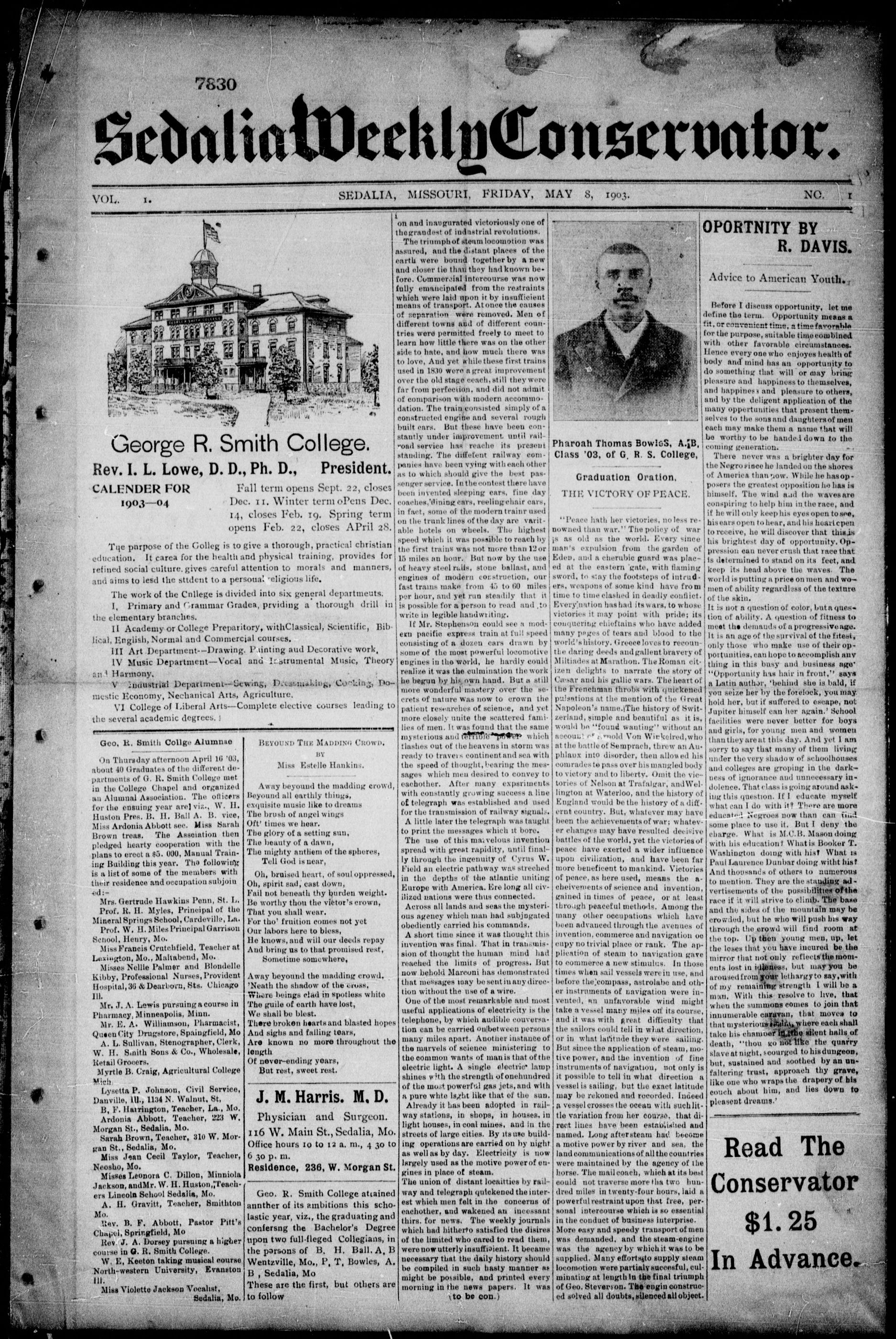

Page text (machine-generated)
SedaliaWeeklyConservator.
GEORGE M. SMITH COLLEGE
The purpose of the College is to give a thorough, practical christian education. It carea for the health and physical training, provides for refined social culture, gives careful attention to morals and manners, and aims to lessd the student to a personal religious life.
The work of the College is divided into six general departments:
I. Primary and Grammar Gradea, providing a thorough drill in the elementary branches.
II. Academy or College Preparitory, with Classical, Scientific, Biblical, English, Normal and Commercial courses.
III. Art Department—Drawing, Painting and Decorative work.
IV. Music Department—Vocal and Instrumental Music, Theory and Harmony.
V. Industrial Department—Sewing, Dressmaking, Cooking, Domestic Economy, Mechanical Arts, Agriculture.
VI. College of Liberal Arts—Complete elective courses leading to the several academic degrees.
VOL. 1.
George R. Sn
Rev. I. L. Lowe, D. D.
CALENDER FOR
1903—04
The purpose of the College is to education. It carea for the health and refined social culture, gives careful and aims to lessd the stdtudent to a per
The work of the College is divi
I, Primary and Grammar Gr
the elementary branches.
II Academy or College Prepar
lical, English, Normal and Commerc
III Art Department—Drawing
IV Music Department—Vocal
and Harmony.
V Industrial Department—Sem
estic Economy, Nechanical Arts,
VI College of Liberal Arts—C
the several academic degrees.
Geo, R. Smith Collge Alumnae
On Thursday afternoon April 16 2003, about 40 Graduates of the different departments of G. R. Smith College met in the College Chapel and organized an Alumnal Association. The officers for the ensuing year are] viz., W. H. Huston Pres. B. H. Ball A. B. vice, Miss Ardonia Abbott see. Miss Sarah Brown treas. The Association then pledged hearty cooperation with the plans to erect a $5.000, Manual Training Building this year. The following is a list of some of the members with their residence and occupation subjoined:- Mrs. Gertrude Hawkins Penn, St. L. Prof. R. H. Myles, Principal of the Mineral Springs School, Cardeville, La.
Miss Francis Crutchfield, Teacher at Lexington, Mo., Maltabend, Mo.
Misses Nellie Palmer and Blondelle Kibby, Professional Nurses, Provident Hospital, 36 & Dearborn, Sts. Chicago Ill.
Mr. J. A. Lewis pursuing a course in Pharmacy, Minneapolis, Minn.
Mr. E. A. Williamson, Pharmacist, Queen City Drugstore, Spaingfield, Mo A. L. Sullivan, Stenographer, Clerk, W. H. Smith Sons & Co., Wholesale, Retail Grocers.
Myrtle B. Craig, Agricultural College Mich.
Lysetta P. Johnson, Civil Service, Danville, Ill., 1134 N. Walnut, St,
B, F. Harrington, Teacher, La., Mo.
Ardonia Abbott, Teacher, 223 W. Morgan St., Sedalia, Mo.
Sarah Brown, Teacher, 310 W. Morgan St., Sedalia, Mo.
Miss Jean Cecil Taylor, Teacher, Neosho, Mo.
Misses Leonora C. Dillon, Minniola Jackson, and Mr. W. H. Huston,"Teachers Lincoln School Sedalia, Mo.
A. H. Gravitt, Teacher, Smithton Mo.
Rev. B. F. Abbott, Pastor Pitt's Chancel, Springfield, Mo
W. E, Keeton taking musical course North-western University, Evanston Ill.
Miss Violette Jackson Vocalist,
Sedalia, Mo.
SEDALIA, MISSOURI, FRIDAY, MAY 8, 1903.
Fall term opens Sept. 22, closes Dec. 11. Winter term oPens Dec. 14, closes Feb. 19. Spring term opens Feb. 22, closes APril 28.
to give a thorough, practical christian health and physical training, provides for careful attention to morals and manners, a personal religious life.
divided into six general departments.
Gradea, priving a thorough drill in
separatory, withClassical, Scientific, Bib-
mercial courses.
Sewing, Painting and Decorative work.
Local and Instrumental Music, Theory
—Sewing, Dressmaking, Cooking, Do-
rts, Agriculture.
—Complete elective courses leading to
BEYOUND THE MADDING CROWD.
BY
Miss Estelle Hankins.
Away beyound the madding crowd,
Beyound all earthly things,
exquisite music like to dreams
The brush of angel wings
Oft' times we hear.
The glory of a setting sun,
The beauty of a dawn,
The mighty antiem of the spheres,
Tell God is near,
Oh, bruised heart, of soul oppressed,
Oh, spirit sad, cast down,
Fail not beneath thy burden weight.
Be worthy thou the victor's crown,
That you shall wear.
For tho' fruition comes not yet
Our labors here to bless,
He knows, and will our deeds repay
And bring us to that promised rest,
Sometimes somewhere.
Away beyound the madding crowd,
'Neath the shadow of the cross,
Where beings clad in spotless white
The guile of earth have lost,
We shall be blest.
There broken hearts and blasted hopes
And sighs and falling tears,
Are known no more throughout the
length
Of never-ending years, But rest, sweet rest.
J. M. Harris. M. D.
Physician and Surgeon. 116 W. Main St., Sedalia, Mo. Office hours 10 to 12 a. m., 4 30 to 6 30 p. m.
Residence, 236, W. Morgan St.
Geo. R. Smith College attained annther of its ambitions this scholastic year, viz., the graduating and confersng the Bachelor's Degree upon two full-fledged Collegians, in the persons of B. H. Ball. A. B Wentzville, Mo., P. T. Bowles, A. B, Sedalia, Mo
These are the first, but others are to follow
on and inaugurated victoriously one of the grandest of industrial revolutions. The triumph of steam locomotion was assured, and the distant places of the earth were bound together by a new and closer tie than they had known before. Commercial intercourse was now fully emancipated from the restraints which were laid upon it by insufficient means of transport. At once the causes of separation were removed. Men of different towns and of different countries were permitted freely to meet to learn how little there was on the other side to hate, and how much there was to love. And yet while these first trains used in 1830 were a great improvement over the old stage coach, still they were far from perfection, and did not admit of comparison with modern accommodation. The train consisted simply of a constructed engine and several rough built cars. But these have been constantly under improvement until railroad service has reache its present standing. The different railway companies have been vying with each other as to which should give the best passenger service. In the contest there have been invented sleeping cars, fine day coaches, dining cars, reeling chair cars, in fact, some of the modern trainr used on the trunk lines of the day are variable hotels on wheels. The highest speed which it was possible to reach by the first trains was not more than 12 or 15 miles an hour. But now by the use of heavy steel rails, stone ballast, and engines of modern construction, our fast trains make from 45 to 60 miles per hour, and yet run steadily that it is possible for a person to read and to write in legible handwriting.
If Mr. Stephenson could see a modern pacific express train at full speed consisting of a dozen cars drawn by some of the most powerful locomotive engines in the world, he hardly could realize it was the culmination the work he begun by his own hand. But a still more wonderful mastery over the secrets of nature was now to crown the patient researches of science, and yet more closely unite the scattered families of men. It was found that the same mysterious and terrible power which flashes out of the heavens in storm was ready to traverse continent and sea with the speed of thought, bearing the messages which men desired to convey to eachother. After many experiments with constantly growing success a line of telegraph was established and used for the transmission of railway signals. A little later the telegraph was taught to print the messages which it bore.
The use of this marvelous invention spread with great rapidity, until finally through the ingenuity of Cyrus W. Field an electric pathway was streched in the depths of the Atlantic uniting Europe with America. Ere long all civilized nations were thus connected. Across all lands and seas the mysterious agency which man had subjugated obediently carried his commands. A short time since it was thought this invention was final. That in transmission of thought the human mind had reached the limits of progress. But now behold Marconi has demonstrated that messages may be sent in any direction without the use of a wire.
One of the most remarkable and most useful applications of electricity is the telephone, by which audible conversation can be carried on between persons many miles apart. Another instance of the marvels of science ministering to the common wants of man is that of the electric light. A single electric lamp shines with the strength of one hundred of the most powerful gas jets, and with a pure white light like that of the sun. Already it has been adopted in railway stations, in shops, in houses, in light houses, in coal mines, and in the streets of large cities. By its use building operations are carried on by night as well as by day. Electricity is now largely used as the motive power of engines in place of steam.
The union of distant localities by railway and telegraph quickened the interest which men felt in the concerns of eachother, and wakened an incessant thirs, for news. The weekly journals which had hitherto satisfied the disires of the limited who cared to read them, were now utterly insufficient. It became necessary that the daily history should be compiled in such hasty manner as might be possible, and printed every morning in the news papers. It was (to be con.)
M. B.
Pharoah Thomas Bowls, A. B. Class '03, of G. R. S. College,
"Peace hath her victories, no less renowned than war." The policy of wars as old as the world. Every since man's expulsion from the garden of Eden, and a cherubic guard was placed at the eastern gate, with flaming sword, to stay the footsteps of intruders, weapons of some kind have from time to time clashed in deadly conflict. Every nation has had its wars, to whose victories it may point with pride; its conquering chieftains who have added many pages of tears and blood to the world's history. Greece loves to recount the daring deeds and gallent bravery of Miltiades at Marathon. The Roman citizen delights to narrate the story of Caesar and his gallic wars. The heart of the Frenchman throbs with quickened pulsations at the mention of the Great Napoleon's name. The history of Switzerland, simple and beautiful as it is, would be "found wanting" without an account of Arnold Von Winkelred, who at the battle of Semprach, threw an Auphlaux into disorder, then allowed his comrades to pass over his mangle body to victory and to liberty. Omit the victories of Nelson at Trafalgar, and Wellington at Waterloo, and the history of England would be the history of a different country. But, whatever may have been the achievements of war; whatever changes may have resulted decisive battles of the world, yet the victories of peace have exerted a wider influence upon civilization, and have been far more beneficent to mankind. Victories of peace, as here used, means the achievements of science and invention, gained in times of peace, or at least through peaceful methods. Among the many other occupations which have been advanced through the avenues of invention, commerce and navigation occupy no trivial place or rank. The application of steam to navigation gave to commerce a new stimulus. In those times when sail vessels were in use, and before the compass, astrolabe and other instruments of navigation were invented, an unfavorable wind might take a vessel many miles off its course, and it was with great difficulty that the sailors could tell in what direction, or in what latitude they were sailing. But since the application of steam, motive power, and the invention of fine instruments of navigation, not only is it possible to tell in what direction a vessel is sailing, but the exact latitude may be reckoned and recorded. Indeed a vessel crosses the ocean with such little variation from her course, that direct lines have been established and named. Long after steam had become a motive power by river and sea, the land communications of all the countries were maintained by the agency of the horse. The mail coach, which at its best could not traverse more than two hundred miles in twenty-four hours, laid a powerful restraint upon that free, personal intercourse which is so essential in the conduct of business interprise. More easy and speedy transport of men was demanded, and the steam-engine was the agency by which it was to be supplied. Many efforts to supply steam locomotion were partially successful, culminating at length in the final triumph of Geo. Stevenson. The engin construced solved all doubts, silenced all object.
OPORTNITY BY R. DAVIS.
Advice to American Youth.
Before I discuss opportunity, let me define the term. Opportunity means a fit, or convenient time, a time favorable for the purpose, suitable time combined with other favorable circumstances. Hence every one who enjoys health of body and mind has an opportunity to do something that will or may bring pleasure and happiness to themselves, and happiness and pleasure to others, and by the deligent application of the many opportunities that present themselves to the sons and daughters of men each may make them a name that will be worthy to be handed down to the coming generation.
There never was a brighter day for the Negro since he landed on the shores of America than now. While he has opposers the greatest opposition he has is himself. The wind and the waves are conspiring to help him in the race, and if he will only keep his eyes open to see, his ears open to hear, and his heart open to receive, he will discover that this is his brightest day of opportunity. Opression can never crush that race that is determined to stand on its feet, and keep its head above the waves. The world is putting a price on men and women of ability regardless of the texture of the skin.
It is not a question of color, but a question of ability. A question of fitness to meet the demands of a progressive age. It is an age of the survival of the fitest, only those who make use of their opportunities, can hope to accomplish any thing in this busy and business age
"Opportunity has hair in front," says a Latin author, 'behind she is bald, if you seize her by the forelock, you may hold her, but if suffered to escape, not Jupiter himself can her again.' School facilities were never better for boys and girls, for young men and women than they are at this day. And yet I am sorry to say that many of them living under the very shadow of schoolhouses and colleges are groping in the darkness of ignorance and unnecessary indolence. That class is going around asking this question. If I educate myself what can I do with it? There are more educated Negroes now than can find some place to use it. But I deny the charge. What is M.C.B. Mason doing with his education? What is Booker T. Washington doing with his? What is Paul Laurence Dunbar doing with his? And thousands of others to numerous to mention. They are the standing advertisements of the possibilities of the race if it will strive to climb. The base and the sides of the mountain may be crowded, but he who will push his way through the crowd will find room at the top. Up then young men, up, let the loses that you have incurred be the mirror that not only reflects the moments lost in idleness, but may you be aroused from your lethargy to say, with of my remaining strength I will be a man. With this resolve to live, that when the summons comes to join that innumerable caravan, that moves to that mysterious saith, where each shall take his chameur in the silent halls of death, "thou go not like the quarry slave at night, scourged to his dungeon, but, sustained and soothed by an unfaltering trust, approach thy grave, like one who wraps the drapery of his couch about him, and lies down to pleasant dreams."
Read The Conservator $1.25 In Advance.
This Space Will Notify You When Your Subscription Is Due
Contributions must be accompanied by name as an assurance of good faith.
All articles for publication must be in by Wednesday.
SUBSBRIFTION.
One Year $1.25.
Six Months 75.
One Mouth 15.
Think for Thy-Self one good thought;
And know it to be Thine own.
'TIS better than a thousand gleaned
From fields dy others sowu.
—anon.
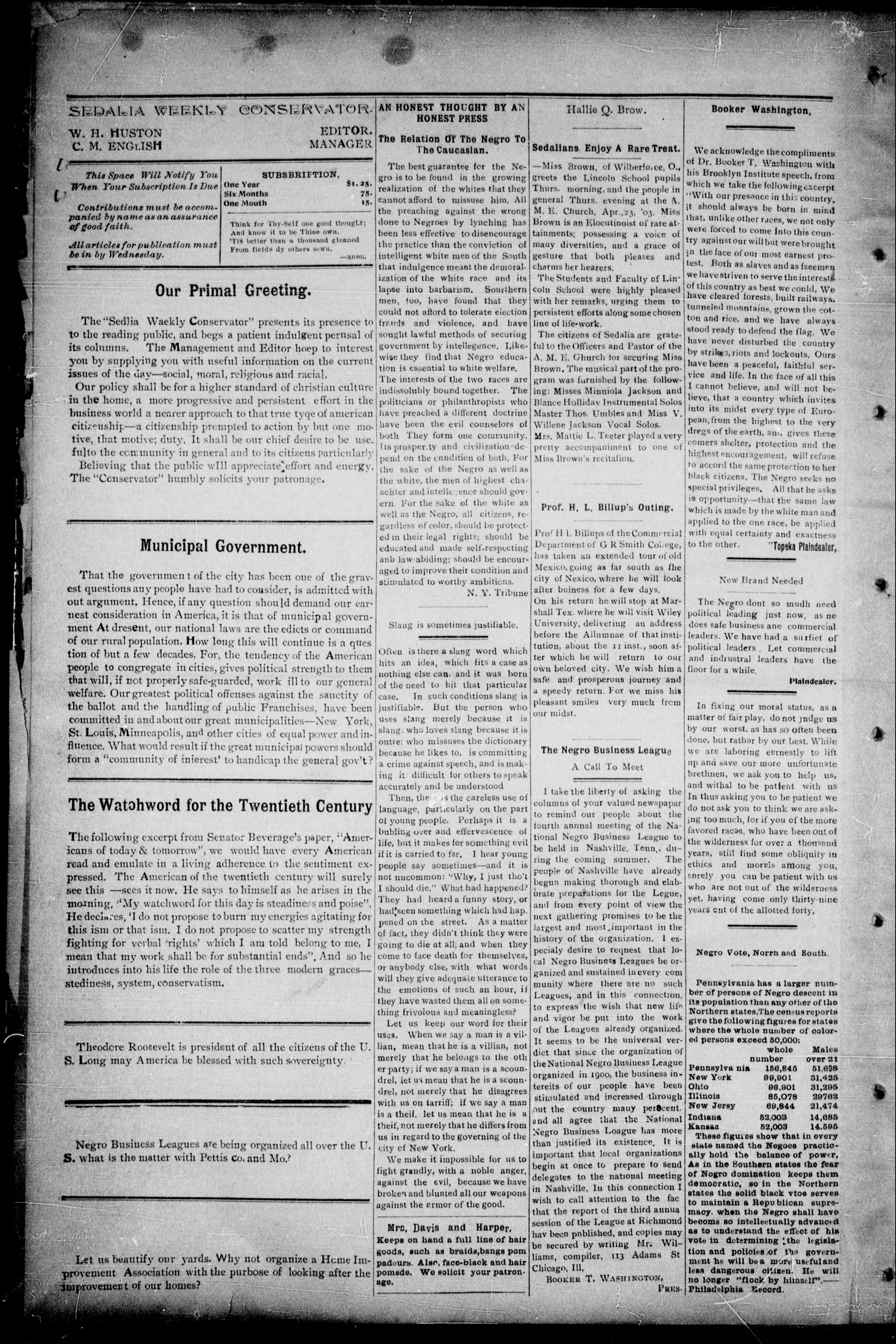
Our Primal Greeting.
Waekly Conservator" presents it to the public, and begs a patient indulgence. The Management and Editor hoots giving you with useful information on day—social, moral, religious and race shall be for a higher standard of christianity, a more progressive and persistent and a nearer approach to that true type of citizenship prompted to action by active; duty. It shall be our chief desi- community in general and to its citizen that the public will appreciate effort "rator" humbly solicits your patronage.
The "Sedlia Waekly Conservator" presents its presence to to the reading public, and begs a patient indulgent perusal of its columns. The Management and Editor hoep to interest you by supplying you with useful information on the current issues of the day—social, moral, religious and racial. Our policy shall be for a higher standard of christian culture in the home, a more progressive and persistent effort in the business world a nearer approach to that true type of american citizenship—a citizenship prompted to action by but one motive, that motive; duty. It shall be our chief desire to be useful to the community in general and to its citizens particularly Believing that the public will appreciate effort and energy, The "Conservator" humbly solicits your patronage.
Municipal Government.
government of the city has been one my people have had to consider. is a
That the government of the city has been one of the gravest questions any people have had to consider, is admitted with out argument. Hence, if any question should demand our earnest consideration in America, it is that of municipal government At dresent, our national laws are the edicts or command of our rural population. How long this will continue is a question of but a few decades. For, the tendency of the American people to congregate in cities, gives political strength to them that will, if not properly safe-guarded, work ill to our general welfare. Our greatest political offenses against the sanctity of the ballot and the handling of public Franchises, have been committed in and about our great municipalities—New York, St. Louis, Minneapolis, and other cities of equal power and influence. What would result if the great municipal powers should form a "community of interest' to handicap the general gov't?
The Watəhword for the Twentieth Century
The following excerpt from Senator Beverage's paper, "Americans of today & tomorrow", we would have every American read and emulate in a living adherence to the sentiment expressed. The American of the twentieth century will surely see this—sees it now. He says to himself as he arises in the morning, "My watchword for this day is steadiness and poise". He declares, 'I do not propose to burn my energies agitating for this ism or that ism. I do not propose to scatter my strength fighting for verbal 'rights' which I am told belong to me, I mean that my work shall be for substantial ends'. And so he introduces into his life the role of the three modern graces—stediness, system, conservatism.
Theodore Roosevelt is president of all the citizens of the U. S. Long may America be blessed with such sovereignty.
Negro Business Leagues are being organized all over the U. S. what is the matter with Pettis co. and Mo.?
Let us beautify our yards. Why not organize a Home Improvement Association with the purpose of looking after the improvement of our homes?
AN HONEST THOUGHT BY AN HONEST PRESS
The Relation Of The Negro To The Caucasian.
The best guarantee for the Negro is to be found in the growing realization of the whites that they cannot afford to missuse him. All the preaching against the wrong done to Negroes by lynching has been less effective to disencourage the practice than the conviction of intelligent white men of the South that indulgence meant the demoralization of the white race and its lapse into barbarism. Southern men, too, have found that they could not afford to tolerate election frauds and violence, and have sought lawful methods of securing government by intelegence. Likewise they find that Negro education is essential to white welfare. The interests of the two races are indissolubly bound together. The politicians or philanthropists who have preached a different doctrine have been the evil counselors of both. They form one community. Its prosperity and civilization depend on the condition of both. For the sake of the Negro as well as the white, the men of highest chachter and intellegence should govern. For the sake of the white as well as the Negro, all citizens, regardless of color, should be protected in their legal rights; should be educated and made self-respecting anb law-abiding; should be encouraged to improve their condition and stimulated to worthy ambitions.
Slang is sometimes justifiable.
Often is there a slang word which hits an idea, which fits a case as nothing else can, and it was born of the need to hit that particular case. In such conditions slang is justifiable. But the person who uses slang merely because it is slang: who loves slang because it is outre: who missuses the dictionary because he likes to, is committing a crime against speech, and is making it difficult for others to speak accurately and be understood
Then, there is the careless use of language, particularly on the part of young people. Perhaps it is a bubbling over and effervescence of life, but it makes for something evil if it is carried to far. I hear young people say sometimes—and it is not uncommon: "Why, I just thou't I should die." What had happened? They had heard a funny story, or had seen something which had happened on the street. As a matter of fact, they didn't think they were going to die at all; and when they come to face death for themselves, or anybody else, with what words will they give adequate utterance to the emotions of such an hour, if they have wasted them all on something frivolous and meaningless?
Let us keep our word for their uses. When we say a man is a villian, mean that he is a villian, not merely that he belongs to the other party; if we say a man is a scoundrel, let us mean that he is a scoundrel, not merely that he disagrees with us on tariff; if we say a man is a theif, let us mean that he is a theif, not merely that he differs from us in regard to the governing of the city of New York.
We make it impossible for us to fight grandly, with a noble anger, against the evil, because we have broken and blunted all our weapons against the armor of the good.
Mrs. Davis and Harper.
Keeps on hand a full line of hair goods, such as braids,bangs pom padours. Also, face-black and hair pomsde. We solicit your patronage.
Sedallians. Enjoy A Rare Treat.
—Miss Brown, of Wilberforce, O., greets the Lincoln School pupils Thurs. morning, and the people in general Thurs. evening at the A. M. E. Church, Apr., 23, '03. Miss Brown is an Elocutinoist of rare attainments; possessing a voice of mauy diversities, and a grace of gesture that both pleases and charms her hearers.
The Students and Faculty of Lincoln School were highly pleased with her remarks, urging them to persistent efforts along some chosen line of life-work.
The citizens of Sedalia are grateful to the Officers and Pastor of the A. M. E. Church for securing Miss Brown. The musical part of the program was furnished by the following: Misses Minniola Jackson and Blance Holliday Instrumental Solos Master Thos. Umbles and Miss V. Willene Jackson Vocal Solos. Mrs. Mattie L. Teeter played a very pretty accompaniment to one of Miss Brown's recitation.
Prof. H. L. Billup's Outing,
Prof H L Billups of the Commercial Department of G R Smith College, has taken an extended tour of old Mexico, going as far south as the city of Nexico, where he will look after business for a few days. On his return he will stop at Marshall Tex. where he will visit Wiley University, delivering an address before the Allumnae of that institution, about the 11 inst., soon after which he will return to our own beloved city. We wish him a safe and prosperous journey and a speedy return. For we miss his pleasant smiles very much from our midst.
The Negro Business League
A Call To Meet
I take the liberty of asking the columns of your valued newspapar to remind our people about the fourth annual meeting of the National Negro Business League to be held in Nashville, Tenn., during the coming summer. The people of Nashville have already begun making thorough and elaborate preparations for the Legue, and from every point of view the next gathering promises to be the largest and most important in the history of the organization. I especially desire to request that local Negro Business Leagues be organized and sustained in every community where there are no such Leagues, and in this connection, to express the wish that new life and vigor be put into the work of the Leagues already organized. It seems to be the universal verdict that since the organization of the National Negro Business League organized in 1900, the business interests of our people have been stimulated and increased through out the country mauy per cent. and all agree that the National Negro Business Loague has more than justified its existence. It is important that local organizations begin at once to prepare to send delegates to the national meeting in Nashville. In this connection I wish to call attention to the fact that the report of the third annual session of the League at Richmond have been published, and copies may be secured by writing Mr. Williams, compiler, 113 Adams St Chicago, Ill.
BOOKER T. WASHINGTON. PRES.
Booker Washington.
We acknowledge the compliments of Dr. Booker T. Washington with his Brooklyn Institute speech, from which we take the following excerpt "With our presence in this country, it should always be born in mind that, unlike other races, we not only were forced to come Into this country against our will but were brought in the face of our most earnest protest. Both as slaves and as fseemen we have striven to serve the interests of this country as best we could. We have cleared forests, built railways, tunneled mountains, grown the cotton and rice, and we have always stood ready to defend the flag. We have never disturbed the country by strikes, riots and lockouts. Ours have been a peaceful, faithful service and life. In the face of all this I cannot believe, and will not believe, that a country which invites into its midst every type of European, from the highest to the very dregs of the earth, and gives these comers shelter, protection and the highest encouragement, will refuse to accord the same protection to her black citizens. The Negro seeks no special privileges. All that he asks is opportunity—that the same law which is made by the white man and applied to the one race, be applied with equal certainty and exactness to the other." "Topeka Plaindealer."
New Brand Needed
The Negro dont so mudh need political leading just now, as ne does safe business an commercial leaders. We have had a surfiet of political leaders. Let commercial and industral leaders have the floor for a while. Plaindealer.
In fixing our moral status, as a matter of fair play, do not judge us by our worst, as has so often been done, but rathb by our best. While we are laboring earnestly to lift up and save our more unfortunate brethren, we ask you to help us, and withal to be patient with us. In thus asking you to be patient we do not ask you to think we are asking too much, for if you of the more favored races, who have been out of the wilderness for over a thousand years, still find some obliquity in ethics and morals among you, snrely you can be patient with us who are not out of the wilderness yet, having come only thirty-nine years cent of the allotted forty.
Negro Vote, Norrh and South
Pennsylvania has a larger number of persons of Negro descent in its population than any other of the Northern states. The census reports give the following figures for states where the whole number of colored persons exceed 50,000:
| | whole number | Males over 21 |
| :--- | :--- | :--- |
| Pennsylva nia | 156,845 | 51,698 |
| New York | 99,901 | 31,425 |
| Ohio | 96,901 | 31,295 |
| Illinois | 85,078 | 29762 |
| New Jersy | 69,844 | 21,474 |
| Indiana | 52,003 | 14,685 |
| Kansas | 52,003 | 14,595 |
These figures show that in every state named the Negoes practically hold the balance of power, As in the Southern states the fear of Nogro domination keeps them democratic, so in the Northern states the solid black vtoe serves to maintain a Republican supremacy, when the Negro shall have become so intellectually advanced as to understand the effect of his vote in determining the legislation and policies of the government he will be a more useful and less dangerous citizen. He will no longer "flock by hiimself".—Philadelphia Record.
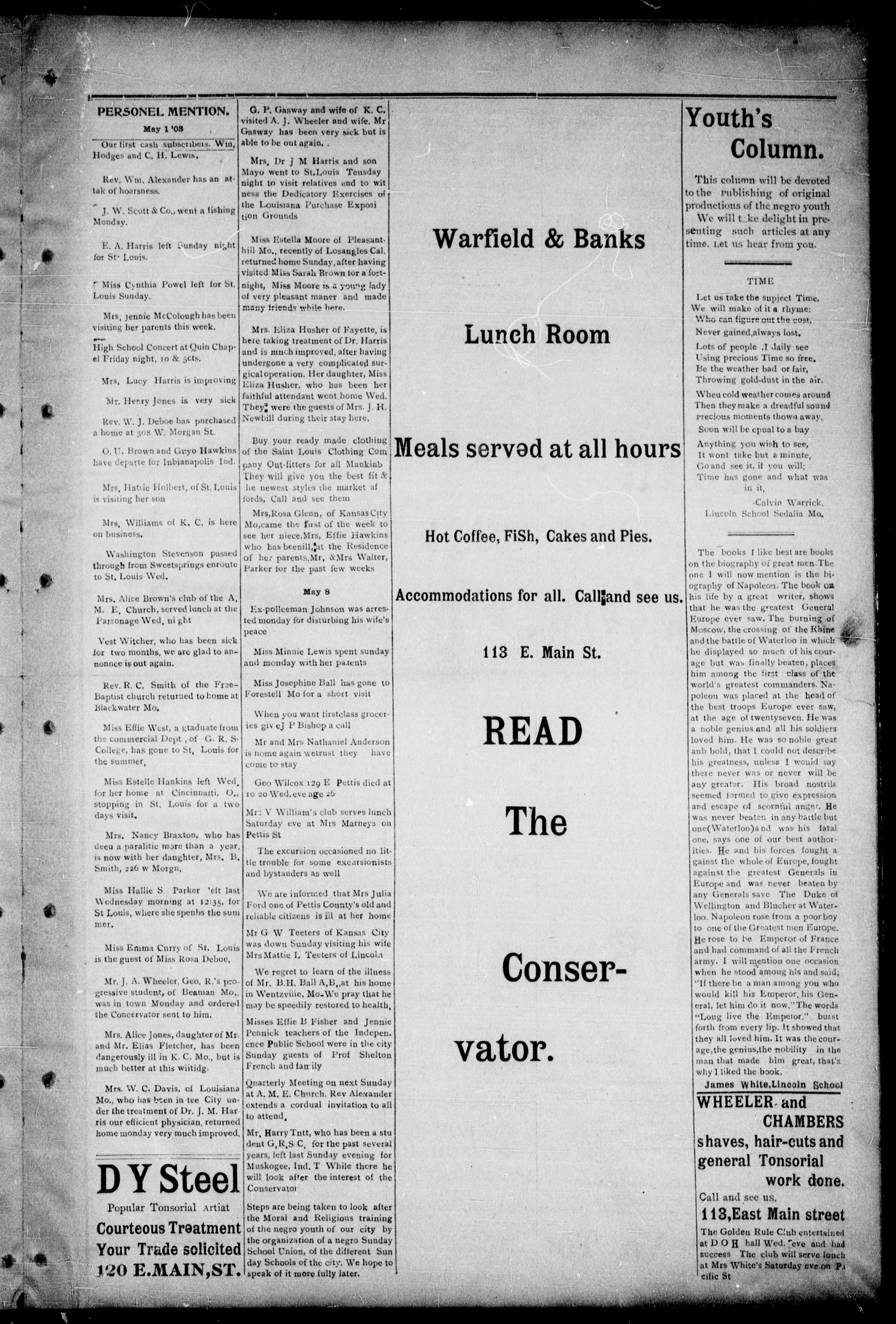
Mrs. Hattie Holbert, of St. Louis is visiting her son
Mrs. Williams of K. C. is here on business.
Washington Stevenson passed through from Sweetsprings enroute to St. Louis Wed.
Mrs. Alice Brown's club of the A. M. E. Church, served lunch at the Parsonage Wed, night
Vest Witcher, who has been sick for two months, we are glad to annonce is out again.
Rev. R. C. Smith of the Free-Baptist church returned to home at Blackwater Mo.
Miss Effie West, a graduate from the commercial Dept., of G. R. S-College, has gone to St. Louis for the summer,
Miss Estelle Hankins left Wed. for her home at Cincinnati, O., stopping in St. Louis for a two days visit.
Mrs. Nancy Braxton, who has deeu a paralitic more than a year, is now with her daughter, Mrs. B. Smith, 226 w Morgn.
Miss Hallie S Parker 'eft last Wednesday morning at 12:35, for St Louis, where she spenbs the summer.
Miss Emma Curry of St. Louis is the guest of Miss Rosa Deboe,
Mr. J. A. Wheeler, Geo. R.'s progressive student, of Beaman Mo., was in town Monday and ordered the Convener sent to him.
Mrs. Alice Jones, daughter of Mr. and Mr. Elias Fletcher, has been dangerously ill in K. C. Mo., but is much better at this wiitidg.
Mrs. W. C. Davis, of Louisiana Mo., who has been in tee City under the treatment of Dr. J. M. Harris our efficient physician, returned home monday very much improved,
DY Steel
Popular Tonsorial Artiat Courteous Treatment Your Trade solicited 120 E.MAIN,ST.
G. P. Gasway and wife of K. C. visited A. J. Wheeler and wife. Mr Gasway has been very sick but is able to be out again. Mrs, Dr J M Harris and son Mayo went to St.Louis Teesday night to visit relatives and to wit ness the Dedicatory Exercises of the Louisiana Purchase Exposition Grounds
Miss Estella Moore of Pleasanthill Mo., recently of Losangles Cal. returned home Sunday, after having visited Miss Sarah Brown for a fortnight. Miss Moore is a young lady of very pleasant maner and made many friends while here.
Mrs. Eliza Husher of Fayette, is here taking treatment of Dr. Harris and is much improved, after having undergone a very complicated surgical operation. Her daughter, Miss Eliza Husher, who has been her faithful attendant went home Wed. They were the guests of Mrs. J. H. Newbill during their stay here,
Buy your ready made clothing of the Saint Louis Clothing Company Out-fitters for all Mankinb They will give you the best fit & the newest styles the market af fords, Call and see them
Mrs,Rosa Glenn, of Kansas City Mo,came the first of the week to see her niece,Mrs, Effie Hawkins who has beenill,at the Residence of her parents,Mr, &Mrs Walter, Parker for the past few weeks
May 8
Ex-pollceman Johnson was arrested monday for disturbing his wife's peace
Miss Minnie Lewis spent sunday and monday with her parents
Miss Josephine Ball has gone to Forestell Mo for a short visit
When you want firstclass groceries give J P Bishop a call
Mr and Mrs Nathaniel Anderson is nome again wetrust they have come to stay
Geo Wilcox 129 E Pettis died at 10 20 Wed, eve age 26
Mr2 V William's club serves lunch Saturday eve at Mrs Marneys on Pettis St
The excursion occasioned no little trouble for some excursionists and bystanders as well
We are informed that Mrs Julia Ford one of Pettis County's old and reliable citizens is ill at her home
Mr G W Teeters of Kansas City was down Sunday visiting his wife Mrs Mattie L Teeters of Lincola
We regret to learn of the illness of Mr. B.H. Ball A,B,at his home in Wentzville, Mo-We pray that he may be speedily restored to health. Misses Effie B Fisher and Jennie Pennick teachers of the Independence Public School were in the city Sunday guests of Prof Shelton French and family. Quarterly Meeting on next Sunday at A. M. E. Church. Rev Alexander extends a cordual invitation to all to attend.
Mr. Harry Tntt, who has been a student G.R.S C. for the past several years, left last Sunday evening for Muskogee, Ind. T While thore he will look after the interest of the Conservator
Steps are being taken to look after the Moral and Religious training of the negro youth of our city by the organization of a negro Sunday School Union, of the different Sunday Schools of the city. We hope to speak of it more fully later.
Lunch Room
served at all h
offee, FiSh, Cakes and P
dations for all. Call and
Hot Coffee, FiSh, Cakes and Pies.
Accommodations for all. Call and see us.
113 E. Main St.
READ
---
The
---
Conser-
vator.
Youth's Column.
This column will be devoted to the publishing of original productions of the negro youth We will take delight in presenting such articles at any time. Let us hear from you. TIME
TIME
Let us take the subject Time,
We will make of it a rhyme:
Who can figure out the cost,
Never gained,always lost.
Lots of people ,I daily see
Using precious Time so free.
Be the weather bad or fair,
Throwing gold-dust in the air.
Wheu cold weather comes around
Then they make a dreadful sound
precious moments thown away,
Soon will be cpual to a bay
Anything you wish to see,
It wont take but a minute,
Go and see it, if you will;
Time has gone and what was
in it.
-Calvin Warrick,
Lincoln School Sedalia Mo.
The books I like best are books on the biography of great men. The one I will now mention is the biography of Napoleon. The book on his life by a great writer, shows that he was the greatest General Europe ever saw. The burning of Moscow, the crossing of the Rhine and the battle of Waterloo in which he displayed so much of his courage but was finally beaten, places him among the first class of the world's greatest commanders. Napoleon was placed at the head of the best troops Europe ever saw, at the age of twentyseven. He was a noble genius and all his soldiers loved him. He was so noble great anb bold, that I could not describe his greatness, unless I would say there never was or never will be any greater. His broad nostrils seemed formed to give expression and escape of scornful anger. He was never beaten in any battle but one (Waterloo) and was his fatal one, says one of our best authorities. He and his forces fought a gainst the whole of Europe, fought against the greatest Generals in Europe and was never beaten by any Generals save The Duke of Wellington and Blucher at Waterloo. Napoleon rose from a poor boy to one of the Greatest men Europe. He rose to be Emperor of France and had command of all the French army. I will mention one occasion when he stood among his and said; "If there be a man among you who would kill his Emperor, his General, let him do it now." The words "Loug live the Empetor," burst forth from every lip. It showed that they all loved him. It was the courage, the genius, the nobility in the man that made him great, that's why I liked the book.
James White,Lincoln School
WHEELER and
CHAMBERS
shaves, hair-cuts and
general Tonsorial
work done.
Call and see us.
113,East Main street The Golden Rule Club entertained at DO H hall Wed. eve and had success The club will serve lunch at Mrs White's Saturday eve on Pacific St
BLUE FRONT GROCERY Full line Staple Groceries
Fresh Bread, Cakes, and Cookies. Soda--Pop and other refreshing drinks Right of the Ice. CALL AND SEE US, WE WILL TREAT YOU RIGHT. John Kuhn & Co. COR. LAMINE & PETTI SEDALIA, MO.
Corner Lamine & Pettis St. Having open a first class ICE CREAM PARLOR and LUNCH ROOM, we are prepared to serve you with the best cream in the city at all hours at a reasoadle price. CALL and SEE US. Open Day and Night. St. Clair McClain, Proprietor.
15 cents Per- month
J. P. Bishoq the Progressive Grocer.
Fresh Butter --- --- .20 cts. lb.
Bulk Coffee --- --- .10 " ".
Coal Oil --- --- .15 " gal.
Ai. Elonr --- --- 1-4, s'ck 45 ct.
Orders taken every morning. Courteous Treatment.
Your Trade Solicited. 413 N. Lamine,
Simpson's Chapel.
Methodist Episcopal Church.
Sunday School 9 00, a. m.
Preaching 11 00 a. m.
Class meeting 3 00 p. m.
Preaching 7 30 p. m.
Prayer meeting every Wed., evening. G. W. Ball, Pastor.
C. M. E. Church
Preaching at 11 00 a. m. and 7 30 p. m.
Sundayschool 2 00
Class meeting 3 00
Prayer meeting every Fri. evening
T. H. Wartield Pastor
Lodge Directory
Sedalia Chapter, No. 5.
R. A. M.
2nd. & 4th. Wed., each month.
J. W. Wheeler, H. P-
C. H. Lewis, Sec.
Centennial Lodge, No. 59.
A. F. A. M.
2nd. & 4th. mondays in each month
J. P. Ferril, W. M.
E. Poindexter, Sec.
Centennial Court, No. 37.
1st. & 3rd. Thus., of each month.
Sallie Moffat, Matron,
Julia Hayden, Sec.
Hawkin's Lodge, No. 44.
1st. & 3d. Mondays in each month.
C. O. Brown, W. M.
C. W. Holliday, Sec.
G. O. U. of O. F., No. 3542.
1st. & 3d. Tuesdays in each month.
L. Cowan, N. G.
D. Steele, P. S.
Hall 120 Main St.
Sons & Datghters of Charity.
Lodge No. 1.
Meets 1st. and 3d. Tuesdays each month. D. L. White Pres
W: W. Henderson Sec.
Quick Service
And
SQUARE
DEALING
Get Billup's Carraige
JOHN HURDLE IS FOLITE AND WILL TREAT YOU RIGHT. Ring him up. Phone 146 or 164 Funeral and all Cells promptly Looked after.
This
Space
Next week.