Sedalia Weekly Conservator
Saturday, May 16, 1903
Sedalia, Missouri

Page text (machine-generated)
Sedalia Weekly Conservator.
VOL. 1.
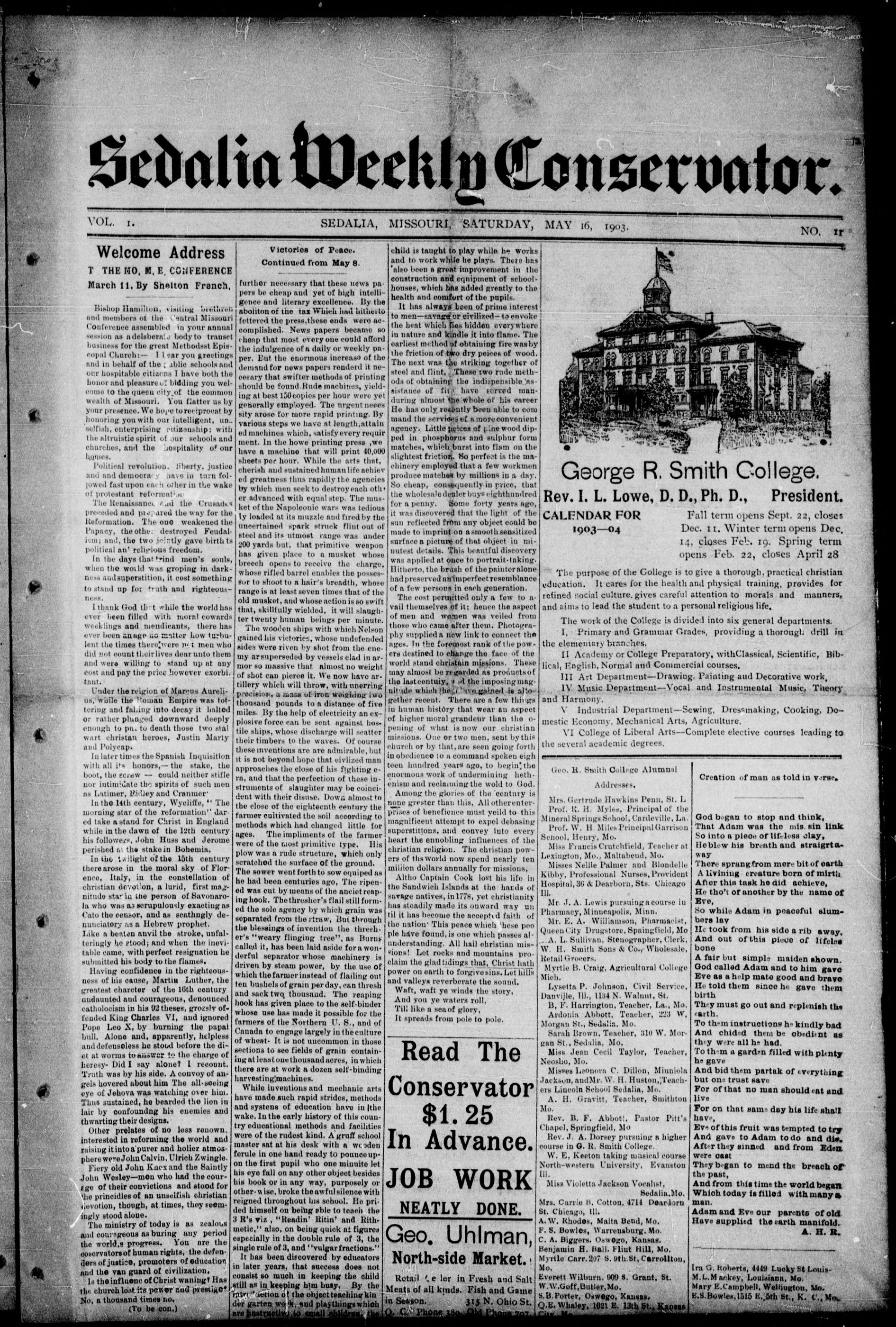
Bishop Hamilton, visiting brethren and members of the Central Missouri Conference assembled in your annual session as a deeds伯ate body to transet business for the great Methodst Episcopal Church:— I hear you greetings and in behalf of the public schools and our hospitable citizens I have both the honor and pleasure of bidding you welcome to the queen city of the common wealth of Missouri. You flatter us by your presence. We hope to reciprocate by honoring you with our intelligent, unselfish, enterprising citizenship; with the altruistic spirit of our schools and churches, and the hospitality of our homes.
Political revolution. Liberty, justice and and democracy have in turn followed fast upon each other in the wake of protestant reformation. The Renaissance and the Crusades preceded and prepared the way for the Reformation. The one weakened the Papacy, the other destroyed Feudalism; and, the two jointly gave birth to political an' religious freedom. In the days that mind men's souls, when the world was groping in darkness and superstition, it cost something to stand up for truth and righteousness.
I thank God that while the world has ever been filled with moral cowards weeklings and mendicants, there has ever been an age no matter how turbulent the times there were not men who did not count their lives dear unto them and were willing to stand up at any cost and pay the price however exorbitant.
Under the religion of Marcus Aurelius, while the Roman Empire was totering and fading into decay it halted or rather plunged downward deeply enough to put to death those two stalwart christian heroes, Justin Marty and Polycap.
In later times the Spanish Inquisition with all its honors,—the stake, the boot, the screw—could neither stifle nor intimidate the spirits of such men as Latimer, Eidley and Cranmer:
In the 14th century, Wycliffe, "The morning star of the reformation" dared take a stand for Christ in England while in the dawn of the 12th century his followers, John Huss and Jerome perished on the stake in Bohemia.
In the twilight of the 15th century there arose in the moral sky of Florence, Italy, in the constellation of christian devotion, a lurid, first magnitude star in the person of Savonarola who was as scrupulously exacting as Cato the censor, and as seathingly denunciatory as a Hebrew prophet. Like a beaten anvil the stroke, unfalteringly he stood; and when the inevitable came, with perfect resignation he submitted his body to the flames.
Having confidence in the righteousness of his cause, Martin Luther, the greatest character of the 16th century, undaunted and courageous, denounced catholicism in his 92 theses, grossly offended King Charles VI, and ignored Pope Leo X, by burning the papal bull. Alone and, apparently, helpless and defenseless he stood before the diet at worms to answer to the charge of heresy- Did I say alone? I recount. Truth was by his side. A convoy of angels hovered about him. The all-seeing eye of Jehova was watching over him. Thus sustained, he bearded the lion in lair by confounding his enemies and thwarting their designs.
Other prelates of no less renown, interested in reforming the world and raising it into a purer and holier atmosphere were John Calvin, Ulrich Zwingle. Firey old John Kaxx and the Saintly John Wesley—men who had the courage of their convictions and stood for the principles of an unselfish christian devotion, though, at times, they seemingly stood alone.
The ministry of today is as zealous and courageous as buring any period the world's progress. You are the coservators of human rights, the defenders of justice, promoters of education and the van guard of civilization.
Is the influence of Christ waning? Has the church lost its power and prestige? No, a thousand times no.
SEDALIA, MISSOURI, SATURDAY, MAY 16, 1903.
Victories of Peace.
Continued from May 8.
further necessary that these news papers be cheap and yet of high intelligence and literary excellence. By the abolition of the tax Which had hitherto fettered the press,these ends were accomplished. News papers became so cheap that most every one could afford the indulgence of a daily or weekly paper. But the enormous increase of the demand for news papers rendered it necessary that swifter methods of printing should be found. Rude machines, yielding at best 150 copies per hour were yet generally employed. The urgent needs sity arose for more rapid printing. By various steps we have at length,attain ed machines which, satisfy every require ment. In the howe printing press ,we have a machine that will print 40,000 sheets per hour. While the arts that, cherish and sustained human life achieve ed greatness thus rapidly the agencies by which men seek to destroy each other advanced with equal step. The musket of the Napoleonic wars was tedious ly loaded at its muzzle and fired by the uncertained spark struck flint out of steel and its utmost range was under 200 yards but, that primitive weapon has given place to a musket whose breech opens to receive the charge, whose riffed barrel enables the possessor to shoot to a hair's breadth, whose range is at least seven times that of the old musket, and whose action is so swift that, skillfully wielded, it will slaughter twenty human beings per minute.
The wooden ships with which Nelson gained his victories, whose undefended sides were riven by shot from the enemy arsuperseded by vessels clad in armor so massive that almost no weight of shot can pierce it. We now have artillery which will throw, with unerring precision, a mass of iron weighing two thousand pounds to a distance of five miles. By the help of electricity an explosive force can be sent against hostile ships, whose discharge will scatter their timbers to the waves. Of course these inventions are are admirable, but it is not beyond hope that civilized man approaches the close of his fighting era, and that the perfection of these instruments of slaughter may be coincident with their disuse. Down almost to the close of the eighteenth century the farmer cultivated the soil according to methods which had changed little for ages. The impliments of the farmer were of the most primitive type. His plow was a rude structure, which only scratched the surface of the ground.
The sower went forth to sow equipped as he had been centuries ago. The ripened was cut by means of the ancient reaping hook. The thresher's flail still formed the sole agency by which grain was separated from the straw. But through the blessings of invention the thresher's "weary flinging tree", as Burns called it, has been laid aside for a wonderful separator whose machinery is driven by steam power, by the use of which the farmer instead of flailing out ten bushels of grain per day, can thresh and sack two thousand. The reaping hook has given place to the self-binder whose use has made it possible for the farmers of the Northern U. S., and of Canada to engage largely in the culture of wheat. It is not uncommon in those sections to see fields of grain containing at least one thousand acres, in which there are at work a dozen self-binding harvesting machines.
While inventions and mechanic arts have made such rapid strides, methods and systems of education have in the wake. In the early history of this country educational methods and facilities were of the rudest kind. A gruff school master sat at his desk with a wooden ferule in one hand ready to pounce upon the first pupil who one minute let his eye fall on any other object besides his book or in any way, purposely or other-wise, broke the awfulsilence with reigned throughout his school. He prided himself on being able to teach the 3 R's viz, "Readin' Ritin' and Rithmetic," also, on being quick at figures especially in the double rule of 3, the single rule of 3, and "vulgar fractions."
It has been discovered by educators in later years, that success does not consist so much in keeping the child still as in keeping him busy. By the introduction of the object teaching kindergarten work, and playthings which are instructing to small children, the
child is taught to play while he works and to work while he plays. There has also been a great improvement in the construction and equipment of schoolhouses, which has added greatly to the health and comfort of the pupils.
It has always been of prime interest to men—savage or civilized—to envoke the heat which lies hidden everywhere in nature and kindle it into flame. The earliest method of obtaining fire was by the friction of two dry peices of wood. The next was the striking together of steel and flint. These two rude methods of obtaining the indispensable assistance of fire have served manduring almost the whole of his career He has only recently been able to com mand the services of a more convenient agency. Little peices of pine wood dipped in phosphorus and sulphur form matches, which burst into flam on the slightest friction. So perfect is the machinery employed that a few workmen produce matches by millions in a day. So cheap, consequently in price, that the wholesale dealer buys eighthundred for a penny. Some forty years ago, it was discovered that the light of the sun reflected from any object could be made to imprint on a smooth sensitized surface a picture of that object in minutest details. This beautiful discovery was applied at once to portrait-taking. Hitherto, the brush of the painteralone had preserved an imperfect resemblance of a few persons in each generation.
The cost permitted only a few to avail themselves of it; hence the aspect of men and women was veiled from those who came after them. Photography supplied a new link to connect the ages. In the foremost rank of the powers destined to change the face of the world stand christain missions. These may almost be regarded as products of the last century, and the imposing magnitude which they have gained is altogether recent. There are a few things in human history that wear an aspect of higher moral grandeur than the opening of what is now our christian missions. One or two men, sent by this church or by that, are seen going forth in obedience to a command speken eightteen hundred years ago, to begin the enormous work of undermining hetheism and reclaiming the wold to God.
Among the glories of the century is none greater than this. All other enterprises of benefience must yeild to this magnificent attempt to expel debasing superstitions, and convey into every heart the ennobling influences of the christian religion. The christian powers of this world now spend nearly ten million dollars annually for missions.
Altho Captain Cook lost his life in the Sandwich Islands at the hands of savage natives, in 1778, yet Christianity has steadily made its onward way until it has become the accepted faith of the nation. This peace which 'hese peo ple have found, is one which passes al-understanding. All hail christian missions! Let rocks and mountains proclaim the glad tidings that, Christ hath power on earth to forgives sins. Let hills and valleys reverberate the sound.
Waft, waft ye winds the story,
And you ye waters roll,
Till like a sea of glory,
It spreads from pole to pole.
Read The Conservator $1.25 In Advance. JOB WORK NEATLY DONE. Geo. Uhlman, North-side Market.
Retaileller in Fresh and Salt Meats of all kinds. Fish and Game in Season. 315 N. Ohio St.
O. C. Phone 280. Old Phone 207.
THE HOTEL
The purpose of the College is to give a thorough, practical christian education. It cares for the health and physical training, provides for refined social culture, gives careful attention to morals and manners, and aims to lead the student to a personal religious life.
The work of the College is divided into six general departments.
I. Primary and Grammar Grades, providing a thorough drill in the elementary branches.
II Academy or College Preparatory, withClassical, Scientific, Biblical, English, Normal and Commercial courses.
III Art Department—Drawing, Painting and Decorative work.
IV Music Department—Vocal and Instrumental Music, Theory and Harmony.
V Industrial Department—Sewing, Dressmaking, Cooking, Domestic Economy, Mechanical Arts, Agriculture.
VI College of Liberal Arts—Complete elective courses leading to the several academic degrees.
Geo. R. Smith College Alumnal
Mrs. Gertrude Hawkins Penn, St. L.
Prof. R. H. Myles, Principal of the
Mineral Springs School, Cardeville, La.
Prof. W. H. Miles Principal Garrison
School, Henry, Mo.
Miss Francis Crutchfield, Teacher at
Lexington, Mo., Maltabend, Mo.
Misses Nelle Palmer and Blondelle
Kibby, Professional Nurses, Provident
Hospital, 36 & Dearborn, Sts. Chicago
Ill.
Mr. J. A. Lewis pursuing a course in
Pharmacy, Minneapolis, Minn.
Mr. E. A. Williamson, Pharmacist,
Queen City Drugstore, Spaingfield, Mo
A. L. Sullivan, Stenographer, Clerk,
W. H. Smith Sons & Co. Wholesale,
Retail Grocers.
Myrtle B. Craig, Agricultural College
Mich.
Lysetta P. Johnson, Civil Service, Danville, Ill., 1134 N. Walnut, St.
B, F. Harrington, Teacher, La., Mo.
Ardonia Abbott, Teacher, 223 W.
Morgan St., Sedalia, Mo.
Sarah Brown, Teacher, 310 W. Morgan St., Sedalia, Mo.
Miss Jean Cecil Taylor, Teacher, Neosho, Mo.
Misses Leonora C. Dillon, Minniola Jackson, andMr. W. H. Huston, Teachers Lincoln School Sedalia, Mo.
A. H. Gravitt, Teacher, Smithton Mo.
Rev. B. F. Abbott, Pastor Pitt's Chapel, Springfield, Mo
Rev. J. A. Dorsey pursuing a higher course in G. R. Smith College.
W. E, Keeton taking musical course North-western University, Evanston Ill.
NO. ir
Fall term opens Sept. 22, closes Dec. 11. Winter term opens Dec. 14, closes Feb. 19. Spring term opens Feb. 22, closes April 28
this to give a thorough, practical christian health and physical training, provides for useful attention to morals and manners, a personal religious life.
divided into six general departments.
Grades, providing a thorough drill in
paratory, withClassical, Scientific, Bibmmercial courses.
Sewing, Painting and Decorative work,
local and Instrumental Music, Theory
—Sewing, Dressmaking, Cooking, Doors,
Agriculture.
—Complete elective courses leading to
Creation of man as told in verse.
God began to stop and think,
That Adam was the mis. sin link
So into a piece of lifeless clay,
He blew his breath and straigrtaway
There sprang from mere bit of earth
A livining creature born of mirth
After this task he did achieve,
He tho't of another by the name of
Eve,
So while Adam in peaceful slumbers lay
He took from his side a rib away,
And out of this piece of lifeless bone
A fair but simple maiden shown.
God called Adam and to him gave
Eve as a help mate good and brave
He told them since he gave them birth
They must go out and replenish the earth.
To them instructions he kindly bad
And chided them be obedient as they were all he had.
To them a garden filled with plenty he gave
And bid them partak of everything but one trust save
For of that no man should eat and live
For on that same day his life shall have,
Eve of this fruit was tempted to try
And gave to Adam to do and die.
After they sinned and from Eden were cast
They began to mend the breach of the past,
And from this time the world began
Which today is filled with many a man.
Adam and Eve our parents of old
Have supplied the earth manifold.
A. H. R.
Ira G. Roberts, 4419 Lucky St Louis-
M. L. Mackey, Louisiana, Mo.
Mary E. Campbell, Wellington, Mo.
E.S. Bowles, 1515 E. 5th St., K. C., Mo.
This Space Will Notify You When Your Subscription Is Due.
Contributions must be accompanied by name as an assurance of good faith.
All articles for publication must be in by Wednesday.
Our
The Editorial Staff and Mr. wish to thank the public in giving the Business Enterprises proposed in us. We, also that kindly mention in their columble to reciprocate their kindness.
HO
The colonial that, Every man our consistsration, even now this idea from their English an expression that gave to the home. The castle, in the Federal building capable of withstanding assaults. And, the English in home could not have been exposed that of a castle. Since the castle made it strong and capable, we acquire elements of strength sailed daily by influences of the rest of the home. strive to give virtue, and industry, intelligence this, every home may be made strength to the race, a comfort God.
Duties of the
The Conservative, tho young nationalism, may feel temerity in all, Political, Religious and, other politic, of the Republic, yet dation to enter upon the discussion involve the public interest of Sylvania state our tho'ts of some of it.
It is the imperative duty of ionately, every question that cal laws. For, it is not the admiorthy, thru national or state coming into immediate contact that, shapes our happiness tions should and must claim ther, studying these local issues swerve us from our purpose to americans shuold act. That is, at the progress of Sedalia means should let their energies be agreed—sacrificing the public but, by that nobler sentiment. The Conservator stands, lia's future, pledged to every pa a puissant arm raised against eies.
Our Thanks
staff and Management, of the public in general for its purposes particularly for the use, also thank our content their columns and hope their kindness in the new
The Editorial Staff and Management, of the Conservator, wish to thank the public in general for its encouragement & the Business Enterprises particularly for the confidence imposed in us. We, also thank our contemporaries, for their kindly mention in their columns and hope that we may be able to reciprocate their kindness in the near future.
HOME.
Every man's house is even now. They born in English Ancestry. He gave to the world their in the Feudal ages was with-standing the seven English idea, later, they have been expressed in stance the castle had element capable, even so must the strength and enduranceences of demoralization have to give to it those ele-ly, intelligenee, push and may be made a veritable a comfort to the Nation.
Of the Sedalia
Is tho young in the world merity in discussing the status and, other problems, public, yet we shall not in the discussion of any of interest of Sedalia. There is some of the urgent duty of every citizen relation that concerns the act not the administering of local or state officers, that state contact with the local happiness or sorrows. Must claim the attention of local issues, nothing shall purpose to act justly, and That is, act for the good India means the elevation of energies be directed, not the public interest for sentiment. The good of India stands, with sanguining to every progressive mea-nd against any and all re
The colonial that, Every man's house is his castle, worthy our considrsation, even now. They borrowed or inherited this idea from their English Ancestry. Hence, it was indeed, an expression that gave to the world their appreciation of the home. The castle, in the Feudal ages was a strongly fortified building capable of with-standing the severest attacks of all assailants. And,the English idea, later, the colonial idea of the home could not have been expressed in stronger terms than that of a castle. Since the castle had elements of strength that made it strong and capable, even so must the American home acquire elements of strength and endurance, for it is being assailed daily by influences of demoralization. study the interest of the home. strive to give to it those elements of strength, virtue, and industry, intelligenee, push and energy. By doing this, every home may be made a veritable castle, a bulwark of strength to the race, a comfort to the Nation, and, a glory to God
Duties of the Sedalia Citizens
The Conservative, tho young in the world of american journ alism, may feel temerity in discussing the Social, Education al, Political, Religious and, other problems, of the whole body politic, of the Republic, yet we shall not feel the least trepidation to enter upon the discussion of any question, that may involve the public interest of Sedalia. Therefore, we shall briefly state our tho'ts of some of the urgent duties of our citizens
It is the imperative duty of every citizen to study dispassionately, every question that concerns the administration of local laws. For, it is not the administering of federal or state au thority, thru national or state officers, that we feel but, the, coming into immediate contact with the local or municipal power that, shapes our happiness or sorrows. Hence, local questions should and must claim the attention of the Sedalian. After, studying these local issues, nothing should be allowed to swerve us from our purpose to act justly, and as only true Americans shuold act. That is, act for the good of Sedalia Since the progress of Sedalia means the elevation of her citizens they should let their energies be directed, not by selfishness and greed—sacrificing the public interest for self-aggrandizement but, by that nobler sentiment, The good of The Municipality. The Conservator stands, with sanguine hopes for, Sedalia's future, pledged to every progressive movement. And with a puissant arm raised against any and all retrogressive tenden eies.
We are pleased with our contributors. All of which are of a thoughtful and literary merit. And we urge our readers to carefully rerd the articles on our front page each week. Look carefully thru our Youths Colum, for we feel that you will there see things that will both interest and please you. When you see the productions of our boys and girls
W. H. HUSTON
C. M. ENGLISH
Our Contributors.
SUBSBRIETION,
One Year $1.25.
Six Months 75.
One Mouth 15.
Think for Thy-Self one good thought;
And know it to be Thine own.
TIS better than a thousand gleaned
From fields by others sowu.
man's house is his castle, worthy
law. They borrowed or inherited
Ancestry. Hence, it was indeed
the world their appreciation of the
hundred ages was a strongly fortified
building the severest attacks of all
idea, later, the colonial idea of the
pressed in stronger terms than
the had elements of strength that
even so must the American home
and endurance, for it is being as-
demoralization. study the inter-
to it those elements of strength,
unee, push and energy. By doing
a veritable castle, a bulwark of
att to the Nation, and, a glory to
Sedalia Citizens
in the world of american journ
discussing the Social, Education
other problems, of the whole body
we shall not feel the least trepisi-
sion of any question, that may
Sedalia. Therefore, we shall brief
the urgent duties of our citizens
every citizen to study dispass-
concerns the administration of lo-
ministering of federal or state au-
re officers, that we feel but, the,
with the local or municipal pow
or sorrows. Hence, local ques-
tion attention of the Sedalian. Af-
s, nothing should be allowed to
act justly, and as only true A-
ct for the good of Sedalia Since
the elevation of her citizens they
directed, not by selfishness and
interest for self-aggrandizement.
The good of The Municipali-
with sanguine hopes for, Seda-
progressive movement. And with
any and all retrogressive tenden
The Conservator Encouraged.
It was, indeed, gratifying to the Conservor's Staff to receive the following communications this week from Kansas City and St. Louis. Kansas, Mo. May, 13 '03 Mr. W.H. Huston, Editor of Conservator Sedalia, Mo.
Dear Sir: My daughter is well pleased with your paper and I think I shall try to secure many subscribers here here. Yours truly. Amanda Travis.
Mr. B. H. Ball also writes us encouraging news from St. Louis.
We shall be pleased to communicate
Sedalia Weekly Conservator.
EDITOR
MANAGER
The Negro's Rise
The human mind is so constituted that it never can allow a question to rest until it is settled right. It is the order of progress, demanded by the nature of the mind itself. Philosophers and scientists have from time to time given solutions to certain cosmic questions, and have rested back upon their labors as complete. But restless inquiry has soon entered to disturb them with observed irregularities, contradictions and unexplained mysteries, demanding a reinvestigation, a adjustment looking toward a truer, larger and deeper understanding of things. God thrusts man out of the comfortable selfsatisfaction of his immature accomplishments and drives him on toward a progress in harmony and totality. At times many sink by the way into discouraged indifference or militant pessimism, exclaiming, vanitas! But the heart of humanity is charged with a quenchless hope and an invincible courage that base deep the unshaken conviction in "an upward path to a great end." And this experience of disturbances and conviction holds good as much, or more, in practical as in theoretical concerns. Human society has met its problems and progressed in the part; it can and shall meet them and progress in the future. There is no difficulty in the affairs of men too dark or too hard to grapple and solve. Only, there are two fundamental elements that must be rekoned with from the start before the efforts of intelegence and honest motive can come into their own. The first elment, which is independent of man, is time, fro, which the second arising, dependent upon man, is patience.
In time and with patience we may fairly hope that the light of reason and the sense of justice will enable us to deal with the ever recurrent negro problem. To begin with, we ought at any rate, to rid ourselves of imaginary difficulties that tend to cling to the question such as the bug bear of social equality or long distance theories and the like. Social equality will take care of itself, and theoretical solutions from a distance are simply to be replaced by actual accomplishment on the spot.
The address of ex-President Cleveland in New York City the other evening, at a meeting where industrial education in the south was under discussion, presents some simple, perhaps commonplace and yet sound cnnsiderations.
After declaring himself to be "such a friend of the negro," Mr. Cleveland points out the immense and real problem of the South in eight millions of blacks among whom there "is still a grievous amount of ignorance, a sad amount of viciousness and a tremendous amount of laziness and thriftlessness, and while sympathy and help can be given from the North, the solution of the problem 'mainly depends except so far as it rests with the negroes themselves, upon the sentiment and conduct of the leading men of the South.' Recognizing the attitude of the white people as prejudice or as a deeper race instinct Mr. Cleveland also oecognizes the honesty and sincerity of the south in dealing with the negro problem. The people of the North may give sympathy and help, but cannot in any way force a solution upon a people who alone can solve and are endeavoring to solve the problem.
"As friends of the Negro," he says, "fully believing in the possibility of his improvement and advancement, sincerely and confidently laboring to that end, it is folly for us to ignore the importance the ungrudging cooperation on the part of
this work. Labor as we will, those who do the lifting of the weight must be those who stand next to it. This cooperation cannot be forced nor can it be gained by gratuitously running counter to firmly fixed and tenaciously held Southern ideas, or even prejudices."
The chief emphasis of his, adress Mr. Cleveland laid upon the one rational and practical method in dealing with the Negro, and that is, the method of Booker T. Washington; teach the Negro to do some useful service for the community, and do it well. In consequence, the Nego, s rise to competence, position and self respect will take care of itself.
At the same time Booker T, Washington spoke' introducing his subject with these wise and noble words: "In the case of my race, I believe that both the teachings of history, as well as the results of every-day observation, should convince us that we shall make our most enduring progress by laying the foundation carefully, patiently, in the ownership of the soil, the exercise of habits of economy, the saving of money and the securing of the most complete education of hand and head, and the exercise of the christian virtures. Standing tonight before this audience, when very soul of my race is aching and seeking guidance as never before, I say deliberately that I know noother road. If I knew how to find more speedy and prompt relief, and did not point the way at any cost, I should be a coward and a hypocrit.
"One farm bonght. one house built, one home sweetly and intelligently kept, one man who is the largest taxpayer or has the largest bank account, one school or church maintained, one factory running successfully, one truck garden profitably cultivated, one patient cured by a negro doctor, one sermon well preached, one life cleanly lived, these will tell more in our favor than all the abstract eloquence that can be summoned to plead our cause. Our pathway must be thru the soil, up thru swamps, up thru forests, up thru the streams, the rocks, up thru commerce, education and religion.
The sound wisdom of these words is not applicable merely to the negro's upward struggle, but to the upward struggle of every race and man. The Great Ronnd World-
Thos, Smith Injnred At Prairie Lick, Last Week.
Mr. Thos. Smith, West Morgan Street the old reliable Katy porter has been detained in the city for the past ten days, on account of an injury of the hand received in an accident at Praire Lick Station on the M. K & T System. We are pleased to announce that his hand injuries are much improved.
Mr. Solmon Dixon and Grand- Daugther, Lucile, to visit Chicago Ill.
Mr. Solmon Dixon, Sedalia's most highly esteemed citizens and his Grand-daughter Lucile, a pupil of Lincoln school, anticipates an early trip to Chicago, Ill. to visit Mrs.Carrie B. Cotton, of 4714 Dearborn St. The Conservator assures them that they will have a pleasant outing, for Mrs. Cotton, Mr. Dixon's daughter, we are informed is an excellent hostess.
Paper Hanging.
PLASTERING, PATCHING, and CALCIMINING. All work guaranteed. Call and see
The Quality of the Negro.
Much has been written concerning the Negro—his condition, past, present, and future; still but few articles appear respecting the quality of the Negro. What is of more importance concerning a thing than its quality? Does not quality determine the worth or worthlessness of things? What, then is the quality or disposition of the Negro?
Quality as I now use the word, refers to attributes of things relatively considered, and not merely to rank. The attributes considered are three, viz: Morality, Intellectuality, and Religion. In what degree does the Negro possess these attributes, and are these attributes undergoing any observable development? This question I now attempt to answer: not from supposition, but from actually existing facts.
Whatever may be the Negro's origin, he certainly possesses a greater degree of Morality, Intellectuality and Religion, both in America and in Africa than he did prior to the time of the Emancipation.
Before the Emancipation, the Negro in the South had many ideas that were purely African; his relation toward his fellow-man was similar to the relations which were sustained by his brothers of the "Dark Continent;" his intellect, excepting his knowledge of a few trades and his acquirement of a few experiences from the white man, was practically undeveloped, his religion had become somewhat changed, altho he was almost as superstitious as his African ancestors. Such was the quality or make up of the ante-bellum Negro; but is he so today, or has he advanced from that stage? A consideration of his past and present conditions will convince you that he has.
To enter into the minutiae of the morality of the Negro is out of place as well as unsuited to the subject at hand, and I am sure if those who justify the statement that the Negro is immoral, would avail them selves of the opportunity to thoroughly investigate his moral status, they would, if free from prejudice, speak more favorably of Negro morality.
Has the Negro improved intellectually? Let us see. There are now doctors, ministers, lawers, dentists, inventors, professors of the various sciences, artists, musicians ect.—these were practically wanting before the Emancipation but are now very numerous. From nothing to something, is that progression or retrogression? It seems that the Chinese would prove an interesting subject for discussion instead of the "Nigger;" for the Chinese have had years before them but are, nevertheless, intellectually inferior to the American Negro. Do you see how quality manifests itself? Consider how the Negroes of Haiti have progressed since the revolution of 1791—93. The Republic has now 960 000 Negroes, over 400 national schools and lycees, executive governmet vested in president, legislative in National Assembly, of two houses and an army of 6,828, chiefly infantry. Remember the Negro was bro't to the island as a slave. No race upon earth can boast of such rapid progress as that made by the American Negro. That the Negro has improved religiously can be seen from numerous ministers of the gospel, in both Africa and America; from missionaries in foreign lands, and from the establishment of various religious institutions. If "improvement is the order of the age," then the Negro is truly in order. Give him a fair chance and I know Negro quality will prove itself a patent factor of American citizenship and not, as some prejudicial persons suppose, an impedi-
PERSONAL MENTION.
CHRONLOGICALY.
May 10
May 10
Mrs. Martha Ramsey, one of Sedalia's old and highly esteemed citizens, who is keen sick, is better.
Rev. Richard Davis preached the Eucharistic sermon at Quinn's hapel at three in the afternoon.
A charitable collection for the relief of Mrs. Amanda Jones, was taken at Taylor's Chapel, amounting to more than two Dollars.
Mr William Flournoy of St.Lou is, Pullman porter on the Katy has been detained in the city for the past several days by the recent wreck. While here, he is the guest at the Dixon home, on E Cooper. Prof. J H Williams, Centralia, Mo., advance agent for James Parker, of McKinley fame, was in our city arranging for three lectures by him at the follo wing places: Taylor's Chapel, Morgan greet Baptist church and Quinn Chapel A. M. E. church.
BOSTON CAFE.
Furnishesall Grocers with Fresh Delilicious HOME MADF Bread. Dont forget. Ask for WALCH'S BREAD. We lead in the production of ICE CREAM.
11
J M Holly,the plasterer, left for St. Louis last night on business.
Mr. Dan Banks, of Warsaw, our old playmate at Arrow Rock was in the city, doing the show.
Mr. John Swopshire, an old Katy porter, on the North end, Paris Mo. passed thru the city, en Route to Parsons, Kas. When there he will be routed for between that city and Denison Tex. over the M. K & T. We wish him success.
Mr. Richard Sanders and wife returned from St. Louis, where they had a pleasant visit with friends & also witnessed the Dedicatory Exercises of the Louisiana Purchase Exposition Ground. They will leave shortly for an extended trip thru the Southland. The Conservator wish es them pleasant journey and trust that they will communicate with us while abroad.
Miss Maria Herndon returned to Warrensburg.
Mr. J. F. Thompson of K.C. will be the guest of Miss Estell Martin Sunday.
Mrs. Smith Buckner spent Saturday and Sunday in Smithton the guest of Mrs. Wm. Sayles.
Mrs. Jno. Holbert has returned from St. Louis, being the guest of her son Elmer Smith.
Mrs. Patterson of Windsor. Mo., passed thru enroute to K. C., to be the bedside of her sicksister-in-law
Mrs. M. B. Smith was called to Hannibal, Mo. tuesday, to be at the bedside of her dying brother.
Mr. Smith Overton is home on a short visit. We all are glad to give brother Overton the glad hand.
Mrs. Davis and Harper. Keeps on hand a full line of hair goods, such as braids,bangs pom padours. Also, facebleach and hair pomade. We solicit your patronage.
Sedalia Weekly Conservator
1. The image contains a black background with a white text block. The text is not clearly legible due to the blurry quality of the image.
THE NATION'S HERO
J. B. PARKER,
At Quinn Chapel To Night.
See Interview of him Next Week
Mr. Ulysses Walls of K.C. Mo. has been in the city for the past several days visiting his mother and sister Ella Scott.
Rev. P. M. Mack of Centralia,Mo has been called by the Morgan St. Babtist Church. He will begin his active work the first of June. Bro. Mack comes to us highly recommended. And the Conservator joins all in extending him a hearty welcome.
Finis Washington of the class '03 Lincoln school was called home Saturday evening to be at the bedside of his dying mother, Mrs. Maggie Sims, Holden, Mo. She died Monday morning, and was intered at the Knob Noster cemetery Tuesday morning. The Conservator extends its sympathy to Mr. Washing ton in his recent bereavement.
Installation.
At 9:15 o'clock the members of the Court filed into D. O. H. Hall, with Scott Hayden presiding at the piano the court performed a beautiful drill after which the court sang "Haven of Rest," and prayer was offered by the Rev. Mr. Warfield.
Officers installed are as follows: Matron, Sallie Moffet. Vice Matron, Lillie Thomas. Treas. Ellen Bowles Secretary, Ella Williams. Iner gate keeper, Laura Lewis. Outer gate keeper, Ada Bass. Directors, J. W. Wheeler, Marion Hayben and Mr. Moffet.
Investigating Committee;- Ella Sims, Ada Chambers and Mary Belle. Sick Committee;- Mrs. Jas. Newbill Ella Brazier and Paul Terril. Mr. John Waters was installing officer, with Mr. J. W. Wheeler assisting him. Delicious refreshments were served.
J. M. Harris. M. D.
Physician and Surgeon.
116 W. Main St., Sedalia, Mo.
Office hours 10 to 12 a. m., 4 30 to
6 30 p. m.
Residence, 236, W. Morgan St.
DY Steel
Popular Tonsorial Artist Courteous Treatment Your Trade solicited 120 E.MAIN,ST.
Warfield & Banks
Lunch Room
is served at all h
Coffee, Fish, Cakes and P
odations for all. Call'and
Meals served at all hours
Hot Coffee, Fish, Cakes and Pies.
Accommodations for all. Call and see us.
113 E. Main St.
READ
```markdown
```
The
```markdown
```
Conser-
vator.
1.
This column will be devoted to the publishing of original productions of the negro youth We will take delight in presenting such articles at any time. Let us hear from you. Spring.
Spring.
When spring comes around
With its dew upon the ground,
The birds in the trees they sing,
And there is joy in their sound.
The Robin. Jaybird and yellow-
breast
They all are ready to fly from their
nests
They are all ready to hunt the
worm,
The little ones are doing their
best.
The children are ready to have
fun,
With whip, rope and popgun,
While the large ones play marbles
and ball,
The little ones tumble and fall.
In the fields and meadows we
play,
And on the hot and sunny day,
With horse and dog we play,
While the little are having their
way. Russell Emerson.
Decoration Day
Oh, how sad it is with some people when decoration day comes! These will be many flowers we can get to decorate the sad and lonely graves with. I have seen once at a decoration more than two hundred persons who had relatives in this lonely spot. And it was sad with them! It seems to me that this day is for the people to think of the dead once more. Christian people ought never forget about their relatives who have gone on before them.
Of course the people who are not christians think about wrong dsings so that it is impossible for them to thik what they ought.
I hope to meet my lovely brothers and sisters and everybody else in heaven.
Any one who has true religion cannot pass any of their friends with out shedding a few tears. It is sad to think one's relatives or close friends are gone to never return.
I will bring the violets blue
That say, be true, be true,
True to the God above you,
And to the friends that love you.
For the brave and the true
We'll twine them together,
For the red, white and blue
Are united forever,
When we reach that glorious world.
WHEELER and
CHAMBERS shaves, hair-cuts and general Tonsorial work done. Call and see us. 113,East Main street The Golden Rule Club entertained at D O H hall Wed. eve and had success The club will serve lunch at Mrs White's Saturday eve on Pacific St
BLUE FRONT GROCERY Full line Staple Groceries
Fresh Bread, Cakes, and Cookies. Soda--Pop and other refreshing drinks Right of the Ice. CALL AND SEE US, WE WILL TREAT YOU RIGHT. John Kuhn & Co. COR: LAMINE & PETTI SEDALIA, MO.
Morgan St. Baptist Church.
Sunday
Preching 11 00 a. m. and 7 30 p. m.
Sunday school 2 00 p. m.
Prayer meeting every Wednesday.
Simpson's Chapel.
Methodist Episcopal Church.
Sunday School 9 00, a. m.
Preaching 11 00 a. m.
Class meeting 3 00 p. m.
Preaching 7 30 p. m.
Prayer meeting every Wed., evening.
G. W. Ball, Pastor,
Lodge Directory
Sedalia Chapter, No. 5.
R. A, M.
2nd. & 4th. Wed., each month.
J. W. Wheeler, H. P-
C. H. Lewis, Sec.
Centennial Lodge, No. 59.
A. F. A. M.
2nd. & 4th. mondays in each month
J. P. Ferril, W. M.
E. Poindexter, Sec.
Centennial Court, No. 37.
1st. & 3rd. Thus., of each month.
Sallie Moffat, Matron,
Julia Hayden, Sec.
Hawkin's Lodge, No. 44.
1st. & !3d. Mondays in each month.
C. O. Brown, W. M.
C. W. Holliday, Sec.
G. O. U. of O. F., No. 3542.
1st. & 3d. Tuesdays in each month.
L. Cowan, N. G.
D.'Steele,
Hall 120 Main St.
Sons & Daughters of Charity
Lodge No. 1.
Meets 1st. and 3d. Tuesdays
each month. D. L. White Pres
W. W: Henderson Sec.
Corner Lamine & Pettis St. Having open a first class ICE CREAM PARLOR and LUNCH ROOM, we are prepared to serve you with the best cream in the city at all hours at a reasnoadle price. CALL and SEE US. Open Day and Night. St. Clair McClain, Proprietor.
Next week.
JOHN HURDLE IS POLITE
AND WILL TREAT YOU RIGHT.
Ring him up. 'Phone 146 or 164
Funeral and all Cells promptly
Looked after.