Sedalia Weekly Conservator
Saturday, July 18, 1903
Sedalia, Missouri
Page text (machine-generated)
Sedalia Weekly Conservator.
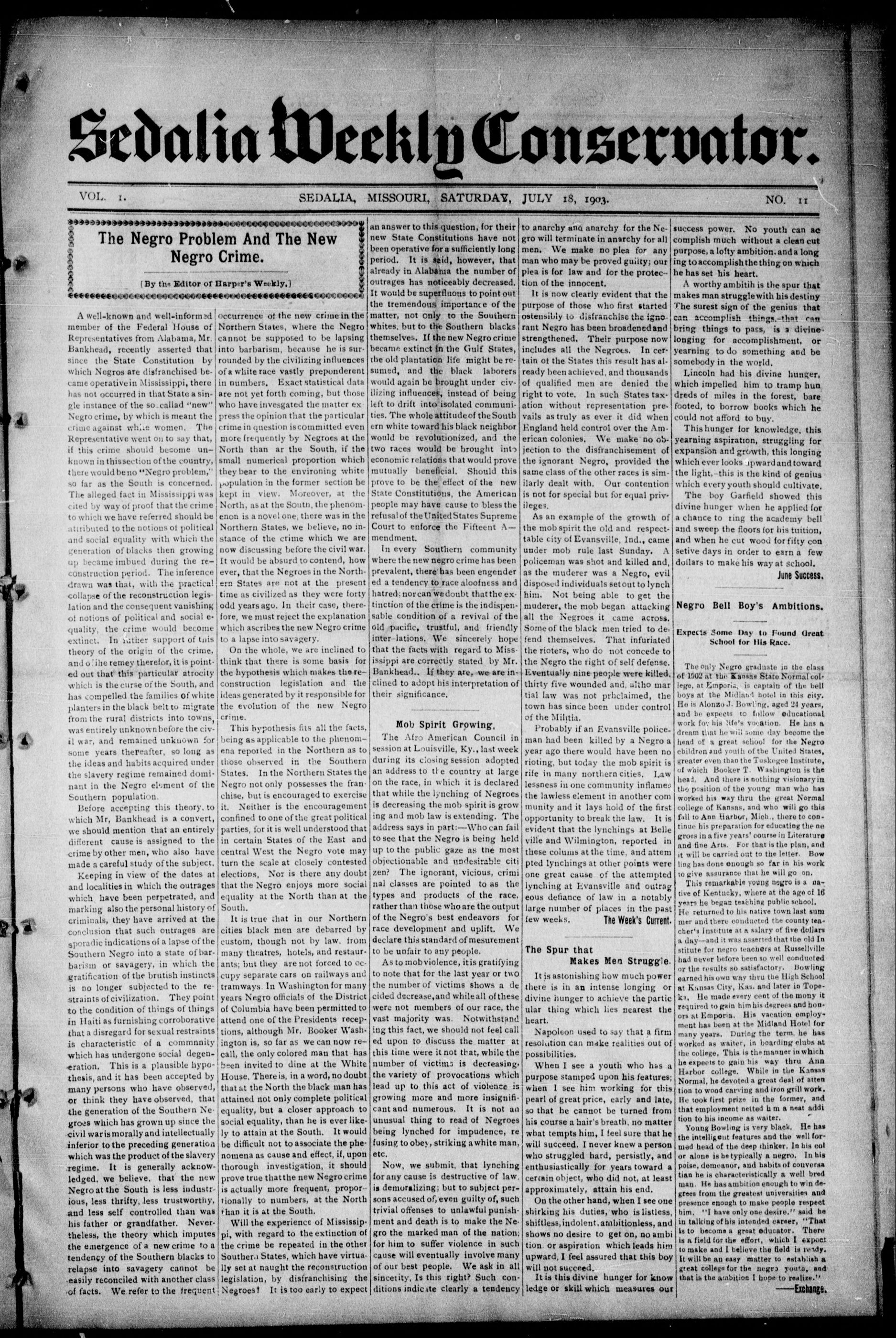
The Negro Problem And The New Negro Crime.
[By the Editor of Harper's Weekly.]
A well-known and well-informed member of the Federal House of Representatives from Alabama, Mr. Bankhead, recently asserted that since the State Constitution by which Negros are disfranchised became operative in Mississippi, there has not occurred in that State a single instance of the so-called "new" Negro crime, by which is meant the crime against white women. The Representative went on to say that, if this crime should become unknown in this section of the country, there would beno "Negro problem," so far as the South is concerned. The alleged fact in Mississippi was cited by way of proof that the crime to which we have referred should be attributed to the notions of political and social equality with which the generation of blacks then growing up became imbued during the reconstruction period. The inference drawn was that, with the practical collapse of the reconstruction legislation and the consequent vanishing of notions of political and social equality, the crime would become extinct. In further support of this theory of the origin of the crime, and of the remey therefor, it is pointed out that this particular attocity which is the curse of the South, and has compelled the families of white planters in the black belt to migrate from the rural districts into towns, was entirely unknown before the civil war, and remained unknown for some years the Peafater, so long as the ideas and habits acquired under the slavery regime remained dominant in the Negro element of the Southern population.
Before accepting this theory, to which Mr. Bankhead is a convert, we should mention that an entirely different cause is assigned to the crime by other men, who also have made a careful study of the subject.
Keeping in view of the dates at and localities in which the outrages which have been perpetrated, and marking also the personal history of criminals, they have arrived at the conclusion that such outrages are sporadic indications of a lapse of the Southern Negro into a state of barbarism or savagery, in which the gratification of the brutish instincts is no longer subjected to the restraints of civilization. They point to the condition of things of things in Haiti as furnishing corroborative that a disregard for sexual restraints is characteristic of a community which has undergone social degeneration. This is a plausible hypothesis, and it has been accepted by many persons who have observed, or think they have observed, that the generation of the Southern Negroes which has grown up since the civil war is morally and intellectually inferior to the preceding generation which was the product of the slavery regime. It is generally acknowledged, we believe, that the new Negro at the South is less industrious, less thrifty, less trustworthy, and less self controlled than was his father or grandfather. Nevertheless, the theory which imputes the emergence of a new crime to a tendency of the Southern blacks to relapse into savagery cannot be easily reconciled with another class of facts. We refer to the frequent
VOL. 1.
occurrence of the new crime in the Northern States, where the Negro cannot be supposed to be lapsing into barbarism, because he is surrounded by the civilizing influences of a white race vastly preponderent in numbers. Exact statistical data are not yet forth coming, but those who have invesgated the matter express the opinion that the particular crime in question is committed even more frequently by Negroes at the North than ar the South, if the small numerical proportion which they bear to the environing white population in the former section be kept in view. Moreover, at the North, as at the South, the phenomenon is a novel one, there was in the Northern States, we believe, no instance of the crime which we are now discussing before the civil war. It would be absurd to contend, how ever, that the Negroes in the Northern States are not at the present time as civilized as they were forty odd years ago. In their case, therefore, we must reject the explanation which ascribes the new Negro crime to a lapse into savagery.
On the whole, we are inclined to think that there is some basis for the hypothesis which makes the reconstruction legislation and the ideas generated by it responsible for the evolution of the new Negro crime.
This hypothesis fits all the facts, being as applicable to the phenomena reported in the Northern as to those observed in the Southern States. In the Northern States the Negro not only possesses the franchise, but is encouraged to exercise it. Neither is the encouragement confined to one of the great political parties, for it is well understood that in certain States of the East and central West the Negro vote may turn the scale at closely contested elections. Nor is there any doubt that the Negro enjoys more social equality at the North than at the South.
It is true that in our Northern cities black men are debarred by custom, though not by law, from many theatres, hotels, and restaurants; but they are not forced to occupy separate cars on railways and tramways. In Washington for many years Negro officials of the District of Columbia have been permitted to attend one of the Presidents receptions, although Mr. Booker Washington is, so far as we can now recall, the only colored man that has been invited to dine at the White House. There is, in a word, no doubt that at the North the black man has attained not only complete political equality, but a closer approach to social equality, than he is ever likely to attain at the South. It would be difficult not to associate the phenomena as cause and effect, if, upon thorough investigation, it should prove true that the new Negro crime is actually more frequent, proportionally to numbers, at the North than it is at the South.
Will the experience of Mississippi, with regard to the extinction of the crime be repeated in the other Southern States, which have virtually set at naught the reconstruction legislation, by disfranchising the Negroes? It is too early to expect
SEDALIA, MISSOURI, SATURDAY, JULY 18, 1903.
an answer to this question, for their new State Constitutions have not been operative for a sufficiently long period. It is said, however, that already in Alabama the number of outrages has noticeably decreased. It would be superfluous to point out the tremendous importance of the matter, not only to the Southern whites, but to the Southern blacks themselves. If the new Negro crime became extinct in the Gulf States, the old plantation life might be resumed, and the black laborers would again be brought under civilizing influences, instead of being left to drift into isolated communities. The whole attitude of the Southern white toward his black neighbor would be revolutionized, and the two races would be brought into economic relations that would prove mutually beneficial. Should this prove to be the effect of the new State Constitutions, the American people may have cause to bless the refusal of the United States Supreme Court to enforce the Fifteent A- mendment.
In every Southern community where the new negro crime has been prevalent, there has been engendered a tendency to race aloofness and hatred; nor can we doubt that the extinction of the crime is the indispensable condition of a revival of the old pacific, trustful, and friendly inter-lations. We sincerely hope that the facts with regard to Mississippi are correctly stated by Mr. Bankhead.. If they are, we are inclined to adopt his interpretation of their significance.
Mob Spirit Growing
The Afro American Council in session at Louisville, Ky., last week during its closing session adopted an address to the country at large on the race, in which it is declared that while the lynching of Negroes is decreasing the mob spirit is growing and mob law is extending. The address says in part:—Who can fail to see that the Negro is being held up to the public gaze as the most objectionable and undesirable citizen? The ignorant, vicious, criminal classes are pointed to as the types and products of the race, rather than those who are the output of the Negro's best endeavors for race development and uplift. We declare this standard of measurement to be unfair to any people.
As to mob violence, it is gratifying to note that for the last year or two the number of victims shows a decided decrease, and while all of these were not members of our race, the vast majority was. Notwithstanding this fact, we should not feel called upon to discuss the matter at this time were it not that, while the number of victims is decreasing, the variety of provocations which lead up to this act of violence is growing more and more insignificant and numerous. It is not an unusual thing to read of Negroes being lynched for impudence, refusing to obey, striking a white man, etc.
Now, we submit, that lynching for any cause is destructive of law, is demoralizing; but to subject persons accused of, even guilty of, such trivial offenses to unlawful punishment and death is to make the Negro the marked man of the nation; for him to suffer violence in such cause will eventually involve many of our best people. We ask in all sincerity, Is this right? Such conditions indicate clearly a tendency
to anarchy and anarchy for the Negro will terminate in anarchy for all men. We make no plea for any man who may be proved guilty; our plea is for law and for the protection of the innocent.
It is now clearly evident that the purpose of those who first started ostensibly to disfranchise the ignorant Negro has been broadened and strengthened. Their purpose now includes all the Negroes. In certain of the States this result has already been achieved, and thousands of qualified men are denied the right to vote. In such States taxation without representation prevails as truly as ever it did when England held control over the American colonies. We make no objection to the disfranchisement of the ignorant Negro, provided the same class of the other races is similarly dealt with. Our contention is not for special but for equal privileges.
As an example of the growth of the mob spirit the old and respect-table city of Evansville, Ind., came under mob rule last Sunday. A policeman was shot and killed and, as the muderer was a Negro, evil disposed individuals set out to lynch him. Not being able to get the muderer, the mob began attacking all the Negroes it came across. Some of the black men tried to defend themselves. That infuriated the rioters, who do not concede to the Negro the right of self defense. Eventually nine people were killed, thirty five wounded and, altho marital law was not prhclaimed, the town has since been under control of the Militia.
Probably if an Evansville police man had been killed by a Negro a year ago there would have been no rioting, but today the mob spirit is rife in many northern cities. Law lessness in one community inflames the lawless element in another community and it lays hold of the first opportunity to break the law. It is evident that the lynchings at Belleville and Wilmington, reported in these columns at the time, and attempted lynchings at other points were one great cause of the attempted lynching at Evansville and outrag eous defiance of law in a notably large number of places in the past few weeks. The Week's Current.
The Spur that Makes Men Struggle.
It is astonishing how much power there is in an intense longing or divine hunger to achieve the particular thing which lies nearest the heart. Napoleon used to say that a firm resolution can make realities out of possibilities.
When I see a youth who has a purpose stamped upon his features; when I see him working for this pearl of great price, early and late, so that he cannot be turned from his course a hair's breath, no matter what tempts him, I feel sure that he will succeed. I never knew a person who struggled hard, persistly, and enthusiastically for years toward a certain object, who did not, at least approximately, attain his end.
On the other hand, when I see one shirking his duties, who is listless, shiftless, indolent, ambitionless, and shows no desire to get on, no ambition or aspiration which leads him upward, I feel assured that this boy will not succeed. It is this divine hunger for know ledge or skill which measures out
NO. 11
success power. No youth can ac complish much without a clean cut purpose, a lofty ambition, and a longing to accomplish the thing on which he has set his heart.
A worthy ambitith is the spur that makes man struggle with his destiny The surest sign of the genius that can accomplish things, that can bring things to pass, is a divine longing for accomplishment, or yearning to do something and be somebody in the world.
Lincoln had his divine hunger, which impelled him to tramp hun dreds of miles in the forest, bare footed, to borrow books which he could not afford to buy. This hunger for knowledge, this yearning aspiration, struggling for expansion and growth, this longing which ever looks upward and toward the light, -this is the kind of genius which every youth should cultivate
The boy Garfield showed this divine hunger when he applied for a chance to ring the academy bell and sweep the floors for his tuition, and when he cut wood for fifty conceive days in order to earn a few dollars to make his way at school. June Success.
Negro Bell Boy's Ambitions.
Expects Some Day to Found Great School for His Race.
The only Negro graduate in the class of 1902 at the Kansas State Normal college, at Emporia, is captain of the bell boys at the Midland hotel in this city. He is Alonzo J. Bowling, aged 24 years, and he expects to follow educational work for his life's vocation. He has a dream that he will some day become the head of a great school for the Negro children and youth of the United States, greater even than the Tuskegee Institute, of which Booker T. Washington is the head. And there is nothing visionary in the position of the young man who has worked his way thru the great Normal college of Kansas, and who will go this fall to Ann Harbor, Mich., there to continue his preparation for educating the no groes in a five years' course in Literature and fine Arts. For that is the plan, and it will be carried out to the letter. Bowling has done enough so far in his work to give assurance that he will go on.
This remarkable young negro is a native of Kentucky, where at the age of 16 years he began teaching public school. He returned to his native town last summer and there conducted the county teacher's Institute at a salary of five dollars a day—and it was asserted that the old In institute for negro teachers at Russellville had never before been so well conducted or the results so satisfactory. Bowling earned his own way thru the High School at Kansas City, Kas. and later in Topeka. He made every cent of the mony it required to gain him his degrees and honors at Emporia. His vacation employment has been at the Midland Hotel for many years. During the term, he has worked as waiter, in boarding clubs at the college. This is the manner in which he expects to gain his way thru Ann Harbor college. While in the Kansas Normal, he devoted a great deal of attention to wood carving and iron grill work. He took first prize in the former, and that employment netted him a neat addition to his income as waiter.
Young Bowling is very black. He has the intelligent features and the well formed head of the deep thinker. In his col or alone is he typically a negro. In his poise, demeanor, and habits of conversa tian he is characteristically a well bred man. He has ambition enough to win degrees from the greatest universities and presence enough to make people respect him. "I have only one desire." said he in talking of his intended career, "That is to become a great educator. There is a field for the effort, which I expect to make and I believe the field is ready. It will be an easy matter to establish a great college for the negro youth, and that is the ambition I hope to realize."
SEDALIA WEEKLY CONSERVATOR Published Every Saturday. Office, Room 13 G. R. Smith College Entered June 16,'03 at Sedalia, Mo., as second class matter under Act of Congress of March 3,'79.
This Space Will Notify You When Your Subscription Is Due
Contributions must be accompanied by name as an assurance of good faith.
All articles for publication must be in by Wednesday.
SUBSCRIPTION N.
One Year $1.25.
Six Months 75.
One Month 15.
Think for Thy-Self one good thought;
And know it to be Thine own.
The better than a thousand gleaned
From fields by others sown.
—anon.
Hope is the guiding star in every man's life. Therefore, let us hope for better things and go after them with the determination to get what we are after.
We wish to announce that the P. O. Department has granted us mailing privileges and that we shall soon be in our new location at E. Main St. And we wish also to announce that we are coming.
Cease so much of this political organization and get down to "Hard pan" actual work. Organize for business. Politics are to much like an Ignis Fatuus for us to put all our time and energy in.
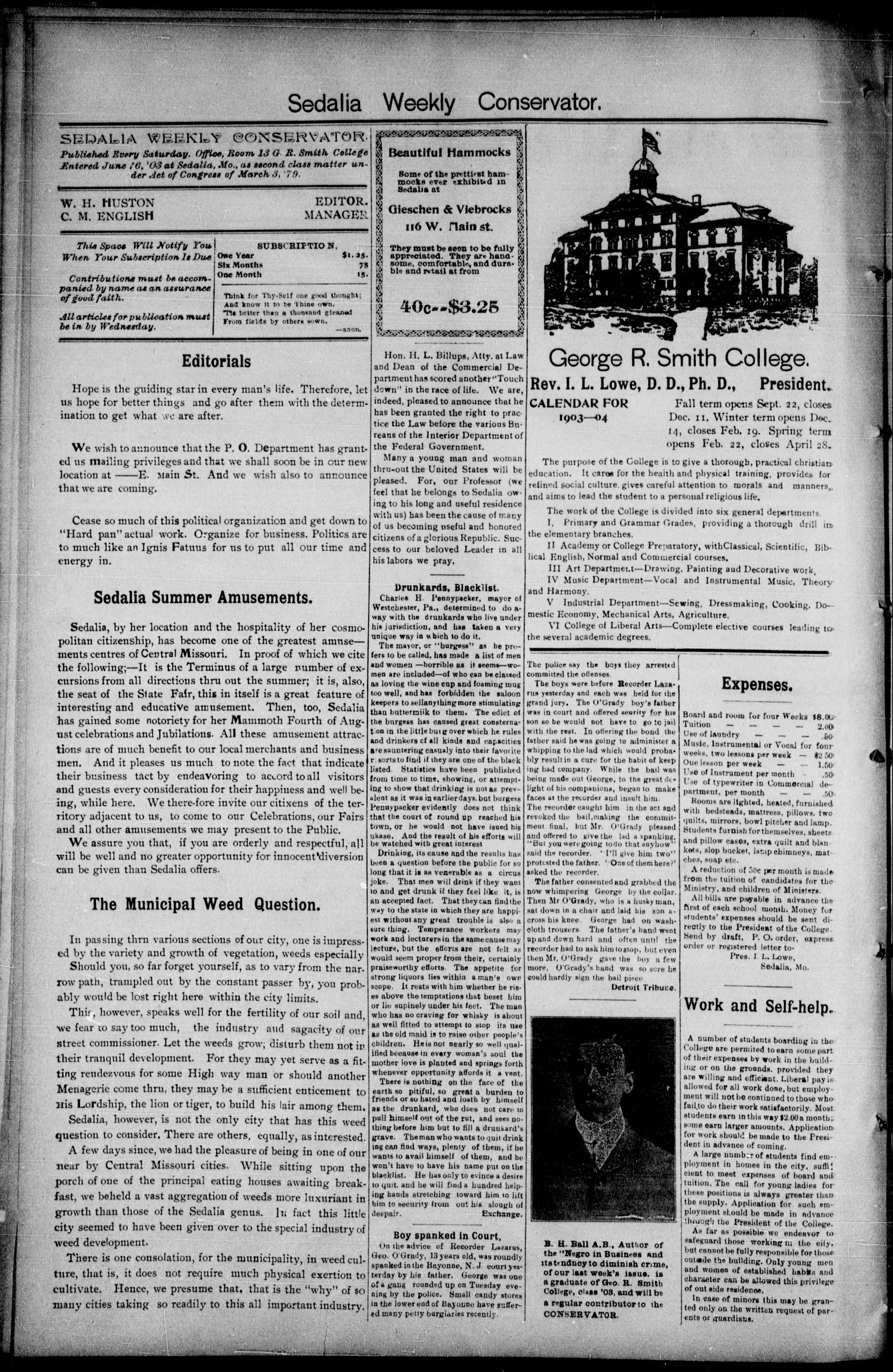
Sedalia Summer Amusements.
Sedalia, by her location and the hospitality of her cosmopolitan citizenship, has become one of the greatest amusements centres of Central Missouri. In proof of which we cite the following;—It is the Terminus of a large number of excursions from all directions thru out the summer; it is, also, the seat of the State Fair, this in itself is a great feature of interesting and educative amusement. Then, too, Sedalia has gained some notoriety for her Mammoth Fourth of August celebrations and Jubilations. All these amusement attractions are of much benefit to our local merchants and business men. And it pleases us much to note the fact that indicate their business tact by endeavoring to accord to all visitors and guests every consideration for their happiness and well being, while here. We there-fore invite our citixens of the territory adjacent to us, to come to our Celebrations, our Fairs and all other amusements we may present to the Public.
We assure you that, if you are orderly and respectful, all will be well and no greater opportunity for innocent diversion can be given than Sedalia offers.
The Municipal Weed Question.
In passing thrn various sections of our city, one is impressed by the variety and growth of vegetation, weeds especially Should you, so far forget yourself, as to vary from the narrow path, trampled out by the constant passer by, you probably would be lost right here within the city limits. This, however, speaks well for the fertility of our soil and, we fear to say too much, the industry and sagacity of our street commissioner. Let the weeds grow; disturb them not in their tranquil development. For they may yet serve as a fitting rendezvous for some High way man or should another Menagerie come thru, they may be a sufficient enticement to his Lordship, the lion or tiger, to build his lair among them.
Sedalia, however, is not the only city that has this weed question to consider. There are others, equally, as interested. A few days since, we had the pleasure of being in one of our near by Central Missouri cities. While sitting upon the porch of one of the principal eating houses awaiting breakfast, we beheld a vast aggregation of weeds more luxuriant in growth than those of the Sedalia genus. In fact this little city seemed to have been given over to the special industry of weed development.
There is one consolation, for the municipality, in weed culture, that is, it does not require much physical exertion to cultivate. Hence, we presume that, that is the "why" of so many cities taking so readily to this all important industry.
W. H. HUSTON
C. M. ENGLISH
Editorials
Sedalia Weekly Conservator.
EDITOR
MANAGER
Beautiful Hammocks
Some of the prettiest hammocks ever exhibited in Sedalia at
Gieschen & Viebrocks
116 W. Main st.
They must be seen to be fully appreciated. They are handsome, comfortable, and durable and retail at from
40c--$3.25
Hon. H. L. Billups, Atty. at Law and Dean of the Commercial Department has scored another "Touch down" in the race of life. We are, indeed, pleased to announce that he has been granted the right to practice the Law before the various Bureaus of the Interior Department of the Federal Government.
Many a young man and woman thru-out the United States will be pleased. For, our Professor (we feel that he belongs to Sedalia owing to his long and useful residence with us) has been the cause of many of us becoming useful and honored citizens of a glorious Republic. Success to our beloved Leader in all his labors we pray.
Drunkards. Blacklist.
Charles H. Pennypacker, mayor of Westchester, Pa., determined to do away with the drunkards who live under his jurisdiction, and has taken a very unique way in which to do it.
The mayor, or "burgess" as he prefers to be called, has made a list of men and women—horrible as it seems—women are included—of who can be classed as loving the wine cup and foaming mug too well, and has forbidden the saloon keepers to sellanything more stimulating than buttermilk to them. The edict of the burgess has caused great consternation in the little butt over which he rules and drinkers cf all kinds and capacities are sauntering casually into their favorite resorts to find if they are one of the black listed. Statistics have been published from time to time, showing, or attempting to show that drinking is not as prevalent as it was in earlier days, but burgess Pennpacker evidently does not think that the court of round up reached his town, or he would not have issued his ukase. And the result of his efforts will be watched with great interest
Drinking, its cause and the results has been a question before the public for so long that it is as venerable as a circus joke. That men will drink if they want to and get drunk if they feel like it, is an accepted fact. That they can find the way to the state in which they are happiest without any great trouble is also a sure thing. Temperance workers may work and lecturers in the same cause may lecture, but the efforts are not felt as would seem proper from their, certainly praiseworthy efforts. The appetite for strong liquors lies within a man's own scope. It rests with him whether he rises above the temptations that beset him or lie supinely under his feet. The man who has no craving for whisky is about as well fitted to attempt to stop its use as the old maid is to raise other people's children. He is not nearly so well qualified because in every woman's soul the mother love is planted and springs forth whenever opportunity affords it a vent.
There is nothing on the face of the earth so pitiful, so great a burden to friends or so hated and loath by himself as the drunkard, who does not care to pull himself out of the rut, and sees nothing before him but to fill a drunkard's grave. The man who wants to quit drinking can find ways, plenty of them, if he wants to avail himself of them, and he won't have to have his name put on the blacklist. He has only to evince a desire to quit, and he will find a hundred helping hands stretching toward him to lift him to security from out his slough of despair.
Exchange.
Boy spanked in Court.
On the advice of Recorder Lazarus, Geo. O Grady, 13 years old, was roundly spanked in the Bayonne, N. J. court yesterday by his father. George was one of a gang rounded up on Tuesday evening by the police. Small candy stores in the lower end of Bayonne have suffered many petty burglaries recently.
THE MUSEUM
The purpose of the College is to give a thorough, practical christian education. It cares for the health and physical training, provides for refined social culture, gives careful attention to morals and manners, and aims to lead the student to a personal religious life.
The work of the College is divided into six general departments.
I. Primary and Grammar Grades, providing a thorough drill in the elementary branches.
II Academy or College Preparatory, withClassical, Scientific, Biblical English, Normal and Commercial courses.
III Art Department—Drawing, Painting and Decorative work.
IV Music Department—Vocal and Instrumental Music, Theory and Harmony.
V Industrial Department—Sewing, Dressmaking, Cooking, Domestic Economy, Mechanical Arts, Agriculture.
VI College of Liberal Arts—Complete elective courses leading to the several academic degrees.
The police say the boys they arrested committed the offenses.
The boys were before Recorder Lazarus yesterday and each was held for the grand jury. The O'Grady boy's father was in court and offered security for his son so he would not have to go to jail with the rest. In offering the bond the father said he was going to administer a whipping to the lad which would probably result in a cure for the habit of keeping bad company. While the bail was being made out George, to the great delight of his companions, began to make faces at the recorder and insult him. The recorder caught him in the act and revoked the bail, making the commitment final, but Mr. O'Grady pleased and offered to give the lad a spanking. "But you were going to do that anyhow" said the recorder. "I'll give him two" protested the father. "One of them here?" asked the recorder.
The father consented and grabbed the now whimpering George by the collar. Then Mr O'Grady, who is a husky man, sat down in a chair and laid his son across his knee. George had on washcloth trousers. The father's hand went up and down hard and often until the recorder had to ask him to stop, but even then Mr, O'Grady gave the boy a few more, O'Grady's hand was so sore he could hardly sign the bail piece
Detroit Tribune
M. B.
B. H. Ball A.B., Author of the "Negro in Business and its tendency to diminish crime, of our last week's issue, is a graduate of Geo. R. Smith College, class '03, and will be a regular contributor to the CONSERVATOR.
Fall term opens Sept. 22, closes Dec. 11. Winter term opens Dec. 14, closes Feb. 19. Spring term opens Feb. 22, closes April 28.
is to give a thorough, practical christian health and physical training, provides for ful attention to morals and manners, a personal religious life.
divided into six general departments.
Grades, providing a thorough drill in
apparatory, withClassical, Scientific, Bib-
mercial courses.
Living, Painting and Decorative work,
Local and Instrumental Music, Theory
—Sewing, Dressmaking, Cooking, Do-
gets, Agriculture.
—Complete elective courses leading to
Expenses.
Board and room for four Weeks $8.00
Tuition — — — — 2.00
Use of laundry — — — .50
Music, Instrumental or Vocal for four
weeks, two lessons per week — $2.50
One lesson per week — 1.50
Use of Instrument per month .50
Use of typewriter in Commercial de-
partment, per month — .50
Rooms are lighted, heated, furnished
with bedsteads, mattress, pillows, two
quilts, mirrors, bowl pitcher and lamp.
Students furnish for themselves, sheets
and pillow cases, extra quilt and blan-
kets, slop bucket, lanp chimneys, mat-
ches, soap etc.
A reduction of 50c per month is made
from the tuition of candidates for the
Ministry, and children of Ministers.
All bills are payable in advance the first of each school month. Money for students' expenses should be sent directly to the President of the College. Send by draft, P. O. order, express order or registered letter to Pres. I. L. Lowe, Sedalia, Mo.
Work and Self-help.
A number of students boarding in the College are permitted to earn some part of their expenses by work in the building or on the grounds, provided they are willing and efficient. Liberal pay is allowed for all work done, but employment will not be continued to those who fail to do their work satisfactorily. Most students earn in this way $2.00 a month; some earn larger amounts. Application for work should be made to the President in advance of coming.
A large number of students find employment in homes in the city, sufficient to meet expenses of board and tuition. The call for young ladies for these positions is always greater than the supply. Application for such employment should be made in advance through the President of the College.
As far as possible we endeavor to safeguard those working in the city, but cannot be fully responsible for those outside the building. Only young men and women of established habits and character can be allowed this privilege of out side residence.
In case of minors this may be granted only on the written request of parents or guardians.
Our Correspondence
Boonville
The Fayette Elk-Horns played the Boonville Stars at Boonville Sunday.
Nathaniel Diggs has become a man of fowls (fouls) (chickens) since marriage.
Dr R. Leon Hill and estimable wife en ttained the 'Editor' Huston at lunch Sunday.
Jas. W. A. Brewn is pushing the Conservator to the front in Boonville. Let all join hands and help things move.
We are to have a Street Fair beginning Aug. 3rd, and extending to Aug. 8. Large crowds and a splendid time is expected.
St. Matthew Chapel A. M. E. church under the wise and efficient leadership of Rev. Sage, has a most excellent choir with Miss S. A. Braxton, a teacher in the city schools, as organist.
Presiding Elder Allen's discourse at St. Matthew's Chapel, last Sunday morning, was with sincerity, common sense, and intelligence. He, as the worthy successor, of the late Rev. White, is succeeding admirably. Being a young minister of unusual powers of character and intelligence, no better choice could have been made than that setting him apart as lead er in his district.
We were pleased to find in one of the leading Gents' Furnishing Houses in Boonville, a young man, Mr. Humphheys by name, who holds a very prominent position, as assistant to Victor and Brother Mr. Humphheys is a very unassuming & business-like young man—courteous and refined. We would say to him: Continue to cultivate the confidence and esteem of your employees, until you may secure a still higher position of Honor and Trust.
The game of ball played Sunday was one of the most exciting games ever played here this year. The opposing teams were the Fayette Elkhorns and Boonville Stars. The game was interesting, the score being 5 to 4 in the Star's favor.
The boys have been playing good ball this year with Charley Jones, pitching and Jas, Hutcheson, catching. The batterey for the Elk-Horns was Seeals and Gates, Jones and Hutcheson simply outclassed them. The Stars have won every game this year.
An Accident.
While the ball game was watched by the spectators Sunday, Pleasant Umphry, running to first got his leg broken. On reaching the base he got his leg between the baseman's legs and with his speed fell and broke both bones just above the ankle. Dr. Hill was on the ground and temporarily dressed the limb The player was taken home and the wound properly dressed. The young man well known and thought of in Boonville, and will have the best attention of Dr. Hill and U. B. F. lodge of which he is a member.
Malta Bend.
Mr. Sam Fowler is better.
Mr. Charley Thomas is on the sick list
Miss Hannah Wilson is able to be out again.
Miss Fannie Miles visited in Marshall Saturday.
Rev. Divers of Sweet Springs is visiting Rev. C. Tayes.
Mrs. Rosa Rhodes came in Sunday morning from Kansas City.
A number of people attended the p'cnic at Marshall Friday.
A social given at Mr. Albert Tibb's Monday eve. was a good success.
Mr. and Mrs. Tom Allen from Miami spent Sun. with Mr. George Lee.
Mrs. Pauline Florence of Denver Colo. is here visiting her mother and friends.
Mr. Wester Randell came in Tuesday from Kansas City to visit home folks.
Died. Saturday, July 11, little Lucy May Logan, daughter of Mr. and Mrs. Ben Logan.
Misses Maud and Mittie Fowler have returned from Waverly, Mo. where they were the guest of Miss. Lizzie Stewart.
---
Holden.
Mr. H. Johnson has gone for a short trip to the city.
Mrs. Mary Bryant came home very ill from. Kansas City.
Miss Lillie Henderson, who has been on the sick list has fully recovered.
Mr. Robert Jacobs made one of Frank Reads flying trips home and back to K City.
Mrs. Gillum, who has been visiting her son-in-law, has returned to Knob Noster.
Miss Stella Butler of Kan. City is home visiting her father, who has been very ill
The ladies' lodge, the 'Misterious Ten' has just received sits charter and is now for business.
Mrs Mary Jacobs, who has been visiting friends and relatives here has departed for Kansas City.
Mr. Madison Fisher, one of Holden's noted sports, says he has lost a good home. (with his lady friend.)
Mr. Walter Hunley, who has been hunting his lost wife succeeded in finding her with relatives in Kansas City.
Mrs. Kindol, an old lady, was found dead in her garden last Thursday evening. Her remains were interred in the Holden cemetery.
Marshall.
Wilson Patrick, an aged and highly respected citizen is ill on Conway Ave.
Mrs. A. H. Higgs expects to spend a few days at Louisiana, Mo, this month.
Mrs. Deboe, wife of W. J. Deboe of Slater, Mo., is visiting this week in Marshall at Mrs. Lizzie Huff's.
A wedding is to take place in the parsonage yard under the big trees quite soon Look out for announcements.
Rev. A. H. Higgs is to speak at the Summer Chatauqua at Grinnell Ia. and Iowa City this season. The former town where he graduated in 1884.
We trust that the visit of our Editor to the city recently in the interest of his paper and the young people will prov helpful in many ways.
What are you doing to help the great Negro journals? Get one subscriber; that will be a starter for you. People may prove quite helpful in many ways.
Misses Louise Bush and Lavinia Switzler were the guests of Miss Willie Brown a few days since. The Misses Bush and Switzler are of the city of Arrow Rock, his possession coins of every country upon the face of the earth. Another remarkable thing about this is the fact that he knows the history, intrinsic and commercial value of each.
Rev. H. Green has been somewhat disposed since his return from College, but has managed to hold his own in upholding the principles and good name of the Free Baptist of this section.
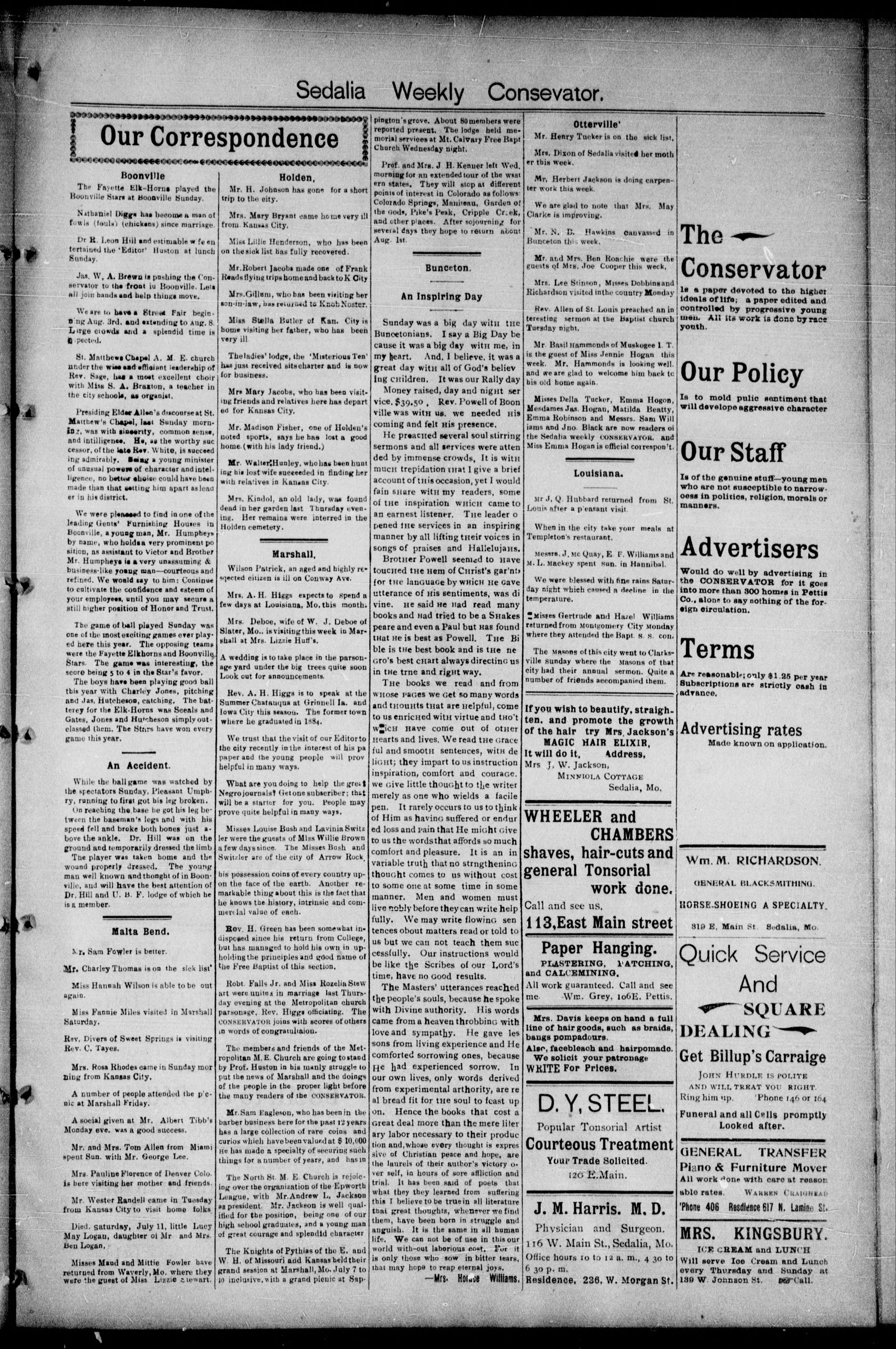
Robt. Falls Jr. and Miss Rozelia Stew art were unites in marriage last Thursday evening at the Metropolitan church parsonage, Rev. Higgs officiating. The CONSERVATOR joins with scores of others in words of congratulation.
The members and friends of the Metropolitan M.E. Church are going to stand by Prof. Huston in his manly struggle to put the news of Marshall and the doings of the people in the proper light before the many readers of the CONSERVATOR.
Mr. Sam Eagleson, who has been in the barber business here for the past 12 years has a large collection of rare coins and curios which have been valued at $ 10,000 He has made a specialty of securing such things for a number of years, and has in The North St. M. E. Church is rejoicing over the organization of the Epworth League, with Mr. Andrew L. Jackson as president. Mr. Jackson is well qualified for the position, being one of our high school graduates, and a young man of great courage and splendid character The Knights of Pythias of the E. and W. H. of Missouri and Kansas held their grand session at Marshall, Mo. July 7 to 10 inclusive, with a grand picnic at Sap-
---
pington's grove. About 80 members were reported present. The lodge held memorial services at Mt. Calvary Free Bapt Church Wednesday night.
Prof. and Mrs. J. H. Kenner left Wed. morning for an extended tour of the wsst ern states. They will stop at different points of interest in Colorado as follows: Colorado Springs, Maniteau, Garden of the gods, Pike's Peak, Cripple Creek, and other places. After sojourning for several days they hope to return about Aug. 1st.
Bunceton
An Inspiring Day
Sunday was a big day with the Buncetonians. I say a Big Day be cause it was a big day with me, in my heart. And, I believe, it was a great day with all of God's believing children. It was our Rally day Money raised, day and night service. $39.50, Rev. Powell of Boon ville was with us. we needed his coming and felt his presence.
He preached several soul stirring sermons and all services were attended by immense crowds. It is with much trepidation that I give a brief account of this occasion, yet I would fain share with my readers, some of the inspiration which came to an earnest listener. The leader opened the services in an inspiring manner by all lifting their voices in songs of praises and Hallelujahs.
Brother Powell seemed to have touched the hem of Christ's gar'nt for the language by which he gave utterance of his sentiments, was divine. He said he had read many books and had tried to be a Shakes peare and even a Paul but has found that he is best as Powell. The Bible is the best book and is the negro's best chart always directing us in the true and right way.
The books we read and from whose pages we get so many words and thoughts that are helpful, come to us enriched with virtue and tho't which have come out of other hearts and lives. We read the graceful and smooth sentences, with de light; they impart to us instruction inspiration, comfort and courage. we give little thought to the writer merely as one who wields a facile pen. It rarely occurs to us to think of Him as having suffered or endured loss and pain that He might give to us the words that affords so much comfort and pleasure. It is an in variable truth that no strengthening thought comes to us without cost to some one at some time in some manner. Men and women must live nobly before they can write help fully. We may write flowing sentences obout matters read or told to us but we can not teach them successfully. Our instructions would be like the Scribes of our Lord's time, have no Good results.
The Masters' utterances reached the people's souls, because he spoke with Divine authority. His words came from a heaven throbbing with love and sympathy. He gave les sons from living experience and He comforted sorrowing ones, because He had experienced sorrow. In our own lives, only words derived from experimental arthority, are real bread fit for the soul to feast up on. Hence the books that cost a great deal more than the mere literary labor necessary to their production and, whose every thought is expressive of Christian peace and hope, are the laurels of their author's victory over self, in hours of sore affliction and trial. It has been said of poets that what they they learned from suffering this I believe to be true in all literature that great thoughts, whenever we find them, have been born in struggle and anguish. It is the same in all human life. We can not be of use in this our world with-out laborious cost. For it is only those who sow in bitter tears, that may hope to reap eternal joys.
Mrs. Horace Williams.
Mr. Henry Tucker is on the sick list,
Mrs. Dixon of Sedalia visited her mother this week.
Mr. Herbert Jackson is doing carpenter work this week.
We are glad to note that Mrs. May Clarke is improving.
Mr. N. D. Hawkins canvassed in Bunceton this week.
Mr. and Mrs. Ben Roachie were the guests of Mrs. Joe Cooper this week.
Mrs. Lee Stinson, Misses Dobbins and Richardson visited in the country Monday
Rev. Allen of St. Louis preached an interesting sermon at the Baptist church Tuesday night.
Mr. Basil Hammonds of Muskogee I. T. is the guest of Miss Jennie Hogan this week. Mr. Hammonds is looking well. and we are glad to welcome him back to his old home again.
Misses Della Tucker, Emma Hogon, Mesdames Jas. Hogan, Matilda Beatty, Emma Robinson and Messrs. Sam Wiams and Jno. Black are now readers of the Sedalia weekly CONSERVATOR, and Miss Emma Hogan is official correspondent.
Louisiana.
Mr J. Q. Hubbard returned from St. Louis after a pleasant visit.
When in the city take your meals at Templeton's restaurant.
Messrs. J. McQuay, E. F. Williams and M. L. Mackey spent sun. in Hannibal.
We were blessed with fine rains Saturday night which caused a decline in the temperature.
Misses Gertrude and Hazel Williams returned from Montgomery City Monday where they attended the Bapt. s. s. con.
The masons of this city went to Clarksville sunday where the masons of that city had their annual sermon. Quite a number of friends accompanied them.
If you wish to beautify, straighten. and promote the growth of the hair try Mrs. Jackson's MAGIC HAIR ELIXIR. It will do it. Address,
Mrs J. W. Jackson,
MINNIOLA COTTAGE
Sedalia, Mo.
WHEELER and
CHAMBERS shaves, hair-cuts and general Tonsorial work done. Call and see us. 113,East Main street
Paper Hanging.
PLASTERING, PATCHING,
and CALCEMINING.
All work guaranteed. Call and see
me. Wm. Grey, 106E. Pettis.
Mrs. Davis keeps on hand a full
line of hair goods, such as braids,
bangs pompadours.
Also, facebleach and hairpomado.
We solicit your patronage
WRITE For Prices.
D.Y,STEEL
Popular Tonsorial Artist Courteous Treatment Your Trade Solicited. 126 E.Main.
J. M. Harris. M. D.
Physician and Surgeon. 116 W. Main St., Sedalia, Mo. Office hours 10 to 12 a. m., 4 30 to 6 30 p. m. Residence, 226, W. Morgan St.
Conservator
Is a paper devoted to the higher ideals of life; a paper edited and controlled by progressive young men. All its work is done by race youth.
Our Policy
Is to mold pulic sentiment that will develop aggressive character
Our Staff
Is of the genuine stuff--young men who are not susceptible to narrow- oess in politics, religion, morals or manners.
Advertisers
Would do well by advertising in the CONSERVATOR for it goes into more than 300 homes in Pettis Co., alone to say nothing of the foreign circulation.
Terms
Are reasonable; only $1.25 per year Subscriptions are strictly cash in advance.
Advertising rates
Made known on application.
Wm. M. RICHARDSON.
GENERAL BLACKSMITHING.
HORSE-SHOEING A SPECIALTY
310 E. Main St. Sedalia, Mo.
Quick Service And SQUARE DEALING
Get Billup's Carraige
JOHN HURDLE IS POLITE
AND WILL TREAT YOU RIGHT.
Ring him up. 'Phone 146 or 164
Funeral and all Cells promptly
Looked after.
GENERAL TRANSFER
Piano & Furniture Mover
All work done with care at reason
able rates.
WARREN CRAIGHEAD
'Phone 406 Resdience 617 N. Lamine St.
MRS. KINGSBURY.
ICE CREAM and LUNCH Will serve Ice Cream and Lunch every Thursday and Sunday at 139 W. Johnson St. Call.
THEATRE
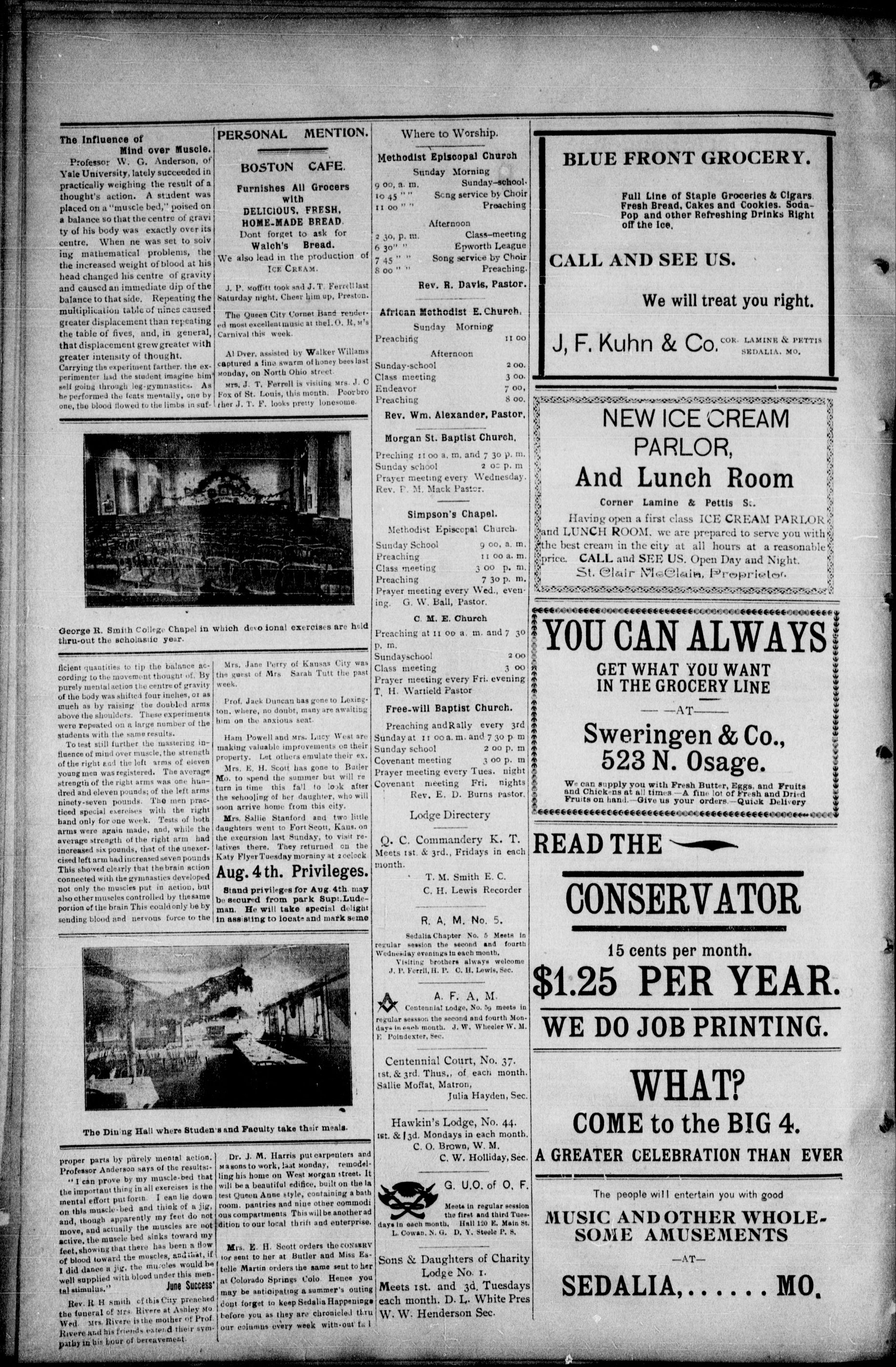
George R. Smith College Chapel in which devotional exercises are held thru-out the scholastic year.
The Dining Hall where Students and Faculty take their meals.
The Influence of Mind over Muscle.
Professor W. G. Anderson, of Yale University, lately succeeded in practically weighing the result of a thought's action. A student was placed on a "muscle bed," poised on a balance so that the centre of gravity of his body was exactly over its centre. When ne was set to solving mathematical problems, the increased weight of blood at his head changed his centre of gravity and caused an immediate dip of the balance to that side. Repeating the multiplication table of nines caused greater displacement than repeating the table of fives, and, in general, that displacement grew greater with greater intensity of thought.
Carrying the experiment farther. the experimenter had the student imagine him self going through leg-gymnastics. As he performed the fets mentally, one by one, the blood flowed to the limbs in suf-
George R. Smith College Chapel in v thru-out the scholastic year.
ficient quantities to tip the balance according to the movement thought of. By purely mental action the centre of gravity of the body was shifted four inches, or as much as by raising the doubled arms above the shoulders. These experiments were repeated on a large number of the students with the same results.
To test still further the mastering influence of mind over muscle, the strength of the right and the left arms of eleven young men was registered. The average strength of the right arms was one hundred and eleven pounds; of the left arms ninety-seven pounds. The men practiced special exercises with the right hand only for one week. Tests of both arms were again made, and, while the average strength of the right arm had increased six pounds, that of the unexercised left arm had increased seven pounds. This showed clearly that the brain action connected with the gymnastics developed not only the muscles put in action, but also other muscles controlled by the same portion of the brain This could only be by sending blood and nervous force to the
The Dining Hall where Student
proper parts by purely mental action. Professor Anderson says of the results: "I can prove by my muscle-bed that the important thing in all exercises is the mental effort put form. I can lie down on this muscle-bed and think of a jig, and, though apparently my feet do not move, and actually the muscles are not active, the muscle bed sinks toward my feet, showing that there has been a flow of blood toward the muscles, and that, if I did dance a jig, the muscles would be well supplied with blood under this mental stimulus." June Success' Rev. R H Smith of this City preached the funeral of Mrs. Rivere at Ashley Mo. Wed. Mrs. Rivere is the mother of Prof. Rivere and his friends extend their sympathy in his hour of bereavement.
PERSONAL MENTION.
BOSTON CAFE.
Furnishes All Grocers with DELICIOUS, FRESH, HOME-MADE BREAD. Dont forget to ask for Walch's Bread. We also lead in the production of ICE CREAM. J. P. moffitt took sad J. T. Ferrell last Saturday night. Cheer him up, Preston. The Queen City Cornet Band rendered most excellent music at thel. O. R. m's Carnival this week.
Al Dyer, assisted by Walker Williams captured a fine swarm of honey bees last monday, on North Ohio street. Mrs. J. T. Ferrell is visiting Mrs. J. C Fox of St. Louis, this month. Poorbrother t. J. F. looks pretty lonesome.
which devoional exercises are held
Mrs. Jane Perry of Kansas City was the guest of Mrs. Sarah Tutt the past week.
Prof. Jack Duncan has gone to Lexington, where, no doubt, many are awaiting him on the anxious seat.
Ham Powell and Mrs. Lucy West are making valuable improvements on their property. Let others emulate their ex.
Mrs. E. H. Scott has gone to Butler Mo. to spend the summer but will return in time this fall to look after the schooling of her daughter, who will soon arrive home from this city.
Mrs. Sallie Stanford and two little daughters went to Fort Scott, Kans. on the excursion last Sunday, to visit relatives there. They returned on the Katy Flyer Tuesday morning at 2 oclock
Aug. 4th. Privileges.
Stand privileges for Aug. 4th may be secured from park Supt.,Lude man. He will take special delight in assisting to locate and mark some
s and Faculty take their meals.
Dr. J. M. Harris put carpenters and maisons to work, last monday, remodeling his home on West morgan street. It will be a beautiful edifice, built on the la test Queen Anne style, containing a bath room, pantries and nine other commodi ous compartments. This will be another ad dition to our local thrift and enterprise.
Mrs. E. H. Scott orders the conservi tor sent to her at Butler and Miss Estelle Martin orders the same sent to her at Colorado Springs Colo. Hence you may be anticipating a summer's outing dont forget to keep Sedalia Happenings before you as they are chronicled thru our columns every week with-out fail
Methodist Episcopal Church
Sunday Morning
9 00, a. m. Sunday-school
10 45 " " Song service by Choir
11 00 " " Preaching
Afternoon
2 30, p. m. Class-meeting
3 60 " " Epworth League
7 45 " " Song service by Choir
8 00 " " Preaching.
African Methodist E. Church.
Sunday Morning
Preaching 11 00
Afternoon
Sunday-school 2 00.
Class meeting 3 00.
Endeavor 7 00,
Preaching 8 00.
Rev. Wm. Alexander, Pastor.
Morgan St. Baptist Church.
Preching 11 00 a. m. and 7 30 p. m.
Sunday school 2 00 p. m
Prayer meeting every Wednesday.
Rev. F. M. Mack Pastor.
Simpson's Chapel.
Methodist Episcopal Church.
Sunday School 9 00, a. m.
Preaching 11 00 a. m.
Class meeting 3 00 p. m.
Preaching 7 30 p. m.
Prayer meeting every Wed., evening.
G. W. Ball, Pastor.
C. M. E. Church
Preaching at 11 00 a. m. and 7 30 p. m.
Sundayschool 2 00
Class meeting 3 00
Prayer meeting every Fri. evening
T. H. Wartield Pastor
Free-will Baptist Church.
Preaching andRally every 3rd
Sunday at 11 00 a.m. and 7 30 p.m
Sunday school 2 00 p. m
Covenant meeting 3 00 p. m
Prayer meeting every Tues. night
Covenant meeting Fri. nights
Rev. E. D. Burns pastor.
Lodge Directory
Q. C. Commandery K. T.
Meets 1st. & 3rd., Fridays in each
month.
T. M. Smith E. C.
C. H. Lewis Recorder
R. A. M. No. 5
Sedalia Chapter No. 5 Meets in regular session the second and fourth Wednesday evenings in each month. Visiting brothers always welcome J. P. Forrill, H. P. C. H. Lewis, Sec.
A. F. A. M.
Centennial Lodge, No. 59 meets in regular season the second and fourth Mondays in each month. J. W. Wheeler W. M. E. Polindexter, Sec.
Centennial Court, No. 37.
1st, & 3rd. Thus., of each month.
Sallie Moffat, Matron,
Hawkin's Lodge, No. 44. 1st. & 13d. Mondays in each month. C. O. Brown, W. M.
X
Sons & Daughters of Charity Lodge No.1. Meets 1st. and 3d. Tuesdays each month. D. L. White Pres W. W. Henderson Sec.
BLUE FRONT GROCERY.
Full Line of Staple Groceries & Cigars. Fresh Bread, Cakes and Cookies. Soda-Pop and other Refreshing Drinks Right off the Ice.
CALL AND SEE US.
We will treat you right.
J, F. Kuhn & Co.
NEW ICE CR
PARLOR,
And Lunch H
Corner Lamine & Pettis
Having open a first class ICE C
and LUNCH ROOM, we are prepared
the best cream in the city at all hour
price. CALL and SEE US. Open Da
St. Clair McClain, Pre
YOU CAN ALW
GET WHAT YOU W
IN THE GROCERY
AT
Sweringen &
523 N. Osag
We can supply you with Fresh Butter, B
and Chickens at all times. A fine lot of
Fruits on hand. Give us your orders.
J, F. Kuhn & Co. COR. LAMINE & PETTIS SEDALIA, MO.
NEW ICE CREAM PARLOR, And Lunch Room
Corner Lamine & Pettis St. Having open a first class ICE CREAM PARLOR and LUNCH ROOM. we are prepared to serve you with the best cream in the city at all hours at a reasonable price. CALL and SEE US. Open Day and Night. St. Clair McClain, Proprietor.
Sweringen & Co.,
523 N. Osage.
We can supply you with Fresh Butter, Eggs, and Fruits and Chickens at all times-A fine lot of Fresh and Dried Fruits on hand.-Give us your orders-Quick Delivery
READ THE
CONSERVA 15 cents per mon
CONSERVATOR
15 cents per month. $1.25 PER YEAR. WE DO JOB PRINTING.
WHAT? COME to the BIG 4. A GREATER CELEBRATION THAN EVER
The people will entertain you with good MUSIC AND OTHER WHOLE- SOME AMUSEMENTS
SEDALIA,.....MO.