Sedalia Weekly Conservator
Saturday, July 25, 1903
Sedalia, Missouri
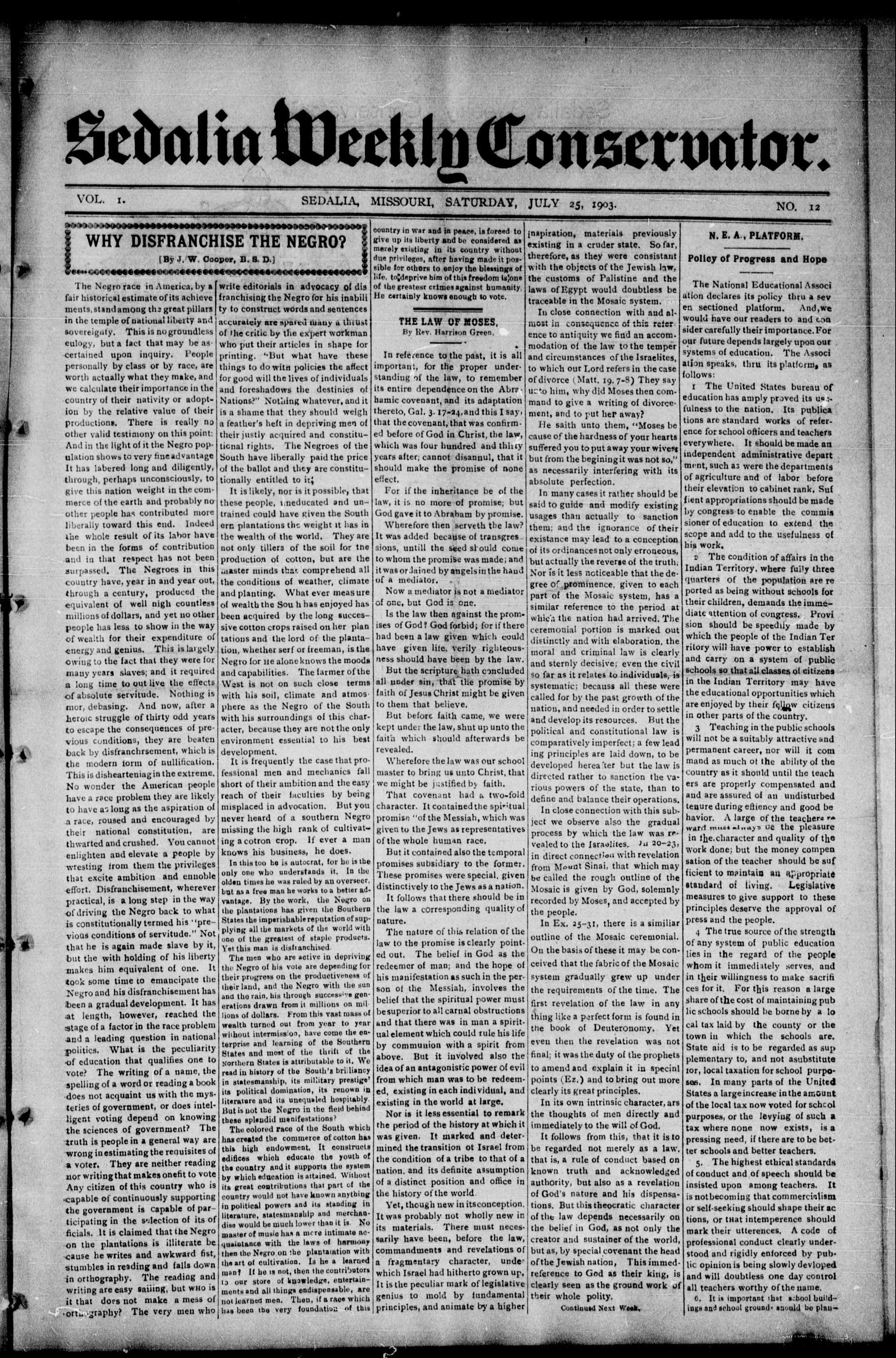
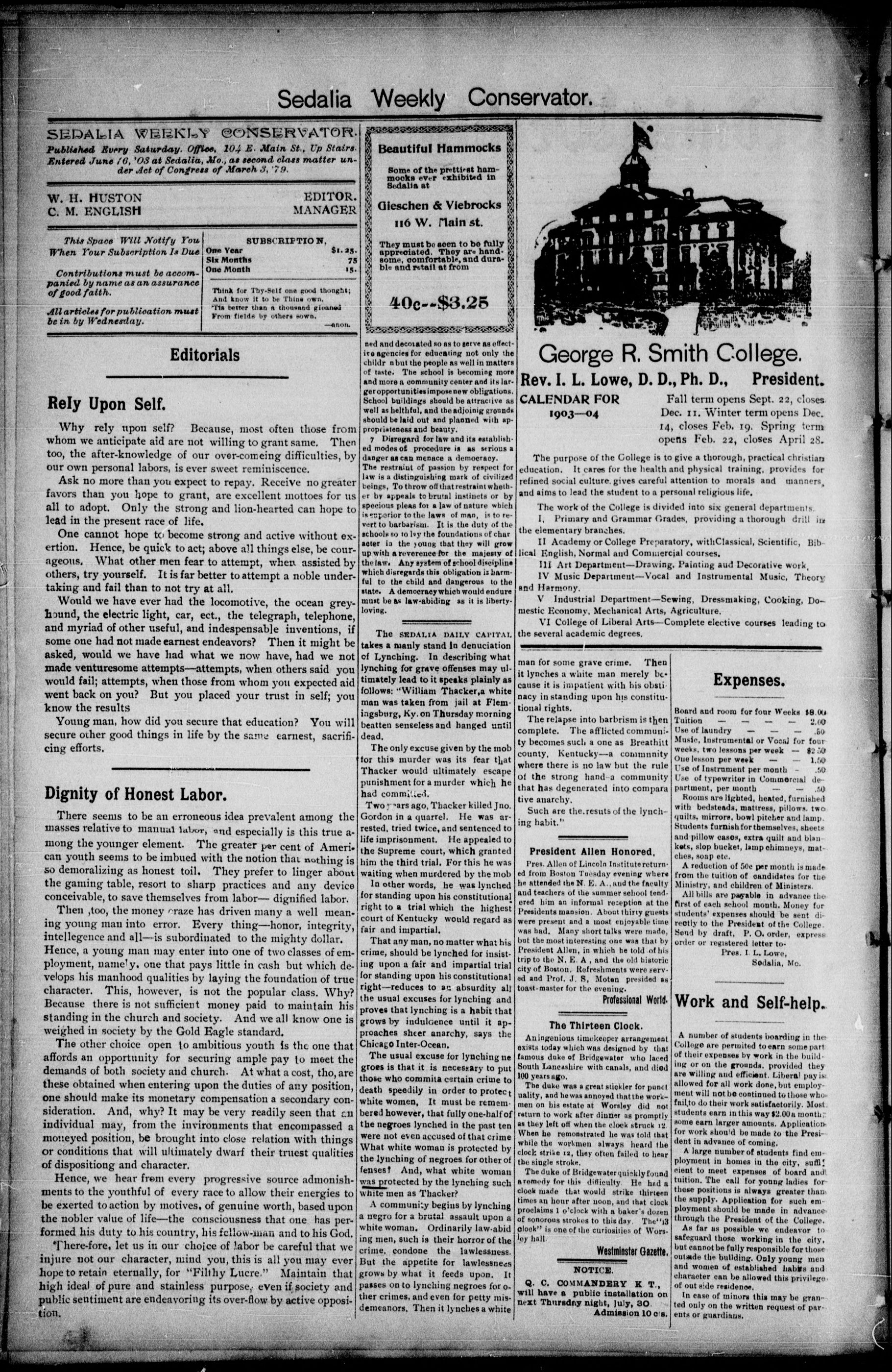
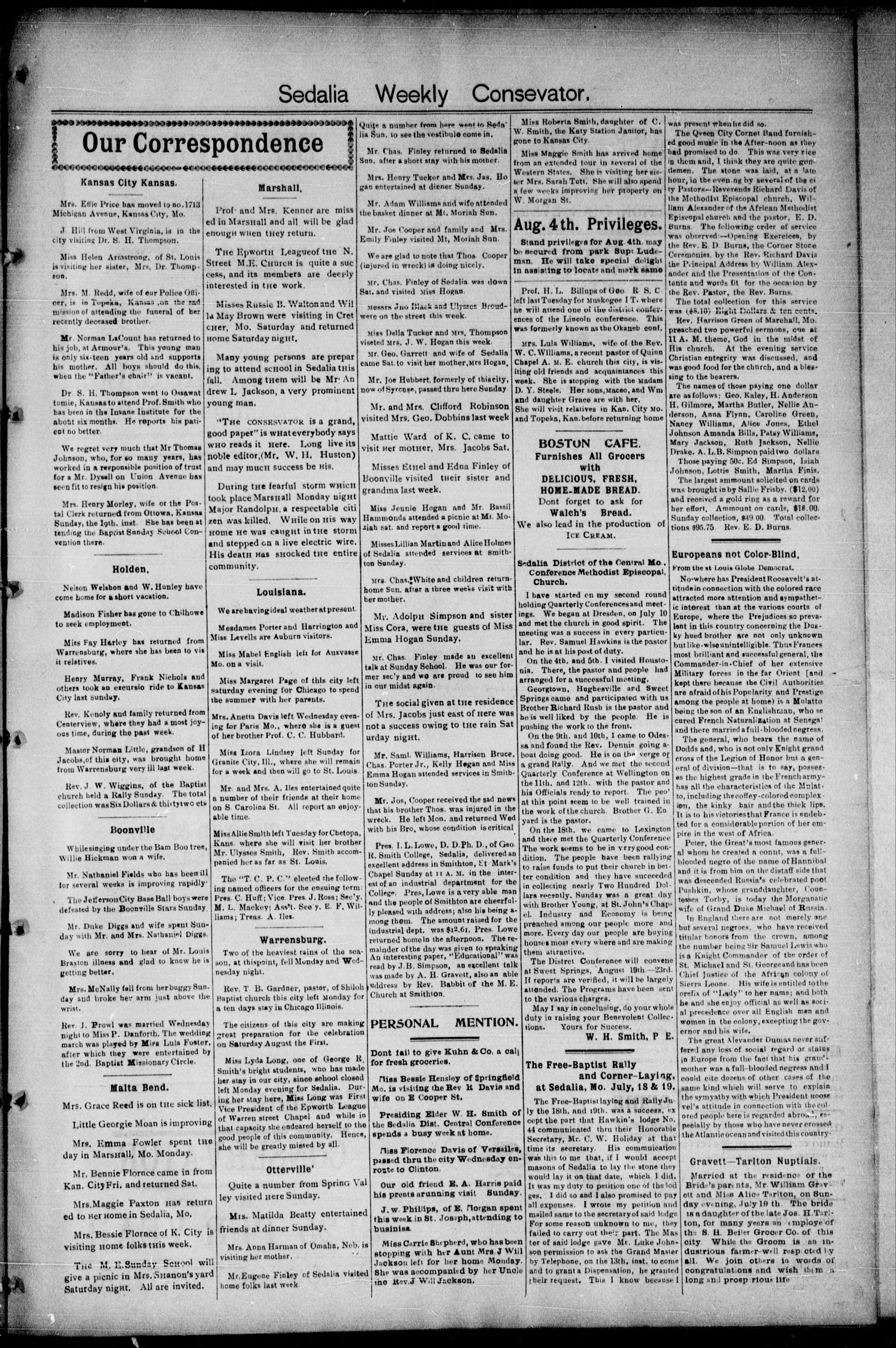
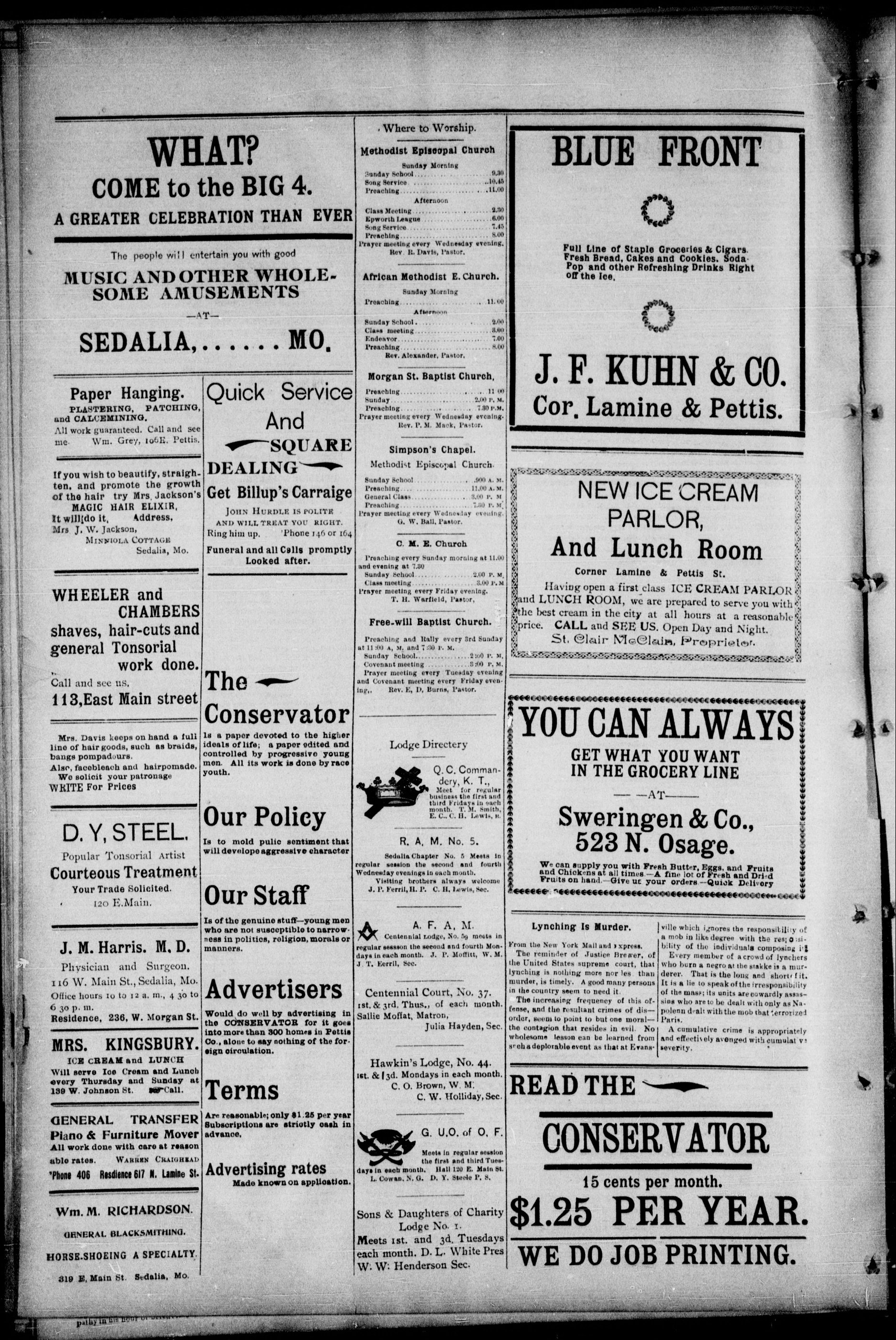
Page text (machine-generated)
Sedalia Weekly Conservator.
WHY DISFRANCHISE THE NEGRO?
VOL. 1.
The Negro race in America, by a fair historical estimate of its achievements, stand among the great pillars in the temple of national liberty and sovereignty. This is no groundless eulogy, but a fact that may be ascertained upon inquiry. People personally by class or by race, are worth actually what they make, and we calculate their importance in the country of their nativity or adoption by the relative value of their productions. There is really no other valid testimony on this point: And in the light of it the Negro population shows to very fine advantage It has labered long and diligently through, perhaps unconsciously, to give this nation weight in the commerce of the earth and probably no other people has contributed more liberally toward this end. Indeed the whole result of its labor have been in the forms of contribution and in that respect has not been surpassed. The Negroes in this country have, year in and year out, through a century, produced the equivalent of well nigh countless millions of dollars, and yet no other people has less to show in the way of wealth for their expenditure of energy and genius. This is largely owing to the fact that they were for many years slaves; and it required a long time to out live the effects of absolute servitude. Nothing is mor, debasing. And now, after a heroic struggle of thirty odd years to escape the consequences of previous conditions, they are beaten back by disfranchsement, which is the modern form of nullification. This is disheartening in the extreme. No wonder the American people have a race problem they are likely to have as long as the aspiration of a race, roused and encouraged by their national constitution, are thwarted and crushed. You cannot enlighten and elevate a people by wrestling from them the privileges that excite ambition and ennoble effort. Disfranchisement, wherever practical, is a long step in the way of driving the Negro back to what is constitutionally termed his "previous conditions of servitude." Not that he is again made slave by it, but the with holding of his liberty makes him equivalent of one. It took some time to emancipate the Negro and his disfranchisement has been a gradual development. It has at length, however, reached the stage of a factor in the race problem and a leading question in national politics. What is the peculiarity of education that qualifies one to vote? The writing of a name, the spelling of a word or reading a book does not acquaint us with the mysteries of government, or does intelligent voting depend on knowing the sciences of government? The truth is people in a general way are wrong estimating the requisites of a voter. They are neither reading nor writing that makes one fit to vote. Any citizen of this country who is capable of continuously supporting the government is capable of participating in the selection of its officials. It is claimed that the Negro on the plantations is illiterate because he writes and awkward fist, stumbles in reading and falls down in orthography. The reading and writing are easy sailing, but who is it that does not make a mess of orthography? The very men who
SEDALIA, MISSOURI, SATURDAY, JULY 25, 1903.
write editorials in advocacy of disfranchising the Negro for his inability to construct words and sentences accurately are spared many a thrust of the critic by the expert workman who put their articles in shape for printing. "But what have these things to do with policies the affect for good will the lives of individuals and foreshadows the destinies of Nations?" Nothing whatever, and it is a shame that they should weigh a feather's heft in depriving men of their justly acquired and constitutional rights. The Negroes of the South have liberally paid the price of the ballot and they are constitutionally entitled to it;
It is likely, nor is it possible, that these people, uneducated and untrained could have given the South ern plantations the weight it has in the wealth of the world. They are not only tillers of the soil for the production of cotton, but are the master minds that comprehend all the conditions of weather, climate and planting. What ever measure of wealth the South has enjoyed has been acquired by the long successive cotton crops raised on her plantations and the lord of the plantation, whether serf or freeman, is the Negro for he alone knows the moods and capabilities. The farmer of the West is not on such close terms with his soil, climate and atmosphere as the Negro of the South with his surroundings of this character, because they are not the only environment essential to his best development.
It is frequently the case that professional men and mechanics fall short of their ambition and the easy reach of their faculties by being misplaced in advocacy. But you never heard of a southern Negro missing the high rank of cultivating a cotron crop. If ever a man knows his business, he does.
In this too he is autocrat, for he is the only one who understands it. In the olden times he was ruled by an overseer, but as a free man he works to a better advantage. By the work, the Negro on the plantations has given the Southern States the imperishable reputation of supplying all the markets of the world with one of the greatest of staple products. Yet this man is distranchised.
The men who are active in depriving the Negro of his vote are depending for their progress on the productiveness of their land, and the Negro with the sun and the rain, his through successive generations drawn from it millions on millions of dollars. From this vast mass of wealth turned out from year to year without intermission, have come the enterprise and learning of the Southern States and most of the thrift of the Northern States is attributable to it. We read in history of the South's brilliancy in statesmanship, its military prestige' its political domination, its renown in literature and its unequaled hospitably. But is not the Negro in the field behind these splendid manifestations?
The colored race of the South which has created the commerce of cotton has this high endowment. It constructs edifices which educate the youth of the country and it supports the system by which education is attained. Without its great contributions that part of the country would not have known anything in political powers and its standing in literature, statesmanship and merchandise would be much lower than it is. No master of music has a more intimate acquaintance with the laws of harmony then the Negro on the plantation with the art of cultivation. Is he a learned man? If he is not, then the contributors to our store of knowledge, entertainments and all things endispensable, are not learned men. Then, if a race which has been the very foundation of this
country in war and in peace, is forced to give up its liberty and be considered as merely existing in its country without due privileges, after having made it possible for others to enjoy the blessings of life, to deprive him of this freedom is one of the greatest crimes against humanity. He certainly knows enough to vote.
THE LAW OF MOSES. By Rev. Harrison Green.
In reference to the past, it is all important, for the proper understanding of the law, to remember its entire dependence on the Abrahamic covenant, and its adaptation thereto, Gal. 3.17-24, and this I say, that the covenant, that was confirmed before of God in Christ, the law, which was four hundred and thirty years after; cannot disannul, that it should make the promise of none effect.
For if the inheritance be of the law, it is no more of promise; but God gave it to Abraham by promise.
Wherefore then serveth the law? It was added because of transgressions, untill the seed should come to whom the promise was made; and it was ordained by angels in the hand of a mediator.
Now a mediator is not a mediator of one, but God is one.
Is the law then against the promises of God? God forbid; for if there had been a law given which could have given lite. verily righteousness should have been by the law.
But the scripture hath concluded all under sin, that the promise by faith of Jesus Christ might be given to them that believe.
But before faith came, we were kept under the law, shut up unto the faith which should afterwards be revealed.
Wherefore the law was our school master to bring us unto Christ, that we might be justified by faith.
That covenant had a two-fold character. It contained the spiritual promise "of the Messiah, which was given to the Jews as representatives of the whole human race.
But it contained also the temporal promises subsidiary to the former. These promises were special, given distinctively to the Jews as a nation.
It follows that there should be in the law a corresponding quality of nature.
The nature of this relation of the law to the promise is clearly pointed out. The belief in God as the redeemer of man; and the hope of his manifestation as such in the person of the Messiah, involves the belief that the spiritual power must besuperior to all carnal obstructions and that there was in man a spiritual element which could rule his life by communion with a spirit from above. But it involved also the idea of an antagonistic power of evil from which man was to be redeemed, existing in each individual, and existing in the world at large.
Nor is it less essential to remark the period of the history at which it was given. It marked and determined the transition of Israel from the condition of a tribe to that of a nation, and its definite assumption of a distinct position and office in the history of the world.
Yet, though new in its conception. It was probably not wholly new in its materials. There must necessarily have been, before the law, commandments and revelations of a fragmentary character, under which Israel had hitherto grown up. It is the peculiar mark of legislative genius to mold by fundamental principles, and animate by a higher
inspiration, materials previously existing in a cruder state. So far, therefore, as they were consistent with the objects of the Jewish law, the customs of Palistine and the laws of Egypt would doubtless be traceable in the Mosaic system. In close connection with and almost in consequence of this reference to antiquity we find an accommodation of the law to the temper and circumstances of the Israelites, to which our Lord refers in the case of divorce (Matt. 19.7-8) They say unto him, why did Moses then command to give a writing of divorcement, and to put her away?
He saith unto them, "Moses be cause of the hardness of your hearts suffered you to put away your wives but from the beginning it was not so," as necessarily interfering with its absolute perfection.
In many cases it rather should be said to guide and modify existing usages than actually to sanction them; and the ignorance of their existence may lead to a conception of its ordinances not only erroneous, but actually the reverse of the truth; Nor is it less noticeable that the degree of prominence, given to each part of the Mosaic system, has a similar reference to the period at which the nation had arrived. The ceremonial portion is marked out distinctly and with elaboration, the moral and criminal law is clearly and sternly decisive; even the civil so far as it relates to individuals, is systematic; because all these were called for by the past growth of the nation, and needed in order to settle and develop its resources. But the political and constitutional law is comparatively imperfect; a few leading principles are laid down, to be developed hereafter but the law is directed rather to sanction the various powers of the state, than to define and balance their operations,
In close connection with this subject we observe also the gradual process by which the law was revealed to the Israelites. In 20-23, in direct connection with revelation from Mount Sinai, that which may be called the rough outline of the Mosaic is given by God, solemnly recorded by Moses, and accepted by the people.
In Ex. 25-31, there is a similar outline of the Mosaic ceremonial. On the basis of these it may be conceived that the fabric of the Mosaic system gradually grew up under the requirements of the time. The first revelation of the law in any thing like a perfect form is found in the book of Deuteronomy. Yet even then the revelation was not final; it was the duty of the prophets to amend and explain it in specinic points (Ez.) and to bring out more clearly its great principles.
In its own intrinsic character, ars the thoughts of men directly and immediately to the will of God.
It follows from this, that it is to be regarded not merely as a law, that is, a rule of conduct based on known truth and acknowledged authority, but also as a revelation of God's nature and his dispensations. But this theocratic character of the law depends necessarily on the belief in God, as not only the creator and sustainer of the world, but as, by special covenant the head of the Jewish nation, This immed-reference to God as their king, is clearly seen as the ground work of their whole polity.
Continued Next Week.
NO. 12
N. E. A., PLATFORM.
Policy of Progress and Hope
The National Educational Association declares its policy thru a seven sectioned platform. And,we would have our readers to and consider carefully their importance. For our future depends largely upon our systems of education. The Association speaks, thru its platform, as follows:
1 The United States bureau of education has amply proved its usefulness to the nation. Its publications are standard works of reference for school officers and teachers everywhere. It should be made an independent administrative department, such as were the departments of agriculture and of labor before their elevation to cabinet rank. Sufficient appropriations should be made by congress to enable the commissioner of education to extend the scope and add to the usefulness of his work.
2 The condition of affairs in the Indian Territory, where fully three quarters of the population are reported as being without schools for their children, demands the immediate attention of congress. Provision should be speedily made by which the people of the Indian Territory will have power to establish and carry on a system of public schools so that all classes of citizens in the Indian Territory may have the educational opportunities which are enjoyed by their fellow citizens in other parts of the country.
3 Teaching in the public schools will not be a suitably attractive and permanent career, nor will it command as much of the ability of the country as it should until the teachers are properly compensated and and are assured of an undisturbed tenure during efficiency and good behavior. A large of the teachers reward must always be the pleasure in the character and quality of the work done; but the money compensation of the teacher should be sufficient to maintain an appropriate standard of living. Legislative measures to give support to these principles deserve the approval of press and the people.
4 The true source of the strength of any system of public education lies in the regard of the people whom it immediately serves, and in their willingness to make sacrifices for it. For this reason a large share of the cost of maintaining public schools should be borne by a local tax laid by the county or the town in which the schools are. State aid is to be regarded as sup plementary to, and not as substitute 10r, local taxation for school purposes. In many parts of the United States a large increase in the amount of the local tax now voted for school purposes, or the levying of such a tax where none now exists, is a pressing need, if there are to be better schools and better teachers.
5. The highest ethical standards of conduct and of speech should be insisted upon among teachers. It is not becoming that commercialism or self-seeking should shape their actions, or that intemperence should mark their utterences. A code of professional conduct clearly understood and rigidly enforced by public opinion is being slowly developed and will doubtless one day control all teachers worthy of the name. 6. It is important that school buildings and school grounds should be plan-
SEDALIA WEEKLY CONSERVATOR. Published Every Saturday. Office, 104 E. Main St., Up Stairs. Entered June 16,'03 at Sedalia, Mo., as second class matter under Act of Congress of March 3,'79.
This Space Will Notify You When Your Subscription Is Due
Contributions must be accompanied by name as an assurance of good faith.
All articles for publication must be in by Wednesday.
This Space Will Notify You When Your Subscription Is Due
Contributions must be accompanied by name as an assurance of good faith.
All articles for publication must be in by Wednesday.
SUBSCRIPTION,
One Year $1.25.
Six Months 75
One Month 15.
Think for Thy-Self one good thought;
And know it to be Thine own.
'Tis better than a thousand gleaned
From fields by others sown.
—anon.
Editorials
? Because, we are not willing to see of our over-dependence, is ever sweet, we expect to repay our grant, are even strong and life of life.
We become strong to act; above even fear to attest is far better to not try at all.
And the locomotive, car, ect., the ful, and indesperate earnest endeavor, had what we apts—attempts, when those from you placed you secure that in life by the
Why rely upon self? Because whom we anticipate aid are not willing too, the after-knowledge of our own our own personal labors, is ever swear.
Ask no more than you expect to receive favors than you hope to grant, and all to adopt. Only the strong and lead in the present race of life.
One cannot hope to become strong. Hence, be quick to act; abodegeous. What other men fear to all others, try yourself. It is far better taking and fail than to not try at all.
Would we have ever had the local hound, the electric light, car, ect., and myriad of other useful, and indiscrete one had not made earnest endearned, would we have had what we made venturesome attempts—attempts would fail; attempts, when those frogs went back on you? But you placed know the results.
Young man, how did you secure the secure other good things in life by the ing efforts.
Why rely upon self? Because, most often those from whom we anticipate aid are not willing to grant same. Then too, the after-knowledge of our over-comeing difficulties, by our own personal labors, is ever sweet reminiscence.
Ask no more than you expect to repay. Receive no greater favors than you hope to grant, are excellent mottoes for us all to adopt. Only the strong and lion-hearted can hope to lead in the present race of life.
One cannot hope to become strong and active without exertion. Hence, be quick to act; above all things else, be courageous. What other men fear to attempt, when assisted by others, try yourself. It is far better to attempt a noble undertaking and fail than to not try at all.
Would we have ever had the locomotive, the ocean greyhound, the electric light, car, ect., the telegraph, telephone, and myriad of other useful, and indespensable inventions, if some one had not made earnest endeavors? Then it might be asked, would we have had what we now have, had we not made venturesome attempts—attempts, when others said you would fail; attempts, when those from whom you expected aid went back on you? But you placed your trust in self; you know the results
Young man, how did you secure that education? You will secure other good things in life by the same earnest, sacrificing efforts.
Dignity of Honest Labor.
There seems to be an erroneous masses relative to manual labor, among the younger element. The g can youth seems to be imbued with so demoralizing as honest toil. Th the gaming table, resort to sharp
erroneous idea labor, and event. The great ambued with the
There seems to be an erroneous idea prevalent among the masses relative to manual labor, and especially is this true among the younger element. The greater per cent of American youth seems to be imbued with the notion that nothing is so demoralizing as honest toil. They prefer to linger about the gaming table, resort to sharp practices and any device conceivable, to save themselves from labor—dignified labor.
Then, too, the money craze has driven many a well meaning young man into error. Every thing—honor, integrity, intellegence and all—is subordinated to the mighty dollar. Hence, a young man may enter into one of two classes of employment, namely, one that pays little in cash but which develops his manhood qualities by laying the foundation of true character. This, however, is not the popular class. Why? Because there is not sufficient money paid to maintain his standing in the church and society. And we all know one is weighed in society by the Gold Eagle standard.
The other choice open to ambitious youth is the one that affords an opportunity for securing ample pay to meet the demands of both society and church. At what a cost, tho, are these obtained when entering upon the duties of any position, one should make its monetary compensation a secondary consideration. And, why? It may be very readily seen that an individual may, from the environments that encompassed a moneyed position, be brought into close relation with things or conditions that will ultimately dwarf their truest qualities of disposition and character.
Hence, we hear from every progressive source admonishments to the youthful of every race to allow their energies to be exerted to action by motives, of genuine worth, based upon the nobler value of life—the consciousness that one has performed his duty to his country, his fellow-man and to his God. There fore, let us in our choice of labor be careful that we injure not our character, mind you, this is all you may ever hope to retain eternally, for "Filthy Lucre." Maintain that high ideal of pure and stainless purpose, even if society and public sentiment are endeavoring its over-flow by active opposition.
W. H. HUSTON
C. M. ENGLISH
Rely Upon Self.
Sedalia Weekly Conservator.
EDITOR
MANAGER
Beautiful Hammocks
Some of the prettiest hammocks ever exhibited in Sedalia at
Gieschen & Viebrocks
116 W. Main st.
They must be seen to be fully appreciated. They are handsome, comfortable, and durable and retail at from
40c--$3.25
ned and decorated so as to serve as effective agencies for educating not only the childr n but the people as well in matters of taste. The school is becoming more and more a community center and its larger opportunities impose new obligations. School buildings should be attractive as well as helthful, and the adjoining grounds should be laid out and planned with appropriateness and beauty.
7 Disregard for law and its established modes of procedure is as serious a danger as can menace a democracy. The restraint of passion by respect for law is a distinguishing mark of civilized beings. To throw off that restraint whether by appeals to brutal instincts or by specious pleas for a law of nature which is superior to the laws of man, is to revert to barbarism. It is the duty of the schools so to lay the foundations of character in the young that they will grow up with a reverence for the majesty of the law. Any system of school discipline which disregards this obligation is harmful to the child and dangerous to the state. A democracy which would endure must be as law-abiding as it is liberty-loving.
The SEDALIA DAILY CAPITAL takes a mainly stand in denunciation of Lynching. In describing what lynching for grave offenses may ultimately lead to it speaks plainly as follows: "William Thacker,a white man was taken from jail at Flemingsburg, Ky. on Thursday morning beatten senseless and hanged until dead.
The only excuse given by the mob for this murder was its fear that Thacker would ultimately escape punishment for a murder which he had committed.
Two years ago, Thacker killed Jno. Gordon in a quarrel. He was arrested, tried twice, and sentenced to life imprisonment. He appealed to the Supreme court, which granted him the third trial. For this he was waiting when murdered by the mob. In other words, he was lynched for standing upon his constitutional right to a trial which the highest court of Kentucky would regard as fair and impartial.
That any man, no matter what his crime, should be lynched for insisting upon a fair and impartial trial for standing upon his constitutional right—reduces to an absurdity all the usual excuses for lynching and proves that lynching is a habit that grows by indulgence until it approaches sheer anarchy, says the Chicago Inter-Ocean.
The usual excuse for lynching negroes is that it is necessary to put those who commita certain crime to death speedily in order to protect white women. It must be remembered however, that fully one-half of the negroes lynched in the past ten were not even accused of that crime. What white woman is protected by the lynching of negroes for other of fenses? And, what white woman was protected by the lynching such white men as Thacker?
A community begins by lynching a negro for a brutal assault upon a white woman. Ordinarily law-abiding men, such is their horror of the crime, condone the lawlessness. But the appetite for lawlessness grows by what it feeds upon. It passes on to lynching negroes for other crimes, and even for petty misdemeanors. Then it lynches a white
The purpose of the College is to give a thorough, practical christian education. It cares for the health and physical training, provides for refined social culture, gives careful attention to morals and manners, and aims to lead the student to a personal religious life. The work of the College is divided into six general departments.
I. Primary and Grammar Grades, providing a thorough drill in the elementary branches.
II Academy or College Preparatory, withClassical, Scientific, Biblical English, Normal and Commercial courses.
III Art Department—Drawing, Painting and Decorative work.
IV Music Department—Vocal and Instrumental Music, Theory and Harmony.
V Industrial Department—Sewing, Dressmaking, Cooking, Domestic Economy, Mechanical Arts, Agriculture.
VI College of Liberal Arts—Complete elective courses leading to the several academic degrees.
man for some grave crime. Then it lynches a white man merely because it is impatient with his obstinacy in standing upon his constitutional rights.
The relapse into barbrism is then complete. The afflicted community becomes such a one as Breathitt county. Kentucky—a community where there is no law but the rule of the strong hand—a community that has degenerated into comparative anarchy.
Such are the,results of the lynching habit."
President Allen Honored
Pres. Allen of Lincoln Institute returned from Boston Tuesday evening where he attended the N. E. A., and the faculty and teachers of the summer school tendered him an informal reception at the Presidents mansion. About thirty guests were present and a most enjoyable time was had. Many short talks were made, but the most interesting one was that by President Allen, in which he told of his trip to the N. E. A., and the old historic city of Boston. Refreshments were served and Prof. J. S. Moton presided as toast-master for the evening.
Professional World-
The Thirteen Clock
Aningenious timekeeper arrangement exists today which was designed by that famous duke of Bridgewater who laced South Lancashire with canals, and died 100 years ago. The duke was a great stickler for punctuality, and he was annoyed that the workmen on his estate at Worsley did not return to work after dinner as promptly as they left off when the clock struck 12. When he remonstrated he was told that while the workmen always heard the clock strike 12, they often failed to hear the single stroke.
The duke of Bridgewater quickly found
aremedy for this difficulty. He had a
clock made that would strike thirteen
times an hour after noon, and that clock
proclaims 1 o'clock with a baker's dozen
of sonorous strokes to this day. The "13
clock" is one of the curiosities of Worsley hall.
Q. C. COMMANDERY K T,
will have a public installation on
next Thursday night, July, 30.
Fall term opens Sept. 22, closes Dec. 11. Winter term opens Dec. 14, closes Feb. 19. Spring term opens Feb. 22, closes April 28.
is to give a thorough, practical christian with and physical training, provides for ful attention to morals and manners, a personal religious life.
divided into six general departments.
Grades, providing a thorough drill in
paratory, withClassical, Scientific, Bib-
mercial courses.
Living, Painting and Decorative work,
local and Instrumental Music, Theory
—Sewing, Dressmaking, Cooking, Do-
ts, Agriculture.
—Complete elective courses leading to
Expenses.
Board and room for four Weeks $8.00
Tuition — — — — 2.00
Use of laundry — — — .50
Music, Instrumental or Vocal for four
weeks, two lessons per week — $2.50
One lesson per week — 1.50
Use of Instrument per month — .50
Use of typewriter in Commercial
department, per month — .50
Rooms are lighted, heated, furnished
with bedsteads, mattress, pillows, two
quilts, mirrors, bowl pitcher and lamp.
Students furnish for themselves, sheets
and pillow cases, extra quilt and blankets, slop bucket, lamp chimneys, matches, soap etc.
A reduction of 50c per month is made
from the tuition of candidates for the
Ministry, and children of Ministers.
All bills are payable in advance the first of each school month. Money for students' expenses should be sent directly to the President of the College. Seud by draft, P. O. order, express order or registered letter to Pres. I. L. Lowe, Sedalia, Mc.
Work and Self-help.
A number of students boarding in the College are permitted to earn some part of their expenses by work in the building or on the grounds, provided they are willing and efficient. Liberal pay is allowed for all work done, but employment will not be continued to those who fail to do their work satisfactorily. Most students earn in this way $2.00 a month; some earn larger amounts. Application for work should be made to the President in advance of coming.
A large number of students find employment in homes in the city, sufficient to meet expenses of board and tuition. The call for young ladies for these positions is always greater than the supply. Application for such employment should be made in advance through the President of the College.
As far as possible we endeavor to safeguard those working in the city, but cannot be fully responsible for those outside the building. Only young men and women of established habits and character can be allowed this privilege of out side residence. In case of minors this may be granted only on the written request of parents or guardians.
Our Correspondence
Kansas City Kansas.
Mrs. Effie Price has moved to no. 1713 Michigan Avenue, Kansas City, Mo.
J. Hill from West Virginia, is in the city visiting Dr. S. H. Thompson.
Miss Helen Armstrong, of St. Louis is visiting her sister, Mrs. Dr. Thompson.
Mrs. M. Redd, wife of our Police Officer, is in Topeka, Kansas, on the and mission of attending the funeral of her recently deceased brother.
Marshall.
Prof. and Mrs. Kenner are missed in Marshall and all will be glad enough when they return.
The Epworth League of the N. Street M.E. Church is quite a success, and its members are deeply interested in the work.
Misses Russie B. Walton and Willa May Brown were visiting in Cret
Mr. Norman LaCount has returned to his job, at Armour's. This young man is only sixteen years old and supports his mother. All boys should do this, when the "Father's chair" is vacant.
Dr. S. H. Thompson went to Ossawat tomie, Kansas to attend Prof. Smith who has been in the Insane Institute for the about six months. He reports his patient no better.
We regret very much that Mr Thomas Johnson, who, for so many years, has worked in a responsible position of trust for a Mr. Dysell on Union Avenue has seen fit to resign his position.
Mrs. Henry Morley, wife or the Postal Clerk returned from Ottawa, Kansas Sunday, the 19th. inst. She has been at tending the Baptist Sunday School Convention there.
Holden.
Nelson Welshon and W. Hunley have come home for a short vacation.
Madison Fisher has gone to Chilhowe to seek employment.
Miss Fay Harley has returned from Warrensburg, where she has been to vis it relatives.
Henry Murray, Frank Nichols and others took an excursion ride to Kansas City last Sunday.
Rev. Kenoly and family returned from Centerview, where they had a most joyous time, during the past week.
Mastor Norman Little, grandson of H Jacobs, of this city, was brought home from Warrensburg very ill last week.
Rev. J. W. Wiggins, of the Baptist church held a Rally Sunday. The total collection was Six Dollars & thirty two cte
Boonville
Whilesinging under the Bam Boo tree, Willie Hickman won a wife.
Mr. Nathaniel Fields who has been ill for several weeks is improving rapidly.
The JeffersonCity BaseBall boys were defeated by the Boonville Stars Sunday.
Mr. Duke Diggs and wife spent Sunday with Mr. and Mrs. Nathaniel Diggs.
We are sorry to hear of Mr. Louis Braston illness and glad to know he is getting better.
Mrs. McNally fell from her buggy Sunday and broke her arm just above the wrist.
Rev. J. Prowl was married Wednesday night to Miss P. Danforth. The wedding march was played by Miss Lula Foster, after which they were entertained by the 2nd. Baptist Missionary Circle.
Malta Bend.
Mrs. Grace Reed is on the sick list.
Little Georgie Moan is improving
Mrs. Emma Fowler spent the day in Marshall, Mo. Monday.
Mr. Bennie Flornce came in from Kan. CityFri. and returned Sat.
Mrs. Maggie Paxton has returned to her home in Sedalia, Mo.
Mrs. Bessie Flornce of K. City is visiting home folks this week.
The M. H.Sunday School will give a picnic in Mrs.Shanon's yard Saturday night. All are invited.
Sedalia Weekly Consevator.
Marshall
Prof. and Mrs. Kenner are missed in Marshall and all will be glad enough when they return.
The Epworth League of the N. Street M.E. Church is quite a success, and its members are deeply interested in the work.
Misses Russie B. Walton and Will la May Brown were visiting in Cret cher, Mo. Saturday and returned home Saturday night.
Many young persons are preparing to attend school in Sedalia this fall. Among them will be Mr. Andrew L. Jackson, a very prominent young man.
"The CONSESVATOR is a grand, good paper" is what everybody says who reads it here. Long live its noble editor, (Mr. W. H. Huston) and may much success be his.
Duting the fearful storm which took place Marshall Monday night Major Randolph, a respectable citizen was killed. While on his way home he was caught in the storm and stepped on a live electric wire. His death has shocked the entire community.
Louisiana.
We are having ideal weather at present.
Mesdames Porter and Harrington and Miss Levels are Auburn visitors.
Miss Mabel English left for Auxvasse Mo. on a visit.
Miss Margaret Page of this city left Saturday evening for Chicago to spend the summer with her parents.
Mrs. Anetta Davis left Wednesday evening for Paris Mo., where she is a guest of her brother Prof. C. C. Hubbard.
Miss Izora Lindsey left Sunday for Granite City, Ill., where she will remain for a week and then will go to St. Louis.
Mr. and Mrs. A. Iles entertained quite a number of their friends at their home on S. Carolina St. All report an enjoyable time.
Miss Allie Smith left Tuesday for Chetopa, Kans. where she will visit her brother Mr. Ulysses Smith, Rev. Smith accompanied her as far as St. Louis.
The "T. C. P. C." elected the following named officers for the ensuing term Pres. C. Huff; Vice. Pres. J. Ross; Sec'y. M. L. Mackey; Ass't. See y. E. F. Williams; Treas. A. Iles.
Warrensburg.
Two of the heaviest rains of the season, at this point, fell Monday and Wednesday night.
Rev. T. B. Gardner, pastor, of Shiloh Baptist church this city left Monday for a ten days stay in Chicago Illinois.
The citizens of this city are making great preparation for the celebration on Saturday August the First.
Miss Lyda Long, one of George R. Smith's bright students, who has made her stay in our city, since school closed left Monday evening for Sedalia. During her stay here, Miss Long was First Vice President of the Epworth League of Warren street Chapel and while in that capacity she endeared herself to the good people of this community. Hence, she will be greatly missed by all.
Otterville
Quite a number from Spring Valley visited here Sunday.
Mrs. Matilda Beatty entertained friends at dinner Sunday.
Mrs. Anna Harman of Omaha, Neb. is visiting her mother.
Mr. Eugene Finley of Sedalia visited home folks last week.
Quite a number from here went to Sedalia Sun. to see the vestibule come in.
Mr. Chas. Finley returned to Sedalia Sun. after a short stay with his mother.
Mrs. Henry Tucker and Mrs. Jas. Hogan entertained at dinner Sunday.
Mr. Adam Williams and wife attended the basket dinner at Mt. Moriah Sun.
Mr. Joe Cooper and family and Mrs. Emily Finley visited Mt. Moriah Sun.
We are glad to note that Thos. Cooper (injured in wreck) is doing nicely.
Mr. Chas. Finley of Sedalia was down Sat. and visited Miss Hogan.
Messrs Jno Black and Ulysses Broud-
were on the street this week.
Miss Della Tucker and Mrs. Thompson
viseted Mrs. J. W. Hogan this week.
Mr. Geo. Garrett and wife of Sedalia
came Sat. to visit her mother, Mrs Hogan.
Mr. Joe Hubbert, formerly of this city,
now of Syrcuse, passed thru here Sunday.
Mr. and Mrs. Clifford Robinson
visited Mrs. Geo. Dobbins last week
Mattie Ward of K. C. came to
visit her mother, Mrs. Jacobs Sat.
Misses Ethel and Edna Finley of Boonville visited their sister and grandma last week.
Miss Jennie Hogan and Mr. Bassil Hammonds attended a picnic at Mt. Mojiah sat. and report a good time.
Misses Lillian Martin and Alice Holmes of Sedalia attended services at smithton Sunday.
Mrs. Chas. White and children returnhome Sun. after a three weeks visit with her mother.
Mr. Adolph Simpson and sister Miss Cora, were the guests of Miss Emma Hogan Sunday.
Mr. Chas. Finley made an excellent talk at Sunday School. He was our former sec'y and we are proud to see him in our midst again.
The social given at the residence of Mrs. Jacobs just east of here was not a success owing to the rain Sat urday night.
Mr. Saml. Williams, Harrison Bruce, Chas. Porter J Jr., Kelly Hegan and Miss Emma Hogan attended services in Smithton Sunday.
Mr. Jos, Cooper received the sad news that his brother Thos. was injured in the wreck. He left Mon. and returned Wed with his Bro. whose condition is critical
Pres. I. L. Lowe, D. D. Ph. D., of Geo. R. Smith College, Sedalia, delivered an excellent address in Smithton, St. Mark's Chapel Sunday at 11 A.M. in the interest of an industrial department for the College. Pres. Lowe is a very able man and the people of Smithton are cheerfully pleased with address; also his being among them. The amount raised for the industrial dept. was $1.261. Pres. Lowe returned home in the afternoon. The remainder of the day was given to speaking An interesting paper, "Educational" was read by J.B. Simpson, an excellent talk was made by A. H. Gravett, also an able address by Rev. Babbit of the M. E. Church at Smithton.
PERSONAL MENTION.
Dont fail to give Kuhn & Co. a call for fresh groceries.
Miss Bessie Hensley of Springfield Mo. is visiting the Rev R Davis and wife on E Cooper St.
Presiding Elder W. H. Smith of the Sedalia Dist. Central Conference spends a busy week at home.
Miss Florence Davis of Versailles, passed thru the city Wednesday enroute to Clinton.
Our old friend E. A. Harris paid his prents arunning visit Sunday.
J. w. Phillips, of E. Morgan spent this week in St. Joseph, attending to businiss.
b. is Miss Carrie Shepherd, who has been stopping with her Aunt Mrs. J Will Jackson left for her home Monday. She was accompanied by her Uncle the Rev. J Will Jackson.
Miss Roberta Smith, daughter of C. W. Smith, the Katy Station Janitor, has gone to Kansas City.
Miss Maggie Smith has arrived home from an extended tour in several of the Western States. She is visiting her sister Mrs. Sarah Tutt. She will also spend a few weeks improving her property on W. Morgan St.
Aug. 4th. Privileges.
Stand privileges for Aug. 4th may be secured from park Supt. Luddeman. He will take special delight in assisting to locate and mark same
Prof. H. L. Billups of Geo. R S. C left last Tuesday for muskogee I T. where he will attend one of the district conferences of the Lincoln conference. This was formerly known as the Okaneb conf.
Mrs. Lula Williams, wife of the Rev. W. C. Williams, a recent pastor of Quinn Chapel A. M. E. church this city, is visiting old friends and acquaintances this week. She is stopping with the madam D. Y. Steele. Her sons, Maceo, and Wm and daughter Grace are with her. She will visit relatives in Kan. City Mo. and Topeka, Kan. before returning home
BOSTON CAFE.
DELICIOUS, FRESH,
HOME-MADE BREAD.
Dont forget to ask for
Walch's Bread.
We also lead in the production of
ICE CREAM.
Sedalia District of the Central Mo. Conference Methodist Episcopal Church.
I have started on my second round holding Quarterly Conferences and meetings. We began at Dresden, on July 10 and met the church in good spirit. The meeting was a success in every particular. Rev. Samuel Hawkins is the pastor and he is at his post of duty. On the 4th, and 5th. I visited Houstonia. There, the pastor and people had arranged for a successful meeting. Georgetown, Hughesville and Sweet Springs came and participated with us Brother Richard Rush is the pastor and he is well liked by the people. He is pushing the work to the front.
On the 9th, and 10th, I came to Odessa and found the Rev. Dennie going about doing good. He is on the verge of a grand Rally. And we met the second Quarterly Conference at Wellington on the 11th, and 12th, with the pastor and his Officials ready to report. The peo' at this point seem to be well trained in the work of the church. Brother G. Envard is the pastor.
On the 18th, we came to Lexington and there met the Quarterly Conference The work seems to be in vrygood condition. The people have been rallying to raise funds to put their church in better condition and they have succeeded in collecting nearly Two Hundred Dollars recently. Sunday was a great day with Brother Young, at St. John's Chapel. Industry and Economy is being preached among our people more and more. Every day our people are buying houses most every where and are making them attractive. The District Conference will convene at Sweet Springs, August 19th.—23rd. If reports are verified, it will be largely attended. The Programs have been sent to the various charges.
May I say in concluding, do your whole duty in raising your Benevolent Collections. Yours for Success. W. H. Smith, P E.
The Free-Baptist Rally
The Free-Baptistlaying and RallyJuly the 18th, and 19th, was a success, except the part that Hawkin's lodge No.44 communicated thru their Honorable Secretary, Mr. C. W. Holiday at that time its secretary. His communication was this to me that, if I would accept masons of Sodalia to lay the stone they would lay it on that date, which I did. It was my duty to petition one of the lodges. I did so and I also promised to pay all expenses. I wrote my petition and mailed same to the secretary of said lodge For some reason unknown to me, they failed to carry out their part. The Master of said lodge gave Mr. Luke Johnson permission to ask the Grand Master by Telephone, on the 18th, inst. to come and to grant a Dispensation, he granted their request. This I know because
was present when he did so.
The Qveen City Cornet Band furnished good music in the After-noon as they had promised to do. This was very nice in them and, I think they are quite gentlemen. The stone was laid, at a late hour, in the evening by several of the city Pastors—Reverends Richard Davis of the Methodist Episcopal church, William Alexander of the African Methodist Episcopal church and the pastor, E. D. Burns. The following order of service was observed:—Opening Exercises, by the Rev. E. D. Burns, the Corner Stone Ceremonies, by the Rev. Richard Davis the Principal Address by William Alexander and the Presentation of the Contents and words fit for the occasion by the Rev. Pastor, the Rev. Burns.
The total collection for this service was ($8.10) Eight Dollars & ten cents. Rev. Harrison Green of Marchall, Mo. preached two powerful sermons, one at 11 A. M. theme, God in the midst of His church. At the evening service Christian entgrity was discussed, and was good food for the church, and a blessing to the bearers.
The names of those paying one dollar are as follows: Geo. Kaley, H. Anderson H. Gilmore, Martha Butler, Nellie Anderson, Anna Flynn, Caroline Green, Nancy Williams, Alice Jones, Ethel Johnson Amanda Bills, Patsy Williams, Mary Jackson, Ruth Jackson, Nellie Drake, A. L.B. Simpson paid two dollars Those paying 50c. Ed Simpson, Isiah Johnson, Lottie Smith, Martha Finis.
The largest ammount solicited on cards was brought in by Sallie Frisby, ($12.00) and received a gold ring as a reward for her effort. Ammount on cards, $18.00. Sunday collection, $49.00. Total collections $95.75. Rev. E. D. Burns.
Europeans not Color-Blind.
From the st Louis Globe Democrat.
No-where has President Roosevelt's attitude in connection with the colored race attracted more attention and sympathetic interest than at the various courts of Europe, where the Prejudices so prevalent in this country concerning the Dusky hued brother are not only unknown but like-wise unintelligible. Thus Frances most brilliant and successful general, the Commander-in-Chief of her extensive Military forces in the far Orient [and kept there because the Civil Authorities are afraid of his Popularity and Prestige among the people at home] is a Molatto being the son of an Englishman, who seured French Naturalization at Senegal and there married a full-blooded negress.
The general, who bears the name of Dodds and, who is not only Knight grand cross of the Legion of Honor but a general of division—that is to say, possesses the highest grade in the French army has all the characteristics of the Mulatto, including the coffey-colored complexion, the kinky hair and the thick lips. It is to his victories that France is endebted for a considerable portion of her empire in the west of Africa. Peter, the Great's most famous general whom he created a count, was a full-blooded negro of the name of Hannibal and it is from him on the distaff side that was descended Russia's celebrated poet Pushkin, whose granddaughter, Countesses Torby, is today the Morganatic wife of Grand Duke Michael of Russia.
In England there are not merely one but several negroes, who have received titular honors from the crown, among the number being Sir Samuel Lewis who is a Knight Commander of the order of St. Michael and St. George and has been Chief Justice of the African colony of Sierra Leone. His wife is entitled to the orefix of "Lady" to her name; and both he and she enjoy official as well as social precedence over all English men and women in the colony, excepting the governor and his wife.
The great Alexander Dumas never suffered any loss of social regard or status in Europe from the fact that his grandmother was a full-blooded negress and I could cite dozens of other cases of the same kind which will serve to explain the symyathy with which President noose vel's attitude in connection with the colored people here is regarded abron., especially by those who have never crossed the Atlantic ocean and visited this country-
Gravett—Tarlton Nuptials.
Married at the residence or the Bride's parents, Mr. William Gravett and Miss Alice Tarlton, on Sunday evening, July 19 th. The bride is a daughter of the late Jos. H. Tarlton, for many years an employee of the S. H. Beiler Grocer Co. of this city. While the Groom is an industrious farmer well respected by all. We join others in words of congratulations and wish them a long and prosperous life
PLASTERING, PATCHING, and CALCEMINING. All work guaranteed. Call and see me. Wm. Grey, 106E. Pettis.
If you wish to beautify, straighten, and promote the growth of the hair try Mrs. Jackson's MAGIC HAIR ELIXIR. It will do it. Address, Mrs J. W. Jackson, MINNIOLA COTTAGE Sedalia, Mo.
WHEELER and CHAMBERS shaves, hair-cuts and general Tonsorial work done. Call and see us. 113,East Main street
Mrs. Davis keeps on hand a full line of hair goods, such as braids, bangs pompadours.
Also, facebleach and hairpomade.
We solicit your patronage
WRITE For Prices
D. Y, STEEL. Popular Tonsorial Artist Courteous Treatment Your Trade Solicited. 120 E.Main.
J. M. Harris. M. D.
Physician and Surgeon. 116 W. Main St., Sedalia, Mo. Office hours 10 to 12 a.m., 4 30 to 6 30 p.m. Residence, 236, W. Morgan St.
MRS. KINGSBURY.
ICE CREAM and LUNCH Will serve Ice Cream and Lunch every Thursday and Sunday at 139 W. Johnson St. Call.
GENERAL TRANSFER
Piano & Furniture Mover
All work done with care at reason
able rates. WARREN CRAIGHEAD
*Phone 406 Resdience 617 N. Lamine St.
Wm. M. RICHARDSON.
GENERAL BLACKSMITHING.
HORSE-SHOEING A SPECIALTY.
319 E, Main St. Sedalia, Mo.
Get Billup's Carraige
JOHN HURDLE IS POLITE AND WILL TREAT YOU RIGHT. Ring him up. Phone 146 or 164 Funeral and all Cells promptly Looked after.
The
Conservator
Is a paper devoted to the higher ideals of life; a paper edited and controlled by progressive young men. All its work is done by race youth.
Our Policy
Is to mold pulic sentiment that will develope aggressive character
Our Staff
Is of the genuine stuff-young men who are not susceptible to narrowness in politics, religion, morals or manners.
Advertisers
Would do well by advertising in the CONSERVATOR for it goes into more than 300 homes in Pettis Co., alone to say nothing of the foreign circulation.
Terms
Are reasonable; only $1.25 per year
Subscriptions are stricly cash in
advance.
Advertising rates
Made known on application.
African Methodist E. Church.
Sunday Morning
Preaching.....11.00
Afternoon
Sunday School.....2.00
Class meeting.....3.00
Endeavor.....7.00
Preaching.....8.00
Rev. Alexander, Pastor.
Morgan St. Baptist Church,
Preaching.....11.00
Sunday.....2.00 P.M.
Preaching.....7.30 P.M.
Prayer meeting every Wednesday evening.
Rev. P. M. Mack, Pastor.
Simpson's Chapel.
Methodist Episcopal Church.
Sunday School.....900 A.M.
Preaching.....11.00 A.M.
General Class.....3.00 P.M.
Preaching.....7.30 P.M.
Prayer meeting every Wednesday evening.
G. W. Ball, Pastor.
C. M. E. Church
Preaching every Sunday morning at 11.00
and evening at 7.30
Sunday School.....2.00 P.M.
Class meeting.....3.00 P.M.
Prayer meeting every Friday evening.
T. H. Warfield, Pastor,
Free-will Baptist Church.
Preaching and Rally every 3rd Sunday
at 11:00 A, M, and 7:00 P. M.
Sunday School.....2:00 P. M.
Covenant meeting.....3:00 P. M.
Prayer meeting every Tuesday evening
and Covenant meeting every Friday evening,
Rev. E, D, Burns, Pastor.
Lodge Directory
X
Q. C. Commandery, K. T. Meet for regular business the first and third Fridays in each month. T. M. Smith. E. C. C. H. Lewis, r.
R. A. M. No. 5.
Sedalia Chapter No. 5 Meets in regular session the second and fourth Wednesday evenings in each month.
Visiting brothers always welcome J. P. Ferril, H. P. C. H. Lewis, Sec.
A. F. A. M.
Centennial Lodge, No. 59 meets in
regular sessson the second and fourth Mondays in each month. J. P. Moffitt, W. M.
J. T. Ecrill, Sec.
Centennial Court, No. 37. 1st. & 3rd. Thus., of each month. Sallie Moffat, Matron, Julia Hayden, Sec.
Hawkin's Lodge, No. 44.
1st. & 13d. Mondays in each month.
C. O. Brown, W. M.
C. W. Holliday, Sec.
G. U.O. of O. F.
Meets in regular session the first and third Tuesdays in each month. Hall 120 E. Main St.
L. Cowan, N. G. D. Y. Steele P. S.
Sons & Daughters of Charity
Lodge No. 1.
Meets 1st. and 3d. Tuesdays each month. D. L. White Pres
W. W. Henderson Sec.
---
BLUE FRONT
Full Line of Staple Groceries & Cigars. Fresh Bread, Cakes and Cookies, Soda Pop and other Refreshing Drinks Right off the Ice.
J. F. KUHN & CO. Cor. Lamine & Pettis.
Having open a first class ICE CREAM PARLOR and LUNCH ROOM, we are prepared to serve you with the best cream in the city at all hours at a reasonable price. CALL and SEE US. Open Day and Night. St. Clair McClain, Proprietor.
We can supply you with Fresh Butter, Eggs, and Fruits and Chickens at all times.—A fine lot of Fresh and Dried Fruits on hand.—Give up your orders—Quick Delivery
```markdown
```
Lynching Is Murder.
From the New York Mall and express.
The reminder of Justice Brewer, of the United States supreme court, that lynching is nothing more nor less than murder, is timely. A good many persons in the country seem to need it.
The increasing frequency of this offense, and the resultant crimes of disorder, seem to point to but one moral—the contagion that resides in evil. No wholesome lesson can be learned from such a deplorable event as that at Evans-
ville which ignores the responsibility of a mob in like degree with the responsibility of the individuals composing it. Every member of a crowd of lynchers who burn a negro at the stakke is a murderer. That is the long and short fit. It is a lie to speak of the irresponsibility of the mass; its units are cowardly assassins who are to be dealt with only as Napoleon dealt with the mob that terrorized Paris. A cumulative crime is appropriately and effectively avenged with cumulat vs severity.