Sedalia Weekly Conservator
Friday, September 25, 1903
Sedalia, Missouri

Page text (machine-generated)
Sedalia Weekly Conservator.
VOL. 1.
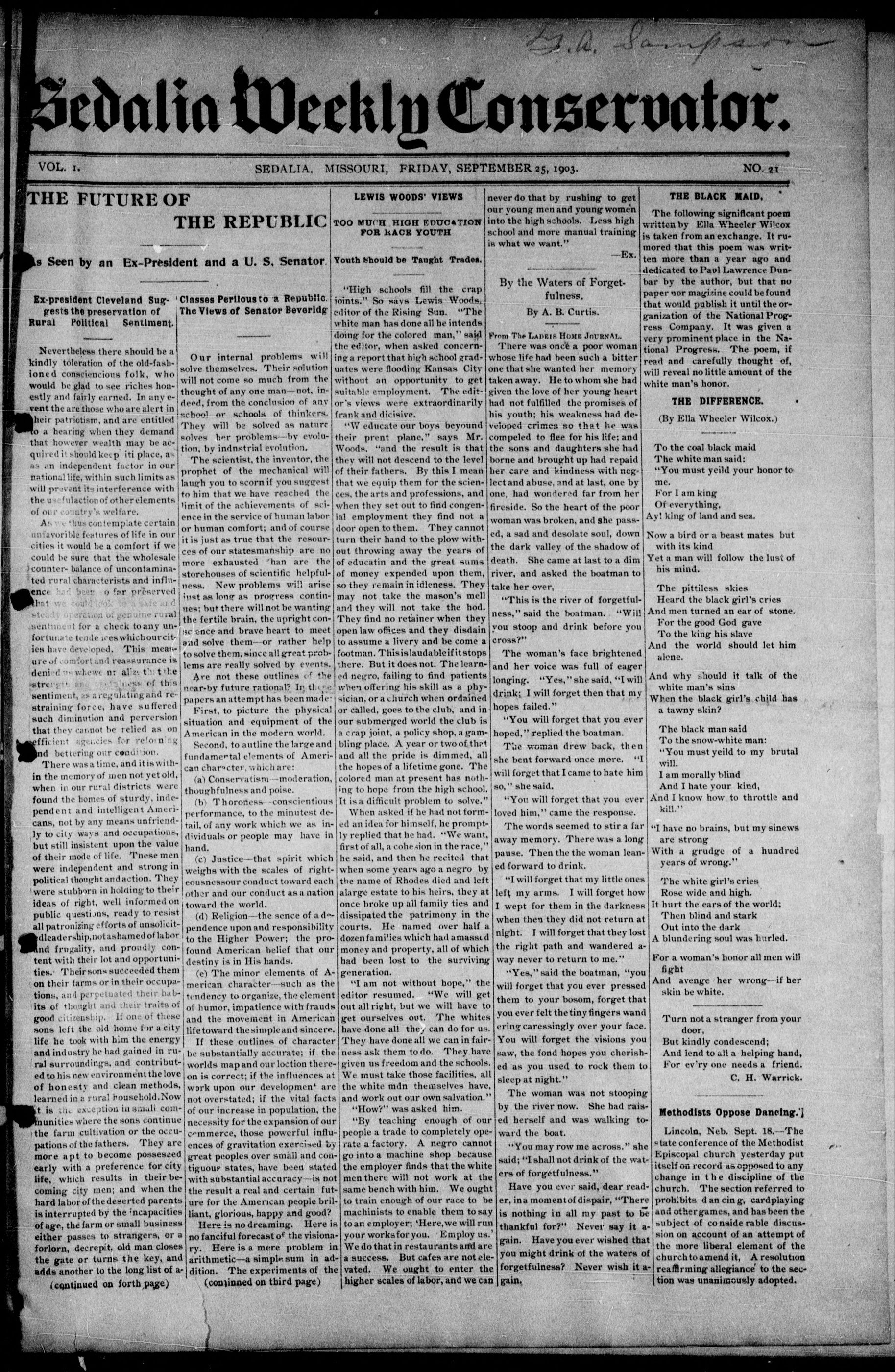
Ex-president Cleveland Suggests the preservation of Rural Political Sentiment.
Nevertheless there should be a kindly toleration of the old-fashioned consciencious folk, who would be glad to see riches honestly and fairly earned. In any event the are those who are alert in their patriotism, and are entitled to a hearing when they demand that however wealth may be acquired it should keep iti place, as an independent factor in our national life, within such limits as will prevent its interference with the usefulaction of other elements of our country's welfare.
As we thus contemplate certain unfavorable features of life in our cities it would be a comfort if we could be sure that the wholesale counter-balance of uncontaminated rural characterists and influence had been so far preserved that we could look to a safe and steady operation of genuine rural sentiment for a check to any unfortunate tendeices which our cities have developed. This measure of comfort and reassurance is denied us where we realize that the strength and usefulness of this sentiment, as a regulating and restraining force, have suffered such diminution and perversion that they cannot be relied as on efficient agencies for reforming and bettering our condition.
There was a time, and it is within the memory of men not yet old, when in our rural districts were found the homes of sturdy, independent and intelligent Americans, not by any means unfriendly to city ways and occupations, but still insistent upon the value of their mode of life. These men were independent and strong in political thought and action. They were stubborn in holding to their ideas of right, well informed on public questions, ready to resist all patronizing efforts of unsolicit-
leadership, manhood, love and frugality, and proudly content with their lot and opportunities. Their sons succeeded them on their farms or in their occupations, and perpetuated their habits of thought and their traits of good citizenship. If one of these sons left the old home for a city life he took with him the energy and industry he had gained in rural surroundings, and contributed to his new environment the love of honesty and clean methods, learned in a rural household. Now it is the exception in small communities where the sons continue the farm cultivation or the occupations of the fathers. They are more apt to become possesed early with a preference for city life, which results in their becoming city men; and when the hard labor of the deserted parents is interrupted by the incapacities of age, the farm or small business either passes to strangers, or a forlorn, decrepit, old man closes the gate or turns the key, and adds another to the long list of a
(continued on forth page)
SEDALIA. MISSOURI, FRIDAY, SEPTEMBER 25, 1903.
THE REPUBLIC
Classes Perilousto a Republic. The Views of Senator Beverldg
Our internal problems will solve themselves. Their solution will not come so much from the thought of any one man-not, indeed, from the conclusion of any school or schools of thinkers. They will be solved as nature solves her problems-by evolution, by industrial evolution.
The scientist, the inventor, the prophet of the mechanical will laugh you to scorn if you suggest to him that we have reached the limit of the achievements of science in the service of human labor or human comfort; and of course it is just as true that the resources of our statesmanship are no more exhausted than are the storehouses of scientific helpfulness. New problems will arise just as long as progress continues; but there will not be wanting the fertile brain, the upright conscience and brave heart to meet and solve them—or rather help to solve them, since all great problems are really solved by events,
Are not these outlines of the near-by future rational? In these papers an attempt has been made: First, to picture the physical situation and equipment of the American in the modern world. Second, to outline the large and fundamental elements of American character, which are: (a) Conservatism--moderation, thoughtfulness and poise. (b) Thoroness--conscientious performance, to the minutest detail, of any work which we as individuals or people may have in hand.
(c) Justice—that spirit which weighs with the scales of righteousnessour conduct toward each other and our conduct as a nation toward the world.
(d) Religion—the sence of a dependence upon and responsibility to the Higher Power; the profound American belief that our destiny is in His hands.
(e) The minor elements of American character—such as the tendency to organize, the element of humor, impatience with frauds and the movement in American life toward the simple and sincere.
If these outlines of character be substantially accurate; if the worlds map and our loction thereon is correct; if the influences at work upon our development are not overstated; if the vital facts of our increase in population, the necessity for the expansion of our commerce, those powerful influences of gravitation exercised by great peoples over small and contiguous states, have been stated with substantial accuracy—is not the result a real and certain future for the American people brilliant, glorious, happy and good?
Here is no dreaming. Here is no fanciful forecast of the visionary. Here is a mere problem in arithmetic—a simple sum in addition. The experiments of the
(conjinned on third page)
LEWIS WOODS' VIEWS
TOO MUCH HIGH EDUCATION FOR RACE YOUTH
"High schools fill the crap joints." So says Lewis Woods, editor of the Rising Sun. "The white man has done all he intends doing for the colored man," said the editor, when asked concerning a report that high school graduates were flooding Kansas City without an opportunity to get suitable employment. The editor's views were extraordinarily frank and dicisive.
"W educate our boys beyound their prent plane," says Mr. Woods. "and the result is that they will not descend to the level of their fathers. By this I mean that we equip them for the sciences, the arts and professions, and when they set out to find congenial employment they find not a door open to them. They cannot turn their hand to the plow without throwing away the years of of educatin and the great sums of money expended upon them, so they remain in idleness. They may not take the mason's mell and they will not take the hod. They find no retainer when they open law offices and they disdain to assume a livery and be come a footman. This is laudable if it stops there. But it does not. The learned negro, failing to find patients when offering his skill as a physician, or a church when ordained or called, goes to the club, and in our submerged world the club is a crap joint, a policy shop, a gambling place. A year or two of that and all the pride is dimmed, all the hopes of a lifetime gone. The colored man at present has nothing to hope from the high school. It is a difficult problem to solve."
When asked if he had not formed an idea for himself, he promptly replied that he had. "We want, first of all, a cohesion in the race," he said, and then he recited that when some years ago a negro by the name of Rhodes died and left alarge estate to his heirs, they at once broke up all family ties and dissipated the patrimony in the courts. He named over half a dozen families which had amassed money and property, all of which had been lost to the surviving generation.
"I am not without hope," the editor resumed. "We will get out all right, but we will have to get ourselves out. The whites have done all they can do for us. They have done all we can in fairness ask them to do. They have given us freedom and the schools. We must take those facilities, all the white mdn themselves have, and work out our own salvation." "How?" was asked him.
How: was asked him.
"By teaching enough of our people a trade to completely operate a factory. A negro cannot go into a machine shop because the employer finds that the white men there will not work at the same bench with him. We ought to train enough of our race to be machinists to enable them to say to an employer; 'Here, we will run your works for you. Employ us.' We do that in restaurants and are a success. But cafes are not elevated. We ought to enter the higher scales of labor, and we can
never do that by rushing to get our young men and young women into the high schools. Less high school and more manual training is what we want."
By A. B. Curtis.
There was once a poor woman whose life had been such a bitter one that she wanted her memory taken away. He to whom she had given the love of her young heart had not fulfilled the promises of his youth; his weakness had developed crimes so that he was compelled to flee for his life; and the sons and daughters she had borne and brought up had repaid her care and kindness with neglect and abuse, and at last, one by one, had wondered far from her fireside. So the heart of the poor woman was broken, and she passed, a sad and desolate soul, down the dark valley of the shadow of death. She came at last to a dim river, and asked the boatman to take her over,
"This is the river of forgetfulness," said the boatman. "Will you stoop and drink before you cross?"
The woman's face brightened and her voice was full of eager longing. "Yes," she said, "I will drink; I will forget then that my hopes failed."
"You will forget that you ever hoped," replied the boatman.
The woman drew back, then she bent forward once more. "I will forget that I came to hate him so," she said.
"You will forget that you ever loved him," came the response.
The words seemed to stir a far away memory. There was a long pause. Then the the woman leaned forward to drink.
"I will forget that my little ones left my arms. I will forget how I wept for them in the darkness when then they did not return at night. I will forget that they lost the right path and wandered away never to return to me."
"Yes," said the boatman, "you will forget that you ever pressed them to your bosom, forget that you ever felt the tiny fingers wand ering caressingly over your face. You will forget the visions you saw, the fond hopes you cherished as you used to rock them to sleep at night." The woman was not stooping by the river now. She had raised herself and was walking toward the boat.
"You may row me across." she said; "I shall not drink of the waters of forgetfulness."
Have you ever said, dear reader, in a moment of dispair, "There is nothing in all my past to be thankful for?" Never say it again. Have you ever wished that you might drink of the waters of forgetfulness? Never wish it again.
NO.21
THE BLACK MAID.
The following significant poem written by Ella Wheeler Wilcox is taken from an exchange. It rumored that this poem was written more than a year ago and dedicated to Paul Lawrence Dunbar by the author, but that no paper nor magazine could be found that would publish it until the organization of the National Progress Company. It was given a very prominent place in the National Progress. The poem, if read and carefully thought of, will reveal no little amount of the white man's honor.
THE DIFFERENCE.
(By Ella Wheeler Wilcox.)
To the coal black maid
The white man said:
"You must yeild your honor to
me.
For I am king
Of everything,
Ay! king of land and sea.
Now a bird or a beast mates but
with its kind
Yet a man will follow the lust of
his mind.
The pittiless skies
Heard the black girl's cries
And men turned an ear of stone.
For the good God gave
To the king his slave
And the world should let him
alone.
And why should it talk of the
white man's sins
When the black girl's child has
a tawny skin?
The black man said
To the snow-white man:
"You must yeild to my brutal
will.
I am morally blind
And I hate your kind,
And I know how to throttle and
kill."
"I have no brains, but my sinews
are strong
With a grudge of a hundred
years of wrong."
The white girl's cries
Rose wide and high.
It hurt the ears of the world;
Then blind and stark
Out into the dark
A blundering soul was hurled.
For a woman's honor all men will fight
And avenge her wrong--if her skin be white.
Turn not a stranger from your door,
But kindly condescend;
And lend to all a helping hand,
For ev'ry one needs a friend.
C. H. Warrick.
Methodists Oppose Dancing.
Lincoln, Neb. Sept. 18.—The state conference of the Methodist Episcopal church yesterday put itself on record as opposed to any change in the discipline of the church. The section referred to prohibits dancing, cardplaying and other games, and has been the subject of considerable discussion on account of an attempt of the more liberal element of the church to amend it. A resolution reaffirming allegiance to the section was unanimously adopted.
---
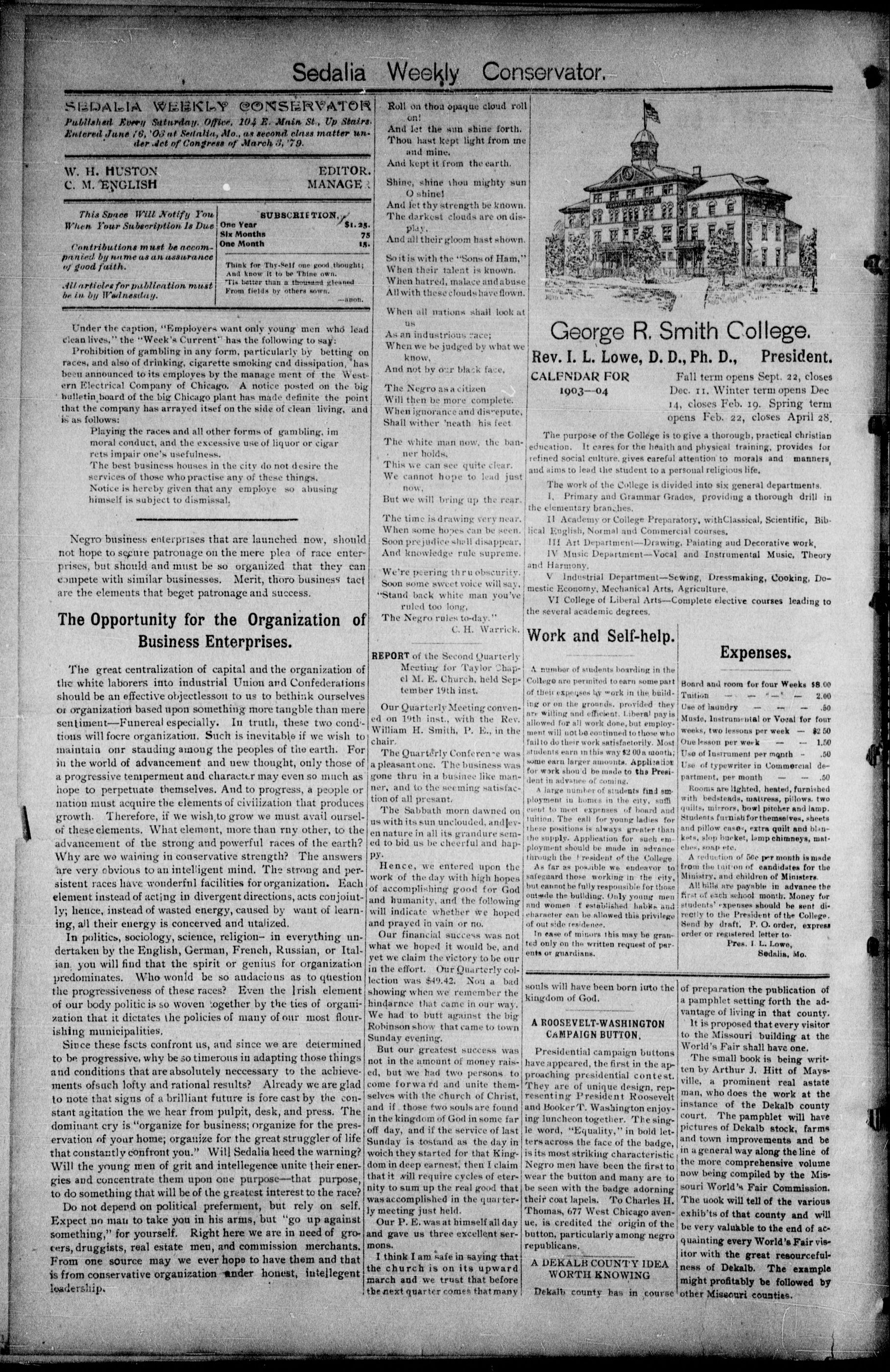
SEDALIA WEEKLY CONSERVATOR Published Every Saturday. Office, 104 E. Main St., Up Stairs. Entered June 76, '03 at Sedalia, Mo., as second class matter under Act of Congress of March 3, '79.
This Space Will Notify You When Your Subscription Is Due
Contributions must be accompanied by name as an assurance of good faith.
All articles for publication must be in by Wednesday.
SUBSCRIPTION
One Year $1.25.
Six Months 75
One Month 15.
Think for Thy-Self one good thought;
And know it to be Thine own.
Tis better than a thousand gleaned
From fields by others sown.
—anon.
Under the caption, "Employers want only young men who lead clean lives," the "Week's Current" has the following to say:
Prohibition of gambling in any form, particularly by betting on races, and also of drinking, cigarette smoking end dissipation, has been announced to its employees by the manage ment of the Western Electrical Company of Chicago. A notice posted on the big bulletin board of the big Chicago plant has made definite the point that the company has arrayed itself on the side of clean living, and is as follows:
Playing the races and all other forms of gambling, im moral conduct, and the excessive use of liquor or cigar rets impair one's usefulness.
The best business houses in the city do not desire the services of those who practise any of these things.
Notice is hereby given that any employee so abusing himself is subject to dismissal.
Negro business enterprises that are launched now, should not hope to secure patronage on the mere plea of race enterprises, but should and must be so organized that they can compete with similar businesses. Merit, thoro business tact are the elements that beget patronage and success.
The Opportunity for the Organization of Business Enterprises.
The great centralization of capital and the organization of the white laborers into industrial Union and Confederations should be an effective objectlesson to us to bethink ourselves or organization based upon something more tangble than mere sentiment—Funereal especially. In truth, these two conditions will focre organization. Such is inevitable if we wish to maintain our stauding among the peoples of the earth. For in the world of advancement and new thought, only those of a progressive temperment and character may even so much as hope to perpetuate themselves. And to progress, a people or nation must acquire the elements of civilization that produces growth. Therefore, if we wish to grow we must avail ourselves of these elements. What element, more than rny other, to the advancement of the strong and powerful races of the earth? Why are we waining in conservative strength? The answers are very obvious to an intelligent mind. The strong and persistent races have wonderful facilities for organization. Each element instead of acting in divergent directions, acts conjointly; hence, instead of wasted energy, caused by want of learning, all their energy is conceived and utalized.
In politics, sociology, science, religion- in everything undertaken by the English, German, French, Russian, or Italian, you will find that the spirit or genius for organization predominates. Who would be so audacious as to question the progressiveness of these races? Even the Irish element of our body politic is so woven together by the ties of organization that it dictates the policies of many of our most flourishing municipalities.
Since these fscs confront us, and since we are determined to be progressive, why be so timerous in adapting those things and conditions that are absolutely necessary to the achievements of such lofty and rational results? Already we are glad to note that signs of a brilliant future is forecast by the constant agitation the we hear from pulpit, desk, and press. The dominant cry is "organize for business; organize for the preservation of your home; organize for the great struggle of life that constantly confront you." Will Sedalia heed the warning? Will the young men of grit and intellegence unite their energies and concentrate them upon one purpose—that purpose, to do something that will be of the greatest interest to the race?
Do not depend on political preferment, but rely on self. Expect no man to take you in his arms, but "go up against something," for yourself. Right here we are in need of grocers, druggists, real estate men, and commission merchants. From one source may we ever hope to have them and that is from conservative organization under honest, intelligent leadership.
W. H. HUSTON
C. M. ENGLISH
Sedalia Weekly Conservator
EDITOR
MANAGE
Roll on thou opaque cloud roll on!
And let the sun shine forth.
Thou hast kept light from me and mine.
And kept it from the earth.
Shine, shine thou mighty sun O shine!
And let thy strength be known.
The darkest clouds are on dis-
play.
And all their gloom hast shown.
So it is with the "Sons of Ham,"
When their talent is known.
When hatred, malace and abuse
All with these clouds have flown.
When all nations shall look at us
As an industrious race;
When we be judged by what we know,
And not by our black face,
The Negro as a citizen
Will then be more complete.
When ignorance and disrepute,
Shall wither 'neath his feet.
The white man now, the banner holds,
now,
But we will bring up the rear.
The time is drawing very near.
When some hopes can be seen.
Soon prejudice shall disappear.
And knowledge rule supreme.
We're peering thru obscurity.
Soon some sweet voice will say,
"Stand back white man you've ruled too long.
ruled too long,
The Negro rules to-day."
C. H. Warrick.
REPORT of the Second Quarterly Meeting for Taylor Chapel M. E. Church, held September 19th inst.
Our Quarterly Meeting convened on 19th inst., with the Rev. William H. Smith, P. E., in the chair.
The Quarterly Conference was a pleasant one. The business was gone thru in a businee like manner, and to the seeming satisfaction of all present.
The Sabbath morn dawned on us with its sun unclouded, and even nature in all its grandure seemed to bid us be cheerful and happy. Hence, we entered upon the work of the day with high hopes of accomplishing good for God and humanity, and the following will indicate whether we hoped and prayed in vain or no.
Our financial success was not what we hoped it would be, and yet we claim the victory to be our in the effort. Our Quarterly collection was $49.42. Nou a bad showing when we remember the hindrance that came in our way. We had to butt against the big Robinson show that came to town Sunday evening.
But our greatest success was not in the amount of money raised, but we had two persons to come forward and unite themselves with the church of Christ, and if those two souls are found in the kingdom of God in some far off day, and if the service of last Sunday is to stand as the day in woich they started for that Kingdom in deep earnest, then I claim that it will require cycles of eternity to sum up the real good that was accomplished in the quarterly meeting just held.
Our P. E. was at himself all day and gave us three excellent sermons.
I think I am safe in saying that the church is on its upward march and we trust that before the next quarter comes that many
BENNINGTON HOSPITAL
The purpose of the College is to give a thorough, practical christian education. It cares for the health and physical training, provides for refined social culture, gives careful attention to morals and manners, and aims to lead the student to a personal religious life.
The work of the College is divided into six general departments.
I. Primary and Grammar Grades, providing a thorough drill in the elementary branches.
II Academy or College Preparatory, with Classical, Scientific, Biblical English, Normal and Commercial courses.
III Art Department—Drawing, Painting and Decorative work.
IV Music Department—Vocal and Instrumental Music, Theory and Harmony.
V Industrial Department—Sewing, Dressmaking, Cooking, Domestic Economy, Mechanical Arts, Agriculture.
VI College of Liberal Arts—Complete elective courses leading to the several academic degrees.
Work and Self-help.
A number of students boarding in the College are permitted to earn some part of their expenses by work in the building or on the grounds, provided they are willing and efficient. Liberal pay is allowed for all work done, but employment will not be continued to those who fail to do their work satisfactorily. Most students earn in this way $200 a month, some earn larger amounts. Application for work should be made to the President in advance of coming.
A large number of students find employment in homes in the city, sufficient to meet expenses of board and tuition. The call for young ladies for these positions is always greater than the supply. Application for such employment should be made in advance through the resident of the College. As far as possible we endeavor to safeguard those working in the city, but cannot be fully responsible for those outside the building. Only young men and women if established habits and character can be allowed this privilege of out side residence. In case of minors this may be granted only on the written request of parents or guardians.
souls will have been born iuto the kingdom of God.
A ROOSEVELT-WASHINGTON CAMPAIGN BUTTON.
Presidential campaign buttons have appeared, the first in the approaching presidential contest. They are of unique design, representing President Roosevelt and Booker T. Washington enjoying luncheon together. The single word, "Equality," in bold letters across the face of the badge, is its most striking characteristic Negro men have been the first to wear the button and many are to be seen with the badge adorning their coat lapels. To Charles H. Thomas, 677 West Chicago avenue, is credited the origin of the button, particularly among negro republicans.
A DEKALB COUNTY IDEA WORTH KNOWING
Fall term opens Sept. 22, closes Dec. 11. Winter term opens Dec 14, closes Feb. 19. Spring term opens Feb. 22, closes April 28.
is to give a thorough, practical christian with and physical training, provides for useful attention to morals and manners, a personal religious life.
divided into six general departments.
Grades, providing a thorough drill in
paratory, withClassical, Scientific, Bib-
mercial courses.
Living, Painting and Decorative work,
local and Instrumental Music, Theory
—Sewing, Dressmaking, Cooking, Do-
ts, Agriculture.
—Complete elective courses leading to
p.
Expenses.
Board and room for four Weeks $8.00
Tuition — — — — — 2.00
Use of laundry — — — .50
Music, Instrumental or Vocal for four
weeks, two lessons per week — $2.50
One lesson per week — 1.50
Use of Instrument per month — .50
Use of typewriter in Commercial
department, per month — .50
Rooms are lighted, heated, furnished
with bedsteads, mattress, pillows. two
quilts, mirrors, bowl pitcher and lamp.
Students furnish for themselves, sheets
and pillow cases, extra quilt and blankets, slop bucket, lamp chimneys, matches, soap etc.
A reduction of 50c per month is made from the tuition of candidates for the Ministry, and children of Ministers. All bills are payable in advance the first of each school month. Money for students' expenses should be sent directly to the President of the College. Send by draft, P. O. order, express order or registered letter to-
Pres. I. L. Lowe,
Sedalia, Mo.
of preparation the publication of a pamphlet setting forth the advantage of living in that county. It is proposed that every visitor to the Missouri building at the World's Fair shall have one.
The small book is being written by Arthur J. Hitt of Maysville, a prominent real astate man, who does the work at the instance of the Dekalb county court. The pamphlet will have pictures of Dekalb stock, farms and town improvements and be in a general way along the line of the more comprehensive volume now being compiled by the Missouri World's Fair Commission. The uook will tell of the various exhibits of that county and will be very valuable to the end of acquainting every World's Fair visitor with the great resourcefulness of Dekalb. The example might profitably be followed by other Missouri counties.
```markdown
```
THE BLUE FRONT GROCERY
GRICERIES
10 lb Granulated sugar ... $1.00
Pure Leaf Lard ... 15c lb
100 Brand Sorghum ... qt. can 10c
Brand syrup ... qt. can 10c
Wrap ... 6 bars for 25c
Country Soap ... 6 bars 25c
Just Vinegar ... gal. 21c
Good Cream Cheese ... lb 15c
Smoked Bacon ... lb 15c
NOTIONS
Shoe strings ... pair 2c
Boys Suspedners ... pair 8c
Mens Suspenders ... pair 19c
Men's half hose ... pair 9c
Lady's hose ... per pair 9c
Handerchiefs ... each 8c
Fine Hard Rubber Combs ... each 5c
Safty Pins ... perdoz 5c
Elastic Rubber ... per yd. 40
Men's Supporters ... per pair 10c
These, and many other bargains, to numerous to mention, are to be had in our store This Month—Nothing old—Everything New and Fresh—We make no charges for showing our goods—Call in and see them.
J. F. KUHN & CO. Cor. Lamine & Pettis.
Roy Jones, who has been very seriously ill, is improving gradually.
Mrs. Lizzie Johnson, who has been ill all summer is apparently
Mrs. Lue Fields spent several days of last week in Kansas City looking after business interests.
Mr. Israel Sydney, of Kansas City, Mo., has been visiting his sister, Mrs. Lue Fields, during the past week.
James Wilson mingled with Sealians Sunday, calling at The Convoyator's sanctum while he and was highly pleased with his future outlook.
Among the many farmers who are now busily engaged in putting out large crops of wheat, are be found Halleck Johnson. John Jones and James Johnson.
The Guthre brothers made a ring trip thru the country last day. They are frequently to seen in our midst and we are ceased to see them (that is the iris are).
Mrs. Millie Williams and husband entertained the following nests last Sunday afternoon:—Mr. Samuel Fields and wife, Mr. and Bolar and wife and Mrs. Lize Bird. The occasion was the fiith anniversary of Mrs. Williams' life and all enjoyed themselves very much. She was the happy recipient of many useful reseats.
Malta Bend, Mo.
Miss Martha Fowler is on the
ck list this week.
Mrs. Emma Fowler is home
from the country.
Prof. Perkin opened school
Mr. Alfred Wilson left Sunday for Kansas City to spend the winter.
Mr. Joe Crawford, also Mr. Livir Davis, is out of town this week.
Mrs. Mamie Shanon will move to Marshall soon to spend the winter-
Mrs. Sarah Neff is confined to her bed.
There will be a grand picnic here Saturday to which everyone is invited.
Messrs. Arthor Wyte and Will Harris of Marshall spent Tuesday with Miss Martha Fowler.
Mr. Pete Kile spent Tuesday in Marshall.
Mrs. Billy Smith, of Marshall, spent Friday, Saturday and Sunday with Mrs. B. S. Florence.
Mrs. James Rhoades of Odessa spent a few days here with her brothers and sisters.
Mr. Albert Randel is at home from Kansas City to visit home folk. Glad to see you Albert.
Born to the wife of Mr. B. S. Florence, a fine boy, Wednesday eve September, 16.
Died, September 18 1903 little Georgia Moan, age 11 years and 22 days. She was the daughter of Mrs. B. S. Florence and a member of the M. E. Church. Her funeral was Sunday by Rev. Tayes
LOCAL MENTION
A new campaign paper is the latest in K. C.
Fire destroyed $20,000 worth of property at the State Fair grounds Monday.
A car of Phillipinos passed thru Sedalia over the Mo. P., for St. Louis Wedndsday.
"Boodling" has crept into the management of Lincoln Institute at Jeff City and Gov. Dockery
FRONT GROCERY
MONEY if you consult *************
AIN PRICES
has called for the resignation of J. S. Harris.
The "Reed for Governor" crowd opened up to the tune of "Dixie" here, but for the timely interference by detectives, on their way home, they would have closed to the tune of "Rock Hill."
The local school board of Stephenson, Mich., has passed a resolution prohibiting teachers from attending dances or parties, night or day, or dancing while school is in session. We know of a school in Missouri where the teacher who, during recess hours, churns out the music while the students trip the light fantastic.
BOSTON CAFE.
Furnishes All Grocers
with
DELICIOUS, FRESH,
HOME-MADE BREAD.
Dont forget to ask for
Walch's Bread.
We also lead in the production of
ICE CREAM.
SOCIETY NOTES
Mrs. D. Y. Steele will entertain at "Flinch" in honor of a visitor.
Mrs. Hattie L. Billups and Mrs. Katie Violet are the champions at Flinch.
Prof. A. H. Gravett came in from Georgetown and took her out on the Trolly Party.
Society had on her best dress Tuesday night and proved to the public that she can spread "er on" when she wants to.
The Trolley Praty was a success in every way. Two cars were loaded to their capacity, and two more could have been filled. Conductors Smith and Walden managed the affair very creditable. The Q. C. Band furnished the music playing "Hiawiatha," "Emancipation Day," and other popular selections. The cars started at eight o'clock from third and ohio streets, going around then out to East Sedalia. Turning we came back around the loop then went out to Forest Park where we took a few moments rest and listened to some music by the band. Leaving the park we came back to the city and sped away for the Fair Grounds then to Liberty Park, returning from Liberty Park at about 11:30 to third and ohio.
Every body expressing them selves as having enjoyed a very pleasant evening. Receipts for the church, above expences, were $20,90.
Government Land in Missouri.
For the benefit of those who expect to take part in the inspection of government land, which will be about September, I herein give a list of acres and location.
Boonville District, 109,020 acres
Ironton District 122,800 acres
Springfield District 213,920 acres
Anyone desiring to see the location of theseands may see map of same at the CONSERVATOR's office, 104 E. Main St.
Other information will be given by meat any time.
Chambers & Wheeler are down to date Tonsorialist. Every shave and hair-cut done to please the most fastidious
We can supply you with Fresh Butter, Eggs, and Fruits and Chickens at all times — A fine lot of Fresh and Dried Fruits on hand. — Give us orders — Quick Delivery
GEISCHEN & VIEBROCK
Check given with each purchase
Return $15 in checks and get
50c in trade.
The Future of the Republic.
(continued from first page) chemist in his labatory are not more definite nor his conclusions more certain than the splendor of the future of the American peoples feebly indicated in this paper. With the facts of the situation in mind, what American can despair? What American can be less than hopeful? What American can be less than certain of the nobility of the To-Morrow of his people?
Nothing but a high faith in American destiny is rational And this faith itself will be a powerful factor in its own realization The achiever is always the believer. Such were the layers of cables across the bed of the ocean; such were the constructors of the continental railroads; to go farther back, such were the men who unfurled our flag. Faith is the inspirer—aye, and the doer—of noble deeds. American mines are not exhausted; in reality they have only just opened.
American agricultural productivity is not declining; on the contrary, we are only now beginning to learn sensible and saving
methods of farming.
American manufacturing has not recabed its limit; on the contrary, the processes have only commenced which will make this Republic the workshop of the world.
American intellegence is not decadent; on the contrary, we Americans are just beginning to learn the uses of the trained intellect—just beginning to methodize the mightd and multitudinous productivity of the American mind.
Yearly, daily, hourly we make our work more thor.
Yearly, daily, hourly we are a juster and a better people. Yearly, dailyyp hourly our tho't and work make more and more for righteousness. And so in the beauty of holiness our flag advances and will advance. Not yet do the American bugles sound "retreat"—no, not yet, and never will. American character, American civilization, American life—the American people—are all right. Let them alone and the result will confound proyhecy. Sturday's Evening Post.
There is seldom much profit in prophecies.
M
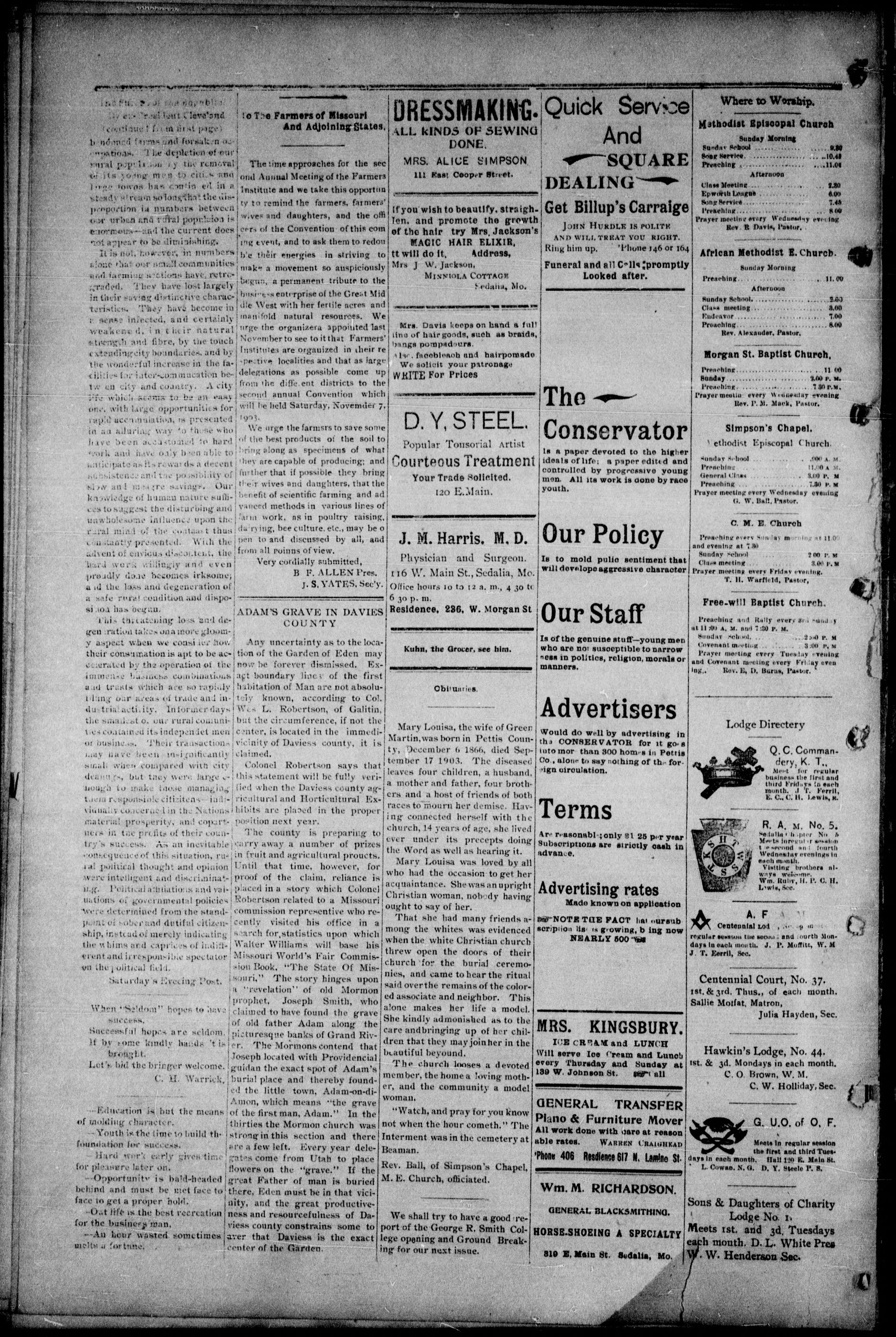
by our resident Cleveland (continued from first page) bonded farms and forsaken occupations. The depletion of our rural population by the removal of its young men to cities and large towns has continued in a steady stream so long that the disproportion in numbers between our urban and rural population is enormous—and the current does not appear to be diminishing.
It is not, however, in numbers alone that our small communities and farming sections have, retrograded. They have lost largely in their saving distinctive characteristics. They have become in a sense infected, and certainly weakened, in their natural strength and fibre, by the touch extending city boundaries, and by the wonderful increase in the facilities for inter-communication between an city and country. A city life which seems to be an easy one, with large opportunities for rapid accumulation, is presented in an alluring way to those who have been accustomed to hard work and have only been able to anticipate as its rewards a decent subsistence and the possibility of slow and insane savings. Our knowledge of human nature suffices to suggest the disturbing and unwholesome influence upon the rural mind of the contrast thus constantly presented. With the advent of envious discontent, the hard work willingly and even proudly done becomes irksome; and the loss and degeneration of a safe rural condition and disposition has begun.
This threatening loss and degeneration takes on a more gloomy aspect when we consider how their consumption is apt to be accelerated by the operation of the immense business combinations and trusts which are so rapidly ruling our areas of trade and industrial activity. Informer days the smallest of our rural communities contained its independent men or business. Their transactions may have been insignificantly small when compared with city deanings, but they were large enough to make those managing them responsible citizens—individually concerned in the Nations material prosperity, and copartners in the profits of their country's success. As an inevitable consequence of this situation, rural political thought and opinion were intelligent and discriminating. Political affiliations and valuations of governmental policies were determined from the standpoint of sober and dutiful citizenship, instead of merely indicating the whims and caprices of indifferent and irresponsible spectator on the political field.
When "Seldom" hopes to have success.
Successful hopes are seldom.
If by some kindly hands 't is brought.
Let's bid the bringer welcome.
C. H. Warrick.
- Education is but the means of molding character.
- Youth is the time to build the foundation for success.
- Hard work early gives time for pleasure later on.
- Opportunity is bald-headed behind and must be met face to face to get a proper hold.
- Out life is the best recreation for the business man.
- An hour wasted sometimes melts a fortune.
To The Farmers of Missouri And Adjoining States.
The time approaches for the second Annual Meeting of the Farmers Institute and we take this opportunity to remind the farmers, farmers' wives and daughters, and the officers of the Convention of this coming event, and to ask them to redoubble their energies in striving to make a movement so auspiciously begun, a permanent tribute to the business enterprise of the Great Middle West with her fertile acres and manifold natural resources. We urge the organizera appointed last November to see to it that Farmers' Institutes are organized in their respective localities and that as large delegations as possible come up from the different districts to the second annual Convention which will be held Saturday, Novemder 7, 1993.
We urge the farmsrs to save some of the best products of the soil to bring along as specimens of what they are capable of producing; and further that if possible they bring their wives and daughters, that the benefit of scientific farming and ad vanced methods in various lines of farm work, as in poultry raising, dairying, bee culture, etc., may be o pen to and discussed by all, and from all points of view.
Very cordially submitted,
B. F. ALLEN Pres.
J. S. YATES, Sec'y.
ADAM'S GRAVE IN DAVIES COUNTY
Any uncertainty as to the location of the Garden of Eden may now be forever dismissed. Exact boundary lines of the first habitation of Man are not absolutely known, according to Col. Wes L. Robertson, of Galitin, but the circumference, if not the center, is located in the immedi vicinity of Daviess county, it is claimed. Colonel Robertson says that this statement will be fully verified when the Daviess county agricultural and Horticultural Exhibits are placed in the proper position next year.
The county is preparing to carry away a number of prizes in fruit and agricultural products. Until that time, however, for proof of the claim, reliance is placed in a story which Colonel Robertson related to a Missouri commission representative who recently visited his office in a search for statistics upon which Walter Williams will base his Missouri World's Fair Commission Book, "The State Of Missouri." The story hinges upon a "revelation" of old Mormon prophet, Joseph Smith, who claimed to have found the grave of old father Adam along the picturesque banks of Grand River. The Mormons contend that Joseph located with Providencial guidan the exact spot of Adam's burial place and thereby founded the little town, Adam-on-di-Amon, which means "the grave of the first man, Adam." In the thirties the Mormon church was strong in this section and there are a few left. Every year delegates come from Utah to place flowers on the "grave." If the great Father of man is buried there, Eden must be in that vicinity, and the great productivity and resourcefulness of Daviess county constrains some to over that Daviess is the exact center of the Garden.
DRESSMAKING.
ALL KINDS OF SEWING DONE.
MRS. ALICE SIMPSON
111 East Cooper Street.
If you wish to beautify, straighten, and promote the growth of the hair try Mrs. Jackson's MAGIC HAIR ELIXIR, tt will do it. Address,
Mrs J W. Jackson,
MINNIOLA COTTAGE
Sedalia, Mo.
Mrs. Davis keeps on hand a full line of hair goods, such as braids, bangs pompadeurs.
Also, facebleach and hairpomade We solicit your patronage
WRITE For Prices
D.Y. STEEL
Popular Tonsorial Artist Courteous Treatment Your Trade Solleited. 120 E.Main.
J. M. Harris. M. D.
Physician and Surgeon. 116 W. Main St., Sedalia, Mo Office hours 10 to 12 a.m., 4 30 to 6 30 p.m. Residence, 286, W. Morgan St.
Kuhn, the Grocer, see him.
Obituaries.
Obituaries.
Mary Louisa, the wife of Green Martin, was born in Pettis County, December 6 1866, died September 17 1903. The diseased leaves four children, a husband, a mother and father, four brothers and a host of friends of both races to mourn her demise. Having connected herself with the church, 14 years of age, she lived ever under its precepts doing the Word as well as hearing it.
Mary Louisa was loved by all who had the occasion to get her acquaintance. She was an upright Christian woman, nobody having ought to say of her.
That she had many friends among the whites was evidenced when the white Christian church threw open the doors of their church for the burial ceremonies, and came to hear the ritual said over the remains of the colored associate and neighbor. This alone makes her life a model. She kindly admonished as to the care and bringing up of her children that they may join her in the beautiful beyound.
The church looses a devoted member, the home a loving mother, and the community a model woman.
"Watch, and pray for you know not when the hour cometh." The Interment was in the cemetery at Beaman.
Rev. Ball, of Simpson's Chapel, M. E. Church, officiated.
We shall try to have a good report of the George R. Smith College opening and Ground Breaking for our next issue.
Get Billup's Carraige
JOHN HURDLE IS POLITE AND WILL TREAT YOU RIGHT. Ring him up. Phone 146 or 164 Funeral and all Cells promptly Looked after.
The
Conservator
Is a paper devoted to the higher ideals of life; a paper edited and controlled by progressive young men. All its work is done by race youth.
Our Policy
Is to mold pulic sentiment that will develop aggressive character
Our Staff
Is of the genuine stuff-young men who are not susceptible to narrowness in politics, religion, morals or manners.
Advertisers
Would do well by advertising in the CONSERVATOR for it goes into more than 300 homes in Pettis Co., alone to say nothing of the foreign circulation.
Terms
Are reasonable; only $1.25 per year Subscriptions are strictly cash in advance.
Advertising rates
Made known on application
NOTE THE FACT that our sub
script lists is growing, bing now
NEARLY 500
MRS. KINGSBURY.
ICE CREAM and LUNCH
Will serve Ice Cream and Lunch
every Thursday and Sunday at
139 W. Johnson St. all
GENERAL TRANSFER
Piano & Furniture Mover
All work done with care at reason
able rates. WARREN CRAIGHEAD
'Phone 406 Resdiense 617 N. Lamine St.
Wm. M. RICHARDSON.
GENERAL BLACKSMITHING.
HORSE-SHOEING A SPECIALTY
810 E, Main St. Sedalia, Mo.
Where to Worship.
Methodist Episcopal Church
Sunday Morning
Sunday School ..... 9.80
Song Service ..... 10.48
Prenching ..... 11.08
Afternoon
Class Meeting ..... 2.30
Epworth League ..... 6.00
Song Service ..... 7.45
Prenching ..... 8.00
Prayer meeting every Wednesday evening
Rev. R. Davis, Pastor.
African Methodist E. Church.
Sunday Morning
Preaching.....11.00
Afternoon
Sunday School.....2.00
Class meeting.....8.00
Endeavor.....7.00
Preaching.....8.00
Rev. Alexander, Pastor.
Morgan St. Baptist Church.
Preaching ..... 11 00
Sunday ..... 2.00 P.M.
Preaching ..... 7.30 P.M.
Prayer mentin every Wednesday evening
Rev. P. M. Mack, Pastor
Simpson's Chapel.
Vethodist Episcopal Church.
Sunday School ..... 000 A.M.
Prenching ..... 11.00 A.M.
General Class ..... 3.00 P.M.
Preaching ..... 7.30 P.M.
Prayer meeting every Wednesday evening
G. W. Ball, Pastor.
C. M. E. Church
Preaching every Sunday morning at 11.00
and evening at 7.30
Sunday school ..... 2.00 P.M.
Class meeting ..... 3.00 P.M.
Prayer meeting every Friday evening.
T. H. Warfield, Pastor.
Free-will Baptist Church.
Preaching and Rally every 3rd Sunday at 11:00 A., M. and 7:50 P.M.
Sunday school. ..... 2:00 P.M.
Covenant meeting ..... 3:00 P.M.
Prayer meeting every Tuesday evening
and Covenant meeting every Friday evening.
Rev. E. D. Burns, Pastor.
Lodge Directory
X
Q. C. Commandery, K. T.,
Meet for regular business the first and third Fridays in each month. J. T. Ferril,
E. C. C. H. Lewis, K.
S S T K S H T W S
R. A. M. No. 5.
Sedalia chapter No. 7
Meets irregular session
the second and fourth
Wednesday evenings in
each month.
Visiting brothers always welcome.
Wm. Ruby, H. P. C. H.
Lewis, Sec.
M
A. F
Centennial Lod
regular session the second and fourth Mondays in each month. J. P. Moffitt, W. M.
J. T. Eerril, Sec.
Centennial Court, No. 37.
1st. & 3rd. Thus., of each month.
Sallie Motfat, Matron,
Julia Hayden, Sec.
Hawkin's Lodge, No. 44.
1st. & 3d. Mondays in each month.
C. O. Brown, W. M.
C. W. Holliday, Sec.
G. U.O. of O. F.
Meets in regular session
the first and third Tues-
hall 120 E. Main St.
D. Y. Steele P. S.
X
Sons & Daughters of Charity Lodge No. 1. Meets 1st. and 3d. Tuesdays each month. D. L. White Pres W. W. Henderson Sec.
0