Sedalia Weekly Conservator
Friday, December 18, 1903
Sedalia, Missouri
Page text (machine-generated)
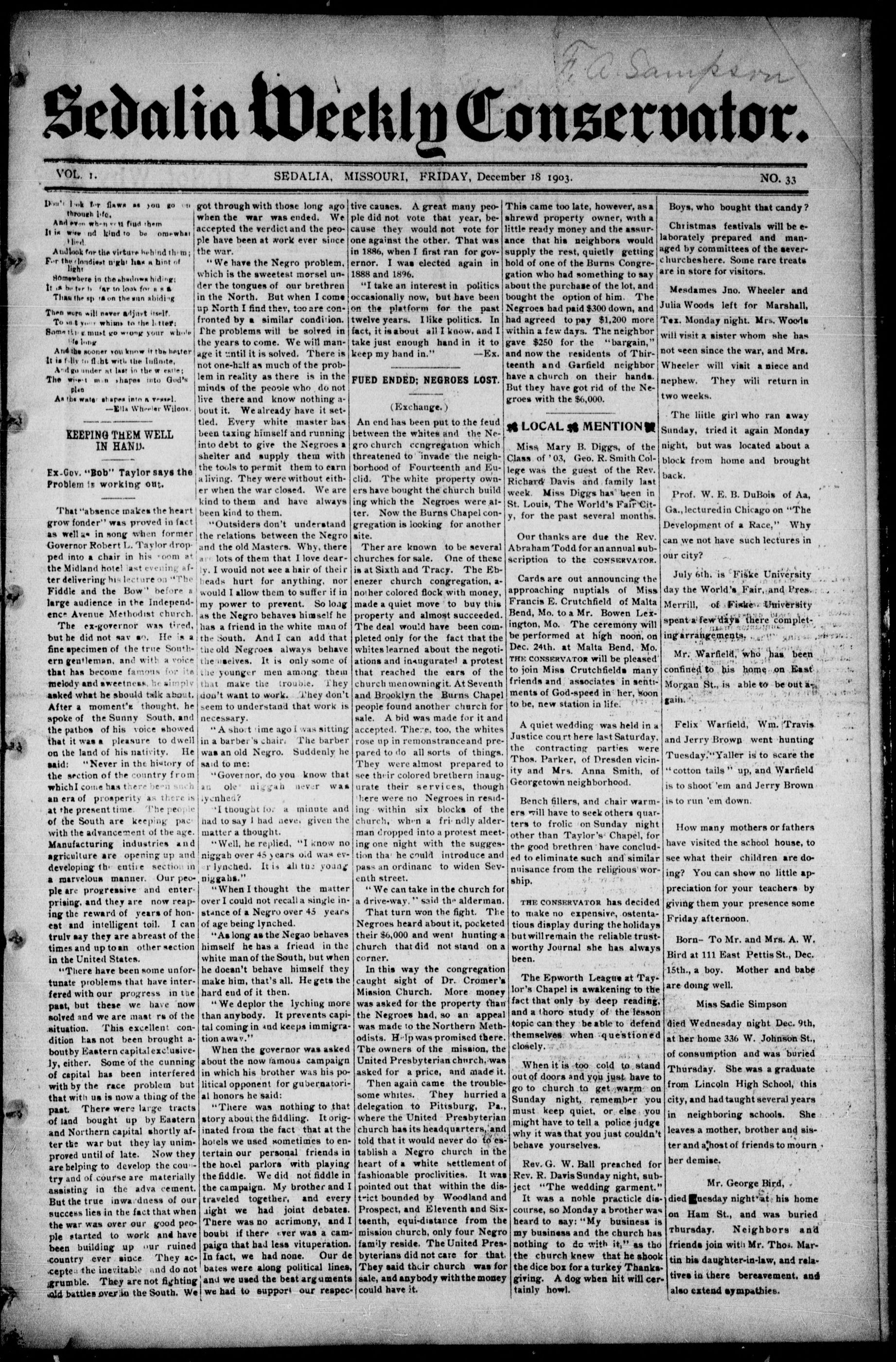
Sedalia Weekly Conservator.
VOL. 1.
Don't look for flaws as you go on through life.
And even when you find them
It is wise and kind to be somewhat blind.
And look for the virtue behind them;
For the cloudiest night has a hint of light.
Somewhere in the shadows hiding;
It is better to far to look for a a
Than the spire on the sun abiding.
Then worn will never adjust itself.
To suit your whims to the letter;
Something must go wrong your whole life long.
And the sooner you know it the better
It is fully to flight with the infinite.
As the water shapes into a vessel.
—Ella Wheeler Wilcox
KEEPING THEM WELL IN HAND.
Ex-Gov. "Bob" Taylor says the Problem is working out.
"That "absence makes the heart grow fonder" was proved in fact as well as in song when former Governor Robert L. Taylor dropped into a chair in his room at the Midland hotel last evening after delivering his lecture on "The Fiddle and the Bow" before a large audience in the Independence Avenue Methodist church.
The ex-governor was tired, but he did not say so. He is a fine specimen of the true Southern gentleman, and with a voice that has become famous for its melody and sweetness, he simply asked what he should talk about. After a moment's thought, he spoke of the Sunny South, and the pathos of his voice showed that it was a pleasure to dwell on the land of his nativity. He said: "Never in the history of the section of the country from which I come has there been such an era of prosperity as there is at the present time. The people of the South are keeping pace with the advancement of the age. Manufacturing industries and agriculture are opening up and developing the entire section in a marvelous manner. Our people are progressive and enterprising, and they are now reaping the reward of years of honest and intelligent toil. I can truly say they are abreast of the times and up to an other section in the United States.
"There have been some unfortunate problems that have interfered with our progress in the past, but these we have now solved and we are mast rs of the situation. This excellent condition has not been brought about by Eastern capital exclusively, either. Some of the cunning of capital has been interfered with by the race problem but that with us is now a thing of the past. There were large tracts of land bought up by Eastern and Northern capital shortly after the war but they lay unimproved until of late. Now they are helping to develop the country and of course are materially assisting in the advancement. But the true inwardness of our success lies in the fact that when the war was over our good people started to work and have been building up our ruined country ever since. They accepted the inevitable and do not grumble. They are not fighting old battles over in the South. We
---
SEDALIA, MISSOURI, FRIDAY, December 18 1903.
got through with those long ago when the war was ended. We accepted the verdict and the people have been at work ever since the war.
"We have the Negro problem, which is the sweetest morsel under the tongues of our brethren in the North. But when I come up North I find they, too are confronted by a similar condition. The problems will be solved in the years to come. We will manage it until it is solved. There is not one-half as much of the problem in reality as there is in the minds of the people who do not live there and know nothing about it. We already have it settled. Every white master has been taxing himself and running into debt to give the Negroes a shelter and supply them with the tools to permit them to earn a living. They were without either when the war closed. We are kind to them and have always been kind to them.
"Outsiders don't understand the relations between the Negro and the old Masters. Why, there are lots of them that I love dearly. I would not see a hair of their heads hurt for anything, nor would I allow them to suffer if in my power to prevent. So long as the Negro behaves himself he has a friend in the white man of the south. And I can add that the old Negroes always behave themselves. It is only some of the younger men among them that make the trouble. They don't want to work. They don't seem to understand that work is necessary.
"A short time ago I was sitting in a barber's chair. The barber was an old Negro. Suddenly he said to me:
"Governor, do you know that an ole niggah never was lyenhed?
"I thought for a minute and had to say I had never given the matter a thought.
"Well, he replied, "I know no niggah over 45 years old was ever lynched. It is all the young niggahs."
"When I thought the matter over I could not recall a single instance of a Negro over 45 years of age being lynched.
"As long as the Negao behaves himself he has a friend in the white man of the South, but when he doesn't behave himself they make him, that's all. He gets the hard end of it then.
"We deplor the lyching more than anybody. It prevents capital coming in and keeps immigration away."
When the governor was asked about the now famous campaign in which his brother was his political opponent for gubernatorial honors he said:
"There was nothing to that story about the fiddling. It originated from the fact that at the hotels we used sometimes to entertain our personal friends in the hotel parlors with playing the fiddle. We did not fiddle in the campaign. My brother and I traveled together, and every night we had joint debates. There was no acrimony, and I doubt if there ever was a campaign that had less vituperation. In fact, we had none. Our de bates were along political lines, and we used the best arguments we had to support our respec
tive causes. A great many people did not vote that year, because they would not vote for one against the other. That was in 1886, when I first ran for governor. I was elected again in 1888 and 1896.
"I take an interest in politics occasionally now, but have been on the platform for the past twelve years. I like politics. In fact, it is about all I know, and I take just enough hand in it to keep my hand in." —Ex.
FUED ENDED; NEGROES LOST.
(Exchange.)
An end has been put to the feud between the whites and the Negro church congregation which threatened to invade the neighborhood of Fourteenth and Euclid. The white property owners have bought the church building which the Negroes were after. Now the Burns Chapel congregation is looking for another site.
There are known to be several churches for sale. One of these is at Sixth and Tracy. The Ebenezer church congregation, another colored flock with money, made a quiet move to buy this property and almost succeeded. The deal would have been completed only for the fact that the whites learned about the negotiations and inaugurated a protest that reached the ears of the church menowning it. At Seventh and Brooklyn the Burns Chapel people found another church for sale. A bid was made for it and accepted. There, too, the whites rose up in remonstrance and prepared to do all sorts of things. They were almost prepared to see their colored brethern inaugurate their services, though there were no Negroes in residing within six blocks of the church, when a friendly alderman dropped into a protest meeting one night with the suggestion that he could introduce and pass an ordinance to widen Seventh street.
"We can take in the church for a drive-way." said the alderman. That turn won the fight. The Negroes heard about it, pocketed their $6,000 and went hunting a church that did not stand on a corner.
In this way the congregation caught sight of Dr. Cromer's Mission Church. More money was asked for the property than the Negroes had, so an appeal was made to the Northern Methodists. Help was promised there. The owners of the mission, the United Presbyterian church, was asked for a price, and made it. Then again came the troublesome whites. They hurried a delegation to Pittsburg, Pa., where the United Presbyterian church has its headquarters, and told that it would never do to establish a Negro church in the heart of a white settlement of fashionable proclivities. It was pointed out that within the district bounded by Woodland and Prospect, and Eleventh and Sixteenth, equi-distance from the mission church, only four Negro family reside. The United Presbyterians did not care for that. They said their church was for sale, and anybody with the money could have it.
This came too late, however, as a shrewd property owner, with a little ready money and the assurance that his neighbors would supply the rest, quietly getting hold of one of the Burns Congregation who had something to say about the purchase of the lot, and bought the option of him. The Negroes had paid $300 down, and had agreed to pay $1,200 more within a few days. The neighbor gave $250 for the "bargain," and now the residents of Thirteenth and Garfield neighbor have a church on their hands. But they have got rid of the Negroes with the $6,000.
LOCAL MENTION
Miss Mary B. Diggs, of the Class of '03, Geo. R. Smith College was the guest of the Rev. Richard Davis and family last week. Miss Diggs has been in St. Louis, The World's Fair City, for the past several months.
Our thanks are due the Rev. Abraham Todd for an annual subscription to the CONSERVATOR.
Cards are out announcing the approaching nuptials of Miss Francis E. Crutchfield of Malta Bend, Mo. to a Mr. Bowen Lexington, Mo. The ceremony will be performed at high noon, on Dec. 24th. at Malta Bend, Mo. THE CONSERVATOR will be pleased to join Miss Crutchfields many friends and associates in sentiments of God-speed in her, soon to be, new station in life.
A quiet wedding was held in a Justice court here last Saturday, the contracting parties were Thos. Parker, of Dresden vicinity and Mrs. Anna Smith, of Georgetown neighborhood.
Bench fillers, and chair warmers will have to seek others quarters to frolic on Sunday night other than Taylor's Chapel, for the good brethren have concluded to eliminate such and similar nuisance from the religious worship.
THE CONSERVATOR has decided to make no expensive, ostentatious display during the holidays but will remain the reliable trustworthy Journal she has always been.
The Epworth League at Taylor's Chapel is awakening to the fact that only by deep reading, and a thoro study of the lesson topic can they be able to defend themselves when questioned closely.
When it is too cold to stand out of doors and you just have to go to church to get warm on Sunday night, remember you must keep quiet, or else you might have to tell a police judge why it was that you just couldn't behave yourselves.
Rev. G. W. Ball preached for Rev. R. Davis Sunday night, subject "The wedding garment."
It was a noble practicle discourse, so Monday a brother was heard to say: "My business is my business and the church has nothing to do with it," as tho the church knew that he shook the dice box for a turkey Thanksgiving. A dog when hit will certainly howl.
NO.33
Boys, who bought that candy? Christmas festivals will be elaborately prepared and managed by committees of the severchurcheshere. Some rare treats are in store for visitors.
Mesdames Jno. Wheeler and Julia Woods left for Marshall, Tex. Monday night. Mrs. Woods will visit a sister whom she has not seen since the war, and Mrs. Wheeler will visit a niece and nephew. They will return in two weeks.
The little girl who ran away Sunday, tried it again Monday night, but was located about a block from home and brought back.
Prof. W. E. B. DuBois of Aa, Ga., lectured in Chicago on "The Development of a Race," Why can we not have such lectures in our city?
July 6th. is Fiske University day the World's Fair, and Pres. Merrill, of Fiske University spent a few days there completing arrangements.
Mr. Warfield, who has been confined to his home on East Morgan St., is able to be out again.
Felix Warfield, Wm. Travis and Jerry Brown went hunting Tuesday."Yaller is to scare the "cotton tails" up, and Warfield is to shoot'em and Jerry Brown is to run'em down.
How many mothers or fathers have visited the school house, to see what their children are doing? You can show no little appreciation for your teachers by giving them your presence some Friday afternoon.
Born- To Mr. and Mrs. A. W. Bird at 111 East Pettis St., Dec. 15th., a boy. Mother and babe are doing well.
Miss Sadie Simpson
died Wednesday night Dec. 9th, at her home 336 W. Johnson St., of consumption and was buried Thursday. She was a graduate from Lincoln High School, this city, and had taught several years in neighboring schools. She leaves a mother, brother and sister and a host of friends to mourn her demise.
Mr. George Bird,
died Tuesday night at his home on Ham St., and was buried Thursday. Neighbors and friends join with Mr. Thos. Martin his daughter-in-law, and relatives in there bereavement. and also extend sympathies.
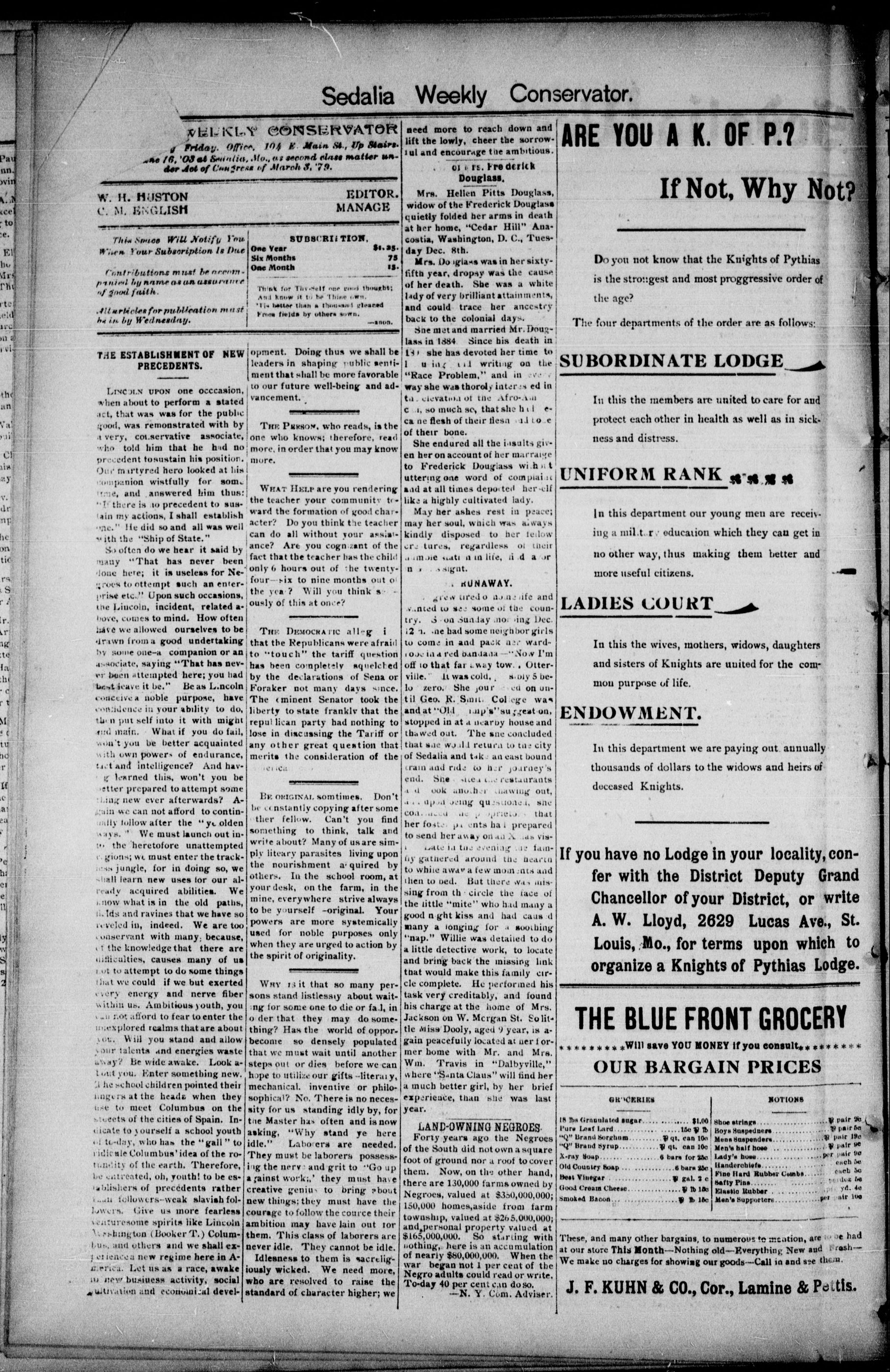
Sedalia Weekly Conservator.
VEEKLY CONSERVATOR
Friday. Office, 104 E. Main St., Up Stairs
June 16, '03 at Saintia, Mo., as second class matter under Act of Congress of March 3, '79.
This Space Will Notify You When Your Subscription Is Due
Contributions must be accompanied by name as an assurance of good faith.
All articles for publication must be in by Wednesday.
SUBSCRIPTION,
One Year $1.25.
Six Months 75.
One Month 15.
Think for Thy-Self one good thought;
And know it to be Thine own.
His better than a thousand gleaned
From fields by others sown.
anon.
W. H. HUSTON
C. M. ENGLISH
THE ESTABLISHMENT OF NEW PRECEDENTS.
LINCOLN UPON one occasion, when about to perform a stated act, that was was for the public good, was remonstrated with by a very, conservative associate, who told him that he had no precedent to sustain his position. Our martyred hero looked at his companion wistfully for some time, and answered him thus: "If there is no precedent to sustain my actions, I shall establish one." He did so and all was well with the "Ship of State."
So often do we hear it said by many "That has never been done here; it is useless for Negroes to attempt such an enterprise etc." Upon such occasions, the Lincoln, incident, related above, comes to mind. How often have we allowed ourselves to be drawn from a good undertaking by some one-a companion or an associate, saying "That has never been attempted here; you had best leave it be." Be as Lincoln conceive a noble purpose, have confidence in your ability to do, then put self into it with might and main. What if you do fail, won't you be better acquainted with own powers of endurance, tact and intelligence? And having learned this, won't you be better prepared to attempt something new ever afterwards? Again we can not afford to continually follow after the "ye olden ways." We must launch out into the heretofore unattempted regions; we must enter the trackless jungle, for in doing so, we shall learn new uses for our already acquired abilities. We know what is in the old paths, fields and ravines that we have so revealed in, indeed. We are too conservant with many, because, of the knowledge that there are difficulties, causes many of us not to attempt to do some things that we could if we but exerted every energy and nerve fiber within us. Ambitious youth, you can not afford to fear to enter the unexplored realms that are about you. Will you stand and allow your talents and energies waste away? Be wide awake. Look about you. Enter something new. If the school children pointed their fingers at the heads when they use to meet Columbus on the streets of the cities of Spain. Indicate to yourself a school youth of day, who has the "gall" to ridicule Columbus' idea of the rotundity of the earth. Therefore, be entrusted, oh, youth! to be establishers of precedents rather than followers—weak slavish followers. Give us more fearless venturesome spirits like Lincoln Washington (Booker T.) Columbus, and others and we shall experience a new regime here in America. Let us as a race, awake to new business activity, social cultivation and economical devel-
EDITOR MANAGE
SUBSCRIPTION,
One Year $1.25.
Six Months 75.
One Month 15.
Think for Thy-Self one good thought;
And know it to be Thine own.
His better than a thousand gleaned
From fields by others sown.
anon.
opment. Doing thus we shall be
leaders in shaping public sentiment
that shall be more favorable
to our future well-being and advan-
cement.
THE PERSON, who reads, is the one who knows; therefore, read more, in order that you may know more.
WHAT HELP are you rendering the teacher your community toward the formation of good character? Do you think the teacher can do all without your assistance? Are you cognizant of the fact that the teacher has the child only 6 hours out of the twenty-four—six to nine months out of the year? Will you think so—ously of this at once?
THE DEMOCRATIC allegi that the Republicans were afraid to "touch" the tariff question has been completely squelched by the declarations of Sena or Foraker not many days since. The eminent Senator took the liberty to state frankly that the republican party had nothing to lose in discussing the Tariff or any other great question that merits the consideration of the
BE ORIGINAL sometimes. Don't be constantly copying after some other fellow. Can't you find something to think, talk and write about? Many of us are simply literary parasites living upon the nourishment acquired by others. In the school room, at your desk, on the farm, in the mine, everywhere strive always to be yourself -original. Your powers are more systemically used for noble purposes only when they are urged to action by the spirit of originality.
Why is it that so many persons stand listlessay about waiting for some one to die or fail, in order that they may do something? Has the world of opporbecome so densely populated that we must wait until another steps out or dies before we can hope to utilize our gifts—literary, mechanical, inventive or philosophical? No. There is no necessity for us standing idly by, for the Master has often and is now asking, "Why stand ye here idle." Laborers are needed. They must be laborers possessing the nerve and grit to "Go up against work;" they must have creative genius to bring about new things; they must have the courage to follow the course their ambition may have lain out for them. This class of laborers are never idle. They cannot be idle. Idlesness to them is sacreligiously wicked. We need more, who are resolved to raise the standard of character higher; we
---
need more to reach down and lift the lowly, cheer the sorrowful and encourage the ambitious.
or rs. Frederick Douglass.
Mrs. Hellen Pitts Douglass, widow of the Frederick Douglass quietly folded her arms in death at her home, "Cedar Hill" Anacostia, Washington, D.C., Tuesday Dec. 8th.
Mrs. Douglass was in her sixty-fifth year, dropsy was the cause of her death. She was a white lady of very brilliant attainments, and could trace her ancestry back to the colonial days.
She met and married Mr. Douglass in 1884. Since his death in 1901 she has devoted her time to training and writing on the "Race Problem," and in every way she was thoroly interested in the elevation of the Afro-Amrican, so much so, that she had ceane flesh of their flesh and one of their bone.
She endured all the insults given her on account of her marrage to Frederick Douglass without uttering one word of complaint and at all times deported herself like a highly cultivated lady.
May her ashes rest in peace; may her soul, which was always kindly disposed to her fellow creatures, regardless of their humble stature in life, and aor in a slight.
KUNAWAY.
grew tired of home life and wanted to see some of the country. 3 on Sunday morning Dec. 12 n. she had some neighbor girls to come in and pack her wardrobe in a red bandana—"Now I'm off to that far away tow. Otterville. It was cold, simply 5 belo-zero. She journeyed on until Geo. R. Smith. College was and at "Old Imp's" suggestion, stopped in at a nearby house and thawed out. The she concluded that she would return to the city of Sedalia and take an east bound train and ride to her journey's end. She visited the restaurants and took another chawing out, and upon being questioned, she continued the proprietor, that her foster parents had prepared to send her away on an X vis-
Late in the evening the family gathered around the hearth to while away a few moments and then to bed. But there was missing from the circle the face of the little "mite" who had many a good night kiss and had caused many a longing for a soothing "nap." Willie was detailed to do a little detective work, to locate and bring back the missing link that would make this family circle complete. He performed his task very creditably, and found his charge at the home of Mrs. Jackson on W. Morgan St. Solittle Miss Dooly, aged 9 year, is again peacefully located at her former home with Mr. and Mrs. Wm. Travis in "Dalbyville," where "Santa Claus" will find her a much better girl, by her brief experience, than she was last year.
LAND-OWNING NEGROES
Forty years ago the Negroes of the South did not own a square foot of ground nor a roof to cover them. Now, on the other hand, there are 130,000 farms owned by Negroes, valued at $350,000,000; 150,000 homes,aside from farm township, valued at $265,000,000; and personal property valued at $165,000,000. So starting with nothing, here is an accumulation of nearly $80,000,000. When the war began not 1 per cent of the Negro adults could read or write. To-day 40 per cent can do so.
Do you not know that the Knights of Pythias is the strongest and most proggressive order of the age?
The four departments of the order are as follows:
SUBORDINATE LODGE
In this the members are united to care for and protect each other in health as well as in sickness and distress.
UNIFORM RANK
In this department our young men are receiving a military education which they can get in no other way, thus making them better and more useful citizens.
LADIES COURT
In this the wives, mother and sisters of Knights are mon purpose of life.
In this the wives, mothers, widows, daughters and sisters of Knights are united for the common purpose of life.
ENDOWMENT.
In this department we are paying out annually thousands of dollars to the widows and heirs of deceased Knights.
If you have no Lodge in your locality, confer with the District Deputy Grand Chancellor of your District, or write A. W. Lloyd, 2629 Lucas Ave., St. Louis, Mo., for terms upon which to organize a Knights of Pythias Lodge.
THE BLUE FRONT GROCERY
GR'CERIES
18 lbs Granulated sugar..... $1.00
Pure Leaf Lard..... 15c $ B
"Q" Brand Sorghum..... $ qt. can 10c
"Q" Brand Syrup..... $ qt. can 10c
X-ray Soap..... 6 bars for 25c
Old Country Soap..... 6 bars 25c
Best Vinegar..... $ gal. 2 c
Good Cream Cheese..... $ B 18c
Smoked Bacon..... $ B 18c
NOTIONS
Shoe strings..... $ pair 2c
Boys Suspedners..... $ pair 5c
Mens Suspenders..... $ pair 19c
Men's half hose..... $ pair 9c
Lady's hose..... per pair 9c
Handerchiefs..... each 5c
Fine Hard Rubber Combs..... each 5c
Safty Pins..... per dz 5c
Elastic Rubber..... yd. 4c
Men's Supporters..... per pair 10c
These, and many other bargains, to numerous mention, are to be had at our store This Month-Nothing old-Everything New and Fresh- We make no charges for showing our goods-Call in and see them. J. F. KUHN & CO., Cor., Lamine & Pettis.
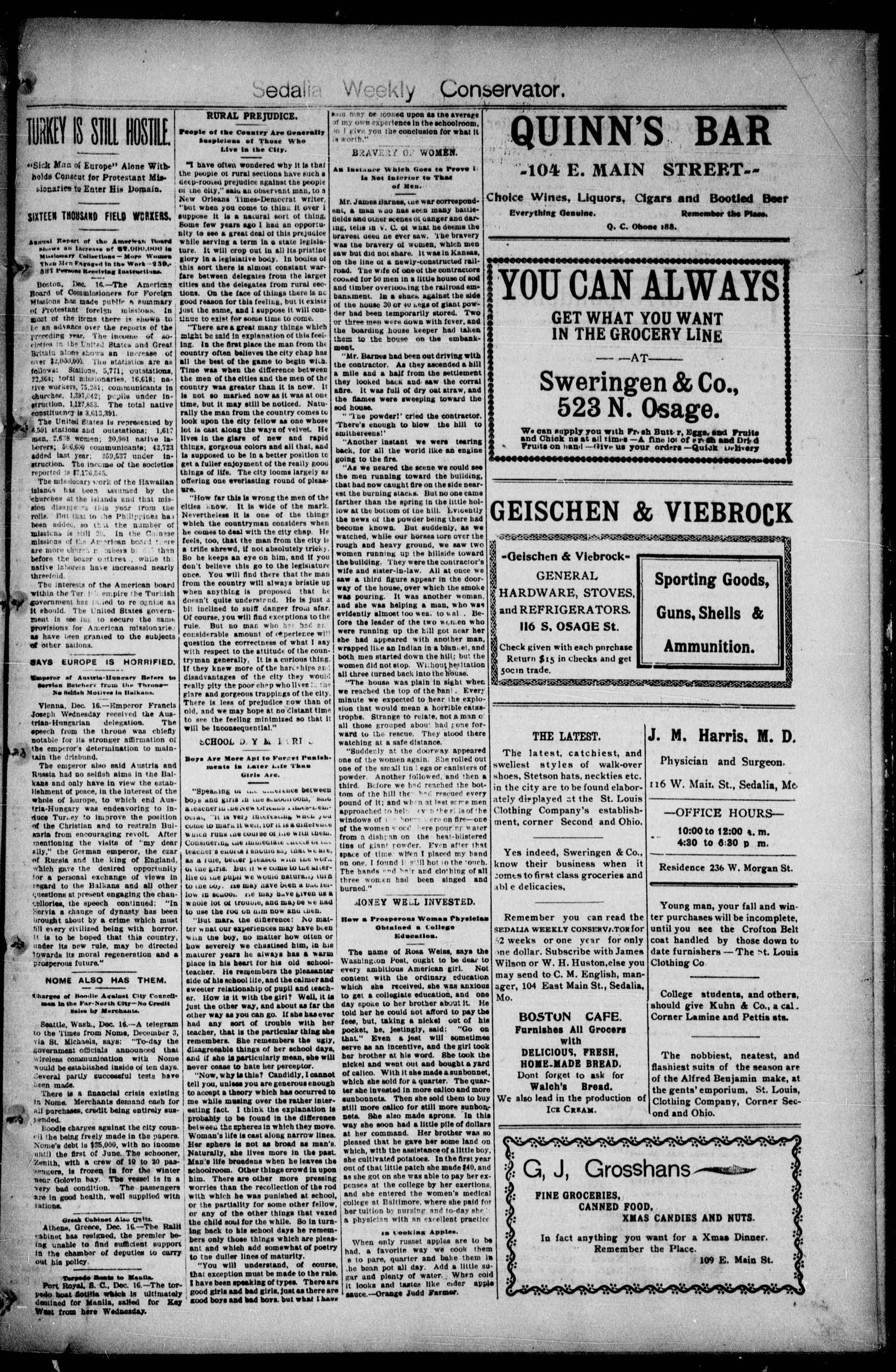
TURKEY IS STILL HOSTILE.
"Sick Man of Europe" Alone Withholds Consent for Protestant Missionaries to Enter His Domain.
SIXTEEN THOUSAND FIELD WORKERS.
Annual Report of the American Board
Shows an Increase of $2,000,000 in
Missionary Collections—More Women
Than Men Engaged in the Work—$30,
$187 Pensions Resolving Instructions.
Boston, Dec. 16.—The American
Board of Commissioners for Foreign
Missions has made public a summary
of Protestant foreign missions. In
most of the items there is shown to
be an advance over the reports of the
preceding year. The income of so-
cieties in the United States and Great
Britain alone shows an increase of
over $2,000,000. The statistics are as
follows: Stations, 5,771; outstations,
22,364; total missionaries, 16,618; native
workers, 75,261; communicants in
churches, 1,397,042; pupils under
instruction, 1,127,853. The total native
constituency is 3,613,391.
The United States is represented by 4,391 stations and outstations; 1,617 men; 2,678 women; 20,901 native laborers; 56,600 communicants; 43,723 added last year; 259,537 under instruction. The income of the societies reported is $7,176,545.
The missionary work of the Hawaiian islands has been assumed by the churches at the islands and that mission disappears this year from the rolls. But that to the Philippines has been added, so that the number of missions is still 26. In the Chinese missions of the American board there are more church numbers by 65 than before the boxer outbrea, while the native laborers have increased nearly threefold.
The interests of the American board within the Turkish empire the Turkish government has failed to recognize as it should. The United States government is see ing to secure the same provisions for American missionaries as have been granted to the subjects of other nations.
SAYS EUROPE IS HORRIFIED.
Emperor of Austria-Hungary Refers to Servian Batchery from the Throne—No Selfish Motives in Balkans.
Vienna, Dec. 16.—Emperor Francis Joseph Wednesday received the Austrian-Hungarian delegation. The speech from the throne was chiefly notable for its stronger affirmation of the emperor's determination to maintain the dreadhund.
The emperor also said Austria and Russia had no selfish aims in the Balkans and only have in view the establishment of peace, in the interest of the whole of Europe, to which end Austria-Hungary was endeavoring to induce Turkey to improve the position of the Christian and to restrain Bulgaria from encouraging revolt. After mentioning the visits of "my dear ally," the German emperor, the czar of Russia and the king of England, which gave the desired opportunity for a personal exchange of views in regard to the Balkans and all other questions at present engaging the chancellors, the speech continued: "In Servia a change of dynasty has been brought about by a crime which must fill every civilized being with horror. It is to be hoped that this country, under its new rule, may be directed towards its moral regeneration and a prosperous future."
NOME ALSO HAS THEM.
Charges of Bodie Against City Councilmen in the Far-North City—No Credit Sales by Merchants.
Seattle, Wash., Dec. 16.—A telegram to the Times from Nome, December 3, via St. Michael's, says: "To-day the government officials announced that wireless communication with Nome would be established inside of ten days. Several partly successful tests have been made.
There is a financial crisis existing in Nome. Merchants demand cash for all purchases, credit being entirely suspended.
Boodle charges against the city council the being freely made in the papers. Nome's debt is $35,000, with no income until the first of June. The schooner, Zenith, with a crew of 10 to 20 passengers, is frozen in for the winter near Golovin bay. The vessel is in a very bad condition. The passengers are in good health, well supplied with ration.
Greek Cabinet Also Quits.
Athens, Greece, Dec. 16.—The Rallt cabinet has resigned, the premier being unable to find sufficient support in the chamber of deputies to carry out his policy.
Torpedo Bents to Manila.
Port Royal, S. C., Dec. 16.—The torpedo boat Gotilla which is ultimately destined for Manila, sailed for Key West from here Wednesday.
RURAL PREJUDICE.
People of the Country Are Generally Suspicious of Those Who Live in the City.
"I have often wondered why it is that the people of rural sections have such a deep-rooted prejudice against the people of the city," said an observant man, to a New Orleans Times-Democrat writer, "but when you come to think it over I suppose it is a natural sort of thing. Some few years ago I had an opportunity to see a great deal of this prejudice while serving a term in a state legislature. It will crop out in all its pristine glory in a legislative body. In bodies of this sort there is almost constant warfare between delegates from the larger cities and the delegates from rural sections. On the face of things there is no good reason for this feeling, but it exists just the same, and I suppose it will continue to exist for some time to come.
"There are a great many things which might be said in explanation of this feeling. In the first place the man from the country often believes the city chap has all the best of the game to begin with. Time was when the difference between the men of the cities and the men of the country was greater than it is now. It is not so marked now as it was at one time, but it may still be noticed. Naturally the man from the country comes to look upon the city fellow as one whose lot is cast along the ways of velvet. He lives in the glare of new and rapid things, gorgeous colors and all that, and is supposed to be in a better position to get a fuller enjoyment of the really good things of life. The city looms largely as offering one everlasting round of pleasure.
"How far this is wrong the men of the cities know. It is wide of the mark. Nevertheless it is one of the things which the countryman considers when he comes to deal with the city chap. He feels, too, that the man from the city is a trifle shrewd, if not absolutely tricky. So he keeps an eye on him, and if you don't believe this go to the legislature once. You will find there that the man from the country will always bristle up when anything is proposed that he doesn't quite understand. He is just a bit inclined to sniff danger from afar. Of course, you will find exceptions to the rule. But no man who has had an considerable amount of experience will question the correctness of what I say with respect to the attitude of the countryman generally. It is a curious thing. If they knew more of the hardships and disadvantages of the city they would really pity the poor chap who lives in the glare and gorgeous trappings of the city. There is less of prejudice now than of old, and we may hope at no distant time to see the feeling minimized so that it will be inconsequential."
SCHOOL D. Y. M. RI
Boys Are More Apt to Forget Punishments in Later Life Than
"Speaking of the difference between boys and girls in the schoolroom," said a teacher in the new Orleans Times-Beneficial, "it is very interesting when you come to mark it well, for it is a difference which runs the course of life with them. Considering the immediate choices of the teacher's school should say, that we are, as a rule, better pleased with the work of the girls. But if we come to the afterlife of the pupil we would naturally turn to the boy. He may have been a bad fellow in school. He may have given us a whole lot of trouble, and maybe we had to use the roog on him now and then.
"But mark the difference: No matter what our experiences may have been with the boy, no matter how often or how severely we chastised him, in his maturer years he always has a warm place in his heart for his old school-teacher. He remembers the pleasanter side of his school life, and the calmer and sweeter relationship of pupil and teacher. How is it with the girl? Well, it is just the other way, and about as far the other way as you can go. If she has ever had any sort of trouble with her teacher, that is the particular thing she remembers. She remembers the ugly, disagreeable things of her school days, and if she is particularly mean, she will never cease to hate her perceptor.
"Now, why is this? Candidly, I cannot tell you, unless you are generous enough to accept a theory which has occurred to me while musing over the rather interesting fact. I think the explanation is probably to be found in the difference between the spheres in which they move. Woman's life is cast along narrow lines. Her sphere is not as broad as man's. Naturally, she lives more in the past. Man's life broadens when he leaves the schoolroom. Other things crowd in upon him. There are other more pressing worries than the recollection of the rod with which he was punished at school, or the partiality for some other fellow, or any of the other things that vexed the child soul for the while. So in turning back to his school days he remembers only those things which are pleasant and which add somewhat of poetry to the duller lines of maturity.
"You will understand, of course, that exception must be made to the rule. I have been speaking of types. There are good girls and bad girls, just as there are good boys and bad boys, but what I have
Conservator.
and may be looked upon as the average of my own experience in the schoolroom, so I give you the conclusion for what it is worth."
An Instance Which Goes to Prove It Is Not Interior to That of Men.
Mr. James Barnes, the war correspondent, a man who has seen many battlefields and other scenes of danger and daring, tells in V. C. of what he deems the bravest deed he ever saw. The bravery was the bravery of women, which men saw but did not share. It was in Kansas, on the line of a newly-constructed railroad. The wife of one of the contractors cooked for 50 men in a little house of sod and timber overcrowding the railroad embankment. In a shack against the side of the house 30 or 40 legs of giant powder had been temporarily stored. Two or three men were down with fever, and the boarding house keeper had taken them to the house on the embankment.
"Mr. Barnes had been out driving with the contractor. As they ascended a hill a mile and a half from the settlement they looked back and saw the corral afire. It was full of dry oat straw, and the flames were sweeping toward the sod house.
"The powder!' cried the contractor. 'There's enough to blow the hill to smithereens!'
"Another instant we were tearing back, for all the world like an engine going to the fire.
"As we neared the scene we could see the men running toward the building, that had now caught fire on the side nearest the burning stacks. But no one came farther than the spring in the little hollow at the bottom of the hill. Evidently the news of the powder being there had become known. But suddenly, as we watched, while our horses tore over the rough and heavy ground, we saw two women running up the hillside toward the building. They were the contractor's wife and sister-in-law. All at once we saw a third figure appear in the doorway of the house, over which the smoke was pouring. It was another woman, and she was helping a man, who was evidently almost too wea. to walk. Before the leader of the two women who were running up the hill got near her she had appeared with another man, wrapped an Indian in a blanket, and both men started down the hill; but the women did not stop. Without hesitation all three turned back into the house.
"The house was plain in sight when we reached the top of the bank. Every minute we expected to hear the explosion that would mean a horrible catastrophe. Strange to relate, not a man of all those grouped about had gone forward to the rescue. They stood there watching at a safe distance.
"Suddenly at the doorway appeared one of the women again. She rolled out one of the small tin legs or canisters of powder. Another followed, and then a third. Before we had reached the bottom of the hill she had rescued every pound of it; and when at last some men approached to help, even the elf is of the windows of the house here on fire—one of the women stood here pouring water from a dishpan on the heat-bilistered tins of giant powder. Even after that space of time, when I placed my hand on one, I found it still hot to the touch. The hands and hair and clothing of all three women had been singed and burned."
JONEY WELL INVESTED.
How a Prosperous Woman Physician Obtained a College Education
The name of Rosa Weiss, says the Washington Post, ought to be dear to every ambitious American girl. Not content with the ordinary education which she received, she was anxious to get a collegiate education, and one day spoke to her brother about it. He told her he could not afford to pay the fees, but, taking a nickel out of his pocket, he, jestingly, said: "Go on that." Even a jest will sometimes serve as an incentive, and the girl took her brother at his word. She took the nickel and went out and bought a yard of calico. With it she made a sunbonnet, which she sold for a quarter. The quarter she invested in more calico and more sunbonneta. Then she sold them to buy still more calico for still more sunbonneta. She also made aprons. In this way she soon had a little pile of dollars at her command. Her brother was so pleased that he gave her some land on which, with the assistance of a little boy, she cultivated potatoes. In the first year out of that little patch she made $40, and as she got on she was able to pay her expenses at the college by her exertions and she entered the women's medical college at Baltimore, where she paid for her tuition by nursing, and to-day she a physician with an excellent practice
When only russet apples are to be had, a favorite way we cook them is to pare, quarter and bake them in the bean pot all day. Add a little sugar and plenty of water. When cold it looks and tastes like cider apple sauce.—Orange Judd Farmer.
in Cooking Apples.
QUINN'S
-104 E. MAIN
Choice Wines, Liquors, Ch
Everything Genuine.
Q. C. Obo
YOU CAN A
GET WHAT Y
IN THE GROC
AT
Sweringe
523 N. C
We can supply you with Fris
and Chick ns at all times — A
Fruits on hand — Give us you
GEISCHEN &
-Geischen & Viebrock-
-104 E. MAIN STREET-- Choice Wines, Liquors, Cigars and Bootled Beer Everything Genuine. Remember the Place. Q. C. Ohone 188.
Sweringen & Co., 523 N. Osage. We can supply you with Fresh Butter, Eggs, and Fruits and Chick ns at all times—A fine lot of fresh and Dried Fruits on hand—Give us your orders—Quick Delivery
GEISCHEN & VIEBROCK
GENERAL
HARDWARE, STOVES,
and REFRIGERATORS.
116 S. OSAGE St.
Check given with each purchase
Return $15 in checks and get
50c in trade.
THE LATEST.
The latest, catchiest, and swelliest styles of walk-over shoes, Stetson hats, neckties etc. in the city are to be found elaborately displayed at the St. Louis Clothing Company's establishment, corner Second and Ohio.
Yes indeed, Sweringen & Co., know their business when it comes to first class groceries and able delicacies.
Remember you can read the SEDALIA WEEKLY CONSERVATOR for 62 weeks or one year for only one dollar. Subscribe with James Wilson or W. H. Huston,else you may send to C. M. English, manager, 104 East Main St., Sedalia, Mo.
BOSTON CAFE.
Furnishes All Grocers
with
DELICIOUS, FRESH.
HOME-MADE BREAD.
Dont forget to ask for
Walch's Bread.
We also lead in the production of
ICE CREAM.
G, J, Grossh
FINE GROCERIES,
CANNED FOOD
XMAS
In fact anything you
Remember
G, J, Grosshans
FINE GROCERIES,
CANNED FOOD,
XMAS CANDIES AND NUTS.
In fact anything you want for a Xmas Dinner.
Remember the Place.
109 E. Main St.
Sporting Goods,
Guns, Shells &
Ammunition.
J. M. Harris, M. D.
Physician and Surgeon. 116 W. Mair, St., Sedalia, Mc
OFFICE HOURS
10:00 to 12:00 a.m.
4:30 to 6:30 p.m.
Residence 236 W. Morgan St.
Young man, your fall and winter purchases will be incomplete, until you see the Crofton Belt coat handled by those down to date furnishers - The St. Louis Clothing Co.
College students, and others, should give Kuhn & Co., a cal. Corner Lamine and Pettis ats.
The nobbiest, neatest, and flashiest suits of the season are of the Alfred Benjamin make, at the gents' emporium, St. Louis, Clothing Company, Corner Second and Ohio.
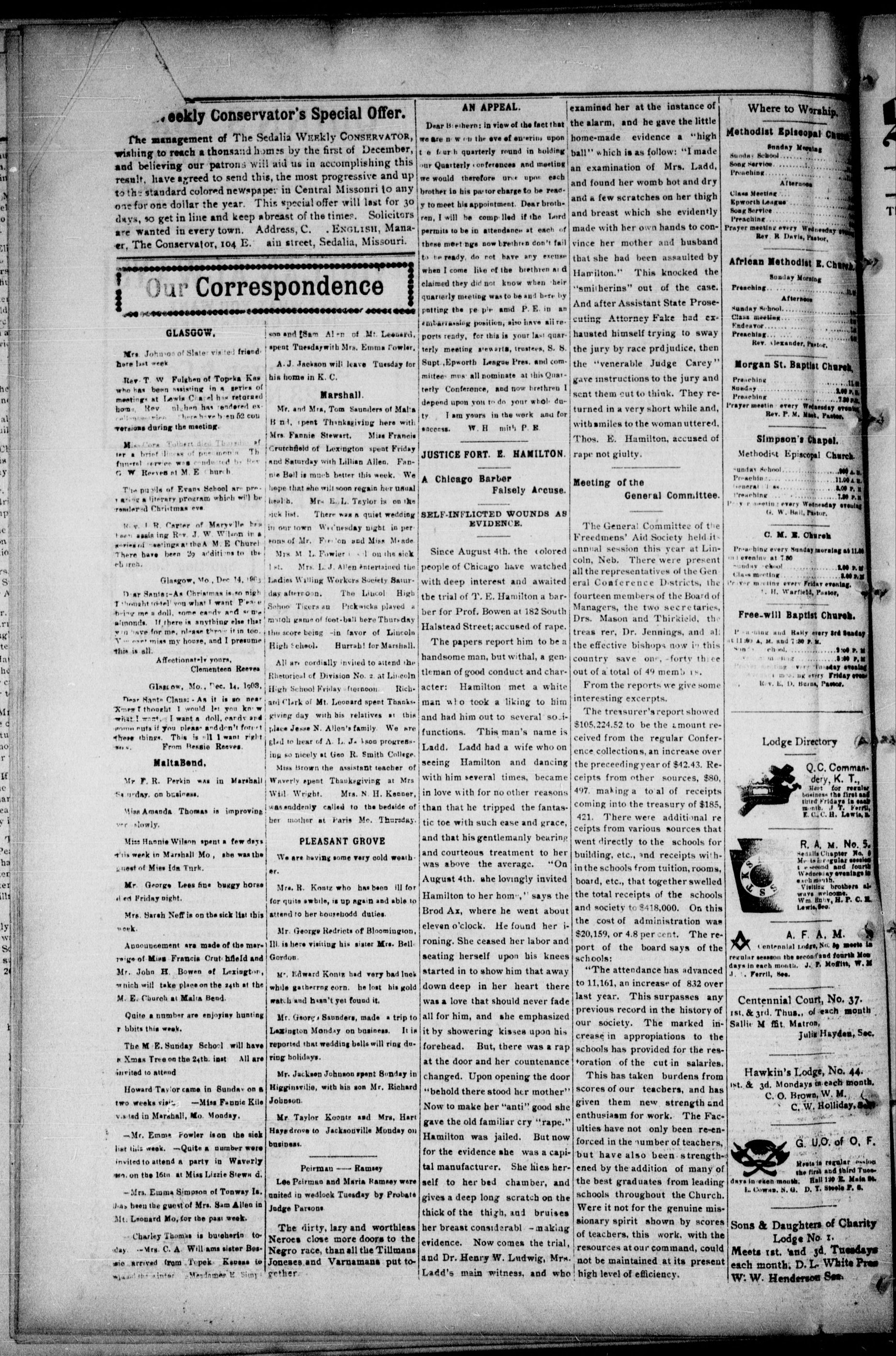
.ooekly Conservator's Special Offer.
The management of The Sedalia WEEKLY CONSERVATOR, wishing to reach a thousand homes by the first of December, and believing our patrons will aid us in accomplishing this result, have agreed to send this, the most progressive and up to the standard colored newspaper in Central Missouri to any one for one dollar the year. This special offer will last for 30 days, so get in line and keep abreast of the times. Solicitors are wanted in every town. Address, C. ENGLISH, Manager. The Conservator, 104 E. ain street, Sedalia, Missouri.
Our Correspondence
```markdown
```
GLASGOW.
Mrs. Johnson of Slater visited friends here last week
Rev. T. W. Fulghen of Topeka Kas who has been assisting in a series of meetings at Lewis Chapel has returned home. Rev. ulghen has rendered excellence there have been 62 conversions during the meeting.
Miss Cora Tolbert died Thursday after a brief illness of pneumonia. The funeral service was conducted by Rev. G. W. Reeves at M. E. Church.
The pupils of Evans School are preparing a literary program which will be rendered Christmas eve.
Rev. J. R. Carter of Maryville has been assisting Rev. J. W. Wilson in a series of meetings at the A. M. E. Church. There have been 29 additions to the church.
Dear Santa: -As Christmas is so nigh
I thought totell you what I want. Please
bring me a doll, some candy and some
almonds. If there is anything else that
you have for me, please throw it in too.
You can't miss my house, and I presume
this is all.
Affectionately yours.
Clementeen Reeves
Glasgow, Mo., Dec. 14, 1903.
Dear Santa Claus: -As it is so near
Xmen I thought I would let you know
what I want. I want a doll, candy and
some nuts if you please and don't forget
these things. This is all I want right
now.
From Bessie Reeves.
MaltaBend.
Mr F. R. Perkin was in Marshall Saturday, on business.
Miss Amanda Thomas is improving very slowly.
Miss Hannie Wilson spent a few days this week in Marshall Mo, she was the guest of Miss Ida Turk.
Mr. George Lees fine buggy horse died Friday night.
Mrs. Sarah Neff is on the sick list this week.
Announcement are made of the marriage of Miss Francis Crutchfield and Mr. John H. Bowen of Lexington, which will take place on the 24th at the M. E. Church at Malta Bend.
Quite a number are enjoyiy hunting rabbits this week.
The M. E. Sunday School will have a Xmas Tree on the 24th. inst. All are invited to attend.
Howard Taylor came in Sunday on a two weeks visit. —Miss Fannie Kile visited in Marshall, Mo. Monday.
Mr. Emma Powler is on the sick list this week. Quite a number were invited to attend a party in Waverly on the 16th at Miss Lizzie Stew d.
Mrs. Emma Simpson of Tonway Is. Has been the guest of Mrs. Sam Allen in Mt. Leonard Mo. for the past week.
Charley Thomas is butcher in today. Mrs. C. A. Will ams sister Bessie arrived from Topek Kansas to attend the winter. Meadamus E. Simp
---
son and [Sam Allen of Mt. Leonard,
spent Tuesdaywith Mrs. Emma Fowler.
A.J. Jackson will leave Tuesday for
his home in K.C.
Marshall.
Mr. and Mrs. Tom Saunders of Malta Bnd. spent Thanksgiving here with Mrs. Fannie Stewart. Miss Francis Crutchfield of Lexington spent Friday and Saturday with Lillian Allen. Fannie Bell is much better this week. We hope that she will soon regain her usual health. Mrs. E. L. Taylor is on the sick list. There was a quiet wedding in our town Wednesday night in persons of Mr. Fieleton and Miss Meade. Mrs. M. L. Fowler will on the sick list. Mrs. L. J. Allen entertained the Ladies Willing Workers Society Saturday afternoon. The Lincoln High School Tigers an Pickwicks played a match game of foot-ball here Thursday the score being -in favor of Lincoln High School. Hurrah! for Marshall.
All are cordially invited to attend the Rhetorical of Division No. 2, at Lincoln High School Friday afternoon. Richard Clark of Mt. Leonard spent Thanksgiving day with his relatives at this place Jesse N. Allen's family. We are glad to hear of A. L. Jackson progressing so nicely at Geo R. Smith College. Miss Brown the assistant teacher of Waverly spent Thanksgiving at Mrs. Will Wright. Mrs. N. H. Kenner, was suddenly called to the bedside of her mother at Paris Mc. Thursday.
PLEASANT GROVE
We are having some very cold weather.
Mrs. R. Kontz who has been ill for for quite awhile, is up again and able to attend to her household duties.
Mr. George Redribs of Bloomington, Ill. is here visiting his sister Mrs. Bell-Gordon.
Mr. Edward Kontz had very bad luck while gatherng corn. he lost his gold watch and hasn't yet found it.
Mr. George Saunders, made a trip to Lexington Monday on business. It is reported that wedding bells will ring during holidays.
Mr. Jackson Johnson spent Sunday in Higginsville, with his son Mr. Richard Johnson.
Mr. Taylor Koontz and Mrs. Hart Hays drove to Jacksonville Monday on business.
Lee Pearman and Maria Ramsey were united in wedlock Tuesday by Probate Judge Parsons.
The dirty, lazy and worthless Neroes close more doors to the Negro race, than all the Tillmans Joneses and Varnamana put together.
AN APPEAL.
Dear Brother, in view of the fact that we are now on the eve of entering upon the fourth quarterly round in holding our Quarterly conferences and meeting we would therefore urge upon each brother in his pastor charge to be ready to meet his appointment. Dear brother, I will be compelled if the Lord permits to be in attendance at each of these meetings now brethren don't fail to be ready, do not have any excuse when I come like of the brethren and claimed they did not know when their quarterly meeting was to be and here by putting the people amd P. E. in an embarrassing position, also have all reports ready, for this is your last quarterly meeting stewarts, trustees, S. S. Supt., Epworth League Pres. and committees must all nominate at this Quarterly Conference, and now brethren I depend upon you to do your whole duty. I am yours in the work and for success. W. H. with P. E.
JUSTICE FORT. E. HAMILTON
SELF-INFLICTED WOUNDS AS EVIDENCE.
Since August 4th. the colored people of Chicago have watched with deep interest and awaited the trial of T. E. Hamilton a barber for Prof. Bowen at 182 South Halstead Street; accused of rape.
The papers report him to be a handsome man, but withal, a gentleman of good conduct and character: Hamilton met a white man who took a liking to him and had him out to several soci-functions. This man's name is Ladd. Ladd had a wife who on seeing Hamilton and dancing with him several times, became in love with for no other reasons than that he tripped the fantastic toe with such ease and grace, and that his gentlemanly bearing and courteous treatment to her was above the average. "On August 4th. she lovingly invited Hamilton to her home," says the Brod Ax, where he went about eleven o'clock. He found her ironing. She ceased her labor and seating herself upon his knees started in to show him that away down deep in her heart there was a love that should never fade all for him, and she emphasized it by showering kisses upon his forehead. But, there was a rap at the door and her countenance changed. Upon opening the door "behold there stood her mother" Now to make her "anti" good she gave the old familiar cry "rape." Hamilton was jailed. But now for the evidence she was a capital manufacturer. She hies herself to her bed chamber, and gives a deep long scratch on the thick of the thigh, and bruises her breast considerabl- making evidence. Now comes the trial, and Dr. Henry W. Ludwig, Mrs. Ladd's main witness, and who
examined her at the instance of the alarm, and he gave the little home-made evidence a "high ball" which is as follow: "I made an examination of Mrs. Ladd, and found her womb hot and dry and a few scratches on her thigh and breast which she evidently made with her own hands to convince her mother and husband that she had been assaulted by Hamilton." This knocked the "smitherins" out of the case. And after Assistant State Prosecuting Attorney Fake had exhausted himself trying to sway the jury by race prdjudice, then the "venerable Judge Carey" gave instructions to the jury and sent them out to thiuk. They returned in a very short while and, with smiles to the woman uttered, Thos. E. Hamilton, accused of rape not giulty.
Meeting of the General Committee.
The General Committee of the Freedmens' Aid Society held its annual session this year at Lincoln, Neb. There were present all the representatives of the General Conference Districts, the fourteen members of the Board of Managers, the two secretaries, Drs. Mason and Thirkield, the treasurer, Dr. Jennings, and all the effective bishops now in this country save one, forty three out of a total of 49 members. From the reports we give some interesting excerpts.
The treasurer's report showed $105,224.52 to be the amount received from the regular Conference collections, an increase over the preceeding year of $42.43. Receipts from other sources, $80, 497. making a total of receipts coming into the treasury of $185, 421. There were additional receipts from various sources that went directly to the schools for building, etc., and receipts within the schools from tuition, rooms, board, etc., that together swelled the total receipts of the schools and society to $418,000. On this the cost of administration was $20,159, or 4.8 per cent. The report of the board says of the schools:
"The attendance has advanced to 11,161, an increase of 832 over last year. This surpasses any previous record in the history of our society. The marked increase in appropriations to the schools has provided for the restoration of the cut in salaries.
This has taken burdens from scores of our teachers, and has given them new strength and enthusiasm for work. The Faculties have not only been re-enforced in the number of teachers, but have also been strengthened by the addition of many of the best graduates from leading schools throughout the Church. Were it not for the genuine missionary spirit shown by scores of teachers, this work, with the resources at our command, could not be maintained at its present high level of efficiency.
African Methodist E. Charge
Sunday Morning
Preaching.....11.5
Afternoon
Sunday School.....12
Class meeting.....12
Endeavor.....12
Preaching.....12
Rev. Alexander, Pastor.
Morgan St. Baptist Church
Praeching ..... 11.00
Sunday ..... 8.00 P.M.
Praeching ..... 7.00 P.M.
Prayer meetin' every Wednesday evening
Rev. P. M. Mack, Pastor.
Simpson's Chapel.
Mediterranean Episcopal Church.
Sunday School.....800 A.M.
Preaching.....11.00 A.M.
General Las.....8.00 P.M.
Preaching.....7.00 P.M.
Day meeting: every Wednesday evening
(G. W. Bell, Pastor.
C. M. E. Church
Preaching every Sunday morning at 11:00 on evenin at 7:30
Sunday - choo!.....2.00 p.m.
Class meeting.....2.00 p.m.
I've've meeting every Friday evening.
1. H. Warfield, Pastor,
Free-will Baptist Church.
P. meeting and Rally every 3rd Sunday
at 11:00 A. M. and 7:30 P. M.
Sunday school.....3:00 P. M.
Wednesday meeting.....3:00 P. M.
Thursday meeting every Thursday evening
meeting every Friday evening
Rev. E. D. Burns, Pastor.
Lodge Directory
#
Q.C. Commandery, K. T.
Best for regular business the first and third Fridays in each month. J. T. Forti. E. C. H. C. Lewis.
SSFKS
R. A. M. No. 5.
Sedalia Chapter No. 5
Me is migrating classes
the second and fourth
weekends evenings
each month.
Visiting brothers always welcome.
Wm. Ribby, H. P. C. M.
Lewis, Seo.
A. P. A. M.
Centennial Lodge, No. 69 mocte is
regular session the second and fourth Mo
days in each month. J. P. Moffitt, W. M
J. J. Ferril, See.
Centennial Court, No. 37. 1st. & 3rd. Thus., of each month Sallie M fit. Matron.
Julia Hayden, Sec.
Hawkin's Lodge, No. 44.
1st. & 3d. Mondays in each month.
C. O. Brown, W. M.
C. W. Holliday,
G. U.O. of O. F.
Monta in regular position
the first and third Tuon-
h. Hall 120. B. Main St.
D. Y. Steele P. S.
安
Sons & Daughters of Charity
Lodge No. 1.
Meets 1st. and 3d. Tuesdays
each month. D. L. White Press
W: W. Henderson Se.