Sedalia Weekly Conservator
Monday, July 15, 1907
Sedalia, Missouri
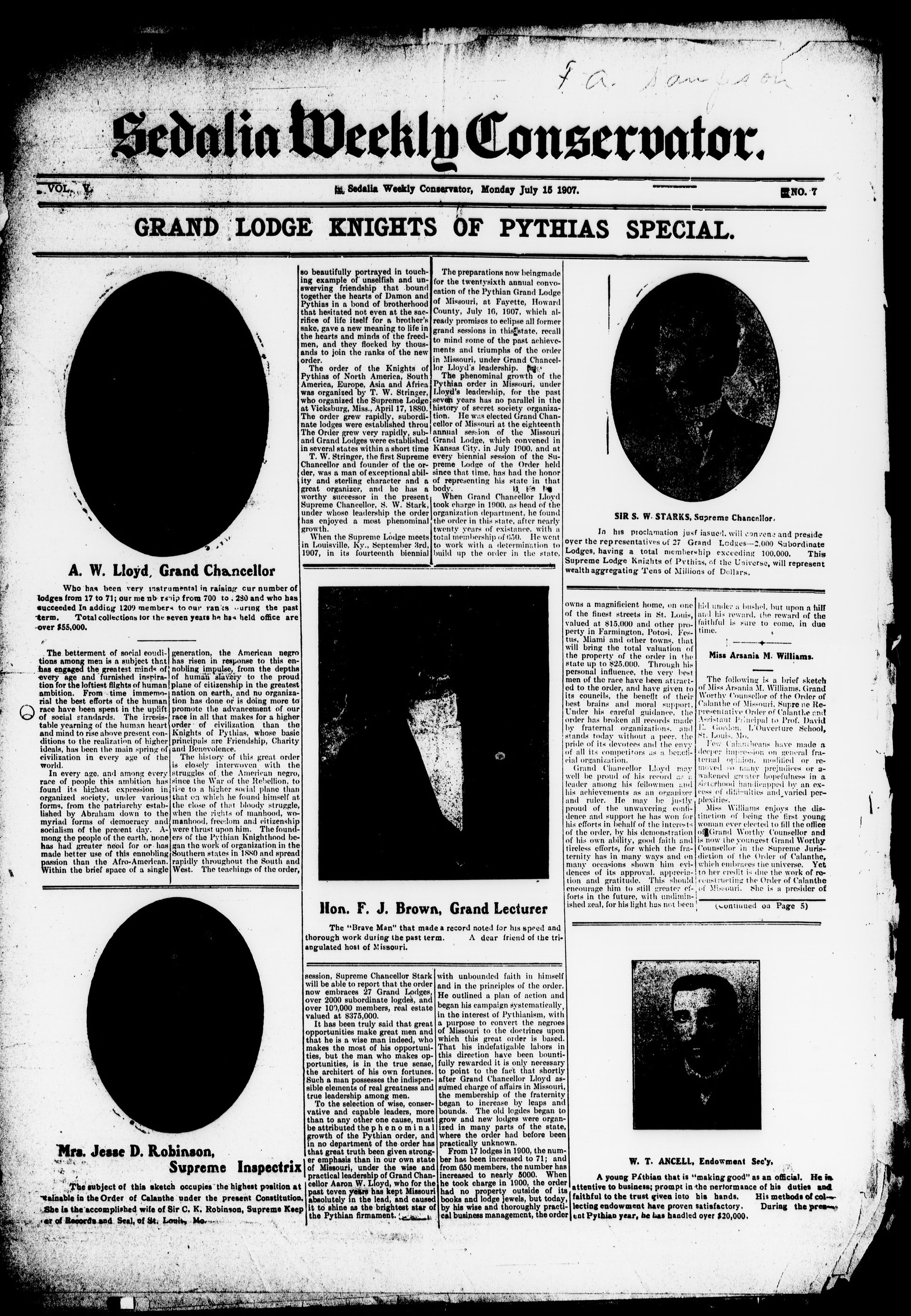
Page text (machine-generated)
Sedalia Weekly Conservator.
```markdown
```
A. W. Lloyd, Grand Chancellor Who has been very instrumental in raising our number of lodges from 17 to 71; our membership from 700 to 280 and who has succeeded In adding 1209 members to our ranks during the past term. Total collections for the seven years he has held office are over $55,000.
```markdown
```
Mrs. Jesse D. Robinson, Supreme Inspectrix The subject of this sketch occupies the highest position at sustainable in the Order of Calanthe under the present Constitution. She is the accomplished wife of Sir C. K. Robinson, Supreme Keeper of Records and Seal, of St. Louis, Mo.
VOL. V
A. W. Lloyd, G.
Who has been very instruded lodges from 17 to 71; our members succeeded In adding 1209 member term. Total collections for the over $55,000.
The betterment of social conditions among men is a subject that has engaged the greatest minds of every age and furnished inspiration for the loftiest flights of human ambition. From time immemorial the best efforts of the human race have been spent in the uplift of social standards. The irresistable yearning of the human heart and mind to rise above present conditions to the realization of higher ideals, has been the main spring of civilization in every age of the world.
In every age, and among every race of people this ambition has found its highest expression in organized society, under various forms, from the patriarchy established by Abraham down to the myriad forms of democracy and socialism of the present day. Among the people of the earth, none has had greater need for or has made better use of this ennobling passion than the Afro-American. Within the brief space of a single
---
generation, the American negro has risen in response to this ennobling impulse, from the depths of human slavery to the proud plane of citizenship in the greatest nation on earth, and no organization has done or is doing more to promote the advancement of our race in all that makes for a higher order of civilization than the Knights of Pythias, whose basic principals are Friendship, Charity and Benevolence.
The history of this great order is closely interwoven with the struggles of the American negro, since the War of the Rebellion, to rise to a higher social plane than that on which he found himself at the close of that bloody struggle, when the rights of manhood, womanhood, freedom and citizenship were thrust upon him. The founders of the Pythian Knighthood began the work of organization in the Southern states in 1880 and spread rapidly throughout the South and West. The teachings of the order,
Sedalia Weekly Conservator, Monday July 15 1907.
```markdown
```
Hon. F. J. Brown. Grand Lecturer
The "Brave Man" that made a record noted for his speed and thorough work during the past term. A dear friend of the triangulated host of Missouri.
so beautifully portrayed in touching example of unselfish and unawerving friendship that bound together the hearts of Damon and Pythias in a bond of brotherhood that hesitated not even at the sacrifice of life itself for a brother's sake, gave a new meaning to life in the hearts and minds of the freedmen, and they flocked by thousands to join the ranks of the new order.
The order of the Knights of Pythias of North America, South America, Europe, Asia and Africa was organized by T. W. Stringer, who organized the Supreme Lodge at Vicksburg, Miss., April 17, 1880. The order grew rapidly, subordinate lodges were established throu The Order grew very rapidly, sub and Grand Lodges were established in several states within a short time T. W. Stringer, the first Supreme Chancellor and founder of the order, was a man of exceptional ability and sterling character and a great organizer, and he has a worthy successor in the present Supreme Chancellor, S. W. Stark, under whose leadership the order has enjoyed a most phenomenal growth.
When the Supreme Lodge meets in Louisville, Ky., September 3rd, 1007, in its fourteenth biennial
Hon. F. J. Brown
The "Brave Man" that made thorough work during the past ter- angulated host of Missouri.
session, Supreme Chancellor Stark will be able to report that the order now embraces 27 Grand Lodges, over 2000 subordinate logdés, and over 100,000 members, real estate valued at $375,000. It has been truly said that great opportunities make great men and that he is a wise man indeed, who makes the most of his opportunities, but the man who makes opportunities, is in the true sense, the architect of his own fortunes. Such a man possesses the indispensable elements of real greatness and true leadership among men.
To the selection of wise, conservative and capable leaders, more than to any other one cause, must be attributed the pheno m in a l growth of the Pythian order, and in no department of the order has that great truth been given stronger emphasis than in our own state of Missouri, under the wise and practical leadership of Grand Chancellor Aaron W. Lloyd, who for the past ten years has kept Missouri absolutely in the lead, and caused it to shine as the brightest star of the Pythian firmament.
---
The preparations now being made for the twentysixth annual convoction of the Pythian Grand Lodge of Missouri, at Fayette, Howard County, July 16, 1907, which already promises to eclipse all former grand sessions in this state, recall to mind some of the past achievements and triumphs of the order in Missouri, under Grand Chancellor Lloyd's leadership.
The phenominal growth of the Pythian order in Missouri, under Lloyd's leadership, for the past seven years has no parallel in the history of secret society organization. He was elected Grand Chancellor of Missouri at the eighteenth annual session of the Missouri Grand Lodge, which convened in Kansas City, in July 1900, and at every biennial session of the Supreme Lodge of the Order held since that time, has had the honor of representing his state in that body. When Grand Chancellor Lloyd took charge in 1900, as head of the organization department, he found the order in this state, after nearly twenty years of existence, with a total membership of 650. He went to work with a determination to build up the order in the state,
n, Grand Lecturer
de a record noted for his speed and
arm. A dear friend of the tri-
with unbounded faith in himself and in the principles of the order. He outlined a plan of action and began his campaign systematically, in the interest of Pythianism, with a purpose to convert the negroes of Missouri to the doctrines upon which this great order is based. That his indefatigable labors in this direction have been bountifully rewarded it is only necessary to point to the fact that shortly after Grand Chancellor Lloyd assumed charge of affairs in Missouri, the membership of the fraternity began to increase by leaps and bounds. The old legdes began to grow and new lodges were organized in many parts of the state, where the order had before been practically unknown.
From 17 lodges in 1900, the number has been increased to 71; and from 650 members, the number has increased to nearly 5000. When he took charge in 1900, the order had no property outside of its books and lodge jewels, but today, by his wise and thoroughly practical business management, the order
fa. Sam
servato
1907.
HIAS SPECIAL
rvator.
SPECIAL.
[Name]
SIR S. W. STARKS, Supreme Chancellor.
In his proclamation just issued, will convene over the representatives of 27 Grand Lodges—2,000 Lodges, having a total membership exceeding 100, Supreme Lodge Knights of Pythias, of the Universe, wealth aggregating Tens of Millions of Dollars.
This proclamation justif isued, will convene representatives of 27 Grand Lodges--2,000 being a total membership exceeding 1000 Lodge Knights of Pythias, of the Universe, exegating Tens of Millions of Dollars.
In his proclamation justif issued, will convene and preside over the representatives of 27 Grand Lodges—2,000 Subordinate Lodges, having a total membership exceeding 100,000. This Supreme Lodge Knights of Pythias, of the Universe, will represent wealth aggregating 'Tens of Millions of Dollars.
owns a magnificent home, on one of the finest streets in St. Louis, valued at $15,000 and other property in Farmington, Potosi, Festus, Miami and other towns, that will bring the total valuation of the property of the order in the state up to $25,000. Through his personal influence, the very best men of the race have been attracted to the order, and have given to its councils, the benefit of their best brains and moral support. Under his careful guidance, the order has broken all records made by fraternal organizations, and stands today without a peer, the pride of its devotees and the envy of all its competitors as a beneficial organization.
Grand Chancellor Lloyd may well be proud of his record as a leader among his fellowmen and his achievements as an organizer and ruler. He may be justly proud of the unwavering confidence and support he has won for his efforts in behalf of the interests of the order, by his demonstration of his own ability, good faith and tireless efforts, for which the fraternity has in many ways and on many occasions shown him evidences of its approval. appreciation and gratitude. This should encourage him to still greater efforts in the future, with undiminished zeal, for his light has not been
---
---
M.
W. T. ANCELL, Endowment Sec'y,
A young Pythian that is "making good" as an attentive to business; prompt in the performance of his faithful to the trust given into his hands. His neglecting endowment have proven satisfactory. During Pythian year, he has handled over $20,000.
young Palthian that is "making good" as an aid to business; prompt in the performance of his duty the trust given into his hands. His new allowment have proven satisfactory. During an year, he has handled over $20,000.
A young Pathian that is "making good" as an official. He is attentive to business; prompt in the performance of his duties and faithful to the trust given into his hands. His methods of collecting endowment have proven satisfactory. During the present Pythian year, he has handled over $20,000.
If issued, will convene and preside and Lodges—2,000 Subordinate ship exceeding 100,000. This is, of the Universe, will represent ins of Dollars.
bid under a bushel, but upon a hill and his reward, the reward of the faithful is sure to come, in due time.
Miss Arsania M. Williams.
The following is a brief sketch of Miss Arsania M. Williams, Grand Worthy Counselor of the Order of Calanthe of Missouri, Supre ne Representative Order of Calanthe and Assistant Principal to Prof. David E. Gordon, L'Ouverture School, St. Louis, Mo.
Few Calantheans have made a deeper impression on general fraternal opinion, modified or removed so many prejudices or awakened greater hopefulness in a sisterhood handicapped by an excess of difficulties and varied perplexities.
Miss Williams enjoys the distinction of being the first young woman ever elected to fill the office of Grand Worthy Counsellor and is now the youngest Grand Worthy Counsellor in the Supreme Jurisdiction of the Order of Calanthe, which embraces the universe. Yet to her credit is due the work of reconstructing the Order of Calanthe of Missouri. She is a presider of
(Continued on Page 5)
making good" as an official. He is the performance of his duties and his hands. His methods ofcolsatisfactory. During the press over $20,000.
NO.7
Page Two.
FOR
Mall
URGES NE
WAY,
FORAKER AND
WILB
Makes Clear His
URGES NEGRO-AMERICANS THE
WAY, FOR EVERY CON
AND GOD-GIVEN
FORAKER AT WILBERFORCE.
Makes Clear His Political Ideas.
URGES NEGRO-AMERICANS TO CONTEND, IN MANLY WAY, FOR EVERY CONSTITUTIONAL RIGHT AND GOD-GIVEN PRIVILEGE.
SENATOR FORAKER'S SPEECH.
The Great Record of the Colored Soldiers.
The Senator said in part: "In all these great events the Colored people have borne an honorable part. They were represented among the volunteers we raised for the Spanish-American war. They were represented, and galantly represented, among the regulars who fought the battles in Cuba. No braver troops bore the flag to victory in that contest than the Ninth and Tenth Cavalry and the Twenty-fourth and Twenty-fifth Infantry. They were represented on every firing line, and some of them perished in every clash of arms. They died fighting side by side with the white soldiers, and as it was in Cuba, was it in the Philippines. Whenever there was hard service to be rendered or dangerous duty to be performed, they were present and did their full share. They would not claim any higher credit than their white comrades are entitled to receive. It would be an injustice to them to give them any less credit. Whether in the camp, on the march in the campaign, or in battle, they have shown themselves to be patient, orderly, well-behaved, well-disciplined, brave, gallant and thoroughly reliable soldiers. With no more exceptions than should be made in the case of a similar number of white soldiers, their record is a fine one, of which not only the men who made it, but all the men of their race may well be proud.
Colored Americans' Great Progress.
While the Negro has been doing so much to promote the common welfare he has been doing wonders for himself. Forty years ago the great body of the race in this country had just escaped from bondage. They had no property, no education, no social organization, no political rights. They were not only in this pitiliably helpless condition, but they were the objects of all the prejudices that had been born of slavery. It is hard to imagine a more difficult situation than that in which they were placed, or a more hopeless outlook than that which was then before them. Forty years have passed. They have been 40 years of glorious progress, not only for the white man, but for the Colored man as well. The last census will show that these poor, helpless, poverty-stricken people have accumulated and are today the owners of more than $500,000,000 worth of property.
Praise for Colleges and Lower Schools—Good Word for the Colored Press.
This institution then just founded has been growing, developing and doing its splendid work. In the meanwhile numerous other such institutions have been founded, and what has been witnessed here has been accomplished in other universities. And while this higher educational work has been in progress there have been established numerous schools of lesser importance. As a result there is a general uplift of both the mental and the moral qualities of the Negro race throughout the whole country—North and South alike. As a result you now have your own newspapers in almost every populous community. You have your magazines and you supply yourself with a literature that is of the highest character.
In Spite of Progress Equal Political Rights are Denied.
This is a splendid record and it would seem enough to overcome the prejudice born of that slave period to the extent of bringing about universal acquiescence in the doctrine of political equality for all men—white and black alike, in the presence of the constitution and the law. But unfortunately such is not the case. The work of reconstruction that promised so much has had no such wholesale accomplishment. Notwithstand-
```markdown
```
I
the progress the race and individuals of the race have been making, there has been, particularly of late years, a sentiment developed throughout the country that gives rise to a race problem with respect to which all thoughtful men have serious apprehensions.
Condemns "Grandfather Clauses."
Its expression has taken the form not only of unlawful and shockingly brutal lynchings, but numerous other forms, such as disfranchisement of voters by the grandfather clauses in violation of the spirit if not the letter of the amendments to the constitution, a system of peonage, almost as bad as slavery, and similar devices, all based upon the idea of a denial of that recognition of equality of rights which good citizenship imposes upon all classes of citizens.
The Bab Solutions Often Advocated.
How this problem is to be solved no one seems to know, but I am sure that many of the solutions that have been proposed will not prove either practicable or acceptable.
One man proposes that all the Colored people be deported to Africa, another that a part of our domestic territory be set aside for their exclusive occupation. Another proposes that they be by one process or another exterminated or REDUCED TO SUCH A STATE OF INFERIOR POLITICAL RIGHT AS TO PRACTICALLY DIVEST THEM OF THEIR CITIZENSHIP AND MAKE OF THEM MERE HEWERS OF WOOD AND DRAWERS OF WATER FOR THE WHITE RACE. And the state of Florida has recently proposed that the fourteenth and fifteenth amendments be repealed, and I believe has gone so far as to declare that without regard to whether they are repealed or not they shall be considered and regarded as of no binding force or effect.
America needs her Colored People.
I do not know what the solution of the race problem will be, but I do know that its solution will not be found in any of these solutions. If we had opportunity and desired to transfer them to Africa we could not afford to lose from our midst our Colored population. We need not only their labor, but their help in many ways. We need in our industrial conditions and our national life what they supply and what nobody else could substitute. "The mere suggestion of extermination has in it so much of brutality and crime that nobody should be allowed to mention it.
No Repeal of Amendments.
The fourteenth and fifteenth amendments will not be repealed, for, while the march of progress may for a time be halted, it never turns a permanently backward, and such a step would not do any good if it could be taken. Another man would solve the race problem by denying to the Colored man the benefits of education. He would not only deny him refinement and culture, mental training and development, but he would drive him out of the ranks of the trades, away from the shops, into the fields and make him "carry bricks and mortar" all the days of his life.
Only True Solution Equality of Rights.
The solution of the race problem will not come in any of these ways. All such propositions will fail because they are based upon a denial of equality of right before the law for all American citizens. By no method whatever can the march of progress with respect to such a matter be stopped. The doctrine of equal citizenship has been put into our organic law to stay there forever, and there will eventually be actual equality of rights under the law for all men—white and black, rich and poor alike.
By Effort Equal Rights Will Yet Prevail.
This guaranty of the constitu-
Sedalia Weekly Conservator, Monday July 15, 1907.
tion may be uallified and defeated and thwarted for years to come, as it has been for the years that are gone, but it will come when it will be respected and enforced throughout all the land. But this realization so important to the Negro race will not come without effort.
Effort by Colored Men Themselves.
This will be an effort not for white men alone, but for Colored men also. They can do more than anybody else, and it is proper they should do more than anybody else. It is pre-eminently their work. They can help themselves in this matter in no way so much as by providing such mental and moral education and development as will come to all who receive the benefits of such institutions as this, and who will go out into the world to give these same benefits in greater or less degree to all others with whom they come in contact. But aside from this special reason the success of popular government depends upon the intelligence and the morality of the people.
Education and Morality Prepare for Citizenship.
It is, therefore, the duty of all to help in every way possible to educate all and to bring classes up to the highest possible intellectual and moral plane. Therefore, let your newspapers and magazines be multiplied, let new schools and new colleges and new universities be established, and let all go ahead as with a labor of love to educate your youth and prepare them as only education and morality can prepare them for the great burdens and high privileges of American citizenship.
Then show Manhood in Voting-
4 Stand up for your Rights.
And then in the discharge of these duties of citizenship show your manhood—stand up for your rights and make everybody else stand up for them. Let your ballots read down with the grandfather clauses and down with every man who withholds, condones or defends them, no matter where he lives, what politics he professes or what office he wants.
AS TO BROWNSVILLE INQUIRY
Hearing Not over Yet.
"Now a few words about Brownsville.
"The investigation has not yet been concluded. We have simply taken a recess. Whether there will be any further important testimony no one knows. Because of this uncertainty I cannot predict what will be the ultimate results. All know, however, what has been accomplished.
The President's Order.
"That this may be better understood it is well to recall that the President's order dismissing the battalion without honor was based on certain reports made by officers of the inspector general's department, and certain testimony taken by the citizens of Brownsville. This seemed to the President to show conclusively that some men of the battalion were the raiders, and that other men of the battalion had knowledge of their identity, but would not disclose it.
Question of Constitutional Power.
"The first question that arose was as to the President's power to discharge men from the army without honor and without a hearing upon the theory that they were guilty of serious crimes, thus fastening such crimes upon them, but that is a question of constitutional power which I will not discuss in this connection.
President felt Facts Uncertain and Sent Purdy to Bolster them up.
The second question that arose was upon the facts. The testimony and the reports upon which the President acted seemed unreliable and insufficient to establish guilt. After it had been dissected in the discussions in the senate, the President, apparently recognizing its uncertian and unsatisfactory quality, sent Mr. Purdy, assistant attorney-general, and Major Blocksom to Texas to take testimony to establish the fact. They took the affidavits of a great many witnesses—people who claimed to have seen the firing party in the streets of Brownsville on the night of the affray, and to have recognized them as soldiers of the garrison. They also secured a lot of shells and clips and cartridges and bullets from the streets and houses of Brownsville. The shells and clips and cartridges and bullets all seemed to indicate that the firing party had used army ammunition and the army rifle.
President Claimed Guilt Certain— But Soldiers Not Heard.
"The President sent this testimony to the senate stating in the message transmitting it that it left no room for doubt that some of the soldiers were guilty of shooting up the town and that many of them who did not participate in the firing necessarily had knowledge as to the identity of the raiders and were guilty of withholding that knowledge.
Purpose of the Inquiry.
"It was after this testimony was so transmitted that the investigation was ordered by the senate. The purpose of the investigation was not only generally to establish the facts, but
"1. To give the men a chance to be heard in their own defense.
"The President had stated in his message on the subject that if he found that any of the men who had been discharged without honor were innocent of the offense of withholding knowledge, he would do what ever it might be in his power to do to restore them to any rights of which they might have been deprived by his order.
President puts Burden of Proof as to Innocence on the Accused.
"The effect of all this was to place the burden of proof on the soldiers to prove their innocence. THIS WAS UNREASONABLE AND UNPRECEDENTED, for on account of it the soldiers had to be called first to tell their story with respect to the occurrences of that night.
All Soldiers Who were in possession of Information have been Examined.
There were 167 non-commissioned officers and men discharged without honor. About 60 of these have been called and examined as witnesses. Those called included all the non-commissioned officers, all who were on guard that night, all the non-commissioned officers in charge of quarters, all the men who were on special duty and all the men who were, on any account, by leave or otherwise, away from the barracks, and all who were in a situation such that they would necessarily have some knowledge, as accessories either before or after the fact, if any men of the battalion had done the shooting. These men were all examined very carefully and cross-examined very rigidly. The examination and cross-examination took a very wide range. Each man was examined as to his whereabouts that night, where he was when the shooting commenced, whether awake or asleep, what he did and all the details of his personal experiences. They were carefully examined also as to their ammunition and their guns and the cleaning of the same, and as to whether there was any opportunity for them to clean their guns after the firing that night and before they were inspected the next morning.
Not a Missing Cartridge or a Dirty Gun.
The effect of all this testimony was to show that there was not a missing cartridge, nor a dirty gun in the whole battalion; that the soldiers were in a good state of discipline, under entire control and without any resentment such as would prompt such a conspiracy and such a crime because of any mistreatment they or any of them might have received at the hands of the citizens of Brownsville.
No one in Battalion Connected with
Raid or concealed Knowledge.
"The effect of all the testimony when properly analyzed and weighed went to show that no one in the battalion was connected with the raid on Brownsville, and that all the men were innocent both of participation in the raid and of wrongfully withholding knowledge with respect to it. They simply had nothing whatever to do with it. THUS THE SOLDIERS WERE ACQUITTED A SECOND TIME. "At that point the defense of the men rested and a short recess was taken. The investigation was resumed May 14. Since that time citizens of Brownsville, to a great number, have been called and examined for the purpose of convicting them a third time.
Nothing New Developed by Brown-
ville Citizens.
"The testimony so given by these witnesses has been from day to day published in the newspapers. Those who have not been informed are, perhaps-not, aware that-the
testimony so given, and during these past few weeks republished broadcast, is precisely the same testimony, with no important variations or additions, that was taken in the first place by the Citizens' committee, and afterward retaken by Mr. Purdy. Ninety percent of it relates to matters about which there is no dispute. For instance, nobody denies that the town of Brownsville was shot up. Nobody denies that the shooting was done by men who passed through the streets and alleys where the shooting was done with guns in their hands and wearing clothing of some kind. The only question about which there has been a controversy is whether or not the men who did the shooting were soldiers of the garrison or were somebody else.
Brownsville Whites may have Thought
Very little testimony that has been taken has been directed to this question, and the little that has been given on this point is, in my judgment, UTTERLY UNRELIABLE AND INSUFFICIENT, IN VIEW OF THE TESTIMONY GIVEN BY THE MEN AND IN THEIR BEHALF. It consisted of the statements of various people that they heard the shooting, went to their windows or doors, looked out into a NIGHT OF UNUSUAL DARKNESS, and that at a distance ranging all the way from 25 to 30 feet up to 150 feet, saw the men who were doing the shooting and recognized them as negroes wearing the uniform of United States soldiers. The testimony of all these witnesses was to the effect that from the very first moment when the firing commenced and before they had seen any firing or any men or had been given any information on the subject, THEY CONCLUDED THAT THE SHOOTING WAS BEING DONE BY THE SOLDIERS.
Starting with this assumption it was not difficult for them, being familiar with the uniform, to HELP OUT THEIR EYES WITH THEIR IMAGINATION. So that it may be that many of them who testified gave their evidence in good faith, really BELIEVING THE TRUTH OF WHAT THEY STATED.
All Officers say Night too Dark to Datset Color.
But it is in testimony by all the officers of the battalion, in addition to everything else that they said in favor of their men, that the night was so dark that it was impossible to tell a Colored man from a white man without the aid of artificial light at a distance of 10 to 12 feet. Major Penrose testified that he could not tell his officers, who were white, from his enlisted men, who were Colored, 10 feet away from him, and that he could not tell at that distance from him anything about clothing. The testimony of every other officer was to the same effect. These officers are all intelligent, honorable, high-minded men.
Officers Believe Men Innocent after Investigation.
"The fact that when at one time, before the case had been fully investigated, the partial testimony then presented, together with the unexplained finding of the shells in the streets, seemed to establish the guilt of the men they frankly accepted that belief but gives strength to the opinion they now have, after the thourogh investigation that has been made, that all their men are innocent. They base this opinion upon the faith they have in the truthfulness of their men, who deny all guilt, and who account for themselves, their guns and their ammunition to their entire satisfaction, coupled with the fact that the witnesses in contending to have seen them lay claim to that which the officers know, from their personal knowledge of the darkness OF THAT NIGHT, WAS AN UTTER IMPOSSIBILITY.
Men Have Been Heard in own Defense—Victims of Injustice.
But, however it may be as to the question of guilt, the fact remains that the men have had a chance to be heard in their own behalf, to tell their own story, to tell their own defense, and this they have done in a clear, manly, straightforward way that reflects on them the highest credit and SATISFIES MY MIND THAT THEY ARE THE VICTIMS OF AN INJUSTICE THAT HAS NO PRECEDENT IN THE HISTORY OF THE AMERICAN ARMY.
Qu. tes Taft in Case of W ite Ohio Soldiers.
"Why have I bothered myself about this matter? My critics have assigned a good many reasons, all of a reprehensible character. Let
me tell you the real reason, and let me tell it in the language of Secretary Taft. I refer to what he said when Athens, Ohio, was shot up two or three years ago by a lot of WHITE SOLDIERS of the regular army, who were encamped there with our National Guard. He sent representatives of the government to look after the defense of the men who had been arrested for the crime. The citizens of Athena protested. He answered that 'an ENLISTED MAN IS MORE OR LESS A WARD OF THE GOVERNMENT AND IF THE GOVERNMENT STEPS IN MERELY TO SEE THAT HE IS TRIED ACCORDING TO LAW, T SEEMS TO ME THAT IT IS AN EXERCISE OF A DISCRETION WHICH THE GOVERNMENT HAS.'
Colored Soldiers in Texas Enti led TO SAME as WhiteSoldiers in Ohio.
"That answer was a credit to both his head and his heart. The reason that prompted him prompted me. I THOUGHT WHAT A WHITE SOLDIER WAS ENTITLED TO AT ATHENS, OHIO, A NEGRO SOLDIER WAS ENTITLED TO AT BROWNSVILLE, TEXAS.
Got no "Square Deal."
"I do not question the good faith of the President or of the secretary of war, but when I looked at the reports of Major Blocksom and General Garlington, and the testimony submitted therewith upon which the President acted, I felt, that, whether it was intentional or not, HE HAD BEEN MISLED. I felt that the men had not been given a hearing, and that the little they had been permitted to say in their own behalf had been wrongfully denied any credence whatever. A few days ago these officers testified before the senate investigating committee."
If He Suffers He will never Regret His Action.
"The investigation may prove futile to establish the truth. It may never be known who did the firing, but it will always be known that the men have at least had a chance to state their side of the case. If for what I have done in this behalf I am to be eliminated from public life, as has been proclaimed, then let it be known that I shall at least carry with me into private life the consoling satisfaction of feeling and knowing that I have been rebuked for an action that I shall never regret, but always esteem as creditable to my heart as a man and to my sense of justice and duty as a public official. justice and duty as a public official."
FIELD AGENT DATES.
Prof. A. C. Maclin, Field Agent for the George R. Smith College, will fill the dates as indicated below. It is hoped that each charge will give this cause a favorable and profitable hearing. "$2,000 for Industrial Education" is the Battle-cry. Will you help?
Ladonia 17&18
Curryville, 19
Bowling Green, 20
Thompson Chapel 21
Hannibal 22
Clarksville 24
Payneville 25
Louisiana 26
Elsberry 28
Auburn 29
Troy 30
Mosgow 31
Wellsville August 1.
Williamsburg 2
Montgomery City 4
Wright City 5
New Florence 6
Trueadale 7
Jonesburg 8
Foristell 9
O'Fallon 10
St. Charles 11
Bridgeton 12
Baden 13
Poplar Bluff 15&16
Ironton 18
Potosil 19
Warrensburg 23
Subscribe Now!
AND HELP US MAKE THE CONSERVATOR THE MOST PROGRESSIVE NEGRO WEEKLY IN THE WEST.
WHY A PYTHIAN?
PAST CHANCELLOR J. WILL COOPER, OF WARRENS BURG LODGE, DISCUSSES THIS PROPOSITION WITH CONCLUSIVE RESULTS.
The question that may be asked by the outside world, I mean those who have not walked the thorny path, why are people Pythians, why are persons flocking so swiftly to the order? These questions and many others may arise in an observing mind, so to speak, yet the same person might forget that there are underlying principles that are the very sinew of the Order.
In everything that a man affiliates himself with, when he does so from a pure motive, is for the betterment of himself and the race, better for the community and the country in which he moves and has his being. When one takes upon himself various occupations, they are taken with the express purpose of bettering his condition and those depending upon him and just in proposition as he improves and betters his surroundings, so in proportion will the enjoyment be improved. So it is with one who has taken upon himself the ties of Pythianism as there are great virtues which he is bound to emulate if he stands in the great advancement and those virtues are the corner stone of our Order and when one stands out among the dangers of this world and shows the true spirit of Friendship, Charity and Benevolence, one can rightly say "There are reasons why he is a Pythian;" for anything that has for its object the advancement of human happiness or human intellect; anything that tends to draw together the condition of mankind or to lessen the ills and miseries to human life anything that draws closer ties of human sympathy and strengthens the bonds of brotherhood between man and man, is not only worthy of approbation, but the warmest support and admiration. That such is the object of the Knights of Pythias, none who have taken the trouble to investigate its principles and operation will attempt to deny.
When the Almighty Architect of the Universe spake and this sphere in which we inhabit burst; into light and loveness, every fundamental principle on which our order is based was stamped with the signet of omnipotence upon her young and unstained being, there to remain in legible and enduring characters as constituent elements of her perpetuity and existence. Friendship then weaves her silken bonds; charity breathes forth her strains of mutual sympathy and confiding tenderness while benevolence above, around and beneath, sheds her blaze of of living light, as unsullied and pure as the rays that eminate from the throne of the eternal God. Upon these 3 pillars rest the super-structure of our Order and around them cluster our brightest hopes and fondest anticipations.
There may be those, who join simply to find out the curiosities within and after securing such, may think that they will then pass by, so to speak. But when he has attained for himself simply the "Looked for curiosity," it fills the mind with a desire to know what is to be farther on. Such desires are rarely sirtified until all Pythian mysteries are unravelled by the individual becoming a thoroughly initiated brother. Friendship, Charity and Benevolence, when combined in the mind of the newly initiated, are sufficient to satisfy the most sanguine anticipations.
Yet there are those who may say the Order is a secret and that secrecy is not in consonance with innocence: 'Tie true that we are
in part a secret society, but is secrecy a crime? The world itself the universe, the God of Eternal Truth are surrounded by an impenetrable veil that no mortal eye ever pierced. And, shall it be denied that these exist because their secrets are not revealed at our bidding? Shall we pronounce them evil because their plan of operation is hidden from our immediate view? And, above all, shall we discredit everything we that extends beyond our comprehension? So far from secrecy being an objection to our order we claim it as a recommendation. It is the tie that binds us together in an indissoluble brotherhood, prompting us to deeds of virtue and benevolence. It comes and entwines itself around our fraternity, like a refreshing, yet invisible breeze, that at summer noon tide fans our forehead, invigorates the system with its coolness and gladdens our heart with its freshness and virgin purity.
When one realizes the object of the order of Knights of Pythias is another great stimulus. Why a Pythian? Because its principles of humanity and religion; its object is to promote the general good of mankind and to spread abroad the light of morality and knowledge. It not only benefits the common cause of philathropy but it insures its members in the hours of adversity and tribulation a source of safety and comfort that none, save the arm of Omnipotence, can destroy. A parent's affections may change; the friend ship of the world may be transformed to loathing and disgust, but the mystic ties that bind us together are never sundered. Our chains or brotherhood are only dissolved by death, no, not even death can rend them, since its influence is handed down to widows and orphans. A stranger, penniless and friendless, in a foreign land, breathes its tones and his necessities are relieved. Sickness comes and lays its paralyzing hand upon him and tho no friend or relative be near, at brother of this mystic band will minister to his wants and soothe his distresses. We are obliged to perform the last solemn office to the remains of a departed brother and to see him consigned to the bosom of mother earth with respectful decency. To the living our fraternal solicitude is no exercised. It is our enjoined duty to watch over the conduct of our brethern, even in the common intercourse with men, as well as with one another and to remonstrate with those who wander from the path of rectitude or trespass upon the moral code.
Yet the fundamental principles of the order are before the world. Its deeds are not conceiled from public scrutiny, while the laws of our society are within reach of all who may wish to examine them. But there are mysteries within the inner circle of our altars that none except member of the fraternity are permitted to bebold. Solemn and sublime truths are here inculcated that have never reached the ears of any, save the ones who have proven themselves worthy of the sacred trust.
Our order is the handmaid of virtue and religion, and it, therefore, must flourish. It calls into life and action the best and holiest feelings of our nature and success must crown our efforts. Poeta have twined about their brow the wreath of immortality; orators have reared eternal monumants to their memory; conquerors have had their trophies, but the pathway of the glory of these is often watered by the despiring tears
```markdown
```
Sedalia Weekly Conservator. Monday July 15 1907.
of widows and orphans, while the trophies that lay at the foot of our altars are the result of the principles of "Good will toward men" and the proud achievement of lives spent in the cause of virtue, unsullied by caime, and benevolence, unstained by a tear, unless it be a tear of gratitude and of joy. Our course is onward and we look forward, with confidence to a day, not far distant, when our society shall find an abiding place in every village and hamlet of our land and the smoke of out altars shall go up from a thousand hills.
$2 To $5 per DAY
Taylor's Hair Grower and Dandruff Cure (pomade), cures dandruff, scaliness, dryness and every eruptive scalp affection. Stimulates the Hair Follicles, thereby causing short, thin, stubborn Hair to grow Long, Thick, Beautiful, Soft, Glossy, Better and Pliable. Improvement Wonderful in a short time. AN IDEAL H A I R DRESSING. Also grows Mustache, Beard and Whiskers. 25c & 50c sizes at All DRUG STORES, or will be sent to any address by mail on receipt of price.
LADIES or GENTLEMEN,
if you want the easiest and quickest way to make from $2.00 to $5.00 per day, just write at once for particulars, and we will also send our list of 108 useful and beautiful presents which we give Absolutely FREE to our agents.
First to write, first to get agency Our Proposition is a Winner.
Address:
TAYLOR REMEDY CO.
Dept. 11 Louisville, Ky.
True-Reformers
A BRIEF SKETCH OF THEIR WORK AND A DESCRIP- TION OF THEIR FIN- ANCIAL SCHEME.
To the Editor of the CONSERVATOR:—Please allow me space in your paper to say something about the Grand United Order of True-Reformers with its headquarters at Richmond, Va., and her branch offices in twenty-seven states. The greatest Fraternal and Business Negro Organization in the world. Worked out by Negro brain, the founder Rev W. W. Brown, a Methodist Episcopal preacher, with its present Grand Master and President, Rev W. L. Taylor, one of the greatest leaders of the day, with two thousand seven hundred subordinate fountains that take care of the sick and hurries the dead.
This organization has paid out more than two million and a half dollars for deaths and sick benefits, to which men and women can become members between the ages of 18 and 50 years. The Rose Bud Nursery department which takes children from two to eighteen years it also gives Endowment policy and sick dues. It trains our children into business qualifications and intelligence. We have overone thousand Rose Bud Fountains and in that number, twenty-five thouor more are being trained up to make useful men and women in this grand and noble order that we have before us.
The Savings Bank of the Grand Fountain with its half million dollars with our own cashier and clerks. The class department class B. $200., class E. $500., class M. $1,000 The Mercantile department, our stores that give employment to our girls and boys. The 6th class, Real Estate and old folks home with over one half million dollars in real estate, 7th hotel Reformer, 8th the Reformers
This great bank of ours was the only bank that stood with open doors during the panic at Richmond, Va., 1893. This bank accommodated the School Board with fifty thousand dollars to pay bills.
The last but not least the Building loan Association with its fifty thousand dollar Capital stock. Why not join this Institution, every Negro help solve the problem. Join the True Reformers and buy stock in the Building loan at ten dolloars per share.
We have in Sedalia 2 subordinate fountains organized.
I remain Yours in
U. T. and C.
J. M. Braden, Chief.
Mrs. A. C. Braden Ass't Chief.
207 East Cooper st.
Sedalia, Mo.
A Genuine Djamond Ring for $2. Guaranteed
With a diamond ring I reveal free how to secure a beautiful complexion. Diamonds and exquiste complexion are both desirable. An opportunity to every woman is now offered for obtaining both. For $2.00 I offer a 12 Kt. gold shell ring, shaped like a belcher, with a Tiffany setting, set with a genuine diamond and will send free with every order the recipe and directions, for obtaining a faultless complexion, easily understood and simple to follow. It will save the expense of Creams, Cosmetics and Bleacees. Will free the skin from pimples, black heads, etc., and gives the skin beauty and roftness.
The GENUINE DIAMOND RING is guaranteed by the manfacturer to be as represented, and should any purchaser be dissatisfied, I will cheerfully refund the money. Do not let the price lead you to doubt the genuineness or value of this ring, as the above guarantee protects each and every purchaser. Send me $2 by mail and take advantage of this offer as the time is limited. Send size of finger ror which ring is desired.
T. C. MOSELEY
32 East 23rd Str. New York City
FREE OFFER
Send me your name and the names of 5 reputable people as reference and I will foward you a proposition to act as my agent and sell my goods in your location.
33 East 23rd st New York City.
PHYLLIS WHEATLEY PQETESS
This remarkable woman lived in the times of General George Washington and Thomas Jefferson, and was first of the race in this country to write poetry. A magnificent engraving has just been issued which we sell for only Fifty cents. Address the Colored American Novelty Co., P. O. Drawer 2318, Washington, D. C. Agents wanted.
To Organize Pythian Cadets.
Any lodge in the jurisdiction of Missouri desiring to organize the boys in Cadet companies, should write to the undersigned for information. We wish to effect organizations among our Pythian children throughout the state. Write at once. COL WM H HUGHES, 3513 Bernard Ave., St Louis, Mo.
---
CENTRAL MISSOUR! CONFERENCE.
SECOND ROUND 1907
"District Motto"
"SOULS FOR CHRIST, AND
$1,000 FOR MISSION."
---
Do not for get your collection for George R. Smith College nor the circulation of the Southwestern Christian Advocate.
APPOINTMENTS
New Bloomfield Ct, July 13, 14
Fulton, 20, 21 W. C. Ellis
Sturgeon and Yates, 27, 28
Mexico, 2), 21
Randolph Springs, Aug. 3, 4
Higbee
Moborly, Aug. 3, 4, H. T. Reeves
Columbia, 10, 11, J. W. Thomas
Armstrong, 10, 11, T. H.
Lockwood
Glasgow Ct., 10, 11
District Conference convenes
August 14.
St. Joseph, 14, 10
Glasgow, 24, 25, O. A. Johnson
Fayette, 24, 25, J. H. McAlister
Arrow Rock and Gilliam, Sept.,
1, 2
New Franklin, 7, 8
Independence, 7, 8 J. D. Evans
Richmond, 14, 15
Kansas City, Clark, 22, M. T.
Hooks
Kansas Centenniel, 14, 15
D. J. Mitchell.
Harriscnville, 21, 22,
Des Moines, Ia., 21, 22
Oskalooso, Ia., 28, 29,
Slater, Mo., 28, 29.
A LETTER
Dear Brethern of the St. Joseph
District:
Imposing in you a high confidence in the interest of our church and district, I have assigned you to hold some of the quarterly meetings on this round in order that I may be able to give more attention, and some Sabbath to rural district. I shall appreciate very much your service in this work. In holding these meeting touch the people with the warm hearts of your own livs. When a man has done his dutp he can do nothing more. This being done you have my unqualified support. A. H. HIGGS, P. E.
TIPTON
TIPTON
Miss Dora Redmond was in Clarksburg on business last week.
Miss Nora Shackleford is visiting Mrs. Dennis Payton in Versailles this week.
Mrs. Esther Sackson of Kansas City returned home Friday after a pleasant visit with Mrs. Fred Shipley.
Rev. Dennis Payton of Versailles stopped over in Tipton to shake hands with some of his many friends Saturday.
Mrs. Maria Robertson was called, to Bunceton to be at the bedside of her niece, Mrs. Bettie Johnson who is very ill.
Miss Serene Price of Clarksville, and her little niece, Ruth Abington, arrived here Sunday to spend the summer visiting her niece, Mrs. Jno. Proctor.
The little Misses Mattie and Jessie Embry of Kansas City who are spending the summer in California. Mo., visited their grandfather, W. Embry here a few days last week.
Will Give Baths.
Al G Wheeler, the progressive tonsorial artist, has had a fine bath room, equipped with hot and cold water, added to his shop at 103 North Lamine. There is no need of any one being dirty now when you can bathe for a reasonable price. Call and see him.
Page Three
Pianos at a Bargain.
J. J. McDonald, the local representative for the Thiebe-Stierin Music House of St. Louis, has the following pianos for sale.
CHICKERING & SON,
of Boston, POOLE, CAMERON, THIEBE-STIERLIN, THIELIN, and STIEN-BACH-DREHER.
Persons, desiring a piano, can save money by seeing me first, since we are manufacturers and, therefore, we can save you money. Call on, or write,
J. J. McDONOUCH,
617 LaFayette Street,
Sedalia, Missouri.
CHURCH DIRECTORY
CHURCH DIRECTORY
Sedalia Churches.
SUNDAY SERVICES.
TAYLOR CHAPEL MET.
Sunday School 9;30 a. m.
Preaching - 11,00' a. m.
Class-meeting - 5;00 p. m.
Epworth League - 6,30 p. m.
Preaching - 7,30 p. m.
Prayer Meeting Wednesday evening of each week.
REV R. DAVIS, Pastor.
Residence 107 E. Cooper street.
Morgan Street Baptist Church.
Preaching ..... 11:00 a. m.
Sunday school ..... 2:30 p. m.
Preaching ..... 7:30 p. m.
Prayer meeting every Wednesday evening. Come, you will be made welcome to all of our services. —Rev. R. Adkins Pastor.
8URN'S CHAPEL, FREE BAPTIST CHURCH
Sunday School 10 a m
Preaching First and Third Sunday
in each month, 11 a. m. and
7;30 p. m
Prayer Meeting Tuesday night
Covenant Meeting Friday night
Pews free and everybody made
welcome
Rev. E D Burns, Pastor,
Mrs Zula Whitley, Clerk,
Mabel Williams, Asst. Clerk
Upholster · Shop
138 W. Morgan st.
Is pre
to do
kina
Uphol
an
Repair
Furn
Price
som
SE
Is prepared to do all kind of Upholstering and Repairing of Furniture Prices Reasonable SEE US Our Work Is Guaranteed. St. Clair McClain and Son.
BASKET DINNER
AND RALLY.
We are preparing to have our Basket Dinner and Rally at Otterville on the 21st of July. Rev. Frank S. Bowles and others will preach for us on this occasion. All who wish to be filled peysically and spiritually are invited to come and be with us, because we will do thee good. C. S. WEISTER, Pastor. JAMES HOGAN, Secretary.
Page Four.
Sedalia Weekly Conservator, W H. HUSTON, Editor & Publisher
Published every Monday morning and entered at the Sedalia Post Office as Second Class matter.
SUBSCRIPTION PRICES.
One Year, 52 Consecutive Copies, $1.00.
Six Months, 26 Consecutive Copies, $.65.
LLOYD'S ALRIGHT.
The Rising Sun, of Kansas City, in an issue of recent date had the following to say of Grand Chancellor A. W. Lloyd, of St. Louis:
"Hon. A. W. Lloyd, Grand Chancellor of the Knights of Pythias of Missouri, jurisdiction of North and South America, Europe, Asia, Africa and Australia, has his residence in St. Louis, but is so well and favorably known over the state, that his home seems to be any place where he rests his grip and hangs up his hat. All welcome him and seem glad to have him with them. Chancellor Lloyd is the right man in the right place. He is doing good for the Knights of Pythias in this great state of Missouri what no other man has been able to do for any other secret organization in the west among Negroes."
"He is untiring in his efforts and leaves such a clear clean record behind him, that he is not forced to lose any of his time locking back."
"History is replete with examples of men like Chancellor Lloyd, whom Providence has called and nature fitted to fill important places at some crisis in the history of their race. No man familiar with the history and progress of the Knights of Pythias of Missouri, during the past 6 years can truthfully deny that Lloyd has been the "Moses" of his people in traternal work."
It must be admitted, however, that Lloyd's phenomenal success has been greatly augmented by the active support he has had from loyal friends, among whom the Conservator is a 'stand-patter.'
The Foraker Doctrine.
New political ideas are generally heavily discounted until their real significance is fully understood. Politicians every attached very little importance to the Foraker movement in the Senate. Some alleged that he was "playing" politics; others said that he was "sore" at the President; others declared that he was in pursuit of an ignis fatuus, when he undertook the task of securing a hearing for the discharged soldiers of the 25 Infantry. And the radicals, wrap ping themselves in the mantles of selfish security, sent the message down the line that Foraker, Ohio's great Senator, has slaughtered his political future.
Such was the state of the public mind six months ago. Today there are seen evidences of a change. Politicians and the public in general now realize that there is something to this Forker Doctrine. In many places the significance of its influence has been felt. Instead of dying it is becoming a stout and healthy question before the American people.
They are realizing the elimination of Foraker from public life is not an easy task. Ohioans are beginning to take a hand in the solution of the equation. Senator Foraker has gone to the people with a doctrine that will ring in their ears for all time to come. As it rings greater will be his following in the old Buckeye State.
What is the Foraker Doctrine? It is simply this, that no man should give political support to any man, party, creed or combination that permitted, tolerated or condoned an elimination of his right. In his Wilberforce Address he told black men to vote with and to stand by all men, without regard to creed, race or party, who believed in giving to them every political, economic and legal right under our Federal Constitution. This was a practical as well as a sensible proposition to place before his audience.
Moreover the Foraker Doctrine carries with it this principle—Black men must secure their rights by manly contention and individual effort. Education and culture will help to do this. All will agree that these are acquired only by personal or individual effort. Therefore, it must not be presumed by the Negro that he can remain idle and at the same time secure the gifts that the Foraker Doctrine offers to all. We do not believe that Senator has a greater love for the Negro than he has for our constitution, our traditions, our national institutions and our national aspirations. It was we believe the love we had for the Constitution that impelled him to stand against the President in the Brownville affair rather than any special love for any race. His belief that the Constitution reached the Negro as well as other peoples under the flag led him to seek for our soldier boys a hearing.
One phase of his doctrine all of us have caught, namely:—the "square deal" feature. Let us be as easy to apprehend the other which is "Black men must rise by exerting yourselves." If black man will place the same stress upon his advice to us to contend by personal effort as they do upon his declaration that block should
LONG DISTANCE PHONES LOCAL 272
CALLOWAY'S
Restaurant and Grocery
J. W. CALLOWAY, Proprietor
We keep a complete stock of Fresh Staple Groceries
New Lippincott FOUNTAIN
Sodas, Creams and Cooling Drinks served in up-to-date style.
Let the "Brave Boys and Fair Calanthas come and see me
151. Church street, Fayette, Mo.
Sedalia Weekly Conservator, Monday July 15, 1907.
have absolute justice before the law, we shall witness great changes for good in a short period.
Read the Wilberforce Address on page two and study every phase.
Let Preferment be Place as a Reward for Merit.
Let Preferment be Place as a Reward for Merit.
Ambition often misleads men. Since it does, we will not condemn those who are ambitious. Laudable ambition, brought about as a result of honorable service, merits just and visible encouragement. Any manor woman has the right to desire to reach the top, if they have been honest workers, while at the bottom. But for one to desire places of preferment before they have given service is unwise, impractible and inconsistent with the spirit of the age. Everybody is entitled to what they merit had we merit in proportion to the service we render humanity.
Self-service has no line on the public, since it is incased in selfishness. If one desires public preferment he or she must give the public some valuable gifts—not money nor promises but actual personal and hearty services.
In all of our deliberative body, we find a large number who are constantly seekers for official or other honors. Many of them place stress upon what they know rather than what have done. It is easy enough to find individuals who know how to do things but neither God nor man can get them to do one-half they know how to do. In most cases, they do more in two three days they are hustling votes to be elected than they will do the remainder of their term.
We would advise delegates to any deliberative body to select men, that have a record of having done something to be something in the near future. Men of capacity do not make much noise to secure an opportunity to do something because they are constantly em ployed. Let men stand upon merit instead of restoring to schemes that are questionable, plots that are dammable, and methods, that are barbaric. If we are to have honest and capable men and women at the heads of our various organizations, we must make it possible for them to secure such positions by open, frank and manly method.
Secret concases and "Star Chamber" manipulations are becomes are becoming unpopular in politics. Since it is, we see no reason why such should be obtained in our smaller deliberations. Every body is given an opportunity to do something that belong. If they do it well, it will be known generally. When known, if faithful, they will reap their reward.
In the selection of officers at the Fayette Session of the Grand Lodge Knight of Pythias this week, it is our earnest hope that the delegates will place the honors upon the brows of those who have merited them, by the service they have given the Order in general and their local lodges especially.
Epworth League Convention
The Epworth League and Sunday School Convention just closed at Fulton, Mo., was the best yet held. It proved conclusively, that it is a help, instead of a hindrance. Thirty-three delegates entered the city Tuesday evening, June 25. After being located by a prompt and attentive committee, and partaking of such hospitalities as only Fulton can bestow, the delegation met at the church, whose pastor is the scholar, the theologian, Jno. H. McAllister, whose very name signifies hospitality. At S o'clock P. M., the P. E. Rev. Dr. A. H. Higgs announced that the keynote of the convention would be sounded by Rev. O. A. Johnson, whose name is a household word. The Rev gentleman took as his theme, "Salt as a Savor", from which he preached the gospel and elicited the entire convention. Briefly stated the week was one of hallelujahs and exultations. Fifteen persons were converted, nine of whom were persons between the ages of 20 and 60. Fulton, through the influence of this convention, upheld by the Spirit of God, was filled with the Holy Spirit.
On Friday night one of the grandest musical and literary entertainments ever presented in the state was given by the Convention and local talent. To say that it was par excellent only states a half truth. The merit of the program can better be understood when we refer to the following persons who appeared on the program: Music, Mrs. E. B. Thompson, Mrs. H. T. Reeves (better known as Miss Barnett), Miss Emma L. Abbott, Profs. Broyles and Cole, Mrs. Maglin Lewis, Miss Nina Bell, Mrs. Laura Bell, Declaimers, Miss Allie Gibbs and Mrs. Lillian Bell. Orators, Prof. E. B. Thompson, Rev. T. H. Lockwood. Jubilee Singers, Whaley, Johnson, Williams, Deboe, Broyles, Cravens, Reeves, etc. There was collected for all purposes $114.79, leaving in cash to the church or pastor at Fulton, $76. I ask does 15 souls redeemed from sin, and $76 cash help or injure the Church? Besides the enthusiasm and spirit put into the life of the Church and delegation as well.
We congratulate the P. E. and pastors of the District for the interest they are taking in the young people. All of the leading minis-
Remember that
Pythian
CELEBRTION
FRIDAY 19 Leonard Heigts
ters of the St. Joseph's District, save those who were held back by sickness were present. Their interest in this work is bringing together the best intellect, fresh from College and School work. Look, for one moment, how grand old Geo. R. Smith's sons and daughters are being brought together to do work for Christ., Read these names: Reeves, Bell, Deboe, Whaley, Cole, Misses Abbott, Bell, Campbell (who was converted at this session), Mrs. Bell, Reeves, etc. Sunday was a great day. Each pulpit was supplied with ministers of Convention; and it is said that they have never been better supplied. Deboe, Lee and Johnson held the fort at the old battling ground. It is said that Rev. Whaley (son of our Most Worthy President) has been preaching since Friday. You know Miss Mary Campbell, don't you? She was converted Friday. Ha! ha! Praise his name!
In conclusion I will say to the heroes of other battle fields, or rather to P. Es of other districts, also pastors: "Awake thou that sleepest, arise from the dead, throw off the lethargy of selfishness, and Christ will give you life". Finally, brethren, farewell.
P. M. CASON, Reporter
Fayette, Mo., July 12—The citizens of this city, were much displeased by the recent publication in several papers of an article that stated that a "Race War" was brewing in our city. As a result of their resentment of such action of certain newspapers the following call for a mass meeting was issued by the mayor and president of the Commercial Club:
MASS MEETING!
There will be a mass meeting of the citizens of Fayette and all members of the Commercial Club at the Court-house at 7:30 p. m.
To-Night to take action relative to the Slanderous Report of a "Race War Imminent in Fayette," as published in the St. Louis Star-Chronicle. Everybody come out,
F. H. QUINN, Mayor
M. B. YEAMAN,
Pres. Commercial Club.
In order that the Negro Pythians and others might be re-assured of good treatment during the Grand Lodge session, this mass convention of citizens sent out the following circular letter:
Fayette, Mo., July 12, 1907.
In a mass meeting of the citizens of Fayette, Mo., held in the Courthouse this evening to discuss a certain report published in the St. Louis Star-Chronicle, a newspaper published in St. Louis, Mo., dated July 11, 1907, and headed "Negro Pastor's Attack on Jim Crow Bill's Author May Cause Race War," the following resolutions were adopted:
RESOLVED, that the article is without any foundation whatsoever and we denounce the same as absolutely false.
That the best feeling possible exists between the two races in this city.
And that the visitors to the Grand Lodge Convention to be held in this city on next week will receive the best of treatment and protection at the hands of the white people of Fayette, Mo.
Hon. S. C. MAJOR, Senator.
F. H. QUINN, Mayor.
GEO. D. GIBSON, Sheriff.
R. I. TOLSON, Attorney.
P. P. PROSSER, Attorney.
L. W. JACOBS, Cashier Commercial Bank.
A. W. WALKER, Pros. Atty.
H. C. REED, Marshal.
3000 ACRES OWNED BY NEGROS.
A Settlement near Williamsburg,
Callaway County, doing well.
r that
Saturday, July 6th, we were the guest, of Rev. J. H. Boone, at a Fish Fry at Williamaburg, Callaway County, Missouri. To our delight we met hundreds of our people who were prosperous and well bearded. At six in the afternoon, we were introduced to and addressed a large audience, in which were several white citizens. Our message to them was "The Significence of Agricultural Life". Many spoke of the useful service Rev. Boone has given during the past seven years as pastor of the M. E. Church. By his advice, many have secured homes and young men and women are courteous and religious.
Saturday evening we were entertained at the home of Sylvester Richardson, who is an ideal farmer and dealer in sheep, swine and poultry.
On the Lord's day, an overflow congregation worshipped with their pastor, after having had an interesting Sabbath School. In their religious and other services, these people display unostentatiously more intelligence than the ordinary congregations.
By inquiry, we learned that the Negro landowners, within a scope of the county, embraced by a single township, held about 3000 acres, easily averaging $30 per acre.
Just to give you, dear readers, an idea of the health of this community, I will tell you that 300 pounds of fish were devoured before eight p. m., July 6th.
Rev. J. I. Rolin, 80 acres.
Mrs. Riddle Roberts, 120 acres.
J. D. Rolin, 120 acres.
John Johnson, 200 acres.
Lewis Dude, 120 acres.
H. M. Belcher, 200 acres.
Riley Belcher, 260 acres.
Henry Ritchy, 40 acres.
Mate Ritchy, 40 acres.
Voyd Brown, 80 acres.
Mrs. Josie Farris, 40 acres.
David Branham, 40 acres.
Willis Dunlap, 40 acres.
Sylvester Richardson, 96 acres.
Raphael Green, 200 acres.
Mrs. Nora Scott, 70 acres.
Gregory family, 120 acres.
Charles Walker, 120 acres.
Samuel Scott, 100 acres.
Frank Johnson, 40 acres.
Benjamin Curtis, 200 acres.
George French, 40 acres.
Cornelius Tolliver, 120 acres.
Thomas Buckner, 80 acres.
Bell Estate, 80 acres.
Archibald Bell, 120 acres.
Poston Harris, 40 acres.
Daniel White, 40 acres.
Arthur Brown, 200 acres.
Benjamin Pasley, 100 acres.
James Johnson, 30 acres.
John Henderson, 40 acres.
By tilling the soil and sticking close to business, these and others of this community are solving their own problems.
SEDALIA
PERSONAL.
SUBSCRIBERS! TAKE NOTICE.
A blue pencil cross in this space indicates that your subscription is past due. Please remit at once to this office and oblige.
W. H. HUSTON,
Editor and Publisher.
See Editor Huston for Grand Lodge Photos fresh from Duncans.
Rev. J. H. Boone of Wellsville has a beautiful pair of mares he sets aside $500 for, almost daily.
C. R. Smith, the popular M, K. & T. station man, is erecting a beautiful home on East 3rd St.
John Sibley, the melon expert, of Boonville, told us last week he had some fine ones coming on.
Dr. Leon Hill and wife were passengers from Boonville to Hannibal during the past week.
Arthur Woolfolk, after building up a pretty neat wardrobe, departed for St. Louis on the 13. The Misses Diggs of St. Louis, are at the bedside of their cousin J. H. Diggs of Payette, giving all the comfort possible. Mrs. Buckenridge Isaacs and son of Kausas City are enjoying a fortnight's stay in Fayette with relatives and friends. George M. Williams was called from St. Louis last week to view the remains of his father, who died there recently.
Prof. W. H. Harrison, who has been retained as a member of the Lincoln Institute faculty, was in our city during the past week.
Mrs. Rachel McKinney departed for Fredericktown on the 13th where she will enjoy a two weeks' visit with friends and relatives.
John Galbreath of Auxvasse, has secured a patent for a machine they will bale straw as it comes from the separator, while threshing.
The Rev. E, W. S. Hammons, of Walden University, Nashville, Tean., will spend three days with Rev, W. J. DeBoe, beginning July 29.
C. W. Holliday, att'y H. G. Phillips, Prof. C. C. Hubbard, Joseph Guy, and Rev. William Alexander, all of this city attended the St. Louis meeting on the 10 and 11.
Rev. H. H. Curtis, who has charge of the Baptist congregation at Boonville is doing excellent work. If he continues, we shall soon plant the Pythian Hanner in that city.
Sylvester Richardson, an enterprising farmer of Williamsburg on being denied accommodations by a local telephone company, put his hands to work and built one of his own. His phone extends from his farm to the Williamsburg exchange, a distance of 7 miles.
MO
If you haven't already, hasten to secure one of those souvenir programs gotten out the Conservator's job office.
Miss Blanche Colliday, accompanied by her aunt, Mrs. Emma Jones and his sons, returned home last week. Miss Holliday has been a student in the Chicago schools, during the past term and she comes west for her vacation.
B. P. Toley of Boonville is doing a good grocery and restaurant business. During the past week he has added a large pavilion to the rear of his store-room where he will serve creams and sodas.
George Douglas, an intelligent and reliable citizen of Boonville, who has been ill for several years still retains his mental vigor. He keeps well informed on public affairs and therefore makes a very entertaining conversationalist.
J. H. Diggs, one of Fayette's most reliable citizens is still confined to his bed. Pythians from everywhere will be much aggrieved to find this old warrior thus stricken. Prayers daily ascend for his early restoration to health.
Our friend T. F. McCanlev, the expert Mono-Type Machine operator had some pleasant experiences while in our city recently. Aside from learning the value of a "keen" proposition, he was covinced by observation that an educated Negro is a pretty good specimen of humanity, if he wills to be a man. Moreover he was delighted with this Western country, since he found that the age of the Bowie Knife and "Razzer" was over. Missouri, especially Pettis county, is keeping pace with eastern culture. All of us join in an urgent appeal for "Old Mc" to come again.
Our thanks are due the following Fayette firms for taking space in our Official Program of the Pythian Grand Lodge:— W. W. Whyte, Furniture dealer and Undertaker Fayette and Commercial Bank Financial Institutions
Fayette Bazaar, a Dry Coods imporium
Sedalia Weekly Conservator, Monday July 15, 1907.
Cooper and Wood, Liverymen McDonald, Dry goods and Shoes Mrs, Nellie Davis, Shampooer J. H. Lawton, Headquarters for wet goods Dallas Shields, Barber Shop and Poolroom in connection Grand Lodge vfsitors will do us a favor by looking up these persons when about to make purchases or to secure privileges.
```markdown
```
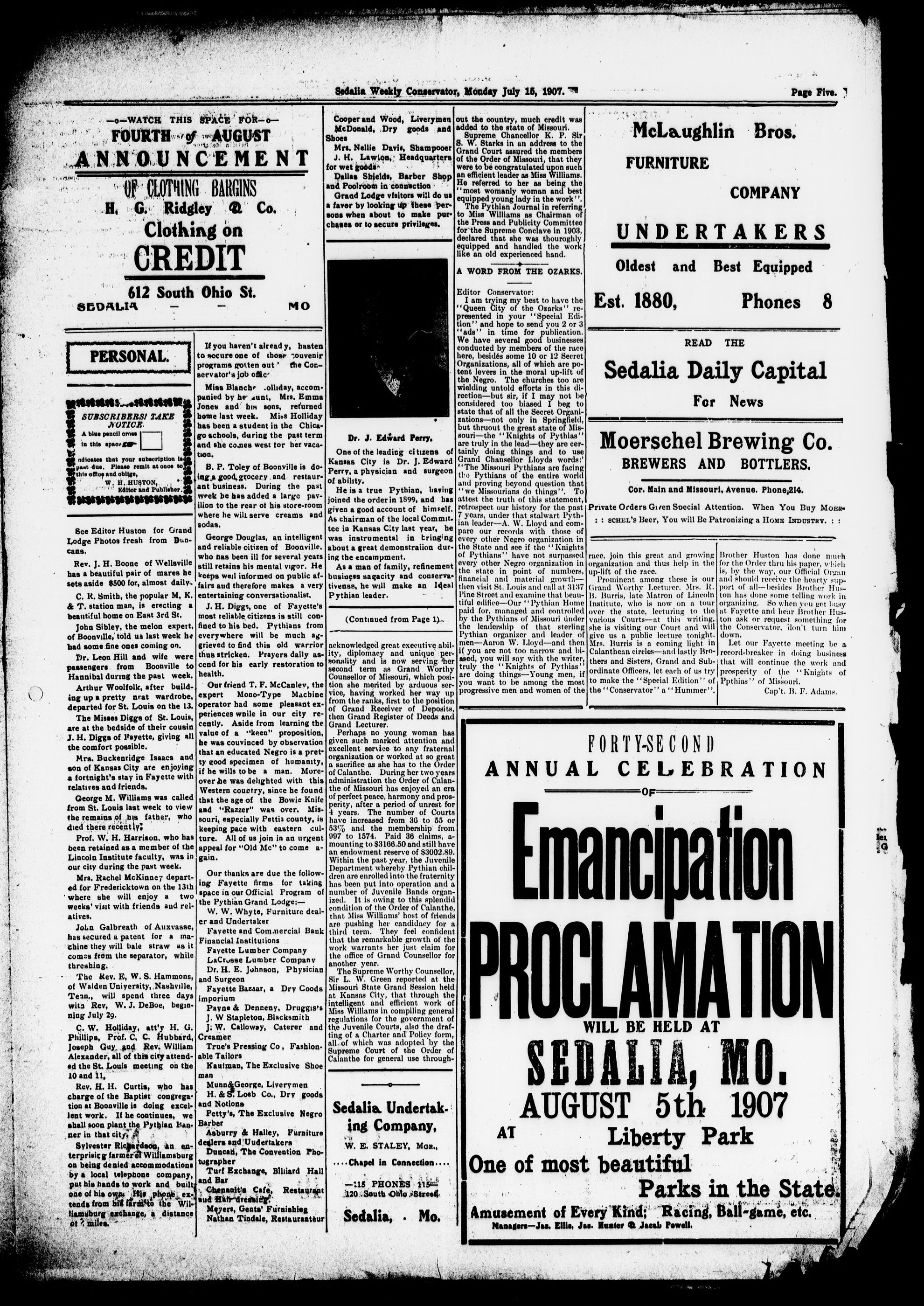
Dr. J. Edward Perry.
One of the leading citizens of Kansas City is Dr. J. Edward Perry, a physician and surgeon of ability.
He is a true Pythian, having joined the order in 1899, and has given a good account of himself. As chairman of the local Committee in Kansas City last year, he was instrumental in bringing about a great demonstration during the encampment.
As a man of family, refinement business sagacity and conservativess, he will make an Ideal Pythian leader.
(Continued from Page 1)
acknowledged great executive ability, diplomacy and unique personality and is now serving her second term as Grand Worthy Counsellor of Missouri, which position she merited by arduous service, having worked her way up from the ranks, first to the position of Grand Receiver of Deposits, then Grand Register of Deeds and Grand Lecturer.
Perhaps no young woman has given such marked attention and excellent service to any fraternal organization or worked at so great a sacrifice as she has to the Order of Calanthe. During her two years administration the Order of Calanthe of Missouri has enjoyed an era of perfect peace, harmony and prosperity, after a period of unrest for 4 years. The number of Courts have increased from 30 to 55 or 53% and the membership from 997 to 1574. Paid 36 claims, amounting to $3166.50 and still have an endowment reserve of $3002.89. Within the past year, the Juvenile Department whereby Pythian children are enrolled into the fraternity has been put into operation and a number of Juvenile Bands organized. It is owing to this splendid condition of the Order of Calanthe, that Miss Williams' host of friends are pushing her candidacy for a third term. They feel confident that the remarkable growth of the work warrants her just claim for the office of Grand Counsellor for another year.
The Supreme Worthy Counsellor, Sir L. W. Green reported at the Missouri State Grand Session held at Kansas City, that through the intelligent and efficient work of Miss Williams in compiling general regulations for the government of the Juvenile Courts, also the drafting of a Charter and Policy form, all of which was adopted by the Supreme Court of the Order of Calanthe for general use through-
Sedalia Undertaking Company,
W. E. STALEY, MGR.,
Chapel in Connection.....
-115 PHONES 115-
120 South Ohio Street
Sedalia, Mo.
FORTY-SECOND
ANNUAL CELEBRATION
OF
Emancipation
PROCLAMATION
WILL BE HELD AT
SEDALIA, MO.
AUGUST 5th 1907
AT Liberty Park
One of most beautiful
Parks in the State.
Amusement of Every Kind; Racing, Ball-game, etc.
Managers—Jas. Ellis, Jas. Hunter @ Jacab Powell.
out the country, much credit was added to the state of Missouri. Supreme Chancellor K. P. S. S. W. Starks in an address to the Grand Court assured the members of the Order of Missouri, that they were to be congratulated upon such an efficient leader as Miss Williams. He referred to her as being the "most womanly woman and best equipped young lady in the work''. The Pythian Journal in referring to Miss Williams as Chairman of the Press and Publicity Committee for the Supreme Conclave in 1903, declared that she was thouroghly equipped and handled the work like an old experienced hand.
A WORD FROM THE OZARKS.
Editor Conservator:
I am trying my best to have the "Queen City of the Ozarks" represented in your "Special Edition" and hope to send you 2 or 3 "ads" in time for publication. We have several good businesses conducted by members of the race here, besides some 10 or 12 Secret Organizations, all of which are potent levers in the moral up-lift of the Negro. The churches too are wielding untold efforts in this direction—but sir, if I may not be considered too biased I beg to state that of all the Secret Organizations—not only in Springfield, but throut the great state of Missouri—the "Knights of Pythias" are truly in the lead—they are certainly doing things and to use Grand Chanssell Lloyds words: "The Missouri Pythians are facing the Pythians of the entire world and proving beyond question that "we Missourians do things". To attest the truth of this statement, retrospect our history for the past 7 years, under that stalwart Pythian leader—A. W. Lloyd and compare our records with those of every other Negro organization in the State and see if the "Knights of Pythians" have not surpassed every other Negro organization in the state in point of numbers, financial and material growth—then visit St. Louis and call at 3137 Pine Street and examine that beautiful elifice—Our "Pythian Home paid for, managed and controlled by the Pythians of Missouri under the leadership of that sterling Pythian organizer and leader of men—Aaron W. Lloyd—and then if you are not too narrow and biased, you will say with the writer, truly the "Knights of Pythias" are doing things—Young men, if you want to be among the most progressive men and women of the
READ
Sedalia Dale
For
Moerschel B
BREWERS AND
Cor. Main and Missouri
Private Orders Given Special Attn
:: schel's Beer, You will Be P
READ THE
Daily
For New
Del Brewer
S AND E
Missouri, Aven
Special Attention.
Will Be Patronizizi
Moerschel Brewing Co. BREWERS AND BOTTLERS.
Private Orders Given Special Attention. When You Buy MOER
:: SCHEL's Beer, You will Be Patronizing a HOME INDUSTRY. : :
race, join this great and growing organization and thus help in the up-lift of the race.
Prominent among these is our Grand Worthy Lecturer, Mrs. R. B. Burris, late Matron of Lincoln Institute, who is now on a tour over the state, lecturing to the various Courts—at this writing, she is visiting our Court and will give us a public lecture tonight. Mrs. Burris is a coming light in Calanthean circles—and lastly Brothers and Sisters, Grand and Subordinate Officers, let each of us try to make the "Special Edition" of the "Conservator" a "Hunmer".
FORTY-SECOND
O N D
Est. 1880,
in Bros.
COMPANY
TAKERS
Best Equipped
Phones 8
THE
Daily Capital
News
Brewing Co.
AND BOTTLERS.
11, Avenue. Phone,214.
ention. When You Buy Moer-
tronizing a Home INDUSTRY. : :
Brother Huston has done much for the Order thru his paper, which is, by the way, our Official Organ and should receive the hearty support of all—besides Brother Huston has done some telling work in organizing. So when you get busy at Fayette and hear Brother Huston ask or request something for the Conservator, don't turn him down.
Let our Fayette meeting be a record-breaker in doing business that will continue the work and prosperity of the "Knights of Pythias" of Missouri.
RATION
Page Five.
Cap't. B. F. Adams.
Page Six.
The Offending Hand
By Annie Hamilton Donnell
(Copyright, by Joseph B. Bowles.) Jeffy felt better about that hand when he kept it in his pocket. He couldn't see how black it was—it had looked very black when he shut it up there, two hours ago. He remembered it now with a little shudder. That nursery soap and water a little tempered with heat might possibly have made it look less guilty had not occurred to him—did not occur to him now.
Of course nobody had seen when he slid his white nightgown over his little trousers and waist. How else could he keep his hand—that hand—in his pocket, he meant to, all night? Jeffy felt better about it there. In a sense it was in prison, where hands that—that—you know—ought to be incarcerated for their sins. In a sense he seemed to be making separation. Not exactly to Elizabeth—no, o, but still—Jeffy twisted about under his little white covers miserably. That hand hurt him—maybe because it was cramped and stiff, maybe not. Maybe because—that. Jeffy wondered if Elizabeth ached there.
Of course, Elizabeth was to blame—still, she was very little. All at once, lying there in the dark, Jeffy remembered how very little Elizabeth was. Her head just came to the edge of the dining-room table; you're pretty little when you have to stretch up on tip-toe to see what there is going to be for dinner. Perhaps when you were as little as that you'd have meddled with your big brother's things—you might have.
Elizabeth was very little and Jeffy was her big brother. Jeffy was seven. He had always rather domineered over Elizabeth, but he had never done that, before. Oh, no, no, I tell you! Never!
"Does it show, I wonder?" the little boy in bed thought, among the other thoughts.
"I'm going in and see," he said with a little premonitory shiver of dread. Elizabeth, because she was so very little, slept beside mother's bed in her dainty white crib. Jeffy could see the whiteness of it shining faintly through the dark. He crept toward it very quietly. On the edge of it nestled Elizabeth snugly, just her small, serene face in its mellow radiance. Jeffy could see it distinctly.
She was lying on that cheek. He could not see it at all. The other cheek was fair and sweet, with a dimple in as though a dream-angel had been there and kissed it a minute ago and that were the print of the kiss. The "big brother" stood looking at it with a strange impression that Elizabeth was turning the other cheek also. He flushed all over his little guilty face.
Somewhere downstairs a step sounded and disturbed Elizabeth in her sleep. She threw up both small hands, then with a restless little heaving-of round body and white covers, turned over on her pillows.
"It shows!" gasped Jeffy, and fled back to his own room in horror. He had seen little parallel red creases in Elizabeth's cheek—that cheek. He did not for a moment doubt their origin.
"It shows!" it shows!" he groaned in the awful loneliness of night. Perched on the side of his bed with his little lean bare legs a-dangle, he thought about what the Bible said—Jeff's thoughts did not quote verbatim:
"If thy right hand strikest thy sister, cut it off an' cast it into Hell Fire," he repeated under his breath, "an' there shall be gnashing—an' there shall be gnashing."
He shuddered. The precise significance of gnashing puzzled him a little, but it meant something awful—awful! An' cut it off meant—oh, oh!
"Urr-rr!" softly shuddered Jeffy, thinking how hot hell fire must be. You were to cast it into hell Fire, where there would be gnashing—if it ever struckest thy sister. The Bible said you were. And it had struck her, it had struck Elizabeth.
The darkness seemed to grow darker, the stillness stiller in Jeffy's room. The little figure on the bedside awayed unsteadily—swayed again—fell backward on the quilts. Jeffy was very tired. It tires you to—what does it tire you to do? Yes—oh, yes, that. An' it makes you tireder still to—too—feel—sorry—so awful sor-
Some one seemed to be speaking in the room, but there was no one there. Jeffy could see, for it had grown light, as if many lamps had been lighted. Or else it was one great lamp, the sun. Could it be morning? The voice called out and now it seemed to be his own voice calling to him.
"Come, Jeffy, time to go," it said, brusquely. "The sooner you get it ever with the better. I suppose you know that?"
"Y-yes," shivered Jeffy, answering himself. "I've got some o' my clothes on. I'll be ready in a minute."
"Well, be spry about it. You're going to the One With Spectacles, I suppee."
"Yes, to the One With Spectacles. He was the kindest one. When Elizabeth had the croup he came and when mother was sick. He was the one that always smiled. But now—of course now he wouldn't smile."
It was too early for office hours, but the One With Spectacles was at home. He put out his hand to Jerry and smiled—but that was before he knew.
"Why, Jeffy, this you?" he said. "What can I do for you?" Jeffy stretched out his right hand and shut his eyes. "Cut it off an' cast it into Hell Fire," he said rapidly. "It would be over soon if you kept your eyes shut an' never budged."
The One With Spectacles started a very little, but recovered himself the next instant. He proceeded to examine the small hand gravely. "It does look pretty black," he said in a professional tone. "Been offending you, has it?"
"Oh, no, Elizabeth—please hurry! I'd rather you'd do it f-fast," trembled the little voice.
"You are sure you want it done? Better think twice. You won't be able to cut your meat, you know." Jeffy knew.
"Or write in your copybook—or play ball—"
Or play ball—oh! But the small right hand did not waver.
"I know," Jeffy said.
"It'll be pretty hard to button your buttons, of course—"
"Of course."
"And it takes two hands to whittle. Still, if you say so—"
Jeffy nodded. Something was the matter with his voice; it would not go.
"Well, then, steady! It's going to hurt, of course—now then!"
The hurt of it woke Jeffy. Something awful seemed to have happened and it required a little time to realize what it was. Then he remembered. His hand—oh, how it ached! He shuddered as he drew it painfully out of its cramped prison, and it made him rather faint to look at it—
"Why!" Jeffy laughed aloud in his relief. Why, the callous called brown right hand was there! It felt numb in some parts and throbbed in others, but there it was! Not cut off—nor cast out. You could pinch it and wriggle it—you could cut meat with it, whittle with it, button buttons—anything! The One With Spectacles was only a dreadful dream.
In mother's room next door, Elizabeth was singing to herself. Her little, thin, clear voice piped up joyously. Elizabeth sounded happy. Jeffy
A boy in a robe stands on a rug, looking at a baby in a crib.
"So's Me," Elizabeth Smiled.
sat up on the bed—he had slept all night outside the covers, slanting across them—and listened eagerly. Then if Elizabeth was happy, she—she wasn't unhappy. She hadn't laid anything up. Perhaps if he were to go in there now and say: "Elizabeth, I'm sorry—I'm sorry—I'm sorry"—perhaps if he were to do that, she would forgive him. You couldn't tell till you tried.
Jeffy tried. He sild softly to the floor and softly across the floor—to Elizabeth. She was sitting with her little bare feet out between the bars of her crib, swinging them to the time of her music. Jeffy caught the grints of morning sunshine in her yellow hair and thought how beautiful they were—how beautiful Elizabeth was. Before he got to her his heart had her in its arms hugging her.
"Elizabeth, I'm sorry—I'm sorry—I'm sorry, Elizabeth!" he cried. The gay little song ended suddenly and the gay little singer whirled about. "So me," Elizabeth smiled.
Which Way
The story is told of a major who was in command of troops who were in pursuit of some outlaws. In the chase he arrived at a village to discover that he was too late to intercept them, and finally ordered the horses unsaddled and fed. Now the major's hostler was a son of Ireland, ignorant of everything pertaining to the equestrian art, and, coming in from the village in a state bordering on intoxication, he put the major's saddle on the horse facing to the rear. When the horses were brought up for a fresh start the major, instantly discovering the mistake, demanded the reason for it.
"An' sure," said Pat, a little terrified—"an' shure, major, an' I didn't know which way you was going!"
An explosion followed—the major was satisfied—and Pat escaped punishment. "Harper's Weekly."
A Strange Incident.
The ambitious young humorist had received from the editor his offering of jokes.
"I wonder why he didn't take them," said the humorist, sadly.
"I shouldn't be surprised," said his wife, "if the editor is one of these men who don't understand a joke until it has been explained to them. If I were you I should send them back to him, with a kind little note telling him what the point is in each one."
The humorist did so.
To his great surprise the editor accepted his explanations. Judge
Sedalia Weekly Conservator, Monday July 15 1907.
J. M. Arbuckle
GENERAL
AND AGENTS SUPPLIER; PICTURE, SACRED IR POST CARDS.
Factory to home prices.
262 Washington st
Negro Cor
Since the abolition of slaves in 1863, many Negroes have held United States Senators. Two Registers of the Treasury; seven of States. About forty have positions; many have been office corders of Deeds in the Distictory.
A fine engraving of these been issued, giving accurate postgress in which they served and picture, the two Senators, Messre the center of the group, surround resentatives. In the background or. This beautiful engraving, ographies of these eminent men. This engraving is a graphic police America. No home, library, or complete without it. Send for
THE COLORED ART.
P. O. Drawer 2318.
Agents wanted.
AND AGENTS SUPPLIES, BOOKS, & STATIONERY; PICTURE, SACRED & SECULAR, SOUVENIR POST CARDS.
Factory to home prices. Correspondence Solicited
262 Washington st Boston, Mass.
Negro Congressmen
Negro Congressmen
Since the abolition of slavery in the United States in 1803, many Negroes have held official positions. Two were United States Senators. Twenty-two Representatives; three Registers of the Treasury; several were Lieuienant Governors of States. About forty have held diplomatic and cusual positrons; many have been officers in the army; six were Recorders of Deeds in the Distict of Columbia.
A fine engraving of these Negro Congressmen has just been issued, giving accurate portraits of each; also the Congress in which they served and the years of service. In the picture, the two Senators, Messrs. Revels and Bruce, occupy the center of the group, surrounded by the other twenty Representatives. In the background, the Stars and Stripes in color. This beautiful engraving, with a booklet containing biographies of these eminent men, is sold for one dollar ($1.00). This engraving is a graphic political history of the Negro in America. No home, library, office, or school-room will be complete without it. Send for one to-day.
THE COLORED AMERICAN NOVELTY CO.
P. O. Drawer 2318. Washington, D. C.
Agents wanted.
Sedalia Undertaking Company,
W. E. STALEY, MGR.,
Chapel in Connection.....
—115 PHONES 115—
120 South Ohio Street,
Sedalia, . Mo.
TOUSSAINT L'CUVERTURE.
This soldier, statesman and martyr with a mere handful of men held at bay sixty ships and thirty thousand trained soldiers, the flower of the French army and navy. Wendell Phillips pronounced Toussaint the greatest general the world has produced. Pictures of this great Negro, and of all eminent colored people sold by the Colored American Novelty Co., Washington, D. C. Agents wanted.
An Experienced Carpenter.
Hello !!! What's This ? ? ? Another Colored Carpenter.
Who? B. F. Isaacs, Jr. Fayette, Missouri. We shall be glad to have your patronage along the line of our work. Havtng had 14 years experience with the plane and hammer I am fully prepared to design and make estimates on buildings. We
```markdown
```
RIGLEY'S C
612 Sout
RIGLEY'S CLOTHING CO. 612 South Ohio St.
MERCHANDISE
UPLIES, BOOKS, & STATION-
ED & SECULAR, SOUVEN-
s. Correspondence Solicited
Boston, Mass.
congressmen
slavery in the United States in
held official positions. Two were
twenty-two Representatives; three
several were Lieutenant Governors
are held diplomatic and consular
officers in the army; six were Re-
port of Columbia.
These Negro Congressmen has just
portraits of each; also the Con-
and the years of service. In the
ers. Revels and Bruce, occupy
bounded by the other twenty Rep-
ound, the Stars and Stripes in col-
g, with a booklet containing blen,
is sold for one dollar ($1.00).
political history of the Negro in
office, or school-room will be
for one to-day.
AMERICAN NOVELTY CO.
Washington, D. C.
are willing to contract by the day or job complete. Our terms are reasonable.
ALL WORK GUARANTEED.
If you are planning to build a Home, Barn or Factory write,
B. F. ISAACS, Jr.,
Box 504. Fayette, Mo.
—Bell Phone 257.—
Old papers for sale at this office
CREDIT!
Are you ready for your Summer Suit?
We are ready for you.
Par us as you get paid.
Weekly, semi-monthly or monthly
clothing for men, women
and children on CREDIT.
$1 Per Week.
CLOTHING CO.,
South Ohio St.
Stephen Winstow backed his horses down to the brook to drink before turning in at his gate, as had been his lifelong custom. To-day he felt tired, and even after the animals had lifted their heads from the water he still set there, leaning back contentedly against the sacks of flour piled up behind him.
"I shouldn't wonder if I missed that brook," said Stephen, reflectively. "When you've heard a thing for 60 odd years, it's apt to ring in your dreams maybe."
Stephen was a small, lean old man, half in house clothes that seemed far too large for himself. His white beard combed into straggling locks by his nervous fingers, flowed in a patriarchal fashion over his breast. Presently he chirruped to his horses and they lumbered along through the water and up the steep little rise to the turn. As he drove through the open gate a woman came out of the house.
"Well, everything is about wound up at last, Pri." he said, contentedly. "I went into Dan McCullock's on my way to the mill and we made the dickes. He's rented the farm for a year. Lawn, Pri; it makes me young again to think of it! Seems 'stil we were starting out in life all over again, don't it, now?"
Priedilla ended.
"Maybe you'll be wanting to get back before you've lived long in Redmond," she said.
Stephen chuckled, as if at a joke.
"That was all the talk at the store to-day. Peter Shackleford says, says he: 'Winslow, you'll never be contented in city life. You'll be wild to get back here afore next spring,' says he, Shackleford-like, as if he knew it all."
"I don't know that I care a great deal myself," said Priscilia, placidly.
"But I'm tired of this lonesome life, too, now that the children have all gone. I'm sure of myself, but I'm not
A
They Lumbered Along Through the Water.
so sure of you, father. You are as full of enthusiasm as a boy over moving to the city, but perhaps you won't find it all you expect, and you may feel discontented.
"No I won't, Pris," protested Stephen. "I've thought it all out, I tell you. There'll be no hankering for Rose-neath on my part. You'll more likely be homesick yourself."
Stephen and Priscilla Winslow had decided to sell or rent their farm and move to Redmond for the remainder of their days. Their three children were settled there and they wished to be near them. Gordon, the oldest, was president of the university. Besides the natural tie, there was a bond of intellectual comradeship between him and his mother, from whom he had inherited his most marked characteristics. Theodore, commonly called Ted, was a prominent Redmond lawyer, and Edith, who was the youngest, had recently been graduated from college and was the teacher of mathematics in the Redmond summary.
By Christmas they were settled down.
"I'm glad it's finished," said Priscilla. "I've had enough of shopping and 'harmonizing.' I must say I like the result, though. Don't you, father?"
"Yes," piped Stephen, with alacrity. In his heart he was wondering if he would ever feel like anything but a visitor in this fine new house of his. But he would not say so to Priscilla. He was ashamed and alarmed to find that he was longing for Roseneth—"after all my bragging," he reflected, sheepishly. He grew more ashamed as the winter went by. He could not feel like anything but a stranger in the city. He missed his old cronies at the store. He had been wont to laugh at them to Priscilla, but he had in reality enjoyed his simple preeminence among them. He had been looked up to as a clever, well-read man. Now he did not like being a nobody. Above all, Priscilla must never suspect it—Priscilla, who so evidently enjoyed the new life as fully as she had predicted.
When April came his homestickness grow worse. The spring air wakened in him, a keen desire to get back to the farm and its old, homely ways. One day it overpowered him. "Things'll be wakening up in Rose
"south by now," he thought. "These
Stormies the storm will be full. Yeah!
I, could sleep in! B'fose. Don't be
getting ready to work the farm. Wonder
what, hell, pnt in the south hill
field? "Tough to be wheat, but like
as not he'll now it with cata."
Frequently Friscilla came, in flushed and bright-eyed. "Father," she said, abruptly, "do you think you can get along without me for a couple of days most week? The—the Mothers' council meets in St. Andrew's then, and I've been appointed one of the delegates." "Think of that, now!" said Stephen, admiringly. "Of course you must go. I'll be all right. I'll be as jolly as a sand-boy." "If I go I will leave here Tuesday morning and not be back until Wednesday evening. Why, father, what's the matter?" Stephen sat bolt upright with an exclamation. "Nothing, nothing," he said hastily, as he subsided. "I just thought of something. I'd—I'd forgotten—but it's of no importance. Yes, you were saying you'd go on Tuesday, Pris. Well, all right, all right."
Left aboie, the weasened little figure in the wicker chair sat up and slapped its right leg smartly thrice. "I'll do it," said Stephen, excitedly. "I'll do it! She'll never know. I'll come back Tuesday night."
"He was silent for a minute, then added, explosively:
"I am dod-gasted sick of the town!"
Early Tuesday morning he went to the station with her and saw her off on the St. Andrew's flyer. His own train did not leave until later. It landed him at Rosemeath station in the mid-forenoon.
Rosemeath proper was three miles from the station, and Stephehn started to walk it, over the long, moist road that wound and twisted up to the wooded hills, through the young green saplings.
He stood with his arms on the yard gate, feasting his eyes on the gray buildings and gardens. There was a lonely, deserted look about the place that hurt him, but it was home. He would spend the whole afternoon here. He would go over the farm in its length and breadth and visit every field and nook.
He was down on his knees by the day-lily plot when he heard the eastern gate swing back with its old peculiar creak. Stephen hastily got upon his feet. A woman was coming through it. "I'll be dcd-gasted if it 'taint Priscilla'," he said, helplessly. Priscilla it was. She did not see Stephen until she came round the last cherry tree on the path.
"Father!" she exclaimed.
They stood and looked at each other in silence for a few moments. Stephen's brain worked in a succession of jerks. He had begun to understand things before Priscilla had recovered herself.
"Priscilla, Priscilla," he said, solemnly, but with a twinkle in his mild eyes. "Who are the mothers?" Priscilla had to laugh.
"They're at St. Andrew's, no doubt, father. You know I didn't tell you I was going there. I just said the council met there and I was appointed one of the delegates. I never meant to go. I meant to come here, but I couldn't bear to admit 60 you that I was so crazy for Roseneath that I had to start off in mud and mire for it. And after all our talk last fall, too! How did you find out I came here?"
"I didn't know you did come," he answered. "I thought you was safe in St. Andrew's. I came on my own account, because I was so homesick I couldn't stand it a day longer, and because I was lit'really dying to get out of sight and sound of that town, if only for a day."
"Why, father," said Priscilla, in astonishment. "you don't mean to say that you are not contented in town! Why, you seemed so interested in everything—I thought you were just as happy as you expected to be!"
"All put on, Pris—all put on," said Stephen. "I've hated it—name 'o goodness, what a relief it is to say it at last! But I wouldn't let on for the world for fear you'd laugh at me and say you told me so, for all my brag. I didn't think you were hankering for Roseneath. You seemed so taken up with everything in town and as busy and happy as if you were just in the place that fitted you."
"Oh, I just pretended, to hide the truth from you," cried Priscilla. "I—I—couldn't bear to admit how disappointed I was after being so sure of myself. I wanted to be back here. Why, father, I missed the loneliness of it! I just wanted to feel lonely again, with all my heart. And the worst of it was, it came between us. I was determined you should not suspect what I felt like. I don't care now, when you're feeling the same way. So I came out to day. I brought a lunch with me, and I meant to stay all night at the Hendersons. I've been all over the farm already. I wish we'd never left it—we were old fools to run after new things at our time of life. Good as they are, it's too late."
"We can come back, Pris," said Stephen, eagerly.
"Oh, if we only could!" cried Priscilla. "But the children—"
"Never mind the children! See here. Pris. It's not going to do them an! good for us to be miserable. They'll be willing enough to let us come when they find out how we feel. And we'll come, whether or no. We're our own houses yet, I guess. Pris. We'll move out as soon as come good roads. Won't them shackleards cackle with delight over my backdown! But I don't care a mile since you're in it, too. I can just snap my fingers at the whole world."
He laughed eagerly with joy. Pris will add sadness to a long breath.
-
Cure
Almost instant
They also relied
gia, Rheumsth
Stomach ache,
Jury, Bearing-
ziness, Nervou
By taking one or
Pills when you
You not only avow
ening influence o
nervous, irritable
tablet on retiring
This soothing i
brings refreshing
25 doses, 25 ca
Cure.
Almost instantly, they also relieve gia, Rheumatic Stomach ache, A jury, Bearing-dozen niness, Nervousness.
by taking one or two bills when you feel you not only avoid ing influence of p nervous, irritable a tablet on retiring this soothing inflings refreshing s 25 doses, 25 cents
Cure. Headache Almost instantly, and leave no bad effects. They also relieve every other pain, Neuralgia, Rheumatic Pain, Sciatica, Backache, Stomach ache, Ague Paina, Pains from injury, Bearing-down Pains, Indigestion, Dizziness, Nervousness and Sleeplessness.
By taking one or two Dr. Miller Anti-Pain Pills when you feel an attack coming on. You cannot only avoid suffering, but the weakening influence of pain upon the system. If nervous, irritable and cannot sleep, take a tablet on retiring or when you awaken. This soothing influence upon the nerves brings refreshing sleep. 45 doses, 25 cents. Never sold in bulk.
CALL OR WRITE Mrs R. Sanders For all kinds of
False Hair
All Work Guaranteed
459 W. Cooper St. Sedalia, Mo.
G. J Grosshan
The Old Reliable
GROCER,
G. J Grosshan The Old Reliable GROCER, Retail dealer in Groceries, Provisions and Feed all kind at bottom prices 109 East Main st
RAILROAD TIME.TABLES
MISSOURI PAIFIC
ARRIVE. Going East. DEPART.
No. 4, 12:15 a. m.....12:20 a. m.
No. 10 1:45 a. m.....1:50 a. m.
No. 6, 11:05 a. m.....11:10 a. m.
No. 22.....10:40 a. m.
No. 2, 1:10 p. m.....1:15 p. m.
No. 8, 4:45 p. m.....4:50 p. m.
No. 28, 9:10 p. m.
No. 438 Reserves.....5:30 a. m.
No. 638, Passenger ..... 5:30 a. m.
No. 638 is a new train for Smithton,
Otterville, Syracuse, Tipton and
Boonville.
ARRIVE. Going West. DEPART.
No. 9, 1:50 a. m. ..... 1:55 a. m.
No. 3, 4:00 a. m. ..... 4:05 a. m.
Commercial Traveler, 12:35 p. m.
No. 21, 2:15 p. m.
No. 1, 2:50 p. m. ..... 2:55 p. m.
Mo. 5, 5:45 p. m. ..... 5:50 p. m.
No. 27. ..... 7:15 a. m.
No. 97, Local Freight ..... 8:25 a. m.
...2:55 p. m.
...5:50 p. m.
...7:15 a. m.
...8:25 a. m. C
LEXINGTON BRANCH
No. 622 arrives ..... 10:30 a. m.
No. 624 arrives ..... 9:45 p. m.
No. 023 departs ..... 5:15 a. m.
No. 621 departs ..... 3:10 p. m.
No. 621, Local Fre't, dep. 8:45 a. m.
No. 698, Local Fre't arrive 2:30 p. m.
WARSAW BRANCH
Mixed train leaves.....7:15 a. m.
Mixed train arrives.....2:05 p. m.
Passenger, daily, leaves.....12:52 p. m.
Passenger arrives.....4:50 p. m.
MISSOURI, KANSAS & TEXAS.
ARRIVE. Going South. DEPART.
No. 1, 6:26 p. m.....6:50 p. m.
No. 3, 8:50 a. m.....9:10 a. m.
No. 5, 3:17 a. m.....3:22 a. m.
Flyer, 3:12 a. m.....3:17 a. m.
No. 511, Southb'd local frt. 7:10 a. m.
Arrive. Going North and East. Depart.
No. 6, 12:35 a. m.....12:40 a. m.
No. 504, daily, except Sun.....6:15 a. m.
No. 2, 8:25 a. m.....8:50 a. m.
No. 4, 8:05 p. m.....8:30 p. m.
No. 515, daily, except Sun .. 8:35 a. m.
No. 451 departs.....2:00 p. m.
Going East
No 414 arrives.....8:55 p. m.
No 452 arrives.....5:00 a. m.
```markdown
```
OFFICE HOURS:
9 to 11 a. m., 8 to 5 & 7 to 9 p. m.
J. D, BALL, M. D.,
PHYSICIAN AND SURGEON,
LEXINGTON, : : MO.
MAGIC HAIR ELIXIR
IF YOU WISH to have YOUR HAIR become SOFT AND LENGTH, you should use JACKSON'S MAGIC HAIR ELIXIR.
When ordering write
Mrs. J. Will Jackson
Miniola Cottage,
Sedalia, Missouri.
Hair Cuts
Shampoos
Clean Shaves
D' Y. STEELE 120 E. MAIN ST
USE.....
Mexican Hair Tonic
FOR YOUR HAIR The Best on the Market. It cleanse the scalp, prevents falling hair. gives life and gloss to the hair and makes it grow Price, 75c. per Bottle. Chas. W. Holmes, Agent
Retail dealer in GR OCERIES
G. W. Goals
Cash Buyer of Poultry and Eggs
When in Need of Anv Groceries
Make Us a Call.
MOUNT OLIVE MO
60 YEARS
EXPERIENCE
PATENTS
TRADE MARKS
DESIGNED
Copyrights Ae.
Anyone sending a sketch and description may
please send a sketch and description to the
Scientific American.
A membership of the Scientific American is
required. Membership is free. Membership is
limited to one person.
Scientific American.
A membership of the Scientific American is
required. Membership is free. Membership is
limited to one person.
New York
New York, New York, 212
Sedalia Weekly Conservator, Monday July 15, 1907.
PYTHIAN LODGE DIRECTORY.
Names of Lodges, Their Location, Dates and Places of Holding their Monthly Meetings. the Names of Their Executive Officers, Subject to Semiannual and Grand Lodge Changes.
St. Louis Lodges.
All Meet in the Pythian Temple, 3137 Pine Street, at Eight O'clock.
Kansas City Lodges
All Meet at The Vendome Academy, 1734 Grand Avenue at Eight P. M.
LODGES OF THIS JURISDICTION MEETING ON THE FIRST AND THIRD MONDAYS. MONTHLY, ATEIGHT O'CLOCK.
---
Gallant No. 57. Salisbury, William Harvey, chancellor commander; J C Russell, keeper of records and seal.
Mound City No. 4, St. Louis, Rev. R H Cole, chancellor commander; John Johnson, keeper of records and seal.
Fidelity No. 7, Springfield, B F Adams, chancellor commander
LODGES OF THIS JURISDICTION MEETING ON THE FIRST AND THIRD TUESDAYS, MONTHLY, AT EIGHT O'CLOCK.
St. Louis No. 41, St. Louis, Joseph Eagles, chancellor commander; Charles S White, keeper of records and sea'.
Miami No. 20, Miama, Frank H Brown, chancellor commander; L L Dandridge, keeper of records and seal.
New Madrid No. 45, New Madrid, William Powell, chancellor commander; G D Ross, keeper of records and seal.
Clinton No. 53, Clinton, William Elliston, chancellor commander; Ernest Dunning, keeper of records and seal.
LODGES OF THIS JURISDICTION MEETING ON THE FIRST AND THIRD WEDNESDAYS. MONTHLY, AT EIGHT O'CLOCK
Eureka No. 16, St. Louis, Samuel Keys, chancellor commander; William H Johnson, keeper of records and seal.
Fayette No. 35, Fayette, Lewis H Williams, chancellor commander; Laurenzo Leonard, keeper of records and seal.
Zenith No. 64, Rocheport, William Sexton, chancellor commander; A E Robinson, keeper of records and seal.
LODGES OF THIS JURISDIGTION MEETING ON THE FIRST AND THIRD THURSDAYS, MONTHLY, AT EIGHT O'CLOCK.
Kaw Vallev No. 54, Kansas City, John H Yates, chancellor commander; W E Burdette, keeper of records and seal.
Flora No. 15, Poplar Bluff, William L Carter, chancellor commander; S E Townsend, keeper of records and seal.
Richmond No. 20, Richmond, William Moss, chancellor commander; Benjamin Vaugh, keeper of records and seal.
Anchor No. 31, Cape Girardeau George Walls, chancellor commander; A M Oliver, keeper of records and seal.
Greater Sedalia No. 42, Sedalia A C Maclin, chancellor commander; George M Williams, keeper of records and seal.
LODGES IN THIS JURISDICTION MEETING ON THE FIRST AND THIRD, FRIDAYS, MONTHLY AT EIGHT O'CLOCK.
New Era No. 40, Kansas City, William Scott, chancellor commander; Wade H Robinson, keeper of records and seal.
Warrensburg No. 46, Warrensburg, Stephen Lillard, chancellor commander; J. Will Cooper, keeper of records and seal.
LODGES OF THIS JURISDICTION
MEETING ON THE SECOND AND
FOURTH MONDAYS, MONTHLY
AT EIGHT O'CLOCK.
Pride of the West No. 1, St
Louis, William Mitchell, chancellor commander; W H Goff,
keeper of records and seal.
Lone Star No. 10, Macon, J T
Ancell, chancellor commander; J
O McNutt, keeper of records and
seals.
Westgate No. 38, Kirksville, L
M Hockaday, chancellor commander;
G G Brown, keeper of records and seal.
LODGES OF THIS JURISDICTION
MEETING ON THE SECOND AND
FOURTH FRIDAYS, MONTHLY,
AT EIGHT O'CLOCK.
Semper Fidelis No. 34 St. Louis,
T H Baker, chancellor commander;
O J Biggs, keeper of records and seal.
Pythagoras No. 30, Ironton,
Henry Spiers, chancellor commander;
H F Boyd, keeper of records and seal.
LODGES OF THIS JURISDICTION
MEETING ON THE SECOND AND
FOURTH WEDNESDAYS MONTH
LY AT EIGHT O'CLOCK.
Triumph No. 52, St. Louis, D W Tansiel, chancellor commander; Charles Harvey, keeper of records and seal.
LODGES OF THIS JURISDICTION MEETING ON THE SECOND AND FOURTH TUESDAYS, MONTHLY, AT EIGHT O'CLOCK.
---
Green Valley No. 36, Lexington, Walter Shipley, chancellor commander; James Lindsey, keeper of records and seal.
St Pythias No. 13, St Louis, Cato Graves, chancellor commander; William B. Rankins, keeper of records and sael.
Polar Star No. 60, Versailles, Serry Woods, keeper of records and seal.
LODGES OF THIS JURISDICTION MEETING ON THE SECOND AND FOURTH THURSDAYS, MONTHLY. AT EIGHT O'CLOCK.
一
Excelsior No. 3, St Louis, Chas Parks chancellor commander, Arthur Turner, keeper ofrecords and seals
Harrison No. 12, Huntsville, A L Davis, chancellor commander, W L Toney, keeper of records and seal.
Golden Star No. 27, Ardmore, William Campbell, chancellor commander, J H Crutchfield, keeper of records and seal.
Send us your orders for Job Work, if you would have it done with care and dispatch.
---
By Eleanor H. Porter
(Copyright, by Joseph B. Bowles.)
"But I'm determined to win you, Kathleen."
"As if you could against my will!"
"It won't be against your will—you'll wish it."
She raised her eyebrows in unbelief.
"I'll make myself so necessary to you that you can't help wishing it," he went on confidently.
"But I don't need you for—anything," she objected.
"Oh, but you may, you know," he smiled, imperturbably. "I'll be your knight and fight for you as in the olden time."
"I'm no princess shup in a castle, Charlie," she retorted, all the more scornfully because his words had given her a curious little thrill. "The extent of your warfare thus far has been to procure me an ice or to bring me my fan," she went on, with tilted chin.
"Not very dragon-like obstacles, I acknowledge," he laughed back at her; "still—there's time yet, so long as the princess remains unwed," he finished, bringing his thin, clean-cut lips together decisively, as Kathleen turned away.
When Kathleen Randal had unexpectedly fallen heir to a small fortune, she immediately announced her intention of traveling.
"All my life," she declared laughingly, "I've been like Helen's Babies and have wanted to 'see the wheels
A man and a woman are standing in front of a fireplace. The man is holding a chair and looking at the woman. The woman is standing on a chair and looking at the man.
"As If You Could Against My Will!"
go 'round'—if only they were car-wheels and taking me somewhere!" she supplemented. "Now I'm going to go—and go—and go, and see if I can't satisfy this longing that is devouring me."
It was but two days now before she, and the aunt who had been a mother to her all these years, would start on their journeys. Trunks and tickets, plans and packing, filled the house with confusion and her soul with delirious joy; there was no time for Charlie Heywood and his love-making—love-making that had become trite in its periodic repetition ever since her pinafore days. That Charlie was young, good to look upon, rich, and altogether approved by her relatives, made it only worse—as if she could grow sentimental over her next-door neighbor, with whom she had made mudplugs in her babyhood!
At the very outset of her journey, Kathleen seemed doomed to disappointment, for the stagecoach—her only means of transportation from the village to the railroad station five miles away—failed to call at her door, and disappeared far down the road in a cloud of dust.
"Why, Auntie—if they haven't left us!" cried Kathleen, dropping in limp dismay onto the plaza steps.
"Never mind; we'll go to-morrow," soothed Mrs. Howells.
"But the boat—oh, Auntie, we'll lose the boat!" wailed the girl, springing to her feet in sudden realization of what the delay meant.
"Not gone yet?" called Heywood cheerfully, over the fence. "Old Abe's late this morning," he continued, with an alry innocence that gave no hint of his knowledge of the shameless bribe even then in Old Abe's pocket.
"I was just going down to the station to see you off."
"Oh, Charlie, he's left us—we've lost the boat!" moaned Kathleen, wringing her hands.
"Not much, you haven't!" shouted Heywood over his shoulder, as he turned with ruspidious promptness and ran towards his open stable door.
"Here, jump in, both of you," he commanded a minute later, bringing his huge red automobile to a standstill before them.
"Oh, lovely, lovely!" gurgled Kathleen bundling Mrs. Howells into the back seat and leaping in beside her.
"Let's see—your baggage went last night, I believe," said Heywood—as if it had not gone at his own suggestion!
It was somewhat later that Heywood said musingly, as he held her hand in parting:
"Hm-m, well, I don't know—an automobile is a pretty good substitute for a rusty sword."
"Don't be ridiculous," she returned with some dignity; then her eyes danced. "I'll take the auto every time, though!" she laughed, as she skipped up the car steps after her aunt.
Heywood gave a few short orders to the man beside the machine, caught the satchel from his hand, and swung
himself onto the last car after the train had started.
Kathleen and her aunt had no trouble during the short journey to New York, nor in establishing theselves comfortably in their staterms on board the boat; but the first three days at sea were very rough and the ladies scarcely left their berths. On the fourth day a clear blue sky and a warm sun enticed Kathleen into her steamer chair on deck. She had sat there half an hour in listless endurance of an uncomfortable position, when a low voice said in her ear:
"If you'll me put this cushion at your head, and readjust your footrest, I think you'll be easier."
"Charlie Heywood."
"At your service."
"Why, how in the world—" she began delightedly, then her whole figure stiffened. "This is never going to do at all," she finished with decision. Heywood busied himself with the cushion and the foot-rest and did not seem to hear. "I am traveling with my aunt," she began again, with some asperity. "Certainly!" he responded cheerfully, picking up her magazine for her. "There, now I am sure you will be more comfortable." And he bowed himself off. All through the rest of the voyage Kathleen did not see him once, though she watched for him every day—first fearfully, then resentfully. When once again on land, Kathleen stood guard over her trunks and travel-bags with a frowning face. "Why can't they have checks over here and transfer one's baggage in a good, Christian manner?" she demanded wrathfully of her aunt.
"Suppose I attend to it for you," suggested Heywood at her elbow.
"Oh, then you are on earth!" returned Kathleen, a bit ungraciously, though a relieved look came into her eyes. The look remained until Heywood had seen then enroute for their hotel then it changed to one very like regret as his form was lost to sight in the crowd.
"Er—ah—what's Charlie doing over here?" inquired Mrs. Howells, with the hesitation one always showed in asking Kathleen questions regarding Heywood.
"Business, he says," she replied, with a shrug of her shoulders.
In London Kathleen saw Heywood just three times—once when she and her aunt lost their bearings on the Strand, again when he obtained for them permission to enter a certain palace which they wretched very much to see, and a third time when in a panic in a London theater made his presence something in the nature of a godsend.
"Charlie Heywood has a remarkable faculty of making his advent delightfully opportune!" observed Mrs. Howells, with a shrewd glance at Kathleen's face.
"Humph! it strikes me he's a, little bit officulous," retorted Kathleen, again trying to banish with sofnillness that curious thrill.
Kathleen had friends in Paris, and she danced and flirted and drove and shopped in an endless whirl of savety.
Days passed. Save with the eye of her fancy, Kathleen had not once seen Heywood, though she looked for him at every turn. One afternoon, ignoring the fact that Paris is not New York, she slipped out alone for a short walk. She was strangely restless, and her feet flew faster and faster; even then, they seemed to her to be but crawling over the pavements. An hour passed and she turned to go back, but after another 60-minute walk, she awoke to a realization that she had lost her way.
"How stupid of me!" she murmured, bliting her lips with annoyance.
She stopped to roast at a table in an open-air restaurant, but when a bering, beatudded man slipped into the seat at her left, she fled again to the sidewalk.
e1
G
"You are looking for some one?" a voice at her side suggested.
A sudden throb of joy tingled to Kathleen's finger-tips.
"Go—go away!" she cried feebly, glorying in the absolute certainty that the man wouldn't obey her.
"Right away—now?" he asked.
She nodded—but drew nearer to him.
"I—I'm tired of being rescued, Charlie," she laughed, hysterically.
He gave a keen glance at her flushed cheeks and hailed a carriage. He helped her in without speaking, gave an order to the driver, and seated himself at her side.
"How stupid of me—I never thought of a carriage," she quavered, brushing back the loose hair from her eyes. She stole a glance at the man's gloomy face, and a rose-pink flushed to has forehead. "Let me see," she went on softly, "an automobile, a cushion, a—a—"
"Don't!" he interrupted harshly.
"But, really," she continued, a queer little tremor in her voice, "I was only naming them over—the weapons have been so very — effective — that—"
Heywood looked up quickly.
"Kathleen, you don't mean that—"
"The castle has been stormed, and the princess is—is—" She raised shy eyes to his face.
"Mine at last!" he breathed, the light of a long-deferred joy in his eyes.
Permanent Affiliation.
He—That handsome girl over there made a fool of me two years ago.
She—I felt sure that something happened in your past life that you had never got over.
Different.
The Judge—And did this man, do you bodily harm?
The Victim—Naw, yer anner. He smashed me fa-soe.—Cleveland Leader.
Page eight
The Rebellion of Jackie
By Susie Bouchelle Wight
(Copyright, by Joseph B. Bowles.)
"What a perfectly exquisite child!" exclaimed a passer-by to her companion, after a glance at little Jack. Jack's mother fidgetted with complacency, and looked admiringly at the vision at her feet—a vision of golden curls, rich, creamy complexion, and the most tempting briar-rose cheeks—a small boy, clad from top to toe in spotless white. He was a pretty boy. She knew there was no denying that fact, and so she did not tarry to ask herself the meaning of that inscrutable look that was dawning in the great brown eyes. A look new and strange, it would have seemed to her, for she was all a flutter with maternal vanity. Mrs. Perham sighed.
"How fortunate you are Mattie," she said. "Jack is such a perfect gentleman, and takes all the lovely dressing you can think up for him, but my James—" She sighed again, and Jack's mother laughed, for the mere mention of James, the unspeakable, usually provoked smiles in Oldtown. "You needn't laugh, Mattie. I assure you it is anything but funny to be the mother of a freckled little tough, that will not stay clean two minutes after he is dressed."
Jack's mother laughed again.
"Oh, James is all right, only it is a pity that he looked like the Perhams instead of like our family—that is all! I do believe, though, Jennie dear, that if you would pursue a different course with him, you could mold him as much to your liking as Jack is to mine. Now, no matter if he does rebel at blouses and frills and other things that he ought to wear as a matter of course, you ought to make him understand that your will is to be his law about his dress for a good many years to come yet."
"How can I? I told him only last week that if he would wear a sweet little brown linen sailor suit to the Fourth of July celebration I would give him a dollar—now what do you suppose Jim said to that? Why, he simply looked up from his paper and said, 'Take her up on it, son, and get your dollar, and then father will give you another to go out and roll in a unud-puddle with that suit on." "Jennie Perham! You don't-mean to say that Jim Perham set your authority at naught in that way?"
"Oh, he didn't mean to set it at naught—but he is always saying that he cannot bear to see country people trying to put on city airs"—Mrs. Perham stopped suddenly and bit her lip at a recollection of the connection in which he had said this, but Jack's mother did not seem to feel hit, so she continued: "He is given to abetting James in all of his shines, anyway, and I simply haven't the backbone to undertake the quelling of the two of them."
"There's where you and I differ!" said her sister. "Now listen to me. Go right on and make that linen suit for the Fourth, and when the time comes let him choose between wearing it and staying at home all day, and you will see that he will come to terms; then, when he has worn it there will be no more trouble. Don't say a word to Jim about it, and above all, do not try to hire James—just be firm and positive and you will see that you will carry your point readily. He really would be a strikingly hand-come boy if he were well dressed, and whether you will believe me or not, his freckles and his snagged teeth look a great deal worse to you than they do to anyone else."
They left the room and Jackie, aged seven, looked out of the window across the street at his cousin James turning a handspring in the dust of a vacant lot, and then down at his own immaculateness, with envy and rebellion in his soul.
The Fourth came. It was in the south, where the sound of fireworks did not smite the morning air. Early in the morning the people began to gather from all the country 'round, for Oldtop was to do itself proud this day, and was keeping open house.
Jack's mother, flushed and charming in white and lavender—the first appearing in anything else than widow's weeds for a long time—came down the street, leading her lovely child by the hand. He was all in white, except for a tiny bow of blue ribbon, which peeped out from under the broad-rolling brim of a handsome white sailor—the bow of which tied back the long front locks, which were saving for subsequent use. His little shoes were white, too, so he had to walk circumspectly, to avoid mud and dusty spots.
They paused a moment at the gate for Mrs. Perham, who came down the walk, drawing on her long white silk mitts.
"Why, Jennie, where is James?" asked Jack's mother.
"James is in bed," replied Mrs. Perham, firmly. "I have locked up all his other clothes, and laid out the linen suit and the tan shoes, and he can either wear them or spend the day in bed."
"That's right—be firm and positive, and you will carry your point, as I have always told you—but what about Jim?"
"Oh. Jim! I'll tell you later about him. He had to sally out immediately after breakfast—you know he is chairman of the committee on tables, so he doesn't know a thing about the unpleasantness," she concluded as the sound of a muffled kick and howl came from James' room.
Jack's mother stood a moment in
thought, then said: "Jackie, dear, suppose you go back and talk to your little cousin, and then you can help him dress, too, and come on to the pavilion with him. If you persuade James to get up and come right on, mother will buy you a beautiful new book."
Jack faced obediently about, and when his back was well turned, he made a wry face which would have curdled the blood of a Goop, for he had overheard his Aunt Jennie say, admiringly:
"Now, isn't Jackie the sweetest thing! I don't see how it will be possible for James to persist in his naughtiness after he sees him."
Jack felt very doubtful about his mission, for he knew that James did not approve of himself or his mother, but the unusually smart raiment with which he had been decked out made him wildly reckless, and he longed for something to break the monotony of his perfect propriety, and even felt equal to the flickcuff which he half expected. If James should get the best of him, as he was altogether likely to do, still there would be the satisfaction of wearing tumbled clothes in consequence, and ch, sweet hope, perhaps in the melee the blue ribbon would be loosened and fall from his hair!
James lay sprawled out in the middle of the bed, with his feet propped up on the pillows, a neat array of holiday garments lying on a chalar by the bed.
"They sent me back," said Jack, "to help you put on your little clothes."
"Shoo!" cried James. "I guess papa'll see me through this thing!" With a bounce he landed on the floor, and snatched from the wall a long-discarded Astrakhan cap.
"Come on, little gal-boy!" he called. "I'll take care of you, and we'll go right on to the pavilion and hear the band play."
"Oh, Jamie, you wouldn't ever?" panted Jack, as he raced along at James' heels, and watched the pink nightshirt flooing.
"Oh, you come on, little frill-breeches!" was all the answer he received, and then Jack made a grab for James, just as the gate clanged behind them. He planted one small fist plump in the back of his cousin's neck and then they both stopped and squared off. James gave Jack another of those puzzled looks, and then dropped his fists. "I couldn't bear to hurt a little thing like you!" he said, and then he had to dodge Jack's fist again. "Say Jack!" he said, as a sudden thought struck him. "I dare you
A
"Oh, You Come On, Little Frill-Breeches!"
"I double-dare you—to stomp in your sundown!"
In a twinkling the lovely white sailor hat was trampled in the dust, and a blue ribbon lay beside it.
"Jiminy! But won't Aunt Mat skin you for that? Dare you to roll over in the road!"
The words were scarcely out of his mouth before a little white figure was kicking and tumbling in the middle of the street and Jack was think ing as actively as his legs were working. He was relieving the pent-up feelings of all the weeks that had gone by since his first realization of the fact that he was not as other boys of his age. He had thirsted for a fight, but this was even better, and he gave a final roll as he saw a team drive past.
"You're a sight!" James remarked, coolly, when Jack straightened up.
"Want to dare me some more?"
"No, thank you—not any more for to-day—but what Aunt Mat will do to you when she sees you will be a plenty."
How the Village Progressed.
"Well, well!" exclaimed the man who had wandered back to the village. "So the Eagle house is still' the Eagle house? No change after 20 years." "There hey been a few changes," asserted the oldest inhabitant with some acerbity. "Since you've been gone the hotel hez been respectively the Grand Union, the Grand Central, the Grand Junction, the Great Northern, the Great Southern, the Imperial, the Regal, the Empire, the Monarch, the Prince of Wales, the Regent, an' a few other royalties which I disrecollect, the Mansion house six times an' the Eagle house seven, the latter happenin' to be its proud patronymic at present writin'. Plunkville, my friend, hain't so all-fired behind the times as you seem to imagine."
Alarming.
Mrs. Popley—Our George must be on the verge of a spell of sickness. He has no appetite.
Mr. Popley—O! that's nothing.
Mrs. Popley—But he has no appetite for candy!
Sedalia Weekly Conservator, Monday July 15 1997.
GOURT DIRECTORY
Names of Subordinate Courts of the Order of Calanthe, Their Location, Place and Date of Meeting, Exec utive Officers, etc, Subject to Semi-annual and Grand Court Changes.
BOTZ & SONS
PUBLISHERS
ON LOCAL PRINTERS
SEDALIA, MO.
If you want good
Printing and want
it quick let us do it
BOTZ & SONS
PUBLISHERS
ON LOCAL PRINTERS
SEDALIA, MO.
Sedalia for Next Session
KANSAS CITY COURTS All Meet at the Vendome Academy,1734 Grand Ave.
RUDENCE NO.166.
Meets each 2nd and 4th Friday afterpoon of each month at 2:30 o'clock. Mrs, S Matthew Dibble, worthy councillor; Janie Combs, recorder of deeds.
PROGRESS NO. 5.
Meets each 1st and 3rd Friday afternoon of each month at 2:30 o'clock. Mrs. Lily Johnson, worthy councillor; Mrs. R H Browning, recorder of deeds.
4 WENTAL NO. 10.
its east 2nd and 4th Thursday afternoon of each month at 2:30 o'clock. Mrs. Dollie Yates, worthy councillor; Mrs. Lulu Edwards, recorder of deeds.
WHITIS ROSE NO. 17.
Meets each 1st and 3d Thursday afternoons of each month at 2:30 Mrs Norena West, worthy councillor, Mrs. Pinkey Green, recorder of deeds.
Meets on the first and third Tuesdays of each month at 2:30 p m, in the Pythian hall. Mrs Fannie E Majors, worthy council [or; Miss Julia Hall, R of D.
Let the courts send some news to us occasionally.
NEW DESIGN COUR
UTOPIA COURT NO. 19
Sedalia, Mo.
Meets on the first Thursday afternoon in each month at HUSTON'S Hall at 3 o'clock sharp, Mrs. J A Miter, Worthy council lor; Mrs Luud Coleman, Register of deeds.
PYTHAGORAS COURT NO. 16.
Springfield, Mo.
Meets the second and fourth Wednesday afternoons of each month, at 325 Boonville street, Mrs Lucy Williams, worthy councillor; Mrs F L Boxley, register of deeds.
BOOKER T. WASHINGTON NO. 126 Ironton, Mo.
Meets on the second and fourth Thursday afternoons in the Pythian hall at 3 o'clock. Mrs. L. C. Greene, worthy counselor; Mrs. Mabelle Gordon, register of deeds.
MASOLEAT COURT NO. 127
Meets on the second and fourth Fridays of each month at 2:30 p m in the Masonic hall. Mrs Ada Murphy, worthy councillor; Miss Bessie Hunt, register of deeds.
A. B. MOORE NO. 22.
Columbia, Mo..
Meets on the first and third Mondays of each month at the Pythian Hall, on Eight street, at Three O'clock p. m.
Mrs. M. L. Huggard, worthy councillor; Mrs. D. L. Burton, register of deeds.
BEHIND THE TIMES
BY MARTA R. BROWN
(Copyright, by Joseph R. Browne)
Until she was 60 years old, Mrs. Hubbell had never been over ten miles away from her native town, which being, as its younger population grumblingly declared, 'way out of the world,' it was not strange that the old lady was sadly behind the times.
Upon the death of her husband, Mrs. Hubbell discontinued housekeeping and made her home, with the older, of her two children, Mrs. Jana Stobb, Mrs. Stebb, on the strength of having spent a part of her, honeymoon in New York city, quite prided herself on her knowledge of the world, and was entirely content to settle down for the remainder of her life on her husband's farm — her interests and ideas, and those of James, her husband, bounded by the stone wall and rail fences that bounded their land.
The home of John, Mrs. Hubbell's younger child, had been, since his boyhood, in a distant city, with a wealthy and childless uncle, who had bestowed upon him a liberal education, and afterwards established him in business, but, a few months previous to the time of our story, John had left his uncle's house, and with a fair domestic partner, established a home of his own, or, in his mother's homely phraseology, "John had got married an' gone to housekeepin'." Mrs. Hubbell and her daughter were prevented from attending John's wedding, and several months passed without their having made the acquaintance of the bride, but at length, influenced partly by natural curiosity concerning her and partly by John's urgent invitations, they decided to brave the perils of the way, which seemed very formidable to Mrs. Hubbell, and pay him a visit.
"I can't stay more than a forenlight at the most," said Mrs. Stebb, as they were laying their plans, "but there's nothing to hinder you from staying as long as you like."
Within a few days Mrs. John had completely captivated her husband's relatives, and within the same time
A woman in a dress carrying a basket of apples.
their unconventional but kindly ways quite won Mrs. John's heart. But while heartily approving of John's wife, Mrs. Hubbell and her daughter did not altogether approve of his home surroundings, as the following conversation goes to show:
"Louisy's as good-looking' a woman as I ever see," observed Mrs. Hubbell to her daughter one evening, as they prepared to retire.
"I declare, Janey," continued Mrs. Hubbell, "the more I see of how mean and poverty-stricken some things about the house be, the more I wonder how Louisy can keep up her sperits the way she does."
"I've thought of the same thing, ma," said Mrs. Stebb, "and I think all the more of Louisa for not making excuses about her things; I suppose she knows they're the best John can ford, and so she acts just as she would if they were the best in the land."
"So had I," said Mrs. Stebb.
"I declare, I was beat the first time I went into the parlor an' see how mean an' scrimped things was there." Mrs. Hubbell went on; "take that faded old carpet, now; it likely was made a present to Louisy by some of her folks, an' I suppose she an' John thought 'would save buyin' a new one, and so they put it down, though it don't come up to the wall by a good foot all 'round, and to think of her hanging up these plates and platters on the wall, because they can't afford to buy pictures enough. It's too bad, how the poor child has had to put up with all the old trumpeter," said Mrs. Hubbell, in mild indignation, as she laid her head on the pillow, and hour after hour, while her daughter slumbered at her side, the old lady lay wide awake, thinking over the indications of her son's poverty that surrounded her on over hand, and devising a certain scheme for the bettering of his household appointments.
Sight seeing and other pleasures made the days fly, and all too quickly, Mrs. Stabb's visit drew to an end. As she was packing her trunk on the day previous to her departure, Mrs. Hubbell revealed to her the scheme which she had devised in the night watchmen. "Demon" she began. "Two made up
"Well, sir, I guess you're right, and Mrs. Stone, an after thinking the gartner over for a moment, her face brightened; I had sort of looked on that red, but Lemon did need it. A good deal more than Tum Easy to be years to come."
"You're a good girl, Jenny; there isn't a polish girl in your head," Mrs. Hubbell, approvingly. "You must be sure an' her Simon wrap it up very careful, an' don't start it off till I write for you to; I want to wait till I get a good chance to cruise Louay. For several weeks after Mrs. Shebble return, home, Mrs. Hubbell watched and waited in vain for a favorable opportunity to put into execution her project for surprising her daughter-in-law. At length one day John came to his mother and said that Louay was about to make a short visit to a sister.
Mrs. Hubbell, sonor, gladly assumed authority over her son's household, and congratulated herself upon the opportunity thus presented for the carrying out of her plans.
"Nethin' could 's suited me better," she said to herself in great delight, as on the day after her daughter-in-law's departure, she wrote to Mrs. Stebb an account of the situation, and requested that her gift be sent on without delay.
In a few days Mrs. Hubbell received from Mrs. Stebb a notification that the furniture was on its way.
"John," she said to her son at breakfast, on the day on which it was to arrive, "Janey has been sendin' me some things from home, an' James writes that they're gain' to get here to-day, an' I wish you'd send a good, stiddy man from the store to help me with 'em. They're heftier than me an' Katy can manage alone."
"Very well, mother, I will send Murphy; he is a strong, accommodating young fellow," said John.
Murphy, accordingly, soon made his appearance, and a scene of great actively ensued. Katy was summoned from the kitchen to help.
All was ready, therefore, for the furniture when it arrived, and as it did so in excellent condition, Mrs. Hubbell's mind was greatly relieved, and she carried forward the work of refinishing the parlor with much enthusiasm.
On the day upon which Mrs. John was to return, Mrs. Hubbell not only dusted, but thoroughly swept the parlor, and then she arrayed herself in her best cap and dress, and awaited Mrs. John's return.
"Here they be!" she exclaimed, as John's latch-key rattled in the door; and hastening down, she met Mrs. John in the hall. After a short rest Mrs. Hubbell escorted her son and his wife into the parlor and explained what she had done.
"You dear, kind mother!" said Mrs. John, with lips twitching strangely she impulsively embraced the old lady; "how funny—I mean, how good of you!"
"Yes, mother, it was generous and good of you," said John, as he vigorously pulled his mustache.
"Well, I'm glad you like it," said Mrs. Hubbell, much gratified at these expressions of appreciation.
"But, mother," said Mrs. John, after a moment's hesitation, "I really don't deserve either your praise or this—this beautiful furniture."
"Why don't you?" inquired Mrs. Hubbell, in much praise.
"Because our furniture was not poor, mother dear, and so there was no merit in my putting up with it," said Mrs. John very humbly.
"Wann't poor!" repeated Mrs. Hubbell, in increased astonishment.
"No, mother, it was only fashionable," said Mrs. John, by which time could no longer control her abilities, and burst into a hearty laugh, in which she was joined by her husband.
"Fash'nable!" echoed Mrs. Hubbell, as she threw up her hands and looked very blank.
"Yes, mother, they were all fashionable," repeated Mrs. John; "the faded carpet was a Persian rug, and cost a great deal of money. And the platters and plates, mother dear, were plaques, and made to hang on walls." Mrs. John went on.
"Dear me, an' I had Katy pile 'em on the top shelf o' the pantry!" said Mrs. Hubbell; "an' the sideboard, I suppose that was fashionable too."
"That wasn't a sideboard, mother," said Mrs. John, laughing. "It was a cabinet, and the dishes in it were very rare and expensive."
"Well, I never!" exclaimed Mrs. Hubbell, laughing too, for by this time the humor of the situation had partially overcome her mortification; "I thought you'd put 'caught there, because they was odd pieces that wouldn't do fur the table. Well," continued Mrs. Hubbell, laughing again, "the long an' short of it is. I've made an old goose o' myself, an' the best thing I can do now is to send my fur'nure right back to Janey. If fashions has changed so here, they'll be changin' there before many years, an' she may as well hev the good of it, an' take what she's got for her settin-room."
And so Mrs. Hubbell's best set came, after all, into the possession of Mrs. Stobb, who received it gladly. "Fashion or no fashion," she said to her husband, "Td a good deal rather, have it then all the things in London, parlor put together."
"Just so," said Mr. Blank, appearingly; "and," he added, with a twinkle in his eye, "of fashionable company comes and knits at putting on and ends, why we are knitted but in addition a knit to wear."