St. Louis Palladium
Saturday, June 6, 1903
St. Louis, Missouri
Page text (machine-generated)
ST.LOUIS PALLADIUM.
Vol. XIX. No.25.
Notes and News Concerning Our People--Weekly Record of Social Events, Deaths, Marriages and Births-- Written Especially for St. Louis Palladium.
NOTICE
If the reporters of the St. Louis Paladium do not get their matter to the office by Wednesday, the waste basket will get their reports. J. W. WHEELER, Manager. MISS KATE JOHNSON, Editor.
SOCIETY.
Miss Ruth Thomas, assisted by Miss Melissa M. Parram, entertained the members of the T. C. G. C. club on last Sunday afternoon from three to six o'clock, at 4348 De Soto avenue. The occasion was a very enjoyable one, and was enhanced by the charming appearance of these extremely popular young ladies. The colors of the club, black and gold, were successfully carried out in the decoration on the rooms. A dainty menu, in keeping with the color scheme, was served in four courses. Later, a short musicale programme, consisting of both vocal and instrumental numbers, was enjoyed.
A pretty affair of the past week was the informal birthday party on Thursday afternoon, of the daughter of Mr. and Mrs. Jas. Thompson, of Texas avenue. The lovely little lady who celebrated her third anniversary, was the recipient of many congratulations and beautiful gifts.
Quite an interesting meeting of the literary section of the St. Louis Woman's Club was held at the residence of Miss Lavinia Carter, of 2660 Morgan street, on Monday evening, June 1. Mrs S. P. Vashon pre ided. An interesting paper, "The New Woman," was read by Miss H. Georgiana Whyte. A selection from Paul Lawrence Dunbar was given by Mrs. Elmer Campbell and reading by Mrs. Mabel Jones. At the close of the meeting refreshments were served.
Miss Minnie B. Jones, of St. Paul
Minn., spent last week in our city, and
made quite a favorable impression upon
those who formed her acquaintance.
Miss James was the guest of Miss Anna
Parram on Sunday evening.
Mrs. Louise Thompson, of Kansas
City, Kan., is in the city visiting her
mother and other relatives.
The B. N. C. club gave a social on
last Tuesday evening, at the residence
of Miss Jessie Johnson, of 4212 Fairfax
avenue which was largely attended.
The marriage of Miss Carrie A. O'Fallon and Mr. Victor R. Smith on Wednesday was the notable social event of the present week. The ceremony was performed by Rev. C. M. C. Mason, rectory of All-Saints' Episcopal church, at the residence of the bride's parents, Mr. and Mrs. Henry O'Fallon, of 2008 John avenue. The pretty young girl, attired in an exquisite bridal gown, was attended by her sister, Miss Briide O'Fallon, in a beautiful costume of pink silk mull. Mr. Ernest Walker attended the groom as best man. The reception following the ceremony at bride's o'clock, was limited to the intimate friends and relatives of the bride and groom, whose circle of acquaintances is extensive.
Mr. and Mrs. Zach Douglass, of 4254A North Market street, sent out cards this week for the marriage of their daughter, Nadine, and Mr. Wm. E. Mitchell, which will take place Tuesday, June 16th, at high noon. Miss Douglass is a charming and cultivated young lady who has many friends and is much admired by them.
ROOMS FOR RENT.
2016 MORGAN ST.—Nicely furnished
rooms. Mrs. Ellen Gooden.
1010 GLASGOW AV.—Nearly furnished
room for couple of men or man and
wife, with or without board.
2336 WASH ST.---Furnished
rooms for rent to men; rooms
comfortably furnished; on
second and third floors; with
or without board. T. T.
Thompson.
$3.00 FREE To Every
Person
Sending their name and address.
Write at once, enclosing stamp, for
particulars. Address Scott Remedy Co.,
P. O. Box 570, Lonisville, Ky.
Our Girls.
The sight of some of our girls mounting men's bicycles, assisted by half-grown boys, is becoming a matter of common occurrence, and one to be regretted exceedingly.
Girls are fast losing what little modesty they did pretend to have, and are convincing observers that modesty is a thing of the past.
Some of them are to be seen riding around the streets during late hours of the night.
The mothers of these girls have not the slightest idea as to their whereabouts, and apparently, do not exert themselves to find out.
The saving of the Negro race depends upon its women and girls, and at the rate our girls are going, the future holds small hopes for its redemption.
A Short Visit.
Mr. Pastel, of Clarksville, Ky., was in St. Louis a few days ago. He stopped with Mrs. C. H. Tandy, of 1224 Bayard avenue. He spent a very pleasant time. Mrs. Tandy gave a dinner in honor of her guest. Among those present were: Messrs. C. H. Wheeler, Perkins, J. W. Wheeler, C. H. Tandy, and many others. Mr. Pastel will visit our city soon again.
Hello! Say, There?
Why, the Oriole Club will give their first lawn fete of the season, June 19, 1903, at 3957 Finney avenue. Come and enjoy yourself with the Orioles. Officers—Charles Lee, president; Walter Cathrell, vice-president and manager; Hugh Redman, secretary; Estell Smith, treasurer; Archie Lee, censor-Staff—Lacy Cosley, Will Flewellen, James Marley. Admission, 15 cts.
The St. Louis Local, No. 3, Building Laborers' International Protective Union of America, was favored with the presence of the executive officers in call session at Reformer Hall, Corjefferson avenue and Pine street. Among the arrivals were: President E. Young, of Marion, Ind.; H. L. Taylor, First Vice-President, of Cleveland, O., and Norman Stark, of Eas St. Louis, Ill., National Secretary. After the meeting was called to order, the distinguished gentlemen were introduced by Edward Jones. President of Local No. 3. Each of the visiting officers related many valuable sayings on the labor movement in the great West. The party were entertained with a very delightful spread at the Ariett cafe, 2301 Morgan street.
All free doings will hereafter be excluded from the Palladium.
Mr. and Mrs. C. W. Brown, of 4236 San Francisco avenue, gave a dinner Thursday, May 28, at 7:30 p. m., in honor of our popular president, Edward Young, of Marion, Ind., and our shrewd vice-president, H. L. Taylor, of Cleveland, O. Our International Secretary could not be present owing to sickness in his family. Mr. and Mrs. C. W. Brown, in their cozy little cottage at the above number, in entertaining the representatives of the B. L. I. P. U., set a very interesting spread, consisting of many delicious things of the season. Among those present were Rev. R. H. Brown, Ben. Parks, Geo. Radeliff and H. Daneball.
Don't forget the Masonic outing, June 21, by all the lodges.
Wait for the annual outing of the Masonic lodges, June 21, 1903. You must be sure to get there.
The public schools will close on the 12th of this month, and the high school will complete its work on the 15th.
Mr. Sylvester Grones and Miss Lulu Mitchell were married last week. We wish them much happiness through life. They now live at 3029 Labadie avenue.
The West End Hod-Carriers' Local, No. 3, will give their second annual picnic and barbecue of the season at Hoehn's Grove, June 20th, 1903. Don't forget the place and time.
FOR SALE- Fine 10-room stone front;
Lawton avenue west of Lefflinge
w avenue; only $700 cash required; will
rent for $60 per month; easy terms.
Hutchins Inge, 1107 Clark avenue
and 2033 Pine street.
ST. LOUIS, MO., SATURDAY, JUNE 6, 1903.
Please take notice. All free doings is passed with the St. Louis Palladium. It takes money to pay the printer.
J. W. WHEELER.
Mr. James L. Halley is cutting quite a dash with some of our young school teachers. When is it to be, Jim?
The birthday party of little Miss Thomas was largely attended. Miss Thomas received quite a number of presents. Some of them were very
Gone to Wash-
Rev. O. J. W. Scott has been appointed pastor of the Metropolitan church at Washington, D. C. Rev. J. C. Owens, the presiding elder of this district will have charge of Allen chapel until a successor of Rev. Scott is appointed. The bishop was present Thursday evening and explained to the church the cause of Rev. Scott being called away before the close of the conference year.
The Booker T. Washington Club will give the first outing of the season at Offenstein's Grove with a grand old-fashioned barbecue and picnic, Monday June 15th, 1903. Admission, 25 cents. E. L. Arnett, manager; J. M. H. Dorsey, secretary.
Miss Nettie Vanderburg, of 4253 Labadie avenue, is to be married to Mr. Nicholas Clark on June 10th, at the residence of Mrs. Ellen Uanderburg, of 4253 Labadie avenue.
Dr. W. P. Curtis left last Tuesday to visit his home in Atlanta, Ga. He will be gone, probably, eight or ten days.
Mr. Chas. Harris, of 33 S. Twentieth street, is making a flying trip to Louisville, Ky. He will return Sunday.
If the Negro expect to have true friends they should get their pianos at O. K. Houck Piano Co. They employ an experienced man, Mr. Frank De France, who does much business with the colored people. 1010 Olive street.
Mr. M. Felton, of 1937 St. Charles street, has been sick for the past week. He is up again.
Mr. G. E. Temple, of 2341 Wash street, has been sick for the past week He is up again.
Mrs. Jackson, of 2339 Papin street, is quite sick at this writing.
Mrs. B. Williams, of New Orleans, La., is visiting Mrs. O. Morgan, of 2646 Randolph street. She will remain several weeks.
Dr. A. W. Craddock, of 2728 Wash street, is among our most prominent physicians. Dr. Craddock has won quite a deal of praise in the neighborhood in which he lives by performing several very difficult operations. He has proven by these facts that he is an excellent surgeon.
Ant doch B. Y. P. U. will meet with the First Baptist Church and Fifth Baptist Church unions at Fifth Baptist Church in their quarterly meeting, Sunday, June 7 at 5:30 p. m. A short programme will be rendered by each union.
Antioeh Sunday School will open at 12:15 Sunday, the 7th, instead of 1 o'clock as the Superintendent, Attorney J. A. Smith, is to take a part in the dedication of the Old Folks' Home in south St. Louis.
The Democratic party is using the ax on the Negro and putting white men in their places. Messrs. Rufus Sharpe, L. W. Vinegar, Ed. Perkins and Al. Harris have been discharged from the Sewer Department, not because they were Republicans, but because they were Negroes. The only answer the Sewer Department can deny this statemnt is to put Negroes in the places these men have held.
In the First District Police Court, in the Old City Hall, E. M. Hawkins was discharged and a white man put in his place. Thus the Democratic principle is being carried out, and the hatred of the Negro displayed.
Mr. W. W. Holman has recently returned from Peoria, Ill., where he has made arrangements for an enjoyable day to be spent by the many who take in the excursion given by the Afro-American Enterprise League on Saturday, June 20th, to that city.
Mr. Daniel J. Ilegram, secretary of the Federal Clerks' Association, is making a very efficient officer.
---
Mr. James L. Halley is cutting quite a dash with some of our young school teachers. When is it to be, Jim?
The birthday party of little Miss Thomas was largely attended. Miss Thomas received quite a number of presents. Sme of them were very costly as well as useful.
Mr. Wm. H. Owens, Jr., remarked that he was living like a millionaire last Saturday night. We wonder how he lives this Sunday? How about it, Bill?
Mr. James C. Watkins and Mr. William D. McKoin leave on vacation on the 14th inst. They anticipate much pleasure.
Mr. Thomas A. Jefferson will leave on his vacation on the 17th inst. He contemplates going to Chicago, Ill., and Detroit, Mich.
Mrs. James, of St. Paul, Minn., passed through the city Sunday night enroute to her home. While in our city she was the guest of Miss Anna O. Parram.
Mr. James B. Huston is nearly heart-broken over the coming marriage of the young lady he loves so well in South St. Louis.
He does not eat. When our reporter called at his house Mr. Huston was out but his mother stated that he was muohly grieved over the affair; that he did not eat anything, and that he even brought half of his lunch home. Mr. Huston, when seen, stated that he could get the young lady if he wanted her, but we have heard the wind blow before, and we know what to expect.
Mrs. Nettie Thomas, of Edwardsville, Ill., who has been sending a few days with her sister, Mrs. M. A. Lawrence, returned home Monday, June 1.
The Ladies' Noonday Social Club will long remember the pleasant outing they had in Brooklyn, Ill., May 28. They will hold their next meeting with Mrs. R. S. Tolley, of 711 Rutger street, Thursday, June 11, 1903. M. A. Lawrence, president; Miss Ella Williams, secretary.
Miss Mildred Beams, of Oberlin college, has recently returned to St. Louis, where she will be the guest of Miss Gussie Turner for a few weeks.
Miss Berenice Wilkinson, of Detroit, Mich., will be the guest of Miss Allerta Isom during the summer months.
Misses Mabel Wheeler and Beulah Roots, who together with Mr. Lloyd Wheeler, one of Chicago's well-known citizens, will spend their vacation in Europe.
Miss Cora M. Smith, of Oberlin college, is expected home in the near future.
Mr. Wm. P. Bandals, one of our new letter carriers, is a very popular young man with the South St. Louis girls.
Stop that cough. Pickett's Cough Syrup.
A New Rooming House.
Mrs. Mary White has fitted up a new rooming house at 200 South 14th street. It is, indeed, a model in beauty and convenience. She has ten rooms fitted up in the most elegant style from bottom to top. She is now ready to receive guests, both single and married. Don't fail to give her a call. She will give general satisfaction to her many guests. Remember her number—200 South 14th street.
First Baptist Church Notes
St. Louis, Mo., May 31, 1903.
The B. Y. P. U. of the First Baptist Church meets every Sunday evening at 6 p.m. Opened by singing, then prayer, Bible reading, discussion, and, lastly, a literary programme, which is very interesting indeed. The public is cordially invited.
Messrs. Andrew Bell, Wm. Robinson, E. Moore, John Evans, Ballard Randolph, of Chicago; Chas. A. Phrelkill, of Indianapolis, Ind.; Dennis Akins, Harry Jones, Andy Johnson and D. Hodge, railroad men, are stopping with Mr. and Mrs. A. W. Washington, of 2011A Walnut street.
---
$2.00 Per Annum, Single Copy 6 cents.
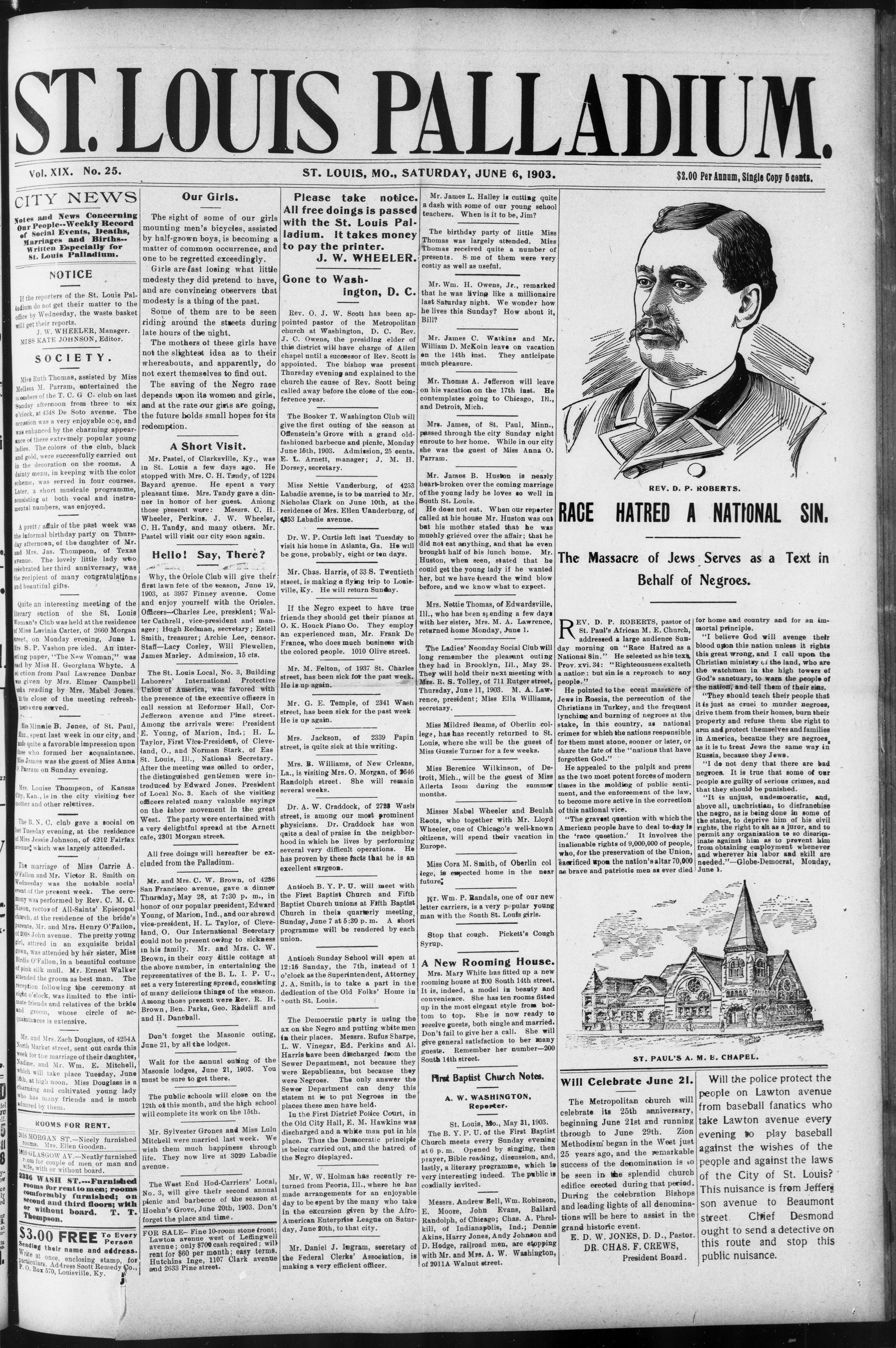
REV. D. P. ROBERTS.
NATRED A NATION
re of Jews Serves as
Behalf of Negroes.
D. P. ROBERTS.
A NATIONAL SIN.
News Serves as a Text in
of Negroes.
J.
RACE HATRED A NATIONAL SIN.
for home and country and for an immortal principle.
"I believe God will avenge their blood upon this nation unless it rights this great wrong, and I call upon the Christian ministry of the land, who are the watchmen in the high towers of God's sanctuary, to warn the people of the nation, and tell them of their sins.
"They should teach their people that it is just as cruel to murder negroes, drive them from their homes, burn their property and refuse them the right to arm and protect themselves and families in America, because they are negroes, as it is to treat Jews the same way in Russia, because they Jews.
"I do not deny that there are bad negroes. It is true that some of our people are guilty of serious crimes, and that they should be punished."
"It is unjust, undemocratic, and, above all, unchristian, to disfranchise the negro, as is being done in some of the states, to deprive him of his civil rights, the right to sit as a juror, and to permit any organization to so discriminate against him as to prevent him from obtaining employment whenever and wherever his labor and skill are needed."—Globe-Democrat, Monday, June 1.
BROOKLYN
B. K.
ST. PAUL'S A. M. E. CHAPEL.
Will the police protect the people on Lawton avenue from baseball fanatics who take Lawton avenue every evening to play baseball against the wishes of the people and against the laws of the City of St. Louis? This nuisance is from Jefferson avenue to Beaumont street. Chief Desmond ought to send a detective on this route and stop this public nuisance.
---
---
REV. D. P. ROBERTS, pastor of St. Paul's African M. E. Church, addressed a large audience Sunday morning on "Race Hatred as a National Sin." He selected as his text, Prov. xvi. 34: "Righteousness exalteth a nation: but sin is a reproach to any people." He pointed to the eccent massacre of Jews in Russia, the persecution of the Christians in Turkey, and the frequent lynching and burning of negroes at the stake, in this country, as national crimes for which the nations responsible for them must atone, sooner or later, or share the fate of the "nations that have forgotten God."
He appealed to the pulpit and press as the two most potent forces of modern times in the molding of public sentiment, and the enforcement of the law, to become more active in the correction of this national vice.
"The gravest question with which the American people have to deal to-day is the 'race question.' It involves the inalienable rights of 9,000,000 of people, who, for the preservation of the Union, sacrificed upon the nation's altar 70,000 as brave and patriotic men as ever died
THE HALL OF THE MUSEUM
Will Celebrate June 21.
The Metropolitan church will celebrate its 25th anniversary, beginning June 21st and running through to June 29th. Zion Methodism began in the West just 25 years ago, and the remarkable success of the denomination is to be seen in the splendid church edifice erected during that period. During the celebration Bishops and leading lights of all denominations will be here to assist in the grand historic event.
E. D. W. JONES, D. D., Pastor.
DR. CHAS. F. CREWS,
President Board.
St. Louis Palladium.
J. W. WHEELER, Editor and Manager,
ST. LOUIS, MISSOURI.
S. E. Pettee, inventor of the machine
for making paper bags, died in Cleveland,
O., on the 1st, aged 81 years. He
was a native of Foxboro, Mass.
The bronze statue of Garrett A. Hobart was unveiled at Paterson, N. J., on the 3d. The orator of the day was John W. Griggs, attorney general in McKinley's cabinet.
The old Order of German Baptists,
whose national conference closed at Wakarusa, Ind., on the 3d, voted not to permit their members to use tele-
phones in their homes.
The new capitol building at Jackson, Miss., erected at a cost of $1,000,000 was formally dedicated on the 3d. The orators of the day were Chief Justice Whitfield and Bishop Galloway.
Prof. J. P. Leslie, the famous geologist of the University of Pennsylvania, died, on the 2d, at his home in Milton, Pa. Prof. Leslie was rated as one of the most expert geologists in the world.
Announcement was authoritatively in Washington, on the 3d, that Secretary of the Navy Moody would leave the president's cabinet at the close of the present term and resume the practice of law.
Alderman J. Ferd Tellbuescher, of Quincy, Ill., was indicted, on the 2d, by the grand jury on two charges of offering and accepting bribes in connection with the passage of competitive telephone franchises.
While the west is suffering from superabundance of water, the eastern states are experiencing the worst spring drought on record. During the month of May less than one-third of an inch of rain fell in New York.
Ruperto Rios, the fanatical Filipino leader in the province of Tayabal, was convicted of murder and sentenced to death on the 30th. Twenty-seven of his followers were sentenced to various terms of imprisonment.
Maj. James McLaughlin, representing the government, closed a treaty with the Uintah Indians in Utah, on the 2d, as a result of which 1,250,000 acres of reservation land will be thrown open for settlement in October, 1904.
Taking advantage of the demand for ice in Kansas City and other towns in the flooded district which have been cut off from their usual sources of supply, Chicago ice dealers, on the 3d, raised their prices 50 cents per 1,000 pounds.
A baseball league in which all players are members of Christian churches or Sunday-schools, in which no one receives a salary, and whose officers are ministers, is the unique organization recently formed by six Christian churches in St. Louis.
Advices from Algeria, on the 31st, reported that M. Jonnart, the governor general, was attacked by nomads near Figuig while journeying from Djennan-Ed-Dar to Benouif with a large party. Thirteen persons were seriously wounded.
The law enacted by congress an approved March 3, 1903, which prohibits the naturalization of aliens who disbelieve in or who are opposed to all organized government or who are affiliated with organizations teaching such doctrines, went into effect June 1.
The Ferris wheel, one of the main attractions during the Chicago World's fair, was sold at public auction on the 2d. A junk dealer bid in the big wheel, and the sum paid for the engines, boilers, buildings, etc., was $1,800. The wheel cost originally $362,000.
The district executive boards of the United Mine Workers of America, on the 3d, issued a call for a convention in Wilkesbarre, Pa., June 15, to decide whether the miners shall suspend work pending settlement of the difficulty existing in the conciliation board.
Postmaster-General Payne has decided that the new rural free-delivery routes, which were to have gone into effect, under the Machen regime, July 1, have been held up under stop orders, because only in that way can the deficiency be kept under the $100,000 mark for the year.
The last half of May, 1903, has become historic for disaster. Lives lost by flood in Kansas and Missouri (estimated), 215; lives lost by tornado in four states, 42; persons left homeless by wind and water, 50,000; damage by tornadoes, $2,000,000; loss by flood (estimated), $10,000,000.
Capt. Thomas B. Sims, owner of the steamer Lotus Sims, which vessel the officers of the Stacker Lee claim to have defeated in the 900-mile race from St. Louis to Memphis and return last week, has issued a challenge for a race over the same course, or a longer or shorter one, for a $10,000 stake.
Capt. A. S. Lightner of the steamboat Stacker Lee, which won the 900-mile race with the Lotus Sims, from St. Louis to Memphis and return, has been in the steamboat business for 50 of his 68 years, and has never had an accident while in command, and the insurance companies have never lost a dollar on a cargo transported under his supervision.
Flood Conditions at Kansas City and Vicinity Growing Slowly But Surely Better.
ARMOURDALE A SCENE OF DESOLATION.
Weeks, Perhaps Months, Must Elapse Before the Place Will Be Again Habitable —Some of the Heavy Losers In and About Kansas City—Latest News of the Situation at Other Points.
Kansas City, Mo., June 4.—The Missouri river fell seven inches between 7 a. m. and 7 p. m. Wednesday, and the Kansas river fell nine inches in the same time. The fall of both rivers is at a much faster rate to day. There was sunshine during a large part of the day, and the general feeling was hopeful. Militiamen and police still guard all approaches to the flooded district, and soldiers halt pedestrians in the residence streets late at night, for there are no street lights, the electric light plant being still shut down. Seven street car lines are in operation, and the others will resume in a day or two. The city waterworks began pumping late Wednesday night, and the retail business district is now supplied with water. Railroads are still giving incomplete service, but are repairing the washouts. The reports of heavy loss of life in Kansas City, Kas., are not true, and the stories of bodies lying in the drift there are unbounded. The loss of property has not been overestimated, however. A launch crossed to Armourdale Wednesday, and cruised for miles through the water lanes that formerly were city streets. The entire city is under water, in many places 20 feet deep, and all of the 16,000 inhabitants have fled. Except the watchmen in the packing houses on the river front, not a human being was to be seen, or even a domestic animal. In many of the houses the upper windows were open and the rooms in confusion. Red and white flags hung from the upper windows of some houses, the occupants of which had evidently been rescued. No steps have been taken to protect household goods in the buildings.
Armourdale will not be inhabitable for a long time after the flood subsides. Every building has been more or less damaged, hundreds utterly ruined. A strong current has set through the town, and the river may persist in following this course. In the old channel in front of Armourdale the stream flows moderately, but through the town the water rushes madly. Where the water is deep and still there will be six feet of solidly-packed mud when the flood abates, and this will need to be cleared away. A foot of mud lies on the flat roofs of houses.
Kansas avenue, the principal thoroughfare of Armourdale, presents an extraordinary appearance, being choked 25 feet deep with the debris of houses, telegraph poles, sidewalks and fences. The brick buildings have stood, losing all their windows, but the water has packed the street with rubbish. The clearing away of the mud and ruins will be the work of months.
In the west bottoms of Kansas City the waters of the Kansas river are rushing through the streets like a mountain torrent.
SOME OF THE HEAVY LOSERS.
Corporate and Other Interests Which Have Suffered Heavily.
Kansas City, Mo., June 4.—While the total loss caused by the flood in this city and vicinity may reach the enormous aggregate of $50,000,000, it will take some time to compute the various individual losses. Among those whose losses may be approximately estimated at the present time are the following:
Bradley-Anderson & Co ..... $ 10,000
Kansas City Electric Co ..... 100,000
Eagle Manufacturing Co ..... 60,000
Kansas City Hay Press Co ..... 10,000
Cudahy Packing Co ..... 500,000
Swift & Co ..... 500,000
Schwarzchild & Sulzberger ..... 500,000
Crane Co ..... 5,000
Heim Brewing Co ..... 100,000
Parlin & Orendorf ..... 10,000
Ryley, Wilson & Co ..... 10,000
Deere Plow Co ..... 27,000
Halliwell Cement Co ..... 15,000
Abernathy Furniture Co ..... 25,000
Armour Packing Co ..... 500,000
Phil R. Toll Box Co ..... 2,000
Freight in Burlington freight
house ..... 500,000
house ..... 500,000
Union Depot Co ..... 30,000
THE SITUATION AT TOPEKA.
Total Number of Known Dead In Now Twenty-Two.
Topeka, Kas., June 4.—The Kansas river is rapidly falling. At two o'clock Wednesday afternoon the flood had receded four feet. In a few more days the work of rehabilitating North Topeka may begin. The situation may be summarized thus:
Total number of known, 22.
Unidentified dead, five.
Reported dead, 66.
The depth of the river is yet 23 feet, which is seven feet above the highest ever known in previous years.
Gov. Bailey has issued a proclamation calling for help, and asking that contributions be sent to William Sims, treasurer. The Topeka Commercial club will accept all offered contributions.
The general relief fund has passed $14,000. The Elks' fund has passed $4,000. The fund in the hands of the governor now amounts to $3,500.
All who are held in buildings in
North Topeka are safe and comfortable, and no one in the flood district is in danger.
All the homeless are being well cared for. More than two hundred deputies are guarding property in North Topeka.
The only railroads operating out of Topeka are the Missouri Pacific, south, and the Santa Fe, west.
The governor may call an extra session of the legislature to provide state relief for all sufferers from floods in Kansas, though Gov. Bailey hopes his appeal for help will bring enough money to meet the emergency. If it fails, he says, he probably will ask members of the legislature to come here for a day without expense to the state and make the necessary appropriations.
CARING FOR THE SUFFERERS.
Iowa Will Take Care of Her Sufferers
Without Stopped Aid Services
ERS Without Outside Assistance.
Des Moines, Ia., June 4.—The work of caring for the 5,000 destitute flood sufferers is still taxing the local committee to the utmost, but the committee has reaffirmed that there is no need of outside assistance. Ten thousand dollars have been subscribed here, in addition to a large quantity of clothing and food.
At Atlantic two marooned families were drowned in the Nishnabotabina bottoms Tuesday night cooped up in their own homes by the flood. For five days they had been compelled to sit on tables with no drinking water and practically nothing to eat.
The river continues to fall rapidly between here and Keokuk.
CONDITION AT ST. LOUIS.
The Water Gradually Rising and a Stage of 35 Feet Predicted.
St. Louis, June 4.—Thursday morning the stage of the river in front of St. Louis was 32.1 feet. The government gauge at the foot of Market street, which showed this, also showed that the stream was rising steadily at the rate of a tenth of a foot every two hours. Harbor department officials state that 35 feet will be reached by Saturday, even if there is no change of conditions to cause a more rapid rise. At that stage there will be from two to three feet of water in all the buildings along the levee front. The river will then be within one foot of the stage reached by the great flood in 1892.
While a rise of one-twentieth of a foot an hour does not seem rapid, it is about as rapid as the river ever rises when at its present stage. The river spreads over so much territory that it takes a vast quantity of water to cause a rise of one-twentieth of a foot. The same quantity coming down at an average stage would cause a rise of from one-tenth to two-tenths an hour.
There is activity among the boat people. They know better than others what to expect from the river when it is at its present stage and rising, and they are not permitting their property to be exposed to any unnecessary risk.
The levee is being rapidly cleared of moveable property and those who have goods stored in cellars and stores along the levee front are removing them to places of safety.
HANNIBAL IN A BAD WAY.
Flood Leaves Hannibal In Total Darkness-River Rising:
Hannibal, Mo., June 4.—A stage of 21.8 feet reached by the Mississippi here. Wednesday night, establishes the highest water mark in the history of Hannibal. The water is now nine feet over the danger line, a rise of 2.5 feet in the past 24 hours. Flood conditions have never before confronted Hannibal to such a grave extent, and it is estimated that the damage already done will amount to at least $200,000.
The street car system is paralyzed and the city electric light plant is shut down, leaving the city in total darkness and causing the suspension of work by a large number of manufacturing industries which utilize electric power for running their machinery.
The railroad service is badly crippled. The yards of the Wabash, Missouri, Kansas & Texas, Burlington and St. Louis & Hannibal roads are from two to twelve feet under water. Few trains are running into the city at present. The Sny levee, aeros from Hannibal, which protects 100,000 acres of fertile Illinois land, may go at any time.
COMMISSIONER WARE SAFE.
He Is Water-Bound at Topeka, and Will Remain for Some Days to Come.
Topeka, Kas., June 4.—Eugene F. Ware, commissioner of pensions, is here safe. He has been in no danger at any time. He will not try to return to Washington for several days because of the demoralized conditions of the railways. A dispatch, Tuesday night, from Washington indicated that uneasiness was felt over Mr. Ware's condition.
The family of T. J. Coughlin, president of the Coughlin Hardware Co. reported from the east, Tuesday night, as being lost, are safe at Perry, 15 miles from here, where they went before the flood came up. Mr. Coughlin is at New Haven, Conn.
Three deaths from drowning are reported since Tuesday night. There are still about 100 persons in houses in the flooded district, but all are safe.
The river fell during the night at the rate of an inch an hour and is still going down rapidly. The refugees are being taken care of in a systematic manner and there is no acute suffering. There is now plenty of fresh water and provisions.
MISSOURI STATE NEWS.
Judge Jefferson Pollard, of St. Louis, was baptized into the Christian church a few days ago. He promised his venerable mother that he would join church and be baptized the first Sunday she was able to attend services. But death claimed her. A few hours after her death he went to the First Christian church, and was baptized and received into membership. Judge Pollard is one of the best-known men in Missouri. He has been the reading clerk for several democratic state conventions, and reading clerk in the house of representatives at Jefferson City. Judge Pollard's devotion to his mother has been noted by many. She was with him at Jefferson City last winter, that he might look after her welfare.
Indicted On His Wedding Day.
Indicted On His Wedding Day.
Clarence A. Barnes was indicted, at Mexico, four hours before the time set for his wedding, on a charge of murder in the second degree for the killing of Representative Rhodes Clay, July 10, 1902. Barnes was ready for just such an emergency, and bond of $10,000 was quickly arranged. The marriage took place on time in the presence of a large audience. The bride was Miss Ruth Lakenan, whose father is the business partner of Barnes' father. The date of the wedding was announced several weeks ago.
Says Wheat Crop Will Be Poor.
State Crop Report, June 1.—Wheat continues very promising in most of the northern counties, though in some localities it is being damaged by the heavy rains, and in a few counties it is becoming too rank. In the central and southern sections it is generally heading low, with short heads. Considerable further damage by rust is reported, and, while improvement is noted in some counties, the crop as a whole will be very poor.
Drowned While Rescuing Cattle.
Virgil Searcy, a young farmer in Howard bottoms, near Franklin, was drowned while trying to rescue stock from the flood. He was riding a mule and leading another in swimming water, when the mule sank with him. Two men in a skiff were following Searcy to rescue him in case of accident, but they could not locate the body.
Corn Crop Backward.
State Crop Report, June 1.—Corn is generally grow well, but much of it is very weedy. Little or no planting has been done in those southwestern counties, where that work has been so greatly delayed, and much planting is yet to be done in the northern and some of the south-central and southeastern counties.
Hereford Sale Postponed.
The Sotham auction of Heretford cattle, at Chilicothe, has been postponed to June 16 and 17. The district is surrounded by water, and the postponement is necessitated by refusal of the railroad companies to accept shipments. Meanwhile, no cattle will be sold at private sales, all being held for the auction.
The Apple Crop Light.
Reports regarding apples indicate that in a majority of the southern counties there will be little more than one-third of a crop, very many crop correspondents reporting less than one-fourth of a crop.
Barbaglia Confesses.
John Barbaglia, the Italian politician who was convicted of naturalization frauds in the federal court at St. Louis, has made a confession to District Attorney Dyer implicating high city officials, it is said.
Caught in San Francisco.
A man who answers the description of H. H. McDonald, wanted in Thayer on forgery charges, is under arrest in San Francisco pending further communication with the Missouri authorities.
A. Good Job.
Evidence in the Hannigan bribery trial at St. Louis develops that each of the combine members of the former house of delegates received $10,000 during the life of the organization.
The Oat Crop.
Oats are reported in poor condition in a few counties, principally in the eastern sections, but are generally doing well. They are heading in the southern counties.
Heavy Loss to Farmers.
All rivers in Missouri are or have been at flood stage since June 1. Thousands of acres of rich corn and wheat land are under water, and the loss is heavy.
Meadows and Pastures.
Meadows promise an average, or more than an average, yield in nearly all counties, but are generally quite weedy. Pastures are excellent.
Missouri Cotton.
Cotton in the extreme southeastern counties is growing well, except in portions of Dunklin county, where some has been drowned out.
Great Damage in Saline.
Saline county has the longest river frontage in the state, and is suffering severely from the floods. Thousands of acres are covered.
Won by a Missourian.
The design submitted by Miss Elsie Ward, a native of Missouri, for the W. C. T. U. fountain at the World's fair has been accepted.
A Double Tragedy.
Contractor Wolz shot Mrs. Louis P. Nielson, on the street in St. Louis, then himself. He is dead, and she will probably die.
WAITING AND WATCHING.
St. Louis Preparing for the Big Head of Water Expected to Reach There From Above.
St. Louis, June 3.—The Mississippi river is still on the rise, and all along the river front the people are preparing for the big flood which is expected Friday—before that time if the rains continue. The rise has been two feet in 24 hours.
Traffic north and west is interfered with on account of the railroad tracks being either washed out or under water.
The river is now rising at the rate of about one-half an inch an hour, so that it can be observed by those standing on the banks. Driftwood is coming down the river in great quantities, and the men employed by the different shipping companies are kept busy in keeping it away from the wharfboats, which would be torn from their moorings if it was allowed to accumulate.
Reports were received at St. Charles Tuesday morning of the drowning of Mrs. William Schmidt and her two small children in an attempt to escape on a flatboat from Catfish island, in the Missouri river, seven miles south-west of St. Charles.
Schmidt and his family of four were compelled to abandon their home on the island early Tuesday morning, and loaded a part of their household goods on the small boat on which they depended for safety. In midstream the craft capsized, and Schmidt was able to save only one of his children. Two miles east of St. Charles 50 head of cattle are on a small island.
Eight families in the bottom closely adjoining St. Charles have abandoned their homes in the last 24 hours, seeking shelter with neighbors living on higher ground. Fields of wheat are entirely under water. The river at St. Charles rose seven inches Tuesday morning, and at noon was within 20 inches of the high water mark of 1892. At the confluence of the Missouri and Mississippi the water has overflowed the St. Louis county bottoms, the Illinois shore and Mobile island and others belonging to St. Charles county, Mo. No signs of life are visible on the shores.
GUARDS ON THE SNY LEVEE.
An Embankment Thirty-Five Miles
Long Is In Danger
Hannibal, Mo., June 3.—This city and adjacent country is suffering from one of the worst floods in its history. The Mississippi, which has been coming up fast for the past several days, rose, Tuesday, at the rate of $1\frac{1}{4}$ inches an hour, and Tuesday night the gauge registered 19 feet and 1 inch, a rise of $2\frac{1}{2}$ and a half in 24 hours. This is six feet above the danger line, and conditions were never worse in this locality. Thousands of acres of fertile farm lands in this vicinity are devastated, causing a loss estimated at not less than $100,000.
The Burlington railroad suspended traffic over its Missouri tracks, between here and Quincy, Ill., as the water now stands over the roadbed to a depth of six feet. Trains are running over the Illinois lines. Across the river from Hannibal, the town of Shepherd, Ill., is without a resident, as all have been driven away by the flood. The Sny levee, which protects 100,000 acres of Illinois farm lands, is in danger. This levee is 35 miles long, and a guard is being kept over it night and day, and the levee commissioners are making every effort to prevent it from breaking. In Hannibal the yards of the Burlington, Wabash, Missouri, Kansas & Texas railroads are inundated, and traffic is only carried on with difficulty. All trains are running far behind time. The railroads will be the heaviest losers by the floods.
BURLINGTON TRAIN MISSING.
Kansas City, Mo., June 4.—The Journal to-day says: Chicago, Burlington & Quincy passenger train No. 3, from Chicago to Kansas City, due here at four o'clock Sunday afternoon, has been lost track of. It is not deemed possible nor is the thought entertained by the railroad officials that the train ran into the flood. Nevertheless General Agent Harmon was notified Tuesday from the Chicago general office of the extraordinary occurrence, and Superintendent Mulhern was requested to exert every possible effort to locate the missing train and remove its passengers at all cost or hazard. The tug John Lentz was chartered, and a voyage made down the Missouri river to Birmingham Nothing was to be seen from there. The men have been started on horses to Liberty, with orders to keep as close as possible to the track and to carefully investigate what is known to be a great washout two miles east of Birmingham.
Provisions in Liverpool
Liverpool, June 4.—Following are the stocks of provisions in Liverpool: Bacon, 14,000 boxes; hams, 2,500; shoulders, 2,300; butter, 2,000 hundredweight; cheese, 10,000 boxes; lard, 2,600; tierses prime western steam and 610 tons of other kinds.
Captured by Insurgents.
Hong Kong, June 3.—The French consul reports that the insurgents in Yun Nan province have captured the towns of Che Ping and Chau and Hori Chau. Communication between Yu Nan and Tonguin is cut.
EXCURSION STEAMER SUNK.
Flying Eagle Wrecked By Striking
a Bridge at Hannibal—Four
Lives Lost.
Hannibal, Mo., June 5.—The steamer Flying Eagle and barge, with the excursion of the Sunday-school of Park Methodist church, of Hannibal, struck the Hannibal bridge on its way up stream at 10:30 Wednesday morning, and went down in 40 feet of water a few minutes later. So far, four are known to be dead, but this list may be swelled.
The known dead are:
Miss Lonnie B. Curts, daughter of R. A. Curts, undertaker and liveryman of Hannibal.
Miss Mary Coppege, daughter of M. A. Coppege, of Hannibal.
Harry Eichenberger, son of A. Eichenberger, of Hannibal.
"Peggy" Harvey, cook on the boat. Miss Curtis was struck by the wheel of the boat, and young Eichenberger lost his life endeavoring to save her. Miss Coppege jumped into the river and Harvey went down with the boat.
RAN INTO DEEP WASHOUT.
Conductor and Four Passengers Killed in Railroad Wreck in South Carolina.
Charleston, S. C., June 5.—An excursion train on the Atlantic Coast line was wrecked near Sumter, Wednesday morning, the engine, baggage car and three coaches plowing headlong into a deep washout. Conductor Clements and four negro passengers were killed. Thirty-three were injured, eight seriously. The engineer and fireman are among the injured. Surgeons were sent on extras from both Sumter and Columbia. A negro who saw the washout made a desperate effort to warn the train with a piece of red paper in his hand, but the engineer did not see his signal or saw it too late.
The killed:
J. J. Clements, conductor, Wilmington.
Frank Ross and his wife, Minnie Ross, of Sumter.
Joe Davis, of Marion.
Ned Weston, oftmufSrLrEwa,wv
Ned Weston, of Sumter.
Weston died on relief train on his way to Sumter.
THE VALPARAISO STORM.
Of Eighty Persons on Board the Lost Steamer Arequipin, Only Seventeen Known to Be Saved.
London, June 4.—A dispatch to Lloyd's from Valpariso, Chili, confirms the dispatch from Santiago de Chili referring to the fears expressed there for the safety of the Pacific steam Navigation Co.'s steamer Arequipa, which, during a lull in Tuesdays storm at Valpariso, left that port in an endeavor to ride out the gale at sea. The agent cables that the steamer, which had 80 persons on board, was probably lost. The bodies of some of the Arequipa crew, he adds, have been washed ashore.
Later advices from Valpariso say the Arequipa founded at her moorings, and the captain, his wife and the majority of the crew were lost. Only 17 were saved.
TWENTY-EIGHT HOUSES BURN
Serious Conflagration Threatened at Hull, a Suburb of Ottawa, Ontario.
Ottawa, Ont., June 5.—A fire Wednesday evening, destroyed 28 houses in the suburbs of the city of Hull, opposite this city. A stiff wind was blowing and a serious conflagration was threatened. Mindful of the disaster of 1901 this city was at once called upon for aid, but by the time the first engine from Ottawa reached the scene the fire was under control. The buildings destroyed were small dwellings, owned by mill workers. The loss is estimated at between $30,000 and $40,000, with no insurance. One hundred homeless persons are being cared for by the city. A fire at Coteau, Quebec, early in the day destroyed eight houses, causing a loss of $20,000.
COURT CHANGED ITS MIND.
The Trial of Curtis Jett and Them
White Will Not be Sent Out of
Breathitt County.
Jackson, Ky., June 4.—The jail guard was called out Tuesday night by a number of shots, which were apparently fired in the air to arrest the soldiers. Otherwise, the night passed quietly.
Curtis Jett and Thomas White, who leged murderers of James Marcuum were brought in to court by a file of soldiers Wednesday. The court's order of Tuesday to hold their trial in Morgan county had not been entered and upon the suggestion of Commonwealth Attorney Byrd, of the incarceration and danger to witnesses trailed, the court directed that the order be not entered, and that the cases go to trial here. The judge will appoint an elisor to go to another county and get a jury.
WRECK ON THE ROCK ISLAND
Three Passengers and Two Train men Injured in a Rock Island Wreck at Alta, Illinois.
Peoria, Ill., June 4.—The Rock Island and Peoria passenger train came here late Tuesday night was wrecked at Alta, eight miles from here, by the breaking of an axle. The cars were ditched and three passengers and two trainmen were injured. A relief train brought the injured to Peoria Wednesday day morning and they were placed at St. Francis hospital.
St. Louis Palladium.
MY SKIES ARE SELDOM GRAY.
I've had my share
Of carking care,
Of nickle Fortune's trowns;
I've braved and borne
The cold world's scorn
And had my ups and downs,
Yet I can still
Yet I can still
Yet I can still
Or sing a roundelay;
For though I hold
Nor lands nor gold.
My skies are seldom gray!
The stress and strife
Of toilsome life
Have taught me one glad truth,
Not he who must
Crawls in the dust,
But he who will—forsooth!
And so I sing
My song, and fling
My head of care away;
For though I hold
Nor lands nor gold,
My skies are seldom gray!
I would not give
A fig to live
Divorced from fret and moll;
The bread I eat
In rendered sweet
Because of my daily toil,
And so I still
A ditty trill—
A blithesome roundelay;
For though I hold
Nor lands nor gold—
My skies are seldom gray!
James Ball Naylor, in National Maga
nites.
The KIDNAPPED MILLIONAIRES
A Tale of Wall Street
and the Tropics A
By FREDERICK U. ADAMS
Copyright, 1901, by Lothrop Publishing Company.
All rights reserved.
CHAPTER VII.—CONTINUED.
If that young lady anticipated any prolonged resistance on the part of Mr. Chalmers she was unaware of the traits which had been developed by his newspaper experience as managing editor of the Record. He would have been delighted to have been able to offer a reward of a million. He attempted to convince Miss Carmody that it would be a good plan to make the reward $350,000, of which the Record should contribute $100,000, but she would not listen to it, and for the first time in his career the young journalist was dictated to by an outsider.
"I will tell you what we will do," he said, as he comprehended the possibilities and rose to the occasion. "We have a large staff, but not large enough to meet this emergency. I will detail ten of our best men to this work. Then I will secure ten twelve of the best men from other New York papers. Then there are some famous detective reporters in Chicago. We will have them. We will scour the country for all the talent which money can purchase. I will take personal charge of this force, map out a plan, and keep at it. We shall succeed; I know we shall succeed."
Miss Carmody clapped her hands in her joy and enthusiasm. All traces of sorrow and care had disappeared from her face. She sprang to her feet and grasped Mr. Chalmers' hand. There was nothing of boldness in this action, nor did Mr. Chalmers construe it as such. It was the joy natural to a generous-hearted girl who loved her father and appreciated the hearty sympathy which Mr. Chalmers expressed in his offer of co-operation.
"You are just splendid!" she declared, her eyes dancing with excitement and pleasure. "I do not know how to thank you. You are right; we are certain to find papa. Oh, if there was anything I could do! But," she said, with a little sigh, as she returned to her seat, "I will do all I can. You will let me know everything that happens, will you not, Mr. Chalmers?"
"I will put in a private telephone and have it connected with your residence, if you will give your consent," Mr. Chalmers replied.
"That is an excellent plan," said Miss Carmody. "Then it will not be necessary for me to come to your office and take up your time as I am now doing."
"You need not let that disturb you," replied Chalmers, with a broad smile. "Now that we are partners in this enterprise, I am going to be so bold as to ask you to be permitted—as Mr. Van Horne's personal representative—to call at your residence as occasion may demand, and make a more consecutive report of what has been done than I could over the telephone."
"It is unnecessary for me to give you permission," said Miss Carmody. "You may consider it a standing invitation, with as much of the nature of a command as I have a right to give."
CHAPTER VIII
CHALMERS HAS A SUSPICION.
Before the New York Record went
to press on the day when Helen
Carmody called on Mr. William Chal-
mers, that gentleman received a
cablegram from Mr. Robert Van
Horne, the editor of the paper.
It read as follows:
St. Petersburg, Russia, May 4.
Wilhelm Chalmers: Offer in my name
reward of $500,000, and no questions asked,
for return of millionaires. Put Hester
to work on case. Spare no expense.
ROBERT VAN HOENE.
"That satches it," said Mr. Chal-
mers, as he read and reread the yel-
low slip. "I see it; $500,000, are the
$260,000 which Miss Carmody offers,
is $750,000. That's an odd-looking
number. It ought to be a million."
He went to the telephone, and for an hour was busy. He talked with representatives of the families of Rockwell, Kent, Haven, Pence and Morton, and each agreed to pledge $50,000 to the Record's reward fund. Chalmers was supremely happy. He sent for the foreman of the composing room and designed a new caption, the first line of which read: "THE RECORD OFFERS ONE MILLION DOLLARS REWARD!!" He then called Miss Carmody by telephone, and informed her what had been done. That young lady was delighted, but assured Mr. Chalmers that she would take it upon herself to see that the missing men paid every dollar of the reward. This was a mere detail to Chalmers, and when he had finished his talk with Miss Carmody, the foreman returned with the new headline. Chalmers pinned it to the wall and stood off and admired it with the rapt expression of an art devotee lost in contemplation of a newly-discovered Raphael.
"Print it in red," he said to the foreman. "Run it clear across the page. Below we will string a solid row of six half-tone portraits of the missing millionaires."
Chalmers was a busy man during the two days following the interview with Miss Carmody. He detailed ten of his men to exclusive work on the mystery and at considerable expense secured 15 others from rival New York papers. Chicago was drawn on for five reporters, and he induced ten from other cities to join his newspaper detective force. This gave him a staff of 40 men.
John L. Stevens, of Chicago, was the most famous police and detective reporter of the country, and, after an interview with Mr. Chalmers, was appointed chief-of-staff under the direct supervision of the managing editor.
"I have no theory about this mystery, Jack," said Chalmers, after they had discussed the case in all its details. "I have certain vague suspicions, but they are not founded on facts, and they may be dismissed from consideration."
"By the way, has that man L. Sylvester Vincent been heard of?" "Who is he?" asked Chalmers.
"You had a paragraph about him yesterday," said Stevens. "He is missing from the Broadway Central hotel. Has not been seen since Monday night. He may have something to do with it. I have sent a man to Chicago for his record."
Stevens went away and left Chalmers to his reflections. The managing editor leaned back in his chair and gazed for a long time at the ceiling. Then he lit a cigar and blew rings of smoke at the wall above, as if to bombard it into a surrender of the secret. He placed his feet on the desk and allowed his mind to wander at will over the dark fields of the mystery. There was no thoroughfare. Chalmers leaned back until the office chair threatened to fall. He then stood up, kicked it savagely, and paced up and down the room. "It's queer; mighty queer." Mechanically he picked up Mr. Van Horne's cablegram and again read it. "Put Hestor to work on the case," he mused. "I will do right well putting Hestor to work on the case. I wish I knew where I could find him."
"Hestor came in here on Saturday," muttered Chalmers as he hurled a pile of unoffending exchanges in the direction of the waste basket. "He said he was compelled to make a hurried trip to Europe, and expected to sail on Monday or Tuesday in his yacht the 'Shark.' Queen chap, that Hestor. Of course it's only a coincidence; but I cannot help thinking about it."
Chalmers paced up and down the room with his head thrown back and his eyes half closed in thought. He attempted to recall every word and action of Hestor's during the days immediately preceding his departure.
"It's too deep for me," he said, as he returned to his desk and mechanically picked up the Van Horne cablegram. "What does Hestor want in the Mediterranean? How in thunder am I going to reach him?"
He turned the knob on the door to Hestor's private office. It was locked, and Chalmers knew it was locked. He sent for the janitor.
"Have you a key to that door?"
"No, sir. Mr. Hestor has the only key," the janitor replied.
"Take off the lock and put in a new one," he said. "We must have a room for Mr. Stevens and some of his men. Hestor may be mad but I can't help it."
The door was soon opened and Chalmers entered. The heavy oak desk was closed. At the base of the door, opening into the hall, were a number of letters which had been dropped through a slit by the postman. When Hestor returned from his long expeditions he frequently found a bushel basket full of accumulated letters.
There were perhaps a dozen letters now lying on the floor. Chalmers picked them up and looked at the inscriptions. Three were in dainty white envelopes and sealed with wax. Chalmers glanced at them and threw them back on the floor. One bore the name of a big grocery house. Another was from a liquor house. A third from a furniture establishment. Yet another was from a billiard table manufacturer. The fifth contained the address of a dealer in smoked and canned meats. There was one from a manufacturer of awnings, one from a piano house, and another from a dealer in guns, fishing tackle and sporting goods. There were several other letters with the names of well-known New York merchants on their upper left hand corners.
"Hestor is quite a business man," mused Chalmers as he sorted over the letters. "These are bills. I know a bill as a cat knows his home. Bills for stuff on his yacht, I suppose. Very likely. I wonder what they are. There is a way to find out, and I am going to do it. This is all wrong, perhaps, but I am going to find out if there is anything in my suspicions. Hestor is a queer fish. He left New York the night these men disappeared. Where did he go? Why did he go? Van Horne wants him to work on this case. It is my duty to locate him. Hestor would be glad to take hold of a mystery like this. It is right in his line."
Mr. Chalmers sent for a reporter named Benson, a cautious, self-possessed gentleman who could extract information from sources barren to all but the select few who are masters of the art. It was not necessary to waste words with Benson. He thoroughly understood his business. "Here are some business addresses, Benson," said Chalmers, handing him a slip of paper. "I promised Mr. Hestor I would attend to certain bills as they became due. Go to these
WHY DID HE GO?
houses and ask for itemized statements of any bills against Mr. Hestor. If necessary explain that Mr. Hestor has suddenly been detailed to work abroad and that through an oversight he neglected to leave the key to his room where his mail is delivered. You should have no difficulty. Merchants seldom object to the prompt settlement of accounts. This is a personal matter, concerning no other member of the staff." Mr. Benson bowed, said not a word and quietly left the room. Late in the afternoon he was admitted to Mr. Chalmer's office. He produced from a deep inside pocket a small package and handed it to Chalmers. "There they are," he said. "All of them?" Mr. Benson nodded an affirmative, turned on his heel and vanished.
Mr. Chalmers examined the slips with much interest. The first one was from a furniture house. It was an itemized bill for a long list of articles, among which were the following:
Twelve brass bedsteads.@$ 40.00 $ 480.00
Twelve hair mattresses... 35.00 420.00
Thirty-six chairs... 4.00 144.00
Twenty-four chairs... 6.00 140.00
Twelve mother sofas... 75.00 140.00
Two leather sofas... 125.00 250.00
Twelve center tables... 40.00 480.00
One dining table... 300.00
One sideboard... 500.00
Two library cases... 125.00 500.00
Twelve willow rockers... 10.00 120.00
Twelve rugs... 60.00 250.00
One rug... 250.00
Four writing desks... 100.00 400.00
Miscellaneous furniture ... 1,699.00
$6,958.00
Chalmers studied these items long and earnestly.
"Looks as if Hestor had started a hotel or boarding house," reflected the managing editor. "A 12-room boarding house. That is not the kind of furniture he would put up in a New York house. He has his own bachelor apartment. I have been in it scores of times. It is full of furniture, and mighty fine furniture." He read and reread the furniture bill. Then he leaned back in his chair and invoked the resources of a memory trained to its work and responsive as the muscles of an athlete or the fingers of a virtuoso.
"It is about a year," he reflected, "since Hestor invited Bob Van Horne, Blake and myself to dinner at the Waldorf, and after dinner we went to his apartment. He was loquaciously mysterious about some house he was building. Bob Van Horne had been talking about a summer joint he was going to erect on on Long Island. Hestor said he was building one which would make Bob's look like 30 cents. He raved about the scenery and all that. Seems to me as if he said something about palm trees. Bob asked him where it was, and he shut up like a clam."
Chalmers reflected. "He said 'palm trees' all right. Seems to me as if he said something about alligators. Then he closed up and said nothing."
Chalmers examined the other statements. They were bills of various kinds—for stocks of canned goods, smoked meats, condensed milk and the multitudinous articles which would be used by a well equipped camping party. They were dated between the 25th and 29th of April, and were rendered on the first of the month. It was late in the afternoon when he was through with this work. About 11 o'clock that night Chalmers received a telegram from Mr. Bernard Seymour dated from Chicago. Mr. Seymour had been detailed by Jack Stevens to hunt up the Chicago record of L. Sylvester Vincent. Seymour was first heard of in the following bulletin, filed in Chicago at eight o'clock that night.
Chicago, May 8.
To William Chalmers, Managing Editor the New York Record:
L. Sylvester Vincent is the kidnapper.
He formed plan in Chicago two months ago. Has been seen in conference with former teammate, coach, and operator. Was probably backed up.
them to abduct Rockweil, Carmody, Kent, Pence, Haven and Morton. Vincent is a plausible but desperate character. Have big story. Can send 10,000 words. How much do you want? BERNARD SEYMOUR. Chalmers wired the impetuous Seymour to send nothing except a brief statement of the facts he had learned; not for publication, but for the private information of Mr. Stevens and himself. Chalmers then wired Stevens to put his men at work at Provincetown, and return to New York at once. He received a telephone message from Miss Carmody asking him to call at her residence if convenient, and in 15 minutes an automobile landed him at the Carmody mansion.
He found Miss Carmody with Miss Edith Le Roy, Miss De Neuville and Mrs. Isabel White, the latter being the widowed aunt of Miss Carmody, and a most charming chaperone to that young lady. Mr. Chalmers was acquainted with all the ladies except Mrs. White. All were eager for the latest news. Mr. Chalmers repeated Mr. Van Horne's instructions about the reward, and displayed a copy of the headlines and the leading article for the following day. He told what had been done in the way of forming a detective staff.
"We now have 40 men detailed exclusively to this work," he said. "Ten are with Mr. Stevens at Provincetown and others are at various points selected by Mr. Stevens and myself. I know you ladies will excuse me if I ask for a few minutes' private conversation with Miss Carmody. We must all do what we can to advance her interests, and this is a matter in which she is especially concerned, and no precautions can be omitted." "Certainly we will excuse you," said Mrs. White. "Why, of course," said Miss Le Roy and Miss De Neuville. But these young ladies were devoured of curiosity and would have given anything quietly to have stepped into the adjoining room and overheard the subdued conversation between Miss Carmody and the managing editor.
Chalmers briefly recited the story of L. Sylvester Vincent and told of the telegram he had received from Seymour at Chicago.
"This is a clew well worth following," said Mr. Chalmers. "I do not suppose you have ever heard your father speak about a man named Vincent?"
Miss Carmody was sure that her father had never mentioned the name. It was an odd one and she would have remembered it.
"Did Mr. Vincent ever call here? Your butler or footman might know."
Miss Carmody rang a bell. A servant appeared.
"Tell Smith I wish to see him," said Miss Carmody.
"Do you keep the cards of all who call on Mr. Carmody?" asked Miss Carmody as the butler stood in the doorway.
"Yes, Miss 'Elen."
"Bring me the cards which have been received in the past three or four weeks."
The butler bowed, disappeared, and soon returned with a formidable assortment of cards. These were spread out on the table, and Miss Carmody and Mr. Chalmers began an examination of them.
[To Be Continued.]
BUT SCANT PRAISE.
Honest Effort That Was Not Sufficiently Appreciated to Encourage a Renewal.
The old saying that "praise to the face is open disgrace" is still firmly believed by some people. A young woman who was brought up by her New England grandmother, a notable housekeeper and example of thrift, says that the adage was a household guide in her family, relates an exchange.
One day her grandmother went off to pay a visit and the ambitious girl of 16 scrubbed and polished, swept and dusted until it seemed as if there was nothing left to do. Her heart beat high with the hope of a word of commendation as she sat in the kitchen doorway, waiting for her grandmother's return.
When the old lady arrived she looked about her with keen eyes, but there seemed no chance for criticism, until, stooping down under the kitchen table, which stood near the open door, she saw that the south wind had wafted a bit of fluff from the henyard. With eyes that would twinkle in spite of herself, she pointed an accusing finger at this evidence of carelessness, and said, soberly: "Janet, my dear, I see there's a feather in the kitchen. It's high time I came home!"
Not a Secret Order Man.
"I didn't know you were an Elk," said a man, after shaking hands in Broadway with an acquaintance whom he had not seen for several weeks.
"I am not an Elk," replied the one addressed. "In fact I do not belong to any secret order. Why did you say that?"
"But you gave me the 'grip,'" persisted the friend. "How did you know it?"
"Must be pure accident," said the other, according to the New York Mail and Express. "I hurt my hand the other day, and although it is only a slight bruise it pains like thunder when I shake hands. To protect the wound I have fallen into the habit of doubling my fingers in a certain way when I shake hands. Now I know why so many of my friends have responded to my greeting with a peculiar pressure. I thought it was a new fad in the matter of shaking hands."
RELIGIOUS MATTERS
THE THANKFUL HEART.
Dull moods are ours when low and dim
About us clings the brooding mist;
No heart have we for lifted hymn,
No eye for his of amethyst,
No heart be of the sky.
And steadfast stars that burn above;
Dull moods when coward fears draw nigh
And clutch the tender arm of love.
But these are as the passing cloud
Against the splendor of the sun,
So thick our Father's mercies crowd,
So swift to us His angels run.
Hisable the wilderness
Before our forehead.
Bright mornings wake with lil' of lark
And light that flushes all the way,
Swallowing the sun's warmth, the dark,
For Heaven has watched us all the day,
And rough or smooth the pilgrim land
Is safe for us who walk this road;
Aye, grasping firm the Father's hand,
Knelful, faring home with God.
-Margaret E. Sangster, in Christian Intelligence.
EFFICACY OF APPRECIATION.
Nothing Retards Spiritual Growth or Blights the Joy of Life Like the Habit of Criticism.
Nothing more retards spiritual growth or more effectually blights the joy of life than a habit of criticism and depreciation. Mozley says in his "University Sermons," "a life of ennities is greatly in opposition to growth in holiness;" but much more than that, even the habit of discovering and emphasizing what we may regard as the seamy side of men, things and events is intensely unwholesome and injurious. That depreciative criticism is hurtful we may soon perceive by watching its influence upon our own heart. James Smetham writes to a correspondent: "Don't get into the focus of criticism. Many men spoil their enjoyment of art by looking on it as something to pull in pieces rather than as something to enjoy and lead them to enjoy nature and through nature to enjoy God. How wretched is that fervish, satiated, complaining spirit of criticism. Never contented, never at rest."
By this self-same spirit of determined faultfinding, says the Wesleyan Methodist Magazine, we not only spoil the enjoyment of art, but our enjoyment of everything. Of course, we must discriminate between the qualities and values of things; life would be insipid, and we should miss its great teachings, without constant criticism of character and affairs, but it is singularly difficult to preserve criticism pure and generous. Base alloys readily mingle with it. We complain of the weather, the climate or the scenery, when there is no ground whatever for querulousness; our faultfinding is not the expression of an exacting sense of beauty, as we flatter ourselves, but simply ignorance, ingratitude and irreverence. We complain of the monottonousness, meanness and misery of our lot, and suppose that such criticism is the revolt of a great soul dominated by noble ideals; the fact being that our discontent is bred of blindness, pride and unthankfulness. We complain of the doings and achievements of our fellows, insisting on their general unworthiness; and although we delude ourselves that our criticism is purely impersonal and intellectual and wholly inspired by a love of perfection, God knows that our harsh judgments are sickled o'er with envy, jealousy and uncharitableness. Nothing is more difficult than to preserve criticism sweet, reasonable and generous.
The habit of running things down is no sign of mental superiority, although many think so; it is far offener an indication of mental impotence and obliquity. "The monkey," according to Mr. Lockwood Kipling, "has a passion for picking things to pieces," but that passion is not characteristic of really able men. "Intelligent men are easily pleased," testifies the Turkish proverb; and it is true. Without question the highest intellects are specially appreciative. We prove the quality of our genius not by cavil and detraction, not by unwillingness to be pleased and a readiness to censure, but by doing some worthy thing handsomely. As Drummond puts it: "It is easier to criticise the best thing superbly than to do the smallest thing indifferently." To blow upon people, to carp at their endeavors and to handle things generally in a fastidious and disparaging spirit, is the sure sign of a mean and narrow intellect. Neither is the habit of picking holes in our brethren any evidence of moral and spiritual superiority. "And Jesus spake also this parabue unto certain which trusted in themselves that they were righteous and set all others at nought." That was the sting of their condemnation—"they despised others," they "set all others at nought." It was chiefly this habit of depreciation that branded them as being superficial and false. To suspect men, to impute to them poor motives, to construe their actions uncharitably and to be niggardly of encouragement and praise, is to discover and perpetuate the hollowness of our own character.
Ah! too easily do we get "into the focus of criticism," and it chills our whole being and life. It is possible to be angry without sin, but only rare saints in rare moments touch that fire without being burned; and while it is possible to criticise in the pure love of truth, such criticism remains a dangerous ordeal even to the saintliest. Whenever we diagnose, disapprove and condemn, we need to be richly saturated with the spirit of our Master, if
we ourselves are not to be the worse for the unpleasant task. There is something in all stricture that is closekin to the worst elements of our nature. And yet how readily and largely do we yield to this tendency! Looking on the wonderful world, we see little to extol; subjects of a marvelous Divine government, we chiefly demur to its ordinations; intrusted with the oracles of God replete with sublime treasures, we spend far more time in analyzing and decrying their contents than we do in glorifying him who has thus made the light to shine in our darkness.
Oh for the gift of vision that we might behold the teeming marvels and delights of this fair earth whose most modest shapes are rich in bloom and beauty! Oh for the gift of faith and love, that we might interpret truly the events of life and find in each a theme for a delectable song! Oh for the heavenly charity which can recognize in our brethren patience, kindness and heroism, when a niggling intellect can see nothing but imperfection and failure! Oh that we might behold with open face the goodness of God in Jesus Christ and live in the spirit of adoring wonder and loying consecration! If we do not grow in grace let us turn over a new leaf; let us try the focus of appreciation instead of that of criticism; let us be freer to see the beautiful, to appreciate the good, to praise the high; and if we are only humble, sympathetic and pure, the glory and joy of life will stand freshly revealed in everything, the law of praise will be on our lips and in the genial glow we shall grow as flowers and palms in the sun.
SELF-LOVE.
Not the Same Quality as Selfishness, But the Seeking of the Higher Ends of Life.
It seems to be a very common notion that self love is a thing absolutely prohibited by the teaching of our Lord. But, says the Nashville Christian Advocate, we do not so read the record of His utterances. As a matter of fact He distinctly recognizes self-love as a thing allowable. Nay, He goes so far as to make it a primary duty. No one will deny that He requires us to love our neighbors; but it must also be kept in mind that He requires us to love them in the same sense as we ought to love ourselves. That would be an impossibility, a mere straining after an end beyond the limit of the attainable.
But what is the self-love that we are allowed to cherish? Certainly it is not the same as selfishness. The two things are often confused in thought, but are wholly distinct in fact. Perhaps it would be better to say that selfishness is the exaggeration of self-love, the abnormal and unnatural growth of a natural and innocent instinct. A rational self-love may be known by these two marks: First, it never fails to choose the higher ends of life in preference to the lower, the things which are spiritual rather than the things which lie within the sphere of sense, duty instead of pleasure, honor in preference to gratification; and, secondly, since it knows that it can derive no real and permanent good from injuring another, it is as careful of the rights and interests of others as it is of its own welfare.
Selfishness, on the contrary, often takes the lower road and chooses the inferior good. It lives in the world of sense and in the present hour and is so much concerned to secure immediate delights that it loses sight of the larger issues which the future holds. It is likewise blind to everything except its own supposed interests; it cares nothing for the rest of mankind, but rides roughly and coarsely over everybody and everything that gets in the way. A selfish man cannot be a good Christian; if he be radically and profoundly selfish, he cannot be a Christian at all.
RELIGIOUS TRUTHS.
"Actions speak louder than words," but words make the most noise.—United Presbyterian.
When a man is willing to go to Heaven alone he must surely be mistaken as to his destination.—Ram's Horn.
I have always observed the thread of life to be like other threads or skeins of silk, full of snarls and encumbrances.—George Herbert.
One thing is clear to me, that no inulgence of passion destroys the spiritual nature so much as respectable selfishness.—George MacDonald.
The smallest things become great when God requires them of us; they are small only in themselves; they are always great when they are done for God, and when they serve to unite us with Him eternally.—Fenelon.
Do not draw back from any way because you never have passed there before. The truth, the task, the joy, the suffering on whose border you are standing, oh, my friend, to-day go into it without a fear; only go into it with God who has been always with you.—Phillips Brooks.
To accept the inevitable; neither to struggle against it nor murmur at it, simply to bear it—this is the great lesson of life—above all to a woman. It may come late or early and the learning of it is sure to be hard; but she will never be a really happy woman until she has learned it.—Dinah Mulock Craik.
"O my God, grant me" (so they are taught to pray in some monasteries in France), "grant me that to-day I may be of some use to some one." If God, for our good, see fit to deny us all else, may He, as His best gift to all, grant us this—to be of some real, of some deep use to our fellow men, before we go hence and are no more seen—Dean Farrar.
PUBLISHED EVERY SATURDAY.
Entered at the postoffice at St. Louis,
Mo., as second-class matter.
JOHN W. WHEELER, JR.,
General Collector and Solicitor.
MISS BEATRICE ROSS, Secretary.
2617 Lawton Avenue.
MISS KATE JOHNSON.....Editor.
WILLIAM D. MCKOIN.....City Reporter.
MISS ANNA PARRAM.....Society Reporter.
JAMES HUSTON.....Religious Reporter.
J. M. CRAWFORD.....Sporting Reporter.
JAMES HAYES.....Chief Reporter.
Business matters pertaining to the
paper should be addressed to The
Palladium Office.
Communications for publication
must reach us not later than Wed-
needy.
ADVERTISING RATES.
For one inch, one insertion.....$ 50
For one inch each subsequent
insertion.....25
For two inches, three months.....6 00
For two inches, six months.....10 00
For two inches, nine months.....14 00
For two inches, twelve months.....20 00
Standing and transient notices
per line.....10
RATES OF SUBSCRIPTION.
Per year.....$2.00
Six months.....1.00
Three months......60
Single copy......05
SEVEN POINTERS FOR THE READING AND ADVERTISING PUBLIC.
(1) THE ST. LOUIS PALLADIUM IS in its 20th year of regular publication.
(2) Never has missed an issue.
(3) No fake subscription list to "catch" honest advertisers.
(4) More bona fine subscribers than any other Negro paper in St. Louis or State.
(5) The ONLY Negro newspaper published in St. Louis as the organ of the Republican party.
(7) Because it is fearless in denouncing crime regardless of consequences.
The St. Louis Palladium is sold at the following places:
2617 Lawton avenue.
209 South 15th street.
1208 Wash street.
2652 Lucas avenue.
Charleston, Mo.
West Plains, Mo.
3104 State street, Chicago, Ill.
Notice.
Notice.
All who are connected with the Palladium MUST send their weekly reports so that they will reach the office on Wednesday morning. They are also requested to report each week.
Baseball and crowds of dudes on the streets must stopped. Lawton avenue, between Jefferson avenue and Beaumont street must be cleared of these hangers on. We call on the detectives in citizens clothing.
ONE FOR THE SUTLERS.
A Soldier's Remark About Them Which Was Not Extravagant, But Disorderly.
"I had a narrow escape," said the Pennsylvania major, according to the Chicago Inter Ocean, "in trying to locate the confederate lines at Peebles' farm. This was just after the fight on the Weldon railroad. Gen. Bartlett, of the Fifth corps, Army of the Potomac, sent me forward alone to see what the enemy was up to. While he formed his line of battle I rode forward easily until I came to the woods, and there I found a well-formed confederate line waiting in ambush to pour a hot fire into Gen. Bartlett's regiments.
"They were so well concealed that I was within a few feet of them before I saw a man, and then I saw a good many all ready to fire. They ordered me to surrender, but I wheeled my horse quickly, and lying flat to the saddle, dashed away and gained a ravine, by following which I reached our lines without a scratch. Not one fired at me, because a volley would have betrayed their position to Bartlett's men forming attack.
"When I rode up to Gen. Bartlett and saluted, he inquired if I had seen any confederates in front. I replied in considerable excitement: 'The Johnnies are massed in the edge of the wood, and are thicker than sutlers in h—' The general looked me over for a minute, and then said, slowly: 'Captain, your report is satisfactory, and gives me the information I wanted, but duty compels me to say that your language as to sutlers, while possibly not extravagant, is, from the standpoint of military etiquette, out of order. Thank you, sir.' I never came nearer a reprimand than that."
FLAG ON NEW STAMP
Innovation to Be Introduced in Next Two-Cent Postal Issue.
The Portrait of Washington Will Occupy the Central Oval Resting Over the Background of the Draped Flag.
For the first time since 1869, and practically since the establishment of the United States postal system, the people will have the privilege of using a postage stamp bearing the flag of the republic with the issuance of the new series of postage stamps now in process of printing. The postage stamp displaying prominently the stars and stripes will be the 2-cent denomination, but it will bear no resemblance to the 2-cent stamp in use to-day. Washington's portrait, which has appeared upon the common letter postage stamp since the beginning of the use of stamps except during the single year 1869, when the portrait of Washington was displaced to make room for a wild and woolly, wide-stacked, wood-burning locomotive of the "rocket" type, will again occupy the position of honor upon the label, but the bust of Washington, so long familiar to the public will disappear, probably forever. The portrait of Washington, drawn from Houdon's profile cast, is abandoned, to be succeeded by a photograph from Stuart's famous painting, which now adorns the national capitol building.
The first postage stamps issued by this government were the 5 and 10 cent denominations in 1847 bearing portraits of Franklin and Washington, respectively. The Washington picture was Stuart's. This portrait continued until 1870, with a few exceptions, a type of the Houdon cast appearing upon the 3 cents value a portion of the time. In 1870 the Stuart photograph disappeared entirely, being superseded by Houdon's profile cast, which has been used exclusively upon the current letter postage denomination up to the present time.
Now Stuart's representation of the first president is about to resume its place. The likeness of Washington is the most important feature of the design upon the new stamp, but the American flag—two flags, in fact—is conspicuous and inspiring. The photograph occupies the central oval, somewhat smaller than the oval in the current stamp. Above this in a panel are the words "United States of America" and draped upon either side occupying two-thirds the length of the stamp are two flags forming a background against which the oval seems to rest. Immediately beneath the bust of Washington appears his name and at the side in small figures the dates of Washington's birth and death, 1732-1799.
EPILEPSY IN UNITED STATES.
National Association for Study of Disease Reports 140,000 Cases in This Country.
At the annual meeting of the National Association for the Study of Epilepsy and Treatment and Care of Epileptics in New York, President Frederick Peterson, in his annual address, said:
"There are 140,000 cases of this disease in the United States only. Time was when the hospital, the school, the church and employment were closed to him; he was even a burden to his family. Now in 19 states there are provisions made for their care and treatment, and in some cases cures have been established. In Europe also there are many homes and colonies established for the care of these unfortunates, and the movement has even extended into the countries of Asia and South America."
Among the other speakers was Dr. Roswell Park, of Buffalo, who discussed "The Treatment of Epilepsy by surgery." He advocated the early diagnosis of the case for the attainment of the best results by surgery. It will be well, he said, to have the epileptic carefully studied by an accomplished surgeon, who should review the case with a view to the possibility of surgical intervention.
The operation, when undertaken, he thought, should be regarded as a first measure, to be followed by others looking to a correcting of all faults of diet, of elimination, and so forth.
Last of a Species Gene
Ornithologists will regret to learn that Guilding's Amazon parrot, a rare bird inhabiting the mountains of St. Vincent, has in all probability become extinct, owing to the recent volcanic phenomena in the island. The species was said formerly to occur only on the Souffriere, hence it became known as the Souffriere bird, writes a London correspondent to the Scotsman. The great eruption of 1718 drove many specimens to seek shelter in the other highlands of St. Vincent, but their numbers were considerably reduced by the fearful hurricane of 1898, and there is reason to fear, so I am told by an ornithological friend, that the few survivors have all perished in the eruption of May last.
Oil Paintings a Drug on Market.
So stagnant has the market for paintings in oil become, says the London correspondent of the New York Tribune, that many artists of good reputation despair of ever again making a living by the sale of their work. The demand for water colors, however, is constant, works of this class being sold readily when purchasers for oils cannot be found.
A. F. and A. M. of Missouri and Its Jurisdiction.
Masonic Lodges.
GRAND LODGE OF MISSOURI.
OFFICERS.
A. R. Chinn, Grand Master, Glasgow, Mo.
E. W. Perkine, Deputy Grand Master, Trenton.
T. P. Mahammitt, Senior Grand
Warden, Omaha, Neb.
J. C. Cobb, Grand Junior Warden, Cape Girardeau.
R. T. Coles, Grand Treas., Kansas City.
J. H. Pelham, Grand Sec'y', Hannibal, Mo.
Prince Hall Lodge No. 1, St. Louis, Mo., meets first Monday in each month. All Masons in good standing are invited, W. T. Dixon, W. M.; H. W. Lawless, Sec'y'.
Lone Star Lodge No. 2, St. Louis, Mo., meets second Monday in each month. All Masons in good standing are invited. R. W. Marshall, W. M.; Joseph A. Smith, Sec'y'.
H. McGee Alexander Lodge No. 3. John Casey, W. M.; Albert Hedgman, Sec'y'.
Onward Lodge No. 17, St. Louis, Mo., meets the third Monday in each month. P. Johnson, W. M.; J. W. Grant, Sec'y'. J Q. Johnson Lodge No. 30, meets the first Thursday in each month. J. L. Henderson, W. M.; J. G. Stevens, Sec'y', 3948 Fairfax Ave. Widows' Son Lodge No. 105, meets second Tuesday in each month. James Flemings, W. M.; J. T. Anderson Sec'y'. True Blue Lodge No. 107, meets the first Tuesday in each month. Aug. Barrow, W. M.; J. T. Anderson, Sec'y'.
CHURCHES.
St. Paul's, A. M. E., Leffingwell and Lawton; Rev. D. P. Roberts, pastor.
St. Peter's, A. M. E., Elliott and Montgomery; Rev. James Madison pastor.
St. James, A. M. E., Pendleton and St. Ferdinand; Rev. W. C. Williams pastor.
Quinn's Chapel, A. M. E., Carondelet; Rev. J. A. Christoper pastor.
St. John's Mission, A. M. E., Lowell;
Rev. F. E. Clark pastor.
A. M. E. ZION.
Metropolitan A. M. E. Zion, 2625
Morgan; Rev. E. D. W. Jones pastor.
St. John's A. M. E. Zion, 113 Eiler
St.; Rev. R. P. Christian pastor.
Colored Methodist, 3986 Fairfax
avenue; Rev. O. Heaylow, pastor.
avenue; Rev. O. Ireawl, pastor.
Lexington Ave. A. M. E. Zion, 4214A
Lexington Ave.; Rev. Donovan pastor.
M. E
Centennial M. E., Elliot and Washington; Gilliam.
BAPTIST.
Central Baptist, Twenty-third and Morgan Sts.
First Baptist. Fourteenth and Clark Ave.; Rev. E. C. Coie pastor.
Fifth Baptist, 4117 Papin St.
Pilgrim Baptist, Kossuth and Pans St.; S. P. Anderson pastor.
Antioch Baptist, 4223 Kennerly Ave.; Rev. Frank McKinney pastor. Mt. Pleasant Baptist, foot Doc. St. Pleasant Green Baptist, 711 N. Eleventh St.
Baptist Church, 110 8. Leonard Ave.; Rev. Perry pastor.
Chambers Street Baptist, Tenth and Chambers: Rev, Cox pastor.
Compton Hill Baptist, LaSalle St.
El Bethel Baptist church, 638 Athlone
Ave.
Ruck's Church, Baptist 14th and
Morgan; Rev. Rucks pastor.
Bethany, Presbyterian, Nineteenth
and Wash Sts.; Rev. Washington,
pastor.
All Saints, Episcopalian, 2135 Washington Ave.; C. M. C. Mason pastor.
Missionary Baptist True Reformers;
J. Cohen pastor.
Carried Unanimously.
According to a gentleman who has spent many years in the gold fields, the average digger would bear comparison with some of our best debaters.
Some time ago the "boys" of Nugget Creek were in council assembled. It was generally admitted that the size of the colony—consisting as it did of something just over a dozen shanties—entitled it to be considered a city, and Mecca City sprang into existence.
Then one Roaring Dick arose and wanted to know what the "citizens" intended to do in the matter of lighting the "streets" by night.
"You know me, boys," he said, twirling a formidable-looking six-shaooter, "I ain't afraid o' nothing, nayhur in daylight nor dark. But it's this way—other cities 'as got gas, and Mecca's got ter 'ave it."
It can be that "it's got to be did!" roared the speaker: "Wot other cities does weides! 'Sides, gas lamps is a hornament an' lamp posts a habsolute necessity. Why, why' ain't a decent spot ter lynch a man within twenty miles. We're goin' ter 'ave lamp posts."
The argument was conclusive, and it was decided unanimously to have gas—New Yorker.
August G. Seyfert, United States consul at Straford, Ontario, reports that a strong impetus has been given in Canada to the manufacture of peat for fuel, but the question of making the apparently inexhaustible beds of bog commercially valuable lies in the drying process. Thousands of dollars are being expended in experiments to perfect machinery for this purpose, and the genius who succeeds in inventing a machine to thoroughly extract moisture from crude peat will make a fortune.
A
BIG SUMMER SALE. BRADBURY PIANO CO. THE GREATEST VALUES EVER OFFERED.
ER,
manager.
ERACBURY
St.
Remember the
AL DEER
---
SOCIAL DEER CLUB,
7 TARGEE STREET.
Richard Kent, General M.
Prof. Joe Marshall
George Ken
Jam
Yours in
WAIT FOR USE
FOR THE
Railroad Exc
ST. LOUIS, MO.
SUNDAY, JUNE
MASONIC LODGE
Train leaves at 9:00 a.m.
Adults, 75c.
Buy your Groceries at the St.
Franklin avenue, St. Louis, Mo.
H. H. TEM
PRESCRIPTION
2605
1901 (Franklin
St. General Manager.
Joe Marshall, Musical D.
George Kenzie, Preside
James Crawford
Yours in F. C. and B.
FOR US! FOR W
FOR THE GRANDEST
Road Excursion
A. LOUIS, MO., to UNION, M.
MAY, JUNE 21, 1903
MASONIC LODGES OF THE CITY
leaves at 9:00 a. m. and returns at 7:00
5c. Child
proceries at the St. Louis Grocery & St.
E. St. Louis, Mo.
TEMM &
SCRIPTION DRUGG
Franklin Ave.
Richard Kent, General Manager.
Prof. Joe Marshall, Musical Director.
George Kenzie, President.
James Crawford, Proprietor.
Yours in F. C. and B.
Buy your Groceries at the St. Louis Grocery & Supply Co., 2627 Franklin avenue, St. Louis, Mo.
H. H. TEMM & SONS.
PRESCRIPTION DRUGGISTS.
2605 1901(Franklin Ave. And Marcus and Easton Avenues.
Best Always Cheapest.
THE WEST END
of 3719 Caf
Has a Barber Shop o
Dancing Academy
Wednesday and Frid
Dancing
On Sunday Evening
admission t
ROBERT OLIVER, Secretary.
WEST END SOCIAL
of 3719 Cass Avenue,
Berber Shop on the First
Bing Academy on Third
Day and Friday, admission
Dancing Academy.
Day Evening a Reception
admission to Reception
TER, Secretary. E. M. HAWK
THE WEST END SOCIAL CLUB,
Has a Barber Shop on the First Floor and Dancing Academy on Third Floor. Wednesday and Friday, admission 25c. to Dancing Academy. On Sunday Evening a Reception. 15c. admission to Reception.
A ROADSIDE GRAVE.
Mystery of It Was Cleared Up by Brother of Its Unfortunate Occupant.
"The queer things that happened in the army," said the doctor, according to the Chicago Inter Ocean, "would fill a volume as large as Webster's unabridged. In the Tullahoma campaign of 1863 there was not much heavy fighting, but there was a great deal of rapid maneuvering that brought on unlooked for skirmishes between picket lines and advanced posts. In marching through the bottom lands, just before we reached Manchester, we found a newly-made grave at the roadside and there was much speculation as to how the man buried therein had been killed.
"On a pine board at the head of the grave was cut the name of a member of the Third Kentucky infantry, C. S. A."
"I AM GOING TO OPEN THE GRAVE."
with regimental and company designation. As some of the boys lounged about the grave a member of the Third Kentucky union regiment came up and, his eve catching the number on the
---
BER the BEER CLUB,
Manager.
Bill, Musical Director.
Anzie, President.
Les Crawford, Proprietor
F. C. and B.
FOR WHAT?
GRANDEST
Excursion of the
season.
to UNION, MO.
E 21, 1903, Under the au-
spices of the
various....
ES OF THE CITY.
and returns at 7:00 p. m.
Children, 50c.
Louis Grocery & Supply Co., 2627
M & SONS,
N DRUGGISTS,
n Ave. And Marcus
and Easton
Avenues.
SOCIAL CLUB,
Mass Avenue,
in the First Floor and
play on Third Floor.
day, admission 25c. to
Academy.
a Reception. 15c.
to Reception.
E. M. HAWKINS, President.
pine board, he walked up close to investigate and said: 'Great Scott—my name and my regiment!' Seeing there the C. S. A., he said: 'Boys, I believe that is my brother. He enlisted in a Kentucky confederate regiment ten days before I enlisted in the Third Kentucky union. I am going to open the grave.' "The boys ran for picks and shovels, and in ten minutes the dead body of a man in confederate uniform was uncovered and was identified as that of the brother of our Third Kentucky friend. The living brother in the union service stood for many minutes looking down into the face of the dead confederate, not one of the men in the group saying a word. Then, at a sign from the captain, the grave was refülled, more distinctly marked, and the command moved on.
"On the same campaign, when our regiment had the advance, there was a sharp skirmish in the brush and our boys supposed the rebs had retreated when they saw not 300 yards away a head thrust out of the brush and quickly withdrawn. In a minute the head came out again and again, and, suspecting an ambush, the skirmishers opened fire on the thicket and charged. They found they had killed a boy not more than 12 years old, who had been sent out from his home not 50 yards away to give the union troops warning of a heavy cavalry force moving on a parallel road. The boys grieved more over the shooting of that boy than over the hundreds of men killed at Chickamauga."
Only Indian Pensioner.
Armstrong Cornsilk, who has been granted a pension by the North Carolina pension board, is the only Indian thus provided for by that state. Cornsilk is a Cherokee. He served in the Sixty-ninth North Carolina regiment from April, 1862, to the close of the war.—Indianapolis News.
Is Not Labeled.
The opportunity of a lifetime seldom has a label on it.—Chicago Daily News.
New Pianos, upright and square.
Pianos, used but a few weeks will be disposed of at heavy discount.
1012 Olive Street.
Sending their name and address
Write at once, enclosing stamp, for
particulars. Address Scott Remedy Co.
P. O. Box 570, Louisville, Ky.
MRS. L. CLARK'S
She treats the scalp, stops the hair from falling out. Best of attention is given to all ladies' work.
2115 Lucas Ave., St, Louis, Mo.
"Follow the Flag."
Banner Route
WABASH
To the Great Gateways
Kansas City. Chicago, Omaha, Toledo & Buffalo. Through sleepers to New York and the East. Magnificent Equipment and Train Service.
Eigth and Olive streets.
MISSOURI
PACIFIC
RAILWAY
KNOWN AS THE
GREAT
SOUTHWEST
SYSTEM
Connecting the Commercial Centers and Rich
MISSOURI,
The Broad Corn and Wheat Fields and Thriving
Cities of
KANSAS,
The Fertile River Valleys, Trade Centers and
Cities of
NEBRASKA,
The Grand, Picturesque and Enchanting Scenery,
and 6.5 Famous Mining Districts of
COLORADO,
The Agricultural, Fruit, Mineral and Timber
Lands, and Famous Hot Springs of
ARKANSAS,
The Sugar Plantations and immense Rice
Fields of
LOUISIANA,
The Cotton and Grain Fields, the Cattle Ranges
and Winter Resorts of
TEXAS,
Historical and Scenic
OLD AND NEW MEXICO
and forms with its Connections the Popular
Winter Route to
CALIFORNIA
For descriptive images, address pamphlets or
any of the above States, address Companies
Agents, or
H. C. TOWNSEND,
General Passenger and Ticket Agent.
ST. LOUIS
DR. G. H. ANDERSON,
DENTIST,
1407 Market Street,
Hours 8 a.m. to 6 p.m. ST. LOUIS.
Phone Klinlock C414, Bell Main 584.
Spring Ave. Car. O'Fallon Park Car.
MR. A. L. LEE,
Representing the
PALACE LAUNDRY,
guarantees satisfaction and
prompt service. The best
Colar and Cuff work in the
city. Please address all communications to 3712 Sullivan
avenue.
[Name]
L. W. VINEGAR.
International Brotherhood of Stationary Firemen.
L. W. VINEGAR, Organizer.
No. 122. I. B. S. Firemen meet every
1st and 4th Thursday in each month at
Tobin's Hall.
Office—806 North 14th Street.
Telephone—Kinloach C-397.
THEO. H. TEMPEL,
Dealer in
Staple and Fancy
GROCERIES,
2601 Market Street,
ST. LOUIS, MO.
California Canned Goods a Specialty.
CHAS.H.WHITTENBERG, Wholesale Dealer in
Bourbon and Rye Whiskies
Importer of Fine Wines, Gins, Brandies, Kuemmels and Cordials.
Sole Owner Blue Wing Whiskey.
Kinloch, D-162.
2654-56 Franklin Avenue.
HARRY PENN, Night—MIXERS—JOHN H. CLARK, Day.
2220-2222 Market Street,
Phone—Kinloch D-855.
St. Louis, Mo.
Pool Room in Connection.
The 200
1322 Market
Choice Wines, Liquors and
best of accommodation
E. J. BRUNER and D. G. HO
THE GREEN TREE
SIMON BROWN, Pro
NOAH WARGTING, Gene
1600=1602 Morgan
Pool Room in Conn
200 I
22 Market
Liquors and Cig
rest of accommodation
R and D. G. HOGAN
EEN TREE
ON BROWN, Propriet
ARGTING, General
202 Morgan
I Room in Connect
200 Bar,
2 Market St.
Liquors and Cigars with the
of accommodation.
and D. G. HOGAN, Proprietors.
EN TREE SALOON.
BROWN, Proprietor.
GRTING, General Manager.
2 Morgan Street.
Room in Connection.
The 200 Bar,
Choice Wines, Liquors and Cigars with the best of accommodation. E.J.BRUNER and D.G.HOGAN, Proprietors.
THE GREEN TREE SALOON.
SIMON BROWN, Proprietor. NOAH WARGTING, General Manager. 1600=1602 Morgan Street. Pool Room in Connection.
O.K.SALOON
H. L. FRANKLIN, Prop.
Dealer in Bonded Liquors,
Cigars, Tobacoo.
Pool Room in Connection.
4000 Papin St., St. Louis, Mo.
DYE'S
Buffet and Poor
WM. P. DYE, Proprietor
2801-3 Manchester Ave.,
Telephone—Kinloch B
THE G
HUGH B: WHITE, Pro-
SALOON and BILLIE
At 1911 Market
(Opposite Union Sta-
Choica Wines, Liquors, Cigars, and
Billiard Ro
Remember the Gem, I
THE "OWL" S
33 South 20th St
Choice Wines, Liquors, Cigars
Everything Genuine.
Re-
Phone, Kinloch C
WILLIAM JAMES and MR. R. SAUND
CHARLEY HARRIS, P
FURNISHED ROOMS FOR MEN ONLY.
BILLIARD
EVERYTHING STRICTLY FIT
The Brunswick
G. W. HOLT, Proprietor
1925 Market Street
Fine Wines, Liquors, Cigars and Tobaccos.
and Pool
WM. P. DYE, Proprietor.
Wester Ave.,
Telephone—Kinloch B-1812.
THE GEN.
B: WHITE, Proprietor
and BILLIARD
1911 Market
(Opposite Union Station)
Liquors, Cigars, and the
Billiard Room
Under the Gem, 1911
"OWL" SALE
13 South 20th Street
Liquors, Cigars and
Genuine.
Remember
Phone, Kinloch C-43.
and MR. R. SAUNDERS,
HARLEY HARRIS, Proprietor
FOR MEN ONLY.
BILLIARD ROOM
ANYTHING STRICTLY FIRST-C
Brunswick
W. HOLT, Proprietor
Market Street,
Cigars and Tobacco.
and Pool Room, WM. P. DYE, Proprietor.
TE GEM.
B.S: WHITE, Proprietor of
BILLIARD HALL
1911 Market St.
(Opposite Union Station)
Oars, Gigars, and the best up-to-date.
Billiard Room.
Over the Gem, 1911 Market.
DOWL” SALOON,
South 20th Street.
Quors, Cigars and Bottled Beer.
Quine. Remember the Place.
Phone, Kinloch C-43.
MR. R. SAUNDERS, . . . Managers
LEY HARRIS, Proprietor.
FOR MEN ONLY.
BILLIARD ROOMS IN CONNECTION,
WHICH STRICTLY FIRST-CLASS.
Bunswick Saloon,
R. HOLT, Proprietor.
Market Street, (Near Union Station),
Oars and Tobaccoos. ST. LOUIS.
At 1911 Market St. (Opposite Union Station) Choica Wines, Liquors, Gigars, and the best up-to-date. Billiard Room. Remember the Gem, 1911 Market.
THE "OWL" SALOON,
Choice Wines, Liquors, Cigars and Bottled Beer.
Everything Genuine. Remember the Place.
Phone, Kinloch C-43.
WILLIAM JAMES and MR. R. SAUNDERS, - - - Managers
CHARLEY HARRIS, Proprietor.
FURNISHED ROOMS FOR MEN ONLY.
BILLIARD ROOMS IN CONNECTION.
EVERYTHING STRICTLY FIRST-CLASS.
The Brunswick Saloon,
The Brunswick Saloon,
G. W. HOLT, Proprietor. 1925 Market Street, (Near Union Station), Fine Wines, Liquors, Cigars and Tobaccos. ST. LOUIS.
The Greeley Saloon.
Fine Wines, Liqueur
Excursionists give us a call.
Ask for it, you
1201 Morgan St.,
Jas. Williams, MIXED
GE
Fine Wines, Liquors and Cigars.
Excursionists give us a call. Headquarters for sports.
Ask for it, you'll get it.
1201 Morgan St., ST. LOUIS, MO.
Jas. Williams, MIXERS Chas. St. Clair.
GEO. FOUNTAIN, Mgr.
Excursionists give us a call. Headquarters for sports
Ask for it, you'll get it.
---
PETER H. BURKE
Fine Wines and Liquors.
JEFF. SMITH, Propr.
Imported and Domestic Cigars.
[Name]
St. Louis, Mo.
FARMER'S HAIR TONIC.
Farmer's Hair Cream, an indispen-sable hair dressing. Cures Dandruff.
Mrs. Lulu Farmer,
Manufacturer and Sole Proprietor,
2724 Morgan Street.
Miss Mary Graham.
Miss Mary Graham,
of 4121 Fairfax avenue, has opened
a Hair Dressing Parlor. She will
shampoo the hair for 15c and
press the hair for 25c. Call and
if not write her and she will go to
any part of the city.
Louis Huggins
Pays the highest price for all kinds of Household Furnishing Goods, Carpets and Stoves, in large and small lots. Feathers a specialty. Furniture taken in exchange for moving at 2132 Franklin avenue. Kimloch Phone, 1489 D.
The True Reformer Shaving Parlor and Bath Rooms.
The True Reformer Shaving Parlor is the most complete Barber Shop and Bath House in St. Louis for colored. We have both Hot, Cold and Vapor Baths.
J. W. ALPHSON, Manager.
Miss Anna L. Cohen.
Miss Edith Floyd.
2718 Wash Street.
Order in time and save annoyance.
U. B. F., S. M. T. and
Reveribe Badges for Lodges, Temples, Royal Houses and Past Masters' Councils at the very low prices—50 cents, 60 cents, 75 cents and upWard, depending upon the quality desired quality is considered. Regalias of all kinds, worth $2 and upward, depending upon quality. Knight's Full Uniform at prices to suit the trade. Swords for Sentinels at $3.50 each. Metal Top Pieces, the most beautiful the order has ever had, and will last for ever at $4 a pair. These top pieces for supporters' staffs are capable of the highest polish and make a splendid display. We have the only first-class beautifully enameled button for U. B. F. and S. M. T. in the world. They are tricolored and in harmony with the ritualistic law. Fo one is ashamed to wear one, all who see them want them.
Rolled Golo Buttons.....75 cents
Solid Gold Buttons.....$1.25
Banners of the very latest design and finished workmanship can be procured by paying from $8 to as high a price as you desire. Banners are very necessary and every organization should have one.
Jewels for anp department of the order at 75 cents each and upward accordin3 to quality desired. All kinds of Paraphernalia furnished for initiation in every degree known to the order. Those desiring these requisites must on naming articles defined give sufficient proof that srid applicants are entitled to handle goods ordered. I am in a position to furnish anything desired on short notice.
My connection with the order for 22 years enables me to assist the membership in getting anything wanted. Six years National Grand Secretary and an officer of one kind or another since 1884 are evidences that I am reliable. Order before you need the goods.
Send all orders with cash to
F. W. GROSS, P. N. G.S.,
Victoria, Texas, U. S. A.
Terms—All transactions absolutely cash or C. O. D. Orders must be accompanied by one-half cash, at least, but it is cheaper to send cash and save return charges. Special terms for large orders.
One of our watch charms would make a pleasing gift. Send for prices.
Buy badges and regalia before you need them.
a fine gold pin or button would be a nice holiday present.
Good Advice.
If you are troubled with kinkey or curly hair use Ozonized Ox Marrow, it will make your hair straight, oft and beautiful. If your hair is falling out, Ozonized Ox Marrow will stop it. If you have dandruff and itching in the head, Ozonized Ox Marrow will give you instant relief, and make the hair grow. Ozonized Ox Marrow is half food that imparts to the hair a healthy life-like appearance so much desired. Sold over 40 years. Never fails. Warranted harmsess. Send us 50 cents and we will ship you a bottle expresspaid. Address Ozonized Ox Marrow Co., 76 Wabash Avenue, Chicago, Ill.
REMOVED.
Mr. Sanford Warfield, who formerly owned a Barber Shop at 803 North Jefferson avenue, is now at 729 Beaumont street. Give him a call. First-class work in the barber ne.
Pink Coat Bar.
Fine Wines, Liquors and Cigars.
POOL ROOM.
S. E. Cor. 22d and Market Streets,
ST. LOUIS, MO.
THE JOCKEY CLUB,
WM. DOVER, Proprietor.
3924 Sophia Avenue,
Cor. Margaretta, St. Louis.
Choice Wines Liquors and Cigars.
B. BELKER,
—Dealer in—
Groceries, Wines,
Liquors, Cigars and Tobacco.
Meat and Vegetable Market.
119 and 1121 Morgan Street.
St. Louis, Mo.
$3.00 FREE To Every Person
Sending thels name and address.
Write at once, enclosing stamp, for
particulars. Address Scott Remedy Co.,
P. O. Box 570, Louisville, Ky.
Mrs. Susan Gross,
2609 Pine Street.
Millinery.
Up-to-date Hats.
Trimmings and all material in that line.
WALTER S. FARRINGTON.
Walter S. Farrington is doing a great business on Leonard and Channing avenues as a Veterinary Dentist, Clipping, Braking and Styling Horses. He is an expert at his business. Express and Coal business on Channing avenue between Olive and Locust streets. All orders are promptly attended to. 308 North Leonard avenue.
DR. S. B. BELL,
Barber Shop and Bath,
In the True Reform Hall.
First-class Barbers.
S. W. Corner Pine Street and Jefferson Avenue.
IF YOU BUY
FURNITURE.
AT Thuner's
ITS GOOD.
2122-24-26 South Broadway
CHILI CON CARNE,
SPAGHETTI,
The Real Mexican Dishes, at
2718 WASH STREET.
Old Shady Place.
Sam, the Tailor,
is the place to get your
Summer Suits,
Made to order. One of the Best
204 North 14th Street.
Sexton & Maxwell,
First-class Photographers
1407 Market St.
WM. A. OVERTON,
Plumbing and Gas Fitting
Furnaces, Stoves and Ranges Repaired
and put up. Expressing and Moving.
Phone Kin. D-2137. 1124 N, Sarah St.
Choice Wines, Liquors and Cigars.
Meals served in the Cafe as you wish them at all hours.
Drinks of all kinds properly served in the Cafe.
Open day and night. Phone, Kim, B-686.
The Palace Saloon,
TWENTY-SECOND AND MARKET STS.
Newly fitted up from bottom to top. Electric lights. Largest
Billiard Parlor in the city for the accommodation of our people.
JIM RAY, Proprietor.
Do You Play Pool and Billiards? If so, go to the
BARBELL'S BARBELL'S
They are the leaders of the city for pass-time pleasure. No saloon connected. Strictly first-class. Hall No. 1 at 1323 Market St. Hall No. 2 at 2326 Market St. A. A. BROOKS, Proprietor.
The American Mutual Aid Association.
723, 724 and 725 Wainwright Bldg., St. Louis, Mo.
Licensed to do business in Missouri, Indiana, Arkansas,
Kentucky and Mississippi.
Weekly benefits for sickness and accident. Benefits for death.
Free use of surgeon or physician to all members.
Write for circular.
St. Louis Dairy Co.
Delivers exclusively in Bottles to the family trade 2008 Pine Street.
R. J. RAYMOND, Attorney - at Law, 1111 Clark Ave., St. Louis, Mo.
STUDY MEDICINE AND PHARMACY AT THE Louisville National Medical College FIETEENTH YEAR.
School of Medicine, Four years of six months each. Session continues throughout the year. Each session is divided into four terms of three months each. Attendance upon any two terms entitles student to credit for one year's attendance.
THE BEST LAWN SWING MADE
AGENTS WANTED
Lawn Swings and Settees, Hammock Chairs, Camp Chairs and Stools, Ironing Tables, Wash Benches, Etc.
Agents easily make $5 TO $10 PER DAY.
Will furnish samples at reduced prices to those desiring agency. Exclusive territory given. Address,
Clearfield Wooden-Ware Co.
CLEARFIELD, PA.
J. T. Brewer and A. H. Howell,
Proprietors of
NEW RESTAURANT and DINING HALL,
The only place where you can get the very best for your money. Give them a call.
HOUSEHOLD WOMAN PRESS FEEDER.
Annie Peglow Operates Two Big Cylinders in a St. Louis Office and Belougs to Union.
Annie Peglow, of No. 3016 Missouri avenue, claims to be the only woman pressman in the United States, says the St. Louis Republic.
For five years she has operated two cylinder presses at 314 North Third street. The firm considers her one of its best workmen.
Miss Peglow entered the employ of the company 20 years ago as a press feeder. At that time women press feeders were a novelty, but since many girls have entered that branch of the printing business, and now some of the larger printing companies hire hundreds of women press feeders.
Running a cylinder press was never thought of as woman's work until it occurred to Miss Peglow. None has tried it since. She was an enthusiastic printer and she determined to learn all about the business.
"I just 'nosed' about until I 'caught on'; then I began to try and convince my boss that I was as good a pressman as any of the men and finally I got a trial, which proved successful, and here I am," is the way she explains her presence before her two big machines.
She belongs to Pressmen's Union No. 6. In order to allow her to enter the union the international body of pressmen allowed their constitution to be amended so as to admit her. It caused quite a little discussion at the time.
Miss Pegglow does not attend the meetings of her local, however. She leaves the transaction of all union business to the men and abides by
MISS PEGLOW AT WORK.
their decisions. She does not attend the meetings because she is the only woman member and her presence there alone, she thinks, would appear too bold.
Every morning at 8 o'clock she appears before her machines, dons her blue calico dress, which is made of cloth similar to the goods used in jumpers and overalls, and superintends the turning out of the large printed sheets.
She excels in color work which embraces two, three or more colors, and is considered especially good in dainty work, which she is always consulted about by the heads of the firm.
Although elbowing men all day long in pursuit of her duties, Miss Peglow says she cannot agree with Mrs. Claxon and her ideas on the "Ideal Wife" or the deterioration of chivalry.
"I do not think," said she, "because a woman works for a living that it detracts a particle from her womanly graces; neither do I think that a woman that works is not as good a housewife as the girl who spends all her time at home. I think to get out in the world and work serves to broaden one's ideas, and I am sure some of the workers appreciate their homes a great deal more from the fact that they are at home so little. To work shows one how fortunate the woman who does not have to work really is.
"As to men losing their chivalry—I don't believe it; at least, I have not experienced it, and I meet a great many men in my business every day."
TO KEEP PRETTY HANDS.
If You Pay Attention to This Bunch of "Don't's" You Can Have Them the Year Around.
Don't polish nails too highly; they should have only a natural gloss. Too much polishing makes them tender. Don't polish nails without first rubbing on a little rose-tinted paste. Use the palm of the hand to polish. Don't cut nails without first holding them in warm water or sweet oil. Don't cut them too often, or they will become thick and ugly. Don't cut the cuticle or any part of the flesh around the nails. Don't cut the nails in points, but let them be carefully arched. Don't use a file or emery paper on the flat surface of the nail, but only on the elge, to level it. Don't dry the hands with a towel, but with a silk handkerchief, which absorbs moisture more readily. Don't wear gloves every night, or the hands will become yellow. Occasional use of gloves, however, is advisable.
Don't use ammonia in the bath without applying a cold cream afterward. Don't let the hands hang down, or the blood will fill and stretch the veins. Don't forget that warm feet have much to do with white hands. When the feet are habitually cold, the hands are always red or blue.—Washington Star.
CHARMING OLD LADY.
The Original of Charles Dickens
"Little Dorrit" Recalls Novelist's Happy Youth.
Who that has read Dickens has not loved and admired the "child of the Marshallsea," the sweet and charming Little Dorrit? All of us have loved her as a child of a bygone age, yet still "Little Dorrit" is amongst us, hearty and well. Mrs. Mary Ann Cooper, of Southgate, now in her nineteenth year, is the original of Dickens' famous character, although the life depicted in the book cannot be said to correspond with her own, for Mrs. Cooper herself was never in that dreary debtors' prison. She was born on November 27, 1813, in Hatton Garden, her father being a well-to-do farmer named Mitton, who also had a place at Sunbury, at which Dickens' in his early youth was a frequent visitor. The bed
MRS. MARY COOPER.
(Charming Old Lady Who Is the Original of Dickens' "Little Dorritt.")
"Little Dorrit" now sleeps on at Southgate is one Charles Dickens slept on there.
A few years later the Mittons were living in Johnson street, Clarendon square, and a house directly opposite was occupied by the Dickens family. There began the acquaintance with "My Charles," as the old lady calls the novelist. Mrs. Cooper's brother was a school fellow of Dickens, and would assist him in his literary work by correcting manuscripts, as in later years he assisted him in law matters. Between Mary Ann and Charles the closest friendship—almost ripening into something more—sprang up, and the old lady is never tired of telling their adventures and misadventures in the heyday of youth—how they would call at a little place in the Hampstead road, where Cecil Rhodes' grandfather, "a grumpy old man," would serve them with milk; how after church he would take her for a walk to "New St. Pancras church" for the special purpose of staring at and taking off the pompous beadle who used to strut about its precincts—Dickens imitating his walk and bearing, to the delight of others, but to the great indignation of this prototype of Bumble; how Dickens was out walking when he met a procession of school girls from a sedate boarding school, headed by a particularly prim and severe principal, and how, seeing an old apple woman, Dickens bought up her stock and slyly slipped two apples into the hands of each girl and stood by when the horrified principal discovered her "very select" establishment munching apples in the street.
Once when staying at Mrs. Cooper's home at Sunbury, Charles went out, and borrowing some old clothes, disguised himself as a farm laborer in search of work, and so clever was his makeup that he completely deceived the shrewd farmer, who, not having work for him, was prevailed upon to allow him a place and some straw in one of his barns, where he might pass the night.
Dickens had a habit of giving nicknames to his friends and relatives, as he had a way of giving literary names to his sons; his name for Miss Mitton was Little Dorrit. "Why did he give you this name?" I asked, and the old lady said: "I really cannot say. It seemed to come; at any rate, I only recollect that somehow I was always 'Dorrit' with Charles."
"And how did you come to get into the Marshalsea, and be famous ever afterwards?"
"Well, I can't exactly say, but as I have told you, Charles and I were, I think I may say, very fond of one another, and one day at home he told us: 'The next book I write I shall put you in it, and I shall call it 'Little Dorrit.' Thus his next work was named.'
Now, in her ninetieth year, Mrs. Cooper is lively and quick, although she has had some serious accidents in the course of her long life. Once she was thrown from her horse and dragged for three-quarters of a mile. She has suffered, too, from rheumatism, and is rather deaf. Mrs. Cooper has been a widow for over 20 years, and now lives alone—in a little room crammed with flowers and fancies, and a chimney corner which is a perfect gallery of portraits, with a notable one, of course, of "Mary Charles." Over the mantelpiece is one of those curious old "samplers" which our grandmothers used so laboriously to produce, made by "Mary Ann Mitton, aged nine, February, 1822."—London Black and White.
Recipe for Indian Muffins.
Indian muffins are most delicious when eaten hot and fresh with butter. This recipe for them is simple: Pour boiling water on a quart of corn meal, stir it thoroughly till it forms a thick batter. When it has cooled a little, add a tablespoonful of yeast, two well-beaten eggs and a tablespoonful of salt. Set the dough to rise in a warm place for two hours, then butter some square tin pans and fill them two-thirds full with dough and bake in a quick oven.
YOUTHS' DEPARTMENT
FINDING A WAY.
I can show papa the way, I know,
Out to the meadows and up up the hill,
Over the fields where the daisies blow,
Off to the woodland so far and still.
I could show papa the way, if he
Cares to go visiting them with me.
I'd find the way, oh, I could, indeed,
Down through the paths where the
southern way
Over the pastures where cattle feed,
While the glad robin keeps holiday;
Under the cool of the shady trees,
Into the homes of the birds and bees.
But when we'd seen all the wonderland,
And we were ready at last to go.
I should be glad to take papa's hand;
For I'm afraid that I shouldn't know
Nearly so well, after all, as he.
Just what the safest way home would be,
And with Faith's Com
Just what the safest way home would be.
—Frank Walcott Hutt, in Youth's Com
NEAT HOME EXPERIMENT.
An Interesting Little Apparatus That Is Made Chiefly of Empty Egg Shells and Straws.
The paper straws that are used at most soda fountains nowadays are more easily obtained, if you live in the city, than real straws, and they are also stronger and more reliable. Or small glass tubes may be used. For the shells goose eggs are better than hens' eggs, as they are larger and the shells are thicker and less brittle. The shells are emptied through small holes bored in each end. A short straw is inserted in one end of one shell and pushed in nearly to the opposite end, in which a longer straw is inserted and pushed nearly to the first end. The other end of the long straw just enters one of the holes in the sec-
A FOUNTAIN AND A CIRCUS.
ond shell, the other hole being left open. tThe joints between the shells and straws are made water tight with wax. To avoid confusion we will call the egg with two straws A and the egg with one straw and an open hole B. Hold the apparatus with B above and pour water into the hole in B. The water does not fill B, but passes through the long straw to A, which it nearly fills before it reaches the inner end of the short straw and begins to flow out below. If you stop pouring at this point, you have A nearly full of water and Bempty, or rather full of air. Now turn the whole affair end for end and plunge it into a deep vessel of water until A, which is now on top, is submerged and only the short straw rises above the water. Immediately you see a little jet of water spouting from the straw.
This may puzzle you, but the explanation is simple. At B, which is submerged rather deeply, there is a good deal of pressure. The water of the jar is forced into B, and therefore the air is forced into A, from which in turn, it expels the water through the short straw. The little fountain continues to play until A is empty and B is full. To renew the experiment, you have only to take the apparatus out, invert it to allow the water to flow from B to A, invert it again, and replace it in the jar. But the effect is prettier and more striking if A is filled in the first place with colored water. Then you have a colored fountain rising from the jar of colorless water. If you wish to repeat this experiment, you must, of course, empty the apparatus and recharge it with colored water—a different color if you choose.
So much for the fountain; now for the circus. Bore a hole half-way through a cork in the direction of its length, and from the cured surface bore other holes, two, three or four, at equal distances, to meet the central hole. To these side holes fit straws or tubes bent at right angles all in the same (circular) direction, and fit the short straw of the egg fountain to the central hole.
Fill the fountain and put it in the jar as before, but support A by a perforated cork beneath it and ballast B with a little bag of shot or otherwise, so that the apparatus will float in an upright position without being held. Now the water flows out of the bent tubes, and the whole apparatus revolves. The effect is improved by attaching a couple of paper horsemen, as shown in the picture—Brooklyn Eagle.
To eye strain, usually unsuspected, Dr. George M. Gould attributes much of human misery. He finds evidence that it was indirectly responsible for the opium habit of De Quiney, caused the morbidcondition and breakdowns of Carlyle, and gave Browning his headaches and vertigo. Printing books in white ink on black paper is a suggested means for lessening eye strain.
BETRAYED BY A DOG.
Sagacious Animal Guides Party to Scene of Crime and Thus Convicts the Assassin.
An Italian woodcutter has just been sentenced to penal servitude for life for murder, and the conviction is due to a dog. A carefully prepared plan came to naught because of the animal's sagacity. Cassinelli, the woodcutter, was employed by a Frenchman, Jean Bonati. They had had a disagreement about wages. One day last winter the woodcutter appeared at the Bonati home with his ax and asked Mme. Bonati where her husband was.
She was surprised at his appearance, and told him her husband had gone to look for him in the forest. The woodcutter disappeared, but came again the next day, saying that he had spent the day in the woods trying to find Bonati and had been unsuccessful.
Alarmed by that, Mme. Bonati called for aid, and a searching party was organized. The Italian, who was familiar with the forest, undertook to guide the party, and they proceeded to traverse the woods in all directions.
Bonati's dog, which had gone into the woods with his master, but which had returned the evening of the day he disappeared, was with the searchers. Finally the animal, in the heart of the forest, suddenly left the party and started in another direction.
The Italian was endeavoring to lead the searchers in quite a different direction, and he tried to call the dog back, without success. The searchers became suspicious, observing the manner of the man and the actions of the dog. They decided to follow the animal, and as they turned aside the Italian burst into tears.
As they followed the dog they saw it run up a broad slope and come to a dense thicket. Into this it penetrated, and the searchers forced their way in after it.
When the dog saw that it had been followed it began scratching at a mound of dirt and leaves. Ready hands soon came to its assistance, and underneath the pile was discovered the body of the dead Bonati with ten great knife wounds as evidence of how he met his death.
Cassinelli was accused of the crime and brought to trial. Breaking down, he admitted having killed his employer, but asserted that the fight had been begun by Bonati and that he used the knife to defend himself. His description of the battle there in the thicket was vivid and the jury, considering that there might have been extenuating circumstances, held him guilty of premeditated assassination, but placed the sentence at life imprisonment instead of death.
The man after he had killed his employer had forgotten the dog, which was the only witness to the crime.
SIMPLE LEAF PRINTING.
One of the Mont Delightful Pastimes in Which Bright Boys and Girls Can Engage.
Any boy or girl may readily take a perfect impression of a leaf, or even of a cluster of leaves, with very little trouble, and it will look about as nice as an engraving.
Take a piece of fine writing paper, and oil it well with either lard or sweet oil. Let it stand long enough for the oil to soak through, and then, having wiped off the superfluous oil with a bit of paper, hang the oiled piece in the air to dry.
When the oil is well dried in, move the paper slowly over a lighted candle horizontally, so as to touch the flame.
DESIGN FOR LEAF PRINTING.
and keep this up until the paper is perfectly black with the soot.
Lay the blackened paper on a table, and on it a leaf of which you wish an impression. Put a piece of clean paper over the leaf and rub it with your finger equally in all parts for half a minute. This will transfer the soot to the leaf, just as a printer puts ink on type.
Take the leaf up very carefully, and just as carefully lay it, blackened side down, on the paper on which you wish to have the impression; then place a piece of blotting paper over the leaf, and rub it with your finger for a few moments, when you will have an impression that will look about as well printed as an engraving. The blackened paper will serve for quite a number of impressions, and a very pretty collection of leaves may thus be made—Brooklyn Eagle.
Silk from a Shell Fish.
Silk is obtained from the shell-fish, known as the pinna, which is found in the Mediterranean. This shell-fish has the power of spinning a viscid silk, which in Sicily is made into a regular and very handsome fabric. The silk is spun by the shell-fish, in the first instance, for the purpose of attaching itself to the rocks. It is able to guide the delicate filaments to the proper place, and there glue them fast, and if they are cut away it can reproduce them. The material, when gathered, is washed in soap and water, dried, straightened and carded, one pound of the coarse filament yielding about three ounces of fine thread, which, when spun, is a lovely burnished gold- brown color.
Nervous
Prostration
The Ills of Women Act upon the Nerves like a Firebrand.
The relation of woman's nerves and generative organs is very close; consequently nine tenths of the nervous prostration, nervous despondency, "the blues," sleeplessness, and nervous irritability of women arise from some derangement of the organism which makes her a woman. Herein we prove conclusively that Lydia E. Pinkham's Vegetable Compound will quickly relieve all this trouble.
Details of a Severe Case Cured in Eau Claire, Wis.
"DEAR MRS. PINKHAM: I have been ailing from female trouble for the past five years. About a month ago I was taken with nervous prostration, accompanied at certain times before menstruation with fearful headaches. I read one of your books, and finding many testimonials of the beneficial effects of Lydia E. Pinkham's Vegetable Compound, experienced by lady sufferers, I commenced its use and am happy to state that after using a few bottles I feel like a new woman, aches and pains all gone.
"I am recommending your medicine to many of my friends, and I assure you that you have my hearty thanks for your valuable preparation which has done so much good. I trust all suffering women will use your Vegetable Compound."—MRS. MINNIE TIETZ, 620 First Ave., Eau Claire, Wis. (May 28, 1901)
Nothing will relieve this distressing condition so surely as Lydia E. Pinkham's Vegetable Compound; it soothes, strengthens, heals and tones up the delicate female organism. It is a positive cure for all kinds of female complaints; that bearing down feeling, backache, displacement of the womb, inflammation of the ovaries, and is invaluable during the change of life, all of which may help to cause nervous prostration.
Read what Mrs. Day says:
"DEAR MRS. PINKHAM: — I will the benefit I have received from taking time with nervous prostration, baitation, pain in the stomach after eating would lose my mind. I began to take Compound and was soon feeling like highly. It does all that it is recommend "I hope that every one who suffers remedies a trial." — MRS. MARIE DAY
Free Medical Aid
Mrs. Pinkham invites for advice. You need no things you could not explorer will be seen only by wifefidential. Mrs. Pinkham's troubles enables her to tell you, and she will charge
Another Case of Nervous
"DEAR MRS. PINKHAM: — Allow derived from taking Lydia E. Pinkh I started to take it I was on the ver not sleep nights, and I suffered dream heard of Lydia E. Pinkham's wonder immediately restored my health.
"I can heartily recommend it to E. DEIRBINS, 25% Lapidge St., San Francisco"
$5000 FORFEIT if we cannot forth above testimonials, which will provide
"FOLLOW
Only Double Day Line to BE
THE WAB
In connection with the Maine Railroads, has inalice between St. Louis and
Leaving St. Louis.....
Arriving Boston.....
Arriving New York.....
Additional Train, via Waba
Leaves St. Louis.....
Arrives New York.....
Arrives Boston.
All above trains carry through Sleepfor passengers to Toledo, Detroit, Niagara.
For full information regarding summeresorts call at
Ticket Office, Olive and
MRS. PINKHAM: — I will write you a few lines to let you know of have received from taking your remedies. I suffered for a long nervous prostration, backache, sick headache, painful menstrual the stomach after eating, and constipation. I often thought it my mind. I began to take Lydia E. Pinkham's Vegetable and was soon feeling like a new woman. I cannot praise it too much that all it is recommended to do, and more.
What every one who suffers as I did will give Lydia E. Pinkham's al. — Mrs. MARIE DAY, Eleanora, Pa. (March 25, 1901.)
Medical Advice to Women.
Pinkham invites all women to write to her. You need not be afraid to tell her the you could not explain to the doctor—your letter is seen only by women and is absolutely conducive to Mrs. Pinkham's vast experience with such abilities her to tell you just what is best for she will charge you nothing for her advice.
Case of Nervous Prostration Cured.
MRS. PINKHAM: — Allow me to express to you the benefit I have making Lydia E. Pinkham's Vegetable Compound. Before make it was on the verge of nervous prostration. Could it, and I suffered dreadfully from indigestion and headache. I a E. Pinkham's wonderful medicine, and began its use, which restored my health.
Partially recommend it to all suffering women." — Mrs. BERTHA 5½ Lapidge St., San Francisco, Cal. (May 21, 1901.)
FOLLOW THE FLAG.
Double Daily Sleeping Car Line to BOSTON.
THE WABASH LINE,
Section with the West Shore and Boston & Railroads, has inaugurated double daily serveen St. Louis and Boston.
Living St. Louis..... 9:00 A. M.—8:30 P. M.
Driving Boston..... 5:20 P. M.—9:50 A. M.
Driving New York..... 8:30 P. M.—7:40 A. M.
Train, via Wabash and Del., Lack. & Western.
Lives St. Louis..... 11:32 P. M.
Drives New York..... 7:45 A. M.
Drives Boston..... 10:10 A. M.
Trains carry through Sleeping Cars to New York City and are convenient to Toledo, Detroit, Niagara Falls and Buffalo.
Information regarding summer tour tickets via these trains to all Eastern
Kent Office, Olive and Eighth Streets, N. E. Cor.
“DEAR MRS. PINKHAM: — I will write you a few lines to let you know of the benefit I have received from taking your remedies. I suffered for a long time with nervous prostration, backache, sick headache, painful menstruation, pain in the stomach after eating, and constipation. I often thought I would lose my mind. I began to take Lydia E. Pinkham's Vegetable Compound and was soon feeling like a new woman. I cannot praise it too highly. It does all that it is recommended to do, and more.
“I hope that every one who suffers as I did will give Lydia E. Pinkham's remedies a trial.” — Mrs. Marie Day, Eleanora, Pa. (March 25, 1901.)
Free Medical Advice to Women.
Free Medical Advice to Women.
Mrs. Pinkham invites all women to write to her for advice. You need not be afraid to tell her the things you could not explain to the doctor—your letter will be seen only by women and is absolutely confidential. Mrs. Pinkham's vast experience with such troubles enables her to tell you just what is best for you, and she will charge you nothing for her advice.
Another Case of Nervous Prostration Cured.
"DEAR Mrs. PINKHAM: — Allow me to express to you the benefit I have derived from taking Lydia E. Pinkham's Vegetale Compound. Before I started to take it I was on the verge of nervous prostration. Could not sleep nights, and I suffered dreadfully from indigestion and headache. I heard of Lydia E. Pinkham's wonderful medicine, and began its use, which immediately restored my health.
"I can heartily recommend it to all suffering women." — Mrs. BERTHA E. DEBRINS, 25% Lapidge St., San Francisco, Cal. (May 21, 1901.)
$5000 FORFEIT if we cannot forthwith produce the original letters and signatures of above testimonials, which will prove their absolute genuineness.
Lydia E. Pinkham Medicine Co., Lynn, Mass.
Only Double Daily Sleeping Car Line to BOSTON.
In connection with the West Shore and Boston & Maine Railroads, has inaugurated double daily service between St. Louis and Boston.
Leaving St. Louis.....9:00 A. M.-8:30 P. M.
Arriving Boston.....5:20 P. M.-9:50 A. M.
Arriving New York.....3:30 P. M.-7:40 A. M.
Ticket Office, Olive and Eighth Streets, N. E. Cor.
RAIN CAN'T TOUCH
the man who wears
SAWYER'S
EXCELSIOR
BRAND
Slickers
SAWYER'S Excelsior
Brand Oiled Unglazing
Best in the world. Will
not crack, peel or get
sticky. Look for or make
mark if not at dealer's
sound for catalogue.
H. H. Sawyer & Son, Sole Mfrs.
East Cambridge, Hess.
```markdown
```
FREE TO WOMEN
To prove the health
cleansing power of
Paxline, we will
mail a large trial package
with book of instruction
absolutely free,
in package, enough to convien
anyone of its value. Woman
all over the country, and
praising Paxline that she
has done, will treat
the treatment of female ills, cure
PAXTINE
TOILET
To prove the cleaning point of Paxtine Antiseptic we will mail a large trial package with book of instructions absolutely in sample, but a large package, enough to convive anyone of its value. Women all over the country are praising Paxtine for what is in local treatment of female illness, all inflammation and discharges, wonderful as a cleansing vaginal douche, for sorority nasal catarrh, as a mouth wash, and to remove the teeth. Send to-day postcard will do.
Sold by druglists or sent postpaid by the
seller. Mail to: AXTON CO, 201 Contaminated
THM, 12, AXTON CO, 201 Contaminated
THM, 12, AXTON CO, 201 Contaminated
The Burlington's Cheap Rates for a Summer Outing.
Take your vacation in Colorado. Remarkably cheap daily tourist rates after June 1st, and from July 1st to 10th round trip rates are less than half.
CHEAP TO MINNESOTA.
To this beautiful summer region daily low tour rate is approximately one fare, plus $2.00 round trip.
CHEAP TO CALIFORNIA.
Special half rate round trip to California,
July 1st to 10th. Low round trip rates
between one fare from August 1st to 14th.
Write me describing proposed route. L
W WAKELEY, G.P. A., Burlington Route,
604 Fine Street, St. Louis, Mo.
Candour without courtesy is not courage.
-Ram Horn.
Chicago, St. Paul-Minneapolis, four daily
trains via the Chicago & North-Western
Ry.
BABY'S
BOWELS
```markdown
```
are delicate and no drastic purgatives should ever be given. Neither should a mother give her child any concoction containing opiates. If necessary to assist Nature to move the little one's bowels give it one quarter
Dr.Caldwell's Syrup Pepsin
Pleasant to the taste — contains nothing which can harm the most delicate organism. Physicians will testify to the truth of this statement. See page 21 of our book of "Proofs." Write for it today.
Miss Alice Jackson, of Farner City, III, writes: "My seasick wife old age did not deal with his stomach and bowels. I had tried numerous remedies with no good results, until the baby lost much flesh, and was in a state of exhaustion. I procured a 600 bottle at the drug store and gave the contents to the baby according to directions, after which he was well rested. Have been giving him Syrup Peskin for about a month, with very satisfactory results, his stomach and bowels being in good healthy condition and his former weight regained."
If it Don't Benefit You
PEPSIN SYRUP CO., Monticello, Ill.
WHAT'S WRONG?
Are you sick?
Do you feel under the weather?
Suffer from shooting or aching
pains? Consumption.
If so your blood and nerves are
probably in need of some special
utilizing food, like
Ozomulsion
Ozomulsion is a vitalizing and
purifying blood and nerve food,
which prevents and scientifically,
certainly and safely drives disease
out of the human system.
It is not merely a food.
It is a pleasant emulsion combining the health properties of both. Cures Consumption and all Lung Troubles. For sale everywhere in large bottles, Weighing Over Two Pounds.
TRY IT FREE!
Free samples will be sent to everyone who will send their complete address (by letter or postal card) to Ozomulsion Food Co 98 Pine Street, New York
Arew Kood
KANSAS WILL ACCEPT AID:
The Commercial Club of Topeka Has Pocketed Its Pride in the Face of Necessity.
10V. BAILEY HAS ISSUED AN APPEAL.
The Situation at Topeka Materially Better So Far as the Water in Concerned, But Relief and Rehabilitation of the Homeless is the Problem Now Presented.
Topeka, Kas., June 3.—The Commercial club at noon, Tuesday, voted to ask for outside aid for the flood sufferers. Monday the club voted that no aid from outside would be accepted, but the distress of the people is so great that the community can not provide for all, and so the charity of the country is appealed to.
This action was taken after an address by Gov. Bailey, who has just returned to the city from Mound City, where he has been waterbound since last Thursday. The governor pointed out to the club the necessities of the suffering people and the inability of the community to provide properly for them and relieve their wants, and said that while he wanted to work in harmony with the townspeople and its charitable organizations, he saw his duty clearly and he would soon issue a proclamation calling on the charitable people of the country to send aid in the form of money.
THE SITUATION BETTER.
The Work of Relief and Rehabilitation the Problem Now Presented.
Topeka, Kas., June 3.—The flood situation in Topeka to-day can be briefly summarized thus:
Known dead, 48.
River now receding at rate of two inches an hour.
Distress great among the refugees Gov. Bailey issues a proclamation calling for help for flood sufferers of the state.
Fifty deputy sheriffs armed with Winchester rifles go to North Topeka to protect property, with orders to shoot looters whenever they are caught stealing.
Gov. Bailey's proclamation calling for outside aid was decided upon at a mass meeting Tuesday, when the governor was requested to issue the call. It was decided to make this a general appeal for the people all along the flooded districts of the state, as well as in Topeka. The plan is to make Topeka headquarters and to distribute the aid from here to the other parts of the state. There will be this general appeal made, an appeal through the fraternal organizations and other appeals through various sources.
A meeting of the representative people of North Topeka who are on the south side was held Tuesday to arrange for systematic protection of property in North Topeka. Immediately after the meeting a large number of armed men left in boats for the north side, where they will guard property, and their orders are to shoot.
The river is three feet below high water mark. The fall is plainly indicated on the Seymour building at Kansas and Crane streets. The water has receded on Kansas avenue to the platform of the Rock Island depot—a distance of 250 feet. It is the opinion of experts that the river will go down rapidly from now on. The Blue the Republican and the Solomon have spent their force, and the volume of water spread over the Kaw bottom will hunt its channel quickly.
The situation in the flood-streken districts is better than it has yet been for the reason that fewer people are marooned in houses, trees and on islands. Nobody now is clinging to trees. Those who had to cling either were rescued or dropped into the river.
There is no way of getting at the amount of damage done by the flood in Topeka and vicinity. The damage may reach $2,000,000. It may go beyond that. It may be much less. Crops in the Kansas bottom are destroyed. This makes an enormous loss to farmers. Gov. Bailey has communicated with the federal authorities, and believes he will have no trouble in securing the use of whatever tents are needed. Reassurling Advice.
While great inconvenience resulted from the city water being shut off and the ice plants flooded, wells over the city are numerous, and cisterns filled with good water are plentiful. The gas and electric plants continue to run, and street car traffic is continued in South Topeka. The question of provisions, which seemed a serious problem at first, is growing brighter as the waters recede from around the big wholesale mercantile houses along the river front. The Wolf Packing Co. have erected a temporary slaughterhouse, and thus settled the fresh meat problem for the time being.
AN ENTIRE GARRISON OUT.
Mob Quelled at Agram and Two Hundred Persons Placed Under Arrest.
Vienna, June 4.—The entire garrison of Agram, capital of Croatia, has been called out to clear the streets of riots. A number of persons are injured and about two hundred people under arrest. The mob was re-enforced and started window smashing. Finally, all the troops in the city were ordered to take part is telling the disturbance.
THE SUNDAY SCHOOL.
Lesson in the International Series
for June 7, 1903—Paul's Voyage and Shipwreck.
THE LESSON TEXT.
(Acts 7:32-44)
83. And while the day was coming on,
Paul besought them all to take meat,
saying, This day is the fourteenth day that
ye have tarried and continued fasting, having taken nothing.
84. Wherefore I pray you to take some meat; for this is for your health: for there shall not an hair fall from the head of any of you.
85. And when he had thus spoken, he took bread, and gave thanks to God in presence of them all; and when he had broken it, he began to eat.
86. Then were all good cheer, and they also took some meat.
87. And we were in all in the ship two hundred three score and sixty-six souls.
38. And when they had eaten enough, they lightened the ship, and cast out the wheat into the sea.
38. And when it was day, they knew not the land; but they discovered a certain creek in a shore, into which they were minded. If it were possible, to thrust in the ship.
40. And when they had taken up the anchors, they committed themselves unto the sea, and loosed the rudder bands, and hoisted up the mansail to the wind, and made shore.
40. And failings to a place where two seas met, they ran the ship aground and the forepart stuck fast, and remained unmovable, with the hinder part was broken with the violence of the waves.
42. And the soldiers' counsel was to kill the prisoners, lest any of them should assume the role.
43. But the centurion, willing to save Paul, kept them from their purpose; and commanded that they could swim should cast themselves first into the sea, and get to land:
44. And the rest, some on boards, and some on broken pieces of the ship. And so it came to pass, that they escaped all safe to land.
GOLDEN TEXT—Then they cry unto the Lord in their trouble, and He bringeth them out of their distresses.—Ps. 107:28.
OUTLINE OF SCRIPTURE SECTION.
The voyage to Crete . . . Acts 27:1-8
The great storm . . . Acts 27:1-8
Paul's cheering words . . . Acts 27:21-28
The anchoring . . . Acts 27:21-28
Beaching the ship . . . Acts 27:33-41
Safe to land . . . Acts 27:42-44
TIME . . . D. 9:04
PLACE—Mediterranean sea.
PLACE AND COMMENTS.
In the lesson for two weeks ago Paul was a prisoner at Caesarea, where he had been confined for two years. He had appealed his case to the emperor, and was waiting to be sent to Rome for trial. In this lesson the voyage begins.
In studying this voyage, remembering that he was a prisoner, think what kind of a man Paul must have been to have gained such influence on board the ship. Paul was one of a number being sent to Rome under guard at this time. At Myra the convoy of prisoners was transferred to one of the Alexandrian grain ships bound for Rome. The ship encountered head winds most of the time.
"The Fast" (day of Atonement) was late in September or early in October, according to the year. During the winter, navigation was discontinued entirely. Note several things in verses 9-12 showing that a meeting was held to discuss what was best to do. Paul was an important man and a great traveler for those days, and was present at the council. "Euraquilo" is from Euros, the east wind, and Aquilo, the north wind. Compare our expression, a "northeaster." "The boat" (v. 16) was the small boat towed behind the ship. For "lowered the gear," we should say "shortened sail." "The Syrtis" was the much dreaded quicksand along the African coast.
The storm had lasted nearly two weeks. Officers and crew had given themselves up for lost, and were doing nothing when Paul came to the rescue, and, calm, clear-headed and confident, succeeded in rallying the men to renewed effort. Notice how Paul seems to stand head and shoulders above all the rest on the ship. How do you account for it?
It was now a question of where to run the ship aground, and in order to choose as favorable a place as possible it was necessary to have daylight. Paul's vigilance prevented the desertion of the crew, without whom it would have been hard to beach the ship successfully.
Picture to yourself the scene on the ship in the dusk of the morning, especially the part Paul played and the heartrending effect of his words and example. "Throwing out the wheat:" The lighter the ship was the closer could she run to shore before striking bottom. "Loosing the bands of the rudders:" The "rudders" were two enormous oars worked by hand from the stern. They had been pulled out of the water for fear the waves would break them. The revised version is more accurate here than the common. Note the differences, especially in verse 40: "Where two seas met;" This was probably a bar such as often runs between two neighboring islands. Ramsey believes that finding this was a piece of extraordinary good fortune.
"Kill the prisoners:" If a Roman soldier could not produce his prisoner when called for, he forfeited his life. Was Paul's influence on this voyage due simply to his strong personality and good judgment, or was it largely due to the fact that he was a man of God? What idea of Christianity do you suppose Paul's shipmates carried out into the world with them, as a result of what they saw of it on the voyage?
PRACTICAL SUGGESTIONS.
In time of danger a Christian has a source of strength and cheer that others do not have.
In time of danger a Christian will intercede for others as well as for himself.
In time of danger a Christian will try to comfort and encourage others.
In time of danger a Christian's faith in God will be most conspicuously shown.
It is idle to predict disaster for the women's daily paper in Chicago. It may get to be all the style.
GRIPPE HURT KIDNEYS.
The lingering results of La Grippe remain with the kidneys for a long time. They suffer from over exertion and the heavy drugs of Grippe medicines. Doan's kidney Pills overcome this condition.
Those Delightful Americans.
"Here's a story, the truth of which is pouched for by an English lady resident in Florence. She has a balcony that overhangs a street in which are some shops, and a few days ago an American mother and daughter paused to look in at the window, and interchanged the following remarks: 'Mime, you quite sure that this is Venice?' 'My mime,' was the reply, 'you know it says in our itinerary that we are to be in Venice on April 15, and to-day is April 15, sure!" —'London Modern Society.
Minnesota Man's Discovery.
Adrian, Minn., June 1st—Philip Doyle, of this place, says he has found out a medicalian, who was a patient of the dandy Trouble. As Mr. Doyle was himself sick for a long time with this painful disease, and is now, apparently, as well as ever, his statement carries the confirmation of personal experience.
The remedy that cured Mr. Doyle is called Dodd's Kidney Pills. In speaking of the pills, Mr. Doyle says: "In regard to Dodd's Kidney Pills, they are certainly a wonderful medicine—the best that I have ever taken. "I was very bad for a long time with Kidney Pills and could not nothing to help me till I tried Dodd's Kidney Pills. "I used altogether about ten boxes, and I can say emphatically that I am completely cured. I am entirely well, without a symptom of Kidney Trouble left. "I can heartily recommend Dodd's Kidney Pills to anyone who is suffering with Kidney Trouble, for they made me all right. "I have advised several of my friends to try them, and not one has been disappointed." People who accomplish most make the least noise—Chicago Daily News.
The Four-Track News, with a monthly edition of 50,000 copies, has a steadily increasing subscription list, while its system of distribution is one of the best enjoyed by any magazine. In the United States and Canada it is handled by thirty-four news companies, while the International News and Foreign offices for the reception of subscriptions are maintained at London, Southampton, Bremen, Paris, Havre, Antwerp, Liverpool, Hamburg and Genoa, and files are kept at the office of every United States consul and consular agent in the world. These express包裹 Express touristic agents it is also upwards in 700 places, embracing 210 cities in forty-five foreign countries. —From Printers' Ink.
Opposition is essential to success. Ram's Horn.
Ladies Can Wear Shoes
One size smaller after using Allen's Foot-Ease. A certain cure for swollen, sweating, hot, aching feet. At all Druggists, 25c. Accept no substitute. Trial package FREE. Address A. S. Olmsted, Le Roy, N.Y.
Every man is a volume, if you know how to read him.—Channing.
Stops the Cough. and works off the cold. Laxative Bromo Quinine Tablets. Price 25 cents
Forbearance is always more heroic than fighting.—Ram's Horn.
Opium and Liquor Habits Cured. Book free. B. M. Woolley, M.D., Atlanta, Ga.
It is no use blowing up folly unless you build up wisdom.—Ram's Horn.
Piso's Cure for Consumption is an infallible medicine for coughs and colds. N. W. Samuel, Ocean Grove, N. J. Feb. 17, 1900.
Where there is much pretension there is much deceit.—Addison.
Putnam Fadeless Dyes cost but 10 cents per package.
Truth releases from tyranny.—Ram's Horn.
"The Klean, Kool Kitchen Kind" is the trade mark on stoves which enable you to cook in comfort in a cool kitchen.
Not failure, but low aim, is crime.—J. R. Lowell.
AURORA, NEW MEXICO. — I received the free sample of Doan's Kidney Pills which I ordered for a girl nine years old that was suffering with bed wetting, and she improved very fast. The pills acted directly on the bladder in her case and stopped the trouble. J. C. LUCERO.
BATTLE CREEK, MICH. — My husband received the sample of Doan's Kidney Pills and has taken two more boxes and feels like a new man. He is a fireman on the Grand Trunk R. R., and the work is hard on the kidneys. Mrs. GEO. GIFFORD.
PLINY, W. VA. — The free trial of Doan's Kidney Pills acted so well with me, I wrote Hooff, the druggist, at Point Pleasant, to send me three boxes, with the result I have gained in weight, as well as entirely rid of my kidney trouble. My water had become very offensive and contained a white sediment and cloudy. I would have to get up six and seven times during the night, and then the voiding would dribble and cause frequent attempts, but, thanks to Doan's Kidney Pills, they have regulated all that, and I cannot praise them too much. JAS. A. LANHAM.
RUNNING FOR COVER.
THE ORIGINAL
TOWER'S
FISH BRAND
OILED CLOTHING
(MARBLE IN BLACK AND YELLOW)
WILL COVER YOU
AND KEEP YOU DRY IN
THE WETTEST WEATHER.
ON SALE EVERYWHERE.
TAKE NO SUBSTITUTES.
A.J. TOWER CO. BOSTON, MASS. U.S.A.
TOWER CANADIAN CO. Limited, TORONTO, CAN.
UPWARS OF 100,000 Americans have settled in Western Canada during the past 5 years. They are
WESTERN CANADA FREE
AND PROSPEROUS, and there is room still for MILLIONS.
Wonderful yields of wheat and other grains. The best grazing lands on the continent. Magnificent climate; plenty of water and fuel; good schools, excellent churches; splendid railway facilities.
HOMESTEAD LANDS OF 160 Acres FREE, the only charge being $10 for entry.
Send to the following for an Atlas and other literature, as well as for certificate giving you reduced railway rates, etc.; Superintendent of Immigration, Ottawa, Canada, or J. S. C. RAWPORD, N. W. Ninth St., Kansas City, Mo.; C. J. BROUGHTON, 40 Quincy Bldg., Chicago, IL; authorized Canadian Government Agents.
REGISTER OF THE U. S. TREASURY USES PE-RU-NA FOR SUMMER CATARRH.
Hon. Judson W. Lyons.
UNSTRUNG AND HEADS
HAT ACHE
WOMEN
-SELTZER
CAKE
OTTLE 10 CENTS.
WITH NERVES UNSTRU
THAT ACH
WISE WO
BROMO-SE
TAK
TRIAL BOTTLE 10
WITH NERVES UNSTRUNG AND HEADS THAT ACHE
WISE WOMEN
BROMO-SELTZER
TAKE
TRIAL BOTTLE 10 CENTS.
ASK FOR Wenneker's TRADE MARK. Name on Each Pieces.
TORTURING
DISFIGURING
Skin, Scalp and Blood
Humours
From Pimples to Scrofula
From Infancy to Age
Speedily Cured by Cuticura
When All Else Fails.
RT KIDNEYS. TO main with the kidneys for a long time and the heavy drugs of Grippe medicate this condition.
FOREST-MILBURN CO., Buffalo, N. Y.
Please mail me free trial box Doan's Kidney
Pills.
Name ...
Post-office ...
State ...
Medical Advice Free.—Strictly Confidential.
---
---
Summer Catarrh Afflicts Men and Women.
HON. JUDSON W. LYONS.
Register of the United States treasury, in a letter from Washington, D. C., says: "I find Peruna to be an excellent remedy for the catarhal affections of spring and summer, and those who suffer from depression from the heat of the summer will find no remedy the equal of Peruna."---Judson W. Lyons.
No man is better known in the financial world than Judson W. Lyons, formerly of Augusta, Ga. His name on every piece of money of recent date makes his signature one of the most familiar ones in the United States.
Two Interesting Letters From Thankful Women.
Miss Camilla Chartier, 5 West Lexington St., Baltimore, Md., writes: "Late suppers gradually affected my digestion and made me miserable dyspeptic, suffering intensely at times. I took several kinds of medicine which were prescribed by different physicians but still continued to suffer. But the trial convinced me that it was wicked me of this trouble, so I continued taking it for several weeks and I was in excellent health, having gained ten pounds."—Miss Camilla Chartier.
Summer Catarrh.
Mrs. Kate Bohn, 1119 Willoughby Ave., Brooklyn, N. Y., writes:
"When I wrote you I was troubled with frequent headaches, dizzy, strange feeling in the head, sleeplessness, sinking feelings, faintness and numbness. Sometimes I had heartburn. My food would rise to my throat after every meal, and my bowels were very irregular.
"I wrote you for advice, and I now take pleasure in informing you that my improvement is very great indeed. I did not expect to improve so quickly
Aching backs are eased. Hip, back, and loin pains overcome. Swelling of the limbs and dropsy signs vanish. They correct urine with brick dust sediment, high colored, pain in passing, dribbling, frequency, bed wetting. Doan's Kidney Pills remove calcull and gravel. Relieve heart palpitation, sleeplessness, headache, nervousness, dizziness.
FREEB1
Mail the coupon with your address for free trial box
Doan's Kidney Pills
PRICES SO CLEVER
A SPECIFIC YORK
Kidney Company
U.M.C.
Stands for Union Metallic Cartridges. It also stands for uniform shooting and satisfactory results.
Ask your dealer for U.M.C. ARROW and NITRO CLUB Smokeless Shot Shells.
The Union Metallic Cartridge Co.,
BRIDGEPORT,
CONN.
WHEN WRITING TO ADVERTISERS
please state that you saw the Advertise-
ment in this paper.
FISCO'S CURE FOR
CURSES WHERE ALL EASY FAILS.
Best Coughe Syrup. Tastes Good. Use
in time. Sold by grocers.
CONSUMPTION
after suffering for five long years. I am feeling very good and strong. I thank you so much for Peruna. I shall recommend it to all suffering with the effects of catarrh, and I consider it a household blessing. I shall never be without Peruna."
For those phases of catarrh peculiar to summer Peruna will be found efficacious.
Peruna cures catarrh in all phases and stages.
If you do not derive prompt and satisfactory results from the use of Peruna write at once to Dr. Hartman, giving a full statement of your case and he will be pleased to give you his valuable advice gratis.
Address Dr. Hartman, President of The Hartman Sanitarium, Columbus.O.
CHOCOLATE
BON-BONS
Packed in Belt and Original Sealed
Packages.
All First-Class Dealers Handle Them
WENNEKER'S, ST. LOUIS.
The agonizing itching and burning of the skin, as in Eczema; the frightful scaling, as in psoriasis; the loss of hair and crusting of the scalp, as in scaled head; the facial disfigurements, as in acne and ringworm; the awful suffering of infants, and anxiety of worn-out parents, as in milk crust, tetter and salt rheum—all demand a remedy of almost superhuman virtues to successfully cope with them. That Cuticura Soap, Ointment and Resolvent are such stands proven beyond all doubt. No statement is made regarding them that is not justified by the strongest evidence. The purity and sweetness, the power to afford immediate relief, the certainty of speedy and permanent cure, the absolute safety and great economy, have made them the standard skin cures, blood purifiers and humour remedies of the civilized world.
Bathe the affected parts with hot water and Cuticura Soap, to cleanse the surface of crusts and scales and soften the thickened cuticle. Dry, without rubbing, and apply Cuticura Ointment freely, to allay itching, irritation and inflammation, and soothe and heal, and lastly, take Cuticura Resolvent, to cool and cleanse the blood. This complete local and constitutional treatment affords instant relief, permits rest and sleep in the severest forms of eczema and other itching, burning and scaly humours of the skin, scalp and blood, and points to a speedy, permanent and economical cure when all else fails. (Mint of Chocolate Coffees Filled Foils, 25, per vial of 60, Olimmons, Mc. Soap, 25c, Depot 1 London, 27 Chatterbury, Mc. Soap, 25c, Depot 1 London, 27 Chatterbury, Mc. Soap, 25c, Depot 1 London, 27 Chatterbury, Peter Drug & Chem. Corp. Soap Proprietor. Send for "How to Cure Every Humour."
A. N. K.-B 1972
'S, JEWELRY, DIAMONDS, SILVERWARE, Standard Goods. Lowest Prices, Maltese Bread, Cream of Tartar, CREEK, B. C. BLEEDER, 913 Locust Street, St. Louis, Mo.
WONDERFUL DISCOVERY Curly Hair Made Straight By
1
OZONIZED OX MARROW
(Copyrighted).
This wonderful hair pomade is the only safe preparation for hair that makes kinky or early hair straight as shown above. It nourishes the scalp and prevents it from becoming glandruff and makes the hair grow long and silky. Sold over the holidays, it is a must-have for harmless testimonials on request. It was the first preparation ever sold for OZONIZED OX MARROW as the genuine never falls to keep hair soft and moist. It is necessary for ladies, gentlemen and children. Blegly perfumed. The product is by its use you can straighten your own hair at home. Owing to its superior quality it is most economical. It is not possible for anybody to produce a preparation equal to OZONIZED OX MARROW's contents. Sold by druggists and dealers or send us 50 cents for one bottle or $1.40 for three bottles. Sold by postal or express money order. Write your name and address plainly to
OZONIZED OX MARROW CO.,
76 Wabash Avenue, Chicago, Illinois.
A UNION OR A DEPOT FOR NEGRO
NEWSPAPERS.
To all who are fond of negro newspapers the Palladium office can furnish any of the following papers:
Freedman Journal.
Chicago Conservator.
Topeka Plaindealer.
Indianapolis Recorder.
The Afro-American.
The Vicksburg Light.
Arkansas Appreciator.
The Dallas World.
The Springfield State Capital.
The Sedalia Times.
Eagle-Herald, Gainsville, Fla.
The Reformer.
The Truth Teller, St. Louis.
Southern Christian Recorder.
Cincinnati Brotherhood.
Star of Zion.
Washington Bee.
Seattle Republic.
Woman's World.
Bluegrass Bugle.
Chicago Broad Ax.
Paducah Bee.
The Parson Weekly Blade.
The City Times, Galveston, Tex.
The Eagle, Kempsville, Ala.
Christion Recorder of the A. M. E. Chureh.
The Press, Quendo, Kan.
The Light, Vicksburg, Miss.
The Mayor, Hopkinsville, Ky.
Oklahoma Guide, Guthrie, Logan Co.
American Eagle, St. Louis.
The Watchman, Columbus, Ga.
Texas Guide, Victoria, Texas.
The Lancet, Baltimore, Md.
The City Times, Galveston, Texas.
The Sunday School Monitor, Nashville, Teen.
The Business Herald, Donaldsonville, Ala.
The St. Luke Herald, Richmond, Va.
The Progress, Omaha, Neb.
Nashville Clarion, Nashville, Tenn.
Missouri State Republican.
The Pyhian Blade, Vicksburg, Miss
The Christian Organizer, Lynchburg,
Virginia.
The Columbia, Louisville, Ky.
Colored Messenger, Kansas, Mo.
Temple of Health and Physical Rev
view.
Savanna Gazette, Savannah, Ga.
Florida Sentinel, Pensacola, Fla.
Colored Citizens Press, Chicago, Ill.
Banker, Merchant and Manufacturer
Publisher of Money, New York.
Southern Advocate, Hot Springs,
Mississippi.
Etheopian Abbiville, S. C.
Wisconsin Advocate, Milwaukee.
Wisconsin.
Eagle, Kempsville, Ala.
Chicago Visitor, Chicago, Ill.
Kenucky Reporter, Owensboro, Ky.
Pythian Journal, St, Louis, Mo.
Rising Sun, Kansas, Mo.
Southwestern Advocate, New Orleans, Louisiana.
Republican Guide, Baltimore, Md.
The Advance Citizen, East St. Louis.
Morrig Sun, Kansas, Mo.
The Albuquerque American, a newspaper published in New Mexico, is on our desk. A paper well edited and quite newsy. We heartily exchange. J. M. Griffin, editor and proprietor.
Any of the above papers can be had at the Palladium office. We will count the list next week.
Mrs. J. W. Wheeler,
MODISTE
Dreasmaking,
Designing,
Cutting,
Fitting,
Purchasing,
2617 Chestnut St.
ST. LOUIS, MO
Newly Fitted.
Mr. E. L. Arnett has had his saloon newly fitted up in the latest style. Go and look upon Mr. Arnett's newly decorated saloon.
We have been looking for it. Holt's Saloon, 1925 Market street. Something new.
The Jockey Club, 3924 Sophia avenue. Wm. Dover, Proprietor, is always ready to fill you up.
Bruner and Hogan, the 200 Bar, at 1322 Market street, is just the place for you to get a "night-cap."
The Gem Saloon—Hugh B. White, Proprietor, is the place to rest the weary head—1911 Market street.
If you wish to help the good cause along, go to old friend Jeff Smith, 1201 Morgan street, and get good drinks.
Then we see the Pink Coat Bar, Twenty-second and Market streets. Williams and Head will do you up fine.
Passing to Chas. Harris, 33 South Twentieth street. He will attend to you in first-class style. Good beer and wiskey.
A fine place of resort is 1911 Market street, where you can get either an "eye-opener" or a "night-cap." Hugh B. White, Proprietor.
The Rosebud Bar, 2220 Market street, Tom Turpin, proprietor, can "dress you up" with all that makes a man lively—good beer and whiskey.
Jeff Smith's is the place to go—1201 Morgan street.
Don't forget the billiard hall at 2326 Market street. A. A. Brooks.
Yes, Jim Ray has opened at Twenty-second and Market street. It is a dandy. Be sure and get there in time.
The Green Tree Saloon, 1600-1602 Morgan street, is all right. Don't fail to see Simon Brown.
Try Pickett's Headache Powders. Don't fail to get them. 2601 Lawton avenue.
Don't forget Teress, the Florist, 1308 Olive street, the best in the city.
Go to 2132 Franklin avenue to gee household goods and inquire for Mr. Louis Huggins.
The Palladium wants ads. If our true friends wish to assist us, they will secure ads., forus.
FANNIE LEE,
World's Fair artist. Pictures of all kinds called for and delivered. All sizes crayon, pastel, water color and oil paintings, a specialty. Fine frames and high grade work. Terms reasonable. Cash or credit; also lessons given. Call or write to 456 N. Sarah st.
A Coal Yard.
Mr. John Fitzhugh, of 2354 Chestnut street, has opened a coal yard. Mr. Fitzhugh's legs were broken at the Century building, May 30, 1902. He has been confined to his home for eleven months. He is able to get about and has opened a coal yard. We trust that the good people will help a worthy at 2354 Chestnut street.
Notice.
Sam, the Tailor, will not be responsible for money paid to agents unless those contracts are signed by him at 204 North Fourteenth street.
$3.00 FREE To Every Person
Sending their name and address.
Write at once, enclosing stamp, for
particulars. Address Scott Remedy Co.,
P. O. Box 570, Louisville, Ky.
Electa Temple,
Meets Second Thursday of each month at 8:00 p. m., Knights of Pythias Hall, Lucae and Jefferson Aves.
Mrs. Annie D. Hyatt, M. W. P.
Lulu D. Dell, See'y.
HOTEL BOB.
Neatly Furnished.
I. F. DAVI S, Proprietor.
2013 Walnut Street.
ST. LOUIS, MO.
James Barnes,
FIRST-CLASS
BARBER - SHOP,
1433 Morgan Street.
The Christian Employ-
Dr. J. B. Colbert, manager, 2603 Lucas avenue. Secures the highest wages for all kinds of services. Call on him.
U. S. POSTOFFICE.
The Peoples' Drug Store, located at Jefferson avenue and Morgan street, has recently secured a sub-postoffice station for the benefit of our people and the general public. We should feel proud of this new achievement, being the first of its kind in the city, and show our appreciation by sending all of our money orders and registered mail through this office.
The Old Folks' Home.
The managers of the Old Folks' Home are working hard for the success of the same. On the 7th of June the Home will be dedicated by the Masons' State Grand Lodge. Don't fail to help this worthy cause.
The first outing of the season of the Provident Hospital and Training School will take place at Ofenstein's Grove, Wednesday, June 24th, 1903. It will be under the auspices of Young Ladies' Aid, No. 2.
Wait for Sunday, June 21. The Masonic Lodge will all join in the great railroad excursion.
Mr. Wm. A. Overton, of 1124 N. Sarah street, stands to the front in his business. See his card in the Palladium.
Stop that cough. Pickett's Cough Syrup, 2601 Lawton avenue.
Watch Mr. Jim Ray's Place, 22d and Market streets. It will be a dandy—an up-to-date dandy. 22d and Market street.
The St. Louis Grocery Company is doing a good business at 2627 Franklin avenue. Rev. T. H. Tipton is secretary of the above named company.
Go to Miss Teresa's Store, 1308 Olive street, the place to get your natural flowers. The young gentlemen should get their bouquets for young ladies at 1308 Olive street.
Church Notices.
St. Paul A. M. E. Church Services.
Preatching, Sunday, 11:00 a m
Sunday School, 2:00 p m
Preatching, 7:30 p m
Tabernacle Baptist Church Services.
Preaching, Sunday, 11:00 a m
Sunday School, 1:00 p m
B. Y. P. U., 6:30 p m
Preaching, 8:00 p m
Wednesday evening, Prayer Meeting. Friday evening, Young People's Prayer Meeting.
Rev. Fred. McKinney, Pastor.
J. A. Smith, Clerk.
All church notices must be mailed to this office on or before Wednesday of each week.
Reporters will be sent wherever requested. Only notify this office.
Stop that cough. Go and get Pickett's Cough Symp.
Remember Mr. John W. Wheeler, Jr., is a professional pianist. He plays high-class music and he takes high-class advertisements for the Palladium. When you help us you help a worthy young man, John W. Wheeler.
Carpenter and Builder,
and General Repair Work.
All work promptly attended to. Call and see me.
2837 MANCESTER AVE.
Shop-2816 Walnut Street.
GEO. W. F. BULLOCK,
3320 Franklin Avenue. St. Louis.
F L T
Come with me and we will go to the Annual Picnic at St. Louis Hope Lodge, 2117, G. U. O. of O.-F., at Offenstein's Grove, Monday, June 22.
ST. LOUIS PATRIARCHS, NO. 50, Uniform Rank of the Grand United Order of Odd-Fellows. Grand Entertainment and Picnic at Offenstein's Grove,
MONDAY, JUNE 8th, 1903. ALL ARE WELCOME.
Nicely Furnished Room
for Gentlemen Only,
With or without Board.
2718 Wash Street.
Tennessee Shaving Parlor
Everything Neat, Clean and Up-to-date.
1326 Morgan Street,
ST. LOUIS, MO.
G W. ROBINSON,
Second-Hand Furniture
BOUGHT AND SOLD.
Moving and Expressing, General
Jobbing and Repairing of Furniture,
Ranges, Stoves, Etc.
4025 EASTON AVE., ST. LOUIS.
If you want to be shaved by soft,
tender hands, go to Mrs. Geo. Bullock,
of 3320 Franklin avenue. She is the
best lady barber in the city.
There is more buying of real estate in St. Louis at present than at any other time in its history. You cannot rent anything now, so why not buy as the time may soon come when there will be nothing to buy. A bargain is good at all times, and a better thing now than it will be after the World's Fair. I have several bargains in houses. Insurance placed in the best companies. HUTCHINS INGE, Attorney-at-Law and Real Estate Agent, 1107 Clark avenue.
Notice to our many readers of the Palladium. Please pay to Mr. John W. Wheeler, Jr., our agent.
S. L. Pickett's. Drugs fresh daily. Don't pass his door—2601 Lawton avenue.
The moonlight boat excursion of All-Saints Church is to be given Tuesday, June 16th, on the popular steamer City of Providence. Music by the Taborian Band, and refreshments of the season are to be served.
The Madison Club will sail on the 6th of July.
Pickett's Headache Powders give instant relief. 2601 Lawton avenue.
We call especial attention to the fish stand of Mr. M. Meyer, dealer in fresh fish, oysters, etc., 2704 Franklin avenue. Our race must learn to patronize those who patronize us. So give Mr. Meyer a call.
Remember the Busy Bee Restaurant at 2887 Market street, has good ice-cream. Call and taste then guess whoes ice-cream it is.
The Palladium mule is laid up to rest. Watch for his appearance soon.
Keep Lawton avenue and Pine street clear from loafers. If the mothers of girls would keep them home the dudes would not be on the corners watching.
H. H. Temm & Sons, druggists, 2605 and 1901 Franklin avenue, are the places to get fresh medicines.
Mr. P. W. Metz, of 812 Iron street, is one of the best carpet cleaners in the city. Call on him. He is up-to-date.
---
LODGES-ODD-FELLOWS.
and we will go to the
Lodge, 2117, G. U.
in's Grove, Monday,
S PATRIARCHS
of the Grand United Order
ent and Picnic at O
JE 8th, 1903. ALL A
by you to the grounds. Come and go with us as
chairman; W. L. COX, Captain. J. D Bucha
We are the only thoroughly expe
tically competent Colored
will go to the Annual R
2117, G. U. O. of O.
e, Monday, June 22.
RIARCHS, NO.
d United Order of Odd-Fell
Picnic at Offenstein's
003. ALL ARE WELC
als. Come and go with us and have a good old t
X, Captain. J. D Buchanan, Treas.; Elious R
only thoroughly experienced and th
competent Colored Undertakers in the
We are the only thoroughly experienced and the only practically competent Colored Undertakers in the city. A. RUSSELL.
A
We have our own conveyance
Carriages furnished
2118-20-22 Market St., ST. LOUIS
CHOP H
Harrison Cook, Pro
Room, better known
at 1930 Chestnut St
First Cla
SEE T
Maurer Meat and
have our own conveyances and do all our own w
Carriages furnished for all occasions.
Market St., ST. LOUIS, MO. Telep
CHOP HOUSE
Prison Cook, Proprietor of a L
om, better known as a Chop Ho
1930 Chestnut Street.
st Class F
SEE
Purer Meat and Provision
We have our own conveyances and do all our own work. Carriages furnished for all occasions. 2118-20-22 Market St., ST. LOUIS, MO. Telephone, C-300.
CHOP HOUSE.
Harrison Cook, Proprietor of a Lunch Room, better known as a Chop House, at 1930 Chestnut Street.
First Class Food.
Maurer Meat and Provision Co.
CASH MARKETS:
1402 MARKET STREET.
No. 5 S. Fourteenth Street. Branch: 3204 Laclede Ave.
TELEPHONES: TELEPHONES:
BELL, Maln 2103-A KINLOCH, D-25 BELL, Lindell 1004-A KINLOCH D-1022
2606 FRANKLIN AVENUE. KINLOCH C 720.
8 and 10 South Jefferson Ave.
1402 MARKE
No. 5 S. Fourteenth Street.
TELEPHONES:
BELL. Main 2103-A KINLOCH, D-25 B
2606 FRANKLIN AVE
8 and 10 South J
1402 MARKET STREET
Fourteenth Street. Branch: 3204 L.
TELEPHONES: TELEPHON
3-A KINLOCH, D-25 BELL, Lindell 1004-A K
FRANKLIN AVENUE. KINLOCH
8 and 10 South Jefferson Ave.
S. L. PICKETT.
Fresh DRU
2601 LAWTOR
N. W. Cor. Jefferson
Open Day and
My nearly 10 years const
perience in this busi
fitted me for the
ducting o
sh DRUGS D
2601 LAWTON AVENUE,
V. Cor. Jefferson and Lawton
in Day and Night.
By 10 years constant and cons
ence in this business has spe
itted me for the continued con
ducting of same.
Fresh DRUGS Daily
2601 LAWTON AVENUE,
N. W. Cor. Jefferson and Lawton Aves.
Open Day and Night. Both Telephones.
My nearly 10 years constant and consistent experience in this business has specially fitted me for the continued conducting of same.
W. C. GORDO
2216-18 Morgan street. Phone
C. GORDON, Under
an street. Phone C 1744.
RIDER AGENTS W
one in each town to ride and exhibit a
bicycle of our manufacture. YOU CAN
$50 A WEEK besides having a wheel to
1902 Models High Grade
Guaranteed
1900 and 1901 Models
500 Second Hand Whee
taken in trade by our Chicago retail store
makes and models, good as ne
W. C. GORDON, Undertaker,
2216-18 Morgan street. Phone C 1744. St. Louis, Mo.
RIDERAGENTSWANTED
DO NOT BUY a wheel until you have written for our
FACTORY PRICES & FREE TRIAL OFFER.
Tires, equipment, sandries and sporting goods of all kinds
half regular prices, in our big free sandries catalogue. Give
them a try and save.
WE WANT a reliable person in each town to distribute catalogues for our
exchange for a bicycle. Write today for free catalogue and our special
J. L. MEAD CYCLE CO., Chicago, Ill.
---
WE WANT a
exchange for a
J. L. M