St. Louis Palladium
Saturday, August 1, 1903
St. Louis, Missouri
Page text (machine-generated)
ST.LOUIS PALLADIUM.
THE MUSEUM OF THE HISTORY OF CHINA
Vol. XIX. No. 33.
```markdown
```
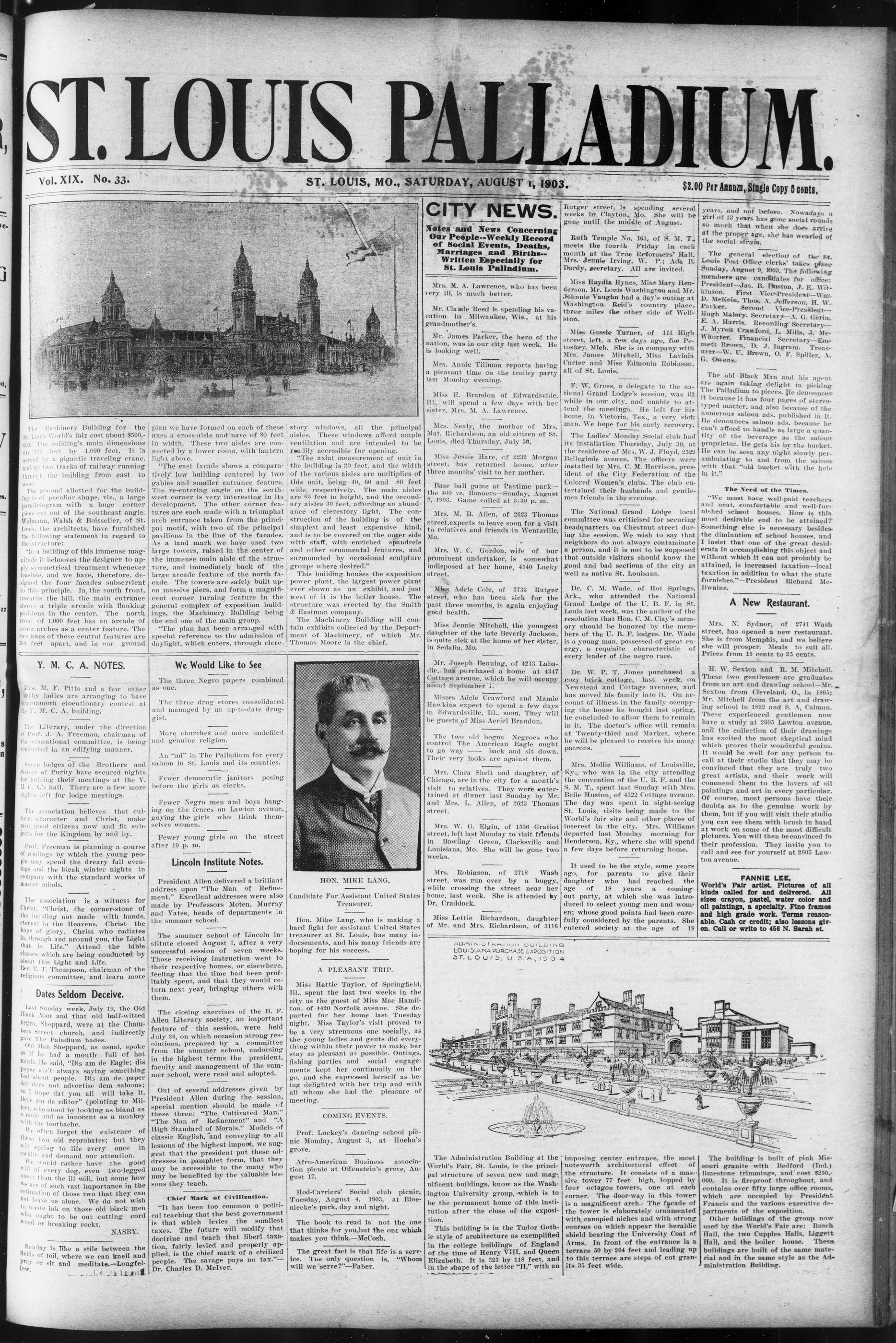
The Machinery Building for the St. Louis World's fair cost about $500, 500. The building's main dimensions are 255 feet by 1,000 feet. It is served by a gigantic traveling crane, and by two tracks of railway running through the building from east to west.
The ground allotted for the building is of peculiar shape, viz., a large parallelogram with a huge corner piece cut out of the southeast angle. Widman, Walsh & Boisselier, of St. Louis, the architects, have furnished the following statement in regard to the structure:
"In a building of this immense magnitude it behooves the designer to apply symmetrical treatment whenever feasible, and we have, therefore, designed the four facades subservient to this principle. In the south front, towards the hill, the main entrance shows a triple arcade with flanking pavilions in the center. The north front of 1,000 feet has an arcade of seven arches as a center feature. The two axes of these central features are 160 feet apart, and in our ground
Y. M. C. A. NOTES
Miss. M. F. Pitts and a few other mothy ladies are arranging to have 4 mammoth elocutionary contest at the Y. M. C. A. building.
The Literary, under the direction of Prof. J. A. Freeman, chairman of the educational committee, is being conducted in an edifying manner.
Seven lodges of the Brothers and Sisters of Purity have secured nights for holding their meetings at the Y. M. C. A.'s hall. There are a few more nights left for lodge meetings.
The association believes that culture, character and Christ, make men good citizens now and fit subjects for the Kingdom by and by.
Prof. Freeman is planning a course of readings by which the young people may spend the dreary fall evenings and the bleak winter nights in company with the standard works of master minds.
The association is a witness for Christ. "Christ, the corner-stone of the building not made with hands, eternal in the Heavens. Christ the hope of glory. Christ who radiates in through and around you, the Light that is Life." Attend the bible classes which are being conducted by about this Light and Life.
Rev. T. F. Thompson, chairman of the religious committee, and learn more
Dates Seldom Deceive.
Last Sunday week, July 19, the Old Black Man and that old half-witted negro, Sheppard, were at the Chambers Street church, and indirectly gave The Paladium hades.
Old Man Sheppard, as usual, spoke as if he had a mouth full of hot mush. He said, "Dis am de Eagle; dis paper don't always saying something bad about people. Dis am de paper dat does not advertise dem saloons; so I hope dat you all will take it. Dere am de editor" (pointing to Miller), who stood by looking as bland as a mule and as innocent as a monkey with the toothache.
We often forget the existence of these two old reprobates; but they will spring to life once in awhile and demand our attention.
We would rather have the good will of every dog, even two-legged ones; than the ill will, but some how we are of such vast importance in the estimation of those two that they can not leave us alone. We do not wish to waste ink on those old black men who ought to be out cutting cord wood or breaking rocks.
NASBY.
Sunday is like a stile between the fields of toll, where we can knell and pray or sit and meditate.—Longfellow.
plan we have formed on each of these axes a cross-aisle and nave of 80 feet in width. These two aisles are connected by a lower room, with lantern light above.
"The east facade shows a comparatively low building centered by two gables and smaller entrance feature. The re-entering angle on the southwest corner is very interesting in its development. The other corner features are each made with a triumphal arch entrance taken from the principal motif, with two of the principal pavilions in the line of the facades. As a land mark we have used two large towers, raised in the center of the immense main aisle of the structure, and immediately back of the large arcade feature of the north facade. The towers are safely built upon massive piers, and form a magnificent corner turning feature in the general complex of exposition buildings, the Machinery Building being the end one of the main group.
"The plan has been arranged with special reference to the admission of daylight, which enters, through clerse-
We Would Like to See
The three Negro papers combined as one.
The three drug stores consolidated and managed by an up-to-date drug-gist.
More churches and more undefiled and genuine religion.
An "ad" in The Palladium for every saloon in St. Louis and its counties.
Fewer democratic janitors posing before the girls as clerks.
Fewer Negro men and boys hanging on the fences on Lawton avenue, guying the girls who think themselves women.
Fewer young girls on the street after 10 p. m.
Lincoln Institute Notes.
President Allen delivered a brilliant address upon "The Man of Refinement." Excellent addresses were also made by Professors Moten, Murray and Yates, heads of departments in the summer school.
The summer school of Lincoln institute closed August 1, after a very successful session of seven weeks. Those receiving instruction went to their respective homes, or elsewhere, feeling that the time had been profitably spent, and that they would return next year, bringing others with them.
The closing exercises of the B. F. Allen Literary society, an important feature of this session, were held July 24, on which occasion strong resolutions, prepared by a committee from the summer school, endorsing in the highest terms the president, faculty and management of the summer school, were read and adopted.
Out of several addresses given by President Allen during the session, special mention should be made of these three: "The Cultivated Man," "The Man of Refinement" and "A High Standard of Morals." Models of classic English, and conveying to all lessons of the highest import, we suggest that the president put these addresses in pamphlet form, that they may be accessible to the many who may be benefited by the valuable lessons they teach.
Chief Mark of Civilization.
"It has been too common a political teaching that the best government is that which levies the smallest taxes. The future will modify that doctrine and teach that liberl taxation, fairly levied and properly applied, is the chief mark of a civilized people. The savage pays no tax."—Dr. Charles D. McIver.
ST.LOUIS, MO., SATURDAY, AUGUST 1, 1903.
story windows, all the principal aisles. These windows afford ample ventilation and are intended to be readily accessible for opening.
"The axial measurement of unit in the building is 20 feet, and the width of the various aisles are multiplies of this unit, being 40, 60 and 80 feet wide, respectively. The main aisles are 65 feet in height, and the secondary aisles 30 feet, affording an abundance of clerestory light. The construction of the building is of the simplest and least expensive kind, and is to be covered on the outer side with staff, with enriched spandrels and other ornamental features, and surmounted by occasional sculpture groups where desired."
This building houses the exposition power plant, the largest power plant ever shown as an exhibit, and just west of it is the boiler house. The structure was erected by the Smith & Eastman company.
The Machinery Building will contain exhibits collected by the Department of Machinery, of which Mr. Thomas Moore is the chief.
M. B.
Candidate For Assistant United States Treasurer.
Hon. Mike Lang, who is making a hard fight for assistant United States treasurer at St. Louis, has many indorsements, and his many friends are hoping for his success.
A PLEASANT TRIP.
Miss Hattie Taylor, of Springfield, Ill., spent the last two weeks in the city as the guest of Miss Mae Hamilton, of 4420 Norfolk avenue. She departed for her home last Tuesday night. Miss Taylor's visit proved to be a very strenuous one socially, as the young ladies and gents did everything within their power to make her stay as pleasant as possible. Outings, fishing parties and social engagements kept her continually on the go, and she expressed herself as being delighted with her trip and with all whom she had the pleasure of meeting.
COMING EVENTS.
Prof. Luckey's dancing school picnic Monday, August 3, at Hoehn's grove.
Afro-American Business association picnic at Offenstein's grove, August 17.
Hod-Carriers' Social club picnic, Tuesday, August 4, 1903, at Blooniecke's park, day and night.
The book to read is not the one that thinks for you, but the one which makes you think—McCosh.
The great fact is that life is a service. The only question is, "Whom will we serve?"—Faber.
ADMINISTRATION BUILDING
LOUISIANA PURCHASE EXPOSITION
ST. LOUIS, U.S.A., 1904
CITY NEWS.
Notes and News Concerning Our People--Weekly Record of Social Events, Deaths, Marriages and Births-- Written Especially for St. Louis Palladium.
Mrs. M. A. Lawrence, who has been very ill, is much better.
Mr. Claude Reed is spending his vacation in Milwaukee, Wis., at his grandmother's.
Mr. James Parker, the hero of the nation, was in our city last week. He is looking well.
Mrs. Annie Tillman reports having a pleasant time on the trolley party last Monday evening.
Miss E. Brandon of Edwardsville, Ill., will spend a few days with her sister, Mrs. M. A. Lawrence.
Mrs. Nealy, the mother of Mrs. Mat. Richardson, an old citizen of St. Louis, died Thursday, July 30.
Miss Jessie Hare, of 2232 Morgan street, has returned home, after three months' visit to her mother.
Base ball game at Pastime park—the 400 vs. Bonners—Sunday, August 2, 1903. Game called at 3:30 p. m.
Mrs. M. B. Allen, of 2623 Thomas street.expects to leave soon for a visit to relatives and friends in Wentzville Mo.
Mrs. W. C. Gordon, wife of our prominent undertaker, is somewhat indisposed at her home, 4140 Lucky street.
Miss Adele Cole, of 3733 Rutger street, who has been sick for the past three months, is again enjoying good health.
Miss Jennie Mitchell, the youngest daughter of the late Beverly Jackson, is quite sick at the home of her sister, in Sedalia, Mo.
Mr. Joseph Benning, of 4213 Labadie, has purchased a home at 4347 Cottage avenue, which he will occupy about September 1.
Misses Adele Crawford and Mamie Hawkins expect to spend a few days in Edwardsville, Ill., soon. They will be guests of Miss Aeriel Brandon.
The two old bogus Negroes who control The American Eagle ought to go way — back and sit down. Their very looks are against them.
Mrs. Clara Shelt and daughter, of Chicago, are in the city for a month's visit to relatives. They were entertained at dinner last Sunday by Mr. and Mrs. L. Allen, of 2623 Thomas street.
Mrs. W. G. Elgin, of 1536 Gratiot street, left last Monday to visit friends in Bowling Green, Clarksville and Louisiana, Mo. She will be gone two weeks.
Mrs. Robinson, of 2718 Wash street, was run over by a buggy, while crossing the street near her home, last week. She is attended by Dr. Craddock.
Miss Lettie Richardson, daughter of Mr. and Mrs. Richardson, of 3116
ADMINISTRATION BUILDING
LOUISIANA PURCHASE EXPOSITION
ST. LOUIS, U. S. A., 190
The Administration Building at the World's Fair, St. Louis, is the principal structure of seven new and magnificent buildings, know as the Washington University group, which is to be the permanent home of this institution after the close of the exposition.
This building is in the Tudor Gothic style of architecture as exemplified in the college buildings of England of the time of Henry VIII. and Queen Elizabeth. It is 325 by 118 feet, and in the shape of the letter "H," with an
Rutger street, is spending several weeks in Clayton, Mo. She will be gone until the middle of August.
Ruth Temple No. 163, of S. M. T. meets the fourth Friday in each month at the True Reformers' Hall. Mrs. Jennie Irving, W. P.; Ada B. Dardy, secretary. All are invited.
Miss Haydia Hynes, Miss Mary Henderson, Mr. Louis Washington and Mr. Johnnie Vaughn had a day's outing at Washington Reid's country place, three miles the other side of Wellston.
Miss Gussie Turner, of 111 High street, left, a few days ago, for Petoskey, Mich. She is in company with Mrs. James Mitchell, Miss Lavinia Carter and Miss Edmonia Robinson, all of St. Louis.
F. W. Gross, a delegate to the national Grand Lodge's session, was ill while in our city, and unable to attend the meetings. He left for his home, in Victoria, Tex., a very sick man. We hope for his early recovery.
The Ladies' Monday Social club had its installation Thursday, July 30, at the residence of Mrs. W. J. Floyd, 2529 Belleghade avenue. The officers were installed by Mrs. C. M. Harrison, president of the City Federation of the Colored Women's clubs. The club entertained their husbands and gentlemen friends in the evening.
The National Grand Lodge local committee was criticised for securing headquarters on Chestnut street during the session. We wish to say that neighbors do not always contaminate a person, and it is not to be supposed that outside visitors should know the good and bad sections of the city as well as native St. Louisans.
Dr. C. M. Wade, of Hot Springs, Ark., who attended the National Grand Lodge of the U. B. F. in St. Louis last week, was the author of the resolution that Hon. C. M. Clay's memory should be honored by the members of the U. B. F. lodges. Dr. Wade is a young man, possessed of great energy, a requisite characteristic of every leader of the negro race.
Dr. W. P. T. Jones purchased a cozy brick cottage, last week, on Newstead and Cottage avenues, and has moved his family into it. On account of illness in the family occupying the house he bought last spring, he concluded to allow them to remain in it. The doctor's office will remain at Twenty-third and Market, where he will be pleased to receive his many patrons.
Mrs. Mollie Williams, of Louisville, Ky., who was in the city attending the convention of the U. B. F. and the S. M. T., spent last Sunday with Mrs. Belle Huston, of 4322 Cottage avenue. The day was spent in sight-seeing St. Louis, visits being made to the World's fair site and other places of interest in the city. Mrs. Williams departed last Monday morning for Henderson, Ky., where she will spend a few days before returning home.
It used to be the style, some years ago, for parents to give their daughter who had reached the age of 18 years a coming-out party, at which she was introduced to select young men and women; whose good points had been carefully considered by the parents. She entered society at the age of 18
N
4
imposing center entrance, the most noteworth architectural effect of the structure. It consists of a massive tower 77 feet high, topped by four octagon towers, one at each corner. The door-way in this tower is a magnificent arch. The facade of the tower is elaborately ornamented with canopied niches and with strong courses on which appear the heraldic shield bearing the University Coat of Arms. In front of the entrance is a terrace 50 by 264 feet and leading up to this terrace are steps of cut granits 35 feet wide.
years, and not before. Nowadays a girl of 13 years has gone social rounds so much that when she does arrive at the proper age, she has wearied of the social strain.
The general election of the St. Louis Post Office clerks' takes place Sunday, August 9, 1903. The following members are candidates for office: President—Jas. B. Buston, J. E. Witkinson. First Vice-President—Wm. D. McKoin, Thos. A. Jefferson, H. W. Parker. Second Vice-President—Hugh Malory. Secretary—A. G. Gerin, E. A. Harris. Recording Secretary—J. Myron Crawford, L. Mills, J. McWhorter. Financial Secretary—Emmet Brown, D. J. Ingram. Treasurer—W. E. Brown, O. F. Spiller, A. G. Owens.
The old Black Man and his agent are again taking delight in picking The Palladium to pieces. He denounces it because it has four pages of stereotyped matter, and also because of the numerous saloon ads, published in it. He denounces saloon ads, because he can't afford to handle as large a quantity of the beverage as the saloon proprietor. He gets his by the bucket. He can be seen any night slowly peramubulating to and from the saloon with that "old bucket with the hole in it."
The Need of the Times.
"We must have well-paid teachers and neat, comfortable and well-furnished school houses. How is this most desirable end to be attained? Something else is necessary besides the diminution of school houses, and I insist that one of the great desiderata in accomplishing this object and without which it can not probably be attained, is increased taxation—local taxation in addition to what the state furnishes"—President Richard McLlwaine.
A New Restaurant.
Mrs. N. Sydnor, of 2741 Wash street, has opened a new restaurant. She is from Memphis, and we believe she will prosper. Meals to suit all. Prices from 15 cents to 25 cents.
H. W. Sexton and R. M. Mitchell. These two gentlemen are graduates from an art and drawing school—Mr. Sexton from Cleveland, O., in 1895; Mr. Mitchell from the art and drawing school in 1892 and S. A. Calman. These experienced gentlemen now have a study at 2605 Lawton avenue, and the collection of their drawings has excited the most skeptical mind which proves their wonderful genius. It would be well for any person to call at their studio that they may be convinced that they are truly two great artists, and their work will commend them to the lovers of oil paintings and art in every particular. Of course, most persons have their doubts as to the genuine work by them, but if you will visit their studio you can see them with brush in hand at work on some of the most difficult pictures. You will then be convinced of their profession. They invite you to call and see for yourself at 2605 Lawton avenue.
FANNIE LEE.
World's Fair artist. Pictures of all kinds called for and delivered. All sizes crayon, pastel, water color and oil paintings, a specialty. Fine frames and high grade work. Terms reasonable. Cash or credit; also lessons given. Call or write to 456 N. Sarah st.
```markdown
```
The building is built of pink Missouri granite with Bedford (Ind.) limestone trimmings, and cost $250,000. It is fireproof throughout, and contains over fifty large office rooms, which are occupied by President Francis and the various executive departments of the exposition.
Other buildings of the group now used by the World's Fair are: Busch Hall, the two Cupples Halls, Liggett Hall, and the boiler house. These buildings are built of the same material and in the same style as the Administration Building.
St. Louis: Palladium.
a. W. WHEELER, Editor and Manager,
BT, LOUIS, 2 MISSOURL
1903 AUGUST 1903
a [no | FOE | ww aOR | at. | a.
2| 3[ 4|°5] 6| 7| 8
9|10/11/12/13]14]15
16} 17/18) 19|20/21}22
23|24|25|26|27|28|29
20) TT
fi CURRENT COMMENT,
A king of England welcomed in Ire-
Jand and old Geronimo baptized as a
Methodist are good illustrations of
“Time works changes.”
A Chicago man endeavored to per-
suade his wife to live with him six
weeks every year. This summer and
winter resort habit is a bad thing when
it gets settled.
It is not known definitely just when
Doodling began in Missouri, but there
are good reasons for believing that it
Jost no time when it got started, says
the Kansas City Journal.
The Utah supreme court decided
that a man is under “moral but not
legal necessity” to support his plural
wives. Outside of Utah it looks more
like an immoral necessity.
State Entomologist Smith, of New
Jersey, who has dug ten miles of
ditches and stocked them with fish
for the extermination of mosquitoes,
says that Elizabeth will soon be a mos-
quitoless city.
ee
A Rochester man who was being em-
‘Dalmed rose and swore at the under-
taker. It is no use trying to palm off
an inferior grade of embalming fiuid
‘on the publie, Some people will get
right up off the table and out of the
shop. /
‘A Kentucky mob of whites lynched
@ white man last week and now an
East St. Louis mob of negroes attempt-
ed to lynch a black man. Obliteration
‘of the color line and objectionable
characters is going hand in hand—or
‘ant cenr hand .
‘The United States has 202,471 miles
of railway, or 46,288 more than the
British, German and Russian empires
combined, And the toot of the Ameri-
can locomotive is heard in all climes,
quite eclipsing the morning drumbeat
that keeps company with the hours.
Down in Kentucky they have just
Iynched a white murderer who was al-
ready in prison for life. Why is it so
hard to get 12 Americans to vote in a
jury room for hanging a prisoner by
Jaw and so easy to get 1,000 to pull on.
the rope that hangs him against the
law?
‘A contributor to a Sunday newspa-
per has discovered that the force ex-
erted in breathing for one week would
enable a man to lift up and balance an
elephant. Nothing but the Sunday
newspaper would sail into our faults in
this fearless manner and make us
ashamed of ourselves for wasting our
energy on breathing when we might
be using it to lift and balance ele-
phants.—Ottawa (Kan.) Herald.
‘Leo XIU. was distinguished for his
Jeanness. He was, it is believed, the
thinnest pope that ever lived. All of
his cardinals , with the exception of
Gibbons, are well-fed men, so that we
may look for some embonpoint in the
papal chair when the election takes
place. Before the time of Leo XIII. a
good, healthy expansive body was re-
garded as entirely popish. To be of
“pope's size” became not only a prov-
erb, but a trademark.
‘There are now in the United States
5,299 local building and loan associa-
tions, with a total membership of 1,-
590,707 and assets aggregating $577,
228,014, which is an increase of $11,
640,048 over last year. Illinois and
Missouri, which have for several years
past made an unfavorable showing, re-
cord the largest decreases. Missour!’s
assets in 1894 were in round numbers
$81,000,000, and are to-day a litle over
‘48,000,000. a decrease of $23,000,000.
It has been denied by the highest au-
thorities that any human being has
ever lived to be 110 years oid; and
these authorities have refused to be-
ileve that any person has exceeded the
age of 104. Although there have been
many centenarians who have pro-
fessed to be 120 years old, it must be
conceded that in no case has there been
documentary proof of the claim. It
‘has ben considered significant that ev-
‘ery very old person has been elther a
pauper or very poor, and so has not
been in a position to maintain docu-
mentary evidence.
Statistics gathered at national pro-
hibition headquarters show that the
prohibition movement has never scored
such progress anywhere in the country
as it is making of late south of Mason
and Dixon’s line. O. W. Stewart,
chairman of the prohibition national
committee, says that the southern pro-
‘hibition wave is largely due to the
eonstantly increasing feeling that
Liquor must be kept away from the
megroes and that public sale must ac-
cordingly be stopped. Prohibition is
thus a measure of self-protection on
the part of southerners.
SLIM REOUEN ASS.
‘The First of the. Three Great Re
| quiem Masses For the Repose
) of Pope Leo’s Soul.
| Se
= SCENE IN THE SISTINE CHAPEL.
The Entire College of Cardinals,
Diplomatic Corps, Roman Nobili-
ty and Other Distinguished Per=
sons, with Members of the Relig-
tou Ocaees fac Atteudames,
Rome, July 29.—The first of the
three great requiem masses, under
the auspices of the sacred college, for
the repose of the soul of Pope Leo,
was celebrated Tuesday morning in
the Sistine chapel. All the cardinals
now in Rome, the diplomatic corps,
the Roman nobility and many other
distinguished persons were present.
No such mass had been seen in Rome
since the death of Pius IX.
In the Sixtine Chapel.
In the Sistine ehapel stood a huga
white catafalque 30 feet high, and on
it, upon two scarlet cushions, rested
a triple crown of srold, shining bright-
ly in the light of a hundred candles.
‘The catafalque completely hid the
altar. Flanking the catafalque, on
benches specially constructed, sat al-
most all the members of the sacred
college wearing scarlet capes over
their violet robes. At their feet, on
stools, were the conclavists, or secre-
taries, in violet. In the narrow aisle
behind, between the benches and the
wall, the heads of the religious or-
ders, archbishops, patriarchs, mon-
signors and monks, knelt or stood in
picturesque confusion.
In the Gallertes.
In the gallery on the left were
about a hundred ladies, all in deep
black. In the right gallery were the
special missions, among them being
Sir Thomas Esmonde and Capt. Done-
lan, representing the Irish party in
parliament. Beneath the galleries the
priests and laymen who had been for-
tunate enough to secure tickets, but
who were not distinguished enough
for special places, were packed in dim
seclusion. Swiss ind noble guards,
chamberlains and other vatican offi
cials lined the aisle. Michael Angelo’:
frescoes on ceiling and walls seemed
merely faint reflections of the brik
liant maze of color that stretched be
low from door to altar.
‘The Matchiess Sixtine Choir.
‘The Abbe Perosi, Italy’s famous
oratorio composer, waved his baton,
and the silence was broken with the
notes of the Dies Irae. Those who
know the vatican well say the mateh-
less Sistine choir never sang as well
Wefore. Through the historie chapel
the voices of boys and men rose and
fell and swelled triumphantly as if
with songs of paradise, the voices dy-
ing away almost to a whisper at the
mention of death. Even the cardinals
stood spellbound at this perfection of
the Gregorian chant. Not a note of
instrumenta! music was heard
throughout the mass.
At the Altar.
At the altar Cardinal Serafino Van.
nutelli was assisted by Cardinals
Agliardi, Vincenzo Vannutelli, Satol-
ii and Richard, wearing white mitres
and glistening vestments. Satolli, al-
ways erect and swarthy, looked
doubly sober beside the feeble
frame and snow white head of the
aged Cardinal Richard, archbishop of
Paris.
As the fifty cardinals and 50 con.
clavists gathered around the cata:
falque and alternately knelt and rose
their movements resembled an amaz
ing kaleidoscope of crimson and vio:
let with colors so bright as to be al-
most trying to the eyes.
Singing of the Sanctus.
‘Then came the singing of the Sane.
tus, modulated almost into a whisper
All present knelt as the choir ceased
intoning its grand chant and the
dead silence of the consecration
which followed was suddenly broken
by the clash of arms as the noble
guards presented swords. Then there
was another clatter of arms, as the
soldiers’ scabbards clashed on the
marble flooring when they dropped
‘on one knee, lowered their swords
and brought their left hands to their
helmets in rigid salute.
Clouds of incense rose from the
censers until Michael Angeio’s fa-
mous “Last judgment” yas almost
hidden from view.
Elevation of the Host,
Suddenly the sharp tinkling of a
dell rang through the edifice and told
the worshippers that the Host had
been elevated.
‘At the conclusion of the mass the
choir again burst out into song and
Cardinal Serafino Vannutelli, preced-
ed by the cross-bearer, passed scl:
emnly around the catafalque after
sprinkling it with holy water Each
of the officiating cardinals followed
in turn and the ceremony was ¢on-
eluded with the chanting of the
Oremus.
Horse Thief Slain.
Guthrie, Okla., July 29—J. W.
Isham, a wealthy farmer of Caddo
county, shot and instantly killed Jim
Herrine, who had stolen borses in his
possession, Herrine was an excon-
vict, having served a term in the
Kansas penitentiary.
For Protection of Birds.
Atlanta, Ga., July 29.—The women
of Georgia can not hereafter adorn
their hats with birds, the legislature
Iuving passed the “Audubon” bill
for the protection of feathered song
gters.
LOYALTY EVERYWHERE.
Peasants and Landlords Torn Out im
Large Numbers to Greet King
‘and Queen of England.
Galway, Ireland, Aug. 1—King Ed-
ward, Queen Alexandra and their par
ty left Galway by train, Friday morn-
ing, for Kenmare, where they arrived
at 3p. m,, and met with an enthusi-
astic reception. Their majesties visit-
ed the convent and then rode in @
motor to Deeren house, the residence
of Lord Lansdowne, the foreign secre-
tary, where they were entertained by
his lordship. ‘The king and queen aft.
erwards proceeded to Berehaven and
embarked on board the royal yacht
Victoria. and Albert, bound for
Queenstown. ‘The weather was beau-
tiful, and the scenes witnessed Thurs-
day were repeated at all the stop
‘ping places, the peasants and land
a es oe al ores aas
giving even evidence of loyalty. ‘This
‘was especially noticeable at Limerick,
‘which was passed by the royal party
‘on their way to Kenmare. A great
erowd of people at Limerick gave
‘their majesties a most cordial greet-
‘ing.
WESTERN FRUITS IN LONDON.
Spectal Consignment of California
Pears and Plums Brings Good
Prices in London.
London, Aug. 1.—The big shipment
of specially packed California fruit
which arrived in England on_ the
American line steamer St. Paul,
‘Thursday, was sold at Covent Garden
Friday morning. There was a large
crowd present and the competition
was spirited, partly because of the ex-
cellence of the fruit and partly owing
to the shortage of the fruit crops in
France, Great Britain and elsewhere
in Europe. Five thousand, four hun-
dred and seventy-six cases of Bartlett
and Souvenir Dncongers pears sold
from 10s 6d to 13s a case. ‘Two thou-
sand nine hundred and forty-two
cases of plums were sold for 10s 6d.
‘The prices were an improvement over
those obtained in London heretofore.
SAYS MRS. FAIR DIED FIRST.
Woman Who Witnessed the Fair
Automobile Accident Declaren Mrs.
Fair Was Instantly Killed.
Paris, Aug. 1.—Mme. Tremblay, who
alleges that she witnessed the auto-
mobile accident by which Mr. and
Mrs, Charles L. Fair lost. their lives at
Pacy-Sur-Eure last August, was ex-
amined Friday afternoon. She posi-
tively declared that Mrs, Fair was
Killed on the spot and that her hus-
band's legs continued to twitch for
some seconds. Mme. Tremblay fur-
ther asserted that she saw two cy-
clists in the vicinity, but she was una
ble to identify the photographs of
Masse and Mauranne, and asked to
‘be confronted with them,
RUSSIAN WAY OF DOING IT.
Perminsion to Make Geological Re-
search Used ax a Pretext for
Milltary Occupation.
Cologne, Aug. 1.—The Cologne Ga-
zette says it hears from Chinese
sources that after secretly negotiat-
ing for permission to make geological
researches in Thibet, Russia sent sev-
eral hundred Cossacks into Thibet, as-
serfing that she has Chinese permis-
sion to march through that territory.
‘The Chinese government, the Gazette
adds, has informed its representatives
in Thibet that no such permission has
egn given, and that he must watch
Russian movements closely, while ab-
staining from forceful opposition.
SERIOUS FLOUDS IN AUSTRIA.
|Recent Heavy and Continuous
“Rains Have Rained Crops and
Many Dulldings.
Vienna, Aug. 1—Continuous heavy
rains in many parts of Austria are
damaging crops. Already most sert-
ous floods have caused great havoe in
the Jaegerndorf districts of Silesia.
Buildings have collapsed, crops are
ruined, and the loss is estimated at
several millions of kronen. At Baschi-
Kouty and Bucovina the rivers have
overflowed, and have submurged 50
houses and destroyed the crops, in-
Aicting immense loss on the poorer
classes of the nopulation.
PACIFIC COAST HOP GROWERS,
Movement to Secure Unity of Ac-
tion Among Hop Producers of
‘the Pacific Conat,
Tacoma, Wash. Aug. 1—Promé
inent hop growers of the Pacize
northwest are endeavoring to secure
unity of action among the producers
with the object of controlling this
season's production and foreing up
prices. Of the 30,000 bales produced
ast year, the growers now hold lest
than 3,000 bales, one dealer having
just purchased 3,000 bales in south
erm Washington and Oregon for di
rect export to England. Growers are
asking 15% cents per pound, witt
ekaecttea: aibcss at 35 canta.
Candidates for Yale.
New Haven, Conn., Aug. 1.—Seven
hundred and eighty-five young men
are candidates for admission to Yule
in the undergraduates’ entering
classes of next September. Last year
the total was 681. The academieal
department leads with 416 candidates
She Passed the Century Mark.
New York, Aug. 1—Mrs, Lydis
Hancock is dead at her home in
Palmer, Mass., at the age of one hun-
red years and one month, Until re
cently she kad been able t# read
without glasses.
MISSOURI STATE NEWS.
Ne Lives on Dividing Line.
‘Thomas J. Crist is a citizen of both
St. Louis city and St. Louis county.
Lhe dividing line between city and
sounty runs through Mr. —Crist’s
House and lot. In making the pur-
ghase it was necessary to file deeds
at Clayton cnd also at the St. Louis
sity hall. The lot is 31 feet 8 inches
by 140 feet, and the owner will have
to pay taxes om M1 feet 8 inches by
140 feet to the county authorities and
‘on 20x140 feet to the city. The dwell-
ing is so situated that the rooms on
the west half of the building are un-
ier county jarisdietion, while those
on the east side are urbam and the oc-
cupants thereof may owe allegiance
to Mayor Wells. Friends of Mr. Crist
have raised the question that should
he sleep on the west side of the house
would he be entitled to yote in a
municipal election, or if he makes his
bed on the east side of the residence
would he be permitted to vote in
county elections? The location of the
dining-room complicates the question,
for the law, in fixing the place of
one’s residence, takes into considera-
tion both bed and board. These prob-
lems do not worry Mr. Crist, who is
advised that in the matter of voting
he has his choice, though, of course,
he can not vote in both places. An old
statute gives him the right to declare
his place of residence. He will pay
taxes on the same home in both city
aoe DomniT..
This Dog Has Three Days.
‘A dead dog laid in the street in the
wholesale district of St. Louis for
three days. ‘The health department
was notified thirty times, and each
time replied that a wagon was on the
way and would remove the canine
within ten minutes. At last the
wagon arrived, and the driver gave
notice that he wou'd remove the dog
for the sum of fifty cents, He was
given the money. The stench from
the decomposed flesh caused a sus-
pension of business in the vicinity.
Sisters Drown Together.
Mrs. Lettie H. Shinn, wife of Will
jam, Shinn, and her sister, Miss Ruth
Bell, aged 14 years, daughter of M.
V. Bell, were drowned in the Osage
river, ten miles west of Warsaw. Miss
Bell and two little brothers were bath-
ing, when the girl stepped off a ledge
of rock into a deep hole. ‘The boys
attempted to rescue her. Mrs. Shinn
heard their cries and rushed into the
stream, but sank in the deep water,
and both were drowned.
ini eon Caen aes.
Otto C. Muchenberger, manager 01
the Kansas City house of the Western
Wall Paper Co., died while in bathing
at Lake Contrary, near St. Joseph. It
was supposed at first that he had
drowned, but physicians say that
death was caused by suppression of
the heart's action, whieh resulted
from the shock incident to a plvnge
tn the water.
Victims of Lockjaw.
Acting Mortuary Clerk Smyth, of
Bt. Louis, has prepared a statement
showing that during the month of
July there were sixteen deaths in the
city from tetanus (lockjaw), due te
the use of blank cartridges in cele-
brating the Fourth,
Mard Rains.
Tard rains have fallen over the
greater part of the state, and the
farmers are now greatly encouraged
over the prospect for fruit. The corn
erop will also be greatly benefitted.
Charges Breach of Promise.
Mrs. Mary Hemmen, a St. Louis
trained nurse, has sued William Ho-
bein, a retired Ilinois farmer, for
$15,000 damages for alleged breach of
promise to marry her.
‘Kistea tu Switekdhe Yara.
William Coatney, 55 years old, wat
run over by a train in the switehing
yards at Monett and instantly killed.
His head and one arm were severed
trom the body.
Kicked By a Pet Horse,
Wm. Ambruster, a former superin-
tendent of the St. Louis morgue, wat
probably fatally injured by a pet
horse which kicked him while rolling
on the lawn,
An Old Man's Fall.
Harry Hobson, aged 71, fell “twe
stories down an elevator shaft in St
Louis and sustained injuries which
were pronounced serious at the dis
pensary.
Cadet Appointed,
Representative John A. Woods hay
appointed Ernest Evans as cadet to
the Missouri state university from
Howard county for a term of twe
years.
Foreman Shot by a Nezro.
James Alexander, boss of a railroad
gang at Camp Eby, at work on the
Burlington cut-off near Wellsville,
was fatally shot by a negro laborer.
The New Binding-Twine Plant.
A site has been selected and work
will be commenced in the next few
gays on the new binding-twine fuc-
tery tc the Minbount penitenttare.
Two Thonsand Tons of Hay Burned,
Fire destroyed a large storage
honse of the St. Louis Hay exchange,
with 2,000 tons of hay and several
freight cars. Loss, about $35,000.
Injuries Proved Fatal.
Fred Gresham, aged 18, a street
railway conductor, died at Sedalia,
the result of being crushed in a col
lision between two cars.
Louis Millet Appointed.
Louis Julian Millet, of Chicago, has,
been appointed chief of the depart-
ment of mural and decorative painte
ing of the World's fain
COMMERCIAL CONGRESS,
Programme For the Transmississippi
‘Commercial Congress to Be
Held at Seattle.
THE PRESIDENT TO ATTEND BY PROXY.
Among Other Speakers, Many of
‘Them of National Reputation, Ad~
miral Dewey Has Been Aaked to
Speak on “Const Defenses and the
aes
Cripple Creek, Col., Aug. 1.—The
programme for the meeting of the
‘Trans-Mississippi_ Commercial _ Con-
gress at Seattle, Wash., August 18-21,
is about completed. Several distin-
guished gentlemen other than those
mentioned below have been invited to
Geliver addresses, and favorable re-
sponses are expected from a number
of them, President Roosevelt has
been requested, if he can not attend,
to designate some personal _repre-
sentative, to submit a paper upon a
topic of the president's selection. Ad-
miral Dewey has been asked to speak
upon “Coast Defenses and the Navy.”
‘The programme includes the fol-
lowing:
Addresses of welcome by the gov-
ernor of Washington and the mayor
of. Seattle.
Responses by President Kirby and
the governors and the ex-governors.
‘The annual address of President
John H. Kirby, Houston, Tex.
Addresses by the following:
Hon. George B. Cortelyou, secre:
tary department of commerce; “De-
partment of Commerce in Ks Rela-
tions to the Country. Its Future
Work.”
Hon. Porter J. McCumber, United
States senator, North Dakota, “Com-
mercial “Relations With the Nations
of the East”
Col. Ed. F. Browne, Colorado, “Gov-
ernmental Department of Mines and
Mining.”
Mr. J. J. Hill, president’ of the
Northern Pacific, “Oriental Trade.”
Hon. R. W. Richardson, secretary
National Good Roads association,
“Commercial Importance of Good
Public Roads.” The subject will be
discussed by Hon. M. 0. Eldridge, as-
sistant director of the office of public
road inquiries, department of agri-
culture, and Hon. James W. Abbott,
representative of the road division of
the government.
Hon. Thomas Richardson, of New
Orleans, “Immigration and its Distri-
bution.”
Hon. J. W. Riggin, Waco, Tex., and
Hon. W. H. Frankenberg, Colorado,
“Benefits of Irrigation.”
Hon, Truman G. Palmer, secretary
National Beet Sugar association, “The
Philippines.”
Von, Thomas M. Patterson, United
States senator, Colorado, “Alaska.”
The subject will be discussed by Hon.
Knute Nelson and other members of
the senatorial Alaskan commission.
Hon, Walter Gresham, Galveston,
‘Tex.; Hon. Alva Adams, of Colorado,
and E. 0. MeCormick, passenger traf-
fic manager of the Southern Pacific,
whose subject will be “American
Scenery and Its Influence Upon
‘Travelers.”
Herbert Strain, Montana, “Trade
Relations with Canada.”
Hon. F. B. Thurber, New York,
“Qur Export Trade—the Field of the
World.”
‘The joint committee on merger of
the ‘Trans-Mississippi Commercial
congress and the National Irrigation
congress will submit their report.
THE PRESIDENT’S VISITORS.
President and Commissioner Proctor
Discuss the Reinstatement
SS ae
Qrster Bay, N. Y., Aug. 1.—Secre-
tary Wilson remained at Sagamore
Hill a comparatively brief time. He
left on the 2:20 train for New York
en route to Washington. John TR.
Proctor, president of the civil service
commission, and Mrs, Proctor were
guests of the president and Mrs,
Roosevelt a part of Friday. The pres-
ident considered, with Commissioner
Proctor, the case of Wm. A. Miller,
who recently was reinstated in the
government printing office at Wash-
ington, as a foremm in the bindery,
by order of President Roosevelt.
‘The case, so far as the civil service
commission is concerned is a closed
incident, but Mr. Proctor is familiar
with the details of the matter since
the reinstatement of Miller. The
charges filed against Miller by the
bockbinders’ union which expelled him
trom membership will be investigated
in due course of time, but the indica-
tions are that their consideration will
not be hurried. The president, it can
be said, is interesed in the case, but
beyond his published letters to Seere-
tary Cortelyou, has made no public
expression concerning it. He is thor-
oughly informed on the case, how-
ever, and is cognizant of the charges
filed by the union against Miller
THE HOBART, ALABAMA, FIRE.
Four Blecks of Business Buildings
Burned At a Loss of One Hun-
dred Thousand Dollars,
Oklahoma City., Okla, Aug. 1—The
fire that started Thursday at Hobart
one of the new towns in the Kiowa:
Comanche reservation, was brought
under control at night after destroy.
ing four blocks of business buildings
including the Citizens. bank. The lost
4s now estimated at $100,000; “insur.
ance light, on account of poor fire
‘equipment.
ermNrEeED ITTY pcx... ™
BUNKER HILL Poisoning
Phe Death of Little Ewart Steary
fleld Under Investigation ye
os
Bunker Hill, Wl, Avg. 1p.)
tlosed doors the coroner's jury yy:
ls investigating the death of ig
Mears Cheeksfield, the six-yes.,
boy who is believed to havé beey oa
soned Wednesday evening, remaj
in session Friday night until shor
before ten o'clock.
‘The strictest secrecy is chseng
regarding the testimony secured ig
the jury. No one save the jurors ag
one witness at a time wax adningl
to the room during the sessions, |
Coroner Charles Robinson left tog
last night, and the inquest is
charge of James Rumbolz, foreiay,
the jury.
The witnesses examined incts
several playmates of little Ewar.
Their stories, it is vaid, related to
current report regarding a picce
poisoned candy a boy name big
Carroll is supposed to have had in iy
possession several days ago.
The statement that Ewart was pg
Soned by a woman living here is pes
erally believed. Her husband refos
either to deny or to affirm the repr
that his wife gave the Chee ‘ksfield bop
a piece of candy on the aftermg
‘that he died.
ME refuse to make any statenny
whatever. My wife is not at tine
a will not be home to-night. Shei
with friends.”
‘The boy's stomach, which wo x
‘moved at the. post-mortem examine
tion yesterday, is still in the poses
sion of Dr. R. E. Bley. It is said thy
it will be sent to St. Louis either
morrow or Monday for an analytic
examination.
The coroner's jury will convene t
aight at seven o'clock. It was expec
ad that a verdict would be reache
to-night, but for some reason the ju
is delaying.
It is thought that all the witness
who ean give any pertinent testimne
have, been examined, and the delay
causing surprise.
‘The absence of the coroner is 2
remarked upon, as no one appears
known why he left town.
MANY THROWN INTO RIVER,
Breaking of Bridge Throws Overt
Hundred People Into Kiver—
Lone Unknown, :
Portland, Ore., Aug. 1—Over om
hundred people were precipitated ins
the Willamette river by the break:
of a rection of the bridge. Rumox
of a large loss cf life are currest
though it is believed that not mor
than a few were drowned. Thousant
of people had congregated _on ‘he
bridge to watch Clarence Tut, =
ermless man, swim the river, shis
is about three-eighths of a mile wide
‘The people crowded against the n't
ing of the passenger track of the
bridge, which is an old stractyrs
Yust after Lutz reached shore #
sinall portion of the walk gave wy
and precipitated a mass of peop! +:
to a boathouse moored under the
bridge. Many people slid oif the bos
house into the river, but it is thought
almost all were picked up by the dor
ens of siall boats in the vicinity
DEATH IN PECULIAR MANNER
A Young Lady fnstantly Kitted
Fall of a, Stone Coping
‘Teesauel- ky Rightalas.
New York, Aug. 1.—Miss Birdt
Aarons has met death in a pecs!t
manner in Lexington avenue set
her home. She had called on a sit
friend and the two were standing
the stoop of the Lexington aventt
house when a portion of the bros
stone coping above them fell ax
struck Miss Aarons to the grou!
Her skull was crushed and she ‘ie
immediately. Investigation shox
that a bolt of lightning hed sired
the stoop in the heavy storm whit
had just passed. The shock bial free
tured the heavy stone and ieft i
hanging by only a small, undroket
part.
A DARING ROBBERY.
‘Thieves Steal Two Trayes of Dit
monds While Store ts Fell
aa laaplie.
Chicago, Aug. 1.—While the jewel
store of Louis Weber, at Clark
Harrison streets, was full of
tomers, Friday night, robbers &
tered the basement of the place, 2"
cutting holes through the floor a!
the raised platform between the ot
er and inner show windows, stole te
trays of diamonds valued at 5%
Gaining access to the basemett
through a vacant store in the Te
‘the thieves sawed a hole in the fot
back of the show window lan
enough to permit a hand to be pi*
upward where the jewels lay. T™
plush covering the raised floor bs
of the window was cut away with?
knife.
NEGRO ROBERT LEE DEAD.
The Prime Cause of the Recent Met
at Evanavitie, Ind., Has 58°
cumbed to Hin Wound.
Jeffersonville, Ind., Aug. 1— kobe?
Lee, the negro who shot Molice™®
Louis Massey, at Evansville, .
and started the riot that resulte! ®
the death and injury of mans cit”
died here in prison Friday, {t se
effects of a wound in the [re
caused by @ bullet fircd by May
Lee's wife was killed by a *>
See dasa-cdtar tha rint.
To be a little girl of ten
Seems nice enough—to boys and men;
wonder if they ever tried
to argue from the other side?
I don't suppose they'd ever guess
The stiffness of a starched white dress;
wonder how they'd like the hooks—
Let alone the way it looks!
They never sit at home and sew,
and watch their brothers come and go;
a should not even like to say
That they would bear it for a day!
They do not know how hard it seems
To a girl still, in one's dreams,
To feel that one can never be
A drummer boy, or go to sea.
Our brothers say we're hard to please
Because we long for things like these;
They think it is a pleasant life
To wait until you're someone's wife.
When I'm a wife I'll gladly sit
At home, and cook and sew and knit;
But there's a lot of waiting when
You're a little girl of ten.
Our brothers do not seem to know
That waiting can be very slow;
You see, they've never really tried
To argue from the other side!
-Evelyn Sharp, In Westminster Gazette.
The KIDNAPPED
MILLIONAIRES
A Tale of Wall Street
and the Tropics A A
By FREDERICK U. ADAMS
CHAPTER XIV.—CONTINUED.
"It is very beautiful, but there are others I would rather look on just now," said Mr. Rockwell.
"Well, we will give it a housewarming," said Hestor; calmly ignoring the melancholy note in Mr. Rockwell's answer. "Let's see. The keys were to be left in a box under the second tree to the left of the big crow. Get us something we can dig with," he said, addressing one of the crow, who returned in a minute with a shovel from the furnace room of the "Shark." He dug at the base of the tree and soon struck a wooden chest, inside of which was an iron box with the key in its lock. Hestor opened the box and disclosed a lot of marks marked with labels.
"here they are," he said. "The world is ours!" He led the way to the bungalow. There was an air of earnest about the structure which said that it had but recently been completed. Scattered around were areas of lumber, paint pots and sawresses, which showed that no tenant had occupied the structure.
The first door was of wire screen going on the veranda. The entire wanda was enclosed in a fine wire room, as were all the windows. This way to exclude mosquitos and other insects. The door of the main building was next opened, and the party entered into a circular room about a feet in diameter. The floors were covered with matting, and the walls finished in burlaps. There was no furniture in this or in any other room in the bungalow. In the center of the ceiling there was a light and air area extending to the glass roof above, the upper floor being supported from the roof. This area was a circle 12 feet in diameter, the upper floor constituting a nine-foot gallery around the room. The kitchen and storeroom were in a building separated from the main structure. A wire netting passageway, with a protecting roof, connected the kitchen with the dining-room in such a way that communication was possible despite weather or insects, and at the same time the odors of the kitchen were avoided. A large cooking range was already in position. There also was an oil store.
"This is the dining-room, parlor and lounging room," explained Hestor, as they returned to the large circular room. "I suppose it is really the dining-room, but we will use it in any way we choose. There are 12 sleeping apartments, all opening directly on the veranda. Here is one of them. You will notice that each has its own bathroom."
"Where does th' water come from?" asked Mr. Morton, as he turned a faucet. A clear, cold stream of water rushed out at great pressure.
"We dammed up a brook on the hill back of here and made a reservoir," said Hestor. "The pipes lead directly to the building with a drop of 120 feet."
"All you need now is furniture and provisions," said Mr. Haven.
"You won't know the place by night," exclaimed Hestor. "You gentlemen make yourselves comfortable as you can. Explore the surroundings, or do what you please. This is my busy day," and Hestor dashed away towards the yacht. It was then about ten o'clock in the morning, and the sun was very warm in the open. Sidney Hammond, Mr. Carmody and Mr. Kent set out to explore the brook which rushed past the bungalow. Mr. Pence went back to the "Shark," and the other gentlemen wandered around or rested under the shade of the trees.
In the meantime the hull of the yacht was disgorging an unexpected volume of boxes, barrels, chests and crates of all descriptions. Brass bedsteads, chairs, sofas and various articles of furniture came to light and were borne away to the bungalow by the sailors. There were bar-
rels of flour and crackers, barrels of oil, lamps and lanterns, and an endless variety of cooking utensils. There was also a barrel which Mr. Vincent handled tenderly, and that gentleman took special care of crates containing bottles of claret, beer and Burgundy, to say nothing of cigars, tobacco, sherries, cordials, brandies and liquors. Mr. Vincent arranged these in order, and then stood and gazed lovingly at the imposing array.
And still the sailors brought new treasures from the hold of the "Shark." There were library shelves, pictures, mirrors, bric-a-brac, a piano and the parts of a billiard table. There were guns, revolvers and cases of ammunition, together with rods and an assortment of fishing tackle. A huge chest contained a complete set of carpenter's tools. There were numberless articles of necessity and comfort, including a variety of canned foods, jellies and jams, and smoked and cured meats, of which a grocer or market-man might have been proud. These were placed in the storehouse, which was provided with a huge cave which served as a cellar, through which a branch of the brook had been diverted to keep it cool.
By one o'clock all of these articles had been deposited, either in the various rooms or on the broad verandas. Luncheon was served on the yacht, and the crew returned to their task. Mr. Kent and Mr. Rockwell took a hand in the work; so did Sidney Hammond and Mr. Haven. Mr. Carmody took charge of the arrangement of the pictures, while Mr. L Sylvester Vincent devoted his time to the perfection of the storeroom. Mr. Morton remained on board the yacht for awhile, and then rejoined the busy party. It was warm, but he entered into the spirit of the affair and was soon at work.
"You will find in one of the boxes a great assortment of linen clothing and other wear suitable to this climate," said Hestor. "There are cork helmets and all of the devices to protect you from the glare of the sun. There is also a gas engine and a small dynamo sufficient to run electric fans, which my men are now setting up in the powerhouse adjoining the storeroom. We will have it installed before night. Next
"WE ARE LOST"
year. I am going to have electric lights, but this season we must put up with lamps. We will have things in shape so that we can sleep ashore to-night. We will take dinner on the yacht this evening, and this will be your last meal afloat for some time."
After dinner the tide had so far receded that Capt. Waters made ready to drop the "Shark" into deeper water. Hestor and his guests returned to shore, and the yacht glided out into the bay. Its great searchlight, later in the evening, swept around the amphitheater and aroused a chorus from birds and a roar from prowling animals. Mr. Pence declared he saw the flaming eyes of some wild beast through the palm trees, and was not at all reassured when Hestor informed him that it was nothing but a puma or "mountain lion."
"They are as common as rabbits around here," he said. "If you leave them alone they will not bother you. They probably smell the meat in the storeroom."
All were weared from the day's work, and at a little after nine o'clock it was decided to retire for the night. Hestor shook hands with all and grasped Sidney Hammond's hand with an earnest clasp. He again expressed the hope that they would enjoy their visit, and bidding them good-night retired to his room.
At five o'clock the following morning the captives were aroused by a great outery, and hammering at the doors of their rooms. They found Mr. Pence rushing up and down the veranda, wringing his hands and moaning in terror.
"The boat is gone!" he cried.
"The Shark' has gone away and left us! We are lost! We are lost! We are lost!"
"Oh, shut up!" said Mr. Kent and he went back to his couch, and was soon asleep. Mr. Walter B. Hestor, owner of the "Shark," and special envoy and correspondent of The New York Record, was not in his room. There was no trace of the "Shark" in "Morton's Bay." The millionaires were marooned.
CHAPTER XV.
ON SOCIAL ISLAND.
Had a visitor dropped in on the eight occupants of the Hestor bungalow at seven o'clock that Wednesday morning of the tenth day of May, he would not have imagined they were marooned. Even Mr. Pence had recovered his spirits if not his courage. The cooling waters of a bath infused new life into the millionaire castaways, and at six o'clock all of them, except the phlegmatic Mr. Kent, were assembled in the main room of the bungalow; that gentleman making his appearance half an hour later.
"Gentlemen," said Mr. Palmer J. Morton, "we will have plenty of time
to discuss our situation and to formulate plans. After consulting my stomach, I am of the opinion that the first problem is that of breakfast."
"Yes, and unlike many castaways of history and of romance, we should not have great difficulty in satisfying our hunger," observed Mr. Rockwell.
MARGARET, OBSERVED MR. ROCKWELL
"Mr. Vincent, you are familiar
with our resources in the matter of
food," said Mr. Morton. "Suppose
you see what can be done in the way
of breakfast. I imagine there is
plenty of cold stuff which will serve
for the present. Later we will
organize our forces and perhaps do
better."
"I will help Mr. Vincent," said Sidney Hammond. "You gentlemen retire to the veranda and give us the use of the dining room and kitchen for half an hour or so, and we promise you will not starve."
While the others strolled down to the landing where the "Shark" once rested, Sidney and Vincent took possession of the culinary part of the bungalow. They soon found the table linen, and Sidney arranged the plates, knives, forks, spoons and cruets, while Vincent was busy building a fire in the kitchen range. From the cave Vincent produced two dozen eggs, a part of a large stock which had been kept in the refrigerators of the "Shark," and which were so packed that they would remain fresh for weeks. He brought up ham and bacon and potatoes. There was also a dozen loaves of bread from the stores of the yacht, and plenty of sea biscuits. The coffee pot was soon boiling, and its pleasing aroma filled the kitchen. There was an unlimited supply of condensed milk.
"I have always bragged about being a good cook, and here is where I am put to the test," said Sidney, as he sliced several loaves of bread and prepared to make toast. Vincent remembered there was a supply of grape-fruit and oranges.
"Serve both of them," said Sidney, "That means finger bowls. Have we any finger bowls?"
"Sure," answered Vincent, as he made them ready.
In less than half an hour Sidney stood in front of the bungalow and rang a dinner bell which had been found by the inquisitive Mr. Vincent. In the meantime Sidney stepped to the rear of the building and plucked a big bouquet of flowers, which now adorned the table. A massive water service, silver butter dishes, and an imposing array of glass and china were set off by the spotless linen and flowers.
"Be seated, gentlemen," said Sidney.
"This is magic," said Mr. Rockwell.
"If your menu is as good as your service, we are indeed fortunate."
All were surprised and delighted. Sidney touched a button and set two electric fans in motion. They found the grape-fruit delicious, and Mr. Kent declared that the oranges were the best he ever had tasted. A few minutes later L. Sylvester Vincent entered with a huge platter of poached eggs, cooked to perfection. Sidney followed with crisp, bits of bacon and a generous installment of broiled ham. Mr. Morton clapped his hands and proposed three cheers and a vote of thanks for the cooks. They were given with a will. Then all fell on the viands. But the cooks were not yet through. They served French fried potatoes and Saratoga chips, vast piles of buttered toast, jars of jam, and to crown all, Vincent brought in the steaming coffee pot and made the feast complete.
"We have no cream, but this condensed milk is not bad," said Sidney.
"Make no excuses," said Mr. Kent. "You and Vincent are the kings of chefs. Talk about your Waldorf-Astoria. It isn't in it!" The cooks joined in the breakfast, and it was a hungry and a merry party. Mr. Morton sat at the head of the table and was in splendid humor. "You don't seem to be lost now, Brother Pence," said Mr. Kent, as he helped that gentleman to another portion of bacon and eggs. "You certainly have found your appetite." "You let Pence alone," said Mr. Morton. "We will make you cook the next meal as a punishment."
"Perhaps you think I can't cook?" said Mr. Kent, defiantly, "You don't know what I can do!" "I do," said Mr. Haven. "Pass the sugar, please."
Mr. Kent smiled in a sardonic manner at Mr. Haven, and continued by saying that when a young man he had served as cook for six months in a western mining camp. Breakfast over, they adjourned to the veranda; Vincent volunteered to clear the table and look after the dishes. For an hour he was a busy man. He donned an apron and washed and wiped the dishes, and stored them away in the china closet. During this operation he smoked a large imported cigar. Every once in a while his face would wreathe in smiles. When his task was ended he lit a fresh cigar, and joined the rest of the party which was grouped on the west veranda, engaged in conference.
"We must divide our work and assign each member of the party a certain responsibility," Mr. Morton was saying. "In the first place we must ascertain, as near as possible, where we are, and then devise means to return to our homes. We may as well dismiss this man Hestor and his yacht from any further consideration. If not crazy he is a villain, and in either case we have little to hope from him. We must explore this island, and then see what can be doff. About where do you suppose this island is located, Mr. Hammond? I have my own idea, and I would like to hear from others."
"We are somewhere in the West Indies, or in the Gulf of Mexico or the Carribbean Sea," said Sidney. "That is rather an indefinite answer, I admit, but we should be able by timing the sunrise by our watches—which are set by New York time—to tell about how far west we are, and possibly we can make a calculation which will determine our approximate latitude. I am inclined to think we are well to the west of Cuba, and not many hundred miles from the Mexican or Central American coast."
"I entirely agree with you," said Mr. Morton. "I kept as close a watch of the direction taken as possible. Monday was cloudy, but I am sure that on that day and on a part of Sunday we were going in a westerly or southwesterly direction. I figure that we ran about 124 hours on a fairly direct course to this island. The 'Shark's' course was erratic only when Capt. Waters was avoiding other craft. Now, if we averaged 20 miles an hour, that would make a total of 2,430 miles. It may be 100 miles either way from this estimate."
Sidney produced an atlas from the library, and all pored over the map of North America, as if demanding a solution of the puzzle from the tinted page.
"You will not solve the problem of where we are at by gazing at that map," said Mr. Kent. "There are thousands of islands in the West Indies which are not on the map, and we may be in any one of them."
"Here is something that may be of service to us," said Mr. Morton, who had been absent for several minutes. "I took a notion to examine the room occupied by Mr. Hestor last night, and I found this on the dressing case."
Mr. Hestor unrolled a sheet of manila drawing paper containing a well-executed map labeled "Hestoria." It was spread out on the dining table and examined amid much excitement.
"Here is what Hestor named 'Morton Bay.'" said Mr. Carmody, pointing to the pear-shaped lake, "and the black L is the bungalow. Here are the hills which surround the lake," said Mr. Carmody pointing to the shaded portions of the map, back of the bungalow and around "Morton Bay."
"This is not a complete map of the island," said Sidney Hammond. "It is merely a detailed map of the immediate surroundings of the bay. There is the reservoir he spoke about, and here is the brook which passes the bungalow. Let's see if we can find any other map in his room."
A VILLAGE BLUCHER.
Resourceful Editor of a Country Paper-Successful Plan for Raising Money.
Just what would have happened at Waterloo if the Prussians had not come up just when they did is still a matter of conjecture. It is less difficult to determine what would have happened at a certain town in Kansas, if a certain editor had not driven up at the right moment.
This editor, as he is described in the Kansas City Journal, is the versatile, resourceful manager of a country paper. He sweeps out his office, kindles fires, sets type, makes up the forms, wets down the paper, inks the roller, pulls the hand-press, kicks the job-press, solicits advertising, gathers news items, writes editorials, and lives the soberer life of a private citizen.
Not long ago a violent hail-storm broke the window-lights of all the churches of the village. The pastors were at their wits' ends to know how to raise money to make the necessary repairs. In the course of the morning following the disaster they called in a body on the editor for advice. After thinking briefly, he said: "Advertise a hail-storm union social for to-night. Gather up the hailstones and freeze ice cream with them. I'll print handbills for you to circulate." The scheme was adopted. The novelty of eating ice cream frozen with ice that had dropped from the clouds brought out the whole town, and now the churches in that town have new window-lights.
The Exact Truth.
Mr. Douglas Grand, who was the principal witness for the crown at the remount trial at Ennis, tells a good story regarding the examination of one of the witnesses. "Did you sell Major Studdert a horse?" asked the counsel.
"No, sorr," replied the witness.
"No, sorr," replied the witness.
"Did your father sell Major Studdert a horse?"
"No, sorr."
"Well, then, did your grandfather sell Major Studdert a horse?"
"No, sorr."
"Did any member of your family sell Major Studdert anything?"
"Yes, sorr, I did," replied the witness.
"And what did you sell Major Studdert?"
"I sold him a mare," replied witness, to the chagrin of counsel and the delight of the court.—London Express.
Encouraging Him
"There is only one reason why I have never asked you to be my wife." "What is that?" "I have always been half afraid you might refuse." "Well (in whisper, after a long silence), I should think you'd have curiosity enough to want to find out whether your suspicion was well founded ar not!"—Tid-Bits.
RELIGIOUS MATTERS
"HIS FATHER SAW HIM."
"When he was yet a great way off, his father saw him and had compassion."—Luke 15:20.
Thy Father sees thee, weeping one,
Returning home by sin undone;
There is no anger on His brow,
His heart is filled with gladness now.
He saw thee take the road of sin,
And mourned to see thee walk therein;
He saw thee down among the swine,
And pitied thee, when husks were thine.
He saw thee when with tear-filled eyes
Thine heart excalled: "I will arise,
Confess the sin that I have done,
nworthy to be called a son."
O weary heart and desolate,
O fearful reverie wait;
Returning home, what joy is thine,
And deeper yet the joy divine!
—Robert M. Offord, in N. Y. Observer.
BUSINESS AND RELIGION.
Can a Merchant Conduct His Affairs on Christian Principles?-The Answer of Experience.
It is possible, of course, to do business on Christian principles. But would it pay? Rather, says the Boston Congregationalist, we would like to ask, if we could hear from our Christian merchants, does it, in their own experience, pay? For if men who call themselves Christians in their homes and in the church are unchristian in the hours of business there is little hope of progress for the church. We are utterly skeptical of the Christianity which such men accept. They may in some sense hold Christianity; but what is wanted is a Christianity which holds and directs and possesses them. For a true disciple of Jesus Christ cannot be built like a modern ocean-going steamer in watertight and non-communicating compartments, one for the business and the other for the religion of the owner; one to be inhabited on ordinary days, another on Sunday; one for the financial relations of life, the other for a retreat in the wreck of earthly hopes.
The hindrances to the Christian conduct of business are admittedly great. Competition is keen and often unscrupulous. Stories of sharp practice are common and almost every one has frequent experience of the so-called tricks of the trade by which men seek to increase their profits—or often to save themselves from loss. In some trades it must be acknowledged, we fear, that to be honest is to be singular. Great businesses are built up by methods which violate the laws both of God and man, and Christians are often partners in them. The consciences of men are blunted, the problems to be solved grow steadily more complex. The worship of success misleads the mind both directly and through the needs and claims of those who are dependent on us. It is no easy task to serve Christ and pile up a fortune.
Yet by the acknowledgment of the commercial world personal honesty is the best kind of capital. There are countries in the world whose reputation for honesty secures them trade, and others from whom men only buy with caution and in case of need. No man willingly goes back to a shop where he has once been cheated. The unvarying quality of goods in the long run is the best advertisement. Even the great monopolies are eager to assert that in ruining competitors they have in view uniformity and a high quality of product. The rewards of efficient honesty, if it can secure a hearing, are both great and permanent.
Here is one of the great trials and temptations of the soul. The rewards now are for him who succeeds, honestly if possible, but for him who succeeds. Yet the real and permanent reward is not in what we win, but in what we do and become. The business of our lives is formative. It creates or it destroys our capacity to enjoy the higher life which is like Christ and which some day is to become the prevailing and the honored life. Can the Christian afford to crave or to secure any other form of success than this?
SEEDS THAT WILL GROW
Ourselves become our own best sacrifice.—Richard Crashaw.
Imperfect discipleship means coldness of love. To speak of cold love is much like speaking of cold fire, and the very difficulty of giving expression to the idea shows how unnatural it is.
—William L. Watkinson.
Glad, grateful, single-minded worship of the All-Father revealed in Jesus Christ; the self-committal of ourselves to the ideal of which our blessed Lord is the expression, is a primary necessity for all great Christian advance.—R. J. Campbell.
The next revival of religion will stand, I have no doubt, for the recovery of personality. Religion will call men back to its service, and will accept nothing in place of themselves. One cannot give money or anything else with the same passion with which he gives himself. All other forms of consecration are secondary-valuable, but secondary.—William J. Tucker.
I can only say that the true part of a man, in relation to God, seems to me to be to give all that is claimed and claim nothing that is not given. And I profoundly believe that whoever will cheerfully surrender himself to the daily duty and the prayer of faith will not long be left in the shadows, but will emerge into a light which he knows to be divine.—James Martinean.
FLEEING FROM FRIENDS.
Restraints and Commands Often Contain Blessings Which Are Lost by Our Continual Chaing.
Much is lost through ignorance. Lack of acquaintance has shut out many a possible friend. Often do we turn away from real sources of help and from mines of riches, just because we do not know that help and riches are at our side or beneath our feet. For years a poor man made a meager living on a stony farm in the northern part of New York. But riches came flowing into his hand when he was made acquainted with the character of the great ledges that peeped from the soil and turned the point of his plow. Ledges of splendid granite were friends that had been looking up at him, but it was years before he came to know them.
Many a young person, says Philadelphia Young People, frowns, fretts and fights, where knowledge would bring smiles of glad peace. Restraints are rebelled against. Who listens to commands as to friends? Who thinks of obedience as other than trial and burden? There is rebellion against a fixed word and a definite way. But all nature as well as God's word declares that commands or laws come to lighten our ignorance and to give larger views of our surroundings and opportunities. Commands and laws are splendid teachers.
Commands are more than this. The other side of every command is a promise. It always has something to bestow after obedience has been rendered. He who in right spirit obeys a command always gets something for himself that could not have come to him without that obedience. Obedience is too often thought of as something given to another, but it is something given to self as well.
The seed in your hand is a command while you hold it. Sown, it is a promise. In your hand it says: "Sow me! Sow me!" In the soil it turns with the cry: "I will give you! I will give you!" But this is promise. It does give. It gives either added quantity or added quality. Sometimes it gives both. The corn of wheat dropped into the soil returns in like kind a larger quantity, thirty, sixty or an hundred-fold. The flower seed gives you color, beauty, fragrance. This is quality of higher kind. Often the flower gives you the handful of seed besides.
Young people make a grave mistake when they rebel against commandments of either God or man. The commandment that has a right to our obedience never robs us, nor can it do so. It always has something to give. The commandment may seem like an uglyledge in our farm land, but closer acquaintance will uncover our wealth. We flee from friends when we avoid restraint or command.
FINISHING THINGS.
We Are Too Prone to Leave Incomplete the Work We Have Began
—The Stendy Push.
It is only unto him who finishes the course, who runs to the end, that the crown of life will be given. But the saying is of much wider application than we commonly accept. There is a sense in which it is true here "below," as well as yonder, "above." The half-finished house which Jesus saw, which may have furnished Him with His parable of the man who began to build and was not able to finish, stands for large meaning to every age, and never more suggestive than to the present day. What a bewildering list of things begun—which have never been finished. The patent office has more designs which represent beginnings than completed tasks. Here is a man who has a new scheme every time he meets you. He is as sickle as Col. Sellers, of Asiatic eye-water fame. His plans scarcely get cold, but what he discards them, and he has something else to show you. He seems to cosider that his genius is in dreaming out new schemes, and it must be admitted that he fairly shines with them; a new star rises in his sky with every passing day. He has given his attention to the discovery of new things, leaving him no time for the working out of any of them. He cannot stand the steady push to a "finish." You can tell by his step and movement that he will never do a great thing because he is bothered by so many little things. This vitiated taste for variety has almost proved the ruin of much well-meant service in the kingdom of God. A man gets on the track of novelty, and never runs far with anything, the outcome being that his novelties pall on the taste, and he has nothing left with which to tickle the deprived public appetite. Would it not be better to take fewer things and move them on to completion? There is the genius of novelty, but it does not belong in the same catalogue with the genius of hard, steady, patient plodding—until the end is in sight. Amiel said, "That which is not finished is nothing."—Baptist Union.
Need Unfettering.
As one looks round upon the community to-day, how clear the problem of hundreds of unhappy lives appears! Do we not all know men for whom it is just as clear as daylight that that is what they need, the sacrifice of themselves for other people? Rich men who with all their wealth are weary and wretched; learned men whose learning only makes them querulous and jealous; believing men whose faith is always souring into bigotry and envy; every man knows what these men need; Just something which shall make them let themselves go out into the open ocean of a complete self-sacrifice. They are rubbing and fretting and chafing themselves against the wooden wharves of their own interests, to which they are tied. -Phillips Brooks.
St. Louis Palladium.
PUBLISHED EVERY SATURDAY.
Entered at the postoffice at St. Louis,
Mo., as second-class matter.
Manager and Proprietor.
JOHN W. WHEELER, JR.,
General Collector and Solicitor.
MISS BEATRICE ROSS, Secretary.
2617 Lawton Avenue.
MISS KATE JOHNSON.....Editor.
JAMES HUSTON.....Religious Reporter.
Business matters pertaining to the
paper should be addressed to The
Palladium Office.
Communications for publication
must reach us not later than Wed-
nesday.
ADVERTISING RATES.
For one inch, one insertion.....$ 50
For one inch each subsequent
insertion..... 25
For two inches, three months..... 6 00
For two inches, six months..... 10 00
For two inches, nine months..... 14 00
For two inches, twelve months..... 20 00
Standing and transient notices
per line..... 10
RATES OF SUBSCRIPTION.
Per year.....$2.00
Six months.....1.00
Three months......60
Single copy......05
No Excuse for Non-Payment.
From the present time on, all who live south of Scot t avenue, will please settle their St. Louis Palladium bills with Miss Kate Johnson, 2627 Papin street.
Mrs. M. A. Lawrence, of 3944 St. Ferdinand avenue, is the Reporter and General Solicitor for the St. Louis Palladium.
SEVEN POINTERS FOR THE READING AND ADVERTISING PUBLIC.
(1) THE ST. LOUIS PALLADIUM IS in its 20th year of regular publication.
(2) Never has missed an issue.
(2) Never has missed an issue.
(3) No fake subscription list to "catch" honest advertisers.
(4) More bona fine subscribers than any other Negro paper in St. Louis or State.
(5) The ONLY Negro newspaper published in St. Louis as the organ of the Republican party.
(6) Because it is the official organ of Wright Cuney Political Club.
(7) Because it is fearless in denouncing crime regardless of consequences.
The St. Louis Palladium is sold at the following places:
2617 Lawton avenue.
209 South 15th street.
1208 Wash street.
2652 Lucas avenue.
Charleston, Mo.
West Plains, Mo.
3104 State street, Chicago, Ill.
The editor of the St. Louis Palladium desires to inform Mr. B. H. Forrest, of 4725 Chestnut street, New Orleans, La., that she is no relative of the person mentioned. She hopes, however, that the gentleman will be successful in finding his relative, and volunteers her assistance to nid him, if desired.
AMERICAN LITERATURE
Vast Majority of Our Reading Practically Worthless from a Literary Standpoint.
A cursory glance through the various magazines of the day presents to the reader a very discouraging outlook and yet one which has been long expected. With a few exceptions, the vast majority of our reading matter is practically worthless, from a literary standpoint. It is a mere dainty bubble, good only for a few short moments, and then breaks and is gone. It has no stability, no worth, expresses no meaning, teaches no lesson.
The world of to-day, so far as literary pursuits are concerned, is like a small child who reaches for the sweets and lets the solid foods go untouched. Pleasure first, by fair means or foul, is the motto of the present day generation. And the majority of our publications are awakening to this fact and preparing to cater to the public taste. Periodicals that have hitherto occupied a distinguished place among the literary guides have abolished to a certain extent all matter that would be helpful and needful to mankind for the lighter style of work. Even those who still cling to the old idea of giving food for thought to the serious-minded reserve some space for love stories, light poetry and the like, all of which, sooner or later, will encroach upon the other's territory until it entirely occupies the pages of the periodical.
As a matter of fact, we take life too lightly. Few really seriously consider the tasks set before them. If any conscientious thought presents itself, we push it aside for some frivolous, idle notion that can do no good and may bring harm, says the Memphis Commercial-Appeal. Literature has for ages been looked upon as one of the highest branches of man's education. It is the means whereby the persons most fitted for the task may give to the world such truths and teachings as are necessary to their intellectual life. And no one can gainisay the fact that without the literary efforts of the few of our older writers latter-day scribes would not occupy the positions they now fill.
Hoss and Hoss.
Nell—He married her for her beauty, but she hasn't much left.
Belle—And she married him for his money. So they are in the same boat. Philadelphia Record.
[Name]
First Baptist Church Notes.
The Carnation club gave a Japanese wedding entertainment last Tuesday night. It was well attended, which made it quite a success. Prof. Wm. D. Acklin suggested the wedding.
The B. Y. P. U. of the First Baptist church held its regular weekly meeting last Sunday evening at six o'clock, and the usual programme was carried out. It was decided, by unanimous vote, to send Mrs. Annie R. Davis to Philadelphia, as a delegate to represent the Union of the above church in the national convention, which will be held there in September next.
The Pleasant Workers' club of the First Baptist church gave their trolley party, as advertised, to Creve Coeur lake, on Monday night, the 27th. They had two cars well filled with some of the most representative Neertes in the city. Everyone had a good time. The club will run another trolley party next week. The following are some of those who attended: Rev. E. C. Cole and wife, Capt. W. H. Butler, Madame M. A. Gilree, Mrs. Sophia Edwards, Mrs. Minnie Turner, Mr. and Mrs. Gilbert Brown, Zenobia Brown, Madame Addie Hairston, Mrs. Lizzie Harris, Mrs. Addie Johnson, Mrs. Etta Brachet, Mrs. M. J. Grant, Mrs. Julia Townsend, Mr. and Mrs. F. De France, Miss Nora Lee, Mr. and Mrs. H. Rhodes, Mrs. Lillian Graves, Miss Irene Hairston, Mr. J. M. Valentine, Mr. H. W. Hause, Mr. Henry Hall, Mr. Willie Carnell, Mr. James S. Williams, Miss Lottie Wilson, Mr. A. P. Brown, Mr. A. W. Cobbs, Mr. J. G. Epps, Mrs. Alice Washington, Mrs. Otto Berry, Miss Bertha Smith, Miss Anna Thomas, Miss Bertha Thomas, Mrs. Fuqua and daughter, Mrs. S. P. Philips, Mrs. J. Brown, Miss C. Kirkley and Mr. John H. Gates.
The returning home of Rev. E. C. Cole and wife, from the west, last week, was the beginning of a new epoch in the history of the First Baptist church, from the very fact, quite a large crowd turned out last Sunday morning and evening to greet him. Rev. B. Levister preached at 11 a. m., and Rev. George W. West at 7:30 p. m. Immediately after the night services were over, and to the surprise of the pastor, he was invited into the chapel, where Capt. William H. Butler and his kind assistants had prepared a fine reception for him. Capt. Butler had his welcoming programme neatly arranged; hece, after all were seated, he began to call each speaker by name, giving the subjects they would speak on. The speakers were: Reverends R. H. Cole, J. W. Muse, George W. West, Wm H. Pierce, Prof. J. A. Freeman, Madame M. A. Gilree, Deacons Gilbert Brown, N. Hairston and B. Young. The pastor delivered a short address, during which Capt. W. H. Butler and his assistants were serving cake and cream. The affair was the grandest ever seen there. The choir had two additions in the persons of Messrs. R. Wilcox and Charles E. Scott, who played bass and cornet.
Antioch Church.
L. H. Harrison, of Birmingham, Ala., called at our office. He is the managing editor of The Truth, published in that city.
Mr. and Mrs. Henry Jackson, of 333 Toledo street, Indianapolis, were delegates to the National Grand Lodge session. They stopped at Mrs. W. B. Williams' of 2307 Pine street.
The rally last Sunday was quite a success. The clubs did well.
The members of the church thank the visiting members and friends for their support.
Rev. F. McKinney preached an interesting sermon in the morning; Rev. R. H. Cole in the afternoon, and Rev. Dr. Baine in the evening.
The rally amounted to $268.21.
The public is invited to attend the Sunday school services at 1:30 p. m.
J. A. SMITH, Supt.
W. T. SMITH, Sec'y.
FOR RENT.
THREE rooms, furnished or unfurnished, at 2614 Stoddard street.
MRS. R. F. LEWIS.
ONE furnished room for rent; gentleman only. Call 2617 Lawton avenue.
"The taxation that goes for the upbuilding of the public schools is the very freedom and liberty of the people."—Gov. Charles B. Ayecock.
KEEP CHILLER AND COOL.
That hot weather is trying to the nerves, there is no gainsaying, but there is a way to help you to bear what might be termed "a necessary evil," and that is to make up your mind that nothing will worry you, advises American Queen. Of course, it is very easy to wax eloquent on the subject of "no worry," but it is equally true that the preacher does not always practice what he preaches. It is easier to give advice than to follow it, but the suggestion given above is the result of experience, and if it works in one case, why not in ninety-and-nine?
It will be conceded by all that worry does make every trial less endurable; when the thermometer is in the eighties it is all the more potent for discomfort. Everybody knows also that worry never does any good and always does harm. Another idea that perhaps is not fully realized is that the disasters which we anticipate seldom befall us. In other words, we worry ourselves to death over things that never happen. Hence it will be seen by even the most chronic worrier that borrowing trouble is illogical and silly; that it doesn't pay and that it aggravates rather than remedies.
When these facts are fully realized it is a surprising thing that we do not "choose the better part of valor."
Cheerfulness is a positive force, which builds up; worry a negative force, which pulls down. Realize that things are not in any sense going to perdition and that the world will wag on whether you will it or not, as will also your household and other affairs, and that you and all about you will be the better—and keep cooler—for the absence of worry.
High Cream Pie
Three-fourths cup sugar, one-half cup butter, two eggs, one-fourth cup milk, one teaspoon vanilla, three-eighths cup pastry flour, three-fourths cup flour; cream butter and sugar together with the hands, then cream in the eggs, one at a time, without beating, add vanilla, milk and flour and bake in two good-sized washington pie plates. For the filling, put a cup of milk on the stove and let it come to a scald, mix together one-half cup sugar, one-fourth teaspoon of salt, one egg, three tablespoons flour, and pour the scalded milk over it; cook in double boiler until thick, then cool and add flavoring.—Boston Globe.
Spiced Vinegar.
One pint vinegar, two pounds brown sugar, one ounce stick cinnamon, six tablespoonfuls mustard seeds, one teaspoon whole cloves. The cinnamon and cloves in a small piece of mosquito netting. Simmer sugar, vinegar and spices 20 minutes. Drop nasturtium seed cells into syrup, leaving them only long enough to heat through. Bottle them at once and seal. This is a fine relish for all meats—Housekeeper Vagabond Philosophy.
"Mike," said Plodding Pete, "how would you like to be one o'dese here nabobs?"
"I dunno," answered Meandering Mike; "it kind o'looks to me as if I'd rather keep me appetite fur ham sandwiches dan have to get me enjoyment ownin' art galleries an' lookin' at de pictures."—Washington Star.
Sure Sign of Poverty
Mr. Newrocks—What sort of folks are the Bluebloods next door, Mariah?
Mrs. Newrocks (patronizingly—Pleasant; but they must be frightfully hard up. They haven't got any mechanical attachment for their piano and have to play it by hand.—N. Y. Weekly.
ROOMS FOR RENT.
2616 MORGAN ST.—Nicely furnished rooms. Mrs. Ellen Gooden.
2336 WASH ST.---Furnished rooms for rent to men; rooms comfortably furnished; on second and third floors; with or without board. T. T. Thompson.
GEO. W. F. BULLOCK
Ladies' Barber AND TONSORIALIST 3320 Franklin Avenue. St. Louis.
Sending their name and address.
Write at once, enclosing stamp, for particulars. Address Scott Remedy Co., P. O. Box 570, Louisville, Ky.
Pickett's Headache Powders give instant relief. 2601 Lawton avenue.
Nicely Furnished Room
for Gentlemen Only,
With or without Board.
2718 Wash Street.
Tennessee Shaving Parlor
Everything Neat, Clean and Up-to-date.
1326 Morgan Street,
ST. LOUIS, MO.
The Madison Club.
FLT
A Great Thought.
Some Gottingen students who had a keen admiration for Klopstock, the German Milton, once found one of his stanzas unintelligible and begged him to explain its exact meaning to them. The poet read the stanza—then carefully reread it—then read it again, while all looked on with bated breath. At last he spoke: "I can not recollect what I meant when I wrote it, but I do remember that it was one of the finest things I ever wrote, and you can not do better than devote your lives to the discovery of its meaning."—Chicago News.
Negro Hair Wanted.
Mrs. J. H. Clark wants to buy Negro hair or combings. Good prices paid for all kinds of hair. Call at 2609 Pine, or 4200 Red Bud avenue.
DR. G. H. ANDERSON, DENTIST,
1407 Market Street,
Hours 8 a.m. to 6 p.m.
ST. LOUISE
Phone Kinlock C414, Bell Main 584.
MR. A. L. LEE,
guarantees satisfaction and prompt service. The best Collar and Cuff work in the city. Please address all communications to 3103 Lawton avenue.
Telephone—Kinloch C-307.
THEO. H. TEMPEL,
Dealer in
Staple and Fancy
GROCERIES,
2601 Market Street,
ST. LOUIS, MO.
California Canned Goods a Specialty.
G. W. ROBINSON,
Second-Hand Furniture
Moving and Expressing, General
Jobbing and Repairing of Furni-
ture, Ranges, Stoves, Etc.
4025 EASTON AVE., ST. LOUIS.
Electa Temple,
No. 31,
S. M. T.
Meets Second Thursday of each month
at 8:00 p. m., Knights of Pythias
Hall, Lucas and Jefferson Aves.
Mrs. Annie D. Hyatt, M. W. P.
Lulu O. Dell, Sec'y.
Carpenter and Builder,
and General Repair Work.
All work promptly attended to. Call
and see me.
2837 MANCHESTER AVE.
Shop—2816 Walnut Street.
CHURCH DIRECTORY.
St. Paul's, A. M. E., Leffingwell and Lawton; Rev. D. P. Roberts, pastor.
St. Peter's, A. M. E., Elliott and Montgomery; Rev. James Madison, pastor.
St. James, A. M. E., Pendleton and St. Ferdinand; Rev. W. C. Williams, pastor.
Quinn's Chapel, A. M. E., Carondelet; Rev. J. A. Christoper, pastor.
Metrcpolitan A. M. E. E. Zion, 2625
Morgan; Rev. E. D. W. Jones, pastor.
St. John's A. M. E. Zion, 113 Eiler
St.; Rev. R. P. Christian, pastor.
Colored Methodist, 3066 Fairfax
avenue; Rev. O. Heavlow, pastor.
Lexington Ave. A. M. E. Zion, 4214A
Lexington Ave; Rev. Donovan, pastor.
M. E.
Centennial M. E., Elliot and Wash-
ington; Rev. Gilliam, pastor.
First Baptist. Fourteenth and Clark Ave.; Rev. E. C. Cole, pastor.
Fifth Baptist, 4117 Papin St.
Pilgrim Baptist, Kossuth and Pans St.; Rev. Brown, supply.
Antioch Baptist, 4223 Kennerly Ave.; Rev. F. McKinney, pastor.
Mt. Pleasant Baptist, foot Dock St.
Pleasant Green Baptist, 711 N. Eleventh St.
Baptist Church, 110 S. Leonard Ave.; Rev. Perry, pastor.
Chambers Street Baptist, Tenth and Chambers; Rev. Cox, pastor.
Compton Hill Baptist, LaSalle St.
El Bethel Baptist church, 638 Athlone Ave.
Ruck's Church, Baptist, 14th and Morgan; Rev. Rucks, pastor.
Bethany, Presbyterian, Nineteenth and Wash Sts.; Rev. Washington, pastor.
All-Saints, Episcopalian, 2135 Washington Ave.; Rev. C. M. C. Mason, pastor.
Missionary Baptist True Reformers; Rev. J. L. Cohen, pastor.
CHURCH SERVICES
Tabernacle Baptist Church Services.
Preaching, Sunday, 11:00 a m
Sunday School, 1:00 p m
B. Y. P. U., 6:30 p m
Preaching, 8:00 p m
Wednesday evening. Prayer Meeting.
Friday evening, Young People's
Prayer Meeting.
Rev. Fred. McKinney, Pastor.
J. A. Smith, Clerk.
All church notices must be mailed to
this office on or before Wednesday
of each week.
Reporters will be sent wherever
requested. Only notify this office.
L
C.F. HOLLAND 1909
Sending their name and address.
Write at once, enclosing stamp, for
particulars. Address Scott Remedy Co.
P. O. Box 570, Louisville, Ky.
MRS. L. CLARK'S
She treats the scalp, stops the hair from falling out. Best of attention is given to all ladies' work.
2115 Lucas Ave., St, Louis, Mo.
"Follow the Flag."
Banner Route
To the Great Gateways
Kansas City,
Chicago,
Omaha.
Through sleepers to New York and the East. Magnificent Equipment and Train Service.
Ticket Office,
Eigth and Olive streets.
MISSOURI
PACIFIC
RAILWAY
KNOWN AS THE
GREAT
SOUTHWEST
SYSTEM
Connecting the Commercial Centers and Rich Farms of
MISSOURI,
The Broad Corn and Wheat Fields and Thriving Cities of
KANSAS,
The Fertile River Valleys, Trade Centers and Rolling Prairies of
NEBRASKA,
The Grand, Picturesque and Enchanting Scenery, and the Famous Mining District of
COLORADO,
The Agricultural, Fruit, Mineral and Timber Lands, and Famous Hot Springs of
ARKANSAS,
The Sugar Plantations and immense Rice Fields of
LOUISIANA,
The Cotton and Grain Fields, the Cattle Ranges and Winter Resorts of
TEXAS,
Historical and Scenic
OLD AND NEW MEXICO,
And forms with the Greatest the Popular Winter Route to
CALIFORNIA
For descriptive and illustrated pamphlets of any of the above States, address Companies Agents, or
H. C. TOWNSEND,
H. C. PASSenger and Ticket Agent
ST. LOUIS
[Name]
L. W. VINEGAR.
International Brotherhood of Stationary Firemen.
L. W. VINEGAR, Organizer,
No. 122. I. B. S. Firemen meet every
1st and 4th Thursday in each month at
Tobin's Hall.
Office—806 North 14th Street.
Rough Riders Drum Corps.
HEADQUARTERS AT THE
Deer Club, No.
FRED. HUTCHINSON, Leader.
DICK KENT
The 20
1322 Ma
Choice Wines, Liquors
best of acc
E. J. BRUNER and D. C
Do You Play Pool and B
Standard Pool
and Billiard
Parlors
Club, No. 7 Targee Street.
INSON, Leader. JOHN FREEMAN, Manager.
DICK KENT, Proprietor.
The 200 Bar,
322 Market St.
Lines, Liquors and Cigars with the
best of accommodation.
NER and D. G. HOGAN, Proprietors.
By Pool and Billiards? If so, go to the
pool
GREEN TREE SALOON.
IMON BROWN, Proprietor.
WARGTING, General Manager.
602 Morgan Street.
Pool Room in Connection.
Deer Club, No. 7 Targee Street.
The 200 Bar, 1322 Market St.
Choice Wines, Liquors and Cigars with the best of accommodation. E.J.BRUNER and D.G.HOGAN, Proprietors.
Do You Play Pool and Billiards? If so, go to the
BARBERS
THE GREEN T
SIMON BROW
NOAH WARGTING
1600=1602 M
Pool Room in
THE GREEN TREE SALOON.
SIMON BROWN, Proprietor. NOAH WARGTING, General Manager. 1600=1602 Morgan Street. Pool Room in Connection.
DYE'S et and Pool Room,
DY Buffet and
WM. P. DYE, Proprietor.
2801-3 Manchester Ave.
Telephone—K
THE "OWL
33 South 2
Choice Wines, Liquors,
Everything Genuine.
Phone, KI
WILLIAM JAMES and MR. R.
CHARLEY HA
FURNISHED ROOMS FOR MEN OF
B
EVERYTHING STRI
The Brunsw
Manchester Ave., St. Louis, Mo.
Telephone—Kinloch B-1812.
"OWL" SALOON,
33 South 20th Street.
James, Liquors, Cigars and Bottled Beer.
ing Genuine. Remember the Place.
Phone, Kinloch C-43.
MES and MR. R. SAUNDERS, . . . Manager3
CHARLEY HARRIS, Proprietor.
ROOMS FOR MEN ONLY.
BILLIARD ROOMS IN CONNECTION.
EVERYTHING STRICTLY FIRST-CLASS.
Brunswick Saloon,
2801-3 Manchester Ave., St. Louis, Mo Telephone—Kinloch B-1812. THE "OWL" SALOON,
Choice Wines, Liquors, Cigars and Bottled Beer.
Everything Genuine. Remember the Place.
Phone, Kinloch C-43.
WILLIAM JAMES and MR. R. SAUNDERS, - - - Managers
CHARLEY HARRIS, Proprietor.
FURNISHED ROOMS FOR MEN ONLY.
BILLIARD ROOMS IN CONNECTION.
EVERYTHING STRICTLY FIRST-CLASS.
The Brunswick Saloon,
G. W. HOLT, Proprietor. Market Street, (Near Union Station), uoors, Cigars and Tobaccos. ST. LOUIS. The Greeley Saloon.
1925 Market Street, (Near Union Station),
Fine Wines, Liquors, Cigars and Tobaccos. ST. LOUIS.
The Greeley Saloon.
Fine Wines, Liquors and Cigars.
Excursionists give us a call. Headquarters for sports.
Ask for it, you'll get it.
1201 Morgan St., ST. LOUIS, MO.
Excursionists give us a call. Headquarters for sports. Ask for it, you'll get it.
Jas. Williams, MIXERS Chas. St. Clair.
GEO. FOUNTAIN, Mgr.
JEFF. SMITH. Propr.
Sam, the Tailor,
is the place to get your
Summer Suits,
Made to order. One of the Best
204 North 14th Street.
SEXTON & MITCHELL'S EXTRA FINISH Art School, 2605 Lawton Ave.
Miss Anna L. Cohen.
Miss Edith Floyd.
2718 Wash Street.
Please take notice. All free doings is passed with the St. Louis Palladium. It takes money to pay the printer.
J. W. WHEELER.
---
Fairfors
They are the leaders of the city for passi-
ture pleasure. No saloon connected.
Strictly first-class.
Hall No. 1 at
1323 Market St.
Hall No. 2 at
1326 Market St.
A. A. BROOKS,
Proprietor.
Fine Wines and Liquors.
PETER H.
Fashionable
Imported and Domestic Cigars.
Now Open for Pupils.
Terms Reasonable.
Fine Oil Paintingts for sale, Portraits
Enlarged in Crayon, Pastel, Oil.
FARMER'S HAIR TONIC.
Farmer's Hair Cream, an indispensable hair dressing. Cures Dandruff.
Mrs. Lulu Farmer, Manufacturer and Sole Proprietor, 2724 Morgan Street.
1407 Market St.
ONE BASS THRICE TAKEN.
Greedy Fish Comes Back After the Bait Although Wounded in the Effort.
Sometimes a fish strikes because it is hungry, sometimes because it is irritated, sometimes because it has got into the habit of doing so. There are fish which, when a bait has been snatched away from them once, cannot be tempted to attack it again, though the book has not touched them; there are others which will return to the charge, even though they have been badly scratched, says the New York Sun.
Recently a couple of men fishing from a boat on Round Lake, in Sawyer county, Wis., caught a couple of dozen of bass and, having enough, returned to the water all taken thereafter. One returned a three-pounder whose side had been freshly scarred by a muskallonge.
A moment afterward the frog was taken and he hauled out a fish scarred in the same place. He believed it to be the same fish, but to make sure clipped the edge of a back fin with his knife and put it in the water.
After a couple of casts the frog was again seized and the fish, after a fight, was reeled in. It was the marked bass. To avoid taking this fish all of the afternoon the boat was moved away.
Early in June two friends named Wade and Shively, fishing on Long Lake, Wis., lost two frogs apiece and all within five minutes. They were using small green frogs hooked through the lips. They believed that some extraordinarily smart bass was after their hook.
Then Shively got a strike and hooked his fish. A big fight followed, and when the bass was landed it was found that it had taken all five frogs.
George Clark, of Chicago, fishing in the Gogebie region of Michigan this spring, hooked a muskallonge when trolling with some sixty feet of line out. The fish immediately rolled over on the line, wrapping it about its body twice or thrice, and gave a hard fight. After twenty minutes of work it was brought to the boatside and shot through the head.
It weighed 12 pounds, not a particularly big musky, but strong and game. Certainly it struck at the spoon because it was angry and not because it was hungry, for sticking out of one side of its mouth was the tail of a bass which weighed a pound and a half. Three inches of the tail and body projected; the remainder of the bass was firmly fastened in the maw and doubtless the tail would have been swallowed after the other part was digested if Clark and his spoon had not happened along.
The musky made its fight with the bass sticking out of one side of its mouth and the hook sticking into the other side of it, and the bass was not loosened at all by the struggles.
HOME OF CASHMERE SHAWLS.
There Is Not Enough Demand for the Industry to Keep Workers Employed.
A New Yorker who is now living in Shadipore, India, in the vale of Cashmere, the home of the beautiful Cashmere shawl, gives a melancholy account of the decline of a great and famous industry. These rare and costly shawls, which were so much prized in the days of our grandmothers and handed down as hiromits from mother to daughter, are still made in Cashmere, but their glory has departed, and the cheap and seductive aniline dye has displaced the soft and beautiful colorings in the old-time vegetable dyes, says the New York Tribune.
The men who understand their manipulation have gone to more lucrative fields, or else they lie in humble graveyards hard by the straggling village streets, and the wild iris clothes their resting places with colors far more delicate than any they ever mixed. The Cashmere shawl industry received its death blow during the Franco-Prussian war, at the breaking up of the French court. The shawls were brought to France for the great Napoleon, and fashion immediately set her seal upon them. But when the court of Napoleon III. crumbled in the dust the vogue of the Cashmere shawl fell with it, and famine and distress invaded the far-away valleys of Cashmere.
Shadipore, which was once one of the centers of the Cashmere shawl industry, is beautifully located in a valley at the junction of the Sind and Jhelum rivers. Numerous herds of cattle find rich pasture on the surrounding hills, and the giant chenar, the glory of Cashmere, makes the valley look like a park. But the village has shrunk to a mere hamlet of rickety houses, and the luxuriant vegetation fails to cover its bareness and poverty. What is left of the shawl industry is carried on by boys and men, who earn from two to eight annas a day, or from four to eight cents in American coinage. For this beggarly sum they sit all day long at the looms, which are almost as forlorn as themselves in appearance, for they date back to the days of prosperity and are held together by a generous use of string.
There is just enough demand for the shawls to keep the industry alive. Rich Cashmerians like to wear Cashmere shawls, and also employ them as draperies, and a few find their way to Central Asia and Tibet.
Couldn't Scare Him.
"Colone!," said the fair hostess to the hero of many battles, "are you fond of classical music?"
"Madam," replied the gallant colonel, "I'm not afraid of it."—Chicago Daily News.
On the Same Plane.
Foreign Attache—Are they on the same plane socially?
American—Oh, yes; they exchange snubs regula™—Town Topics.
THE HILL SALOON.
James Collins, Proprietor.
2807 Manchester Ave.
CHOICE WINES,
Whiskies,
Tobacco and Cigars.
Williams & Head, Props.
Pink Coat Bar.
Fine Wines, Liquors and Cigars.
POOL ROOM.
S. E. Cor. 22d and Market Streets,
ST. LOUIS, MO.
THE JOCKEY CLUB.
WM. DOVER, Proprietor.
3924 Sophia Avenue,
Cor. Margaretta, St. Louis.
Choice Wines Liquors and Cigars.
B. BELKER,
—Dealer in—
Groceries, Wines,
Liquors, Cigars and Tobacco.
Meat and Vegetable Market.
119 and 1121 Morgan Street,
St. Louis, Mo.
S. L. Pickett's. Drugs fresh daily.
Don't pass his door—2601 Lawton avenue.
Millinery. Up-to-date Hats. Trimmings and all material in that line.
WALTER S. FARRINGTON.
Walter S. Farrington is doing a great business on Leonard and Channing avenues as a Veterinary Dentist, Clipping, Braking and Styling Horses. He is an expert at his business. Express and Coal business on Channing avenue between Olive and Locust streets. All orders are promptly attended to. 308 North Leonard avenue.
DR. S. B. BELL,
FIRST-CLASS
Barber Shop and Bath,
In the True Reform Hall.
First-class Barbers.
S. W. Corner Pine Street and Jafferson Avenue.
IF YOU BUY
FURNITURE.
AT Thuner's
ITS GOOD.
2122-24-26 South Broadway
CHILI CON CARNE,
SPAGHETTI,
The Real Mexican Dishes, at
2718 WASH STREET.
Old Shady Place.
Wm. A. Overton,
Plumbing
AND GAS FITTING.
Furnaces, Stoves and Ranges
Repaired and put up.
Expressing and Moving.
Keystone Hotel
Keystone Hotel
First-Class Accommodation for Colored People Only.
Hot and Cold Baths.
2305 Chestnut, St. Louis, Mo.
M. ROBINSON, Prop.
ARNETT'S PLACE.
.The Jefferson Bar...
GEO. S. WILLIAMS. Proprietor. JAS. JACKSON, Entertainer.
715 LINDEN STREET.
Private Reception Rooms for Ladies and Special Parties.
NOTICE—Any enterprising colored man colored man can make money in St. Louis during the great World's Fair. The field is promising and offers wonderful inducements to men with money to invest. All inquiries along this line will receive immediate attention by sending your communications to the above address.
NEW RESTAURANT and DINING HALL,
at 2837 Manchester Ave.
First-Class Me
The only place where you can
your money. Give them a call.
The American Mutual A
PERCY STONE, Genera
723, 724 and 725 Wainwright B
Licensed to do business in Missouri
Kentucky and Missi
Weekly benefits for sickness a
efits for death
Free use of surgeon or physicia
Write for circu
St. Louis D
Delivers exclusively in Bottles
2008 Pine S
R. J. RAYM
Attorney - at
1111 Clark Ave., St. L
$45
STUDY MEDICINE AN
Louisville Nationa
First-Class Meals,
in place where you can get the
Give them a call.
American Mutual Aid Assoc.
ARCY STONE, General Manage-
d 725 Wainwright Bldg., St.
Do business in Missouri, Indiana,
Kentucky and Mississippi.
Benefits for sickness and acci-
efits for death.
Surgeon or physician to a-
Write for circular.
Louis Dairy
exclusively in Bottles to the f
008 Pine Street
R. J. RAYMOND
corney - at .. I
All Clark Ave., St. Louis, M
STUDY MEDICINE AND PHARMA
Louisville National Medica
FIFTEENTH YEAR
Recognized by all State Boards. All building
the School, and have been entirely remodeled.
Laboratories and Hospital.
Nearly 100 Graduates in various parts of the
them enjoying a lucrative practice.
School of Medicine. Four years of six
continues through the year. Each session
terms of three months each. Attendance upon
a student to credit one year's attendance.
Terms: January, April, July and October,
of each term. Students may enter at beginning.
Department of Pharmacy. Two year
session is divided into two terms of three month
For further information and Catalogue addr:
W. A. BURNEY, M. D., Dean
Meals, 15c
you can get the very best for
a call.
Dual Aid Association
General Manager.
Wright Bldg., St. Louis, Mo.
Missouri, Indiana, Arkansas
and Mississippi.
kness and accident. Ben-
for death.
physician to all members
for circular.
Dairy Co.
Bottles to the family trade
One Street.
RAYMOND,
at Law,
c., St. Louis, Mo.
MEDICINE AND PHARMACY AT THE
National Medical College
TEENTH YEAR.
All State Boards. All buildings are the property
been entirely remodeled with fully equipped
hospitals in various parts of the country, every one o
rative practice.
Medicine, Four years of six months each. Session
but the year. Each session is divided into four
each year. Attendance upon any two terms entitle
years' attendance. Examinations at en-
tents may enter at beginning of any term.
of Pharmacy. Two years, six months each
into two terms of three months each.
Formation and Catalogue address
BURNEY, M. D., Dean, Louisville, Ky.
First-ClassMeals,15c The only place where you can get the very best for your money. Give them a call.
The American Mutual Aid Association.
PERCY STONE, General Manager. 723, 724 and 725 Wainwright Bldg., St. Louis,Mo.
Weekly benefits for sickness and accident. Benefits for death.
Free use of surgeon or physician to all members.
Write for circular.
St. Louis Dairy Co.
Delivers exclusively in Bottles to the family trade 2008 Pine Street.
Attorney - at - Law, 1111 Clark Ave., St. Louis, Mo.
STUDY MEDICINE AND PHARMACY AT THE Louisville National Medical College
Recognized by all State Boards. All buildings are the property of
the State Board, entirely remodeled with fully equipped.
Laboratories and Hospital.
Nearly 100 Graduates in various parts of the country, every one of them enjoying a lucrative practice.
THE BEST
LAWN
SWING
MADE
AGEN
Lawn Sw
Chairs,
Ironing
$5
AGENTS WANTED
Agents easily make $5 TO $10 PER DAY.
Clearfield Wooden-Ware Co.
CLEARFIELD, PA.
RAGENTS WANTED
down to ride and exhibit a sample 1902 ma-
sur manufacture. YOU CAN HAVE $10
besides having a wheel to ride for your
Models
High Grade
Guaranteed
$9 to $
and 1901 Models
BEST
$7 to
RIDER AGENTS
one in each town to ride and exhibit
bicycle of our manufacture. YOU
$50 A WEEK besides having a whee
1902 Models High Gra
Guarantee
1900 and 1901 Models
500 Second Hand WI
taken in trade by our Chicago retail
makes and models, good as new
RIDERAGENTSWANTED
WE WANT a p
exchange for a
J. L. MI
one in each town to ride and exhibit a sample 1902 model bicycle of your manufacture. YOU CAN MAKE $10 to $50 A WEEK besides having a wheel to ride for yourself.
1902 Models High Grade Guaranteed $9 to $15
1900 and 1901 Models BEST MAKES $7 to $11
500 Second Hand Wheels $3 to $8 taken in trade by our Chicago retail stores, all makes and models, good as new
We ship any bicycle IN APPROVAL to anyone without a cent deposit in advance and allow
10 DAYS FREE TRIAL. You take absolutely no risk in ordering from us, as you do not need to pay a cent if the bicycle does not suit you.
DO NOT BUY wheel until you have written for our FACTORY PRICES & FREE TRIAL OFFER.
Tires, equipment, sandrines and sporting goods of all kinds, at half regular prices, in our big free sundry catalogue. Contains a world of useful information. Write to us for catalogues for us in.
---
Pays for professional lectures, board and room rent for one term.
By the Quarterly System is offered unrivaled opportunities for those who must retain teaching positions as a means of livelihood, and yet desire to study Medicine.
Lawn Swings and Settees, Hammock
Chairs, Camp Chairs and Stools,
Ironing Tables, Wash Benches, Etc.
Will furnish samples at reduced prices to those desiring agency. Exclusive territory given. Address,
YOUTHS' DEPARTMENT
THE MERRY-GO-ROUND.
Across the way there's a merry-go-round. I can see it where I lie.
I can see it where it happens.
I can see it where borses glide across
wilde skies.
the twilight sky.
And the round-roound goes round,
the music begins to play.
And the people laugh, and the children sing,
and all are bilie and gay.
And the merry-go-round goes round and
round,
And the mirr's roars higher and higher.
As the terrry-go-round goes round and
round.
And round and round goes the merry-go-round.
Parkes, in St. Nicholas.
THE STORY OF DICK.
Faithful seagull Which Kept Tryst for a Period of Twenty-Four Consecutive Years.
Out in the ocean, about four miles off the shore of Rhode Island and just south of Narragansett bay, is anchored Brenton's Reef lightship. Some 32 years ago the lonely watchers on the ship had their attention attracted by a seagull that so far put aside his wild nature as to swim close to the vessel in search of food. The friendliness and trustfulness of the bird
DICK LEAVING LIGHT SHIP
immediately won the hearts of the keepers, and soon he was supplied with all the food he wanted. Not only this, but every day, without a break, the bird, which by this time the men had named "Dick," came back, and just as regularly was he supplied. This soon grew into a habit; and the preparation of Dick's allowance became one of the cook's fixed duties.
There would have been nothing very remarkable in a wild sea fowl following an instinct that led it to repeat a search for food so regularly and so bountifully successful, were it not for its later history. One day near the first of the first April following Dick's appearance at the lightship he was missed, and was not seen again until about the first of the next October, when the same programme of daily feeding was resumed and kept up as during the previous year. Then, as the first of April crew near, Dick would again take himself off to his summer home, wherever that might be, only faithfully to return with the following October.
This repeated going and coming, with the constant round of daily feeding, was kept up for 24 consecutive years; and Capt. Edward Fogarty, in charge of the lightship, writes to us that the last seen of the old fellow was in April, 1895, when, according to his custom, he left for his summer vacation, but, for the first time in 24 years, failed to return the next October.
What became of him no one knows. His great age may have so enfeebled him that he was unequal to the long flight to and from his unknown summer home. He may have chosen to stay there, or he may have died of old age.
It was noticed by the ship's keepers that during his last visit Dick plainly showed the effects of his increasing years, and that he was no longer able to hold his own with the other gulls in maintaining his exclusive right to the bounty thrown out from the lightship.
The Smithsonian institution knew the history of Dick's visits and was desirous of obtaining his remains when he died, but, while it is possible that in his later life he might have been captured and forced to end his days on shipboard, there was not on board the lightship so false as to make the attempt or permit it in others.
The reports of Dick's arrival and departure were faithfully recorded by the captain in his ship's records as if they were an important item of marine news, and in the neighborhood of Newport, at least, he was as well known a character as any pet elephant or monkey within the safe confines of a zoological garden is to the girls and boys in the cities. Dick's cage and playground was the whole Atlantic ocean, if he had wished, but he was faithful to the friends whom he had always found faithful to him.—St. Nicholas.
When the wheat is growing in the fields near the banks of the Nile, Egypt, great quantities of birds of every kind pounce down upon the tender grain and would soon destroy the whole crop were it not for the watchful "stone slingers." These are men who stand all day perched on little platforms, here and there throughout the fields with silings and pebbles, shooting any bird that comes within reach. The work of a stone slinger is a regular profession in Egypt, though a poorly paid one, it being thought that simply standing still all day is not very hard labor. It is only for a few weeks twice a year that the stone slinger can find employment.
STORIES ABOUT RAVENS.
Fidelity to Mates and Formation of Peculiar Friendships Characterize These Birds.
The raven always pairs for life, and the strength of affection, the fidelity, the dignity which this implies seem to me to raise him infinitely, as it does the owls, above birds which congregate in flocks, and so abjure family ties and duties through a greater part of the year.
A raven kept at the "Old Bear" inn at Hungerford struck a close friendship with a Newfoundland dog. When the dog broke his leg the raven waited on him constantly, catered for him, forgetting for the time his own greediness, and rarely, if ever, left his side. One night, when the dog was by accident shut within the stable alone, Ralph succeeded in pecking a hole through the door, all but large enough to admit his body.
Another, kept in a yard in which a big basket sparrow trap was sometimes set, watched narrowly the process from his favorite corner, and managed, when the trap fell, to lift it up, hoping to get at the sparrows within. They, of course, escaped before he could drop the trap. But, taught by experience, he opened communications with another tame raven in an adjoining yard, and the next time the trap fell, white one of them lifted it up, the other pounced upon the quarry.
A female raven, known at that time to be 60 years of age, and who had passed much of her early and middle life with a strange companion, a blind porcupine, was given, in the year 1854, by J. M. Hurney, the well-known ornithologist, to the rector of Bluntisham, in Huntingdonshire. She seemed so disconsolate at the loss of her surroundings that her now owner, falling to get another raven, managed to secure a seagull for her as a companion. A warm friendship soon sprang up between the two birds. They followed one another about everywhere, and the raven often used to treat her companion to pieces of putrid meat which she had buried for her own consumption in the shrubberies. These were delicacies in the eyes of the raven, but they were not so good for the gull. In course of time, whether from indigestion or not, the gull fell ill and the raven became more assiduous than ever in her attentions, never leaving him and plying him with her most nauseous tit-bits. The gull grew worse, as was perhaps natural under the treatment, and less companionable, and one day, when he positively refused to touch a more unsavory morsel than usual, which the raven had denied to herself and doubtless thought to be a panacea, the raven, in a fit of fury at the ingratitude of her patient, fell upon her friend, killed it, tore it to pieces, and, burying half of it for future consumption, devoured the rest.—Nineteenth Century
TRICK IN BALANCING.
After a Few Trials It Can Be Mastered by Anyone Whose Hand Is Reasonably Steady.
If you want to amuse some young persons, get a decanter, a plate, a ladle and a skimmer, and then tell them that you intend to balance the ladle and the skimmer in the manner shown in the accompanying picture. Of course, they will be incredulous, but, if your hand is reasonably steady, you will be able to do the trick. First, hang the skimmer by its handle from the edge of the plate and keep it in position by means of a small wedge
AN AMUSING TRICK.
made of cork. Next, take the skimmer and plate in one hand and lay the edge of the plate on the edge of the decanter, and then with the other hand connect the ladle with the skimmer and hold them until you find the exact position in which they will balance each other. The first time you try to do this trick it is quite probable that you will fail, and in that case your audience will be much amused at seeing skimmer, ladle and plate come down with a rush on the innocent decanter. After a few trials, however, you will become an adept at the trick and it will then be your turn to laugh at those who doubted your ability to perform it.—N. Y. Herald.
Cat Has Strange Family.
Mrs. Lee Kauffman, who lives near Lyndon, Kan., has a cat that is rearing a rather strange family. Some time ago, while Mrs. Kauffman was in the yard, she heard a squealing and commotion coming from a large hole in the ground which was close by. She was afraid to put her hand in the hole and investigate the cause of the sounds, and, when the men came from the fields at noon, she called their attention to the occurrence. They procured spades and dug into the hole, unearthed a mother coon in her nest with three tiny ones about a day old. The old coon escaped, and the little ones, after being admired for some time, were given to the cat to devour, which was licking its chops near by, as if hungry for the little fellows. The cat smelled them, and then began licking their little bodies, afterward hunting a bed for herself, to which she took the little coons and adopted them. One of them died, but the other two are living and will soon be larger than their foster mother.
HOUSEHOLD
BAY TREE AND TUB.
Hints for Housekeepers Who Are Interested in Outside Ornamentation of Their Homes.
Hints for Housekeepers Who Are Interested in Outside Ornamentation of Their Homes.
Why is it that the square tub is not more often used for such subjects as bay and orange trees? The use of these plants for outside ornamentation of residences has greatly increased of recent years, and there is every indica-
SQUARE TUB IS THE THING.
tion that the demand will become greater yet. The bay trees are imported from European nurseries and come across in round tubes, in which they remain, merely getting a coat of paint. Of course, there is the decided advantage of ease in handling that goes with the round tub, and it will, therefore, endure undoubtedly, says American Gardening.
But as a matter of harmony and balance a square tub is greatly to be preferred. At its very best the bay tree is very formal, and its true use lies in conjunction with buildings of a formal character. This is especially the case with standards. In conjunction with the straight lines of the buildings and their appurtenances, such as piazzas, etc., the square tub fits the picture better than the round one and serves to accentuate the more the round head of the tree itself. In the square tub the tree top has a distinct character of its own which stands out prominently.—Cincinnati Commercial Tribune.
THE LATEST WRINKLE.
Everything in the Way of Gifts Has Reference to the Recipient's Birth Month.
Many a girl is busy nowadays decorating her room, her personal belongings and herself with the flowers, gems and colors which have reference to her birth month, and in making presents to her friends she gives them also the same significance.
For the last few years there has been an increasing attempt to make gifts which recognize in some way the recipient's pet fads. As this is an athletic age, all sorts and kinds of things have been made having reference to golf, tennis, bicycling, riding and driving. Now the fad is to utilize the symbols of the birth month.
For herself the girl uses chiefly the flowers for the month in which she was born. These she cultivates, if she has a garden, and wears. She decorates her room with them in draperies, bed covers, upholstery for reed or willow furniture and hangings for her windows. There are so many pretty things in floral designs that every purse finds something desirable within reach. The girl even embroidered her handkerchiefs and lingerie with her flower, though it must be said that she does not put much work into the latter unless it is for a trousseau. In this outdoor age she cares more for sports than for needlework, and she can buy her underwear for less than she can make it.
Here are the three chief emblems for the several months—gems, flowers and astral colors:
January—White onyx. snowdrop, brown, silver-gray and black.
February—Amethyst, primrose, pink, blue and Nile green.
March—Bloodstone, violets, white, pink, emerald and black.
April—Diamond, daisy, white and rose.
May—Emerald, hawthorn, red and lemon yellow.
June—Pearl, honcy suckle, red, blue and white.
July—Ruby, water Illy, green and russet brown.
August—Moonstone, poppy, red and green.
September—Sapphire, morning glory, gold and black with blue dots.
October—Golden bead, green
October—Opal, hops, black, crimson and light blue.
November—Topaz, chrysanthemum, golden brown and black.
December—Turquise, holly, gold and brown.
There are gorgeous things in the way of birthday pillows ready made or ready stamped at a low price to make up in birthday designs. These have not only the appropriate colors, flowers and jewels, but the signs of the zodiac for the month. The birth month colors or flowers are also put into picture frames, handkerchief and tie or veil cases, cushions and bureau covers. The imitation jewels can be bought to sew on. Birthday spoons with the appropriate flowers can be found, some with the gems set in, and rings with both flowers and gems. For the children there are pencils and pen holders set with imitation birth stones.—Washington Star.
SOME BOUDOIR DON'TS.
Simple Things for the Complexizz Which Are Worth Knowing and Putting in Practice.
Don't be afraid of sunshine. Curative powers are in the chemical rays of the sun, and they rejuvenate.
Don't think of the complexion only and fear tan and freckles; they can be removed. The sun is one of the most efficient of all surgical methods in the treatment of morbid growths as warts, moles and all parasitical skin diseases.
Don't use borax and rose water to remove tan and freckles without putting on a little cold cream afterward, for borax makes the skin dry.
Don't use cold water when giving the face a cosmetic scrub. Warm water, followed by a dash of cold water, is better.
Don't despise the humble lemon. With the juice of a lemon and the beaten white of an egg, milady, brush in hand, may touch up her freckles in the seclusion of her boudoir and no one be the wiser.
Don't forget that vinegar will eradicate yellow stains from the face. Bath the bruise at once with vinegar and discoloration will be prevented.
Don't have a shiny nose and forehead because it is warm weather. Use a little cologne or spirits of camphor in the water when bathing the face.
Don't wash your face in cold water the moment you reach a washstand if you have been traveling. Remove traces of dust and smoke with cold cream, and wipe off with a soft towel.
Don't expect to cure an eruption on the face by an external application only. A hot foot bath containing washing soda will often cure this trouble.
Don't use tincture of benzoin on the face unless the skin is dry. It is detrimental to an oily one. This is an instance of a preparation excellent in itself but not suited to every complexion.—Chicago Record-Herald.
SENTIMENTAL JEWELRY.
"Denrest" Pendant and "Good Luck"
Bangle Are in Astonishing
Demand Just Now.
Sentimental jewelry is in vogue just now, or perhaps it would be more correct to say that sentiment is finding expression in the productions of the jewelers and goldsmiths to a greater degree at the present time than for some seasons past. Witness the popularity of the heart-shaped hangle and pendant, the fancy for the miniature adorned brooch, and various ornaments and trinkets introducing the true love knot or some similar sentimental device. Now comes a new claimant for consideration, and from an English source, namely, the "Dearest" pendant reproduced here. The significance of the sentimental designation is found in the gems that embellish the ornament, the initials of which spell the word "dearest." The stones used are diamond, emerald, amethyst, ruby, sapphire and topaz, the emerald appearing twice. A brooch on the same order is also to be had and likewise a ring, with cluster stone settings. The most recent "Dearest" production is a padlock bracelet formed of gold links; at regular intervals the gold chain is separated by seven small gold hearts and in the center of each heart flashes one of the gems included in the "dearest" group. Anything more sentimental in the jew-
S T D E
E A
R
A "DEAREST" PENDANT.
elry line would be hard to find. Those to whom the dearest combination does not appeal may find an opportunity for reveling in sentiment in a bracelet and doubless also in pendant and brooch, with the word "remembrance" spelt out in jewels. Or some particular Christian name may be indicated.
Less frankly sentimental and yet belonging to this special group in jewelry is a novelly known as the "good luck" bangle, with a beautifully enameled shamrock as the distinctive feature. A chain composed of shamrocks, lady birds and pearls in alternating sequence is the accompaniment of this bangle when worn as a neck ornament—Brooklyn Eagle.
Value of Pennyroyal Oil.
"Bits of raw cotton or wadding saturated with the oil of pennyroyal, and placed in corners or closet shelves and in boxes, will drive away several kinds of objectionable insects, cockroaches, ants, etc," said an entomologist of the agricultural department to a Washington Star man. "Placed in a saucer in the window it will help to drive away the files. I have been told that it does so completely. Saturated pads of the pennyroyal placed between the mattress and around the bed will drive away the plague not given in the list of those with which Egypt was scourged for her sins. For this dreadful pest another excellent preventive and cure is an application to infested places of equal parts of kerosene and spirits of turpentine. Put the solution in the joints and the cracks of the bed, about the surbase and in any other place where the insects have found lodgment, and fill all cracks with hard soap that can be so treated. This is an old-fashioned and reliable remedy."
M. W. H. W. O. J.
Mrs. F. Wright, of Oelwein, Iowa, is another one of the million women who have been restored to health by Lydia E. Pinkham's Vegetable Compound.
Overshadowing indeed is the success of Lydia E. Pinkham's Vegetable Compound — compared with it, all other medicines for women are experiments.
Why has it the greatest record for absolute cures of any female medicine in the world? Why has it lived and thrived and done its glorious work among women for a quarter of century? Simply because of its stenling worth. The reason that no other medicine has ever reached its success is the cause there is no other medicine so successful in curing woman's ills. Remember these important facts when a druggist tries to sell you something which he says is just as good.
A Young New York Lady Tells of a Wonderful Cure:—
"DEAR Mrs. PINKHAM:—My trouble was with the ovaries; I am tall, and the doctor said I grew too fast for my strength. I suffered dreadfully from inflammation and doctored continually, but got no help. I suffered from terrible dragging sensations with the most awful pains low down in the side and pains in the back, and the most agonizing headaches. No one knows what I endured. Often I was sick to the stomach, and every little while I would be too sick to go to work for three or four days; I work in a large store, and I suppose standing on my feet all day made me worse.
w
sai
su
doe
fere
the n
pain
ache
I wa
whil
mother's
"At the suggestion of a friend of my mother's I began to take Lydia E. Pinkham's Vegetable Compound, and it is simply wonderful. I felt better after the first two or three doses; it seemed as though a weight was taken off my shoulders; I continued its use until now I can truthfully say I am entirely cured. Young girls who are always paying doctor's bills without getting any help as I did, ought to take your medicine. It costs so much less, and it is sure to cure them. Yours truly, Adelaide Prahl, 174 St. Ann's Ave., New York City."
Women should not fail to profit by Miss Adelaide Prahl's experiences; just as surely as she was cured of the troubles enumerated in her letter, just so certainly will Lydia E. Pinkham's Vegetable Compound cure others who suffer from womb troubles, inflammation of the ovaries, kidney troubles, nervous excitability, and nervous prostration; remember that it is Lydia E. Pinkham's Vegetable Compound that is curing women, and don't allow any druggist to sell you anything else in its place.
If there is anything in your case about which you would like special advice, write freely to Mrs. Pinkham. She can surely help you, for no person in America has such a wide experience in treating female ills as she has had. Address is Lynn, Mass.; her advice is free and always helpful.
$5000 FORFEIT If we cannot forthwith produce the original letter and signature of above testimonial, which will prove its absolute genuineness.
Lydia E. Pinkham Medicine Co., Lynn, Mass.
Who's Afraid
The childish confidence which this illustration portrays shows exactly the confidence of every one who has ever used
Dr. Caldwell's Syrup Pepsin
(A LAXATIVE)
No medicine ever put on the market has met with such phenomenal cures and the output of our laboratory has increased steadily 500 per cent every year. This speaks volumes for Dr. Caldwell's Syrup Pepsin, which is positively guaranteed to cure dyspepsia, indigestion, constipation, malaria and all troubles arising from the stomach (excepting cancer), and if you will purchase a 50-cent or $1.00 bottle from your druggist it will be a complete revelation to you. Heads off billiousness, induces sound and refreshing sleep, cures nervousness, and is praised by women in all parts of the country.
We will be glad to send you a sample bottle and a little book on stomach troubles if you will send us a postal.
PEPSIN SYRUP COMPANY, Monticello, Ill.
Bromo-Seltzer
Promptly cures all Headaches
PISO'S CURE FOR CURES WHERE ALL ELSE FAILS. Best Cough Syrup. Tastes Good. Use in time. Sold by druggists.
CONSUMPTION
'S, JEWELRY, DIAMONDS. SILVERWARE. Standard Goods. Lowest Prices. Mall Orders Filled. Catalogue FREE. F. O. BLELOCK, 913 Locust Street, St. Louis, Mo.
Lesson in the International Series for August 2, 1903—Samuel Anoints David.
THE LESSON TEXT.
4. And Samuel did that which the Lord grake, and came to Bethlehem. And the robes of the town trembled at his coming, and said, Comest thou peaceably? 5. And he said, Peaceably: I am come to sacrifice unto the Lord; sanctify yourselves, and sacrificed by your sacrifice. And sacrificed Jesse and his sons, and killed them to the sacrifice. 6. And it came to pass, when they were some, that he looked on Eilab, and said, surely the Lord's anointed is before him. 7. But the Lord said unto Samuel, Look not on his countenance, nor on his countenance, because I have refused him; for the Lord seetth not as man seeth; for man looketh on the outward appearance, but the Lord looketh on the heart.
8. Then Jesse made Abinadad, and made him pass before Samuel. And he said, Neither hath the Lord chosen this.
9. Then Jesse made Shammah pass by, and he said, Neither hath the Lord chosen this.
10. Again Jesse made seven of his sons to pass before Samuel. And Samuel said unto Jesse, The Lord hath not chosen these.
11. And Samuel said unto Jesse, Are here all thy children? And he said, There remaineth yet the youngest, and behold, keepeth the sheep. And Samuel said unto Jesse, And he fetch him for we will not till them he come hither.
12. And be sent, and brought him in. Now he was ruddy, and withal of a beautiful countenance, and goodly to look to. And the Lord said, Arise, anoint him; for this he.
13. Then Samuel took the horn of oil, and anointed him in the midst of his brethren; and from the Lord came upon them that day forward. So Samuel inwent and went to Ramah.
GOLDEN TEXT.—Man looketh on the outward appearance, but the Lord looketh on the heart.—1 Sam. 16:7.
OUTLINE OF SCRIPTURE SECTION.
James's arrand. 1 Sam. 16:1-3.
The sacrifice. 1 Sam. 16:4, 5.
The inspection. 1 Sam. 16:6-10.
The anointing. 1 Sam. 16:11-13.
David and Saul. 1 Sam. 16:14-22.
TIME.—Probably about 1065 B. C.
NOTES AND COMMENTS
We think none the less of Samuel for taking to heart so keenly the disappointing failure of Saul. He mourned for him as for an only son. His grief seemed to cut the nerve of his public ambition. How long he did nothing about it, we do not know. It may have been years or only a few months.
But he was finally arPOSED to take action for Israel's future. The dynasty of Saul must soon end. Who should succeed him? Twelve miles to the south of Ramah lay the famous town of Bethlehem, the home of Jesse, the grandson of Ruth and Boaz. His fine family of eight stalwart sons was doubtless known to Samuel, whose judicial journeys for many years had given him a wide acquaintance. One morning, under divine impulsion, the old prophet took his own horn of sacred oil and walked to Bethlehem.
His arrival causes surprise and fear at Bethlehem. Apparently his visits had been infrequent in his later years, and only some momentous errand could have drawn him from his quiet retirement at Ramah. The people tremble as they think how the old Puritan prophet treated his enemies, and half suspecting some unpunished criminal among their number, they ask: "Comest thou peaceably?" Quickly he allays their fear and quietly all suspicion; announces laconically his purpose to sacrifice, and bids them prepare themselves and join him. "Sanctify yourselves:" "Wash your persons and put on clean clothing."—Gekike.
The sacrificial rite having been attended to, Samuel now devotes himself to the business which was the real cause of his coming. He goes to Jesse's house and interviews his sons. Each youth is measured by the Jofty standard of the divine ideal for the kingship. Eliab, the oldest, is in the full strength of robust manhood. At first thought the prophet is inclined to accept him and look no further. But his divinely-inspired second thought warns him not to trust too much in outward appearance. The memory of the handsome young Saul haunts him. He turns away. He scrutinizes the faces of six more of Jesse's sons in turn, searching for kingsiness in character. None of them meets Jehovah's requirements.
"Goodly to look upon:" Something in David's face and manner betokens the boy's developing possibilities. Being youthful and untrained, he was the more susceptible to Samuel's influence. Early youth is the time for anointing for one's life mission. "Then Samuel . . . anointed him in the midst of his brethren:" The ceremony was not understood by the brothers. They little dreamed the office intended was the kingship. Probably the prophet revealed his full purpose to David; and what a deepening effect it must have had upon the young man's life!
A strange malady had attacked the king—a species of insanity or perhaps only violent despondency, induced by his growing evil temper. This distemper was found to yield to the soothing effect of music, and the young sleep-herd musician from Bethlehem was brought to court to charm into good-humored sanity the king whose successor he was destined to be. Here he soon became a favorite, and in due time he was made the king's armor-bearer.
Flgs and Thistles
Cowardly fear finds no favor with God.
The power of the heart is the heart of all power.
It is doing the right in the dark that is always hard.
Each day will be bright if we take it as it comes new from God's hand.
We shall never be angry without sinning until we are angry only at sin.
Our pride on account of the sins we do not commit will not procure parison for those we do—Barn's Horn.
THE FARMING WORLD CONVENIENT HARROW
One Horse Can Do Light Weeding with It at Small Cost of Money and Labor.
On every farm where small fruits and vegetables are grown a one-horse harrow is a great convenience. By its use the lighter weeding is done and the surface of the soil kept loose at small expense of labor. If one has a lever harrow two of the beams may be used for this one-horse harrow or the beams may be readily made with lumber of proper length, using long wire nails for
HOME-MADE DARROW.
the teeth. The beams are fastened together in a V shape, as shown in the cut, and a wooden frame is constructed as shown, to support the handle. If a blacksmith is conveniently near the support for the handle may be two iron rods running from the corners of the harrow to the handle. A board may be placed over the frame and heavy stones set upon it to weigh down the tool if it is found too light for certain soils. This tool will be found especially useful in corn cultivation during the early growth of the plants. -Indianapolis News.
PLANT LIFE ELEMENTS.
Nitrogen Is the Most Important and Shows Its Effect in a Variety of Ways.
Each element used by plant life helps in the building of certain parts of the plant, and likewise, doubtless, each has some one or more special functions. What some of these are, says a late Vermont station bulletin, is not well understood, but some are known. Nitrogen is known to show its effects on plant life in three ways. It promotes stem and leaf growth, and, if in excess, delays seed and fruit formation. It deepens the green coloration of the leaves. Its abundance may increase and its deficiency may lessen the relative amount of nitrogen in the plant. This means a variation in food value. If nitrogen is freely applied in fertilizers, or is present in plentiful quantities in the soil, its effect is generally shown—unless its effect be negatively by phosphoric acid—
by a vigorous, dark-green leaf growth, and by a somewhat retarded flower and seed formation. If available nitrogen is relatively lacking, either in the soil or in the added fertilizer, a somewhat more scanty foliage than occurs under better conditions—one of a rather lighter green—is grown. The seed, moreover, is apt to mature rather earlier than usual. The farmer may, by careful observation, judge somewhat as to the crop needs in this manner. It should be remembered in this connection that nitrogen is essential to plant growth, that available nitrogen is in small quantity and easily exhausted from soils, and that consequently it is and always has been the most costly form of plant food.
GARDEN AND ORCHARD
Clean out the strawberry bed, unless you are going to plow it under.
Cultivate often in the garden and orchard, weeds or no weeds, and thus keep the surface in condition to receive the rainfall or to retain soil moisture.
An old sow with a litter of vigorous pigs will root recognition out of the garden in about 15 minutes. Pigs and a garden cannot be raised on the same lot.
When the lettuce are too old to use on the table clear the garden of them—unless you have some little chicks that will relish them; in this case let them remain as chicken feed.
The value of good stock was shown at New York recently when strawberries were selling all the way from two to ten cents per box. There were only about 80,000 crates received on that particular day.
Successful War on Ants.
Large numbers of ants can be destroyed by a liberal use of boiling water, kerosene emulsion or strong soap suds poured over the nests at night when the insects are all at home, but the more effective is a substance known as carbon bisulphide, which may be used in the following manner: Make some holes some inches apart and several inches deep with a broomstick or bar in the nests, and pour in each about a teaspoonful of carbon bisulphide, and cover the nests with a wet blanket, and after a few minutes explode the fumes collected underneath with a match or other light on the end of a short stick. This treatment, if repeated one or two times, should destroy all the occupants of a nest.—Country Gentleman.
Good News for Shippers.
The supreme court of Minnesota has decided that the Wisconsin Central railroad must pay for apples frozen in transit. A lot was sent from New Hampshire to St. Paul, and arrived frozen. The owner refused the apples, brought suit against the railroad, and a jury gave verdict of $262.26. The road appealed, with above mentioned result. As the Produce News says, it is the duty of railroads to haul the fruit and deliver it in good order. They always claim not to be responsible, but whenever the owner of the fruit has the nerve to go to the courts, he usually gets justice. This verdict will be good news for a number of shippers.
Fresh Water Troops at Sea.
When the Michigan regiments went east a few weeks ago to embark on the Yale for Cuba they imagined they were to have a gay summer voyage. The fame of the luxurious ocean travel had penetrated the Michigan pineries, and the Yale was known to be one of the finest "liners." So the lads piled aboard and made for the cabins with a rush. But here they were confronted with fierce-looking marines with fixed bayonets. Repulsed at this point, the Michiganders went about to find their staterooms. They raced about the decks, plunged down the hatchways and thronged every entrance that gave promise of disclosing one of those luxurious little rooms. But the same grim marines headed them off at all points. Finally the order came for each man to deposit his blanket and knapsack in regular order upon the two decks. That meant that each man's stateroom was on the hard deck just where his blanket lay.—San Francisco Chronicle.
His Successive Argument
"You see, it's this way," explained the wily man. "I intended to let you have a new bonnet and a new gown, but Wilkins, who lives next door, was in to see me to-day, and Wilkins is awfully nard up."
"What has that to do with my new bonnet and gown?" she asked.
"I don't blame you for asking that question," he answered. "At first glance anyone would naturally say that it has nothing to do with it; but Wilkins says that if I get you a new bonnet and gown he will be compelled to get one for his wife, and he positively cannot afford it. Now, of course, I am anxious that you should have one, but out of consideration for Wilkins—in the interests of humanity, I may say—I feel that it is a pleasure that I should deny myself."—Chicago Post.
Center of American Population
In 1700 the center of population o; the United States was a point 23 miles east of Baltimore. In 1820 it was about 16 miles north of Woodstock, Va. In 1840 it had reached a point 16 miles south of Clarksburg, W. Va. In 1860 it was 20 miles south of Chillicothe, O. In 1870 it had reached the neighborhood of Cincinnati, and to-day it is not far from Westport, ind. The center of area of the United States is in northern Kansas. Accordingly the center of population is three-fourths of a degree south and more than 12 degrees east of the center of area. Chicago Chronicle.
Tlulest Queen on Earth.
Djihan Begum is believed to be the smallest monarch in the world. This tiny queen, who is over 50 years old but is no larger than a child of ten reigns over more than 1,000,000 subjects in the Hindoo vassal state of Bhopal. But in this dwarf's realm peace and prosperity are supreme, for despite her size she has a firm grip on the reins of government, and her rule is as strong as if she were ten times as large. N. Y. World.
Face of Camel:
Seven miles an hour is the camel's best pace. Nor can it maintain this rate over two hours. Its usual speed is about five miles an hour—a slow lounging pace, beyond which it is dangerous, with nine camels out of ten, to urge them, or else, as Asiatics say, they "break their hearts," and literally die on the spot.—Chicago Inter Ocean.
Grit of a Colored Soldier.
In the ambush at La Quasina one husky warrior of the colored Tenth cavalry, with a ragged wound in his thigh, coolly knelt behind a rock, loading and firing, and when told by one of his comrades that he was wounded, laughed and said: "Oh, that's all right. That's been there some time."—N. Y. Journal.
She Was Willing:
"If you do not marry me I shall hang myself" exclaimed a loveloven Denver young man. "Well, if you do, please go down a block," was the cheerful response, "for I heard papa say he did not want you to hang around here." --Denver Times.
He Was Simply Horrid.
Marguerita—How beautifully transparent is the diamond!
David—Almost as easy to see through as a woman's purpose in mentioning it.—Jewelers' Weekly.
New York, Aug. 1
CATTLE-Native Steers $ 4 90 @ 5 55
CLOUT-No. 2 Red 3 75 @ 4 30
FLOUR-Winter Wheat 3 75 @ 4 30
WHEAT-No. 2 Red 83 @ 834
CORN-No. 2 83 @ 834
OATS-No. 2 40
PORK-Mess (new) 16 00 @ 16 50
ST. LOUIS.
COTTON-Middling @ 12%
BEEVES-Steers 4 00 @ 5 00
HOGS-ows and Hefers. 4 50 @ 5 00
CALVES-ows and Hefers. 4 50 @ 5 00
HOGS-Fair to Choice. 5 25 @ 5 00
SHEEP-Fair to Choice. 3 25 @ 3 85
FLOUR-Patents. 3 95 @ 4 00
Other Grades 3 25 @ 3 85
WHEAT-No. 2 Red 78% @ 80
CORN-No. 2 Mixed @ 50
OATS-No. 2 @ 34
WOOL-Tub Washed 20 @ 29%
Other Grades 12 @ 12%
HAY-Clear Timothy 10 00 @ 15 00
HUTTER-Cloke Dairy 13 @ 13
BACON-Clear Rib @ 8%
EGGS-Fresh 11% @ 13%
LARD-Choice Steam @ 7
PORK-Standard Mess(new) 14 30
CHICAGO.
CATTLE-Native Steers 4 50 @ 5 55
HOGS-Fair to Choice. 5 25 @ 5 75
SHEEP-Fair to Choice. 3 50 @ 3 96
FLOUR-Winter Patents. 3 75 @ 3 90
Spring Patents. 70 @ 4 40
WHEAT-No. 3 Springs. 70 @ 4 00
WHEAT-No. 2 Red 78% @ 80
CORN-No. 2 @ 52
OATS-No. 2 @ 45
PORK-Mess. 13 70 @ 13 75
KANSAS CITY.
CATTLE-Native Steers 4 50 @ 5 25
HOGS-Fair to Choice. 5 00 @ 5 40
FLOUR-Winter Patents. 3 75 @ 3 90
Spring Patents. 70 @ 4 40
WHEAT-No. 3 Springs. 70 @ 4 00
CORN-No. 2 @ 52
OATS-No. 2 @ 45
PORK-Mess. 13 70 @ 13 75
NEW ORLEANS.
FLOUR-High Grades 3 75 @ 4 35
CORN-No. 2 @ 61
OATS-No. 2 @ 46
HAY-Choice 23 00 @ 24 00
PORK-Standard Mess 16 00
BACON-Rib Rides. @ 10
COTTON-Middling @ 13%
LOUISVILLE.
WHEAT-No. 2 Red 77 @ 78%
CORN-No. 2 @ 534
OATS-No. 2 @ 328
BACON-Short Ribs 9% @ 10
COTTON-Middling @ 13%
Where Age Is Looked Up To. The parents' birth is always law in Japan, and perhaps this accounts for the sweetness and gentleness of the Japanese character. The Japanese are inherently an obedient people. The old always take precedence of the young in all things. An eager, impetuous young man, he be ever so brilliant and clever, is not expected in Japan to have the reason, the wisdom and the foresight of an old man. Therefore the old man comes first always. As a result, there is, perhaps, more general happiness in Japan than anywhere else in the world. One might imagine that where duty is carried to the extent it is in Japan the natural love is not so much in evidence—I mean the actual affection, rather than the mere duty, of a child to its parent. On the contrary, the natural bond of affection between parents and children is nowhere so wonderful as in Japan. No matter how unkind, unjust or even wicked the parent may be, or how depraved, the child invariably clings to that parent, even though, as is often the case, its own nature be finer—Onoto Watanna, in Ladies' Home Journal.
Hindoo Vaccinated
A distinction must be made between inoculation for the prevention or mitigation of smallpox, and vaccination, which is the grafting of cowpox, as a protection against the severer malady. Inoculation was practiced by Turks, Greeks, Syrians and Circassians long before Lady Mary Wortley Montague brought it to England. It was after this that Jenner made his so-called discovery of vaccination or inoculation with virus from the cow instead of from the human subject. There is, however, not the slightest doubt that true vaccination in this sense was long ago known to and practiced by the Hindoos as a preventive smallpox, because distinct references are found to it in Hindoo medical treatises which are certainly several centuries old.-Chinmati Enquirer.
Found a Friend.
Valley City, N. Dak, July 27th. Matilda M. Boucher of this place tells how she found a friend in the following words: "For years I suffered with a dizziness in my head and could get nothing to cure me till about two years ago when I was advised to take Dodd's Kidney Pills. These pills cure dizziness. I had used the whole of the first box, and I have been trained since. "In January of this year I had of Sciatica that made me almost helpless, and remembering how much Dodd's Kidney Pills had done for me before, I sent and got some and began to take them at once. "In three weeks I was well, and not a trace of the Sciatica left, and I have been well since. "Dodd's Kidney Pills have certainly been of great benefit to me. I have found a friend in time of sickness, and I will always recommend them to every one suffering with the troubles that bothered me."
"Jenkins must be a pretty tight fellow. Dobbins tells me he never drinks a day. "Dobbins may have mastered Dobbins. What he said must have been that Jenkins never drops a drink." Baltimore News.
Ladies Can Wear Shoes
One size smaller after using Allen's Foot-Ease. A certain cure for swollen, sweating, hot, aching feet. At all Druggists, 25c. Accept no substitute. Trial package FREE. Address A. S. Olmsted, Le Roy, N. Y.
Tess — "Gracious! You're an cross as two sticks this morning." Joel — "No, beckered. That's what I had calling on me last night." Tess — "What?" Jess — "Two sticks." — Philadelphia Press.
Piso's Cure for Consumption is an infallible medicine for coughs and colds. — N. W. Samuel, Ocean Grove, N. J., Feb. 17, 1900.
Caller — Are you sure your mistress is not in? Bridget — Oi am not, but she shes to be, so 'tis not the lokes 'o me to doubt it. — Philadelphia Press.
Stops the Cough
and works off the cold. Laxative Bromo Quinine Tablets. Price 25 cents
It is much easier to come down from the heights than to climb out of the depths.—Town Topics.
Chicago, St. Paul-Minneapolis, four daily trains via the Chicago & North-Western Ry.
A woman gains weight might fast when she has a habit of sitting on her husband's lap.—N. Y. Press.
Iowa Farms $4 Per Acre Cash, bal. 1 crop till paid. Mulhall, Sioux City, Ia.
How the short haired women dislike the long haired men!—Chicago Tribune.
Opium and Liquor Habits Cured. Book free. B. M. Woolley, M.D., Atianta, Ga.
A good housewife is like the ocean—very tidy.—Chicago Daily News.
ABSOLUTE
SECURITY.
Genuine
Carter's
Little Liver Pills.
Must Bear Signature of
Brantwood
See Fac-Simile Wrapper Below.
Very small and an easy
to take as sugar.
CARTERS
LITTLE
LIVER
PILLS.
FOR HEADACHE.
FOR DIZZINESS.
FOR BILIOUSNESS.
FOR TORPID LIVER.
FOR CONSTIPATION.
FOR SALLOW SKIN.
FOR THE COMPLEXION
Price
$1.00 | Purely Vegetable
CURE SICK HEADACHE.
Major T. H. Mann.
PERUNA CURES CATARRH OF THE KIDNEYS
Pe-ru-na Creating a National Sensation in the Cure of Chronic Ailments of the kidneys.
Major T. H. Mars, of the First Wisconsin Cavalry regiment, writes from 1425 Dunning street, Chicago, Ill., the following letter:
"For years I suffered with catarrh of the kidneys contracted in the army. Medicine did not help me any until a comrade who had been helped by Pe-ru-na advised me to try it. I bought some at once, and soon found blessed relief. I kept taking it four months, and am now well and strong and feel better than I have done for the past
sure to follow if the poisons are allowed to remain. It gives great vigor to the heart's action and digestive system, both of which are apt to fail rapidly in this disease.
kidneys simply because it cures catarrh wherever located.
If you do not derive prompt and satisfactory results from the use of Peruna, write at once to Dr. Hartman, giving a full statement of your case and he will be pleased to give you his valuable advice gratis.
Address Dr. Hartman, President of The Hartman Sanitarium, Columbus, O.
OCUM
REMEDIES FREE
TEST OF TONICS
YCHINE
favorative
digestive
Tonic
GORATING
TAINING
REFRESHED
THE
WITHIN
ORIGIN
ICE $3.99
EASY
TOTAKE
OZOMULSION
THE FOOD THAT
DOES GOOD
God Liver Oil
Emulsion
Par Excellence
Sold by
ALL DRUGGISTS
IN LARGE BOTTLES
Virginia Cure
Texas Pharmacy
ONE DOLLAR
Ozomulsion
A WONDERFUL
WITHIN
THEM AND
STRENGTH PRODUCTION
Ozomulsion
That Cures CONSUMPTION
Dr SLOE
THESE FOUR GREAT REME
NOTHING LIKE IT IN THE WORLD
Colts Note EXPECTORAM ALL OCCASION
Don't Cough Save Yourself From Wreck
CURS - COLD - CRUST
PREVENTS INFLUENCE
PREIMONIA
PRICE $6.00
Price $60 Carts
Pre Tissue
WITH MEDICINE
GRBATEST OF TONICS
PSYCHINE
Restorative
Digestive
Tonic
INVIGORATING
SUSTAINING
COMPANY'S MONTHLY
FOR FIVES, REFRESHES
AND STRENGTHENS THE
DITTER NORMAL ORANGE
PRICE $3.00
SYST
The Only Treatment That Cure
Dr SLOCUM
THESE FOUR GREAT REMEDIES FREE
NOTHING LIKE IT IN THE WORLD
Cliffs Dote Expectorant
Don't Cough Save Yourself From Wreck
CURSE OLD CROSS
WITH HISTORICAL
PREUMORIA
PRICE $8.00
GREATEST OF TONICS
PSYCHINE
Restorative
Digestive
Tonic
INVIGORATING
SUSTAINING
COMBINED WITH WATER, BASED
POTTERIES, SALT, SUGARS
AND STRAININGS THAT
OFFER IMMANUAL PROMO
PRICE $3.99
EASY TO TAKE
OZOMULSION
THE FOOD THAT DOES GOOD
God Liver Oil
Emulsion
Par Excellence
OZOMULSION
Sally All Drugsists
In Lung Bottles
In Liver Bottles
Two Powers For
ONE DOLLAR
A WONDERFUL
VITALIZER AND
STRENGTH PRODUCT
Ozomulsion
SYSTEM
The Only Treatment That Cures CONSUMPTION
To Prove to All Our Readers the Wonderful Properties of this Great System of Medicinal Treatment a Full, Free Course, conceived and illustrated above, will be gladly sent to every reader on request. Simply send your Name, Post Office and Express Address to DR.T. Wine Street, New York, and the Complete Free Treatment will as once be sent you.
DOCTOR'S SPECIAL NOTICE.
"I have prescribed the Complete Treatment called by my name and sold by all druggists in hundreds of thousands of very serious cases, with unexampled success, and most satisfactory results."—DR. SLOCUM.
CHOCOLATE BON-BONS
Packed in Bulk and Original Sealed Packages.
All First-Class Dealers Handle Them.
WENNEKER'S, ST. LOUIS.
U.M.C.
CARTRIDGES AND
SHOT SHELLS
represent the experience of 35
years of ammunition making.
U.M.C. on the head of a cart-
ridge is a guarantee of quality.
Sure fire—accurate—reliable.
Ask your dealer.
Catalog sent
upon request.
THE UNION METALLIC
CARTRIDGE GO.
BRIDGEPORT, CONN.
W. H. MAY, M. D.,
94 Pine Street, New York City.
Barnes Business College
909 Locust St., ST. LOUIS.
Opens its Fall Term and 22nd year Sept. 1.
Furnishes a thorough preparation for business,
and secures positions for graduates.
50-page catalogue giving full information mailed free.
FARMS IN FRANKLIN CO.,
MISSOURI.
Franklin adjoins St. Louis county, has no bonded debt and is one of the most prosperous counties in the State. I own and offer for sale, in appropriation, more
WHEN WRITING TO ADVERTISERS please state that you saw the Advertisement in this paper.
Major T. H. Mars, of the First Wisconsin Cavalry regiment, writes from 1425 Dunning street, Chicago, Ill., the following letter:
"For years I suffered with catarrh of the kidneys contracted in the army. Medicine did not help me any until a comrade who had been helped by Peruna advised me to try it. I bought some at once, and soon found blessed relief. I kept taking it four months, and am now well and strong and feel better than I have done for the past twenty years, thanks to Peruna."
—T. H.-Mars.
At the appearance of the first symptom of Kidney trouble, Peruna should be taken. This remedy strikes at once the very root of the disease. At it once relieves the catarrh kidneys of the stagnant blood, preventing the escape of serum from the blood. Peruna stimulates the kidneys to excrete from the blood the accumulating poison, and thus prevents the convulsions which are
Here is a combined treatment that does what ONE medicine CAN NOT DO. The complete obliteration of that dread Conjunction through the use of The Dr. Siocum's Combination System of Medication, which will Positively Cure this Dread Disease.
It is the Most Modern and the very Great Method of Alimentation Ever Presented in Medicine. It is the Most Modern and the Cures Consumption of the Threat, Lungs, Stomach, Liver, Spleen and Kidneys.
Ask FOR
Wenneker's
TRADE MARK
Name on Each Piece.
You in suffer from Epilepsy, Fits, Falling Sickness, St. itis, its symptoms, friends or neighbors that do so, or know people that are afflicted, my New Treatment will immensely relieve you. I will call all you are asked to is to send for my FREE TREATMENT and try it. It has CURED thousands of people. My pain plain package absolutely free, express prepaid. My illustrated Book, "Epilepsy Explained," FREE by mail. Please give name, AGE and confidential. All correspondence professionally confidential.
FREE MEDICINE TO ALL.
THE 400 BASE BALL CLUB
C. WILLIAMS, Proprietor 400 BAR, And President 400 BASE BALL CLUB.
THE NEW YORK EXHIBITION
Dimensions, 525 feet by an average of 600 feet. Approximate area, sevenacres; cost, $309 040. We will give fur ther description next week.
GEO. WASHINGTON. Secretary.
GEO. COX. Vice-President.
C. WILLIAMS, Proprietor 400
Head
1300 MORGAN STRE
WONDERFUL
DISCOVERY
Curly Hair Made Straight By
This wonderful hair pomade is the only safe preparation in the world that makes kinky or curly hair the scalp and prevents the hair from falling out or breaking off, cures dandruff and it helps the scalp to heal forty years and used by thousands. Warranted harmless. Testimonials free on request. It was the first preparation for hair. Beware of imitations. Get the Original Ozonized Ox hair the hair straight, soft and beautiful. A toilet necessity for ladies, gentlemen and children. The hair straight is the only wonderful pomade is that by its use you can straighten your own hair at home. Giving best and most economical. It is not possible for anybody to produce a preparation equal to this pomade. Sold by druggists and dealers or send us 50 cents for one bottle or $1.49 or more. Send postal or express money order. Write your name and address plainly to
OZONIZED OX MARROW CO.,
76 Wabush Avenue, Chicago, Illinois.
A UNION OR A DEPOT FOR NEGRO
NEWSPAPERS.
To all who are fond of negro newspapers the Palladium office can furnish any of the following papers:
Freedman Journal.
Chicago Conservator.
Topeka Plaindealer.
Indianapolis Recorder.
The Afro-American.
The Vicksburg Light.
Arkansas Appreciator.
The Dallas World.
The Springfield State Capital.
The Sedalia Times.
Eagle-Herald, Gainsville, Fla.
The Reformer.
The Truth Teller, St. Louis.
Southern Christian Recorder.
Cincinnati Brotherhood.
Star of Zion.
Washington Bee.
Seattle Republic.
Woman's World.
Bluegrass Bugle.
Chicago Broad Ax.
Paducah Bee.
The Parson Weekly Blade.
The City Times, Galveston, Tex.
The Eagle, Kempsville. Ala.
Christion Recorder of the A. M. E.
Church.
The Press, Quendo, Kan.
The Light, Vicksburg, Miss.
The Mayor, Hopkinsville, Ky.
Oklahoma Guide, Guthrie, Logan Co.
American Eagle, St. Louis.
The Watchman, Columbus, Ga.
Texas Guide, Victoria, Texas.
The Lancet, Baltimore, Md.
---
M. H.
RAY'S BUFFET
Newly fitted up from bottom to top. Electric lights. Largest Billiard Parlor in the city for the accommodation of our people. JIM RAY, Proprietor.
BUD GATEWOOD, Captain.
IRVIN WHEEL 2R Business Agent.
THE 400
BALL CLUB
BAR,
and President 400 BASE BALL CLUB.
quarters the 400 BAR,
ET.
The City Times, Galveston, Texas.
The Sunday School Monitor, Nash-
ville, Tenn.
The Business Herald, Donaldsonville,
A a.
The St. Luke Herald, Richmond Va,
The Progress, Omaha, Neb.
Na hville Clarion, Nashville, Tenn.
Missouri State Republican.
Stop that cough. Pickett's Cough
Syrup, 2601 Lawton avenue.
Yes, Jim Ray has opened and is doing
a good business at 2135 Market street.
RAY'S
TWENTY-SECOND
Newly fitted up from bottom to
Billiard Parlor in the city for th
JIM RAY,
United Brothers of Friendship and Sisters of the Mysterious Ten and Knights and Daughters of Tabor.
My Dear Brothers and Sisters:
I am pleased to announce that we have been given an important function in the Quincy Regalia Manufacturing Company. This company is the first to recognize the standing of fraternal orders among colored persons, by the establishment of a department designed to serve the interest and meet the special conditions of the race.
In excellence of goods, appropriateness of designs, accommodation to peculiar conditions and reasonable prices, this company challenges competition and invites your patronage.
```markdown
```
U. S. POSTOFFICE.
The Peoples' Drug Store, located a Jefferson avenue and Morgan street, has recently secured a sub-postoffice station for the benefit of our people and the general public. We should feel proud of this new achievement, being the first of its kind in the city, and show our appreciation by sending all of our money orders and registered mail through this office.
Stop that cough. Go and get Pickett's Cough Syrup.
H. H. Temm & Sons, druggists, 2005 and 1901 Franklin avenue, are the places to get fresh medicines.
Mr. P. W. Metz, of 812 Iron street, is one of the best carpet cleaners in the city. Call on him. He is up-to-date.
The Palladium wants ads. If our true friends wish to assist us, they will secure ads., forus.
BUFFET,
and MARKET STS.
top. Electric lights. Largest
accommodation of our people.
Proprietor.
My long official relation with these orders enables me to know and appreciate the wants and requirements of my brothers and sisters, and since I am devoting my entire attention to these interests, I can guarantee you entire satisfaction in the choicest goods at the 1-lest prices.
Write for catalogue, price list and descriptive circular. Thanking you in advance for your co-operation in outfitting and raising our fraternal orders to a higher plane,
I am yours fraternally,
QUINCY REGALIA COMPANY,
Per WILLIS N. BRENT,
Afro-American Dept.
THE NEW YORKER
Newly Fitted.
Mr. E. L. Arnett has had his saloon newly fitted up in the latest style. Go and look upon Mr. Arnett's newly decorated saloon.
We have been looking for it. Holt's Saloon, 1925 Market street. Something new.
The Jockey Club, 3924 Sophia avenue. Wm. Dover, Proprietor, is always ready to fall you up.
The Gem Saloon—Hugh B. White, Proprietor, is the place to rest the weary head—1911 Market street.
If you wish to help the good cause along, go to old friend Jeff Smith, 1201 Morgan street, and get good drinks.
Then we see the Pink Coat Bar, Twenty-second and Market streets. Williams and Head will do you up fine.
Passing to Chas. Harris, 33 South Twentieth street. He will attend to you in first-class style. Good beer and wiskey.
A fine place of resort is 1911 Market street, where you can get either an "eye-opener" or a "night-cap." Hugh B. White, Proprietor.
The Rosebud Bar, 2220 Market street, Tom Turpin, proprietor, can "dress you up" with all that makes a man lively—good beer and whiskey.
Jeff Smith's is the place to go—1201 Morgan street.
Don't forget the billiard hall at 2326 Market street. A. A. Brooks.
The Green Tree Saloon, 1600-1602 Morgan street, is all right. Don't fail to see Simon Brown.
Try Pickett's Headache Powders. Don't fail to get them. 2601 Lawton avenue.
Don't forget Teresa, the Florist, 1308 Olive street, the best in the city.
Mr. Wm. P. Dye's Buffet, 2801 Manchester avenue, is the place to rest your weary head by taking good cigars and beer.
We take pleasure in presenting to the public Geo. S. Williams, who has been conducting a saloon at 715 Linden street. He has been in the business for years, and is known to keep an orderly and quiet place. You will do well by calling at his place. We will have more to say about him in the future.
A New Rooming House.
Mrs. Mary White has fitted up a new rooming house at 200 South 14th street. It is, indeed, a model in beauty and convenience. She has ten rooms fitted up in the most elegant style from bottom to top. She is now ready to receive guests, both single and married. Don't fail to give her a call. She will give general satisfaction to her many guests. Remember her number—200 South 14th street.
Stop that cough. Pickett's Cough Syrup.
A Coal Yard.
Mr. John Fitzhugh, of 2354 Chestnut street, has opened a coal yard. Mr. Fitzhugh's legs were broken at the Century building, May 30, 1902. He has been confined to his home for eleven months. He is able to get about and has opened a coal yard. We trust that the good people will help a worthy at 2354 Chestnut street.
Don't forget 1911, 1923, 2108, 2120, 2135, 2220 and 2326 Market street. You must go there. They want to see you and your friends.
A Most Remarkable Character.
Mr. Robert Johnson, of 209 South Fifteenth street, was born in 1815; therefore, was a slave forty-five years; he passed through the civil war in the commissary department, rnd since that time, through friends, he has secured several good positions; in 1881 he was employed by the late Hon. John W. Turner, Street Commissioner under Mayor William L. Ewing, then under Hon. D. R. Francis, who was Mayor of St. Louis. For the past ten years he has been a patient sufferer; not being able to do any hard work, yet he was always willing to do something for a living. He is now a newsdealer, selling papers; by that means he makes a fair living. He sells the St. Louis Palladium, and if you wish to help him, you can do so. Remember he cannot get out, but you can gett the St. Louis Palladium by calling at his house—209 South Fifteenth street.
$3.00 FREE To Every Person
Sending their name and address.
Write at once, enclosing stamp, for
particulars. Address Scott Remedy Co.,
O. Box 570, Louisville, Ky.
TOM TURPIN, Prop.
only thoroughly experienced and the competent Colored Undertakers in the A. RUSSELL, boarding and UNDERTA
We are the only thou
tically compete
A
Delivery Boarding
We have our c
Carrier
0118-20-22 Market St
We are the only thoroughly experienced and the only practically competent Colored Undertakers in the city.
have our own conveyances and do all our own w Carriages furnished for all occasions. Market St., ST. LOUIS, MO. Telep
We have our own conveyances and do all our own work. Carriages furnished for all occasions. 211S-20-22 Market St., ST. LOUIS, MO. Telephone, C-390.
S. L. PICKETT.
Fresh
2601
N. W. Cor. J.
Open Day
Maurer M.
C.
1402 1
No. 5 S. Fourteenth
TELEPHONE
BELL, Main 2103-A KIN
2606 FRANK
8 and 10
H. H. T
PRESCR
2605
1901(Fra
Best
BIG SU
BRAD
THE GREATEST
A. E. WHITAKER,
Manager,
1012 Olive St.
THE
HUGH B.
CALOON and
At 19
(0)
hoica Wines, Liquor
Bill
Remember
Rush DRUGS DAY
2601 LAWTON AVENUE,
W. Cor. Jefferson and Lawton A
n Day and Night.
SEE
Purer Meat and Provision
CASH MARKETS:
1402 MARKET STREET,
Fourteenth Street. Branch: 3204 La
TELEPHONES:
33-A KINLOCH, D-25 BELL, Lindell 1004-A K
FRANKLIN AVENUE, KINLOCH C
8 and 10 South Jefferson Ave
I. TEMM & S
RESCRIPTION DRUGGIST
Franklin Ave.
Fresh DRUGS Daily
2601 LAWTON AVENUE,
N. W. Cor. Jefferson and Lawton Aves.
Open Day and Night. Both Telephones
Maurer Meat and Provision Co.
CASH MARKETS:
1402 MARKET STREET.
No. 5 S. Fourteenth Street. Branch: 3204 Laclede Ave.
TELEPHONES:
BELL, Maln 2103-A KINLOCH, D-25 BELL, Lindell 1004-A KINLOCH D-102
2606 FRANKLIN AVENUE, KINLOCH C 720.
8 and 10 South Jefferson Ave.
H. H. TEMM & SONS
PRESCRIPTION DRUGGISTS.
Best Always Cheapest.
G SUMMER SALE
BRADBURY PIANO CO
GREATEST VALUES EVER OFF
THE GEM
BLEUGH B. WHITE, Proprietor o
N and BILLIARD
At 1911 Market St
(Opposite Union Station)
es, Liquors, Gigars, and the best
Billiard Room.
Remember the Gem, 1911 Market
At 1911 Market St. (Opposite Union Station) Choica Wines, Liquors, Gigars, and the best up-to-date. Billiard Room. Remember the Gem, 1911 Market.
Mrs. J.W. Wheeler,
D
D
C
F
F
---
ROSEBUD BAR
2220-2222 Market Street,
Phone—Kinloch D-855.
St. Louis, Mo.
Pool Room in Connection.
roughly experienced and the only prac-
tion Colored Undertakers in the city.
RUSSELL,
and UNDERTAKING
n conveyances and do all our own work.
ges furnished for all occasions.
., ST. LOUIS, MO. Telephone, C-390.
DRUGS Daily
LAWTON AVENUE,
Jefferson and Lawton Avcs.
and Night. Both
Telephones.
SEE
Seat and Provision Co.
ASH MARKETS:
MARKET STREET.
Street. Branch: 3204 Laclede Ave.
OCH, D-25 BELL, Lindell 1004-A KINLOCH D-1022
LIN AVENUE, KINLOCH C 720.
South Jefferson Ave.
EMM & SONS,
PTION DRUGGISTS.
SUMMER SALE.
BURY PIANO CO.
BEST VALUES EVER OFFERED.
New Pianos, upright
and square.
BRACEBURY
Pianos, but used a few weeks will be disposed of at heavy discount.
E GEM.
WHITE, Proprietor of
BILLIARD HALL
11 Market St.
( opposite Union Station )
rses, Gigars, and the best up-to-date.
iard Room.
for the Gem, 1911 Market.
MODISTE.
Dressmaking,
Designing,
Cutting,
Fitting,
Purchasing,
And Marcus and Easton Avenues.