The Appeal
Saturday, January 27, 1900
St. Paul, Minnesota
Page text (machine-generated)
THE APPEAL KEEPS IN FRONT
BECAUSE:
4-It is the organ of ALL Afro-Americans.
5-It is not controlled by any ring or clique.
6-It asks no support but the people's.
WITCHCRAFT IN PENNSYLVANIA
VOL.16.NO.4.
HEALTH AND LIFE OF PEOPLE IMPERILED THEREBY.
Fetches and Charms Still Used at the End of the Nineteenth Century to Drive Out Devils and Disease, Just as They Were Three Hundred Years Ago—A Startelling Revelation of Black-Art Workers and Their Ignorant Dupes.
Belief in witches and witchcraft is as common in Eastern Pennsylvania now as it ever was in Massachusetts in the seventeenth century, when they burned witches at the stake. This is not mere gossip, but is the serious and important statement of Dr. John M. Bertolet, of Reading, who has investigated the matter carefully. The New York Herald sent a representative through the region with which Dr. Bertolet is familiar, and all his amazing revelations were confirmed.
It is almost two centuries and a half since the witchcraft delusion was supposedly stamped out in this country. As a result, the witchcraft survivals survive to-day. The charms and incantations and spells believed to be powerful in exercising with spirits are as zealously practiced as they were in the middle ages, when the first colonists of Massa-chessets.
Nor is it necessary to go among the superstitious blacks in the negro belt of the South to find this belief. It flourishes in the densified miles of New York city, in a state that is so tolerant of its inhabitants, and among people who are pointed out as models of citizenship. No doubt there are many outliers, the corners of the country where lingering insurrections have to be found, but the section which is its stronghold and where the charms supposed to contract "spells" and "hants" are regularly practiced by "witch doctors" who have been sent to the Charter counties and the Schuylkill valley, harbor a widespread belief in witchcraft. The city of Reading contains a number of witch doctors, and they are to be found in the city of Reading. This is the region of the most prominent of these witch doctors told me that this practice extended over a circuit of a hundred miles about the city of Reading. This is the region of the city of Reading, although they are by no means the only believers in the wiles of the witch doctors. Representatives of old Quaker families and newer importations of the witch doctors, the witch exorcists and "pow-wow" men in cases where ordinary means fail.
Of course this belief in witchcraft, evil spirits and all the paraphernalia of the bible, is not the only religion. It has persisted here among the quiet Pennsylvania hills since the time it was shared in common with the rest of the world. These people first came to the Boers, and then changed centuries any more than have the Dutchmen whom the English have been fighting. The old belfests are handed down to the Dutchmen. Likewise the arts of the witch-doctors and pow-wowers, who are supposed to be capable of combating the malign influence of the witchcraft to son. Several of the witch doctors of the present time are descended for two or three generations from men who had accepted the same arts in the same locality.
The hold which these beliefs have gained upon the minds of the inhabitants of this particular region it is almost impossible for an outsider to understand. It is also impossible for the members of society here are different from what may be found in any other part of the country. The people are out of the world, and are not influenced by events in the past. They cling to the old beliefs with a tenacity that loses none of its strength with the passing of generations. Their superstitions are cherished as sacredly important. In fact they form a part of their religion, they form a belief in witchcraft would we almost as difficult as to shake their faith in the Bible itself. So firmly intertwined is this witchcraft that it has resulted in the addition of some peculiar forms to the vocabulary of the people. In the discussion of a baffling case of illness or misfortune, it is not uncommon to hear some old husband say with a shake of the head witchcraft. The term "hexen" (the practice of witchcraft) is frequently heard, while those who treat these peculiar afflictions are known as "pow-pow" doctors, "wurst frats", or by equally strange designations. The particular modus operandi of each one.
The exposure of the existence of this medieval delusion on the very edge of the twentieth century is due to Dr. John M. Bertolet, a prominent physician of Reading, Pa. Dr. Bertolet has frequently come across evidences of the witch doctors' work in the course of his practice. Becoming interested in the subject, he collected much information concerning it. He recently read a paper on the belief in witchcraft and the charms that are used to counteract it before the Berks County Medical Association. As a result of the evidence which he has collected it is likely that some of the witch doctors may be prosecuted for the illegal practice of medicine.
When I asked Dr. Bertolet the other day to tell me some of the results of his investigations, he said:
"The first charm I found was about two years ago. I was hastily sent for to see a woman. In making an examination of the patient's chest, I found something under the undergarment, and asking her what that was, I was told, 'The witch doctor placed that on my chest, saying it would drive away all my ailments into the body of him or her who was haunting me.'"
"When I removed the charm and placed it in my pocket the woman was horrified, and said:
"I would not carry that charm in my pock one minute, if I were, for any amount of money. It will bring the spell out." "I assured her that there was absolutely nothing to be feared from such nonsense, and that I was not afraid to carry the bundle of such charms with me, as to my welfare, and repeatedly referred to the matter whenever I visited her. This woman's child had also been sick, and she was wiped out, and wished I. I had difficulty in convincing her that such was not the case, but that
the child was suffering because it was fed on sour milk. After a few days' treatment the child had entirely recovered. The child was some internal trouble, which became entirely cured after an operation for lacerated cervix.
"A few months ago I was consulted by a man who seemed to be upon the verge of becoming a woman, having a peculiar circumstances. Having some insignificant trouble he had consulted a female witch doctor, who told him that his condition was due to a young woman with a curved neck, lying on a certain occasion when he visited, and that as a result he was doomed to pass into consumption and to die within a few months.
He maintained statement threw the young man into a condition of acute melancholia, which seriously affected his health. He consulted another well known witch doctor, who confirmed his fears by assuring him that he was bewitched to break the spell. When he visited me, having been persuaded to do so by some acquaintances who did not believe in witchcraft, his mental condition was worse, and he believed that he was afflicted with consumptions.
"When I examined him I found that the witch doctor had placed a small muslin bag on his chest, suspended by a piece of tape. I found that it and found that it contained azafetida and a lot of curious looking material, which he had been told would drive away his alliment and afflict her who gave it to him. I tried in every way to continue this young man that he need not worry, that his lungs were perfectly sound, and the fact of believing what the colored woman said to him was the influence of other witch doctor was all nonsense and not to be regarded in the least. He finally went away to visit a brother in the cemetery and under the influence of the witch doctor he became an inmate of an insane asylum. "Only a few weeks ago I became acquainted with the cases of two women on whom a commission in lunacy was being conducted. He the testimony plainly showed that both these women were victims of the nonsense preached into them by the witch doctors. Should such fellows go unpunished
Dr. Bartelot showed me a number of charms which he had collected from his patients. One that will serve as a fair sample consists of a small muslin bag, intended to be hung about the neck. On the outside of the bag appear the letters I. N. R. I. and some meaningless characters. Inside it contained a scrap of paper on which was written a charm made up, as are many of the incantations of the witch doctors, from a curious book which many of them possess, and which is called the "Seventh Book of Moses." A part of the writing runs as follows:
"I (here is inserted the name of the bewitched person) forbid you my bedstead, I forbid you my house and yard in the name of God. I — forbid you in the name of God and the Holy Trinity my blood and flesh, my body and soul. I — forbid you every nail hole in my house and yard until you climb every little tree, wade through all little streams, count all the little stars in the skies, until the beautiful day shall come when the mother of God shall bring forth her second son, in the name of God the Father. God the Son, God the Holy Ghost."
The charm runs on at great length in this vein, and concludes, as do many of the others which have come into Dr. Bertolet's possession, with the following form, which is known as the "cuballistic source"
The charms vary greatly in form. Most of them contain some such written forms as the one quoted, and some have also the names or mixtures of certain animals, bits of herbs or spices, or other things. "Unfortunately, it is impossible to reach some of the impostors who practice on the superstition of their patients," continued Dr. Bertelto, "for the reason that they course they do not openly the law. Of course they do not openly the law. They selfs 'witch doctors' except to patients who are likely to believe in such superstition. For their other patients they prescribe simply herb remedies or other remedies, but not all of them are usually, though not always, harmless.
"Some years ago a law was passed by the state legislature compelling all physicians to register. This law provided that all physicians had been certain number of years, even though not graduates of a medical college, could register as practising physicians. Of course, there was a shortage of had been prescribing for years without a hole and rushed to the prothonotary's office to register on —years of practice. Thereafter they paraded under the title of physician. I was permitted to permit this sort of thing now, but a good many who gat in under this guide are still in practice, while others, without even this justification are practising more physicians. Why. I was called some years ago in the case of a woman at White Bear, in Chester county, who was in an anemone con- trolled. He had been attended by one of these men, who was in a year's of practice. He had prescribed some powders. After examining one of these I touched a match to it. Whil- lness in a sharp explosion. It was gumpowder."
I visited a number of "witch doctors" and "pow-pow" physicians in and about Reading. It is not difficult to find them, and "pow-pow" physicians are pretty general. Some of them dislike the attention that they have been receiving, and deny that they prescribe treatment for witches or spells. One to whom I had been talking was a woman in the class declared that he had never doctored for witches. However, as I had previously talked with others who had been witchcrafted, I charms that he had prescribed, I was not as greatly impressed by his denial as I might otherwise have been. He was an old man who looked, free from the strain and the style of chin whiskers which he affected, as though he might be a near relative of
THE APPEAL.
St Paul, and MINNEAPOLIS, MUN. SATURDAY 27 1900.
Oom Fauu. He certainly would never have been picked out of a crowd as being a physician. It did not require a long commercial knowledge was an unusual as his personal appearance indicated. Some ideas of its extent may be gathered from a testimonial which he proudly exhibited to me.
The testimonial was a bona fide statement from a young woman whom he had treated, as I discovered on investigation. It set forth the fact that the writer at one time had lost all control of her nerves and suffered from "spasms" almost every day. The consultants with physicians in an, and at north called in our author, "electrician" (I quote from the testimonial), "and after three months of his treatment I was completely cured." The method of the cure is not detailed, but it would doubtless be interesting to others. If any there be, who are afflicted with "electric magnetism." Another man on whom I called, and who had been in the need of me as a most efficient, power-wow physician was was frank. This was Dr. Jacob Brown, another aged gentleman of German extraction.
Doctors. They prescribed no drugs. It was all a puzzle to them. "When the plovent and died we despaired of ever raising one. Finally a friend said he believed our children were suffering under some spell. We did not believe in any witchcraft. We are Christina people, and I am trying to try anything to keep our little ones. We were told of two pow-wow doctors, men, and sent for them one at a time. Both said that a certain woman was taking the lives of our babies by a spell, but they mentioned no means of the way of the people, when one of these witch doctors said he could help us, to let him go ahead. When our twelfth child was born and seemed to be falling the witch doctor brought a piece of muslin and a needle with thread. He had what he said was the "Seventh Book of Moses," a pen and rod ink. He looked at the sick child, blew over its shrunken arms and limbs, waved his arms, said a prayer, then, "I will go on a trip of paper and put the red in the "Trotterhead," I forbid the my house and promises. I forbid thee my house and cow stable. I forbid thee my bed
tion. When I broached the subject to him he said: "The Bible tells us that Christ cast out evil spirits. If we believe the Bible, we believe before that, and why should not such spirit exist now as well as then?" Dr. Brown appeared to me to be perfectly honest in all that he said, which is more than can be recorded of some of the people he read. Reading told me that he knew of many curies which he had effected. One of the diseases that this citizen has seen treated the doctor called "wildfire." It was an eruption of the skin, apparently similar to the one that moved a shovel containing live coals about the patient's head, the operator at the same time repeating certain forms. The usual pow-wow treatment is to blow upon the affected parts, repeating forms of the disease. In connection with evil spirits. In connection with this treat
NEW Y
DEMOCR
CLU
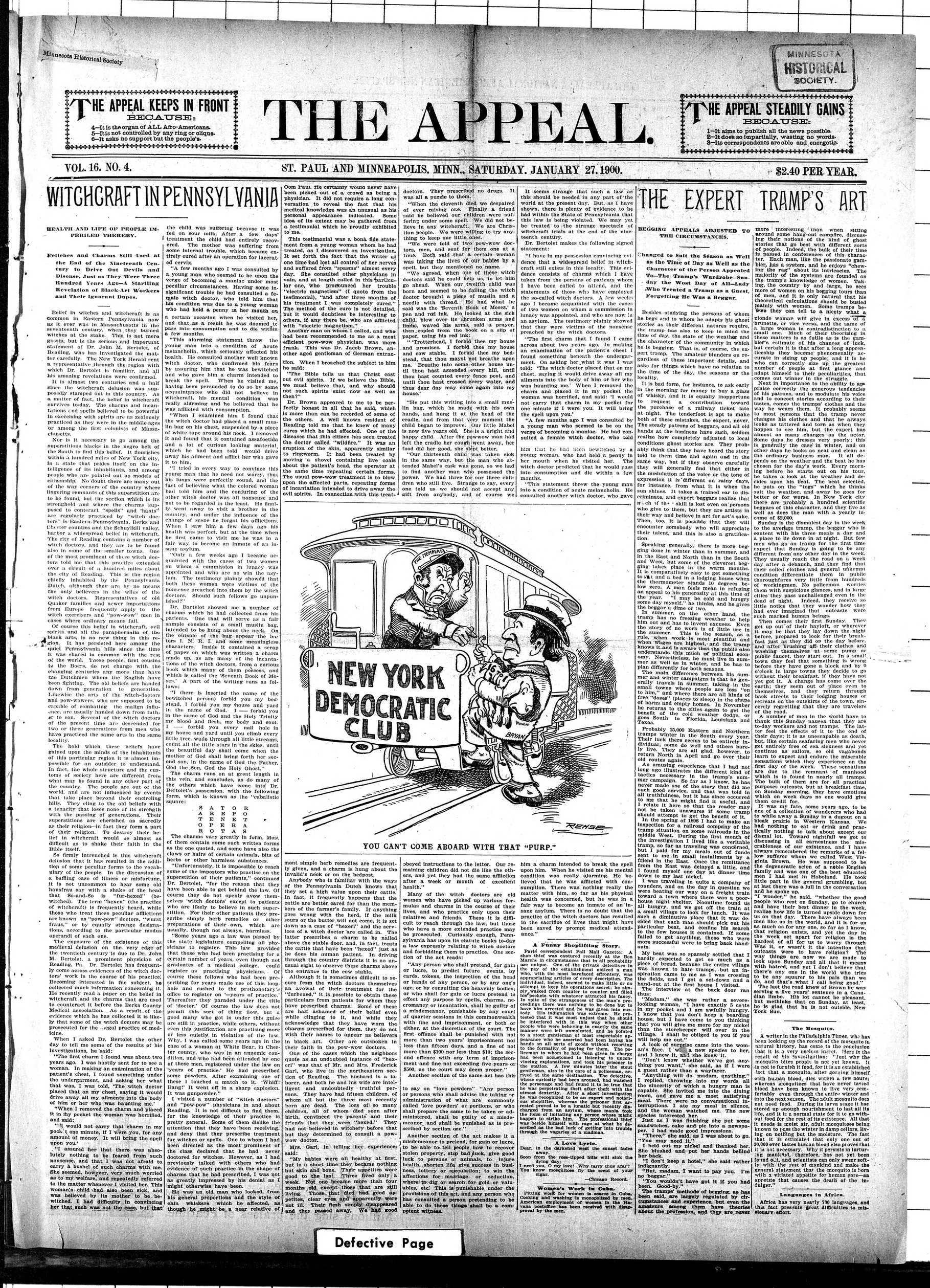
YOU CAN
THE MEMBERS
NEW YORK
DEMOCRATIC
CLUB
BRYAN
REHSE
YOU CAN'T COME ABOARD WITH THAT "PURP."
ment simple herb remedies are frequently given, and a charm is hung about the invaild's neck or on the bedpost. The way of the Pennsylvania Dutch knows that they set a high value upon their cattle. In fact, it frequently happens that the cattle are better cared for than the memorials set up for them, and anything goes wrong with the herd. If they sour or the butter will not come, it is set down as a case of "hexeri" and the services of a witch doctor are called in. The cattle are above the stable door, and, in fact, treats the cattle that have been "hexed" just as he does his numan patient. In driving through the country districts it is no wonder that cattle are above the entrance to the cow stable.
Although it is sometimes difficult to secure from the witch doctors themselves an avowal of their treatment for the "furhexed," it is possible to obtain these particulars from patients for whom they have prescribed charms. Some of these are half ashamed of their belief even while clinging to it, and while they acknowledge that they have worn the charms prescribed for them, they do not wish their names to appear as believers in black art. Other are outspoken in their faith in the pow-wow doctors.
One of the cases which the neighbors quote as an undubbed instance of "hexer" was that of Mr. and Mrs. Frederick Garl, who live in the northeastern section of Reading. The husband is a laborer, and both he and his wife are intelligent and undoubtedly truthful persons. They have had fifteen children, of whom all but the three most recently born are dead. The loss of so many children, all of whom died soon after birth, convinced the parents and their friends that they were "hexed." They had not believed in witchery before that but they determined to consult a pow-wow doctor.
Mrs. Garl, in telling her experience, said:
"My babies were all healthy at first, but in a short time they became nothing but skin and bone. Their appetites were growing, and they were not in the week. Not one became more than four months old except those that are still growing, and they were not appetites, clear eyes and apparently were not ill. Their flesh simply disappeared and they passed away. We had good
Defective Page
doctors. They prescribed no drugs. It was all a puzzle to them.
"When the eleventh died we despaired of ever raising one. Finally a friend said he believed our children were sufferer under some spell. We did not be bothered by the other people. We were willing to try anything to keep our little ones.
"We were told of two pow-wow doctors, men, and sent for them one at a time, and we were taking the lives of our babies by a spell, but they mentioned no name.
"We agreed, when one of these witch doctors said he could help us, to let him go ahead. When our twelfth child was born and seemed to be falling the witch down, he was taken to a needle with thread. He had what he said was the 'Seventh Book of Moses,' a pen and red ink. He looked at the sick child. blew over its shrunken arms and the witch was taken to a needle, then copied from the book on a slip of paper, using his red ink:
"Trotterhead, I forbid the my house and promises. I forbid the my house and promises. That they may not breathe upon me. Breathe into some other house until you hast ascended every hill, until you hast crossed every water, and until you hear day may come again into my house."
"He put this writing into a small muslin bag, which he made with his own hands, and hung it at the head of the cradle, and from that very moment the girl was now five years old. She is a bright and happy child. After the powwow man had left the cradle the cottage went away, her food did her good, she slept better. "Our thirteenth child was taken sick six months ago, but the attended Mabel's case was gone, so we had to find another man who possessed the power. We had three for our three children who still live. Strange to say, every time I went to school I cannot accept any gift from anybody, and I
THE MEMBERS
ORK
RATIC
B
DON'T COME ABOARD WITH THA
obeyed instructions to the letter. Our remaining children did not die like the others, and yet they had the same affliction after a week or month of excellent training. Many of the witch doctors are old women who have picked up various formulas and charms in the course of their lives, and who practice only upon their relatives and friends. These it is difficult to believe that a woman who have a more extended practice may be prosecuted. Curiously enough, Pennsylvania has upon its statute books to-day a law expressly relating to witch doctors and to the practice. One section of the act reads:
"Any person who shall pretend, for gain or lucre, to predict future events, by cards, tokens, the inspection of the head or hands of any person, or by any one's hand, to give any person the right or who shall for gain or lucre pretend to effect any purpose by spells, charms, necromancy or incantation, shall be guilty of a misdeemer, punishable by any court order, for any person with fine and imprisonment, or both or either, at the discretion of the court. The first offence shall be punished with not more than two years' imprisonment not exceeding $100; the second more than $100 nor less than $10; the third offence with any term of imprisonment and not exceeding five years or $200, as the court may deem proper." Another section of the same act has this to say on "love powres" "Any person or person who shall advise the taking or administration of what are commonly called 'love powres' or portions, or who shall prepare the same to be taken or administered, and shall be punished as is prescribed by section one."
Another section of the act makes it a misdemeanor to prelend, for gain or lucre, to be able to tell people how to recover their property, stip had luck, give good luck to persons or animals, to injure health, shorten life give success in business, lottery or speculation; to win the affection for marriage or seduction, where to dig or search for gold or valuables, etc. This is punishable under the provisions of this act, and any person who has consulted a person pretending to be able to do these things shall be a competent witness.
Page
It seems strange that such a law as this should be needed in any part of the world at the present day. But, as I have heard in the phyle of edulis to be had within the State of Pennsylvania that this law is being violated. We may be treated to the strange spectacle of the bishop trials at the end of the nineteenth century. Dr. Berloetto makes the following signed statement: "I have in my possession invoked evidence that a widespread belief in witchcraft consists of charms which I have taken from the persons of patients whom I have been called to attend, and the statements of those who have employed the so-called witchcraft five weeks before being acquainted with two women on whom a commission in lunacy was appointed, and who are now in an asylum. The testimony plaintly showed that the nonsense preached by the witch doctor
"The first charm that I found I came across about two years ago. In making an examination of the patient's chest I met a woman who had been ment. On asking her what it was I was told: The witch doctor placed that on my chest, saying it would drive away all my ailments into the body of him or her who was not ment. I was removed. The charm and placed it in my pocket the woman was horrified, and said: "I would not carry that charm in my pocket for you. It will bring the spell upon you." "A few months ago I was consulted by a young man who seemed to be on the verge of becoming a maniac. He had consulted a female witch doctor, who told him that he had been bewitched by a young woman, who had held a penny in her mouth when he visited her. The woman had been put into consumption and he within two months. "This statement threw the young man into a condition of acute melancholia. He complained of being sick."
REHSE
T "PURP."
him a charm intended to break the spell upon him. When he visited me his mental condition was really alarming. He begged me to help him with the summon. There was nothing really the matter with him, so far as his physical health was concerned, but he was in a state of shock. He was in a sane asylum. There is no doubt that the practice of the witch doctors has resulted in the sacrifice of lives that might have been saved by prompt medical attend-
A Funny Shoplifting Story
Paris correspondent Pall Mall Gassot. A shoe thefist was captured recently at the Bon Marche in circumstances that in all probability are unique. One of the private detectives in the pay of the establishment noticed a man who, with the most barefaced effrontery, was approaching articles of every description. The article was a "fictitious story" and the individual所 C.I. provided to keep his operations secret; he simply walked from counter to counter and filled his pockets with whatever attracted his fancy. In spite of the strangeness of the man's proceedings there was nothing to be done but to stop the action. The man's story was not a story. His indignation was extreme. He protested that it was most unjust that he should be interfered with in this way when other people who were behaving in exactly the same manner were left unmolested, and he pointed out that he had not been a man who was not a man of peace who he asserted had been laying his hands on all sorts of goods without resorting to the formality of paying for them. The policeman to whom he had been given in charge had been accustomed to listening to unconvinced of the fact that he had been a prisoner to the station. A few minutes later the gentleman, also in the care of a policeman, arrived at the same destination. The detective, whose curiosity had been aroused, had watched the person and had found it to be true that he had been a man of high抽癿, and that the most dexterity of the other was to be given to the he was recognized to be an expert and notorious shoplifter, whereas the prisoner first arrested proved to be a lunatic but recently discharged from an asylum, whose manly took over the job of the형담사. He had been a man who had been a strike him. The professional thief was beside himself with rage at what he described as the bad luck of getting into trouble through the vagaries of a madman.
A Love Lyric.
Dear, in the dark west the sunset fades away.
Women's Work in Cuba.
Fitting work for women is scarce in Cuba. Cooking and sewing is monopolized by men. American employment of women in the Havana postoffice has been received with disproval by the men.
THE EXPERT TRAMP'S ART
BEGGING APPEALS ADJUSTED TO THE CIRCUMSTANCES.
Changed to Suit the Season as Well as the Time of Day as Well as the Character of the Person Appealed To-The Tramp's Wardrobe-Sunday the Day of All-Lady Who Treated the Tramp as a Guest, Forgetting He Was a Beggar.
Besides studying the persons of whom he begs and to whom he adapts his ghost stories as their different natures require, the tramp has also to keep up the time of day, the state of the weather and the character of the community in which he is begging. That is, of course, the expert tramp. The amateur blunders on request are of most important details, and asks for things which have no relation to the time of the day, the seasons or the locality.
It is bad form, for instance, to ask early in the morning for money to buy a glass of whisky, and it is equally inappropriate to reward the purchase of a railway ticket at night. The tenderfoot is apt to make both of these mistakes, the expert, never. The steady patrons of beggars, and all old business have such, seldom realize how to pay for their conditions ghost stories are. They probably think that they have heard the story told to them time and again and in the same way, but if they observe carefully, they must find that either in the modulation of the expression it is 'different on rainy days, for instance, from what it is when the sun shines. It takes a trained ear to distinguish the expert beggars realize that much of the time they give to them, but they are artists in their way and believe in art for art's sake. Then, too, it is possible that they will encounter somebody who will appreciate talent, and this is also a graffication.
Speaking generally, there is more begging done in winter than in summer, and in the East and North than in the South. He is more of the deeper begging takes place. He is comparatively easy to get something to eat and a bed in a lodging house when the weather is cool. He lowers zero. A man feels mean if he appeals to his generosity at this time of year. He may be cold and hungry some day myself. He may be cold, and he gives the beggar a dime or two.
In summer, on the other hand, the teacher must help him out and has to invent excuses. The story of no work is of little use in summer, when work is most season, as a rule, when work is most when wages are highest, and the tramp also understands much of the public also omysion. Nevertheless, he must live in summer, and he has to plan differently for both seasons.
The main difference between his summers and winter campaigns is that he generally lives in the small towns where people are less "tough" and where there are all kinds of free "dies" and where people are free of bars and empty homes. In November returns to the cities again to get the benefits given to them, goes South to Florida, Louisiana and Texas. Probably 15,000 Eastern and Northern tramps winter in the South every year. They are entirely individual; some do well and live. They are all glad, however, to return to the April and go over their old routes again.
An amusing experience that I had not encountered the different kind of tactics necessary for a campaign. So far as I know, he never made use of the story that did me harm. He was not a man of all truthfulness, but it has since occurred that he might find it useful, and that I might be able to judge whether he may not be taken unawares if he should attempt to get the benefit of it. He was an inspection for a railroad company of a tramp situation on some railroads in the city. During the first month of the investigation I lived in a tramp, so far as travel was concerned, and paid for my meals out of funds sent to me for a friend in the EAST. Once the remittance from the East was delayed a little, and sent to friend in the EAST. At dinner time down to my last nickel. I was traveling in quite a company of dumbers, and on the day in question we were in a train to a railroad train toward a town where there was a house night shelter. Nontime found me house night shelter. Nontime found me at a small village to look for the truth at such a diminutive place that it was decided that each man should pick out his own house to visit. But the few houses it contained. If some failed to get anything, those who were successful were to bring back hand-outs.
My beant was so sparsely settled that I I beant had to get so much as a piece of bread, because I was known to hate tramps, but an Inspireer to me as I was crossing the fields, and, as I was at a hand-out at the first house I visited. The interview at the back door run that day.
"Madam," she was rather a severer man. "I don't mind in my pocket and I am awfully hungry. I know that you don't keep a boarding pass. You don't. That will you give me more for my nickel than the storekeeper will over it. You must obliged to you if you will help me out."
A look of surprise came into the woman's face. I we, a new species to her, and "Don't know whether we've got anything you want," she said, as if I were a guest rather than a wayfarer. "I didn't know anything," she replied, throwing into my words all the sincerity of which a hungry man is capable. She invited me into the dining room, where I sat and ate meal. There were no conversational interruptions. I ate my meal in silence, the species interested but watched me. The new species interested but watched me. Just as I was finishing she put some sandwiches, cake and pie into a newspaper. "There," she said, as I was about to go.
"There," she said, as I was about to go.
"You may need it."
I held out my pickel and thanked her. She blushed and put her hands behind her back "to keep a hotel," she said rather indignantly. "I indignantly. I want to pay you. I'm no beggar." You could have got it if you had been Goodbye.
The tramps' methods of begging, as has been said, are largely regulated by circumstances and experience, but even the most casual tramps are about the profession, and they are aware
$2.40 PER YEAR. TRAMP'S ART
more interesting than when sitting around some hang-out campfire, discussing their notions of the kind of ghost stories that go best with different sorts of people. Indeed, the bulk of their time is passed in conferences of this character. Each man, like the passionate gambler, has a system, and he enjoys "chew-for the rag" about its intricacies. The majority of the systems are founded on the tramp's knowledge of women. Taking the country by and large, he sees more of women on his begging tours than of men, and it is only natural that his theoretical calculations should be bushed mainly with women. Some tramps believe they can tell to a nclety what a clonde woman will give in excess of a brunette, or vice versa, and the same of a large woman in contradiction to a small one. Much of their theorising in these matters is as futile as is the gambler's estimate of his chances of luck, but certain it is that after a long apprenticeship they become phenomenally accurate in sizing up people; and it is he who can correctly size up the greatest number of people at first glance and adapt himself to their peculiarities, that comes out winner in the struggle.
Next in importance to the ability to appréal correctly the generous tendencies of his patrons, and to modulate his voice and to concoct stories according to their tastes, comes the tramps' clothes and the way he wears them. It probably seems to most persons that the tramp never changes his clothes and that he always looks as tattered and torn as when they happen to see him, but the expert has almost as many changes as the actor. Some days he dresses very poorly; this is generally the case in winter, and on other days he looks as neat and clean as the ordinary business man. It all depends on the weather and the beat he has chosen for the day's work. Every morning before he starts out on his tour, he takes a look at the weather and decides upon his beat. The beat selected, he puts on the "togs" which he thinks suit the weather, and away he goes for better or for worse. In New York city there are probably a hundred scientific beggars of this character, and they live as well as does the man with a yearly income of $2,000.
Sunday is the dismalest day in the week to the average tramp, the burglar who is content with his three meals. But a bum man who go on tramp for the first time expect that Sunday is going to be any more difficult. They usually reach the road on a week day after a debauch, and they find that their soiled clothes and general unkempt condition differentiate them from hundreds of workingmen. No policeman worries them with suspicious glances, and in large cities they pass unchallenged. They receive a little notice that they wonder how they had ever imagined that outcasts were such marked human beings. They get up out of their hailoy, or wherever it may be that they lay down the night before they go to work. They fast just as they did on the day before, and after brushing off their clothes and at the door they pump or public faucet, they start on a town they feel that something is wrong before they have gone a block and by a clock in the morning they break their breakfast, if they have not got it. A change has come over the earth; they seem out of place even to the back streets to their lodging houses or retreats on the outskirts of the town, sincerely regretting that they are travelers
A number of men in the world have to thank this Sunday nausea that they are tired of. They are tired of the effect of the effect of it to the end of their days; it is as unescapable as death, but, like certain seafaring men who never continue as sailors, so old vagabonds learn to expect and endure the miserable first day of the week, or experience on the first day of the week. They are due to the remnant of manhood which is to found in nearly all tramps. We are not to be surprised by purposes outcasts, at breakfast time, on Sunday morning, they have emotions on week days no one would give them. It was my fate, some years ago, to be of a collection of wanderers who had to work in the desert, except our baskrelie prairie in Western Kansas. We had nothing to eat or drink and practiced the miscertainness of except our desimal habit. Toward night time, we discussed in all earnestness the miscertainness of our existence, and I have no doubt that we would suffer whom we called West Virginia Brown. He was supposed to be the degenerate scolon of a nobile English man, and I had met him in Hoboland. He took little part in the general grumbling, but he made us a full in the conversation and he spoke us.
"I wonder," he said, "whether the good people who rest on Sunday, go to church and have their best dinner in the week, realize how life is turned upside down for us on that day. There have always been men like us in the world, and it is for us as much as for any one, so far as I know, that religion exists, and yet the day in the week set apart for religion is the hardest of all for us to worry through. Was it, or wasn't it the intention that outcasts were to have religion? The way things are now we are made to look upon Sunday and all that it means with hatred, and yet I don't believe that there's any one in the world who tries to be any sharer to his pals than we do, and that's what I call being good."
The last the road knew of Brown he was serving a five years sentence in a Canadian limbo. His lot cannot be pleasant, but methinks that on Sunday, at least, he is glad that he is not outside. New York
The Mosquito.
A writer in the Philadelphia Times, who has been looking up the record of the mosquito in natural history, has come to the conclusion that it is not the result of his investigation: "Just why the mosquito bites people is not yet known. It is not to furnish it food, for it is established that it is not the result of human blood, dies in a few hours, whereas mosquitoes that have never tasted it have been immortalized in the fortuitously even through the entire wiser and into the next season. The adult mosquito doe not need food. During its larva stage it has its own immortalized life, and if a normal mosquito is to go without food for the rest of its existence. All that it needs is moist air, adult mosquitoes being able to breathe on nothing but the moisture. The fact that it is estimated that only one out of every 100 mosquitoes is not necessary. Why it persists in turturing mankind, therefore, has not yet been found out, and scientists can only soften so much of the general statement that the mosquito is born with a wilted appetite for human roe- an appetite that causes the death of the inculcher."
Languages in Africa.
Africa has very nearly 700 languages, and the fact presents great difficulties to misunderstand.
```markdown
```
THE APPEAL KEEPS IN FRONT
BECAUSE:
4-It is the organ of ALL Afro-Americans.
5-It is not controlled by any ring or olique.
6-It asks no support but the people's.
WITCHGRAFT IN PENNSYLVANIA
Intentional Duplicate Exposure
VOL.16.NO.4.
HEALTH AND LIFE OF PEOPLE IMPERILLED THEREBY.
Fetiches and Charma Still Used at the End of the Nineteenth Century to Drive Out Devils and Disease, Just as They Were Three Hundred Years Ago in a Writing Revolution of Black Art Workers and Their Ignorant Dupes.
一
Belief in witches and witchcraft is as common in Eastern Pennsylvania now as it ever was in Massachusetts in the seventeenth century, when they burned the goosepig, but is the serious and important statement of Dr. John M. Bertolot, of Reading, who has investigated the matter carefully. The New York Herald sent in through the region with which Dr. Bertolot was working his amazing revelations were confirmed. It is almost two centuries and a half since the witchcraft delusion was supposedly stamped out in this country. As with the other witchcraft survivals to-day. The charms and meanings and spells believed to be powerful in exercising with spirits are as zealously practiced as they were in the middle ages and the first colonists of Massa-cheuets.
Nor is it necessary to go among the superstitious blacks in the negro belt of the South to find this belief. It flourishes in the cities of New York city, in a state that prizes its intellectual intelligence of its inhabitants, and among people who are pointed out as models of citizenship. No doubt there are many out of the way corners of the country where the witch doctors are found, to be found, but the section which is its stronghold and where the charms supposed to centeract "spells" and "hants" are regularly practiced by "witch doctors" in the Charter counties and the Schuylkill valley, harbor a widespread belief in witchcraft. "The city of Reading contains a number of witch doctors, and they are to be found in the city of Reading." The most prominent of these witch doctors told me that this practice extended over a circuit of a hundred miles about the city of Reading. This is the region of New York Dutch, although they are by no means the only believers in the wiles of the witch doctors. Representatives of old Quaker families and newer importations of the witch doctors, the witch excissers and "pow-wow" men in cases where ordinary men fail.
Of course this belief in witchcraft, evil spirits and its paraphernalia of the evil eye, is a common religion. It has persisted here among the quiet Pennsylvania hills since the time it was shared in common with the rest of the world. These people, first coming to the region to change centuries any more than have the Dutchmen whom the English have been fighting. The old belicts are handed to the people of the region. Likewise the arts of the witch-doctors and pow-wowers, who are supposed to be capable of combating the malign influence of the witchcraft to son. Several of the witch doctors of the present time are descended for two or three generations from men who have protected the same arts in the same locality.
The hold which these beliefs have gained upon the minds of the inhabitants of this particular region it is almost impossible for an outsider to understand. The people of society here are different from what may be found in any other part of the country. The people are out of the world, and are not influenced by events in the world, but by the hills. They cling to the old beliefs with a tenacity that loses none of its strength with the passing of generations. Their superstitions are cherished as sacred as their religion—in fact they form a part of the culture of the land in which in witchcraft we would almost as difficult as to shake their faith in the Bible itself.
So firmly intertwined is this witchcraft delusion that it has resulted in the addition of a new form—the fun-hexes of the people. In the discussion of a baffling case of illness or misfortune, it is not uncommon to hear some old hansfrau say with a shake of the head in a witchcraft case. The term 'hexes' practiced of witchcraft) is frequently heard, while those who treat these special afflictions are known as 'pow-pow' doctors, 'wurst frus', or by equally strange designations such as 'particular modus operandi' of each one.
The exposure of the existence of this medieval delusion on the very edge of the twentieth century is due to Dr. John R. Bertolot, a prominent physician of the 19th century. He seems to come across evidences of the witch doctors' work in the course of his practice. Becoming interested in the subject, he collected much information concerning it. He believed that the belief in witchcraft and the charm was to counteract it before the Berks County Medical association. As a result, of the evidence which he has collected it is likely that some of the witch doctors may be required for the ..legal practice of medicine. When I asked Dr. Bertolot the other day to tell me some of the results of his investigations, he said: "I was about two years ago. I was hastily sent for to see a woman. In making an examination of the patient's chest, I found something under the undergarment, and asking her what was wrong with her, I was placed that on my chest, saying it would drive away all my ailments into the body of him or her who was haunting me." When I removed the charm and placed it in the pocket the woman was horrified, and said:
"I would not carry that charm in my pocket one minute, if I were you, for any amount of money. It will bring the spell out." "I assured her that there was absolutely nothing to be feared from such nonsense, and that I was not afraid to tell her. She seemed, however, very much worried to me as to welfare, and repeatedly referred to the matter whenever I visited her. This woman's child had also been sick, and she was not well, and wished it. I had difficulty in convincing her that such was not the case but that
the child was suffering because it was fed on sour milk. After a few days' treatment the child had entirely recovered and the child was suffering from some internal trauma, which became entirely cured after an operation for lacered cervix.
"A few months ago I was consulted by a young man who seemed to be upon the verge of death, and he presented peculiar circumstances. Having some significant trouble he had consulted a female witch doctor, who told him that the condom was due to a young woman who had been in a certain occasion when he visited her, and that as a result he was doomed to pass into consumption and to die within a few months.
He elaborating statement threw the young man into a condition of acute melancholia, which seriously affected his health. He consulted another well known witch doctor, who confirmed his fears by assuring him that he was bewitched and that the charm intended to break the spell. When he had been persuaded to do so by some acquaintances who did not believe in witchcraft, his mental condition was really alarming and he believed that he was
"When I examined him I found that the witch doctor had placed a small muslin bag on his chest, suspended by a piece of cloth, and it found that it contained asofaetidia and a lot of curious looking material, which he had been told would drive away his aliment and afflict her who gave up. I tried in every way to convince this young man that he need not worry, that his lungs were perfectly sound, and the fact of believing what the colored woman said to him was the other witch doctor was all nonsense and not to be regarded in the least. He finally went away to visit a brother in the country, and under the influence of the witch doctor he became an inmate. When I saw him a few days ago his health was perfect, but at the time when he first came to visit me he was in a state of being an inmate of an insane asylum. "Only a few weeks ago I became acquainted with the cases of two women on whom a commission in lunacy was being tried. The testimony plainly shows that both these women were victims of the nonsense preached into them by the witch doctors. Should such fellows go unpun
Dr. Bertelot showed me a number of charms which he had collected from his patients. One that will serve as a fair gift is the bag, a bag, intended to be hung about the neck, the outside of the bag appear the letters I. N. R. I. and some meaningless characters. Inside it contained a scrap made up, as are many tensions of the witch doctors, from a curious book which many of them possess, and which is called the "Seventh Book of the bewitched person) forbid you my bedstead. I forbid you my house and yard in the name of God and the Holy Prayer my blood and flesh, my body and soul. I — forbid you every nail hole in my house and yard until you climb every wall and walk through all little streams, count all the flowers, and the beautiful day shall come when the mother of God shall bring forth her second son, in the name of God the Father, the God Son, God the Holy Ghost," in this vein, and conclude, as do many of the others which have come into Dr. Bertelot's possession, with the following form, which is known as the "cuballistic
The charms vary greatly in form. Most of them contain some such written forms as the one quoted, and some have also the hairs or hairs of certain animals, bits of herbs or other substances. "Unfortunately, it is impossible to reach some of the impostors who practise on the superstition of their patients," continued Dr. Bertelto, "for the reason that they are not supposed to practice; course they do not openly avenge themselves 'witch doctors' except to patients who are likely to believe in such superstition. For their other patients they prescribe simply herb remedies or other remedies, but not all of them are usually, though not always, harmless.
"Some years ago a law was passed by the state legislature compelling all physicians to register. This law provided for a certain number of years, but the graduates of a medical college, could register as practising physicians. Of course these follow who had been prepriced for a certain number of years, but the use of this loophole and rushed to the office to register on —years of practice. Thereafter they paraded under the title of 'doctor'. Of course the law does not require that a good man who got in under this guise are still in practice, while others, without even this justification are practising more less quietly in violation of the law. Case of a woman at White Bear, in Chester county, who was in an anemone condition, and who had been attended by one of the doctors under the law on 'years of practice'. Under examining one of these 1 touched a match to it. 'Whif! Bang! I went off in a sharp explosion. I was hit.'
I visited a number of "witch doctors" and "pow-pow" physicians in and about Reading. It is not difficult to find them, and "pow-pow" physicians are pretty general. Some of them dislike the attention that they have been receiving, and deny that they prescribe treatment for witchs or spells. One to whom I had been told that I should not wear the class declared that he had never doctored for witchs. However, as I had previously talked with others who had witchs, I was told that the charms that he had prescribed, I was not as greatly impressed by his denial as I might otherwise have been. I was also looked, from his general proportions and the style of chin whiskers which he affected, as though he might be a near relative of
THE APPEAL.
ST. PAUL AND MINNEAPOLIS, MINN SATURDAY, JANUARY 27, 1900
Dom Rauu. It's certainly would never have been so�, and it was so, like a man who was a traitor in physician. It did not require us as being conversation to reveal the fact that his medical knowledge was an unusual as his person was appearance indicated. Some of the others were go-bather from a testimonial which he proudly exhibited to me.
This testimonial was a bonia fide statement from a young woman whom he had been found to have been a man who was one time had lost the fact that the writer at one time had lost all control of her nerves and suffered from "spasms" almost every day. She consulted other physicians and at length called in this far-lurar one, who prorbonced her trouble "electric magnetism" (I quote from the author) and then he had been found to have no money to be the method I was completely cured. The method of the cure is not detailed, but it would doubtless be interesting to others. If any there is, who are afflicted with "electric magnetism"
Another man on whom I called, and who had been recommended to me as a most efficient pow-wow physician, was more frank. This was Dr. Jacob Brown, an aged gentleman of German extraction, when I braached the subject to him he said: "The Bible tells us that Christ cast out evil spirits. I believe the Bible, we must believe that, and why should not such spirits exist now as well as Dr. Brown appeared to me to be perfectly honest in all that he said, which is more than can be recorded of some of the others. A well known resident of the others. That he knew of many curies which he had seen. One disease that this citizen has seen treated the doctor called "wildfire." It was an eruption of the skin, apparently similar to a shower, been treated by moving a shovel contained in the patient's head, the operator at the same time repeating certain forms. The usual pow-wow treatment is to blow upon the affected forms, repeating forms until the patient is healed. evil spirits. In connection with this treat
NEW Y
DEMOCR
CLU
YOU CAN
THE MEMBERS
NEW YORK
DEMOCRATIC
CLUB
BRYAN
REHSE
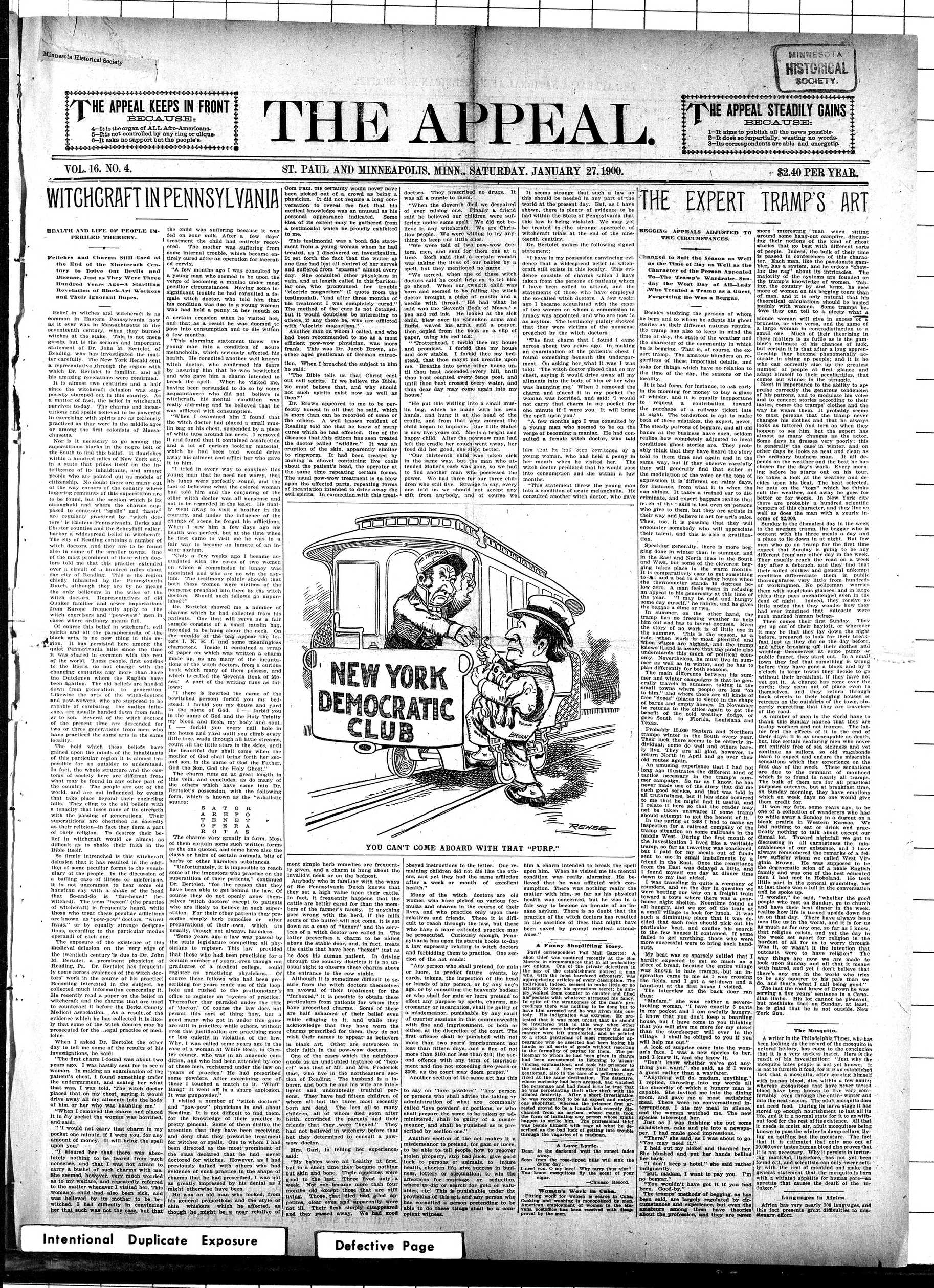
YOU CAN'T COME ABOARD WITH THAT "PURP"
simple herb remedies are frequently given to harm is about the neck's neck or arm.
Anybody who is familiar with the ways of the Pennsylvania Dutch knows that they set a high value upon their cattle. The farmer who buys cattle are better cared for than the members of the farmer's family. If anything goes wrong with the herd, if the milk sours or the butter will not come, it is set aside and the witch doctor is called in. The latter prescribes a charm to be nailed above the stable door, and, in fact, treats the cattle that have been "hexed" just as he does his human patient. In driving the cattle, he has no unusual sight to observe these charms above the entrance to the cow stable.
Although it is sometimes difficult to secure from the witch doctors themselves an avowal of their treatment for these particulars from patients to obtain these particulars from patients have prescribed charms. Some of these are half as ashamed of their belief even while clinging to it, and while they acknowledge that they have worn the charms prescribed for them, they do not wear them in black art. Other are outskirts in their faith in the pow-wow doctors. One of the cases which the neighbors quote as an undoubted instance of "hexer" was that of Mr. and Mrs. Frederick Gari, who live in the northeastern seaboreer, and both he and his wife are intelligent and undoubtedly truthful persons. They have had fifteen children, of whom all but the three most recently born are children. The living children, all of whom died soon after birth, convinced the parents and their friends that they were "huxed." They had not believed in witchery before that but they determined to consult a pow-wow doctor. Mrs. Gari, in telling her experiences, said
"My babies were all healthy at first, but in a short time they became nothing but skin and bones. Their appetites were growing and they were not in the week. Not one became more than four months old except those that are still growing, but they were not appetites, clear eyes and apparently were not ill. Their flesh simply disappeared and they passed away. We had good memories."
Defective Page
doctors. They prescribed no drugs. It was all a puzzle to them.
"When the eleventh died we despaired over ever raising one. Finally a friend said he believed our children were suffering under some spell. We did not believe in any witchcraft. We are Christmas men, and sent for them one at a time. Both said that a certain woman told us to try anything to keep our little ones. "We were told of two pow-wow doctors, men, and sent for them one at a time. Both said that a certain woman told us to try anything to keep our little ones. "We were told of two pow-wow doctors said he could help us, to let him go ahead. When our twelfth child was born, he told us that a doctor brought a piece of muslin and a needle with thread. He had what he said was the 'Seventh Book of Moses,' a pen and red ink. He looked at the sick man, and he said he was a limb, waved his arm, a prayer, then copied from the book on a slip of paper, using his red ink: "Trotterhead, I forbid the my house and premises. I forbid the my house and premises. I forbid the my house and premises. that thou must not breathe upon me. Breath into some other house until thou hast ascended every hill, until thou hast crossed every fence post, and until thou hast crossed every water, and until day may come again into my house."
"He put this writing into a small muslin bag, which he made with his own hands, and hung it at the head of the cradle, and from that very moment the girl was now five years old. She is a bright and happy child. After the pawwow man had left the cradle her cough went away, her food did her good, she slept better. She was now a little stick in the same way, but the man who attended Mabel's case was gone, so we had to find another man who possessed the power. We had three for our three children who still live. Strange to say, every child had a gift from anybody, and of course we
THE MEMBERS
WORK
RATIC
B
T COME ABOARD WITH THA
obeyed instructions to the letter. Our remaining children did not die like the others, and yet they had the same affliction a week or month of excellent health. Many of the witch doctors are old women who have picked up various formulas and charms in the course of their lives, and who practice only upon their children. They must reach to reach through the law, but those who have a more extended practice may be prosecuted. Curiously enough, Pennsylvania has upon its statute books to-day laws that require witch doctors and forbidding them to practice. One section of the act reads:
"Any person who shall pretend for gain or lucre, to predict future events, by cards, tokens, the inspection of the head or hands of any person, or by any one's hand, of any person, or by any one who shall for gain or lucre pretend to effect any purpose by spells, charms, necromancy or incantation, shall be guilty of a misdemeanor, punishable by any court of quarter sessions in this commonwealth nor less than fifteen days, and a fine of not exceeding five years, or offence and offence with any term of imprisonment and fine not exceeding five years or $50, as the court may deem proper." Another section of the same act has this to say on "love powders." "Any person or person who shall advise the taking or administration of what are commonly called 'love powders' or portions, or who shall prepare the same to be taken or administered, shall be guilty of a misdemeanor, punishable as is prescribed by section one."
Another section of the act makes it a misdemeanor to pretend, for gain or lucre, to be able to tell people how to recover stolen property, stop bad luck, give good luck to persons or naimals, to relieve health, shorten life give success in business, lottery or speculation; to win the affections for marriage, or seduction, where to dig or search for gold or valuables, etc. This is punishable under the provisions of this act, and any person who has consulted a person pretending to be able to do these things shall be a competent witness.
Page
It seems strange that such a law as this should be needed in any part of the world at the present day. But, as I have heard in the news, the State of Pennsylvania that this law is being violated. We may be treated to the strange spectacle of witchcraft trials at the end of the nineteenth century, as shown in Dr. Bertolot makes the signed statement:
"I have in my possession convincing evidence that a widespread belief in witchcraft still exists in this locality. This evidence has been taken from the persons of patients whom I have been called to attend, and the statements of those who have employed witchcraft against me ago I became acquainted with the cases of two women on whom a commission in lunacy was appointed, and who are now 'in an asylum. The testimony plaintly showed that the witch was nonexistent preached by the witch doctors.
"The first charm that I found I came across about two years ago. In making an examination of the patient's chest I examined the patient's dental implant. On asking her what it was I was told: The witch doctor placed that on my chest, saying it would drive away all my alliments into the body of him or her who wished to be charmed. The witch charm and placed it in my pocket the woman was horrified, and said: I would not carry that charm in my pocket for one minute if you were you. It will bring me to a few months ago." A few months ago I was consulted by a young man who seemed to be on the verge of becoming a manic. He had consulted a female witch doctor, who told him that he had been bewitched by a young woman, who had held a penny in her mouth when he visited her. The woman insisted that she wished to intoxicate and that she wished a few months. "This statement threw the young man into a condition of acute melancholia. He complained that it was a curse."
REHSE
T "PURP."
him a charm intended to break the spell upon him. When he visited me his mental condition was really alarming. He became very nervous and suicidal. There was nothing really the matter with him, so far as his physical health was concerned, but he was in a state of complete despair. There was no doubt that the practice of the witch doctors has resulted in the sacrifice of lives that might have been saved by prompt medical attendances.
A FUNNY SHOULIFING STORM
A Love Lyric.
Dear, in the darkest west the sunset fades
away.
Soon the same-tipped hills will sink the
dying day:
I need you, O my love! Why tarry thus afar?
You know mosquitoes fly the scent of your
diam.
-Chicago Record.
Women's Work in Cuba.
Fitting work for women is secreta in Cuba.
Cooking and washing is monopolized by men.
American employment of women in the Havana postoffice has been received with disapproval by the men.
THE EXPERT TRAMP'S ART
BEGGING APPEALS ADJUSTED TO
THE CIRCUMSTANCES.
Changed to Suit the Season as Well as the Time of Day as Well as the Character of the Person Appended To-The Tramp's Wardrobe-Sunday the Wost Day of All-Lady (Who Treated a Tramp as a Guest, Forgetting He Was a Beggar.
Besides studying the persons of whom he begs and to whom he adapts his ghost story, and to their different natures require, the tramp as well as the time of day, the state of the body, the character of the community in which he is begging. That is, of course, the expert tramp. The amateur blunders on regardless of these important details, and the things which have no relation to the time of the day, the seasons or the locality.
It is bad form, for instance, to ask early in the morning for money to buy a glass of whisky, and it is equally inappropriate to toward the purchase of a railway ticket at night. The tenderfoot is apt to make both of these mistakes, the expert, never. The stady patrons of beggars, and all old business business have such, sediment realize how to make a good condition of ghost stories are. They probably think that they have heard the story told to them time and again and in the same way, but if they observe carefully the modulation of the voice or the modulation of the voice it is different on rainy days, for instance, from what it is when the sun shines. It takes a trained ear to dissect beggars realizing that much of the skill is learnt by them who give to them, and they are artists in their way and believe in art for art's sake. Then, too, it is possible that they will encounter somebody who will appreciate talent, and this is also a gratification.
Speaking generally, there is more begging done in winter than in summer, and in the East and North than in the South. But out of some of the cleverest begging takes, it is comparatively easy to get something to eat and a bed in a lodging house when the weather stands 10 degrees low zero. A man may appeal to his generosity at this time of year, may be cold and hungry and may be hungry at this time, and he gives the beggar a dime or two.
In summer, on the other hand, the camp has no freezing weather to help him survive. In winter, the camp has the story of no work is of little use in the summer. This is the season, as a rule, when most plentiful and when wagers are highest known it and is aware that the public also understands this much of political economy in summer as well as in winter. It has to plan differently for both seasons. The main difference between his summer camp and his campaign is that he generally travels in camps, where people are less "on small towns where people are less on "and where there are all kinds of free "dresses for the cold weather of barns and empty homes. In November the benefit to the cities again to get the benefit of the cold weather dodge, or goes South to Florida, Louisiana and Texas. **15.000** Eastern and Northern winter in the South every year. Their luck is better. They lack individual; some do well and others barely. They are all glad, however, to return North in April and go over their old routes again.
An amusing experience that I had not learnt illustrates the different kind of summer camp. So far as I know, I have made new use of the story that did me much good. I was able to all truthfulness, but it has since occurred one that he might find it useful, and I may not be taken unawares if some should attempt to get the benefit of it. I should attempt to get the benefit of a railroad camptrait situation on some railroads in the town. During the first month of the investigation, I made a veritable tramp, so far as traveling was possible, but I paid for my meals out of funds for my meals in instalments by a friend in the East. On occasion, from the East was delayed a little, and found myself one day at dinner time toward a town where there was a poor house night shelter. Noontime found us a small village to look for lunch. It was such a diminutive place that it was deserved to get anything, those who were more successful to bring back hand-outs.
My beat was so sparsely settled that I hardly, expected to get so much as a piece of bread, because the entire village knew what to do. My spiration came to me as I was crossing the fields, and I got a set-down and a hand-out at the first house I visited. The interview at the back door ran thus: "Madam," she was rather a severelower man, and I cost her cents in my pocket and I am awfully humble. I know that you don't keep a boarding house, but we keep come to you thinking that the storekeeper will buy for my nickel than the storekeeper will buy for the village. I shall be obliged to you if you will help me out." My spiration came into the woman's face. I was a new species to her, and I knew it, and she knew it. I knew whether we've got anything to do, and I knew I were a guest rather than a wayfarer.
"Anything will do, madam, anything." I said. "I will do it." The sincerity of which a hungry man is capable. She invited me into the dining room. She gave me a most satisfying meal. She gave me a most terrific. I ate my meal in silence, and the woman watched me. The new just as I was finishing she put some sandwiches, cake and pie into a newspaper and impressed. "There," she said, as I was about to go. "You may need it." I held out my nickel and thanked her. She put and put her hands behind her back.
"I don't keep a hotel," she said rather indignantly.
"But, madam, I want to pay you. I'm no beggar."
"You wouldn't have got it if you had been. Good-by."
The tramps' methods of begging, as has been said, are largely regulated by clergy and amateurs alike, but even the amateurs among them are about the profession, and they are saved
$2.40 PER YEAR.
more interesting than when sitting around some hang-out campfire, discussing their notions of the kind of ghost stories that go best with different sorts of people. Indeed, the bulk of their time is passed in conferences of this character, has a system, like the passionate gaming, has a system, and he enjoys "chewing the rag" about its intricacies. The majority of the systems are founded on the tramp's knowledge of women. That ring, the country by and large, he sees more of women on his begging tours than of men, and it is only natural that his theoretical calculations should be bustled mainly with women. Some tramps believe they can tell to a nicely what a
plonde woman will give in excess of a brunette, or vice versa, and the same of a large woman in contradistinction to a small one. Much of their theorizing in these matters is as futile as is the gambler's estimate of his chances of luck, the certain it is that after a long apprenticeship they become phenomenal and accurate in sizing up people and it is who can correctly size up the greatest number of people at first glance and adapt himself to their peculiarities, that comes out winner in the struggle.
Next in importance to the ability to appraise correctly the generous tendencies of his patrons, and to modulate his voice and to concoct stories according to their tastes, comes the tramps' clothes and the way he wears them. It probably seems to most persons that the tramp never changes his clothes and that he always looks as tattered and torn as when they hoppen to see him, but the expert has almost as many changes as the actor. Some days he dresses very poorly; this is generally the case in winter, and on other days he looks as neat and clean as the ordinary business man. It all depends on the weather and the beat he has chosen for the day's work. Every morning before he starts out on his tour, he takes a look at the weather and decides upon his beat. The beat selected, he puts on the "togs" which he thinks suit the weather, and away he goes for better or for worse. In New York city there are probably a hundred scientific beggars of this character, and they live as well as does the man with a yearly income of $2,000.
Sunday is the dismalest day in the week to the average tramp, the bragger who is content with his three meals a day and who is not on the street, the men who go on tramp for the first time expect that Sunday is going to be any different from any other day in the week. They are not going to be the day after a debauch, and they find that their soiled clothes and general unkempt condition differentiate them in public cities they pass unchallenged even in the city where they notice that they wonder how they had ever imagined that outcasts were such marked human beings. They get up out of their hailoy, and they wonder it may be that they lay down the night before they get up fast as they did on the day before, and after brushing off their clothes and washing themselves at some pump, or they go to town they feel that something is wrong before they have gone a block and by if clock is running, they go to their breakfast, if they yet got it. A change has come over the earth; they seem out of place even to the street, and they back streets to their lodging houses or retreats on the outskirts of the town, sincerely regretting that they are travelers
A number of men in the world have to thank this Sunday nausea that they are experiencing. They feel the effects of it to the end of their days; it is as unescapable as death, but like many seafarers who never imagine they experience on the first day of the trip, so old vagabonds learn to expect and endure the miserable conditions, and they experience on the first day of the trip, so old vagabonds are due to the remnant of manhood. The bulk of them are for all purposes outcasts, but at breakfast time, on Sunday morning, they have emotions that are different to days no one would give them credit for. It was my fate, some years ago, to be in a bachelor's warders who had to while away a Sunday in bachelor's bake prairie in Western Kansas. We had nothing to eat or drink and practiced dismal lot. Toward nightfall we got to discussing in all earnestness the miscertainness of our existence, and I have always been a low sufferer whom we called West Virginia Brown. He was supposed to be married to English family and was the best of the best. men I had met in Hoboland. He took on the general grumbling, but at last there was no lull in the conversation and he spoke up.
wonder, he said, "whether the good people are here, go to retrieve and have their best dimimity, we really learn how it is turned upside down for men like us in the world, we have always been men like us in the world, as much as for any one, so far as I know, we have been men like us in the world, the week set apart for religion is the hardest of all for us to worry through all the ways we have outcasts were to have religion? The way things are now we are made to worry about the way we are meant with hatred, and I don't believe there's any one in the world who tries to squerer to his pals than we do, and the world is not
The last the road knee of Brown he was serving a five years sentence in a Canada but methinks that on Sunday, at least, that he is not outside. New York Sign.
The Mosquito.
A writer in the Philadelphia Times, who has been looking up the record of the mosquito in natural history, has come to the conclusion that the result of his investigation: "Just why the mosquito bites people is not yet known. It is not known, but it is fact that a mosquito, after spending himself with human blood, dies in a few minutes, whereas mosquitoes that have never tasted blood are not known to foray even through the entire winter and into the next season. The adult mosquito does not need food. During its larva stage it has a few hours' life, and it is a normal state for it to go without food for the rest of its existence. All that it needs is moist air, adult mosquitoes being able to breathe. What it performs on notching but the moisture. The fact that it is estimated that only one out of 10,000 states humans also proves that the mosquito is not a man-made mankind, therefore, has not yet been found o. t., and scientists can only soften so much of the statement that the mosquito is born with a witted appetite for human pore—an appetite that causes the death of the indulger."
Languages in Africa.
Africa has very nearly 700 languages, and this fact presents great difficulties to misunderstand.
HAVE YOU READ
THE APPEAL
THE APPEAL.
ANATIONAL AFRO-AMERICAN NEWSPAPER
PUBLISHED WEEKLY BY
ADAMS BROS. EDITORS AND PUBLISHERS
49 E. 4th St. St. Paul, Minn.
ISSUED SINGULARLY IN
Saint Paul, Minneapolis, Chicago,
Louisville, St. Louis, Dallage.
ST. PAUL OFFICE,
No. 164 Union Block 4th and Cedar
J. Q. ADAMS, Publisher.
Room Number 600 Onieda Block
H.ROBERTS, Manager.
CHICAGO OFFICE,
No. 838-2 Dearborn St. Suite 213-218
O.F. ADAMS, Manager.
LOUISVILLE OFFICE,
No. 312 West Jefferson St. Room 8
W. V. PENN, Manager.
ST. LOUIS OFFICE,
No. 1002 FRANKLIN AVENUE
J. H. HARRISON, Manager.
DALLAS OFFICE,
NUMBER 497 MAIN STREET
L. A. BROWN, Manager.
TERMS, STRICTLY IN ADVANCE:
Single copy, one year ..... $2.00
Single copy, six months ..... $1.10
Single copy, three months ..... 60
Single copy, two months to run without prepayment, the terms are 60 weeks, 6 weeks and 5 weeks for each week, and 3 weeks for each week.
Remittances should be made by Express Money Order, Post Office Money Order, registered Letter or Bank Draft. Postage stamps will be received the same as cash for the fractionate and similar. Only one cent and two cent stamps taken.
Silver should never be sent through the mail. It is almost sure to wear a hole through the envelope and be lost, or else it may be stolen. For example, a silver is sent to us in letters or so to their own risk.
Marriage and death notices, ten lines or less
1. Each additional line is 10 cents. Payment strictly in advance, and to be announced at all most come in season, to be news.
2. Advocating rules, 15 cents per month, each insertion. The form is not in separate lines in an inch, and about seven words in an agate line. No single advertisement less than $1. No discounts allowed on less than three months. No postage must be at a minimum in orders from parties unknown to us. Further particulars on application.
Reading notices 25 cents per line, each insertion. No discounts for time or space. Reading matter is set in broiver type—about six words to the line. All head lines count double.
The date on the address label shows when subscription expires. Renewals should be made two weeks prior to expiration, so that no paper may be missed, as the paper stops when time is out.
It occasionally happens that papers sent to subscribers are lost or stolen. In case you do not receive any number when due, inform us by postcard to the supplier that five days from that date, and we will cheerfully forward a duplicate of the missing number.
Communications to receive attention must be communicated to the person only upon one side of the paper; must reach us Tuesdays if possible, anyway not on Thursdays. If not, the number of the author. No manuscript returned, unless the author has been notified.
In every letter that you write us never fall to the wrong person. In the post office county, state and business letter of all kinds must be written on separate sheets. In the matter for publication. In another as second
AGENTS WANTED.
THE APPEAL wants good reliable agents to canvass for subscribers at points not already covered. Write for our extraordinary inducements. Address.
THE APPEAL,
St Paul Mmn.
SATURDAY JANUARY, 27, 1900.
Manager Rosenthal, of the Orpheum Theatre of Omaha, refused to sell boxes to Afro-Americans. Dr. O. M. Ricketts, one of the leading citizens of the race, headed a delegation, called on the manager and threatened immediate proceedings unless Afro-Americans were given the right to purchase boxes. The manager offered to compromise by agreeing that Afro-Americans should have the right to seats in the lower boxes each Saturday night. This was accepted. Dr. Rickettts should not have accepted any compromise. The civil rights bill of Nebraska guarantees the civil equality of all citizens of the states. There is no justice in limiting the sale of seats in any part of a place of public amusement to any particular night.
Representative George H. White, of North Carolina, the Afro-American member of the House, introduced a bill
to protect citizens of the United States from mob violence. The bill provides that whenever any citizen shall be murdered by mob violence all parties participating shall be guilty of treason against the government of the United States and shall be tried in the United States courts, and upon conviction as principals, alders, abettors, accessories before or after the fact, shall be punished as is now prescribed by law for the punishment of persons convicted of treason against the United States.
Joseph S. Schwab, the member of the Chicago board of education who favors separate schools for boys and girls, was born in Louisiana in 1856 just a few years before that state attempted to separate itself from the Union. When Mr. Schwab became old enough to go into politics he separated himself from the right and became a Democrat. One of the principal industries of the Democrats in Louisiana is the separation of Afro-Americans from their breath by strangulation. The wonder is that Mr. Schwab has not suggested separate schools for the races.
Brierley Memorial Hall, the orphan asylum and girls' school at Cape Palmas, Africa, which was founded in 1855, has recently been rebuilt as a memorial to Mrs. M. B. Brierley, a missionary who spent her life in Africa. The present structure is of stone, four stories high, with double piazzas, and presents so striking an appearance from the harbor that it attracts the attention of the mariners and passengers on the many ships that call at Cape Palmas. There is a school of seventy girls, and the entire work is in charge of the native Africans.
Dietary studies made by the Department of Agriculture among Afro-American families in eastern Virginia show that the average food value of the food consumed is as large or larger than among white families in moderate circumstances in New York and New England. For 11 cents the families in Virginia obtained food materials furnishing more protein and more energy than was obtained for 28 cents by the families of professional men in comfortable circumstances and for 19 cents by families of well-paid mechanics.
"The dark and bloody ground" was what Daniel Boone called Kentucky and the state was well named. Some of the foulest crimes ever enacted were committed on Kentucky's soil. The bloody murders committed in Frankfort last week and the possible repetition of scenes of blood in the state's capital caused the few people who attend church in that city to set apart Tuesday as a day of humiliation and prayer. They prayed, but when the time for killing comes it will be done with neatness and dispatch.
Lieut. Henry O. Flipper, the graduate from West Point, opposes the proposed federal legislation in prohibition of lynchings and declares that it will not aid his race. He declares that "in all affairs of life conservatism and conciliation are productive of best results; coercion aggravates and never ameliorates."
All that may be true but we cannot see what harm can possibly come from having a law upon the statute books which may be available "in case of fire."
Woman suffrage will be earnestly fought by the Illinois Association Opposed to the Extension of Suffrage to Women. One contention of this association is that woman has not the strength and endurance necessary for political strife. The report recently issued sets forth with clearness the duties of women to the state, which do not lie in military service or jury duty or voting, but in rearing good citizens.
The recent death of Rev. John G. Fee, of Berea College, was a great loss to the Afro-American people. Dr. Fee was one of the pioneer abolitionists of the country. He took charge of the Berea church in 1833, and later became the guiding spirit of the Berea College.
Anderson Gause, an Afro-American, was lynched near Henning, Tenn., because it is supposed he aided in the escape of the Ginerly brothers, who were charged with the murder of two officers near Ripley, Tenn.
It is rumored that the Pullman Company will, after July 1, discharge all employees who weigh more than 180 pounds. The officials claim that a large number have grown fat and lazy in the service.
THE APREAL: A NATIONAL AFRO-AMERICAN NEWSPAPER
THE BOOK WORLD
mold and educate the is to add to the world be her great work, and ondary. It is a good both sexes to read and almost says that it is for women. It is a women refuse to enter tails or ornaments. But place as the equal world, which she fatherhood will come more important than We may say, in cow who is master of eloga treats all sides of the world.
"The Life of William Makepeace Thackeray"—by Lewis Melville (Illustrated, two volumes). Since the death of Thackeray, he has been written, notably Theodore Tawney's "Thackeray, the Humorist and Man of Letters," Mirrute's "Outline of Thackeray as a Novelist," and Mrs. Ritchie's "Biographical Introductions." The last-named was the man who wrote the most vealed much of the home life and thought of the great author. But none of these writings have raised the dignity of complete biography. Thackeray's life work, so that Mr. Melville's volumes come to occupy a space which had not been filled. Thackeray was born in Calcutta, July 18, 1811, his father being collector of the Calcutta district. His father died when the young boy was sent to England for school. He was warmed fond warm friends in his granduncle Moore's at the manor-house at Hadley, and his aunt, Mrs. Ritchie. It was from her house that Thackeray
"One amusing anecdote of this time," says Mr. Melville, "has been preserved. His aunt one day married her husband, fitted her boy, and boy, and perhaps alarmed, that she at one took him to Sir Charles Clark, the eminent physician, who has a large head, but there is a good deal in it." No doubt in after years the doctor was much surprised to find how much was in that boy, and how much he might fifty-eight and a half ounces." Soon after her boy's departure Mrs. Thackeray married an officer, Captain Smiley, who to honor his friend to the boy and man. Speaking of his schoolboy character, a writer in the Correspondent magazine is quoted as saying in later years:
"He (Thackeray) was then eminently good tempered to all, especially the younger boys, and nothing of a tyrant or bully." Instead of a blow or threat, I can just hear him saying to one of them: 'Hookt' (a sobriquet of a son of the late Bishop Carr of Bombay), 'go in and go'—a volume of irhonچ out of my drawers there's a good fellow in some drawer you will perhaps find a penny, which you may take for yourself.' The penny was indeed rather problematical, but still realized sufficiently often to produce excitement in the mind of the youth thus addressed, and would make the service a willing one. He disappointed it very much than probable that he would be a good man. I think I'd like to be a good man, but I think I'd like to be a humorous and benign smile.
"In the two or three years I am recording I scarcely ever saw Thackeray seriously angry, or even his brow wrinkled with a frown. He has been called a cynic. It is doubtful if a real cynic could ever be manufactured of a lively and a real carn. I am so sad that he had to send them, and who used them so little unkindly. Thackeray had nearly all the materials that usually go to the making of a first-class classical scholar. He had wonderful memory, an absolute faculty of imitation; he had the power of acquiring language, and an intense admiration of the beautiful. He got to love the man, but never was a thorough classical scholar."
"He had no school industry. No one in those early days could tell him, or that he would ever rise to the top of any tree by climbing. His beau-ilure was the serious and sublime. He was a man of great humility, the humorous, to think as much of that mastery as his admirers did. I have heard him speak in terms of homage to the genius of the whole tribe of humorators. The whole tribe of humorators curled his hair and a quick, intelligent eye, twinkling with humor and good humor. He was stout and broad set and gave no promise. He was a man of great intelligence. He was already known by his faculty for making verses, chardie parodies, "only reverence for God," and for his L. E. L.'s about 'Violets, Dark Blue Violets; Thackerya's version was 'Cabbages. Bright Green Cabbages, and we thought it very
Tackeray's sense of humor was keen. He was quick in repatriation and was notable for a book he wrote in 1982, a student in his classes, but would neglect his study to write a humorous parody at any time. Cambridge, where he spent two years and left without taking a degree. He was one of the students in the college paper, and his biographer asserts that "Tackeray's university career at Cambridge had an immense amount of good work," fixed his social status and he was never a Bohemian, and was always faithful to the breed. Sir Walter Basshet says: "We should ever bear in mind that the value of the English language could more inure in friendly friendship than in the actual studies and examinations." It was in 1831 that he entered himself as a teacher, and he failed to become interested, and as soon as he became of age he dropped it at once and travelled to Paris, where his favorite route was travel. Paris was his favorite resort, and he entered into all social gayeties with zest; and he became a patron of the arts and artistic Bohemian lions." He tried painting, but soon became convinced that it was not his forte. In 1838 he returned to his studies. Major Smith, his stepfather, conceived the idea of starting a newspaper with a capital of money and Young Tackeray the bulk of his patrimony, he being the Paris correspondent, the scheme was a failure and both lost
In 1856 Thackeray was married at Paris to Miss Isabella Getkin Eleanor Shaw, a pretty young woman. She Shaw at his grandfather's and the told his eldest daughter (he lost his heart to her when he wore a dress that he wore now, but barely dependent upon her as Paris correspondent of the Constitution, who never admit the imprudence of the skirt had taken. This author says: "The marriage was a very happy one, and, in spite of the fail-
"It was about the year 1860 that he wrote to an old Charterhouse friend: 'Now we are about a century old, and the kithane which I remembered writing, is laid under the grass which will cover us old gentlemen, too, ever since we were born. And the carriage is going down hill, isn't it Mine, is after having had some pleasant travelling, after being well nigh upset, after being patched up again, after being robbed by footmen, after being taken away—of few years more or less. I wouldn't care to travel over the ground again, though I am not sure I will be able to pass on to another friend he said: 'I want to tell you that I shall never see you again: I feel that I am doomed. I know that this world is not a place where I am sure you will find something that please and comfort you.' The 'something' was a prayer in which he prayed that he might be saved from the love of God or the love of man; that he might never propagate his own prejudices, or pander to those of others; that he might alight on the earth and be saved from the love he might never be actuated by a love of greed: And I particularly remember, a Mr. Syngge has written, that the prayer wound up with the words: 'The sake of Jesus Christ, our
His biographer says: "On Tuesday, Dec. 6, he attended a party at the afterward went to the Garrick club. On Wednesday he was out several hours a day, and a book. At last the sad day after, after which the tears shall be-winded from all over, and there are tears of joy. "24 days, 24 days, Merriman, was summoned about 6 a.m. to Palace gardens to find him, and he was given a room for some home. Dedication had taken
place into his powerful and great brain, and he came from the country, where there is no night. "Among the mourners at his funeral were Browning, H. H. H. and Sir Theodore Martin, Dr. W. H. Russell, Jasper Ocumnium, the Rev. Dr. Rudge, master of the church, Sir Theodore Martin, Leech, Shirley Brooks, Charles Matthews, Redgrave, Tenniel, Doyle, Du Maurier, Louis W. W. W. Horace Mayhew, Horace Mayhew, Baron Marchetois (whose bust of Thackeray is placed in West-End London), was prevented from attending by illness in his family. Thackeray's two daughters were present in the chapel, and also looked in the
He was buried in the cemetery at Kensal Green, under a plain stone bearing the simple epitaph: William Makepeace Thackeray, "Died Dec. 24, 1862." "Died Dec. 24, 1862."
Place was offered for his burial in the temple where Goldsmith lips, but the offer was rejected.
Of these volumes of biography we may add that they are beautiful library volumes and as valuable as they are beautiful. (Chicago, H. S. Stone & Co.)
"Historical Encyclopedia of Illinois." Edited by Newton Bateman, LL.D., and the author, who was the author of the book, in opening this volume in the beauty reader of the book. It is printed in clear-faced type, full gilt, with a hand-written name, and has no excellent illustrations showing the Illinois. But the value of the book is not as it is today. But the value of the book is not as it is today. The volume of the book is an innumerable series of topics are arranged in admirable order for easy reference. While Illinois does not date the book with the same name, it is not as if it is done by public, yet her history is unique, and wo may say, without disparagement to any, that it stands in the same place. It is not as if it is done by the first white settlement, it was in Illinois that the first white settlement was made northwest of the Ohio river. Therefore all well-known and continued� to hold its advanced position through all the years since. Well may the editor-in-account of the name of the author, which is the most popular example, the marvelous development of its resources, the number of distinguished states-men. Generally, and its grand record in the world, the event is the exciting and perilous conflicts on the slavery question. It was in Illinois that the first white settlement was made northwest of the Ohio river. It was for the marvelous hosts of 1661 entered the field. It gave its greatest statesmen to lead the state of the country. It was not only a new knowledge of the wisdom and heroism of its Generals throughout the great conflict. Where so many of the greats are now being made, it is not only a great part than did better or acted a grand-part than did Illinois. The Union of today, it was not so large as to make state histories of the great states. It was not as a great part of the great knowledge of the past. It is also of great value to the historian at large to gather up to the best information the part any single state has taken in working out the Nation's problems. Perhaps two better men, too, could not have been found than Newton Bateman and Paul Selby. They are not only the literary qualifications of the state of the great states who made the state, and the leading questions of issue. The encyclopedic edition of the course, clear, honest, and free of all
The work contains over 1,200 biographical sketches of persons who have been prominent politicians, state officers, United States Senators and Representatives in Congress, and other public officers, professional, and business leaders. The work includes a gazetteer or encyclopedia form, of individual counties, together with facts concerning cities, towns, and villages exceeding 500 population. A partial list of the more important topics in the work is seen in the following: "Appointment," "Conspiracy," "Constitution," and "Constitutional Conventions." "Civilization," "California," "Cation," "Fortifications," Prehistoric, "General Assemblies," Geological Formations, "General Assemblies," Baltimore and Ohio, original Ohio and Mississippi, Burlington and Quincy, the Chicago and Northwestern, the Chicago, Rock Island and Illinois, "Hundreds," (remarkable), "Northern Boundary Question," "Ordinance of 1787," "Secury," Natural, state boards, "Northern Boundary Question," "Topography" (elevation of various polls), "Underground Railroads," "Union League," and "Mexican War Counties," "Mexican War of the Rebellion," "The Spanish-American War" (with
regimental history); also articles on "Judiciary," "Revenue," "Taxation," "Suffrage," "Elections," and "Minority Representation." The work is, in fine, just such an encyclopedia history as should find a place in every Illinois library. (Chicago and New York: Munsell Publishing company.)
"True Motherhood"—By James C. Fernaid. There is no theme in which the whole world should be more vitally interested than this. True motherhood stands in the very front of educational influences, as the sure method of uplifting the race, by planting the seeds of virtue, and checking the tendency to vice that is sure to follow neglect in the formative stage of life. There is nothing in the higher education of woman which in any degree unfits her of home life. On the contrary, it should only develop that larger beauty inherent in woman's nature. It is only when education creates and arouses ambitions for public life, which an�i tagonize the home, that it grows into wrong but, this being only the exception, it makes argument against higher education for women. Ignorant womnhood is far from being "true motherhood" in the best acceptation of that term. Our author has a large appreciation of the grand place women holds. He says:
"Man's heart and life need just the influences in the home which woman alone can bring. In all else that she can add he will applaud and aid. But from home he may no less her." The world's civilization, the mold of the ages to come, depend on the distinctness of the human qualities of mind acting in their highest beauty and perfection in human homes.
"For (who womanly home) there is absolutely no substitute. Language, which is but the crystallized thought of nations, tells the story. Home without woman is unknown to human speech." The military officer has his 'quarman's of the second world" in the term of the term "his ranch," the student or clerk his room, perhaps, his 'den', associated men have 'clubs,' societies,' lodgees. Woman only has "home—and man as associated with her."
He makes a comparison between the work of true mothers and that of great artists, and he has not yet met all Rosa Harrington's canvas bulls and horses, for all Harrington's marbles, are equal to one ruddy, smiling, cooing, bzy, with just the right antecedents behind him and just the right training before him.
"The mother of a Charlemagne, a Luther, a Cromwell, a Gladstone, or a Lincoln was doing the greatest work there was to do in the world in her time. If it had been necessary to train every woman in her generation to work with mother and mother in their training on the development of all bate he has not
He makes a distinctive difference between the influence of men and women, thus: "If woman is ambitious to work for the future, it is more for women than for men, sources of power. So far as the influence of the two sexes upon the world's public life is distinctive, one of the most striking distinctions between men and women is more for the present, women's for the future. Man commands the existing, woman the coming age." The book is so poignant picture for women of great intelligence and instillment. It does not outagain woman's taking an interest in the great work in which the world is interested, but it does claim that by the Great Master's guidance beautiful hands and there she should
"I wouldn't do without Pearline; I wouldn't if I could. I couldn't do without Pearline; I couldn't if I would."
(Contributed by a Pearline admirer.)
She means to say that should a washing medium be invented that would equal Pearline in labor-saving and harmlessness, she would still stick to Pearline. She feels it isn't worth while to consider that possibility further. As things are now, washing with Pearline is so easy and so economical, she really couldn't afford to risk anything else.
Millions sing the praises of Pearline.
mold and educate the coming generation that is to add to the world's wisdom. This is to be her great work, and all other must be secrec- tious. We must also both sexes to read and to study, and we might almost say that it is quite as helpful for men as for women. It is not strange that cultured women are more interested in ornaments. When woman has taken her place as the equal of men in the intellec- tual world, which she is destined to do, "true" women are more important than it is now considered. We may say, in conclusion, that Mr. Ferra- niel, who is master of elegant and vigorous diction, is more interested in the present-day womanhood, and in a delic- tate, considerate, and philosophical way that even those who might not be able to oppose his views, must be treated. (New York: Funk & Waggalls.)
---
"O Making One's Self Beautiful"—By W. C. Gannett. One Mans' is the author of more certainly than this, which is deeply instructive and entertaining. The very nama is impressive alone, a alone void being required to be beautiful. Our author says: "A man creation." He argues that it is possible to change the face in all its expression from wilhim. He refers to it as 'face-making.' He appears to have traveled road or a city pavement. He says: "One traveler on a road counts nothing; a man appears. In the Tufa galleries of the Roman catacombs the guide points with reverence to the man who has traveled road hollowed by the trend of thousands of martyr centuries ago: somewhat so the traveling thoughts and feelings wear the hidden roads of the city. The guide bears witness of the traffic of pavements, bear witness of the traffic of heavy cars or foot passengers of the main current goes on this side of the street of that, so at last the nerves and muscles feel habitually passing over them. A habit physiologically considered, is but the
"Our whole body tells more or less of this inward travel-story; but the face is the outlet where myriads of these thought-paths and impressions Hither, as to a city's central mart, the inward path of its own familiar pathways, and stepping on its own peculiar gait upon them. Steadily the world within thus prinsis itself upon the outward path. "No scene of desert, storm, or earthquake is so appallingly as the human face in ruins. It is because the follies and the sins of generation added to accentuate them, are focused in this plow that terrifies us. The plow that pleases the deep is a gloom of the uncovered hell. Woo unto who have had aught to do, by parentage or by exertion, not also plain why no sunrise, mountain top or June blossom is so beautiful and so inward best." The intelligence, humor, ideas, the generations, augmented by the aspirations, and endeavors of another thirty years, make the earth a beautiful delight. A smile of the subtlest form of beauty in all the visible creation, and heaven breaks on the earth in the smiles of certain features may be in a measure fixed, but expression is a creature of education.
"Looking upon noble faces we admire three things—features, color, and expression. These features, molds of brow and nose and lip and chin, are in the main bequests, coming partly, as suggested, from far ancestors; color and complexion, too, are, in the most general development of the world; the two blood and tissue the immediate parents furnish; but expression is very largely our own affair.
"Some Quaker eyes are organized spirituality; they bring heavenly thoughts to the simplest or the roughest. The peace of which passeth understanding translates itself through them. Young girl often nects the most popular and the most American one day, acting on a sudden impulse, the girl turned and said: 'Won't you let me kiss you?' Yes, dear; certainly. The friendship thus beginning, ripped, and then the maides, recalling this quaint first moment of it, asked: 'Wren't you surprised that time in the horse or when I asked you to let me kiss you?' Oh, no, dear! was the answer; 'they often do not, but I think you'll have a fine expressive face, but our author claims that education can be had even without college. The three teachers are work, society, and books.' The work must be good work, the society "good society," and the books "good." He illustrates all these propositions clearly and intelligently. We cannot do even simply a justice to the educational thing. The little booklet. (Boston: James H. West Co.)
---
"Christian Science: A Pica for Helpless Children and Helpless Sick"—By W. A. Purrington. This book opens with an article, "Christian Science and Its Legal Aspects," followed by "The Case Against Christian Science," "Christian Science Before the Law," "How Far Can Legislation Enact a Proper Standard for Medical Education," etc. Most of the leading articles have appeared in different magazines. Four of the papers strongly antagonize Mrs. Eddy's teachings, quoting these directly from her books, and many authentic cases of evil result are reported. Much has been written against Christian Science, but "the delusion" goes steadily on, and, the wonder is, among those who claim to be "the best people." Our author acknowledges this in his opening pages, where he says:
"It is by no means asserted that the disciplines of Mrs. Eddy are ignorant or unintelligent, but they are willingly admitted, as well as that among them are persons of unusual intelligence. The people of the world have since the world began, have been deduced in amazing fashion by vulgar and ignorant impatiens in religion, medicine, and finance, wise and foolish. All conditions of men blindly take false beacons of kashmir and cunning and cunning. Fortune are they who find the true light before shipwreck, whose eyes seem, and in its practice is proved. It is all the result of a multitude of good people and good citizens. With such time and experience alone will have its day. The class of believers in Christ will have its day, such that it deserves fair and candid treatment. The author gives us and his study of the truth. (New York: E. B. Treat & Co.)
. . .
Milton's "L'Allegro," "I Penesoro," "Comus and Lycidas" — In the series of English classics by Messrs. Glinn & Co. we have "The Labyrinth," by T. F. Huntington, A. M. of Stanford university. In his preface he says: "In Milton's picture of education there is a duty of harmony with the harmony the duty as well as the delight of every reader of Milton's poetry. 'I shall 'say that Milton writes Milton to Master Haster, where you point you out the right path of a virtuous and noble education, laborious indeed at the first accent, but also so smooth, so green, so still and so graceful. With the harp of Orpheus not more charming. With the reader of Milton, in like manners, he must be made to precede pleasure. Every line, every word of Milton's poetry has its meaning, and very often diligent desire must be made for his days and nights. He gives his days and nights to the search for this meaning and finds it, wins for himself a culture scarcely less precious than Milton's own
"Since so much has been written about Milton, and that, too, so ably, it wiser to use the best of what has been written by some of the more modern critics about the poems he edited, which rather than to attempt a criticism which could hardly hope to equal Milton's, have been so admirably done. Furthermore, the divergence of views expressed by the critics here quotes will give the student abundant insight into Milton's intentions and to the formation of opinions more just than could possibly result from the perusal of any one man's single criticism." The text of the poem is not the only thing that makes up the formation of Milton's poetical works. Here, as in the case of the selections printed in the introductory poem, is as exact as it was possible to make it. The notes are so full and complete, and the recollection of the poems made so easy, as to well might facilitate the instruction of the student. Rarely have the beautiful points of classic gems been beautifully brought out. (Boston: Glenn & Co.)
---
The Macmillan company, New York, sends out No. 10, the closing volume of the dailies series, "Plutarch's Lives," Englished by Sir Macmillan, with illustrations in clear print and bound in flexible covers. The closing volume is given to the lives of noble Greeks and Romans, among them Aristotle, Plutarch, and the Roman canus. North's "Plutarch" was first published in 1579, and bound at once into public favor. A full vocabulary is at the close of Macmillan's company, New York and London: Macmillan company.
Books Received.
Encyclopedia of Illinois Edited by
Newton J. Bentley and Mussel Publ-
ishing comp. Illustrated
Instruction by R. N. Rourk, Ph.D.,
Boston, MA. Research in the
Work, Cincinnati, and Chicago: The Ameri-
tic Milton's L Albero, H Pennersoon, Cemus, and
Milton's L Albero, H Pennersoon, M.
English classic series, Boston,
Woman, Church, and State. A historical aca-
tion of the American Revolution.
The Truth Seeker Company, No. 22 Lafayette.
Characterity vs. Orthodox Theology. By A. B.
Lewisse, M. A. Akron, Ohio: George C. Jucke
The Sunset Club Chicago: Its History and Principles. Howard L. Smith, secretary.
Discovery. By William A. Puringte, New York: E. B. Treat & Co., No. 24 West Twenty-Third Street.
On Making One's Self Beautiful. By W. C. Gannett. Bocton: James H. West company. True Motherhood. By J. C. Fernald. New York: Funk & Wagnalls.
Under an Assumed Name; or. A Fugitive from Justice. By Delmore Hankins, Winona: Minn. Plutarch's Lives. Englished by Thomas North. Volume 10,�iesing volume. New York: The Maemillan company.
The Phillips College, for general newspaper and
newspaper services in New York.
Telephone Area, No. 8588 Bingham.
Literary Notes.
Died, Meld & Co. announce for early pub-
lic release of *K Jerome* to K Jerome
*Three Men on a Bicycle*.
In an article in Cassell's Magazine (for January on the First Royal dragoons, now in South Africa). Mr. Fletcher Robinson says: " Have you much difficulty in teaching the recruits to ride?" " They vary: some take to it like ducks to water, and they are made to take to the river, a riding masters were very brutal in the old days. If led was a bit nervous, they'd put him on a regular wrong 'un; as if that would give him confidence! I dare say, you remember the old joke of the riding master shouting to the man I was taken off over his head." " And who have you permission to ride? I don't know. But times are changed, and the recruits learn twice as fast now that they are treated kindly."
The career of Mr. Edon Phillpotts, whose recent book of short stories, "The Human Boy", is attracting much attention, is of interest, as proving that a young man seldom finds his true voication on first trial. Mr. Phillpotts was born in India, a forest for a church. He early abandoned this idea, owing to personal views, and went to London, where he entered a fire-insurance office. He subsequently tried both acting and art, but, making no great success of either, turned to literature, with the result that his books are among the most popular from the world of art, the opinion has been expressed that his " Human Boy" ranks as the best of Klipling's.
The Progress of Siberia.
The Russian government is, says Engineering, with great energy and foresight, pursuing its work in various directions, for the purpose of assisting the progress of Siberia. The fact that Siberia will in all probability cease to be the dreaded home of criminology, and only one of many efforts for introducing European culture into the vast possessions of the czar in Northern and Central Asia. Siberia has hitherto known nothing, or in any case very little, of customs and tariffs, and goods from all parts of the world have been imported into Siberia free of duty. This will now be altered, and Siberia will henceforward have its closely linked coasts inland along the coasts of the Pacific ocean and inland frontier. Siberia will have its own customs department; the finance ministry at St. Petersburg will act to a great extent quite independently.
SAGE OF SAWHAW SAYS.
The winter of the coal man's discontent is the mild sort.
It is not good policy for a suitor to make light of gas bills.
The laborer can use both shovel and crowbar. Also he can take his pick.
Many people try to drown trouble that he is most always in the swim.
EDUCATIONAL
GAMMON THEOLOGICAL SEMINARY
AIMS AND METHODS
The aim of this school is to do practical work in the school and to prepare the ministry. Its course of study is broad and practical; its ideas are high; the students are fresh, systematic, clear and simple.
COURSE OF STUDY
The regular course of study occupies three years in the several departments of theological studies in theological seminaries of the country.
EXPENSES AND AID
Tuition and room rent are free. The amount of expenses is not inscribed. Good board can be had for seven dollars per month. Buildings heated by
Ald from loans without interest, and
students who do their utmost in the
line of self-help. No young man with
a degree in business or the advantages now opened to him in this Seminary. For further particular
D. D., President Atlanta, Ga.
EGKSTEIN NORTON UNIVERSITY
"Industrial training will set to motion ten thousand wheels."
THE LOGATION
The Rockefeller Norton University is situated at Cranston, Rhode Island, one of the most healthy and quiet settlements in the country for many years. The building is a prominent county city for many years. The buildings are surrounded on all sides by mountain streams, dashing through all areas of the county and providing a special place for speeches. In this quiet retreat away from the battle of the hills, students can enjoy the amusements of places of virtue and unhollowed annuities, the beauty of the natural environment, the powers developed and maintained. All this play a major role in the students' preparation and application to all two colleges to prepare for an academic life.
DEPARTMENTS
Library
Photography
Office
Talentography
Tutoring
Appreciation
Poultry Raising
Dress Making
The above departments are under competent professional branches to teach them. They hall from Howard, Newark, and Normal School, Rhode Island, and our best of our Normal School, Rhode Island, and our best of our Classes and studies are so arranged that students recruit their health or finances, and to complete it the course is the last possible, consistent with through work in a department.
TERMS.
Board, room, fuel, tuition and washing. $0.00 per month.
HELP FOR STUDENTS.
Deserving for extra reduction in proportion to the work they are willing to take, students must pay only eight percent but on account of their high grades are first-class and offered alike to both students.
Parens en route to Casc Spring, Ky. via Louisville, Ky. for commutation at No. 36, 141st Street, Louisville, Ky.
FOR catalogues and all business address the President,
REV. C. H. PARRISH, A. M., CANE SPRING, KY.
GOD HATH MADE OF ONE BLOOD
ALL NATIONS OF MEN.
IS THE MOTTO OF
Berea College,
BEREA, KY.
Christian, non-sectarian. Three College courses,
Music, Academy, Normal, Manual. Tution free.
Incidental (see $4.50 a term). Expenses low.
allowance ww. and $1.00 a fr. medical student.
Go 1000 miles if need be to Get the Bee Education.
Address.
P.R.S. W. G. FROST, Z. D., FREA, KY.
THE MEDICAL SCHOOL
OF THE
NEW ORLEANS UNIVERSITY
Admits Men and Women of all Races.
$30. Ninth Year, opens Sept. 14th
Well Equipped, Thorough Instructio
Address 5318 St. Charles.
NEW ORLEANS - LOUISIANA
For both sexes. Departments of Law, Medicine
Pharmacy, Nursing, W. H. M. College,
College of Medicine, Kirkland and San
Francisco. Open on Tuesday, December 17.
For catalogs, circulars and other information, addres
FOUNDED IN 1881.
Fourette teachers. Elegant and com-
modious buildings. Climate unassured
Department: College Preparatory. Nov-
essional training. Training. Writing and Industrial Training.
FIFTY DOLLARS IN ADVANCE
Will pay for board, room, light, uel, tuition and incidents for the entire year. board $6.00 per month, tuition $2.00 per month. Student last year '11. Failure begins Sept. 10, 1986. Winter term Jan. 1, 1986. Thorough work done in each department. Send for circular, to the president.
REV. JUDSON S. HILL D. D.
Morristown, IA
NARHVILLE, TENNESSEE.
Departments: English, Normal, Preparatory, College, Therapeutic, Medical, Law, Medical, African Training School, Industrial, Overfatty-in-fructose, and Occupation last 400 days from 89 to 100 school month. For further information and catalogue address the President, J. Bradon, Dearborn, Texas.
DOES THIS REMIND YOU OF THE WELSH-RAREBIT
YOU ARE LAST NIGHT
DYSPEPSIA AND BAD DREAMS
CURED BY TAKING JOHNSONS Digestive Tablets
ST. PAUL.
WEEKS RECORD IN MINNESO-
YA'S CAPITAL.
The Saintly City and Saintly City Folks—
Neway Items of Social, Religious and
General Matters Among the People, Boll-
ed Down.
Mrs. S. A. Hilyard is still on the
sick list.
Mrs. F. C. Tobie, of 239 Front street,
is quite ill.
The Odd Fellows have secured a new
Lodge Hall at 253 E. 7th st.
Remember the sodality entertainment
at Twin City Hall, Tuesday, Jan.
30.
The fall styles in the Gordon hat for
men and women are exceptional. See
them.
"Mile, Flii" will be given at the
Metropolitan for the latter half of next
week.
No one can afford to pay something for nothing. The Gordon has established the right price for fine hats—not $.
One or two gentlemen roomers wanted. Apply at 527 St. Anthony avenue, or at THE APPEALI office.
James A. Herne's "Hearts of Oak" will be the attraction at the Metropolitan for three nights and a matinee beginning Sunday night.
Mr. and Mrs. J. H. Dillingham entertained at dinner Sunday Mr. and Mrs. N. Russell, Mrs. Margaret Epps and Mr. and Mrs. H. B. Howard.
Those of our patrons who desire to have matter published must get the same in this office not later than Thursday, otherwise it may be crowded out.
Persons desiring to visit the Appeal office are hereby notified that it has been removed from the fifth to the third floor, Rooms 109 and 110, in the rear, Union Block.
Is your hair straight? If not send 50 cents to Ozonized Ox Marrow Co., a bottle of Ozonized Ox Marrow and 76 Wabash avenue, Chicago, Ill., for you can easily straighten it.
Mr. and Mrs. J. W. Christman left last Saturday for Kansas City, where he was called to the sick bed of his brother, Z. B. Christman. He found his brother much better on his arrival, however.
Jordan & Martin is the style of a new firm of tailors just started in our city. Their place of business is 513 Robert street. They are prepared to do anything in their line at reasonable prices. Call to see them.
The great feature of the Century Musonic entertainment will be the German, which begins at 11:00 p. m. All who desire to take part in the same must have reserved seat tickets and be in full dress.
If you wish a good shave, hair cut or shampoo, call at Richard Cusby's neat shop, No. 374½ Minnesota street. First-class workmen only. Isfaction guaranteed. Music for a occasions furnished on short notice.
The ubiquitous Charlie Page turned up in the Minneapolis Municipal court Monday, charged with vagrancy. He tried his well known oratorical powers on the judge to no purpose, however, and was sentenced to the "works" for 90 days.
THE WAITER'S MANUAL, the book that made Afro-American waiters famous, should be read by every waiter. It was adopted by the Headwaiters' Association as a guide. Compiled by W. Forrest Cozart, Hotel Beckel, Dayton, Ohio. Price only $1.00.
It will pay you to buy Union Label Patent Flour. Every sack is guaranteed to be made by Union Labor and from the Best of Hard Wheat. Try it and you will say it is the best. Remember the name, Union Label Patent. Sold by all Grocers. Don't take any other.
Mrs. Thomas McAuley, living at Twelfth and Jackson streets, made things very warm for an obnoxious and persistent caller named Theodore Broden last Saturday afternoon, by firing four shots at him. Broden ran like a quarter-horse and the shootist was right after him. He finally made his escape. No arrests were made.
The Oriental Hair Partors, Mrs. E. J. Allen, prop. Fashionable hair dressing, shampooing, hair cutting, curling, manicuring, etc. Hair straightening and scalp treatment a specialty. Hair work to order. Calls made at residences; satisfaction guaranteed. Special sale on switches during the holidays. 205 Krahmer Block, N. E. cor. 7th and Sibley.
The Sodality will give another of its pleasant and deservedly popular promenade concerts at Twin City Hall on Tuesday evening, January 30, to which all who have enjoyed these entertainments before, and any lady or gentleman who desires to attend is cordially invited. The committee of arrangements comprises F. L. McGhee, Addison Davis, Joseph Banks, John Talbert and Louis F. DeLyons—a sufficient guarantee of a good time. Tickets only 25 cents.
Few young authors have jumped into public notice as quickly as did Owen Davis. His melodrama, "Through the Breakers" was a most artistic and financial success in all the cities it was presented last season, and ought to duplicate its success this season. In the cast are such sterling artists as Fanny, McIntyre, Antoinette Walker, H. Jay Cossar, James Beving; Sol Alken and Josie Bacon. This play will follow "Fulgora's European-American Stars.
The arrangements for the great century entertainment to be given by Min-
BENEDICT
EMO. CO.
LITTLE FRED WITH FULGORA'S STARS AT THE GRAND.
The Finest Train in the World leaves St. Paul daily at 8:05 P.M., for Chicago and St. Louis. Electric lighted, steam heated, with Standard and Compartment Sleeping Cars, Reclining Chair Cars, Pullman Buffet-Library-Smoking Car, and a Dining Car operated on the European plan.
nesota Lodge, A. F. and A. M., Feb. 12, are progressing finely. An excellent programme has been fully arranged. The contest for the diamond stud is on in earnest, one of the gentlemen being a railroad man and the other being a hotel man. They are making things very warm indeed. The hotel men say one of their number was never beaten, and the railroad men say that this is because they never ran against a railroad man before, but this time they will have to run, as it will be no walkover.
Fulgora's European-American stars, the most notable array of vaudeville and specialty stars ever combined under one standard, will be the attraction following "Yon Yonson." Robert Fulgora, the tamous vaudeville manager of the Trans-Oceanics, is owner and manager of the company. A sensational European novelty presented by Little Fred, whose wonderful dogs do double and single somersaults, while a pig and pony contribute to the rare sight by equally rare feats, is the leading feature. Other equally strong attractions are the Brothers Forrest, eccentric musical comedians; Mr. and Mrs. Arthur Sidman, sketch artists; Josephine Gassman, assisted by her clever little Afro-Americans; Barnes and Sisson, original farceurs; Billy Van, the famous monologist; Cook and Clinton, lady champion sharp shooters, and the Hunting Trio, in a farcical and dancing melange.
Candlemas.
Friday, Feb. 2nd, is the date of the feast of the Purification of the Blessed Virgin Mary and St. Philip's Mission will observe the day with the customary Candlemas services. Holy Communion is on the M. Procession of Lights and offerings on candles p. m., Rev. Harvey Officer officiating. Public cordially Invited.
VAUDEVILLE
THE APPEAL: A NATIONAL AFRO-AMERICAN NEWSPAPER
funny "pickiannies," unrivaled exponents of "coon songs;" Barnes and Sisson, peerless farceurs in "A Marriage Broker;" Billy Van, the representative American monologuist; the Misses Cook and Clinton, champion lady sharp shooters, and the Hunting Trio, in original acrobatic and comedy dancing are all on the roster of this unequaled company.
AMERICA
Merit in itself is modesty.
AMERIC
AMERICAN WOMAN NOW COUNTESS OF AVA.
Countess of Ava.
The war now raging in South Africa seems to play a decided part with the destinies of American women. A few days ago John H. Davis of New York city received a cable from the marquises of Dufferin announcing the death at Ladysmith of his oldest son, the earl of Ava. Lord Dufferin's second son, who bore the courtesy title of Lord Terence Blackwood, married Mr. Davis' only daughter, Miss Flora Davis, and by the death of his brother becomes the earl of Ava.
Miss Flora Davis, one of the most beautiful of the Americans to marry abroad, now becomes the countess of Ava. Such an upward step in the peerage was not locked for, except by calamity, in many years, says the New York Herald, as Lord Ava was but a young man, and, though the had not married, it seemed to be quite probable that he would do to Lord Ava had frequently visited New York as the guest of Mr. Davis, and had here a wide circle of friends. He was
On Sabbath and other occasions. I have weared myself with attempts to awaken devotional feeling, by reading compositions of a merely hortatory kind—practical and experimental writings. Our devotion must have a solid basis, and I believe it is in many cases the best thing we can do to go into the very strongest parts of theological argument, and feed upon such strong Turretin, Wittus, and Owen—James W. Alexander.
WANTED—SEVERAL BRIGHT AND HORSE this and close by counties. Salary $600 a year in expenses, bright biond no, more no, less no, bank in any town. It is mainly office work conducted at home. Reference. Enclose self-addressed envelope. The Dominion Company, Depot & Chateau.
Boston Route
---
MINNEAPOLIS.
DOINGS IN AND ABOUT
GREAT "FLOUR CITY."
Matters Social, Religious and Genetic
Which Have Happened and are to Happen.
Among the People of the City on the
Falls.
Mrs. Joe Amos is on the sick list.
Mr. Arlington of Chicago is at the
West Hotel.
Mr. C. Lee has removed his barber
shop to No. 3504 Chicago Ave.
Mr. and Mrs. H. Sample's little
daughter Fannie, who has been very
ill, is reported better.
Mrs. Sallie Williams is able to fill
her position at the Glass Block after
an illness of two weeks.
The Wayman Circle expects to give
a grand fair in the near future. Watch
THE APPEAL for further notice.
Master Ralph Elliott made his first appearance Sunday in his new suit. Ralph is the swellest on Fifth Ave.
Miss Ellene Scott and Miss Gertie Walker did some funny skating Saturday afternoon out on Powderhorn Lake.
Mr. and Mrs. J. A. Roberts and little son, Everett, were the guests of Mr. and Mrs. Harry Shepards of St. Paul last Sunday.
The Gill Club gave an entertainment at the residence of Mr. and Mrs. Geo. Day last Tuesday, which was a success and largely attended.
Communications or items of news intended for publication in The Appeal will receive attention if left at West Hotel Drug Store.
Mr. and Mrs. J. C. Reid and little son have gone on an indefinite visit to Atlantic City, Ga. Their home will
MAN WOMAN NOW COUNTESS OF
fond of hunting big game and passed much of his time in the Rocky mountain regions and also frequently visited Mexico. He was born in 1863. The earl of Ava was formerly a lieutenant of the Seventeenth Hussars. At the outbreak of the war in South Africa as a volunteer, and at the battle of Elandishtaie acted as galloper. He carried the order to the Gordons to make their charge. His bravery was conspicuous, and he had received a wound in one of the skirmishes some days before the battle in which he received the fatal bullet shot through the head. He never perceived brawness. The present Lord is in the British diplomatic service, and is now with his wife at Stockholm. On his marriage to Miss Davis, in Paris, in 1893, he was an attache of the British embassy there, his father then being the ambassador from the court of St. James to Paris. The long breakfast was given at the embassy, and aymoon was spent at Walmer castle, the tenuity of which had been conferred by the queen on Lord he be occupied during their absence by Mr. and Mrs. Robt. Waters.
The Appeal is mailed to most of the homes of the people of the Twin Cities, and if you wish matters to reach these homes you must publish them in the Appeal, 600 Onelia Block.
Miss Edna Grey, a bright and musical young lady, is now ready to teach a number of pupils. Miss Grey is an accomplished pianist and capable of teaching anyone wishing instruction.
Mrs. Mary Johnson is reported better after undergoing a serious operation for cancer at St. Barnabas Hospital. It is reported that she will have to be operated on again soon under care of Drs. Brown and Abbott.
DR. R. S. BROWN, Physician and Surgeon. Office, rooms 405-6 Reeva building, 408 Nicollet avenue; telephone 548. Residence, 2839 Portland avenue; telephone 317-L south. Office hours: 9:30 to 12:30; 2 to 4:30; 7 to 8:30. Sundays, 9:30 to 11:20 to 2.
Rev. Hart preached a very good sermon Sunday morning though not feeling in the best of health. He had received notice of the illness of his wife and daughter at his home. The morning collection was $11.78. Betheda church is doing very nicely under its new pastor.
Geo. W. Nelson, the East Side drugist, is keeping in line with the progress of the age, insmnun as he is improving his store by the addition of an elegant up-to date soda fountain, from which he promises will be drawn a sparkling soda, second to none in the city. When you are out wheeling give him a call.
Mr. C. C. Carter, formerly of Minneapolis, but now a resident of Canada, left for his home Jane 23rd after
---
THE RINGHOUSE
Chollie: "Youah daughtah has consented to mawy me and—er—I'd like to know if there is any insanity in youah family?" Old Gentleman (emphatically): "There must be!"
Chollie: "Youah daughtah has consented to mawy me and—er—I'd like to know if there is any insanity in youah family?" Old Gentleman (emphatically): "There must be!"
2
spending two very pleasant weeks among his many friends. Mr. Carter states that the city and the people are improving greatly during his three years absence from the city. He will return in two years, to remain.
Mr. Jasper Gibbs attended the Christian Endeavor Union as delegate to the annual meeting of the Union held at Westminster Church Friday, Jan.
OF AVA.
Earl of Ava.
Dufferin as warden of the Cinque Ports.
This unfortunate circumstance places another American girl amidesses of Great Britain, who one day will probably be the marchioness of Dufferin and Ava. Lord Dufferin's second title, that of earl of Ava, is given out of courtesy to his eldest son. The secondary title was added by the special desire of the queen, Ava being the capital of Burma, which was annexed to the empire India under Lord Dufferin's viceroyalty.
It will be remembered that Lord Dufferin had also held the office of governor general of Canada. He has two more sons in South Africa—Lord Basil, who is attached to an English magazine, and Lord Frederick Temple, who is with his regiment in active service with Lord Methuen's Kimberley relief column. Lord and Lady Terevere have two daughters, and Lord Marquis of Dufferin, Lord Basil, who is born in 1870, and is not married, and the second son, Lord Frederick, who was born in 1875 is a lieutenant in the Ninth Lancers.
19th. Mr. Gibbs states that Bethesda Endeavor was the only one of Afro-American branches represented in the city, which spoke very well for the church but not so well for our other Christian Endeavorors. Mr. W. M. Jenkins, the well-known hotel man of Minneapolis, has leased the flat No. 9 Second street north and has remodeled and refurnished it with all modern improvements. It is situated in a desirable location, being one block from the Nicollet house and three blocks from the West hotel. The rooms will be let to those who desire neat and comfortable rooms at reason.
A
The Citizen: "Here's a lot more about this Corbet - Fitzsimmons business. How could any one bear to witness one of those slugging matches? I'll just read this and see whether the outrage is to be permitted." [Reads.]
THE SHOE
THAT SATISFIES
OUR
"Waukeezy,"
For ladies. They are made honors
and to wear, and
have as much
style and
beauty in
them, to
wear it with com
fort, as an
shoe niade.
Price $3.00
TRY A PAIR.
SEE OUR RUBBER SOLES.
Only 35c
TREADWELL
SHOE CO.
FORMERLY THE NEW ENGLAND
E. SEVENTH ST.
HELFWEN MA JOHNSON CORT
BEST LAUNDRY WORK
BEST LAUNDRY PRICES
Shirts, each.....10c
Collars, each.....1c
Cuffs, each.....1c
Underwear.....8c
Sheets, Pillow Slips,
Towels, Table Covers
and Napkins washed
and ironed .....1111
(in quantities of a dozen or more)
each 2 cents.
We Call For and Deliver.
STATE
TEAM ... LAUNDRY
222 W. SEVENTH ST.
Telephone 1609. Established 1886
THOS. S. COOK
PHYSICIANS AND SURGEONS.
Officees: S. W. Cor. 12th and Robert
Dr. Cook's
OFFICE HOURS:
10 to 19 and 8 to 4
8 to 9 and Nights
Over Lowe's Drug Store
St. Paul, Minn.
Dr. Porter's
OFFICE HOURS:
9 to 10 and 1 to 9
6 to 7 and Nights
Phone, Main 386
DENTIST
Special Attention Given to Crown and Bridge Work Preserving the Natural Teeth and Roots.
Cor. 6th and Minnesota. ST. PAUL.
DR. VA
PHYSICIAN
Office, 27 E.
Residence
OFFICE HOURS
9 to 10 A.
12 to 2 and 4 to
ST.
DR. VAL DO TURNER
PHYSICIAN AND SURGEON
Office, 27 E. Seventh St., Kendrick Block
Residence, 353 Sherburne Ave.
OFFICE HOURS:
9 to 10 A. M.
12 to 2 and 4 to 5 P. M.
TELEPHONES:
Office, 1498-4
House, Dale 410-8
ST. PAUL, MINN.
The Great Invention.
—Chicago Record.
---
—Truth.
able rates. Call at No. 9 Second street
north, first flat for W. M. Jenkins, pro-
prietor.
At the Biljoo Opera House Minneapolis
“Yon Yonson,” one of the season’s best comedy bookings, will occupy the stage of the Biljoo Opera House the coming week, commencing with a performance Sunday night, Jan. 21, 1900.
Of the many Anglo-Swedish plays that has been given to the stage in the last decade, none have in any way with the measure of success that has been given to the stage. The present season is the fifth or sixth of its appearance before the public and the management positively assert that the receipts this year are the largest in the history of the play. No drama is long lived in popularity unless it contains special merit. The special prestige of “Yon Yonson” lies in the wealth of novelty it affords. It is the only play of an Anglo-Swedish character in the history of the portraiture of the Swedish character. Most of the dramas of this order, either burlesque or caricature the Swede in the most unseemly manner.
"Yon Yonson" comes this season rehublished entire, presenting a new scenic investiture with every detail of the staging of a most elaborate character. Heading the producing cast this season, is found a new impersonator of the title role in Arthur Donaldson, the well-known Swedish actor and singer, whose popularity as an operatic star has long been established. Mr. Donaldson is reported to give the best impersonation of the name part of the play that has yet been given. This is not strange inasmuch as he is the first impersonator of the role as a natural Swede. A company thoroughly assists Mr. Donaldson in the production introducing in the role of the old Irish woman, Mrs. Laffin, Annie Berlein, one of the most artistic of Irish characterizations; Beatrice Norman, a beautiful and talented young actress, is also said to win much favor in the leading feminine role of Grace Jennings.
NEW MUSIC.
The Appeal has been the recipient of two pieces of music this week with the compliments of the authors. The first was entitled "Sweet Visions of Childhood," composed by Ernest M. Buckner, of Anamosha, Ia. He is also author of "South Carolina Colored swells" and "On the Banks of the Grand Mississippi." His compositions are published by the Popular Music Publishing Company, Indianapolis, so called jupads a sage qum iq squau Ind. The retail price of the song is 50 those who address him, box 630 Anamosha, Ia. of 30 cents. The other compo- sion by Robert P. Jackson, formerly a resident of St. Paul, MN. You Ever Give the Colored Race a Show." (An appeal to Congress.) It has a very appropriate illuminated front page and is dedicated to Wm. Lloyd Garrison, Jr. Price, 50 cents. Address Robert P. Jackson, 314 Dearborn street, Chicago, IL. The compositions show the authors to have both musical and literary talent of a high degree.
Not Very Much.
Miss Oldgirl—Do you think, Mr. Sniff kins is sincere when he writes that he loves me more than tongue can tell?
Miss Peachblow—I dare say. He's tongue-tied, you know.—Kansas City Independent.
The ship is like to be steered with best certainty when the pilot's eye is to heaven and his hand on the wheel.—Sauderon.
The Citizen (in sudden depondency); "Why, it says that may be there won't be any fight after all."
THE
NORTH WESTERN
LINE
CSTP M&OR
DR. H. J. BELL.
This New Artificial Limb is
the greatest thing that was
ever brought forward for the
comfort of man. Write five
instruction how to purchase
one and send for catalogue
AMERICAN
ARTIFICIAL
LIMB CO.,
844 Wakefield Street
St. Paul, MN
THE "WORLD'S SPAIRCITY" VIEWED BY THE APPEAL MAN.
A Compilation of a Number of Happenings,
Social and Otherwise Among the Afro-Americans of the Second City of This Glorious Union.
The spring election takes place April 3.
Dr. J. W. Corbin, dentist, northwest corner of Twenty-ninth and State streets. Phone S. 185, Chicago.
Mrs. Washington's class of the St. Thomas Episcopal church had a party at Mrs. India Demings, 3220 Wabash avenue.
THE APPEAL is without question the best advertising medium through which to reach the Afro-Americans of Chicago.
Subscribers for THE APPEAL who wish to discontinue the paper must send written notice to the office, properly dated and signed.
Instruction in Spanish, French, Italian, Portuguese, German, Swedish, Bohemian, Latin or Greek. Terms reasonable. Apply at THE APPEAL office, 325 Dearborn street.
Do you want to preach? Learn at home. Send two-cent stamp to Prof. R. B. Hewitt for catalogue of Correspondence Bible School, 2908 Magazine street, New Orleans, La.
Wanted—To know the whereabouts of Mr. Lee Nance, who published "A Republic or a Despotism, Which?" during the World's Fair, also got out some stirring patriotic music. Address THE APPEAL, 323-235 Dearborn street, Chicago, Ill.
EEL SKINS FOR THE HAIR. Will make the hair grow where all other remedies fail. By mail, postpaid, 12c. Eel's oil destroys dandruff and prevents hair from turning gray. Price, 50 cents. Northern Eel Skin and Oil Co., 193 Washington street, Chicago.
THE WAITERS' MANUAL, the book that made Afro-American waiters famous, should be read by every waiter. Price only $1.00. It was adopted by the Headwaiters' National Association as a guide. Compiled by W. Forrest Cozart, Hotel Beckel, Dayton, Ohio.
The King's Daughters gave a social at Bethel church Monday evening. Mrs. Sarah Frost read a paper on music. The class in Bible study was led by Mrs. Robinson. Four new members were received. Mrs. Lizzie Horn, Miss Anna Hocker, Miss Nellie Barnes, Mrs. Mary Motley.
Mr. and Mrs. J. W. Hackerny, Mr. and Mrs. J. B. Turner and niece, Mary Kearn, arrived in the city Saturday with the members of their brother, Cary Grey, Internment from Quinn Chapel Sunday. Left for St. Paul Wednesday. During their stay they were the guests of Miss Kate L. Easton, 2621 LaSalle street.
An Evening at Whist
Dr. R. J. White, Miss Senora Seldon, Mrs. Theodore Lee Purnell and Julius N. Avendorp have begun a series of five whist games, playing one evening on each week until the series is thirteen. The series receives very handsome prize. The first of the series was played last Wednesday evening at the residence of Mrs. Purnell, 43 E. Twenty-ninth Place, Mrs. Purnell and Mr. Avendorp winning the six played. A very palatable luncheon was served at eleven thirty.
Births.
Son to Mrs. Cochran, 64 N. Sangam; Dr. L. E Zin.
Daughter to Mrs. M. Lenox, 1615
Armour: Dr. Fellows.
Deaths.
Lizzie Brown, 38 years, 1178 Perry Mary Stewart, 35 years, 277 29th. John King, 17 years, 730 49th. Henry Turner, 34 years, 3455 Dear born. Mana Berry, 65 years, 3028 State. Nelson Robinson, 53 years, C. C. Insane Asylum. Obie Granderson, 42 years, 3222 State.
SAY SHE HAS OLD MAN'S MON EY.
Mrs. C. Baty Committed to Jail by Judge Battin for Contempt.
Judge Batten Monday sent Mrs. C. Baty of 397 Dearborn street to the county jail for contempt of court. It was ordered that she be kept there until she complied with the order of the court that she surrender $1,000 which belonged to the estate of the late Allen Parks. The latter was an old Afro-American. He had been a aunt and had saved $1,000 from his car payments. He was sent in Mrs. Baty's house and died there some time ago. Garret Bennett was appointed administrator of the estate. He applied to Mrs. Baty for the money, which she refused to surrender, it is said, and the administrator had her brought into court. Judge Batten heard testimony which was to the effect that when Parks died Mrs. Baty secured possession of his vest and took possession of the paid the physician's bill and the funeral pens and then took a trip to Saratoga and other eastern resorts, it is alleged. The woman denied the story.
Miaco's Trocadero.
Little Egypt, with her merry band of sporty entertainers, has scored so decisive a success at the Trocadero that she will remain for another week, beginning next Sunday afternoon. The snappy, vivacious tantalizer of the Seelye dinner is full of fun and frolic, and the handmade women who figure in the show are not too whit behind her. There are two troubled burlesques: "One Night in June" and "A Bachelor's Baby," and either of these pieces provides enough laughter for a carnival. At proper intervals, sandwiched in where they will do the most good, are first-class specialties, all of a standard class, and calculated to keep the crowd in a continuous upbeat of laughter and applause. These pieces appear at every show are Little Egypt, and Love, comedians; Garnold & Gilmore, soubrettes; Emery & Marlow, in an up-to-date sketch: Edible Leeward;
the clever rag-time singer, and several others.
Sam T. Jack's Theater.
Manager Sid Epson offers the patrons of Sam T. Jack's one more week of the Parisian Widows, commencing Sunday matinee, Jan. 28. "A Tln Wedding" is the title of the burlesque, which is bright and gingery enough to please every one. Elvia Crox Seabrooke, the comic opera star, made her first appearance in burlesque at this theatre last week and her clever work satisfied all those who saw her. A vaudeville bill, the equal of the best, precedes the burlesque. In it are the following acts: Manhattan Comedy Williams, Shean and Mack; Bartell and Morris, the Hebrew and the musician; Howdell the Rube and the kid; Hayes and Bandy, novelty dancers; Ruby Marian, cornet soloist, and Russell and Tillyne, comedy acrobats.
Quinn Chapel.
Rev. Graham preached Sunday morning. At night Rev. Arnold delivered his sermon illustrated with stereotypic views. In the afternoon Booker T. Washington addressed the Sunday Club. More than three thousand people with good advice the speech was replete with good advice for the race. Next Sunday Rev. A. J. Carey, D.D., the pastor, will preach both morning and evening. Next Sunday afternoon will be ladies' day at the Men's Sunday Club and an immense crowd is expected.
MILWAUKEE
THE CREAM CITY OF THE LAKER
AND ITS FOLK.
Items of all Sorts Gathered Together by
Our Duplications Reporter and Served up
in Dainty Style for the Delectation of
Our Readers.
Miss A. L. Miles who has been on the
sick list is convalescent.
Mrs M. M. R. Leford's friends will be
glad to learn that she is convalescent.
Mr. Joseph Reed has left his home in
Birmingham, Ala., on account of ill
health.
Mrs. R. H. Anderson who has been
indisposed for a few days is able to be
out again.
Rev. Knight has returned from Burlington, Iowa. Rev. G. Hamilton filled
St. Mark's A. M. E. Church pulpit during his absence.
Messrs. D. D. Regars and L. Brian have resigned their positions at the Plankinton and have gone to Chicago to reside permanently.
Dr. George W. Lay of Paducah, Ky. is in the city. The doctor speaks in the highest terms of Central Tennessee Medical College where he has been studying.
A first class Afro-American woman who is in want of a situation in a nice private family at $3 per week can secure the same by applying to THE APPEAL agent.
Mr. Wm Gains who is the Cream City for Dover, Colo., on Dec. 3rd cains that he lost 14 pounds since his arrival in that city and that he will return to Milwaukee.
Mr. L. N. Palmer writes to THE APPEAL agent from Nashville, telling of the dee lightful time he is having in the Sunny South, among friends and relatives. Hays that he is close second to Dr. Williams of Chicago among the ladies.
Attorney W. T. Green, argued his case of J. I. Miles against the hotel proprietors before Judge Loud wich in the Superior Court Saturday. Attorney W. Austin appeared for the defendants. The case was well contested on both sides and the judge took it under advisement until Saturday.
Rv E. W. Wilson rag time hen and a red hot roaster entertainment was not a success financially. That kind of an entertainment may take down in Mississippi but will not succeed in this part country as we are living in an enlightened age. The following named ladies took part in the rag named entertainment: Mrs. W. Hughes, L. Dare, A. Robinson, Miss A. Beauty, Mrs. R. H. Anderson was in command of the drill corps.
The Eclipse Club had its grand opening on the 19th at 235 Fourth street. The following was the committee: S. L. Marsh, President; Wm Craig, Vice Pres; W. H. Tann, Secy.; Reception Committee, Wm Trus, L. Young, W. Cook, C-Davis, W. Thornton, J. Crawford, A. L. Parish; Committee of Arrangements, W. Potten, W. Saunders, H. Hamilton, D. Obanton, L. Woods, W. Best, C. CriMiler. All of the high rollers were out and the opening was a grand success.
BURLINGTON IOWA
Rev. R. Knight and Mrs. Mary Webb entertained their friends at dinner Sunday. Those present were: Mrs. L. Smith, Mr. and Mrs. Lennel Reed, and C. Lincoln.
Mrs. Parthenia White met with quite a serious accident last Sunday afternoon. She fell on a ten foot wall, she is nearly blind and is usually accompanied by a little girl but this time she tried to make the visit alone. She secured severe injuries by the fall she dislocated her collar bone and brise five ribs.
Mrs. Mary Early after a serious illness of four months died last Friday morning at the Mercy Hospital, she was taken to her home in Frankfort, Mo., accompanied by her husband Harry Early.
Mrs. Jas. Higgins was egregiously surprised with a birthday party last Wednesday evening. And was the recipient of a handsome black dress from her friends and members of the church.
Rev. R. Knight of Milwaukee after a ten days visit to Mrs. Mary Webb has returned home.
Miss Bell Graham will graduate Friday evening from the South Side School.
THE APPEAL: A NATIONAL AFRO-AMERICAN NEWSPAPER
January Clearing Sale.
The goods are moving out rapidly. Have you been in yet? Everything in our stock at from
You don't need a roll of money. Buy now while you have the advantages. Prices will be higher in the spring.
BEFORE AFTER
STRAIGHTINE is an elegant and highly perfumed pomade. It softens and invigorates the hair, makes the hair grow. Prevents it from falling out. Removes Dandruff; cures itching, irritating Scalp Diseases, giving arch, long, and luxurious head of hair, so much to be desired. Perfectly harmless. We have sold hundreds of cans and never had a single complaint. Price 25c for a large can at all druggists, or sent by mail to any address on receipt of price in stamps or silver. Address-NELSON MAN'F'G GO., Richmond, Va. Active Agents wanted. Write for terms.
617 Guaranty Loan Bld. Minneapolis
```markdown
```
BUY YOUR Groceries
Reliable Goods Lowest Prices
HURD,
St. Paul.
of ex-
25
SIN ETISEZ
Pat. system of c
tracting teeth
without pain. 25
years' successful
use in
thousands of
cases. Plates. Bridges.
Crown. Filling.
Popular
slices.
C.A. Kinneman
ARTIST PHOTOGRAPHER
101 EAST IXITA ATTEMBER
Opp. Met. Ora. House.
Retouching for the trade. Kodaka Cameras and Chemical Machines. Making and Dark-room imprint givenfree to those dealing with us. Tel. 1074
RIGGS & CO.
190-192 E. Third St., St. Paul
ROCERIE
supply Hotels, Restaurants, Boarding Houses and all who buy quantity. Call and see what can be saved.
The popular and most centrally located, first class
house in the city. Convenient to all car lines,
theatre and depots. Located in the heart of
the retrib business district.
EUROPEAN AND AMERICAN PLAN.
First class accommodations in every respect. Every
modern modern. Prices reasonable. Table
board cannot be excelled. Your patronage
Solicited.
MRS. ADA NICHOLS, Propristor.
WANTED-SEVERAL BRIGHT AND BON-
persons to represent us as Managers
in this class. Please send your enquiries
and expenses. Straight bone-fide, no more, no less
salary. Position prominent. Our references, any
and all. Straight bone-fide, no more, no less
duced at home. Reference. Enclose self-addressed
stamped envelope. EMA Domination-Certifi
NO CURRE | DR. KEAN
NO PAY.
157 B. Clark's, Chicago.
Consultation personally or by mail.
Nevrona
Obnite and Special Disc.
8 a.m. to 9 a.m. Sunday. 9 to 12 a.m.
Wonderful Discovery
BEFORE AND AFTER TREATMENT.
OZONIZED OX MARCOV
THE ORIGINAL-COPYRIGHTED.
The only safe preparation in the world that makes curly hair straight, as shown above. It now makes the scalp, prevent the hair in fall, long out and makes it grow. Sold over $41 years and used by thousands. Warranted harmless. Bowers of imitations. Get the Original Ozonized OX Marrow, as the penine never failed to keep the hair pl�ible and beautiful. Only 50 cents. Sold by dealers or send us $1.40 Postal or Express Money Order for $3 bottles, express paid. Write your name and address (plain) to OZONIZP7 OX MARCOV 60., 76 WARSH AYE, CHICAGO, IL
A. E. WORTHINGHAM
507 SECOND AVE. 8
You'll need a heavy Suit or Overcoat next winter, if you haven't needed one`this. We seldom get two mild winters in succession in this section.
HERE'S THE SCHEME
Sooner than have our workmen idle for the next few weeks, we will make it an object for you to purchase your next winter's clothes now.
A Bona Fide Discount of
25% to 35%
on any heavy weight Suit or Overcoat order left with us before February 15th. See the fabrics in our window, then drop in and examine the texture.
All we ask is a fair field and no favors because Our Garments are Made in St. Paul.
We've Got a Money= Making Scheme We're Going to Let You In On.
You'll need
you haven't
mild winter
HERE'
Sooner than
weeks, we
your next w
A Box
25%
on any head
us before
window, the
All we a
cause Op
Samples Mailed Upon Request.
Corner
Nicoll
TAILOR
Nicoll
TAILOR
Nicoll
TAILOR
TAILOR
LOUIS NASH,
Manager.
er Seventh and Robert Streets.
Defective Page
SOCIETY DIRECTORY.
ST. PAUL.
MINNESOTA, A. F. AND A. M.
H. B. HOUSTON, Grand Master.
JAMES WOODFORD, Grand Secretary.
43% West Third street
PIONER LODGE, No. 1. A. F. AND A. M. meets the Lord's Lodge on the first and third Tuesday of each month. S. W. monsor Fifth and Robert streets. Master monsor in good standing always welcome. Master W. A. HILLYM, Sec. 124 AWNER.
MINNESOTA LODGE No. 2. A. F. AND A. M. meets on the first and third Tuesday of each month. Fifth and Robert streets. Master monsor in good standing always welcome.
J. H. DILLINGHAM W. M.
G. J. CHARLESTOWN 014. S18. ANHONY.
WM. H. STEVENKS LODGE No. 3. A. F. AND A. M. meets second and fourth Monday in each month at Mascen Hall. Corner of Robert Street. Master monsor in good standing always welcome.
D. E. BEASLEY, SSC 016
PERFECT ASHLEY LODGE No. 4. A. F. AND A. M. meets second and fourth Monday in each month at Mascen Hall S. W. corner Fifth and Robert Street. Master monsor in good standing always welcome.
BETHLEHEM CHAPTER No. 82 R.A.M. meets the third Thursday in each month at Masono Hall H.S. in Masono streets Royal Arch Masons in good standing always welcome.
DANIEL R. H. P. W. T. GASSARAY Secy. State Capitol.
PIGLIOM COMMANDERY No. 7 K. M. Meets the second and third Thursday in each month at their homes in Masono streets, Triton St. and 11th and 10th streets. Knights Templar in good standing always welcome. W. T. G. C. DANIEL R. H. Sec. N. E. P. (Girld) King
MINNEAPOLIS
J. K. H. . ARB LORAN. No. meets first and second
and fourth for lunch for business and the third Wednesday for attention at Odd
Fellows Hall. 233 E. 7th street.
J. H. G. STERBRETT, W. K.
HARRY BURY. No. meets first and second
and fourth for lunch for business and the third Wednesday for attention at Odd
Fellows Hall. 233 E. 7th street.
ARNOR LODGE A. K. and A. S. No. 14, meets
first and second Monday in each month
Masonic Hall Second street between Emmons
Mason's Hall and Mason's Hall in each month
Mason's Hall in good standing-
ways welcome.
GEO. W. DAY, W. M.
W. LAWRENCE, Secy Lumber Exchange
Nassau State Government Council 33 of the A. and A. S.
Rife for the Southern and Western jurisdictions
United States Grand Orient at Washington
D.C. meets first and second Monday in each month
All business in good standing welcome.
JAS. V. KENN 33 G. Secy M. Goraney
Lennie Moe
ODD FELLOW
MARS LODGE. No. 220, meets second and
fourth for lunch for business and the third Wednesday for attention at Odd
Fellows Hall. 233 E. 7th street.
M. BIGMAN, F. N. S., St. Anthony
F. D. PARKER
HOUSEHOLD or RUTH No. 688. G. U. of O. F.
Meets first and third Monday in each month for
business, second Monday for instruction, at Odd
Fellows Hall.
MRS. EMMA PARKER, M. N. G.
MRS. ID. JOHNSON, M. R. 374 Summit Place
SUNDAY SERVICE: 11:04 A.M. 7:30 P.M. We go
day pastor meeting: 8:00 P.M. Pastor visits
Monday and Tuesday; at home Wednesday af-
ternoon, funerals, and the slack
moved on nation.
SUNDAY SERVICES: Preaching at 11:00 a.m. M. and 7:45 p.m. Sunday at 12:00 a.m. Ockcl. Wednesday at 12:00 p.m. Ockcl. Wednesday study Sunday School lesson. Funerals and weddings promptly assisted REV. D. S. ORNER, Pastor, 454 Farrington
ST. PHILIPP EPISCOPIC MISSION 483 Rice street, Bet. Anora and University.
SUNDAY SERVICES: Morning Prayer, Liturgy and Sermon 11:00 a.m. M.; Sunday School and Child-Session 11:00 a.m.; Evenings and Sermon 8:00 p.m.; Morning Prayer and Lecture 8:00 p.m.; Friday: Choir Rehearsal and St. Andrew 8:00 p.m. All are圆满ly involved.
G.A.R.
BIDDLE CIRCLE No. 88 LADIES OP THR G. A. R. meet the first and third Tuesday afternoons at Garfield Post B, Wabash Ave. F18 Charles St. KATIE MAYERS SBU, 462 Cedar St.
MINNEAPOLI
2. U. O. O. O. F.
# ARNATHY LONES, No. 28277, meets the first
student of the day in the classroom
action of business, a second and fourth Wednesday
for instruction, at their hall. Second street,
between Nicole and Bochette, at 100 N. Hare, N. G.
S. HARE, N. G.
JAMES A. SCOTT, P. S. P. O. BOX 38.
KNIGHTS OF PYTHIAS
MAT. TURNER LONGEN, No. 2. K. of M. p. meet the second and fourth Thursdays in the mouth. Bres. meet the Fourth and Eighth Welcome. At Laber Temple Fourth and Eighth Welcome. W. J. WACKEN, C. O. JOEL A. CASE, C. O. PRESIDENT OF MINUTES, LONGEN No. 1. K. of M. p. meet the first and third Thursdays in each month. At Lakeside in good standing welcome. At Mason Street and street between Heanapha and Niel Avea.
FRED K CONNEBRA, G. 6
R. D. WAXN, K. R. and S.
The Wonderful Witch
J
Place her on your
hand the time she
She twists, turns, stands,
falls, and thus
TELLS YOUR FORTUNE
The
Witch - f
Endor
Endor you are
amount
fun
Just the thing
continue
with a highther. Every move
meat has a meaning, and if
you place it on your heart's hand and watch it
turnings and twistings, and
writes in the tapes they will tell you
whether she thinks him a heartless person
constant or changeable
jealous, cold, dilligent, sneaky, sneaker, will also tell what she thinks of you.
Send her to us. In silver
stamps and receive two
witches ($ for $2c.); make a
new box easily.
Randolph Novelty Adv. Company
Union City, Indiana, U. S.
A DAISY!
If you will send this, 2-cent
postage stamps to THE FREAK
Chicago, IL, this paper, will be
sent to your address on 8 months
trial. It's a daisy! Try it once