The Appeal
Saturday, May 5, 1900
St. Paul, Minnesota
Page text (machine-generated)
Observations of an American Mining Engineer, Who Made One of the Most Remarkable Trips on Record—Saw Ancient Cities and Fought Persian Bandits
New York, Special, April 25.-William M. Fitzhugh, an American mining engineer, for many years a resident of California, has just completed the most remarkable expedition to the southwest, been the privilege of an American to make. More than two years ago he went to Siberia on a mission for a London graduate, which desired to have a number of expeditions. He undertook a general report on the mineralization of the country. During the trip Fitzhugh seized the opportunity offered to travel extensively through Siberia. He ascended the Arctic circle, and then swung to the southwest went down into Mongolia. At the conclusion of his tour to Siberia he was commissioned by the Russian government to visit Southern and Southeastern Russia, and to examine the mineralization schemes and examine a number of mphthra properties. While carrying out that work he made an extended tour through the Caucasus and transacantha province. He was given a military escort, and wherever possible the strong hand of the White Czar reached out to protect him from the savage people over whom his sovereignty rested. He was impressed by the ancient cities of Central Asia from Bukun to Andiljan, and returns greatly impressed with the promise that the future holds for the already vast and powerful empire that is ruled from St. Petersburg, and that is to be furnished to the deepest and desirous fath professional reasons to and展望 of his professional reasons and examinations, Fitzhugh disposed to refrain from a discussion of his trip, but decided to furnish the Pioneer Press with the calicoing sketchy narrative of his triumph.
"I was first engaged by an English syllabic to make an examination of a number of Siberian place properties, and later in behalf of the Russian government vis-à-vis the Russian people, and Central Asia as far as Tibet to make a general examination of the country, especially with regard to the gold and naphtha deposits which exist there, and to report on the possibility of extensive irrigation long been in contemplation. As you know, Russia has had a long and grim struggle with famine, and for years past a vast amount of money has been directed to the remedial plans. The Trans-Siberian railway was projected and built to draw the excess of population from the overcrowded centers, and give the products of their energies in that virgin soil a market, and the areas in Central Asia productive by leading water on to them. The latter work has an especial interest for the student, for they are taking up the work of these energies, that they have actually cost the Russian government 600,000 roubles. I took occasion on my various trips in a connection with the two missions which I undertook in Russia to see as much of the country as possible, the country east and west for the country east and west for the Arctic, and then went into Mongolia. Later, when in Central Asia, I visited the ruins of the ancient city of Kungur, the fortress boasted that it was the center of the world's civilization. I also saw a considerable part of Tibet. Provided by the strong hand of the Russian government, some doors that are usually to go among people who have turned their back upon the rest of the world. With my escort I several times crossed into where the law fades out and might be violated without trouble. We were in danger at times, but only once in over two years of travelling and that down near the Persian frontier, that it came to bloodshed. I routed a band of Persian bandits or robbers, who had been looting the country, and killed a dozen of them.
excellent quality of wheat, and is desir-
ed, in my opinion, to be a great wheat
country. Generally speaking, the country
is Commemorating at Ekadem
inburg in the United States to mark
centers Siberia, which has from 35,000 to
50,000 people. This city is beautifully stu-
lated, is of modern build, and has splen-
tely developed. After a year two days'
travel by railway, you can visit Omsk,
with 25,000 population, and after
another day and a half of travel you
are at Tomsk, the capital of Western
Europe, and day and a half and you are
handed in Krynetsk, the capital of the
more bring you to Irkutsk, which is on
Lake Bikal, and boasts of 45,000 population.
The intermediate country between
Tomsk and Krynetsk is densely unsettled
and uncultivated, and the nationally prison settlements, military posts
and fur trading stations. The climate of
the country is not bad. In fact, it is
inclusive, while the cold country in Nov-
ember to March is inactive. When I out-
fitted at St. Petersburg I was advised to
take along plenty of furs, and did so.
I went to a station. I can best
wear pongee silk suits, and the
meals were being raised. I was also
advised to take along a good supply
of provisions, yet I found good eating houses
in the station. I can best be
described by traveling to a station. I
settled principally by young Russians.
You do not see the Eskimo from the
Tower of the Tartar from the South,
and the rugged and hapter than any other people in European or Aslatic Russia. Russia wants to colonize this vast virgin region to induce people to go out there from centers. The railways built and projected will give them a market for the things they raise, and in time Russia will
be no fames when it becomes possible to move foodstuffs at a reasonable cost.
"The houses in every village upon the main street facing the road have little windows with shelves, about six feet high, and on this shelf they place whatsoever food they want. This is a custom handed down from a former period to aid escaped prisoners, the shelves being placed at that height to prevent dogs from getting at the food.
"Siberia is mineralized from the Urals east, and it is clear that the belt is the same one that extends through Alaska. You can trace it from the Urals through the Vladovachniks, on to Karsakraka, which is only a short distance from the new district of Cape Nome. All of the gold in Siberia so far has been in places, but there are ledges, and that they will be uncovered. The sharp changes in the seas, with the snow coming to hold the rank growth of spring and summer, will produce a very heavy turf and the coldest so to speak. There has been no prospecting for the ledges, but when there I am, as I say, quite sure that they will am, so I do not take the impression that Siberia is explored land from what I say. The fact is that it is all quite well known, and the Russians themselves are quite familiar. It has only been closed to the foregreat the past and is unsettled and undeveloped.
"The parts that have been settled are quite, highly civilized. I learned that, once, rather to my embarrassment, a race to my embarrassment. I learned ten days from Kraarmark to journeyed ten days to the South Yensel. I was to look the particular property in question over and over, the guest of those in charge of the project, that might be, a calling a hunted suit, and that added to its appearance Imagine my feelings when at the dinner hour the table in correctly cut evening in Parisian gowns. That is pretty good for a town that lies within the Arctic choke. There are thousands of men minute. There are thousands of Yensel, and the two camps have produced $4,000,000 a year for twenty-five years. I was very favorably impressed by the section. "After my observations in Northern Siberia I traveled down into the Altai district in Southern Siberia, on the boundary of Mongolia. As you enter that area, a gradual becomes more mountainous. I was able to leave Slav race behind and come to Alaska. I was accompanied by a large
Defective Page
THE APPEAL.
armed party, although during our entire stay in the country we could no use for our weapon as far as defense was conceived, we were generally friendly and welcoming to them, and that they had to offer. These highlands are drained by swift moving streams and the scenery is wildly picturesque. It is the island of Asia. It is there that many of the people north into Siberia and south into Mongolia have their source. The country is very sparsely settled and the people are mostly nomadic. They have herds and flocks drive from place to place. One could not have been more familiar with resemblance to our North American Indians. That country has been swept in the distant past by great movements easterly and westerly, and raided by people from all over the world. To me its most interesting feature was presented by thousands of burial stones that we came upon; stones resemble those left by Dr. Dudley and his minions thin of hard, red sandstone, six to eight inches thick and four or five feet broad by ten to twenty feet long. Some project ten or more feet above the surface, and ways around a rectangular square, with sides due north and south and east and west. At a distance they look like sharks this rising above the level plain. The people are isolated from both China and Russia, and are ruled, if at all, by chiefs or kans, who have set up governments, collected revenue and administered law.
"We were mounted and went about one thousand miles south into the Mongolian country. You may say that we sneaked into the country and avoided the people in large numbers as far as possible. The country is mineralized and the country is good property opened up down there. It has properties that impressed me very favorably. That is probably the oldest known portion of the world, and it will seem odd to see it invaded by modern methods after lying neglected and untraveled for centuries. On my return to the country, I was asked the government to make a trip to the Caucasus country with the object of reporting on an extensive irrigation scheme
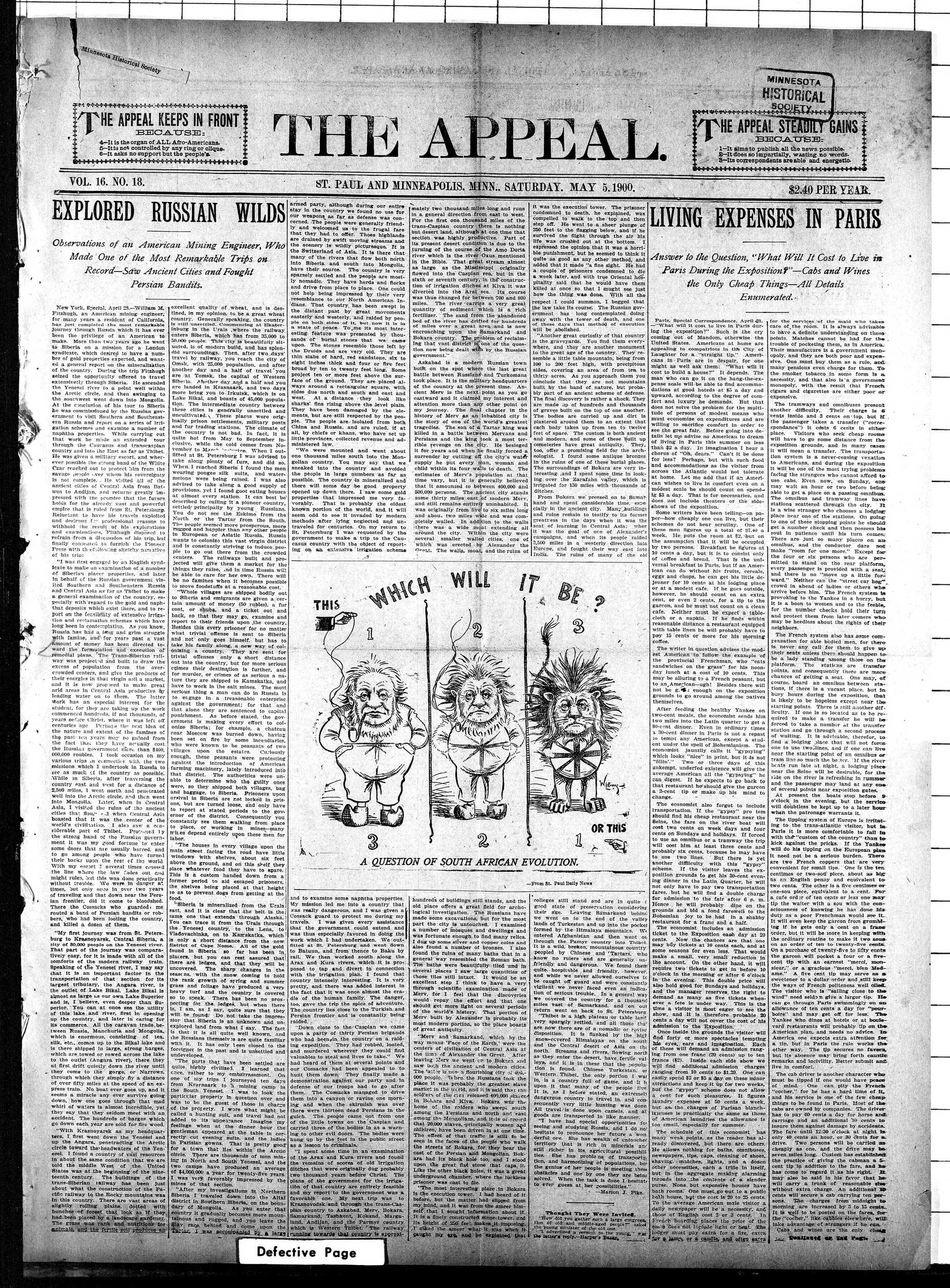
THIS WHI
1
3
A QUESTION
THIS WHICH WILL IT BE?
1 2 3
3 2 1
OR THIS
A QUESTION OF SOUTH AFRICAN EVOLUTION.
and to examine some naphtha properties. My mission led me into a country that was really dangerous, and I was given a Cossack guard to protect me during my journey. I was told that the government could extend and was thus especially favored in doing the work which I had undertaken. We outfitted at St. Petersburg and went down to the river to be railed. We then worked south along the Arax and Kura rivers, which it is proposed to tap and divert in connection with the irrigation plan. I found that the water was so precious, and there was added interest in the fact that it was once almost the cradle of the human family. The danger, too, gave the trip the spices of adventure. The country lies close to the Turkish and frontier and is constantly being raided.
"Down close to the Caspian we came upon a party of thirty Perian brigands who had been in the country on a raiding expedition. They had robbed, looted, and murdered wherever they could find them. They had heard of them at several points and our Cossacks had been appealed to to hunt them down. They finally made a demonstration against our party and in defense of our troops had to go after them. The Cossacks managed to drive them out of the town and when the skirmish was over there were thirteen死 Persians in the gulch. The people came out from one of the little towns on the Caspian and carried three of the bodies in as a warning to other evil doors. The bodies were taken to the criminal public street as a lesson to the public.
"I spent some time in an examination of the Arax and Kura rivers and found the remains of scores of old irrigation canals. I visited two thousand years before Christ. The plans of the government for the irrigation of that country are entirely feasible and my report to the government was a success. I visited Krasnovodsk and through the trans-Casian country to Askabai, Merv, Bokara, Samarkand, Tashenk, Kokand, Margu, Kashgar, and Kashgar which is Western Tibet. The railway running towards that country is approx-
mately two thousand miles long and runs in a general direction from east to west. For the first one thousand miles of the trans-Caspian country there is nothing but desert land, although at one time that land was the most important in its present desert condition is due to the turning of the course of the Amo Doria river which is the river Oxus mentioned in the Bible. That great stream almost as large as the Mississippi originally flowed into the Caspian sea, but in the past it was diverted for the inflow of irrigation ditches at Kiva it was diverted into the Arafat sea. Its course was thus changed for between 700 and 800 miles. The river carries a very great quantity of sediment which is a rich source of nutrients for the bed of the river has drifted for hundreds of miles over a great area and is now encroaching upon the Kamarkand and Bokara country. The problem of reclamation is the most difficult one of the question that best deals with it by the Russian government."
Askabad is a modern Russian town built on the spot where the last great battle between Russians and Turkumans took place. It is the military headquarters of the country at the present time. An eastward and a westward and it claimed my interest and attention more than any other point on my journey. The final chapter in the history of Merv as an inhabited city is the story of one of the world's greatest killed in a battle between Mervans and Persians and the king took a more terrible revenge on the city. He besieged it for years and when he finally forced a surrender by cutting off the city's walls, children within its four walls to death. The estimates of Merv's population at that time vary, but it is generally believed that it amounted to between 400,000 and 500,000 persons. The ancient city stands and still remains entirely uninhabited. It was originally from five to six miles long and about, two miles wide and was completely walled. In addition to the walls there was a wide moat extending all the way to the several smaller walled cities, one of which was erected by Alexander the Great. The walls moat, and the ruins of
CH WILL 1
2
2
ON OF SOUTH AFRICAN E
hundreds of buildings still stand, and the old place offers a great field for archological investigation. The Russians have made some excavations, but for the most part the city is untouched. I examined a number of mosques and dwellings and made a few discoveries, many relics. I dug up some silver and copper artifacts, also found a number of bronzes. I also found the ruins of many baths that in a general way resembled the Roman bath. The baths were beautifully tiled and in several places I saw large quantities of pottery. I would be an excellent step I think to have an through scientific examination made of Merv, for I feel that the discoveries would repay the effort and that one should get more light on several periods of the world's history. That portion of Merv is probably its most modern portion, so the place boards of great antiquity.
"Merv and Samarkand, which by the way means 'Face of the Earth,' were the centers of civilization of Central Asia at the time of Alexander the Great. After having Merv we went on to Bokara and we went on to Samarkand. The latter is now a mining city of 400,000 people. When the Russians took the place it was probably the greatest slave market in the world, and it is said that the soldiers of the citr released 400,000 slaves. Bokara was the home of the raiders who were among the Persians and north and east among the Mongolians, and it is of record that 20,000 slaves, principally women and children, have been driven in at one time. The Persians were seen in the faces of the people who walk the streets of Bokara, for they bear the cast of the Persian and Mongolian. Bokara had its black hole too; and I stood upon the great fist stone that caps it, a great underground chamber, where the huckleberry prisoner was cast to die.
"The most interesting place in Bokara is the execution tower. I had heard of it before, but the matter had slipped from my mind, and it was from the ameer himself. I was in the executionation about it. It is a finely constructed tower of its height of 20 feet. meats it imposing. I asked the ameer what it was when it caught my eye, and he explained that
it was the execution tower. The prisoner condemned to death, he explained, was compelled to walk to the top and then went to want to a sheer plunge of 250 feet to the ground. He survived the flight through the air his life was crushed out at the bottom. I expressed the opinion that it was a horrible punishment, but he seemed to think it was a good thing. He added that it made a 'fine sight. He had a couple of prisoners condemned to die a week later, and with true Oriental hospital said that he would have them with him. He just see just how the thing was done. With respect I could summon, I begged the law take its course. The Russian government has long contemplated doing away with the tower of death, and one of the methods of execution will be abolished.
"Another great curiosity of that country is the graveyards. You find them everywhere, and they are another monument of the country. You can see them, semble a little table mountain, being from 100 to 200 feet high, with precipitous sides, covering an area of from ten to thirty acres. As you approach them you will see the hand of nature, built by the hand of nature, but probably part of an ancient scheme of defense. The final discovery is rather a shock. They are graves built on the top of one another. The bodies are carried up and dirt is plastered around them to an extent that each body takes up from ten to twelve feet of graves. They are modern, and some of these built up cemeteries have great antiquity. They, too, offer a promising field for the archival work. There are many in the ruins of one of these burial places. The surroundings of Bokara are very interesting, and I spent some time in looking over the Zarafarah valley, which is one of 130 miles with thousands of ditches.
From Bokara we pressed on to Samarikand and spent considerable time, especially in the city of Bokara, and rulers remain to testify to its former greatness in the days when it was the seat of learning in Central Asia; when it was the home of the great campaigns, and when its people rushed 3,000 miles in a westerly direction into Europe, and fought their way east into Asia.
T BE ?
3
OR THIS
1
VOLUTION.
-From St. Paul Daily News
college still stand and are in quite a good state of preservation considering their age. Leaving Samarkand behind is to the end of the valley of Turkestan in the mountains formed by the Himalaya mountains. We entered Afghanistan and then went on through the Pamyr country into Tibetan and Chukchi mountainous country peopled by Chukchi who know no rulers and are generally unfriendly and dangerous. We found them quite hospitable and friendly, however, we found that they allowed ourselves to be caught off guard and vigilant we never faced even an indication of serious trouble. In a general way we covered the country for a thousand miles and on our return went on back. For
"Tibet is a high plateau or table land very sparsely settled, and all those that there are of a nomadic or roving disposition snow-covered Himalayas on the south and the Central desert of Asia on the north. Streams and rivers, flowing north and south, are fertile valleys, and it is in these that an island is found, Chinese Turkestan, or Western Tibet, the only portion I was aware of, of game and it is upon it that many of it. It is, as I before stated, an extremely dangerous country to travel in, and concludes that hunting was done All travel is done and all goods are transported in like manner.
"I have had special opportunities for seeing and studying Russia, and I do not hesitate to pronounce her future a wonderful one. She has wealth of untreated territory (that is rich in minerals and still richer in its agricultural possibilities). She has problems of transportation and hamming up populations, but the genus of her, the musk ox, obstacles and one by one they are being solved. When the task is done I hesitate to ever guess at her possibilities."
—Marlon J. Pike.
Thought They Were Invited:
"How did you gather such a collection, of old and middle-aged people?" asked the young minister of the old one. "Is it possible you own them?" asked the letter's reply—Harper's Bazaar.
MINNESOTA
HISTORICAL
SOCIETY
THE APPEAL STEADILY GAINS
BECAUSE:
1-It aims to publish all the news possible.
2-It does so impartially, wasting no words.
3-Its correspondents are able and energetic.
LIVING EXPENSES IN PARIS
Answer to the Question, "What Will It Cost to Live in Paris During the Exposition?"—Cabs and Wines the Only Cheap Things—All Details Enumerated.
Special, Presidency correspondence, April 21. "What will it cost to live in Paris during the exposition?" Such is the cry coming out of Mandem, otherwise the appeal to compatriots in the City of Laughter for a "straight up." Americans in Paris are in despair, for one might as well ask them: "What will it cost to build a house?" It depends. The economic scale of modest means who must economize of modest means who willing to sacrifice comfort in order to see the great fair. Before going into details let me advise no American to dream of living in Paris this summer on less than $2 a do. In imagination I hear a call for less. Perhaps, but with such food and accommodations as the visitor from across the Atlantic would not tolerate at home. Let me add that if an American wishes to live in comfort on a $2 a do scale he should count on spending $2 a do or $2 a do, and does not include the剧院 or the sideshows of the exposition.
Some writers have been telling—on paper—how cheaply one can live, but their schemes do not bear scrutiny. One of these men figures up a total of $7.40 a week, which is less than the assumption that it will be occupied by two persons. Breakfast he figures at 10 cents a day, but it is to constate only of coffee and bread. That is the unlucky breakfast in Paris, but if an American can eat it, he can eat ghee and eggs, and he can get his little dejeuner for 10 cents at his lodging place or at a modest café. If he goes outside, however, he should count on an extra 2 cents, for a tip to the garçon, and on the cafe. Neither must he expect a tablecloth or a napkin. If he finds within reasonable distance a restaurant equipped with table linen he will probably have to pay 15 cents or more for his morning cafe. The writer in question advises the modest American to follow the example of the provincial Frenchman, who "cats sandwiches on the grass" for his noon-day lunch at a cost of 10 cents. This may be alluring to a French peasant, but an American—amongst? Besides there will be no room for the on the exhibition grounds to go around among the natives themselves.
After feeding the healthy Yankee on two-cent meals, the economist sends him two miles into the Latin quarter to get a 80-cent dinner. Even in ordinary times the economist dinner in Paris is not a repast to temple the dinner in Bologna, under the spell of Bohemianism. The economist lautally calls it "gypysing" which looks "nice" in print, but it is not "fillin". Two or three days of this unempet, underfed existence will give the average American all the "gypysing" he needs. If he expects to go back to that restaurant, he should give the garonon a 2-cent tip or make up his mind to change.
The economist also forgot to include transportation. If the "kypss" pro tem should find his cheap restaurant near the Seine, the fare on the river boat will have two cents on week days and four cents on weekdays. If forced to use an omnibus or a day taxi, he will cost six cents at least three cents and probably six cents, because he may have to use two lines. But there is yet another difficulty with this "kypss" pro tem. The latter leaves the expedition grounds to the dinner in the Latin Quarter, he will not only have to pay two transportation fares, but he will find a double charge for admission to the fair after 6 p. m. Hence he will probably dine on the farrow to the Bohemian joy to that farrow's restaurant for a franc and a half.
The economist includes an admission ticket to the Exposition each day at 20 cents, and the chances are that one buyet ticket will be given some seasons for even less. That would make a small, very small reduction in the account. On the other hand, it will be more expensive, and a o'clock in the morning or after 6 o'clock in the evening. This double price will also hold good for Sundays and holidays, and the manager reserves the right to change the time, even a fete is under way. This is the time a visitor is most eager to see the show, and it is therefore probable 20 cents will be the cost of his admission to the Exposition.
Once inside the grounds the visitor will find forty or more spectacles tempting his eyes, ears and imagination. Each spectacle comes from one france (20 cents) up to ten francs ($2). Inside each side show we will find additional admission charges ranging from 10 cents to $1.20. One can buy a pair or $3 a day on these minor attractions, or buy a pair of glasses but the "gypsy" scheme does not allow a cent for such pleasures. It figures laundry expenses at 50 cents a week, but as the charges of Parisian blanching are higher than the cost of American laundries the allowance is too small, especially for summer.
The schedule of this economist has many weak points, as the reader has already discovered, but there are others. He allows nothing for baths, omnibuses, toilets, and showers, matches, lights, and a dozen other necessities, each a trifle in itself, but in the aggregate making alarming inroads into the contents of a slender purse. None but expensive houses have to pay for baths, and the average bath house, but the cost is 20 to 20 cents. To the average American male visitor a daily newspaper will be a necessity, and those of English cost 2 or 3 cents. In the case of a house with a door each does not include light or heat. The lodger must pay extra for a fire, extra for a lamp, or a candle and often extra
$2.40 PER YEAR.
for the services of the maid who takes care of the room. It is always advisable to have a definite understanding on these points. Matches cannot be had for the maid's use. Their manufacture is a government monopoly, and they are both poor and expensive. One must buy them as a rule, and many pensions even charge for them. To the smoker tobacco in some form is a necessity, and that also is a government expense. The French cigars and cigarettes are either poor or expensive.
The French system also has some compensation for able bled men, for there is never any call for them to give up their seats unless there should happen to be among those on the platform. The station is also equipped with points, and consequently there are more chances of getting a seat. One may, of course, board an omnibus between stations, if there is a vacant place, but in the case of a station with an exposition, that is likely to be hopeless exposition, starting points. There is still another difficulty. If one is so located as to be required to make a transfer he will be forced to take a number at the transfer station, and a second process of waiting. It is such a process that finding a lodging place that will not force one to use two lines, and if one can live near the starting point of an omnibus or tram line so much the beter. If the river is near the station, the boats will near the Seine will be desirable, for the side on the river is refreshing in runner and the passenger may land at any one of several points near exposition gates. The boats stop before 9 o'clock on the river, and will doubtless be kept up to a later hour when the patronage warrants it.
The tipping system of Europe is irritating to the trans-antialantic visitor, but in Paris it is more comfortable to fall in on "custom of the country" than to kick against the wall, and will do his tipping on the European plan it need not be a serious burden. There are two French coppers that are very convenient for small tips. One is the ten contiles or two-soot piece, about as big as an English penny and equivalent to ten cents. The other is one-souce piece, equivalent to a cent. For a cafe order of ten cents or less one tip the waiter with a soup with the consciousness of knowing he has done his duty as a poor Frenchman would see it. If he gets only a cent on a frame order, it will be more in keeping with the ordinary routine to make it two soons on an order of ten to twenty-five cents. If he gets only a cent on a frame order the garon will pocket a four or a frecent tip with an earnest "merel, moonseur," or a gracious "mered, blen Mo裳me." A five cent tip may serve as a sweetener to a dollar order and still keep it free. The visitor who is "selling close to the wind" need selden for a larger tip. He can go through Paris swimming on an allowance of ten cents a day for "poor-boy," and may get off for less. The boutique restaurants will probably board on the American plan, and needs no advice. America one expects extra attention for a tip, but in Paris the rule works the other way. The tip secures no freeways, no parking, no remarks and inclivity. Better submit and live in comfort.
The cab driver is another character who must be tipped if one would have pence of mind. One can pity the French "cocher," for he has a hard time of it. It is not easy to carry things to be found in Paris. Most of the cabs are owned by companies. The driver has to pay 60 cents a day for horse and carriage and an additional 10 cents to pay the fare. The fare until 12:30 o'clock at night is only 40 cents an hour, or 30 cents for a drive. Two persons will be carried as cheaply as one, and the drive may be carried in a car without extra charge. The practice of giving the cabman a 5-cent tip in addition to the fare, and he has come to regard it as his right. It may also be said in his favor that he has been given a 5-cent tip without extra charge. An additional 10 cents will secure a cab carrying ten persons. The charges from midnight to morning are increased by 5 to 15 cents. The cab driver, the "cocher," like cabbies elsewhere, will take advantage of strangers if he can. Cabs and wines are the only cheap
YOU READ
THE APPELL
PUBLISHED WEEKLY BY
ADAMS BROS. EDITORS AND PUBLISHERS
49 E. 4th St. St. Paul, Minn.
INSUED MICHAELSUNLY IN
Gaint Paul, Minneapolis, Chicago,
Louisville, St. Louis, Dallas.
ST. PAUL OFFICE.
No. 164 Union Block 4th and Cedar
J. Q. ADAMS, Publisher.
MINNYZAPOLIS OFFICE.
Room Number 600 Onteda Block
H.ROBERTS, Manager.
CHICAGO OFFICE.
No. 323-5 Dearborn St. Suite 213-215
C.F. ADAMS, Manager.
LOUISVILLE OFFICE.
No. 312 West Jefferson St. Room
W. V. PENN, Manager.
ST. LOUIS OFFICE.
No. 1002 FRANKLIN AVENUE
J. H. HARRISON, Manager.
DALLAS OFFICE,
NUMBER
LA: BROWN, Manage
TERMS, STRICTLY IN ADVANCE:
Single copy, one year
$2.00
Single copy, six months
$1.10
Single copy, three months
60
When to return
to run without prepayment, the terms are
center for returns, or at the state office.
communications to receive attention m.ast
must be received only upon one side of the paper; most
ten only upon one side of the paper; most
later than two; if possible, no negotiation
of the answer. No manuscript returned, un-
cleared, or withdrawn.
In every letter that you write us never fall to
give us your name and address, plainly write
your post office address, and plainly write
letters of all kinds must be written on separ-
ate sheets. The matter for publication, Enspres is second
matter for publication. Enspres is second
AGENTS WANTED.
AGENTS WANTED.
THE APPEAL wants good reliable agents to canvass for subscribers at points not already covered. Write for our extraordinary inducements. Address.
THE APPEAL,
St. Paul Minn.
SATURDAY, MAY 5, 1900.
For choice reading, we refer our readers to an article which appears in this issue telling of a speech Pitchfork Tillman made at Ann Arbor, Mich., a few days since. It beats anything we ever heard of. We have not a sufficient command of language to express our opinion of the author of the speech, so won't try. Just read for yourselves and we don't care how bad your opinion is of the thing that made the speech. Just consider your statements our's.
There are two classes of Afro-American, those who won't read Afro-American newspapers and those who won't read any other kind. Both are wrong. All good, intelligent citizens should take a daily paper, and read it so as to be informed on the news of the day; and all loyal Afro-Americaners should take one Afro-American paper so as to keep in touch with matters pertaining to the race.
The grand protest of the Afro-
Americans of Washington against the reappointment of Wight as one of the commissioners of the District of Columbia, on account of his utterances so derogatory to them, has had the effect of causing the President to appoint Henry B. F. MacFarland, a newspaper man, who is more acceptable.
St. Louis is preparing to present Admiral Dewey a solid silver punch bowl, lined with gold, when he visits the Future Great. The cost of the bowl will be $3,000. We wonder if it will be big enough for him to soak his swelled head in?
The presidential campaign orchestra has not yet commenced the opening number, but there's lots of tuning up going on.
Come to think of it-it isn't at all strange that a Kitchen-er should have an affinity for a Pot-ter.
Reed isn't sayin' nothin'. Wonder whether he's to be the dark horse in this campaign.
Don't pull back so, Teddy. There's nothing hard about being vice president.
PROGRESS OF THE NEGRO
Shown in Exhibits at the Paris Exposition
position.
Prof. W. E. B. DuBois has just sent the second new university for the Paris exposition at Atlanta for which he is an exhaustive study of the Georgian negro-Georgia, as having the largest negro population of any state, being住住 the air representative for the negro- and it is illustrated by maps, colored charts and facts shown are on the whole decidedly courageing, not only in regard to the material progress of the negro, but his intellectual progress as well. The increase in the has been steady from 1762 to the present and proportion in relation to the whites has been from 37 per cent in 1800 to 46 per cent in 1800, there being in 1800 over $50,000 negroes resident in Georgia. The freedmen of Georgia and their sons own an increase of over 700,000 of land, an increase of over 700,000 and their taxable property is assessed at about $1,500,000, having increased in value nearly $3,000,000 since 1875. In the various occupations the agricultural are still in the great majority, although practically no occupation or profession that is not represented by a few at least.
Hillery has decreased from 90 percent in 1880 to 50 per cent in 1900, and the number of children in public schools in the same period from 7 to nearly 190,000 public schools, with property valued at $196,000, and about 3,500 nongovernment teachers. The numbers of nongrevenu students in different courses—business, medical, and industrial—professional, scientific, normal and industrial—in business to 2,252 in industrial courses.
He lit in the camp with a booze scented wine, and swept away the wreathed wedge, and sweep he would wipe from the earth any rooster that crowed in his caisson. he tilted the air that hung over the bar with the heat of his language was his name was Wild Dick, it an it fit him, for he was a terror from Kalamazoo. A pair of six-shooters' ballast a ship were hung from a belt at his waist; his arm was covered in premature graves he had placed. But price marks were written in ink on his guns—they both were unarmed and And we knew that our camp was the first stand he'd played since starting from the camp.
But nothing was hit that would leak any blood for the terror from Kalamazoo.
He'd kill the first man that declined to indulge, and the bawls quite obligitably drank—
Taken from a truck with money to burn in his flank.
They gave him a dakock and called him a dakock cuckoo.
And every such joshing would jolly a drink
Yank Sullivan started, the ball on a dance
round the fast whirling wheel of roulette,
and bawled at the adiable way to play the game with a ball.
And half an hour later, in searching his pocket, kind-hearted Sullivan purchased a drink for the terror from Kalamazoo.
We filled all his pocket's with second-hand grub. For Richard was not in position to ride at regular passenger. And he groomed the gloom of the yarsis we bade him a tender adder.
An abby took the emigrant car and started for Kalamazoo.
"Denver Post."
There hurks in the mind of man a longing for something beyond the present—Humboldt.
TO CURB A COLD IN ONE DAY
Take Laxative Bromine Quinine Tablets
All drugs励 the money if it fails
Grove's signature is on each box.
THE APPEAL: A NATIONAL AFRO-AMERICAN NEWSPAPER
SHOTGUN METHODS.
SEXATOR TILLMAN DEFENDS THE
SHOOTING OF NEGROES
IN THE SOUTH.
SENSATIONAL IN HIS ABUSE.
Says the Whites Have No Recourse, but to Ignore the Thirteenth, Fourteenth and Fifteenth Amendments to the Constitution, and Run the Elections by Force of Arms.
Ann Arbor, Mich., April 30.—The students of the University of Michigan listened one hour before the Senate interfered in Southern medias upon the reconstruction policy that it was ever their fortune or rather misfortune if you will, to listen to it. It was an opportunity, the Fourteenth, and fifteenth Senator Tillman, of South Carolina, upon the "Race Problem." under the auspices of the Fourteenth, and fifteenth shotgun and intimidation were the order of the day to accomplish the disfranchise of the negro, and that white the thirteenth, and that fifteenth amendments to the constitution were not repealed in fact, they were nullified in fact, they were nullified in Carolina. Among other things, he said:
"This is not a race or negro question of the South alone; it is not a local or sectional question; it is a national question, and this is what we want to know to look for in You in Michigan. In Michigan nothing about this question. You judge only by books and from what you hear: politicians say, who have axes to grind. The last census gives Michigan 7,000 colored and 600,000 white voters, or to about 10. If there were to be pro-monies intermarriage between the races Michigan it would not affect the white race.
He then went into the history of the war, and North calls the War of the Rebellion, and which you can never make me admit. He said that the very men who claim negro and to put the ballot in his hands are the men who have recently distanced themselves from slaving the natives of the Philippine省, and the senators of the United States and the senators of the United States and would have liked to use a term sufficiently strong to express the actual facts, but he said that to "hiss the word 'hypocrite' into their manner as I was capable of doing."
He continued: "You have heard of the governor in South Carolina, Well, we have $2,000 negro voters to $8,000 white voters. How much more would you like to beat that majority in a fair vote? It can't be done. So we got together; and repealed the thirteenth, fourteenth, and fifteenth amendments, got arms and carried the election, and repealed the thirteenth, fourteenth, and fifteenth amendments, got arms and carried the election by vote and framed it, and took the state away from the negro. Michigan, and we wouldn't have stood it; if we hadn't remembered Sherman's bravery, we wouldn't have freed the slave and settled nothing else."
He spoke in a most contemptuous man-
ners, laziness, shiftless, with no tenacity of purpose,
etc., and that since their freedom,
sales, shiftless, with no tenacity of purpose,
sales, "Education is a bar more than
benefit to them. When colored men learn
to obtain goods and money, Character is
the main essential to life, and we look
at them as the most important one good mother
in one hundred. We cannot not one good mother
totally lacking in virtue. The venture
of that man is a total failure.
The object of that man is to graduate,
to be graduate high grade mechanics and
to be graduate high grade mechanics and
their learning would be graduated
man would not joblele him in a com-
mputer world. The negro is fit only as a
shoeblock man and the cotton and rice fields.
he had no fears of the "race problem" he had no fears of the "race problem" he would only keep their hands off, and predicted that the Northernner will not dare attack the Southernner in the nature of the past, as the precedent established in the Philippines, Hawaii and New Zealand, forever bar any such interference.
The address was loudly applauded, more
accounted for, the Amazon boldness than
the talk.
LIVING EXPENSES
mann is in need of training for the manishable, and the freshman's qualifications is for the manishable, a more mature native's while the look took as though a manishable in them but after training she arrived to the opinion that the Galilee barriers are gradually pulling out their customers' beards by the roots.
French is so important in our life that we use it in our box or in our toilets. French canals are comparing notes there is a frequent query: "Do you get, enough to eat?" Similar complaints are also made. Publishers in the English papers in Paris.
Food is expensive and human labor is cheap. Most Parisians are forced to light eaters. It is an education in how to see how thin midsummans can put the flesh out of their mouths with which she dips out an extra half ladle of soup may be either an art or an inheritance. Perhaps she is seen at her best or worst—when after having dished out a plate of two or three morsels and returning to platter. I do not think this mode of life is due to stinginess or avarice. It is forced upon Parisians by their crushing exasperation and small income. In the case of a French woman, the additional necessity of making enough during the season to carry the mistress through the remainder of the season is an anxious to get into a French house, where he must accept the pension as it is.
There are quite a number of boarding houses catering to Americans in which trans-Atlantic visitors can live in, comparative comfort, for seven and eight that is in ordinary rates to $120 a week. That is in ordinary rates to $120 a week does not include "light or heat. Few American visitors to Paris will want to put up with less than these pensions afford, but there seems to be a general trend that is higher rates May 1, to $2 and-$24 a day. In some of these houses it has been possible to get rooms, without meals, at two frances a day or $20 a week. They are notifying loggers of an advance to four frances a day or $20 a week to $7 a week merely for a place to sleep. These are the moderate prices in the quarter of the patronized by Americans, and it is hardly necessary to add that it is the best quarter of Paris. An ordinary room in an apartment is worth the rate would be $2 a day with an advance of $2 in May. That included no meals. Another who is paying $220 a day at a small hotel in the St. Louis area in beginning May 1. This is with meals. These are merely given as samples of a general condition. Visitors seeking rooms at cheap prices will have to go some distance to find such rooms. The Latin quarter is one of the most promising fields for these wanderers.
will want to
Allen, Richard: Autobiography, Philadelphia,
1888; Autobiography, Philadelphia,
1884;
a general
raise 'their
anonymous,
Anonymous, Appointed,
a day,
Armstrong, J. H.: What Communion Hath
in seem possible,
Darkness, Philadelphia, 1884,
Arnett, Benj.,
Speeches and Addresses of Negroes,
collected and published (15 vols.); Orations
They are
There are many travelers' tales about the cheapness of Paris restaurants, and the Duval establishments are often clever in their way. You can read in the book of fare "Blinken of coffees." Beersweet at twelve centrically does look cheap, but when it comes on the investigator finds that his morsel two inches wide and three inches long. This is not an aggression or about shouting. Potatoes are extra. A lump of bread adds a thin wafer of butter, extra. A little more butter or bread, another extra charge. At the end of the meal the dinner must be unable to make the mystic bill take the form of a mental memorandum, but a veteran waiter who there is an extra charge for tablecloth and napkin. Finally there is the tip to the waiter, who in this case is the "madame" instead of a "garoon." The establishments are good, moderate priced restaurants, but they are not in them, for it is no trick to spend four or five franks for a modest meal.
A French housekeeper has furnished me with the prices of some staple stuffs, which will show how living is not cheap. The cheapest meat to be had is scraps. The most expensive for an American pound. At the scale the scale are cooked hams at 43 cents a pound, and the best steaks at 40 cents. Uncooked hams can be had at 24 cents and meat at 13 to 22 cents. Stirling steak meat 18 cents and veal at 13 to 32 cents, the price of the latter depending on the number of bones. The usual grades of coffee from 30 to 54 cents, but any for a lamp may not appear so unassailable in the light of the fact that kerosene costs 54 cents a gallon. Butter costs from 28 to 72 cents a pound, and any for a lamp for less than 28 cents may be set aside. The meat worth 11 cents, and flour ranges from 5 to 9 cents. These high prices are due in part to the octol, the tax on food stuffs brought into the city. It is to the degree that no matter how humble or untidy the restaurant the cooking is good. The dyspeptic whose purse is as poor as his stomach may a "gysps" diet with the assurance of escaping the all-purposefulness of the cheap restaurant of America.
Let me repeat that no American with a respect for himself and his stomach should think of trying to do Paris during the Exposition for less than $2 a day. He should still enjoy interesting to economize and thus safely interesting a day, with careful management and self-denial, he can see the essential things. If he wants to see everything he can use $5 to $10 a day without waste. These figures do not include drinks, cigars or the night show that are toured by a swarm of boulevard guides. Of course, there is no limit to the cost of these things and the high pressure with which American men have to put into their short stay will also increase the daily outlay.
And still the transatlantic visitor will probably ask: "What is the best way to do Paris and the Exposition?" It will be money in pocket to buy a good book on the way over, especially its maps and the transportation lines. At the posts on this side one of the English dailies of Paris can be had by previous arrangement with a steamer steward, and in that case you can go to hotels and pensions; catering to Americans. The stranger can then look around. If he wishes to make a change he can get admissible advice from the attaches at Commission General Peck's office. The colony will be glad to help out a compatriot with a knowledge and experience gained by rubbing against the sharp corners of the City of Laughter.
**ent.**
Johnson, Wm.: Prominent Colored Men of
Kentucky.
Kenney, E. W.: Behind the Scenes.
ampton, E. W.: Sacred Dynamite on
Baptism.
Merry, L. C.: Struggles for Freedom,
says
Rockford
angston, John M.: Freedom and Citizen
capital; Lectures and Addresses.
rose in the
not take
minton or
rain to buy
Lewh, R. B.: Light and Truth, Boston.
1858.
Defective Page
A well-authenticated relic of the poet, Burns, came up for sale at Messrs. Sotheby's, London, in the shape of a glass tumbler used by him, and presented to the present owner by Mrs. Hutchinson, daughter of Colonel James Glencairn Burns, the poet's glass tumbler is enclosed in a handsome call case and secured by a lock. It realized £12.
Products and Equipment.
"The advance in the prices of agricultural machinery and equipment," says Dr. Burns, of the Rockford Register, who ought to know "the best more than offset by the advance in the prices of farm prudue. It does not take as many pounds of pork, beef, mutton or poultry as the price of grain to buy a wagon, harvested from the land, and the like, as it did a year ago."
THE BOOK WORLD
Alphabetical List of Afro-American Authors and Their Works.
Love, E. K.: History of the First African Baptist Church.
1909, 1913. Christianity, Islam and
Judaism. 1909, 1913. Born in
Bombay, O.: Plain Theology for Plain
Judaism.
Bowen, J. W. E.: Africa and the American Negro.
Brent, Linda: Incidents in the Life of a
Slave Girl.
Penguin, New York.
Brooks, Chas. H.I. History of the Grand
Plaas, 1803 of Odd Fellows, Philadel-
phia, 1803
Brown, Margaret: French Cook Book,
Washington, D. C., '88.
twelve New York, 1863; The Black Man, 1864; The New York, 1865; the Boston, 1867; Colleton, 1870; bellton, 1868; Colleton, 1871; Philadelphia, 1874; Three Years in Born, 1875; Dough, Dough, Mirage, the Beautiful
Bruce, H. C.; The New Man.
Bibb, Henry; Autobiography.
Coole, J. Bohn & Brow, The Walters of Wollens.
J. Bohn & Brow, Chicago, 1888.
Campbell, Jabez P.
Campbell, J. Cohen from the Cabin, etc.
Campbell, J. Cohen from the Cabin, etc.
Campbell, N. C.; Rock of Wisdom.
Carson, Hannah; Glory in Affliction, Phil
Caruthers; Poems.
Chestnut, Chas. W.-S. The Conjur: Woman
Woodward; Hedrick Douglass; Wife of
Hilde, youth, etc.
Clark, Peter H.: History of the black
riangle.
Coleson, H. N.: Poor Ben, Philadelphia,
T80.
Coleson, H. H.: A Casket of Pulpit
Thought, 1883.
Columbea N. and Coffin. A. O. Natr.
Plants of Marshall. Texas.
*Taxodium distichum*
Saker, Behmann: Anti-Slavery Pamphlet,
1820. Baskett: Anti-Slavery Pamphlet,
1810
Cook, Barker: Anti-Slavery Pamphlet,
1810
Council, Mrs. A. J., 1820. A Voice from the
South, Xenin, 1820.
Council, Mrs. Key to Negotiations that
referred to the Treaty, Nashville, 1850.
drove to the Church, Nashville, 1850.
Council, W. H.: Lamp of Wisdom,
Council, W. H.: Talks for the Times;
Crowman, W. H.: Talks for the Times;
Crowwell, John W.: History of Bettel
Historical and Literary Association,
Bettel.
Crosthwait, Wm. A. The Negro Problem.
Crosthwait, Wm. A. The Negro Problem.
1876: Africa and America. 1881: Future
Civilization the Primal Need.
Crosthwait, Wm. A. The Negro Problem.
1881: Narrative of Enslavement.
1878.
Fortune, T. T.: Negro In Politics; Black and White.
Sotoe; John A.: Brand Plicked from Fire
Frederick; Freedric: Freedric's Slave Life.
Franklin: Jau. Crimson Almighty, Memphis.
1805: Midday Gleanings, Memphis.
Gaines, W. J.: *The Methodist in the South*, The Army and the White Man. Gaines, Henry Highland. Pamphet Adjacent. Gauret, Henry Highland. Pamphet Adjacent. Gauret, H. H.: *Gauret's Memorial Discourses*, 1885. Gauret, the Literary and Historical Society, Georgia Conference.
Green, A. R.; Life of Rev. D. F. Davis,
Gregory, J. M.; Frederick Douglas, the
Gresham, G. N.; Mathematica (text book),
Grimke, A. R.; Life of Charles Summer;
Grimke, A. R.; Life of Charles Summer;
William Lloyd Garrison.
Hogan M. M.: Colored Man in the M. E.
Crawford
[Haley, James T.: Sparkling Gems (poems).
James T. Garnett of the Discipline; The
Jacob Problem.
Jacob Problem. Conversations on the
Jacob Problem.
J. E. Church. Conversations on the
J. E. Church.
M. B. Church. Iola Lola Laby 1929; Poesy.
Iayne, Joe M.: The Black Man; Negro in
Sacred History.
Jose M. Laby. Glories 1800.
inderson, John M.: The Black Man;
Inderson, John M.: The Black Man;
Fables of the Own, Near Daughter;
Fables of the Own, Near Daughter.
Henson, Joseph: 'Eather Henson's Story,
Hood, J. W.; One Hundred Years, etc.
Joseph, J. W.; E. Z. Church; Negro
in Christian Pulpit; Two Characters
Two Destinies.
Howard Jas, H. B.: Bond and Free, 1886.
Jones, J. A.?: Some footprints of Prog-
gression. In: *Footprints* (Jas, Ipsen,
Jasper, John: "Sun Do More.",
*ninnings, Paul: Colored Man's Life of
Johnson, E. A. (Mrs.) The Hazeloy
Family; Clarence and Corinne.
Johnson, E. Edward A.: School History of
Johnson, Riego: Negro in Spanish-American
War.
Johnson, Jas. H. A.: The Fine Tree Mission.
Johnson, H. T.: The Diversity Layer.
Loguen, J. W.: As a Slave and as a Free man.
Love, E. K.; History of the African American Church. Lyman, M. K.; American Speaker. Marys, Ellijah P.; Life and History. Lynch, M. K.; American Speaker. Magee, J. H.; The Night of Affliction. Majors, M. A.; Noted Negro Women in the Lands. M. A.; The Mothset Luminary. Moth of Ignorance must be destroyed. Moore, Alice Ruth (Mrs. Dunbar); Violets;
Mossel, C. W.; Tousant L'Overture.
Miller, Kiley; Review of Hoffman's Race
Miller, Kiley.
Nell, W. C.: Colored Patriots of the Revolution, 1855.
Newson, T. the Negro Pew. Boston, 1857.
Newson, J. T. C.: Know What You Want to Say, etc.
Newson, Soomon: Twelve Years a Slave.
Ousley, M.: Translation of Gospels and Acts.
Paige, T. F.: Twenty-two Years of Freedom.
Payne, Daniel A.: Recollections of Service, a treatise on Domestic Education, Hearst Press, 1801. Ficures, and other Miscellaneous Poems. Baltimore, 1850.
Perry, Rufus L. *The Cushite*, 1883.
Perry, H. *H: History Colored M. E. Church*.
Pope, Barbara: *Storlettes*.
Proctor, B. H. *The Negro and the War: Quinquefinal*.
A Colored Man Around World.
Randolph, E. A. *Life of Rev. John Jasper*.
Randolph, Peter. *Sketches of Slave Life*.
Ransome, R. C. *School Days at Wilberforce*, 1882. *Disadvantages and Opportunities of Colored Youth*, Cleveland, 1882.
Riley, H. Cordelain: Lincoln (a poem), 1883
Roy, H. Cordelain: Lincoln (a poem), 1883
Rector, J. R. Chart of Negro Progress, 1883
Rideout, J. R., D. A.: Life of D. A. Rideout, Sr., 1881.
Riley, Jerome F.: Philosophy of Negro
Suffrage.
Rowe, Geo. C. C., Thoughts in Verse, 1857.
Rudd. L. E. C.: Catholic Afro-American Congresses, 1883.
Rise and Progress of the A. M. P. Z. Church, 1832.
Sanspam, John P.: Temperament and Pheromology of Negro Race; Mixed
Smith, Mrs. Amanda: Autobiography, 1898.
Smith, C. Alberta: in the Light of
D. A. Payne: Sermons of Bishop D. A. Payne: Sermons of Bishop D. A. Payne: Sermons of Africa, 1895: Race
Quotient: Sermons of Africa, 1895: Sermons of
Smith, Jas. McCuse: influence of Glimates on
Lougelyt, 1846.
Smith, W.: Sermons of Bishop T. S.
Jones.
Smith, L. H.: Earnest Pleasen
Stevenson, J. W.: Church Financing, 1892.
Stevenson, J. W.: Church Financing, 1892.
Steward, T. G.; Genesis Reed, 1858.
Gospel Annam I. S.; Soldier, 1850.
Gospel Annam I. S.; Soldier, 1850.
Northrop: Twoy-two years a Slave. Forty
Years a Cars. Twoy-two years a Slave.
Stewart, T. Moe; Liberia, the Americo-
llan; Still William: The Underground Rail-
Straker, D. Augustus; New South In-
terior Dogs; Larceny of Dogs; Toussaint L'Overture
Tyson, M. E.; Benjamin Banneker,
M. E.; A Natural Truly,
Taylor, C. H.
Taylor, J. T.; The Negro, Atlanta, G.
Taylor, J. T.; The Negro, Atlanta,
1888; Universal Reign of Jesus; Life
Downey; Negro Evangelist; Life of
Thomas, I. L.; Colored Man's Reply to
Bishop Poster,
Trotter, James M.; The White Negro, 1884,
Trotter, James M.; Music and Some High
Musical People.
Truth, Josephine; Sojourner Truth's Nar-
row.
Turner, Bishop H. M.: Methodist Polity,
Bishop of the A. M. Church.
Ages: Printed Speeches and Letters;
Catechism of the A. M. Church.
Turner, H. H.: History of Church-
Turner, H. H.: History of Church-
Hynn Book for A. M. E. Church.
Hynn Book for Good Samaritans tane, etc., 1881.
W.
Thams, Edward: John Brown (Poem).
1889.
Washington, 1882; History of Negroes
1882; History of Indians, 1888; Negro as a Polishist
Factor.
The American Negro From 1776 to 1876,
Cincinnati, 1876.
Wilson, C. B.: History of G. U. O. of Odd Fellows.
Wilson, Joseph T. *Black Phalanx; Eman*
*Anonymous; "Johann"; "Fifty Years."*
*Anonymous.*
NOTES OF THE STAGE.
David Belasco is to make a "state" out of "Dave" Warfield.
Judge Joseph F. Daly is preparing a biography of his brother, Augustin Daly.
These are times of uncommon prosperity for the theater. Almost all the playhouses in America are making money, and many of them are highly profitable.
Laura Joyce Bell's new sketch marks the introduction of golf to the vaudeville stage. The sketch is based on that sport. It is called "The Lady of the Lhika."
Annie Russell will likely be seen in a dramatization of "Lorna Doone," R. D. Blackmore's celebrated story, next season. It is being adapted for the stage now by Louis N. Parker.
De Wolf Hopper has just bought a new opera and will produce it as soon as possible. It is by Jacquil and Scribe and the tall comedian thinks it will suit him. The name is not yet announced.
Francis Wilson has revived "Ermine" on a gorgeous scale, with Purline Hall in the title role, her old part, LuLa Glau者 as Javette, Jennie Westersby as the Duchesse and William Broderick as Ravannes
THE HOTEL
AIMS AND METHODS
The aim of this school is to do practical work in helping men toward success in the ministry. Its course of study is based on the work of its work; its work is thorough; its methods are systematic, clear and simple.
COURSE OF STUDY
The course occupies three years, and covers the lines of work
instruction offered in the course. Instruction usually pursued in the leading
theological schools of the country.
EXPERIENCES AND
EXPERTISES
Tuition and room rent are free. The enrollment students are fairly turbulent, good housing is available, and dollars per month. Buildings heated by Aid from loans without interest, and students who do their utmost in the students who do their utmost in the grace gifts, gifts and gifts are opened to him in this Seminary. For further information, address this Seminary. For further information, address this Seminary. FHRKIRKELID, President Algie A.
EGKSTEIN NORTON UNIVERSITY
COLLEGE OF SCIENCE, CUNY
HAMMING, BULLITT COUNTY, NY.
*Inducting wheelers to motet motion ten thousand wheels.*
THE LOCATION
The Ecklenbert Norton University is situated at Canaan, New York, and is one of the most beautiful and quiet institutions in the country. It is located in the county for many years. The building and grounds are surrounded by a mountain stream, dashing military boats and many species. In this quiet retreat away from the city, life is free of noise and unwinding and offers the physical development and security, and applies to all types of persons. It is designed to prepare for and aid the students.
DEPARTMENTS.
Library, Sericulture, Blacksmithing, Literature, Photography, Printing, Crayon Work, Telegraphy, Printing, Art, Appreciation, Furniture Raising, Dress Making, Agriculture,
The above departments are under competent personnel and branches they teach. They hall from Oberlin, rote to St. Louis, and then to Normal, Normal, Rhode Island, and other c. 200 colleges. Our classes and studies are not arranged that student must be enrolled in courses or finances, and return to course when the course is completed, consistent with 18 hours work in all departments.
TERMS
Room, board, fuel, tuition and washing. $850.00 × 12 months. Students may enter at any time during the year. Please contact Deserving students may have the privilege of extra reduction in proportion to the work they are willing to do. Students may be required to pay back on account of the very high character of the accommodations are first-class and offered alike to students.
PARTYES on route to Cane Spring, Ky., via Louisville,
for free accommodation at No. 25 Laurent Street,
Louisville. For catalogues and all business address the President,
REV. C. H. PARRISH, A. M.,
CANE SPRING, TY.
"GOD HATH MADE OF ONE BLOOD
ALL NATIONS OF MEN."
IS THE MOTTO of
Berea College
BEREA, KY.
Christian, non-sectarian. Three college courses.
Music Academy, Normal Manual. Tuition free,
except for American students. 250 white and forty American students.
To 100 miles if need to be to Grace Hill.
Address:
PRES. WM. G. FROST, PE. D. EISHA, KU
SHAW UNIVERSITY
SHAW UNIVERSITY
RALLEGE, N. C.
For both areas, Departments of Law, Medicine and Public Health. College Preparatory, English and Inductive Year begins before the end of the school year. Circulations, catalogs and contact information, address.
PRES. CHAS. S. MESERVE
Rallege N. C.
Fourteen teachers. Elegant and commodious buildings. Climate unsupervised. D partnerships. Northport, Typewright and Innotail Training. FIFTY DOLLARS IN ADVANCE Will pay for board, room, diet, tutition and lodgements for the entire year. Budget $40 per tuition $20 per term. Work done work. Send for director, to the president. REV. JUDSON S. HILL D. D. Morrissle, Temn.
NASHville, Tennessee
Departmental, English, Norfolk, Preparatory,
School of Medicine, A. J. School of
Medicine, Law, Medical, African American, A. J.
School of Medicine, Over forty instructors. Attendance last
year 600. Expenses from 40 to 50 per school
month. For further information, address the President, J. Braden, Nashville, Tennessee.
THE MEDICAL SCHOOL
OF THE
NEW ORLEANS UNIVERSITY
Admits Men and Women of all Races
WELL EQUIPPED, THROUGH INSTRUCTION.
Address 5318 St Charles.
NEW ORLEANS, LOUISIANA.
DOES THIS REMIND YOU
OF THE
WELSH-RAREBIT
YOU ATE
LAST
NIGHT
DYSPEPSIA
ANDBAD
DREAMS
CURED BY TAKING
JOHNSONS
Digestive Tablets
HOW TO HAVE LAST DREAMS
FEET
i ee ee
rs ——— ae Bis)
fl i
ST. PAUL.
A WEEKS RECORD IN MINNESO.
: TA'S CAPITAL,
Bue Satatty Clty and Salat City Folks
Newer Tora of Social, Religloas anv
‘General Matcers Among the Poople, Bot!
da meea
‘Mrs, J. Q. Adams is on the sick list
this week.
Mrs, 0, H. Allen has been on the
slek list this week.
‘No one can afford to pay something tor
nothing. ‘Tho Gordon has established the
<cright priee for fine hate—not $5,
One or two gentlemen roomers
‘wanted. Apply at 627 St. Anthony
sayenue, or ut THE APPEAL office.
Look out for the charming cantata
vol “Little Bo Peep” at St. James. A. ML.
©, Chureh, May 17, under the manage-
iment of Mrs, R. C. Minor.
Mr. Louis Carter has reopened the
Metropolitan Restaurant, No, 378 Min-
nesota street, where meals may be ob-
tained at all hours. Meals, 15 cents,
WA and Mamle Womack were ar-
rested Wednesday for having a Mttle
family setto, ‘They were before Judge
Orr Thursday and had their ease con
tinued,
‘those of ur patrons whe desire to
fanve matter publisted must got the
-same in this office not later than
‘Thursday, otherwise it may be crowa-
ea out,
‘The Pied Piper of Hamelin is to be
produced at the Grand Opera House
hext week for the benefit of the Free
Dispensary. ‘There will be 150 ehil-
‘dren in the cast.
Persons avelring to visit the Appeal
olfice ure hereby notified that it has
been removed from the fifth to the
“bird floor, Rooms 109 and 110, in the
rear, Union Block.
‘There is a letter at this offlee from
‘Spokane, Wash,, for Mrs, Lizzie Ogden.
FOR RENT—No. 674 Fuller street;
four large rooms at reasonable rates.
Splendid location.
By Why does he smile?
%2) Because he is going
2z{\\ to see ‘Little Bo Peep’
(-/ at St. James church
May (7. You go and
\\ your smile too, for
& the little ones will ren-
ee ee a er tees.
charming marner.
Is your ualr straight? If not send
50 cents to Ozonized Ox Marrow Co.
x hottie of Gzonizea Ox Marrow and
7G Wabash avenue, Chicago, 1, for
‘you can easily straighten tt.
Jordan & Martin is the style of a nev
‘oem of tailors Just started in our elty.
‘Tele piace of business Is 61S Robert
sirect. ‘They ave prepared x9 do anything
i their ine @t reasonable prices. Call
to see Um,
Some people who send matter for
publication In THE APPEAL, seem to
think they need only to put a 1 cent
stamp on samo because the envelope
is unveaied, All communications should
bear 2 2 cent stamp.
st you wish & good shave, alr cut
fe° stissnpoo, call at Richard C~usby’s
neat shop, No. 874% Afinnesot treet.
Wirst-cicss workmen only. i tsfac
sion guarantod. Music for ¢ occa
aious (urniaued ef exort notice.
Ms, John Gotres has moved Ils board
ving house 0 No, 11S East Ninth street, ve
seen tobort atsd Jackson, amd Is BOW DFS
ated th furniah owe dollghttel meals
His nese place i tact more conventent te
IMs patzers, All are Invited to call and tr
a meat,
THE WATTER'S MANUAL, the
book that made Afro-American waiters
Aamous, should be read by every walt-
‘er. Tt was adopted by the Headwaters!
Assscclaton as a guide, Compiled by
W. Forrest Cozart, Hotel Beckel, Day-
ton, Ohio. Price only $1.00.
+ On noxt Tuesday, Mrs, J. H. Dilling-
ham will start upon a three months
trip in honor of the twentieth year of
‘her married life, She will visit some
‘of the prineipal cities of, Minois, Ken-
tucky, Onlo, Connecticut, New York
ansh shin Distitct of Columblg, <2"
Py
Why does this
poor old man
weep? Because
he cannot get to
go to hear the
Beautiful cantata,
“hes Bo Boen’’
which Is to be given at St.
James church May 17 under
the direction of Mrs. R. C.
Minor whowill be ably assis-
ted by Misses Hattie Crisson
and Mae Williams. You may
g0, though, if you wish to,
seo!
xt will pay you to buy Union Label
Patent Flour. Every sack 1s guaran-
teed to be made by Union Labor and
from the Best ot Hard Wheat. Try tt
fand you wiii say it is the best. Re-
miember the mame, Union Label Pat-
ent. Sold by all Grocers. Don’t take
any other.
‘Those who wish to revelsin repasts
evidencing the highest style of culin
ary art in their preparation; or, 10
‘other words, these who wish: to ca
ood, wholesome, home-cooked meals
‘should try those furnished at Jobs
<Godtrey's, No. 148 East Ninth strect
near Jackson,
John Godfrey, No. 148 Hast Nind
street,, between Robert and Jackson
is. prepared to take’ care ot a fey
roomers at reasonable ‘rates. ‘Tran
slents accommodated. Board. furnish
ea when desired. Best , homé-cooke
meals in the elty. It you doubt it, t.
them once and you'll be conviticed.
[Tho Orlental Hiir’ Parlors; Mra. E
*. 7 :
: ‘That's the word that’s in the 2h” ,in every home that we
furnish. You don’t need to have 1 t Woven into your fur
nishings. We make a specialty of furnishing homes
@ “complete, and wlien we get one ready for you there is that
= feeling and appearance of cosiness, ¢o, fort and welcome,
the ideal of every homemaker. We have all the newest, brightest and best designs in our Furs, titure and Carpet
departments—prices éxtremely moderate and time to-pay for your goods. In our basement depa. ttments we have
everything—anything you want at lower prices than auy, other store. Headquarters for Baby Cabs a." Gocarts.
Sa = ee Le ke
Cts Lk A) (Say £) Wa | \ ty
Se CG Cen Wi) ...CARPETS...
ees ) aw SST | eg WUE ‘This week is our specil Carpet weeks, arid we will
Way iil | 7 io SS) | ALUMILT | cut « big note in out prices as well as fa ot stock.
Snare | | eT ee ‘ cag | We have the best and choicest the carpet mills tura
Wee ee atta otehgeee wn PEAT | out, besides which we hve many of our own excl,
Pie) | GeeeeNI terion Sats0 fy 2 | sive patterns. “We cam certainly suit you, Axuin-
AN eae es = asaleeaatnns PRO ST Bosker Solldat. | stersy Velvets, Brussels or Ingrains are particule tly
ee ES ee $2.68 | good value,
RR : seaman Cae SEE cece ee Mattings from {Se per yard up.
rine Drewon ory Ruvenite RGR cee ecia Sat esontved eae
we eee ta Be NS [anes | reumpceme, ci tor Tals Woon |
Fa ana ae Peet on, aim suey CUS SURES. SE SMYRNA RUG, 18x36, est
Belle. $1260 ere COUCHES is 9.001 nese ang | Meo tne hie | ECR, aN fTnged at oth ends as
nee TR EN a aelo un aaa emote $B. LN | Nn Bathe cernrenvnneen BAC
QT GED EM af. ) E sees8
NESE Pee ae oe & janers' Shears steel,
Qe MMAR Cie. Rael ARR ramrome. et Ma
Be See Sas Ny MAZES, Ee ( O a ie 23c
Wire Dish Drainer—large ize, , beter Goth ene la | od pobre Sa)
camera 102 Gee Cra | | VO) So |
Siar gd pel Sp =aag
RONEN REN: s00-rice Dioner sets—aanisons RQ oD NP eigen Hootie. rawn Mowers the cond
Hee oe see $5.98 | rosaiue oD RO am ME Mie. $1BD
Wee ~ SSPE AREAS wut "eousinen SAN
Pea eeeeeeieeemeerenaeed OSS, SEM!" 996 Sere Se ; AT N\
Seroon Doors: iiiar to ew, {Tae a aus mara o] OER VV \
Air aah on ese OBE ys ns aa 20n conn SE ga a a \
elites Niner Ses 2B pa teal pe hay i veal \
eae Garten Trowel fo od ai
_ LU SE BE IAM Cate rack: eterna sing
ee 0) wisited Gatton eet Si Re i is 38c:_&.... $3 48
ey 2 eeenesom Be Ea TTT —
rae eta inet coin er Senge, 1 5c cases 190 ane
2 nen CBE oct ce See |. ‘ ¥:
castor ad, att eB. ADE area ot Tacks and Be Cgereaws | Bicycles: | sheet
Hater ..... EBC ae C aici ner
| Ce pee |..von—e |
Poe CD a Se | |
Auiiedtesce xetrgeraor Driptan | $25} }
ome. FE aabsbestonstore’ | Bey ike ci. cs OE gg CANAAN | OE lect easy
—— . = : pismentpan,. :
a= i LEI wikel as ott Gisotine Stover — We mit
Si EET CS A er etl for $00. ogee a3!
ieee Ca qgemtmecl ee $3.45
aoa rater and Vegetable ‘$bdown ain ons of Heuwata Irom, bent.
ARB BOE’ ,cmerurtensermsworsee Qe col 19e |ssipacmone canoe! S150
RE OES spat ae SE CE eee Ue 9150:
Thea ARBRE RIT ARy Hou: :
curling, manicuring, ete. Hair
straightening and sealp treatment a
‘specialty. Hair work to order. Calls
‘made at residences; satisfaction guar-
anteed. Special sale on switches dur-
ing the holidays. 205 Krahmer Block,
‘NE, cor, 7th and Sibley.
__Edythella Belle Adams, the youngest
child of Mr. and Mrs. J. Q. Adams, had
a serious ‘accident last Monday.
‘While playing in the back yard, she
fell upon a piece of broken china and
almost cut her nose off, at the same
time cutting a gash just above one
eye. Dr. Porter was called and gave
ay anesthetic and put twelve stitetes
in the wounds. She bore the ordeal
well, and is getting on nicely, though
she will Ukely be marked for life.
LITTLE BO-PEEP.
A PASTORAL OPERETTA:
In three acts.
DRAMATIS PERSONAE.
Little Bo Peep ......Miss Eva Reeves.
Boy Blue ........+.-...Mr. Ed. Hall
Nettlcote ........./Miss Joste Harmon
Ladye Lea .......1Miss Lulu Howard
Mistress Mary ......,.Miss Lula Mill
Gin ...... "" Miss’ Hattie Grissim
Tafly, the cook ....Mr. Edgar Murphy
‘We expect to have fitty participants,
including the peasants, lads and las-
sles. We expect to glve the best. per-
formance of this character ever given
in the city. We desire, further, to
show. what our people are capable of
doing. if properly trained, especially
the little ones.
‘The will of the late Ars. Charlotte
Crossley was filed for probate last Sat-
urday. Joseph Lockey is named as ex-
ecutor, or in the event that he cannot
serve, then Paul 8. Hendrickson fs: to
tbe selected. The will directs that $20¢
be invested in bonds, the imcome: o}
which 1s to be used in placing a suit:
TO DRAW HER BEAU,
as a
: i
a
hf ei / AIA
Or ye.
Ee
able inscription on the tombstone of
Israel Crosley, Rusband of deceased.
‘The following bequests: are noted:
Georgiana King, $500; Susan Price,
$600; Rev. 0. H. Elmer, $100; Mary
Steinkamp; $200; Eliza Mills, $50; Jo-
sephine ©: Griffing, $300; Susie H.
Hendrickson; $150; William. Brimbal,
$100. ‘
‘The executor is requested! to make
jpearch for Georgiana King, niece of
Gecedent,. whom tle latter liad mot
seen for w period of twenty’ years, If
she cannot be found,.then her bequest
{8 to be void,
TRY THE MEALS: AT JOHN GoD-
PREYS, NO. 18 EAST NINDH
STREET, BETWEEN: ROBERT AND
JACKSON, AND YOU WILL MOT
WISH TO EAT ANY OTHERS.
AGardot Thanks,
‘To those who so: kindly: extended
thelr smpathy and.asslstance. to us
during the illness. of our elovadi sis
tet, Nettie, we extend our sincere
thanks and appreciation: for. thelt ef
{forts to lighten the heavy burden of
our grief. Bapesially do werdemird: to
extend’ our gratitude to. Rev: Brooks
and members of St. ePter’a.church, for
their kindly visits; words:of clieer’ amd
thoughtful” administration: ‘Wa aio
wish to thank our friends: for the
|many- floral tritmtes, andl espeelaliy the
members of the-K: S.C: girls. alto th
pallbearers.
WM. AND GIRTIE' MODES.
Hopes deferred postpene, the alsapypotnt
eePsy Seieeres postrene, * ape
WS Srvperaone to fopnens ae a Masser
Teinsna'Coee by GoushonsSlury bub ous
snd exyenacer Sutight bout 306 no nomena We
Snr posiion prominent. Gao eeretcnn, 00
Son fs tar tome. Tene matyofoe woot eo
recite Harerongs Role sakasoree
‘sa stamped.cavelops. ‘Tus Demmen Company
THE APPEAL: A NATIONAY, APRu -AMERICAN NEWSPAPER.
MINNEAPOLIS.
DOINGS. IN AND ABOUT 7
GREAT “FLOUR CITY."
Batters: Soctat, Rotlgtons and C-nea
‘Which Mave Happened andare o opp
Amoog the People of the City on she
Soe
‘Mr. Fred Conners lew last Satuntay
to visit relatives and friends in B¥ichi-
se.
| Rev. DS Omen of Sti Paul,
‘preached at Bethesda: Baptist cleurch
not Sunday mora
Mr. ©. ©. Carter, farmerly of this
sé, passed through itere laste on
hn way to the Paris expcsition.
Communleations oF items of news
Intended for publication in Uke. AD-
posi will recelve attention it left ai
Wet Hotel Drug Store.
miss L. Hare, sitter to Rae: W.
Hiart, former pastor of Bethesda Bap
tit chureh, has accured a’ sition i
the flee of Dr. Shrgeant x Syndicat
Moa.
‘The Appeal 1s mailed to most. 0
the homes of the people of the Twi
Cities, and if you wish masters to reac
these homes yum must publish them f
‘the Appeal,
‘Mrs. Sadie Williams, of East Bight
eenth St,, whe was takom to Chicago t
be treated ts the dinine healers, |
qreatly improved. Her many frlend
hope for Rar a upeedy, recovex.
‘Miss Ete Manning rendered a bea
|| tiful solo at St. Peter’s chureh Frida:
evening, April 27. Tt was Miss Bite
frst appearance ‘a public 8 a singo
|| and her voice bespeaks for her a brigh
future. r
‘The annual sermon’ to tho Kalght
‘of Pythias wi be preached at &
Peter's Church Sunday May 20.
Knights in good standing: are invite
to turn out, Captain Clack will be |
command of the walform rank.
DR. RS. BROWN, Physician ax
Surgeon, Offee, rooms 405-8 Reet
bullding, 48 Nicolet avenue; tlento
bis, Residence, 2809 Portland avenu
telephone #170 south, Office hour
9:20 to 1:20; 9 to 450; 7 bo 9:9. Sunday
$20 to 11: 220 to 2 .
‘Miss Minnie Taylor, the guest «
‘ar. Jackon, of No. 2216 Clinton av
nue, received the sad news of U
death of her sister in Lonisville, K.
She was sick only ond day. Miss Ta
Jor has the sympathy of er mat
friends in Minneapolis.
Geo. W. Nelson, the Bast Side drus
Sist, 1a keeping in line with the proj
ress of the syfe; thesmucn as he is tn
proving his'store by the adaition of a
Clegsnt up-to date’ soda touncain, tro
_| Whe he. promnises will’ be drawn.
| Ses sales marl Ses
at ety. : ing
av ime e eath (ERE SR tre
THAT MORNING STHAR,
i
!
t =
2g eo Fidl scale ag
<— iii): APE we
TAR Sine wercen\
ea me Noa \ 7
Walle Be ames ef] 3
ee Uy
7 a EEE 2 7
te A
AEN SGM
ace aay aacak bie sa aan
Star Boarder (interrip:ing)—Stopped in and got a chunk of leather, and wo'l get tt
_ist Doane darrian tetera
‘The Orlentat!Nititmal! Futr opened
Teesday evening: vita linge crowd at
St. Peter's clnsch. "Te fae in given
tnder the auspices of thn | Wayman
Home" Circer The commits I
shargo deserves. much cree for th
Stanger in wbichithe outa were ar
Fanged, the menbors-llanpencing
Slferene coitumes representing afer
fat natons, Prom al ndlcations th
falr was a uceess. in evary mas.
Commenorment Day exerasgs of the
seversh high schools of the elty occ
fa tho eventugs, 8p, dune 6,67
and 8 ‘Tho Bas, high wehool, Tues
day, June 6, at Bits Congsegationa
nurch; tho South Side school Wenes
day, the 6, atthe Swadlah Taberna
los the Norte at the hall In the
Nore ind shook bung. Thuraday
Sue 7, andthe Catal High on Pr
‘day, Jun08 at the Sadi Tabernacle
St. Peter A. MH. Chueh Wil, op
‘to a. Snday fn Ala, ald gran
rally fo order (a pay of the last mort
[ease on \so chim Everybody
working. faith{wlly to, pay this debt,
Which wil, eave the church trea 0
edt, Tho minlatar aa trustees, be
of yatta with them and gv
Mberally to nt Ws debe. Dasa
every A. MB. Chured In the Ute
States ronesonin aa nsttutinn. fo
the upbuiMing ef the race.
Mr, W. M6, Jenkins, te wabinom
atel man. ot atianeaplls, haw leu
the lat No.9 Second strest north a
fen remodiod ad returnished ft wil
Ait modern improvementa ti atu
‘od In a dantraie location, Bolg om
block from the Nicollet house an
Caren blocks from the Wost hotel, ‘h
root wil be let to howe who dai
Beat and comnforabio some at ean
able raten call at Na 9 Second are
north, first fat for W. M. Jenkins, pro
prietor. %
| rene: Soetas ott pmmasasio. ee beh
Lodge No. 5, gave its first May party
‘Tuesday evening, May 1, at Plummer
Post hall. Invitations were extended
anda goodly number responded. A
number of St. Paul ladies and gentle-
men Were present and all seemed to
enjoy the occasion. At 11 o'clock the
grand march was had and all marched
Into the dining room, where tables
Were set for thirty-five couples, Dan-
cing was the feature of the evening.
Mr. Harry Burk, head of the reception
committee, received a vote of thanks
for the creditable way in which he con-
ducted the entertainment.
MRS. B. O’SHAUGHNESSEY.
At the Grand Opera House; St. Paul.
The old adge of “The Countenanes i
the index to the Sfan” ie most sptly ex-
‘emplified in Geo. W. Monroe, who wil
tbo toemat the Grand Opera Hoase nex
week in hia new comedy “Mrs, 5.
|O'Sneogdnoeney (wash lady)". To look
ng at M91. Moproe's lithograpls tha gon
ial, amorous, Droadminied man iopre-
sented adice briméal of joealar expasr
ion, the eye'eparsling with native humor
Jand'the mouth dintioetly: character atic
a aeoaiesaouspi ins fotsuead
broad and well back, wit the depth of
ice Tocation 90. well developed
that the casualobsorver reedily exclaime
“there is the face-of weomedian.” Geo.
eee ae
leopted souse cfithe word, and m most
‘origional one. who baonerer been guilty
of copying @ charactor or eaation, or
plagiarizing an idea, He i absolntly
‘or'ginal in everythiog, sharacter, make.
apand delineation. In hisnex comedy
‘Mire, B. O'shaugimeosey,?”a creation i
presented which stands today 9 oue of
themasterpiecesof charaaterization, and
‘one whicd will lve when memory a'one
‘eam trace the exiotenee ofits ereator.
‘The comedy is teraely written, void of
volgarity or any atrendant effort £9 0b-|
tain a laugh by euggoative methods. The
music is tuvefa and embrecos many
dittiea that exe ure to become local fe-
‘vorites, aod the epeciabtivs oSexception-|
slmeiiy A decided innovation in the
costuming of farce: comedy is promised
by Geo WV, Monroe ia bis: new comedy.
Dariog-tbe evening ve Wosthgowns,
imported this eouson, will be worn, exch
a perfecedrenm of lovaliveee: fa design
tnd execation, Mr. Monroe is tue pos-
[seseur of-cns which was: origionelly con-
fsteacted by the Duchess Dy atta, oot
owing to a family inicforvune;, wos dis-
posed of to the prevent owner.
Political Point.
Mayor-elect Robert 4..Smith has
ally ae
is romored can hat tere wa
eegaatals whe an tte dant
F sfoward hele san fre
spout Sis alah at
rs eaten
| ‘The Afro-Americans, of the:aity very
eo he ae eI
SN, ate anit He
Semele ho obapaat hin
The wouder ofthe landle oI
roca eae ie teaar are $e
‘Cardy. The sentiments:he expressed
Sand ie Ge tertie Sea
ety. 2 Wace. Sa ith
2a hare ‘santos of adanct
a Boat ane TE
The fab of the cereaan en
san Sig tes
ay Unidas Tone eee
the Puiguer pty ene He mae
affidavit that all of the gibry he got
Ser anew candiate Sas we
ects and at neal am copent
eden a potace ange
Al the oppanion tthe rom
in of aac Suns ear ee
ee eee eee
Suro decane staan
Tint SS nese ass
Be a es teat ae
oa ere ae ceca eee So
tee Ra ah ap asi or
Siam ott mally engine
i Bhat he ae
dist oe
‘hy omell agree stow the flow
ing epaens Sar hae
of "uantynat” eam 2 ele
Hlonate Whedbi, fBoniy, Gam
Hote we atase nis Donkin Coat
Ridges: Jonni ae Hat war
Sead Badnd tie Tne
Br he Bente? Sale foe Beh
Baer ie mmevele cont
Bio ied gt Attar Cll
Swart reat
Tho next pote diversion Wil
jeraaai oP" Mapua Sout
Seon ot ay Sand we
laren apni the cl
es ty boat tie’ cate
SES wl St acne tcp
tottus Tate convention be uel’
Shanta ofa Sind are
UOa'SPy 23 Wil ace toto
ferety-avedelotaeresh tne oo
Sioschar watetces fe te
caaoeal cenit
‘3% 1s where human weakness ends,
that divine power begins.—Sogneri.
‘We never need prayer 20 much as when
‘we, exe tnichapauea’ Sorte; Gasseeens
‘Worth® | gaan
Knowing: Crisis
cates ri ao
| ree OF
“This insures‘connections with morn-
Ti miareuriaine
‘Toenjoy these special Superb Sl
‘Our other trains ie
ra ei
viet ake
BiSeeak Vi ay)
. SS Cs
Ke oe
eed
aM Wie
BF
(Pea or sansres
Sx Veen,
Pr.
wee |
~$3.00
‘TRY A PAIR;
j ene eemSeoum
ee SEC
Co sno
Mies
Buln
129-13] ESeeest.
:
-
Fes) -
eS
yarns
beg) Beer
| IER Rane nacwmcc, |
‘1008.8, coo, sous x ror,
Euuk Kk Porter
PHYSICIANS AAD)SURCEONA.
ateso: 8. W. Car, lite and Robert
Dr.cook’s Br. Porters
once nouns: omnice ucea
Wioiaaed 104 91010 aot os
N ttooena tia Stor enaignin
‘Oves Lowe's DrugStose Phone, Vain 386,
St Rawk Minn,
———
OR. HJ. RELL,
Special Attention Clvcen to.
Crown and Bridge Work
Preserving the Natuzal
Teeth and Root.
Ger. Gth and Minnesota, ST. PAUL.
PHYSICIAN ANDSURGEON
‘Office, 27 E. Seventh St., Kendrick Block
Residence, 353 Sherburna Ave.
eta wll wena
eke
eee
pay \he Great:
oe Invention.
FM oisXowArsinctal Licab te
Dene
| ever brought forward for the
Pegi
oe
jf SSS
"HGH. “AMERICAN
| | ARTIFICIAL,
A) LIMB 60...
= sper by erran te re
THE "WORLD'S FAIRYTAIL" VIEWED BY THE APPEAL MAN.
A Compilation of a Murder of Happenings, Social and Otherwise Among the Afro-Americans of the Second City of This Glorious Union.
Robert Gibson, 67 years old, was found dead in the kitchen of his home, 3742 Muragne avenue, Friday. He had gone into the kitchen to build a fire, and when his wife entered the room a woman she found him lying on the floor dead. Heart disease.
"Doe" Thomas, living at 89 Wadlow place, created a disturbance on the pier on the lake at Thirty-seventh street Monday. He drew a knife and cut Harry Taylor, of 3445 Muragne avenue, in the hand. Within two hours he found and fined $55 by Justice Wallace.
Look up Your Property
Editor The Appeal: Through your paper I wish to call the attention of your readers as far as possible to the fact that the Census Bureau is planning to take the taking of the Census in June to find the exact amount of property of every description that is owned by Afro-Americans. This means a great deal of the property is very largely judged by the world by the result. It is of the utmost importance that each individual member of the race in every part of the country owns the property of the amount and value of the property that he owns so as to be ready to give it at once to the census taker. It is also important that as far as possible to the attention of the people to this matter as far in advance as may be thought best.
Graduation of Trained Nurses.
THE APPEAL has received an invitation to attend the graduating exercises of the Training School for Nurses of the Freedmen's Hospital, which takes place May 9. Dr. A. M. Curry of Chicago, is surgeon in chief and president for the evening. The graduates are: Mary S. Clarke, Richmond, Va.; A. J. Hamilton, Montgomery, Ar: A. J. Hamilton, Varrenton, N. C.; Mary A. Hinton, Long Island; Hattie B. Johnson, Raleigh, N. C; Eva P. Lewis, Manassas, N. A; Annie L. Moody, Harris P. O., Va.; Maciel C. Mickens, Covington, Va.; Haga H. C. Covington, S. C.; Cora V. Smith, Petererson, S. C.; Laura W. Ware, Mass.
St. Mark's Church
St. Mark's M. E. church has bought for $8,000 the State Street Methodist church near Forty-seventh street and will dedicate it next Sunday, May 6 Rev. John W. Robinson, the pastor will officiate.
O!lvet Baptist Church.
Olivet School convened at 9:30 a.m. m. Opened by singing, "Come. Great Deverer," Primary, department, attends Chapel, gave a few brief remarks, total attendance, 448; collection, $7.06; J. F. V. Thomas discourses upon "Baptism Blended with the Apostle's Mission," m. six went down into the water and a Christ by baptism, arose to walk in newness of life. Eight received the right hand of fellowship. The mission selected for the theme, "God's Lordship in the World." Ref. 24th psalm, 8th verse, Who is this king of glory? The Lord strong and mighty, the Lord mighty in battle. One united with the church
One united with the church, the
widest was well attended.
Our next leader, the president, Mr.
William Crudup. All are cordially
invited to attend.
Sam T. Jack's Theatre.
Sam T. Jack's New York Company, a grand aggregation of burlesque queens and brilliant comedians, will make its debut at the Sunday matinee May 6. Mrs. Sam T. Jack will play the principal part in a burlesque called, "The Leading Lady," Associated with her and is Sidney J. Eason, the well-known comedian, and the star of the female portion of the teenth entertainment with there is a magnificent chorus of shapey beauties, who appear in conglomeration of mirth, music and melody. Aside from the burlesque there is a musical first part, called, "The Ballast" which introduced the ensemble gavotte and other dances. There will be a good ollo bill.
Mirco's Trocadero Theatre.
a corking good quality of all-round burlesque—a show seen already by Chicagos and thoroughly approved—will be on view at Maco's Trocadero this holiday afternoon, when W. B. Watson's and his brother begin a week's engagement. This show is a topnotcher all the way through—oilo, burlesques, and burlesquers—especially the latter. Among the variety people who will figure on the bill are the Watson and Dupre, in their parts, simply unrivaled wonders; the Turag Arab acrobats, whirlwinds of the desert; George Diamond; Miss Mildred Murray; Scanlon & Stevens; the Brothers Robinson; the Monroe sisters, and the Spencer Brothers. Two brothers Robinson, with Jenette Dupre in leading, will superb array of handsome, finely superb young women as her assistants.
Births.
Sons to Mrs. John Taylor; Dr. Chas. Dickerson. Mrs. Wm. Rankin; Dr. Frank Johnson. Mrs. Eugene Wilson; Dr. Geo. Williams. Daughter to Mrs. Tom Lawrence; Dr. Sidney Smith.
Alhambra Theatre.
The scene of Lincoln J. Carter's new play, "The Tornado," is laid in a Wisconsin village, on the Fourth of July manifest, it turns a storm soon becomes a terrible tornado, houses are tow ashore and blown away, great trees are taken up roots and all, and watted into space, lightning flashes and thunder peals. The scene is one of awful intensity and youthfulness. Then follows the deck of the captain, the grand rigging scene with a mast, yardarm of a mast, furling sail; in the lion of two captains a scene show
ing the open sea tossing a lone man about on the waves which run as high as the stage will permit. Chicago in a medical college, and a beautiful tumoral scene in the Wisconsin woods. "The Tornado" was unanimously pronounced the most elaborately staged melodrama ever seen in Chicago by the director of that city, and produced here originally. "The Tornado" will presented at the Alhambra all next week.
Deaths.
William Golden, 38 years, 345 South Clark street.
Mabel Keith, 12 years, 6129 Loomis street.
Double Guard, Double Beer.
A war correspondent writes from South Africa to the London Dally Mall: "A certain gallant corps at Chieveley camp provided the guard that should protect our precious beer till Christmas day. In the morning two dozen bottles were missing. 'Disgraceful' said the authorities; 'double the guard' and they doubled it. Next day four dozen were missing."
It is a poor relief from sorrow to fly to the distractions of the world. As might be lost we worried bird, suspicious and perilous pestous ocean, seek a resting place on row seek a place of repose amid the bustling cares and intoxicating pleasures of earth and time—Dr. Spring.
On Sabbath and other occasions, I have weared myself with attempts to awaken devotional feeling, by reading compositions of a merely hortatory kind—practical and experimental writings, and a basis, and I believe it is in many cases the basis, we think we can do to go into the very strongest parts of theological argument, and feed upon such strong turrets in Calvin, Rivet, Turretse, Wittius, Owen—Dr. James W. Alexander.
MRS. AGNES MOODY
Writes White Eurette to the Paris Expo-
gition
March 28, 1900
We are now in sight of land. The first is Bishop's Rocks, when, twenty-fourth, our earlier east we passed Wolf Rock lighthouse, then three men, who remain there for three months at a time. This lighthouse is twenty-two miles from the nearest point of land, called the Needles, which is about 10 miles north of April — Now we have passed Lizard Point—some call it Land's End. This is the English coast. The first town is over. The next town we came to was Fishing. There our mail was found.
I was as glad to see land as was Columbus. Then we sailed very nicely until we came to the North Sea. Here we tried it rough again. It was so cold, and the wind was very strong, not stay on deck, but thank the Lord, we got over safe. We had a burial at sea. A young man died. He was going to see his mother and father; it was too cold, and we drooped. Sunday evening at 7:30 we landed, Antwerp, took a cab to the depot, paid 5 francs to go over, and had to wait until the 10:20 train. We had one of the girls in our room, it was very fine. We passed through Holland, Belgium and North France, and arrived in Paris at 6 a.m. There was no one there to meet us. The porch was that a man had been there all day, until we had to back it at 8 a.m. So Mrs. Alex and I went in the waiting room and sat down to wait. We were looked at to their hearts' content by the people, until we could see Brother John. The depot is a great big place, so I walked up a little way, and there John was sitting on a bench reading the paper. I said, "John!" you bet he jumped, and glad to see me and hear from all of you. He is like Sadie all over.
Morris Lewis came to see me. He is well, doing well, and working hard every day. We meet me to everyone. Your sister and aunt.
AGNES MOODY,
20 Rue Simart, Montmartre,
Paris, France.
WANTED-SEVERAL REIGHT AND BEG
perous to represent us as Managers
and executives. Position offered on a year
and expense. Straight bonus offered on a year
salary. Position permanent. Our references,
any one willing to accept. Position
decided at some. Reference. Enclose self-addressed
arriving envelope. Do Donations General
THE APPEAL: A NATIONAL AFRO-AMERICAN NEWSPAPER
SCOTLAND WOOLEN MILLS CO.
All Suits or Overcoats Made to Order.
MORE $15 NO LESS
.....FROM MILLS TO MAN....
Burlington Route
Map of the United States
Handsome map of the United States, 38 by 48 inches
size, printed in four colors, and mounted on a roller
changing up, will be sent to any address on receipt
FIFTEEN CENTS. Postal or Express Money
or Coin preferred. Apply to
N. Asst. Gen'y Pass. Agent, C. B. & Q. R. R., ST. PAUL, MINN.
STRAIGHTINE
MAKES KNITTY
OURLY MAKE
STRAIGHTINE
BEFORE AFTER
HE is an elegant and highly perfumed pomade. It softens
hair, makes the hair grow. Prevents it from falling out.
Suffs; curves, fching, irritating Scaly Disease, giving a thick,
pus head of hair, so much to be desired. Perfectly harmless,
addreds of cans and never had a single complaint. Price 25c
all druggists, or sent by mail to any address on receipt of
or silver. Address NELSON MAN'F'G GO., Richmond, Va.
anted. Write for terms.
A handsome map of the United States, 38 by 48 inches in size, printed in four colors, and mounted on a roller for hanging up, will be sent to any address on receipt of FIFTEEN CENTS. Postal or Express Money Order or Coin preferred. Apply to
GEO. P. LYMAN, Asst. Gen.'l Pass. Agent, C. B. & Q. R. R., ST. PAUL, MINN.
BEFORE AFTER
STRAIGHTINE is an elegant and highly perfumed pomade. It softens and invigorates the hair, makes the hair grow. Prevents it from falling out. Removes Dandruff; cures itching, irritating Scalp Diseases, giving a rich, long, and luxurious head of hair, so much to be desired. Perfectly harmless. We have sold hundreds of cans and never had a single complaint. Price 25c for a large can at all druggists, or sent by mail to any address on receipt of price in stamps or silver. Address NELSON MANFRO GO, Richmond, Va. Active Agents wanted. Write for terms.
GO TO THE.....
L FURNITURE & CARPET CO. IGOLLET AND 207 HENNEPIN AVS. and Cheapest. place in the city to Buy All Kinds and Qualities of Household Goods
CENTRAL FURNITURE & CARPET CO.
206 NICOLLET AND 207 HENNEPIN AVS.
WISCONSIN DAIRY
MANUFACTURERS OF
The Eagle Brand Butter is the highest grade and best flavored of any butter made and is fresh from our churns daily.
SPECIAL QUARTER, 30 CENTS HALF CALLON
Special Prices For Churches, Societies and House Parties
509 Saint Peter Street,
SAINT PAUL
13 South Third Street,
MINNEAPOLIS
T. F. DUNLEVY
MANUFACTURER AND JOBBER IN
AND THE VERY LATEST IN NOVELTIES. YOUR PATRONAGE DESIRED
NO. 314 NICOLLET AVE. MINNEAPOLIS, MINN
Planos, Organs and Musical Merchandise, Sheet Music Books, etc.
We do not boast of what we can do, but come in and see what we will do
with the music.
Best and Cheapest Light Known. Clean, Bright, Perfect and Cheap.
No Trouble. No Vavres to Stick or Leak. No Ratchets, Levers or
A man is playing a game of chess. He is sitting on a table with a chessboard. The chess pieces are arranged on the table. The man is holding a pawn and a knight. He is looking at the chessboard. The chess pieces are arranged on the table. The man is holding a pawn and a knight. He is looking at the chessboard.
14 STORES IN EUROPE
If you cannot get it, Telephones 1290,
21 in 924 NW 42nd.
"I must to the barber; for, mothinks,
I am marvelous hairy about the face."
200 Washington Ave. S. R. DeLux. Prop. (Under Washington Bank.) Assisted by first class agents.
PORCOLLIN LINED BATH TUBS AND SHOWER BATHS, BATH ROOMS ON OR SUNDAYS FROM 9 to 12.
"Man's rich restorative, his balmy bath, That supplies lubricates, and keeps in play, The various movements of this nice machine, Which asks such frequent periods of repair."
Minneapolis. Minn.
Wonderful Discovery
THE ONZONIZED OX MARSHALL
THE ORIGINAL HISTORIAN
The only safe preparation in the world that can carry a baby straight as show. It is safe, nourishing and self-protecting. It is easy to out and make. Grow. Sold on 64 years and used by himself. Warranted by见证 of initiation. Get the Original Ozons. Or buy one. Keep the Original Ozons to keep the palm beautiful and beautiful. Only 50 Ozons. Express money order for 8 bottles, express paid with a bank transfer. OX MARSHALL CO., 76 WARSHALL AVE, CHICAGO, IL.
The Minnesota Storage Co.,
62-64 West 10th St.
Buy, sell, exchange, repair, pack and store Furniture of all kinds.
ARTIST PHOTOGRAPHER
101 EAST MIXT STREET,
Opp. Met. Opera House,
Retouching for the works of Rodgers, Cameras
and Chemicals. Developing, building and ca-
larizing. Lighting and Dark-Room instruc-
tions given to those dealing with us. Tel. 1071
RIGGS & CO.
190-192 E. Third St. St. Paul
PROCERIES
supply Hotels, Restaurants, Boarding Houses
and all who buy in quantity. Call and see
what can be served.
W. R. MORRIS
Attorney at Law
PRACTICE IN ALL COURTS.
817 Guaranty Loan BF'd. Minneapolis
THE PULLMAN HOUSE
409 First Avenue So.
The popular and most centrally located, first class
house in the city. Conventan to all car lines,
theatres and depots. Located in the heart
of the retail business district.
EUROPEAN AND AMERICAN PLAN.
First class accommodations in every respect. No
everything modern. Price reasonable. Table
board cannot be excelled. Your patronage
Solicited.
MRS. ADA NICHOLS. Proprietor.
Dr. E. N.
RAY
NO CURB
NORTH
167 & Clark st, Chicago
Consultation personally or by mail
Free of charge on Private Hertz,
Cleveland and Special Discounts
8 a.m. to 8 p.m. Sunday, 8 to 12 a.m.
Dr. W. J. HURD,
91 E. 7th, St. Paul.
Pat. system of
extracting teeth
without pain. 25
years' success!
use in
'housands of
cases. Plates,
Bridge,
Crown, Filling
ings Popular
guides.
MILWAUKEE.
THE CREAM CITY OF THE LAKER
AND ITS FOLK.
Items of all Sorts Gathered Together by
Our Uniquities Reporter and Served up
in Dainty Style for the Deletion of
Our Readers.
Mrs. W. M. Hargow and children are on the
sick list.
M. A. V. Rainey has returned from St. Louis, where he went on business.
J. M. W. Walts has returned from South Bend, Ind., where he has been employed at the new Oliver.
The board of control of the young mens Sunday club met at the office of attorney W. T. Green on the 29th ult.
Mr. Geo. Washington Scott returns his grateful thanks to the men of the Plankton for the money they sent him.
Mr. Henry Blands many friends will be glad to receive an again able to leave her bed and attend to her house.
Mr. Geo. Fields of Chicago, the orator of the walters Royal League is at the Davidson. He will be quite an addition to the Sunday club.
Wanted for the Plankton American plan dining room twelve first class waiters. "No 'hams' or 'log rollers' need apply. Will pay at the rate of $23.00 per room and room.
Master Mason, Oliver Davile, Dudley Moore, F. W. Taylor, J. W. Eylow, A. W. Jones, T. McKenna, W. Moore and W. H. Hutchels will take the Knights Tulipmars degree June 2nd.
A few nights the police raided the Eclipse Club on fourth street which was started by Attorney S. M. Marsh about a year ago. The police captured twelve Afro-Americans and one white man. The police Marsh was charged with keeping a diRECTORY of $50 bonds for a hearing before a jury May 7. The other inmates were held in $50 bill each. The raid was the chief topic of conversation for several days.
Mr. W. Hutton formerly head waiter of the West End, St. Louis, has been appointed head, Mr. Davidson, as Mr. Hutton has been employed in the European hotels in the country and is a young man of ability and good habits he will no doubt give general satisfaction. He will pay his men $0.50 per month in order to secure first class one. No others need apply. The head and second waiter of the hotel return thanks to Mr. Danman for conferring with his dent, J. J. Miles, before taking his head waiter and will do all in its power to assist Mr Hutton in securing comfort in his dining room. Mr. Darman assured Mr Miles that the report that girls would be employed is untrue and that Mr. Darman men who he can get the right kind, and not the wrong
We promised we would compare the Afro-Americans of the present time with the early settlers of the Cream City. We have proven that if the fiery settlers owned the property today they did axe it up and move it to the land. Now we will take up the new inflow from 1890 to 1902 and see what progress has been in thirty nine years. After the Enemulation in 1865 a few Afro-Americans begin to settle here again, and in 1892 we begin to buy the bands" came home with the soldiers and settled here, but they were not enterprising. A number of them are still living here. On Sept. 17, 1868 the opening of the Plankton House brought the them back and they remained with them and they bought a house and lot. No. 498 Wells street for $28 per foot today not one can buy a foot of land in the block for less than $300. Mr. Miles awake out of the stipulation and his property ten years later bought a broker. Since 1899 G. W. Land, Henry Blackwin, Col. John A. Slaughter, John Goodwin, J. Reenson, Hon. P. C. Clark, — Pointeden, Louis Hughes, Louis P. Willham, Wills Hughes, one first barber and improved property the Afro-Americans worth between $7,000 and $10,000 in real estate since 1895 which speaks well for those who came here since 1895. Now we will compare the business of the present time with that of the early settlers of the Cream City, one first class barber and three fourth class ones, one turkish bath room, one restaurant, one massage bath, one wood and coil dealer—by the 10 cent jen one first class and one second class. By the 10 cent jen two first class and one second class. To mention two doctors, two lawyers, one typewriter. This is near as the writer can remember the Afro-Americans prosperity in Ice Cream City aside from the follower who can be found standing in the bar in every city telling his friends what the Afro-Americans are doing and one enriched lodge, one help and has society and one weekly paper.
Consciousness of ignorance, is no small part of knowledge—St. Jerome.
Wealth is probably a luxury.
Miss. Minnie Maddern Fiske is planning a tour of Germany for next summer. She intends to present "Tess," "Becky Sharp," and "Divorons." Lauren she proposes to visit London, where she will play "Tess" and "Becky Sharp."
SHORT SERMONS.
God loves men not for what they are but for what He can make out of them.—Rev. Frank Crane.
The resources of spiritual power are ever at the command of the humblebait salt—Rev. J. J. Parsons.
Ignorance of law does not excuse violations of it. Search all the more earnestly for your sin—Rev. T. H. Rice.
Life is not the lapse of years, but an inheritance which is ours to possess, modify and improve—Rev. J. T. Steff.
The giving of ourselves to bad habits is an insult to our heavenly Father, who gave us life and being—Dr. Dr. Frohock.
Be patient towards all men. One of the brightest pictures in the life of Jesus is his patience toward weak, erring, stumbling men—Rev. J. R. Shannon.
Time redeemed is wealth. Every time you buy up an opportunity for Him you invest an hour in God and with those hours God is making your fortune—Rev. J. M. Gaston.
Changes have come, but there are some things that can never change, and one of them is the truth wring out of the heart of man in his conflict with life.—Rev. Morgan Miller.
At the present time we find the highly educated man linking his knowledge to the ignorance of the world, and 'by so doing broadening humanity'—Rev. J. S. Pennan.
What we like determines what we are, and to teach taste is inevitably to form character.
ST. PAUL
MOST WORSHIPFUL GRAND LODGE
MINNEAPOLIS
J. K. R. AND LOUIS. No. 8800 Bristol and
St. Louis street between Hempinpl and Nicolett
Masons in good standing. Always welcome.
HARVEY BURK. See Mollest Block
ALEXANDRIA A. P. AND A. A. ROE. No. 8800
Bristol and St. Louis street between Hempinpl
and Nicolett Ave. Masons in good standing. Always welcome.
GEO. W. DAY, W. W.
WM. LASTER. See Secy Lumber Exchange
ROSE MAR. Conservatory in Bristol
and St. Louis street for the Bermuda and Western jurors.
RILEY M. second the Tuesday in each mollest.
ALL mollest in good standing welcome.
KEMP, S. G. BECY W. GURKIN
LUNA ST.
OED FELLOW ST.
MARS LODGE. No. 2292 meets second are for
business second and the third Wednesday for instruction of Godd
Fellow Hall on street.
V. R. HERTZ. No. 4292. An Abby
F. D. PARKER. N. G. 399 Edmund St.
HOUSEHOLD OF RIGHT No. 553 G. U. of O. P.
MRS. SUTIE L. WALKER. in day each month for
business second Monday for instruction, of
Fellow Hall, 332 Wabasha.
MRS. SUTIE L. WALKER. M. N. G.
MRS. IA M. JUNKSON. W. R. 374 Station 2126
SUNDAY SERVICES: 1. Q. m. 7:30 p. M. Wed-
day prayer meeting: 8:00 p. M. Visitors
at Sunday and Tuesday; at home Wednesday
at Thursday; funerals, funerals and the slep
SUNDAY SERVICES: Preaching at 11:09 a.m. W. and
7:26 p. M. Sunday at 12:30 o'clock. Coffee and evening
study Sandy school lesson. Funnelcake and weddings promptly attended.
REV. D. S. ORNER, Pastor, 405 Farrington
SUNDAY SERVICES: Morning Prayer, Liturgy,
Sunday Mass, Bible Study, Sunday
Vespers in 8:00 p.m. F. M.; and Renaissance
and Sermon in the Vespers in 8:00 p.m.
Sunday Lecture 8:00 p.m. Friday. Club Rite,
Sunday Mass, 8:00 p.m. F. M. All are
cordially invited. Sats free.
G. A. R.
4. U. O. O. O.
KNIGHTS OF PYTHIAS
WAT TURNER, No. 2. K. of P. mesto. C. of
Milwaukee is good standing welcome. At Laker
Tourneau and Kirkhill Aye. So,
JOAK, A. C. of M. JACKSON, C. G.
JOAK, A. C. C. and R. S.
PRIMUS OF MIDNIGHT, No. 1. K. of P. mesto.
C. of Milwaukee is good standing welcome. At
Harry and street between Hammond and J.
G. of Milwaukee and street between Hammond and J.
G. B. R. WANK, K. and R. S.
```markdown
```
Send to cta. In letter or
stamp receipt, address
witches (8 per page), make a
dollars easily.
Randolph Novelty Adv. Company
Union City, Indiana, U. S. E.
A DAISY!
If you will send thirty, 2-cent
postage stamps to THE FPEAL
Chicago, Ill., this stamp, will be
sold to your address on 3 months
trial. It's a daisy! Buy it once.