The Appeal
Saturday, February 23, 1901
St. Paul, Minnesota
Page text (machine-generated)
THE APPEAL STEADILY GAINS
BECAUSE:
1-It aims to publish all the news possible.
2-It does so impartially, wasting no words.
3- Its correspondents are able and energetic.
OSTON, Feb. 16. - Announcement has just been made of the abandonment of the remarkable system of meteorological stations, extending in a chain from the Pacific over both Cordilleraes of the Andes to the valley of the Amazon, which have been maintained in connection with the Peruian institution of the Harvard college observatory. The exception of the station at Arecuna itself are to be given up, the objects for which they were established having been in large part attained.
Observations have been continuously made for over a decade, and since the phenomena of climate and weather are so much more stable, taking one year with another, in Peru than in a country like our own, for example, it is believed that we will furnish a basis for a fairly complete study of the conditions prevailing throughout this region of the Andes. The barometer, for example, shows in Peru nb such irregularities as in our northern latitudes. There is simply a double diurnal change, twice each day, reaching a maximum and twice a minimum. January differs from February by 10 degrees; July is remarkably like a day in another. Among the various Peruvian stations that of El Misti, some ten or a dozen miles from the city of Arequipa, is notable as being the highest point at which continuous meteorological observations have ever been taken—19,200 feet above the level of the sea. The station is on the very summit of the mountain; some 3,500 feet lower is another station called the Mont Elance station, as being at the same location. The Mont Mori station, Switzerland, where the meteorological Météorological instituted by the French academy, for a time endeavored to maintain observations.
The line of stations in which Arequia and El Misti are central points marked, at the time it was established, the beginning of regular meteorological work in Peru. An occasional traveler had made a few random observations, but next to nothing was known, from the point of view of the Peruvian government, about the regular conditions of weather in the mate. Since the Harvard work has begun, however, the Peruvian government, inspired perhaps by the enterprise of its American visitors, has started an excellent observatory of its own at the capital, Lima. Arequia also, as has been will to return the main Harvard station to perform an astronomical observatory, so that it will be quite as well off, in this respect, as most of the South American countries.
The line of stations now given up begins at Mollende on the coast, at an elevation of 100 feet, stops at a point in the desert plateau between Arecipa and the sea, crosses the Western Cordillera of the Andes at the summit of E Misti, takes in the Eastern Cordillera at Vincocaya, 14,000 feet, and finally rests at Santa Ana, 3,000 feet above the sea, in the Amazon valley. The chain thus stretches in a direct line northeast for about 400 miles. The observations taken, over so wide an extent of country and at both low and extrordinary depth, of points, have embraced, in the ten or more years that they have lasted, practically the whole range of phenomena which go to form the peculiar meteorological conditions of Peru. Metorological speaking, that is, Peru is a known and no longer an unknown country.
It is to be remembered, however, that extreme meteorological precision is not claimed for all the observations taken at all the stations. The purpose of the Harvard expedition has been the visual and photographic study of the Southern savannas; except at Arequipa, therefore. It has been prepared trained observers to have charge observations, which was only secondary to its principal purpose. It has had to rely on such fairly intelligent Peruvianas as it could find at the various points-in one case, for example, a stationmaster on the line of the railroad, who was glad to add even a small sum to his slender wages; in another a prosperous farmer who took up his task scientific value—to a real interest in the bility of watching and keeping in order the various delicate self-recording instruments, for measuring wind velocity and direction, atmospheric pressure, humidity, and temperature, which were distributed at the various stations. But the instrument and the observer in all cases furried a mutual check; and the work if not every real value has no less its real value, even where it fully done, as practical pioneer work in a region unknown to the meteorologist.
El Misti was, of course, the greatest problem. To carry up the material for the shelter for the observer who every now and then must struggle up from Arequipa to set in order the instruments and bring back their records, and to bring back the equipment without breaking over a route which goes out thirty-five miles in a constant zigzag up the steep volcanic sand, was a task which the easy-going Peruvians prophesied would be impossible. It was accomplished, however, in safety, by the old twenty mules and twenty Indians, in the desert, and a dozen from the observatory—"fifty of a dozen in all," one member of the expedition smiling said the other day.
It was impossible, with such resources as the observatory could spare for this single station, to continue a trained observer on the summit. Indeed, the most that could have been done in any circumstances, and only by the expenditure of many thousand dollars-an ex-peniture, was to travel a way which it is hoped to make, if the necessary funds can be secured—would have been to secure a couple of hardy Indians, of fair intelligence, to live six months alternately on the mountain, with an assistant from below to make the assent perhaps once a week to see that they were keeping the instruments in reasonable order. The "season" the mountain sickness, due to the decrease in temperature, is called in Peru, would be fatal to white man, Peruvian or American, who attempted to pass any length of time at such an altitude.
Accordingly a meteorograph, containing the various self-recorded meteorological instruments combined in a compact and convenient form, was specially constructed to run three months with continuous light on the summit in a strongly built lit house whose sides were covered with slats, since instruments must be exposed to the weather, so as to be open to all outside indications. This little station was visit-
ed from Arequita as often as possible. At times the snow was so heavy that for several months the instruments had to be left to their fate. Occasionally they broke down long before the limit of time was reached. The metrorograph had been successfully tested in normal conditions, but the whirling winds, as often as not sweeping straight up the slope of the ground and throwing the anemometer into complete confusion, and the drifting snow which every now and then almost overwhelmed the station were things with which it could not always contend. Nevertheless, if one recalls the enormous difficulties, the results obtained in markaby comprehensive, and, taking them year by year, if not day by day, complete.
There has been no lack of picturestone interest. to accompany the various ascents of El Misiú, as may be readily imagined. Here, for example, is a paragraph from Prof. S. I. Bailley's account of the establishment of the station in his introduction to the volume, in the "Annals" of the Harvard observatory, which treats of "Peruvian Meteorology." El Misiú describes a volcanic mountain, and the summit, appears, was marked with an iron cross over a century ago by Spanish priests from Arequipa to guard against the eruption of the volcano, crater which, as then, sends out its vapors into the air. Prof. Bailley is writing of the ascent of Sept. 28, 1883, as the party under his charge was nearing the summit.
"The Indians were not enthusiastic; two of them, who went ahead to reconnetre, thought the place too difficult for mules. I thought differently, and on a careful examination found a route whereby by descending fifty or seventy-five feet we avoided the cliff and gained the bottom of the ravine. The way they led across a had slope of coarse pebbles, when it was impossible to make a good path, this route was, remarkably, enough the easiest of the whole account. At 1:55 p.m. we got our first view of the observatory, and by small mirrors gave and received flashes in return. About ten minutes later we reached the cross, situated a few feet southwest of the highest point of the mountain. About fifteen minutes before reaching the summit the Indians caught sight of the cross, and this sight, assuring them that success was certain in their hard battle over, killed in their ambush. We played at any other time. On our arrival at the summit each of the Indians in turn embraced first me and then Mr. Waterbury. Each then removed his hat and knelt at the foot of the cross, kissing first the base and then the arms. Then, they drank our health and afterward dug a little hole just at the apex of the mountain and placed therecoco, poured wine upon it and covered it with arrows. After encountering it for the prowlers and macking it up and a few photographs, we sent the mules and apparatus back by two of the men."
Later, in October, the ascent was again made in force, the difficulties, as before, increasing as the journey neared its end. "From this time on," says Prof. Balley. "It was a constant struggle to keep all the loads in motion. The work was exceedingly hard for the drivers and Indians. Each man carried some instrument or package in addition to leading a heavy load, though not especially heavy, were extremely difficult to shape, and were in constant need of adjustment. In the more difficult places it was necessary for one man to lead and another to walk behind and steady each mule. About the middle of the route, the men announced that they could go no further that day, that men and animals were exhausted. Two strong and opposite influences were powerfully with them. On the one hand, if the station was not maintained that day their engagement was merely if abandoned here, they would be needed for another expedition. This, together with their physical condition, inclined them to refuse to proceed. Fortunately this situation was not unexpected, and had been guarded by a counter-influence. Calisaya, the mule owner, and Francisco, our regular driver, had each beenpromised a extra, when the station was a fact, if the station was not sufficiently. Each of the six Indians who had preceded him had been promised five sores on the same conditions. The others also hoped for an extra fee.
For these men, who generally earn about 60 cents per day, this was a considerable sum. This, they were now informed, would be forfeited if they stopped without permission. I was not open to persuasion. Conxing, complaining, and swearing were alike ineffective. After a lunch and plenty of stimulant in the room, the men are accustomed, and with it, would not work at this altitude, they concluded to proceed, and the loads having been rearranged, in order to partially relieve one nearly exhausted mule, we advanced. Several of the men, including Callasya, had not ascended the mountain before. This proved an advantage; for, during the last two hours, misled by the appearances, they thought each moment that the summit was just ahead. We had the hope that the men rested for half an hour and took a lunch. It was arranged that Mr. H. C. Ballley should give his special attention to making views of the craters and surroundings. He had been suffering for the last two hours from mountain slackness, but went to work promptly and attended to it persistently until he had seen that the plates he had brought, when he became tired, were not as hard. It is probable that no such difficulties were ever met and overcome before in the pursuit of meteorological investigation.
Johnson has disposed of all his interests here preparatory to removal to the University, and he gives Grant his child, and threatened to take it to Sweden with him unless the debt was paid. Grant consulted the auctions and the habas corpus proceeding resulted.
THE APPEAL.
ATTIRED in coleman black, speaking not a superfluous word, methodical in every movement, of a presence which inspires respect and attracts speculations as to who and whence he is; such is the personality of a white-haired man who few days ago stayed at the Westminster chambers. From day to day the curiosity of the other guests grew stronger. Men were sent by their wives to try and get the mysterious personage to talk. They were met with a courtesy, but the old gentleman would draw back into his shell of curiosity as soon as he discovered that curiosity as soon as he conversed. A Boston representative in New York World recognized in the ministerial man Col. Thomas Sheldon of New Orleans, now nearly ninety years old, who has been in turn a prosperous planter, a gambler and a spendthrift, and who now is known all over the country as a philanthropist. Before Col. Sheldon left the hotel he told this story, of the "Teche," or cotton country of Louisiana, as it appeared in 1858:
I was a happy man in those days, a prosperous cotton planter of many acres, possessing as fine a body of slaves as ever worked for one master. But all this had become mine through inheritance, and I was not so happy on their account as I was over something which I knew I had gained by my own individual efforts.
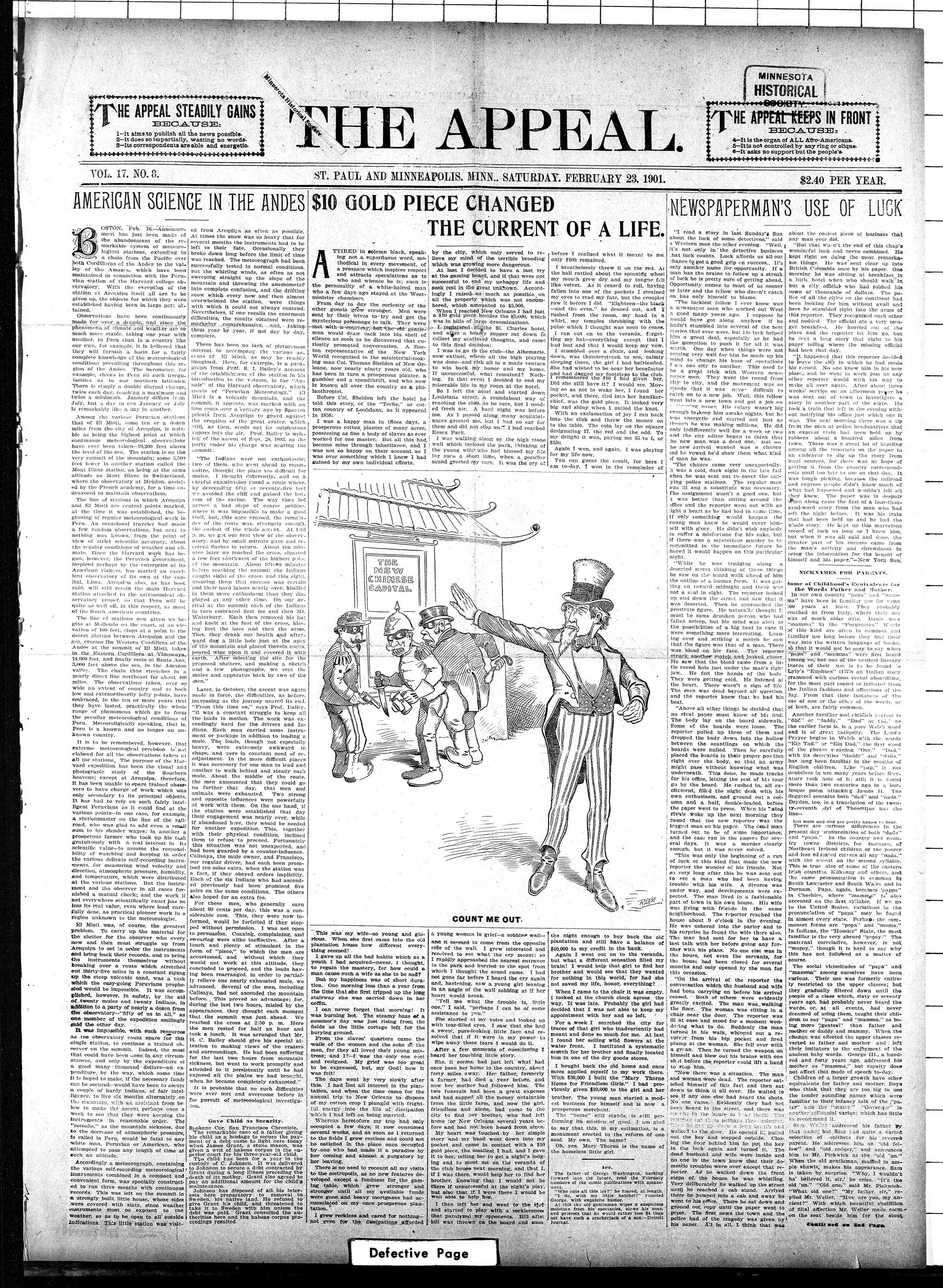
THE NEW CHINESE CAPITAL
THE
NEW
CHINESE
CAPITAL
This was my wife—so young and glorious. When she first came into the old plantation house how different everything seemed! I gave up all the bad habits which as a girl had acquired—moves that to regain the mastery, for how could man cause such a wife as she be so sad? But my happiness was of short duration. One morning less than a year from the time that she first tripped up the long stairway she was carried down in her coffin. I can never forget that morning! It was burning hot. The steamy base of a summer's day was just rising from the fields as the little cortege left for the burying ground. From the slaves' quarters came the walls of the women and the sobs of the men, for they all loved their young mistress; and 17- I was the only one cool to my grief was too great to be expressed, but my God! how it was felt!
The days went by very slowly after this. I had lost all interest in the plantation, and when the time came for the annual trip to New Orleans to dispose of my cotton crop I plunged with frightful energy into the life of dissipation when on being married.
Whereas herefore my trip had only occupied a few days, it now consumed several weeks, and as soon as I returned to the fields I grew restless and could not be satisfied in the place once occupied by one who had made it a paradise by her coming and almost a purgatory by her leaving.
There is no need to recount all my visits to the metropolis, as no new features developed except a fondness for the game, which grew stronger and stronger, until all time gone were gone and heavy mortgages had accumulated on my once prosperous plantation.
I grew reckless and cared for nothing—
I grew reckless and cared for nothing—not even for the dissipations afforded
Defective Page
THE CURRENT OF A LIFE.
by the city, which only served to relieve my mind of the terrible brooding which was growing more dangerous. At last I decided to have a last try at the gaming board, and if that were not successful to end my unhappy life and seek rest in the great unknown. Accordingly I raised as much as possible on all the property which was not encumbered, which amounted to $3,000. When I reached New Orleans I had just a bit of money the $5,000, which was in bills of large sums. I registered at the St. Louis hotel and after a heavy supper sat down for collect my scattered thoughts, and came to this final decision:
I was to go to the club—the Albermale, now extinct, where all the high playing was done—and risk all in a made venture to win back my honor and my home. I unsuccessful what remained? Nothing, I decided to end my miserable life in my room. I so left the hotel and started down Louisiana street, a roundabout way of reaching the club, to be sure, but I needed fresh air. A hard night was before me. As I passed along many acquaintances greeted me, but I had no ear for them and did not stop until I had reached Essex Park. Walking along by the high stone wall which incloses the park, the kissing of the young wife who had blessed me for such a short time, when a peculiar sound greeted my ears. It was the cry of
COUNT ME OUT.
a young woman in grief—a sobbing wall—and it seemed to come from the opposite side of the wall. I grew interested and resolved to see what the cry meant; so I rapidly approached the nearest entrance to the park and hurried to the spot from which I thought the sound came. I had not gone far before I heard the cry again and, hastening, saw a young girl leaning in an angle of the wall sobbing as if her heart would break. "Tell me what the trouble is, little one," I said, "perhaps I can be of some assistance to you."
She started at my voice and looked up with tear-filled eyes. I saw that she had been pure-cooking in the face and resolved to wipe away those tears I would do it.
near her herding little story.
She. It seems, had just left what had
been a long story about
forty miles away. Her father, formerly
a farmer had died a year before, and
now her mother had followed him. The
two funerals had been a great expense
and had sapped all the money obtainable
from the little farm, and now the girl
friendless and alone, had come to the
city to find her brother, who had left
home for New Orleans several years before
and had not been heard from since.
Her heart touched, touched, touched, story
her heart had sent down into my
pocket and came in contact with a $10
gold piece, the smallest I had, and I gave
it to her, telling her to get a night's lodging and to meet me on the veranda of
the club house next morning, and that I.
If I was there, would help her to find her
brother, knowing that I would not be
there if unsuccessful at the night's play,
but also that I were there I would be
wished to see them. I would help her.
I then left her and went to the club
and started to play with a recklessness
that paralyzed my opponents. Bill after,
bill was thrown on the board and soon
before I realized what it meant to me only $100 remained.
I breathelessly threw it on the red. As the ball rattled about the spinning wheel my mouth grew dry and my tongue fell like velvet. As it ceased to roll, having fallen into one of the pockets I strained my eyes to read my fate, but the croupler saw it before I did. "Eighteen—the black and the even, he droned out, and I stumbled over a chair, in a whirl, my temples throbbing with the pulse which I thought was soon to cease. I ran out on to the veranda, forgetting my hat—everything except that I had lost and that I would keep my vow. I stumbled over a chair, and looking down, was thunderstruck to see, calmly sleeping there, the girl I had befriended. She had wished to be near her benefactor and had dugged my footsteps to the club. Did she still have it? I would see. Moving so as not to wake her, I found her pocket, and there, tied into her handkerchief, was the gold piece. It looked very big and shiny when I unified the knot. With an exclamation of joy I ran back into the club and throw the money on to the table, calmly lay on the square designating 17, the red and the old. To my delight it won, paying me 35 to 1, or $50.
Again I won, and again. I was playing for my life now.
You can guess the result, for here I am to-day. I won in the remainder of
RIEPE
the night enough to buy back the old plantation and still have a balance of $40,000 to my credit in the bank.
Again I went out on to the veranda, but what a different sensation filled my brain! I would help that girl to find her brother and would see that they wanted for nothing in this world, for had she not saved my life, honor, everything?
When I came to the chair it was empty. I looked at the church clock across the way. It was late. Probably the girl had decided that I was not able to keep my appointment with her and so left.
For a week I searched the city for traces of that girl who inadvertently had meant and done so much for me. At last I found her water front. I instituted a systematic search for her brother and finally located him in one of the dry goods stores.
I bought back the old home and once more applied myself to my work there. With $30,000 I built the "Mary Thorne Home for Friendless Girls." I had previously given $10,000 to the girl and her brother. The young man started a modest business for himself and is now a prosperous merchant.
The "home" still stands, is still performing its mission of good. I am glad to say that this, in my estimation, is a monument erected to the reform of one soul. My own. The name?
Oh, yes. Mary Thorne is the name of the homeless little girl.
The father of George Washington, harking forward into the future, read the February numbers of the comic publications with amazement: "Who cuts all this ice," he roared, at length. "I do, with my little hatched," proclaimed George, with exquisite humor. "I the wizard my animal rips a suspicious moisture from his spectacles, his nose, and protests that he would rather lose $4 than not have such a crackerjack of a son—Drottin Journal.
MINNESOTA
HISTORICAL
SOCIETY
THE APPEAL KEEPS IN FRONT
BECAUSE:
4-It is the organ of ALL Afro-Americans.
5-It is not controlled by any ring or olique.
6-It asks no support but the people's.
NEWSPAPERMAN'S USE OF LUCK
"I read a story in last Sunday's Sun about the luck of some detectives," said a Western man the other evening. "Well, it's not only in the 'detective business' luck counts. Luck affords us all our chance to grip on success. It's only another name for man has the brains to follow up a streak of luck he is pretty sure of getting ahead. Opportunity comes to most of us sooner or later and the fellow who doesn't catch on has only himself to blame. The luckiest fellow I ever knew was a man who worked out West a good many years and would have got along anyhow if he didn't stumbled into several of the best stories that ever were, but his luck helped him a great deal, especially as he had the pumption to push it for all it was coming very day when things were not coming very well, and made up his mind to change his base of work from one city to another. This used to be a great trick with Western newspaper men. They went the round from city to city, and the movement was so difficult to catch on a man who was still this fellow went into a new town and
coming moner. His salary wasn't big enough to keep him awake nights, but he was energetic and started out just as though he was making millions. He did only indifferently well for a week or two and the city editor began to think that he was making a lot of money he new arrival wanted it was a chance, and he vowed he'd show them what kind of man he was.
"The chance came very unexpectedly. it was a cold, dark night in the late fall when he was sent out to cover the outlying police stations. The regular man was ill and a substitute was necessary. It was better than sitting around the office and the reporter went out with as light a heart as he had in some time. if only something would happen the young man knew he would cover himself with glory. He didn't wish anybody to suffer a misfortune for his sake, but there was a mysterious murder to be committed in the immediate future he hoped it would happen on this particular night.
"While he was trudging along a deserted street thinking of these things he saw on the board walk ahead of him the outline of a human form. It was getting on toward midnight and there was in sight. The reporter looked up and saw him. He was deserted. Then he approached the prostrate figure. He naturally thought I must be some drunken person who had fallen asleep, but his mind was alert to the possibilities of a big heat in case it were something more interesting. Leaning over and striking a match he saw the blood on his face. The blood was blood on his face. The reporter struck another match and looked closer. He saw that the blood came from a little round hole just under the man's right eye. He felt the hands of the body. They were getting cold. He listened at the heart. There wasn't a sign of life. The man was dead beyond all question and the reporter knew that he had his beat.
"Above all other things he decided that no rival paper must know of his find. The body lay on the board sidewalk. Some of the boards were loose. The reporter pulled up three of them and placed them down into the hollow between the scaffolding boards were nailed. Then he carefully placed the boards in their proper position right over the body, so that an army might pass without knowing what was underneath. This done, he made tracks for his office, letting the rest of his tour equipments rush in, all effort, filled the room in, all own enthusiasm, and ground out a column and a half, double-leaded, before the paper went to press. When his sated rivals woke up the next morning they found that the new reporter was the biggest man on his paper. The dead man turned out to be of some importance, the most important, the earliest days. It was a murder clearly enough, but it was never solved.
"This was only the beginning of a run of luck of this kind that made the new reporter the wonder of his friends. Not so very long after this he was sent out to see a man who had been having trouble with his wife. A divorce was under way, and developments were expected. The man lived in a fashionable part of town in his own house. His wife was living with friends in the same neighborhood. The reporter reached the man about 9 o'clock in the evening. He went into the parlor and to his surprise he found a wife there also. The man had sent for her to have last talk with her before going any further with his plans. No one else was in the house, not even the servants, for the house had been closed for several months and only opened by the man for this occasion.
"On the arrival of the reporter the conversation which the husband and wife had been carrying on before his arrival ceased. Both of them were evidently great excited. The man was, walking down the street, the woman was sitting in a chair near the door. The woman was ill at ease and stood for a moment doing what to do. Suddenly the man turned in his walk, whipped out a revolver from his hip pocket and fired plump at the woman. She fell over with it. Then he turned the weapon on himself and sat out his brains with one shot before the reporter could lift a hand to stop him.
"Now there was a situation. The man and woman were dead. The reporter satisfied himself of this fact and then sat down to think it all over. He waited to see if any one else had heard the shots, and came. Evidently they had not been here before, and there was no one in the house to see. The rest of the patrol sat there perhaps the minutes. Then he updrew a long breath and walked to the door. He opened it, pulled out the key and stepped outside. Closing the door behind him he put the key. The look again and turned it. The dead man's face were inside and no one in the town knew about domestic troubles were over except that the porter. As he walked down the front steps of the house he was whistling. Very deliberately he walked up the street until he reached a cab stand. Arrived there he jumped into a cab and away he went to his office. There he sat down and ground out (copy until the paper went to the police) and the police had of the tragedy given his paper. All in all, I think that was
$2.40 PER YEAR.
about the coolest piece of business that any man ever did.
"But that wasn't the end of this chap's wonderful luck and nerve combined. He kept right on doing, the most remarkable things. He was 'sent clear up into British Columbia once by his paper. One morning he was sitting at breakfast in a little hotel when who should walk in but a city official who had robbed his town of thousands of dollars. The police of all the cities on the continent had been looking for him without avail and theumbled right into the arms of this reporter. The recognized each other and nodded. The official taunted her greater breakfast. He hurried out of the place and the reporter let him go, but he sent a long story that night to his paper telling where the missing official had been that day.
"It happened that this reporter decided to leave the city in which he had made his record. No one knew him in his new place, and he went to work just as any makeover would with his way to make all the changes he would weeks' service on an afternoon paper he was sent out of town to investigate a story in another part of the state. He took a train that left in the evening without notifying his office just which one it was. The next morning there was a tip from the man at police headquarters that an express train had been held up by a train that had been pulled down. There was a great lot of hustling among all the reporters on the paper in an endeavor to dig up the story from local sources, for there was no hope of getting it from the country correspondents until too late to use on that day. It was tough picking, because the railroad was what had happened and wouldn't tell all they knew. The paper was in despair when along came the first of a four-thousand-word story from the man who had left the night before. It was his train that had been held up and he had the whole story. He kept up this marvelous story, and when it was all said and done, greater part of his success came from the man's activity and shrewdness in using the information for the benefit of himself and his paper."—New York Sun,
NICKNAMES FOR PARENTS.
Some of Childhood's Equivatives for the Words Father and Mother. In our own country "papa" and "mamma" have been in familiar use for some years at best. They probably coexist in the same language, but was of much older date. Dame is "mamma" in the "Purgatoria." Words of this kind are often in common and familiar use long before they find their way into the written language of books, so that it would not be easy to say when "papa" and "mamma" were first heard among us, but one of the earliest literary traces of our use is to be found in Lily's "Euphrates" (1579) an Italian story grammarn with curious verbal absurdities, such as the copied or imitated from the Italian fashion of the day. From that time instances of the use of one or the other of the words, or of both, are fairly common.
Another familial and childish variant is "dad" or "daddy." "Dad" or "dad," as the earlier form is, is a pure Welsh word and is of great antiquity. The Lord's Prayer begins in Welsh with the words "daddy" and "Dad," the first word of the phrase rendered in Old Dan, the second with its derivatives "daddy" and "dadah," has long been familiar in the months of English children. Like "jap," it was doubtless in use many years before literature took note of it; still it is found more than two centuries ago in a burial poem in the smoking James II. The degeneracist Dr. Dryden, too, in a translation of the twenty-seventh dyl of Theoretics has the line—
But mam and dad are pretty names to hear. There are curious differences in the present day archeology of both "dada" and "nana." In the country and country towns districts, for instance, Northeast Ireland children of the poorer and less educated classes all say "dada," with the accent on the second syllable. This is true also of some of the eastern Irish counties, Kilkenny and others, and the same pronunciation is common in Lancaster and South Wales and in Durham. In the county, beacon is in Cheshire, where "mummu" is also accented on the first syllable. If we go to the United States, variations in the pronunciation of "papa" may be found in almost every state. Perhaps the commonest forms are "papa" and "moma." In Indiana, the "Hoosier" State, the most familiar is the very absurd "popsy." The "mopsy" is not used in "mopsy," though it is hard to say what this has not followed as a matter of course.
The social vicissitudes of "papa" and "mamma" among ourselves have been curious. Their use was formerly entirely restricted to the upper classes; but they gradually filtered down until the people of a class which, sixty or seventy years ago, had probably never heard the ancient stories of "gentlemen" dreamed of using them, taught their children to say "papa" and "mamma," as being more "gentle" than father and mother or daddy and mammy. When the change was effected the upper classes reverted to father and mother and left imitators to the enjyment of the ancient stories of "gentlemen" red and forty years ago, addressed his mother as "mamma," but royalty does not affect that mode of speech to-day. Children of a larger growth have other equivalents for father and mother. Boys who think that they are too big to use the tender sounding names which were familiar in infant tales of the yea- and the yea- and the another colloidal variant: which has little to recommend it.
Sam Weller addressed his father by that name; but Sam had quite a varied selection of epithets for his revered parent. He addresses him as "old fellow" and "old cooger," and announces him to Mr. Pleckwick as the "old 'um'. When the old gentleman, muffled in象 shawls, makes his appearance, Sam is taken by surprise. "Why, I wouldn't ha' believed it, sir, he' cries. 'It's the old um'. "Old one," said Mr. Pleckwick. "What old one?" "My father, sir," replied Mr. Weller. "How are you, my uncle? With which beautiful abultion of illial affection Mr. Weller made room on the seat beside him for the stout
THE APPEAL STEADILY GAINS
BECAUSE:
1-It aims to publish all the news possible.
2-It does so impartially, writes in words.
3- Its correspondents are able and energetic.
AMERICAN SCIENCE IN THE ANDES $10 GOLD PIECE CHANGED
VOL. 17. NO.8.
OSTON, Feb. 16—Announcement has just been made of the abandonment of the remarkable system of meteorological data, a chain from the Piacei over both Cordillera of the Andes to the valley of the Amazon, which have been maintained in connection with the Peruvians and the observatory. With the exception of a station at Arequipa itself all are to be given up, the objects for which they were established having been in large part attached. Observations have been continuously made for over a decade, and since the phenomena of climate and weather are so much more stable, taking one year with more than in a country like our own, for them to be used, they will furnish a basis for a fairly complete knowledge of the meteorological conditions prevailing throughout this region of the Andes. The barometer, for example, can be used to run such irregularities as in our country. There is simply a daily diurnal change, twice each day, reaching a maximum and twice a minimum. January differs from July in the amount of precipitation, is remarkably like a day in another.
Among the various Peruvian stations that of El Mist, some ten or a dozen miles from the city of Arequipa, is notable as being the highest point at which an earthquake has ever been taken—19,200 feet above the level of the sea. The station is on the very summit of the mountain; some 3,300 feet lower is another station called the same altitude as Mount Blanc in Switzerland where the observatory at Meledón, assisted by the French academy, for a time endeavored to maintain observations.
The line of stations in which Arequipa and its areal points marked, at the time of the earthquake, were ginning of regular meteorological work in Peru. An occasional traveler had made a few random observations, but next to what was known, from the point of view of the observatory, was the regular conditions of weather and climate. Since the Harvard work has begun, however, the Peruvian government, inspired perhaps by the enterprise of its excellent observatory of its own at the excellent, Lima, Arequipa, as also has been said, will still retain the main Harvard station attached to the astronomical office, so that Peru will be quite as well known as most of the South American countries.
The line of stations now given up begins at Mollondo on the coast, at an elevation of 100 feet, stops at a point in the desert plateau between Arequipa and the Andes at the summit of Coral de los Andes at the summit of Coral de los Andes in the Eastern Coralida at Vinecosa, 14,000 feet and finally rests at Santa Anna, 3,000 feet above the sea, in the Amazon valley. The chain thus stretches in a nearly直线 line northeast for about 400 miles, then curves over so wide an extent of country, on low and extraordinarily lofty points, have embraced, in the ten or more years that they have lasted, practically the whole range of phenomena which go to form the peculiar meteorological conditions of extremely practically speaking, that is, Peru is a known and no longer an unknown country.
It is to be remembered, however, that extreme meteorological precision is not claimed for all the observations taken at all the stations. The purpose of the Harper and photographic study of the visual and heavens; except at Arequipa, therefore, it has been unable to spare trained observers to have charge of work which was only secondary to its principal objects, intelligent Peruvian as it could fairly intelligent Peruvian as it could various points—in one case, for example, a stationmaster on the line of the railroad, who was gid to add even a small sum to his slender wages; in another a stationmaster on the line of the railroad, gratiously with a real interest in its scientific value—to assume the responsibility of watching and keeping in order the various delicate self-recording instruments, for measuring wind velocity and temperature, which were distributed at the various stations. But the instrument and the observer in all cases furnished a mutual check; and the work if not everywhere scientifically exact has not been done, as carefully as carefully done, as practical pioneer of the region unknown to the meteorologists.
El Misti was, of course, the greatest problem. To carry up the material for the shooter to the observer who every day from Arequipa to set in order the instrument and bring back their records, and to bring the instruments themselves without having to stretch out thirty-five miles in a constant up the steep volcanic sand, was a task which the easy-going Peruvians prophecied was impossible. It was accomplished, however, by twenty mules and twenty Indians, in addition to a party of nearly a dozen from Arequipa, by thirty of us in all".—one member of the similarly sized the other day.
ed from Arequita as often as possible. At times the snow was so heavy that for several months the instruments had to be broken down long for the time it was reached. The meteorologist had successfully tested in normal conditions, but the whirling snow, as often as not sweeping straight up the slope of the mountain and throwing the anemometer snow, as often as not, and the drifting snow which every now and then overwhelmed the station, were things with which it could not always contend. Nevertheless, if one recalls the enormous results obtained were remarkably consistent, and, taking then year by year, if not day by day, complete.
There has been no lack of pictureuse interest, to accompany the various accounts of El Misiit, as may be readily imaged. Here, for example, is a paraphylogram of the Bailley's account of the establishment of the museum in his introduction to the volume, in the "nails" of the Harvard observatory, which treats of "Peruvian Meteorology." El Misiit is a volcanic mountain, and the apurpurea, was marked with an eruption cross. The priests from Arequipa to guard against the eruption of the great crater, which will, as then, sends out its sulphurous air into the air. Prof. Batley is writings the account of Sept. 28, 1883 as the party whose charge was nearing the summit;
"The Indians were not enthusiastic; two of them, who went ahead to reconnetre, thought the place too difficult for mules. I thought differently, and on a day before we descended fifty or seventy-five feet we avoided the cliff and gained the bottom of the ravine. The way they then led across a bad slope of coarse pebbles, and imposed to mule a good truth, but, this time we descended the route of the route was, strangely enough, the easiest of the whole ascent. At 1:55 p.m. we got our first view of the observatory, and by small mirrors gave and relied on the view of the mountains later we reached the cross, situated a few feet southwest of the highest point of the mountain. About fifteen minutes before reaching the summit the Indians were instructed to assess them that success was certain and their hard labor nearly over, kindled in them more enthusiasm than they displayed at any other time. On our arrival at the summit each of the Indians was instructed to climb Waterbury. Each then removed his hat and knelt at the foot of the cross, kissing the base and then the arms. They drank our health and afterward they went up the mountain and placed their coffin, poured wine upon it and covered it with earth. After selecting the site for the proposed shelters, and making a sketch of the mountain, they jacketed the mules and appraised back by two of the men."
Later, in October, the ascent was again made in force, the difficulties, as before, increasing as the journey neared its end. "From this time on," says Prof. Ealley, "the ascent was made easier, the loads in motion. The work was exceedingly hard for the drivers and Indians. Each man carried some instrument or package in addition to leading in heavy, were extremely awkward in shape, and were in constant need of adjustment. In the more difficult places it was necessary for one man to lead and animals were exhausted. Two strong men announced that they could go no further that day, that men and animals were exhausted. Two strong men announced that they could work at work with them. On the one hand, if the station were established that day their engagement was nearly over, while if abandoned here, they would be needed to work with their physical condition, inclined them to refuse to proceed. Fortunately this situation was not unexpected, and men guarded by a counter-influence. Calais was our regular station, had each been promised ten soles extra, when the station was a fact, if they obeyed implicitly. Each of the six Indians who had ascended Calais were promised five soles on the same conditions. The others also hoped for an extra fee.
For these men, who generally earn about 60 cents per day, this was a considerable sum. This, they were now inexperienced, for it failed if they stopped without permission. They were unable to persuasion, coaxing, complaining, and swearing were alike ineffective. After a lunch and plenty of stimulant in the form of "plazo," to which the men are accustomed, they would not work at this attitude, concluded to proceed, and the loads having been rearranged, in order to partially relieve one nearly exhausted mule, we advanced. Several of the men, including the two men in the mountain before. This proved an advantage during the last two hours, miled by the appearances, they thought each moment that the summit was just ahead. We reached the cross at 2:50 p. m. Here he took a lunch. It was arranged that Mr. H. C. Ballley should give his special attention to making views of the craters and surroundings. He had been suffering for the last two hours from mountain sickness, and apparently and attended to it persistently until he had exposed all the plates we had brought, when he became completely exhausted." It is probable that no such difficulties were ever met and overcome before in the pursuit of meteorological investigation.
Stokke Corp. San Francisco, California. The remarkable case of a father giving his child as a hostage to secure the payoff of a wrongful conviction when James Grant, a stone mason, was given a writ of habeas corpus in the courtroom. The child has been for a year in the custody of C. Johnson. It was delivered to the courtroom and Grant during a long illness preceding the death of its mother. Grant also agreed to provide an amount for the child's education.
Johnson has disposed of all his interests here preparatory to removal to the University. He gave Grant his child, and threatened to take it to Sweden with him unless the University thorities here and the habeas corpus proceedings resulted.
THE APPEAL.
ITIRED in solenm black speaking,
not a supernous word, made
a presence which impels movement,
a presence which impels movement,
and attracts spectacles as to
and whence he is; is such is the personage of a white-haired man who a few days ago stayed at the West-minister chambers. From day to day the curiosity of the other guests grew stronger. Men were their wives to try and get the mysterious man to meet with a country, but the gentleman would draw back into his shell of silence as soon as he discovered that curiosity prompted conversation. A Bosse representative of the New York Museum of Art, the man writing man Col. Thomas Sheldon of New Orleans, now nearly ninety years old, who has been in turn a prosperous planer, a gambler and a spendthrift, and who now over the country as a philanthropist. Before Col. Sheldon left the hotel he told this story, of the "teccher," or country of Louisiana, as it appeared in 1808: a happy man in those days, a prosperous cotton planer of many acres, possessing as fine a body of slaves as ever worked for one master. But all this had become mine through inheritance, and I was not so happy on their account as I was with the man who gained and gained by my own individual efforts.
THE NEW CHINESE CAPITAL
THE NEW CHINESE CAPITAL
COUNT ME OUT.
This was my wife—so young and glorious. When she first came into the old plantation house how different every day was. I gave up all the bad habits which as a youth I had acquired—never. I thought, to regain the mastery, for how could a man cause such a wife as she to be sad? I was not a fool. One morning less than a year from the time that she first tripped up the long stairway she was carried down in her coffin. I never forget that morning! I was burning hot. The steamy haze of a summer's day was just rising from the fields as the little cortege left for the building. My slaves' quarters came the walls of the women and the sobs of the men, for they all loved their young mistress; and 17—I was the only one cool and resigned. My grief was too great to repress but, my God, how it was felt!
The days went by very slowly after this, I had lost all interest in the plantation, and when the time came for the planting, I went to the farm of my cotton crop I plumbed with rightful energy into the life of dispation which I had left on being married.
Whereas heretofore my trip had only occupied a few days, it now consumed me and I had to move to the fields I grew restless and could not be satisfied in the place once occupied by one who had made it a paradise by her coming and almost a purgatory by herself. There is no need to recount all my visits to the metropolis, as no new features developed except a fondness for the gaming table, which grew stronger and stronger until all my available funds were used to my enterprises had accumulated on my once prosperous plantation.
I grew reckless and cared for nothing—
Defective Page
THE CURRENT OF A LIFE.
by the city, which only served to broaden my mind of the terrible brooding which was growing more dangerous. At last I decided to have a last try at the job, but I was not successful to end my unhappy life and seek rest in the great unknown. Accordingly I rallied as much as possible on all the property which was not encumbrated. When I reached New Orleans I had just a $10 gold piece besides the $5,000, which was in bills of large denominations. The St. Charles hotel and after a heavy rain I collected for collect my scattered thoughts, and came to this final decision: I was to, go to the club—the Albemarle, extinct, where all the high playing was done, and a made venture to win back my honor if unsuccessful, what remained? Nothing. In that event I decided to end my miserable life in my room at the hotel. I was to go to the hotel and started down Louisiana street, reaching the club to be sure, but I needed fresh air. A hard night was before me. As I passed along many acquaintances, me, but I had no car for them and not did not unpack. I had reached Essex Park.
I was walking along by the high stone wall which indoles the park, thinking of the young wife who had blessed my life with her love. "She sounded my ears. It was the cry of
COUNT ME OUT.
a young woman in grief a sobbing wall, and it seemed to come from the opposite side of the wall. I grew interested and resolved to see what the cry meant; so I rapidly approved the nearest entrance to the room, and the spot from which I thought the sound came. I not gone far before I heard the cry again and, hastening, saw a young girl leaning in an angle of the wall sobbing as if her heart would break. She told the trouble as a little one. I said, "perhaps I can be of some assistance to you." She started at my voice and looked up with tear-filled eyes. I saw that she had a sweet, pure-looking face and relied on me to wipe away these tears I would do it.
After a few moments of questioning I heard her touching little story. She it seems, had just left what had once been her home in the country, about forty miles away. Her father, formerly a farmer, a year before, and then a mother had died. The two funerals had been a great expense and had sapped all the money obtainable from the little farm, and now the girl, friendless and alone, had come to the home for New Orleans several years before and had not been heard from since.
My heart was touched by her simple story and my hand went down into my pocket and came in contact with a $10 bill. I was surprised that I had it to her, telling her to get a night's lodging and to meet me on the veranda of the club house next morning, and that I. If I was there, would help her to find her brother, knowing that I would not be able to help her, but also that if I were there I would be well able to help her.
I then left her and went to the skiff and started to play with the skifteness that paralleled my opponents. Bill after bill was thrown on the board and soon
before I realized what it meant to me, only $10 remained.
I broachlessly threw it on the red. As the ball rattled about the spinning wheel my mouth grew dry and my tongue fell like velvet. As it ceased to roll, having fallen into one of the pockets I strained my arm up and brought the coupler saw it before I did. "Big leap and—and the even," he drenched out, and I rushed from the room, my head in a whirl, my temples throbbing with the pulse which I thought was soon to cease. "I ran out on to the veranda, forgetting I had lost and that I would keep my wow. I stumbled over a chair, and looking down, was thunderstruck to see, calmly sleeping there, the girl I had befriended. She had wished to be near her benefactor. She went to the club to the club I remembered the $10 I received. Did she still have it? I would see. Moving so as not to wake her, I found her to the table. I entered into her handkerchief, was the gold piece big and shiny when I untied the knot. With an exclamation of joy I ran back into the club and threw the money on to the table. The coin lay on the square of the red and the odd. To my delight it won, paying me $31 to 1, or $300.
Again I won, and again. I was playing for my life now.
You can guess the result, for here I am to-day. I won in the remainder of
RILEE
the night enough to buy back the old
bank note, or the old balance of
$10,000 to my credit in the bank.
Again I went out on to the veranda, but what a different sensation filled my brain! I would help that girl to find her brother and would see that they wanted to be together, but not the one that not saved my life, honor, everything? When I came to the chair it was empty. I looked at the church clock across the way. It was late. Probably the girl had decided that I was not able to keep my appointment with her and so let. For a week I searched the city for that girl and I found that meant and done so much for me. At last I found her selling wild flowers at the water front. I instituted a systematic search for her brother and finally located him in one of the dry goods stores. I bought back the old home and once I met him with $30,000 I built the "Mary Home for Friendship Girl." I had previously given $10,000 to the girl and her brother. The young man started a modest business for himself and is now a prosperous merchant. My sister's is still performing its mission of good. I am glad to say that this, in my estimation, is a monument erected to the reform of one soul. My own. The name? Oh yes. Mary Thorey is the name of
Ave.
The father of George Washington, hardy forward into the future, read the February numbers of the comic publications with amuse- ments:
"Who cute all this ice?" he raided, al- length.
"He cooed with 'Jake cathet.'" rejoiced George, with exquisite humor.
At this the old gentleman wipes a suspicious moisture from his spectacles, blows his nose, and protects that he would rather lose $ than not have such a crackerjack of a son—Dettroit Journal.
"I read a story in last Sunday's Sun about the luck of some detectives," said a Western man the other evening. "Well, it is not only in the 'detective business' that Luck affords us all our chance to get a good job, but only another name for opportunity. If a man has the brains to follow up a struck of luck he is pretty sure of getting ahead. But the most of us sooner or later and the fellow who catch on has only himself to blame.
"The luckiest follow I ever knew was a newspaper man who worked out West and years ago. I suppose he would have grown up in the city, hadn't stumbled into several of the best stories that ever were, but his luck helped him a great deal, especially as he had to work in the news all it was worth. One day when things came very well for him he made up his mind to change his base of operations on a one city to another. This used to be a newsmen's newspaper men. They went the newsmen's city to city, and the movement was so steady that it was never difficult to catch on to a new job. Well, this fellow was not a newsmen's man, but a job in a newspaper. His salary was enough to keep him awake nights, but he was energetic and started out just as easily as he was making millions. He and the city editor began to think that the new man was a dead one. but as he new arrival wanted was a chance to work and show them what kind of man he was.
"The chance came very unexpectedly, it was a cold, dark night in the late fall when he was sent out to cover the outlying police stations. The regular man asked him to help with the assignment went a good one, but it was better than sitting around the office and the reporter went out with as light a heart as he had had in some time, something would happen the young man would self with glory. He didn't wish anybody to suffer a misfortune for his sake, but if there was a mysterious murder to be committed it in the immediate future he would happen on this particular night.
"While he was trudging along a deserted street thinking of these things he saw on the board walk ahead of him a deserted uniform form. It was getting on toward him, and he did not a soul in sight. The reporter looked up and down the street and saw that it was deserted. Then he approached the figure. He naturally thought it must be a man. He fellen asleep, but his mind was alert to the possibilities of a big heat in case it were something more interesting. Leaned against the wall, he thought that the figure was that of a man. There was blood on his face. The reporter struck another match and looked closer. He saw that the blood came from a life that was not a man. Jaw. He felt the hands of the body. They were getting cold. He listened at the heart. There wasn't a sign of life. The man was dead beyond all question. The reporter knew that he had his beat.
"Above all other things he decided that no rival paper must know of his mind. The body lay on the board sidewalk. The body reporter pulled up three of them and dropped the body down into the hollow between the scantlings on which the boards were mailed. Then he carefully placed the body right over the body, so that an army might pass without knowing what was underneath. This done, he made tracks for his office, letting the rest of his tour go on. The office, the equipment, filled the night desk with his own enthusiasm, and ground out a column and a half, double-leaded, before the paper went to press. When his "at ted" found that the new reporter was the biggest man on his paper. The dead man turned out to be of some importance, and the case ran in the papers for several months, enough but it was never solved.
"This was only the beginning of a run of luck of this kind that made the new reporter the wonder of his friends. Not so very long after this he was sent out with him, who had been having trouble with his sister under way, and developments were expected. The man lived in a fashionable part of town in his own house. His wife was living with friends in the same neighborhood. The reporter reached the house and saw him. He was ushered into the parlor and his surprise he found the wife there also. The man had sent for her to have a last talk with her before going any further with his plans. No one else was in the house, not even the servants, for the man was been closed for several months and only opened by the man for this occasion.
"On the arrival of the reporter the conversation which the husband and wife had been carrying on before his arrival ceased. Both of them were evidently excited. The man was, walking the floor, the door, and in chair near the door. The reporter was ill at ease and stood for a moment wondering what to do. Suddenly the man turned in his walk, whipped out a revolver from his hip pocket and fired plump at the woman. She fell over with the weapon on himself and blow out the weapon with one shot before the reporter could lift a hand to stop him.
"Now there was a situation. The man and woman were dead. The reporter satled himself of this fact and then sat on the floor. He waited to see if any one else had been dead. No one came. Evidently they had not been heard in the street, and there was no car in the house to hear them. The man sat in the house and walked to the door. He opened it, pulled out the key and stepped outside. Closing the door behind him he put the key in the car and again and turned it. The dead husband was gone. No one in the town knew that their domestic troubles were over except that reporter. As he walked down the front steps of the house he was whistling. The man sat in the house he walked up the street until he reached the door. There he jumped into a cab and away he went to his office. There he sat down and ground out copy until the paper went to presen the first news the town and the police had heard. All in all, I think that was
$2.40 PER YEAR.
about the coolest piece of business that any man ever did.
"But that wa-n't the end of this chap's wonderful luck and nerve combined. He kept right on doing, the most remarkable and the best up into British Columbia once by his morning he was sitting at breakfast, in a little hotel when who should walk" in but a city official who had robbed his town of thousands of dollars. The poacher at the offices on the continent had been looked upon with suspicion here he stumbled right into the arms of this reporter. They recognized each other and nodded. The official ate a very meager breakfast. He hurried out of the place and the reporter let him go, but he had a story that night to his pager telling the missing official had been that day.
"It happened that this reporter decided to leave the city in which he had made his record. No one knew him in his new place, and he went to work just as any other man. He did not make all over again. After about three weeks' service on an afternoon paper he was sent out of town to investigate a story in another part of the state. He took a train that left in the evening with him, and he was the next morning there was a tip from the man at police headquarters that an express train had been held up by robbers about a hundred miles from the city. He was among all the reporters on the paper in an enakeer to dig up the story from local sources, for there was no hope of getting it from the country correspondent, for there was no hope of being placed to use on that day. It was tough place to find the man who had left the night before, and what happened and not tell all they knew. The paper was in despair when along came the first of a four-thousand-hour journey, the man who had that had been held up and he had the whole story. He kept up this marvelous record of luck as long as I knew him, but when it was all said and done, the man's activity and shewthness in using the information for the benefit of himself and his paper."--New York Sun.
NICKNAMES FOR PARENTS.
Some of Childhood's Equivalents for the Words Father and Mother. In our own country "papal" and "mamma" have historically been years at least. They probably reached us from Italy, where their use was of much older date. Dante uses "mamma" in the "Purgatoria." Words like "papal" and "mamma" familiar use long before they find their way into the written languages of books, so that it would not be easy to say when "papal" and "mamma" were first heard among us but one of the earliest literary works is "Lylys the Epiphant" (1573) an Italian story crammed with curious verbal absurdities, for the most part copied or imitated from the Italian fashion and affections of the day. From that time instances of the words, or of both, are fairly common.
Ist mam and dad are pretty names to bear. There are curious differences in the pronunciation of both dada and "papa". In the town of Dada, town districts, for instance, of Northeast Ireland children of the poorer and less educated classes all say "dada", this is accent on the second syllable. This is accent on the first syllable. Irish counties, Kilkenny and others, and the same pronunciation is common in South Liamathan and South Wales and in Durham. Papa, again, becomes "papp". This is accent on the first syllable. If we go to the United States, variations in the pronunciation of "papa" may be found in almost every state. The common in Indiana is the "Hoosier" State, the most familiar is the very absurd "popsy". The maternal correlative, however, is not "mopsy", though it is hard to say why it was not followed as a matter of course.
The social vicissitudes of "papa" and "mamma" among ourselves have been curious. Their use was formerly entirely restricted to the upper classes; but they have become more people of a class which, sixty or seventy years ago, had probably never heard the words, or, at all events, had never dreamed of using them, taught the children to use them, and taught more "genteel" than father and mother or daddy and mammy. When the change was effected the upper classes reverted to father and mother and left the children to ancient baby words. George III, a hundred and forty years ago, addressed his mother as "mamma", but royalty does not affect that mode of speech to-day. A larger growth have been equivalents for father and baby Boys who think that they are too big to use the tender sounding names which were familiar to their infancy talk of the "papa" and "mamma". Overprise is another colloidal variegation, which has little to recommend it.
Sam Weller addressed his father by that name; but Sam had quite a varied selection of epithets for his revered parent. He addresses him as "old felled man," and he addresses him as "old man" to Mr. Plewick as the "old man." When the old gentleman, muffled in a shawl, makes his appearance, Sam is taken by surprise. Why, "I wouldn't have believed it, air one," he cries. "It's the old um. um," said Mr. Plewick. Sam is taken by surprise. Mr. Plewick piled Mr. Weller. "How are you, my ancient?" With which beautiful epithesis of old affection Mr. Weller made room on the seat beside him for the stout
THE VOUCHER
THE APPEND
THE APPEAL.
NATIONAL AFRO-AMERICAN NEWSPAPER
PUBLISHED WEEKLY BY
ADAMS BROS. EDITORS AND PUBLISHERS
49 E. 4th St. St. Paul, Minn.
ISSUED SIMULTANEOUSLY IN
Saint Paul, Minneapolis, Chicago,
Louisville, St. Louis, Dallas.
ST. PAUL OFFICE,
No. 164 Union Block 4th and Cedar
J. Q. ADAMS, Publisher.
MINNEAPOLIS OFFICE,
Guaranty Loan Building, Room 817
H. ROBERTS, Manager.
CHICAGO OFFICE,
No. 323-5 Dearborn St. Suite 213-215
C.F. ADAMS, Manager.
LOUISVILLE OFFICE,
No. 312 West Jefferson St. Room 8
W.V. PENN, Manager.
ST. LOUIS OFFICE,
No. 1002 FRANKLIN AVENUE
J. H. HARRISON, Manager.
DALLAS OFFICE,
NUMBER 497 MAIN STREET
L.A. BROWN, Manager.
Write on the address label label, then ben sub-scription expires. Renewals should be made to the address label, and may be chased, as the paper stops whin-utes.
Occasionally happens that papers sent as subscripts are lost or stolen. In case you do not receive any number when due, inf. em us may be sent out of the possession of five days from that date, and will certainly foar wail a duplicate of the missing number.
Communication to receive attention mast be neway, upon important sub-scription of the paper, written to you. You may reach us Thursdays if possible, anyway not later than 10:00 am, and bear the signature of your person. No signature is returned, unless stamps are sent for postage.
We do not hold ourselves responsible for the correspondence.
Collecting letters anywhere, Write for terms. Sample copies free.
In every letter that you write as never fail to
give your full name and address, plainly write
tenn, post office, county and state. Business
letters must be written on separate
cheese. In letters news of matter
for publication. Enter as second
class matter
AGENTS WANTED.
THE APPEAL wants good re-
fitable agents to canvass for subs-
cribers at points not already
covered. Write for our extraordi-
nary inducements. Address.
THE APPEAL,
St Paul Minn.
SATURDAY, FEBRUARY 23. 1901.
The latest solution of the "Negro Problem," as it is generally known, says Miss Carrie E. Busby of St. Joseph, Mich., is a race war. She says: "We believe too much in faith without works. Never will our fellowmen in the South be wholly free from oppression, and innocent men wholly relieved from fear of lynching until they fight. Let the regiments which fought at Santiago to free Cuba now turn about and fight to free themselves."
We do not agree with the young lady, though it does seem that something must be done to check the tendency to deprive us of everything which makes life worth living, even if we have to fight. We know, of course, that one-eighth cannot hope to win in a fight against seven-eighths, yet it would be terrible if the one-eighth succeeded in wiping out another eighth, which we might do, though finally wiped out ourselves. But we want none of that, we don't
JUSTICE
Judge Scarem-What is your trade?
Judge Scarem-What is your trade?-I'm a bombing house raid)—I'm a locksmith.
Judge-What were you doing there when the police entered?
Judge-What were you doing there when the police entered?
TREE ORNAMENTS.
First Bear—Did you have a Christmas tree?
want to wipe out anybody nor be wiped out ourselves. We want to live and let live. The civilized nations of the earth, while prepared to slaughter each other with the recent man-killing implements, seek now to arbitrate. Let us arbitrate. All the whites are not our enemies. They were not when most of us were ignorant slaves, and a way will sooner or later be found to relieve us of many of the burdens we now labor under. We must, however, do something for ourselves mentally, morally, financially. Education, good morals and money will get us out of the woods more surely than fighting. Our enemies in Tennessee tried to pass a law prohibiting whites from teaching in Afro-American institutions, but failed. In North Carolina they tried to pass a law prohibiting the licensing of Afro-American lawyers and doctors, but failed. And they will fail in many things they will undertake. We must follow lago's advice: "Put money in thy purse," and Solonom's, "With all thy getting, get understanding."
The present south town Chicago officials have an excellent record for honesty and efficiency and the collector and supervisor should be renominated. The clerk having received a federal appointment is out of the race. The collections of taxes this year will break all records. The collector, Mr. H. H. Fuller, is a painstaking and conscientious official who has run the office on a strictly business plan just as he promised to do when he was a candidate for office. Mr. William J. Lawler, the supervisor, is a clean, capable and popular official, who has conducted his office in an excellent manner. Under Democratic rule there were many scandals in the south town office, but this year with Republicans at the head of affairs everything has been done in such a manner as to reflect credit upon all parties connected with the office. Collector Fuller and Supervisor Lawler have fairly won a re-nomination, then put a clean, honest Afro-American for clerk and the ticket will sweep the town.
Chicago has just lost the model policeman, one with a record which cannot be equaled in the world. His name was Steve Rowan, and he was known as "Big Steve." He was the body guard of Mayor Harrison, and was the best known policeman in the city. He had been on the force since 1874, and had drawn in that time $27,000 in salary, to say nothing of his private tips. In all that time he is credited with never having made an arrest.
There is nothing so small, but that we may honor God by asking His guidance of it, or insult Him by taking it into our own hands.—Ruskin.
TO CURE A COLD IN ONE DAY.
Take Laxative Bromo Quinine Tablets. All thoughts, round the money if it fails to cure. W. G. Wrover on each
THE APPEAL: A NATIONAL AFRO-AMERICAN NEWSPAPER
Mt. Fuji
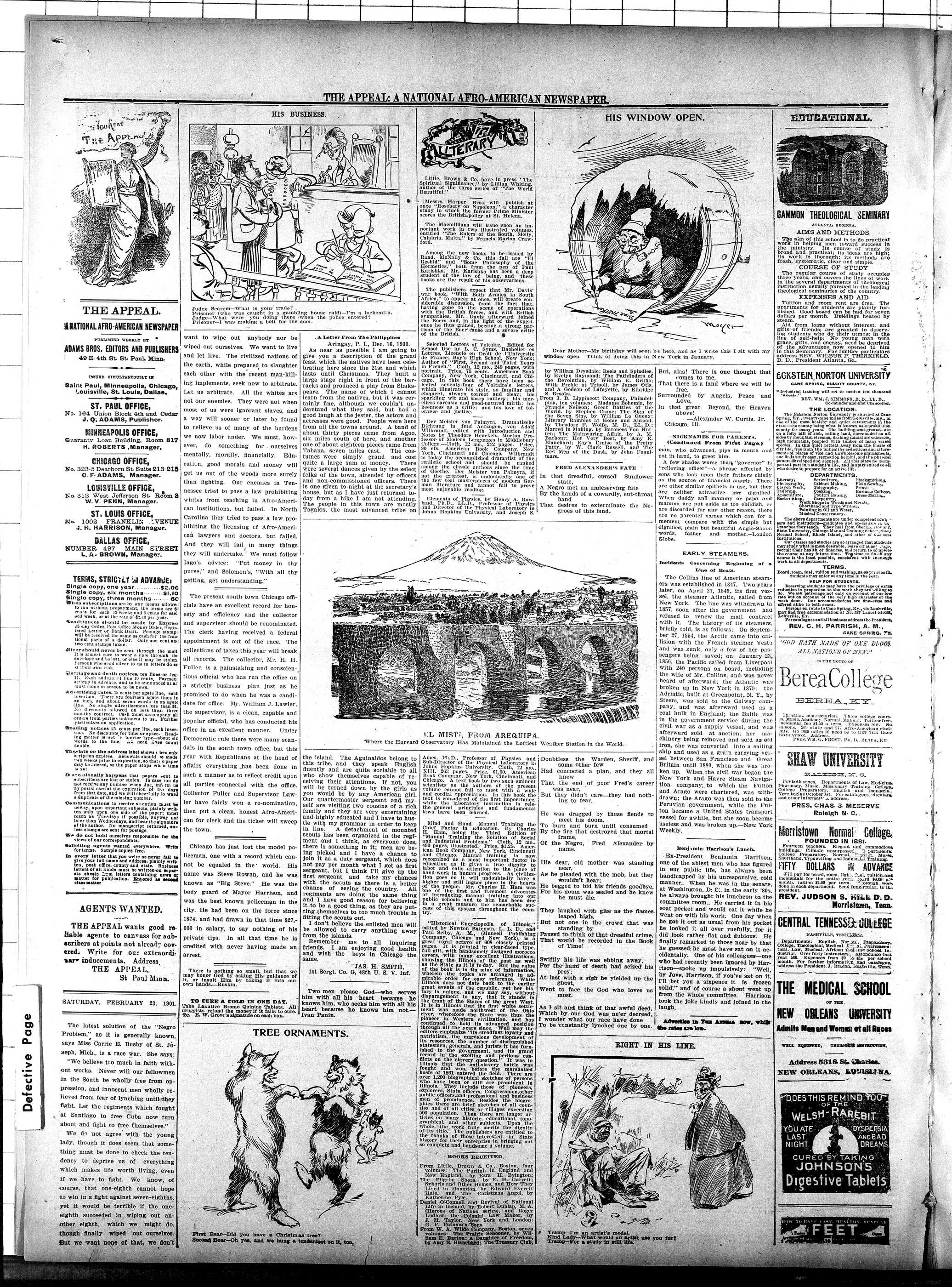
UL MIST!, FROM AREQUIPA.
Where the Harvard Observatory Has Maintained the Lottiest Weather Station in the World.
A Letter From The Philippines
Aringay, P. I., Dec. 16, 1900.
As near as possible I am going to give you a description of the grand feast which the natives have been celebrating here since the 21st and which lasts until Christmas. They built a large stage right in front of the barracks and produced a play from Shakespeare. The name of which I cannot learn from the natives, but it was ceramic and was made to stand. I understand what they said, but had a good laugh at the jester, the actors and actresses were good. People were here from all the towns around. A band of about thirty pieces came from Agoo, six miles south of here, and another one of about eighteen pieces came from Tabana, seven miles cast. The costumes were simply grand and cost quite a large sum of money. There were several dances given by the select folks of the town, attended by officers and non-commissioned officers. There is one given to night at the secretary's house, and it was returned today from a hike I am about to make. The people in this town are mostly Tagalog, the most advanced tribe on
Where the Harvard
the island. The Aguinaldos belong to this tribe, and they speak English fluently and are quite sociable to all who show themselves capable of receiving their attentions. If not, you will be turned down by the girls as you would be by any American girl. Our quartermaster sergeant and myself are visiting two cousins of a rich man and they are very entertaining and highly educated and I have to hustle with my group to keep in line. A detachment of many muscats has been organized in the regiment and I think, as everyone does, there is something in it; men are being picked and I have a chance to join it as a duty sergeant, which does not pay per month what I get as first sergeant, but I think I'll give up the first sergeant and take my chances the scouts as there is a better chance to see the country. All regiments are being trained and I have good reason for believing it to be a good thing, as they are putting themselves to too much trouble in fitting the scouts out.
I don't believe the enlisted men will be allowed to carry anything away from the islands.
Remember me to all inquiring friends. I am enjoying good health and wish the boys in Chicago the same.
JAS. H. SMITH,
1st Sergt. Co. G, 48th U. S. V. Inf.
Two men please God—who serves him with all his heart because he knows him, who seeks him with all his heart because he knows him not—Ivan Panin.
NAMENTS.
LITERARY
Little, Brown & Co. have in press "The Spiritual Significance," by Lillian Winting, author of the three series of "The World Beautiful."
Messrs. Harper Bros. will publish at once "Rosebery on Napoleon," a character study in which the former Prime Minister scores the British policy at St. Helena.
The Macmillans will issue soon an important work in two illustrated volumes, entitled "The Kings of the South, Sleek, Calibra, Malta," by Francis Marion Grawford.
Among the new books to be issued by Rand, McNulty & Co. this fall are "El Reshid," and "Some Philosophy of the Discs," both from the pen of Paul Kartishka. Mr. Kartishka has been a deep student of the law of being, and these books are the result of his observations.
The publishers expect that Mr. Davis' war book, "With Both Armies in South Africa," will provide a saddlerable discussion, from the fact that, having gone to the scene of operations in South Africa, he will sympathies. Mr. Davis afterward joined the Boers and, in the light of the experi- pendence gained, became a strong par- tition of the censure and a severe criee of the British.
Selected Letters of Voltaire. Edited for School Use by L. C. Syms. Baceller as Lettres, Llicence en droit de l'Université des High School, New York; Author of "Plays" and "Letters in French." Cloth, 12 mo, 249 pages, with portrait. Price, 75 cents. American Book Cargo. In this book there have been selected seventy-four of Voltaire's letters, written in style, so familiar and eloquent, always concise, sparkling wit and sharp railway; his mer- cless sarcasm and good-natured mfrh; his merciless and justice; and his love of tolerance and justice.
Der Mestler von Palmyrn. Dramatische Dichtung in funf Aufzugen, von Adolf Wilbrandt, edited with Introduction and the Introduction of Modern Languages in Middlund College—Cloth, 12 m., 212 pages. Price. Noctes, American Book Company, New York. The first edition of Modern Languages is today the accomplished dramatist of the realistic school and should be ranked among the classic authors since the time of Wilbrandt. Dramatica, if not the greatest, is undoubtedly the few real masterpieces of modern German literature and cannot fail to prove most enjoyable reading.
Elements of Physics, by Henry A. Rowland, Ph.D., LL.D., Professor of Physics John Hopkins University, and Jodson S.
IL MISTI, FROM AREQUIPA
Observatory Has Maintained the Loftiest
Ames, Ph.D., Professor of Physics and Sub-Director of the Physical Laboratory in the University of Chicago, XIII, 263 pages, Price, $1,00. American Book Company, New York, Cincinnati, and Atlanta. A text book by two such eminent scholars, the present volume cannot fail to meet with cordial appreciation. In this book the text is considered the first importance, and the author's borrowed material is relied on the general principles and fundamental laws have been learned.
Mind and hand. Manual Training the Chief Factor in Education. By Charles H. Ham being the Third Edition of Training the Solution of Social and Industrial Problems, 480 pages, illustrated. Price, $1,25. American Book Company, New York, Cincinnati, now recognized as a most important factor education as it gives a true dignity to labor and calls attention to the place of people. Charles Ham was one of the first people to introduce of introducing manual training into our public schools and to him has been due to ensure the remarkable success of this system throughout the country.
BOOKS RECEIVED.
From Little, Brown, & Co. Boston four volumes: The Urbish in England and New England; by Earn H. Byington; The Pilgrim Shore; by E. H. Garett; The Pilgrim Shore, by E. H. Garett; Lived in Hamilton, by Edward Precert Hale; and The Christmas Angel, by Daniel O'Connell and Revival of National Life in Ireland, by Robert Dunlap. M. A. Hodgson, by Robert Dunlap; Lived, the Colonial Law Maker, by J. M. Taylor, New York and London; From W. A. Wilde Company, Boston, seven volumes: The Prairie Schooner, by William A. Wilde; The Treasury Club, by Amy E. Blanchard.
HIS WINDOW OPEN.
Dear Mutter,
Moyer
Dear Mother--My birthday will soon be here, and as I write this I sit with my window open. Think of doing this in New York in January.
RIGHT IN HIS LINE.
Tramp—I'm an artist's model.
Kind Lady—What would an artist use you for?
Tramp—For a study in still life.
by William Drystale: Reels and Spindles,
with the Revolution; by William Griffis,
With Prebble at Tripol, by James Otis,
with the Codson of Lafayette by Elbridge
S. Propey
From J. B. Lippincott Company, Philadelphia, ten volumes: Mamane Bohmein, by A. M. Marteau; The World, by Stephen Crane; The Sign of the Seven Sins, by William Le Queux; The Wife, by William Le Queux; The Theodore F. Wolfe, M. D. LL. D. Marred in Making, by Baroness Von Hutten; The Mainwairing Affair, by A. M. Marteau; The Binchard; Ray's Cruise of the Pretty Patty, by W. Clark Russell, and The Red Men of the Dusk, by John Fenni-
In that dreadful, cursed Sunflower state,
A Negro met an undeserving fate
by the hands of a cowardly, eut-throat
band
That comes to exterminate the Negroes of this land.
Weather Station in the World.
Doubtless the Warden, Sheriff, and some other few
Had concocted a plan, and they all knew
That the end of pcor Fred's career was near.
But they didn't care—they had nothing to fear.
He was dragged by those fiends to meet his doom.
To burn and burn until consumed
By the fire that destroyed that mortal frame.
Of the Negro, Fred Alexander by name.
His dear, old mother was standing near.
As he pleaded with the mob, but they wouldn't hear;
He begged to bid his friends goodbye,
For his doom was sealed and he knew he must die.
They laughed with glee as the flames leaped high.
But not one in the crowd that was standing by
Paused to think of that dreadful crime.
That would be recorded in the Book of Time!
Swiftly his life was ebbing away,
For the hand of death had seized his prey:
At last with a sigh he yielded up the ghost,
Went to face the God who loves us most.
As I sit and think of that awful deed,
Which by our God was ne'er decreed,
I wonder what our race have done
To be constantly lynched one by one.
RIGHT IN
But, alas! There is one thought that comes to me,
That there is a land where we will be free,
Surrounded by Angels, Peace and Love,
In that great Beyond, the Heaven above!
—Alexander W. Curtis, Jr.
Chicago, Ill.
NICKNAMES FOR PARENTS.
(Continued From First Page.)
man, who advanced, in mouth and pot in hand, to greet him.
A few shades worse than "governor" is "relieving officer"—a phrase affected by sons who look upon their fathers chiefly as the source of financial supply. There are other similar epithets in use, but they are neither attractive nor dignified. When daddy and mammy or papa and mamma are put aside as too childish, or are discarded for any other reason, there are no parental names which can for a moment compare with the simple but dignified, plain but beautiful Anglo-Saxon words, father and mother—London Globe.
EARLY STEAMERS
Incidents Concerning Beginning of a Line of Boats.
The Collins line of American steamers was established in 1847. Two years later, on April 27, 1849, its first vessel, the steamer Atlantic, sailed from New York. The line was withdrawn in 1857, soon after the government had refused to renew the mail contract with it. The history of its steamers, briefly told, is as follows: On September 27, 1854, the Arctic came into collision with the French steamer Vesta and was sunk, only a few of her passengers being saved; on January 23, 1856, the Pacific sailed from Liverpool with 240 persons on board, including the wife of Mr. Collins, and was never heard of afterward; the Atlantic was broken up in New York in 1879; the Adriatic, built at Greenpoint, N. Y., by Steers, was sold to the Galway company, and was afterward used as a coal hulk in England; the Baltic was in the government service during the civil war as a supply vessel, and was afterward sold at auction; her machinery being removed and sold as odiron, she was converted into a sailing ship and used as a grain carrying vessel between San Francisco and Great Britain until 1880, when she was broken up. When the civil war began the New York and Havre Steam Navigation company, to which the Fulton and Arago were chartered, was withdrawn; the Arago was then sold to the Peruvian government, while the Fulton became a United States transport vessel for awhile, but she soon became useless and was broken up—New York Weekly.
Benjamin Harrison's Lunch.
Ex-President Benjamin Harrison, one of the ablest men who has figured in our public life, has always been handicapped by his unresponsive, cold manner. When he was in the senate, at Washington, D. C; in the early '80s, he always brought his luncheon to the committee room. He carried it in his coat pocket and would eat it while he went on with his work. One day when he got it out as usual from his pocket he looked it all over ruefully, for it did look rather flat and dubious. He finally remarked to those near by that he guessed he must have sat on it accidentally. One of his colleagues—one who had recently been ignored by Harrison—spoke up impulsively: "Well, by Jove, Harrison, if you've sat on it, I'll bet you a sixpence it is frozen solid," and of course a shout went up from the whole committee. Harrison took the joke kindly and joined in the laugh.
Advertise in This Annual Row, while the rates are low.
THE HOTEL
GAMMON THEOLOGICAL SEMINARY
The aim of this school is to do practical work in helping men toward success in the ministry. Its course of study is broad and practical; its ideas are high; its work is thorough; its methods are fresh, systematic and clear and simple.
The regular course of study occupies three years, and covers the lines of work in theology, theology of instruction usually pursued in the leading theological seminaries of the country.
EXPENSES AND AID
Tutoring
The apartments for students are plainly furnished. Good board can be had for seven students per month. Buildings heated by steam.
Aid from loans without interest, and allowance for students who do their utmost in the line of self-help. No young man with a degree can be admitted to the advantages now opened to him in this Seminary. For further particulars, see HIRKGILD, D. D, President Atlanta, Ga.
ECKSTEIN, NORTON UNIVERSITY
The above departments are under competent instructors and instructors—graduates and specialists at the State University, Chicago Manual Training School, State Normal School, Rhode Island, and other of 62 local universities. Our classes and studies are so arranged that students will be able to recognize the health or finances, and return to complete the course at any future time. The time to finish a course will be determined with a walk-in work in all departments.
**PERMS.**
Board, room, fuel, tuition and washing, 80 or more month. Students may enter at any time in the year.
**HELP FOR STUDENTS.**
Deserving for the benefits of extra reduction in proportion to the work they are willing to do, students may be required to rate but on account of the high character of the work done. Our accommodations are first-class and persons en route to Canes Spring, Ky., via Louisville, Louisville, and free accommodation at No. 527 Laures Lake, Kentucky.
"GOD HATH MADE OF ONE BLOOD
ALL NATIONS OF MEN."
IS THE MOTTO OF
Berea College
BEREA, KY.
Christian, non-sectarian. Three college courses.
Music, Academy, Normal, Manual. Tuition.
residential fee $4.0 a term. Expenses low.
No allowance for Aro-American students.
Go 100 miles if need be to attend Berea
SCHOOL. Address.
RALEIGH, N.C.
For both sexes. Departments of Law, Medicine,
Pharmacy, Music, Missionary Training, College,
Oil Refinery, Preparatory Health and industry.
Vow a tacitius October 1st. For catalogues, occupations,
and other information, address.
PRES. CHAS. S. MESERVE
Raleigh N. C.
Morristown Normal College
FOUNDED IN 1821.
Fourteen teachers. Excited and commended
buildings. Climate unsuspected. Department
College Preparatory. Normal English. Musical
Shortland. Typewriting and industrial Training.
FIFTY DOLLARS IN ADVANCES
Will pay for board, room, light, food, tuition as
much as required. entire year. Musical
mouth, tuition $2.00. Do not do
done in each department. Send for regular, to
president.
REV. JUDSON S. HILL D. D.
Morristown, Tenn.
CENTRAL TENNESS COLLEGE
Departments: English, Norfolk, Prennally,
College, Theological, Medical, F.I.T., Pharmac-
ology, Law, Medical, Medical, Medical,
industrial. Over forty instructors. Attendance last
year. 80. Expenses from $ 20. 25 per school
month. For further information 24, and clerkage,
address the President, J. Bradan, Magellana, North.
THE MEDICAL SCHOOL
OF THE
NEW ORLEANS UNIVERSITY
Admits Man and Woman of all Races
WELL EQIFIED, THOROUGH INSTRUCTION.
Address 5318 St. Charles.
NEW ORLEANS, LOUISIANA.
DOES THIS REMIND YOU
OF THE
WELSH-RAREBIT
YOU ATE
LAST
NIGHT
DYSPERSIA
AND BAD
DREAMS
CURED BY TAKING
JOHNSON'S
Digestive Tablets
WEEKS RECORD IN MINNESOTA'S CAPITAL.
The Saintly City and Salutty City Folks—Newy Arrivals of Social, Religious and General Matters Among the People, Holiday Down.
We have had a slight taste of real winter this week.
Goodall House, 376 Jackson street, furnished rooms, translents accommodated.
Yesterday was Washington's birthday and was observed as a holiday by the city schools.
J. Q. Adams, Jr., who was suffering from a case of pneumonia last week, is convalescant.
For Rent—Two furnished rooms for gentlemen. Apply to Mrs. D. E. F. Albert, 553 Sibley street.
Roomers Wanted—A few gentlemen roomers may find nicely furnished rooms at 554 Broadway.
One or two gentlemen roomers wanted. Apply at 527 St. Anthony avenue, or at THE APPEAL office.
St. Paul now can boast of two more osteopaths in the persons of Drs. W. T. Francis and Geo. W. James, who have received their diplomas.
J. M. McNeill, a waiter at the Minnesota Club, was arrested last Saturday night on East Seventh street charged with insulting women.
The Wm. E. Nagel Undertaking Co. funeral directors and embalmers, 222 Wabasha street, between Third and Fourth streets. Telephone 508 day or night.
Those of our patrons who desire to have matter published must get the name in this office not later than Thursday, otherwise it may be crowded out.
Persons dwelling to visit the Appeal office are hereby notified that it has been removed from the fifth to the third floor. Rooms 109 and 110, in the rear, Union Block.
Is your hair straight? If not so
50 cents to Ozonized Ox Marrow Co.
76 Wabash avenue, Chicago, Ill. for
a bottle of Ozonized Ox Marrow and
you can easily straighten it.
TRY THE MEALS AT JOHN GOD
FREY'S. NO. 148 EAST NINETY
STREET. BETWEEN BERTON AND
MACKSON. AND YOU WILL NOT
WISH TO EAT ANY OTHERS.
If you wish a good shave, hair cut
or shampoo call at Richard Cousby's
neat shop. No. 374% Minnesota street.
First-class workmen only. Satisfaction guaranteed. Music for all occa-
sions furnished on short notice.
Elk Express, G. D. Charleston, prop.
packing and shipping; hauling of all kinds; coal and wood in large or
small quantities. When you wish
to call line give him a call. Telephone, Main 1920-J. 1 Office 63
East sixth street.
Mr. F. L. McGhee left the city this week to visit several cities in the interest of the fund to test the constitutionality of the Louisiana distric-tion law. His first stop was in Chicago, where he addressed a large audience Wednesday night.
Dr. J. E. PORTER, physician and surgeon, Room 410 Washburn building, Fifth street, opposite Court House. Office hours: 10 a.m. to 12 m., 2 p. m. to 4 p. m., 7 to 8 p. m. Telephone, Main, 173S-J.1 Residence, 453 Carroll street. Telephone, Dale, 444-L3.
Those who wish to revel in repas- evidencing the highest style of culinary art in their preparation; or, in other words, those who wish to eat good, wholesome, home-cooked meals should try those furnished at John Godfreys, No. 148 East Ninth street, near Jackson.
There will be a mock trial in which some prominent people will appear, given by the Young Men's Club of Pilgrim Baptist Church Wednesday night, March 13. S. J. Cuthut, H. G. Johnson, Wm. Johnson, executive committee. Admission 25 cents. Benefit of the carpet fund.
John Godfrey, No. 148. East Ninth street, between Robert and Jackson is prepared to take care of a few roomers at reasonable rates. Translents accommodated. Board furnished when desired. Best home-cooked meals in the city. If you doubt it, try them once and you'll be convinced.
Pilgrim Baptist, Cedar and Summit, Rev. W. D. Carter, pastor, Services, 10:45 a. m. and 7:45 p. m. Morning; "The Work of Religion Completed." Evening: "The Gospel Supper." Sunday school at 12:30 p. m. Prayer meeting Wednesday evening. Literary Society meeting Monday evening.
When you wish to meet your friends or take your friends where first-class fluid refreshments, foreign and dermetic, may be found, call on Thomas Jefferson & Son at THE ROYAL, No. 374 Minnesota street. Best brands of cigars. Billiards, pool. Free lunch for patrons. Public cordially invited. Messrs. Thos. Jefferson, Jr., and Lee Turpin. entertainers.
```markdown
```
Mr. H. A. Kintley had some trouble with the bookkeeper at Magee's restaurant, where he was employed as headwaiter, the other day and after being insulted and imposed upon until patience ceased to be a virtue he smashed his tormentor in the face with a dish. The matter was brought up in the Municipal Court Thursday and the case was continued until to-day.
Dr. O. D. Howard, osteopathist, has opened nice offices in suit a. N. 409 Baltimore block, corner of Seventh and Jackson streets. He is prepared to effect a cure of most diseases affecting the human system where all other methods have failed. Consultations free. Office hours, 9 a. m. to 12 m., 1 to 5 p. m. Call and be convinced.
Mr. James Legger, who was arrested last, week for entering the house of Mr. Pettit, on Jackson street and charged with assault and battery, was tried by a jury and found guilty and that the fine will be, however, thought that the fine will be increased. Jackson, who was with his wife fined $10. Legger was looking for his truant wife, who has not yet been located.
The engagement of the "Twentieth Century Made" at the Star will end with two performances today, beginning Sunday "Twin's Big Show" Company will hold the boards. Its features are said to be entirely new and attractive. Clineograph and living pictures will have a prominent
Established 1882.
The Plymouth Clothing House.
Knox
Hats.
THE PLYMOUTH
Hanan
Shoes.
Correct Dress from Head to Foot.
Annual February Sale of
Plymouth Pants
The greatest offering of dependable
all-wool,' up-to-date styles of Men's
Pants ever offered in St. Paul.
$2.00—$2.50 Men's Pants, $1.35
now only.....
$3.00—$3.50 Men's Pants, $1.95
now only.....
$4—$4.50 Men's Pants, $2.50
now only.....
$5—$6 Men's Pants, $3.50
now only.....
See Show Windows, 7th and Robert.
ECONOMICAL.
She—What kind of caramels do you wish?
Do Mean—Give me the ones in wrappers. They last longer.
place in a long olo. The production is said to be staged in elaborate fashion, with full light and scenic effects. L. Eppstein & Sons Co., who have recently moved their extensive liquor house to the corner of Wabasha and Eighth streets, where the best in their line which the city affords may be obtained, have also secured the services as city salesman, of Mr. Joseph Eurist for many years with the California Wine House. Mr. Eurist is one of the best fellows in the world and appreciates anyone else who is a good fellow. Call to see him; he'll treat you right.
One of the most enjoyable social functions of the winter was the masquerade party given by Mrs. Edgar De Baptiste at her residence on Rondo street last Monday evening. The house was filled with the elite of the city and the costumes worn were original, unique, comical and beautiful and all had a delightful time. At midnight masks were removed and a dainty collation was served and the guests departed voting the occasion one of the jollest of the season and the hostess a princess among hostesses.
Ramsey county has a peculiar habit of going for the governor who is in office. It cast a heavy majority for Governor Nelson, and when Governor Clough ran against Lind after having served nearly two years it gave him 2,500 majority. Last election Lind the county by about the same majority by which Clough, Two years hence, if Governor Sant should be a candidate, he would undoubtedly carry it as Clough did, for he is already one of the most popular men in St. Paul among those who have occupied the executive chair.
NOTE THE DIFFERENCE
The following items appeared in a morning daily yesterday one following the other:
"Thomas Vital, colored, charged with having assaulted a thirteen-year-old white girl, was yesterday taken from his home near Fenton, La., by a mob and lynched. Samuel Maddox, who attempted to defend Vital, was shaken." "Slick" Slater, the white man charged with assaulting a young girl at Topeka and who was last night hurried away from that place to prevent lynching, is now in jail at Atchison. Slater declares he will prove an alibi if given a chance."
SIBERIA
At the Grand Opera House. St. Paul.
The attraction at the Grand the coming week commencing Sunday night will be Bartley Campbell's great melodrama "Siberia." There is a fascination in plays or romances portraying Russian life with its nihilism, its autocratic government, its wrongs and injustices, that will always appeal strongly to the theater goer. "Siberia" is one of the most vivid of such dramas. The story is pathetic, the incarnation of the characters interesting and the denouement. The struggles of oppressed against oppressers are pictured in a romance which deals with the unbridled passions of the nobility and the retaliation of victims. Snowstorms, knout punishment and Russian imperial and prison life are vividly portrayed and can set ends with a strong tableau. But it will be appropriate and beautiful and all the costumes, made from photographs taken in Russia.
The absorbing story is brightened by a vein of excellent comedy which runs throughout the play and hearty laughter invariably follows the sympathetic sigh. The cast that will present "Siberia" is an exceptionally strong one and the scenery, costumes and effects will be most elaborate and beautiful.
A VERY WOKTHY MAGAZINE
The February number of The Colored American Magazine has been laid upon our desk. We find it an admirable publication which every Afro-American would do we best and American—would do we best as observant and read. It is filled, with good
THE APPEAL: A NATIONAL AFRO-AMERICAN NEWSPAPER
THE CHICKEN
Aunt Betsy—Did you go to the thater. Silas?
Uncle Silas (just back from the ctiy)—Yes, I went to see the same piece we saw on our weddin' trip thirty years
ngo
matter from cover to cover. It must be seen and read to be fully judged or appreciated. It is in its second year and is published by the Colored Co-operative Publishing Co., No. 5 Park Square, Boston, Mass. Price $1.50 per year; 15 cents a number. Mr. Harvey Jackson, No. 554 Broadway, has been appointed General Northwestern Agent and Mrs Bessie Mills local agent, who will call upon the citizens. Subscriptions may also be left with Mrs G.eo. Duckett, 395 Thomas street. Ccpies are on sale at the People's barber shop, 366 Minnesota street.
GOOD BARBER WANTED
A good sober barber wanted. Wages $10 per week and half of receipts over $18 per week. Will raise wages in June. Young man preferred. Apply to R. E. MRSR'S Marshall, Mipp.
INAUGURAL COMMITTEE 1901.
Washington, D. C., Feb. 11, 1901.
Washington, D. C., Feb. 11, 1901. Mr. John Q. Adams, St. Paul, Minn. Dear Sir: By virtue of authority vested in me as chairman of Committee on Public Comfort in connection with the inaugural ceremonies, March 4th, I hereby appoint you chairman of the local Committee on Public Comfort for your city in connection with the inauguration of the President at Wash-
Aunt Betsy—Did you go to the th
Uncle Silas (just back from the cl
ago.
Aunt Betsy—How was it?
Uncle Silas—Well, Shylock was ju
ington on the date heretofore mentioned. You are hereby authorized to increase your committee as you see fit, not exceeding ten persons.
DANIEL MURRAY,
Chairman Committee on Public Comfort.
I hereby appoint as members of the local committee T. H. Lyles, J. E. Porter, F. D. Parker, W. A. Hilary, Wilson C. C. M. Tibbs, Harry Shepard Geo. B. Lowe, W. T. Francis and J. R. White.
Any persons who contemplate attending the inauguration and who desire arrangements made for their accommodation will please report to any member of this committee.
J. Q. ADAMS,
Chairman.
Farming in 1800.
The farmer in 1800 played his land with a wooden plow, sowed the grain broadcast by a scythe, and threshed it on the barley field a fail. The enormous crops of to-day have been made possible by agricultural machinery.
he? "I guess he has. But it's all the fault of the mistletoe hanging there from the chandelier. Phypps was all right until that ancien Miss Busbee sat down at the piano and screeched. 'The Lipe That Touch Liquor Shall Never Touch Mine.'"
MICAL.
DOINGS IN AND ABOUT THE GREAT "FLOUR CITY."
Matters Social, Religious and General Which Have Happened and are to Happen Among the People of the City on the Falla.
Mrs. Charles Brooks, collector for THE APEAL, will give delinquent subscribers a call next week.
The Mistif Clothing Partors is the place to get the best clothes at the lowest prices. They will make them fit you, too. No. 241 Nicollet Ave.
Mrs. Lacy Thomas, who is at St. Barnabas hospital, where she had a serious operation performed by Dr. Brown, Varred and Abbott, is improving nicely.
The Appeal is mails to most of the towns of the people of the Twin Cities, and if you wish matters to reach these homes you must publish them in the Appeal.
DR. R. S. BROWN, Physician and Surgeon, office, rooms 405-6 Reeve building, 408 Nicollet avenue; telephone 645. Residence, 2839 Portland avenue; Office hours: 9:30 to 12:30; 2 to 4:30; 7 to 8:30. Sundays, 9:30 to 11:30 to 2.
Mr. W. M. Jenkins, the well-known hotel man of Minneapolis, has leased the flat No. 9 Second street north and has remodeled and refurbished it with all modern improvements. It is situated in a desirable location, being one block from the Nicollet house and the West hotel. The rooms will be let to those who desire neat and comfortable rooms in a reasonable's rates. Visit at No. 9 Second street north, first flat for W. M. Jenkins, proprietor.
FOR FIRE ENGINES
New Device Which Adds to the Efficiency of the Machines.
Fire engine No. 39, on its way to a fire, whirling and rocking behind three big plunging bay horses, looks like an irresistible force to which one might well give a wide berth, says the New York Mail and Express. But it is not so dangerous as it appears, for by a recent invention applied first to that engine for a test the driver from his seat in the box can bring the great machine to a full stop within the space of its own length. For a long time the fire department has felt the need of making the brake so long in use more efficient, and from suggestions made by Chief Croker, who is ever looking for new devices with which to equip his splendid depart-
eater, Silas?
y)—Yes; I went to see the same piece we
st as mean as ever, but I think Venice ha
ment, Engineers Corson and Schurnbersky of engine No. 23 invented a brake attachment which meets the long-felt want. The invention consists simply of a cog wheel and "dog" acting as a lock upon the brake and easily worked from the driver's seat. The test made in front of fire headquarters in the presence of Chief Croker and other officials proved that the invention is a splendid success, and every engine and truck in the city will soon be equipped with it. The benefits arising from the new brake are at once apparent. It has been too great a task for a driver to handle three giant horses and at the same time hold the brake against the wheel when dashing down some heavy grade or trying to slow up before striking down some vehicle or careless pedestrian. Accidents without number which have happened are now made impossible, so effectively does the new dog and cog wheel hold the brake when once set. And now, instead of a long, steady strain, the driver has only to put the brake on notch by notch and "the little dog" does the rest. Often in dashing to a fire some part of the harness breaks and the horses, terrified by flying strap or crowding engine, take the bits in their teeth and usually tear things up before they are again brought under control. With the new brake they can be speedily brought to a standstill. With the new device it matters not with what speed the engine comes nor how steep the grade may be.
SUGAR FOR HORSES
Good Results by Mixing the Brown Variety with Other Food.
I have found that the addition of a pound of fair quality of moist brown sugar to a horse feed of chaff and corn doubles its work-producing power and that, therefore, the ordinary feed may with this aid be greatly reduced in weight, without proportionately reducing the efficiency of the animal getting it. When no other feed is obtainable, a says a writer in the Contemporary Review, a few pounds of flour, mixed with enough water to make them easily drinkable, have great staying power, but few horses would take this, however hungry, unless they had at some previous time been made accustomed to it. I have known horses, when there was little grass, habitually rob the camp of fresh salt.
OFFICE SEEKS THE MAN.
Executive-I would appoint your man, but he's too ignorant-for the policeforce. Heeler-Den put him on the school beard.
A MAN OF RESOURCE.
Broncho Hill (of Skull Fulch, Arizona) I just busted the tip of my one must
or dried meat. It is even more certain that no horse would touch flesh unless at some time accustomed to it. What strange food grammivorous animals will eat, when habituated to it, is almost beyond belief. In Iceland horses and cattle are frequently fed on dried fish. I have known sheep to eat meat, fruit, bread, pastry and the like, and even tobacco in considerable quantity, without harm ensuing. During the early times of the diggings, when gold was being found in large quantities and horse feed, beyond the grass, was not procurable, many of the rich claimholders fed the horses used in their work on the mine with bread sooner than suffer delay. Bread, even unleavened, is better food for horses than raw flour and water, but it takes time to prepare, and is rarely available on an emergency, while rice is much more likely to be. In Singapore it is not uncommon for horses to be given a loaf of bread soaked with a bottle of beer, which they eat greedily.
Getting Ahead of Russell Sage
Russell Sage, who owns several houses in the little Long Island village
saw on our weddin' trip thirty years
s spruced up a bit.
of Lawrence,recently engaged a plumber named Holler to make some repairs. When the work was done the plumber presented his bill, amounting to $22, to Sage personally. The Wall street financier looked the account over carefully and remarked, decisively: "I'll give you $18 cash." "All right," said Holler, "I need the money." The other day Sage asked him for an estimate on another job. Holler spent considerable time figuring and then said: "Mr. Sage, I do that job for $54." When it was completed Sage examined the work and professed his satisfaction. Again the plumber presented his bill in person for $54. "It's worth $50 cash," said the financier. Meekly the plumber took his check. Then, so the villagers say, Holler took his revenge also. "Sage," he said, "I could have done that job for $25 and made a profit of $5, but I expected you to beat me down. I guess I'm about $25 ahead of you."
Wife's Photograph in Horse's Eye.
J. P. Sullivan of Salina, Kan., has a horse, according to a report, in whose right eye there is a photograph of his wife. He has been offered $500 for the
A MAN OF
horse, but he retuces to sell it. The photo is said to be a perfect likeness. Mrs. Sullivan was standing in front of the horse during an electrical storm, and veterinary surgeons attribute to this the fact that the photo appears in the horse's eye. The sight is not affected.
GOOD BUSINESS RULES.
A prominent New York banker attributes his success in business to the care with which he has obeyed these plain rules:
Be honest, even if you lose money by it.
Take time for eating, sleeping and digestion.
Never let business interfere with home duties.
Don't talk too much. Let your actions speak for yourself.
Don't worry. Be satisfied with your work, after doing it well.
Never ask another to do what you ought to attend to personally.
Always meet your appointments on time. Never late. If possible not much ahead of the moment.
It is refreshing. in these days of speculation and dishonest dealings, to know that a man can live according to the above principles and make money. It shows that honesty and business can go hand in hand.
Shot an Exulting Englishman.
The British and the Boers at Pieters Hill were crouching behind bowlers scattered over a wide surface. The moment a man on either side emerged from his cover he was at once the target of the enemy's bullets. A Boer, partly, it seemed, in bravado, made a sudden salty to join a neighbor. An Englishman who had long watched the rock and was becoming sick with hope deferred, took aim and brought the daring one down. So delighted was he with his luck that he threw himself on his back behind the shallow shelter of his bowler and kicked his heels into air. In his transport his heel rose above the rock, as he was instantly made aware by a bullet transfixing his fluttering ankle.—New York Tribune.
"Soclete de la Dotation."
In France there is a "Societe de la Dotation," a combination of charity and encouragement to thrift. Its object is to assist parents of the poorer class to save for their daughters the dowry that French custom makes inevitable in forming a respectable marriage arrangement. The parents contribute in small sums collected from them monthly by the society a total of only £4 or £5, and the society undertakes, if the payments have been regularly made, to find the girl when her marriage is settled a dowry of £20. The wife of the president of the republic is one of the patronesses, and another of these women is the empress of Russia.
What a Girl Did.
A girl named Ackerman, aged 14, daughter of an English laborer, has just completed her education. She has never missed being present since the school was opened, and in completing her 3,451 attendances is said to have walked 6,000 miles. She has passed every standard successfully and in the three subjects on first grade drawing obtained "excellent" prizes in freehand and model, as also in the three stages of the specific subjects, literature, domestic economy and animal physiology, and in one stage in physical geography. She has also obtained 26 other prizes for good attendance, sculpture, sewing, knitting, etc.
A man says "life is not worth living," because he has not the Life that is worth Living. - W. L. Y. Davis.
ROCHE'S
WINES
Dinner Wines.
Pontot Claret $1.00
Per quart.....
Medoc Claret 75c
Per quart.....
Chesterfield 50c
Per quart.....
Good Fair Wine 25c
Per quart.....
Telephone Main 1401
ST. PAUL.
367
ROBERT ST.
JOHN G. ROCHE
MINNEAPOLIS
44
3RD ST. S.
The Wonderful Witch
Place her 60 your
hand then watch her
She twits, likes, stands,
kills, and then
The Will attorney
Witch 8,9 and you and
Endow
around you
anything i. convoe a crew
with laughter. Every move
make him a crew
you place her on your waist
hand and watch her
twirling and watch her
reskir to the printed dress
of her passionate or anable
and a wonderful jealous, cold, diligent, enge
gettie, fearless, etc. That
will make her warm and
thinks of you.
Send to cts. In silver or
stainless steel (5 for spec.); also
make a large $200 dollars city.
Randolph Novetty Adv. Company
Union City, Indiana, H. A.
Worth Knowing?
Our Atlantic Express is so
oaked because
it's easy to
rival in threas
at 7:00 AM.
G.S.P.M.&ORG.
This insures connections with morn-
ing trains for the East and South.
To enjoy these special advantages and many others be sure and buy your ticket over the North-Western Line.
Our other trains for Chicago:
Ly. Minneapolis
735A, M.65 and 730 PM
Ly. St. Paul
6:35 AM,
6:55 and
8:10 PM.
Superb Sleeping Cars Buffet Lunch Service. & Free Redclining Cars.
Offices
Robert Street
St. Paul
415 Nicollet Avenue
Minneapolis
Why does the boy hate the beer?
He doesn't -he loves it because it is Hamm's delicious brew it is the medicine his kind aunty has mixed in it that he dislikes. Never mind he is to have a drink of the pure an ticle afterwards to take the bad taste away.
Hamm's
St. Paul
Beer
Drink a beer you know is pure.
Theo. Hamm Brewing Co.
Tel. 972.60 St.Paul, Minn.
Agents Everywhere.
TAKING
CARE OF
TEETH
Means more than a hasty brush after meals. It means stopping small lilies before they detach into serious ones. The stitch in time appears York done here is skillfully done—from painless extracting to perfect crown and bridge work—and the price is moderate
DR. FRANK H. KYLE,
DENTIST.
417 GERMANIA LIFE BUILDING.
DR. VAL DO TURNER
PHYSICIAN AND SURGEON
Ice, 27 E. Seventh St., Kendrick Bloch
Residence, 353 Sherburne Ave.
OFFICE HOURS:
9 to 10 A. M.
07 and 4 to P. M.
TELEPHONES:
Office, 1468
House, Dale di-
Defective Page
a
CHICAGL.
THE" WORLD'SIFAIRCITY" VIEW.
‘<D EY THE APPEAL MAN.
‘4 compintion of aNuaber of Happehings
octal wad Oinerwive, Among. the Afro-
‘Americans of the Second Gity of Tuts
Gceioal ak
‘visiting Mrs. J. R, Hopkins, of 2414
Dearborn street,
Don't forget to visit the W. C.
‘League Home, 2976 La Salle street, anc
carry a small donation,
Dr. J. W. Corbin, dentist, northwest
corner of ‘Twenty-ninth ‘and State
streets. “Phone 8. 185. Chicago.
Mrs, H. F. Claven, of Marquette
‘eau soporiyr geo “wdiopHiaay "N snqIn4
“SHG “sO.WSREp Joy Jo Jans w BT “YOON
THE APPEAL ts without questior
the best advertising modium throust
which to reach the Afrg-Amerleans 0
Thicago.
Subscribers for THE APPEAL who
wish to discontinue the paper “must
send written notice to the office, prop:
erly dated and signed.
‘Tho Afro-American who shot th
Italian about his wife, who was. sup.
posed to be white, was discharged anc
the case thrown out of court.
Men's Sunday Forum, ladies’ day ai
Institutional Chuveh next Sunday. at
4p. m. Address by Hon, W. J. Gres
ham, ot Kansas City. No pubite: In
vited.
Do you want to preach? Learn at
home. Send two-cent stamp to. Prof
R. B. Hewitt for eatalogue of Corre:
spondence Bible School, 2908 Moga
sing street, New Orleans, La,
‘The International Industiial Assoct
ation and Blue Cross Society met ai
212 State street. Speeches were mad
by J, E. Lewis, B. B. Langford, Mrs
Honderson. Mrs. A, Letcher.
Have you seen the frst tssue of “The
Colored Citizens’ Press,” a new Journal
publised and edited "by ‘Taylor. anc
Harris, of 202 State street? ‘The other
papers will have to. look to thel
Taurels
Mrs, Plummer, the originator of the
resolutions passed. by the Chicago
Woman's Club, will give ‘the Mare!
lecture for the’ Free Kindergarten of
Institutional Church, of. which Mrs
Daniel Williams Is president,
‘Phe John Brown W. R. C. will give
a. prize orange social’ March “5th ‘and
Gth at 160 Hast 18th street, Admis-
sion 10 cents, Every tleket holder wil
Feceive an orange and the one who gets
the prize orange with a coin init
will recetve a prize,
‘Tho Men's Sunday Club, whick meets
at Quinn Chapel, will discuss Beb. 24,
the following: “Should the bill now
before the Tennessee legislature which
prohibits whites from teaching | in
Afro-American schools and colleges be-
come a law?"
Wanted—To know the whereabouts
ot Mr. Lee Nance, who. published “A
Repubife. or a Despotism, Which?”
Guring the World's Fair, also got out
some stirring patriotic "music. Ad-
dress THE APPEAL, 923-325 Dearborn
street, Chicago, Til
Cooney Dolilen, infant son of Mr.
and Mrs. J.-C. Meinney, S119 Ar-
mour avenue, died last Sunday morn-
ing at 11 o'clock. Interment took place
at Oakwood Tuesday. Mrs. MeKinney
is the only sister of Mr. S. D. Fowler,
editor of the Chicago Visitor.
‘he Monarch Insect and Contagious
Disoase Exterminator kills Insecta
‘bugs, roaches, moths, mosquitos, ants
and silver bugs instantly. By mail, 17
cents in stamps. Northern Eel Skir
and Oil Co, Geo. Jas. Washington
Mer., 19% Washington street. Chicagc
Invitations are ont announcing the
marriage of Mr. Samuel Carol Hudnell
to Miss Norma Louise Ridley, of Wash-
Sngton, D. C,, Feb. 27, at the home of
the bride's parents, 333 Spruce street
N. W. Couple wili be at home after
‘Mareh 18, 276 Newark avenue, Jersey
city. N.S. ;
Mrs. M. B. Burton, ef 2950 Dearborn
street, gave a five o'clock dinner Sun-
day, Feb. 10, in honor of Mrs. Jennie
Gaston and son, Clifford, of Cincinnati.
‘Those present ‘were: "Mr. and Mrs.
‘Thos, Brown and daughter, Susie; Mr.
and Mrs. G. Gales, Mr. and Mrs, H.
F, Fields, Mrs, Susie James, Mrs, Lydia
English, Mrs, L. Henderson, ‘Mrs. M.
B. Pleree, Mrs. Emma Baslett, Mr.
Henry Smoah, Mr. W. Y. L. White.
Miss Rachel Smith, aged eighteen
years, born in Loutsviite, Ky., April 5,
1883, ‘died at the home of her grand:
mother ‘Thursday, Feb. 14, and was
uried from Quinn Chapel Sunday. at
1:30 p.m. of which Sunday” school
she was an honored member... She had
heen ill for over a year. Several very
expensive flower designs “decked ‘her
pretty white casket and six of her girl
friends acted as pallbearers. She
leaves a devoted grandmother, father,
five aunts and a host of cousins and.
friends to mourn cher loss. May: they,
find comfort in the knowledge that
over Jordan theie fs sweet peace.
Mr. T. J. Hunter, class No, 1 of
Quinn Chapet, has the largest enroll-
ment of any class in the Sunday school
and members and Visitors have pleas-
ant_momants together. For three or
four Sunday's. very interesting papers
on the Bivle tiave been prepared and
read before the class by some one of
the members. Feb. 17 the. paper was
“The Lord's Supper.” This. class
meets sn one of the side rooms. If you
wish to visit it ask the usher at ‘the
door for class No. 1. Visitors are al.
ways welcome. Mr. Hunter's bride 1s
a very pleasant Ittle woman and. ie
making herself at home among her
new acquaintances,
Dr. J. Albert Johnson, pastor of the
Metropolitan Chuseh of ‘Wastington
D. C., was in the olty last week and
spcke Sunday morning and evening a
the Institutional Chureh. Sundar
evening he read from the adth chapter
of St. Lmke and took as his text, *
Son of man has come to seek and save
that which was lost.” Dr. Johnson le
very able and eloquent’ in his. dis
coursts and held the undivided atten-
tion of the. large, congregation that
SOON WOnLEN IMB Co
..THE BIG TAILORS...
a] All Suits or Overcoats fred
ee] Made to Order. frost
now GTR to uss
seFROM MILLS TO MAN......
Minneapolis Store: 310 Nicollet Avenue:
sa Tr as ie eh ie oe mor etn, he cee ceptn of hey
In Ghe OUTLOOK
LYMAN ABBOTT & HAMILTON Ww. MABIE, EDITORS
during the months of November, December, and January
will appear a series of ten autobiographical papers from
Booker T. Washington
telling the romantic story of his life, from birth in a Virginia
slave cabin to the eminent position which he holds as the
builder and head of Fuskegee Institute and the honored
and trusted leader of the colored race in’ this country.
e 6
Every Reader of This Paper
epee eect eire a one
es oe ett ap seston, “Toe Or so als vy of word
Dagaar seta owt tg caret Paeg PD Aveies Wop You Geist
URE ArYhai A NATIONAL AFRO-AMERICAN NEWSPAPER.
ee
Altega Gerary Bead
a eS ee
Py | Brown Post, No. 50, died Feb..14, at —Fow
Pp eee 2g | his home, 2998 Firth avenue, cf typhoid |} ————__—
pore eer | | ecwronia and was busied trom oliver ||| Man's Shoe
ere S| church Sunday, eb, Ti, at Zp. me
ae : bo) | Rev. ‘Thomas officiating, Text, 12th
ge “i PASE Bj Chanter, eal, 17 verse, |
eT a Comrade Cerney was born in South
at a ee Carolina: enlisted with Gist U.S. V.1|} | >!
reek = . March 14; 1864; discharged Jan. 95.14!
CS Mi Wy Bee [2805s ointd soin Brown eee 80.5 |] acs oy
ee ee cer Sy Sept. 21, 1808) He leaves to mourn his || |,.20°% 8°, 08
ge iad lost, his wife, Henrietta, and grown || | \nd sieves no in
ee Bier) (con, Altred.. ‘rhe services were con: | | | sites these
uy NAMB | | cucied by Boot. No. 50. and Women's || iit teatiee
Pr, | 4 P| | Reliet Corps No. 14. Several G. A. R. || | haus revrexssat
ae ake} | ladies were present. Olivet choir sang | { [Bei ,come — 3
ct te Pi] | some very appropriate music. Floral | | form
Py Ed tributes were very pretty from Post]
. fe ae] Srttiten wer ‘
fee 7 —<—— “EAE per
Debra est ak ct 2 Are
Our New American Mammoth
THE BEST AND LARGEST MANGLE
FIRST ONE IN THE STATE,
Lowest Prices on Flat Work
SHIRTS, 100. COLLARS and GUFFS, to.
» State Steam Laundry,
¢ Phone, Main 1609 aza West Seventh Street 9
aD ?/. — 7g
‘Miaco's Trocadero Theatre.
Rice & Barton’s Galety Extravagan-
za, headed by those peerless humorist
Rice and Barton, will play one week
at Minco’s ‘Trocadero, beginning ‘next
Sunday afternoon. ‘These two genial
Jesters need no introduction to Chi
cago. audiences. Be it sufficient to
say that they will take part in every
performance. ‘They will personally
head their jolly cohorts in two new
farees, “Brown Among the Daisies"
and “Satan's Inn,” while Idyll Vy.
her, a new burlesque star, will lead
the feminine contingent, all’ good look
ing girls of gay attire.’ The specialty
Dill Will "be" of exceptional "quality.
and will include Ruf and Retto, trap-
eze wonders; Rice and Elmer, comedi-
ans, J. K. Mullen and Annie Dunn,
humorists; the Revere sisters, dane.
ers; the musical team of Wekhoft and
Gordon, and the Princeton Sisters, gay
soubrettes, Music, scenery and’ cos-
tumes will all be of the most brilliant
and impressive styles,
ee a rt
p12 1 AS
It’s & ist
s Surprising.
HAT @ lot of good can be done with a single DOLLAR. {f one knows
how. For example: You have a few dollars to spare, not
enough to buy clothes with or to make extensive purchases,
but enough to be aggravatingly: short for getting what you want, and
you find yourself in anything but an enviable frame of mind. Just
forget It, as if the obstacle never existed. Come to us, our advice is
worth a great deal to you. Our assortment this season surpasses all
our former efforts, and we show only the latest styles ina most care~
fully-selécted stock of Men's, Women’s and Children's wearing apparel.
PECPLE’S GRESIT CLOTHING COMPARY,
Si Paul Store, . 374 Robert Street.
"Doren Evenings. Phone 2262-J-1
Minncanolis Branch, 316 Nicollet Ave. -
The 1. B. W. W. C. met Thursday at
Mrs. 1. Lewis, 9836 Dearborn street. It
was Current Topie night and a goodly
number were out. Mrs. Lewis, leader
had a very Interesting paper’ and so
‘many current topics that when a paper
was open for dispussion each present
could choose a different topic to dis-
cuss and as women love to talk and
when they have the privilege. they
kenow how to use it. ‘The Herald was
Tead, dues collected, then adjournment.
‘Ment, cocoa and ham sandwiches, gin-
ger wafers and: lemonade,
Feb. 28, meeting will be held at Mrs.
Mollie Taylor's, 3610 Dearborn,
Biron,
Daughter, to Mrs. Robert Simms,
533 Dearborn street, Dr. C. H. Hen-
aerson,
Son, to Mrs. Charles Wells, 174 W.
Jackson: boulevard, Mrs, 8. Elierson,
Son, to Mrs. Phoebe Mason, 552
West [Pitucsisth street, “Dr. 7
Crowell,
Son. to Mrs. Henry Robinson, 2703
Armour avenue, Dr. Marie A. Fellows.
Son, to Mrs. Frances Worden, 2923
State street, Dr. B.S, Miller,
Son to Mrs. Oscar Taylor, 2528 Dear-
born, Mrs. 1. Glover.
Son, to Mrs. Annie Phillips, 45 Olga
street, Dr. Olga Lundin,
Son to Mrs. Edward Seott, 1439 State
Street, Dr. Marie A. Fellows,
Daughter to Mrs. Edward Young,
2642 La Salle street; Mrs. L.. Glover.
Son to Mrs. Irviné ‘Smith, 3121 Dear-
dorn street; Dr. B.S. Miller.
Daughter to Mrs. Richard S. Maye,
3646 Armour avenue; Dr, Jos, A. Kelly.
Daughter to Mrs. Win. Yates, 394
‘Thirty-third street; Mrs. L. Glover.
pea: +
‘The Wabash road, in connetion| with
the Iron Mountain, now operates a
through sleeper from Chicago to Hot
Springs, Ark,, leaving Chicago daily
at 11:03 a.m, and arriving at Hot
Springs next) morning at 9 o'clock —
only, 22 hours from Chicago. Write
for booklets giving full information
about this great health resort. ‘Ticket
office, 97 Adams street, Chicago.
A
‘aman
A
Electric Light in Every Berth
and St. Louis 6:21 next afternoon. Scenic Day Express leaves
‘Minneapolis 7:40 a. m., St, Paul 8:15, m., except Sunday, arriving
P. S. EUSTIS, CEO. P. LYMAN,
\ Deaths,
“Blanch Johnson, eighteen years, 387
Forty-third street,
H. P. Brown, forty-three years, 452
‘vhirty-sixth street, fe
Andrew, Vaughn, thirty-four years,
1341 State,
Charles Yung, thirty-seven years,
421 South Clark.
Tar se ep gates:
The W. C. League held its regular
meeting Feb, 17 at Quinn Chapel and
After the general order of ‘business
Mrs. Irene Lewis read the following
article, which “Marion Harland,” of
the Evening News, gave to “I. B.D.”
an inquirer,
“Inquirer.”
In a certain portion’ of this city a
few days ago there was a young Indy
of respectable parents in fair clreum-
stances, who fell in Icve with a young
Afro-American. Her parents on find:
ing the matter out forbade her from
ever speaking to him again. ‘The lady
said that he was the man she loved,
and he was the man she would marry.
She has been rejected from home for
doing 80. Please express your cpinion
a8 to this affair?”
L. FD.
“Mario Harland’s Kepiy.”
“There can ve Dit one opinion on
this matter among tight minded. peo-
ple. Miscegenation of this sort ts of-
fensive to good taste , repulsive in the
extreme to those Who’ have studied the
ace question in all Its bearings, ‘The
Parents should resort to almost any
extreme measure of prevention to save
the family reputation and thelr child
from the life long misery. To refect
hher from their home does' not ‘elleve
them from responsibillty and hurries
fon her ruin, The tople is. Intensely
‘isagrecable throughout. Such a fancy
can, hardly exist Ina sane mind and
{a imcompatible ‘with delicacy.”
|qblf® Irene Lewis’ opinion of Marion
Harland’s reply, which a8 yet has not
‘appeared in print in the News: “In
Wednesday's Daily News, Jan. 9, a let-
ter signed “L, F.C.” wrote you in re-
gard to a young white woman loving a
Young Atro-American and your reply
was “that miseegenation of this sort
1s oftensive to good taste, repulsive in
the extreme to those who have studled
the race question in all {ts bearing.”
Now in regard to repulsiveness of the
‘fxing Lagree with you for the foolish
‘Afro-American man usually allows his
affection to be centered on some One
ot the poorest of the white race, such
8 the Detter positicned white man
Would not took upon, knowing. that
ey In thelr ignorance could never
Teach thelr plane. Why is the ery of
rape 20 prevalent in our country? Tt
4s only’ because women of your race,
jwho eannot help lovinig the aico-a.u.
ferloan (even though he be "a very dis-
tasteful subject®’) anid only when they
fre suspicloned by thelr own race do
ey make the heatt-rending cry to
oe ni ho iy oo much of a
ee.
er eae
Men's Shoes| * At
ig
sgt i
arateas| AE
eet era p Wy
TREAT BROS (aya
ie Creer i
eee,
Pee
auaueny Ss
PASCUA GY 2"
The Monarch of Them All}
"he SURE oar.
| B, A. LANPHER & GD, Besse
/ 1. M. BEVANS,
Zectrotyping an Seengpiog
W. R, MORRIS
Attormeg at, Kaw
Ce
Wonderful Discovery
Att. Aor
OZONIZED OX MARROW)
Rorteaiteladin stead
it uscd by theme warsSred AGS
acd Ox Murrow, So tiegoxtsnal onan:
a hatte sgsnitse i Geta
Fy
Pee e
Ny 8 6 att’
OS.
Cel
Me ==
hee Dawe vegies see wee
Sean eta renee
do that?” “Excuse me, ma'am, twas beable
eee cee es eee
Eee eGtaroatacmatsanrne toa
cease ayant cal ears
Tapenade
Bort raicenscle ie emt
ERble You aa nce sectie that Sere maybe
Sie cube tners iar
mits 3
leashes aes
Souter ee eer
ae
s THE SHOE
2| TAT SMTISHIES
‘ee
~ $3.00)
356
EA 4a ee
actus
Mk eas
eae eee ne OAT VERS
had any true right to speak against
{the Afro-American, when very fey of
tem could be found that had uct in
some part of their family some stray
tons of fhe Negro. ead fn Uae
veins, It the white woman crys rape
why. not give the same sprivilege. to
the black ‘woman, No! And. why ts
ef Because they would’ not give her
the jnstice due her and perhaps if tye
Iynchers would burn a few of the white
men at the stake we Would have less
Ot. these" outrageous proceedings that
now #0 steadily are” being. enacted.
Anil why “repulsive in the extreme" to
those “who have studied the race ques-
Gon in'all is "bearings’” Team sure
‘Here are Just at many literate whites
as blaoks, Just at many brutish ones
famong the whites. "We have made 2
[greater stride in the world’s history
in morality and. education in all it
branches than any other tace; there:
fore please explain to me your mean:
Ing 1 do not fully comprehend. Yes,
He would he a “ge misery to her” in
this ‘way, that atter she was married,
the Whites would not assoeldte. with
hgr athe better gia of Afto-Am-
erleans do not associate with “‘Mfanas-
S4g"""as we call them, Now I aman
‘Affo-Ameriean woman and. read. too
much of this trcuble that i going ‘on
nd know that If it was admissable
many, many of your Dest men would
mary ‘Afro-American women, "The
Women of the League freely expressed
tele views-on this subject.” Next Sune
day alrs. Lewis will give her views on
suitable books for girls to read. and
why?
MERU ber IGus Oro BACDRL GK
‘The bigger a Christmas tree is the
Uttler shadow it makes,
‘Most men drink their wives’ health
about as often.as they take castor oll,
A woman: stays afraid of a mouse
only as long as she is afraid of a man,
After a girl has had threo love af-
fairs her heart is as tender as a botled
turnip. +
‘Women’s colleges were invented to
enable girls to forget how to cook
bolted potatos.
It’s a funny thing that no great his-
torian has ever written a successful
historical novel,
As soon as it gets so 2 man doesn’t
have to ent the grass he has to clean
out the furnace,
If men bad a right to whip their
wives as they used to. there would be
no divorces and & lot fewer women's
1€ women wero all bald they would
probably exit buy halrping so. they
would bave them to. put In their
mosties,
Whesi there is a party all of the mar-
ried men get toxcther #0 they can fool
the oid bachelors and pretend how jol-
ly they are
‘The rain disadvantage abont being
married ig that a min never dares to
| bray amy more about what his Ideal
Woman is like,
It doesn’t (ake a girl long to. get over
| the {dea that she 1s nover going to let
a man put his arm round ber til after
they get married,
Probably If her husband eloped with
her hired girl the average woman
wouldn't be as mortided as she would
‘be if he drank toa out of his sauesr
when they had company to supper.
‘The average woman has an idea that
her husband wouldn't have any show
at all of getting into heaven if it
weren't for all of her proying for him,
et Vaek -Sreen
HERE AND THERE.
Italy gives away $950,000 « year in
marriage portions to her poorer peo-
ple.
England's thirty-five sovereigns have
reigned on au average of twenty-thred
years,
It is said that there is tea grown and
sathered in Japan that sells. for as
much as $10 per pound.
Oil for combustion is now supStied
to Los Angeles factories at $1 per bar-
Fel. “AbOuE 193.000 barrels & month ar
used,
Skim milk has got into the indus-
tries, and it Is uow found to be worth
more to papermakers than five cents 3
‘quart.
Petrolmen of Cincinnatt are train-
Ing two bloodhounds for police duty
The dogs are named Sampron and
Schley.
‘The consolidated statement of the
savings banks in Michigan show an in-
‘ease of $6:885,080.89 In the savings
eposits im the past year.
‘The appellate division of the <preme
court of New York stute has decided
Guat memberahips inthe New York
stock exchaage are not taxable,
Two white women of Nashville
Tenn,, have #0ld thelr bodies to a loca
physielan for $2 each, and a contract
to that effect has Deen put on record
at the registrar's ofice.
Poultney Bigelow has been engaged
to give a course of lectures at Yale In
March oh colonization and its prob:
lems. Mr. Bigelow, who is now
London, will sail for America about
‘Mareh 1,
PLES CRT S TR BOB
‘Good soap should always be used,
‘and though more expensive at frst, i
cheaper In the Tong run.
‘A dash of eau-de-Cologne thrown
into the water is Very refreshing shen
‘one is extra fatigued.
‘A pilece of good wash Mather, with
which t9 rub the face after washing,
helps to Keep the skin smooth and
white,
Spirits of ammonia 1s another toilet
requisite, a8 a little in the water will
both soften it and help to rrmove stains
trom the hands,
/ To soften hard water oatmeal anout
‘be put In, Little bags of thls should
always be on one's toilet table, nd
Dlacel in the water a few moments be-
fore it is. needed. Oatmeal is, very
enefielal to the skin.
‘Three most {mportant aecessttes of
thie everyday, toilet area. good tooth-
brush, a hairbrush of the beat quality
‘and a clothesbrusls that will do. the
work without tearing a delicateytabric,
for Teaving it as though it had been
hrouRh the) process of teasing —Bos-
ton Journal.
Charity ise Kind of asvestos, which
es ‘once kindled in a stove of. fre
“auuot us extugusled, Nov wind Ga
a eiamae eet ot wate ce
quench 1 ‘storm can put ou:
jguench Jts heat, no storm can put our
I
SHTIETY WIRELTIRY_
mere tes
@T. PAUL.
erin i
a he a be
See ee sey
‘MOST WORSHIPFUL GRAND LOD3B
Sor
MINNESOPA, ALF. axD A.M.
Jomx N. Neat Grand Master,
(2 Howton is Mlonespoln Sinn,
Wat Te Sfornie, Grand Scerstey:
617 Guaranty Bldg, Anneapia, Maan
Prowren, Lopes, No. A. Pan AH ma
ge" fiar Mostayineach south ‘cr Mate a
Srvc corny Fitaod lotr sels Maar
one i eee seek gree vocers i.
W. A. Hiaano, Ses, 86 keno
fu, I Srevexe Lonor, No.4 A. Fan A.M.
petitioner erties ace nis
BESSA Wai W cornee etn a eere a
estas in good standin always welcome
Mseier Manabe ese ak
1.8. Banter, Se
crisona Loven No.8. A: Fan 2, 3.
Mires Hane dks ama te
Stik eialeronie Hal's W. corner of Fit
ete Hagin ater Sans In oe
atvayewsiones yo. Duimmomay WM.
@.9. Onsnuxsrowit See 18 Se ANTNONE
rnrtor Aenten Loner, Ko. $A: F.0d,
sett tre eer ages sang ob
Baier Se Mister Mace io food “ecnding
Jone @ A Wun #2
1 W. Cnaxcww, Ste, & Cxder
Bran, .COArTIN No. RIA. . ate
HAUS AP coener uf Filth. st Hotere eter
Hepat arch “Sleuna as good sanisg ie
: Dosen tgs §
W. T.Guenawar Soop. sone eal
Pron Coumasoeny No. KT. Meats
sere a aby cath aon a
Keberatestee nighte Templar ie goed stands
lg always welcomes
Ws Ganeaay
Danone Roy, Ses, SPH ea ide ©
ste alata Sart
MINNEAPOLIS
A ortigs Seen Re mate Sem cok swe
gies ee
Sfavous in good sanding” chars welcese
Joan G.>tenmur, W. tL
geet ieee ee
reste Coan pan)
SSE aera
laa cnat et Gxo, W. Daz, Wo
ton saan ty ETB
me mes aes oe
sities Sees wis Sy
pa pmecrarcae yan aT
flesiee trees k ties
‘Bi\ootmasa te good geass ave sniconad,
ricer
pars
SDN ret ue
Eellows Batts Bg ntrece, eo SE OM
|B, Ruthonwans}.s s:2st.Anmeny.
ons Yalan a
Goa ek Rag
‘oreday. Weddings. fuxernis and ta al
enn a _
eer
| Sawehdlng poopy stented
ST. PHILIPS BPISOOPAL MISSION
68 Bie ret, ek. Anrorn and Galeri.
se Bermoa Hae: Mectap creas ONE
Sola het Weurealay eee ‘Pay
feats oid re Riaet "Cla haha 8
iebeinea Sri: woatow Ga" C aN
‘ry ixea ent Wes
oan
nx Omncxa No, 8 Laptes Ov Dem. A.
a RERGt Gr evita ete Sanat
‘Seria oat Hell Wabasha Suet a
aris Wess us, 6s car me
SS enn
(UNNEAPOWIn.
aveacs
ap Axrtony Lonas, No.7, rte tae tre
tae eee ae
hiatal teop ee
ne ottentish ©
ENIGHTS OF PYTHIAS
as, Tren Lonen Ho, 8K of F mews:
= 'and fourth Thursdays im the month. Dre
mingeegaangyecme a tater
ee are Tacxsem, ©. 0
dom. A. Osan, 0, Bands.
Pas ot Morrrees Lopen oP
ie oad Sarin sak in a
Eee le
Pasy'y Orting 0.8
RB Woman Ee
50, YEARS’
EXPERIENCE
anger eee enacts Bc.
meee erie Bee oe
Scent Atuerican,
ia araucete alco dooms
HN eee fk
—-eEeaQeEN
CASTORIA
For Infants and Children.
te Kind You Have Always
Bears the Ze a J Tan
‘Signature of | A ~