The Appeal
Saturday, July 6, 1901
St. Paul, Minnesota
Page text (machine-generated)
SOME GOOD NEWSPAPER STORIES
VOL. 17. NO. 27.
The calls that an editor receives in the course of a day would astonish some people, both as to their number and their character. I have found that as a rule he would all sorts of people with a great deal of knowledge rarely lose their patience, and I have no doubt at all that every editor has a certain point on his temperamental thermometer at which he is certain to become a friend, and a call from a distinguished profession who was profoundly moved by the fact that in an article of recent date bearing on men of his calling not nearly so much was given to his achievements, and had been so taken of some loss celebrated persons in the press. His pre-eminence was well understood and in the article it was acknowledged, but it was in vain that I declared his position was so secure that more news was given to no longer or avail in his case. The time was when the fact that newspapers dismissed him with a brief acknowledgment of his superiority should be regarded as the alderest praise. He did not look at the in that light. Newspaper notoriety was in that light with so much content as I had supposed would be the case. In fact, it was newspaper notoriety that he was pursuing. Finding him unwilling to acknowledge the possibility that the explanation was the direct one and tiring of his labile eagerness I said:
"Professor, how many times have we published long and appreciative notices of your life and work?" He his quick response, and at the same time he drew from his pocket clippings of the indentual articles, now well-thumbed and discolored with age. I took them in my hand, and after riminating a few seconds, I said: "I will give you a vals of a year or two during the period of eight years. They are all very complimentary. I presume they gave you great satisfaction. Yet this is the first time I have heard of the honor of a call from you. In fact, it is the time that we have met. Do you not see something peculiar in that circumstance?" It is creditable to the human race, as I view it, to say that the professor was that he colored vibly, and that he dismissed the subject of his complaint forthwith and swallowed, leaving an expensive umbrella in a chair, recently took it and sent it to his residence.
Human Nature in Newspapers.
The peculiarity which the professor was invited to consider was this: The average man who may be praised in a newspaper does not acknowledge the compliment and whorty tone, he knows his own goodness better than an editor makes some reference to him his only thought is that at least one journal is capable of appreciating it. He never took a meal or a new garment more as a matter of course than the average man takes honeyed words from a newspaper. Yet if criticism be passed upon him he will be heard from in protest without delay.
He becomes fully conscious of this human falling early in life. I am now willing to admit that on more than one occasion I have tried the experiment of praising men repeatedly and then in a single instance (ensuring that I never missed it) to announce the unfulfill after the publication involving criticism. Then they called promptly and brecely. They all were confirmed that the strictures passed upon them were the result of some unaccountable mistake by a manor self-self-education. It enslays in all the modern world. It will not take many to go round.
It must not be supposed that I never knew a man to acknowledge a newspaper compliment. I have known of one such case. A gentleman whom I never saw, a reputation was good and of whom some reputation was bad and of whom some reputation was good and of whom some reputation was bad, sent me a basket of handsome roses with an appreciative note. The fragrance of the former and the kindness of the latter filled the editorial atmosphere during a long and busy day, and at 7 p. m. I learned that a gentleman was a candidate or an important man. The writer of a vicious anonymous letter always has been regarded with contempt, but what shall be said of the fussy old lady, familiar to most editors, who is always in a social or a religious fight of some sort, and who must permit her to strike a man weighing 20 pounds over your shoulder? She generally is interested in the home for the care of the careless, and her mind is usually at rest on one point at least—that the Lord sent her on her mission. Now, no one else can attack the fair sex. Be far from me to乞 or to say to evil of any member there.
or, out if a rotund old lady in eat and crope, with curls and gold spectacles and a short breath, floccens into your office and follow directors in the afosseo directors in the afosseo villains; that Mrs. Jiggs, the matron, is a wicked old lady, and that between them they are robbing the press and oppressing the scorn that you must show up in your office, your "honor-minded you," your "honor"—not to mention her name, what are you going to do about it? **Country Correspondents.** It is a relief to turn from such as she and take the hard hand and look into the honest face of the country correspondent who is passing through the town so merely called to see you and to talk to you. She is a 200-word telegram that he sent to your paper week before last when the tannery in his town was destroyed by fire. The man himself and his widow used to an abrupt end immediately after he has made the discovery that not very much is going on at the theaters and if there were the free list is suspended.
I have known two country correspondents whose memory will be kept green if it is in my power to do it. One of them is the city of 15,000 inhabitants which was abandoned the first morning after the catastrophe nothing but a few meager bulletins announcing its extent appeared in the newspapers. The next day, by much telegram management to induce the correspondent in question to visit the telegraph office in
a neighboring town where I had a conversation with him over the wires, and instructed him at length as to the nature of the report that I desired him to telegram, and he had all the facts; that he could write them five columns and that he would begin at once, handing his copy to the telegraph operator as fast as written. Things were a very promising, indeed, but 10 o'clock in the morning the word having been received, I sent him a franck diagrace, and an hour later I received from him a telegraph of forty-seven words, saying that the town had sent him a word 'fond' and that "words failed to describe the situation." He had approached his subject vallantly, but it had vanquished him.
The other country correspondent was of a different sort. He lived in a town where they had seven men in jail for murder, and being a leading citizen and know what was going on. On going heceived from him by wire a well-written history of the crimes of the prisoners, with an account of the proceedings of a lynch court that had been held that afternoon in the public square. At the time he was saying: "Hanging takes place later, will have 3,000 + 4,000 words more." True to his word, at 10 p. m. his supplementary dispatch started, and by a 1. a. m. we had seven-column account of the most remarkable manifestation of mob law ever no other newspaper in the Mississippi river, no other newspaper in the New York even so much as a bulletin of the occurrence. In this case the country correspondent was one of the mob, and with his own hands placed the ropes around the necks of three of the culprits. I read an efficient newsgatherer and an able manman.
Addressed in Poetry.
"Ireasonable, you say. Yes, and filmed, too, perhaps, but despairing men and women in all ages have called aloud, beckoning the time or the place, and helping to create the children's stories come to all of the children of men at one time or another. Some of us may not hear them, even though they be repeated, but he assured me they may be heard. And that some day we will know whether we heard wisely or passed on foolishly.
The Young Musician.
You may see over my desk a small frame holding the photograph of a boy. The face he has is very beautiful. Faded though it is, I look in it sometimes for inspiration, as I once did info the original. That boy and I became friends in a peculiar way. He was ten years of age, and I was his boy me by letter. His father was dead, so he could barely support him and her other children and he was ambitious to become a musician. Although he had never received a lesson, he could play several instruments. He had heard that there were places where he could play with musical talent could be given instruction free, and his letter to me was to ask me to interest myself in his behalf. I did in a formal way; but as mine was a whole matter soon passed out of mind.
A month or two later the lad came to see me with my letter to him in his hands, and with swimming eyes he related how all his visits to the numerous colleges and institutions had resulted in him being great patrons of music and the persons who gave free instruction to the poor were not in when he called. The quick eyes of the lad seemed to read my face and he said frankly that he did not come to pay for his instruction. He thought I should place where free lessons were given to worthy boys. I promised to do that very thing, and the next day *A* persuaded a well-known music teacher to give the boy instruction for one term. Such was upon the frequent, always hopeful, always grateful.
Unhappily, the child was not strong, and he did not long survive. A year after I made his acquaintance I stood by his beautiful face. Every feature was of content. The one great disappointment possible in his case had been spared to him. He had gone to rest with little clothes, and that is kind enough to small boys when it thinks of them, but that has too much on its mind to think of them very often. was something, I thought, to have helped him to grow up. Pilgrimage and to have enabled him to pass on from time to eternity with a soul full of faith in the better nature of men.
Precept and Practice.
Do editors ever practice what they please? In most questions. Editors are great preschoolers. They guide and to instruct everybody. Sure
THE APPEAL.
ST. PAUL AND MINNEAPOLIS. MINN. SATURDAY. JULY 6, 1901.
By, if they do not practice, to what preacher can they look for such an example? The good Marceur surestus (e.g., the “other in writing” or “other in reading”) will not be able to lay down rules for others before thou shalt have their learned to obey those rules thyself,” but he never enjoyed an acquaintance with a modern editor. Possibly if the great emperor had lived in these times he would not have written at all. The editorial moralists and socios would have a effort on his part entirely unnecessary.
enough in most respects is yet held by us to be an excellent place for poor folks. It had no superior sense of his visitor, but he had no in-sайer save which was to be found in his pinched and troubled face, in his simplicity and in his tears.
Yet here the preacher stood face to face with his congregation and there appeared to be no escape. The man really should not have been permitted to pass the secretary on duty at the door. The editor would see to that. He must not be inexperienced, but he must be in the care of a fact that he was not a good one.
venerable truths to th limbo a set all previously formed and forces new ones upon the understanding him, suspecting that the most important of all disturbance, a patient of attacks upon the wonderful that people treat a as a fool or as an enemy laugh at him or hang him, a may suggest? More than one should shipwrecked upon a trial than one society has gone to confronted by a fact that con
Yes, I have known one editor who preciated what he preached, but I may say that it was because he 'got caught at a gambit' wrote an article on the subject of gambit writing, a sensation as a disease and arguing that since the wealthy and humane provided hospitals for the treatment of all other diseases some such arrangement should be made for the care of men who were gambitting. It was purely a speculative essay, and its author never expected to hear from it again, but the next day a man who plainly was in trouble, presented himself at the editor's desk and asked the editor acknowledged the production and immediately perceived that his caller was in tears. In brief, the visitor was an unfortunate clerk, well along in years whose poverty had driven him not long ago, and had lost and lost again and at last he had appropriated money belonging to his employers, hoping to win enough to be able to return in, and had lost every the little things he had a wife and three children, the honesty were exposed, as well as himself, would be involved in ruin. He
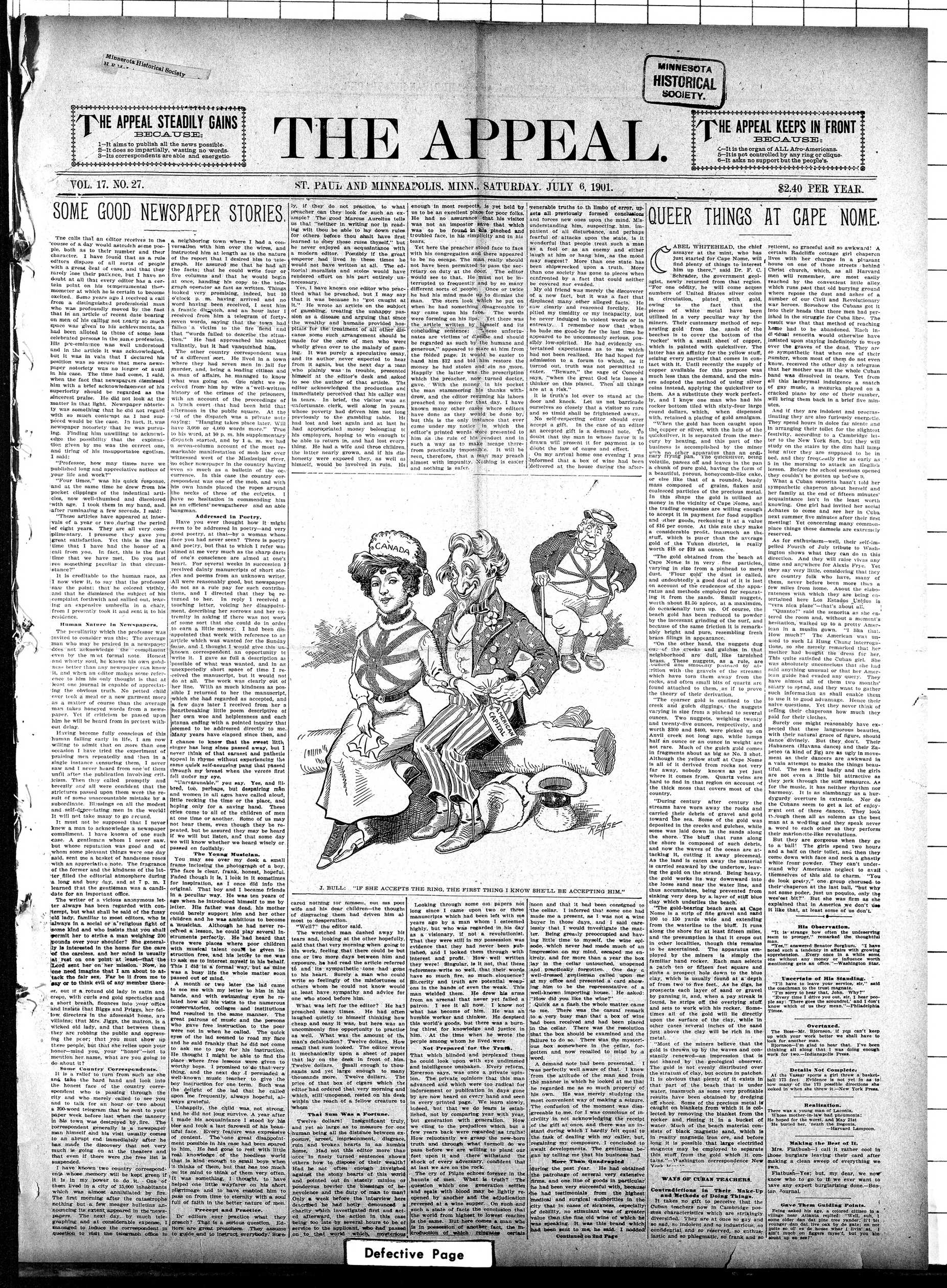
CANADA
J. BULL: "IF SHE ACCEPT
CANADA
AMERICAN
CAPITAL
J. BULL: "IF SHE ACCEPTS THE RING, THE FIRST THING I KNOW SHE'LL BE ACCEPTING HIM."
cared nothing for nmesen, out as poor wife and his dear children—the thoughts of disgracing them had driven him almost away. "Well?" the editor said.
The wretched man dashed away his tears and, looking at the other hopefully, said that that very morning when going to his work, feeling that there could be but a moment's time to be spent with his wife, he had read the article referred to and its sympathetic tone had gone to his heart. Surely a man who could write so feeling of the misfortunes of others has the same way as him would have, by sympathy and advice for one who stood before him.
Looking through some one papers not long since I came upon two or three manuscripts which had been left with me years ago by a man whom I esteemed highly. He was a man who had been his own, and his visionary, if not a revolutionist. That they were still in my possession was evidence that they had never been published, and I looked them through with interest and profit. How well that writer, of course, had a great deal of thought, and his reformers write so well, that their words have so much fire, so much eloquence? So, certly and truth are potential weapons in the hands of even the weak. This man wielded them. He drew his arms round him, and, for more than a year in the general, that never yet failed, a "How did you like the wine?"
What was left for the editor? He had preached many times. He had often laughed quietly to himself thinking how cheap and easy it was, but here was an uncommonly fine opportunity to practice as well. What was the amount of the money, and easy it was, the dollar. How small that sum looked. The dollar it mechanically upon a sheet of paper that lay on the desk in front of him. Twelve dollars. Small enough to thousands and yet large enough to many thousands more. Twelve dollars. The price of that box of cigars which the man bought, which, still unopened, rested on his desk within the reach of a fellow creature to whom
That Sum Was a Fortune.
Twelve dollars! Insignificant truly, and yet so large as to measure for one human being all the distance between exposure, arrest, imprisonment, disgrace, torture, death, and home. Had not this editor more than once in finely turned sentences shown others how to dispose of their wealth! Had he not often enough inveighed against the stony hearts of this world, and how to ponder the ponderous breeder the blessings of the nebulosity and the duty of man to marry. Only a week before the interview here described he had hotly denounced a charity which investigated first and acted afterward, the action in this case of the police service to the applicant, who had passed on to that world which mysterious
Defective Page
enough in most respects, is yet held by us to be an excellent place for poor folks. He had no assurance that his visitor was not an impostor save that which to be found in his plinched and troubled face, in his simplicity and in his tears.
Yet here the preacher stood face to face with his congregation and there appeared to be no escape. The man really should not have been permitted to pass the secession and would see to that. He must not be interrupted to frequently and by so many different sorts of people. Once or twice he had his mind made up to dismiss the man. The stern look which he put on his face would say came upon his face. The words were forming on his lips. Yet there was the article written by himself and its concluding sentence: "these unfurtunate are victims of disease and should be regained as such as amuse and amane and say came upon the folded page. It would be easier to hand him $12 and bid him restore the money he had stolen and sin no more. Happily the latter was the prescription which the preacher, now turned docter, had done as they would be done by the man stammering his thanks withdrew, and the editor resuming his labors preached no more for that day. I have known many other cases where editors have done as they would be done by the man stammering his thanks withdrew under my notice in which the editor's printed words were presented to him as the rule of his conduct and in such a way as to make escape therefrom practically impossible. It will be seen, therefore, that a man may preach nothing is easier and nothing is safer.
AMERICAN
CAPITAL
THE RING, THE FIRST THING I KNOW
Looking through some our papers not long since I came upon two or three manuscripts which had been left with me years ago by a man whom I esteemed highly, but who was regarded in his day as a man of great intellect. That they were still in my possession was evidence that they had never been published, and I looked them through with interest and profit. How well written they were, and how much they wrote so well, that their words have so much fire, so much eloquence? Sincerity and truth are potential weapons in the hands of even the weak. This man wielded them, and drew his arm as he wrote, and it was a patron. I see it all now. I know not what has become of him. He was an humble worker and thinker. He despised this world's goods, but there was a burn in his heart. He was killed him. At the time when he wrote the people among whom he lived were
Not Prepared for the Truth.
That which blinded and perplexed them he could look upon with eye undimmed and intelligence unshaken. Every reform, Emerson says, was once a private opinion, and which were advanced and which were too radical for enforcement or publication in days gone by are now heard on every hand and seen in every printed page. We learn slowly, indeed, but that we do learn is established, not by comparing year with year, but by comparing what we see, we cling to the prejudices which but a few years back were regarded as truths. How reluctantly we grasp the new-born truth and through what turnolt do we pass before we are willing to plant our feet upon it and therewith stand the prejudices and the condemn that at last we are on the rock.
The cry of Pilate echoes forgery in the haunts of men. What is truth? The question which one generation may seals and seals with blood may be lightly reopened by another and the adjudication reversed at a wine supper. On such and such a state of faith the conclusion that Pilate is the same man is the same. But here comes a man who is in possession of another fact, the introduction of which relates certain
venerable truths to thimble of error, uprops all previously formed conclusions and forces new ones upon the mind. Misunderstanding him, suspecting, him, impatient of all disturbance, and perhaps of all wrongness, is wonderful that people treat such a man as a fool or as an enemy and either laugh at him or hang him, as the mood may suggest? More than one state has been shipwrecked upon a truth. More than one state has been forced to pieces when confronted by a fact that could neither be covered nor evaded.
My old friend was merely the discoverer of a new fact, but it was a fact that many other alleged facts. He saw a man with a timidity or my inflexibility. He pitied his timidity or my inflexibility, but he never indulged in violent words or in entreaty. I remember now that when he bade me good-by for the last time he appeared to be uncommonly serious, postulated expectation. He had evidently entertained expectation. He had not been realized. He had hoped for admission to a forum to which, as it turned out, truth was not permitted to enter. "Beware," the sage of Concord says, when the great God lets loose a man on the planet. Then all things are at a risk. It is truth's lord over to stand at the door and knock. Let us not barricade ourselves so closely that a visitor so rare and so timid be frightened away. Let us accept a gift. In the case of an editor an accepted gift is a demand note. To doubt that the man in whose favor it is drawn will present it for payment is to doubt the law of cause and effect. My arrival home one evening I was informed that I had been at the house during the after-
W SHE'LL BE ACCEPTING HIM."
moon and that it had been consigned to the cellar. I inferred that some one had made me a present, as I was not a wine buyer in those days, and I said carelessly that the matter. Being greatly preoccupied at the little time to myself, the wine epilogue, which never made much of an impression on my mind, escaped me entirely, and for more than a year the book was well-dressed and practically forgotten. One day a well-dressed gentleman called upon me at my office and presented a card showing him to be the representative of a company that I had been asked: "How did you like the wine?" Quick as a flash the whole matter came to me. There was the casual remark to a very busy man that a box of wine was in the cellar. There was the resolution that the box should be examined and the failure to do so. There was the mysterious box somewhere in the cellar, forgotten and now recalled to mind a
A demand note had been presented. I was perfectly well aware of that. I knew from the attitude of the man and from the manner in which he looked at me that he regarded me as so much property of the man that he was the most convenient way of making a seizure. The confusion of the moment was disagreeable to me, for I was conscious of inclivity in not acknowledging the receipt of my payment, and I was standing during which I hardly felt equal to the task of dealing with my caller, but, regaining my composition, I concluded to await developments. The gentleman began by telling me that his business had been
More than landpipes
during the patrols of several very extensive
firms, and one line of goods in particular
he had been very successful with, because
he had testimonials from the highest,
medical and surgical authorities in the
country. The fact of debility, no stimulant was of greater value than the fine old wine of which he was speaking. It was this brand which had been the best in the nodded
Continued on 30 Page
QUEER THINGS AT CAPE NOME.
ABEL WRITEHEAD, the chief assayer at the mint, who has just started for Cape Nome, will finally things to instigate him up there. He will Schrader, the government geologist, newly returned from that region. "For one oddity, he will come across numbers of United States silver coins to coinage to the fact that the pieces of white metal have been utilized in a very peculiar way by the miners. Their customary method of separating gold from the sands of the beeches is to cover the bottom of the coins with silver coins, which is painted with quicksilver. The latter has an affinity for the yellow stuff, seizing every particle that comes in contact with it. Until recently the supply of copper available for this purpose was limited, but the miners adopted the method of using silver coins instead, applying the quicksilver to them. As a substitute they work perfectly, and I know one man who had his rocker bottom tiled with sixty-four large round coins, which, when dispensed with silver coins, is called "When the gold has been caught upon the copper or silver, with the help of the quicksilver, it is separated from the mercury by heating, and this part of the business is accomplished by the miner in a martyring frying pan. The quicksilver, being voluble, passes off and leaves in the pan a chunk of pure gold, having the form of a coin, and is then melted or else like that of a rounded, beady mass composed of grains, flakes and coalesced particles of the precious metal. In this shape the gold is utilized as material in the vicinity of Cape Nome, and the miners are forced to accept it in payment for food supplies and other goods, reckoning it at a value of $16 per ounce. At this rate they make a considerable profit, inasmuch as the which is purer than the average gold of the United States, is really worth $18 or $19 an ounce.
"The gold obtained from the beach at Cape Nome is in very fine particles, varying in size from a pinhead to more dust. "Flour gold" the dust is called, "the dust of the coast," on account of the erudence of the apparatus and methods employed for separating it from the sands. Small nuggets, worth about $1.50 apiece, at a maximum, are obtained from the beach gold has been reduced to powder by the incessant grinding of the surf, and because of the same friction it is remarkably bright and pure, resembles fresh water. "On the other hand, the nuggets dug out of the creeks and gulches in that neighborhood are dull, like tarnished brass. These nuggets, as a rule, are of the same size, and are rich in the gravels of the streams which have torn them away from the rocks, and often small bits of quartz are found. It is proved to prove the theory of their derivation.
"The coarser gold is confined to the creek and gulch diggings, the nuggets varying in size from a pinhole to several hundred nuggets, weighing twenty and twenty-two worth $200 and $400, were picked up on an Avilreek not long ago, while lumps half an ounce or an ounce in weight are not rare. Much of the gulch gold comes from the creek, although Although the yellow stuff at Cane Nose is all of it derived from rocks not very far away, nobody knows as yet just where it comes from. Quartz veins are hard and in that region on account of the thick moss that covers most of the country.
"During century after century the streams have worn away the rocks and carried their debris of gravel and gold deposited in the creeks and glaciers, while some was laid down in the sands along the shore. The bluff that runs along the shore, composed of such debris, and how the water has moved it, cutting it away pleasurable. As the land is eaten away the material is carried seaward by the underwater, leaving the gold works its way downward into the loose sand near the water line, and thus accumulates, be prevented from slinking very deep by a layer of stiff blue water."
"The gold-bearing beach area at Cape Nome is a strip of fine gravel and sand 100 to 150 yards wide and extending from the waterline to the bluff. It runs along the shore for at least fifteen miles, and the presumption is that it crops out the sand. It is not easy to be ascertained. The apparatus employed by the miners is simply the familiar hand rocker. Each man selects a patch ten or fifteen feet square and shakes a prospect hole down to the blue clay, which is usually found at a depth of about ten feet. The prospect prosects each layer of sand or gravel by panning it, and, when a pay streak is found, he strips off the overlying stuff and sets to work with his rocker. Sometimes all of the gold will lie directly upon the surface of the clay, while in other cases several inches of the sand above the clay will be rich in the metal.
"Most of the miners believe that the gold is thrown up by the waves and constantly renewed—an impression that is not shared by the geological observer. It is not shared by the geologist. The stratum of clay, but occurs in patches. It is obvious that plenty of it exists in part of the beach that is under water, inasmuch as some very profitable results have been obtained by dredging and caught on blankets from which it is collected by removing the blanket from the rocker and rinsing it in a bucket of water. Much of the beach material contains magnets, which is in reality magnetic iron ore, and before long it is possible that large electrified magnets may be employed to separate this stuff from the gold which it contains." - Washington correspondence New York
WAYS OF CUBAN TEACHERS
Contradictions in Their Make-Up and Methods of Doing Math
It takes no gift to perceive that the Cuban teachers now in Cambridge possess characteristics which are strikingly diversified. They are at once so gay and so confident, so reserved, so confidential and so phlegmatic, so frank and
$2.40 PER YEAR.
reticent, so graceful and so awkward! A certain Radeffice cottage girl chaperon with her charges in a pleasant house on the hill, where she grew up. Christ church, which, as all Harvard men will remember, are most easily reached by the convenient little alley where she grew up, and where ground where the dust and the number of our Civil and Revolutionary war heroes. Somehow the Cubans got it on their heads that those men had perished, and now they still result was that that method of reaching home had to be abandoned. Each individual senorita would otherwise have been sitting indefinitely to weep over the dust and the number so sympathetic that when one of their number, whom most of them do not even know, received the other day a telegram that the Cuban hand was dissolved in tears. We all this lachrymal indulgence a snatch of gay music, a muzurka played on a cracked piano by one of their number, bring them back in a brief five minutes.
And if they are indolent and processing them are also furiously energetic. They spend hours in doce far nients and in arranging their toilet for the slightly larger ones to the New York sun, but they will study on the stairs by the dim hall lamp long after they are supposed to be in bed, and they frequently rise as early as in the morning to attack an English learner, who is desperately depressed they couldn't be gotten up before it. What a Cuban senator has not told her sympathetic chaperon about herself and her family at the end of fifteen minutes' time, knowing, one girl had invaded her Acahates to come and see her in Cuba next summer five minutes after their first meeting: Yet concerning many commonplace things these damams are extremely aware. As for enthusiasm—well, their self-proclaimed Fourth of July tribute to Washington shows what they can do in this direction. And they will raise vlasys any time and anywhere for Alexis Prie. Yet they are country folk, considering that they are never before been more than a few miles from home. About the elaborateness with which they are being entertained here Los Estados Unidos is
"Quanto?" said the senator as she entered the room and, without a moment's hesitation, walked up to a pretty American in a mugnin gown. "I like that. How much?" The American was uninterested in her interrogations, so she merely remained mother had bought the dress for her. This quile satisfied the Cuban girl. She was absolutely unconscious that she had been looking unusual or that her American guide had seen her. She have almost all of them two months salary to spend, and they want to gather such information as shall enable them to use it to good advantage. Hence their advice is that they never think of teffing their chapters how much they paid for their clothes.
Surely one might reasonably have expected that these languorous beauties, with their natural grace of figure, should Habanaera (Havanaera) not they don't. Their Habanaera (Havanaera) are as ugly in movement as their dancers are awkward in a vain attempt to make the things beautiful. The men lead badly and the girls lead badly and the girls attractive as they jerk through the stiffness for the music, it has neither rhythm nor harmony. It is as slambangy as a hurdgydury overture in extremis. Nor do the Cuhans seem to get a lot of enjoyment, they look tough, them all as seem as men at a wedding and they speak never a word to each other as they perform their marionette-like revolutions. But they are gorgeous when they go up. The girls spend two hours and a half and a half come down with face and neck a ghastly white from powder. They can't understand why Americans neglect to avail themselves of this aid to charm. "You do look pretty," one group chorused to not some woman, just unpointe, only the wee 'set bit." But she was firm as she explained that in America we don't use it like that, at least some of us don't.
His Observation.
"It is strange how often the underseeing to seem to prompt," remarked the thoughtful
"Yes," answered Senator Sorghun. "I have
apprehension. Every once in a while she
one without any money or influence worth
mentioning gets an offer." Washington St.
Uncertainty of His Standing.
"I'll have to leave your service, sir," said
the cochairman to the trust magistrate.
"You have to be very careful." "Why?"
"Every time I drive you out, sir, I hear pea-
say. There goes the soundrel, and I don't
know which of us they mean." "Indiana
Pulps Times.
Overtaxed.
The Bone-Mr. Mrs. you can't keep up
with your work better we shall have to
forget another man.
Bigness, minder than that I was doing enough
work for two. -IndianaPulps Press.
Details Not Complete.
At the dinner table a girl threw a basketball
173 for the winner and yet in as to
how many of the 173 possible directions she
socked in when she threw it. -New York Press.
Realization.
There was a young man of Laconia.
Whose mother-in-law had pneumonia.
He buried the worst, near the Magnolia.
He buried her, near the Magnolia.
Harvard Lampoon.
Making the Best of It.
Mrs. Flatbush—I call it cool in those burglaries leaving their card after making a clean sweep of everything we flatbush—Yes; but, my dear, we now know who to go to if we ever want to save any expert burglarizing done—Boston Journal.
Gave Them Guiding Points.
Peter Flatbush in a village near Atlanta replied: "Well, sah, some older dan dat pine tree yander. I'll bit you into it." He guts it so ok de house what I vin't at. I guts it myself, my myself, but you knn up on en."
The Acute
THE APPEAL,
A NATIONAL AFRO-AMERICAN NEWSPAPER
PUBLISHED WEEKLY BY
ADAMS BROS. EDITORS AND PUBLISHERS
49 E. 4th St., St. Paul, Flinn.
ISSUED SMULTANOUSLY IN
Saint Paul, Minneapolis, Chicago,
Washington, Louisville, St. Louis.
ST. PAUL OFFICE,
No. 110 Union Blk. 4th & Cedar,
J. Q. ADAMS, Publisher.
MINNEAPOLIS OFFICE,
Guaranty Loan Bldg. 817
HENRY ROBERTS, Manager.
CHICAGO OFFICE,
323-5 Dearborn St., Suite 310,
C. F. ADAMS, Manager.
WASHINGTON OFFICE,
No.1919 Eleventh St. Northwest
CHAS. E. HALL, Manager.
LOUISVILLE OFFICE,
No. 312 W. Jefferson St. Room 3
W. V. PENN, Manager.
ST. LOUIS OFFICE,
No. 1002 Franklin Avenue.
J. H. HARRISON, Manager.
TERMS, STRICTLY IN ADVANCE:
SINGLE COPY, ONE YEAR $2.00
SINGLE COPY, SIX MONTHS 1.10
SINGLE COPY, THREE MONTHS...
When subscriptions are by any means allowed to run without prepayment, the terms are 600 and 1200 in 5 weeks and 5 cents for each old week, or at the race $0.30 per year.
Remittances should be made by Express Money Order, Post Order Money Order, Registered Letter, or Order Money Order, stamps will be received the same as cash for the fractional parts of a dollar. Only one cent and two cent stamps taken.
Silver should be made by each the mail. It is almost sure to wear a hole through the envelope and be lost; or else it may be stoned. It should be used in letters to do so at their own risk.
Narrage and death notices 10 lines or less $1. Each additional line 10 cents. Payment strictly in advance, and to be announced at the time of completion to be news.
Advertising rates, 15 cents per age line, each insertion. There are fourteen agate lines in an inch, and about seven words in an agate line. The particular vertissimum less than 31. No discount allowed on less than three months contract. Cash must accompany order from parties unknown to us. Further particulars application.
Reading notices 25 cents per age line insertion. No discounts for time or space. Reading matter is set in brevler type—about six words to the line. All head-lines count double.
The date on the address label shows when subscription expires. Remewals should be made two weeks prior to expiration, so that the same mission is missed, as the paper stops when time is out.
It occasionally happens that papers sent to telephone or receive any number when due, inform us by postal card at the expiration of five days from the date of receipt, or forward a duplicate of the missing number.
Communications to receive attention must be neway, upon important documents, the paper; must reach us Tuesday if possible, anyway nature of the autumn or winter nature of the autumn. No man should impugnure, unless stamps are sent for postage.
We do not hold ourselves responsible for the soliciting agents wanted everywhere. Write for terms. Sample copies free.
We do not hold ourselves responsible for the soliciting agents wanted everywhere. Write for terms. Sample copies free.
We do not hold ourselves responsible for the soliciting agents wanted everywhere. Write for terms. Sample copies free.
We do not hold ourselves responsible for the soliciting agents wanted everywhere. Write for terms. Sample copies free.
AGENTS WANTED.
THE APEAL wants good reliable agents to cavassv for subscribers at points not already covered. Write for our extraordinary inducements.
SATURDAY, JULY 6, 1901
It is enough to make one feel, like things are pretty badly distributed when he has to worry along on a few pennies per day, and then reads about Senator J. N. Camden, of West Virginia, who, though worth $40,000,000, sold some coal lands last week for a price that will give him an income of $1,000 per day, sundays and holidays excepted, for the next forty-eight years. Camden is seventy-three years old now, and so cannot live long to enjoy his income, from that particular deal, of $300,000 per year. Perhaps, too, he is like Andrew Carnegie, who is credited with saying recently to a gentleman who enviied him his wealth: "I am not really to be enviied. How can my wealth help me? I am 60 years old and I cannot digest my food. I would give you all my millions if you could give me youth and health." "Then I shall never forget his next remark. We' had driven some yards in silence when Mr. Carnegie suddenly turned and in hushed voice and with bitterness and depth of feeling quite indescribable said: 'If I could make Faust's bargain I would. I
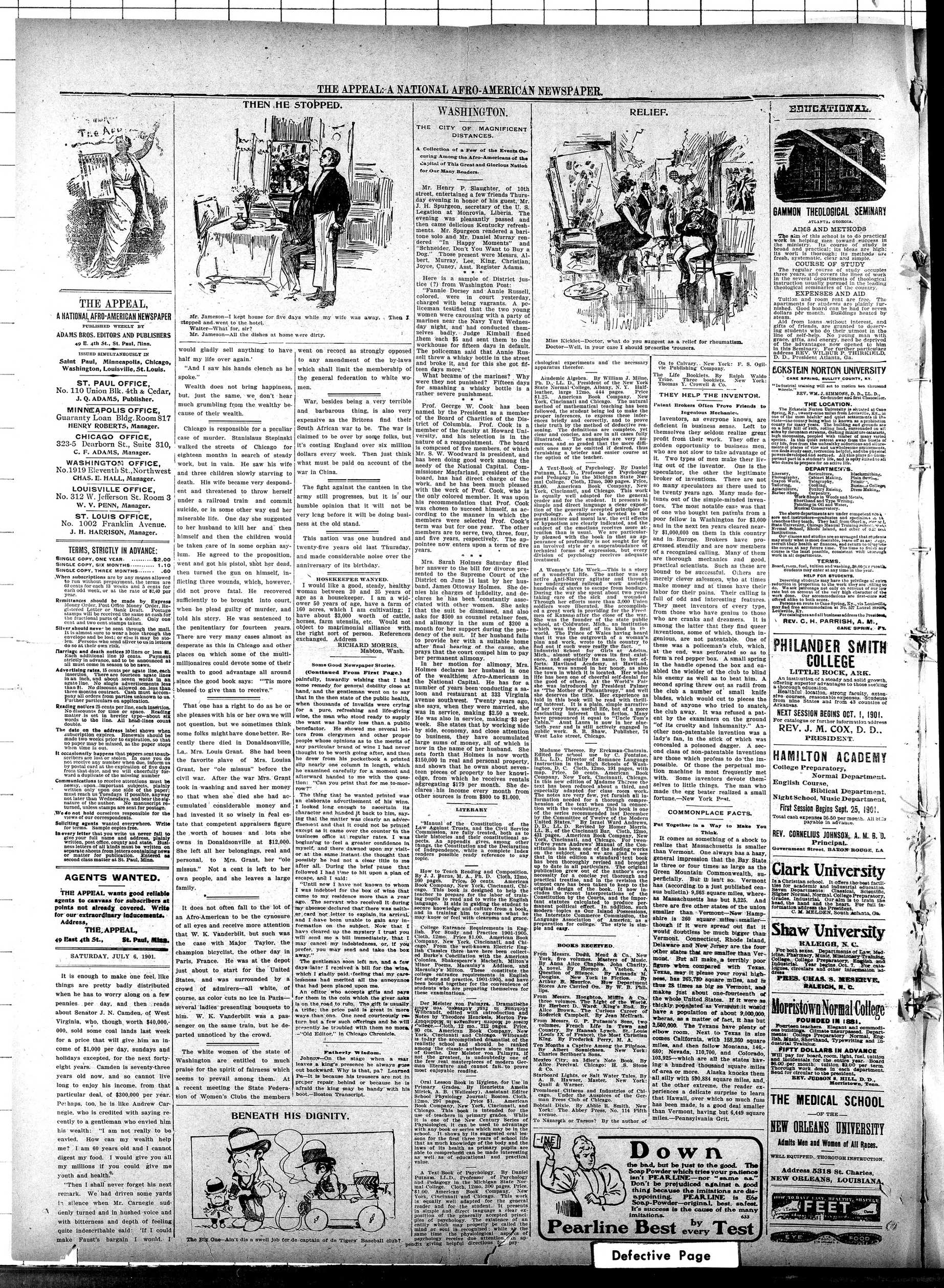
THEN HE STOPPED.
Mr. Jameson—I kept house for five days while my wife was away. Then I stopped and went to the hotel.
Walter—What for, sir?
Mr. Jameson—All the dishes at home were dirty.
(Continued From First Page.)
painfully, inwardly wishing that I had some remedy for general oblivity close at hand. I had to remember that in the then state of the public health, when thousands of invalids were crying for a pure, refreshing and life-giving wine, the man who stood ready to supply it was a man who was a benefactor. He showed me several letters from clergymen and other proper people whose opinions as to the merits of any particular brand of wine I had never seen were true. He drew from his pocketbook a printed slip nearly one column in length, which he examined carefully for a moment and afterward handed to me with the question, "Can you print that for me to-morrow?"
The thing that he wanted printed was an elaborate advertisement of his wine. I looked long enough to ascertain its character and handed it back to him, saying it was a good wine and a pleasant flenement and that it could not be printed except as it came over the counter in the business office at regular rates. I was beginning to feel a greater confidence in myself, and there dawned upon my vistay that I had to instant the thought that possibly he had been after all. During the brief pause that followed I had time to hit upon a plan of escape, and I said: "Until now I have not known to whom I was indebted for the box of wine that came with me a year ago. The servant who received it during my absence declared that there was neither card nor letter to explain, its arrival, and I have been unable to gain any information on the subject. Now that I have the mystery I trust you will send me a letter. I may cancel my indebendness, or, if you prefer, you may send and take the box away." The gentleman soon left me, and a few days later I received a bill for the wine, and I felt a feeling that my carelessness had mettered on an annoyance that had been placed upon me.
An editor who accepts gifts and pays for them in the coin which the giver asks is on the road to ruin. The gift is usually a trifle; the price paid is great in more ways than ones. One need courteously wait for the gift to arrive, and presently be troubled with them no more.—"Old Editor," in Chicago Chronicle.
Fatherly Wisdom.
Johnny—On the stage when a man leaves a king's presence he always goes out backward. Why is that, pa? Learned it because his trousers are not in proper color, he behind or in afraid the king may be handy with his boot.—Boston Transcript.
BENEATH HIS DIGNITY.
would gladly sell anything to have half my life over again."
"And I saw his hands clench as he spoke."
Wealth does not bring happiness, but, just the same, we don't hear much grumbling from the wealthy because of their wealth.
Chicago is responsible for a peculiar case of murder. Stanislaus Stepinski walked the streets of Chicago for eighteen months in search of steady work, but in vain. He saw his wife and three children slowly starving to death. His wife became very despondent and threatened to throw herself under a railroad train and commit suicide, or in some other way end her miserable life. One day she suggested to her husband to kill her and then himself and then the children would be taken care of in some orphan asylum. He agreed to the proposition, went and got his pistol, shot her dead, then turned the gun on himself, inflicting three wounds, which, however, did not prove fatal. He recovered sufficiently to be brought into court, when he plead guilty of murder, and told his story. He was sentenced to the penitentiary for fourteen years. There are very many cases almost as desperate as this in Chicago and other places on which some of the multimillionaires could devote some of their wealth to good advantage all around since the good book says: "Tis more blessed to give than to receive."
That one has a right to do as he or she pleases with his or her own we will not question, but we sometimes think some folks might have done better. Recently there died in Donadsonville, La., Mrs. Louis Grant. She had been the favorite slave of Mrs. Louisa Grant, her "ole missus" before the civil war. After the war Mrs. Grant took in washing and saved her money so that when she died she had accumulated considerable money and had invested it so wisely in real estate that competent appraisers figure the worth of houses and lots she owns in Donadsonville at $12,000. She left all her belongings, real and personal, to Mrs. Grant, her "ole missus." Not a cent is left to her own people, and she leaves a large family.
It does not often fall to the lot of an Afro-American to be the cynosure of all eyes and receive more attention that W. K. Vanderbilt, but such was the case with Major Taylor, the champion bicyclist, the other day in Paris, France. He was at the depot just about to start for the United States, and was surrounded by a crowd of admirers—all white, of course, as color cuts no ice in Paris—several ladies presenting bouquets to him. W. K. Vanderbilt was a passenger on the same train, but he departed unnoticed by the crowd.
The white women of the state of Washington are entitled to much praise for the spirit of fairness which seems to prevail among them. At a recent meeting the State Federation of Women's Clubs the members
THE APPEAL: A NATIONAL AFRO-AMERICAN NEWSPAPER
went on record as strongly opposed to any amendment of the by-laws which shall limit the membership of the general federation to white women.
War, besides being a very terrible and barbarous thing, is also very expensive as the Britons find their South African war to be. The war is claimed to be over by some folks, but it's costing England over six million dollars every week. Then just think what must be paid on account of the war in China.
The fight against the canteen in the army still progresses, but it is our humble opinion that it will not be very long before it will be doing business at the old stand.
This nation was one hundred and twenty-five years old last Thursday, and made considerable noise over the anniversary of its birthday.
HOSEKEEPER WANTED.
I would like a good, steady, healthy woman between 20 and 35 years of age as a housekeeper. I am a widower 50 years of age, have a farm of 200 acres, which I have about $2,000 worth of cattle horses, farm utensils, etc. Would not object to matrimonial alliance with the right sort of person. References exchanged. AARP. RICHARD MORRIS. Mabton, Wash.
Some Good Newspaper Stories.
WASHINGTON.
THE CITY OF MAGNIFICENT DISTANCES.
A Collection of a Few of the Events Occuring Among the Afro-Americans of the Capital of This Great and Glorious Nation for Our Many Readers.
Mr. Henry P. Slaughter, of 10th street, entertained a few friends Thursday evening in honor of his guest, Mr. J. H. Spurgeon, secretary of the U. S. Army, and the evening was pleasantly passed and then came delicious Kentucky refreshments. Mr. Spurgeon rendered a baritone solo and Mr. Daniel Murray remembered in "Happy Moments" and "Scholder, Dr. You Can Be a Dog." Those present were Messrs. Albert, Murray, Lee, King, Christian; Joyce, Cune, Asst. Register Adams.
Here is a sample of District justice (?) from Washington Post:
"Fannie Dorsey and Annie Russell, colored, were in court yesterday, charged with being vagrants. A policeman testified that the two young women were carousing with a party of marines near the Navy Yard Wednesday, and they self-selves badly. Judge Kimbail found them each $5 and sent them to the workhouse for fifteen days in default. The policeman said that Annie Russell threw a whisky bottle in the street and broke it, and for this she got off punishment. What became of the marines? Why were they not punished? Fifteen days for smashing a whisky bottle is a rather severe punishment.
Prof. George W. Cook has been named by the President as a member of the Board of Charities of the District of Columbia. Prof. Cook is a member of the faculty at Howard University, and his selection is in the hands of the Board, which is composed of five members, of which Mr. S. W. Woodward is president, and has been doing good work among the needy of the National Capital. Commissioner Macfarland, president of the board, has had direct charge of the work, and much pleased with the work of Prof. Cook, the only colored member. It was upon his recommendation that Prof. Cook was chosen to succeed himself, as according to the manner in which the members were selected Prof. Cook's term was but for one year. The other four members were three, four, and five years, respectively. The appointe now enters upon a term of five years.
Mrs. Sarah Holmes Saturday filed her answer to the bill for divorce presented to the Supreme Court of the district on June 14 last by her husband, Janet. She has also charged his charges of infidelity, and declares he 'has been 'constantly associated with other women. She asks that the suit be dismissed, and also asks $350 as counsel retainer fees, and $100 as alloy money for month her support during the pendency of the suit. If her husband fails to provide her with a suitable home after that hearing of the cause, she may be required to impel him to pay her permanent alloy.
In her motion for alimony, Mrs. Holmes declares her husband is one of the wealthiest Afro-Americans in the National Capital. He has for a year worked as a saloon and restaurant at 333 Wingate avenue southwest. Twenty years ago, she says, when they were married, she was in service, making $2.50 a week. He was also in service, making $3 per week. She states that by working side by side in economy, and close attention to business, she has accumulated large sums of money, all of whom now in the name of her husband. She sets forth that Holmes is now worth $150,000 in real and personal property, and shows that he owns about seven degrees, of property to her knowledge, from her parents, and aggregating $179 per month. She declares his income every month from other sources is from $800 to $1,000.
LITERARY
"Manual of the Constitution of the Laws of the State of Pennsylvania Service Commission, are fully treated, both their histories and their constitutional as-spectacles, the Constitution and the Declaration of Independence, while a complete Index of possible readiness reference to any topic.
How to Teach Reading and Composition. By J. J. Burns, A. M. Ph. D. Clothing, 120 pages. Price, 50 cents. American Book Store. This book is designed to help the training pupils to read and write the language. It aids in giding the student to secure reading skills and the ability to train pupils to express what he may know or feel with clearness and what he can. College Entrance Requirements in English. For Study and Practice 1901-1905. Maculaus, New York. Company. New York, Cincinnati, and Chicago. From the well-known Electric Engineers' Association. Burke's Conciliation with the American Poor. Maculaus' Addition. Maculaus' Milton. These constitute the foundation for studying and preparing themselves for these examinations.
Der Meister von Palmyra. Dramaticist
prow ous *gumma* juny uju. *Munju* juny
Notes by Theodore Huckleck, Morton Pro-
Anspruch uus *uus* juny *hapo* jo 20 juniu
80 cts. American Book Company. New
Ontario, Cincinnati and Wilbrand
realistic school and should be ranked
among the classic authors since the time
of the 19th century. Not the greatest, is undoubtedly one
not the greatest, is undoubtedly one of modern German
literature and cannot fail to prove most enjoyable reading.
Oral Lese book in Hygiene, for use in
Primary Grades. By Henfetta Amelia
Mirick A. B. (Wellesley). Assistant Editor
School Journal, Boston Cloth,
207 page. Price $14. Book Company, New
Cincinnati, New York. Used by
teachers in primary grades. While
it is one of the New Century Series of
books, it is not with any book or series which may be in
the school. It shows by its suggested oral lea-
sure that as much knowledge of the body and
the laws of its health as primary pupils are
able to comprehend can be made interesting
as of educational and practical value.
A Text-Book of Psychology. by Daniel Putnam, LL.D., Professor of Psychology at Columbia University, College, Cloth 120a, 300 pages, Price: $15.00, American University, York, Chicago and Chicago. This work is equally well adapted for the general audience in simple and direct language a clear position of the generally accepted principle of entity which may properly be called the same time the physiological aspects of psychology receive due attention, on ap-
RELIEF.
Miss Kicklet—Doctor, what do you suggest as a relief for rheumatism.
Doctor—Well, in your case I should prescribe 'trousers.'
Down
the bad, but be just to the good. The Soap Powder which tries your patience isn't PEARLINE—nor "same as." Don't be prejudiced against a good thing because the imitations are disapparing. PEARLINE is the Soap-Powder—original best, unless it's success is the cause of the many imitations.
Pearline Best by every Test
633
Defective Page
chological experiments and the necessary apparatus therefor.
Academic Algebra. By William J. Mille, Ph. D., L.L. D., President of the New York University, and William J. Mille, Professor of leather, large 12no., 444 pages.
Price $1.25. American Book Company, New York.
The method of mathematical teaching has been followed, the student being led to make the proper brief and correct, to make the brief and correctly, and to prove their truth by the method of deductive reasoning, to be clear and concise, and in all cases fully illustrated and concise, and in all cases fully illustrated and concise, and so graded that the more difficult ones may be omitted if desired, thus furnishing a briefer and easier course at the same time.
A Text Book of Psychology. by Daniel Putnam, LL. D., Professor of Psychology at the University of Chicago and the College. Cloth, 120mm, 300 pages. Price. $100. American Book Company, New York. The text is equally well adapted for the general reader and for the student. It presents in detail the contents of the general accepted principles of psychology, chapter 1. The chapter on the effects of hypnosis are clearly indicated, and the effects of hypnosis on law, the evil effects of hypnosis are clearly indicated, and the effectuation than is usual. We are particularly pleased with the book in that an important part of the book is an involved style or a superb abundance of technical forms of expression, but every edition of psychology receives adequate training.
Madame Therese, By Ereckman-Chtrain. Edited for school use by C. Fontaine, B.L., L.D. Director of Romance Language Instruction in the High Schools of Washington, C. Cloth. Cloth is a map, map. Price, 50 cents. American. Book Company, New York, Cincinnati. Chicago. In this new edition of Madame Thzzee the new edition of Madame Thzzee is the third, and especially adapted for class of books. The notes are very few, yet furnish all information needed for a thorough comprehension of the text when used in connection with the school book. The book of the series recommended Inst December by the Committee of Twelve of the Modern States.
By Israel Ward Andrews, R.J. Reynolds Company, L.L. B., of the Cincinnati Bar. Cloth, 12mo, 431 pages. American Book Company, New York, Cincinnati, and Chicago. For twentieth years, the company has been the leading of the institution has been one of the leading of the leading of the subject. and we are glad to see that in this edition a standard text book has thoroughly revised and brought into date to the first edition of the publication grew out of the author's own necessity for a concise yet thorough and practical treatise, and in the revision the book has been the most popular to the original design of the book. It now includes the recent interpretations of the Constitution by the Courts, and the imposition of the law on the public personnel and political effect. In addition to modern topics as Our Island Possessions, the Interstate Commerce Commission, the Interstate Association of America, as a preparation for college. The style is slim and easy.
BOOKS RECEIVED
From Messrs. Dodd, Mead & Co., New York, five volumes. Masters of Music. By Anna Alice Chaplin. John Charity. A novel. By Horace A. Vaehen. Question of Silence. By Amanda M. Douglas. New York in Fiction. By Arthur B. Maurice. How Department Stores Are Carried On. By W. B. Phillips.
From Messrs. Houghton, Mifflin & Co., three volumes. The Light of the World. By Herbert D. Ward. King's End. By Alice Brown. The Curious Career of Roderick Campbell. By Jean McIrath.
From Messrs. G. P. Putnam's Sons, two
volumes. French Life in Town, and
Towns. A Biography of the French.
Louis IX of France), the Most Christian
King. By Frederick钾钾, M. A.
Ten Months a Captive Among the Filipinos.
New York
Charles Scribner's Sons.
Mexico City: an Island's Note Book.
By
Percalv. ID: Chicago: H. S. Stone
& Co.
Starboard Lights, or Salt Water Tales, By
Maurice Mastet. New York: Quell & Warner.
Prominent Citizens, and Industries of Chil-
dren. New York: The German Press Club of Chicago.
Bobtail Dixie. By Able B. R. Smith. New
Haven. By the Abbey Press. No. 114 Fifth
nvenue.
A virtue:
To Nazargth or Tarsus? By the author of
On to Calvary. New York: F. S. Oglivie Publishing Company.
The Life Bookslet. By Ralph Waldo Thomas. New York: Thomas Y. Crowell & Co.
THEY HELP THE INVENTOR.
Patent Brokers Often Prove Friends to Ingenious Mechanics.
COMMONPLACE FACTS.
Put Together in a Way to Make You Think.
It comes as something of a shock to realize that Massachusetts is smaller than Vermont. One always has a hazy, general impression that the Bay State is three or four times as large as the Green Mountain Commonwealth, superficially. But it isn't so. Vermont has (according to a just published census bulletin) 9,655 square miles, whereas Massachusetts has but 8,325. And there are five other states of the union smaller. Vermont—New Hampshire is 260 square miles, though if it were spread out flat it would doubtless be much bigger than Vermont. Connecticut, Rhode Island, Delaware and New Jersey are the four other states that are smaller than Vermont. But all make, a terribly poor figure when compared with Texas. Texas, may it please your royal highness, has 265,780 square miles, and is more 28 times as big as Vermont, and is one-fourteenth of the whole United States. It were as thickly populated as Vermont have a population of about 9,000,000 whereas, as a matter of fact, it has but 3,600,000. The Texans have plenty of elbow room. Next to Texas in size comes California, with 155,360 square miles, and then follow Montana, 146,680; Nevada, 110,700, and Colorado, 103,259—all that are the states having a hundred thousand square miles and then a Alaska knocks them all, with 150,884 square miles, and, at the other extreme, a leader experiences a delicate surprise that Hawaii, over which so much fuss has been made, is a good deal smaller than Vermont, having but 6,449 square miles—Pennsylvania Grit.
EDUCATIONAL
V
The aim of this school is to do practical work in the ministry. Its course of study is broad and practical; its ideas are high; it is well structured; its are fresh, systematic, clear and simple.
**COURSE OF STUDY**
The required courses are three years, and covers the lines of work in the ministry's departments in the loading theological summaries of the country.
**COURSE OF SUMMARIES OF THE COUNTRY.**
Tution and Government are free. The apartments for students are plainly furnished. Good board can be had for seven days per month. Buildings heated by steam.
Aid from loans without interest, and gifts of friends are granted to deserving students who are not limited to the line of self-help. No young man with grace, gifts, and energy, need be deprived of their stage. For the same reason, in this Seminar, for further particulars address REV. WILBUR P. THRIKFIELD, D.D., President Atlanta, Ga.
ECSTEIN NRTON UNIVERSITY
CANE SPRING, BULLITT COUNTY, KY.
Industrial training will act to motion ten thousand waves. REV. WX. J. BIMMOSS, D.D., LL.D.
Co-founder and first Chancellor.
THE LOCATION.
The Echesta Norton University is situated at Cape Spring, KY. The city is located near the South Coast, near the South Coast, in the south-west of the city of New York, and is located at the south-west of the city of New York, and is located at a lofty hill of rich, rolling land, surrounded on all the high mountains, people with timber of many various types of wood. In this quiet retreat away from the bumble of city life, the city is very large, with many of the most important places of vice and unwholesome amusements. The city is also one of the most well-modulated and well-classified powers developed and secured. All this play no unimportant part in a student's life, and is aptly united to all who desire to protect.
DEPARTMENT'S
L'S.
Libratory,
S�ement,
Blanciture,
Palm Making,
Twin Busties,
Cooking,
MILK-raising,
Business College,
Barber Shop,
Carpentry.
Blacksmithing,
Palm Brewery,
Blacksmith,
Blacksmith,
Blacksmith,
The abbreviated departments are under competent new
administrators. We have also trained teachers they teach. They have from other, like
State University, Chicago Manual Training School, New
Rhode Island, Rhode Island, and of other state
Institutions.
Our classes and studies are so arranged that students may study what is most desirable, leave off at any age, recruit their health or finances, and return to complete the course at any future time. The time to finish any course is the least possible, consistent with a strong work in all departments.
TERMS.
Board, room, fuel, tuition and washing, $8.00 per month. Students may enter at any time in the year.
HELP FOR STUDENTS.
Deserving students may have the privilege of extra reduction in proportion to the work they are willing to do. We ask patronage not only on account of our low rate but on account of the very high character of the work done. Our accommodations are first-class $220 offered alike to both sexes.
Persons en route to Cane Spring, Ky., via Louisville, may find free accommodation at No. 527 Laurel Street.
PHILANDER SMITH COLLEGE
Healthful location, strong faculty, extensive courses, reasonable expense. Students from nine States and from 43 counties of Arkansas.
NEXT SESSION BEGINS OCT. 1, 1901.
For catalogue or further information address REV. J. M. COX. D. D.
PRESIDENT
HAMILTON ACADEMY
Normal Department.
English Course,
Biblical Department.
Night School, Music Department.
First Session Begins Sept. 25, 1901.
Total cash expense 65.50 per month. All bills
payable in advance.
REV. CORNELIUS JOHNSON, A. M. B. D.
Principal.
Government Street, BATON ROUGE, LA
Clark University
In a Christian school, it offers the best faculty. The seven departments: Classical, Scientific, Humanities, Business, Grades, Industrial. Our aim is to train the students to form information address the President.
For both sexes. Departments of Law, Medicine, Pharmacy, Music, Missionary Training, Music, and Industrial. Begin begins Oct. 7. Post catalogues, circulators and other information indi-
nities. PRES. CHAS. S. MESERVE,
RALEH, N. C.
WEDU 1851.
Fourteenth school commons-
buildings. Climate unsurpassed. Depart-
ment. Preparatory Normal, Engli-
lish, Music, Schoo, and Typewriting and
Industrial Training.
FIFTY DOLLARS IN ADVANCE
Fifty-two rooms, board, room, light, tuition
and incidental fees. $2.00 per per-
meter; tuition $2.00 per term
department. Seed for circular to the presiden-
tment.
THE MEDICAL SCHOOL
OF THE
NEW ORLEANS UNIVERSITY
Admits Men and Women of All Races.
WELL EQUIPPED. THOROUGH INSTRUCTION.
Address 5318 St. Charles,
NEW ORLEANS, LOUISIANA.
HOW TO HAVE EASY, HEALTHY, SHAPLE
FEET
EYE
FOOD
ST. PAUL.
A WEEKS RECORD IN MINNESOTA TAS CAPIT
The Saints City and Salatay City Folks- Neway items of Social, Religious and General Matters Among the People, Bulled Down.
The public baths on Harriet Island will be opened tomorrow.
Nice furnished rooms, for gentlemen only, on reasonable terms, at No. 851 Sibley street.
Miss May Irvin, of Minneapolis, is in the city visiting her uncle, Mr. T. J. Irvin, 427 Rondo.
The hour for the sessions of St. James' Sunday school has been changed to 2:30 p. m.
For Rent- Two furnished rooms for gentlemen. Apply to Mrs. D. E. Albert, 553 Sibley street.
One or two gentlemen roomers rented. Apply at 527 St. Anthony or, at UTE THE APPEAL office.
The Elk Express Co. now has a large, commodious store house, where furniture or other household goods may be stored at reasonable rates.
Have you seen that elegant new moving van of the Elk Express Co? Well, it a corker. Don't forget them when you need any expressing done.
The Wm. E. Nagel Undertaking Co. funeral directors and embalmers, 222 Wabash street, between Third and Fourth streets. Telephone 508 day or night.
Those of our patrons who desire to have matter published must get the same in this office not later than Thursday, otherwise it may be crowded out.
Mrs. G. W. M. Grosse, of Chicago, sister of Mrs. T. H. Lyles, is expected in our city today to spend a couple of weeks with her mother, who is not very well.
Is your hair straight? If not see 60 shades to Ozonized Ox Marrow. Co. 75 W. Avenue Chicago, Ill. for a bottle of Ozonized Ox Marrow, or can you easily straighten it.
Anyone who contemplates attending the Pan-American Exposition who wishes a nice place to stop may learn of the same by application to J. Alex Ross, 509 Michigan Ave., Buffalo, N.Y. Miss Fannie Dodd left Wednesday evening for Galesburg, Ill., to attend the Wood River Baptist Association and then to visit friends elsewhere. She will be gone for several weeks. If you wish a good shave, hair curf or shampoo call at Richard Cousby's shop. No. 424 Minneapolis street. First-street workroom. Insurance guaranteed. Music for all occasions furnished on short notice.
No place has been decided upon for the annual picnic of Mars Lodge, G. U. O. O. F., but you may bet your beorts it will come off with the usual eel August 1st just the same. Wait for it, and watch these columns for announcements.
Elk Express, G. D. Charleston, prop., packing and shipping; hauling of all kinds; coal and wood in large or small quantities. When you wish a telephone, Main 1920.-J. 1. Office 63 East Sixth street.
Mr. J. F. Pringle and Mr. J. C. McGinn, who for so many years were at the Plymouth Clothing House, have again connected themselves with that community, and come their old friends and serve their greatest interests as in days past. Dr. J. E. PORTER, physician and *argeson*, Room 410 Washburn building, Fifth street, opposite Court. House. Office hours: 10 a.m. to m. 12 p. 2, m. to 4 p. m., 7 to 8 p. m., m. Telephone. Wall street. Telephone, Dale, 464-183. The excursion to Coner Island last Wednesday given by the Literary society of Pligrum Baptist church was well patronized and was a most enjoyable affair. All who went were delighted. The best of order pre-departed to committee in charge of the excursion is much pleased with their success.
The famous chef, John Godfrey, has moved his boarding house to No. 552 Wabasca street, between Tenth street and College avenue, amenities, and all the other amenities, and is much longer than ever, prepared to serve his guests. Board and rooms by the day, week or month at reasonable rates. Meals, 25 cents. Sunday dinners, 25 cents. A speciality. Transients accommodated.
L. Eppstein & Sons Co., who have recently moved their extensive liquor house to the corner of Wabasca and Eighth streets, where the best in their which the city affords may be obtained, 25 secured the services as city salesman, of Mr. Joseph Eurifur for many years with the California Wine House, Mr. Eurifur is one of the few predates anyone else who is a good fellow. Call to see him; he'll treat you right.
Pilgrim Baptist Church—Preaching, morning and evening, by Rev. J. T. Caston, of Fulton, Mo., at 3:00 P. M. Grand, rally day. All are invited.
Miss Mayaula Leavitt, who is visiting Mrs. Martha Washington, at Portland, Ore., will accompany her to the sea coast and count to St. Louis. Mrs. M. J. Leavitt will be a guest of Mrs. M. J. Leavitt, 651 Mississippi street.
Mrs. T. H. Lyles will leave for Buffalo, N. Y., today where she will represent the women's clubs of Minnesota at the biennial session of the National Colored Women's association. Mrs. Lyles is state organizer. Mrs. Lyles is a national president of the John Brown Monument association. She has made an able representative of this state and has kept the state of Minnesota prominently in the front rank of the national organization and it is hoped she will be retained in her representative capacity.
There have been a number of clubs started in St. Paul in the last decade, some of them being quite nice and were conducted well, at least for a while. But the Ramsey County Afro-American Social Club No. 378 Cedar street, which celebrates and opens by its members, to its members, to complete and nicest of any of them, the club is incorporated, and has about fifteen charter members, with Mr. James Woodford as proprietor.
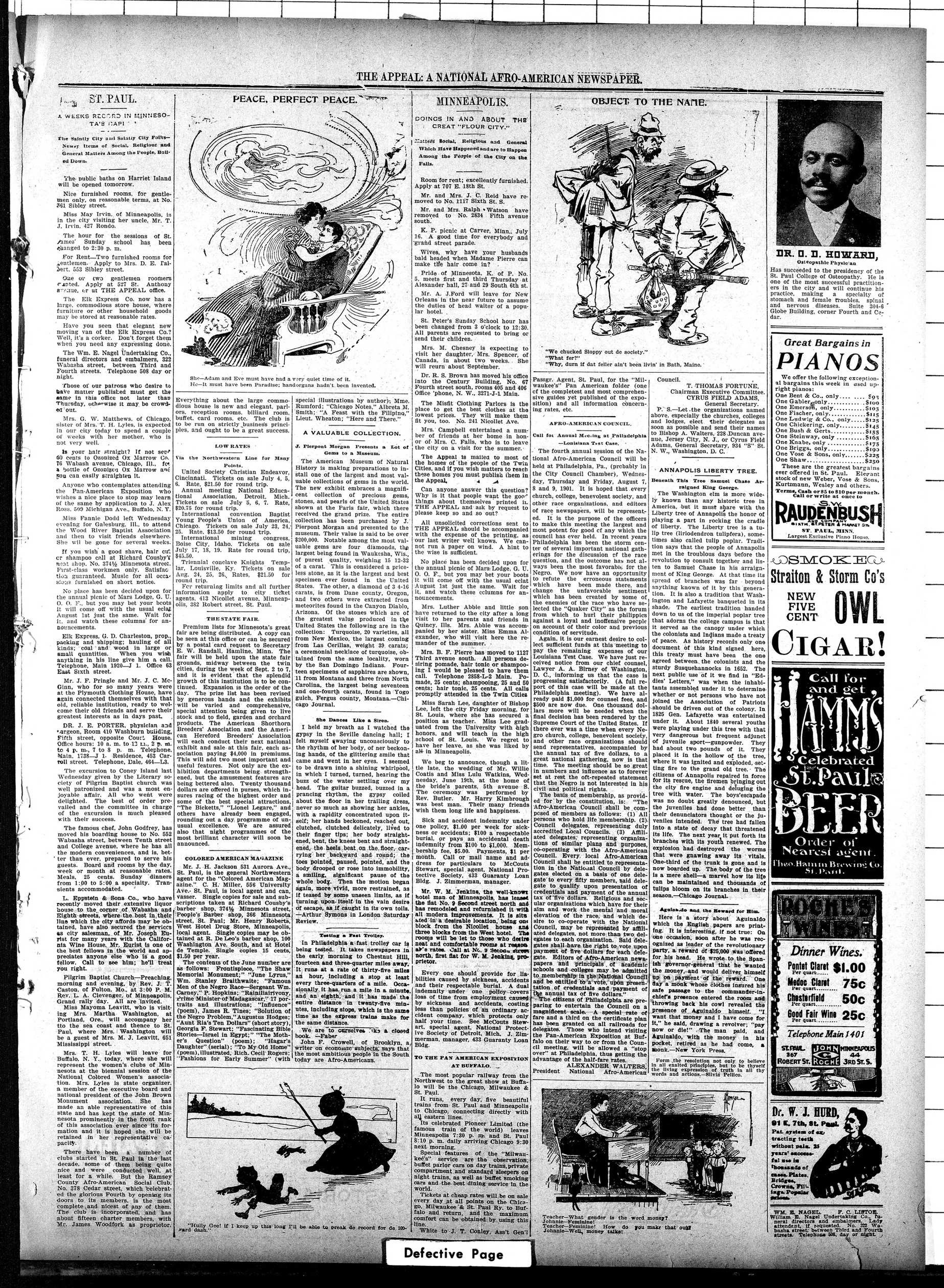
PEACE, PERFECT PEACE.
She—Adam and Eve must have had a very quiet time of it. He—It must have been Paradise; handgardens hadn't been invented.
"Knelle Goal if I have no Ninja."
"Hully Gee! if I keep up this long I'll be able to break de record for de 100- guard dash."
Everything about the large commodoious house is new and elegant, parlors, reception rooms, billiard room, buffet, card rooms, etc. The club is to be run on strictly business principles, and ought to be a great success.
LOW RATES
Via the Northwestern Line for Many
Points.
United Society Christian Endeavor,
Cincinnati. Tickets on sale July 4, 5,
6. Rate $21.50 for round trip.
Annual meeting National Educational
Association, Detroit, Mich.
Tickets on sale July 6, 7. Rate
$20.75 for round trip.
International convention Baptist
Young People's Union of America,
Chicago. Tickets on sale July 23, 24,
25. Rate $13.50 for round trip.
International mining congress,
Bolos City, Idaho. Tickets on sale
July 1, 18, 19. Rate for round trip,
$45.50.
Trienial conclave Knights Templar,
Louisville, Ky. Tickets on sale Aug.
24, 25, 26, 26. Rate $21.50 for
round trip.
Information limits and all further
information apply to city ticket
agents, 413 Nicole avenue, Minneapolis,
382 Robert street, St. Paul.
THE STATE FAIR.
Premium lists for Minnesota's great fair are being distributed. A copy can be seen at this office or can be secured by a postal card request to Secretary Randall Hamline, Minn. The fair will be held on the grounds, midway between the twin cities, during the week of Sept. 2 to 7, and it is evident that the splendid growth of this institution is to be continued. Expansion is the order of the day. The prize list has been revised and the awards will be varied and comprehensive, special attention being given to live stock and to field, garden and orchard products. The American Shorthorn Breeders' Association and the American Hereford Breeders' Association exhibit and sale at this fair, each association paying $4,000 in premiums. This will add two most important and useful features. Not only are the exhibition departments being strengthened, but the amusement features are being bettered also. Twenty thousand tickets are being issued racing of the highest order and some of the best special attractions, "The Bickets," "Lionel Legare," and others have already been engaged, rounding out a day programme of unusual excellence. We are assured that our programs will be the most brilliant character will soon be announced.
COLORED AMERICAN MAGAZINE
Mr. J. H. Jackson 513 Aurora Ave. St. Paul, is the general Northwestern agent for the "Colored American Magazine." C. H. Miller, 556 University Ave. St. Paul, is local agent and can vasser. St. Paul copies for sale and subscriptions to the barber shop, 374% Minnesota street, People's Barber shop, 366 Minnesota street, St. Paul; Mr. Henry Roberts, West Hotel Drug Store, Minneapolis, local agent. Single copies may be obeyed. Lee's Barber shop, 100 Washington Avenue, and at the de Temple. Single copies 15 cents, $1.50 per year.
The contents of the June number are as follows: Frontpiece, "The Shaw Memorial Monument," "June Lyrus," Wm Stanley Braithwaite, "Famous Men of the Past," Carney, "P. Hopkins; Rattailrivory, prime Minister of Madagascar," 17 portraits and illustrations; "Influence" (poem), James R. Tines; "Solution of the Problem" (poem), Aut Rila's Ten Dollars (short story), Georgia F. Stewart; "Fascinating Bible Stories—Israel in Egypt," "The Mother's Question" (poem), "Hagar's Story" (poem), "Aunt Rila" (poem), illustrated, Rich. Cecil Rogers; "Fashions for Early Summer" (with
THE APPEAL: A NATIONAL AFRO-AMERICAN NEWSPAPER
special illustrations by author); Mme Rumford; "Chicago Notes," Albreta M Smith; "A Feast with the Filipino," Lieut. Wheaton; "Here and There."
A VALUABLE COLLECTION.
J. Plerpont Morgan Presents a Lot of Gems to a Museum.
The American Museum of Natural History is making preparations to install one of the largest and most valuable collections of gems in the world. The new exhibit embraces a magnificent collection of precious gems, stones, and pearls of the United States shown at the Paris fair, which there received the grand prize. The entire collection has been purchased by J. Pierpont Morgan and presented to the Museum. Their value is said to be over $200,000. The most valuable gems are four diamonds, the largest being found in Wauksha, Wis, of purest quality, weighing 15 12-32 of a carat. This is considered a priceless stone, as it is the largest and best specimen ever found in the United States. The other, a diamond of 3 4-16 carats, is from Dane county, Oregon, and two others were extracted from meteorites found in the Canyon Diablo, Arizona. Of the stones which are of the greatest value produced in the United States the following are in the collection: Turquiope, 20 varieties, all from New Mexico, the largest coming from Las Corillas, weight 39 carats; Turquiope, 20 varieties of turquoise, obtained from the sand in the Bay of the San Doningo Indians. Fourteen specimens of sapphires are shown,十个 Montana and three from North Carolina, the largest being seventen and one-fourth carats, found in Yogo gulch, Fergus county, Montana—Chicago Journal.
She Dances Like a Siren
I held my breath as I watched the gypsy in the Seville dancing hall; I felt myself gwaying unconsciously to the rhythm of her body, of her necking hands, of the glittering smile that came and went in her eyes. I seemed to be drawn into a shining whirlpool, in which I turned, turned, hearing the buzz of the water settling over my head. The guitar buzzed, buzzed in a prancing rhythm, the gypsy colled about the floor in her trailing dress, the knees bent, with a rapidity concentrated upon itself; her hands beckoned, reached out, clutched, clutched delicately, lived to their finger tips; her body straightened, bent, the knees bent and straightened, the heels beat on the floor, carrying her backward and round; the toes pointed, paused, pointed, and the body drooped or rose into immobility, a smiling, significant pause of the whole body. Then the motion began again, more vivid, more restrained, as if teased by some unseen limits, as if she was in a dream, an ideal of escape, as if caught in its own toils. —Arthur Symons in London Saturday Review
Testing a Fast Trolley.
In Philadelphia a fast trolley car is being tested. It takes newspapers in the early morning to Chestnut Hill, fourteen and three-quarter miles away. It runs at a rate of thirty-five miles an hour, including a stop at least every three-quarter of a mile. Occasionally, it has run a mile in a minute and an eighth, and it has made the entire distance in twenty-five minutes, stops which is the same time as the trains make for the same distance.
We are to ourselves like a closed book. -Faber
John F. Crowell, of Brooklyn, a writer on economic subjects, says that the most ambitious people in the South today are Afro-Americans.
DOINGS IN AND ABOUT THE CREAT "FLOUR CITY."
Matter Social. Religious and General
Which Have Happened and are Happen
Among the People of the City on the
Falls.
Room for rent; excellently furnished.
Apply at 707 E. 18th St.
Mr. and Mrs. J. C. Reid have removed to No. 1117 Sixth St. S.
Mr. and Mrs. Ralph *Watson* have removed to No. 2834 Fifth avenue south.
K. P. picnic at Carver, Minn., July 16. A good time for everybody and grand street parade.
Wives, why have your husbands bald headed when Madame Pierre can make the hair come in?
Fride of Minnesota, K. of P. No. 57. Prince of Minnesota, Thirty Fourth Thursday. Alexander hall, 27 and 29 Sixth st.
Mr. A. J.Ford will leave for New Orleans in the near future to assume the duties of head waiter of a popular hotel.
St. Peter's Sunday School hour has been changed from 3 o'clock to 12:30. All parents are requested to bring or send their children.
Mrs. M. Chesney is expecting to visit her daughter, Mrs. Spencer, of Canada, in about two weeks. She will return about September.
Dr. R. S. Brown has moved his office in Century Building. No. 67 Fourth street south rooms 405 and 406 Office phone N. W. 3271-1-Main.
Mrs. Fitting Clothing Parlors is the place to meet friends at the lowest prices. They will fit you, too. No. 241 Nicollet Ave.
Mrs. Campbell entertained a number of friends at her home in hour of Mrs. C. Falls, who is to leave the city on a visit for the summer.
The Appeal is mailed to most of the homes of the people of the Twin Cities, and if you wish matters to reach these homes you must publish them in the Appeal.
Can anyone answer this question? Why is it that people want the goo'thing to be printed in the THE APPEAL and ask for request to please keep and so out?
All unsolicited corrections sent to THE APPEAL should be accompanied with the expense of the printing, as well as the well known. We cannot run a paper mail. A hint to the wise is sufficient.
No place has been decided upon for the annual picnic of Mars-Lodge. G. U. O. O. F., but you may bet your boots it will come off with the usual ectal August 1st just the same. Wait for the columns for announcements.
Mrs. Luther Abbie and little son have returned to the city after a long visit to her parents and friends in Quincy, Ills. Mrs. Abbie was accompanied by her sister, Miss Emma Alma Browne, who is here the remainder of the summer.
Mrs. B. F. Pierce has moved to 1127 Third avenue south. All persons desiring pomade, hair tonic or shampooing I would be pleased to have them call. Telephone 2858-L2 Main. Powder centers; shampooing; 23 and 50 cents; shampooing; 23 and 50 cents; promptly attended in the Twin Cities
Miss Sarah Lee, daughter of Bishop Lee, left the city Friday morning, for St. Louis, where she has secured a position as teacher. Miss Lee graduated from the University with high school diploma and from the school of St. Louis. We regret to have her leave, as she was liked by aH in Minneapolis.
We beg to announce, though a little late, the wedding of Mr. Willie Coats and Miss Lulu Watkins, Wednesday, June 19th, at the home of the bride's parents, 5th avenue S. The ceremony was performed by Mr. Kinnough was best man. Their many friends wish them long life and happiness.
Sick and accident indemnity added one policy, $1.00 per week for sickness or accidents; $100 a respectable burial, or pays an accidental death indemnity from $100 to $1,000. Membership fee, $5.00. Payments, $1 per month. Call or mail name and address for particulars to McCoutts Protective Society, 433 Guaranty Loan Bldg. J. Dimmers Loan Loan
Mr. W. M. Jenkins, the well-known hotel man of Minneapolis, has leased the flat No. 9 Second street north and has remodeled and refurbished it with remodeling materials. It is sited in a desirable location, below a block from the Nicollet house and three blocks from the West hotel. The rooms will be let to those who desire neat and comfortable rooms at reasonable rates. Call at No. 9 Second street north flat for W. M. Jenkins, proprietor.
Every one should provide for liabilities caused by sickness, accidents and their respectable burial. A dual license is required for loss of time from employment caused by sickness and accidents, costing less than policies of an ordinary accident company, which protects only half your time. See McCourt Stews art special agent. National Protective Society of Detroit, J. Zimmerman, manager, 433 Guaranty Loan Bldg.
TO THE PAN AMERICAN EXPOSITION AT BUFFALO.
The most popular railway from the Northwest to the great show at Buffalo & will be the Chicago, Milwaukee & St. Paul, every day, five beautiful trains from St. Paul and Minneapolis to Chicago, connecting directly with all eastern lines.
Its celebrated Pioneer Lifted (the famous train of the world) leaves Minneapolis 7:30 p.m. and St. Paul 8:10 p.m. daily arriving Chicago 9:30 next morning.
Special features of the "Milwaukee's" service are the observation, motor cars on day trains, private campers on night trains, as well as buffer smoking cars and the best dining service in the world.
Tickets at cheap rates will be on sale every day at all points on the Chicago, Milwaukee & St. Paul Ry. to Buffalo and return, and the comfort can be obtained by using this line.
Defective Page
OBJECT TO THE NAME.
"We chucked Sloppy out de society."
"What for?"
"What turn if dater felliern't been living" in Bath, Main.
M. M.
Teacher-What gender is the word money?
Teacher-Permitim How- do you make that cue?
Teacher-Permitim How- do you make that cue?
Passger, Agent, St. Paul, for the "Milwaukee's" Pan American folder (one of the completest and most comprehensive guides yet published of the exposition) and all information concerning rates, etc.
AFRO-AMERICAN COUNCIL
Call for Annual Meeting at Philadelphia — Lonislana Test Case.
The fourth annual session of the National Afro-American Council will be held at Philadelphia, Pa., (probably in the City Council Chamber), Wednesday, Thursday and Friday, August 7, 8 and 9, 1901. It is hoped that every church, college, benevolent society, and other race organizations, and editors of race newspapers, will be represented. It is the purpose of the officers to make this meeting the largest and most potent for good of any which the council has ever held. In recent years Philadelphia has been the storm center of several important national gatherings for the discussion of the race question, and the outcome has not always been the most favorable for the Negro. We now have an opportunity to refute the erroneous statements which have been made there, and change the unfavorable sentiment which has been created by some of the enemies of the race who have selected the "Quaker City" as the forum from which to ouri their philippies against a loyal and inoffensive people on account of their color and previous condition of servitude.
Again, it is our earnest desire to collect sufficient funds at this meeting to pay the remaining expenses of our Louisiana Test Case. We have just re-released the case to our counsel, Lawyer A. A. Birmer of the Law School, D. C., informing us that the case is progressing satisfactorily. (A full report of this case will be made at the Philadelphia meeting). We have already paid $1,000 for counsel fees, and we have already paid $1,000 for representations more will be needed when the final decision has been rendered by the Supreme Court of the United States. If there ever was a time when every Negro church, college, benevolent society, school, or organizations should send representatives, the annual tax of five dollars, to a great national gathering, now is that time. The meeting should be so great in numbers and influence as to forever change the statement that the Negro is not interested in his civil and political rights.
The basis of membership, as provided for by the constitution, is: "The Afro-American Council shall be composed of members as follows (1) All members of the National Council, the Afro-American Council delegates, representing duly accredited Local Councils. (3) Affiliated delegates; representing organizations of similar plans and purposes, the Afro-American Council. Every local Afro-American Council shall be entitled to representation in the National Council by delegates elected on a basis of one delegate to every fifty members, said delegates representing the delegation of credentials and payment of the tax of five dollars. Religious and secular organizations which have for their aim and work the mental and moral resources of the nation right to co-operate with the National Council, may be represented by affiliated delegates, not more than two delegates to each organization. Said delegates representing the right to vote upon payment of five dollars may be represented by editors of Afro-American newspapers and principals of academic schools and colleges may be admitted to membership in the National Council upon presentation of credentials and payment of the annual tax of five dollars."
The citizens of Philadelphia are preparing to entertain the Council on a visit to the University of Pennsylvania fare and a third on the certificate plan has been granted on all railroads for delegates. Those who intend visiting Philadelphia an Exposition at Buffalo on their wives will be allowed a "stop over" at Philadelphia, thus getting the advantage of the half-fare rates. TUESDAY, JULY 17, 2015, PRESIDENT National Aft-Atomic
COUNTRY
T. THOMAS FORTUNE,
Chairman Executive Committee.
CYRUS FIELD ADAMS,
General Secretary.
P. S.-Let the organizations named
above, especially the chairs and
lodges, elect the delegates as
as soon as possible and send their
names to Bishop A. Walters, 228 Duncan
ave, Jersey City N. J., or Cyrus Field
Adams, 228 "34" St. N.
W., Washington D. C.
ANNAPOLIS LIBERTY TREE.
The Washington clim is more widely known than the pine tree in America, but it must share with the Liberty tree of Annapolis the honor of playing a part in rocking the cradle of liberty. The Liberty tree is a tulip tree (liriodendron tulipera), sometimes also called tulip poplar. Tradition says that the people of Annapolis met in the troubled days before the revolution to consult together and listen to Samuel Chase in his arrangement of King George. At that time its spread of branches was far beyond anything known of it by this generation. It is also a tradition that Washougal Laffette banqueted in its shade. Laffette tradition handed down to us of the imperial poplar树 that adorns the college campus it served as the canopy under which the colonists and Indians made a treaty of peace. As history records only one document of this kind signed here, this treaty must have been the one agreed between the colonists and the sturdy Susquehannocks in 1652. The next public use of it we find in "Eddies' Letters," used when the inhabitants assembled under it to determine whether or not persons who have not joined the Association of Patriots should be driven out of the colony. In 1652 Laffette was entertained under it playing under several trees with that very dangerous but powerful aid of juvenile sport—bungead. They had about it in the hollow of it, the tree where it was ignited and exploded, setting fire to the grand old tree. The citizens of Annapolis repaired in force for its rescue, the firemen bringing out the city fire engine and deluging the tree with water. The boys' escapade was no doubt greatly denounced, but the juveniles had done better than the juveniles' counselors thought or the juveniles' counselors thought. The tree had fallen into a state of despair and endured its life. The next year it put forth branches with its youth renewed. The explosion had destroyed the worm that were gnawing away its vitals. One-third of the trunk is gone and is boarded up. The body of the tree is a mere shell—a marvel how its life can be maintained and thousands of tulips bloom on its branches in their season.—Chicago Journal.
Aguinaldo and the Reward for Him.
Here is a story about Aguinaldo which the English paper are printing. It is interesting, if not true: On one occasion, soon after he was recognized as leader of the revolutionary party, a reward of $25,000 was offered for his head. He wrote to the Spanish governor-general that he wanted the leader to deliver himself up on payment of the reward. One day a monk whose clothes injured his safe passage to the convent chiefs' presence entered the room and throwing back his cowl revealed the presence of Aguinaldo himself. "I want that money and I have come for it," he said, drawing a revolver; "pay now or die!" The man paid, and Aguinaldo, with the money in his pocket, retired as he had come, a monk—New York Press.
Form the resolution not only to believe in all exalted principles, but to be by itself in all the words and settings—Silvia Pellico.
DR. O. D. HOWARD,
Osteopathic Physician
Has succeeded to the presidency of the St. Paul College of Osteopathy. He is one of the most successful practitioners in the city and will continue his specialty of stomach and female trauma pain and nervous diseases. Suite 304-6 Globe Building, corner Fourth and Cedar.
Great Bargains in PIANOS
We offer the following exceptional bargains this week in used upright planos:
One Bent & Co., only.....$95
One Gabler only.....$100
One Emerson, only.....$103
One Fischer, only.....$115
One Ludwig & Co., only.....$125
One Chickering, only.....$145
One Bush & Gerts.....$155
One Steinway, only.....$165
One Knabe, only.....$175
One Briggs, only.....$190
One Vose & Sons, only.....$225
One Shaw.....$250
These are the greatest bargains ever offered in St. Paul. Elegant stock of new Weber, Vose & Sons, Kurtmann, Wesley and others. Terms, Cash or $5 to $10 per month. Call or write at once to RAUDENBUSH NEW COMPANY, SIXTH, REPETER & MARVEL 30 ST. PAUL, MINN. Largest Exclusive Piano House.
SMOKE
Straiton & Storm Co's
NEW FIVE CENT
OWL
CIGAR!
Call for and get HAMM'S Celebrated St.Paul's BEER
Order of
Nearest agent.
Theo Hamm Brewing Co
St. Paul.
ROCKES
YINES
Dinner Wines.
Pontet Claret $1.00
Per quart.
Medoo Claret 75c
Per quart.
Chesterfield 50c
Per quart.
Good Fair Wine 25c
Per quart.
Telephone Main 1401
ST. PAUL.
367
ROBERT St.
JOHN G.
ROCHE
MINNEAPOLIS
44
3RD St. S.
Dr. W. J. HURD,
91 E. 7th, St. Paul.
Pat. system of ex-
tracting teeth
without pain. 25
years' successa-
ful use in
thousands of
cases. Plates.
Bridge,
Brown, Pitt-
land, Popular
public.
WM. H. NAGEL
William Unger. Unger, statistician. Co-
mmercial director and embalmer. Lady
attendent. If requested. No. 322 Wa-
ter Street, between Tullis Street, South
street. Telephone 508, day or night.
THE "WORLD'S IFAIRCITY" VIEWED BY THE APPEAL MAN.
Compilation of a Number of Happenings, Social and Otherwise, Among the Afro-Americans of the Second City of This Glorious Union.
The many friends of Mrs. S. Abner, 5532 Lake avenue, will regret to hear of her serious illness.
Miss Isabella Green of New Orleans, La., is visiting her friend, Mrs. Johnson, 5027 Dearborn street.
Seward French, of the West Side, spent the "glorious Fourth" in Detroit, Mich. Business, of course.
Mrs. George Holmes, 2717 Armour avenue, has returned to Chicago after an absence of several weeks.
Mrs. Swazey, 5047 Princeton avenue, is able to be out again after her recent illness, to the delight of the numerous friend.
Miller Walker of Oxford, Ohio, is spending a few weeks in Chicago, the guest of Mrs. Simpson, 425 Warren avenue.
THE APPEAL is without question the best advertising medium through which to reach the Afro-Americans of Chicago.
Miss A. M. Caldwell, formerly of Pissy Lake, Pa, will make Chicago her future home. She is now living at 3012 LaSalle street.
Subscribers for THE APPEAL who wish to discontinue the paper must send written notice to the office, properly dated and signed.
The first annual cutting of the Appomatto Club will take place early in August. This promises to be the most entertaining affair of the season.
Miss A. Peter Steele, of the West Side, will be the guest of August in Xenia, Ohio, visiting the relatives and friends of the latter.
The family of Rev. A. L. Harris, pastor of Providence Baptist church, is visiting friends in Ohio, and thereby escaping the hot weather in Chicago.
Miss Mollie Williams, one of St. Louis' talented young lady teachers, is visiting Chicago, the guest of Mr. and Mrs. A. Newby, 4014 Dearborn street.
James A. Scott, attorney-at-law, can be found at THE APPEAL office during business hours. Prompt attention given all legal business entrusted to his care.
Mrs. John J. Harris of St. Louis was in the city last week attending the wedding of Miss Belle Thomas, a former teacher in the public schools of that city.
Mr. Robert Bell, of Lexington, KY, is spending the month of July in Chicago, escaping friends and incidentally escaping the intense heat of his Southern home.
Do you want to preach? Learn at Do. you want to preach? Learn at Prof. R. Paul, for catalogue of Correspondence Bible School. 2008 Magazine street, New Orleans, La.
Chicago friends, now in Buffalo, of the Hon. Cyrus Field, Alabama, assistant register of the treasury at Washington report that he is having an elegant time at the Pan-American this week.
Mr. James R. Thompson, 2968 Armour avenue, has been chosen Master President of the Afro-American Railway Union, a branch order of the International Industrial Blue Cross Society.
Mrs. J. Silone Yates, of Kansas City, Mo, one of the most prominent Afro-American women of the country, will address the Men's Sunday Club at Quinn Chapel, on Sunday, 4 p. July 7th.
Robert M. Robert M. CoMoorer, of the North Shore, who for the past ten years has been a member of the employee in the U. S. Custom House, will soon move his family to his Englewood residence.
Rev. J. F. Thomas, pastor of Olivet Baptist church, Twenty-seventh and Dearborn streets, preached the annual sermon to the International Industrial Church last Sunday at his church to a large and appreciative congregation.
Mr. James H. French, formerly of this city, but recently of Montreal, Canada, died in that city last Saturday in heart disease. He was a brother of Mr. James H. French, of this city, and was well and favorably known by the older citizens of Chicago.
The Afro-American Business Men's Association of Chicago is making active and energetic efforts to entertain the National gathering in this city in August. This promises to be the most important gathering ever held in Chicago. Afro-Americans, and much benefit will certainly result from the meeting.
Ex-Commissioner Edward H. Wright can be found by client and friends at his new office, suite 421, 260 South Clark street. A visit to the commissional office of Mr. Wright will convince anyone that he is doing a law business. Mr. B. F. Moseley has given a business office with Mr. Wright and can be seen between the hours of 12 m. and 2 p. m.
The literary and historical congress of the Fourth Episcopal district of the A. M. E. church will be held at Quinn Chapel, corner of Wabash avenue and New Street, from July 16 to 19. An interest in the exercises has been prepared, including papers by some of the ablest divines of that connection. The Congress will close with the celebration of the 54th anniversary of the founding of Quinn Chapel. Three Bishops will be present on the occasion, viz: Bishops Grant Lee and Trent.
To the Editor: Kindly publish the following: We, the Financial Committee of the Colored Women's Business Club, having entire charge of cancer, have given to assist Mrs. Hudgins to help her endeavor legal advice, beg leave to submit the following report for the benefit of the public and all persons who so generously responded to our call. Full amount of money received from all persons amount of money disbursed for expenses of $11.09 expenses: Printing, $11.09; refreshments, $3.35; rental Institutional church, $3.00; bills, incidentals, etc., $2.00. Total amount realized, $75.00. Total amount of justice and the C. W. B. Club, $1.00. Press and public who assisted us in this undertaking, and trust all our
On the Burlington's Chicago and St. Louis Limited, you can live as well as at the finest hotel in America. You can dine in a dining car; smoke in a smoking car; read in a library car; sleep in a compartment or standard bedroom; sleep in a reclining chair; smoke in a Electric lighted and steam heated. Leaves Minneapolis 7:20 p. m. St. Paul 8:05 p. m., daily, arriving Chicago 9:25 next morning and St. Louis next afternoon. At "Scenic Express, an elegant day train, leaves Minneapolis 7:40 p. m., Sunday morning. Same cage same evening and St. Louis 6:40 next morning. Ask your home agent for tickets via this line.
P. S. EUSTI, Genl' Pass, agent
Genl' Pass, agent
CEO. P. LYMAN,
Ast' Genl' Pass, Agent
You too?"
Everyone smokes the
strictly High Grade
DUKE OF
PARMA
CIGARS
HART & MURPHY
MNFRS. ST. PAUL, MINN.
AVE
EEN
TH
VordonH
& Co., The Boston 6th &
headquarters for the Gord
New American Mammy
THE BEST AND LARGEST MANGLE
FIRST ONE IN THE STATE.
West Prices on Flat W
TS, 10c. DOLLARS and OUFFS
State Steam Laundry
庄 1609. 222 West Seven
Good
Con" Talk
But all there is to some advertisements, especially clothing business. It is absolutely necessary since an intelligent buyer that he is buying a 0.00 suit for $5.00.
Isn't our way of doing business. We claim to make, the best Suits and Overcoats to order possibly be produced for the money—$20.00 to a glimpse at our windows will convince you. Orders placed this week will be ready for the Friday. Keep your money at home by having made in St. Paul.
DO?"
hokes the
fifth Grade
E OF
MA
ARS
URPHY,
PAUL, MINN.
YOU
THE
nHat
"You too?"
Everyone smokes the
strictly High Grade
DUKE OF
PARMA
CIGARS
HART & MURPHY,
MNFRS. ST.PAUL, MINN.
HAVE YOU THE GordonHat
the Gordon.
Mammoth
WEST MANGLE
STATE.
On Flat Work
5 and OUFF8, 10.
Laundry,
222 West Seventh Street
alk
tisements, especially in
absolutely necessary to
he is buying a $15.00
less. We claim to, and
overcoats to order, that
money—$20.00 to $45.00.
will convince you of the
will be ready for delivery
at home by having your
Headquarters for the Gordon.
Our New American Mammoth
THE BEST AND LARGEST MANGLE
FIRST ONE IN THE STATE.
Lowest Prices on Flat Work SHIRTS, 10c. COLLARS and OUFFS, 1c.
A Good "Con" Talk
is about all there is to some advertisements, especially in the clothing business. It is absolutely necessary to convince an intelligent buyer that he is buying a $15.00 or $20.00 suit for $5.00.
That isn't our way of doing business. We claim to, and do make, the best Suits and Overcoats to order, that can possibly be produced for the money—$20.00 to $45.00.
A glimpse at our windows will convince you of the fact. Orders placed this week will be ready for delivery next Friday. Keep your money at home by having your clothes made in St. Paul.
Nielson's Sailor
ples mailed free. Seventh and Robert, St. Paul.
LOUIS NASH, Manager.
venth and Robert, St. Paul. manager.
THE APPEAL A NATIONAL AFRO-AMERICAN NEWSPAPER
6th & Robert.
future efforts will be crowned with success, as have been our past endeavors. Yours courteously, Cora Nara, chairman; Gerritude L. Green, Daisy Day; Anna Cooper, Claudia Smith, Idia Clark, and Mrs. Lytle.
REDUCED RATES TO NEW YORK CITY
From July 1st till further notice the Nickel Plate Road offers round trip tickets, Chicago to New York and returning same route or going and returning same route without option of passengers. No excess费 is charged on any of its trains. Meals served in up-to-date dining cars, ranging in price from 35 cents up, but not exceeding one dollar for each per person. Car berths in your car berths at City Ticket office. 111 Adams St, 'phone 2057 Central.
Miaco's Trocadero.
"The European Sensation Burlesquers," forty strong, with some of the best comedians and handsome of women in the organization, will supply the week's fun at Miaco's Trocadero, beginning next Sunday afternoon. After a week of fun, furnish a record-breaking entertainment, and do a record-breaking business. Its handsome women, blondes, brunettes and red-headed stars, will shine in two new burlesque, chuckful of original dialogue and wit, and will shape形ly forms of these superb speeches of femininity will be still more freely displayed in a new series of living pictures, embracing reproductions of masterpieces in both ancient and modern art. Between the burlesques, there will be numerous speeches of varied character, including athletic exhibitions, soubreties, singers, dancers, and frisky sketch teams.
$13. TO BUFFALO AND REFUN $13 via the Nicel Plate Road from Chicago, for the Pan-American Exposition. Tickets on sale daily, good leaving Buffalo up to midnight of tenth day from and including date of sale. All tickets on sale daily for $10. Buffalo on sale daily for the round trip, with 15-day limit, including date of sale. $21.0 Chicago to Buffalo and return, good for 30 days. Tickets, Chicago to New York and return at special reduced rates. Write an email to Chicago Agent, 111 Adams St. Chicago, for full particulars and folder showing time of trains, etc.
"COLORD PRESS CLUB..
Will give its first grand picnic at
Kalapa森 Park, Forty-seventh and Ro
bey streets, Monday, July 22, 1901.
Music by Prof. Armant's Select Orchestra. Dancing from 1 p. m. to
3 a. m. Admission, 25 cents. Take
any south-bound car, transfer at Forty-seventh and pass gate.
B. W. FITTS, Assistant.
KING JEFFERSON, Secretary.
S. J. SHEPARD, Treasurer.
JAS. T. CASELL, Chairman Com-
mittee of Arrangements.
LOW RATES TO BUFFALO
via the Nickel Plate Road. Also special reduced rates Chicago to New York and return. Three through daily trains with vestibulated sleeping accommodations. Meals being served on the American Club Meals plan, ranging in price from 35 cents to $1.00. Chicago deferred taxes. Pacific avenue, on the Elevated loop. Write John Y. Calahan, General Agent, 111 Adams St, Chicago, for information and beautifully illustrated Exposition Buildings and Grounds.
CLUB WOMEN COME
Prominent women of the west and northwest are beginning to arrive in Chicago to join the local contingent of delegates to the convention of the "National Association of Colleges in the City of Buffalo next week. Mrs. Hadee Campbell, the head of the kindergarten schools in St. Louis; Miss Hellea Abbott, of the St. Louis schools, and Mrs. Azalia Hackley, of Denver, will be attending the convention. Mrs. Taylor, of Oskaloosa, Iowa, and Mrs. Jerome Rivers, of San Francisco, Cal., arrived this morning.
Among those who are expected during the week are Mrs. Josephine Silene Yates, the treasurer of the National Association of Colleges in the City, Jones, of Kansas City, Mo., Mrs. Hartwell, of Topeka, Kan., Mrs. A. H. Hall, of Omaha, Neb, and Mrs. James Merriweather, of Helena, Mont. Next Sunday Mrs. Yates will address the convention, and later in the evening there will be an informal reception for her by the women's clubs of Chicago.
Through Steepers to Hot Springs via the
Wadaah Road.
The Wabash road, in connection with the Iron Mountain, now operates a through sleeper from Chicago to Hot Springs at 11:03 a.m., and arriving at Hot Springs next morning at 9 o'clock. only 22 hours from Chicago. Write brochures giving full information about the hot spring ticket office, 81 Adams street, Chicago.
AGENTS WANTED.
We are Western headquarters for high grade subscription books and magazines by Afro-American authors. Our agents are doing well because our good books. For particular address ISAIAH BURRELL, 159 S. Desplains St., Chicago, Ill.
$13.00 to Buffalo and Return $13.00.
Via Nickel Plate Road from Chicago, for the Pan-American Exposition Tickets on sale daily, good leaving buffalo up to 10am, free from and including date of sale. Also tickets on sale daily Chicago to Buffalo and return at $1.60 for the round trip, with 15-day imit, including date of sale. $2.00 Chicago to Buffalo and return at $1.60 for the round trip to points east of Buffalo, privilege of stop over at Buffalo for ten days may be granted by depositing ticket with Joint Agent and payment of fee of $1.00. General Agent, 114 Adams St., Chicago, for full particulars and folders, showing time of trains, etc.
When once the soul, by contemplation, is raised to any right appreciation of the divine perfection, and the foretastes of celestial bliss, the glitter of the world will no more dazzle his eyes than the faint, lustre of a glowworm whose eyes have been beholding the sun—Sengel.
"He that in the stranger to himself is a
- He that is a stranger to himself is a stranger to God - Barter.
EVERY Mother
With a family to buy Shoes for should trade here. Every advantage is offered as regards style and low price.
With a family to buy Shoes for should trade here. Every advantage is offered as regards style and low price.
EVERY CHILD NEEDS Shoes.
Misses' Tan Shoes, in all the new spring styles, for $1.25, $1.35 and $1.75.
Children's Tan Shoes, new leather and pretty shapes, for 49c, $5c, 90c, $1.25 and $1.50.
WONDERFUL DISCOVERY
BEFORE AND AFTER TREATMENT.
OZONIZED HARROW
THE ORIGINAL - CUSTOMIZED
Straightknife kinky hair quickly and easily so how finky can curly your hairs. It also cures hair that is fried out or damaged by the falling cut, nurtures the scalp and makes the hair natural and healthy for forty years. Beware of imitations. Get the proper hair care to make the hair straight and soft. We will help you express paid, one bottle for $10 and address plainly to OZONIZED HARROW, 1234 S. 10th St., Chicago, IL 60611.
Lindeke's
Apple &
Blossom
Flour
STANDS
ALONE.
Nons Better-Many Worse
-Few as Good.
Men's Shoes
$3.50
That's the whole
way in a unisex.
And there's no limit,
either in style, size or
word to suit it.
Every worthy sort
finds representation
here. Comes—and
get full money's
worth.
TREAT BROS
116 E. 4th St.
Men's Shoes
$3.50
That's the whole
shoe that you must
And there's no limit,
either in size, size or
sort of father.
Every worthy sort
thinks representation
business - and
get full money's
worth.
TREAT BROS
106 E. 4th St.
W. R. MORRIS
Attorney at Law
617 Guaranty Loan Bfd. Minneapolis
The Wonderful Witch
Since how do you
hand and watch her
the twins, I must, stu-
dies, that you tell me
TELLO YOUR PORTURE
The Witch, -9 feet and of
amount 9 feet, just a
thing k, coward a crowd
with a meat has a snapping,
and you place her on your sweater
k's hands, and tarnage and twisting,
and they will tell you
whether she thinks his kid
is constant or changable
jolson, cold, dilg, good,
friend, will also tell what she
thinks you.
He is a king, in order to
stamps and receive two
witches (8 for sg.) and
horses.
The Wonderful Witch
Place how you do your
things. The twister, the stunner,
falls, and the TELLER OF FORTUNE
TELLER OF FORTUNE
Witch, 7
Mandrake, 7
and you do your
things. It covers a
thing. It covers a cover.
with a higher. Every more
you place on your own
heard's band and watch it
refer to the printed dust
whether you think of
your passionate or unkind
girl, fanless, etc. When
whether you think of
your love, fanless, etc.
Send in cta. in allow stamps and receive pcs witchs (8 for age.); make a bake callers' notice
Randolph Novetty Adv. Company
Union City, Indiana, U.S.A.
EXPERIMENTS WITH TISSUE.
Electrical Reaction Proves Theory of a
Scientific Design.
Dr. Augustus Waller has recently made some interesting experiments which have attracted considerable attention. His endeavor has been to discover a method of demonstrating whether an animal tissue is dead or living, and as a result he has found that by sending a current through such tissue and then connecting it to the poles of a sensitive galvanometer that there will be a back rush of current perceived if the tissue is living, while if not there will be no appreciable effect. Quite late the doctor has been conducting on this principle a series of experiments on eggs the first object of interest in the first instance of life. In general he found that non-incubated, sterile or putrefied eggs failed to give the back rush current, while those containing an embryo in state of development always gave it. With incubated eggs he first removed a small portion of the shell from the upper and lower sides, holding the eggs horizontally, so that the passage of the current, applying the electrodes to the membrane, thus laid bare. At beginning of incubation a small body was formed. After twenty-four hours, and upon back rush the wastestable, and upon beetle development. After forty-eight hours currents in the noticeable plus of 0.0022 volt and—0.0006 to 0.0012 volt. Upon opening, the vascular area was found to be well developed and the heart beat vigorous. He continued his experiments up to twelve days, finding the back rush to constantly increase, with the increase of life in the embryo. In contrasts however, the results were negative, and the eggs wastestable. One of the eggs was found to be sterile and in the other putrid, both, consequently, sustained the proposition. In a number of similar experiments he obtained like results, and also with eggs in a mass like frogs' eggs. One of his most striking experiments was with certain animalcules, which when dried appear to possess no signs of life, but which when exposed to moisture revive. In them the results followed the same order, being negative during the quiescent stage and showing a back rush when exposed to water. One of the tissues rendered insensible by anaesthetics spended in the same way, giving no reaction until the effect of the anaesthetic was removed, when they gave the characteristic electrical reaction.—Philadelphia Times.
TEA CULTURE IN AMERICA
It Has Passed from the Experimental to the Realization Period.
A deal of humor has been expended on the tea gardens and no man was more ridiculed than William G. Le Duc of Minnesota for expressing the belief when he had charge of the old agricultural bureau that American tea drinkers would one day be getting all the tea they want out of American soil. The South Carolina tea culture has been often described, but Mrs. Ellis writes in a more hopeful vein than others. After inaugurating tea culture in 1881 the government gave it up in 1883 on the ground that climatic conditions were unfavorable. Dr. Shepard, a gentleman of culture, then undertook to produce the tea and set up a government with tea seed from Asia. In 1884, C, he has shown that the tea plant can be successfully cultivated in the South Atlantic section of this country and tea made commercially profitable. He has overcome all alleged climatic difficulties and tested all available varieties of tea and soils. Dr. Shepard has seventy-five acres planted to tea and other tea gardens have been opened. It costs 27½ cents a pound to produce the American tea and he sells it (at retail) at $1 a pound. He expects to reduce the cost of production to 14 cents are long. At the wholesale selling price of 50 cents a pound the producer gets a profit of 22½ cents a pound. It is shown that, with some profit per acre is nearly $70, while no more than $200 acre. The prospect of raising tea for home consumption is apparently good. We consume nearly 93,000,000 pounds a year of tea. If we produced a new and profitable industry, employing many thousands of people, would be established. The feat does not seem impossible of accomplishment.
NataKs Mimosa Hark
An important industry has sprung up in Natal during the last few years in the growing of wattle trees (Acacia mollisima, or mimosa), the bark of which is exported to Great Britain and to the continent for tanning purposes. The trees are planted in close rows so that they grow tall and straight with few branches except near the top; some will attain a height of 10 to 15 meters to soil and climate. The bark is cut cleanly ground and beaten with the back of an ax to loosen and split it. Then it is removed by hand and torn into strips, the latter being twelve feet or more in length. The tree is then cut down, the branches and top lopped off, and the trunk thoroughly barked. The pieces are then cut into ten feet lengths and tied into bundles of about fifty pounds weight and dried. When dry, the strips are again cut up and packed into a box. The export. A good plantation will yield a good amount of per acre, and its present value per acre, and packed is 55 a hundred-weight. In 1895 the value of the export from Natal was £17,200; in 1898 the export had risen to £30,929.
Toothpicks Taken from Restaurants
"I'd like to know what my customers do with all the toothpicks they carry away," says a restaurant pro. "Few men take a single toothpick. Most of them take half a dozen, do an armful of hole handful, and when they come in be be again for the next meal they take it, man over again. They don't need that. He due to the toothpick chewing habit, which seems to be growing. There isn't anything particularly pleasant about chewing a wooden toothpick, and it may be injurious if a piece of the wood lodges in the throat or gets down into the stomach, as it is very to忙 to do."
MOST WORSHIPFUL GRAND LODGE
OF
MINNESOTA, F. A. AND A. M.
John N. Neal, Grand Master.
622 Boston Blk., Minnesota, Minn.
Wm. R. Monks, Grand Secreary.
617 Gustavy Blg., Minnesota, Mn.
PIONER LODGE NO. 1, A. F. AND A.
M., meets first and third Mondays of each month at 8:00 P. M., 324 Wabasha street, at 8:00 P. M., H. Wabasha, W. M.; W. A. Hilyard, Sec., 124 Atwater St.
MINNESOTA LODGE NO. 2, A. F. AND A.
M., meets second Thursday, each month at 8:00 P. M., J. H. Charleston, W. M.; G. J. Charleston, Sec., 410 St. Anthony Ave.
WM, STIVENS LODGE NO. 3. A. F. and A. M. meets second and fourth Mondays of a week. WM, STIVENS LODGE NO. 19 Wabash street, at 8:30 P. M. D. E. Beasley, W. M.; H. C. Vaughn, Sec. 888 PERFECT ASHIL LODGE NO. 40. A. F. and A. M. meets second and fourth Tuesdays at Masonic Hall No. 319 Wabash street, at 8:30 P. M. D. E. J. H. Sherwood, Sec. 475 Martin St. M.
MARS LODGE, NO. 2202, meets second and fourth Wednesday in each month for business and the third Wednesday for instruction at Odd Fellows' Hall, 253 E. Sc. St. Val Do Turner, N. G.; T. R. Hickman, P. S., 422 St. Anthony Ave.
HOUSEHOLD OF RUTH, NO. 553, G. U. O. of C. F. meets first and third Monday in each month for business; second and day for instruction, at Odd Fellows' Hall, 253 E. Seventh St. Mrs. Maggle Griswold, N. Sc. St. Mrs. Ida M. Johnson, W. R., No. 502 Rice street.
ST. JAMES A. M. E. CHURCH, cor. Fuller and Jay streets. Sunday services: 11:00 a. m.; 7:30 p. m. Wednesday prayer meeting, 8:00 p. m. Pastor visits on Monday and Tuesday: at home Wednesday and Thursday. Weddings, funerals and the sick attended on notice. Rev. J. C. Anderson, Pastor, 380 Louis St.
PILGRIM BAPTIST CHURCH, Cor. 12th and Cedar. Sunday services: Preaching at 11 a. m. and 7:45 p. m. Sunday school at 12:30 o'clock. Wednesday evening; yesterday, payer meeting. Friday evening; study Sunday school lesson. Funeral and weddings promptly attended. Rev. W. D. Carter, Pastor, 559 Elfelt St.
ST. PHILIP'S EPICOPAL MISSION,
Sunday services: Early celebration of Holy
Eucharist, 7:30 a. m. High celebration of
Sunday services, 11:00 a. m. Matins, two and fourh
11:00 a. m. Matins, two and fourh
11:00 a. m. Brotherhood of school, 12:30
m. m. Brotherhood of school, 12:30
m. m. Services, 7:30 p. m. Week services:
Fridays, evening prayer, 8:00 p. m. Satur-
days, evening prayer, 8:00 p. m. Satur-
days, evening prayer, 8:00 p. m. VARIETY,
CARTERI, Bector, 7:30 Central avenue
MINNEAPOLIS
J. K. R. & A. LORD, Ne. mosaic frist and
second street between Heupelin and Nicolet Ave.
Mason in good standing always welcome.
HARVEY BURKE, Ne. mosaic block
ALEXANDER LODD, A. F. and A. M. B. ne. mosaic
block HARVEY BURKE, Ne. mosaic block
Masonic Hall Second street between Doyon
and Nicolet Ave. Mason in good standing
ways welcome.
GEO. W. DAY, W. F.
W. LEXTER, Soc'y Leather Exchange
NORNE BAY Community making the
southern and western jurisdictions
Rite for the Southern and Western jurisdictions.
GRAND ORIENT at Washburn,
D. C. mosaic block All buildings in good standing always welcome.
KARRY N. G. * G. JAY M. GURZ
MINNEAPO_IN
a. U. Q. Q. C. Z.
By ARNIVOY LONGA, No. 1857, medica theae the
section of the second and fourth Wednesdays
for imprintation, at their hall. Second street,
wheel No. 1857, N. Hale, N. G.
S. Hale, N. G.
JANE A. SCOTT. P. B. P. O. HOG 33
KNIGHTS OF PYTHIAS
MAT. TURNER, LOOKS N. B. of P. meets O. R. of P. in good company in good clothing welcomes. At latter Temple Fourth and Ninth AVE. 56.
JOAN A. CASE, C. R. and S.
PRINCE OF MINNESOTA, LOOKS N. B. of P. meets first and third Thursday in each month. At latter Hall second street between Hammond and J. Melt AVE.
PRINCE OF MINNESOTA, G. O. D. WARN, K. R. and R.
G. A. R.
BEDDEN CIRCLE No. 38 LAMES OT O. T. A. A. B. Garfield Post Hall Wabash Street LATUA B. HICKMAN PARK, G. CHEVIN RATHEM MAIN STO., 485 CEDAR RD.
THE
OF
MYSTERY IS
A true Clarroyant and Trance Medium who understands all secrets and reveals all mysteries. Tells past, present and future without your presence. Describes someone you have never met, you life. Removes all obstacles, prevents troubles, gives luck in marriages, law suits and chance. Separates and unites. Cures opium, morpheme, liquor and tobacco harves debility and other sickness. Write your wonderful woman. Answers all questions correctly.
N. B. Send two-cent stamp for answer. Send full name, age and address, accompa- ments with $1.00 for life reading. Address: MRS. M. F. HARPER, 711 W. Spring street, Lima, Ohio
50 YEARS' EXPERIENCE
PATENTS
TRADE MARKS
DESIGN
COPYRIGHTS &c.
Anyone entering a marketplace may
quickly assert our opinion free whether
them strictly confidential. Handbook on
patent law. Patent law. Patent law.
Patents taken through Mumu & C. receive
care in the