The Appeal
Saturday, October 5, 1901
St. Paul, Minnesota
Page text (machine-generated)
THE APPEAL STEADILY GAINS
BECAUSE:
1- It aims to publish all the news possible.
2- It does so impartially, wasting no words.
3- It does not comment on any enervating
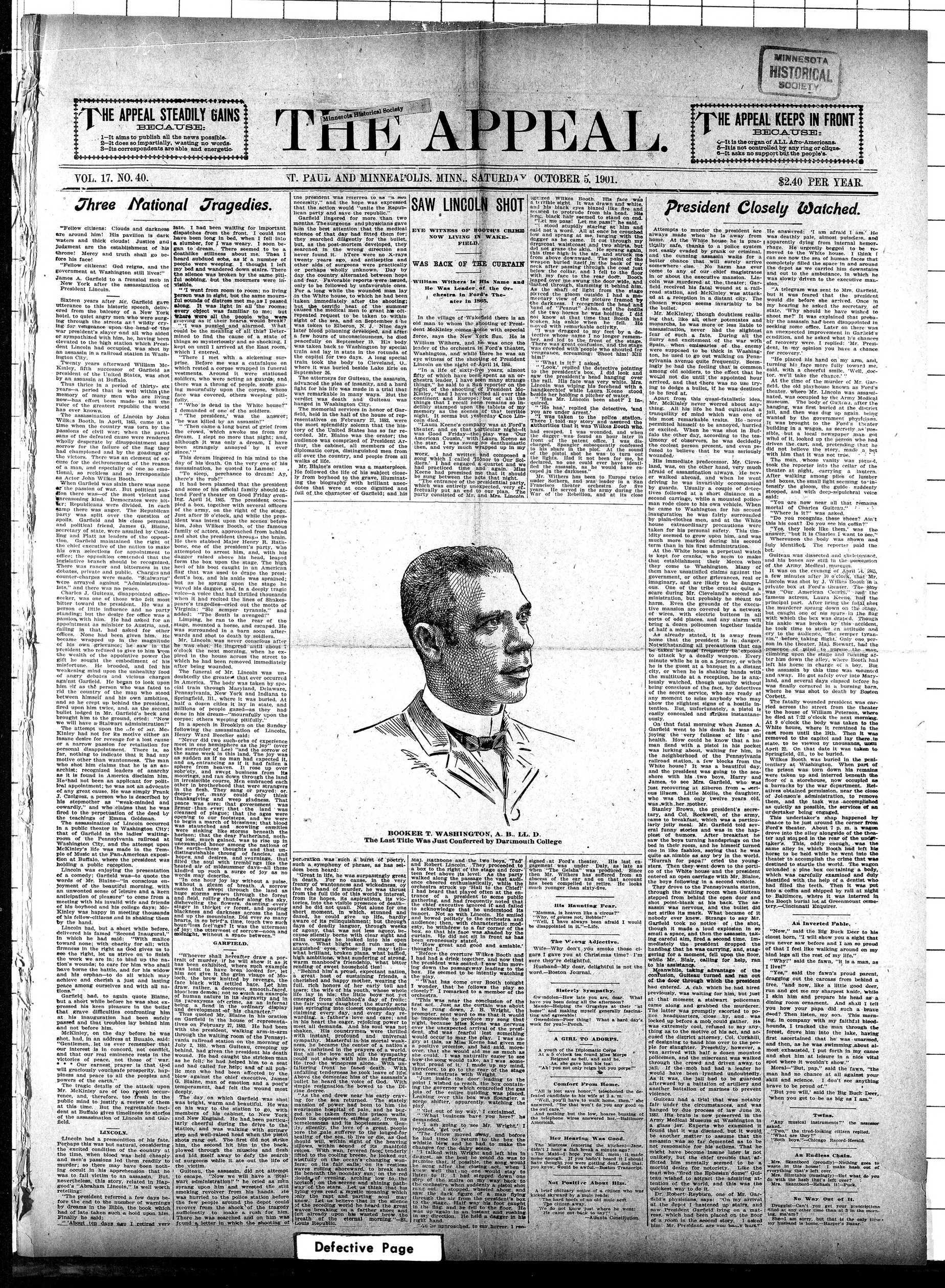
Three National Tragedies.
---
VOL. 17. NO. 40.
"Fellow citizens: Clouds and darkness are around him! His pavilion is dark waters and thick clouds! Justice and judgment are the establishment of his thrones and truth shall go before his face." "Fellow citizens: God reigns, and the government at Washington still lives!" James A. Garfield to a frenzied mob in New York after the assassination of President Lincoln.
Sixteen years after air. Air Garfield gave utterance to this historic speech, delivering a hotel, to quiet angry men who walked through the streets and wild crying for vengeance upon the head-of-the house, who aided or sympathized with him, he having elevated to the high station which Presidentialhood had occupied, was shot by an assassin in a railroad station in Washington City.
Twenty years after William McKinley of Garfield as president of the United States, was shot by an assassin at Buffalo.
Thus thrice in a period of thirty- six months within the memory of many men who now-has effort been made to kill the greatest republic the world has ever known.
The assassination of Lincoln by John W. Boots in, April, 1865, came at a time when the passions of civil war; when the partisans of the defeated cause were rendered captive by disappointment and sorrow for their country and had championed and by the goodness of the victors. There was an element of excitement in the capture of a man, and especially of one so emotionally so scandalous and so irresponsible that when John W. Boots was slain there was none of the passion of war. But political passions were the most violent and unreasoning kind; Republicans were divided. In each camp there was anger. The Republican leader, James G. Blaine, Garfield and his close allies, spolls. Garfield and his close allies and political friend, James G. Blaine, were assailed by Conkling and Plains in a debate. Garfield maintained the right of the chief executive of the nation to make decisions, and the opposition contended that the legislative branch should be recognized, and that the legislature should debate, private and public. Charges and counter-charges were made. "Slawaters" and there were "Administration-lists," and there were "Administration-lists."
Charles J. Guteau, disappointed office-seeker, was one of those who felt most bitter toward the president. He was a person of little influence and no party standing; but the desire for office was a passion with him. He had asked for an appointment as minister to Austria, and the office was asked for other offices. None had been asked for other offices. None had been asked for him, he became wrapped up in the magnitude of his own grievance; he saw in the president who refused to give to him Vom the wealth of the apollinative power the gift he sought the embodiment of his misfortune. He brooded, and fed his weakening mind upon the unhealthy food he had received and vicious charges against Garfield. He began to look upon him as the person of whom he had the country of the man who stood between himself and his own ambition, and so he crept up behind the president, fired upon him twice, and, as the second bullet lodged in Mr. Garfield's beck and brought him to the ground, eried: "Now we will have a Stalwart administration!" The attempt upon the ..fe of air. McGrath was not a man who could have any influence on Insanely desire for revocation. There is, for a narrow passion for retaliation for personal disappointment. There is, so far, nothing to indicate that it had any motive other than wantonness. The man who shot him claims that he is an anarchist; recognized leaders of anarchy as it is found in America disclaim him. He had not been an applicant for politi-feal appointment; he was not an advocate of the党. He was not an advocate of J. Czolgosz, a person who is described by his stepmother as "weak-minded and cowardly," and who claims that he was fired to the perpetuation of the deed by the teachings of Emma Goldman.
The assassination of Lincoln occurred in a public theater in Washington City; the room of the Pennsylvania railroad at Washington City, and the attempt upon the life of Lincoln made in the Temple of Muleth in Buffalo, where the president was holding a public reception. The presentation of a comedy: Garfield was-to quote the words of Mr. Blaine: "in conscious eneance a beautiful morning, with an unwanted beauty, morning with an anticipation of pleasure" to come from a meeting with his invalid wife and friends of his school and his college days. Kliney was to present the announcement of his fellow-citizens and in shaking the hand. Lincoln was but a short while before, delivered his famous "Second Inaugural," in which he had said: "With malice we have been so afraid for all; with firmness in the right we must see the right, let us strive on to finish the work we are in; to bind up the nape of our shoulders, have borne the battle, and for his and his orphan-to do all which may achieve and cherish a just and lasting nation ourselves and with all nations."
Garfield had, to again quote Blaine, but a short while before he was shot expressed his keen pleasure in the belief that grave difficulties confronting him at his inauguration had been safely passed and that troubles lay behind him and not before him.
McKinley, on the day before he was shot, had, in an address at Bumalo, said: "Gentlemen, let us ever remember that our interest is in concord, not conflict, and that our real eminence rests in the victory of the peace, not those of war."
* * * Our earliest prayer is that God will graciously vouchafe prosperity, happiness and peace to all the peoples and powers of the earth."
The tragic details of the attack upon Mr. McKinley are of too recent occurrence, and, therefore, too fresh in the public mind to justify a review of them at this time. But the regrettable incident at Buffalo gives timeliness to stories of the assassination of Lincoln and Garfield.
LINCOLN.
Lincoln had a premonition of his fate. Perhaps this was but natural, considering the excited condition of the country at the time, when blood was held cheaply and men's passions led them rendily to murder; so there may have been nothing occult in his action that he was to fall victim to an assassination. But, nevertheless, this story, related in Rappogans' "Abraham Lincoln," is well worth retelling:
"The president referred a few days before the end to the number of warnings taken. The book the watch had of late taken such a book upon him. Finally he said:
"'About ten days ago I retired very
late. I had been waiting for important dispatches from the front. I could not have been long in the city. I fell into a gun to dream. I was weary. I fell into a gun to dream. There seemed to be a deathhole stillness about me. Then I went to bed. People were weeping. People were weeping. I thought I left my bed and wandered down stairs. There the silence was broken by the same pitiable, but the mourners were invisible.
"I went from room to room; no living person was in sight, but the same mourning along. It was light in all the rooms; every object was familiar to me; but I was grieving as if their hearts would break." "I was puzzled and alarmed. What could be the meaning of all this? Determine what things so mysteriously and so shocking. I kept on until I arrived at the East room, which I entered. Before me was with a sickening surprise. Before我 was with a sickening surprise on which rested a corpse wrapped in funeral gestures. I would be stationed in the room where I was grieving there was a throng of people, some gazing mournfully upon the corpse, whose face was covered, others weeping pitifully.
"Who is dead in the White House?" I demanded of one of the soldiers.
"The president," was the answer; "the people."
"Then came a long burst of grief from the crowd, which awoke me from my sleep. I slept no more that night; and, although I had been strangely annoyed by it, ever night, this dream lingered in his mind to the day of his death. On the very eve of his assassination, he quoted to Lamon: 'There is perchance to dream! Ay, there's the rule.'
It had been planned that the president and some of his official family should attend the funeral, April 14, 1885. The president ended a box, together with several officers of the army, on the right of the stage. The president was intent upon the scenes before him, John Wilkes Booth, of the famous student of the academy, reached from behind and shot the president. He then stabbed Major Henry R. Rattulone, one of the president's party, who was killed. The dagger raised above his head, leaped form the box upon the stage. The high priest, who was the flag that was used to drape the president's box, and his ankle was sprained; but as he sprung upon the stage he hit the priest, who was the voice—a voice that had thrilled thousands when it had recited the lines of Shakes trageries—cried out the motto of Virginia: "The South is avenged!" and added: "The South is avenged!" Limping, he ran to the rear of the stage, surrounded by his escaped. He was surrounded in a barn, conscious afterwards and shot to death by soldiers. He was seized. He lingered on the clock the next morning, when he exited the house across the street to which he had moved immediately after being wounded.
The funeral of Mr. Lincoln was unobstructed the greatest that ever occurred (1865). He was taken by special train through Maryland to Pennsylvania, New York and Indiana to Springfield, IL, where it was buried. At a hooded cemetery it lay in state, and the funeral service was done in his weeping—"mournfully upon the corpse; others weeping pitifully." In a speech in Brooklyn on the Sunday morning of assassination of Lincoln, Henry Ward Benton
"Never did two such-orbs of experience meet in one hemisphere as the joy" (over the surrender of Lee) "and the sorrow of the same week in this land. The joy was as sudden as if no man had expected it, and as entrancing as if it had fallen a sphere from heaven. It rose up over sobriety, and swept business from its moorings, and ran down through the land in irresistible course. Men embraced each other in brotherhood that were strangers in the flesh. They sang or prayed; or, deeper yet, many could only think thanksgiving and weep gladness. That peace was sure; that government was firmer than ever; that the land was cleansed of plague; that the ages were opening to our footsteps, and we were to begin a march of blessings; that blood was staunched and scowling emmities were sinking like storms beneath the horizon; that the dear Fatherland, nothing lost, much gained, was to rise up in unexampled honor among the nations of the earth—these thoughts and that undistinguishable throng of fancies, and hopes, and desires, and yearnings, that filled the soul with tremblings like the heated air of midsummer days—all these kindled up such a surge of joy as no words may describe.
"In one hour joy lay without a pulse, without a gleam of breath. A sorrow came that swept through the land as huge storms swept through the forest and field, rolling thunder along the sky, disheveling the flowers, daunting every singer in thicket or forest, and pouring blackness and darkness across the land and up the mountains. Did ever so many hearts, in so brief a time, touch two such bounteless feelings? It was the uttermost of joy; the uttermost of sorrow—noon and midnight, without a space between."
GARFIELD.
"Whoever shall hereafter draw a portrait of murder if he will show it as if it has been exhibited, where such example was least to have been looked for, let him not give it the grim visage of Morlock, the brow knitted by revenge, the face black with settled hate. Let him draw, rather, a decorous, smooth-faced bloodless demon; not so such an example of human nature in its depravity and in its paroxysms of crime, as an infernal being, a fend in the ordinary display and development of his character."
Thus quoted Mr. Blaine in his oration on June 11 in the house of representatives on Feb. 11, he was with the president, walking arm-in-arm through the waiting room of the Pennsylvania broad station on the morning of July 2. He stepped up to keep up behind, had given the president a wound. He had caught the stricken man and had helped him to a seat and had called him to the office of the liec man who had been affected by the blow against the chief executive, James Blaine, man of emotion and a poet's temperament, had felt the wound most deeply.
The day on which Garfield was shot was the warm and beautiful. He was on his way to the hospital, and members of his cabinet, to New York and New England. He had been particularly nervous at the station, and was walking with scrippy step and well-rallied head when the pistol shot rang out. The first did not strike him, but the second plunged through the muscles and flesh and hid itself away to defy the search of surgeons whilst it ate out the life of the man.
Guiteau, the assassin, did not attempt to escape. "Now we will have a stigma on him," he said, sprang upon him and wrested the still smoking revolver from his hands. he riled him, but now he had hurt people around the depot could recover from the shock of the tragedy. "There he was searched and on him was found a letter in which the shooting of
THE APPEAL.
BOOKER T. WASHINGTON, A. B., LL. D.
The Last Fifth W. W.
BOOKER T. WASHINGTON, A. B. LL. D.
The Last Title Was Just Conferred by Dartmouth College
the president was reerren to as "a suce-
ncessely," and the hope was expressed in
republican party and save the republic.
Garfield ingriffed for more than two
months. The surgeons and physicians gave
attention to the medical science of
these soldiers, who they searched diligently for the bullet,
but, as the post-mortem developed, they
never found it. The b-steps were no x-rays
twenty years ago, and antisepsis and
other aids of surgeons were practically
day the country alternated between hope and fear. Favorable reports were issued,
only to be followed by unfavorable ones,
and the summer caused the medical men to the sun-
mer repeated request to be taken to within
sight of the sea, and on September 6 he
lived in Boston, where later blood poisoning developed, and after
a few hours of unconsciousness, he died
peacefully on September 19. His body
was brought to Boston by a special train and lay in state in rotunda
the capitol for two days. A long special train took the body to Cleveland, O.
and was buried beside Lake Erie on September 28.
The attorneys for Guteau, the assasin, advanced the plea of insanity, and a hard line was drawn. The verdict was remarkable in many ways. But the verdict was death and Guteau was dead. The memorial services in honor of Garfield, held in the hall of the house of representatives on Monday would solemnize that the history of the United States has so far revered Garfield. The audience was comprised of President Arthur, the cabinet, all members of the diplomatic corps, distinguished men from the country, and people from all walks of life. Mr. Blinville's oration was a masterpiece. He was a man of great ability from boyhood to the grave, illuminating the biography with brilliant anecdotes. He was full of the character of Garfield; and his
BOOK
The Last Title
peroration was such a burst of poetry, such a symphony of phrase, as has seldom been heard:
"Great in life, he was surpassingly great in death. For no cause, in the very frenzy of wantonness and wickedness, or the red hand of murder, he was thrust from the full tide of this world's interest, from its hopes, its aspirations, its victories, into the visible presence of death and he did not quail. Not alone for one short moment, in which, stunned and dazed, he could give up life, hardly aware of its relinquishment; but through days of deadly languor, through weeks of agony, that was not less agony, because silently borne with clear sight and calm courage he looked into his open grave. What blight and ruin met his anguished eyes, whose lips may tell what brilliant, broken plans, what baffled, high ambitions, what sundering of strong, warm manhood's friendship, what bitter rending of sweet household ties!
"Behind him'a proud, expectant nation, a great host of sustaining friends, a cherished and happy mother, wearing the full, rich honors of her early toll and tears: the wife of his youth, whose whole life lay in his; the little boys not yet emerged from childhood's day of frolic; the fair young daughter; the sturdy sons just springing into closest companionship, claiming every day, and every day rewarding, a father's love and care; and in his heart the eager, rejoicing power to meet all demands. And his soul was not shaken. His countrymen were thrilled with instant, profound and universal sympathy. Masterful in his mortal weakness, he became the center of a nation's love, enshrined in the prayers of a world. But all the love and all the sympathy could not share with him, his suffering. He trod the winepress alone. With unfaltering front he faced death. With unfalling tenderness he took leave of life. Above the demoniac his loss of the assassin's bullet he heard the voice of God. With simple resignation he bowed to the Divine decree.
"As the end drew near his early craving for the sea returned. The stately mansion of power had been to him the wearisome hospital of pain, and he berged to be taken from his prison walls, from its oppressive, stiff air, from its noiselessness and its hopelessness. Gently, silently, the sown of a great people is the whole sufferer to the longed for healing of the sea, to live or die, as God should will, within sight of the heavy follows, within sound of its manifold voices. With wan, fevered face, tenderly lifted to the cooling breeze, he looked out wistfully on the ocean's changing wonders; on its fair salls; on its restless waves rolling shoreward, to break and be beneath the moonday sun; on the red cloud of evening, arching low to the horizon; on the serene and shining pathway of the stars. Let us think that his lying eyes read a mystic meaning which only the rapt and parting soul may know. Let us believe that in the silence of the receding world he heard the great waves breaking on a farther shore and felt already upon his wasted brow the breath of the eternal morning."-St. Louis Republic
Defective Page
SAW LINCOLN SHOT
SAW LINCOLN SHOT
EYE WITNESS OF BOOTH'S CRIME
NOW LIVING IN WAKE-
FIELD.
WAS BACK OF THE CURTAIN
William Witers is His Name and
He Was Leader, of the Or-
chestra in Ford's Thea-
ter in 1865.
In the village of Wokefield there is an
old man to whom the shooting of pres-
ident McKinley comes some with especial
force, says the New York Sun. He is
William Witers, and he was once the
leader of the orchestra in Ford's theater,
Washington, and while there he was an
eye witness of the shouting of President
Lincoln on the night of April 14, 1865.
"In a life of sixty-five years, almost fifty of which have been spent as an orator, a writer, a teacher, and a things," he said to Sun reporter on the night of the shooting of President McCain, continent and Europe; but of all the things he saw, he seems but yesterday Cae Lincoln died.
"Laura Keene's company was at Ford's was good Friday—the play was 'Our American Cousin,' with Laura Keene as then, and very much wrapped up in my work. I had written and composed a hard I had honored to Our Soldier." I had practiced time and again. Miss it should be sung between the days.
The entrance of the presidential party, the president, will be the first to be factually put an end to our plan. The president will be the first to be factually put an end to our plan.
EXER T. WASHINGTON, A. B., LIE
He Was Just Conferred by Dartmou
Mag, jathroone and the two boys, 'Tad and Robert Lincoln. They proceeded to the orchestra, and the two feet above its level. As the party walked along the passage the vast auditorium, he heard the play at the enclosed orchestra struck up 'Hall to the Chieff' I had heard that played at the enclosed orchestra, and had frequently noted that the chief executive ignored it and failed to inform. Not so with Lincolne. He smiled and bowed politely to the orchestra and auditorium, and the rest of theesty. he withdrew to a far corner of the curtain. He did not face was shaded by the front as he been erroneously stated, a great and amable, thought I
"Before the overture Wilkes Booth and
the conductor, a drink together, and now that
the preacher has been down the passway leading to the
play, he seemed to be intently watching
the play, and I wondered what tonight
I wonder, that the follows are
I wonder, that I remarked to a member of the
orchestra.
"This was near the conclusion of the theater, and I was about to be rung down, J. B. Wynn's prompler, sent word to me that it would right, because Miss Keene was over the unexpected arrival of the preface, something would occur to mar the play. I gry at this, as Miss Keene had given me a lesson, that over that, she would aid me as much she could. I was naturally eager to see what proud of it. I made up my mind, therefore, to go to the rear of the stage, "Just inside the door, leading to the point I wished to reach, the box containing all of the jobs of the entire building was placed, seen over this box was Spangler, a sexy shifter, apparently watching the play.
"Get out of my way," I exclaimed, he demanded. "I can't see you." He moved to see "toe" W. Winston.
demanded, "go along to see Mr. Wright!" I rejoined, "get out," I said, "and he had time to return to the box, the whistle blew and he had to make the noise." I talked with Wright and left him in the room, and he walked away and promised that, if possible, the song would sing after the closing act, when I knew it would be the last time I listen to it. I had stopped down one step, and the orchestra when suddenly a photot shouted out, I stopped, wheeled about and sat down, through the air from the president's box, through the hall, and through the air in the flag, and he felt to the floor. He was up again in an instant and rushing out the hall, and he dug a dagger in his right hand.
As he approached, to say horror, I reo-
organized Wilkes Booth. His face was
seemed like it was drawn and white,
and his head was slightly soared
seemed to protrude from his head. His
long, black hair seemed to stand on end.
"I stood stupidly staring at him and said not a word. All at once he crouched low and sprang at me, lunging with the dogger as he came. It cut through my dresscoat waistcoat and two shirts, but did not graze the skin. He sprang again, this time high in the air, and struck me from above downward. The point of the weapon buried itself in the back of my neck after passing through the coat just below the collar, and I fell to the floor with my face to the rear door. Booth leaped over me swung the door wide, and flashed through, slamming it behind him. As the shaft of light from the stage pierced the gloom outside I had a momentary view of the picture framed by the darkness. I recognized the head and hand of "Peanut" John, and the heads of the two horses he was holding. I did not know at that time that Booth had broken his ankle when he fell. He moved with remarkable activity.
"I was dragged to my feet by a detective whose name I no longer remember, and led to the front of the stage. There was a great confusion, and the stage was crowded with people who shouted for vengeance, screaming: 'Shoot him! Kill him!'
"What is it?" I asked.
"Look," replied the detective, pointing to the president's box, I did look over, saw the president's head hanging on the rail. His face was very white. Mr Lincoln was wiping his forehead with a handkerchief while Laura Keene stood beside her holding a pitcher of water.
"Has Mr. Lincoln been shot?" I inquired.
"He has," replied the detective, "and you are under arrest."
"I was taken to the police station. There I told my story and assured the authorities that it was Wilkes Eoooth who had escaped. I was wounded, and when the dagger was found an hour later, I was in front of the patent office. I was discharged. Spangler subsequently confessed to his share in the plot. At the sound of the pistol shot he was to turn out the lights. Had it not been for me, he declared, no one could ever have identified the assassin, as he would have escaped. He had the darkness."
Mr. Withers has been to Europe twice under Sother, and was leader in a San Francisco theater, orchestra for five years. He served in the army during the War of the Rebellion, and at its close
L. D.
South College
signed at Ford's theater. His last engagement was under Daly, as late as June 2012, and then Mr. Witherls has suffered from an ankle injury and on that account has been compelled to retire. He looks much younger than sixty-five.
**Life Haunting Fear.**
"Mamma, is heaven like a circus?"
"Why, of course not, Bobbie!"
"Well, I have always been afraid I would be disappointed in it."—Life.
**The Wrong Adjective.**
Wife-Why don't you smoke those cigars I gave you Christmas time? I'm sure they're delightful.
Husband-My dear, delightful is not the word.-Boston Journal.
**Sister's Sympathy.**
Gwondolwyn-are you dead. What have you been doing all the afternoon?
Maude-Helping the Grusgals at their "at home" and making generally fascination and amusement-Gwondolwyn-foor thing! What a hard day's
Gwendolen—Foor thing! What a hard day's work for you!-Eunch.
At a 5 o'clock ten found Alice Morpe
Reigns him, and said she.
As she did him, he said:
'Ah! you not only reign but you perse!'
Comfort From Home.
"All is lost save honor," telephoned the de-
fense officer at 5 a.m. at a 10.
"Well, you'd have to be in them," she
answered for "that won't do you any good on
And nothing but the low, hoarse buzzing of the telephone wires answered her—Haltimore Amorcraft.
Her Hearing Was Good.
The Matterress (entering the kitchen)—Jane, didn't hear a dash break a minute ago?
The Maint—I hope you did, men; it made have enough. If you knew hard, if I should have thought you were getting dead, and that you know, would be awful—Boston Transcript.
Not Postfire About Him.
A brief obituary notice of a citizen who was kicked out of a mule seet, the hard boots of a mule seet.
The citizen away.
We do not know where we went; he came not back to say!
—Atlanta Constitution.
President Closely Watched.
President Closely Watched.
Attempts to murder the president are always made when he is away from home, usually safe, to a police system not easily evaded by brank or criminal, the cunning assassin waits for a better opportunity to somewhere else. No harm has ever come to any of our chief magistrates not easily murdered by a executive mansion. Lincoln was murdered by executive mansion, field received his fatal wound at a railroad station, and McKinley was attacked in a reception in a distant city. The chosen weapon seems invariably to be the bullet. Mr. McKinley, though doubtless realities like all other potentates and monarchs, were the element of the war with assassination, never had the slightest fear of such a fate. During all the war, when the element of the war with Spain, when the element of the war with assassination were supposed to be thick in Washington, he used to go out walking on Pennsylvania avenue frequently. Seemingly among old soldiers, to the effect that he would not die until; the appointed hour arrived, and that there was no use try, to the bullet, if he was destined to be fired at.
Apart from this quasit-fatalistic idea, I had never thought of anything. All his life he had cultivated a tranquility of mind which was one of the most important things permitted himself to be annoyed, hurried or excited. When he was shot in Buffalo, he was taken to the hospital, the testimony of observers, he was decidedly the coolest person present, and even then he believed that he was seriously wounded.
His immediate predecessor, Mr. Cleveland, was, on the other hand, very much more conservative always. He never walked on a road that he driving he was invariably occupied between lives. Usually a couple of detectives followed him. Usually a couple of detectives followed him. While a mounted police man rode close to his own vehicle. When he came to Washington for his second term, he was a policeman by plain-clothes men, and at the White house extraordinary precautions were worn. His security safety. This timidity seemed to concern him, much more marked during his second term than when his first administration. He was kept for cranks, who seem to make that establish their Meca when they have unsatisfied claims against the government, or other grievances, real or imaginary, and are likely to be dangerously injured, or scare during Mr. Cleveland's second administration, but probably he meant no harm. Even the grounds of the executive office, and of wires, with electric buttons in all sorts of odd places, and any alarm will poison police policemen inside of half a room.
As already stated, it is away from home, and the president is in danger. Notwithstanding that he must be taken he must frequently be exposed to attack by a deadly weapon. Every time he is attacked he is the guest at a banquet in a distant city, or when he is shaking hands with the multitude at a reception, he is anxious being conscious of the facts by detections of the secret service, who are ready at any moment to seize anybody who may be in danger. But, unfortunately, a platoi is easily concealed and strikes instantaneously. On that fatal morning when James A. Garfield went to his death he was enjoying the very fullness of life and the joy of manhood. He manfied with a platoi in his pocket was lurking about, waiting for him, in the neighborhood of the Yangshuangyin White house. It was a beautiful day, and the president was going to the sea, James, to see Mrs. Garfield, who was just recovering at Kibron from a serious illness. Little Mollie, the daughter, was twelve years old, was with her mother.
Stanley Brown, the president's secretary, came to breakfast, which was a particularly jolly meal. Mr. Garfield told several guests of humors. After breakfast he saw the boys turning handpans on the table, one in like fashion, saying that he was quite as nimble as any boy in the world. He was a little stern. Then they went down to the portico of the White house and the president came to breakfast, the boys following in a second vehicle.
They drove to the Pennsylvania station, through the waiting room when Guteau stepped from behind the door open and the sassin was nervous, and the bullet did not strike its mark. What became of it was that the sassin was nervous, and the bullet took no notice of the shot, though it made a loud explosion in so small a space, and then the sassin, taking the sassin's hand, meditated the president dropped the handbag that he was carrying, and, staggering for a moment, fell upon the floor, calling for help, run to his assistance.
Meanwhile, taking advantage of the confusion, Gulteau turned and ran out of the room. He had entered. A cab which he had hired previously, was waiting for him, but just at that moment a stalwart policeman came along and grabbed the murderer. The latter was promptly escorted to police headquarters, where he locked up before a mob could gather. He was extremely cool, refused to say anything, and caused the district attorney, C. Cornellkall, of designing to hand him over to the people for slaughter. Precisely, however, a police officer had escorted the district policemen, and the miscreant was waited through the crowd and driven away, to jail. The man had a leader he wanted, and he was being lynched. As it was, the jail had to be guarded afterward by a battalion of artillery and a battalion of marines to prevent violence.
Guteau had a trial that was notably fair under the circumstances, and was issued. ISH. His brain is now preserved in the Army Medical Museum at Washington in a case that he found that it was diseased, but it would be another matter to assume that the assassin was no far demented as to be a morbid man, but he might have become iller. Is it not unlikely, but the chief trouble that attained him mentally seems to be a morbid man, and a man who "fired the Ephephus dome". Guteau wished to attract the admiring attention and this was the greatest way to do it. Dr. Robert Reuburn, one of Mr. Gardell's physicians, says: "On my arrival I saw President Garfield lying on a mattress, which had been placed on the floor himself. Mr. President, you saw 'burt'."
$2.40 PER YEAR
He answered: "I am afraid I am." He examined pale, almost pauisseus, and appeared to be a very emotional morbidity. He urgently begged to be moved to the White house. I think I should have moved to the office that completely filled the space in and around the depot as we carried him downstairs and out to the ambulance, in which he slowly driven to the executive mansion. "A telegram was sent to Mrs. Garfield, who would die before she arrived. One in my hearing he asked the secretary of the office, who wished to shoot me? It was explained that the assassin had been disappointed in seeking zome office. Later on there was a call from Garfield's condition, and he asked what he had of recovery were. I replied: Mr. Pressford placed his opinion you have a chance for recovery. "He placed his hand on my arm, and, turning his face more fully toward me, he said a cheerful smile. Well, doctor, we'll talk."
At the time of the murder of Mr. Gairy, the old physician known as Ports' Hall, was named, was occupied by the Army Medical museum. The body of Guitan, after the attack, was taken to jail, and then was dug up again being wanted by the government physicians. The building in a wagon, as secretly built, but a local newspaper man got wind of it looked up the person who had been killed. The police did not believe the story, made with him that it was not true. The police took the reporter into the collar of the theater at night, carrying a lanter. After, among plies of lumber boxes, the smothered the gloom, the guide suddenly stopped, and with deep-sequential voice "You are now near all that remains mortal of Charles Guitan." "Do you recognize these shoes? Ain't this his coat? Do you see his colf."
"Yes, they look like them," was the answer, "but it is Charles I want to see." Whereupon the body was shown and data identified. The reporter paid the duet.
Gulteau was dissected and skeletized, and his bones are still in the possession of the Army Medical museum.
It was on the evening of April 14, 1885, a few minutes after 18 o'clock, that "Mr. Lincoln was shot by J. Wilkes Booth in a private box at Ford's Theater. The boy was "Our American Coach," and the famous actress, Laura Keene, had the principal part. After firing the fatal shot the murderer sprang down on the stage, but caught one of his spurs in the flag with which the bex was draped. Though his ankle was broken by this accident, he took time to strike an attitude and cry to the audience, "Sic semper tyrannis," before taking flight. Only one person in the theater, Major, Stewart, had the presence of mind to pursue the man, climbing upon the stage and running after him down the alley, where Booth had left his horse in charge of a boy. But the assassin by this time was mounted and away. He got safely over into Maryland, and several days elapsed before he was finally cornered in a burning barn, where he was shot to death by Boston Cerebts.
The fatally wounded president was carried across the street from the theater to the house of William Peterson, where he died at 7:22 o'clock the next morning. At 9 o'clock the body was taken to the White house, where it remained in the east room until the 19th. Then it was removed to the Capitol and lay there. In the state, to be viewed by thousands, untawn April 22. On that date it was taken to Springfield. Ill., to be buried.
Wilkes Booth was buried in the pententary at Washington. When part of his body was taken up, he was taken up and interred beneath the floor of a storehouse, now occupied as a barracke by the war department. Relief administration, near close of Johnson's administration, took them, and the task was accomplished as quickly as possible, the services of an undertaker being engaged. He decided to chance to be just around the corner from Ford's theater. About 7 p. m. a wagon drove into the alley along the stairs of the theater, and the wagon taker's. This, oddly enough, was the same alley in which Booth had left his horse to be bead while he went into the theater. He had destined to starle the world. The wagon unloaded a pine box containing a body, which was carefully examined and duly inspected. The teeth had filled the teeth. Then it was put into a coffin and shipped by rail at night to Baltimore, where it was interred in Baltimore county, where he was memorialized in peculiar honour.
An Inverted Fable.
"Now," said the Big Buck Deer to his closestborn, "I will show you a sight that you never saw before and I am so proud of that, feel like walking around on my knees all the rest of my life." "Why?" said the fawn, "it is a man, as I live!"
"Yes," said the fawn's proud parent, dragging out the carcass from behind a tree, "and now, like a little good deer, run and get me my sharpest knife, while a skin him and prepare his head as a mask, and then you ask, 'How do you how your papa did such a brazened?' Then listen, my son. This morning, in company with my faithful blood-hounds, I tracked the man through the forest, drove him into the lake, having first acerated that he was unarmed, then almost exhausted, I put forth a shot and shot him at leisure in a nice vital spot where it wouldn't show."
Moral-"But, but," said the fawn, "the man had no chance at all against your skill and science. I don't see anything brave to be of proud." "But you will," said the Big Buck Deer, "when you get to be as big as I am."
Mrs. Silmblett (mushy?)—But what do you do with the hash that's left over?
Mrs. Skanbord—Knash it—Puck.
No Way Out of It.
Drugstreet—Can you get your prescriptions there or other time at 3 in the morning, man?
She-I am sorry, but that is the only time she-I am sorry, but that is the only time
HAVE YOU READ
THE ARDEAL!
THE APPEAL,
A NATIONAL AFRO-AMERICAN NEWSPAPER
PUBLISHED WEEKLY BY
ADAMS BROS. EDITORS AND PUBLISHERS
49 E. 4th St., St. Paul, Minn.
ISSUED SIMULTANEOUSLY
Saint Paul, Minneapolis, Chicago,
Washington, Louisville, St. Louis.
CHICAGO OFFICE,
323-5 Dearborn St., Suite 310,
C. F. ADAMS, Manager.
WASHINGTON OFFICE,
No.1919 Elevent St., Northwest
CHAS. E. HALL, Manager.
LOUISVILLE OFFICE,
No. 312 W. Jefferson St. Room 3
W. V. PENN, Manager.
ST. LOUIS OFFICE,
No. 1002 Franklin Avenue.
J. H. HARRISON, Manager.
TERMS. STRICTLY IN ADVANCE:
SINGLE COPY, ONE YEAR ..... $2.00
SINGLE COPY, TWO YEARS ..... $3.00
SINGLE COPY, THREE MONTHS ..... $4.00
Communications to receive attention must be written only upon one side of the paper; more reach in the newspaper and bear greater authority of the author; must manuscript reproduce the author's name.
4. We do not hold ourselves responsible for the views of our correspondents.
**OFFICE FOR SCHOLARSHIPS.** Write
Soliciting for terms. Sample copies free.
In every letter that you send us, never fall to
the hands of a solicitor, writer, or
written, post office, county and state.
Business letters of all kinds must be written on
or matter for publication. Entered as
scholarship.
AGENTS WANTED.
THE APEAL wants good reliable agents to canvass for subscribers at points not already covered. Write for our extraordinary inducements.
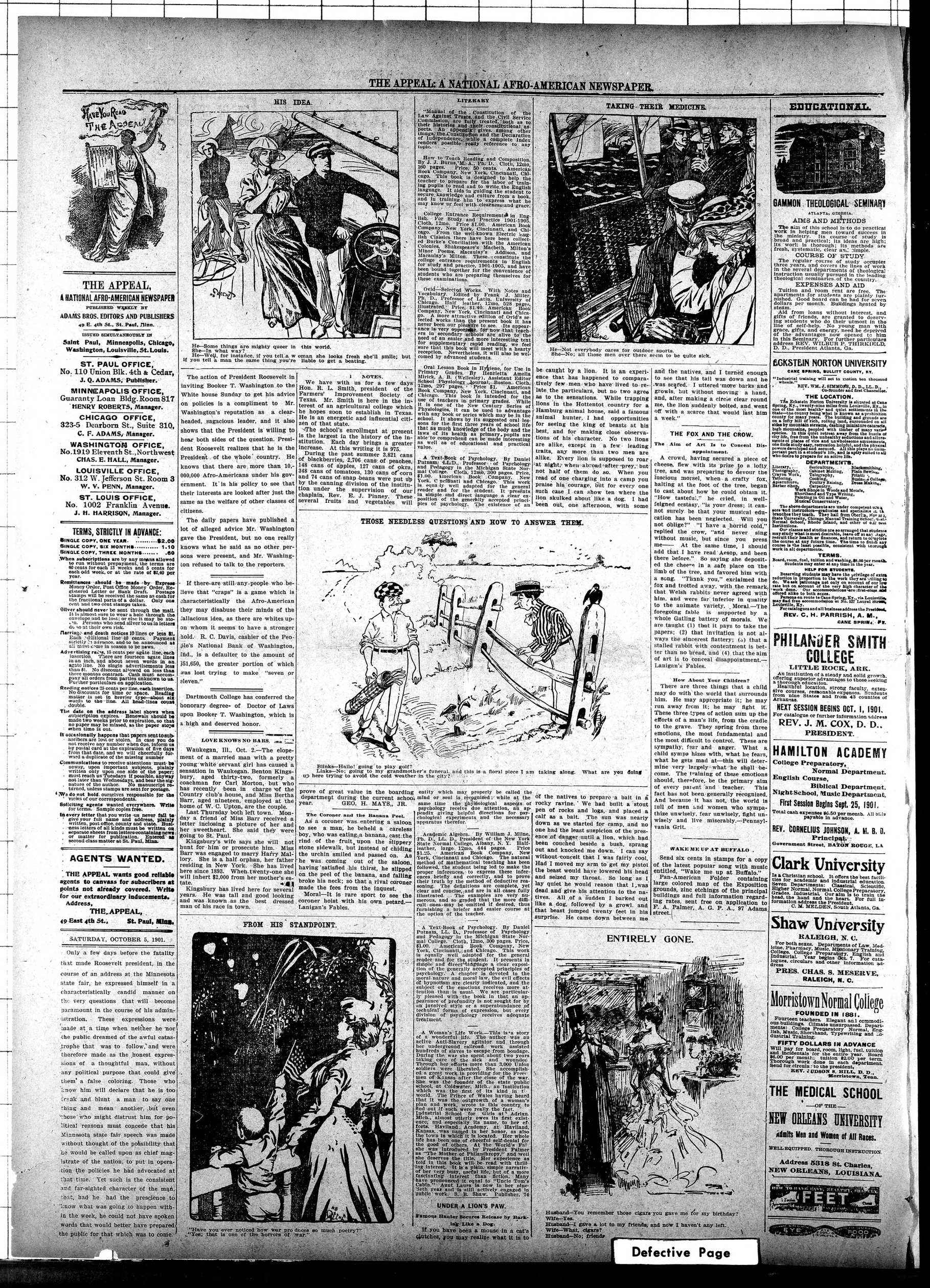
Only a few days before the fatality that made Roosevelt president, in the course of an address at the Minnesota state fair, he expressed himself in a characteristically candid manner on the very questions that will become paramount in the course of his administration. These expressions were made at a time when neither he nor the public dreamed of the awful catastrophe that was to follow, and were therefore made as the honest expressions of a thoughtful man, without any political purpose that could give them a false coloring. Those who know him will declare that he is too frank and blunt a man to say one thing and mean another, but even those who might distrust him for political reasons must concede that his Minnesota state fair speech was made without thought of the possibility that he would be called upon as chief magistrate of the nation, to put in operation the policies he had advocated at that time. Yet such is the consistent and far-sighted character of the man, that, he had he the prescience to know what was going to happen within the week, he could not have spoken words that would better have prepared the public for that which was to come.
HIS IDEA.
He—Well, for instance, if you tell a w oman she looks fresh she'll smile; but if you tell a man the same thing you're liable to get a beating.
THE FIREWORKS
"Have you ever noticed how war pro duces so much poetry?"
"Yes; that is one of the horrors of war."
The action of President Roosevelt in inviting Booker T. Washington to the White house Sunday to get his advice on policies is a compliment to Mr. Washington's reputation as a clear-headed, sagacious leader, and it also shows that the President is willing to hear both sides of the question. President Roosevelt realizes that he is the President of the whole country. He knows that there are more than 10,000,000 Afro-Americans under his government. It is his policy to see that their interests are looked after just the same as the welfare of other classes of citizens. The daily papers have published a lot of alleged advice Mr. Washington gave the President, but no one really knows what he said as no other persons were present, and Mr. Washington refused to talk to the reporters.
If there are still any people who believe that "craps" is a game which is characteristically the Afro-American they may disabuse their minds of the fallacious idea, as there are whites upon whom it seems to have a stronger hold. R. C. Davis, cashier of the People's National Bank of Washington, ind., is a defaulter to the amount of 515,650, the greater portion of which was lost trying to make "seven or eleven."
Dartmouth College has conferred the honorary degree- of Doctor of Laws upon Booker T. Washington, which is a high and deserved honor.
Waukean, Ill., Oct. 2. —The eloquence of a married man with a pretty young white servant girl has caused a sensation in Waukean. Benton Kingsbury, aged thirty-two, formerly a coachman for Carl Morton, but who has recently been in charge of the Country club's house, and Miss Bertha Kingbury, a former home of W. C. Upton, are the couple.
Last Thursday both left town. Monday a friend of Miss Barr received a letter inclosing a picture of her and her sweetheart. She said they were married. Kingbury's wife says she will not hunt for him or prosecute him. Miss Barr was engaged to marry Hairy Mallory. She is a half orphan, her father residing in New York. She has lived in Boston, where twenty-one she will inherit $2,000 from her mother's tate.
Kingsbury has lived here for several years. He was tall and good looking and was known as the best dressed man of his race in town.
THE APPEAL: A NATIONAL AFRO-AMERICAN NEWSPAPER
THOSE NEEDLESS QUESTIONS AND HOW TO ANSWER THEM.
Blinks-Hallo! going to play golf?
Let's go to the mother's funeral, and this is a floral piece I am taking along. What are you doing up here trying to avoid the cold weather in the city?
NOTES
We have with us for a few days Hon. R. L. Smith, president of the Farmers' Improvement Society of Texas. Mr. Smith is here in the interest of an agricultural college which is soon to establish in Texas. He is an alumnus and influential citizen of that state. 'The school's enrollment at present is the largest in the history of the institution. Each day brings a greater increase. At this writing it is 975. The number of tomatoes and influential blackberries, 2,706 cans of peaches, 148 cans of apples, 127 cans of okra, 348 cans of tomatoes, 130 cans of corn and 74 cans of snap beans were put up during division of the institution under the chaplain, Rev. E. J. Pinney. These several fruits and vegetables will
THOSE NEEDLE
Filinks—Hallo! going to play golf?
Links—No; going to my grandmother
u? here trying to avoid the cold weather!
prove of great value in the boarding department during the current school year. GEO. H. MAYS, JR.
The Coroner and the Banana Peel.
As a coroner was entering a saloon to see a man, he beheld a careless boy, who was eating a banana, cast, the rind of the fruit, upon the slippery stone sidewalk, but instead of chiding the urchin smiled and passed on. As he was coming out of the saloon, having satisfied his thirst, he slipped on the peel of the banana, and falling broke his neck; so that a rival coroner made the feast from the inquest.
Moral—It is rare sport to see the coroner hoist with his own petard—Lanigan's Fables.
TANDPOINT.
Manual of the Constitution of the Law Against Trusts, and the Civil Services Commission, are fully created both their histories and their constitutional aspects. An appendix gives among other things the Constitution and the Declaration of Independence, while complete under renderable ready reference to any topic.
How to Teach Reading and Composition. By J. J. Burns, M.G. Ph.D. Cloth, L2no, 160 pages. Price: 50 cents. American Book Company, New York, Cincinnati, Chicago, as this book is designed to help the teacher to present the text and to write the English language. It aids in guiding the student to understand knowledge and culture from a book and is a key tool in the expressing what he may know or feel with clearness and grace.
College Entrance Requirements in English For Study and Practice 1901-1905. Cloth, L2no, Price $1.00. American Books Company, New York, Cincinnati, Michigan, cago. From the well-known Electric English Classics there have been collectors at Book's Conciliation with the American Colonies. Shakespeare's Machine's Milton's Minor Poems, Macaulay's Addison, Macaulay's Milton. These constitute the college entrance requirements in English for study and practice, 1901-1905, and have been bound together for the commence of students who are preparing themselves for these examinations.
Ovid.—Selected Works. With Notes and Vocabulary. Edited by Frank J. Miller, Ph.D. Professor of Latin, University of Chicago. Half leather. 12mo, 628 pages. Illustrated. Price: $140. American Book Company, New York, Cincinnati and Chicago. A more attractive edition of Ovid's see-lected works than the present book it has never been our pleasure to see. Its appearances are lessово, for now that teachers in secondary schools are allowed to find need of an easier and more interesting text for supplementary rapid reading, we feel sure that this book will meet with a hearty reception. Nevertheless, it will also be welcomed by advanced students.
Oral Lesson Book in Hygiene, for Use in Primary Grades. By Henrietta Amellin Mirick, A. B. (Wellesley), Assistant Editor School Physiology Journal, Boston, Cloth. 12mo, 297 pages. Price $1. American Company, New York, Cincinnati, and Chicago. A book intended for the use of teachers in primary grades. While it is one of the New Century Series of Physiologies, it can be used to advantage with any book or series which may be in the school. It shows by its suggested oral lessons for the first three years of school life that as much knowledge of the body and the laws of its health is primary. A popular and able to comprehend can be made interesting as well as of educational and practical value.
A Text-Book of Psychology. By Daniel Putnam: L.L.D., Professor of Psychology and Pełagogy in the Michigan State Normal College. Cloth, 12mo, 300 pages. Price, $1.00. American Book Company. New York, Cneffnati and Chicago. This work is equally well adapted for the general reader and for the student. It presents in simple and direct language a clear exposition of the generally accepted principles of psychology. The existence of an
PRESS QUESTIONS AND HOW TO ANSWER
her's funeral, and this is a floral piece I am
or in the city?
entity which may properly be called the mind or soul is recognized; while at the same time the physiological aspects of psychology receive due attention, an appendix giving helpful directions for psychological experiments and the necessary apparatus therefor.
Academic Algebra. By William J. Milne, Ph.D., LL.D., President of the New York State Normal College, Albany, N.Y. Haffleather, large 12mo. 444 pages. Price $1.25. American Book Company, New York, Cincinnati and Chicago. The natural method of mathematical teaching has been followed, the student being led to make the proper inferences, to express these inferences briefly and correctly, and to prove their truth by the method of deductive reasoning. The definitions are complete, yet clear and concise, and are in all cases fully illustrated. The examples are very numerous, and so graded that the more difficult ones may be omitted if desired, thus furnishing a briefer and easier course at the option of the teacher.
A Text-Book of Psychology. By Daniel Putnam LL.D., Professor of Psychology and Pedagogy in the Michigan State Normal College. Cloth, 12mo, 30th pages. Price $100.00 American Book Company, New York, Cincinnati, and Chicago. This work is equally well adapted for the general reader and for the student. It presents an in-depth description of the generality accepted principles of psychology. A chapter is devoted to the moral nature and moral law, the evil effects of hypnotism are clearly indicated, and the mention of the common result of the intention than is usually. We are particularly pleased with the book in that an appearance of profundity is not sought for by the native style of the in-depth technical forms expression but every division of psychology receives adequate treatment.
A Woman's Life Work. This is a story of a wonderful life. The author was an active Anti-Slavery agitator and through the undermined life of the world, he was a hundred and five to escape from bondage. During the war she spent about two years taking care of the sick and wounded. Then she was brought to the 5,000 Unleashed Soldiers, were liberated. She accomplished a great work in providing for the Freemans of Kansas after the close of the war. She was a great one of the most well-known and the most well-known school at Coldwater, Mich., an Institution which was the first of its kind in the world. The Prince of Wales having heard that it was the outgrowth of a woman's plan and work for the new life.
Industrial School for Girls at Adrian Michal, almost utterly owes its first existence, and especially its name, to her efforts. Haviland Academy, at Haviland, Kansas, was named in her honor, as also the town in which it is located. Her whole life has been one of cheerful self-denial for the good of others. At the World's Fall she was introduced by President Palmer as "The Mother of Philanthropy," and well she deserves the title. Her experience as told in this book will be read with thrilling interest. It is a plain, simple narrative of her very busy, useful life, but of a more fascinating interest than fiction. Many have pronounced it equal to "Uncle Tom's Cable." Aunt Laura's now in her nine-thirteenth year and is still actively engaged in public work. S. B. Shaw, Publisher, 74
UNDER A LION'S PAW.
Famous Hunter Secures Release by Barking Like a Dog.
It you have been a mouse in a cat's clutches, you may realize what it is to
Rene
He—Not everybody cares for outdoor sports.
She—No; all those men over there seem to be quite sick.
ENTIRELY GONE.
Husband-You remember those cigars you gave me for my birthday?
Wife-Yes
be caught by a lion. It is an experience that has happened to comparatively few men who have lived to relate the particulars, but no two agree as to the sensations. While trapping lions in the Hottentot country for a Hamburg animal hunter, I had opportunities for seeing the king of beasts at his best, and for making close observations of his character. No two lions are alike, except in a few leading traits, any more than two men are very lionous; every lion is supposed to roar at night; a monkey aboard prey, but not half of them are so. When you read of one charging a pump you praise his courage, but for every such case I can show ten where the skunked about like a dog. I had been out, one afternoon, with some
NSWER THEM.
h taking along. What are you doing
of the natives to prepare a bait in a rocky ravine. We had built a stout pen of rocks and logs, and placed a calf as a bait. The sun was nearly down as we started for camp, and one no had the least suspicion of the presence of danger until a lion, which had been couched beside a bush, sprang out and knocked me down. I can say without conceit that I was fairly cool. He moved my arm to get my pistol his hand, and wounded his head and seized my throat. I lay quiet he would reason that I was dead and give his attention to the natives. All of a sudden I barked into a dog, followed by a growl, and that beast jumped twenty feet in his surprise. He came down between me
ENTIREL
and the natives, and I turned enough to see that his tail was down and he was secreted. I uttered barks and growls, but without moving a hand, and after making a circle clear round me, the lion suddenly bolted, and went off with a scarce that would last him a week."
THE FOX AND THE CROW
The Aim of Art Is to Concens Disappointment.
A crowd, having secured a piece of cheese, flew with its prize to a lofty tree, and was preparing to devour the mousseline, when a crafty fox, halting at the foot of the tree, began to cast about how he could obtain it. "How tastful!," he cried, in well-feigned ecstasy, "is your dress; it cancels that your musical education has been neglected." "Will you not oblige?" I have no word, replied the crow, "and never sing without music, but since you press me— At the same time, I should add that I have read Aesop, and been there before." So saying she deposited the cheese in a safe place on the limb of the tree, and favored him with a thank. "Thank you," exclaimed the fox and trotted away, with the remark that Welsh rabbits never agreed with him, and were far inferior in quality. Ultimate variety. Moral—The foregoing is supported by whole Gatling battery. We are taught (1) that it pays to take the papers; (2) that invitation is not always the sincerest flattery; (3) that a stalled rabbit with contentment is better than no bread, and (4) that the aim of art is to conceal disappointment.—Lanigan's Fables.
How About Your Children?
There are three things that a child may do with the world that surrounds him. He may appropriate it; he may run away from it; he may fight it.
These three types of action sum up the efforts of a man's life, from the cradle to the grave. They spring from three emotions, the most fundamental and most difficult to control. These are sympathy, fear and anger. What a child sympathy hides are the fears, what he gets mad at—this will mine very largely—what the shall become. The training of these emotions should, therefore, be the primary aim of every parent and teacher. This fact has not been generally recognized. And because it has not, the world is full of men and women who sympathize unselfishly, fear unselfishly, fight unselfishly and live miserably—Pennsylvania Grit.
WAKE ME UP AT BUFFALO
Send six cents in stamps for a copy of the latest popular song with music by the likes we make up at Buffalo*. Pa.-America: The large, colorized map of the Exposition grounds, zinc etchings of the principal buildings and full information regarding rent, sent free on application to F. Palmer, A. G. P. A., 87 Adams street.
GAMMON THEOLOGICAL SEMINARY
ATLANTA, GEORGIA.
AIMS AND METHODS
The aim of the course is to practical work in helping men toward success in the ministry. Its course of study is hard and practical; its work is thorough; its methods are fresh, systematic, clear and simple.
COURSE OF STUDY
The regular course of study occupies three years, and covers the lines of work the applicant to departments of theological instruction usually pursued in the leading theological seminaries of the country.
EXPENSES AND AID
Tuition and room rent are free. The apartments for students are partially furnished. Good board can be had for seven dollars per month. Buildings heated by radium.
Aid from loans without interest, and help students who do their utmost in the line of self-help. No young man with a degree in the sciences of the advantages now opened to him in this Seminary. For further particular information, see KIRKLED, D. D., President Atlanta, GA.
EGKSTEIN NORTON UNIVERSITY
GARVING, BRISTOL, UK
EXAMS, UK
"Industrial training will set to motion ten thousand wheels." REV. W.M. J. GIMMONS, D.D., LL.D. Co-founders and first Channelol.
THE LOCATION
The Eckstein Norton University is situated at Case Spring, KY, twenty-nine miles from Louisville, KY, in the central city of New York, and from the South of the State—the county being what is known as a prohibition on the building of the building and the building and the building of the city of the city line of hick-rolling, and the current under the high-mountain streams, dashing miniature caravals, high-mountain waterways, and the high-mountain waterways. In this quiet retreat away from the city life, free from the unhealthy seductions and allure-of-the-life, the city is now the most well-being of the city. The city is now the only home of the city's only home to the county and the city is now the only home of the city's only home.
REPARTMENTS.
Literary,
Photography,
Crayon Work,
Acupuncture,
Barber shop,
THE OLD WORKS AND METAL
Shortland, Woods and Metals,
Printing and Water,
Musical Conservatory.
The above departments are under competent use of the books and instructions—graduates and specialists in the branches they are required to develop. The school is the University, Chicago Manual Training School, 9-5-2014, Northwood, Rhode Island, and other of 0-2 ones institutions.
Our classes and studies are so arranged that students may be required to learn the skills they have to complete with a course of their health and fitness, and return to complete the course at any future time. The time to finish any work is to be possible, consistent with unenough work in all departments.
TERMS.
Board, room, fuel, tuition and washing, $8.00 per month. Students may be in the year in the year.
HELP FOR STUDENTS
Deserving students may have the privilege of extra reduction in proportion to the work they are willing to do. Students who are not deserving but on account of the very high character of the work may be accommodated - first-class and chilled to both jobs.
Faroes are route to Canis Spring, Ky., via Locustville, Ky. and route to No. 30, Nd. Largest Railway, Lokvilles, Ky.
PHILANDER SMITH COLLEGE
institution of a steady and solid growth. offer of education to students engaged to those seeking a thorough education.
healthy location, strong faculty, extensive health care, reasonable expense. Students from states and from 43 counties of Arkansas.
NEXT SESSION BEGINS OCT. 1, 1901.
For catalogue or further information address REV. J. M. COX, D. D.
HAMILTON ACADEMY
Normal Department.
English Course,
Biblical Department.
NightSchool, Music Department.
First Session Begins Sept. 25, 1901.
Total cash expenses $5.50 per month. All bills payable in advance.
REV. CORNELIUS JOHNSON, A. M. B. D.
Principal.
Government Street, BATON ROEGE, LA
In a Christian school, it offers the best faculty in the country. Seven departments: Classical, Scientific, Mathematics, Engineering, Industrial, Our aim is to train the information address the President.
For both sexes. Departments of Law, Medical, Public, Missionary Training, College. College Faculty. Industrial. Year begins Oct. 7. For catalogues, circulars and other information adhere to PRES. CHAS. S. MESERVE, RALEIGH, M. C.
1881.
Fourteen teachers. Elegant, commonsul buildings. Climate unstormed. Departed. Music. Music. Type normal. English. Music. Shorthand. Industrial Training.
**ARMS IN ADVANCE**
Will pay for board, room, light, tuition, and incidentals for the entire year. Board will accept all expenses. Through work done in each department. Send for circuits to 1800 W. 21st St. BILL. D.
THE MEDICAL SCHOOL
OF THE
NEW ORLEANS UNIVERSITY
admits Men and Women of All Races.
WELL EQUIPPED. THOROUGH INSTRUCTION.
Address 5318 St. Charles,
NEW ORLEANS, LOUISIANA.
HOW TO HAVE HEAVY HEALTHY SHAPES
FEET
London
Copenhagen
EYE
FOOD
4 WEEKS RECORD IN MINNESO-
TA'S CAPIT
The Saintly City and Saintly City Folks—
Newy Items of Social, Religious and
General Matters Among the People, Boll-
OH, YES,
GO OVER TO SEE
OUR BOYS IN BLUE
AT CENTURY MUSIC HALL,
MONDAY EVENING, OCTOBER 7TH.
Don't fail to secure a copy of the
APPEAL next week.
Mr. and Mrs. Owen Davis have
moved from 413 Franklin street to 189
West Third street.
The hour for the sessions of St.
James' Sunday school has been
changed to 2:30 p. m.
For Rent - Two furnished rooms for
entlemen. Apply to Mrs. D. E. Paleart,
553 Sibley street.
The Wm. E. Nagel Undertaking Co.,
Walsha street, between Third and
Fourth streets. Telephone 508 day or
night.
Mrs. J. E. Johnson, accompanied by
Master Peavey, has returned from Duluth after a two weeks' stay at the lakeside.
"Old Crimp" is coming around these mornings and is asking shivering mortals: "What have you been doing all summer?" The Elk Express Co. now has a large, commodious store house, where furniture or other household goods may be stored at reasonable rates. Mr. Clarence, Tibbs, formerly elevator man in the Metropolitan Block, has gone on the road and his place has been filled by Mr. Joseph Harris. Beginning Monday night and during all of next week, Otis Skinner in an elaborate production of "Francesca da Rimini" will be at the Metropolitan. Have you seen that elegant new moving van of the Elk Express Co? Well, it's a corker. Don't forget them when you need any answering done. Any customers who wish work done or those who have hair work which has not been called for will please call at 553 Stible street, Mrs. E. J. Allen.
M. Jerry Logan left last week to take a good position in Seattle, Wash., and his place at the Metropolitan Block has been filled by Mr. Harry Black.
Those of our patrons who desire to have matter published must get the same in this office not later than Thursday, otherwise it may be crowded out.
Mr. Daaeliel Webster Brown, superintendent and solicitor for Noxubee (Hass.) Industrial School, was in the city this week in the interest of his school.
Miss Eva Lindsay, of Stillwater, is spending a couple of weeks in the city as the guest of Mrs. V. J. Henley, who recently returned from an Eastern trip with her husband.
The most popular place for people who take their meals down town is John Godfrey's, No. 552 Wabasha street. Everything neat, clean and well cooked.
Is your hair straight? If not, seek 50 cents to Ozonized Ox Marrow Cove 76 Wabash avenue, Chicago, Ill., for a bottle of Ozonized Ox Marrow and you can easily straighten it.
Anyone who contemplates attending the Pan-American Exposition who wishes a nice place to stop may learn of the same by application to J. Alex Ross, 509 Michigan Ave., Buffalo, N.Y.
Write to Riley Allen, St. Anthony Hill station, St. Paul, Minn., state the date of your birth and enclose ten cents, and he will send you a wonderful life reading of character, ability and prospects.
If you wish to good shave, hair cut or shampoo call Ridley Coubys' 747-742 Minnesota street. First-class workstation. Satisfaction guaranteed. Music for all occasions furnished on short notice.
When you're out late at night,
And you wish a nice bite
Of food that will fill you with joys,
To a lunch wagon go,
And you'll get the best show
At Johnson & Williams' "Iroquois."
At Johnson & Williams "Iroquois"
Put Under Bonds—W. J. Roots and Thomas Ryan, charged in the police court Thursday with being in a cutting affray at Fifth, and Minnesota streets Sunday night, were released by Judge Hine under bonds to keep the peace.
As the time draws near for selecting candidates for our next mayor, there are a number of people who want to know, what's the matter with Warner? And the echo comes back good and strong: "He's all right!"
Elk Express, G. D. Cnarieston, prop., packing and shipping; hauling of all kinds; coal and wood in large crates; when you wish anything in his line give him a call. Telephone, Main, 1920—J 1. Office 63 East Sixth street.
Mr. J. F. Pringle and Mr. J. C. McGinn, who for so many years were at the Plymouth Clothing House, again connected themselves with to old, reliable institution, ready to welcome their old friends and serve their greatest interests in days past.
DR. J. E. PORTER, physician and pargue, Room 410 Washburn building, Fifth street, opposite Court House. Office hours: 10 a. m. to 12 a., 2 p. m. to 4 p. m., 7 to 8 p. - m. Telephone Main, 1738 - J. 1. Residence, 453 Carroll street. Telephone, Dale, 464 - L3. Next week at the Star theatre, beginning with the Sunday matinee, the Bon-Ton Burlesquers' "365 Days Ahead of Them All." The show that sets the pace. Gauzy, wutty and pretentious cast for the senses. Secure seats well in advance. Prices, 10, 20, 30 cents. At the coming session of the district court, forty-two people who have found married life, failure will tell their troubles. This number of divorce suits has already been commenced. The calendar this year is a record-breaker, containing a total of 256 cases.
Pilgrim Baptist church, Cedar and Summit. Services, 10:45 a.m. 8 p.m. Rev. W. D. Carter, pastor, Morning; "Justification—Its Author, Ground, Condition and Reasonableness" Evening: "The National Baptist Convention and Its Work." Sunday School at 12:30 p. m.
St James' A. M. E. church, Fuller
and Jay streets. Rev. J.C. Anderson, pastor. Morning theme: "Higher Ground." Evening theme: "The Ethiopian Inquirer." Special service on Oct. 13th. It is the annual endowment day for the 4th Episcopal District of the A. M. E. church.
Mrs. George H. Wade is in the city visiting her mother, Mrs. Adkerson, on West Seventh street. She will remain in the city until about Oct. 10. then she will leave vla Chicago to join Rev. George H. Wade, at Osceola, IA. Then he has been assigned for the ensuing year.
Messrs. J. J. Johnson and A. Williams have started a new enterprise in the form of a night lunch wagon, which they have named the coquois." They have a stand on Minnesota street between Sixth and Seventh, and are prepared to serve all comers. Give them a call.
The famous chef, John Godfrey, has moved his boarding house to No. 552 Haverford College avenue, where he has all the mood, ennervements, and is, getter than ever and by the day's end, much more manageable rates. Meals, 25 cents, Sunday dinners from 1:00 to 5:00 a specialty. Translants accommodated.
October Rally of St. James' A. M. E. Sunday School, Sunday, Oct. 13th, at 2:00 o'clock p. m. A programme of an interesting and instructive character is being arranged. Splendid speaking and singing provided. Particulars later. A good time is expected. Everybody is invited to get ready and meet with us. James P. Anderson, Superintendent.
Rev. W. D. Carter has returned from Cincinnati. O., where he attended the National Baptist convention. He reapplied very pleasant time. The members fixed him up in an excellent shape by presenting him a nice black suit and all expenses to and from Cincinnati. The members and friends feel that they have the right man in the right place and know how to appreciate him.
The Daily News has been conducting a voting contest for some time to determine the most popular preacher in St. Paul, the winner to be given a seventy-seven day trip to Palestine. The count was closed Monday night and Father Solnce was declared the fortunate one with 109,446 votes to his credit. Rev. F. B. Cowill was seceded with 75,719 votes to his credit. Rev. W. D. Carter had 2,681 votes and Rev. J. C. Anderson 2,148.
The Christian Endeavor Society of Pilgrim Baptist church is to be congratulated on their very interesting meeting last Sabbath evening. A very large number was out to listen to very excellent paper read by Mrs. Jennie Watson, on "Christian Endeavor Work," which was both interesting and instructing. Worries the good work may still continue with abating interest. Mrs. Bertha Wilson will sing at the meeting next Sabbath evening.
The October Rally of St. James' A. M. E. S. is looked forward to, as having many things in store for us by way of entertainment. Do not forget the date or fall to be present, Sunday, the Sunday schools of the Twins' p.m. The Sunday schools of the Twins' invited and expected with their officers to be present. Among those on the program are: Mr. D. E. Bealey, superintendent Pilgrim Baptist Sun school; Mr. J. L. Neal, superintendent Sun school, Minneapolis school, Minneapolis Good singling and speaking are the order. Come with us at James P. Anderson, Superintendent.
A man by the name of Henry Sommers was betrayed by a supposed friend and arrested a few days since and is now held at central station awaiting action by the Tennessee authorities. He is charged with the murder of William Lewark, a white man, in Bolivar Tenn., on the night of Nov. 1, 1900. The people have become very much interested in his case and his services of Attorney F. L. McGhee have been secured to fight his extradition, which will be opposed on the ground that the man will be lynched if returned. Sommers was brought into the municipal court on the charge of being a fugitive from justice, but McGhee found a flaw in the complaint, and Judge Hine discharged the prisoned, eH was, however, immediately arrested. The only person who can help Sommers is the governor, and a strong fight will be made to prevent his extradition papers.
That sterling attraction, "On the Swainness River," will be the offering at the Grand Opera House for one week, commencing Sunday, Oct. 6th, with the usual manners. That this play possesses interest and merit is an indisputable fact. Now in its fifth season, its drawing ability seems unminished. "Like the song, it will 'live forever' is a kind of trademark or catch line used by Stalr and Nicolai, under whose direction it has been since its introduction. Possibly the maintenance of an unusually capable cast and a production of completeness have much to do with its popularity.
MRS. MARY
MARY
but even these wise adjuncts could not float a bad play. The heart interest of the story is great, its comedy well seasoned with pathos, for tears and laughter are happily mingled. Its general theme has been likened to "Uncle Tom's Cabin" and to a certain extent with reason. Old "Aunt Lindy" the company as true a type of characterization as the mother and her staunch championship of blind "Dora Clayton" is symbolic with "Uncle Tom's" love for little Eva. The villainy of "Caleb Croc" the miser in this play, is hand in hand with the hated "Simon Legree," the cupidity of Judge Hawk is along the same lines as "Marks" the lawyer. With all this there is no more similarity between the two plays than there is between a Sardon production and a Reid pastoral. "On the Swuance River" pure story of the Southland and women is as great a life as Harriet Beecher Stowe's great old story of slavery days
THE APPEAL: A NATIONAL AFRO-AMERICAN NEWSPAPER.
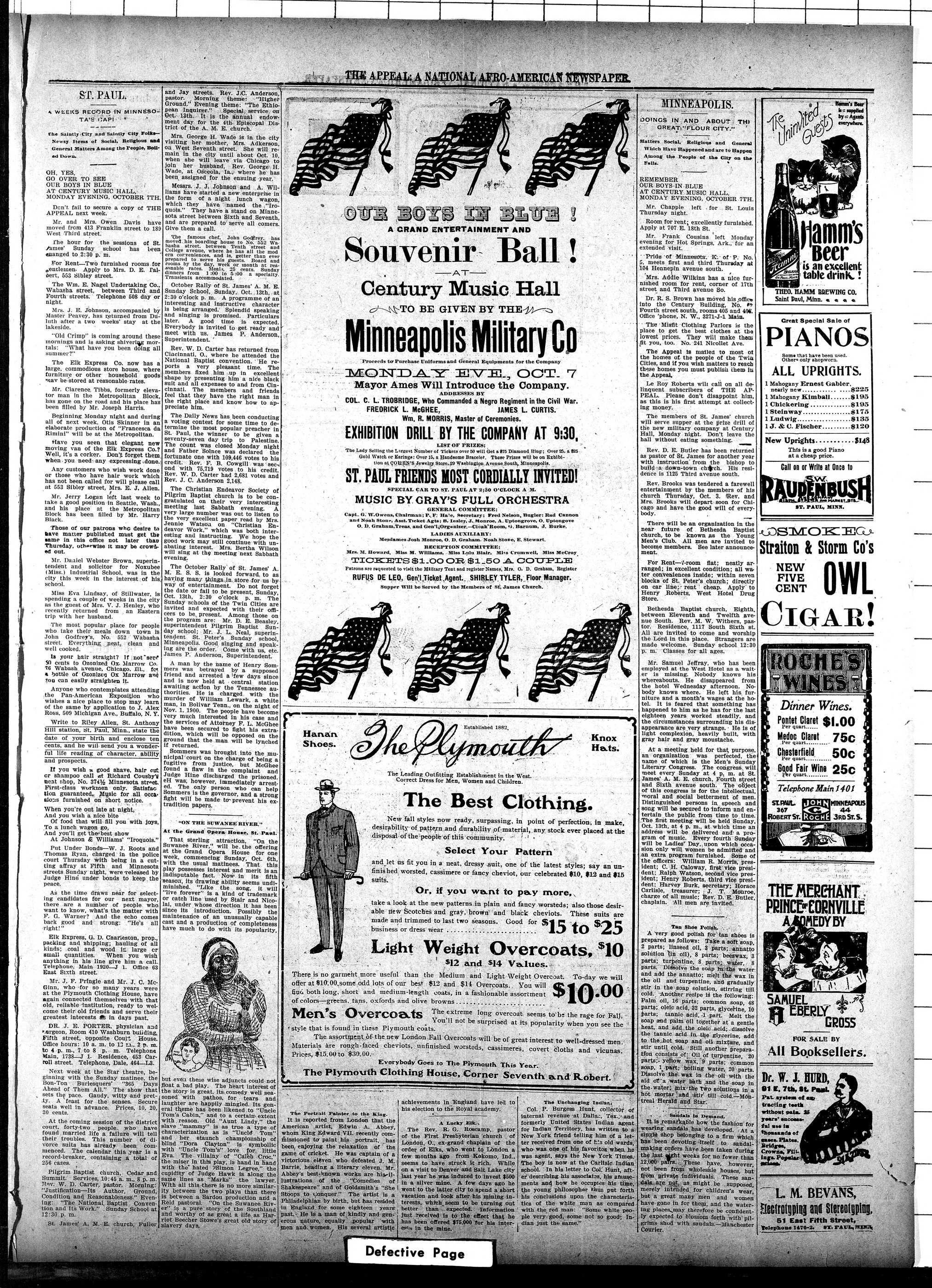
OUR BOYS IN BLUE !
A GRAND ENTERTAINMENT AND
Souvenir Ball !
AT
Century Music Hall
TO BE GIVEN BY THE
Minneapolis Military Co
COL. C. L. TROBRIDGE, Who Commanded a Negro Regiment in the Civil War.
FREDRICK L. McGHEE,
JAMES L. CURTIS.
Wm. R. MORRIS. Master of Ceremonies.
The Lady Selling the Largest Number of Tickets over 50 will Get a $75 Diamond Ring; Over 25, a $25 Gold Watch or Earings: Over 15, a Handsome Bracelet. These Prizes will be on Exhibition at COHEN'S Jewelry Store. Washington Avenue South, Minneapolis.
MUSIC BY GRAY'S FULL ORCHESTRA
GENERAL COMMITTEE:
Capt. G. W.Owens, Chairman; P. F. Hale, Secretary; Fred Nelson, Bugler; Rad Cannon and Noah Stone, Asst. Ticket Apts; B. Isley, J. Monroe, A. Uptongrove, O. Uptongove
O. D. Graham, Treas, and Gen'l Organizer. -Cickr'Room; B. Barnum, J. Burke.
Mrs. M. Howard, Miss M. Williams, Miss Lulu Blair, Miss Crumwell, Miss McCroy.
TICKETS $1.00 OR $1.50 A COUPLE
Patrons are requested to visit the Military Tent and register Names, Mrs. O. D. Graham, Register
RUFUS DE LEO, Gen'l Ticket Agent, SHIRLEY TYLER, Floor Manager.
Supper Will be Served by the Members of St. James Church.
The B
New fall styles now read
desirability of pattern and du
disposal of the people of this
Sele
and let us fit you in a neat, o
finished worsted, cassimere o
suits.
Or, if you
take a look at the new pattern,
able new Scotches and gray,
made and trimmed to last two
business or dress wear ...
Light Weight
$12 a
more useful than the Medium
old lots of our best $12 and $1
and medium-length coats, in
oxfords and olive browns.
Overcoats
The extreme
You'll not
these Plymouth coats.
of the new London Fall Overcoat
faced cheviots, unfinished work
Everybody Goes to The B
North Clothing House,
New fall styles now ready, surpassing, in point of perfection, in make, desirability of pattern and durability of material, any stock ever placed at the disposal of the people of this community.
and let us fit you in a neat, dressy suit, one of the latest styles; say an unfinished worsted, cassimere or fancy cheviot, our celebrated $10, $12 and $15 suits.
take a look at the new patterns in plain and fancy worsteds; also those desirable new Scotches and gray, brown and black cheviots. These suits are made and trimmed to last two seasons. Good for $15 to $25 business or dress wear .....
There is no garmeht more useful offer at $10.00, some odd lots of fine both long, short and medium of colors—greens, tans, oxford's Men's Overcoat style that is found in these Plymouth The assortment of the new Materials are rough-faced chew Prices, $15.00 to $30.00. Every The Plymouth Clos
There is no garment more useful than the Medium and Light Weight Overcoat. To-day we will offer at $10.00,some odd lots of our best $12 and $14 Overcoats. You will find both long,short and medium-length coats, in a fashionable assortment of colors—greens, tans, oxford and olive browns.
Men's Overcoats The extreme long overcoat seems to be the rage for Fall. You'll not be surprised at its popularity when you see the style that is found in these Plymouth coats.
The assortment of the new London Fall Overcoats will be of great interest to well-dressed men. Materials are rough-faced cheviots, unfinished worsteds, cassimeres, covert cloths and vicunas. Prices, $15.00 to $30.00.
Everybody Goes to The Plymouth This Year.
The Portrait Painter to the King.
It is reported from London that the American artist, Edwin A. Abbey, whom King Edward WII recently commissioned to paint his portrait, has been enjoying the relaxation of the game of cricket. He was captain of a victorious eleven who defeated J. M. Barrie, heading a literary eleven. Mr. Abbey's best-known works are his-illustrations of the "Comedies of Shakespeare" and of Goldsmith's "She Stoops to conquer." The artist is a Philadelphia by birth, but has resided in England for some eighteen years past. He is a man of kindly and generous nature, equally popular with men and women. His several artistic
Defective Page
Hanan Shoes.
A man in a suit and hat holds a cane.
The Leading Outfitting Establishment in the West Correct Dress for Men, Women and Children.
The Best Closet
New fall styles now ready, surpassing, in popularity of pattern and durability of material, essential of the people of this community.
Select Your Pair
let us fit you in a neat, dressy suit, one of the worsted, cassimere or fancy cheviot, ours.
Or, if you want to pair
a look at the new patterns in plain and fancy new Scotches and gray, brown and black and trimmed to last two seasons. Good fitness or dress wear ...
Light Weight Overcoats
$12 and $14 Value
useful than the Medium and Light Weight of our best $12 and $14 Overcoats. Your medium-length coats, in a fashionable assortments and olive browns ...
coats
The extreme long overcoat suit. You'll not be surprised at its Plymouth coats.
new London Fall Overcoats will be of great cheviots, unfinished worsteds, cassimeres, etc.
Everybody Goes to The Plymouth This Year
Clothing House, Corner Seven
The Best Clothing.
The Best Clothing.
Or, if you want to pay more,
achievements in England have led to his election to the Royal academy.
A Lucky Elk.
The Rev. R. G. Roscamp, pastor of the First Presbyterian church of London, O., ex-grand chaplain of the order of Elks, who went to London a few months ago from Kokomo, Ind., seems to have struck it rich. While on a visit to Denver and Salt Lake city last year he was induced to invest $500 in a silver mine. A few days ago he went to the latter city to spend a short vacation and look after his mining interests, which seem to be turning out better than expected. Information just received is to the effect that he has been offered $75,000 for his interests in the mine.
Knox Hats.
The Unchanging Indian,
Col. P. Burgess Hunt, collector of
internal revenue at Dallan, Tex., and
formerly United States Indian agent
for Indian Territory, has written to
a New York friend telling him of
a terrestrial received from one of his old wards,
who was one of his favorites when he
was agent, says the New York Times.
The boy is now at the Carlsbad Indian
school. In his letter to Col. Hunt, after
describing his associates, his movements
and how he occupies his time,
the young philosopher thus put forth
his conclusions upon the characteristics
of the white man as compared
with the red man: "Some white people
very good, some not so good. Indian just the same."
DOINGS IN AND ABOUT TH) GREAT "FLOUR CITY." Matters Social, Religious and General Which Have Happened and are to Happen Among the People of the City on the Falls.
MONDAY EVENING, OCTOBER 7TH.
Mr. Chapple left for St. Louis
Thursday night.
Room for rent; excellently furnished.
Apply to 707 E. 18th St.
Mr. Frank Cousins left Monday
evening for Hot Springs, Ark., for an
extended visit.
Pride of Minnesota. K. of P. No.
5, meets first and third Thursday
at 104 Hennepin avenue south.
Mrs. Addie Wilkins has a nice
furnished room for rent, corner of
17th street and Third avenue So.
Dr. R. S. Brown has moved his office
into the Century Building, No. 40
Fourth street south, rooms 405 and 406.
Office 'phone, N. W., 3271-J-1 Main.
The Misfit Clothing Partors is
the place to get the best clothes at the
lowest prices. They will make them
fit you, too. No. 241 Nicollet Ave.
The Appeal is invited to most of
the homes of the people of the Twin
Cities, and if you wish matters to reach
these homes you must publish them in
The Appeal.
Le Roy Roberts wilt call on all delinquent subscribers of THE APEAL. Please don't disappoint him, as this is his first attempt at collecting money.
The members of St. James' church will serve supper at the prize drill of the new military company at Century Hall, Monday night. Don't leave the hall without eating something.
Rev. D. E. Butler has been returned as pastor of St. James for another year with instruction from the bishop to build a down-town church. His residence is 1125 Third avenue south.
Rev. Brooks was tendered a farewell entertainment by the members of his church Thursday, Oct. 3. Rev. and Mrs. Brooks will depart soon for Chicago and have the good will of everybody.
There will be an organization in the near future of Bethesda Baptist church, to be known as the Young Men's Club. All men are invited to become members. See later announcement.
For Rent—1-room flat; neatly arranged; in excellent condition; all water conveniences inside; within seven blocks of St. Peter's church; directly on car line; rent cheap. Apply to Henry Roberts, West Hotel Drug Store.
Bethesda Baptist church, Eighth, between Eleventh and Twelfth avenue South. Rev. M. W. Witers, pastor. Residence, 1117 South Sixth st. All are invited to come and worship the Lord in this place. Strangers are made welcome. Sunday school 12:30 p. m. Classes for all ages.
Mr. Samuel Jeffray, who has been employed at the West Hotel as a waiter is missing. Nobody knows his whereabouts. He disappeared from the hotel Wednesday afternoon. Nobody knows where. He left his furniture and a month's wages at the hotel. It is feared that something has happened to him as he has for the last time. He is surrounded by the circumstances surrounding his appearance are very strange. He is of light complexion, heavily built, with gray hair and gray moustache.
At a meeting held for that purpose, an organization was perfected, the name of which is the Men's Sunday Literary Congress. The congress, will meet every Sunday at 4 p. m. at St. Mary's Church and Sixth avenue south. The object of this congress is for the intellectual, moral and social betterment of men. Distinguished persons in speech and song will be secured to inform and entertain the public from time to time. The first meeting will be held Sunday, at 3 a.m. at 4 p. m., at which time an address will be given to the program of music. Every fourth Sunday will be Ladies' Day, upon which occasion only will women be admitted and an extra program furnished. Some of the officers: William R. Morris, president; C. H. Caloway, first vice president; Ralph Roberts, second vice president; Harvey Roberts, third vice president; Horace Carlisle, treasurer; J. T. Murdoch charge of all music; Rev. D. E. Murdoch, chaplain. All men are invited.
A very good polish for tan shoes is prepared as follows: Take a soft soap, 2 parts; linseed oil, 3 parts; annatto solution (in oil), 8 parts; beeswax, 3 parts; turpentine, 8 parts; water, 8 parts. Dissolve the soap in the water and add the annatto; melt the wax in the oil and turpentine, and gradually stir in the soap solution, stirring till cold. Another recipe is the following: Palm oil, 16 parts; common soap, 48 parts; oleic acid, 32 parts; glycerine, 10 parts; tannic acid, 1 part. Melt the soap and palm oil together at a gentle heat, and add the oleic acid; dissolve the tannic acid in the glycerine, add to the hot soap and oil mixture, and stir until cold. Still another preparation consists of: Oil of turpentine, 20 parts; yellow wax, 9 parts; common soap, 1 part; boiling water, 20 parts. Dissolve the wax in the oil with the aid of a water bath and the soap in the water; mix the two solutions in a hot mortar and stir till cold—Montreal Herald and Star.
Sandals in Demand
It is remarkable how the fashion for wearing sandals has developed. At a samba shop belonging to a firm which has been devoting itself to sandal-making orders have been taken during the last eight weeks for no fewer than 12,000 pairs. These have, however, not been from wholesale houses, but from private individuals. These sandals are not as might be supposed, merely intended for children's wear, but a great many men and women have gone in for them, and the watering places may therefore be confidently expected to blossom forth with pilgrims couch with sandals—Manchester Courier.
The Uninvited Guests
Hamm's Beer is supplied by = Agents everywhere.
Hamm's Beer
is an excellent table drink!
THEO. HAMM BREWING CO.
Saint Paul, Minn.
Great Special Sale of
PIANOS
Some that have been used.
Others only shopworn.
ALL UPRIGHTS.
1 Mahogany Ernest Gabler,
nearly new.....$225
1 Mahogany Kimball.....$195
1 Chickering.....$195
1 Steinway.....$175
1 Ludwig.....$135
1 J. & C. Fischer.....$120
New Uprights.....$148
This is a good Piano
at a cheap price.
CAN ON OR WRITE AT ONCE TO
SW. RAUDENBUSH
AIRLINES, AIRMARKET, ST.
ST. PAUL, MINN.
SMOKE
Straiton & Storm Co's
NEW
FIVE
CENT
OWL
CIGAR!
ROCHE'S
WINES
Dinner Wines.
Pontet Claret $1.00
Per quart.....
Medoc Claret 75c
Per quart.....
Chasterfield 50c
Per quart.....
Good Fair Wine 25c
Per quart.....
Telephone Main 1401
ST. PAUL
367
ROBERT St. JOHN G ROCHE MINNEAPOLIS
44
3RD St. S.
THE MERCHANT
PRINCE-CORNVILLE
A COMEDY BY
SAMUEL
EBERLY
GROSS
FOR SALE BY
All Booksellers.
Dr. W. J. HURD,
91 E. 7th, St. Paul.
Pat. system of en-
tracing teeth without pain. 25
years' success.
ful use in
thousands of
cases. Plates.
Bridges.
Crowns. Pillings. Popular
artists.
L. M. BEVANS,
Electrotyping and Stereotyping,
51 East Fifth Street,
Telephone 1476-2. ST. PAUL, MILWAUKEE.
---
CHICAGO
THE "WORLD'S IFAIRCITY" VIEWED BY THE APPEAL MAN.
A Compilation of a Number of Happenings, and Social Otherwise, Among the Afro-Americans of the Second City of This Glorious Union.
Mrs. Annie Underwood has moved to 3610 State street, top flat.
Miss Hattie Miller, of Racine, Wis., is visiting Miss Daisey Owens, 316 Fifth-ninth street.
Mrs. Jessie Williams, of Ohio, is visiting her sister, Miss Pauline Wilson, 1208 West Lake street.
Mrs. Dora White, of Nashville, Tennessee, is the guest of Miss Josie Johnson, 913 West Polk street.
Mrs. C. C. Lewis has returned to the city after being royally entertained by the elite of Detroit, Mich.
Mr. and Mrs. William Houson, of Ogden, Utah, are visiting friends and relatives in Chicago this week.
Mr. and Mrs. Walter Lapley, of Portland, Oregon, are visiting Mrs. George Jones, 3610 Dearborn street.
Mr. L. Reed, of Indianapolis, Ind., who has been visiting her sister at 1317 State street, has returned to her home.
Miss Lucile Hampton has again resumed her old position as musical directress of the Dixie Jubilee Concert Co.
Slayton Jubilee Co. No. 1 left the cell Monday morning, Sept. 30th, for the East, also the Dixon Jubilee Singers.
Miss Jesse Fisher, 5213 Lake avenue, has returned home after visiting friends in Southern Illinois and Missouri.
THE APPEAL is without question the best advertising medium through which to reach the Afro-Americans of Chicago.
Subscribers for THE APPEAL who wish to discount the paper must send written notice to the office, properly dated and signed.
Mr. Reuben Gill, a well known young man of this city, after a visit of over a year in the East, has come back to Chicago to reside permanently.
Miss Marian Berry left the city Saturday for Little Rock, Ark. where she is employed as a teacher of music in the Baptist Mission School of that city.
James A. Scott, attorney-at-law, can be found at THE APPEAL office during business hours. Prompt attention given all legal business entrusted to
Beacon Light Court No. 48, I. O. O. C., will give a social at the residence of Mrs. M. J. Bateman, 3457 Dearborn street, Wednesday evening, Oct. 9, 1901.
Mrs. Catherine Lindsey, 2816 LaSalle street, who has been seriously ill for several weeks is able to be up and out again, to the delight of her numerous friends.
Mr. and Mrs. Lewis, of Jeffersonville, Ky., are spending a few weeks in Chicago on business. At present they are at Glencoe, Ill., the guests of their daughter.
Mr. Charlie Stewart, the versatile and entertaining correspondent of the Baltimore Afro-American, spent a few days in Chicago visiting old friends last week.
THE APPEAL has fixed advertising rates, and will not cut them in order to attract them. However, if you want to reach the people, advertise in THE APPEAL.
Miss Marie Starks, of Vicksburg, Miss., returned home last Sunday, after a delightful sojourn of two weeks in Chicago visiting Mrs. B. F. Moseley, 6113 Morgan street.
Do you want to preach? Learn at home and two-cent stamp to Prof. R. B. Howitt for catalogue or spondence Bible School, 2008. Magazine street, New Orleans, La.
M. M. Grainger, 2040 Dearborn street, has opened a news and stationery store at the above number. THE APPEAL can be found on sale each week at Grainger's place.
The formals gave their annual Autumn Tailgate for catalogue Hall. Tuesday evening, Oct. 1st. The hall was packed, and amongst those present were some of the best people of the city.
FOR RENT-A: between 34th and 35th streets, west side of State; good location and splendid terrain; other business prevents personal attention. Call first flat 3423 State street.
Dr. J. Webb Curtis, late surgeon in the volunteer army in the Philippines, addressed the West End Sunday Club, at St. Mark's church last Sunday, on the island of Philippines. A large and appreciative audience heard the doctor.
All members of the I. B. W. W. C. are hereby notified that the club will meet every Thursday at 2 p. m. at Mrs. M. Anderson's, 4609 Vincennes avenue, until further notice is given, and are earnestly requested to be to meetings.
The Columbia Giants defeated the Chicago Union Giants last Sunday to 2. It was a well-played game, and there were many amusing features during the game. Will Joyner, right forder for the Unions, in trying to hold with his hands he caught it on the eye.
The Fisk Club held its first meeting of the conference last Tuesday evening at the residence of 3724 Dearborn street. The officers were for the ensuing year were as follows: Mr. Julius N. Avendorph, who succeeds himself for the fourth year; Mr. Joseph L. Jones; Mr. Lewis; secretary, Miss L. Joseph; treasurer, Mrs. L. G. Jackson.
Ex-commissioner **endward** H. Wright can be found by his clients and friends at his new office, suite 421, 260 South Clark street. A visit to the commodious offices of Mr. Wright will convince anyone that he is doing a good job. Mosley has opened a branch office with Mr. Wright and can be found there between the hours of 12 m. and 2 p. m. Capt. Leon Denison and wife, née Dr. Fitzbush, late of Louisville, Ky. left last Sunday for San Francisco, from which port they will sail for Manila, P. I., which they intend to make their future home. Capt. Denison recently returned from the islands, where he spent the last summer. Forty-eight, U. S. Volunteers, and so well did he like that country that he remained in America only long enough to get married.
Field, Schlick & Company's Store News.
Choice flannelettes.
Flannelettes the
colorings of mu-
sure. Four complete
acquaces, wrapp-
ed and 17c.
Outing flann
flannel, flannel,
envelopes of 20 12 y
piece 10c yard.
at.
Flannelettes that have the fine styles and colorings of materials costing many times as Four complete lines suitable for shirt whis, sacques, wrappers and lounging robes. 10c, 12 and 17c.
Outing flannel special—Heavy teasled of flannels, stripes, checks and plaids in all colors ends of 2 to 12 yards that are worth in the piece 10c yard. On sale Thursday at.
Flannelettes that have the fine styles and choice colorings of materials costing many times as much. Four complete lines suitable for shirt whists, house saques, wrappers and lounging robes. 10c, 12i c, 15c and 17c.
**Outing flannel special**—Heavy teasled outing flannels, stripes, checks and plaids in all colors—Mill ends of 12 12 yards that are worth in the piece 10c yard. On sale Thursday.
at
Underwear bargains.
Here's a line of vests and pants and suits at bargain prices. They are just the wanted now and are extremely fine ribbed with ful silk crochet trimmingss—union suits $1.50. Vests and pants . . .
**Double fleeced**—Winter weight, ribbed maco yarn vests and pants—double fleeced . . .
**Corset covers**—Natural gray wool corset covers with long sleeves—reduced from 85c to . . .
**Wool union suits**—3.75 and 4.00 heavy imported natural gray wool suits reduced to
By Day
The more between leaves M reaches comforta
Ask Your P
"You too
Everyone smokes
strictly High C
DUKE C
PARM
CIGAR
HART & MUR
MNFRS. ST.PAUL
"You too?"
Everyone smokes the
strictly High Grade
DUKE OF
PARMA
CIGARS
HART & MURPHY,
MNFRS. ST. PAUL, MINN.
By Daylight Along the
The most beautiful river scenery it
between St. Paul and Chicago. Our "leaves Minneapolis 7:30, St. Paul 8
reaches Chicago at 9:35 p.m. An comfortable trip.
Ask Your Home Agent to Ticket You
The Plymouth
By Daylight Along the Mississippi
By Daylight Along the Mississippi
The most beautiful river scenery in the world is between St. Paul and Chicago. Our "Scenic Express" leaves Minneapolis 7:30, St. Paul 8:05 a. m., and reaches Chicago at 9:35 p. m. An interesting and comfortable trip.
Ask Your Home Agent to Ticket You by the Burlington.
XIV
The Plymouth HA SE
We are Sole Agents for Hard
Fine Shoes.
The Plymouth Clothing House, Sev
HAVE
SEEN
We are Sole Agents for Hanan, & Sons' Fine Shoes.
The Plymouth Clothing House, Seventh and Robert.
HAVE SEEN YOU THE
Gordon Hat
Bowlby & Co., Jrs. Boston 6th & Robert.
Headquarters for the Gordon.
The "Emperor" is the best of all the $3.50 Shoes for men, made especially for us in all leathers on the latest and most modern up-to-date lasts.
It is a pleasure to guarantee a shoe that will uphold every claim made for it, giving the utmost comfort and satisfaction. We claim that, a Shoe of equal value cannot be had for equal money, no matter where you go. A new pair for any pair that goes wrong.
The "Empress" is likewise the best of all the $3.50
Shoes for women.
Burlington Route
THE APPEAR A NATIONAL AFRO-AMERICAN NEWSPAPER
Good gloves, 1.00.
The most satisfactory glove we have been able to find at 1.00 is Our Own. They are made from soft, pliable skins, fit perfectly and wear well. All colors and sizes, 1.00.
Electrique—A genuine Jouvin make in all shades for street and calling wear. I.50
1.50
Fall goods for men.
One of the biggest underwear bargains possible is this one: Heavy winter weight fleece shirts and drawers, well finished and worth 50c, selling to tomorrow at..... 32c
Special at 1.00—Here are two of as good lines of shirts and drawers as we have ever sold at 1.00. One is fine and light weight for fall—the other is heavy winter weight, and both sold all last season at 1.25. Now..... 1.00
Wool shirts—Fine ribbed wool flesh color shirts and drawers. Just one case of them—it's all the mill had. Regular price is 1.50. This case, special here at..... 1.10
Socks—Heavy black cotton socks, seamless and stainless—good wearing 15c kind, for..... 10c
One of the biggest underwear bargains possible is this one: Heavy winter weight fleeced shirts and drawers, well finished and worth 50c, selling to_32c tomorrow at
Special at 1.00—Here are two of as good lines of shirts and drawers as we have ever sold at 1.00. One is fine and light weight for fall—the other is heavy winter weight, and both sold all last season at 1.25. Now
Wool shirts—Fine ribbed wool flesh color shirts and drawers. Just one case of them—it's all the mill had. Regular price is 1.50. This case, special here at 1.10.
Socks—Heavy black cotton socks, seamless and stainless—good wearing 15c kind, for 10c
Orphan's Home in Central Georgia, near Macon, whose work consists of gathering up afro-American boys and girls and orphan children from the streets and alleys of towns and cities and counting to take them to this institution, training them to farming or trades, is in Chicago trying to raise additional funds for new buildings. The school has been running scarcely two years, but has made good nearly $2,000 in bushings and has secured nearly $2,000 in bushings and he hopes to get much more in this city.
The newly organized Company E₄ of the Eighth regiment, Illinois National Guard, gave a prize: drill, ball at the regiment's armory. Twenty-seventh street, between Wabash and Michigan avenues, on Monday evening. The affair was well attended. Prof. Armor of orchestra furnished the music for the evening, won by Mr. and Mrs. Fox. The prize drill, one man from each company, elicited rounds of applause. Col. J. H. Johnson was the drill master. The commissioned of the new company is to train the children to attain; James Fielden, first lieutenant and Jack Turnley, second lieutenant.
Mrs. Oro Palmer, of 2811 State street, entertained a few friends last Friday evening in honor of her niece, Miss Emma Edwards, of New Orleans, Miss Edwards were entertained at whist from the kitchen of a sumptuous luncheon, was served by Mrs. William; the caterer. The table was beautifully decorated with ferns, carnations and American Beauties. Mrs. J.-N. Avendort assisted in recieving from the society of the gentlemen was enjoyed from the reception present were: Misses Emma Edwards, Frankie Lewis, Isabella Lewis and Nelle DeJole, of New Orleans, La.; Blanche Hagen, Etta Moore, Gertie Moore; Morese Julusus N. Avenel; Morese Julusus N. Carrie Turnley; Messrs Julusus N. Andoroph, Jack Turnley, L. W. Moore, Joan Morris, Sam White, W. Thompson and Mr. Allison.
Nickel Plate Road $10.50, for Round trip
The Nickel Plate Road has three through trains daily and will sell tickets October 5th and 6th at one cent per mile, good returning until October 13th, Invasive Through trains to New York and Boston. City ticket office 111 Adam St. Phone Central 2057.
It is not so much general notions of Providence which are our best support, but a sense of personal interest taken by Christ in our welfare.—Arnold.
NOTICE OF MORTGAGE SALE.
The 18th day of November, in the office, was held on the 13th of the 13th of the Month of 13th, in the office and deliver to The West St. Paul Real Estate and Improvement Syndicate, a corporation, mortgage, and lease money mortgage deed dated the 26th day of June, and study recorded at 215 o'clock P. M. on the 18th day of November, 1886, in Book the Mortgages, on page 137. In the office of the Register of Deeds in and for the County of Bameley in the State of Minnesota, the� and the conditions of the payment of principal and interest and the amount now due, and claimed to be due thereon at the date of this notice, is the sum of $239.62, and said mortgagee is now the holder and owner of said mortgage, and the debt secured thereby, and no action at the date of this notice is to recover said debt or any日前款.
The premises described in and conveyed by said mortgage deed are situate within the same County, Minnesota, and are known as deemed in the dded as Lot number twenty-one (21 of Block number sixty-nine (69) of the West St. Paul Real Estate and Improvement Syndicate Addition number six (6) according to the request, plat thereof on file in the office of the Registrator of Deeds in and for said Ramsey County; and, pursuant to the power-sale contained in said mortgage deed and the statute in such case made and provided, said mortgage will be foreclosed and the causes above described will be sold at public attention to highest bidder, for cash, at the Cedar street main to the Court House, in the City of St. Paul, in said County, on Tuesday, the 15th day of October, 1901 at ten o'clock in the foreclosure of Sheriff of said County, to satisfy the amount of the due on said mortgage, together with $23 attorney's fees and costs of foreclosure.
Dated St. Paul, Minn., August 26th, 1901. THE WEST ST. PAUL REAL ESTATE AND INCREVEMENT SYNDICATE,
HERRMAN OPPENHEIM, Mortgage.
Atty. for Mortgage.
916 New York Life Blg.
St. Paul, Minn.
Aug 31 18-27 14-21 2805-12
NOTICE OF MORTGAGE SALE.
Notice is hereby given that Wallace W. Thomas, Mortgagor, did duly execute and deliver to The West St. Paul Real Estate and Improvement Syndicate, a corporation, mortgagee, his purchase money mortgage deed dated the 26th day of June, 1886, and duly recorded in the office of the Register of Deeds in and for the County of Tamsey in the State of Minnesota, at 215 P.M. on the 18th day of November, 1886, in Boarland, on mortgages, on page 117, and that default has been made in the conditions of said mortgage sale from payment of principal and interest and the amount now due, and claimed to be due thereon, at the date of this notice, is the sum of $239.62, and said mortgagee is now the holder and owner of said mortgage, and the debt secured thereby, and no action at law or otherwise, has been instituted to recover said debt or any part thereof.
The premises described in and conveyed by the Mortgage deed are situate within said Rome County, Minnesota, and are known and described in said State as Lot
Burlington
Route
OF THE
The Pan-American Exposition at Buffalo closes October 31. You must go this month if you go at all. Via St. Paul and Chicago the most comfortable line is the Burington.
ASK YOUR HOME AGENT
FOR TICKETS VIA THE
BURLINGTON
EVERY Mother
With a family to buy Shoes for should trade here. Every advantage is offered as regards style and low price.
EVERY CHILD NEEDS SHOES.
Misses' Tan Shoes, in all the new spring styles, for $1.25, $1.35 and $1.75.
Children's Tan Shoes, new leathers and pretty shapes, for 49c, 85c, 90c, $1.25 and $1.50.
For the new spring styles,
SEE OUR WINDOWS.
TREADWELL SHOE CO.
129-131
E. SEVENTH ST.
BETWEEN
JACKSON & ROBT
WONDERFUL DISCOVERY
BROOKLYN AND AFTER TIME MARKET
OZONIZED OX MARROW
THE ORIGINAL - COFFEEIZER.
The only safe preparation in the world that makes hair grow long and thick. The nourishes the scalp prevents hair from falling. The hair grows long, bold over 40 years and used in all of its applications. Get the Original Ozonized OX Marrow to keep the hair straight, soft and beautiful. Only the original Ozonized OX Marrow is used in one bottle. $1.40 for three bottles, we pay all taxes. Write your name and address plainly to the advertiser.
Lindeke's
Apple &
Blossom
Flour
STANDS
ALONE.
TUXEDO
Men's Shoes
$3.50
That's the whole shoe,
whole shoe.
And there's no limit,
either in style, size, or
every worthy sort.
finds representation
Come on,
get the moneys' worth.
tyline (60), of the Went St. Paul Real Estate and Improvement Syndicate Addition and the Real Estate platt thereof on file in the office of the real estate county, and pursuant to the power of sale contained in said mortgage deed, and the said mortgage will be foreclosed and the said mortgage will be sold at public auction to the highest bidder in cash, at the Cedar street main entrance in said County, on Tuesday, the 15th day of October, 1801, at ten o'clock in the foreclosure amount the amount on due said mortgage, and the amount $25 attorney's fees and costs of foreclosure
Dated St. Paul, Minn., August 26th, 1901. THE WEST ST. PAUL REAL ESTATE AND IMPROVEMENT SYNDICATE,
Mortgage.
HERMAN OPENHEIM,
Atty. for Mortgage.
916 New York Life Bldg.,
St. Paul, Minn.
NOTICE OF MORTGAGE SALE.
Notice is hereby given that Isaac B. Seixas, Mortgagor, did duly execute and deliver to The West St. Paul Real Estate and Improvement Syndicate, a corporation, mortgage, his purchase money mortgage deed dated the 25th day of March, 1887, and was recorded in the office of the Register of Deeds for Ramsey County, the Minnesota, at four o'clock P.M. on the 21st day of April, A.D. 1887, in Book 133 of mortgages, on page 426, and that default has been made in the conditions of said mortgage by non-payment of principal and interest and the amount now due, and claimed to be due thereon, at the date of the notice the sum of $368.34, and said mortgagee is now the holder and owner of said mortgage, and the debt secured thereby, and no action at law or otherwise, has been instituted to recover said debt or any part thereof.
The premises described in and converted to a Ramsey deed deed within said Ramsey deed, and known and described in said deed as Lofthouse, 515-715, of the West St. Fifty-five (65) of the West St. Institute and Improvement Syndicate Addition and Improvement Syndicate Recorded plower on the die in the office of Register of Deceds and for said Ramsey deed, and the premises above described will be contained in said mortgage deed, and the statute in such case made and provided, and the premises above described will be public auction to the highest bidder, for said Ramsey deed, and the Court House, in the City of St. Paul in said County, on Tuesday, the 15th day of January, 2015, for the occasion, by the Shriff of said County, by the amounts the amount then due on said mortgage, and the $25 attorney's fees and costs of foreclosure.
Dated St. Paul, Minn., August 26th, 1901.
TREATMENT AND IMPROVEMENT SYNDICATE.
HERMAN OPPENHEIM.
Mortgage.
Atty. for Mortgage.
Mortgage Life Bridge.
St. Paul, Minn.
NOTICE OF MORTGAGE SALE.
Notice is hereby given that Isaac B. Barker, of the State of Minnesota, and deliver to the West St. Paul Real Estates and improvement Syndicate, a corporation mortgage deed dated the 25th of June, 1901, and the daily recorded in the office of the Registrar of the State of Minnesota, at four (4) o'clock P. M. on June 13th, 1901, of mortgages, on page 424 in Book 153 of mortgages, on page 424 in the default has been made in the conditions of principal and interest and the amount claimed to be due thereon, is the sum paid to the mortgage is now the holder and owner of the debt secured thereby, and no action at the time of payment is required to recover said debt or any part thereof.
The premises described in and conveyed to said mortgage deed and site within said premises, and known and described in said deed as Lost Property, 60 (a) the West St. Paul Real Estate and Improvement-Syndicate Addition and Improvement-Syndicate Addition (6) account for the office in which the premises are located in the office Register of Deeds in and for said Ramsey County, and jurisdiction of the sale of property in the mortgage deed and site statute in such case made and provided, and the premises above described and closed, and the public auction to the highest bidder, for the Court House, in the City of Cincinnati in said Court, on Tuesday, the 15th day in said Court, on Tuesday, the 15th day in the foreon, by the Sheriff of said Court, by the amount they the amount on due on said mortgage, with $25 attorney's fees and costs of foreon, by the Sheriff of said Court.
Dated St. Paul, Minn., August 26th, 1901.
Mortgage and IMPROVEMENT SYNDICATE.
HERMAN OPPENHEIM. Mortgage.
Atty. for Mortgage.
Atty. for Life Bldg.
St. Paul, Minn.
NOTICE OF MORTGAGE SALE.
Witness is hereby given that Wallace W. Thomas and deliver to the West St. Paul Real Estate corporation, mortgages his purchase money, zed dated the 26th day of June, 1886, Register of Deeds for Ramee County, Register of Deeds for Ramee County, 18th day of November, 1886, in Book 138th of mortgages, on page 138, and that default mortgage by non-payment of principal and mortgage by non-payment of principal and claimed to be amount now due, and claimed to be amount now due, this notice is the sum of $239.62, and said mortgage and holder and owner mortgage, and holder and owner thereby, and no action at law, or otherwise, and no institution to recover said debt
The premises described in and conveyed by said mortgage deed are situate within said Ramsey County, Minnesota, and are known and described in said deed as Lot numbered Twenty-two (22) of Block numbered Sixty-nine (69) of the West St. Paul Real Estate and Improvement Syndicate Addition number six (6) according to the recorded plot thereon on file in the office of the Register of Deeds in and for said Ramsey County; and the amount to the power of sale contained in said mortgage deed, and the statute in such case made and provided, said mortgage will be foreclosed and the premises above described will be sold at public auction to the highest bidder, for cash, at the Cedar street main entrance to the Court House, in the City of St. Paul, in said County, on Tuesday, the 15th day of October, 1901, at ten o'clock in the forenoon, by the Sheriff of said County, to satisfy the amount then due on said mortgage, together with $25 attorney's fees and the costs of foreclosure.
Dated St. Paul, Mann, August 26th, 1901. THE WEST ST. PAUL REAL ESTATE AND IMPROVEMENT SYNCTATE.
NOTICE OF MORTGAGE SALE.
Notice is hereby given that Inase B. Seixas, Mortgagor, did duly execute and deliver to The West St. Paul Real Estate and Improvement Syndicate, a corporation, mortgagee, his purchase money mortgage deed dated the 25th day of March, 1887, and duly recorded in the office of the Register of Deeds for Ramsey County, Minnesota, at four o'clock P.M. on the 21st day of April, A.D. 1887, in Book 135 of mortgages, on page 425, and thereafter recorded on the 25th day of May, 1887, at 10:45 o'clock M. in said Register's office in Book 127 mortgages on page 123, and that defiant has been made in the conditions of said mortgagee by non-payment of principal and interest, and the amount now due, and claimed to be due thereon, at the date of this notice is the sum of $394.35, and said mortgagee is now the holder and owner of said mortgage, and the debt secured thereby, and no action at law, or otherwise, has been instituted to recover said debt or any part thereof.
mortgages described in and converted by said Ramsey County, Minnesota, and are numbered Ten (10) in Block number 716-59 (the West of St. Paul Real Estate) and number six (the East of St. Paul Real Estate) according to the recorded on file in the office of the Resident Court, and pursuant to the power of sale statute in such case made and provided, mortgage will be foreclosed and the public auction to the highest bidder, for the Court House, in the City of St. Paul, in said County, on Tuesday, the 18th day of August, by the Sheriff of said County, to be noon, by the Sheriff of said County, together with $20 interest on said mortgage, for the foreclosure of said County, August 26th, 1961, THE WEST ST. PAUL REAL ESTATE AND IMPROVEMENT SYNDICATE, Mortgage HERMAN OPPENHILM,
916 New York Life Bldg,
St Paul, Minn.
MOST WORSHIPFUL GRAND LODGE
OF
MINNESOPA, A. F. AND A. M.
JOHN N. NZAL, Grand Master.
622 Boston Blk., Minnesapolis, Minn.
WM. R. Monna, Grand Secretary.
617 Guaranty Bldg., Minnesapolis, M. un.
PERSECT ASHLIAR LODGE NO. 40. A.
P. and A. Monna, Grand Secretary.
WM. W. A. Hillyard, Sec., 124 Atwater St.
PERSECT ASHLIAR LODGE NO. 40. A.
P. and A. Monna, Grand Secretary.
Tuesdays at Masonic Hall, No. 319 Wabash
St. at 8:00 P. M. B. R. Durant, W. M.;
MAR 6 LODGE, NO. 2202, meets second and fourth Wednesday in each month for business and the third Wednesday for instruction at Odd Fellow's Hall. 253 E. Seventh St. Val Joe Turner, N. G., T. R. Hickman, P. S., 422 St. Anthony Ave.
HOUSEHOLD OF RUTH, NO. 553, G. U. O. of C. F. meets first and third Monday in each month for business; second Monday for instruction at Odd Fellow's Hall, 253 E. Seventh St. Mrs. Lillian A. Turner, M. N. G. Mrs. da M. Johnson, W. R., No. 592 Rice street.
ST. JAMES' A. M. E. CHURCH, cor. Fuller and Cedar, Sunday services: 11:00 a. m. 7:30 p. m. Wednesday prayer meeting, 8:00 p. m. Pastor visits on Monday and Tuesday; at home Wednesday and Thursday. Weddings, funerals and the sick attended on notice. Rev. J. C. Anderson, Pastor, 350 Louis St.
PILGRIM BAPTIST CHURCH, Cor. 12th and Cedar, Sunday services: Preaching the 11th of 7:40 pm, Tuesday, 12:30 o'clock. Wednesday evening general prayer meeting. Friday evening study, Sunday school lesson, Funerals and weddings promptly attended. Rev. W. D. Carter, Pastor, 559 Ellist St.
ST. PHILIPS EIPCISOPAL MISSION-corner Aurora avenue and Mackinab street-Sunday services: Early celebration of Holly Easter staircase and Sundays, 11:00 a. m. Sundays, second and fourth Sundays, 12:30 a. m. Sunday school, 12:30 a. m. Brotherhood of Mary, 7:30 p. m. Week services: editions, confirmation class, 8:00 p. m. Holy Easter staircase, 8:00 p. m. Holy Easter staircase, REV. A. C. V. CARTER, Rector, 570 Central avenue.
MINNEAPOLIS
J. H. H. and Lopen, No. 1873 first met and Tuesday in each month at Massonic Hall St. and Street between Hennepin and Nicollet Ave.
Massons in good standing always welcome
John G. Steerrett, W.
Harvey Burke, Sec. Medical Block
ANDREA LODGE A. N. and A. M. co. 14.
the first and second Monday in each month
Massonic Hall Second street between Engle
and Nicollet Ave's. Massons in good standing
ways welcome.
Geo. W. Day, W. W. Lester, Sec'y L. Laver Exchange
```markdown
```
MINNEAPOLIS
ANTHONY LONES, No. 3857, meets the first day in school each day in each month for the transition between classes. On instruction, at their hall, second street, when Niellet and Hancup arrive. No. M. N. G.
JAMES K. SMITH, P. S. P. O. H. S1
KNIGHTS OF PYGIAS
MAT. TURNER LONES. No. 8, L. K. of P. menta. In school in good standing welcome. At Labor Town Fourth and Bigham Ave. 90.
JOAN A. CASE, C. R. and S.
PRESIDENT OF MINNESOTA LONES. No. 1, K. of P. menta. In first and third Thursday in each month. At Hall 200 and Hall 201. Second street between Hancup and I. Ave. A.
PRESIDENT OF MINNESOTA LONES. No. 1, K. of P. menta. In first and third Thursday in each month. At Hall 200 and Hall 201. Second street between Hancup and I. Ave. A.
PRESIDENT OF MINNESOTA LONES. No. 1, K. of P. menta. In first and third Thursday in each month. At Hall 200 and Hall 201. Second street between Hancup and I. Ave. A.
G.A.B
BIDDLE CIRCLE No. 38 LAMBORG OV THE G. A. B.
RATE OF HISTORY No. 11 MARY A. A. A. A. A.
Garfield Post Hall, Wabasha Street.
LATINA B. HICKMAN FARM. 30 GARDEN 68
KATIE MYERS SHO. 400 CODES 89
The Monarch of Them All.
HETRA QUALITY
DUNLAP & CO.
SUPPRESSED BY
THE DUNLAP HAT.
R. A. LANPHER & CO. 333
ROBERT SCHMEL
THE
OF MYSTERY IS
A true Clairvoyant and Trance Medium who understands all secrets and reveals all mysteries. Tells past, present and past your presence. Describes all persons you know. Life. Removes all obstacles, prevents troubles, gives luck in marriages, law suits and chance. Separates and unites. Cures opium, morpheme, liquor and tobacco habit. Reads books and other sickness. Write to this wonderful woman. Answers all questions correctly.
N. B. "B. Send two-cent stamp for answer. Send full name, age and address, accompany your reading." Address: MRS. M. F. HARPER 711 W. Spring Street, Lima, Ohio
50 YEARS' EXPERIENCE
PATENTS
TRADE MARKS
IN THE
COPYRIGHTS & C.
Anyone sending a sketch and description may qualify for patent protection. Communication invention is probably patentable. Communications sent free. Overseed agency for securing patent. Receive special notice, without charge, in the
Scientific American.
A handbook of illustrations and a collection of scientific journal. Terms, $ 8 a year, four months. Bold by all new publishers.
MUNN & Co 391 Broadway, New York
Boston Office, 65 W. St., Washington, D. C.