The Appeal
Saturday, May 10, 1902
St. Paul, Minnesota
Page text (machine-generated)
THE APPEAL STEADILY GAINS
BECAUSE
1-It aims to publish all the news possible.
2-It does so impartially, wasting no words.
3-Its correspondents are able and energetic.
VOL. 18. NO. 19
```markdown
```
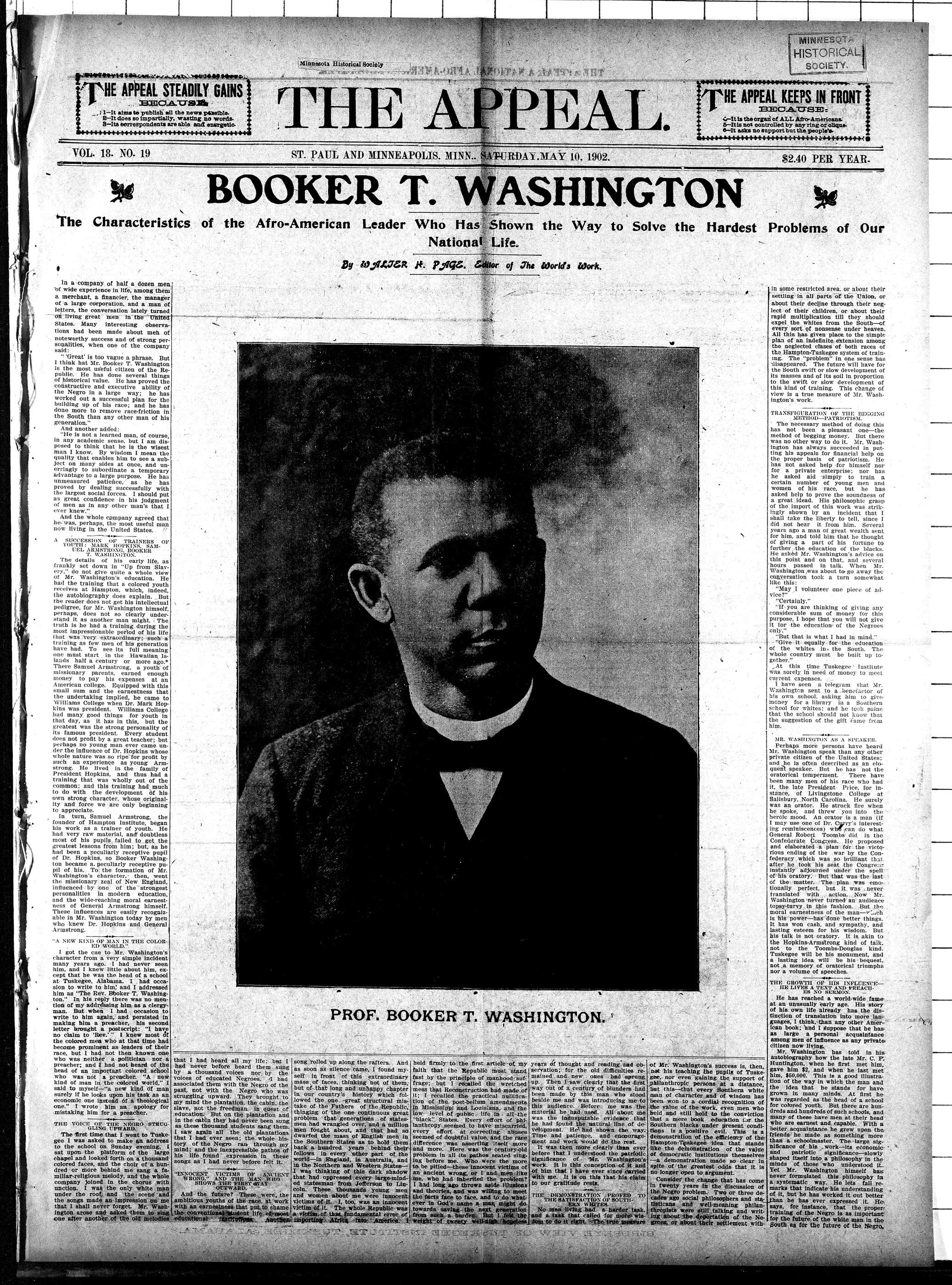
In a company of half a dozen men of wide experience in life, among them a merchant, a financier, the manager of a large corporation, and a man of letters, the conversation lately turned on living great men in the United States. Many interesting observations had been made about men of noteworthy success and of strong personalities, when one of the company said: "Great' is too tague a phrase. But I think hat Mr. Booker T. Washington is the most useful citizen of the Republic. He has done several things of historical value. He has proved the constructive and executive ability of the Negro in a large way; he has worked out a successful plan for the building up of his race; and he has done more to remove race-friction in the South than any other man of his generation."
HE SUCCESSION OF TRAINERS OF YOUTH: MARK HOPKINS, SAMUEL BOKER
W. T. WASHINGTON
The details of his early life, as frankly set down in "Up from Slavery," do not give quite a whole view of Mr. Washington's education. He had the training that a colored youth receives at Hampton, which, indeed, the autobiography does explain. But the reader does not get his intellectual pedigree, for Mr. Washington himself, pernaps, does not so clearly underscore the man might. The truth is he had a training that the most impressionable period of his that was very extraordinary; such a training as few men of his generation have had. To see its full meaning one must start in the Hawaiian islands half a century or more ago. There Samuel Armstrong, a youth of missionary parents, earned enough money to pay his expenses at an American college. Equipped with this small sum and the earnestness that Williams College implied, he came to Williams College in the 1970s. Hopkins was president. Williams College had many good things for youth in that day, as it has in this, but the greatest was the strong personality of its famous president. Every student does not profit by a great teacher; but perhaps no young man ever came under the influence of Dr. Hopkins whose whole nature was so ripe for profit by such an experience as young Armstrong lived in the family of President Hopkins and thus had a training that was wholly common; and this training had much to do with the development of his own strong character, whose originality and force we are only beginning to appreciate.
In turn, Samuel Armstrong, the founder of Hampton Institute, began his work as a trainer of youth. He had very raw material, and doubtless most of his pupils failed to get the training he needed. But he had been a peculiarly receptive pupil of Dr. Hopkins, so Booker Washington became a peculiarly receptive pupil of his. To the formation of Mr. Washington's character, then, went the missionary zeal of New England, influenced by one of the strongest educators in India, but made the wide-reaching moral education, and the wide-reaching moral education, of General Armstrong himself. These influences are easily recognizable in Mr. Washington today by men who knew Dr. Hopkins and General Armstrong.
"A NEW KIND OF MAN IN THE COLORED WORLD."
I got the cue to Mr. Washington's character from a very simple incident many years ago. I had never seen him, and I knew little about him, except that he was the head of a school at Tuskegee, Alabama. I had occasion to write to him; and I addressed him, as a Booster. Mr. Washington in his reply was the manifestation of my addressing him as a clergyman. But when I had occasion to write to him again, and persisted in making him a preacher, his second letter brought a postscript: "I have no claim to 'Rev.' I knew most of the colored men who at that time had become prominent as leaders of their race, but I had not then known one who was neither a politician nor a teacher, and not the most heard head of the important school who was not a preacher. "A new kind of man in the colored world." I said to myself—"a new kind of man surely if he looks upon his task as an economic one instead of a theological one." I wrote him an apology for mistaking him for a preacher.
The first time that I went to Tuskegee I was asked to make an address to the school on Sunday evening. I sat upon the platform of the large chapel and looked forth on a thousand colored faces, and the chair of a hundred or more behind me sang a familiar-religious melody, and the whole company joined in the chorus with unction. I was the only white man under the chapel's scene and the songs made an impressive that I shall never forget. Mr. Washington arrose and asked them to sing one after another of the old melodies
BOOKER T. WASHINGTON
P.
that I had heard all my life; but I had never before heard them sung by a thousand voices nor by the voices of educated Negroes. I had associated them with the Negro of the past, not with the Negro who was struggling upward. They brought to my mind the plantation, the cabin, the slave, not the freedman in quest of education. But on the plantation and in them they had never been sung as these thousand voices sang them. I saw again all the old plantation that I had ever seen; the whole history of the Negro ran through my mind; and the inexpressible paths of his life found 'expression in these songs as I had never before felt it.
"INNOCENT VICTIMS OF ANCIENT WRONG." AND THE MAN WHO SHOWS THE FIRST WAY OUTWARD.
THE APPEAL.
By WALTER H. PAGE, Editor of The World's Work.
song roiled up along the ratters. And as soon as silence came, I found myself in front of this extraordinary mass of faces, thinking not of them, but of that long and unhappy chapter in our country's history which followed the one - great structural mistake of the Fathers of the Republic, thinging of the one continuous great problem that generations of statesmen had wrangled over, and a million men fought about, and that had so dwarted the mass of English men in the Southern States as to hold them back a hundred years behind their fellows in every other part of the world in England, in Australia, and in the Western and Western States - I was worried that dark shadow that had oppressed every age-mindered statesman from Jefferson to Lincoln. These thousands young men and women about me were innocent victims of it. I, too was an innocent victim of it. The whole Republic was a victim, of that fundamental error of importing Africa into America
held firmly to the first article of my faith that the Republic must stand fast by the principle of manhood-offrage; but I recalled the wretched mess that Reconstruction had made of it; I recalled the practical nullification of the post-bellum amendments in Mississippi and Louisiana, and the low level of public life in all the "black" States. Every effort of philanthropy seemed to have miscarried, every effort at correcting abuses seemed of doubtful value, and the race difference was asserting itself more and more. Here was the century-old problem in all its pathos seated singing before me. Who were the more to be pitied—these innocent victims of an ancient wrong, or I and men like I had long been inflicted with the problem? I had long been addicted to rumours and theories, and was willing to the facts face to face, and to do whatever in God's name a man might do towards saving the next generation from such a burden. But I felt the weight of twowell hardened
years of thought and reading and observation; for the old difficulties remained and new ones had sprung up. Then I saw clearly that the first way out of a century of blunders had been made by this man who stood beside me and was introducing me to this audience. Before, me was the material he had used. All about me was the indusputable evidence that he had found the natural line of development. He had shown the way. Time and patience, and encouragement and work would do the rest.
It was then more clearly than ever before that I understood the patriotic significance of Mr. Washington's work. It is this conception of it and of him that I have ever since carried out his work that has given him his claim to our gratitude rests.
THE DEMONSTRATION PROVED TO THE SATISFACTION OF SOUTH AMERICA
No man living had a harder task, and a task that called for more wisdom to do it right. The true measure
THE APPEAL KEEPS IN FRONT
BECAUSE:
4-It is the organ of ALL Afro-Americans.
5-It is not controlled by any ring or olique.
6-It asks no support but the people's.
of Mr. Washington's success is then, not his teaching the pupils of Tuskegee, nor even gaining the support of philanthropic persons at a distance, but this—that every Southern white man of character and of wisdom has been won to a cordial recognition of the value of the work, even men who held and still hold to the conviction that a mere book education for the under present conditions is a positive demonstration of the efficiency of the Hampton-Tuskegee idea that stands like the demonstration of the value of democratic institutions themselves—a demonstration made so clear in spite of the greatest odds that it is no longer open to argument.
Consider the change that has come in twenty years in the discussion of the Negro problem. Two or three decades ago social philosophers and statisticians and well-meaning philanthropists were still talking and writing about the deportation of the Negroes, or about their settlement with
MINNESOTA
HISTORICAL
SOCIETY.
AL KEEPS IN FRONT
BECAUSE:
out of ALL Afro-Americans.
encrolled by syringing or olique.
support but the people.
$2.40 PER YEAR.
Problems of Our
L
In some restricted area, or about their settling in all parts of the Union, or about their decline through their neglect of their children, or about their rapid multiplication till they should expel the whites from the South—of every sort of nonsense under heaven. All this has given place to the simple plan of an indefinite extension among the neglected clases of both races of the Hampton-Tuskegee system of training. The "problem" in one sense has disappeared. The future will have for its victims a slow decline in its masses and of its soil in proportion to the swift or slow development of this kind of training. This change of view is a true measure of Mr. Washington's work.
TRANSPIGURATION OF THE BEGGING METHOD-PATRIOTISM.
The necessary method of doing this has not been a pleasant one—the method of begging money. But there was no other way to do it. Mr. Washington has always succeeded in putting his appeals for financial help on the proper basis of patriotism. He has not asked help for himself nor for a private enterprise; nor has he asked aid simply to train a nurse aid number of young men and women of his race, but that he asked help to prove the soundness of a great idea. His philosophic grasp of the import of this work was strikingly shown by an incident that I shall take the liberty to tell, since I did not hear it from him. Several years ago a man of great wealth sent for him, and told him that he thought of giving a part of his fortune to further the education of the blacks. He asked Mr. Washington's advice on medicine and on that, and several hours, passed in talk. When Mr. Washington was about to go away the conversation took a turn somewhat like this: "May I volunteer one piece of advice?"
"Certainly."
"If you are thinking of giving any considerable sum of money for this purpose, I hope that you will not give it for the education of the Negroes on the island."
"But that is what I had in mind."
"Give it equally for the education of the whites in the South. The whole country must be built up together."
At this time Tuskegee Institute was sorely in need of money to meet current expenses.
I have seen a telegram that Mr. Washington sent to a benefactor of his own school, asking him to give him a library for a school in South Africa school for whites; and he took that the school should not know that the suggestion of the gift came from him.
MR. WASHINGTON AS A SPEAKER.
Perhaps more persons have heard Mr. Washington speak than any other private citizen of the United States; and he is often described as an eloquent speaker. But he has not the oratorical temperment. There have been many men of his race who had it, the late President. Price, for instance, of Livingstone College at Salisbury, North Carolina. He surely was an orator. He struck fire when he was attacked by an armed heroic mood. An orator is a man (if I may use one of Dr. Curry's interesting reminiscences) who can do what General Robert Toombs did in the Confederate Congress. He proposed and elaborated a plan for the victorious ending of the war by the Confederacy which was so brilliant that after he took his seat the Congress instantly adjourned under the spell of his oratory. But that was the last of the matter. The plan was emotionally perfect, but it was never translated with action. Now Mr. Washington never turned an audience into a moral earnestness of man. But the moral earnestness of man is his power—has done better things. It has won cash, and sympathy, and lasting esteem for his wisdom. But his talk is not oratory. It is akin to the Hopkins-Armstrong kind of talk, not to the Toombs-Douglas kind. Tuskegee will be his monument, and a lasting idea will be his-bequest, not a memory of oratorical triumph nor a volume of speeches.
THE GROWTH OF IHS INFLUENCE-
H I B LIVING REACH-
REACU-
ES NO SEMION
He has reached a world-wide fame at an unusually early age. His story of his own life already has the distinction of translation into more languages, I think, than any other Amer- ian, and I suppose that he has as large a perceptual acquaintance among men of influence as any private citizen now living.
Mr. Washington has told in his autobiography the late Mr. C. P. Huntington, when he first met him, gave him $2, and when he last met him, $5,000. This is a good illustration of the way in which the man and the idea that he stands for have grown in many minds. At first he learned to head a school for colored youth. But he hundreds and hundreds of such schools, and many of these have men at their head who are earnest and capable. With a better acquaintance he grew upon the friends he made as something more than a schoolmaster. The large significance of his work—its economic and patriotic significance—slowly shaped itself into a philosophy in the wake of those who understood it. Yet Mr. Washington has never formulated this philosophy in a systematic way. He lets fall remarks that indicate his understanding of it, but he has worked it out better. He says, for instance, that the proper training of the Negro is as important for the future of the white man in the South as for the future of the Negro.
```markdown
```
FIELDSTEVE VIEW OF TWENTY-FOUR MILES FROM THE CENTER OF THE CITY
HAVE YOU READ
THE APPEAL?
THE AFPEAL,
A NATIONAL AFRO-AMERICAN NEWSPAPER
PUBLISHED WEEKLY BY
ADAMS BROS. EDITORS AND PUBLISHERS
49 E. 4th St., St. Paul, Minn.
ISSUED SMALLTAMBULDERLY IN
Saint Paul, Minneapolis, Chicago,
Washington, Louisville, St. Louis.
ST. PAUL OFFICE,
No. 110 Union Blk. 4th & Cedar,
J. Q. ADAMS, Publisher.
MINNEAPOLIS OFFICE,
Guaranty Loan Bldg. Room 811
HENRY ROBERTS, Manager.
CHICAGO OFFICE,
823-5 Dearborn St., Suite 310,
C. F. ADAMS, Manager.
LOUISVILLE OFFICE,
No. 312 W. Jefferson St. Room 3
W. V. PENN, Manager.
ST. LOUIS OFFICE,
No. 1002 Franklin Avenue.
J. H. HARRISON, Manager.
TERMS, STRICTLY IN ADVANCE:
AGENTS WANTED.
THE APPEAL wants good reliable agents to canvass for subscribers at points not already covered. Write for our extraordinary inducements. Address.
SATURDAY, MAY 10, 1902.
Judge D. B. L. Guffy, Chief Justice of the Supreme Court of Kentucky, in a recent interview in the Washington Times said:
"It looks as if it could as truly be said of the Negro today, as at the time of the Dred Scott decision, that he has no rights a white man is bound to respect.
"I am of the opinion of nearly all thoughtful men in the Republican party who now admit that the enfranchisement of the colored people was a serious mistake. It hurt the Negro himself more than anybody else. His vote will never be counted at any time, or at any place, where it would have a decisive result. His numerical preponderance, as in States like Mississippi, makes no difference. He is clear outside the breastworks."
The Times says that Judge Guffy is an ardent Republican, but that is very doubtful even if the Judge was elected on the Republican ticket. The above quotations are not the doctrine of an ardent Republican. The thoughtful men of the party do not admit that enfranchisement was a mistake. Only half-hearted, renegade Republicans believe any such thing.
The enfranchisement of the Afro-American was simple justice, and was right. It is never a mistake to do right. No honorable, fair-minded man will deny a God-given right or privilege, to one of his fellow men, which he, himself enjoys, simply because he has the power, or because God in his infinite wisdom saw fit to make him of a different complexion. How any white man can pretend to believe that he thinks the disfranchisement of the Afro-Americans for the Afro-Americans' good, is beyond our comprehension. He knows he does not, and we know that everyone who says so willfully, multicolously and outrageously LIES.
After a journey covering 2,662 miles Robert C. Ogden, accompanied by his eighty guests, returned to New York Monday on the special train on which they for two weeks have been traveling through the South, visiting educational centers. Those in the party are the prime movers in the great educational movement for the South by which it is hoped to raise a fund of $50,000,000. During the trip it received its first considerable impetus in the gift of $1,000,000 by John D. Rockefeller.
The leaders of the movement returned full of enthusiasm and greatly encouraged. Mr. Ogden said that the annual conference, which lasted four days, at Athens, Ga., was the most largely attended meeting the organization has held and reflected the widespread interest of the South. The leading public men of that section were present. Among those in Mr. Ogden's party were William H. Baldwin, Jr., George Foster Peabody, Dr. Felix Adler, John Crosby Brown, Morris K. Jesup and many others of national fame, either as masters of finance or as philanthropists or educators.
The Afro-Americans of Toppeka, Kansas, have applied to the Supreme Court of the State for a writ of mandamus against the school board to secure the attendance of Afro-American children at the Lowman Hill school. This has been done because the school set apart for them is not equal in appointments to the school for Caucasians. There should be no schools separated on the color line, and, then, such trouble would be avoided. There are no two things on earth alike, and, try as they might, they could not get two schools just exactly-alike; and, if they did, so long as the schools were separated there would a distinction; and all distinctions are odious.
In St. Louis J. D. Miller, a janitor of the 9th district police court, swore out a warrant against Officer Andrew Gordon charging him with murder in the second degree in killing William Garner, an Afro-American, while attempting to arrest him, has been discharged for "pernicious activity." The St. Louis people are justly indignant
and a permanent body to look after such cases and known as the Afro-American Protective League has been organized with Capt. C. H. Tandy as president.
George W. Greenup, the Kentucky aspirant for Congressional honors who attracted unusual attention from the fact that he introduced music in politics and took his daughter on his speaking tours to play the violin before and after his addresses, has announced his retirement from the race. Greenup found that of the great crowds that flocked to hear the music, few were voters and while he was making a lot of noise but little real progress was made.
OGEN PARTY.
T. Kemmet J. Smith, Private Secretary T. Hooser T. Washington.
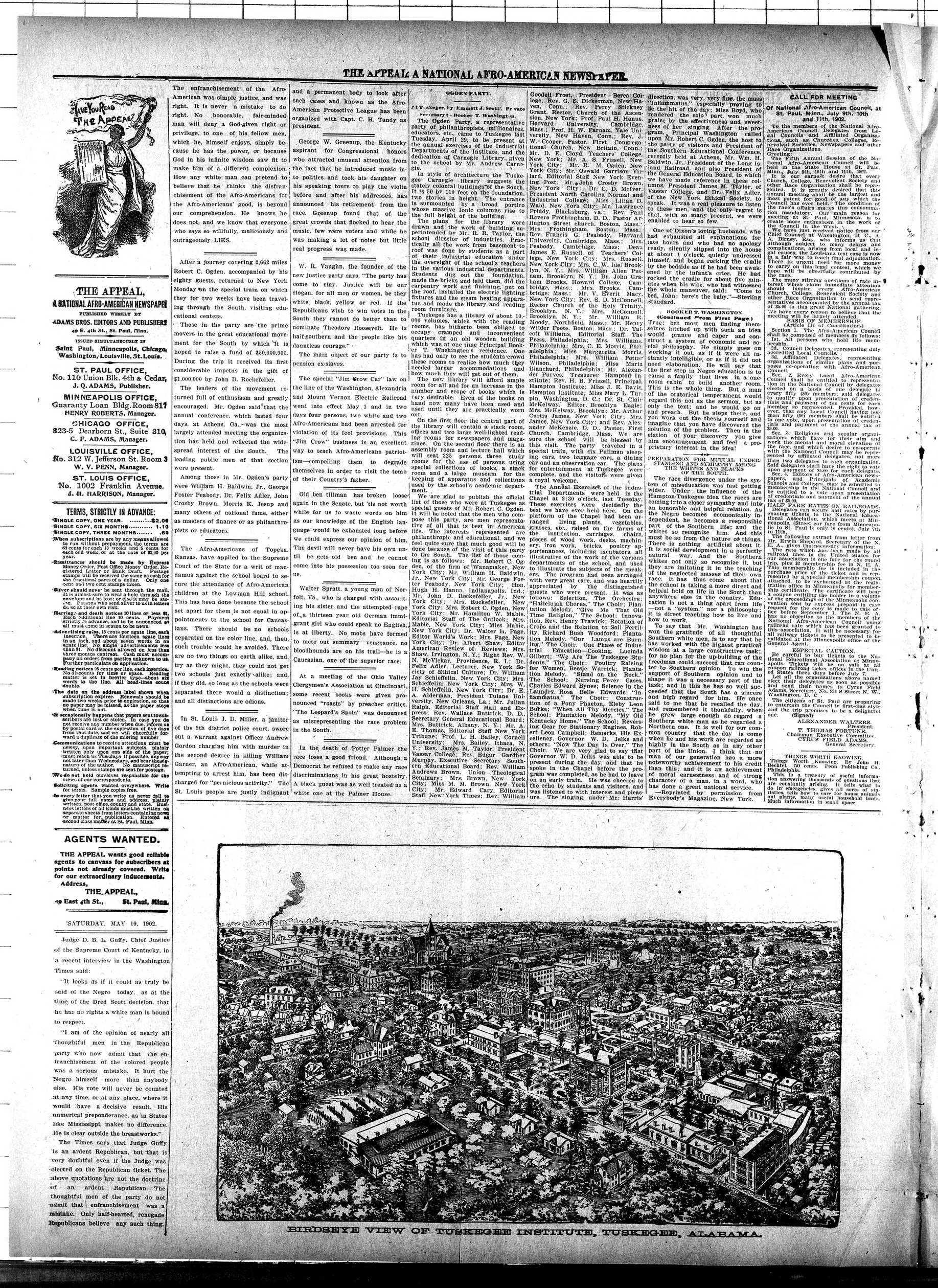
The Ogden Party, a representative party of philanthropists, millionaires, educators, came to Tuskegee last Tuesday, April 29, to be present at the annual meeting of the Industrial Departments of the Institute, and the dedication of Carnegie Library, given to the school by Mr. Andrew Carnegie.
The style of architecture the Tuskegee Carnegie library suggests the stately colonial buildings of the South. It is 50 by 110 feet on the foundation, two stories in height. The entrance is surmounted by a broad porico that gives rise to the full height of the building.
The plans for the library were drawn and the work of building superintended by Mr. R. R. Taylor, the school director of industries. Practically all the work of the library to roof was done by students as a part of Good Frost, President Berenge; Rev. G. S. Dickerman, Newen, Conn.; Rev. Percy Stirling, Grant, Rector, Church of the Abyssinian New York; Prof. Paul H. Harvey, Harvard, Mass.; Prof. H. W. Farnam, Yale; Prof. New Haven, Conn.; Rev. W. Cooper, Pastor. First Concern Church, New Britain, Conn.; Prof. M. Edward Teachers, New York; Mr. R. M. Ogden, York City; Mr. R. M. Ogden, York City; Mr. Oswald Garrison, Editorial Staff New York; Mr. John Croshy B. New York; Dr. John Croshy B. President North Carolina Normal Industrial College; Miss Lila Waid, New York City; Mr. Law Pridky, Blacksburg, va.; Rev. R. J. Hingstham, Boston, Mrs. Frothingham, Boston, Mrs. Francis G. Peabody, Haven University, Cambridge, Mass.; Peabody, Cambridge, Mass.;
W. R. Vaughn, the founder of the new justice party says, "The party has come to stay. Justice will be our slogan, for all men or women, be they white, black, yellow or red. If the Republicans wish to win votes in the South they cannot do better than to nominate Theodore Roosevelt. He is half-southern and the people like his dauntless courage." The main object of our party is to pension slaves.
The special "Jim Crow Car" law on the line of the Washington, Alexandria and Mount Vernon Electric Railroad went into effect May 1 and in two days four persons, two white and two Afro-Americans had been arrested for violation of its fool provisions. This "Jim Crow" business is an excellent way to teach Afro-Americans patriotism—compelling them to degrade themselves in order to visit the tomb of their Country's father.
Old ben tillman has broken loose again in the Senate, but 'tis not worth while for us to waste words on him as our knowledge of the English language would be exhausted long before we could express our opinion of him. The devil will never have his own until he gets old ben and he cannot come into his possession too soon for us.
Walter Spratt, a young man of Norfolk. Va., who is charged with assaulting his sister and the attempted rape of a thirteen year old German immigrant girl who could speak no English, is at liberty. No mobs have formed to mete out summary vengeance, no bloodhounds on his trail—he is a Caucasian, one of the superior race.
At a meeting of the Ohio Valley Clergymen's Association at Cincinnati, some recent books were given pronounced "roasts" by preacher critics. "The Leopard's Spots" was denounced as misrepresenting the race problem in the South.
In the death of Potter Palmer the race loses a good friend. Although a Democrat he refused to make any race discriminations in his great hostelry. A black guest was as well treated as a white one at the Palmer House.
**Secretary T. Hooker T. Washington.**
The Oden Party, a representative party of philanthropists, millionaire, educator and usurgee last Tuesday, April 29, will be the annual exercises of the Industrial Departments of the Institute, and the dedication of Carnegie Library, given to the school by Mr. Andrew Carnegie.
In style of architecture the Tuskegee Carnegie library suggests the stately colonial buildings of the South. The library is feet on the foundation, two stories in height, and is surmounted by a broad porch whose massive ionic columns rise to the full height of the building. The plans for the library were drawn up by a building superintended by Mr. R. R. Carnegie, school director of industries. Practically all the work from basement to roof was done by students as a part of their industrial education under the supervision of the school's teachers in the various departments. Students dug out the foundations, made the bricks and laid them, did the carpentry work and finishing, put on the roof, installed the electric lighting, and made the steam heating apparatus and made the library and reading room furniture.
Tuskegee has a library of about 10,000 volumes, which with the reading room occupy cramped and inconvenient quarters in an old wooden building which was at one time Principal Bookstore in the *Boston* residence. One has had only two of these rooms to realize how much they needed larger accommodations and how much they will get out of them. The room is a large, plush room for all and for an increase in the number and scope of books which is very desirable. Even of the books on hand now many have been used and they are often practically worn out.
On the first floor the central part of the library will contain a stack room, reading rooms for newspapers and magazines. On the second floor there is an assembly room and lecture hall which seat 225 persons, three study rooms, and a library with special collections of books, a stack room and a large museum for the keeping of apparatus and collections by the school's academic department.
Goodell Frost, President, Berea College; Rev. G. S. Dickerman, New Haven, Conn.; Rev. Percy Stickney Grant, Teacher, Church of the Ascension, New York; Prof. Paul H. Hanus, Mass.; Prof. H. W. Farnam, Yale University, New Haven, Conn.; Rev. J. W. Cooper, Pastor, First, Congregational Church, New Britain, Conn.; Mr. D. E. Cloyd, Teachers College, New York; Dr. C. Meyer, New York City; Mr. R. M. Ogden, New York City; Mr. Oswald Garrison Villard, Editorial Staff New York Evening Post; Mr. John Crosey Brown, New York City; Dr. C. Meyer, President, Industrial College; Miss Lillian D. Waid, New York City; Mr. Lawrence Priddy, Blackburg, va.; Rev. Paul Revere Frothingham, D. D. Pastor Arlington, street church, Boston, Mass.; Rev. Percy Stickney Industrial College; Miss Lillian D. Waid, New York City; Mr. Lawrence University, Cambridge, Mass.; Mrs. Peabody, Cambridge, Mass.; Dean James E. Russell, of Teachers College, York City; Mrs. Russell, New York City; Mrs. W. Wiley, N.Y.; Mrs. Allen Purnam, Brooklyn, N. Y.; Dr. John Graham, Brookow, Howard College, Cambridge, Mass.; Mrs. Brooks, Cambridge, New York City; Mrs. Everly Mac, New York City; Mrs. Everly Mac, Rector Church of the Holy Trinity, Brooklyn, N. Y.; Mrs. McWilliam, Brooklyn, N. Y.; Mr. William H. Moody, Northfield, Mass.; Mr. Henry W. Moody, Northfield, Mass.; Mrs. William Potter, Wilmington, Mass.; Mrs. William Potter, Blanchard, Philadelphia; Mrs. Alexander Purves, Treasurer Hampton Institute; Rev. H. B. Frissell, Principal, Hampton Institute; Miss J. E. Davis, Hampton Institute; Miss L. M. Turley, Hampton Institute; William Potter, McKelway, Editor, Brooklyn Ed. McKelway, Brooklyn; Mr. Arthur Curtis James, New York City; Mrs. James, New York City; Rev. Alexander Camble, Dr. Pastor First, ensure the school will be blessed by this visit. The party traveled in a special train, with six Pilum sleeping cars, two baggage cars, a dining car and an observation car. The plans complete, and the visitors were given a royal welcome.
The Annual Exercises of the Industrial Departments were held in the theatre 12:00 o'clock, last Tuesday. These exercises were best we have ever held here. On the platform of the Chapel had been arranged, living plants, vegetables, grasses, etc., raised on the farms of the various students. We had pieces of wood work, desks, mairies, iron work, bricks, poultry appurences, including incubators, all illustrative of the work of the various students. We used to illustrate the subjects of the students. The program had been arranged with very great care, and was heartily appreciated by the distinguished guests who were present. It was as a result of the Selection by the Halleijhua Chorus, The Choir; Plantation Melody, "Give Me That Old Time Religion," The School; Innovation, Rev. Henry Trawick; Rotation of the students; The Tuskegee Students"; The Choir; Richard Bush Woodford; Plantation Melody, "Our Lamps are Burning." The Choir. One Phase of Industrial Education—Cooking, Lucinda Sturm, Henry Trawick, The Tuskegee Students"; The Choir; Women Bessie Warrick; Plantation Melody, "Stand on the Rock." The School; Nursing Fever Cases, Edward Bynes; Science in the Lakes; The Tuskegee Students"; The Choir; Construction of a Pony Phaeton, Eleby Leon Burke; "When All Thy Mercies," The School; Plantation Melody, "My Old Friend Gear for Stationary Engines, Robert Leon Campbell; Remarks, His Excellency, Governor W. D. Jekks and others; "Now The Day Is Over," The School; We are very glad to say that Governor W. D. Jekks and others present during the day, and that he spoke in the Chapel before the program was completed, as he had to leave on an early train. He was heeded to and received the officers, and was listened to with interest and appreciation. The singing, under Mr. Harris
direction, was very, very fine, the mass "inflammatus," especially preving to be the hit of the day: Miss Boy, who rendered the solo part, won much success by the hit of the sweetness of her singing. After the school, Principal Washington called upon Mr. Robert C. Ogden, the host to the party of visitors and President of the Conference, recently held at Athena, Mr. Baldwin, Jr., President of the Long Island Railroad, and also President of the General Education Board, to which he responded with an unnums. President James M. Taylor, of Vassar College, and Dr. Felx Adler, of the New York Ethical Society, to which it was a real pleasure to listen to these verses, and to regret that, with so many present, we were enabled to hear so few.
One of Dixon's loving husbands, who had exhausted all explanations for late hours and who had no apology ready, silently slipped into the house at about 1 o'clock, quietly undressed himself, and began rocking the cradle by the bedside as if he had been awakened the infant's cries. He had rocked the bed about 40 minutes when his wife, who was the whole maneuver, said: "Come to bed, John: here's the baby."—Sterling Standard.
BOOKER T. WASHINGTON
(Continued From First Page)
True; but most men finding themselves hitched up with such an idea prince and caper and construct economic and social philosophy. He is working it out, as if it were all instantly intelligible, or as if it did not need elaboration. or as will he say that the first step in Negro education is to come a family that lives in a one room, another room. This is the whole thing. The man of the orator temperament would regard this not as the sermon, but as only the text; and he would go on and preach. But he stops there, and you work cut the thesis yourself and find that you have discovered the solution of the problem, even in the elation of your discovery to give him encouragement and feel a proprietary interest in the idea!
The race divergence under the system of miseducation was fast getting wider. Under the influence of the race, the school has come in to a closer sympathy and into an honorable and helpful relation. As the Negro becomes economically independent, he becomes a responsible white person, and the whites so recognize him, that he must be so from the nature of things. There is nothing artificial about it. It is social development in a perfectly Southern whites not only so recognizing them, they are imitating it in the teaching of the neglected masses of their own class. This thus come about that the school helps on life in the South than anywhere else in the country. Education is not a thing apart from life in the "system," nor a philosophy; it is the teaching how to live and how to work.
To say that Mr. Washington has won the gratitude of all thoughtful Southern white men, is to say that he has won the most practical wisdom at a large range for no plan for the up-building of the freedman could succeed that ran counter to Southern opinion. To win the support of Southern opinion and to win it was a necessary part of the task; and he succeeded thatceded that the South has a sincerity and high regard for him. He once said to me that he recalled the day, and remembered it thankfully, when he grew large enough to regard a Northern one. It is as well for a noncountry that the day is come when he and his work are regarded as highly in the South as in any other part of the Union. I think that no other of our generation has a more noteworthy character than this; and it is an achievement of moral earnestness and of strong character of a man, in a word, who has done a great national service.
—Reprinted by permission from Everybody's Magazine, New York.
Of National Afro-American Council, at St Paul, Minn., July 9th, 10th and 11th, 1902.
To the members of the National Afro-American Council Delegates from Local Councils and Affiliated Organizations, such as Churches, Colleges, Benevolent Societies, Newspapers and other Race Organizations.
The Fifth Annual Session of the National Afro-American Council will be held in the State House of St Paul, Minn. July 9th, 10th and 11th, 1902.
It is our earnest desire that every Church, College, Benevolent Society and other Race Organization shall be represented by the gorgy desired that the annual meeting shall be the largest and most potent for good of any which the Council has ever held. The condition of the race's affairs makes this consummation necessary. The reason for meeting at St Paul, Minnesota is to create more enthusiasm in the work of the Council in the West.
We have justed the notice from our Chief Counsel at Washington, D.C. A. A. Birney, Esq., who informs us that although subject to many delays and regulations arising from local and legal causes, the law is to be made in a fair way to reach final adjudication. There is urgent need for more money to carry on this legal contest, which we will be cheerfully contributed by the race.
The many stirring questions of race in America should insinure every Afro-American Church, College, Berevene Society and the Organization of the American sensatives to the annual tax of $0.00 to this great National gathering. The many reason to believe that the meeting will be a major BASIS OF MEMBERSHIP (BASIS OF MEMBERSHIP) Section 1. The Afro-American Council shall be composed of members as follows: all persons who hold Hie membership.
The following extract from letter from letter E. A. gives the necessary information: I. E. A. gives the necessary information: which Jain has made by all railroad lines in Minnesota for our association is one fare for the round trip. This membership fee is $20 in N. E. A. this purchase price of the ticket and is repurchase office in Minnesota for memorial co-payment attached, to be exchanged at the office in Minnesota for memorial co-payment a coupon entitleing the holder to a volume of the proceedings of the Minnesota conference in case request for the copy is made by the E. A. has no objection to the copy. The National Afro-American Council uses this association. It will be necessary for all railway tickets to be presented to be made by the Minnesota office of the General Agent.
ESPECIAL CAUTION
Be careful to buy tickets to the National Educational Association at Minneapolis, MN. Buy tickets to the all-inclusive railroad ticket offices in all United States three days before July 7. Buy tickets to the trip to No. 61 S Street N. W. Washington, D. C.
The citizens of St. Paul are preparing entertainment the Council in first-class style at Adrian School. The Chairman Executive Committee CYRUS FIELD ADAMS. General Secretary.
ALEXANDER WALTERS. President. Adrian School. The Chairman Executive Committee CYRUS FIELD ADAMS. General Secretary.
THINGS WORTH KNOWING.
Things Worth Knowing. By John H. Penn. Penn Publishing Co. Philadelphia.
This is a treasure of useful information. It is a treasure of useful information that are constantly arising. It tells what to study, gives us sorts of statistics, tells how to use many useful household hints. Much information.
ST. PAUL.
A WEEKS RECORD IN MINNESOTA'S CAPIT.
The Saintly City and Saintly City Folks—Newy Items of Social, Religious and General Matters Among the People, Bolled Down.
One or two gentlemen roomers wanted. Apply at 527 St. Anthony avenue, or at THE APPEAL office.
One or two gentlemen will find a very pleasant front room for rent, with or without board at 139 Concord street. On car line.
Prof. W. A. Weir, after an extended stay in Canada and various parts of the United States, has returned home for the summer.
WANTED—A good, sober, industrious barber. Wages $10 per week and half of earnings over $17. Address W. B. Wright, Sloux Hills, S. D.
Germania Shoe Shining Parlor, No. 18 West Sixth street, J. B. Johnson, proprietors. Shoes shined or polished. Special chairs for ladies. Shoe dying a speciality.
The most popular place for people who take their meals down town is John Godfrey's. No. 552 Wabasha street. Everything neat, clean and well cooked.
Is your hair straight? If not, send 50 cents to Ozonized Ox Marrow Co. 75 Wabasha avenue, Chicago, Ill., for a bottle of Ozonized Ox Marrow and you can easily straighten it.
Pilgrim Baptist church, Cedar and Cedar Park, 10:45 a.m. 8 p.m.; Rev. W. D. Carter, pastor. Morning. "The Knowledge of Salvation." Evening. "The Object of Christian Life."
Anyone who can give any information regarding the whereabouts of Mr. James Thompson, who used to work at the Ryan Hotel, will confer a favor by sending the same to THE APPEAL office at once.
Let your object in life be that you will be somebody in fact or nobody in fact. Never allow yourself to be somebody in fact. Use somebody when your secret life gives you the lie, for you only destroy yourself.
If you wish a good shave, hair cut or shampoo call at Richard Cousby's neat shop. No. 3714% Minnesota street. First-class workmen only. Satisfaction guaranteed. Music for all occasions furnished on short notice. When you're out late at night, And you wish a nice bite. And you will call you with joys, To a lunch cafe you. And you'll get the best show At Johnson & Williams' "Iroquois." "The Bon-Ton Burlesques" begin an engagement of one week at the Star Theatre tomorrow. The company includes thirty people and is strictly to-date. The usual burlesques and an excellent olio will constitute the bill of fare. Elk Express, G. D. Carteston, prop. packing and shipping; hauling of all kinds; coal and wood in large or small quantities. When you wish a telephone, Main 1920 - I. Office 63 East Sixth street
Those of our patrons who desire to have matter published must get the same in this office not later than Thursday afternoon, otherwise it may be taken of any communication that is not signed by the author.
E. S. Willard is underlined at the Metropolitan for three nights and Wednesday matinee, beginning Monday, May 19. He will present a repertory, consisting of "The Cardinal," "Tom Pinch" and by special request, "The Professor's Love Story."
Irvine Wellbounce and James Leger, who had the little misunderstandment, wrote that the Professor's Leger was cut in the abdomen, having refused to testify against each other, the charges of assault with dangerous weapons have been withdrawn.
SAFE DEPOSIT AND STORAGE vaults—We invite your inspection.
It costs little to place your papers, cash securities and valuables in absolute safety. Boxes in our vaults can be used for your boxes, trunks, etc. with us. St. Paul Trust Co., 13$ Endicott Arcade.
The Odd Fellows of the city are requested to meet at their hall at 2 p.m. tomorrow, thence to march to St. James' A. M. E. church, headed by Prof. Holtman, Bass Band, St. Minnesota, abbreviated Sermon will be presected at 2 p.m. by the pastor of the church, Rev. J. C. Anderson.
"The Spanish Gypsy" dramatized from George Eliot's famous story by Marguerite W. Morton, will be presented at the Metropolitan Opera House for one performance only, next Monday night. The play will be presected at the local people will be given for the benefit of the library fund of the Humboldt school.
Payne, the mind reader, hypnotist, magician and wizard, will appear at the Metropolitan Tuesday, presenting a novel and interesting entertainment, embracing many marvelous acts. The programme will include a spiritual, educational, and famous Davenport brothers, some sensational experiments in mind-reading and clairvoyance, and a reproduction of the great Mahmata fire scene.
The Charity Club has issued invitations for its first annual social, which is to occur at Twin City Hall. Rice and his wife, M. L. Hill, the club is under the control of an executive board, composed of W. J. Utley, pres.; C. M. Tibbs, sec.; J. H. Vincent, treas. On the occasion of the social, the club will act as a gangsters-at-arms, and Messrs. C. S. Harrison and J. M. Allison as floor managers.
The "Adelphi" held a social session at the residence of Mrs. W. T. Francis last Tuesday evening, to which the husbands of the lady members were invited. In the interest of the club and some interesting discussions were indulged in. Refreshments were served and all present had an enjoyable time. The club was the next Tuesday at the residence of Mrs. J. E. Porter, Carroll street.
That there was an election last Tuesday the Republicans of the city are too well aware. There were 31 offices to save. There were only a unlicensed number of 13 of them—the two municipal court judges, four assemblymen, three aldermen, the two justices of the peace and the two justices of the court, are variegated curs is that the gandi-
HIS IDEA.
Rev. Fiddle D. D. This life is full of misfortune.
Rev. Fiddle D. D.--This life is full of uncertainties.
Between the trolley cars and the automobiles you don't know which way
to turn.
A POSER.
Mrs. Jones. Noah took a pair of every living animal into the ark so that they wouldn't have been drowned.
Mobble-Did he take in fish?
Mrs. Jones. Yes.
Mobble-Would they have been drowned mammal?
dates did not poll the full strength of the party.
Though we have met the enemy and are theirs, we cannot refrain, in justice to those who had charge of the team from mentioning the splendid meeting of the American Club, which was held at the Afro-American Club, Cedar street, last Saturday night. Mr. James Woodfork, the president of the club, presided, and the enthusiastic crowd that listened with attention to a list of speakers, including Congressman Stevens, F. B. Doran, Fred Schlifman (the only speech he gave) in the audience) and a host of others. The meeting was a splendid one in every respect.
The Republican state convention will be held in St. Paul Tuesday, July 1. The date of the convention and the preliminary rout of the insurgents was effected Thursday afternoon by a vote of the state central committee.
The county conventions will be held June 24, one week before the state convention, and the total number of delegates entitled to seats in the nominating convention is 1,472. The apportionment made on the vote for McKinley in 1900 was of one delegate for each 250 votes and five delegates at large for each county. Ramsey county, by virtue of the 15,584 votes polled for McKinley, will have a delegation of sixty-seven members and Hennepin comes to the front with 113, one-tenth of the convention strength. The anti-Van Sant men retired from the field without firing a single shot in the open. Tams Bixby, chairman of the committee and recognized leader of the insurgents, made the motion to vote for McKinley, who was carried by a unanimous viva vote without the slightest debate.
TENTH ANNIVERSARY
Last Monday was the tenth anniversary of the wedding day of Mr. and Mrs. J. Q. Adams, and they were tended a little surprise party by a number of their friends. The party was gotten up with Meadios O. H. Allen W. M. Allen and the party met at the residence of Meadios Allen and Milton and dropped in at the Adams residence in small relays. At first Mr. and Mrs. Adams thought they were just ordinary callers, but as they continued to come at a rate of a few moments it began to dawn on them to take a hand in entertaining their guests, who had by this time taken complete possession of the house, and
a jollier crowd could scarcely be meet with. Music, games, etc., filled in the time. Especially pleasing were the meals, the dinners, the morning of Minneapolis. A few of the ladies who had taken possession of the kitchen, soon had refreshments consisting of salads, coffee, cream, cake, etc., ready of which all partook advenience. The man been the recipient of a number of nutritious, meat grinder, vegetable slicer, deep fat fryer and basket, sauce pans, pudding pans, knives, velvet spoons, double cereal boiler, etc., served with the meal. "The director" from her husband. She also received a check for one hundred dollars from her brother-in-law, Cyrus Field Adams, Asst. Register of the U. S.ressus, Washington, which she received with a check. And in order that Mr. Adams should not feel that he was forgotten, his brother sent him a check for one dollar. Every one seemed to enjoy the meal, with the right left, wishing the host and bostess many happy returns of the day.
Among those present were: Mr. and Mrs. J. W. Milton, Mr. and Mrs. Richmond, Ms. and Mrs. Hilyard, Ms. and Mrs. F. D. Parker; Mdesedames O. H. Allen, S. Bellecuse, C. S. Mills, E. V. Taylor, Geo. Gooden, W. T. Franchis, Luin Kung, Val Doi Massey, Luin Kung, Misses Fannie Howard, Hattie Massey, som, Jimelou Smith, Minnetta James, Elle Manning, Lola Moker, Jennie Loean; Messrs. E. Hall, A. W. Haynes, Ms. Haynes, E. Hall, A. W. Haynes, A. Robinson, S. Harris, E. James, W. Smith, P. Gooden.
KNOBS O' TENNESSEE
At the Grand Opera House, St. Paul.
For the coming week at the Grand
Opera House there is announced a
visit of that very entertaining comedy
THE APPEAL: A NATIONAL AFRO-AMERICAN NEWSPAPER
drama by Hal Reil, enlisted "Knobs O' Tennessee." This play was seen here the latter part of last season and pleased immensely and is sure to be remembered. "Knobs O' Tennessee," portrays a vivid picture of mountain life in the hills of Tennessee, as it is today, the mountaineers, in the struggle to live and survive. They are cloud-capped mountain knobs in theirplicity of existence and in a frank delight of children, love and make merry, suffer and never finch. Their sacrifices are pathetic, their heroism tragic, and their courage is almost as pure as they are kind. They may be "white trash," but they are not clay caters. Ignorant of the formalities of the outer world, they are untainted by its temptations. The dream of their lives is that they should shine and storm. The play is a story of intense heart interest and strong dramatic climaxes. It does not appeal to sensational effects to retain its appeal, but it does capable company is promised to be seen in the piece and the scenic and mechanical effects are especially elaborate and complete.
He that is a stranger to himself is a stranger to God - Haxter.
THOUGHTS OF GREAT MEN.
The secret of success is constancy to purpose.—Disraeli.
In prosperity prepare for a change; in adversity hope for one.—Burgh.
Good humor is the best shield against the darts of satirical railway. Progress is the real cure for an overestimate of ourselves.—G. Macdonald.
Price is seldom delicate; it will please itself with every mean advantage.—Johnson.
There is no future pang can deal that justice on the self-condemned that he deals on his own soul.—Byron.
He is only advancing in life, whose heart is getting softer, his blood warmer, his brain quicker, and his spirit entering into living peace.—Ruskin.
THOUGHTS FOR EVERY DAY.
Any man can teach wisdom; few are able to learn it.
The careless man tries to win; the careful man tries not to lose.
The world is a mirror into which we look and see our own image.
It is better to have to do disagreeable work than to have nothing to do.
OSER.
MINNEAPOLIS
DOINGS IN AND ABOUT THE GREAT "FLOUR CITY."
Matters Social, Religious and General
Which Have Happened and are to Happen
Among the People of the City on the
Walls.
Pride of Minnesota, K of P. No.
5 meets first and third Thursday at
104 Hennepin avenue south.
The Christian Endeavor meets every Sunday 6:30 p. m. at Bethesda Baptist church. You are most cordially invited.
The ladies of Bethesda Baptist Church have already organized themselves into a sewing bee, getting ready for their May fair.
Miss M. Jackson, miltifier and modiste, ladies' tailoring. French cleaning and softening teachers a specialty. No. 1406 South Irish street.
Miss M. W. Witmers has been in Louisville, Kv. for the past weeks, where she went to attend the funeral of her sister, Mrs. McClure.
Dr. R. S. Brown has moved his office into the Century Building, No. 400 street south, rooms 405 and 406. Office fourth, N. W., 3271-J J. Main.
The Appeal is mailed to most of the homes of the people of the Twin City if you wish matters to reach these homes you must, publish them in the Appeal.
The kindergarten hour at St. James' Church has been changed from 9 a.m. Wednesday and Saturdays to noon of the same days. The school can accommodate five more children.
There will be a song service at Bethesda Baptist church Sunday evening, May 18th, given by the chair of the church, Mr. F. L. McGhes, of St. James' will be present and deliver a short address.
The members of Bethesda Baptist church will have their grand rally Sunday, June 8. This will be preceded by an apron sale lasting three or four nights, beginning June 2. The proceeds will go to complete the base building and church and make some needed repairs. Will you help out in this effort?
The people of the Twin Cities have invited the members of the National
HON SYSTEM Cut the ice-billi
cost is the expense of a refrigerator. But the cold air is possible to play a role in the cold water and the long-term function of the food compartment, it is drawn by the above all the inquiries and the use of a time of the food compartment is pure-to-t�ist of the food冷藏室 and the time of the food冷藏. They cost more than any refrigerator walls for the food冷藏 and the time of the food冷藏. Ordinarily refrigerators or ice boxes can be used to make the mostیله of the food冷藏. Ordinarily, the above all time of the food冷藏 is not stroll. So if typhoid-beastial cleanliness of the food.
Direct Company
Chicagn, July 16, 19
on System Refrigerators In our give new dining care has been made to the mostیله of the food. This is a result of the results of the project. This has not been made innumerable experiments, and we have not only proven their great value from the time to time that we have made the most tiling of our food. We have made the most tiling of our food, and we are in the most excellents of the most tiling. We have to equal. They are certainly all you can do with a best place to learn the best of the best time to do. We are entirely satisfied to be in every particular.
WHITE, Coun
Adopted by the Pullman Company, Auberg Northern Pacific Rye; Great Northern Bay; St. Chicago, Alvarado & St. Paul; Pennsylvania Quincy; Chicago & Aitton and others.
Rocket is full of valuable information on the use of the most tiling of our food; the most tiling of our food can be used to show the best place to learn the best of the best time to do; we are in the most excellents of the most tiling.
WHITE ENAMEL REFRIGERATOR CO., $0
Afro-American Council and the National Afro-American Press Association to meet in St. Paul during the annual meeting of the African American society will be held in Milwaukee. This should bring together the largest number of prominent men and women of the race ever gathered. There are preparations and a general awakening should be had. Much work is to be done and must begin now. This is a matter in which every one is or should be interested. LET US GIVE TOGETHER AND STICK TOGETHER.
The Law.
Prisoner—It’s difficult to see how I can be a footnote in this chapter. Why, I can’t sign my own name.
Prisoner—I am charged with signing your name—T-11-Be.
SPLENDID SCENA MELODRAMA
... KNOBS ...
O'TENNESSEE
CONSERVATIVE HUSBAND.
"Another fire caused by friction."
"How's that?"
"Aw, rubbin' a three thousand-dollar policy on a $2,000 bar."
TUSKEGES REVELATION.
For the Southern Born man, by Sidney Or
mond.
The first visit of a southern born man to Booker Washington's institute at Tuskegee will constitute a revelation, no matter how closely he may have studied the Negro race or how much he may have read of Washington's work. The most detailed descriptions of the Negro experience in the institute and the work being done there are, at best, in the very nature of things, inadequate. From long contact and association, the southern man has formed a very just and complete mental model of possibilities, however, under an exceptional environment, he is not fully aware. The white man is familiar, of course, with the sporadic examples of black men who have, through force of experience, turned the rank and file of their race; but of the high average of intelligence, and activity which may be attained by the masses, he has but a vague conception. The exceptional entailment of his results, a transcendent result, is manifest at Tuskegee.
This point—that of an exceptional en-
rators
in two.
NO.
now
buying
and pub
which
exchange
in the
transportation,
applies
in the
issuance.
Mississippi.
Topeka & Santa Fe Hy:
southern Ry: Illinois Central:
16 Rt. Chicago, Burlington &
are and economy of a refrig.
they make will be sent to you.
days you are not satisfied it
and your money. Write today.
OF Jackson St., St. Paul, Minn.
vironment, and influence—must be constantly borne in mind when Washington's work at Tuskegee is considered. Through the medium of magazine articles written by northern men, I had read much of Booker Washington, and his school in the "black belt" of Alabama. This reading had inspired me to write a memoir of the foremost of American Negroes; but, at the same time, I was inclined, to make large allowances for, and to modify the northern point of view as we did in the past. I had no idea that Washington's creation so nearly approximated the high ideal of its creator—that the achievement measured so nearly the height of the man, that the southern-born man is surprised, who visits Tuskegee for the first time.
Separated from the town of Tuskegee proper, the Tuskegee Normal, and industrial school is, to all appearances, a town to itself—a town of one, 1,500 Negroes. Booker Washington might be a mayor whose authority is practically unlimited and whose word is law. His duties are multitudinous. He is the mayor, the comptroller, the commissioner of public works, the head of the sanitary department, the president of the board of health and the moral officer of the corps of some 150 instructors—all Negroes—under him, but he is the final court of appeals. His responsibilities are in proportion to his power. His
A
is the vitalizing and sustaining influence that has made Tuskegee. The real measure of the man is manifest in spirit he has inspired into his assistants and the community as a whole.
In this community are some 1,200 males and females who are being equipped for the duties of life. They come from all classes and conditions in institutes in abject poverty, without the ability to pay the small tuition which is charged. The most unpromising are soon whipped into condition. Each is given a trade, education. Each is taught a trade, education. Each is taught with ideas of morality, thought, cleanliness, industry and discipline. No false ideas are preached. The dominant note which one hears from moms and grandmothers is the average student, coming from the most property-strecken surroundings, soon catches the spirit of Tuskegee, and in the brief space of a few months, the transformation takes place. Order comes in. The habits of a lifetime are reversed.
The result of all this is an ideal Negro community. The expression "an ideal Negro community" will give but a vague idea to the average southern-ized I have visited many college towns and I have never seen one which approximates Tuskegee in many respects. During two days spent at Tuskegee I never saw tobacco used in any form. I have never seen a family, family, family, did not detect thesemblance of immorality, and the boisterousness and disorder which one instinctively associates with the Negro neatness, self-respect and absolute politeness prevailed everywhere. These Negroes had been educated in the broadest and best sense. All sides of it had been developed and the best had been taught in the suggestion of a superficial veneer which temporarily hides all the original cultures. The visit was, as I said in the beginning, a revelation. The visit is in store for any southern man who will take the trouble to visit Tuskegee.
It will be urged that Tuskegee is an exceptional case and that one can form no idea of the net result of Negro industrial education from this isolated state of Alabama, the state of Alabama the results of the Tuskegee spirit are the results of manifest everywhere. Similar schools, or a small, scale founded by Tuskegee graduates, are springing up in many sections. All of these schools are annuals and are making better carpenters who are making better carpenters, better cooks, nurses, brick masons, farmers and better men and women.
The South owes Booker Washington a lasting debt of gratitude. If the race was race, the race will follow his ideas, the race will eventually become a thing of the past.
CHRISTIAN CONGRESS
Ten Thousand Delegates Expectid to Attend Meeting at Atlanta.
Atlanta, GA—The Afro-American young people's Christian and educational, congress, a movement to urge aggressive Christian and educational work among the Negro young people throughout the United States, which meet in Atlanta, GA, August 6-11, 1981. The history of the Afro-American when all agencies and denominations have united, in one effort for the promotion of learning among Afro-Americans. The denominations and their several boards with the agencies at work among the Afro-Americans have each represented 100 directors; the board of directors consisting of 100 members. The congress will be in session five days, and 10,000 delegates are expected to be present. Two thousand commissioners have been appointed to assist in the work of the Afro-American societies as well as institutions of learning represented at this congress.
The railroads have granted a one-fare for the round trip. The fourth day has been designated as a day of prayer for all ministers are requested on that day to deliver sermons on the Christian training of the young people with referee movement. Church organizations are also, asked to hold special exercises.
Burlington
Route
The best way to reach
Chicago
or St. Louis
is via Burlington Route
trains. Leaving on the
Scenic Express in the
morning you arrive at
Chicago 9:35 p. m.
Leaving in the evening
you have the finest Elec-
tric lighted train in the
world, reaching Chicago
9:20 next morning.
ASK YOUR HOME AGENT FOR TICKETS VIA THE BURLINGTON
Time Is Money
You save time and therefore money by using
Twin City Telephones.
Our thoroughly modern equipment enables us to give more prompt and satisfactory service than the Twins City have here-to-owned.
RATES:
$2.50 per month for residence
$4.00 per month for office.
TWIN CITY TELEPHONE CO.
Phoenix Building.
Great Special Sale of
PIANOS
Some that have been used.
Others only shopworn.
ALL UPRIGHTS.
1 Mahogany Ernest Gabler
nearly new ..... $225
1 Mahogany Kimball ..... $195
1 Chickering ..... $295
1 Steinway ..... $175
1 Ludwig ..... $135
1 J. & C. Fischer ..... $120
New Uprights ..... $248
This is a good Piano
at a cheap price.
Call on or Write at Once to
SW
RAUDENBUSH
MIDDLE STATE MUSEUM, ST.
ST. PAUL, MINN.
STATE STEAM LAUNDRY
222 W. 7th ST Phone 1609
SHIRTS 10'
COLLARS am CUFFS
374
A. S.WILLAMSON
MANAGER
Scott R. Walker
FINE WINES. LIQUORS AND CIGARS,
374 Minnesota St.
Tel. 188 113
ST. PAUL, MINN.
DR.HURD
91 E.-Seventh St.
Specialty — Pain-
less extracting,
crown and bridge
work.
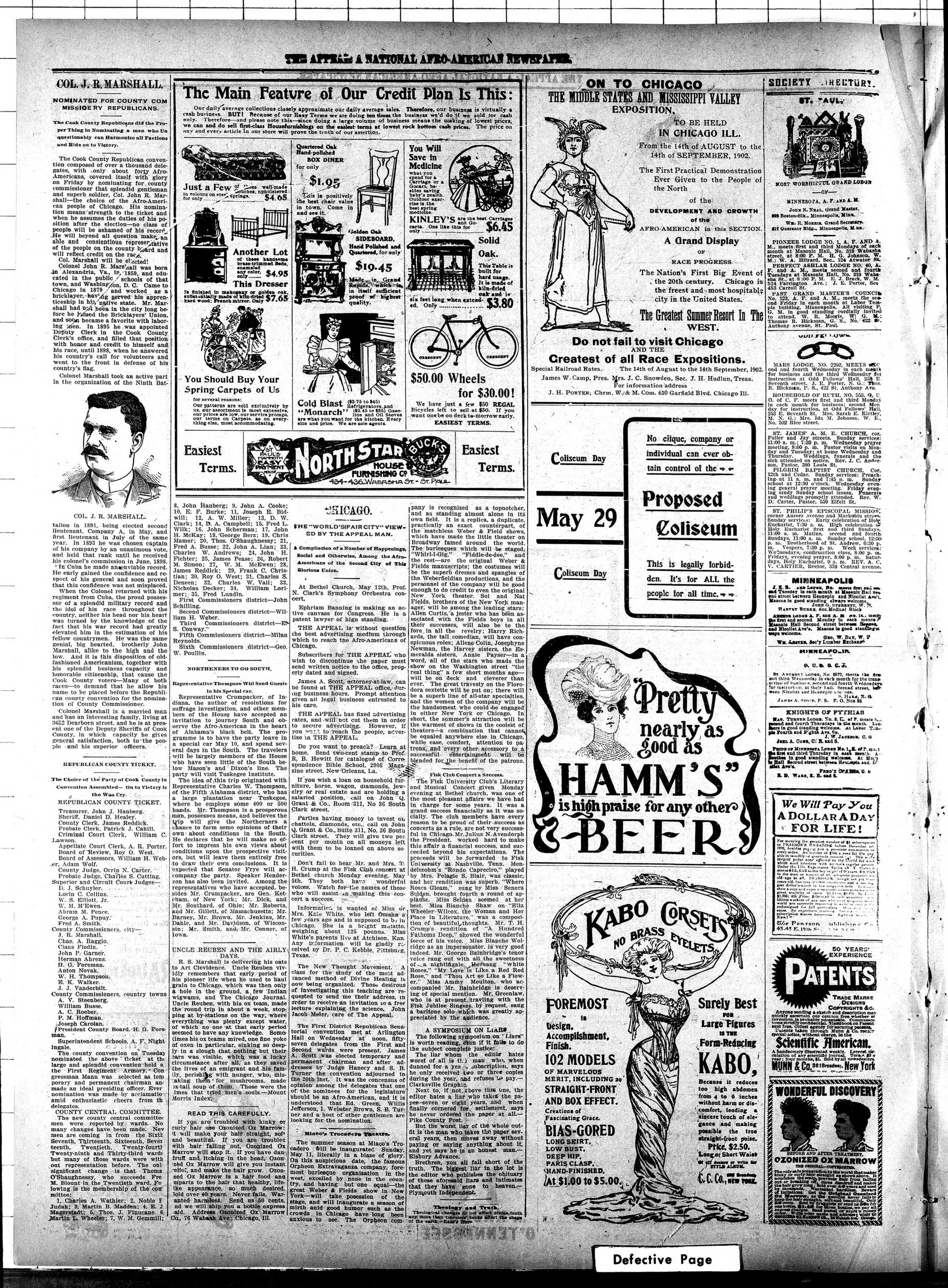
COL. J. R. MARSHALL.
COL. J. R. MARSHALL.
NOMINATED FOR COUNTY COMMISSIONER REPUBLICANS.
The Cook County Republican did the Proper Thing in Nominating a man who I questionably can Harmonize all Factions and Ride on to Victory.
The Cook County Republican convention composed of over a thousand delegates, with only about forty Afro-American candidates on Friday by nominating for county commissioner that splendid gentleman and super soldier, Col. John R. Marshall—the choice of the Afro-American people of Chicago. His commission means strength to the ticket and when he assumes the duties of his position after the election—no class of people will be ashamed of his record, and no class of people will be able and consentious repressive of the people on the county Board and will reflect credit on the race.
Colonel John R. Marsh "became born in Alexandria, Va., in 1859, and educated in the public schools of town, and Washingon, D.C. Came to Chicago in 1879 and worked as a bricklayer, hav'g arrived his apprentice, have'g negative state. Mr. Marshall had nix'd his job, before he joined the Bricklayers' Uniform and soon became a favorite with laboring Deputy Clerk in the Cook County Clerk's office, and filled that position with honor and credit to himself and his race, until 1888, when he answered the call for volunteers and went to the front in defense of his country's flag. Colonel Marshall took an active part in the organization of the Ninth Natt-
COL. J. R. MARSHALL.
tation in 1891, being elected second lieutenant, Company A, in May, and first lieutenant in July of the same year. In 1893 he was chosen captain of his company by an unanimous vote, and held that rank until he received his colonel's commission in June. 1898. In Crane he made an enviable record. He early gained the confidence and respect of his general and soon proved that this confidence was not misplaced.
When the Colonel returned with his regiment from Cuba, the proud possessor of a splendid military record and a military training ground in country, neither his head nor his heart was turned by the knowledge of the fact that his war record had greatly increased in the estimation of his fellow country, his general, big hearted, brotherly John Marshall, alike to the high and the low. And it is this disposition of old-fashioned Americanism, together with his honorable citizenship, that cause the Cook County voters—Many of both races—to demand that he allow his name to be placed before the Republican county convention for the nomination. Colonel Marshall is a married man and has an interesting family, living at 3652 Dearborn street, and he is at present one of the Deputy Sheriffs of Cook County, with general satisfaction, both to the people and his superior officers.
REPUBLICAN COUNTY TICKET.
REPUBLICAN COUNTY TICKET.
Criminal Court Clerk, William C.
Lawson.
Appellate Court Clerk, A. R. Porter.
Board of Review, Roy O. West.
Boston Assessors, William H. Weber.
Adam W. Wiley.
County Judge, Orrin N. Carter.
Probate Judge, Charles S. Cutting.
Superior and Circuit Court Judges—
D. J. Schuyler.
Lionel Collins.
W. S. Ellott Jr.
W. M. M'Ewen.
Abram M. Pence.
George A. Puppy.
Fred A. Spell.
County Commissioners, city—
J. R. Marshall.
Chas. A. Raggio.
Claus Floodin.
John P. Garner.
Horma H. Havenus.
H. G. Foreman.
Auton Novak.
W. H. Thompson.
E. W. Walker.
J. V. Janderbilt.
County Commissioners, country towns
A. V. Steenberg.
Superintendent Schools, A. F. Night ingale.
The county convention on Tuesday nominated the above 'ticket' at the large and splendid convention held a week earlier at the gressman Mann was selected as temporary and permanent chairman amade an ideal presiding officer. Every nomination was made by acclamation with all爽 cheers from th delegates.
COUNTY CENTRAL COMMITTEE.
The new county central committee men were reported by wards. No more men are coming in from the Sixth Seventh, Thirteenth, Sixteenth, Seventh, Twentieth, Twentieth, Twenty-fourth, Twenty-ninth and Thirty-third wards. The new county central committee out representation before. The only significant change is that Thomas O'Shaughnessy, who succeeds Fre M. Blount in the Twentieth ward. Foe is the membership of the com-mittee.
1, Charles A. Wathler; 2, Noble F
Judah; 3, Martin B. Madden; 4, E. J
Magerstadt; 5, Thos. J. Flucane. 6,
Martin L. Wheeler; 7, W. M. Gemmill;
The Main Feature of Our Credit Plan Is This:
Our daily average collections closely approximate our daily average sales. Therefore, our business cash business. BUT! Because of our Easy Terms we are doing ten times the business we'd do if we only. Therefore—and please note this—since doing a large volume of business means the making of we can and do sell first-class Housefurnishings on the easest terms at lowest rock bottom cash prices. any and every article in our store will prove the truth of our assertion.
ST. PAUL'S
MARSHMOUTH
EASY
PAINTING
HOUSE
NORTH STAR
BUCKS
HOUSE
FURNISHING CO.
434-436 WABASHA ST. ST. PAUL
Just a Few of these well-made
in volours on steel springs... $4.65
Collocates, upholstered
for only... Another Lot
of these handsome
brass-framed Beds,
enclosed
any color... $4.95
This Dresser
Another Lot
of these handsome
brass-trimmed Beds,
but only any color,
$4.95
this .....
This Dresser
Is finished in mahogany golden oak,
substantially made of kiln dried
hard wood; French mirror. Only $7.65
You Should Buy Your
Spring Carpets of Us
for several reasons:
Our patterns are sold exclusively by
our own company. Our prices are low. Our services prompt,
our terms on Carpets are on every
thing else, most commercial
8. John Hanberg; 9. John A. Cooke;
10. E. F. Burke; 11. Joseph E. Bidwill;
12. A. W. Miller; 13. D. W. Clark; 14. D. A. Campbell; 15. Fred L. Wilk; 16. John Scherman; 17. John W. Clark; 18. John Mamer; 19. Thos. O'Shaughnessy; 21. Fred A. Busse; 22. John A. Linn; 23. Charles W. Andrews; 24. John H. Fichter; 25. James Pease; 26. Robert M. Simon; 27. W. M. McEwen; 28. James Reddick; 29. Frank C. Christian; 30. Roy O. West; 31. Charles V. Ward; 32. Nicholas Decker; 34. William Lorimer; 35. Fred Lundin.
First Commissioners district—John Schilling.
Second commissioners district—William H. Weber.
Third Commissioners district—E.S. Conway.
Fifth Commissioners district—Milan Sixth Commissioners district—Geo W. Poullin.
NORTHENERS TO GO SOUTH,
Representative Thompson Will Send Guests in his Special car.
Representative Crumpacker, of Indiana, the author of resolutions for suffrage investigation, and other members of the House have accepted an offer to serve as the chair of the serve the Afro-American in the heart of Alabama's black belt. The programme is to have the party leave in a special car May 10, and spend several days in the South. The travelers will be largely members of the House and will be allowed to leave Mason's and Dixon's line. The party will visit Tuskegee Institute.
The idea of this trip originated with Representative Charles W. Thompson, of the Fifth Alabama district, who has a large plantation near Tuskegee, Alabama, and hands. Mr. Thompson is a prosperous man, possesses means, and believes the trip will give the Northerners a chance to own about conditions in South. He declares that he will make no effort to impress his own views on conditions upon the prospective visitors, but will leave them entirely free to explore. He expected that Senator Frye will accompany the party. Speaker Henderson has also been invited. Among the representatives who have accepted, beckoned, or chamod, of New York; Mr. Dick, and Mr. Southard, of Ohio; Mr. Roberts, and Mr. Gillett, of Massachusetts; Mr. Barney, Mr. Brown, Mr. Jenkins, Mr. and Mr. Daleon, of Wisconsin; Mr. Smith, and Mr. Connor of Iowa.
UNCLE REUBEN AND THE AIRLY DAYS.
R. S. Marshall is delivering his oats to Art Clevidence. Uncle Reuben vividly remembers that early period of his pioneer life when he used to haul his oats from the field to a hole in the ground, a few Indian wigwams, and The Chicago Journal. Uncle Reuben, with his ox team, made the round trip in about a week, stopping at every point, everything was plenty except water, of which no one at that early period seemed to have any knowledge. Sometimes his ox teams mired, one fine oke of oxen in particular, shaking so deep that the oke cars was visible, which was a lucky circumstance after all, as they saved the lives of an emigrant and his family, perishing with hunger, who misplaced their axe-tail soup of them. Those were the times that tried men's souls—Mount Morris Index.
READ THIS CAREFULLY.
If you are troubled with kinky or curly hair use Ozonized Ox Marrow: it will make your hair straight, soft and beautiful. If you are troubles with hair color, Ozonized Ox Marrow will stop it. If you have dandruff and itching in the head, Ozonized Ox Marrow will give you instant lice, and make the hair grow. Ozonized Ox Marrow compacts to the hair that healthy, life-like appearance, so much desired, hold over 40 years. Never fails. Wanted harmless. Send us 50 cents. Mail to: Address Ozonized Ox Marrow Cd, 76 Wabash Ave, Chicago, Ill.
THE AFTERNOON A NATIONAL AFRO-AMERICAN NEWSPAPER
```markdown
```
A
Made in Grand Rapids, which in itself sufficient proof of highest quality.
Cold Blast ($3.75 to $45) for liquor and "Monarch" ($2.45 to $85) Gasoline and Oil Stores are what you want for the kitchen. Every size and price. We are sole agents.
CHICAGO.
THE "WORLD'S SIPAIRCITY" VIEWED BY THE APPEAL MAN.
A Compilation of a Number of Happenings, Social and Otherwise, Among the Afro-Americans of the Second City of This Glorious Union.
At Bethel Church, May 12th, Prof. N. Clark's Symphony Orchestra concert.
Ephiam Banning is making an active canvass for Congress. He is a patent lawyer of high standing.
THE APPEAL is without question the best advertising medium through which to reach the Afro-Americans of Chicago.
Subscribers for THE APPEAL who wish to discontinue the paper must send written notice to the office, properly dated and signed.
James A. Scott, attorney-at-law, can be found at THE APPEAL office, during business hours. Prompt attention given all legal business entrusted to his care.
THE APPEAL has fixed advertising rates, and will not cut them in order to secure advertising. However, if you want the people, advertise in THE APPEAL.
Do you want to preach? Learn at home. Send two cent stamp to Prof. R. B. Hewitt for catalogue of Correspondence Bible School, 2008 Magazine street, New Orleans, La.
If you wish a loan on household furniture, horse, wagon, diamonds, jewelry or real estate and are holding a loan, you can contact No. 36 South Grant & Co. Room 311, No 36 South Clark street.
Parties having money to invest in chattels, diamonds, etc. call on John Q. Grant & Co., Suite 311, No. 36 South Clark street. They will give two per cent loan to money to move with them to be loaned on above securities.
Don't fall to hear Mr. and Mrs. H. Crump at the Fisk Club concert at Bethel church Monday evening, May 5th. They both have wonderful stories for the names of those who will assist in making this concert a success.
Information, is wanted of Miss or Mrs. Kate White, who left Ommaa a few years ago and is supposed to be in Chicago. She is a bright mattoon. Miss White is a pousa. Miss White's parents live at the mansion. Any information will be gladly received by Dr. P. C. Kebble, Pittsburg, Texas.
The New Thought Movement. A class for the study of the most advanced method of Divine Healing is now being organized. Those desirous of investigating this teaching are requested to send me their address, in writing, to the Institute of lecture explaining the science, John Jacob Meler, care of The Appeal.
The First District Republican Senatorial convention met at Arlington Hall on Wednesday at noon, fifty-seven delegates from the First and Second Districts, James A. Scott was elected temporary permanent chairman and after addresses by Judge Haney and S. B. Turner the convention adjourned to the 20th inst. It was the concenus of the nominees for the legislature should be an Afro-American, and it is understood that Ed. Green, Willis Jefferson, I. Webster Brown, S. B. Turner and a host of other gentlemen are looking for the nomination.
Misico's Trocadero Theatre.
The summer season at Misco's Trocadero will be inaugurated Sunday, May 11, literally in a blaze of glory. On this auspicious date, the famous Orpheon Extravaganza company, foremost exile organization in the world, will host a theatre, and having but one equal—the great Weber & Fields show in New York—will take possession of the stage and will inaugurate a season of the Orpheon Extravaganza with crowds in Chicago have long anxious to see. The Orpheon com-
Therefore, our business is virtually a business we'd do if we sold for cash is means the making of lowest prices, rock bottom cash prices. The price on
You Will Save in Medicine what you bought for a Carriage or a baby's slides saving baby's health outdoor exercise is the spring medicine
KINLEY'S are the best Carriages with 100 carts. One like this for only $6.45
Solid Oak. This Table is built for hard usage. It is made of kints-dried
ORBICENT ORBICENT
We have left a few $50 REGAL Bicycles left to sell at $80. If you want one be on deck to-morrow early, EASIEST TERMS.
Easiest Terms.
pany is recognized as a topnotcher, and as standing almost alone in its own field. It is a replica, a duplicate, practically an exact counterpart, of the matchsheet. Weber & Field shows, the Broadway famed around the world. The burlesques that will be staged, "Whirl-I-Gig," "Fiddle-de-dee," and the rest—are the original Weber & Fields manuscripts; the costumes will span the Broadway, spanning the Weberfieldian production and the personnel of the company will be good enough to do credit to even the original New York theater. Sol and Nat Fields, brothers of the New York manhunters, will be stars; Allen Curtis, a jester who has been associated with the Fields boys in all their successes, will also be to the fore in all the revelry; Harry Richards, the tall comedian, will have contempt for the Newman, the Harvey sisters, the Esmeralda sisters, Annie Payser—in a word, of the stars who made the show on the Washington street "the real thing" a few short months ago—and will be the ever. The great travesty on the Florodora sextette will be put on; there will be a superb line of all-star specialties, and the women of the company will be the handsomest who could be engaged in the show. Short, the summer's attraction will be the warmest of shows in the coolest of theaters—a combination that cannot be equaled anywhere else in Chicago, while ease, comfort, attention to patrons, and every other accessory to the theater will be blended for the benefit of the patrons.
Fisk Club Concert a Success.
The Fisk University Club's Literary and Musical Concert given Monday evening at Bethel church, was one of the most pleasant affairs we have had in charge for some years. It was a grand success financial事件. It was so good that the members have a reason to be proud of their success as concerts as a rule, are not very successful in Chicago. Mr. Julius N. Avendorph, the President, worked hard to make this affair a financial success, and succeeded beyond his expectations. The first video with the Bandner was at the University at Nashville, Tenn. Mendelssohn's "Rondo Capreiro," played by Mrs. Pelagie S. Blair, was classic, and her rendition was superb. "Where Roses Gleam," sung by Miss Senora Selden brought forth a round of applause. Miss Selden seemed at the time Miss Blain, the Shark of the Wheeler-Wilcox, the Woman and Her Place in Literature," was a composition of beautiful thoughts. Mr. T. H. Crump's rendition of "A Hundred Fathoms Deep," showed the wonderful force of his voice. Miss Blanche was a firm friend of the Bandner. Mr. George Balnbridge's tenor voice rang out with all the sweetness of a nightingale. "His sang " white Roses," "My Love is Like a Red Rose," and "Thou Art so Like a Flower." Miss Ammy Morton, who proposed a new Balnbridge is deserving of the special mention. Mr. Greenlaw, who is at present traveling with the Fisk Jubilee Singers, by request, sang a baritone solo which was greatly appreciated by the audience.
The following symposium on "Ilarr"
to the subject, complete lectures.
The liar whom the editor hates worst of all is th. man who, when dunned for a yea. subscription, says he only received two or three copies during the year, and refuses to pay. Clarksville Graphic. He bites this one, the editor hates a liar who takes the paper-seven or eight years, and when finally cornered for settlement, says he never ordered the paper at all. Pike County Post. But the worst liar of the whole outfit is the man who takes the paper sev. and the man who pays or saying anything about it, and yet says he is an honest man. Elsbury Advance.
Brehren, you all fall short of the truth. The biggest lurin in the lot is the editor who publishes the obituary of these aforesaid liars and intimates that they have gone to heaven—Pymuth independent.
Theology and Truth.
Theology and Truth. The obituary of these aforesaid liars and intimates that they have gone to heaven—Pymuth independent.
Theology and Truth.
The obituary of these aforesaid liars and intimates that they have gone to heaven—Pymuth independent.
The Greatest Summer Resort In The
WEST.
fail to visit Chicago
AND THE
of all Race Expositions.
The 14th of August to the 14th September, 1902.
Mrs. J. C. Snowden, Sec. J. H. Hudlun, Treas.
For information address
W. & M. Com. 610 Garfield Blvd. Chicago Ill.
Do not fail to visit Chicago
Special Railroad Rates. The 14th of August to the 14th September, 1902.
James W. Camp, Pres. Mrs. J. C. Snowden, Sec. J. H. Hudun, Treas.
For information address
J. H. PORTER; Chrm. W.& M. Com. 610 Garfield Blvd. Chicago Ill.
Proposed Coliseum
"Pretty nearly as good as
MM'S"
raise for any other
BEER
ABO CORSETS
NO BRASS EYELETS
"Pretty nearly as good as
HAMM'S"
is high praise for any other
BEER
KABO CORSETS
NO BRASS EYELETS
Defective Page
A
Do not fail
Greatest of all
Special Railroad Rates. The 1
James W. Camp, Pres. Mrs. J.
For inf
J. H. PORTER, Chrm. W. & M
Coliseum Day
May 29
Coliseum Day
HAM
is high praise
BE
FOREMOST
Design,
Accomplishment,
Finish.
102 MODELS
OF MARVELOUS
MERIT, INCLUDING 20
STRAIGHT-FRONT
AND BOX EFFECT.
Creations of
Fascinating Grace.
BIAS-GORED
LONG SKIRT,
LOW BUST,
DEEP HIP,
PARIS CLASP,
HAND-FINISHED.
At $1.00 to $5.00.
Defe
DEVELOPMENT AND GROWTH of the AFRO-AMERICAN in this SECTION
A Grand Display
The Nation's First Big Event of the 20th century. Chicago is the freest and most hospitable city in the United States.
No clique, company or
individual can ever ob-
tain control of the
This is legally forbiden. It's for ALL the people for all time.
```markdown
```
K
MINNESOFA, A. F. AND A. M.
Joe N. NAIL, G. Grand Master.
Boston-Bilton, Minneapolis, Minn.
Wm. R. MORRIS, Grand Secrery.
GURTANY Bldg., Minneapolis, Mn.
PIONEER LODGE NO. 1, A. F. AND A. M., meets first and third Mondays of each month at Mascall Hall, No. 313 Wabash, M. W.; W. M. Hilyard, Sec. 124 Waterst. PERECT ASHLAR LODGE NO. 40, A. F. AND A. M., meets Tuesday at Mascall Hall, No. 313 Wabash, M. W.; W. M. Hilyard, Sec. 124 Farrington Ave.; J. E. Porter, Sec. 453 Carroll St.
PERECT ASHLAR MASTER'S COUNCIL NO. 122, A. F. AND A. M., meets the second Friday in each month at Labor Tem-
pory, Minneapolis, A. Visiting F. G. in good standing invited to attend. W. G. in good standing invited to attend. H. Hickman, Morris, W. G. in good standing invited to attend. M. Hickman, Morris, W. G. in good standing invited to attend. St. Paul.
MARS LODGE, NO. 2202, MEETS W.C. and fourth Wednesday in each month for business and the third Wednesday for instruction at Odd Fellows' Hall, 259 E. Seventh street, J. E. Porter, N. G.; Thos. R. Hickman, P. S., 422 St. Anthony Ave.
HOUSEHOLD OF RUTH, NO. 533, G, C O. of C. F. meets first and third Monday in each month for business; second Monday for instruction at Odd Fellows' Hall, 253 E. Seventh St. Mrs. Sarah E. Kirtley, M. N. G.; Mrs. Ida M. Johnson, W. R. No. 592 Rice Street.
ST. JAMES' A. M. E. CHURCH, cor. Fuller and Jay streets. Sunday services: 11:00 a.m. to 7:30 p. m. Wednesday prayer meeting: 8:00 p. m. Pastor's visits day and Tuesday at home Wednesday and Thursday. Weddings, funerals and the sick attended on notice. Rev. J. C. Anderson, Pastor, 350 Louis St.
PILGRIM BAPTIST CHURCH, Cor. 12th and Cedar. Sunday services: Preachham, St. Louis, and 1:45 p. m. Sunday school at 12:30 p.m. Wednesday evening general prayer meeting. Friday evening study Sunday school lesson. Funerals and weddings promptly attended. Rev. W. D. Carter, Pastor, 539 Elfelt St.
ST. PHILIP'S EMPISCAL MISSION
corner Aurora avenue and Mackinab street
Early celebration of Hoy
Eucharist, 7:30 a.m.
Early celebration of Hoy
Eucharist first and third Sunday,
1:00 a.m. m. Mattsa, second and fourth
Sunday, 1:00 a.m. m. Mattsa, second and fourth
m. Brotherhood of St. Andrew, 6:30 p.
m. Vespers, 7:30 p. m. Week services:
8:00 p. m. Fridays, 8:00 p. m. Fridays, 8:00 p. m.
Days, Holy Eucharist, 9 n. m. REV. A. C.
V. CARTIER, Rector, 750 central Avenue
MINNEAPOLIS
J. K. R., and Loren, R. moea first and second Tuesday in each month at Massonie Hall Secondary Street between Hennepin and Nicollet Ave's.
Massons in good standing always welcome
John G. STERRETT, W.
Harvey Burke, Sec. Medical Block
ANDREW LODGK, F. and A. M. no. 14, must the first and second Monday in each month
Masson Hall Second street between Hoxne and Nicollet Ave's. Massons in good standing always welcome.
a. b. a. a. c. a.
By Anthony Wongen, No. 8577, meets the first three Wongen, on second and fourth Wednesday for instruction, at their tail. Second street, between Nicole and Helen, is Nicole's house. N. Hale, N. Hale.
KNIGHTS OF PYTHIAG
May. Truckon Lounge. No. 2. K. of. P. men's
second and fourth Thursdays in the month. Laye
found good standing welcome. At Laye Truckon
Fountain. G. R. of. J. W. JACKSON. C. G.
JOHN A. GARL. G. R. 18.
Friend of Merrimack Lounge. No. 1. K. of. P. men's
first and third Thursdays in each month. A
bother in good standing welcome. At Minty
Broad street second between Hewlett and
old Avene.
Friend of Chelsea G. 4
R. D. WARS. K. R. and 6.
We Will Pay You
A DOLLAR A DAY
FOR LIFE!
For warning the greatest number of $1 subscriptions to TEALSON'S MAZING Inform Decements in 1992, besides paying for a new serious commission on every order. An income of $100 a year for life, payable in monthly or quarterly increase. This is the largest price ever offered in the world for each which need interview with no more regular profit under the life's Expatriancy Tales (N.Y. States) means $13,602 to the boy or girl of 19 years, $0.128 to the man or woman of $1,000, and $0.128 to the old age to $1,000. The most姆's change was paid for 10 years old, has never been a question until in the last year's post-dollar search in New England. The most they show a copy and explain the results of the report and the majority of others $1,000, $1,000. In 1992, the $1 million workers' share-all-to-each another billion workers' work wasால் when the cost was not as high as currently expected, and are currently expected to be used to be designed for full particulars of the region. No experience is required.
In the last year's post-dollar search in New England, the report is now available for the New England Public Pension Association.
50 YEARS' EXPERIENCE
PATENTS
TRADE MARKS
FOR USE
COPYRIGHTS & C.
Anyone sending a sketch and description may qualify for patent. Invention is probably passable. Communicate it freely. Lorem ipsum dolor sit amet, consectetuer adipiscing elit. Ut leo, lobortis, lobortis, lobortis, rec- special police, without charge, in the
Scientific American.
A handsomely illustrated weekly. Lorem for patent. Invention is probably passable. Communicate it freely. Lorem ipsum dolor sit amet, consectetuer adipiscing elit. Ut leo, lobortis, lobortis, lobortis, rec- special police, without charge, in the
MUNN & Co 3818 broadway, New York
WONDERFUL DISCOVERY