The Appeal
Saturday, July 19, 1902
St. Paul, Minnesota
Page text (machine-generated)
THE APPEAL STEADILY GAINS
BECAUSE
1-It aims to publish all the news possible.
2-It does so impartially, wasting no words.
3- Its correspondents are able and energetic.
N. A. A. C.
The National Afro-American Council.
OFFICERS OF THE NATIONAL AFRO-AMERICAN COUNCIL.
At the meeting of the National Afro-American Council held in St.
Paul, Minn., July 9, 10, 11, 1002, the following officers were elected:
President—T. Thomas Fortune, New Jersey.
First Vice President—William A. Pledger, Georgia.
Second Vice President—William H. Steward, Kentucky.
Third Vice President—George White, District of Columbia.
Fourth Vice President—C. Dawey, North Carolina.
Fifth Vice President—B. Scott, Texas.
Sixth Vice President—H. T. Johnson, New Jersey.
Seventh Vice President—E. H. Deas, South Carolina.
Eighth Vice President—Charles W. Scratchin, Minnesota.
Ninth Vice President—Mrs. J. Rerome Jeffrey, New York.
Secretary—M. J. Nielsen Adams, Illinois.
Financial Secretary—F. L. Gibbons, Minnesota.
Corresponding Secretary—Mrs. Fannie Barrier Williams, Illinois.
Assistant Secretary—Miss Martha V. Webster, Kentucky.
Treasurer—John W. Thompson, New York.
National Organizer—George W. Clinton, North Carolina.
Sergeant-at-Arms—J. H. Dillingham, Minnesota.
Chaplain—Rev. Walter Brooks, District of Columbia.
Director of Bureaus.
Education—W. T. Wern, Kansas.
Legal—J. Madison Vance, Louisiana.
Business—Emmett J. Scott, Alabama.
Ecclesiastical—M. C. B. Mason, Ohio.
Emigration—Nelson Crews, Missouri.
Literary—Mrs. J. St. P. Ruffin, Massachusetts.
Literary—Mrs. B. I. Ruffin, Illinois.
Newspaper—P. J. Smith, Massachusetts.
Vital Statistics—Dr. J. E. Porter, Minnesota.
Executive Committee.
Chairman—Alexander Walters.
Secretary—Cyrus Field Adams.
T. THOMAS FORTUNE
VOL. 18. NO. 29.
N.A.A.
The National
Coun
OFFICERS OF THE NATION
At the meeting of the National
Paul, Minn., July 9, 10, 11, 1902,
President—T. Thomas Fortune
First Vice President—W. T. J.
Second Vice President—William
Third Vice President—George
Fourth Vice President—John
Fifth Vice President—I. B. Scott
Sixth Vice President—H. T. J.
Seventh Vice President—E. H.
Eighth Vice President—Charlie
Ninth Vice President—Mrs. R.
Secretary—Cyrus Field Adams
Financial Secretary—F. L. Mc
Corresponding Secretary—Miss Ma-
tressuer—John W. Thompson
National Organizer—George W.
Sergeant-at-Arms—J. H. Dillin
Chaplain—Rev. Walter Brooks
Doctorer
Education—W. T. Vernon, R.S.
Legal—J. Madison Vance, Lou-
Business—Emmett J. Scott, Al-
Ecclesiastical—M. C. B. Mao
Emigration—Nelson Crews, M.
Miliary—Anti-Lynching—M. I. B.
Newspaper—P. J. Smith, Mass.
Vital Statistics—Dr. J. E. Port-
Executive
Chairman—Alexander Walters
Secretary—Cyrus Field Adams
WEDNESDAY, JULY 9TH
There was a much larger attendance there had been anticipated at the opening of the National Afro-American council in the city. The hall was well filled with bright men and women, representative of all the business and professional as well as religious and educational organization. The mission of the council is to elevate the status of women and especially to aid the walks of life, and especially to aid the members of the race in the south, to more circumscribed than in the north. The council is a national federation of women of kind and shape, and it is the leaders in these organizations who represent them. The assemblage was composed of as many a body of men and women as could actively, thinking members of the race, to advance of their people, intellectually, industriously politically and religious. The early session was devoted to addresses and responses. Mr. Smith welcomed the delegates on behalf of the city.
Rev. J E Mason, of North Caroline, respond-
ed, In which he referred to the progress made by the Afro-Americans in religion as well as in education and wealth since they had become freemen. He spoke particularly of their religious advancement in the days their religion had been mostly classed as a part of the paganism, and it was true that it had consisted largely of sentimentalism for which no one could give a good reason. That religion had been replaced by one based on principle and common sense. With education had come a higher standard of morals generally and a higher condition of education. The education of teachers and workers were laboring of a higher and broader development of the race in all lines.
Gov. Van Sant welcomed the delegates on behalf of the people of the state.
The delegates rose in a body and saluted the governor as he advanced to the front of the state.
Among other things the governor said: The colored people have done much for the development of this country since they were granted their freedom. The progress they have made in educator and the development of the qualities which make for good American citizenship, has never been equaled in history.
The Civil War. When the order of Lincoln that the negroes should be armed as soldiers was read, I stepped out and proposed three cheers. There was not a response from my regiment. A short time after a black brigade saved that regiment from annihilation. Then there were few in the negroes and they were given with a will.
We are glad to welcome you to Minnesota. We rejoice at the progress you made in our work. We are glad to just one way to secure and maintain the place you want among the citizens of this country, and that is by work. It is a space that all must pay for advancement.
Harry Shepard welcomed the delegates on behalf of the villains, Rev. R. Porter, on behalf of the ladies, and Rev. Timothy Reeves for the churches.
F. Thomas Portacio, chairman of the executive committee, spoke briefly of the work that had been done by the league.
THE SCHOOL FOR THE BLACKS
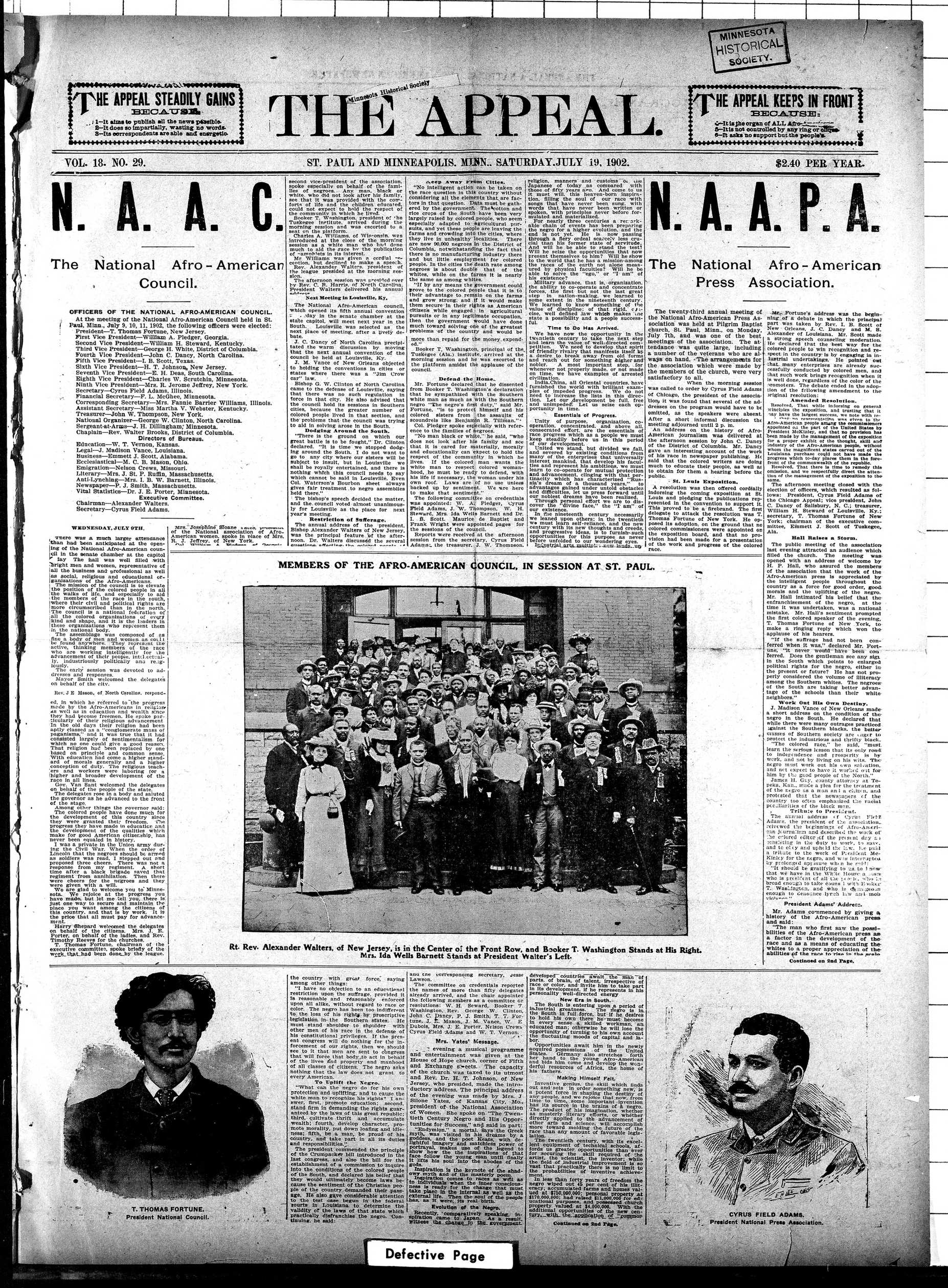
Rt. Rev. Alexander Walters, of New Jersey, is in the Center of the Front Row, and Booker T. Washington Stands at His Right. Mrs. Ida Wells Barnett Stands at President Walter's Left.
Mrs. Josephine Stearn and of AFO
of the Mrs. Josephine Stearn and of AFO
of the Mrs. Josephine Stearn and of AFO
Mrs. R. Q. Jertwyn of New York
Mrs. R. Q. Jertwyn of New York
THE APPEAL.
second vice-president of the association, and vice-president of the league of negroes. Any man, black or white, who did not look after his family, could not expect to hold the respect of a Booker T. Washington, president of the association, for the forts of life and the children educated could not expect to hold the respect of a Booker T. Washington, president of the association, for the morning session and was escorted to a seat on the platform. The association was introduced at the close of the morning session at Wisconsin, which much to aid the race by the publication of *nambles* in its interest. The association, by decoration, but declined to make a speech. The league pressed at the morning session the afternoon session was pressed over by Rev. C. R. Harris, of North Carolina, President Walters delivered his annual
Next Meeting in Louisville, Ky.
The National Afro-American council, which opened its fifth annual convention, day in the senate chamber at the South. The next year in the South. Louisville was the next place of meeting, after a lively debate. C. Dancy of North Carolina preplated the warm discussion by moving that the next annual convention of the council be held at Louisville. Ky. C. Dancy of North Carolina decided to hold the conventions in cities or states where there was a "Jim Crow" law. G. W. Clinton of North Carolina came to the defense of Louisville, saying that there was no such regulation in force in that city. He also advised that the conventions be held in cities, because the greater number of colored people lived in that section, and the problems that the council was trying to address arose in the South. Dodds of Louisville. "There is the ground on which our great battle is to be fought." Dr. Clinton says we must be entertained and there is nothing which cannot be go to any city where our sisters will be subject to insult, but in Louisville we must be entertained and there is nothing which cannot be said in Louisville. Even Col. Waterson's Bourbon sheet always required treatment to negro assemblies held there.
The bishop's speech decided the matter, and the council voted almost unanimously to next year's meeting. The annual address of Suffrage. The annual address of the president, Bishop Alexander Walters of New Jersey, noon. The annual address of noon. Dr. Walters discussed the several
MEMBERS OF THE AFRO
Under Walters, of New Jersey, is in
Mrs. Ida We
the country with great force, saying among other things;
"I have no objection to an educational restriction upon the suffrage, provided it all alike, without regard to race or color. The negro has been too indifferent by prescriptive legislation in the South. We must stand shoulder to shoulder with other men of his race in the defense of our rights, then we should not congress that will force that body to act on the lives and property and manhood will classes of citizens. The negro asks not law does not grant to every American To Uplift the Negro.
"What we have in his own protection and uplifting, and to cause the white man to recognize his rights? I answer, we must stand firm in demanding the rights anteceded by the laws of this great republic; we must develop and accumulate wealth; fourth, develop morality, put down loafing and idleness; fifth, be a man, be proud of his work, be part in all its duties and responsibilities."
The president commended the principle of the Crumpacker bill in response to the last congressional bill for the establishment of a commission to inquire into the conditions of the colored people of the South, and declared his belief that they would ultimately become laws because the sentiment of the Christian people of the country demanded their passage. He also gave considerable attention to the test case begun in the federal courts of Alabama, and defined the validity of the laws of that state practically disfranchise the negro. Continuing, he said:
Def
"No intelligent action can be taken on the race question in this country without considering all the elements that are factors in that question. Data must be gathered by the government. The cotton and rice crops of the South have been very largely raised by colored people, who seem especially adapted to agricultural pursuits, and yet these people are leaving the farms and crowding into the cities, where they live in unhealthy localities. There are now 90,000 negroes in the District of Columbia, notwithstanding the fact that there is no manufacturing industry there and but little employment for colored people. In the cities the death rate among negroes is about double that of the whites, while on the farms it is nearly the same as among whites."
"If by any means the government could prove to the colored people that it is to their advantage to remain on the farms and grow strong, and if it would make them secure in their rights as American citizens while engaged in agricultural pursuits or in any legitimate occupation, then the government would have done much toward solving one of the greatest problems of the country and would be more than repaid for the money expended."
more than repaid for the money, expended.
Booker T. Washington, principal of the Tuskegee (Ala.) institute, arrived at the university in 1915, and became the platform amidst the applauses of the students.
Defend the Home.
Mr. Fortune declared, that he dissented from Booker T. Washington's declaration that he sympathized with the Southern negro "the negro's first duty," said Mr. Fortune, "to protect himself and his colored slaters from the assaults of the white men." Col. Pledger spoke especially with reference to the families of negroes.
"No man black or white," he said, "who did not care that it is cared for materially, morally and educationally can expect to hold the respect of the community in which he resides." The white man he must respect colored womanhood, he must be ready to defend, with his life if necessary, the woman under his care. He must be backed up by sentiment. We are here to make that sentiment.
His appointment committee on credentials was appointed Pledger, Cyrus Field Adam, J. W. Thompson, W. H. Steward, Mrs. Jia Wells Barnett and Dr. Frank Wright were appointed pages for the sessions of the council.
Reports were received at the afternoon Adams, the treasurer, J. W. Thompson,
AFRO-AMERICAN COUNCIL, N.Y.
y, is in the Center of the Front Row, Dla Wells Barnett Stands at President W
and the corresponding secretary. Jesse Lawson.
The committee on credentials reported the names of more than fifty delegates to the following members as a committee on resolutions: W. H. Seward, Booker T. Washington, Rev. George W. Clinton, John F. Kennedy, J. M. Fountue, J. E. Mason, J. M. Vance, W. E. Dubois, Mrs. J. E. Porter, Nelson Crews, Cyrus Flood Adams and W. T. Vernon.
Mrs. Yates' Message:
Evening a musical programme and entertainment was given at the House of Hope church, corner of Fifth and Eighth Streets, the capacity of the church was taxed to the president and Rev. Dr. H. T. Johnson, of New Jersey, who presided, made the introductory address. The principal address was made by Mrs. J Silone Yates of Kansas City, president of the National Association of Women. She spoke on "The Twentieth Century Negro and His Opportunities, success, and said in part, "Endymion." His career was in a myth, was visited in his work by a lightful imagery and matchless power of portrait, makes use of the legend of her face follow the young man until finally face follow his soul into the abodes of the gods.
Inspiration is the keynote of the aheadoview. Inspiration comes to races as well as as the change in the environment is ready for the change that must just place in the internal as well as the external environment of the people has, as it were, its real birth. Evolution of the Negro. Evolution of the inspired came to Japan. As a result, witness the change in the government.
Defective Page
religion, manners and customs o. use Japanese today as compared to Europe, and we must will, this heaven-born inspirational songs that have never been sung, with music that is not spoken, with principles never before formulated and materialized. These stories a remarkable chain of events has been preparing and is not yet. He is now passing through a fiery ordeal scarcely less crucible. And will he be able to stand the test? Will he be able to present themselves to him? Will he show to the world that he has a mission among the people he is burdened by physical faculties? Will he be able to present the "go, or "I am of his existence? Military advance, that is, organization, forces, the first but not the second, some extent in the nineties learned to some extent in the nineties, well defined law which makes us state a possibility and a people success.
Time to Do Has Arrived.
We have now the opportunity in the twentieth century to take the next step in developing a national petition. We need to develop that spirit of friendly rivalry that manifests itself by the use of force and reach out for something higher and nobler. A most important step, for us, is to be able to work on time, we have examples of arrested civilization. All Oriental countries have furnished the world with brilliant examinations, we need not to increase lists in this direction. Let our development be free, full and secure. Let us seize each opportunity in time.
Essentials of Progress.
Unity of purpose, organization, co-ordination, conscientious effort, are the essentials of race progress which as a people we must use us in this period of our development.
United we stand, but divided we fall, and many of the enterprises that universally interest mankind, that develop his faculty and learn to co-operate for mutual protection and intimacy which has characterized "Russia's dream of a thousand years," to the extent that difficulties, let us press forward until we have been realized. Through personal experience we discover the "divine face," the "I am" of Russia. In the nineteenth century necessarily we met ourselves in the twentieth century with its self-created creeds and opportunities for this purpose as never before unfolded to our wondering eyes.
IN SESSION AT ST. PAUL
and Booker T. Washington Stan
Walter's Left.
developed countries await the man of
education, the man of color or race, and invite him to take
in his development. If he represents in his
personality, he may be invited to New Era in South.
The South is entering upon a period of
education, and the South in full force, but if he desires
to hold his own there he must become
educated; the South must be educated
educated; otherwise he will lose the
faultuating turn to his own account and
income. Opportunities await him in the
acquired possessions of the "United
Germany" also stretches forth her
hand, and bids him come and develop the woo-
dens of Africa, the home of his father.
Making Himself Felt.
Inventive genus, the skill which finds out and sets in. In order something new, is of any people, and we replace that destiny of any people, and we replace that from its time, some important invention has its source in the island of Crete. The product of his imagination, whether other directly applied to the advancement of other arts and science, will accomplish more than making the future race than any amount of favorable legislation. The twentieth century, with its excellent equipment of technical schools, affords the opportunity for securing the skill required of the artist, the scientist, the inventor; while the educational facilities vast that practically there is no limit to the probabilities of inventive achievement. In less than forty years of freedom the mercy, accumulated farms and homes valued personal property at $170,000,000; had personal property at $170,000,000; had possessed church educational purposes, and additional opportunities of the new century, with the application of "common
Continued on 2nd Page.
MINNESOTA
HISTORICAL
SOCIETY.
THE APPEA
B
4.
5-It is the organ
6-It is not control
6-It asks no sup
N. A. A
The National
Press As
The National Afro-American Press Association.
The twenty-third annual meeting of the National Afro-American Press Association was held at Pilgrim Baptist church, St. Paul, Minn., on Monday, July 7th, and was one of the best meetings of the association. The attendance was quite large, including a number of the veterans who are always on hand. The arrangements for the association which were made by the members of the church, were very satisfactory to all.
When the morning session was called to order by Cyrus Field Adams of Chicago, the president of the association, it was found that several of the addresses on the program would have to be omitted, as the speakers were absent. After a short informal discussion the meeting adjourned until 2 p. m.
An address on the history of Afro-American journalism was delivered at the afternoon session by John C. Dancy of the District of Columbia. Mr. Dancy gave an interesting account of the work of his race in newspaper publishing. He said that the colored writers are doing much to educate their people, as well as to obtain for them a hearing before the public.
St. Louis Exposition.
A resolution was then offered cordially indorsing the coming exposition at St. Louis and then made public, presented in the convention to support it. This proved to be a firebrand. The first delegate to attack a resolution was T. Thomas Fortune of New York. He opposed its adoption, on the ground that no colored commissioners were appointed on the commission board, and that no provision had been made for a presentation of the work and progress of the colored race.
L.
CYRUS FIELD ADAMS.
President National Press Association.
Mr. Fortune's address was the beginning of a debate in which the principal of New Orleans, J. C. Duncy and M. Alexander of Louisiana. Mr. Scott made a strong speech counseling moderation. He pointed out that many enterprises are pointed out that many enterprises are carefully conducted by colored men, and that such work brings recognition when it matters. The debate ended with promoters. The debate ended in the adoption of the following amendment to the original resolution Resolved. That while inloring on general knowledge has the largest success, we note with respect to the representation was given to the Afro-American appointed on the part of the United States by the United States Congress, made out of the work made by the management of the exposition for a proper exhibit of the thought, skill and experience could not have made the progress which could not have made the front of the commonwealth of the republic. Resolved. That there is time to remedy this complaint. That attention to the management of the expoitation to
The afternoon meeting closed with the election of officers, which resulted as follows: Mr. C. Dancy of Chicago Appeal; vice president, John C. Dancy of Sallisbury, N. C.; treasurer, William H. Steward of Louisville, Ky.; president, John C. Dancy of York; chairman of the executive committee, Emmett J. Scott of Tuskegee, Ala.
Hall Reises a Storm.
The public meeting of the association last evening attracted an audience which filled the church. The meeting was opened with an address of welcome by the president of the association that the work of the Afro-American press is appreciated by the intelligent people throughout the city, and the uplifting of the morals and the uplifting of the negro. Mr. Hall intimated his belief that the entrenchment of the negro, at the time of the mistake, Mr. Hall's sentiment prompted the first colored speaker of the evening. Thomas Fortune of New York, to whom the mistake which won the applause of his hearers.
"if the suffrage had not been been informed when it was," declared Mr. Fortune, when he arrived. Does the gentleman see any sighs in the South which points to enlarged political rights in negro, either in the future? We may consider the volume of litterary among the Southern whites. The negroes in the South are taking better advantages than their white neighbors." **For Out Our Own Dewnty** J. Mason Robinson made a short address on the condition of the negro in the South. He declared that we were many outrages practiced against the negro. We were many courses of Southern society are easier to protect the industrious and thirsty black. We must work on his schools to learn the serious lesson that its only route to independence and prosperity is by the negro must work out his schemes and not expect to have it worked out for him by the good people of the North." **Pea, Kan.** made a plea for the treatment of the negro as a man and a citizen, and asserted that the newspapers of the country were the racial peculiarities of the black man.
The annual address of Cyrus Pfeff Adams, the president of the association, relinquished the beginnings of Afro-American journalism and described the work of the enlaced editor of the present day as consisting in the duty to work, to save, and to cly and uphold the law. He said a tribute to the work of President McKinley for the negro, and was interrupted by prolonged applause when he said:
"It should be gratifying to us to know that we have in the White House a man who is president of all the people, who is broad enough to take counts with Barker T. Washington, and who is an American enough to genocide lyric law and mob violence."
President Adams' Address.
Mr. Adams commenced by giving a history of the Afro-American press and said:
"The man who first saw the possibilities of the Afro-American press as a factor in the development of the race and as a means of educating the whites to a proper appreciation of the abilities of the race to rise in the people."
Amended Resolution.
Hall Raises a Storm
President Adame' Address.
Continued on 2nd Page
HAVE YOU READ
THE APPEAL?
THE APPEAL,
A NATIONAL AFRO-AMERICAN NEWSPAPER
PUBLISHED WEEKLY BY
ADAMS BROS. EDITORS AND PUBLISHERS
49 B. 4th St., St. Paul, Minn.
ISSUED SIMULTANEOUSLY IN
Saint Paul, Minneapolis, Chicago,
Washington, Louisville, St. Louis.
ST. PAUL OFFICE,
No. 110 Union Blk. 4th & Cedar,
J. Q. ADAMS, Publisher.
MINNECAPOLIS OFFICE,
Guaranty Loan Bldg. Room 811
HENRY ROBERTS, Manager.
CHICAGO OFFICE,
823-5 Dearborn St., Suite 310,
C. F. ADAMS, Manager.
LOUISVILLE OFFICE,
No. 312 W. Jefferson St. Room
W. V. PENN, Manager.
ST. LOUIS OFFICE,
No. 1002 Franklin Avenue.
J. H. HARRISON, Manager.
TERMS, STRICTLY IN ADVANCE:
When subscriptions are by any means allowed
for 69 cents for each 12 weeks and 5 cents for
each odd week, or at the rate of $2.40 per
year.
Remissions should be made by Express
stamps for each 12 weeks and 5 cents for
each odd week, or at the rate of $2.40 per
year.
Gifted Letter or Bank Draft. Postage
stamps will be received the same as cash for
the functional gifted stamp. Only one
gifted stamp is given for gifted stamps taken.
Silver should never be sent through the mail.
It is almost sure to hone a hole through the
envelope. Persons who send silver to us in letters
must have a silver address in the mail.
Mortgage and death notice 10 lines or less $1.
Additional line cents. Payment
specially additional line cents. No payment
at all must come in season to be news.
Advertising notice. 15 cents per aisle line, each
an aisle line. No advertisement allowed
in an aisle line, and about seven words in an
aisle line. No single advertisement allowed
three months contract. Cash must accompany
the receipt of the application to us.
Further particulars on application.
Reading notice 25 cents per line, each insertion.
Each insertion must be in brewer type—about six
cents to the line. All head lines count
double.
The date on the address label shows when
the matter is set in brewer type—about six
cents to the line. All head lines count
double.
It occasionally事者 that papers sent to
sellers are lost or stolen. In case you do
not receive two weeks prior to expiration, so that
no paper may be missed, the paper stops
it. It occasionally事者 that papers sent to
sellers are lost or stolen. In case you do
not receive two weeks prior to expiration, so that
no paper may be missed, the paper stops
it.
Communications to receive attention must be written only upon one side of the paper; must reach us Tuesday if possible, anyway in the nature of the author. No manuscript returned, unless stamps are sent for postage. We do not hold ourselves responsible for the views of our correspondents. Write to us elsewhere. Write for terms. Codes copy free.
for terms. Sample copies free.
In every letter that you write us never fall to
the wrong hands. Write us, post office, county and state. Business
letters of all kinds must be written on
paper or envelope. Write us on mail or
master for publication. Entered as
second class matter at St. Paul, Minn.
AGENTS WANTED.
THE APPEAL wants good reliable
agents to canvass for subscribers as
points not already covered. Write
for our extraordinary inducements.
Address,
THE APPEAL,
to East 4th St., St. Paul, Minn.
SATURDAY, JULY 19, 1902.
The gathering of two of the Afro-American national organizations in St. Paul last week was an event of very considerable interest to Afro-Americans and to the whole people, as well. They brought together a large number of the thinkers and workers of the race, though, owing, doubled, to the distance of St. Paul from the thickly populated portions of the country, the number was somewhat smaller than it would have been in some city easier of access. It may be said, however, that the reception and treatment accorded the members of the National Afro-American Press Association and National Afro-American Council by the press and the people of the Twin Cities has never been equaled anywhere during the lives of the organizations. The homes of the people were thrown open to all comers and the various daily newspapers vied with each other in reporting the proceedings of the meetings. Special photographs of both organizations were published together with numerous portraits and sketches of the more prominent personages in attendance. The number of our fairer brothers and sisters, who were in attendance
PROGRAMME.
EVENING M
House of Hope Church,
Wednesday Even
Chorus—Hatelujah Chorus
Soprans—
Mrs. J. S. Harris,
Mrs. A. S. Weber.
Contralto—
Mrs. W. T. Francis,
Mrs. F. L. McLeese,
Mrs. J. C. Anderson.
Mr. Claude D. Ja-
Mrs. Lulu King.
Quartette—Come Holy Spirit
Introductory Address.....
Rev. Dr. H. T.
Solo—The Roosevelt
In English, Preen
Mr. Cyrus Flei.
Instrumental—Polonaisse in
26, No. 1).
Miss Hattie
Address—"The Twentieth
Opportunities for Success
Mrs. J. Silo
Instrumental—Overture.
19, No. 1, Ms. Mac
Address—"The Problem of
Prof. W.
Address.Hon. T. Thos. For
Benediction...
Thursday, July 10th, 8 P.M.
Chorus—The Lost Chord.
Instrumental—The Midsum
phrase) ..... Miss Mae.
Quartette—Lead, Kindly J.
Invocation.....Rev.
Chorus—Achieved is the G
Instrumental.....
Address.....Rev.
Address—Moral Country
Regeneration" .Mrs. J.
Benediction.....
Benediction.....Rt. Rev. C. R. Harris
at the meetings, was much larger than ever before, and our own people evinced an interest, as shown by their attendance at all meetings, which was a most encouraging feature. These meetings though at times somewhat turbulent owing to the presence of a few malcontents who, however, were not sufficient in number to either rule or ruin, must be productive of much good among all classes. A feeble attempt was made to inject politics into the proceedings of the council and attack the national administration, but fortunately it died a bornin'. On the whole the meetings were a grand success and there is every reason to feel gratified that they were held in the great Northwest.
The report of the common statistics sought to show of the prevailing belief that among negroes living in cities and cities made the city with an all-time, Mrs. Barnett's report of anti-lynching bureau stated things: "The true extent of anti-lynning cannot be told. The a colored man was found to be so very low in the right. He had been lynchmen, but when he was a him, or for what reason, discovered. For many years, I'm a faith of a lynchmen has been a faith of lynchings every year. To make shows to Jan. 1, 1992, lynchings since 1885 is 2.63 percent, and there was no effect on the overall status of the country. South and 14 in the North number, 107 were negroes. India and 12 Chinaman, crimes for which they were included only 27 cases of crim
In his address at the meeting of the National Afro-American Press Association, President Cyrus Field Adams paid a glowing tribute to President Roosevelt. He was interrupted by prolonged applause, when he said: "It should be gratifying to us to know that we have in the White House a man who is President of all the people, who is broad enough to take counsel with Booker T. Washington, and who is courageous enough to denounce lynch law and mob violence."
In the death of William Still, who was widely known as the father of the "underground railroad" the race loses one of its strong men. At the time of his death, which occurred in Philadelphia Monday, Mr. Still was 80 years old and left a fortune of about $1,000,000. He was a born slave but helped more than 10,000 slaves from bondage to freedom "over the "underground railroad."
"Character Building," by Booker T. Washington, Just published by Doubleday, Page & Co., New York, is made up of a selection of practical simple addresses which Mr. Washington has delivered on Sunday evenings to the students of Tuskegee Institute.
The Republican party has not done anything that it ought to have done so far as the race is concerned, but it is safer to trust than the Democratic party, which has opposed every movement for the amelioration of the condition of the Afro-American.
The Democrats thought they would bring out the anti-trust issue for the fall campaign, but President Roosevelt jumped their claim.
In his Pittsburgh speech President Roosevelt recommends that there be national legislation in restraint of trusts and monopolies.
N. A. A. C.
(Continued First Page.)
sense" to the solution or response, as should be able to wipe out the remainder of the materially increase his financial status.
He has now the opportunity to improve the skills and just in proportion as this home is being built, truly noble, truly inspiring, truly artistic, truly noble, truly inspiring, people who go forth from this "golden opportunity" and to achieve success. The well rounded character embraces the life, hence in our desire to develop the skills, hence in our desire to develop the esteel the industrial opportunities of the emoment, let us not forget to develop the permanent progress of a people.
A feature of the musical programme was the vocal solo by Mr. Cyrus Field Ambassador, specialist of the National Afro-American Press Association.
THURSDAY JULY 10TH.
The day of the morning's session — day include an address by a mitete on vital statistics on "Race Mortality, Causes and Prevention" read by E. Porter; a report from the anti-lynching bureau, read by the chairman Mrs. Ida B. Wells Barnett; the report of the business bureau, given by Emmett J. Scott, its chairman; and family an address by E. H. Dess, of South Carolina who is the chairman of the Republican state committees of that state.
MEETINGS.
Bath and Exchange Sta.
Uniting, 8 P. M.
... Handel.
Tenors—
Mr. W. T. Francis,
Mr. S. Edward Hall.
Passes—
Mr. C. H. Miller,
Mr. J. S. Harris,
M. A. W. Haynes.
Kelson, Director.
Accompanist.
It... Millard.
Johnson, N. J. Presiding.
Beltelbert Nevin.
Chand German.
Adams, Ill.
C-sharp Minor (Op.)
Chopin
Grissom.
Century Negro: His
less"
Ye-Yates, Kansas City, Mo.
Tanhauser,
Minneapolis.
Work"
E. B. Dubois, Atlanta, Ga.
June, New York City, N. Y.
.Rt. Rev. G. W. Clinton.
..... Proctor-Sullivan.
Night's Dream (Para-
... Smith.
Williams.
Right.
Dr. M. C. B. Mason, Ohio.
Journals Work.... Haydn.
Prof. Weir.
Dr. I. B. Scott, Louisiana.
as a Factor for Social
osophine St. Pierre Ruffin.
Boston, Mass.
.Rt. Rev. C. R. Harris.
The report of the committee on vital
statistics sought to show the inaccuracy
of the prevailing belief that the death rate
among negroes living in cities is heavier
Mrs. Barnett's report of the work of the anti-lynching bureau stated among other things: "The true extent of the lynching outlawry cannot be told. Two weeks ago a colored man was found hanging to a tree. He had been lynched during the night. What his name was, who lynched him, or for what reason, has not been discovered. For many years the Chicago Tribune has made a faithful compilation of lynchings every year. The record thus made shows to Jan. 1, 1902, the number of lynchings since 1885 is 2,658. Of the 135 lynchings in 1901, 121 occurred in the South and 14 in the North. Of the total number, 107 were negroes, 25 whites, 1 Indian and 1 Chinaman. The alleged crimes for which they were lynched included only 27 cases of criminal assault.
MEMBERS
THE LEGISLATIVE COMMISSIONER
attempted assault."
attempted assault." Colored Man in Business
**Colored Man in Business.**
Colored Man in Business by Emmett Scott was of especial interest, owing to the fact that Mr. Scott, who is a long-time employee of the Negro Business Men's league, recently found himself in Jackson. The aim of the society is to encourage the engagement in commercial enterprises. Chairman Scott reported that during the last three months he come in contact with 3,328 colored business men in states and 39 different lines of trade, doing a business of from $30,000 to $55,000, although the average is much lower. The council transacted a large amount of business at Barnett's centers at the afternoon session. The convention adopted a resolution of thanks to Emmett Scott, Barnett's chief and her work as the director of the antilynching bureau. Rev. W. T. V. Ternon, president of the Western university for African Americans, is the secretary of the Negro Business Men's league.
on "The Needs of the Colored Ministry."
This was followed by an essay on "The Value of Literature in Race Development and an address by James H. Guy, county attorney at Topeka, Kan., on "The Uniting Fourteenth and Fifteenth Amendments."
Mrs. Williams told the work of the n戎ger authors and investigators, saying: "We have a great opportunity to open among us that the only field for an educated black man was in the professions. Now the n戎ger graduates of the University are well as of the humber colleges, are giving themselves to work in all the lines of enterprise and Inquiry opened by modern thought."
Legal Bureau.
The legal bureau of the council reported the constitution of the University in 1888, and also the variation of the constitutions of Alabama, North Carolina and other Southern states containing the constitution of the University. The status of pending legislation to create a commission for investigation and showed that the bureau had prepared and presented to congress an amendment to the interstate commerce agreement discriminating against passengers on account of race or color.
The public meeting of the council a
sought, with Booker Washington as its
vice president, in a reception which
filled the House of Hope church.
It was a good musical program, and Dr. I.
Brown spoke briefly of the relations
the relations between the Era club
Southern negroes. Mrs. Josephine S.
Southern negro, president of the Era club
of Boston, for social service as the
a Factor for Social Registration.
Booker T. Washington.
The great negro loader was at his best.
THE APPEAL: A NATIONAL AFRO-AMERICAN NEWSPAPER
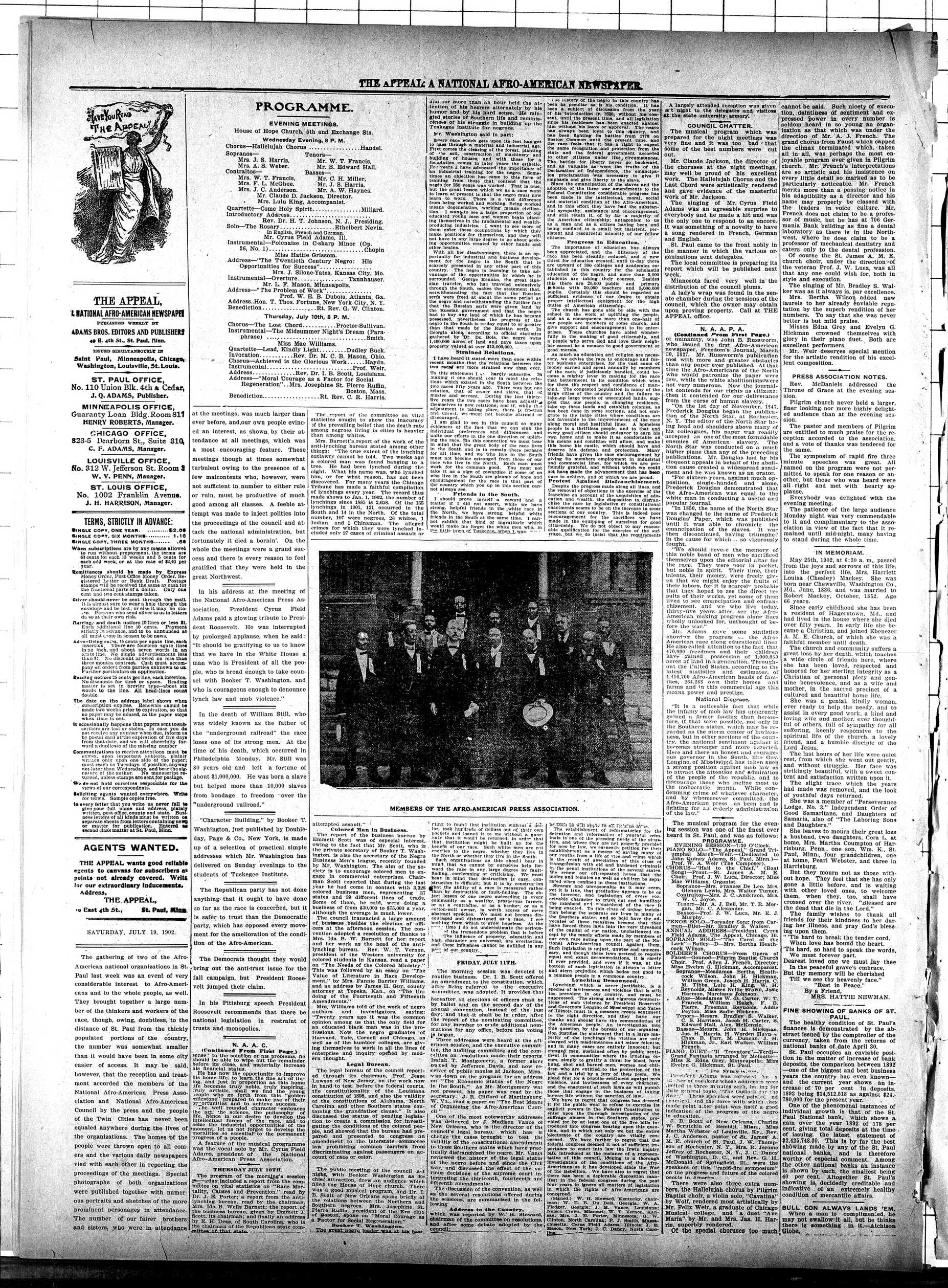
MEMBERS OF THE AFRO-AMERICAN PRESS ASSOCIATION.
Legal Bureau.
and/or more than an hour held the attention of his hearers alternately by his humor and by his hard sense. He minimae of his struggle in building up the Tuskegee institute for negroes.
Mr. Washington said in part:
"Every race which gets upon its feet has got to be built. First the clearing of the forest, planting a foundation of machinery and building a construction of machinery and foundation comes in later years the esthetic. Sometimes an objection has come to him. Sometimes an objection has come to him. Some of the containt that the negro for 250 years will be able to build the great lesson which we as a race want
To learn at present is that the negro must now see the situation where it has a difference from being worked and working. In the case of means generation, working means civilization is want to see a large proportion of our educated young men and women begin planting the plant. The fundamental and well-producing industries are more likely to be the most them enter those occupations by which they make positions for themselves, and they will not have in any large degree to go about seeking the activities created by other hands and other brains.
With all her disadvantages there is an opportunity for industrial and business development for the negro in any other part that is socially present in any other part of this country. The negro learns to be a vantage of the opportunities by which he is surrounded. George Kennan, the great Russian traveler, who has traveled extensively in the South, makes the statement that, notwithstanding the need for the use of the land, he is not withstanding the serfs were freed at about the same period as the negro and notwithstanding the further fact that the Russian serfs were given land by the government that the negro had to buy any land which is not as well as possible, nevertheless the progress of the negro in the South is to-day equal to or greater than that made by the Russian serfs. In Georgetown he access to official statistics gathered by Dr. Du Bolon, the negro owns 1,400,000 acres of land and pays tax upon property valued at over $15,000,000.
Strained Relations.
I have heard it stated more than once within recent months that the relations between the two races are more strained now than ever.
To this statement I hardly subscribe. In making it one should hear in mind the relations which existed in the South between the two races fifty years ago. There was but one relation, that of owner and slave, that of master and servant. During the last thirty-five years the two races have been adjustively themselves to new relations; and if, while the adjustment is taking place, there is friction and unrest, we must not become alarmed or discarried.
I am glad to see in this council so many evidences of the fact that we can sink the individual preferences and differences and unite our efforts in the one direction we uplifting the race. In this connection we must bear in mind that the great body of the race lives in the South and is to remain there perhaps for all time, and we who live in the South must not become estranged from those of our race who live in the North. Each man must work for the common good. You must not make it as a sign of cowardice if some of us who live in the South see gleams of hope and encouragement for the race in that part of the country which you up in this section cannot always see.
Friends in the South.
I should prove myself a coward and a traitor if I did not assert, while we have strong friends in the North, we have strong, helpless friends in the South at the same time. I cannot exhibit that kind of ingratiance which I have seen among men who, in the little town of Tappanzoa,
OF THE AFRO-AMERICAN PRESS ASS
filling to found that institution without a dollar, took hundreds of dollars out of their own pockets and loaned it to me without a gournity that it would be returned, in order that that institution might be built up for the benefit of our race. Such white men are not the environs of the world; they live in the North or whether they live in the South.
Such organizations as this should bear in mind that we cannot by ourselves help forward the race in any, large degree by faultfinding, condemning or criticising. We must bear in mind that destruction is easy, construction is difficult; but it is by construction of the ability of a race is measured rather than by destiny or fault-finding. The objective lesson of one negro succeeding is that community as a wealthy, prosperous farmer, or as a contractor, or as a banker, or as a cotton-mill owner, is worth scores of mere abstract speeches. We must not become discouraged and disheartened as a race. I see nothing from which to grow hopeless. At the time do underdominate the seriousness of the tremendous problem that is before the influence of property education and high character are universal, are everlasting, and these influences cannot be nullified in any part of our country.
FRIDAY, JULY 11TH.
The morning session was devoted to routine business. Dr. I. B. Scott offered advice after being referred to the executive o-mittee, was adopted. It provides that hereafter all elections of officers shall be by ballot and on the second day of the meeting; otherwise it shall be in order, after the report of the nominating committee, for any member to make additional nominations for any office, before the voting began.
Three addresses were heard at the afternoon session, and the executive committee, the auditing committee and the committee on "solutions made their reports者的责任" was the former slaved by Jefferson Davis, and the level of public monies at Jackson, Miss.
was down on the program for an address on "The Economic Status of the Negric in the South." As Mr. Montgomery was released, his paper was read by the secretary. J. R. Clifford of Montessuro, W. Va., read a paper on "The Best Means of Organizing the Afro-American Council."
One of the most noteworthy addressed was delivered by J. Madison Vance of New Orleans, who is the director of the council's legal bureau, which has a charge the cases brought to test the validity of the constitutional amendments to those Southern states which have practiced dissatisfied the negro. Mr. Vance reviewed the report of the legal status of the negro before and since the Civil War, and discussed the effect of the various decisions of the supreme court interpreting the thirteenth, fourteenth and fifteenth amendments.
The discussion of the convention, as well as the several resolutions offered during the sessions, was summarized in the following
Address to the Country, which was reported by W. H. Steward, chairmen of the committee on resolutions, and after some debate adopted by the council;
---
a history of the negro in this country has been a subject of discussion, and has been a subject of discussion, of the introduction in 1820, without his comment, until the press and the public began to regard him without his leave or approval. The negro has been fighting its battles from 1778 on Boston Common until the present day. He has recognized the same recognition and protection from the authorities to other citizens under like circumstances, battles liberty never go backward, battles liberty never go backward, Declaration of Independence, the emancipation and give liberty to the slave.
Since the emancipation of the slaves and the adoption of the three war amendments to the law of the Constitution, considerable progress has been made to the intellectualism of the American, and material condition of the Aro-American, and in this effort they have had the substantial sympathy, assistance and encouragement, as well as the support of the American citizenship, as a majority of the American citizenship; and on the other hand, as a man and as a citizen having been and being confined to a small but insistent, persistent and resourceful minority of our fellow citizens.
Progress in Education.
The importance of education has always been appreciated, and the illiteracy of the race has been steadily reduced, and a new social structure has been introduced, until today, there are now the two groups are�极大定able in this country for the schoolful education of the negro, and more than 5,000 students are taking their courses. Besides these are the public and primary schools with 50,000 teachers and 3,900,000 pupils. Certainly this should be regarded as sufficient evidence of the desire to obtain proper intellectual equipment for the high�ities of the German school.
The church has gone side by side with the school in the work of uplifting the people, and as a consequence more than one-half of the school's education, the school has given support and encouragement to its enterprises. These churches have aided wonderfully in the making of good citizenship, and a people who serve God and love their neighbors as a menace to good government or good morals.
As much as education and religion are necessary, we advise the race to encourage and foster money earned and spent annually by members of our community, and to come a mighty lever in making for the race to be more successful, for them the respect and confidence that must kind. The congested population in many of the cities we live in take up large tracts of unoccupied lands, suggest that our people, in changing residences, have been done in some sections, and not emptied of them, not favourable to the improvement of the race along moral and healthy lines. A homeless person every good citizen should endeavor to earn his means and condition will allow, and make this home his castle, which should have and should have friends have given the race encouragement by the public and commercial lines, for which we are proud to have made the advancement that has been ours to achieve, and of which we are proud. Despite the progress made along all lines, and the removal of objections to the exercise of education and wealth, the direct acquisition of education seems to be the most important sections of our country. This is indeed poor made in the equiping of ourselves for good citizenship, we do not object to any reason, but we do insist that the requirements
SOCIATION.
The establishment of reformatories for the destruction and reformation of youthful�ின் is one of the most important issues in the situation, and where they are not properly proposed for now by law, we earnestly petition for their establishment as a means of saving many of our youth. For the same time, which is the result of association and the situation of transgression with old and hardened criminals in the penal institutions of the several states. With the support of the state of off-repeated homes that the males and females in these institutions are separated when confined in these institutions are.
Strange and unreasonable as it may seem, yet it is true, that prejudice appears to be on the subject of the legislation of every convalescence character to such a humility of the manhood set on manhood of the race is being enacted. To this class of unjust legislation, the separate car laws in many of the Soughts are the same as those of the voxatcs of these measures. But that have advanced these laws into the very threshold of the capitol of our nation, unchallenged exceptees, and the most efforts made by members of our own race, acting on their own terms.
Such legislation is unjust, unwise and unnecessary, and though these laws pretend to require equal and unguages, accommodations, it is rarely if ever provided. If, as at the bottom of such legislation is always, both the and stern prejudice which bodes not good to a common people in a common country.
Lynching, which is never justifiable, is a species of lawlessness and violence that is still too prevalent in our country, and must be suppressed. The strong and vigorous denunciations of mob violence by President Roosevelt and Governors Longino of Mississippi and Yates of Illinois must in a measure create sentiment in the right direction, and they have our thanks and should have the commendation of the American people. An investigation into this question, by the bureau of our organization justifies the statement that in a large majority of the lynching, the victim are only charged with misdemeanors and minor felonies and in many cases are entirely innocent; but enraged men, sustained often by public sentiment in communities where the lynching occurs, simply to gratify a thirst for blood, have hung, shot and burned men, women and children who are entitled to the protection of the law and a trial by a jury of their peers. We plead first for a popular sentiment against mob violence, and lawlessness of every character, and the enactment of such laws as will punish those that engage in the business of taking human life without the sanction of law.
A largely reception was given art night to the delegates and visitors at the state university armory.
COUNCIAL CHATTER.
The musical program which was prepared for the night meetings was very well received, and some of the best numbers were cut out.
Mr. Claude Jackson, the director of the choruses at the night meetings, made an excellent solo work. The Halleluj Chorus and the Last Chord were artistically rendered and gave evidence of the masterful work of Mr. Jackson.
The singing of Mr. Cyrus Field Adauney was a sensible surprise to everybody and he made a hit and was the only one to respond to an encore. It was something of a novelty to have a song rendered in French, German and English.
Paul came to the front nobile in the manner in which the various organizations sent delegates.
The local committee is preparing its report which will be published next week.
Minnesota fared very well in the distribution of the council plums.
A lady's wrap was found in the senate chamber during the sessions of the council, which the owner may obtain for property. Call at THE APPEAL office.
N. A. A. P. A.
(Continued From First Page.) or journalists as John B. Russworm, who published a newspaper, Freedom's Journal, March 1945, with Mr. Russworm's publication not with than any paper ever published. At that time the Afro-Americans of the North Star were, while the white abolitionists were not very numerous. Now the journal, which or ourights as citizens then it contained for the rights from the curse of human slavery. "On the 1st day of November, 1847, the Afro-Americans of the North Star at Rochester, N. Y. The editor of the North Star be the author and shoulders above many of his colleagues, and accepted as one of the most formidable enemies of American slavery. The higher plane than any of the preceding publications. Mr. Douglas had by his own effort caused a widespread sentiment and he was known as an orator. For sixteen years, against much opposing causes, Frederick Douglas demonstrated that the Afro-American was equal to the man in conducting a useful and popular
In 1850, the name of the North Star was changed to the name of Frederick Kirkpatrick, a man who was unable until it was able to chronicle the emancipation of the slaves. It war then discontinue having a simple fight, but the slaves, who fought, should receive the power of this noble band of men who sacrificed themselves upon the editorial altar for the race. They were poor in pocket, their talents, their money, were freely given that we might enjoy the fruits of their labor. They were unimpedance and enchancement, and that they hoped to see the direct results of their works, yet some of them were imprisoned and enthralled, and thirty-five years after, see the Afro-American making progress along lines that were booked for, unthought of before the war. Mr. Adams gave some statistics about the American race along educational lines. He also called attention to the fact that he have gained possession of 1,000,000 acres of land in a generation. Throughout the latest statistics, according to the latest statistics, 1,410,700 Afro-American heads of families, 242,838 own their homes and a large age this means power and prestige.
National Disgrace.
"It is a noticeable fact that while the infamy of mob law has apparently been overcome, if that were possible, not only in the Southern states, which may be regarded as the storm center of civilization, the national sentiment against it becomes stronger and more asserted, the governor in the South, the Gov. Longino, of Mississippi, has taken such a strong position against mob law as to have made the majority of the people of the republic, and to discourage those who incline to the mobocratic mania. While continue to be active by whomsoever committed, the Afro-American press, as been and is forged at an earlier administration of the law."
The musical program for the evening session was one of the thuest even heard in St. Paul as follows: PROGRAMME
EVENING SESSION - 7:30 O'Clock, PIPE STREET, St. Paul, March 14 - Dedicated to John Quincy Adams, St. Paul, Minn. - Chorus - "Hall to the Chief," Boat Song - "Prout," St. James A. M. E. McWilliam, Director; Mice MacWilliam, Organist.
Sopranos—Mrs. Frances De Lco. Ms.
Contraitor—Mrs. J. C.Contraitor,
Mrs. Tenor—Mr. A. J. Bell, Mr. T. R. M.
Bassof—Mr. W. Luca, Mr. E. J.
Bassof—Prof. W. Luca, Mr. E. J.
TENOR SOLO—Toreador Song from Carmen—Bijet—Mr. Bradley S. Walker. ANNUAL ADDRESS—President Cyrus Field Adams, The Appeal, Chicago, Ill. SOPRANO SOLO—The Carol of the Lark—Bailey—D—Mrs. Bertha Heathcock Wilson.
SOLDIER'S CHORUS—From Opera of Faust—Gounod—Pilgrim Baptist Church Choir. Prof. Allen J. French, Director, Miss Evelyn G. Hickman. Accompanied by Sopranos—Medames Bertha Heathcock Wilson. John H. Hickman, William Green, Joseph H. Harris, C. M. Tibbs, Lulu H. King, W. H. Reynolds, Misses Nellie Brown, Josie Harmon, Narcissus Johnson. Altos—Medames W. D. Carter, W. T. Francis, William Halgh, F. B. Pierre, Freeman Reynolds, Addie Peyton, Miss Sadle Nickens.
Tenors—Messrs. Bradley S. Walker C. S. Harrison, Jacob H. Carter, S. Edward Hall, Alex. McKenzie. B. B. M. McKeown, Hickman Jos. H. Harris, H. Worden Hayn. Chau. B. Farr. M. Duncan. J. H. Hickman, Jr., Earl Walker, William Trench.
PIANO JUET—"I. Trovatore"—Verdi—Grand Fantasia arranged by Melnotte—Miss E. Edna Grey, Minneapolis; Miss Evelyn G. Hickman, St. Paul.
Freedist Adams was followed by a member of speakers whose addresses were limited to three minutes each, having for their general topic, "The Outlook for the Rarely, the Spectrum were point of reference, and the policy within which they made point a term point was itself a good indication of the progress of the negro in education."
J. B. Scott of New Orleans, Charles W. Scrutchin of Bemidji, Minn., Miss Martha Webster of Louisville, Ky., Rev. J. C. Anderson, pastor of St. James A. M. E. church of St. Paul, J. W. Thompson of Rochester, N. Y., Mrs. R. Jerome Jeffrey of Rochester, N. Y., J. C. Dancy of Washington, D. C., and Rev. G. H. McDonald of Springfield, Ill., were the speakers of this "rapid-fire symposium" on the progress and future of the colored people in America.
There were also three extra numbers, the Hallelujah chorus by Pilgrim Baptist choir, a violin solo, "Cavatina" by Wolf, rendered most artistically by Mr. Felix Weir, a graduate of Chicago Musical college, and a duet "Ave Maria" by Mr. and Mrs. Jas. H. Harris, superbly rendered.
Of the special choruses too much
cannot be said. Such nice execution, daintiness of sentiment and expressed power in every number is seldom heard in so young an organization as that which was under the grand chorus from Faust which capped the climax terminated which taken all in all, was perhaps the most enjoyable program ever given in Pilgrim church. Mr. French's interpretations are so artistic and his insistence on the fact that he particularly noticeable. Mr. French merits more than a passing notice in his adaptability as a director and his name may properly be classed with the leaders in voice culture. Mr. French does not claim to be a professor of mechanical dentistry and caters only to the dental profession. Of course the St. James A. M. E. professor of mechanical dentistry the direction of the veteran Prof. J. W. Hace, that any one could wish for, both in style and execution.
The singing of Mr. Bradley S. Walker was as it always is, par excellence. Mrs. Bertha Wilson added new lament to her handy deviant reputation to the superstitious her numbers. To say that she was never better is but mild praise. Misses Edna Grey and Evelyn G. Hickman crowned themselves with glory in their piano duet. Both are冠中冠. Mr. Weir deserves special mention for the artistic rendition of his excellent composition.
PRESS ASSOCIATION NOTES.
Rev. McDaniels addressed the Throne of Grace at the evening session.
Pilgrim church never held a larger finer looking nor more highly delighted audience than at the evening session.
The pastor and members of Pilgrim are entitled to much praise for the reception accorded to the association. A note of thanks was tended for the same.
The symposium of rapid fire three minute speeches was great. All named the program were not perplexed to speak to others, but those who were heard all right and met with hearty applause. Everyone was delighted with the evening meeting. The patience of the large audience Monday night was very commendable to it and complimentary to the association in view of the fact that it relied on the speaker having to stand during the whole time.
IN MEMORIAM
May 25th, 1902, at 6:30 a.m. m. passed from the joys and sorrows of this life, into the perfect life, Mrs. Harriett Louisa (Chesley) Mackey. She was born near Chewsville, Washington Co., 1836, and was married to Robert Mackey, October 1852. Age 66 years. Since early childhood she has been a resident of Hagerstown, Md., and had lived in the house where she died in 1862. She lived life she became a Christian, and joined A. M. E. Church, of which she was a faithful member until death. The church and community suffers a great loss by her death, which touchs her heart. She has been loved, respected and honored for her sterling integrity as a Christian of personal plea and genuine benevolence, and as a wife and mother, in the sacred precinct of a cultured and beautiful home life. She is a devoted woman, ever ready to help the needy, and to assist in every good work, a kind and loving wife and mother, ever thoughtful of others, full of sympathy for all suffering, keenly responsive to the life of the church a lovely friend and a humble disciple of the Lord Jesus.
The slight trace which the years had made was removed, and the look of youthful days returned. The persistence Lodge, No. 3." Independent Order of Good Samaritans, and Daughters of Samaria, also of "The Laboring Sons and Daughters."
She leaves to mourn their great loss a husband, two daughters, Cora L. at home, two sisters, the mother of Thee Harrisburg, Penn, one son, Wm K. St. Paul, Minn, four grandchildren, one at home, Pearl Webster, and three in Harrisburg.
But they mourn not as those without them. They feel that she has only gone a little before, and is with other loved ones, to welcome them, when they, too, shall have crossed over the river. "Glessed are the dead that die in the Lord." Thank all friends for their kindness to her during her illness, and pray God's blessing upon them.
"Tis hard to break the tender cord. When love has bound the heart. When love is so hard to speak the words. When we are so hard to hear. Dearest loved one we must jay thee. In the peaceful grave's embrace.
But thy memory will be cherished
BANK OF ST. PAUL.
MRS. HATTIE NEWMAN.
FINE SHOWING OF BANKS OF ST. PAUL.
The healthy condition of St. Paul's finances is demonstrated by the abstract issued by the comproller of the currency, taken from the returns of notices dated April 30, 1892. St. Paul's account holds a position in the matter of increase of bank deposits, the comparison between 1892—one of the biggest and best business years the country has even known—and the current year shows an increase in deposits. 1892 being $1,451,512 as against $24,780,000 for the present year.
One of the phenomenal instances of individual growth is that of the St. Paul National bank, which shows a 40 percent increase in total deposits, giving total deposits at the time of issuing, the latest statement of $2,425,748.30. This is by far the best showing made by any of the St. Paul national banks, and is therefore among the other national banks an almost shown by each, the smallest being 40 per cent. Altogether St. Paul's showing is decidedly creditable and indicative of an extremely healthy condition of mercantile affairs.
**BULL CON ALWAYS LANDS 'EM.** When a man is compliments, he may not swallow it all, but he thinks there is something in it—Aitchison
GOV. VAN SANT'S ACCEPTANCE SPEECH
THE GOVERNOR ABLY DISCUSSES THE ISSUES OF THE COMING CAMPAIGN BEFORE THE REPUBLICAN STATE CONVENTION.
The History of the Party Reviewed—Reciprocity Advocated as Being in Keeping With Its Traditions—The Excellent Financial Condition of the State and the Reduction of the Price of Binding Twine This Year Due to the Sound Business Administration of the Republican Party—The Problem of Taxation and the Merger Question Fully Discussed.
Mr. Chairman and Gentlemen: I am profoundly grateful for the distinguished honor conferred upon me by the representatives of the Republican party of Minnesota in convention assembled. For two years I have endeavored as chief executive, to serve the people of our state to the best of my ability, and to have performed the duties of that position in such a manner as to meet with your collaboration most gratifying.
While a firm believer in the principle of protection, I also believe that our tariff laws should be revised. They should be designed to address the new conditions and any schedule not needed to provide our own people against foreign competition, or not required for raising the income of the revenue for the purpose of administering the after-tax government, should be largely reduced. I have also mentioned that the provision of the new policy is the only way to be made by the party of protection than by the company. The Democratic party is the Democratic party who will keep trials. It made a miserable failure. Is our memory so short that we can forget the evils resulting from 1803-1807, when that party was the first session of all branches of the government. The world is the darkest period in our history. Closed factories, smokeless chimneys, idle men, misery and want the common lot of all. Let us know that the terrible lesson and performance of our country will be as much as we can be accomplished without harm in our business interests and without a shock to our industrial system. We should consider a more present year, not only maintaining our present market, but we must find new ones. We cannot hope to always sell and never buy in pursuing such a policy we follow. In the post-war era of the great modern leaders of our party, Blaine, McKinley and Rooge-Veit.
We will not further discuss national issues and they have been so ably and fully prescribed the proposed disbanded senior senator, Hon. Knute Nelson.
For the term of forty years our party has been practically in control of all branches of our state government. So it is not a case of all laws upon our statute books during the period we were passed by Republican legislators or signed by Republican governors. Among the most important are the great benefit to the people might be mentioned for the inspection of grain, laws for the supervision and control of the railroads and the establishment and control of the commission of taxing corporations, drainage, and others.
We trust that state that there has not been a benefit, legislative official act in the interest of the people that did not have its origin in and that was not enacted into law by the Republican party or those chosen to represent it.
Our great growth and development as a state is so interwoven with the history of the Republican party that one cannot be separated from other.
FINANCES
The finances of the state are in a most excellent condition. After the recent Ohio Republican state convention one of the largest and most well-known states in the power to take on these uses are a agreement the credit of the state was so good that it could negotiate its bonds at the time. That is indeed a fine showing. But we look very close to the case, managed so well that we do not have
to borrow at all; and we are able to borrow the capital without incurring $1 of bonds other than our other hand, we have more than $8,000,000 of the bonds of other states in our strong economy. But the interest is to cut off the coupons. But more valuable than the bonds, even, than the interest, from counties, cities and townships. I say more valuable because the interest is higher and the rate of interest higher. The amount loaned since Jan. 1, 1801, is in excess? If so, keep the Republican party in power.
THE STATE PRISON AND BINDING
TWINE PLANT.
During the time the management of the state prison, especially in connection with the binding twine plant, contained the prison party that it was grossly mismanaged, and we promised, if given the opportunity, firmly to institute the same excellent condition in which our political enemies Upon investigation it was found that unfavorable conditions existed in the prison plant, then just closed, had not only resulted in a loss to the state, but that the prisoners had been carried on had proven very unsatisfactory.
DEMOCRATIC MANAGEMENT.
The principal complaints against the democratic management of the state prison plant, briefly stated were as follows:
The prison twine was sold to the farm crates had full charge of the prison) 10 cents per pound. This price being 2 hours could have bought their twine for local dealers.
Democratic management did not guarantee prices, as former administrations had always done, or as the present administration had done, both last season and this season. This being the case, the option of canceling an off, they were obliged to take the twine either they had any crops to bind or not.
Much of the twine made was inferior in
these cases, unveneous, unoven, bunchy
and overgrown, withlith.
In the operation of the twine plant during the season of 1900 (the Democratic administration of 1900) the twine plant was not only a detriment to the actual purchasers of the twine, in that it cost consumers per pound more than they could have bought it for elsewhere from local consumers of twine throughout the state for the reason that instead of tending to the plant, they had to intoactive competition with independent cordage manufacturers, it kept prices up and the state also lost money under the Democratic administration of 1900 by the liberator at the closing period of that season, which had to be carried over and manufactured by the discovery of a plot on the part of two officers of the prison to assist the institution. The discovery of a plot having been made within three days after the discovery of the officers were arrested and both convicted of the crime, one sentenced to the state prison, and the other to pay a heavy fine.
The sale of the binding twine to con-
form the state of the Democratic management in 1900, which amounted to something over 5,000,000 more than they were purchased more than they were paid for their local dealers; at the same time, that the twine was inferior in both grade and quality. The complaints as to the management of the twine came from some of the best farmers brought to the state, and these complaints party affiliations; viz. that the prices were too high; that they were not allowed to purchase the twine; that the twine was inferior in grade and quality, that they were obliged to take it from the farmers; or not; that the twine plant instead of the state as managed, was a positive detriment to them.
REPUBLICAN MANAGEMENT.
I am in making such changes in the board of directors of the reappointment of Warden Wolfer to that appointment on March 1501, but there had already been a factured. Much of the twine made and was found upon examination to be inferior in quality, that there was about $80,000 in notes, to the former administration, which fell due to the preceding November, still uncollected.
The new management set about to remodel the warehouse and these were overcome as expensively as possible, although some of the poor stock of last season, or up to March L. 1901, when the new warden took charge, together with the new manager, made it very difficult to dispose of last season's product, and in order to displace it, the new manager, of the entire output Warden Wolfer was obliged to hire a large number of travellers and the twine gave general satisfaction, except the poor twine that was made at the end of 1901, some of which were carried to, or before the change took place.
GREAT SAVING TO THE FARMERS.
The warehouse, manufactured in the season of 1901, some 3,800,000 pounds were sold to the jobbers, some 280,000 pounds were sold to the dealers, following prices, viz. 64% cents per pound for mixed twine, and 84% cents per pound for pure Manila; an average of the prices at which twine was sold, below the quality was sold by the jobbers and managers, which would make the prices at which twine was sold over $1,000,000 to the consumers of the state prison twine. The cost caused by the state prison twine at these figures also was sold in the state by other, manufacture which resulted in a benefit to the consumers of binding twine in the state gen-
The profit on binding twine last season amounted in round numbers to $333,000. The profit after all expenses had been borne incident to the conduct of the twine plant.
stantly given and errors with the skilled men are very rare. The chief complaint now is not that the inspection of the grain is worthless, as during the former amortization, but that not enough men are given to the sale of the grain and have been to conduct the business just as any successful business concern would do. The efficiency and economical administration of the grain department will equal the cost of the sale of the grain in the face of the fact that the capacity of the cars is rapidly increasing, thereby enabling the shipper to market the grain in a greatly reduced amount of cash and a increase in the inspection and weighing increase was made. One great and marked benefit accomplished for the good of the shipper of grain and the railroad companies hauling it. The complete extermination of the before the sale of the grain from the practice had caused the loss of many thousands of bushels of grain every year. While this work had been undertaken many times, it is conceded that the premanagement cost was not as well as a shipping be sent to the임원. Not only has the promised improvement been made at home, but the service has been so good that our grain sells in the same way as the world as graded in Mungestica.
DAIRY AND FOOD DEPARTMENT.
The dairy and food department is one of the largest and most important present commissioner and his inspectors is doing most excellent work, and its presence is being the past eighteen months have been invaluable. There are at present four cheese shops, and the cheese industry is also in a most flourishing condition; about twenty-five cheese shops are spring; in all we have some 700 cream-filled and more than one hundred cheese shops; and there are spectors have made hundreds of visits to state, district and county dairy conventions and gatherings, and have given them insights to those engaged in this line of work.
It is a pleasure to state that the dairy department does share knowledge and accomplish this result. The dairy interest has added materiality to the wealth of the agricultural classes, and it is not quite $290,000,000. Let me give you some idea of the work during this admittance. There have been, in order to ascertain whether articles of food and drink were requested, in 10,410 analyses made. In addition the result has been forwarded to the person who requested it. The case was requested, or the merchant from whom the article was taken by the in-venture, and one most unpleasant was that making prosecutions for violation of the prosecutions there were in all the possible point in connection with the public good. Whenever the health and safety of the people were without prosecution it was the policy of the department to do this, but at no time guilty offender been allowed to escape.
M.
1890
M.
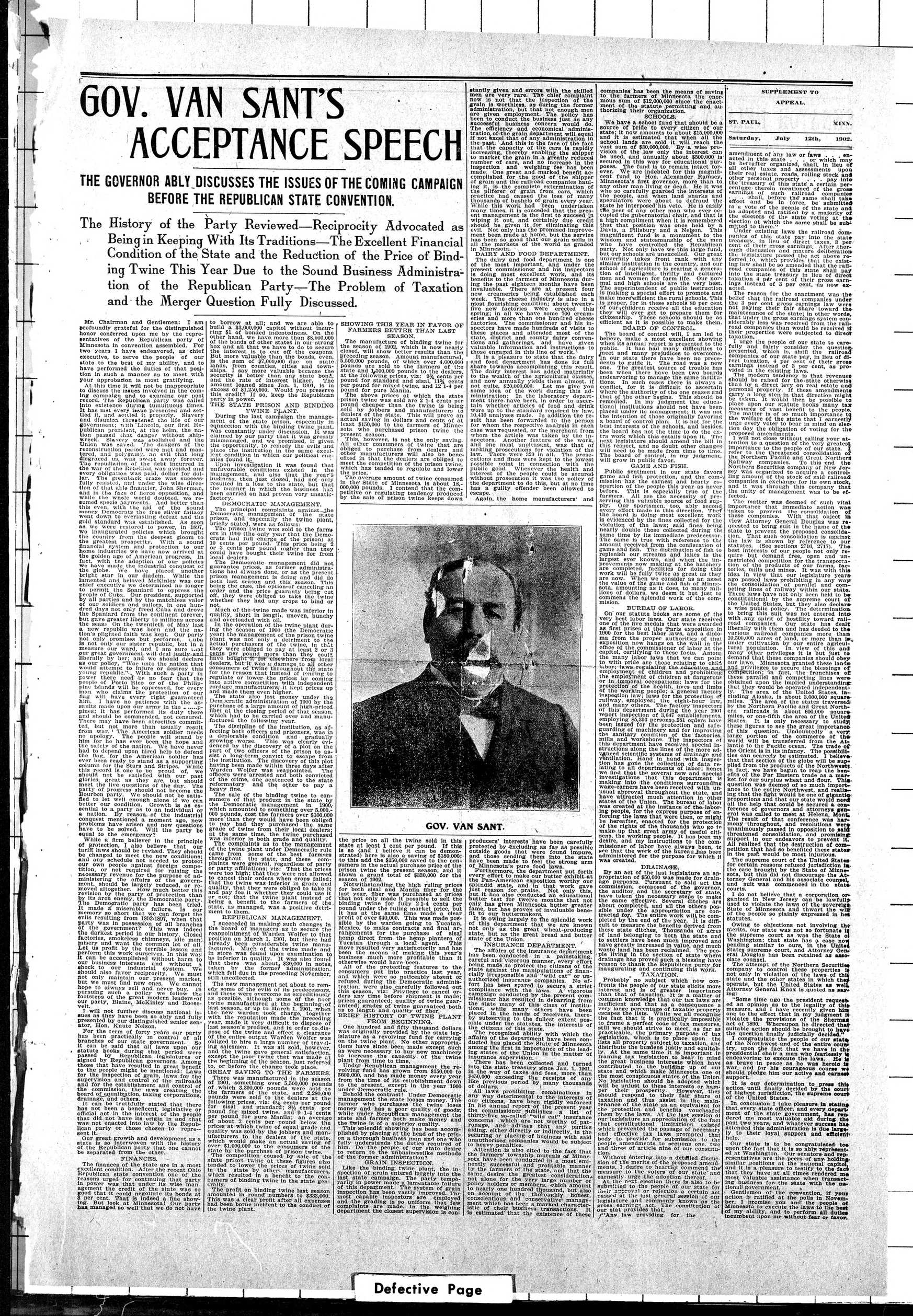
GOV. VAN SANT.
producers interests have been carefully protected by excluding as far as possible outside goods that were found impure, but not being found to be the state have been made to feel the strong arm of Minnesota's pure food laws.
Furthermore, the department put forth every one of the law'slawsuits to the Pan-American exposition for why our spendid state, and in that work gave just a reason for praise. Not only this, but it also also is the information but other test for twelve months that not only has given Minnesota better greater chance but has proven of invaluable benefit to the young largely to the splendid work of this department that we are known not only as the great wheat-producing state, but the great bread and butter state of the Union.
INSURANCE DEPARTMENT.
The affairs of the insurance department has been conducted in a painstaking, careful and vigorous manner, every effort being made to the industry. The state against the manipulations of financial irresponsible and "wild cat" or unauthorized insurance companies.
We report to the Office of the Compliance with a Street-to-Whipping campaign conducted by the present commissioner has resulted in debarring from the state's own things that theரuss of institutions, while many other have placed in the hands of receivers, theresby, the subserving to the fullest extent possible of the state. The interests of
The recognized ability with which the state has been conducted has placed the State in among the first in importance of the lead-up to the insurance in the matter of insurance supervision. There has been collected and turned in the State in 1, 1901, in the way of taxes and fees, to $450,000 exceeding the receipts of any period by many thousands of dollars.
All laws prohibiting combinations in the interests of our citizens, have been enacted. In his annual report of the present year the commissioner publishes a list of thirteen concerns which are not worthy of passage, and advises that any parties involved in the matter should secure or placing of business with said unauthorized companies would be subject to attention is also cited to the fact that the farmers' township mutuals of Minnesota most eminently successful and profitable by the farmers of the state, and that the latter, in consideration, not alone for the very same purpose, policy holders or members, which amount on account of the thousands, but also on account of the thousands, marked characteristic of their business, is estimated that the existence of these
4
ge
SHOWING THIS YEAR IN FAVOR OF FARMERS BETTER THAN LAST SEASON.
The manufacture of binding twine for the season of 1902, which is now nearly closed, will show better results than the one for the season. Amount manufactured, 5,500,000 pounds, which is 1.500,000 pounds are sold to the farmers of the state and 1,500,000 pounds to the dealers at the following prices, viz: 9% cents per pound by standard and sisa1,11% cents per pound for the same time, and 12.1-4 per pound for pure Manila.
The above prices at which the state prison twine was sold are 21-4 cents per pound cheaper than the twine is being sold by folbed and manufacturers to dealers of the state. This will be a actual saving in dollars and cents of at least $150,000 to the farmers of Minnesota who purchased prison twine the price at the same time.
This, however, is not the only saving. All other consumers of twine that are obliged to purchase from dealers and other manufacturers will also be benefited at the dealers are obliged to meet the conmentation of the prison twine, which has included to regulate and lower the price.
The average amount of twine consumed is 100,000.000 in the State of Minnesota about 18,000,000 in the State of Michigan, and that the competitive or regulating dependence down by the sale of prison twine keeps down
BRIEF HISTORY OF TWINE PLANT
One hundred and fifty thousand dollars was originally provided by the state legislature for revowing fund for carrying on the twine plant, and most inspectors have since been made except such as were necessary to buy new machinery for the revowing fund of the twine plant from time to time.
Under Republican management the revowing fund was $800,000, and has made money every year from the time of its establishment down in the year 1900 under Democratic rule.
Behold the contrast! Under Democratic management the farmer who purchases the twine loses money and has a poor quality of goods; the state and farmer both make money and the twine is of a superior quality. Unaccomplished by placing at the head of the prison a thorough business man and one who is a superior man, he does not help. Do the people of our state desire to return to the unbushelslike methods of the former to make a lamentable failure of this department. The system of grain most capable inspectors are employed and the grading is so uniform that few inspectors are employed in the department the closest supervision is con
Defective Page
Again, the home manufacturers' and
companies has been the means of saving the farmers in Minnesota the enormity of the enactment of the statute permitting and thorizing their organization.
BOARD OF CONTROL
The board of control will, I am led to believe, make a most excellent showing to the public. It has had many difficulties to meet and many prejudices to overcome. It has had no precedents to guide it. The road was one. The greatest source of trouble has been the lack of educational endeavoring to manage the same institution. In such cases there is always a place where the authority of the one ceases and should be remedied. In my judgment educational institutions should not have been the intention of those originally favoring a board of control plan. It is not for the board to have the time to do the extra work which this entails upon it. The board has not the time to do the same respect, and no doubt other changes will need to be made from time to time. My judgment, will grow in public favor.
GAME AND FISH
Public sentiment in our state favors game and fish protection, and the commission has the earnest and hearty cooperation of the people this year as never before. This is especially true of the farmers. All see the necessity of preserving this valuable source of food supply. Our sportsmen, too, ably second every effort made in this direction. The first of the board is doing most excellent work is evidenced by the fines collected for the violation of the laws; said fines being nearly double those collected during the same time by its immediate predecessor. The same is true with reference to the amount received from the confiscation of game and fish. The distribution of fish to replenish our streams and lakes is the largest ever known, and when the improvements now making at the hatchery are completed, facilities for doing this work will be fully twice as great as they are now. When we consider as an asset the value of the game and fish of Minnesota, accounting as it does, to many millions of dollars, we deem it but just to commend the splendid work of the commission.
BUREAU OF LABOR
On our statute books are some of the very best labor laws. Our state received as first prizes at the Paris expiration in 1881 for the best labor laws, and a diploma from the university for the best labor law, and a diploma from the capital, certifying to these cases the many labor laws that we can point to, those relating to child labor; laws for the employment of children and prohibiting or in immoral occupations; laws for the protection of the health, lives and limbs in inspection law; laws for the protection of railway, employers; the eight-hour law; laws for the inspection law; laws for the protection of this department during the year 1881 in inspection of 3,647 establishments, employers, and workers. It was been issued for the protection and safeguarding of machinery and for improving mills and workshops. The inspectors of institutions along the scientific systems of drainage and inspection has gone the collection and the investigation into all departments of labor; hence investigations that this department is making into the conditions surrounding the usual approval throughout the state, and has attracted much attention in other laboring people for the express purpose of enforcing hereafter, enacted for the protection of the thousands who go to work, the working people. It has been my desire, and my instructions to the department, to see that the work of the bureau has been administered for the purpose for which it
DRAINAGE
By an act of the last legislature an appropriation of $30,000 was made for drainage and erosion control commission, composed of the governor, the state senator, and five members have taken the necessary steps to make the same effective. Several ditches are constructed under the appropriation are completed by the end of the entire work will be completed by the end of the next year to measure the benefits derived from the appropriation. The acres of land belonging to both states to settlers have been much improved and the waste land has been reclaimed. The people living in the section of state where the appropriation has been made are reason to thank the Republican party for inaugurating and continuing this work.
Probably no subject which now confronts the people of our state elicits more interest than that of taxation. It is a matter of fact that our tax laws are inefficient and that the state has very large percentage of taxable property. The fact that it is practically impossible to frame a perfect case of tax measures, the very large percentage of taxable property, the primary purpose of tax legislation, which is to place upon the state the same time it is important to frame the same time it is important to distribute the burdens justly and equitably. The same time it is important to frame the great business interests which have the most conspicuous states of the Union. The most conspicuous states of the Union will be unjust to these interests or unjust to their prosperity. However, they taxation and thus assist in the maintenance of the state as an equivalent for those interests by the laws. At the last session of the state legislature, it was prompted that constitutions limited the people amendments to sections one, two and three of article nine of our constitution.
Without entering into a detailed discussion of the measures, I desire to heartily commend the measures to the voters of our state and to urge the voters of our state to attend the next election there is also to be held. At the next election there is also to be held that the voters of our state for their approval or rejection a certain nominee at the last general session of our state's congress. At the gross earnings act. The constitution of the state provides that "Any law providing for the
amendment of any law or laws, en-
mendment of any law or law, or which may
be heretofore authorized, shall be
all other taxes and assessments upon
all other taxes and assessments upon
other personal property in other
the treasury of this state a certain per-
scription of such railroad companies
earnings of such railroad companies
effect and be in force, be submitted
a note of the people of the state and be
submitted to the electors of the state voting at the
electors of the state voting at the
same shall be submitted to them.
The modern tendency is that revenues should be raised for the state otherwise than by personal property. If these amendments carry a long step in that direction might be placed upon our statute books many tax measures of vast benefit to the people, the welfare of the state that I earnestly urge every voter to bear in mind on close examination of voting for the proposed amendment, the will not close without calling your attention to a question of the very greatest importance in the Northern Pacific and Great Northern Railway Northern Securities company of New Jersey was organized to acquire a control of companies in exchange for its own stock, and it was through this company that the unity of management was to be ef-
The supreme court of the United States has jurisdiction in the case brought by the State of Iowa sota, but this did not discourage the Attorney General to associate counsel, and suit was committed in the courts.
The Supreme Court does not believe that a corporation organized in New Jersey can be lawfully used to violate the laws of the sovereignty of the people so plainly expressed in host statutes.
The Supreme Court not involving the morits the people was not a state of the supreme court as was the State of Indiana that state has a case now pending. States supreme court, and Attorney General has been retained as associate counsel.
The attempt of the Northern Securities Company to have properties not only in violation of the this state and other states in which the Attorney General Knox is quoted as saying:
Some time ago the requested an opinion as to the nature of the measure, and I have recently given him evidence that the provisions of the Sherman act of 1803. Whereupon he directed that the question finally ludicrously decided.
I congratulate the people of our state at the end of the first century of the age of the entire country. I am the fact that we have in the presidential election the great power to implement the endeavoring to execute the laws. He is as brave in peace as he was heroic in war, and for his courageous course we should pledge him our active and earnest support.
It is our determination to press this action until finally decided by the court of highest jurisdiction, the supreme court of the United States.
In conclusion I take pleasure in stating that every officer and every department of the state, government, and the government, are most valuable aid during the past two years, and whatever success has attended this administration is due large-ly to their loyal support and efficient help.
Our state is to be congratulated to you upon the fact that it is so ably represented at Washington. Our senators and representatives are the peers of any holding of the status of the national capital, and it is a pleasure to testify to the most valuable assistance when transacting business for the state with the national government.
Gentlemen of the convention, if your action is ratified at the polls in November, I promise you and the people of Minnesota to execute the laws to the best. I am a part of the performance all duties of the public.
SENATOR NELSON'S ADDRESS
United States Senator Knute Nelson, when introduced as temporary chairman of the election to make the following ad dress out:
The population of the country is at the top of the people's attitude upon them of the Republican party. He said:
The proportion of all people and all of you will remember the critical, hard, and unpromising times of 1866.
The country was still suffering from the industry and stagnation of industry, which began and continued under Cleveland's administration. The country's new and large-scale and large-scale and large-scale and large-scale and large-scale, men of all classes, who do not work. Money, through want of confidence, was out of circulation, and hard to pay for, and the financial and business world was stagnant, stood paralyzed and dread of the future. And the state was massivelyग्रहणैरिक, and the time for the difficulties by which they were sucrined, with them, and the purpose, and in many cases, undecided as the proper road to take.
It was at such a time and under such conditions that the remains of the�, hoping, that out of the stagnant chaos and despcirc then prevailing, they might secure political success, and being willing to secure the future will be the same. Before the American people with their startling and dangerous program, defending the country and unwilling exchange of silver, seeking the array labor against capital, and depreciating the protection, by the courts and the executive property against lawlessness and disorder.
And their program and policy was, as a result, sified by the declarations, promises and animus of their standard bearer. What they may have there in mind may in any way imply that the platform cleared up and made plain by the candidate it was at this juncture, and under party control, ever mindful of the welfare and best interests of the American people, the defense of gauges, money, declared its readiness to foster and protect, in harmony, the defense of labor and to protect and defend both health and lawlessness and disorder. It was not only that job involved in that campaign the Democratic party felt confident of success, for at the outset it captured the masses of the people. And there were many good men in the countryside and fearful of the result. The very boldness and revolutionary character of the candidate were paralyzing and awe-inspiring. But the Republican party, under the men-William McKenzie-opened and carried on a campaign of education, and appalled to the science and good sense of the American people. Loyalty to the true interests of the people was the foundation and sober judgment of the masses were the fountain and cornerstone of the Re-
The effervescence which existed immediately after the Chicago convention gradually disappeared as men began to be employed to the drugged of silver monotallism with incidental contraction, and the danger of arraying labor against capital, and thus paralyzing it. From the beginning now the creed and gosep of the Republican party bore fruit and in November the American people, under the banner of the Republican party, got a serious effect on the status of the great war. He was saved from one of the greatest perils that had confronted the country.
SINCE THE DAYS OF THE GREAT REBELLION.
The result of the election was no sooner known than the country seemed to awake its own being and to a new life. A slighter part of the "Democracy" was past, and the rejoicing was not alone confined to the victim.
When the war of the great Rebellion was over, and the fervor of battle had been to the end of the war of the vanquished in their innermost hearts, were glad that the Union was saved.
So, when the great political struggle of ISW was over, there were many men who were the forces of habit or who like drowning men grasping for a straw, had voted the Democratic ticket, who were nevertheless, when the heat of the strife had subsided, happy in the result and simultaneously rejoined in the success of the
Time and more than five years of Representation, she emphasize the great advantages and the great blessings that have come to the Republican party. But the Republican party has not only stayed the hand of the destroyer, it has also become the hand of the destroyer, its degree, by judicial legislation and administration, fostered and promoted the life and development of the country. The Democratic tariff law of 1854, legislation, bred industrial stagnation, and was also insufficient as a revenue provider, 1859, passed at a special session called by President McKinley for that purpose. Whatever criticism may be pronounced on some of the provisions of this act—all criticism—it is certain that but for the then unforeseen Spanish war, it would have revenue for its current war. It is also certain, and amply demonstrated by our country has enjoyed the greatest most pronounced commercial and industrial and continued prosperity in all our history.
Our total foreign commerce—exports—a period of five years—amounted to $82,278,755,620, with a balance of trade in imports—a period of five years—amounted to $21,230,181; while our total foreign commerce from 1897 to April, 1902, a period of four years—a period of five years—amounted to $477, with a balance of trade in our favor, upon the same, of the enormous sum of imports—$99,384,291, with $59,384,291, in kind and immense great of our foreign trade—especially the great balance in our favor—that has alarmed the people of the world. They fear and see in it—and well they may—a loss of their industrial and agricultural resources to and vesture in the great republic of the West. The products of the farm and factory, under the momentum of enlarged commerce, resting from a good home and from a strong force all countries of the civilized world. We are the owners of our production over the home market.
The domestic trade of our country since the 19th century has been revival and increased productive capacity; has more than kept pace with our foreign trade and is abundant; and labor finds its place in greater force and volume. Capital has more and is still abundant; and labor finds its place in greater wages. And in many industries the demands outruns the productive capacity. Many mills and factories have received orders which they can be filled. And there have been many instances and localities where the high degree of prosperity among people has the more remarkable because of the occurrence of many of the countries of the Old World which is attested by the fact that immigration is pouring to our shores from countries in greater volume than ever. Our mills and foundation on which our industry rests, and also shows the great value of
OUR PROTECTIVE SYSTEM
in its importance and needed tariff legislation for
their protection. The bank vigor by the currency act of March 18th, making gold the standard unit of value, making debt in new 2 per cent bonds, and pro-
ducing debt in new 2 per cent banks' bank currency by allowing circulation un
to the par value of the bonds deposited, and by permitting the estatioishment of banks with only $25,000 capital in the quarter of 2014, and by permitting the estatioishment system, and bringing banking facilities near to the homes of the people.
This act extinguishes the silver heresy, and the price once for an a goa's asset. The refunding of the debt was provided for in the act has proved a great success. On the 31st of May 1902, our bonded liabilities of $10,070,040, and of this $450,940,730 was a new bonds thus reducing our interest charge by several millions.
On the 14th of March, 1900, when this act passed, there were in distinction 3,617 national banks, with a capital of $616,805,905, and with an outstanding circulation of $251,402,739, and on the 19th of March, 1900, the new bonds with a capital of $76,926,695 and a circulation of $357,115,356, of which banks were of the smaller class provided for in connection with the bank.
The bank has been an increase of $77,840,010,000 in capital and $102,712,636 in circulations since March, 1900.
The treasury is in the most prosperous condition—the envy and wonder of other nations.
The fiscal year ending yesterday closed with a surplus of revenue over expenditure and on the 30th day of June 1902, there was on the treasury over and above all current liabilities, and over and above 100,000.000. A hold definition fund, a balance year, near to $20,000,000.
During Cleveland's administration we were a debtor nation, suffering with gold and gold, and had to be a good difficulty, and had to borrow, to maintain the gold redemption reserve.
Since those days, under Republican auspices, the tax rate was 1.5 percent higher than the large balance of trade has turned the tide of gold to our shores in great abundance, and we have become the financial and financial�ernal and interest lower here than in any other country, and today our country dominates the financial and industrial world. It has been a major gain for the government and has gained our political independence, and under the leadership of McKinley and Roosevelt we have gained our industrial and financial support. One of the important and engrossing questions pressing the American people in recent years, and at the present time, we have to regulate and control them so as to to regulate and control them so as to become oppressive and our masters. We are living in the midst of an economic and economic�ernal and economic on the other side, and we have given way to new methods, scale have given way to new methods on an enlarged and more concentrated surface.
The tendency of the age is combination and concentration, and where the chief object of this is to lessen the cost of pro-taxation so as to cheapen the most to the consumer and not to obtain the supply of supply compensation or check the reduction of price to the consumer, the public will not be injured and has no fair wrong to control.
But a combination which becomes in one form or another an absolute monopoly, or nearly such, shutting off all substantial competition, is in its very essence a menace and a danger, because of human selfishness and human greed commensely as at all places the public at the mercy and under the vེལ་ of a single concern. None of us would like to be the subject of an absolute monarch, however gentle, kind and humane he might be, because we would be in his power, subject to his whims and his caprice act all times.
Charles B. J. Cooperate, the eminent lawyer of Baltimore, at the great conference of trusts held in Chicago in September, 1890, clearly stated the case, and the distinction in the following language:
If, therefore, the combination of producing agencies do not affect the freedom of competition, the consumer will benefit by the reduction in the combination of production thereby caused; if the combination creates a virtual monopoly the consumer will not ordinarily benefit by the decrease of cost; on the contrary, the tendency of such a combination is to increase the price whilst reducing the cost.
The Republican Party has not been
The Republican party has not been unmindful of its duty
TO PROTECT THE AMERICAN PEOPLE
from the dangerous consequences of monopolies so far as the same can be administered of President Harrison's administration of President Republican in both congress was Republican in both states. Sherman antitrust was enacted, both monopolies and combinations in restraint of trade, in interstate commerce, which law monopoly legislation on our federal statutes.
In passing upon cases brought under the law, the supreme court of the United States has ordered the Federal Constitution congress has no power to regulate combinations or combinations as distinguished from combination or monopoly traffic, and no power to regulate or control combination or monopoly in other combinations or monopoly or regulating combinations or monopoly in manufacture and local traffic in several states and not in the federal government.
From this it is apparent that the act of 1580 has substantially exhausted the power of a congress in the premises; and it is far from being adequate relief. There are forty-five stannings of union, no two of them with similar anti-monumentation, and some of them with none at all. A combination or monopoly in production of the entire country is thus a single check and untrammined in any one of the states, from when the people of other states suffer and against which they are obtained protection. Besides it is of a complete difficulty to separate sequences and effect of local traffic from interstate traffic. If the injuries which a state can inflict were limited to the state under which it is, and has its seat, then there would be no health leaving it to the exclusive control of such state, but where such a monopoly extends to the population without the entire country, then it is a evidence that the scope of the relief and protection ought to be extensive with the injury and harm that can be done.
From this, national in its scope and consequences, should for the protection of the entire people be subject to national control. Whoever seeks to enjoy national protection and national advantages should be required in national inspection and regulation. Protection in such cases should be mutual.
the light of these facts that these necessities the subject, and with a view of giving power to control monoclinies and hostile communities, and to hostile committee of the house of representatives a joint resolution to the Constitution of the United States. Section 1. Congress conferred by this article shall extend to the several states, the territories, the District of Columbia, the states, the states, the states, the states, and subject to the jurisdiction of the United States. Congress shall have power to define, regulate, control, prohibit, or dissolve trusts, monopolies or otherwise. The states may continue to exercise such powers by law in conflict with the laws of the United States. Sec. 3. Congress shall have power to enforce the provisions of this article by passing laws. When this resolution was put on its passage on May 31, 1900, nearly every Democrat voted against it. It failed to pass for want of two-thirds majority, and the United opposition of the Democratic party. Our state legislature, when the Republican executive, for the purpose of preventing a monopoly in railroad transportation, in 1874, passed the following
"No railroad corporation, or the lessees, purchaser or managers of any railway, or the stock, property or franchise of such corporation with, or lease or purchase, the
works or franchise of, or in any way control other any railroad corporation ownership or competing line; nor shall any officer or such railroad corporation, act as an owner or having the control of a parallel or competing line, and the question whether railroad companies and the question whether railroad companies shall, when demanded by the complaining or having the control of a parallel or competing line, in in other civil issues." And in 1851 the swinging law.
No railroad corporation shall consort with lease, or purchase or in any way become the owner of or control any other railroad corporation, or the rights or property thereof which owns or controls a parallel or competing line." The referred to, clearly express the public and the public demand; and you are all matter of public history—that President Lincoln suffered the federal law, nor Gov. Woodrow Wilson, to remain obsolete or a dead letter, justified in saying to you that neither of these high executive officials have been entitled to hostility to our railroads or their able and public-spirited managers, but only by the authority on our statute books which laws they have oath to support. The builders of our vast railroad systems in the Northwest have a most task and rendered a most muble.
in settling and developing our great domain. They have followed with swift ardor and often preceded them. They have been many burdens and encountered great hardship and often faced fair transportation activities within the easy reach of nearly all in the farthest corners. We are beckoning in this respect they are fast supplying. In energy, perseverance and stamina, we stand and stand to none of their knit in the entire country, and as such we are to them and wish them no harm; but wish to live in harmony and in co-operation. We are opposed to the consolidation—no so much because we fear that they will be of it as because we know that they are great while pass from our midst, and that then we would be at the mercy of a non-resident army of non-resident stockholders, who will be more concerned about high迪利安 domain, whatever its purpose may be, becomes, nevertheless, in its essence a necessary involves solitude, and that
1860
THE MAYOR OF BOSTON
SENATOR KNUTE NELSON
is repulsive to the great body of the people and is dreaded by them, in the realm unfamiliar no less than in the political world.
ANOTHER GREAT CHAPTER of Republican history remains to be told. When President Obama took the duties of his high office, the oppressed and downdropped people of Cuba had been forced to secure their independence. Cleveland's struggles to shake the yoke of Spain and to secure their independence Cleveland's appeals for assistance and had given them no material or moral aid. But the civil war would ultimately have occurred in Havana harbor in February, 1898. That cruel and unprovoked act, the possible force, brought on a Spanish war, for which we were poorly prepared.
But the patriotism of the people and our country was not such were such in a few weeks we were in full battle array, both on land and, or
And the war, begun at Manila on the 1st day of May, was ended at Santiago on the 16th day. Spain and most decisive. Spain renounced her rights to Cuba and ceded to us the Philippine islands and Porto Rico. The people of these islands were forever relieved of their captivity.
Spain's bourgeoisie was not a two years ago we established a free and stable legislative government in Porto Rico, giving the people of the island the blessings of a free government akin to our own, and such as they had never enjoyed or dreamed of before. Courts compelled us to open to all, bringing speedy justice within the easy reach of all have been established and are in operation. A system of free schools with school houses and competent teachers has been organized and established all over the islands. Roads have been graded and built in the inland and small town of the island, where only precarious bridles paths existed before. The people have recovered from the effects of the tornado and storms which devastated their island in 1890, and under a good government, and free trade with the States have been an upland and the most promising and encouraging for both them and ourselves. A million of people, oppressed and in a state of tutelage, have been regenerated and born to a new life under the Stars and Stripes. The very thought of it fills every patriotic American heart with thankfulness and life.
And what have we not done for poor, bleeding Cuba. The ten-year insurrection of 1968, the blood and blood. A calm, born of despair, had supervised for a few years. Then, the people had again taken up arms for their independence, and had bravely struggled against the oppressive aspects of success. And it was then that our nation came to their relief and smote the people of Cuba. So swift sure and decisive, which forced us to rule of Spain in the Western Hemisphere. In people the Cuba stood in great need of their fortune. But they could fairly come to their own, before they could secure a stable government. And this assistance we have given them with a most intelligent and generous government, or law or order. Their lands and their farms were devastated, disasters, helpless, aimless and many more reeking with poverty, fifth pestilence. The mass of the people were puprified, helpless, aimless and many more reeking with poverty, fifth pestilence.
of these documents for the duals of these
war. First of all we had to clothe and feed them, then establish a law and order, then aid them to embark in self-sustaining existence, then cleanse, purify and render immune from pestilence their olds and towns, and then, last of all, the state establish a law and stable republican form of government.
All this we have done and accomplished with patience and great skill, in full measure, and we have launched among the republics of the world a sister republic, hopeful, buoyant and full of love, and the great order of the world. Stars and Stripes have given the people of Cuba a training in self-government most valuable and blissful. Never was mother kinder to her daughter than America has been to Cuba. Who can be built by the wisdom, the unselfishness and the magnanimity of the great republic?
Cuba and Porto Rico are both most happy in a new existence and a new life. And what we have accomplished for them we shall in some form, though less rapid-action and a common condition, are present, accomplish for the Philippine Islands.
We entered upon the Spanish war to free Cuba, but when it was over we found ourselves in occupation of Porto Rico and the Philippine islands, our sense of duty and sense of justice forbade us to return them to the clutches of Spanish tyranny and oppression.
The problem was even more pressing in pine islands than Porto Rico, more brutal and cruel because the people were not of African descent, in part civilized, were composed of people from many tribes—from the savage Moros and Abubecle and dwarfish Negrites to the Toucanians in self-government, or indeed any government at all, save the despotism of Spain.
To abandon these unutored and heterogeneous Spanish brutality seemed rather cruel and shocking to our sense of right and justice, and to their then condition and helplessness, to themselves seemed even more reckless would have led them irresistibly into dire confusion, chaos and self-destruction, and exploitation by one or more of the great powers of Europe. Strong fleets of forerunners could move to move in the moment we moved out.
A great nation can no more afford to evade or shirk a great moral responsibility, and the science of a republic as ours is but the counterpart of the conscience of the people, incarnate and unmarnished. There is no course, under the stress of the facts, to
1910
taken. And that way to accept in cohesion
talk, to accept in cohesion, to accept in
and establish law an order and a good
law.
President McKinley was at first loath to impose a moral problem in all its length and comprehended it, the path of justice and the duty of duty seemed plain to him. He was no more courageous or responsible for the unresolved conflict, he never falter, never shirk and never trim. He was the master of the Philippine islands and to the entire civilized world to do just what we have rendered our nation a moral imbecile to the enlightened nations of the world.
At the time Dewey entered Manila Bay Spain was in undisputed possession and control of the islands. The insurrection which Aguinaldo and some of his associates were�ing and was 1800 that was promised and abandonment for more consideration in 1897 and had taken themselves to China, where they were living when Dewey's steamed into the Bay of Manila. There was at that time no Philippine insurrection and no semblance of will-powered army and a Philippine government, any of which. Under these conditions which turned out to be a mere pretense, of helping our forces to expel the Spaniards. Aguinaldo and some of his associates, with the permission of Dewey, redeemed the war and were furnished with arms and ammunition. By the end of the war, they landed and secured arms than they proceeded to organize an army and set up a military government, all in hostility to our government rather than Spain. They were even ready at one time to disengage with the Spanish. This insurrection, thus started, and fed by the ignorant and savage lawlessness of the people, we have suppressed. Most of it, except in a few isolated parts and in the case of a few barbarous and savage tribes, and bands of ladrones or robbers, we suppressed more than a year ago.
A year ago our army in the islands there is now, and by next fall expect to receive our force to 12,000 men. A year ago this troops were stationed on 469, at this time ber is only 245, and, deducting from this there are but 100 left, and these greatly reduced if more extensive quarries are built in the larger towns. In the meantime the Taft commission, we have successfully ordered and order, in most of the provinces. In thirty-five provinces civil governments successfully, chiefly under native officials in nine provinces civil government is successfully carried on under military authority. In thirty-five of the provinces a system of teachers, thus affording the people with nearly 1,000 Americans and 4,000 teachers, thus affording the people they have never enjoyed before. This eager to attend the schools and to learn English and learn quickness of mind. There are too-day teachers in 200 towns and villages where there is not a single American soldier, barbarian tribes and bands, and the La-mer and law and order civil government prevails. A civil government more just and liberal than ever enjoyed under Spanish rule.
Under a liberal tariff law, enacted by the Rhode Island commission, all natural and supplemented by an act of congress at this session, which eliminates the basic factions of Spanish colonies and revenues will be received to cover all expenses of the government of the islands, including the maintenance of the system of public schools, the improvement of the highways and harbors and the necessary sanitation of the country.
Congress has passed at this session an act giving an ampler and broad way to the commission for the establishment of civil government and the development of the country and the development of the country, provides for the survey of the things, and entry of the public lands and the opening of development of the mines. The Act was issued on the same day, 22,000,000 acres of land in the island most of it rich and arable, with an abundance of timber. Of this amount 67,000,000 a year is a public lands, and only 1,000,000 are private property. The city's church and friar land, farmed by natives, as laborers, or as tenants, at low wages, is a high-value area. With this Act, the system of church and friar ownership and farming is and has been most burdened some and odious to the natives, and was a result of the effects of a principal against the Spanish rule of com-
Besides, under Spanish rule, few of the natives had secured titles to the lands and were more naked squatters. With the view, a reliefing the people of the burdens of friar and church lands, the act referred to makes of the country, by purchase of condemnation these lands by the government of them in forty-acre farms at cost price to the natives who occupy them. The act of the country is the same as the Act, which is now to the public lands without title in fee, to the extent of forty acres in each case, of the lands they occupied and leased, and the second possible land in the country and forty acres of that soil in that climate and with their productions makes a good and ample farm. In this Act, every family can secure a home of its own.
This free distribution of land, in fee, under the Spanish law will do more than anything else to make the mass of the people in the country sense of ownership be a love of peace and ownership for law and order, with land ownership, for law and order, with schoolships, and improved means of communal living for people who become pro-public and lifted for local self-government. What is it that we have done, and in the immediate future aim to do, and who came to us as a legacy from Spain. In our efforts to pacify, to civilize and to educate, we have cent efforts of legislation in their behalf, as you all know encountered the bitter, as you all know encountered the able opposition of the Democratic party in Spain. They would have us lay down our task of justice and duty and would have us work hard and honestly, in a state of economic and political unity in a state of economic and
Those islands, which some of the Democracy, by their votes, for both treaty and invasion, those islands, which our brave and valourous army and navy have occupied last three years, now that the hard drudgery has been done and peace, with the people of been victorious and the people are about to reestablish theborn to a newer and better life, now, when all this great and necessary preeminence and fiercer than ever, thus preach the gospel of scuttle and abandonment louder and fiercer than ever, thus results that have been accomplished and declaring it all fruits and a failure, preservation of the Union a failure in 1864.
After acquiring the islands by as valid treaties, we are obliged to acquire any of our territorial acquisitions after pouring out our blood and our treasure with well-nigh one accord, we are to treat them as a stranded wreck, as though we ourselves had been the them, and are to cast them adrift as they are, and to cast them as the latest gospel of the militant Democracy. What the American people have, in bed with their valor, their treasure and their blood, accustomed, and held, they will never permit 1865 to take them.
The task which under a high sense of justice and duty they assumed in 1888 was to goodenish the military injury in traducing our army by hunting its cases and instances where some of our officers and soldiers were cruelty and savagery of the enemy, have transcended the methods of civilized warfare and soldiers have transgressed on the rules of war can have no valid bearing on the conduct of war, and soldiers have transgressed on the rules of war can have no valid bearing on the conduct of war by isolated cases, and yet no one ever undertook to measure the justice of that war by isolated cases of great army. Neither it appeared or been shown that the president or the war was guilty before military courts, for investigation, trial and punishment, all cases of civilized warfare brought to their attention.
These Democratic efforts to besmarch on the enemy, to exploit a few of the shortcomings, to exploit the manifold patience, its valor and its manifold acts of generosity and kindness, manifest a fear of the enemy, of any negligence of the president or the chief minister, the premises, Kirkley had himselfristified in war, was familiar with all hardships and, drawbacks, and was a fine man, someone hearted man. The same is of the President for neither of them would for a moment tolerate or permit to go unpunished any acts of violence or rules and customs of civilized warfare.
The American army is a part of our own people, of the same race, training and food. The rank and file are a fair, unforeseen status. The country is a feature of the intelligence and the moral status of the American people, and as a whole superior in these respects to the rank and nationality of the country. They are all, in a certain sense, volunteers. They are all, in a certain condition of enforced military service in this country as they have in the world. They are as humane and as kind-nature, very very much, so that the battle array. Their record is the fact; and in the Philippine Islands, barring a few instances of cruelty provoked by the vagracy of the country of methods of the enemy, their conduct has and for-bearing, by, and, in the whole, the whole, patient, kind and forbearing. The savage enemy has often mistaken this forbearance for fear or courage. The many of them encountered great perils and suffered training and slaughter because of their kindness, generosity and forbearance.
The Democrats have shifted their spleen of their rights, whether they are a sycamore against our little army in the islands, true friend never takes pains to hunt for our short-comings or finds delight therein, but they are ready to see and proclaim our great good qualities. Not Democraء, but the Congress has found occasion to see laud or make known any of the good and noble qualities of that army. He has uttered no or sympathetic word in its behalf. Such or sympathetic word in its
WORSE THAN UNPATRIOTIC.
it is positively cruel to our army. The lot of
them is to be punished and trying. His scanty pay is no stimulant. It is the fact that he carries the
thority of our country in places where
without him neither would exist that
he is the most thrifty of our country in places where
and danger. As our soldiers cluster around
their bivouac at night after a long, weary
suit of a treacherous jungle in pursuit of
a treacherous footnote and too tired
with a scant supper, footnote and too tired
to come up one thing above all that
cheers and commends him, that their country upholds them,
cherishes and loves them, and takes a
heart to their country. Their heart is wholly theirs for weal or woe.
To deprive the soldier of this cheer and treasure, and the American people will never, for one moment, appreciate or tolerate him. He will assail our army assailus our flag, and be indicted and dear to every lover of his country.
"Brave boys are they, gone at their count. And we shall never cease to cherish their patriotism, their bravery, their forbearance and their faithfulness. The prosperity of our country at home and abroad under the leadership of President Roosevelt is our greatest publican party. We shall meet and sue
cessfully solve the Philippine problem, as we have seen. We have also faced many other great problem we have been confronted with since 1896. We shall in the next chapter discuss good government as firmly in the distant past, and the problems of oppressed and downtrodden humanity will repress and downtrodden humanity the great republic of the West.
The Platform
The following is the platform in full: The Republicans of Minnesota, assembled in convention rearm the form adopted by the Republican convention, convened in Philadelphia in 1800, and pledge anew their support to its principles. We support William McKinley. As a citizen, soldier and statesman he yielded his best service to the nation and the people of the world and is enshrined in the hearts of his countrymen. He is the able and patriotic administration of President Roosevelt. We are proud of his many courage, his purity and his country, and pledge him as the earnest support of the Republicans of Minnesota in all his efforts to succeed the people at home and the glory of the republic abroad. It is therefore the sense of success he ushered in as president of the United States. The Republicans of Minnesota lament the death of their peers after and statesman, Cushman of Minnesota, and most trusted statesman, beloved by the people had won an enduring fame by his illustrious success, save his memory and deeply his loss. We congratulate the people of Minnesota on patriotic and businesslike administration of the state. We especially commend the conscientious and faithful supervision by the officials of the state. Our official efforts have been continually directed to an earnest and upright administration of
Merger.
It has been the settled policy, as declared in the Constitution, that competing lines of railway shall be allowed to believe that the protection of the citizen and his health is safety of the state, rests in obedience to law, safety of the state, rests in obedience to law, safety of the state, rests in obedience to law, Sant in his effort to consolidate the consolidation of competing lines of railway.
Taxation
We are in favor of such legislation as will equalize as far as possible the burdens of taxation, and require all persons, corporations and property to bear their just proportion of such taxation. The legislative branch of our government having decided that certain constitutional amendments are necessary before such legislation can be adopted, we pledge our party to support these constitutional amendments. We also pledge our party to support the proposed amendment increasing the gross earnings tax of railroads to 4 per cent.
The Philippines
We indorse the course of the administration of the establishment in the Philippines of civic institutions in the Philippine islands. We favor the policy of encouraging the participation of civic institutions in the Philippine islands in their domestic government to the largest extent practicable by the extent of the capacity, awareness, intelligence, capacity and a desire for such
The Army and Navy.
We condemn those who continue to resist the authority of the United States, either openly or secretly, and we condemn strongly the malignant attacks upon our army and navy which have won for the people of the United States, or domestic or domestic soil, impermissible fames.
Protection
We adhere to the policy of protection. Under it our industries have developed, the on-ground and the on-air our country has passed from a state of burden andness depression and terrible suffering to the most remarkable and prosperous state in the world. We treat that protection and reciprocity are twin measures of Republican policy and success, or in other words, the correct application of reciprocity is protection. Under this doctrine we favor such modifications in our stuff schedules as are or may from time to time be changed by changes in duties to remove any burdens from our people and to hold and extend our trade among
Reciprocity.
We heartily favor the wider extension of our work and the full range of all American products. To this end we endure a policy as defined by President Roosevelt in his annual message to the Fifty-seventh congress: "Our first duty is to see that the protection granted by the tariff in every case where it is needed is maintained that reciprocity be maintained; it can be done without injury to our home industries." And defined by our late lamented president William McKinley, we extend the pledge to the people at Buffalo when he said: "By sensible trade arrangements which will curb our home production we should extend our trade to the people at Buffalo. We should take from our customers such of their products as we can use without harm to
The New Republic of Cuba.
We congratulate the new republic of Cuba on its independence and the earth. We wish it for peace, prosperity and a long and successful national career. We thank President Roosevelt, by a plan which shall ensure the profitable interchange of commodities, insure to the advantage of both nations the ability to meet the needs of the chief benefit of which shall not enrich trusts, which shall not interfere in our home production.
Trusts.
We recognize the necessity of co-operation in order to meet new conditions in the industrial world's markets; but the combinations which suffice competition, limit production, control prices, or unduly increase prices or values, which are necessary for the necessities of life, are opposed to public policy. We flavor legislation, national and state, to prevent such abuses. We approve of the single tax on all employers, the rent and Gov. Van Sant to enforce the laws and demand that all administrative officers enforce the law in the most vigorous manner. We require the law to be comprehensive shall not be embarrassed or destroyed.
Finance
Our faith in the gold standard and the financial amity has been amply justified by the wonderful strides made in commerce, and commerce, and in the universal confidence, and in the ability of the government to meet every exigency.
Penalons.
We recognize as a continuing obligation of debt and gratitude due from the Republic to the nation for the sacrifice of the life of the nation and those who won glory for its flag in the recent war with Spain, in the recent war with Iraq, and in the annulition of this sacred obligation demands that liberal provision be made by pensions for the veterans, and the widows and orphans of the nation. We favor the most stringent national and state legislation to suppress anarchy. We support the unification of United States senators by the people.
Minnesota Delegation
The Republican party of Minnesota for years has had a just pride in its representation in the state, and has indulged our present senators. Honorable Knute Nelson and Honorable Moses E. Clapp for their compulsions and efficient services for our state, and for their care is best subserved by a continuance of their eminence and ability in their present high position. The Republican party of Minnesota indores its representatives from this state in congress, is proud of their ability, courage, indifference, and care for the interests of our commonwealth, insisting upon the rights of its members and maintaining the West, bringing added glory to the West, bringing added glory to the state they so ably represent.
Labor.
The Republican party of Minnesota recommends that eight hours should be considered by public authority. We favor the abolishment of day labor where practicable. We earnestly solicit a better understanding between capital and labor in Minnesota convention in Minnesota where employers and employed will meet in friendly conference. We favor the use of the union label on state supporter cards.
MELLES RECORD IN MINNESO-
AAPI
The Salinity City and Salinity City Folk-
Nowy Items of Social, Religious and
General Matters Among the People, Boll-
ed Down.
All who were present at the reception
were delighted.
It is now in order for the "knockers"
to go out in the woodshed and shed
tears.
Mrs. Jennie E. Watson is visiting
Mrs. J. H. Dillingham and Mrs. J. C.
Berry of Rondo street.
The delegates to the meetings were
loud in their praise of the generosity
and hospitality of the people.
Miss Mabel Lawrence of Chicago is
in the city visiting her uncle, Mr. W.
A. Lawrence, 94 Rondo street.
Mrs. W. T. Francis and Mrs. Lula
King entertained at dinner in honor of
Prof. W. E. B. DuBois of Atlanta
Thursday.
Mr. E. G. Rogers, the present clerk of courts of Ramsey county, has filed for the Republican nomination for the same office.
Mr. Marcellus L. Countryman, a prominent lawyer, has filed for the Republican nomination for Judge of the District Court of Ramsey county.
Nice furnished rooms for rent at 221 East Thirteenth street at reasonable price by the week or month. Apply to J. J. Johnson or W. A. Williams.
On Thursday night Prof. Booker T. Washington entertained at lunch at Carling's. J. C. Dancy, Cyrus Field Adams, T. Thomas Fortune, Emmet J Scott.
The Elite Shoe Shining Parlor, No. 12 West Sixth street, J. B. Johnson, proprietor. Shoes shined or polished. Special chairs for ladies. Shoe dying a specialty.
The most popular place for people who take their meals down town is Jake's driveway. No. 552 Wabasha street. Everything neat, clean and well cooked.
A trolley party, headed by Mr. W. T. Francis and Mr. F. L. McGhee, took in Lake Como and Wildwood last Sunday, Prof. W. E. B. DuBois being the guest of honor.
Is your hair straight? If not, send 50 cents to Ozonized Ox Marrow Co. 76 Wabash avenue, Chicago, Ill., for a haircut. Give a Marrow and you can easily straighten it.
Gentlemen wishing nice furnished rooms, with all conveniences, by the week, or month, at reasonable rates, should apply at the Benton House, 233 West Third street, up stairs.
FURNISHED ROOMS—Nicely furnished rooms for rent by the day, week or month, at No. 50 West Ninth street, between St. Peter and Exchange streets. Transients accommodated.
If its quality, purity, variety, etc., you care for very particularly in groceries, call on Michael Bros., on Lake Como streets, direct importers of Fine Groceries, Wines, Liquors and Cigars.
Let your object in life be that you will be somebody in fact or nobody in fact. Never allow yourself to believe that you are somebody when you are somebody when you lie for you only destroy yourself.
If you wish a good hair, shave cut or shampoo at Richard Cousby's shop, No. 374½ Minnesota street. First-class workmen only. Satisfaction guaranteed. Music for all occasions furnished on short notice.
St. Paul Chapter No. 30, O. E. S., have issued invitations for tours on the steamer J. J. Hill, Thursday evening, July 31st. Boat will leave foot of Jackson street at 8:45 returning at 12:45.
Elk Express, G. D. Cartesian, prop, packing and shipping; hauling of all kinds; coal and wood; it large or small. Anything in his line give him a call.
Telephone, Main 1920—J. 1. Office 63 East Sixth street.
WILLIAM E. NAGEL—Funeral director and embalmer, formerly on Wabasha street, is now located at 208 West Third street, Seven Corners. One day and another, Telephone M 1604 assistant on all calls where one is required.
Those of our patrons who desire to have matter published must get the same in this office not later than Thursday afternoon, otherwise it may be taken of any communication that is not signed by the author.
Thursday Mr. and Mrs. J. Q. Adams entertained at dinner Prof. Booker T. Washington, Bishop Alexander Walters, J. C. Dancy, Emmet J. Scott, T. Thomas Fortune, J. R. Clifford, J. W. Heward, in Washington, W. H. Steward, Cyrus Field Adams.
DR. JOHN E. PORTER, physician and surgeon, office suite 410 Bradley Building. Fifth street, opposite Court House. Office hours: 10:00 a.m. to m. a. phone main 1738-1 J. Residence, 463 Carroll street. Telephone, Dale, 464 L. 3.
The APPEAL man visited the wire grass twine plants this week, and found that the Afro-Americans had pleased the managers so well with their department and work that they in contemplation bringing a lot of people from the South to work for them.
On last Tuesday, Mr. and Mrs. J. H. Dillingham entertained at luncheon, Mr. and Mrs. W. H. Steward of Louisville, Mrs. Lawrence Washington, D. C.; Mrs. D. Duthut, Minn.; Mrs. Jeenie Watson of Cincinnati, Ohio, and Mrs. Maggle Griswald.
"No clothes like ours" may be well said of those carried by Browning, King & Company, Clothiers, Hats, and Robert streets, and see Mr. C. E. Hasson, the aftable manager about it. Even if you are from Missouri he can satisfy you, for he can show you.
SAFE DEPOSIT AND STORAGE If you want your inspection, it costs little to plan. Cash securities and valuables in absolute safety. Boxes in our vaults can be had for $4.00 per year. Store your boxes trunk up, etc., with us. St. Louis Co. 1832 Reddict Arcade.
Visitors to the city, residents also, who wish to get first-hand should call at John Godfrey's. No. 552 Wabasha street, between 59th street
Established 1882
The Plymouth
Great Reduction in . . . Straw Hats
Men's Straw Hats in an endless variety of rough-and-ready, Mackinaw, Canton split and Sennet braids; $3 and $2 kinds go at 50c and $1.
Panamas at about half-price.
Regular $15 Panamas, $10.
Regular $12 Panamas, $8.
Regular $8' Panamas, $4.
Boys' and Children's Straws, very special at 25c and 50c.
The Plymouth Clothing House, Seventh and Robert.
and College League. Board and rooms by the day, week or month at reasonable rates. Best meals in the city, for the week, 25 cents. Sunday dinners from 1:00 to 5:00 p. m. a speciality. Everyone was sorry on account of the little coughing spell the people had on Thursday night at House of Hope church. There was, however, no indication that the length of the paper had weared the patience of the audience. This will not occur at future meetings as a resolution was passed restricting papers and speeches to twenty minutes.
Hamm's New Velvet Beer.
The Theo. Hamm Brewing Co., of St. Paul, notwithstanding the excellent brews of beer that it now furnishes, has just put a new extra pale beer on the market that promises to be a great addition to your beer. This new beer is called "Veket." It is an extra pale beer, having a rich, agreeable hop flavor and just the right amount of malt strength to make it an ideal tonic beverage. This beer is guaranteed to be absolutely wholesome and to be made of the finest malted ported hops. Telephone the Big Home Brewery, ...ain 935, for a case.
AN OPEN LETTER
I hereby wish to thank all members of the Chorus that took part in the Press Association Program for their diligent attention and studiousness for the short rehearsal and preparation for the occasion. It all goes to show what may be done in our midst, even if we have not been through tribulations to reach the goal. Very respectfully,
A. J. FRENCH.
A delightful party was tendered to Miss Magde Thomas of Chicago, who is a guest of Mrs. J. L. Neal; at the home of Miss Eugenia Coulter, on Thursday evening, by the young people of the "Plumed Knight" Club of St. Paul, under the supervision of the "Plumed Knight" society, Sir Stephen Edward Hall, its popular president, attended in a body. Among the special guests of the party were Mr. John H. Saddle Hyllard of Oberlin and Cleveland, Ohio, respectively. The Saints City folks were composed as follows: Misses Fannie Howard Clara Howard, Mrs. John H. Saddle Hyllard, Smith, Hattie Grissom, Lulu Howard, Jenlog Log, Effe Milling, Evelyn Hickman; Messrs. Jas. A. Vass, S. Harick, M. Hickman; S. E. Hall, T. Battles, H. Walker, A. W. Haynes, W. A. Robbins, C. L. Couser, N. Houser, M. Mesdames J. H. Hickman and Lulu H. King chaperoned the party.
MRS LYLE'S RECEPTION
The largest social function of last week excepting, of course, the reception at the armory, was the reception given at the residence of Mr.s. T. H. Lyles, on Tuesday evening by the President of the Press Association and Council delegates and visitors. The spacious residence was filled to overflowing.
Mrs. J. Silone Yates, of Kansas City, made a short address, as also did Mrs. B. Jerome Jeffreys, both of which were highly appreciated. Refreshment, a special service, and libtum. Among those present were: Mr. and Mrs. S. Bellesen, J. P. Anderson, J. Q. Adams, B. R. Durant, C. S. G. Mills, H. Shepherd, John H. H. Shepherd, H. D. Howard, J. H. Hickman, S. D. Kemp, E. B. Lowe, W. H. Steward, J. W. Peyton. Mdesames A. B. Lowe, E. De Baptiste, H. C. Richardson, C. F. Coleman, H. C. Richardson, C. F. Coleman, Maker, J. W. Wynn, V. C. Joyce, Mopkins, Ada Colter, J. W. Wynn, I. B. Warnett, P. H. Anderson, Geo Underwood, J. W. Blair, R. J. Jeffreys, Jenne Watson, Samuel Brant, W. Wynn, J. Wynn, V. C. Joyce, Yates, J. N. Kemp, V. J. Henley, Della Pettis, W. Margw. W. Weir, J. B. Turner, J. W. Hackenney, Hattie Perry, Margaret Rankin, E. L. Johnson, H. Rogers, Walter Turner, John Marsh, J. W. Wynn, V. C. Joyce, S. Lewis, A. French, C. Morgan
Misses Hattie Loomis, Zada Dennis Blanch Matthews, Evelyn Hickman Loola Moker, Mae Williams, Scottie Lomax, Evelyn Hickman lou Smith, Sadie Godine, Fannie Dodd, Stella Bond, Lee Miller, Maud Arbuckle, Amael Taylor, H. Layton M. J. Dillard, Lulu Howard, Luly Howard, John Logan, Josephine Prose Fannie Brant, Willetta Smith, Elizabeth William, Hattie Wier, Era Lindsay, A. E. Nugent, G. A. Nugent Sophia Johnson, Edna Hedgehate, Mae Williams, Stella Perry, L. McCoy, Nora Williams, Annie Anderson, Lulu Moker
Messrs. J. H. Guy, Allen French, Ed De Baptiste, E. W. B. DuBois, S. W. Alexander, C. O. Highgate, Jas. A. Vass, E. Shepherd, W. T. Vernon, N. Alexander, W. T. Vernon, Arthur Winstead, John Battles, W. Johnson, R. Farr, T. H. Jones, W. H. Payne, John Sanders, J. Lawson, J. W. Thompson, C. Smith, M. Maloy, Fred Parker, G. W. Slimon, W. A. Weir, A. H. Weir, G. W. Weir, H. J. Shelton, H. T. H Johnson, B. W. Clinton, W. French, M. Hickman, C. S. Harrison, W. H. Anderson Clifford Smith, B. Archer, J. Madison Vance, F. A. Goddine, J. E. Brack, H. Turner, Sidney Hryant, H. Bryant, P. J. Smith, F. A. Goddine, J. E. Brack, Mason, Theo, Harris, S. Harris, Thos. Fortune, E. J. Murphy, C. F. Adams, I. B. Scott and others.
THE APPEAL: A NATIONAL AFRO-AMERICAN NEWSPAPER
MISSING
THE RECEPTION.
CITIZENS OF THE TWIN CITIES DO THEMSELVES PROUD
They Give the Fittest Social Function Ever Seen in the Northwest in Honor of the Delegates and Visitors to the Council and Press Association.
Ever since the announcement was made that the Press Association and Council would meet this year in St. Paul, and the National Educational Association in Minneapolis, the people of the Twin Cities have been looking forward to their coming with pleasurable anticipations. A committee was formed to arrange the enterprise succeeded every one now knows, though the knockers had out their lit-
MEMBERS AND C
Members of the Adelphi club, with their guests, Mrs. Josephine St. Pierre Ruffin, of Boston, and Mrs. Fannie Barrer Williams, of Chicago. The picture was taken at the home of Mrs. Lulu the hammers and kept them busy. Of course the principal feature in the minds of the society people was the grand banquet and reception which was announced to take place at the Armory of the State University. This event was the air: a function that could be found in the Northwest and it was specially and most beautifully decorated in white and red bunting, the walls and ceiling being literally hidden from view with the same. There was a fountain at the center of the floor throwing a stream of water into the air. The fountain was surrounded by banks of evergreen, palms, flowers, and all around the room was a wall of cedars and evergreens making a fairy-like scene that beggars description. There were sixteen are lights hidden in large balloon covers which illuminate the floor.
The guests began to gather at 8 o'clock and when most had arrived an overture was played by Kuhn's orchestra of favorite pieces. Then Mr. W. T. McCormick, the master of ceremonies, introduced Arch-bishop Ireland, who delivered a masterful address filled with good things, as his addresses always are.
Then came the grand march in two columns, one under the leadership of Mr. W. T. McCormick, the master of ceremonies, led by Mr. and Mrs. C. H. Miller. The evolutions were artistic and intricate and the long lines and curves of the columns filled with the handsome gowned ladies made a scene in the march ended in a waltz, after which all repaired to the banquet board.
The banquet was set in a large room adjoining and opening into the main hall and covers, were laid for three hours. The banquet was served by Dorsett, of Minneapolis and consisted of
**Fruit Frappe**
**Rolls** Fish Turbot **Fish Turbot**
**Cold Turkey** Ham Sandwiches **Brown Turkey** Bread **Chicken Salad** **Chicken Salad**
Neapolitan Ice Cream.
Fruit Assorted Cake. Confections
Assorted Cake.
There was no speech making and the toothsome viands were not long in being transferred from the tables to places where they would do most good, and then the dancing began and went at a merry pace until the hour for leaving had arrived and Home Sweet Home told of the end of the grandest social function we had ever had. Following are the names of those
who gave the reception by subscribing for and purchasing tickets at $.50 each:
Messrs. F. L. McGhee, Geo. Barrett, J. F. McGhee, Geo. W. Dempsey, J. ard, Geo. W. James, Timothy Reeves, W. T. Francis, Geo. B. Lowe, W. D. Carter, J. H. Dillingham, R. K. Grisom, C. H. Miller, Z. A. Pope, A. Moss, Grissom, E. W. Burchard, E. Richardson, E. Taylor, D. Duckett, E. Porter, Jos. Adams, J. R. White, A Payne, J. L. Ervin, J. A. Cunningham, C. E. James, Henry, Roberts, B. W. Buckner, M. W. Withers, Anderson George, John Howard, George Brown, Julius Pits, Johnkins, C. Smith, A. Ray, John Crane, T. J. Fite, R. B. Grey, W. T. Jones, C. D. Jackson, Atal Blair, John D. Dropper, F. Athol Bair, W. Haynes, George H. Mall, P. Cormier, S. Cuthbert, Creon Thomas, B. Burk, James A. Vass, John H. Sanders, H. Moseley, E. J. Brack, B. Archer, Will Gibbins, Will Johnson, D. C. Bray, W. M. Marshall, Thos. Battles, B. R. Drant, Irvin Williams, E. A. Drew and Mrs. H. C. Covington. There was also one ticket without name sold by Rev. T. Reeves.
subscribers for $2.00 tickets were:
Mesdames E. Banister, M. Griswold,
T. H. Brigham, — Colter, J. Kemp,
— Tylor, — Robinson, J. E. Paterson,
Rosa Weaver, T. V. Parker,
Annie Parker, Mary Grimes, Mollie Davis.
Misses Ada H. Mason, M. Buckner,
Lewis Lindsay, Jimelou Smith, Elizabeth Rhone, Carrie Combs, Mary Williams, Sadie Godette, Myrtle Clark, Fannie and Birdle Dodd, all of whom were present. Among the others present were:
Mr. and Mrs. A. D. Griffrin, Chas. W. Scrutchin, W. H. Steward, — Sheepher; Mesdames Chas. Welr, Cella Falls, Jennie Watson, J. P. Crawford, O. A. Austin, S. Williamson, M. Green, O. Austin, Joe O. Owen, H. Harding, Dillard, R. Jerome Jeffrey, J Silone Yates, Fannie Barrier Williams, P. L. Langford.
Mesdames Alice Marshall, Josie Harmon, Minnie Taylor, — Miller, Mae Sam (Miller), Fannie Barrier, B Galloway, S. Zenobia Wright, Tavis Davis, Hattie Loomis, Vola Berry, Edna Grey, Minnie James, Sophia
GUESTS OF ADELPHI CLUB
King, St. Anthony avenue. Mrs. Ruffin is in the central front of the picture and Mrs. Williams stands at her right hand. Mr. Ruffin is in the left corner of the phila club and who extended greetings from the club to the Minnesota Federa.
Johnson, Lula Howard, Estella C. Bond, Fannie Harper, Hatty Perry, Gertrude J. Harper, Jennie V. Hilyer, A. B. Lilly, M. Thomas, M. V. Webster, C. B. Lilly, L. Smith, Claudia Waugh, Nette Harding, Olive Henderson, Mattie Buster.
Messrs. G. Benjamin, P. A. Hubert,
J. W. Thompson, C. A. Anderson, Robert Earnest, E. H. Deas, W. F. Fairax,
R. B. Montgomery, D. E. Williams, N.
W. Hews, J. J. Hiles, W. Bowles, C.
W. Hews, J. Mason Van Valk, F. Field Adams, W. T. Wern, W. E. D.Buolis, J. E. Mason, A. E. Nugent, Emmett J. Scott, G. A. Nugent, Geckar, J. R. Clifford, T. Thos. Fortune, R. Farr.
The gowns of the ladies were most superb, they were creations of the art and modiste and in fact some of them were entitled to be termed confections.
The Appeal man was as busy as he could be from the first dance to the last endeavour to obtain the names of guests and descriptions of the flowers to get all. He, however, managed to get a few and here they are:
Miss G. A. Nugent, Louisville, white silk mull, diamonds.
Mrs. W. H. Steward, Louisville, Persian silk, aplique lace, diamonds, flowers.
Mrs. E. A. Nugent, Louisville, dotted silk, emeralds, diamonds.
Mrs. Hattie Perry, Chicago, black crepon and satin, diamonds.
Miss Leola Moker, white French organdie, lace, white satin, diamonds, roses.
Mrs. Chas. H. Miller, lettuce green creeper du chien, white lace, white tafeta ribbons, diamonds, American Beauties.
Miss Jennie Nelson, cream silk mull, lace, robbons.
Miss Mayme Weir, embroidered white batte lettuce, green underdress, chiffon and white satin trimmed dress, Mrs. T. E. Franklin, lavender silk, black lace, diamonds. Mrs. R. Jerome Jeffreys, New York, blazer.
Miss Elizabeth Rhone, Atlanta, miss taffeta, accordion plaited flounce, shirred waist, pearls, white carnations. Mrs. H. Roberts, striped lavender and white silk, applique, lace. Mrs. J. A. Cunningham, flounced ornament and black lace over white
Defective Page
WEISKOPF PAINT & WALL PAPER CO.
H. P. UFHAM. L. T. SCRUMMERI. JAMES N. HILL. E. W. WINTER.
J. H. JILL. C. D. SCHAPERD. E. H. CUTLER. E. H. THOMPSON.
GREENLNAF CLARK. C. D. GILFILLAN. F. B. CLARKE. W. A. MILLER.
B. H. BAILEY. B. N. SAUNDERS. F. P. FHAPER.
Mrs. Mary Walker, black etomine over black taffeta, gaslight green trimming.
Mrs. A Payne, white brocaded waist, black grendel skirt, flowers.
Miss Gertrude I. Harper, Fort Hall, idaho, old rose foulard, ribbon and lace trimming.
Miss Gerry, grey, rainbow gown of gray over pink mousselain de sole.
Mrs. Lulu H. King, gray crepe du chine renaissance, applique lace, pearls, Jack H. King.
Mrs. J. E. Porter, imported costume of lavender and lace.
Miss J. E. Porter, Kansas City, black silk, pink silk and lace.
Miss M. V. Webster, Louisville,
white batiste, lace, diamonds.
Miss Sophia Johnson, Louisville
white organde, lace, diamonds.
Miss Sophia Johnson, black jetted
brussels, lace, diamonds.
Miss Harry Shepherd, black grena
dine, lace, diamonds.
Miss Louisa Jackson, Chicago, white
swiss, lace, pearls.
Miss. Madge Thomas, Broadland, black silk greadine.
Mrs. A. D. Griffin, Portland, black lace and laffin, decollete, diamonds, Mrs. T. Reeves, pink silk waist black cloth skirt. Mrs. J. L. Neal, Black grenadine over silk.
Mrs. W. C. Joyce, Paris and black lace insertion, diamonds.
Mrs. C. F. Coleman, white orgale and lace, sleeveless, millinery sash, diamonds.
Mrs. W. T. Francis, turquoise crepe duvet, sleeve lace, pearls.
Mrs. J. N. Kemp, blue Paris muslin, lace, flowers.
Mrs. Josephine St. Pierre Ruffin, Brookline, gray nuns veiling, white brocade and lace.
Mrs. Cella Falls, black silk granade.
Miss Mary Dillard, white china silk and applique waist, black tafeta.
Mrs. J. Q. Adams, robin's egg blue organdie, court train cruc cord embroidery, vallenclennes lace insertion, black velvet, diamonds, American Beauties. Elizabeth Banister, black embroidered taffeta, chiffon and lace. Mrs. C. L. Weir, white lace waist, black brocade.
UB OF ST. PAUL.
tion of Women's club last October at Owatonna, is the last lady at the left in M. Wright Franderick L. McGhee, a another prominent Adelphian, a waist and is leaning against a pillar at the right of the picture.
Miss Ruth McGhee, white dotted swiss.
Miss Tarquinia Harper, French green Mousselain de soie, lace, pearls.
Miss P. L. McGhee, pink silk, cream lace, pauce, nile green trimmings, diamonds.
Miss Imogene Gertrude Palmer, Chicago, white swiss, lace, diamonds.
Miss B. W. Buckner, white silk wrist, silk silk.
Miss L. W. Miller, Woonstock, Kan, pink silk waist, blue skirt; carnations.
Miss Mary H. Scott, Louisville, gray epimine over silk, white mille silk.
Miss Myrtle Clark, pink organde, black lace.
Miss Fannie Dodd, pink pompadour and lace decollete.
Mrs. W, J. Relat, Chicago- black embroidered net, black and white organdie.
Mrs. Geo, W. Day, blue flowered four-lard serpentine lace, flowers.
Mrs. Geo, W. Day, brown, gray mousse-lain de sole over lait.
Miss Mamle Samuels, black silk net, white shower bouquet.
Mrs. A. Moss, white organdie, white applique trimming, pink carnations.
Mrs. Alice Marshall, white silk mull.
Mrs. Eugenia Colter, blue organdie.
WEISKOPF PAINT &
JOBBERS AN
54 East Seventh St.
Telephone
HENRY P. UPHAM, E. H.
President.
The First N
Mrs. Geo. Barnett, embroidered chiffon over black taffeta.
Mrs. H. C. Richardson, pink silk white chiffon, pink carnations.
Mrs. A. Parker, black satin, lace, red carnations.
Mrs. T. B. Parker, Persian blue tafetta, lace.
Mrs. W. M. Withers, black silk trimmed with blue silk and lace.
Mrs. Emma Crawford, white brocade satin, crisonon chiffon, lace, diamonds.
Mrs. E. J. Williams, blue foulard, lace.
Miss Estella Bond, Chicago, black lace, taffeta, diamonds and emeralds.
Miss Maud Buckner, black taffeta.
Mrs. George Brown, white silk waist, black cheviot skirt.
Miss Carrie Combs, pink silk mull.
Mrs. S. Marney, St. Joe, white silk mull.
Miss A. B. Lilly, white silk mull.
Mrs. Morris Porter, black silk point lace.
Mrs. J. W. Peyton, white liberty sandal, white sole.
Mrs. Bra Lindsay, Stillwater, embroidered mull over cocoa taffeta.
Mrs. Ida Underwood, lavender waist, black peau de sole.
Mrs. Cora Wilson, Adrian, white organdle, lace.
Miss H. Howard, white dimity.
Miss Minetta James, white chiffon, ribbons, lace.
Mrs. O. D. Howard, black taffeta lace, diamonds.
Mrs. J. H. Dillingham, black taffeta,
brass grindle, lavender ribbon, red
bies.
Mrs. Z. A. Pope, striped gray silk,
lace, ribbons.
Mrs. J. M. Grissom, black gross
grain, lace.
Mrs. D. Duckett, gray silk, lace.
Mrs. Maggie Griswold, black taffeta
lace and ribbons.
Miss Lulu Howard, white organdie, lace, yellow ribbons, roses.
Mrs. Della Pettis, black silk grenadine, ditch, lance, lace.
Mrs. Julius Pitts, black taffeta and lace.
Following is a list of the officers and committees, etc.:
**Officers of General Committee.**
P. L. McGhee, chairman.
Mrs. George Barnett, vice chairman.
J. O. Shepherd, chairman.
George W. Day, treasurer.
**Executive Committee.**
O. D. Howard, G. W. James, T. Reeves, W. T. Francis, G. B. Lowe, W. D. Carter, H. Shepherd.
**Committee.**
Mr. and Mrs. W. T. Francis, George Barnett, J. Q. Adams, George W. Day, O. D. Howard, G. W. James, T. Reeves, J. L. Neal, G. B. Lowe, W. D. Carter, H. Shepherd, J. E. Porter, C. E. James, W. V. Howard, J. H. Dillingham, A. Pope, P. L. McGhee.
Messdames Luila H. King and J. N. Kemp.
Messrs. H. B. Burk, W. T. Jones, Ralph Gray, A. W. Haynes, S. E. Hall, C. S. Harrison.
Misses Edna Grey, Tarquinia Harper, Mayne Weir, Minnetta James, Hattie Grissom, Lulu Howard.
Floor Committee.
C. H. Miller, J. M. Allison, S. Cuthbert.
Miss Sadie Hilyard is in the city visiting her grandmother, Mrs. Sabra Hilyard.
Mrs. R. C. Howard presented her husband with a bouncing boy last Wednesday. Mother, baby and father are getting on nicely.
Mr. R. C. Logan, a noted basso, was in the city Thursday the guest of Mr. J. W. Hackerney. He was enroute from Butte to Benton Harbor to join Rusco and Hollands minstrels.
Mrs. Elizabeth Banister is in the city visiting her daughter, Mrs. J. Q. Adams.
Mr. Cyrus Field Adams, after a stay of two weeks with his brother, left Thursday for a visit to St. Louis.
"BLUE JEANS"
Burlington Route
By providing the best of everything and paying close attention to details the
a la Carte in service on Burlington Routetrains have gained an international reputation. The "pay-for-what-you-order" plan is much more acceptable than the "dollar-a-meal" charge.
ASK YOUR HOME AGENT
FOR TICKETS VIA THE
BURLINGTON
A Happy
Combination
of Comfort
Luxurious Travel and
Perfect Accomodations
IS VIA
THE
NORTH-WESTERN
LINE
C.ST.P.M.&O.R.Y
Inquire for rates and information
should you contemplate a trip well
rounded out with pleasure. : : :
T. W. TFASDALE, Gen. Pas. Agt.,
St. Paul, Minn.
Great Special Sale of
PIANOS
Some that have been used.
Other* only shopworn.
ALL UPRIGHTS.
1 Mahogany Ernest Gabler,
nearly new ... $225
1 Mahogany Kimball ... $195
1 Chickering ... $195
1 Steinway ... $173
1 Ludwig ... $135
1 J. & C. Fischer ... $120
SW
RAUDENBUSH
ST. COMPANY
SIXTH & FIRST AVE. MARKET, OTTS.
ST. PAUL, MINN.
STATE STEAM
LAUNDRY
222 W. 79 ST. Phone 1609.
SMIRTS 101
Dollars Cuffs
RAMSEY COUNTY Afro-American Club. SOCIAL
378 Cedar St. St. Paul, Phi.
OFFICERS
J. W. WOODFORK, Pres.
J. L. PHELPS, Supt.
JOHN MORGAN, Asat. Supt.
F. D. MCRACKEN, Sec.
ANDY COMBS, Asst. Sec.
C. E. CHARLETON, Treas.
Wm. GIBBS, Chef.
Tel. Main 1786-J1.
We Will Pay You
A DOLLAR A DAY
FOR LIFE!
For securing the greatest number of $1 subscriptions
to PEARLBORN MAGAZINE before December 14,
each every eighth minute of time a year for life,
or at the latest price offered in the World for work
Under the 15th Day of February. Y. B. 1888.
Under the 15th Day of February. Y. B. 1888.
Under the 15th Day of February. Y. B. 1888.
Under the 15th Day of February. Y. B. 1888.
Eleg Pearson publishing Co.
45.45 E. 19th St. < NEW YORK
THE ST. PAUL DAILY NEWS
Every day in the year except Sunday for,
per year.
$1.00
Outside the City of St. Paul.
---
DOINGS IN AND ABOUT THE
GREAT "FLOUR CITY."
Matters Social, Religious and, General
Which Have Happened and are to Happen
Among the People of the City on the
Falls.
Dr. P. A. Hubert has returned to
Chicago.
"We, a jury composed of men who know cigar values, find that the plaintiff, the Judge Harlan Cigar, is entitled to recover 10 cents from every smoker"
The K. of P. picnic at Carver was a grand success. Relatives from Pullman, Ill, are visiting Mr. and Mrs. Wm. R. Morris,
Judge Harlan
5¢ Cigar
Query--Why not subscribe for The Appeal and stop borrowing your neighbor's paper?
The Union Sunday School picnic was the very best ever given by the different Sunday Schools.
Quite a number of ladies from this city attended the Adelphia Club picnic at Indian Mounds last week.
The Christian Endeavor meets every Sunday 6:30 p. m. at Bethesda Baptist church. You are most cordially invited.
HART & MURPHY, MAKERS, ST. PAUL, MINN.
Mrs. Jennie E. Watson, after spending several months visiting at Columbus and Cincinnati, Ohio, has returned to the city.
Hamm's
Extra Pale and
Extra Fine
From what you have heard, aint you sorry that you did not attend the Banquet at the Armory Hall? Well, you "just simply missed it."
Miss M. Jackson, milliner and modiste, ladies' tailoring. French cleaning and curling feathers a speciality. No. 1409 South Fifth street.
Mrs. Nellie Hale has opened a studio for piano instruction, Room 52, Eastman block. Special attention given beginners. Terms reasonable.
The kindergarten hour at St. James' Church has been changed from 9 a.m. Wednesdays and Saturdays to noon of the same days. The school can accommodate five more children.
St. Thomas' Mission and Sunday School will hold their annual basket picnic at Linden Hills, Lake Harriet, Thursday, July 24, 1902. All friends of the Sunday School and Mission are cordially invited.
Mrs. Celestine Brown has opened the "Creole Kitchen," boarding-house style, at 405-407 Fifth ave. S. Regular meals, 25 cents. Short orders served. First-class furnished rooms in connection. N. W. Tel. 343-42, Minneapolis. WM. H. VANDERBURGH. Candidate for Congress.
M. H.
VELVET
Wessel & Sixth and Cedar. Noble. FASHION LEADERS
In the past half century there has perhaps been no name familiar in Hennepin county that has stood out more clearly for principle or is more universally respected than the name of Vanderburgh. It stands out today in bold relief, the synonym of integrity, honesty and faithfulness in public service. Judge Vanderburgh enjoyed the confidence of the people in a wonderful degree. His chief aim was to be faithful to the trust the people reposed in him rather than to write brilliant opinions on the supreme bench and get credit for them. It is more difficult to be really notable and calls for special concern and has no parallel in the west. He was elected in 1859 on the first republican ticket elected in Minnesota, on which were the well known names of W. Windom, Alex Ramsey and Ignatius Donnelley. Even at this early day, when only 29 years of age, he showed evidence of great popularity, for he ran 800 votes ahead of his ticket. He was the old court house 22 years (1859 to 1881) and afterwards for a long period on the supreme bench. For the first dozen years Judge Vanderburgh's jurisdiction took in the counties north and west of here and he was the only judge in all this territory. He drove the circuit as there were freely with all the people without loss of dignity and it is said that he knew and was singularly happy in such association. On the bench it was his work to temper justice with equity—to interpret the rigid letter of the law with common sense and compassion. He had the rare gift of discernment, brushing away technicalities and arriving at the real justice of the case. It will thus be seen that he blazed the way in a new country when there were no supreme court decisions to follow, exercising independent thought and action. The permanence of this fact that in 1898 he was offered the nomination for the old place he first took 39 years before; and Judge Vanderburgh died happy, in the thought that the plain people never lost their confidence in him which he valued far more than wealth.
Warm Weather Comforts Shirt Waist Suits, Cool Canvas and Fussia Crash Dresses; Separate Skirts in Linen, White, P. K. and Etamine, all on sale at
New Walking Skirts Are here-five styles and all very rich materials-so differ-ent from what you see around town and no higher in price..... $7.50 And Up
N. B.-STORE CLOSED SATURDAY AT 1 P. M. DURING JULY AND AUGUST.
THE LAMINATING MACHINE
Under these auspicious circumstances, W. H. Vanderburgh, the only son of the Judge, presents himself for Congress from this district and as there is no doubt of his nomination by the Democratic party he pleads for and expects the support of his father's old Republican friends. He was born in Minneapolis, on sixth avenue between Third and Fourth streets in 1858. Educated in the public schools and subsequently graduated from Princeton College, also Columbia law school. Inherited a large fortune and the affluence in Minneapolis in 1881. Was director in Northwestern Bank from 1885 to 1893. The panic of the latter year inflicted upon him great losses in the New York stock market he had been a heavy operator. Has taken fifteen trips abroad and in 1894 married in Paris a highly connected French young lady. He resides with his family in the old homestead, 10th avenue S. and 17th street. Is engaged in the real estate business.
Our New American Mammoth
THE BEST AND LARGEST MANGLE
FIRST ONE IN THE STATE.
Lowest Prices on Flat Work
SHIRTS, 10c. COLLARS and OUFFS, 10.
State Steam Laundry,
Phone, Main 1609 223 West Seventh Street
THE APPEAL: A NATIONAL APO-AMERICAN NEWSPAPER
THE MIDTOWN MUSEUM
WHOLESALE HARDWARE, ST. PAUL
NOTICE
Send your work to us, Shirts 10c C
We call and deliver f
Standard Laur
Telephone Main 967-2.
GEO. W. FREEMAN, Prest.
C. GOTZIAN &
Manufacturers and
Wholesale Dealers in
BOOTS AND
Proprietors of
Minnesota Sh
Factory: Cor. Fifth and Rosabel Sts.
Salesrooms and Offices 242 to 280 inclusive E. 5th
E. ST. PAUL
TICI
s, Shirts 10c C
ull and deliver for
Laur
TZIAN &
Manufacturers and
Wholesale Dealers in
AND
Proprietors of
Iowa Sh
Sts.
10 inclusive E. 5th
ST. PAUL
TICE!
Shirts 10c Collars and Cuffs 1c
and deliver free.
Laundry Co.
536-538 Wabasha Street
PAUL H. GOTZIAN, Sec. & Tr.
ZIAN & CO.
Manufacturers and
Makesale Dealers in
AND SHOES
Proprietors of
Iota Shoe Co.
Exclusive E. 5th St. ST. PAUL, MIL.
GERMANIA LIFE BUILDING,
Fourth and Minnesota Sts.
ST. PAUL.
Paul exclusively for savings doing
gifts bank law of the state as am-
OF $1.00 AND UPWARD.
TRUSTEES
France, John D. Ludden, Gustav Willius,
Am Constans, Harris Richardson,
Thomas Fitzpatrick, C. P. Noyes,
Jul. M, Goldsmith.
CREAM
from CREAM.
TO LODGES AND CHURCHES.
Creamery Co.,
NOTICE!
Send your work to us, Shirts 10c Collars and Cuffs 1c We call and deliver free.
Factory: Cor. Fifth and Rosabel Sts.
Salesrooms and Offices 242 to 280 inclusive E. 5th St. ST. PAUL, MINN.
THE STATE GAVINGB BANK
GERMANIA LIFE BUILDING,
Fourth and Minnesota Sts.
ST. PAUL.
The only Bank in St. Paul exclusive business under the savings bank law ended to date.
TAKES DEPOSITS OF $1.00
TRUSTEES
Ferdinand Willius, C. G. Lawrence, John D. John D. O'Brien, William Constans, John B. Sanborn, Thomas Fitzpatrick, W. B. Dean, Jul. M. Gold
ICE CREAM
Frozen from CREAM
SPECIAL DISCOUNTS TO LODGES
The Crescent Cream
BOTH PHONES.
3rd a
L. L. May
Is the Place to Flowers
64 East Sixth Street.
The Merchants National
OF SAINT PAUL, MINN
Capital One M
UNITED STATES DEPOSIT
Paul exclusive
savings bank law
BITS OF $1.00
TRUSTEES
Lawrence, John D.
William Constans,
Thomas Fitzpatrick,
Bean, Jul. M. Gold
CREA
from CREA
TO LODGES
nt Crea
The only Bank in St. Paul exclusively for savings doing business under the savings bank law of the state as amended to date.
TAKES DEPOSITS OF $1.00 AND UPWARD.
TRUSTEES
Ferdinand Willius, C. G. Lawrence, John D. Ludden, Gustav Willius, John D. O'Brien, William Constans, Harris Richardson, John B. Samborn, Thomas Fitzpatrick, C. P. Noyes, W.B. Dean, Jul. M. Goldsmith.
ICE CREAM
SPECIAL DISCOUNTS TO LODGES AND CHURCHES
May 4
Place to
BLOWE
Street.
ants Natio
NT PAUL, MINN
al One M
STATES DEPOSIT
May & Co.'s
place to Get Your
GOWERS ...
Street. St. Paul.
Banks National Bank
PAUL, MINNESOTA.
One Million
STATES DEPOSITARY.
Is the Place to Get Your . . . FLOWERS...
DIRECTORS
CRAWFORD LIVINGSTONE
J. H. SKINNER
D. R. NOYES
F. B. KELLOGG
KENNETH CLARK
LOUIS W. HILL
V. M. WATKINS
C. H. BIGELOW
Sensational W
The G
nal W
Shin
Of a
ever saw
passes a
the Plymouth
al Waist Sale
Shirt Waist Sale long
Of all the Shirt Waist
ever saw, or anybody else
passes all, viz:
The Plymouth
Sensational Waist Sale of the Year
Shirt Waist Sale long to be remembered.
Of all the Shirt Waist deals you ever saw, we ever saw, or anybody else ever saw, this one surpasses all, viz:
At 25c, worth to $1—To make Thursday a day long to be remembered in this department, we place on sale a waist perfect in every particular, and up-to-date, worth to anybody 75c and $1, for 25c. They come in white lawn, also in black and white striped percale, two rows of insertion. Get here early or you won't get one at 25c
At 50c, Waist worth $1 and $1.25—An extremely fine madras cloth waist; just the thing for lake or outings of any kind, in a variety of pretty colorings, also in white lawn tucked back and front with two rows of insertion. You can't buy either waist for less tan $1.00. Our special 50c only.
0 the finest ass
sth. We are sh
Summ
pass all previous
black and white, a
amed with deep fl
2 and $1.
assortment of Lad
south Cloth
the finest assortment of white sheer
We are showing both long and
Summer Dress S
all previous efforts—
and white, and blue
with deep flounces,
and $1.25
At 50c,
Crash Skirt
good hang
Special at
ment of Ladies' Tailor-Made Suits, a
South Clothing House, Se
At $1.25 and $1.50 the finest assered or hemstitched, or both. We are shorth (elbow) sleeves
Summ
Values that surpass all previous 300 Dress Skirts of black and white, a and white polka dot, trimmed with deep fl perfect hanging, worth $2 and $2.50. Special at $1.
Extra Special, splendid assortment of Ladies
The Plymouth Cloth
At $1.25 and $1.50 the finest assortment of white sheer material trimmed with lace, embroidered or hemstitched, or both. We are showing both long and short (elbow) sleeves..... $1.25 and $1.50
Summer Dress Skirts.
Values that surpass all previous efforts—
300 Dress Skirts of black and white, and blue and white polka dot, trimmed with deep flounces, perfect hanging, worth $2 and $2.50. Special at..... $1.25
At 50c, Crash Skirts worth $1.00—Linen Crash Skirts trimmed with two rows of braid, good hanging skirts, worth $1.00. Special at..... 50c
CRAWFORD LIVINGSTONE
J. H. SKINNER
D. R. NOYES
F. B. KELLOGG
A
3rd and Minnesota.
Co.'s Your .. St. Paul. Bank
E. N. SAUNDERS
GEO. H PRINCE
L. P. ORDWAY
Amour
t Sale
t Sale long
Shirt Waist
anybody else
of white sheer
h long and
$ Dress S
At 50c,
Cash Stock
At 50c, Crash Skirts worth $1.00—Linen Crash Skirts trimmed with two rows of braid, good hanging skirts, worth $1.00. 50c Special at.
If not quite ready to buy.
We have a fine assortment.
Our very small shop.
Pricing rent on a purchase to be made later is very popular. Perhaps you present needs. Let us talk it over today.
Perfect Piano Tuning . . .
Is a specialty of ours. Satisfaction guaranteed in every case. Telephone Main 87—both lines or otherwise make known your wishes, and prompt attention will be given.
Stetson Mandolins, Guitars, Basses. Are like Steinway Pianos.
"The World's Best."
W. J. Dyer & Bro,
Largest Music House in the Northwest. Soie Agents for Steinway and Knabe Pianos.
17 Dyer Building, - - St. Paul, Minn.
ROCHES WINES
Dinner Wines.
Pontet Claret $1.00
Per quart.....
Medoc Claret 75c
Per quart.....
Chesterfield 50c
Per quart.....
Good Fair Wine 25c
Per quart.....
Telephone Main 1401
ST. PAUL
367
ROBERT ST.
JOHN G.
ROCHE
MINNEAPOLIS
44
3RD ST. S.
Lindeke's
Apple &
Blossom
Flour
STANDS
ALONE.
MOHONK
COLLAR
with
e of the Year
to be remembered.
st deals you ever saw, we
e ever saw, this one sur-
At 50c, Waist worth $1 and
$1.25—An extremely fine madras
cloth waist; just the thing for lake
or outings of any kind, in a variety
of pretty colorings, also in
white lawn tucked back and front
with two rows of insertion. You
can't buy either waist for less
tan $1.00. Our special
only. 50c
material trimmed with lace, embroid-
$1.25 and $1.50
skirts.
Crash Skirts worth $1.00—Linen
trimmed with two rows of braid,
ing skirts, worth $1.00. 50c
this season's styles at about ½-price.
venth and Robert.
MOST WORSHIPFUL GRAND LODGE
OF
MINNESOPA, A. F. AND A. M.
JOHN N. NEAL, Grand Master,
822 Boston Blk. Minneapolis, Minn.
WM. R. MORRIS, Grand Secretr.
817 Guaranty Bldg., Minneapolis, Mn.
PIONEER LODGE NO. 1, A. F. AND A. M., meets first and third Mondays of each month at Masonle Hall, No. 319 Wahasha street, at 8:00 P. M. H. G. Johnson, W. M.; W. A. Hillyard, Sec. 124 Atwater St.
PERFECT ASHLAR LODGE NO. 40, A. F. and A. M., meets second and fourth Tuesdays at Masonle Hall, No. 319 Wahasha st. at 8:00 P. M. E. J. Brack, W. M. 424 Purna Hill Ave.; J. E. Porter, See 453 Carroll St.
PAST GRAND MASTER'S COUNCIL
No. 123, A. F. and A. M., meet the se-
es of the college building, Minneapolis. All visiting P.
G. M. in good standing cordially invited
to the college building. Thomas R. Hickman, G. S., No. 422
Anthony rue, St. Paul.
MARS LODGE, NO. 2202, MEETS CO. OCCUPY on Thursday in each month for business and instruction at Odd Fellows' Hall, 238 E. Seventh greet. J. E. Porter, N. G.; T. R. Hickman, P. S., 422 St. Anthony Ave.
HOUSEHOLD OF RUTH, NO. 533, G. U. M. for instruction in each month for business; second Monday for instruction, at Odd Fellows' Hall, 238 E. Seventh greet. M. S. Mrsch. E. Kirtley, M. N. Mrsch. da. M. M. Johnson, W. K. No. 592 Rice street.
ST. PAUL PATRIARCHY NO. 114 at Odd Fellows' Hall, No. 238 E. Seventh street. All Patriarchies in good standing at Odd Fellows' Hall, No. 238 E. Seventh street. V. P.; Thos. R. Hickman, R. W. W. T. Francis, V. P.; Geo. B. Lowe, W. P. R. 4781 Wabasha.
ST. JAMES' A. M. E. CHURCH, cor. 11:00 a.m. to 11:00 a.m. on Wednesday prayer meeting, 8:00 p.m. Past visit on Monies, Wednesday and Thursday. Weddings, fun, sick attended on notice. Rev. J. C. Anderson, Pastor, 380 Louis St.
ST. CEDAR SUNDY CHURCH, Cor. 12:00 a.m. to 12:00 a.m. on Sunday services: Preaching at 11 a.m. and 7:45 p.m. Sunday general prayer meeting. Friday evening study Sunday school lesson. Funeral R. W. Carter, Pastor, 559 Effelt St.
ST. PHILIP'S EPISCOPAL MISSION
corner Aurora avenue and Mackubin street
Sunday services: Early celebration of Holy
Sunday. Eucharist first and third Sundays,
11:00 a. m. Matina, second and fourth
Sundays, 11:00 a. m. Sunday school, 12:30
Sundays, 11:00 a. m. Sunday school, 12:30
Sundays, 11:00 a. m. Vespers, 7:30 p. m. Week services:
We-tendays, confirmation class, 8:00 p. m.
We-tendays, prayer 8:00 p. m.
We-tendays, Holy Eucharist REV, A. C. V.
CARTIER, Rector, 750 Central avenue
MINNEAPOLIS
J. K. H. A. AND LODGE, N. C. AND SMITH, S. L. AND
and street between Hempin and Nicoll St.
Masons in good standing (always welcome
HARVEY BURKE, BET MEDICAL SLOPs
ANCHOR LODGE, F. A. AND A. JOE, 16, 16,
first and second street between Zoon,
and Nicoll St. A. Masons in good standing
ways welcome
GEO, W. DAY, W. J.
MINI-EAPOIL
8T ANTONET JONOR, NO. 277, μετε 100 ερ
and third Wed eades in each month for 10 trans-
action of business, specials and form We need a
for instruction at her hall. See id street, be
been Nicolet and Huepni.
JAMES A. NO. T. P. S. P. O. 4 x 38
KNIGHTS OF PYFIAS
AT. TENNEN LODGE No 2 L. 17 P. MEAS.
second and fourth Thoreays in 1st month 1st
bern in good standing welcome at Labor T
the Fourth and 9th A.E.S.
J.W. Jackson. O.O.
FUEL A.C.R. C. B. and N.
PRICE OF MINNESOTA FOR H. 1, K. of P.
as are and from Thurds on 1st month A
brother in good standing welcome. At W.
Hall Second street between H. North and T.
that Are.
FRIDAYS OF 18.
K.D. WARS R.M. and S
A. S. WILLIAMS
MANAGER
715 W 113 LIDDS AND CIGARS,
274 H. Minnesota St.
T. P. Paul, 40
50 YEARS' EXPERIENCE
PATENTS
TRADE MARKS DESIGNS
COPIES AND AOUND CHARGING
Anyone sending a sketch and description may quickly ascertain our opinion. Pre-wheeler ad invention is probably patentable. Communities sonic riotly confidential. Handbook on Patents, sent free. Gideat agency for securing patients.
Patents taken through Munn & Co. receiving special notice, without charge, in the
Scientific American.
A. handbook illustrated weekly. Lawree, de-
citation of any scientific journal. Terms: $3 a
year: four months, $1 Sold by all newdealers.
MUNT Co. 381 Broadway, New York
W. W. Washington D.C.
WONDERFUL DISCOVERY
BEFORE AND AFTER TREATMENT.
OZONIZED OX MARROW
THE ORIGINAL—OPTIMIZED.
The only safe preparation to the world that makes
it possible to maintain the strength of hair from falling
it numbles the soap, prevents hair from falling
it breaks the soap, prevents hair from falling
the hair grow long, bold over 4.6 years and used
in hair extensions. Get the Original Ozonized
Ox Marrow to keep the hair straight, soft and
gain strength. Mail by druggists or send us for
one bottle. Mail express charge. Send postal or express money
to WONDERFUL DISCOVERY, 1000 WEST 2ND STREET, BROOKLYN, NY 10021.
```markdown
```