The Appeal
Saturday, August 2, 1902
St. Paul, Minnesota
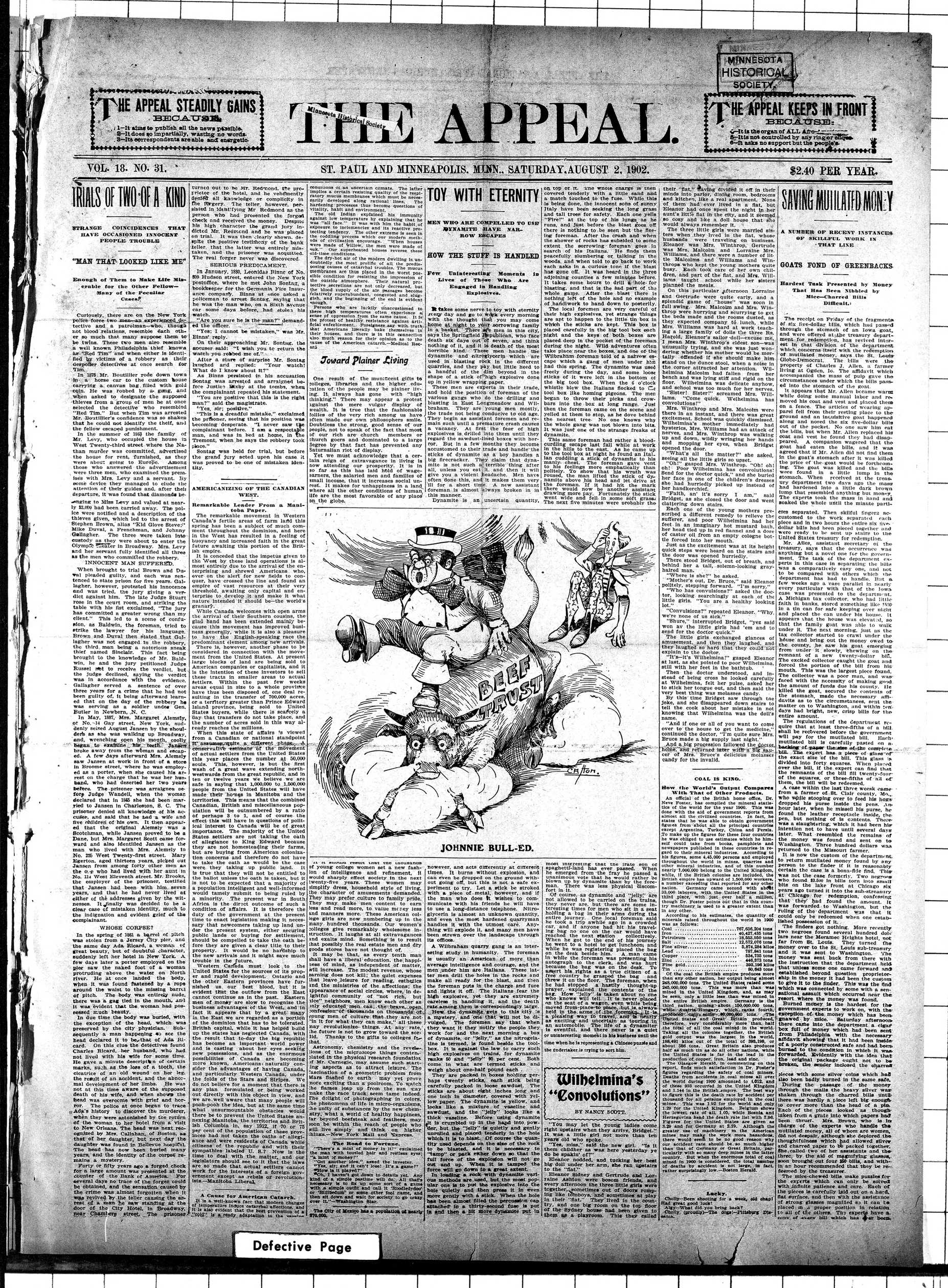
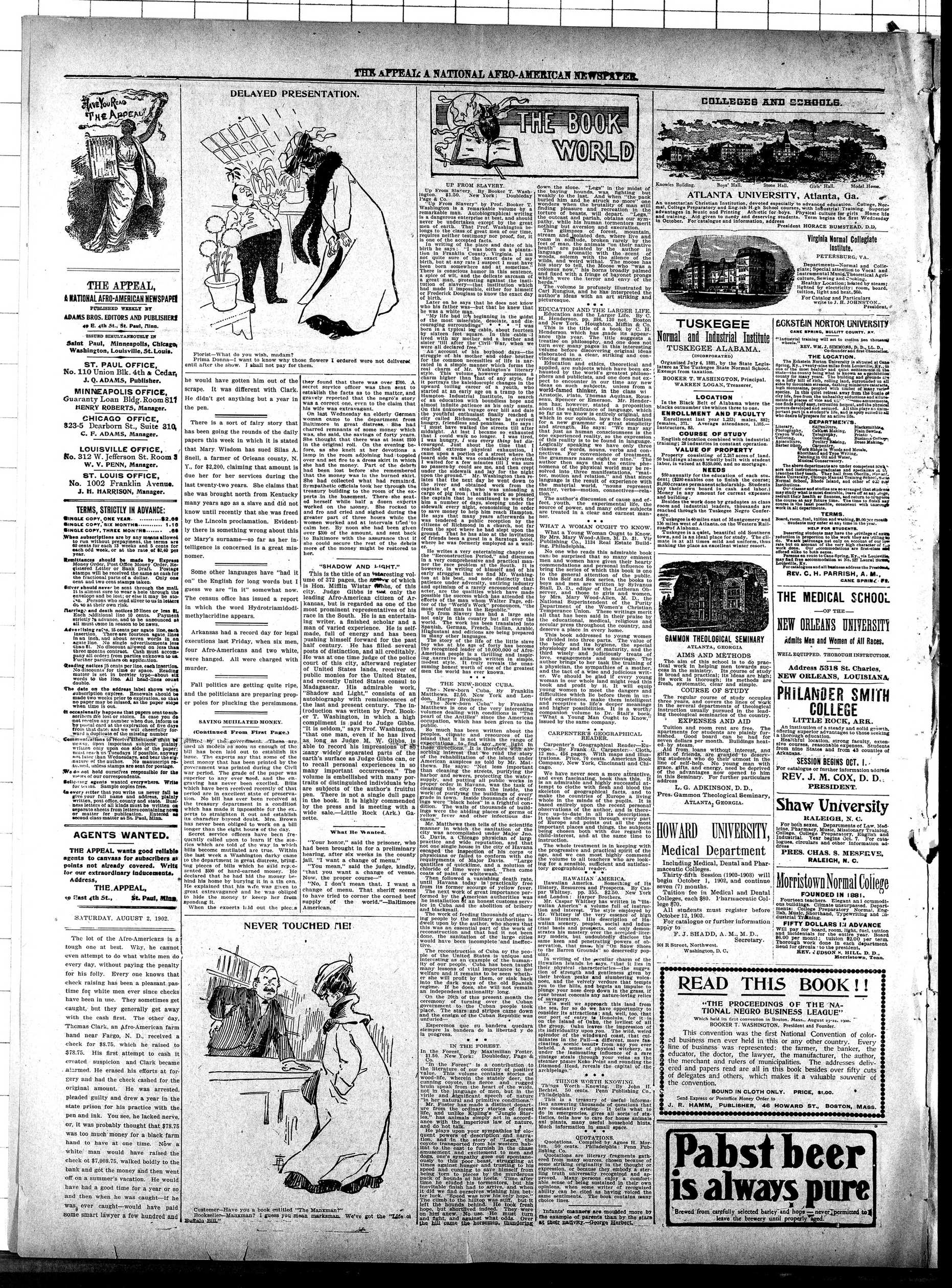
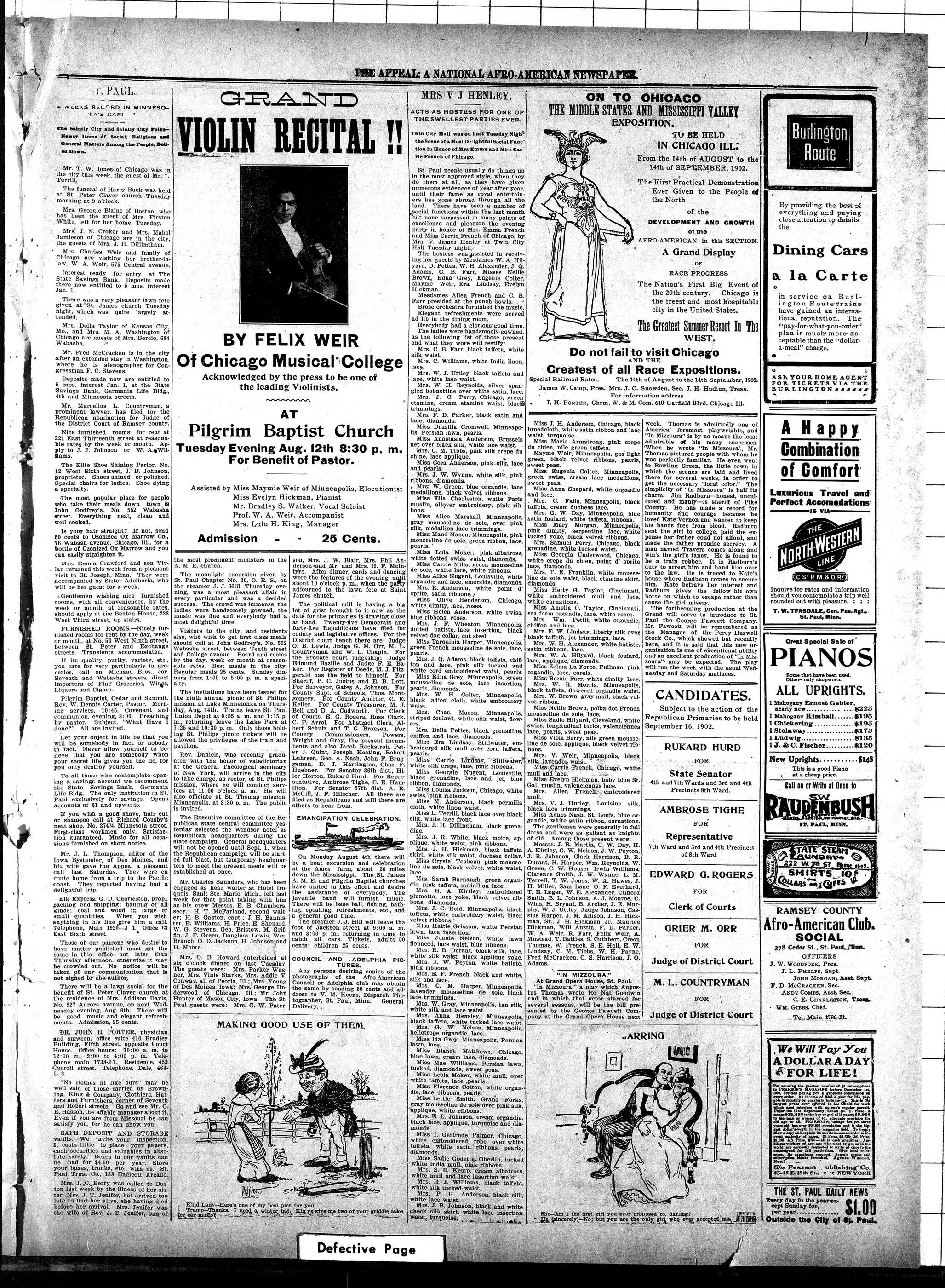
Page text (machine-generated)
THE APPEAL STEADILY GAINS
BECAUSE
1-It aims to publish all the news possible.
2-It does so impartially, wasting no words.
3- Its correspondents are able and energetic.
TRIALS OF TWO OF A KIND
STRANGE COINCIDENCES THAT
HAVE OCCASIONED INNOCENT
PEOPLE TROUBLE
"MAN THAT LOOKED LIKE ME"
Enough of Them to Make Life Miscreable for the Other Fellow—Many of the Peculiar Cases?
Curiously, there are on the New York police force two men—an experienced detective and a patrolman—who, though not blood relations, resemble each other so much that they pose them to be twins. These two men also resemble a well known Philadelphia thief known as "Red Tim" and when either is identified by victims of a robbery as their detectives at once search for Tim.
In 1876 Mr. Boutilier rode down town in a horse car to the custom house in New York. He was robed by a gong, and when asked to designate the supposed thieves from a group of men he at once called "Red Tim." But when Tim was arrested Mr. Boutilier's confidence was so shaken that he could not identify the theft, and the thieves were furnished a furniture. In the summer of 1883 the family of Mr. Levy, who occupied the house in West Twenty-third street where the Nathan murder was comedied, were arrested. They were about going to Eurosep. Among those who answered the advertisement were the furniture dealers with Mrs. Levy and a servant. By some device they managed to elude the attention of their guides and, after their arrest, the diamonds belonging to Miss Levy and value $3,000 had been carried away. The police were notified and a description of the thieves given, which led to the arrest of Mr. Duvel, a Frenchman of Mike Duvel, a Frenchman of Gallagher. The three were taken into custody as they were about to enter the house. He was robed by Levy and her servant fully furnished all the men who committed the robbery.
ANCOST MAN SUPPERED.
He brought to trial Brown and Dawid pleaded not guilty, accented to state prison for five years. Gallahower, however, protested his innocence and was tried, the jury giving a verdict of not guilty. He rose in the court room, and striking the table with his fist exclaimed, "The jury has committed a greater wrong than my client." This led to a scene of confusion, as Baldwin, the foreman, tried to prove that Brown and Dawal then staked the lager was not engaged in the robbery, the third man being a notorious sneak named Nobilis. This fact being brought to light, Brown and Dawal won, he and the jury petitioned Judge Russell not to receive the verdict, but the judge declined, saying the verdict required an ordinance of evidence. Gallahower gave a sentence, three years for a crime that he had not been guilty of, it being afterward learned that on the day of the robbery he was guilty of the gen. Butler in Newborn, N. C.
In May, 1887, Mrs. Margaret Alemby, or No. 14 Gay street, New York, suddenly seized August Jannen by the shoulder, and wrenching open his mouth, coily began to examine his teeth. Jannen broke away from the woman and escaped. A few days afterward Mrs. Alemby was in Broome street, where he was employed as a porter, when she caused his arrest on the charge that he was her husband. Before the prisoner was arrested, Judge Wandell, when the woman declared that in 1885 she had been married to Jannen in Charleston, S. C. The woman, who was a nurse, cuises, and said that he had a wife and five children of his own. It then appeared that the original Alemby was a Scotchman, while Jannen proved to be a Frenchman, and also identified Jannen as the man who lived with Mrs. Alemby in No. 226 West Twenty-first street. Mary Jannen from among forty other men as the o. p. who had lived with her aunt in No. 14 West Eleventh street Mr. Brooks, from among forty other men as Jannen had been with him seven years, and that he had never lived at either of the addresses given by the witnesses. It finally was decided to be a married woman. At the indignation and evident relief of the complainant.
WHOSE CORPSE?
In the spring of 1861 a barrel of pitch was stolen from a Jersey City pier, and the same day Ada Ricard, a woman of the time, was arrested suddenly her hotel in New York. A few days later a porter employed on the pier saw the naked foot of a woman protruding above the water on North Carolina Avenue. When it was found fastened by a rope around the waist to the missing barrel of pitch. The body was entirely nude, there was a gag tled in the mouth, and there was a woman who had posed much beauty.
In due time the body was buried, with the exception of the head, which was removed. The head was subsequently a man happening to see the head declared it to be that of Ada Ricard. On this clue the detectives found the body, and not lived with his wife for some time. He gave a minute description of certain marks, such as the loss of a tooth, the result of an accident, and the abnormal development of her limbs. He was taken to the death of his wife, and when shown the head was overcome with grief and horror. The police at once began to trace Ada's history to discover the murder, and the death of the woman to her hotel from a visit to New Orleans. The head was next recalled to the police, and the fact that of her daughter, but next day the daughter was found in Bellevue hospital. The head has now been buried many years later, the city of the corpse remains a mystery.
Forty or fifty years ago a forged check for a large amount was presented at the courthouse. The judge several days no trace of the forger could be obtained, and the sensation caused by the crime was almost forgotten when it was revived by the teller causing the anarchist door of the City Hotel, in Broadway, near Chambersburg, the prisoner
turned out to be Mr. Redmond, the proprietor of the hotel, and he vehemently insisted on the business, or complicity, of the surgery. The teller complained in Identifying Mr. Redmond as the person who had presented the forged key to the hotel, and he insisted his high character the grand jury indicted Mr. Redmond and he was placed in the prison. He spiked the positive testimony of the bank teller, that the latter was entirely mistaken, and the prisoner was acquitted. The case was recovered SERIOUS PREDICATES In January, 1880, Leondas Rinne of No. 99 Hudson street, entered the New York postoffice, where he met John Sontag, a police company, and he met a police company, Binsat once asked a policeman to arrest Sontag, saying that he was the man who, on a sixth avenue some days before, had staked his watch.
"Are you sure he is the man?" demanded the officer.
"Yes; I cannot be mistaken," was Mr. Elnns' reply.
On their approaching Mr. Sontag, the accuser said: "I wish you to return the watch you robbed me of. I wish you to return the watch you laughed and replied: 'Your watch! What do I know about it?' My accusation was repeated and arraigned before Justice Mkbye at the tomb, when the complainant repeated his statement. "You are positive that this is the right man to be arrested." "Yes, sir; positive." "This is a dreadful mistake," exclaimed the complainant, "becoming desperate." "I never saw the complainant before. I am a respectable man, and was in bed at home, in the morning, when he says the robber took place." Sontag was held for trial, but before the grand jury acted upon his case it was proved to be one of mistaken identity.
AMERICANIZING OF THE CANADIAN WEST.
Remarkable Leader From a Manitoba Paper.
The remarkable movement in Western Canada's fertile areas of farm land this spring through the dominion, such come from the West has resulted in a feeling of buoyancy and increased faith in the great future creating this portion of the Britt-empire. It is conceded that the impetus given to the West by these land operations is albeit a small one, but the enterprise and shrewd Americans, who, ever on the alert for new fields to conquer, are the superpower of vast resources at their very threshold, awaiting only capital and enterprise to develop it and make it what nature intended it should be—the world's
While Canada welcomes with open arms the number of foreign-born business-generally, foreign-born胶头 hand has been extended mainly because this movement has improved business generally. The English-speaking race of the predominant element among new arrivals is more however, another phase to be mentioned from the United States. At present foreign-born American companies or capitalists, and it is the intention of these investors to sell their settlers. Within the past few weeks areas equal in size to a whole province of the United States are awaiting in the transfer of 700,000 acres, or a territory greater than Prince Edward Island, to foreign-born States buyers, while there is scarcely a day that transfers do not take place, and the number of acres sold in this way al-
When this state of affairs's viewed from a Canadian or national standpoint it assumes, quite, a different phase. A conservative estimate of the movement of actual settlers from the United States this year places the number at 50,000 souls. This, however, is but the first example of the state's extendings, westwards from the great republic, and in ten or twelve years we believe we are safe in saying that 1,000,000 to 1,500,000 people from the United States will have made their hongs in Manitoba and the territories. This means that the combined Canadian, British and miscellaneous population of the state is the程度 in which the other 3 to 1, and of course the effect this will have in questions of political interest to Canada will be of great importance. The majority of the United States settlers are not taking the oath of allegiance to King Edward because they are not homestading their farms, but are buying from American colonizationists. The fact that the country has taken to take the oath as would be the case were they taking up public land. It is true that they will not be entitled to the ballot unless the oath is taken, but it is not to be expected that a majority of a population intelligent and well-informed would tarnely submit to being ruled by a man who is not present in South Africa, is the direct outcome of such condition of affairs. It is therefore the duty of the government at the present time to enact legislation making it necessary that newcomers taking up land under the present system, either securing public lands or buying for settlement, should be compelled to take the oath before the government. It is not the case that the new arrivals and it might save much trouble in the future.
Western Canada must look to the United States for the sources of its prosperity, but we must also look to the other Eastern provinces have furnished us, our best blood, but it is evident that the outflow from the East must be the source of the men of money are slow to recognise the business advantages of the West, and in the East we are regarded as a portion of the dominion that has to be tolerated. But the capital, while it has helped build up the country, about her eyes seeking new possessions, and the prospects of possibilities of Canada are becoming more known America, and the advantages of having Canada, and particularly Western Canada, under the folds of the Stars and Stripes. We must also plan formulation or being worked out directly with this object in view, and any plan formulation or being worked out what unsurmountable obstacles would there be to prevent the United States an American colony, the oaths of allegiance and were residents of citizens of the republic and with their sympathetic U. S. 7. Now is the time for legislators should see to it that the laws are made that actual settlers cannot be represented by a foreign government except as reliable or revolutionists—Manitoba Liberal.
A Cause for American Catarrh.
It is a well-known fact that modern changes of imperative induce catarrhal affections, and it is the result of prevention of a "ready" is a ready adenoiditis.
Defective Page
THE APPEAL.
conclusions of an uncertain climate. The latter implies a certain resisting quality of the respiratory mucus membranes which must be necessarily developed along rational lines. The hardening processes thus become questions of vitality, habit and environment.
The old Indian explained his immunity against low temperature by explaining that he was not a "fever-free" person. It was with him the habit of exposure to inclement weather and its reactive protecting tendency. The other extreme is seen in the codding process which "when methodical of civilisation encourage." (When house-woven was made of willow, the men were made of oak." Our superheated houses reverse these old-time conditions.
The dry-hot air of the modern dwelling is undoubtedly the most prolific of all the predisposing causes of catarrhal troubles. The mucus membranes are thus placed in the worst possible condition for resisting the impression of the outside atmosphere. Their natural protection is not the result of their own decreased but the blood supply of air, passages become relatively superabundant, congested and sluggish, and the beginning of the end is evident enough.
Persons who are luckily unaccustomed to these high temperatures often experience a sense of oppression from the same cause. It is the protest of healthy resistance against artificial enfeeblement. Foreigners say with truth that Americans literally bake themselves in their houses, and there is in this connection evidence much reason for their opinion as to the cause of the American catarrh.—Medical Rec
Joward Plainer Living
One result of the munificent gifts to colleges, libraries and the higher education system is that it always has gone with "high thinking." There may appear a protest against the mere vulgar display of health of the very rich among have often made our own philosophers amble. People of the very rich among people, not to speak of the fast that most of our rich are church members or church goers and dominated to a large extent by an avengance in now attending our university. It rests as this has laid hld of wagearners, the salaried men and families of the rich, the most favorable of any place [20].
111
BEEF
TRUST
CHATON.
JOHNNIE BULL-ED.
of young college women set a new fashion of intelligence and refinement, it would sharply effect society in the next twenty-five years. These women may simplify dress, household style of living, the character of amusements demanded. They may prefer culture to family pride. They may make men content to earn less and read more, to value money less and manners more. These American college girls are now numbering up in the many hundred thousands. Our women's colleges give remarkably wholesome instruction. It laughs at all extravagances and exalts mind. Something is to result that possibly the real estate men and dry goods stores have not thought of.
It may be that, as every tenth man shall have a liberal education, the happiness of mind, as independent of matter, will increase. The modest revenue, whose earning does not kill; the quiet expenses that leave leisure for reading, esthetics and the ministries of the affections; the appearance of social circles, where, in delightful community of "not rich, but nice" neighbors, men know each other as only educated men can; the brave, open confession of thousands on thousands of young men of culture that they are not "in it for what they can make," all these may revolutionize things. At any rate, the future is not to grow toward the world. Thanks to the gifts to colleges for that.
Astronomy, chemistry and the revelations of the microscope things contemplated in the physical research foundation of Mr. Carnegie, may assume such starting aspects as to attract leisure. The "asymmetry" of a geometric problem from Mars flashed to earth may yet prove more exciting than a poolroom. To watch the flames leap up from the sun may make the race track, seem tame indeed. The delight of photographing in colors, the phenomena of life in micro-organisms, the unity of substances by the new chemistry, what a world of healthy happiness, far beyond beefsteak and feathers, may soon be within the reach of people who will live simply and think on higher things.
The Road to Fortune.
"There's a mint of money in it!" exclaimed the man with tousled hair and restless eyes; "a mint of money!" asked the investor. "Got a mint of money?" asked the investor. "Yes, sir; and it can't lose! It's a game!"
"How is it played?"
"Oh, I haven't got down to details yet. Any kind of a simple pastime will do. All that's necessary is to fix up some sort of a game with a simple outfit and call it 'Roodledydoe' or 'Billibedum' or some other fool name, and then sit down and wait for society to go crazy over it." Washington Star.
TOY WITH ETERNITY
MEN WHO ARE COMPELLED TO USE DYNAMITE HAVE NARROW ESCAPES
HOW THE STUFF IS HANDLED
Few Uninteresting Moments in Lives of Those Who Are Engaged in Handling Explosives.
It takes some nerve to toy with eternity sweep and run, terrifying with the thought that you may home at night to your sorrowing family in a basket. There are men in this city, share the Apartment building, who face death six days out of seven, and thinks nothing of it, and it is death of the most dour kind. These men handle the dynamite, and atropogryne, which used in blasting rock in the different quarries, and they play but little heed to a handful of the dim beyond in the dynamite, and explosive done up in yellow wrapping paper.
These men are experts in their trade, and hold the position of foreman of the vault, and the position of blasting in East Limehead and Wilbraham. They are young men mostly. They are young men mostly. They begin as sandwich force to old age. They main such until a premature crash causes a vacancy. At first the fear of high pressure is a major factor to regard the sawdust-lined boxes with horror. But in a few months they become accustomed to their trade and handle the big fire cracker. They claim that dynamite is not such as terrible 'thing after fire' and that they give you a violent headache. Men have often done this, and it makes them very for a short time. A new assistant must always break in in this manner.
Dynamite is an uncertain quantity.
BEEF
TRUST
JOHNNIE BULL-ED.
however, and acts differently at current times. It burns without explosion, and can even be dropped on the ground with a hammer or a hammer periment to try. Let a stick be stroked with a piece of metal, however, and if the man who does it wishes to communicate with his friends he will have a hammer. Glycerin is almost an unknown quantity, and even the most hardened quarryman handles it with the utmost care. Anything will explode it, and many men have been burnt over the landscape through its office.
A Wilbread quarry gang is an inter-
esting study in humanity. The foreman is
usually an American, of more than
average intelligence and courage, and the
foreman must drill the holes in the rocks
and make all ready for the blast, and then
the foreman pete in the charge and tense
the men up, and the men high explosive, yet they are extremely
careless in handling it, and the death
is not a problem. How the dynamic gets to this city is
a mystery, and that will not be divulged. The foreman may say, when
the dynamic is active, the work for
work and the next morning a box of
dynamite, or "jelly," as the nitroglue-
is ten feet long beneath the toolbox,
is against him. How high explosives on trains, for dynamite
ranks 50 and "jelly" 90 per cent. Both
and watch about one-half pound each.
They are packed in boxes holding perhaps twenty sticks, each stick being about the same length, and sticks are about eight inches long, and one inch in diameter, covered with yellow paper. The dynamite is placed looks like a stick, but it looks at vasseline and sawdust, and the "jelly" looks like a thick vasseline. Before using dynamite the jelly is placed in the vasseline, but the "jelly" is quietly and gently unrolled and placed tenderly in the hole which it is to blast. Of course the quantity of dynamite to be blasted, and it is necessary to "tamp" or pack either down so that the full force of the explosion will not go too hard. The force will go down to a great extent. In loading a rock with dynamite vartition one is to put the explosive into the hole quietly and then press it in even more gently with a stick. When the hole is filled, the explosive is attached to a thirty-second fuse is put in and then a bit more dynamite put in.
---
on top or. it. one wnoie carnge is then covered tenderly with a little sand and a match touched to the fuse. While this is being done, the innocent sons of sunny Italy have been seeking the long grass. He has had his own life in the country. "Fire!" at the top of his lungs as he runs, and just before the blast goes off there is nothing to be seen but the fleeing foreman. After the crash and when the shower of rocks has subdued to some extent the sorrowing foreman goes in, he is in a state of sadness. He is peacefully slumbering or talking in the woods, and when told to go back to work each asks in a curious tone if the blast has gone off. It was heard in the three adjoining counties a few minutes before. It takes some hours to drill a hole for blasting, and that is the sad part of the whole game. After the blast there is a great deal of trouble here, and no one of haridwork to hand down to posterity.
The local foremen are very careful of their high explosives, yet strange things are apt to happen to the little tin box in which the sticks are kept. This box is placed carefully in the big tool box each night, and is used to be used in the pocket of the foreman during the night. Wild adventures often take place near the boxes, and one of the Wilbraham foreman told of a narrow escape which a gang of men under his had this spring. The dynamite was used freely during the day, and some loose pieces of lead were let into the bottom of the big tool box. When the bottom of the whistle blew the Italians flocked to Czei tool box like homing pigeons. The men began to throw their picks and crow bars into the box at long range. Just then the foreman came on the scene and yelled at them to stop, as he dove behind his first tree. No one knows why the whole thing was not blown into bits. It was just one of the strange freaks of dynamite.
This same foreman had rather a blood-curdling escape last fall while at work in the hills to the east. As he came up to the tool box at night he found an Italian cuddling a stick of dynamite to his manly chest. The foreman gave vent to his feelings more emphatically than politely. To show that his wrath was roused, the man lifted the stick of dynamite above his head and let drive at the foreman. If it had hit the mark there would now be another assistant drawing more pay. Fortunately the stick went wide and fell in some soft grass.
CHITON.
most increasing that the irate son of
the man who had been the fray he
he emerged from the fray he was
unanimous by dynamic than by rather
man. There was less physical discom-
fort.
Of course, as dynamite and "jelly" are not allowed to be carried on the training, they never are, but there are some interesting times for men who sit in a seat holding a bag in their arms during the entire journey. One local foreman said he took a trip awhile ago in a crowded car, and if anyone had hit his traveling bag no one on the car would have reached the next station collectively. When he got to the end of his journey he went to a hotel to get luncheon, and while he was registering placed the bag on the desk beside him. A man came in while the foreman was presenting his autograph to the clerk, and was hurt because the bag was on the desk. To assert his rights as a true citizen of a free country he grasped the bag and threw it on the floor. The foreman, when he had stopped a hastily thought-up prayer, explained the contents of the bag. How "jelly" is taken about no one who knows will tell. It is never placed on the seat of a wagon, even while being moved from-place to place. But is it all held in the arms of the foreman, and in the pleasing way to travel, and is nearly as exciting and uncertain as touring in an automobile. The life of a dynamiter is eventful, and there never is a quiet or interesting moment in his business until the
Wilhelmina's "Convolutions"
"You may let the young ladies come right up here and they arrive, Bridge." It was a little girl not more than ten years old who spoke
Eleanor Sidney and Gertrude and Lorraine added several booths, and every afternoon the three little girls were together, sometimes out of doors roaming this shadowed sometimes in play in their "flat." They lived in the country, and one big room on the top floor of the Sydney house had been given to them as a playroom. This they called
their "fat," having divided it off in their minds into parlor, dining room, bedrooms and bathrooms. The room of them had ever lived in a flat, but Eleanor once had spent the night in her apartment in the city and it seemed so cozy and like a home that she would always remember it.
The three little girls were married sisters when they lived in the flat, whose husbands were traveling on business. Eleanor was Mrs. Winthrop, Gertrude was Mrs. Malcolm and Lorraine Mrs. Williams, and there were a number of little Malcolms and Williams and Winthrops who kept the young mothers quite busy. Each took care of her own children, and part of the flat, and Mrs. Williams taught school while her sisters planned the meals.
On this particular afternoon Lorraine and Gertrude were quite early, and a splendid game of "house" was soon in full swing. Mrs. Malcolm and Mrs. Winthrop were hurrying and scurrying to get the beds made and the rooms dusted, as they expected company to lunch, while Mrs. Williams was hard at work teaching a large family of dolls the three Rs. Harold, Eleanor's sailor-doll—excuse me, I mean Mrs. Winthrop's eldest son—was unusually trying, and she was just wondering whether his mother would be mortally offended if she should make him stand on the dunce stool, when a noise in the corner attracted her attention. Wilhelmina Malcolm had fallen from her bench and was lying stiff and rigid on the floor. Wilhelmina was delicate anyhow, and school was too much for her nerves. "Sister!" Sister!" screamed Mrs. Williams. "Come quick. Wilhelmina has convolutions!"
Mrs. Wintrop and Mrs. Malcolm were there an instant, and there was great excitement the little girl had experienced Wilhelmina's mother immediately her hysterics, Mrs. Williams had an attack of Mrs. Wintrop and Mrs. Wintrop was walking up and down, wildly, with her arms and mopping her eyes, when Bridget opened the door. The matter" she asked, seeing all the little girls so excited.
seeing all the little girls so upset,
"Oh! oh! Oh!!" Powl Wilhelmina, "Oh! oh!
Oh!!" Powl Wilhelmina, "Oh! oh!
Send for the doctor quick," and she buried
her face in one of the children's dresses
her carefully picked up instead of
her handkerchief.
"Faith, an' it is sorry I am," said
Bridget, as she closed the door and went
down stairs.
Each one of them young mothers prescribes a different remedy to relieve the sufferer, and poor Wilhelmina had her
imaginary hot mustard bath, her head tilted in a pose and a dose of castor oil from an empty cologne bottle
forced into her mouth.
But as the excitement was at its height,
the door was opened hurriedly.
There stood Bridget, out of breath, and
and behind her a tail, solemn-looking gray-haired man she?" he asked. "Mother's out, Dr. Bruce," said Eleanor Cohen. "She's not m sorry. "Who has convulsions?" she looked searching at each of the girls. "You are a healthy looking lot."
"Convulsions?" repeated Eleanor. "Why were none of us sick?" Bridget. "yeas won a win the little girls had 'em and to send for the doctor quick." "Little girls exchanged glances of amusement as they laughed and they laughed so hard that they could not explain to the doctor. The little girls gaped Eleanor at last, as she pointed to poor Wilhelmina, still with her feet in the bathhut. "Then the doctor understood, and insisted at Wilhelmina, felt her pulse, asked her to stick her tongue out, and then said the trick that Bridge was candy. By this Bridge Bridge was joke, and she disappeared down stairs to tell the cook about her mistake in not mentioning that Wilhelmina was the doll's name. "And if one or all of you want to come over to the house to get the medicine," Bridget said, "Mrs. Bruce made a big supply last night. And a big process followed the doctor home, and returned later with a big salad of delicious molluscs candy for the invalid."
COAL IS KING.
With That of Other Products.
An official of the British home office, Dr. Neve Foster, has compiled the mineral statistics of the world for the year 1900. This was done with the aid of government reports from almost all the civilized countries. In fact, he states that he was able to obtain government figures from about all the principal countries except Argentina, Turkey, China and Persia. To make up the figures for these four countries, he has obliged to use estimates of his own and his own估计 to make a table from books pamphlets and newspapers published in these countries in regard to their mineral industries. According to his figures, some 4,45,000 persons and employed throughout the world in mines, quarries and other mineral industries, and of this number nearly 1,000,000 belong to the United Kingdom, while, if the British colonies are included, the rest of the British is as far north as 1,100,000.
A number exceeding that reported for any other nation. Germany came second with about 33,000 laborers, with the United States in the third place, with just over half a million, though Dr. Foster points out that in this country machinery is used to a greater extent than in any other.
According to his estimates, the quantity of mineral products is 1,100,000 tons.
Coal was as follows:
Iron: 40,427,435 tons
Petroleum: 18,553,050 tons
Salt: 12,572,076 tons
Fine silver: 5,874,284 kilos
Lead: 757,841 tons
Copper: 834,753 tons
Zinc: 444,753 tons
Fine gold: 393,196 kilos
Tin: 90,643 tons
Of the coal the British empire produces more than any other nation, her output being almost 248,000,000 tons. The United States raised some 245,000,000 tons. This was more than was mined in the United Kingdom, and as may be seen only in the United States, the United States is the entire British empire. Germany is the third nation, mining-about 150,000,000 tons, while Austria-Hungary, which ranks fourth, produced: only some 20,000,000 tons. The United States and Great Britain produced 10,000,000 tons, while the United States and Great Britain produced 366 tons, a great deal more than the United States is far on the end of the production of copper, iron, lead and zinc.
The Glasgow Herald, in commenting on this report, finds much satisfaction in Dr. Foster's figures regarding the safety of coal miners. In 1904, Dr. Foster said that the United States were the world's first to have the world during 1900 amounted to 4,012, and of these 923 occurred in the United Kingdom and 1,144 in the British empire. The best way to figure this is the death rate by accident per thousand for all persons employed in the coal mine. The U.S. Department of Labor, on the 12th of 1904, states that the world for the United Kingdom, Belgium, above the lowest rate of all, 1.05, while Bosnia and Herzegovina head the death rate list with 7.96. Figures for the United States are given as 3.29 and for Germany at 2.19. Although the greater number of machines in America may be made by the work more heavily there would seem to be no good reason why our accident rate should be so much higher than that of Germany or Great Britain, particularly with so many deep mines in the latter country. The U.S. Department of Labor, on the 12th of 1904, states that the world for the United Kingdom, the death rate list with 1900 is considered, the total number of deaths by accident is not large, in fact, rather surprisingly low.
Lacky.
Cholly—Been helpful for a week, old chap
Had great good look!
Ally—What you bring back!
Cholly (groundly)—The dogs—Fitzsburg Dis-
SAVING MUILATED MONEY
A NUMBER OF RECENT INSTANCES
OF SKILLFUL WORK IN
· THAT LINE
GOATS FOND OF GREENBACKS
Hardest Task Presented by Money
That Has Been Nibbled by
Mice-Charred Bills
Difficult.
The receipt on Friday of the fragments of six five-dollar bills, which had passed through the stomach of an Iowa goat, were offered at the treasury department for sale. The department was interested in that division of the department which concerns itself with the redemption of mutilated money, says the St. Louis police department. The property of Charles J. Allen, a farmer living at Odgen, J. The affidavit which accompanied the mass of pulp gave the police department bills passed into the stomach of the goat.
It appears that Mr. Allen became warm while doing some manual labor and relied on his coat and vest and placed them on a fireplace and fell into the pocket from their resting place to the ground and an inquisitive goat happened to pull out of the pocket. No one saw him jump the bills, but when Mr. Allen replaced his coat and vest he found they had disappeared. The goat had eaten the bills, and it was agreed that if Mr. Allen did not find them in the goat's stomach after it was killed, the goat was killed and the bills were found in a little lump in the face department two days ago the mass had hardened into a little dark brown lump that resembled anything but money. The department two days ago the mass soaked the whole until the minute parties separated. Then skidful fingers accustomed to the work separated each piece and in two hours the entire six dollar bills had been placed together and United States treasury for redemption.
Mr. Alies, assistant secretary of the Treasury, said the occurrence of anything but a move toward the government. The task of the department eventually was a comparatively easy one, and not to be compared with others which the few weeks ago a case paralleled in nearly every particular with that of the Iowa tax collector. A Michigan tax collector, who little faith in banks, stored something like 50% of money for safe keeping over night and placed it in the house, appears that the house was elevated, so that the family goat was able to walk the house and bring out the money owed to the tax collector started to crawl under the house and bring out the money owed to the tax collector caught the goat and forced the portion to move out. This was the largest piece found, that was a poor man, and was faced with the amount of the funds due his county. He killed the goat, secured the contents of the house, and devoted as to the circumstances, the matter on to Washington, and within ten weeks, a new, crisp bills for the entire amount.
The regulations of the Department require that at least three-fifths of a bill shall be recovered before the government will pay for the mutilated bill. Each mutilated bill is carefully pasted on a backing of paper the size of the complete bill. The expert has a piece of glass of the exact size of the bill. This glass is divided into forty squares. When placed over the bill, if the expert can find that the remnants of the bill fill twenty-four of the squares, or three-fifths of all of them, the bill will be redeemed.
A case within the last three weeks came from a farmer of St. Clair county, Mo., who while stooping over to feed his hogs dropped his purse inside the pens. An hour later, when he missed his purse, he found the leather receptacle inside, the pen, but nothing of its contents. There was a slaughtering, which it had been his intention not to have until several days later. What resembled the remains of the money was found and sent on to Washington. Three hundred dollars was returned to the Missouri farmer.
It is now the custom of the department-mart to multitask money found by any person in the office. It is important certain the case is a bona-fide find. This was the case formerly. Two negroes bitted bits on the lake front at Chicago six months ago into the sub-stressure that they had found the amount. It forwarded to Washington, but the failure could only be redeemed when could only be redeemed when one established possession of it. More recently two negroes found several hundred dollars near the Meramec Hotel, not hotel, and two dollars the money over to the St. Louis sub-stressure and it was sent to Washington. The money was there with the instruction that the department must give that unless some one came forward and that unless some one question proprietorship in the money to give it to the finder. This was the find was connected by some with a sensation the resort where the money was found.
Burned money is the hardest for the employee, except of the money which has been grawn by mice. Saturday afternoon the department a clog box full of money for the treasurer from Philadelphia with the necessary aidadvice showing that it had been inside the building when the money was burned to the condition in which it was forwarded. Evidently with the idea that original package not to be broken, the money was placed with some silver coins which had also been badly burned in the same safe. During the passage of the money through the heavy silver was removed and there was hardly a piece left big enough to cover more than the head of a pin. There was hardly a piece left taken from a grate into which papers had been thrust. Mrs. Brown, who is in charge of the experts who handle the money, did not despair, although she deplored the thoughtfulness which had allowed silver to be recovered, although she deplored the call two of her assistants and the three by the aid of magnifying glasses, soon brought out four aid bills, and with them the treasurer that they be received.
The miter-chewed bills make purser forces on the pieces, and the pieces with infinite patience and care. Each of the pieces is carefully laid on a hard, flat surface, and the pieces of strong glasses magnified as it can be placed in a proper position in relation to the pieces. The pieces can conv of strong bill which has not been
HAVE YOU READ
THE APPEAL
ADAMS BROS. EDITORS AND PUBLISHERS
49 E. 4th St., St. Paul, Ill.
ISSUED SIMULTANEOUS IN
Saint Paul, Minneapolis, Chicago,
Washington, Louisville, St. Louis.
ST. PAUL OFFICE,
No. 110 Union Blk. 4th & Cedar,
J. Q. ADAMS, Publisher.
MINNEAPOLIS OFFICE,
Guaranty Loan Bldg. Room 811
HENRY BROERTS, Manager.
CHICAGO OFFICE,
823-5 Dearborn St., Suite 310,
C. F. ADAMS, Manager.
LOUISVILLE OFFICE,
No. 312 W. Jefferson St. Room 8
W. V. PENN, Manager.
ST. LOUIS OFFICE,
No. 1002 Franklin Avenue.
J. H. HARRISON, Manager.
TERMS, STRICTLY IN ADVANCE:
SINGLE COPY, ONE YEAR ..... $2.00
SINGLE COPY, SIX MONTHS ..... 1.10
SINGLE COPY, THREE MONTHS ..... .68
When subscriptions are by any means allowed
to run without prepayment, the terms are
applicable. For a single subscription,
each week or, at the rate of $2.40 per
cent, should be made by Express
Remittances should be made by Express
Money Order, Post Office Money Order, Order
stamps, or by a cash envelope with cash as
stamps will be received the same as cash for
one cent and two cents stamps taken. Only one
cent and two cents stamps taken.
Silver should never be sent through the mail.
Cash envelopes and be lost or destroyed.
Persons who send silver to us in letters
Marriage, and design letters 10 lines or less.
Each Additional line 10 cents. Payment
announced at all must season in the month
all must season in the month
Advertising rates, 15 cents per agate line each
insertion. There are fourteen agate lines
agate line. No single advertisements must
agate line. Three months contract. Must access
pany all orders from parties unknown to us.
Reading rates 25 cents per line each insertion.
No discounts for time or space. Reading
many types of paper about us
words to the line.
On the envelopes label should
double.
When on the envelopes label should
make two weeks prior to expiration, so that
no paper may be missed, as the paper stage
may be delayed.
Occasionally happens that papers sent to someone may not receive any number when due, inform us by postal card at the expiration of five days or by email. We will forward a duplicate of the missing number.
Communications to receive information must be upon, upon important subjects, plainly stated. We must reschedule Tuesdays if possible, anyway no later than Wednesday, and bear the signature, unless stamps are sent for postage.
We do not hold ourselves responsible for the views of our correspondents.
We write to you somewhere. Write for you. Sample copies free.
in every letter that you write us never fall to
the wrong hands. You must write, post office, county and state. You must write on separate sheets from the letter or matter for publication. Entered as a
document.
AGENTS WANTED.
THE APPEAL wants good reliable agents to canvass for subscribers as points not already covered. Writes for our extraordinary inducements.
SATURDAY, AUGUST 2. 1902.
The lot of the Afro-Americans is a tough one at best. Why, he cannot even attempt to do what white men do every day, without paying the penalty for his folly. Every one knows that check raising has been a pleasant pastime for white men ever since checks have been in use. They sometimes get caught, but they generally get away with the cash first. The other day, Thomas Clark, an Afro-American farm hand near Fargo, N. D., received a check for $8.75, which he raised to $78.75. His first attempt to cash it created suspicion and Clark became alarmed. He erased his efforts at forgery and had the check cashed for the original amount. He was arrested, pleaded guilty and drew a year in the state prison for his practice with the ink. You see, he lacked nerve, or, it was probably thought that $78.75 was too much money for a black farm hand to have at one time. Now a white man would have raised the check at $7,000.75 walked boldly to the bank and got the money and then went off on a summer's vacation. He would have had a good time for a year or so and then when he was caught—if he was ever caught—would have paid some smart lawyer a few hundred and
DELAYED PRESENTATION.
Florist-What you wish, mudam? Prima Dunn-I want to know why rose flowers I ordered were not delivered until I received them.
NEVER TOUCHED ME!
Customer. Have you a book grilled? "The Manyman!"
he would have gotten him out of the scrape. It was different with Clark. He didn't get anything but a year in the pen.
There is a sort of fairy story that has been going the rounds of the daily papers this week in which it is stated that Mary. Wisdom has sued Silas A. Snell, a farmer of Orleans county, N.Y., for $2,200, claiming that amount is due her for her services during the last twenty-two years. She claims that she was brought north from Kentucky many years ago as a slave and did not know until recently that she was freed by the Lincoln proclamation. Evidently there is something wrong about this or Mary's surname—so far as her intelligence is concerned is a great misnomer.
Some other languages have "had it on" the English for long words but I guess we are "in it" somewhat now. The census office has issued a report in which the word Hydrotramidodic methylacridine appears.
Arkansas had a record day for legal executions last Friday, when six men, four Afro-Americans and two white were hanged. All were charged with murder.
Fall politics are getting quite ripe, and the politicians are preparing proper poles for plucking the persimmons.
SAVING MUILATED MONEY
(Continued From First Page.)
printed by the government. These are used as models as soon as enough of the bill has been laid out to establish its issue. The experts say that some of the best money that has been printed by the government was printed during the Civil war period. The grade of the paper was superior to any ever used, and the engraving has never been excelled. Bills of the United States have been printed recently that period are in excellent status for present. No bill has ever been received at the treasury department in a condition which has made it impossible for the experts to straighten it out and establish its character beyond doubt. Mrs. Brown has never been obliged to work on a bill long that the eight hours of the day.
Secret service officers have recently frequently called upon to learn if the stories which are told of the way in which bills become mutilated are true. Within the last week a Washington darky came to the department in great distress, bringing pieces of bills which he said reposented $500 of hard-earned money. He declared that he had hit the money because his income of burying it in a tin can. He explained that it was given great extravagance and he was obliged to hide the money to keep her from spending it.
When the experts laid out the pieces
THE APPEAL: A NATIONAL AFRO-AMERICAN NEWSPaper
they found that there was over $100. A
new report from the Justice Department
establish the facts as to the matter, and
gravely reported that the negro's story
was true. The claim that the
bisie wife was extravagant
On last Wednesday an elderly German woman came to the department from her home, where she charred remnants of some money which was, she said, the savings of forty years. She thought that there was a need for her evening before, as she knelt at her devotions a lamp in the room adjoining had topped her desk. She said she had the money. Part of the debts had been lost before she remembered that the money was in the burned skirt of her dress. Sympathetic officials took her through the treasury building to the room of the ex-merchant, who worked herself while half a dozen experts worked on the money. She rocked to an armful of relief and she danced during the hours women worked and at intervals tiled to calm her. By noon she had given her money to Baltimore with the assurance that it could secure the rest of the debts more of the money might be restored to Baltimore with the assurance that it
"SHADOW AND LIGHT."
This is the title of an interesting volume of 372 pages, the following of which is:
He. Mifflin Wistar 700s, of this city. Judge Gibbs is not only the leading Afro-American citizen of Arkansas, but is regarded as one of the most well-knownจีนไทย people in the world. He is an entertaining race in the South. He is an entertaining in the world. He is an entertaining in the world. He is an an man of varied experience. He is self-made, full of energy and has been pushing himself forward for the past two years. He is the most diligent and most unstopped of distinction, and all credits He was at one time judge of the police court of this city, afterward registered of United States lands, receiver of public monies for the United States and recently the United States consul to be a member of the United States work."
"Shadow and Light," he lists of autobiography with reminiscences of the last and present century. The introduction was written by Prof. Booker T. Washington, in which a high-compliment is paid to Judge Gibbs, who is a member of the National Fund for the "Fighting" that one man, even if he has lived as long as Judge M. W. Gibbs, is able to record his impressions of the many widely separated parts of the earth's surface as Judge Gibbs can, or to recall personal experiences in some of the world, and the "Fighting" volume is embellished with many portraits of distinguished individuals who are subjects of the author's fruitful pen. There is not a single dull page in the book. It is highly commended by the press and is meeting with a wide sale—Little Rock (Ark.)
What He Wanted.
"Your honor," the prisoner, who had been brought in for a preliminary hearing, after six weeks in the county jail, said. "You mean, the judge said, 'You mean,' the judge said, kindly, 'that you want a change of venue. Now, the proper course—' "No, I don't mean that. I want a change of menu. That sheriff seems to have tried to corner the corned beef and the 'world.'" -Baltimore American.
THE BOOK WORLD
UP FROM SLAVERY.
Up From Slavery. By Booker T. Wash-
ington. $1.50. New York: Doubleday
down the slope. "Legs" in the midst
the baying hound, was fighting
weakly to the last. And when "the p
breaks."
"Up From Slavery" by prof. Booker T. Washington is a remarkable volume by a man who is a dangerous enterprise at best, and should never be undertaken except by the great man who has other testimony nor proof, for it is one of the most important in Franklin County, Virginia. I am not quite sure of the exact date of his birth, but it is known that he was born somewhere and at sometime. This sentence, a spice of wit, and the delicacy of a great man, protesting against the institution, had made it impossible, either for himself or Frederick Douglass to know the exact day. Later on he says that he does not know that he was a white man, but that he knew that he was a white man.
"My life had it's beginning in the midst of the most miserable, desolate, and discouraging surroundings" "I was born in a typical leg cabin, about fourteen by sixteen feet square. In this cabin lived with my mother and a brother and sister 'till after the Civil War, when we were all declared free."
An account of his boyhood may be the struggle of his mother and elder brother, the community of his children with the help of the same family. In a simple manner which forms the real charm of Mr. Washington's literary and popular life, he possesses the charm higher than that of any style, for it portrays the kaleidoscopic changes in the life of the young, the soaring rolling career of a youth who started at a early age. In the first of the Hampton Industrial Institute, in search of an education with boundless hope and love, he was born in the city of New York, and his only assets. On this unknown voyage, he was born to the youth of the enthusiast finally reached a city called Richmond, where he arrived at the same place. He had a great嗜好, and he was walked the streets till after midnight. At last I became so exhausted that he could not see the life of the young. I was hungry, I was every thing but discouraged. Just about the time that I came upon the physical exhaustion, I came upon a positive stress, the board side walk was considerably elevated. I waited for a few minutes till I was sure no one could come to the place. I was so under the sidewalk and my day for the night upon the ground. Mr. Washington then received the奖品, and he went down to the river and obtained a work. He was unloading a captain of a ship, who was no leading a cargo of big iron; that his work so pleased that he was so so much as he had to do with the ship a number of days, sleeping under the sidewalk every night, economizing in order to go to the ship his reach Hampton, he says that many people were厄chers. He was tendered a public reception by the citizens of Richmond in a church, not far from the open space in the town. He was a group of friends. That he has also at the invitation were he was formerly in a Saratoga hotel, and he was formerly employed as a waiter.
He writes a very entertaining chapter on the importance of the man in a very comprehensive and practical manifold, however, in writing of bishops and of his disciples, he is more careful to distinguish at his best, and more distinctly to patience under adversity, untiring industry and perseverance. The actors are the qualities which have made the man a man of great efforts of the man whom Walter Fiedler edi- tions, "The Man in the Red Robe," the most useful man in the Repository.
Up from Slavacy has had a large sale in the United States and abroad. The work has been translated into Spanish, German, French, Italian, Arabic, Indian editionitions are being prepared.
The story of the life of the little slave boy who at his age of forty has become the most famous slave in American people is a thrilling and inspiring narrative although written in simple, real life, it truly reveals the unsuspected honest work that the greatest men the world has ever known.
THE NEW-BORN CUBA
The New-born Cuba. By Franklin
Mitton. New York and London.
Harper Brothers.
"The New-born Cuba" by Franklin K. McCarthy and the volumes dealing with conditions in "The Pearl of the Antillea" since the American occupation, which has been given to the public.
So much has been written about the resources of the island that it is not withholding its expectations, to find any, new light in the situation, and with an sorbising interest that we read about the rehabilitation of the island under the auspices an told by Mr. Matthews. He has been thanked than cleaning the streets, purifying the water, and sewers, protecting the water supply, and proper order in Havana, was the task of the work from the inside, the work of purifying from the inside, the work of purifying in town. Inside thousands of dwellings in "black holes" in a frightful condition. The buildings were the abiding places of germs and fever and other infectious diseases."
Esperemos que su bandera quedara siempre la bandera de la libertad y de la progresa.
IN THE FOREST.
In the Forest, By Maximillian Foster, $1.50. New York: Doubleday, Page & Co., in the Forest" is a contribution to the literature of our country of positive life. This volume contains stories of wood-life, which are the most developed cunning coyote, the fierce and rugged brain speak from the heart of the wild, in the forest, and the heart of the wild, in the forest, and the heart of nature and the high and significant speech of nature. "In her natural and primitive conditions," he from the ordinary stories of forest life, and unlike Kipling's "Jungle Storance" and animals simply act in accordance with the imperious law of nature, and do not talk.
He plays upon your sympathies by eloquent and unflinching description of his history and, in the story of Leges, the coyote transported from his western hamburger and his life to the wild, in the amusement and excitement to men and dogs, one's sympathy goes out spontaneously to his or her other struggling times against hunger and trusting to his speed and cunning to say himself from the point of view of the people who are present on the back of hounds, his heels. Time after time he eluded his tormentous, but his life is still a long and unwell-feeling. He is a little old we find divives wishing him after luck. "Speed was now his only hope," The climb to the hilltop was stiff, but it was so much so, and the look of the eagle, the hope, but shortlived indeed. They were on him anew. No use. He must turn the head to the heart of the world. He has a long and unflinching
down the slope. "Legs" in the midst of the baying hounds, was fighting but was the first of the day. And when the pack buried him and he struck more than 500 wonders when the brutality of man still finding pleasure and recreation in the past, the last time the department of "Legs," the outcast and parishman was our pathy, while his human tormentors merit nothing but aversion and execration.
The imposters, broad mountain, stream and isolated den, where lives of roam in solitude, broken rarely by the feet, man, the animals "on their native land" are the most important author in language, aromatic with the sense of woods, solemn with the silence of the land and well with the. The moose has his store, and the moose boasts a colossus now, "his horns broadly palmed and fixed with a fringe of bayonet prongs of herds," were the terror and envy of the herds.
The volume is profusely illustrated by Carl Rungius, and he has interpreted the author's ideas with an art striking and picturesque.
• • •
EDUCATION AND THE LARGER LIFE.
Education and the Larger Life. By C. H. H. P. 385-800. Boston and New York. Houghton's Mifflin Press.
This is the title of a book by C. H. Henderson which has made its appear-
treatise on philosophy, another title suggests a return ever many pages in this interesting volume before discovering original ideas which are clear, striking and convincing manner.
Education and ethics, theoretical and practical, have been exhausted by the world's greatest encounters with experts and publicists, and one does not expect to encounter subjects, time any new ideas on the world, times any new world-famed thinker, in the class who has, however, stated a proposition Spencer or Emerson has; however, stated a proposition of language, which so far as we know is the foundation which in our opinion, lays the foundation of our understanding, has great simplicity and strength. He says: that just as human consciousness is the result of our experience in the expression of this reality is to be found in our consciousness. Logically speaking we have only three connectives: and connectives and connectives. For convenience of the grammars name eight or nine." The nomena of the physical world may be resolved into three manifestations, "mathematical," "verbual," and "language is the result of experience with the material world, "mouns represent verbs, "motion, connectives-relation.
The author's discussion of cause and effect, experimental life, the source of power and the source of power, and the importance of women are treated in a clear and earnest manner.
WHAT A WOMAN OUGHT TO KNOW.
What a Young Woman Ought to Know. B. Wood-Allen, M. D. 31. Vr. Publishing Philadelphia, 124 Real Estate Building, Philadelphia.
No one who reads this admirable book can ignore women and women have given their many commendations and personal influence to the general attention of the public. In this Self and Sex series, the books to St. Dall, D. ed. editor of the Lutheran Association and those to girls and women, by Mrs. M. D. ed. editor of the National Superintendent of the Purity Department of the Women's Christian Alliance all that has been said in their praise by the educational, medical, religious and cultural country, and deserve a place in every home.
This book addressed to young women is divided into three parts. The value of the body and its hygiene, the special physiology and laws of maturity, and the third wisely and judiciously treats of love, engagements and marriage. The author brings to her task the training of a physician, the sympathies of a mother, and the tact of a wise and judicious writer. We should be glad if every young woman in our whole land might read this book and profit by it. It will equip young women to meet the dangers and difficulties which lie before them in untried experiences, make them intelligent and receptive to life's deeper meanings and higher possibilities. It is a worthy companion volume to Dr. Stall's book, "What a Young Man Ought to Know," issued by the same company.
CARPENTER'S GEOGRAPHICAL READER.
Carpenter's Geographical Reader- Eucalyptus, Carpenter's Cloth, 12 mo., 465 pages, and illustrations. Price, 70 cents. American Book Company, New York, Cincinnati and Chicago.
We have never seen a more attractive, and book than this. It is an admirable and book-like tempt to cloth with flesh and blood the subjects of our book. We make the countries of Europe a living whole in the minds of the pupils. It is an admirable and book-like description of the author, and is there observations of the author, and is there descriptions. It takes the children through the countries of Europe and points out all the most important places and things, the subjects being the people, the places, and at the same time to instruction.
The whole treatment is in keeping with the progressive and practical spirit of the authors. It is a book of the volume to all teachers who are looking for a sensible sufficient and satisfactory geographical resource.
HAWAI'I AMERICA
Hawaiian America. Something of its History, Resources and Prospects. By Casualty, New York and London; Harper Brothers.
Mr. Caspar Whitney has written in "Hawaii and the New York, a volume full of instruction and interest," Mr. Whitney is the very essence of high class literature. His description of Haciước, a people who had a trial basis and prospects, not only demonstrates his mastery over the accepted liter- models, but undoubtedly discloses the same, and perhaps he is the servation, that now, his "On Snow Shoes to the Barren Grounds" so deservedly popular.
In writing of the peculiar charm of the Hawaiian Islands he says, "that it lies in their physical characteristics. It suggests that the strength of the mass is given to their broken peaks and slumbering volcanoes, and the velvety verdure that tempts you to his hills, and gets an impulse to plunge your base down to the outermost of your breast conceals any nature-loving relics of savagery.
"We approach this land from the sea, for so do we have opportunity to consider its attractions; and, well, too, that our port of entry is Honolulu for it is the first in the Island. Only a small collection of its group, Oahu leaves the impression of its individuality upon you. The wild, weird, vendor, the windward coast, that culminating in the most ill-moderate more far-reverent, scenic beauty from any you ever behold." A sense of physical witchery, as a very small, is the inflowing of a vintage steals through your veins as the steamer passes Koko Point and rounding the Diamond Head, reveals the capital of the archipelago.
THINGS WORTH KNOWING.
Things Worth-Knowing. By John H. Pachell, 50 cents Penn Publishing Co., Ph.D.
This is a treasury of useful information containing thousands of questions that are constant in emergencies, all give all sorts of stats and facts. In emergencies, do all sorts of stats and facts, and plants, many useful household hints. Much information in small space.
QUOTATIONS.
Quotations. Compiled by Agnes H. Morton and cents. Philadelphia: Penn Publishing.
Quotations are literary fragments gathered from various sources. Some striking originality in the thought or expression, or because they embody a stater's opinion, proves. Many persons enjoy a comforting experience. Some opinions, when some writer of recognized ability can be cited as having voiced the opinions. The book contains many choice lines.
Infant's呐喊 are covered more by the example of parents than by the stars at the maternity-George Hertzert.
Knowles Building. Boys' Hall. Stone Hall. Girls' Hall. Model Home.
ATLANTA UNIVERSITY, Atlanta, Ga.
An unsectarian Christian Institution, devoted especially to advertise education. College, Normal, College Preparatory and English H.gh School courses, with Industrial Training. Superior advantages in Music and Printing. Athletic for boys. Physical culture for girls. Home life. Aid given to society and deserving students. Term begins the first Wednesday in October. For catalogue and information, address
READ THIS BOOK!!
"THE PROCEEDINGS OF THE 'NATIONAL NEGRO BUSINESS LEAGUE"
Which held its first convention in Boston, Mass., August 31-24, 1900.
BOOKER T. WASHINGTON, President and Founder.
This convention was the first National Convention of colored business men ever held in this or any other country. Every line of business was represented: the farmer, the banker, the educator, the doctor, the lawyer, the manufacturer, the author, the merchant and rulers of municipalities. The addresses delivered and papers read are all in this book besides over fifty cuts of delegates and others, which makes it a valuable souvenir of the convention.
BOUND IN CLOTH ONLY. PRICE, $1.00.
Send Express or Postoffice Money Order to
Pabst beer is always pure Brewed from carefully selected barley and hops - never permitted to leave the brewery until properly aged.
THE HOTEL
TUSKEGEE Normal and Industrial Institute
(INCORPORATED)
Organized June 14, 2016 by the State Legislature as The Tennessean Formal Scolon Exempt from taxation
BORN IN HISTONGTON, Principal.
WARREN LOGAN, Treasurer.
LOCATION
Enrolment last year 123S; males 882;
females 105; Average attendance 1105;
instructors 882
**COURSE OF STUDY**
Engineering 28 industries in constant operation
training; 28 industries in constant operation
VALUE OF PROPERTY
Property
Properties almost wholly built with student labor, is valued at $350,000, and no mortgage.
NEEDS
$50 annually for each of six students; ($200 enables one to finish the course; $1,000 creates permanent scholarship. Students receive a stipend; Money in any amount for current expenses.
Beaches work done by graduates as class room and industrial leaders, thousands are reached through the Tuskegee Negro Conference.
Tuskegee is 40 miles at Montgomery and
150 miles at Atlanta, on the Western Rail-
way of Alabama.
Tuskegee is a quiet, beautiful old Southern town, and is an ideal place of retreat. The climate is at all times mild and uniform thus making the place an excellent winter resort.
The aim of this school is to do practice in teaching men towards success in the mines. It is broad and practical; its ideas are high and thorough. Our methods are fresh, systematic and systematic. COURSE OF STUDY
The regular course of study occupies the first semester in the several departments of theological instruction usually pursued in the leading theological institutes of the country.
EXPENSES AND AID
Tuition and room rent are free. The course is well equipped and finished. Good board can be had for seven dollars per month. Buildings heat.
Aid from loans without interest, and grants for students who do their utmost in the line of self-help. No young man with a degree in the sciences of the advantages now opened to him in this Seminary. For further particulars L. G. ADKINSON, D. D., Pres. Gammon Theological Seminary, ATLANTA, GEORGIA.
HOWARD UNIVERSITY.
Medical Department Including Medical, Dental and Pharmacetic Colleges
Third fifty-6 Session (1902-1903) will begin October 1, 1902, and continue seven (7) months in Medical and Dental Colleges, each $80. Pharmaceutical College $70.
All students must register before October 12, 1903.
For catalogue or further information apply to
F. J. SHADD, A. M., M. D.
Secretary.
001 R Street, Northwest.
Washington, D. C.
READ THIS
THE PROCEEDINGS OF
TIONAL NEGRO BUSINESS
Which held its first convention in Boston, M.
BOOKER T. WASHINGTON. Pres
This convention was the first Nati-
ed business men ever held in this or a
line of business was represented: the
Department—Normal and College
Music; Instrumental Music Theory Agrarian
instrumental Music Theory Agrarian
Health Location; heated by steam
lighted by electricity; room, board,
kitchen, office. For Catalog and Particulars
wrote to J. H. JOHNSON,
President.
"Industrial training will set to motion ten thousand wheels." REV. WM. J. SIMMONS, D. D., LL. D. Co-founder and first Chance.
THE LOCATION.
The Eckstein Norton University is shubbed at Cane Spring, Ky., twenty-nine miles from Louisville, Ky., in one of the most health-and quiet settlements in the state of the county being what is known as a quoblitton county for many years. The building and ground-on all of the hill of rich, rolling land, surrounded on all sides by mountain streams, dashing miniature caratacts, high mountains, peopled with timber of many varicities. In this quiet retreat away from the bustle of city life, free from the unhealthy seductions and allure-of-the-olives places of which and is "some amusements, one finds study as a recreation, beipur and the power developed and secured. All this plays no important part in a student's life, and is aptly suited to all who desire to prepare for an active life.
DEPARTMENT'S.
Literary, Eczouture, Blacksmiths. Photography, Cabaret Making, Plain Bewing, Crayon Work, Telegraphy, Printing, Balls, Business Outsourcing, Apaiculture, Foulage, Dress Making, Barber shon, Carpentry.
The above departments are under competent nowors and instructors—graduates and specialists in, branches they teach. They hail from Oberlin, Horaf, State University, Chicago Manual Training School, Normal School, Rhode Island, and other of 02 local Institutions.
Our classes and studies are so arranged that students may study what is most desirable, leave off at any stage, recruit their health or finances, and return to complete the course at any future time. The time to finish any course is the least possible, consistent with thorough work in all departments.
TERMS.
Board, room, fuel, trillion and washing, $8.00 x month
Students may enter at any time in the year.
HELP FOR STUDENTS.
Deserving students may have the privilege of extra reduction in proportion to the work they are willing to do. We ask patronage not only on account of our low rate but on account of the very high character of the work done. Our accommodations are first-class and offered alike to both sexes.
Persons en route to Cane Spring, Ky., via Louisville, May had free accommodation at No. 527 Laurel Street.
may find free accommodation in No. 267, Laurent Street,
Louisville, KY. For reservations and all business addresses the Press-
ident, REV. C. H. PARRISH, A. M.,
CANE SPRINT, F. R.
THE MEDICAL SCHOOL
OF THE
NEW ORLEANS UNIVERSITY
Admits Men and Women of All Races.
WELL EQUIPPED. THOROUGH INSTRUCTION.
Address 5318 St. Charles,
NEW ORLEANS, LOUISIANA.
PHILANDER SMITH COLLEGE
LITTLE ROCK, ARK.
An offering of solid and sold growth offering superior ad valorem pricing.
Healthful location, strong faculty, extensive course, reasonable expense. Students from Skies and from 43 counties of Arkansas.
SESSION BEGINS OCT. I.
For catalogue or further information address REV, J. M. COX, D. D.
Shaw University
RALEIGH, N. C.
For both sexes, Departments of Law, Medicine, Psychology, College Preparatory, English and College, College Preparatory, English and College, circulars and other information additions.
PRES. CHAS. S. MESFRVE, RALEIGH, N. C.
Morristown Normal College
Fourteen teachers. Elegant and i commodious buildings. Climate unsurpassed. Department: College, Preparatory Normal, Engg. College, School, Typewriting and industrial Training.
FIFTY DOLLARS II. ADVANCE
With poor book condition, fast tuition, and incidentals for the entire year, fees per month: tuition $2.00 per term. Throughout curriculum to department Send for tuition to the president.
REV. J DSON S. HILL D. D.
Morristown, Tenn.
IS BOOK!!
AGES OF THE N.A. BUSINESS LEAGUE"
Boston, Mass., August 33-24, 1900.
N. President and Founder.
First National Convention of colorists or any other country. Every: the farmer, the banker, the manufacturer, the author.
WEEKS RECORD IN MINNESOTA'S CAPIT
The Saintly City and Saintly City Folks—Newary Items of City, Religious and General Matters Among the People, Boll
Mr. T. W. Jones of Chicago was in the city this week, the guest of Mr. L. Terrill.
The funeral of Harry Buck was held at St. Peter Claver church Tuesday morning at 9 o'clock.
Mrs. Georgie Blaine of Boston, who has been the guest of Mrs. Firston White, left for her home, Tuesday.
Mrs. J. N. Croker and Mrs. Mabel Jamieson of Chicago are in the city, the guests of Mrs. J. H. Dillingham.
Mrs. Charles Weir and family of Chicago are visiting her brother-in-law, W. A. Weir, 575 Central avenue.
Interest ready for entry at The State Savings Bank. Deposits made there now entitled to 5 mos. interest Jan. 1.
There was a very pleasant lawn fete given at St. James church Tuesday night, which was quite largely attended.
Mrs. Della Taylor of Kansas City, Mo., and Mrs. M. A. Washington of Chicago are guests of Mrs. Bercio, 684 Wabasha.
Mr. Fred McCracken is in the city after an extended stay in Washington, where he is stenographer for Congressman F. C. Stevens.
Deposits made now are entitled to 5 mos. interest Jan. 1, at the State Savings Bank, Germania Life Bldg., 4th and Minnesota streets.
Mr. Marcellus L. Countryman, a prominent lawyer, has filed for the Republican nomination for Judge of the District Court of Ramsey county.
Nice furnished rooms for rent at 212 East Thirteenth street at reasonable rates by the week or month. Apply to J. J. Johnson or W. A. Williams.
The Elite Shoe Shining Parlor, No. 12 West Sixth street, J. B. Johnson, proprietor. Shoes shined or polished. Special chairs for ladies. Shoe dying a specialty.
The most popular place for people who take their meals down town is John Godfrey's. No. 552 Wabasha street. Everything neat, clean and well cooked.
Is your hair straight? If not, send 60 cents to Ozonized Ox Marrow Co., 76 Wabash avenue, Chicago, Ill. for a bottle of Ozonized Ox Marrow and you can easily straighten it.
Mrs. Emma Crawford and son Vivian returned this week from a pleasant visit to St. Joseph, Minn. They were accompanied by Sister Adelbera, who will be her guest for a week.
*Gentlemen wishing nice furnished rooms, with all conveniences, by the week or month, at reasonable rates, should apply at the Benton House, 228 West Third street, up stairs.
FURNISHED ROOMS.—Nicely furnished rooms for rent by the day, week or month, at No. 50 West Ninth street, between St. Peter and Exchange streets. Transients accommodated.
If its quality, purity, variety, etc., you care for very particularly in groceries, call on Michaud Bros, cor. Seventh and Wabasha streets, direct importers of Fine Groceries, Wines, Liquors and Cigars.
Pilgrim Baptist, Cedar and Summit. Rev. W. Dennis Carter, Pastor. Morning services, 10:45. Covenant and communion, evening, 8:00. Preaching by pastor. Subject, "What Have I done?" All are invited.
Let your object in life be that you will be somebody in fact or nobody in fact. Never allow yourself to believe that you are somebody when your secret life gives you the lie, for you only destroy yourself.
To all those who contemplate opening a savings account we recommend the State Savings Bank, Germania Life Bldg. The only institution in St. Paul exclusively for savings. Opens accounts of $1 and upwards.
If you wish a good shave, hair cut or shampoo call at Richard Cousby's neat shop. No. 374% Minnesota street. First-class workmen only. Satisfaction guaranteed. Music for all occasions furnished on short notice.
Mr. J. L. Thompson, editor of the Iowa Bystander, of Des Moines, and his wife gave the Appeal a pleasant call last Saturday. They were en route home from a trip to the Pacific coast. They reported having had a delightful trip.
Elk Express, G. D. Cnarieston, prop., packing and shipping; hauling of all kinds; coal and wood; large or small quantities. When you wish anything in his line give him a call. Telephone, Main 1928-J 1. Office 63 East Sixth Street
Those of our patrons who desire to have matter published must get the same in his office on any other occasion; otherwise it may be crowded out. No notice will be taken of any communication that is not signed by the author.
There will be a lawn social for the benefit of St. Peter Claver church at the residence of Mrs. Addison Davis, No. 527 Aurora avenue, on next Wednesday evening, Aug. 6th. There will be good music and elegant refreshments. Admission, 25 cents.
DR. JOHN E. PORTER, physician and surgeon, office suite 410 Bradley Building, Fifth street, opposite Court House. Office hours: 10:00 a.m. to 12:00 m. hour; 2:00 to 4:00 p. m. Telephone main 1738-J1. Residence, 453 Carroll street. Telephone, Dale, 464- L 3.
"No clothes fit like ours" may be well said of those carried by Brownings and & Company, Clothes, Hats, and Coats. In the South Court and Robert streets. Go and see Mr. C. E, Hasson, the affable manager about it. Even if you are from Missouri he can satisfy you, for he can show you.
SAFE DEPOSIT AND STORAGE vaults—We invite your inspection. It costs little to place your papers, cash securities and valuables in absolute safety. Boxes in our vaults can be had for $4.00 per year. Store your boxes, trunks, etc., with us. St. Paul Trust Co., 138 Endicott Arcade. Mrs. J. C. Berry was called to Boston last week by the illness of her sister, Mrs. J. T. Jenifer, but arrived too late to find her alive, she having died before her arrival. Mrs. Jenifer was the wife of Rev. J. T. Jenifer, one of
VIOLIN RECITAL
BY FELLOW
Of Chicago M
Acknowledged by the
the leading
A
Pilgrim Bay
Tuesday Evening A
For Benefi
Assisted by Miss Maymie W.
Miss Evelyn H.
Mr. Bradley S.
Prof. W. A. Wei
Mrs. Lulu H. K
Admission -
BY FELIX WEIR Of Chicago Musical College Acknowledged by the press to be one of the leading Violinists.
AT Pilgrim Baptist Church Tuesday Evening Aug. 12th 8:30 p. m. For Benefit of Pastor.
Assisted by Miss Maymie Weir of Minneapolis, Elocutionist Miss Evelyn Hickman, Pianist Mr. Bradley S. Walker, Vocal Soloist Prof. W. A. Weir, Accompanist Mrs. Lulu H. King, Manager
the most prominent ministers in the A. M. E. church.
The moonlight excursion given by St. Paul Chapter No. 30, O. E. S., on the steamer J. J. Hill Thursday evening, was a most pleasant affair in every particular and was a decided success. The crowd was immense, the ladies were handsomely gowned, the music was fine and everybody had a most delightful time.
Visitors to the city, and residents also, who wish to get first class meals should call at John Godfrey's, No. 552 Wabasha street, between Tenth street and College avenue. Board and rooms by the day, week or month at reasonable Regular meals 25 cents. Sunday dinners from 1:00 to 5:00 p. m. a specialty.
The invitations have been issued for the ninth annual picnic of St. Philips mission at Lake Minnetonka on Thursday, Aug. 14th. Trains leave St. Paul Union Depot at 8:55 a. m. and 1:15 p. m., returning leave the Lake Park at 7:25 and 10:30 p. m. Only those holding St. Philips picnic tickets will be allowed the privileges of the train and pavilion.
Rev. Daniels, who recently graduated with the honor of valedictorian at the General Theological seminary of New York, will arrive in the city to take charge, as rector, of St. Philips mission, where he will conduct services at 11:00 o'clock a. m. He will also officiate at St. Thomas mission, Minneapolis, at 3:30 p. m. The public is invited.
The Executive committee of the Republican state central committee yesterday selected the Windsor hotel as Republican headquarters during the state campaign. General headquarters will not be opened until Sept. 1, when the Republican campaign will be started full blast, but temporary headquarters to meet the present needs will be established at once.
Mr. Charles Saunders, who has been engaged as head waiter at Hotel Iroquois, Sault Ste. Marie, Mich, left last week for that point taking with him as his crew Messrs. E. B. Chambers, secy; H. T. McFarland, second waiter; H. B. Gaston, capt; J. H. Bannister, E. Williams, H. Price, E. Shearp, W. G. Stevens, Geo. Bristow, M. Griffin, J. F. Green, Dougless Lewis, Wm. Branch, O. D. Jackson, H. Johnson, and H. Moore.
Mrs. O. D. Howard entertained at six o'clock dinner on last Tuesday. The guests were: Mrs. Parker Wagner, Mrs. Vinie Starks, Mrs. Addie V. Conway, all of Peoria, Ill.; Mrs. Young of Des Moines, Iowa; Mrs. George Underwood of Chicago, Ill.; Mr. John Hunter of Mason City, Iowa. The St. Paul guests were: Mrs. G. W. Pater-
MAKING GOOD
MAKING GOOD USE OF THEM.
Kind Lady—Here's one of my best pies for you.
Tramp—Thanks. I need a winter hat. Kin ye give me two of your griddle cake for ear muffet.
IX WEIR
Musical College
the press to be one of
Violinists.
Baptist Church
Aug. 12th 8:30 p. m.
It of Pastor.
Weir of Minneapolis, Elocutionist
Buckman, Pianist
Walker, Vocal Soloist
Air, Accompanist
ing, Manager
- 25 Cents.
son, Mrs. J. W. Blair, Mrs. Phil Anderson and Mr. and Mrs. H. F. McIntyre. After dinner, cards and dancing were the features of the evening, until p.m. when the parly adjourned to the lawn fete at Saint James church.
The political mill is having a big lot of grist brought to it now as the date for the primaries is drawing close at hand. Twenty-five Democrats and forty-five Republicans have filed for county and legislative offices. For the District court bench there are: Judge O. B. Lewis, Judge G. M. Orr, M. L. Lawson, and J. C. Chapin. For the Probate court, judge G. Edmund Bazille and judge F. E. Baker. For Register of Deeds, M. J. Fitzgerald has the field to himself. For Sheriff, P. C. Justus and E. B. Lott. For Surveyor, Gates A. Johnson. For County Supt. of Schools, Thos. Montgomery. For County Auditor, C. E. Keller. For County Treasurer, M. J. Fitzgerald. For Cudworth for Clerk of Courts, E. G. Johnson. For C. F. Arrol. For Abstract Clerk, Albert Schutz and T. G. Bronson. For County Commissioners, Powers, Wright and Gray, the present incumbents and also Jacob Rockstroch, Peter J. Quint, Joseph Keating, Robert Luhrsen, Geo. A. Nash, John F. Bruggeman, D. J. Harrington, Chas. F. Huebner. For Senator 36th dist, Hiler Horton, Rukard Hurd. For Repeler, Robert Horton, Rukard Hurd. For Hamilton. For Senator 37th dist, McGill J. F. Hilscher. All these are filed as Republicans and still there are others to hear from.
EMANCIPATION CELEBRATION.
On Monday August 4th there will be a boat excursion and celebration at the Ames farm, about 20 miles down the Mississippi. The St. James A. M. E. and Pilgrim Baptist churches have united in this effort and desire the assistance of everybody. The juvenile band will furnish music. There will be base ball, fishing, bathing, speaking, refreshments, etc., and a general good time.
The steamer J. J. Hill will leave the foot of Jackson street at 9:00 a. m. and 8:00 p. m., returning in time to catch all cars. Tickets, adults 50 cents; children 25 cents.
COUNCIL AND ADELPHIA PICTURES.
Any persons desiring copies of the photographs of the Afro-American Council or Adelphia club may obtain the same by sending 50 cents and admonishing Mr. Koens. Dispatch Photographer, St. Paul, Minn. General Delivery.
USE OF THEM.
s for you.
Kin ye give me two of your griddle cake
Defective Page
THE APPEAL: A NATIONAL AFRO-AMERICAN NEWSPAPER
MRS V J HENLEY.
ACTS AS HOSTESS FOR ONE OF THE SWELLEST PARTIES EVER.
Twin City Hall was on last Tuesday Night the scene of Most Delightful Social Function in Honor of Mrs Emma and Miss Carrie French of Fhicago.
St. Paul people usually do things up in the most approved style, when they do them at all, as they have given numerous evidences of year after year, until their fame as royal entertainers has gone abroad through all the land. There have been a number of social functions within the last month but none surpassed in many points of excellence and because the evening party in honor of Mrs. Emma French and Miss Carrie French of Chicago, by Mrs. V. James Henley at Twin City Hall Tuesday night.
The hostess was assisted in receiving her guests by Mesas W. A. Hilyard, D. Pettes, W. H. Alexander, J. Q. Adams, C. B. Farr, Misses Nellie Brown, Edna Grey, Eugenia Colter, Mayme Wefr, Wera Lindsay, Evelyn Hickman.
Mesas Allen French and C. B. Farr presided at the punch bowls. Brose orchestra furnished the music. Elegant refreshments were served at lil in the dining room.
Evelyn had a glorious good time. The ladies were handsome gowned, as the following list of those present and what they wore will testify.
Mrs. C. B. Farr, black teefs, white
Mrs. C. B. Farr, black taffeta, white silk waist
Mrs. C. Williams, white India linon, lace.
Mrs. W. J. Uttley, black taffeta and lace, white lace waist.
Mrs. W. H. Reynolds, silver spangled bobnette over white linon, lace.
Mrs. Perry, Chicago, green etamine, cream etamine waist, black trimmings.
Mrs. F. D. Parker, black satin and lace, diamonds.
Miss Drusilla Cromwell, Minneapolis, Persian lawn, pearls.
Miss Anastasia Anderson, Brussels net over black silk, white lace waist.
Mrs. C. M. Tibbs, pink silk crepe du chine, lace appliqué.
Mrs. J. W. Anderson, pink silk, lace and pearl.
Mrs. J. W. Wynne, white silk, pink ribbons, diamonds.
Mrs. W. Green, blue organdle, lace
Mrs. W. Green, green orgule, lace medallions, black velvet ribbons,
Mussin Ella Charleston, white Paris
muslin, allover embroidery, pink ribb
Miss Alice Marshall, Minneapolis,
gray mousseline de soie, over pink
silk, medallion lace trimmings.
Miss Maud Mason, Minneapolis, pink
mousseline de soie, green ribbon, lace,
pears.
Miss Lula Moker, pigl albatross,
white dotted swiss waist, diamonds.
Miss Carrie Mills, green mousseline
de soie, white lace, white ribbons.
Miss Alice Nugent, Louisville, white
organdie and lace, emeralds, diamonds.
Mrs. R. Anderson, white point d'
sprite, satin ribbons./
Miss Olive Henderson, Chicago white dimity, lace, roses.
Miss Helen Anderson, white swiss, blue ribbons, roses.
Mrs. J. F. Wheaton, Minneapolis, dotted batiste, lace insertion, black velvet dog collar, cut steel. Miss Tarquinia Harper, Minneapolis, green French moussellure de soie, lace, pearls.
Mrs. J. C. Adams, black taffeta, chiffon
and white cord, bicolor taupe, and
white cord, bicolor bolderdress.
Miss Edna Grey, Minneapolis, green moussellie de sole, lace insertion, pearls, diamonds.
Mrs. W. H. Colter, Minneapolis, black ladies' cloth, white embrouery waist.
Mrs. Chas. Mason, Minneapolis, striped foulard, white silk waist, flowers.
Mrs. Della Pettes, black grenadine,
chiffon and lace, diamonds.
Miss Era Lindsay, Stillwater, embroidered slik mull over cottar taffeta,
Miss Carrie Lindsay, Stillwater,
white silk crepe lace, npk ribbons.
Miss Louisa Jackson, Chicago, white swiss, pink ribbons.
Miss M. Anderson, black permilla cloth, white lion waist.
Miss L. Terrill, black lace over black silk, white lace front.
Mrs. J. H. Dillingham, black grenadine.
Mrs. J. R. White, black moire, applique, white waist, pink ribbons.
Mrs. J. H. Hickman, black taffeta skirt, white silk waist, duchess collar.
Miss Crystal Teabeau, pink mousse线 de soie, black velvet, white waist, lace.
Mrs. Sarah Burnaugh, green organde, pink taffeta, medallion lace.
Mrs. H. A. Kirtley, embroidered plumetta, lace yoke, black velvet ribbons, diamonds.
Mrs. J. C. Reid, Minneapolis, black taffeta, white embroidery waist, black overcoat Miss Hattie Grissom, white Persian lawn, lace insertion.
Miss Jennie Nelson, white lawn flounced, lace waist, blue ribbons.
Mrs. R. B. Durant, black silk, lace, white silk waist, black applique yoke.
Mrs. J. W. Peyton, white batiste, pink ribbons.
Mrs. E. F. French, black and white, silk and lace.
Mrs. C. M. Harper, Minneapolis,
lavender moussele de sole, black
lace trimmingss
Mrs. W. Gray, Minneapolis, tan silk,
white silk and lace waist.
Mrs. Anna Hensley, Minneapolis,
black taffeta, white tucked lace waist.
Mrs. G. W. Nelson, Minneapolis,
hairy organdie, lace.
Miss Ida Gray, Minneapolis, Persian
lawn, lace.
Miss Blanch Matthews, Chicago,
blue lawn, cream lace, diamonds.
Miss Mae Williams, Persian lawn,
tucked, diamonds, sweet peas.
Miss Leola Moker, white mul, over
white taffeta, lace, pearls.
Miss Florence Cotton, white organdie,
lace, ribbons, pearls.
Miss Lettle Smith, Grand Forks, gray moussellie de soie over pink silk, applique, white ribbons.
Mrs. E. L. Johnson, cream organdie, black lace, applique, turquoise and diamonds.
Miss I. Gertrude Palmer, Chicago, white embroidered robe over white taffeta, white satin ribbons, pearls, diamonds.
Miss Sadie Godette, Oberlin, tucked white India mull, pink ribbons.
Mrs. S. D. Kemp, cream albatross, white mull and lace insertion waist. Williams, black tafeta, white silk tuck waist. Mrs. P. H. Anderson, black silk white lace waist. Mrs. J. B. Johnson, black and white check silk skirt, white lace insertion waist, turquoise.
Special Railroad Rates. The 14th of August to the 14th September, 1902.
James W. Camp, Pres. Mrs. J. C. Snowden, Sec. J. H. Hudlun, Treas.
For information address
I. H. PORTER, Chrm, W. & M. Com. 610 Garfield Bldd, Chicago Ill.
JARRING
A
Miss J. H. Anderson, Chicago, black broadcloth, satin satin ribbon and lace waist, turquoise. Miss J. H. Anderson, firmstrong, pink crepe du chien, nile green taffeta.
Mayme Weir, Minneapolis, gas light green, black velvet ribbons, pearls, sweet peas.
Eugenia Colter, Minneapolis, green milk, cream lace medallions, sweet peas.
Miss Anna Shepard, white organdie and lace.
Mrs. C. Falls, Minneapolis, black taffeta, cream duchess lace.
Mrs. G. W. Day, Minneapolis, blue saffron, cream taffeta, ribbons.
Miss Mary Morgan, Minneapolis, pink dimity, serpentine lace, white tucked yoke, black velvet ribbons.
Mrs. Samuel Perry, Chicago, black
Mrs. Samuel Perry, Chicago, black grenadine, white tucked waist.
Miss Georgia Underwood, Chicago white crepe du chien, point d' sprite lace, diamonds.
Mrs. T. E. Franklin, white mousse line de soie waist, black etamine skirt, diamonds.
Miss Hetty G. Taylor, Cincinnati white embroidered mull and lace white crepe lace.
Miss Amelia G. Taylor, Cincinnati sea foam organde, lace, white roses.
Mrs. Wm. Pettit, white organdie, chiffon and lace.
Miss Zelma La Force, Pullman, pink
organdle, lace, corals.
Miss Bessie Farr, white dimity, lace
Mrs. W. R. Morris, Minneapolis,
black taffeta, flowered organdie waist
Brown, gray mull, black vel.
vet ribbon
Miss Nellie polka dot French
mousselline de sole, lace.
Miss Sadie Hilyard, Cleveland, white swiss, longitudinal tucks, valenciennes lace, pearls, sweet peas. Miss Viola Berry, nile green mousse-line de sole, applique, black velvet ribbons. Mrs. V. Weir, Minneapolis, black silk, lavender waist. Miss Carrie French, Chicago, white mull and lace.
Miss Evelyn Hickman, baby blue St Gall musl, valenciennes lace.
Mrs. Allen French embroidered mull.
Mrs. V. J. Hurley, Louisine silk, black lace trimmings.
Miss Agnes Nash, St. Louis, blue organdle, white satin ribbon, carnations.
The gentlemen were generally in full dress and were as gallant as knights of old. Among those present were:
R. Kirtley, G. W. Wesley, J. W. Parkton, J. B. Johnson, Clark Harrison, B. R. Durant, H. Harper, Wm. Reynolds, W. Green, C. W. Houser, Iwr Williams, Clarence Smith, J. W. Wynne, L. M. Terrell, T. W. Jones, W. A. Hawes, J. H. Miller, Sam Lane, O. F. Everhard, E. T. Logan, W. E. Alexander, Clifford Smith, B. L. Johnson, A. J. Monroe, C. Wins, H. Bryant, B. Archer, J. E. Murphy, W. J. Uttley, judge Johnson, Cussey Harper, J. M. Allison, J. H. Hickman, J. H. Hickman, Maurice Hickman, Will Austen, J. F. Parkton, W. A. Weir, R. Farr, Felix Weir, A. Musted, T. Battles, S. Cuthbert, Thomas, W. French, S. E. Hall, E. W lindsay, C. M. Tibbs, H. W. Payne, Fred McCracken, C. S. Harrison, J. Q. Adams.
"IN MIZZOURA."
At Grand Opera House, St. Paul,
"In Mizoura," a play which Augustus
Thomas wrote for Nat Goodwin
and the other members of the
several seasons, will be the bill
presented by the George Fawcett
Company at the Grand Opera House next
From the 14th of AUGUST to the 14th of SEPTEMBER, 1902.
The First Practical Demonstration Ever Given to the People of the North
DEVELOPMENT AND GROWTH of the AFRO-AMERICAN in this SECTION. A Grand Display OF RACE PROGRESS The Nation's First Big Event of the 20th century. Chicago is the freest and most hospitable city in the United States.
The Greatest Summer Resort In The
WEST.
To visit Chicago
AND THE
Race Expositions.
th of August to the 14th September, 1902.
S. Snowden, Sec. J. H. Hudlun, Treas.
Information address
Com. 610 Garfield Blvd. Chicago Ill.
week. Thomas is admittedly one of America' foremost playwrights, and "In Mizzoura" is by no means the least admirable of his many successes. When he wrote "In Mizzoura", Mr. Thomas pictured people with whom he was perfectly familiar. He even went to the town where the scene is laid out there for several weeks, in order to get the necessary "local color." The simplicity of "In Mizzoura" is half its charm. Jim Radburn—honest, uncultured and manly—is sheriff of Pike County. He has made a record for humanity and courage because he loved Kate Vernon and wanted to keep him in good mood. Radburn sent the girl to college and penned her father coud not afford, and made the father promise secrecy. A man named Travers comes along and win's the girl's fancy. He is found to be a train robber. It is Radburn's duty to arrest him and hand him over to the law. He is traced to Kate's house where Radburn comes to secure him. Radburn gives and secures Radburn gives the fellow his own horse on which to escape rather than cause the girl misery.
The forthcoming production at the Grand will serve to introduce to St. Paul the George Fawcett Company. Mr. Fawcett will be remembered as the Manager of the Percy Haswell Stock Co., which showed but recently here, and it is said that this new organization is one of exceptional ability and an excellent production of "In Mizoura" may be expected. The play will run the week with the usual Wednesday and Saturday matinees.
CANDIDATES
Subject to the action of the Republican Primaries to be held September 16, 1902.
RUKARD HURD
State Senator 4th and 7th Wards and 3rd and 4th Precincts 8th Ward.
AMBROSE TIGHE
Representative
7th Ward and 3rd and 4th Precincts
of 8th Ward
EDWARD G. ROGERS
Clerk of Courts
GRIER M. ORR
FOR
Judge of District Court
M. L. COUNTRYMAN
Judge of District Court
RRING
Burlington Route
By providing the best of everything and paying close attention to details the
Dining Cars
a la Carte
in service on Burl-
ington Route trains
have gained an in-
ternational reputation. The
"pay-for-what-you-order"
plan is much more ac-
ceptable than the "dollar-
a-meal" charge.
ASK YOUR HOME AGENT
FOR TICKETS VIA THE
BURLINGTON
A Happy
Combination
of Comfort
Luxurious Travel and
Perfect Accomodations
JS VIA
THE
NORTH-WESTERN
LINE
C. S.T.P. M. & O.R.Y
Inquire for rates and information should you contemplate a trip well rounded out with pleasure. : : :
T. W. TFASDALE, Gen. Pas. Agt., St. Paul, Minn.
Great Special Sale of PIANOS
Some that have been used.
Other* only shopworn.
ALL UPRIGHTS.
1 Mahogany Ernest Gabler. nearly new. $225
1 Mahogany Kimball. $195
1 Chickering. $195
1 Steilaway. $175
1 Ludwig. $135
1 J. & C. Fischer. $120
New Uprights.....$148
This is a good Piano
at a cheap price.
Call on or Write at Once to
SW
RAUDENBUSH
STATE STREAM AND MARKET ST.
ST. PAUL, MINN.
WANT PLANES
STATE STEAM
LAUNDRY
222 W. 70 ST. Phone 1609
SMIRTS 101
COLLARS CAFES
RAMSEY COUNTY
Afro-American Club.
SOCIAL
378 Cedar St., St. Paul, Illin.
OFFICERS
J. W. WOODPORK, Pres.
J. L. PHELPS, Supt.
JOHN MORGAN, Asst. Supt.
F. D. McCRACKEN, Sec.
ANDY COMBS, Asst. Sec.
C. E. CHARLESTON, Trea.
WM. GIBBS, Chef.
Tel. Main 1786-J1.
We Will Pay You ADOLLARADY FOR LIFE!
For securing the greatest number of $1 subscriptions to PKARSON'S MAGAZINE before December list, 1992, besides paying you a generous commission on service and tax income of $250 a year for each of the 16 monthly or quarterly instalments. This is the largest price ever offered in the World for work which need interfere with no one's regular pursuit. Under the life Expectancy Tables (N.T. Glast) it means $15,629 to the boy or girl of Hyprs, $9,950 to the man or woman of 40, adequate provision for old age to all. PKARSON, though not yet three years old, has over $20,000 circulation and is the biggest dollar-worth in the magazine field. To simply show a copy and explain its morris means an over in the great majority of cases, $24,125, $24 Price, $1,900, $1,750 — all in cash annuities. Ambitious workers of any age who want to get on is the world are concerned required to do at once to the mentioned for full particulars. Give local reform soon. No experience required. Sample copies and subscription blanks furnished. Agents Wanted, New!
The Pearson Publishing Co.
The Pearson publishing Co.
45.45 E. 19th St. < NEW YORK
THE ST. PAUL DAILY NEWS
Every day in the year except Sunday for,
per year..... $1.00
Outside the City of St. Paul.
THE MEMBERS OF THE MUSEUM
DOINGS IN AND ABOUT
GREAT "FLOUR CITY."
Matters Social, Religious and, General
Which Have Happened and are to Happen
Among the People of the City on the
Falls.
The Bethesda Sunday school will
picnic at Mimehaha Aug. 6th.
There will be baptism at Bethesda
Baptist church Sunday evening.
"We, a jury composed of men who know cigar values, find that the plaintiff, the Judge Harlan Cigar, is entitled to recover 10 cents from every smoker"
Rev. D. E. Butler of St. James A. M.
E. church has returned from Detroit,
Mich.
Judge Harlan
5¢ Cigar
Query—Why not subscribe for The Appeal and stop borrowing your neighbor's paper?
Miss Elene Wheaton has returned from Iowa, where she has been visiting for the last few weeks.
The Christian Endeavor meets every Sunday 6:30 p. m. at Bethesda Baptist church. You are most cordially invited.
HART & MURPHY, MAKERS, ST.PAUL, MINN.
Miss M. Jackson, milliner and modiste, ladies' tailoring. French cleaning and curling feathers a specialty. No. 1409 South Fifth street.
Hamm's
Extra Pale and
Extra Fine
Mrs. Nellie Hale has opened a studio for piano instruction, Room 52, Eastman block. Special attention given beginners. Terms reasonable.
Mr. McCracken, stenographer to Congressman Stephens, will be at the headquarters of Aug. Fletcher for several weeks, in the Phoenix building.
The kindergarten hour at St. James' Church has been changed from 9 a.m. Wednesdays and Saturdays to noon of the same days. The school can accommodate five more children.
Mr. James Nelson and wife of 401 5th street South will make Buffalo, N. Y. their home. Mrs. Nelson was formerly Miss Millrid Taylor, and enjoyed a host of friends and acquaintances.
Mrs. Celestine Brown has opened the "Creole Kitchen," boarding-house style, at 405-407 Fifth ave. S. Regular meals, 25 cents. Short orders served. First-class furnished rooms in connection. N. W. Tel. 344-L2, Minneapolis
Mrs. Jennie E. Watson will join a party of ladies next week from Louisville, Cincinnati, Dayton, Ohio, in Philadelphia, from whence they will go to Atlantic City for several weeks, returning by Washington, New York and Boston.
Felix Fowler Weir will give a violin recital at Gethsemane Parish Home for the benefit of St. Thomas Mission on the evening of August 7. Mr. Weir will be assisted by Miss Zelma Weir-La Force, pianist, Mr. Bradley Walker, tenor, and Miss Mayme Weir, reader.
Invitations have been issued for the ninth annual picnic of St. Philips Mission of St. Paul, at Lake Minnetonka on Thursday, Aug. 14th. Trains leave on August 15th, at venue and Fourth avenue North at 9:20 a.m. and 1:40 p.m., return leaving Lake Park at 7:25 and 10:30. Only those holding St. Philips picnic tickets will be allowed the privileges of the special train and pavilion.
VELVET
Messrs. W. S. Neal, C. H. Robinson, D. Reese and L. J. Neal chartered the electric launch "Nellie Maud" on the evening of St. Thomas' picnic and took the visiting young ladies for a ride on the lake. In the party were: Miss Blanche Mathews of Chicago, Miss Laurel La Foye of New York, Mamie Gowan of Mississippi, Miss, Hattie Loomis and Scottie Davis of St. Paul, and the Misses Alice Marshall, Ada Mason, Eugenia Colter, Mayne Weir, Maud Mason and Sadie Marshall.
Wessel &
Warm Weather Comforts Shirt Waist Suits, Cool Canvas and Fussia Crash Dresses; Separate Skirts in Linen, White, P. K. and Etamine, all on sale at
New Walking Skirts Are here-five styles and all very rich materials-so differ-ent from what you see around town and no higher in price..... $7.50 And Up
N. B.-STORE CLOSED SATURDAY AT 1 P. M. DURING JULY AND AUGUST.
THE PRINTING MACHINE
A WILD NIGHT IN BEARDSTOWN.
Doings tonight:
Beardstown circle No. 154, Royal
circle.
Prayer meeting, German Methodist Episcopal church.
Prayer meeting, First Methodist Episcopal church—Beardstown Illinoisan-Star.
**Hamm's New Velvet Beer.**
The Theo. Hamm Brewing Co., of St. Paul, notwithstanding the excellent brews of beer that it now furries, has just put a new extra pale beer, a market that promises to surpass anything in the line of bottle beer. This new beer is called "Velvet." It is an extra pale beer, having a rich, agreeable hop flavor and just the right amount of malt strength to make it an ideal tonic beverage. This beer is guaranteed to be absolutely pure and wholesome and to be made of the very best selected malt and imported hops. Telephone the Big Home Brewery, at 935, for a case.
Our New American Mammoth THE BEST AND LARGEST MANGLE FIRST ONE IN THE STATE.
BULL CON ALWAYS LANDS 'EM.
When a man is complimented, he may not, swallow it all, but he thinks it is something in it. Atchison Globe
THIS TIME IT'S YEI EDITRESS.
There will be no preachiness here edits this week. She is too hungry eating strawberries. The mothers may raise their children just as they please. -Newton (Iowa) Journal.
THE APPEAL: A NATIONAL AFCO-AMERICAN NEWSPAPER
Men's $5 and $6 Trousers Reduced to $3.50
We have about 400 pair of high grade Pants that have been selling through the season at $5.00 and $6.00 which we wish to close out at once to make room for a large shipment soon to be received. This lot includes the finest Worsteds and Outing Trousers—all desirable patterns. This is an opportunity you cannot afford to miss if you wish a fine pair of trousers at a low figure.
Another pile of broken lots, the remainder from our finest grade suits. Everything about them suggests beautiful custom tailoring. Pattern, style, fit and fabric. There are only about 100 left. Price ..... $12
These are odds and ends that remain from our sale of last week. There are about 70 suits all told, including fine worsteds and rough Scotches. For the most part they are medium and light colors. All are hand-tailored and the workmanship is the finest. They are the same lot that we have sold during the season for $15 and $18. Price .....
colors. All are hand-tailored and the lot that we have sold during the se
Special
Boys' Wool Suits. 98c Boys'
Suits.
The $2.00 kind. . . . kind...
The Plymouth Clothing H
FARWELL, OZMUN, KIRK & CO.
Specials in Boys' Wear.
Boys' All-Wool Suits. The $3.50 kind..... $1.95 Boys' Ten 75c thing House, Corner Seventh & CO. GENERAL HARDWARE CUTLERY BICYCLES
Boys' Wool Suits.
The $2.00 kind.... 98c Boys' All-Wool Suits. The $3.50 kind.... $1.95 Boys' White and Tan Tennis Oxfords. The 75c kind.... 48c
The Plymouth Clothing House, Corner Seventh and Robert Sts.
WHOLESALE HARDWARE, ST. PAUL
NOTICE
NOTICE!
Send your work to us, Shirts 10c Collars and Cuffs 1c We call and deliver free.
Factory: Cor. Fifth and Rosabel Sts.
Salesrooms and Offices 242 to 280 inclusive E. 5th St.
ST. PAUL, MINN.
HENRY P. UPHAM,
President.
E. H. BAILEY,
Vice Pres.
WM. A. MILLER,
Cashier.
H. P. JUTAL. T. L. SCHURMEER. JAMES N. HILL. E. W. WINNER.
J. I. HILL. D. C. SHEPARD. E. H. CUTLER. H. E. THOMPSON.
GREENLEAF CLARK. C. D. GILFILLAN. F. B. CLARKE. W. A. MILLER.
E. H. BAILEY. E. N. SAUNDERS. F. P. SHEPARD.
SPECIAL DISCOUNTS TO LODGES AND CHURCHES.
Is the Place to Get Your . . . FLOWERS . .
A
$18 and $25 Men's Suits. $12.
GUNS AND SPORTING GOODS BUILDERS HARDWARE
Rent a Piano...
If not quite ready to buy. We have a fine assort-
ment of very small prices. Our plan of sup-
plying rent on a purchas-
tance to be made later is very popular. Perhaps it will just suit your present needs. Let us talk it over today.
Perfect Piano Tuning ...
Is a specialty of ours. Satisfaction guaranteed in every case. Telephone Main 81—both lines, or otherwise make known your wishes and prompt attention will be given.
Stetson Mandolins, Guitars, Banjos. Are like Steinway Pianos.
"The World's Best."
W. J. Dyer & Bro.
Largest Man's Home in the Northwest. Sew Agents for Steinway and Knife Pianos.
17 Dyer Building, - - St. Paul, Minn.
ROCHES
WINES
Dinner Wines.
Pontet Claret $1.00
Per quart.....
Medoc Claret 75c
Per quart.....
Gchesterfield 50c
Per quart.....
Good Fair Wine 25c
Per quart....
ST.PAVL
367
ROBERT ST. JOHN C ROGHE MINNEAPOLIS
44
3RD ST. S.
Lindeke's
Apple &
Blossom
Flour
STANDS
ALONE.
A Paris newspaper relates that a party of men, sitting in front of a boulevard cafe, were recently approached by a man who had a clarinet in his hand and who said: "Gentlemen, excuse me, I have to make my living, but I suppose you would rather give me a sou not to hear me." They took the hint. He repeated this performance, till, one day, one of the men said he felt like hearing a tune, and asked him to play. "I am sorry," said the man with the clarinet, "but I cannot play a note." Chicago News.
TEMPLE OF THE SUN
MINNESOTA, A. F. AND A.
JOHN N. NEAL, Grand Master.
Boston Blk. Minneapolis, Mine.
WM. R. MORRIS, Grand Secretr.
117 Guaranty Bldg. Minneapolis, Mn.
PIONEER LODGE NO. 1, A. F. AND A.
M., meets first and third Mondays of each
month at Mason Hall, No. 310, Albissha
H. H. H. No. 310, Albissha
M. W. A. Hilyard, Sec. 124 Atwater St.
PERFECT ASHLAR LODGE NO. 40, A. F. and A. M., meets second and fourth Tuesdays at Masonic Hall, No. 319 Wabasha St., at 8:00 P.M. E.J. Brack, W.M. 524 Farrington Ave.; J.E. Porter, Sec 453 Carroll St.
PAST GRAND MASTER'S COUNCIL
No. 123, A. F. and A. M., meets the second Friday in each month at Labor Temple building, Minneapolis. All visiting P. G. M. in good standing cordially invited to attend. W. R. Morris, W. G. M.; Thomas R. Hickman, G. S., No. 422 at Anthony Avenue, St. Paul.
MARS LODGE, NO. 2202, MEETS WC and fourth Wednesday in each month for instruction at Odd Fellows Hall, 230 E. Seventh street. J. E. Porter, N. G.; Thos R. Hickman, P. S., 422 St. Anthony Ave.
HOUSEHOLD OF RUTH, NO. 538, O. G. U. in each month for business; second Monday for instruction, at Odd Fellows' Hall, 230 E. Seventh street. Mrs. Sarah E. Kirtley, M. N. G.; Ida M. Johnson, W. E. No. 592 Rice street.
ST. PAUL PATRIARCHY NO. 114 at Odd Fellows' Hall, No. 238 E. Seventh street. All Patriarchs in good standing at Odd Fellows' Hall, No. 238 E. Seventh street. V. P.; Thos R. Hickman, R. V.; W. T. Francis, V. P.; Geo. E. Lowe, W. P. R., 4781 Wabasha.
ST. JAMES A. M. P. CHURCH, cor. Fuller and Jay streets. Sunday 11:00 a.m. m. 7:30 p.m. Wednesday prayer meeting. 8:00 p.m. Pastor visits on Monday 11:00 a.m. m. 7:30 p.m. Thursday. Weddings, funerals and the sick attended on notice. Rev. J. C. Anderson, PALGIMB BAPTIST CHURCH, Cor. 12th and Cedar. Sunday services. Preach at 12:30 p.m. and 45 p.m. Sunday school at 12:30 p.m. General prayer meeting. Friday evening general prayer meeting. Friday evening general prayer meeting. Funerals and weddings. Rev. W. D. Carrier, Pastor, 559 Eiffelt St.
ST. PHILIP'S EPISCOPAL MISSION corner Aurora avenue and Mackubin street, Eucharist, 7:30 a.m. High celebration Holy Eucharist first and third Sundays, Holy Eucharist at 11:00 a.m. second and fourth Sundays, 11:00 a.m. Brotherhood of St. Andrew, 6:30 p.m. Messenger, 7:30 p.m. Week services: Fridays, evening prayer, 8:00 p.m. Saturdays, Holy Eucharist, 9 a.m. REV. A. C. V. CARTIER, Rector, 750 central avenue
MINNEAPOLIS
J. K. M. . AND LOPON. Rc. mason stair set and
out street between Hennepin and Miclot set
Mason in good stair set and welcome
HARRY BURK. Sec. Medical Stock
AMNOR LOPON A. and A. Rc. 10, 14, 16,
Masonic Hall Second street between Hennepin
Masonic Hall Second street between Hennepin
A. and Rc. Mason in good stair set and
welcome
GEO. W. DAY, W. W.
MINI-EAPO_LR
a. D. B. Q. C. J.
BY ATHOMSON LODGE, No. 2877, meet the fire and third Wednesday in each month for the tran and business, second and fourth Wednesday for the fire and second, and street, when Nicolet and Rhinopetalus are here.
JAMES A. SCOTT, P.B. P.O. BURKE
KNIGHTS OF PYTHIAS
HAT. TURNER LODGE, No. 8, L. of P. music and fourth Thursdays in the month. Live there in good standing welcome. At LATER LODGE, Fourth and F fifth Ave., N. JACKSON, G. G.
JEAN A. CELER, C. R. AND R.
PRIDE OF MINNESOTA LODGE, No. 1, R. of P. music and third Thursday in each month. All good standing welcome. At MAXIMUS LODGE, ground street between Hodgson and 11th Ave.
R.D. WARD, R. E. 8
374
A. S. WILLIAMS
MANAGED
Scott R. Walker
FINE WINES. LIQUORS AND CIGARS,
374 Minnesota St
Tel. 1818 112
ST. PAUL, MINN.
50 YEARS'
EXPERIENCE
PATENTS
TRADE MARK
DESIGNS
Commercial &
Acquisition.
Anyone sending a sketch and description may
have our opinion free whether as a
invention is probable or not. Our
tactility is confidential. Handbook on Patent
inventors confidential. Handbook on Patent
inventors confidential. Parents taken through Munn & Co. reser-
vies special notes, without charge, in the
Scientific American.
A handmade illustrated weekly. Largest Co.
inventors in the world. Published a year,
four months, $1. Sold by newdealer.
MUNN & Co. 361 Broadway, New York
France Office for P. St. Washington D. C.
WONDERFUL DISCOVERY
BEFORE AND AFTER TREATMENT.
OZONIZED OX MARROW
THE ORIGINAL—COFFEEGITED.
The only safe preparation in the world that makes hair grow, grows and strengthens. It nourishes the scalp, prevents hair from falling and grows hair. It can be used on the hair grow long, hold over 40 years and used on hair of infiltrations. Get the Original Ozonized OX MARROW. Keep the hair straight, soft and beautiful. Buy sold drugs or send us $6 for one bottle. All delivery charges apply. Send postal or express charges. Send postal or express money to OZONIZED OX MARROW CO., 1000 W. 42nd St., Chicago, IL 60611.
```markdown
```