The Appeal
Saturday, January 3, 1903
St. Paul, Minnesota
Page text (machine-generated)
THE APPEAL KEEPS IN FRONT
BECAUSE:
1-It aims to publish all the news possible.
2-It does so impartially, wasting no words.
3-Its correspondents are able and energetic.
VOL. 19. NO. 1.
IN THE TRACK OF THE TOW
BY ALBERT W. TOLMAN.
AM what many people call a 'vanguard' of the many water. Among the pleashest hours of my life are those long Island Sound. Nothing glove me greater delight than the shores and there lie my ears dreaming, marking the play watching the vessels and steamers glide
In July and August, 1988, I passed a few weeks in a Connecticut shore town not many miles east of New Haven, and, as I was going from New York, and I had bowed her from New Haven harbor to the mooring in a cove near my boarding place. The joy of that afternoon in the isle of the mooring, which, like myself, had only been made by man, who, like myself, had been pouring over ledger columns in a back office for eight hours a day for ten months. A crescent of big blisters, glistening with a small, white, red glist of the trip, but my nerves were tranquil and I slept like a log that night.
The next day the thermometer registered between twenty and one hundred degrees in temperature, and the afternoon it was too warm to do anything but drowsy in a hammock under the apple-tree behind the house. I got an early supper, and just before sunset pulled out the three-tops set up to mark the boundaries of the oyster-beds.
The water was unruffled. East and west down other shore to the horizon, and the water was a procession of cloudless sky with their black smoke. The few sailing craft in sight were motionless, their salts hanging idly. In the still air, the soft dip of the ears sounding pleasantly in my ears. The sun dropped below the horizon; the red of the west darkened and disappeared, and it was night, with blackness of the sound. Lamps began to sparkle along the shore, while mustered lanterns and red and green running lights told the position of moving steamers, and pulls had become invisible in the gloom.
I stopped rowing and established myself comfortably on my back in the bottom of the boat, pillowing my head on the bow. The cool darkness, the salty fragrance of the ocean air, the gentle motion of my skiff and the distant sound of bells and whistles from passing steamers and the land all induced a peaceful drowsiness, which soon lapsed gradually and imperceptibly into a dreamless sleep.
I must have been unconscious for two or three hours, when the rocking of the boat awoke me. Cramped and stiff from my slumber in the night air on the uncushioned boards, I started up to find myself enveloped in a thick mist which covered the sound like a blanket. It was not very deep, for the stars shone faintly through it, but all other objects were cut off from my view. There was no wind, but an ocean swell, rolling in from the east, was stirring in quite a sea.
Although without a watch, I knew that it must be on well toward midnight. It must have been in a very dangerous condition, not because I expected any trouble in finding it, but I expected it to be a tussle of tussle and steamers. I shivered at the thought of the peril to which I had been exposed while white steam. Beneath that shroud out and might have been beaten lifeless, I was able to be being the wiser for it.
I listened to the whistles speaking to one another through the fog. The general course of all the whistles of a woman endangering myself, I could approach a tow of barges near enough to see when they were in the water, and determine the quarters of the commissar; if the boats were loaded I knew that they were in a way approaching us on their way back to New York. Oo-oo-ooh! Oo-oo-ooh! The increased loudness of a waving approach. Lying on my cars, I waited, prepared to row forward quickly or to stay near and near came the tooting, and I could hear the rush of water meeting the shore. Suddenly, twenty feet away approached a black stem, steaming rapidly through a bog. It
the turt sweet by I caught a glimpse of a tow-rose dragging over the stern, and I saw her crying. Kry had two cool-laden barges behind her. I could hear the voices of the men on board, and I saw the black shadow passed; it was the first barge, loaded low in the water; after her at an intertie, some another; after her at the bridge, some another; heading east, and that the shore therefore lay in front of me. I settled myself on the thwart and braced my feet for the
So interested had I been in my calculations that I whistles that occurred shortly after the passage of the tow. Hence I was always on the other boat approaching through the fog from the opposite direction to escape being blinded down by a tug that was making the water fly as she swam. I caught the splash of a rope, and waited. So came the huge black canopy of the water. It posed so near that I backed another stroke to be out of the water following it. Soon I heard another tow rope whipping the surface, and I listened for several seconds, but hearing no further sound, I bent to my left, seeing sure that there were more barges. I had gone perhaps thirty feet when something caught the cable rose squirtly beneath the boat, snapping it into the air. As my boat sizzed, the cable rose again, shooting me out. When I went under I lost my grip on the oars, and on the hands frantically in about the hope of finding them. I inches above the water my fingers encountered something round and wet, and closed about it. I was capsized by a third barge had been towing after the other two, and its hawker had proved that I was
Higher and higher it rose, lifting me above water until I was only waist-deep. The waves rippled against my body as a dragged along. I caught a last glimpse of my ears and water-logged eyes, and they were swallowed up, and I was left clinging to the bedden rope. I did not dare let go of it, to attempt to regain my skill. Indeed, so confused was I that the idea did not enter my head until the chance was gone. Lower and lower I fell until I was submerged to the neck. Deeper it was, and deeper still I had no choice but to let go, unless I wished to be dragged under. I released my head and was left strung in the wave, and I was left strung in the wave, and I began to rest.
Should I abandon the cable and strike out for shore? I was not a strong swimmer, and the land was a mile or two distant. To start for it in that fog would be a bit more difficult than I could do by direction and circle aimlessly about of direction and circle. Once let me lose by some passing. My only salvation was to keep near the rope, so that I might grasp it when it rose. Once let me lose that, and I should drown or be run down by some passing.
The water was lower again with a snap, catching me violently across the chest. Regaining my hold with difficulty. I was lifted up, up, until only my legs dragged in the water. Then down I sank again, in the rope passed below me, reach in a way that would not last forever. It was as if it could not sunk, the barges should make a turn and pull it from beneath me, so that my position would be serious indeed. I had no hope of going into the water, and my life hung in the balance.
I knew that the only thing for me to do
the lamer was once to one of the
lamer before my sister became a wolf
of mine the reader behind me was
proceeded me a little every time I let
me
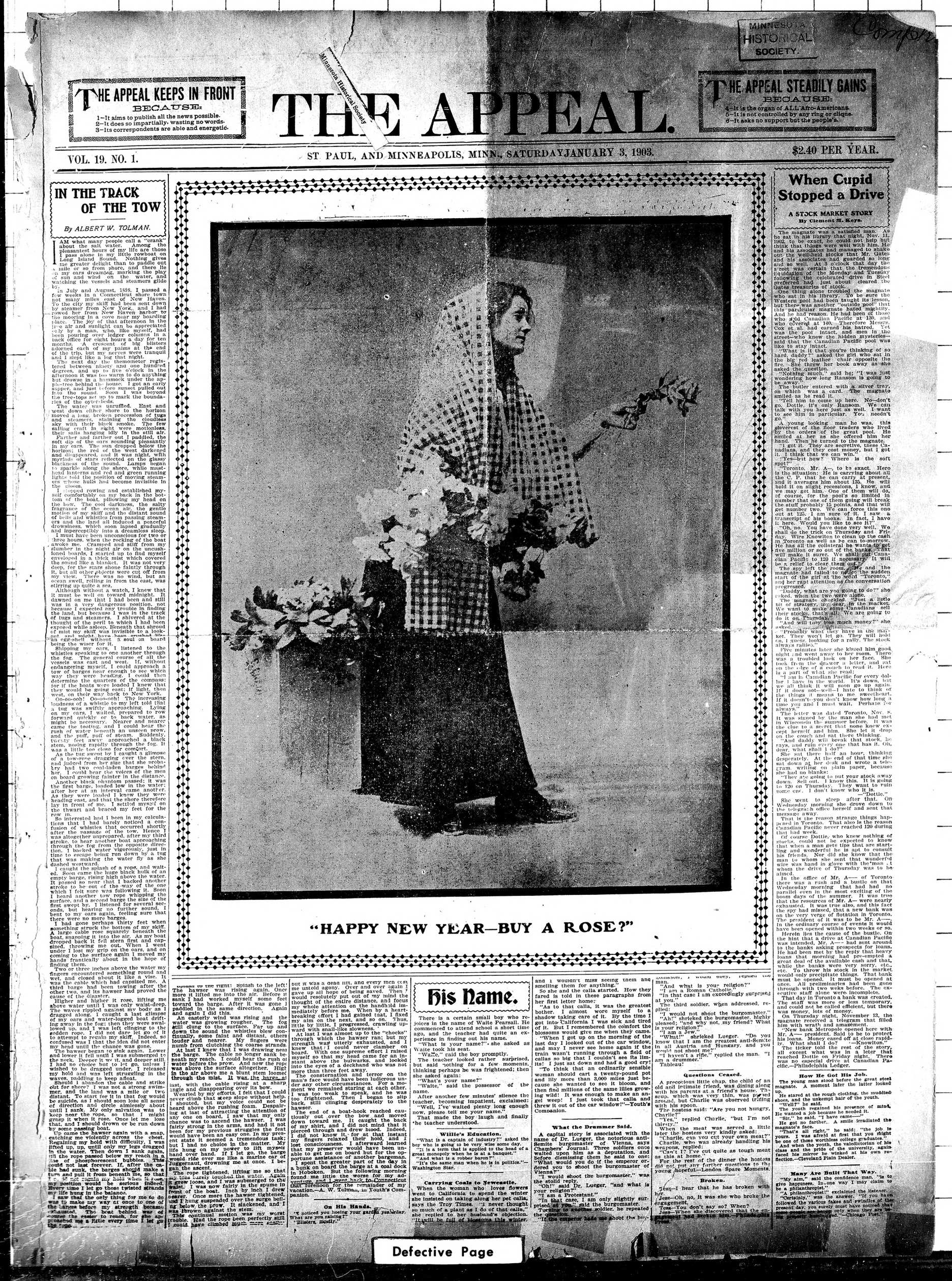
The image shows a woman standing in a room with a plain wall. She is wearing a checkered dress with a white headscarf. The dress has a long skirt and a fitted top. She is holding a bouquet of flowers in her left hand, which consists of white and pink flowers. The woman appears to be posing for the photograph.
Wearled by my efforts, I felt that I could never climb that steep hill. I could not be heard above the rushing foam. Despairing at last of attracting me, my only chance was to ascend the hawser. I was fairly strong in the arms and hands, but the feet would have been an easy one. In my present state it seemed a tremendous task. My life hung on my power to lift my hand over hand. If I let go, the bargain Jaggerman, drowning me at once, I began the ascent. The rope tightened, lifting me so that it grew loose, and I was submerged to the waist. I was now far below the water. I inch by inch I drew once. More the hawser tightened, and I hung suspended over the surge being dragged back, blackened, and I allowed the stem.
This continual motion was my worst trouble. I was clamped much more than I could.
"HAPPY NEW YEAR-BUY A ROSE?"
out it was a dea int, and every men ces me unt agony, and my men ces me unt agony, of being saved. Then I would resolutely put out of my mind the thought of being alone, and I would immediately attention on the handheld immediately before me. When by a heartbeat I thought of being alone, I alight on the next, and so on. Thus little by little, I progressed, crowling upwards. At last I was almost up to the "chocks" through which the hawks flew, and I knew that I could never clamber on board, so that my head came for an instant above the bulwarks, and looked into it, so that my head was not than three feet away. The consternation and terror on the der any other circumstances. For a moment we remained staring at each other, and then we frotted too frightened. Then I began to slip back, still clinging desperately to the
The end of a boat-hook reached cautiously out over the bow and moved down toward me. It caught the back of my shirt, and I did not mind that it pierced through and drew blood. Indeed, I did not know it, for at that instant my fingers relaxed their hold, and I lost consciousness. I afterward learned that my preserver would have been unable to get me on board but for the opportunity assistance of another bargeman.
I spent the greater part of the day in a bunk on board the barge at a coal dock in Hoboken. But the following morning found me little the worse for my adventure, and I went back to Connecticut that afternoon for the remainder of my vacation. - A. W. Tolman, in Youth's Companion.
On His Hands.
"I noticed you hoing your garden yesterday. What are you raising?"
"Plaster, mostly."
His Name.
There is a certain small mail who rejoices in the name of Wate Fearshall. He commenced to attend school a short time ago, and he has a special experience in finding out his name.
"What is your name?" she asked as Waite took his seat. "He asked you to promptly. The teacher looked rather surprised, but said nothing for a few moments, thinking perhaps he was frightened; then she asked again: "What is your name?" "Waite," she said the possessor of the name. "The another few minutes' silence the teacher, becoming impatient, exclaimed: "Well, I've waited plenty long enough now, please tell me your name." "Well, I had thought and finally the teacher understood."
Willie's Education
"What is a captain of industry?" asked the man. "Is it a term that is applied to the head of a company?" is the term that is applied to the head of a company. "And what is a robber baron?" It is the same man when he is in politics." When he is in politics."
---
**Carrying Coals to Newcastle.**
When the woman who loves flowers
she insisted on taking on her pet cals,
says the Troy Times. "I never thought
she replied to her husband's objection.
"It will be full of blossoms this winter.**
Defective Page
and I wounded them with them and I wounded them with them. So she and the calla started. How they fared is told in these paragraphs from her. She is to that calla, it was the greatest bother. I almost wore myself to a shade and I was to that calla into California. I was sick and tired of it. But I remembered the comfort the blossoms would give me the morning of the last day I looked out of the car window, and may I never see home again the day I looked out of the car window and calla so bie that I couldn't see its limbs! I just sat down and had a good cry: "To think that an ordinarily wore them with them and illly more than 3,000 miles just because she wanted to see the same illies growing wild! It was enough to make an angel weep! I just took that calla and then I took the car window!"-Youth's thought.
What the Drummer Said.
A capital story is associated with the name of Dr. ueager with the burgomaster of Vienna, says Chambers' Journal. Three soldiers once tried to kill him before dismissing them he said to one: "What would you do if the emperor or you to shoot the burgomaster of Vienna?"
"I would shoot the burgomaster." was the stold reply.
"Oh!" said Dr. Lueter, "and what is it? "I am a protester," said Dr. Lueter, "only slightly surprised at year," said the burgesmaster. "Turning to the soldier, he repeated that."
the question.
"If the emperor hase me shoot the busi-
sweeter, I would love, replied the man.
"And what is your re- religion?"
"What is your re- religion?"
"in that case I am exceedingly surprised"
"in that case I am exceedingly surprised"
The third soldier, when addressed, replied: "I must not shoot the burgomaster." "All" shrieked the burgomaster, highly pleased, "and why not, my friend? What is your religion?" "I am low in the sky." "What!" shrieked Lueger. "Do you know that I am the greatest anti-Semite in all Austria and Hungary, and you must kill me."
"I haven't a rifle," replied the man. "I am a drummer."
Questions Caused:
A preoccupied little chap, the child of an old and intimate friend. He was a little girl, a friend's house. The soup, which was very thin, was piled around, but Charlie was observed trilling.
The hostess said: "Are you not hungry, Cherlie?"
"Yes," replied Charlie, "but I'm not thirsty."
when the meat was served a little later the hostess very kindly asked, "Charlie, can you cut your own meat? Charlie, what was already handing his
won't I? I've cut quite as tough meat
or this at home."
For the rest of the dinner the hostess did not put any further questions to the young hopeful—London Spare Moments.
**Broken.**
**Dess-1** hear that he has broken with his
Jes-Oh, no, it was she who broke the engagement.
Tess-No, don't say so? When? When-When she discovered that the engagement and broken him. Philadelphia
$2.40 PER YEAR.
A STOCK MARKET STORY
By Clement M. Keys.
The magni-ture was a satisfied man. As he sat in his way, he could not help but think that things were well with him. He and his associates had managed to shake our the well-held stocks that Mr. Gates and his associates had guarded so long and so well. At 3 o'clock that day the street was certain that the tremendous liquidation of the Monday and Tuesday following the celebrated drive in Steel preferred had just about cleared the Gates treasuries of stock.
One thing alone troubled the magni-ture who sat in his way. To be sure the who sat in his way. To be sure the who had been taught its lesson, but there was another "outside pool" that this particular magnate hated mightily. And he had reason. He had been of those who sold Canadian Pacific at 130, and who covered at 140. Therefore Messrs. Cox et al. had earned his hatred. Yet was the pool intact, and men in the street—who knew the hidden mysteries—said that the Canadian Pacific pool was like to stay intact.
What did you think of so hard a lady? He asked the girl who sat in the big red leather chair opposite the fire. She threw her book away as she asked the question.
"Tell him to come up here. No—don't go. Dottle, it's only Ransom. We can talk with you here just as well. I want to see him in particular. You needn't go."
A young looking man he was, this cleverest of the floor traders who lived by the orders of the great pool. He smiled at her as she offered him her hand. Then he turned to the magnate.
"I got it. They are secretive, these Canadians, and they cost money, but I got it. I think that we can win."
"Yes—but how? Where is the soft spot?"
Toronto. Mr. A. to be exact. Here is the situation: He is carrying about all of his possessions and it averages him about 125. He will hold in on sight necessities such as the clothes he will do, of course for the pool's so limited in size, the stuff probably in 10 points, and that will get number two. We can force this one to be one of the most important transcript of his books. In fact, I have it here. Would you like to see Weil? Weil will do the trick on Thursday and Friday in Toronto as well as be can to-morrow. He has all the collateral he wants to get. He will make it sure. He will make it sure. We shall out-Canada Pacific to 120 it necessary. It will
The spy left the room, care and the magnetate had failed to notice the sudden start of the girl at the word "Toronto," her attention as the conversation increased.
"Daddy, what are you going to do?" she
kod, when the two were alone.
locked, when the two were alone.
The manager's name is in the a list of bible titles, in the market. We want to make some Canadians and Americans are to do it on Thursday.
We are to do it on Thursday.
"And will they lose much money?" she asked.
"Probably what they have in the market. They won't let go. They will hold on, making for a rally. They will always rally."
Five minutes later she kissed him goodbye and was a troubled hook on her face. She took from the drawer a hook on her neck. It is a part of what she read: "I am Candice on every dollar of the world. It's down, let me all think it will soon go up again. The things it means to me sweetheart, If it doesn't-you don't know how long it can and I must wait. Peril always." The letter was dated Toronto, November 7, 2001 in Wisconsin the summer before. It was the due to a secret that none knew except the coach and sat there thinking.
"And daddy will break that stock, he rays, and ruin every one that has it. Oh,
She sat there half an hour, thinking desperately. At the end of that time she picked up her book, writing on plain paper, because she had no blanks: she held it, not your stock away down to 120 on Thursday. They want it to ruin some one. I don't know who said "Dottie." She went to sleep after that. On Wednesday she got the telephone office herself and sent that message away. The reason strange things happened in Toronto. That also is the reason Canadian Pacific never reached 120 during that week.
She could not, who knew nothing of stocks, could not, who expected that they are starting and wonderful he is apt to consult his friends. Nor did she know what the man was, wonderful wire was hand in glove with the man, whom the drive of Thursday was to be. In the office of Mr. A — of Toronto was a rash, who had that man, who had no parallel even in the most exciting of the boom days of Mr. A — were nearly exhausted. It was true also, and this fact the spat had missed, that he was in Toronto. The president of it was to be Mr. A —. In the ordinary course of every day,
Herein lies the cause of the bustle. On the hint that a drive at Canadian Pacifié was intended, Mr. A— had sent around to the banks asking prospects for loans. He had been met by the reply that heavy loans that morning had pre-empted a great deal of the available cash and that, while the banks were very sorry, etc., etc. To throw his stock in the market would only precipitate things. That bank must be opened. It must be opened at once. All preliminaries had been gone through with two weeks before. The executive staff alone were incomplete.
That day in Toronto a bank was created. The staff was more or less temporary, and could not be called efficient, but there was money, lots of money.
On Thursday night, November 13, the magnate received a telegram that filled him with wrath and amazement.
"New bank Metropole opened here with Mr. A— president. Said to be to protect his loans. Money eased off at close rapidly. What shall I do?"—Knowlton.
The ticker told the rest of the story, all excent what was in a letter that reached Dottie on Friday night. There was no especial drive at Canadian Pacific—Philadelphia Ledger.
How He Got His Job:
The young man stood before the great steel magnate. A moment later the latter looked
**UD**
He stared at the rough clothing, the muddied hair, and the unkempt hair of the youth.
The youth regained his presence of mind.
He wanted a job because he needed it.
"Sir," he said, "I have came—
He got no farther. A smile irradiated the
magnate's face. "All right," he said; "the job is you. I was aardvark at first that you might be one of those worthless college graduates. And when I was a professor of his chance the pride of the university, again faced his mirror he winked at his own reflection. Cleveland 2 Plain Dealer.
"Many Are Built That Way. " "My aim," the confidence man's, "to give hard work. One way I may claim to be a front排."
"A philanthropist" exclaimed the listener. "Certainly!" was the answer. You are followed by the answer: "You must have noticed you surely must have noticed that only when the reader
HAVE YOU READ
THE APPEAL
ISSUED SIMULTANEOUSLY
Saint Paul, Minneapolis, Chicago,
Washington, Louisville, St. Louis.
ST. F. AUL OFFICE,
No. 110 Union Blk. 4th & Cedar,
J. Q. ADAMS, Publisher.
MINNEAPOLIS OFFICE,
Guaranty Loan Bldg.817
HENRY ROBERTS, Manager.
CHICAGO OFFICE,
323-5 Dearborn St., Suite 310,
C. F. ADAMS, Manager.
WASHINGTON OFFICE,
No.1919 Eleventh St., Northwest
CHAS. E. HALL, Manager.
LOUISVILLE OFFICE,
No. 312 W. Jefferson St. Room 3
W. V. PENN, Manager.
ST. LOUIS OFFICE,
No. 1002 Franklin Avenue.
J. H. HARRISON, Manager.
TERMS STRICTLY IN ADVANCE
SINGLE COPY, ONE YEAR ..... $2.10
SINGLE COPY, SIX MONTHS ..... 1.01
SINGLE COPY, THREE MONTHS ..... 60
When subscriptions are by any means allowed to run without prepayment, the terms are for accounts for each 13 levels and 5 cents for each odd week, or at the rate of $2.40 per year.
Remittances should be made by Express Money Order; Post Office Money Order, Respected Letter or Bonds Draft. Postage stamps will be received the same as cash for the fractional parts of a dollar. Only one cent and two cent stamps taken.
Silver should never be sent through the mail. It is shown to other a doller through the envelope and be lost; or else it may be stolen. Persons who send silver to us in letters do so at their own risk.
Marriage and death notice: 10 lines or less 81. Each additional line: 10 cents. Payment strictly in advance, and to be announced as
Further particulars on application.
Reading notices 25 cents per line, each insertion. No discounts for time or space. Reading matter is set in brevier type—about six weeks to the line. All head-lines counts double.
The date on the address label shows when subscription expires. Renewals should be made two weeks prior to expiration, so that no paper may be missed, as the paper stops when line is out.
It occasionally happens that papers sent to sentoumbers are lost or soaked in water, and, when due, inform us by postal card at the expiration of five days from that date, and we will cheer you for information. We also form a number of communications to receive attention must be news, upon important subjects, plainly stated, and must reach us Tuesdays if possible, anyway not later than Wednesdays, and the beat is turned, unless samps are sent for postage. We do not hold ourselves responsible for the views of our correspondents. Soliciting agents wanted everywhere are free.
In every letter you write us we never fall to
the letter of the writer, who is
written, post office county and state.
Businesses are not allowed on business
shoots from letters not posted on
matter or for publication. Entered as
a business.
AGENTS WANTED.
THE APPEAL wants good reliable agents to canvass for subscribers at points not already covered. Write for our extraordinary inducements.
THE APPEAL.
SATURDAY, JANUARY 3, 1903.
Last week in Pittsburgh, Kan., an Afro-American was lynched by a mob, and two days later it was discovered that he was innocent of the charge which cost him his life. If the law had been allowed to take its proper course his life would not have been taken. Now every member of that mob is particeps criminis in the murder of an innocent man. It matters not what whites may think or believe about the matter, Afro-Americans are human beings with souls just as themselves, and should be treated as they themselves would be treated. They claim that God is a just God, then how can they hope to miss the just punishment for their crimes. In the account in the daily papers the greatest stress was laid upon the fact that the "Gully Negro Escaped"; not that a lot of so-called superior people had murdered an innocent man, prompted by their assinine prejudice against color. We too believe God is just, and that punishment for such crimes will be meted out by Him, whose Son said: "it is better that ten guilty ones escape, rather than one innocent be made to suffer."
The Southern Caucasians treat the dead Afro-American body servant with great respect. What is needed is the just treatment of the good Afro-American citizen while he is alive.
NEW BOOKS
THE FARMER'S WORK
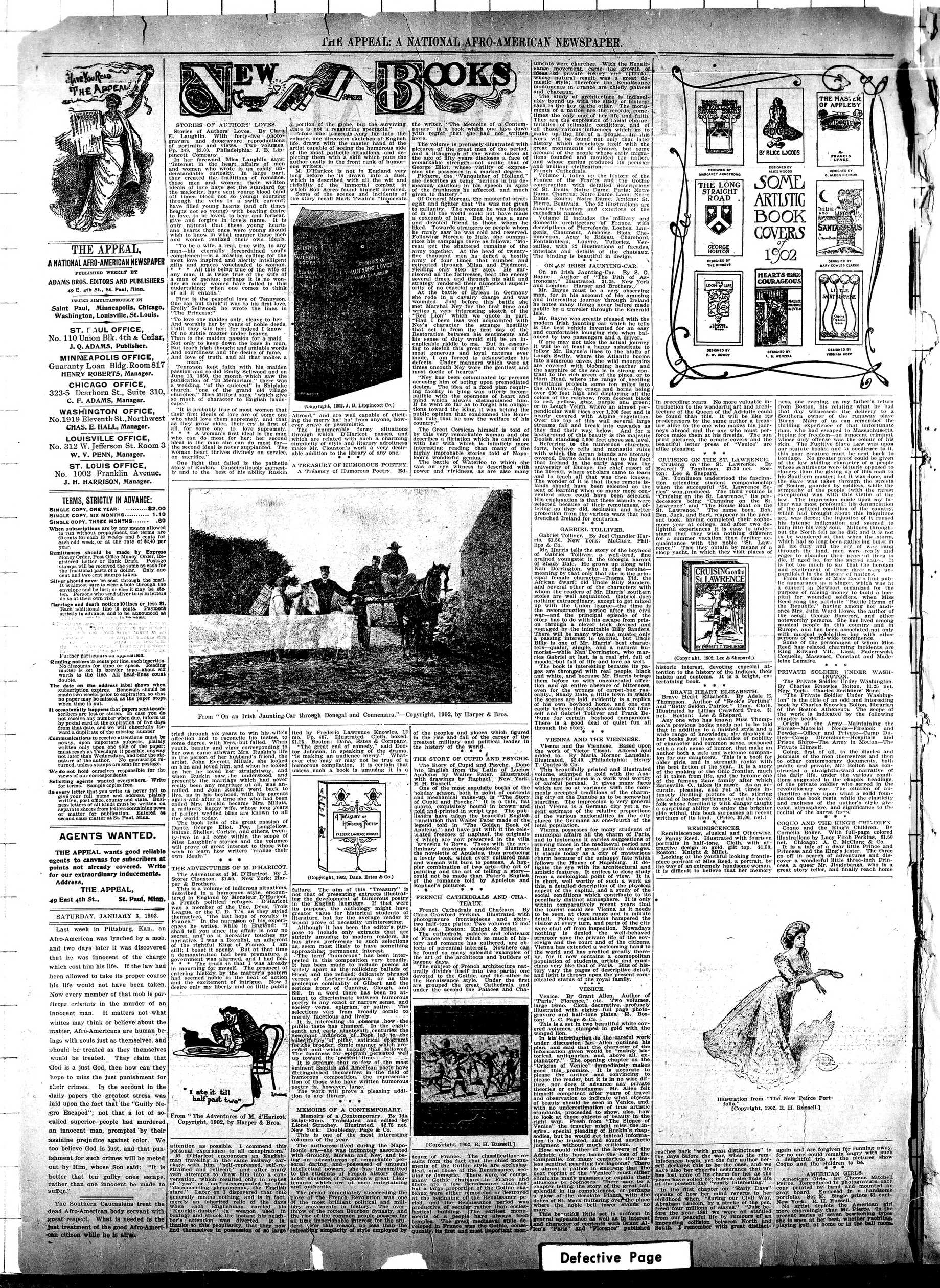
From "On an Irish Jaunting-Car through Donegal and Connemara."—Copyright, 1902, by Harper & Bros.
STORIES OF AUTHORS' LOVES.
Stories of Authors' Loves. By Clarice A. Browne and Grace Grauvre and duogravure reproductions of portraits and views. Two volumes. Philadelphia: J. B. Lipincott Company.
In her foreword, Miss Laughlin says: "I am a woman of love and women who wrote is an easily understandable curiosity. In large part, these women have felt that those men and women; their written ideals of love have set the standard for women who write so oft times blood not so young) coursing through the veins in a swift current; women who write so oft times heart not so young) with beating desire to love, to be loved, to be and forbear, give and forgive in love's name; women who write so oft times heart and hearts that once were young should wish to know in what manner those men and women would be, to be a wife, a real true wife, to any man—his eternally forcaded soul's complement—is a mission calling for the gifts and graces vouchsafed to woman. * * * All this being true of the wife of a woman, it is a man of genius; perhaps it is no wonder so many women have failed in this of all it entails.
First is the peaceful love of Tennyson. One can but think it was to his first love, the woman he wrote the lines in "The Princess:
To love one mademain only, cleave to her
heart. To love her heart, cleave to her
heart. Until they win her win; for indeed I know
that I love her love; for indeed I know
that I love her love.
Tennyson kept faith with his malden passion and so did Emily Sellwood and on one occasion he published a "In Memoriam," there was a wedding, "of the quietest" in Shikaple churches, "of the most beautiful churches," Miss Mitford says, "which give so much of character to English lands." It is probably true of most women that their first ideals of love are of some one all, for some one to love supremely, as they grow older, their cry is first of all, for some one to love supremely. The man who can do most for her, the man who can do most for her, the man ideal is the man she can do most for—that is never supplanted. The woman heart is divinely on service, on sacrifice. One light that failed is the pathetic passion and to the best of his ability Ruskin
From "On an Irish Jaunting-
tried through six years to win his wife's affection and love, and with hers, but failed. When youth, beauty and vigor corresponding to her own came up, she married her husband, a new wife and her husband's friend, the artist, John Everett Millais, she looked on him and loved him, and she straightened, and when John Ruskin saw he understood, and presented his work to her, she became a marriage at all, was annulled, and John Ruskin went back to her again and after a time she who had been called Mrs. Ruskin became Mrs. Millais, and she wedged perfect wedded bliss are known to all the world today. Mrs. George Elliot, Poe, Longfellow, Balzac, Shelley, Carlyle, and others, twentyeight years later, Mrs. Miss Laughlin's stories and the volumes will prove of great interest to those who wish how writers "realize their ideals."
---
THE ADVENTURES OF M. D'HARICOT
The Adventures of M. D'Haricot. By J. Stoorer Clouston. $1.50. New York: HarperCollins.
This is a volume of indictuous situations, described in a series by M. Blesseau and by Monsieur D'Haricot, a French political refugee. D'Haricot was a member of the French government, U. D. T.'s, as they styled themselves, "the last hope of royalty in France. In the narration of the story, the English "shall tell you since the affair is now no secret, and as it hereafter touches my heart, the rightful King of France. I am still; I boast it openly. But at that time, the government was alarmed, and I had fled. The truth is that I was already in motion, and I entered the history by the martyr's postern had seemed noble in the context of action, and I had desire only my liberty and as little public
"I ate it till half past two"
From "The Adventures of M. d'Haricot; Copyright, 1902, by Harper & Bros.
attention as possible. I commend this personal experience to all conspirators."
M. DHaricot encounters an Englishman traveling in the same railway carriage with him, "self-repressed, self-any strained and retieent," and after many vain attempts to draw him into a conversation, which resulted only in replies of "yes" or "no," accompanied by that "disconcerting phenomenon," the English stare. Later on I discovered that this generally means nothing, and is in fact, merely an inherited relic of the days when each Englishman carried his "Knuckle-duster" (a weapon used in boxing) and struck the instant his neighbor's attention was diverted. It is, thanks to this popularity, that they now find themselves in possession of so large
THE APPEAL: A NATIONAL AFRO-AMERICAN NEWSPAPER
a portion of the globe, but the surviving state is not a reassuring spectacle.
"before one proceeds very far into the volume, one discovers sketches of English life, drawn with the master hand of the artist capable of seeing the humorous side of the most pathetic situations, and depicting them with a skill which puts the author easily in the front rank of humorous writers."
M. D'Haricot is not in England very long before he is drawn into a duel, which is described with all the wit and visibility of the immortal combat in which Bob Acres found himself involved.
Some of the scenes and incidents of the story recall Mark Twain's "Innocents
STORIES
AUTHORS
LOVES
CHARLES
LAUGHLIN
VOL. I
STORIES OF
AUTHORS LOVES
CHARLES E. LAUGHLIN
Abroad" and are well capable of eliciting the metre in anyhow, how-ever, or in possitimie. The innumerable funny situations that the author has created, and which are related with such a charming simplicity of style and literary adroitness, make a valuable addition to the library of any one.
A TREASURSE OF HUMOROUS POETRY
A Tragedy of Humorous Poetry, Ed.
Car through Donegal and Connemara."—C
ited by Frederic Lawrence Knowles, 12 mo. Fp. 407. Illustrated. Cloth box, 31.5 in. Boston, Dana Etes & Company, "The great end of comedy," said Doctor Johnson, in speaking of the drama, "is making an audience merry." What ever else may result of a humorous compilation, it is certain that unless such a book is amusing it is a
A treasury of Humorous Poetry
PREFERRED LUMINARY BOOKS
(Copyright, 1902, Dana. Etes & Co.)
failure. The aim of this "Treasury" is not that of presenting extracts illustrating the development of humorous poetry in the English language. If that its purpose the anthology might have greater value for historical students of literature, but for the average reader it would be more appropriate.
Although it has been the editor's puristically amusing to modern readers, it has given preference to such selections and something approaching permanent interest. The term "humorous" has been interplay in composition very broadly. It has been widely apart as the rollingick ballads of widely apart as the rollingick ballads of verses of Locker-Lampon, and of grotesque comicality of Gilbert and the curious from Couch, Chand, and Word there has been a tempt to discriminate between humorous and narrow sense, and society verse, epigram, and selections vary from broadly comic to humorous. It is interesting to observe, how the public taste has changed. In the eightieth dominant influence of Pope lefto the substitution of pithy, satirical epigrams, dominant influence of Pope lefto the substitution of pithy, satirical epigrams, ceded and which happily was followed. The fondness for epigram persisted well. It is strange that so few of the most eminent English and American poets have humorous composition, the representation of those who have written humorous the work will prove a pleasing addi-
The work will prove a pleasing addition to any library.
MEMOIRS OF A CONTEMPORARY.
Memoirs of a Contemporary. By Ida Saint-Elme. Translated and edited by Ida Saint-Elme. Published by the New York: Doublepage, Page & Co.
This is one of the most interesting volumes which we have.
The authorless lived during the Napoleonic era—she was intimately associated with Grouchy, Morane and the life of the Napoleon III. A remarkable personal during, and possessed of unusual knowledge, she are at once entertaining and authentic.
The period immediately succeeding the French Revolution was one of the most unusual political and military movements in history. The overthrow of the French monarchy and the rise of the common people possessed a great interest for the present and future. For this reason, no less than the refreshing simplicity of style employed by
the writer. "The Memoirs of a Contemporary policy is a book which one lays down with regret that she had not written more.
The volume is profusely illustrated with pictures of the great men of the period, and the life of the people of the age of birth years discloses a face of remarkable strength—not unlike that of George Elliot, whose virility of expression she possesses in a marked degree. The "vanisher of folklore," she describes as being "serious in his demeanor, cautious in his speech in spite of the frankness he affected, and much given to flattery."
Germany. Moreau, the masterful strategist and fighter that "he was not given to gallantry. The woman he was fondest of in all the world could not have made a coxcomb of him. But he was a sure and devoted friend to those whom he killed. Toward his starters of people whom he rarely saw him who is not a free-man. Following Moreau to Italy, she summarizes his campaign there as follows: "Moreau gets the shattered remains of the army together. At the head of twenty-five thousand men of the most of the army of four times that in number and retreated through Milan and Piedmont, yielding only step by step. He garrisoned all the fortresses, beat the enemy and time and and through his skill and strategy, enderees, their unheralfordery ability of no special avail."
At the battle of Eyleau in Germany he attacked the wounded. Just before this battle she met Marshal Ney for the first time and he was impressed by the "Red Lion" which we quote in part, "Had I been less well acquainted with Marshal Ney the strange host that seemed from the strange Restoration between his sentiments and that character, I could not explain a riddle to me. But in essaying to sketch this great soul, one of the most brilliant minds in the world, made. I am forced to acknowledge his defects. Under manners which were at the same time the gentlest and most docile of hearts. "Ney has been colonized by persons who have been so far as to make the design. The idea of a fixed plan requiring facility in lying was utterly inconvenient. He was a mind which always daringly hummed. If he went so far as to forget his obligatory duty, he would have made public opinion that condemned the Bourbon rule, that he saw the welfare of his people. The Great Corsican himself is told of by this very remarkable woman and she was a woman with which he with which is infinitely more interesting interest than many of the most wonderful genius of Napoleon.
The battle of Waterloo to which she
was power and vldness, and is also many
Copyright, 1902, by Harper & Bros.
of the peoples and places which figured
the history of the world, the career
the greatest military and political leader
in the history of the world.
THE STORY OF CUPID and PSYCHE
The Story of Cupid and Psyche. Done to English from the Latin of Lucius Apuleius by Walter Pater. Illustrated with drawings by Raphael. New York: R. H. Russell.
One of the most exquisite books of the holiday season, both in point of contents and mechanical make-up, is "The Story of Cupid and Psyche." It is a thin, flat quarto, exquisitely bound in brown and gold and printed in script type. The publishers have taken the beautiful English translation that Walter Pater made of the legend told in "The Golden Book of Apuleius," and have put it with it the celebrated frescoes of Raphael, the originals of which are now preserved in the villa "Arvelina in Rome." These with the preliminary drawings completely illustrate the novelette of Apuleius, thus producing a lovely book, which every cultured man and woman will burn to possess. A happier combination of two arts—the art of painting and the art of telling a story could not be made than Pater's English of the romance told by Apuleius and Raphael's pictures.
FRENCH CATHEDRALS AND CHA-
TRAUX
British Cathedrals and Chateaux. By French Cathedrals and Chateaux. For photographic frontispieces and sixty-two half-tone plates: Two volumes 12 m. long. For the cathedral and its cathedrals, the cathedrals, and chateaux of France around which so much of his art was created, are examples of perennial interest. Nowhere can be found so many splendid examples of French architecture and builders of bygone days. The subject of French architecture natives, the architects and builders devoted to the Gothic, and the other to the Renaissance style. Under the first two volumes, the Palace and the other under the second the Palace and Cha
[Copyright: 1902, R. H. Russell.]
jeux of France. The classification results from the fact that the chief monuments are religious and those of the Renaissance, secular or domestic. There were, of course, there are a few Renaissance France châteaux, but a large proportion of the Gothic châteaux are all immodulated or destroyed at the beginning of the Renaissance period, and the Renaissance period is one of the great medieval style architectural building. The earliest monuments of a people have always been religious. The great medieval style of developed in France was the Gothic, consequently its first and most important mon-
jummees were churches. The Renafalae jummees were private twelfth and groundless, whose natural result was a great doom of ideals of private twelfth and groundless monuments in ancient city are chateaues and chateaux of architecture. It is radically bound up with the study of history; each is the key to the other. The monuments the only one of her life and faith. They are the expression of racial chancery, all those various influences which go to make up the life of a people. In this history which associates itself with the great monuments of France, but some of those founded and moulded the nation, and whose genes produced its peculiar brilliant civilization. Firché. From Volume I, takes up the history of the France. Volume I, takes up the history of the construction with detailed descriptions of St. Daisis, Notre Dame, Paris; Notre Dame, Rouen; Notre Dame, Amiens; St. Pierre, Beauvais. The $2 illustrations are detailed descriptions of Pierrefonds. Loches, Langeais, Chaumont, Amboize, Bloch, Châteaues, Fontainebleau, Fontainebleau, Louvre, Tullières, Versailles, with $3 illustrations of facades, and Cheux. The binding is beautiful in design.
ON AN IRISH JAUNTING CAR
B. On the Jaunti Jaunting-Car. By S. G. Bonatropomy. Illustrated. $1.25. New York University Press. Mr. Jayne must be a very observing man, for in his account of his amusing experiences he notes many things never before made public by a traveler through the Emerald Valley.
Mr. Bayne was greatly pleased with the modern Irish jaunting car which he tells the vehicle invented for an easy and compact two-seater car, anced by two passengers and a driver.
If one may not take the actual journey to the Mountains, they can follow Mr. Hayne's lines to the bluffs of Lough Swilly, where the Atlantic booms are covered with blooming heather and the sapphire of blooming heather and the hornhead, where the range of beetling mountains projects some ten miles into the valley. The range covers over 600 feet high and displaying all the beauty of the landscape, to red, yellow, gray, purple aur green; or to Lough Velgh, where an almost perennial bloom is nearly covered with Alpine vegetation. Over the top of this wall several large hills, the most beautiful beauty is the malacic Doolich standing 600 feet high.
Referring to the numerous churches, forts, beehive cells and monastic ruins, Ireland has a rich tradition covered. Ireland calls attention to the fact that Ireland in the early ages was the home of the literati, where scholars came to learn and to teach all that was then known. The lands should have been selected as the seat of learning when so many more connoisseurs were selected. His explanation is that these islands selected because of their remoteness, of seclusion and better protection from the rains that had drenched Ireland for centuries.
GABRIEL TOLLIVER
Gabriel Tolliver. By Joel Chandler Harper, New York: McGraw, Phillips & Co.
Mr. Harris tells the story of the boyhood of Gabriel Tolliver, a grained youngster in the Georgia hamlet of Shady Dale. He grows up along with her meaning by that only that she is the principal female character—Tasma Tid, the girl of Gabriel Tolliver and several other of the characters with whom the readers of Mr. Harris's southern nothing extraordinary, except to get mixed up with the Union league—the time is war—and the principal episode of the story has to do with his escape from prison, maraged by the inimitable Billy Sanders. There will be many who can muster only a few characters, and a natural humility Billy is one of Mr. Harris's best characters—quant, and a natural humility Gabriel at last, is a real girl, full of moods, but full of life and love as well. Billy is one of Mr. Harris's best characters are throughed with real people, black and white, and because Mr. Harris brings the scenes are laid, evidently is a replica of his own boyhood home, and one can see himself and Gabriel Tolliver and Frank Beume for certain boyhood companions. For the quiet of fun all through the story.
VIENNA AND THE VIENNESE
Vienna and the Viennese. Based upon a survey of the city, the Germans added to, by Marta Hornor Landeale, illustrated. $240. Philadelphia: Henry T. Stuart. This beautifully printed and illustrated volume, stamped in gold with the Auschwitz insignia, is a collection of careful perusal. It gives many facts which are at variance with the common knowledge of the city on the Danube as to be somewhat startling. The impression is very general. The estimate of the relative proportions of the various nationalities in the city of Vienna and the Germans as one-fourth of the total population.
Vienna possesses for many students of municipality a rich and varied city, it carries suggestions of stirring times in the mediaeval period and in later years in great fashion, a city of mysterious charm because of the unhappy fate which lights the eye with its architectural and artistic features. It entices to close study in short, well worthy of such a work as this, a detailed description of the physical and social conditions which contribute to its peculiarly distinct atmosphere. It is only when the tourist could see Vienna as it needs to be seen, at close range and in minute detail, that the tourist could see the visitor at every turn, and parts of the city were shut off from inspection. Nowadays the stranger save the private life of the sovereign and the court and of the citizens. For it has been the world and has profited greatly by, for it now contains a cosmopolitan city, and it has given clans very like that of Paris. Blist of history vary the pages of descriptive detail, complicated status of the royal family.
VENICE
Venice. By Grant Allen. Author of
large large. Flock. Cloth decorative, profusely
illustrated with eighty-fold page photo
plates. $3. Boston: L. C. Page & Co.,
This is a set in two beautiful white cov-
ers, stamped in gold with the wiphed
limel.
In his introduction to the careful work under discussion, Mr. Allen outlined his plan, and said that the charism of the information that would be mainly historical, antiquarian, and above all, explanatory. The opening chapter on the "Origins of Venice" immediately makes good this promise. It is to please the author and convincing to please the reader, but it is no wise diffuse, nor does it advance any private theories or enthusiasm. Mr. Allen felt himself competent to indicate the ideas of the Free Trade on the observation of indicate what objects of beauty should be seen in Venice, and, with no underestimation of true artistic standards, proceeded to show, also, how it took the whole object of the right way. Fresh from "The Stones of Venice" the traveler might miss the inspire, special pleading of Ruskin's raphosodies, but he would get instead information to be used, and the aesthetic justice of which it must be artistic.
How would either the light of the Adriatic city have borne the loss of the Campanile, for many centuries the tireless sentinel guarding the heart of the world. The most reprint of the "Venice" must either eliminate many passages or explain their allusions by footnotes. In the study of the great fall, splendid in its completeness, or perhaps a view of the desolate Piazza with the doves of St. Mark fluttering over the place where the noble bell tower stands no
This be-utiful little set is uniform in general appearance as well as in interest and character of contents with Grant Alen's "Paris" and "Florence" published
DESIGNED BY
MARGARET ARMSTRONG
BY RLICE LJOODS
DESIGNED BY
ALICE WOODS
THE MASTER
OF APPLEBY
FRANCIS LYNDE
DESIGNED BY
G. ALGEN HERBSON
THE LONG
STRAIGHT
ROAD
GEORGE
HORTON
DESIGNED BY
THE KINNEY
SOME
ARTISTIC
BOOK
COVERS
of
1902
THE LIFE
A ROAD
AMUSEMENTS
SANTA
JULIANA
DESIGNED BY
MARY COWLEY CLARKE
LOOKING
LIFE
DESIGNED BY
F. W. OGWDY
HEARTS
COURAGEOUS
HALLIZ
BENNIE
RIVER
DESIGNED BY
A. B. WENZELL
LITTLE
SANTA
RUSCHIE
DESIGNED BY
VIRGINIA KEEP
Illustration from "The New Peirce Portfolio."
[Copyright, 1902, R. H. Russell.]
In preceding years. No more valuable introduction to the wonderful art and architecture of the Queen of the Adriatic could be found than this. It will be like its old son of the same author a treature, are alike to the one who makes his journey abroad and the one who must perforce make them at his fireside. The sun print pictures, the ornate covers and the beautiful letter press of "Venice" are alike pleasing.
CRUISING ON THE ST. LAWRENCE. CRUISING ON THE ST. LAWRENCE. By Everett T. Tomlinson. $1.20 net. Boston: Lee & Shepard.
Dr. Tomlinson understood the fascination of the student of the company in the�. The student companieship when the successful "St. Lawrence Series" was produced. The third volume is "Cruising on the St. Lawrence," its predecessors being "Camping on the St. Lawrence" and "The House Boat on the River" The "The House Boys, Box, Ben, Jack, and Bert, reappear in the present book, having completed their sophomore year at college, and after two delightful experiences it is easy to understand that they wish nothing different from some of the other other quaintance with the noble "St. Lawrence." This they obtain by means of a sloop yacht, in which they visit places of
CRUISING on the ST LAWRENCE
BY EYRETT T. TOMLINSON
(Copyr. hc. 1902, Lee & Shepard.)
historic interest, devoting especial attention to the history of the Indians, their habits and customs. It is a bright, entertaining book.
BRAVE HEART ELIZABETH
Brave Heart Elizabeth. By Adele E. Thompson. AKA of "Bee's Fortune" and "Betty Seldon, Patriot." 12mo. Cloth. Illustrated by Lillian Crawford True. $1 cat. Browning Leaf Books.
Any one who has known Miss Thompson that in addition to a finished style and a wide range of knowledge, she displays in her books a keen sense of character and common sense, seasoned with a rich sense of humor, and a welcome companion for our daughters. This is a book for the best fiction of the year. It is a story of the making of the Ohio front, much of which takes place in the famous Zane family after which Zaneville takes over and yet at times intensely thrilling the story of the stirring fowl whose familiarity with danger taught a surprising ability to enjoy the brighter side of life, and yet writings of its kind. (Price, $1.40, net.)
REMINISCENCES
Reminiscences, *Musical and Otherwise*, by Fanny Reed. The book features fourteen half-tone, cloth, tractive design in gold, gilt top, $1.50. Boston: Knopf. The youngful looking frontispiece portrait of Miss Reed, a portrait, by the difficult, difficult, believe that her memory
Illustration from "T
follo"
[Copyright, 190
reaches back "with great distinctness" to the days before the war, when the remnants of her life self-declares this to be the case, and we have also her herbal assurance that we have have rolled by, indeed, she finds life in the first chapter, on "Early Days" speaks of how her mind reverts to her childhood when, by a stroke of the pen, freed four millions of slaves. "Just before our peaceful life by rumour of an impending collision between North and South. I remember with great distain-
ness, one evening, on my father's return to the town, that dog witnessed a delivery to a Southern owner of the runaway slave thrilling experience of that unfortunate man, who had escaped to Massachusetts, for freedom—an innocent criminal skin. The Fugitive Slave Law was upon this poor creature must be sent back to the town, and the law adding character of a people whose sentiments were bitterly opposed to his Southern master; but it was done, and the slave was taken through the streets sympathy of the people (with the rarest law, the impassioned man, my father was most profound; his denunciation act was fierce; the injustice of it roused him into his very soul. Millions through-burn into his very soul. Millions through-burn to be wondered at that when the storm, which had so long been gathering burst in through the land, men were really and eager to abandon their peace of lives to the storm, which is not too much to say that the herosim unparalleled in the history of nations.
From the time of Miss Reed's first public appearance as a singer, which was at a time of the Newport tsunized for the purpose of raising money to build a hospital for wounded soldiers, when Miss Reed sang the patriotic "Battle Hymn of the Republic," having among her audience Mrs Julia Ward now, the author of the song, George Bancock, and others not other. She has lived among musical people in this country and in Europe, and has been associated not only with the people of the world, with other persons of the personages of whom Miss Reed has related charming incidents are King Edward VII., Liszt, Paderewski, Coquellin, Massenet, Constant and Madeleine Lenair.
PRIVATE SOLDIER UNDER WASHINGTON.
The Private Soldier Under Washington.
By Charles Knowles Bolton, $1.25 net.
New York City Charity, $1.25 net.
The Private Soldier Under Washington is the title of an odd and interesting book by Charles Knowles Bolton, librarian of the Boston Atheneus. The scope of the work is indicated by the following chapter heads.
Origin of the Army—Maintaining the Forces—Material Needs—Firelock and Powder-Officer and Private-Camp Duties—Camp Diversions—Hospitals and Prison Shops—The Army in Motion—The Private Soldier
Going, first of all, to the diaries and journals of the men themselves and then to other contemporary documents, both public and private, Mr Bolton has constructed a straightforward narrative of the daily life, under the various conditions suggested in the chapter headings, of the private soldier who served in the revolutionary war. The citation of authorities shows upon what a solid foundation the book rests, while the elasticity and raciness of the author's style give color, atmosphere, and significance to the recital of the barest facts.
COQUO AND THE KING'S CHILDREN
Coquo and the King's Children. By Cornelia Baker. With full-page colored illustrations by Lucy Fitch Perkins, $1.50 net. Chicago: A. C. McClurg & Co.
It is a tale of a dear little Prince and Princess and the King's fester. The three go off in search of adventures and discover a wonderful little three-inch Princess, a queer Mr. Jinglebangs, who is a great story teller, and finally reach home
the New Peirce Port-
E. R. H. Russell.]
again and are forgiven for running away, for no one could remember where they were in the pictures show Coqo and the children to be.
AMERICAN GIRLS.
American Girls. By Thomas Mitchell Petre. Reproduced. In a handmade and hand mounted on gray board. Enclosed in a handsome portfolio. Set in 14 prints each. H Russell.
No artist depicts the American girl more charmingly than the Mafia Faces, of the present series of seven bewitching types she is seen at her best, whether yachting, playing golf, at home or in the ball room.
A WEEKS RECORD IN MINNESOTA'S CAPITAL.
The Saintly City and Saintly City Folks-
Sawyer Items of Social, Religious and
General Matters Among the People, Belief
It is now in order to turn over the usual New Year's leaf.
don't forget the Men's Sunday Club at St. James Church to-morrow afternoon.
"I haven't paid $5.00 for a hat since I began wearing the Gordon and I buy the best."
Dr. J. E. Porter has moved his residence from Carroll street to 569 Iglehart street.
There were 761 fires in St. Paul during the year, with an approximate loss of $330,000.
The state legislature will convene next Tuesday. Several Afro-Americans are candidates for appointive positions.
Mrs. J. H. Dillingham received the sad intelligence of the death on last Tuesday, in Chicago, of her sister, Mrs. Duncan.
D. E. Beasley, the governor's messenger, received a New Year's gift in the shape of a reappointment for the next two years.
Deposits made on or before Feb. 3 entitled to five months' interest July 1 at the State Savings Bank, Fourth and Minnesota Sts.
Miss Mary L. Harwell has associated with Miss B. M. Foley, in hair-dressing, manicuring and facial treatments, in the Chamber of Commerce building.
Mrs. George C. Sleet left last Tuesday for a holiday trip to Chicago, thence to Stratford, Ont., to visit friends. She will be gone about six weeks.
The New Year's social of the Charity Club at Twin City Hall Thursday night was a most pleasant function, and was a fitting finale to a day full of enjoyment.
The most popular place for people who take their meals down town is John Godfrey's, No. 552 Wabasha street. Everything neat, clean and well cooked.
Is your hair straight? If not, send 50 cents, to Ozonized Ox Marrow Co., 76 Wabash avenue, Chicago, Ill., for a bottle of Ozonized Ox Marrow and you can easily straighten it.
Gentlemen wishing nice furnished rooms, with all conveniences, by the week or month, at reasonable rates, should apply at the Benton House, 228 West Third street, up stairs.
FURNISHED ROOMS.—Nicely furnished rooms for rent by the day, week or month, at No. 50 West Ninth street, between St. Peter and Exchange streets. Translents accommodated.
The Excelsior Night Lunch Wagon is the place to go to get good sandwiches and coffee. Open from 5:00 p.m. to 2:30 a.m. Wagon stand at the corner of Sixth and Jackson streets. J. S. Mills, proprietor.
If you wish a good shade, hair cut or shampoo call at Richard Cobby's neat店, No. 374% Minnesota street. First-class workmen only. Satisfaction guaranteed. Music for all occasions furnished on short notice.
For good home cooking go to the Metropolitan restaurant, No. 378 Minnesota street. First-class meals at all hours. Regular meals 20 cents. Meals to order at moderate prices. Mrs. Lou M.Laughlan proprietor.
Mrs. John H. Hickman and daughter, Miss Evelyn Gertrude, send greeting and best wishes for the new year, and though far from old friends, find in Denverites a people careful to entertain the stranger within their gates.
If you continue to spend all you make, you'll be poor all your life. Every one should have a savings account. Accounts opened of $1 and upward at the State Savings Bank, Germania Life Building, Fourth and Minnesota streets.
Elk Express, G. D. Caraiston, prop-packing and shipping, hauling of all animals, and wood in large or small quantities. When you wish anything in his line give him a call Telephone, Main 1920-J i. Office 63 East Sixth street
Don't forget that the Grand Ball to be given by the Juvenile Brass Band at Twin City Hall, occurs Jan. 12, 1903. Tickets 35 cents and each ticket entitles the holder to a chance on a beautiful framed picture. Brose orchestra will furnish music.
Those of our patrons who desire to have matter published must get the same in this office not later than Thursday afternoon, otherwise it may be crowded out. No notice will be taken of any communication that is not signed by the author.
Dr. John E. Porter, physician and surgeon, office suite 410 Bradley building. Fifth street, opposite court house. Office hours: 10:00 a.m. to 12:00 a.m. 9:00 to 4:00 p.m. m. Telephone, Main: 1738-13. Residence, 569 Iglehart street. Telephone, Dale: 589-J9.
Mr. and Mrs. Frank Taylor of New York City are the guests of Mr. and Mrs. Peter Conway, 411 Rondo street. Mr. Taylor is steward on the private car of Col. Daniel S. Lamont, vice president of the Northern Pacific Railway Company, located at New York.
Owen Howell, No. 156 E. Sixth St.
fashionable tailor. Gentlemen wishing suits or overcoats of the latest cuts and patterns should call on them. Ladies' work also done. Clothing cleaned, repaired, sponged and pressed on short notice. Moderate prices. Goods called for and delivered.
SAFE DEPOSIT AND STORAGE vaults.—We invite your inspection. It costs little to place your papers, cash securities and valuables in absolute safety. Boxes in our vaults can be had for $4.00 per year. Store your boxes, trunks, etc., with us. St. Paul Trust Co., 138 Endicott Arcade.
Visitors to the city and residents also, who wish to get a class means should call at John Godfrey's, No. 553 Wabash street, between Tenth Street and College avenue. Board and room by the day, week or month at reasonable rates. Best meals in the city. Regular meals 25 cents. Sunday dinners from 1:00 to 5:00 p.m. a specialty.
THE MUSICIAN
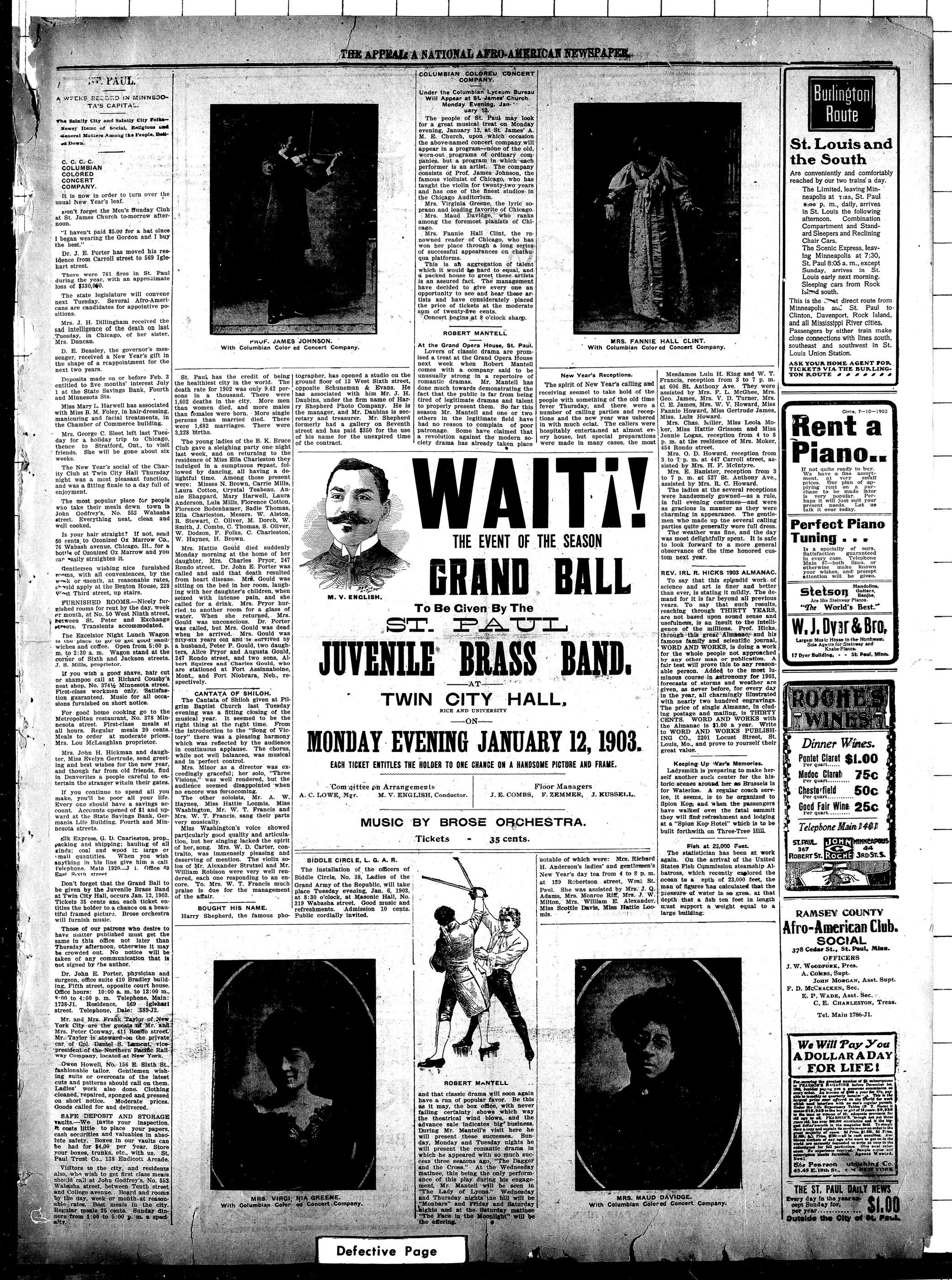
PROF. JAMES JOHNSON.
With Columbian Color ed Concert Company.
St. Paul has the credit of being the healthiest city in the world. The death rate for 1902 was only 9.42 persons in a thousand. There were 1,602 deaths in the city. More men than women died, and more males than females were born. More single persons than married died. There were 1,682 marriages. There were 3,228 births.
The young ladies of the B. K. Bruce Club gave a sleighing party one night last week, and on returning to the residence of Miss Ella Charleston they inhaled in a sumptuous repast, followed by dancing, all having a delightful time. Among those present were: Misses N. Brown, Carrie Mills, Laura Cotton, Crystal Teabean, Annie Shappard, Mary Harwell, Laura Anderson, Lula Mills, Florence Cotton, Florence Bodenhaman, Sedge Toth, W. Alston, R. Stewart, C. Oliver, M. Dorch, W. Smith, J. Combs, C. Thomas, S. Oliver, W. Dodson, F. Folks, C. Charleston, W. Haynes, H. Brown.
Mrs. Hattie Gould died suddenly Monday morning at the home of her daughter, Mrs. Charles Pryor, 247 Rondo street. Dr. John E. Porter was called and said that death resulted from heart disease. Mrs. Gould was sitting on the bed in her room, laughing with her daughter's children, when seized with intense pain, and she called for a drink. Mrs. Pryor hurried to another room for a glass of water. When she returned, Mrs. Gould was unconscious. Dr. Porter was called, but Mrs. Gould was dead when he arrived. Mrs. Gould was nity-six years old. Peter P. Gould, two daughters, Alice Pryor and Augusta Gould, 247 Rondo street, and two sons, Albert Squires and Charles Gould, who are stationed at Fort Assinabine, Mont., and Fort Niobrara, Neb., respectively.
The Cantata of Shiloh given at Pilgrim Baptist Church last Tuesday evening was a fitting closing of the musical year. It seemed to be the right thing at the right time. From the introduction to the "Song of Victory" there was a pleasing harmony which was reflected by the audience in continuous applause. The chorus, while not well balanced, was musical and in perfect control.
Mrs. Minor as a director was exceedingly graceful; her solo, "Three Visions," was well rendered, but the audience seemed disappointed when no encore was for incoming.
Mrs. Hattie Loomis, Miss Washington, Mr. W. T. Francis and Mrs. W. T. Francis, sang their parts very musically.
Miss Washington's voice showed particularly good quality and articulation, but her singing lacked the spirit of her, song. Mrs. W. D. Carter, contralto, was immensely pleasing and deserving of mention. The violin solos of Mr. Alexander Strutzel and Mr. William Robison were very well rendered, each one responding to an enchanting tune / 7. Tchaikovsky's praise is due for the management of the affair.
BOUGHT HIS NAME.
Harry Shepherd, the famous pho-
Mary
tographer, has opened a studio on the ground floor of 12 West Sixth street, opposite Schuneman & Evans. He has associated with him Mr. J. H. Daubins, under the firm name of Harry Shepherd Photo Company. He is the manager, and Mr. Daubins is secretary and treasurer. Mr. Shepherd formerly had a gallery on Seventh street and has paid $350 for the use of his name for the unexpired time of the contract.
M. V. ENGLISH.
ST
JUVENI
TW
MONDAY EV
EACH TICKET ENTITLES TH
Committee on Arrangement
A. C. LOWE, Mgr. M. V. ENG
MUSIC
WAIT!
THE EVENT OF THE SEASON
GRAND BALL
M. V. ENGLISH.
To Be Given By The
ST. PAUL
JUVENILE BRASS BAND.
AT
TWIN CITY HALL,
RICE AND UNIVERSITY
ON
MONDAY EVENING JANUARY 12, 1903.
EACH TICKET ENTITLES THE HOLDER TO ONE CHANCE ON A HANDSOME PICTURE AND FRAME.
Committee on Arrangements
A. C. LOWE, Mgr. M. V. ENGLISH, Conductor.
Floor Managers
J. E. COMBS, F. ZEMMER, J. KUSSELL.
MUSIC BY BROSE ORCHESTRA.
Tickets - 35 cents.
BIDDLE CIRCLE, L. G. A. R.
The installation of the officers of Biddle Circle, No. 38, Ladies of the Grand Army of the Republic, will take place Tuesday evening, Jan. 6, 1903, at 8:30 o'clock, at Masonic Hall, No. 319 Wabasha street. Good music and refreshments. Admission 10 cents. Public cordially invited.
THE APPEAL: A NATIONAL AFRO-AMERICAN NEWSPAPER.
COLUMBIAN COLORED CONCERT COMPANY.
Under the Columbian Lyceum Bureau Will Appear at St. James' Church Monday Evening, January 12.
The people of St. Paul may look for a great musical treat on Monday evening, January 12, at St. James' A. M. E. Church, upon which occasion the above-named concert company will appear in a program—none of the old, worn-out programs of ordinary companies, but a program in which each performer is an artist. The company consists of Prof. James Johnson, the famous violinist of Chicago, who has taught the violin for twenty-two years and has one of the finest studios in the Chicago Auditorium.
Mrs. Virginia Greene, the lyric soprano and leading favorite of Chicago.
Mrs. Maud Davidge, who ranks among the foremost pianists of Chicago.
Mrs. Fannie Hall Clint, the renowned reader of Chicago, who has won her place through a long series of successful appearances on chataquime recordings.
This is an aggregation of talent which it would be hard to equal, and a packed house to greet these artists is an assured fact. The management have decided to give every one an opportunity to see and hear these artists and have considerably placed the price of tickets at the moderate sum of twenty-five cents.
Concert begins at 8 o'clock sharp.
ROBERT MANTELL
At the Grand Opera House, St. Paul. Lovers of classic drama are promised a treat at the Grand Opera House next week when Robert Mantell comes with a company said to be unusually strong in a repertoire of romantic dramas. Mr. Mantell has done much towards demonstrating the fact that the public is far from being fired for dramas and talent to properly present them to season Mr. Mantell and one or two others in the legitimate field have had no reason to complain of poor patronage. Some have claimed that a revolution against the modern society drama has already taken place
WAI
THE EVENT OF
GRAND
To Be Given By The
T. PAU
LE BRASS
AT
IN CITY HA
RICE AND UNIVERSITY
ON
ENING JANU
HOLDER TO ONE CHANCE ON A HANDS
ments
LISH, Conductor.
J. E. COMBS,
BY BROSE ORCH
Tickets - 35 cents.
FENCING
and that classic drama will soon again have a run of popular favor. Be this as it may, the box office, with never failing certainty shows which way theatrical wind blows, and the advance sale indicates big business. During Mr. Mantell's visit here he will present these successes. Sunday, Monday and Tuesday nights he will present the romantic drama in which he appeared with so much success three seasons ago, "The Dagger and the Cross," as the "Wednesday matinee, the being the only performance of this play during his engagement. Mr. Mantell will be seen in "The Lady of Lyons" Wednesday and Thursday nights the bill will be "Monbars" and Friday and Saturday nights and at the Saturday matinee "The Face in the Moonlight" will be the offering.
THE MUSICAL FOLK
THE MUSICAL FOLK
MRS. FANNIE HALL CLINT.
With Columbian Colord Concert Company.
New Year's Receptions
The spirit of New Year's calling and receiving seemel to take hold of the people with something of the old time four Thursday, and there were a number of calling parties and receptions and the new year was ushered in with much celat. The callers were hospitably entertained at almost every house, but special preparations were made in many cases, the most
IT! THE SEASON
BALL
BAND.
LL,
JRY 12, 1903.
HOME PICTURE AND FRAME.
Floor Managers
F. ZEMMER, J. KUSSELL.
ESTRA.
notable of which were: Mrs. Richard
H. Anderson's ladies' and gentlemen's
New Year's day tea from 4 to 8 p. m.
at 139 Robertson street, West St.
Paul. She was assisted by Mrs. J. Q.
Adams, Mrs. Monroe Riff, Mrs. J. W.
Milton, Mrs. William E. Alexander,
Miss Scottie Davis, Miss Hattie Loomis.
C
MRB. MAUD DAVIDGE.
With Columbian Colored Concert Company.
Mesdames Lulu H. King and W. T. Francis, reception from 3 to 7 p. m. at 606 St. Anthony Ave. They were assisted by Mrs. F. L. McGhee, Mrs. Geo James, Mrs. V. D. Turner, Mrs. C. E. James, Mrs. W. V. Howard, Miss Fannie Howard, Miss Gertrude James, Miss Lulu Howard.
Mrs. Chas. Miller, Miss Leola Moker, Miss Hattie Grissom and Miss Jennie Logan, reception from 4 to 8 p. m. at the residence of Mrs. Moker, 454 Rondo street.
Mrs. Hattie Grissom, reception from 3 to 7 p. m. at 447 Carroll street, assisted by Mrs. H. F. McIntyre.
Mrs. E. Banister, reception from 3 to 7 p. m. at 527 St. Anthony Ave. assisted by Mrs. R. C. Howard.
The ladies at the several receptions were handsomely gowned—as a rule, in full evening costumes—and were as gracious in manner as they were charming in appearance. The gentlemen who made up the several calling parties quite generally were full dress. The weather was fine, and the day was most delightfully spent. It is safe to look forward to a more general observance of the time honored custom next year.
REV. IRL R. HICKS 1903 ALMANAC.
To say that this splendid work of science and art is finer and better than ever, is stating it mildly. The demand for it is far beyond all previous years. To say that such results, reaching through THIRTY YEARS, are not based upon sound sense and usefulness, is an insult to the intelligence of the millions. Prof. Hicks, through this great Almanac, and his famous family and scientific journal, WORKS OF STORMS AND WEATHER, of the whole people not approached by any other man or publication. A fair test will prove this to any reasonable person. Added to the most luminous course in astronomy for 1903, forecasts of storms and weather are given, as never before, for every day in the year, all charmingly illustrated with nearly two hundred engravings. The price of single Almanac. Postage postage and mailing is like THIRTY WORD AND WORKS with the Almanac is $1.00 a year. Write to WORD AND WORKS PUBLISHING CO., 2201 Locust Street, St. Louis, Mo., and prove yourself their great value.
Keeping Up War's Memories
Keeping Up War's Memories.
Ladysmith is preparing to make herself another such center for the historic scenes around her as Brussels is for Waterloo. A regular coach service, it seems, is to be organized to Spion Kop and when the passengers have walked over the fatal summit they will find refreshment and lodging at a "Spion Kop Hotel" which is to be built forthwith on Three-Tree Hill.
Fish at 23,000 Feet
The statistician has been at work again. On the arrival of the United States Fish Commission steamship Albatross, which recently explored the ocean to a aeth of 23,000 feet, the man of figures has calculated that the pressure of water is so green, at that depth that a fish ten feet in length must support a weight equal to a large building:
The Scenic Express, leaving Minneapolis at 7:30.
St. Paul 8:05 a.m., except Sunday, arrives in St. Louis early next morning.
Sleeping cars from Rock Island south.
This is the first direct route from Minneapolis and St. Paul to Clinton, Davenport, Rock Island, and all Mississippi River cities.
Passengers by either train make close connections with lines south, southeast and southwest in St. Louis Union Station.
ASK YOUR HOME AGENT FOR TICKETS VIA THE BURLINGTON ROUTE
Globe, 7-10-1902
Rent a Piano...
If not quite ready to buy. We have a fine assupplement at very small prices. Our plan of applying ten years or more to be made interchase is very popular. Perhaps it will just suit your present needs. Let us talk it over today.
Perfect Piano Tuning . . .
Is a specialty of ours. Satisfaction guaranteed in every case. Telephone Make. Six both lines, or otherwise make known your wishes, and prompt attention will be given.
Stetson Mandolins, Guitars, Blangos. Are like Steinway Pianos.
"The World's Best."
W. J. Dyar & Bro,
Largest Man to House in the Northwest. Sole Agents for Steinway and Knabe-Pianos.
17 Dyer Building, - - St. Paul, Minn.
ROCHE'S
WINES
Dinner Wines.
Pontet Claret $1.00
Per quart.....
Medoc Claret 75c
Per quart.....
Chesterfield 50c
Per quart.....
Good Fair Wine 25c
Per quart.....
Telephone Main 1401
ST. PAUL
367
ROBERT ST.
JOHN C
ROCHE
MINNEAPOLIS
44
3RD ST. S.
RAMSEY COUNTY
Afro-American Club.
SOCIAL
378 Cedar St., St. Paul, Minn.
OFFICERS
J. W. WOODFORK, Pres.
A. COMBS, Supt.
JOHN MORGAN, Asst. Supt.
F. D. McCRACKEN, Sec.
E. P. WADE, Asst. Sec.
C. E. CHARLESTON, Treas.
Tel. Main 1786-J1.
We Will Pay You
A DOLLAR A DAY
FOR LIFE!
For securing the greatest number of $1 subscriptions to FRAIRON'S MAGAZINE before December 1st, please send a letter to the address below. In income of a gift a year for life, payable in monthly or quarterly installments, is properly or questionably offered on the Order for work which is interrupted with an no money regular payment. In lieu of payment, Tables (I) to (V) must be $1, $5, $8 to the boy or girl of 15 years, $9, $9.5 to the boy or girl of 18 years, $12, $15 to the boy or girl of 16 years, and $18, $25 to the old age to all. FRAIRON'S, though not yet three years old, will pay a dollar award in the magazine field. To stop show a copy and a copy of his mertion, please send a letter to the address below.
THE "WORLD'S FIRE-CITY" VIEW
ED BY THE APPEAL MAN.
A Compilation of a Number of Happening;
Social and Otherwise, Among the Afro
Americans of the Second City of Th
Glorious Union.
If you wish everybody to see it put
it in THE APPEAL.
Mrs. Julius N. Avendorph has about
recovered from her recent illness.
The Appeal is on sale at Faulkner's
Afro-American news stand, 3104 State
street.
Mrs. Sybil White, of Terre Haute,
Ind., is in the city visiting relatives
and friends.
Mrs. Edward Mead, 6351 Vincennes
avenue, who has been ill for some time
is convalescing.
Miss Gertrude Shreeves, who has
been very ill with jaundice, is recovering
very rapidly.
Miss Grace Sampson entertained her friends Friday evening. A most delightful time was had.
Miss Mamie Seldon's Christmas present was a diamond ring. You know what that means.
Mrs. Anderson Lewis, of Indianapolis, is in the city visiting her grand-daughter, Mrs. Albert Ford.
The APPEAL is on sale at C. C. McLain's cigar store and cut-rate ticket office, 428 Dearborn street.
The Knights Templars will give their annual charity ball January 26. As usual it will be a first class affair.
Mr. Welling Grayson presented Miss Estella Arnold with a handsome set of furs. Listen, now, for the wedding bells.
THE APPEAL is without question the best advertising medium through which to reach the Afro-Americans of Chicago.
GERTRUDE IMOGENE PALMER,
violinist. Concerts, musicals, instruction. Room 86 Auditorium, and 680 Austin Ave.
Mr. and Mrs. Anderson, who were married December 24th are now at home to their friends at Mrs. Derizen's 2970 Wabash avenue.
Subscribers for THE APPEAL who wish to discontinue the paper must send written notice to the office, property dated and signed.
The hotel men and waiters generally will meet Monday evening at Huellet's Hall, 2712 State street to organize a waiters' union.
Mrs. Helen Scott and son, of Detroit, are in the city visiting her daughter, Mrs. Jacob Jones, who is soon to move to California.
Mary E. Dixon Lodge, No. 26, Daughters of the Tabernacle, gave an entertainment Monday night at Huellet's Hall, 2712 State street.
THE APPEAL has fixed advertising, and will not cut them to secure advertising. However, if you wish to reach the people you must use THE APPEAL.
Senator R. F. Bell will leave Lexington, Ky, in a few days for Hot Springs, Ark, where he will spend a mouth. He is expected in Chicago about February 15th.
Miss Tina L. Robinson, a teacher in the St. Joseph, Mo., schools, spent the holidays in the city, the guest of her aunt, Mrs. Ha. y Wilson, 3118 Dearborn street.
Miss Margaret Bell entertained at 7 o'clock Christmas morning at an elaborate breakfast. Miss Bell is famous for her delightful and unique entertainments.
C. J. Chambers & Co., manufacturers and wholesale and retail dealers in fine cigars, are doing a rushing business at 2558 State St. Pluck and push will tell.
Mr. and Mrs. Bradley entertained Christmas day, at their home in Irving Park. Misses L. Winborn, L. Beasley and E. Fisher, Messrs. Craig, Neblack and Robinson.
New Year's eve Miss Fisher, of 3528 Dearborn street, gave a "Dutch lunch." All present enjoyed themselves intensely, and afterward repaired to Watch meeting.
Miss Ophelia Brown, of Paducah, Ky., spent the holidays with her cousin, Mrs. Zula Tangy, at 524 Willard street. She will probably leave for home this evening.
Do you want to preach? Learn a home. Send two-cent stamp to Pro. R. B. Hewitt for catalogue of Corvesspence Bible School, 2908 Magazine street, New Orleans, La.
Miss Grace Croker, who is spending the winter with her aunt, Mrs. Hancock, received New Year's day, assisted by her cousin, Miss Connie Hancock, at 3424 Dearborn street.
JAMES JOHNSON, Teacher of violin, room 86 Auditorium building. Miss Gertrude Imogene Palmer and Mr Felix Weir, assistant teachers. Wednesday and Saturday, Tuesday and Friday.
If you wish a loan on household furniture, horse, wagon, diamonds, jewelry or real estate and are holding a salaried position, call on John Q. Grant & Co. Roqm 311, No 36 South Clark street.
Mr. Geo. Smith, 2945 Dearborn street, has been notified of the death of his sister-in-law, Miss Lizzie Bledger, at Providence, R. I. Mrs. Smith went East several weeks ago to be with her sister.
The Duganes Club has postponed their party until later in the month. Rumor has it that Mr. William Porter, the undertaker, is soon to become a benedict; the bride to be the beautiful Miss Martha Duncan, of Detroit.
Harry Thompson, at one time a member of the local democracy, and who went to Washington and joined the police force of that city has resigned his position and gone to New York. He is now a Tammy brave.
Parties having money to invest on chattels, diamonds, etc., call on John Q. Grant & Co., Suite 310, No. 36 South Clark street. They will give two per cent per month on all money left with them to be loaned on above se curtains.
100
Mr. Cyrus Flood Fields, assistant register of the U. S. treasury, spent a few days in the city last week. Mr. Adams, owing to continued illness was compelled to take a rest. A short stay in Chicago and the Northwest materially improved his condition, and he returned to Washington last Saturday.
```markdown
```
New Moulded Records
ALL PENNY A
EDISON PHONOGRAPH
Tel. M. 2104-L 2.
EDISON PHONOGRAPH PARLOR, 376 WABASHA ST., P. L. GETCHELL, Mg'r.
Tel. M. 2104-L 2. ST. PAUL, MINN.
Age counts
We have the largest
Storage Capacity
on basis of sales
of any beer on
the market.
Our beer is
perfectly aged.
Call for
Hamm's
THE LAMINATOR
THE BEST AND LARGEST MANGLE
FIRST ONE IN THE STATE.
Lowest Pr
SHIRTS, 100.
State S
Phone, Main 1609
WEST Prices on Flat W
S, 100. COLLARS and CUFF
ate Steam Laun
1609 222 West Sev
TCHABLE OFFER
Lowest Prices on Flat Work SHIRTS, 100. COLLARS and OUFFS, 10.
398-410 Jackson Street, ST. PAUL.
It means the most for the least money.
ARE THOROUGHLY RELIABLE. ST. PAUL, MINN.
WEISKOPF PAINT & WALL PAPER CO.
THE APPEAL: NATIONAL AFFO-AMERICAN NEWSPAPER
AT. RIGHT PRICES.
..CASH OR CREDIT..
Information is wanted of Miss or Mrs. Kate White, who left Omaha a few years ago and is supposed to be in Chicago. She is a bright matto, weighing about 125 pounds. Miss White's parents live at Atkinson, Kan. Any information will be gladly received by Dr. P. C. Kebble, Pittsburg, Texas.
The party given by the Bachelor Club was a decided success. This club, organized for the purpose of pleasure, will try to make its entertainments the most select given. The next entertainment will be a musical; to be given in January, at which the club will be assisted by the "Country Maldens Club."
Quinn Chapel had its annual Christmas ship Christmas night, and an excellent force comedy, entitled "The Conviction" was enjoyed by all. The parts were all well acted, especial credit being due Misses Helen Holmes and Maude Williams. Dr. Cress, as "The Professor," also made a decided hit. The solo by Miss Maude Williams was highly appreciated.
The ball given by the "Business Men and Bachelors," was a success. Much credit is due this body of young men, as they are striving to do more than "have a good time" on a salary of $3 or $4 per week with tips. They have the privilege of working in the salubrious of Chicago, and if this undertaking proves successful it will give employment to a number of young men and women.
Where They Are and What They Are Doing.
R. H. Perry, who has been on the sick list for some time, left Monday night on his regular run, for Los Angeles on the Santa Fe Limited.
W. P. Sorrell, better known as "Sony," of the Rock Island, is one of the old timers in railroad service out of Chicago. His run is between this city and Kansas City.
Gentry Maury left Monday night for Florida on the C. & E. I. limited.
G. C. Calhoun, who has been ill for several months, has recovered and resumed his run on the Michigan Central.
Dan Nall has become a permanent fixture on the Union Pacific. He runs from Chicago to the coast.
Ben Mathews is running West out of St. Paul.
Private car men are preparing for their annual pilgrimage to the South.
New Officers for Eighth Regiment Band.
The Eighth Regiment band recently held its annual election, selecting the following named officers for the ensuing year: President, Wm. Berry; vice president, N. Clark Smith; financial secretary, W. G. Alexander; recording secretary, William Lawson; treasurer, William Lawson; treasurer, Jackson; board of directors, Clinton Hill, N. Clark Smith, Geo. Boorman, Chas. Alexander, Alex. Armant, C. L. Gates, William Pinckney, W. A. Sherrell, Richard Springs, R. S. Troutman. This, popular musical organization is one of the four Afro-American bands that has joined the American Federation of Musicians. They also affiliate the other Afro-American bands to the Federation of Labor. The other Afro-American bands belonging to the federation are located at St. Louis, New Orleans and East Liverpool, Ohio.
Under the leadership of Prof. Arnant, the Eighth Regiment band has arrived at a stage of proficiency acquired by but few, if any, Afro-American musical organizations in the country. They now have under consideration a new leader, Horace Brady, "none in the suring. Horace Brady, better known among the members as "Pap," is the mascot, and has been leader of several first-class bands.
Tuskegee Institute Notes.
The substantial addition to the Slater-Armstrong Memorial Trades building is rapidly nearing completion and will accommodate all of the trades not housed there now.
The Tuskegee football eleven was again victorious in a hard fought game with the Atlanta Baptist Seminary eleven Dec. 13th. It was the best game of the season, and the score was 1 to 0 in Tuskegee's favor. Tuskegee has lost but one game this season, to Walden University, Nashville.
The work on the C. P. Huntington Memorial building goes steadily on. The brickmasons are hurrying it as much as possible.
A conduit has been laid from the reservoir to Rockefeller Hall and boy's bath room by the Brickmasonry and Machinist division.
Robt. K. Wallace.
Soldiers' Addresses Wanted.
Henry N. Copp, attorney-at-law,
Washington, D. C., wants the addresses
of below named Afro-American sol-
diers served in the Civil War.
Dead, their heirs. Information will be
paid for.
John W. Dent, 3rd Cavalry; Jerry Smith, 3rd Artillery; Diana Bankes, Albert Bates, Peter Brodby, Patton Giles, Anderson Hoffman, George Nally, George Nickols, William Robbins, Joseph Roney, Rowan Samuels, and Willis Stone, 5th Cavalry; George Bibb, Charles Cantwell, Jesse Darnell, Louis Darbney, John Gault, Frank McFarland, John Price, Dennis Roberts, and Washington Smith, 13th Artillery; Charles Browne, George W Harmon and Simon Smith, 11th Infantry; Huston Balless, William Brodwell, Henry Clav, and Ellas Smith, 2th Infantry; Edward Washburn, and John C. Louis, 28th Infantry; William A. Bates, George Cooper, Henry Crouch, Henry Harrison, Richard Zilman, Granville Zilman, 43rd Infantry; Granville Zilman, Matthew Felts, David Hunt, About Jackson, William King, Peter Tardy, and William Winn, 59th Infantry; Roger Edwards, 107th Infantry; Moses Able, Moses Ballard, Harrison Butler, Robert Burdette, John A. Cecil, Simon Cook, David Wilmot, Moses Etherton, Squire Garrison, Henry Hamilton, John W. Hopkins, Jerry Morris, Grandison Smith, Beverly Taylor and George Washington, 123rd Infantry; Timothy Nilman and Patrick McCormick, 138th Infantry.
Ministers of the gospel and secretaries of lodges, and others interested, will be present in public announcement of the above list and posting it in conglomerate places.
Concerning Shoes,
WITH every step, the sole of your shoe must bend. The proper place for it to bend is at the "ball" of the foot—never at the instep. To make it bend at the "ball" things are necessary:—the sole must be extremely flexible while the shank or arch must be extremely rigid. Most shoes bend at the shank, thus losing their shapeliness and tiring the weak arch of the foot. That is what makes walking for most women so fatiguing. The "Dorothy Dodd" shoe has a shank that the weak arch firmly. It will not bend. The method of the shank is different from the ordinary—it is sewn and through—making a strong, firm shank than cannot need any other way. It has a sole that is extremely and will bend.
The "Dorothy Dodd" shoe has a shank that supports the weak arch firmly. It will not bend. The method of sewing the shank is different from the ordinary—it is sewn through and through—making a strong, firm shank than cannot be obtained any other way. It has a sole that is extremely flexible and will bend.
Established 1882. The Plymouth Plymouth Corner, Seventh and Robert.
The Plymouth The Plymouth Corner, Seventh and Robert.
Afro-American Club Cafe JAMES H. GATEWOOD, Mgr.
ALS AT ALL HOURS.
LUNCH FROM 12:00 TO 2:30.
SPECIAL DINNER 5 TO 8, 25C.
MEALS AT ALL HOURS.
LUNCH FROM 12:00 TO 2:30.
SPECIAL DINNER 5 TO 8, 25C.
Telephone Main 1786-J1.
Cedar St. - ST. PAUL, MINN.
CE CREAM
378 Cedar St. - ST. PAUL, MINN.
ICE CREAM
AL DISCOUNTS TO LODGES AND CHURCHES. Crescent Creamery Co.,
SPECIAL DISCOUNTS TO LODGES AND CHURCHES.
DRUGGISTS OPEN DAY AND NIGHT
A. D. THOMPSON DRUG CO.
PRESCRIPTION DRUGGISTS
O. ST. AND FIRST AVE. SOUTH, OPPOSITE POST OFFICE
MINNEAPOLIS, MINN.
COR. THIRD ST. AND FIRST AVE. SOUTH, OPPOSITE POST OFFICE MINNEAPOLIS, MINN.
G. D. CHARLESTON, PROP.
Packing, Shipping and Storing
WOOD AND COAL.
63 East Sixth Street,
ST. PAUL, MI
Tel. Main 1920-J1.
"We, a jury composed of men who know cigar values, find that the plaintiff, the Judge Harlan Cigar, is entitled to recover 10 cents from every smoker"
Judge Harlan
5¢ Cigar
HART & MURPHY, MAKERS, ST. PAUL. MINN.
It Touches the Spot!
PICKWICK RYE
GEO.
BENZ
& SONS.
ST. PAUL,
MINNEAPOLIS.
DISTILLERIES AT
EMINENCE, KY.
AND
BALTIMORE, M.D.
HD
supports the weak
of sewing the sha
through and thro
be obtained any
flexible and will b
Every step in
delight.
They cost $3.
A few special s
The Plymouth
MEALS A
LUN
ME
378 Cedar
ICE
Fr
SPECIAL DISC
The Cres
BOTH 'PHONES.
MODERN DRUGGISTS
A. D.
P
COR. THIRD ST. AND
MIN
A
WITH every step, the sole of your shoe must bend. The proper place for it to bend is at the "ball" of the foot—never at the instep.
Most shoes bend at the shank, thus losing their shapeliness and tiring the weak arch of the foot. That is what makes walking for most women so fatiguing.
Dorothy Dodd
MEALS SENT OUT ON ORDER.
Frozen from CREAM.
3rd and Minnesota.
E.lk Express Company.
Luxurious Travel and
Perfect Accomodations
IS VIA
THE
NORTH-WESTERN
LINE
C.ST.P.M.&O.R.
Inquire for rates and information
should you contemplate a trip well
rounded with pleasure. : : :
T. W. TFASDALE, Gen. Pas. Agt.,
St. Paul, Minn.
SOCIETY DIRECTORY.
MOST WORSHIPFUL GRAND LODGE
MINNESOTA, A. F. AND A. M.
R. L. DE L. MASTER, MASTER,
419 E. 18th St., Minneapolis, Minn.
W. R. MORRIS, GRAND SECRETARY,
1020 Guaranty Loan Bldg., Minneapolis,
Minn.
PIONEER LODGE NO. I. A. F. AND A.
M. meets first and third Mondays of each
month at Masonic Hall, Minneapolis
street, at 8:00 P. M. H. G. Johnson, W.
M.; W. A. HILYARD, Sec., 124 Atwater St.
PERFECT ASHLAR LODGE NO. 40, A.
F. pardon, M. meets fourth
Tuesdays at Masonic Hall, No. 319 Wabasha
St., at 8:00 P. M. E. J. Brack, W. M.
24 F. FORTON AVE.; J. E. Porter, Sec.
453 Carroll.
PAST GRAND MASTER'S COUNCIL
No. 123, A. F. and A. M., meets the secre-
tary building, Minneapolis. All visiting P.
G, M. in good standing cordially invited
P. G. in standing cordially invited
Thomas R. Hickman, G. S., No. 422
Anthony rue, St. Paul.
MARS LODGE, NO. 2522, MEETS WEC
and MECS for business and the third Wednesday for
instruction at Odd Fellows' Hall. 253 G
Seventh street. J. E. Porter, N. G.; 793
R. Hickman, P. S.; 821, Anthony
HOUSEHOLD OF RUFFIN, NO. 653 G. D.
in each month for first and third Monday
in each month for business; second Monday
for instruction; Mrs. Nelle F. Francis,
M. N. G.; Mrs. Ida M. Johnson, W. R.
No. 592 Rice street.
ST. PAUL PARACHIRCHY NO. 114,
passes the second Monday in each month
at Odd Fellows' Hall. No. 263 G. Seventh
street. All Patriarchs in good standing
are in attendance. R. Hickman, R. W. W.
Francis, V. P.; Gco. B. Lowe, W. P. R.
4781% Wabasha.
ST. JAMES' A. M. E. CHURCH, cor.
Fulcher and J.街 streets. Sunday services:
11:00 a. m. 7:30 p. m. Wednesday prayer
11:00 a. m. 7:30 p. m. Thursday and Tuesday at
home Wednesday and Thursday. Weddings, funerals and
sick attended on notice. Rev. J. C. An-
derson
PILGRIM BAPTIST CHURCH. Cor. 12th and Cedar. Sunday services; Preaching at 12:30 and 3:55. Wednesdays at 12:30 eclock. Wednesday evening general prayer meeting. Friday evening study Sunday school lessons. Funerals and weddings promptly attend. Rev. W. D. Carter, Pastor, 530 Elcott St.
ST. PHILIP'S EPHORIC MISSIONary Center services; Early celebration of Holy Eucharist, 7:30 a.m. High celebration of Holy Eucharist first and third Sundays, 8:30 a.m. Consecration Mass, second and fourth Sundays, 11:00 a.m. Sunday school, 12:30 p.m. Brotherhood of St. Andrew, 6:30 p.m. Vespers, 7:30 p.m. Week services; Consecration Mass, Friday prayers, evening prayer, 8:00 p.m. Saturdays, Holy Eucharist, 9 A. M. Rev. Everard Daniels, Rector.
A. S. WILLIAMS MANAGER
Scott R. Walker
FINE WINES. LIQUORS AND CIGARS,
374 Minnesota St.
Tel. 1818 JJJ. ST. PAUL, MINN.
50 YEARS'
EXPERIENCE
PATENTS
TRADE MARKE
DESIGNS
COPYRIGHTS & C.
Anyone sending a sketch and description may
quickly obtain our opinion free whether or
invention is probably patented. Communication
to the patent confidential. Handbook on present
sont free. Oldest agency for securing patent,
takes through Muni & Co. receiv
special notice, without charge, in the
Scientific American.
A handsome illustrated weekly. Largest in
the country. Four months, $1. Sold by all new
newspapers.
MUNN & Co. 381 broadway. New York
Broadway.
WONDERFUL DISCOVERY
BEFORE AND AFTER THATMENT.
OZONIZED OX MARROW
THE ORIGINAL - OFTCHRONICED
The only safe preparation in the world that makes a kind ofې our very whole strongness as shown above. In the�abies the scalp, prevents hair from falling out or breaking out, and the blood and blood from the hair grow long, bold over 4 years and used by thousands. Warranted harriens. Revers of intations. Get the Overall Goodness of the Marrower, as it is genuine never is a to keep the half-straight, solet and beautiful. My one sentile. Both for three��bites or even two. The one of the most express charges. Send postal, express to order. The most like to be in the OX MARROW, so it was not.
```markdown
```