The Appeal
Saturday, August 8, 1903
St. Paul, Minnesota
Page text (machine-generated)
THE APPEAL KEEPS IN FRONT
BECAUSE
1-It aims to publish all the news possible.
2-It does so impartially, wasting no words.
3-Its correspondents are able and energetic.
DUE TO BRAIN WORK
CAUSE OF GRAY HAIR ON PROFESSIONAL MEN.
Thinkers May Properly Be Divide Into Three Groups—Heredity Also Is a Factor—Science Has a Ready Explanation.
Everything physical being equal, it is established that the man who is engaged in professional work will grow gray sooner than will the man who earns his bread by the literal sweat of his brow. Thus by implication the man who has more and harder brain work than another—more worries, more troubles, more difficult thoughts, less intelligibility, this is the individual and the profession that soonest are marked by gray hairs.
"But who shall decide which is which?" asks Dr. I. N. Danforth, who has made a study of both bald and gray heads. "The doctor and the lawyer and the minister and the business man and the whole category of men going to go, on record as being the victims of the hardest possible occupations.
"Thus far, however, one may be certain: in the professions generally there are three groups which may be taken up as suggestive of the manner in which heads grow white. First of these are the representatives who are on the outskirts of even moderate success of life. They have the burden of living more than the burden of ambitions. They have to work harder toward making the end of things meet than they work toward attainment of their goals. Of the one of the class which get gray early even if there be no disposition on the part of their ancestry to become gray early in life. Just to the extent that they are susceptible to the worries and pinchings of life, to that extent they become gray and premature old.
"Another class are the happy men They are capable, of bounded ambitions, and are content with the successes that come to men who bore with small augurs and learn well the philosophy of living for ease and comfort. They have horizons that are wide enough, they have learned to avoid cares, and between working and living they grow gray; you will see them long after the allotted span of life scarce any gray hairs and with small trace of baldness.
"That third type of professional men belongs to the top of the professional ladder the world over. Their brains are filled with surging ideas; there is no rest for the gray matter within their skulls; before blood nutrition can get to the hair it is cut off and subverted to the use of the brain until the logical result of years of training is greater gray matter at all. There is a disposition to hold instead of grayness, but in many ways the two conditions are brought about by the same causes.
"In general the man who thinks will be gray before the man who works without thinking. To the extent that the thinker fails to take exercise, is sedentary in his work and habits, and allows his system to lapse in tone, just to that extent he will be come prematurely gray.
"As a factor in grayness, however heredity has more to do with it than anything else. In my own family everybody had been in the habit of getting gray or bald at 40, and as a result I am a good deal of both."
Logically and naturally gray hairs may be expected to appear on the temples at 35 or 40 years old. Brown Sequard is an authority for the statement that the first of these gray hairs turn white in a night. His observation is based upon the white thread that appeared in his own beard. Look in the ing in the one morning, he is dressed in a single white shirt not there the night before. He not only pulled it out, but before going to bed again he made a careful search for other white hairs. Satisfied that none was left, he went to sleep again, only to find that while he slept two other gray hairs had turned white in the same area where he had marked the first.
In this way Dr. Brown-Sequard becomes to an extent sponsor for the story of the man whose hair turned white in a night, caused from fright This is the story which dermatologist Dr. Brown has whited at which at the same time has been or a much stronger footing than any thing in the line of ghosts, sea serpents or mermida—Chicago Tribune.
"The other day I was out of town," said a smart churchman in Broad street, "with my rector. We stopped for dinner at a farm hotel, if you know what that is. When we saw down to the repast it was about the worst I ever saw, and my spiritual diRECTor agreed with me. In fact, it was too much, for me, and I simply balked. But the rector laded to, and was evidently relishing it when I said to him in the language of Paul to the Ro mme." "Let not him that catch despise him that eateth not." "Whereupon the rector, who was quicker in the Book than I, resulted:
"Whereupon the 'rector, who was quicker in the Book than I, replied: "And he that doubtbeth is damned if he eat—same chapter Paul to the Romans." "Before I could command my tongue I had said, 'Till be damned if I eat! He had the best of me according to St. Paul, but I had the best of hhr according to the way I felt."-New York Herald.
HUMMINGBIRD IS A FIGHTER.
Though Tiny, Its Buzzing Prowess is Feared by the Sparrow.
Although the English sparrow has managed in large measure to banish from its haunts many larger native birds, and even the courageous little wren, there is one smaller bird of which it is afraid. This tiny but formidable enemy is the hummingbird.
The familiar principle of physics that the striking power of a body in motion is equal to its weight multiplied by its velocity is the secret of the hummingbird's superiority over the sparrow. The hummingbird's weight is small, but its speed is high, and its buzzing haste has genuine terror for its larger enemy.
The uneasy cries of a sparrow attracted the attention of an observer the other day, who presently discovered the sparrow sitting well up in a pine tree. Just within a foot of the frightened bird buzzed a hummingbird, its misty aerial and keen beaks suggesting a tiny aerial ram in flight and bent upon puncturing some greater craft in the air.
The sparrow stood its ground until the beak seemed about to pierce its breast, and then took flight, with the angry little hummingbird in foot purge, bringing the bird soon returned, apparently having given up the chase, possibly because it had driven the enemy far enough from the nest.
—New York Sun.
HE KEPT HIS VOW.
And Apples in One Farmer's Orchard
Were 'Free to All.
The late R. H. Stoddard used some
times to narrate a striking experience
that befell him during a walking trip
in New England.
"During this tour," he said, "I came
one August afternoon, to an apple orchard
on the outskirts of a village, and
on the fence I saw a placard inviting
travelers to enter and partake of
the inviting fruit within. I ate an apple
or two, and then received the owner
and his barn. He was an intelligent young man,
and I asked him why he was so generous
with his apples.
"I'll tell you, sir," he replied. "When my father was a boy, he had to walk, one summer, a matter of 200 miles, working out his meals as he traveled. There was a certain apple orchard that he came upon, and an apple that had fallen from one of the trees lay in the road. He picked it up and was about to eat it. But the farmer had perceived him, and he ordered him to put the apple back. My father obeyed, of course, but he told the man that he was mighty with his fruit, and he planted a hundred apple trees for the free use of travelers exclusively. Fortune went well with my father, sir, and this is the orchard that he planted. All the fruit here will be free always."
Willie Winkles' Win.
Little Wille Winkle was a very bad boy
Everybody said.
With a shaggy little head;
Favorite recreation was to break a nice
toy—
Little Willie Winkles was a bad, bad boy
Little Willie Winkles
Willie dropped a kitten in his mamma's soup tucen!
II.
Little Willie Winkles had a pretty new suit—
Little Willie Winkles in his nice new suit!
Dirty Willie Winkles,
O! muddy Willie Winkles!
Mamma did the customary head to feet.
And clothes all in winkles!
Mamma did the customary slipper turn
When Willett tried to sit down he experi-
enced remorse!
III.
Mr. Willett Winkles a powerful man-
people all round
Did the kow tow to the ground;
Nothern man interfered with Mr
Winkler plight.
For Mr. William Winkles was a big, big man!
Alderman Bill Winkles,
Ol Congressman Bill Winkles,
How the fame and the coin you've made
Ring them merry tinkles!
All the nice, good little boys you played with, where are they?
JUST WANTED TO WARN HIM.
Doorkeeper Feared for Safety o
Member of Parliament.
One day Sir Algeron West, a well-known member of parliament from London, was observed by one of the doorkeepers talking to a gentleman who had a rasping, raucous voice and a demonstration, excited manner. While the conversation was in progress Sir Algeron received the card of another member of parliament and an intimation that its owner wished to see him. "Sorry, I'm engaged," was the answer. Next moment up came another card from a well-known peer. Again an apology was returned. In another minute the doorkeeper came carrying a huge card and saying that the lord mayor and sheriff of London wished very urgently to see Sir Algeron. The latter excused himself from the gentleman with whom he was conversing; this was too important to resist. "There isn't nobody here," whispered the door keeper when he got the card side. "only I was able a madman had been shown in to you by mistake from you."
ST. PAUL AND MINNEAPOLIS. MUNN.. SATURDAY. AUGUST 8. 1903.
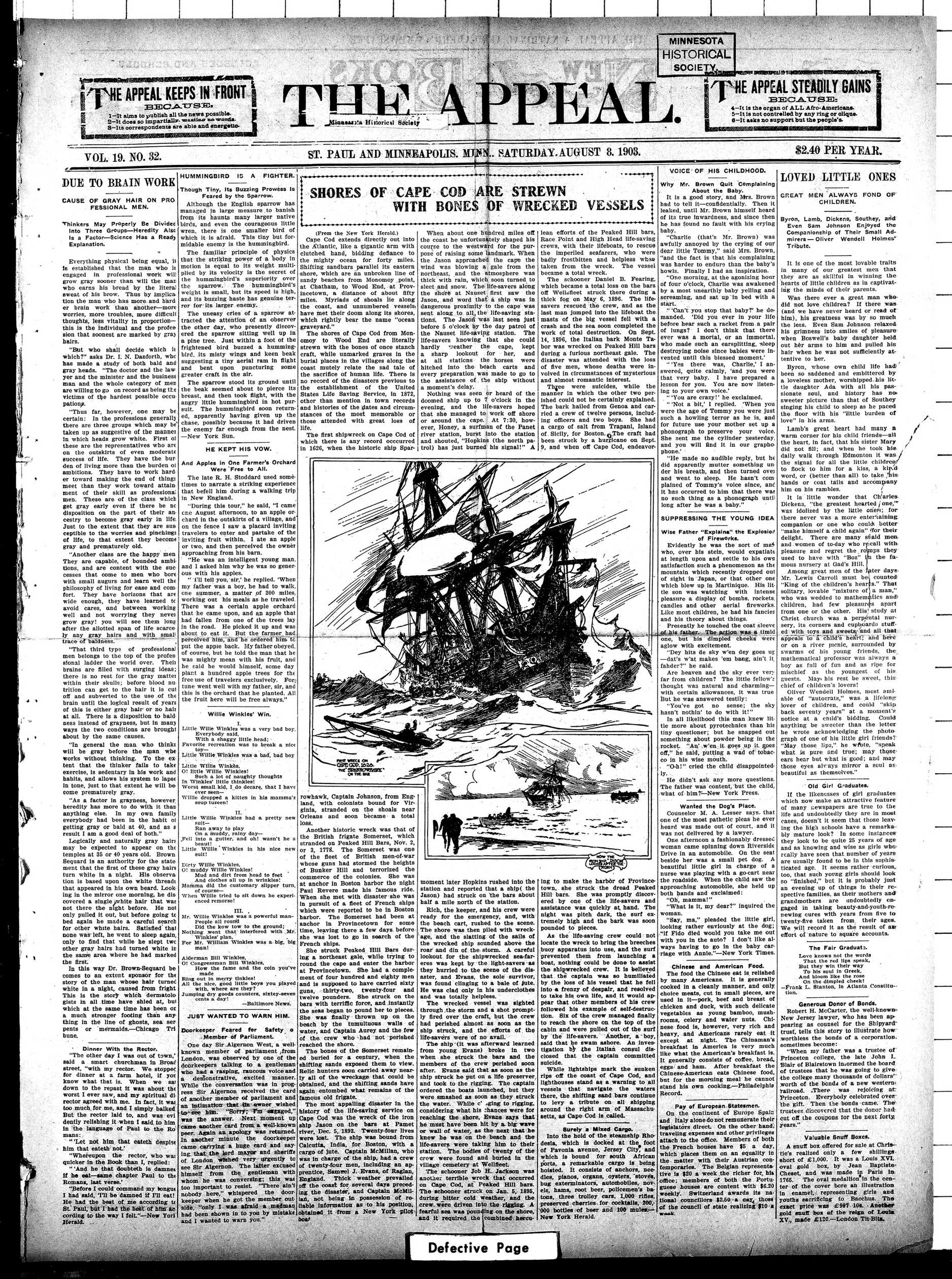
SHORES OF CAPE COD ARE STREWN WITH BONES OF WRECKED VESSELS
bowhawk, Captain Johnson, from England, with colonists bound for Virginia, stranded on the shoals near Orleans and soon became a total loss.
Another historic wreck was that of the British frigate Somerset, which stranded on Peaked Hill Bars, Nov. 2, or 3, 1778. The Somerset was one of the fleet of British men-of-war whose guns had stormed the heights
(From the New York Herald.)
Cape Cod extends directly into out the Atlantic, like a gigantic arm with clutched hand, bidding defiance to the mighty ocean for forty miles. Shifting sandbars parallel its eastern coast, the unnumbered sandy beaches from Monomoy point, at Chatham, to Wood End, at Provincetown, a distance of about fifty miles. Myriads of shoals lie along the coast, and unnumbered vessels have met their doom along its shores, which rightly bear the name "ocean graveyard." The shores of Cape Cod from Monomoy to Wood End are literally strewed with the bones of once stanch craft, while unmarked graves in the burial places in the villages along the coast mutely relate the sad tale of the sacrifice of human life. There is no record of the disasters previous to the establishment of the United States Life Saving Service, in 1872, other than mention in town records and histories of the dates and circumstances of the most memorable or those attended with great loss of life.
The first shipwreck on Cape Cod of
1626, when the historic ship Searn
FIRST WRECK ON
CAPT. GOD, 1620.
THE SEABORNE WRECK
ON THE SEA
rowhawk, Captain Johnson, from England, with colonists bound for Virginia, stranded on the shoals near Orleans and soon became a total loss.
Another historic wreck that was of the British frigate Somerset, which stranded on Peaked Hill Bars, Nov. 2, or 1, 3787. The Somerset was one of the fleet of British men-of-war use guns, which were of the Hill and terrorized the commerce of the colonies. She was at anchor in Boston harbor the night Paul Revere made his famous ride. When she met with disaster she was in pursuit of a fleet of French ships which were reported to be in Boston harbor. The Somerset had been at anchor in Provincetown for some years before there a foul date before she was lost to go in search of the French ships.
She struck Peaked Hill Bars during a northeast gale, while trying to round the cape and enter the harbor at Provincetown. She had a complement of four hundred and eighty men and is supposed to have carried sixty guns, thirty-two, twenty-four and twelve pounders. She struck on the bars with terrific force, and instantly the seas began to pound her to pieces. She was finally thrown up on the beach by the tumultuous walls of water, and Captain Aurey and the few of the crew who had not perished reached the shore. The bones of the Somerset remained buried for a century, when the shifting sands expelled them to view, and the carrying carried away nearly all of the wreckage that could be obtained, and the shifting sands have again entombed what remains of the famous old frigate.
The most appalling disaster in the history of the life-saving service on Cape Cod was the wreck of the iron ship Jason on the bars at Pamet river, Dec. 5, 1893. Twenty-four lives were lost. The ship was bound from Calcutta, India, for Boston, with a cargo of jute. Captain McMillan, who was in charge of the ship, had a crew of twenty-four men, including an apprentice, Samuel J. Evans, of Raglan, England. Thick weather prevailed off the coast for several days preceding the disaster, and Captain McMillan, not being in possession of reliable information as to his position, obtained it from a New York pilot boat.
When about one hundred miles off the coast he unfortunately shaped his course to the westward for the purpose of raising some landmark. When the Jason approached the cape the wind was blowing a gale from the northeast, and the atmosphere was thick with rain, which soon turned to rain. The Jason was on the shore at Naustet first saw the Jason, and word that a ship was in dangerous proximity to the cape was sent along to all the life-saving stations. The Jason was last seen just before 5 o'clock by the day patrol of the Naustet life-saving station. The life-savers knowing that she could hardly weather the cape, kept a sharp lookout for her, and at all stations the horses were hitched into the beach carts and the boat was to the assistance of the ship without a moment's delay.
Nothing was seen or heard of the doomed ship up to 7 o'clock in the evening, and the life-savers hoped that she managed to work off shore or around the cape. At 7:30, however, Honey, a surfer of the Panet and shouted, "Hopkins (the north patrol) has just hurried his signal!"
120
moment later Hopkins rushed into the station and reported that a ship the Jason) had struck on the bars about half a mile north of the station. Rich, the keeper, and his crew were ready for the emergency, and, with the beach cart, rushed to the scene. The shore was then plied with wreckage, and the slating of the sails of the shipwrecked soot boat, the roar and the noise. A careful lookout for the shipwrecked sea-farers was kept by the light-savers as they hurried to the scene of the disaster, and Evans, the sole survivor, was found clinging to a bale of jute. He was clad only in his underclothes and was totally helpless. The wrecked vessel was sighted through the storm and a shot promptly fired over the craft, but the crew was able to escape the shipstruck, and the efforts of the life-savers were of no avail.
The ship (it was afterward learned from young Evans) broke in two when she struck the bars and the members of the crew perished soon after. Evans said that as soon as the ship struck he put on a life preserver and took to the rigging. The captain ordered the boats launched, but they were smashed as soon as they struck the water. With a c'ing to rigging, conquering the shore, conquering the shore, Evans says that he must have been hit by a big wave or wall of water, as the next that he knew he was on the beach and the life-savers were taking him to their station. The bodies of twenty of the crew were found and buried in the village cemetery at Welfell.
The schooner Job H. Jackson was another terrible wreck that occurred on Cape Cod, at Peaked Hill bars. The schooner struck on Jan. 5, 1895, during bitter cold weather, and the crew were driven into the rigging. A fearful sea was pounding on the shore, and it required the combined hurricane.
Defective Page
lean efforts of the Peaked Hill bars, Race Point and High Head life-saving crews, with their lifeboats, to rescue the imperiled seafarers, who were badly frostbaited and helpless what taken from the wreck. The vessel became a total wreck. The schooner Dian B. Fearing, which became a total loss on the bars off Welfsella struck there during a thick fog on May 6, 1896. The lifesavers rescued the crew, and as the last man jumped into the firefall with the boat and the sea soon completed the work of total destruction. On Sept. 14, 1896, the Italian bark Monte Tabor was wrecked on Peaked Hill bars during a furious northeast gale. The disaster was attended with the loss of five men, whose deaths were involved in circumstances of mysterious and almost romantic interest.
Three were suicides, while the manner in which the other two persisted could not be certainly explained. The bark hailed from Genoa and carried a crew of twelve persons, including officers and two boys. She had a cargo of salt from Trapani, island of Sicily, for Boston. The craft had been struck by a hurricane on Sept. 9, and when of Cane Cod, endover
HOW THE
ROCKY TROLL
LOOKS AT THE
SEA
ting to make the harbor of Provincetown, she struck the dread Peaked Hill bars. She was promptly discovered by one of the life-savers and assistance was quickly at hand. The night was pitch dark, the surf extremely high and the bark was soon pounded to pieces.
As the life-saving crew could not locate the wreck to bring the breeches buoy apparatus into use, and the surf prevented them from launching, the crew should do as to assist the shipwrecked crew. It is believed that the captain was so humiliated by the loss of his vessel that he fell into a frenzy of despair, and resolved to take his own life, and it would appear that other members of his crew followed his example of self-destruction. Six of the crew managed finally to reach the shore on top of the cabin and were pulled out of the surf by the life-savers. Another, a boy, said that he swam home. An investigation of the Italian command closed that the captain committed suicide.
While lightships mark the sunken rips off the coast of Cape Cod, and lighthouses stand as a warning to all vessels that navigate the waters there, the shifting sand bars continue to levy a tribute on all shipping around the right arm of Massachusetts, as Cape Cod is called.
Surely a Mixed Cargo. Into the into the atmosphere Rhodesia, which is docked at the shipwreck of Pavonia Jersey City and the sound for south African ports, a remarkable cargo is being hoisted. It consists of anchors, needles, pianos, organs, stoves, stoves, bug exterminators, automobiles, novels, hams, root beer, policemen's bats, three trolley cars, 1,000 rifles, preserved cherries for cocktails, 200, 000 bottles of beer and 100 mules.—New York Herald.
---
VOICE OF HIS CHILDHOOD.
Why Mr. Brown Quit Complaining About the Baby.
It is a good story, and Mrs. Brown had to tell it—confidently. Then it leaked, until Mr. Brown himself heard of its true inwardness, and since then he has found no fault with his crying baby.
"Charlie (that's Mr. Brown) was awfully annoyed by the crying of our dear little Tommy," said Mrs. Brown, "and the fact is that his complaining was harder to endure than the baby's howls. Finally I had an inspiration.
"One morning, at the agonizing hour of four o'clock, Charlie was awakened by a most unearthly baby yelling and screaming, and sat up in bed with a seat.
"Can't you stop that baby? he demanded. 'Did you ever in your life before hear such a racket from a pair of lungs?' I don't think that there ever was a mortal, or an immortal, who made such an ersplitting, sleep destroying noise since babies were invented until this blessed moment.'
"Yes there was, Charlie," I answered, quite calmly, 'and you were that very baby. I have prepared a lesson for you. You are now listening to your own voice.' "You are crazy!" he exclaimed. "You are quick!" I replied. "When you were the age of Tommy you were just such a howling terror as he is, and for future use your mother set up a phonograph to preserve your voice. She sent me the cylinder yesterday and you will find it in our grapho phone.' "He made no audible reply, but he did apparently mutter something under his breath, and then turned over the clock to sleep. He complained of Tommy's voice since there, and it has occurred to him that there was no such thing as a phonograph until long after he was a baby."
SUPPRESSING THE YOUNG IDEA
Wise Father "Explains" the Explosion of FireWorks
Evidently he was the sort of man, who over his stein, would expatiate at length upon and settle to his own satisfaction such a phenomenon as the mountain which recently dropped out of sight in Japan, or that other one which blew up in Martinique. His life the son was watching with intense pleasure a display of bombs, rockets, candles and other aerial fireworks. Like most children, he had his fancies and outfits things. Presently he touched the coat sleeve of his father. The action was a timid one, but his dimpled cheeks were aglow with excitement.
"Dey hits de sky 'wen dey goes up—dat's 'wat makes 'em bang, isn't it fahder?' he said.
Are heaven and the sky ever very far from children? The little fellow's thought was natural and charming—with certain allowances, it was true. But he was not. "You've got no sense; the sky hasn't nothin' to do with it!"
In all likelihood this man knew it the more about pyrotechnics than his tiny questioner; but he snapped out something about powder being in the rocket. "An 'en' it goes up it goes off," he said, putting a wad of tobacco in his wise mouth. "O-h!' cried the child disappointedly. He didn't ask any more questions. The father was content, but the child, what of him?—New York Press.
Wanted the Dog's Place.
Counselor M. A. Lesser says, that one of the most pathetic pleas he ever heard was made out of court, and it was not delivered by a lawyer.
One afternoon a fashionably dressed woman came spinning down Riverside Drive in an automobile. On the seat beside her was a small pet dog. A beautiful little girl in charge of a nurse was playing with a go-cart near the roadside. When the child saw the approaching automobile, she held up both hands and exclaimed:
"Oh, mamma!"
"What is it, my dear?" inquired the woman.
"Say, ma." pleaded the little girl, looking rather enviously at the dog; "if Fido died would you take me out with you in the auto? I don't like always having to go in the baby carriage with Annie."—New York Times.
Chinese and American Food.
Chinese and American
The food the Chinese is relied on is the Chinese rice it is generally cooked in a cleanly manner, and only choice meals, cut in small pieces, are used in it—pork, beef and breast of chicken and duck, with such delicate vegetables as young bamboo, mushrooms, celery and water nuts. The Chinese food is, however, very rich and heavy, and Americans rarely eat it except at night. The Chinaman's breakfast in America is very much like what the American's breakfast is. It generally consists of bread, milk and eggs. After breakfast the Chinese-American eats Chinese food, but for the morning meal he cannot stand his own cooking—Philadelphia Record.
Box of European Statesmen.
Pay or European Statesmen.
On the continent of Europe Spain and Italy alone do not remunerate their legislators direct. On the other hand, traveling expenses and other privileges attach to the office. Members of the French houses have a day, which places them on equality in the matter with their Austrian contemporaries. The Belgian represents is 500 a week the richer for his members of both the Portuguese houses are content with $6.20 weekly. Switzerland awards its national councillors $2.50 a day, those of the council of state realizing $10 a week.
LOVED LITTLE ONES
GREAT MEN ALWAYS FOND OF CHILDREN.
Byron, Lamb, Dickens, Southey, and Even Sam Johnson Enjoyed the Companionship of Their Small Admirers—Oliver Wendell Holmes' Tribute.
It is one of the most lovable traits in many of our greatest men that they are as skillful in winning the hearts of little children as in captivating the minds of their parents.
Was there ever a great man who did not love children? If there was (and we have never heard or read of him), his greatness was by so much the less. Even Sam Johnson relaxed his grimness into smiles of pleasure when Boswell's baby daughter held out her arms to him and pulled his hair when he was not sufficiently attentive to her.
Byron, whose own child life had been so saddened and embittered by a loveless mother, worshipped his little daughter Ada with all his passionate soul, and history has no sweeter picture than that of Souley singing his child to sleep as he paced the floor with his "little burden of love" in his arms.
Lamb's great heart had many a warm corner for his child friends—all the heart, in fact, that his sister Mary did not fill; and when he took his wife, Elizabeth McIntosh was a signal for all the little children to fock to him for a kiss, a kip word, or (better than all) to take his hands or coat tails and accompany him on his rambles.
It is little wonder that Charles Dickens, "the greatest hearted, one," was idolized by the little ones; for there never was a more entertaining companion or one who could better "make himself a child again" for their delight. There are many shald men and women of to-day who recall with pleasure and regret the romps they used to have with "Boo" in the famous nursery at Gad's Hill. Among great men of the later days Mr. Lewis Carroll must be counted "King of the children's hearts." That solitary, lovable "mixture of a man," who was wedded to mathematics and children, had few pleasures apart from one or the other. His study at Christ church was a perplexed sorrow, its carpets and cushions stuffed with joyful memories and all that applauds a child's heart; and here on a river pen, surrounded by swarms of his young friends, the mathematical professor was always a boy as full of fun and as ripe for mischief as the youngest of his guests. May his rest be sweet, this chief of children's lovers!
Oliver Wendell Holmes, most amiable of "autocrats," was a lifelong lover of children, and could "skip back seventy years" at a moment's notice at a child's bidding. Could anything be sweeter than the letter he wrote acknowledging the photo of his girl friends? "May those lips," he wrote, "speak what is pure and true; may those ears hear but what is good; and may those eyes always mirror a soul as beautiful as themselves."
Old Girl Graduates.
If the likenesses of girl graduates now which make an attractive feature of many newspapers are true to the life and undoubtedly they are in most cases, doesn't it seem that those leaving the high schools have a remarkably mature look? In some instances they are not as knowing and wise as girls who really have seen that number of years are usually found to be in this sophisticated age. It seems rather curious, too, that such young girls should look so "finished", but it is probably just an evening up of things in their respective families, as their mothers and grandmothers are undoubtedly engaged in taking care of their children with years from five to twenty-five taken from their ages. We will record it as the result of an effort of nature to square accounts.
The Fair Graduate.
On the dimpled skirt!
Frank L. Stanton, in Atlanta Constitution.
Generous Donor of Bonds.
Robert H. McCarter, the well-known New Jersey lawyer, who has been appearing as counsel for the Shipyard trust, tells this story to illustrate how worthless the bonds of a corporation sometimes become: The trustor was a trustee of Princeton college, the late John L. Blair of Baldwin informed the board of trustees that he was going to give the college many thousands of dollars' worth of the bonds of a new western railroad. There was rejoicing at Princeton college. Then the bonds came. The trustees discovered that the donor had cut off the coupons for the next forty years.
Valuable Snuff Boxes.
A snuff box offered for sale at Christie's realized only a few shillings short of £1,000. It was a Louis XVL gold box gold, by Jean Baptiste Cheset, and was made in Paris in 1765. The oval medallion in the center of the cover bore an illustration in enamel, representing girls and youths sacrificing to Bacchus. The exact price was £997.10s. Another gold snuff box of the reign of Louis XV., made £120—London Tit-Bite.
HAVE YOU RID
THE APPEAL
THE APPEAL,
A NATIONAL AFRO-AMERICAN NEWSPAPER
PUBLISHED WEEKLY BY
ADAMS BROS. EDITORS AND PUBLISHERS
49 E. 4th St. St. Paul, Minn.
ISSUED SIMULTANEOUSLY IN
Saint Paul, Minneapolis, Chicago,
Washington, Louisville, St. Louis.
ST. FAUL OFFICE,
No. 110 Union Blk. 4th & Cedar,
J. Q. ADAMS, Publisher.
MINNEAPOLIS OFFICE,
Guaranty Loan Bldg. Room 1020
HARVEY B. BURK, Manager.
CHICAGO OFFICE,
823-5 Dearborn St., Suite 310,
C. F. ADAMS, Manager.
LOUISVILLE OFFICE,
No. 312 W. Jefferson St. Room 3
LILLIAN L. MORRIS, Manager.
ST. LOUIS OFFICE,
No. 1002 Franklin Avenue.
J. H. HARRISON, Manager.
VERMS, STRIGTLY IN ADVANCE:
It occasionally happens that papers sent to subordinates are lost or stolen, so do the information by postal card at the expiration of five days from that date. We also send documents for review by the missive team. Communications to receive attention must be neway, upon important subjects, plainly stated, and must reach on Tuesday if possible, anyway not later than Wednesdays, and be the earliest turned, unless stamps are sent for postage. We do not hold ourselves responsible for the views of our correspondents. Selecting agents wanted everywhere. Write to us at the address below.
In every letter that you write us never fall to
the wrong hands. We write you a letter,
posted, office, county and state. Business
letters must be written on separate sheets
from mails. We will not send second
class matter at Ss. Hall. Kindred
are second class matter at Ss. Hall.
AGENTS WANTED.
THE APPEAL wants good reliable agents to canvass for subscribers at points not already covered. Write for our extraordinary inducements. Address,
THE APPEAL,
40 East 4th St., St. Paul, MNn
**AMEN! AMEN! AMEN! AMEN!**
* "We ask Thee, Lord, that Thou wilt raishe up a man who will kill you, and damnable horay that this is a white man's country, and that damnable horay that this is a black man. Raishe up some widow's son, who is now in his wife's hands, saving the black slave of to-day saving the black slave of to-day but from the shackles of prejudice, and save the black race from his superulous contempt, from his degradation, and lift him from his superulous contempt, from his superulous contempt, from his followen framed in God's own image."—
* "The pastor of Plymouth Hills, the pastor of Plymouth Church, Brooklyn, New York.*
SATURDAY, AUGUST 8, 1903.
Whenever the question of lynching Afro-Americans is discussed by white men they almost invariably endeavor to justify lynching by claiming it is necessary to protect white women. Every one knows that not one out of ten of the black men lynched is guilty of rape or attempted rape, or is even accused of these crimes. It matters not what crime a black man is accused of committing, he is just as much in danger of being lynched as if he had committed rape. The prejudiced mobs do not care what the crime is, nor if there is no crime at all, so long as the prospective victim for their brutal enjoyment is black. It does not depend upon the enormity of the crime with any mob, and really it does not mat-
ter who the intended victim is nor what his color or nationality with a mob, though when the victim is black his color acts as a red rag does on a mad bull and makes the mob more brutal and bloodthirsty. Mobs are just like flocks of sheep, they follow their leaders blindly, and when cheated out of a victim by some means or another, they are just as likely to mob anybody who comes along or who may be suggested as a victim. And, when it is a black man they are after, if they cannot get him they will go and hunt up his wife or children or some other man and his wife and children. This proves that this plea of "protecting white women" is not the true incentive of the mob. Lynch law is wrong and ought to be abolished. Punish criminals as severely as you please, let the punishment fit the crime, but punish only the criminals and punish them legally, whether they be black or white.
The hoodlums who attempted to break up the Booker Washington meeting in Boston last week will defeat their own ends if they continue along the same lines of lawlessness. If they have any arguments to present in answer to Mr. Washington's propaganda, they ought to present them in a legitimate way. They cannot hope to win by violence, any more than the mobocrats can. And as they are the greatest sufferers from mob violence, this ought to teach them a better lesson. Dr. Washington has the full and cordial support of the conservative people of both North and South, black and white, and the lawless spirit exhibited at Boston should be frowned upon and condemned as earnestly as that exhibited at Danville, Ill, and hundreds of other places. We are unalterably opposed to lawlessness in an individual or in the mob, and whether directed against an individual or a special class of persons, and all good, sensible people are.
James Wilson, who attempted to assault Mrs. Burgess of Alvin, Ill., and who was the cause of the "race war" at Danville, Ill., July 25th, pleaded guilty at his trial on last Tuesday and was sentenced to a long term in the penitentiary. The whole proceeding occupied about two hours. This seems to be speedy justice, and the brute got what he deserved. He should have been punished and would have been punished, and as he was the guilty one everybody would have said amen; but the enormity of his crime was surpassed by that of the brutal mob that wreaked its vengeance on the innocent, guilty of no crime but being born black. If Wilson had been sentenced to death we would have said amen. But now that the law has dealt with him, we wait to see what it will do with the lynchers who murdered the innocent unoffending. law-abiding people.
It seems that certain disorderly persons in Danville have been trying to foment more trouble. One man went to Alvin from Westville last Monday and advised the people there to send a mob to cooperate with another from Westville and other mining towns in another attack on the jail. The people of Alvin would have nothing to do with him, and similar attempts elsewhere were not successful.
Among the resolutions adopted by the American Federation of Catholic Societies at Atlanta City, N. J., last Wednesday the first one condemned feuds, riots and mob law as unworthy of civilized people. Lynching is regarded as murder, and the burning and torture of people, even when clearly guilty, as barbarous and a menace to the peace and security of all good citizens.
Brave Sheriff Whitlock of Danville, Ill., who defended the Afrc-American prisoners against the mob, has received hundreds of letters commending his courage from all parts of the United States. Danville Ministerial Association passed strong resolutions praising Sheriff Whitlock for his heroic stand.
The New Orleans Picayune thinks that under existing conditions the United States is a paradise for Afro-Americanans. If this country is a paradise, many of the race would prefer to reside in hades.
The greatest need of this country at the present time is a hanging under the forms of the law of some of the American mobocrats. Lynching is murder—murders should be hanged
THE APPEAL: A NATIONAL AFRO-AMERICAN NEWSPAPER
SOCIAL LIFE IN THE EARLY REPUBLIC.
Social Life in the Early Republic. By Aune Hollingworth, Carlton, Pro fusely illustrated. $8o. Buckram, gift top, uncut edges. $3 net. Philadel- lore. I. In correspondence.
chapter called "A voyage of misery and a happy ending" she writes: "If the food was bad the drink was worse. The universal most demand for which is the production of a bottle bearing a wonder- ful label and the statement 'Used in the House of Parliament.' The commercial which identifies him as "T or 'Carpenter Erickson.' quite an excellent addition ature of travel.
Within the last year or two there has been written a good deal of interesting articles about the life of the Republic and of the colonial period. Much of the matter that has been written is classed as standard literature. Of hastiness and ill preparation, and can hardly be classed as standard literature. "Social Life in the Early Republic," has written historically and well. This lady has written dealing with the men, the most strenuous period of development and evolution was not only well received by the public, but has looked forward with much expectation to the present volume, which may be termed exhaustive. This chapter on "A Social Evolution" carries one straight to the heart of the subject, little prologues or apologies which usually characterize works of this class. The little prologues and apologies with that politeness and delicacy of manner which renders the book a warrior, a warrior, who visited the principal cities of America soon after the Revolution, and who visited the Frenchman recorded that he discovered neatness without laxity, and that he visited be found more luxury and less neatness, in all of them. He was admitted to the Frenchman recorded that he frankly admitted that for beauty and conversational ability he was admitted with the rank of court in the Old World.
In discussing the landed gentry of the Middle Ages, we were the English characteristics of the Southern settler more clearly shown than the English characteristics of the English chronicler writes of his countrymen: 400 horses that seemed almost tireless, and who were so strong that Reynard across the eastern peninsula from the Chesspeake to the Atlantic coast could move man-made mounts on the way, took more time than the pursuit of the fox and the whole expedition sometimes lasted.
In a chapter on "Jeffersonian Simplification" when Mrs. Madison gave expression to her sweeping strictures upon Democrats, she must have had reservations on her expression. She was a great favorite. Indeed it was in consequence of her precedence to Mrs. Madison in a state dinner that he aroused the animosity of the White House. White House etiquette does not seem to have occupied Mr. Jefferson's mind, and either from carelessness or because of his defiant red-republicanism, he quite seems to have been a writer. The author writes interesting chapters on the politics, society and intellectual life of the early inhabitants of the Republic.
```markdown
```
THE STORY OF THE SLAVE
Slavery in New Jersey Historical Society, Camden, N.J.
Alfred M. Heston, Member of the New Jersey Historical Society
This monograph is a recital of slavery and seduction. The act is brought out that slavery existed in American long before 1619 and that slavery is carried out by the cargo of human freight to Jamestown. The Aztecs in Mexico enslaved not only slaves but also enslaved nation who were convicted of their own nation and who were freed or introduced in New Jersey in 1898—at least that is the earliest recorded instance of the leading citizens engaged in the African slave trade. There is a record of a slave trade in the African coast always turned out well, leaving the carriages of a slave claim harbor in these words: "An overruling slave trade in the land of freedom another cargo of benighted heathen to enjoy the blessings of God."
Perth Amboy was New Jersey's chief port of entry and had a large number, many of them freshly imported and still bearing their original $80. The system of white bondage, known as redemptive servitude, existed in New Jersey for the last seventeenth centuries. This form of bondage was usually voluntary, and at the expiration of their service, merged into the mass of white population without any special taint of servitude. Many white convicts, who were found to be cheaper than white servants, checked in a measure. Many white convicts were shipped to New Jersey from the British Islands, and were sent to New York. An act providing for the gradual abolition of slavery was passed by the state legislature in 1820 and still later another in 1848, did not bring about the complete abolition of slavery. The other act in 1820 and still later another were there but 18 in the entire state when Lincoln's proclamation was issued. In 1831, Lincoln issued a bill to a member of the state state legislature, and passed a bill which removed the slave last vestige of slavery in New Jersey.
The little book contains much valuable information.
---
ROMANCE OF THE COMMONPLACE
The Romance of the Commonplace. By Gelett Burgess, $1.50. San Francisco. Paul E.der and Morgan Shepard. This is volume of modern philosophy, which ranks in that class of essay made famous by Jerome K. Jerome. Mr. Burgess says many clever things in his book, and one may glance at any chapter and discover many commonplace things written in a very uncommon manner. "The desire to tell secrets," writes the author, "is one of the most contagious of diseases, and few of us are immune. Some vigorous moral constitutions never succumb, but once an epidemic begins it is hard work stopping it, and a secret on the rampage is well nigh irresistible. Tell your secret, then, broadcast, and let it have its way until it dies out. But above all never confide it to her who asserts she never has the slightest desire to tell, for there, like a seed sown in fertile ground, it will germinate and flower long after you have forgotten it. aye, and bring forth fruit you never planted."
Again: "Flattery is, however, an edged weapon. It is not everyone who has the tact to decide at once just how much his victim will hold. The author treats of art, science and life in a way that is critical, criticism, and withal, with so much of his interest to render the book of mutual interest."
---
THE MYSTERY OF MURRAY DAVEN-
T. The Mystery of Murray Davenport, A
Story of New York at the Museum of
Painting. Pressed by H. C. Edwards.
Boston: L. C. Page
H. C. Edwards. Boston: L. C. Page
The scene is New York. The hero a dispoisoned and fortune has frowned upon him. Mr. Stephens is particular to seek the bustle and excitement of a familiar neighborhood. He sims to reproduce the bustle and excitement of its customs. The well-appointed flat, the boarding house, the hotel, the pseudo-friendly side neighborhood are all recognizable. The personages are generally commonplace. The "mystery" seems to be something to accept it for what it is worth we certainly will not quarrel with the manner of it, but by enough except the explanation when it comes. What it is the reader must learn for himself.
TWO ON THEIR TRAVELS
"Two on Their Travels." by Ethel Cohn
$2.50. New York. A. S. Barnes &
C. H. Barnes.
"Two on Their Travels" by Bibl-Col
the writer is a very interesting book
by the writer is a very interesting book
The writer describes the out-of-the-way
treatments of the natural world, its
literally natural and its quite unique. In the
book, the writer describes the out-of-the-way
treatments of the natural world, its
literally natural and its quite unique. In the
BOOKS
chapter called "A voyage of misery and a happy ending," she writes: "If the food is good, the people are good. The male demand for whiskey led to the production of a bottle hearing a wonderfully sweet rum. The House of Parliament." The commercial traveler tasted it, put down his glass and drank it. He wore a dressing the head boy he said with his slow Glasgow accent: "Whaur-did ye wear a rum?" The irony was, I fear entirely lost. It was the same commercial traveler who, a few months later, came to share a rather less poisonous drink unearthened from somewhere. "Thank ye, you," he said. "What did he believe as much as guilt for r-me." He then related how, feeling thirsty in the mid-afternoon, he drank what he believed to be about half a bottle of water. In the morning he discovered the water bottle, and the whisky bottle, and I thought, "What did he believe as much as guilt for r-me?" he remarked. He was in a very interesting manner scenes, people and places in the Philippines, the straits settlement, Japan, China, and other countries in the world. The illustrations are, many of them in colors and are very elaborate.
The TRUE ABRAH LINCOLN.
The True Abraham Lincoln. By William Eleroy Curtis, author of The True Thomas Jefferson, Crown 8v. cloth. By J. B. Lippincott Company.
There are a few rare characters in history with interest with each succeeding generation, and which gleam brighter as time passes, and which endure with the generals of men and women who they were enviored. The characters are unique and original and bear striking analogies to each other—the most important of which is the character of William Elderly Curtis. They may be called the guide posts of civilization, and may be named as, Christ, John, and William Elderly Curtis the latter that William Elderly Curtis written under the title, "The True Abraham, knoxin." The Lincoln is always absorbing and full of human interest. The volumes which have been written about Abraham Lincoln—we have, however, read none of them which surpass in arrangement of literary content that William Elderly Curtis nil nisi bonum" has exerted such a profound influence on literature that light upon many of the eminent careers of distinguished statesmen and soldiers. It is, however, written in a manner that is not to remind us that Mr. Lincoln not to fall remind us that Mr. Lincoln these faults, however, serve as a striking contrast to the sublimity of the Great Emancipator's life.
The illustrations are profuse and some of them appear for the first time in a history of the biography of the Great Emancipator's life.
Those who were present say that at an age of 12, he was in monotone, but gradually his words grew in force and intensity until he swept the room with his sword and his hearsers "arose from their chairs with pale faces and quivering lips and his influence was irresistible.
THE REAL BENEDICT ARNOLD.
The Real Benedict Arnold. By Charles Burr. Todd. author of "The True Aaron." New York: A. S. Barron & Co., 12. New York: A. S. Barron & Co., 12.
The "real" and "true" people seem to have the front of the stage just now, in many quarters that Benedict Arnold has not been fairly treated, that his servile nature has not been emphasized, that great fault was not over-emphasized perhaps, but unreasonably punished. Treason is the other great treachery to one's friend and is not to be condemned in any wise. There are other reasons why he explains the deed and modify the bitter condemnation. He invades Arnold's treason, Mr. Todd emphasizes his invaluable services to America, and shows conduct in the colonies. Colonies: first at the battle of Valour's Island on Lake Champlain (the first name of the colony) where they were engaged, where, by his desperate valor, he gave the Americans arms that they gave up their plan of invasion from the north that year. He invaded the harbour in the Mohawk Valley and putting to flight St. Leger's invading army garrison, by winning the two battles of Saratoga, which, conjoined, Cressey included as one of the fifteen deeds.
Mr. Todd also shows that it was the influence of Arnold's wife and his fear of being taken away by the British officers be discovered, which induced Arnold to betray his country, and the British officers were not the calamities of paper generals—the motives generally ascribed. The book is an original and unique work, and it is the illustrations are interesting and instructive; especially noteworthy is the reproduction of an old print repre-
As death drew near, it is said his mind wandered, and he was again in America, and he was in England, and his old comrades in arms. In a lucid interval he asked that his Continental uniform had to be adapted to the "Vulture," and which he had ever cherished, might be brought and put on him, with the comrades and sword-wielding which had given the bravest of the brave. "Let me die in my own unfortunate uniform in which I fought my battles. God forgive me," he added, "for ever putting on any other."
PICTURES OF SWEDISH LIFE.
Pictures of Swedish life; or Svea and her Children. By Mrs. Woods Baker. Borgelholm-Holmberg Publishing Co., Chicago.
This is a beautifully printed and elaborately illustrated book for instructed or illustrated readers in the "Land of the Midnight Sun." The illustrations are expressive and the author writes a vivid life story. The author writes at length on the simplicity of living which the book emphasizes, and tells us that the strength of this people lies therein. "The sons of the Bible are accustomed to habits of life most simple and unpretending." In a chapter entitled "We are accustomed to habits of life most simple and unpretending," the rule of simplicity of these people and says, "With regard to the highest and lowest of the highest and lowest have none. Oscar II is simply Oscar II. dropping the Bernach and Anders or Axel, while his wife is simply Brita, Anna or Maria. When a man in ordinary calls to his mother in ordinary calls he may have a title
```markdown
```
---
which Identifies him as "Tailor Larsen"
which identifies him as "Tailor Larsen"
quite an excellent addition to the literature of travel.
SONGS AND STORIES FROM TENNES-
S
"Songs and Stories from Tennessee."
By John Trotwood Wood. $1.00. Philadel-
phia.
"Songs and Stories from Tennessee," by John Trotwood Moore is a volume of real literary merit.
His dialect stories are gems of artistic work. "Ole Mistis," being a story of the turf, wherein the genius of the colored jockey is described in a story of more than ordinary power. "Wal, sah, I sleep in de stall wid Ole Mistis eby night and she nurver tromped on me nary time. Demornin of de race dar wus de bigges crowd I eber seen. 'Twas down in de ole clover bottom."
This is the prelude to the description of a horse-race which for literary skill and dramatic power, is almost equal to Lew Wallace's chariot race in Ben Hur.
Mr. Moore's poetry is redolent of southern pine forests, mocking birds, and sun sets and show much depth of sentiment.
The illustrations by Howard Weeden and Robert Dickey are very attractive.
THE ARCHIERY OF SAMARA.
The Archery of Samara, By Henry Ilowitz, $1.50. Philadelphia: Henry T. Comes the Co.
Mr. Ilowitz well remembers the terrible treatment of the Poles during their last revolt and says he has been an eyewitness of most of the incidents narrated in his romance. He writes with the bitterness that comes of suffering: "The Tartar enthroned in St. Petersburg is the dragon that holds the half of two continents between his terrific iron jaws, ready to crush him who dares to put a straw in his way." Darkest Russia is not limited to the confines of the pale; it covers an empire where the sun never sets, peopled by 120,000,000 of beings who belong soul and body to the czar. It is amun্তieldy mass of heterogeneous humanity in various stages of degradation, at least forty kinds of religionists hating each other and all hating the police and the army.
These sentiments form the undercurrent of the book and are in strange contradiction regarding Russia and the policies of reform with the latest newspaper accounts of the persecution of the Jews, which cannot be surpassed in burdury. The book is a timely contribution to current literature.
RUAIYAT OF OMAR KHAYAM YJR., Born in Russia, 50 cents. By Wallace Irwin, 50 cents. San Francisco. Elder & Shepherd Jr., by Wallace Irwin is nothing less than a very cleverly written parody on the origination of the Khayam, Jr. By Wallace Irwin is nothing less than to those critics of the real Omar who positively refused to accept his verse as the author. To those Socrates held in诗文 in general when he said, "but Oh! I have questioned them and criticized of the Persian诗文 Mr. Irwin's critics were unable to tell me. No ordinary mind could have performed the task which Mr. Irwin has in his very book which I have given to end with wilt of the very first class.
THE SPOILSMSM. The Spoilsmsm. A story of Ward politics. By Elliott Flower. Author of "War Politics." $24. $24. Boston, L. C. Page & C.
A story of municipal politics depicting a condition of municipality to be more of large cities. While no attempt has been made to describe particular locality, the political methods employed have been taken. The political methods employed have been taken to have served the public in some capacity or other, and some of the characters are literally true. The love interest centres around a sociologist, wealthy young man to enter the local campany to become a successful story which relates to the troubles and complications which follow the story of the municipal politics.
THE WORTH OF WORDS.
The Worth of Words. by Dr. Racy Husted Bell. 12mo., gilt top. Pp. 300. $1.50 net. New York: The Grafton Press.
In the introduction Dr. William Colby Cooper says: "Words are the red corpuscles in the blood of language, and upon language depends social integrity. See the mighty importance of words. Is it less than sacrifegious to mistreat them? Words being the red corpuscles of language, it follows that the smaller one's vocabulary is, the more anemic will be his brain's children."
Dr. Bell is a poet and understands the value of words as only the few do, and in producing this work he has merely justified his natural fitness in this line.
Some persons are correct as to grammar, others as to rhetorics, and others as to quite obligatory use may be quite offensive to the trained grammarian, the improper application of a figure of speech. There was a grocer who was very accurate in his grammar, and who did not use the language, and took some trouble to instruct them. One day a customer called and said, "What are you doing with Eggs and eggs?" "Darn glad to hear the last I got here were more than Eggs." "The Worth of Words." Dr. Bell attacks misused words, vulgarisms, and other bad language, but the manner, and many errors of speech which are often made by persons of intelligence may be corrected by a careful study of the book.
SALLY WISTERS JOURNAL
Salem, MA. A true narrative of a Quaker maiden's account of her experiences with the Indians, 1778. Edited by Albert Cook Myers. With reproductions of portraits, manuscripts, relics and views. 12 mon. pp. 224. Philadelphia:
Sally Wister's Journal is the record kept by a Quaker girl of 16 during a country-ter famous in the history of the country. He was the first of the book has to do with the savings and doings of American soldiers visiting or quartered at the farm-house, to their attentions. The book was read by the regret and her heart. Lydina had to her regret and her certain of them go upon missions of peril. Her "teeth rattled" and her "hand shook like an aspen leaf," she soon she first saw these soldiers, but she soon says to her Philadelphia friend: "My advice is summon up all your resolution, call a port of a small aid, and don't feel so much of the right one, and there's nothing like courage," is what I stand if need of myself. I'll go soon. I've been a good career, and I've seen the rest of the sort of life, she says very.
The first of the year like other folks, talk like them and behave with elegance. One "is the most amiable of men," tall and genteel, whom the following lines will must fullly characterize:
"How skilled he is in each obliging art."
The mildest manners with the bravest heart.
Another soldier. A second is "monstrous tall and brown, but has a certain something in his face and conversation is very agreeable." And then there are the glory, skilled the major is a bashful, so fat-
thes. He cannot be ex-
toll'd for the graces of person, but for those of the mind he may justly be celebrated; he is large in his person, man and an engaging countenance and ad
"Whimists." By S. Scott Stinson. Illustrated by Philadelphia. *Henry T. Coates & Co.* by W. Scott Stinson, pictured by Clare Victoria Dwigens, in one of the dainty drawings. By W. Scott Stinson. "Whimists is uniform with Mr. Matthewman's "Cranklama," and consists of three imitative drawings. Dymed conceits embodied in Mr. Dwigins' imitable drawings. Dymed conceits well as the unusual and genuine illustrative ability displayed in pictured drawings, as well as by the grace and beauty of his drawings, and in the services for Mr. Stinson's clever conceits.
Defective Page
---
Knowles Building. Boys' Hall. Stone Hall. Girls' Hall. Model House.
ATLANTA UNIVERSITY, Atlanta, Ga.
An unsectarian Christian Institution, devoted especially to advanced education. College, Normal, College Preparatory and English High School courses, with Industrial Training. Supervise Physical Education. Attend by Physic tutors for all Home and training. Aid given to needy and deserving students. Term begins the first Wednesday in October. For catalogue and information, address President HORACE BUMSTEAD, D.B.
Virginia Normal Collegiate Institute.
PETERSBURG, VA.
Departments- Normal and College Special Institute, Vocational and Instrumental Music, Theoretical Agriculture, Sewing and Cooking. Health Lessons taught by steward lighted by "scribicty; room, board tuition, light and heat, $80.
For Catalog and Parties, write to J. H. JOHNSTON.
President.
TUSKEGEE Normal and Industrial Institute
Organized July 4, 1881, by the State Legislature State Normal School Earned from taxation
BOOKER T. WASHINGTON, Principal.
WARREN LOGAN, Treasurer.
ENROLLMENT AND FACULTY
Enrollment last year 1.23S; males, 88; females, 88.
Average attendance, 1.03S;
instructors, 88.
COURSE OF STUDY
Education education combined with industrial training; 28 industries in constant operation.
VALUE STUDENTS
Property management of 127 acres of land,
50 buildings almost wholly built with student
labor, is valued at $330,000, and no mortgage.
$5 annually for the education of each student;
$200 enables one to finish the course;
$150 enables a scholarship. Students
pay their own bank account. Money in any amount for current expenses.
Besides the work done by graduates as class
room teachers, there are thousands and
through the Tuskegee University
beaches is 40 miles east of Montgomery and
135 miles west of Atlanta, on the Western Rail-
road. Alabama, beautiful old Southern
town, and is an ideal place for study. The cli-
cine school is the place made the place as excellent winter resort.
Fourteen teachers. Elegant and commodious
college. Preparatory. Normal, Xi'an, H. Music
College. Preparatory. Normal, Xi'an, H. Music
FIFTY **DOLLARS** **ADVANCE**
Will pay for board, room, light, kitchen, tuition and
indicators for the entire year. $800.00 per
done in each department. Send for circulation to tl.
Send your Sons and Daughters to
WESTERN UNIVERSITY
QUINDARO, KANAS
A great place for research, laboratory,
Normal, Musical, Industrial and Theological
studies. Send your papers.
Write as once for information or catalogue
to WESTERN WILLIAM T. VERNON
PRESIDENT WILLIAM T. VERNON
QUINDARON, KANSAS
WANTED Canvassing "THE NEGRO IN REVELATION, IN MISSION" What a man for Race Has Done and Is doing in Asia. What a man for the Forum, the School and the Mart of record of his achievement and a record of his accomplishments. J. P. Jickle. Supervised and interned by John B. Gordon, former Minister of Interior, and full particulars and what is said of the Demonstrators. PROMISON PUBLISHING CO., INC.
Now Ready
The New
Pittsburg
Wall
Papers
Nectar Duties everywhere
Valuable hints and colored
Reproductions free.
The Pittsburg Wall Paper Co.
New Brighton, Pa.
"FOOD FIT FOR THE
GODS"
TOMMY HANLEY
New York
WHITE Wrapper
White Wrapper:
GROCERS EVERYWHERE.
Send Postal to: H.S.A. bring P.I. R.I. for Free Booklet.
also name of your grocer if he does not handle the above.
Pabst h is always Brewed from carefully selected barley and leave the brewery until pro
Pabst beer is always pure
Brewed from carefully selected barley and hops — never leave the brewery until properly aged.
(INCORPORATED)
LOCATION:
Departments: Normal and Co-
fessional Education, Instrumental Music, Theatrical Agriculture, Sewing and Cooking.
Music: Acoustic room, room boa-
tition, light and heat. $50.
For Catalog and Parts: write to J. H. JOHNSTON.
President.
"GOD HATH MADE OF ONE BLOOD
ALL NATIONS OF MEN."
IS THE NOTTO OF
Berea College
BEREA, KY.
Christian, non-sectarian. Three college curric-
ums: Music, Academy, Normal, Manual. Tuition free
individual. $100 per room. $20 white and $21 Afro-American stu-
rooms. 60, 100 miles if need be to GET THE Buf-
sic School.
PRES. WM. G. FROST, PH. D., BENFA, KV
SHAW UNIVERSITY
SHAW UNIVERSITY
RALEIGH, N. C.
For both sexes, Departments of Law, Medicine
College Preparatory, English College,
College Preparatory, English College,
Two-year colleges, catalogues, circuits
and other informa'i addresses.
PRES, CHAS. S. MESERVE
Raleigh N. C.
TILLOTSON COLLEGE
AUSTIN, TEXAS.
OLDEST AND BEST SCHOOL
In College. Attendance required.
Reputation unsurpassed. Manual Training a part of the regular course. Music a part of the regular course. Advantages for earnest students seeking to help themselves. Address
Rev. Marshall R. Galge, A. M., President. Austin, Texas.
AVERY COLLEGE
TRADES SCHOOL
ALLEGHENY, P. A.
A Practical, Literary and Industrial Trades School for Afro-American boys and Girls. Attendance for Girls and a separate school. Address
SAMUEL HUSTON COLLEGE
A CHRISTIAN SCHOOL Experienced Faculty Progressive in all departments, best Methods of Instruction, Health of Students carefully planned, and the proper labor as well as think. For catalogue and other information, write to the AUSTIN, TEXAS. R. LOVINGGOOD, AUSTIN, TEXAS.
The why some shop-keepers do not sell President Suspenders is they make more money on imitations 50 cents and a dollar. Ask at favorite shop, or post paid from C.A. Edgerton Mfg. Co. Bead or fabric. Bead or fabric for catalog.
Use "Ceres" Flour for Success in Baking.
Best in the World
CERES
Fancy Roller Patent.
Ask your grocer for "Ceres" Flour
—refuse substitutes.
In happy homes, wherever found,
One hear the Wainborn's murky sound
THEY PLAY
WASHRUDN
WASHBURN
MANDOLINS
GUITARS AND BANJOS
Unequaled for Tone, Durability
and Workmanship.
We will gladly send free a beautiful Arc
Souvenir Catalogue and "Facts About The
Mandolin" and "How to Play" a Mandolin.
If you will send your address on a postal card.
LYON & HEALY, Chicago
144 Adame St.
The World's Largest Music Store. Music—Everything Enjoyed at Home.
TOM MURRAY
"We Make Guitars to order"
3 for $1.00
WEEKS RECORD IN MINNESOTA'S CAPITAL.
The Saintly City and Saintly City Folk—way Items of Social, Religious and General Matter Among the People, Bolled Down.
WANTED—SEVERAL PERSONS OF choice so far in each state (one in each county required) to represent and advertise old established wealthy business house of solid financial status, Sunday, $1.00 weekly with expenses additional, all payable in cash direct each Wednesday from head offices. Horse and carriage service, Bricole self-addressed envelope, Coquial Co. 234 Dearborn St., Chicago.
Half soils, sewed, 75c; rubber heels, 40c; Phone 1556-J2. Jarvis, 83 E. 4th.
Miss Birdella Harris of St. Louis, is in the city, the guest of Mr. J. H. Jacobs.
FOR RENT—Nicely furnished front room can be had at 197 West Sixth street.
"I haven't paid $4.00 for a hat since I began wearing the Gordon and I buy the best."
Messrs. F. D. McCracken and S. Edward Hall leave next week for Port Arthur, Ont.
Mr. Wm. Liggins, who broke the bones in one of his feet last week, is improving rapidly.
Messrs. Owen Howell and C. S. Harrison returned Monday from a pleasant trip to Colorado.
Mrs. Samuel Hatcher has moved from the Grand to Union Block, Cor. 4th and Cedar, Room 50.
Don't forget the St. Paul Street Carnival; it is a good place to spend a pleasant evening. Admission only 10 cents.
There will be big times among the ladies of the Order of the Eastern Star next week. Many strangers are expected.
Wait for the tenth annual picnic of St. Philip's church at Spring Park, Thursday, August 13th. The usual good time may be expected.
Mrs. E. J. Allen has closed her place of business on Seventh street, and anyone wishing to leave orders for work should call at 602 Wabasha.
Miss Mary L. Harwell has associated with Miss B. M. Foley, in hair-dressing, manicuring and facial treatments, in the Chamber of Commerce building.
The most popular place for people who take their meals down town is John Godfrey's. No. 552 Wabasha street. Everything neat, clean and well cooked.
James Russell had some argument with a friend of his landlady on last Tuesday evening and had his thumb nearly severed by a razor. His assailant escaped.
Mr. and Mrs. H. B. Rogers and children went to Manitouville, Minn., last Saturday to attend the funeral of Mr. Rogers' mother, who died quite suddenly Friday morning.
Is your hair straight? If not, send 60 cents to Ozonized Ox Marrow Co., 76 Wabus avenue, Chicago, Ill., for a bottle of Ozonized Ox Marrow and you can easily straighten it.
Rav. E. W. Daniels, rector of St. Philips mission, completes his first year in charge of the mission on tomorrow and will celebrate Holy Communion at 11 o'clock a.m.
THE NAGEL UNDERTAKING CO., Wm. E. Nagel Manager, 208 West Third street, Telephone, Main 1504. Latest equipments in every line. Lady assistant when desired.
Gentlemen wishing nice furnished rooms, with all conveniences, by the week or month, at reasonable rates, should apply at the Benton House, 228 West Third street, up stairs.
Mr. and Mrs. Peter T. Conway, 411 Rondo street, entertained at five o'clock dinner Saturday, Mr. and Mrs. A. D. Griffin of Portland, Ore., Mrs. T. J. Irwin and Miss Malaind Fogg.
Mr. Richard Cousby has put in a handsome two mirror cup case and stand in his shop. No. 37414; Minnesota to street, which makes a notable improvement in his popular tonsorial parlor.
Mr. and Mrs. J. R. White of 569 Iglehart street will entertain during next week Mrs. C. T. White of Vancouver, B. C. Mrs. Dr. F. A. Lindsey, Xenia, Ohio, Mrs. Henry Harden and daughter Nellie of Chicago.
For good home cooking go to the Metropolitan restaurant, No. 378 Minnesota street. First-class meals at all hours. Regular meals, 20 cents. Meals to order at moderate prices. Mrs. Lou McLaughlan, proprietor.
ELK EXPRESS CO. G. D. Charleston, Proprietor; G. J. Charleston, Manager. Packing, shipping and storing. Piano moving a speciality. No. 39 E. Seventh street, cor. Cedar (basement). Telephone Main 2514 J 2.
If you wish a good shave, hair cut or shampoo call at Richard Cousby's neat shop. No.3741' Minnesota street. First-class workmen only. Satisfaction guaranteed. Music for all occasions furnished on short notice.
Shoes mended while you wait at Jarvie, 83 East. Fourth street. Halls, 50 and 75 cents. Prices reasonable for all kinds of repairing. Remember if they can be mended, Jarvie can do it on short notice. Jarvie, 83 E. wh.
The "Small Loan Co." have moved their offices from the front to the rear of the fourth floor of the Bradley building, where they have better and more commodious quarters for the transaction of their rapidly and constantly increasing business.
If you wish a dainty meal or lunch, night or day, just try Benton's Cafe, 351 Fort street—Seven corners—meals from 25 cents up. Private rooms for ladies. Regular dinner 25 cents. Lunch counter. Everything first class and up-to-date.
Those of our patrons who desire to have matter published must get the same in this office not later than Thursday afternoon, otherwise it may be crowded out. No notice will be taken of any communication that is not signed by the author.
An examination will be held at the federal building, September 2 for candidates for appointment as chemist in the Freedmen's hospital, Washington, D. C. The department makes a rule to appoint only Afro-Americans to this position, which pays $50 a month.
Mrs. Chas. H. Brown of 890 Rice street, is pleased to announce the ar-
Factory: Cor. Fifth and Rosabel Sts.
Salesrooms and Offices 242 to 280 inclusive E. 5th St.
rival of her ister, Mrs. Frank Lanier of Cincinnati, Ohio, her aunt, Mrs. Mary Bradshaw of St. Louis, Mrs. W. M. Farmer and Mrs. Lucretia Farmer, wife and mother of Lawyer Walter M. Farmer of St. Louis.
When you wish a sandwich or cup of coffee call at Mills' Sandwich Room, 444 Robert street*, between Seventh and Eighth opposite the Rule. Rule open from 5:00 to 2:30 am. mugs delivered by messenger 10 cents extra. N. W. Telephone, main 2004 J. J. S. Mills, proprietor.
Owen Howell, No. 156 E. Sixth St. fashionable tailor. Gentlemen wishing suits or coats of the latest cuts and shoes should call on them. Laries' work also done. Clothing cleaned, repaired, sponged and pressed on short notice. Moderate prices. Goods called for and delivered.
were Mr. H. King, Mr. H. Shaw, M. Mrs. Magg, M. Mrs. F. L. M.
The "info Waist Party, day evening, Evans of Lcity, the gt McGhee. T ant one, and shirt waist comfort as about sixty teen number past was being hour the each one she all large even the large number of hosts.
Mr. George Benton, proprietor of "Benton's Cafe," 351 Fort street, has enlarged his place of business by adding considerable space to his dining room. He has also repapered and painted and put in several improvements, making his cafe one of the coziest and attractive in the city.
SAFE DEPOSIT AND STORAGE rauits—We invite your inspection, it costs little to place your papers, cash securities and valuables in absolute safety. Boxes in our vaults can be had for $4.00 per year. Store your boxes, trunks, etc., with us. St. Paul Trust Co., 138 Endicott Arcade.
Mr. William Turner and Mr. George Washington, who were in the wreck on the Montana Central last Tuesday, were brought home Wednesday. Washington is not so seriously hurt, but it is thought Turner has internal injuries, which are quite serious. Both have been properly cared for and are getting on as well as could be expected.
Visitors to the city, and residents also, who wish to get first class meals should call at John Goffrey's No. 552 Wabasha street, between Tenth street and College avenue. Board and rooms by the day, week or month at reasonable rates. Best meals in the city. Regular meals 25 cents. Sunday dinners from 1:00 to 5:00 n. m. a specialy.
Have you tried the new Mecca Cafe, No. 372 Minnesota street? Well, you'd up-to-date, cosy place. Regular dinner from 12:15 to 9:00 n. m. 25 cents, other meals and lunch at reasonable rates. Open to 2:30 a.m. Lunch counter attachment. Motto: "If we please you, tell others; if not, tell the manager." J. C. Spikes proprietor.
William Lumpkin was arrested last Wednesday night for vagrancy. Searched at the station, a revolver was found in his pocket. Lumpkin said he was on his way to the Dakota harvest fields and had bought the weapon shortly before he was taken into custody. He was discharged on promising to leave the city, and the revolver confiscated.
Mrs. W. V. Howard entertained at progressive whist last Tuesday evening in honor of Miss Sadie Evans of Louisville, Ky. There were eight tables. Miss Evans won the head favor for ladies, two pounds of French bons; Mr. Edgar, a Dept. Baptiste won the cigar holder. W. M. A. Robinson wcn the "booby," a potato. The function was most enjoyable and Mrs. Howard proved herself to be a very charming hostess.
"Emancipation day" was observed Sunday morning at St. Peter Claver's church, Farrington and Aurora avenues. High mass was celebrated and Rev. P. R. Heffron preached the sermon. He took for his subject "The Rights of the Afro-American." Special music was given by the choir. A large crowd attended, and a special offering was taken. The money will be used as an expense fund for testing in the courts the civil and political rights of the Afro-American.
THE APPEAL was favored with a call on last Thursday from Sergt. Benjamin Brown, drum major of the band of the 24th U. S. Infantry, and Sergt. James Satchell, of Co. A of the same regiment, stationed at Fort Harrison, Mont. They are with a detachment of twelve men from the 24th Squadron who belong to the unit at Sheddan, near邹邑 to attend the annual rite contest. They gave some very interesting information in regard to their travels and service they saw in the Philippines and elsewhere.
Lou Bruin and Pearl'Lyle had a dispute at Third and Sibley streets last Tuesday night over a fellow named Baker, who had accompanied them to a picnic at Forest Lake. Patrolman Fitzgerald ordered them to leave at Third and Jackson streets the women had another bout, and Baker's hat was torn to pieces by one of his admirers. Both women were arrested for disorderly conduct.
Mr. and Mrs. J. Q. Adams entertained at dinner Sunday Mr. and Mrs. A. D. Griffin of Portland, Ore., and Mr. and Mrs. T. H. Lyles.
Mr. Wm. Johnson, the "Judge," entertained at a delightful six o'clock course dinner in honor of Mr. and Mrs. W. T. Francis last week, on the occasion of their return from the South. The appointments were all in pink the cener pieces being pink roses, and pink roses were used in profusion for decoration. From the lighted chandelier pink ribbon was draped to the corners of the table. The guests present
The Merchants National Bank
KENNERT CLARK, President
C. H. BIGELOW, Vice-President
were Mr. H. W. Haynes and Mrs. Lula King, Mr. Harvey Burke and Miss Emma Grissom, Mr. Johnson and Miss Hattie Grissom, Mrs. J. H. Dillingham and Mrs. Maggie Griswold, and Mr. and Mrs. F. L. McGhee.
The "Informal T" club gave a "Shrift Waist Party" at Central Hall last Friday evening in honor of Miss Sadie Evans of Louisville, Ky, who is in the city, the guest of Mr. and Mrs. F. L. McGhee. The affair was a most pleasant one, and the gentlemen wore their shirt waists with as much ease and comfort as the ladies. There were about sixty couples present, and eighteen numbers were danced. A light repast was served, and at nearly noon, many of the delighted guests departed each one saying to himself "What a large evening I've had!" and all voting the Informal T's as ever the most general of hosts.
Last Thursday was the twentieth anniversary of the birthday of Mr. Clarence Smith, and his aunt, Mrs. O. H. Allen, of 412 St. Anthony Avenue, got up a little surprise party in his honor, which proved to be a very enjoyable affair in every way. Seasonal viands were served ad libitum in the dining room. Whist was one of the features, and Mr. S. Edward Hall
G. H. WALKER,
Manager.
Correct Dress
for Men.
Forty-
REDU
Big Mark-
Men's Suits,
WERE
$10.00, $12.00 and $14.00
NOW
$6.50.
$3.50
Immense P
Our 44th Semi-annual Sale
Shoes in large lots we were
eutire floor stock, consisting
Fine Shoes at a greatly red-
are strictly up-to-date; all
leathers (except patent); any
pair warranted; not a pair
$3.50 and $4. Our Semi-
EXTRA SPECIAL—340 pair
$1.98—All we have left in c
sizes from 5½ to 10, go
stylish. Just to close out
per pair
Forty-Fourth Semi-Annual REDUCTION SALE. Big Mark-Downs in All Departments.
Our 44th Semi-annual Sale now in progress. Owing to our, capacity for handling Shoes in large lots, we were enabled to buy from a reliable Eastern manufacturer his
won the prize, a bottle of perfume, Mr. Smith received as presents, handsome book, fine silk umbrella, embroidered satin tie, elegant "robe de nuit," to say nothing of the best wishes of those present, who were: Mr. and Mrs. R. H. Anderson, Dr. and Mrs. W. T. Francis, Mr. and Mrs. J. W. Milton; Mesdames Maggie Griswold, Chas. Allen; Misses Hattie Grissom, Emma Shaw, Jennie Logan, Fannie Howard, Scottie Davis, Mae Williams, Ella Charleston, Abbie Hilary, Myrtle Allen; Messrs. A. W. Haynes, E. S. Hall, F. D. McCracken, Ed. James, Herbert Elliott, H. Price, J. Q. Adams.
The feature of the carnival Wednesday night was the wedding in the Midway of Mr. William M. Strother and Miss Evelyn Harris. The ceremony was performed by Rev. G. W. Gaines of St. James A. M. E. church, in the presence of about five thousand people. The wedding march from "Lohengrin" ushered the pair to the accompaniment as best man and Lizzie Williams as brides-mid. President Hubert C. Schurmeier gave the bride away. Following the wedding there was a cake walk in which there were four couples—Mr. Strother and Miss Carter; Mr. and Mrs. Richard Williams, the winners;
National Bank
MINNESOTA.
the Million
DEPOSITARY.
DIRECTORS
KERNNTH CLARE
LOUIS
WATKINS
C, H, BIGLOW
DELLOW
THE APPEAL A NATIONAL AFRO-AMERICAN NEWSPAPER
ST. PAUL, MINN
GEO. H. PRINCE, Cashier
H. W. PARKER, Asst. Cashier
B. N. SAUNDERS
GEO. H. PRINCE
G. P. ORDWAY
Mr. and Mrs. Walter Taylor, and Mr. and Mrs. Harry Wright. The audience demanded a trial finish between Mr. Wright and wife and Mr. Williams and wife, and decided in favor of the latter pair, after they had complied with President Schurmeter's suggestion and recompeted. Strother received $100 from the carnival association as a present.
ORDER OF EASTERN STAR.
Annual Session of Grand Chapter for Illinois and Jurisdiction.
Secret society as well as social society "circle" will have "somethin doin'" the Twin Cities next week. The occasion for the same will be the meeting of the Fourteenth Annual session of the Grand Chapter of the der of the Eastern Star for Illinois and Jurisdiction. The meetings will be held in Central Hall, at the junction of Sixth and Seventh street, St. Paul, and will be presided over by Royal Grand Matron, Mrs. Laura Dyson, of Chicago, and Royal Grand Patron, J. S. Washington, of Galesburg, Ill. The opening session will be Tuesday morning at 10 o'clock. The delegates have already begun to arrive, but the most of them are expected to arrive on Monday; about fifty delegates and visitors are expected, and forty have already made application for stopping places. The business sessions will be held at Central Hall Tuesday, Wednesday and Thursday morning and afternoon, and the evenings will be given up to various entertainments of a social nature.
Monday, evening there will be a grand public reception tendered to the grand officers, delegates and visitors by St. Paul Chapter O. E. S. at Central Hall. An interesting program of addresses and responses and music will be rendered and refreshments served. Tuesday evening a trolley excursion
Established 1832.
The Plymouth Clothing SEVENTH AND ROBERT STREETS
Y-Fourth Semi-Annual BUCTION
Back-Downs in All Deals
Men's Suits,
WERE
$15.00 and $18.00.
NOW
$8.50.
O Shoes at
The Purchase Men's F
Sale now in progress. Owing to our were enabled to buy from a reliable listing of 1,950 pairs of Men's by reduced price. The styles all of this season's make; all any size and any width; every pair in the lot worth less than semi-annual Sale price, choice ony.
These are "Union Made," too.
pairs Men's regular $3.00 and $3.1
in our fine vici kid, velour and box,
good widths and every pair nee
out the lot, only,
e. Mr. dsome
ordered to say
those R. H.
ancis,
names misses
feminis
David
Abbie
to Indian Mounds and Como Park will be given. Special cars will assemble on Seventh street in front of the hall at 6'clock sharp. Those who desire to go must be there on time. Fare for round trip, 15 cents.
Wednesday evening, Pride of the West Chapter of Minneapolis, will entertain the officers, delegates and visitors. The exact nature of the entertainment will be announced at the meetings.
Thursday evening there will be the grand finale, the installation of the Grand officers, followed by a grand ball at Central Hall. This promises to be a very swell affair, and some things which folks do not often get to see will be shown. The ladies of the Eastern Star have won an enviable reputation for their elegant entertainments, and they are preparing to excel all other occasions Thursday night. Music will be furnished by the famous Brose orchestra. Admission 50 cents.
Among the notables who will attend the meeting are: Royal Grand Lecturer, Mrs. Richard Moore; Royal Grand Conductress, Mrs. Hattie Woolridge; Mrs. Louise Webb, Mrs. Sibble Bell, all of Chicago, who will be guests of Mesdames L. F. Terrill and D. Pettis of Fuller street.
Royal Grand Patron, J. S. Washington and wife, will be guests of Mrs. Joseph Adams, 409 Charles street.
Mrs. Mary Davenport and Mrs. Mary Brown of Chicago, will be guests of Mrs. J. E. Porter, corner Kent and Central.
Royal Grand Secretary Mrs. Emma Noell, Royal Grand Associate Patron, Mr. T. H. Samuel, Mrs. Laura Smith, will be guests of Mrs. John Charleston, 632 University.
Royal Grand Associate Matron, Miss A. Barnes, Mrs. B. Ury, Mrs. Diamond, Mrs. King of Rockford, Ill., will be guests of Mrs. L. A. Meiker, 438 University.
Defective Page
WE ARE LEADERS. N. W. PHONE, MAIN 1619. ZWIN CITY 278.
FALCONER'S LAUNDRY,
First-Class Laundry Work.
Best in Every Respect.
509-511 Second Ave., So., - Minneapolis.
Royal Grand Treasurer, Mrs. Julia Duncan, of Springfield, Ill., will be the guest of Mrs. Emma Houston, 418 Edmund street.
The officers of the local committees are as follows:
MINNEAPOLIS.
DOINGS IN AND ABOUT THE GREAT "FLOUR CITY."
General Committee—Mrs. L. M. Terill, chairman; Mrs. T. E. Franklin, secretary; Mrs. B. R. Durant, treasurer.
Reception Committee—Mrs. Della Pettis.
Music Committee—Mr. W. A. Hilyard.
Program Committee—Mrs. J. H. Dunn.
Decoration Committee—Mrs. T. E. Franklin.
Refreshment Committee—Mrs. O. S. Sanders.
Mrs. Lula King and Mrs. W. T. Francis entertained about seventy-five of the unmarried set at a dress cotillion at their home on St. Anthony avenue
Sole Agents for
KNOX HATS
and
HANAN
SHOES.
Annual
SALE.
departments.
Men's Suits,
WERE
$20, $22 and $25.
NOW
$11.50.
$2.39
Fine Shoes.
our capacity for handling
the Eastern manufacturer his
$2.39
3.50 Shoes and Oxfords at
ex calf Shoes and Oxfords,
new and
$1.98
on Wednesday evening, in honor of Miss Sadie Evans of Louisville, who is the guest of Mrs. F. L. McGhee. Mr. and Mrs. Francis lead, and a number of very pretty figures were executed, notably the scarf figure, with Mrs. King and Mr. Wheeler and the flower figure, with Miss Evans, Mrs. Francis and Mr. Francis leading. The tavors were unique and furnished much merriment. Assisting Mrs. King and Mrs. Francis about the rooms and in receiving the guests were Miss Evans, Miss Emma Shaw, Miss Jimilou Smith, Miss Effe Manning, Miss Hattie Grissom, Gertrude James and Mrs. McGhee. Miss James and Miss Clara Howard presided over the favor tables. A distinguished out-of-town guest was present in the person of Mr. Robert Wheeler, a popular yr of Mr. Robert Wheeler, who arrived in the city Wednesday afternoon to attend the cotillion, returning to Chicago Thursday morning.
CLIFFORD A. SMITH
A Progressive Young Man Goes Into Business for Himself
Mr. Clifford A. Smith was born, reared and educated in Chicago. He learned the tailor trade and came to St. Paul some years ago, and for the last four years held the position of cutter for the fashionable and popular tailors, Reid Brothers. Believing that he can use his knowledge to a better advantage by doing business for himself he has opened a neat tailor shop in room 412 Bradley Building, on Fifth street between Wabasha and Cedar, where he is prepared to do anything in the line of his business. Gentlemen wishing stylish garments made to order will do well to give him an order for their衣 and winter suits and overcoats. St. Paul has trained five days after order is placed. Quality fit and finish guaranteed. Clothes, cleaned and repotted.
Clothes repaired and renovated.
Miss M. Jackson, milliner and modiste, ladies' tailoring. French cleaning and curling feathers a specialty.
No. 1499 South Fifth street.
MINNEAPOLIS.
DOINGS IN AND ABOUT THE
GREAT "FLOUR CITY."
Matters Social, Religious and General
Which Have Happened and are to Happen
Among the People of the City on the
Falls.
Mrs. John S. Wright is able to be
about again.
Mrs. J. W. Thomas of Chicago is visiting
Mrs. John Harper.
Mrs. D. F. Danna was visiting several days in the country last week.
Jim Williams was accidentally shot
in a street brawl Wednesday evening.
Mrs. F. B. Pierre and daughter left
for a month's visit in Chicago Saturday.
Dr. and Mrs. R. S. Brown entertained
for Miss Edna Gray last Friday
evening.
Mrs. J. B. Turner and Miss Mary Farwell of St. Paul were calling in the city last week.
Miss B. Scott and the Opportunity Club entertained for Miss White Wednesday evening.
Mr. Scott Blake is able to be out again, after a two weeks' confinement at St. Barnabas Hospital.
Quite a large crowd attended the Odd Fellows' picnic at Forest Lake Tuesday. Everybody reports a good time.
Mrs. Chas. Turner entertained for Miss May White of Spillman Seminary, of Atlanta, Ga., Tuesday afternoon and evening.
Mrs. Eliza Carey of 1411 Washington Ave. So, left this week to spend several months visiting relatives in Natchez, Miss., and New Orleans, La.
WANTED—In a good locality, furnished or unfurnished room, with or without board. Address THE APEAL, 608 Nicollet avenue, Medical Block.
The Appeal is mailed to most of the homes of the people of the Twin Cities, and if you wish matters to reach these homes you must publish them in the Appeal.
Several young ladies and gentlemen attended the full dress cotillion given by Mrs. King and Francis Wednesday evening in honor of Miss Sadie Evans of Louisville, Ky. The Appeal man was there.
Mrs. Celestine Brown has opened the "Creole Kitchen," boarding-house 6736, at 405-407 Fifth ave. S. Regular meals, 25 cents. Short orders served. First-class furnished rooms in connection. N. W. Tel. 3434-L2, Minneapolis
Mrs. Joshua Monroe, of 717 W. 31st street, received for Mrs. C. A. Holly of Denver, Colo., Thursday, from 2 to 5. The parlers were beautifully decorated with ferns, palms and cut roses. Those present were Messrs. Wm. H. Roberts, White, Chas. Turner, Wm. Monroe, Nellie Hale, J. A. Cunningham, E. Freeman, R. S. Brown, Samuel Hatcher, J. W. Wynne, D. E. Britton, H. Donaldson, M. W. Willis, E. English, Albert Moss, Elizabeth Mac Williams, Sarah Witmans, William Cratie, Fred Jefferson, B. Keesse, J. E. Stewart, John W. Parkerson, C. Monroe, Anderson Scott.
Bishop Abraham Grant preached at St. James Church Sunday afternoon and at St. Peter's in the evening. Both services were well attended and listened to with much interest. Monday evening the Bishop lectured at the Plymouth Congregational Church. The lecture was not as well attended as had been honed.
Dr. Marion D. Shutter of the Church of the Redeemer introduced Bishop Grant by saying that it gave him great pleasure to have the honor of introducing such a distinguished gentleman. Dr. Shutter said that if the church were to be the worst, they would make a much worse showing than the Afro-Americans.
Bishop Grant said during the course of his lecture: "Every mob is a band of murderers, regardless of the class of which they may be composed. * * * To advise the Negro to go to Africa does him harm. The climate is unhealthy and he cannot survive there. * * * It is fair to expect that the flag should protect its protectors. The Negro has been a good and brave soldier." The Bishop spoke interestingly of his visit to South Africa, and his travels through the dark continent. He said he had discussed a few years ago the Negro problem with Wm. E. Giglstone, England's great premier. Solos were rendered by Madame De
Solos were rendered by Madame De Leo and Mrs. McKinzie.
TENTH ANNUAL PICNIC
Of St. Philip's Mission at Spring Park,
(Lake Minnetonka) Thursday, Aug. 13.
Once more the people of St. Philip's
Mission invite you and your friends to
attend their annual excursion and picnic.
The committee will do all in its
power to insure you the usual pleasant
sports, with prizes.
outing. There will be music in the pavilion, and a programme of athletic activities. Leave St. Paul (Depot) 8:50 a.m. 1:30 4:40 and 5:40 p.m.
Leave Minneapolis (Union Depot)
9:20 a. m. 2:00, 5:10 and 6:10 p. m.
Returning, Leave Spring Park 1:40,
5:05 and 10:30 p. m.
NOTICE—Only those holding S. Phillip's Picnic Tickets will be allowed the privileges of the pavilion and special train. The committee reserves the right to cancel any ticket held by a person.
TICKETS. Adults, 65 cents; Children, 35 cents.
Patrons are advised to purchase their tickets in advance, so as to avoid the rush at the depots. Tickets may be obtained from C. E. James, 419 Sherburne avenue; J. H. Vincent, 548 Wabasha street; W. R. Godette, W. J. Utley, W. A. Johnson.
If you don't know Hoffmann, you aught to—HE SELLS always the "New things" and never too many to make 'em common. And my famous "Drummed-Sweat" $3.00 Hat—the hat that saves you headaches and saves you a dollar.
HOTEL RYAN
Cor. 6th and Robert Sts.
H. MOSLEY, MGR.
VISIT THE Jesamine Club POOL AND BILLIARDS
REAR 245 NICOLLET AVE.
TEL. 2429-J 1 MAIN.
JOHN M. GLEASON,
HIGH CLASS
UNDERTAKING
84 South Seventh St.,
Telephone at Office
and Residence.
MINNEAPOLIS.
The Spring Rush
IS FAST APPROACHING
REAL ESTATE AND
FARM LAND DEALER
ERS ARE OFFERING
BARGAINS EACH DAY
IN
The St. Paul Daily News
WANT COLUMNS
Phone 158 or take your Ad
to the nearest
druggist.
MILTON'S
SUPERIOR
ICE CREAM
and
STAR BRAND
BUTTER.
Always the Best
Always Reliable
MILTON DAIRY CO.
COR, 9th & WABASHA STS.
McKibbin
Hats
NONE BETTER MADE
SMOKE
Straiton & Storm Co's
NEW
FIVE
CENT OWL
CIGAR!
Celestialery's English Dis. and Brands PENNY ROYAL PILLS
Original and Only Coventry,
nare, always reliable, LADIES ask
Drugglas for Chickotlar's English Dia-
mond Brand in Red and Gold metallo
buase, enlisted with blue ribbon. Take
no other. Refuses dangerous substitu-
tions and limitations. All Drugglas, or sand
in swine, are particulars, sometimes and
in public. In addition, for some of the
Chickotlar's English Dis. and Brands
Penny ROYAL PILLS
es es ee |
; ee Cea Oe
orotic areca eens oe ci es ee iene os
—_————————— 0
* a SSSR TE TENSES BA ra
CHICAGO. lIRARWELL, OZMUN KIRK & co.,| | eRe EER ES STU i aaa sates Sar ge UY
CHICAGO,
wy Le i e
zy A ES. ee ey
Plead Mane we ad
i x ee EL aie ty eens
ee ae let tea area
Bema tt ae
THE “WORLD'SIFAIR CITY” VIEW~
ED BY THE APPEAL MAN.
eee imereh, er eene ein eer kena Sree or
Americans of the Second City of Thla
terious Union.
Miss Mary Mason of Lexington is in
the city.
Rey. T. W. Lott of Indianapolis is in
the city. ‘
Mr. Burney Barber of New York is
in the city.
Mrs, Joseph L. Velar of St. Louis is
sn the city.
Miss Emma Wilson is visiting in
Denver, Colo.
Mr, Rufus Stokes of St. Louis spent
a few days in the city this week.
Mr. and Mrs, Will Huffman of St.
Louis are spending a few days in the
city.
Miss Carrie Brydie of Athens, Ga.
js visiting her sister at 3727 Rhedes
avenue.
Mr, Bertram Jamison has gone to
New York on business for the Edison
‘Company.
Mrs. Blanche Newsome White
Jeaves for Europe in the early part of
September.
Mrs, John Phelps, 3619 Dearborn
street, is visiting relatives in Nash-
ville, ‘Tenn.
Miss Hattie Curtis of Washington,
p, C. is visiting her mother at 5757
Dearborn street.
Mr. Franklin H. Bryant, author ot
«Black Smiles,” a small book of po-
ems, is in the city.
Mrs, Maude Rhodes, 2556 State
street, is home from a visit with rela
tives in Nashville.
Mr. and Mrs. Geo. Walker are spend-
ing their honeymoon in Detroit, Buf-
falo and Cleveland.
Miss Estella Arnold, stenographer
for the Eighth Regiment, spent the
week in Springfield.
Mr. E. P. Booze of Clarksdale, Miss.,
As in the city, the guest of Mrs. Lewis,
3719 Forest avenue.
Mrs. Henry Daniels left the city last
saturday evening for an extended vis-
it at Logansport, Ind.
Dr, D. H. Anderson, of 3108 State
street, has been apointed surgeon for
‘the Teamsters’ Union.
Miss Debora Williams of Council
Blufis, Iowa, is the guest of Miss
‘Smart aat Provident Hospital.
Miss Zoe Graves of Council Bluffs,
Towa, is visiting the family of Mr.
John French, 35th street and Grand
Boulevard.
Prof. R. R. Wright, instructor in
Wilberforce University, has gone to
Berlin, Germany, to take a post gradu-
ate course,
ar, and Mrs. Charles Stevenson, et
route from St, Louis, their home, to
‘Toronto, Canada, spent a few days in
the city this week.
aos. M. k Rankin gave a lawn fete
adhe hole, 4 WES lest
evening, in honor of Miss Ethel Allen
of Vandalia, Mich.
Paul Lawrence Dunbar leaves the
first of next week on a visit to Yellow
stone Park and other points of inter-
est in the Northwest.
Mrs, Lottie Meredith Cooper , and
‘Miss Mamie Meredith of New York
City are visiting Prof. and Mrs. Bman-
uel, 64th and Rhodes avenue.
Mrs. Geo. C. Hall entertained Friday
evening at her residence, 5736 Rosalie
Court, in honor of Miss Louise Kellog
Smallwood of Washington, D. C.
Miss Louise Smallwood, one of the
most prominent teachers in the public
schools of Washington, D..C., is in the
city, the guest of Mrs. Geo. C. Hall.
Lloyd G. Wheeler, Jr, leaves for
Golden, Colo., next ‘welt, where he
contemplates "taking a four years’
course in the school of mines and min-
ing.
Prof, Gus. Thornton of the Summer
High School, St. Louis, Mo., was. in
the city this ‘week, and while here pur-
chased several thousand dollars’ worth
‘of machinery for the Manual Training
department of the school with which
he is Connected.
For the last few day's Frank Liver-
pool has been wearing an unusually
‘broad smile upon his erstwhile serene
countenance. Investigation proves the
‘commotion to be due to. the recent ar-
rival of an eight-pound girl baby at
the Liverpool home. Congratulations.
>» When you drink!
be , Beer
Weipa stink ’
AVS "eens
‘Twin City Phone 1413
ARE YOU SATISFIED WITH YOUR WORK
IF NOT TRY US, WE DO WORK FOR
PARTICULAR PEOPLE. LADIES’ AND ‘
GENTS FINE WORK A SPECIALTY. WE
CALL AND DELIVER FREE. # ut
Standard Laundry Co.
936-538 WABASHA STREET. j
VK—SSS eee
H. A. Netson ‘Telephone 423-J2 Dale (Cus3. G. Jonxson
For Cement Sidewalks always get an estimate from
Prices Reasonable and all work Guaranteed. =
cee Speuaie 611 UNIVERSITY AVE.
STONE @TEPS
re
CELLAR FLOOR®, ETO. 3 ST. PAUL, MINN.
Will Recognize Afro-Americans.
Newport ‘News, Aug. 1.—The..Cen-
tral Labor Union, which hitherto has
refused to, recognize delegates from
‘Afro-American labor unions, has off
cially announced that hereafter such
representatives will be recognized and
given seats in that body. This action
is a result of an effort to organize the
laborers in the shipyard.
GREAT DAIRY DISPLAY.
‘The Coming Minnesota State Fair Will
Have a Most Interesting Exhibi-
Interest in northwestern butter-mak
ing will draw to the Minnesota State
Fair of 1903, @ most complete displa3
of dairy apparatus as well as a large
amount of butter in competition or the
liberal prizes offered by the state fair
management. A. W. Trow, of Glen-
ville, Is superintendent of the depart.
ment, and is making every effort to
have the exhibition the best ever seen
in the country. Competition is keen
and some high scoring is looked for.
Manufacturers of dairy apparatus are
struggling for the space in the dairy
Duilding. It will be crowded with the
latest things.
‘This year the fair will open on Aug
31 and continue until Saturday, Sept. 5.
Tee:
PAINTS.
ARE THOROUGHLY RELIABLE...
‘Mob Law Is Red-Handed Murder.
At the Advent Christian Church in
Masonic Temple Sunday morning the
pastor, Rey. Orrin R. Jenks, preached
‘a sermon devoted to the moral les-
sons.
“Look at the violence of to-day.
Over 8,000 murders and nearly as
many suicides in our own land is the
record of one year. When a brutal
mob will kick a black man to death.
drag him through the streets with a
rope around his neck, stretch him te
a pole and riddle his body with bul-
Jets and then burn body-till it is char-
red, it should ,be branded by. all Iaw-
loving people as violently ‘brutal, and
red-handed murder. God destroyed
the earth once for such wickedness.
i BUY: THE -CELEBRATED
_ Goods and you will always be happy. ‘
The New Process | 3 ee
Blue Flame Roasted Coffee a : i af
is better strength and finer ve :
flavor than any other. ‘
GRIGGS, COOPER & CO., Gaaammamnees
IMPORTERS and MANUFACTURING
WHOLESALE GROCERS,
8T. PAUL, MINW:
Swe APPRAL: ia BATION: J9R0-AWERICAN NEWor Ars
WE WANT
YOUR BUSINESS
We furnish the house com-
plete, Furniture, Carpets, Rugs,
Curtains, Stoves, Ranges, Re-
frigerators & Housefurnishings.
pen ps 4 ,
my in
Will E. Matels Go.
Cor. 6th & Cedar Sts.
Piles of People have Piles and Piles of People have been cured of Piles
with Hoyt’s Pile Cure.
IT REACHES THE SPOT.
Why suffer when a 50 cent tube may cure you. Used and recommended
by physicians. A booklet with each tube. If your druggist don't have it
send 30 cents by mail. 5
Prussian Remetly Co., St. Paul, Minn.
CURED IN TWO WEEKS.
Liberty Centre, 0. February 15, 1894.
To whom it may concern: I most heartily recommend “Hoyt's Sure
Cure for Piles” to all who suffer from this annoying disease. I suffered
with Piles for years, and tried various remedies, none of which afforded
more than temporary relief. About six months ago I procured one tube of
Hoyt's Sure Cure and used it according to directions two weeks, at the end of
which time the ulcers disappeared and have not since returned. I believe the
cure is complete. D. S. MIRES.
Why, then, should we brand men as
insane who preach that if men do not
repent the Almighty will deluge the
world with fire if wicked men of to-
day persist in practicing the same
sins?”
AFRO-AMERICAN LEAGUE.
Organization Calling for Equal Rights
Is Formed at Saratoga.
Saratoga, Aug. 3—The Afro-Amer-
(iit Eaual Rlehts League of the Stato
‘bf New York was organized here to-
day by a state convention, which was
presided over by W. H. Moseley of
Saratoga.
‘The folowing officers were elected:
President, Frederick A. Chew of Troy;
vice presidents, Henry A, Spencer ot
Rochester; H.’ A. Williams of Syra-
cuse, and'J. W. Jackson of Schenee-
tady; secretaries, Edward D. Thomp-
son of Albany, W. H. Johnson of Syra-
cuse, and J. C. Davis of ‘Troy; treas-
urer, J. W. Thompson of Rochester;
sergeantatarms, Levi Bond. of: Lan-
singburg. ”
The president was empowered to
appoint one person from each congres-
sional district to form an executive
board. A cothmittee was appointed
on constitution and by-laws. A popu-
lar meeting was held to-night and ad-
aressed by ex-Governor P. B. 8, Pinch-
back of Washington, T. Thomas For-
tune of the New York Age, Bishop
Walters of Jersey City and others.
PO RO eee | a ae
Apa = =~ aS x
J IY i oh LPS) ih
ieee 2 vy ae eR) tf i iV
4 i om Te. aan aera
UE ee ee ee
CRA mad Vea al ry
“We,,2 jury composed of men who ‘know
cigar values. find that ‘the plaintiff, the:
W Judge Harlan Cigar, is: entitled to recover
70 cents from every. smoker”
a) |
ES b |
ioe ’ © ¢
aunt Ota sk RCL ee ae aca
REGULAR GRAND SEASON.
Will Open Aug. 23 With “In Old Ken-
tucky.”—'
‘The fall and winter season at the
Grand opera house will open. Sunday
night, Angust 23, with. a presentation
of the old favorite play, “In Old Ken-
tucky.””
‘During the summer the theater has
undergone the usual cleaning and ren-
ovating, and when the season opens it
will be'spick and span with new car-
pets and brightened and renovated
both in front and back of the curtain.
House cleaning in a theater means a
deal of work. “It means a cleaning of
the walls and draperies, the washing
and polishing of all the woodwork, and
the renovating of the seats, requiring
a large corps of working people for
several weeks,
‘With the opening of the fall season
the mhanagement will open for use, for
the first time the new ladies’ waiting
room. Over $2,000 has been spent in
‘providing for this accommodation, and
it is one of the’ most beautiful’ and
‘complete rooms of its kind connected
with any playhouse in the West.
“In Old Kentucky” needs no intro-
duction to, local theater-goers. Even
though last season was the tenth or
eleventh year of the history. of its
great success, its business everywhere
was phenomenal, even exceeding the
Past seasons in success.
Tt is promised that the attractions
that the Grand will offer this season
will far exceed any that ever have yet
appeared there, .
APPEAL TO PIUS X.
Afro-American Editors Want New
Pontiff to Intercede to Stop
Lynching.
Colorado Springs. Col., Aug. 6.—The
Afro-American Editors’ association, in
session here, has adopted resolutions
appealing to Pope Pius X. to intercede
in the race problem of the United
States. The resolutions recite the fact
that there are “hundfeds of thousands
of Negroes who afe affiliated-with the
Roman Catholic church, and, as the
Protesant church, the ruling power of
this country, has persistently refused
to take any action looking to a stop-
ping of indiscriminate lynching,” the
pope is appealed to for redress.
‘The petitioners state they have con-
fidence in the influence of the new
pope as a man of the masses to gain
the confidence of the people in this
country. ‘They also ask the pope to in-
struct the Roman Catholics, “who form
& majority of the labor unions in Amer-
fea,” to use their influence to gain the
admission of Afro-Americans to a full
‘brotherhood {nithe industrial army. —
SHAROOD
Maxzs Union Mapx SHOES FOR ALL. THE FAMILY
SHOES
‘THAT ARE STYLISH—UP-TO-DATE, FIT AND
ARE
WEARERS AND RIGHT IN PRICE.
GOOD
§ FOR ANY ONE THAT WANTS THE
Best. Ask For SHaroon's
SHOES.
——_——————
PS. BUTLER N. W. Ter. Main 1467
W. L. KIDDER Twix city 1467
BUTLER TRANSFER 60.
Heavy Draying, Safes, Boilers, Etc,
A SPECIALTY.
Piano and Furniture Moving.
385 Sreuuy STREET ST. PAUL, MINN.
: \ uae dina cs eke pies aaN Cure
ys Kas Yourself of
hq Catarrh Cure J
g Hares LT et CATARRH.
L|(— ——— zz
IT’S VERY DISGUSTING TO YOUR FRIENDS and others to hear you
hawking and spitting. There is no ne2d of ii. You can cure yourself with
Phipp’s Catarrh Cure. It is pleasant and easy to use. You get relief at once.
Price with nasal tube on, 50 cehts at drug store cr by mail. Don’t take any
other. :
|, Prussian Remedy Co., St. Paul, Minn.
DONE SO MUCH GOOD WANTS AGENCY.
Barnum, Minn., March 14, 1897.
Prussian Remedy Co., St. Paul, Minn.: Ggntlemen—f obtained “some of
your medicine for Catarrh while at Sauk Centre, and it did me so much good
that I want to take an agency, as it is not-for sale here, and a great many
of my friends seeing the good it has done me, want to trv it; also send me
terms, ete. If you want an ageat here ‘Yours truly,
G. E. JOHNSON.
ALLRIGHT
~ Eoeleloy
Liaotes,. GENTS
TREADWELL SHOE 0.77")
\ Re 1) Shy
Sa)
HERTZ. BROS.
; Avesta tor me
Red Cross Stoves and Ranges |
And Thatcher Furnaces.
Desincsin
Builders’ Hardware, Tools, Tinware, Paints, Oils, Glass.
‘in, Sheet Irom and Copper Workers.
519- $21 Uniersity Ave. ST. RAUL, MINN.
spose cual ~ | Defective Page |
—————————
A Happy
Combination
of Comfort
Luxuriofs Travel and
Perfect Accomodations
5 A ———
Laer
Pr
ag
csr mason)
Eorelns tor ea ip wal
meended out with floasure, 2?
7. W. TFASDALE, Gon, Pas. Agt.-
aa Mine J
BES * ee
ce
ev. PAUL.
MASONIO
DEAN G
(erwin Pe
a eal
eae
eo
ME Bak
Ey MAB —— 1)
ost WORSHIPFUL GRAND LODG®
goo
MINNESOTA, A. Fano A.
RL, DB LO, GRAND MASTI.
iol, Weer Se, Mibneapolla, lm
y, R, MORRIS, GRAND, SECRETARY,
1086 Riuueny Lan Bag, Minueepall,
Sinn
PIONSER LODGHNO,1, A. F. and A.
ae Oouts frst and thd Mondays of eaghe
Motte Missonts Halle or oie Wapsahe
went a BGOTES Meg Gi. Haley, We
SEG. Ghantesion, Beer die BU" an=
ny
A. B. Meyers, W. M.
PERFECT ASHLAR LODGE NO. 40, A.
Fe RT Sects second an fourth,
Fctlave’at Siagonie Hall, No. S19 Waba
Seeger et eB ay AE Bherwood,
Start cat’ wheringtonave.; 5. Be Porter,
See. irudiey ‘blag.
PAST GHAND. MASTER'S COUNCIL
woo 8, RYAN aa ASHE Tineots the set
RG) Fetaey’ th: exch ontit at Labor "tem.
Be gliding "ainnente Ai Sati
Be eared standing cotdlalty ioeiged
Bett ee ee Aen WT” ce” Bes
Brosiac te, Mawmin wen, No, Sr ai
ODD FELLOWS.
MARS LODGE, NO. 2202, MEETS wee
ond and fourth Wednesday’ tn each month
for business and the third Wednesday for
instruction at Odd. Fellows" Hall. 20 L
Seventh street, J.B, Porter, N. Gui ‘Ibo
Te Hilekman, 1, 8., 432 St. “Anthony # re.
HOUSEHOLD OF RUTH, NO; 653,010
Oofor &. F. mects first and third Monday
Tr@egch’ month for bsiness: second Mom
day for struction, Mt Odd Fellows fait,
258 Bast Seventh ‘St, Mrs. Margaret
Shepherd, M,N. G.. Mrs. Ida M. dobn-
sone We, No. a6 Marion St
ST, PAUL PATRIARCHY No 16.
meets, the second Monday Ip each” a onth
fat Oda Fellows" Hall, "No. 263.5. Se enth
Bireet. All Pauiarehs 1h Eood sta: ding
fare inviied toatiend. Woke Morne, Me
Vopr Thos, Te. Hickman, . Vi Vf 0.
Fiancls, VB Geo. B. Lows. We Ts Re
{isi Wabasha.
Sf. JAMES A. MB CRURCH cor
Fuller ‘and Jag ‘sStreeis.“Snidag_ ser (ees
11:00." Mh: 720 pe os, Wednesday p ayer
incerta. Rin p.m. Pastor eine nt tom
day und Thesdar: at home Wednesie and
Tiursday. Weddings. funerale. ane ce
ale attended an native, Mee. dC a wer
Son; Tiastan, 280 Tonle St.
PILGRIM BAPTIST. CHURCH, Cor.
Yatb stun Cedar. Sunday. services: br euch
Ing ot Usain, and TH nom. Se aday
fehiool a T8:a0" week Weautadag et
og Keneral prager meeting. Friday wen:
Ing, Aude Sduday schoo! fesse. Eu eralr
fl wediitize promptly attended, Reve W.
DB earter, Pastor, SiN Blfelt 8.
ST. PHILS EVISCOMAL | MISSIO'”
corner Avroru avenue and Mackubin stem
Sondas services: Barly eelebation of Hole
Puebariet, 7340 a, my: Ugh celebration a
Holy" Hucharist "rw" and ehind. Sundays
11:00. a. tne Aatinse “eco and. fouren
Bundays, 11:00. in Ship wehiney, 12:90
Pe the Bothered of Ste ~autrew, 6:0
i, Vespers £0 pean “Week, servicen
Weeneadnss. rontirnatiiy cine S00 t.
days. Holy Eucharist, 0 A. M. Rev. Everard
Daniela itector.
a SeWILEam
374 ae
FINE WiN23. LIQJI3S AND CIGARS,
374 Minhesota Sf
Tet tes 312 ST. PAUL. ante,
5O YEARS
EXPERIENCE
Pa Treen
ampsmeaig apes canes
Bee pmmengtnaietreraae
ie ae [ey
Selene ite 5 imerican,
Se a eae cee
HUNN 8 C0,20:0reeeen, New York
LHLKLAKGAARHAAAN NAAM ABABA
; 3
; WONDERFUL BISCOVERY 7
g
; ;
, g
5 3 g
g
g
, ia 3
Z Pirronn aio avrex tacarunr. Y
Z OLONIZED OX MARROW?
A on onts mieproparatiogtn he word tint raise Y
j cuca eens
Aho ape a aL
pee eras
G cee eo ero
G ceaeseumten weer