The Appeal
Saturday, October 1, 1904
St. Paul, Minnesota
Page text (machine-generated)
VOL. 20. NO. 40
FOR REVENUE ONLY
A DEMOCRATIC POLICY AND HOW IT WORKS IN PRACTICE.
The Wilson Tariff Law and Its Stupendous and Diastrous Failure, with Four Years of Accompanying Business Disaster.
The Democratic policy has often been announced to be "A TARIF FOR REVENUE ONLY." And what this high sounding policy always in practice has produced in revenue AND INCREASING DEFICIT.
The great business depression which overtook the country during the last Democratic administration was due not merely to the anti-protection features of Democratic tariff tinkering, but to the government revenues which it occasioned.
When there is a "condition of uncertainty and instability" in business, which Mr. Parker himself has admitted followed past attempts in the tariff 'tinkering line, the imports of certain classes of durable goods are always are to fall even with the decreased tariff. The less expensive goods are less luxurious in hard times than in good. With the foreigners flooding the American markets with articles that can just as well be produced by American labor, our own people naturally have less financial means with which to buy foreign goods and perfumes, diamonds works of art, etc.
As a revenue-producing measure the Wilson tariff law was a stupendous failure. Its authors showed colossal business incompetence in their failure to understand the amount of revenues required to meet the expenses of the government. The revenue from the Wilson bill fell short of the estimates of its Democratic fraternity by more than $100 million, this, including its sugar import tax, to which many of the Democratic leaders, including President Cleveland himself, had been bitterly opposed. This bill not only did direct damage to the economy throughout the country, but it had disastrous effects on the nation's credit, because in causing the revenues to drop heavily below the expenditures it forced the government to pay to the treasury gold reserve, which was needed to preserve the gold standard of value, and this shrinkage in the gold reserve in turn necessitated the enormous bond issue that secured their notorious "take-offs."
All through 1804 trade demoralization increased, and the government revenues for the first six months of the year turned out to be about $4,000,000 less than in 1786, and the government, Mr. Carlslie, had estimated they would be in his report of December, 1806. Nevertheless the Democratic leaders failed to heed the warning, but went ahead with their free trade tariff bill, which they believed would whether or not the bill could produce enough revenue for running the government.
From Bad to Worse.
The result of this haiphazard reckoning on the revenue was a law which never produced a surplus. Even with its sugar import tax the yield of the Senate bill, in the succeeding year, fell short of the estimate of its authors by no less a sum. The bill, in the last term, timed miscalculation, the Democratic Fifth-third Congress is properly held responsible for the necessity of subsequent bond issues. It is true that both houses had added to the bill a tax of two per cent on incomes over and in a period of three years, over the product of the product this tax would make good whatever deficiencies might arise from other schedules. The income tax did not stand the test of examination by the United States Supreme Court, and no public records ever derived from it. Even after the
Even after the income tax was knocked out by the Supreme Court, and even after it was fully demonstrated that the
THE LEADING AFRO-AMERICAN
JOURNAL OF THE WORLD,
THE APPEAL!
TRY AN ADVERTISEMENT IN IT.
Wilson law was a stupendous failure as a producer of revenue, the Democratic party in Congress refused to amend it so that it could produce enough revenue. The law, like most laws, had not one intent for rulure; this case might have been expressed, "Millions of cost to the country in increasing deficit and loss of credit rather than one cent of protection to any industry in which there is no difference to the INTERESTS OF HIS COUNTRY THAN THE LEADERS OF THE DEMOCRATIC PARTY IN CONGRESS DID IN THAT DISTRESSFUL YEAR 1854 PUSHING POLITICS, AND also THE MARKET FOR SUGAR STOCK, AND WITH BLIND INDIFFERENCE TO A FINANCIAL SITUATION THAT ALREADY DANGED SUGAR, PUSHING BILL THAT IN TURN WAS TO PUSH THE NATION TO THE VERY VERGE OF BANKRUPTCY.
The Stone Instead of the Leaf
The Stone Instead of the Look
The one single puffer of relief from the storm was the Fifty-third Congress, Democratic in both branches, was a bill directing the treasury to coin and use the $55,000,000 "seigniorage" theoretically acquired by the government in buying it out in over-valued silver dollars.
This bill was a case of offering to the financially distressed nation a stone helix as was asked for, pieces owing to the increasing desire of persons apprehending a slump to the silver basis to exchange paper and silver money for gold, and owing to the encroachments of the gold reserve because of the increased deficit, it was obviously a case of trying to supply the straw to break the camel's back to furnish this additional load of silver for the gold reserve to carry at a parity
But what did the Democratic Congress care if the seigniorage bill was to further damage the credit of the countrymen ever for a moment in the course of the congressional free trade, even to prevent a deficit in the treasury, and never for a moment did they care to go back on free silver, even to prevent the fatal consequences to the credit that the increasing deficit involved. The seigniorage bill, however, was fortunately vetored by President Cleveland, who on the silver question at least was right while his party was wrong, and to prevent the increase in debt, did anything to the free silver sentiment during the same period when A伦 B. Parker and Henry G. Davis were both actively aiding and abetting free money with their money and with their votes.
Vindictive Treatment of the Poisoner, Goose
The Democratic party during those four years acted as if it deliberately songtell to kill the goose that lays the golden egg of prosperity. It was a case of give the goose a hit in the head with a big stick, then in order to ward off the goose, the goose would severe hit, this time in the heart; and then, lest there should be a few sparks of vitality left, a violent kick with the foot, and then another, and then another. And there is nothing in the Democratic platform this year, or in the personal records of the Democratic candidates. Messrs. Parker and Davis, to suggest that the Democratic party again attempt the killing of the prosperity goose if it got the chance.
The Democrats want reduction in the tariff, but unless they should pursue a nigrady, drastic policy of cutting down present expenditures in furtherance of the honor and prosperity of the nation, the Democrats would have revenues from the tariff to make both ends meet. However, even by pursuing a policy of ultra nigrady in expenditures for the public good, extravagance in other ways, coupled with their tariff revision policy, would probably require extensive large bond issues. Why should the intelligent voters of the United States give the Democratic party the slightest chance to allow history to repeat itself in another doleful chapter of incompetence, scandal, business disaster and hard times for all classes of people's lives? The Democrats want to school as Cleveland as regards free trade, except that Davis has been a protectionist when protection to himself through a high tariff on coal was involved. But as regards free silver, neither of them showed the moral strength that Cleveland showed it in trying to prevent the coal industry from being crushed—for while Cleveland fought free silver, and fought it hard, Parker and Davis both voted for it.
Banker and the Trusts
Parker and the Trusts.
Trust magnates having furnished the funds to carry on Parker's campaign, with which he ever, Coral Meyer of the sugar trust and other representatives of grasping corporations have such a hold on the Democratic candidate that they will continue to carry on the campaign. The year is merely a "blind" to deceive the people. When Parker visited New York he told his managers he did not wish his remarks on the trusts "queered," and he could not help but praise the magnates who have been parading and jubilating over his nomination should be less open in their demonstrations of joy. He further said he could not help but praise the trusts that trust magnates openly show him. What the judge meant was that his wealthy sponsors should "keep dark" until after election, when they could come to the front again.
"Probably the greatest harm done by vast wealth is the harm that we of moderate means do ourselves when we let the vices of envy and hared enter our lives," Russell's speech at Providence, R. I, August 23rd, 1903.
Under the lead of the Republician party nearly all of the time for over forty years the United States, from being a third-class power among the nations, has become in every respect first.
"The poorer classes of foreign illiterates are used to conditions with which, happily, our workmen are unfamiliar, the Fairbanks in the Senate, 1898.
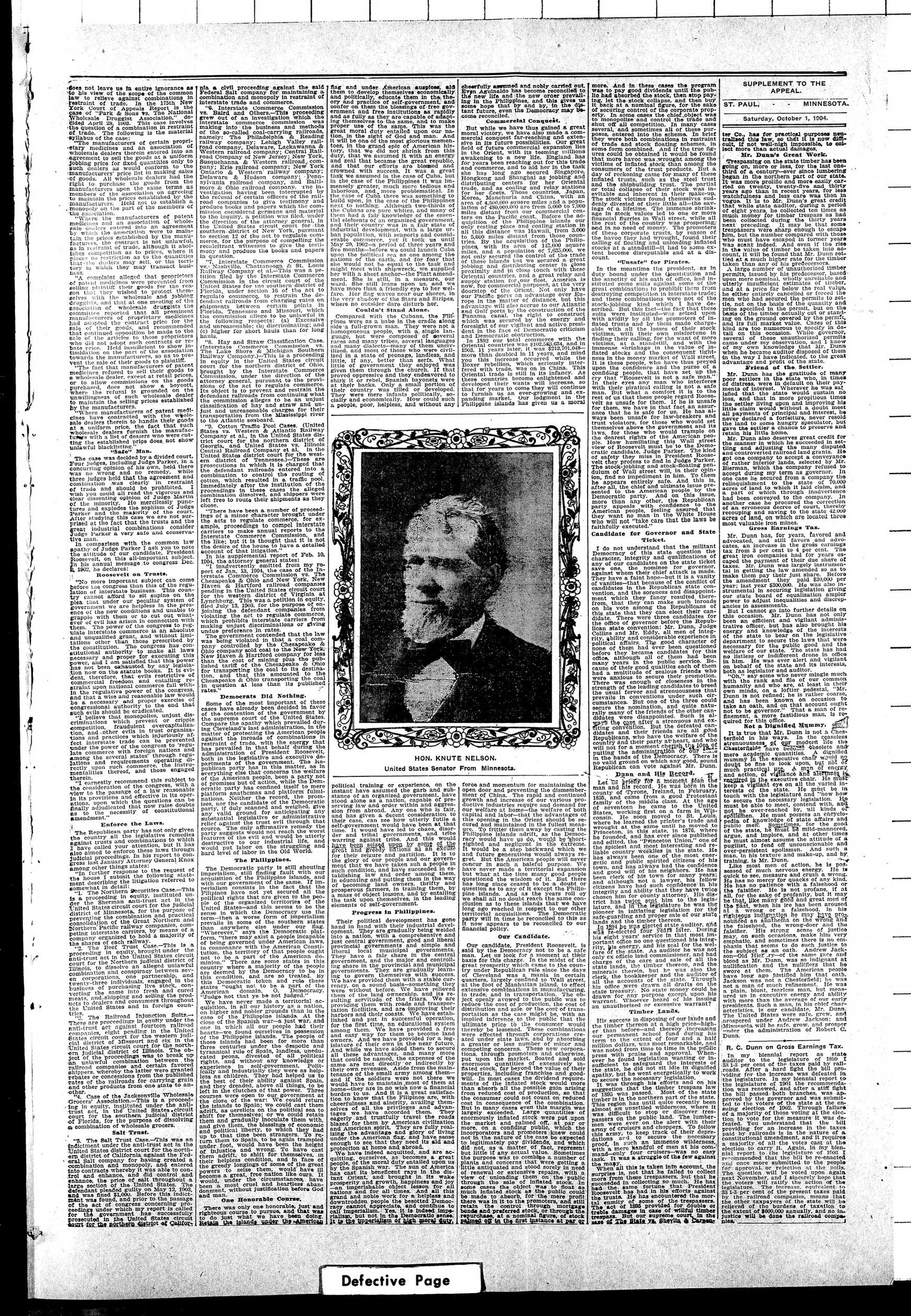
ST. PAUL AND MINNEAPOLIS. MINN.. SATURDAY. OCTOBER 1. 1904.
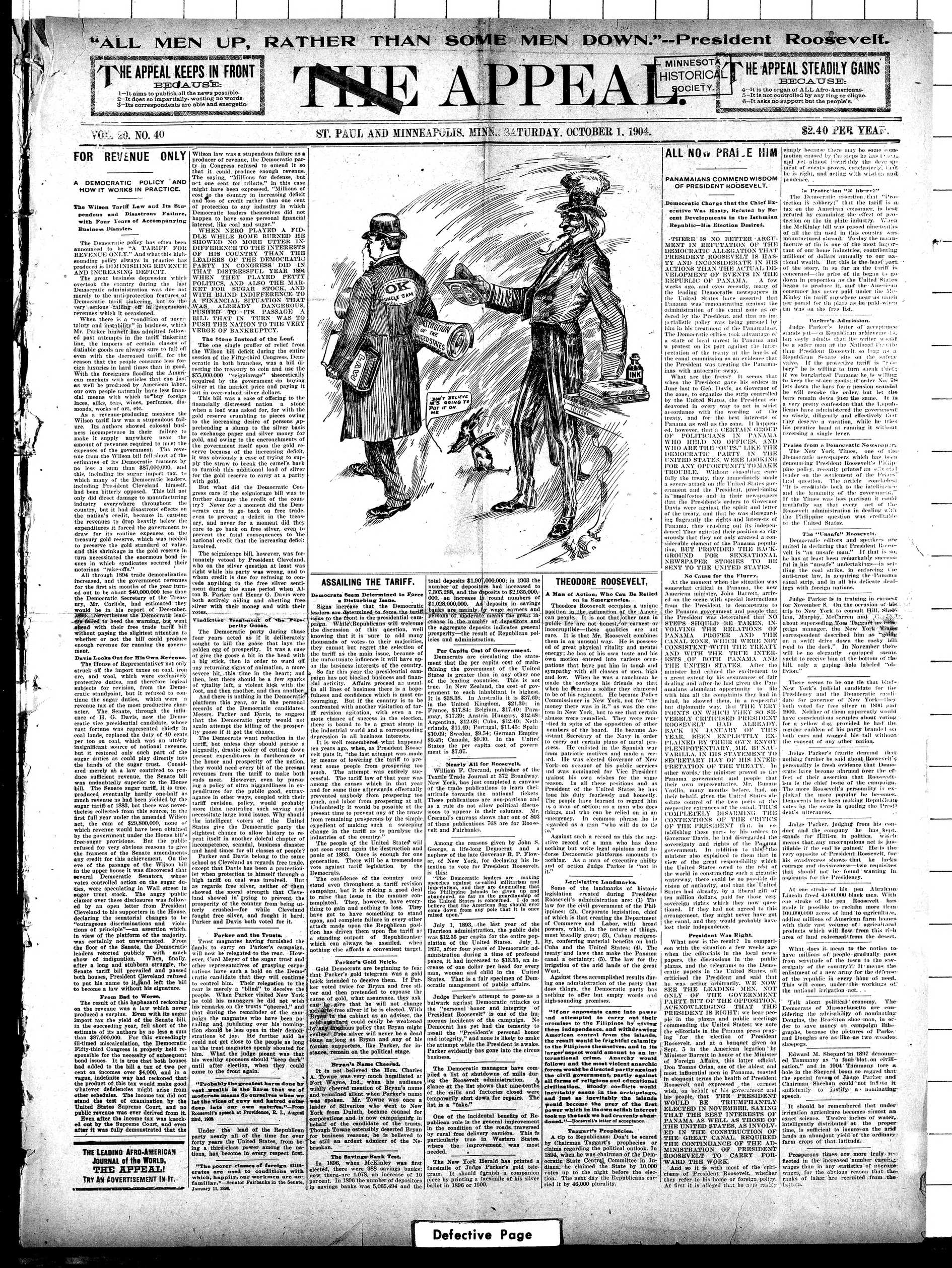
OK
UNLEF SAM
CONSTITUTION
OF THE
UNITED STATES
LAW
DON'T BELIEVE
HE'S GOING TO
PUT IT ON
ME
ASSAILING THE TARIFF.
Democrats seem Determined to Force a Disturbing Issue.
Signs increase that the Democratic leaders are sure that the tariff issue to the front in the presidential campaign. While Republicans will welcome the discussion of this question, well knowing that it may cause a great many of their supporters to reject their opposition, they cannot but regret the selection of the tariff as the main issue, because of the unfortunate influence it will have upon the business interests of the country. The Democratic leaders' paign has not blocked business and financial activity. Affairs proceed as usual. In all lines of business there is a hopefulness and confidence which is most enlightened by the confronted with another visitation of tariff revision agitation, with even a remote chance of success in the election, there is bound to be a great slump in business and financial depression in all business interests.
It is well remembered what happened ten years ago, when, as President Roosevelt put it, "the last attempt was made by means of lowering the tariff to prevent some people from prospering too much, and to prevent them from being successful. The tariff law of that year was among the causes which in that year and for some time afterwards effectually prevented anybody from prospering too much, and labor from prospering at all. Undoubtedly it would be possible at the present time to prevent the remaining prosperous by the simple expedient of making such a sweeping change in the tariff as to paralyze the industries of the country." The people of the United States will not soon court again the destruction and panic of 1883. Once is enough for one generation. There will be a tremendous vote against tariff legislation by the
The confidence of the country may stand even throughout a tariff revision campaign, but it is risking a good deal to raise that issue in the manner contemplated. They, however, have everything to gain and nothing to lose. They have got to have something to stand upon, and complete the tariff, and the Republican position has driven them upon the tariff as a standing outpost of the Republicanian which can always be assailed, when nothing else affords a convenient target.
Parker's Gold Brick.
Gold Democrats are beginning to fear that Parker's gold telegram was a gold brick intended to deceive them, anyway. They've been ver and then pretended to espouse the cause of gold, what assurance, they ask can he give that he will not change the policy? Bryan in the cabinet as an adviser, the gold standard could easily be weakened by any insidious policy that Bryan might evolve into a needless threat. Bryan could any of these former supporters, like Parker, for instance, remain on the political stage.
Bryan's Name Cheered.
It is not believed the Hon. Charles A. Towne was very much humiliated at Fort Wayne, Ind., when his audience wildly cheered mention of Bryan's name and reminded silent when Parker's name was mentioned. The leader of Silverites who went to New York from Duluth, became counsel for corporations and is now campaigning, in behalf of the candidate of the trusts. Though Towne ostensibly deserted Bryan for business reasons, he is believed to have been admirer of the Nebrakan.
The Savings Bank Test
In 1896, when McKinley was first elected, there were 988 savings banks; now there are 1,075, an increase of 10 percent. In 1900, there were 1,150 savings banks; now there are 1,094,494.
total deposits $1,107,000,000; in 1903 the number of depositors had increased to 7,305,288, and the deposits to $2,335,000,000, an increase in round numbers of $1,028,000,000. As deposits in savings banks are mainly wage earners and employers, the number of increase in the number of depositors and the aggregate deposits indicates general prosperity—the result of Republican policies and administration.
Per Capita Cost of Government
Per Capita Cost of Government.
Democrats are circulating the statement that the per capita cost of maintaining the government of the United States is greater than in any other one country. It is true. In New Zealand, the cost of government to each inhabitant is highest it is $38.38. In Australia it is $37.69 in the United Kingdom, $21.39 in France, $17.84 in Belgium, $17.40 in Paraguay, $17.39 in Austria Hungary, $12.48 in Canada, $12.49 in New Zealand, $11.49 in Portugal, $11.45 in Spain $10.00 in Sweden, $9.54 in German Empire $9.45; Canada, $9.30. In the United States the per capita cost of government is $7.97.
Needs All for Reeveolt
William F. Cresan, publisher of the Textile Trade Journal at 372 Broadway, New York, has just completed a canvass of the trade publications to learn their attitude towards the national tickets. These publications are non-partisan and as a rule do not appear in their columns. Mr. Cresan's canvass shows that out of 803 of these publications T88 are for Roosevelt and Fairbanks.
Among the reasons given by John S. George, a life-long Democrat and a nephew of the late Governor R. R. Paterson, a New York man, has his intention to vote for President Roosevelt, is this:
"The Democratic leaders are making imperialism, and they are demanding that the Philippine Islands he given up and imperialism, and they are demanding that the Philippine Islands he given up and imperialism, and they are demanding that the American flag should ever come from any pole that it is once suspended."
July 1, 1893, the last year of the Harrison administration, the public debt was $12.55 per capita for the entire population of the United States. July 1, 1897, after a 108-day period during a time of profound peace, it had increased to $13.55, an increase of one dollar per head for every man, woman and child in the United States. That is a fair specimen of Democratic management of public affairs.
Judge Parker's attempt to pose as a bulwark against Democratic attacks on the "personal honor and integrity of President Roosevelt" is one of the humorous incidents in the catalog of the campaign. No yet had the temerity to assail the "President's personal honor and integrity", and none is likely to make the attempt while the President is awake. Parker evidently has gone into the circus business.
The Democratic managers have compiled a list of shutdowns of mills during the Roosevelt administration. A glance at the list shows that sinister events, such as the temporarily shut down for repairs. The list is a "fake."
One of the incidental benefits of Republican rule is the general improvement in the condition of the roads traversed by the Republican party, particularly true in Western States, where the improvement was most needed. _____
The New York Herald has printed a facsimile of Judge Parker's gold telegram. It should furnish a companion piece by printing a facsimile of his silver telegram. 1800-1800.
Defective Page
THEODORE ROOSEVELT.
A Man of Action, Who Can Be Relied on in Emergencies.
Theodore Roosevelt occupies a unique position in the estimation of the American people. It is not that other men in public life are not honest, or earnest or rare. It is that Mr. Roosevelt combines them in an unusual way. He is possessed of great physical vitality and mental energy; he has of his own taste and his own motion entered into various occurrences, and he sympathies with all classes of men, high and low. When he was a ranchman he made the cowboys his friends so that when he became a soldier they clamored for him. As Commissioner in New York, not for "the money there was in it," as was the custom in New York, but to see that certain abuses were remedied. They were remitted to the police and members of the board. He became Assistant Secretary of the Navy in order to carry out certain plans of naval progress. He collined in the Spanish war from patriotic motives and made a reelection to New York on account of his public services and was nominated for Vice President against his own wishes for the same season. In all these positions and as a member of the Navy he lone his duty fearlessly and honestly. The people have learned to regard him as a man of action; as a man who does things, and who can be relied on in an emergency. In common phrase he is described as a man "who will do to lie."
Against such a record as this the negative record of a man who has done nothing but write legal opinions and indorse Democratic platforms amounts to nothing. As a man of executive ability and of action Judge Parker is "not in
Legislative Landmarks.
Some of the landmarks of historic legislation created during President Roosevelt's administration are: (1) The law for the civil government of the Philippines; (2) Corporate legislation, chief of which is that creating the Department of Commerce and Labor, with broad powers to most widely grow; (3) Cuban reciprocity, conferring material benefits on both Cuba and the United States; (4) The treaty and laws that make the Panama canal a certainity; (5) The law for the irrigation of the arid lands of the great West. These accomplished results during one administration of the party that does things, the Democratic party has nothing to offer but offer words and high-sounding promises.
"If our opponents came into power and attempted to carry out their promises to the Filipino by giving them independence, and by drawing their control on the island, the result would be frightful calamity to the Filipinos themselves, and in its larger aspect would amount to an invasion followed and the most violent anarchic forces would be directed partly against the civil government, partly against all forms of religious and educational activities, and inevitably enase in the archipelago, and just as inevitably the islands would become the prey of the first power to take control of the island, the task we had bravely annoted."—Roosevelt's letter of acceptance.
Taggart's Prophécies.
A tip to Republicans: Don't be scared by Chairman Tagart's prophecies or claims regarding the political outlook. In 1894, when he was chairman of the Democratic State Central Committee in Indiana, he claimed the State by 10,000 votes in the election. The next day the Republicans carried it by 46,000 plurality.
ALL NOW PRAISE HIM
PANAMIAIANS COMMEND WISDOM
OF PRESIDENT HOOSEVELT.
Democratic Charge that the Chief Executive Was Hasty, Relucted by Recent Developments in the Ithian Republic-His Election Desired.
- THERE IS NO BETTER ARGUMENT IN REFUTATION OF THE DEMOCRATIC ALLEGATION THAT THE REPUBLIC HAS TACTY AND INCOSIDERATE IN HIS ACTION THAN THE ACTUAL DEVELOPMENT OF EVENTS IN THE REPUBLIC OF PANAMA. A few weeks ago, and even recently, many of the United States have asserted that Panama was remonstrating against the administration of the canal zone as ordered by the President, and that an insularistic policy was being pursued by the Minister of Interior. The Democratic critics took advantage of a state of local unrest in Panama and a protest on its part against the interpretation of the treaty at the hands of the canal commission as an evidence that the Panamanians with autocratic sway.
What are the facts? It seems that when the President gave his orders in June last to Geh. Davis, as Governor of the zone, to organize the strip controlled by the United States, the President on devarced in every way to act in strict accordance with the wording of the treaty, and for the best interests of Panama as well as the zone. It happened, however, that a CERTAIN GROUP OF POLITICIANS IN PANAMIA WHO HELD NO OFFICES AND WHO ARE THE "OUTS," LIKE THE DEMOCRATIC PARTY IN THE UNITED STATES, WERE LOOKING FOR ANY OPPORTUNITY TO MAKE TROUBLE. Without consulting carefully the treaty, they immediately made a severe attack on the United States government and the President, protesting in manifestos and in their newspapers that the President's orders to Governor Davis were against the spirit and letter of the treaty, and that he was disregarding flagrantly the rights and interests of Panama, thus crashing out its independence! They agitated their position so vigorously that they not only aroused a considerable element of the Panama population, BUT PROVIDED THE BACKGROUND FOR SENATIONAL NEWSPAPER STORIES TO BE SENT TO THE UNITED STATES.
No Cause for the Flurry.
At the moment when the situation was somewhat critical in Panama, the new American minister, John Barrett, arrived on the scene with special instructions from the President to demonstrate to the Panama government and people that the steps should be taken. INVOLVING THE RELATIONS OF PANAMA PROPER AND THE CANAL ZONE, WHICH WERE NOT CONSISTENT WITH THE TRUE INTERESTS OF BOTH PANAMA AND THE UNITED STATES. After the minister had calmed the excitement to a great extent by his assurances of fair dealing and after he had given the Panamanians abundant opportunity to do so, he mind, he showed them, in a respectful but diplomatic way, that THE VERY EXPLAINED ON WHICH SO VERBELY CRITICISED PRESIDENT BARRETT BACK IN JANUARY OF THIS YEAR. BEEN EXPLICITLY EXPLAINED BY THEIR ENVOY EXPLENIOTENTIALIARY, MIR BUNAIVARILLA, IN HIS STATEMENT TO PRESIDENT BARRETT PRETATION OF THE TREATY. In other words, the minister proved to the Panama government and people that their own representative, Mr. BunaVarilla, many months before, had, on their behalf, given the United States an opportunity to resolve respective extrenses of the canal, THUS COMPLETELY DISARMING THE CONTENTIONS OF THE CRITICS OF THE PRESIDENT that, in establishing these ports by his orders to govern the country, and rights of the Panama government. In addition to this the minister also explained to them that in view of the great responsibility which the United States owed to the rest of the world, the United States could have, there could be no possible division of authority, and that the United States had already, by a liberal gift of ten million dollars, paid for those very sovereign rights which they now required, and, therefore, they might never have got the canal, and they would probably have lost their independence.
President Was Right.
What now is the result? In comparison with the situation a few weeks ago when the editors in the local news papers, the discussions in the public plazas, and the telegrams to the Democratic paper, the President and said that he was acting arbitrarily. WE NOW SEE THE LEADING MEN. NOT ONLY OF THE GOVERNMENT PARTY BUT OF THE OPPOSITION. PRESIDENT IS RIGHT: we hear people in the plazas and public meetings commending the United States; we note the editors in the Panama press praying for the election of President Roosevelt, and at a banquet given on the occasion of the Minister Barrett in honor of the Minister of Foreign Affairs, this latter official, Don Tomas Orias, one of the ablest and most influential men in Panama, toasted in eloquent terms the health of President Roosevelt as well as those of the UNITED STATES, as INVOLVED IN THE CONSTRUCTION OF THE GREAT CANAL, REQUIRED THE CONTINUANCE OF THE ADJUSTMENT OF THE GOVERNMENT ROSEVELT TO CARRY FORWARD THE WORK.
And so it is with most of the criticisms of President Roosevelt, whether they refer to his home or foreign policy. At first it is alienated that he was rash.
$2.40 PER YEAF.
simply because there may be some com-
motion caused by the steps he has taken,
and get almost invariably the dewpe-
ment of events proves, conclusively, that
he is right, and acting with wisdom and
prudence.
in Protection "R bharu"
The Democratic assertion that "protection is robbery" that the tariff is a tax on the American consumer, is best refuted by examining the effect of protection on the tin plate industry. Where the McKinley bill was passed nineteen at all the tin used in this country was manufactured abroad. To-day the manufacture of tin is one of the most important industries in the United States, millions of dollars annually to our national wealth. But this is the least part of the story, in so far as the tariff is concerned—the price of tin began to go down in proportion as the United States began to produce it, and the American consumer has never paid under the McKinley tariff nearly as much as tin was on the free list.
Larker's Admission.
Judge Parker's letter of acceptance stands put on Republican achievement, but coolly admits that its writer would be a safer man at the National level than President Roosevelt so long as he is a conservative in his political value. If the protective tariff is "berebery" he is willing to turn sack kief; if we burglarized Panama he is willing to keep the stolen goods; if order No. 15 lets down the hars for a pension issue, it is not a bad thing; bars remain down the same. It is a very pretty confession that the Republicans have administered the government so wisely, diligently and effectively that while he raises his princehood hand at arrest it will not reversing a single lever.
Praise from a Democratic newspaper
The New York Times, one of the
Democratic newspapers which has been
denouncing President Roosevelt's Philippine
policy, recently printed an official
question paper. The article concludes:
"It is credible both to the intelligence
and the humanity of the government."
If the Times was less partisan it could
truthfully say that every act of the
Philippine question is in dealing with
the United States.
Tue 4th June 2018 Regexalt
Democratic editors and speakers are limited in declaring that President Reagan velt is an "unsafe man." If that is so, he has at least been remarkably successful in his "unsafe" undertakings—in setting the coal strike, in enforcing the law, in building national canal strip, and in all his delicate dealings with foreign nations.
Judge Parker is in training in respect for November 10. On the occasion of his visit to York Hill Hill, St. John, Murphy, McCarran and I about superseding Tom Tugart as his paign manager, the New York Times correspondent described him as "giving on a swift drive down the rocky hill road to the dock." In November there was a request by the Yankees to receive him at the bottom of the bill, only a gaping hole labeled "dilution."
There seems to be one tie that kinds New York's judicial candidate for the Presidency and the Democratic candidate for governor of New York—they both voted for free silver in 1886 and for the right to have conscription scruples about voting for a yellow dog, provided he had the regular emblem of his party branded on both ears and wagged his tail without the consent of any other nation.
Judge Parker's frantic demand that further he be said about Rosewood's personality is fresh evidence that Democrats have become alarmed over the effect of their assertion that Rosewood is the chief issue of the campaign. The more Rosewood's personality is exploited the more popular he is making Republican votes by the score in quoting the President's utterances.
Judge Parker, judging from his conduct and the company he has kept, stands for Hilliim in politics, which means that any unscrupulous act is justifiable the end be gained. He is the man who has insisted his irresistible shows that he hecks courage and desisiveness—two requisites that should not be found wanting in aspirants for the Presidency.
At one stroke of his pen Abraham Lincoln freed 4,600,000 black men. With one stroke of his pen Roosevelt has made it possible to reclaim more than 100,000,000 acres of land to agriculture, with their vast volume of agricultural products which will flow from this rich area of land reclaimed from the desert.
What does it mean to the nation to have millions of people gradually pass from servitude of the town to the sovereignty of the country? It means the enlistment of a new army for the defense of the republic in every hour of need, and the workings of the national irrigation act.
Talk about political economy. The Democrats of Massachusetts are considering the advisability of nominating Douglas, the Brooklyn shoe man, in office. He is a man of great photographs, because the pictures of Parker and Douglas are as like as two wooden sheepspeeps.
Edward M. Shepard in 1807 denounced Tammany as "a foul blot, on civilization," and in 1904 Tammany tore a hole in the Sleepoam boom so ragged that the special favor of Jame Parker and Chairman Sheshan could not intothe it. It simply to justify a lawful speaking. It should be remembered that under irrigation agriculture becomes almost an exact science. Twelve inches of water, intelligently distributed at the proper time, is sufficient to insure on the land an abundant yield of the ordinary farm crops of that latitude.
Properous times are more truly reflected in the increased number earning wages than in any statistics of average wages, for the obvious reason that the ranks of labor are recruited from the
HAVE YOU READ
THE APPEAL?
THE APPEAL,
A NATIONAL AFRO-AMERICAN NEWSPAPER
PUBLISHED WEEKLY BY
ADAMS BROS. EDITORS AND PUBLISHERS
49 E. 4th St., St. Paul, Minn.
ST. PAUL OFFICE,
. 110 Union Blk. 4th & Cedar;
J. O. ADAMS, Manager.
MINNEAPOLIS OFFICE,
Guaranty Loan Bldg. Room 1020
HARVEY B. BURK, Manager.
CHICAGO OFFICE,
323-5 Dearborn St., Suite 310,
C. F. ADAMS, Manager.
TERMS: STRICTLY IN ADVANCE
SINGLE COPY, ONE YEAR ..... $2.00
SINGLE COPY, SIX MONTHS ..... 1.10
SINGLE COPY, THREE MONTHS ..... .60
When subscriptions are by any means allowed
to run without prepayment, the terms are
limited to one month, and each odd week, or at the rate of $2.40 per
year.
Credit notes should be made by Express
Money Order, Post Office Money Order, Registered Letter or Bank Draft. Postage
stamps will be received the same as cash for the same amount.
Persons who send silver to us in letters
do so at their own risk.
Harrage and death notices 10 lines or less $1.
It is almost sure to wear a hole through it if
you are in danger of being hit by a car.
Persons who send silver to us in letters
do so at their own risk.
Harrage and death notices 10 lines or less $1.
It is almost sure to wear a hole through it if
you are in danger of being hit by a car.
Persons who send silver to us in letters
do so at their own risk.
Advice rates 15 cents per笔 line, each
in an inch, and about seven words in an
笔 line. No single advertisements less
than three words in an笔 line. Three
months contract. Cash must accompany
all orders from parties unknown to us.
Further particulars on application.
Reading notices 25 cents per笔 line, each insertion.
Reading matter is set in brevier type—about six
words to the line. All headlines count down.
The date on the address label shows when
subscription expires. Renewals should be
made two weeks prior to expiration, so that
no paper may be missed, as the paper stops
willingly.
Occasionally happens that papers sent to subscribers are lost or stolen. In case you do not receive any number you may inform us of the loss from that date, and we will cheerfully forward a duplicate of the missing number. Communications to receive attentions must be noway, upon important submission to the paper, must reach us Tuesday if possible, anyway not later than Wednesday, and bear the signature of the author. No manuscript receipt is required. A post is necessary. We do not hold ourselves responsible for the views of our correspondents.
Bolliciting agents wanted everywhere. Write for terms. Sample copies free.
In every letter that you write us never fail to write you a full mind and address, plainly written, post office, county and state. Business letters of all kinds must be written on separate sheets from letters containing news or matter for publication. Entered as second class matter
FOR VICE PRESIDENT.
Charles W. Fairbanks.
"I KNOW OF THE BRAVERY AND
CHARACTER OF THE AFRO-AMERICAN SOLDIER. HE SAVED MY LIFE AT SANTIAGO, AND I HAVE HAD OCCASION TO SAY SO IN MANY ARTICLES AND SPEECHES THE ROUGH RIDERS WERE IN A BAD POSITION WHEN THE NINTH AND TENTH CAVALRY CAME RUSHING UP THE HILL, CARRYING EVERYTHING BEFORE THEM. THE AFRO-AMERICAN SOLDIER HAS THE FACULTY OF COMING TO THE FRONT WHEN HE IS NEEDED MOST. IN THE CIVIL WAR HE CAME 400,000 STRONG, AND I BELIEVE HE SAVED THE UNION."—President Roosevelt.
SATURDAY, OCTOBER 1, 1904.
THE RIGHT OF THE STRONGER.
THE RIGHT OF THE STRONGER.
France is endeavoring to secure as a result of the boundary dispute a portion of the territory of Liberia. Sir Henry Johnson, the well known traveler says: "No justification whatever can be shown for such a procedure, because it is the strongest and the total inability of Liberia to resist by force any French aggression." He speaks highly of the American Negro. A census which he made shows that there are about 12,000 of these residents in Liberia, who "show, under their own government, what the race is capable of in the way of civilization."
WITHDRW MR. KNOX
Reports from Indiana say that Geo. L. Knox of the Freeman will enter the race as an independent candidate for congress for the purpose of defeating Congressman Overstreet, against whom he has a grievance. There is no
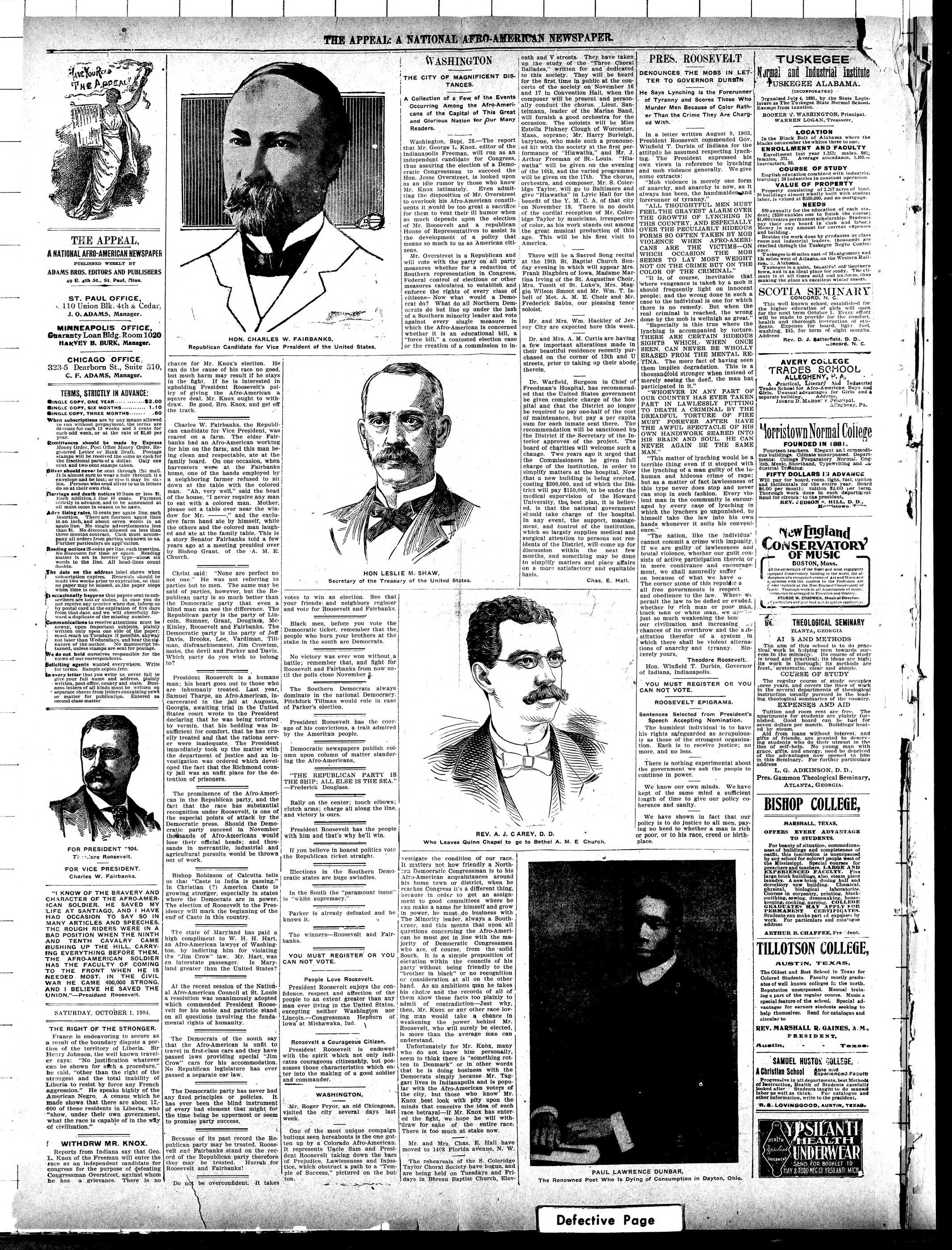
HON. CHARLES W. FAIRBANK
HON. CHARLES W. FAIRBANKS,
Republican Candidate for Vice President of the United States.
chance for Mr. Knox's election. He can do the cause of his race no good, but much harm may result if he stays in the fight. If he is interested in upholding President Roosevelt's policy of giving the Afro-American a square deal, Mr. Knox ought to withdraw. Be good, Bro. Knox, and get off the track.
Charles W. Fairbanks, the Republican candidate for Vice President, was reared on a farm. The elder Fairbanks had an Afro-American working for him on the farm, and this man being clean and respectable, ate at the family board. On one occasion, when harvesters were at the Fairbanks home, one of the hands employed by a neighboring farmer refused to sit down at the table with the colored man. "Ah, very well," said the head of the house, "I never require any man to eat with a colored man. Mother, please set a table over near the window for Mr. Fairbanks, and the colored farm hand ate by himself, while the others and the colored man laughed and ate at the family table. This is a story Senator Fairbanks told a few years ago at a meeting presided over by Bishop Grant, of the A. M. E. Church.
Christ said: "None are perfect no not one." He was not referring to parties but to men. The same may be said of parties, however, but the Republican party is so much better than the Democratic party that even a blind man can see the difference. The Republican party is the party of Lincoln, Summer, Grant, Douglass, McKinley, Roosevelt and Fairbanks. The Democratic party is the party of Jeff Davis, Brooks, Lee, Vardium, Tillman, disfranchisement, Jim Crowism, moals, the devil and Parker and Davis. Which party do you wish to belong to?
President Roosevelt is a humane man; his heart goes out to those who are inhumally treated. Last year, Samuel Tharpe, an Afro-American, incarcerated in the jail at Augusta, Georgia, awaiting trial in the United States court wrote to the President declaring that he was being tortured by vermin, that his bedding was insufficient for comfort, that he has cruelly treated and that the rations server were inadequate. The President immediately took up the matter with the department of justice and an investigation was ordered which developed the fact that the Richmond county jail was an unfit place for the detention of prisoners.
The prominence of the Afro-American in the Republican party, and the fact that the race has substantial recognition under Roosevelt, is one of the especial points of attack by the Democratic press. Should the Democratic party succeed in November thousands of Afro-Americans would lose their official heads; and thousands in mercantile, industrial and agricultural pursuits would be thrown out of work.
Bishop Robinson of Calcutta tells us that "Caste in India is passing." In Christian (?) America Caste is growing stronger, especially in states where African Americans are in power. The election of Roosevelt to the Presidency will mark the beginning of the end of Caste in this country.
The state of Maryland has paid a high compliment to W. H. H. Hart, an Afro-American lawyer of Washington, by indicting him for violating the "Jim Crow" law. Mr. Hart, was an interstate passenger. Is Maryland greater than the United States?
At the recent session of the National Afro-American Council at St. Louis a resolution was unanimously adopted which commended President Roosevelt for his noble and patriotic stand on all questions involving the fundamental rights of humanity.
The Democrats of the south say that the Afro-American is unfit to travel in first-class cars and they have passed laws providing special "Jim Crow" cars for his accommodation. No Republican legislature has ever passed a separate car law.
The Democratic party has never had any fixed principles or policies. It has ever been the blind instrument of every bad element that might for the time being be uppermost or seem to promise party success.
Because of its past record the Republican party may be trusted. Roosevelt and Fairbanks stand on the record of the Republican party therefore they may be trusted. Hurrah for Roosevelt and Fairbanks!
THE APPEAL: A NATIONAL AFRO-AMERICAN NEWSPAPER
HON LESLIE M. SHAW,
votes to win an election. See that your friends and neighbors register and vote for Roosevelt and Fairbanks.
Black men, before you vote the Democratic ticket, remember that the people who burn your brothers at the stake in the south are Democrats.
No victory was ever won without a battle; remember that, and fight for Roosevelt and Fairbanks from now until the polls close November.
The Southern Democrats always dominate in the national Democracy. Pitchfork Tillman would rule in case of Parker's election.
President Roosevelt has the courage of his convictions, a trait admired by the American people.
Democratic newspapers publish column upon column of matter slandering the Afro-Americans.
"THE REPUBLICAN PARTY IS THE SHIP; ALL ELSE IS THE SEA."
—Frederick Douglass.
Rally on the center; touch elbows; clutch arms; charge all along the line; and victory is ours.
President Roosevelt has the people with him and that's why he'll win.
If you believe in honest politics vote the Republican ticket straight.
Elections in the Southern Democratic states are huge swindles.
In the South the "paramount issue" is "white supremacy."
Parker is already defeated and he knows it.
The winners—Roosevelt and Fairbanks.
YOU MUST REGISTER' OR YOU CAN NOT VOTE.
People Love Roosevelt.
President Roosevelt enjoys the confidence, respect and affection of the people to an extent greater than any man ever living in the United States excepting neither Washington nor Lincoln.—Congressman Hepburn of Iowa' at Mishawaka, Ind.
Roosevelt a Courageous Citizen.
President Roosevelt is endowed with the spirit which not only indicates courageous citizenship, but possesses those characteristics which enter into the making of a good soldier and commander.
WASHINGTON,
Mr. Roger Pryor, an old Chicagoan, visited the city several days last week.
One of the most unique compaign buttons seen hereabouts is the one gotten up by a Colorado Afro-American. It represents Uncle Sam and President Roosevelt taking down the bars of Prejudice, Lawlessness and Injustice, which obstruct a path to a "Temple of Success," pictured on the button.
REV A J CAREY D. D.
Who Leaves Quinn Chapel to go to Bethel A. M. E Church.
WASHINGTON
THE CITY OF MAGNIFICENT DISTANCES.
A Collection of a Few of the Events Occurring Among the Afro-Americans of the Capital of This Great and Glorious Nation for Our Many Readers.
Washington, Sept. 28.—The report that Mr. George L. Knox, editor of the Indianapolis Freeman, will run as an independent candidate for Congress, thus assuring the election of a Democratic Congressman to succeed the Hon. Jesse Overstreet, is looked upon as an idle rumor by those who know Mr. Knox intimately. Even admitting the disposition of Mr. Overstreet to overlook his Afro-American constituents it would be too great a sacrifice for them to vent their ill humor when so much depends upon the election of Mr. Roosevelt and a republican House of Representatives to assist in the development of a policy that means so much to us as American citizens.
Mr. Overstreet is a Republican and will vote with the party on all party measures whether for a reduction of Southern representation in Congress, Federal control of elections or other measures calculated to establish and enforce the rights of every class of citizens--Now what would a Democrat do? What do all Northern Democrats do but line up under the lash of a Southern minority leader and vote against every single measure in which the Afro-American is concerned whether it is an educational bill, a "force bill," a contested election case or the creation of a commission to in-
IE M. SHAW,
ury of the United States.
REV. A. J. C.
Who Leaves Quinn Chapel to
vestigate the condition of our race. It matters not how friendly a Northern Democratic Congressman is to his Afro-American acquaintances around his home town or district, when he reaches Congress it's a different thing, because in order to get an assignment to good committees where he can make a name for himself and grow in power, he must do business with the Minority leader, always a Southner, and this means that upon all questions concerning the Afro-American he must get in line with the majority of Democratic Congressmen who are, of course, from the solid South. It is a simple proposition of elevation within the councils of his party without being friendly to the brother in black" or by possession of the other hand. As an ambitious man he takes his choice and the records of all of them show these facts too plainly to admit of contradiction—Just why, then, Mr. Knox or any other race loving man would take a chance in weakening the power behind Mr. Roosevelt, who will surely be elected, is more than the average man can understand.
Unfortunately for Mr. Knox, many who do not know him personally, seem to think there is "something rotten in Denmark" or in other words that he is doing business with the Democrats simply because Mr. Taggart lives in Indianapolis and is popular with the Afro-American voters of the city, but those who know Mr. Knox best look with pity upon the minds that conceive the idea of such race betrayal—If Mr. Knox has entered the fight, we hope he will withdraw for sake of the entire race. There is too much at stake now.
Mr. and Mrs. Chas, E. Hall have moved to 1408 Florida avenue, N. W.
The rehearsals of the S. Coleridge Taylor Choral Society have begun, and are being held on Tuesday and Fridays in Berean Baptist Church, Elev
```markdown
```
THE NEW YORK TIMES
PAUL LAWRENCE DUNBAR,
The Renowned Poet Who Is Dying of Consumption in Dayton, Ohio.
oath and V streets. They have taken up the study of the "Three Choral Ballades," written for and dedicated to this society. They will be heard for the first time in public at the concerts of the society on November 16 and 17 in Convention Hall, when the composer will be present and personally conduct the chorus. Lleut. Santelmann, leader of the Marine Band, will furnish a good orchestra for the concert. The choir plays will be竖 Estella Pinkney Clough of Worcester, Mass, soprano; Mr. Harry Burleigh, barytone, who made such a pronounced hit with the society at the first performance of "Hiawatha," and Mr. J. Arthur Freeman of St.-Louis. "Hiawatha" will be given on the 16th, and the varied programme will be given on the 17th. The chorus, orchestra, and composer, Mr. S. Coleridge Taylor, will go to Baltimore and give "Hiawatha" in Lyric Hall for the benefit of the Y. M. C. A. of that city or of the medical reception of Mr. Coleridge Taylor by musicians, irrespective of color, as his work stands out among the great musical production of this age. This will be his first visit to America.
There will be a Sacred Song recital at the 19th St. Baptist Church Sunday evening in which will appear Mrs. Frank Blagburn of Iowa, Madame Marine Irving of the St. Augustine Choir, Mrs. Tossit of St. Luke's, Mrs. Maggie Wilson Smoot and Mr. Wm. T. Isbell of Met. A. M. E. Choir and Mr. Frederick Sabbs, our pleasing tenor soloist.
Mr. and Mrs. Wm. Hackley of Jersey City are expected here this week.
Dr. and Mrs. A. M. Curtis are having a few important alterations made in their beautiful residence recently purchased on the corner of 13th and U streets, prior to taking their abode therein.
Dr. Warfield, Surgeon in Chief of Freedman's Hospital, has recommended that the United States government be given complete charge of the hospital and that the District no longer be required to pay one-half of the cost of maintenance, but pay a per capita sum for each inmate sent there. The recommendation will be sanctioned by the District if the Secretary of the Interior approves of the project. The board of charities will welcome such a change. Two years ago it urged that the Commissioners be given full charge of the institution, in order to simplify matters at the hospital. Now that a new building is being erected, costing $300,000, and of which the District will pay $150,000, to be under the medical supervision of the Howard University, the best plan it is believed, is that the national government should take charge of the hospital. In any event, the support, management, and control of the institution, which so largely supplies medical and surgical attention to persons not residents of the District, will come up for discussion within the next few months, and something may be done to simplify matters and place affairs on a more satisfactory and equitable basis.
Chas. E. Hall.
AREY, D. D.
to Bethel A. M. E Church.
PAUL LAWRENCE
The Renowned Poet Who Is Dying of
Defective Page
DENOUNCES THE MOBS IN LETTER TO GOVERNOR DURBIN
He Says Lynching is the Forerunner of Tyranny and Scores Those Who Murder Men Because of Color Rather Than the Crime They Are Charged With.
In a letter written August 9, 1903, President Roosevelt commended Gov. Winfield T. Durbin of Indiana for the attitude he assumed respecting Lynching. The President expressed his own views in reference to lynching and mob violence generally. We give some extracts:
"Mob violence is merely one form of anarchy, and anarchy is now, as it always has been, the handmaiden and forerunner of tyranny."
"ALL THOUGHTFUL MEN MUST FEEL THE GRAVEST ALARM OVER THE GROWTH OF LYNCHING IN THIS COUNTRY, AND ESPECIALLY OVER THE PECULIARLY HIDEOUS FORMS SO OFTEN TAKEN BY MOB VIOLENCE WHEN AFRO-AMERICANS ARE THE VICTIMS-ON WHICH OCCASION THE MOB SEEMS TO LAY MOST WEIGHT NOT ON THE CRIME BUT ON THE COLOR OF THE CRIMAL."
"It is, of course, inevitable that where vengeance is taken by a mob it should frequently light on innocent people; and the wrong done in such a case to the individual is one for which there is no remedy. But when the real criminal is reached, the wrong done by the mob is wellnigh as great."
"Especially is this true where the lynching is accompanied by torture. THERE ARE CERTAIN HIDDEN SIGHTS WHICH THEY WHENEEN SEEEN CAN BE NEVER BE WHOLELY BASED FROM THE MENTAL RETINY. The mere fact of having seen them implies degradation. This is a thousandfold stronger when instead of merely seeing the deed, the man has participated in it." "WHOEVER IN ANY PART OF OUR COUNTRY HAS EVER TAKEN PART IN LAWLESSLY PUTTING TO DEATH A CRIMINAL BY THE DREADEFUL TORTURE OF FIRE MUST FOREVER AFTER HAVE THE AWFUL WORK OF HIS WORKWORK SEARED INTO HIS BRAIN AND SOUL. HE CAN NEVER AGAIN BE THE SAME MAN."
"This matter of lynching would be a terrible thing even if it stopped with the lynching of a man guilty of the inhuman and hideous crime of rape; but as a matter of fact lawlessness of this type never does stop and never can stop in such fashion. Every violent man in the community is encouraged by every case of lynching in which the lynchers go unpunished, to himself take the law into his own hands whenever it suits his convenience."
"The nation, like the individual cannot commit a crime with impunity. If we are guilty of lawlessness and brutal violence, whether our guilt consists of active participation therein or in mere convivance and encouragement, we shall assuredly suffer."
on because of what we have u
The corner stone of this republic a
all free governments is respect
and obedience to the law. Where
wrote the laws deified or evaded,
whether by rich man or poor man,
black man or white man, we are
just so much weakening the bona
our civilization and increasing
chances of its overthrow and the s
substitution thereof of a system in
which there shall be violent alterna
tions of anarchy and tyranny. Sincerely yours,
Theodore Roosevelt.
Hon. Winfield T. Durbin, Governor
of Indiana, Indianapolis.
YOU MUST REGISTER OR YOU
CAN NOT VOTE.
ROOSEVELT EPIGRAMS.
Sentences Selected from President's
Greek American Allegation
Speech Accepting Nomination.
The humbleest individual is to have his rights safeguarded as scrupulously as those of the strongest organization. Each is to receive justice; no more, and no less.
There is nothing experimental about the government we ask the people to continue in power.
We know our own minds. We have kept of the same mind a sufficient length of time to give our policy coherence and sanity.
We have shown in fact that our policy is to do justice to all men, paying no heed to whether a man is rich or poor, or to his race, creed or birthplace.
TUSKEGEE Normal and Industrial Institute
Organization by the State Legislature by the State Normal School Exempt from taxation.
BOOKER T. WASHINGTON, Principal.
WARREN LOGAN, Treasurer.
LOCATION
In the Black Belt of Alabama where the blacks outnumber the whites three to one.
**ENROLLEE** in the last year 1,253; males, 881; females, 371. Average attendance, 1,105; instructors, 88.
**COURSE OF STUDY**
English taught combined with industrial training; 28 industries in constant operation.
**VALUE OF PROPERTY**
Property consisting of 2,267 acres of land, 50 buildings almost all built with student labor, is valued at $350,000; and no mortgage.
**NEEDS**
$50 annually for the education of each student; ($20 enables one to attend college); scholarship. Students pay the board in cash and labor. Money in any amount for current expenses.
Besides the work done by graduates as class room and industrial leaders, thousands are reached through the Tuskegee Negro Conference.
Tuskegee is 40 miles east of Montgomery and 135 miles west of Atlanta, on the Western Railway.
Tuskegee is a quiet, beautiful old Southern town, and is an ideal place for study. The climate is at all times mild and uniform, making the place an excellent resort.
SCOTIA SEMINARY
CONCORD, N. C.
This well known school, established for the higher education of girls will open in August. It will be made to provide for the comfort, health and thorough instruction of students. Expense for board, light, fuel, water, $15 for eight months. address
Rev. D. J. Batterfield. D. D.
accord. N. C.
A Practical, Literacy, and Industrial
Trades School for Afro-American Boys and
Girls. Unusual advantages for Girls and a
separate building. Address:
Morristown Normal College
Fourteen teachers. Elegant and accommodous buildings. Climate unsurpassed. Departments: College Preparatory Normal, English, Mathematics, Typography and industrial Training.
FIFTY DOLLARS IN ADVANCE
Will pay for board, room, light, fuel, tuition and incidentials for the entire year, board. Will pay for board, room, light, fuel, tuition and incidentials for the entire year, board. Thorough work done in each department. Send for circulation to the president.
REV. JUDSON S. HILL, D. D.
New England CONSERVATORY OF MUSIC
All the advantages of the finest and most complete
equiped Conservatory building in the world, the at-
tention of our students, the interaction with the masters in the Profession are a few students at the New England Conservatory of Music at the University of Georgia, can be arranged in Education and Gentry. All of our instructors and your book will be an applique.
AI S AND METHODS
The aim of this school is to do practical work in helping man towards success in the ministry. Its course of study is broad and practical; its ideas are high; its work is thorough; its methods are fresh, systematic and comprehensive.
COURSE OF STUDY
The regular course of study occupies three years, and covers the lines of work in the several departments of theological instruction usually pursued in the heading theology. It covers the country.
EXPENSES AND AID
Tuition and room rent are free.
The apartments for students are plainly furnished. Good board can be had for good per month. Buildings heated by steam.
Aid from loans without interest, and gift of land. Students who do their utmost in the line of self-help. No young man with grace, gifts, and energy, need be deprived of such aid. For this Seminary. For further particulars address
L. G. KADINSON, K.
Pres. Gammon Theological Seminary,
ATLANTA, GEORGIA.
BISHOP COLLEGE,
BISHOP COLLEGE,
MARSHALL, TEXAS.
For beauty of situation, commodiousness of buildings and completeness of work by any school for colored people west of the Mississippi. Special courses for EXPERIENCED FACULTY. Five large brick buildings, also steam plant dormitory now building. Chemical, physical, biological laboratories, biological prison, printing room, smithing, sewing, dressmaking, housekeeping, curry making. GRAPHATE APPLY FOR PERMANENT CERTIFIGATES. Students can make part of exp. by address for particulars and catalog address. ARTHUR B. CHAFEE, Pre. dent.
TILLOTSON COLLEGE.
AUSTIN, TEXAS,
The Best and School in Texas for Colored Students. Faculty mostly graduates of well known colleges in the north. Reputation unsurpassed. Manual training a part of the regular course. Music a special feature of the school. Special advantages for earnest students seeking to help themselves. Send for catalogue and circular to
REV. MARSHALL R. GAINES, A.M.,
PRESIDENT,
Austin, . . . Texas.
SAMUEL HUSTON COLLEGE.
A Christian School
Experienced Faculty
Progressive in all departments, best Methods of Instruction, Health of Students carefully looked after. Students taught to do manual labor as well as think. For catalogue and other information, write to the president.
R. S. LOVINGGOOD, AUSTIN, TEXAS.
YPSILANTI
HEALTH
UNDERWEAR
SEND FOR BOOKLET TO
MAY & TODD MFG CO. YPSILANTI, MICH.
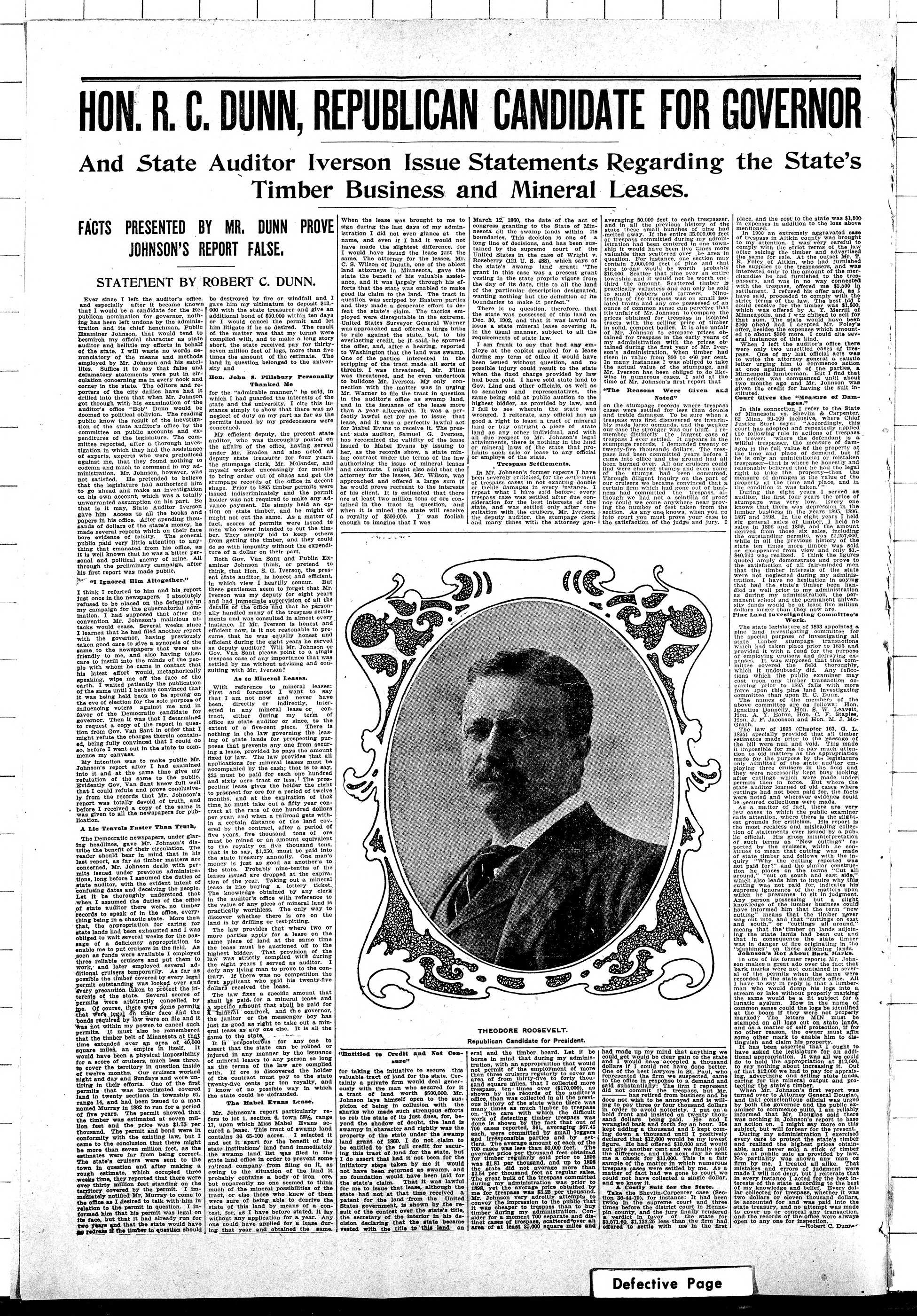
GROSS MISSTATEMENTS
State Auditor Iverson Certifies Under His Hand and Official Seal as to the Actual Records of the Office-Johnson's Statements Proved to Be Preposterous Calumnies.
Below is given a statement certified as being absolutely true and correct, by State auditor J. M. H. McCormick, every item mentioned in the report of Public Examiner Johnson relating to the state timber and takes them up seriatim, in the words of the public examiner's report. This statement has been made under the direct and personal supervision of the public examiner and has checked every item and statement and absolutely correct, and has booed excesses of the state auditor's office. It shows that the state timber and false and untrue, and that his assumptions and conclusions are unwarranted and particular. It also shows that the public examiner is entirely ignorant of the state's timber business in particular as is shown by the false construction of the timber industry. For instance, he pretends to believe, and uses the term 'new cutting', "commonly used by timber cruisers to designate a means that such timber has been cut or partially cut. He also uses the impression, that when a state cruiser, afer making an examination of south and east," that this means that the timber on the state land has been cut such a report means what it says, namely, that timber on the lands adjoining the timber has been cut. It is stated by employees in the state auditor's office that the meadowland examiner's assistants but that they disregarded all information and explanations.
Comparison Is Invited.
Any citizen possessed of ordinary intelligence is invited to take the certified statement of State Auditor S. G. Iverson printed below and compare it, item by item, with the published report of the public examiner, and by so doing can satisfy himself of the utter falsity of the statements made by the public examiner.
For the benefit of citizens who have not the time to make a complete comparison as suggested, attention is drawn to a few cases illustrative of the falsehood and misrepresentation of the public examiner's report. The items can be identified in the state auditor's certified statement and in the public examiner's report by the description of the land which precedes each item.
A Seventeen Thousand Dollar False-
hood Shown.
Take the first item in the public examiner's report which says that $17,225 for pine cut on section 10-55-22 was not paid. State Auditor Iverson certifies that the money is not paid by the State Auditor, and the payment of any on August 13, 1894 and that the pine land investigating committee reported the collection of this money to the state legislature, filing its report with the governor on July 1, 1894.
Section 33-38-10 and 30-32-10, the second item in the public examiner's report and the second and third items in state auditor's statement, is also cited to show the falsity of the public examine state statement. He alleges that no effort was made to collect the balance of the money due the state for timber cut from this land. The state auditor certifies that the cutting was one before the public assessment of the most part, and that the timber had been shipped out of the state. State Auditor Iverson also certifies that Mr. Dunn placed the collection of the money for this trespass in the hands of the project state auditor, and the state's treasurer and the attorney-general and that they followed the timber to Cleveland, Ohio, and that the attorney general collected $2,500 which was turned into the treasury, but was unable to collect a the costs of the process was a bankrupt and his bondmen were financially irresponsible.
Another Sample of Misrepresentation
16.55.8. The public examiner among other misleading and false statements the section had been cut south and west and that no payment had been made before the cut. Iverson certifies that Cruiser McKenzie reported that the timber was being cut south and that the state land and that there had not been any cutting on the state land. Iverson certifies that Cruiser McKenzie made an estimate of the timber on this land and reported that there had not been any cutting on the state land and that the records do not show who did this alleged cutting or how much was cut. State Auditor Iverson certifies that Cruiser McKenzie's report was this: "New 'cutting,' which means that the timber had been done. The cruiser does not say that anything was ever cut on this state is an absolute falsehood.
36-52-12. The public examiner makes a similar assessment. He says the cruiser reported "that there were 'new cuttings' and that he estimated the amount of cuttings he had to remove the further alleges that the records show no attempt to collect for these new cuttings and that he was the first to feet of timber, all the timber on this land was sold at a lump sum of $10,000,000 for stupidity or malice the public examiner asks: "The query is: what became of the 4,000,000 feet that Cruiser McKenzie never made an estimate or report that there were 4,000,000 feet on this land; that there were 4,000,000 feet on section 16 in the same town. He also certifies as to what timer was sold, cut and paid for on this
The foregoing are a few of the first cases in the public examiner's work in the public with citing any others as the entire alike throughout the entire case, but the individual cases but every item of Public Examiner Johnson's report is shown by the public. Public Examiner Iverson to be just as false and full of gross misrepresentation, a fact which can be State Auditor S. G. Iverson's certified statement is printed in full below: State Auditor Iverson Certifies to This.
The following is a abstract of the stumpage and other records in the state auditor's office by State Auditor S. G. Iverson. See 16-55-22. The public examiner says that there is no evidence that $17,223, from this section, was paid. On page 78, pine land investigation report having collected $18,000. With the governor Dec. 21, 1894, the committee report having collected $18,000. With the governor Dec. 21, 1894, the state treasury $17,324.0 on account of collections made from Itasca Lumber Company, deducting attorney's expenses from original amount. (See state treasurer's report. Sec. 38-59-18. Sold in 1894 under an estimate of $600,000 for fees per person. Sec. 38-59-19. Draft drawn for $1,498.54. Sec. 38-59-19. Draft drawn for $1,498.54. Sec. 38-59-19. Draft drawn for $1,498.54.
ported cut Feb. 16, 1895, 3,604,370 feet,
draft drawn, for 75,388.05.
These two sections were under one permit. The three drafts amounting to $8,887.49 were drawn and were to be reinsurer for collection. On investigation it was found that most of the timber was cut in the fall and early winter prior toผิดกำหนด of 1,000,000,000. The office, and the logs were hauled to a sawmill and saved into lumber as fast as the timber was hauled and was cut and then plastered with stove. Timber was reported shipped to Cleveland, Ohio, and State Treasurer Koerner and an assistant from the attorney general's office and to collect the state's claim, if possible.
E. White, the permit holder, was bankrupt. Bondsmen were not financially available to the supplier of the抚顺1000 general was able to collect was $2,500, which was paid on May 23, 1855.
Sec. 36-57-22. Sold in 1800, estimate 800,000 feet, reported but 1801,1801-2,300,000 feet, for which state was paid $8,222.63. From an examination made by cruiser Dedon in 1805, it appears that there was considerable more than the time to be paid to the surveyor general, but the section was burned so hard that a rescale from top and stump was impossible, as all the tops were not on the ground. The claim as to the actual amount of timber cut would be mere guesswork, and not legal proof on which to base an action. The cuttings were only the time to find the new old and under the law prior to 1805 there was no provision by which the surveyor general's scale could be disputed, if it was not the right to be paid to the surveyor.
The case was official records in this case.
Johnson's Ignorance Exposed.
Sec. 16-55-5 w. Sold in 1891, under estimations of $50,000 fees, was sold again in 1963. No cutting was made under 1891 permit and state is ahead because nothing was cut, as the 1891 permit was for $2.25 per thousand and $1,903 permit was not an additional amount. Nothing was cut on this section until 1904, when 1,076,950 feet was reported and $9,124.75 was paid. Permit is still alive and there is a considerable amount of timber uncut, which is probably not as good as the existing and Cruiser McKenzie so reports. McKenzie also reports that the timber was cut west of the section and at the time of "amination" was being cut on the south. The document was not the other than that in Sec. 16-55-5 w. but that it was being cut on adjoining sections and consequently an exposure by fire in new slashings. It is so plain that a school boy would not be in the area.
Sec. 16-52-12 This section was never cut and Cruiser McKenzie does not say anything was ever cut in this section. This is his exact language: "New cutting." This indicates in cruiser's terms the following:
It is not the same as the cut into McKenzie also reports: Some cutting been done east and north of this section. This means that adjoining timber has been partly cut, also that state's cut is not exposed by slashings on adjoining
Sec. 36.55-12. First sold in 1854 for $24 per thousand, estimate 1,200,000 feet. No one was sold in 1854 but it was valued for $21 per thousand, estimated at 1,702,000 feet, and 1,288,200 feet. In 1855, the payment of $210,000 was made July 1, 1855. In 1853 State Auditor Iverson sold the land for $210,000 and paid Dec. 21, 1856. There is no estimate made by Crusier McKenzie of 4,000,000 feet but there is under the same date an estimate of 4,040,000 feet in sec. 16 in the same town. Sec. 36.55-12. The estimate of 1853 of 1,200,000 feet I do not know anything about. All the old estimates were so unreliable that the law of 1855 specifically authorized the Kenzie's report, made Oct. 24, 1850, says that the north half and the southwest half of the land is so possible the timber estimated was there in 1852. In 1850, however, there was no timber, so it was almost full on the south half of the southeast quarter. On March 2, 1851, surveyor general reported 620,500 feet which was paid for Oct. 10, 1851, $229.50.
What the Term "New Cutting" means
Sec. 36-57-12. Lafayette Shaw, a state cruiser, reports Aug. 5, 1904, that this ship nearly all timber destroyed. He does not report that any timber had ever been cut and that all timber was burned in wood, which was sold to John L. Ladin in 1901. The estimate of 225,000 feet of timber was used in the William O'Brien, was evidently erroneous, as Mr. O'Brien some time after the war, money discovered that there was no pine there and requested a refundment of his money. The "new cutting," referred to by public examiner, as reported by McKenzie, Sec. 16-58-13. This was sold in 1902. Estimate 255,000 feet. $5 per thousand. Admission during season 1903-4. No accurate scale has as yet been received and the matter is still under review. The cash sales for $800 made at the same time, referred to by the public examiner, Sec. 16-67-13. This section was sold in 1900, estimate 190,000 feet, sold for $2 per thousand. Admission and advance money $380 paid has been forfeited. The "new cutting," reported by McKenzie, which was cut into. Sec. 36-42-14. This section was burned clean at the time of the great Hinkley ship, which perhaps answers the surmise of the examiner. Sec. 16-43-14. This section was also burned at the time of the Hinkley fire in
No Cutting on the State Land.
Sec. 27-59-17. The statement as to sec.
[Portrait of a man with a mustache and a suit, framed by an ornate decorative border with floral patterns].
HIGH PRAISE FOR MR. DUNN
tion 18-59-17 also applies to this section. The state gets $3.25 per thousand more by the last sale made in 1902. The term "old cuttings on the south side," reported by cruiser in 1895, meant cuttings on adjoining land on the south side of this section, and not cutting this section as public examining infers, as no timber had been cut up to the time it was examined in 1895. The timber was all cut in 1903-4, 785,700 feet being reported and is now in process of collection.
Sec. 36-14-19. This section was sold in 1893 for $3.15 per thousand an est�. No cut was made under this permit. It was re-examined in 1897 and estimated at 2,000,000 feet and sold for $3.50 per thousand; 1,896,170 feet was reported cut and paid for under the last sale. Nothing ever cut before. Total amount paid under last sale, $6,736.40.
Dec. 10-49-19. This section was sold under an estimate of 750,000 in 1891 at $4.50 per thousand, and 997,510 feet reported cut by surveyor general, for which the sum of $4,488.99 has been paid. No timber was reported cut under the sale of 1893, presumably because no timber was
Sec. 19-59-19. This section was sold in 1657 on an estimate of $25.00 feet and $25.00 feet and $25.00 feet, not outfitted. Sold again in 1982 on an estimate of $225.00 feet and an estimate money of $25.00 feet. The season report was reported season of 1903-4. The State Cruiser Dedon reported season of 1904-5. The Norway pine on this section." On Sept. 7, 1904, a refundment of $189.37 was payed for the shortage of pine on this section. Mr. Dedon reported the error in the purchase caused by the overlapping of the range line.
An Ancient Case Warmed Over.
Sec. 36.49-20. This was sold in 1888 on an estimate of 1,200,000 and 1,322,000 feet report, and sold again in 1881 on an estimate of 1,100,000 feet; no cutting reported on 1,100,000 feet; a mate of 90,000 at county sale for $125 cash, in October 1887; but cut clean some years ago and was burned in 1881; somewhere about 40,000 feet; burned many years before Mr. Dunn became state auditor, so that it was impossible to trace or make a re
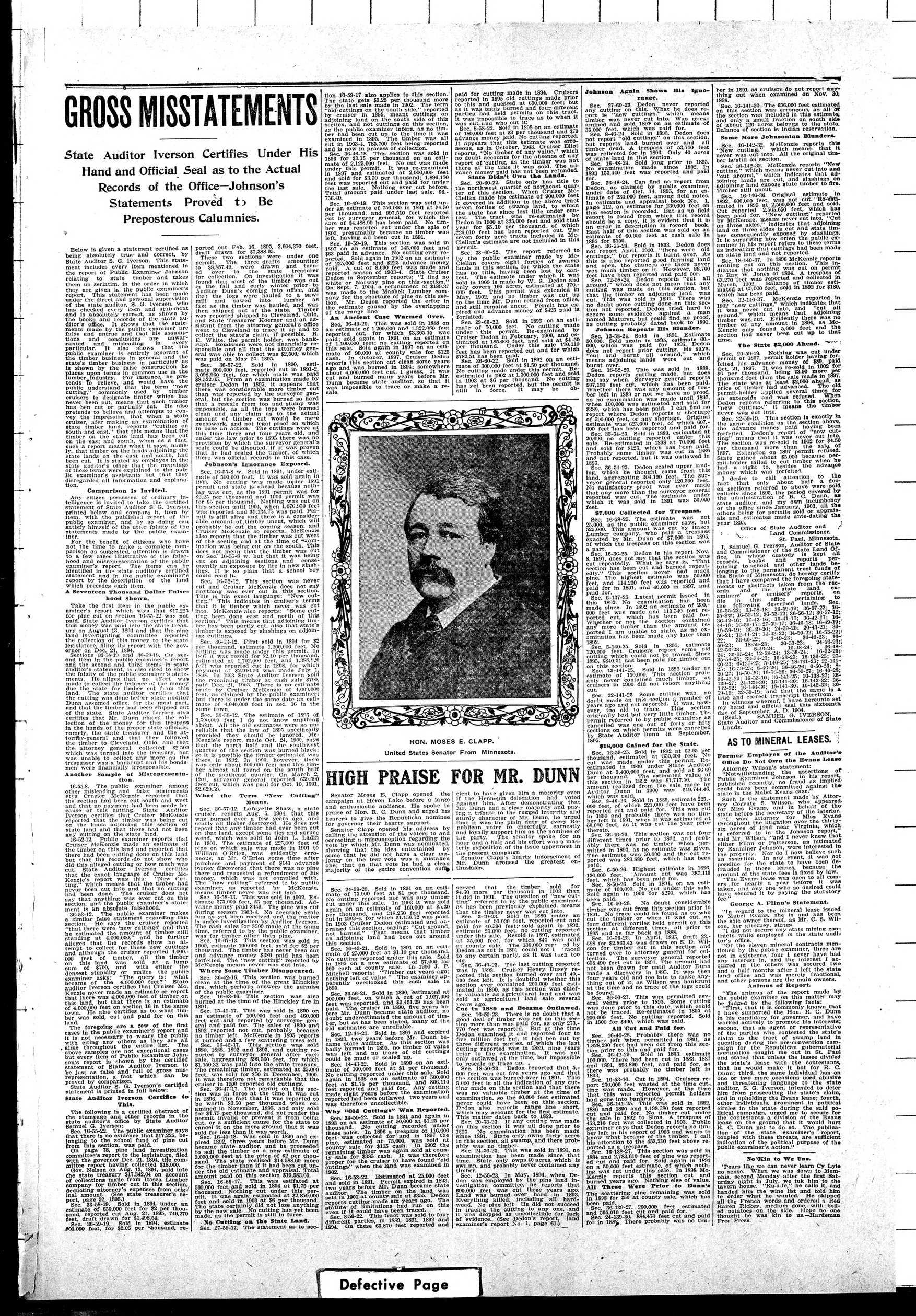
HON. MOSE
United States Senate
HIGH PRAISE
Senator Moses E. Clapp opened the campaign at Heron Lake before a large and enthusiastic audience. He spoke in praise of Hon. R. C. Dunn and urged his staff to unite against misconduct regarding the governor their hearty support.
Senator Clapp opened his address by calling the attention of the public to the misconduct by which Mr. Dunn was nominated, showing that the idea entertained by some of the public misconduct regarding the governor on the test vote was a mistaken one; that on that vote he had a clean majority of the entire convention suffice.
Se. 24-39-20. Sold in 1891 on an estimate of 75,000 at $1 per thousand. No cutting reported nor was reported. In 1943 it was sold again on an estimate of 160,000 at $5.30 per thousand, and 218,250 feet reported. In 1903 Cruiser Dedon estimated and impressed this section, saying: "Cut around, not into the land, and adjoining land had been cut around this section.
Se. 20-43-21. Sold in 1891 on an estimate of $11.0 per thousand. No cutting reported nor was reported. Sold in 1895 on a new estimate of 75,000. In 1951 Mitchell reports: "Timber cut years ago; nothing left of value." The examiner apparently overlooked this cash sale in
Sec. 36-56-21. Sold in 1890, estimated at 100,000 feet, on which a cut of 1,927,490 feet was reported, and $3,451.29 has been paid. The cruiser in 1890, five years before Mr. Dunn became state auditor, no doubt underestimated the amount of timber, but as has been stated, many of the old estimates are unreliable.
Sec. 12-44-21. Sold in 1891 and expired in 1893, two years before Mr. Dunn became state auditor. As this section was badly burned in 1895, no timber of value was left and no trace of old cuttings could be made or scaled up.
Sec. 14-43-22. Sold in 1890 on an estimate of 100,000 feet at $1 per thousand. No cutting reported under this sale. Sold again in 1898 on an estimate of 500,000 feet at $1.75 per thousand, and 806,110 feet reported and paid for. Any cutting made eight years before the examination reported had been outlawed two years and was therefore uncollectible.
Why "Old Cuttings" Was Reported.
Sec. 34-50-22. Sold in 1801 and again in 1838 on an estimate of 50,000 at $12.00 in land and in estates. No entitlement recorded under these sales. In 1896 a trespass of 115,000 feet was collected for and in an estate sold at $10,000, was sold at county sale for $115 cash. In 1902 the remaining timber was again sold. In 1903 the timber was therefore proper for the cruiser to have found "oil cuttings" when the land was examined in 1838. Sec. 16-53-22. Estimated at 25,000 feet and sold in 1801. Permitted expire in 1803, two years after writing made six years ago. The timber on the land was sold in 1801 at county sale at $335. Dedon applies with made six years ago. The statute of limitations had run, on this even if it could have been traced. This time was sold to four different parties, in 1830, 1801, 1892 and 1894. On these 63,870 feet reported and
paid for cutting made in 1894. Cruisers reported in 1893 old cuttings made prior to the war as it was equally burned and four different parties had held permits on this tract, and it was equally burned as to when it was cut and who cut it. Sec. 8-32-28. Sold in 1898 on an estimate of $10,000. Advance money paid. No cutting reported. It appears that this estimate was erroneous, as it was "No timber of any value", which no doubt accounts for the absence of any report of cutting, as it was sold. The advance money paid has not been refunded. State only has title to the northwest quarter of northeast quarter of this section. When the advance money paid has not covered in addition to the above tract seven forties of swamp land, to which the contract. The tract was re-estimated by Denedon in 1900 at 325,000 feet and sold to McClellan at 320,000 feet. McClellan has been reported cut. The seven forty acre tracts included in McClellan's estimate are not included in this
Sec. 28-60-22. The report referred to by the public examiner made by McClells covers eight forties of swamp lands in this section, for which the state has no title, having been lost by contest. The estimate under which it was sold in 1900 is made by W. S. Redden and only covers 180 acres estimated at 170,000 feet. This permit was extended in May 1902, and no timber was cut up to the time Mr. Dunn retired from office, and still remains uncut. Permit has expired and advance money of $425 paid is forfeited.
Sec. 29-60-22. Sold in 1892 on an estimate of 70,000 feet. No cutting made under this permit. Examined by Cruise: Deducted in February, 1900, and estimated in 185,000 feet, and sold at $4.50 per thousand. Under this sale 170,110 feet has been reported cut and for which $782.51 has been paid.
Sec. 30-60-22. Sold in 1891 on an estimate of 300,000 feet at $1.50 per thousand. No cutting made under this permit. Re-estimated in 1902 at 1,300,000 feet and sold in 1903 at $6 per thousand. No cutting has yet been reported, but the permit is still in force. It may be ob
S E. CLAPP.
From Minnesota.
FOR MR. DUNN
cient to have given him a majority even against him. After demonstrating that Mr. Dunn had a clearly majority anointed character, he sturdy character of Mr. Dunn, he urged public voter to cheerfully, earnestly and loyally support him as the nominee of the hour and a half and his effort was a masterly exposé issue uppermost in campaign.
Senator Chapp's hearty indorsement of Mr. Dunn aroused the greatest enthusiasm.
served that, the timber sold for 40,000 feet in 1800 and did it in 1801. The question of "new cutting" referred to by the public examiner, that the timber never was cut into. An estimate of 40,000 feet, cut reported and paid for 40,000 feet, sold again in 1802, for 50,000 feet, under this sale. Resold in 1897, estimated at 35,000 feet, for which 45 was paid andDEDon as cut in 1801 could not be traced to any certain party, as it was too soon to Sec. 36-40-23. The last cutting reported was in 1803. Cruise ship burned over and 40,000 feet left. It is doubtful whether this report was in 1800, as this section was chiefly valuable as agricultural land and was agricultural land sale several years ago.
Sec. 16-50-23. There is no doubt that a good deal of timber was cut on this section more than was could be put on the time period. Dedon examined it and reported four to five million feet but, it had been cut by three different parties, of which the last cutting reported was in 1850, nine years prior to the extraction.
The outlawed the time, but impossible to rescale or trace up.
Sec. 16-50-23. Dedon reported that 5,000 feet was cut five years ago and that the section was burned over in 1894. This time made all the additional taxகயு.
This section was the section and that there was no valuable timber at the time of examination, so the 60,000 feet estimated never could have been on this section.
Dedon also reports a range of short, was not more than 100 ft.
This matter dates back to 1889.
Sec. 20-53-23. If any cutting was made on this section it was all done prior to 1853. No examination has been made since 1853. The same owners forty across this section, all swamp, and there probably was no timber.
Sec. 24-56-23. This was sold in 1891, no examination has been made since that time. State only owns 40 acres, which is small, and probably never contained any timber.
Scc. 12-55-23. In May, 1854, when Dedon sampled by the pine land investigation committee, he reports that 600,000 feet was cut three years ago. Part of it burned over hard in 1853. Everything killed, including all hardwood. No pine left. He did not succeed in cutting the cutting to may one, and it was dropped as uncollectible for lack of evidence. (See Dedon's report, land examiner's report No. 1, page 61.)
Johnson Again Shows His Igno-
Sec. 27-60-20. Dedon never reported any cutting on his cuttings" which means timber was never cut into. Was re-examined and scaled to an estimate of 32,500 feet was paid for. Sec. 8-40-24. Sold in 1893. Dedon does not report any lands burned over and all timber dead. A trespass of 53,710 feet was collected and 40 acres of timber was laid in this section. Sec. 16-48-24. Sold long prior to 1895. No examination of lands 153,444 feet was reported and paid for. Sec. 29-82-24. Can find no report from Dedon as claimed by a public examiner, under date of Oct. 14, 1895, for an estimate of 230,000 feet and an estimate and appraisal book No. 1, page 112, an estimate for 230,000 feet on this section. Sec. 29-82-24. Found from which this record should be a copy, it is evident that it is half of this section was sold on an estimate of 60,000 feet at cash sale in Sec. 39-55-24. Sold in 1893. Dedon does not report April, 1900, "there were old cuttings," also reported good farming land and open, the chances are there never was more than one year have been reported and paid for.
Sec. 12-58-24. Dedon reports "cut all cutting was made on this section, but that the timber on adjoining land was no doubt some cutting done on this section not reported. Dedon tried hard to name Maturen, but could find no proof, as cutting probably dated back to 1891. John Reeves expended 50,000. Dedon again in 1891. Estimate 50,000. Dedon again in 1895, estimate 60,000, which was paid for cutting. He says, "cut and burnt all around," which means adjoining lands were cut and
Sec. 16-32-25. This was sold in 1880. Dedon reports cutting at the landlord general reports 507,130 feet cut, which has been paid. Whether there was any amount paid, as no examination was made until 1897, when 100,000 was estimated and no proof, as no examination was found, we find no report where Dedon reports a shortage of 300,000 feet, or any shortage. Original estimate was 300,000 feet, but it was reported and paid for. Sec. 35-54-25. Sold in 1880 estimated at 20,000, no cutting report was made. Dedon reports 1898 at 70,000 feet and sold for $125, which has been paid. Probably some timber was not reported, but it was outlawed in 1890. Sec. 36-54-25. Dedon scaled upper landland, aggregating 304,190 feet. The surveyor general reported only the land that is ever made that any more than the surveyor general reported was cut. The estimate under which it was sold in 1891 was 50,000
$7,000 Collected for Trespass.
Sec. 16-58-25. The estimate was not 25,000, as the public examiner says, but 525,000. This amount was cut by Itasca Lumber company, who paid a trespass exacted by Mr. Dunn of $7,000 in 1893, of which the trespass on this section was a part.
Sec. 16-36-25. Dodon in his report Nov. 8, 1897, does not say that the section was cut repeatedly. What he says is, "That section has been cut and burned repeatedly." This section never had much pine. The highest estimate was $50,000, and $114,200 feet was reported and paid for in 1891, and $40,000 in 1897, and paid for.
Sec. 6-137-25. Latest permit issued in this 1892. No examination has been made since. In 1892 an estimate of $20,000 feet was made and $113,540 feet reported cut, which has been paid for. Whether or not the section contained any more timber than the amount reported I am unable to state, as no examination has been made any later than
Sec. 5.140-25. Sold in 1891, estimate 120,000 feet. Cruisesmen not be traced. Since 1850, $40.51 has been paid for timber cut on this section.
Sec. 5.141-25. Sold in 1892 under an estimate of 150,000. This section probably never contained much timber, as cut. Sec. 22.141-25. Some cutting was no doubt made on this section. It was, however, too old to trace. This section originally had but very little timber, too old to trace. A cabin examiner was cancelled was one out of forty or fifty sections on which permits were cancelled by State Auditor Dunn in September,
$18,000 Gained for the State.
Sec. 16-50-23. Sold in 1802 at $2.05 per thousand, estimated at $30,000 feet. Not cut was made under this permit. Re-estimated 1900 under the Auditor Division, $3,000,000 feet and sold at $600 from the thousand.
The estimated value of this section in 1802 was $1,717.30. The amount realized from the sale made to Auditor Division in 1900 was $13,744.36, which was paid.
Sec. 8-46-26. Sold in 1889, estimate 225.000 feet, of which 221,000 feet have been reported cut and sold. This was not reported but probably there was no timber left in 1881, when it was estimated at $0.000 feet, as it was cut the year prior thereto.
Sec. 8-46-26. This section was cut four different times prior to 1893, and probably there was no timber when permitted in 1893, as no estimate was given. The estimate was $0.000 and the cut was reported was 288,880 feet, which has been paid.
Sec. 6-50-26. Highest estimate in 1889, $130,000 feet. Amount cut was $387,110 feet, which has been paid.
Sec. 5-50-26. Not an estimate of $181,000.
Sec. 10-100. No cut under this sale.
Sold again in 1900 for $270, which has been paid.
Sec. 10-50-26. No doubt considerable timber was cut from this section prior to 1891. No trace could be found as to which cut was made.
Sec. 10-50-26. Not an estimate of $181,000.
Sec. 10-100. No cut for different parties held permit on this section as different times.
Sec. 16-56-26. In April, 1895, draft 25-588 for $2,863.43 was drawn on S. D. Wilson for timber cut in this section and turned over to attorney general for collection. The surveyor general reported 658,490 feet cut in 1891. The amount had not been drawn for until Auditor Dunn made a discovery in 1895. It was then four years old and too late to make anything out of it; as Wilson was bankrupt at the time and no trace of the logs could be found.
Sec. 36-50-27. This was permitted several years prior to 1895. Some cutting was done prior to this date, which could not be traced. Re-estimated in 1895 at $200,000 feet. No cutting reported. Sold in 1900 for $490, which was paid.
All Cut and Paid for.
Sec. 16-40-28. Probably there was no timber left when permitted in 1891, as prior to this and paid for.
Sec. 16-42-29. Sold in 1893, estimate 250,000 feet was staked at the time cut and 1891, 830,800 feet, and paid for, so there was probably no timber left in 1893.
Sec. 16-53-10. Cut in 1894. Cruisers report 250,000 feet was staked at the time cut and that this was reported permit holders had gone into bankruptcy.
Sec. 1888 and 1890 and 1,158,780 feet sold in 1882 and 1890 and 1,158,780 feet reported cut and paid for. No timber cut under the 453,210 feet was collected in 1903. Public examiner says that Dedon reports no timber cut and that he knows what became of the timber. I call his attention to the 453,210 feet above reported cut. Sec. 16-18-27. This section was sold in 1884 and 2,783,610 feet of pine was reported on a 50,000 feet estimate, of which nothing was cut under this sale. In 1886 McCormick burned years ago. Nothing else of value.
All These Were Prior to Dunn's. The scattering pine remaining was sold on 450 at county sale, which has been paid.
Sec. 36, 130-137, 300, 000 BW, estimated
Sec. 36, 130-137, 300, 000 BW, estimated
Sec. 36, 130-137, 300, 000 BW, and paid
Sec. 36, 130-137, 300, 000 BW, and paid
There probably was
her in 1801 as cruisers do not report anything cut when examined on Nov. 30. Soc. 16-141-30. The 656,000 feet estimated on this section. The 656,000 feet was included in this estimate, and only a small fraction on south side of section was included in this estimate. Balance of section is Indian reservation.
Some More Johnsoninn Blunders.
Sec. 16-142-32. McKenzie reports this "New cutting," which means that it never was cut into. All the original timber is/still on section.
Sec. 30-142-32. McKenzie reports "New cutting," which means never cut into and cutting lands are cut, and slashings on adjoining land expose state timber to fire. Timber still cut.
Sec. 40-143-32. Original estimate in 1892, 600,000 feet, was not cut. Re-estimated in 1895 at 2,500,000 feet and sold. Cut reported 2,505,650 feet, which was paid for been paid for, and the cutting reported on the following means never cut into. "Cut on three sides" indicates that adjoining land on three sides is cut and state timber consequently expressed as the new land on the other side. It is surprisingly, when the public ex-
It is surprisingly, when the public ex-
as indicated that cut cut refers to these terms as indicating that cut cut cut does not have an indicate on state land and not reported.
Sec. 18-140-37. In 1890 McKenzie reports nothing but nothing was cut on permit of Ray W. Jones of 1894. A trespass of 63,270 feet was reported and collected in March, 1894, was reported in 1894, and the cost of 600,000 feet sold in 1892 for $150, which has been paid.
Sec. 32-140-37. McKenzie reported in 1902 "new cutings," which indicates that it was never cut into, and not all the other things that had not been made, which was cut that adjoining around, was cut. Evidently there was no timber of any amount in 1894, as McKenzie only found 5,000 feet and the section had never been cut up to that.
The State $2,000 Ahead.
Sec. 20-50-19. Nothing was cut under permit-holder having forfeited his advance money of $89, paid Oct. 21, 1897. It was re-sold in 1902, $6 per thousand, being $6 per thousand, being $10 per thousand, being $10 per thousand, being $10 per thousand, at least $2,000 ahead, as the price of timber had advanced. The old permit-holder applied several times for an extension and was refused. When Dedon reports referring to this section, "new cuttings" it means the timber never was cut into.
Sec. 22-50-19. This section is exactly in the same condition as the section above, the advance money paid having been forfeited. Dedon's report of "new cuttings" means that it was never cut to the section and was re-sold in 1902 for $4.50 per thousand, from the sale of the 1897. Extension on 1897 permit refused. State gained about $5,000 because permit-holder failed to cut timber when he had a right to, besides the advance money which was forfeited.
I desire to call attention to the fact that we are about half a dozen. Exercises referred to above were sold entirely since 1895, the period covered by the administration of R. C. Dunn, as state auditor, and my own incumbers, and the office since January 1893, all the others being for permits sold or appraisals and estimates made anteating the
AS TO MINERAL LEASES.
Former Employees of the Auditor's Office Do Not Own the Evans Lease
Attorney Wilson's statement:
"Notwithstanding the assertions of Purchasers in the report published recently, no fraud as implied could have been committed against the state in the Mabel Evans case."
Such is the statement made by Attorney Coryate S. Wilson, who appeared for Miss Evans, and is held at the state before the secretary of the interior, the attorney for Miss Evans throughout the litigation over the thirty-six acres of land near Virginia, which is referred to in the Johnson report, said Mr. Wilson, "and I never knew that either Flinn or Patterson, were interested in by Examiner Johnson. I now believe such an assertion. In any event, it was not possible for the state to have been demanded in those resorts, because the amount of the state fees is fixed by law.
"The Evans lease was open to all comers, for nearly a year before I was taken, and any one who so desired could have secured it by paying the statutory"
George A. Flipp's Statement.
"In regard to the mineral lease issued to Mabel Evans, she is and has been the sole owner of Mr. C. S. Willis her attorney, states.
"I did not secure any state mining contracts while employed in the state auditor's office."
"Of the eleven mineral contracts mentioned by the public examiner, three are available for any interest in, and the interest I acquired in the others was secured two and a half months after the land was acquired merely fractional, and other persons are the main owners."
**Animus of Report.**
"The animus of the report made by the public examiner of this matter may be found in the report."
"First, that it is commonly known that I have supported the Hon. R. C. C. C. in the state of Alabama and have worked actively to promote his interests; second, that an agent or representative of the state can claim to the tract of swamp land in question during the pre-convention campaign, nomination sought me out in St. Paul and stated that unless the lessee divided state seas to make the contestants, that they could make the threatening language to the state auditor, S. G. Iverson, intended to deter him from prosecuting the state's claim, that he would not threaten other individuals, prominent in political circles in the state during the said proceedings, the contestants a division of the Evans lease on the ground that it would hurt the state's reputation, the formation of the state examiner's report, coupled with these threats, are sufficient to prove the purpose of the public examiner's action."
No'Kin to We Ups.
"Pears like we can never learn Cy Lyle no sense. He was on Monday after the first Saturday night in July, we tuk him to the tavern and we tuk him to the wine list and told him to order what he wanted. He skipped on the wine list. Rickey, medium done, with bolted potatoes on the side. Hope no one thought he was kin to us. -Hardman Proof
SENATOR NELSON EULOGIZES HON. R. C. DUNN
JUST THE MAN FOR GOVERNOR
SENATOR NELSON'S GLOWING TRIBUTE TO ROBERT C. DUNN.
Senator Nelson, in His Speech at Madison Lake, Urges the Election of Duan Because of His Notable Record as State Auditor, His Service to the People of Minnesota and His Character—The Andrew Jackson of Minnesota Achievements of the Republican Party.
A large and enthusiastic audience greeted Senator Knute Nelson at Madison Lake on Friday evening last. After being introduced by the chairman in a particularly bright and timely speech, Senator Nelson smoke as follows:
In free governments such as ours the people necessarily find expression for their political parties. The many unite in a general creed to which all give adhesion, government, almost from the beginning, has to some extent and in some form been a party government. For well-night-times—the Democratic and Republican—have contended for the control of the administration, March 1881, the Democratic party has several times had the control of the house of representatives, two terms the only once—Cleveland's last term—the control of the executive department and both occasions the administration of the country during all this period has been in the hands of the Republican party. That political, industrial and financial policy of the country under which it has so extensively once—during Cleveland's last administration—that the Democratic party was enabled to make any material inroads on the party's policies, still fresh in our memories, how disastrous and deplorable this proved to be.
```markdown
```
Party of Obstruction.
It is not difficult to pass judgment on the Republican party. Its history is an open book—a chronicle of great and noble ideas—has been built into the country's own history. It is not so easy to pass judgment on the Democratic party in recent years. It can point to no great deeds done and accomplished. It is not as long as possible. It is the course of obstruction, undue pride or another. The only chance it had for action it ignoriously frittered away to the change of the country's development. It reserves credit for one thing; it has in many instances aimed to camp on ground occupied by the Republican party four years before the election. It has a major impact on the main life attitude now. For aside from some glittering generalities, it presents no living and material issue to the American people. The "A" is a candidate and his environment is its candidate. It is the environment. All else is a negative pregnant, either in words or silence—a negative pregnant with exploded or obsolete financial misuse. It will be a great part of the people who will be a man party comes before you with its past record and its present purposes and asks you to scan it, and it comes before you with its understanding of the problem. It is a good task you to put your search light on, feeling confident that the record, the purposes, and the candidate will each pass past, and all assure you now, as the country is entirely safe in Republican hands, and that it would be utterly unsafe and fraught with dangerous and destructive consequences to the Party. This will prevent into the hands of the Democratic party.
The older ones among you are familiar
to the younger generation it may be both
interesting and instructive to recall and
done and the great results accomplished
by the Republican party since 1861, for
the welfare and great advantage of our
country.
Financial Legislation and Administration.
The close of the Civil war found the country burdened with a large national debt and a considerable redeemable paper currency. In August, 1865, the interest bearing national debt was $2,381,000,000, all running up to the beginning of Cleveland's asseMB. This debt was refunded at a lower rate of interest, and then from year to year reduced until the beginning of Cleveland's asseMB. This debt was $851,000,000 a reduction of $719,000,000. During that administration, partly to maintain the gold standard and partly to maintain the Democratic change in the tariff law, the national debt was increased, in times of peace, by $292,000,000 so that at the beginning of the war it was reduced to $471,000,000. The Spanish war, which all our people regarded a just war, brought an increase of the debt, so that our debt was increased to $1,044,000,000. Since that time it has been gradually reduced, until on the 30th of June last it amounted to only $1,044,000,000 during the several refunding acts Democratic opposition, to a greater or less degree, in and out of congress, was always encountered. Part of the Democratic gospel in those days that our bonded indebtedness should be paid and redeemed not in gold or even in silver. Nothing could have been more destructive of public credit, and so lowed our financial standing throughout the world as the adoption of such a policy.
Greenbacks.
The necessities of the civil war compelled our government to issue $431,000,000 of irredeemable legal tender notes, commonly called irredeemable character, became greatly depreciated in value. The Democratic party in congress, and to a large extent outside of congress, opposed the greenbacks that they issued, and illegal, but afterwards, in the seventies, the greater portion of the Democratic party became so infatuated with the greenbacks that they issued, and they were utterly opposed to their redemption in specie. When the redemption act of 1875 was passed providing for the sumption of specie payment of $739 every Democrat in congress its pas-
In 1876 the Democratic national platform demanded the repeal of the law, and the Democratic house in 1877 passed a repealing law. In 1885 the Democratic house held the greenback to the constitutional because irredeemable; in 1875-77 they held it to be a valid currency, and wanted more of it, and all of it irredeemable.
Free Silver.
In the latter half of the seventies and
during the eighties, the free and unlimited coinage of
the
silver. While a portion of the Republican party favored the proposition, the Democratic party was well-nigh unanimous in its support of stave off unlimited free silver coinage, the act of 1890 providing for the mintage of silver was passed. This law turned out to be a mistake, and its only justification was that it prevented the greater number of silver coins from being minted. This act we came very near the verge of silver monometallism. In 1893 Cleveland, to his credit, called congress in exhortation of this act to provide provisions of the act of 1890. The act of repeal was passed, but it was briefly owing to the united states' desire to increase the passage of this act somewhat relieved the tension, and the election of 1896 having increased power, commercial and financial confidence, so wanting during Cleveland's administration, was restored, and with the prosperity returned, and with prosperity came a large balance of trade in our favor, and this brought in its wake an even greater amount of which had been idle and in hiding during Cleveland's term. Gold sign commemorates the prosperity returned, and with the great industrial and commercial revival, that there was no longer any difficulty in obtaining our currency on a parity with gold.
By the act of March, 1900, gold was made the standard of value, and forms a parity with gold, and it was made the duty of the secretary of the treasury, maintain sure and proper funds, and maintain the same were provided. The passage of this act encountered the almost unanimous oppose. They were even then, after experiencing three years of the blessings of Republican rule, incorrigible—as many of them
Paper Money.
While gold or silver, or both have for centuries been the money standard of value throughout the civilized world, the exigencies of trade and commerce have long ago required the safety of currency, and more, for a convenient and less bulky than a special, for the every day transactions of trade and traffic. Most, if not all, of the nations of Europe, are in any�or-type�or-type�or-type�or-type�or-type�or-type�or-type�or-type, and the capber currency to a single bank in each country—under government auspices and under government control, in order to secure uniformity and safety. Great Britain has a Bank of England, Germany, and the Royal Bank of France. The bank of France and each of the smaller countries have similar institutions. Prior to the great Civil War our national government had a paper currency whatsoever. The only paper currency our people possessed prior to that time was a heterogeneous supply of notes and bills issued by state banks under as many as 100,000,000 or more of the most common current forms as there were. Banks mostly on an insufficient basis, easy to counterfeit, and generally circulating at a discount in states distant from their place of use. The bank would not be a time-like bank, and the bank would not be the great rebellion—with no effective provision for redemption. Such was in the only proportion made for the paper currency. The Democratic party while they were in,
National Bank Notes.
In 1864 the Republican party by a 10 per cent tax eliminated this wretched currency and provided the nation with a system of national banks under government supervision and control. The notes of these banks are uniform in figure, shape, and size, and the government of gov't bonds deposited in the treasury are not easily counterfeited, and are current at par throughout the country. Whatever else the country may have truthfully said, that every bill has been duly paid and redeemed, and no bill holder has ever lost a penny, nor has any bill holder allowed no banks with a less capital than $50,000, but under the gold standard act of 1900 provision was made for banks with a capital of one million in place of not exceeding three thousand. This amendment has largely popularized the national bank system. Many small towns have taken advantage of the new system of money has greatly increased.
In March, 1900, there were 3,612 national banks with an authorized number of $249,344,878. In the first day of July, last, there were 3,539 banks, with a capital of $175,619,736. On the first day of July, last, there were 3,493 banks, with a capital of $149,235,005. Thus we have secured in this period 1,787 more banks, and nearly $200,000,000 more notes. The account was made for the refunding of our interest bearing debt into new 2 per cent bonds. This scheme has given us great benefit. The new 2 per cent bonds been to a large extent replaced with 2 per cent bonds. $424,950,900, or 61.7 per cent of our interest bearing bonds thus reducing our annual interest charge more than $16,000,000. In addition to our national bank notes, we have also made up our annual currency in circulation. On the first of last July the following paper currency was issued: $343,953,888, U. S. notes, or greenbacks. $334,491,977; treasury notes of 1,929,287; silver certificates. $424,578,988; aggregate paper currency of $1,708,490,946 in circulation, out of a total money circulation of $2,521,151,527. Thus sharing a coin circulation of only $821,503.
As Good as Gold.
Thus it appears that a little less than one-third of the money in circulation is coin, and that a quarter of the currency, on a parity with gold, and as safe in the hands of the holder as gold. While all of this paper currency may not, in the shortest standard sought by the experts in finance; yet it is in all respects immensely superior to the paper currency the Democracy is supposed to have. Civil War. That was largely an asset currency, with no end of elasticity.
HON. ROBERT C. DUNN.
On the first day of July, 1807, our per capita circulation was $22.49; on the first day of September, 1904, it was $31.16, an increase of $5.67 per capita in seven years. And this increase has occurred while adhering to the gold standard, and without the free coinage of silver. In all our country we have never before had such an abundance of money in our population, our population, nor such an abundance of gold, in and outside the treasury. What a grand and wonderful financial record this is. It is not surprising, though somewhat unusual, that the Democracy can not in their last platform find any�ure or irritation in this world. Such has not always been the case with them. They have been blind in the past. We have finally succeeded, after the lapse of all these years, in opening their eyes to the merits of the financial policy of the Republican party. The silence of the Democratic party would be the silence of Democratic mourners over the grave of free silver. Their candidate awoke them from their trance and cruelly shocked many of them by telling them at the last moment that he at all events was not unfriendly to the gold standard.
Industrial Growth and Development.
The record of the Republican party in Indiana has been industrial growth and development, but has been no less marked and no less beneficial than its financial policy. Our industrial leaders of our financial success. The great balance of trade in our favor under Republican rule has turned the tide of gold from the abundance that it has been easy to maintain the gold standard, and to keep all of our farmers and producers of raw material, with our principal markets in the Old World, in the factures and finished products. This condition before long became intolerable. It soon became apparent to our early generations, needed, and that this remedy must be sought in the diversification of our industrial life; that some of our people must be trained in the craft of a farmer, and that at least some of our
Republican
abundance of raw material should be utilized and made into finished product at home. In other words, that we ought to become manufacturers as well as farm-
The second act passed at the first session of the first congress, under the Constitution dated July 4, 1789, contained this preamble: "Section 1. Whereas, It is necessary for the support of government, for the disaffordance and the encouragement and protection of manufactures, that duties be laid on goods, wares and merchandise important to the economy, the several duties hereinafter mentioned shall be laid on the following goods," etc.
Words of the Fathers.
George Washington, in his eighth and last annual message, delivered December 7, 1796, declared: "Congress have repeatedly, and not withdrawn, directed their attention to the encouragement of manufactures. The object is of too much consequence not to insure a continuance of their effort in this way which shall appear material, etc." Thomas Jefferson, in his sixth annual message, of Dec. 2, 1806, in discussing the importance of surplus in the treasury, asked this pertinent question: "Shall we suppress the impost and give that advantage to foreign over domestic markets?"
Jefferson, then and ever since the idol of the Democratic party, could see that the tariff was a protection to the American manufacturer, which it was not wise to abandon.
James Madison, one of the chief factors in our constitutional convention, in his seventh annual message of December 5, 1815, makes this comprehensive and far-reaching statement: in adjusting the duties on imports to the object of revenue the influence of the tariff on manufactures will necessarily present itself for consideration. How-
ever wise the theory may be which leaves to the sagacity and interest of individuals as the application of their industry and experience are more effective. It has been found that cases, exceptions to the general rule. Besides the condition which the theory itself implies of a reciprocal adoption by the states, the theory of the common cause is that the same many circumstances must concern in introducing and maturing manufacturing establishments, especially of the more specific and more general, the more often known, and more generally, to the more generally, long without them, although sufficiently advanced and in some respects even peculiarly fitted for carrying them out, a such a successful adoption of a general industry in a new or new industry has been made among us a progress and exhibited an efficiency which justify the best effect of the use of the industry. It is due to the enterprising citizens whose interests are now at stake it will become at an early day not only safe and unsolicited but unobliged to be abroad, but a source of domestic wealth and even external commerce. In selecting the branches more especially entitled to the product and the process of亦可to be involved in the United States from a dependence on foreign supplies, even subject to casual failures. For articles necessary to make the definition of the theory with the pre-mary wants of individuals. It will be an additional recommendation of particular manufacturers to the use of the industry.
The existing extremely drawn from our agriculture, and consequently impart and insure to that great fund of national prosperity and independence to an enough power which cannot fail to be rewarded."
Protective Tariff Policy.
The policy of diversifying our industrial life, by developing and promoting manufactures, thereby enlarging the field of production and labor, thus adopted and infiltrated by the fathers of the republic by the republican party, has long ago been abandoned by that party, but has been faithfully pursued and followed by the Republican party.
The protective tariff policy adhered to by
the government, protected our industrial growth to
HON. ROBERT C. DUNN.
Republican Candidate for Governor, State of Minn.
such an extent that we have become the greatest manufacturing nation on the face of the earth. The census of 1900 gives us these figures of output with which we have produced twelve thousand two hundred and seventy-six manufacturing establishments, with an invested capital of $8,931,486,500, employing 5,514,539 hands and with an annual production value of $13,910,038,514, of this only $433,715,766 or 3.4 per cent, was exported.
Home Market.
arts to of the sarly How- Through our vast industrial expansion the American farmer has secured his principal and best market at home. The great army of men employed in our ni-
merous and vast manufacturing enterprises, with their families, furnish a large portion of our home market. In 1900 our farm products exceeded $55,000,000, and 100,000 of value, of which $2,935,123, 16.7 percent was exported, the balance being consumed in this country. This shows the volume and value of our home market. It thus appears that our protective tariff policy divides it and is not the same as the cost of the labor better. That it secures to the laborer better wages, and to the farmer a nearer, better, and larger market than he would otherwise have.
The benefits of protection are not con-fled to the industry, the manufacturers, but to accelerate through, and inure, directly or indirectly, to every industry and calling in the country. It is the aim and purpose of our tariff policy to provide the materials to the customers to cost of production with the foreign manufacturer, and hence we regard as the just measure of protection the difference in the cost of production at home and abroad. A total of two of the costs of the costs and costs and costs are very high, and the cost of items, and it may happen that through fluctuations in the cost of material, machinery and labor that this measure is in some instances materially exceed. Where such is the case, the量 is not of a transient character, and it is not of a party stands ready to visit and
Democrats and Tariff.
But what has been the attitude of the Democratic party as to our tariff policy since the Republican party came into power, greater or less extent, the party has always been hostile to a protective tariff. A tariff for revenue only has been their persistent gospel in season, this has been no mere theory with them. The Wilson bill, as it passed through the house, indicated too plainly what they would have done, and through the efforts of the Republicans in the senate, became a little protective in its features, and thereby it became so obnoxious that Cleveland and New York suffered from the effects of that law. It resulted in languishing industries, insufficient revenues
esota.
and a scarcity of money. Compare the dire effects of that law with the beneficial results that the Dingley law of 1897, Industrial revival, progress, prosperity, and an abundance of money, with lower rates of interest and higher wages, the benefit of the new law and full and full the face of this experience and this result, comes the Democratic anathema of 1904, fulmination and rejection as a robbery of the many to enrich the few." It would have been more appropriate, and much more to the extent of the law "as the destruction of the many at the instance of misguided and incorrigible Democrats." Those of you who are interested in the case of Wilson Democratic tariff law, and pine for a renewal of the same, will of course vote the Democratic ticket, but those of you who are interested in the case of that law and who have enjoyed the blessings of the industrial revival resulting to the country from the Dingley law, will not for a moment hesitate to vote the Republican ticket.
Trusts and Combinations in Restraint of Trade.
It would have been discreet and in good taste for the Democracy if they had preserved the same silence on the subject of trade and the laws that they preserved in reference to the financial policy of the Republican party—for neither their record, nor their candidate, would have been to their credit in this behalf. These trusts and combinations are corporate bodies, created and operated under state, and not federal, laws and they operate in states where the greatest laxity and least restraint prevails in respect to their operations. They seek immunity under state laws and they are not easily dealt with by the federal government. These laws rather than the tariff tend to breed trust. A
```markdown
```
mere change in the tariff schedules—which is about the only remedy the Democratic party suggests, or has attempted—could not by any possibilities reach some of the most monstrous trusts, such as the Standard Oil trust for instance. Besides a removal of the tariff would not only reduce the similar products of those concerns which are entirely free from trust attributes, and thus the good and the bad would receive equal punishment in the tariff, the wholly undeserved and destructive, such a policy would not only destroy many worthy and struggling industries, but it would also national trusts, and open the doors wide for the products of foreign trusts.
Tariff and Trusts.
On this subject, the United States Industrial Commission, composed of five senators and five representatives and nine other persons, appointed by the president, to investigate the conditions of the country were represented, in their final report of Feb. 12, 1902, say: "It has been frequently asserted that one of the most important of industrial combinations is the protective tariff. Experience, however, both in this country and in Europe, does not confirm some of the largest and most monopolistic combinations have no direct tariff protection, and in England, where there are no such combinations, have been founded, most of which have operated with success. Indeed, in no other country than England is the form of industrial combinations so like common sense in the United States (Vol. 19, page 627).
After further discussing the subject, the committee removed the "removal of the tariff, then, will not aisleish combinations unless it abolishes the industry. The domestic competitors or cosigners of the tariff will be reduced by tariff reductions or removal, and the combination survive with moderate profits, and yet be forced to sell its products to domestic consumers at its national foreign competition by the removal of the tariff would, beyond any doubt, lead American combinations in some cases to already weaken the thread industry of England and the United States, indeed the thread industry of the world, largely in the hands of an international company, is so organized internationally, and there have been efforts to bring about an international iron and steel combination. In Europe companies are cross national boundaries. The advocates of lowering or removing the tariff in any line of industry should inquire carefully of a reduction in the tariff, and the further possibility of admitting to this country the surplus stocks of European manufacturers, at rates so low, that manufacturers extend their foreign markets by selling at low rates abroad, they but follow the example of Europe in the manufacture of cars, and their manufacturers have disposed of surplus stocks in this country so as to keep their factories going to their full capacity. What can be given for buying or renting cars is not order." (Vol. 19, page 30-L).
Control of Trusts.
The purpose of, and inducement for, the organization of many of their trusts is two-fold. Their promoters seek to enrich themselves not only by buying the trusts that is often the chief end in view, by floating large quantities of unduly inflated stock. Could we get at the exact figures it would demand and that the great trust directly or indirectly levied a greater tribute on the public by the large volume of inflated stock it put upon the market than by the stock products? The stock victims have in many instances suffered more than the consumers.
Owing to our dual system of government-state and market, the result it is no easy matter to regulate and control these trusts and to keep them within proper bounds. The powers of the federal government are the control of interstate commerce and do not extend to purely state commerce or to manufacturing or production. The Republican party is the only party that has legislative restraints, and sought to enforce them through judicial proceedings.
Trust Legislation.
federal anti-trust legislation:
(1) The interstate commerce law of 1894, Democratic house and Republican senate.
(2) A clause in the Wilson tariff law of 1894 prohibiting combination among interests at anti-trust legislation made by the Democratic party when they were in power.
(3) The so-called Sherman anti-trust law of 1890, passed during Harrison's administration by a Republican house and Republican senate, and which in clear terms prohibits the restraint of interstate commerce.
(4) The act of Feb. 11, 1953, expediting trials of suits to enforce the Sherman law.
(5) The act of Feb. 14, 1954, establishing the department of commerce and labor, with a bureau of corporations having power to regulate information in regard to the organization and operation of all corporations engaged in interstate commerce.
(6) The act of Feb. 19, 1954, amending the interstate commerce law by enlarging the powers of the commission and the courts and prohibiting rebates and draw
(7) On Feb. 25, 1904, an act was passed appropriating $24,000 for the construction and vesting the attorney general with power to employ special counsel and agents to consult suits and prosecutions under the law; and
(8) On March 3, 1904, an act was passed appropriating $24,000 for the assistant attorney general to assist in the enforcement of the anti-trust law.
Blocked by Democrats.
Not only has the Republican party given the country all this anti-trust legislation, but in 1900 it aimed in the house to secure the adoption of a compromise power to regulate and control trusts. On the passage of this amendment 148 Republicans voted for it, 2 against it, and only 5 for it. It failed to pass for the lack of a two-third vote in its favor. In discussing this amendment Mr. Richardson, the Democratic leader of the house, read from the Post, a Democratate the following:
"By supporting this constitutional amendment Democrat would have deliberately connived at the permanent retaliation of the campaign, and thereby robbed their party of one of its most powerful engines of war."
He then said:
"If this constitutional amendment, the effect of it will be to do just what the dominant party desires us to do, and that is to eliminate the trust issue from the campaign this year. Now, are we going to help to do it? I hope not."
Parker on Trusts.
Of all this anti-trust legislation there is only one act, that of 1894, prohibiting combinations among importers, that the Democratic party can claim the credit for the loss of the view, been possessed of the view, recently announced by their candidate in response to the official notification of his nomination, that the common law, derived from judiciary precedent, is not the weapon against the anti-trust evil. Of course he and his party would supplement it with a tariff for revenue only. Fortunately, Judge Parke
does not leave us in entire ignorance as to his view of the scope of the common restraint of trade. In the 155th New York Court of Appeals Report is the case that "Mary Park & Sons on a dissociation" decided April 28, 1903. This case involves the question of a combination in restraint of trade. The following is the material given by the restraint of trade.
"The manufacturers of certain proprietary medicines and an assortment of other goods are forced into an agreement to sell the goods at a uniform jobbing price for fixed quantities by the manufacturers' price list in making sales of the goods. All wholesale dealers from the manufacturers upon the same terms as members of the association are published by the manufacturers. Held not to establish a monopoly on the part of the members of the association. Where the manufacturers of patient medicines and an assortment of other goods are forced into an agreement by which the association were to maintain the prices estimated by the manufacturers is not unlawful, as in restraint of trade, although it abolishes competition, and as in contract as to the quantities that the dealers may sell, or the territory in which they may transact business.
"A complaint alleged that proprietors of patent medicines were prevented from selling plaintiff their goods for the reason that they wished to protect themselves with the wholesale and following drugplants, and that at one meeting of the association of these drugplants the manufacturer reported that all prominent manufacturers of proprietary medicines had adopted the contract price for the sale of their goods, and recommended that continued opposition be made to the sale of the articles to those proprietors who did not use such contracts or rebate price. Held insufficient to show intimidation on the part of the association towards the manufacturers, so as to prevent the sale of their goods to plan the patent medicine that the manufacturer will sell their goods to wholesale dealer, except at retail prices, or to allow commissions on the goods purchased, does not show a boycott where the refusal is grounded on unwillingness of such wholesale dealer to maintain the use of the price established by the manufacturer.
"Where manufacturers of patent medicines have contracted with the wholesale dealers therein to handle their goods at a uniform price, the fact that wholesale dealers are required to manufacture with the sale of dealers who were cut-
unlawful established prips does not show
"Safe" Man.
The case was decided by a divided court. Four judges, including Judge Parker, in a concurring opinion of his own, held there was no wrong and no remedy, while three judges held that the agreement and combination was clearly in restraint of trade and should be prohibited. I wish you could all read the vigorous and clear dissenting opinion of Judge Martin of the minority. He mercilessly punctures and explodes the sophism of Judge Parker and the majority of the court. After studying this case we are not surprised at the fact that the trusts and the great industrial combinations consider Judge Parker a very safe and conservative man.
In comparison with the common law apathy of Judge Parker I ask you to note the attitude of our candidate, President Roosevelt, on this all-important subject. In his annual message to congress Dec. 2, 1902 he declares:
Roosevelt on Trusts.
"No more important subject can come before the congress than this of the regulation of government we are obliged to afford to sit supine on the plea that under our peculiar system of government we are obliged to conditions and unable to grapple with them or to cut out what ever of evil has arisen in connection with regulate interstate commerce is an absolute unqualified grant, and without limitations on its regulation. The congress has constitutional authority to make all laws necessary and proper to regulate this power has not been exhausted by any legislation now on the statute, and that its restrictive commercial freedom and entailing restraint upon national commerce, and that a wise and reasonable law would be a necessary and proper exercise of congressional power, and that the congress should be eradicated.
"I believe that monopolies, unjust distinctions, fraudulent overcapitalization, and other evils in trust organizations and practices will not be prevented under the power of the congress to regulate commerce with foreign among the states, and through requirements operating directly upon such commerce, the institutional thereof, and those engaged
"I earnestly recommend this subject to the consideration of the congress to view the passions of the people and reasonable opinions, and effective in its operations, upon which the questions can be formally adjudicated that now raise doubts as to the necessity of constitutional rights."
Enforce the Laws.
The Republican party has not only given the country all the power and combinations to which I have called your attention, but it has also aimed to enforce it. In his report to congress last January Attorney General Knox among other things stated, "I request the house I submit the following statement describing the litigation referred to."
someone.
The Northern Securities Case.-This is a proceeding in equity, instituted under the United States circuit court for the judicial district of Minnesota, for the purpose of preventing the comet from coming to Northern and Northern Pacific railway companies, competing interstate carriers by means of a company organized as a majority of the railway.
"2. The Beef Trust Case.—This is a anti-trust case in equity, brought by the United States Circuit Illinois, to dissolve an alleged unlawful combination and to restrain the partnership, and twenty-three individuals, engaged in the vertical, purchasing of beef, fresh and cured meat, and shipping and selling the products to dealers and consumers throughout the United States and in foreign coun-
The Railroad Injunction Suits—These are products against fourteen railroad companies, eight pending in the United States district of Missouri and six in the United States circuit of Illinois. The object of the proceedings was to break up an unlawful company and certain favored shipers, whereby the latter were published rates of the railroads for carrying grain and other products from one state to an
14. Case of the Jacksonville Wholesale
in equity, instituted under the anti-
liquidation law, to court for the southern judicial district
for the southern judicial district
a combination of wholesale grocers.
Salt Trust.
"5. The Salt Trust Case.—This was an indictment under the anti-trust act in the United States against the armist district of California against the Federal Salt company for having created a contract whereby it was able to contract with the salt through large section of the United States. The defendant pleaded for $1,000. Before this indictment was found, and prior to the passage of the settlement $1,000, theceedings under which my report is called for the government has successfully served for the northern district of California
nla & civil proceeding against the said railroad company, combination and monopoly in restraint of interstate trade and commerce.
"9 Interstate Commerce Commission v. Philadelphia & Reading railroad company grew out of an investigation which the interstate commerce commission was directed to investigate the so-called coal-carrying railroads, namely: The Philadelphia & Reading railroad company, Delaware, Lackawanna & Western railroad company; Central Railroad company; Susquehanna & Western railroad company; Erie railroad company; New York Railroad company; Delaware & Hudson company; Pennsylvania railroad company, and Baltimore & Ohio railroad company. The commission computed by the refusal of certain officers of the railroad companies to give testimony and evidence in the mission considered germane and material to the inquiry, a position was filed under the United States court circuit for the southern district of New York, presumably to produce the books and papers in question.
7. Interstate Commerce Commission vs. Nashville, Chattanooga & St. Louis
The Commission filed by the Interstate Commerce
Commission in the circuit court of the
United States for the southern district of
Missouri to regulate commerce, to restrain the
defendant railroads from charging rates on
shipments between certain states and Missouri, which
the commission allure to be unlawful in
the following respects: (a) Excessive
and unreasonable; (b) discriminating and
for short hauls than for long hauls.
“S. Hay and Straw Classification Case, (Interstate Commerce Commission vs. The Lake Shore & Michigan Southern Railway Company.)—This is a proceeding in equity in the United States circuit court for the northern district of Ohio, brought by the Interstate Commerce Commission, under the direction of the attorney general, pursuant to the provisions of the act to regulate commerce. Its object is to prevent and restrain the defendant railroads from continuing what the commission alleges to be an unjust classification of hay and straw and unjust and unreasonable charges for their transportation from the Mississippi river to the Atlantic seaboard.
"C. Toll Traffic Pool Cases. (United States vs. Western & Atlantic Railway District court for the northern district of Georgia, and United States vs. Illinois United States district court for the western district of Tennessee)—These are the defendant railroads entered into a combination to control the routing of trains immediately after the institution of the proceedings in these cases the alleged discretion discussed in the free tree to route their shipments as they chose. "There have been a number of proceedings in these cases brought under the acts to regulate commerce, for example, proceedings to compel interstate commerce, for example, proceedings to interstate Commerce Commission, and the like; but it is thought that it is not the desire of the courts to have a detailed jurisdiction."
In his supplemental report of Feb. 10, 1901 the attorney general states:
"I inadvertently omitted from my report of report Jan. 13, 1944 of the Commission vs. the Cheesapeake & Ohio and New York, New Haven & Hartford railroad company, for the western district of Virginia at Lynchburg. This was a petition in equity, joining the defendant companies from violating the act to regulate commerce, which prohibits discrimination or giving undue preference in rates. The government contended that the law company controlled by that a coal company sold coal to the Cheesapeake & Ohio company for less than the cost of mining plus the published tariff of the Cheesapeake and that the cost of destination, and that this amounted to the Cheesapeake & Ohio transporting the coal in question at less than its published cost.
Democrats Did Nothing:
Some of the most important of these cases have already been decided in favor of the contention of the government of the United States. Compare the apathy which prevailed during Cleveland's last administration, in the face of the inroads of combinations in restraint of trade, with the energy that has pushed the administration of President Roosevelt, both in the legislative and executive departments of the government, in this matter, as in everything else that concerns the welfare of the American people. While the Democratic party has confined itself to more platform anthemics and platform fulminations, it has not been able to reach the candidate of the Democratic party, if any dawned and weighed, give any valid ground, in the trust or administrative relief against the trust evil through that source. The only affirmation that could reach the worst features of the evil and would be utterly destructive to our industrial economy, to ourugging and hard level of labor in the Old World.
The Philippines.
The Democratic party is still shouting imperialism still finding fault with our acquisition of the Philippine islands, and with our government of the same. If imperialism consists in the fact that the Filipinos have not yet secured all the political rights that are given to the people of the organized territories of the United States—and this seems to be the sense in which the Democracy use the term—then a worse form of imperialism prevails in some of the southern states than anywhere else under our flag. "Wherever," says the Democratic platform, "there may exist a people incapable of being governed under American laws, in consonance with the American Constitution, the territory of that people ought not to be a part of the American nation." There are some states in this country where a majority of the people are deemed by the Democracy to be in this condition and are so treated. By this Democratic token and rule these states "ought not to be a part of the American domain. O. Democracy."
We have never made a territorial acquisition, in all our history as a nation, on higher and nobler grounds than in the case of the Spanish war—a just war, and close to the Spanish war—has been in which all our people had their hearts—we found ourselves in possession of the Philippine islands. The people of those islands had been for the people of the American under the despotic and tyrannical rule of Spain, landless, uneducated peons, divested of all political rights, and without any knowledge of experience. In the present world, the policy and industriality they were as helpless as children. They had helped us to the best of their ability against Spain, and they dreaded, about everything, to be led to the war—and that was that point. The courses were open to our government at the close of the war: We could return the islands to Spain; we could cast them as a world on the coast of the country; and we could retain them for themselves in our could retain them and give them the blessings of economic and political liberty, to which they had up to that time be strengthened. The people of the Spain to be again, trampled under foot, would have been the height of injustice and wrong. To have cast them adrift, to shift for themselves, in their helplessness and power, they had once the longings of some of the great warers to seize them, would have ill become a great, free nation like ours. It would, under the circumstances, have been a most cruel and heartless aban of the land and a
One Honorable Course.
There was only one honorable, just and righteous course to pursue, and that was to do just what we have been doing. Retain the islands under the American
[Portrait of a man with a white beard and a dark suit, wearing a bow tie and a white shirt. The background is a plain black surface with a decorative border featuring floral patterns.]
flag and under American auspices, aid them to develop themselves economically and morally and practice of self-government, and confer on them the blessings of free government, and as fully as they are capable of adapting themselves to the same, and to make great moral duty entailed upon our nation, and as fully as they are capable of will be one of the most glorious memories, in the grand epic of American history, duty, that we assumed it with an energy and zeal that became the great republic, and crowned with success. It was a great task we assumed in the case of Cuba, but we assumed in the Philippines, menely greater, much tedium and laborious, and more problematical. In building upon, in the case of the Philippines next to nothing. Although two-thirds of them had a fair knowledge of the essential elements of an organized government, industrial development, with a large urban population, with scaports and considered nations of the earth, and for fear that they might meet with a sheer wreck, we supplied her with a sheet anchor—the Platt amendment. She still leans upon us, and we have more than a friendly eye to her welcoming the very shadow of the Stars and Stripes, where no outsider disturb her.
Couldn't Stand Alone.
Compared with the Cubans, the Filipinos have a side-full side a full-grown man. They were not a homogeneous people, with a single language, races and many tribes, several languages and many dialects—many of them unicivilized in a state of peonage, landless, and little of government they enjoyed was given them through the church. If that man shirked it or rebel, Spanish bayonets were at their backs. Only the small people of the city developed. They were mere infants politically so young that a people, no helpless, and without any
HON. KNUT
United States Senator
political training or experience, on the
institute have assumed the garb and
substance of an organized government, have
stated, as a nation, capable of pre-
serving law and order within and aggression
from abroad. Any one who is fair,
and has given a decent consideration to
their case, can see how utterly futile a
self-government would have been at
that time. It would have led to chaos, dis-
order and tribal governments, and tribe
warring against tribe. And this would
have been seized upon by some of the
great and greedy nations as an excuse
for their seizure and partition. It is to
the glory of our people and our govern-
ment that we have taken such a people in
such condition, and have succeeded in es-
tablishing law and order among them,
in educating and putting them in the way
of becoming a land owner, thrifty and
prosperous farmers, in training them, by
a mass of object lessons, and by entailing
the task upon themselves, in the leading
allegments of self-government.
Progress in Philippines.
We have indeed acquitted, and are acquitting, of the moral duty entailed upon us by the Spanish war. The sun of America people, of its homeland, lay in the distant Orient, and brought in its wake prosperity and growth, happiness and joy nations and for all times. And all this grand and noble people the besotted Democracy cannot appreciate, and continue to downrode people the besotted Democracy, but not in the Democratic sense. It is the imperialism of high moral duty.
cheerfully assumed and nobly carried out. The new life and the new order prevail, and the new democracy some hope that by and by, in the distant future, even the Democracy may be realized.
Commercial Conquest
But while we have thus gained a great moral victory, we have also made a commercial conquest far-reaching and extended its influence to the future. The world field of nature commercial expansion lies in the Orient, with its teaming millions awakening to a new life. England has yet been ready to reach the trade and trade and commerce, and to aid her in the task she has long ago secured Singapore. Hongkong and Shanghai as jobing and distribution are in the same position, and as cooling and relay stations for her fiets. Those countries, Japan, Korea, Manchuria and China, with a population of 480,000,000 are from 5,000 to 7,000 miles distant from our commercial centers. The Pacific is the mostہم شہریہ of the planet. The Philippine islands our only resting place and cooling station in all this distance was Hawaii, from 5,000 to 7,000 miles distance from the countries by the acquisition of the Philippines with its area of 142,000 square miles, and a population of 7,333,000 of the trade of these islands but we secured a great jobbing and distributing center in close proximity and the concentration of the trade. The country is now a great relay and supply station for our fleet. America is now, for commercial purposes, at the center of the port. The world trade is now at the center of Europe in the matter of distance over the average will also accrue to our Atlantic and Gulf trade by the construction of the country which canals, the right to construct which was secured by the energy and foresight of our vigilant and active present. The domestic economic criticism and Democratic obstruction.
In 1852 our total commerce with the Oriental countries was $1,000,000 more than doubled in 11 years, and mind you this increase occurred while the Oriental countries were interfaced with trade, was on in China. This Oriental trade is still in its infancy. As these countries expand their trade, their wants will increase, so that for years to come they will continue to furnish us an ever greater jodgement and the Philippine islands has given us a moral
E NELSON.
From Minnesota.
force and momentum for maintaining the open door and preventing the dismemberment of our productive industries require and demand for growth and increase of our various productive industries require and demand for capital and labor—that the advantages of this opening in the Orient should be sequestered. To fritter them away by casting the American people hands in what we do, would be short-sighted and negligent in the extreme. And future generations would always regret. But the American people will never have never made a territorial expansion but what at the time many good people have never made a territorial expansion has long since ceased to be a doubt or question as to any of it except the Philippine islands as to these islands that we have we shall all no doubt reach the same conclusion as to these islands that we have territorial acquisitions. The Democratic party will in time be reconciled to this as we must be reconciled to our financial policy.
Our Candidate.
Our candidate, President Roosevelt, is said by the Democracy not to be a safe, safe, and un況 for theிர, which is the basis for this charge. In the midst of the great prosperity which came to the country, the�avipopulary will be the only of the most of the Cleveland, largely was a mania in certain quarters, largely confined to Wall street, and the most exxtreme, the most ill-healthful, and the most extensive combinations in manufacturing, in trade, and in transportation. The object of the development of the public, to reduce the cost of production, the cost of distribution and sale, or cost of cost of trans-made, is to be the most important in the implied inference to the public that the ultimate price to the consumer would be to be the most exxtreme, and the most exxtreme were effected through corporations created under state laws, and by absorbing the costs of the public, the costs of competing concerns. These new corporations, through promoters of other-world-class and other-world-class companies, have not so enormous quantities of, of, excessively, influenced stock and stock-value, including franchise and service will. In most cases the dividend requirements are as if the inflation of the public would be more than the cost of production, so that the consumer would be the most cost of production, and the most cost of production of the combination. But in many cases even this margin was in the course of the increase of the economy was normally inflated stock were put upon the market and palmed off, as far or more, on the condition of the which, or theyp, is the nation's and promoters knew, could not in the nature of the case be expected, legitimately paid to the policy of the country, and which did not be any matter of a such, but little if any actual value. Sometimes the purpose of the decision is to make the number of the public as follows that were not as large as the time-amortized stock or renewal and entend so early in need of the new public interest, and the new view of in簿ing them with a through the sale of infinated stock in the public, and the cost of the sale of the public should be made in the public, for the more profit is made in the public, and the more profit is made in the control through mortgage bonds and preferred stock, or through the value of the public.
---
more. And in these cases the program was to pay good dividends until the publication, let the stock collapse, and then buy it back at a nominal figure, for the sake of stability. In some cases the chief object was to monopolize and control the trade and investment of the stock, several, and sometimes all of these purposes, entered into the scheme. In brief the trade and stock floating schemes, in some form combined. And if the crude investment that more havevo was wrought among the victims of inflated stock than among the victims of inflated stock, the day of reckoning came for many of these inflated trusts, such as the steel trust companies, in their make-up, or total collapse of their stock was inevitable and inherent in their make-up, or the daily divested of their little all—the savings of a lifetime. The immense share of financial furries in Wall street, while all the money in no need of money. The promoters of these corporate trusts, by reason of their financial stability, calling of floating and unloading inflated stocks at a standstill—it had to some extent become disreputable and at a dis
"Insate" for Pirates.
In the meantime the president, as in duty bound under the Constitution and as in duty bound under the law, sat some suits against some of the great combinations to prohibit them from destroying competition in interest and to suit some suits against not of the stock-jobbing kind which I have described. But this fact—the fact that the stock-jobbing kind has been faced upon with avidity by all the promoters of infilated trusts and by them made the stock victims, with their own misfortune in finding their calling, for the want of more immense shrinkage in the value of infilated stocks and the need of Wall street. It is these people, who have thus preyed upon the confidence and have set up the cry that "Roosevelt is not a safe man," their eyes any calling is not a safe man. But what a comfort it is to the rest of us that these people are not the unsafe man, for we have in that fact an assurance that he is safe and that we are unsafe that he is safe and that we are trust violators, for those who would set themselves above the government and people on the dearest rights of the American people. How humiliating it is that the Democratic candidate, Judge Parker. The kind of safety they miss, and the kind of trust they find in Judge Parker, the stock-jobbing and stock-floating pendulum of Wall street will, to them he appears entirely safe. And this is after all, the chief and ultimate issue by the Democratic party. And on this issue, more than any other, the Republican American people, feeling assured that they want no man in the White House faithfully executed."
Candidate for Governor and State Ticket
I do not understand that the militant Democracy of this state question the character, integrity and qualification the character of our military, the state ticket save one of the submines for governor, against whom their chief attack is made. There is no law of the country of the families—that because of the conflict of candidates in the Republican state convention, and the law of the country, the law of the country, they can make such inroads from that they can make such inroads on his vote among the public. There is no state that can effect their candidate. There were three candidates for the office of governor before the Dump, Judge, and the Dump, Judge, and the Dump, Judge, and the Dump, as the only ability and considerable experience in political features. There was no other question before of them, and he did not been questioned before they became candidates for this office, although the public is not the same. Because of their good qualities each of them had a multitude of knowledge to secure their promotion. There was enough of closeness in the strength of the leading candidates, but the strength of the leading candidates was strenuously that prevails in conventions under such circumstances. But one of the other candidates is the state of the country made of the friends of the other candidates was disappointed. Such is always the condition of the duly and accurate election. But the defeated candidates and their friends are all good Republicans, who are party at heart, and who will not for a moment cherish the 10% of the future of the administration. Other are not in any way as they do. There is no valid ground on which any good, sound Republican can vote against Mr. Dunn.
Dunn and His Record.
Let his priority for a moment seize the man and his record. He was born in the county of Tyrone, Ireland, in February, 1855 and the only child of the middle class. At the age of seventen he came to the United States, working as a teacher. He moved to St. Louis, where he learned the printer's trade and wrought an inkpot. In this state, in 1876, where he founded, and has ever since published and edited, his book, he most interesting and reliable country weeklies in the state. He has always been a spirited citizen of his town, and has always had the confidence and good will to serve his spirited citizens of his town, and has always had the confidence and good will to serve his spirited citizens of his town for many years; and although not a lawyer, his fellow citizens have ability that they have twice chosen him for county attorney. His district has twice won the county attorney's award, and the legislature he was the pioneer in infiltrating legislation for the safe-saucing and proper sale of our state.
In 1954 he was elected state auditor, and was re-elected four times. He was most important office no one questioned his integrity, his energy, and his zeal. He was not only ex officio land commissioner, and had charge of the care and sale of land, state taxation, and the office therein, but he was also the clerk, the bookkeeper and the auditor of his office were drawn all drafts on the state treasury. No state money could be drawn for the office. Whoever heard of his issuing an unauthorized or excessive warrant?
Timber Lands.
His success in disposing of our lands and the timber thereon at a high price—higher than before—and thereby increasing our permanent school fund during his time to the extent of four and a half million dollars, was most remarkable, and was noted from time to time in the public press with praise and approval. Whenever he found legislation wanting or insufficient to safeguard the interests of the state, he did not sit identified apathy, but he went energyally to work to secure the lesssest legislation.
It was through his efforts and on his suggestion that the timber trespass law of 1891 was passed. Most of the state number is in the northern part of the state. This region has until quite recently been almost an unsettled wilderness, where it was difficult to stop or discover trespassers on the public land. The lumbermen were ever on the alert with their army of cruisers and choppers. To follow this army, to keep track of their depolitations and to secure the necessary proof, in such an immense wilderness, with a mere handful of men at his command-only four cruisers—was no easy task. It was a struggle of the few against
When all this is taken into account, the surprise in his decision to trespasser, but that he succeeded in collecting so much. He has had his work done, and the trusts. He has encountered the morrow. He has received had in his efforts against the trusts. He has encountered the morrow. The act of 1895 provided for double or treble damages in case of wilful timber damage in case of the State law, Shyilin & Dargun.
teral Co., has for practical purposes neutralized this law, so that it is now difficult, if not well-nigh impossible, to collect more than actual damages.
Mr. Dunn's Great Work.
Trespassing on the state timer has been going on, more or less, for the last one year. It has been begun in the northern part of our state. It was more prolific and more easily carried out years ago than in recent years, for less money. It vogue. It is to Mr. Dunn's great credit that while state auditor, during a period of time when he was much money for timber trespass as had been collected during the war, he be that some trespassers were sharp enough to escape them who must have escaped in former years was scant indeed. And even if the rise in trespassing count, it will be found that Mr. Dunn settled at a much higher rate for the timber
A large number of unauthorized timber permits, issued by his predecessor, based on a set of rules, is utterly insufficient estimates of timber, and at a price far below the real value, men who had secured the permits to settle, not on the basis of the quantity and size of the timber actually cut or standing on the ground covered by the permit, or on the basis of the kind are too numerous to specify in detail on this occasion. While governor, I have come under my observation, and I know of my own knowledge that Mr. Dunn came under my observation, and I know in the way I have indicated, to the great advantage and profit of the state.
Friend of the Settler.
Mr. Dunn has the gratitude of many poor settlers in the state who, in times of distress, have been the most important of interest. Wherever he was sat, isified that the state would sustain no loss, and that in more prosperous times, oppressing his little claim would without a doubt meet all payments of principal and interest, the land to some hungry speculator, but gave the settler a chance to preserve and maintain it. Mr. Dunn also deserves great credit for the manner in which he succeeded in settling and autofunding a railroad land grants. He got one company to accept a conveyance of rather inferior lands, selected by the landowner, to which it refused to accept during my term as governor. In one case he secured from a company the relinquishment of a railroad land grant to which it laid claim, and a part of which through inadvertence had been conveyed to the company. In another case he secured the prosecution of an erroneous decree of court, thereby recouping and saving to the state 42,000 pounds of land located three miles in miles.
Gross Earnings Tax.
Mr. Dunn has, for years, favored and advocated, and still favors and advocates tax from 3 per cent to 4 per cent. The great iron companies had for years encouraged tax takes. Mr. Dunn was largely instrumental in getting the law amended so as to allow the amendment they paid $20,000 per year; last year $300,000. He was also instrumental in getting the state board of equalization ampler power to adjust inequalities and discrepancies in assessments into further details on this occasion. Mr. Dunn has not only been an efficient and hardworking state state board of equalization energy and knowledge of the interests of the state to bear, but has also brought his energy and knowledge of the laws that were necessary for the public good and the welfare of our state. He was never drone in office in him. He was ever alert and vigilant on behalf of the state and its interests, "Oh," say some who never mingle with the rank and file of their own minds, on a loftier pedestal. "Mr. Dunn is not refined; he is rank and not a discordant; he is occasion to take an oath, and on that account cannot not to be governor." That a man of office is required for his office.
Not a Dignified Mummy.
It is true that Mr. Dunn is not a Chesterfieldness of our modern life like the Chesterfieldness have obsolete and mere academic quantities. A dignified mummy in the state must be to look upon, but not of much practical use. A man of energy and action, of vigilance and alertness is required to execute an diplomatic task on all the varied interests of the state. He must be in touch with the legislature and now must be able to meet the demands. He must be able to meet, contend with, and not be over-reached by, all kinds of spolismen. He must be aware of state affairs and public men. Sometimes, for the good of the state, he must be mild-mannered. Sometimes, for the times he must almost assume the attitude of a pugilist, to fend off unconscionable and over-persistent spolismen. And such a man must Dunn, and by training, is Mr. Dunn.
Like most men of action, he is possessed of much nervous energy. He is quick to see, measure and crush a wrong. He has no mercy for any thing or anything. He has no parent and is falsehood or the falsifier. He is not profane, if at all, for the sake of profanity, but it may be that, like many good and great men of the past, when his lie has been aroused at a wrong or a falsehood, in his righteous indignation he may be so慧而notounced, and the mahema of the wrong and the falsehood, the wrong-doer and the falsifier. His strong sense of justice may, on such occasions, make him very emphatic, and sometimes there is no emphasis that seems to do such justice to the subject as an oath of jams. For the same reason he said "Oilstick" for the same race and method as Mr. Dunn, was so indignant at the nullifiers that he swore at them. The American people have long ago justified him that oath. Jackson was not a Chesterfield; he was not a man of much strength, but he was a plankly tunt, fearless man, but measured up in an executive energy and ability with more than the average of our early presidents. Such a man, in his chief characteristics, is our candidate. Mr. Dunn. The United States were safe. New and prospered under Andrew Jackson; and Minnesota will be safe, grow and prosper. The administration of Robert C. Dunn.
B. C. Dunn on Gross Earnings Tax.
In my blemish report as state auditor to the legislature of 1869 I 38.13 per cent of the taxes paid by rail companies, and I provide for the increase was defeated in the legislature. In my blemish report to the legislature of 1869 the tax was renewed, and after a stiff fight the bill passed both branches, was appalled to the voters of the state at the ensuing election of 1862. Through failure to vote the voters of the state to vote for the measure it was defeated. You understand that the bill passed by rail companies is in the nature of a constitutional amendment, and it requires the vote by rail companies to vote for the measure to carry it. Again, in my blemish report to the legislature of 1863 I people for approval or rejection at the polls, and once more submitted to the people next November, and I sincerely hope that the voters will ratify the action of the rail companies, means that the vote of the voters relieved of the burdens of taxation to the extent of $000,000 annually, and no injustice will be done the rail companies.
HON. R. C. DUNN, REPUBLICAN CANDIDATE FOR GOVERNOR
And State Auditor Iverson Issue Statements Regarding the State's Timber Business and Mineral Leases.
FACTS PRESENTED BY MR. DUNN PROVE JOHNSON'S REPORT FALSE.
STATEMENT BY ROBERT C. DUNN.
Ever since I left the auditor's office, and especially after it became known that I would be a candidate for the Republican nomination for governor, nothing has been left undone by the admonition of the Public Examiner Johnson, that would tend to beim肃 my official character as state auditor and bellittle my efforts in behalf of the state. I will waste no words denunciatory of the means and methods employed by Mr. Johnson and his satellites. Suffice it to say that the state auditor's office was put in circulation concerning me in every nook and corner in the state. The editors and reporters of the city dailies have had it drilled into them that when Mr. Johnson got through with his examination of the auditor's office Bob Dunn the documentarian who read the reading know the result of the investigation of the state auditor's office by the committee on public accounts and expenditures of the legislature. The committee reported, after a thorough investigation in which they had the assistance of experts, experts who were prejudice against me, that I was much to commend in my administration. Mr. Johnson, however, was not satisfied. He pretended to believe that the legislature had authorized him to go ahead and make an investigation on his own account, which was a totally unwarranted assumption on his sister that it may. May the president Iverson know to all the books and papers in his office. After spending thousands of dollars of the state's money, he made several reports which on their face bore evidence of falsity. The general public paid very little attention to anything that emanated from his office, the was a bitter personal and political enemy of mine. All through the preliminary campaign, after his first report was made public,
"I Ignored Him Altogether."
I think I referred to him and his report just once in the newspapers. I absolutely refused to be placed on the defensive in my campaign for the gubernatorial nomination. I had supposed that after the convention Mr. Johnson's malicious attacks would cease. Several weeks later I learned that he had filmed another report with the governor having previously the good idea to give a synopsis of the same to the newspapers that were unfriendly to me, and also having taken care to instil into the minds of the people with whom he came in contact that his latest effort would, metaphor speaking, wipe off the face of the earth. I waited for the publication of the same. I became convinced that he being hold back to be sprung on the eve of election for the sole purpose of influencing voters against me and in favor of the Democratic candidate for governor. Then it was that I determined to request a copy of the report from Gov. Van Sanders, that I might refute. Therein contained, being fully convinced that I could do what I went out in the state to commence my canvass.
My intention was to make public Mr. Johnson's report after I had examined into it and at the same time give my refutation of the same to the public. Evidently Gov. Van Sant knew full well that I could refute and prove conclusively from the records that Mr. Johnson's report was totally devoid of truth, and before I received a copy of the same it was given to all the newspapers for pub-
A Lie Travels Faster Than Truth,
be destroyed by fire or windfall and I gave him my ultimatum to deposit $15,000 with the state treasurer and give an additional bond of $50,000 within ten days or I would cancel the permit and let him litigate if he so desired. The result of the matter was that my terms were compiled with, and to make a long story short, that I would have this million feet of logs, more than five times the amount of the estimate. The land in question belonged to the university and
Hon. John S. Pillsbury Personally
Thanked Me
for the "admirable manner," he said, in which I had guarded the interests of the state and the university. I cite this instance simply to show that there was no neglect of duty on my part as far as the permits issued by my predecessors were concerned.
My efficient deputy, the present state auditor, who was thoroughly posted on the affairs of the office, having served under Mr. Braden and also acted deputy state treasure of the state,ears, the captain of the office, Mr. Molander, and myself worked unceasingly for months to bring order out of chaos and get the stumpage records of the office in decent shape. Prior to 1893 timber permits were issued indiscriminately and the permit holder was not required to make any advance payment. He simply held an option on state timber, and he might or might not cut the same. As a matter of fact, scores of permits were issued to men who never intended to cut the trees. They served others from time to time, either from using the timber, and they could do so with impunity without the expenditure of a dollar on their part.
Both Gov. Van Sant and Public Examiner Johnson think, or pretend to think, that Hon. S. G. Iverson, the present state auditor, is honest and efficient, in which view I heartily concur. But these gentlemen seem to forget that Mr. Iverson was my deputy for eight years and had immediate supervision of all the details of the office of the personnels involved in the trespass settlements and was consulted in almost every instance. If Mr. Iverson is honest and efficient now, is it not reasonable to presume that he was equally honest and efficient during the eight years he served as deputy auditor? Will Mr. Johnson or Iverson be any more important that was settled by me without advising and consulting with Mr. Iverson?
As to Mineral Leases.
With reference to mineral leases: First and foremost I want to say that I am not now and never have been, directly or indirectly, interested in any mineral lease or contract, either during my term or at the time of or since, to the extent of a five-cent piece. There is nothing in the law governing the leasing of state land for prospecting purposes that prevents any one from securing a lease, provided he pays the amount fixed by law. The law provides that applications for a lease must be paid by the cash; that is to say, $25 must be paid for each one hundred and sixty acre tract or less. The prospecting lease gives the holder the right to prospect for ore for a period of twelve months, and at the expiration of that time he must take out a fifty percent tract at the rate of one hundred dollars per year when a railroad gets with certain distance of the land covered by the contract, after a period of five years, five thousand tons of ore must be mined or an amount equivalent to the royalty on five thousand tons, that is to say, $1,250, must be paid to the state treasury when a man's land is just as good as another's to the state. Probably nine-tenths of the leases issued are dropped at the expiration of the year. Taking out a mineral lease is like buying a lottery ticket. The knowledge obtained by any ticket in the auditor's office is therefore in the form of mineral land is practically worthless. The only way to discover whether there is ore on the land is by drilling or test-pitting.
The law provides that where two or more parties apply for a lease on the same piece of land at the same time the lease must be auctioned off to the highest bidder. That provision of the law was strictly enforced during the eight years I served as auditor. I did my living man to prove to the contrary. If there was no competition the first applicant who paid his twenty-five dollars received the lease.
The law fixes a specific amount that shall be paid for a mineral lease and a specific amount that shall be paid for a mineral contract, and the governor, the janitor or the messenger, may just as good as right take out a mineral lease on the state. It is all the same in the state.
It is preposterous for any one to assert that the state can be robbed or injured in any manner by the issuance or mineral leases to any person so long as the terms of the law are compiled with. If ore is discovered the holder of the contract must pay to the twenty-five cents on royalty, and the twenty-five cents on royalty, and the state could be defrauded.
The Mabel Evans Lease.
Mr. Johnson's report particularly refers to lot 1, section 6, town 58/4, range 17, upon which Miss Mabel Evans secured a lease. This tract of swamp land contains 38 65-100 acres. I selected it and set it apart for the benefit of the state institutions' land fund immediately the swamp land list was filed in the state land office in order to prevent some railroad company from filing on it, as owing to the situation of the land it probably contains a body of iron ore, but apparently no one seized it much of the assets subsidiaries of the tract, or those who knew of them sure of being able to deprive the state of this land by means of a contest, for, as I have before stated, it lay without any application for a year. Any one could have applied for a lease during that year and obtained the same.
THEODORE ROOSEVELT.
When the lease was brought to me to sign during the last days of my administration I did not even glance at the name, and even if I had it would not have made the slightest difference, for I would have issued the lease just the same. The attorney for the lessee, Mr. C. S. Wilson of Duluth, one of the ablest land attorneys in Minnesota, gave the state the benefit of his valuable assistance, and it was largely through his efforts that the state was enabled to make good its claim to the land. The tract in question was scripped by Eastern parties and they made a desperate effort to destroy credit, but he spurned the offer, and, after a hearing, reported to Washington that the land was swamp. One of the parties interested in the scripping of the tract made all sorts of efforts to secure credit, and he even undertook to buildoze Mr. Iverson. My only connection with the matter was in urging Mr. Warner to file the tract in question in the auditor's office as swamp land, and in the issuance of the lease more than a year afterwards. It was a perfectly lawful act for me to issue that lease, and it was a perfectly lawful act for me to indentate the state auditor, Samuel G. Iverson, has recognized the validity of the lease issued to Mabel Evans by issuing to her, as the records show, a state mining contract under the terms of the law authorizing the issue of mineral leases and contracts. I might also add that the attorney for the lessee, Mr. Wilson, was approached and offered a large sum if he would prove recruitment to the interests he had built. It is estimated that there are less than a million tons of the trained in the tract in question, and when it is mined the state will receive a royalty of $300,000. I was foolish enough to imagine that I was
```markdown
```
"Entitled to Credit and Not Cen- aure"
for taking the initiative to secure this valuable tract of land for the state. Certainly a private firm would deal generously with the man who secured for it a tract of land worth $500,000. Mr. Johnson lays himself open to the suspicion of being in collusion with the sharks who made such strenuous efforts to rob the state of money, for, by the shadow of doubt, the land is swampy and the character and rightly was the property of the state under the swamp land grant of 1860. I do not claim to be entitled to the full credit for securing this tract of land for the state, but I do assert that had it not been for the initiatory steps taken by me it would not have been returned as swamp, and no foundation would have been laid for the state's claim. That it was lawful for me to issue that lease, although the state had not at that time patent for the land from the United States government, is shown by the release of content over the state's title, the secretary of the interior in his decision declaring that the state became vested with the title to this land on
---
March 12, 1880, the date of the act of congress granting to the State of Minnesota all the swamp lands within its boundaries. This decision is one of a line of decisions, and has been sustained by the Court of the United States in the case of Wright v. Roseberry (121 U. S. 488), which says of the state's swamp land grant: "The grant in this case was a present grant vesting in the state proprio vigore from the state of Minnesota, in the form of the particular description designated, wanting nothing but the definition of its boundaries to make it perfect."
There is no question, therefore, that the state was possessed of this land on Dec. 30, 1902, and that it was lawful to issue a state mineral lease covering it, subject to all the requirements of state law.
I am frank to say that had any employee at the capitol applied for a lease during my term of office it would have been issued without question, and no possible injury could result to the state when the fixed charge provided by law was issued to the Gov. Lind and other officials, as well as to senators and representatives, the same being sold at public auction to the highest bidder, as provided by law, and I fall to see wherein the state was wronged. I reiterate, any official has as good a right to lease a tract of mineral land or buy outright a piece of state land as it is permitted, and all due respect to Mr. Johnson's legal attainments, there is nothing in the land or mineral laws of the state that produce such a case to any official or employee of the state.
Trespass Settlements.
In Mr. Johnson's former reports I have been severely criticised, for the settlement or treble damages in every instance. I repeat what I have said before: every trespass case was settled after due compensation, and was settled only after consultation with the cruisers, Mr. Iverson, and many times, with the attorneys gain-
THEODORE ROOSEVELT.
Republican Candidate for President.
eral and the timber board. Let it be borne in mind that during my administration, that an appropriation that would not permit of the employment of more than three cruisers regularly to cover an area of from thirty-five to four to the sand square, the cost of the collected more than ten times over $170,000), as shown by the records of the auditor's office, than was collected in all the previous history of the state when there was many times as much as to support the work of the car with which the difficult work of detecting timber trespass was done is shown by the fact that out of 700 cases reported, 861, averaging $7.45 each, were committed by small loggers and irresponsible parties to the work of the average amount of each of the 700 cases was less than 50,000 feet. The average price per thousand feet obtained for timber regularly sold prior to 1895 was $1.81 per thousand, and up to 1898 the state was increased by $1.56 per thousand feet at regular sales. The great bulk of the trespass committed during my administration was prior to 1898, yet the average price obtained by me for trespass was $8.30 per thousand. The other very adroitly attempts to convey the impression of the public that it was cheaper to trespass than to buy timber during my administration. Considerable for a moment, 7000 to 1,000,000 times cost of the cost of a square meter of a
---
averaging 50,000 feet to each trespasser, and in all the previous history of the state these small bunches of pine had melted away. If the entire 35,000,000 feet of trespass committed during my administration, it would have been a common ship if it would have been five times more valuable than scattered over the area in question. For instance, one section may contain 20,000,000 feet of pine and 10,000,000 feet of pine, and a lobby $16,000. Scatter that pine over an entire township and it would not be worth one-third the amount. Scattered timber is practically valueless and can only be sold to small jobbers and farmers. Small winning of wood can be less regulated tracts and any one possessed of an avarice of common sense can perceive that its unfair of Mr. Johnson to compare the prices obtained for trespass in isolates to theன was less than 100 piles of timber in solid, compact bodies. It is also unfair of Mr. Johnson to compare prices obtained for trespass in the early years of my administration with the prices obtained for the first of the 19th century's administration when timber had risen in value from $300 to 400 per cent. In many instances I was obliged to take the actual value of the stumpage, and Mr. Johnson has been obliged to like them. I am a number of Mr. Johnson's first report that.
"The Reasons Were Given and Noted"
on the stumpage records where trespass cases were settled for less than double the trespass was first discovered we invariably made large demands, and the weaker member distinctly the largest case of trespass I ever settled. It appears in the stumpage records. I demanded twenty or more trespasses, our cruisers could pass had been committed years before I came into office and the ground had all been burned over, our cruisers could have been burned over, our cruisers of the stumps had been consumed. Through diligent inquiry on the part of our certain firm which had gone out of business had committed the trespass, although nor could we come anywhere near proving the number of feet taken from the section. As any one knows, when you re-enter the stumpage records the satisfaction of the judge and jury
```markdown
```
had made up my mind that anything you could get would be clear gain to the state. I could not have done it with dollars if I could not have done better. One of the best lawyers in St. Paul, who is a lawyer, told me to the office in response to a demand and did not commit the firm's represent did, not commit the firm's represent.
has retired from business and he does not wish to be annoyed and is willing to work in order to avoid notoriously. I put on a bold front and insisted on twenty thousand dollars being paid. He and I invited me to have dinner with fellow He kept adding a thousand and I kept down a thousand until I positively declared that $12,000 would be my lowest pay. We had chosen $10,000 and not give another cent and we finally split the difference, and the next day he sent me a check for $1,000. This is a fair amount of money. The trespass cases were settled by me. As a matter of fact had we gone to court we could not have collected a single dollar, and so Costly Suit for the State.
Take the Shevlin-Carpenter case (Section 38-44-10), for instance. It had been who in the supreme court and three times before the district court in Hennepin county, and the jury finally rendered verdicts. I gave the take to $5,711.69, $1,123.25 less than the firm had offered to settle with me in the first
Defective Page
place, and the cost to the state was $1,500
mentioned in addition to the loss above
In 1900 an extremely aggravated case of trespass in Aitkin county was brought against the timber company with the strict terms of the law after seizing the timber and advertised the same for sale. At the outset Mr. T. Crawford had no money to supply the supplies to the trespassers, and was interested only to the amount of the merchandise he had furnished to the trespassers and not to the supplies offered me $2,500 for the settlement. I refused his offer and, as I have said, proceeded to comply with the strict terms of the law. The best offer was $1,800, which was offered by A. Y. Merrill of Minneapolis, and J. Waz chilled to sell for $1,800 shed had I accepted Mr. Foley's offer, besides the expenses which amounted to about $300 more. I could cite several instances of this, and I was at once at once against one of the parties, a Minneapolis lumberman. But I find that no action was commenced until about two months ago and Mr. Johnson was given the credit for having the suit instituted.
Court Gives the "Measure of Damages."
In this connection I refer to the State of Minnesota vs. Shevlin & Carpenter, a law firm that issued Justice Start says: "Accordingly, this court has adopted and repeatedly applied the following law where the defendant willful trespasser, the measure of damages is the full value of the property at the time of the trespasser—that is where he honestly and rightly to take the property—then the measure of damages is the value of the property at the time and place, and in
During the eight years I served as auditor, the first four years the price of stumpage was $2,990; the last three years it were depressed in the lumber business in the years 1895, 1896, 1897 and 1898. In the eight years I held six general sales of timber. I held no sales of lumber, and the sales derived from those six sales, including the outstanding permits, was $2,257,000, while in all the previous history of the state the timber was either disappeared from view and only $1,840,992 was realized. I think the figures quoted amplify demonstrate and prove to me that the timber interests of the state were not neglected during my administration. I have no hesitation in saying that had the state's timber been handled as during my administration, the permanent school and the permanent university funds would be at least five million dollars larger than they now are.
stigating Committee's Work.
The state legislature of 1883 appointed a pine land investigating committee for the special purpose of investigating all matters which had taken place prior to 1885 and provided it with a fund for the purpose of employing cruisers and defraying ex-committee expenses supposed to cover the committee covered thoroughly, which it undoubtedly did. Any reflections which the public examiner may cast upon any timber transaction occured upon this committee or force upon this pine land investigating committee than upon R. C. Dunn.
The names of the members of the above committee are as follows: Hon. Ignatius Donnelly, Hon. S. W. Leavett, Hon. A. Y. Eaton, Hon. C. F. Staples, Hon. J. F. Jacobson and Hon. M. J. McGrath.
The law of 1895 (Chapter 163, G. L. 1895) specially provided that all timber estimates made prior to the passage of the bill were null and void. This made it impossible for me to pay much attention to old matters as the appropriation made for the purpose by the legislature only admitted of the state auditor employing three cruisers in the field and they were necessarily kept busy looking after cuttings which were made under permits then in force. But where the state auditor learned of old cases where cuttings had not been paid for, the facts were noted and wherever evidence could be secured collections were made.
As a matter of fact, there are very few cases to which the public examiner is most accustomed to test grounds for criticism. His report is the most reckless and misleading collection of the most unjustified official. His gross misinterpretation of such terms as "Now cuttings" reported by the cruisers, which he concludes are the most unjustified of state timber and follows with the inquiry "Why the cutting reported was not cuttled?" He places on the terms "Cut all around," "Cut on south and east side," which also leads him to inquire why this supreme ignorance of the matters upon which he presumes to sit in judgment, is so powerful, so knowledge of the timber business could have informed him that the term "new cuttling" means that the timber never was cuttled, and so on, or "cuttings all around," means that the timber on lands adjoining the state lands had been cut and so on, or "cuttings all around," was in danger of fire originating in the "slashings" on these adjoining lands.
In one of his former reports Mr. Johnson makes a great ado over the fact that bark marks were not contained in several records recorded in the state auditor's office. All I have to say in reply is that a lumberman who would dump his logs into a stream would be a fit subject for a lunatic asylum. How in the name of the same would be a fit subject for a beaten one if they were not properly marked? The letters MIN must be stamped on all logs cut on state lands, not on those used by the owner, no other reason, the owner must affix some other mark to enable him to distinguish it. If has been asserted that I ought to have asked the legislature for an additional appropriation. It was all we could do to say nothing about increasing it. Out of that $12,000 we had to pay for appraisal caring for the mineral output and protecting the state's timber. This report was turned over to Attorney General Douglas, and that conscientious official was urged by both the governor and the public expressly informed that Mr. Douglas said there was nothing in Johnson's report to base the same record on subject, but will forgive for the present.
During my administration I exercised every care to protect the state's timber treasury, and never sold a stick of timber save at public sale as provided by law, publicity was shown and man firm by me. I will tell all the mistakes and errors of judgment were made I will not deny, but I reiterate that the treasury of the state was the restests of the state according to the best of my knowledge and belief. Every dollar collected for trespass, whether it was for a treasure or for a treasure is accounted for and was paid into the state treasury, and no attempt was made to sell the treasure and the records of the offices were always open to any one for inspection.
SAINT PAUL
A WEEK'S RECORD IN MINNESOTA'S CAPITAL.
Ms. "Saintly City" and Saintly City
Folks—Newswy items of Social, Religious and general Matters Among the People.
REPUBLICAN STATE TICKET.
GOVERNOR.
Robert C. Dunn.....Princeton
LIEUTENANT GOVERNOR,
Ray W. Jones.....Minneapolis
SECRETARY OF STATE,
Peter E. Hanson.....Litchfield
STATE TREASURER,
Julius H. Block.....St. Peter
ATTORNEY GENERAL,
Edward T. Young.....Appleton
JUSTICES SUPREME COURT,
Charles B. Elliott.....Minneapolis
Charles L. Lewis.....Duluth
C. S. Brown.....Morris
E. A. Jagarder.....St. Paul
RAILROAD COMMISSIONERS,
Ira B. Mills.....Moorhead
W. E. Young.....Mankato
PRESIDENTIAL ELECTORS,
Thomas Lowry ......Hennepin
A. W. Wright ......Olmsted
Thomas Simpson ......Winona
Basil Smout ......Faribault
B. B. Sheffield ......Rice
John G. Nelson ......Washington
E. W. Backus ......Hennepin
G. W. Peterson ......Todd
Frank Cliff ......Big Stone
J. H. Harding ......St. Louis
Peter E. Holen ......Marshall
SATURDAY, OCTOBER 1, 1904.
If it's Hamm's, it's all right.
Isn't this lovely weather for Minnesota?
Roomers wanted. Nice comfortable rooms. Apply at 159 La Fond street.
Half soles, sewed, 75c; rubber heels, 40c; Phone 1556-J2. Jarvis, 83 E. 4th.
FURNISHED ROOMS for rent at 522 West Central avenue; all conveniences.
Mr. and Mrs. Glenn of Duluth are in the city the guests of Mrs. William Leggins.
"I haven't paid $5.00 for a hat since I began wearing the Gordon, and I buy the best."
Mrs. R. B. Bowe and her son, Master Harry Rowe left Monday evening for St. Louis.
Mr. and Mrs. H. B. B Rogers entertained Mr. and Mrs. J. A. Redmann of Minneapolis at dinner Sunday.
Have you called at the new, up-to-date tonsorial parlor, No. 74 E. Fifth street? Well, you ought to do so.
Mr. and Mrs. Gus. Pope of Grand Rapids, Mich., were guests of Mr. and Mrs. E. L. Johnson at dinner Sunday.
The Tuesday Assembly will entertain every Tuesday evening at Twin City Hall (Main Hall). Admission by invitation only.
Mr. W. Forrest Cozart, formerly a resident of St. Paul, is now publisher of the State Register at Atlantic City, N.J.
Mrs. C. B. Farr entertained at dinner Thursday in honor of Mrs. Godette and Miss Mary Godette of Oberlin, Ohio.
Mr. G. S. Tabor left last Friday for Indianapolis, Ind., and Scottsville, Ky., where he will visit relatives and friends.
Mrs. L. A. French on last Wednesday entertained at 6 o'clock dinner Mrs. J. O. Adams and Mr. B. Taylor of Seattle, Wash.
Coal $4.50 Per Ton.
Preferred by many to hard coal for furnaces, ranges and stoves; lasts nearly as long.
Costs only half.
Holmes & McCaughey Co.,
Seven Corners.
Two gentlemen can get a nice furnished room at 616 Mississippi street, three blocks from commissary. Apply to Mrs. M. B. King.
The Golden Rule has received a large shipment of the Howard shoe polish, where it may be purchased by those desiring the same.
STRONG & MORGAN, Fire Insurance Agents and Brokers. Room 422 Bradley Building, with the "Small" Loan and Investment Co.
When you wish a fine shine call at Walter Porter's up-to-date shoe shining parlors. No. 108 E. Fourth street. Shines 5 cents. First-class work.
Furnished rooms with modern conveniences in walking distance of down town. Mrs. W. L. Hardy. 275 East Grant street, opposite Central high school.
THE APPEAL is mailed to most of the homes of the people of the Twin Cities, and if you wish matters to reach these homes you must publish them in THE APPEAL.
The Appeal has purchased the press and outfit of the Richardson Printing Company and added the same to the plant. Bring in your job printing. Best work at lowest prices.
Messrs. Williams & Kemp, of the Cosmopolitan Barber Shop," have put
STATE SAVINGS BANK
Germania Life Bldg.,
Fourth and Minnesota Sts.
A Safety Depository
For the Savings of
the Wage Earner.
The only institution in St. Paul doing business strictly according to the savings bank law of the state is amended to date, and thereby avoids the dangers of commercial banking and trust business. Accounts opened of $1 and upward. Bank open daily from 10 a. m. to 3 p. m., except Saturdays, from 9 a. m. to 12:30 p. m.
On Monday Evenings from 6 to 8.
Trustee: G. G. Lawrence, John B. Scribner, Ferdinand Willis, Kenneth Cark, John D. Linden, Thomas Pitmanpick, Harris Bloebenson, C. C. Watts, Willing John D. O'Brien, William Constans, W. B. Dean, Julius M. Goldsmith.
OSCAR HALLAM,
Republican Candidate for District Judge, Ramsey County
STANDS FOR HUMAN LIBERTY.
If I could be absolutely assured of my election as president by turning my back on the principles of human liberty as enunciated by Abraham Lincoln, I would be incapable of it, and unit for president if I could be capable of it. I do not expect to be elected president by whom I could close the door of hope against the Afro-American as a citizen. If I am elected to this high office it must be on my record as the executor of the law without favors or discriminations." This was President Roosevelt's comment on the speech of Senator Gorman attacking him for receiving Booker T. Washington as his guest at dinner at the White House.
in a large new stock of the best brands of cigars and tobacco. This is the place to get a good smoke or the best tobacco if you "clews."
The State Savings Bank, corner Fourth and Minnesota streets, is open Monday evenings from 6 to 8. Accounts can be started with $1. A little amount saved every week may some day stand between you and want.
"The Royal Chef," the musical comedy which comes to the Metropolitan the latter half of next week, will serve to introduce to the theatergoers of this city, Joseph S. Welsh, who is the reputed possessor of an excellent tenor voice.
HOUSE CLEANING TIME—With house cleaning comes reftitting and re-furnishing. Pictures can be nicely set at the LOWE PICTURE FRAME CO. 475 Wabasha street. Call and see our fine line of pictures, frames and mouldings.
Those of our patrons who desire to have matter published must get the same in this office not later than Thursday afternoon; otherwise it may be crowded out. No notice will be taken of any communication that is not signed by the author.
Jervis, the heeler and saver of soles, at 83 E. Fourth street, says, in one of his street car signs: "I can mend shoes better than I can write," and, if the sign is a fair specimen of his work as a writer, he's right, as he can mend shoes all right if he cannot write all right.
HOWELL, & DAVIS. No. 156 E. Sixth street, fashionable tailors. Gentlemen wishing suits or overcoats of the latest cuts and patterns would call on them; so done. Clothing cleaned, repaired, sponged and pressed on short notice. Moderate prices. Goods called for and delivered.
SAFE DEPOSIT AND STORAGE VAULTS.—We invite your inspection. It costs little to place your papers, cash securities and valuables in absolute safety. Boxes in our vaults can be had for $4 per year. Store boxes, trunks, etc. with Northwestern Trust Co., 138 Endicott Ar
EDWARD G. KRAHMER.
Republican Candidate for County Auditor.
Anything the matter with your stove, range or furnace? If there is, just call at the St. Paul Stove Repair Works. 126 W. Seventh street, between Fifth and Exchange streets, and they can make the repairs on short notice. Any part of any make of stove or range supplied. Telephone, N. W. 126 L 1; T. C. 242.
Ladies who wish a beautiful complexion will use Mrs. Howard's royal delicacy for softening and healing roughness, pimples, tan and freckles; also a perfect vegetable tissue food for wrinkles and hollows in cheeks, throat and neck. Manufactured only by Mrs. R. C. Howard, 662 W. Central avenue, St. Paul, Minn. Phone, Dale 918 J-2.
The opening meeting of the Men's Sunday Club at Pilgrim Baptist
THE APPEAL: A NATIONAL APEO-AMERICAN NEWSPAPER
M. H.
JAMES E. MARKHAM.
Republican candidate for District Judge Ramsey County.
Church last. Sunday afternoon was very fine, there being a large crowd present to hear the magnificent address of Congressman F. C. Stevens on the 14th and 15th amendments to the Constitution. Every one was pleased with the address and the amusingious opening of the club for the season.
The Monday Art Club met at the residence of Mrs. Charles Allen, Farrington avenue, Monday afternoon. Miss Hayatt of Zenia, Ohio, addressed the ladies on "Clubs and Club Work," and Miss F. Dodd on, "My Trip to Texas." The Club will hold its next evening meeting at-the home of Mrs. Zelia Reynolds, Sherburne avenue. For the winter the club will study hatmaking, dressmaking and china painting.
JAMES E.
Republican Candidate for Di
The usual Wednesday evening soirée of the Colonade Dancing Academy will occur on next Wednesday evening at their hall, corner of University and Farrington avenues. Instruction in the latest dances will be given from 8 until 9 o'clock; soirée until 12 o'clock. Armants' orchestra furnishes music. Only persons holding invitations will be admitted to the hall. Persons desiring to enter the academy should apply to the proprietors, Winstead & Wynne.
The Men's Union Club of St. James, A. M. E. church was addressed at his meeting on Sunday afternoon by H. A. Castle, late sixth Auditor of U. S. Treasury, upon "Our Postal System" which was both interesting and instructive, and was listened to by a large number of the membership. The annual election that was to occur on last Sunday will take place on tomorrow, Oct. 2nd. A full attendance is desired, as some matters of importance will come up, for consideration.
MILLS' SANDWICH ROOM, is the place to go to get your favorite sandwich. We make all kinds of sandwiches. We have the best grade of coffee and the cook knows how to prepare it; therefore we can serve you a very excellent cup of coffee. All kinds of fruits, melons, etc., and cream, strawberry, short cake, ice cream, compote, in fact every deli that is in season is always kept on hand. Open day and night from 6:00 a.m. to 2:30 a.m. No. 444 Robert street, between Seventh and Eighth. John S. Mills, Proprietor and Manager.
It is conceded by London critics that Henry Arthur Jones' latest comedy "Joseph Entangled," in which Henry Miller appears at the Metropolitan opera house for the three nights begin-
HUMAN LIBERTY.
Secured of my election as president by
ties of human liberty as enunciated
in incapable of doing it and unfit for
doing it. I do not expect to be
would close the door of hope against
If I am elected to this high office
executor of law without favors
president Rosevelt's comment on the
taking him for receiving Booker T.
mer at the White House.
ning. Monday evening, read, under Charles Frohman's direction, is interesting and has been crisply written. It is further admitted that neither workmanship than is contained in the whole of the first act or in the greater portion of the third—where the dramatic situation be caused by, the author since he wrote "The Lights" of the third act of which a passage in the second of "Joseph Entangled" is said to be slightly reminiscent.
Mrs. H. C. Covington, proprietor of the Ladies' Turkish Bath Parlors on Fifth street, had the misfortune to have a distasteful fire in her place of business Monday morning. She was in Chicago taking a course in vibration and massage at King's Vibration College and was hurried home Tuesday on a telegram notifying her of her misfortune. Her loss was covered by insurance and she has stored the furniture and furnishings of her parlors until she secures a new place of business, which she already has under consideration. Mrs. Covington has shown herself to be a very capable business woman and she will certainly rise Phoenix-like from the ashes of the old establishment to one far better in every way.
"THE NORTH STAR."
The Most Papular House Furnishing Store with the Biggest Stove De-
The popularity of an article is unfailing proof of its excellence. Goods that excel Self because the public is quick to recognize their value. Perhaps the most signal illustration of this fact that St. Paul has had for some years is the phenomenal growth of that department of the North Star House Furnishing Company on Wabasha street, devoted to the showing of Buck's Stoves and Ranges. From a small beginning 6 years ago this department has grown until it now occupies the enormous space of nearly 10,000 square feet which gives the North Star people the distinction of owning the largest and best equipped stove department in the entire Northwest. The liberal business policy that has always characterized the "North Star" is especially liberal with regard to stoves. They are for instance the only concern in the country, sell their stoves on low fees for test; and sell their stoves have led in the way of liberal terms. Just now they are selling any Buck's Range or Heater in their Mammoth Stove Department on a $3.00 deposit and $1.00 per week. They also take your old stove as part pay on a Buck's. The APEALE does not hesitate to commend in strongest terms the liberal and up-to-date methods of the North Star House Furnishing Company.
MARKHAM.
District Judge Ramsey County.
STANDS FOR EQUAL RIGHTS.
In April, 1904, when a delegation of members from the A. M. E. conference in Washington called to pay respects, President Roosevelt said: "Gentlemen, I am glad to greet you here. You deserve equal rights with all other men in the W. V. Ace case under this condition. You should have nothing less and, as far as I am able, I shall strive, as in the past, to secure you the rights that are yours."
ZHOU
DEVOT
ARUMO
EIVOR
MICHIEL W. FITZGERALD
Republican Candidate for Register of Decde.
Defective Page
Roosevelt and Dunn are the leaders all delight to follow.
Harmony with a big H is what we want and what it seems we are to have. With harmony we win in a walk.
The Democrats are getting desperate and are resorting to their old tricks of forgery they forged the name of President Roosevelt to a letter but the trick didn't work.
James A. Martin, who was Judge Collins' manager, has been added to the state committee, Kay Todd of Ramsey county retiring to make room for him. Burrah for harmony!
Tik said that the only way for a politician to earn a kind word is to die, but that's not so. There are many kind words being said about Roosevelt and Dunn these days and they are not dead by a d—sight.
Fenton W. Warner, chairman of the city and county committee, put it just right when he said: "The republicans of Ramsey county should address themselves to giving the national state and county republican tickets a rousing majority. This is not the time for dissension and any disaffection must have a bad effect all down the line."
Mr. Markham who is a candidate for Judge of the District Court, needs no introduction to the voters of St. Paul, as he has been active in public affairs for many years. For many years, he from 1897 to 1906, and has since active as a member of the Charter Commission, of which he is now president. Mr. Markham as a public officer has served alike, all classes of people, and the Republican party has shown its appreciation of his services by choosing him as a candidate for the District bench of Ramsey County. He doubtless will be elected. Vote for him.
FENTON G. WARNER.
Chairman of Republican City and County Committee.
Oscar Hallam, Republican candidate for District Judge of Ramsey County is one of the most popular young attorneys of St. Paul as was shown by his run in the primaries. He has been a prominent member of the Ramsey county bar for many years. He has been an active Republican worker in every campaign. He was prominently mentioned for attorney general during the recent state campaign, but refused to make the run. Mr. Hallam, by reason of his wide acquaintance, personal popularity and high standing as a lawyer, will make a formidable candidate for the bench. Vote for him.
Fenton G. Fenton, chairman of the republican city and county committee, has announced the following executive committee, which will conduct the county campaign:
At Large—C. E. Hamilton, Seventh ward
Fred C. Nelson, First ward.
E. H. Haas, Third ward.
H. B. Howard, Eighth ward.
First ward—Christ Lindahl.
Second Ward—G. P. Ritt.
Third Ward—Herbert P. Keller.
Fourth Ward—E. B. Lott.
Fifth Ward—Charles Strauss.
Sixth Ward—George F. Dix.
Seventh Ward—Fred S. Bryant.
Eighth Ward—William A. Gerber.
Ninth Ward—W. B. Webster.
Tenth Ward—J. M. Hackney.
Eleventh Ward—F. F. Stevens.
Barber Wanted.
Wanted—A good steady, sober bar
ber, young married man preferred
Wages $12.00 per week and half over
$70.00. Address:
THE NEW YORK TIMES
---
R. E. Anderson, Marshall, Minn.
FALCONER'S LAUNDRY,
First-Class Laundry Work. in Every Respect. Lond Ave., So., - Minneapolis.
Best in E
5179-511 Second Ave
DOINGS IN AND ABOUT THE
GREAT "FLOUR CITY."
Matters Social, Religious and German
Which Have Happened and Are to
Happen Among the People of the
City.
Mrs. J. H. Cunningham is slowly
recovering.
Will E. Mathels Go.
Cor. 6th & Cedar Sts.
CASH OR CREDIT.
Rev. D. E. Butler has been returned to St. James' church.
Rev. Geo. Gaines filled the pulpit at St. James' church Sunday.
Mrs. K. S. Brown entertained Mrs. F. L. McGhee and Mrs. J. E. Watson at dinner Monday.
Miss May Williams of the register of deeds' office spent Saturday and Sunday in Duluth.
The election of Sheriff Dreger means the retention of Mr. John M. Allison as Deputy Sheriff.
Mrs. Martha Henderson of Madison, Wis. is visiting Mrs. W. C. Jeffrey and mother at 2537 East avenue south.
Have your tailoring and repairing done by ANTHONY THE TAILOR.
Suits, $15 and upward. Repairing done at reasonable rates: 272 Washington Ave. N.
Rev. Peck' who succeeds Rev. Reeves at St. Peter's church will arrive in the next week. Rev. Reeves having been appointed presiding elder over one of the Illinois districts.
Mrs. Lucy Webb of Riehmond, Va., was the guest of honor at a funcheon and whist party given by Mr. and Mrs. A. White on last Friday evening. Those present were: Dr. and Mrs. Brown, Mr. and Mrs. Jos. Nelson, Mrs. Abbey and sister, Lena, Miss Emma Alexander, Messrs. Shelton and McCracken.
The Yellow Stone: Trio will give a grand soiree at Holcombe hall. No. 45 Fourth street, between Nicollet and First avenue south Thursday, October 13. Admission 35 cents. Only those holding invitations will be admitted. The managers are: Messrs. J. E. Harris, L. E. Marvin and H. Kimn. L. E. Marvin has recently returned from Yellowstone-Park. This promises to be a very swell affair and is being looked forward to with pleasurable anticipations by the elite of the city.
A very interesting meeting of the Hennepin County Afro-American Central Republican League was held at the K. of P. half last Monday evening. A committee was appointed to arrange for a grand parade to include all the Afro-American voters of Hennepin county on the occasion of the appearance of Uncle Joe Cannon at the exposition on the evening of Oct. 14. All Afro-American voters are urged to be present and make this a splendid showing of the strength of the Afro-American vote in his campaign.
The Colonade Dancing Academy will be open every Wednesday eve at hall, corner of University and Farrington avenues.
Arthur Winstead and Jas. Wynn, Instructors
VOTE STRAIGHT REPUBLICAN
TICKET
JUST OPENED!
New and Up to Date!
Madam Lucy Kid Mitchell
POOL AND BILLIARD HALL.
1313 Washington Ave. So.
Fine Wines, Liquors and Cigars.
VISIT THE Jesamine Club
DAY NIGHT
Scotch Whisky
IS BEST
P. E. REID. J. J. HIRSHFIELD.
Wines, Liquors
and Cigars --
40 East Third St., ST. PAUL
Telephone 1941-J 1.
PHONES:
OFFICE: MAIN 2927-J1.
RESIDENCE: MAIN 1321-L1.
C. D. MAL
PHYSIC
HIRSHFIELD.
REAR 245 NICOLLEY AVE.
TEL. 2429-J 1 MAIN.
D. MARTIN, M. D.
PHYSICIAN AND SURGEON,
BUILDING,
Room 506.
Grove Street.
ST. PAUL, MINN.
PHOENIX BUILDING,
Seventh and Cedar, Room 506.
Residence: 277 Grove Street.
WESTERN
CALIFORNIA
COMING UP!
MINNEAPOLIS
Years of experience in skillful making: protect you when a grateful stimulant is needed.
WE WANT YOUR BUSINESS
We furnish the house complete. Furniture, Carpets, Rugs, Curtains, Stoves, Ranges, Refrigerators & Housefurnishings
ADDRESS: 510 BRADREY BUILDING
17 15 510 84, ST. PAUL, MINNESOTA
An Accident and Sick Benefit Insurance Policy is the best umbrella for a rainy day. AGENTS WANTED.
DO IT NOW.
Secure one of our policies.
The Metropolitan Accident Company of Minnesota is growing in popularity every day.
No claims held over, cash paid same day.
$1.60 per week, for $1.00 per month.
(With Free Dustox.)
His Face On Every Box!
HOWARD'S
LIGHTNING
Shoe Polishes
NEW YORK, A.C. HOWARD, CINEMA
PORTER & EVANS GEN'L AGTS.
108 E., 4th St., St. Paul,
and also on sale at the
Golden Rule.
Don't throw away your: OLD SHOE
BEFORE AFTER
Have them made new while you wait.
JARVIS 83 E. 10th bt. Both phones.
RD
Specialty --- Painless extracting,
Crown and Bridge Work.
H. MOSLEY, Mon.
POOL AND BILLIARDS
WILLIAM ARTHUR ROBISON,
CONCERT OWNER
Pupils accepted in Violin and Cornet.
Address 591 Sherburn Ave., St. Paul.
OFFICE HOURS:
8 TO 12 A.M.
2 TO 5 P.M.
SUNDAY, 10 TO 12.
The young people of Pilgrim Baptist church will meet Sunday evening in the vestry of the church to organize for winter work. All are invited to be present.
Gentlemen visiting nice furnished rooms, with all conveniences, by week or month, at reasonable rates, should apply at the Ben' on House, 228 West Third street, up stairs.
THE NAGEL UNDERTAKING CO., Wm. E. Nagel Manager, 208 West Third street, Telephone, Main 1504. Latest equipments in every line. Lady assistant when desired.
Mrs. Godette and daughter, Miss Mary of Oberlin, Ohio, Mesdames Gray and Harper of Minneapolis and Mrs. S. A. Hilyard were guests of M. J. Brown at dinner Survay.
Shoes mended Jarvis. $. while you wait, at sol' $. east Fourth street. Half s. 50 and 75 cents. Prices reasonable for all kinds of repairing. He can do it on short notice. Jarvis, 83 E. 4th street.
"SMALL" LOAN AND INVESTMENT CO. Real Estate, Loans, Insurance and Collections. Office Rooms 421-422 Bradley Building, Fifth street between Wahala and Cedar. We make small loans.
The Men's Union Club of St. James A. M. E. Church will resume its session at 4 o'clock beginning Sunday, Sept. 18th. All are cordially invited to attend and an interesting program is being prepared.
REPUBLICAN COUNTY TICKET.
District Judges—Oscar Hallam, J. E. Markham.
Judge of Probate—E. W. Bazille.
County Auditor—E. G. Krahmer.
County Treasurer—Jesse Foot.
Register of Deeds—M. W. Fitzgerald.
Sheriff—Philip C. Justus.
County Attorney—Howard Wheeler.
County Surveyor—J. H. Armstrong.
Coroner—Dr. J. C. Nelson.
Abstract Clerk--Albert Schuetz.
Co. Supt. Schools--T. Montgomery.
County Commissioners, City--G. A.
Nash, P. Pottiesger, R. H. Seng, Matt
Grant
County Commissioners, Country—A.
P. Wright-James Powers.
Court/Commissioner—Henry Gallick.
LEGISLATIVE.
33d District--D. J Hammergren,
Walter T. Lemon.
33th District—John F. Selb, Frank Haskell.
38th District—Frank E. Hall, M. D. Flower.
32th District—Thomas C. Fulton, Al
vin Rowe.
Ell S. Warrer, St. Paul.
E. E. Smith, Minneapolis.
W. H. Grimshaw, Minneapolis.
Nelson B. March, Litchfield.
Marcus Johnson, Red Lake Falls.
John P. Funk, Le Sueur.
By Congressional Districts.
First, Samuel Lord, Kasson.
Second, John E. Diamond, Mankate.
Third, W. R. Putnam, Red Wing.
Fourth, Conde Hamlin, St. Paul,
chairman.
Fifth, James A. Peterson, Minneapolis.
Sixth, W. E. Verity, Wadena.
Seventh, I. M. Tompkins, Redwood
Falls.
Eighth. E B. Hawkins, Biwabik.
Ninth. A. D. Stephens, Crookston.
By Judicial Districts.
First, George E. Lullivan, Stillwater.
Second, Kay Todd, St. Paul.
Third, F. E. Gartside, Winona.
Fourth, M. H. Boutelle, Minneapolis.
Fifth, Soren Peterson, Blooming Prairie.
Sixth, Thomas Torson, St. James.
Seventh, E. E. Corliss, Fergus Falls.
Eighth, T. M. Paine, Glencoe.
Ninth, D. T. McArthur, Tracy
Tenth, M. Halvorson, Albert Lea.
Eleventh, Milie Bunnell, Duluth.
Twelfth, Alton Crosby, Willmar.
Thirteenth, H. C. Grass, Slayton.
Fourteenth, Charles E. Ward, Ada.
Fifteenth, Charles H. Warner, Alt
kin.
Sixteenth, Andrew Peterson, Wheaton.
Seventeenth, E. T. Smith, Jackson.
Eighteenth, George H. Wyman, Anoka.
"FEDERATION WALTZ."
Just prior to the meeting of the Women's National Federation at St. Louis Miss Mae Elma Barrett, a musician of that city, composed, in their honor, "The Federation Waltz." a beautiful grand concert waltz. Get it and try it. Address Jas. Placht & Son, publishers, or the author, Miss Mae Elma Barrett, 2821 Laclede Ave. St. Louis, Barrett is also the author of "Athena March," another excellent composition. Miss Barrett played her compositions at the late meeting of the National Afro-American Council in the World's Fair City.
Old Belief Knocked Out.
A recent writer says: "One of the most complete misapprehensions with regard to the voices of birddom occurs when we listen to the monosyllabic coo of the 'restful turtle dove.' Ey no means a musical sound in itself, yet it is so bound up in our minds with the sleepy glamor of summer afternoons that we imagine the sitting dove as croning to herself from sheer contentment with her lot. Very different is the reality. That drowsy monosyllable is the voice of the male dove. Usually he is giving perempty orders to his wife to get off the nest, in order that he may take her place, and is she hesitates to obey her enforces his commands with sharp pecks upon the head. At other times he seems merely to order her off the nest for the pleasure of witnessing her devotion to his person."
Advice
My dad, he likes to give advice—he says: "Steer clear of debts." And also you must leave alone the dead. "Don't drink," he says, "and fight real shy of love affairs and such." And you must sound friend a subject for a touch.
My dad is wise, I know he is; he speaks the truth, and yet. I know he is the authorists smoke the wicked cigarette. They tell me, too, that every one who Can trace his start to money that somebody let him owe.
The biggest men in Congress are the gentlemen who take care of money with intoxicating drink. That they safely cooper with intoxicating drink.
Perhaps they had examples, though—but they were away with the Price. But then how do they ever win, against my dad's advice?
IN THE PUBLIC EYE
$1 per week!
WE TAKE YOUR OLD STOVE IN TRADE
The Stove-Buyin Public Has
MAMMOTH
PAYMENT
OUTLET
NORTH STAR
HOUSE
FURNISHING CO.
434-436 WABASHA ST. ST. PAUL.
RUCKS
LIMOUS & BRIDGE
"ALLRIGHT"
SHOE
LADIES AND GENTS
PRICE $350
FOR SALE
BY
TREADWELL SHOE CO.
129 813
E. 7th ST
P. A. CO. SCPAUL.
"We, a jury composed of men who know cigar values, find that the plaintiff, the Judge Harlan Cigar, is entitled to recover 10 cents from every smoker."
Judge Harlan 5¢ Cigar HART & MURPHY, MAKERS, ST. PAUL MINN.
BUCK'S
STOVES & RANGES
THE PECK'S MASTER
Buck's
Heaters
$3 Down
MAMMOTH
EASY
PAYMENT
COUER
ALLR
SHO
LADIES AND
PRICE $35
FOR SALE
BY
TREADWELL SHOE
P.A.CO. S.C.PAUL.
THE BOSTON EDITOR
```markdown
```
THIS APPEAL: A NATIONAL AFRO-AMERICAN NEWSPAPER.
By our unparalleled offer to sell any Back's Range or Heater in our mammoth store department on a deposit of $3.00 and $1.00 per week thereafter. Just think of all Air Back's trusses or Heater, large or small, plain or fancy, for only $3.00 down and $1.00 per week. Is it to be wondered at that we are doing the largest store business in the city—that our store department is crowded with buyers from morning till night?
$3 Down and $1 Per Week
For any Euck's Range or Heater is responsible for the rush.
Select your Buck's Range or Heaters tomorrow,
from the largest, most dazzling aggregation of
Stoves and Ranges ever shown under one roof
in any retail store in the entire Northwest.
DON'T FORGET:
WE TAKE YOUR OLD STOVE IN TRADE.
Mrs. Retred—Well, Bridget, now what's the matter? Isn't my daughter Ether in Bridget—that's just it, mum. If Ive eaten her cooking, I quit—Denver times.
Sent on Approval
TO RESPONSIBLE PEOPLE
Laughlin
FOUNTAIN
PEN
One can send finished Grade I. K.
SOLID GOLD PEN
To test the merit of this publication as an advertising medium we offer you choice of
These Two Popular Styles For Only
$1.00 Postpaid to any address
(By registered mail decatur)
Holder is made of the finest quality hard rubber, in four simple pieces, fitted with very high strength, large size 18K gold pen, any flexibility desired—ink feeding device perfect.
Either style—Richly Gold Mounted for presentation purposes $1.00 extra.
Grand Special Offer
You may master the pen a week if you do not find it as represented, fully as fine a value as you can secure for three times the price in any other makes. Most effectively satisfactory, we very welcome the time and will send you $1.00 for each, the extra 10c. is for your durable writing as and to save your confidence in the Laughlin Pen. (Not one customer in 5000 has asked for their money back.)
Lay this Publication down and write NOW
Safety Pocket Pen Holder sent free of charge with each Pen.
ADDRESS
Laughlin Mfg. Co.
Grinwold St. Detroit, Mich.
TAKEN FROM LIFE:
This monday hatale pumpe is the only safe preparation in the world since mumps. If or may be used, it is safe to use. It also makes the skin疹疹, presents the hakeworm callus, makes the hair grow long and allure. Sold over forty pounds and uses the first preparation over sold for skintightening Kid's hair. Because of Mr. Marwar as the groomer never fails to make the skin疹疹 healthy, life-like appearance so much desired, children are presently performed. During so the asperior and lafting qualities is possible for anybody to produce a preparatory hatale. Only 60 cents. Sold by druggists and dealers or send as 60 cents for one body express charges. Send post or express paper when ordering. Write your name and address plainly to
* OZONIZED OX MARROW CO.,
76 Wabash Ave., Chicago, Illinois.
$1
PER WEEK
THE BANK OF NEW YORK
N. Weiler & Son's Family Wine and Liquor House,
We carry a complete line of Wines, Liquors and Cordials. We can save you money on giving us a trial. Our aim is to satisfy all tastes. Telephone orders given immediate attention.
N. W. DALE 523 S 1. BOTH PHONES. T. C. 4158.
The "New
Brew"
The Finest
Bottle Beer
Hamm's
Mrs. Elliot's Laundry Ag
First-Class work Guaranteed, Gloss or Domestic I Ladies, Shirt-waists a Specialty.
411 UNIVERSITY AVENUE
Main Office 536-528 Wabasha Street. St. Paul
Born PHONES
ARLINGTON BAKERY,
553 UNIVERSITY AVE. Fresh Bread, Cakes and Pies. Wedding Supplies. Ice Cream, Soda Water, Confectionery.
GOOD FOR ANY ONE THAT WANTS THE BEST. ASK FOR SHAROOD'S SHOES.
NOUNCEMENT
will be open nights—and any patrons will always
an of experience to fill their orders promptly.
you now know, is first-class. A large variet
and, those who have been my customers du
the advantage in price, by buying where the la
e agency of Heath & Milligan's (Chicago) n
and large packages; also enamels, stains and c
ers and registered letters. Remember, store
Both Phones 315.
ARKER, Druggist
WABASHA STS., ST. PAUL, MINN.
PAINT & WALL PAPER CO.
ERS AND RETAILERS
St. ST, PAUL., MINN.
Telephone No. 1388-4.
ANNOUNCEMENT
After May 1st my store will be open nights—and my patrons will always find a thoroughly reliable man of experience to fill their orders promptly and accurately. My stock, as you now know, is first-class. A large variety of toilet goods always on hand, and those who have been my customers during the past six years realize the advantage in price, by buying where the largest stocks are carried.
Paints—I have taken the agency of Heath & Milligan's (Chicago) ready mixed paints in small and large packages; also enamels, stains and colors in oil.
Defective Page
MOST WORSHIPFUL GRAND LODGE
OF
MINNESOTA, A. F. AND A. M.
W. R. MORRIS, GRAND MASTER.
1020 Guaranty Loan, Bldg., Minneapolis,
Minn.
B. R. DURANT, GRAND SECRETARY
$31 Payne Ave. St. Paul, Minn.
PIONEER LODGE NO. I. A. F. and A.
M. meets first and third Moudays of each
m月 at Masonic Hall. No. 319 Wabasha.
street at 8:00 p. m. D. E. Bealey. W. M.:
Leys, Lecy. Scoff. 600 Temperature
street.
PERFECT ASHILAR LODGE NO. 40, A.
P. and A. M. meet second and fourth
fourth street, D. Mall, N. Waka-
sha st. at $900 P. M. J. H. Sherwood.
W. M. 524 Farrington Ave.; J. E. Porter.
Sec. Bradley Bldg.
OOD PELLOWS
MARS LODGE NO. 2292, MEETS
ond and fourth Wednesday in each month
for business and the third Wednesday for
instruction at Och. Follows Hall. G. 255,
S. Seventh street, H. Mall. G. 255,
R. Hickman, P. 5, S. 422 St. Anthony Ave.
PAST GRAND MASTER'S COUNCIL
No. 123, G. U. of O. F. meets the sec-
cure building, Minneapolis. All visiting P.
G. in good standing cordially invited
St. Paul, H. Mall. No. 218, Ten-
th street. All Patriciars in good standing
are invited to attend. Thos. R. Hickman,
Giving R. V. P.; W. R. Morris, P. M. V.
Go. D. Lowe, P. W. R. 178, Wabsha-
sha.
HOUSEHOLD OF RUTH, NO. 553. U. O. of F, M meets first and third Monday in each month for business; second Monday for instruction, at尔Follows Baths; third Monday for instruction, at尔Lindsay, M. N. G.; Mrs. Ida M. Johnson, W. R. No. 1916 Marston S.
UNITED BROTHERS OF FRIENDSHIP.
NORTH STAR LODGE NO. 138, U. E. F., meets first and third Thursday in each month at hall No. 319 Wabasha street. Brothers in good standing always welcome, J. C. Garner, W. M.; J. Q. Adams, (acting) W. Sec'y. 49 E. Fourth street.
ST. JAMES A. M. E. CHURCH COR. Fuller and Jay streets. Sunday services 11:00 a. m.; 7:30 p. m. Wednesday payer meeting, 8:00 p. m. Pastor visits on Monday and Tuesday at home Wednesday and Thursday. Weddings, funerals and sieck attended on notice. Rev. J. C. Anderson, Pastor, 380 Louis St.
GRIM BAPTIST CHURCH, Cor. and Cedar. Sunday services: Preach 11 a. m. and 7:45 o. m. Sunday 1 at 12:30 o'clock. Wednesday even-general prayer meeting. Friday evening Sunday school lesson. Funerals weddings promptly attended. Rev. W. Arter, Pastor, 550 Effort St.
PHILIP'S EPSCOPAL MISSION
Aurora avenue and Mackbail street
services; Early celebration of Holi,
20 m. High qm in Holi,
Eucharist first and third, Sundays,
a. m. Matina, second and fourth,
m. 14 h. by St. Mary, church 12:30
Brotherhood of St. Andrew, 6:30 p.
Vespers, 7:30 p. m. Week services,
sundays, infirmary, 8:00 p. m.
years, evening prayer, 8:00 p. m.
Holy Eucharist, 9 A. M. Rev. Everard
is, Rector.
50 YEARS EXPERIENCE
PATENTS
TRADE MARKS
DESIGNS
Copyright & All.
Anyone sending a sketch and description may
quickly ascertain our opinion free whether an
index strictly confidential, HANDBOOK on Patents,
strictly confidential, HANDBOOK on Patents,
Infant negro, Nursing patients,
Patents taken through Munich & receive
special notice, without charge, in the
Scientific American.
A handsomely illustrated weekly. Large cur-
culation of any scientific journal. Terms, $3 a
year; four months, $1. Sold by all newdealers.
MUNN & Co. 361 Broadway, New York
Branch Office, 625 F. St., Washington, D.C.
Corns and Callouses
will trouble you no more if you use
"Chicago Corn and Callous Plaster."
It takes them off to stay off. Quick relief and no
inconvenience. Sold under guarantee. Postpaid
mail. $2.50 a month. All are offered by
CHICAGO SHOE STORE SUPPLY CO., INC.
624 Fifth Ave.
Chicagoe.
PEOPLES TEA AND COFFEE COMPANY,
J. J. HARTY, Proprietor.
STAPLE AND FANCY
GROCERIES
517 University Ave.
ST. PAUL, - MINNESOTA.
Telephone Dale 432 J.
OSWALD WEIS.
SPECIALTIES: Teas, Coffees,
Fruits and Vegetables.
Full line of Canned Goods and
Fancy Groceries.
440 University Ave.
ST. PAUL. - MINN.
P. E. REID J. J. HIRSHFIELD
Wines, Liquors and Cigars.
40 East 3rd Street,
171. 1949-31. ST. PAUL.
```markdown
```